
Soli Deo Gloria: A Critical Narrative Analysis of Faith, Reason & the Claims of Truth
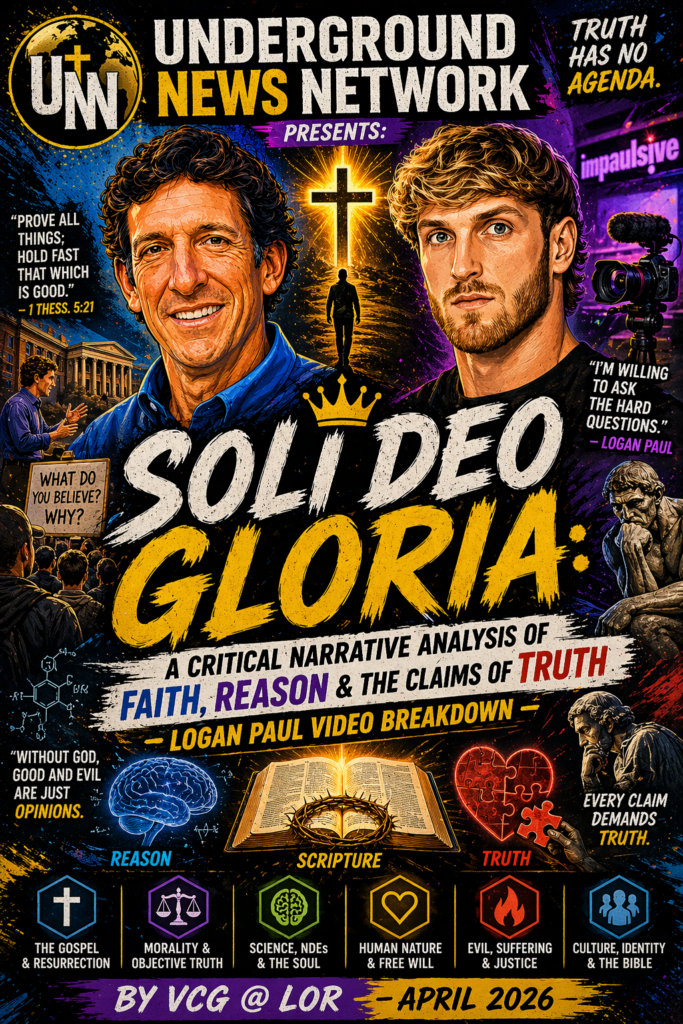
BY VCG LOR ON 4/24/2026
SOLI DEO GLORIA — FULL NARRATIVE BREAKDOWN
The conversation begins with a confident claim:
that heaven is attained because one chooses to live life with God.
Cliffe Knechtle — Full Breakdown, Deep Dive & Bio – Library of Rickandria
At first glance, this sounds reasonable—even appealing—because it places responsibility in the hands of the individual.
It resonates with modern instincts about autonomy and personal decision-making.
However, when measured against Scripture, the statement is incomplete.
The King James Bible teaches clearly in Ephesians 2:8–9 that salvation is:
“by grace… through faith… not of works.”
This means the foundation is not human choice alone, but divine grace initiating salvation.
The methodology here subtly shifts emphasis from God’s action to human decision, which psychologically empowers the listener but theologically risks distortion.
From there, the discussion moves quickly to the resurrection of Jesus Christ, particularly the claim that He appeared to over 500 witnesses.
This is rooted in 1 Corinthians 15:6, one of the earliest recorded Christian creeds.
Historically, scholars widely agree that this claim emerged very early, within decades of the crucifixion.
The key issue is not whether the claim exists, but how it is interpreted.
The speaker uses this as strong evidence of reliability, employing a method of appeal to eyewitness testimony and numerical weight.
Psychologically, numbers create credibility, even if the audience has not verified the underlying sources.
The real tension lies between two interpretations: either these witnesses truly encountered the risen Christ, or they believed they did.
That distinction is where belief systems diverge.
The conversation then shifts into moral and cultural territory, particularly around identity and behavior.
A challenge is raised: if someone is “hardwired” a certain way, how can they be judged for it?
This is a powerful modern argument rooted in identity-based reasoning.
It appeals to fairness and emotional justice. However, the response given distinguishes between the value of a person and the moral evaluation of actions.
This aligns more closely with biblical teaching, such as 1 Corinthians 6:9–11, which affirms both the reality of sin and the possibility of transformation.
The psychological method here is critical:
one side appeals to identity as fixed and defining, while the other reframes identity as separate from behavior and capable of change.
The discussion deepens into the problem of evil, particularly in light of tragedies like Sandy Hook.
Here, the speaker introduces the moral argument: that without God, the concept of evil loses objective meaning.
This is a classic philosophical position.
The strength of this argument lies in its ability to expose inconsistency—people speak of evil as if it is real and binding, not merely subjective.
However, the weakness is that alternative moral frameworks do exist, such as evolutionary ethics or social contract theory.
The method used here is a dilemma:
either accept God as the basis of morality or face the unsettling implication that morality is ultimately subjective.
Psychologically, this creates discomfort and forces the listener to confront their assumptions.
Next comes a reductionist argument:
that without God, humans are merely chemical reactions or biological machines.
While this aligns with strict materialism, it oversimplifies the opposing view.
Many secular thinkers argue for emergent properties like consciousness and self-awareness that cannot be reduced entirely to chemistry.
The rhetorical strategy here is to push the opposing worldview to its most extreme and unsettling conclusion, thereby making it less appealing.
It is effective psychologically because it threatens the listener’s sense of meaning and identity.
The conversation then moves into near-death experiences (NDEs), which are presented as potential evidence for life beyond the body.
This is where factual accuracy becomes especially important.
While NDEs are indeed documented and often share common features—such as out-of-body sensations, light, and peace—the claim that people reliably gather verifiable information (like reading medical charts while unconscious) is not strongly supported by consistent scientific evidence.
Additionally, the mention of a “Duke study” appears to be misattributed; the more credible research comes from figures like Bruce Greyson (University of Virginia) and Sam Parnia (AWARE studies).
The methodology here relies heavily on anecdotal evidence and the persuasive power of personal testimony.
Psychologically, stories are far more compelling than statistics, even when they are less reliable.
Closely tied to this is the claim that energy leaving the body might represent the soul, based on the principle that energy cannot be created or destroyed.
This is a clear category error.
The conservation of energy is a physical law and does not imply the persistence of personal identity or consciousness.
The argument attempts to bridge physics and metaphysics without sufficient justification.
It sounds scientific, which gives it persuasive weight, but it does not hold under scrutiny.
When the discussion turns to the soul, it becomes more theologically grounded.
The idea that the soul is the “real you” aligns with Scripture, such as Genesis 2:7 and Matthew 10:28.
Here, the argument shifts from speculative science to revealed theology.
The concept of the soul provides a foundation for personhood, moral responsibility, and free will. Philosophically, this aligns with dualism—the idea that mind and body are distinct.
The topic of free will is then explored through the lens of environment versus choice.
The example of an alcoholic parent producing different outcomes in children illustrates that influence does not equal determinism.
This is a balanced and reasonable position, supported both psychologically and biblically (Deuteronomy 30:19).
The method here reinforces personal responsibility while acknowledging external factors, which resonates with lived human experience.
Finally, everything converges on the central claim of Christianity:
the resurrection of Jesus Christ as proof of His authority and reliability.
This is the linchpin.
If the resurrection is true, then Christ’s claims carry ultimate weight.
If it is false, the entire structure collapses.
Historically, several points are widely discussed: the early proclamation of the resurrection, the transformation of the disciples, and the willingness of many to suffer for their belief.
However, alternative explanations exist, such as hallucinations, legend development, or symbolic interpretation.
The argument presented frames the resurrection as a decisive and rational conclusion, but in reality, it remains a matter of interpretation informed by one’s worldview.
Throughout the entire discussion, several psychological strategies are consistently at work.
Authority framing establishes the speaker as knowledgeable and trustworthy.
Existential pressure—focusing on death, suffering, and eternity—raises the stakes of the conversation.
Binary framing simplifies complex issues into either-or choices, which can clarify but also oversimplify.
Emotional anchoring uses powerful events like tragedies to ground abstract arguments in real human pain.
Testimony weighting elevates personal stories as evidence, even when they are not scientifically verifiable.
In the end, the conversation is not merely about facts; it is about interpretation, framing, and the deeper question of truth.
Scripture calls for discernment:
“Prove all things; hold fast that which is good” (1 Thessalonians 5:21)
That command cuts both ways.
It requires testing not only secular claims but also religious ones.
Truth is not established by emotion, authority, or repetition, but by alignment with reality—both revealed and observed.
The final tension remains unresolved by argument alone.
It comes down to the nature of reality itself:
whether there is a Creator who defines truth, morality, and destiny, or whether these are constructs emerging from a purely material universe.
Every claim in the discussion ultimately points back to that foundational divide.
Soli Deo Gloria: A Critical Narrative Analysis of Faith, Reason & the Claims of Truth