
WELCOME TO THE LIBRARY OF RICKANDRIA
UPDATED BY VCG ON 10/24/2026 @ 23:23 EST
Really tired of fake friends.
Odd comment left on my video.
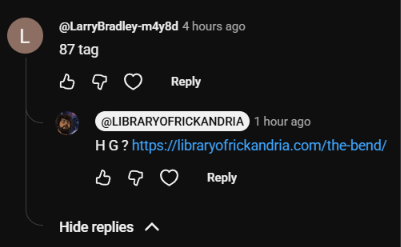
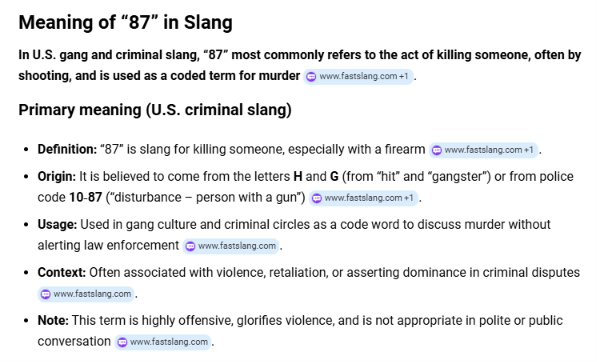
That’s cute.
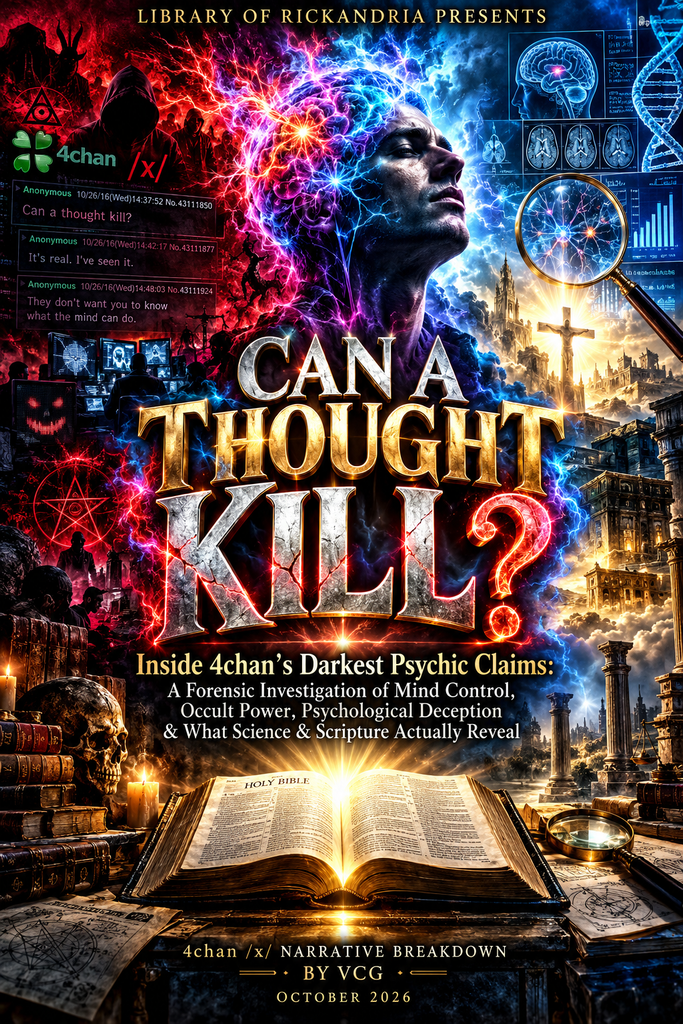
“Can a Thought Kill?”
is:
- an extensive
- forensic
- scientific
- psychological
- historical
and biblical investigation into a disturbing October 2026 discussion on 4chan’s paranormal board, /x/, where anonymous participants claimed that:
- human thoughts
- psychic abilities
- occult practices
could cause:
- illness
- misfortune
- even death
Through a detailed examination of all twenty posts, the Library of Rickandria separates documented facts from extraordinary allegations,
investigating claims involving:
- traumatic brain injuries
- neurological disorders
- supernatural entities
- spiritual frequencies
- alleged curses
- psychic attacks
Drawing upon historical cases of:
- fraudulent spirit photography
- government-sponsored parapsychology research
- neuroscience
- cognitive psychology
- statistical methodology
- the King James Bible
the paper explores how:
- coincidence
- confirmation bias
- memory distortion
- suggestion
- fear
can create compelling impressions of supernatural influence.
Particular attention is given to the thread’s final, unverified allegation of a psychic killing, examining the critical difference between predicting an event and causing it.
Scripture is carefully compared with Scripture to distinguish:
- biblical miracles
- spiritual gifts
- divination
- divine judgment
- occult practices
from modern speculation.
Rather than dismissing unusual experiences or accepting sensational claims without evidence,
this investigation applies:
- rigorous fact-checking
- historical context
- scientific reasoning
- biblical discernment
to one central question:
Can a thought truly kill, or does the real mystery lie in the extraordinary power of human belief, perception, and deception?
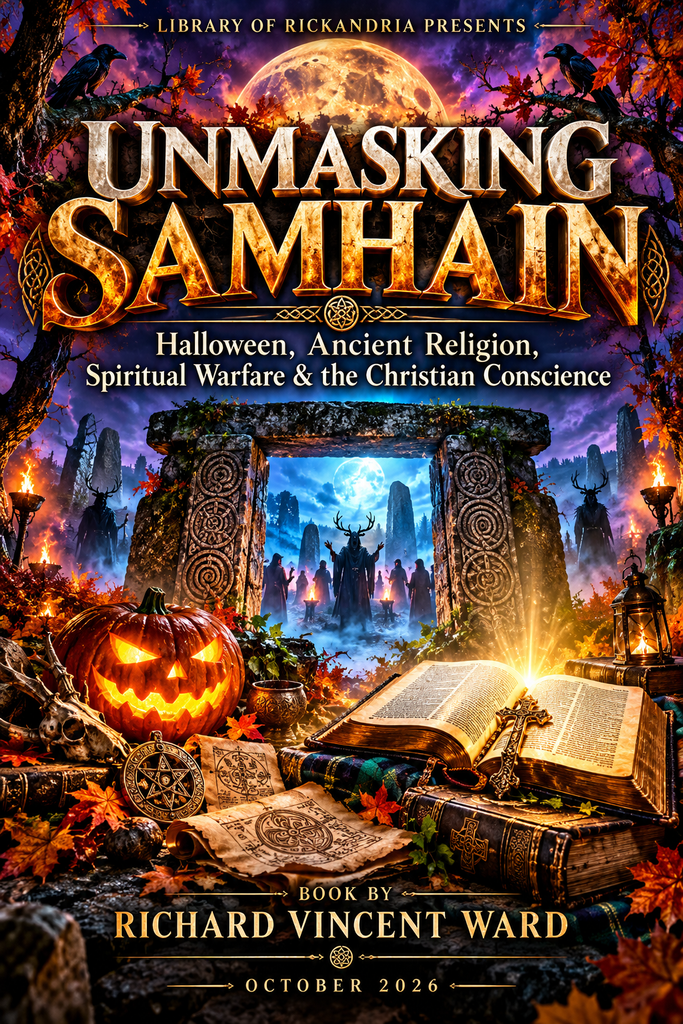
LIBRARY OF RICKANDRIA PRESENTS
UNMASKING SAMHAIN
Halloween, Ancient Religion, Spiritual Warfare & the Christian Conscience
A Historical, Psychological, Evidentiary & Biblical Investigation
BOOK BY RICHARD VINCENT WARD AKA VCG
OCTOBER 2026
Library of Rickandria
SOLI DEO GLORIA
To God Alone Be the Glory
DEDICATION
To those who love the truth enough to question what they have been taught, examine what they believe, and correct what they have misunderstood.
To the parents seeking wisdom in a world filled with competing voices.
To the pastors and teachers entrusted with the responsibility of handling Scripture faithfully.
To those who have been frightened by religious claims they could not independently verify, and to those who have been reassured by cultural explanations they have never carefully examined.
To the sincere seeker who refuses to confuse conviction with evidence, tradition with revelation, or speculation with the Word of God.
And above all, may this work serve the glory of the LORD, whose truth requires neither invention nor exaggeration.
“Prove all things; hold fast that which is good.”— 1 Thessalonians 5:21, KJV
AUTHOR’S PREFACE
Why This Book Had to Be Rewritten
A Commitment to Truth Above Everything Else
There comes a point in every serious investigation when the researcher must confront a question more difficult than the subject being studied:
Am I seeking the truth, or am I seeking evidence to defend what I already believe?
That question stands at the foundation of this book.
In October 2025, the Library of Rickandria published Unmasking Samhain: Exposing the Satanic Roots of Halloween. The original work confronted a subject that has troubled generations of Christians: the historical origins of Halloween, its relationship to ancient Celtic traditions, its associations with death and supernatural beings, and the biblical implications of participating in customs whose religious meanings have changed across centuries.
The first edition approached these matters with urgency. It warned against idolatry, sorcery, spiritual deception, and the possibility of cultural practices being accepted without examination.
Those concerns deserve serious attention.
Scripture does condemn genuine divination, necromancy, idolatry, and participation in forbidden religious practices. No responsible Christian examination of Halloween should dismiss those teachings merely because modern society regards the occasion primarily as entertainment.
Yet another responsibility is equally important.
A warning must be true.
A historical allegation must be supported.
A biblical passage must be understood in context.
A conclusion must not be stronger than the evidence upon which it rests.
The seriousness of a subject does not lessen these responsibilities. It increases them.
Upon renewed examination, the original manuscript presents claims that require more careful scrutiny than they originally received. Assertions about Druidic ceremonies, sacrificial fires, spiritual agreements created through costumes, Halloween candy subjected to curses, and the relationship between ordinary cultural participation and demonic influence must each be investigated independently.
Some assertions may contain elements of truth. Others may preserve genuine historical traditions while assigning them an unwarranted interpretation. Still others may not possess sufficient evidence to justify their inclusion as statements of fact.
Where the original work is supported, this edition will preserve and strengthen its conclusions.
Where it is incomplete, this edition will expand them.
Where it is mistaken, this edition will correct them.
And where the evidence remains uncertain, that uncertainty will be stated openly.
This is not a surrender of biblical conviction.
It is an insistence that biblical conviction must never become an excuse for careless scholarship.
The Difference Between a Warning and an Accusation
Consider the historical claim that ancient Druids conducted human sacrifices.
The Roman commander Julius Caesar, writing in the first century before Christ, described human sacrifice among the peoples of Gaul and attributed a religious role to the Druids. His account includes the construction of enormous figures of woven branches in which victims were reportedly burned.
That account exists. It is an ancient primary source, and it must be examined.
See Julius Caesar, The Gallic War, Book VI, Chapter 16.
But Caesar’s account does not establish that these sacrifices were performed specifically during Samhain. It does not document an annual October 31 ceremony. Nor does it prove that modern Halloween celebrations directly descend from the particular practices he describes.
To reach those conclusions, additional evidence is required.
We must consider the geographic difference between Caesar’s Gaul and medieval Ireland, the centuries separating the sources, the political circumstances of Roman descriptions, and the reliability of later traditions.
The principle is simple: evidence that establishes one fact must not be made to establish another fact without a defensible connection.
Now consider the word bonfire.
Historical etymology does support an earlier connection with fires in which bones were burned. The English word developed from forms meaning bone-fire.
See Online Etymology Dictionary, “Bonfire”.
Yet the linguistic history of an English word does not, by itself, establish that Druids burned human beings at Samhain or that modern Halloween bonfires commemorate such sacrifices.
An etymological connection is not automatically evidence of ritual continuity.
The distinction may appear small.
It is not.
It is the difference between recovering the past and reconstructing the past according to a predetermined narrative.
What If the Most Frightening Explanation Is Not the Most Accurate?
Human beings are naturally affected by stories of danger, secrecy, betrayal, and unseen threats.
An ordinary object can appear sinister when surrounded by sufficiently alarming explanations.
A carved pumpkin becomes more than a decoration if the reader is told that placing one outside a house constitutes a spiritual agreement.
A child’s costume becomes more than imaginative play if the reader is told that wearing it transfers the child’s identity to an evil spirit.
A piece of candy becomes more than food if the reader is told that accepting it permits a hidden curse to enter the household.
But the emotional force of these assertions is not evidence that they are true.
Before accepting them, we must ask:
Who originally made this claim?
What evidence did that person provide?
Are there independent witnesses?
Is there a primary document?
Is the practice historically attested?
Does Scripture actually describe such a mechanism?
These are not irreverent questions.
They are necessary questions.
If a particular religious group intentionally performs a ritual, that action can be investigated and described according to the evidence.
It does not follow that every person engaging in a superficially similar cultural activity is participating in that same ritual.
Likewise, the existence of genuine spiritual evil in biblical theology does not authorize an author to attribute every unsettling symbol, fictional character, or cultural custom to direct demonic activity.
That conclusion would require its own biblical and evidentiary justification.
This distinction will be maintained throughout the present work.
The Historical Record Is More Complicated Than the Popular Narrative
For generations, many books have described Samhain as the ancient Celtic New Year, the great feast of the dead, and the original religious foundation from which Halloween emerged.
Such descriptions are widespread, but widespread acceptance does not settle every historical question.
In 2024, historian Ronald Hutton published an important reassessment, The Celtic New Year and Feast of the Dead, in the peer-reviewed journal Folklore. Hutton examined the development of these familiar interpretations, including the influence of Sir John Rhys and James George Frazer, and reconsidered the evidence upon which the traditional reconstruction had been built.
See Ronald Hutton, The Celtic New Year and Feast of the Dead, Folklore 135, no. 1 (2024), pp. 69–86.
The existence of this scholarship does not mean that Samhain lacked religious significance.
Nor does it establish that there were no ancient traditions involving supernatural beings, seasonal transitions, or the dead.
Rather, it demonstrates that historians must distinguish what ancient and medieval records actually say from later attempts to assemble those records into one continuous narrative.
The modern holiday also passed through centuries of Christian observance, regional folklore, migration, social change, and commercial development.
The history of trick-or-treating, for example, cannot be understood adequately without examining European door-to-door customs, North American mischief traditions, twentieth-century community celebrations, and the commercial rise of individually packaged candy.
See Lesley Bannatyne, “When Halloween Was All Tricks and No Treats,” Smithsonian Magazine (2017).
We shall therefore resist the temptation to compress two thousand years of differing customs into one uninterrupted ceremonial system.
Historical continuity must be demonstrated, not merely asserted.
Scripture Must Be Examined, Not Merely Quoted
A second purpose of this revised edition is to distinguish the authority of Scripture from the authority of the person interpreting it.
These are not identical.
The King James Bible, in the Pure Cambridge Edition supplied for this investigation, will serve as our primary English biblical text.
Whenever Scripture is invoked, we shall examine the passage in its literary and historical context, compare relevant biblical passages, and consider the original language where doing so clarifies the argument.
For example, Deuteronomy 18 explicitly prohibits particular divinatory and occult practices among Israel.
That prohibition deserves close study.
But we must still determine whether a particular contemporary action corresponds to the activities named in that passage.
Similarly, 1 Corinthians 10 addresses idolatrous participation, conscience, and questions concerning food associated with idol sacrifices.
Rather than extracting one verse and applying it to everything resembling a pagan custom, we must examine Paul’s whole argument—including the distinction between actual participation in an idol’s religious table and food obtained in the marketplace.
Romans 14 introduces further questions concerning disputed practices, personal conscience, and judging fellow believers.
These passages require careful comparison.
A biblical command may be absolute regarding the practice it actually identifies. Yet identifying whether a modern activity belongs to that category may involve historical evidence, contextual judgment, and disputed theological interpretation.
Our conclusions should acknowledge those distinctions.
We must also be cautious with prophetic language and metaphor.
Not every biblical mention of darkness refers to Halloween.
Not every altar refers to a hidden modern ritual.
Not every command to separate from evil establishes that physical contact with a cultural symbol creates spiritual contamination.
A resemblance between two images is not sufficient proof of an intended biblical connection.
Scripture must illuminate our conclusions, not merely decorate them.
Understanding the Psychology of Fear
An investigation into Halloween would be incomplete without examining the human mind.
Why do frightening explanations become persuasive?
Why do certain stories spread rapidly through religious communities?
Why do people sometimes remember confirming details while overlooking contradictory evidence?
Why can a familiar holiday generate joy in one household, anxiety in another, and religious concern in a third?
Psychology offers useful tools for investigating these questions.
Confirmation bias can influence which sources we accept. Motivated reasoning can make us defend conclusions before examining their foundations. Fear-based persuasion can increase the apparent urgency of a warning while discouraging scrutiny of the evidence behind it.
Repeated claims can begin to feel familiar and credible even when their original source has been lost.
At the same time, the psychological study of fear must not be turned into another form of overstatement.
Explaining why people believe a claim does not establish that the claim is false.
Demonstrating that a frightening film can be enjoyed recreationally does not establish that every frightening image is beneficial.
Nor can psychological research determine whether the supernatural beings described in Scripture exist.
Psychology examines human experiences and behavior through empirical methods. Theology addresses additional questions about God, revelation, spiritual beings, and moral obligation.
The two disciplines may inform one another, but they should not be confused.
The objective is to understand both belief and evidence without reducing either to an ideological slogan.
Children Deserve Truth, Not Manufactured Terror
Few subjects deserve greater care than the welfare of children.
Parents have legitimate reasons to examine the messages contained in entertainment, the effects of frightening imagery, and the influence of social pressure and commercial culture.
Children differ in maturity, temperament, sensitivity, and their ability to distinguish fantasy from reality.
A practice enjoyable to one child may be distressing to another.
A parent may reasonably conclude that certain Halloween activities are inconsistent with the values being taught within the home.
Such decisions deserve respect.
Yet protecting children also means protecting them from unnecessary fear and unsupported claims.
A child should not be taught that an ordinary object carries a hidden spiritual threat unless there are sufficient grounds for that warning.
A parent should not be led to believe that a child’s imaginative participation has irreversibly compromised the household’s spiritual condition because an author has made an unverified declaration.
Responsible Christian instruction should encourage discernment, moral seriousness, confidence, honesty, and trust—not helpless anxiety over invisible dangers supposedly attached to every object.
We must distinguish legitimate moral teaching from psychological intimidation.
The next generation deserves something better than fear disguised as knowledge.
The Responsibility to Correct Our Own Work
The Library of Rickandria’s research into religious tradition and historical interpretation continued after the original Unmasking Samhain was published.
Its August 2026 investigation, Pagan Origins, Christian Adaptation & Internet Mythmaking, examined recurring problems in arguments over Christian holidays, including unsupported assumptions about pagan origins, cultural borrowing, and biblical prohibitions.
That later analysis provides an important principle for this new edition:
A possible historical influence is not the same thing as a demonstrated line of descent.
Neither does the absence of an explicit biblical command automatically prove that every later cultural observance is forbidden.
These propositions deserve the same degree of scrutiny whether they support or challenge our existing conclusions.
We shall also preserve an honest record of the original manuscript. Its eleven numbered chapters will be examined claim by claim, without silently discarding inconvenient statements or disguising substantial corrections as stylistic revisions.
Every significant historical assertion will be evaluated according to the surviving evidence.
Every biblical argument will be tested within its proper context.
Every psychological explanation will be distinguished from moral and theological judgment.
And where the evidence is inadequate, the responsible conclusion will be that the matter has not been established.
There is no dishonor in correcting an error.
There is dishonor in preserving one merely because it has already been published.
The wisdom literature of Scripture offers an especially appropriate reminder:
“He that is first in his own cause seemeth just; but his neighbour cometh and searcheth him.”— Proverbs 18:17, KJV
A compelling argument may appear unanswerable until it is subjected to independent examination.
This principle must apply to the present author no less than to those with whom this book disagrees.
What This Book Is—and What It Is Not
This book is not intended to persuade Christians that genuine occult practice is harmless.
Nor is it intended to establish that every criticism of Halloween is historically or biblically justified.
It is not a defense of religious indifference.
It is not an attempt to dismiss the supernatural claims of Scripture through psychology.
It is not an argument that all religions teach the same thing.
Neither is it a declaration that all Christians must reach identical conclusions about every cultural tradition.
Instead, this book is an investigation.
It will examine what can be known about Samhain, what can be reconstructed about ancient Celtic religious life, how Christian and European traditions contributed to the formation of Halloween, and how modern entertainment and commerce transformed the celebration.
It will distinguish actual spiritual practices from representations of those practices.
It will evaluate claims concerning sacrifice, witchcraft, necromancy, demonic influence, and alleged ritual activity without confusing belief, testimony, and independently established fact.
It will consider what modern psychology reveals about fear, imagination, symbolism, suggestibility, and the development of conscience.
And it will examine what Scripture actually requires of those who seek to honor God.
The reader will encounter competing interpretations. Some will be persuasive; others will prove weaker under examination. Certain historical matters will remain unresolved.
That is the nature of an honest investigation.
The purpose is not to eliminate every uncertainty through confident language.
It is to discover where certainty is justified.
An Invitation to the Reader
As we begin, I ask the reader to approach this subject with both courage and humility.
Do not accept an assertion merely because it is familiar.
Do not dismiss evidence merely because it challenges a treasured conclusion.
Do not assume that everything ancient was demonic, everything modern is harmless, or everything culturally popular is morally acceptable.
Study the documents.
Examine the dates.
Read the biblical passages in context.
Consider the strongest arguments on both sides.
And remember that an explanation may be emotionally powerful without being historically sound.
The pursuit of truth demands more than recognizing errors in the arguments of others.
It requires a willingness to discover them in our own.
If we find genuine wrongdoing, let us identify it accurately.
If we encounter actual occult practice, let us describe what is occurring rather than exaggerate its reach.
If we uncover an unfounded accusation, let us correct it.
If Scripture forbids a particular act, let us neither weaken the prohibition nor expand it beyond what the text justifies.
And if two sincere Christians disagree over a practice that Scripture does not directly identify, let us first determine whether the disagreement concerns a genuine biblical command, a reasonable application of principle, or a matter of conscience.
There is room for seriousness without sensationalism.
There is room for conviction without arrogance.
There is room for spiritual vigilance without superstition.
And there is room for revision without abandoning the pursuit of truth.
The revised Unmasking Samhain will not merely ask whether Halloween has a dark history.
It will ask a more demanding series of questions:
What happened?
How do we know?
What have later generations added to the story?
Which claims can withstand investigation?
What does the Word of God actually say?
And what conclusions may Christians responsibly draw?
Those questions will guide every chapter that follows.
Our aim is not to replace one unquestioned narrative with another.
It is to submit every narrative to examination.
May truth take precedence over familiarity, evidence over exaggeration, Scripture over speculation, and integrity over the desire to appear certain.
For the glory of God alone.
Richard Vincent Ward
Library of Rickandria
October 2026
SOLI DEO GLORIA
End of Author’s Preface
EDITORIAL NOTICE
What Has Changed Since 2025
A Statement of Historical Correction, Biblical Integrity & Research Accountability
“Prove all things; hold fast that which is good.”— 1 Thessalonians 5:21, KJV
Why This Notice Is Necessary
The present edition of Unmasking Samhain: Halloween, Ancient Religion, Spiritual Warfare & the Christian Conscience is not a cosmetic revision of the work originally published by the Library of Rickandria on October 29, 2025.
It is a fundamental reconstruction.
The original volume, Unmasking Samhain: Exposing the Satanic Roots of Halloween, contained a prologue, an introduction, eleven numbered chapters, and closing material. Its argument connected the ancient Celtic festival of Samhain with Druidic ritual, spirit communication, human sacrifice, modern Halloween customs, demonic influence, and the biblical obligation of separation from evil.
Much of that argument was presented as a continuous historical and spiritual explanation.
The revised edition subjects this explanation to a more demanding standard.
It asks whether the surviving historical evidence demonstrates the connections alleged, whether the psychological mechanisms described can actually be established, and whether the biblical passages cited support the specific conclusions drawn from them.
These questions matter because a book may contain legitimate moral warnings while simultaneously relying upon unsupported historical narratives.
A conclusion is not established merely because it sounds consistent with a broader theological conviction.
A biblical prohibition against necromancy does not establish that every Halloween activity constitutes necromancy.
Evidence that Druids participated in religious sacrifices does not establish the precise dates, purposes, and ceremonies of every alleged sacrificial observance.
Nor does the fact that some contemporary religious practitioners observe Samhain establish that all modern Halloween participants share their beliefs or intentions.
Each assertion requires evidence appropriate to the question being asked.
This edition therefore introduces explicit corrections, documented qualifications, and expanded research wherever the original text exceeded what its sources could establish.
The aim is not to protect the reputation of a previous argument.
It is to protect the integrity of the investigation.
I. The Historical Revisions
1. Samhain Must Be Reconstructed from Evidence, Not Popular Tradition
The original edition presented Samhain as an established ancient Druidic religious system centered upon a spiritual gateway between the living and the dead.
The festival’s association with the seasonal transition into winter is historically significant, and later Gaelic folklore certainly includes supernatural traditions associated with this period.
But the available evidence is insufficient to reconstruct all supposed prehistoric ceremonies with the confidence often found in popular accounts.
An especially important reassessment appeared in 2024.
In The Celtic New Year and Feast of the Dead, published in Folklore, historian Ronald Hutton examined the familiar proposition that Samhain was both the ancient Celtic New Year and the principal annual commemoration of the dead.
His analysis concluded that the proposed New Year interpretation rests upon indirect and inconclusive evidence, while the evidence for a prehistoric great feast of the dead is extremely weak.
This finding does not conclusively disprove either interpretation.
It means that neither should be stated as an established fact about the pre-Roman Celtic world.
Editorial correction: The revised edition will distinguish the historically attested seasonal festival, medieval Irish traditions, later folklore, modern Pagan reconstructions, and speculative claims about prehistoric religious ceremonies.
Each will be examined within its own period.
2. Druidic Human Sacrifice Is Not Proof of Samhain Human Sacrifice
The original book connected human sacrifice, Druidic religious ceremonies, and Samhain as elements of one continuous ritual system.
There is a genuine ancient source behind part of this narrative.
Julius Caesar, The Gallic War, Book VI, Chapter 16, describes human sacrifice among the Gauls, including large wicker structures filled with victims and set on fire.
This testimony cannot responsibly be ignored.
Nevertheless, the account does not identify Samhain as the occasion of those sacrifices.
It also concerns communities in ancient Gaul, not a surviving eyewitness description of a particular Irish Samhain ceremony.
The distinction matters.
A historical practice documented in one setting cannot simply be transferred into another setting because both have been associated with Celtic religion.
The revised investigation will therefore separate three questions:
whether human sacrifice occurred among particular ancient Celtic populations; whether available sources identify such sacrifice with Samhain; and whether any demonstrated tradition connects those rites with present-day Halloween celebrations.
Editorial correction:
Caesar’s testimony will be retained and examined critically. The alleged Samhain-specific connection will not be presented as established without additional evidence.
3. The History of Bonfires Must Not Become a Fabricated Ritual History
The original manuscript associated Samhain bonfires with sacrificial bones and sometimes with human victims.
The linguistic argument contains one legitimate fact.
The word bonfire is historically connected with the burning of bones.
The Online Etymology Dictionary’s entry on bonfire traces the English term to late-fourteenth-century forms referring to a fire in which bones were burned.
Yet the existence of that etymology does not establish who burned the bones, why they were burned, whether they were human or animal, or whether the practice originated in a particular Celtic festival.
The date of the surviving English word must also be distinguished from the much earlier historical setting being reconstructed.
An etymology is evidence about language.
It is not independently a record of an ancient ceremony.
Editorial correction: The legitimate bone-fire etymology will be preserved. Assertions about Druidic sacrificial rituals will require separate historical documentation.
4. Christianization Must Be Investigated Without Assuming a Single Explanation
The 2025 edition asserted that Christian observances surrounding All Saints’ Day represented a deliberate transformation of Samhain into a superficially Christian celebration.
The relationship between ancient customs and medieval Christianity is a legitimate historical subject.
There is evidence of cultural adaptation in the history of Christian missionary activity, and later Halloween traditions contain recognizable Christian as well as pre-Christian elements.
Yet a general pattern of adaptation does not prove the exact origin of every festival date, symbol, or practice.
Nor does the existence of All Saints’ Day establish that its institution occurred for one singular purpose throughout the entire Christian world.
The chronology of commemorations, regional variations, documentary evidence for papal decisions, and subsequent development of All Souls’ observances must be investigated independently.
The Library of Congress guide to Halloween and Día de Muertos presents an influential account of Christian substitution and religious blending. That account is useful as an overview, but must be compared with more specialized historical studies, including Hutton’s examination of claims about Samhain.
Editorial correction: Christianization will be treated as a historical process requiring chronological evidence, rather than as proof of deliberate demonic continuity.
II. The Corrections Concerning Symbols and Ritual Participation
5. Wearing a Costume Does Not Automatically Establish a Spiritual Covenant
The original edition described costuming as a form of spiritual identity exchange. It associated ordinary disguise with ritual imitation and suggested that imitation itself could create access for demonic forces.
These claims require a distinction between representation and participation.
A person may impersonate a character during a dramatic performance without professing that character’s beliefs.
A child may portray a fictional monster without attempting to invoke a supernatural being.
A costume may possess a documented religious function in one setting and a theatrical or recreational function in another.
Those contexts cannot be assumed identical.
None of this means that costume choices are beyond ethical evaluation.
Parents and Christians may reasonably question the messages, themes, and practices associated with particular forms of entertainment.
But a prohibition against genuine occult practice is not proof that an ordinary costume automatically constitutes occult participation.
Editorial correction: The revised edition will investigate historical disguise traditions, ritual intention, the psychology of imaginative role-play, and relevant biblical principles without presenting automatic spiritual contracts as established fact.
6. Halloween Candy Must Not Be Described as a Proven Vehicle of Demonic Transfer
Chapter 6 of the original manuscript alleged that some witches and Satanists ritually dedicate Halloween candy before distributing it, thereby transmitting harmful spiritual influence to recipients.
Such a statement contains several distinct propositions.
One concerns whether particular individuals have ever performed a ritual involving distributed food.
Another concerns whether such actions are common or organized.
A third concerns the proposed supernatural mechanism by which an unsuspecting recipient is allegedly harmed.
Each proposition requires different evidence.
Testimony from an individual practitioner, even where authenticated, does not establish how widespread a behavior is.
Neither does the existence of a purported ritual demonstrate its alleged supernatural consequences.
Furthermore, the Christian Scriptures contain an important discussion of food, idolatry, and conscience in 1 Corinthians 8–10.
In 1 Corinthians 10:14–33, Paul prohibits participation in idolatrous religious fellowship while also addressing ordinary market purchases, private meals, and situations in which the food’s sacrificial association becomes known.
This contextual distinction cannot responsibly be omitted.
Editorial correction: Ritual-dedication allegations will be classified as unverified unless supported by identifiable, independently assessable evidence. Claims of automatic spiritual transmission will not be stated as established biblical doctrine.
7. Trick-or-Treating Requires Its Own Historical Investigation
The original book described modern trick-or-treating as a continuation of an ancient appeasement transaction involving spirits.
Historical customs involving food, disguise, seasonal visits, and religious observances certainly existed in different societies.
But their relationship to modern North American trick-or-treating is neither identical nor reducible to one uninterrupted ancient ritual.
Documented antecedents include souling, Scottish and Irish guising, seasonal performances, neighborhood mischief, and modern community celebrations.
The familiar American practice was shaped particularly by developments in the twentieth century.
Smithsonian Magazine’s historical examination, When Halloween Was All Tricks and No Treats, describes how communities encouraged the exchange of treats as one response to disruptive seasonal pranking.
The widespread practice familiar today therefore reflects several historical streams, including social and commercial changes that occurred long after the ancient Celtic period.
Editorial correction: The origins of modern trick-or-treating will be presented as a question of documented cultural development. Any claim of direct, unchanged ritual descent must be demonstrated rather than presumed.
III. The Corrections Concerning Spiritual Warfare and Biblical Interpretation
8. Spiritual Warfare Must Not Be Reduced to Unverified Rules of Ritual Access
The 2025 manuscript repeatedly associated Halloween symbols, decorations, and ordinary participation with spiritual openings, territorial claims, or supposed legal access for demonic beings.
These explanations are theological assertions.
They cannot be established through historical resemblance alone.
The New Testament does address Satan, temptation, idolatry, demonic activity, and resistance to evil.
Ephesians 6:10–18 speaks of the believer’s spiritual struggle and the whole armour of God.
But it does not provide an inventory declaring that pumpkins, costumes, candy, or calendar dates automatically grant legal rights to spirits.
Additional interpretation would be necessary to reach those conclusions.
The revised edition will therefore distinguish biblical teaching from speculative systems of spiritual jurisdiction.
It will also distinguish religious practices intentionally designed to invoke spiritual beings from ordinary cultural activities that do not share that purpose.
Editorial correction: Claims concerning demonic legal access, spiritual contracts, and automatic ritual consequences will be identified as interpretations requiring explicit biblical argument, not as universally established spiritual laws.
9. Romans 11:16 Must Be Restored to Its Actual Context
One significant example of biblical misapplication occurs in the original discussion of church harvest festivals.
Romans 11:16 was invoked to support the assertion that the nature of a cultural celebration is permanently determined by its religious origin.
But Romans 11:16–24 concerns Paul’s olive-tree metaphor involving Israel, Gentile believers, faith, unbelief, and participation in the covenantal blessings being discussed.
The passage does not establish a universal law that every custom remains spiritually contaminated by every aspect of its historical ancestry.
An interpreter may propose a broader analogy, but that analogy must be identified as such.
It cannot be presented as Paul’s direct teaching about Halloween.
Editorial correction: Romans 11 will be interpreted within its actual argument. Claims about the moral status of inherited cultural practices must be supported by other relevant reasoning rather than imposed upon this passage.
10. Genuine Biblical Prohibitions Must Be Distinguished from Disputed Cultural Applications
The revised edition does not withdraw the biblical prohibitions against idolatry, necromancy, sorcery, and divination.
Those passages remain central.
But the application of a prohibition requires correctly identifying the conduct involved.
Deuteronomy 18:9–14 concerns identifiable forbidden practices.
Ephesians 5:11 concerns fellowship with works characterized as darkness.
First Corinthians 10 condemns participation in idolatrous religious fellowship while also discussing food and conscience in ways that resist simplistic conclusions.
Romans 14 addresses disputes among believers about particular observances and practices.
First Thessalonians 5:19–22 combines the command to examine matters carefully with the instruction to abstain from evil.
These passages cannot be understood responsibly by extracting isolated phrases and using them as universal labels for customs not directly named in the text.
Editorial correction: Every passage will be examined in context, with clear distinctions among commandment, principle, analogy, disputed application, and personal conscientious judgment.
IV. The Corrections Concerning Children, Fear and Criminal Allegations
11. Claims of Organized Ritual Abuse Require More Than Anonymous Testimony
The original work alleged ongoing secret sacrifices, ritualized abuse, and other criminal activities associated with Halloween.
Allegations of violence and child abuse must be taken seriously.
But seriousness does not eliminate the need for corroboration.
A historically important investigation is Kenneth V. Lanning’s 1992 Investigator’s Guide to Allegations of “Ritual” Child Abuse, catalogued by the United States Department of Justice.
Lanning’s analysis challenged assumptions about widespread organized satanic abuse and emphasized examining evidence and alternative explanations.
This does not establish that crimes involving religious or occult motivations never occur.
It does mean that broad allegations about systematic sacrificial networks cannot responsibly be accepted without independent documentation.
The revised edition will therefore distinguish actual documented crimes, unresolved allegations, witness testimony, rumor, and claims lacking corroboration.
It will avoid converting allegations about specific conduct into generalized accusations against religious minorities.
Editorial correction: Criminal allegations will receive especially stringent sourcing requirements. Absent corroboration, they will remain allegations rather than established historical facts.
12. Children’s Entertainment Must Not Automatically Be Classified as Deliberate Spiritual Recruitment
The original book characterized ordinary Halloween participation by children as a process of spiritual initiation and recruitment.
Such language implies a causal mechanism and, potentially, intentional action by agents whose involvement must be demonstrated.
Questions about children’s exposure to frightening content, social pressures, symbolic imagery, and moral development deserve serious research.
But they must not be answered by asserting a universal causal relationship without adequate evidence.
Psychological research distinguishes between imaginative play, fear responses, social learning, beliefs, and harmful experiences.
Children also vary greatly in emotional sensitivity and developmental maturity.
The impact of an activity should therefore be investigated according to its actual content, circumstances, and outcomes.
Editorial correction: Claims about children’s psychological development will be evaluated through appropriate research. Theological concerns about discipleship will be discussed separately from empirically demonstrable psychological effects.
V. Why the Psychology of Persuasion Has Been Added
This edition introduces a field of investigation that was insufficiently developed in the earlier work: the psychology of how people come to believe extraordinary claims.
A relevant example is the illusory truth effect, in which repeated information can come to be perceived as more credible simply because it has become familiar.
In a 2024 review, Jessica Udry and Sarah J. Barber examined how repetition influences belief in misinformation.
See The Illusory Truth Effect: A Review of How Repetition Increases Belief in Misinformation.
The significance for this book is methodological.
When the same story appears in numerous books, articles, sermons, and videos, it may seem independently corroborated.
But if those accounts all descend from one unverified source, the apparent agreement does not establish the story’s truth.
The revised edition will examine confirmation bias, motivated reasoning, fear appeals, authority claims, source dependence, and moral panic.
These methods will apply equally to arguments for and against Halloween.
A secular explanation can be exaggerated.
A Christian warning can be exaggerated.
A skeptical dismissal can overlook evidence.
A religious testimony can be sincere but mistaken in its interpretation.
No conclusion is exempt from investigation merely because it comes from a preferred community.
VI. Correcting the Treatment of Other Religious Traditions
The earlier manuscript sometimes treated ancient Celtic religion, medieval folklore, contemporary Wicca, Satanism, and other religious traditions as though they represented a single continuing spiritual system.
The revised edition will not make that assumption.
The history of modern Paganism includes religious reconstruction, new religious movements, reinterpretations of folklore, and substantial differences among practitioners.
Modern Wicca, for example, developed as a recognizable religious movement in the twentieth century. This historical development is discussed in Ethan Doyle White’s Modern Paganism, Oxford Research Encyclopedia of Religion (2026).
Religious differences must be represented accurately even where Christian theology fundamentally disagrees with the beliefs involved.
Criticism of a religious practice does not require mischaracterizing its participants.
Nor should similar customs in geographically distant societies automatically be assigned a common religious origin.
The revised work will examine such comparisons individually.
VII. The Complete Correction Register
Every major proposition from the original manuscript will receive a documented research disposition.
The terms will be used consistently:
| Finding | Meaning |
|---|---|
| Verified | Directly supported by credible evidence appropriate to the claim |
| Partly supported | Contains a demonstrable element but exceeds its evidence |
| Disputed | Meaningful scholarly disagreement or conflicting evidence remains |
| Unsupported | Sufficient evidence has not been established |
| Contradicted | Strong evidence supports a materially different conclusion |
| Misapplied Scripture | A biblical passage has been used beyond its contextual meaning |
| Theological interpretation | A religious conclusion that must be identified separately from historical fact |
| Indeterminate | Available evidence does not permit a responsible conclusion |
These categories are not merely editorial labels.
They are safeguards against silently converting suspicion into certainty.
The initial review has already identified the following changes:
| Subject | Preliminary editorial disposition |
|---|---|
| Samhain as an established prehistoric feast of the dead | Disputed; substantial revision required |
| Caesar’s testimony regarding Gallic human sacrifice | Genuine ancient testimony; Samhain-specific claims unsupported |
| Bonfire’s connection with burning bones | Verified etymology; ritual extrapolation unsupported |
| Direct, unchanged descent from Samhain to modern Halloween | Overstated; multiple historical developments must be separated |
| Costumes producing automatic spiritual contracts | Unsupported as a universal claim |
| Candy transmitting a curse through ordinary acceptance | Unsupported as an established mechanism |
| Modern Wicca as a direct survival of ancient Druidic religion | Historically inaccurate as a simple continuity claim |
| All Halloween participants engaging in necromancy | Unsupported generalization |
| Romans 11:16 as a universal rule concerning pagan cultural origins | Misapplied Scripture |
| Universal spiritual contamination of harvest festivals | Theological assertion requiring separate justification |
| Widespread organized Halloween ritual sacrifice | Not established by the cited evidence |
| All child participation constituting spiritual initiation | Unsupported generalization |
These findings are preliminary, not substitutes for the full chapter-by-chapter investigation.
Where additional evidence is identified, the register must remain open to revision.
VIII. The Library of Rickandria Research Record
The revised edition will incorporate earlier Library publications as research material, but will not regard any Library publication as automatically authoritative merely because it appeared under the same imprint.
A notable point of comparison is Pagan Origins, Christian Adaptation & Internet Mythmaking: A Historical, Biblical & Psychological Analysis of a 4chan Debate on Christian Holidays, published August 13, 2026.
That investigation recognized the methodological danger of treating superficial resemblance or possible cultural influence as proof of direct historical descent.
This concern will be applied consistently throughout the present book.
The earlier Unmasking Samhain relied upon works by authors including Ken Johnson, Howard Ratcliffe, Douglas Hamp, and Peter Goodgame.
Those works will not be discarded without examination.
Neither will their interpretations be treated as equivalent to primary historical evidence simply because they present confident or elaborate narratives.
Their significant claims must be traced to independently identifiable sources.
Where they accurately reproduce primary documents, those documents will be examined.
Where they offer theological interpretation, that status will be disclosed.
Where they advance speculative reconstruction, the limits of the argument will be explained.
Where they lack adequate support, the revised edition will state that limitation clearly.
This is the appropriate standard for research regardless of a source’s religious affiliation.
IX. What Remains Unchanged
The changes described here do not require treating serious moral questions as unimportant.
The revised edition will continue to examine the biblical prohibitions against idolatry and forbidden spiritual practices.
It will continue to consider the responsibilities of parents, the teaching obligations of churches, the influence of culture, and the moral significance of entertainment.
It will continue to investigate the historical connections between religious traditions and modern observances.
And it will take seriously the fact that contemporary groups may intentionally use symbols, dates, and rituals for religious purposes.
But it will no longer assume that such meanings automatically attach themselves to every other use of the same objects or calendar dates.
It will no longer use historical assertions without establishing their provenance.
It will no longer treat dramatic spiritual explanations as substitutes for evidence.
Most importantly, it will not use Scripture as though individual verses can be detached from their setting and made to establish propositions never addressed by their authors.
A conviction may be deeply held without being demonstrably correct.
A popular story may be emotionally effective without being historically established.
A religious warning may be well intended without being biblically justified in its particular application.
Truthfulness requires acknowledging these possibilities.
X. A New Standard of Accountability
The complete revised edition will preserve a distinction among four questions:
What does the evidence establish?
This includes historical records, archaeological findings, reliable linguistic research, documented social practices, and empirical psychological studies.
What does Scripture state?
This requires examination of the biblical text, relevant language, literary context, cross-references, and appropriate theological interpretation.
What remains uncertain?
This includes unresolved historical questions, disputed reconstructions, unverified allegations, and hypotheses that have not been independently demonstrated.
What moral conclusions may reasonably follow?
These require careful reasoning rather than the automatic transfer of judgment from one context to another.
Throughout the book, factual claims will be accompanied by direct references to outside sources whenever practicable.
The reader will be able to examine ancient documents, historical scholarship, scientific research, relevant Library of Rickandria studies, and the biblical passages under discussion.
Source links will be given without affiliate or UTM tracking parameters.
The full line-by-line record will be preserved in Appendix A, so that the corrections made to the first edition may be examined rather than merely accepted on trust.
A Closing Statement to the Reader
The greatest danger in a work of investigation is not always the failure to recognize an external deception.
Sometimes it is the refusal to discover that an argument of our own has been built upon insufficient evidence.
The first task of a researcher is not to sound an alarm.
It is to determine whether the alarm is justified.
The Christian Scriptures themselves provide a model of careful examination.
“He that answereth a matter before he heareth it, it is folly and shame unto him.”— Proverbs 18:13, KJV
This principle demands more than a sincere intention.
It demands patience.
It demands inquiry.
It demands the willingness to hear contradictory evidence.
And it demands the humility to correct what cannot withstand scrutiny.
The purpose of the 2026 edition is therefore not to replace serious religious concern with indifference, nor to exchange biblical teaching for fashionable cultural opinion.
Its purpose is to conduct the investigation properly.
Where evil can be documented, it should be identified.
Where the Bible condemns a practice, the relevant teaching should be stated faithfully.
Where a historical tradition has been misunderstood, the misunderstanding should be corrected.
Where psychology provides a useful explanation, its findings should be presented without exceeding what the research demonstrates.
Where evidence is missing, the absence must be acknowledged.
And where the reader must exercise conscience and judgment, an author should not disguise a personal inference as a direct command from God.
No book is strengthened by preserving an error.
No argument becomes more biblical by becoming less truthful.
And no serious pursuit of holiness is advanced by confusing suspicion with knowledge.
This is the commitment upon which the new Unmasking Samhain is founded.
We shall examine the history.
We shall test the claims.
We shall compare Scripture with Scripture.
And we shall follow the evidence wherever it leads.
For truth needs no invented history, and conviction requires no manufactured certainty.
Soli Deo Gloria.
Richard Vincent Ward
Library of Rickandria
October 2026
End of Editorial Notice — What Has Changed Since 2025
PROLOGUE
THE NIGHT BENEATH THE NARRATIVE
Before the Masks, Beyond the Myths, Beneath the Claims
“Prove all things; hold fast that which is good.”— 1 Thessalonians 5:21, King James Bible
I. The Night of October Thirty-First
October comes quietly at first.
The days grow shorter. The trees exchange their summer green for crimson, amber, and gold. Cold air moves through the streets, and the long shadows of evening begin to fall before the workday has ended.
Then, almost without announcement, an ordinary neighborhood changes.
Pumpkins appear upon front porches.
Paper skeletons hang from windows.
Artificial cobwebs stretch across doorways. Plastic gravestones emerge from carefully maintained lawns. Witches, ghosts, bats, black cats, and grinning skulls become decorations in shop windows and family homes.
As October 31 approaches, the transformation accelerates.
Store shelves fill with masks and costumes. Supermarkets construct towering displays of confectionery. Television networks advertise horror films. Haunted attractions promise carefully manufactured terror.
On Halloween night itself, children move through neighborhoods dressed as superheroes, monsters, princesses, fictional villains, and creatures of the imagination. Parents accompany them beneath porch lights. Neighbors exchange greetings. Laughter passes between houses.
For millions of participants, the occasion is a familiar mixture of entertainment, childhood excitement, community interaction, and seasonal tradition.
Yet for others, the very same night represents something profoundly different.
Some Christians regard Halloween as a celebration incompatible with biblical holiness.
Some contemporary Pagans observe Samhain as a religious occasion associated with the changing seasons, remembrance, and spiritual practice.
Some families decline every form of participation.
Others attend church-sponsored autumn celebrations while avoiding occult imagery.
Still others regard the entire controversy as a dispute about an ordinary cultural holiday whose religious ancestry has become largely irrelevant to modern participants.
How can a single calendar date carry such different meanings?
Why does one person see a harmless costume while another sees a spiritual danger?
Why does one family associate a carved pumpkin with childhood memories while another understands it as a surviving symbol of ancient religion?
And how much of what either person believes is supported by the historical record?
These questions cannot be answered simply by examining the decorations.
Nor can they be resolved by accepting whichever explanation provokes the strongest emotional reaction.
To understand the night, we must examine the stories that have gathered around it.
Some are ancient.
Some are medieval.
Some emerged only a few generations ago.
Some rest upon identifiable documents.
Others survive primarily because they have been repeated so frequently that their origins are forgotten.
Behind the familiar imagery lies a complicated history—not one story, but many overlapping stories.
And before we pronounce judgment upon that history, we must discover which parts can actually be demonstrated.
II. A Doorway into the Ancient World
Imagine leaving the brightly illuminated modern street behind.
The sound of traffic recedes.
The decorations disappear.
The landscape changes into the hills, forests, and settlements of an earlier Ireland.
There are no suburban lawns, no electric decorations, no packaged sweets, and no modern Halloween costumes.
The autumn harvest has ended or is drawing toward its conclusion. Winter approaches. Livestock, food supplies, seasonal obligations, and community gatherings matter enormously to the people who inhabit this landscape.
In the early Irish calendar, a seasonal turning point is known as Samhain.
The name itself belongs to a real historical tradition.
It is not an invention of modern occult literature.
But recognizing the existence of a historical festival is only the beginning of understanding it.
The medieval Irish textual tradition contains references to assemblies, feasting, important events, and extraordinary happenings associated with Samhain.
For example, the medieval Irish tale Serglige Con Culainn (The Wasting Sickness of Cú Chulainn), preserved in the manuscript collection known as Lebor na hUidre, describes an annual Ulster assembly extending across the days surrounding Samhain.
The text associates this gathering with recreation and feasting, while the wider narrative contains elements of heroic literature and the supernatural.
The relevant material can be examined through University College Cork’s Corpus of Electronic Texts, Lebor na hUidre.
Such evidence establishes that Samhain possessed significance within medieval Irish literary culture.
It does not, by itself, establish exactly what every community celebrated in prehistoric times.
That distinction is essential.
Medieval manuscripts may preserve older traditions. They may also reshape those traditions through the literary, political, and religious circumstances of the periods in which they were written or copied.
An account of a hero encountering an otherworldly being is evidence for the existence of a story.
It is not automatically evidence that an identical supernatural encounter took place in the historical world.
A seasonal assembly is evidence for the significance of the season.
It is not automatically evidence for human sacrifice, necromancy, or a prescribed universal system of spirit worship.
Yet popular discussions often collapse these different categories into a single account.
The result is a vision of ancient Samhain in which every fire becomes an altar, every gathering becomes an invocation, and every supernatural tale becomes a documentary record of religious practice.
But ancient history does not yield its secrets so easily.
The surviving evidence must be approached with both imagination and restraint.
We may reconstruct probable settings.
We may compare accounts.
We may investigate customs, beliefs, and changing traditions.
But we must not confuse the vividness of an imagined scene with the certainty of a documented event.
III. The Roman Witness
Now the investigation moves across the ancient world.
We leave medieval Irish manuscripts and enter the Roman Republic.
During the first century before Christ, Julius Caesar conducted military campaigns in Gaul and composed the work commonly known as The Gallic War.
In Book VI, Caesar described aspects of Gallic society, including the religious and educational roles attributed to the Druids.
He also made a disturbing allegation.
According to Caesar, certain Gallic religious practices involved human sacrifice. He described enormous woven structures containing living victims, which were then burned.
His account survives in The Gallic War, Book VI, Chapter 16, where the Latin text and explanatory annotations may be examined directly.
This testimony raises serious historical questions.
Were the practices accurately described?
Were they widespread or exceptional?
How much did Roman political interests shape the presentation of peoples whom Rome was conquering?
What archaeological evidence bears upon the account?
And what, if anything, does Caesar’s description reveal about Samhain?
Here the investigation encounters a crucial limitation.
Caesar did not identify the wicker-figure sacrifices as Samhain ceremonies.
His discussion concerned religious practices among the Gauls and contained no statement establishing an annual October 31 rite.
He did not describe modern Halloween.
He did not establish a continuous ceremonial lineage extending from the Iron Age into contemporary neighborhoods.
Those additional connections must be demonstrated separately.
This is where historical investigation becomes especially demanding.
A disturbing primary source may support one allegation without supporting every later claim built upon it.
The existence of ancient sacrifice is not sufficient to establish the precise origin of every modern symbol involving fire.
The description of a Druidic religious role does not establish that every custom now associated with Halloween originated with Druids.
The survival of supernatural folklore does not prove that contemporary children unknowingly perform ancient invocations.
Each proposed connection requires its own historical evidence.
And when the evidence is missing, the responsible investigator must say so.
Not because the subject is unimportant.
Because it is too important to mishandle.
IV. The Story Everyone Thinks They Know
For generations, a familiar explanation of Halloween has circulated through books, lectures, sermons, documentaries, encyclopedias, and websites.
According to this account, ancient Celtic peoples celebrated their New Year at Samhain.
The festival allegedly marked the moment when the boundary separating the living from the dead became unusually thin.
Spirits returned.
Fires were lit.
Sacrifices were performed.
People disguised themselves to escape supernatural attention.
Christian missionaries later transformed the occasion into All Saints’ Day and All Hallows’ Eve, preserving pagan customs beneath a Christian name.
Modern Halloween supposedly represents the latest stage of the same ceremonial tradition.
This narrative possesses extraordinary appeal.
It is dramatic.
It is coherent.
It explains many recognizable symbols.
And it offers a continuous account stretching from the ancient world to the present.
But coherence is not the same thing as historical demonstration.
The full narrative must be assembled from sources separated by different periods, geographic settings, languages, and cultural contexts.
Some details are ancient. Others appear in medieval literature. Still others emerge much later in folklore, antiquarian scholarship, or modern entertainment.
In 2024, historian Ronald Hutton addressed the long-standing claims concerning Samhain in his study The Celtic New Year and Feast of the Dead, published in the scholarly journal Folklore.
Hutton traced the influence of earlier scholars, particularly Sir John Rhys and James George Frazer, upon the popular reconstruction of Samhain as the Celtic New Year and great annual feast of the dead.
His reassessment found that the evidence for an ancient New Year celebration was indirect and inconclusive, while evidence for the proposed prehistoric feast of the dead was exceptionally weak.
Neither hypothesis was declared conclusively impossible.
But neither could responsibly be treated as an established fact about the pre-Roman Celtic world.
This is an important moment in our investigation.
For a considerable period, explanations that appeared in serious historical writing were repeated in popular summaries and eventually became familiar facts in religious arguments.
Once accepted, they could be incorporated into further theories.
Ancient customs were joined to modern symbols.
Modern symbols were assigned religious meanings.
Those meanings were then applied to contemporary participants.
And the resulting conclusions were sometimes presented as though every historical and theological connection had already been proved.
But the strength of a conclusion depends upon the strength of the evidence connecting its premises.
If the connection is uncertain, the conclusion cannot honestly be presented as certain.
That does not mean Samhain had no religious significance.
It means that the existence of religious significance is not permission to invent or assume undocumented details.
Historical uncertainty is not an enemy of truth.
It is one of the conditions under which responsible historical investigation operates.
V. The Christian Calendar and the Making of Halloween
The story does not end in the Celtic world.
Christian communities developed commemorations honoring martyrs and saints. Over time, November 1 became widely associated with All Saints’ Day in Western Christianity, while November 2 became associated with All Souls’ Day.
The evening preceding All Saints’ Day acquired the name All Hallows’ Eve, from which the English name Halloween developed.
These Christian observances became connected with regional European traditions involving the dead, hospitality, seasonal customs, costumes, and communal celebration.
But once again, the details matter.
A religious commemoration may develop differently across regions.
A seasonal custom may acquire new significance.
A community may preserve a practice after its original religious explanation has changed or disappeared.
A custom may also be revived, deliberately reconstructed, or given an entirely new meaning.
The cultural history of Halloween therefore cannot be reduced to a single act in which one religion simply changed the name of another religion’s festival.
The Library of Congress guide to Halloween and Día de Muertos describes the commonly accepted account of Christian and pre-Christian traditions blending over time.
Its overview is useful, but the precise details of substitution, continuity, and cultural transmission still require independent historical examination.
Centuries later, European customs crossed the Atlantic.
In North America, Halloween underwent further changes through immigration, community celebrations, seasonal pranks, children’s entertainment, and commercial development.
By the beginning of the twentieth century, American newspapers were describing an array of Halloween activities, including lanterns, mischief, fortune-telling games, and social festivities.
The Library of Congress provides access to contemporary newspaper evidence through its Halloween: Topics in Chronicling America research guide.
These newspaper records are especially valuable because they allow us to examine customs as they were described by people living during the period in question.
They do not require us to assume that every modern practice existed in the same form two thousand years earlier.
They reveal a holiday being shaped and reshaped by the society celebrating it.
The familiar Halloween of the present is therefore not simply an archaeological survival.
It is also a product of modern history.
And the distinction between a claimed ancient origin and a documented modern development will become one of the central concerns of this book.
VI. The Power of an Explanation
History alone, however, cannot account for the extraordinary emotional force of Halloween controversies.
To understand that force, we must investigate the psychology of belief.
Consider a person who sees a carved pumpkin upon a doorstep.
Without additional information, the object may appear decorative, humorous, frightening, nostalgic, or aesthetically pleasing.
Now imagine that person encounters an explanation asserting that the same pumpkin represents a spiritual invitation, an ancient sacrificial practice, or a hidden covenant.
The visible object has not changed.
But the meaning assigned to it has changed dramatically.
An ordinary observation has acquired the emotional power of a supernatural allegation.
The person may begin examining every similar decoration with heightened suspicion.
Additional stories about costumes, masks, lanterns, and candy may seem to confirm the first explanation.
The more frequently those stories are encountered, the more familiar the proposed system becomes.
A coherent narrative can emerge in which every object appears to support the same hidden conclusion.
This does not establish that the original explanation is false.
Nor does it establish that the objects are harmless.
It demonstrates the importance of distinguishing the observable object from the interpretation attached to it.
The human mind naturally searches for patterns and explanations.
Patterns help us recognize danger, learn from experience, and navigate uncertainty.
Yet our ability to detect patterns can also encourage us to connect events whose relationship has not been demonstrated.
Confirmation bias can lead us to notice information that supports an existing belief.
Repeated exposure can increase the apparent familiarity and credibility of an assertion.
Emotionally charged warnings can motivate protective behavior before the factual basis of the warning has been adequately examined.
Such mechanisms are not unique to religious communities.
They operate within political movements, commercial advertising, conspiracy narratives, popular journalism, and secular debates as well.
The point is not that strong religious beliefs are psychological mistakes.
The point is that psychological processes affect how evidence is received and interpreted by believers and skeptics alike.
A Christian who wants to demonstrate that Halloween is spiritually dangerous may be especially receptive to frightening historical explanations.
A secular participant who enjoys the holiday may be especially receptive to reassuring explanations.
Both must be willing to examine evidence that challenges their preferred conclusions.
An argument should not be accepted because it frightens us.
Neither should it be rejected because its implications make us uncomfortable.
We must learn to distinguish what we feel from what we know.
VII. The Biblical Question
At this point, another investigation begins.
The historical question asks what Samhain and Halloween have meant to different communities across time.
The biblical question asks what Scripture teaches about worship, idolatry, the dead, forbidden spiritual practices, conscience, and holy living.
These questions are related, but they are not interchangeable.
A historian may establish that a particular ritual was practiced.
A theologian must then consider its moral significance within the relevant doctrinal framework.
A biblical prohibition may be clear concerning a specific action, but applying that prohibition to a modern custom requires demonstrating that the modern custom actually belongs to the prohibited category.
The distinction is especially important when examining biblical passages concerning occult practices.
Deuteronomy 18 prohibits various forms of divination, sorcery, and attempts to consult the dead.
These are serious prohibitions within the biblical text.
But whether every activity associated with Halloween constitutes one of these practices cannot be determined merely by placing the word Halloween beside the passage.
The activity itself must be examined.
Similarly, Paul’s instructions in 1 Corinthians 8–10 distinguish among idol worship, religious fellowship, food, knowledge, and conscience.
These passages demand careful reading.
They cannot be reduced either to the claim that every cultural association with an idol automatically contaminates an object or to the claim that religious intention and participation are morally irrelevant.
Scripture requires us to make distinctions.
The apostle Paul instructed believers to examine what they encountered.
In 1 Thessalonians 5:21, he wrote:
“Prove all things; hold fast that which is good.”
The surrounding passage addresses matters including discernment, conduct, and the life of the believing community.
It is not a modern handbook on historical research.
Nevertheless, its emphasis upon examination offers a fitting principle for readers who wish to avoid accepting religious assertions uncritically.
An even more explicit example appears in the book of Acts.
When Paul and Silas preached in Berea, the people were commended for receiving the message with readiness while testing what they heard against Scripture.
Acts 17:11 states:
“These were more noble than those in Thessalonica, in that they received the word with all readiness of mind, and searched the scriptures daily, whether those things were so.”
Notice the balance.
They were willing to listen.
They were also willing to examine.
Their readiness did not eliminate investigation.
Their investigation did not require hostility.
That example provides an appropriate model for the present work.
We shall listen to historical witnesses without granting them infallibility.
We shall examine scholarly interpretations without confusing scholarship with divine revelation.
We shall consider psychological evidence without assuming that scientific methods can settle every theological question.
And we shall examine the King James Bible without attributing our own interpretations to the text as though no disagreement were possible.
The goal is not to weaken Scripture.
It is to avoid claiming scriptural authority for conclusions that Scripture itself has not established.
VIII. The Book That Must Be Examined
There is one more document that belongs within this investigation.
It is not an ancient manuscript.
It is not a Roman history.
It is not a medieval Irish tale.
It is the original 2025 edition of Unmasking Samhain, published by the Library of Rickandria.
That earlier work described Halloween as a surviving spiritual continuation of ancient pagan practices.
Its opening prologue declared:
“It was a spiritual gateway — and remains so.”
That statement contains both a historical claim and a supernatural interpretation.
To examine it responsibly, we must separate them.
What historical evidence establishes the ancient beliefs and practices?
What evidence demonstrates continuity into the modern period?
What does the expression spiritual gateway mean?
Is it being used as a description of ancient belief, as a metaphor, or as a claim about present supernatural realities?
And does Scripture provide a basis for asserting that such a gateway exists on a particular date?
These questions cannot be answered by repeating the original conclusion.
They require a new investigation.
The previous book also associated costumes, decorations, candy, and church harvest gatherings with spiritual consequences that were presented with considerable certainty.
Those assertions must receive the same scrutiny.
Some may reflect identifiable religious beliefs.
Some may arise from symbolic comparisons.
Some may depend upon interpretations of Scripture that are open to challenge.
Others may rest upon claims whose sources have not yet been adequately established.
We shall examine each one.
The purpose is not to discredit the earlier author for having pursued the subject.
The present revised edition bears the same author’s name.
Rather, the purpose is to demonstrate that a sincere desire to warn others carries a corresponding obligation to ensure that the warning is accurate.
An author who asks readers to examine the world must also be willing to have his own work examined.
This obligation becomes especially important when statements may influence parental decisions, congregational teaching, religious relationships, and the emotional well-being of children.
A false sense of security can be harmful.
But so can a false sense of danger.
Responsible discernment seeks to avoid both.
IX. The Light We Must Carry
Return now to that October street.
The lights still glow.
Children still move from house to house.
Leaves collect beside the pavement.
Some families celebrate.
Others abstain.
Some religious communities gather for worship.
Some individuals engage in practices that possess explicit spiritual meaning.
Most participants will never investigate the ancient manuscripts, Roman sources, medieval chronicles, or modern historical debates connected with the occasion.
They have simply inherited a custom.
But inheritance alone does not determine whether a practice is morally good, evil, or indifferent.
Neither does ignorance automatically establish innocence in every possible circumstance.
The moral significance of an action requires a clearer understanding of what the action is, what it involves, what the participant intends, and which biblical teachings properly apply.
That task is more demanding than repeating either of the slogans most often encountered in this controversy.
It is not enough to say that Halloween is harmless because it is entertaining.
It is not enough to say that Halloween is demonic because some of its imagery resembles practices associated with ancient religion.
Both explanations may conceal more than they reveal.
The challenge is to move beyond slogans.
To identify what can be documented.
To distinguish the past from the present.
To distinguish representation from religious participation.
To distinguish a biblical prohibition from a disputed application of that prohibition.
And to recognize that confidence is not a substitute for evidence.
The objective is not to make Halloween appear more frightening than it really is.
Nor is it to make every tradition appear innocent.
It is to discover the truth about the practices, beliefs, and historical claims under investigation.
That discovery may confirm some concerns, correct others, and overturn assumptions that once seemed beyond question.
It may require changing the language we use when speaking about ancient peoples.
It may require acknowledging that a popular Christian explanation lacks reliable historical foundations.
It may require recognizing that particular modern practices genuinely raise biblical concerns.
And it may require respecting conscientious disagreements without treating every difference as spiritual rebellion.
These possibilities are not failures of investigation.
They are reasons to undertake it.
X. The Threshold of Truth
The title Unmasking Samhain may suggest the removal of a single disguise.
But the investigation before us is more complicated.
There are historical masks: later explanations projected backward upon societies that left limited written testimony.
There are cultural masks: modern traditions presented as though they have remained unchanged for thousands of years.
There are rhetorical masks: emotionally powerful assertions presented with more confidence than their sources justify.
There are psychological masks: assumptions and expectations that influence what people perceive.
And there are theological questions that cannot be resolved merely by comparing symbols or tracing words.
Removing these masks demands more than suspicion.
It demands evidence.
It demands context.
It demands patience with uncertainty.
And it demands the courage to distinguish a compelling story from a demonstrated fact.
Above all, it demands honesty in handling Scripture.
In John’s Gospel, Jesus speaks of truth in the context of continuing in his word, genuine discipleship, and freedom from bondage to sin.
His words in John 8:32 are familiar:
“And ye shall know the truth, and the truth shall make you free.”
That verse must not be detached from the wider passage and treated as a promise that every historical mystery will become transparent.
But its emphasis upon truth provides a fitting closing reflection.
Christians should not seek liberation through speculation.
Nor should they construct convictions upon invented histories.
The pursuit of historical truth does not replace the gospel, and historical research alone cannot establish a person’s spiritual condition.
Nevertheless, intellectual honesty belongs to the ethical responsibilities of anyone who claims to speak truthfully.
We now stand at the entrance to a long investigation.
Before us lie the texts of ancient Rome.
The manuscripts of medieval Ireland.
The history of Christian observances.
The customs of European villages.
The transformation of Halloween in America.
The development of modern Pagan religions.
The psychology of fear and persuasion.
The warnings and permissions found within Scripture.
And the original claims of a book that must now be examined anew.
We shall follow these trails wherever the evidence leads.
We shall not assume that darkness lies behind every unfamiliar symbol.
Neither shall we deny genuine wrongdoing because its existence is uncomfortable.
We shall not label conjecture as revelation.
Neither shall we dismiss Scripture because its moral demands are unpopular.
We shall test what can be tested.
We shall identify what remains uncertain.
We shall compare Scripture with Scripture.
And we shall make no claim stronger than its foundations will bear.
The night before us is filled with stories.
Some are true.
Some are partly true.
Some have changed beyond recognition.
Some have never been adequately demonstrated.
The task of this book is to tell the difference.
The investigation begins not when we decide what the darkness contains, but when we are willing to discover what the evidence actually reveals.
Let the record be opened.
Let every claim be examined.
Let Scripture be handled faithfully.
And let truth stand above the desire to defend our previous conclusions.
Soli Deo Gloria.
Richard Vincent Ward
Library of Rickandria
October 2026
End of Prologue — The Night Beneath the Narrative
CONTINUE
PART I — THE INVESTIGATION
Methodology, Evidence, Scripture & Intellectual Integrity
UNMASKING SAMHAIN: CHAPTER ONE – WHAT DOES IT MEAN TO UNMASK SAMHAIN? – Library of Rickandria
UNMASKING SAMHAIN: CHAPTER TWO – EVIDENCE BEFORE ALLEGATION – Library of Rickandria
UNMASKING SAMHAIN: CHAPTER THREE – HOW SCRIPTURE WILL BE EXAMINED – Library of Rickandria
UNMASKING SAMHAIN: CHAPTER FIVE – THE CELTIC WORLD BEFORE HALLOWEEN – Library of Rickandria
PART II — SAMHAIN IN THE HISTORICAL RECORD
Reconstructing the Ancient World Before Halloween
UNMASKING SAMHAIN: CHAPTER SIX – SAMHAIN: THE END OF SUMMER – Library of Rickandria
UNMASKING SAMHAIN: CHAPTER TEN – FROM MEDIEVAL FOLKLORE TO MODERN HALLOWEEN – Library of Rickandria
PART III — THE SYMBOLS UNDER EXAMINATION
Spirits, Witchcraft, Sacrifice, Masks & Ritual Claims
THE 4CHAN FILES: Where Anonymous Claims Meet Evidence & Scripture – Library of Rickandria
VCG PAPER PROJECTS – Library of Rickandria
UNMASKING SAMHAIN: Halloween, Ancient Religion, Spiritual Warfare & the Christian Conscience