
Fact-Checking the NSA Smartphone Warning: What the Evidence Actually Shows
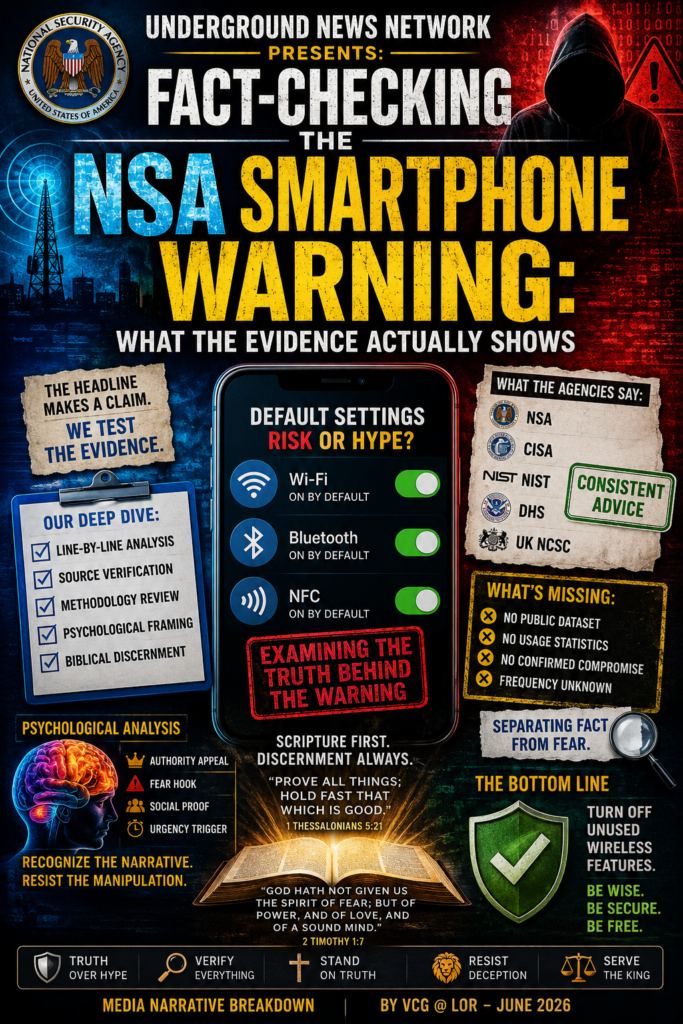
BY VCG @ LOR ON 6/2/2026
The article title in the pasted file is:
“The NSA still warns every smartphone user to disable one default setting that most Americans leave switched on”
One immediate issue is that the title says “one default setting”, but the article itself discusses three separate wireless functions:
- Wi-Fi
- Bluetooth
- NFC (Near Field Communication)
The headline creates a stronger, simpler narrative than the body supports.
A more accurate title would have been:
“NSA advises smartphone users to disable unused wireless features such as Wi-Fi, Bluetooth, and NFC.”
This is a common media technique:
- Authority appeal (“NSA warns…”)
- Urgency/fear framing (“still warns every smartphone user…”)
- Hidden danger framing (“one default setting…”)
- Social proof (“most Americans leave switched on…”)
Yet the article later admits there is no published government dataset proving that most Americans leave these settings enabled.
So, from a fact-checking standpoint:
Headline: Partially misleading.
Body: Mostly accurate.
Evidence: Strong for the recommendation itself, weak for the “most Americans” claim.
Overall rating: True advice, exaggerated headline.
“Prove all things; hold fast that which is good.” — 1 Thessalonians 5:21 (KJV)
That verse is a fitting approach here:
- test the headline
- examine the evidence
- keep the valid security advice
- reject the unsupported implications
I reviewed the pasted article.
Verdict:
mostly accurate on the core security advice, but overstated in the headline and weak where it implies measured proof about “most Americans” or real-world compromise frequency.
Methodology
I checked the article against primary sources first:
- NSA
- CISA
- NIST
- DHS
- UK NCSC
- Apple
Secondary media claims are treated as weaker than agency/device-vendor documentation.
Line-by-line rebuttal and correction
| Article claim | Fact-check | Rebuttal / correction |
|---|---|---|
| “Every smartphone sold in the U.S. ships with Wi-Fi, Bluetooth, and NFC turned on by default.” | Overbroad / not proven. | This varies by manufacturer, setup flow, carrier image, OS version, and whether NFC exists. The article gives no dataset. Better wording: many phones encourage or retain always-available wireless functions by default. |
| “NSA has repeatedly told users to switch all three off whenever not needed.” | True in substance. | NSA says, at minimum, disable Wi-Fi, Bluetooth, and NFC when not in use. (NSA) |
| “The setting most people never touch…” | Unproven. | The article admits no public government dataset proves how many Americans leave these on. This should not be framed as a measured national fact. |
| “Phone broadcasting signals to every nearby receiver.” | Partly true, technically simplified. | Phones can emit Wi-Fi/Bluetooth/NFC-related signals depending on settings, OS behavior, paired devices, scanning, and app permissions. But “every nearby receiver” is rhetorical, not precise. |
| “NSA location exposure guidance ties Wi-Fi, Bluetooth, NFC, GPS to location leakage.” | Generally true. | NSA travel/mobile guidance tells users to turn off unused wireless communications and disable GPS/location services unless required. (NSA) |
| “CISA echoes the recommendation.” | True. | CISA guidance says to disable unused features such as Bluetooth or Wi-Fi; Google also tells Android users to turn off Bluetooth when not in use. (CISA) |
| “NIST reinforces this.” | True with nuance. | NIST Bluetooth security guidance recommends disabling Bluetooth when not in use; NIST mobile guidance also discusses managing Wi-Fi, Bluetooth, and NFC interfaces. (NIST Publications) |
| “DHS catalogs threat categories tied to wireless interfaces.” | True, but broad. | DHS describes threats to the mobile ecosystem, including device, app, network, Wi-Fi/Bluetooth, physical access, and enterprise-service vectors. (Department of Homeland Security) |
| “UK NCSC says disable Bluetooth if not required.” | True. | NCSC says short-range wireless interfaces such as Bluetooth should be disabled if not required. (National Cyber Security Centre) |
| “No government body contradicts the recommendation.” | Mostly true but too absolute. | I found aligned guidance, not contradiction. But “no government body” is too sweeping unless the author surveyed all relevant agencies worldwide. |
| “No public dataset quantifies how many Americans leave these enabled.” | True and important. | This is the article’s strongest self-correction. The headline should have reflected this uncertainty. |
| “Risk is procedural, not forensic.” | Fair. | The advice is based on attack-surface reduction, not public proof that ordinary consumers are frequently compromised this way. |
| “Turn off unused radios.” | Good practical advice. | Correct, especially in airports, hotels, protests, hostile workplaces, border crossings, conferences, or public Wi-Fi environments. Apple also notes Control Center does not fully turn off Wi-Fi/Bluetooth; they remain available for some features unless disabled in Settings. (Apple Support) |
Psychological / rhetorical analysis
The article uses a fear-hook headline:
“NSA still warns every smartphone user…”
This triggers urgency and authority bias.
The body is more responsible than the headline, because it later admits the “most Americans” claim is not measured.
It also uses consensus pressure:
- NSA
- CISA
- NIST
- DHS
- NCSC
all agree.
That is valid evidence for a baseline security practice, but it can mislead readers into thinking there is public proof of widespread real-world exploitation.
There is not, at least not in the sources cited.
Best correction:
the advice is sound, but the headline is stronger than the evidence.
Practical corrected takeaway
Use this as a risk-reduction discipline,
not panic:
Turn off Bluetooth, Wi-Fi, NFC, and location services when not needed, especially in public or sensitive settings.
On iPhone, use Settings, not only Control Center, because Apple says Control Center disconnects but leaves Wi-Fi/Bluetooth available for certain services. (Apple Support)
Scripture correction
The article’s wisdom is lawful if kept in proportion:
prudence without fear.
“The prudent man foreseeth the evil, and hideth himself:
but the simple pass on, and are punished.” — Proverbs 22:3, KJV
But do not let security warnings become bondage:
“For God hath not given us the spirit of fear; but of power, and of love, and of a sound mind.” — 2 Timothy 1:7, KJV
Final judgment:
Accept the security practice.
Reject the sensational certainty.
Fact-Checking the NSA Smartphone Warning: What the Evidence Actually Shows
Fact-Checking the NSA Smartphone Warning: What the Evidence Actually Shows – Library of Rickandria