
McDonald’s “Milkshake” Mystery: Fact-Checking the Claim They Can’t Call It a Milkshake
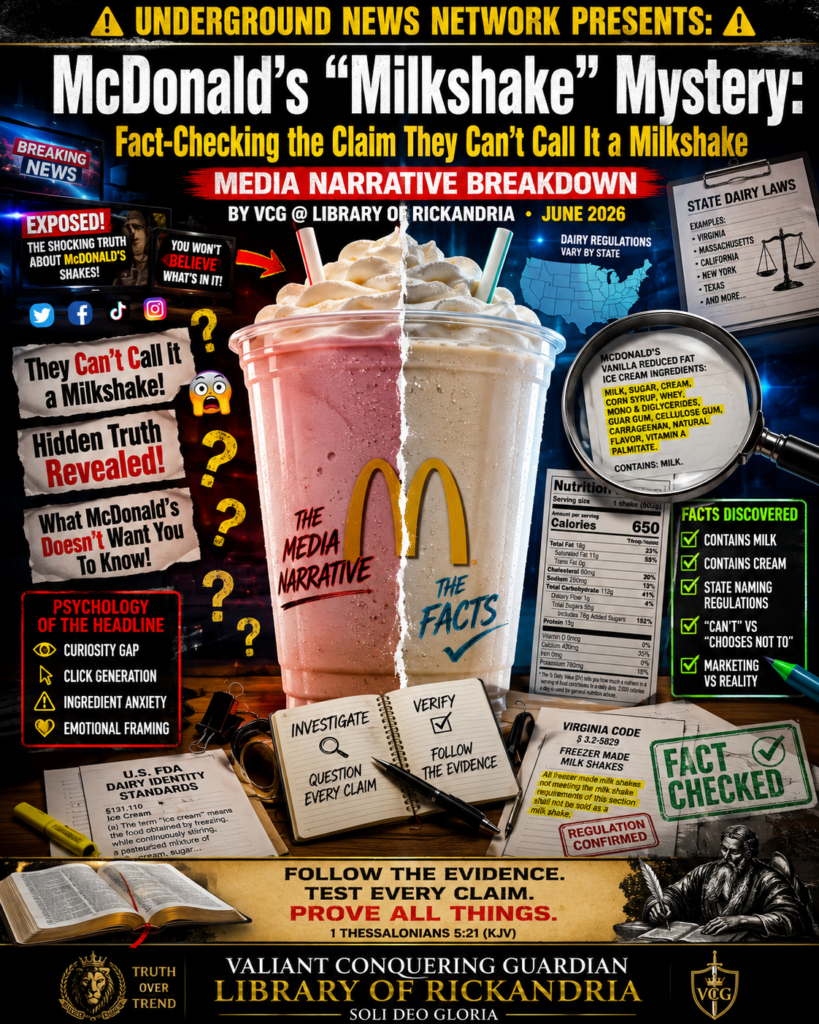
BY VCG @ LOR ON 6/03/2026
Soli Deo Gloria.
There’s a good reason why McDonald’s can’t call its shakes milkshakes
Verdict:
the article is mostly true but rhetorically inflated.
McDonald’s does not avoid “milkshake” because its shakes contain no milk; McDonald’s says its shakes do contain milk from reduced-fat soft serve, but it uses “shake” because dairy naming rules vary by state. (McDonald’s)
Methodology
I checked:
- McDonald’s own FAQ and ingredient pages
- FDA dairy identity rules, state-level examples
- KJV Scripture for moral correction
The standard is:
“Prove all things; hold fast that which is good.”
Line-by-line correction
Headline:
“There’s a good reason why McDonald’s can’t call its shakes milkshakes.”
Correction:
“Can’t” is too strong.
The better wording is: McDonald’s chooses not to call them milkshakes nationally because the legal definition can vary by state.
McDonald’s own wording is:
“we like to keep it simple,”
not
“we are forbidden everywhere.”
“McDonald’s… always has chocolate, vanilla, and strawberry options.”
Mostly true for the U.S. core menu,
but “always” is weak journalism because availability can vary by:
- location
- equipment
- market
The claim should say “commonly offers.”
“These shakes… never have ‘milk’ in their titles.”
True for McDonald’s U.S. naming:
- Vanilla Shake
- Chocolate Shake
etc. (McDonald’s)
“A deliberate response to dairy regulations.”
Supported.
McDonald’s says dairy regulations vary by state regarding what may officially be called a “milkshake.” (McDonald’s)
“The brand produces shakes using a reduced-fat soft serve.”
Supported, though McDonald’s calls the base Vanilla Reduced Fat Ice Cream, not merely “soft serve.”
Ingredients include:
- milk
- sugar
- cream
- corn syrup
- flavoring
- gums
- emulsifiers
- carrageenan
and vitamin A palmitate.
“Milkshake criteria range from state to state.”
Supported in principle.
Virginia, for example,
defines:
“freezer made milk shake”
with minimum milkfat and milk-solids requirements, and says shakes not meeting “milk” shake requirements shall not be sold as a milk shake. (Virginia Register)
“In Massachusetts, a milkshake actually can’t contain any cream…”
This is the article’s weakest claim.
New England usage commonly distinguishes a milkshake from a frappe, with frappe often meaning milk plus ice cream; but the article presents this as a hard legal rule without giving the actual regulation.
Better correction:
Massachusetts/New England terminology often treats an ice-cream shake as a frappe, but the article needs a primary legal citation before claiming ‘can’t.’ (Patch)
“McDonald’s skipped the ‘milkshake’ title for all eateries.”
Likely true for U.S. branding, and consistent with McDonald’s FAQ. (McDonald’s)
“Soft serve… isn’t quite ice cream as we know it.”
Misleading.
McDonald’s own ingredient page calls the base Vanilla Reduced Fat Ice Cream.
It is not:
“just milk and cream,”
but that does not mean it is not ice cream under a reduced-fat formulation. (McDonald’s)
“A multitude of ingredients and additives, rather than just milk or traditional ice cream components.”
True but framed emotionally.
Gums and emulsifiers are common texture stabilizers.
The problem is not automatically “poison”; the honest issue is processing, sugar load, additives, and marketing clarity.
“McDonald’s shake hinges on just three ingredients.”
Technically misleading.
The finished menu item is listed as reduced-fat vanilla ice cream, shake syrup, and whipped cream, but those components themselves contain many ingredients. (McDonald’s)
“Crowd-pleaser… satisfy your dairy cravings.”
Marketing language, not fact-checkable truth.
It appeals to appetite and nostalgia.
Psychology of the article
The article uses a common persuasion pattern: curiosity gap headline → legal mystery → ingredient anxiety → harmless conclusion.
It makes readers feel they have uncovered hidden knowledge,
but the actual truth is mundane:
McDonald’s uses a broad national label to avoid state-by-state dairy naming complications.
The subtle deception is not that McDonald’s shakes contain no milk.
They do.
The deception risk is in consumer assumption:
many people hear “shake” and imagine a hand-spun diner milkshake made from milk and ice cream, while the product is a standardized fast-food dessert built from reduced-fat ice cream mix, syrup, stabilizers, and whipped topping.
Scripture correction
God condemns dishonest measures:
“A false balance is abomination to the LORD:
but a just weight is his delight.”
So the righteous standard is not panic, slander, or clickbait.
It is truthful labeling, truthful reporting, and truthful judgment.
And for us:
“Wherefore putting away lying, speak every man truth with his neighbour.”
Final rebuttal
McDonald’s “shakes” are not fake because they contain no milk.
They contain milk-derived reduced-fat ice cream.
The real issue is that “milkshake” can have legal and regional requirements, so McDonald’s avoids the word nationally.
The article is useful, but it overstates with “can’t,” weakly supports the Massachusetts claim, and uses ingredient-list shock to create emotional weight.
Correction headline:
“Why McDonald’s Calls Them ‘Shakes,’ Not ‘Milkshakes’: State Dairy Rules, Branding Simplicity, and Processed Ingredients.”
McDonald’s “Milkshake” Mystery: Fact-Checking the Claim They Can’t Call It a Milkshake