
Progressive Revelation, Not Invention: A Comprehensive Biblical Rebuttal to Dan McClellan’s “On the Invention of Satan”
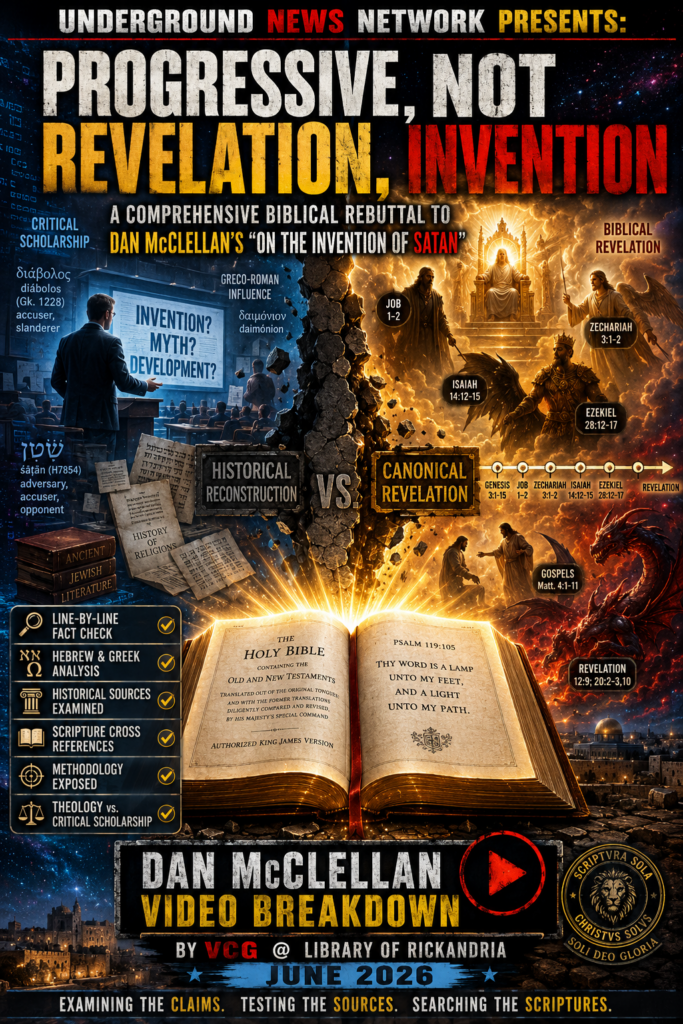
BY VCG @ LOR ON 6/2/2026
Soli Deo Gloria.
Here is the core rebuttal framework.
Verdict
Dan’s argument is partly lexically true but doctrinally overreaches.
He is right that שָׂטָן / satan can mean “adversary/accuser,” and in Job/Zechariah the Hebrew often has the article, “the satan.”
Lexicons and scholars recognize that range. (Blue Letter Bible)
But he then commits the major error:
he treats progressive revelation as invention.
Scripture does not require every later revealed doctrine to be fully systematized in the first Hebrew references.
The Bible reveals Satan progressively:
adversary → accuser → tempter → devil → dragon → old serpent → deceiver of the whole world.
Line-by-line correction
Claim:
“There is no rebellious or fallen angel named Satan anywhere in the Hebrew Bible.”
Correction:
the Hebrew Bible does show a heavenly adversary opposing God’s servants.
Job says:
“Satan came also among them,”
accuses Job, receives boundaries from God, and then goes forth to destroy.
That is not merely a neutral prosecutor.
Zechariah shows Satan standing “to resist” Joshua,
and the LORD rebukes him:
“The LORD rebuke thee, O Satan.”
Claim:
“Lucifer in Isaiah 14 is only the human king of Babylon.”
Correction:
Isaiah 14 is directly addressed as a proverb against the king of Babylon, yes.
But the language rises beyond ordinary kingship:
“I will ascend into heaven,”
“I will exalt my throne above the stars of God,”
“I will be like the most High.”
The immediate target is Babylon’s king; the spiritual pattern is prideful heavenly rebellion.
Claim:
“Ezekiel 28 is only the human king of Tyre.”
Correction:
Ezekiel begins with the prince/king of Tyrus,
but again the language exceeds a mere earthly man:
“Thou hast been in Eden,”
“Thou art the anointed cherub that covereth,”
“perfect… till iniquity was found in thee.”
Dan’s “only human king” reading cannot carry all the text.
Claim:
“In Job and Zechariah, Satan is just an office in the divine council.”
Correction:
“office” is an interpretation, not a conclusion demanded by the text.
Job’s Satan is personal, speaks, travels, accuses, desires Job’s ruin, and departs from God’s presence.
Zechariah’s Satan is rebuked by the LORD.
That is adversarial, not righteous service.
Claim:
“The angel of the LORD is called a satan in Numbers 22, so anyone can be satan.”
Correction:
yes, the Hebrew word can be generic.
That proves semantic range, not that the personal Satan does not exist.
“Adversary” can be a common noun and still become a title/name for the chief adversary.
Strong’s gives the range as:
“opponent… adversary, Satan, withstand.”
Claim:
“1 Chronicles 21:1 is just obscuring God’s role from 2 Samuel 24:1.”
Correction:
this is speculative.
The plain KJV says:
“And Satan stood up against Israel, and provoked David to number Israel.”
2 Samuel shows God’s sovereign judgment; Chronicles shows the adversarial instrument.
Those are not contradictions.
Scripture often distinguishes God’s permission/judgment from the evil agent’s intent.
Claim:
“By the New Testament, Satan became the name of the head malevolent angel.”
Correction:
the New Testament does not invent this being; it identifies him plainly.
Jesus says,
“Get thee hence, Satan,”
and calls him “the devil” and “the tempter.”
Revelation identifies the same being as
“the dragon, that old serpent, which is the Devil, and Satan.”
Claim:
“Demon is a Greco-Roman product; no legitimate demon in Hebrew Bible.”
Correction:
the English KJV uses “devils” in Deuteronomy 32:17 and Psalm 106:37 for hostile false-god/spirit worship.
It is true that Greek daimon/daimonion has a history and the Septuagint uses it in places like Deuteronomy 32:17, but Dan overstates the case by implying the concept is alien to Scripture. (Intertextual Bible)
Methodology failure
Dan uses historical-development criticism:
later clarity is treated as later invention.
Biblical correction uses canonical revelation:
later Scripture can clarify earlier Scripture without being false.
The Lord Jesus is the final authority here.
He did not treat Satan as a literary development.
He treated him as a real tempter, liar, ruler of a kingdom, and enemy.
“Get thee hence, Satan…”
“And if Satan also be divided against himself, how shall his kingdom stand?”
Psychological pattern
The rhetorical move is subtle:
reduce the enemy to vocabulary, reduce revelation to sociology, then reduce doctrine to “later invention.”
That comforts unbelief because it makes Christ’s warfare language sound culturally conditioned instead of true.
Scripture answer:
Satan is real, defeated, and doomed.
“And the devil that deceived them was cast into the lake of fire and brimstone…”