
Following the Money: Factchecking Claims About Trump, Iran & Rising Household Costs
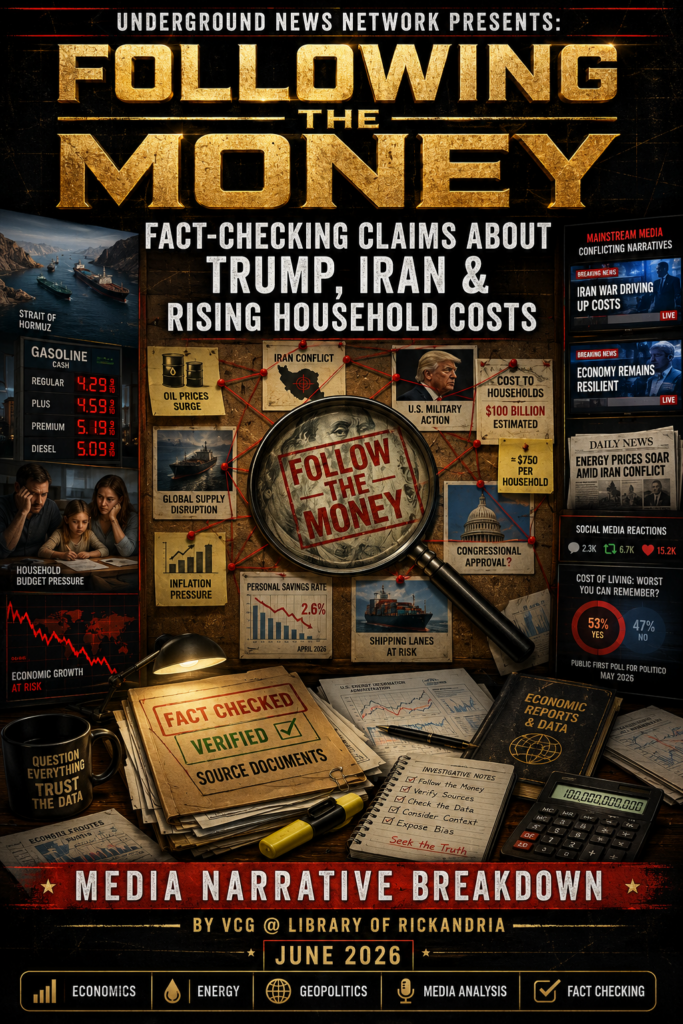
BY VCG @ LOR ON 6/2/2026
Soli Deo Gloria.
Bottom line:
the article’s core economic claims are mostly supported by current reporting/data, but its framing is politically loaded and sometimes overconfident on causality.
How Trump’s Iran war is driving up costs for households
Method
I checked the claims against primary/current sources where possible:
- AAA for gas
- BEA for savings
- The Independent/Politico polling
- Zandi/Moody’s reporting
- Reuters/IEA/White House context for Hormuz and the war
Line-by-line factcheck and correction
“The military conflict in Iran has cost U.S. households an estimated $100 billion…”
Supported as a reported Moody’s/Zandi estimate, but it is an economic model, not a direct receipt total.
Better wording:
“Moody’s Analytics estimates…”
Business Insider reports the same $100B/$750 household figure. (Business Insider)
“…driven primarily by a sharp increase in energy costs following the closure of the Strait of Hormuz.”
Broadly supported.
IEA says the Strait is crucial for oil/LNG, and closure would heavily affect oil and gas trade. (IEA)
Reuters also reports Hormuz-related disruption and recovery concerns. (Reuters)
“$750 per household since the conflict began in February.”
Supported as Moody’s estimate, but “per household” is an average; lower-income households feel fuel/food/utility pressure more sharply. (Business Insider)
“Initiated by President Donald Trump without congressional approval…”
This is legally/politically loaded.
The White House calls it “Operation Epic Fury” and says Iran agreed to ceasefire/reopening after 38 days. (The White House)
Whether it was unlawful depends on War Powers/legal interpretation; the article asserts rather than proves.
“35 percent surge in oil prices.”
Plausible but needs a benchmark date and oil grade.
Reuters currently shows Brent/WTI around the mid-to-high $90s amid conflict pressures. (Reuters)
Without the starting price, this line is incomplete.
“AAA… regular gasoline sits at $4.29…”
Nearly correct.
AAA showed $4.29 “yesterday” and $4.26 current as of June 3, 2026. (AAA Fuel Prices)
“Costs continue to top $5 in six states…”
Supported by recent AAA-based reporting; LendingTree found six states above $5 on May 12
AAA’s current map also shows top-price ranges above $5. (AAA Fuel Prices)
“White House dismissed concerns…” / Trump called hikes ‘peanuts.’”
I found White House language emphasizing “short term disruptions” and future normalization, but not enough from the retrieved sources to verify the exact word “peanuts.”
Treat that quote as needs direct source. (The Independent)
“Public First for Politico… 53 percent…”
Supported.
The Independent reports the Public First/Politico poll:
53% said cost of living is the worst they can remember, up from 46% in November. (The Independent)
“Zandi… ‘big economic blow’…”
Substance supported by reporting and Zandi’s public X snippet about tax refunds no longer offsetting fuel costs. (X (formerly Twitter))
“BEA… personal savings rate fell to 2.6 percent in April…”
Supported.
BEA says April personal saving was $611.7B and the personal saving rate was 2.6%. (Bureau of Economic Analysis)
Psychology / persuasion pattern:
The article uses real economic pain,
then chains it to one political villain through attribution framing:
“Trump’s Iran war” → “household cost” → “polling pressure.”
That can be legitimate journalism,
but it also narrows complex causality:
- Iran’s actions
- shipping risk
- oil markets
- insurers
- global demand
- taxes
- refining
and state fuel rules all matter.
Scripture correction
God commands testing claims,
not swallowing headlines:
“Prove all things; hold fast that which is good.”
He also warns,
“Thou shalt not bear false witness.”
Judgment:
not a fake article, but a framed article.
Keep the data; correct the rhetoric.
Following the Money: Factchecking Claims About Trump, Iran & Rising Household Costs