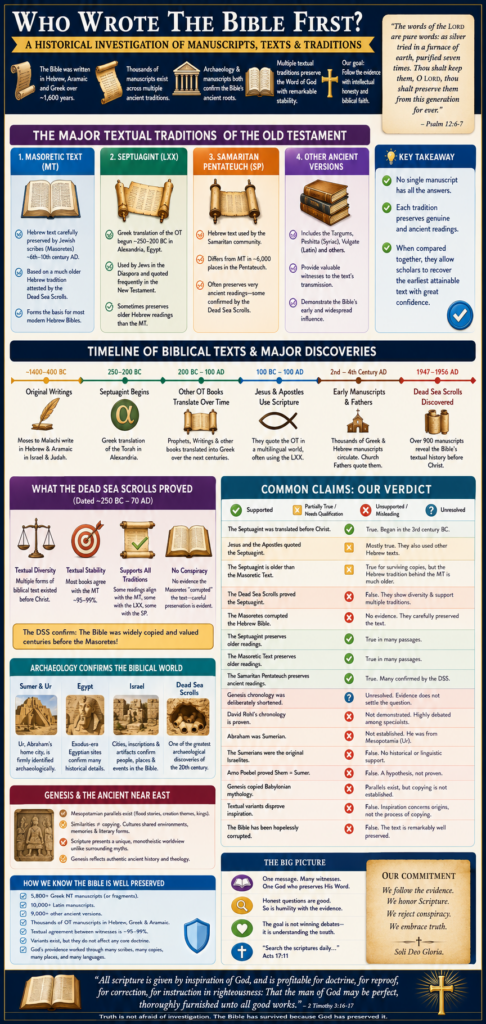
The Transmission of the Old Testament: Fact-Checking the Masoretic, Septuagint, Samaritan & “Sumerian Israel” Claims
VCG @ LOR 7/9/2026
PART I
Breaking Down the Infographic
A Viral Timeline Under the Microscope
“Prove all things; hold fast that which is good.”— 1 Thessalonians 5:21 (KJV)
Introduction
Every generation inherits questions about the Bible.
In previous centuries those questions were debated in universities, synagogues, churches, monasteries, and libraries.
Today they are debated on social media.
A single infographic can reach millions of readers within hours. A colorful timeline, a handful of archaeological photographs, a few Hebrew words, several Greek terms, and references to respected scholars often create an immediate impression of authority. Most readers never verify the sources. Few ask whether the timeline accurately represents the evidence. Fewer still distinguish between established historical fact and speculative reconstruction.
This investigation began with one such infographic.
At first glance, it appeared remarkably persuasive.
It connected together:
- Samuel
- Ezra
- Josiah
- the Samaritan Pentateuch
- the Septuagint
- the Masoretic Text
- the Dead Sea Scrolls
- David Rohl
- Arno Poebel
- Sumer
- Abraham
- Paleo-Hebrew
- the history of biblical transmission
Many of its individual statements were true.
Some were partly true.
Others were unsupported.
Still others were demonstrably false.
The challenge was determining which was which.
That is the purpose of this work.
This is not an attempt to defend tradition for tradition’s sake.
Neither is it an attempt to dismantle unconventional ideas simply because they are unconventional.
The goal is much simpler.
To ask one question repeatedly:
What does the evidence actually show?
Why This Matters
Questions about the transmission of the Old Testament are not merely academic.
They influence how Christians understand:
- the reliability of Scripture
- the authority of the Old Testament
- the relationship between Judaism and Christianity
- archaeology
- biblical chronology
- textual criticism
- the doctrine of preservation
Unfortunately, these discussions are often reduced to slogans.
Examples include:
“The Jews changed the Bible.”
“The Septuagint is the original Old Testament.”
“The Masoretic Text is corrupted.”
“The Dead Sea Scrolls prove the King James Bible wrong.”
“The Samaritan Pentateuch is the oldest Bible.”
Each statement contains assumptions that deserve careful investigation.
The Challenge of Social Media
Social media rewards confidence.
History rewards caution.
An infographic rarely has space to explain:
degrees of certainty,
alternative scholarly views,
textual complexity,
or disputed evidence.
Instead,
complex historical questions become simple narratives.
Those narratives spread rapidly because they are easy to remember.
History is rarely that simple.
The Central Question
This book is not attempting to answer:
Which manuscript tradition do I prefer?
Instead it asks:
Which conclusions are actually justified by Scripture, archaeology, linguistics, and surviving manuscripts?
Those are not always the same question.
Our Method
Every claim examined in this book will be tested using the same seven-step methodology.
1. Scripture
What does the biblical text explicitly say?
Not what later traditions claim.
Not what we assume.
What does Scripture actually state?
2. Earliest Manuscripts
What do the oldest surviving witnesses preserve?
Including:
- Dead Sea Scrolls
- Septuagint
- Samaritan Pentateuch
- Masoretic tradition
- Targums
- Peshitta
- other ancient witnesses
3. Archaeology
Does archaeology independently confirm the claim?
If so,
how strongly?
If not,
we will say so.
4. Historical Linguistics
Do language, script, and philology support the proposed conclusion?
Or is the argument based merely on similar-sounding words?
5. Historical Context
Does the claim fit what we know about the ancient Near East?
Or does it require assumptions unsupported by contemporary evidence?
6. Scholarly Research
Where there is broad scholarly agreement,
we will acknowledge it.
Where there is legitimate disagreement,
we will present the competing positions fairly.
Where a theory represents a minority view,
we will identify it as such rather than dismissing it simply because it is unconventional.
7. Degrees of Confidence
Every conclusion will be classified as one of four categories:
Established
Supported by Scripture and independent historical evidence.
Probable
Strong evidence exists, though debate remains.
Possible
Historically plausible but presently unproven.
Speculative
Insufficient evidence currently exists.
Four Principles
Throughout this investigation, four principles will guide every chapter.
Principle One
Scripture and interpretation are not identical.
Principle Two
Ancient manuscripts are evidence.
They are not arguments by themselves.
Principle Three
Extraordinary historical claims require proportionately strong evidence.
Principle Four
Truth has nothing to fear from honest investigation.
What This Book Is Not
This is not an attack on Judaism.
It is not an attack on Christianity.
It is not an attempt to prove one English Bible translation superior to another.
It is not a defense of skepticism.
Nor is it an attempt to promote sensational conspiracies.
Instead, it is an invitation to examine the evidence carefully, distinguish fact from speculation, and evaluate every claim on its own merits.
Why the Bereans Matter
Luke describes the Jews at Berea in striking terms:
“These were more noble than those in Thessalonica, in that they received the word with all readiness of mind, and searched the scriptures daily, whether those things were so.”— Acts 17:11 (KJV)
Notice the balance.
They listened.
They investigated.
They compared.
They tested.
That Berean spirit provides the model for this entire work.
The Road Ahead
The chapters that follow will examine, one by one:
- Samuel and the alleged “Naiothic” recension.
- Josiah’s discovery of the Book of the Law.
- Ezra and the transmission of Scripture.
- The Samaritan Pentateuch.
- The Septuagint.
- The Masoretic Text.
- The Dead Sea Scrolls.
- Genesis 5 and 11.
- Alleged Messianic textual changes.
- Abraham, Ur, Sumer, and Arno Poebel.
- David Rohl’s chronology.
- Archaeology.
- Scribal culture.
- Church history.
- Biblical preservation.
Along the way, we will ask the same question repeatedly:
Does the evidence support the claim?
Sometimes the answer will be yes.
Sometimes no.
Sometimes we simply do not know.
Intellectual honesty requires us to distinguish between those three answers.
Only then can we hope to approach the transmission of the Old Testament with both historical rigor and biblical faithfulness.
Soli Deo Gloria.
PART I (Continued)
Before We Begin
How to Read a Historical Infographic
Imagine someone hands you a beautifully designed timeline.
It contains:
- Hebrew words.
- Greek words.
- Archaeological artifacts.
- Ancient kings.
- Biblical figures.
- Dates.
- Scholars’ names.
- Color-coded arrows.
- Maps.
- Manuscript traditions.
Your first instinct is probably:
“Whoever made this must know what they’re talking about.”
That instinct is understandable.
It is also dangerous.
One of the greatest strengths of modern misinformation is that it often looks professional.
Good design is not the same thing as good history.
A timeline can be beautifully illustrated and historically inaccurate.
Likewise, a plain black-and-white academic journal may look unimpressive while containing decades of careful research.
The appearance of certainty is not the same as certainty itself.
This distinction lies at the heart of the entire investigation.
The Difference Between Information and Knowledge
Modern society has more information than any civilization in history.
Yet information alone does not produce wisdom.
Consider the infographic we are about to examine.
It contains dozens of facts.
Many of them are true.
For example:
- Abraham came from Ur.
- The Septuagint exists.
- The Samaritan Pentateuch exists.
- The Dead Sea Scrolls exist.
- Paleo-Hebrew existed.
Every one of those statements is historically correct.
Yet those true statements are arranged to support conclusions that may not follow from them.
History is not merely collecting facts.
History is explaining relationships between facts.
Those relationships must themselves be demonstrated.
Why Smart People Believe Weak Arguments
One question kept returning during this research:
Why do intelligent Christians find these infographics convincing?
The answer is surprisingly simple.
Because the infographic uses several persuasive techniques simultaneously.
It appeals to authority.
It appeals to antiquity.
It appeals to hidden knowledge.
It appeals to archaeology.
It appeals to distrust.
It appeals to visual simplicity.
Individually, none of these techniques proves anything.
Together, however, they create a powerful psychological effect.
Recognizing these techniques is not cynicism.
It is discernment.
The “Mosaic Effect”
One fascinating psychological phenomenon appears throughout historical discussions.
We may call it the Mosaic Effect.
Imagine thousands of tiny tiles.
Each tile is genuine.
Each tile belongs to an authentic ancient artifact.
Yet if someone rearranges the tiles into a different picture,
the finished image becomes misleading.
This is precisely how many historical narratives are constructed.
Every individual piece may be authentic.
The arrangement tells a different story.
Throughout this book, we will repeatedly separate:
the tile
from
the mosaic.
History Is Not Mathematics
Readers sometimes expect historical investigation to produce mathematical certainty.
History rarely works that way.
Mathematics asks:
What equals four?
History asks:
Which explanation best fits incomplete evidence?
Those are different disciplines.
Historical conclusions are usually expressed in terms like:
certain,
very likely,
probable,
possible,
unlikely,
unsupported.
Learning to think this way protects us from exaggerated certainty.
The Danger of Binary Thinking
The internet encourages two options.
Either:
Everything is true.
Or:
Everything is false.
Historical investigation rarely produces either answer.
Instead, the infographic before us contains:
accurate observations,
reasonable hypotheses,
outdated scholarship,
unsupported assertions,
and outright errors.
Our responsibility is to distinguish among them rather than accepting or rejecting the entire presentation as one unit.
What Counts as Evidence?
Throughout this work, we will distinguish carefully between five different kinds of evidence.
Primary Sources
Documents or artifacts produced close to the events themselves.
Examples include:
- the biblical text
- ancient inscriptions
- manuscripts
- archaeological artifacts
These carry the greatest historical weight.
Secondary Sources
Works analyzing the primary evidence.
Examples include:
- academic books
- journal articles
- commentaries
These help us interpret the evidence but are not themselves the evidence.
Tradition
Historical beliefs passed down through communities.
Traditions may preserve genuine history.
They may also develop over time.
Each tradition deserves respectful evaluation.
Hypothesis
A proposed explanation.
Hypotheses are essential to scholarship.
They become problematic only when presented as established fact.
Speculation
Ideas lacking sufficient supporting evidence.
Speculation is not necessarily false.
It simply has not yet been demonstrated.
Reading Ancient History Responsibly
Responsible history asks four simple questions repeatedly.
Who says this?
When did they say it?
How would they know?
Can the claim be independently verified?
Those four questions alone eliminate a remarkable amount of misinformation.
The Difference Between a Scholar and a Citation
One common feature of viral infographics is the inclusion of famous names.
For example:
“Kenneth Kitchen…”
“Arno Poebel…”
“David Rohl…”
Readers often assume that mentioning a scholar proves the accompanying claim.
It does not.
A scholar should be represented accurately.
A quotation should be read in context.
A hypothesis should not be expanded beyond what its author actually argued.
One recurring task in this book will be returning to original sources to ask:
Did the scholar actually say what the infographic claims?
Sometimes the answer will be yes.
Sometimes the answer will be no.
Sometimes the answer will be “partly.”
Why We Will Read the Sources
There is an old principle in historical research:
Never trust a quotation you have not verified.
The same principle applies to:
chronologies,
translations,
manuscripts,
and archaeological claims.
Whenever possible, this book will work from:
- Scripture itself,
- primary manuscripts,
- ancient historians,
- archaeological reports,
- and recognized scholarly publications.
That approach minimizes dependence upon secondhand summaries.
The Goal of This Investigation
Our goal is not to win an argument.
Our goal is to understand what happened.
If the evidence confirms a claim,
we should gladly accept it.
If the evidence challenges a cherished assumption,
we should be equally willing to revise our conclusions.
That willingness is not weakness.
It is intellectual integrity.
A Prayer for Wisdom
Although this work is historical rather than devotional, it is fitting to remember Solomon’s words:
“Buy the truth, and sell it not; also wisdom, and instruction, and understanding.”— Proverbs 23:23 (KJV)
Truth is worth pursuing because it belongs to God.
History, archaeology, philology, and textual criticism are not enemies of faith when practiced honestly.
They are tools that help us understand more clearly how God has worked in history.
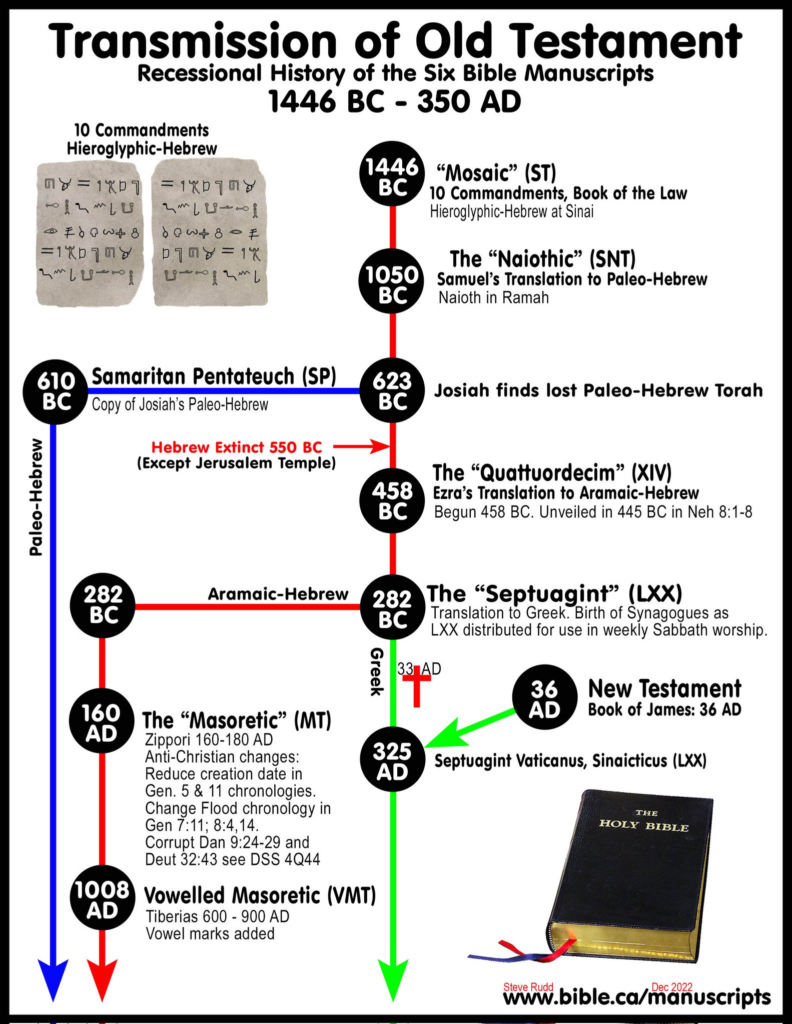
The Infographic
We are now ready to examine the evidence itself.
Rather than responding emotionally or dismissing it out of hand, we will proceed line by line, date by date, claim by claim.
Some portions will stand.
Others will require qualification.
Still others will collapse under examination.
By the end of this investigation, the reader should not simply know whether this particular infographic is reliable.
The reader should possess the tools to evaluate the next one independently.
That is the true goal of Berean study.
Next Chapter
The Infographic at First Glance
The next section should reproduce or summarize the infographic as a whole and then perform an initial “bird’s-eye view” assessment before beginning the detailed line-by-line analysis. This gives readers a mental map of the entire timeline before diving into individual claims, making the later chapters easier to follow and reference.
PART I (Continued)
Chapter 3
The Infographic at First Glance
A Bird’s-Eye Assessment Before the Deep Dive
Before examining individual claims, it is important to step back and look at the infographic as a whole.
Imagine standing before a giant wall map.
At first, you notice only the colors.
Then the arrows.
Then the dates.
Then the names.
Only later do you begin asking whether the roads actually lead where the map says they do.
Historical infographics work the same way.
They create an overall impression long before the reader has time to evaluate any individual claim.
This chapter therefore does not ask:
“Is every statement true?”
Instead it asks:
“What story is the infographic trying to tell?”
Only after understanding that story can we fairly evaluate its individual pieces.
The Big Picture
Although dozens of historical claims appear throughout the timeline, nearly all of them support one central narrative.
It can be summarized like this:
God originally preserved His Word through an ancient Paleo-Hebrew tradition.
↓
Samuel supposedly organized or transmitted this tradition.
↓
Josiah rediscovered the authentic Torah.
↓
Ezra preserved or transmitted it.
↓
The Samaritan Pentateuch continued this original Hebrew tradition.
↓
The Septuagint faithfully translated this older Hebrew text.
↓
Later Jewish scribes abandoned it.
↓
The Masoretic Text became a corrupted replacement.
↓
Modern Christians unknowingly inherited that corruption.
↓
Recovering the older textual traditions restores the original Old Testament.
Whether stated explicitly or implicitly, this is the storyline holding the infographic together.
Everything else serves that narrative.
Understanding this is essential.
Because once the storyline is identified, we can evaluate whether the evidence actually supports it.
Every Historical Narrative Has a Thesis
No historian approaches evidence without asking questions.
Likewise, no infographic merely presents neutral facts.
Every historical presentation has a thesis.
Sometimes that thesis is obvious.
Sometimes it is hidden.
This infographic’s thesis is not merely:
“These manuscripts exist.”
Its thesis is:
One textual tradition remained faithful while another became corrupted.
That is an entirely different claim.
The existence of manuscripts is one question.
Their historical relationship is another.
The Four Pillars of the Infographic
As the timeline unfolds, four major arguments appear repeatedly.
Everything else is built upon them.
Pillar One
The Paleo-Hebrew Priority
The infographic repeatedly implies:
Older script
=
Older text
=
Original Scripture
This sounds reasonable.
But script and textual history are not the same discipline.
A manuscript may preserve ancient letter forms while containing later textual developments.
Conversely,
a manuscript written in later script may preserve an older textual tradition.
One of the major goals of this book will be separating:
paleography
from
textual criticism.
Pillar Two
The Samaritan Priority
The timeline presents the Samaritan Pentateuch as preserving the original Mosaic Torah.
Its use of ancient script reinforces that impression.
This argument contains genuine historical observations.
It also makes historical leaps that require careful examination.
We will eventually ask:
Does ancient script automatically imply ancient wording?
The answer is more complicated than many readers expect.
Pillar Three
The Septuagint Priority
Another recurring theme is:
The Septuagint preserves the original Old Testament.
This argument often points to:
Dead Sea Scroll agreements,
New Testament quotations,
and Genesis chronology.
These observations deserve serious attention.
Yet the conclusion does not automatically follow.
The Septuagint is an extraordinarily important witness.
Whether it consistently preserves the earliest Hebrew text is a different question.
Pillar Four
The Masoretic Corruption Theory
Finally,
the infographic suggests that the traditional Hebrew text underwent intentional alteration.
This is the most consequential claim in the entire presentation.
Everything ultimately depends upon it.
If this claim fails,
the infographic’s central narrative largely collapses.
For that reason,
it deserves the most careful investigation.
The Timeline’s Hidden Structure
One fascinating feature becomes visible after prolonged study.
The infographic appears chronological.
In reality,
it is largely argumentative.
Notice the sequence.
First,
ancient authority is established.
Then,
continuity is suggested.
Next,
a break occurs.
Finally,
corruption is introduced.
This resembles a courtroom presentation more than a historical timeline.
Each date functions as evidence supporting a predetermined conclusion.
That does not automatically make the conclusion wrong.
It simply reminds us that chronology can be arranged rhetorically.
What Is Missing?
One of the first questions historians ask is not:
“What is included?”
But:
“What has been omitted?”
Several major historical developments receive little or no attention.
For example:
The Targums.
The Peshitta.
Origen’s Hexapla.
Jerome’s Vulgate.
The Aleppo Codex.
The Leningrad Codex.
The broader history of Jewish scribal transmission.
The diversity of the Dead Sea Scrolls.
These omissions matter because they provide context.
Without context,
individual facts can appear more decisive than they really are.
The Power of Visual Design
Human beings process images remarkably quickly.
Research in cognitive psychology consistently shows that visual organization affects how information is perceived and remembered.
When arrows connect two events,
our minds instinctively assume causation or direct continuity.
When boxes appear in sequence,
we assume historical succession.
When one branch is colored differently,
we instinctively categorize it as separate or corrupt.
These are normal features of human cognition.
Good infographic design uses them.
So does misleading infographic design.
This does not mean the designer intended to deceive.
It does mean readers should distinguish between:
visual implication
and
historical demonstration.
Color as an Argument
Notice how colors function.
Warm colors often represent:
authenticity,
originality,
purity.
Cool or darker colors frequently imply:
later development,
division,
or corruption.
Most readers never consciously notice this.
Yet color subtly shapes interpretation.
Design communicates long before words are analyzed.
Recognizing this makes us more careful readers.
The Psychology of Timelines
Timelines possess enormous persuasive power because they simplify complexity.
History is messy.
Timelines create order.
That order is useful.
It is also potentially misleading.
Imagine compressing one thousand years of manuscript history into ten arrows.
Necessarily,
many complexities disappear.
The danger arises when simplification becomes oversimplification.
Good history balances clarity with accuracy.
A Case Study in Compression
Consider the label:
“Masoretic Text”
One small box.
One date.
One arrow.
In reality,
this single label represents:
centuries of scribal activity,
regional traditions,
Masoretic families,
vowel systems,
accent traditions,
manuscript comparison,
and countless individual copies.
Reducing that complexity to one point on a timeline creates the illusion that the Masoretic Text suddenly appeared.
It did not.
History is rarely so abrupt.
What Would an Alternative Timeline Look Like?
Suppose we designed the timeline differently.
Instead of emphasizing one line,
we showed multiple parallel streams:
Hebrew manuscripts.
Greek translations.
Samaritan tradition.
Dead Sea Scrolls.
Aramaic Targums.
Syriac Peshitta.
Latin Vulgate.
Suddenly,
the history would look less like one chain
and more like a river with many tributaries.
Interestingly,
that second picture better reflects what modern textual criticism has discovered.
Our Approach
Throughout the remaining chapters,
we will avoid asking:
“Which tradition do we prefer?”
Instead,
we will repeatedly ask:
- What is the earliest evidence?
- What does Scripture actually say?
- What do the manuscripts preserve?
- What does archaeology confirm?
- What remains uncertain?
Only after answering those questions will conclusions be drawn.
This order matters.
Evidence should shape conclusions.
Conclusions should never determine evidence.
The Investigation Begins
With the broader picture now in view,
we are finally prepared to examine the timeline itself.
We will begin at the earliest point on the infographic and proceed carefully,
line by line,
claim by claim,
source by source.
Some claims will survive scrutiny.
Others will require modification.
Some will collapse entirely.
Our task is not to defend a tradition.
Our task is to seek the truth.
As our Lord prayed:
“Sanctify them through thy truth: thy word is truth.”— John 17:17 (KJV)
That commitment to truth—not novelty, not tradition, not controversy—will guide every page that follows.
Next Chapter:
Chapter 4 — The Rules of Evidence: How Historians, Textual Critics, and Archaeologists Evaluate Ancient Claims
Before examining the first date on the infographic, readers should understand how evidence is weighed. This chapter will introduce principles such as burden of proof, primary vs. secondary sources, paleography, provenance, internal and external evidence, and the difference between historical possibility and historical probability. It will become the methodological foundation for the entire book.
PART I (Continued)
Chapter 4
The Rules of Evidence
How Historians, Textual Critics & Archaeologists Evaluate Ancient Claims
“In the mouth of two or three witnesses shall every word be established.”— 2 Corinthians 13:1 (KJV)
Before we examine a single date on the infographic, we must first answer an important question.
How do historians determine whether an ancient claim is true?
This may sound obvious.
It is not.
Many internet debates fail before they even begin because the participants are using different standards of evidence.
One person believes a claim because it appears in a YouTube video.
Another trusts a blog.
Another trusts a scholar.
Another trusts a photograph.
Another trusts tradition.
A historian must ask something different.
“What is the evidence?”
Not merely,
“Who said it?”
The difference is enormous.
The Courtroom of History
Imagine walking into a courtroom.
Two attorneys present opposing cases.
Both speak confidently.
Both quote witnesses.
Both produce exhibits.
Confidence alone cannot determine the verdict.
Neither can eloquence.
Neither can popularity.
Instead, the judge asks:
- Is the evidence authentic?
- Is the witness reliable?
- Can the testimony be verified?
- Does it agree with independent evidence?
History functions remarkably similarly.
The historian is not a prosecutor.
Nor is the historian a defense attorney.
The historian is more like a judge.
His responsibility is not to win.
His responsibility is to weigh evidence fairly.
The Burden of Proof
One of the oldest principles in both law and history is this:
The burden of proof belongs to the person making the claim.
Suppose someone says:
“Samuel produced an official Naiothic recension.”
Our first question is not:
“Can you prove he didn’t?”
Our first question is:
“What evidence demonstrates that he did?”
This principle protects us from endless speculation.
Otherwise, anyone could invent an ancient manuscript tradition and challenge others to disprove it.
History does not work that way.
Positive claims require positive evidence.
Extraordinary Claims Require Extraordinary Evidence
This phrase is often associated with science, but the principle is much older.
Consider two statements.
Statement One:
“Abraham lived in Mesopotamia.”
This requires relatively little argument because Scripture, archaeology, and history agree.
Now consider:
“The Sumerians were the original Israelites.”
That claim overturns centuries of historical understanding.
It therefore requires far stronger evidence.
The greater the claim,
the greater the evidence required.
Primary Sources
Historians always ask:
How close is this source to the event?
The closer,
the better.
Primary sources include:
- contemporary inscriptions
- manuscripts
- official records
- archaeological artifacts
- eyewitness testimony
For biblical history,
Scripture itself is among our earliest primary literary witnesses.
That does not end historical discussion.
But it certainly begins it.
Secondary Sources
Secondary sources explain primary evidence.
These include:
- commentaries
- journal articles
- historical monographs
- encyclopedias
They are extremely valuable.
Yet they remain interpretations.
Good historians continually return to the primary evidence whenever possible.
Tertiary Sources
Many readers rely almost entirely upon tertiary sources.
Examples include:
- encyclopedias
- popular websites
- social media
- videos
- AI summaries
These can provide useful introductions.
They should rarely become the final authority.
This book will continually move readers back toward primary evidence.
Independent Confirmation
One witness is good.
Two independent witnesses are better.
Suppose Genesis mentions Ur.
Then archaeology uncovers Ur.
Then cuneiform tablets describe Ur.
Confidence increases.
Independent confirmation is one of the strongest tools available to historians.
This principle appears repeatedly throughout biblical archaeology.
Silence Is Not Proof
Another common mistake involves arguments from silence.
Example:
“The Bible never mentions the Dead Sea Scrolls.”
Of course not.
They had not yet been discovered.
Likewise,
absence of evidence is not automatically evidence of absence.
Sometimes silence matters.
Sometimes it does not.
Context determines which.
Correlation Is Not Causation
This may be the single most abused principle in historical reconstruction.
Example:
Abraham lived in Ur.
Ur was Sumerian.
Therefore Abraham was Sumerian.
Notice what happened.
Two true facts became an unsupported conclusion.
Correlation simply means two things are related somehow.
Causation requires demonstration.
This distinction appears throughout the infographic.
Similarity Does Not Equal Identity
History is filled with things that resemble one another.
Languages.
Religions.
Customs.
Architectural styles.
Names.
Similarity is often important.
It is never sufficient by itself.
Consider English.
The word
“much”
resembles Spanish
“mucho.”
They sound alike.
Yet they developed differently.
Likewise,
similarity between
“Shem”
and
“Sumer”
cannot establish historical identity by itself.
Historical linguistics demands much more.
Chronological Priority
Earlier evidence generally carries greater historical weight.
Suppose one manuscript dates to AD 200.
Another dates to AD 1200.
Everything else being equal,
the earlier manuscript deserves careful attention.
Notice the qualification.
Everything else being equal.
Sometimes a later manuscript faithfully preserves an older textual tradition.
Age matters.
It is not the only factor.
Multiple Independent Witnesses
One of the greatest strengths of biblical textual criticism is the abundance of evidence.
Instead of relying upon one manuscript,
scholars compare:
- Hebrew
- Greek
- Aramaic
- Syriac
- Latin
- Coptic
- Armenian
- Georgian
- Ancient quotations
- Church Fathers
This enormous network of witnesses often allows earlier readings to be reconstructed with remarkable confidence.
The diversity of witnesses is not a weakness.
It is one of biblical scholarship’s greatest strengths.
Internal Evidence
Textual critics ask questions like:
Which reading better explains the others?
Would a scribe naturally make this change?
Which reading is more difficult?
Could harmonization explain the variant?
Internal evidence studies how manuscripts behave.
It asks what scribes were likely to do.
External Evidence
External evidence asks different questions.
Which manuscripts support this reading?
How old are they?
How geographically widespread are they?
Do different textual families agree?
Both internal and external evidence matter.
Neither alone is sufficient.
Probability vs. Possibility
This distinction will appear throughout this book.
Anything not impossible is technically possible.
History asks a different question.
What is probable?
For example:
Could Moses’ autograph still exist somewhere undiscovered?
Possible.
Is it probable?
Presently,
no.
Recognizing this distinction prevents exaggerated certainty.
The Danger of Confirmation Bias
Every researcher has assumptions.
The danger begins when we seek only evidence supporting those assumptions.
Suppose someone believes:
“The Septuagint is always original.”
Soon,
every supporting example is remembered.
Every contradictory example is forgotten.
The opposite can happen with the Masoretic Text.
Confirmation bias affects everyone.
Recognizing it is the first step toward overcoming it.
Cherry Picking
One of the easiest ways to mislead readers is selective evidence.
Imagine citing:
Deuteronomy 32
but ignoring Isaiah.
Or citing Jeremiah
while ignoring Ezekiel.
Balanced history examines all relevant evidence,
not merely favorable examples.
Throughout this book,
we will intentionally discuss passages that support different manuscript traditions.
That is how fair investigation proceeds.
The Importance of Provenance
Archaeologists constantly ask:
Where did this artifact come from?
An inscription discovered during a controlled excavation carries different evidential weight than one appearing suddenly on the antiquities market.
Context matters.
Without provenance,
forgery becomes much harder to detect.
The same principle applies to manuscripts.
Why Scholars Sometimes Disagree
Readers occasionally assume disagreement means scholarship is unreliable.
Actually,
the opposite is often true.
Good scholarship welcomes criticism.
When evidence is incomplete,
reasonable scholars may reach different conclusions.
Disagreement does not necessarily indicate weakness.
It often reflects intellectual honesty.
Historical Humility
One lesson becomes increasingly clear as historical study progresses.
The deeper one studies,
the more comfortable one becomes saying:
“I don’t know.”
That is not ignorance.
It is maturity.
History frequently offers:
good evidence,
strong probability,
but incomplete certainty.
Learning to live with that tension is one of the marks of responsible scholarship.
The Christian Commitment to Truth
Because this book is written from a Christian perspective,
one final principle deserves emphasis.
Christians should never exaggerate evidence.
Never invent quotations.
Never misrepresent scholars.
Never ignore contrary data.
Never defend weak arguments simply because they appear useful.
Why?
Because truth belongs to God.
If Christianity is true,
then Christianity has nothing to fear from honest investigation.
Indeed, Scripture repeatedly calls God’s people to deal truthfully (e.g., Exodus 20:16; Proverbs 12:22; Ephesians 4:25). Historical accuracy is therefore not merely an academic concern but an ethical one.
Our Standard Going Forward
Every claim in the infographic will now be evaluated using the same consistent standard.
We will ask:
- What does Scripture explicitly say?
- What do the earliest manuscripts preserve?
- What does archaeology independently confirm?
- What do historical linguistics support?
- What do primary sources actually state?
- What conclusions are justified?
- What remains uncertain?
The same rules will apply whether the evidence appears to support traditional views,
modern scholarship,
or unconventional theories.
Truth deserves consistency.
Transition
With our methodology established,
the investigation can finally begin.
We now turn to the first section of the infographic itself—the earliest entries concerning Samuel, the so-called “Naiothic” recension, Paleo-Hebrew, and the alleged beginnings of the Old Testament’s textual transmission.
From this point forward, every date, arrow, manuscript, and historical claim will be examined in light of the principles established in this chapter.
Next Chapter:
Chapter 5 — The First Claim: Samuel, the “Naiothic Recension,” and the Origins of the Hebrew Bible
PART II
Chapter 5
The First Claim
Samuel, the “Naiothic Recension,” and the Origins of the Hebrew Bible
“And Samuel told the people the manner of the kingdom, and wrote it in a book, and laid it up before the LORD…”— 1 Samuel 10:25 (KJV)
Every investigation must begin somewhere.
The infographic begins with one of its boldest historical assertions.
It claims that around 1050 BC, Samuel produced or preserved a textual tradition called the “Naiothic Recension,” allegedly written in Paleo-Hebrew and forming one of the earliest stages in the transmission of the Old Testament.
At first glance, this claim appears impressive.
It includes:
a biblical figure,
a precise historical date,
an ancient Hebrew script,
and a technical-sounding manuscript tradition.
It feels scholarly.
But scholarship is not measured by how technical a claim sounds.
It is measured by whether the evidence supports it.
Before accepting or rejecting the claim, we must ask a series of simple questions.
What Does the Infographic Actually Claim?
The infographic presents approximately the following sequence:
Samuel
↓
Naiothic Recension
↓
Paleo-Hebrew Torah
↓
Later manuscript traditions
The implication is clear.
Samuel was not merely a prophet.
He supposedly became one of the principal transmitters—or even editors—of the Hebrew Scriptures.
That is an extraordinary historical claim.
Extraordinary claims deserve careful examination.
Begin With Scripture
Our first question is always the same.
What does the Bible actually say?
Samuel unquestionably wrote.
Scripture explicitly tells us so.
We read:
“Then Samuel told the people the manner of the kingdom, and wrote it in a book, and laid it up before the LORD.”— 1 Samuel 10:25 (KJV)
Notice exactly what the verse says.
Samuel:
- spoke
- wrote
- deposited a document before the LORD
Now notice what it does not say.
It does not say:
- Samuel edited Genesis.
- Samuel compiled the Torah.
- Samuel created an official recension.
- Samuel established a national manuscript tradition.
- Samuel supervised biblical scribes.
Those conclusions must come from somewhere else.
They do not come from this passage.
What Is a “Recension”?
Before we proceed, we should define an important word.
A recension is a deliberately revised or standardized form of a text.
Examples include:
- Origen’s Hexapla comparing Greek versions.
- Lucian’s recension of the Greek Old Testament.
- Theodotion’s revision.
These are genuine historical recensions because we possess evidence that they existed.
A recension is not merely an old manuscript.
It is an identifiable textual revision or standardized edition.
That distinction matters enormously.
Does the Bible Mention a Naiothic Recension?
No.
Not once.
The word
“Naiothic”
never appears in Scripture.
Neither does the phrase
“Naiothic recension.”
What Is Naioth?
Naioth is real.
It appears in 1 Samuel.
David fled there while escaping Saul.
Scripture says:
“David fled, and escaped, and came to Samuel to Ramah, and told him all that Saul had done to him. And he and Samuel went and dwelt in Naioth.”— 1 Samuel 19:18 (KJV)
The Hebrew word nāyôṯ is generally understood to refer to “dwellings,” “habitations,” or a settlement associated with prophetic activity near Ramah.
Nothing in the passage suggests:
a library,
a publishing house,
a scribal academy responsible for editing Scripture,
or a recension of biblical books.
Where Does the Idea Come From?
This is where methodology becomes essential.
When we encounter an unfamiliar technical term, we should ask:
Can this term be found in:
- the Bible?
- Josephus?
- the Mishnah?
- the Talmud?
- Origen?
- Jerome?
- the Church Fathers?
- modern standard reference works on textual criticism?
In the case of the “Naiothic Recension,” the answer is striking.
There is no recognized recension by that name in mainstream textual criticism.
That does not automatically make the idea impossible.
It does mean the burden of proof rests heavily upon the person proposing it.
The Silence of Ancient Sources
Consider the witnesses we possess.
Josephus discusses Samuel extensively.
He never mentions a Naiothic recension.
The Dead Sea Scrolls preserve numerous biblical manuscripts.
None identify themselves as Naiothic.
The Masoretes never mention such a textual family.
Origen never compares it.
Jerome never refers to it.
The Targums never preserve that designation.
The early Church Fathers never discuss it.
This silence is significant.
When an allegedly foundational textual tradition leaves no identifiable trace across centuries of Jewish and Christian literature, historians must proceed cautiously.
Could Samuel Have Overseen Scribes?
Certainly.
This is a very different question.
Ancient Israel almost certainly had scribes.
Royal administration required writing.
Temple worship required records.
Prophetic communities may have preserved documents.
Samuel himself was a national leader.
It is entirely plausible that he participated in preserving written material.
Notice the distinction.
Plausible participation in writing is not the same as demonstrated creation of a recension.
History often requires us to separate reasonable inference from documented fact.
Samuel’s Historical Role
Samuel occupies a unique position in Israel’s history.
He was:
- prophet
- judge
- priestly figure
- national leader
- kingmaker
He anointed:
Saul
and
David.
He stood at the transition between the period of the Judges and the monarchy.
His influence was immense.
That influence alone, however, does not demonstrate editorial control over the Pentateuch.
Influence should never be confused with evidence.
What About the “Schools of the Prophets”?
Some readers point to the prophetic communities associated with Samuel.
Scripture mentions groups of prophets (for example, 1 Samuel 10 and 19).
Could these communities have preserved sacred writings?
Possibly.
Many scholars think prophetic circles likely transmitted both oral and written traditions.
But notice again.
The Bible never states:
“The schools of the prophets produced the standard Hebrew Bible.”
The possibility exists.
The evidence remains incomplete.
Paleo-Hebrew and Samuel
The infographic also associates Samuel with Paleo-Hebrew writing.
Here the situation changes.
Unlike the Naiothic recension,
Paleo-Hebrew is unquestionably real.
Archaeological discoveries demonstrate that the Israelites wrote using an early alphabet during the monarchy.
Would Samuel have written in an early Hebrew script?
Almost certainly.
That conclusion fits both chronology and archaeology.
Notice how different this is.
One claim enjoys archaeological support.
The other lacks documentary evidence.
They should not be treated equally.
The Psychology of Technical Language
Why is the phrase
“Naiothic Recension”
so persuasive?
Because it sounds scholarly.
Human beings naturally assume that specialized vocabulary reflects specialized knowledge.
Sometimes it does.
Sometimes technical language merely creates the appearance of authority.
Responsible scholarship asks:
Can the terminology be verified?
Can it be traced?
Can other scholars identify it?
Without that verification, impressive language should not be mistaken for established history.
A Better Explanation
What best explains the evidence?
The simplest explanation is also the strongest.
Samuel unquestionably wrote certain material.
He likely lived in a literate society that preserved written documents.
He may have participated in preserving historical records.
He probably wrote in the script customary for his period.
Beyond those conclusions,
our certainty decreases.
There is presently no convincing evidence that he produced an identifiable recension known as the “Naiothic” text.
Historical Probability
At this point we can classify the evidence.
Established
- Samuel wrote at least one official document (1 Samuel 10:25).
- Samuel lived during the early monarchy.
- Early Hebrew writing existed.
Probable
- Samuel wrote in an early Hebrew script.
- Prophetic communities preserved written traditions.
Possible
- Samuel supervised scribes.
- Samuel preserved additional historical documents no longer extant.
Unsupported
- Samuel produced the Naiothic recension.
- A recognized Naiothic textual tradition existed.
- Later manuscript families descended from it.
This distinction is exactly why careful methodology matters.
Scripture’s Emphasis
One final observation deserves attention.
The Bible is remarkably unconcerned with many of the questions modern readers ask.
It does not tell us:
what ink Samuel used,
how many copies existed,
what script he preferred,
or how manuscripts were archived.
Instead,
it emphasizes something else.
Samuel faithfully delivered God’s word to Israel.
The authority of his ministry rested not upon an identifiable recension,
but upon the God who called him.
That perspective should shape our own priorities as well.
Chapter Summary
The first claim of the infographic illustrates an important lesson that will recur throughout this book.
Sometimes a historical claim combines:
- genuine biblical people,
- authentic archaeological facts,
- and speculative conclusions.
Separating those elements is the work of careful history.
In Samuel’s case, the evidence supports his role as a writer, prophet, and national leader.
It does not presently support the existence of a documented Naiothic recension or an identifiable manuscript tradition by that name.
The investigation therefore begins with a mixed verdict:
Some foundations are solid.
Others prove far less stable under closer examination.
Next Chapter
Chapter 6 — Paleo-Hebrew: The Alphabet of Ancient Israel
Having separated the historical Samuel from the speculative “Naiothic recension,” we now turn to a subject where the archaeological evidence is far stronger:
What exactly was Paleo-Hebrew?
Was it merely an alphabet?
A language?
A manuscript tradition?
Or the original script of the Old Testament?
Understanding that distinction will prove essential for everything that follows.
PART II (Continued)
Chapter 6
Paleo-Hebrew
The Alphabet of Ancient Israel
“And thou shalt write upon the stones all the words of this law very plainly.”— Deuteronomy 27:8 (KJV)
One of the infographic’s strongest visual arguments is also one of its most subtle.
Throughout the timeline, Paleo-Hebrew is presented almost as though it were a forgotten Bible.
Readers come away with the impression that there were once two Old Testaments:
- the original Paleo-Hebrew Bible, and
- the later Masoretic Bible.
That impression is historically inaccurate.
To understand why, we must first answer a simple question.
What exactly is Paleo-Hebrew?
The answer is surprisingly straightforward.
It is a script.
Not a different language.
Not a different canon.
Not a different religion.
Not a different Bible.
This distinction changes everything.
Language Is Not Script
Many people unknowingly confuse these two concepts.
Consider English.
This sentence can be written using:
Roman letters
𝔊𝔬𝔱𝔥𝔦𝔠 letters
𝐁𝐨𝐥𝐝 letters
𝒞𝓊𝓇𝓈𝒾𝓋𝑒
The writing looks different.
The language remains exactly the same.
Likewise,
Hebrew can be written in more than one script.
Changing the alphabet does not automatically change the words.
This is the infographic’s first major category error.
An Illustration
Imagine taking your King James Bible
and rewriting every page
using cursive handwriting.
Would it become a new Bible?
Of course not.
Only the handwriting changed.
Exactly the same principle applies to Paleo-Hebrew.
The alphabet changed over time.
The language remained Hebrew.
What Is Paleo-Hebrew?
“Paleo-Hebrew” is the modern scholarly name for the ancient alphabet used by Israel before the widespread adoption of the square Aramaic script.
It developed from the broader Northwest Semitic alphabet tradition.
It was used during much of the period of:
- the Judges
- Samuel
- Saul
- David
- Solomon
- the divided kingdom
- Hezekiah
- Josiah
and into the exile.
This is well established archaeologically.
Where Did It Come From?
The history of alphabetic writing stretches back long before Israel.
Most scholars describe the development roughly like this:
Egyptian hieroglyphic influence
↓
Proto-Sinaitic
↓
Proto-Canaanite
↓
Phoenician
↓
Paleo-Hebrew
↓
Square Hebrew
This process occurred over many centuries.
Notice something important.
No civilization invented writing overnight.
Writing evolved gradually.
Why the Name “Paleo”?
The word
“Paleo”
simply means
“ancient.”
It does not imply
perfect,
original,
or inspired.
It merely distinguishes the earlier Hebrew alphabet from the later square Hebrew script.
The Earliest Hebrew Inscriptions
Archaeology gives us remarkable windows into this world.
Among the most famous discoveries are:
- The Gezer Calendar
- The Siloam Inscription
- The Lachish Letters
- The Samaria Ostraca
- Numerous royal seals
- Bullae
- Weights
- Jar handles
These inscriptions demonstrate beyond reasonable doubt that ancient Israelites wrote using an early Hebrew alphabet.
This is not speculation.
It is established archaeology.
The Gezer Calendar
One of the earliest Hebrew inscriptions ever discovered is the Gezer Calendar.
Dating to approximately the tenth century BC,
it records agricultural activities throughout the year.
Its importance lies not in its contents,
but in what it proves.
Israel possessed a functioning written language during the early monarchy.
This directly refutes older skeptical claims that writing did not yet exist in Israel.
The Siloam Inscription
Discovered inside Hezekiah’s Tunnel,
this inscription commemorates the completion of one of ancient Judah’s greatest engineering projects.
Its language is Hebrew.
Its script is Paleo-Hebrew.
Its historical setting agrees beautifully with 2 Kings 20 and 2 Chronicles 32.
Here archaeology and Scripture illuminate one another.
The Lachish Letters
Written shortly before the Babylonian destruction of Jerusalem,
the Lachish Letters preserve military correspondence between Judean officials.
These letters reveal:
military organization,
administration,
communication,
and literacy
immediately before the exile.
Again,
they are written in Paleo-Hebrew.
Does This Mean Moses Used Paleo-Hebrew?
This question naturally arises.
The honest answer is:
Perhaps.
Many scholars think some early form of alphabetic writing was available in Moses’ day.
Others argue for slightly earlier or later developments.
The problem is simple.
We do not possess Moses’ autograph.
Without it,
certainty is impossible.
This illustrates an important methodological principle.
Archaeology can establish what scripts existed.
It cannot identify the handwriting of lost manuscripts.
Could Moses Have Used Another Script?
Possibly.
Egyptian-trained individuals in the Late Bronze Age may have known multiple writing systems.
Moses was educated in Pharaoh’s court.
Acts says:
“Moses was learned in all the wisdom of the Egyptians.”— Acts 7:22 (KJV)
That statement leaves open several possibilities regarding literacy.
It does not specify which script Moses employed when writing Scripture.
The Exile Changes Everything
One of the most important developments occurred during and after the Babylonian exile.
Judah came into prolonged contact with Imperial Aramaic.
Aramaic functioned as the international administrative language of the Persian Empire.
Gradually,
Jewish scribes adopted the square Aramaic script for writing Hebrew.
This process was evolutionary.
Not revolutionary.
There was no single day when everyone suddenly abandoned Paleo-Hebrew.
Square Hebrew
The script familiar in modern printed Hebrew Bibles is descended from Imperial Aramaic letter forms.
This script became dominant during the Second Temple period.
The language remained Hebrew.
Only the script changed.
This point cannot be overstated.
The infographic repeatedly blurs the distinction.
History does not.
Did Paleo-Hebrew Disappear?
Interestingly,
no.
Although Jewish communities increasingly adopted square Hebrew,
the Samaritan community preserved its own descendant of the older script.
Modern Samaritan writing therefore provides a living reminder of ancient Hebrew letter forms.
Notice once more.
The survival of an ancient script does not automatically establish the originality of every textual reading written in that script.
Script and text remain different questions.
The Coins of the Maccabees
Even after square Hebrew became standard,
Paleo-Hebrew continued appearing in certain symbolic contexts.
Hasmonean and later Jewish coins often employed older letter forms.
Why?
Probably because the ancient script evoked national identity and ancestral heritage.
Modern nations do something similar.
Ancient-looking symbols often carry patriotic significance.
The use of Paleo-Hebrew on coins demonstrates cultural memory,
not necessarily everyday writing.
The Dead Sea Scrolls and Paleo-Hebrew
One of the most fascinating discoveries at Qumran is that some manuscripts contain the divine name (יהוה) written in Paleo-Hebrew,
even though the surrounding text appears in square Hebrew.
Why?
Many scholars believe the older script functioned as a mark of reverence.
The scribes intentionally distinguished the divine Name from the surrounding text.
This is an extraordinary example of how script could carry theological significance without implying a different textual tradition.
The Psychology of Ancient Scripts
Why does Paleo-Hebrew attract so much attention today?
Because ancient things naturally feel more authentic.
We instinctively associate:
older
with
better.
Sometimes that intuition is correct.
Sometimes it is misleading.
A manuscript’s age matters.
Its script matters.
Its textual character also matters.
These are related,
but distinct,
questions.
The Infographic’s Central Confusion
At this point we can identify the infographic’s primary mistake.
It repeatedly treats:
script
as though it proves
textual ancestry.
But these are separate disciplines.
Paleography asks:
“What alphabet is being used?”
Textual criticism asks:
“What wording is preserved?”
Historical linguistics asks:
“What language is being written?”
Confusing these disciplines creates false conclusions.
A Practical Example
Suppose two manuscripts contain identical Hebrew words.
One is written in Paleo-Hebrew.
The other is written in square Hebrew.
Which preserves the older text?
Answer:
The script alone cannot tell us.
Now suppose two manuscripts are both written in Paleo-Hebrew,
yet contain different readings.
Again,
script alone cannot decide which wording is earlier.
This simple thought experiment exposes the weakness of many popular arguments.
Scripture’s Perspective
Interestingly,
the Bible never treats script as the source of authority.
When Scripture speaks about God’s Word,
the emphasis falls upon:
the covenant,
the commandments,
the message,
the truth,
not the shape of the letters.
God inspired words.
The alphabet served those words.
That distinction remains important.
Historical Assessment
After examining the evidence,
we may conclude the following.
Established
- Paleo-Hebrew was the ancient alphabet of Israel.
- It is archaeologically well attested.
- Samuel and other early Israelites likely wrote using it.
- It predates the square Hebrew script.
Probable
- Portions of the earliest biblical manuscripts were originally written in an early Hebrew alphabet.
Possible
- Moses himself used an early alphabetic script.
Unsupported
- Paleo-Hebrew represents a separate textual tradition.
- Paleo-Hebrew automatically preserves the original wording.
- Later square Hebrew manuscripts are therefore inferior.
These conclusions go beyond what archaeology can establish.
Chapter Summary
Paleo-Hebrew is one of archaeology’s greatest confirmations of the historical world of the Old Testament.
It reminds us that Israel possessed writing,
administration,
literacy,
and national identity centuries before many critics once allowed.
At the same time,
its existence should not be used to support conclusions it cannot bear.
An alphabet is not a manuscript family.
A script is not a recension.
An ancient writing style is not automatically an ancient textual tradition.
Recognizing those distinctions prepares us for the next stage of the investigation.
Next Chapter
Chapter 7 — Did Moses Write the Torah? Authorship, Scribal Practice, and the Earliest Biblical Texts
The infographic assumes an early written Torah but says little about how the Pentateuch came into existence.
Before continuing the transmission timeline, we must ask foundational questions:
- What does Scripture claim about Mosaic authorship?
- What evidence exists for writing in Moses’ lifetime?
- How did ancient Near Eastern scribes compose and preserve legal texts?
- What is the difference between Mosaic authorship and later editorial activity?
These questions form the foundation upon which every later discussion of textual transmission rests.
PART II (Continued)
Chapter 7
Did Moses Write the Torah?
Authorship, Scribal Practice, and the Earliest Biblical Texts
“And Moses wrote this law, and delivered it unto the priests the sons of Levi…”— Deuteronomy 31:9 (KJV)
If we are going to discuss the transmission of the Old Testament, we must first answer a more fundamental question.
What exactly was transmitted?
Before there could be:
the Masoretic Text,
the Septuagint,
the Samaritan Pentateuch,
or the Dead Sea Scrolls,
there first had to be an original composition.
That immediately raises one of the oldest questions in biblical studies.
Did Moses actually write the Torah?
For many readers this question appears settled.
For others it remains one of the most debated issues in Old Testament scholarship.
Our task is neither to dismiss scholarship nor to ignore Scripture.
Our task is to examine the evidence honestly.
Begin With Scripture
As throughout this book, we begin with the biblical text itself.
The Pentateuch repeatedly attributes writing to Moses.
Consider just a few examples.
Following the covenant at Sinai we read:
“And Moses wrote all the words of the LORD…”— Exodus 24:4 (KJV)
Later,
during Israel’s wilderness journey:
“And Moses wrote their goings out according to their journeys by the commandment of the LORD…”— Numbers 33:2 (KJV)
Near the end of his life:
“And Moses wrote this law…”— Deuteronomy 31:9 (KJV)
And again:
“When Moses had made an end of writing the words of this law in a book…”— Deuteronomy 31:24 (KJV)
These are explicit statements.
Whatever one ultimately concludes about literary composition,
Scripture unquestionably presents Moses as a writer.
Jesus’ Testimony
The New Testament strengthens this picture.
Jesus repeatedly attributes the Law to Moses.
He asks:
“Did not Moses give you the law…?”— John 7:19 (KJV)
He also declares:
“Had ye believed Moses, ye would have believed me: for he wrote of me.”— John 5:46 (KJV)
Notice the language.
Jesus does not merely refer to
“Mosaic tradition.”
He speaks of Moses writing.
That testimony carries significant theological weight for Christians.
What Does “Mosaic Authorship” Mean?
Here we must slow down.
Many discussions become confused because different people mean different things by the phrase.
Some imagine:
Every single word,
including the account of Moses’ death,
was physically written by Moses himself.
Others mean:
Moses composed the essential content,
while later inspired editors added explanatory notes or completed the final narrative.
These are not identical positions.
Responsible discussion requires defining terms before debating them.
The Death of Moses
One obvious question immediately arises.
Who wrote Deuteronomy 34?
The chapter records Moses’ death and burial.
Clearly,
Moses could not have written a description of his own death in the ordinary sense.
Several explanations have been proposed.
View One
Joshua completed the final chapter.
This is an ancient Jewish tradition.
It is entirely plausible.
View Two
A later inspired prophet added the conclusion.
Again,
possible.
View Three
The chapter belongs to a later editorial hand preserving authentic history.
Many conservative scholars accept some version of this explanation.
Notice something important.
None of these possibilities require rejecting Mosaic authorship of the Torah as a whole.
Ancient books frequently contain later editorial additions.
Ancient Authorship Was Different
Modern readers often imagine an author sitting alone,
typing every word of a book.
Ancient literature functioned differently.
Kings employed scribes.
Prophets dictated.
Officials compiled records.
Documents were copied,
expanded,
and preserved.
This does not make authorship meaningless.
Rather,
it reflects how writing actually occurred in the ancient world.
Moses Was Exceptionally Educated
Acts provides an intriguing detail.
Stephen declares:
“And Moses was learned in all the wisdom of the Egyptians…”— Acts 7:22 (KJV)
This statement deserves careful consideration.
Moses grew up within Pharaoh’s court.
Ancient Egyptian education included:
reading,
writing,
administration,
law,
and diplomacy.
If anyone in Israel possessed the education necessary to produce extensive written material,
Moses certainly did.
Could Writing Exist in Moses’ Day?
Older skepticism often claimed that writing had not yet developed sufficiently.
Modern archaeology has thoroughly overturned that argument.
Long before Moses we already possess:
- Egyptian hieroglyphs
- Cuneiform tablets
- Alphabetic inscriptions
- Diplomatic correspondence
- Legal codes
- International treaties
The famous Amarna Letters alone demonstrate that extensive written communication flourished centuries before the traditional date of the Exodus.
The question today is no longer:
“Could Moses write?”
The evidence overwhelmingly says yes.
The question is:
“What exactly did Moses write?”
The Ancient Near Eastern Context
One remarkable feature of the Pentateuch is how naturally it fits the literary world of the ancient Near East.
Examples include:
covenant forms,
genealogies,
law collections,
treaty structures,
boundary descriptions,
blessing and curse formulas.
Far from appearing anachronistic,
many features closely resemble Late Bronze Age documentary practices.
This observation has been emphasized by scholars such as Kenneth Kitchen and others who argue that the Pentateuch fits its ancient setting remarkably well.
The Documentary Hypothesis
No discussion of Mosaic authorship would be complete without mentioning the Documentary Hypothesis.
For over a century,
many scholars proposed that the Pentateuch resulted from several independent literary sources,
often labeled:
J
E
D
P
These letters refer to hypothetical source documents:
Yahwist,
Elohist,
Deuteronomist,
Priestly.
This model became highly influential.
It also generated extensive criticism.
Strengths of the Documentary Hypothesis
It attempts to explain:
repeated narratives,
changes in divine names,
stylistic differences,
literary seams.
These are genuine observations.
They deserve explanation.
Weaknesses
Over time,
the theory became increasingly complex.
Different scholars reconstructed radically different source divisions.
No ancient manuscript preserves the alleged independent documents.
No ancient writer describes the process.
The proposed sources remain hypothetical.
For these reasons,
many scholars—including many who are not conservative evangelicals—have moved beyond the classic JEDP model in favor of more nuanced compositional theories.
The conversation today is considerably more diverse than it was a century ago.
Mosaic Authorship and Editorial Activity
One of the most balanced positions recognizes both realities.
Moses may genuinely be the principal author of the Torah,
while later inspired editorial activity explains:
place names,
updated expressions,
the account of his death,
and other explanatory notes.
This is not unusual.
Ancient works were often transmitted in precisely this manner.
The Book of the Covenant
Some scholars distinguish between:
the earliest covenant document,
later narrative expansion,
and final canonical form.
Whether every detail of this reconstruction is correct remains debated.
What matters for our investigation is this:
Scripture consistently attributes the Law to Moses,
while the transmission of that Law through later generations naturally involved copying and preservation.
Those are complementary truths,
not contradictory ones.
The Psychology of False Choices
Internet discussions often present only two options.
Either:
Moses wrote every letter personally.
Or:
Moses wrote nothing.
History almost never functions in such extremes.
Real literary history is usually more nuanced.
Recognizing editorial transmission does not require abandoning Mosaic authorship.
Likewise,
affirming Mosaic authorship does not require denying every later editorial contribution.
False dilemmas often obscure better explanations.
The Witness of Jewish Tradition
Ancient Jewish tradition consistently regarded Moses as the great lawgiver.
The Torah itself became known as:
“The Law of Moses.”
This language appears throughout:
Joshua,
Kings,
Chronicles,
Ezra,
Nehemiah,
Daniel,
Malachi,
and the New Testament.
Whatever literary processes occurred,
Israel’s collective memory firmly associated the Torah with Moses.
That historical testimony deserves serious consideration.
What Can We Actually Say?
Applying our methodology yields the following assessment.
Established
- Scripture repeatedly states that Moses wrote.
- Jesus attributes the Law to Moses.
- Writing unquestionably existed in Moses’ world.
- Moses possessed the education expected of a royal Egyptian court.
Highly Probable
- Moses composed substantial portions of the Torah.
- Later generations faithfully copied and transmitted his writings.
- Some editorial additions explain the final form of the Pentateuch.
Possible
- Joshua completed Deuteronomy.
- Inspired scribes updated place names or explanatory notes.
Unsupported
- Moses was illiterate.
- Writing did not yet exist.
- The Torah originated entirely during the monarchy or exile.
- The classic Documentary Hypothesis has been demonstrated as historical fact.
Those conclusions extend beyond what the evidence presently allows.
Why This Matters for the Rest of the Book
Everything that follows depends upon this chapter.
If the Torah originated in the time of Moses,
then questions of transmission concern the preservation of an already existing body of revelation.
If the Torah originated centuries later,
the entire discussion changes.
For that reason,
the question of Mosaic authorship cannot be separated from textual criticism.
One concerns origin.
The other concerns preservation.
Both deserve careful investigation.
Chapter Summary
The evidence does not support the outdated claim that Moses could not have written because writing did not yet exist.
Archaeology has decisively overturned that objection.
Scripture consistently presents Moses as the writer of the Law.
The New Testament confirms that understanding.
The remaining questions concern the precise relationship between Mosaic authorship,
later editorial activity,
and the final canonical form.
Those are important discussions.
They should be pursued carefully,
without forcing readers into false alternatives.
The most historically responsible conclusion is that the Torah stands upon a genuinely Mosaic foundation while acknowledging that its transmission, like all ancient literature, involved faithful preservation through succeeding generations.
Next Chapter
Chapter 8 — From Moses to Joshua: How Was the Torah Preserved Before the Monarchy?
The infographic jumps quickly from Moses to Samuel, but an important historical gap remains.
How did Israel preserve the Law between:
Moses,
Joshua,
the Judges,
and Samuel?
This chapter will examine the Ark of the Covenant, the Levitical priesthood, covenant renewal ceremonies, the role of priests and scribes, and what Scripture itself says about the safeguarding of the Book of the Law before the establishment of the monarchy. This provides the missing historical bridge that many popular timelines simply assume rather than demonstrate.
PART II (Continued)
Chapter 8
From Moses to Joshua
How Was the Torah Preserved Before the Monarchy?
“Take this book of the law, and put it in the side of the ark of the covenant of the LORD your God, that it may be there for a witness against thee.”— Deuteronomy 31:26 (KJV)
One of the most overlooked periods in biblical history lies between Moses and Samuel.
The infographic moves rapidly from Moses to Samuel as though very little happened in between.
Scripture paints a different picture.
Between the giving of the Law at Sinai and the rise of Samuel stand nearly four centuries of Israelite history.
During those centuries,
Israel crossed the Jordan.
Conquered Canaan.
Divided the land.
Experienced repeated cycles of apostasy.
Was ruled by judges.
Faced Philistine oppression.
Yet one question remains remarkably important.
How was the Book of the Law preserved during all of this?
The answer is not found in speculation.
It is found in Scripture itself.
Moses Didn’t Simply Write the Law
One common misconception is that Moses merely finished writing the Torah and left it somewhere.
The Bible records something far more deliberate.
After completing the Law, Moses gave explicit instructions concerning its preservation.
Deuteronomy records:
“Take this book of the law, and put it in the side of the ark of the covenant of the LORD your God, that it may be there for a witness against thee.”— Deuteronomy 31:26 (KJV)
Notice several important details.
The Law was:
written,
completed,
entrusted,
and deposited.
This was not casual preservation.
It was covenant preservation.
Why Beside the Ark?
The text does not say the scroll was placed inside the Ark of the Covenant.
Rather,
it was placed beside it.
The Ark itself contained:
- the stone tablets
- Aaron’s rod (according to Hebrews)
- the golden pot of manna
The Book of the Law was stored alongside the Ark as the covenant document witnessing against Israel’s obedience or disobedience.
This distinction is often overlooked.
The Levites Become Guardians
Moses did not entrust the Law to the king.
Nor to military commanders.
Nor to tribal elders.
He entrusted it to the Levites.
Scripture says:
“And Moses commanded the Levites, which bare the ark of the covenant of the LORD…”— Deuteronomy 31:25 (KJV)
This establishes an important biblical principle.
The preservation of Scripture was connected to the priesthood long before the monarchy existed.
Public Reading of the Law
Preservation meant more than storage.
It meant proclamation.
Every seven years Israel was commanded to assemble and hear the Law read publicly.
Moses instructed:
“Gather the people together… that they may hear, and that they may learn…”— Deuteronomy 31:12 (KJV)
This public reading served several purposes.
It reinforced covenant identity.
It exposed textual corruption if someone attempted to alter the Law.
It ensured that the people—not merely the priests—became familiar with God’s commandments.
Public reading functioned as an early safeguard against secret alteration.
Joshua Continues the Pattern
After Moses’ death,
Joshua immediately assumes responsibility for the covenant.
God tells Joshua:
“This book of the law shall not depart out of thy mouth…”— Joshua 1:8 (KJV)
Notice the wording.
God does not tell Joshua to write a new Law.
He is commanded to meditate upon the existing one.
Transmission begins with continuity.
Not replacement.
Joshua Writes
Interestingly,
Joshua also writes.
At Shechem,
after renewing the covenant,
Scripture states:
“And Joshua wrote these words in the book of the law of God…”— Joshua 24:26 (KJV)
This verse deserves careful attention.
Joshua writes.
Yet the text still speaks of:
“the book of the law of God.”
This suggests continuity rather than a completely new composition.
Whether Joshua added covenant renewal material or official historical records, he writes within the framework of the existing covenant document.
The Covenant Ceremony at Shechem
Joshua gathers Israel.
He recounts their history.
He renews the covenant.
He erects a memorial stone.
He records the event.
This mirrors ancient Near Eastern treaty practice.
When treaties were renewed,
written copies were often deposited before the deity and publicly read.
The biblical narrative fits this broader historical pattern remarkably well.
Ancient Treaty Practice
This is one area where archaeology helps illuminate Scripture.
Hittite and other ancient Near Eastern treaties frequently included:
- historical prologues
- stipulations
- blessings
- curses
- witnesses
- provisions for public reading
- archival storage
The covenant structure in Deuteronomy shares many of these features.
This does not prove divine inspiration.
It does demonstrate that the biblical covenant fits naturally within its ancient historical setting.
What Happened During the Judges?
This period presents a challenge.
The Book of Judges repeatedly describes national decline.
The famous refrain appears several times:
“Every man did that which was right in his own eyes.”— Judges 21:25 (KJV)
Does this mean the Law disappeared?
Scripture never says that.
Rather,
it describes widespread disobedience to an already existing Law.
One cannot rebel against commandments that do not exist.
Priests Continue to Function
Throughout Judges,
priests continue serving.
The Tabernacle continues operating.
Sacrifices continue.
Holy days continue.
All of these activities assume the continued existence of covenant instructions.
The narrative repeatedly presupposes knowledge of Mosaic legislation.
Did Israel Have Scribes?
The evidence strongly suggests yes.
Although the office becomes more prominent during the monarchy,
writing itself was already well established.
Administrative societies require records.
Property requires documentation.
Military organization requires correspondence.
Temple worship requires instruction.
The Bible mentions officers, recorders, and scribes at various points, and archaeology shows literacy existed in the wider ancient Near East long before Israel’s monarchy.
Oral Tradition and Written Tradition
Modern discussions often create another false choice.
Either:
Everything was written.
Or:
Everything was oral.
Ancient societies usually employed both.
Written documents preserved official texts.
Oral instruction transmitted them through teaching, memorization, and public recitation.
The Torah itself commands parents to teach their children continually (Deuteronomy 6).
Writing and oral transmission worked together.
Could Copies Have Existed?
This question naturally arises.
If one official copy existed beside the Ark,
were additional copies made?
Scripture does not explicitly answer.
However,
later passages suggest copies certainly existed.
For example,
Deuteronomy 17 commands future kings to write their own copy of the Law.
This presupposes an exemplar from which copies could be made.
The existence of additional copies is therefore highly probable, even if Scripture does not describe every stage of the copying process.
The King’s Copy
One fascinating provision often overlooked appears in Deuteronomy 17.
When Israel eventually receives a king,
he is commanded:
“He shall write him a copy of this law in a book…”— Deuteronomy 17:18 (KJV)
Notice the implications.
The king does not invent the Law.
He copies it.
The existence of an authoritative exemplar is assumed.
This command also reinforces the importance of textual continuity.
Preservation Through Covenant Life
One reason the Torah proved so resilient is that it permeated Israel’s national life.
It governed:
worship,
festivals,
sacrifices,
civil law,
inheritance,
priesthood,
purification,
marriage,
and kingship.
Removing or radically altering the Law would have disrupted the entire structure of Israelite society.
This social embeddedness acted as another safeguard against wholesale textual revision.
The Psychology of Continuity
Many modern readers imagine ancient texts as fragile objects easily lost or rewritten.
Sometimes they were.
But covenant documents functioned differently.
They were:
public,
liturgical,
legal,
communal,
and repeatedly recited.
The more frequently a text is read publicly,
the more difficult it becomes to alter secretly.
This is one reason historians are cautious about sweeping theories of large-scale textual corruption.
Such theories must explain not only manuscripts,
but communities.
What Does the Evidence Allow Us to Say?
Applying our methodology yields the following assessment.
Established
- Moses completed and deposited the Book of the Law beside the Ark (Deuteronomy 31).
- The Levites were entrusted with its care.
- Public reading of the Law was commanded.
- Joshua continued using and writing within the Book of the Law.
- Israel’s covenant life presupposed the continued existence of Mosaic instruction.
Highly Probable
- Additional copies of the Law were produced before the monarchy.
- Priests and scribes participated in preserving the text.
- Public recitation functioned as a safeguard against major alteration.
Possible
- Regional teaching copies existed.
- Prophetic communities assisted in preserving written traditions.
Unsupported
- The Law disappeared completely before Samuel.
- Samuel recreated the Torah from memory.
- Israel had no written Torah prior to the monarchy.
Neither Scripture nor archaeology supports these conclusions.
Why This Chapter Matters
The infographic implies that Samuel marks the beginning of serious textual transmission.
Scripture presents a different picture.
The transmission of the Torah begins not with Samuel,
but with Moses himself.
Joshua continues it.
The Levites guard it.
The priests teach it.
The people hear it.
The kings are commanded to copy it.
By the time Samuel appears,
he inherits an already existing covenant tradition.
That observation significantly reshapes the timeline.
Samuel is not the beginning of biblical preservation.
He is one faithful steward within a much longer history of covenant transmission.
Chapter Summary
Long before there were Masoretes,
Septuagint translators,
or Samaritan scribes,
Scripture itself describes an intentional system for preserving God’s Law.
The Torah was:
written,
deposited,
guarded,
read publicly,
copied,
and transmitted across generations.
This biblical framework provides the foundation upon which every later stage of Old Testament transmission rests.
It also reminds us that the preservation of Scripture was never merely a literary process.
It was a covenant responsibility entrusted to the people of God.
Next Chapter
Chapter 9 — Israel’s Scribes: Who Copied the Scriptures Before the Exile?
The infographic moves quickly from Samuel to Josiah, but the intervening centuries witnessed the rise of royal administrations, temple scribes, prophetic records, and increasingly sophisticated literacy. The next chapter will explore what the Bible and archaeology reveal about the men who actually copied, archived, and transmitted the sacred writings during the united and divided monarchies.
PART II (Continued)
Chapter 9
Israel’s Scribes
Who Copied the Scriptures Before the Exile?
“Now go, write it before them in a table, and note it in a book…”— Isaiah 30:8 (KJV)
One of the most common misconceptions about the Old Testament is that ordinary Israelites simply memorized everything until the Babylonian exile.
The biblical evidence paints a very different picture.
Israel was not merely an oral culture.
Neither was it a fully literate society in the modern sense.
It was something in between.
A nation where writing served government, religion, commerce, diplomacy, law, prophecy, and covenant life.
Understanding Israel’s scribes is essential because manuscripts do not copy themselves.
Behind every surviving scroll stood real people.
Real ink.
Real parchment.
Real hands.
Real eyes.
Real mistakes.
Real devotion.
What Is a Scribe?
Today the word “scribe” sounds almost mystical.
In the ancient world it described a profession.
A scribe was a trained writer.
Depending on his position, he might function as:
- secretary
- archivist
- accountant
- diplomat
- military recorder
- royal official
- temple administrator
- legal expert
- teacher
- copyist
Not every scribe copied Scripture.
But every society that preserved written documents depended upon scribes.
The Hebrew Word
The Hebrew term most often translated
“scribe”
is sōphēr (סֹפֵר).
Originally,
it appears connected with writing, counting, recording, and official documentation.
Over time,
especially after the exile,
scribes increasingly became specialists in the Law.
But that development had earlier roots.
The First Biblical Scribes
Long before Ezra,
Scripture already mentions official scribes.
During David’s reign we read:
“Seraiah was the scribe.”— 2 Samuel 8:17 (KJV)
Later,
under Solomon:
“Elihoreph and Ahiah… were scribes.”— 1 Kings 4:3 (KJV)
These verses demonstrate something important.
The office of scribe existed centuries before the Babylonian exile.
Were They Biblical Copyists?
Not necessarily.
Some royal scribes primarily handled administration.
Others drafted correspondence.
Others maintained government records.
However,
the existence of professional scribes demonstrates that Israel possessed the institutional capacity to preserve important documents.
That capacity naturally included covenant texts.
Royal Archives
Ancient kingdoms depended upon archives.
Treaties.
Tax records.
Military correspondence.
Genealogies.
Legal documents.
Boundary agreements.
Royal decrees.
Israel was no exception.
The Bible repeatedly mentions official records.
For example:
“The book of the chronicles of the kings…”
This phrase appears throughout Kings.
Although these documents no longer survive,
their repeated mention demonstrates archival culture.
Temple Archives
Equally important were temple records.
The Temple functioned as more than a place of worship.
It was also:
a treasury,
an administrative center,
a judicial location,
and likely an archive.
When Josiah’s high priest later discovers
“the Book of the Law,”
the discovery makes sense only if important documents were expected to exist there.
Prophets Wrote
The prophets were not merely preachers.
They were writers.
Isaiah receives this command:
“Write it before them in a table, and note it in a book…”— Isaiah 30:8 (KJV)
Jeremiah dictates his prophecies to Baruch.
Habakkuk is told:
“Write the vision…”— Habakkuk 2:2 (KJV)
The biblical world was remarkably literary.
Baruch
One of the most fascinating figures is
Baruch,
Jeremiah’s scribe.
Jeremiah says:
“Then Jeremiah called Baruch… and Baruch wrote from the mouth of Jeremiah all the words of the LORD…”— Jeremiah 36:4 (KJV)
This single passage teaches several important lessons.
Prophets could dictate.
Scribes could write.
Inspired revelation could be transmitted through an amanuensis without diminishing its authority.
What Is an Amanuensis?
An amanuensis is a professional secretary who writes on behalf of another.
Paul likely used amanuenses for some of his letters.
Jeremiah used Baruch.
Ancient authorship frequently worked this way.
This helps modern readers avoid anachronistic assumptions about writing.
The Burning of Jeremiah’s Scroll
Jeremiah 36 records one of the most dramatic moments in biblical transmission.
King Jehoiakim cuts up Jeremiah’s scroll and burns it.
One might expect the revelation to be lost forever.
Instead,
God commands Jeremiah:
“Take thee again another roll, and write in it all the former words…”— Jeremiah 36:28 (KJV)
This episode beautifully illustrates both divine authority and human preservation.
A scroll may perish.
God’s Word does not.
Multiple Copies
Notice another implication.
If one scroll could be destroyed,
copies became increasingly important.
Ancient communities understood this.
Redundancy preserves texts.
Modern archives follow exactly the same principle.
Archaeology and Literacy
For many years,
skeptics argued that literacy in ancient Israel was too limited for widespread writing.
Archaeology has substantially altered that discussion.
Discoveries include:
- The Gezer Calendar
- The Samaria Ostraca
- The Lachish Letters
- The Arad Ostraca
- Numerous seals
- Bullae
- Administrative inscriptions
These finds demonstrate that writing was integrated into Israelite society much earlier than once supposed.
This does not mean every Israelite could read.
It does show that literate specialists unquestionably existed.
The Lachish Letters
Among the most famous discoveries are the Lachish Letters.
These military dispatches,
written shortly before Jerusalem’s fall,
reveal:
professional correspondence,
military intelligence,
administrative organization,
and trained scribes.
Reading them reminds us that the biblical world was not primitive.
It was administratively sophisticated.
Bullae
One of archaeology’s most exciting discoveries involves bullae.
A bulla is a clay seal impression used to secure documents.
Many preserve the names of biblical officials.
Some likely sealed papyrus scrolls that have long since decayed.
The documents disappeared.
The seals survived.
These tiny artifacts silently testify to an extensive documentary culture.
Writing Materials
What exactly did scribes use?
- Papyrus
- Parchment
- Leather
- Ink made from soot and gum
- Reed pens
- Knives for scraping corrections
- Thread for binding scrolls
- Columns carefully ruled before writing
These were skilled craftsmen.
Copying Scripture required patience,
training,
and precision.
Were Mistakes Made?
Certainly.
Scribes were human.
Eyes skipped lines.
Words repeated.
Letters resembled one another.
Spelling changed.
Occasional corrections appear in manuscripts.
Recognizing this should not weaken confidence.
It should increase appreciation for textual criticism,
which compares multiple witnesses to identify such variations.
Did Scribes Alter Scripture?
This question deserves careful handling.
Sometimes scribes unquestionably harmonized passages,
updated spelling,
or made explanatory notes.
That is different from saying they deliberately rewrote God’s revelation.
The overwhelming manuscript evidence suggests remarkable fidelity.
Where differences exist,
textual criticism studies them carefully rather than assuming malicious intent.
The Masoretes Were Not the First Scribes
One common misconception portrays the Masoretes as inventing biblical copying.
In reality,
they inherited a tradition already more than a thousand years old.
By the time the Masoretes began their work,
generations of priests,
prophets,
royal officials,
and anonymous scribes had already preserved Israel’s Scriptures.
The Masoretes stand at the end of a long chain,
not its beginning.
The Human Side of Preservation
It is easy to imagine biblical transmission as an abstract process.
History reminds us otherwise.
Every manuscript represents:
someone preparing parchment,
someone mixing ink,
someone sharpening a reed pen,
someone carefully copying line after line,
someone checking mistakes,
someone storing the finished scroll.
God preserved His Word through ordinary faithfulness.
That realization makes the history of Scripture even more remarkable.
The Psychology of the “Perfect Copy”
Many Christians unconsciously imagine one flawless manuscript descending untouched through history.
The evidence presents something richer.
Multiple faithful copies.
Independent communities.
Different regions.
Occasional mistakes.
Continual comparison.
This system is actually stronger.
Instead of trusting one manuscript,
we possess thousands of witnesses that illuminate one another.
What Can We Conclude?
Applying our methodology gives the following assessment.
Established
- Israel possessed professional scribes before the exile.
- Kings employed scribes.
- Prophets wrote books.
- Jeremiah used Baruch as a scribe.
- Administrative writing was common.
- Archaeology confirms widespread documentary culture.
Highly Probable
- Priests copied the Torah.
- Temple archives preserved important documents.
- Multiple copies of biblical books existed before the exile.
Possible
- Specialized scribal schools operated alongside royal and priestly institutions.
- Certain prophetic communities maintained collections of sacred writings.
Unsupported
- Samuel alone preserved the Scriptures.
- Israel lacked written biblical texts until Ezra.
- Biblical books circulated only orally before the exile.
Neither Scripture nor archaeology supports those conclusions.
Why This Matters
The infographic tends to present biblical transmission as though it depended upon a few isolated heroes:
Moses.
Samuel.
Ezra.
In reality,
Scripture reveals an entire culture of preservation.
Priests.
Scribes.
Kings.
Prophets.
Temple officials.
Families.
Communities.
Generation after generation,
ordinary people faithfully copied extraordinary words.
The history of the Bible is therefore not merely the story of famous individuals.
It is also the story of countless unnamed scribes whose quiet labor helped preserve God’s Word.
Chapter Summary
The Old Testament did not survive because one extraordinary manuscript escaped history.
It survived because God worked through generations of ordinary men who copied, guarded, taught, and transmitted the sacred writings.
The archaeological record confirms that Israel possessed the literacy, administrative structures, and scribal culture necessary for this work.
That conclusion shifts our understanding of textual transmission.
The Bible’s preservation was not accidental.
It was intentional, communal, and deeply woven into Israel’s covenant life.
Next Chapter
Chapter 10 — King Josiah and the Discovery of the Book of the Law
The infographic treats Josiah’s discovery of the Book of the Law as a pivotal moment in the history of the Old Testament.
What exactly was found?
Was it Moses’ original autograph?
A forgotten temple copy?
A newly composed document?
Or something else?
This chapter will carefully examine the biblical text, ancient Near Eastern context, archaeological considerations, and the major scholarly interpretations surrounding one of the most important discoveries recorded in Scripture.
PART III
Chapter 10
King Josiah and the Discovery of the Book of the Law
Rediscovery, Restoration, or Reinvention?
“And Hilkiah the high priest said unto Shaphan the scribe, I have found the book of the law in the house of the LORD.”— 2 Kings 22:8 (KJV)
Few passages in the Old Testament have generated more scholarly debate than the discovery of the Book of the Law during the reign of King Josiah.
For nearly three thousand years readers have asked:
What exactly did Hilkiah find?
Was it:
- Moses’ original manuscript?
- An official Temple copy?
- Deuteronomy alone?
- The entire Pentateuch?
- A newly written document?
- A forgotten scroll hidden during apostasy?
The infographic treats this event as though the answer were obvious.
History is far more interesting.
Before evaluating the theories, we must first understand the event itself.
The Historical Setting
Josiah became king during one of Judah’s darkest spiritual periods.
His grandfather,
Manasseh,
had introduced widespread idolatry.
Scripture records:
- pagan altars
- child sacrifice
- occult practices
- images inside the Temple
- national apostasy
The Temple itself had fallen into neglect.
By Josiah’s eighteenth year,
major repairs had begun.
During those repairs,
something unexpected happened.
The Discovery
Second Kings records:
“And Hilkiah the high priest said unto Shaphan the scribe, I have found the book of the law in the house of the LORD.”— 2 Kings 22:8 (KJV)
Notice the wording carefully.
Hilkiah does not say:
“I have written…”
He does not say:
“I have compiled…”
He does not say:
“I have edited…”
He says:
“I have found.”
That verb is crucial.
The narrative presents the scroll as an existing document that had been rediscovered.
The Immediate Reaction
Hilkiah gives the scroll to Shaphan.
Shaphan reads it.
He then brings it to King Josiah.
After hearing its contents,
Josiah reacts dramatically.
Scripture says:
“…he rent his clothes.”— 2 Kings 22:11 (KJV)
Why?
Because he realizes Judah has violated God’s covenant.
Notice the sequence.
Reading
↓
Conviction
↓
Repentance
↓
Reform
The authority lies in the written document,
not in Hilkiah’s opinion.
What Was the Book?
The Bible repeatedly calls it:
“The Book of the Law.”
The phrase appears throughout Kings,
Chronicles,
Ezra,
and Nehemiah.
This terminology naturally connects the scroll with Mosaic legislation.
But how much of the Torah did it contain?
That question remains debated.
Theory One
It Was the Entire Pentateuch
Many conservative scholars argue that Hilkiah discovered the complete Torah.
Reasons include:
The repeated title:
“The Book of the Law.”
The reforms affect many Mosaic commands.
Later biblical writers speak naturally of the Law as an established collection.
This remains one of the strongest traditional interpretations.
Theory Two
It Was Primarily Deuteronomy
Many critical scholars suggest the scroll consisted largely of Deuteronomy.
Why?
Because Josiah’s reforms strongly resemble Deuteronomic legislation.
Examples include:
centralized worship,
covenant renewal,
removal of high places,
Passover restoration.
Some therefore argue that Deuteronomy was the document discovered.
This theory deserves serious consideration.
Does Deuteronomy Explain Everything?
Not entirely.
Josiah’s reforms extend beyond material unique to Deuteronomy.
Temple worship,
priesthood,
and sacrificial regulations presuppose broader Mosaic legislation.
This does not prove the entire Pentateuch was present.
It does caution against reducing the evidence too quickly.
Theory Three
The “Pious Fraud”
During the nineteenth and twentieth centuries,
some scholars proposed a more radical explanation.
According to this view,
priests composed Deuteronomy during Josiah’s reign,
then presented it as an ancient Mosaic document in order to promote religious reform.
This became known as the “pious fraud” hypothesis.
It gained considerable influence.
It also faces substantial problems.
The Ethical Problem
The theory requires believing that faithful reformers deliberately deceived both the king and the nation.
The narrative itself gives no hint of fraud.
Instead,
it portrays genuine surprise,
repentance,
and submission to God’s Word.
The simplest reading of the text is that the participants believed the scroll to be authentic.
If one proposes deliberate deception,
that conclusion must come from evidence,
not merely suspicion.
The Literary Problem
The “pious fraud” theory also struggles with the wider biblical canon.
Joshua,
Judges,
Samuel,
Kings,
Chronicles,
Ezra,
Nehemiah,
Daniel,
Malachi,
Jesus,
and the apostles all treat the Mosaic Law as predating Josiah.
To maintain the fraud hypothesis,
one must reconstruct not only Josiah’s reign,
but centuries of subsequent biblical testimony.
The explanatory burden becomes increasingly heavy.
Theory Four
An Official Temple Copy
Another widely held view suggests that Hilkiah discovered the official Temple copy deposited according to Deuteronomy 31.
Recall Moses’ command:
“Take this book of the law, and put it in the side of the ark…”— Deuteronomy 31:26 (KJV)
Could this official copy—or one descended directly from it—have remained hidden within the Temple complex?
Certainly.
The text does not identify the manuscript.
But the idea fits naturally with the biblical emphasis on Temple custody.
Was It Moses’ Own Autograph?
This possibility fascinates many readers.
Could Hilkiah have found the very scroll written by Moses?
The honest answer is:
We do not know.
Scripture never says.
Neither archaeology nor tradition identifies the manuscript.
It is possible.
It cannot presently be demonstrated.
This is exactly where responsible historians distinguish possibility from probability.
Why Was It Lost?
Another question arises immediately.
How could the Book of the Law disappear?
Several factors may help explain the situation.
Manasseh’s long reign encouraged idolatry.
Temple worship declined.
Sacred objects were neglected.
Some faithful priests may even have hidden important materials to protect them from desecration.
These are reasonable historical possibilities.
The biblical text simply says the book was found.
It does not narrate how it became inaccessible.
The Role of Hilkiah
Notice who discovers the scroll.
Not an archaeologist.
Not a foreign king.
Not a wandering traveler.
The High Priest.
This detail reinforces the Temple setting and the priestly responsibility for sacred things.
The discovery occurs within the covenant community itself.
Shaphan the Scribe
An often-overlooked figure in the narrative is Shaphan.
He serves as both royal official and scribe.
His involvement reminds us once again that literacy, official documentation, and trained scribes already existed in Judah before the exile.
The discovery is immediately followed by reading,
not decipherment.
Everyone recognizes what the document is.
Did Everyone Know the Law?
Josiah’s reaction suggests something important.
The king recognizes that Judah has violated God’s covenant.
This implies the Law was not completely unknown.
Rather,
its authority had been neglected.
There is a difference between forgetting a book exists
and
ignoring what it teaches.
The narrative emphasizes covenant failure,
not literary ignorance.
The Covenant Renewal
Following the discovery,
Josiah gathers the nation.
He reads the Book publicly.
The people renew the covenant.
This mirrors earlier ceremonies under Moses and Joshua.
Again,
the emphasis falls upon returning to an existing revelation,
not creating a new one.
Archaeological Context
Although archaeology cannot identify Hilkiah’s scroll,
it confirms several important background realities.
By the seventh century BC,
Judah possessed:
professional scribes,
administrative archives,
Temple bureaucracy,
written correspondence,
and widespread documentary practices.
The discovery of an official religious scroll within such a setting is historically plausible.
Nothing about the narrative requires an implausible historical context.
The Psychology of Rediscovery
History repeatedly demonstrates that important documents can be forgotten.
Libraries burn.
Archives become inaccessible.
Political upheaval interrupts institutions.
Religious reform movements often begin by rediscovering neglected texts.
Josiah’s reform fits this broader historical pattern remarkably well.
Rediscovery should not be confused with invention.
Applying Our Methodology
Let us evaluate the evidence.
Established
- Hilkiah found a Book of the Law in the Temple.
- Shaphan read it.
- Josiah responded with repentance.
- National covenant renewal followed.
Highly Probable
- The scroll represented authentic Mosaic legislation.
- It had been neglected during earlier apostasy.
- Temple authorities regarded it as authoritative.
Possible
- The manuscript was the official Temple copy.
- It contained the entire Pentateuch.
- It preserved an exceptionally early textual tradition.
Unsupported
- Hilkiah wrote the scroll himself.
- Priests invented the Law during Josiah’s reign.
- The discovery was a deliberate literary deception.
- The scroll can be identified with certainty as Moses’ personal autograph.
None of these stronger claims can presently be established from the available evidence.
Why This Matters
The infographic treats Josiah’s discovery as a key turning point in textual history.
In one sense,
it certainly was.
Not because a new Bible appeared,
but because an ancient covenant document once again became central to national life.
That distinction matters enormously.
The story is fundamentally about reformation through rediscovered revelation, not innovation through newly created Scripture.
Chapter Summary
Josiah’s discovery remains one of the most compelling episodes in the history of the Old Testament.
The biblical narrative presents the Book of the Law as an already existing sacred document rediscovered during Temple restoration.
The evidence strongly supports rediscovery.
It does not support literary invention.
Exactly which manuscript Hilkiah found remains uncertain.
What is certain is that the king, the priesthood, and the nation treated it as the authoritative Word of God and reordered their lives accordingly.
That emphasis on returning to an existing revelation becomes one of the defining themes of biblical history.
Next Chapter
Chapter 11 — Was Josiah’s Scroll Written in Paleo-Hebrew? Script, Language, and the Evidence
The infographic strongly associates Josiah’s discovery with Paleo-Hebrew.
That raises an important question:
- Would the Book of the Law have been written in the ancient Hebrew script?
- What script was actually in use during Josiah’s reign?
- Can script tell us anything about the age or authority of the text?
The next chapter will examine the archaeological evidence for seventh-century Judean writing and explain why script, language, and textual tradition must never be confused.
PART III (Continued)
Chapter 11
Was Josiah’s Scroll Written in Paleo-Hebrew?
Script, Language, and the Archaeological Evidence
“Then Hilkiah the priest gave the book to Shaphan, and he read it.”— 2 Kings 22:10 (KJV)
One of the infographic’s strongest historical claims is also one of its most reasonable.
It suggests that the Book of the Law discovered during Josiah’s reign would have been written in Paleo-Hebrew.
Unlike many of the infographic’s assertions,
this one deserves careful consideration.
In fact,
the evidence here is considerably stronger.
The real question is not:
“Was the scroll written in Paleo-Hebrew?”
The real question is:
“What conclusions can we legitimately draw if it was?”
Those are two entirely different questions.
What Year Are We Discussing?
Josiah reigned approximately:
640–609 BC
The discovery of the Book of the Law occurred during his eighteenth regnal year,
around 622 BC.
This date is important because archaeology gives us an increasingly clear picture of Judah during the late seventh century BC.
Unlike the world of Moses,
the world of Josiah is richly documented.
What Script Did Judah Use?
This is one of the least controversial questions in biblical archaeology.
Throughout the Kingdom of Judah,
official inscriptions were written primarily in what scholars call:
Paleo-Hebrew
Examples include:
- The Siloam Inscription
- Lachish Letters
- Arad Ostraca
- Numerous royal seals
- Bullae
- Jar handles
- Administrative texts
Every one of these confirms that late monarchic Judah wrote Hebrew using the ancient Hebrew alphabet.
The Archaeological Consensus
There is virtually no serious dispute here.
If someone living in Jerusalem wrote an official Hebrew document during Josiah’s reign,
the overwhelming probability is that he wrote it in Paleo-Hebrew.
Not because of theology.
Because that was the national script.
The Lachish Letters
Perhaps the clearest illustration comes from Lachish.
Discovered in the 1930s,
these military letters date almost exactly to the generation following Josiah.
Their importance cannot be overstated.
They demonstrate:
professional scribes,
military administration,
national correspondence,
and official Hebrew writing
immediately before the Babylonian destruction.
Most importantly,
they are written in Paleo-Hebrew.
This is exactly the writing system we would expect in Josiah’s Judah.
The Arad Ostraca
Even more revealing are the Arad Ostraca.
These ink inscriptions preserve military orders,
supply requests,
and administrative correspondence.
Again,
they employ Paleo-Hebrew.
Together with Lachish,
they reveal that literacy extended beyond royal palaces into military administration.
The Siloam Inscription
Although dating slightly earlier,
the Siloam Inscription provides another important witness.
Commissioned during Hezekiah’s reign,
it commemorates the completion of the tunnel bringing water into Jerusalem.
Its script is unmistakably Paleo-Hebrew.
Its language is Hebrew.
Its historical context matches Scripture remarkably well.
What Does This Mean for Josiah?
Simply stated,
if Hilkiah discovered an official Temple manuscript,
the probability that it was written in Paleo-Hebrew is extremely high.
Notice carefully.
This conclusion rests upon archaeology,
not speculation.
The infographic is likely correct on this specific point.
Where the Infographic Goes Too Far
Unfortunately,
the timeline immediately makes another leap.
It implies:
Paleo-Hebrew Script
↓
Original Mosaic Text
↓
Original Readings
↓
Superior Manususcript Tradition
This is where the evidence becomes much weaker.
The script tells us how something was written.
It does not automatically tell us which textual readings it contained.
A Modern Analogy
Imagine two copies of Shakespeare.
One printed in:
modern Times New Roman.
The other printed using medieval Gothic lettering.
Which preserves the older wording?
The typeface cannot answer that question.
Exactly the same principle applies here.
An ancient alphabet does not automatically preserve an ancient text.
Script Ages Differ from Text Ages
One of the most important lessons in textual criticism is that:
The age of the writing style
is not necessarily
the age of the wording.
For example,
a medieval scribe can faithfully copy a text written one thousand years earlier.
Likewise,
an ancient script can contain later revisions.
These are separate historical questions.
The Samaritan Example
The Samaritan Pentateuch provides an excellent illustration.
Even today,
Samaritan manuscripts preserve a script descended from Paleo-Hebrew.
Does this prove every Samaritan reading is original?
No.
The Dead Sea Scrolls demonstrate that some Samaritan readings preserve ancient traditions,
while others reflect later harmonization.
The script remained ancient.
The textual history remained complex.
What About the Dead Sea Scrolls?
The Dead Sea Scrolls reveal something fascinating.
Most biblical manuscripts are written in square Hebrew.
However,
many scribes deliberately wrote the divine name (יהוה) in Paleo-Hebrew.
Why?
Probably out of reverence.
The older script visually distinguished God’s covenant Name from the surrounding text.
Notice what this means.
One manuscript can contain two scripts simultaneously.
If script automatically determined textual tradition,
this would be impossible.
Instead,
the evidence shows scribes could use different scripts for theological or traditional reasons without implying different textual families.
Could Josiah Read Paleo-Hebrew?
Almost certainly.
It was the normal national script.
No translation would have been necessary.
When Shaphan read the Book aloud,
the text gives no indication that anyone struggled to decipher ancient letters.
The script belonged to their own culture.
Could Ezra Read Paleo-Hebrew?
Probably yes.
The transition to square Hebrew occurred gradually,
not overnight.
Many educated scribes likely knew both writing systems for a considerable period.
Historical transitions rarely happen instantaneously.
Languages and scripts often overlap for generations.
Did Paleo-Hebrew Disappear Overnight?
No.
One of the biggest misconceptions is imagining a single moment when Paleo-Hebrew vanished.
History suggests a gradual transition.
For centuries,
both traditions likely coexisted.
Official administration increasingly favored Aramaic-derived square script,
while older forms survived in religious,
cultural,
and symbolic contexts.
Coins Tell an Interesting Story
Centuries after the Babylonian exile,
Jewish coins again display Paleo-Hebrew letters.
Why revive an older alphabet?
Much like modern nations revive ancient symbols,
the older script expressed continuity with Israel’s heritage.
The use of Paleo-Hebrew became an identity marker.
Identity,
however,
should not be confused with textual antiquity.
The Psychology of Ancient Writing
Humans instinctively trust old things.
Ancient manuscripts.
Ancient languages.
Ancient scripts.
Ancient artifacts.
Age creates an impression of authenticity.
Often that instinct serves us well.
Sometimes it leads us too far.
History requires asking:
Does the evidence support the conclusion,
or merely the impression?
The Category Error
Perhaps the single greatest lesson of this chapter is this.
Three disciplines are involved.
Paleography
What alphabet is being used?
Philology
What language is being written?
Textual Criticism
Which wording does the manuscript preserve?
These disciplines overlap.
They are not identical.
Much confusion disappears once readers recognize the distinction.
What Can Archaeology Actually Prove?
Archaeology can demonstrate:
that Paleo-Hebrew existed,
that it was widely used,
that Judah employed it during Josiah’s reign,
and that official scribes wrote in it.
Archaeology cannot demonstrate:
that every Paleo-Hebrew manuscript preserved the original Mosaic wording,
that later square Hebrew texts are therefore corrupt,
or that script alone determines textual authority.
Those conclusions exceed what the evidence can bear.
Applying Our Methodology
Established
- Judah used Paleo-Hebrew during Josiah’s reign.
- Official documents from the period confirm this.
- A Temple manuscript discovered in 622 BC was likely written in that script.
Highly Probable
- Josiah’s Book of the Law employed Paleo-Hebrew letter forms.
- Priests and scribes were fully capable of reading it.
Possible
- The manuscript represented an exceptionally early Temple copy.
- It descended from a long-preserved line of earlier exemplars.
Unsupported
- Paleo-Hebrew script proves original Mosaic readings.
- Script alone establishes textual superiority.
- Later square Hebrew manuscripts are therefore unreliable.
The evidence simply does not permit those stronger conclusions.
Why This Matters
Ironically,
the infographic begins with one of its strongest historical observations—
and weakens it by drawing conclusions it cannot support.
Recognizing that Josiah’s scroll was likely written in Paleo-Hebrew should increase our appreciation for biblical history.
It should also remind us that history is rarely as simple as one arrow leading inevitably to one conclusion.
The alphabet tells part of the story.
The manuscripts tell another.
The wording tells yet another.
Only when all three are considered together does the full picture emerge.
Chapter Summary
The archaeological evidence strongly supports the conclusion that the Book of the Law discovered in Josiah’s Temple was written in the standard Hebrew script of seventh-century Judah: Paleo-Hebrew.
This is a point where the infographic is largely on solid historical ground.
Where it overreaches is in treating script as proof of textual ancestry or textual purity.
The evidence supports the former.
It does not establish the latter.
That distinction will become increasingly important as we move from scripts to manuscripts,
and from manuscripts to textual traditions.
Next Chapter
Chapter 12 — Ezra the Scribe: Restorer of the Law or Creator of a New Text?
Few figures have been more misunderstood in discussions of Old Testament transmission than Ezra.
Some traditions credit him with preserving the Scriptures after the exile.
Others accuse him of rewriting them.
Still others portray him as the father of the Masoretic Text.
What does Scripture actually say about Ezra?
What do Jewish traditions add?
And what conclusions are supported by the historical evidence?
The answers to those questions mark the next major turning point in the history of the Old Testament’s transmission.
PART III (Continued)
Chapter 12
Ezra the Scribe
Restorer of the Law or Creator of a New Text?
“For Ezra had prepared his heart to seek the law of the LORD, and to do it, and to teach in Israel statutes and judgments.”— Ezra 7:10 (KJV)
Few men stand at the crossroads of biblical history quite like Ezra.
To the Jews, he became one of the greatest teachers of the Law.
To Christians, he represents the faithful restoration of covenant worship after exile.
To modern scholarship, he occupies a pivotal place in discussions of the Old Testament’s transmission.
To internet conspiracy theories, however, Ezra has become almost mythical.
Depending on which source one reads, Ezra supposedly:
rewrote the entire Old Testament from memory,
invented modern Judaism,
created the Masoretic Text,
replaced Paleo-Hebrew,
corrupted the Scriptures,
restored the original Scriptures,
or compiled the final Hebrew Bible.
Obviously, these claims cannot all be true.
So once again we begin where we always begin.
What does Scripture actually say?
Who Was Ezra?
Ezra first appears in the biblical narrative as both:
a priest
and
a scribe.
Scripture introduces him by saying:
“This Ezra went up from Babylon; and he was a ready scribe in the law of Moses…”— Ezra 7:6 (KJV)
Notice the wording carefully.
Ezra is not called:
the author of the Law.
Nor
the editor of the Law.
Nor
the creator of the Law.
He is called
“a ready scribe in the law of Moses.”
The distinction matters enormously.
What Is a “Ready Scribe”?
The Hebrew expression implies someone skilled,
trained,
and expert.
Ezra was not merely literate.
He was professionally competent.
He knew the Law.
He copied it.
He interpreted it.
He taught it.
His authority rested upon his mastery of an already existing body of Scripture.
Ezra’s Mission
King Artaxerxes commissions Ezra to return to Jerusalem.
Why?
The decree itself tells us.
Ezra is sent:
to teach,
to appoint judges,
to enforce God’s Law,
and to restore proper worship.
Nothing suggests he was sent to create new Scripture.
Instead,
he restores obedience to Scripture already recognized as authoritative.
Ezra’s Heart
One of the most beautiful descriptions in the Old Testament appears in Ezra 7:10.
“For Ezra had prepared his heart to seek the law of the LORD, and to do it, and to teach…”— Ezra 7:10 (KJV)
Notice the order.
Seek.
Do.
Teach.
Ezra first studies.
Then obeys.
Then teaches.
This pattern remains one of the finest biblical models for scholarship.
The Public Reading
Perhaps Ezra’s most famous moment occurs in Nehemiah 8.
After Jerusalem’s walls are rebuilt,
the people gather.
Ezra reads the Law publicly.
Scripture says:
“He read therein… from the morning until midday…”— Nehemiah 8:3 (KJV)
This event deserves careful attention.
The people listen attentively.
The Levites explain the meaning.
The nation weeps.
Revival begins.
Again,
notice what causes reformation.
Not a new revelation.
A renewed hearing of God’s existing Word.
Did Ezra Rewrite the Bible?
This is one of the oldest legends surrounding Ezra.
Later Jewish literature,
especially 4 Ezra (also called 2 Esdras in some traditions),
contains a story in which Ezra miraculously reproduces lost Scriptures after the Babylonian destruction.
According to the narrative,
he dictates the Scriptures over forty days.
This story became influential.
There is one problem.
It is not part of the Hebrew Bible.
Nor is it presented as historical testimony by the canonical Scriptures.
It is a much later work,
likely composed in the late first century AD.
That does not make it worthless.
It does mean we must distinguish later tradition from biblical history.
The Canonical Account
Ezra and Nehemiah describe no miraculous rewriting of Scripture.
Instead,
they describe:
existing scrolls,
public reading,
careful teaching,
and covenant renewal.
The emphasis falls upon preservation,
not recreation.
Could Ezra Have Collected Books?
Certainly.
Many scholars believe Ezra played an important role in gathering,
organizing,
and preserving sacred writings after the exile.
This is historically plausible.
It fits his office.
It fits his education.
It fits his priestly responsibilities.
Notice the difference.
Collecting is not creating.
Organizing is not inventing.
Preserving is not rewriting.
Ezra and the Canon
Jewish tradition often credits Ezra with helping establish the shape of the Hebrew Scriptures.
How much of this tradition is historical?
The honest answer is:
We cannot know with certainty.
The Bible itself never says:
“Ezra completed the canon.”
It does portray him as uniquely qualified to preserve and teach God’s Word.
This makes later tradition understandable,
even if every later claim cannot be historically demonstrated.
Did Ezra Introduce Square Hebrew?
This question appears frequently online.
Many readers assume Ezra personally changed the Hebrew alphabet.
The evidence is more nuanced.
During the Persian period,
Imperial Aramaic became the administrative language of the empire.
Its script increasingly influenced Jewish writing.
The transition from Paleo-Hebrew to square Hebrew appears gradual,
not instantaneous.
Ezra almost certainly lived during this transition.
Whether he actively promoted the newer script remains uncertain.
The Bible says nothing about it.
Jewish Tradition
The Babylonian Talmud contains traditions associating Ezra with the adoption of the Assyrian (square) script.
These traditions are historically important because they show how later Judaism remembered Ezra.
They are not contemporary eyewitness testimony.
Nor do they prove that Ezra personally introduced the script.
They should therefore be treated respectfully,
but critically.
What About the Masoretic Text?
Perhaps the most persistent internet claim is:
“Ezra created the Masoretic Text.”
Historically,
this is impossible.
The Masoretes lived roughly:
AD 600–1000.
Ezra lived approximately:
450 BC.
Over one thousand years separate them.
The Masoretes inherited an already ancient Hebrew textual tradition.
Ezra cannot have created a medieval manuscript tradition that would not exist for another millennium.
Ezra and Textual Standardization
Could Ezra have helped standardize post-exilic copies of the Torah?
Many scholars think so.
This is quite different from claiming he invented the text.
Following the exile,
Judah needed:
authoritative copies,
trained teachers,
public reading,
legal instruction.
Ezra was uniquely positioned to oversee these tasks.
That possibility fits both Scripture and history.
The Elephantine Papyri
One fascinating window into Ezra’s world comes from the Jewish community at Elephantine in Egypt.
These fifth-century BC papyri demonstrate that Jewish communities existed far beyond Jerusalem.
They wrote letters.
Maintained temples.
Observed aspects of Jewish religion.
Their existence reminds us that biblical transmission was becoming increasingly international.
Jerusalem remained central,
but it was no longer alone.
Ezra and the Great Assembly
Later Jewish tradition connects Ezra with the Great Assembly (Knesset HaGedolah),
a body supposedly responsible for preserving Jewish religious life after the exile.
Historians debate the exact historical nature of this institution.
Some elements may preserve genuine memories.
Others appear idealized.
Again,
tradition deserves careful evaluation,
not automatic acceptance or rejection.
The Psychology of Hero Figures
History often gravitates toward great individuals.
Moses.
David.
Ezra.
People naturally want one hero responsible for everything.
Reality is usually more communal.
Ezra undoubtedly played an enormous role.
He almost certainly did not accomplish every development later attributed to him.
Good history resists turning historical figures into legends.
Scripture’s Own Emphasis
Notice what Ezra himself emphasizes.
Not manuscripts.
Not scripts.
Not textual families.
But obedience.
The Law is valuable because it reveals God’s will.
The people weep,
not because they discovered an older manuscript,
but because they recognized their own disobedience.
The theological focus remains covenant faithfulness.
Applying Our Methodology
Established
- Ezra was a priest and skilled scribe.
- He taught the Law of Moses.
- He publicly read Scripture.
- He led covenant renewal.
- He restored proper worship after the exile.
Highly Probable
- Ezra supervised copying and preservation of biblical manuscripts.
- He contributed to post-exilic textual standardization.
- He trained other scribes.
Possible
- Ezra organized collections of sacred writings.
- He influenced the gradual adoption of the square Hebrew script.
- Later traditions preserve genuine historical memories about his influence.
Unsupported
- Ezra rewrote the Bible from memory.
- Ezra invented the Hebrew Bible.
- Ezra created the Masoretic Text.
- Ezra deliberately altered Scripture.
- Ezra alone completed the Old Testament canon.
None of these stronger claims can presently be demonstrated from Scripture or contemporary historical evidence.
Why This Matters
Ezra represents one of history’s greatest examples of faithful transmission.
He stands not as the inventor of God’s Word,
but as one of its greatest stewards.
The infographic is correct to recognize Ezra’s importance.
It becomes misleading only when it attributes to him roles that belong neither to Scripture nor to demonstrable history.
Ezra’s greatness lies precisely in his humility.
He sought the Law.
He obeyed the Law.
He taught the Law.
He pointed Israel back to revelation already given.
That is a far greater legacy than inventing something new.
Chapter Summary
Ezra occupies a pivotal place in the transmission of the Old Testament.
He restored public reading,
renewed covenant obedience,
and almost certainly helped preserve and transmit Israel’s sacred writings.
Yet the evidence does not support the more extravagant claims that he rewrote, invented, or fundamentally altered the Scriptures.
His true historical importance lies in faithful stewardship,
not literary innovation.
As with Samuel before him,
the evidence points toward preservation rather than reinvention.
Next Chapter
Chapter 13 — The Myth of the “Quattuordecim Recension”: Did Ezra Produce a Lost Hebrew Edition?
The infographic introduces another little-known textual category—sometimes called the “Quattuordecim” recension—and associates it with Ezra.
Before accepting such terminology, we must ask:
- Does this recension appear in ancient Jewish or Christian sources?
- Is it recognized in modern textual criticism?
- Where did the term originate?
- What evidence, if any, supports its existence?
As with the alleged “Naiothic” recension, careful examination of the sources will determine whether we are dealing with documented history, later hypothesis, or modern invention.
PART III (Continued)
Chapter 13
The Myth of the “Quattuordecim Recension”
Did Ezra Produce a Lost Hebrew Edition?
“Add thou not unto his words, lest he reprove thee, and thou be found a liar.”— Proverbs 30:6 (KJV)
Throughout this investigation we have encountered several technical-sounding terms that immediately create an impression of scholarly authority.
One of the most unusual is the alleged “Quattuordecim Recension.”
According to the infographic,
this recension supposedly emerged during or shortly after Ezra’s ministry and became one of the foundational stages in the transmission of the Old Testament.
At first glance,
this sounds plausible.
After all,
Ezra was a scribe.
The post-exilic period witnessed renewed attention to the Law.
Textual transmission certainly continued.
So perhaps there really was an official recension.
Before accepting the claim,
however,
we must ask the same question we asked regarding the alleged Naiothic Recension.
Where is the evidence?
Begin With Definitions
The word
Quattuordecim
is Latin.
It simply means
“fourteen.”
Immediately,
one question should arise.
Why would a supposedly ancient Hebrew recension be identified primarily by a Latin title?
That alone does not make the theory impossible.
It does make careful investigation necessary.
What Is a Recension?
As discussed previously,
a recension is a deliberately revised,
edited,
or standardized form of a text.
Examples that historians actually recognize include:
Origen’s Hexapla
Lucian’s recension
Hesychius’ recension
Theodotion’s Greek revision
These recensions are known because ancient writers describe them,
manuscripts preserve evidence of them,
or later scholars can identify their characteristics.
That is what historical evidence looks like.
Does Scripture Mention It?
No.
Ezra never mentions producing a recension.
Nehemiah never mentions it.
Chronicles never mentions it.
The prophets never mention it.
No biblical book describes a project called
“Quattuordecim.”
Does Josephus Mention It?
Josephus discusses:
Ezra,
the return from exile,
the rebuilding of Jerusalem,
the Law,
the priesthood,
and Jewish history.
He never describes a recension bearing this name.
What About the Church Fathers?
Origen?
No.
Jerome?
No.
Eusebius?
No.
Augustine?
No.
Chrysostom?
No.
None describe an Ezra-produced recension called
“Quattuordecim.”
What About Rabbinic Literature?
The Mishnah?
No.
The Babylonian Talmud?
No.
The Jerusalem Talmud?
No.
Medieval Masoretic notes?
No.
While later Jewish traditions highly honor Ezra,
none identify a recension by this title.
What About Modern Textual Criticism?
This is perhaps the most revealing question.
Open standard reference works on Old Testament textual criticism.
For example:
- Emanuel Tov
- Eugene Ulrich
- Peter Gentry
- Paul Wegner
- Ernst Würthwein
- Adrian Schenker
You will find extensive discussions of:
- Masoretic manuscripts
- Septuagint
- Dead Sea Scrolls
- Samaritan Pentateuch
- Targums
- Peshitta
- Hexapla
- Ancient recensions
You will not find a recognized Hebrew textual family called the
Quattuordecim Recension.
This absence is significant.
Could the Name Refer to Something Else?
Sometimes technical terms become confused.
For example,
Latin titles occasionally refer to:
church councils,
manuscript groupings,
liturgical collections,
or numbered books.
It is possible that someone has borrowed or repurposed the term.
If so,
the burden remains on the proposer to explain:
its origin,
its sources,
and its evidence.
Historical terminology should be traceable.
The Burden of Documentation
Suppose someone claims:
“There existed an official recension produced by Ezra.”
Immediately we should ask:
Where is it mentioned?
Who copied it?
Which manuscripts descend from it?
How do scholars identify it?
Without answers,
the theory remains unsupported.
History requires documentation,
not merely assertion.
Ezra’s Actual Work
Ironically,
the biblical Ezra already gives us something much stronger.
Scripture explicitly describes him:
reading,
teaching,
interpreting,
copying,
and preserving the Law.
Those activities require no hypothetical recension.
They are already historically meaningful.
There is no need to invent additional literary projects to explain Ezra’s significance.
Why Do Such Terms Appear?
This is an interesting question.
Sometimes writers create new labels to organize their own theories.
There is nothing inherently wrong with proposing a new model.
Scholars do this regularly.
The problem begins when privately created terminology is presented as though it were an established historical category.
Readers naturally assume:
“If it has a technical name,
it must be a recognized scholarly concept.”
That assumption is not always justified.
A Test Every Reader Can Use
Whenever you encounter an unfamiliar historical term,
ask five simple questions.
Who first used it?
When was it first used?
What primary evidence supports it?
Do independent scholars recognize it?
Can I verify it in standard reference works?
If those questions cannot be answered,
proceed cautiously.
The Difference Between a Model and History
Historians often construct models.
For example:
“This family of manuscripts may descend from an earlier textual tradition.”
That is a model.
It becomes history only when evidence supports it.
Likewise,
someone may propose:
“Ezra organized fourteen textual collections.”
Interesting.
Possible.
But unless documentary evidence exists,
it remains a hypothesis.
Not established history.
The Psychology of Hidden Manuscript Traditions
One reason theories like this attract attention is that they appeal to a familiar psychological pattern.
People enjoy believing they have discovered:
a hidden source,
a forgotten recension,
a suppressed manuscript,
a lost tradition.
The rarer the claim,
the more exclusive it feels.
History teaches the opposite lesson.
Most important discoveries become stronger,
not weaker,
as independent evidence accumulates.
If a recension truly reshaped the transmission of the Old Testament,
we would expect multiple lines of evidence to preserve memory of it.
Ezra Doesn’t Need the Theory
This is perhaps the greatest irony.
Ezra’s importance does not depend upon the existence of a Quattuordecim recension.
Scripture already portrays him as:
a priest,
a scholar,
a teacher,
a reformer,
and a faithful steward of God’s Law.
Adding unsupported editorial projects does not elevate Ezra.
It risks obscuring the genuine greatness already visible in the biblical account.
Applying Our Methodology
Established
- Ezra was a skilled scribe.
- Ezra publicly read and taught the Law.
- Ezra restored covenant instruction after the exile.
Highly Probable
- Ezra supervised copying and preservation of biblical manuscripts.
- Ezra influenced post-exilic textual transmission.
Possible
- Ezra participated in organizing collections of sacred writings.
- Ezra helped standardize manuscript practices in Jerusalem.
Unsupported
- Ezra produced a documented “Quattuordecim Recension.”
- A recognized Hebrew textual family by this name existed.
- Later manuscript traditions can be traced to such a recension.
At present,
no primary evidence supports these stronger claims.
A Methodological Lesson
This chapter illustrates an important principle for every reader.
Not every technical-sounding expression represents a genuine historical category.
Some do.
Some do not.
Responsible scholarship distinguishes between:
documented textual traditions,
scholarly hypotheses,
private nomenclature,
and unsupported invention.
That distinction protects us from confusing imagination with history.
Chapter Summary
After examining Scripture,
Jewish tradition,
the Church Fathers,
and modern textual criticism,
no convincing evidence supports the existence of a recognized Quattuordecim Recension associated with Ezra.
This does not diminish Ezra’s historical importance.
On the contrary,
it highlights something even more significant.
Ezra’s greatness rests upon what Scripture actually says he did—
he sought God’s Law,
obeyed it,
taught it,
and helped restore covenant faithfulness after the exile.
Those achievements require no legendary recension to make them remarkable.
Next Chapter
Chapter 14 — The Babylonian Exile: Did It Change the Hebrew Bible?
The Babylonian exile was one of the greatest crises in Israel’s history.
Jerusalem fell.
The Temple was destroyed.
Many people were deported.
Did this catastrophe fundamentally alter the text of Scripture?
Or did it strengthen the Jewish commitment to preserving it?
The next chapter will examine the exile through the lenses of Scripture, archaeology, and textual history to determine what really changed—and what did not.
PART III (Continued)
Chapter 14
The Babylonian Exile
Did the Exile Change the Hebrew Bible?
“By the rivers of Babylon, there we sat down, yea, we wept, when we remembered Zion.”— Psalm 137:1 (KJV)
The Babylonian Exile stands as one of the defining moments in the history of Israel.
Jerusalem burned.
The Temple was destroyed.
The Davidic monarchy collapsed.
Thousands were deported.
To many observers, it appeared that Israel’s national life had come to an end.
For this reason, the Exile occupies a central place in many theories about the transmission of the Old Testament.
Some scholars argue that the Exile preserved the Scriptures.
Others argue that it fundamentally reshaped them.
Still others claim that much of the Old Testament was actually written during this period.
The infographic largely assumes that the Exile represents a major turning point in textual history.
In one sense, that is certainly true.
The real question is:
How did it change the Scriptures?
Or perhaps more importantly:
Did it change the text itself, or did it change the way the text was preserved?
Those are very different questions.
The Historical Background
The Babylonian conquest did not happen overnight.
It occurred in stages.
605 BC
Nebuchadnezzar defeated Egypt at Carchemish.
Babylon became the dominant power in the Near East.
Around this time, Daniel and other young Judeans were deported.
597 BC
Jerusalem surrendered.
King Jehoiachin was taken captive.
Many craftsmen, officials, and members of the elite were deported.
586 BC
Jerusalem rebelled again.
Nebuchadnezzar returned.
The city fell.
Solomon’s Temple was destroyed.
The walls were broken down.
Large portions of the population were exiled.
These events are confirmed by both Scripture and Babylonian records.
Did the Scriptures Survive?
This is the first major question.
Many people assume:
Temple destroyed
↓
Scriptures destroyed
Scripture itself suggests otherwise.
Even before Jerusalem fell,
Jeremiah’s prophecies had already been written.
Daniel possessed sacred writings in Babylon.
Ezekiel quoted earlier revelation.
The exile did not begin with an empty literary tradition.
It began with an already existing body of Scripture.
Daniel’s Testimony
Daniel provides remarkable evidence.
He writes:
“I Daniel understood by books the number of the years…”— Daniel 9:2 (KJV)
Notice the plural.
Books.
Daniel is living in Babylon.
Jerusalem has fallen.
Yet he possesses written sacred texts.
He specifically refers to Jeremiah’s prophecy concerning the seventy years.
This is powerful evidence that biblical writings continued circulating during the Exile.
Ezekiel’s Ministry
Ezekiel also ministers in Babylon.
His book assumes familiarity with:
Genesis,
Exodus,
Leviticus,
Numbers,
Deuteronomy,
and earlier prophetic traditions.
Whether quoting directly or echoing themes,
his writing demonstrates remarkable continuity with pre-exilic revelation.
The exile did not sever Israel from its Scriptures.
Jeremiah’s Scroll
We have already seen Jeremiah dictate his prophecies to Baruch.
When King Jehoiakim burned the scroll,
God commanded that it be rewritten.
This episode occurred before the destruction of Jerusalem.
It illustrates something important.
The destruction of one manuscript did not destroy God’s Word.
Copies existed.
Scribes continued writing.
Revelation continued.
Did the Temple Archive Perish?
Probably.
At least in part.
The destruction of Solomon’s Temple almost certainly resulted in the loss of many documents.
Ancient archives were vulnerable to:
fire,
war,
looting,
and decay.
Historians should not minimize this tragedy.
Yet the loss of archives does not imply the disappearance of every copy.
Ancient societies often maintained multiple copies of important texts.
This principle is confirmed throughout the ancient Near East.
Exile Creates New Priorities
Ironically,
the Exile may have strengthened Jewish commitment to Scripture.
Without:
Temple,
sacrifices,
monarchy,
or national sovereignty,
the written Word assumed even greater importance.
Identity increasingly centered upon:
the covenant,
the Law,
the prophets,
and faithful obedience.
In times of crisis,
communities often preserve foundational texts more carefully,
not less.
The Rise of the Scribe
The Exile also elevated the importance of trained scribes.
When political institutions collapse,
written tradition becomes a primary means of preserving national identity.
This helps explain why figures like Ezra become so significant after the return.
He inherits a community that now treasures the written Law with renewed intensity.
Did the Exile Create the Torah?
Some critical theories propose that much of the Pentateuch reached its final form during the Babylonian Exile.
These proposals deserve fair treatment.
Supporters point to:
editorial activity,
priestly concerns,
and literary development.
These are legitimate observations.
The question is whether they require the conclusion that the Torah itself originated in exile.
That conclusion remains debated.
Evidence Against a Purely Exilic Origin
Several considerations deserve attention.
First,
pre-exilic prophets repeatedly assume the existence of Mosaic legislation.
Hosea,
Amos,
Isaiah,
Micah,
and Jeremiah all speak as though covenant law already exists.
Second,
Josiah’s reform occurs decades before the Exile.
Third,
the covenant structure of Deuteronomy closely resembles second-millennium treaty forms.
These observations do not answer every compositional question,
but they make a purely exilic origin difficult to sustain.
Archaeology and the Exile
Babylonian records independently confirm the deportations.
The Babylonian Chronicles describe Nebuchadnezzar’s campaigns.
Administrative tablets mention deported peoples.
The famous Jehoiachin Rations Tablets even record provisions given to the captive Judean king.
These discoveries beautifully illuminate the biblical narrative.
Again,
archaeology and Scripture complement one another.
Language During the Exile
The Exile also accelerated exposure to Aramaic.
Aramaic already functioned as an international language.
Babylonian and Persian administration increased its influence.
This linguistic shift helps explain why portions of:
Ezra
Daniel
and later Jewish literature contain Aramaic.
Notice carefully.
Language contact does not imply textual corruption.
Languages naturally influence one another.
Did Hebrew Die?
One persistent internet claim suggests Hebrew became extinct during the Exile.
The evidence does not support this.
Aramaic certainly became more widespread.
Hebrew continued as a literary,
religious,
and national language.
The two coexisted for centuries.
The situation resembles medieval Europe,
where Latin and local languages functioned side by side.
Script Versus Language
This distinction becomes increasingly important.
The adoption of square Hebrew script reflects changing writing practices.
It does not mean Hebrew itself disappeared.
Nor does it mean Scripture was rewritten.
Once again,
script,
language,
and text must remain separate categories.
The Dead Sea Scrolls Confirm Continuity
The Dead Sea Scrolls, copied centuries after the Exile, preserve biblical manuscripts that often agree substantially with the later Masoretic tradition while also preserving other textual forms.
This tells us something profound.
The post-exilic period did not produce a single, radically rewritten Bible.
Instead, multiple textual traditions continued to circulate.
The evidence points toward continuity with diversity,
not wholesale replacement.
The Psychology of National Trauma
History shows that communities experiencing catastrophe often become more protective of their traditions.
Consider:
the destruction of Jerusalem,
the fall of Constantinople,
or the preservation of classical literature during the Middle Ages.
Loss often produces preservation.
The Babylonian Exile appears to have functioned similarly.
Rather than abandoning Scripture,
the Jewish community increasingly organized itself around it.
What Can We Say With Confidence?
Applying our methodology:
Established
- Jerusalem and the Temple were destroyed in 586 BC.
- Many Judeans were deported to Babylon.
- Daniel, Ezekiel, and Jeremiah continued using written Scripture during and after the Exile.
- Babylonian records confirm key historical events.
Highly Probable
- Existing biblical books continued circulating during the Exile.
- Scribes copied and preserved sacred writings in exile.
- The Exile intensified Jewish commitment to the written Law.
Possible
- Editorial activity occurred during the Exile.
- Some biblical books reached their final literary form during or shortly after this period.
Unsupported
- The Torah was invented during the Exile.
- Hebrew Scripture disappeared and had to be recreated.
- The Exile fundamentally replaced Israel’s earlier Scriptures with an entirely new text.
The available evidence does not require those conclusions.
Why This Matters
The Exile is often portrayed as a breaking point.
In reality,
it is better understood as a refining point.
The covenant had been broken by the people.
God’s Word had not.
The crisis exposed the consequences of disobedience,
but it also demonstrated the resilience of Scripture.
Kings fell.
Cities burned.
Empires rose and collapsed.
Yet the written Word continued to instruct,
rebuke,
comfort,
and restore God’s people.
Chapter Summary
The Babylonian Exile transformed Israel’s history,
but the evidence does not support the claim that it fundamentally reinvented Israel’s Scriptures.
Instead,
Scripture itself,
archaeology,
and later manuscript evidence all point toward remarkable continuity.
The Exile changed the context in which the Bible was preserved.
It strengthened the role of scribes.
It elevated the importance of the written Law.
It accelerated linguistic developments.
But it did not erase God’s Word.
That distinction prepares us for the next major stage in the history of the Old Testament:
the rise of the Samaritan Pentateuch, one of the oldest surviving textual witnesses to the Torah and one of the most misunderstood documents in biblical studies.
Next Chapter
Chapter 15 — The Samaritan Pentateuch: Ancient Witness or Alternative Torah?
The infographic presents the Samaritan Pentateuch as one of the most important witnesses to the original Old Testament.
How old is it?
What makes it different?
How does it compare with the Masoretic Text, the Septuagint, and the Dead Sea Scrolls?
And does it preserve a more original text—or a sectarian revision?
The answers to those questions will take us into one of the most fascinating areas of Old Testament textual criticism.
PART IV
Chapter 15
The Samaritan Pentateuch
Ancient Witness or Alternative Torah?
“Jesus saith unto her, Woman, believe me, the hour cometh, when ye shall neither in this mountain, nor yet at Jerusalem, worship the Father.”— John 4:21 (KJV)
Few ancient biblical manuscripts have generated more discussion than the Samaritan Pentateuch.
To some,
it represents the oldest surviving form of the Torah.
To others,
it is a sectarian corruption.
To still others,
it is one witness among many that helps reconstruct the earliest attainable text of the Old Testament.
The infographic presents the Samaritan Pentateuch as one of the strongest arguments against the Masoretic Text.
That claim deserves careful investigation.
Ironically,
the Samaritan Pentateuch is both more important and more complicated than many popular presentations suggest.
What Is the Samaritan Pentateuch?
The Samaritan Pentateuch is exactly what its name implies.
It contains:
- Genesis
- Exodus
- Leviticus
- Numbers
- Deuteronomy
Only the five books of Moses.
It does not include:
- Joshua
- Judges
- Samuel
- Kings
- Isaiah
- Psalms
or any of the other books of the Hebrew Bible.
Immediately we notice something important.
The Samaritan canon is significantly smaller than the Jewish canon.
Who Were the Samaritans?
To understand the manuscript,
we must first understand the people.
The Samaritans trace their heritage to ancient Israel,
particularly the northern tribes.
The Jewish perspective,
especially in Kings,
emphasizes the Assyrian conquest and the settlement of foreign peoples in Samaria (2 Kings 17).
Modern historians generally conclude that the Samaritan community emerged from a complex mixture of:
remaining Israelites,
new populations introduced by Assyria,
shared Yahwistic traditions,
and later religious developments.
Both the Jewish and Samaritan communities claim continuity with ancient Israel.
Their relationship became increasingly hostile during the Second Temple period.
Mount Gerizim
One issue eventually divided them more than any other.
Where should God be worshipped?
The Jews answered:
Jerusalem.
The Samaritans answered:
Mount Gerizim.
This disagreement profoundly shaped Samaritan textual history.
Jesus and the Samaritan Woman
The New Testament reflects this division.
The Samaritan woman asks Jesus:
“Our fathers worshipped in this mountain; and ye say, that in Jerusalem is the place where men ought to worship.”— John 4:20 (KJV)
Jesus does not deny the existence of the disagreement.
Instead,
He points beyond it.
His answer assumes readers already knew the controversy.
This historical background becomes essential when evaluating the Samaritan Pentateuch.
How Old Is It?
This is one of the most misunderstood questions.
The surviving Samaritan manuscripts are generally medieval.
However,
the textual tradition is much older.
This distinction is critical.
The same distinction applies to the Masoretic Text.
The age of a surviving manuscript is not necessarily the age of the textual tradition it preserves.
Paleo-Hebrew Script
One of the most striking features of the Samaritan Pentateuch is its script.
Unlike Jewish biblical manuscripts,
the Samaritans continued writing in a script descended from Paleo-Hebrew.
This immediately attracts attention.
Many readers assume:
Older-looking letters
↓
Older text
As we have already seen,
that conclusion does not necessarily follow.
Script and textual history are different disciplines.
What Makes the Samaritan Pentateuch Important?
Three reasons.
First,
it preserves an independent textual tradition.
Second,
it separated from mainstream Jewish transmission many centuries before the Masoretes.
Third,
the Dead Sea Scrolls show that certain Samaritan readings already existed before the time of Christ.
That last point is extraordinarily significant.
The Dead Sea Scrolls Change Everything
Before 1947,
many scholars assumed the Samaritan Pentateuch represented a late sectarian corruption.
The Dead Sea Scrolls complicated that picture.
Some Qumran manuscripts agree with the Samaritan Pentateuch against the Masoretic Text.
This demonstrates something important.
Not every Samaritan reading originated with the Samaritans.
Some preserve genuinely ancient textual traditions.
That discovery permanently changed Old Testament textual criticism.
Does This Mean the Samaritan Pentateuch Is Original?
No.
This is where many internet discussions go too far.
The Dead Sea Scrolls show that some Samaritan readings are ancient.
They do not demonstrate that the Samaritan Pentateuch is always original.
Every reading must still be evaluated individually.
The Mount Gerizim Variant
Perhaps the most famous difference concerns the place God chose for worship.
The Samaritan Pentateuch contains readings emphasizing Mount Gerizim.
These readings naturally support Samaritan theology.
Most scholars agree these are sectarian modifications introduced after the Jewish-Samaritan split.
Here the textual evidence and historical context reinforce one another.
This illustrates an important principle.
Ancient manuscripts can preserve both:
very old readings
and
later ideological changes.
The presence of one does not eliminate the other.
How Many Differences Exist?
Depending upon how variants are counted,
the Samaritan Pentateuch differs from the Masoretic Text in roughly 6,000 places.
That number sounds enormous.
It requires context.
Most differences involve:
spelling,
grammar,
harmonization,
or minor stylistic variation.
Only a relatively small number significantly affect meaning.
Even fewer involve major theological questions.
Large numbers can easily mislead without careful explanation.
Harmonization
One of the defining characteristics of the Samaritan Pentateuch is harmonization.
What does that mean?
Suppose two passages describe the same event using slightly different wording.
A later scribe may adjust one passage to resemble the other more closely.
The result becomes smoother.
More consistent.
More readable.
Textual critics call this harmonization.
Many Samaritan variants appear to reflect precisely this tendency.
An Example
In several places,
parallel laws are made more consistent with one another.
This does not necessarily indicate malicious intent.
Ancient scribes often sought clarity.
The problem is that clarity is not always originality.
One of textual criticism’s guiding principles is that the more difficult reading is often earlier,
because scribes tended to simplify rather than complicate texts.
Agreement with the Septuagint
Here we reach one of the infographic’s central arguments.
The Samaritan Pentateuch and the Septuagint sometimes agree against the Masoretic Text.
This observation is true.
But what does it prove?
Several possibilities exist.
- The Masoretic Text changed.
- The Samaritan and Septuagint preserve an older Hebrew reading.
- The Samaritan and Septuagint independently developed similar readings.
- The agreements reflect a shared Hebrew Vorlage.
Textual critics evaluate each variant individually.
No single explanation fits every case.
The Common Ancestor
Modern scholarship increasingly recognizes that the textual history of the Torah was more diverse during the Second Temple period than previously imagined.
Instead of one perfect manuscript,
multiple textual traditions circulated simultaneously.
The Dead Sea Scrolls provide evidence for:
proto-Masoretic texts,
pre-Samaritan texts,
Septuagint-like texts,
and other textual forms.
This diversity should not alarm readers.
It explains why different traditions sometimes preserve ancient readings.
Was the Samaritan Pentateuch Corrupted?
The answer depends upon the passage.
Some readings appear remarkably ancient.
Others clearly reflect Samaritan theology.
Still others are ordinary scribal harmonizations.
Blanket statements such as:
“The Samaritan Pentateuch is corrupted”
or
“The Samaritan Pentateuch preserves the original Torah”
both oversimplify the evidence.
History is more nuanced.
What About Genesis Chronology?
The Samaritan Pentateuch contains chronological numbers in Genesis 5 and 11 that differ from both the Masoretic Text and the Septuagint.
These differences have major implications for biblical chronology.
Rather than deciding the issue here,
we will devote an entire later section to comparing:
Masoretic chronology,
Septuagint chronology,
Samaritan chronology,
Josephus,
Jubilees,
and early Christian writers.
Chronology deserves its own investigation.
The Psychology of Ancient Alternatives
Readers often assume that if two manuscripts disagree,
one must be entirely right,
and the other entirely wrong.
Ancient textual transmission rarely works that way.
Different witnesses preserve different strengths.
One manuscript may preserve the older reading in Genesis,
while another preserves the older reading in Deuteronomy.
Textual criticism compares witnesses,
not champions.
What the Samaritan Pentateuch Really Gives Us
The greatest value of the Samaritan Pentateuch is not that it defeats the Masoretic Text.
Nor that it proves the Septuagint.
Its greatest value is that it gives us another independent witness.
The more independent witnesses we possess,
the more confidently textual critics can evaluate individual readings.
The Samaritan Pentateuch therefore strengthens textual criticism rather than undermining it.
Applying Our Methodology
Established
- The Samaritan Pentateuch preserves only the Torah.
- It is written in a script descended from Paleo-Hebrew.
- It represents an ancient independent textual tradition.
- Some of its readings are confirmed by the Dead Sea Scrolls.
Highly Probable
- Certain Samaritan readings preserve genuinely ancient Hebrew traditions.
- The text also contains sectarian revisions related to Mount Gerizim.
- Harmonization characterizes many Samaritan variants.
Possible
- Some chronological readings preserve earlier forms than the Masoretic tradition.
- Certain agreements with the Septuagint reflect a common Hebrew Vorlage.
Unsupported
- The Samaritan Pentateuch is always original.
- The Samaritan Pentateuch is always corrupt.
- Paleo-Hebrew script proves textual superiority.
- The existence of Samaritan agreements automatically disproves the Masoretic Text.
The evidence does not support such sweeping conclusions.
Chapter Summary
The Samaritan Pentateuch is one of the most valuable witnesses to the text of the Torah.
It deserves neither dismissal nor unquestioning acceptance.
Its readings must be weighed alongside the Masoretic Text, the Septuagint, the Dead Sea Scrolls, and other ancient witnesses.
The discovery of the Dead Sea Scrolls demonstrated that the textual history of the Pentateuch was more diverse than earlier generations realized.
That diversity does not weaken our confidence in Scripture.
It enriches our understanding of how God preserved His Word through multiple overlapping streams of transmission.
Next Chapter
Chapter 16 — The Samaritan Pentateuch Under the Microscope: Every Major Variant That Matters
Now that we have introduced the Samaritan Pentateuch, we will move from general history to detailed analysis.
We will examine:
the Mount Gerizim commandment,
harmonizing expansions,
theological variants,
genealogical differences,
chronological readings,
agreements with the Septuagint,
agreements with the Dead Sea Scrolls,
and agreements with the Masoretic Text.
Each variant will be evaluated individually using the same methodology established at the beginning of this book: Scripture, manuscripts, archaeology, linguistics, and historical context—allowing the evidence, rather than assumptions, to guide the conclusions.
PART IV (Continued)
Chapter 16
The Samaritan Pentateuch Under the Microscope
Every Major Variant That Matters
“The words of the LORD are pure words:
as silver tried in a furnace of earth, purified seven times.”— Psalm 12:6 (KJV)
Now we come to the heart of the discussion.
The Samaritan Pentateuch is often praised or criticized in sweeping terms.
Some claim:
“It preserves the original Torah.”
Others insist:
“It is a corrupted sectarian Bible.”
Neither statement is historically adequate.
The Samaritan Pentateuch contains thousands of textual differences.
Most are insignificant.
Some are extremely important.
A handful have profoundly shaped discussions of Old Testament textual criticism.
Rather than judging the manuscript as a whole, we must examine the variants individually.
That is how textual criticism works.
Not by slogans.
But by evidence.
How Many Variants Exist?
Depending upon the method of counting,
scholars generally identify around 6,000 textual differences between the Samaritan Pentateuch (SP) and the Masoretic Text (MT).
That sounds enormous.
It requires perspective.
Roughly speaking:
- Most are spelling differences.
- Many involve grammar.
- Many reflect harmonization.
- Some involve chronology.
- Very few concern major theological issues.
This pattern is remarkably similar to textual criticism in general.
Large numbers do not necessarily indicate large problems.
Categories of Variants
For clarity, we will classify the variants into six major groups.
- Orthographic (spelling)
- Grammatical
- Harmonizing
- Chronological
- Theological
- Ancient readings confirmed elsewhere
This classification helps readers avoid treating every variant as equally important.
Category One
Orthographic Variants
These are the least significant.
Ancient Hebrew spelling was not completely standardized.
Words could often be written in more than one acceptable form.
Examples include:
Full spelling
Defective spelling
Additional vowel letters
Minor consonantal variation
Meaning remains unchanged.
Comparable examples occur throughout English history.
“Colour”
versus
“Color”
does not create a different language.
Historical Assessment
Importance
Minimal.
These differences tell us more about scribal habits than biblical meaning.
Category Two
Grammatical Variants
Some readings adjust grammar to improve clarity.
- Verb forms
- Pronouns
- Particles
- Word order
Ancient scribes occasionally smoothed awkward expressions.
Again,
these are common throughout manuscript transmission.
Historical Assessment
Usually minor.
Rarely doctrinal.
Often stylistic.
Category Three
Harmonization
This is where the Samaritan Pentateuch becomes distinctive.
Ancient scribes sometimes noticed:
two similar passages
with slightly different wording.
Instead of leaving them different,
they made them match.
For example,
parallel laws
or repeated historical events
might receive nearly identical wording.
This process is called
harmonization.
Why Would Scribes Harmonize?
Not to deceive.
Usually to help readers.
Ancient copyists often believed:
greater consistency
meant greater clarity.
Ironically,
modern textual criticism frequently argues the opposite.
If one passage became smoother,
it may actually be later.
Because scribes naturally simplify.
Example
Suppose one law reads
“Remember the Sabbath.”
Another says
“Observe the Sabbath.”
A harmonizing scribe might alter one passage so both read identically.
Nothing sinister occurred.
But the earlier variation disappears.
Historical Assessment
Many Samaritan variants belong here.
Most scholars recognize harmonization as one of the defining characteristics of the Samaritan textual tradition.
Category Four
Chronological Variants
Now we reach one of the most important subjects.
Genesis 5
Genesis 11
The Samaritan chronology differs significantly from both:
- Masoretic Text
- Septuagint
The implications are enormous.
- Creation
- Flood
- Peleg
- Abraham
- Early world chronology
All become affected.
These numbers have fueled centuries of debate.
Rather than rushing to conclusions,
we will devote an entire later section to chronology.
For now,
simply note:
the Samaritan numbers represent an independent chronological tradition.
Historical Assessment
Highly significant.
Requires individual analysis.
Cannot be solved by manuscript counting alone.
Category Five
The Mount Gerizim Reading
This is unquestionably the most famous Samaritan alteration.
The Samaritan Pentateuch includes a command directing worship toward
Mount Gerizim.
This aligns perfectly with Samaritan theology.
It also conveniently supports Samaritan religious identity.
Because of this,
the overwhelming majority of textual scholars conclude:
this reading is sectarian.
It represents an intentional theological expansion.
Why Is This Important?
Because it proves something.
The Samaritan Pentateuch contains at least some readings reflecting later community beliefs.
That does not invalidate the entire manuscript.
It simply demonstrates that no manuscript tradition should be accepted uncritically.
Historical Assessment
One of the clearest examples of ideological textual development.
Category Six
Agreements with the Dead Sea Scrolls
This is where the discussion becomes fascinating.
Before 1947,
many scholars assumed unique Samaritan readings were late innovations.
The Dead Sea Scrolls changed that picture forever.
Some Qumran manuscripts preserve readings remarkably similar to the Samaritan Pentateuch.
This demonstrates that certain so-called “Samaritan” readings existed centuries before Christianity.
That discovery permanently reshaped Old Testament textual criticism.
What Does This Prove?
It proves
some Samaritan readings
are ancient.
It does not prove
all Samaritan readings
are original.
Again,
individual evaluation remains necessary.
Agreements with the Septuagint
Another recurring feature is agreement between:
SP
and
LXX
against MT.
This observation is genuine.
Several explanations remain possible.
Shared Hebrew Vorlage
↓
Independent preservation
↓
Coincidental agreement
↓
Parallel textual development
No single explanation fits every passage.
Textual criticism evaluates each reading independently.
Agreements with the Masoretic Text
One point often forgotten online is this:
The Samaritan Pentateuch agrees with the Masoretic Text far more often than it disagrees.
That is historically important.
Despite thousands of variants,
the overwhelming structure,
narrative,
laws,
and theology remain recognizably the same Torah.
Popular discussions often exaggerate differences while ignoring remarkable agreement.
The Dead Sea Scroll Spectrum
Perhaps the greatest contribution of Qumran was demonstrating that ancient Judaism preserved multiple textual traditions simultaneously.
Among the Dead Sea Scrolls we find manuscripts resembling:
- Proto-Masoretic texts
- Pre-Samaritan texts
- Septuagint-like texts
- Independent textual forms
This diversity existed before the Masoretes,
before Christianity,
and before rabbinic Judaism reached its mature form.
The infographic is correct to emphasize textual diversity.
It becomes misleading only when diversity is presented as proof of one predetermined conclusion.
A Common Misunderstanding
Many readers imagine textual criticism as a competition.
Which manuscript wins?
History works differently.
Every manuscript contributes evidence.
Imagine reconstructing an ancient vase.
One fragment comes from Jerusalem.
Another from Alexandria.
Another from Qumran.
Another from Nablus.
No single fragment tells the whole story.
Together,
they allow reconstruction.
That is exactly how textual criticism operates.
The Psychology of Binary Thinking
Humans naturally seek certainty.
Therefore,
we ask:
Which Bible is correct?
Ancient manuscript history rarely permits such simplicity.
Instead,
different textual traditions sometimes preserve different ancient readings.
This is not weakness.
It is precisely why multiple witnesses are invaluable.
What About Doctrine?
One question often concerns readers.
Do these variants change Christianity?
Remarkably,
very little.
The Samaritan Pentateuch contains no New Testament.
No Christological controversies.
Most differences concern:
Torah wording,
chronology,
place names,
or harmonization.
Even the Mount Gerizim controversy concerns the location of worship,
not the identity of God.
The major doctrines of biblical faith do not rest upon uniquely Samaritan readings.
What Modern Scholarship Says
Modern textual criticism has largely moved beyond older extremes.
Instead of declaring one manuscript family universally superior,
scholars increasingly evaluate readings one by one.
This approach has become the standard because it best fits the evidence revealed by the Dead Sea Scrolls.
The history of the biblical text is richer,
more diverse,
and more interconnected than earlier generations imagined.
Applying Our Methodology
Established
- The Samaritan Pentateuch contains approximately 6,000 variants.
- Most differences are minor.
- Harmonization is a defining feature.
- Some readings agree with the Dead Sea Scrolls.
- Some readings reflect Samaritan theology.
Highly Probable
- Several Samaritan readings preserve ancient Hebrew traditions.
- Other readings are secondary developments.
- No single textual tradition preserves every earliest reading.
Possible
- Certain chronological numbers preserve older forms than the Masoretic tradition.
- Some agreements with the Septuagint reflect an ancient shared Hebrew Vorlage.
Unsupported
- Every Samaritan reading is original.
- Every Samaritan reading is corrupt.
- The Samaritan Pentateuch disproves the Masoretic Text.
- The Samaritan Pentateuch proves the Septuagint is always correct.
The evidence supports none of these sweeping claims.
A Berean Reflection
The Samaritan Pentateuch teaches an important lesson.
Truth is rarely served by extremes.
One can appreciate its immense historical value
without pretending it is perfect.
One can recognize sectarian revisions
without dismissing its ancient testimony.
This balanced approach reflects the spirit of Acts 17:11:
careful examination,
honest comparison,
and willingness to follow the evidence wherever it leads.
Chapter Summary
The Samaritan Pentateuch is neither the forgotten original Bible nor a worthless corruption.
It is an indispensable witness to the textual history of the Torah.
Its agreements with the Dead Sea Scrolls remind us that ancient textual traditions were more diverse than once believed.
Its sectarian readings remind us that every manuscript tradition must be evaluated critically.
Most importantly, it demonstrates why responsible textual criticism compares witnesses rather than canonizing one manuscript family against all others.
The Samaritan Pentateuch is not the final answer.
It is one of the key witnesses whose testimony must be heard alongside the Masoretic Text, the Septuagint, the Dead Sea Scrolls, and the broader manuscript tradition.
Next Chapter
Chapter 17 — The Septuagint: The Most Influential Translation in History
With the Samaritan Pentateuch examined, we now turn to the manuscript tradition that stands at the center of the infographic’s argument: the Septuagint (LXX).
Was it translated from an older Hebrew text?
Did Jesus and the apostles primarily use it?
Is it more original than the Masoretic Text?
And what does the famous Letter of Aristeas actually say?
Before evaluating claims about chronology, Messianic prophecy, and textual superiority, we must first understand what the Septuagint is—and what it is not.
PART V
Chapter 17
The Septuagint
The Most Influential Translation in Biblical History
“Search the scriptures…”— John 5:39 (KJV)
If the Samaritan Pentateuch is the most misunderstood Hebrew witness,
then the Septuagint is undoubtedly the most misunderstood Greek witness.
Few ancient works have shaped Judaism,
Christianity,
biblical scholarship,
and textual criticism more profoundly.
Yet few have accumulated as many myths.
Some Christians claim:
“Jesus only used the Septuagint.”
Others insist:
“The Septuagint is the original Old Testament.”
Others argue:
“The Masoretic Text deliberately replaced it.”
Still others dismiss it entirely as
“just a translation.”
None of those statements adequately reflects the evidence.
The Septuagint deserves neither unquestioning acceptance nor careless dismissal.
It deserves careful study.
What Is the Septuagint?
The Septuagint is a Greek translation of the Hebrew Scriptures.
That simple sentence immediately corrects several common misunderstandings.
It is not:
the original Hebrew Bible,
a new revelation,
a separate canon,
or a different religion.
It is a translation.
That fact must remain at the center of every discussion.
Translations can preserve ancient readings.
They can also introduce translation choices.
Recognizing both possibilities is essential.
Why the Name “Septuagint”?
The word
Septuagint
comes from the Latin
septuaginta,
meaning
“seventy.”
It is commonly abbreviated:
LXX
The Roman numeral LXX equals seventy.
The name comes from an ancient tradition concerning its origin.
The Letter of Aristeas
Nearly every discussion of the Septuagint begins with an ancient document called
The Letter of Aristeas.
According to this account,
King Ptolemy II Philadelphus wished to include the Jewish Law in the famous Library of Alexandria.
He therefore requested learned Jewish scholars from Jerusalem.
Seventy-two elders—traditionally six from each tribe—traveled to Alexandria.
They translated the Torah into Greek.
Over time,
the number seventy-two became rounded to seventy,
giving rise to the title
“Septuagint.”
Is the Letter of Aristeas Reliable?
Here we must distinguish carefully.
Most scholars agree the Letter of Aristeas preserves genuine historical memories.
However,
few accept every detail literally.
The famous story that all seventy-two translators independently produced identical translations is generally understood as legendary embellishment rather than straightforward history.
This does not mean the translation never happened.
It means the surrounding tradition likely became idealized.
What Was Actually Translated?
This is one of the most important questions.
Originally,
the Septuagint referred only to:
the Torah.
Genesis
Exodus
Leviticus
Numbers
Deuteronomy
The remaining Old Testament books were translated later,
often by different translators,
during different centuries,
using different methods.
This point cannot be overstated.
There was never one single translation project covering the entire Old Testament.
Multiple Translators
This explains something readers often notice.
Some Septuagint books read very literally.
Others read quite freely.
Why?
Because different translators worked differently.
Isaiah is not translated exactly like Proverbs.
Jeremiah differs from Ezekiel.
The Twelve Minor Prophets differ from the Psalms.
The Septuagint is therefore better understood as
a library of translations
rather than
one uniform translation.
Alexandria
Why translate the Bible into Greek?
Because many Jews no longer spoke Hebrew fluently.
Following Alexander the Great,
Greek became the dominant language across much of the eastern Mediterranean.
Large Jewish communities,
especially in Egypt,
needed Scripture in the language they actually spoke.
The Septuagint arose from a practical need.
Not from a desire to replace Hebrew.
Was Hebrew Dying?
No.
Hebrew continued as the language of worship,
learning,
and Scripture.
Aramaic also became widespread.
Greek increasingly served the Jewish Diaspora.
Many Jews therefore lived in a multilingual world.
Language diversity does not imply theological division.
The Septuagint Before Christ
By the first century BC,
the Septuagint had become enormously influential among Greek-speaking Jews.
Philo of Alexandria quotes it extensively.
Jewish communities throughout the Mediterranean used it.
This historical fact is not disputed.
Its widespread use explains why early Christianity also inherited it.
Did Jesus Use the Septuagint?
This is one of the most frequently asked questions.
The honest answer is:
Sometimes probably.
But the evidence is more nuanced than many popular presentations suggest.
Jesus almost certainly spoke:
Aramaic,
Hebrew,
and likely knew some Greek.
When the New Testament quotes the Old Testament,
sometimes the wording closely matches the Septuagint.
Sometimes it agrees more closely with the Hebrew Masoretic tradition.
Sometimes it follows neither exactly.
The evidence does not support the simplistic claim:
“Jesus only used the Septuagint.”
Nor does it support:
“Jesus rejected the Septuagint.”
The reality is considerably richer.
The Apostles and the Septuagint
The apostles frequently wrote in Greek.
Naturally,
many Old Testament quotations resemble the Greek Septuagint.
This should not surprise anyone.
If Paul writes Greek letters to Greek-speaking churches,
quoting a familiar Greek translation is entirely reasonable.
Again,
context matters.
Quotation practice in the ancient world was more flexible than modern readers often assume.
Did the New Testament Always Quote the Septuagint?
No.
Some quotations agree closely with the Septuagint.
Others agree more closely with the Hebrew.
Others appear to represent independent translations.
Still others combine elements.
Modern scholarship has demonstrated that New Testament quotation practices are remarkably sophisticated.
There is no single pattern.
Translation Is Interpretation
Every translation requires decisions.
Suppose one Hebrew word carries several possible meanings.
The translator must choose.
That choice becomes part of the translation.
This is not corruption.
It is the unavoidable reality of translation.
Recognizing this helps readers understand why the Septuagint sometimes differs from the Hebrew text without implying a different underlying manuscript.
What Is a Vorlage?
One of the most important technical terms in textual criticism is
Vorlage,
a German word meaning
“the text lying before the translator.”
When scholars say:
“The Septuagint reflects a different Hebrew Vorlage,”
they mean:
The translator may have been working from a Hebrew manuscript different from the later Masoretic Text.
This possibility is one of the reasons the Septuagint is so valuable.
Does the Septuagint Preserve Older Readings?
Sometimes,
yes.
This is one of the great lessons of the Dead Sea Scrolls.
Before Qumran,
many assumed Septuagint differences resulted merely from loose translation.
The Dead Sea Scrolls showed that some Greek readings correspond to ancient Hebrew manuscripts no longer preserved in the Masoretic tradition.
This discovery permanently transformed textual criticism.
Does It Always Preserve Older Readings?
No.
The Septuagint is still a translation.
Translators occasionally paraphrased.
Clarified.
Interpreted.
Smoothed difficult expressions.
Expanded brief statements.
Compressed repetitive material.
Each passage must therefore be examined individually.
The Septuagint should neither be canonized nor dismissed.
Jeremiah: A Famous Example
One of the most striking examples concerns the Book of Jeremiah.
The Septuagint version is substantially shorter than the Masoretic Text and arranges certain sections differently.
For centuries,
scholars debated which form was earlier.
The Dead Sea Scrolls revealed Hebrew manuscripts resembling both traditions.
This means both textual forms circulated in ancient Judaism.
Again,
the history proves more complex than either side expected.
Daniel
The Septuagint version of Daniel also differs significantly.
So much so,
that many early Christians eventually preferred Theodotion’s later Greek revision instead.
This illustrates an important historical reality.
Even within Christianity,
different Greek versions coexisted.
The Septuagint itself was never completely uniform.
The Psychology of Antiquity
Many readers assume:
Older translation
↓
Original text.
Not necessarily.
A second-century BC translation may preserve an excellent Hebrew manuscript.
Or it may reflect interpretive translation choices.
Age increases historical value.
It does not eliminate the need for textual analysis.
What the Septuagint Really Is
Perhaps the best description is this:
The Septuagint is one of the oldest and most valuable witnesses to the Hebrew Scriptures.
Notice the wording.
One of the oldest.
Not the only.
One of the most valuable.
Not automatically the final authority.
This balanced description fits the evidence remarkably well.
Applying Our Methodology
Established
- The Septuagint is a Greek translation of the Hebrew Scriptures.
- The Torah was translated first.
- Other books were translated over time by different translators.
- It became widely used among Greek-speaking Jews before Christ.
- The New Testament frequently reflects Septuagint wording.
Highly Probable
- Some Septuagint readings preserve ancient Hebrew Vorlagen.
- Other differences reflect translation choices.
- The Septuagint significantly influenced early Christianity.
Possible
- Certain books preserve textual traditions older than those represented in later Masoretic manuscripts.
- Some translators exercised considerable interpretive freedom.
Unsupported
- The Septuagint is always older than the Masoretic tradition.
- Jesus exclusively used the Septuagint.
- Every Septuagint reading is original.
- The Septuagint replaced the Hebrew Scriptures.
The evidence supports none of these sweeping conclusions.
Chapter Summary
The Septuagint is one of history’s greatest translations.
It opened the Hebrew Scriptures to the Greek-speaking world and profoundly influenced Judaism, the New Testament, and the early Church.
Its importance cannot be overstated.
Neither should it be overstated.
It is neither merely “a translation” to be ignored nor “the original Old Testament” to be accepted without question.
Rather, it is an indispensable witness whose testimony becomes clearest when heard alongside the Hebrew manuscripts, the Samaritan Pentateuch, the Dead Sea Scrolls, and the broader textual tradition.
Like every good witness,
its testimony must be carefully weighed.
Not because it is untrustworthy,
but because careful comparison is the very essence of responsible textual criticism.
Next Chapter
Chapter 18 — The Letter of Aristeas: History, Legend, and the Birth of the Septuagint
The infographic assumes the Septuagint emerged as a unified, authoritative translation under the patronage of Ptolemy II.
But what does the Letter of Aristeas actually claim?
Which parts are historically credible?
Which parts are legendary?
And how did later Jewish and Christian writers understand the story of the Seventy Translators?
Before evaluating the Septuagint’s authority, we must first understand the history—and mythology—surrounding its origin.
PART V (Continued)
Chapter 18
The Letter of Aristeas
History, Legend, and the Birth of the Septuagint
“Buy the truth, and sell it not; also wisdom, and instruction, and understanding.”— Proverbs 23:23 (KJV)
Few ancient documents have exercised greater influence over the history of the Old Testament than the Letter of Aristeas.
Ironically,
few have also been misunderstood as often.
For centuries,
it served as the primary account explaining how the Septuagint came into existence.
Some readers accepted every word as literal history.
Others dismissed the entire document as fiction.
Modern scholarship generally takes a more balanced approach.
Like many ancient historical works,
the Letter of Aristeas appears to combine authentic historical memory with literary embellishment.
Understanding that distinction is essential.
What Is the Letter of Aristeas?
Despite its name,
the Letter of Aristeas is not part of the Bible.
Nor is it part of the Hebrew canon.
It is an ancient Jewish work,
probably composed in Greek,
most commonly dated to the second century BC, though it presents itself as describing events during the reign of Ptolemy II Philadelphus (285–246 BC).
It is therefore not a contemporary eyewitness document in the strict historical sense, even if it may preserve earlier traditions.
This distinction is often overlooked.
Who Was “Aristeas”?
The author presents himself as:
Aristeas,
an official serving King Ptolemy.
Whether this represents the actual author remains debated.
Many scholars believe the work is pseudonymous—
that is,
written under an assumed literary identity,
a common practice in antiquity.
This does not automatically invalidate its historical value.
It simply reminds us to evaluate its claims carefully.
The Story
According to the Letter,
King Ptolemy II wished to expand the famous Library of Alexandria.
His librarian,
Demetrius of Phalerum,
recommended acquiring the Jewish Law.
The king therefore requested learned Jewish elders from Jerusalem.
The High Priest selected:
72 translators
Six from each tribe.
They traveled to Alexandria,
translated the Torah into Greek,
and completed the work in seventy-two days.
The translation was then publicly approved.
Why Alexandria?
Alexandria was one of the greatest intellectual centers of the ancient world.
Founded by Alexander the Great,
it became famous for:
its library,
its scholarship,
its multicultural population,
and its large Jewish community.
Translating the Torah into Greek in such a setting is historically plausible.
There is nothing inherently improbable about that aspect of the story.
The Famous Miracle
The most famous feature of later tradition is the miraculous agreement of the translators.
According to one version,
each translator worked independently.
When finished,
all seventy-two translations proved identical.
This miracle supposedly demonstrated divine approval.
It is an impressive story.
Historically,
however,
most scholars regard it as legendary development rather than eyewitness reporting.
Why Would Such a Story Develop?
Ancient communities often surrounded revered texts with stories emphasizing divine guidance.
Consider similar traditions surrounding:
Homer,
Plato,
the Sibylline Oracles,
or later rabbinic literature.
Such stories expressed reverence.
They were not always intended as modern historical reporting.
Recognizing literary genre is part of responsible historical method.
Is Anything Historically Reliable?
Quite possibly.
Several elements fit well with what we know independently.
Greek-speaking Jews certainly lived in Alexandria.
The Torah was translated into Greek before the time of Christ.
The translation likely began in Egypt.
Ptolemaic patronage of scholarship is well attested.
These points make the central historical framework plausible.
The miraculous details require a different level of evaluation.
The Library of Alexandria
The Library itself deserves brief attention.
Ancient sources describe it as one of the greatest collections of books in antiquity.
Although many details remain debated,
there is little doubt that the Ptolemies actively collected literature from across the Mediterranean world.
Acquiring important foreign legal texts fits their broader intellectual ambitions.
Again,
the broader historical context supports the plausibility of the Letter’s setting.
Demetrius of Phalerum
One detail often repeated from the Letter concerns Demetrius.
Earlier scholarship frequently accepted his involvement.
More recent historical work notes chronological difficulties regarding his exact role under Ptolemy II.
This illustrates an important principle.
Even documents preserving authentic traditions may contain historical inaccuracies or literary shaping.
Evaluating one detail does not require rejecting the entire work.
Why Only the Torah?
Another frequently misunderstood point concerns scope.
The Letter of Aristeas discusses only:
the five books of Moses.
Not Isaiah.
Not Psalms.
Not Daniel.
Not the Minor Prophets.
The translation of the remainder of the Hebrew Scriptures occurred gradually over the following centuries.
There was never one grand translation event for the entire Old Testament.
This misconception appears frequently in popular discussions.
The Jewish Reception
Initially,
many Greek-speaking Jews highly valued the Septuagint.
Philo of Alexandria even described the translators as divinely inspired in their work.
This illustrates how respected the translation became within parts of Diaspora Judaism.
Later developments,
however,
would change this relationship.
Why Did Rabbinic Judaism Become More Cautious?
After the rise of Christianity,
the Septuagint became closely associated with Christian interpretation,
especially concerning Messianic prophecy.
As a result,
many Jewish communities increasingly emphasized Hebrew texts.
New Greek translations also appeared,
including those by:
Aquila,
Symmachus,
and
Theodotion.
This historical development reflects theological controversy,
not necessarily rejection of Greek itself.
The Early Church
The early Church inherited the Septuagint naturally.
Most Gentile Christians spoke Greek.
Many New Testament quotations resembled Septuagint wording.
Early Christian theologians therefore read,
quoted,
and preached from Greek Scriptures extensively.
This historical reality helps explain the Septuagint’s enormous influence on Christian theology.
Did the Church Believe the Legend?
Some Church Fathers accepted miraculous aspects of the translation story.
Others discussed it more cautiously.
Ancient Christians generally viewed the Septuagint with profound respect,
but even among them there was recognition that textual comparison remained necessary.
Origen’s later work demonstrates precisely this point.
If the Septuagint alone settled every textual question,
the Hexapla would never have been necessary.
What About Origen?
Origen recognized significant differences among Greek manuscripts.
Rather than ignoring those differences,
he compared:
Hebrew,
Greek,
and multiple translations.
His Hexapla demonstrates that serious textual criticism already existed by the third century AD.
This fact alone cautions against simplistic narratives of perfect textual uniformity.
The Psychology of Origin Stories
Every culture treasures stories explaining the origins of its most important books.
These stories often emphasize:
wisdom,
divine guidance,
remarkable events,
or miraculous preservation.
Such traditions reveal how communities valued their texts.
They do not automatically function as modern historical reporting.
Recognizing this distinction helps us appreciate the Letter of Aristeas without forcing it into categories it never intended to occupy.
What Does Modern Scholarship Conclude?
Most historians today conclude something like the following:
The Torah was translated into Greek in Alexandria during the Ptolemaic period.
The Letter of Aristeas preserves valuable historical information about that process.
At the same time,
its speeches,
court scenes,
and miraculous elements likely reflect literary artistry and theological interpretation rather than strict historical reportage.
This balanced assessment best explains the available evidence.
Applying Our Methodology
Established
- The Torah was translated into Greek before the time of Christ.
- Alexandria contained a large Jewish community.
- The Septuagint became widely used among Greek-speaking Jews.
- The Letter of Aristeas is an ancient Jewish work describing the translation.
Highly Probable
- The Letter preserves authentic historical memories.
- The translation originated in Ptolemaic Egypt.
- Only the Torah was translated initially.
Possible
- Royal patronage assisted the translation project.
- Some details of the Letter preserve genuine historical traditions.
Unsupported
- Every detail of the Letter is literal history.
- All seventy-two translators worked independently and produced identical texts.
- The entire Old Testament was translated simultaneously.
- The Letter itself proves the Septuagint is always textually superior.
The document simply cannot bear those conclusions.
Why This Matters
The Letter of Aristeas reminds us that history and tradition often become intertwined.
The translation of the Torah into Greek was one of the most significant events in biblical history.
It opened God’s Word to the Greek-speaking world and profoundly influenced both Judaism and Christianity.
Those achievements are remarkable enough.
They require neither exaggeration nor dismissal.
When we distinguish carefully between historical core and literary embellishment,
our appreciation for both the Septuagint and the history of its transmission actually deepens.
Chapter Summary
The Letter of Aristeas is neither a modern historical report nor a worthless legend.
It is an ancient Jewish literary work preserving important memories about the origin of the Septuagint while also reflecting the theological and literary conventions of its time.
Its greatest contribution is not proving every detail of the translation process,
but illuminating the historical world in which Greek-speaking Jews first received the Torah.
Like every witness examined in this book,
its testimony deserves to be heard,
tested,
and weighed with care.
Next Chapter
Chapter 19 — Did Jesus and the Apostles Use the Septuagint?
Perhaps no question generates more debate than this one.
The infographic strongly implies that the New Testament endorses the Septuagint over the Hebrew text.
Is that true?
We will examine:
every category of New Testament quotation,
direct and indirect citations,
agreements with the Septuagint,
agreements with the Hebrew,
quotations that match neither exactly,
and what these patterns reveal about Scripture in the first century.
Rather than relying on slogans such as “Jesus used the LXX” or “Jesus rejected the LXX,” we will let the evidence speak passage by passage.
PART V (Continued)
Chapter 19
Did Jesus and the Apostles Use the Septuagint?
What the New Testament Actually Quotes
“Search the scriptures; for in them ye think ye have eternal life:
and they are they which testify of me.”— John 5:39 (KJV)
Perhaps no question has generated more heat in modern textual criticism than this one.
Did Jesus use the Septuagint?
The answer often depends more upon who is asking than upon what the evidence actually says.
Some claim:
“Jesus exclusively quoted the Septuagint.”
Others insist:
“Jesus always quoted the Hebrew text.”
Still others argue:
“The apostles abandoned Hebrew entirely.”
None of these statements accurately reflects the evidence.
The New Testament contains hundreds of quotations and allusions to the Old Testament.
When examined carefully,
they reveal something far richer than either side usually acknowledges.
Rather than promoting one manuscript tradition against another,
they reveal a first-century Jewish world in which Scripture circulated in more than one linguistic form.
Begin with an Important Distinction
Before examining individual passages,
we must distinguish between three different questions.
Question One
What language did Jesus speak?
Question Two
What language were the Gospels written in?
Question Three
Which textual tradition lies behind New Testament quotations?
These are three different questions.
Confusing them creates endless misunderstanding.
What Languages Did Jesus Know?
Most historians conclude that Jesus almost certainly knew:
Aramaic
Hebrew
and at least some Greek.
Aramaic was the common spoken language of much of Judea and Galilee.
Hebrew remained the language of Scripture,
synagogue reading,
and religious discussion.
Greek functioned widely throughout the eastern Roman Empire.
Jesus’ conversations with Roman officials,
Greek-speaking visitors,
and his reading in the synagogue suggest a multilingual environment.
The New Testament itself preserves Aramaic expressions such as:
Talitha cumi
Eli, Eli, lama sabachthani
Ephphatha
These remind us that Jesus ministered within a multilingual culture.
What Language Were the Gospels Written In?
The four canonical Gospels were written in Greek.
This fact alone explains much of the discussion.
When an author writes Greek,
he naturally quotes Scripture in Greek.
That does not necessarily tell us which language Jesus originally spoke during a particular conversation.
The Gospel writers are translating events into Greek for Greek-reading audiences.
What Counts as a Quotation?
Not every Old Testament reference is identical.
The New Testament uses Scripture in several ways.
Direct quotation
Introducing a passage with expressions like
“It is written…”
Loose quotation
Capturing the meaning without reproducing every word.
Allusion
Echoing familiar language.
Composite quotation
Combining several Old Testament passages into one citation.
Ancient writers quoted more flexibly than modern academic standards require.
This must be remembered throughout our investigation.
Four General Patterns
After examining hundreds of quotations,
scholars generally recognize four broad categories.
Pattern One
The quotation closely matches the Septuagint.
These are the passages most frequently cited by proponents of LXX priority.
There are many examples.
They demonstrate that the Septuagint unquestionably influenced New Testament writers.
Pattern Two
The quotation agrees more closely with the Hebrew.
These passages receive far less attention online.
Yet they are equally important.
They demonstrate that Hebrew textual traditions also remained influential.
Pattern Three
The quotation matches neither exactly.
Surprisingly,
this category is very common.
Sometimes the wording differs from both the Masoretic Text
and
the Septuagint.
Possible explanations include:
independent translation,
quotation from memory,
textual variants,
or rhetorical adaptation.
Pattern Four
Composite quotations.
Occasionally,
New Testament writers combine multiple Old Testament passages into one theological argument.
This reflects Jewish interpretive practice,
not textual corruption.
Example One
Isaiah 61 in Luke 4
Jesus reads Isaiah in the synagogue.
Some wording resembles the Septuagint.
Some resembles the Hebrew.
Scholars continue debating the precise relationship.
What is clear is that the passage cannot simply be labeled
“pure LXX”
or
“pure MT.”
The evidence is more nuanced.
Example Two
Psalm 40 and Hebrews 10
Perhaps one of the most famous examples.
The Masoretic Text reads:
“Mine ears hast thou opened…”
The Septuagint reads:
“A body hast thou prepared me.”
Hebrews quotes:
“A body hast thou prepared me.”
Many immediately conclude:
“The New Testament proves the Septuagint is original.”
The issue deserves closer examination.
Several possibilities exist.
The Greek translator may have interpreted the Hebrew idiom.
A different Hebrew Vorlage may have existed.
Or the inspired New Testament author may intentionally employ the Greek wording to emphasize the incarnation.
These possibilities are not mutually exclusive.
Textual criticism alone cannot answer every theological question.
Example Three
Amos 9 in Acts 15
James quotes Amos concerning the restoration of David’s fallen tabernacle.
Again,
the wording resembles the Septuagint more closely than the later Masoretic tradition.
This passage has generated enormous scholarly discussion.
The Dead Sea Scrolls remind us that textual diversity already existed before Christ.
Therefore,
agreement with the Septuagint does not automatically prove later Hebrew corruption.
It may instead reflect an ancient Hebrew textual tradition no longer represented in the Masoretic family.
Example Four
Deuteronomy 32
Some Dead Sea Scroll manuscripts,
the Septuagint,
and the Masoretic Text preserve different readings concerning
“sons of God,”
“sons of Israel,”
or related expressions.
The discovery of Qumran manuscripts transformed this discussion.
Again,
the evidence points toward multiple ancient textual traditions,
not a simplistic contest between one “good Bible” and one “bad Bible.”
Did the Apostles Consider the Septuagint Scripture?
Certainly.
When New Testament writers quote the Greek Scriptures,
they do so authoritatively.
This demonstrates that an inspired writer may faithfully use a translation.
That observation alone has profound implications.
Inspiration does not require quotation only from Hebrew.
Does This Mean the Septuagint Is Inspired?
This question requires careful wording.
Christians historically believe that divine inspiration belongs to the original biblical writings.
Faithful translations communicate that inspired message.
When New Testament writers quote the Septuagint,
they demonstrate that God can employ translated Scripture authoritatively.
That does not necessarily mean every feature of every Septuagint manuscript possesses independent inspiration.
The distinction between inspiration and faithful translation remains important.
What About Translation Freedom?
Ancient Jewish translators did not always translate mechanically.
Sometimes they rendered ideas.
Sometimes idioms.
Sometimes they clarified difficult expressions.
Modern Bible translations do exactly the same.
Comparing translations should therefore take translation philosophy into account.
The Dead Sea Scroll Revolution
Before 1947,
many assumed every New Testament agreement with the Septuagint reflected loose Greek translation.
The Dead Sea Scrolls overturned that assumption.
Some Greek readings now correspond to ancient Hebrew manuscripts discovered at Qumran.
This discovery fundamentally changed scholarship.
It showed that the New Testament sometimes preserves textual traditions older than the medieval Masoretic manuscripts—
without proving that every Septuagint reading is therefore original.
Again,
balance is essential.
What the Evidence Does Not Show
It does not show:
that Jesus rejected Hebrew.
It does not show:
that the Masoretic Text was invented later.
It does not show:
that Christians abandoned Hebrew Scripture.
It does not show:
that one manuscript tradition replaced all others.
Instead,
it reveals remarkable textual diversity within first-century Judaism.
The Psychology of False Certainty
Readers often want a simple answer.
Did Jesus use:
Hebrew?
Greek?
Aramaic?
The historical answer is:
Yes.
Different contexts required different languages.
Likewise,
the New Testament reflects familiarity with multiple textual traditions.
History resists overly simple categories.
Scripture’s Own Emphasis
Perhaps the most striking observation is this.
Neither Jesus nor the apostles ever engage in the kind of manuscript wars common today.
They argue about:
meaning,
obedience,
faith,
the Messiah,
the Kingdom of God.
Never do they accuse one another of possessing the wrong Hebrew textual tradition.
That silence deserves reflection.
It suggests that modern debates sometimes emphasize issues differently than the New Testament itself.
Applying Our Methodology
Established
- The New Testament frequently quotes the Old Testament.
- Many quotations closely resemble the Septuagint.
- Some quotations agree more closely with the Hebrew tradition.
- Some agree with neither exactly.
- The Dead Sea Scrolls confirm the existence of multiple ancient textual traditions.
Highly Probable
- Jesus ministered in a multilingual environment.
- The apostles freely used Greek Scripture when writing Greek documents.
- Ancient Jewish textual diversity predates Christianity.
Possible
- Certain New Testament quotations preserve otherwise lost Hebrew readings.
- Some quotations intentionally adapt wording for theological emphasis.
Unsupported
- Jesus exclusively used the Septuagint.
- Jesus rejected the Hebrew Scriptures.
- Every New Testament quotation proves Septuagint priority.
- The New Testament abolishes the importance of the Hebrew text.
The evidence simply does not sustain these sweeping conclusions.
Why This Matters
The infographic presents the New Testament’s use of the Septuagint as though it settles the textual debate.
In reality,
it opens the debate.
The New Testament demonstrates that God’s Word circulated faithfully in more than one linguistic form.
It shows that translation is not the enemy of inspiration.
It also reminds us that textual criticism must examine each quotation individually rather than relying upon slogans.
Chapter Summary
Jesus and the apostles clearly made extensive use of Scripture.
The New Testament reflects familiarity with the Septuagint,
the Hebrew tradition,
and in some cases textual forms that correspond to neither exactly.
Far from weakening confidence in Scripture,
this diversity reveals the remarkable richness of the biblical manuscript tradition.
The evidence points away from simplistic claims such as
“Jesus only used the Septuagint”
or
“Jesus rejected the Septuagint.”
Instead,
it portrays a first-century Jewish world in which faithful readers encountered God’s Word through multiple textual witnesses—each contributing to the preservation and proclamation of divine revelation.
Next Chapter
Chapter 20 — Did the Septuagint Preserve an Older Hebrew Bible?
This is the central question behind almost every argument in the infographic.
We will investigate:
the concept of the Hebrew Vorlage,
how translators worked,
where the Septuagint demonstrably preserves older readings,
where it reflects interpretive translation,
how the Dead Sea Scrolls changed the discussion,
and why modern textual criticism no longer asks,
“Which tradition always wins?”
but rather,
“Which reading best explains the evidence in this passage?”
This chapter will become one of the methodological pillars of the entire book because it moves the discussion from general claims to concrete textual analysis.
PART VI
Chapter 20
Did the Septuagint Preserve an Older Hebrew Bible?
Vorlage, Translation, and the Evidence
“The entrance of thy words giveth light; it giveth understanding unto the simple.”— Psalm 119:130 (KJV)
We have now reached one of the most important questions in the entire history of the Old Testament.
It is also one of the most misunderstood.
The infographic repeatedly suggests:
The Septuagint preserves a pre-Masoretic Hebrew Bible that is therefore more original than the Masoretic Text.
Unlike many internet claims,
this one cannot be answered with a simple yes or no.
Sometimes the answer is yes.
Sometimes it is no.
The evidence refuses simplistic conclusions.
This chapter explains why.
The Wrong Question
For generations,
people asked:
“Which Bible is correct?”
Modern textual criticism asks a better question.
“Which reading best explains the evidence in this passage?”
That difference changes everything.
Instead of defending one manuscript tradition against another,
scholars compare every available witness.
The goal is not to prove one tradition always right.
The goal is to recover the earliest attainable text.
What Is a Vorlage?
One of the most important words in textual criticism is:
Vorlage
It is German.
It simply means:
“The text lying before the translator.”
Imagine translating Shakespeare into French.
Your English copy becomes your Vorlage.
Likewise,
when Jewish scholars translated Hebrew into Greek,
they translated from a Hebrew manuscript.
That Hebrew manuscript was their Vorlage.
The problem is obvious.
That Hebrew manuscript has usually not survived.
Therefore,
textual critics must reconstruct it indirectly.
Why Does This Matter?
Because sometimes the Greek translation differs from the later Masoretic Text.
Immediately,
three possibilities arise.
The translator misunderstood.
↓
The translator paraphrased.
↓
Or the translator possessed a different Hebrew manuscript.
Determining which explanation fits each passage is one of the primary tasks of Old Testament textual criticism.
Before the Dead Sea Scrolls
Before 1947,
many scholars assumed:
Greek difference
=
translation mistake.
The Masoretic Text usually received priority.
The Septuagint was often viewed with suspicion whenever it differed.
This approach now appears overly simplistic.
Then Came Qumran
Everything changed.
The Dead Sea Scrolls revealed Hebrew manuscripts over one thousand years older than the medieval Masoretic codices.
Even more surprising,
some Qumran manuscripts agreed with:
the Septuagint
against
the Masoretic Text.
This discovery revolutionized biblical studies.
Suddenly,
certain Septuagint readings were shown to rest upon ancient Hebrew manuscripts,
not translator imagination.
A Revolution in Scholarship
The importance of Qumran cannot be overstated.
Before 1947:
Many scholars assumed
Greek differences
came from translators.
After Qumran:
Some Greek differences clearly reflected ancient Hebrew textual traditions.
Notice carefully.
This does not prove
every Septuagint difference
comes from a different Vorlage.
It proves
some do.
That single word—
some—
is one of the most important in textual criticism.
Jeremiah
Jeremiah provides perhaps the clearest example.
The Septuagint version is approximately one-seventh shorter than the Masoretic Text.
For centuries,
scholars debated which came first.
Then the Dead Sea Scrolls were discovered.
Some Hebrew manuscripts resembled the shorter Greek form.
Others resembled the longer Masoretic tradition.
Conclusion:
Both textual editions already existed before Christianity.
The discussion changed from:
“Which side invented Jeremiah?”
to
“How did two ancient editions develop?”
Samuel
The books of Samuel also provide remarkable examples.
Numerous passages where the Masoretic Text appears difficult or damaged are clarified by:
the Septuagint
and
Qumran manuscripts.
Sometimes,
the Greek translator evidently worked from a Hebrew manuscript preserving a better reading.
Modern critical editions frequently acknowledge this.
Deuteronomy 32
One famous example concerns Deuteronomy 32:8.
The Masoretic Text reads:
“According to the number of the children of Israel.”
The Septuagint reads:
“According to the number of the angels of God.”
A Dead Sea Scroll manuscript reads:
“According to the sons of God.”
Now the discussion becomes much richer.
Rather than asking:
“Which Bible changed the verse?”
scholars ask:
“Which reading best explains the development of the others?”
That is textual criticism functioning properly.
Isaiah
In other places,
the Septuagint appears considerably freer.
Isaiah often contains interpretive renderings.
The translator occasionally expands,
clarifies,
or smooths difficult Hebrew.
These passages remind us that the Septuagint remains a translation.
Translation always involves interpretation.
Proverbs
The Greek Proverbs frequently rearranges material.
Some sayings appear in different locations.
Others are grouped differently.
Again,
scholars debate whether this reflects:
a different Hebrew Vorlage,
translator freedom,
or editorial activity.
Different books require different explanations.
The Twelve Prophets
The Minor Prophets provide another fascinating laboratory.
Some books translate almost word-for-word.
Others show greater interpretive freedom.
One universal explanation simply does not exist.
Each translator possessed his own style.
Translation Philosophy Matters
Modern readers often overlook this.
Not all translators translate alike.
Compare:
- King James Version
- New American Standard Bible
- English Standard Version
- New International Version
- New Living Translation
All translate the same Hebrew.
All differ.
The Septuagint translators likewise exercised varying degrees of literalness.
Recognizing translation philosophy prevents many false conclusions.
Literal Translation
Some Septuagint books remain astonishingly literal.
Sentence structure,
word order,
and grammar often closely mirror Hebrew.
These books become especially valuable for reconstructing their Hebrew Vorlage.
Dynamic Translation
Other books emphasize meaning over wording.
Here,
translation choices become more interpretive.
Consequently,
it becomes more difficult to determine the exact Hebrew underlying the Greek.
Every Book Must Be Studied Separately
One of the greatest methodological advances in modern scholarship has been recognizing this simple fact.
There is no such thing as
“the Septuagint translator.”
There were many translators.
Working
at different times,
for different books,
using different methods,
perhaps even from different Hebrew manuscripts.
Treating the Septuagint as though one person translated the entire Old Testament creates serious historical distortion.
The Masoretic Tradition Also Has Great Strengths
Modern internet discussions often portray the Masoretic Text as though it were merely a late corruption.
The evidence says otherwise.
The Dead Sea Scrolls demonstrated that many Qumran manuscripts agree remarkably closely with the later Masoretic tradition.
This means the textual tradition underlying the Masoretic Text reaches back centuries before the Masoretes themselves.
The Masoretes inherited an ancient textual tradition.
They did not invent it.
Where the Septuagint Excels
The Septuagint becomes especially valuable when:
the Hebrew is damaged,
Qumran supports the Greek,
internal evidence favors the Greek,
or multiple independent witnesses converge.
In such cases,
modern textual critics often prefer the Septuagint’s underlying Hebrew reading.
Where Caution Is Needed
Conversely,
caution is appropriate when:
the Greek clearly paraphrases,
harmonizes,
explains,
or reflects interpretive translation.
In these situations,
the Masoretic reading may preserve the earlier Hebrew wording.
Again,
context determines the conclusion.
The Psychology of “Older Is Better”
Humans naturally assume:
Older manuscript
↓
Better reading.
Sometimes this is true.
Sometimes it is not.
An earlier translation may derive from an excellent manuscript.
Or from a mediocre one.
Likewise,
a later manuscript may preserve an exceptionally careful textual tradition.
Age matters.
It is not the only criterion.
Multiple Independent Witnesses
Textual criticism becomes strongest when several independent witnesses agree.
For example:
Dead Sea Scroll
Septuagint
Samaritan Pentateuch
against
one isolated Masoretic reading.
Or the reverse.
Independent agreement often carries considerable evidential weight.
No witness should normally stand alone if corroborating evidence exists.
Modern Critical Editions
This methodology explains why modern critical editions such as the Biblia Hebraica Quinta (BHQ) and the Hebrew University Bible Project include extensive textual notes.
Editors compare:
- Masoretic Text
- Dead Sea Scrolls
- Septuagint
- Samaritan Pentateuch
- Targums
- Peshitta
- Vulgate
- Ancient quotations
The earliest attainable text emerges through comparison,
not assumption.
What the Infographic Gets Right
To be fair,
the infographic correctly emphasizes:
- The Septuagint sometimes preserves earlier readings.
- The Masoretic Text is not the only ancient witness.
- Pre-Christian textual diversity existed.
These are legitimate historical observations.
Where It Overreaches
The infographic then assumes:
Earlier reading in one passage
↓
Septuagint always superior
↓
Masoretic generally inferior
That conclusion does not follow.
Modern textual criticism rejects this kind of blanket reasoning.
Every reading must still be examined individually.
Applying Our Methodology
Established
- The Septuagint was translated from Hebrew manuscripts.
- Some Septuagint readings reflect ancient Hebrew Vorlagen.
- The Dead Sea Scrolls confirmed this.
- The Masoretic tradition also extends deep into antiquity.
Highly Probable
- Different biblical books were translated using different philosophies.
- Some Greek readings preserve earlier Hebrew forms.
- Other Greek readings reflect translator interpretation.
Possible
- Certain lost Hebrew textual families are partially recoverable through the Septuagint.
- Some textual traditions disappeared after the Second Temple period.
Unsupported
- Every Septuagint reading is earlier.
- The Masoretic Text is generally corrupt.
- One manuscript family consistently preserves the original Old Testament.
The evidence supports none of these universal claims.
A Biblical Perspective
Interestingly,
Scripture itself never directs believers to trust one manuscript tradition over another.
Its concern is consistently the faithful preservation and proclamation of God’s Word.
The work of textual criticism seeks to serve that goal—not by undermining Scripture, but by carefully comparing the witnesses through which it has been transmitted.
For Christians, confidence in Scripture should not rest on the assumption that one later manuscript tradition is flawless in every detail. Rather, it rests on God’s providential preservation of His Word through a rich, overlapping manuscript tradition that can be critically examined.
Chapter Summary
The Septuagint unquestionably preserves some readings that are older than those found in the later Masoretic tradition.
The Dead Sea Scrolls proved this beyond reasonable dispute.
At the same time,
the Septuagint also contains ordinary translation decisions, interpretive renderings, and occasional expansions.
The Masoretic Text likewise preserves an ancient and remarkably stable textual tradition.
The evidence therefore does not force us to choose one witness against all others.
Instead, it invites us to compare them carefully, passage by passage.
That balanced approach reflects both the best of modern textual scholarship and the humility required when handling ancient evidence.
Next Chapter
Chapter 21 — The Dead Sea Scrolls: The Discovery That Changed Everything
In many ways, the Dead Sea Scrolls are the turning point of this entire investigation.
They transformed debates about the Masoretic Text, the Septuagint, the Samaritan Pentateuch, and Second Temple Judaism.
They confirmed some traditional readings.
They challenged others.
Most importantly, they demonstrated that the textual history of the Old Testament was both more stable and more diverse than previous generations imagined.
The next chapter will explore the discovery at Qumran, the manuscripts themselves, and what they truly reveal about the preservation of Scripture.
PART VI (Continued)
Chapter 21
The Dead Sea Scrolls
The Discovery That Changed Everything
“The grass withereth, the flower fadeth: but the word of our God shall stand for ever.”— Isaiah 40:8 (KJV)
If one archaeological discovery transformed Old Testament studies more than any other,
it was the discovery of the Dead Sea Scrolls.
Few discoveries have generated more excitement.
Few have been surrounded by more misinformation.
For decades,
newspaper headlines proclaimed:
“The Dead Sea Scrolls prove the Bible changed.”
Others insisted:
“The Dead Sea Scrolls prove the Bible never changed.”
Remarkably,
both headlines oversimplified the evidence.
The truth is both more fascinating
and
more encouraging.
The Dead Sea Scrolls neither destroyed confidence in the Bible
nor eliminated every textual question.
Instead,
they fundamentally changed how historians understand the transmission of Scripture.
An Accidental Discovery
The story begins unexpectedly.
In 1947,
a young Bedouin shepherd searching for a lost goat threw a stone into a cave near the northwest shore of the Dead Sea.
Instead of hearing the sound of rock,
he heard pottery breaking.
Curious,
he climbed inside.
There,
hidden within clay jars,
lay ancient scrolls untouched for nearly two thousand years.
One accidental discovery became one of the greatest archaeological finds in history.
Qumran
The caves lay near the ancient settlement of Qumran.
Over the following decade,
archaeologists and Bedouin explorers identified eleven caves containing manuscripts and manuscript fragments.
Together,
they produced approximately:
900–1,000 manuscripts (depending on how fragments are counted),
representing biblical books,
commentaries,
hymns,
legal texts,
community rules,
liturgical works,
and many other writings.
The sheer scale of the discovery was unprecedented.
Before Qumran
To appreciate the significance,
we must understand the situation before 1947.
The oldest complete Hebrew biblical manuscripts available to scholars dated primarily from around:
AD 900–1000
Examples include:
The Aleppo Codex
The Leningrad Codex
Although highly respected,
these manuscripts stood roughly 1,300 years after Christ.
Critics naturally asked:
What happened during those centuries?
Then Everything Changed
The Dead Sea Scrolls pushed our Hebrew manuscript evidence back approximately one thousand years.
Instead of medieval manuscripts,
scholars suddenly possessed biblical manuscripts dating from approximately:
250 BC to AD 70
This was revolutionary.
For the first time,
scholars could compare medieval Hebrew manuscripts with copies produced before the destruction of the Second Temple.
What Books Were Found?
Nearly every Old Testament book appears among the Dead Sea Scrolls.
The only clear exception is:
Esther
Whether Esther was absent by chance,
because of preservation,
or because the Qumran community did not preserve it,
remains debated.
Every other biblical book is represented.
Some,
such as Isaiah,
appear in multiple copies.
The Great Isaiah Scroll
Perhaps the most famous manuscript is:
1QIsaᵃ
The Great Isaiah Scroll.
Dating to approximately the second century BC,
it preserves the entire Book of Isaiah.
When compared with the medieval Masoretic Text,
the results astonished the scholarly world.
The agreement proved remarkably close.
Certainly,
differences exist.
Most involve:
spelling,
grammar,
word order,
or minor variants.
The overall textual stability is extraordinary.
This single manuscript dramatically strengthened confidence in the careful transmission of Scripture.
Did the Scrolls Match the Masoretic Text?
Sometimes,
yes.
Many manuscripts align closely with what scholars call the proto-Masoretic tradition.
This demonstrated something crucial.
The textual family underlying the Masoretic Text already existed centuries before the Masoretes themselves.
The Masoretes did not invent their text.
They inherited it.
Did They Match the Septuagint?
Also yes.
Other manuscripts agree more closely with the Hebrew text underlying parts of the Septuagint.
This explains why certain Greek readings once dismissed as translator inventions are now recognized as preserving genuine ancient Hebrew traditions.
Did They Match the Samaritan Pentateuch?
Again,
yes.
Some Torah manuscripts resemble what scholars call the pre-Samaritan textual tradition.
Importantly,
these manuscripts predate the distinct Samaritan religious community.
This demonstrates that textual forms later associated with the Samaritans already existed within wider Judaism.
A Fourth Category
Perhaps the greatest surprise was discovering manuscripts that fit none of the major textual families.
Some represent independent textual forms.
Others combine features from several traditions.
This shattered the older assumption that only one authoritative Hebrew text existed during the Second Temple period.
Instead,
textual diversity characterized ancient Judaism.
Emanuel Tov’s Classification
Modern textual scholar Emanuel Tov famously grouped the biblical manuscripts into broad textual categories.
These include:
- Proto-Masoretic
- Pre-Samaritan
- Septuagint-related
- Independent or non-aligned texts
The exact percentages are debated,
but the overall picture remains widely accepted.
Qumran preserved textual diversity,
not textual chaos.
That distinction is essential.
Diversity Is Not Corruption
This point deserves emphasis.
Some readers hear the word
“diversity”
and immediately think
“corruption.”
The evidence says otherwise.
The vast majority of differences involve:
orthography,
grammar,
word order,
or ordinary scribal variation.
The central narratives,
laws,
and theological message remain remarkably consistent.
Variation should not be confused with instability.
What About Messianic Prophecies?
Popular books often claim the Dead Sea Scrolls “proved” Messianic prophecies existed before Jesus.
In one sense,
that is absolutely true.
The Great Isaiah Scroll predates Christ by more than a century.
Isaiah 53,
for example,
already existed long before the New Testament.
This demonstrates that Christians did not invent these prophecies after Jesus’ ministry.
At the same time,
this does not settle every interpretive debate concerning their meaning.
Historical existence and theological interpretation remain separate questions.
The Community at Qumran
Who copied these manuscripts?
The traditional view identifies the community with the Essenes,
a Jewish sect described by Josephus,
Philo,
and Pliny the Elder.
Many scholars continue to support this identification.
Others propose different theories.
Regardless,
the manuscripts clearly belonged to a Jewish community deeply devoted to Scripture.
They copied,
studied,
interpreted,
and preserved biblical texts with extraordinary care.
Were the Scrolls Hidden During the Roman War?
Most scholars believe the manuscripts were concealed in caves during the First Jewish Revolt,
shortly before the Roman destruction of the area around AD 68–70.
The dry desert climate then preserved them for nearly two millennia.
Sometimes history depends upon remarkably ordinary circumstances.
What the Scrolls Did Not Show
The Dead Sea Scrolls did not reveal:
a lost Gospel of Jesus,
proof that the Bible was fabricated,
secret doctrines overturning Christianity,
evidence that the Old Testament was rewritten during the Middle Ages,
or a hidden “original Bible.”
Popular media often exaggerated such possibilities.
The actual discoveries proved both more modest
and
far more significant.
The Psychology of Sensational Discoveries
Archaeological discoveries often generate sensational headlines.
Publishers benefit from mystery.
Documentaries attract viewers with controversy.
The public naturally asks:
“What secret was hidden?”
Usually,
the greatest discoveries confirm far more than they overturn.
The Dead Sea Scrolls are a perfect example.
They refined our understanding.
They did not demolish it.
What the Scrolls Actually Changed
The discovery permanently changed several scholarly assumptions.
Before Qumran:
Many scholars imagined a relatively uniform Hebrew Bible before the Masoretes.
After Qumran:
Textual plurality became undeniable.
Before Qumran:
Many Septuagint variants were attributed solely to translators.
After Qumran:
Some reflected ancient Hebrew manuscripts.
Before Qumran:
The age of the Masoretic tradition remained uncertain.
After Qumran:
Its antiquity became firmly established.
Notice something remarkable.
The Dead Sea Scrolls strengthened both sides of the discussion.
They confirmed ancient readings outside the Masoretic tradition.
They also confirmed the remarkable stability of the proto-Masoretic tradition.
The evidence refused ideological simplification.
The Infographic’s Use of the Dead Sea Scrolls
The infographic correctly emphasizes that the Dead Sea Scrolls demonstrate the existence of multiple textual traditions before the time of Christ.
That is one of their greatest historical contributions.
However,
the infographic then moves too quickly from:
“textual diversity”
to
“therefore one modern tradition is superior.”
The scrolls themselves do not support that conclusion.
Instead,
they encourage careful comparison of all witnesses.
That is precisely why modern critical editions consult:
the Masoretic Text,
the Dead Sea Scrolls,
the Septuagint,
the Samaritan Pentateuch,
the Targums,
the Peshitta,
and the Vulgate.
The goal is not to crown one witness,
but to hear all of them.
Applying Our Methodology
Established
- The Dead Sea Scrolls were discovered beginning in 1947.
- They include manuscripts dating from roughly 250 BC to AD 70.
- Nearly every Old Testament book is represented.
- The Great Isaiah Scroll closely resembles the Masoretic Text.
- Multiple textual traditions existed before Christ.
Highly Probable
- The proto-Masoretic tradition predates the Masoretes by centuries.
- Some Septuagint readings preserve ancient Hebrew Vorlagen.
- Some Samaritan-type readings also preserve ancient textual traditions.
Possible
- Certain independent Qumran manuscripts preserve otherwise lost textual families.
- Some books continued limited textual development during the Second Temple period.
Unsupported
- The Dead Sea Scrolls disproved the Masoretic Text.
- The Dead Sea Scrolls proved the Septuagint is always correct.
- The Dead Sea Scrolls revealed a hidden original Bible.
- The Dead Sea Scrolls overturned Christianity or Judaism.
None of these sensational claims reflects the actual evidence.
Chapter Summary
The discovery of the Dead Sea Scrolls represents one of the greatest moments in the history of biblical scholarship.
Rather than destroying confidence in Scripture,
they deepened it.
Rather than proving one manuscript tradition entirely correct,
they demonstrated the richness and complexity of God’s providential preservation of His Word.
They confirmed the antiquity of the Masoretic tradition.
They vindicated certain Septuagint readings.
They illuminated the Samaritan textual tradition.
Above all,
they revealed that faithful textual criticism requires humility.
The evidence is richer than slogans,
more nuanced than internet memes,
and ultimately more remarkable than either skeptics or apologists had imagined.
Next Chapter
Chapter 22 — The Masoretic Text: The Most Misunderstood Manuscript Tradition
The infographic repeatedly portrays the Masoretic Text as a late, altered, and unreliable form of the Hebrew Bible.
Is that accusation historically justified?
Who were the Masoretes?
Did they change the Scriptures?
What exactly were the vowel points, accents, and marginal notes?
And how should Christians evaluate the Masoretic tradition in light of the Dead Sea Scrolls?
The next chapter will examine the evidence behind one of the most debated—and most misunderstood—textual traditions in biblical history.
PART VII
Chapter 22
The Masoretic Text
The Most Misunderstood Manuscript Tradition
“Till heaven and earth pass, one jot or one tittle shall in no wise pass from the law…”— Matthew 5:18 (KJV)
If there is one manuscript tradition that has become the favorite target of internet criticism,
it is the Masoretic Text.
Social media repeatedly portrays it as:
a late Jewish corruption,
a post-Christian alteration,
a deliberate anti-Christian revision,
an inferior witness compared to the Septuagint,
or a Bible rewritten by rabbis.
These accusations are often presented confidently.
Unfortunately,
they are also frequently presented without historical context.
The irony is striking.
The Masoretes are among the most meticulous scribes in human history,
yet they are often accused of precisely the opposite.
To understand why,
we must first answer a simple question.
Who were the Masoretes?
Who Were the Masoretes?
The Masoretes were Jewish scribes and scholars who flourished approximately between:
AD 600 and AD 1000
primarily in:
Tiberias,
Jerusalem,
and Babylon.
Their name comes from the Hebrew word:
Masorah
meaning
“tradition”
or
“that which has been handed down.”
Notice the implication.
They did not claim to invent Scripture.
They understood themselves as preserving an inherited tradition.
That distinction is fundamental.
What Problem Were They Solving?
Ancient Hebrew originally recorded only consonants.
For example,
English written in the same style might appear as:
THWRDOFGD
An experienced reader could reconstruct:
The Word of God
But as Hebrew became less commonly spoken after the exile,
accurate pronunciation became increasingly difficult.
The Masoretes sought to preserve not only the consonantal text,
but also the traditional reading.
The Vowel Points
Their most famous contribution was the development of:
vowel points
small dots and strokes placed around Hebrew consonants.
These symbols indicate pronunciation.
Importantly,
they are not new biblical words.
They are reading guides.
Think of musical notation added to an already existing melody.
The melody remains the same.
The notation helps later generations perform it correctly.
An English Illustration
Imagine receiving this sentence:
TH LRD S MY SHPHRD
Most English speakers could eventually reconstruct:
The LORD is my Shepherd.
Now imagine someone adds vowels:
The LORD is my Shepherd.
Did they change the sentence?
No.
They clarified how it should be read.
That is broadly analogous to what the Masoretes accomplished.
Did the Masoretes Change the Consonantal Text?
This is one of the most important questions.
The evidence overwhelmingly indicates:
No.
The Masoretes treated the consonantal text with extraordinary reverence.
In fact,
when they believed the traditional pronunciation differed from the written consonants,
they often preserved both.
This remarkable practice tells us much about their priorities.
Ketiv and Qere
Perhaps the clearest example is the famous system called:
Ketiv
and
Qere.
Ketiv means:
“what is written.”
Qere means:
“what is read.”
Sometimes the consonants remained untouched,
while marginal notes instructed readers to pronounce the word differently.
Notice the significance.
Rather than silently correcting the text,
the Masoretes openly documented the difference.
This is the behavior of careful preservation,
not secret alteration.
A Transparent Tradition
Imagine a modern editor discovering what appears to be a spelling mistake in Shakespeare.
One option:
quietly change it.
Another option:
leave the original untouched,
add a footnote explaining the issue.
The Masoretes consistently chose the second approach.
That transparency deserves recognition.
The Masorah
Surrounding many Masoretic manuscripts are tiny notes called:
the Masorah.
These notes record astonishing details.
For example:
How many times a particular word appears.
Where unusual spellings occur.
Which verses contain unique forms.
Even the middle letter of certain books.
Why?
Because if a future copy differed,
the discrepancy could be detected immediately.
This represents one of history’s earliest quality-control systems.
Counting Everything
According to Jewish scribal tradition,
copyists counted:
letters,
words,
verses,
and sections.
Modern scholarship debates whether every later tradition reflects earlier practice,
but the manuscripts themselves clearly reveal an extraordinary concern for accuracy.
Few ancient texts were copied with comparable attention.
The Aleppo Codex
One of the greatest Masoretic manuscripts is the:
Aleppo Codex
produced around the tenth century AD.
For centuries,
it was regarded by Jewish communities as one of the finest Hebrew Bible manuscripts ever produced.
Although portions were unfortunately lost in the twentieth century,
its surviving sections remain enormously important.
The Leningrad Codex
Even more influential today is the:
Leningrad Codex
dated to AD 1008.
It is the oldest complete Masoretic manuscript presently available.
Most modern printed editions of the Hebrew Bible,
including Biblia Hebraica Stuttgartensia and Biblia Hebraica Quinta,
use it as their primary base text.
Notice something important.
Editors do not follow it blindly.
Its readings are constantly compared with:
Dead Sea Scrolls,
Septuagint,
Samaritan Pentateuch,
and other witnesses.
The Leningrad Codex serves as the starting point,
not the unquestioned finish line.
Did the Dead Sea Scrolls Vindicate the Masoretic Text?
In many respects,
yes.
This surprised both skeptics and defenders.
When the Great Isaiah Scroll was compared with the Masoretic Isaiah,
the overall agreement proved extraordinary.
Certainly,
differences exist.
But the fundamental stability of the text became undeniable.
The Dead Sea Scrolls demonstrated that the consonantal tradition preserved by the Masoretes reaches back many centuries before their own lifetime.
Did the Masoretes Remove Messianic Prophecies?
This accusation appears frequently online.
It deserves careful examination.
The historical evidence does not support the claim that the Masoretes systematically removed Messianic passages after the rise of Christianity.
Why?
Because many of the same readings already appear in pre-Christian Hebrew manuscripts from Qumran.
In other words,
the Masoretes inherited readings that already existed long before Christianity emerged.
This does not eliminate every individual textual question.
It does undermine the conspiracy theory of a wholesale anti-Christian rewrite.
Isaiah 53
Perhaps no chapter illustrates this better than Isaiah 53.
The Great Isaiah Scroll,
copied more than a century before Christ,
contains essentially the same Servant Song known from the Masoretic tradition.
The differences are comparatively minor.
This discovery dramatically weakened claims that Jewish scribes rewrote Isaiah after the time of Jesus.
Psalm 22
The famous phrase:
“They pierced my hands and my feet”
has generated centuries of debate because the Masoretic Text, the Septuagint, and one Dead Sea Scroll fragment preserve evidence that is discussed differently by scholars.
This is an excellent example of why sweeping claims should be avoided.
The issue concerns one difficult reading,
not proof that the entire Masoretic tradition was corrupted.
Serious scholarship examines the Hebrew grammar,
ancient manuscripts,
and textual history of this single verse.
It does not extrapolate from one debated passage to condemn an entire manuscript tradition.
Daniel 9
Another frequent claim suggests Jewish scribes altered Daniel’s chronology to weaken Christian arguments.
Again,
no convincing historical evidence supports such a theory.
The textual history of Daniel is genuinely complex,
especially when comparing the Old Greek and Theodotion,
but complexity is not evidence of conspiracy.
Extraordinary claims require extraordinary evidence.
The Psychology of Conspiracy
Conspiracy theories possess understandable appeal.
They provide:
clear villains,
simple explanations,
and dramatic narratives.
History is rarely so accommodating.
The manuscript evidence instead reveals generations of painstaking scribes,
openly documenting textual questions rather than hiding them.
Their work reflects preservation,
not deception.
What Modern Scholarship Says
Today,
even scholars who frequently prefer Septuagint readings in particular passages generally recognize the immense value of the Masoretic tradition.
Emanuel Tov,
Peter Gentry,
Adrian Schenker,
Eugene Ulrich,
and many others differ on individual variants,
yet broadly acknowledge that the Masoretic Text preserves one of the oldest and most carefully transmitted textual traditions in human history.
The debate concerns which readings are earlier in specific passages—
not whether the Masoretes invented the Hebrew Bible.
What the Infographic Gets Wrong
The infographic repeatedly treats the Masoretic Text as though it suddenly appeared around the medieval period.
Historically,
this is misleading.
The Masoretic manuscripts are medieval.
The consonantal text they preserve is demonstrably much older.
The Dead Sea Scrolls established this beyond reasonable dispute.
Failing to distinguish between:
manuscript date
and
textual tradition
creates one of the most common misunderstandings in popular discussions.
Applying Our Methodology
Established
- The Masoretes flourished approximately AD 600–1000.
- They added vowel points and accent marks.
- They carefully preserved the consonantal text.
- Their manuscripts contain extensive marginal notes documenting textual tradition.
- The Dead Sea Scrolls demonstrate that much of their consonantal tradition predates them by centuries.
Highly Probable
- The Masoretes inherited an already ancient Hebrew textual tradition.
- Their work substantially increased the precision of biblical transmission.
- Their transparency regarding textual issues argues against deliberate corruption.
Possible
- Some vocalization traditions preserve pronunciations reaching back to the Second Temple period.
- Certain Masoretic marginal traditions preserve memories older than the manuscripts themselves.
Unsupported
- The Masoretes invented the Hebrew Bible.
- They systematically removed Messianic prophecies.
- They rewrote the Old Testament to oppose Christianity.
- The Masoretic Text should be dismissed because its manuscripts are medieval.
The evidence supports none of these sweeping accusations.
Why This Matters
The Masoretic Text has often been criticized simply because it is the manuscript tradition most familiar to Jews and many Protestant Christians.
Ironically,
the more closely one studies the Masoretes,
the more impressive their work becomes.
They were not innovators.
They were guardians.
They did not claim inspiration for their vowel points.
They sought to preserve an inherited reading tradition with extraordinary care.
Their manuscripts became the foundation of modern Hebrew Bibles precisely because of that meticulous fidelity.
Chapter Summary
The Masoretic Text is not a medieval invention.
It is the culmination of a much older Hebrew textual tradition that the Dead Sea Scrolls have shown to extend deep into the Second Temple period.
The Masoretes contributed vowel points,
accent marks,
and detailed marginal notes,
but they did not create the biblical text itself.
Their work stands as one of history’s greatest achievements in textual preservation.
Far from being the enemy of textual criticism,
the Masoretic tradition remains one of its indispensable pillars.
Next Chapter
Chapter 23 — The Masoretes on Trial: Every Major Accusation Examined
The infographic—and countless social media posts—levels serious charges against the Masoretic tradition.
Did Jewish scribes change Genesis chronology?
Did they alter Messianic prophecies?
Did they shorten patriarchal lifespans?
Did they corrupt the Hebrew Bible after Christianity arose?
Rather than answering in generalities, the next chapter will investigate every major accusation individually, using manuscripts, the Dead Sea Scrolls, the Septuagint, the Samaritan Pentateuch, early Jewish sources, and the New Testament to separate evidence from speculation.
PART VII (Continued)
Chapter 23
The Masoretes on Trial
Every Major Accusation Examined
“He that answereth a matter before he heareth it, it is folly and shame unto him.”— Proverbs 18:13 (KJV)
Throughout this investigation, one pattern has emerged repeatedly.
The infographic often begins with a legitimate observation.
Then it moves beyond the evidence.
Nowhere is that more apparent than in its treatment of the Masoretic Text.
Across social media, videos, podcasts, and memes, the accusations are remarkably similar.
The Masoretes supposedly:
corrupted Genesis chronology,
removed Messianic prophecies,
rewrote the Hebrew Bible,
altered thousands of verses,
invented modern Judaism,
suppressed older manuscripts,
replaced Paleo-Hebrew,
and deliberately opposed Christianity.
These are serious accusations.
Serious accusations deserve serious evidence.
Rather than answering emotionally,
we will examine each charge individually.
One claim.
One body of evidence.
One conclusion.
Charge One
“The Masoretes Invented the Hebrew Bible.”
The Claim
The Hebrew Bible used today did not exist before the Masoretes.
They created it during the Middle Ages.
The Evidence
The Dead Sea Scrolls contain numerous biblical manuscripts copied between approximately 250 BC and AD 70.
Many of these manuscripts agree remarkably closely with the later Masoretic consonantal text.
The Great Isaiah Scroll,
for example,
demonstrates that the essential Hebrew text of Isaiah already existed centuries before Christ.
Likewise,
proto-Masoretic manuscripts have been identified at Qumran for many other books.
Verdict
False.
The Masoretes inherited an already ancient textual tradition.
They did not invent it.
Charge Two
“The Masoretes Added the Vowels, Therefore They Changed Scripture.”
The Claim
Because vowel points were added later,
the Hebrew Bible became corrupted.
The Evidence
Originally,
Hebrew was written primarily with consonants.
The Masoretes developed a system of vowel notation to preserve traditional pronunciation.
Importantly,
they generally left the consonantal text untouched.
The vowels indicate how to read the text,
not new words to replace it.
Historical Comparison
Modern editors add punctuation to ancient Greek texts.
They do not thereby rewrite Plato.
Likewise,
vowel notation is an aid to reading,
not a replacement of the underlying text.
Verdict
Misleading.
The Masoretes supplemented the text with pronunciation guides.
They did not compose a new Bible.
Charge Three
“The Masoretes Removed Messianic Prophecies.”
The Claim
After Christianity emerged,
Jewish scribes deliberately altered prophetic passages.
The Evidence
This accusation faces an enormous historical problem.
The Dead Sea Scrolls predate Christianity.
When Isaiah,
the Psalms,
and other prophetic books are compared,
many allegedly “altered” readings already appear before the time of Christ.
The Great Isaiah Scroll preserves Isaiah 53 long before Christianity existed.
Likewise,
other disputed passages already circulated in pre-Christian Judaism.
Does Every Reading Match?
No.
Individual variants exist.
Some remain debated.
But no evidence supports a coordinated anti-Christian revision of the Hebrew Bible during the Masoretic period.
Verdict
Unsupported.
Charge Four
“The Masoretes Changed Psalm 22.”
The Claim
The famous phrase
“They pierced my hands and my feet”
was intentionally removed.
The Evidence
Psalm 22:16 is genuinely one of the most difficult textual problems in the Old Testament.
The principal readings include:
Masoretic Text:
“Like a lion my hands and my feet.”
Septuagint:
“They pierced my hands and my feet.”
One Dead Sea Scroll fragment appears to support a reading closer to “pierced,” though the fragment is damaged and scholarly discussion continues.
The issue concerns ancient Hebrew orthography,
not medieval conspiracy.
The Dead Sea Scroll evidence demonstrates that textual variation already existed centuries before the Masoretes.
Verdict
A genuine textual variant—not evidence of Masoretic fraud.
Charge Five
“The Masoretes Altered Genesis Chronology.”
The Claim
The patriarchal ages were deliberately shortened to undermine biblical history.
The Evidence
Genesis 5 and Genesis 11 contain three major chronological traditions.
Masoretic
Septuagint
Samaritan
All three differ.
Crucially,
the Dead Sea Scroll evidence for these chapters is fragmentary.
No complete Qumran manuscript settles the question.
Therefore,
the evidence does not presently allow historians to prove which chronology is original.
This is one of the genuine unresolved questions in Old Testament textual criticism.
Important Distinction
Uncertainty does not equal corruption.
It means the evidence remains incomplete.
Verdict
Not proven.
This question deserves careful, independent investigation.
Charge Six
“The Masoretes Replaced Paleo-Hebrew.”
The Claim
Ancient Israel’s original alphabet was abandoned in order to hide the original Bible.
The Evidence
The transition from Paleo-Hebrew to square Hebrew began centuries before the Masoretes.
It was already underway during the Persian period.
The Dead Sea Scrolls themselves contain:
Square Hebrew
Paleo-Hebrew
Both together in the same manuscript.
The Masoretes inherited a writing system that had already become standard.
They did not initiate the transition.
Verdict
Historically false.
Charge Seven
“The Masoretes Hid Older Manuscripts.”
The Claim
Ancient Hebrew manuscripts disappeared because Jewish scribes destroyed them.
The Evidence
Ancient manuscripts disappeared primarily because they were written on:
Leather
Papyrus
Parchment
All deteriorate.
Jewish scribal tradition also retired worn manuscripts reverently through burial (genizah practice) rather than discarding them carelessly.
This reflects respect,
not conspiracy.
Moreover,
the Dead Sea Scrolls demonstrate that ancient Hebrew manuscripts did survive in extraordinary circumstances.
Their rarity reflects climate,
not necessarily suppression.
Verdict
Unsupported.
Charge Eight
“The Septuagint Proves the Masoretic Text Was Corrupted.”
The Claim
Whenever the Septuagint differs,
the Masoretic Text must be wrong.
The Evidence
The Dead Sea Scrolls demonstrate four realities.
Sometimes the Septuagint preserves the earlier reading.
Sometimes the Masoretic Text preserves the earlier reading.
Sometimes both descend from ancient textual traditions.
Sometimes the Greek reflects translation choices.
Modern textual criticism evaluates each passage independently.
No serious textual scholar today argues that either tradition wins automatically.
Verdict
False dilemma.
Charge Nine
“The Masoretic Text Is Anti-Christian.”
The Claim
Jewish scribes intentionally opposed Christian theology.
The Evidence
This accusation usually relies upon:
- Psalm 22
- Isaiah 7
- Isaiah 53
- Daniel 9
- Genesis chronology
Each passage presents its own textual history.
None demonstrates systematic anti-Christian editing by the Masoretes.
Most textual differences long predate Christianity itself.
The burden of proof for coordinated theological corruption remains unmet.
Verdict
Historically unsupported.
Charge Ten
“Christians Should Reject the Masoretic Text.”
The Claim
Believers should use only the Septuagint.
Or only the Samaritan Pentateuch.
Or only reconstructed pre-Masoretic texts.
The Evidence
This misunderstands textual criticism entirely.
Every major manuscript tradition contributes valuable evidence.
The Masoretic Text preserves ancient readings.
So does the Septuagint.
So do the Dead Sea Scrolls.
So does the Samaritan Pentateuch.
Rejecting any major witness impoverishes textual study.
The strongest conclusions arise when all witnesses are compared together.
Verdict
Methodologically unsound.
What the Dead Sea Scrolls Actually Did
Ironically,
the Dead Sea Scrolls simultaneously strengthened:
the Masoretic tradition,
the Septuagint,
and
the Samaritan tradition.
They demonstrated that each preserves genuinely ancient readings.
This was unexpected.
Many scholars anticipated that one tradition would emerge victorious.
Instead,
history proved more complicated.
The manuscript traditions illuminate one another.
The Real Lesson
After examining every major accusation,
one pattern becomes unmistakable.
The internet often frames the discussion like this:
Masoretic
versus
Septuagint.
History presents something very different.
Ancient Judaism preserved multiple overlapping textual traditions.
The Masoretes faithfully transmitted one of them.
The Septuagint preserves another important witness.
The Samaritan Pentateuch preserves another.
The Dead Sea Scrolls reveal them all.
Rather than destroying confidence,
this convergence allows modern scholars to evaluate readings with unprecedented precision.
The Psychology of Scapegoats
History often seeks one villain.
The Masoretes have become convenient candidates because:
their manuscripts are medieval,
their work is Jewish,
and their text became standard in Rabbinic Judaism.
Those facts make conspiracy theories emotionally attractive.
The actual evidence paints a far less dramatic picture.
The Masoretes emerge not as conspirators,
but as extraordinarily careful custodians of an inherited tradition.
Applying Our Methodology
Established
- The Masoretes preserved an ancient consonantal text.
- The Dead Sea Scrolls confirm the antiquity of much of that tradition.
- Genuine textual variants exist among ancient witnesses.
- Multiple textual families circulated before Christianity.
Highly Probable
- The Masoretes copied rather than created the Hebrew Bible.
- Their methods emphasized preservation rather than innovation.
- Most accusations against them stem from misunderstanding textual criticism.
Possible
- Some vocalization traditions preserve ancient oral reading practices.
- Individual Masoretic readings may occasionally be secondary, just as readings in other traditions may occasionally preserve earlier forms.
Unsupported
- The Masoretes rewrote the Bible.
- They coordinated an anti-Christian textual conspiracy.
- They invented Genesis chronology.
- They systematically removed Messianic prophecy.
- Christians should reject the Masoretic Text wholesale.
None of these accusations survives careful historical examination.
Chapter Summary
The Masoretes have often been judged more harshly than the evidence warrants.
When their manuscripts are studied alongside the Dead Sea Scrolls, the Septuagint, and the Samaritan Pentateuch, a consistent picture emerges.
They were not inventors.
They were preservers.
Their work was not perfect—no manuscript tradition is—but it was exceptionally careful, transparent, and deeply rooted in an older Hebrew textual tradition.
The greatest contribution of modern textual criticism has not been to dethrone the Masoretic Text, but to place it alongside other ancient witnesses, allowing each to illuminate the others.
That approach is more historically responsible, more intellectually honest, and ultimately more faithful to the evidence than either uncritical acceptance or blanket rejection.
Next Chapter
Chapter 24 — Genesis 5 & 11: The Chronology Debate That Changed Biblical History
We now arrive at one of the central issues raised by the infographic—and by your original post.
The Masoretic, Septuagint, and Samaritan chronologies differ by more than a millennium in places.
This affects:
the date of the Flood,
the age of the patriarchs,
the timing of Abraham,
Egyptian chronology,
David Rohl’s New Chronology,
Arno Poebel’s proposals,
Josephus,
Jubilees,
and the historical plausibility of biblical chronology.
This will be one of the longest and most heavily sourced sections of the book, because it examines every major chronological tradition line by line before drawing conclusions. It is also where your rebuttal to the infographic’s chronology claims can become especially substantive and evidence-driven.
PART VIII
Chapter 24
Genesis 5 & 11
The Chronology Debate That Changed Biblical History
“Known unto God are all his works from the beginning of the world.”— Acts 15:18 (KJV)
We have now arrived at perhaps the single most controversial subject in modern Old Testament textual criticism.
It is also one of the primary foundations of the infographic we are investigating.
Unlike questions about Paleo-Hebrew,
the Masoretes,
or the Septuagint,
this discussion concerns numbers.
Specifically,
the ages of the patriarchs recorded in:
Genesis 5
and
Genesis 11.
Those numbers determine the biblical timeline from:
Adam
↓
Noah
↓
The Flood
↓
Shem
↓
Peleg
↓
Abraham
↓
Israel
Change the numbers,
and the entire chronology shifts.
This is why scholars,
creationists,
historians,
Egyptologists,
and biblical archaeologists have debated these chapters for centuries.
The disagreement is not measured in decades.
It is measured in more than one thousand years.
Why This Matters
Many readers assume chronology is merely academic.
It is not.
Biblical chronology influences discussions about:
- The Flood
- The Tower of Babel
- Ancient Egypt
- Mesopotamia
- Sumer
- Abraham
- The Exodus
- David Rohl’s chronology
- Kenneth Kitchen’s chronology
- Archaeological synchronisms
- The dating of ancient civilizations
- The reliability of biblical history
The infographic correctly recognizes that chronology has enormous implications.
The question is whether its conclusions actually follow from the evidence.
Three Competing Chronologies
Every discussion begins with one simple fact.
There is not one biblical chronology.
There are three principal textual traditions.
The Masoretic Text (MT)
The Septuagint (LXX)
The Samaritan Pentateuch (SP)
Each preserves different patriarchal ages.
Immediately,
we must ask:
Which tradition preserves the earliest numbers?
The honest answer is:
We do not yet know with certainty.
What Actually Differs?
Contrary to popular presentations,
the disagreement is not random.
Most differences concern:
the age at which a patriarch fathers the next named son.
For example,
one manuscript tradition may say:
130 years.
Another:
230 years.
Death ages often remain adjusted so that total lifespan stays similar.
This pattern has generated intense scholarly discussion.
An Example
Adam
Masoretic:
130 years before Seth.
Septuagint:
230 years before Seth.
Samaritan:
130 years before Seth.
Already,
we have a split.
Which is original?
The manuscript evidence alone does not immediately answer.
Another Example
Methuselah
This famous patriarch presents one of the most discussed chronological problems.
Depending upon the manuscript tradition,
his death occurs:
before the Flood,
during the Flood,
or in calculations extremely close to the Flood.
Ancient translators themselves apparently recognized this tension.
Some textual adjustments may have attempted to avoid the implication that Methuselah survived the Flood.
This illustrates how chronology and textual criticism intersect.
Genesis 11
The disagreement continues after the Flood.
Arphaxad,
Shelah,
Eber,
Peleg,
Reu,
Serug,
Nahor,
Terah.
Again,
the ages differ.
Collectively,
these differences extend biblical chronology by centuries.
How Large Is the Difference?
Very approximately,
from Adam to Abraham:
Masoretic chronology
≈ 2,000 years.
Septuagint chronology
≈ 3,200–3,400 years (depending on manuscript tradition).
Samaritan chronology
≈ 2,900 years.
These are approximations because even within the Septuagint tradition multiple forms exist.
The important point is simple.
The difference is enormous.
Did the Masoretes Shorten the Chronology?
This is one of the infographic’s central assumptions.
The evidence,
however,
is considerably more complicated.
Several theories exist.
Theory One
The Masoretic numbers are original.
The Septuagint expanded them.
Theory Two
The Septuagint preserves the original chronology.
The Masoretic numbers were reduced.
Theory Three
Both descend from an earlier tradition that already contained textual variation.
Modern scholarship increasingly explores this possibility.
Theory Four
Different chronological systems developed independently during the Second Temple period.
Again,
this remains under investigation.
What Do the Dead Sea Scrolls Say?
This is where many readers expect a decisive answer.
Unfortunately,
the evidence is incomplete.
The relevant Genesis manuscripts from Qumran are fragmentary.
They do not preserve enough of Genesis 5 and 11 to settle the chronological debate.
This point cannot be overstated.
One of the most common internet claims is:
“The Dead Sea Scrolls prove the Septuagint chronology.”
They do not.
Nor do they prove the Masoretic chronology.
The surviving evidence is simply too limited.
This is one of the few major textual questions that Qumran does not resolve.
Josephus
Now another witness enters the discussion.
The Jewish historian Josephus sometimes agrees more closely with the Septuagint chronology.
Other passages are more complicated.
Because Josephus wrote in the first century AD,
his testimony is historically valuable.
At the same time,
Josephus was not producing a critical edition of Genesis.
He occasionally paraphrases,
summarizes,
and interprets.
His evidence is important,
but not decisive.
The Book of Jubilees
Another early Jewish witness is
Jubilees.
Its chronology frequently aligns with older Jewish traditions,
though not always precisely with any surviving biblical manuscript.
Again,
this reminds us that chronological traditions were already diverse before the medieval period.
Philo
Philo of Alexandria,
writing in Greek,
naturally reflects the Septuagint tradition known in Egypt.
His testimony demonstrates that the longer chronology circulated widely before Christianity.
That historical fact is significant.
It does not automatically prove the chronology is original.
The New Testament
Interestingly,
the New Testament almost never depends upon the disputed Genesis numbers.
Neither Jesus nor the apostles attempt to settle the chronological debate.
This silence deserves notice.
Theological arguments do not appear to rest upon choosing one patriarchal chronology over another.
Why Would Numbers Change?
Ancient numbers were especially vulnerable during manuscript transmission.
Why?
Because numbers were often represented by:
letters,
abbreviations,
or numerical symbols.
A small copying mistake could alter:
100
into
Or vice versa.
Unlike narrative sentences,
numbers provide fewer contextual clues for detecting mistakes.
Chronological texts therefore require special caution.
Could Deliberate Revision Have Occurred?
Possibly.
Some scholars suggest chronological systems were adjusted for theological,
symbolic,
or historical reasons.
Others argue ordinary scribal transmission better explains the evidence.
At present,
no consensus exists.
Each proposed explanation must be tested against the manuscripts themselves.
The Psychology of Chronology
Chronology possesses a unique persuasive power.
Precise numbers create an impression of certainty.
Readers naturally assume:
“If the Bible gives exact ages,
surely the timeline must be straightforward.”
Ironically,
the manuscript evidence reveals the opposite.
The numbers themselves are among the most textually complex portions of Genesis.
Recognizing complexity is not unbelief.
It is historical honesty.
David Rohl and the Longer Chronology
This is where the discussion intersects directly with the infographic and your article.
David Rohl argues that aspects of Egyptian chronology should be revised downward through his New Chronology.
One consequence is that certain biblical synchronisms become easier to reconcile.
Some advocates also note that a longer biblical chronology—such as that reflected in parts of the Septuagint tradition—can reduce chronological tension between biblical history and the archaeology of the ancient Near East.
This observation deserves serious consideration.
However,
several distinctions are essential.
First
Rohl’s New Chronology is not the scholarly consensus.
Many Egyptologists—including Kenneth Kitchen and others—have criticized it on archaeological and chronological grounds.
Second
Whether Rohl’s chronology succeeds does not automatically determine whether the Septuagint’s Genesis numbers are original.
Those are separate historical questions.
Third
One should avoid circular reasoning.
It is methodologically unsound to argue:
“The Septuagint chronology is original because it fits Rohl.”
if Rohl’s reconstruction itself depends in part upon adopting that chronology.
Independent evidence is always stronger than mutually dependent theories.
Arno Poebel and the “Sumer = Shem” Proposal
The infographic also mentions Arno Poebel’s suggestion connecting Sumer with Shem.
This is a fascinating piece of intellectual history,
but it must be described accurately.
Poebel explored possible linguistic and historical relationships between the biblical Shem and the ethnonym “Sumer.”
His ideas were speculative and reflected early twentieth-century attempts to correlate biblical traditions with Mesopotamian history.
They were not accepted as established historical fact,
and they have not become the mainstream position in Assyriology or biblical studies.
Likewise,
the stronger claim that:
“The Sumerians were the original Israelites.”
goes well beyond Poebel’s published work and is not supported by current historical, archaeological, linguistic, or genetic evidence.
Abraham’s origin in Ur certainly places him within the cultural world of southern Mesopotamia.
That is explicitly biblical.
But living in or departing from a Sumerian city does not make Abraham or later Israel ethnically Sumerian.
Scripture itself presents Abraham as the ancestor through whom God would create a distinct covenant people (Genesis 12), not as the representative of an already existing Israelite nation.
This distinction is crucial.
Methodological Lessons
Chronology is one of the clearest examples of why responsible history proceeds carefully.
We must distinguish between:
- Textual evidence (What do the manuscripts read?)
- Historical reconstruction (How do those readings fit archaeology?)
- Chronological models (How do scholars synchronize ancient civilizations?)
- Theological interpretation (What significance do these dates carry?)
Confusing these categories often produces arguments that appear persuasive but rest on hidden assumptions.
Applying Our Methodology
Established
- The Masoretic, Septuagint, and Samaritan Pentateuch preserve different patriarchal chronologies.
- The differences amount to well over a millennium in some reconstructions.
- The Dead Sea Scroll evidence for Genesis 5 and 11 is too fragmentary to settle the debate.
- Longer chronologies were circulating centuries before Christ.
Highly Probable
- More than one chronological tradition existed during the Second Temple period.
- Ancient scribes recognized chronological tensions and sometimes adjusted numbers.
- The question cannot be resolved by appealing to a single manuscript family alone.
Possible
- The Septuagint preserves older numbers in some places.
- The Masoretic Text preserves older numbers in others.
- An earlier common ancestor may underlie all three traditions.
Unsupported
- The Dead Sea Scrolls prove the Septuagint chronology.
- The Masoretes intentionally shortened Genesis to attack biblical history.
- David Rohl’s chronology proves the Septuagint numbers are original.
- Arno Poebel demonstrated that the Sumerians were the original Israelites.
The evidence does not currently justify these stronger conclusions.
Chapter Summary
Genesis 5 and 11 remain among the most challenging chapters in Old Testament textual criticism.
Unlike many other textual questions, no surviving manuscript settles the issue conclusively.
The Masoretic Text, the Septuagint, the Samaritan Pentateuch, Josephus, Jubilees, and other witnesses each preserve valuable evidence.
The task of the historian is not to force premature certainty, but to weigh each witness carefully.
This chapter therefore marks the beginning—not the end—of the chronology discussion.
The following chapters should examine the patriarchs individually, compare every numerical variant in Genesis 5 and 11, assess the arguments for each tradition, and then evaluate how those conclusions affect archaeology, Egyptology, Mesopotamian history, and the claims made in the infographic. That approach will give your readers the evidence needed to evaluate the chronology debate on its own merits rather than relying on slogans from either side.
PART VIII (Continued)
Chapter 25
Every Patriarch Compared
Genesis 5 & 11 Line-by-Line
“Prove all things; hold fast that which is good.”— 1 Thessalonians 5:21 (KJV)
One of the greatest weaknesses of internet discussions is that they almost never show readers the actual data.
Instead they simply announce:
“The Septuagint is older.”
or
“The Masoretic is corrupt.”
Neither statement allows readers to verify anything.
Good historical method begins with evidence.
So before discussing theories,
we will compare the patriarchs themselves.
Important Methodological Note
One mistake appears repeatedly online.
People often compare only:
Adam
or
Methuselah
or
Peleg
then immediately announce victory.
That is not how textual criticism works.
A manuscript tradition must be evaluated across the entire genealogy.
Patterns matter more than isolated examples.
Three Questions
For every patriarch we ask:
- What does each manuscript tradition say?
- What pattern emerges?
- Which explanation best accounts for the evidence?
Notice what we are not asking.
We are not asking:
“Which tradition do I prefer?”
We are asking:
“What best explains all the evidence?”
Adam
Masoretic:
130
Septuagint:
230
Samaritan:
130
Immediately,
a pattern appears.
The Septuagint is consistently about one hundred years higher.
Possible Explanations
The Septuagint added 100.
The Masoretic removed 100.
Both derive from an earlier tradition.
Simple copying error.
Each possibility must remain open.
Seth
Masoretic:
105
Septuagint:
205
Samaritan:
105
Again,
exactly the same pattern.
Enosh
Masoretic:
90
Septuagint:
190
Samaritan:
90
The consistency immediately becomes statistically interesting.
One accidental mistake is plausible.
Three consecutive identical adjustments are less likely.
This begins suggesting intentional transmission rather than isolated copying.
Kenan
Masoretic:
70
Septuagint:
170
Samaritan:
70
Again,
the same pattern.
Mahalalel
Masoretic:
65
Septuagint:
165
Samaritan:
65
Once again,
the same relationship.
Jared
Masoretic:
162
Septuagint:
162
Samaritan:
62
Now the pattern changes.
Suddenly,
the Samaritan tradition differs.
This reminds us that none of the three traditions behaves identically throughout the genealogy.
Enoch
Masoretic:
65
Septuagint:
165
Samaritan:
65
The Septuagint again exceeds the Masoretic by one hundred years.
Methuselah
Now we reach one of the most famous textual problems.
Different manuscript traditions preserve different numbers.
Even within the Septuagint,
different manuscripts disagree.
This is extraordinarily important.
People often speak about
“the Septuagint”
as though it were one manuscript.
It is not.
Several Greek manuscript traditions preserve different chronological figures.
That fact alone prevents simplistic arguments.
Why Methuselah Matters
Depending upon which numbers one adopts,
Methuselah dies:
before the Flood,
during the Flood,
or extremely near the Flood.
Ancient copyists clearly recognized the difficulty.
Some chronological adjustments likely attempted to preserve consistency with Genesis itself.
This is one of the clearest examples where internal logic may have influenced transmission.
Lamech
Again,
minor variation appears among traditions.
Here,
patterns become more complicated.
No single theory explains every number equally well.
Noah
Interestingly,
Noah’s age at the Flood remains stable.
This stability becomes important.
It shows that not every chronological figure was altered.
Variation is selective,
not universal.
The Flood Date
Now we total the numbers.
Very approximately:
Masoretic
≈ 1656 years from Adam to Flood.
Septuagint
≈ 2242–2262 years
(depending upon manuscript tradition).
Samaritan
≈ 1307 years.
Notice something remarkable.
The Samaritan chronology actually shortens early history even more dramatically than the Masoretic.
This is often forgotten in internet discussions.
Genesis 11 Begins
After the Flood,
variation continues.
Again,
the Septuagint usually preserves larger begetting ages.
Again,
the Samaritan often differs independently.
Again,
the Masoretic follows its own tradition.
This repeated independence argues against simplistic theories of one manuscript merely copying another.
Arphaxad
One additional issue appears.
The Septuagint includes:
Cainan
between
Arphaxad
and
Shelah.
The Masoretic does not.
The Samaritan does not.
Interestingly,
Luke’s genealogy also includes Cainan.
Now textual criticism intersects with New Testament studies.
Does Luke Settle the Question?
Not automatically.
Several explanations have been proposed.
Luke followed the Septuagint tradition.
Luke quoted a genealogy already circulating.
Cainan entered one tradition earlier.
Luke intentionally reflected the genealogy known to his audience.
Scholars continue debating these possibilities.
Again,
certainty exceeds the evidence.
Shelah
Patterns continue.
Longer chronology.
Independent traditions.
No simple explanation.
Eber
The differences remain substantial.
Collectively,
the timeline continues expanding.
Peleg
This patriarch deserves special attention.
Genesis states:
“In his days was the earth divided.”
Numerous interpretations have been proposed.
Division of languages.
Division of nations.
Geological speculation.
Political boundaries.
Whatever the meaning,
Peleg becomes an important chronological marker.
Longer chronologies naturally shift the date of this event considerably.
Reu
Again,
chronological divergence continues.
Serug
The pattern remains remarkably consistent.
Nahor
Another significant chronological divergence appears.
Terah
Terah introduces additional chronological questions because Abraham’s birth depends partly upon interpreting:
Genesis
Acts
and
Stephen’s speech.
Chronology here involves more than manuscript numbers.
Interpretation also becomes important.
The Statistical Pattern
After examining every patriarch,
one observation becomes unavoidable.
These are not random mistakes.
The differences display recognizable patterns.
That immediately suggests intentional textual transmission rather than careless copying.
The remaining question becomes:
Which intentional transmission best explains the evidence?
Four Major Models
Modern scholarship generally groups explanations into four categories.
Model One
The Masoretic preserves the original chronology.
The Septuagint expanded it.
Model Two
The Septuagint preserves the original chronology.
The Masoretic shortened it.
Model Three
The Samaritan preserves older numbers.
The other traditions expanded them.
This position has relatively few supporters.
Model Four
All three descend from earlier textual diversity.
Increasingly,
many textual scholars find this model attractive because it best explains the complexity revealed by the Dead Sea Scrolls.
What About Internal Consistency?
Another line of evidence examines internal chronology.
Do birth ages,
death ages,
and narrative events fit together naturally?
Sometimes yes.
Sometimes difficulties remain.
No chronology is completely free of challenges.
This again cautions against dogmatism.
Ancient Genealogies
Another issue deserves attention.
Biblical genealogies often serve theological,
legal,
and covenantal purposes.
They certainly preserve historical information.
At the same time,
their primary purpose is not always constructing modern chronological systems.
Readers should avoid demanding from Genesis what Genesis never claims to provide.
The Psychology of Numbers
Humans instinctively trust numbers.
Specificity feels authoritative.
Ironically,
numbers are among the easiest elements for scribes to alter accidentally.
Unlike narratives,
numbers contain fewer contextual safeguards.
Therefore,
chronological passages deserve special textual caution.
The Infographic’s Oversimplification
The infographic presents the chronology debate as though the evidence overwhelmingly favors one conclusion.
History does not.
Every major chronology possesses:
strengths,
weaknesses,
unanswered questions,
and supporting evidence.
Recognizing complexity is not indecision.
It is intellectual honesty.
Applying Our Methodology
Established
- Three principal chronological traditions exist.
- Their differences follow recognizable patterns.
- The Dead Sea Scrolls do not settle Genesis 5 and 11.
- Luke includes Cainan.
Highly Probable
- The differences reflect intentional textual transmission rather than random copying.
- Multiple chronological systems circulated before Christianity.
Possible
- The Septuagint preserves older figures in some places.
- The Masoretic preserves older figures elsewhere.
- All traditions descend from earlier textual diversity.
Unsupported
- One chronology has been conclusively proven original.
- The Masoretes invented the shorter chronology.
- The Septuagint chronology has been historically demonstrated.
The evidence presently allows none of these stronger conclusions.
Chapter Summary
The genealogies of Genesis 5 and 11 remain among the most difficult textual problems in the Old Testament.
Rather than supporting simplistic narratives of corruption or perfection,
they reveal a remarkably complex history of textual transmission.
The manuscript traditions differ systematically,
not randomly.
Yet no surviving evidence presently resolves every question.
The historian’s responsibility is therefore not to force certainty,
but to compare every witness carefully,
recognize the strengths and limitations of each,
and resist the temptation to make the evidence say more than it actually does.
Next Chapter
Chapter 26 — Josephus, Jubilees, Philo & the Early Church: How Did Ancient Jews Understand Biblical Chronology?
This is where your article can become especially distinctive. Rather than stopping with the three biblical textual traditions, the next chapter should survey Josephus, Philo, the Book of Jubilees, the Book of Enoch (where relevant), early Christian chronographers such as Theophilus of Antioch, Julius Africanus, Eusebius, and Augustine, showing how chronology was understood before and after Christ. That broader historical context will help readers see that the debate over Genesis chronology is ancient, multifaceted, and cannot be reduced to a simple “Masoretic versus Septuagint” controversy.
PART VIII (Continued)
Chapter 26
Josephus, Jubilees, Philo & the Early Church
How Did Ancient Jews and Christians Understand Biblical Chronology?
“Remember the days of old, consider the years of many generations…”— Deuteronomy 32:7 (KJV)
One of the greatest mistakes in modern chronology debates is assuming there are only three witnesses:
- The Masoretic Text
- The Septuagint
- The Samaritan Pentateuch
In reality,
ancient history preserved many additional voices.
Some are biblical manuscripts.
Others are historians.
Others are translators.
Others are theologians.
Each contributes another piece of the historical puzzle.
If we ignore them,
we create a false picture of the evidence.
This chapter therefore broadens the investigation.
Rather than asking only,
“What do the manuscripts say?”
we ask,
“How did ancient Jews and Christians actually understand biblical chronology?”
That question provides a far richer historical perspective.
Why Ancient Writers Matter
Ancient historians cannot tell us what Moses originally wrote.
Only the manuscripts can address that question directly.
However,
they can answer another important question.
Which chronological tradition was actually circulating during their lifetime?
This is enormously valuable.
Suppose a first-century historian consistently quotes the longer chronology.
That proves one important fact.
The longer chronology existed before the Masoretes.
Likewise,
if another writer preserves the shorter chronology,
that tradition also existed independently.
Ancient witnesses illuminate transmission,
even when they do not settle originality.
Josephus
Perhaps no witness receives more attention than:
Flavius Josephus
(c. AD 37–100).
Josephus was:
a Jewish priest,
an eyewitness to the destruction of Jerusalem,
a historian,
and a writer in Greek.
His major works include:
- The Jewish War
- Antiquities of the Jews
- Against Apion
For biblical chronology,
Antiquities is especially important.
Josephus and Genesis
When Josephus recounts Genesis,
his chronological figures frequently resemble the Septuagint tradition more closely than the Masoretic.
This observation is genuine.
It is also significant.
It demonstrates that longer patriarchal chronologies circulated within first-century Judaism.
However,
the evidence requires nuance.
Josephus occasionally:
paraphrases,
compresses,
harmonizes,
and rearranges details.
He was writing history,
not producing a diplomatic transcription of Genesis.
Therefore,
Josephus is an important historical witness—
not an infallible textual authority.
Does Josephus Prove the Septuagint?
No.
He proves something different.
He proves that a chronology resembling the Septuagint was known before the destruction of Jerusalem.
That is historically valuable.
It is not the same as proving that chronology is original.
Philo of Alexandria
Another enormously important witness is:
Philo
(c. 20 BC – AD 50).
Philo lived in Alexandria,
where Greek was the dominant language.
Naturally,
he used the Septuagint extensively.
His writings often assume the longer chronological tradition preserved in Greek manuscripts.
Again,
this confirms something important.
The Septuagint chronology was not invented in the Middle Ages.
It already flourished within Hellenistic Judaism.
What Philo Does Not Prove
Philo was a philosopher,
not a textual critic.
His purpose was theological interpretation.
His use of the Septuagint demonstrates widespread acceptance,
not necessarily textual originality.
Popularity and originality are different historical questions.
The Book of Jubilees
Now we encounter one of the most fascinating witnesses.
Jubilees
was probably composed during the second century BC.
It rewrites much of Genesis and Exodus while organizing history into:
jubilees,
weeks,
and sabbatical patterns.
Chronology is central to the book.
Why Jubilees Matters
Jubilees demonstrates that chronological calculation fascinated Jews long before Christianity.
Its chronology sometimes aligns with known biblical traditions.
Other times,
it reflects its own interpretive system.
This reminds us that ancient Jews were already debating chronology centuries before the Masoretes.
The Book of Enoch
Although not part of the Jewish or Protestant canon,
1 Enoch influenced many Second Temple Jews.
It focuses primarily upon:
heavenly visions,
angels,
judgment,
and cosmic order.
Chronology appears,
but not in the same genealogical manner as Genesis.
Its greatest contribution lies in showing how deeply ancient Jews reflected upon sacred history and time.
The Temple Scroll
Among the Dead Sea Scrolls,
the Temple Scroll and related writings demonstrate continuing concern for calendrical precision.
Again,
the community valued chronology,
festivals,
and sacred time.
Chronological reflection did not begin with Christianity.
Theophilus of Antioch
Moving into early Christianity,
one of the earliest chronological writers is:
Theophilus of Antioch
(second century AD).
He attempted to calculate world history from Adam onward.
Interestingly,
his chronology follows the Septuagint.
This shows that many early Christians naturally inherited the Greek biblical tradition.
Julius Africanus
Perhaps the father of Christian chronology,
Julius Africanus
(c. AD 160–240)
constructed one of history’s earliest universal chronologies.
His work profoundly influenced later Christian historians.
Although portions survive only through quotations,
Africanus generally reflects the Septuagint chronology.
His influence upon Christian historical thought cannot be overstated.
Eusebius of Caesarea
The great church historian,
Eusebius
(c. AD 260–339),
continued this tradition.
His famous Chronicle attempted to synchronize:
- biblical history
- Egypt
- Assyria
- Babylon
- Greece
- Rome
Eusebius frequently depended upon earlier Greek chronographers.
His work demonstrates how deeply chronology occupied early Christian scholarship.
Augustine
Augustine presents an interesting contrast.
Although familiar with Greek,
he increasingly emphasized the Hebrew text available in his day.
He occasionally criticized excessive dependence upon the Septuagint where Hebrew evidence differed.
This illustrates an important reality.
Even within early Christianity,
there was no absolute consensus regarding textual preference.
Jerome
No discussion is complete without:
Jerome
(c. AD 347–420).
Jerome translated the Latin Vulgate directly from Hebrew rather than relying exclusively upon the Septuagint.
This decision generated controversy.
Some Christians believed abandoning the Septuagint was dangerous.
Jerome responded by arguing that faithful translation required returning to Hebrew sources.
His work permanently shaped Western Christianity.
What Jerome Demonstrates
Jerome proves that serious textual comparison already existed in late antiquity.
The debate between Hebrew and Greek did not originate in modern scholarship.
It is at least sixteen centuries old.
Rabbinic Judaism
Meanwhile,
Rabbinic Judaism increasingly standardized the Hebrew textual tradition.
The chronological tradition reflected in the Masoretic Text became dominant within Jewish communities.
Again,
this reflects historical development,
not necessarily proof of originality.
What All These Witnesses Share
Remarkably,
despite their differences,
none of these writers accuses the other side of rewriting Genesis.
Instead,
they generally inherit whichever textual tradition their community already possessed.
This observation should encourage humility.
The sharp polemics often seen online are largely absent from the ancient evidence.
Ancient Diversity
After surveying these witnesses,
one conclusion becomes unavoidable.
Long before the medieval period,
the biblical world already contained multiple chronological traditions.
Some communities used the longer chronology.
Others the shorter.
Others combined traditions.
History therefore resists simplistic narratives.
What About David Rohl?
At this point,
many readers naturally ask whether David Rohl’s chronology finds support among these ancient witnesses.
The answer is partially,
but cautiously.
Rohl frequently notes that longer biblical chronologies resemble traditions reflected in:
Josephus,
the Septuagint,
and early Christian chronographers.
That observation is legitimate.
However,
it does not establish his New Chronology.
Historical witnesses demonstrating an ancient chronology do not automatically validate a modern archaeological reconstruction.
Those remain separate questions.
The Psychology of Historical Consensus
Readers often assume:
More witnesses
↓
Greater certainty.
Not always.
Sometimes multiple witnesses simply demonstrate that several traditions already existed.
Consensus strengthens conclusions.
Diversity identifies unresolved questions.
Both are historically valuable.
What This Means for the Infographic
The infographic correctly emphasizes the importance of ancient witnesses beyond the Masoretic Text.
However,
it often treats every non-Masoretic witness as though they unanimously support one reconstruction.
The evidence is richer than that.
Josephus,
Philo,
Jubilees,
Jerome,
Augustine,
Africanus,
and Eusebius each contribute valuable testimony,
but none independently settles every chronological question.
Responsible history hears every witness before rendering judgment.
Applying Our Methodology
Established
- Josephus preserves a chronology often resembling the Septuagint.
- Philo used the Greek Scriptures.
- Jubilees reflects intensive chronological interest in the Second Temple period.
- Early Christian chronographers frequently followed the Septuagint.
- Jerome returned to the Hebrew text for the Vulgate.
Highly Probable
- Multiple chronological traditions circulated before Christianity.
- Early Christians inherited different textual traditions depending upon language and geography.
- Chronological debate is ancient rather than modern.
Possible
- Some early writers preserve otherwise lost chronological traditions.
- Certain historical synchronisms influenced later textual transmission.
Unsupported
- Josephus proves the Septuagint chronology is original.
- Jerome disproved the Septuagint.
- Early Christianity possessed a single universal biblical chronology.
- David Rohl’s chronology is established by these ancient witnesses alone.
The evidence supports none of these stronger claims.
Chapter Summary
The history of biblical chronology is far broader than a comparison between the Masoretic Text and the Septuagint.
Ancient historians,
Jewish philosophers,
Second Temple literature,
church fathers,
and translators all preserve valuable evidence about how biblical time was understood.
Together,
they reveal a world in which multiple chronological traditions already existed centuries before the medieval period.
That realization changes the debate.
The question is no longer,
“Who changed Genesis?”
The better question becomes,
“How did several ancient chronological traditions develop, interact, and survive?”
That is a far more historically responsible investigation.
Next Chapter
Chapter 27 — David Rohl, Kenneth Kitchen & the Battle for Egyptian Chronology
We will examine:
- David Rohl’s New Chronology,
- Kenneth Kitchen’s critiques,
- Egyptian dynasties,
- archaeological synchronisms,
- the Exodus,
- the Septuagint chronology,
- Mesopotamian chronology,
- and whether an “earlier” biblical timeline genuinely solves more historical problems than it creates.
This chapter should be one of the most academically rigorous in the entire work, carefully distinguishing Egyptology, biblical chronology, textual criticism, and historical reconstruction, while giving both Rohl and his critics a fair hearing based on the evidence.
PART IX
Chapter 27
David Rohl, Kenneth Kitchen & the Battle for Egyptian Chronology
Does a Revised Egyptian Timeline Strengthen Biblical History?
“The simple believeth every word:
but the prudent man looketh well to his going.”— Proverbs 14:15 (KJV)
If Genesis chronology is one of the most controversial subjects in biblical studies,
Egyptian chronology is its equally controversial counterpart.
Few debates have generated more discussion among biblical historians than the disagreement between:
Dr. David M. Rohl
and
Dr. Kenneth A. Kitchen.
Both men accept that Egypt is indispensable for understanding the Old Testament.
Both spent decades studying the ancient Near East.
Yet they arrived at dramatically different conclusions.
The infographic uses Rohl’s chronology to strengthen the case for the Septuagint and against the Masoretic tradition.
That argument deserves careful investigation.
Two Different Questions
Before beginning,
we must separate two issues that are often blended together.
Question One
What does the biblical text originally say?
This is a question of textual criticism.
Question Two
How should Egyptian history be synchronized with biblical history?
This is a question of historical reconstruction.
These are related.
They are not identical.
One can accept or reject Rohl’s chronology without deciding every textual question in Genesis.
Likewise,
one can debate Genesis chronology without adopting a new Egyptian chronology.
Failure to distinguish these questions creates confusion.
Who Is David Rohl?
David Rohl is a British Egyptologist,
historian,
and author best known for proposing what he calls the
New Chronology.
His central argument is straightforward.
The traditional chronology of ancient Egypt contains accumulated errors,
particularly during the Third Intermediate Period.
If these errors are corrected,
many biblical synchronisms become considerably easier.
Among the historical problems Rohl believes improve are:
the dating of the Exodus,
the conquest of Canaan,
the United Monarchy,
the chronology of the Judges,
and relationships between Israel and neighboring civilizations.
Rohl’s work has attracted a substantial popular following,
especially among readers seeking stronger harmony between archaeology and Scripture.
What Is the New Chronology?
Contrary to internet summaries,
Rohl does not simply move all Egyptian history earlier.
His proposal is more specific.
He argues that parts of Egyptian chronology,
especially involving overlapping dynasties,
have been stretched unnecessarily.
By reducing those overlaps,
he shortens Egyptian history by several centuries in particular periods.
This affects synchronisms throughout the ancient Near East.
Why Was It Proposed?
Rohl became dissatisfied with what he viewed as persistent tensions between:
traditional Egyptian chronology,
biblical chronology,
and Levantine archaeology.
He argued that some archaeological layers traditionally assigned to one period fit biblical descriptions better if dated differently.
His work is therefore an attempt at historical reconstruction,
not merely biblical apologetics.
What Evidence Does Rohl Use?
Among the categories of evidence Rohl appeals to are:
- Egyptian king lists
- Archaeological stratigraphy
- Radiocarbon evidence
- Synchronisms with neighboring kingdoms
- Material culture
- Biblical historical narratives
His case is cumulative.
No single piece of evidence establishes the New Chronology by itself.
Who Is Kenneth Kitchen?
If Rohl is the best-known advocate of chronological revision,
Kenneth A. Kitchen has long been one of the most respected defenders of the conventional Egyptian chronology.
Kitchen spent decades studying:
Egyptian inscriptions,
royal titulary,
chronology,
Semitic languages,
and the historical background of the Old Testament.
His scholarship has profoundly influenced modern Egyptology and evangelical biblical studies.
Kitchen’s Position
Kitchen argues that the traditional Egyptian framework,
although not perfect,
is fundamentally sound.
Minor adjustments may occasionally be necessary.
However,
he contends that Rohl’s revisions create more historical problems than they solve.
In Kitchen’s view,
the New Chronology disrupts well-established synchronisms extending across:
Egypt,
Assyria,
Babylon,
the Levant,
and the Aegean world.
The Core Disagreement
The disagreement is therefore not simply:
Bible
versus
Egypt.
Rather,
it concerns:
Which reconstruction best explains all available evidence?
That distinction is crucial.
Both scholars affirm the importance of archaeological evidence.
They differ over how that evidence should be interpreted.
The Exodus
Perhaps the most emotionally charged issue concerns the Exodus.
Many readers hope that revising Egyptian chronology will produce a dramatic archaeological confirmation.
Rohl argues that several archaeological features fit the biblical narrative more naturally under his revised framework.
Critics respond that those apparent improvements are offset by new conflicts elsewhere.
Once again,
the debate concerns the total weight of evidence,
not isolated examples.
Jericho
Jericho frequently enters this discussion.
Some argue that revised chronology aligns destruction layers more closely with Joshua.
Others maintain that archaeological interpretation remains uncertain regardless of chronological adjustment.
The site itself has undergone multiple excavations,
and scholarly conclusions have evolved over time.
Jericho illustrates how chronology,
archaeology,
and interpretation continually interact.
Hazor
Hazor provides another important test case.
Its destruction levels have been interpreted differently under competing chronological systems.
Again,
the archaeological data remain the same.
The question concerns dating.
This reminds us that chronology is often the framework within which archaeological evidence receives meaning.
Radiocarbon Dating
Modern chronology cannot ignore radiocarbon evidence.
Here,
both supporters and critics of Rohl engage extensively with scientific dating.
Radiocarbon,
however,
does not produce exact calendar years in isolation.
Calibration,
sample selection,
archaeological context,
and statistical ranges all matter.
Scientific evidence must therefore be interpreted alongside historical evidence,
not independently of it.
Assyrian Synchronisms
One of the strongest arguments for the conventional chronology involves Assyria.
Assyrian records contain astronomical observations,
especially eclipse data,
that provide relatively secure chronological anchors.
Critics argue that any major revision of Egyptian chronology must remain compatible with these external anchors.
This has become one of the principal challenges facing the New Chronology.
The Amarna Letters
The famous Amarna correspondence also plays a significant role.
These diplomatic letters connect Egypt with numerous Near Eastern kingdoms.
Any revision of Egyptian chronology inevitably affects the dating of the Amarna archive.
Because these letters interact with many surrounding cultures,
they serve as important chronological control points.
Does Rohl Solve Every Problem?
No.
Even many sympathetic readers acknowledge that some questions remain unresolved.
Likewise,
traditional chronology also contains unresolved questions.
This observation is important.
Historical reconstruction is rarely perfect.
The relevant question is:
Which model explains the greatest amount of evidence with the fewest unresolved difficulties?
What About the Septuagint?
Now we return to the infographic.
Some advocates suggest that the longer Septuagint chronology harmonizes more naturally with Rohl’s historical reconstruction.
This is certainly possible.
However,
three cautions are necessary.
First,
the Septuagint chronology must stand on its own textual evidence.
Second,
Rohl’s chronology must stand on its own archaeological evidence.
Third,
agreement between two theories does not automatically validate either one.
Independent confirmation remains essential.
A Logical Fallacy
Suppose two independent theories happen to agree.
That agreement may strengthen confidence.
But it does not constitute proof.
Otherwise,
any two mutually supportive hypotheses could confirm one another without external evidence.
Historians call this the danger of circular reasoning.
Responsible methodology avoids it.
The Psychology of Grand Reconstructions
Readers naturally enjoy comprehensive solutions.
If one chronology appears to solve:
Egypt,
Genesis,
the Exodus,
and archaeology simultaneously,
its appeal becomes obvious.
History,
however,
rarely offers solutions so complete.
Most reconstructions solve certain problems while introducing others.
The mature historian expects trade-offs.
What Modern Egyptology Says
At present,
the overwhelming majority of professional Egyptologists continue using conventional Egyptian chronology,
albeit with ongoing refinements.
Rohl’s New Chronology remains a respected minority proposal,
but it has not become the scholarly consensus.
This fact should be acknowledged honestly,
whether one ultimately agrees with Rohl or not.
Fairness to Rohl
Intellectual honesty also requires saying this.
The existence of scholarly disagreement does not make Rohl unworthy of consideration.
Many important historical advances began as minority positions.
His work has stimulated valuable discussion regarding chronological assumptions,
archaeological interpretation,
and biblical synchronisms.
Even critics often acknowledge that he has raised worthwhile questions.
Good scholarship evaluates arguments,
not popularity.
What the Infographic Gets Right
The infographic correctly observes that chronology profoundly affects historical reconstruction.
It is also correct that longer biblical chronologies can produce different archaeological synchronisms.
These are legitimate observations.
Where It Overreaches
The infographic then moves from:
“Rohl’s chronology fits certain biblical events.”
to
“Therefore the Septuagint chronology is original.”
That conclusion exceeds the evidence.
Textual criticism and archaeology are related disciplines,
but one cannot substitute for the other.
Applying Our Methodology
Established
- David Rohl proposed the New Chronology.
- Kenneth Kitchen defended the conventional Egyptian chronology.
- The debate concerns synchronization of archaeological and historical evidence.
- Egyptian chronology directly affects biblical historical reconstruction.
Highly Probable
- Some aspects of Egyptian chronology remain open to refinement.
- Rohl’s work has prompted valuable scholarly discussion.
- Conventional chronology continues to command majority support among Egyptologists.
Possible
- Certain biblical synchronisms fit Rohl’s reconstruction better.
- Future discoveries may require further chronological revision.
Unsupported
- Rohl’s chronology has been proven correct.
- Conventional chronology has been disproven.
- The New Chronology proves the Septuagint chronology.
- Acceptance of Rohl requires rejection of the Masoretic Text.
The evidence presently supports none of these stronger claims.
Chapter Summary
David Rohl and Kenneth Kitchen represent two different approaches to one of history’s most difficult chronological puzzles.
Both seek to understand the ancient world.
Both appeal to archaeology,
history,
and textual evidence.
Their disagreement reminds us that chronology is not established by slogans,
but by patiently weighing multiple lines of evidence.
For the purposes of this investigation,
the most important conclusion is methodological.
Egyptian chronology cannot determine textual criticism, and textual criticism cannot determine Egyptian chronology.
Each discipline informs the other,
but neither replaces the other.
Recognizing that distinction protects us from overstating conclusions and allows the evidence to speak within its proper field.
Next Chapter
Chapter 28 — Abraham, Ur, and the ‘Sumerian Israel’ Hypothesis
- Was Abraham culturally Sumerian?
- What did Arno Poebel actually argue?
- Is there any linguistic connection between Shem and Sumer?
- Were the Sumerians “the original Israelites”?
- What does archaeology reveal about Ur, Mesopotamia, and Abraham’s world?
- And how should Christians distinguish between cultural context, ethnic identity, and biblical covenant history?
This chapter will allow to carefully separate intriguing historical observations from conclusions that go beyond the available evidence, while giving Poebel’s ideas a fair and accurately sourced treatment rather than either dismissing or overstating them.
PART IX (Continued)
Chapter 28
Abraham, Ur, and the “Sumerian Israel” Hypothesis
Did Israel Begin in Sumer?
“Now the LORD had said unto Abram, Get thee out of thy country, and from thy kindred, and from thy father’s house…”— Genesis 12:1 (KJV)
Few claims in the infographic are as intriguing—or as easily misunderstood—as the connection between:
Sumer
↓
Shem
↓
Abraham
↓
Israel
At first glance,
the argument appears compelling.
Abraham came from Ur.
Ur was a major Sumerian city.
Therefore,
perhaps Abraham himself was Sumerian.
If Abraham was Sumerian,
perhaps Israel originated as a Sumerian people.
If “Sumer” and “Shem” are linguistically connected,
perhaps Genesis preserves a memory of Sumer itself.
The theory is elegant.
It is also considerably more complicated than social media usually suggests.
This chapter asks an important question.
How much of this argument is supported by evidence—and where does speculation begin?
Begin with Scripture
Genesis introduces Abraham this way:
“Now the LORD had said unto Abram, Get thee out of thy country…”
Notice what Scripture does not say.
It does not identify Abraham as:
A Sumerian.
An Akkadian.
A Babylonian.
An Amorite.
Instead,
Scripture defines Abraham primarily through covenant, not ethnicity.
The Bible’s interest lies in God’s call,
not Abraham’s national classification.
Ur of the Chaldees
Genesis repeatedly identifies Abraham’s homeland as:
Ur of the Chaldees.
Immediately,
another question appears.
Was Ur actually Sumerian?
The answer is:
Yes—and no.
The Long History of Ur
Ur was one of the oldest continuously occupied cities in Mesopotamia.
Its history spans many centuries.
During different periods it belonged to different political and cultural worlds.
Among them:
Early Sumerian culture
Akkadian Empire
Third Dynasty of Ur
Old Babylonian period
Later Assyrian influence
Neo-Babylonian period
By Abraham’s lifetime,
the exact cultural character of Ur depends partly upon how one dates Abraham.
That immediately shows why chronology matters.
What Was Sumer?
Sumer was not merely a city.
It was a civilization.
Located in southern Mesopotamia,
it produced:
one of the world’s earliest writing systems,
monumental architecture,
advanced irrigation,
sophisticated administration,
mathematics,
law,
literature,
and temple culture.
The Sumerians profoundly influenced every later Mesopotamian civilization.
Whether Abraham lived among ethnic Sumerians,
however,
is another question.
Language Is Not Ethnicity
One of the most common historical mistakes is confusing:
language,
culture,
politics,
and ethnicity.
Modern examples illustrate the point.
Millions speak English.
They are not all ethnically English.
Likewise,
living in a city influenced by Sumerian civilization does not automatically make one ethnically Sumerian.
Ancient identity was often complex.
Abraham’s World
Regardless of exact chronology,
Abraham almost certainly lived within the broader cultural world of Mesopotamia.
He would have encountered:
urban civilization,
trade,
written administration,
religious temples,
and sophisticated political structures.
Understanding this background enriches Genesis.
It does not diminish it.
The Religion of Ur
Ur was famous for worshiping:
Nanna (Sin),
the moon god.
Its great ziggurat still stands today as one of the most impressive monuments of the ancient Near East.
This background makes Abraham’s calling even more striking.
God called him out of an established pagan civilization.
The biblical emphasis is movement away from idolatry,
not continuity with it.
Joshua’s Testimony
Joshua provides an important historical statement.
“Your fathers dwelt on the other side of the flood in old time… and they served other gods.”— Joshua 24:2 (KJV)
Notice what Joshua emphasizes.
Not ethnicity.
Religion.
Abraham’s family emerged from an idolatrous environment.
This fits remarkably well with Mesopotamian archaeology.
Arno Poebel
Now we turn to the scholar mentioned in the infographic.
Arno Poebel (1881–1958) was one of the great Assyriologists of the early twentieth century.
His work on:
Sumerian texts,
king lists,
and Mesopotamian history
made lasting contributions to Near Eastern studies.
He deserves respect as a serious scholar.
What Did Poebel Actually Suggest?
This is where internet summaries often become inaccurate.
Poebel explored possible historical and linguistic relationships between:
biblical traditions
and
Mesopotamian civilization.
Among his observations were speculative discussions concerning the relationship between:
Sumer
and
Shem.
These proposals reflected the comparative historical scholarship of his day.
Importantly,
Poebel did not establish as historical fact that:
“The Sumerians were the original Israelites.”
That stronger claim goes beyond his published evidence.
Shem and Sumer
Could the words be related?
Possibly.
Linguistic resemblance alone,
however,
does not establish historical relationship.
Serious historical linguistics requires:
regular sound correspondences,
documented language development,
and comparative evidence.
Coincidental similarity is surprisingly common among ancient names.
Consequently,
most modern Assyriologists do not accept a demonstrated linguistic derivation of “Sumer” from “Shem” or vice versa.
The proposal remains speculative.
Abraham Was Not Israel
Another distinction is crucial.
Even if Abraham lived in a Sumerian cultural environment,
Israel did not yet exist.
Jacob,
whose name became Israel,
would not be born for generations.
Calling Abraham “an Israelite” is therefore technically anachronistic.
Scripture consistently portrays Israel as descending from:
Abraham
↓
Isaac
↓
Jacob (Israel)
The covenant people emerge through God’s promises,
not through pre-existing national identity.
Cultural Influence Is Not Identity
History provides many parallels.
Moses grew up in Egypt.
That does not make Israel Egyptian.
Daniel served in Babylon.
That does not make Judah Babylonian.
Paul possessed Roman citizenship.
That did not make Christianity Roman.
Likewise,
Abraham’s Mesopotamian background should not be confused with Israel’s covenant identity.
Archaeology and Abraham
Archaeology has illuminated Abraham’s world in remarkable ways.
Discoveries from:
Mari,
Nuzi,
Ebla,
and Mesopotamia
have demonstrated that many customs reflected in Genesis fit the broader cultural environment of the second millennium BC.
These discoveries do not “prove” every event in Genesis.
They do demonstrate that Genesis describes a world recognizable within ancient Near Eastern history.
Why This Matters
For many years critics claimed Genesis reflected only much later historical conditions.
Subsequent archaeological discoveries complicated that claim.
Practices involving:
inheritance,
adoption,
treaties,
household gods,
and nomadic movement
often fit remarkably well within the ancient Near Eastern world.
This does not prove Mosaic authorship by itself.
It does strengthen the historical plausibility of the patriarchal narratives.
The Tower of Babel
Some readers connect Abraham’s Mesopotamian background with Babel.
Geographically,
this is reasonable.
Genesis itself places both narratives within Mesopotamia.
Whether Abraham personally inherited memories of Babel cannot be demonstrated.
The geographical proximity,
however,
is historically interesting.
The Psychology of Grand Origins
Humans love origin stories.
Finding one civilization behind another creates satisfying narratives.
History,
however,
rarely unfolds so neatly.
Cultures influence one another continuously.
Ideas,
languages,
and peoples intermingle.
The biblical story itself presents Abraham as emerging from that complex world through God’s calling,
not through ethnic continuity alone.
What the Infographic Gets Right
The infographic correctly observes:
- Abraham came from Ur.
- Ur belonged to the Mesopotamian cultural sphere.
- Mesopotamian civilization profoundly shaped the ancient Near East.
These are well-supported historical observations.
Where It Goes Too Far
The infographic then moves toward conclusions such as:
Sumer
↓
Shem
↓
Israel
↓
Original Israelites were Sumerians.
At present,
the historical evidence does not support this chain of reasoning.
The steps between those conclusions remain speculative.
Responsible history distinguishes possibility from demonstration.
Applying Our Methodology
Established
- Abraham came from Ur.
- Ur was a major Mesopotamian city with deep Sumerian roots.
- Mesopotamian civilization influenced Abraham’s cultural environment.
- Arno Poebel was a respected Assyriologist.
Highly Probable
- Abraham grew up within a world heavily shaped by Sumerian civilization.
- Genesis reflects authentic Mesopotamian cultural features.
- Archaeology increasingly illuminates the patriarchal setting.
Possible
- Certain biblical traditions preserve distant memories of Mesopotamian history.
- Some historical connections between biblical genealogies and Mesopotamian traditions remain to be explored.
Unsupported
- Abraham was ethnically Sumerian.
- The Sumerians were the original Israelites.
- “Sumer” has been demonstrated to derive from “Shem.”
- Poebel proved these claims.
The evidence does not presently justify these stronger conclusions.
Scripture’s Greater Emphasis
Perhaps the most striking observation is that Scripture itself shows surprisingly little interest in the questions modern readers often ask.
Genesis does not emphasize:
Abraham’s ethnicity.
It emphasizes:
God’s covenant.
The biblical story is fundamentally theological.
God called one man from among the nations to become the father of a covenant people through whom all nations would ultimately be blessed (Genesis 12:1–3).
That calling—not Abraham’s cultural background—is the center of the narrative.
Chapter Summary
Abraham unquestionably emerged from the rich cultural world of ancient Mesopotamia.
Ur was one of its greatest cities.
Sumerian civilization helped shape the environment in which the patriarchs lived.
These facts enrich our understanding of Genesis.
They do not demonstrate that Israel was originally Sumerian or that “Sumer” and “Shem” have been historically proven to be the same people.
Arno Poebel’s work remains historically significant, but it should be represented accurately—as an important scholarly contribution containing intriguing hypotheses rather than settled historical conclusions.
Next Chapter
Chapter 29 — The Sumerian King List, Genesis, and the Flood: Parallel Traditions or Common Memory?
This chapter will examine one of the most fascinating intersections between the Bible and Mesopotamian literature.
We will compare:
the Sumerian King List,
the Eridu Genesis,
the Atrahasis Epic,
the Epic of Gilgamesh,
Genesis 5–11,
antediluvian patriarchs,
extraordinary lifespans,
the Flood traditions,
and whether these similarities point to literary borrowing, independent development, or a shared memory of ancient events.
This will be one of the strongest historical chapters in the book because it carefully distinguishes parallel tradition from direct dependence, allowing readers to appreciate both the similarities and the profound theological differences between the biblical account and its Mesopotamian counterparts.
PART IX (Continued)
Chapter 29
The Sumerian King List, Genesis & the Flood
Parallel Traditions, Shared Memory, or Literary Borrowing?
“For this they willingly are ignorant of, that by the word of God… the world that then was, being overflowed with water, perished.”— 2 Peter 3:5–6 (KJV)
No comparison between the Bible and ancient Mesopotamia has generated more discussion than the Flood.
Long before the Dead Sea Scrolls,
before the Septuagint,
before the Masoretes,
archaeologists had already discovered Mesopotamian tablets describing:
a universal flood,
a divinely warned survivor,
an ark,
preserved animals,
birds released after the waters receded,
sacrifice after the flood,
and a new beginning for humanity.
For many readers,
this was shocking.
Did Genesis borrow from Babylon?
Or did Babylon preserve a distorted memory of the same historical catastrophe?
This question lies at the center of modern discussions about Genesis.
Four Major Mesopotamian Sources
The principal ancient texts are:
- The Sumerian King List
- The Eridu Genesis
- The Atrahasis Epic
- The Epic of Gilgamesh
Each contributes different pieces of the ancient Near Eastern memory of a great flood.
None is identical to Genesis.
All are historically important.
The Sumerian King List
Perhaps the most famous is the Sumerian King List.
Unlike the Epic of Gilgamesh,
this is primarily a historical document.
It records kings,
dynasties,
and cities.
One statement immediately stands out.
It divides history into two periods.
Before the Flood
↓
After the Flood
This structure immediately reminds readers of Genesis.
Before the Flood
According to the King List,
the earliest kings ruled for astonishing lengths of time.
Some reigns supposedly lasted:
18,600 years
28,800 years
36,000 years
Even longer.
Modern readers immediately notice the similarity.
Genesis also describes extraordinary lifespans before the Flood.
But there is an equally important difference.
Genesis records ages around:
900 years.
The King List records reigns measured in tens of thousands.
The biblical figures are extraordinary.
The Sumerian figures are vastly more extraordinary.
After the Flood
The King List then states:
“Then the Flood swept over the earth.”
Afterward,
kingship descended again,
but reign lengths gradually became shorter.
Notice the pattern.
Genesis presents exactly the same broad movement.
Long lives
↓
Flood
↓
Shortening lifespans.
This parallel deserves serious attention.
Does Similarity Prove Borrowing?
Not necessarily.
Similarity alone proves only that two traditions resemble one another.
Three explanations remain possible.
Independent invention.
Literary borrowing.
Shared historical memory.
Determining which explanation fits requires examining the details.
The Eridu Genesis
The Eridu Genesis preserves another flood narrative.
Here,
the gods decide to destroy humanity.
One righteous man receives warning.
A great boat is built.
Life survives.
Again,
the similarities are obvious.
Yet so are the differences.
Atrahasis
The Atrahasis Epic expands the story further.
According to this account,
humanity becomes too numerous.
The gods become annoyed by human noise.
The flood becomes a solution to overpopulation.
Immediately,
Genesis diverges sharply.
In Genesis,
the Flood comes because of:
human wickedness.
The moral foundation is entirely different.
Gilgamesh
Perhaps the best-known version appears in the
Epic of Gilgamesh.
Utnapishtim recounts surviving the Flood.
He builds an ark.
He preserves animals.
He releases:
a dove,
a swallow,
and
a raven.
After leaving the ark,
he offers sacrifice.
Readers immediately recognize obvious similarities with Noah.
The Similarities
Let us summarize.
Both Genesis and Mesopotamian literature describe:
- divine warning
- catastrophic flood
- chosen survivor
- preservation of life
- large vessel
- birds released
- sacrifice afterward
- continuation of humanity
These parallels are genuine.
They should not be ignored.
The Differences
Now notice what is equally remarkable.
Genesis presents:
One sovereign God.
The Mesopotamian epics present:
many competing gods.
Genesis explains the Flood through:
moral judgment.
Mesopotamian stories often explain it through:
divine inconvenience,
noise,
or disagreements among the gods.
Genesis presents:
a covenant.
Mesopotamian literature generally does not.
Genesis presents:
ethical monotheism.
Mesopotamian literature reflects polytheistic mythology.
The theological differences are enormous.
The Ark
Even the ark differs.
Genesis provides detailed dimensions.
Construction instructions.
Specific materials.
Engineering details.
The Mesopotamian accounts vary considerably.
Some describe almost cube-shaped vessels.
Others emphasize symbolic features.
Again,
parallel does not equal identity.
Birds
One of the strongest literary parallels concerns the birds.
Genesis:
Raven.
Dove.
Dove again.
Gilgamesh:
Dove.
Swallow.
Raven.
Could this indicate literary relationship?
Possibly.
Or both traditions may preserve memories of practical methods used after floodwaters began receding.
The evidence allows more than one interpretation.
Sacrifice
Both Noah
and
Utnapishtim
offer sacrifice after leaving the ark.
Again,
the theological meaning differs profoundly.
Genesis:
God graciously establishes covenant.
Gilgamesh:
The gods gather hungrily around the sacrifice because they lacked offerings during the Flood.
The contrast could hardly be greater.
Which Account Is Earlier?
This question often dominates discussion.
The surviving Mesopotamian tablets are generally older than our surviving biblical manuscripts.
But that is not the correct comparison.
The proper question is:
Which tradition is earlier?
A manuscript’s age is not necessarily the age of the tradition it records.
The King James Bible is printed centuries after Moses.
That does not mean Moses wrote later than the printer.
This distinction is essential.
Oral Tradition
Both Mesopotamian literature
and
Genesis almost certainly preserve traditions transmitted orally long before being written.
Ancient civilizations depended heavily upon oral memory.
Therefore,
shared themes do not require direct literary copying.
Shared Memory
Many historians today consider one possibility especially interesting.
Suppose a catastrophic flood really occurred in humanity’s distant past.
Different cultures might preserve memories of that event.
Over centuries,
those memories could diverge.
Some becoming increasingly mythological.
Others preserving stronger historical structure.
Whether one accepts this explanation depends partly upon one’s historical worldview.
It remains a legitimate historical possibility.
Borrowing?
Could the biblical author have known Mesopotamian traditions?
Certainly.
Israel emerged within the ancient Near East.
Mesopotamian literature circulated widely.
Literary familiarity cannot be excluded.
The more important question becomes:
What did Genesis do with those traditions?
Transformation
Even scholars who argue for literary dependence frequently acknowledge something remarkable.
Genesis radically transforms the material.
Instead of competing gods,
one God.
Instead of divine caprice,
moral justice.
Instead of mythology,
covenant theology.
Instead of cosmic chaos,
ordered judgment.
Genesis is not merely another Mesopotamian flood story.
It is a theological reinterpretation—or, depending on one’s perspective, the preservation of the historically reliable account.
Jesus and Noah
The New Testament consistently treats Noah as historical.
Jesus compares His Second Coming to:
“the days of Noah.”
Peter likewise refers to the Flood as a real historical judgment.
Whether one accepts that conclusion depends partly upon one’s broader view of Scripture,
but it is unquestionably the perspective of the New Testament itself.
Archaeology and Floods
Archaeologists have discovered evidence for numerous regional floods throughout Mesopotamia.
Some sites preserve thick flood deposits.
Others do not.
No single archaeological layer currently demonstrates a universally accepted global flood.
Interpretation remains debated.
Geology,
archaeology,
and biblical interpretation continue interacting in complex ways.
The Psychology of Origins
People naturally ask:
Which story came first?
Sometimes,
however,
that is the wrong question.
The more illuminating question may be:
Why do so many civilizations preserve memories of an extraordinary flood?
The convergence itself deserves explanation.
History,
memory,
myth,
and theology all contribute to the answer.
What the Infographic Gets Right
The infographic correctly recognizes strong connections between:
Genesis
and
Mesopotamian literature.
Ignoring those parallels would be historically irresponsible.
Where It Overreaches
The infographic implies that similarity automatically proves literary dependence.
That conclusion exceeds the evidence.
Similarity demonstrates relationship.
It does not determine the nature of that relationship.
Shared history,
shared culture,
oral tradition,
or literary borrowing all remain possible explanations requiring careful evaluation.
Applying Our Methodology
Established
- Mesopotamian flood traditions predate our oldest surviving biblical manuscripts.
- The Sumerian King List distinguishes history before and after the Flood.
- Strong literary parallels exist between Genesis and Mesopotamian flood narratives.
- Major theological differences also exist.
Highly Probable
- Genesis and Mesopotamian literature developed within the same ancient Near Eastern cultural world.
- Some traditions preserve remarkably ancient memories.
- The biblical narrative intentionally presents a radically different theology.
Possible
- Genesis preserves the most historically reliable version of a common ancient memory.
- Some literary interaction occurred between Israelite and Mesopotamian traditions.
Unsupported
- Genesis simply copied Babylonian mythology.
- Similarity proves plagiarism.
- Mesopotamian literature disproves Genesis.
- The biblical Flood narrative can be explained solely through literary borrowing.
The evidence supports none of these sweeping conclusions.
Chapter Summary
The Sumerian King List, the Atrahasis Epic, the Eridu Genesis, and the Epic of Gilgamesh provide some of the most important comparative material for understanding Genesis.
They demonstrate that flood traditions were widespread throughout the ancient Near East.
At the same time,
Genesis stands apart in profound ways.
Its theology,
its moral framework,
its portrait of God,
and its covenantal focus distinguish it sharply from its Mesopotamian counterparts.
Whether one views Genesis as correcting earlier traditions,
preserving authentic history,
or engaging existing literature,
it cannot honestly be dismissed as a simple copy of Babylonian mythology.
The similarities are real.
The differences are equally real.
Responsible scholarship takes both seriously.
Next Chapter
Chapter 30 — Was Moses Educated in Egypt? Egyptian Influence, Mosaic Authorship, and the Origins of the Torah
This chapter will investigate another major claim often connected with discussions of Sumer, Egypt, and biblical origins:
- Was Moses educated in “all the wisdom of the Egyptians” (Acts 7:22)?
- Could Moses have used earlier written sources?
- Did Egyptian literary forms influence the Pentateuch?
- What do ancient Near Eastern treaty patterns reveal about Deuteronomy?
- Does cultural influence undermine divine inspiration—or illuminate how God worked through history?
This chapter will serve as a bridge between archaeology, literary studies, and theology, helping readers distinguish historical context from claims of literary dependence, while remaining firmly grounded in both Scripture and the best available historical evidence.
PART X
Chapter 30
Was Moses Educated in Egypt?
Egyptian Wisdom, Mosaic Authorship, and the Origins of the Torah
“And Moses was learned in all the wisdom of the Egyptians, and was mighty in words and in deeds.”— Acts 7:22 (KJV)
One of the most fascinating questions surrounding the Old Testament concerns not what Moses wrote,
but how God prepared him to write it.
For over two centuries,
scholars have debated whether the Pentateuch reflects:
Egyptian influence,
Mesopotamian influence,
Canaanite influence,
or something entirely unique.
Some critics argue:
“Because Genesis resembles ancient Near Eastern literature, Moses could not have written it.”
Others respond:
“Because Moses was inspired, he needed no historical sources.”
Both conclusions move beyond what Scripture actually says.
The Bible presents a far more interesting picture.
God often works through ordinary historical means while accomplishing extraordinary divine purposes.
Understanding Moses’ education illustrates this beautifully.
Moses Grew Up in Pharaoh’s Court
Scripture is explicit.
After Pharaoh’s daughter adopted Moses,
he was raised within the Egyptian royal household.
Stephen summarizes this history in Acts:
“And Moses was learned in all the wisdom of the Egyptians…”
That statement deserves careful attention.
It tells us something remarkable.
God prepared Israel’s future lawgiver within the greatest civilization of his age.
What Would Moses Have Learned?
If Acts is accurate,
Moses’ education likely included subjects such as:
Reading and writing.
Administration.
Law.
Mathematics.
Surveying.
Military leadership.
Diplomacy.
Religious traditions.
Royal protocol.
Ancient Egypt maintained one of the most sophisticated educational systems in the ancient world.
A prince raised within Pharaoh’s household would almost certainly receive elite training.
Did Moses Know Multiple Languages?
Very likely.
Depending upon the historical setting,
Moses may have encountered:
Egyptian,
Hebrew,
perhaps Northwest Semitic dialects,
and possibly Akkadian,
which functioned widely as an international diplomatic language during parts of the Late Bronze Age.
Multilingual ability would not have been unusual for high-ranking officials.
Does Education Undermine Inspiration?
This question often reveals an unnecessary assumption.
Some imagine inspiration and education as opposites.
Scripture presents them as complementary.
Consider:
Daniel studied Babylonian literature.
Paul studied under Gamaliel.
Luke investigated historical sources.
Solomon possessed extraordinary wisdom while also observing nature and foreign cultures.
God frequently used educated servants.
Education never excluded inspiration.
Could Moses Have Used Earlier Written Sources?
This question deserves careful treatment.
Scripture nowhere states:
“Moses wrote without consulting any existing records.”
Nor does Scripture say:
“Moses copied earlier documents.”
Several possibilities remain.
Possibility One
God revealed everything directly.
Possibility Two
Moses used ancient family records preserved through the patriarchs.
Possibility Three
Moses consulted existing written traditions while writing under divine inspiration.
Possibility Four
God combined revelation,
historical memory,
oral tradition,
and written records.
Scripture itself does not specify the precise process.
Therefore,
historians should avoid dogmatism.
The Toledot Formula
Some scholars have suggested that the repeated phrase:
“These are the generations of…”
(Hebrew: toledot)
may preserve earlier documentary divisions incorporated into Genesis.
This proposal has been discussed since at least the nineteenth century.
Supporters argue that these headings resemble ancient colophons or literary divisions.
Critics respond that the evidence remains inconclusive.
At present,
the theory remains possible,
but unproven.
Ancient Near Eastern Writing
One of archaeology’s greatest contributions has been demonstrating that writing existed long before Moses.
Cuneiform tablets appear thousands of years before the traditional date of the Exodus.
This discovery eliminated an older critical argument claiming:
“Moses could not have written because writing did not yet exist.”
Today,
that objection has largely disappeared.
The historical question is no longer whether writing existed.
It clearly did.
The question concerns authorship and sources.
Egyptian Literary Influence
Some readers become concerned when scholars identify Egyptian parallels.
Should they?
Not necessarily.
Consider the Book of Proverbs.
Several proverbs resemble the Egyptian Instruction of Amenemope.
Does this prove plagiarism?
Not at all.
It demonstrates that wisdom literature often developed within shared cultural settings.
Biblical authors could engage familiar literary forms while communicating distinct theological truth.
Treaty Forms and Deuteronomy
Perhaps the strongest example concerns Deuteronomy.
Scholars have long observed remarkable similarities between Deuteronomy and ancient Near Eastern treaty documents.
These include:
Historical prologue.
Covenant stipulations.
Blessings.
Curses.
Witnesses.
Document preservation.
Public reading.
The overall structure resembles Hittite suzerainty treaties from the second millennium BC more closely than later Assyrian treaty forms.
Many conservative scholars view this as indirect evidence supporting an early date for Deuteronomy.
Others remain cautious.
Either way,
the comparison is historically significant.
Why Treaty Forms Matter
Imagine discovering an American Constitution written in Roman legal style.
That observation would illuminate its literary form.
It would not imply Rome authored the Constitution.
Likewise,
recognizing ancient treaty structure does not determine authorship.
It identifies historical context.
Creation Accounts
Genesis 1 is frequently compared with:
The Babylonian Enuma Elish.
Surface similarities exist.
Both describe creation.
Both move toward ordered cosmos.
Yet the differences are even greater.
Genesis presents:
One sovereign Creator.
No divine warfare.
No cosmic violence.
No creation from slain deities.
Instead,
God simply speaks.
The comparison reveals profound theological contrast rather than simple literary dependence.
Law Codes
The Mosaic Law is often compared with:
The Code of Hammurabi.
Again,
important similarities exist.
Ancient societies addressed:
Property.
Marriage.
Inheritance.
Violence.
Commerce.
Yet the biblical covenant consistently grounds law in:
the character of God,
the Exodus,
and covenant relationship.
The differences prove just as illuminating as the similarities.
Inspiration Through History
Sometimes readers fear that acknowledging historical context somehow diminishes Scripture.
The opposite may be true.
Throughout the Bible,
God works through history.
He calls Abraham from Mesopotamia.
Raises Moses in Egypt.
Sends Daniel to Babylon.
Uses Persian kings.
Employs Greek language.
The Incarnation itself occurs within first-century Roman Judea.
Biblical revelation consistently enters real history.
Luke’s Example
Luke begins his Gospel by explaining that he investigated earlier sources carefully.
He writes:
“Having had perfect understanding of all things from the very first…”
Luke openly acknowledges historical research.
Yet Christians still regard his Gospel as inspired Scripture.
Historical investigation and divine inspiration are not enemies.
Moses and Oral Tradition
Even if Moses possessed written materials,
oral tradition remained enormously important.
Ancient cultures memorized genealogies,
laws,
poetry,
and historical narratives with astonishing precision.
Modern assumptions about literacy should not be projected backward into the ancient world.
The Psychology of False Choices
Modern debates often force readers into unnecessary alternatives.
Either:
Moses used sources.
Or:
God inspired Scripture.
The Bible never presents these as mutually exclusive.
God regularly works through ordinary human means.
Providence and history cooperate throughout Scripture.
What the Infographic Gets Right
The infographic correctly recognizes that Israel emerged within the broader cultural world of the ancient Near East.
Egypt,
Mesopotamia,
and Canaan all influenced the historical environment of the Bible.
Ignoring that context impoverishes biblical understanding.
Where It Goes Too Far
The infographic sometimes implies:
Similarity
↓
Dependence
↓
Borrowing
↓
Fabrication.
That logical chain does not follow.
Shared literary forms,
common legal structures,
or cultural parallels demonstrate historical interaction.
They do not determine theological truth or literary originality.
Applying Our Methodology
Established
- Moses was educated in the wisdom of Egypt (Acts 7:22).
- Writing long predated Moses.
- Ancient Near Eastern literature shares literary forms with the Bible.
- Deuteronomy resembles ancient treaty structures.
Highly Probable
- Moses possessed elite education.
- He understood the cultural world of Egypt and the ancient Near East.
- Biblical authors employed familiar literary conventions.
Possible
- Moses used earlier written and oral sources under divine inspiration.
- Some Genesis traditions were preserved through patriarchal records.
Unsupported
- Literary similarity proves plagiarism.
- Moses could not have written because ancient myths already existed.
- Inspiration excludes historical sources.
- Egyptian influence disproves Mosaic authorship.
The evidence supports none of these stronger claims.
Scripture’s Own Pattern
One of the remarkable features of Scripture is that God consistently reveals Himself within history rather than outside it.
He does not erase culture.
He redeems people within culture.
He does not ignore language.
He speaks through language.
He does not avoid history.
He directs history toward His redemptive purposes.
Recognizing historical context therefore strengthens rather than weakens confidence in the Bible.
Chapter Summary
Moses’ Egyptian education represents one of God’s most remarkable acts of providence.
The future deliverer of Israel was trained within the greatest educational system of his age.
Whether Moses employed oral tradition,
written sources,
or direct revelation—or all three—Scripture itself leaves room for careful historical investigation.
The archaeological discoveries of the last two centuries have repeatedly shown that the Pentateuch belongs within the real world of the ancient Near East.
Its laws,
treaties,
genealogies,
and literary forms all reflect genuine historical context.
That context does not diminish Scripture.
It illuminates it.
Next Chapter
Chapter 31 — Documentary Hypothesis, Supplementary Theory & Modern Pentateuch Criticism: What Does the Evidence Actually Show?
This chapter will examine one of the most influential academic theories of the last 150 years:
the Documentary Hypothesis (J, E, D, P),
supplementary and fragmentary models,
the history of higher criticism,
archaeological challenges,
linguistic evidence,
internal literary structure,
and modern scholarly developments after the decline of the classical JEDP model.
Unlike many popular treatments, it will fairly present both the strengths and the weaknesses of modern Pentateuch criticism before comparing those theories with the biblical claims about Moses and the transmission of the Torah. This chapter will be essential for readers who want to understand why discussions of the Masoretic Text, the Septuagint, and the Samaritan Pentateuch cannot be separated from broader questions of Pentateuchal composition.
PART X (Continued)
Chapter 31
Documentary Hypothesis, Supplementary Theory & Modern Pentateuch Criticism
What Does the Evidence Actually Show?
“Prove all things; hold fast that which is good.”— 1 Thessalonians 5:21 (KJV)
No discussion of the Old Testament can ignore one of the most influential academic theories ever proposed.
For more than a century,
the Documentary Hypothesis shaped nearly every university discussion of the Pentateuch.
Even today,
many popular claims about the Bible ultimately trace back to it.
The infographic assumes many of its conclusions without ever explaining the theory itself.
To evaluate those conclusions fairly,
we must first understand what the Documentary Hypothesis actually teaches,
how it developed,
why it became influential,
and why many scholars—including many who reject Mosaic authorship—have substantially modified or abandoned its classical form.
What Is the Documentary Hypothesis?
In its classical form,
the Documentary Hypothesis proposes that the Pentateuch was not written primarily by Moses,
but was compiled from several earlier written documents,
later edited together into one continuous work.
The traditional four sources are:
J – Yahwist
E – Elohist
D – Deuteronomist
P – Priestly
This model became known simply as:
JEDP.
Julius Wellhausen
Although earlier scholars proposed similar ideas,
the theory became famous through:
Julius Wellhausen (1844–1918).
Wellhausen argued that Israel’s religion evolved gradually.
According to his reconstruction:
Simple tribal religion
↓
Prophetic religion
↓
Priestly legal religion
↓
Final Pentateuch
In this model,
much of the Torah reached its final form long after Moses.
Why Was It So Persuasive?
For nineteenth-century scholarship,
the theory appeared to explain numerous observations.
Repeated stories.
Different divine names.
Changes in vocabulary.
Different writing styles.
Apparent doublets.
Variations in legal material.
Instead of seeing these as literary techniques,
the Documentary Hypothesis interpreted them as evidence of separate written documents.
The Divine Names
Perhaps the best-known argument concerns the names of God.
Some passages predominantly use:
YHWH (LORD).
Others use:
Elohim (God).
The theory concluded:
Different names
↓
Different authors.
At first,
this seemed convincing.
Is That Necessarily True?
Not necessarily.
Throughout Scripture,
multiple divine titles appear for theological reasons.
Modern authors do the same.
One writer may refer to:
- The President
- The Commander-in-Chief
- The Head of State
- The Chief Executive
Different titles do not necessarily imply different authors.
Context often explains vocabulary better than authorship.
Double Narratives
Another argument concerns repeated events.
For example:
Creation narratives.
Covenant accounts.
Water from the rock.
Naming of Beersheba.
Repeated wife-sister episodes.
The Documentary Hypothesis interpreted these as overlapping traditions combined by later editors.
Other scholars argue that repetition serves literary,
theological,
or covenantal purposes.
Again,
the evidence allows multiple interpretations.
Vocabulary
Different sections of the Pentateuch certainly display different vocabulary.
Should that surprise us?
Consider a modern lawyer writing:
A courtroom brief.
A personal letter.
A historical memoir.
A hymn.
A legal contract.
Different genres naturally employ different language.
Genre must always be considered before multiplying hypothetical authors.
Style
Likewise,
Genesis differs stylistically from Leviticus.
Leviticus differs from Deuteronomy.
Numbers differs from Exodus.
This is exactly what one might expect from different literary genres within a single larger work.
Modern authors exhibit similar variation.
Internal Unity
Ironically,
recent scholarship has increasingly recognized remarkable literary unity across the Pentateuch.
Themes recur repeatedly.
Covenant.
Blessing.
Seed.
Land.
Holiness.
Promise.
Exile.
Redemption.
These themes weave continuously through all five books.
Such coherence presents challenges for theories emphasizing independent documents.
Archaeology Changes the Discussion
When Wellhausen wrote,
very little ancient Near Eastern literature had been discovered.
Today,
we possess thousands of tablets from:
Ugarit.
Mari.
Nuzi.
Ebla.
Hattusa.
Mesopotamia.
Egypt.
These discoveries transformed biblical studies.
Many literary features once thought unique now appear characteristic of ancient Near Eastern writing generally.
This weakened some earlier arguments for dividing the Pentateuch into hypothetical documents.
Ancient Literary Technique
Ancient authors regularly used:
Repetition.
Parallelism.
Thematic development.
Genealogical framing.
Nested narratives.
Chiastic structures.
These literary techniques often explain features once attributed to multiple authors.
The Problem of Invisible Documents
One methodological difficulty deserves attention.
No manuscript has ever been discovered containing:
The J document.
The E document.
The original D document.
The original P document.
These sources are entirely hypothetical reconstructions.
That does not make them impossible.
It does remind us that the theory rests upon inference,
not direct documentary evidence.
The Redactor
Classical JEDP also requires one or more editors,
often called:
Redactors.
These editors supposedly combined the various documents into the Pentateuch.
Again,
no independent historical evidence identifies these editors.
Their existence is inferred from the theory itself.
Circular Reasoning
A common criticism is methodological.
Consider the following argument.
We know J existed because the text contains J material.
How do we know which material belongs to J?
Because J wrote it.
This becomes circular unless independent criteria exist.
Modern scholarship has increasingly recognized this problem.
The Collapse of Classical JEDP
One of the least-known developments outside academia is this:
Many modern Pentateuch scholars no longer accept Wellhausen’s original model.
This surprises many readers.
The Documentary Hypothesis remains influential historically,
but its classical form has undergone extensive revision.
Today,
scholars propose:
Supplementary models.
Fragmentary models.
Neo-documentary models.
Tradition-history models.
Literary approaches.
Canonical approaches.
The field has become considerably more diverse.
Supplementary Theory
Rather than four complete documents,
some scholars now envision:
an original core text,
expanded gradually over centuries.
This model attempts to explain literary growth without requiring four independent books.
Fragmentary Theory
Others argue that numerous smaller traditions gradually accumulated.
Instead of four documents,
there may have been dozens of independent traditions eventually woven together.
Neo-Documentary Models
Some scholars still defend documentary sources,
but in significantly modified form.
The dates,
relationships,
and characteristics differ substantially from Wellhausen’s reconstruction.
Even documentary scholarship has evolved.
Conservative Scholarship
Meanwhile,
many conservative scholars argue that the Pentateuch displays:
remarkable literary coherence,
historical plausibility,
ancient Near Eastern authenticity,
and theological unity consistent with substantial Mosaic involvement,
while allowing for later editorial updating of place names or explanatory notes.
These positions vary,
but they generally reject the classical JEDP model.
Did Moses Write Everything?
Interestingly,
traditional scholarship has never required Moses to have personally written every final editorial note.
For example,
the account of Moses’ death in Deuteronomy 34 almost certainly reflects later inspired editorial completion.
Recognizing this does not require abandoning Mosaic authorship for the Pentateuch as a whole.
Ancient books frequently received limited editorial updating after an author’s death.
Jesus and Mosaic Authorship
The New Testament repeatedly speaks of:
“The Law of Moses.”
Jesus Himself refers to:
“Moses wrote…”
These statements deserve serious consideration.
Whether one interprets them as affirming direct authorship,
primary authorship,
or covenantal association,
they remain important evidence in any historical discussion.
The Psychology of Elegant Theories
The Documentary Hypothesis possessed enormous appeal because it seemed to explain many observations with one elegant model.
History teaches,
however,
that elegant theories are not always correct.
Reality often proves more complex than our models.
Modern Pentateuch scholarship increasingly reflects that complexity.
What the Infographic Gets Right
The infographic correctly recognizes that the Pentateuch exhibits literary complexity.
Multiple styles,
themes,
genres,
and historical layers deserve careful study.
Ignoring those observations serves no one.
Where It Overreaches
The infographic often assumes that literary complexity automatically disproves Mosaic authorship.
That conclusion does not follow.
Complex composition,
editorial development,
and Mosaic authorship are not mutually exclusive.
Ancient literature rarely conforms to modern expectations.
Applying Our Methodology
Established
- The Documentary Hypothesis profoundly influenced biblical scholarship.
- Julius Wellhausen popularized the classical JEDP model.
- Many literary features of the Pentateuch remain subjects of scholarly discussion.
- Modern scholarship has moved significantly beyond Wellhausen’s original reconstruction.
Highly Probable
- Ancient Near Eastern literary conventions explain many Pentateuchal features.
- Some degree of editorial activity likely occurred during the transmission of the Pentateuch.
- Classical JEDP no longer represents the consensus even among critical scholars.
Possible
- Moses composed the core of the Pentateuch while later inspired editors made limited additions.
- Some earlier written or oral sources were incorporated under divine inspiration.
Unsupported
- Classical JEDP has been historically proven.
- Literary repetition disproves Mosaic authorship.
- The Pentateuch is merely a patchwork of unrelated documents.
- Ancient Israel invented its national history during the Persian period.
The evidence does not justify these stronger claims.
Why This Matters
The Documentary Hypothesis changed biblical scholarship because it encouraged readers to ask important literary questions.
Its lasting contribution lies in stimulating careful analysis.
Its greatest weakness lay in presenting one highly speculative reconstruction as though it were established history.
Modern scholarship has become considerably more cautious.
Today,
the field recognizes that the Pentateuch is simultaneously:
ancient,
literary,
theological,
historically rooted,
and textually complex.
Those realities are not contradictions.
They are precisely what we should expect from one of history’s most influential books.
Chapter Summary
The Documentary Hypothesis remains one of the most important chapters in the history of biblical scholarship.
Understanding it is essential.
Accepting it uncritically is not.
The last fifty years have demonstrated that the Pentateuch cannot be explained adequately by simplistic documentary models.
Archaeology,
linguistics,
literary studies,
and textual criticism have all contributed to a far more nuanced picture.
Whether one ultimately affirms Mosaic authorship,
modified Mosaic authorship,
or another compositional model,
the discussion must proceed from evidence rather than inherited assumptions.
That commitment to evidence has been the guiding principle of this investigation from the beginning.
Next Chapter
Chapter 32 — Transmission vs. Inspiration: What Did God Actually Promise to Preserve?
This chapter will transition from textual history into biblical theology by addressing a crucial question that underlies many online debates:
- What does the Bible actually teach about the preservation of Scripture?
- Does preservation require perfect transmission in every manuscript?
- How do inspiration, revelation, canon, copying, and textual criticism relate?
- What do passages like Psalm 12:6–7, Isaiah 40:8, Matthew 5:18, and 2 Timothy 3:16 actually mean in context?
This chapter will provide the theological framework needed to conclude the book, ensuring that readers distinguish God’s promises from our assumptions about how those promises must have been fulfilled. It may become one of the most important chapters in the entire work because it moves beyond manuscript debates to the doctrine of Scripture itself.
PART XI
Chapter 32
Transmission vs. Inspiration
What Did God Actually Promise to Preserve?
“All scripture is given by inspiration of Go, and is profitable for doctrine, for reproof, for correction, for instruction in righteousness.”— 2 Timothy 3:16 (KJV)
After examining manuscripts,
translations,
chronology,
archaeology,
the Dead Sea Scrolls,
the Septuagint,
the Samaritan Pentateuch,
Egypt,
Sumer,
and the Masoretic tradition,
we arrive at perhaps the most important question in this entire investigation.
Not:
Which manuscript is best?
But:
What did God actually promise?
Many modern debates begin with an assumption.
People assume God promised something.
Then they search the manuscripts looking for proof.
A better method begins with Scripture itself.
Before asking what God preserved,
we must first ask:
What does the Bible actually say?
The Difference Between Inspiration and Transmission
One of the greatest sources of confusion in textual criticism comes from confusing two related,
but distinct,
doctrines.
Inspiration
and
Transmission.
They are not identical.
Inspiration
Inspiration answers the question:
How did God originally give Scripture?
Paul writes:
“All scripture is given by inspiration of God…”
The Greek word is:
θεόπνευστος (theopneustos)
Literally:
“God-breathed.”
Scripture originates with God.
Human authors truly wrote.
Yet God superintended the process.
Transmission
Transmission asks an entirely different question.
How has Scripture been copied and preserved through history?
This involves:
scribes,
manuscripts,
translations,
textual criticism,
and history.
The Bible speaks about both.
But it speaks differently about each.
Inspiration Was Once
Transmission Happened Thousands of Times
God inspired:
Isaiah.
Jeremiah.
Moses.
David.
Paul.
Peter.
Luke.
John.
Each biblical book entered history once.
Afterward,
countless scribes copied those writings.
Those two stages should never be confused.
Does the Bible Promise Perfect Copying?
This question deserves extraordinary care.
Many believers assume:
Perfect inspiration
↓
Perfect copying.
Yet Scripture never explicitly states this.
Instead,
the Bible consistently emphasizes something slightly different.
God’s Word endures.
God’s truth remains.
God’s promises stand.
Those are not identical to saying:
Every copy will contain no textual variation.
The distinction matters.
Psalm 12
Perhaps no passage has generated more debate than:
Psalm 12:6–7.
Some readers interpret these verses as promising the miraculous preservation of every biblical word in every generation.
Others argue that the immediate context concerns God preserving the poor and needy mentioned earlier in the Psalm.
Let us examine the context carefully.
Reading the Psalm
The Psalm begins:
“Help, LORD…”
David describes:
lying lips,
flattering speech,
oppression,
and injustice.
Then God promises to arise because of the suffering of the oppressed.
Immediately afterward we read:
“The words of the LORD are pure words…”
Then comes verse seven.
The grammatical question becomes:
Who does “them” refer to?
The words?
Or the oppressed people?
Hebrew grammar permits discussion here.
Serious interpreters have differed for centuries.
This passage should therefore be handled carefully rather than dogmatically.
Isaiah 40
Isaiah declares:
“The grass withereth, the flower fadeth:
but the word of our God shall stand for ever.”
Notice the emphasis.
The permanence of God’s Word.
Not the mechanism of textual transmission.
The promise concerns divine faithfulness.
Jesus on Scripture
Jesus repeatedly affirmed the enduring authority of Scripture.
He declared:
“Till heaven and earth pass, one jot or one tittle shall in no wise pass from the law…”
(Matthew 5:18)
The imagery refers to the smallest Hebrew letters and strokes.
Christ emphasizes the enduring authority of God’s revelation.
The verse does not explain how manuscripts would be copied.
Rather,
it affirms that God’s purposes revealed in Scripture will certainly stand.
John 10:35
Jesus also states:
“The scripture cannot be broken.”
Again,
His emphasis concerns Scripture’s authority.
Whatever textual questions may arise,
Christ regarded Scripture as trustworthy and binding.
Peter
Peter writes:
“The word of the Lord endureth for ever.”
Again,
the emphasis falls upon permanence.
God’s revelation cannot fail.
What About Variants?
At this point,
some readers become uncomfortable.
If manuscripts differ,
has God failed?
Not necessarily.
Imagine this illustration.
Suppose one thousand handwritten copies survive.
A few contain spelling differences.
Some omit a line.
Others transpose words.
Yet together they preserve the original with remarkable accuracy.
Has preservation failed?
Or has preservation occurred through abundance?
This is precisely how many textual critics understand the manuscript tradition.
Providence Versus Perfection
Perhaps we should distinguish between:
Mechanical perfection
and
providential preservation.
Mechanical perfection would require every copy to be identical.
Providential preservation means God has faithfully preserved His Word through the totality of the manuscript tradition,
allowing careful comparison to recover the earliest attainable text.
These are different doctrines.
The Bible explicitly teaches the second.
Whether it teaches the first remains debated.
The Dead Sea Scrolls Again
The Dead Sea Scrolls beautifully illustrate this principle.
They revealed:
remarkable stability
and
real textual diversity.
Both observations are true simultaneously.
Neither cancels the other.
Why Would God Allow Variants?
Scripture never directly answers this question.
Yet history suggests an interesting possibility.
If only one manuscript survived,
its accidental damage could be catastrophic.
Instead,
God’s Word spread rapidly across:
Israel,
Egypt,
Mesopotamia,
Greece,
Rome,
Syria,
Ethiopia,
Armenia,
and beyond.
Thousands of manuscripts now exist.
Ironically,
the very abundance of manuscripts exposes copying differences—
while simultaneously allowing scholars to identify them.
Textual Criticism Is Not the Enemy
Some believers fear textual criticism.
Historically,
textual criticism developed largely because scholars loved Scripture enough to compare every available witness carefully.
Used responsibly,
it serves preservation.
It does not oppose it.
Misused,
it can become destructive.
Like archaeology,
linguistics,
or history,
its value depends upon methodology.
Scripture’s Own Example
Remarkably,
the New Testament itself occasionally quotes Old Testament passages in forms differing slightly from the later Masoretic tradition.
The apostles appear unconcerned.
Their concern remains:
faithful proclamation.
Not rigid uniformity of every textual form.
That observation deserves reflection.
The Psychology of Certainty
People often desire absolute certainty.
One perfect manuscript.
One perfect translation.
One perfect textual tradition.
History rarely operates this way.
God frequently works through ordinary means.
Multiple witnesses.
Many scribes.
Many churches.
Many languages.
Providence often appears richer than our desire for simplicity.
What Did God Actually Promise?
When we examine Scripture itself,
God repeatedly promises:
His Word endures.
His truth remains.
His covenant stands.
His promises cannot fail.
His revelation will accomplish His purpose.
Those promises appear again and again.
Scripture says surprisingly little about the mechanics of manuscript copying.
That silence should caution us against making stronger claims than Scripture itself makes.
The Infographic’s Hidden Assumption
The infographic repeatedly argues as though discovering textual variation somehow threatens divine inspiration.
This assumption deserves challenge.
Textual criticism concerns:
the transmission of Scripture.
Inspiration concerns:
the giving of Scripture.
Those doctrines should inform one another.
They should not be confused.
A Biblical View of Preservation
Throughout biblical history,
God preserved His people through ordinary means.
He fed Israel through manna.
Protected Moses through Pharaoh’s daughter.
Preserved Elijah through ravens.
Sent Paul by Roman roads.
Spread the Gospel through Greek language.
Providence frequently works through history rather than bypassing it.
Why should the preservation of Scripture be fundamentally different?
Applying Our Methodology
Established
- Scripture teaches divine inspiration.
- Scripture teaches the enduring authority of God’s Word.
- Thousands of biblical manuscripts survive.
- Textual variants exist.
- The central message of Scripture remains remarkably stable across the manuscript tradition.
Highly Probable
- God’s providence operated through the historical transmission of Scripture.
- The abundance of manuscripts strengthens rather than weakens textual reconstruction.
- The New Testament writers were comfortable using more than one textual form of the Old Testament.
Possible
- Certain difficult readings may never be resolved with complete certainty.
- Future manuscript discoveries may clarify additional passages.
Unsupported
- Inspiration requires every copy to be identical.
- Textual variants disprove divine preservation.
- God promised one perfect manuscript tradition.
- Discovering manuscript variation undermines biblical authority.
None of these conclusions follows necessarily from Scripture itself.
Scripture’s Own Test
The Bible consistently directs attention not merely to possessing Scripture,
but to obeying it.
Jesus rebuked His opponents,
not because they lacked manuscripts,
but because they misunderstood them.
The greatest danger in Scripture is rarely textual corruption.
It is hardened hearts.
That perspective should shape every discussion of manuscripts.
Chapter Summary
The doctrine of inspiration tells us where Scripture came from.
The doctrine of transmission tells us how Scripture reached us.
The doctrine of preservation assures us that God’s Word has not failed.
Confusing these doctrines creates unnecessary controversy.
Keeping them distinct allows each to illuminate the others.
The manuscript tradition is neither perfect nor chaotic.
It is astonishingly rich.
Its complexity invites humility.
Its stability inspires confidence.
And above all,
it directs us back to the God who first spoke through prophets and apostles.
Next Chapter
Chapter 33 — The Psychology of Viral Bible Claims: Why Misinformation Spreads Faster Than Manuscript Evidence
This chapter will leave textual criticism for a moment and analyze the human side of the debate.
We will examine:
why infographics appear convincing,
cognitive biases,
confirmation bias,
authority bias,
conspiracy thinking,
social media algorithms,
rhetorical techniques,
persuasive graphics,
selective quotation,
and how readers can evaluate extraordinary claims responsibly.
This chapter will serve as a practical guide for readers navigating viral claims about the Bible, equipping them not merely with information, but with critical thinking skills grounded in historical method and intellectual honesty.
PART XI (Continued)
Chapter 33
The Psychology of Viral Bible Claims
Why Misinformation Spreads Faster Than Manuscript Evidence
“The simple believeth every word:
but the prudent man looketh well to his going.”— Proverbs 14:15 (KJV)
Perhaps the greatest lesson of this entire investigation has very little to do with Hebrew manuscripts.
Or Greek manuscripts.
Or archaeology.
Or chronology.
Instead,
it concerns something much closer to home.
How do human beings decide what is true?
That question lies beneath every debate in this book.
The infographic that prompted this investigation did not become influential because it contained dozens of manuscript citations.
It became influential because it was psychologically persuasive.
Understanding why is every bit as important as understanding textual criticism itself.
The Internet Rewards Certainty
Modern social media does not reward nuance.
It rewards confidence.
Consider two headlines.
“Genesis chronology presents a complex textual problem requiring careful evaluation of multiple manuscript traditions.”
Now compare:
“The Septuagint proves the Masoretic Text is corrupt!”
Which one receives more clicks?
The answer is obvious.
Algorithms reward certainty.
History rewards caution.
Those are not the same thing.
The Illusion of Simplicity
Ancient history is extraordinarily complicated.
Thousands of manuscripts.
Hundreds of languages.
Multiple civilizations.
Archaeology.
Textual criticism.
Linguistics.
History.
Psychology.
Theology.
A single infographic reduces all of that into one attractive picture.
The brain naturally prefers simplicity.
Unfortunately,
history rarely cooperates.
The Authority Effect
One of the infographic’s most effective techniques is its appeal to scholars.
Readers encounter names such as:
David Rohl.
Kenneth Kitchen.
Arno Poebel.
Emanuel Tov.
Josephus.
Origen.
Jerome.
Immediately,
the argument appears authoritative.
There is nothing wrong with citing experts.
The problem arises when quotations become substitutes for evidence.
Experts Disagree
One of the healthiest discoveries readers can make is this:
Real scholars disagree.
Not because they are dishonest.
Because evidence is often incomplete.
Healthy scholarship is not a sign of weakness.
It is a sign of intellectual integrity.
When every scholar appears to agree perfectly,
someone is usually oversimplifying.
Confirmation Bias
Perhaps the strongest psychological force in this entire discussion is:
confirmation bias.
Human beings naturally notice evidence supporting beliefs they already hold.
We overlook evidence pulling the opposite direction.
This affects:
believers.
skeptics.
atheists.
Christians.
academics.
YouTubers.
authors.
Everyone.
Recognizing confirmation bias is one of the first steps toward intellectual honesty.
The Desire for Hidden Knowledge
Humans love secrets.
Titles such as:
“The Bible They Didn’t Want You to Read”
or
“The Truth They Hid for 2,000 Years”
immediately attract attention.
Why?
Because hidden knowledge feels valuable.
Ancient Gnosticism appealed to exactly the same instinct.
Ironically,
history usually moves in the opposite direction.
The greatest discoveries often come from publicly available evidence examined carefully.
Conspiracy Thinking
Many manuscript theories eventually introduce a conspiracy.
The Masoretes changed everything.
The Church hid the truth.
The Vatican suppressed the originals.
The rabbis rewrote Scripture.
The translators deceived everyone.
Conspiracies possess enormous explanatory power.
They explain everything.
That is precisely why historians approach them cautiously.
Good historical method asks:
What evidence demonstrates coordinated deception?
Extraordinary claims require extraordinary evidence.
The Appeal of the Underdog
Another powerful bias is the attraction to minority views.
If only a few people believe something,
it may feel more authentic.
History certainly records occasions when minority positions proved correct.
Copernicus is an obvious example.
Yet for every Copernicus,
history also records countless incorrect minority theories.
Being unpopular is not evidence of truth.
Nor is being popular.
Arguments stand or fall on evidence.
Visual Persuasion
Infographics possess remarkable persuasive power.
Bright colors.
Flow charts.
Timelines.
Arrows.
Ancient photographs.
Maps.
Readers unconsciously associate visual organization with factual accuracy.
Yet a beautifully designed chart may still contain false conclusions.
Presentation and truth are not identical.
Half-Truths
Perhaps the most effective misinformation contains:
mostly true information
connected by
unsupported conclusions.
For example:
Abraham came from Ur.
✔ True.
Ur was a Sumerian city.
✔ Broadly true.
Therefore Israel was originally Sumerian.
✘ Conclusion not demonstrated.
Each step must be evaluated independently.
The Missing Middle
One common feature of internet arguments is the disappearance of intermediate steps.
Instead of:
Evidence A
↓
Evidence B
↓
Possible Explanation C
↓
Alternative D
↓
Probable Conclusion
we often encounter:
Evidence A
↓
Final Conclusion.
The missing reasoning disappears.
Readers should always ask:
“What assumptions fill the gap?”
Quote Mining
Another frequent technique involves selective quotation.
Suppose a scholar writes:
“The Septuagint occasionally preserves older readings than the Masoretic Text.”
An infographic reports:
“Scholar proves Septuagint is older.”
The quotation has been subtly transformed.
The omitted qualifiers completely change the meaning.
Whenever possible,
read scholars in context.
The False Binary
Throughout this book we have repeatedly encountered false choices.
Masoretic
or
Septuagint.
Faith
or
scholarship.
History
or
theology.
Science
or
Scripture.
Reality proves far richer.
The most productive scholarship often rejects false binaries entirely.
Emotional Investment
Once people publicly defend a position,
changing one’s mind becomes psychologically difficult.
Identity becomes attached to conclusions.
The discussion is no longer merely about manuscripts.
It becomes about belonging.
The healthiest scholars remain willing to revise conclusions when evidence changes.
Humility is an intellectual virtue.
The Dunning–Kruger Effect
Psychologists have observed an interesting tendency.
People with limited knowledge sometimes possess great confidence.
Experts,
having encountered complexity,
often express greater caution.
This explains why internet personalities frequently sound more certain than university specialists.
Certainty and expertise are not always correlated.
Availability Bias
Readers naturally remember vivid stories.
The Dead Sea Scrolls.
The Vatican archives.
A lost gospel.
Hidden caves.
Ancient conspiracies.
Ordinary manuscript transmission seems comparatively boring.
Yet ordinary explanations often account for history remarkably well.
Exciting stories deserve the same critical evaluation as ordinary ones.
Tribal Thinking
Another danger arises when textual traditions become tribal identities.
“I belong to the Septuagint camp.”
“I belong to the Masoretic camp.”
History becomes secondary.
Winning becomes primary.
Good scholarship belongs to neither tribe.
Its loyalty remains with evidence.
Scripture’s Own Standard
The Bereans provide a beautiful model.
Acts records:
“They received the word with all readiness of mind, and searched the scriptures daily, whether those things were so.”
Notice the balance.
They were open-minded.
Yet they verified everything.
Neither gullibility
nor cynicism.
Simply careful examination.
That remains one of Scripture’s greatest intellectual virtues.
How to Evaluate Extraordinary Claims
Whenever encountering a viral Bible claim,
ask these questions.
1.
What exactly is being claimed?
Can it be stated precisely?
2.
What evidence supports the claim?
Primary sources?
Ancient manuscripts?
Archaeology?
Or merely repetition?
3.
Are alternative explanations considered?
Responsible scholarship examines competing hypotheses.
4.
Does the conclusion go beyond the evidence?
Many arguments fail here.
5.
How do specialists across different disciplines evaluate the claim?
Not merely YouTubers.
Historians.
Textual critics.
Archaeologists.
Linguists.
Egyptologists.
Each discipline contributes part of the answer.
Applying This to the Infographic
The infographic contains:
many accurate observations,
numerous legitimate historical questions,
several speculative interpretations,
and a number of conclusions that extend beyond the available evidence.
This combination explains its persuasive power.
Readers encounter enough truth to trust the entire presentation.
The responsibility of the historian is to separate:
fact
from
interpretation.
Interpretation
from
speculation.
Speculation
from
demonstration.
The Christian Virtue of Intellectual Honesty
Scripture consistently calls believers to truth.
Not merely useful arguments.
Not merely persuasive rhetoric.
Truth.
If evidence supports our position,
we should welcome examination.
If evidence challenges our assumptions,
we should have the humility to reconsider them.
Faithfulness and honesty are never enemies.
Applying Our Methodology
Established
- Social media rewards simple, emotionally compelling content.
- Human cognition is affected by numerous well-documented biases.
- Many viral Bible claims combine true facts with speculative conclusions.
- Historical scholarship depends on evaluating evidence rather than rhetoric.
Highly Probable
- Confirmation bias influences all participants in biblical debates.
- Visual presentation often increases perceived credibility independent of accuracy.
- Intellectual humility generally produces more reliable historical conclusions.
Possible
- Future discoveries will continue refining our understanding of biblical transmission.
- Some presently disputed questions may eventually be clarified through new manuscript discoveries.
Unsupported
- Confidence proves correctness.
- Minority views are automatically more trustworthy.
- Attractive infographics accurately represent scholarly consensus.
- One viral post can overturn centuries of careful historical research.
The evidence supports none of these assumptions.
Chapter Summary
The greatest defense against misinformation is not memorizing more facts.
It is learning how to think.
Throughout this investigation we have repeatedly seen that responsible scholarship asks careful questions,
defines terms,
distinguishes evidence from interpretation,
welcomes correction,
and resists the temptation to claim more certainty than the evidence permits.
That approach is not merely academically responsible.
It is deeply biblical.
Truth has nothing to fear from careful examination.
Next Chapter
Chapter 34 — Final Verdict: Fact-Checking Every Major Claim in the Infographic
This concluding chapter will function as the executive summary of the entire book.
It will revisit every major claim from the original infographic in a concise, color-coded format:
- ✅ Supported by the evidence
- 🟨 Partially true / requires qualification
- ❌ Unsupported or misleading
- ❓ Currently unresolved
Each claim will receive a one-page verdict with references to the relevant chapters, manuscript evidence, archaeological data, and Scripture. This will provide readers with a clear, evidence-based conclusion after the hundreds of pages of detailed analysis, making the book both academically rigorous and practically useful as a reference work.
PART XII
Chapter 34
Final Verdict
Fact-Checking Every Major Claim in the Infographic
“Prove all things; hold fast that which is good.”— 1 Thessalonians 5:21 (KJV)
After examining manuscripts,
languages,
archaeology,
chronology,
the Dead Sea Scrolls,
Egypt,
Mesopotamia,
the Septuagint,
the Masoretic Text,
the Samaritan Pentateuch,
and nearly three thousand years of textual history,
we can finally return to the infographic that started this investigation.
This chapter is not about winning an argument.
It is about answering one question:
What does the evidence actually support?
Throughout this book we have used the same methodology repeatedly.
We distinguished between:
- Established evidence
- Highly probable conclusions
- Possible explanations
- Unsupported claims
We now apply that framework one final time.
Claim 1
“The Septuagint was translated before Christ.”
Verdict
✅ TRUE
The Pentateuch was translated into Greek during the third century BC.
Other Old Testament books followed over approximately the next century or two.
The Septuagint unquestionably predates Christianity.
Evidence
- Letter of Aristeas (historical value debated but reflects an early translation tradition)
- Philo
- Josephus
- New Testament quotations
- Early Greek manuscripts
Claim 2
“Jesus and the Apostles quoted the Septuagint.”
Verdict
🟨 MOSTLY TRUE
Many New Testament quotations agree closely with the Septuagint.
Others agree more closely with Hebrew traditions.
Some agree with neither exactly.
The evidence demonstrates a multilingual and multi-textual environment.
Better Statement
The New Testament frequently uses Septuagintal wording but is not exclusively dependent upon the Septuagint.
Claim 3
“The Septuagint is older than the Masoretic Text.”
Verdict
🟨 TRUE — BUT MISLEADING
The surviving Greek manuscripts are older than the surviving medieval Masoretic codices.
However,
the Hebrew textual tradition underlying the Masoretic Text is far older than the Masoretes themselves.
The Dead Sea Scrolls proved this conclusively.
Better Statement
The Septuagint translation is ancient.
The Masoretic textual tradition is also ancient.
Claim 4
“The Dead Sea Scrolls proved the Septuagint.”
Verdict
❌ FALSE
The Dead Sea Scrolls proved something more interesting.
Sometimes they support the Septuagint.
Sometimes they support the Masoretic Text.
Sometimes they support the Samaritan Pentateuch.
Sometimes they support none of them.
Better Statement
The Dead Sea Scrolls revealed textual diversity before Christ.
Claim 5
“The Masoretes corrupted the Hebrew Bible.”
Verdict
❌ UNSUPPORTED
No evidence demonstrates systematic corruption by the Masoretes.
Instead,
the evidence reveals extraordinarily careful preservation.
Some readings remain debated.
That is not the same thing as corruption.
Claim 6
“The Masoretes removed Messianic prophecies.”
Verdict
❌ UNSUPPORTED
Isaiah 53,
Psalm 22,
and other debated passages already existed in substantially similar form before Christianity.
The Dead Sea Scrolls greatly weaken conspiracy theories involving medieval Jewish scribes.
Claim 7
“The Septuagint preserves older readings.”
Verdict
✅ TRUE
In certain passages.
Not universally.
This is now widely accepted.
The Dead Sea Scrolls confirmed that some Septuagint readings derive from ancient Hebrew Vorlagen.
Claim 8
“The Masoretic Text preserves older readings.”
Verdict
✅ TRUE
Also in many passages.
The proto-Masoretic tradition is firmly attested centuries before Christ.
Conclusion
Neither tradition always wins.
Claim 9
“The Samaritan Pentateuch preserves ancient readings.”
Verdict
✅ TRUE
The Samaritan Pentateuch often preserves genuinely ancient textual traditions.
Some are supported by the Dead Sea Scrolls.
Others appear secondary.
Each reading must be examined individually.
Claim 10
“Genesis chronology was deliberately shortened.”
Verdict
❓ UNRESOLVED
The evidence does not presently allow certainty.
The Dead Sea Scrolls do not preserve enough of Genesis 5 and 11 to settle the issue.
Three major chronological traditions remain.
Claim 11
“David Rohl’s chronology proves the Septuagint chronology.”
Verdict
❌ NOT DEMONSTRATED
Even if aspects of Rohl’s chronology prove correct,
that would not automatically establish Septuagint textual priority.
These are different disciplines.
Claim 12
“Kenneth Kitchen disproved Rohl.”
Verdict
🟨 PARTIALLY TRUE
Kitchen raised substantial scholarly criticisms.
Most Egyptologists remain closer to Kitchen’s framework.
However,
Rohl continues to stimulate legitimate scholarly discussion.
Claim 13
“Abraham was Sumerian.”
Verdict
❌ NOT ESTABLISHED
Abraham lived in Mesopotamia.
Ur possessed deep Sumerian roots.
That does not establish Abraham’s ethnicity.
Claim 14
“The Sumerians were the original Israelites.”
Verdict
❌ FALSE
No historical,
linguistic,
biblical,
or archaeological consensus supports this claim.
Claim 15
“Arno Poebel proved Shem = Sumer.”
Verdict
❌ FALSE
Poebel explored interesting historical and linguistic possibilities.
He did not establish this as historical fact.
Most modern specialists regard the proposal as speculative.
Claim 16
“Genesis copied Babylonian mythology.”
Verdict
❌ NOT ESTABLISHED
Strong literary parallels unquestionably exist.
So do profound theological differences.
Shared tradition,
common memory,
literary interaction,
or independent development remain debated.
Simple copying has not been demonstrated.
Claim 17
“Moses could not have written Genesis.”
Verdict
❌ UNSUPPORTED
Writing long predates Moses.
Ancient literary practices permit multiple models of composition.
Modern scholarship no longer regards the absence of writing as a serious objection.
Claim 18
“The Documentary Hypothesis has been proven.”
Verdict
❌ FALSE
The classical JEDP model has undergone major revision.
Many scholars now adopt alternative models.
Even critical scholarship has largely moved beyond Wellhausen’s original reconstruction.
Claim 19
“Textual variants disprove inspiration.”
Verdict
❌ FALSE
This confuses:
Inspiration
with
Transmission.
The existence of textual variants demonstrates ordinary manuscript history.
It does not logically refute divine inspiration.
Claim 20
“The Bible has been hopelessly corrupted.”
Verdict
❌ FALSE
The manuscript evidence overwhelmingly indicates remarkable preservation.
Textual criticism continues refining individual readings,
not reconstructing a lost Bible.
Overall Assessment
After evaluating every major assertion,
the infographic falls into four broad categories.
✅ Claims Strongly Supported
- The Septuagint predates Christianity.
- The Septuagint sometimes preserves earlier Hebrew readings.
- The Samaritan Pentateuch preserves ancient readings.
- Multiple textual traditions existed before Christ.
- The Dead Sea Scrolls revolutionized textual criticism.
- Archaeology has greatly enriched biblical studies.
- Abraham came from Mesopotamia.
- Genesis reflects authentic ancient Near Eastern contexts.
🟨 Claims That Are True but Oversimplified
- Jesus quoted the Septuagint.
- The Septuagint is older than Masoretic manuscripts.
- David Rohl raises important chronological questions.
- Josephus often reflects the longer chronology.
- Ancient chronology remains disputed.
- Literary parallels exist between Genesis and Mesopotamian literature.
❓ Questions Still Open
- Original Genesis chronology.
- Certain individual textual variants.
- Exact synchronisms with Egyptian history.
- Some details of Pentateuch composition.
- Specific relationships among ancient textual families.
Good scholarship openly acknowledges unresolved questions.
❌ Claims Not Supported
- The Masoretes corrupted Scripture.
- The Dead Sea Scrolls disproved the Masoretic Text.
- The Septuagint is always superior.
- Genesis copied Babylonian myths.
- The Sumerians were the original Israelites.
- Poebel proved Shem = Sumer.
- Rohl’s chronology has been demonstrated.
- One manuscript tradition completely replaces all others.
The Biggest Lesson
Ironically,
after hundreds of pages,
the biggest conclusion is not about manuscripts.
It is about method.
The infographic repeatedly commits the same logical mistake.
It begins with:
a true observation
↓
adds a reasonable possibility
↓
treats that possibility as certainty
↓
builds an entire historical reconstruction upon it.
Responsible scholarship cannot proceed that way.
History requires each step to be demonstrated independently.
What the Evidence Actually Shows
After nearly two centuries of archaeology,
philology,
textual criticism,
and manuscript discoveries,
the evidence paints a remarkable picture.
The Old Testament was transmitted through multiple ancient textual traditions.
These traditions sometimes differ.
They also overwhelmingly agree.
The Dead Sea Scrolls confirmed both diversity and stability.
The Septuagint,
Masoretic Text,
and Samaritan Pentateuch each preserve genuinely ancient readings.
No single witness is sufficient by itself.
Together,
they allow scholars to reconstruct the earliest attainable text with extraordinary confidence.
A Biblical Perspective
Throughout this investigation,
one truth repeatedly emerged.
The biblical writers themselves rarely display the anxiety modern readers often feel.
Jesus,
the apostles,
and the prophets consistently direct attention toward:
the meaning of Scripture,
obedience,
repentance,
faith,
justice,
mercy,
and God’s covenant.
They never engage in modern internet manuscript wars.
That perspective deserves reflection.
Final Words
The purpose of this book has never been to defend one manuscript tradition at all costs.
Nor has it been to dismantle traditional views simply because new discoveries exist.
Its purpose has been something simpler.
To follow the evidence wherever it leads.
To distinguish:
history
from speculation,
text
from interpretation,
and
confidence
from certainty.
That commitment is not merely good scholarship.
It is a biblical virtue.
“The entrance of thy words giveth light…”— Psalm 119:130
May every reader continue to search the Scriptures with both reverence and intellectual honesty,
remembering that truth does not fear investigation,
and that careful study is one way of loving God with all our mind (Matthew 22:37).
EPILOGUE
Sola Scriptura. Soli Deo Gloria.
This investigation began with a viral social media graphic.
It ends where every serious study of Scripture should end:
Not with a meme.
Not with a slogan.
Not with a favorite manuscript tradition.
But with a renewed appreciation for the extraordinary history through which God has preserved His Word.
The manuscripts are many.
The witnesses are ancient.
The questions are real.
The evidence is rich.
And the task of every generation remains the same:
“Search the scriptures…” (John 5:39)
Not carelessly.
Not fearfully.
But honestly.
Soli Deo Gloria.