
THINK FOR YOURSELF — BUT PROVE IT A Biblical, Epistemological, Psychological & Methodological Examination of Bruce Charlton’s “More on Miles Mathis”
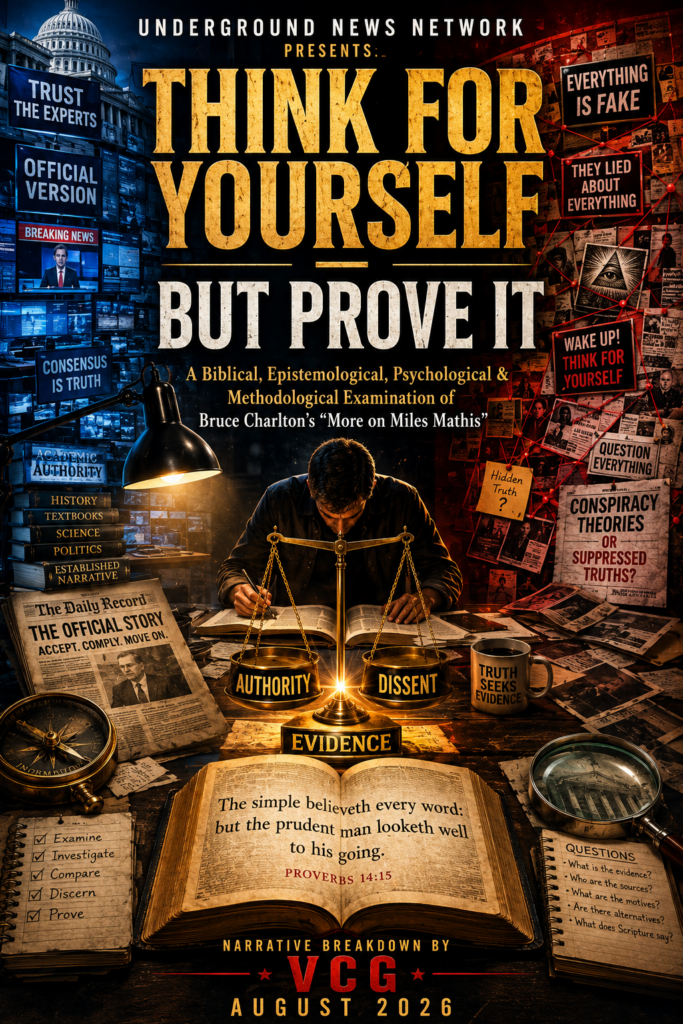
BY VCG ON 8/8/2026
FIRST PAPER BREAKDOWN:
This 2024 piece is actually a different target.
Bruce Charlton’s Notions: More on Miles Mathis
Charlton is no longer mainly attacking Mathis’s metaphysics; he is defending radical epistemic independence—arguing that Mathis may be valuable even when many specific claims are wrong.
That gives the new paper a cleaner central question:
Can a method remain truth-promoting when its factual error rate becomes very high?
Yes.
I read Charlton’s October 14, 2024 article “More on Miles Mathis” and the Ron Unz article it is answering.
This deserves its own paper, title, thesis, and cover because Charlton has changed the argument substantially. (Charlton Teaching)
It identifies the central contradiction in Charlton’s 2024 piece:
Charlton rightly urges independence from prestige and institutional authority—but then argues that Mathis’s numerous factual errors may matter less than the habit of thinking independently.
That is exactly where the paper should press.
The new paper’s central thesis
Charlton’s 2023 article essentially argued:
Mathis gets many things wrong because his worldview/metaphysics is defective.
The 2024 article makes a more surprising argument:
Mathis may get many things wrong, perhaps most things, but can still be extremely valuable because he teaches people not to trust institutional narratives and to think for themselves. (charltonteaching.blogspot.com)
That raises a much deeper epistemological question:
Is independent thinking itself a virtue if the independent thinker repeatedly reaches false conclusions?
My answer for the paper would be:
Intellectual independence is valuable only when joined to intellectual accountability.
Skepticism toward authorities does not eliminate the need for evidence, accurate facts, correction, outside criticism, reliable testimony, and falsifiability.
Otherwise independence can mutate into a closed epistemic system in which being contradicted becomes further proof of one’s independence.
And Scripture gives us almost the perfect standard:
“The simple believeth every word:
but the prudent man looketh well to his going.” — Proverbs 14:15
The biblical alternative is neither blind institutional trust nor blind anti-institutional distrust.
1. Charlton slightly misstates Ron Unz’s conclusion
Charlton opens by saying Unz concludes that
“MM is not a man but a front organization,”
created and operated as a disinformation project. (charltonteaching.blogspot.com)
That is stronger than Unz’s actual wording.
Unz does indeed seriously propose a professional disinformation operation.
But he uses explicitly conditional language.
He says his remaining hypothesis is that Mathis might be a disinformation agent and then says:
“If so…”
before proposing a team of perhaps 10–15 writers.
He estimates hypothetical costs and names the CIA, ADL, foreign intelligence agencies, or wealthy private individuals as possible sponsors. (The Unz Review)
Later Unz uses Mathis’s comparatively limited discussion of Mossad as circumstantial evidence for wondering who might operate the site. (The Unz Review)
So:
Charlton’s version:
Unz concluded Mathis is an intelligence front.
More accurate version:
Unz constructed a speculative disinformation hypothesis and regarded it as his preferred explanation.
That difference matters.
Unz himself does not produce documentary evidence demonstrating:
an intelligence contract,
additional Mathis writers,
payments,
handlers,
editorial communications,
organizational records,
or an identified sponsoring agency.
So the “Mathis organization” hypothesis remains inference, not established fact.
That distinction should appear very early in our paper.
2. Unz’s evidence deserves examination rather than dismissal
Charlton nevertheless does something good here.
He disagrees with another alternative-media writer instead of automatically accepting an anti-establishment thesis.
That is healthy.
Unz reasons substantially from:
Mathis’s enormous output;
what Unz regards as an extraordinarily high error rate;
the apparent disinformation utility of ridiculous claims;
timing relative to discussions of “cognitive infiltration”;
thematic omissions such as Mossad;
the sheer workload necessary to generate the corpus. (The Unz Review)
Those are legitimate observations to investigate.
But they do not individually or collectively establish organizational authorship.
The correct verdict is:
Interesting hypothesis.
Insufficient proof.
3. The Cass Sunstein connection is real—but the Mathis connection isn’t demonstrated
This part needs careful handling because something real lies beneath the speculation.
Cass Sunstein and Adrian Vermeule really did publish
“Conspiracy Theories: Causes and Cures”
in 2009. (DOI)
They discussed what they called “cognitive infiltration” of groups promoting conspiracy theories, including government agents or allies entering online communities to challenge factual premises and reasoning. (Practical Ethics |)
Therefore:
Government-linked cognitive infiltration was genuinely proposed in respectable academic literature.
But Unz goes farther.
He notices chronological proximity between that proposal and Mathis’s unusual mathematical/scientific writing and wonders whether the latter could have been part of such an operation. (The Unz Review)
Chronological proximity is not causal evidence.
So, we should distinguish:
Documented: Sunstein and Vermeule advocated considering cognitive infiltration.
Possible:
intelligence or government organizations have employed comparable tactics elsewhere.
Unproven:
Miles Mathis was created as one such operation.
That’s precisely the methodology this series should enforce.
4. Charlton’s “single man” conclusion has almost the mirror-image problem
Charlton answers Unz:
Mathis seems like one real person because the huge corpus has a distinctive, consistent personality. (charltonteaching.blogspot.com)
That’s evidence.
But it isn’t proof.
Modern authorship attribution—stylometry—really can analyze patterns of language associated with authors.
But forensic reviews emphasize significant unresolved limitations, especially when moving from stylistic resemblance to strong probabilistic authorship conclusions.
Multiple authorship and third-party textual intervention are recognized complications. (PubMed Central (PMC))
Charlton isn’t even performing stylometry.
He’s saying essentially:
“It feels like the same personality.”
Possible.
But a coordinated project could theoretically maintain:
common editing,
a house style,
one lead writer,
one editorial voice,
templated argument structures.
Likewise, one extraordinarily prolific individual could produce the whole thing.
At present, Charlton and Unz are therefore choosing between competing hypotheses without decisive evidence.
Proper verdict
Single-author hypothesis:
plausible.
Organized-team hypothesis:
possible.
Neither established by the evidence presented in these two essays.
That is the strongest answer we can responsibly give.
5. Charlton then makes another armchair personality judgment
He describes Mathis as having a “self-absorbed” personality and links this to motivated creativity. (charltonteaching.blogspot.com)
Psychology does not give us a clean rule:
self-absorbed personality → creativity.
Research finds more robust associations between creativity and variables such as:
openness to experience,
divergent thinking,
intrinsic motivation.
A second-order meta-analysis found these among the meaningful predictors of creativity. (ScienceDirect)
Narcissistic traits have shown much weaker relationships.
A Dark Triad meta-analysis found only a small association between narcissism and creativity, with much of the relationship depending upon how creativity was measured. (ScienceDirect)
One particularly interesting experimental study found narcissists were not objectively more creative, but tended to consider themselves more creative and could persuade others they were creative. (PubMed)
None of that permits us to diagnose Mathis.
So, Charlton’s psychological observation should be downgraded from:
explanation
to:
impression/hypothesis.
6. Then Charlton says something substantially true
His strongest sentence is this:
Much of what humans know comes second-hand.
That is correct.
Modern social epistemology explicitly recognizes that human knowledge is massively dependent upon other people.
We cannot personally verify:
our birthplace,
most ancient history,
astrophysics,
molecular biology,
events occurring across the planet,
most technical measurements,
nearly all archival facts.
Philosopher Gloria Origgi describes knowledge as a collective good and emphasizes that only a small portion of what we know comes through direct personal experience. (Cambridge University Press)
Recent work likewise describes pervasive epistemic dependence:
much knowledge and understanding rest upon the epistemic achievements of other people. (Cambridge University Press)
So, Charlton sees a real problem:
How do we responsibly believe anything we cannot personally witness?
Excellent question.
7. But then comes the leap
Charlton moves from:
Most knowledge is second-hand
to approximately:
Most second-hand knowledge comes through extremely corrupt institutions
to:
Most of what we think we know is probably fabricated or grossly distorted.
(charltonteaching.blogspot.com)
Those are three separate propositions.
The first is strongly supported.
The second requires institution-by-institution evidence.
The third is an enormous empirical claim for which Charlton offers no measurement.
This is a recurring error in alternative epistemology:
Step 1
Some authoritative sources lie.
True.
Step 2
Therefore, authoritative sources are unreliable in general.
Doesn’t automatically follow.
Step 3
Therefore, opposite or alternative narratives deserve higher prior credibility.
Definitely does not follow.
A corrupt newspaper can lie.
An independent blogger can also lie.
A government archive can contain errors.
A dissident website can contain errors.
Institutional status does not determine truth either positively or negatively.
8. Charlton’s real insight: prestige should not substitute for evidence
Here I think we should give him full credit.
Charlton argues that much intellectual life is controlled by concern about prestige and being considered respectable. (charltonteaching.blogspot.com)
That psychological mechanism is real.
Humans are social creatures.
Consensus, authority, reputation and group acceptance influence judgment.
There really are occasions when a person must tolerate ridicule to investigate something honestly.
And Scripture certainly does not instruct Christians to conform truth to public prestige.
Proverbs warns:
“The fear of man bringeth a snare…” — Proverbs 29:25
The Bible therefore gives Charlton something important:
fear of social reputation must not govern truth.
But that verse does not say:
Ignore correction.
Those are entirely different things.
9. This is the decisive sentence in Charlton’s article
Charlton says the perspective Mathis encourages is:
more important than multiple specific inaccuracies.
(charltonteaching.blogspot.com)
This is where our new paper should concentrate its fire.
Because that proposition is epistemologically dangerous.
Suppose an investigator teaches:
Don’t trust anyone.
Verify everything yourself.
Excellent.
But suppose that same investigator then gets:
names wrong,
dates wrong,
family relationships wrong,
institutional histories wrong,
source interpretations wrong,
and repeatedly draws conclusions unsupported by evidence.
At some point the method embodied by the errors becomes more important than the anti-authoritarian slogan.
There is no clean separation between:
what Mathis does
and
what Mathis says.
If his procedure generates false propositions at high frequency, then that procedure itself needs correction.
10. A high error rate cannot be dismissed as the price of freedom
Charlton correctly says errors are inevitable, especially when researching distant events. (charltonteaching.blogspot.com)
Yes.
But inevitability of some error does not make error rate irrelevant.
Consider:
Investigator A
100 claims
95 correct
5 erroneous
Investigator B
100 claims
20 correct
80 erroneous
Both can truthfully say:
“Nobody is perfect.”
But epistemically they are not equivalent.
Reliability matters enormously in testimony.
Philosophical work on testimonial knowledge repeatedly emphasizes speaker/source reliability as a fundamental consideration. (Cambridge University Press)
So, Charlton’s formulation needs correcting:
Errors are inevitable; persistent or systematic error is diagnostic.
That’s the distinction.
11. Radical distrust can become just as irrational as radical trust
This may become the most important section of the paper.
Charlton writes:
once someone has learned not to trust official/mainstream sources and to think for himself, he has learned something vital.
(charltonteaching.blogspot.com)
Half-right.
A person who moves from:
“The New York Times said it, therefore it must be true.”
to:
“The New York Times said it, therefore let’s check.”
has improved.
But someone who moves to:
“The New York Times said it, therefore it is probably false.”
has merely inverted the authority heuristic.
Likewise:
Government says X → true
is intellectually childish.
But:
Government says X → false
is the same faulty reasoning with the polarity reversed.
The correct response is:
Government says X → what is the evidence?
12. Research on media literacy supports calibrated skepticism, not indiscriminate skepticism
A large preregistered experiment involving 3,919 participants tested skepticism-oriented and trust-oriented media literacy advice.
Both approaches could improve discernment, but the most realistic conditions favored a combination helping users reject falsehood while retaining true information. (PubMed)
That’s exactly the problem with Charlton’s approach.
The goal isn’t:
TRUST LESS.
It is:
DISCERN BETTER.
Stanford’s Civic Online Reasoning program teaches similar practices:
investigate the source,
leave the page and read laterally,
seek independent information,
examine actual evidence.
That is much closer to a rigorous Christian investigative method.
13. Charlton’s “not caring about being discredited” contains truth—and danger
This is subtler.
He argues we must cease being controlled internally by whether “The System” considers us respectable. (charltonteaching.blogspot.com)
Correct.
Galileo would not become wrong merely because authorities condemned him.
Nor would an obscure researcher become correct merely because authorities mocked him.
Truth is independent of prestige.
But:
Not caring whether one’s reputation suffers
is different from:
Not caring whether informed critics can demonstrate one’s errors.
Charlton tends to blur these.
An intellectually healthy investigator says:
I don’t care whether you laugh at me.
But also:
I care intensely if you prove me wrong.
That distinction should probably appear in large type in the paper.
14. Biblical correction: independence is not isolation
This is where the Scripture section becomes especially powerful.
The biblical model is not:
retreat into one’s “innermost self” and trust personal conclusions.
Scripture repeatedly presents wisdom as receptive to correction.
Proverbs 18 says:
“He that answereth a matter before he heareth it, it is folly and shame unto him.”
Then:
“He that is first in his own cause seemeth just; but his neighbour cometh and searcheth him.”
The second voice matters precisely because our first interpretation can look compelling to us.
That is almost a biblical description of adversarial peer review.
15. Scripture’s investigator is corrigible
Another crucial biblical principle:
“The ear that heareth the reproof of life abideth among the wise.”
And:
“he that heareth reproof getteth understanding.”
Proverbs 15 places wisdom not in immunity from criticism but in the willingness to learn from it.
Likewise:
“Faithful are the wounds of a friend…”
and
“Iron sharpeneth iron…”
Proverbs 27 explicitly portrays other people as instruments of correction and sharpening.
So a Christian epistemology is personal but not solitary.
16. Even Paul was checked
Acts gives perhaps the strongest example.
The Bereans heard Paul himself.
Yet they:
“searched the scriptures daily, whether those things were so.”
They were praised for doing this.
Notice what they did not say:
Paul is an apostle; trust him automatically.
Nor:
Paul is an outsider challenging authorities; trust him automatically.
They examined the claim.
That’s our standard.
17. Charlton’s formulation risks creating an unfalsifiable identity
There is a psychological danger here.
Suppose someone adopts this identity:
I am one of the rare people who thinks for himself.
Then disagreement can be reinterpreted as:
You are controlled by The System.
Criticism becomes:
You’re trying to discredit me.
Failed predictions become:
At least I’m independent.
Factual errors become:
Details aren’t as important as breaking free.
At that stage, epistemic independence becomes ego-protective.
A person can become psychologically invested in being the dissident.
Recent review work on intellectual humility argues that the answer to mistrust is neither maximal trust nor maximal distrust; rather, people need better discrimination between credible and noncredible sources, and intellectual humility appears useful for doing that. (PubMed)
That’s a far stronger principle than Charlton’s.
18. The irony with Mathis
Charlton explicitly concedes that Mathis’s conclusions are often wrong and bizarre, perhaps with only a few genuinely correct. (charltonteaching.blogspot.com)
Pause on that.
If that assessment is true, then Charlton is saying approximately:
A writer who is frequently factually wrong remains valuable because he trains people to distrust sources that are frequently factually wrong.
That is an unstable argument.
If factual unreliability delegitimizes “The System,” why doesn’t factual unreliability reduce Mathis’s own epistemic authority?
The standard must apply symmetrically.
19. And the same standard must apply to Charlton
Our paper should make this explicit.
We cannot say:
Mainstream source → prove it.
Mathis → prove it.
Unz → prove it.
and then:
Charlton → sounds wise, accept it.
Charlton must also be tested.
That’s why his speculative psychology, sweeping claims about institutions, and causal assumptions need the same scrutiny.
There should be no protected narrator.
20. The proper replacement for Charlton’s thesis
I would rewrite his central principle this way:
Learn not to be intellectually ruled by prestige.
But do not confuse independence with truth. Test official claims and dissident claims by the same evidentiary standard; seek primary evidence, compare independent witnesses, invite correction, distinguish fact from inference, and remain willing to abandon any theory—including your favorite one—when the evidence fails it.
That is epistemically stronger.
And biblically stronger.
21. The governing Scripture for Paper II
Paper I appropriately used:
“Prove all things; hold fast that which is good.” — 1 Thessalonians 5:21
“The simple believeth every word:
but the prudent man looketh well to his going.”
PROVERBS 14:15
That’s perfect because Charlton’s article is really about whom not to believe.
Scripture’s answer is deeper:
Don’t become gullible in either direction.