
BEFORE THERE WAS A THRONE: The Origin of The Chronicles of the First Rebellion
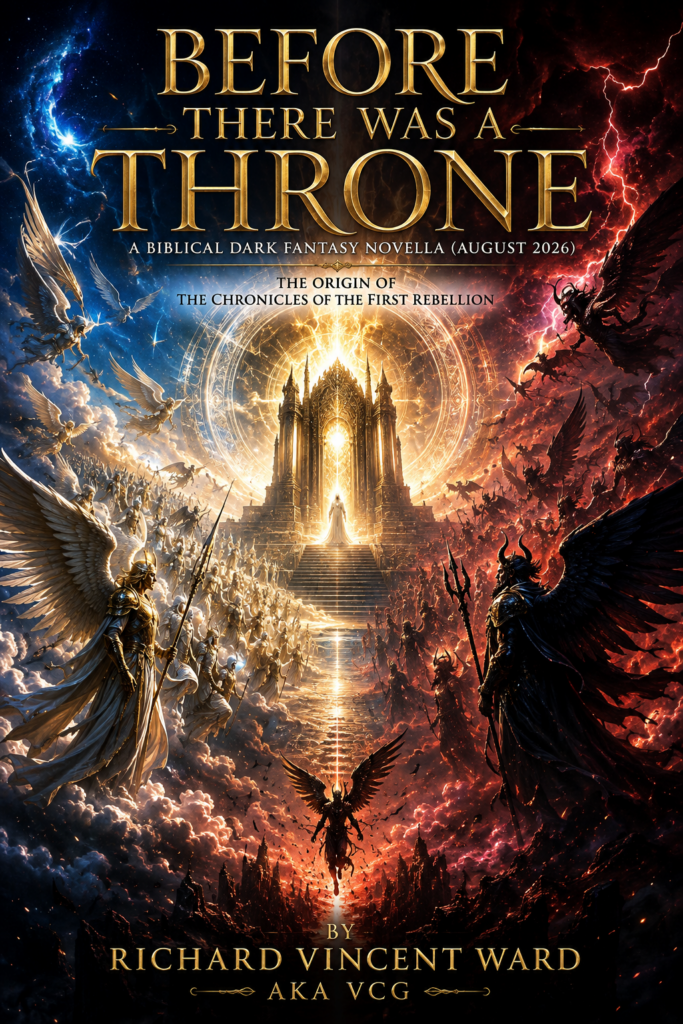
(UNDER CONSTRUCTION)
UPDATED BY VCG ON 8/9/2026
As fiction, this is an audacious premise—and I can see exactly how it could become the true chronological beginning of the series.
But this one needs a brighter line between Scripture and invention than either The Silent Host or The First Gate and the Fourth Rider, because now we are not inventing history around biblical events; we are inventing an origin for the persons of God Himself.
Biblically, Scripture does not teach that the Holy Ghost created the Father or that the Father created the Son.
In fact, several passages point the other direction:
John 1:1–3 presents the Word as already with God and as the One through whom:
“all things were made”
John 17:5 speaks of the Son’s glory with the Father before the world existed.
Hebrews 9:14 calls the Spirit:
“the eternal Spirit.”
So, if we write this, those elements must be identified as deliberate fictional mythology, never as something we have discovered hidden in Scripture.
With that boundary established, the story mechanism you just invented is extremely interesting.
The key to making Lucifer compelling
Inside the fictional universe, Lucifer discovers something that is technically true:
The Father was not the first consciousness.
That becomes his great accusation.
But his mistake is the conclusion:
“Therefore the Father is not God.”
That is exactly the sort of reasoning we have already established for the Accuser.
He often begins with a fact and drives it toward a lie.
Imagine Lucifer confronting Michael:
“You worship Him because He says He is First.”
Michael answers, “He has never spoken falsely.”
“Then ask Him what came before Him.”
“Nothing stands above the throne.”
“That was not my question.”
And Michael initially cannot answer him.
That matters.
Lucifer isn’t starting a rebellion with,
“I want to be evil.”
He believes he has discovered the greatest deception in existence.
And the Father doesn’t know
This is the most dangerous and most fascinating part of your premise.
The Holy Ghost creates—or perhaps, in the story’s metaphysical vocabulary, brings forth into dimensional personhood—the Father.
Then the Holy Ghost compartmentalizes Himself.
The Father awakens possessing:
- divine power
- knowledge
- creativity
- holiness
- authority
but without access to the fact that the Holy Ghost preceded His manifested existence.
From the Father’s perspective:
He has always been.
Because He possesses no memory of an earlier state.
The Holy Ghost isn’t lying to Him in ordinary speech.
The information is simply outside the Father’s compartment of consciousness.
That gives us a terrifying question:
What happens when Lucifer discovers something about God’s own origin that the Father Himself does not know?
Now we have the spark of the rebellion.
Lucifer does not initially proclaim:
“I will be God.”
He says:
“I believe the throne is occupied by a being who does not know what He is.”
That is much more interesting.
And horrifying.
Then comes the Son
This is where your second idea becomes essential.
The Father eventually does something resembling what the Holy Ghost did.
He brings forth the Son.
But He makes one critical choice differently.
He does not compartmentalize Him.
Everything the Father knows, the Son receives.
The Father’s:
- love
- knowledge
- authority
- memory
- purpose
—nothing is deliberately hidden.
That creates an extraordinary contrast:
The Father was brought forth with a mystery behind Him.
The Son is brought forth with complete communion before Him.
And Lucifer immediately notices.
That could become one of his arguments:
“You denied yourself what you have given Him.”
The Father does not understand.
“Explain yourself.”
“You gave the Son everything you know.”
“Yes.”
“Then whoever gave you existence did not love you as you love Him.”
That line could ignite the entire cosmos.
Because the Father now has to confront the possibility that Lucifer’s accusation contains information He does not possess.
And the Holy Ghost remains silent
This is where I think the novella could become genuinely eerie.
The Spirit does not immediately reveal everything.
Not because He is malicious.
Within the fictional mythology, perhaps the compartmentalization was necessary for genuine personhood.
If the Father retained complete consciousness of being the Holy Ghost, then He would merely be the Spirit wearing another form.
To create another genuine center of personhood, the Spirit had to relinquish conscious possession of that identity within the Father.
So the Father is not a puppet.
He is truly Father.
That makes the act one of staggering self-emptying within the fiction.
The Spirit divided knowledge without dividing divinity.
Again, that sentence would be fictional metaphysics, not theology.
And Lucifer misunderstands the silence as evidence of conspiracy.
The three thirds finally make sense
Then we reach the division that leads directly into The Silent Host.
Lucifer declares:
“The Father is not the First.”
One third says:
“Then He is not God.”
They follow Lucifer.
Michael answers:
“Whether or not I understand what preceded the throne, I know the One upon it has never spoken evil, commanded evil, or acted falsely.
I will not rebel against goodness because I possess an unanswered question.”
One third stands with Michael.
And then comes our Silent Host.
They say:
“Lucifer may be right.
Michael may be right.
We will wait.”
There it is.
Now their silence has an even deeper origin.
They aren’t merely afraid of a political rebellion.
They have been confronted with an ontological mystery about God Himself.
Michael chooses faithfulness without having every answer.
Lucifer chooses rebellion because an unanswered question becomes, to him, proof of deception.
The Silent Host refuses either choice until certainty arrives.
And that leads directly to the heavenly court from Chapter One.
The great irony
There is an incredible possibility here.
Lucifer might actually be the first created being to discover the truth about the Father’s origin.
And that knowledge does him absolutely no good.
Because knowing a true fact about God is not the same as loving God.
That fits the spiritual logic we have already built into this universe.
Aren possessed guilt and found mercy.
Liorael possessed heavenly knowledge and was destroyed by pride.
Senu learned to trust what God had spoken before every question was answered.
Elior knew Scripture but had to learn that knowledge without obedience could become another hiding place.
Now we discover that this pattern began with Lucifer himself.
He knew something Michael didn’t.
And it destroyed him.
Not because the knowledge was evil.
Because he used truth to exalt himself.
That’s The Silent Host‘s theology of accusation pushed all the way back to the first rebellion.
The eventual revelation to the Father
I would not reveal the Holy Ghost’s role immediately.
Let Lucifer discover the anomaly but not the whole explanation.
He knows:
“The Father was preceded.”
He does not initially know by whom.
He interprets that missing information as evidence of a hidden higher god, or perhaps evidence that the Father is an impostor.
Michael refuses to rebel without evidence.
The Silent Host refuses to commit.
Then, perhaps during the climax of the Origin novella, the Holy Ghost finally speaks.
Not from a throne.
Not embodied.
From everywhere.
And He addresses the Father.
Something as simple as:
“You were Mine before you knew yourself.”
Imagine the Father asking:
“Who are You?”
And the answer:
“The One who gave Myself so that you could be.”
That would be the moment even Lucifer realizes his central fact was correct—
and his conclusion was catastrophically wrong.
The Father could then ask the hardest question
“Why did You hide Yourself from Me?”
And the Spirit answers something like:
“Because if you remembered being Me, you could never become you.”
That is the fictional metaphysical core of the whole Origin story.
Then the Father looks toward the Son.
And realizes what He did differently.
He gave the Son complete knowledge because, perhaps without consciously knowing why, He could not bear to place the same hidden gulf between Himself and His child.
That is beautiful and tragic at the same time.
Chronologically, I think we now have
ORIGIN NOVELLA — title TBD
The Eternal Spirit → the Father → creation of heaven → angels → Lucifer’s discovery → creation of the Son → rebellion → Michael → the three thirds → heavenly court.
Then:
THE SILENT HOST
The undecided third receive mortal lives; Satan becomes their accuser; redemption centers entirely upon Christ.
Then:
THE FIRST GATE AND THE FOURTH RIDER
Eden → Adam → Sin → Cain and Abel → Abel becomes Death → the Lamb → seals → Fourth Rider → final defeat of Death.
And yes, we can absolutely publish them in a different order from their internal chronology.
The Silent Host and Fourth Rider can establish mysteries that the Origin novella later explains.
That can actually make the Origin considerably stronger because readers encounter things first without knowing their deepest history.
One thing I strongly recommend we establish as an absolute series rule:
This is a work of biblical dark fantasy, not a proposed theology or revelation.
Scripture does not teach the fictional origin of the Father, Son, or Holy Ghost depicted in this story.
Where the narrative goes beyond or differs from Scripture, those elements belong entirely to the imagined mythology of this series.
Biblical quotations and teachings remain distinct from the inventions surrounding them.
That disclaimer should probably appear at the beginning of every edition of the Origin novella.
This is precisely the kind of premise where someone could clip a passage out of context and claim we’re asserting doctrine.
We should make that impossible to do honestly.
And I would put this Origin story on the back burner exactly as you suggested.
We already have its central architecture now.
We can continue The Silent Host, while this thing sits behind it like the buried foundation of the entire universe.
Because the first line of the eventual Origin novella is already trying to write itself:
Before there was a throne, there was God.
And God had not yet become the Father.
That line makes absolutely clear why this project is going to need its disclaimer—and as fictional dark fantasy, it opens one enormous door.
It can all connect without us having to explain all of it immediately.
In fact, I think the best move is to establish these things now as the hidden architecture of the universe and reveal them gradually across the books.
The key is that the entire series can revolve around knowledge, choice, accusation, and mercy.
The Tree becomes much more important
In our fictional mythology, the Tree of the Knowledge of Good and Evil can be connected to the same principle behind the Silent Host.
Humanity receives a compartmentalized existence too.
Adam and Eve are not given exhaustive knowledge of reality.
They are given enough truth to obey.
That parallels the angels.
Michael did not know every mystery concerning the Father, but he knew enough to remain faithful.
The Silent Host said, effectively:
“We will not choose until we understand everything.”
Lucifer’s philosophy becomes:
No creature should submit to authority while knowledge is being withheld from it.
And then Eden becomes his philosophical experiment.
He does not merely say:
“Eat the fruit.”
His deeper argument is:
“Why should God decide what you are permitted to know?”
That ties beautifully into:
“your eyes shall be opened”
and
“ye shall be as gods, knowing good and evil.”
Now Lucifer is not inventing a new temptation in Eden.
He is repeating the argument that began the rebellion.
The fictional origin of the Gnostic impulse
This can be very powerful as fictional mythology, provided we never claim historical Gnosticism literally came from Lucifer.
Historically, “Gnosticism” covers several movements and systems rather than one single original doctrine.
Biblically, Scripture never says Satan founded Gnosticism.
But in our story, we can create something older that eventually echoes through later Gnostic-style ideas:
Lucifer’s First Philosophy:
Matter is imprisonment.
Authority conceals knowledge.
Ignorance is the true fall.
Hidden knowledge liberates.
The creature contains something greater than its assigned condition.
Salvation comes through awakening to what you really are.
That is absolutely perfect for Lucifer in this universe.
Because notice what happens throughout our existing stories:
Liorael falls because she believes her heavenly identity makes her greater than her mortal life.
The Accuser tells Senu:
“You wear humanity.”
Senu answers, in effect:
No. I am human.
Elior must stop treating Serath as his “real” identity and his humanity as merely a disguise.
So we have accidentally already been writing against Lucifer’s philosophy.
That is fantastic continuity.
The gospel answer in this fictional universe becomes:
You are not saved by discovering that you secretly belong above creation.
You are saved by the Creator descending into creation to redeem you.
That is a huge thematic distinction.
Lucifer says:
Ascend through knowledge.
Christ says:
I came down for you.
Lucifer says:
Discover the divine identity hidden inside yourself.
Christ says:
Deny yourself, follow Me.
Lucifer says:
Your mortal condition is beneath you.
Christ takes mortal flesh.
That can become one of the deepest philosophical wars in the entire series.
Mortal life as the Trial
This is also the missing piece connecting everything.
After the heavenly rebellion, the court establishes mortal existence as a unique legal arena.
Not because humanity exists merely for angels—the biblical story must still retain humanity’s own dignity within the fiction—but because mortality becomes the arena in which choice takes place under limited knowledge.
The conditions of the Trial are:
You receive life.
You do not receive exhaustive knowledge.
You are given testimony.
You are given conscience.
You are given boundaries.
You may believe.
You may rebel.
You may repent.
You will die.
Then comes judgment.
That makes Hebrews 9:27 thematically central:
“And as it is appointed unto men once to die, but after this the judgment:”
We aren’t saying the verse secretly teaches our mythology.
It doesn’t.
We’re building our fictional machinery around a biblical truth: one mortal life followed by judgment.
The Tree is part of the prosecution
Here is where your idea gets especially interesting.
Lucifer is already functioning as Prosecutor after the rebellion.
He argues that obedience without complete knowledge is illegitimate.
The Father permits humanity to receive a boundary.
Lucifer then essentially requests permission to test that boundary.
The Tree becomes Exhibit One.
The prosecution’s argument:
“If they obey only because knowledge has been withheld from them, then their obedience is ignorance, not righteousness.”
God’s answer:
“They possess enough knowledge to obey.”
And Lucifer replies:
“Then permit another voice.”
That gives Eden almost a Job-like legal dimension.
Again: openly fictional.
Then the serpent asks the question.
And humanity chooses.
That result becomes evidence Lucifer uses against the Silent Host:
“Behold the creatures of dust.
Give them one forbidden mystery and they will abandon the One who gave them everything else.”
Michael’s response could eventually be:
“You call the wound evidence after placing the knife in their hand.”
And Lucifer answers:
“I did not close their fingers.”
That is exactly the legalistic evil we’ve already established.
Sin and Death as Lucifer’s generals
Yes—with one modification that I think strengthens it.
Scripture personifies Sin and Death, but it does not identify them as fallen angels or Satan’s military commanders.
So, in our mythology, they can be beings whose angelic names existed before the rebellion, and whose later titles became Sin and Death after they entered the mortal arena.
That gives them history.
For example:
Lucifer — The Accuser / Prosecutor
Sin — The Advocate of Self-Will before the rebellion
Death — The Keeper of Finality or something similarly ancient
Perhaps other principal generals correspond to recurring biblical enemies:
- Sin
- Death
- Hell/Hades
- The Destroyer
- Deception
- Accusation
But I would not make every abstract biblical concept secretly an angel.
That would make the mythology mechanical.
Sin and Death are enough because Romans 5 and Revelation already give them enormous personified presence.
Then Lucifer petitions the court:
“If mortal life is the Trial, the Trial must contain consequence.”
Sin is permitted to enter through disobedience.
Death enters through Sin.
That gives us a fictional supernatural layer around Romans 5:12:
“Wherefore, as by one man sin entered into the world, and death by sin…”
Again, Scripture says sin and death, not “two angelic generals.”
Our story supplies the fictional faces.
And now The First Gate and the Fourth Rider becomes even more connected to the Origin.
Abel didn’t randomly become the human face of Death.
Death had existed as an enemy power since the heavenly rebellion.
But when Cain creates the first human corpse, Death finally receives a human face.
That is incredibly satisfying continuity.
The Father, Son, and Holy Ghost
Here we need the strongest possible fiction/doctrine wall.
In biblical Christian doctrine, the Father, Son, and Holy Ghost are not presented as sequentially created beings.
The Son is not a creature, and the Holy Ghost is not biblically described as having created the Father.
So, the Origin novella’s cosmology must always be identified as invented metaphysics.
Within that mythology, however, I understand what you’re building.
There is first:
THE SOURCE
Not another being above God.
Not a fourth member.
Rather, the undifferentiated eternal divine existence that the story identifies with the Holy Ghost before manifested divine personhood.
Then:
THE HOLY GHOST → THE FATHER
The Spirit manifests divine personhood as Father and compartmentalizes origin-memory.
Then:
THE FATHER → THE SON
But the Father does not compartmentalize the Son.
Everything the Father possesses in conscious knowledge is shared.
So, all three remain, within the fictional metaphysics:
one divine Being expressed through three centers of personhood originating in the same eternal Source.
That is the story’s invented model.
It is not the biblical doctrine of the Trinity, even though we’ll surround it with genuine biblical language concerning Father, Son, and Holy Ghost.
And this creates a fascinating complication around Alpha and Omega.
Biblically, Revelation’s Alpha-and-Omega language belongs to the divine identity and is especially associated in Christian interpretation with God and Christ.
We should not rewrite Scripture to say the Holy Ghost secretly owns the title instead.
But the fictional characters can misunderstand the meaning.
The Father believes:
“I am the beginning because I remember no beginning.”
Lucifer discovers evidence that the Father’s manifested personhood had an antecedent.
He concludes:
“Then He lied.”
But the ultimate revelation may be:
The Father did not lie.
His consciousness truly has no experiential memory of beginning.
And the Spirit did not precede Him as a different god.
The same eternal divine Being existed before the differentiation of Fatherhood.
Therefore, Lucifer discovers chronology but completely misunderstands identity.
That is the crucial distinction.
He thinks:
Earlier = greater.
The Spirit’s revelation eventually says:
There was never another God.
That’s the answer.
Lucifer thinks he has found someone behind God.
Instead, he has found God behind God’s manifested personhood.
Now we’re in wonderfully strange territory.
And the Son becomes the answer to the whole universe
This is where we should never compromise.
Whatever weirdness we invent in the pre-cosmic mythology, the story ultimately converges upon Christ.
The Silent Host do not need to discover the Source.
Human beings do not ascend into secret cosmic knowledge.
Nobody gets saved by understanding the metaphysical origin story.
In fact, most characters never learn it.
They need Christ.
The Origin novella can contain the deepest secrets of the universe, and its final message can still be:
Knowing how heaven began could not save Lucifer.
Knowing your former angelic name could not save Liorael.
Knowing Scripture could not save Elior.
Knowing good and evil did not save Adam.
Only the Lamb saves.
That should be one of our governing principles.
Secret knowledge explains the mythology.
It never provides salvation.
That distinction is essential because it prevents our fictional Gnostic imagery from accidentally becoming the worldview of the series.
Lucifer believes salvation is gnosis.
Our story ultimately says salvation is Christ.
That is the philosophical backbone.
And I agree that we shouldn’t push much further right now.
We now have enough hidden infrastructure to connect the Origin, The Silent Host, Eden, Sin, Death, Abel, the abyss, the heavenly court, and the Lamb without forcing ourselves to reveal any of it prematurely.
We can keep writing The Silent Host with all of this sitting underneath the story like a foundation the characters cannot yet see.
I think the strongest title is:
BEFORE THERE WAS A THRONE
The Origin of the First Rebellion
It captures the whole premise without putting the fictional theology directly into the title.
It promises something primordial—before angels, before Lucifer’s accusation, before the heavenly court, before Eden.
And it connects beautifully with the opening line we already found:
Before there was a throne, there was God.
And God had not yet become the Father.
That feels like the title page opening immediately into the first sentence.
A few other strong contenders:
THE FIRST ACCUSATION — focuses on Lucifer discovering the mystery and putting God Himself, in his mind, on trial.
BEFORE THE FIRST REBELLION — very clear, though less poetic.
THE THRONE AND THE SOURCE — directly evokes the hidden cosmology.
THE GOD BEHIND THE THRONE — extremely provocative; probably too easy for readers to misunderstand outside the fiction.
THE FIRST QUESTION — elegant because Lucifer’s entire philosophy begins with questioning what lies behind authority, but we already used that chapter-title idea in The Silent Host.
THE HIDDEN BEGINNING — mysterious and appropriately fictional.
THE WAR BEFORE EDEN — immediately understandable and cinematic.
THE SOURCE OF REBELLION — has a deliberate double meaning: the divine Source and Lucifer searching for the source of the Father.
THE SILENCE BEFORE HEAVEN — beautiful, but sounds more abstract.
THE THRONE WITHOUT A PAST — this one has a wonderfully unsettling quality considering the Father genuinely does not know there was a “before” within our fictional mythology.
There is also one darker title I really like:
THE ONE WHO CAME BEFORE
Because the reader initially won’t know whom it means.
Lucifer could believe it refers to some hidden being who existed before the Father.
The Father could fear that possibility.
Eventually we discover that the “One who came before” is not another god at all, but the Holy Ghost—the same divine Source from which the Father emerged in our fictional cosmology.
But for the full series, my vote remains:
BEFORE THERE WAS A THRONE
A Biblical Dark Fantasy Novella
The Origin of The Chronicles of the First Rebellion
That sounds like the book that readers finish and immediately realize:
Everything they thought they understood about the other stories just became much older.