
The First Gate & the Fourth Rider
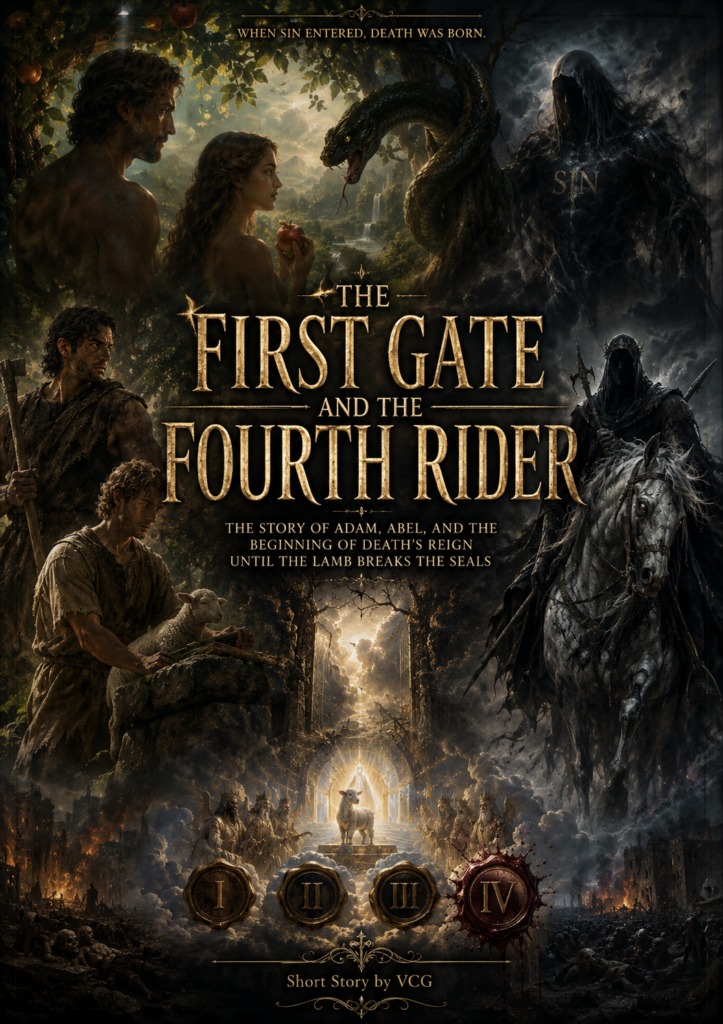
BY VCG 7/31/2026
A Biblical Dark-Fantasy Short Story
by VCG
Prologue
Before the First Grave
Before the earth learned to drink blood, it drank only rain.
No grave broke the green skin of the world. No bone slept beneath the roots of trees. No mother knew the terrible weight of a child who would not awaken, and no man had yet discovered that hatred could make a weapon of the hand.
The wind knew the music of rivers.
It knew the whisper of grass bowing beneath the feet of living creatures. It knew the great voices of beasts and the small songs of birds. But it did not know lamentation.
Eden stood at the heart of that unscarred world.
Four rivers carried its waters outward beneath flowering branches and hills veiled in morning mist. Gold slept in distant lands. Precious stones lay hidden beneath untouched ground. Trees rose like green pillars beneath a sky that had never looked down upon murder.
At the garden’s center stood the tree that had been forbidden.
Around Eden there was a gate no mortal eye could see.
It had no hinges. It had no bars. It had no walls.
It was fashioned from obedience.
Beyond that gate waited a presence without shape.
It possessed neither hands nor mouth, for human hands had not yet performed its works, and human mouths had not yet learned to defend them. It was a shadow without an object, a hunger without a stomach, a kingdom without subjects.
Its name was Sin.
Sin could not enter Eden by force. The gate was stronger than mountains because it rested upon the word of the One who had planted the garden.
So, Sin waited.
Beside it, hidden among the outer shadows, something moved upon a thousand silent coils.
The Serpent lifted his head.
His scales shone like wet emeralds beneath the leaves. His eyes held the cold patience of one who could wait a century for a single unguarded thought.
“You cannot cross,” he whispered.
Sin trembled like smoke.
Not unless they open the way.
“And they will.”
The woman?
“The woman shall listen.”
And the man?
The Serpent’s mouth curved into something that was not quite a smile.
“The man shall choose.”
Far within Eden, Adam and the woman walked together beneath the trees, unashamed and unafraid.
The Serpent watched them.
Then he began to move.
Chapter One
The Voice Beneath the Leaves
Eve found the Serpent wound around a low branch near the forbidden tree.
She did not fear him.
Fear had not yet entered her.
The creature’s body lay across the branch like a living chain of green and black. Sunlight passed through the leaves and scattered gold across his scales.
He regarded the fruit above her.
“Beautiful,” he said.
Eve looked up.
The fruit shone among the leaves, full and unblemished.
“We may eat of the fruit of the trees of the garden,” she answered. “But not of this one.”
“Not even touch it?”
“We shall not eat of it, neither shall we touch it, lest we die.”
The Serpent slowly uncoiled his head from the branch.
“Die?”
The word sounded strange in the garden.
Eve frowned. “That is what was spoken.”
“Yet what is death?”
She had no answer.
The Serpent lowered himself until his eyes were level with hers.
“How can you fear what you have never seen?”
“I trust the One who spoke.”
“Do you?”
The question was gentle.
That gentleness was the hook.
Eve stepped back, but the Serpent did not pursue her.
“I do.”
“Then why are you troubled?”
“I am not troubled.”
“You look toward the fruit.”
Eve turned her eyes away.
The Serpent’s voice followed.
“Perhaps the command was not given for your protection.”
She looked at him again.
“What else could it be?”
“A boundary placed around knowledge. A wall built to preserve your smallness.”
“There is no smallness in what He made.”
“Then why are you denied what is good?”
Eve’s gaze returned to the fruit.
The Serpent slipped lower, his body whispering over bark.
“Ye shall not surely die.”
The unseen gate surrounding Eden trembled.
Beyond it, Sin drew nearer.
The Serpent continued.
“Your eyes shall be opened. You shall know good and evil. You shall become more than you are.”
“I am what He made me.”
“And does the seed apologize because it desires to become a tree?”
Eve stared at the fruit until its beauty seemed almost to pulse.
The Serpent did not command her to take it.
He merely waited until desire began speaking in his place.
Her hand rose.
The stem broke with a sound no louder than the snapping of a thread.
Yet far beyond Eden, the world shuddered.
Eve ate.
Sweetness filled her mouth.
For one fleeting instant she felt nothing but the fruit’s fragrance and the warmth of sunlight upon her face.
Then something cold opened inside her.
The Serpent watched the innocence leave her eyes.
“Do you see?” he asked.
Eve looked down at herself.
Shame entered the world.
She covered her body and turned.
Adam stood among the trees.
He had seen her take the fruit.
He had seen her eat.
In her hand remained what was left of it.
“Adam,” she whispered.
He did not answer.
She crossed the grass toward him.
“The Serpent said—”
“I heard him.”
“Then you know.”
“I know what was commanded.”
The Serpent remained beneath the tree, motionless except for the tip of his tail.
Eve held out the fruit.
Her hand trembled.
“I am afraid.”
Adam looked into her face.
She was still bone of his bone and flesh of his flesh. Yet something had come between them—a veil too thin to see and too strong to tear.
“Do not leave me alone in this,” she said.
Adam looked toward the trees through which the voice of the LORD God had so often come in peace.
He could refuse.
He could call out.
He could stand upon the word he had been given.
Instead, he looked at Eve again.
Then he reached for the fruit.
The Serpent whispered from beneath the branches.
“Choose.”
Adam turned toward him.
“You beguiled her.”
“I spoke. She desired.”
“You have brought this upon us.”
“No,” said the Serpent. “I have only shown you the door.”
Adam’s fingers closed around the fruit.
“I will not abandon her.”
The Serpent’s eyes brightened.
“You will abandon something greater.”
Adam ate.
The invisible gate shattered.
A crack raced through creation—not across stone or sky, but through the order of the world. Flowers bent upon their stems. Beasts lifted their heads. The rivers of Eden faltered as if they had forgotten where they were going.
Through the broken gate came Sin.
It entered as black vapor, thin enough to pass beneath a leaf, yet vast enough to cast a shadow across generations.
It wrapped itself around Adam’s heart.
Behind it came Shame.
Then Fear.
Then Blame.
Last of all, something waited at the threshold.
It was an emptiness shaped like a throne.
It did not yet enter.
It had no face.
It had no name spoken by human lips.
It waited for blood.
Chapter Two
East of the Flame
They hid among the trees.
Adam tore leaves from a fig tree and bound them together with shaking fingers. Eve stood with her arms wrapped around herself, listening to every movement in the garden.
When the voice of the LORD God came in the cool of the day, the sound that had once brought joy now filled them with terror.
“Where art thou?”
The question moved through Eden.
It was not the question of One who lacked knowledge. It was the summons of One calling the lost to step out from hiding.
Adam closed his eyes.
Eve whispered, “Answer Him.”
“What shall I say?”
“The truth.”
Adam looked at her bitterly.
“Which truth? Yours or mine?”
The words wounded her more deeply than he intended.
From the shadows overhead came a quiet laugh.
The Serpent watched them from a branch.
Already his form seemed changed. His beauty had become harsher, his movements lower, his body drawn toward the dust.
“You see?” he murmured. “Knowledge.”
Adam stepped from hiding.
Judgment followed.
The Serpent was cursed. Sorrow entered motherhood. The ground was cursed for Adam’s sake. Thorns stirred beneath the soil like teeth awakening in a buried jaw.
Then came the sentence:
Dust would return to dust.
At those words, the emptiness beyond the broken gate opened its eyes.
Death entered creation.
It did not yet walk.
It passed beneath the soil as a coldness. It entered the roots of trees and the marrow of beasts. Leaves that had never withered felt the first faint pull of decay.
The LORD God clothed Adam and Eve.
Then they were driven eastward.
At Eden’s boundary stood cherubims veiled in terrible brightness. Between them turned a flaming sword whose fire filled the air with a sound like the roaring of many waters.
Adam stopped before the gate.
Beyond it he could see the trees beneath which he had once walked without fear.
“We can return,” he said.
Eve touched his arm.
“The sword will not permit it.”
“We can wait.”
“For what?”
“For mercy.”
Eve looked at the flame.
“Mercy clothed us,” she said. “But mercy has not left the gate open.”
A voice moved through the dust near their feet.
“You chose well, Adam.”
The Serpent crawled from beneath a stone.
No longer did he move proudly among the branches. His body dragged across the earth, and dust clung to his scales.
Adam seized a fallen branch and struck at him.
The Serpent slipped aside.
“You lied.”
“I told the woman she would know good and evil. Does she not?”
“You said we would not die.”
The Serpent raised his head.
“And are you dead?”
“Death is in us.”
“Then perhaps it was already waiting.”
Adam struck again.
The branch broke against the ground.
The Serpent retreated into a thorn bush.
“You cannot blame me forever,” he said. “Soon you will have children. They will find reasons of their own.”
Eve picked up a stone and hurled it.
The Serpent vanished.
Behind them, the gates of Eden burned.
Before them lay a world without shelter.
Adam took Eve’s hand.
Together they walked east.
Far beneath the ground, Death listened to their footsteps.
Chapter Three
The Brothers
Cain loved the earth because he could strike it.
He broke its hard crust with stone and wood. He tore thorns from the fields. He dug channels for water and crushed insects beneath his heel. The ground resisted him, and therefore he understood it.
Abel preferred living things.
He walked among the sheep before sunrise, when mist still lay across the valleys. He knew which lamb had been born weak, which ewe would wander, and which ram would lower its head before charging.
Cain often mocked him.
“You speak to them as though they understand.”
“They understand kindness.”
“They understand food.”
“They understand both.”
Cain drove his tool into the ground.
“You always answer as though you are wiser.”
Abel crouched beside the furrow.
“No. I answer as though I am your brother.”
“That is worse.”
Abel smiled faintly.
Cain did not.
From the edge of the field, something watched them.
The Serpent had followed Adam’s family eastward. Years had passed, but his voice had lost none of its patience.
Cain first heard him during a season when the earth yielded little.
He was kneeling beside a row of withered plants, digging his fingers into dry soil.
“You labor like a servant,” said the Serpent.
Cain turned.
The creature lay coiled beneath a thorn bush.
“My father warned me of you.”
“Your father warns you of many things.”
“He says you destroyed the garden.”
The Serpent laughed.
“Did he tell you whose teeth bit the fruit?”
Cain threw a stone.
The Serpent did not move. The stone struck beside his head.
“You missed.”
“I did not intend to.”
“Then you are already becoming honest.”
Cain rose.
“What do you want?”
“To understand you.”
“No creature understands me.”
“Your brother believes he does.”
Cain’s face hardened.
“Leave Abel out of your mouth.”
“Why? He is always in yours.”
The Serpent slipped through the dust toward him.
“Abel, the gentle. Abel, the righteous. Abel, whose hands remain clean because his sheep eat what your hands force from the cursed ground.”
Cain gripped his tool.
“My offering will be greater than his.”
“To whom?”
“To the LORD.”
“Then perhaps you should ask why one brother was given lambs and the other thorns.”
Cain’s jaw tightened.
The Serpent disappeared into the grass before Cain could answer.
In the process of time, the brothers brought offerings.
Cain laid before the LORD the fruit of the ground. Abel brought of the firstlings of his flock and of their fat.
Respect was shown toward Abel and his offering.
Toward Cain and his offering, it was not.
Cain stood before the smoke of Abel’s sacrifice and felt something twist within him.
His countenance fell.
Abel approached cautiously.
“Brother.”
Cain turned away.
“Do not call me that.”
“What have I done?”
“You stood there.”
“I offered what I had.”
“And I did not?”
“I did not say that.”
“You did not need to.”
Abel reached for his shoulder.
Cain knocked his hand away.
That night, Cain sat outside his dwelling while the stars burned above the dark fields.
The warning came to him:
Sin lay at the door.
Its desire was toward him.
He must rule over it.
Cain lowered his head.
At the edge of the firelight, two golden eyes opened.
The Serpent crawled closer.
“He warns you as though you were a child,” he said.
Cain did not look up.
“Go away.”
“Sin lies at your door.”
“I heard.”
“Then why not open it?”
Cain turned toward him.
“Because I was told to rule over it.”
The Serpent coiled beside the doorway.
“One may rule a beast only after letting it near enough to bind.”
“What do you know of rule?”
“I taught your father to choose.”
“You taught him to fall.”
“Every fall begins with a step freely taken.”
Cain stared into the fire.
“Why was Abel accepted?”
“Ask him.”
“He will answer with humility.”
“And humility in a favored man is pride wearing clean garments.”
Cain rose.
The Serpent watched him walk into the darkness.
At the doorway, something invisible raised its head and followed.
Chapter Four
The First Blood
Cain found Abel at dawn.
His brother stood among the sheep beneath a pale sky. A newborn lamb rested across his shoulders.
“You came early,” Abel said.
“Walk with me.”
Abel studied his face.
“Where?”
“The eastern field.”
“The flock—”
“Leave it.”
Abel gently set the lamb beside its mother.
They walked without speaking.
The eastern field lay beyond the cultivated ground where tall grass moved beneath the wind. In the distance, smoke rose from Adam’s dwelling.
Abel finally broke the silence.
“Father says you have not slept.”
“Father says many things.”
“He is afraid for you.”
“Are you?”
“Yes.”
Cain stopped.
“Of me?”
“For you.”
Cain laughed without mirth.
“You always know which answer sounds righteous.”
“I am not trying to sound righteous.”
“No. You never have to try.”
Abel stepped closer.
“The offering has wounded you.”
“The offering revealed me.”
“What did it reveal?”
“That I am less.”
“I have never thought you less.”
“You stood beneath favor while I stood beneath silence.”
“I cannot explain why.”
“You do not need to. You have what you wanted.”
Abel’s expression changed.
“What do you think I wanted?”
“To be above me.”
“I wanted to be accepted.”
“And I wanted the same!”
Cain’s shout scattered birds from the grass.
Abel did not retreat.
“Then do well,” he said quietly. “Return. Offer again. Ask what must change.”
Cain’s breathing grew heavy.
“So simple.”
“Not simple.”
“For you it is.”
“No.” Abel looked down at his hands. “Nothing is simple after Eden.”
Cain’s anger faltered for a moment.
Abel continued.
“Father carries the garden in his eyes. Mother wakes calling the names of trees we have never seen. We were born outside the gate, Cain. Neither of us knows the world as it was meant to be.”
Cain looked toward the east, where the distant sky sometimes glowed with reflected fire.
“Yet you speak as though the gate would open for you.”
“I speak as though we should not build another gate between us.”
Behind Cain, the grass parted.
The Serpent emerged.
Only Cain seemed to see him.
“Beautiful words,” the Serpent whispered. “He pities you.”
Cain’s hand tightened around the stone tool hanging from his belt.
Abel noticed.
“Brother?”
“He pities you,” said the Serpent. “Soon he will forgive you for sins you have not confessed.”
“Be silent,” Cain muttered.
Abel glanced around.
“I said nothing.”
“Not you.”
The Serpent circled behind Abel.
“Ask him where his lamb is now.”
Cain’s eyes filled with tears.
“Why did He choose you?”
Abel’s face softened.
“I do not know.”
“Liar.”
“I do not know.”
“Say you are better.”
“I am not.”
“Say it!”
“I will not speak what I do not believe.”
The Serpent lifted his head beside Abel’s shoulder.
“He denies his triumph because watching you suffer is sweeter.”
Cain drew the tool.
Abel stared at it.
“Put that down.”
“Were you laughing at me?”
“No.”
“Do you speak of me among the sheep?”
“Cain, listen to me.”
“Do you thank God that you are not your brother?”
Abel stepped forward.
“I thank God that you are my brother.”
Cain struck him.
The sound was small.
Abel staggered and touched the side of his head. Blood appeared between his fingers.
For one breath, neither man moved.
Cain looked at the tool in his hand as though it belonged to someone else.
Abel’s knees weakened.
“Cain…”
“I did not—”
Abel fell.
Cain dropped beside him.
“No. Get up.”
Abel tried to breathe.
The Serpent watched from the grass.
“Get up!” Cain seized him by the garment. “Strike me. Curse me. Do something.”
Abel’s eyes searched his brother’s face.
“Why?”
Cain pressed his hand against the wound.
“I do not know.”
“You do.”
“Be silent.”
Abel coughed.
Blood touched his lips.
“Do not let him have you.”
Cain froze.
“Who?”
“The voice you obeyed.”
The Serpent drew back.
Abel’s gaze shifted toward the grass. For the first time, he saw the creature clearly.
The Serpent’s eyes narrowed.
Abel whispered, “You.”
“I did not raise his hand,” said the Serpent.
“You filled his ear.”
“I offered words. He forged them into iron.”
Cain stared between them.
“You see him?”
Abel reached weakly for Cain’s wrist.
“Brother…rule over it.”
Cain began to weep.
“I cannot.”
“You still can.”
The last breath left Abel.
His hand slipped from Cain’s wrist.
Silence entered the field.
Then the ground opened her mouth.
Abel’s blood sank into the soil.
Beneath the earth, Death awoke.
Chapter Five
The House Without Doors
Abel opened his eyes in a country without a sky.
There was ground beneath him, but it was neither earth nor stone. Darkness stretched in every direction, filled with distant whispers.
He stood.
His wound no longer bled, but he could feel its memory—a cold opening through which the world had released him.
“Cain?”
The name traveled outward and returned in fragments.
Cain.
Cain.
Cain.
Something moved beyond the darkness.
Abel turned.
A tall figure approached.
It wore a mantle the color of old ashes. Beneath its hood there was no face, only a hollow deeper than the surrounding dark.
Abel backed away.
“Who are you?”
“I am what waited at the gate.”
Its voice seemed to come from beneath the ground.
“What gate?”
“The first.”
“Eden?”
The figure stopped.
“Your father opened the way. Your brother gave me form.”
Abel looked down at himself.
“Am I dead?”
“You are the first man slain.”
“That was not my question.”
“No,” the figure said. “But it is the only answer you can yet bear.”
From the darkness came the sound of hooves.
A pale horse emerged.
Its hide possessed the sickly color of life departing flesh. Its black mane moved though no wind blew, and its eyes shone with a dim blue fire.
Abel stepped away from it.
“What is this place?”
“My house.”
“There are no doors.”
“There had been no guests.”
Abel looked into the figure’s empty hood.
“You are Death.”
“I was Death before there was dying, as a sword is a sword before it tastes blood. Yet I had no image among men.”
“Why have you brought me here?”
“I did not bring you. Cain sent you.”
Pain crossed Abel’s face.
“He was deceived.”
“He was warned.”
“He is my brother.”
“He is your murderer.”
“Both are true.”
The faceless figure tilted its head.
“You defend him.”
“I do not defend what he did.”
“Then condemn him.”
“I am not his judge.”
The whispers in the darkness grew louder.
Abel realized they were voices not yet born—future cries waiting for future mouths.
“What are they?”
“All who shall come after you.”
He heard soldiers calling for mothers. He heard children choking beneath smoke. He heard old men praying in empty rooms. He heard kings pleading with the darkness they had once commanded others to enter.
Abel covered his ears.
“Make them stop.”
“They have not begun.”
The pale horse came closer and lowered its head.
Death extended one hidden hand.
Upon it lay a small black seal.
“What is that?”
“Your office.”
“I have no office here.”
“You are the first witness.”
“To what?”
“To the cost.”
Abel looked at the seal.
“I will not kill.”
“You will not choose.”
“I will not carry men into darkness.”
“They will come whether you carry them or not.”
“Then why do you need me?”
For the first time, Death hesitated.
“Because men fear a void less than they fear a face.”
Abel understood.
“You want mine.”
“I require yours.”
“No.”
“Your blood opened the earth. Your death gave death a human memory. From this hour onward, every grave shall echo the first.”
Abel stepped toward the faceless being.
“Then take Cain’s face.”
“Cain lives.”
“Take Adam’s.”
“Adam shall return to dust in his season.”
“Take your own.”
“I have none.”
The darkness moved around them.
Death’s mantle opened.
Within it Abel saw a vision of the earth.
He saw Cain kneeling in the field beside his body. He saw Adam running toward him. He saw Eve fall upon the ground and tear at the blood-soaked soil with her hands.
Her cry entered the house without doors.
Abel sank to his knees.
“Mother.”
Death stood above him.
“This is the first lamentation.”
“Let me go to her.”
“You cannot return.”
“Let me speak to Cain.”
“He will hear you in the ground.”
“That is not enough.”
“It will be more than he can bear.”
Abel looked toward the pale horse.
“What happens if I refuse?”
“Death will still reign.”
“And if I accept?”
“You shall remember every name it takes.”
Abel stared into the faceless hood.
“That is not power.”
“No.”
“It is punishment.”
“For whom?”
Abel had no answer.
Death placed the black seal upon the ground between them.
“One day,” the figure said, “a book shall be opened.”
“What book?”
“One sealed seven times.”
“Who opens it?”
“The One whom death cannot hold.”
The darkness recoiled from the words.
Abel looked up.
“Then death has an end?”
Death’s mantle stirred.
“Everything created has a boundary.”
“Even you?”
“Especially me.”
The pale horse knelt.
Abel reached for the black seal.
When his fingers touched it, the faceless mantle collapsed around him like a wave.
He cried out.
Death entered Abel.
Its coldness filled his bones. Its memory became his memory. Its voice settled behind his own.
The empty hood lifted.
A face now waited beneath it.
Abel’s face.
His eyes had become pale fire.
Death spoke through his mouth.
“We are one.”
Abel answered from somewhere within.
“No. You wear me.”
“For now.”
The horse rose.
Abel placed one hand upon its mane.
He would wait until the seals were broken.
He would remember every name.
Chapter Six
The Mark
Cain remained beside Abel until the sun stood high.
He tried to wipe the blood from his hands, but the soil only smeared it deeper into his skin.
The Serpent lay near the body.
“You should bury him,” he said.
Cain looked up slowly.
“You.”
“I warned you that every fall begins with a step.”
“You told me he despised me.”
“I asked whether he did.”
“You said he pitied me.”
“Did he not?”
Cain seized a stone and hurled it.
The Serpent twisted aside.
“You cannot kill the voice by striking the mouth,” he said.
Cain lunged, but the Serpent slipped through the grass.
Then the voice of the LORD came.
“Where is Abel thy brother?”
Cain stared at the blood upon his hands.
The truth rose within him.
Fear crushed it.
“I know not,” he answered. “Am I my brother’s keeper?”
The ground beneath Abel’s body trembled.
From within it came a voice.
Not loud.
Not angry.
Wounded.
Cain.
Cain fell backward.
Abel’s blood cried from the ground.
Judgment followed.
The earth that had received Abel would withhold its strength from Cain. He would become a fugitive and a vagabond.
Cain bowed beneath the sentence.
“My punishment is greater than I can bear.”
A mark was set upon him so that those finding him would not kill him.
When Cain departed from the presence of the LORD, the Serpent followed at a distance.
They traveled east of Eden into Nod.
At sunset Cain stopped beside a barren ridge.
“Why are you still here?”
The Serpent coiled upon a stone.
“Because no one else will walk beside you.”
“I would rather walk alone.”
“You say that now.”
Cain touched the mark.
“Was this what you wanted?”
“What?”
“The blood.”
The Serpent considered him.
“I wanted the gate opened.”
“My father opened it.”
“Yes.”
“Then why Abel?”
“Your father admitted Sin. You gave Death a face.”
Cain stared at him.
“What does that mean?”
The wind moved over the barren land.
In it Cain heard hoofbeats.
He turned, but nothing stood behind him.
The Serpent’s voice became softer.
“Your brother has not ceased.”
Cain went pale.
“I heard him in the ground.”
“You shall hear him in every grave.”
“I did not mean to kill him.”
“No man means the full harvest when he plants the seed.”
Cain seized the Serpent behind the head.
For the first time, the creature appeared surprised.
Cain lifted him from the stone.
“You made me.”
“No.”
“You whispered.”
“Yes.”
“You lied.”
“Often.”
“You led me into the field.”
“I was already there when you arrived.”
Cain tightened his grip.
The Serpent’s coils wrapped around his arm.
“But I did not love Abel,” the creature hissed. “I did not hate him. I did not raise the tool. That glory belongs to you.”
Cain hurled him into the dust.
The Serpent struck the ground and vanished among the rocks.
Cain sank to his knees.
That night he dreamed of a pale horse.
Abel sat upon it wearing an ash-colored mantle.
Cain stood before him in the dream.
“Have you come for me?” Cain asked.
“Not yet,” Abel answered.
“Then why show yourself?”
“So that you remember.”
“I remember every breath.”
“Remember the last.”
Cain covered the mark upon his face.
“Do you hate me?”
Within Abel, Death whispered.
Say yes.
Abel resisted.
“I hate what you did.”
“That is not what I asked.”
“You are my brother.”
“I ceased to be your brother in the field.”
“No. You ceased to be my keeper.”
Cain wept.
“Forgive me.”
Death moved behind Abel’s eyes.
He asks what cannot restore you.
Abel looked down at Cain.
“I cannot make the blood return to my body.”
“Then there is no forgiveness.”
“I did not say that.”
“Will you forgive me?”
Abel reached down from the horse.
Before his fingers touched Cain’s brow, the dream broke.
Cain awoke alone beneath the stars.
From somewhere beyond the ridge came the Serpent’s laughter.
Chapter Seven
The Long Reign
Cain built a city.
He named it for his son, as though stone walls could silence the field behind him.
Children were born. Generations multiplied. Men shaped bronze and iron. Music entered tents. Cities rose beside rivers.
So did violence.
Abel watched from the house without doors.
Whenever death came, he felt it.
The first child lost to sickness entered crying for her mother. Abel dismounted and carried her until her fear passed.
A hunter slain by a beast arrived clutching an invisible wound.
An old woman came peacefully, astonished that her final breath had been so small.
Then came warriors.
Then murderers.
Then kings.
With every generation, the house grew.
Death’s voice remained within Abel.
You see how readily they come.
“They were not made for this.”
Yet they have mastered it.
“They have mastered nothing. They are slaves to it.”
As Cain was?
Abel did not answer.
Across the ages, the Serpent changed his garments.
He whispered beside thrones and altars. He crawled through markets in the shape of greed. He entered armies as pride and homes as bitterness. Sometimes Abel saw his eyes looking through tyrants and false prophets.
Once, across the gulf between the dead and the living, the Serpent addressed him.
“You wear the mantle well.”
Abel stood beside the pale horse.
“I wear the wound you helped make.”
“I helped?”
“You always ask questions when judgment approaches.”
“And you always answer like a shepherd.”
“I am a shepherd.”
“You are Death.”
“That is the name of my office.”
“It is the name the world fears.”
“They should fear the One who judges.”
The Serpent smiled.
“Yet they shall curse you.”
“Then their curse shall pass through me.”
“To whom?”
Abel looked toward a light Death could not approach.
“To the boundary of my authority.”
The Serpent’s smile faded.
Centuries passed.
Cain grew old.
The city he had built no longer needed him. Children played in streets without knowing the blood upon which the first city had been founded.
Cain walked beyond its walls one evening.
The mark remained upon him.
He found the Serpent waiting beside a dead tree.
“You have followed me all my life,” Cain said.
“I followed your parents first.”
“Did you come to watch me die?”
“I came to see whether you would call for your brother.”
Cain sat beneath the tree.
“I call him every night.”
“Yet he does not answer.”
“He answered once.”
“In a dream.”
“That was enough.”
The air grew cold.
Hoofbeats sounded over the stones.
The pale horse appeared upon the ridge.
Abel rode beneath the ash-colored mantle.
Cain rose unsteadily.
The Serpent remained beside the tree.
Abel dismounted.
For a long moment, the brothers faced one another.
Cain was bent with years. Abel still bore the face he had worn in the field.
“You have not aged,” Cain said.
“I died young.”
The words cut more deeply than accusation.
Cain lowered his head.
“Have you come for me?”
“Yes.”
“Will Hell follow?”
“Hell follows Death. But I do not determine your judgment.”
Cain looked at the Serpent.
“Did he determine it?”
“No.”
“Did I?”
“You chose the blow.”
Cain closed his eyes.
“I have seen it every day.”
“So have I.”
Cain looked at him again.
“Does that satisfy you?”
“No.”
“What would?”
Abel thought of the Lamb who had not yet appeared in history, but whose victory Death already feared.
“Restoration.”
Cain gave a bitter laugh.
“There is none.”
“There is a promise.”
“To me?”
“To the seed of the woman.”
The Serpent recoiled slightly.
Cain noticed.
“You fear that promise.”
“I fear nothing,” said the Serpent.
Abel turned toward him.
“You feared it in the garden.”
“I mocked it.”
“You have spent every age trying to prevent it.”
The Serpent’s coils tightened around the dead tree.
Cain stepped toward Abel.
“Brother.”
Abel waited.
“I cannot undo the field.”
“No.”
“I cannot return your blood.”
“No.”
“I cannot give Mother back the years she mourned.”
“No.”
Cain’s voice broke.
“What can I give?”
“The truth.”
Cain looked toward the ground.
“I killed my brother.”
The words passed through the long reign of Death.
The Serpent hissed.
“Too late.”
Abel extended his hand.
“Truth is never made false by lateness.”
Cain took it.
For the first time since the field, the brothers stood together.
Then Cain’s final breath left him.
His body sank beneath the dead tree.
His soul remained before Abel.
The pale horse waited.
“Where do we go?” Cain asked.
“To the place appointed.”
“Will you remain with me?”
“As far as I am permitted.”
The Serpent watched them leave.
For once, he had nothing to say.
Chapter Eight
The Lamb and the Grave
Ages unfolded.
The promised Seed entered the world.
Abel felt the event from within Death’s kingdom as a light passing through locked doors.
The Serpent raged.
He stirred kings against infants. He offered kingdoms in exchange for worship. He entered one disciple with betrayal and moved through crowds crying for blood.
Then the Lamb was slain.
When that innocent blood touched the earth, Abel fell from the pale horse.
The entire house of Death shook.
The walls that had no doors cracked.
The faceless voice within Abel screamed.
He has entered our dominion.
“No,” Abel whispered. “He has invaded it.”
Darkness gathered against the Lamb.
It could not hold Him.
On the appointed day, the grave opened.
Light poured through Death’s house.
Abel saw the mantle around his shoulders begin to burn.
The dead lifted their faces.
The Serpent’s voice echoed through the abyss.
“This changes nothing!”
But Death knew better.
Our end has been declared.
Abel rose.
“For the first time, you speak truth.”
Death’s kingdom remained, but its throne had been condemned.
The Lamb ascended beyond Abel’s sight.
The ages continued toward their appointed end.
Wars multiplied. Famines spread. Kingdoms devoured kingdoms. Men built machines capable of killing beyond the reach of the hand. Graves covered the earth.
Yet Abel no longer carried the mantle without hope.
He had seen the One whom death could not hold.
One day a summons passed through heaven, earth, and beneath the earth.
A book appeared in the right hand of Him who sat upon the throne.
It was sealed seven times.
A cry went forth asking who was worthy to open it.
No man answered.
No angel stepped forward.
Abel stood beside the pale horse, listening.
Then the Lamb came.
He bore the marks of slaughter, yet stood alive.
Death within Abel recoiled.
He will open them.
“Yes.”
And when the fourth breaks, you must ride.
Abel looked at the horse.
“I know.”
You shall carry sword, hunger, pestilence and beasts across the earth.
“Only the authority given.”
They will call you monster.
“They called Him blasphemer.”
Hell will follow you.
“Hell has followed Death since Cain raised his hand.”
And the Serpent?
Abel looked across the darkness.
The Serpent waited near the edge of the heavenly vision, crowned now with the accumulated pride of empires.
He approached Abel.
“So,” he said, “the shepherd becomes the destroyer.”
Abel placed one hand upon the pale horse.
“The murderer from the beginning calls another destroyer.”
“You will ride over the earth.”
“At the Lamb’s permission.”
“You will kill.”
“Within the boundary appointed.”
“You sound like a servant.”
“I am.”
The Serpent smiled.
“Death serves no one.”
Behind Abel’s eyes, the ancient presence stirred.
Tell him.
Abel faced the Serpent.
“Death serves the judgment of God, and Death itself shall be judged.”
The Serpent’s expression darkened.
“You have worn the mantle too long.”
“I have worn it long enough to know it is not a crown.”
The first seal broke.
Thunder rolled through heaven.
A white horse went forth.
The second seal broke.
A red horse followed, and peace was taken from the earth.
The third seal broke.
A black horse emerged beneath balances and the shadow of famine.
The Serpent moved closer to Abel.
“You hear them crying already.”
“Yes.”
“You cannot save them.”
“No.”
“You cannot save Cain.”
“I was never the savior.”
“Then what are you?”
Abel mounted the pale horse.
“A witness.”
“To what?”
“The cost of your first lie.”
The Serpent rose before him.
“My lie required their desire.”
“And your kingdom requires them to believe desire removes guilt.”
The Serpent bared his fangs.
“You still speak like the innocent shepherd.”
“No one who has remembered every grave is innocent of sorrow.”
The Lamb reached for the fourth seal.
The pale horse trembled beneath Abel.
Hell gathered behind him like a storm made of open mouths.
Cain appeared among the waiting dead.
“Abel.”
Abel turned.
His brother stood at the edge of the darkness.
“Must you go?” Cain asked.
“Yes.”
“Do you forgive me?”
The question crossed all the years between them.
Abel looked toward the Lamb.
“I release my vengeance.”
Death within him whispered.
Blood requires payment.
Abel answered aloud.
“The payment is not mine to demand.”
Cain bowed his head.
The fourth seal broke.
The voice of the fourth living creature thundered:
“Come and see.”
The gates opened.
Before Abel lay the earth.
He saw fields where brothers still murdered brothers. He saw cities built by the children of Cain and altars stained with innocent blood. He saw hunger beneath palace walls and pestilence moving through crowded streets. He saw armies carrying the ancient anger of the first field beneath banners of new names.
He also saw those who endured.
He saw prayers rising.
He saw the testimony of the slain.
He saw the Lamb standing above the seals.
The Serpent whispered one final time.
“Ride, Death.”
Abel drew the mantle around himself.
His face vanished beneath the hood.
The pale horse leapt forward.
Hell followed.
Yet as the fourth rider crossed the threshold, a voice remained within the mantle—the voice of a shepherd, the voice of the first murdered brother, the voice whose blood had cried from the ground.
“I ride because the seal is broken,” Abel said. “Not because the grave has won.”
The horse descended like a storm.
The earth trembled beneath its hooves.
Men looked up and beheld the pale rider.
His name was Death.
But above him stood the Lamb.
Epilogue
The Last Gate
The Serpent watched the riders go forth.
For a moment, he remembered Eden.
He remembered the fruit hanging beneath green leaves. He remembered Eve’s hand reaching upward. He remembered Adam choosing to stand beside her rather than beneath the command he had received.
The first gate had opened.
Sin had entered.
Death had followed.
But now another gate stood beyond history.
This one was not guarded to keep fallen humanity away.
It stood open before a city where no grave would be dug and no night would fall.
The Serpent could not enter it.
Death could not enter it.
Hell could not enter it.
Abel saw that gate from the back of the pale horse.
Within him, Death trembled.
What becomes of us when the last enemy falls?
Abel watched the Lamb.
“The mantle shall be removed.”
And you?
“I shall no longer be the first dead.”
What shall you be?
Abel remembered the fields before blood. He remembered lambs resting beneath the sunrise and his brother walking beside him.
“A keeper of sheep,” he said.
Then the fourth rider lowered his head and continued across the world, awaiting the day when every grave would hear a greater voice than his own.
The biblical foundation is Genesis 3–4, Romans 5:12, and Revelation 6:7–8: Adam eats, humanity is expelled from Eden, Cain kills Abel, sin and death enter through Adam, and the fourth rider is named Death with Hell following. The identification of Abel with that rider, the visible personification of Sin, and all supernatural conversations above are fictional dark-fantasy inventions rather than claims made by Scripture.
The story’s strongest element is the contrast between Abel’s innocent voice and the terrible office of Death, while the Lamb remains above the entire tragedy as the limit of Death’s reign.
The First Gate & the Fourth Rider