
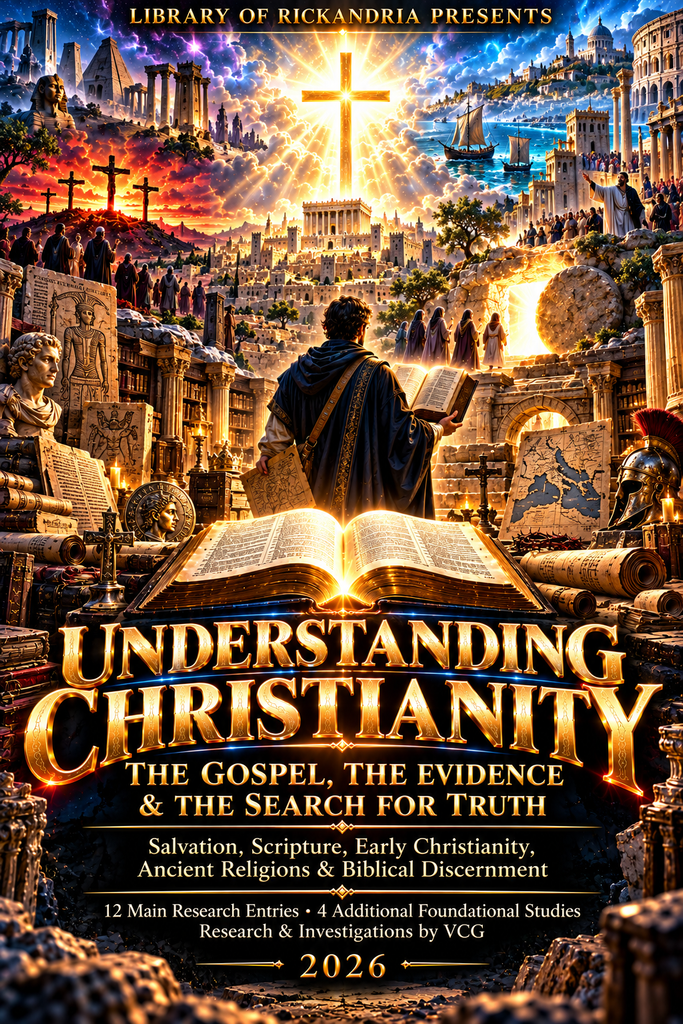
UNDERSTANDING CHRISTIANITY: THE GOSPEL, THE EVIDENCE & THE SEARCH FOR TRUTH: Salvation, Scripture, Early Christianity, Ancient Religions & Biblical Discernment
UPDATED BY VCG ON 10/26/2026 @ 18:18 EST
LIBRARY OF RICKANDRIA PRESENTS
UNDERSTANDING CHRISTIANITY: THE GOSPEL, THE EVIDENCE & THE SEARCH FOR TRUTH
Salvation, Scripture, Early Christianity, Ancient Religions & Biblical Discernment
12 Main Research Entries • 4 Additional Foundational Studies • Research & Investigations by VCG • 2026
“Prove all things; hold fast that which is good.” — 1 Thessalonians 5:21, KJV
Introduction: What Is Christianity—and How Do We Study It Honestly?
Christianity begins not with:
- a modern institution
- conspiracy theory
- political movement
or private experience, but with the proclamation concerning Jesus Christ:
- his life
- death
- resurrection
and the meaning his earliest followers attributed to those events.
The New Testament presents Jesus as the Christ,
calls people to repentance and faith,
speaks of salvation by God’s grace,
and describes a community formed around:
- Scripture
- worship
- baptism
- fellowship
- service
The historical study of Christianity asks related but distinct questions:
when its writings appeared, how its communities spread, what the first Christians believed, and how their traditions developed over time.
Today, those questions are frequently mixed with dramatic assertions:
Was Christianity copied from Mithras?
Was it invented by Roman emperors?
Did the early Church function as a secret society?
Is Satan a borrowing from Zoroastrianism?
Were the Scriptures corrupted?
Could modern mystical experiences disclose a different Gospel?
The Understanding Christianity research hub of the Library of Rickandria brings together 12 main entries, including the Library’s foundational CHRISTIANITY collection, which itself links to four further studies.
The goal is neither to defend every institutional tradition without examination nor to accept every alternative theory because it sounds forbidden or exciting.
Our standard is simple:
read Scripture in context, establish what the historical sources actually say, distinguish facts from interpretation, and apply the same standards of evidence to all sides.
Begin With the Gospel According to the New Testament
Before entering debates about:
- councils
- pagan symbols
- church institutions
or alleged hidden history, begin with the foundational claims of the New Testament.
God, creation, and humanity.
Genesis 1 presents God as Creator and human beings as made in his image.
Christian teaching about:
sin, covenant, moral responsibility, and reconciliation develops from this scriptural setting.
Jesus Christ.
John 1:1–14 presents the Word who became flesh; the Gospels portray Jesus as a first-century Jewish teacher, healer, and the promised Messiah.
Christians debate some details of biblical interpretation, but the person and work of Jesus stand at the center of their faith.
The cross and resurrection.
Paul summarizes the proclamation he received and transmitted:
“Christ died for our sins according to the scriptures; And that he was buried, and that he rose again the third day according to the scriptures.” — 1 Corinthians 15:3–4, KJV
This passage establishes what early Christians proclaimed.
Whether the resurrection occurred as a divine event is a further historical, philosophical, and theological question; simply documenting the ancient proclamation should not be confused with proving its supernatural cause.
Grace, faith, and a transformed life.
Ephesians 2:8–10 connects salvation by grace through faith with a life of good works.
- Romans
- James
- the Gospels
must be read together rather than turned into slogans that ignore one another.
The Christian community and hope.
Acts 2 depicts:
- teaching
- fellowship
- prayer
- communal life
1 Corinthians 12–13 discusses the body of Christ and love.
1 Corinthians 15 and Revelation 21–22 address resurrection and the final hope of God’s people.
This is the biblical starting point, not a demand that the reader set aside honest historical questions.
THE TWELVE FEATURED RESEARCH ENTRIES
PART I — THE FOUNDATIONS: SALVATION, SCRIPTURE & CHRISTIAN HOPE
01. CHRISTIANITY — The Foundational Research Collection
Open the CHRISTIANITY collection
The first link on the current page is not a single long manual.
It is a collection containing four additional studies designed to help readers understand the
- Gospel
- biblical texts
- Christian hope
- practical discipleship
A. God’s Plan of Salvation in the New Testament
A substantial textual and theological study of salvation as God’s work through Christ:
- grace
- repentance
- faith
- union with Christ
- forgiveness
- the Spirit
- a changed life
- perseverance
- resurrection
and final deliverance.
It compares Paul’s teaching on justification with James’s warnings against a dead profession of faith.
B. Recognizing the Canon, Text & Faithful Translation of Scripture
A concise guide distinguishing three different questions:
which books belong in Scripture, what wording the ancient manuscripts preserve, and how translations communicate that wording.
It explains variations between Christian canons and the KJV translators’ attention to Hebrew and Greek sources.
The historical account of canon formation is broader than any single denomination’s theological explanation.
C. The New Jerusalem as the Holy of Holies
An analysis of Revelation 21’s dimensions and the proposed parallel with the Most Holy Place of Solomon’s Temple.
It carefully separates:
- explicit scriptural description
- geometric deduction
- Old Testament allusion
- theological interpretation
- speculative numerical patterns
D. End-Times Preparation Game Plan
A practical guide emphasizing:
- prayer
- calm watchfulness
- food and water planning
- communication
- sanitation
- cooperation
and helping others.
Its focus is preparedness without panic or unsupported date-setting.
Core question:
What does Christianity actually teach about salvation, the Bible, Christian hope, and faithful daily living before later historical disputes are introduced?
Scripture to read:
- John 3
- Romans 3–8
- Ephesians 2
- James 2
- 2 Timothy 3
- Revelation 21–22
PART II — THE HISTORICAL JESUS, EARLY CHRISTIANITY & TEXTUAL EVIDENCE
02. TWELVE ANCIENT NON-BIBLICAL SOURCES CONFIRMING JESUS AND EARLY CHRISTIANITY
This resource introduces Roman, Jewish, and other ancient references associated with Jesus and the emergence of Christianity:
- Tacitus
- Josephus
- Pliny the Younger
- Suetonius
- Mara bar Serapion
- Lucian
- Thallus
- Phlegon
- Celsus
- the Talmud
- Trajan
and a letter attributed to Hadrian.
Important qualification:
The twelve do not have identical evidentiary value.
Some directly refer to Jesus or his execution; some document Christians rather than independently identifying Jesus; some references are indirect, fragmentary, late, or debated.
For instance, Pliny and Trajan’s correspondence is a connected exchange about Christians rather than two fully independent accounts of Jesus’ life; Thallus survives only through later reporting; and the identification or authenticity of some other passages remains disputed.
This makes the article a useful research starting list, not twelve equally strong independent eyewitness confirmations.
Core question:
What do sources outside the New Testament tell us about Jesus and his early followers—and how sure can we be about each source?
Scripture to read:
- Luke 1:1–4
- Acts 26:26
- 1 Corinthians 15:3–8
03. WAS CHRISTIANITY A SECRET SOCIETY?
This project responds to a video alleging that Christianity began as an elite initiation system concealing special information from ordinary followers.
It examines claims about Jesus’ parables, Origen’s teaching on levels of instruction, early Christian public preaching, external historical witnesses, and the idea that Jesus secretly taught universal human divinity.
The available text is presented as a core fact-check and cinematic script framework, not an exhaustively published transcript of every video sentence.
It argues that differentiated religious instruction does not automatically establish an occult secret society, and that early Christian sources repeatedly depict open proclamation.
Core question:
Is the difference between beginners and mature students evidence of a hidden religion—or a common feature of teaching and discipleship?
Scripture to read:
- Mark 4:21–22
- Matthew 13
- Acts 2
- John 18:20
04. JESUS, EHRMAN & THE EVIDENCE
A thoughtful study of an anonymous participant shaken by encountering the biblical scholarship of Bart Ehrman.
The thread grows into questions about manuscript variants, Gospel authorship, historical sources, early Christian diversity, the resurrection, and suffering.
This paper resists a false choice between dismissing scholarship and accepting every sweeping skeptical conclusion.
It emphasizes that a genuine textual variant or historical uncertainty should be acknowledged honestly, while examining whether the larger conclusion a participant draws actually follows.
Core question:
What should readers do when new historical scholarship challenges assumptions they previously treated as certain?
Scripture to read:
- Luke 1:1–4
- Acts 17:11
- 1 Corinthians 15
05. CAESAR’S MESSIAH? DID ROME INVENT CHRISTIANITY?
This extensive analysis examines a theory associated with Joseph Atwill: that figures tied to the Flavian Roman dynasty created a pacifying Gospel narrative after the Jewish War, disguising Roman political propaganda as a new religion.
It acknowledges real Roman propaganda, Josephus’s relationship with Flavian patrons, and Christianity’s later entanglement with imperial authority.
But it stresses a fundamental chronological challenge:
widely accepted Pauline letters from the 50s CE already document a Christian movement, the proclamation of Jesus’ death and resurrection, and Christian leaders before the destruction of Jerusalem in 70 CE.
Core question:
Can a proposed political origin explain the evidence that predates the alleged invention?
Scripture to read:
- Galatians 1:18–19
- 1 Corinthians 11:23–26; 15:3–8
PART III — ANCIENT RELIGIONS, PAGAN PARALLELS & COMPARATIVE HISTORY
06. JUDAISM, CHRISTIANITY, SATAN & THE ZOROASTRIAN AHRIMAN
This article evaluates the claim that the Christian Devil is effectively the Zoroastrian Ahriman under another name.
It compares Satan in Job and Zechariah with New Testament descriptions of the Devil, the development of Jewish apocalyptic literature, and possible religious exchange under Persian influence.
The study recognizes legitimate similarities and possible historical contact, while emphasizing that Christianity grew from a Jewish setting and that the status of Satan in Christian theology is not identical to every Iranian account of Angra Mainyu.
Core question:
Does similarity between traditions demonstrate borrowing, or does a convincing historical argument need chronology, contact, and specific textual connections?
Scripture to read:
- Job 1–2
- Zechariah 3
- Matthew 4
- Revelation 12
07. DID CHRISTIANITY COPY MITHRAS?
A viral online argument claims Christianity borrowed Jesus’ virgin birth, age, death, and religious practices from Mithraism.
This study compares Roman Mithraic archaeology and ancient sources with Christian writings and asks whether the alleged parallels are correctly described and dated.
Its scope expands when the original discussion turns to hostility toward religious, ethnic, and sexual minorities.
The research examines how selected biblical quotations and historical half-truths can be used to justify harmful conclusions.
Core question:
What ancient evidence actually supports a proposed parallel, and what evidence is required to establish that one religion copied another?
Scripture to read:
- Matthew 1–2
- Luke 1–2
- 1 Corinthians 15
- 1 Thessalonians 5:21
08. DRUIDIC SYMBOLISM, MASONRY & JUDEO-CHRISTIANITY
An expansive alternative-history thesis connects:
- prehistoric Ireland
- Druids
- ancient Egypt
- Israelite religion
- Christianity
- Freemasonry
and later elite institutions into a purported chain of hidden descent.
The investigation recognizes genuine historical subjects—
- Neolithic monumental architecture
- Druids
- migration
- the Hyksos
- Akhenaten
and the transmission of symbols—
but finds that the larger theory repeatedly treats resemblance as genealogy and medieval legend as direct evidence of ancient events.
Core question:
Is there a documented historical link between two traditions, or only a series of suggestive resemblances and speculative etymologies?
Scripture to read:
- Deuteronomy 29:29
- Acts 17:11
- 1 Thessalonians 5:21
PART IV — SPIRITUAL CLAIMS, CONSPIRACY NARRATIVES & BIBLICAL DISCERNMENT
09. TESTING THE SPIRITS
Christianity, Supernatural Experience & Ancient Mysteries
An October 2026 forum conversation asks why some people who affirm angels and miracles nevertheless dismiss reported spiritual experiences.
Participants then move into claims about:
- Earth’s age and shape
- Genesis
- biblical giants
- ancient stonework
- psychiatry
- identity
The analysis rejects two mistaken inferences: the existence of supernatural beliefs does not verify a particular apparition, and an unusual experience is not sufficient evidence for diagnosing a stranger with a psychiatric condition.
Biblical testimony, archaeological evidence, personal experience, and medical judgments must be evaluated through different methods.
Core question:
How can Christians take spiritual claims seriously without automatically believing them, and how can skeptics criticize claims without dismissing or diagnosing people?
Scripture to read:
- 1 John 4:1
- Isaiah 8:20
- 2 Corinthians 11:14
10. DID SATAN INVENT CHRISTIANITY?
A 4chan thread wonders whether Christianity’s survival in a world supposedly controlled by occult elites proves that the religion itself was engineered as a mechanism of manipulation.
The research considers Gnosticism, the Roman Empire, disputed readings of Scripture, conspiratorial accounts of religious institutions, and claims involving secret societies.
The key distinction is between Christianity’s historical emergence, its later political adoption, genuine corruption by some institutions, and the much stronger claim that the religion was originally manufactured through a coordinated Satanic scheme.
Evidence for institutional misconduct does not by itself establish the proposed origin story.
Core question:
Does religious hypocrisy or institutional abuse prove the Gospel was created by the very forces it condemns?
Scripture to read:
- Matthew 7:15–23
- Galatians 1:6–9
- Acts 17:11
11. APOCALYPSE, POLEMIC & PROOF
Judaism, Christianity, Islam & Biblical Prophecy
A discussion of the Abrahamic religions develops into arguments over:
- the Third Temple
- the Dajjal
- geomagnetic events
- biblical warfare
- circumcision
- divine justice
- hell
and competing claims about prophecy.
This study neither erases difficult moral questions nor accepts sensational predictions.
It compares the religious claims with their actual texts and asks whether historical or scientific events have been made to fit predictions retrospectively.
It also rejects treating members of entire religious or ethnic communities as collectively guilty.
Core question:
What distinguishes an interpretation of prophecy from an independently demonstrated fulfillment—and how can religious disagreement remain accurate and humane?
Scripture to read:
- Matthew 24
- Deuteronomy 18
- 1 Thessalonians 5:21
12. CHRIST, CONSPIRACY & COUNTERFEIT REVELATION
A short 4chan discussion about Christianity and occult experience invokes Rudolf Steiner, Philip K. Dick’s VALIS, individualized spiritual commands, and alternative forms of knowing Christ.
Skeptical respondents ask for evidence and challenge religious claims about love and judgment.
The research shows why a personal or esoteric system does not automatically become biblical merely by invoking Jesus’ name.
It also recognizes that a question such as:
“Where is the evidence?”
deserves an answer based on the appropriate kind of support, rather than being dismissed as hostility.
Core question:
How can one distinguish the Jesus described by the Gospel texts from a spiritual figure reconstructed through modern esoteric teachings or personal revelation?
Scripture to read:
- John 1:1–14
- 1 John 4:1
- Galatians 1:8
- 2 Corinthians 11:3–4
Five Distinctions Every Reader Should Keep in View
| Question | Suitable evidence | Common mistake |
|---|---|---|
| What does Scripture actually say? | The passage, its language, literary context, and other relevant texts | Presenting an interpretation as a direct quotation |
| What happened in Christian history? | Dated letters, manuscripts, inscriptions, reliable historical witnesses, archaeology | Treating a later legend as a first-century record |
| Did Christianity borrow a religious motif? | Demonstrable chronology, contact, matching specifics, and transmission | Assuming that a resemblance proves copying |
| What caused an unusual experience? | Careful testimony, corroboration, context, and appropriate medical or technical evaluation | Treating sincerity as proof of a supernatural cause, or assuming a diagnosis from a brief report |
| Was an institution corrupt? | Specific documents, events, proven conduct, and accountable testimony | Inferring that a whole faith was therefore fabricated |
Recognizing a real historical problem should lead to more careful investigation—not either automatic dismissal of faith or uncritical adoption of an opposing conspiracy.
A Recommended Reading Path
First: Learn Christianity’s central teachings.
Read:
- John 1–3
- Luke 24
- Romans 3–8
- Ephesians 2
- 1 Corinthians 15
Then use the foundational CHRISTIANITY index, beginning with God’s Plan of Salvation and Recognizing the Canon, Text & Faithful Translation.
Second: Examine the historical record.
Continue with Twelve Ancient Non-Biblical Sources, Jesus, Ehrman & the Evidence, Was Christianity a Secret Society?, and Caesar’s Messiah?.
Pay particular attention to source dates and the difference between attesting a movement and proving a miracle.
Third: Investigate comparisons with ancient religion.
Read the Ahriman, Mithras, and Druidic-symbolism studies.
Ask not only whether two stories sound alike, but whether the chronology and evidence support actual historical transmission.
Fourth: Practice discernment.
Read Testing the Spirits, Did Satan Invent Christianity?, Apocalypse, Polemic & Proof, and Christ, Conspiracy & Counterfeit Revelation for practical examples of separating Scripture, experience, inference, and allegation.
Finally: Return to the Gospel.
After studying opposing claims, return to Jesus’ life, teachings, cross, and resurrection in the New Testament.
The central Christian message should not disappear behind the controversies surrounding it.
Frequently Asked Questions
What is Christianity in its simplest New Testament form?
It is the faith centered on Jesus Christ, proclaiming his death and resurrection, God’s grace, repentance and faith, the work of the Holy Spirit, love of God and neighbor, and the hope of resurrection and eternal life.
Christian churches differ on important doctrinal and ecclesiastical questions, so the shortest summary does not settle every theological controversy.
Is Christianity primarily a religion, a relationship, or a historical movement?
Those descriptions address different dimensions.
Historians study it as a movement and family of traditions; sociologists can study its communal and religious practices; Christians describe a life of faith and relationship with God through Christ.
None of those descriptions alone exhausts the subject.
Do manuscripts prove that the Bible has never changed?
No. Manuscript differences exist and should be acknowledged.
Textual criticism compares surviving witnesses to reconstruct earlier readings.
Differences in transmission are not the same as proof that the entire Gospel was invented, and a discussion of textual reliability should identify the passage and its evidence.
Was Christianity invented by Constantine or the Flavian emperors?
The Christian movement predates Constantine by centuries.
The accepted early Pauline letters also predate the Flavian dynasty’s post-war propaganda.
Roman rulers later influenced Christianity’s political position and institutions, but that is different from creating the movement from nothing.
Did Christianity copy Mithras or Zoroastrianism?
Influence, contact, and shared motifs are legitimate topics for historical study.
But claims that Jesus’ life is simply a rewritten Mithras myth, or that Satan is merely Ahriman renamed, require source-specific evidence.
Broad similarities do not establish a complete dependency.
Did the early Church have secret teachings?
Early Christians sometimes distinguished introductory instruction from more advanced teaching, and some communities had initiation and confidential ritual practices.
That historical complexity does not establish the sweeping claim that Christianity was originally an occult secret society whose true message was universal human godhood.
Does the existence of non-Christian testimony prove the resurrection?
No. Non-Christian references can provide evidence about Jesus, his execution, and early Christians.
Evidence that people proclaimed the resurrection is distinct from an independent demonstration that it happened through divine action.
How should Christians test spiritual revelations?
First John 4:1 and Galatians 1:8 encourage testing purported spiritual authority.
A person’s experience may be sincerely reported, but the content of the message, its consistency with Scripture, and any independent factual claims still require examination.
Does “prove all things” mean every Christian belief can be tested in a laboratory?
No. Historical, philosophical, theological, and scientific questions require different methods.
The principle calls for disciplined examination rather than forcing every kind of question into the same evidentiary procedure.
Primary Sources & Further Study
Biblical starting texts:
- Genesis 1–3
- Isaiah 53
- Matthew 5–7
- Luke 24
- John 1–3
- Acts 2 and 17
- Romans 3–8
- 1 Corinthians 15
- Ephesians 2
- James 2
- 2 Timothy 3
- Revelation 21–22
Ancient historical witnesses worth examining directly:
The undisputed early Pauline letters; Josephus, Antiquities of the Jews; Tacitus, Annals 15.44; Pliny the Younger, Letters 10.96–97; and early Christian writings, each with attention to provenance, literary purpose, date, and disputed readings.
For manuscript and canon questions:
Compare the biblical text, ancient manuscripts and translations, and the KJV translators’ prefatory explanation rather than relying solely on internet summaries.
For comparative religion:
Consult texts and material culture from the relevant historical tradition and period.
Modern diagrams, lists of supposed parallels, and anonymous threads are starting claims, not substitutes for ancient documents.
A reliable investigation is willing to say:
well established, likely, debated, unsupported, or unknown.
Explore the Wider Library
- JESUS CHRIST — The Man, the Messiah & the Evidence
- WHO IS GOD? — Divine Nature, Suffering & Justice
- UNDERSTANDING DEMONS — Spiritual Warfare & Biblical Discernment
- THE 4CHAN FILES — Where Anonymous Claims Meet Evidence & Scripture
- VCG PAPER PROJECTS
- CHRISTIANITY — Basecamp Companion Index
Final Perspective: The Gospel Deserves Careful Examination
Christianity has a real history.
Its texts have a history of copying, translation, interpretation, and disagreement.
Religious institutions have acted both honorably and badly.
Ancient traditions show genuine similarities, and modern believers continue to report experiences they interpret spiritually.
None of these realities justifies overstating evidence.
It is possible to take the New Testament seriously, acknowledge difficult questions, and reject weak arguments whether they come from defenders or opponents of Christianity.
This hub exists to help readers identify what can be documented, understand what Scripture actually teaches, investigate competing interpretations fairly, and return to the central question:
Who is Jesus Christ, and what does his Gospel call people to believe and do?
“And ye shall know the truth, and the truth shall make you free.” — John 8:32, KJV
Soli Deo Gloria — To God alone be the glory.
LIBRARY OF RICKANDRIA | RESEARCH BY VCG | 2026
THE 4CHAN FILES: Where Anonymous Claims Meet Evidence & Scripture – Library of Rickandria
VCG PAPER PROJECTS – Library of Rickandria