
Christ, Conspiracy & Counterfeit Revelation: A Scripture-First Analysis of a 4chan /x/ Thread on Christianity, Occultism & Religious Experience
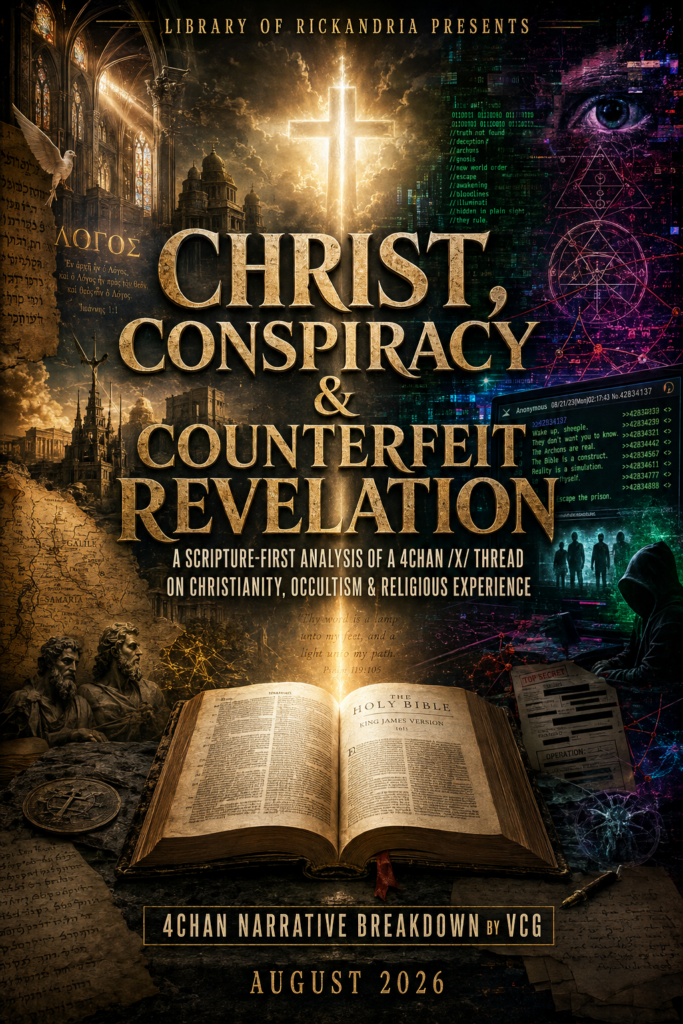
UPDATED BY VCG ON 8/18/2026 @ 22:22 EST
I want to share a heartfelt cause with my audience. Conner Blaisdell-Greene, a brave Airforce Sr. Airman, recently lost his battle with cancer, leaving his family in financial distress. Every donation, no matter how small, can help cover his funeral costs and ease their burden during this difficult time. Please consider clicking the link below to contribute or share Conner’s story with others. Your support truly matters.
Anyone can do this, but most won’t.
ChatGPT – Library of Rickandria
I’ll treat the thread itself as the primary object of analysis, then separate four layers for each claim:
- what it actually says
- what evidence supports or contradicts it
- what rhetorical/psychological mechanism is operating
- what Scripture does—and does not—permit us to conclude
I’ll also distinguish hard factual rebuttal from theological interpretation, so we don’t answer speculation with more speculation.
/x/ – Average Christ Fan – Paranormal – 4chan
The thread is still retrievable and archived on 4chan; it is short enough to audit completely.
One important preliminary finding:
the strongest biblical problems are not only in the hostile replies—OP’s own appeal to Rudolf Steiner, VALIS, personalized “commands,” and
“your own way to know [Christ]”
mixes Christian language with claims that need to be tested rather than baptized as Christian merely because they invoke Jesus.
A second important finding:
Steiner is not merely
“a Christian author with some unusual ideas.”
In his own lectures he taught:
- reincarnation/karma
- two Jesus children
- an “Akashic record” used to reconstruct the Gospels
and a Christ-being entering Jesus at the Jordan baptism.
Those are material departures from the New Testament’s own presentation and must be flagged before using Steiner as a guide to Christ.
The skeptic side also contains one point worth preserving rather than “rebutting away”:
“Where’s the proof?”
is a legitimate epistemic question.
A Bible citation establishes what Christianity teaches; it does not, by itself, force a skeptic to accept the Bible’s authority.
A careful response should therefore distinguish:
- textual evidence
- historical evidence
- philosophical argument
- personal testimony
Soli Deo gloria. I pulled the complete archived thread and audited all ten posts: the OP plus nine replies, posted on August 17, 2026. (4chan)
The result is more interesting than “Christian OP versus atheist trolls.” OP contains several recognizably biblical claims, but also imports Rudolf Steiner/Anthroposophy, Philip K. Dick, subjective revelation, and quasi-esoteric language into his Christianity. Meanwhile, several hostile replies are logically poor or factually unsupported, but two objections—“where is the evidence?” and the apparent tension between divine love and judgment—deserve serious answers rather than dismissal.
1. Methodology
I’m applying the Scripture-first research framework preserved in the project methodology: original statement → meaning → history → KJV biblical analysis → language where relevant → scientific/psychological analysis → logic → methodology → missing context → alternative interpretations → conclusion. Its governing standards are especially important here: context before commentary, evidence before opinion, distinguish fact/interpretation/speculation/rhetoric, state uncertainty honestly, and represent opposing views fairly.
I am therefore using five different evidence labels:
Textual fact means “this is actually what the Bible, Steiner, Dick, or the thread says.”
Historical evidence concerns what can reasonably be established about Jesus, Christianity, etc.
Empirical evidence concerns measurable psychological/social phenomena.
Theological interpretation means a conclusion drawn from Scripture but not itself identical with the wording of Scripture.
Personal testimony means a reported experience whose occurrence or supernatural cause cannot ordinarily be independently verified.
That distinction is crucial. Saying “John teaches Christ created all things” is a textual fact. Saying “therefore Christ objectively created the universe” is a Christian theological conclusion. Saying “Tacitus mentions Christus” is historical evidence. None of those propositions should be blurred together.
2. Executive verdict
The thread’s claims divide roughly like this:
| Claim | Assessment |
|---|---|
| Submit to God/Christ | Biblically grounded, properly understood |
| Seek Christ in prayer | Biblically grounded, but prayer is not wish-fulfilment |
| Christ is the Logos | Directly Johannine |
| Christ changed OP’s habits/outlook | Valid testimony, supernatural causation not independently proved |
| Christians should share Christ/Gospel | Biblically grounded |
| Wait for personalized commands | Needs qualification/testing |
| God’s purpose = personal fulfillment | Too self-actualization-oriented unless biblically defined |
| Steiner should guide someone toward Christ | Serious doctrinal danger |
| VALIS belongs beside the NT as spiritual guidance | Methodologically unsound |
| Everyone has “their own way” to know Christ | Conflicts with NT exclusivity and apostolic doctrine |
| Attachment to temporal things simply “is eternal death” | Overstatement with ascetic/gnostic flavor |
| Steiner saved OP from a demon | Unverifiable testimony and badly framed biblically |
| Christians on /x/ are secretly paid by Jews/Indians | No evidence; conspiratorial ethnic scapegoating |
| Christianity is simply “dying” | False as a global numerical claim; partly true as share-loss in some regions |
| Jesus being Jewish/rabbinic disproves Christianity | Non sequitur |
| “The Bible isn’t proof” | Contains a legitimate epistemological point but is stated too absolutely |
| Genesis cannot possibly have historical reference | Far too categorical |
| Love + judgment is incoherent | A serious philosophical challenge obscured by caricature |
That gives us the map. Now the actual dissection.
3. OP, line 1 — submission, commands, purpose, liberation, knowledge, reward
OP begins by urging submission to Christ, waiting for Christ’s commands, pursuing one’s purpose, and anticipating liberation, knowledge, trials and reward. (4chan)
“Submit to Christ”
Biblical core: sound.
James says:
“Submit yourselves therefore to God. Resist the devil, and he will flee from you.”
James 4:7.
Jesus also connects discipleship with obedience:
“If ye love me, keep my commandments.”
John 14:15.
So submission itself is not the problem.
But Christianity must not be represented as “obey well enough so God will accept you.” Paul explicitly reverses that order:
“For by grace are ye saved through faith; and that not of yourselves: it is the gift of God:
Not of works, lest any man should boast.”
And then good works follow as the resulting vocation, not the purchase price of salvation. Ephesians 2:8–10.
Correction: grace → faith → reconciliation/new life → obedient discipleship.
Not obedience → merit → salvation.
“Wait for his commands”
This is where OP begins drifting.
There is nothing wrong with asking God for wisdom or guidance. But “wait for commands” can easily suggest that Christians should expect individualized divine directives occurring internally, and the thread never explains how those purported commands are distinguished from imagination, impulse, wish, fear, or suggestion.
The NT does not say, “Whatever inner voice seems Christlike, obey it.”
It says:
“Prove all things; hold fast that which is good.”
1 Thessalonians 5:21.
And:
“Beloved, believe not every spirit, but try the spirits whether they are of God.”
1 John 4:1.
Christians disagree over whether and how God gives individualized impressions today. But virtually any biblically responsible approach must insist that an impression does not become authoritative merely because its recipient experiences it as spiritual.
This becomes especially important when the same OP recommends Steiner’s purported clairvoyant revelations.
“Fulfillment of your purpose”
This is not necessarily wrong, but it is vague enough to become modern self-help theology.
Romans gives “purpose” a distinctly Christ-centered shape:
“…called according to his purpose.
For whom he did foreknow, he also did predestinate to be conformed to the image of his Son…”
Romans 8:28–29.
Biblical purpose therefore is not principally “discover the special destiny that makes me fulfilled.”
It is fundamentally belonging to God, conformity to Christ, holiness, love, good works, witness, and finally glorification.
That may profoundly fulfill a person, but personal fulfillment is not the controlling category.
“Liberation → knowledge → challenges → reward”
This sequence deserves attention.
It sounds less like the apostolic summary of the Gospel and more like an initiatory/esoteric progression: submission unlocks liberation, then knowledge, then ordeals, then reward.
The NT’s normal proclamation is much more concrete:
Christ died for sins → Christ rose → repent/believe → forgiveness/reconciliation → new life → discipleship/suffering → resurrection and final hope.
Luke records Jesus summarizing the mission in terms of Christ’s death and resurrection and:
“repentance and remission of sins”
being proclaimed in his name.
There is genuine Christian “knowledge,” but Christianity is not salvation by acquiring hidden metaphysical information.
Verdict: partially biblical vocabulary arranged in a noticeably esoteric framework.
4. OP, line 2 — Steiner, VALIS, the New Testament and “your own way”
This is the decisive doctrinal problem.
OP places Rudolf Steiner’s lectures, Philip K. Dick’s VALIS, and the New Testament together as things someone should read while seeking Christ. (4chan)
That does not automatically mean OP considers all three equally authoritative. But the recommendations are close enough together that the reader receives no warning that Steiner’s Christology is radically different from the New Testament’s.
Rudolf Steiner: what he actually taught
This can be fact-checked from Steiner’s own lectures, rather than from anti-Steiner polemics.
Steiner taught two Jesus boys
Steiner explicitly says:
“Two Jesus boys were born, not one.”
He further assigns Matthew and Luke to different Jesus children. (Rudolf Steiner Archive)
Nothing resembling this occurs in the NT.
Matthew and Luke certainly contain distinct infancy narratives and difficult harmonization questions, but Steiner solves them by asserting an otherwise unknown second Jesus whose existence supposedly came through spiritual research.
That is not exegesis.
It is supplementary revelation.
Steiner subordinated the written Gospels to the “Akashic record”
This is still more serious.
Steiner says Matthew, Mark and Luke need to be reconstructed from an “Akashic record,” and that reading this occult record can provide the correct form of the Gospels where transmitted texts supposedly fail. (Rudolf Steiner Archive)
That creates a radically different epistemology:
Biblical/apostolic method: receive, preserve, read, interpret apostolic testimony.
Steiner method: access clairvoyant supersensory information and use it to correct/reconstruct apostolic texts.
Paul’s standard is almost the inverse:
“But though we, or an angel from heaven, preach any other gospel unto you than that which we have preached unto you, let him be accursed.”
Galatians 1:8.
Notice the epistemological principle: even an apparently supernatural messenger is tested against the already delivered Gospel.
The supernatural claim does not authenticate the doctrine.
The doctrine tests the supernatural claim.
Steiner taught reincarnation and karma
Steiner explicitly describes modern people as having undergone “two, three, or four incarnations” since the time of Christ, depending upon karma. (Rudolf Steiner Archive)
The straightforward reading of Hebrews is very different:
“And as it is appointed unto men once to die, but after this the judgment.”
Hebrews 9:27.
One can construct esoteric reinterpretations of that verse, but they are not its natural grammatical meaning.
Steiner separated Jesus from the descending “Christ Being”
Steiner taught that around Jesus’ thirtieth year, at the Jordan baptism, a divine “Christ Being” entered Jesus’ bodily “sheaths”; he expressly distinguishes Jesus of Nazareth’s earlier ego from the Being who subsequently descended into him. (Rudolf Steiner Archive)
Compare John:
“In the beginning was the Word, and the Word was with God, and the Word was God.”
and:
“And the Word was made flesh, and dwelt among us…”
John 1:1,14.
The Johannine presentation is incarnation.
Steiner’s system introduces a complicated pre-baptism/post-baptism distinction derived from purported clairvoyant observation.
These are not two ways of saying the same thing.
Bottom line on Steiner
Steiner can legitimately be studied as history of religion, Western esotericism, Anthroposophy, or an unusual modern Christology.
But he should not be smuggled into Christian discipleship as if he merely supplies deeper commentary on the New Testament.
His system contains doctrinal claims that materially contradict the ordinary meaning of the biblical texts.
5. Why Philip K. Dick’s VALIS is different again
VALIS is intellectually fascinating literature, but it is another epistemic category entirely.
Philip K. Dick himself described VALIS as a “Vast Active Living Intelligence System” and spoke of a powerful extraterrestrial intelligence intervening in human affairs, adding that one could call it God or not. (Philip K. Dick)
That makes VALIS potentially useful for studying:
- religious experience;
- revelation and madness;
- metaphysical doubt;
- Gnosticism;
- information as divinity;
- the instability of interpretation.
It does not make VALIS an evidential or doctrinal control for understanding Jesus Christ.
Putting John → Steiner → Dick → personal spiritual impressions into one interpretive blender creates a very real danger: every system starts reinterpreting every other system until “Christ” becomes whichever metaphysical principle the reader presently experiences as Christlike.
The NT instead presents a publicly proclaimed apostolic Christ:
“Neither is there salvation in any other…”
Acts 4:12.
And:
“there is one God, and one mediator between God and men, the man Christ Jesus.”
1 Timothy 2:5.
6. “Ask Christ … your own way to know him”
The first half is defensible. The second half is seriously misleading.
Prayer seeking God is biblical.
But “your own way to know him” cannot mean that Christ validates mutually contradictory spiritual roads.
Jesus says:
“I am the way, the truth, and the life: no man cometh unto the Father, but by me.”
John 14:6.
And 2 John warns:
“Whosoever transgresseth, and abideth not in the doctrine of Christ, hath not God.”
People certainly encounter Christ from radically different biographies, cultures and intellectual routes.
That is different from there being different truths about who Christ is.
A Buddhist, occultist, atheist, Muslim, New Ager and Catholic might begin from six utterly different places.
The apostolic claim is not that six contradictory Christs await them at the end.
7. OP, line 3 — changed habits and “Christ love”
OP reports having been frustrated, then calling upon Christ, after which he wanted to read rather than doomscroll, exercise rather than mope, and share Christ’s love. (4chan)
This is precisely where methodological restraint matters.
What can be established?
OP reports a positive change.
We cannot independently verify:
- the magnitude of that change;
- its duration;
- whether prayer caused it;
- whether there were simultaneous lifestyle changes;
- whether an explicitly supernatural intervention occurred.
But neither may a skeptic legitimately conclude:
“Psychology can describe this, therefore Christ had nothing to do with it.”
That would commit a reverse explanatory overreach.
Psychological research does find associations between religious/spiritual involvement, positive religious coping, meaning, community support and aspects of mental health. (PubMed)
So OP’s reported improvement is psychologically plausible.
But psychological plausibility does not settle theological causation.
A scientific description of how prayer affects attention, motivation or emotion would not itself prove or disprove whether God acts through those processes.
8. OP, line 4 — “just ask”
This is rhetorically powerful because it turns Christianity into a low-cost experiment: ask.
But it can be misunderstood as:
Prayer → request → expected observable answer → Christianity verified.
Scripture does not define prayer that way.
1 John qualifies prayer:
“if we ask any thing according to his will, he heareth us.”
James gives another correction:
“Ye ask, and receive not, because ye ask amiss, that ye may consume it upon your lusts.”
James 4:3.
That leads directly into the first troll response.
9. Reply 42834153 — the $50 million prayer
The first respondent mocks OP by requesting fifty million dollars from Jesus. (4chan)
Logic
This is a reductio, but against an overly simplistic model of prayer:
- OP says ask Christ.
- I ask Christ for enormous wealth.
- I presumably don’t receive it.
- Therefore Christ/prayer fails.
That only works if Christianity teaches:
Whatever one sincerely requests must be granted in the requested form.
It does not.
Jesus’ own prayer at Gethsemane is paradigmatically subordinate to the Father’s will.
And 1 John 5:14 makes “according to his will” explicit.
What the troll accidentally exposes
OP’s “JUST ASK” language invites the misunderstanding.
So the skeptic’s argument fails as Christian theology but succeeds as criticism of sloppy evangelistic phrasing.
A better invitation would be:
Seek Christ sincerely, read what the apostolic witnesses actually say about him, pray for truth and mercy, and do not dictate in advance how God must answer.
10. Reply 42834158 — “this isn’t paranormal”
This poster complains that /x/ has too much low-effort Christian proselytizing and speculates that moderators must be Christians. (4chan)
There are two separate claims.
Topicality criticism: partly fair
4chan itself currently describes /x/ as the board for paranormal subjects, spooky material and conspiracy theories, and its moderator sticky asks for high-quality discussion. (4chan)
The OP’s opening is primarily religious exhortation/self-help testimony, not a developed paranormal inquiry.
So “this may be low-effort proselytizing rather than an /x/ topic” is not an irrational criticism.
However, the later discussion explicitly involves:
- occult practice;
- demons;
- spiritual experiences;
- Steinerian esotericism.
Those certainly fit /x/’s broader paranormal/esoteric culture.
Moderator conspiracy: unsupported
There is no evidence in the thread that moderators permitted it because they are Christians.
That is pure motive attribution.
No evidence → no responsible conclusion.
11. Reply 42834229 — ethnic conspiracy, “dying Christianity,” Jewish Jesus
This is the weakest substantive reply.
The poster alleges Jews and Indians are secretly being paid to promote Christianity on 4chan and describes Jesus as an invented Jewish psychological operation. (4chan)
Claim: paid ethnic shilling
Evidence supplied: zero.
No names.
No organization.
No payment records.
No leaked instructions.
No network analysis.
No statistical evidence.
No testimony.
No mechanism.
This is not merely “unproven.” It is an ethnic conspiracy assertion offered without evidence.
Psychologically, conspiracy research finds that conspiratorial explanations commonly frame important events as secret actions of powerful or malevolent groups and can serve epistemic, existential and social motives. That literature does not license diagnosing this particular anonymous poster; it merely helps describe the structure of the claim. (PubMed)
Claim: Christianity has “dying support”
This needs geographical qualification.
Pew’s most recent comprehensive global change report found that between 2010 and 2020:
- the absolute Christian population rose by 122 million to 2.3 billion;
- Christianity remained the world’s largest religious group;
- its share of world population nevertheless fell 1.8 percentage points to 28.8%;
- decline was especially significant in parts of Europe and the Americas. (Pew Research Center)
So:
“Christianity is disappearing” — false globally in absolute numbers.
“Christianity’s proportional dominance is declining, particularly in some Western societies” — true.
The troll turns a complicated demographic development into a victory slogan.
Claim: Jesus was a Jew/rabbi
This is approximately the funniest possible attempted refutation because the New Testament says so itself.
John records disciples addressing Jesus:
“Rabbi, (which is to say, being interpreted, Master,)”
And the Samaritan woman says directly:
“thou, being a Jew…”
John 4:9.
Jesus’ Jewishness is not an embarrassing secret Christianity needs to rebut.
It is basic Christian history and theology.
Paul’s Gospel itself places Christ within Israel’s covenantal history.
Therefore:
Jesus was Jewish → Christianity false
is a non sequitur.
12. Is Jesus himself historically invented?
That stronger claim also runs into evidence outside Christian Scripture.
Writing in the early second century, Roman historian Tacitus reports that “Christus,” from whom Christians received their name, was executed during Tiberius’ reign under Pontius Pilate. Tacitus is hostile toward the movement, not Christian propaganda. (Penelope)
Josephus’ Antiquities 20.200 also contains the sober reference to James as the brother of “Jesus, who was called Christ.” The phrase is present in the manuscript tradition, although modern scholarship continues to discuss questions of authenticity and transmission; a recent Oxford treatment argues extensively for its genuineness while engaging dissenting proposals. (OUP Academic)
What does that establish?
Reasonably: Jesus was not simply fabricated by modern Christians or a 4chan psyop; a first-century Jesus/Christ movement existed around a founder associated with Pilate’s execution.
What does it not establish automatically?
- incarnation;
- miracles;
- atonement;
- bodily resurrection;
- deity.
Those require further historical/philosophical/theological argument.
That distinction is essential.
13. Reply 42834255 — selfie joke
No argument exists here. It is simply visual mockery. (4chan)
There is nothing to fact-check or theologically rebut.
Methodologically it should receive exactly the evidential weight it deserves:
zero.
14. Reply 42834266 — submission, hell and “infinite love”
This person caricatures Christianity as an authoritarian master demanding obedience under threat of eternal hell while simultaneously claiming infinite love. (4chan)
It is crude, but the underlying philosophical question is legitimate.
We should not answer a caricature with another caricature.
What Christianity actually claims
Scripture genuinely teaches God’s love:
“God is love.”
And John defines that love Christologically:
God “sent his Son to be the propitiation for our sins.”
1 John 4:8–10.
Scripture also genuinely teaches judgment.
Jesus speaks of:
“everlasting punishment”
contrasted with “life eternal.” Matthew 25:46.
And 2 Thessalonians speaks of judgment upon those who “obey not the gospel” and “everlasting destruction.”
Therefore the critic has identified a real theological datum:
Christian Scripture affirms both divine love and final judgment.
Where the caricature goes wrong
It compresses the Gospel into:
Obey arbitrary ruler → otherwise torture → ruler calls this love.
But Paul’s central salvation formulation is:
“by grace are ye saved through faith… not of works.”
The Christian account is therefore not “perform enough commands or God will stop loving you.”
It is that sinful humanity stands under judgment, God acts in Christ for reconciliation, salvation is given by grace, and obedience grows from reconciled discipleship.
But a serious problem remains
Different Christian traditions disagree over the exact nature of final punishment:
- eternal conscious punishment;
- conditional immortality/annihilation;
- various hopeful or universalist interpretations.
Matthew 25:46 and other texts place real pressure on readings that simply erase final judgment.
So the responsible answer is not “there’s no difficulty here.”
The difficult philosophical question is:
How do perfect justice, perfect goodness, creaturely freedom, proportional judgment, and eternal consequence cohere?
Christians have offered answers for centuries.
The anonymous reply does not seriously engage them, but it points toward a serious discussion.
15. Reply 42834299 — “Christ is the Logos”
This reply is much stronger biblically.
The poster says Christ is the Logos through whom existence is possible. (4chan)
“Christ is the Logos”
This is directly rooted in John.
The Greek logos is rendered “Word” in the KJV:
“In the beginning was the Word, and the Word was with God, and the Word was God.”
Then:
“All things were made by him; and without him was not any thing made that was made.”
And finally:
“the Word was made flesh.”
John 1:1–3,14.
So Christ = Logos is not Steinerian language smuggled into Christianity. It is Johannine.
Likewise Colossians says of the Son:
“For by him were all things created…”
But “therefore this is scientifically proven” would be wrong
John provides the Christian theological claim.
It does not turn creation through Christ into an experimentally isolated physical mechanism.
This matters for the skeptic’s next reply.
16. “Attachment to temporal things is eternal death”
Here OP/replier overreaches again.
The NT certainly warns against making the temporal world one’s ultimate object of love.
1 John says the world passes away while the one doing God’s will abides.
But biblical Christianity is not:
material things = evil
spiritual things = good.
That would move toward Gnostic or strongly dualistic thinking.
Consider the resurrection.
Luke deliberately describes the risen Jesus as embodied:
“a spirit hath not flesh and bones, as ye see me have.”
He then eats food before the disciples.
Romans speaks not of abandoning embodiment but of:
“the redemption of our body.”
The better formulation is:
Temporal created things become idols when treated as ultimate goods. They are not evil merely because they are temporal or material.
That distinction matters enormously when Steinerian and Gnostic ideas are floating around the same conversation.
17. Reply 42834306 — age, masturbation, “where’s the proof?”, Genesis
This post combines the thread’s best epistemological question with some of its worst reasoning. (boards.4chan.org)
“OP must be young and sexually guilty”
Unsupported mind-reading.
The later OP says he once had a Christian phase as a teenager. That does not establish his current age.
Nothing establishes that masturbation guilt caused his conversion.
The skeptic invents:
- age;
- internal motive;
- sexual guilt;
- causal explanation.
That’s an ad hominem genetic argument: explain—or invent—the psychological origin of a belief and treat that as disproving the belief.
Even if OP had converted because of guilt, Christianity could still be true or false independently.
Psychology of belief ≠ truth value of belief.
18. “Where’s the proof?”
This is the strongest sentence in the skeptical side.
If the proposition is:
Christ is the metaphysical Logos sustaining existence,
then merely answering:
John 1 says so
does not compel someone who does not yet regard John as authoritative.
The proper apologetic structure is layered:
First: What do the documents claim?
Second: What reasons exist for regarding them as historically meaningful testimony?
Third: What historical claims can be independently corroborated?
Fourth: What philosophical worldview best explains the data?
Fifth: What additional inference, if any, justifies resurrection/deity claims?
That is a much stronger method than circularly saying:
“Bible true because Bible says Bible true.”
19. “The Bible isn’t proof”
Too broad.
A historical text is evidence.
It simply is not automatically conclusive proof of every claim it contains.
Historians routinely use:
- inscriptions;
- letters;
- chronicles;
- biographies;
- hostile testimony;
- court records;
- religious texts.
The relevant questions are authorship, dating, sources, genre, transmission, independence, corroboration, bias and explanatory power.
Therefore:
“The Bible is evidence because ancient documents are evidence” — yes.
“Everything in the Bible becomes proven merely by appearing there” — no.
“The Bible provides zero evidence because it is religious” — also no.
That balanced distinction is stronger than either fundamentalist circularity or skeptical dismissal.
20. “Genesis isn’t historical”
The insult in the reply hides a genuinely difficult genre question.
Genesis 1 begins:
“In the beginning God created the heaven and the earth.”
But “Is Genesis historical?” bundles several different questions:
Does Genesis claim real creation by God?
Does it refer to real human history?
Are Adam and Eve intended as historical persons?
Is Genesis 1 chronological in a modern scientific sense?
Are the “days” ordinary solar days?
Does its literary structure affect interpretation?
How does ancient Near Eastern cosmology illuminate its language?
Christians disagree on some of those questions.
The responsible correction to the skeptic is therefore not:
“Genesis is obviously modern science.”
It is:
You cannot simply announce that Genesis has no historical referentiality whatsoever without first doing the genre, linguistic, comparative and canonical work.
Equally, a Christian should not pretend that “historical” automatically means “written according to twenty-first-century scientific historiography.”
21. Reply 42834512 — OP’s Catholic background, occultism, demon experience and Steiner
This is the most important post in the thread because it explains why Steiner appears in the OP.
OP reports Catholic confirmation, later falling away, occult experimentation, a perceived approach to “spiritual death,” finding Steiner’s Christ writings, experiencing deliverance from what he understood as a demon, and returning to Christianity. (4chan)
We need three different analyses.
A. Historical/personal
His confirmation and conversion/deconversion/reconversion story is personal testimony.
We have no independent records.
Therefore:
Do not call it false.
But equally:
do not call it independently established.
B. Psychological
Conversion narratives often reorganize a person’s life story into a coherent before/crisis/turning-point/after structure.
That does not mean the events are fictitious.
Human beings naturally make meaning by integrating experiences into narrative.
Research likewise indicates that religion and spirituality can function as important coping and meaning systems. (PubMed)
Regarding the demon experience specifically: we have nowhere near enough information to diagnose OP with a psychiatric disorder, nor would a religiously framed anomalous experience by itself establish psychosis. Clinical literature emphasizes context, culture, functioning, conviction and associated symptoms rather than declaring any spiritual experience pathological solely because of its content. (PubMed)
At the same time, psychology cannot verify “there was objectively a demon.”
So the correct scientific verdict is:
Reported experience: yes.
Subjective demonic interpretation: yes.
Objective demon independently demonstrated: no.
Psychiatric diagnosis from a 4chan paragraph: unjustified.
That is the intellectually clean position.
22. Biblical correction: “Steiner saved me from a demon”
This wording is especially dangerous.
If OP means, “Something I read in Steiner ultimately prompted me to call upon Christ,” that is a biographical causal claim.
Providence can theoretically use strange means.
But if he means Steiner’s esoteric system itself delivered him spiritually, then he has assigned to Steiner what Scripture assigns to God and Christ.
Acts does not proclaim:
salvation through the correct occult cosmology.
It says:
“Neither is there salvation in any other…”
And Paul’s warning is especially relevant when supposedly spiritual information adds another gospel:
“though we, or an angel from heaven…”
Galatians 1:8.
The biblically safer testimony would be:
“I encountered Steiner during a crisis; certain things I read directed my attention toward Christ; but Steiner’s teachings themselves must be tested against Scripture, and where they contradict the apostolic Gospel I reject them.”
That distinction could save the entire OP from syncretism.
23. The thread’s biggest methodological inversion
Here is the deepest problem I see.
OP’s path appears to be:
occult experience → Steiner → personal experience → Christ-language → New Testament.
The biblical testing order should be:
apostolic Gospel → test doctrinal claims → test spiritual claims → retain what is true, reject what contradicts Christ’s doctrine.
That difference is enormous.
Steiner says his clairvoyant “Akashic record” can reconstruct the Gospels. (Rudolf Steiner Archive)
Scripture’s own posture is almost the reverse:
“Prove all things; hold fast that which is good.”
and:
“believe not every spirit, but try the spirits…”
The Bible tests Steiner.
Steiner must not become the secret key that tells us what the Bible “really meant.”
24. Final reply — “they do it for free”
This merely jokes that the alleged Christian shills are not even paid. (4chan)
It provides no evidence for either hypothesis.
Thus:
Paid conspiracy: unsupported.
Free conspiracy: also unsupported.
Funny rejoinder ≠ factual investigation.
25. Psychology of the whole thread
There is a recognizable interaction pattern here, but we should describe mechanisms rather than diagnose strangers.
OP: testimonial persuasion
OP argues largely through:
I suffered → I called → I changed → try it yourself.
Advantages:
- personal;
- emotionally vivid;
- low abstraction;
- gives the reader something actionable.
Weaknesses:
- post hoc causal inference;
- expectancy effects can be difficult to separate;
- subjective confirmation can become self-sealing;
- experiences are difficult for outsiders to verify.
Again, none of those automatically makes the testimony false.
Troll response: reactance
“Submit,” “commands,” and “obey” are exceptionally high-reactance words in an anonymous culture centered on personal autonomy.
Psychological reactance research finds that freedom-threatening language tends to increase anger, negative thoughts and resistance to persuasion. A 2026 meta-analysis specifically found stronger reactance where language threatens freedom. (OUP Academic)
That helps explain why:
“submit to Christ”
can be heard by a hostile reader as:
“surrender your agency to my invisible authority.”
That is not an argument against Christian submission.
It is an explanation of the communicative failure.
A Christian evangelist should therefore explain who Christ is and why obedience is warranted, rather than treating submission as a self-evidently attractive opening proposition.
Anonymous-board disinhibition
Research on online trolling has found that anonymity can have a disinhibiting effect and increase trolling behavior. (PubMed)
That fits:
- sexual insults;
- ethnic scapegoating;
- sneering;
- absurd prayer requests;
- aggressive caricature.
But anonymity is not the sole cause, and trolling does not mean every argument made by a troll is wrong.
That latter point matters greatly.
A rude person can ask an excellent question.
Conspiracy cognition
The ethnic “paid Christian shill” theory converts an ordinary phenomenon—
religious people posting religious content
into:
coordinated hidden actors → secret payment → ethnic agents → manipulated public support.
That structure is classic conspiratorial explanation. Research treats conspiracy belief as influenced by combinations of epistemic, existential and social/identity motives rather than by one single personality defect. (PubMed)
Again: explanation is not diagnosis.
26. What natural science can and cannot resolve here
A useful boundary:
Natural science can study:
- prayer and psychological outcomes;
- conversion and behavior;
- religious coping;
- anomalous experiences;
- hallucination phenomenology;
- cognition under uncertainty;
- online aggression.
It cannot directly put these propositions in a laboratory:
- Christ is God;
- Christ sustains all creation;
- a demon was present;
- resurrection grants eternal life;
- God answered a particular prayer providentially.
Those are metaphysical/historical/theological claims.
This does not mean they are meaningless.
It means they require different methods of inquiry.
Using the wrong method in either direction creates bad arguments:
“Science can’t detect God, therefore God doesn’t exist.”
and
“I felt God, therefore my complete metaphysical interpretation is scientifically proven.”
Both exceed the evidence.
27. The strongest skeptic argument versus the weakest
The strongest skeptical contribution is:
“What is your evidence that Christ is the metaphysical source of existence?”
That demands historical, textual and philosophical argument.
The second strongest is:
“How do divine love and final judgment cohere?”
That deserves serious theology and philosophy.
The board-topicality objection is modestly reasonable.
Everything else—
- imagined masturbation motive;
- invented age;
- ethnic paid-shill scheme;
- “Jew therefore fake”;
- selfie joke—
adds virtually nothing to the truth question.
That distinction should be maintained because Christian apologetics becomes weaker, not stronger, when it answers every objection as if every opponent were stupid.
28. The strongest Christian claim versus the weakest
Strongest:
Christ is the Logos.
That is an accurate summary of John 1.
Also strong:
salvation/transformation should produce changed life.
Ephesians places good works after grace and salvation.
Weakest:
Steiner + VALIS + personal commands + “your own way” are appropriate guides for knowing Christ.
That combination destabilizes the very apostolic standard needed to identify the Christ being discussed.
29. Scripture-first reconstruction of OP’s message
Strip away the Steinerian/esoteric overlay and the biblical nucleus becomes considerably clearer:
Come to Jesus Christ, not to an occult system. Salvation is God’s gift by grace through faith, not an esoteric achievement. Read the apostolic testimony concerning Christ. Pray for wisdom and mercy, but test every spiritual impression and every teacher by the doctrine already given. Christ is the eternal Word through whom all things were made, who became flesh, died and rose. Do not make temporal things your god; receive created goods thankfully while setting your hope upon God. If your life changes, give the glory to God rather than making your experience the standard of truth. Share the Gospel because Christ commanded his disciples to bear witness—not because your private experience has become a new revelation.
That preserves what is strongest in the thread while removing what Scripture itself gives us reason to question.
30. Final assessment
There are three different “Christs” threatening to collapse into one another in this thread:
The New Testament Christ: the Word made flesh, crucified and risen Lord, Son of God, mediator and Savior.
The Steinerian Christ: a cosmic spiritual Being entering Jesus at baptism, integrated into reincarnation, karma, clairvoyance and Akashic-record teaching. (Rudolf Steiner Archive)
The experiential Christ: the figure OP believes personally spoke, guided, liberated and protected him.
The third must be tested by the first.
The second must be tested by the first.
They cannot all automatically interpret one another.
And Scripture gives precisely that methodology:
“Prove all things; hold fast that which is good.”
The skeptics, meanwhile, are right to demand evidence and right that Christian claims should not be immunized from examination. But mockery is not investigation; racial conspiracy is not evidence; psychological speculation is not refutation; and calling Jesus Jewish is certainly not a discovery Christianity needs to hide.
The thread ultimately demonstrates something worth preserving from both sides: religious experience needs doctrinal testing, and doctrinal claims need evidential accountability.
Scripture itself does not command credulity.
It commands discernment.
And the supplied KJV’s own translators expressed an unusually fitting principle: Scripture is to be searched and studied, and where matters are uncertain, presumption is not a virtue.
The decisive correction to this thread is therefore not “believe every Christian-sounding spiritual claim.” It is: Christ first, apostolic Gospel first, Scripture first; then test Steiner, test Dick, test the trolls, test the experiences—and hold fast only what survives the examination.
4CHAN THREAD & POST BREAKDOWNS – Library of Rickandria
VCG PAPER PROJECTS – Library of Rickandria