UPDATED BY VCG ON 11/10/2026 @ 22:22 EST
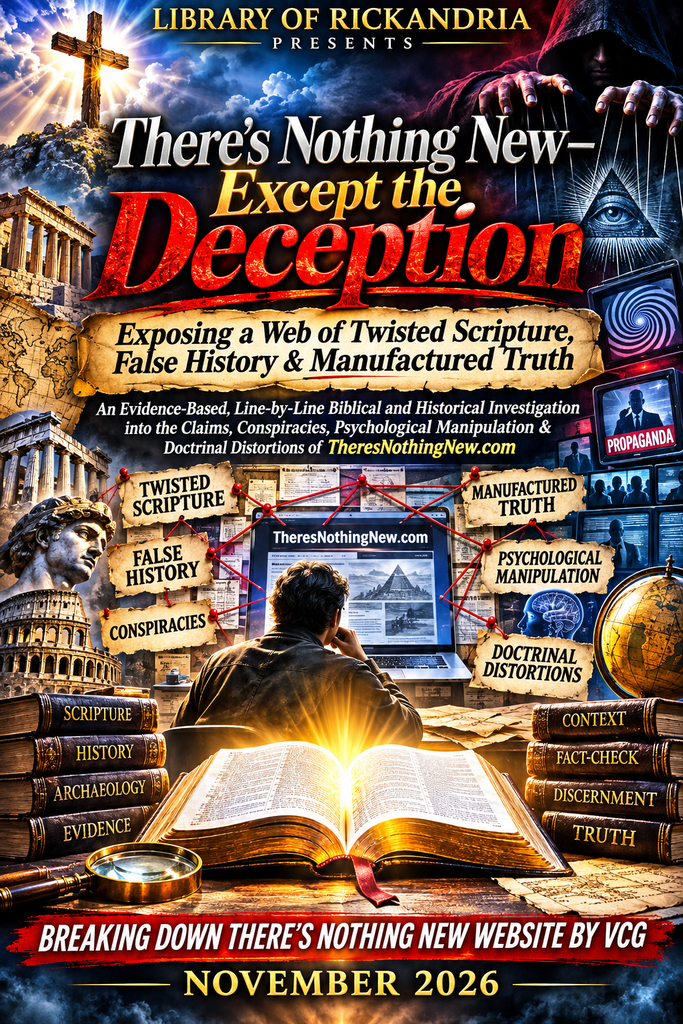
An Evidence-Based, Line-by-Line Biblical and Historical Investigation into the Claims, Conspiracies, Psychological Manipulation & Doctrinal Distortions of TheresNothingNew.com
Anyone can do this, but most won’t.
There’s Nothing New—Except the Deception: Exposing a Web of Twisted Scripture, False History & Manufactured Truth
is an extensive investigative exposé by the Library of Rickandria that critically examines:
- the teachings
- historical claims
- conspiracy theories
- scientific assertions
- prophetic interpretations
presented on TheresNothingNew.com.
Drawing upon:
- the King James Bible
- ancient manuscripts
- primary historical records
- peer-reviewed scientific research
- official investigations
- psychological studies
the paper exposes recurring patterns of:
- Scripture taken out of context
- misleading etymologies
- selective evidence
- numerical coincidences presented as proof
- unsupported allegations of global deception
Major subjects include:
- the identity of Jesus Christ and the Holy Ghost
- KJV-only doctrine
- the divine name YHWH
- Daniel’s seventy weeks
- biblical prophecy
- the Mark of the Beast
- COVID-19 vaccines
- gravity
- climate science
- alleged false-flag events
and controversial claims concerning religious and ethnic communities.
Beyond evaluating individual assertions, the investigation explores how:
- fear
- claims of hidden knowledge
- confirmation bias
- psychological persuasion
can make speculative narratives appear convincing.
Rather than dismissing legitimate questions or demanding unquestioning trust in established institutions, the paper carefully distinguishes:
- documented facts from theological interpretation
- scientific evidence from speculation
- genuine historical concerns from unsupported conclusions
Its central finding is that the website repeatedly elevates:
- coincidences
- symbolic associations
- selective quotations
into claims of certainty that the underlying evidence does not justify.
Guided by 1 Thessalonians 5:21—
“Prove all things; hold fast that which is good”
—the investigation encourages readers to:
- examine original sources
- test every claim
- recognize uncertainty
and approach:
- Scripture
- history
- the pursuit of truth
with:
- intellectual honesty
- biblical discernment
- rigorous evidence
ChatGPT – Library of Rickandria
LIBRARY OF RICKANDRIA PRESENTS
THERE’S NOTHING NEW—EXCEPT THE DECEPTION
Exposing a Web of Twisted Scripture, False History & Manufactured Truth
An Evidence-Based:
- Biblical
- Historical
- Scientific
- Psychological
Investigation into:
- the Claims
- Conspiracies
- Interpretations
- Doctrinal Distortions
of TheresNothingNew.com
A Library of Rickandria Research Investigation | Prepared by VCG | November 2026
Cover artwork:
Library of Rickandria.
The illustration is symbolic, not documentary evidence.
Published by:
Research methodology:
Website examined:
Primary biblical reference:
The Holy Bible, King James Version, Pure Cambridge Edition Research date: November 9, 2026
Abstract
What happens when someone quotes the Bible accurately but builds an interpretation upon it that the passage itself does not establish?
What happens when a genuine historical document is used to support a claim that the document never makes?
Or when:
- a number
- name
- symbol
- scientific term
- biblical prophecy
are connected so confidently that the resulting story begins to feel like proof?
These questions lie at the center of this investigation.
The website There’s Nothing New presents an extensive interconnected body of:
- religious
- historical
- scientific
- medical
- political
commentary.
Its articles discuss:
- biblical translation
- the identity of Jesus Christ
- the Holy Ghost
- the Great Tribulation
- Daniel’s seventy weeks
- Revelation
- vaccination
- gravity
- climate change
- secret societies
- Jewish history
- major tragedies
- alleged worldwide deception
The website’s author, Howard Ratcliffe, states that his work concerns truth and a spiritual struggle for the human soul.
His Statement of Faith declares that the King James Bible is inerrant and describes biblical prophecy as a history of creation written in advance.
The site also invites readers to redistribute its information and offers downloadable book material.
The purpose of this paper is to test those claims—not by assuming that every official account must be correct, nor by assuming that alternative explanations are automatically false, but by returning to the underlying evidence.
This investigation examines the differences:
- between what Scripture explicitly states and what someone concludes from Scripture
- between established history and historical speculation
- between measurable science and scientific-sounding language
- between psychological persuasion and genuine demonstration
The findings reveal recurring problems in the sampled material:
- biblical texts interpreted beyond their context
- linguistic associations mistaken for etymology
- authentic documents given meanings they do not support
- numerical coincidences treated as causal evidence
- allegations that conflict with extensive independent records
Nevertheless, some of the website’s starting observations are correct.
The KJV does contain particular expressions not found in some modern translations.
Biblical prophecy does contain numerical periods.
Religious institutions have made mistakes.
Governments have conducted real covert operations.
Medical products can cause adverse effects.
Historical interpretations can be disputed.
The central question is what follows from these facts.
An authentic fact does not validate every interpretation attached to it.
This report seeks to demonstrate where those transitions occur, what the available evidence actually establishes, and how readers can recognize the difference.
A necessary statement about the scope
This is a substantial investigative paper integrating the earlier claim-by-claim examination with expanded research into the site’s:
- theology
- methods
- historical assertions
- science
- medical claims
- psychology
- influence,
- accountability
It is not a certified transcription or exhaustive sentence-by-sentence audit of every archived page.
The website contains a large archive, including hundreds of navigation entries and many long articles.
The principal pages examined here are linked directly, while topics requiring separate archival or specialist review are identified.
No estimated:
- audience size
- download count
- book-sales figure
- motive
- psychological diagnosis
or secret relationship is treated as established without evidence.
This distinction matters.
The credibility of an investigation depends not on how strongly it condemns its subject, but on how accurately it describes what it can prove.
PART I — FOLLOWING THE SOURCE
1. Who is behind There’s Nothing New?
The first task in any investigation is to identify the source before attempting to judge the contents.
On the site’s Statement of Faith, the author’s note is signed Howard Ratcliffe.
It also says that nothing is copyrighted and encourages readers to spread the information.
The statement expresses opposition to earthly priesthoods and man-made churches, emphasizing a personal relationship with Jesus Christ.
The site’s navigation includes:
- biblical articles
- discussions of religion
- material about science and technology
- coronavirus articles
- claims about political and religious institutions
- extensive daily archives beginning in 2019 and continuing into 2026
Its book page offers PDF and Word download sections for There’s Still Nothing New Under the Sun.
This tells us something about the site’s design.
It is not presented merely as an occasional commentary blog.
It functions as a collection of arguments intended to be read together, remembered, and shared.
But the available evidence does not yet establish how many people have read the site, how many have downloaded its book, or whether the book has generated sales.
Those questions belong in a separate influence assessment.
The architecture of the argument
The site’s material is organized around several recurring ideas.
Its theology provides the starting point:
- Jesus Christ
- the authority of the King James Bible
- spiritual baptism
- an unconventional prophetic chronology
- suspicion of institutional religion
Its historical arguments then connect:
- ancient priesthoods
- religious traditions
- empires
- modern organizations
Its scientific and medical articles introduce:
- allegedly suppressed discoveries
- manufactured diseases
- hidden energy systems
- explanations for natural phenomena
that depart from established measurements.
Finally, contemporary events are interpreted through the preceding theological and symbolic framework.
This creates a powerful narrative structure.
Once a reader accepts the foundational assumptions, apparently unrelated events can seem to confirm the same conclusion.
That is why the investigation cannot stop at individual factual mistakes.
We need to examine the framework that determines how the facts are selected and joined.
2. Our method: separating five questions
The Library of Rickandria’s stated research methodology emphasizes examining claims in context, checking original sources, and distinguishing biblical wording from the interpretation placed upon it.
For this investigation, every major assertion is tested across five different levels.
| Level | Central question |
|---|---|
| Documentary | What did the website actually say, and where? |
| Historical | What can contemporaneous records and reliable historical research establish? |
| Scientific | Is the proposed mechanism measurable, reproducible, and consistent with the evidence? |
| Psychological | How might the argument influence perception, belief, emotion, or willingness to share? |
| Scriptural | What does the biblical passage say in context, and which further interpretations remain disputed? |
A theological disagreement cannot be settled by an astronomy experiment.
A question of viral genetics cannot be settled by the symbolic use of a serpent in Revelation.
And the fact that an argument is emotionally persuasive does not prove that the author intended to deceive.
Our verdict categories
Supported:
The available evidence reasonably substantiates the claim.
Partly correct:
An identifiable factual statement is true, but the argument attaches an unsupported conclusion.
Disputed interpretation:
A possible theological or historical reading, but not an established fact.
Unsupported:
The claim lacks the evidence required to establish it.
Contradicted:
Strong evidence, including sometimes the website’s own primary sources, establishes that the claim is false.
Unresolved:
The available evidence is insufficient for a confident verdict in either direction.
These categories are deliberately different.
A claim should not be called false merely because it has not yet been proved, and an interpretation should not be called biblical fact merely because a verse can be quoted beside it.
Why the King James translators themselves matter
The uploaded Pure Cambridge Edition includes the translators’ preface, The Translators to the Reader.
This is an exceptionally useful primary source because it explains the translation principles the translators themselves embraced.
They described their objective as improving an existing good translation rather than creating Scripture anew.
They also defended comparing earlier translations, consulting original languages, revising work where necessary, and providing marginal readings where the text admitted more than one plausible interpretation.
They explicitly recognized that not every obscure word or passage could be resolved with equal certainty.
That historical fact is important because the website insists that the KJV is uniquely inerrant while treating many translation variations as evidence of spiritual corruption.
Respecting the KJV does not require imposing upon its translators a theory they did not themselves consistently advance.
We will use the KJV directly throughout this paper, while examining:
- Hebrew
- Greek
- manuscripts
- historical context
where those questions are relevant.
PART II — WHEN THE BIBLE IS QUOTED BUT THE MEANING IS CHANGED
3. Jesus Christ, the Father, and the Holy Ghost
The investigation begins with theology because the site’s treatment of Scripture shapes the rest of its claims.
Its Statement of Faith affirms that Jesus is God, the Word made flesh, the Alpha and Omega, and the foundation of salvation.
Several of those statements correspond to major New Testament teachings.
John 1:1 (KJV) states:
In the beginning was the Word, and the Word was with God, and the Word was God.
John 1:14 states:
And the Word was made flesh, and dwelt among us…
John 20:28 records Thomas addressing Jesus:
My Lord and my God.
These passages are central evidence for the deity of Christ in historic Christian theology.
The problem begins when the website moves beyond affirming Christ’s deity and identifies Jesus with the Father and Holy Ghost in a way that treats the biblical distinctions among them as unnecessary.
In its Statement of Faith, the author explicitly identifies Jesus as the Holy Ghost.
Compare John 14:16:
And I will pray the Father, and he shall give you another Comforter, that he may abide with you for ever;
Jesus speaks of himself praying to the Father, who will send another Comforter.
John 14:26 names that Comforter as the Holy Ghost.
John 15:26 continues the distinction between the one who sends, the one from whom the Spirit proceeds, and the Spirit himself.
Matthew 3:16–17 likewise describes Jesus being baptized, the Spirit descending, and a voice from heaven declaring the Father’s pleasure in the Son.
The theological questions are complex, and Christians have historically disagreed about the relationship between divine unity and personal distinction.
Traditional Trinitarian theology holds that the Father, Son, and Holy Spirit are distinct persons sharing the one divine being.
Oneness theology understands the distinctions differently.
Our finding is narrower than simply calling an alternative interpretation false:
the website cannot establish from these passages that Jesus and the Holy Ghost are interchangeable without explaining the distinctions the passages themselves make.
The text must be allowed to speak before a doctrinal system is imposed upon it.
4. The extraordinary claim that “Holy Spirit” refers to Satan
This is among the most important findings in the investigation.
In Authorized Bible versus New Bible versions, the author explicitly distinguishes Holy Ghost from Holy Spirit and identifies the latter with Satan.
The article argues that modern translations substitute one for the other, thereby changing the spiritual identity being described.
The obvious first test is the author’s preferred Bible.
Does the KJV itself use the expression Holy Spirit in a positive sense?
Yes.
Luke 11:13 (KJV):
If ye then, being evil, know how to give good gifts unto your children:
how much more shall your heavenly Father give the Holy Spirit to them that ask him?
The speaker is Jesus.
The giver is the heavenly Father.
What is given is described as a good gift.
The verse cannot reasonably mean that the Father is offering Satan to those who pray.
Psalm 51:11:
Cast me not away from thy presence; and take not thy holy spirit from me.
And Ephesians 4:30:
And grieve not the holy Spirit of God, whereby ye are sealed unto the day of redemption.
These are not obscure passages.
They are straightforward references to God’s Spirit in the King James Bible itself.
The original New Testament Greek also matters.
Both ghost and spirit can translate the Greek noun pneuma.
The mere choice between two English terms does not create two different spiritual beings.
The website attempts to explain Luke 11:13 by suggesting that the passage involved a different kind of spiritual request before Pentecost.
But the actual text supplies neither a Gnostic petitioner nor the asserted identification with Satan.
This is not just a disagreement between ancient manuscripts or Christian denominations.
It is a contradiction between the website’s rule and the very translation it calls inerrant.
Verdict:
Contradicted by the KJV.
The correction is significant because the website associates this distinction with blasphemy and unforgivable sin.
Such accusations should never rest on an English vocabulary distinction that Scripture itself does not maintain.
5. The King James Bible: preservation, translation, and the limits of certainty
The website treats the Authorized Version as the uniquely inerrant written covenant by which humanity will be judged.
That raises two different questions.
The first is theological:
Has God preserved his word?
The second is historical:
Does the existence of the King James Version establish that all differences in other translations are deliberate corruptions?
Those are not the same question.
The KJV was first published in 1611, building upon previous English translation work and Hebrew and Greek source traditions.
David Norton’s A Textual History of the King James Bible, published by Cambridge University Press, documents both its dependence on earlier translations and the editorial changes made in subsequent printings.
Cambridge University Press — A Textual History of the King James Bible
This distinction becomes especially relevant when the author treats every letter of a particular English edition as fixed from the beginning.
The KJV translators themselves understood that a translation could be genuine Scripture while still admitting correction.
Their preface, included in the uploaded Bible, also defends comparing versions in difficult passages.
The case of 1 John 5:7–8
The website repeatedly invokes the full KJV wording of 1 John 5:7–8 as evidence for its theological position.
The fuller heavenly-witness wording is traditionally called the Johannine Comma.
It appears in the KJV, but its textual history is unusually complicated.
A scholarly analysis by Rodrigo Barbosa Galiza and John W. Reeve, published in Andrews University Seminary Studies in 2018, reviews the transmission of this passage and its theological use.
The authors note that the fuller wording is absent from the earliest Greek manuscript evidence and discuss its possible development through Latin Christianity.
Read: The Johannine Comma — Textual History and Theological Usage
This does not by itself disprove the Trinity.
The doctrine is argued from numerous passages beyond 1 John 5:7.
Nor does acknowledging a textual variant make someone an enemy of Scripture.
It means honestly examining what manuscript witnesses contain.
The rule should be simple:
when determining what an ancient text originally said, actual manuscript evidence matters.
Psalm 12 and preservation
Psalm 12:6–7 is often invoked in arguments about perfect verbal preservation:
The words of the LORD are pure words:
as silver tried in a furnace of earth, purified seven times.
The text affirms the purity of God’s words.
Its interpretation regarding the pronouns and the object of divine preservation is debated.
It does not explicitly name the King James Bible, the year 1611, or the later Pure Cambridge Edition.
A theological argument may be constructed about providential preservation, but it must be distinguished from a historical claim that a particular English printing was predicted by the Psalm.
Our conclusion is not that the KJV should be discarded.
It is that the website’s exclusive claims require evidence the cited passages do not supply.
6. The Masoretes, YHWH, and the manuscript that settles a historical question
One of the site’s most concrete historical claims concerns the divine name.
Its article titled Masoretes argues that YHWH was introduced into Scripture by medieval Jewish scribes, associating this supposed alteration with a Masoretic manuscript dating to AD 1008.
This claim can be tested independently of theological opinion.

Gallery of Dead Sea Scrolls: A Glimpse of the Past | Live Science
The specific divine-name evidence discussed below comes from the Qumran Psalms Scroll documented by the Library of Congress.
The Library of Congress documents a Psalms Scroll from Qumran, copied approximately AD 30–50.
Its description explicitly identifies the four-letter divine name, the Tetragrammaton, written in paleo-Hebrew script.
Library of Congress — Scrolls from the Dead Sea: The Psalms Scroll
This evidence predates the AD 1008 manuscript invoked by the website by nearly a thousand years.
The distinction is straightforward.
The Masoretes were Jewish scribes and scholars who worked to preserve and annotate the Hebrew biblical text, especially its pronunciation and reading tradition.
The Leningrad Codex, dated AD 1008–1009, is a major medieval manuscript.
It is not the point at which the Hebrew divine name first entered history.
The written consonants YHWH, the historical pronunciation of those consonants, and the later English form Jehovah are related but distinct questions.
The historical evidence refutes the claim that the four consonants were invented by medieval Masoretes.
It does not settle every theological question about the divine name or its pronunciation.
Verdict:
The alleged medieval invention of YHWH is historically false.
There is a further problem with turning this into an ethnic accusation.
The existence of an early Hebrew manuscript cannot establish that a contemporary religious or ethnic community is engaged in a satanic plot.
That would require a wholly different kind of evidence.
7. Juda, Judah, and the danger of spiritualizing a spelling difference
The website argues that the form Juda is connected with Jesus while Judah signifies Antichrist.
Authorized Bible versus New Bible versions – TheresNothingNew
This argument depends heavily on the letter h.
But the Bible is written across:
- Hebrew
- Aramaic
- Greek
linguistic contexts, subsequently represented in English using different transliteration conventions.
Genesis 49:10 speaks of Judah.
Revelation 5:5 calls Christ the Lion of the tribe of Juda.
The two passages refer to the same tribal identity.
They do not introduce rival tribes, one holy and one demonic.
Revelation 5:5 is especially decisive because it intentionally connects Christ with the royal expectations associated with Judah in the Old Testament.
The argument also fails linguistically:
an English spelling variation does not establish the presence or absence of a spiritual being.
Verdict:
Contradicted by the Bible’s linguistic and literary context.
8. Jesus as Melchisedec: identity or foreshadowing?
The website identifies Jesus directly with Melchisedec of Genesis 14.
It is certainly true that the New Testament connects Christ’s priesthood with Melchisedec.
Genesis 14:18–20 introduces Melchisedec as king of Salem and priest of the most high God.
Psalm 110:4 speaks of a priest for ever after the order of Melchisedec.
Hebrews 7 develops that relationship at length.
But Hebrews 7:3 describes Melchisedec as being made like unto the Son of God.
Hebrews 7:15 likewise speaks of another priest arising after his similitude.
Some Christians interpret the Genesis figure as a pre-incarnate appearance of Christ.
Others understand him as a historical priest-king who prefigures Christ.
Both positions must grapple with Hebrews 7.
The website may argue for the first interpretation.
What it cannot honestly claim is that the disputed identification is a fact stated without ambiguity by Genesis or Hebrews.
Verdict:
Disputed theological interpretation, not a demonstrated identity.
9. Was Jesus a Rabbi? Should his followers be called Christians?
The website’s criticism of religious titles and identities raises another useful test.
John 1:38 records disciples addressing Jesus:
Rabbi, (which is to say, being interpreted, Master,) where dwellest thou?
John 3:2 also records Nicodemus calling Jesus Rabbi.
Matthew 23:8 warns Christ’s followers against religious status-seeking and treating human teachers as ultimate masters.
It does not erase the historical Gospel accounts.
Similarly, Acts 11:26 says the disciples were first called Christians in Antioch.
First Peter 4:16 states:
Yet if any man suffer as a Christian, let him not be ashamed; but let him glorify God on this behalf.
A person can criticize the use of Christian identity as a substitute for genuine discipleship.
But it is not biblically sustainable to assert that the word itself must be rejected as inherently evil.
Verdict:
Absolute prohibitions against these terms are not supported by the New Testament.
10. Spiritual baptism, water baptism, and the assembled church
The website’s Statement of Faith declares that spiritual baptism is the only baptism a person needs and rejects man-made churches.
This raises issues that deserve careful distinction rather than a hurried dismissal.
First Corinthians 12:13 speaks of believers being baptized by one Spirit into one body.
That strongly supports the importance of the Spirit’s work in Christian initiation and identity.
But Acts 8:36–39 describes baptism involving water.
Acts 10:47–48 likewise records water baptism after the Holy Ghost has been received.
Matthew 28:19 provides Jesus’ commission concerning baptism.
Christian traditions disagree about whether water baptism is:
- sacrament
- ordinance
- sign
- means of grace
or testimony of faith.
They do not all agree about its relationship to salvation.
Nevertheless, the website’s categorical dismissal of water baptism must explain why the New Testament continues to describe and command it.
The same distinction applies to churches.
Acts 2:42 describes an assembled community continuing in:
- apostolic teaching
- fellowship
- breaking bread
- prayers
Hebrews 10:25 warns against abandoning the assembly of believers.
First Timothy 3 describes qualifications for church leadership.
These texts do not authorize coercion, financial exploitation, or unaccountable religious institutions.
But neither do they describe congregational life itself as an intrinsically satanic enterprise.
A criticism of corrupt leadership is not proof that all organized fellowship is forbidden.
11. Charity, giving, and the tithe
The website rejects the authority of modern religious organizations to demand tithes under Old Testament law.
There is a legitimate biblical question here.
The Mosaic tithe was connected with Israel’s covenantal and agricultural system and the support of the Levites.
The New Testament does not simply repeat that arrangement as a universal ten-percent tax enforced by Christian churches.
Second Corinthians 9:7 emphasizes willing giving:
Every man according as he purposeth in his heart, so let him give; not grudgingly, or of necessity:
for God loveth a cheerful giver.
The website is therefore right to challenge manipulative financial demands masquerading as divine law.
But 1 Corinthians 9:14 recognizes that those preaching the gospel may receive support, and 1 Timothy 5:17–18 addresses material provision for elders.
The proper conclusion is more nuanced:
a compulsory Mosaic tithe is not plainly imposed on all Christians, but voluntary support for ministry is biblically recognized.
The website’s tendency to turn an important correction into an absolute prohibition weakens what could otherwise be a worthwhile discussion.
PART III — PROPHECY, CHRONOLOGY, AND THE PROBLEM OF CERTAINTY
12. Daniel’s seventy weeks: 490 days or 490 years?
The website’s 70 Weeks article makes an unusually specific claim:
Daniel’s seventy weeks represent the final 490 literal days of the Great Tribulation, with the final seven days immediately preceding Christ’s return.
This interpretation should be examined without assuming that a familiar prophecy chart must be correct.
Daniel 9 begins with Daniel considering Jeremiah’s seventy years concerning Jerusalem (Daniel 9:2).
In Daniel 9:24, Gabriel tells him:
Seventy weeks are determined upon thy people and upon thy holy city…
The underlying Hebrew uses a term for groups of seven.
It is not simply an ordinary English reference to seven-day calendar weeks with every possible interpretation excluded.
The larger context matters.
Daniel is concerned with the duration and consequences of:
- exile
- covenant unfaithfulness
- Jerusalem
- restoration
A study by George Athas in The Journal of Hebrew Scriptures examines the seventy weeks as a 490-year schematic period while arguing for a particular arrangement of its divisions.
That article illustrates something important:
scholars disagree about the chronology without necessarily disagreeing that the prophecy involves groups of years.
George Athas — In Search of the Seventy “Weeks” of Daniel 9
Competing readings of Daniel 9
| Interpretive framework | Basic approach |
|---|---|
| Traditional Christological | Seventy sevens associated with Jewish history and fulfilled through Christ |
| Critical-historical | Symbolic chronology associated with Jerusalem, the exile, and events surrounding the Antiochene crisis |
| Futurist dispensational | Seventy sevens of years, including a future final seven-year period |
| Website’s proposed chronology | Final 490 literal days, ending with a seven-day period before the Second Coming |
Our investigation should not pretend that all Christian interpreters agree about Daniel 9.
They plainly do not.
But neither should the website pretend that its literal-day interpretation requires no additional assumptions.
The author rejects the year-based reading as an unauthorized alteration while proposing a highly specific end-times sequence that Daniel 9 does not explicitly describe.
This is the central problem:
the website condemns interpretation while performing extensive interpretation.
Verdict:
The proposed 490-day end-times calendar is not established by Daniel 9.
13. The 1,260 days, forty-two months, and time-times-half-a-time passages
Revelation repeatedly uses time periods that invite comparison.
Revelation 11:2 refers to forty-two months.
Revelation 11:3 gives the two witnesses 1,260 days.
Revelation 12:6 describes a corresponding 1,260-day period, and Revelation 12:14 uses the expression a time, and times, and half a time.
These numerical relationships are real and important.
Assuming thirty-day months, forty-two months correspond to 1,260 days.
Three and a half such years also correspond to that total.
But recognizing the arithmetic does not by itself answer what the numbers mean, whether they are literal or symbolic, or exactly which historical events they describe.
Different Christian traditions interpret Revelation through:
- preterist
- historicist
- futurist
- idealist
approaches.
Some combine elements from more than one framework.
The website places these periods within its own distinctive historical and prophetic reconstruction.
Correction:
The Bible supplies these numbers.
The website supplies particular modern identifications and chronological arrangements.
Those two sources of information must not be confused.
14. Did prophecy end in AD 61?
On the current homepage, the author places the end of prophecy at approximately AD 61, citing Luke 16:16.
Luke 16:16:
The law and the prophets were until John:
since that time the kingdom of God is preached, and every man presseth into it.
Jesus is describing a major transition in redemptive history:
from the era associated with the law and prophets to the proclamation of the kingdom.
The passage contains no reference to the year AD 61.
Acts 2:17–18 describes prophecy among believers after Jesus’ resurrection and ascension.
Acts 11:27–28 records Agabus prophesying.
Acts 21:9–10 also describes prophetic activity in the early church.
First Corinthians 14 discusses prophecy in the congregation.
Some Christian traditions maintain that revelatory gifts ceased during or after the apostolic age.
Others maintain their continuation.
Both positions have developed theological arguments.
The website has not established its particular date from Luke 16:16.
Verdict:
The exact AD 61 cutoff is unsupported.
15. The six-thousand-year creation clock
Second Peter 3:8 states:
…one day is with the Lord as a thousand years, and a thousand years as one day.
The website interprets this as part of a 7,000-year creation framework, often connecting six thousand years of history with a final thousand-year kingdom.
Ancient and later Christian thinkers have explored millennial patterns of history.
The idea itself is not a recent invention.
But we need to distinguish a theological analogy from a mathematical instruction.
Second Peter 3 is addressing:
- God’s promises
- human impatience
- divine patience
- judgment
The text does not provide a dated chronology for counting exactly six thousand years from creation.
Moreover, Christian and Jewish chronological systems have historically differed in their calculations.
Establishing a precise creation date requires decisions about:
- genealogies
- chronological gaps
- textual variants
- ancient calendars
An analogy may have spiritual significance without functioning as a calendar.
Verdict:
The specific six-thousand-year timetable is interpretive, not an explicit biblical calculation.
16. The alleged Jesuit origins of rapture theology
The website associates:
- futurist prophecy
- the rapture
- interpretive developments
with Roman Catholic and Jesuit influence.
There is a genuine historical subject here, but several histories must be kept separate.
An early-modern Jesuit could employ a particular interpretation of Revelation without thereby inventing every later form of futurism.
Likewise, the existence of Roman Catholic polemics against Protestant interpretations does not establish that nineteenth-century dispensationalism was secretly created by Jesuits.
A scholarly entry by Sean Durbin in the Critical Dictionary of Apocalyptic and Millenarian Movements traces modern dispensationalism to the early nineteenth-century teaching of John Nelson Darby.
It identifies the rapture, the distinction between Israel and the church, and a futurist understanding of Christ’s return among its important features.
Sean Durbin — Dispensationalism
The biblical text itself must also be distinguished from a later theological system.
First Thessalonians 4:16–17 describes the dead in Christ rising and living believers being caught up to meet the Lord.
The existence of this passage is not disputed.
Its timing relative to tribulation and judgment is.
Consequently, rejecting the pretribulation rapture as a doctrine does not establish that every mention of believers being caught up is an invention.
Verdict:
The website conflates separate historical developments and theological questions.
17. Was Jesus born on the Feast of Tabernacles in 6 BC?
The site’s homepage confidently assigns Jesus’ birth to the Feast of Tabernacles in 6 BC and associates his return with the same festival.
Luke 1 provides information about:
- Zechariah’s priestly service
- Elizabeth
- Mary
- the circumstances leading to the births of John the Baptist and Jesus
Some interpreters attempt to reconstruct a precise nativity date from priestly divisions and festival calendars.
However, the necessary chronological details are not sufficiently complete to establish an exact day.
The Gospel narratives do not give a calendar date for Jesus’ birth.
The traditional December 25 observance is also a matter of church history rather than an explicitly recorded Gospel birthday.
Scholars debate the origins of the Christmas date. C. Philipp E. Nothaft’s research, for example, discusses both influence from older religious festivals and early Christian chronological calculation as possible explanations for December 25.
Cambridge University Press — The Origins of the Christmas Date
Verdict:
A Tabernacles birth is a theological and chronological proposal, not a conclusively established historical fact.
18. Christmas, Easter, Hanukkah, and religious traditions
The website repeatedly associates religious holidays with:
- paganism
- Saturn
- ancient priesthoods
- satanic worship
The historical questions are worth investigating.
Religious customs do evolve, and traditions can acquire meanings quite different from their earliest forms.
But historical borrowing and deliberate worship are not the same thing.
The Bible does not command an annual December 25 celebration of Jesus’ birth.
It also does not follow that every Christian who commemorates the Nativity on that date is knowingly participating in pagan worship.
John 10:22 mentions the Feast of Dedication in Jerusalem, associated with Hanukkah.
The passage does not command all Christians to observe Hanukkah, but neither does it support describing the festival as wholly absent from the New Testament world.
Romans 14:5–6 discusses differing convictions regarding the observance of days.
For Easter, another distinction is necessary:
the New Testament establishes Jesus’ death and resurrection as central Christian realities.
The history of later annual calendars and customs is a separate subject.
The proper investigation should ask where a custom originated, how its meaning developed, and what a worshipper actually believes or intends.
Verdict:
The site’s universal condemnation of these observances exceeds what its evidence can establish.
19. The cross, the tree, and ancient symbolism
The website’s Cross, Cube or Tree? article connects the cross with:
- Egyptian symbols
- cubes
- religious institutions
- alleged hidden worship
Ancient Egypt really did use the ankh as a symbol associated with life.
Other societies employed crosses and crosslike signs for different purposes.
But visual resemblance does not establish continuous religious identity.
The New Testament uses the language of both the cross and the tree when describing Jesus’ death.
Acts 5:30 refers to Jesus being hanged on a tree.
First Corinthians 1:18 refers to the preaching of the cross.
There is no contradiction here that requires constructing a different crucifixion event.
The expressions can refer to the same execution through different theological language.
The Gospel descriptions of Jesus and the two thieves place them beside one another, with one on either side (Luke 23:33).
A proposed reconstruction involving one symbolic tree or a candlestick-like arrangement requires independent historical evidence.
It is not established by the wording of those passages.
Verdict:
The symbolic associations do not prove the alleged religious conspiracy or replace the Gospel accounts.
PART IV — SCIENCE ON TRIAL: WHEN NUMBERS BECOME EVIDENCE OF SOMETHING ELSE
20. The coronavirus patent: a real document with a misleading interpretation
This example deserves careful attention because it illustrates how a genuine source can be made to appear to prove something it does not.
In the site’s Coronavirus article, the author cites U.S. Patent 10,130,701 as part of an argument that coronavirus was manufactured in advance.
The patent exists.
That is not disputed.
Primary document: US10130701B2
United States patent publication — Coronavirus
| Document field | Verified information |
|---|---|
| Patent number | US10130701B2 |
| Earliest priority date | July 23, 2014 |
| U.S. filing date | July 23, 2015 |
| Grant publication | November 20, 2018 |
| Original assignee | The Pirbright Institute |
| Relevant organism | Avian infectious bronchitis coronavirus |
Examine the original patent, descriptions, and claims
The patent concerns work involving an avian coronavirus associated with infectious bronchitis in chickens.
It does not identify SARS-CoV-2, the virus responsible for the COVID-19 pandemic.
This matters because coronavirus is the name of a viral family.
Scientists were studying multiple coronaviruses long before the discovery of SARS-CoV-2.
The faulty inference follows a recognizable pattern:
A coronavirus patent existed before 2020.
Documented fact
Therefore the patent concerns the virus responsible for COVID-19.
Unsupported identification
Therefore the pandemic was deliberately manufactured.
Further unsupported conclusion
The first statement is true.
The second does not follow from it.
The third requires an entirely separate investigation.
Even if the exact origins of SARS-CoV-2 remain debated, this patent does not establish deliberate creation of that virus or orchestration of the pandemic.
Verdict:
- Authentic document
- false identification
- unsupported conclusion
21. What does COVID-19 actually mean?
The website interprets COVID as an acronym involving vaccination identification, sometimes connecting it with spiritual doorways and occult symbolism.
The documented naming history is considerably simpler.
On February 11, 2020, the World Health Organization announced COVID-19 as the name of the disease.
It derives from coronavirus disease 2019.
The virus itself was named SARS-CoV-2 by the relevant virus-taxonomy authorities.
World Health Organization — Naming COVID-19 and its causative virus
The website’s alternative expansion is a backronym:
a phrase created after the fact to fit letters that already have a documented meaning.
The existence of a backronym cannot override contemporaneous naming records.
Verdict:
False etymology.
22. Does coronavirus mean crowned serpent venom?
The word corona refers to a crown or crownlike appearance.
Coronaviruses received that designation because their surface structures produce a crownlike appearance in electron microscopy.
The website connects that imagery with:
- biblical serpents
- poison
- Satan
- the pale horse of Revelation
The problem is the transition from a visual resemblance to a theological and biological claim.
A virus can be described with a crownlike visual analogy without being serpent venom.
A biblical serpent can symbolize evil without identifying a specific virus.
Likewise, Revelation 6 does not provide a scientific account of viral structure or medical transmission.
Verdict:
An imaginative symbolic interpretation presented as a biological explanation.
23. Vaccines, genetic material, and the actual scientific distinctions
The site’s Vaccine and Mark of the Beast articles discuss:
- genetic modification
- permanent alterations of the human genome
- unusual vaccine ingredients
- spiritual consequences
Some passages focus on experimental DNA-based approaches, while others discuss COVID vaccines more broadly.
These should not be collapsed into one technology.
What is mRNA?
Messenger RNA carries instructions that cells use to produce proteins.
In an mRNA vaccine, the introduced mRNA temporarily supplies instructions for producing a protein antigen, stimulating an immune response.
The U.S. National Human Genome Research Institute explains that the mRNA used in these vaccines does not ordinarily alter the person’s genomic DNA.
The mRNA is not equivalent to inserting a permanent new sequence into the cell’s chromosomes.
National Human Genome Research Institute — Understanding COVID-19 mRNA Vaccines
DNA vaccines and gene-editing technologies are different subjects.
Claims about those systems require examining the specific product, its delivery method, biological behavior, and supporting experimental evidence.
It is not scientifically sound to treat:
- CRISPR
- messenge
- RNA
- DNA vaccines
and every form of genetic engineering as interchangeable.
What about adverse reactions?
Recognizing the site’s errors does not require denying that medical interventions can have risks.
The CDC’s September 23, 2026, safety guidance acknowledges rare myocarditis and pericarditis following COVID-19 vaccination.
It describes the importance of monitoring and evaluating adverse events.
CDC — COVID-19 Vaccine Safety Considerations
A rigorous medical analysis must distinguish an adverse event reported after vaccination from a reaction demonstrated to have been caused by vaccination.
It must examine:
- rates
- comparison groups
- product types
- age
- relevant health risks
We should be equally skeptical of a source claiming that every vaccine is harmless and one claiming that every vaccinated individual has been genetically corrupted.
The actual medical question is about:
- evidence
- mechanisms
- outcomes
- risk
—not a symbolic association with Revelation.
24. Is vaccination the Mark of the Beast?
The website repeatedly connects COVID vaccination to the imagery of Revelation 13–14, though one passage acknowledges that a vaccine alone would not necessarily be the mark.
That qualification matters and should be preserved.
Revelation 13:16–17 describes a mark associated with the beast’s authority and buying and selling.
Revelation 14:9 connects the mark with worship of the beast and its image.
Neither passage identifies:
- an injection
- an mRNA sequence
- a pharmaceutical patent
or a particular twenty-first-century vaccination program.
Someone may investigate:
- the ethics of vaccine mandates
- public-health policies
- medical consent
Those are legitimate subjects.
But such concerns do not establish that a vaccine is spiritually equivalent to worshipping the beast.
Nor does a person’s vaccination status provide biblical grounds for declaring that person eternally condemned.
The New Testament’s central statements about salvation, including Romans 10:9–13 and Ephesians 2:8–10, must be taken seriously before imposing new requirements that the text does not specify.
Verdict:
The identification is unsupported by Revelation’s wording.
25. The 60 GHz claim and the physics of 5G
In its climate change article, the website asserts that 5G around 60 GHz interferes with oxygen uptake and can function as a killing mechanism.
The argument draws attention to a real physical property:
molecular oxygen absorbs electromagnetic radiation at particular microwave frequencies.
But atmospheric absorption is not equivalent to removing oxygen from blood.
The presence of a molecular absorption band does not establish that a transmitter at that frequency produces the alleged biological injury.
- Exposure power
- distance
- duration
- absorption properties
and the relevant tissue interactions are necessary parts of the investigation.
The WHO’s review of 5G and health reports that causal adverse health effects have not been established for wireless exposures under reviewed conditions, while recognizing that research at certain newer frequencies has been more limited.
WHO — 5G Mobile Networks and Health
The website offers no reproducible human experiment establishing its claimed oxygen-depletion mechanism at ordinary public exposure levels.
Verdict:
Unsupported biological mechanism.
26. Gravity, 666, and the problem of selected numbers
The site’s Gravity article provides one of the clearest examples of its overall argumentative method.
The author associates Newton’s second law with the number 666 and then declares gravity nonexistent.
Newton’s second law may be written:
F = ma
Near Earth’s surface, an object with a mass of approximately 68 kilograms has a weight of:
68 times 9.8 = 666.4
The numerical similarity is real.
But choose a different mass:
70 times 9.8 = 686
Nothing mysterious has occurred.
The force changes with the mass.
The number 666 appeared because a particular mass and units were chosen.
If the same force were measured in pounds-force rather than newtons, the numerical value would be different.
The deeper error
The website treats a modern numerical measurement as though its digits necessarily carry the theological significance of Revelation 13:18.
But units such as the newton are human systems of measurement.
A symbol’s numeric value changes depending on the units and conventions used.
The connection to the biblical beast is therefore not discovered in the physical law; it is introduced by the interpreter.
Does gravity exist?
NASA’s Gravity Recovery and Climate Experiment, GRACE, used changes in the distance between two satellites to measure variations in Earth’s gravitational field.
Those measurements are not simply appeals to Newton’s reputation.
They involve independently observable changes in satellite motion.
NASA — GRACE Mission Fact Sheet

Measuring Principle – Globalwaterstorage
See the mission explanation and measurement method.
Newton did not create gravity by writing an equation.
He developed a mathematical description of an observable phenomenon.
Verdict:
The numerical association is irrelevant to whether gravity exists.
The physical denial is contradicted by reproducible evidence.
27. Does Psalm 93 prove the Earth cannot move?
Psalm 93:1 says:
…the world also is stablished, that it cannot be moved.
The website interprets this language in support of its unconventional cosmology.
However, the Psalm is a declaration of God’s kingship, power, and the stability of his creation.
Its central concern is not a geometric model of the solar system.
This does not mean that biblical statements about creation have no meaning.
It means that their literary and theological purposes need to be considered.
The article is also not a straightforward flat-earth argument.
It rejects a flat Earth while advocating a spherical world with unusual claims about expansion, rotation, and stability.
In the Flat V Spherical Earth article, the author cites 1 Corinthians 16:30.
But 1 Corinthians 16 has only 24 verses.
The intended passage is apparently 1 Chronicles 16:30, which uses similar language about the world’s stability.
That is a factual reference error that should be corrected regardless of one’s cosmological position.
Verdict:
The proposed physics is not established by the Psalm, and the article contains a demonstrable citation error.
28. The denial of atomic and nuclear weapons
The site’s cosmology article explicitly rejects the reality of atomic and nuclear bombs.
This is a substantial historical claim, not a minor disagreement about theoretical physics.
The Trinity test occurred on July 16, 1945, in New Mexico.
The U.S. Department of Energy documents the test, its plutonium device, the location, and the physical effects of the explosion.
The National Park Service also documents the Trinity Site and its historical remains.
U.S. Department of Energy — Trinity Site
A claim that nuclear weapons never existed would require an explanation for:
- the experimental records
- physical residues
- radiological evidence
- instrumentation
- eyewitness accounts
- subsequent decades of nuclear research and testing
The website’s general rejection of modern physics does not supply such an explanation.
Verdict:
Contradicted by historical and physical evidence.
29. Carbon dioxide, climate science, and the number 137
The website’s climate article combines a legitimate biological fact with a conclusion that does not follow.
Plants use carbon dioxide in photosynthesis.
This is correct.
But carbon dioxide also absorbs outgoing infrared radiation and contributes to the greenhouse effect.
These are different physical and biological processes.
A substance can be necessary for life and still produce harmful effects when its concentration or environmental context changes.
The IPCC’s Sixth Assessment concludes that human activities, primarily greenhouse-gas emissions, have caused observed global warming.
The conclusion draws on multiple lines of evidence rather than relying on one model or one laboratory study.
IPCC — Sixth Assessment Report, Summary for Policymakers
The article also repeatedly associates the number 137 with:
- chlorophyll
- Ishmael’s lifespan
- Psalm 137
- the fine-structure constant
- fictional espionage symbolism
Some constituent numerical observations are real.
For example, Genesis 25:17 records Ishmael’s lifespan as 137 years.
The electromagnetic fine-structure constant is approximately:

But there is no demonstrated causal relationship between Ishmael’s age,
a numbered Psalm,
chlorophyll chemistry,
a physical constant,
and a modern conspiracy.
The author also treats the decimal approximation as though it establishes a link to the fictional agent number 007.
That is not how physical constants or probability work.
Verdict:
The argument combines real isolated facts with unsupported symbolic and causal inferences.
30. Unlimited energy and the idea of suppressed inventions
The website proposes that humanity has been denied access to hidden or effectively unlimited energy systems.
Energy suppression is, in principle, a claim that could be investigated.
A technology may be patentable, economically obstructed, poorly marketed, or intentionally withheld.
But the existence of those possibilities is not evidence for any particular secret machine.
A proposed energy device must undergo independent testing of its inputs, outputs, operating conditions, and energy accounting.
Magnets, electric fields, and solar radiation are real.
They do not establish that a machine can produce unlimited work without an adequate energy source.
There is an important difference between energy available at low financial cost and energy produced without physical input.
The website does not demonstrate the latter through its symbolic or historical associations.
Verdict:
Unsupported until reproducible engineering evidence is supplied.
31. Does 1 Timothy 6:20 condemn science itself?
The KJV warns Timothy against:
…profane and vain babblings, and oppositions of science falsely so called:
The important qualification is falsely so called.
The verse concerns claims to knowledge that are misleading or opposed to the teaching Paul is defending.
It is not a blanket prohibition against measuring physical phenomena or testing factual assertions.
Indeed, the website frequently relies on:
- scientific language
- mathematical equations
- astronomy
- chemistry
- physical measurements
when those appear to support its preferred conclusions.
If scientific investigation is intrinsically forbidden, why rely upon it as evidence?
The consistent approach is to judge scientific claims according to their actual evidentiary support.
Verdict:
The passage does not establish that modern empirical investigation is inherently satanic.
PART V — THE FALSE-FLAG FRAMEWORK: WHEN REAL TRAGEDIES ARE DECLARED FICTION
32. The difference between investigating deception and assuming deception
The website’s False Flags = Actors “Driving Sheep” article groups numerous real-world tragedies and public events under a broad theory of staged crises.
There have unquestionably been documented:
- deceptive government operations
- propaganda campaigns
- fabricated evidence
- covert activities
throughout history.
The existence of those events justifies asking critical questions.
It does not establish that every catastrophe with a political consequence was manufactured.
This distinction becomes especially important when the website argues that documented murder victims never existed.
A genuine investigation of an alleged staged event requires independent records of what happened,
a coherent alternative explanation,
a means by which the alleged deception was accomplished,
and evidence that the proposed explanation better fits the facts.
- Numerology
- unusual facial expressions
- symbolic similarities
- references to films
are not substitutes for those records.
33. September 11, 2001: flight numbers versus flight evidence
The site’s 9/11/2001 article associates the attacks with:
- Aleister Crowley
- Thelema
- occult numbers
- flight numbers
- dates
- political figures
- symbolic ritual
The article also includes a claim denying the aircraft impacts.
To test this, we must return to the recorded event.
The 9/11 Commission Report, Chapter 1 reconstructs the four hijacked flights using:
- aviation records
- communications
- testimony
- investigative material
It records American Airlines Flight 11 striking the North Tower at 8:46 a.m. and United Airlines Flight 175 striking the South Tower at 9:03 a.m.
The National Institute of Standards and Technology subsequently examined the buildings’:
- structural performance
- aircraft impacts
- damage to columns
- dislodged fireproofing
- fires
- collapse mechanisms
NIST — World Trade Center Investigation
These investigations are not beyond criticism.
Their particular assumptions, evidence, and conclusions can be examined like any other technical work.
But the website’s claim that aircraft did not strike the towers conflicts with extensive independently recorded evidence.
The problem with occult flight-number associations
Suppose a flight number also appears in an occult text.
Even if that observation is accurate, what does it demonstrate?
It does not identify who selected the flight number, establish that the flight was chosen for ritual purposes, or disprove records of the aircraft’s actual movement.
A name or number can appear in two unrelated contexts without one causing the other.
To establish deliberate symbolic coordination, the author would need evidence connecting the alleged planners to that particular symbolism and showing that it influenced their actions.
That evidence is not supplied by the numerical resemblance alone.
Verdict:
The no-plane assertion is contradicted by evidence.
The ritual interpretation remains unsupported.
34. Sandy Hook: the human cost of declaring documented deaths imaginary
The website’s false-flag article alleges that the Sandy Hook Elementary School shooting was staged and that the reported victims were not real.
It attributes the event to actors and interprets supposed visual irregularities as proof of fabrication.
The event occurred on December 14, 2012.
Connecticut’s State’s Attorney investigated the murders at Sandy Hook Elementary School and at the perpetrator’s family residence.
The official investigation determined that Adam Lanza murdered his mother, then killed twenty children and six adults at the school, wounded two other adults, and died by suicide.
Connecticut Division of Criminal Justice — Sandy Hook Investigation
A person who claims that these deaths were fabricated must provide evidence capable of overturning:
- the criminal investigation
- death records
- forensic findings
and the independently documented aftermath.
The website instead invokes:
- alleged crisis actors
- political beneficiaries
- film symbolism
- supposed irregularities involving photographs and charitable funds
Those allegations require their own verification.
They do not, merely by existing, invalidate the evidence of the murders.
Why the biblical question matters
Exodus 20:16 says:
Thou shalt not bear false witness against thy neighbour.
Proverbs 18:13 warns against answering a matter before hearing it.
These principles apply to the researcher, not only to the person being investigated.
The families of murder victims should not be accused of participating in a fabricated tragedy without extraordinary and independently corroborated evidence.
The proper conclusion from the existing evidence is not ambiguous.
Verdict:
The assertion that Sandy Hook had no victims is contradicted by the documented investigation.
35. Other alleged staged events
The website also discusses:
- MH370
- MH17
- Boston
- Las Vegas
- Uvalde
- the Pulse nightclub attack
- aviation incidents
- natural disasters
and other events.
These cases involve different:
- places
- dates
- investigations
- technologies
- kinds of evidence
They cannot all be resolved by testing one claim about September 11 or Sandy Hook.
For example, the investigation of a missing aircraft requires attention to:
- radar records
- satellite communications
- search areas
- wreckage
- accident-analysis standards
An alleged staged mass shooting requires different primary sources:
- forensic records
- police investigations
- witness accounts
- death records
- medical documentation
An accusation concerning a wildfire requires:
- meteorological data
- ignition analysis
- satellite imagery
- fire-investigation evidence
The website’s tendency to classify these events within one explanatory framework does not relieve the investigator of examining each separately.
Finding:
The broad assertion that all these events are staged has not been demonstrated.
The unexamined individual allegations remain subjects for distinct audits rather than automatic verdicts.
PART VI — HISTORY, RELIGIOUS IDENTITY, AND COLLECTIVE ACCUSATIONS
36. The Khazar theory and Ashkenazi Jewish origins
The site’s article Christian, Jew, Muslim “Khazaria” or JESUS? connects religious identity with Khazarian ancestry and broader accusations about the authenticity of Jewish identity.
The historical Khazar kingdom really existed.
Its religious history, including reported adoption of Judaism among portions of its ruling class, is a legitimate area of scholarship.
But the existence of a medieval kingdom does not prove that all Ashkenazi Jews descended from Khazars.
A genome-wide study published in 2013 examined genetic data from 1,774 individuals representing 106 Jewish and non-Jewish populations.
The researchers found no particular genetic similarity supporting a major Khazar origin for Ashkenazi Jews and identified shared ancestry with other Jewish populations alongside European and Middle Eastern components.
Behar and colleagues — No Evidence from Genome-Wide Data of a Khazar Origin for the Ashkenazi Jews
Population genetics does not settle religious theology.
Neither does ancestry determine whether an individual’s theological beliefs are correct.
The website conflates those questions.
A modern Jew may hold religious beliefs that a Christian disagrees with.
That disagreement does not establish that the person’s ancestry is fraudulent or that the individual participates in a hidden conspiracy.
Verdict:
The generalized Khazar-origin assertion is not supported by the genetic evidence.
37. Allah, Yahweh, and claims about Satan
The website treats several religious names as though similarities in pronunciation or symbolic association prove that they identify Satan.
The linguistic questions are distinct from the theological questions.
Allah is Arabic for God and is used by Arabic-speaking Christians as well as Muslims.
Christian and Muslim theologies differ significantly regarding:
- Jesus Christ
- the Trinity
- salvation
Those differences can be examined through the Bible and Islamic sources.
They cannot be established through the mere resemblance between a religious name and an unrelated ancient word.
Similarly, the Hebrew consonants YHWH predate medieval Masoretic manuscripts, as demonstrated earlier.
A claim about the true pronunciation of the divine name is one question; a claim that the name was deliberately inserted by medieval scribes to lead people into satanic worship is another.
The website does not demonstrate the second claim by proving the first.
Verdict:
The proposed linguistic and satanic identifications are unsupported.
38. Revelation 2:9 and 3:9: who is actually being addressed?
Some of the website’s broader claims about Jewish identity draw upon the hostile imagery of Revelation.
Revelation 2:9 and 3:9 speak to particular Christian communities in Smyrna and Philadelphia, addressing conflicts involving people whose religious identity is disputed within the passages.
The historical situation is complicated.
Scholars debate the social and religious context of the disputes.
But the passages do not provide a universal definition of every Jewish person throughout history.
Romans 11:1–2 is relevant here.
Paul asks:
Hath God cast away his people? God forbid.
He identifies himself as an Israelite and warns Gentile believers against boasting.
Romans 11:18 says:
Boast not against the branches.
The broader biblical witness cannot be reduced to isolated lines from Revelation used as permanent ethnic classifications.
Verdict:
The universalization of those passages is not warranted by their context.
39. From criticizing institutions to blaming entire populations
The website alleges extensive hidden coordination among:
- religious groups
- governments
- financial institutions
- influential families
Institutions should not be shielded from investigation.
Governments have committed abuses.
Corporations have engaged in fraud.
Religious authorities have concealed wrongdoing.
But evidence concerning one institution does not transfer guilt to every person sharing a religion or ancestry with its leaders.
The United States Holocaust Memorial Museum documents the historical use of conspiracy narratives that describe Jews as secretly controlling world finance, politics, or international conflict.
Those accusations were central to the fabricated Protocols of the Elders of Zion and have reappeared in different forms for more than a century.
That historical comparison does not prove that the website consciously imitates those materials.
It identifies a recurring and documented pattern of rhetoric:
complicated events are assigned to a concealed collective enemy identified through religious or ethnic membership.
The appropriate standard is individual and institutional accountability based on demonstrable actions.
Ezekiel 18:20 insists that responsibility for wrongdoing cannot simply be transferred from one person to another by association.
Romans 2:11 says:
For there is no respect of persons with God.
The same principle applies when investigating:
- Christians
- Jews
- Muslims
- atheists
- scientists
- politicians
or religious institutions.
Verdict:
The website’s collective accusations are not justified by the evidence offered.
PART VII — ADDITIONAL HIGH-IMPACT CLAIMS THAT REQUIRE CORRECTION
40. Is Jerusalem necessarily Babylon the Great?
The website identifies Jerusalem as the woman or great city described in Revelation 17.
Its homepage draws this conclusion partly from Revelation 11:8, which describes the place of the Lord’s crucifixion symbolically as Sodom and Egypt.
The connection deserves examination.
Revelation 11:8 does indeed use symbolic language for the city where the Lord was crucified.
Jerusalem is therefore a major interpretive reference for that passage.
But Revelation 17 adds further imagery:
- seven mountains
- many waters
- a woman
- a beast
and authority involving kings and nations.
Revelation 17:15 interprets the waters as peoples and multitudes, nations and tongues.
Revelation 17:18 refers to a great city exercising dominion over the kings of the earth.
Major Christian interpretations have connected Babylon with ancient or imperial Rome, Jerusalem, a corrupt religious-political order, or a future system.
The mere recurrence of great city does not establish that every occurrence refers to the same place.
Revelation 21:10 also uses that language in describing holy Jerusalem.
The author’s position is an interpretation.
It is not demonstrated solely by placing Revelation 11:8 beside Revelation 17.
Verdict:
Disputed theological interpretation presented with excessive certainty.
41. The pharmaceutical industry and the Greek word pharmakos
The website draws a connection between modern pharmaceuticals and the ancient Greek pharmakos, a term associated with a ritual scapegoat or victim.
It then interprets modern pharmacology as intrinsically connected with sorcery or ritual sacrifice.
Here, a genuine ancient concept becomes the foundation for an unsupported modern conclusion.
The related Greek word pharmakon could refer to a medicine or poison, depending on context.
That semantic complexity is recognized in a scholarly history of pharmacology published by the Royal Society of Chemistry.
Royal Society of Chemistry — What Is Pharmacology?
But the ancient use of related words does not mean that every modern medicine is a ritual sacrifice.
Luke 10:34 describes treating wounds with oil and wine.
Colossians 4:14 refers to Luke as a physician.
Neither passage establishes the efficacy of every medical treatment.
But both make it difficult to defend the position that therapeutic medicine is intrinsically satanic.
Verdict:
Etymological association does not establish medical or theological identity.
42. The Supreme Court did not rule that vaccinated people become patentable property
This is another important source-based correction.
The website invokes a supposed Supreme Court ruling concerning modified DNA to imply that people whose genetic material is altered can lose their status as ordinary human beings and become patentable products.
The actual case is Association for Molecular Pathology v. Myriad Genetics, decided June 13, 2013.
The Court examined whether isolated, naturally occurring DNA sequences and synthetically created complementary DNA were eligible for patent protection under U.S. patent law.
It held that a naturally occurring DNA segment is not patent-eligible merely because it has been isolated, while certain synthetic cDNA can qualify.
The decision did not rule that a vaccinated human being becomes a patented object, ceases to be a legal person, or forfeits constitutional rights.
Read the Supreme Court decision — Association for Molecular Pathology v. Myriad Genetics
The website’s argument confuses three very different subjects:
whether a particular molecular invention can be patented,
whether a medical intervention changes a human genome,
and whether a human being possesses legal personhood.
A ruling on the first issue does not establish the second or third.
Verdict:
The legal conclusion is false.
The case is also misdated when described as a 2012 ruling rather than the 2013 decision.
43. PCR testing and the claim that everyone would test positive
The homepage alleges that PCR COVID testing amplified a sequence associated with human chromosome 8 and that this explained widespread positive results.
The actual diagnostic technology targets viral nucleic-acid sequences.
The CDC explains that SARS-CoV-2 nucleic-acid amplification tests detect one or more viral RNA genes and that PCR is a common form of such testing.
CDC — Overview of Testing for SARS-CoV-2
Specific assays vary, and their performance can be affected by:
- sample collection
- timing
- contamination
- laboratory procedures
- viral mutations
- interpretation thresholds
This is why diagnostic tests are evaluated for sensitivity, specificity, and clinical relevance.
Those limitations do not prove that the tests were deliberately designed to detect a sequence shared by every human being.
The website would need to identify the particular commercial assay, its primer and probe sequences, and experimental evidence demonstrating the alleged human-chromosome amplification.
Without that evidence, the assertion is not established.
Verdict:
Contradicted as a general description of SARS-CoV-2 PCR diagnostics.
44. The 2025 depopulation claims: testing a prediction after its deadline
The homepage references a dramatic Deagel-related population forecast associated with 2025 and presents it alongside broader apocalyptic expectations.
This is a particularly useful case because the forecast’s target year has passed.
The U.S. Census Bureau’s Vintage 2025 estimates report continued population growth in the United States, reaching approximately 341.8 million on July 1, 2025.
The Census Bureau also reported an increase of roughly 1.8 million people from July 2024 to July 2025.
U.S. population, 2020–2025
Millions of residents, July 1 annual estimates; values rounded from the Census Bureau’s published Vintage 2025 visualization.

Source:
U.S. Census Bureau — Growth in the U.S. Resident Population, 2020–2025.
These figures do not support a catastrophic U.S. population collapse by 2025.
However, a fair prediction audit should recover the original Deagel forecast, record its exact figures and geographical scope, establish when the website adopted or repeated it, and compare every country separately.
It would be improper to declare that the website made a precise forecast in its own name if it merely reported a third-party projection.
It is equally improper to keep invoking the forecast as evidence of prophetic insight without acknowledging that the claimed catastrophic outcome did not occur in the United States.
Verdict:
The dramatic U.S. depopulation expectation is not borne out by the 2025 population data.
The precise attribution and original forecast require documentary preservation.
45. The alleged CIA quotation about making everything Americans believe false
The website attributes a widely circulated statement about completing a disinformation campaign to CIA Director William Casey.
The statement is rhetorically powerful because it appears to supply an admission from a former intelligence official that official information is deliberately unreliable.
But the fact that a quotation has circulated for years does not establish that the attributed speaker actually said it.
A proper quotation investigation must identify the earliest verifiable record, its date, the original occasion, and independent contemporary corroboration.
For this investigation, I have not established an authenticated primary record of Casey making the statement in the form presented on the website.
We therefore should not reproduce the attribution as an established historical quotation.
Verdict:
Attribution unverified pending original documentary evidence.
PART VIII — THE PSYCHOLOGY OF THE ARGUMENT
46. Why does the website’s method feel persuasive?
It would be easy to dismiss the site’s arguments as obviously implausible.
But that approach would fail to explain why the material can attract attention or why similar narratives circulate so successfully.
The explanations are not necessarily related to a reader’s intelligence.
Ordinary human cognition is exceptionally good at recognizing patterns, remembering emotionally meaningful information, and building coherent stories from complex events.
These abilities are usually useful.
They can also produce false connections.
In 2018, Jan-Willem van Prooijen, Karen Douglas, and Clara De Inocencio published research examining illusory pattern perception and conspiracy beliefs.
Their experiments found relationships between perceiving patterns in random or chaotic information and endorsement of conspiracy or supernatural explanations.
This does not establish that every person who questions an official account is irrational.
Genuine conspiracies occur, and pattern recognition can reveal real relationships.
The issue is how a proposed relationship is tested.
Pattern accumulation
Consider the number 137.
The website connects it with:
- biblical chronology
- chemistry
- atomic physics
- chapter numbers
- astronomy
- popular culture
Each additional match appears to strengthen the conclusion.
But without a rule established before examining the data, the author can select from almost unlimited:
- numbers
- spellings
- units
- dates
- symbols
It becomes possible to find a match regardless of which event is being investigated.
That creates an impression of improbability without actually calculating the probability.
The illusion of independent confirmation
One paragraph may cite a biblical verse.
Another introduces a patent.
A third cites a scientific constant.
A fourth includes a movie reference.
The variety of references creates a feeling of convergence.
Yet the sources do not necessarily support the same proposition.
The Bible passage may be about ancient Israel.
The patent may concern a chicken virus.
The physical constant may describe electromagnetic interaction.
The film reference may be coincidental.
The references are diverse, but the connection exists primarily in the author’s interpretation.
That is not independent corroboration.
Selective skepticism
A particularly important pattern is the uneven treatment of evidence.
When a source contradicts the author’s theory, its institution may be described as corrupt.
When a source appears to support the theory, it may be accepted without equivalent scrutiny—even if it comes from:
- a patent office
- university
- scientific institution
or mainstream historical source.
This produces an unstable standard.
Scientific evidence cannot be dismissed simply because it originates from NASA and then accepted when the same scientific language can be transformed into a numerical argument involving Revelation.
A valid method must apply its standards consistently.
Spiritual urgency and fear
The website often presents its interpretation not merely as information, but as a warning about eternal consequences.
That can make readers feel that rejecting the interpretation would risk rejecting God.
The distinction is crucial.
Scripture may teach a doctrine concerning divine judgment.
But a modern writer’s proposed identification of:
- a vaccine
- date
- symbol
or institution with that doctrine is still an interpretation requiring evidence.
The authority of Scripture does not automatically transfer to the interpretation.
The hidden-knowledge narrative
The site frequently contrasts those who recognize the supposed hidden system with people who have been deceived by institutions.
This can give a reader a sense of possessing rare, spiritually significant knowledge.
But the emotional satisfaction of understanding a complicated world through a single explanation does not establish that the explanation is true.
An accurate investigation must remain open to the possibility that some claims are correct, others are mistaken, and many events are unrelated.
Collective enemies and scapegoating
The site’s rhetoric also assigns broad responsibility to overlapping:
- religious
- ethnic
- political
- institutional
categories.
This can simplify extremely complicated histories into a conflict between enlightened observers and hidden enemies.
But such simplicity is purchased at the expense of precise evidence.
Specific misconduct requires:
- specific perpetrators
- actions
- records
- causal connections
No person becomes guilty merely because of ancestry, religion, or symbolic association.
What research suggests about responding effectively
A 2022 study in Science Advances tested short educational interventions that taught people to recognize:
- emotionally manipulative language
- false dichotomies
- incoherence
- scapegoating
- personal attacks
Across seven preregistered studies, researchers reported improvements in recognizing manipulation techniques and in distinguishing reliable from unreliable information.
Read: Psychological Inoculation Improves Resilience Against Misinformation on Social Media
This suggests an important principle for our paper.
We should not merely tell readers that an assertion is wrong.
We should show them how to investigate it.
The goal is not to replace trust in one website with uncritical trust in another.
It is to improve the reader’s ability to examine evidence independently.
47. A practical demonstration: following a claim from beginning to end
Return to the coronavirus patent.
The website cites a real patent from before 2020.
A reader discovers that the patent exists. That discovery makes the site appear credible.
The reader then sees the claim that a patented coronavirus proves the pandemic was manufactured.
But a careful inquiry separates the evidence into stages.
Stage 1 — The document exists.
Verified through the patent’s official publication record.
Stage 2 — Its subject is identifiable.
The patent concerns an avian infectious bronchitis coronavirus.
Stage 3 — It establishes advance manufacture of SARS-CoV-2.
This conclusion is not supported by the document.
Stage 4 — It proves the pandemic was planned.
A further allegation for which the patent provides no substantiation.
This pattern appears throughout the investigated articles.
The first fact creates credibility.
The second gives the argument a documentary foundation.
Then the conclusion advances beyond what the source establishes.
The decisive task is to identify the first unsupported step.
That is where careful research becomes more valuable than persuasive rhetoric.
PART IX — THE FORENSIC SOURCE AUDIT
48. The website’s citations must be tested, not counted
A long bibliography can make a document appear authoritative.
But a hundred links to unreliable material do not constitute a hundred independent confirmations.
The quality of a citation depends on what it establishes.
For instance, a YouTube video discussing a patent is not equivalent to the patent itself.
An anonymous social-media claim about a historical event is not equivalent to the contemporaneous investigation.
A quotation attributed to a famous person is not verified simply because dozens of websites reproduce it.
Our investigation should trace each consequential assertion to the earliest identifiable source.
The evidence-provenance test
| Investigation stage | Required question |
|---|---|
| Original claim | What exactly is being asserted? |
| First citation | Does the linked material directly support that assertion? |
| Source origin | Is the source original, derivative, anonymous, or unattributed? |
| Historical context | When was the source created, and what was happening at that time? |
| Full context | Does the surrounding material change the meaning? |
| Independent verification | Can another source corroborate the relevant facts without relying on the same intermediary? |
| Inference | What has the website added beyond what the evidence states? |
| Conclusion | What can responsibly be established? |
This method also helps identify a common problem known as citation laundering:
an assertion begins in an unreliable source, is repeated by multiple intermediaries, and eventually appears well documented because of the number of citations surrounding it.
Repetition is not independence.
A 2026 study by Sarah McGrew and Elizabeth Reynolds examined how students reason about source credibility and factual corroboration while practicing lateral reading—looking outside a website to evaluate its claims and sources.
The study emphasizes that evaluating who produced information and verifying whether a particular claim is accurate are related but distinct tasks.
Research record — Discussing Credibility and Corroboration
That distinction is essential here.
A source can be credible on one subject and mistaken on another.
A dishonest person can occasionally state a true fact.
A respected institution can make an error.
The claim must ultimately survive scrutiny on its own merits.
49. Internal citation failures
At least one biblical reference on the website is plainly invalid.
In the Flat V Spherical Earth article, the author cites 1 Corinthians 16:30.
There is no such verse.
The likely intended reference is 1 Chronicles 16:30.
This may be a simple typographical error.
It should not be inflated into proof that every other passage is misquoted.
However, when a website repeatedly stresses exact wording, exact letters, and the danger of even small textual changes, citation accuracy becomes particularly important.
The investigator should check every citation against the actual biblical text rather than assume that an adjacent verse reference is correct.
50. Apparent contradictions within the website
A deeper issue is whether the author’s different arguments remain consistent with one another.
Several tensions are evident.
| Website position | Competing evidence or internal tension |
|---|---|
| Holy Spirit is distinguished from Holy Ghost as satanic | The KJV itself uses Holy Spirit positively in Luke 11:13 and Ephesians 4:30 |
| No private interpretation is permissible | The site advances numerous distinctive, highly detailed prophetic identifications |
| Biblical wording must be exact | Its articles contain at least one nonexistent biblical citation |
| YHWH entered Scripture through medieval scribes | Ancient Qumran manuscripts already contain the divine name |
| Modern science is characterized as fundamentally deceptive | Scientific formulas and constants are selectively treated as decisive when they appear to support the site’s theories |
| A vaccine can be associated with the Mark of the Beast | Revelation never identifies a vaccine, and the site itself sometimes acknowledges that a vaccine alone would not constitute the mark |
| All major institutions participate in deception | The website repeatedly invokes institutional documents when those appear to support its claims |
These are not all contradictions of equal severity.
Some are direct textual conflicts.
Others are methodological inconsistencies or conclusions that exceed the cited evidence.
A good forensic report should identify the type of conflict instead of using the word contradiction indiscriminately.
51. Our own corrections and limitations
A rigorous rebuttal must demonstrate the willingness to correct itself.
The earlier Library of Rickandria dossier should be revised in several places.
First, the site’s current homepage places its prophecy cutoff at approximately AD 61, not AD 96, as the earlier draft stated.
Second, the previous draft described the author’s vaccination-and-Mark-of-the-Beast identification too absolutely.
The current Mark of the Beast article includes a qualification that vaccination alone would not necessarily constitute the mark.
Other passages still make unsupported spiritual and genetic claims, but the qualification must not be omitted.
Third, claims involving:
- mRNA vaccination
- DNA vaccine candidates
- gene editing
- patents
should be distinguished carefully rather than presented as if they are all one medical technology.
Fourth, the current website identifies Howard Ratcliffe as the author of its material, while VCG is the author or investigator of this Library of Rickandria response.
Finally, a complete version history of the website has not been established.
The current text should not automatically be treated as identical to what was published in 2019 or 2020.
These corrections strengthen the paper.
There is no honor in preserving a mistake merely because it appeared in an earlier version of our work.
PART X — INFLUENCE, DISTRIBUTION, AND READER RESPONSIBILITY
52. How far does the material spread?
A website’s influence cannot be determined from the number of its articles alone.
The reviewed site includes:
- a substantial archive
- forum functionality
- downloadable book sections
and explicit encouragement to redistribute its material.
Those are meaningful observations.
They suggest an intention to circulate the author’s ideas beyond a single reading session.
But determining its real reach would require evidence of:
- traffic
- unique readers
- links from other domains
- public reposts
- download totals
- documented engagement
At present, this investigation has not independently established those figures.
We should not invent them.
It is entirely possible for a website with a modest direct readership to have greater influence through reposted:
- articles
- screenshots
- videos
or copied arguments.
But that possibility must be investigated rather than asserted.
53. Why ordinary rebuttals often fail
A person who has spent years reading an interconnected system of claims is unlikely to abandon it after seeing one factual correction.
A single error may be dismissed as a typographical mistake.
A contradictory source may be described as corrupted.
A failed prediction may be reinterpreted symbolically.
For a rebuttal to be genuinely useful, it should examine the process by which conclusions are reached.
This is why the Library of Rickandria paper must be more than a collection of opposing opinions.
It should teach readers to ask whether they have examined the original document, whether the proposed mechanism has been demonstrated, whether different sources are actually independent, and whether the same standard of proof is applied to both sides.
That approach respects the reader’s intelligence.
It also avoids pressuring the reader to accept a conclusion merely because the author of the rebuttal claims superior discernment.
54. What a complete publication record should preserve
A future article-level archive should retain:
- the original webpage URL
- title
- publication date
- date accessed
- relevant paragraphs
and a dated copy where permissible.
Each substantive assertion should have a unique claim identifier.
Where the website supplies an image, the research record should preserve the image’s original source, date, and context.
Where a prediction is made, the record should distinguish the date of prediction from the date of the predicted event.
Where a document is quoted, the record should link to the original source, not merely the website’s interpretation.
That would make the investigation auditable even if the website changes.
It would also allow the original author to challenge particular findings with additional evidence.
A responsible investigation should remain open to such corrections.
PART XI — CONSOLIDATED EVIDENCE REGISTER
The following register summarizes the principal findings in this paper.
It is a guide to the detailed sections above, not a substitute for them.
| Claim under examination | Finding | Core evidence |
|---|---|---|
| Jesus is divine | Supported within historic Trinitarian interpretation | John 1:1, 14; John 20:28 |
| Jesus and the Holy Ghost are interchangeable without distinction | Disputed; contrary to the ordinary Trinitarian reading | John 14:16, 26 |
| “Holy Spirit” means Satan | Contradicted | Luke 11:13; Ephesians 4:30 |
| The KJV is the only genuine English word of God | Exclusive claim unsupported | KJV textual history |
| The Johannine Comma occurs in the earliest Greek witnesses | Contradicted by textual evidence | Scholarly manuscript study |
| Masoretes invented YHWH around AD 1008 | Contradicted | Library of Congress scroll |
| Juda is holy while Judah is Antichrist | Contradicted | Genesis 49:10; Revelation 5:5 |
| Jesus could not be called Rabbi | Contradicted | John 1:38; John 3:2 |
| The designation Christian is intrinsically wrong | Contradicted as an absolute rule | Acts 11:26; 1 Peter 4:16 |
| Jesus was literally Melchisedec | Disputed interpretation | Genesis 14; Hebrews 7 |
| Water baptism has no Christian relevance | Overstated | Acts 8:36–39; Acts 10:47–48 |
| Every organized congregation is satanic | Contradicted as an absolute | Acts 2:42; Hebrews 10:25 |
| Christians must pay a compulsory Mosaic tithe | Not explicitly imposed in the New Testament | 2 Corinthians 9:7 |
| Financial support for Christian ministry is forbidden | Contradicted | 1 Corinthians 9:14 |
| Daniel’s seventy weeks must be 490 literal days | Not established | Hebrew Scriptures study |
| Prophecy ended precisely in AD 61 | Unsupported | Luke 16:16; Acts 21:9–10 |
| Scripture proves a 6,000-year return date | Unsupported | 2 Peter 3:8–10 |
| Jesuits invented all later rapture theology | Historically overgeneralized | Dispensationalism history |
| Jesus was born at Tabernacles in 6 BC | Unverified precise date | Luke 1–2; historical chronology |
| All Christian religious holidays are inherently satanic | Unsupported absolute | Romans 14:5–6 |
| Every cross symbol represents the same pagan worship | Unsupported | 1 Corinthians 1:18; historical context |
| Jerusalem must be Babylon the Great | Disputed interpretation | Revelation 11 and 17 |
| A pre-2020 coronavirus patent proves SARS-CoV-2 was manufactured | Contradicted by patent’s subject | US10130701B2 |
| COVID stands for a vaccination-identification phrase | False etymology | WHO naming record |
| Coronavirus is literally serpent venom | Unsupported | Virology and linguistic evidence |
| mRNA vaccination ordinarily rewrites genomic DNA | Contradicted | NHGRI |
| Vaccination necessarily constitutes the Mark of the Beast | Unsupported | Revelation 13–14 |
| 5G removes oxygen from human blood | Unsupported | WHO 5G review |
| Gravity does not exist | Contradicted | NASA GRACE |
| Gravity is disproved by the number 666 | Invalid numerical inference | \(F=ma\) |
| Psalm 93:1 is a scientific denial of Earth’s motion | Contextually unsupported | Psalm 93 |
| Nuclear weapons do not exist | Contradicted | Trinity test records |
| Carbon dioxide cannot cause harmful climate change because plants require it | False inference | IPCC AR6 |
| The number 137 establishes an occult scientific conspiracy | Unsupported | Selective numerical matching |
| Unlimited energy is secretly suppressed | Unsubstantiated | No verified reproducible device supplied |
| Modern pharmaceuticals are inherently ritual sacrifice | Etymological fallacy | History of pharmacology |
| A Supreme Court case made genetically modified people patentable property | False legal conclusion | Myriad decision |
| COVID PCR tests generally detect human chromosome 8 | Contradicted | CDC testing description |
| No aircraft struck the World Trade Center | Contradicted | 9/11 Commission |
| Sandy Hook had no victims | Contradicted | Connecticut investigation |
| All the site’s named disasters were staged | Not demonstrated | Individual investigations required |
| Ashkenazi Jews are collectively Khazarian impostors | Unsupported | Population genetics study |
| Revelation 2:9 universally identifies all Jews as false | Unsupported generalization | Revelation 2–3; Romans 9–11 |
| A dramatic U.S. depopulation by 2025 occurred | Contradicted | Census Bureau data |
| The attributed William Casey quotation is authenticated | Unverified | Original record not established |
A table of findings is useful, but it cannot capture every uncertainty.
In particular, the theological rows must be read alongside the relevant scriptural discussion, and the scientific rows alongside their primary evidence.
PART XII — SOURCE LIBRARY AND FURTHER VERIFICATION
These are the major externally linked sources underlying the investigation. The URLs are provided without tracking parameters.
The websites and primary research framework
| Source | Direct URL |
|---|---|
| Library of Rickandria | Library of Rickandria – OUR GREATEST FEARS MANIFEST DUE TO OUR LACK OF KNOWLEDGE. |
| LOR Research Methodology | VCG PROJECTS – Library of Rickandria |
| There’s Nothing New | Spiritual Warfare Insights | TheresNothingNew |
| Statement of Faith | Jesus as the Foundation of Faith | STATEMENT OF FAITH |
| Website book page | BOOK | Gnostic Teachings and Revelations by TheresNothingNew |
| KJV article | Authorized Bible versus New Bible versions – TheresNothingNew |
| Masoretes article | Masoretes – TheresNothingNew |
| Seventy Weeks article | 70 Weeks – TheresNothingNew |
| Coronavirus article | Coronavirus – TheresNothingNew |
| False-flag article | False Flags=Actors ‘Driving Sheep’ – TheresNothingNew |
Scripture, manuscripts, and historical theology
| Source | Direct URL |
|---|---|
| Library of Congress, Dead Sea Scrolls | Introduction – Scrolls from the Dead Sea | Exhibitions – Library of Congress |
| Cambridge, KJV textual history | Making the text (Chapter 1) – A Textual History of the King James Bible |
| Johannine Comma study | “The Johannine Comma (1 John 5:7–8): The Status of Its Textual History ” by Rodrigo Barbosa Galiza and John W. Reeve |
| Seventy Weeks study | In Search of the Seventy ‘Weeks’ of Daniel 9 | The Journal of Hebrew Scriptures |
| History of dispensationalism | Dispensationalism – CDAMM |
| Christmas origins study | Page Not Found | Faculty of History |
Science, medicine, and legal documents
| Source | Direct URL |
|---|---|
| Original coronavirus patent | US10130701B2 – Coronavirus – Google Patents |
| WHO disease naming | Naming the coronavirus disease (COVID-19) and the virus that causes it |
| NHGRI, mRNA vaccines | Understanding COVID-19 mRNA Vaccines |
| CDC, vaccine safety | Safety Considerations for COVID-19 Vaccines | Covid | CDC |
| CDC, diagnostic testing | Overview of Testing for SARS-CoV-2 | COVID-19 | CDC |
| WHO, 5G health | Radiation: 5G mobile networks and health |
| NASA, GRACE | GRACE Fact Sheet – NASA Science |
| IPCC climate assessment | Summary for Policymakers |
| U.S. Department of Energy, Trinity | Trinity Site – World’s First Nuclear Explosion | Department of Energy |
| Supreme Court, Myriad | ASSOCIATION FOR MOLECULAR PATHOLOGY v. MYRIAD GENETICS, INC. | Supreme Court | US Law | LII / Legal Information Institute |
Historical events, population, and psychology
| Source | Direct URL |
|---|---|
| 9/11 Commission | National Commission on Terrorist Attacks Upon the United States |
| NIST World Trade Center investigation | About the NIST World Trade Center Disaster Investigation | NIST |
| Connecticut Sandy Hook investigation | Danbury States Attorney Releases Report on Sandy Hook Investigation |
| U.S. Census population estimates | U.S. Census Bureau QuickFacts: United States |
| Ashkenazi genetic-origins study | No evidence from genome-wide data of a Khazar origin for the Ashkenazi Jews – PubMed |
| Psychology of illusory patterns | Connecting the dots: Illusory pattern perception predicts belief in conspiracies and the supernatural – PMC |
| Psychological inoculation study | Psychological inoculation improves resilience against misinformation on social media – PMC |
| Holocaust Museum on antisemitic conspiracy narratives | An Antisemitic Conspiracy: The Protocols of the Elders of Zion | Holocaust Encyclopedia |
The uploaded KJV Pure Cambridge Edition, including its introductory material, remains the biblical reference for this paper.
The manuscript, history, scientific, and legal sources supplement it for questions the biblical text does not independently resolve.
PART XIII — WHAT REMAINS UNRESOLVED
This paper has established important errors in the reviewed material, but several areas still require additional investigation before a definitive full-corpus assessment can responsibly be published.
The complete downloadable book has not been audited against the corresponding articles, so its differences, additions, and possible revisions remain uncertain.
The site’s historical audience size, redistribution, downloads, and commercial activity have not been independently quantified.
Not every linked video, photograph, or third-party document has been authenticated.
Several alleged false-flag incidents require dedicated incident-level examinations, and the site’s extensive daily archives have not been individually transcribed and checked.
The chronology of dated predictions also requires archived copies showing exactly what was written before the relevant events.
The current version of a page cannot alone establish that its wording was identical years earlier.
Some theological disputes cannot be resolved merely by citing a different denomination’s conclusion.
They require closer engagement with biblical languages, textual witnesses, historical interpretation, and the strongest arguments available on competing sides.
These are not reasons to suspend the findings already supported by evidence.
They are necessary boundaries around what the present investigation can honestly claim.
FINAL CONCLUSION — THERE IS A DIFFERENCE BETWEEN FINDING TRUTH AND FINDING CONNECTIONS
The central problem with There’s Nothing New is not that its author asks uncomfortable questions.
Asking whether a Bible translation has been accurately rendered is legitimate.
Investigating institutional corruption is legitimate.
Questioning a government’s explanation of an event is legitimate.
Examining:
- medical safety
- scientific assumptions
- archaeological discoveries
or religious traditions is legitimate.
None of these subjects should be forbidden from scrutiny.
The problem is what happens after the question is asked.
Again and again, the examined material moves from a genuine observation to a conclusion that is not supported by the observation itself.
The coronavirus patent exists, but it does not document the manufacture of SARS-CoV-2.
The divine name YHWH exists in ancient Hebrew manuscripts, so it was not invented by scribes in AD 1008.
The KJV uses Holy Ghost, but it also uses Holy Spirit positively.
Daniel contains numerical prophecy, but those numbers do not automatically establish the website’s detailed end-times calendar.
The number 666 appears in Revelation, but choosing a physical quantity that produces approximately 666 newtons cannot disprove gravity.
Historical religious symbols can resemble one another without demonstrating an uninterrupted secret conspiracy.
Medical technologies can present genuine risks without functioning as the Mark of the Beast.
And real tragedies do not become fictional because their dates, victims’ names, or circumstances can be associated with symbolic patterns.
These examples reveal a recurring methodological failure: a connection is treated as evidence, and then the proposed explanation is treated as certainty.
That is where the argument breaks.
There is also a biblical concern.
When someone invokes Scripture, the reader may reasonably assume that the interpretation has authority because the passage is God’s word.
But Scripture and interpretation are not identical.
A verse may be quoted correctly and interpreted incorrectly.
A prophecy may contain a genuine warning while the proposed identification of a modern event remains speculative.
An ancient text may describe a spiritual truth without supplying a scientific mechanism.
A historical fact may be consistent with a theological interpretation without proving it.
The responsibility of the interpreter is to respect those distinctions.
The responsibility of the researcher is equally demanding.
We should not accuse someone of deliberate lying merely because an argument is incorrect. Motive requires its own evidence.
We should not dismiss every observation made by an unreliable source. Some observations may be true.
We should not conceal uncertainty because it weakens a dramatic conclusion.
And we should not use fear of deception to justify abandoning the very standards needed to recognize deception.
The purpose of this investigation is therefore not to instruct readers to believe the opposite of everything published on the website.
It is to demonstrate that its central evidentiary framework repeatedly fails to distinguish between fact, interpretation, resemblance, inference, and proof.
The appropriate response is not another system of unquestionable claims.
It is an open, reproducible method of inquiry.
The final biblical standard
1 Thessalonians 5:21 (KJV):
Prove all things; hold fast that which is good.
Acts 17:11 (KJV):
…they received the word with all readiness of mind, and searched the scriptures daily, whether those things were so.
Proverbs 18:17 (KJV):
He that is first in his own cause seemeth just; but his neighbour cometh and searcheth him.
And 2 Corinthians 4:2 speaks of the responsibility not to handle the word of God deceitfully, but to commend the truth to every person’s conscience.
These passages should govern both the material being investigated and the investigators themselves.
A reader does not need to fear the examination of evidence.
If a claim is true, sound examination can help establish it.
If a claim is false, careful examination can expose the error.
If a question remains unresolved, intellectual honesty requires acknowledging the uncertainty.
The pursuit of truth is not strengthened by exaggeration, selective skepticism, invented certainty, or the assumption that every apparent mystery conceals a coordinated enemy.
It is strengthened by careful attention to what can actually be demonstrated.
Scripture deserves better than being made to support what it does not say.
History deserves better than being rearranged to fit a preferred narrative.
Science deserves better than being reduced to symbolic numerology.
And readers deserve better than being asked to substitute fear for evidence.
That is the purpose of this Library of Rickandria investigation.
LIBRARY OF RICKANDRIA
VCG | NOVEMBER 2026
Soli Deo Gloria.
“Prove all things; hold fast that which is good.”
1 Thessalonians 5:21 — King James Version
Library of Rickandria · Research Methodology