UPDATED BY VCG ON 11/14/2026 @ 17:17 EST
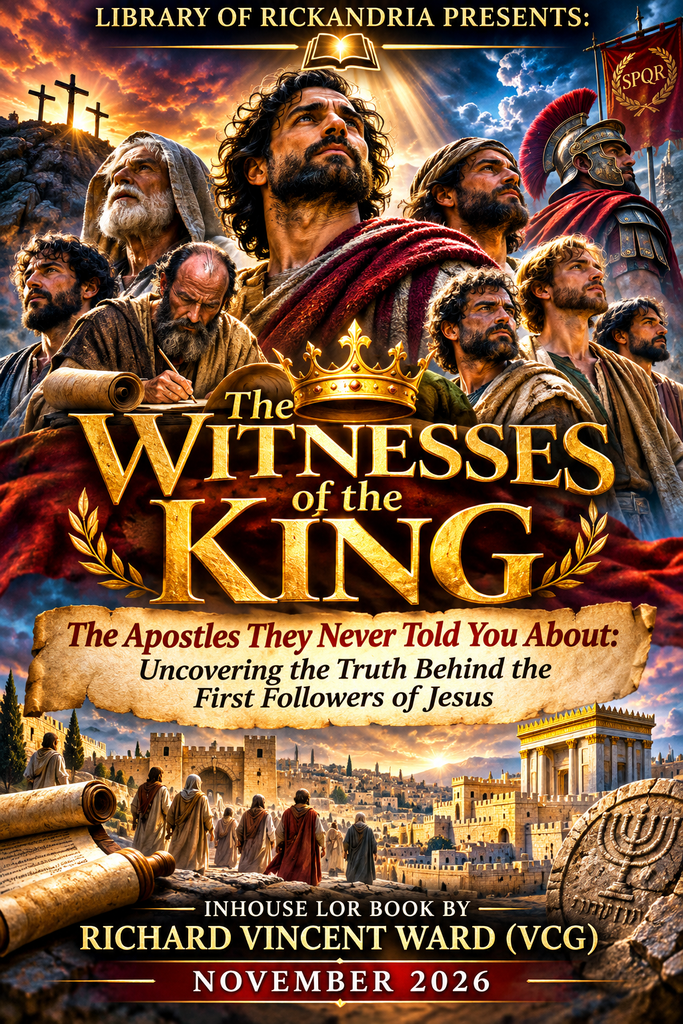
LIBRARY OF RICKANDRIA PRESENTS
THE WITNESSES OF THE KING
The Apostles They Never Told You About: Uncovering the Truth Behind the First Followers of Jesus
An Illustrated Biblical, Historical, and Investigative Study
INHOUSE LOR BOOK BY RICHARD VINCENT WARD (VCG)
NOVEMBER 2026
This expanded edition brings together:
- the biblical accounts
- the disputed histories of the apostles
- the Jewish world surrounding Jesus
- the development of Christianity
and the difficult question of how religious authority should be tested.
The research draws upon:
- the King James Bible
- ancient Christian and Jewish sources
- modern historical scholarship
- archaeological collections
and related Library of Rickandria investigations.
Where the evidence is disputed, the manuscript explains why rather than presenting speculation as established fact.
Historical image gallery
These visual references accompany the manuscript.
Archaeological images show surviving objects or reconstructed settings; later Christian artwork represents how believers remembered the apostles, not contemporary portraits of them.

Early Christian art, fourth-century Roman catacombs.

Reconstruction of the Second Temple setting.

Ancient Hebrew manuscript evidence.
Israel Museum digital collection

Illustrated map of Paul’s journeys recorded in Acts.


Surviving Roman-era urban setting.
The historical foundation includes Josephus on James, Eusebius on the apostles, the Israel Museum’s manuscript collection, and academic research on early church writings and the biblical canon.
THE WITNESSES OF THE KING
The Apostles They Never Told You About: Uncovering the Truth Behind the First Followers of Jesus
LIBRARY OF RICKANDRIA PRESENTS
INHOUSE LOR BOOK BY RICHARD VINCENT WARD (VCG)
NOVEMBER 2026
A Biblical, Historical, Archaeological, and Investigative Examination of the First Followers of Jesus Christ, the Formation of the Early Church, and the Test of Religious Truth
CONTENTS
PROLOGUE — The Witnesses Who Changed the World
INTRODUCTION — How We Investigate the First Christians
PART I — THE MEN AND WOMEN JESUS SENT
- Chosen by the King: The Original Twelve
- The Missing Apostle and the Fire of Pentecost
- What Did the First Apostles Actually Preach?
- Who Led the Church After Jesus?
- The Women Who Witnessed the Resurrection
- Blood, Persecution, and the Cost of Testimony
- Where Did the Apostles Go?
PART II — THE BATTLE OVER APOSTOLIC AUTHORITY
- Paul of Tarsus: The Most Controversial Apostle
- Paul Versus James: Two Gospels or One Faith?
- The Coming of Christ and the Call to Endure
- The Roman Soldier Beneath the Cross
PART III — SCROLLS, SECTS, AND THE WORLD OF THE FIRST BELIEVERS
- The Library in the Wilderness: The Dead Sea Scrolls
- The Essenes and the Voice in the Desert
- The Nag Hammadi Writings and the Question of Hidden Knowledge
- Jerusalem in Flames: The Destruction of AD 70
PART IV — HOW THE EARLY CHURCH BECAME CHRISTIANITY
- Who Decided Which Books Belonged in the Bible?
- The First Christians After the Apostles
- The Seven Churches: Warnings From the Risen Christ
- From Persecuted Believers to Imperial Christianity
PART V — THE TEST OF TRUTH IN EVERY GENERATION
- False Apostles, False Miracles, and Religious Deception
- How to Recognize Faithful Ministry
- When a Religious Title Becomes a Throne
- The Kingdom Beyond Religious Performance
- Spiritual Warfare and the Enduring Remnant
- What Did Jesus Actually Say About the End?
- The Return of the King
CONCLUSION — The Testimony That Remains
APPENDIX A — The Twelve Apostles: Biblical and Historical Profiles
APPENDIX B — Historical Timeline, c. 4 BC–AD 325
APPENDIX C — How to Evaluate Historical and Religious Evidence
APPENDIX D — Maps, Archaeological Sites, and Manuscripts
APPENDIX E — Scripture Comparison Charts and Study Questions
APPENDIX F — Linked Sources, Bibliography, and Library of Rickandria Research
PROLOGUE
The Witnesses Who Changed the World
A few men from Galilee were never supposed to become the center of a world-changing religious movement.
At least, that is how the story might have appeared to someone watching from the outside.
They were not Roman senators.
They did not command armies.
They did not possess the wealth of the Temple establishment or the authority of imperial officials.
Several worked as fishermen.
One collected taxes.
Others remain difficult to identify beyond their names.
Yet the movement associated with them survived the execution of its founder, disputes among its earliest leaders, persecution, imprisonment, and the destruction of Jerusalem.
Within a few centuries, the name of Jesus Christ was known throughout much of the Roman world.
How did that happen?
The New Testament answers that question in theological terms:
God raised Jesus from the dead, empowered his followers through the Holy Spirit, and sent them to proclaim the gospel.
The historian approaches the same period through:
- surviving writings
- geographical evidence
- archaeology
and accounts preserved by subsequent generations.
These approaches overlap, but they are not identical.
A historian can establish that people believed Jesus had risen.
The historian can examine when that conviction appears in surviving documents and how it influenced the communities that held it.
Whether God actually raised Jesus is the central Christian proclamation.
It is a claim that goes beyond what ordinary historical methods can independently reproduce or demonstrate.
That distinction matters throughout this investigation.
We will examine the people who claimed to have known Jesus, the men and women who proclaimed his resurrection, and the communities that preserved their teachings.
We will also investigate claims that have accumulated around them.
Some traditions are ancient and well supported.
Others are centuries removed from the events they describe.
A few familiar stories contain details that no surviving early source can verify.
Consider the Apostle Thomas.
Many people have heard that Thomas traveled to India and died there.
There is an ancient tradition connecting him with eastern missions.
Christianity also has a longstanding history in India.
But the surviving evidence does not allow every detail of Thomas’s reported travels and death to be presented as established historical fact.
Or consider Peter.
The New Testament records his ministry and anticipates his death.
Later Christian writers associate him with martyrdom in Rome, and an influential tradition describes his crucifixion upside down.
Those statements belong to different levels of evidence.
The distinction does not make the investigation less interesting.
It makes it more revealing.
The same principle applies to:
- the Dead Sea Scrolls
- the Essenes
- the writings discovered near Nag Hammadi
- the disputed authority of Paul
and the development of Christian institutions.
We should not be afraid to ask difficult questions.
We should be equally unwilling to substitute dramatic answers for documented ones.
The purpose of this book is to follow the evidence as carefully as possible, while giving the biblical text the serious attention it deserves.
The witnesses have left their testimony.
Our task is to examine it.
INTRODUCTION
How We Investigate the First Christians
Before examining the apostles, we need to establish a method.
The problem with much popular religious history is not necessarily that every claim is false.
It is that different kinds of evidence are often presented as though they carry identical authority.
A statement from Acts,
a fourth-century church historian,
a medieval legend,
and a modern interpretation may all appear in the same paragraph without explanation.
The reader is then left with the impression that everything has been independently established.
That is not how careful investigation should work.
Scripture
Throughout this book, biblical quotations follow the King James Version.
The New Testament is our primary source for understanding how the canonical writings portray Jesus, the apostles, and the earliest church.
But a distinction remains necessary between what a text states and the conclusions readers draw from it.
For example, Acts 12:2 reports that Herod killed James, the brother of John, with the sword.
That is a direct statement within the biblical narrative.
The claim that James was specifically beheaded comes from an interpretation of the wording and later historical tradition.
It should not be presented as though Acts explicitly uses the word beheaded.
That may seem like a small distinction.
Across hundreds of historical claims, such distinctions become essential.
History
Historical investigation examines sources according to their:
- dates
- authorship
- proximity to events
- literary purposes
and relationships to other evidence.
The Jewish historian Josephus provides important information about first-century Judea.
The Roman writers Tacitus and Pliny the Younger help establish how Roman authorities understood the early Christian movement.
Christian writers such as:
- Clement
- Ignatius
- Polycarp
- Irenaeus
- Eusebius
preserve valuable evidence about Christian beliefs and institutional development.
None of these writers should be treated as automatically infallible.
Each wrote from a particular position and within a particular historical setting.
Archaeology
Archaeology can establish the existence of:
- buildings
- settlements
- inscriptions
- manuscripts
- burial practices
- material cultures
It can illuminate the world in which ancient religious texts were written.
It cannot, by itself, verify every theological claim associated with those texts.
The discovery of a biblical manuscript, for example, establishes that a particular text existed by a certain period.
It does not automatically establish that every event described in that manuscript occurred exactly as recorded.
Psychology
Religious beliefs are also transmitted through:
- human memory
- group identity
- authority relationships
- storytelling
- social institutions
Psychology can help explain why certain narratives become especially powerful.
A persecution story, for instance, can strengthen communal identity.
A claim of secret knowledge can create a sense of belonging among those who believe they possess it.
But psychological explanation does not automatically disprove a belief.
A true event can produce powerful emotions.
A false account can do the same.
The emotional effect of a claim and its factual accuracy must be evaluated separately.
Interpretation
Biblical interpretation asks what a passage means within its literary, linguistic, and historical setting.
Not every reader will reach the same theological conclusion.
When significant disagreements exist, this book will explain the main positions and the evidence supporting them.
The guiding principle
The standard is simple:
We should be as confident as the evidence allows, and no more.
This approach is consistent with the spirit of 1 Thessalonians 5:21:
“Prove all things; hold fast that which is good.”
For further discussion of biblical language and the problems of interpretation, see the Library of Rickandria’s Scripture, Translation & Tradition and The Transmission of the Old Testament.
PART I
THE MEN AND WOMEN JESUS SENT
CHAPTER 1
Chosen by the King: The Original Twelve
The story begins beside the Sea of Galilee.
Matthew describes Jesus calling Simon Peter and Andrew while they were working as fishermen.
James and John were called from their father’s boat.
The scene is remarkably ordinary.
There is no elaborate initiation ceremony.
No imperial appointment.
No evidence that the men had completed a specialized religious education.
Jesus simply calls them to follow him.
In Matthew 4:19, he says:
“Follow me, and I will make you fishers of men.”
The description establishes something important about the nature of early discipleship.
Before these men were commissioned to represent Jesus, they were called to accompany him.
Mark 3:14 makes the order particularly clear:
Jesus appointed the Twelve to be with him and to be sent forth to preach.
Their authority was derivative.
It came from the one who commissioned them.
Who were the Twelve?
- Matthew 10
- Mark 3
- Luke 6
preserve lists of the apostles.
These identify:
- Simon Peter
- Andrew
- James and John the sons of Zebedee
- Philip
- Bartholomew
- Thomas
- Matthew
- James the son of Alphaeus
- Simon the Canaanite or Zealot
- Judas Iscariot
and another apostle identified through names including Thaddaeus and Judas of James.
The lists contain variations in names and order.
Those variations should be examined rather than ignored.
Ancient individuals frequently possessed more than one name or designation, although not every proposed identification can be independently verified.
Simon is described as the Canaanite in Matthew and Mark and as Zelotes in Luke.
Whether this proves membership in a formal political movement is debated; the label should not be treated as a complete biography.
Why twelve?
The number twelve invites comparison with the twelve tribes of Israel.
In Matthew 19:28, Jesus speaks of the apostles sitting upon twelve thrones and judging the twelve tribes.
The symbolism therefore has an explicit basis within the Gospel tradition.
The apostles represent more than a collection of religious enthusiasts.
Within the narrative, their appointment is connected to the restoration and fulfillment of Israel’s hopes.
Their first mission
Matthew 10 initially directs the Twelve toward Israel.
They are instructed to announce the nearness of the kingdom and minister to those in need.
Jesus tells them:
“Freely ye have received, freely give.” — Matthew 10:8
This statement has important implications for understanding the character of apostolic ministry.
It places generosity and service at the heart of their commission.
However, it should not be used carelessly to claim that every form of financial support for religious workers is condemned.
Other New Testament passages discuss appropriate support for those who minister.
The immediate lesson is that spiritual gifts are not private property to be sold for personal prestige.
Later, the commission expands toward the nations in Matthew 28:18–20 and Acts 1:8.
The original mission to Israel and the later international mission belong to different moments of the developing narrative.
What qualifies an apostle?
The Greek term apostolos broadly conveys the idea of someone sent as a representative or messenger.
The New Testament uses the term in more than one context.
The Twelve occupy a distinctive position because of their relationship with Jesus during his earthly ministry.
Other figures, including Paul and Barnabas, are also called apostles in New Testament writings.
It is therefore important not to assume that every use of the term describes precisely the same office.
The question for later generations is not merely whether someone adopts the title.
It is whether the person’s teaching and conduct can withstand examination.
Primary Scripture:
CHAPTER 2
The Missing Apostle and the Fire of Pentecost
The death of Judas Iscariot created an immediate problem.
The group Jesus had appointed as twelve no longer numbered twelve.
Acts 1 describes the remaining disciples gathered after the ascension.
Peter addresses the vacancy and appeals to Scripture, including Psalm 109:8.
The community then considers two candidates:
Joseph called Barsabas, surnamed Justus, and Matthias.
The qualification is revealing.
According to Acts 1:21–22, the replacement must have accompanied the disciples through the ministry of Jesus and become a witness of his resurrection.
The text does not present the position as an opportunity for someone to announce an extraordinary private revelation and immediately claim authority.
Continuity with Jesus’ ministry and the resurrection witness are central requirements.
The disciples pray, cast lots, and Matthias is numbered with the eleven apostles.
Acts reports the selection.
Whether casting lots should remain a permanent method of church appointment is a separate interpretive question.
Pentecost changes the situation
Acts 2 presents the disciples gathered at Pentecost.
The narrative describes a sound from heaven, tongues like fire, and the disciples speaking in other tongues.
People from different regions hear them proclaiming the works of God.
Peter then delivers a public address centered on Jesus.
He does not begin by announcing that the apostles have become spiritually superior to everyone else.
He explains the events through the prophets, identifies Jesus as crucified, proclaims that God raised him, and calls his listeners to repent.
Acts 2:38 states:
“Repent, and be baptized every one of you in the name of Jesus Christ for the remission of sins, and ye shall receive the gift of the Holy Ghost.”
The language becomes important in later debates about baptism, salvation, repentance, and the gift of the Spirit.
Different Christian traditions interpret the relationship among these elements differently.
But the narrative itself does not reduce the event to a display of spectacular power.
Its central effect is the public proclamation of Jesus.
The community that followed
Acts 2:42 describes the new believers continuing in apostolic doctrine, fellowship, breaking of bread, and prayers.
The following verses describe shared resources, common meals, and concern for practical needs.
This provides a useful corrective to the assumption that apostolic Christianity was primarily about impressive personalities.
The earliest community, as portrayed in Acts, is recognizable through:
- worship
- teaching
- generosity
- communal responsibility
The contrast between extraordinary events and ordinary faithfulness will reappear throughout this book.
Primary Scripture:
CHAPTER 3
What Did the First Apostles Actually Preach?
One of the simplest ways to investigate the apostles is to read their recorded sermons.
Instead of beginning with later doctrinal systems, we can ask what the earliest proclamations actually emphasize.
Acts preserves several examples.
Peter’s sermon at Pentecost, his address in Acts 3, and his speech before Cornelius in Acts 10 share recognizable elements.
Jesus is identified through his ministry and death.
His resurrection is proclaimed.
The hearers are called to respond.
The narrative also repeatedly connects these events with Israel’s Scriptures.
Repentance and the kingdom
Jesus begins his public proclamation in Mark 1:15 with the announcement that the kingdom of God is at hand.
The call is to repent and believe the gospel.
Repentance in the New Testament is more than a temporary feeling of regret.
It involves a changed response to God.
The Book of Acts repeatedly joins repentance with the proclamation concerning Jesus.
Acts 3:19 urges listeners to repent and be converted.
Acts 10 connects forgiveness with belief in Jesus.
The emphasis is neither purely inward nor merely ceremonial.
The gospel demands a response from the whole person.
The resurrection is central
Acts 2:24 announces that God raised Jesus.
Acts 3:15 speaks of God raising the Prince of life.
Acts 10:40 again proclaims the resurrection.
This repeated emphasis matters historically.
The earliest Christian movement did not simply remember Jesus as a teacher whose ethical insights deserved preservation.
It proclaimed that he had been raised from the dead.
Paul’s summary in 1 Corinthians 15:3–8 similarly identifies Jesus’ death, burial, resurrection, and appearances as central elements of the message he had received.
Scholars commonly recognize traditional material within this passage that predates Paul’s letter, although the precise history of its formulation remains debated.
Obedience and grace
Some modern arguments portray the earliest apostles as teachers of obedience and Paul as the inventor of grace.
The surviving texts do not support such a simple division.
Jesus speaks of forgiveness and divine mercy.
Peter speaks of salvation through the grace of the Lord Jesus Christ in Acts 15:11.
Paul repeatedly insists that grace is incompatible with continuing deliberately in sin (Romans 6:1–2).
James emphasizes that genuine faith must have practical expression.
These passages may raise difficult theological questions, but they cannot be reduced to two entirely separate religions without further argument.
The evidence test
A sound comparison must examine what each writer means by faith, law, works, repentance, and righteousness.
The same word can appear in different arguments without performing the same function.
We will return to this distinction when examining Paul and James.
Primary Scripture:
CHAPTER 4
Who Led the Church After Jesus?
The question sounds simple.
Was Peter the leader of the earliest Christian community?
Was James?
Did the apostles govern collectively?
The New Testament provides evidence for all three questions, but not a modern organizational chart.
Peter’s prominence
In the opening chapters of Acts, Peter is clearly a major spokesperson.
He addresses the community before Pentecost, delivers the Pentecost sermon, and responds to challenges from religious authorities.
His importance is difficult to deny.
However, prominence in the narrative does not automatically establish the full structure of later church authority.
James enters the picture
A second figure becomes increasingly important:
James, identified in Galatians 1:19 as the Lord’s brother.
He should not automatically be confused with James the son of Zebedee, whose death is recorded in Acts 12.
When Peter is delivered from prison, he instructs the believers to report what happened to James (Acts 12:17).
During the Jerusalem Council in Acts 15, James speaks after extensive discussion and offers a judgment about the Gentile believers.
Galatians 2 also places James alongside Peter and John as influential figures.
The combined evidence suggests that James held significant authority within the Jerusalem community.
The Jerusalem Council
Acts 15 records a dispute over whether Gentile converts must be circumcised and keep the law of Moses in the manner demanded by certain teachers.
Peter speaks. Paul and Barnabas describe their work among Gentiles.
James responds by appealing to Scripture and proposing a way forward.
The final communication is presented as the decision of the apostles and elders.
This is important.
The council does not appear as the private declaration of a single charismatic leader.
It involves:
- debate
- testimony
- scriptural reasoning
- collective judgment
Josephus provides an independent witness
The Jewish historian Josephus, writing near the end of the first century, describes the execution of James, the brother of Jesus who was called Christ, under the high priest Ananus.
This is one of the most important non-Christian references to a person associated directly with Jesus.
Most specialists accept the passage as authentic.
Josephus places James’s death around AD 62, substantially earlier than some later Christian traditions suggest.
That difference illustrates why independent sources must be compared rather than blended.
What can we conclude?
Peter was prominent in the early mission.
James became a leading figure in Jerusalem.
The wider apostolic community also exercised authority.
The evidence supports a complex and developing leadership structure, not the assumption that every later institutional claim can be read directly back into Acts.
Sources:
CHAPTER 5
The Women Who Witnessed the Resurrection
Any investigation of the first followers of Jesus that overlooks the women is incomplete.
The Gospels repeatedly describe women supporting Jesus’ ministry.
Luke 8 names:
- Mary Magdalene
- Joanna
- Susanna
and others who ministered from their resources.
Their involvement is not presented as incidental.
They are part of the movement’s actual social history.
At the crucifixion and tomb
The Gospel accounts differ in some details concerning who was present at particular moments.
Nevertheless, women appear consistently in the passion and resurrection narratives.
Mary Magdalene is especially prominent.
John 20 describes her arriving at the tomb and later encountering the risen Jesus.
Jesus instructs her to report what she has seen to the disciples.
This makes her role in the Johannine resurrection narrative highly significant.
The narrative identifies her as a witness and messenger.
It does not, however, explicitly settle every later debate about ordained ministry or ecclesiastical office.
Those are interpretive questions requiring additional arguments.
Women in the expanding church
Acts mentions women participating in the life and growth of Christian communities.
Priscilla appears alongside Aquila and helps instruct Apollos in Acts 18.
Romans 16 commends Phoebe and describes her as a servant of the church at Cenchrea.
The underlying Greek word associated with her description is also used in discussions of ministry and service, making its precise implications a subject of interpretation.
Romans 16:7 mentions Andronicus and Junia, describing them in language that has generated debate over whether they were outstanding among the apostles or highly regarded by the apostles.
The grammar has been interpreted differently by scholars.
The disagreement should be acknowledged rather than decided by a slogan.
Why the women matter
The surviving New Testament texts portray the early Christian movement as depending upon a broader network than the Twelve alone.
Women provided resources, offered hospitality, participated in teaching, carried news, and endured the dangers associated with the movement.
Recognizing that evidence does not require rewriting the biblical account.
It requires reading the account carefully.
The earliest Christian story is not exclusively the story of its most famous male leaders.
Sources:
CHAPTER 6
Blood, Persecution, and the Cost of Testimony
A familiar statement says that all the apostles except John died as martyrs.
The problem is that the surviving evidence does not establish that claim with equal strength for every apostle.
Some deaths are recorded in the New Testament.
Others are preserved in later traditions.
Several remain historically uncertain.
What the New Testament records
Acts describes Stephen’s execution in chapter 7.
Stephen is an early Christian witness, but he is not one of the Twelve.
Acts 12:2 reports that Herod Agrippa I killed James, the brother of John, with the sword.
This is the clearest New Testament statement concerning the violent death of one of the Twelve.
Acts also records imprisonment, threats, and physical punishment suffered by other early believers.
John 21:18–19 contains a saying interpreted by the Gospel narrator as indicating the manner of Peter’s future death.
It does not provide a detailed description of that death.
Peter and Paul
Early Christian tradition strongly associates both Peter and Paul with suffering and death in Rome.
The late-first-century work commonly known as 1 Clement refers to their endurance and suffering.
Eusebius, writing much later, preserves additional accounts, including the tradition that Peter was crucified upside down.
These sources are valuable.
But the surviving reports are not equivalent to contemporary Roman execution records.
The other apostles
Traditions concerning:
- Andrew
- Thomas
- Bartholomew
- Philip
and others developed in different Christian communities.
Some accounts place Thomas in India.
Others associate Andrew with regions around the Black Sea and Greece.
Later narratives assign distinctive forms of martyrdom to particular apostles.
The historical problem is not that these stories must all be false.
It is that many were recorded too late, or in too legendary a form, for every detail to be verified.
Does martyrdom prove a belief?
A willingness to die for a conviction may indicate sincerity.
It does not, by itself, prove that the conviction is true.
People from many religious and ideological traditions have accepted death rather than abandon deeply held beliefs.
There is an additional distinction between dying for something personally witnessed and dying for a tradition inherited from others.
The earliest resurrection witnesses occupy an important place in Christian argument precisely because their testimony concerns events they claimed to know.
Even so, historical analysis must establish what particular individuals actually said and suffered before assigning conclusions to them.
The strongest argument is not that every apostle has a spectacular martyrdom legend.
It is that the earliest Christian sources show a movement willing to endure substantial opposition for its proclamation.
Sources:
CHAPTER 7
Where Did the Apostles Go?
The Book of Acts does not provide a complete biography of every apostle.
Its narrative increasingly concentrates on particular figures and missionary networks.
As the story moves toward Paul’s journey to Rome, many of the Twelve disappear from the surviving narrative.
That silence creates an opportunity for later tradition.
It also creates a methodological challenge.
The journeys we can trace
Acts provides substantial information about Peter’s activity in:
Jerusalem, Samaria, and other regions.
It gives extensive geographical detail concerning Paul’s journeys through the eastern Mediterranean.
These accounts allow readers to follow identifiable movements between cities, ports, and Roman provinces.
A historical map can illuminate those journeys, but a map should distinguish routes expressly recorded in Acts from reconstructed movements.
The traditions preserved by Eusebius
In Church History 3.1, Eusebius reports traditions associating Thomas with Parthia, Andrew with Scythia, and John with Asia.
He also describes Peter’s ministry and eventual martyrdom in Rome.
The historian is writing in the early fourth century.
His account preserves material from earlier writers, some now lost.
That makes his testimony important, but it also means that he is often reporting inherited traditions rather than personally verified first-century events.
Thomas and India
The connection between Thomas and Christianity in India is especially significant.
Indian Christian communities possess longstanding traditions concerning his arrival and ministry.
The Acts of Thomas, an ancient apocryphal narrative generally associated with the third century, contributes to that tradition.
It contains religious storytelling as well as geographically interesting details.
A responsible historian should distinguish the established antiquity of Indian Christianity from the question of whether every event attributed to Thomas can be reconstructed.
Why the gaps remain
Ancient history is uneven.
The most influential surviving texts do not necessarily preserve the most complete accounts of every individual.
Apostles whose activity became important to particular regional churches may have acquired elaborate local traditions.
The absence of documentation does not prove that a journey never happened.
Neither does a tradition prove that it did.
The responsible conclusion is sometimes that a possibility remains unresolved.
This is not a weakness of historical research.
It is one of its necessary disciplines.
Figure 1. Illustrated map of Paul’s missionary journeys.
Routes are reconstructions based on the Acts narrative.

Sources:
PART II
THE BATTLE OVER APOSTOLIC AUTHORITY
CHAPTER 8
Paul of Tarsus: The Most Controversial Apostle
Few figures have influenced Christianity more than Paul.
Few have produced as much disagreement.
To some readers, Paul is the great interpreter of the gospel among the Gentiles.
To others, his writings seem to introduce a theological system that differs from Jesus’ teaching.
The proper response is to examine the evidence.
Paul before his conversion
Acts first presents Saul as an opponent of the Christian movement.
He is associated with the persecution following Stephen’s death.
Later, Acts 9 describes his encounter on the road to Damascus.
Paul’s own letters also acknowledge his previous persecution of the church.
These accounts form the basis for the traditional understanding of his conversion.
Was Paul one of the Twelve?
No.
Paul does not claim to have been among the Twelve during Jesus’ earthly ministry.
His claim is that the risen Christ commissioned him.
Galatians 1:1 introduces him as an apostle through Jesus Christ and God the Father.
First Corinthians 15:8 places his experience of the risen Jesus after appearances to earlier witnesses.
His apostleship therefore raises a distinct question: can a person who did not accompany Jesus during his earthly ministry nevertheless receive an apostolic commission?
The New Testament itself presents Paul’s answer as yes.
Whether a reader accepts that claim depends partly on how the wider canonical evidence is understood.
What about Paul’s disagreements?
Galatians 2 contains an important confrontation.
Paul says he opposed Peter at Antioch because Peter’s conduct concerning table fellowship with Gentile believers had become inconsistent.
This passage establishes that the early Christian leaders did not always behave in complete harmony.
It does not automatically establish that they preached entirely different gospels.
Paul presents the dispute as a matter of conduct with theological implications.
Was Paul teaching lawlessness?
Romans 6:1–2 directly rejects the suggestion that grace authorizes continued sin.
Paul also speaks of the importance of faith working through love in Galatians 5:6.
That does not resolve every question about Paul’s treatment of the Mosaic law.
But any interpretation that portrays him as openly celebrating moral lawlessness must explain these passages.
The limits of the evidence
Ancient Christian groups later disagreed sharply about Paul.
Some Jewish-Christian traditions rejected his authority, while other Christian writers treated his letters as foundational.
Those later disagreements are evidence of reception history.
They do not, by themselves, prove either that Paul was an infiltrator or that every interpretation of his writings is correct.
The serious question is not whether Paul can be defended with a slogan.
It is whether his writings, read in context, can be reconciled with the teaching of Jesus and the other apostles.
Sources:
Related Library research:
Caesar’s Messiah? A Historical, Psychological & Biblical Examination.
CHAPTER 9
Paul Versus James: Two Gospels or One Faith?
The apparent disagreement between Paul and James is one of the most important theological questions in the New Testament.
Romans 3:28 states:
“Therefore we conclude that a man is justified by faith without the deeds of the law.”
James 2:24 states:
“Ye see then how that by works a man is justified, and not by faith only.”
At first glance, the statements appear contradictory.
But a comparison of individual verses is not enough.
We must examine the arguments in which they appear.
What is Paul addressing?
Romans discusses the universal problem of sin and the inability of human beings to establish righteousness through their own performance of the law.
Paul’s argument concerns the basis upon which sinners are justified before God.
His central concern is not to encourage disobedience.
It is to deny that human achievement provides grounds for boasting before God.
What is James addressing?
James challenges a different problem.
He imagines someone claiming to possess faith while refusing practical assistance to a brother or sister in need.
James 2:17 concludes:
“Even so faith, if it hath not works, is dead, being alone.”
His concern is the emptiness of a profession that produces no moral response.
He is asking whether a claim to faith can be genuine when it remains entirely without action.
Abraham in both arguments
Both writers appeal to Abraham.
Paul emphasizes Genesis 15:6, where Abraham believed God and righteousness was credited to him.
James examines Abraham’s obedience in the offering of Isaac, an event recorded later in Genesis 22.
A common reconciliation is that Paul discusses the basis of justification, while James discusses the manifestation of living faith.
This interpretation has significant textual support.
However, not all scholars agree that the difference can be resolved without recognizing tension between the authors’ formulations.
Some argue that James is responding to an interpretation of Pauline teaching.
Others believe the two writers use the same vocabulary in distinct rhetorical contexts.
What about the Jerusalem Council?
Acts 15 provides important background.
Peter, James, Paul, and Barnabas appear within a dispute concerning Gentile believers and the Mosaic law.
The council does not require Gentiles to become Jewish proselytes through circumcision.
Yet it does establish expectations for their conduct.
This suggests that grace and obedience were both significant concerns.
A conclusion that respects both texts
It is too simple to say that Paul believed behavior did not matter.
It is equally misleading to say that James believed people could purchase salvation through good works.
Both writers criticize forms of religious confidence that fail their respective tests.
Paul challenges boasting in human performance.
James challenges faith reduced to words.
A careful reader must allow each argument to develop before claiming an irreconcilable contradiction.
Sources:
CHAPTER 10
The Coming of Christ and the Call to Endure
Paul’s teaching about the return of Jesus has generated intense discussion, especially concerning what later Christian traditions call the rapture.
First Thessalonians 4:13–18 describes believers who have died and those who remain alive at the coming of the Lord.
Paul speaks of resurrection, the Lord’s descent, and believers being caught up to meet him.
The passage concludes with an instruction to comfort one another.
What does the passage actually say?
It describes a future gathering associated with Christ’s coming and the resurrection of the dead.
It does not, by itself, provide a complete timetable for every event described elsewhere in biblical prophecy.
The timing of the gathering relative to tribulation is inferred through comparison with other passages.
This is where competing interpretations arise.
Jesus and tribulation
Matthew 24 describes persecution, deception, distress, and the appearing of the Son of man.
Verse 31 speaks of the gathering of the elect.
Different Christian traditions understand the relationship between this passage and 1 Thessalonians 4 differently.
Some identify them as descriptions of the same event.
Others distinguish separate stages in Christ’s coming.
Still others argue that substantial portions of Matthew 24 refer to the first-century crisis surrounding Jerusalem.
The danger of false certainty
A major problem in prophetic interpretation is the tendency to convert symbolic or disputed language into an exact contemporary schedule.
Repeated predictions of the date of Christ’s return have failed.
Jesus’ warning in Matthew 24:36 should restrain such confidence.
The practical command is watchfulness.
Paul does not promise exemption from every hardship
Acts 14:22 describes believers entering the kingdom through much tribulation.
Romans 8 discusses suffering and future glory.
Paul himself endured imprisonment, hardship, and persecution.
A reading of Paul that guarantees Christians protection from every period of earthly suffering is difficult to reconcile with the broader Pauline record.
The Christian hope presented in these passages is ultimately resurrection and union with Christ.
That hope is not identical to a promise of a trouble-free earthly life.
Sources:
CHAPTER 11
The Roman Soldier Beneath the Cross
One of the most dramatic moments in the crucifixion narratives comes from a Roman soldier.
Matthew 27:54 records the centurion and those with him responding to the events surrounding Jesus’ death.
Their confession is:
“Truly this was the Son of God.”
Mark records a similar statement.
Luke presents the centurion declaring that Jesus was a righteous man.
These accounts establish that the Gospel writers attached significance to the response of a Roman officer.
The unnamed witness
There is a problem with the familiar name Longinus.
The canonical Gospels do not identify the centurion by that name.
John 19:34 describes a soldier piercing Jesus’ side with a spear, but does not name him.
The identification of Longinus develops within later Christian tradition.
Furthermore, the centurion who speaks and the soldier who uses the spear are not explicitly identified as the same person in the canonical accounts.
How Longinus entered Christian memory
The name appears in apocryphal and later devotional traditions associated with the Passion.
Over time, different Christian communities developed accounts of Longinus’s conversion, subsequent ministry, and martyrdom.
Eastern and Western traditions do not always identify him in precisely the same way.
This is a useful example of how religious memory develops.
A brief biblical scene becomes the foundation for a detailed biography.
The later biography may communicate theological meaning, but its historical claims require separate verification.
The theological importance
The centurion’s confession remains significant without adding a detailed legend.
A representative of Roman military power stands at the execution of Jesus.
In the Gospel narratives, his response becomes a witness to Jesus’ identity or righteousness.
The scene reverses expectations.
The condemned man is recognized by one connected to the apparatus of his execution.
That is already a powerful literary and theological statement.
It does not require unsupported historical embellishment.
Sources:
PART III
SCROLLS, SECTS, AND THE WORLD OF THE FIRST BELIEVERS
CHAPTER 12
The Library in the Wilderness: The Dead Sea Scrolls
In 1947, discoveries in caves near the Dead Sea began transforming the modern study of ancient Judaism.
Over the following years, additional manuscripts and fragments were recovered from the region around Qumran.
Today the collection is commonly known as the Dead Sea Scrolls.
The manuscripts are among the most important archaeological discoveries for understanding the religious world preceding and surrounding the beginnings of Christianity.
What was discovered?
The collection includes:
- biblical manuscripts
- commentaries
- religious regulations
- hymns
- apocalyptic writings
and other Jewish compositions.
Some manuscripts preserve portions of books included in the Hebrew Bible.
Others reveal the beliefs and practices of particular Jewish communities.
The Great Isaiah Scroll is especially important because it preserves an ancient, substantially complete copy of Isaiah.
Why the scrolls matter
Before the discovery, many surviving complete Hebrew biblical manuscripts available to scholars were medieval.
The Dead Sea Scrolls provided much earlier textual witnesses.
Comparison between these manuscripts and later textual traditions helps researchers study the transmission of biblical writings.
Some passages show substantial continuity.
Others preserve textual differences.
The evidence therefore supports a complex account of transmission rather than the absolute claim that every manuscript was letter-for-letter identical.
The Community Rule
One important manuscript is the Community Rule.
It describes a highly structured religious community concerned with:
- discipline
- purity
- covenant membership
- communal conduct
The scroll collection also contains language concerning light and darkness, righteousness and wickedness, and expectations about divine intervention.
These themes resemble certain forms of language found in early Christian writings.
But similarity does not automatically establish direct borrowing.
Two movements can draw upon the same Jewish scriptural traditions without one being the secret origin of the other.
Were the scrolls written by Essenes?
Many scholars have associated Qumran with an Essene community.
The proposal has substantial historical support, but it is not uncontested.
Scholars continue to debate the relationship between the settlement, the nearby caves, and the various manuscripts.
The collection itself contains material from different contexts and periods.
A responsible account should not assume every scroll came from a single author, school, or community.
What the discovery does not prove
The scrolls do not establish that Jesus was an Essene.
They do not reveal a previously hidden Christian gospel.
They do not prove that the New Testament was copied directly from Qumran writings.
Their real significance is substantial enough without those claims.
They illuminate the complex Jewish religious landscape in which Christianity emerged.
Historical image:
Explore the actual Dead Sea Scrolls through the Israel Museum.
Sources:
Related Library research:
The Transmission of the Old Testament.
CHAPTER 13
The Essenes and the Voice in the Desert
The New Testament frequently mentions Pharisees and Sadducees.
Another important Jewish movement, the Essenes, appears in ancient historical sources but is not explicitly named in the canonical Gospels.
Josephus, Philo, and Pliny the Elder preserve information about groups identified as Essenes.
Their descriptions vary, but commonly emphasize disciplined communal living, religious seriousness, and distinctive practices.
Why people connect them with John the Baptist
John’s ministry takes place in the wilderness.
He calls people to repentance and baptizes in the Jordan.
Qumran-associated texts also emphasize purification, repentance, and preparation for God’s purposes.
The resemblance has attracted scholarly attention.
John may have been familiar with elements of the wider religious environment represented by communities such as those at Qumran.
However, resemblance is not proof that John belonged to a particular sect.
The Gospels do not explicitly identify him as an Essene.
Isaiah and the wilderness
Isaiah 40:3 speaks of a voice preparing the way of the Lord.
The Gospels apply this passage to John the Baptist.
The Community Rule also uses Isaiah’s wilderness imagery within its own religious program.
This is a particularly valuable comparison.
It demonstrates how the same prophetic text could shape different Jewish religious movements.
But shared interpretation does not establish institutional identity.
The difference between separation and mission
The wilderness can symbolize withdrawal from corruption.
Yet the New Testament portrays Jesus moving among people from different social and religious backgrounds.
He teaches in synagogues, enters homes, speaks with tax collectors, and interacts with those regarded as sinners.
That presents a potential contrast with communities emphasizing strict separation.
The comparison should be made carefully because ancient sources do not describe every Essene group as identical.
What we can learn
The Essenes remind modern readers that first-century Jewish religion was diverse.
The religious world of Jesus cannot be reduced to a conflict between a single uniform Judaism and a newly invented Christianity.
Different communities were already debating purity, authority, Scripture, priesthood, covenant identity, and the coming judgment of God.
Christianity emerged within that world.
Understanding the world makes the New Testament more intelligible.
Sources:
CHAPTER 14
The Nag Hammadi Writings and the Question of Hidden Knowledge
In 1945, manuscript discoveries near Nag Hammadi in Egypt brought a remarkable collection of ancient Coptic writings into modern scholarly study.
The surviving codices preserve a variety of religious and philosophical works.
Many have connections with movements later described under the broad label Gnosticism.
The collection includes works associated with titles such as:
- the Gospel of Thomas
- the Gospel of Philip
- the Apocryphon of John
What makes these books important?
They provide direct evidence for religious ideas that were often known previously through the writings of their opponents.
Ancient Christian writers such as Irenaeus criticized groups they believed were distorting Christian teaching.
The Nag Hammadi discoveries allow scholars to study additional texts connected with some of those intellectual and religious environments.
That is historically valuable.
The problem with calling everything Gnostic
Modern researchers increasingly emphasize that the Nag Hammadi collection is diverse.
Not every text represents the same religious system.
Some contain Christian language.
Others combine philosophical, cosmological, and mythological ideas in ways that differ substantially from the canonical Gospels.
The term Gnosticism can be useful, but it must not erase those differences.
Were these the original suppressed gospels?
That claim goes beyond the evidence.
The surviving Nag Hammadi codices are generally fourth-century manuscripts, although some works or traditions they preserve are substantially earlier.
The canonical Gospels are attested by earlier manuscript evidence and second-century Christian references.
The chronological relationship varies from text to text.
It is historically misleading to claim that the entire Nag Hammadi collection predates the New Testament or represents a single lost original Christianity.
Comparing portraits of Jesus
The canonical Gospels emphasize Jesus’ public ministry, death, and resurrection within narrative settings.
Some Nag Hammadi writings place greater emphasis on revelatory dialogue, cosmology, or special knowledge.
These differences are not minor.
They affect how salvation, the material world, and Jesus’ role are understood.
From the standpoint of traditional Christian theology, some of those teachings conflict with central biblical claims.
From a historical standpoint, the writings demonstrate the diversity of religious interpretation in the ancient Mediterranean world.
Those two judgments should remain distinct.
Why hidden-knowledge narratives are attractive
Psychologically, a claim that ordinary believers have been denied the real truth can be extremely compelling.
It offers the possibility of privileged understanding.
That emotional appeal does not determine whether the claim is true.
The correct question remains:
Where is the evidence for the proposed hidden transmission, suppression, or secret lineage?
When such a chain cannot be documented, the narrative should remain a hypothesis rather than a historical conclusion.
Manuscript image:
Nag Hammadi Codex II, Claremont Digital Library.
Sources:
Related Library research:
CHAPTER 15
Jerusalem in Flames: The Destruction of AD 70
The destruction of Jerusalem’s Temple in AD 70 stands among the most consequential events in ancient Jewish history.
It also transformed the world of the early Christian movement.
The conflict grew from tensions between Roman authority and Judean resistance.
The First Jewish Revolt began in AD 66.
Roman forces ultimately besieged Jerusalem.
During the campaign associated with Titus, the Temple was destroyed.
Josephus as a historical witness
The Jewish historian Josephus provides an extensive account in The Jewish War.
His narrative includes:
- military operations
- internal conflict
- famine
- suffering
and the destruction of the Temple.
Josephus is indispensable, but he is not beyond criticism.
He had personal involvement in the war and wrote under Roman patronage after his surrender.
His casualty figures and certain dramatic details must be evaluated with that background in mind.
Nevertheless, the destruction itself is independently established.
Jesus’ warnings
The Synoptic Gospels preserve warnings concerning Jerusalem and the Temple.
Luke 21:20 describes Jerusalem surrounded by armies.
Matthew 24 begins with Jesus predicting the destruction of the Temple buildings.
Many Christian interpreters understand the events of AD 70 as at least a partial fulfillment of these warnings.
Others believe the passages include both the first-century crisis and events still future.
The historical destruction and the theological interpretation of prophecy are related but distinct claims.
The end of the Temple system
The destruction profoundly altered Jewish religious life.
Temple sacrifice ceased, and forms of Jewish worship and communal organization developed in response.
It is important not to present this as though Judaism simply disappeared.
Jewish communities continued to preserve, interpret, and practice their traditions.
Rabbinic Judaism developed within this changing historical environment.
Christian communities likewise interpreted the Temple’s destruction through their beliefs concerning Jesus.
The Gospel of John portrays Jesus speaking of the temple of his body.
Hebrews presents Christ’s priesthood and sacrifice through an extended comparison with the sanctuary and sacrificial system.
A warning about religious triumphalism
Some Christian readings treat the destruction as divine judgment.
That is a theological interpretation.
It should not become an excuse for hostility toward Jewish people or for celebrating the suffering of civilians.
The event was a human catastrophe.
Historical seriousness requires recognizing the suffering involved even when discussing prophetic significance.
Figure 2. A modern reconstruction of the Second Temple complex.
Architectural details include scholarly reconstruction.

Sources:
PART IV
HOW THE EARLY CHURCH BECAME CHRISTIANITY
CHAPTER 16
Who Decided Which Books Belonged in the Bible?
The New Testament contains twenty-seven books.
But how did that collection become recognized?
The popular answer often involves a dramatic council, an emperor, or a secret decision to exclude unwanted texts.
The actual history is more gradual and more complicated.
The earliest Christian writings
The first Christians inherited the Jewish Scriptures.
They also circulated writings connected with Jesus and his apostles.
Paul’s letters were addressed to particular communities and later shared more widely.
The Gospels preserve traditions concerning Jesus.
Other documents emerged to address:
- worship
- instruction
- church discipline
- disputes
The process of collecting and recognizing these writings unfolded over generations.
Recognition was not instantaneous
Different Christian communities did not always possess identical collections.
Some books achieved widespread recognition earlier than others.
The four Gospels, Acts, and many Pauline letters occupied a prominent place relatively early.
Other writings remained debated in various regions.
- Second Peter
- James
- Jude
- some Johannine letters
- Hebrews
- Revelation
generated different questions in different periods and locations.
Eusebius describes the disagreements
In the early fourth century, Eusebius classified Christian writings according to their reception.
His categories include acknowledged books, disputed books, and writings excluded or regarded as spurious.
This is significant historical evidence.
It demonstrates that questions concerning the canon were being discussed openly before and during the fourth century.
Athanasius and the twenty-seven books
In AD 367, Athanasius of Alexandria issued a festal letter listing the same twenty-seven New Testament books found in most modern Christian Bibles.
This is the earliest surviving Christian list that precisely matches the present twenty-seven-book New Testament.
However, that does not mean Athanasius invented the books or caused all churches immediately to agree.
He was participating in a process that had already developed over centuries.
Did Nicaea choose the Bible?
There is no credible surviving evidence that the Council of Nicaea in AD 325 selected the twenty-seven-book New Testament through a dramatic vote.
The council addressed major disputes concerning Christ, church order, and the calculation of Easter.
The popular claim that Constantine personally assembled the Bible at Nicaea misrepresents the surviving historical record.
The real questions
The history of canon formation raises legitimate questions about:
- authorship
- manuscript transmission
- theological boundaries
- institutional influence
Those questions do not require a fictional single event.
The documentary evidence allows us to observe a process of reception, debate, and increasing standardization.
This process remains an important subject of historical and theological investigation.
Sources:
Related Library research:
The Divine Code and Caesar’s Messiah?.
CHAPTER 17
The First Christians After the Apostles
What happened after the generation associated with the apostles began to disappear?
We possess important evidence from Christian writings commonly grouped under the name Apostolic Fathers.
These works are not all equally early, nor were they necessarily written by personal disciples of the apostles.
The category is a later scholarly and publishing designation.
Nevertheless, the writings provide a valuable window into the early development of Christian communities.
The Didache
The Didache, or Teaching of the Twelve Apostles, is an anonymous early Christian manual.
Its dating remains debated, with proposals extending from the first century into the second.
It discusses:
- moral instruction
- baptism
- prayer
- fasting
- communal meals
- traveling teachers
- local leadership
The text is particularly interesting because it presents practical expectations for Christian conduct.
It also reflects concern about fraudulent religious visitors and the misuse of spiritual claims.
These concerns did not suddenly emerge in the modern church.
They were already present in ancient Christian communities.
First Clement
The letter commonly called 1 Clement was sent from the church at Rome to the church at Corinth, probably toward the end of the first century.
It addresses conflict and church order.
The letter places considerable emphasis on humility, peace, orderly conduct, and respect for established ministry.
It also refers to the suffering of Peter and Paul.
This makes it a particularly important early witness to how their memory was preserved.
Ignatius of Antioch
Ignatius wrote letters while traveling toward martyrdom, commonly dated to the early second century.
His writings strongly emphasize unity and the role of bishops.
They provide evidence for an increasingly visible structure of Christian leadership.
But historians must be cautious about assuming that the same structure existed in identical form in every first-century congregation.
Polycarp
Polycarp of Smyrna was another influential early Christian leader.
His surviving letter to the Philippians draws heavily upon Christian moral teaching and scriptural language.
A later account of his martyrdom became especially important for Christian memory.
The historical value of such writings lies partly in the way they show the development of church identity.
What changed?
The movement increasingly required mechanisms for preserving teaching, resolving disputes, identifying leaders, and maintaining continuity.
Some institutional development was practically unavoidable as communities expanded.
The important question is whether particular developments preserved the substance of the earlier faith or altered it.
That question must be answered by examining specific teachings and practices.
It cannot be settled by assuming that every change is corruption or that every inherited tradition is automatically authoritative.
Sources:
CHAPTER 18
The Seven Churches: Warnings From the Risen Christ
The opening chapters of Revelation contain messages addressed to seven churches in Roman Asia.
They are:
- Ephesus
- Smyrna
- Pergamos
- Thyatira
- Sardis
- Philadelphia
- Laodicea
The letters are remarkable because they combine:
- encouragement
- criticism
- warning
- promise
They do not portray the earliest churches as uniformly perfect.
Ephesus: Truth without love
Revelation 2 commends Ephesus for perseverance and for testing those who falsely claimed to be apostles.
Yet the church is accused of abandoning its first love.
This is a striking combination.
Doctrinal vigilance does not automatically compensate for the loss of genuine love.
Smyrna: Faithfulness under pressure
Smyrna receives encouragement in the face of suffering and opposition.
The passage does not promise immediate escape from hardship.
It calls for perseverance.
Pergamos and Thyatira: Compromise
These messages confront forms of teaching and conduct presented as spiritually dangerous.
The details are debated, especially where symbolic language and references to ancient religious practices appear.
Nevertheless, the recurring issue is the relationship between confession and conduct.
Sardis: Reputation without life
Sardis is described as having a name that it lives while being dead.
The criticism is particularly relevant to religious communities that rely upon historical prestige or outward success.
Philadelphia: Endurance
Philadelphia receives encouragement for keeping Christ’s word despite limited strength.
The emphasis is not on social power.
It is on perseverance.
Laodicea: Complacency
Laodicea is rebuked for its self-satisfied condition.
The church’s material confidence contrasts with the spiritual poverty described in the message.
What do the seven churches represent?
At the historical level, the letters address communities located in the ancient Roman province of Asia.
At the theological level, Christians have interpreted them as warnings with continuing relevance.
Some traditions also understand them as prophetic representations of successive eras of church history.
That interpretation is influential in some circles, but the text does not explicitly provide a universally agreed chronological scheme of seven church ages.
The immediate historical audience must remain part of the interpretation.
Sources:
CHAPTER 19
From Persecuted Believers to Imperial Christianity
For much of its early history, Christianity existed without imperial patronage.
Christian communities sometimes experienced suspicion, local hostility, legal pressure, and persecution.
The intensity and geographical extent varied across periods.
It is historically misleading to imagine uninterrupted empire-wide persecution during every year before Constantine.
Nevertheless, Christianity’s legal and political position changed dramatically in the fourth century.
Constantine’s rise
Constantine emerged from the struggles for imperial power in the early fourth century.
His relationship with Christianity became a turning point in Roman religious history.
In AD 313, agreements and policies associated with Constantine and Licinius helped establish toleration for Christianity and other religious practices.
Christians increasingly gained public standing and imperial support.
The Council of Nicaea
In AD 325, Constantine convened the Council of Nicaea.
The council addressed disputes involving Arius and the relationship between the Father and the Son, along with other matters of church organization and practice.
The council helped produce a major doctrinal statement associated with Nicene Christianity.
Its purpose was not to decide which of the twenty-seven New Testament books should exist.
Did Rome create Christianity?
No.
The existence of Christian:
- communities
- writings
- worship practices
- disputes
- persecutions
long before Constantine makes that claim historically untenable.
What changed was the movement’s relationship to imperial government.
A once-marginal religion increasingly gained institutional resources and political influence.
Did power introduce new dangers?
That is a more useful question.
Imperial involvement created opportunities for churches to acquire:
- buildings
- legal protections
- social influence
It also introduced new relationships between religious and political authority.
Christian leaders could become participants in imperial disputes.
Imperial officials could influence the conditions under which doctrinal disagreements were addressed.
The existence of political influence does not automatically prove that every resulting doctrine was fabricated.
It does mean that institutional pressures deserve historical investigation.
The psychological problem of authority
A community accustomed to identifying faithfulness with resistance may face new temptations when it gains public influence.
Success can become confused with legitimacy.
Social position can become confused with truth.
The New Testament repeatedly warns against seeking power for its own sake.
The fourth-century transformation therefore provides a historically concrete setting for examining those warnings.
Sources:
Related Library research:
PART V
THE TEST OF TRUTH IN EVERY GENERATION
CHAPTER 20
False Apostles, False Miracles, and Religious Deception
The New Testament does not treat every religious claim as equally trustworthy.
It repeatedly warns that apparently spiritual messages can be misleading.
Jesus warns about false prophets in Matthew 7.
Paul discusses deceitful workers in 2 Corinthians 11.
First John instructs believers to test spiritual claims.
Revelation 2 praises the church at Ephesus for examining people who claimed apostolic authority.
What is the basic problem?
Religious language can produce an appearance of legitimacy.
A speaker may quote Scripture, claim spiritual experiences, report miracles, or possess a devoted following.
None of these features automatically establishes the truth of every claim.
The New Testament’s own warnings require something more.
Miracles and verification
Reports of extraordinary healings or supernatural events deserve careful examination.
That examination should begin with the quality of the evidence.
What exactly is claimed?
Was the event observed independently?
Are there contemporary records?
Could ordinary causes account for it?
Has the account changed as it was retold?
A medical recovery is not automatically evidence of deception.
Nor is it automatically proof that a particular religious leader possesses divine authority.
Those are separate conclusions.
Financial and emotional exploitation
One especially dangerous pattern occurs when a leader makes spiritual blessings conditional upon money, loyalty, or submission.
The Book of Acts condemns Simon’s attempt to purchase spiritual authority.
The epistles warn about teachers motivated by greed.
Modern religious abuse research also examines coercive control, isolation, threats, and the manipulation of dependency.
However, such concepts should be applied to documented patterns of behavior rather than used to diagnose someone merely because the person holds unpopular beliefs.
The warning against hasty accusations
False accusations can cause genuine harm.
A disagreement over interpretation is not necessarily proof of malicious deception.
A person’s unusual experience is not automatically fraudulent.
The proper response is careful investigation, proportional judgment, and openness to evidence.
Religious discernment should not become an excuse for cruelty.
The practical test
The strongest evaluation considers:
- teaching
- conduct
- accountability
- financial transparency
- treatment of vulnerable people
and willingness to accept correction.
A claim of spiritual authority that refuses all reasonable examination deserves particular scrutiny.
Sources:
Related Library research:
CHAPTER 21
How to Recognize Faithful Ministry
The central question of apostolic authority is not simply who possesses an impressive title.
It is what the New Testament identifies as faithful service.
Matthew 20:25–28 provides an important starting point.
Jesus contrasts the rulers of the Gentiles with the conduct expected among his disciples.
Greatness is described through service rather than domination.
Teaching matters
The earliest Christians devoted themselves to apostolic teaching.
Faithful ministry therefore involves transmitting a message rather than constantly inventing new claims of private authority.
But the test is not merely verbal agreement with a doctrinal formula.
A person’s conduct also matters.
Character matters
The pastoral epistles contain qualifications concerning elders and overseers.
These emphasize qualities such as:
- self-control
- integrity
- hospitality
- the ability to teach
The descriptions are not celebrity qualifications.
They concern character and responsibility.
Accountability matters
Acts 20 presents Paul addressing church elders and warning them about dangers that could arise even from among their own number.
This is an important observation.
The possibility of corrupt leadership is not limited to outsiders.
People who hold respected positions can also behave improperly.
A healthy community therefore requires forms of accountability.
Service matters
The New Testament repeatedly portrays Christian leadership as work undertaken for others.
The shepherd imagery in 1 Peter 5 includes an explicit warning against acting as lords over God’s heritage.
A religious leader may have legitimate responsibilities without possessing unlimited authority over every aspect of another person’s life.
The final measure
Religious leadership should be evaluated over time.
A single impressive sermon cannot establish a lifetime of integrity.
A dramatic testimony cannot replace consistent behavior.
Nor should one ordinary mistake automatically erase every contribution a person has made.
The New Testament’s vision of faithful ministry requires both conviction and humility.
Sources:
CHAPTER 22
When a Religious Title Becomes a Throne
Titles can serve practical purposes.
- A pastor
- elder
- teacher
or bishop may carry genuine responsibilities.
The problem begins when a title is treated as proof that the person holding it is beyond question.
Jesus and religious prestige
Matthew 23 contains an extended criticism of religious hypocrisy.
Jesus condemns forms of leadership that place burdens upon others while seeking public recognition.
The issue is not that public religious authority must never exist.
It is that authority becomes corrupted when appearance and status replace justice, mercy, and faithfulness.
The warning in Acts 8
Simon sees spiritual power and offers money in exchange for authority associated with the Holy Spirit.
Peter rebukes him.
The incident illustrates the danger of treating spiritual ministry as a possession that can be acquired and controlled.
Modern authoritarian patterns
Several recurring behaviors deserve scrutiny.
A leader may insist that disagreement equals rebellion against God.
Members may be discouraged from seeking outside advice.
Private information may be used as leverage.
Financial practices may become secretive.
People who leave may be threatened with spiritual consequences.
Each allegation must be evaluated on its own evidence.
But when such patterns are documented, the problem is more serious than an ordinary disagreement over church administration.
Why people remain in harmful systems
Psychology helps explain the difficulty.
Community:
- belonging
- fear of exclusion
- emotional investment
and dependence upon respected figures can make leaving costly.
People may also experience genuine benefits alongside troubling behavior.
This mixture can complicate their judgment.
Understanding those pressures does not require declaring every religious commitment irrational.
It means recognizing ordinary human vulnerabilities.
A better model
Christian authority should remain answerable to truth.
A leader who teaches accountability while refusing to accept it personally has created a contradiction.
The New Testament’s recurring emphasis on humility, service, and the testing of claims provides resources for challenging that contradiction.
Sources:
CHAPTER 23
The Kingdom Beyond Religious Performance
A person can know the vocabulary of Christianity without taking its moral demands seriously.
The same is true of communities.
A church can possess:
- excellent music
- attractive buildings
- highly organized events
and a strong public reputation.
None of these things is automatically wrong.
But none can substitute for the conduct Jesus describes.
The Sermon on the Mount
Matthew 5–7 provides one of the clearest summaries of Jesus’ ethical teaching.
It addresses:
- anger
- reconciliation
- honesty
- mercy
- prayer
- generosity
- anxiety
- judgment
- obedience
Jesus repeatedly challenges merely external righteousness.
Religious acts performed for public admiration are criticized.
The treatment of others becomes inseparable from the authenticity of one’s profession.
The problem of outward success
Modern institutions often measure success through:
- attendance
- visibility
- income
or organizational growth.
These figures can provide useful administrative information.
They cannot establish spiritual faithfulness by themselves.
A large congregation may be generous and responsible.
A small congregation may be unhealthy and controlling.
Size is not the deciding factor.
James and practical religion
James 1:27 emphasizes concern for vulnerable people and keeping oneself unspotted from the world.
The passage joins practical mercy with personal moral responsibility.
It does not present religion as a matter of appearances alone.
The kingdom and ordinary life
In the Gospel accounts, Jesus repeatedly places moral responsibility within ordinary human relationships.
How a person treats a neighbor matters.
How the powerful treat the vulnerable matters.
How people use money matters.
Whether repentance produces visible change matters.
The kingdom of God is not reduced to an institution’s public image.
The question for every community
What happens when a church’s public reputation conflicts with the welfare of the people inside it?
Does the institution protect its image at any cost?
Or does it seek:
- truth
- justice
- repentance
and repair?
That question reaches the heart of the New Testament’s concern with religious hypocrisy.
Sources:
CHAPTER 24
Spiritual Warfare and the Enduring Remnant
The New Testament uses the language of spiritual conflict.
Ephesians 6 describes the armor of God.
Second Corinthians 10 speaks of spiritual weapons and the bringing of thoughts into obedience.
Revelation uses vivid imagery of conflict, perseverance, and divine victory.
These passages have inspired centuries of Christian teaching.
But their imagery must be handled carefully.
What Ephesians actually says
Ephesians 6:12 describes a struggle that is not against flesh and blood.
This is one of the most important qualifications in the passage.
The imagery is spiritual rather than an authorization to attack other human beings.
The armor includes:
- truth
- righteousness
- the preparation of the gospel of peace
- faith
- salvation
- the word of God
- prayer
The emphasis is on steadfastness.
The language of the remnant
The Old Testament frequently speaks of a remnant preserved through periods of judgment and crisis.
Paul uses remnant language in Romans 11.
Revelation describes faithful endurance under opposition.
These passages have encouraged Christians who understand themselves as a minority resisting corruption.
The danger of self-identification
There is a psychological risk when a group declares itself the only faithful remnant.
That claim can create solidarity and courage.
It can also create contempt for outsiders and discourage self-examination.
A movement that calls everyone else deceived may become unwilling to test its own assumptions.
The concept of a remnant should therefore encourage humility rather than automatic superiority.
Discernment and ordinary explanations
Not every conflict is evidence of demonic activity.
Not every disagreement is spiritual persecution.
Human behavior can involve:
- misunderstanding
- prejudice
- economic incentives
- institutional pressures
- psychological distress
or deliberate wrongdoing.
Religious interpretation should not erase these ordinary categories.
A person may understand spiritual warfare theologically while still evaluating specific events through appropriate evidence.
The enduring lesson
The New Testament’s response to conflict is not indiscriminate suspicion.
It emphasizes truth, endurance, prayer, love, and faithfulness.
Those qualities provide a more reliable measure than dramatic claims about secret enemies.
Sources:
Related Library research:
The Final Remnant and The Prophets of the Bible.
CHAPTER 25
What Did Jesus Actually Say About the End?
Few biblical subjects have produced more speculation than the end times.
- Wars
- epidemics
- political upheavals
- technological developments
- natural disasters
are regularly interpreted as evidence that the final events must be immediately approaching.
The New Testament certainly contains teachings about:
- judgment
- resurrection
- Christ’s return
But interpretation requires more than matching headlines to isolated verses.
Matthew 24 in context
The discourse begins when Jesus predicts the destruction of the Temple.
The disciples ask questions about these events and the end of the age.
Jesus responds with warnings about:
- deception
- conflict
- persecution
- distress
He also speaks of the Son of man’s coming and the gathering of the elect.
The interpretive challenge is determining how the different elements relate chronologically.
The preterist approach
Preterist interpreters emphasize the first-century context.
Many understand a substantial portion of the discourse as referring to Jerusalem’s destruction in AD 70.
Some regard additional elements as having broader fulfillment, while full preterist interpretations extend the first-century fulfillment much further.
These distinctions matter because not all preterists hold identical positions.
The futurist approach
Futurist interpreters understand significant portions of the discourse as describing events still to occur.
Many connect these passages with Daniel, 2 Thessalonians, and Revelation.
Different futurist systems disagree about the timing and sequence of tribulation, resurrection, and the gathering of believers.
Other approaches
Historicist readings interpret prophetic passages through a long sequence of historical developments.
Idealist approaches emphasize recurring:
- spiritual realities
- symbolic patterns
- the final victory of God
Some interpreters combine elements of several approaches.
What should be avoided?
A responsible reader should resist treating every contemporary event as the definitive fulfillment of prophecy.
Historical analogies are not identical to fulfilled predictions.
A war occurring today does not establish that one particular verse refers exclusively to that war.
Nor should symbolic language be converted into precise dates without compelling textual justification.
What is clear?
Jesus calls his followers to:
- watchfulness
- endurance
- faithfulness
The discourse repeatedly warns against deception.
Whatever interpretation one adopts, those teachings remain central.
The purpose is not merely to satisfy curiosity about the future.
It is to encourage faithful conduct in the present.
Sources:
CHAPTER 26
The Return of the King
The New Testament’s proclamation does not end with the deaths of the apostles or the rise of the institutional church.
It looks toward the resurrection of the dead, final judgment, and the fulfillment of God’s purposes.
Acts 1 describes the ascension of Jesus and announces that he will come again.
First Corinthians 15 presents the resurrection as central to Christian hope.
Revelation concludes with visions of:
- judgment
- renewal
- the New Jerusalem
Resurrection rather than mere survival
Paul’s argument in 1 Corinthians 15 is especially important.
He does not treat resurrection as a minor addition to Christian teaching.
He argues that if Christ has not been raised, the Christian proclamation is fundamentally undermined.
This reveals the significance of the resurrection claim for early Christianity.
The movement’s hope is not simply that good ideas will survive after the deaths of their teachers.
It is that God will finally overcome death.
The final judgment
Matthew 25 and Revelation describe accountability before God.
Different Christian traditions disagree about the exact sequence of final events and the interpretation of symbolic imagery.
They also disagree about certain details of the intermediate state and the final destiny of the wicked.
Yet judgment remains a recurring biblical theme.
It is not merely an instrument for frightening outsiders.
The New Testament applies warnings about accountability to religious communities themselves.
The New Jerusalem
Revelation 21–22 presents a vision of a renewed creation.
The imagery includes a new heaven and earth, the New Jerusalem, the removal of death and sorrow, and the presence of God among his people.
These passages are theological visions expressed through apocalyptic imagery.
The proper interpretation of every symbolic detail remains debated.
The overarching vision is one of restoration.
The witnesses point beyond themselves
The apostles are important because of the person to whom they testify.
Their authority does not make them the ultimate destination of Christian faith.
Their deaths do not complete the story.
Their writings point toward the crucified and risen Christ.
From the Christian perspective, their testimony anticipates a future beyond the instability of human institutions.
From a historical perspective, that conviction helps explain why the movement persevered across extraordinary changes.
The witnesses spoke of a kingdom.
They did not claim to be its king.
Sources:
CONCLUSION
The Testimony That Remains
We began with a handful of men called by Jesus.
We have now followed the movement they helped establish through Jerusalem,
the eastern Mediterranean,
the manuscript traditions of ancient Judaism and Christianity,
and the transformation of the church within the Roman Empire.
Along the way, several conclusions have emerged.
The earliest Christian movement was rooted in the Jewish world of the first century.
Its proclamation centered on Jesus’ death and resurrection.
Its surviving sources reveal significant disagreements, developing institutions, and the continuing struggle to distinguish faithful teaching from competing claims.
The apostles were not always presented as flawless individuals.
Peter could be corrected.
Paul could be questioned.
James participated in difficult decisions.
Christian communities could be praised for endurance while rebuked for moral failure.
The New Testament’s own portrait is more complicated than the image of an institution whose leaders never disagreed.
The historical record adds further complexity.
We have early testimony for some events and much later legends for others.
We have ancient manuscripts that clarify textual transmission without answering every theological question.
We have archaeological evidence that illuminates the setting of early Christianity without automatically validating every religious claim.
We have evidence for developing Christian institutions without evidence that an emperor invented the movement.
The distinction between these categories is not an obstacle to faith.
It is an essential condition of intellectual honesty.
The same principle applies to the present.
Religious authority should be examined.
Claims of extraordinary spiritual power should be tested.
Historical narratives should be supported.
Interpretations should be compared with the texts they claim to explain.
And individuals should not be judged by sensational accusations without appropriate evidence.
The most important lesson may be the simplest:
A witness is not the truth itself.
A witness points toward what he believes to be true.
For the earliest Christian community, that central testimony concerned Jesus Christ.
The responsibility of later generations is not to manufacture certainty where evidence is absent.
It is to examine the testimony faithfully, preserve what can be established, acknowledge what remains uncertain, and resist the temptation to confuse religious prestige with truth.
The final word belongs to the standard with which this investigation began:
“Prove all things; hold fast that which is good.” — 1 Thessalonians 5:21, KJV
APPENDIX A
The Twelve Apostles: Biblical and Historical Profiles
This table distinguishes the biblical record from later traditions.
| Apostle | Biblical evidence | Later tradition and historical caution |
|---|---|---|
| Simon Peter | Prominent in Gospels and Acts; appears in Galatians | Ancient tradition connects him with martyrdom in Rome; upside-down crucifixion is a later reported detail |
| Andrew | Brother of Peter, called by Jesus | Missions in Scythia and martyrdom in Greece are traditional associations |
| James, son of Zebedee | One of the Twelve; killed by Herod in Acts 12:2 | Additional details about the execution are not fully established |
| John, son of Zebedee | One of the Twelve; prominent in the Gospels | Association with Ephesus and death at an advanced age comes from early tradition; exact circumstances uncertain |
| Philip | One of the Twelve; appears in John and Acts | Later accounts associate him with Hierapolis; distinguish him from Philip the evangelist |
| Bartholomew | Named among the Twelve | Missions and forms of martyrdom vary among traditions |
| Thomas | One of the Twelve; prominent in John 20 | Ancient eastern traditions connect him with India and Parthia; individual details debated |
| Matthew | Named as apostle and associated with tax collection | Later missionary and martyrdom narratives vary |
| James, son of Alphaeus | Named among the Twelve | Frequently confused with other figures named James; death accounts uncertain |
| Thaddaeus / Judas of James | Named differently in apostolic lists | Traditional identifications and mission accounts require caution |
| Simon the Canaanite / Zealot | Named among the Twelve | Later missionary and martyrdom traditions lack equally strong early evidence |
| Judas Iscariot | Betrays Jesus; his death appears in Matthew and Acts | Accounts of his death differ in presentation and have generated interpretive discussion |
| Matthias | Chosen to replace Judas in Acts 1 | Later accounts of his ministry and death remain uncertain |
The list identifies the original Twelve, followed by Matthias as Judas’s replacement.
It does not suggest that thirteen men simultaneously held the original twelve positions.
Primary texts:
APPENDIX B
Historical Timeline: Approximately 4 BC–AD 325
Dates in the earliest period are approximate and sometimes disputed.
| Date | Event | Historical significance |
|---|---|---|
| c. 4 BC or earlier | Birth of Jesus, according to common historical reconstructions | Exact date disputed |
| c. AD 26–30 | Ministry of John the Baptist and Jesus | Approximate chronology |
| c. AD 30 or 33 | Crucifixion of Jesus | Competing chronological reconstructions |
| First century | Initial apostolic missions | Expansion from Judea into the Mediterranean world |
| c. AD 49 or 50 | Jerusalem meeting associated with Acts 15 | Gentile inclusion and Mosaic law |
| AD 62 | Execution of James, brother of Jesus | Reported by Josephus |
| AD 64 | Great Fire of Rome and Nero’s persecution | Relevant to early Christian memory |
| AD 66 | Beginning of the First Jewish Revolt | Major Roman-Judean conflict |
| AD 70 | Destruction of Jerusalem’s Temple | Profound transformation of Jewish and Christian history |
| c. AD 90s | Common scholarly dating for 1 Clement | Early evidence of Christian order and Roman-Corinthian correspondence |
| c. AD 98–117 | Common date range for Ignatius’s letters | Evidence concerning bishops and Christian unity |
| Second century | Growth of Christian literature and canon discussions | Increasing circulation and recognition of Christian writings |
| c. AD 180 | Irenaeus’s major anti-heretical writings | Important witness to four-Gospel recognition and theological controversies |
| c. AD 250 | Major empire-wide persecution under Decius | Changing imperial pressure upon Christianity |
| AD 303 | Diocletianic persecution begins | Major imperial campaign against Christianity |
| AD 313 | Religious toleration associated with Constantine and Licinius | Major political transformation |
| AD 325 | First Council of Nicaea | Doctrinal and institutional milestone |
The chronology of first-century Christian events should not be treated as more exact than the available evidence permits.
APPENDIX C
How to Evaluate Historical and Religious Evidence
Every significant claim in the study can be examined through a five-part test.
1. Identify the source
Is the statement found in a New Testament book, an ancient historical work, an archaeological report, a medieval legend, or a modern interpretation?
These categories are not interchangeable.
2. Establish the date
How close is the surviving source to the event it describes?
Earlier evidence often carries greater historical weight, although an early source can still contain errors and a later writer may preserve authentic older material.
3. Examine independence
Do several sources independently support the same claim?
Or are later writers repeating an earlier account?
Multiple repetitions of one story do not necessarily constitute multiple independent witnesses.
4. Consider literary purpose
Was the work written as:
- history
- exhortation
- theological argument
- religious fiction
- liturgy
or polemic?
Genre does not determine truth automatically.
It does affect how the text should be evaluated.
5. Separate fact from interpretation
What can be established directly?
What depends upon theological assumptions?
What remains hypothetical?
What is impossible to verify with currently surviving evidence?
Working confidence scale
| Classification | Meaning |
|---|---|
| Directly attested | Explicitly stated by the source being discussed |
| Strong historical support | Supported by significant early or independent evidence |
| Plausible | Consistent with available evidence but not firmly established |
| Disputed | Significant scholarly disagreement or conflicting evidence |
| Traditional | Preserved in religious memory without sufficient independent verification |
| Unsupported | Available evidence does not establish the claim |
These are explanatory categories, not mathematical probabilities.
The strength of a claim must be assessed individually.
APPENDIX D
Maps, Archaeological Sites, and Manuscripts
The following resources provide visual and documentary evidence for readers who wish to investigate further.
1. Jerusalem and the Second Temple
Second Temple model photograph and attribution
This reconstruction helps visualize the architectural setting of the Gospels and the Jewish Revolt.
It is a modern model, not a surviving photograph of first-century Jerusalem.
2. The Dead Sea Scrolls
Israel Museum — Digital Dead Sea Scrolls
The collection allows readers to examine digitized manuscripts and descriptions, including the Great Isaiah Scroll and Community Rule.
3. Nag Hammadi manuscripts
Claremont Digital Library — Nag Hammadi Collection
The collection provides historical manuscript photography and catalog information.
4. Paul’s missionary journeys
Illustrated map of Paul’s journeys
Readers should compare the mapped routes with Acts, remembering that maps often involve reconstruction.
5. Early Christian art
Christ with Peter and Paul, Roman catacombs
This image illustrates later Christian visual memory, not a contemporary portrait of Jesus or the apostles.
6. Ancient Ephesus
The ancient theatre at Ephesus
The archaeological site helps illustrate the Roman urban environment in which early Christian communities lived.
Publication note:
Image-source links and attribution information are included, but rights and licenses should be checked for each image before commercial print or website reuse.
Linking to an image does not automatically grant permission to reproduce it.
APPENDIX E
Scripture Comparison Charts and Study Questions
Jesus, Peter, James, and Paul
| Theme | Jesus | Peter / Acts | James | Paul |
|---|---|---|---|---|
| Repentance | Mark 1:15 | Acts 2:38 | James 4:8–10 | Acts 17:30 |
| Faith | John 6:29 | Acts 10:43 | James 2:14–26 | Romans 3–4 |
| Obedience | John 14:15 | Acts 5:29 | James 1:22 | Romans 6 |
| Grace | Luke 18:9–14 | Acts 15:11 | James 4:6 | Ephesians 2:8–10 |
| Endurance | Matthew 24:13 | 1 Peter 1:6–7 | James 1:12 | Romans 8:18 |
| Leadership | Matthew 20:25–28 | 1 Peter 5:1–4 | James 3:1 | 2 Corinthians 4:5 |
These references are starting points for comparison.
They should be read in full context rather than treated as interchangeable proof-texts.
Questions for deeper study
- What distinguished the Twelve from other individuals described as apostles?
- What evidence supports James’s leadership in Jerusalem?
- Which claims about apostolic martyrdom are recorded in Scripture, and which come from later tradition?
- How does Paul’s description of faith compare with James’s argument about works?
- What does Acts 15 reveal about disagreement and collective decision-making?
- How do the Dead Sea Scrolls illuminate the Jewish environment of the early church?
- What evidence is required before claiming that Jesus or John the Baptist belonged to the Essenes?
- What is the difference between an ancient manuscript and the date of the work it preserves?
- What do the Nag Hammadi writings establish about ancient religious diversity?
- Why is the formation of the New Testament canon better understood as a historical process than as one secret council decision?
- How does the language of Ignatius differ from some of the leadership language found in Acts?
- What changed when Christianity received imperial support?
- Which biblical tests can be applied to modern claims of apostolic authority?
- How can psychological analysis clarify religious behavior without automatically determining theological truth?
- How do different eschatological approaches interpret Matthew 24?
- What conclusions can historians establish about the earliest Christian resurrection proclamation?
- Which theological claims remain beyond the independent reach of ordinary historical methods?
- How can readers maintain conviction while acknowledging historical uncertainty?
APPENDIX F
LINKED SOURCES AND FURTHER READING
I. Biblical primary source
The Holy Bible — King James Version
The biblical references throughout this book use the King James Version.
King James Bible — searchable text
Particularly important passages include:
- Matthew 10
- Matthew 24–25
- Luke 21
- John 19–20
- Acts 1–2
- Acts 15
- Galatians 1–2
- Romans 3–6
- James 2
- 1 Corinthians 15
- 1 Thessalonians 4–5
- Revelation 2–3 and 21–22
II. Ancient historical and Christian sources
Flavius Josephus
Antiquities of the Jews, Book XX
Important for the reported execution of James and the historical environment of first-century Judea.
Important for the siege and destruction of Jerusalem.
Eusebius of Caesarea
Ecclesiastical History, Book III
Important for later apostolic traditions, Christian succession accounts, and canon history.
The Apostolic Fathers
Open Apostolic Fathers — Text Collection
Includes writings attributed to Clement, Ignatius, Polycarp, and other early Christian authors, as well as the Didache.
The Didache
Early Christian Writings — Didache
An early manual of Christian practice, with dating and composition questions requiring scholarly care.
Athanasius of Alexandria
Thirty-Ninth Festal Letter, AD 367
A central witness in the historical formation of the New Testament canon.
III. Modern historical scholarship
Oxford Academic
James the Brother of Jesus: Josephus, Antiquities 20.200
A modern scholarly examination of the authenticity and interpretation of Josephus’s reference to James.
Cambridge University Press
The Cambridge Companion to the Apostolic Fathers
Important for the dating and historical setting of post-apostolic Christian writings.
Critical Reflections on the Role of the Canon in New Testament Scholarship
A scholarly discussion of the developing recognition and boundaries of the New Testament.
A historical examination of the council’s context and principal issues.
The Nag Hammadi Codices and Their Ancient Readers
Useful for understanding ancient book culture and the limits of broad labels such as Gnosticism.
Historical textual collections
Israel Museum — Digital Dead Sea Scrolls
Claremont Digital Library — Nag Hammadi Manuscripts
IV. LIBRARY OF RICKANDRIA — RELATED RESEARCH
The following Library of Rickandria publications provide additional:
- theological interpretations
- historical investigations
- discussions of related claims
They are supplementary research and editorial viewpoints, not substitutes for primary documents or independently established historical evidence.
1. Jesus Christ: The Man, the Messiah & the Evidence
A collection of investigations concerning:
- the historical Jesus
- alternative religious claims
- biblical interpretation
- the evidence for Christianity
2. Caesar’s Messiah? A Historical, Psychological & Biblical Examination
Examines the claim that Rome invented Christianity, including issues concerning:
- Paul
- imperial influence
- Constantine
- the formation of Christian institutions
3. The Transmission of the Old Testament
Examines:
- the Masoretic Text
- Septuagint
- Samaritan Pentateuch
- the limits of manuscript evidence
4. Scripture, Translation & Tradition
Explores:
- biblical language
- translation
- historical context
and the importance of distinguishing textual evidence from doctrinal interpretation.
5. The Divine Code: The Creation & History of the King James Bible
Presents a strongly KJV-centered interpretation of Bible translation history.
Its historical claims should be compared with independent scholarship.
Investigates claims about:
- ancient and modern Gnosticism
- religious influence
- psychological interpretations of hidden-knowledge narratives
7. Gnosticism Exposed: Unmasking the Serpent’s Lie
A theological critique of Gnostic interpretations from a particular biblical perspective.
8. Whether Those Things Were So
A comparative investigation of:
- religious syncretism
- Gnostic claims
- the importance of evidence-based interpretation
A prophetic and devotional interpretation of:
- faithfulness
- deception
- endurance
A biblical and historical study of prophetic figures and their messages.
11. Counterfeit Light: The Inversion of Truth & the Gospel of the Serpent
A theological examination of alternative spiritual claims and their relationship to biblical teaching.
FINAL EDITORIAL NOTE
This study uses the King James Bible as its principal scriptural reference while distinguishing the claims of Scripture from external historical evidence and theological interpretation.
The biblical writings are primary sources for what their authors and communities proclaimed.
Ancient historical accounts provide additional testimony but must be examined for:
- date
- context
- purpose
- reliability
Archaeological findings illuminate material history.
Psychological analysis helps explain belief formation and group behavior but cannot independently establish or refute supernatural claims.
Theological interpretations are presented as interpretations, especially where substantial disagreements remain.
The purpose of these distinctions is not to manufacture uncertainty.
It is to prevent a conclusion from claiming more authority than its evidence supports.
A faithful investigation does not need to fear an unanswered question.
THE WITNESSES OF THE KING
The Apostles They Never Told You About: Uncovering the Truth Behind the First Followers of Jesus
INHOUSE LOR BOOK BY RICHARD VINCENT WARD (VCG)
LIBRARY OF RICKANDRIA — NOVEMBER 2026
This is the integrated 26-chapter research manuscript, including:
- the historical image references
- expanded subject matter
- comparison tables
- chronology
- study material
- primary-source links
and relevant Library of Rickandria links.
The illustrated material includes identified historical sources rather than presenting imaginative reconstructions as archaeological evidence.
ALTERNATIVE TITLES
Who Were the Real Apostles? The Forgotten History of Jesus’ First Followers
The Apostolic Deception: What History Reveals About the Early Church
After Jesus: The Hidden Struggles That Shaped Christianity
The Men Who Followed Jesus: Faith, Betrayal, and the Battle for Truth
The Lost Story of the Apostles: What Scripture Says and History Reveals
Who Hijacked the Early Church? Apostles, False Teachers, and the Fight for Truth
The Apostles Under Investigation: Separating Biblical Truth from Centuries of Tradition