UPDATED BY VCG ON 10/30/2026 @ 10:10 EST
A Library of Rickandria Book
Preface
A Road Map, Not a Secret Code
“And ye shall know the truth, and the truth shall make you free.”— John 8:32, King James Version
Every generation confronts questions that reach beyond the circumstances of its own time.
Why are we here?
What is the purpose of human existence?
Is there a Creator who has revealed Himself?
Can human beings be reconciled to God?
What happens after death?
And if the biblical promises concerning the return of Jesus Christ are true, how should we live while awaiting their fulfillment?
JESUS CHRIST REVEALED: THE TRUTH THEY HID – Library of Rickandria
These questions are not new.
They have occupied:
- prophets
- apostles
- theologians
- historians
- philosophers
and ordinary people for thousands of years.
Yet in the modern world, they have acquired a particular urgency.
Humanity possesses extraordinary technological capabilities while continuing to struggle with:
- war
- injustice
- moral confusion
- suffering
- mortality
Information is more accessible than at any previous point in history, but access to information does not necessarily produce understanding.
A person may possess:
- thousands of books
- millions of documents
- virtually unlimited access to religious teaching
without developing a reliable method for distinguishing truth from error.
This problem becomes especially serious when examining the Holy Bible.
Scripture is frequently:
- quoted
- debated
- interpreted
and applied to contemporary events.
Some approach it as divine revelation.
Others examine it as ancient literature, historical testimony, or a collection of religious traditions.
Many approach it with sincere questions while encountering conflicting claims about what its words actually mean.
One teacher declares that salvation requires only a profession of faith.
Another insists that genuine faith necessarily produces repentance and obedience.
One interpreter regards the book of Revelation as a nearly complete record of first-century events.
Another sees a prophecy primarily concerning the future.
Still another understands its visions as portraying recurring spiritual and political realities throughout history.
One scholar emphasizes the remarkable preservation of biblical manuscripts.
Another emphasizes the differences among surviving textual witnesses.
Such disagreements do not automatically establish that Scripture is unreliable.
Nor does their existence prove that every interpretation deserves equal acceptance.
They demonstrate the importance of careful examination.
The purpose of this book is therefore not merely to present conclusions.
It is to investigate the biblical evidence supporting them.
The four foundations of this investigation
This work develops four connected studies originally published through the Library of Rickandria.
The first, God’s Plan of Salvation in the New Testament,
investigates the biblical understanding of:
- sin
- grace
- the death
- resurrection of Jesus Christ
- repentance
- faith
- baptism
- sanctification
- perseverance
- final judgment
It argues that salvation cannot responsibly be reduced either to human achievement or to an empty verbal profession.
The second, Recognizing the Canon, Text & Faithful Translation of Scripture, examines how the books of the Bible were recognized, how manuscript traditions developed, and how translations should be evaluated.
It distinguishes the inspiration claimed for Scripture from the historical processes through which biblical texts have been:
- copied
- edited
- printed
- translated
The third, The New Jerusalem as the Holy of Holies,
investigates:
- Revelation 21
- the measurements of the heavenly city
- the connection with the Most Holy Place of the ancient temple
- the symbolic importance of biblical numbers
It also examines the limits of mathematical and theological speculation.
The fourth, End-Times Preparation Game Plan, considers the practical responsibilities of people who take biblical watchfulness seriously.
Its emphasis is not fear or prophetic date-setting but:
- spiritual discipline
- household responsibility
- cooperation
- resourcefulness
- service to others
These studies become more valuable when considered together.
A person seeking salvation must ask what the Scriptures teach about salvation.
A person appealing to Scripture must ask how to interpret its words faithfully.
A person studying biblical prophecy must distinguish what is written from what is inferred.
And a person anticipating the fulfillment of biblical prophecy must consider how that expectation should influence present conduct.
The result is a connected journey:
from the reliability and interpretation of Scripture to the gospel of Jesus Christ, from the promise of redemption to the New Jerusalem, and from future hope to practical faithfulness.
Scripture as the foundation
The principal biblical text used throughout this book is the King James Version, with the supplied Pure Cambridge Edition serving as the project’s reference copy.
The King James Bible occupies an important place in the history of English Christianity.
Its language has influenced religious expression, literature, and public discourse for centuries.
The Majesty of the Word: Unveiling the Legacy of the King James Bible – Library of Rickandria
Nevertheless, appreciation for a translation should not require abandoning historical inquiry.
The original translators of the King James Bible valued the study of Hebrew and Greek, comparison with earlier translations, and careful consideration of difficult passages.
Their 1611 preface, The Translators to the Reader, acknowledged that some questions of interpretation involve genuine uncertainty.
That preface is preserved in the supplied Bible and may also be consulted through the Christian Classics Ethereal Library.
The example is instructive.
A serious commitment to biblical truth should encourage examination rather than discourage it.
Four kinds of claims
Throughout this work, four kinds of claims must remain distinct.
Biblical testimony concerns what a particular passage actually says within its literary and historical context.
Historical evidence concerns:
- surviving manuscripts
- archaeological discoveries
- ancient writings
- linguistic evidence
and other matters that can be investigated through historical methods.
Theological interpretation concerns conclusions drawn by comparing biblical passages, evaluating their meaning, and bringing them together into coherent doctrinal explanations.
Speculation concerns possibilities that may be interesting or plausible but cannot presently be established from the available evidence.
These categories are not interchangeable.
For example, Revelation 21:16 explicitly states that the New Jerusalem’s length, breadth, and height are equal.
Understanding those dimensions as describing a cube is a natural geometric interpretation.
Recognizing a relationship between that form and the Most Holy Place described in 1 Kings 6:20 is an interpretation based on comparing Scripture with Scripture.
Arguing that the twelve edges of a cube contain a divinely intended numerical code corresponding to the 144,000 of Revelation 7 and 14 is a substantially more speculative proposal.
This distinction does not prevent investigation.
It makes investigation more honest.
The question of certainty
Human beings frequently desire certainty about matters that remain difficult.
This desire is understandable, especially when the questions concern:
- eternal life
- judgment
- suffering
or the future of the world.
But confidence should be proportionate to evidence.
Where Scripture speaks clearly, we should identify its actual words.
Where passages are difficult, we should examine the relevant context.
Where Christians disagree, we should accurately represent the principal interpretations and the reasons supporting them.
Where historical evidence is incomplete, we should acknowledge the limits of that evidence.
And where Scripture remains silent, we should resist the temptation to present conjecture as revelation.
The apostle Paul wrote:
“Prove all things; hold fast that which is good.”— 1 Thessalonians 5:21, KJV
That instruction provides a fitting principle for this study.
The search for truth should not be driven by the desire to defend every previously held opinion.
Neither should it become a competition to produce the most sensational interpretation.
Its proper aim is understanding.
The purpose of the journey
This book will examine:
- difficult questions
- disputed passages
- historical controversies
- interpretations of prophecy
It will consider arguments that deserve serious attention while challenging claims that exceed their evidence.
But it will not lose sight of the central biblical message.
According to the New Testament, salvation centers on Jesus Christ—his:
- life
- death
- resurrection
- promised return
The biblical hope culminates not merely in escape from an imperfect world but in:
- resurrection
- judgment
- restored creation
and God’s dwelling with His people.
The final chapters of Revelation express that hope in extraordinary language:
“And I heard a great voice out of heaven saying, Behold, the tabernacle of God is with men, and he will dwell with them, and they shall be his people, and God himself shall be with them, and be their God.”— Revelation 21:3, KJV
Whatever questions remain about prophetic chronology or the precise nature of apocalyptic symbolism, this passage establishes an unmistakable theme within John’s vision:
the ultimate restoration of the relationship between God and His people.
This book begins with the written Word because the reader must first understand the foundation upon which the subsequent arguments will rest.
It then examines salvation because the promises of Scripture are inseparable from the person and work of Jesus Christ.
It explores the New Jerusalem because Revelation presents the final dwelling of God with the redeemed as the culmination of biblical hope.
Finally, it considers preparation because the anticipation of future events ought to have consequences for present conduct.
The central question is not simply whether a person can discover what may happen tomorrow.
It is whether that person can learn to discern truth, understand the biblical message, and act faithfully today.
That is where our investigation begins.
Part I — The Word We Read
How can we identify, understand, and faithfully interpret the biblical witness?
PART II — THE GOSPEL OF SALVATION
PART III — THE CITY WE AWAIT
FROM THE WORD TO THE NEW JERUSALEM: Chapter 11 – Twelve, 144 & the 144,000 – Library of Rickandria
FROM THE WORD TO THE NEW JERUSALEM: Chapter 13 – Watchfulness Without Fear – Library of Rickandria
FROM THE WORD TO THE NEW JERUSALEM: Chapter 14 – A Household Ready to Serve – Library of Rickandria
PART IV — THE LIFE WE LIVE
FROM THE WORD TO THE NEW JERUSALEM: Afterword: The Word, the Way & the City – Library of Rickandria
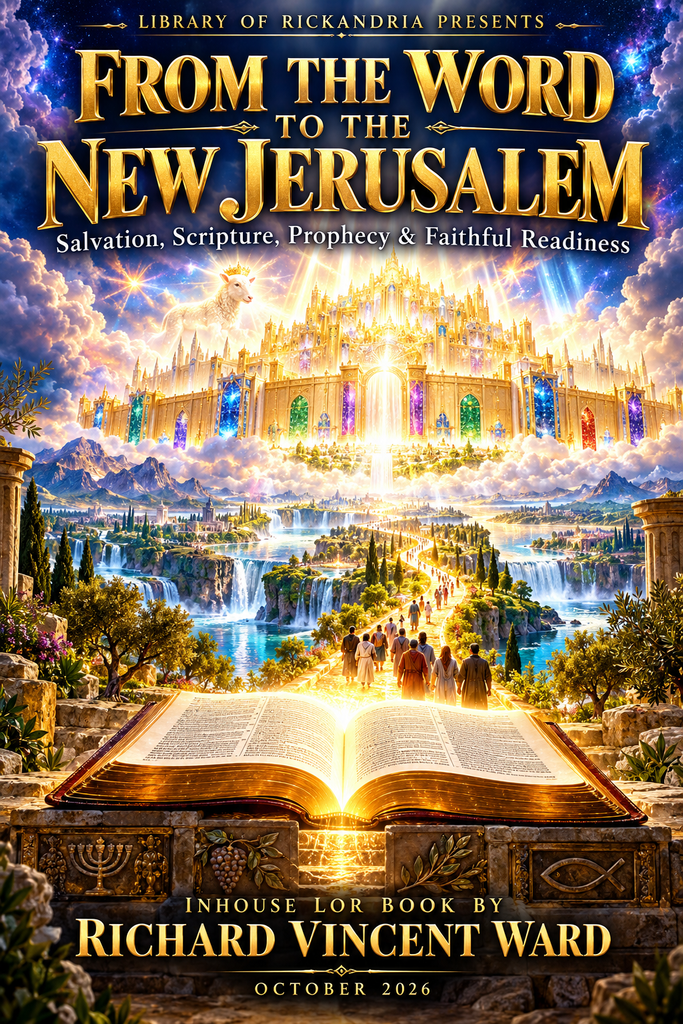
FROM THE WORD TO THE NEW JERUSALEM: Salvation, Scripture, Prophecy & Faithful Readiness