
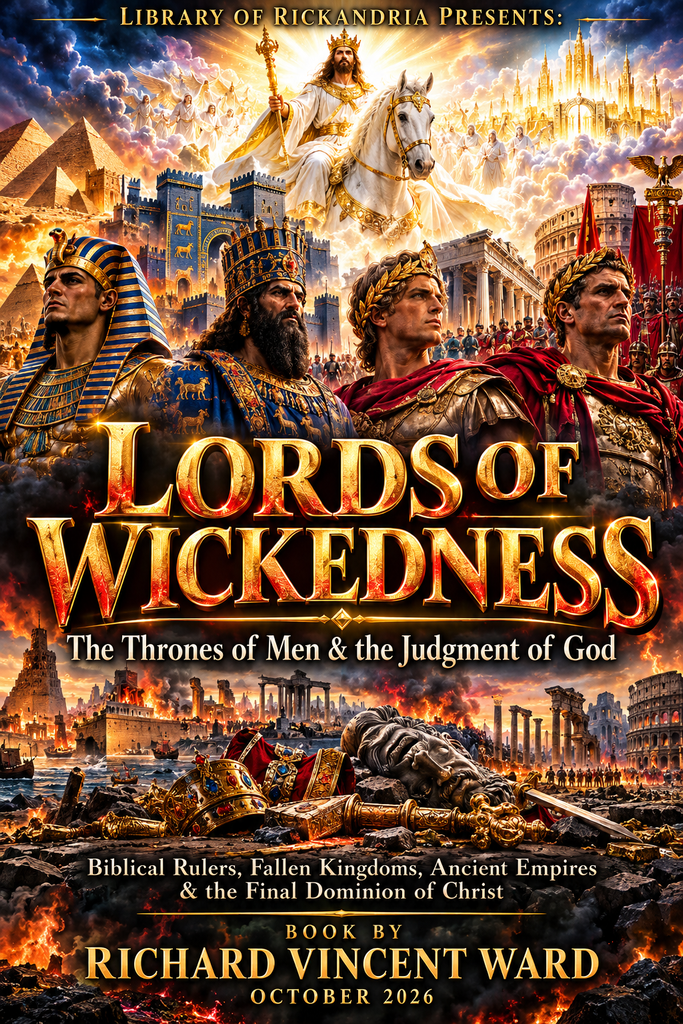
LORDS OF WICKEDNESS: The Thrones of Men & the Judgment of God – Biblical Rulers, Fallen Kingdoms, Ancient Empires & the Final Dominion of Christ
UPDATED BY VCG ON 10/11/2026 @ 06:39 EST
LORDS OF WICKEDNESS
The Thrones of Men and the Judgment of God
Revised and Expanded Edition — 2026
LORDS OF WICKEDNESS: The Thrones of Men and the Judgment of God is an epic biblical and historical investigation into the rise and fall of wicked rulers, ancient empires, and the relentless struggle between earthly power and divine authority. Beginning in Eden and tracing the corruption of mankind through the giants, Nimrod, Babel, Pharaoh, Nebuchadnezzar, Antiochus IV, Herod, Caesar, Pilate, and Nero, the book explores the prophetic mysteries of Daniel and Revelation, the beasts, Mystery Babylon, the Antichrist, and the coming judgment of God. It then examines modern dictatorships, technological surveillance, economic domination, and the dangers of political and spiritual deception. Drawing upon the King James Bible, ancient historical records, archaeology, and scholarly research, Richard Vincent Ward distinguishes documented history from theological interpretation while exposing the recurring dangers of pride, idolatry, persecution, and unchecked authority. Above all, LORDS OF WICKEDNESS declares the Bible’s ultimate message: the thrones of men are temporary, the judgment of God is certain, and Jesus Christ—the King of Kings and Lord of Lords—shall reign forever.
Preface to the Revised Edition
Throughout history, men have:
- raised themselves above their brethren
- established kingdoms through violence
- claimed divine authority
- demanded the allegiance of nations
Some wore crowns of gold.
Others carried the sword.
Some built magnificent cities while enslaving the people who labored beneath them.
Others:
- persecuted prophets
- murdered innocents
- profaned holy places
and exalted themselves against the God of heaven.
Their names are preserved:
- in Scripture
- in ancient inscriptions
- in the writings of historians
and in the traditions of nations.
But the biblical record presents a question deeper than the rise and fall of earthly government:
Who possesses the ultimate authority to rule?
This revised study examines that question through the testimony of Scripture, the historical record, and the prophetic visions of Daniel and Revelation.
The investigation begins in Genesis, where humanity seeks its own name and dominion.
It moves through the courts of Pharaoh, the palaces of Babylon, the kingdoms of Persia and Greece, and the imperial power of Rome.
It then considers the recurring characteristics of oppressive rule and the competing interpretations of the final kingdoms described in biblical prophecy.
Throughout this work, a necessary distinction will be maintained.
The words of Scripture must not be confused with later traditions.
Ancient myths must not be represented as established history.
Modern events must not be declared prophetic fulfillments without sufficient grounds.
Biblical typology and prophetic parallels deserve examination, but resemblance alone is not proof of identity.
The purpose of this book is therefore not merely to condemn wicked rulers.
It is to understand how Scripture:
- portrays power
- exposes injustice
- calls people to faithfulness
and places every earthly kingdom beneath the sovereignty of God.
For the central declaration of Daniel remains unchanged:
The most High ruleth in the kingdom of men.
CHAPTER ONE
THE WAR OF THRONES
Who Rules the Kingdoms of Men?
“This matter is by the decree of the watchers, and the demand by the word of the holy ones: to the intent that the living may know that the most High ruleth in the kingdom of men, and giveth it to whomsoever he will, and setteth up over it the basest of men.”— Daniel 4:17, KJV
1. The Question Behind Every Crown
Long before the establishment of modern nations, the construction of imperial capitals, or the development of armies capable of conquering continents, mankind understood the significance of a throne.
The throne represented authority.
From it, laws were issued, judgments pronounced, armies commanded, and the destinies of entire populations determined.
The occupant of a throne could defend the weak or exploit them.
He could administer justice or pervert it.
He could acknowledge his limitations or declare himself greater than the people he governed.
Ancient kings frequently surrounded their authority with religious symbolism.
Royal power could be presented as the gift of the gods, the expression of cosmic order, or the earthly manifestation of divine kingship.
Yet the Bible repeatedly challenges the assumption that possession of power establishes moral righteousness.
A king might command thousands of soldiers and possess enormous wealth, yet remain subject to the judgment of God.
A ruler might conquer many nations but fail to govern his own pride.
A government might establish peace within its borders while committing grave injustice against those beyond them.
Scripture therefore distinguishes the possession of authority from the righteous exercise of that authority.
Proverbs 29:2 declares:
“When the righteous are in authority, the people rejoice: but when the wicked beareth rule, the people mourn.”
This principle provides the foundation for our investigation.
The question is not simply whether a ruler possesses a crown.
It is what that ruler does with the authority entrusted to him.
2. The Most High Rules Over the Kingdoms of Men
One of the clearest declarations of divine sovereignty appears in the book of Daniel.
Nebuchadnezzar, ruler of Babylon, possessed a kingdom remarkable for its:
- military power
- wealth
- architecture
- imperial influence
According to Daniel 2, the prophet identified Nebuchadnezzar as the head of gold in the king’s dream of a great image.
Yet Daniel did not attribute the king’s greatness solely to military conquest or political ability.
He declared that the God of heaven had given Nebuchadnezzar his:
- kingdom
- power
- strength
- glory
This acknowledgment did not make every action of the Babylonian king righteous.
Indeed, the same book records his command that people worship a golden image, his threatening of those who refused, and his subsequent humiliation.
Daniel 4 reveals the central lesson.
Human greatness does not eliminate human accountability.
When Nebuchadnezzar gloried in the Babylon he had built, judgment came upon him.
His humiliation continued until he acknowledged the authority of heaven.
The biblical narrative reaches its decisive point when the king confesses that the Most High possesses everlasting dominion.
The ruler who once exalted his own magnificence was brought to recognize a sovereignty greater than his throne.
Here Scripture reveals a principle that will recur throughout this book:
God’s sovereignty over an earthly ruler does not mean that God approves of everything that ruler does.
The prophets could describe kings as instruments within divine providence while also condemning their:
- violence
- arrogance
- idolatry
- injustice
3. When Authority Becomes Rebellion
The danger of earthly power becomes especially visible when a ruler refuses to acknowledge any authority greater than himself.
In Exodus 5:2, Pharaoh responds to Moses:
“Who is the LORD, that I should obey his voice to let Israel go?
I know not the LORD, neither will I let Israel go.”
The statement reveals the central conflict of the Exodus narrative.
Pharaoh possessed political authority over Egypt.
But he claimed a power that could disregard the command of God and continue the oppression of Israel.
The contest was not merely between two human leaders.
It concerned the limits of royal authority, the deliverance of an enslaved people, and the recognition of the LORD.
Pharaoh’s resistance eventually brought devastation upon Egypt.
The king who refused to release Israel discovered that his power could not withstand divine judgment.
Throughout the biblical record, other rulers exhibit comparable pride.
Nebuchadnezzar commanded worship before his image.
Belshazzar profaned the vessels taken from the temple in Jerusalem.
Herod sought the death of the child Jesus because he perceived a threat to his throne.
In each account, the ruler’s authority became corrupted by the desire to preserve or exalt himself at the expense of righteousness.
These kings did not commit identical crimes, and their circumstances differed greatly.
Nevertheless, their narratives share a warning:
power becomes dangerous when its possessor treats himself as beyond correction.
4. The Kingdoms Offered in the Wilderness
The New Testament introduces another dimension to the question of earthly dominion.
During the temptation of Jesus, the devil showed Him the kingdoms of the world and offered Him authority in exchange for worship.
The account is recorded in Luke 4:5–8 and Matthew 4:8–10.
The significance of the temptation should not be overlooked.
Earthly glory was presented as something to be obtained through misplaced worship.
Jesus refused.
He answered from Scripture that worship and service belong to God.
The passage reveals a direct contrast between allegiance to God and the pursuit of authority through spiritual compromise.
However, the devil’s claims in the temptation narrative should be interpreted carefully.
His assertion concerning the disposal of kingdoms is part of the recorded temptation; it does not, by itself, establish that every government or ruler is directly appointed by Satan.
Elsewhere, Romans 13 discusses civil authority as existing under God’s providence, while Acts 5:29 establishes the apostles’ obligation to obey God rather than men when the two commands conflict.
These passages require careful consideration together.
The Bible neither treats all rulers as righteous nor portrays the existence of government itself as inherently evil.
Instead, it recognizes civil authority while placing ultimate obedience to God above every human command.
5. The Unseen Conflict
Daniel 10 describes an extraordinary vision involving conflict connected with the kingdom of Persia.
A heavenly messenger speaks of opposition from the prince of the kingdom of Persia and later refers to the prince of Grecia.
The passage has long been important in discussions concerning spiritual powers and earthly nations.
Likewise, Ephesians 6:12 states:
“For we wrestle not against flesh and blood, but against principalities, against powers, against the rulers of the darkness of this world, against spiritual wickedness in high places.”
These texts provide a biblical basis for recognizing spiritual conflict beyond ordinary human struggles.
Yet they also call for interpretive discipline.
The existence of unseen powers in biblical revelation does not authorize readers to assign a particular demon to every modern nation, institution, or public official.
Neither does it establish that every political disagreement is evidence of supernatural conspiracy.
The biblical passages should be studied in their own contexts before conclusions are drawn about present events.
What they do establish is that the biblical understanding of evil extends beyond:
- political administration
- military power
- human ambition alone
6. The Beasts of Daniel and Revelation
The prophetic books employ a remarkable language of kingdoms and beasts.
In Daniel 7, four beasts emerge from the sea.
Their appearances communicate the violence and extraordinary character of earthly kingdoms.
One possesses the features of a lion.
Another resembles a bear.
A third is like a leopard.
The fourth is dreadful, terrible, and exceedingly strong.
The vision culminates in a heavenly court, where judgment is given and dominion is transferred.
In Revelation 13, John describes another beast:
- rising from the sea
- receiving authority
- speaking blasphemies
and making war against the saints.
The imagery deliberately raises questions about:
- political power
- worship
- persecution
and the limits of human dominion.
Christian interpreters have differed in identifying the kingdoms and events represented by these visions.
Some understand them primarily in relation to ancient empires and the circumstances of the earliest Christians.
Others interpret them as a succession of powers throughout church history.
Still others anticipate a future and climactic manifestation of opposition to God.
These interpretations cannot simply be treated as though they make identical claims.
A responsible examination must ask what the text states, how its symbolism relates to earlier Scripture, what its original audience could have understood, and what grounds exist for applying it to later history.
The warnings of the visions remain significant even where interpreters disagree about their precise historical fulfillment.
7. The Pattern of Wicked Rule
Although the rulers examined in this work belonged to different centuries and civilizations, Scripture identifies recurring moral dangers associated with power.
Pride can persuade a ruler that he stands above the law.
Greed can transform public authority into an instrument of exploitation.
Fear can produce persecution and cruelty.
Idolatry can demand religious allegiance to a human institution or leader.
Deception can persuade a population to regard oppression as righteousness.
These dangers are not confined to monarchy.
They can arise wherever power becomes concentrated and accountability disappears.
Yet recognizing parallels is different from proving direct historical continuity.
The fact that a modern government employs surveillance does not establish that it is the beast of Revelation 13.
The fact that a financial system can exclude individuals does not, by itself, establish that it is the mark of the beast.
Such comparisons may raise serious moral and theological questions, but prophetic identification requires additional argument.
The task of this book will be to examine those arguments rather than presume their conclusions.
8. The King Who Refused the Ways of Wicked Rulers
The Gospel accounts present a striking contrast to the kings and tyrants of history.
Jesus did not obtain His authority through military conquest, dynastic intrigue, or the execution of political rivals.
When questioned by Pilate, He declared:
“My kingdom is not of this world.” — John 18:36
The statement does not deny His kingship.
It distinguishes the source and character of His kingdom from the political powers confronting Him.
The rulers of the world frequently preserved authority through violence.
Christ submitted to suffering.
The kings of the earth sought glory through conquest.
The New Testament presents Christ’s exaltation through:
- obedience
- sacrifice
- resurrection
- the vindication of God
This distinction is essential to the argument of the entire book.
The answer to wicked dominion is not another form of wicked dominion.
It is righteous kingship.
9. The Throne That Shall Not Pass Away
Daniel 7:14 describes a dominion unlike the kingdoms that preceded it:
“His dominion is an everlasting dominion, which shall not pass away, and his kingdom that which shall not be destroyed.”
The kingdoms represented by the beasts are limited.
Their power is temporary.
Their rulers are answerable to judgment.
The everlasting kingdom stands in contrast to them.
Revelation brings this theme to its climactic expression in the declaration that the kingdoms of the world have become the kingdoms of the Lord and of His Christ.
The final emphasis of biblical prophecy is therefore not the greatness of the beast.
It is the sovereignty of God and the victory of the Lamb.
This truth governs the chapters that follow.
We shall examine:
- the kings who enslaved nations
- the rulers who persecuted the faithful
- the empires that claimed divine honor
and the prophetic symbols through which Scripture portrays corrupt dominion.
We shall consider the historical evidence, the competing interpretations, and the moral warnings preserved in these accounts.
But no earthly throne shall be treated as greater than the one before which the books are opened and the kingdoms of men are judged.
For the central question remains:
Who reigns when every human crown has fallen?
The book of Revelation answers:
“And he hath on his vesture and on his thigh a name written, KING OF KINGS, AND LORD OF LORDS.”— Revelation 19:16, KJV
End of Chapter One
Principal passages for further study:
- Genesis 10–11
- Exodus 5–15
- Psalm 2
- Daniel 2, 4, 7, and 10
- Matthew 4
- Luke 4
- John 18–19
- Romans 13
- Ephesians 6
- Revelation 13, 17, and 19
CHAPTER TWO
THE TWO SEEDS
From Eden to the Kingdom of Christ
Primary Scripture: Genesis 3:1–24 — King James Version
“And I will put enmity between thee and the woman, and between thy seed and her seed; it shall bruise thy head, and thou shalt bruise his heel.”— Genesis 3:15, KJV
1. Before the First Earthly Throne
Before Babylon rose upon the plains of Shinar, before Pharaoh ruled over Egypt, and before the Caesars commanded the legions of Rome, the biblical narrative introduces a conflict that would shape its account of human history.
It begins in a garden.
There are no armies marching beneath imperial banners.
No conquered nations are paying tribute.
No crowned monarch sits upon a throne of gold.
There is:
- a man
- a woman
- a divine commandment
- a serpent
The narrative in Genesis 2–3 describes humanity’s original relationship with God, the prohibition concerning the tree of the knowledge of good and evil, and the subsequent disobedience of Adam and Eve.
The serpent enters the account as a deceiving figure.
His opening question challenges the commandment of God.
His subsequent words directly contradict the divine warning concerning death.
“And the serpent said unto the woman, Ye shall not surely die.”— Genesis 3:4, KJV
The serpent’s strategy is not presented as open warfare.
It is persuasion.
He introduces doubt about God’s words, challenges the consequences of disobedience, and encourages the woman to desire what God has forbidden.
The woman eats.
Adam also eats.
Their relationship with God is disrupted, and the consequences of their disobedience enter the human story.
When God addresses the serpent, He announces enmity between the serpent and the woman, and between their respective seeds.
It is this declaration that later Christian interpreters would understand as the beginning of a conflict culminating in Jesus Christ.
Yet the passage deserves more than a passing quotation.
What is the seed of the serpent?
Who is the seed of the woman?
And does the text describe:
- literal bloodlines
- spiritual allegiance
- future generations
or a particular promised deliverer?
To answer these questions, we must examine both the original passage and its interpretation throughout Scripture.
2. The First Promise and the Meaning of Seed
The Hebrew word translated seed in Genesis 3:15 is זֶרַע — zeraʿ.
The word has several related uses in biblical Hebrew, including:
- agricultural seed
- descendants
- offspring
- posterity
An important feature of this Hebrew noun is that it may refer either to an individual descendant or collectively to numerous descendants.
Therefore, the appearance of the singular word seed does not automatically establish that only one individual is intended.
The Brown–Driver–Briggs Hebrew Lexicon, available through Bible Hub, documents these uses and identifies Genesis 3:15 among passages in which the term can function collectively.
This matters because two major readings of the passage have developed.
The collective reading
Under this interpretation, the immediate language describes ongoing hostility between the serpent and its offspring on the one hand, and humanity on the other.
The striking imagery of the head and heel reflects the danger of encounters between human beings and serpents.
A serpent may strike at the heel, while a human being may strike at the serpent’s head.
Some scholars understand this as the primary literary meaning within Genesis 3.
The messianic reading
Christian interpreters have traditionally understood the passage as pointing beyond the immediate circumstances of Eden to a coming descendant who would defeat the serpent.
This interpretation is commonly called the Protoevangelium, meaning the first announcement of the gospel.
In this reading, the conflict ultimately reaches its fulfillment in Christ’s:
- suffering
- death
- resurrection
- victory over evil
Douglas Estes discusses this interpretation in “Protoevangelium,” The Encyclopedia of Christian Civilization (2011).
David Pettus, in “Reading a Protoevangelium in the Context of Genesis” (2014), argues that the case for a messianic interpretation is cumulative:
it becomes more developed when Genesis 3:15 is considered within the wider biblical narrative.
This is an important distinction.
Genesis 3:15 does not explicitly name Jesus Christ.
The Christian identification arises from reading Genesis in the light of later biblical revelation.
Both the immediate literary meaning and the larger canonical interpretation deserve examination.
3. The Serpent: A Creature, a Symbol, or Satan?
Genesis 3:1 introduces the serpent in relation to the beasts of the field.
The chapter does not explicitly identify the serpent by the personal name Satan.
This identification becomes clearer in later Christian Scripture.
Revelation 12:9 describes the great dragon as:
“that old serpent, called the Devil, and Satan, which deceiveth the whole world”
Likewise, Revelation 20:2 uses the language of:
- the dragon
- the old serpent
- the Devil
- Satan
Within a Christian canonical reading, these passages provide grounds for connecting the serpent imagery of Genesis with the adversary described in Revelation.
However, this later identification should not be confused with an explicit statement found in Genesis itself.
Jewish interpretation has not been uniform on this question.
Professor Yairah Amit examines the serpent within the literary structure of the Eden narrative in “The Exposition of the Garden of Eden Story,” TheTorah.com.
Another useful examination is “The Immortal Myth of Adam and Eve,” TheTorah.com, which surveys differing Jewish interpretations of the Eden account.
For the purposes of this study, the essential biblical connection is straightforward.
Genesis introduces a deceiving serpent.
Revelation employs the image of the ancient serpent in describing Satan’s deception and opposition to God’s people.
The relationship is theologically significant even though the precise details of the serpent’s identity and activity have been understood differently by interpreters.
4. The Conflict Between Two Seeds
The language of Genesis 3:15 establishes hostility.
It describes opposition between the serpent and the woman, extending to their respective offspring.
The wording naturally raises questions about descendants and the future.
But the biblical narrative also develops a moral conflict:
- righteousness against wickedness
- truth against deception
- obedience against rebellion
This broader pattern becomes especially visible in the New Testament.
In Matthew 13:24–43, Jesus tells the parable of the wheat and the tares.
In His explanation, He identifies the good seed with the children of the kingdom and the tares with the children of the wicked one.
The language is agricultural, but its meaning concerns people and their relationship to the kingdom of God.
Likewise, the apostle John distinguishes the children of God from the children of the devil in 1 John 3:7–12.
John’s explanation emphasizes:
- conduct
- righteousness
- love
These passages establish an important distinction:
Spiritual parentage in these New Testament contexts is expressed through allegiance, conduct, and relationship to God—not through a documented biological descent from a supernatural being.
This does not eliminate the genealogical importance of the word seed elsewhere in Scripture.
It means that genealogy and spiritual identity must not be treated as interchangeable in every passage.
That distinction becomes especially important when we examine Cain and Abel.
5. Cain and Abel: The First Bloodshed
The first murder recorded in Scripture occurs between brothers.
Genesis 4 introduces Cain and Abel as the children of Adam and Eve.
Cain works the ground.
Abel keeps sheep.
Both bring offerings to the LORD, but the biblical account distinguishes the reception of their offerings.
Cain becomes angry.
His countenance falls.
God addresses him and warns him concerning sin.
“If thou doest well, shalt thou not be accepted? and if thou doest not well, sin lieth at the door.”— Genesis 4:7, KJV
This warning is central to the story.
Cain is not portrayed as a helpless creature compelled to commit murder because of an explicitly identified demonic genetic inheritance.
He is confronted concerning his conduct.
The narrative then records his murder of Abel.
When God asks Cain where Abel is, Cain attempts to evade responsibility.
His brother’s blood has been shed, and the violence cannot be concealed.
The story contains several important themes:
- rejected correction
- anger
- violence
- denial
- judgment
- divine restraint
It also introduces a recurring biblical concern.
The innocent may suffer at the hands of those who refuse righteousness.
Why does John call Cain a child of the wicked one?
1 John 3:12 states:
“Not as Cain, who was of that wicked one, and slew his brother.
And wherefore slew he him?
Because his own works were evil, and his brother’s righteous.”
The explanation John provides is significant.
He does not appeal to a hidden genealogical record.
He emphasizes the contrast between Cain’s evil works and Abel’s righteousness.
The surrounding verses command believers to love one another and condemn hatred.
Consequently, Cain becomes a moral example of murderous hatred.
His conduct reflects the character of the wicked one.
This is a stronger textual foundation for understanding Cain’s spiritual association with evil than an unsupported theory of biological descent from the serpent.
6. Was Cain Literally the Serpent’s Biological Son?
Some later interpretations of the Eden narrative propose that Cain resulted from a physical union between Eve and the serpent.
Such interpretations attempt to explain the phrase seed of the serpent as a literal biological lineage.
The claim must be compared with what Genesis actually records.
Genesis 4:1 states:
“And Adam knew Eve his wife; and she conceived, and bare Cain, and said, I have gotten a man from the LORD.”
The grammatical sequence presents Adam’s relationship with Eve before Cain’s conception and birth.
The passage does not identify the serpent as Cain’s biological father.
Neither does it describe a sexual encounter between Eve and the serpent.
Genesis 3:13 says that the serpent beguiled the woman.
The context describes deception concerning God’s commandment and the forbidden fruit, not an explicitly narrated sexual act.
The interpretation that Cain was literally fathered by the serpent therefore goes beyond the information provided by the biblical text.
It is important to recognize this distinction because a literal serpent-bloodline theory can fundamentally change the meaning of later biblical narratives.
Rather than assessing human beings by their conduct and their response to God, such a theory may attempt to assign wickedness to entire populations on the basis of speculative ancestry.
That conclusion is not established by Genesis 3–4.
The biblical warning is more direct and more personally demanding:
Sin is not an accusation to be projected onto an allegedly corrupted people.
It is a reality that each person must confront.
7. The Generations of Cain and Seth
After Cain’s judgment, Genesis records the development of his family.
Genesis 4:17–24 introduces Cain’s descendants and associates his family with:
- a city
- pastoral activity
- music
- metalworking
The account also includes Lamech, who speaks of violence and vengeance.
The narrative then turns to the birth of Seth.
“And Adam knew his wife again; and she bare a son, and called his name Seth:
For God, said she, hath appointed me another seed instead of Abel, whom Cain slew.”— Genesis 4:25, KJV
The reference to another seed is noteworthy in light of Genesis 3:15.
Within the narrative, Seth takes the place of Abel in the family of Adam and Eve.
Genesis 5 then provides a genealogy through Seth to Noah.
This genealogy becomes significant within the larger structure of Genesis.
However, a careful reading prevents us from simplifying the story into the claim that every descendant of Cain must be wicked and every descendant of Seth must be righteous.
The text gives particular accounts of particular individuals.
It does not assign identical moral character to every member of a family simply because of ancestry.
A necessary genealogical correction
The earlier edition of Lords of Wickedness traced a supposed wicked lineage from Cain through the Canaanites and onward into later empires.
That sequence is not presented as a genealogy in Scripture.
Genesis identifies Canaan as a son of Ham, who was a son of Noah.
See Genesis 9:18–27 and Genesis 10:6.
Cain belongs to the earlier narrative of Genesis 4.
The biblical genealogies do not establish a continuous Cain-to-Canaanite bloodline.
Likewise, the Bible does not document a continuous serpent-descended genetic dynasty passing through Babylon, Rome, and into modern ruling families.
The biblical text does permit comparisons among forms of wickedness across generations.
But a recurring spiritual or moral pattern is not the same thing as a proven biological genealogy.
This distinction must govern every historical claim made in the chapters that follow.
8. The Days Before the Flood
Genesis 6:1–13 presents one of the most disputed passages in the early chapters of the Bible.
It describes the sons of God taking the daughters of men as wives.
It also refers to:
- giants
- mighty men of old
- men of renown
Immediately afterward, the text emphasizes the extraordinary wickedness of humanity.
The earth is described as corrupt and filled with violence.
These verses have generated several major interpretations.
The angelic interpretation
Under this view, the sons of God are heavenly beings who entered into unions with human women.
Supporters frequently compare Genesis 6 with the heavenly beings called sons of God in Job and with passages such as Jude 6–7 and 2 Peter 2:4–5.
This interpretation also has important parallels in ancient Jewish literature, especially traditions associated with the Book of Enoch.
The Sethite interpretation
Under this approach, the sons of God are understood as members of a line associated with the worship of God, often connected with Seth, while the daughters of men represent women from the surrounding population.
The interpretation emphasizes the deterioration of religious faithfulness and human morality.
The royal or aristocratic interpretation
Other interpreters understand the sons of God as powerful kings or members of a ruling class who took women according to their own desires.
This reading emphasizes domination and the abuse of human authority.
These alternatives are discussed in the historical commentary of Keil and Delitzsch on Genesis 6.
The passage remains debated, and the various views do not command universal agreement.
For this book, one conclusion is especially important.
Genesis 6 explicitly condemns widespread wickedness and violence.
It does not explicitly teach that a particular modern people or government possesses the DNA of the pre-Flood giants.
Claims about supernatural ancestry extending into modern political dynasties would require evidence beyond the text of Genesis.
Noah and the question of genetic purity
Genesis 6:9 calls Noah a just man and perfect in his generations.
Some interpretations identify the word perfect with biological purity.
The Hebrew adjective תָּמִים — tamim can convey:
- completeness
- soundness
- integrity
or blamelessness.
Its biblical uses include moral integrity as well as the wholeness required of sacrificial animals.
See the Brown–Driver–Briggs entry for tamim and the Hebrew text analysis of Genesis 6:9.
Within Genesis 6:9 itself, Noah is described as just and as walking with God.
Consequently, the moral reading of his blamelessness has direct contextual support.
The wording does not establish that Noah underwent genetic testing, that he belonged to an uncontaminated biological species, or that his righteousness can be reduced to the absence of supposed supernatural DNA.
These ideas are additional interpretations, not explicit statements of Scripture.
9. From the Flood to the Nations
The Flood narrative culminates in the preservation of Noah’s household.
According to Genesis 9–10, the nations subsequently described in the biblical genealogy descend from Noah’s sons.
The narrative then moves toward the emergence of cities, kingdoms, and the dispersion associated with Babel.
This progression is essential to the structure of Lords of Wickedness.
The early chapters of Genesis do not merely explain the origin of individual wrongdoing.
They increasingly address the consequences of human corruption at the level of:
- families
- societies
- nations
The violence preceding the Flood gives way to the development of post-Flood peoples and political centers.
Within this context, Genesis 10:8–12 introduces Nimrod and associates the beginning of his kingdom with Babel and other cities.
Genesis 11:1–9 then records the building project at Babel.
The people seek to make themselves a name and to prevent their scattering.
The narrative presents an extraordinary example of collective human ambition.
Yet the identity and relationship of Nimrod to the builders in Genesis 11 require careful interpretation because the tower narrative does not explicitly name Nimrod as its leader.
The next chapter of this work will examine that question in detail.
The movement from Eden toward Babel establishes an important literary connection:
Human beings repeatedly seek:
- independence
- security
- greatness
through their own arrangements of power.
But the biblical narrative portrays every such project as remaining subject to God’s authority.
10. Abraham and the Promise to the Nations
After Babel, the narrative of Genesis moves toward the calling of Abram.
Genesis 12:1–3 records God’s promises concerning:
- Abram
- his descendants
- the blessing of the families of the earth
This marks a decisive development.
The narrative shifts from the scattering of the nations toward the promise of blessing that will ultimately reach the nations.
The language of offspring becomes central.
Genesis 22:18 declares:
“And in thy seed shall all the nations of the earth be blessed; because thou hast obeyed my voice.”
The promise is repeated through the patriarchal narratives and develops further through Israel’s history.
The covenantal line proceeds through Isaac and Jacob.
Later, the royal promise becomes associated with Judah and David.
See Genesis 49:8–12 and 2 Samuel 7:12–16.
The Scriptures thus present an unfolding relationship between:
- descendants
- covenant promises
- kingship
- the hope of future deliverance
Nevertheless, genealogy alone does not exhaust the theological meaning of the promise.
The prophets repeatedly confront Israel’s own disobedience.
Royal ancestry does not guarantee righteous kingship.
And the promise of blessing is not presented as a justification for the oppression of other nations.
The biblical trajectory leads toward a king whose dominion is associated with justice and righteousness.
11. The Promised Seed and Jesus Christ
The New Testament develops the relationship between Abraham’s promise and Jesus Christ.
In Galatians 3:16, Paul writes:
“Now to Abraham and his seed were the promises made.
He saith not, And to seeds, as of many; but as of one, And to thy seed, which is Christ.”
Paul directly identifies Christ as the seed in his interpretation of the Abrahamic promise.
It is important to recognize that the immediate subject of Galatians 3:16 is the promise to Abraham, not a direct grammatical explanation of Genesis 3:15.
Nevertheless, within a Christian reading of the whole Bible, these passages contribute to a connected understanding of God’s purpose.
The genealogy and covenant promises culminate in Christ.
Paul then expands the significance of belonging to that promise.
Galatians 3:26–29 teaches that those who belong to Christ are Abraham’s seed and heirs according to the promise.
This is a crucial development.
The apostle does not teach that every person must demonstrate physical descent from Abraham in order to participate in the promise through Christ.
Instead, he discusses belonging through faith.
The New Testament’s emphasis on faith and incorporation into Christ must be considered before constructing any doctrine that divides humanity into immutable spiritual classes determined exclusively by ancestry.
12. Two Fathers: The Words of Jesus
One of the most frequently cited passages in discussions of the serpent’s seed is John 8:31–47.
During a dispute concerning descent from Abraham and the identity of God’s children, Jesus declares:
“Ye are of your father the devil, and the lusts of your father ye will do.”— John 8:44, KJV
If this verse is read without its surrounding context, it may appear to support a claim of literal biological descent from the devil.
But the passage itself provides an important qualification.
In John 8:37, Jesus acknowledges the physical ancestry of those He is addressing:
“I know that ye are Abraham’s seed”
He then criticizes their intention to kill Him.
The discussion distinguishes biological descent from the moral and spiritual characteristics expected of those who truly follow Abraham’s example.
Jesus associates the devil with murder and falsehood.
His opponents are rebuked because their conduct reflects those characteristics.
Thus, the language of fatherhood functions within an argument about:
- deeds
- truth
- obedience
It should not be transformed into a claim that Jewish ancestry itself establishes demonic parentage.
Such a conclusion would contradict Jesus’ explicit acknowledgment of Abrahamic descent within the same conversation.
The proper distinction is not between supposedly pure and impure ethnic populations.
It is between:
- truth and falsehood
- righteousness and wickedness
- faithfulness and rebellion
13. The Children of God and the Children of the Devil
The first epistle of John returns to this contrast.
1 John 3:8–10 speaks of the works of the devil and the manifestation of the Son of God.
The passage associates the children of God with righteousness and brotherly love.
This ethical emphasis continues through the remainder of the chapter.
Cain is condemned for murdering Abel.
Hatred is compared with murder.
Love is presented as a fundamental characteristic of those who have passed from death unto life.
The theological distinction is therefore inseparable from moral conduct.
This is especially significant for a book examining wicked rulers.
A ruler cannot be judged righteous merely because he claims divine favor.
A government cannot establish its moral legitimacy solely through religious language.
A dynasty cannot demonstrate spiritual authority by appealing to ancestry.
The biblical witness repeatedly requires attention to deeds.
This does not mean that outward conduct alone resolves every theological question about salvation.
It means that Scripture consistently refuses to treat arrogant claims of privilege as substitutes for righteousness.
For the purposes of this investigation, the test of wicked rule must therefore include what rulers do.
Do they administer justice?
Do they defend the vulnerable?
Do they shed innocent blood?
Do they deceive their people?
Do they exalt themselves beyond correction?
These are questions supported by the broader biblical concern for righteousness and judgment.
See:
14. The Woman, the Dragon, and the Remnant
The imagery introduced in Genesis returns in a striking form in Revelation 12.
John describes:
- a woman
- a child
- a great red dragon
The dragon seeks to devour the child.
The child is described as destined to rule all nations with a rod of iron.
The language echoes the royal imagery of Psalm 2:7–9.
Later in the vision, the dragon persecutes the woman and makes war against the remnant of her seed.
The connection with Genesis 3:15 is difficult to overlook.
Both passages contain imagery involving:
- a woman
- a serpent-like adversary
- descendants
- hostility
But the precise identity of the woman in Revelation 12 has been interpreted in several ways.
Some understand her principally as Israel, from whom the Messiah comes.
Others emphasize the people of God across the covenants.
Catholic and other Christian interpretations also recognize Marian dimensions within the imagery.
These views differ in emphasis, and some interpreters combine elements of more than one.
What Revelation explicitly identifies is the dragon’s opposition:
- to the woman
- her child
- her remaining offspring
Revelation 12:17 characterizes that remnant through its obedience to God and testimony concerning Jesus Christ.
The vision’s emphasis is not a modern laboratory definition of genetic descent.
It is:
- conflict
- persecution
- perseverance
- faithfulness
In Christian interpretation, the opposition introduced in Eden has become part of a cosmic struggle centered upon the Messiah and His people.
15. The Victory Over the Serpent
Genesis 3:15 is often understood by Christians as anticipating a final victory over the serpent.
The New Testament develops the theme of victory over evil through several important passages.
In Hebrews 2:14–15, the writer speaks of Christ’s death in relation to the defeat of the one who possessed the power of death and the deliverance of those held in bondage through fear.
In 1 Corinthians 15:20–28, Paul places the resurrection of Christ at the center of the future defeat of all opposing:
- rule
- authority
- power
Death itself is called the last enemy.
In Romans 16:20, Paul declares:
“And the God of peace shall bruise Satan under your feet shortly.”
The language of bruising underfoot provides another important connection with Genesis 3:15.
Together, these passages support a Christian theological reading in which the defeat of the serpent is bound to the victory of Christ and the ultimate triumph of God’s kingdom.
The victory is not presented as the extermination of an allegedly identifiable biological race.
It is the defeat of:
- sin
- death
- deception
and the powers opposed to God.
This also explains why the New Testament calls believers to:
- endurance
- righteousness
- truth
- love
rather than the pursuit of supposed hidden bloodlines.
16. Jewish and Christian Interpretations of the Promise
The interpretation of Genesis 3:15 has a long history.
Its meaning cannot be reduced to a single modern theory.
A comparison of important traditions helps establish the boundaries of the evidence.
Jewish commentary
The medieval Jewish commentator Rashi explains Genesis 3:15 with reference to the serpent’s hostility and the striking of the head and heel.
His discussion treats the imagery in close connection with the serpent and its judgment.
See Rashi on Genesis 3:15, Sefaria.
Aramaic Targumic interpretation
The Aramaic interpretive tradition commonly published as Targum Pseudo-Jonathan develops the passage beyond the wording of Genesis.
Its treatment of Genesis 3:15 introduces obedience to the commandments and a future remedy associated with the days of the Messiah.
See Targum Jonathan on Genesis 3:15, Sefaria.
This demonstrates that messianic associations with Genesis 3:15 are not restricted entirely to Christian interpretation.
However, the Targum is a later interpretation of the biblical passage, not the original Hebrew wording itself.
Christian interpretation
Christian theology has frequently understood the passage as the earliest promise of redemption through Christ.
The New Catholic Encyclopedia article on the Proto-Evangelium surveys questions concerning:
- the serpent
- the woman
- the offspring
- the Hebrew verb
and the development of the tradition.
Modern Christian scholarship continues to debate the extent to which a messianic meaning is present in the immediate context.
For a focused treatment, see Afolarin Olutunde Ojewole, The Seed in Genesis 3:15: An Exegetical and Intertextual Study (Andrews University, 2002).
These sources demonstrate that Genesis 3:15 has an interpretive history involving:
- language
- theology
- the relationship between the Old and New Testaments
The passage is foundational to Christian reflection on redemption, but its precise interpretation requires argument rather than assumption.
17. What the Seed War Does—and Does Not—Establish
The recurring pattern of opposition between righteousness and wickedness is substantial enough to merit an extended biblical investigation.
Cain murders Abel.
Pharaoh oppresses Israel.
Wicked kings persecute prophets.
Herod attempts to destroy the young Jesus.
The New Testament records persecution of the early church.
Revelation portrays a dragon and beastly powers opposing the faithful.
These narratives can be studied together as examples of hostility toward God’s purposes.
Yet we must distinguish a recurring theological pattern from a documented historical conspiracy.
The Bible does not provide an uninterrupted genealogy of every wicked ruler from Cain to the Antichrist.
It does not identify all ancient civilizations as descendants of a supernatural serpent.
It does not name:
- modern governments
- banking institutions
- biotechnology companies
or artificial intelligence systems as direct biological products of the serpent’s offspring.
Such proposals may appear in modern prophetic interpretations, but they should not be presented as biblical facts without sufficient evidence.
The central biblical contrast is already serious enough.
Falsehood stands against truth.
Oppression stands against justice.
Murderous hatred stands against brotherly love.
Self-exaltation stands against humility before God.
And earthly dominion is repeatedly confronted by the judgment of heaven.
These are the characteristics that must guide the examination of wicked rulers.
18. The King Who Brings the Conflict to Its End
The story that begins in Eden does not conclude with Cain.
Neither does it conclude with:
- Babel
- Egypt
- Babylon
- Persia
- Greece
or Rome.
Within Christian Scripture, the conflict reaches its decisive turning point in the:
- life
- death
- resurrection
of Jesus Christ.
Paul contrasts Adam and Christ in Romans 5:12–21 and 1 Corinthians 15:21–22, 45–49.
The contrast concerns:
- sin and righteousness
- death and life
- the first man and the last Adam
This is fundamental to the Christian understanding of redemption.
The answer to humanity’s rebellion is not the discovery of an uncorrupted human dynasty capable of ruling by hereditary superiority.
It is the work of Christ.
His kingdom is not established through the same means by which wicked rulers have frequently preserved their power.
He does not overcome death by escaping the human condition.
The New Testament declares that He entered into suffering and death and was raised again.
In that sense, the story reverses the assumptions of worldly greatness.
The rulers of the earth seek immortality through:
- monuments
- dynasties
- conquest
and the preservation of their names.
Christ’s victory is revealed through a different path.
The kingdom that endures is not secured by the arrogance of a human throne.
It is grounded in the sovereign purpose of God.
19. The Final Judgment of the Serpent
The book of Revelation reaches its conclusion with:
- the defeat of the devil
- the judgment of the dead
- the vision of a new heaven and a new earth
Revelation 20:10 describes the final judgment of the devil.
Revelation 21–22 portrays:
- the restoration of creation
- the removal of the curse
- the presence of God with His people
The imagery returns the reader to themes first encountered in Genesis.
There is life.
There is a tree of life.
There is the divine presence.
And the curse no longer has dominion.
The canonical movement from Genesis to Revelation therefore provides a powerful literary and theological framework.
Eden introduces:
- disobedience
- alienation
- the announcement of enmity
The biblical narrative follows the development of sin and the promises of redemption.
Revelation portrays the ultimate defeat of evil and the restoration of God’s people.
For Christian readers, the identity of the victorious ruler is not hidden.
It is Jesus Christ.
20. Conclusion: The Two Seeds and the Thrones of Men
The history of earthly kingdoms cannot be understood merely by arranging the names of emperors and kings.
Scripture requires deeper questions.
What does a ruler worship?
Whose commands does he obey?
What does he do when confronted with truth?
How does he exercise authority over the vulnerable?
Does he establish justice or protect his own power through violence?
The pattern introduced in Eden becomes relevant wherever deception leads to rebellion and wherever human ambition rejects accountability.
The account of Cain reveals what hatred can become.
The generations before the Flood show the destructive consequences of widespread corruption and violence.
Babel introduces the danger of collective self-exaltation.
The later history of kings and empires will display these characteristics upon a much larger stage.
But the investigation must remain governed by evidence.
A man is not proved wicked because of an imagined ancestry.
A people must not be condemned because of a speculative bloodline.
A technological development does not become a prophetic fulfillment simply because it resembles an apocalyptic image.
The biblical call is to discernment grounded in truth.
The apostle John’s command remains relevant:
“Beloved, believe not every spirit, but try the spirits whether they are of God:
because many false prophets are gone out into the world.”— 1 John 4:1, KJV
And the closing vision of Scripture reminds its readers that evil does not possess the final throne.
The kingdom of God remains the ultimate measure against which earthly dominion is judged.
The serpent may deceive.
The proud may establish kingdoms.
The wicked may persecute the righteous.
But no earthly crown can overturn the sovereignty of God.
The history of those crowns now becomes the subject of our investigation.
For beyond the first garden, another city will rise upon the plains of Shinar.
And with that city comes one of the most enigmatic figures in the earliest history of kingdoms:
Nimrod—the mighty hunter, the founder associated with Babel, and a ruler whose reputation would grow far beyond the few verses that name him.
RESEARCH NOTES AND SOURCE BIBLIOGRAPHY
The biblical text is the primary source for the narrative and theological arguments in this chapter.
Later Jewish and Christian commentaries are used as evidence of interpretation, not as substitutes for Scripture.
Primary biblical sources
- King James Bible, Genesis 2–6. The Garden of Eden, the serpent, Cain and Abel, Seth’s genealogy, and the pre-Flood generation. Read Genesis 2–6.
- King James Bible, Genesis 9–12 and 22. The descendants of Noah, the nations, Babel, Abraham’s calling, and the promise to his seed. Read Genesis 9–12 and Genesis 22.
- King James Bible, John 8; Matthew 13; 1 John 3. Spiritual fatherhood, the children of the kingdom, the children of the wicked one, and the example of Cain. John 8, Matthew 13, 1 John 3.
- King James Bible, Galatians 3; Romans 5; 1 Corinthians 15. Christ, the Abrahamic promise, Adam, and redemption. Galatians 3, Romans 5, 1 Corinthians 15.
- King James Bible, Revelation 12 and 20–22. The dragon, the woman, the remnant, the judgment of the devil, and the restoration of creation. Revelation 12 and Revelation 20–22.
Hebrew-language reference works
- Brown, Francis; Driver, S. R.; and Briggs, Charles A. A Hebrew and English Lexicon of the Old Testament. Entry for zeraʿ, meaning seed or offspring. Read the lexical entry.
- Brown–Driver–Briggs Hebrew Lexicon. Entry for tamim, meaning complete, sound, blameless, or possessing integrity. Read the lexical entry.
Jewish interpretive sources
- Rashi. Commentary on Genesis 3:15. Medieval Jewish interpretation of the serpent’s curse and the imagery of the head and heel. Read on Sefaria.
- Targum Pseudo-Jonathan. Commentary/interpretive rendering of Genesis 3:15. An Aramaic tradition incorporating messianic expectations. Read on Sefaria.
- Amit, Yairah. “The Exposition of the Garden of Eden Story.” TheTorah.com. A literary examination of Genesis 2–3 and the structure of the Eden narrative. Read the article.
Christian and academic scholarship
- Estes, Douglas. “Protoevangelium.” The Encyclopedia of Christian Civilization, 2011. Explains the traditional Christian understanding of Genesis 3:15 as anticipating Christ’s victory. Read the abstract and publication record.
- Pettus, David. “Reading a Protoevangelium in the Context of Genesis.” Eruditio Ardescens, Volume 1, Issue 2, 2014. Argues for a cumulative messianic reading in the context of the book of Genesis. Read the study.
- Ojewole, Afolarin Olutunde. The Seed in Genesis 3:15: An Exegetical and Intertextual Study. PhD dissertation, Andrews University, 2002. Examines the Hebrew wording and interpretations of the seed throughout biblical literature. Access the dissertation record.
- New Catholic Encyclopedia. “Proto-Evangelium.” Surveys disputes concerning the woman, the serpent, the promised offspring, and later Christian theological interpretation. Read the encyclopedia article.
- Keil, C. F., and Delitzsch, F. Commentary on the Old Testament, Genesis 6. Reviews longstanding interpretations of the sons of God and daughters of men. Read the commentary.
Editorial and interpretive standards
Biblical record:
Claims presented as direct statements of Scripture must be traceable to the cited passages.
Historical documentation:
- Later Jewish traditions
- Christian writings
- historical commentary
and academic scholarship must be identified by their sources.
Theological interpretation:
- Messianic typology
- prophetic parallels
- symbolic relationships
must be distinguished from the literal wording of individual passages.
Unverified claims:
- Literal serpent bloodlines
- biological connections between Cain and later nations
- modern technological or political fulfillments of prophecy
must not be treated as established facts without adequate evidence.
Textual standard:
Biblical quotations are based on the supplied King James Version, Pure Cambridge Edition.
External Bible links provide reader-accessible KJV passages; spelling and punctuation in other online editions may occasionally differ.
END OF CHAPTER TWO
NEXT CHAPTER
CHAPTER THREE — NIMROD AND BABEL
The Birth of Imperial Ambition
The mighty hunter.
The beginning of a kingdom.
The cities of Shinar.
The tower that reached toward heaven.
The traditions that transformed Nimrod into an archetypal rebel king.
Primary passages:
CHAPTER THREE
NIMROD AND BABEL
The Birth of Imperial Ambition
Primary Scriptures:
“And Cush begat Nimrod: he began to be a mighty one in the earth.
He was a mighty hunter before the LORD:
wherefore it is said, Even as Nimrod the mighty hunter before the LORD.”— Genesis 10:8–9, KJV
1. The Man Behind the First Kingdom
Among the figures who emerge from the opening chapters of Genesis, few have acquired a reputation as mysterious as Nimrod.
His biblical biography is remarkably brief.
Genesis:
- identifies his father
- describes his exceptional might
- associates him with hunting
and connects the beginning of his kingdom with cities in the land of Shinar.
Yet over the centuries, this relatively small account expanded into an extraordinary collection of stories.
In later Jewish tradition, Nimrod became a rebel against heaven, a persecutor of Abraham, and a tyrant who sought to turn humanity away from the worship of God.
Other traditions associated him with the building of the Tower of Babel.
Modern writers have identified him with:
- Mesopotamian kings
- warrior gods
- legendary heroes
and even proposed that he established a religious system destined to survive until the final Antichrist.
These claims are not all equal.
Some arise directly from Scripture.
Others belong to ancient interpretation, historical reconstruction, or much later speculation.
To understand Nimrod, we must therefore begin with a distinction:
The Nimrod described in Genesis and the Nimrod developed by later traditions are related figures, but they are not identical in the amount of information available about them.
This distinction is central to the study by Karel van der Toorn and Pieter W. van der Horst, “Nimrod Before and After the Bible,” published in Harvard Theological Review, Volume 83, Issue 1 (1990).
The authors examine both the limited biblical evidence and the increasingly elaborate traditions associated with Nimrod.
Their work provides an important foundation for the investigation that follows.
2. Nimrod’s Place in the Generations of Noah
The biblical account places Nimrod among the descendants of Noah through Ham and Cush.
Genesis 10:6–8 identifies Cush as a son of Ham and Nimrod as a descendant of Cush.
The genealogy is significant because Genesis 10, often called the Table of Nations, traces the development of peoples and territories after the Flood.
The chapter names:
- families
- nations
- lands
- languages
Within this setting, the passage concerning Nimrod stands out.
Rather than merely listing another descendant, the narrative pauses to describe his exceptional position.
He becomes a mighty one.
His reputation becomes proverbial.
And the beginning of his kingdom is connected with several major cities of Mesopotamia.
The mention of his kingdom is particularly important.
Earlier Genesis narratives describe:
- families
- pastoral communities
- violence
- the construction of a city by Cain
But Nimrod is the first named individual in the biblical narrative explicitly associated with the beginning of a kingdom.
This does not establish that no form of organized government existed before him.
It establishes that his kingdom receives special attention within the biblical account of the nations.
The text thus places Nimrod at an important literary transition:
the movement from genealogies and settlements toward the emergence of political dominion.
3. What Does the Name Nimrod Mean?
The name Nimrod is written in Hebrew as נִמְרֹד — Nimrod.
One of the most familiar explanations connects it with the Hebrew root marad, meaning to rebel.
Under this interpretation, the name is associated with rebellion or the expression:
“we shall rebel.”
This interpretation became influential in Jewish and Christian treatments of Nimrod.
But the precise historical origin of his name remains uncertain.
The Encyclopedia of the Bible, article “Nimrod”, notes the proposed connection with rebellion while recognizing that the etymology is not settled.
Scholars have also investigated possible Mesopotamian origins for the name, including connections with the warrior deity Ninurta.
Van der Toorn and Van der Horst review such proposals in “Nimrod Before and After the Bible”.
The question matters because an etymology should not carry more theological weight than the evidence permits.
If the name is connected with rebellion, it would be consistent with Nimrod’s portrayal in several later traditions.
But a proposed meaning of a name does not independently establish the historical actions of its bearer.
The name Nimrod may have been understood as a name of rebellion, but its etymology alone does not prove that Genesis explicitly calls him a rebel against God.
To evaluate that characterization, we must examine the words used to describe him.
4. A Mighty One in the Earth
Genesis 10:8 declares that Nimrod began to be a mighty one in the earth.
The Hebrew word underlying mighty is גִּבּוֹר — gibbor.
The term can describe:
- a strong man
- warrior
- hero
or person of exceptional might.
Its meaning depends upon context.
In some passages, the word identifies military champions.
In others, it describes powerful individuals more generally.
The word is also related to language found in Genesis 6:4, where the mighty men of old are described as men of renown.
This connection has encouraged speculation about Nimrod’s possible relationship to the giants mentioned before the Flood.
However, the vocabulary alone does not prove that Nimrod was a giant or a supernatural hybrid.
The Hebrew term gibbor is not restricted to such beings.
It can describe ordinary human warriors.
The lexical evidence is available in Strong’s Hebrew entry H1368, gibbor.
Thus the biblical statement establishes Nimrod’s extraordinary might without explaining its precise nature.
Was he renowned for military strength?
Was he an exceptional hunter?
Did he become powerful through political leadership?
The passage permits consideration of these possibilities but does not supply a complete biography.
The context of Genesis 10:10, which immediately introduces his kingdom, naturally encourages readers to consider his might in connection with the exercise of political power.
But that remains an interpretation of the passage rather than an explicit account of his conquests.
5. The Mighty Hunter Before the LORD
Genesis 10:9 describes Nimrod as a mighty hunter before the LORD.
The phrase is repeated in the form of a saying, suggesting that his reputation had become memorable.
The interpretive difficulty concerns the expression:
“before the LORD.”
The Hebrew phrase lifnei YHWH can convey the sense of being before or in the presence of the LORD.
Some interpreters understand the phrase as indicating an extraordinary or widely recognized hunter.
Others understand it negatively, suggesting activity carried out in opposition to God.
The Encyclopedia of the Bible discussion of Nimrod recognizes the interpretive uncertainty.
Later Jewish interpretation often adopts the negative reading.
Targum Pseudo-Jonathan on Genesis 10, for example, presents Nimrod in language associating his strength with sin and rebellion.
But the Targum is an interpretive rendering, not a direct reproduction of the Hebrew wording.
This raises another frequently repeated claim.
Was Nimrod a hunter of men?
Some modern writers argue that Nimrod’s hunting should be understood as the pursuit, conquest, or subjugation of human beings.
The association between hunting and conquest is understandable within a discussion of ancient kingship.
Royal hunting could symbolize strength and dominance.
Yet Genesis 10:9 does not explicitly identify human beings as the objects of Nimrod’s hunting.
Consequently, the description hunter of men should be presented as a proposed interpretation, not as a literal quotation from Genesis.
The strongest conclusion available from the passage itself is that Nimrod possessed an exceptional reputation for might and hunting, and that he became associated with the establishment of a kingdom.
Whether that reputation was originally intended as praise, condemnation, or deliberate ambiguity remains a subject of interpretation.
6. The Beginning of His Kingdom
Genesis 10:10 declares:
“And the beginning of his kingdom was Babel, and Erech, and Accad, and Calneh, in the land of Shinar.”
This verse provides the clearest biblical connection between Nimrod and organized dominion.
Four names appear within the region of Shinar.
Their historical significance deserves examination.
Babel — Babylon
Babel is the Hebrew biblical name associated with Babylon.
Babylon would become one of the most influential cities in the ancient Near East.
Its later kings developed a powerful imperial center, famous for its:
- religious institutions
- monumental architecture
- legal traditions
- political influence
The Encyclopedia of the Bible, “Babylon (OT)”, surveys the city’s:
- name
- history
- importance within Scripture
The Babylon familiar from the reign of Nebuchadnezzar II belongs to a much later historical setting than the primeval narrative of Genesis.
Therefore, the Babylon of later imperial history must not automatically be assigned to Nimrod’s personal construction program.
The biblical text associates the beginning of his kingdom with Babel.
It does not provide a securely dated archaeological record of his reign.
Erech — Uruk
Erech is generally identified with ancient Uruk, one of the great urban centers of Sumer.
Uruk played an important role in the early development of:
- Mesopotamian cities
- monumental religious architecture
- administrative practices
It also became associated with the legendary king Gilgamesh.
See World History Encyclopedia, “Uruk”.
This connection is important, but it does not prove that Nimrod and Gilgamesh were the same individual.
Accad — Akkad
Accad is associated with Akkad, the city that gave its name to the Akkadian Empire.
Sargon of Akkad, who ruled in the third millennium BCE, became one of the ancient Near East’s most celebrated empire-builders.
The city of Akkad itself has not been securely located by archaeologists.
See World History Encyclopedia, “Akkad” and “Sargon of Akkad”.
The connection with Nimrod is geographical and thematic.
It does not establish that Nimrod was Sargon.
Calneh
Calneh is more difficult to identify.
Its precise location and the interpretation of the Hebrew wording have been debated.
Some scholars have questioned whether the traditional text should be understood as the name of a fourth city or as wording referring to the totality of the cities mentioned.
The question is addressed in Van der Toorn and Van der Horst’s study of Nimrod.
The uncertainty illustrates an important principle.
Not every ancient place-name can be matched confidently to a surviving archaeological site.
For the present study, the crucial point is that Genesis places the beginning of Nimrod’s kingdom in the Mesopotamian world of Shinar.
This is the setting in which cities would become centers of political power, religious administration, and eventually imperial authority.
7. Asshur, Nineveh, and the Expansion of Kingdoms
Genesis 10:11–12 introduces additional cities.
The King James Version states that Asshur went forth from that land and built:
- Nineveh
- Rehoboth
- Calah
- Resen
Other translations interpret the Hebrew as saying that Nimrod went forth into Assyria and built the cities.
The difference concerns the grammatical interpretation of the word Asshur.
It may be understood as a personal name or as a geographical designation.
This issue has been discussed for centuries.
See the collected historical interpretations in Bible Hub’s commentary on Genesis 10:11.
The distinction affects how extensively Nimrod’s kingdom should be understood.
If Asshur is the builder, the account describes another founding figure.
If Nimrod is the subject, the passage may indicate the expansion of his sphere of influence into northern Mesopotamia.
The ambiguity should not be concealed.
The city of Calah
Calah is associated with ancient Kalhu, an important Assyrian city whose ruins are commonly called Nimrud.
The name of the archaeological site is especially interesting because it preserves a later association with the biblical figure.
But the modern name Nimrud does not prove that the biblical Nimrod personally founded the city.
The Metropolitan Museum of Art’s collection record for an Assyrian lamassu explains the transformation of ancient Kalhu into a major Assyrian capital under Ashurnasirpal II in the ninth century BCE.
The French Ministry of Culture’s archaeological resource on Nimrud/Kalhu likewise documents the site’s Assyrian history.
Here the distinction between historical and biblical evidence becomes particularly clear.
The biblical tradition associates early kingdoms with the region.
Archaeology documents the later history of an actual Assyrian city.
The two kinds of evidence may illuminate one another without proving every detail of the traditional account.
8. Nimrod and the Tower of Babel
The most famous structure associated with Nimrod is the Tower of Babel.
Yet an important detail must be established at the beginning:
Genesis 11 does not explicitly name Nimrod as the tower’s builder.
The association arises from the proximity of the narratives and from later interpretive traditions.
Genesis 10 names Babel among the beginnings of Nimrod’s kingdom.
Genesis 11 describes a city and tower being built in Shinar.
Readers have naturally connected the two accounts.
But the connection is not stated directly.
This does not make the association meaningless.
It means the claim must be classified accurately.
Nimrod’s relationship with Babel is explicit in Genesis 10.
His personal leadership of the tower-building project is an interpretation supported by later traditions rather than a direct statement of Genesis 11.
9. The Plain of Shinar
Genesis 11:1–2 describes humanity speaking one language and settling upon a plain in the land of Shinar.
Shinar is associated with Babylonia, the region of southern Mesopotamia.
The association appears elsewhere in Scripture.
In Daniel 1:2, the vessels taken from Jerusalem are brought into the land of Shinar.
Zechariah 5:11 also uses Shinar as a geographical setting in a symbolic prophetic vision.
Scholarly discussion of Shinar’s relationship with Babylonia appears in “Nimrod Before and After the Bible”.
Within Genesis 11, the people decide to establish a city and construct a tower.
Their stated motivation is central to the narrative.
“Go to, let us build us a city and a tower, whose top may reach unto heaven; and let us make us a name, lest we be scattered abroad upon the face of the whole earth.”— Genesis 11:4, KJV
The builders seek a name.
They seek permanence.
They seek protection from scattering.
Their project combines architecture with a desire for collective identity and security.
This is the foundation upon which the biblical account develops its criticism of Babel.
10. The Tower Whose Top Reached Toward Heaven
The expression describing a tower with its top reaching heaven has sometimes been understood as evidence that the builders were attempting to enter God’s dwelling place physically.
Others interpret it as monumental language describing extraordinary height.
The ancient Near Eastern setting provides important architectural parallels.
Mesopotamian civilizations built monumental stepped temple towers commonly known as ziggurats.
These structures formed part of religious complexes and were associated with the relationship between divine and human realms.
The Metropolitan Museum of Art’s discussion of Birs Nimrud and the Tower of Babel explains how these artificial mountains became associated with later visual reconstructions of the biblical tower.
Archaeological evidence demonstrates that Mesopotamian builders developed monumental religious structures of this kind.
It does not demonstrate that the particular tower described in Genesis 11 has been identified beyond dispute.
Nor does it establish that the biblical tower operated as a literal supernatural portal.
The architecture provides historical context.
The biblical account provides the theological narrative.
Both are important, but they answer different questions.
Brick, bitumen, and organized labour
Genesis 11:3 specifically mentions the use of fired brick and slime for mortar.
This description is consistent with construction practices known from Mesopotamia, where clay and bitumen were important building materials.
The details make the setting distinctive.
They also show that the builders possessed technical knowledge and the ability to coordinate labor.
The narrative does not condemn the existence of bricks or architecture.
Its emphasis falls upon the ambitions expressed by the people and the subsequent divine response.
This distinction is necessary because technological achievement is not automatically synonymous with rebellion.
The moral question concerns the purpose to which human abilities are directed.
11. Etemenanki: The Historical Tower of Babylon
One of the most famous ziggurats of the ancient world was Etemenanki, the temple tower associated with Babylon.
Its name is commonly translated as referring to the foundation of heaven and earth.
The structure stood within Babylon’s religious landscape near the major temple of Marduk.
The Metropolitan Museum of Art’s discussion of Babylonian architecture identifies Etemenanki as the enormous temple tower whose existence was confirmed through archaeological investigation.
This monument has frequently been associated with the biblical Tower of Babel.
That association is understandable.
Both belong to the Babylonian setting.
Both involve monumental towers.
Both concern imagery connecting heaven and earth.
Yet the archaeological history of Etemenanki cannot be equated automatically with the events of Genesis 11.
Etemenanki is known through Mesopotamian evidence relating to historical Babylon, including periods far removed from the narrative world in which Genesis places Nimrod.
Its existence establishes that Babylon possessed a monumental religious tower.
It does not independently prove that Nimrod constructed the building described in Genesis.
The difference is important.
A historical structure may illuminate a biblical description without providing a one-to-one confirmation of every narrated event.
12. Why Did the Builders Seek a Name?
The builders’ declaration in Genesis 11:4 provides one of the most important interpretive keys to the passage.
They desire to make themselves a name.
Within ancient societies, a great name could represent:
- honor
- reputation
- enduring memory
- political influence
Cities and monuments could preserve the reputation of a ruler or people across generations.
The ambition expressed at Babel may therefore be understood as more than an attempt to produce an impressive structure.
It concerns the preservation of collective greatness.
This theme becomes particularly striking when Genesis 11 is read beside Genesis 12.
At Babel, humanity proposes to make itself a name.
In Genesis 12:2, God promises Abram:
“And I will make of thee a great nation, and I will bless thee, and make thy name great; and thou shalt be a blessing”
The contrast is significant.
At Babel, the people seek greatness through their own collective project.
In Abraham’s calling, greatness is presented as something bestowed through divine promise.
The two narratives stand close together in the structure of Genesis.
This makes their comparison particularly meaningful.
Babel’s concern is the preservation of its own name.
Abraham’s calling is directed toward a blessing extending to the families of the earth.
The comparison does not mean that every city is wicked or that every act of political cooperation is sinful.
It identifies differing theological orientations toward greatness, dependence, and the purpose of human life.
13. The LORD Comes Down
Genesis 11:5 presents one of the narrative’s most memorable moments.
After the builders propose a tower reaching heaven, the LORD comes down to see what they have built.
The expression has often been understood as deliberate irony.
From humanity’s perspective, the tower is a magnificent achievement.
Yet the narrative depicts God as coming down to inspect it.
Human greatness remains finite.
Divine authority remains beyond the reach of architectural ambition.
God then determines to confound the people’s language.
The result is the interruption of the building project and the scattering of the people.
Genesis 11:8 records that the LORD scattered them and that they ceased building the city.
Several questions remain open to interpretation.
Was the principal offense disobedience to the command to fill the earth?
Was it collective pride?
Was it the desire for an enduring political center?
Was it an attempt to obtain security apart from God?
The narrative permits examination of these related themes.
But it does not explicitly describe the builders performing demon worship, establishing a world banking system, or opening a supernatural gateway.
Those claims require separate evidence.
The biblical judgment itself is clear:
the building project does not proceed according to its intended purpose.
14. Babel: The Gate of God or the Place of Confusion?
Genesis 11:9 associates the name Babel with the LORD’s confusion of human language.
The Hebrew account plays upon the similarity between Babel and the verb balal, meaning to mix or confuse.
However, the Babylonian name has a different linguistic history.
The Akkadian form is commonly associated with the meaning:
“gate of god”
or
“gate of the gods.”
Jonathan Grossman examines this relationship in “The Double Etymology of Babel in Genesis 11,” Zeitschrift für die alttestamentliche Wissenschaft, 129(3), 2017.
His study examines how the biblical naming explanation interacts with Babylonian understandings of the city’s name.
This distinction reveals an important feature of the narrative.
The people associate their great city with prestige and collective achievement.
The biblical account associates its name with the frustration of their ambitions.
The same city may therefore be viewed from two sharply different perspectives.
To its inhabitants, Babylon could represent religious magnificence and civilization.
Within the biblical account of Babel, it becomes a witness to the limits of human self-exaltation.
15. Josephus: Nimrod Becomes the Great Rebel
The most influential ancient retelling connecting Nimrod directly with the Tower of Babel appears in the writings of the Jewish historian Flavius Josephus.
Josephus wrote in the first century AD, many centuries after the world described by Genesis.
In Antiquities of the Jews, Book I, Chapter 4, he identifies Nimrod as the leader who encouraged humanity to resist divine authority.
Josephus describes Nimrod as gradually transforming government into tyranny.
He portrays him as encouraging people to rely upon their own strength rather than acknowledge God’s providence.
The account then adds a striking claim.
According to Josephus, Nimrod proposed building a tower high enough to resist another catastrophic flood.
He intended to challenge God’s power and avenge the destruction of the earlier generation.
This is an extraordinary development of the story.
Genesis 11 does not state that the tower was designed as protection against another flood.
It does not record Nimrod threatening to avenge humanity upon God.
These details belong to Josephus’s retelling.
Nevertheless, they are important evidence for the history of interpretation.
They show that by the first century AD, Nimrod had become associated in Jewish historical writing with the archetype of a ruler who turns human dependence away from God and toward himself.
Josephus presents tyranny as more than the misuse of political force.
It becomes the deliberate attempt to make the population dependent upon a human ruler in place of divine authority.
This is one reason Nimrod eventually became such a powerful figure in discussions of wicked kingship.
In Genesis, Nimrod is a mighty hunter connected with a kingdom.
In Josephus, he becomes the organizer of rebellion and the architect of tyranny.
Both accounts deserve examination, but the latter must not be misrepresented as a direct quotation from the former.
16. Nimrod and Abraham: The Ancient Traditions
Later Jewish traditions connect Nimrod with Abraham.
In some accounts, Nimrod confronts Abraham concerning the worship of God.
Abraham refuses to acknowledge the ruler’s religious authority and is threatened with death.
The traditions sometimes include the story of Abraham being cast into a furnace and miraculously preserved.
Such accounts appear in Jewish interpretive literature associated with Genesis.
A relevant source is Bereishit Rabbah 38, which preserves traditions concerning:
- Abraham
- idolatry
- Nimrod
These stories have considerable importance in the history of Jewish religious interpretation.
They dramatize the conflict between a ruler claiming religious allegiance and a servant of God refusing idolatry.
However, Genesis itself does not explicitly describe a meeting between Abraham and Nimrod.
It does not record Nimrod commanding Abraham’s execution.
The furnace narrative belongs to later tradition, not the direct biblical account in Genesis.
A parallel in Islamic interpretation
The Qur’an includes an account of a ruler disputing with Abraham concerning God.
See Qur’an 2:258.
The verse does not name the ruler.
Later Islamic commentators commonly identify him as Nimrod.
This provides another example of how the Nimrod figure developed across religious traditions.
The convergence of these traditions is historically interesting.
But agreement among later traditions does not automatically establish all their details as independently verified historical events.
They show how Nimrod came to symbolize the confrontation between worldly power and uncompromising monotheism.
17. Was Nimrod Gilgamesh?
One modern theory identifies Nimrod with Gilgamesh, the legendary king associated with Uruk.
The proposal arises partly from the connection between Nimrod and Erech, understood as Uruk.
Gilgamesh is central to one of Mesopotamia’s most famous literary traditions.
The Epic of Gilgamesh explores:
- kingship
- friendship
- mortality
- suffering
- the search for enduring life
Gilgamesh is portrayed as an extraordinary figure of strength.
His story includes encounters with supernatural beings and journeys beyond ordinary human experience.
Such themes have invited comparison with Nimrod.
But a comparison of literary characteristics is not sufficient to demonstrate that two named figures are historically identical.
The biblical account provides no direct statement equating Nimrod with Gilgamesh.
Likewise, the surviving Gilgamesh literature does not securely establish the biblical Nimrod as its subject.
The theory therefore remains a proposed identification.
It may be investigated as part of the history of interpretation, but it should not be presented as settled fact.
18. Nimrod, Ninurta, and the Warrior-God Hypothesis
Another important scholarly proposal connects the Nimrod tradition with Ninurta, a Mesopotamian deity associated with war and other forms of divine power.
The argument draws upon possible relationships involving names, heroic characteristics, and the geography of northern Mesopotamia.
Ninurta was prominent in Assyrian religion.
The god’s association with military might has encouraged scholars to ask whether traditions concerning a mighty hunter could have developed from Mesopotamian divine or royal imagery.
The issue is examined in Van der Toorn and Van der Horst’s Harvard Theological Review study.
A different line of investigation considers whether Nimrod preserves memories associated with historical Mesopotamian empire-builders, including Sargon of Akkad and Naram-Sin.
Yigal Levin develops such a proposal in “Nimrod the Mighty, King of Kish, King of Sumer and Akkad,” Vetus Testamentum, Volume 52, Issue 3 (2002), pp. 350–366. View the journal’s DOI record.
The competing proposals demonstrate that Nimrod’s identity cannot presently be reconstructed with certainty from surviving extra-biblical evidence.
A scholarly hypothesis may be compelling without being conclusive.
Nimrod may preserve memories of ancient kingship and heroic power.
But no proposed equation with a Mesopotamian ruler or deity should be represented as universally established.
19. Enmerkar and the Ancient Stories of Language
The Sumerian literary figure Enmerkar provides another intriguing comparison.
Enmerkar is associated with Uruk and the legendary conflict involving the distant land of Aratta.
The composition known as Enmerkar and the Lord of Aratta contains material involving:
- political rivalry
- royal authority
- divine favor
- the use of language
A complete scholarly translation is available through the University of Oxford’s Electronic Text Corpus of Sumerian Literature.
The composition includes a passage concerning language and the god Enki.
Because the Tower of Babel also concerns language and divine intervention, the two traditions have attracted comparative attention.
The parallels are worth studying.
Yet their differences must also be respected.
Enmerkar and the Lord of Aratta is not simply another copy of Genesis 11.
It belongs to a different literary and religious setting.
Its characters, structure, and immediate purposes differ from the biblical narrative.
Nor does the composition identify Enmerkar as Nimrod.
The comparison therefore provides evidence of shared ancient Near Eastern interests in:
- language
- kingship
- divine activity
- civilization
It does not prove that Enmerkar personally built the biblical Tower of Babel.
20. Semiramis, Tammuz, and the Proposed Religion of Nimrod
One of the most influential claims in modern prophetic literature concerns a supposed religious family consisting of:
- Nimrod
- Semiramis
- Tammuz
In this reconstruction, Nimrod becomes the founder of Babylonian false worship.
Semiramis is presented as his wife.
Tammuz is identified as their child, often described as a dying and returning god.
The alleged family is then presented as the origin of a religious system later reproduced across many nations.
This theory has influenced popular writing about:
- Babylon
- paganism
- Christian religious history
But the historical evidence must be examined separately.
Semiramis
Semiramis is a legendary queen associated with Assyrian and Babylonian traditions.
The figure is commonly connected with the historical Assyrian royal woman Shammuramat, who lived in the ninth century BCE.
See “Sammu-Ramat and Semiramis: The Inspiration and the Myth,” World History Encyclopedia.
The historical setting of Shammuramat and the legends surrounding Semiramis are not evidence that she was married to the Nimrod of Genesis 10.
Scripture does not name Nimrod’s wife.
It does not identify Semiramis as his spouse or mother.
Tammuz
Tammuz is named in Scripture in Ezekiel 8:14.
The prophet describes women weeping for Tammuz in the setting of a vision concerning religious abominations associated with Jerusalem.
Tammuz is connected with the Mesopotamian deity Dumuzi, who appears in ancient religious literature and traditions involving the goddess Inanna/Ishtar.
For background, consult Encyclopaedia Britannica, “Tammuz”.
The biblical passage explicitly condemns the religious practices presented in Ezekiel’s vision.
However, it does not identify Tammuz as the biological child of Nimrod and Semiramis.
The problem of combining traditions
The existence of Nimrod in Genesis, Semiramis in later Assyrian and Greek traditions, and Tammuz in Mesopotamian religion does not establish that the three formed one historical family.
That claim requires independent evidence establishing their alleged relationship.
The evidence is not supplied by the biblical passages.
Their names may be investigated as part of the complex religious history of the ancient Near East.
But the supposed Nimrod–Semiramis–Tammuz family must be identified as a later speculative construction rather than a documented biblical genealogy.
This does not weaken the Bible’s warnings against idolatry.
Those warnings stand upon their own texts.
It simply prevents those warnings from becoming dependent upon an unsupported historical reconstruction.
21. The Land of Nimrod in the Prophet Micah
Nimrod’s name appears again in a prophetic setting.
Micah 5:6 refers to the land of Assyria and the land of Nimrod.
The context concerns the threat of Assyrian aggression and the deliverance of God’s people.
This reference is important because it demonstrates that Nimrod’s name could function as a geographical or historical designation associated with the Mesopotamian world.
It does not necessarily establish the details of his personal reign.
Nor does it teach that Nimrod would be resurrected as a future Antichrist.
The immediate prophetic context must guide interpretation.
The wider chapter contains the well-known reference to a ruler coming from Bethlehem.
Christian interpreters have long understood Micah 5:2 in relation to the Messiah, a connection explicitly made in Matthew 2:4–6.
Within that broader theological reading, the passage contrasts the threat of foreign domination with the promised rule and deliverance associated with God’s chosen ruler.
But this connection should be developed from the actual prophetic context, not from the assumption that Nimrod himself must return.
22. From Babel to Imperial Babylon
The city of Babylon becomes increasingly significant in later Scripture.
The kingdom of Nimrod described in Genesis is not the same historical government as the Neo-Babylonian Empire ruled by Nebuchadnezzar II.
Many centuries of political change separate the narrative settings.
Nevertheless, the recurrence of Babylon creates an important literary and theological relationship.
In Genesis 11, Babel is associated with collective human ambition and divine intervention.
In Daniel 2, Babylon becomes the kingdom represented by the golden head of Nebuchadnezzar’s great image.
In Daniel 3, the king commands public reverence before a golden image.
In Daniel 4, Nebuchadnezzar’s pride becomes the occasion of his humiliation.
These chapters provide more explicit biblical evidence for a ruler demanding improper worship and glorying in his own greatness than the short account of Nimrod alone.
The connection between Babel and imperial Babylon is therefore not dependent upon proving a continuous political dynasty extending from Genesis 10 to Daniel.
It may be examined through the recurrence of a city-name, the later historical identity of Babylon, and the theological themes developed in Scripture.
The repeated warning concerns the limits of earthly greatness.
Human beings may establish magnificent kingdoms.
But magnificence does not exempt a ruler from judgment.
23. Babylon in the Book of Revelation
The final biblical use of Babylon as a major prophetic symbol appears in Revelation.
Revelation 17–18 portrays Babylon through the imagery of:
- a woman
- a city
- kings
- merchants
- luxury
- corruption
- judgment
This imagery incorporates themes already associated with Babylon and other oppressive powers in the Old Testament prophets.
The relationship is especially visible when Revelation is compared with Isaiah 47 and Jeremiah 50–51.
These older prophetic passages contain declarations of judgment against Babylon, including criticism of:
- pride
- injustice
- idolatry
- false security
Revelation reuses and develops such imagery within its apocalyptic vision.
Christian interpreters differ concerning the primary historical identification of Revelation’s Babylon.
Some associate it particularly with Rome and the situation faced by early Christians under imperial domination.
Others interpret it as representing corrupt religious and political structures throughout history.
Futurist readings often anticipate an additional or final manifestation of Babylonian power.
These positions differ, and they should not be collapsed into one claim.
What is textually clear is that Revelation’s Babylon represents a power under divine judgment.
What is not textually established is that all of its activities can be traced through a fully documented institutional chain beginning with the personal religious system of Nimrod.
A typological relationship is not the same as demonstrated organizational continuity.
The distinction matters whenever modern people or institutions are identified with prophetic symbols.
24. The Spirit of Babel: A Biblical Pattern or a Historical Conspiracy?
The expression spirit of Babel is not a formal biblical title.
It is a theological description used to summarize recurring patterns of pride, self-exaltation, and resistance to divine authority.
When used carefully, it can provide a useful way of comparing biblical accounts.
The people of Babel seek to make themselves a name.
Nebuchadnezzar glorifies his own Babylon.
The ruler of Daniel 3 demands conformity to the worship of an image.
Revelation 13 depicts beastly authority associated with worship and persecution.
These texts contain meaningful similarities.
But similarity does not establish that every regime belongs to a single unbroken organization.
Nor does it demonstrate that every international institution exists to recreate Nimrod’s kingdom.
Modern political cooperation may arise from many causes, including:
- diplomacy
- trade
- public security
- economic interests
and efforts to address problems that cross national borders.
Such organizations can be evaluated critically by examining their:
- actual structures
- policies
- accountability
- consequences
But their existence alone does not prove a prophetic identity.
The proper biblical question is not merely whether political authority is centralized.
It is whether authority is exercised justly, whether people are compelled to violate conscience, whether rulers demand ultimate allegiance, and whether the vulnerable are oppressed.
The prophetic writings provide strong grounds for condemning such abuses.
They do not authorize conclusions unsupported by evidence.
25. Babel and Pentecost: The Question of Language Revisited
An important New Testament comparison appears in Acts 2.
At Babel, the confusion of language disrupts the builders’ common project.
At Pentecost, people from different nations hear the apostles declaring the works of God in languages they understand.
Many Christian interpreters have therefore understood Pentecost as a theological counterpart to Babel.
The comparison is compelling.
In Genesis 11, human communication is disrupted.
In Acts 2, linguistic differences do not prevent the proclamation of the gospel.
Yet Pentecost does not describe the abolition of every human language or the political unification of the nations.
The hearers remain representatives of different peoples and languages.
The event is centered on the proclamation of Christ.
This distinction is important.
The biblical answer to Babel is not necessarily the restoration of a single earthly empire.
Within the Christian reading of Acts, it is the spread of God’s message across the boundaries of human language.
The nations are not required to surrender their identities to a single human throne in order to hear the gospel.
26. Nimrod and Abraham: Two Responses to Greatness
The literary movement from Genesis 10–11 to Genesis 12 provides a fitting conclusion to our study of Nimrod.
Nimrod is associated with the beginning of a kingdom.
Babel’s builders seek a name for themselves.
Abraham receives a promise that God will make his name great and that the families of the earth will be blessed through him.
The contrast is theological rather than evidence of a historically documented personal confrontation between Nimrod and Abraham.
The two figures illustrate different themes within the biblical narrative.
Nimrod represents extraordinary human might and the emergence of royal dominion.
In later interpretation, he becomes the archetypal rebel ruler.
Abraham becomes the recipient of divine promises and an example of faith.
Hebrews 11:8–10 describes Abraham’s obedience and expectation of a city whose builder and maker is God.
That language provides a striking contrast with the builders of Babel.
Babel’s people organize themselves to establish their own lasting name.
Abraham journeys in response to a promise, looking beyond immediate possession toward what God will establish.
The relationship between the narratives is not that construction itself is sinful or that human achievement is inherently evil.
It concerns the place of human ambition beneath divine authority.
The biblical principle is expressed in Psalm 127:1:
“Except the LORD build the house, they labour in vain that build it”
This principle reaches beyond ancient Shinar.
It raises questions relevant to every form of earthly power.
What is the foundation of a kingdom?
What purpose does its greatness serve?
Whom does it benefit?
What does it demand from those under its authority?
And before whom is its ruler finally accountable?
27. Conclusion: The Kingdom and the Tower
Nimrod remains one of the most intriguing figures in the opening chapters of Scripture.
The brevity of his biblical account has inspired centuries of interpretation.
Genesis presents him as a mighty hunter and a figure associated with the beginning of a kingdom in Shinar.
Later Jewish traditions present him as a tyrant and organizer of rebellion.
Ancient Mesopotamian history provides the setting of:
- cities
- kingdoms
- monumental religious architecture
that helps readers understand the world evoked by the narrative.
Modern scholarship investigates possible connections with rulers and divine figures known from cuneiform literature.
But none of these bodies of evidence should be confused with another.
The historical identity of Nimrod remains uncertain.
The original builder of the Tower of Babel cannot be identified by name from Genesis 11 alone.
The claim that:
- Nimrod
- Semiramis
- Tammuz
formed the family responsible for creating all subsequent false religions is not established by the biblical or historical record.
And the existence of modern global institutions does not prove that Nimrod’s personal kingdom has literally survived into the twenty-first century.
What remains is the powerful theological question raised by Babel.
Human beings seek greatness.
They:
- build cities
- establish governments
- construct monuments
- organize armies
and create institutions intended to endure beyond their own lives.
Some of these achievements serve genuine human needs.
Others become instruments of oppression.
The biblical narrative refuses to measure righteousness by power alone.
Babel stands as a warning against the assumption that collective strength places humanity beyond the authority of God.
Its builders sought an enduring name.
Their project was interrupted.
Their unity did not secure the future they imagined.
And the account moves onward toward Abraham, through whom the biblical story introduces a promise intended ultimately to bless the nations.
The lesson is not that human beings should abandon civilization.
It is that civilization must not become an object of ultimate worship.
A kingdom may command armies, but it cannot command the judgment of heaven.
A city may build its tower, but its height cannot establish divine favor.
A ruler may make his name great among men, but that name cannot place him beyond the sovereignty of God.
The next great confrontation between earthly dominion and divine authority will unfold not upon the plains of Shinar, but in the kingdom of Egypt.
There, another ruler will hold extraordinary power.
He will command laborers, control the destiny of a nation, and refuse the demand to release an enslaved people.
When confronted with the word of the LORD, his answer will reveal the pride of a throne that recognizes no authority above itself:
“Who is the LORD, that I should obey his voice to let Israel go?”— Exodus 5:2, KJV
The story of Pharaoh now begins.
RESEARCH NOTES AND SOURCE BIBLIOGRAPHY
Primary Biblical Sources
1. The Holy Bible, King James Version, Pure Cambridge Edition. Genesis 10:6–12. The primary biblical account of Nimrod, his genealogy, his might, and the cities associated with his kingdom. Read Genesis 10:6–12.
2. The Holy Bible, King James Version. Genesis 11:1–9. The account of the city, tower, confusion of languages, and scattering. Read Genesis 11:1–9.
3. The Holy Bible, King James Version. Genesis 12:1–3 and Hebrews 11:8–10. Abraham’s calling, the promise of a great name, and the city whose builder and maker is God. Genesis 12 | Hebrews 11.
4. The Holy Bible, King James Version. Micah 5:2–6. The land of Nimrod, Assyria, and the promised ruler associated with Bethlehem. Read Micah 5:2–6.
5. The Holy Bible, King James Version. Daniel 2–4, Revelation 17–18. The later biblical portrayals of Babylon, imperial power, and divine judgment. Daniel 2–4 | Revelation 17–18.
Ancient Jewish and Religious Sources
6. Josephus, Flavius. Antiquities of the Jews, Book I, Chapter 4, composed in the first century AD. An influential ancient account explicitly connecting Nimrod with rebellion, tyranny, and the Tower of Babel. Read the original historical work in English.
7. Targum Pseudo-Jonathan. Genesis 10:8–12. Aramaic interpretive tradition portraying Nimrod in association with rebellion. Read on Sefaria.
8. Bereishit Rabbah. Chapter 38. Rabbinic traditions involving Abraham, idolatry, and the confrontation with Nimrod. Read on Sefaria.
9. The Qur’an. Surah Al-Baqarah 2:258. An account of a ruler disputing with Abraham, associated with Nimrod in later Islamic interpretation, though the verse itself does not name him. Read the passage.
Peer-Reviewed Academic Scholarship
10. Van der Toorn, Karel, and Pieter W. van der Horst. “Nimrod Before and After the Bible.” Harvard Theological Review, Volume 83, Issue 1 (1990), pp. 1–29. Cambridge University Press. DOI: 10.1017/S0017816000005502. A foundational scholarly investigation of the biblical Nimrod and the development of later interpretations. Publication record and scholarly abstract.
11. Levin, Yigal. “Nimrod the Mighty, King of Kish, King of Sumer and Akkad.” Vetus Testamentum, Volume 52, Issue 3 (2002), pp. 350–366. Discusses a proposed historical reconstruction of Nimrod in relation to Mesopotamian royal traditions. Publication DOI.
12. Grossman, Jonathan. “The Double Etymology of Babel in Genesis 11.” Zeitschrift für die alttestamentliche Wissenschaft, Volume 129, Issue 3 (2017), pp. 362–375. Explores the relationship between the biblical etymology of Babel and Babylonian linguistic traditions. Bar-Ilan University publication record.
Mesopotamian Literature and Archaeology
13. University of Oxford, Faculty of Oriental Studies. The Electronic Text Corpus of Sumerian Literature, “Enmerkar and the Lord of Aratta.” A scholarly translation of Sumerian literature relevant to Uruk, kingship, and traditions concerning language. Read the translation | Bibliography.
14. The Metropolitan Museum of Art. “The Tower of Babel or Birs Nimrud Restored.” Collection record explaining the relationship between Mesopotamian ziggurats, historical Borsippa, and later artistic interpretations of Babel. Read the museum’s archaeological discussion.
15. The Metropolitan Museum of Art. “The Walls and Hanging Gardens of Babylon.” Collection record discussing the historical ziggurat Etemenanki and its place within Babylonian architecture. Read the museum record.
16. The Metropolitan Museum of Art. “Human-headed Winged Bull (Lamassu).” Collection record documenting the Neo-Assyrian capital at ancient Kalhu/Nimrud and the building program of Ashurnasirpal II. Read the museum record.
17. French Ministry of Culture. “Nimrud, Ancient Kalhu.” Archaeological resource describing the location and development of the Assyrian city identified with biblical Calah. Read the archaeological resource.
Historical and Biblical Reference Works
18. Encyclopedia of the Bible. “Nimrod.” Bible Gateway reference edition. Reviews the Hebrew name, historical identifications, and uncertainty surrounding the interpretation of Genesis 10. Read the encyclopedia entry.
19. Encyclopedia of the Bible. “Babylon (OT).” Bible Gateway reference edition. Discusses the name Babylon, its historical background, and its significance in the Old Testament. Read the encyclopedia entry.
20. World History Encyclopedia. “Sammu-Ramat and Semiramis: The Inspiration and the Myth.” Published 2014. Examines the historical Assyrian queen and the legendary traditions surrounding Semiramis. Read the article.
21. Encyclopaedia Britannica. “Tammuz.” Historical reference on the Mesopotamian deity and associated religious traditions. Read the reference article.
SOURCE EVALUATION AND HISTORICAL LIMITATIONS
Established in the biblical text:
Nimrod is identified as:
- a descendant of Cush
- a mighty hunter
- a figure associated with the beginning of a kingdom in Shinar
Recorded in later interpretation:
Josephus explicitly associates Nimrod with tyranny and the construction of the Tower of Babel.
Jewish and Islamic interpretive traditions also connect him with Abraham.
Established in archaeology and Mesopotamian studies:
Ancient Mesopotamian civilizations possessed:
- major cities
- complex political institutions
- monumental temple towers
- Uruk
- Babylon
- Kalhu
belong to this documented historical landscape.
Debated or uncertain:
Nimrod’s exact historical identity, the etymology of his name, whether he personally led the Babel construction, the interpretation of Genesis 10:11, and proposed identifications with particular ancient kings or gods.
Not established by the cited evidence:
A literal Nimrod–Semiramis–Tammuz family, a historically documented religion personally founded by Nimrod and transmitted intact through every later civilization, or the assertion that present-day organizations are directly controlled by an unbroken Nimrodic dynasty.
These distinctions preserve the integrity of the biblical record while permitting careful investigation of the traditions surrounding it.
END OF CHAPTER THREE
NEXT CHAPTER
CHAPTER FOUR — THE WATCHERS, THE GIANTS, AND THE NATIONS
Scripture, the Sons of God, the Nephilim, and Ancient Traditions
Primary passages:
The next investigation examines the sons of God, the daughters of men, the Nephilim, the Book of Enoch, and the relationship between ancient traditions and the biblical account of wickedness before the Flood.
CHAPTER FOUR
THE WATCHERS, THE GIANTS, AND THE NATIONS
The Sons of God, the Nephilim, the Book of Enoch, and the Corruption Before the Flood
Primary Scriptures:
“There were giants in the earth in those days; and also after that, when the sons of God came in unto the daughters of men, and they bare children to them, the same became mighty men which were of old, men of renown.”— Genesis 6:4, KJV
1. A Mystery Before the Flood
Before the waters of judgment covered the ancient world, the book of Genesis records an extraordinary development in human history.
Men multiplied upon the earth.
Daughters were born unto them.
Then, without an elaborate introduction, Scripture describes a group called the sons of God who saw the daughters of men and took wives from among them.
The narrative subsequently mentions:
- giants
- mighty men of old
- men of renown
Within a few verses, the reader is confronted with divine displeasure, widespread human wickedness, and the coming destruction of the world by the Flood.
For centuries, the meaning of this passage has been debated.
Were the sons of God heavenly beings who crossed a boundary between heaven and earth?
Were they descendants of Seth who abandoned faithfulness through marriage with the descendants of Cain?
Were they ancient kings who exercised their power by taking women according to their desires?
And who were the mysterious giants associated with their unions?
The questions extend beyond Genesis.
Ancient Jewish literature contains elaborate accounts of heavenly beings called the Watchers.
The Book of Enoch describes:
- their descent
- their forbidden relationships
- the violence of their offspring
The Dead Sea Scrolls preserve manuscripts demonstrating that these traditions circulated long before the establishment of Christianity.
The New Testament contains further references to:
- angels who sinned
- heavenly beings awaiting judgment
- a prophecy attributed to Enoch
Yet the existence of these related traditions raises another question.
How much of the later Watchers narrative is actually stated in Genesis, and how much represents an ancient interpretation of its mysteries?
This chapter examines that distinction.
Its purpose is neither to dismiss the unusual elements of Scripture nor to supply details that the biblical record does not give.
The investigation begins with the text itself.
2. The Sons of God and the Daughters of Men
Genesis 6:1–2 declares:
“And it came to pass, when men began to multiply on the face of the earth, and daughters were born unto them,
That the sons of God saw the daughters of men that they were fair; and they took them wives of all which they chose.”
Three elements deserve particular attention.
First, the account takes place as human population increases.
Second, the sons of God are distinguished in the wording from the daughters of men.
Third, the sons of God take wives according to their own choosing.
The passage does not explicitly explain why this development is introduced immediately before the announcement of judgment.
Its placement, however, has encouraged interpreters to understand it as part of the corruption characterizing the world before the Flood.
The expression sons of God is especially important.
The Hebrew reads בְּנֵי־הָאֱלֹהִים — bene ha’elohim.
The phrase may be translated literally as sons of God or sons of the divine.
Similar expressions appear elsewhere in the Hebrew Bible.
In Job 1:6 and Job 2:1, the sons of God appear before the LORD.
In Job 38:4–7, the sons of God are described rejoicing in connection with the foundations of the earth.
These passages have often been understood as references to heavenly beings.
That usage provides a substantial argument for interpreting the sons of God in Genesis 6 as heavenly beings as well.
Yet language must always be considered within its immediate context.
The fact that an expression refers to heavenly beings in Job does not, by itself, settle every question concerning its use in Genesis.
For a scholarly analysis of this relationship, see Miryam Brand, “The Benei Elohim, the Watchers, and the Origins of Evil,” TheTorah.com (2016).
Brand explains how ancient Jewish interpreters developed the brief account of Genesis 6 into a much larger narrative concerning the fall of heavenly beings and the corruption of humanity.
3. Three Major Interpretations
The identity of the sons of God has traditionally been understood in several ways.
These interpretations attempt to explain the same Hebrew passage, but they begin with different assumptions concerning the beings involved.
Interpretation One: Heavenly beings
According to the angelic interpretation, the sons of God were heavenly beings who entered into unions with human women.
The argument draws especially upon the phrase’s use in Job and upon the later traditions of 1 Enoch.
Supporters also compare Genesis 6 with Jude and 2 Peter, both of which refer to angels who sinned and were reserved for judgment.
The principal strength of this reading is that it takes seriously the distinction between the sons of God and the daughters of men.
It also corresponds closely with an important stream of ancient Jewish interpretation.
Its principal difficulty concerns the precise nature of the unions.
Genesis does not explain how heavenly beings could enter into marriage or produce offspring with human women.
Such questions require interpretation beyond the immediate description.
Interpretation Two: The descendants of Seth
The Sethite interpretation identifies the sons of God with a line associated with Seth and the daughters of men with a line associated with Cain or the wider ungodly population.
According to this understanding, the narrative describes the abandonment of godliness through marriages that contributed to increasing corruption.
This interpretation emphasizes the preceding genealogies of Genesis 4–5.
Its principal weakness is that Genesis 6 never explicitly identifies the two groups as Sethites and Cainites.
Those identifications must be supplied by the interpreter.
Interpretation Three: Kings and powerful rulers
A third approach understands the sons of God as human rulers or members of a powerful aristocratic class.
In the ancient Near East, royal authority was sometimes expressed through language associating kings with divine parentage or divine favor.
Under this interpretation, Genesis 6 describes powerful men taking women according to their desires, possibly reflecting the abuse of royal privilege.
The language of taking wives from all whom they chose can be considered in this context.
This reading has particular relevance to a study of wicked rulers.
Nevertheless, Genesis does not explicitly call the sons of God kings.
As with the Sethite interpretation, the precise identification remains inferential.
A detailed example of the historical development of these interpretations appears in Augustine’s City of God, Book XV, Chapter 23.
Augustine rejects the conclusion that the passage necessarily describes angelic reproduction and interprets the unions in connection with the descendants of Seth and Cain.
His argument shows that the debate is centuries old.
It also demonstrates that disagreement over Genesis 6 cannot be reduced to a simple division between readers who believe Scripture and readers who reject it.
The central question is how Scripture should be interpreted.
4. The Nephilim: Giants or Fallen Ones?
Genesis 6:4 uses the word translated giants in the King James Version.
The Hebrew term is נְפִילִים — Nephilim.
Its precise etymology is uncertain.
It has frequently been associated with the Hebrew verb naphal, meaning to fall.
This association has produced explanations such as fallen ones or interpretations involving beings who cause others to fall.
But the proposed connection does not establish a single agreed definition.
The Brown–Driver–Briggs Hebrew Lexicon entry for Nephilim identifies the term with giants while expressly noting uncertainty concerning its etymology.
The ancient Greek translation of the Hebrew Bible, commonly called the Septuagint, uses the word gigantes in Genesis 6:4.
That rendering influenced the traditional English identification of the Nephilim as giants.
However, the Greek vocabulary also belongs to a world of heroic and mythological imagery.
The presence of the Greek term alone cannot establish the precise biological characteristics of the individuals described.
Mighty men and men of renown
Genesis 6:4 describes the figures in the passage as mighty men of old and men of renown.
The Hebrew term gibborim, translated mighty men, is related to the word used of Nimrod in Genesis 10:8.
This provides a literary point of comparison between Genesis 6 and the emergence of mighty figures associated with early kingdoms.
Yet the use of the same word does not establish that Nimrod was himself a Nephilim.
Nor does it prove that every powerful ancient ruler descended from supernatural beings.
The term can refer to outstanding warriors or mighty human figures without implying nonhuman parentage.
The relationship between Nephilim, mighty men, and men of renown remains a central interpretive problem in Genesis 6.
The most straightforward textual conclusion is that the passage remembers extraordinary figures belonging to the ancient world.
The precise nature of those figures is disputed.
5. The Watchers in the Book of Daniel
The term Watcher appears in the King James Bible in the book of Daniel.
In Daniel 4:13, Nebuchadnezzar describes a heavenly figure:
“I saw in the visions of my head upon my bed, and, behold, a watcher and an holy one came down from heaven”
The passage belongs to the king’s dream concerning his humiliation.
In Daniel 4:17, the decree of the watchers is associated with the declaration that the Most High rules over human kingdoms.
The underlying Aramaic term is related to the idea of waking or watching.
This provides an important linguistic connection with the beings called Watchers in Enochic literature.
But the context must be respected.
The watcher in Daniel 4 is explicitly described as holy.
The rebellious Watchers of 1 Enoch are accused of transgressing heavenly boundaries.
The same category of heavenly beings is therefore not automatically equivalent to the same moral identity.
A watcher may be presented as a servant of heaven, while a rebellious Watcher in later tradition is a heavenly being who has abandoned his appointed place.
The distinction is crucial.
Daniel 4 does not identify the messenger who announces Nebuchadnezzar’s humiliation as one of the fallen angels described in the Book of Enoch.
6. Enoch: The Man Who Walked With God
Before examining the Book of Enoch, we must distinguish the biblical patriarch from the writings later attributed to him.
Genesis 5:18–24 introduces Enoch among the generations preceding the Flood.
He is identified as the father of Methuselah.
Unlike most of the surrounding genealogical entries, his account ends with an extraordinary statement.
“And Enoch walked with God:
and he was not; for God took him.”— Genesis 5:24, KJV
The New Testament returns to his example.
Hebrews 11:5 connects Enoch’s translation with faith and declares that he pleased God.
These passages explain why Enoch became such an important figure in later Jewish religious literature.
His unusual departure from the world encouraged speculation about what he might have seen and learned.
Could he have received heavenly revelations?
Could he have witnessed divine judgments?
Could he have learned the secrets of the heavenly realm?
Ancient writings bearing his name developed answers to such questions.
But the existence of a book attributed to Enoch does not independently prove that every part of it was personally written by the antediluvian patriarch.
The modern work known as 1 Enoch is a collection of compositions developed over time.
Its attribution to Enoch belongs to the literary practice scholars call pseudepigraphy, in which a work is presented under the name of an authoritative figure from the past.
James C. VanderKam surveys the evidence in “The Book of Enoch and the Qumran Scrolls,” The Oxford Handbook of the Dead Sea Scrolls (2010).
The distinction between the biblical Enoch and the later Enochic writings must remain clear throughout this chapter.
7. The Book of the Watchers
The earliest major portion of 1 Enoch is commonly called the Book of the Watchers.
It occupies chapters 1–36 of the collected work.
Its narrative greatly expands the brief passage found in Genesis 6.
In the Book of the Watchers, heavenly beings become attracted to human women.
They agree to take wives and produce children.
Their unions bring forth extraordinary giants.
Other heavenly beings teach humanity knowledge associated with:
- corruption
- violence
- forbidden practices
The resulting wickedness brings judgment upon the earth.
The work represents an important development in ancient Jewish thought concerning evil, heavenly rebellion, and the suffering of humanity.
Scholars commonly date the composition of the Book of the Watchers to the last several centuries before Christ, rather than treating the surviving work as a manuscript physically written before the Flood.
See Miryam Brand’s scholarly study of the Watchers tradition and VanderKam’s Oxford Handbook chapter.
The complete public-domain English translation by R. H. Charles is available in the Internet Sacred Text Archive.
This translation is useful for examining the ancient tradition, though modern critical editions also incorporate later advances in manuscript research.
8. The Descent Upon Mount Hermon
The narrative becomes especially dramatic in 1 Enoch 6.
According to the account, two hundred heavenly beings agree to descend and take human wives.
Their leader is called Semjaza, with variations in spelling across translations and manuscripts.
The beings bind themselves by a collective oath.
They descend upon Mount Hermon.
The mountain’s name is associated within the narrative with the oath that binds them together.
This is one of the most recognizable elements of the Watchers tradition.
The oath transforms individual desire into collective rebellion.
The beings do not merely act independently.
They make a shared commitment to an action presented as a violation of heavenly order.
Mount Hermon in biblical geography
Mount Hermon is a real mountain in the northern Levant.
It appears in biblical geographical descriptions, including Deuteronomy 3:8–9 and Psalm 133:3.
But the existence of Mount Hermon does not prove the supernatural descent described in 1 Enoch.
The mountain is a historically and geographically identifiable location.
The descent of the Watchers is a claim preserved within ancient religious literature.
These are different kinds of evidence.
Genesis 6 itself does not identify Mount Hermon as the place where the sons of God descended or encountered human women.
That geographical detail belongs to the Enochic narrative.
9. The Birth of the Giants
1 Enoch 7 describes the results of the Watchers’ unions.
The women give birth to gigantic offspring.
The beings consume the resources of humanity, and their hunger eventually gives way to violent destruction.
The account describes them turning against human beings and consuming living creatures.
In the R. H. Charles translation, the giants are assigned a height of three thousand ells.
This extraordinary measurement belongs to the ancient literary tradition.
It should not be treated as a scientifically documented height of prehistoric human remains.
Nor should the number be used to calculate the dimensions of supposedly discovered skeletons.
The purpose of the narrative is to portray a world in which the natural order has been overwhelmed by violence.
The beings produced through the forbidden unions become agents of devastation.
Their appetite is destructive.
Their power is oppressive.
Their existence threatens humanity.
The imagery extends the brief account in Genesis 6 into a much more elaborate explanation of why wickedness increased before the Flood.
Yet the two texts must remain distinguishable.
Genesis describes giants and mighty men but does not give their height.
The specific dimensions and descriptions of their predatory activity come from 1 Enoch.
10. The Watchers and Forbidden Knowledge
The Book of the Watchers does not limit heavenly rebellion to the taking of human wives.
It also describes the transmission of knowledge associated with moral corruption.
In 1 Enoch 8, the figure commonly called Asael or Azazel is associated with teaching human beings the production of weapons and forms of ornamentation.
Other beings are connected with enchantments, astrology, and additional forms of secret knowledge.
The interpretation of these passages is explored in Brand’s study of the Watchers and the origins of evil.
The ancient author presents such instruction as part of a process by which humanity becomes increasingly corrupt.
This does not mean that Scripture universally condemns metalworking, scientific investigation, or technological development.
Indeed, Genesis 4:22 already names Tubalcain in connection with workmanship involving brass and iron.
Other biblical passages describe skilled craftsmanship being used in the construction of the tabernacle.
See Exodus 31:1–5.
The distinction is important.
Knowledge can be used toward destructive purposes.
Weapons can serve conquest and oppression.
Religious knowledge can be abused through manipulation.
Yet the existence of specialized knowledge is not itself proof of supernatural corruption.
The Enochic account is concerned with knowledge conveyed and employed in ways that intensify violence, deception, and disorder.
Does this establish that modern technology comes from fallen angels?
No documented historical chain has been established between the specific teachings attributed to the Watchers and particular modern technologies.
Ancient writers could understand the destructive effects of weapons or illicit practices through a story about heavenly transgression.
Modern investigations of technology require evidence concerning invention, experimentation, institutions, and historical development.
The biblical and Enochic writings may raise moral questions about how knowledge is used.
They do not establish that computers, genetic engineering, or artificial intelligence were literally delivered to humanity by the beings described in 1 Enoch.
Such claims require evidence not supplied by these texts.
11. The Earth Filled With Violence
The central moral problem of the Flood narrative is stated plainly in Genesis.
Genesis 6:11–13 describes the earth as corrupt and filled with violence.
The Hebrew noun often translated violence is חָמָס — hamas.
In biblical usage, the word can express violence, wrongdoing, or injustice.
Its appearance emphasizes the moral condition of the world under judgment.
The narrative does not describe corruption only in the language of mysterious ancestry.
It describes human conduct.
Genesis 6:5 declares:
“And GOD saw that the wickedness of man was great in the earth, and that every imagination of the thoughts of his heart was only evil continually.”
This is the principal divine assessment given before the Flood.
Human wickedness has become pervasive.
The corruption concerns:
- thoughts
- behavior
- violence
The Watchers tradition develops additional explanations of how this corruption arose.
But Genesis itself places unmistakable emphasis upon the moral state of humanity.
The blood crying from the earth
A literary comparison may be made with Cain and Abel.
In Genesis 4:10, Abel’s blood cries from the ground.
In the Watchers narrative, the earth and the victims of violence become witnesses against the lawlessness occurring upon it.
This comparison demonstrates a recurring biblical theme.
Violence cannot finally be hidden by the power of its perpetrators.
The victims of wrongdoing are not forgotten simply because their oppressors possess extraordinary strength.
The God of Genesis confronts the shedding of innocent blood.
For a study of wicked rulers, this moral theme is more firmly established than any speculative reconstruction of supernatural genetics.
12. The Judgment of the Watchers in Enoch
The Watchers narrative ultimately reaches a scene of heavenly judgment.
In 1 Enoch 9, heavenly figures including:
- Michael
- Gabriel
- Raphael
- Uriel
behold the corruption of the earth.
They appeal to God concerning the violence and suffering that have arisen.
The following chapter describes divine judgments upon the rebellious beings.
The Watchers are restrained.
The giants are condemned.
The world is to be cleansed from corruption.
In this account, heavenly status does not place a being beyond judgment.
The rebellious angels may possess power greater than ordinary humanity, but their power is not unlimited.
They have violated an appointed boundary.
Their actions bring consequences.
This is a striking parallel to the theme of Lords of Wickedness.
The corrupt ruler believes authority can free him from accountability.
The Watchers narrative presents heavenly beings whose extraordinary status likewise fails to place them above judgment.
Yet this comparison must remain a theological observation.
It does not establish that the rebellious Watchers personally founded every kingdom later described in Scripture.
The ancient account principally concerns their violation of heavenly order, the violence of their offspring, and divine judgment.
13. The Origin of Evil Spirits According to 1 Enoch
One of the most significant differences between Genesis and the Book of Enoch appears in 1 Enoch 15.
The chapter explains the origin of evil spirits through the deaths of the giants.
According to this tradition, the giants possess an unusual origin involving both heavenly beings and mortal women.
Their bodies perish, but their spirits continue to afflict the earth.
The text describes the surviving spirits as agents of:
- oppression
- attack
- corruption
- destruction
This provides an explanation of demonic activity within a particular stream of Second Temple Jewish thought.
It is important to recognize the source.
Genesis 6 does not explicitly state that demons are the disembodied spirits of the Nephilim.
Nor do the Gospels provide a direct genealogy identifying every evil spirit encountered by Jesus as the surviving soul of a prehistoric giant.
The explanation belongs to 1 Enoch and related Jewish traditions.
That does not make it insignificant.
It demonstrates how some ancient interpreters understood the origin and activity of evil spirits.
But its interpretation must be distinguished from what the canonical biblical texts state directly.
The Book of Jubilees
The same general tradition appears in the Book of Jubilees, Chapter 5, where angels take human wives and produce giants.
Jubilees 10 subsequently describes evil spirits troubling the descendants of Noah and introduces further narrative developments concerning their restraint.
The connection between Jubilees and the Book of the Watchers reveals that the subject was not limited to one isolated text.
A broader ancient Jewish literary tradition developed around the account of Genesis 6.
Yet different works do not always supply identical details.
Their relationship must be studied historically rather than combining every feature into one supposedly uniform account.
14. The Book of Giants and the Dead Sea Scrolls
One of the most important discoveries for the study of Enochic literature occurred with the recovery of the Dead Sea Scrolls.
Manuscripts discovered in the caves around Qumran contain portions of ancient Jewish writings, including compositions associated with Enoch.
The discoveries demonstrate that Enochic traditions were circulating in Aramaic centuries before the medieval manuscripts preserving the complete Ethiopic version became known to modern Western scholarship.
The Library of Congress documents an Enoch manuscript known as 4Q201, copied approximately 200–150 BCE.
The manuscript is discussed and illustrated in the Library of Congress exhibition, “The Qumran Library: Scrolls from the Dead Sea”.
Additional manuscript images are available in the Leon Levy Dead Sea Scrolls Digital Library, 4Q201.
These manuscripts are physical evidence of the antiquity of Enochic literature.
They do not prove that the biblical Enoch personally wrote the surviving compositions.
A separate Book of Giants
The Dead Sea Scrolls also preserve a work conventionally called the Book of Giants.
This is not simply another name for the entire Book of Enoch.
It is a related composition belonging to the broader Enochic literary world.
Aramaic manuscript fragments preserve accounts involving the giants, their fears, and the expectation of judgment.
Surviving examples include:
These records are maintained by the Israel Antiquities Authority’s digital archive.
The physical existence of the fragments is historically established.
But the texts themselves are fragmentary.
Scholars must reconstruct their contents cautiously, accounting for damaged manuscripts, uncertain readings, and the relationship between surviving copies.
George W. E. Nickelsburg discusses these manuscripts in “Dead Sea Scrolls Spotlight: The Book of Enoch,” Biblical Archaeology Review.
The evidence demonstrates that the Enochic tradition was richer and more varied than a reading of Genesis 6 alone might suggest.
It also shows why claims about what these documents supposedly reveal must be checked against the actual manuscripts and scholarly editions.
15. Why Is the Book of Enoch Not in Every Bible?
The status of the Book of Enoch differs across religious traditions.
It is not part of the Jewish biblical canon.
It is also absent from the standard Protestant and Roman Catholic biblical canons.
However, 1 Enoch is included within the broader biblical canon of the Ethiopian Orthodox Tewahedo Church.
This distinction is documented in Nickelsburg’s discussion of the Enoch manuscripts and their reception.
The history of the work is therefore more complicated than the claim that it was universally accepted and later secretly removed from every Bible.
The ancient evidence indicates differing degrees of:
- authority
- circulation
- acceptance
in different religious communities.
Some early Christian writers treated Enochic material favourably.
Others rejected its canonical status.
Augustine discusses the writings attributed to Enoch in The City of God, Book XV, Chapter 23.
He acknowledges the ancient attribution but questions the authenticity and canonical standing of the works circulating under Enoch’s name.
The debate concerns the:
- reliability
- reception
- authority
of particular texts.
The discovery of Enoch manuscripts at Qumran confirms their antiquity.
It does not, by itself, decide the theological question of canon.
A manuscript can be historically ancient without being accepted as Scripture by every religious community.
16. Jude and the Prophecy of Enoch
The New Testament provides one of the strongest connections between canonical Scripture and Enochic literature.
In Jude 14–15, the writer introduces a prophecy attributed to Enoch, the seventh from Adam.
The passage begins:
“And Enoch also, the seventh from Adam, prophesied of these, saying, Behold, the Lord cometh with ten thousands of his saints”— Jude 1:14, KJV
The following verse describes the execution of judgment upon the ungodly.
This closely resembles 1 Enoch 1:9, which also portrays the Lord coming with multitudes of holy ones to execute judgment.
The literary relationship is substantial.
Jude is not merely using a general idea found elsewhere in biblical literature.
He employs language closely associated with a surviving Enochic passage.
This fact deserves serious consideration.
Does Jude’s quotation make the entire Book of Enoch Scripture?
Not necessarily.
Jude’s use of the Enochic prophecy demonstrates his willingness to employ that tradition as authoritative or useful within his argument.
However, quotation of a particular saying does not automatically establish the canonical status of an entire literary collection.
The question of canon involves additional historical and theological considerations.
The book of Jude itself does not explicitly declare that every chapter of the collected work now called 1 Enoch was written by the antediluvian Enoch or should be included in every biblical canon.
Nevertheless, the quotation establishes that the Enochic tradition has genuine relevance for interpreting Jude.
It cannot responsibly be dismissed as though no relationship exists.
17. The Angels Who Kept Not Their First Estate
Jude contains another passage of exceptional importance.
Jude 1:6 declares:
“And the angels which kept not their first estate, but left their own habitation, he hath reserved in everlasting chains under darkness unto the judgment of the great day.”
The language concerns angels, the abandonment of an appointed habitation, confinement, and future judgment.
For interpreters familiar with the Book of the Watchers, the relationship is striking.
The rebellious heavenly beings of 1 Enoch abandon their proper place, engage in forbidden conduct, and are restrained until judgment.
Jude’s wording strongly invites comparison with that tradition.
The connection becomes more significant because Jude later quotes a prophecy associated with Enoch.
However, a distinction remains.
Jude 6 does not itself narrate every event described in 1 Enoch 6–15.
It does not list the names of the rebellious Watchers.
It does not identify Mount Hermon.
It does not describe the exact height of their offspring.
Its emphasis is upon the sin of the angels and the certainty of their judgment.
The connection with Sodom
Jude 1:7 immediately introduces Sodom and Gomorrha.
Some interpreters understand the comparison as supporting the view that the angels’ transgression involved unlawful sexual relationships.
Others emphasize rebellion, boundary-crossing, and the broader pattern of divine judgment.
The precise force of the comparison remains debated.
What is clear is the purpose of Jude’s examples.
They warn that privilege and former status do not place the ungodly beyond judgment.
The people delivered from Egypt, the angels who abandoned their place, and the cities subjected to destruction all become examples within an argument against corruption and ungodliness.
18. Peter and the Angels Cast Down
2 Peter 2:4–5 contains another important reference.
Peter speaks of angels who sinned and were delivered into confinement for judgment.
He then refers to the ancient world and the preservation of Noah.
The proximity of these examples has encouraged many readers to connect the sinning angels with the events of Genesis 6.
The Greek text contains an especially unusual word translated by the King James Version as cast them down to hell.
The verb is ταρταρόω — tartaroō.
Its background is associated with Tartarus, a term used in Greek literature for a region of deep confinement or punishment.
The Greek lexical entry for tartaroō documents its use in 2 Peter 2:4.
This Greek background does not mean that Peter intended to affirm every detail of Greek mythology.
It means that he employed a term capable of communicating severe confinement and punishment to readers familiar with Greek language and imagery.
The point of Peter’s argument is that divine judgment does not spare angels who sin.
His following examples include the Flood and the destruction of Sodom and Gomorrha.
The passage therefore connects heavenly rebellion with a broader warning against ungodliness.
But, as with Jude, the text does not reproduce every detail of the Book of Enoch.
19. The Spirits in Prison
Another disputed passage appears in 1 Peter 3:18–22.
Peter speaks of Christ’s suffering, His being made alive, and His proclamation to spirits in prison.
The passage explicitly connects those spirits with disobedience in the days of Noah.
Several interpretations have developed.
Some understand the spirits as fallen angels associated with the Watchers tradition.
Others understand them as the souls of disobedient human beings from Noah’s generation.
Still others understand Christ to have preached through Noah to the people of that earlier age.
A detailed academic study is Chad Pierce’s Spirits and the Proclamation of Christ: 1 Peter 3:18–22 in Its Tradition-Historical and Literary Context (Durham University, 2009).
The Reformation Study Bible commentary on 1 Peter 3:19 also summarizes several major interpretations.
The existence of these competing explanations demonstrates why the passage should not be treated as an uncomplicated proof of one detailed theory about the Nephilim.
Yet its references to imprisonment, disobedience, and the days of Noah make it highly relevant to the wider investigation.
Across these passages, the New Testament repeatedly emphasizes a central truth:
Those who rebel against divine authority remain accountable to divine judgment.
20. Did Jesus Deny That Angels Could Marry?
One frequently raised objection to the angelic interpretation of Genesis 6 comes from the words of Jesus.
In Matthew 22:30, Jesus says:
“For in the resurrection they neither marry, nor are given in marriage, but are as the angels of God in heaven.”
A parallel appears in Mark 12:25.
Some interpreters understand these verses to establish that angels do not marry and therefore cannot be the beings described in Genesis 6.
Others respond that Jesus specifies the angels in heaven and is describing the conditions of the resurrection rather than the hypothetical abilities of rebellious heavenly beings.
Neither argument should be overstated.
The passage explicitly concerns marriage and the resurrected state.
It does not directly discuss the Nephilim.
A complete interpretation must account for what Jesus actually addresses while considering how His statement relates to other texts.
The existence of the debate reinforces the need for careful distinction between direct biblical declarations and conclusions drawn from comparing passages.
21. Giants After the Flood
One of the most difficult questions concerns the apparent reappearance of giants after the Flood.
Genesis describes a world destroyed by the waters of judgment.
Genesis 7:21–23 emphasizes the extent of the destruction within the narrative.
Noah and those preserved with him survive.
Yet later biblical accounts describe unusually formidable peoples and individuals.
Most notably, Numbers 13:33 uses the Hebrew term Nephilim in the report concerning the inhabitants of Canaan.
This raises an understandable question.
If the Nephilim belonged to the world before the Flood, why does the same term appear in the account of the spies?
Several explanations have been proposed.
Some interpret the wording in Genesis 6:4, and also after that, as implying a continuation or recurrence of the extraordinary beings.
Others understand the phrase within the immediate pre-Flood setting rather than as a direct reference to the post-Flood world.
Still others understand the term in Numbers as part of the spies’ description of formidable inhabitants rather than a literal biological genealogy extending from the antediluvian figures.
The expression itself does not resolve all these questions.
It provides material that different interpreters have attempted to reconcile.
Any reconstruction of how supernatural offspring supposedly survived the Flood must therefore be identified as a theory unless established by more explicit evidence.
22. The Evil Report of the Spies
Numbers 13 records the mission of twelve men sent to explore the land of Canaan.
They return with evidence of the land’s fruitfulness.
But most of the spies are overcome by fear concerning the inhabitants and their fortified cities.
They describe the people as strong and the cities as very great.
Caleb urges the people to proceed.
The other spies oppose him.
Numbers 13:32 expressly characterizes their report as evil.
They then describe men of great stature and claim that they appeared like grasshoppers by comparison.
The narrative context is essential.
The fearful report is not presented as an entirely neutral scientific survey.
It is associated with unbelief and the discouragement of Israel.
This does not establish that the Anakim were imaginary.
Other biblical passages also refer to the Anakim as a formidable people.
However, it requires caution before converting every statement made by the frightened spies into an independently verified biological measurement.
The grasshopper comparison is plainly figurative.
The biblical account provides no skeleton measurements or genetic records.
The purpose of the narrative concerns Israel’s response to God’s promises in the face of intimidating circumstances.
23. Anakim, Rephaim, and Other Formidable Peoples
The Hebrew Bible describes several groups associated with extraordinary strength or stature.
Among them are:
- the Anakim
- the Rephaim
- the Emim
These names occur in different geographical and historical contexts.
The Anakim
Deuteronomy 9:1–2 describes the Anakim as a great and tall people.
The passage reflects their fearsome reputation among Israel.
Joshua 11:21–22 records Joshua’s campaign against the Anakim and identifies:
- Gaza
- Gath
- Ashdod
as locations where some remained.
These notices establish that the Anakim are treated in the biblical narrative as a people associated with particular territories.
The Rephaim
Deuteronomy 2:10–11 describes the Emim and relates them to the Rephaim.
The terminology requires care because forms of the Hebrew word repha’im also appear in poetic and other contexts associated with the dead.
A shared or similar name does not require every passage to describe the same kind of being.
The immediate context determines whether the term concerns an ancient population or another literary usage.
Og, King of Bashan
Deuteronomy 3:11 associates Og, king of Bashan, with the remnant of the giants.
It also describes an iron bedstead measuring nine cubits in length and four cubits in breadth.
The dimensions are remarkable.
But the biblical text gives the dimensions of the bedstead, not a direct measurement of Og’s height.
The bed may communicate extraordinary size or royal grandeur, but its dimensions alone cannot establish an exact physical height for the king.
Goliath of Gath
1 Samuel 17 portrays Goliath as an unusually formidable Philistine warrior.
The King James Version gives his height as six cubits and a span.
Textual evidence from other ancient witnesses preserves a shorter reading of four cubits and a span, showing that even this familiar detail has a textual history.
Regardless of the measurement question, the narrative’s theological emphasis concerns David’s trust in the LORD when confronting a fearsome military opponent.
The Bible does not explicitly identify Goliath as a descendant of the fallen Watchers.
Such a genealogical connection must be supplied by interpretation.
24. The Problem of an Unbroken Giant Bloodline
Modern theories sometimes connect the Nephilim with:
- the Anakim
- the Rephaim
- the Philistines
and various ancient royal families.
Some claims go much further, identifying modern political dynasties as descendants of the Watchers.
Yet an essential question remains:
Where is the documented genealogy?
Genesis does not preserve an uninterrupted Nephilim family tree.
The post-Flood accounts do not provide a continuous record tracing identified individuals back to heavenly fathers.
And the historical and genetic evidence available today does not establish a surviving supernatural hybrid population descended from Genesis 6.
One proposed explanation holds that some form of extraordinary ancestry was preserved through a member of Noah’s household.
Another suggests that a second angelic transgression occurred after the Flood.
Neither explanation is directly narrated in Genesis.
These ideas attempt to resolve perceived difficulties between biblical passages.
They should therefore be described as speculative harmonizations rather than established facts.
There is a further moral concern.
When speculative bloodlines are applied to living populations, they can turn theological interpretation into accusations about people’s ancestry.
Scripture does not authorize the condemnation of modern ethnic communities as biologically demonic because of theories involving ancient giants.
The biblical emphasis upon righteousness, judgment, and individual accountability must remain central.
See Ezekiel 18:20.
25. The Giants and the Question of Ancient Kingship
Although the exact identity of the Nephilim remains disputed, the imagery of mighty men has relevance to ancient kingship.
The cultures of the ancient Near East frequently celebrated exceptional warriors, heroic rulers, and figures associated with divine favor.
Kings could claim extraordinary status.
Their monuments could portray them as greater than ordinary men.
Royal inscriptions could celebrate military victories in language intended to magnify the ruler’s power.
The biblical narratives also recognize formidable warriors and mighty men.
But they do not uniformly celebrate the possession of strength.
The issue is how that strength is exercised.
Nimrod is associated with a kingdom.
The Nephilim are associated with ancient might and renown.
Og and Goliath appear as formidable opponents.
Nebuchadnezzar becomes an example of imperial pride and divine humiliation.
These narratives should not be collapsed into one biological explanation.
Their historical settings and literary purposes differ.
Yet they may be compared in their treatment of:
- power
- reputation
- judgment
The ancient world placed great importance upon physical and political strength.
Scripture repeatedly questions whether strength can establish righteousness.
That question lies at the center of our study.
26. Jesus Christ and the Days of Noah
The New Testament makes direct use of the Flood narrative in teaching concerning judgment.
In Matthew 24:37–39, Jesus compares the days of Noah with the coming of the Son of man.
He describes ordinary human activities continuing until judgment arrives.
People are eating, drinking, marrying, and giving in marriage.
Then the Flood comes.
The comparison emphasizes the suddenness of judgment and the failure of people to respond appropriately.
It does not explicitly state that fallen angels will again reproduce with human women immediately before the return of Christ.
Nor does the passage describe a future program to recreate the Nephilim through genetic engineering.
Those connections are later interpretations.
The actual words of Jesus emphasize watchfulness and readiness.
The days of Lot
Luke 17:26–30 places the days of Noah beside the days of Lot.
Both examples concern human life proceeding without proper attention to impending judgment.
The comparison reinforces the central warning.
The decisive issue is not whether people can identify a hidden supernatural bloodline.
It is whether they recognize the seriousness of God’s judgment and respond faithfully.
The Gospel teaching directs its hearers toward moral and spiritual readiness.
27. Spiritual Wickedness and the Unseen Realm
The New Testament does not reduce evil to human political ambition.
Ephesians 6:12 speaks of:
- principalities
- powers
- rulers of darkness
- spiritual wickedness in high places
Daniel 10 describes conflict involving heavenly messengers and figures called princes of Persia and Grecia.
Revelation 12 presents a symbolic vision of warfare in heaven and the defeat of the dragon.
Together, these texts provide substantial grounds for recognizing spiritual conflict as part of the biblical worldview.
Yet the passages do not supply a complete map of invisible beings governing every modern institution.
Nor do they permit confident identification of a particular supernatural prince behind every contemporary political leader.
The responsibility of a careful interpreter is to acknowledge what Scripture reveals without claiming knowledge of matters it does not specify.
The biblical commands associated with spiritual conflict emphasize:
- truth
- righteousness
- faith
- perseverance
- prayer
- fidelity to God
They do not direct believers to construct unsupported genealogies or make unverifiable accusations concerning the supposed ancestry of other people.
28. The Watchers as a Warning Against Corrupted Authority
The Watchers narrative is especially relevant to the theme of Lords of Wickedness because it portrays the abuse of an extraordinary position.
In the account of 1 Enoch, beings associated with heaven abandon their appointed boundaries.
They pursue desires inconsistent with their proper place.
They contribute to the suffering and corruption of humanity.
Their extraordinary status does not exempt them from judgment.
The narrative therefore communicates a warning recognizable in other biblical accounts.
A ruler may possess authority without possessing righteousness.
A powerful being may enjoy a privileged station yet act wickedly.
Knowledge may be employed for destruction rather than blessing.
And authority exercised without accountability can produce suffering beyond the immediate actions of its possessor.
These parallels do not require proving that every king is a descendant of the Watchers.
They concern the moral danger of power separated from obedience.
The same warning appears in the language of the prophets.
Isaiah 10:1–2 condemns unrighteous decrees and the exploitation of the vulnerable.
Jeremiah 22:13–17 rebukes a ruler who builds through unrighteousness and neglects justice.
These passages provide direct biblical standards for evaluating oppressive dominion.
The Watchers tradition, where it is considered, should be read alongside those clear moral declarations.
29. The Limits of Historical Evidence
The existence of ancient manuscripts is an important historical fact.
It establishes that particular ideas and narratives circulated among particular communities.
It does not automatically establish that every event described in those manuscripts occurred exactly as narrated.
The same principle applies to ancient mythological, historical, and religious literature more broadly.
A scholar may establish that a text was copied in the second century BCE.
A manuscript may preserve an account of supernatural beings said to have lived before the Flood.
But the date of the manuscript does not become the date of the event described.
Nor does the physical survival of the manuscript verify every supernatural claim within it.
This distinction is especially important when discussing the Dead Sea Scrolls.
The actual discoveries are remarkable enough.
They provide insight into ancient Jewish scriptural interpretation.
They illuminate the religious world from which early Christianity emerged.
They preserve evidence concerning the textual history of several biblical and nonbiblical works.
They help establish that the Watchers narrative was not a modern invention.
These are substantial historical conclusions.
There is no need to exaggerate them by presenting every element of the Enochic narrative as archaeologically proven.
Truth is better served by acknowledging the limits of the evidence.
30. The Judgment and the Righteous Remnant
After describing the corruption of the world, Genesis introduces a decisive contrast.
Genesis 6:8 declares:
“But Noah found grace in the eyes of the LORD.”
This statement stands between the announcement of pervasive wickedness and the description of Noah’s character.
The narrative does not center its explanation of Noah’s preservation upon his superiority as a member of a scientifically identifiable bloodline.
It describes him as just, as perfect in his generations, and as one who walked with God.
The wording has been interpreted in different ways, but its moral and religious emphasis is direct.
Noah receives grace.
He walks with God.
He responds to the command concerning the ark.
Hebrews 11:7 interprets Noah’s obedience as an expression of faith.
His preservation is therefore presented as part of a narrative about:
- judgment
- grace
- faithful response
This is fundamental to the contrast developed throughout Scripture.
Power does not guarantee deliverance.
Renown does not secure salvation.
And extraordinary status does not prevent judgment.
In the Flood narrative, the world of mighty men is destroyed while Noah’s household is preserved.
Whether the sons of God are understood as angels, powerful rulers, or a human line, the result is the same in the narrative’s broad moral structure:
The corruption of the world cannot overthrow the authority of the God who judges it.
31. From the Ancient Giants to the Final Kingdom
The final chapters of the Bible again describe opposition to God.
Revelation presents beasts, a dragon, persecution, false worship, and the eventual judgment of wicked dominion.
The imagery is extraordinary.
It contains heavenly and earthly dimensions.
And it warns against powers that demand allegiance inconsistent with fidelity to God.
But Revelation does not explicitly identify its final beast as the biological descendant of the Nephilim.
It does not describe a program for resurrecting the Watchers.
Nor does it declare that the Antichrist must arise through the genetic reconstruction of an ancient giant.
Such ideas may appear in modern prophetic literature.
They should not be confused with the statements of the biblical text.
The stronger connection concerns the recurring relationship between wickedness and power.
The ancient giants are associated with might and renown.
The corrupt world before the Flood is filled with violence.
The beasts of Daniel symbolize frightening kingdoms.
The beast of Revelation receives authority and persecutes the faithful.
Within these passages, physical power and political dominance are repeatedly subjected to divine judgment.
The biblical story does not conclude with the victory of the strongest earthly ruler.
It concludes with the kingdom of God.
32. Conclusion: The Mighty Men and the Judgment of Heaven
The account of the sons of God and the daughters of men remains one of Scripture’s most debated passages.
Its language is brief.
Its implications are far-reaching.
And its interpretation has generated an extensive body of ancient religious literature.
The Book of Enoch expands the narrative into a story of:
- rebellious heavenly beings
- forbidden unions
- destructive giants
- divine judgment
The Book of Jubilees preserves related traditions.
The Dead Sea Scrolls establish that these writings were part of the religious world of ancient Judaism.
Jude and 2 Peter provide important New Testament parallels concerning angels who sinned and the certainty of judgment.
Yet not every detail of the later literature is explicitly stated in Genesis.
And not every modern theory concerning the Nephilim can be supported from surviving evidence.
The central moral testimony of Genesis is clear.
The earth became corrupt.
Violence multiplied.
Human wickedness grew exceedingly great.
And God brought judgment upon a world that had abandoned righteousness.
In this account, even the most extraordinary figures are not beyond accountability.
The mighty men of old possess renown.
But their renown cannot preserve the world from judgment.
The Watchers of ancient tradition possess heavenly origins.
But their power cannot exempt them from the consequences of rebellion.
The nations of later history will produce:
- kings
- champions
- conquerors
- emperors
whose strength appears equally formidable.
Yet they too remain beneath the sovereignty of God.
The question confronting every generation is therefore not simply whether giants once walked upon the earth.
It is whether greatness without righteousness can ever endure.
The biblical answer is found not in the preservation of the mighty, but in the preservation of those who trust and obey God.
“For the LORD knoweth the way of the righteous: but the way of the ungodly shall perish.”— Psalm 1:6, KJV
The next stage of our investigation moves from the mysterious figures of the ancient world to a ruler whose identity and actions are recorded in one of the Bible’s greatest narratives of deliverance.
The king of Egypt possesses armies, servants, wealth, and the power to command an entire nation.
He holds Israel in bondage.
He receives the demand to let the people go.
And he refuses.
In doing so, he becomes one of Scripture’s clearest examples of a ruler who places his own authority against the command of the LORD.
The mighty men of the ancient world have passed before our eyes.
Now the throne of Pharaoh stands before us.
RESEARCH NOTES AND SOURCE BIBLIOGRAPHY
The following references distinguish biblical primary sources from ancient Jewish interpretive writings, surviving manuscripts, and modern scholarship.
I. Primary Biblical Sources
1. The Holy Bible, King James Version, Pure Cambridge Edition. Genesis 5–9.
The generations of Enoch and Noah; the sons of God and daughters of men; the giants; human corruption; the Flood.
2. The Holy Bible, King James Version. Numbers 13–14.
The exploration of Canaan, the Anakim, the Nephilim terminology, the evil report of the spies, and Israel’s response.
3. The Holy Bible, King James Version. Deuteronomy 2–3.
The Emim, Rephaim, Anakim, and Og, king of Bashan.
4. The Holy Bible, King James Version. Daniel 4 and 10.
Heavenly watchers in Nebuchadnezzar’s vision and the spiritual conflict described in Daniel 10.
5. The Holy Bible, King James Version. Jude; 2 Peter 2; 1 Peter 3.
The angels who sinned, heavenly judgment, Enoch’s prophecy, and the spirits in prison.
II. Ancient Enochic Literature
6. 1 Enoch, Chapters 1–36 — The Book of the Watchers.
Translated by R. H. Charles, The Book of Enoch, Society for Promoting Christian Knowledge, 1917.
A major surviving ancient Jewish treatment of the heavenly Watchers, the giants, forbidden knowledge, corruption, and divine judgment.
Complete public-domain translation
Specific chapters:
1 Enoch 1 — Judgment and the Holy Ones
1 Enoch 6 — The Descent of the Watchers
1 Enoch 7 — The Birth and Violence of the Giants
1 Enoch 9 — The Appeal of the Heavenly Beings
1 Enoch 15 — The Origin of Evil Spirits
7. The Book of Jubilees, Chapters 5 and 10.
Ancient Jewish retelling and expansion of Genesis, traditionally attributed to Moses within the literary work.
The relevant chapters describe the sin of the angels, the giants, the Flood, and traditions concerning evil spirits after the Flood.
III. Dead Sea Scrolls and Manuscript Evidence
8. Library of Congress. “The Qumran Library: Scrolls from the Dead Sea.”
Institutional exhibition resource presenting manuscript evidence for ancient Enochic literature, including 4Q201, copied approximately 200–150 BCE.
Read the Library of Congress exhibit
9. Israel Antiquities Authority. Leon Levy Dead Sea Scrolls Digital Library. 4Q201.
Ancient Aramaic Enoch manuscript from Qumran Cave 4.
Examine manuscript photographs and catalogue information
10. Israel Antiquities Authority. Book of Giants, 4Q530.
Aramaic fragments of the Book of Giants from Qumran Cave 4.
11. Israel Antiquities Authority. Book of Giants, 4Q531.
Additional Aramaic Book of Giants manuscript material.
IV. Biblical Scholarship and Historical Interpretation
12. Brand, Miryam. “The Benei Elohim, the Watchers, and the Origins of Evil.” TheTorah.com, 2016.
Examines Genesis 6 and the development of the Watchers tradition in ancient Jewish literature.
13. VanderKam, James C. “The Book of Enoch and the Qumran Scrolls.” In The Oxford Handbook of the Dead Sea Scrolls, edited by Timothy H. Lim and John J. Collins. Oxford University Press, 2010.
Discusses the composition, manuscripts, historical development, and religious significance of 1 Enoch.
DOI: 10.1093/oxfordhb/9780199207237.003.0011
14. Nickelsburg, George W. E. “Dead Sea Scrolls Spotlight: The Book of Enoch.” Biblical Archaeology Society.
Discusses the relationship between Ethiopic Enoch, Aramaic manuscripts from Qumran, and the Book of Giants.
15. Augustine of Hippo. The City of God, Book XV, Chapter 23.
A major early Christian discussion of Genesis 6, angelic reproduction, the descendants of Seth, and the status of writings attributed to Enoch.
16. Pierce, Chad. Spirits and the Proclamation of Christ: 1 Peter 3:18–22 in Its Tradition-Historical and Literary Context. Doctoral thesis, Durham University, 2009.
Investigates the possible identities of the imprisoned spirits and the relationship of the passage to early Jewish and Christian traditions.
Read the university research record
17. Reformation Study Bible. Commentary on 1 Peter 3:19.
Summarizes four major interpretations of Christ’s proclamation to the spirits in prison.
V. Hebrew and Greek Lexical References
18. Brown–Driver–Briggs Hebrew Lexicon. Nephilim — Hebrew H5303.
Discusses the Hebrew word, its occurrences, its traditional identification with giants, and uncertainty concerning its derivation.
19. Greek Lexical Reference. Tartaroō — Greek G5020.
Explains the Greek verb used in 2 Peter 2:4 and its association with confinement in Tartarus.
EVIDENCE AND INTERPRETIVE ASSESSMENT
Explicitly established in Scripture
Genesis 6 describes sons of God taking daughters of men as wives, refers to giants and mighty men of old, and condemns widespread human wickedness and violence.
Jude and 2 Peter describe angels who sinned and were reserved for judgment.
Jude quotes or closely reproduces an Enochic prophecy concerning judgment.
The biblical record also describes formidable peoples, including the Anakim and Rephaim, in later periods.
Established through historical manuscripts
Ancient Enochic writings circulated among Jewish communities centuries before Christianity.
Aramaic fragments of Enochic texts and the Book of Giants survive among the Dead Sea Scrolls.
The Watchers narrative therefore belongs to a genuine ancient interpretive tradition rather than being a modern invention.
Subjects of theological debate
The identity of the sons of God in Genesis 6.
The precise nature of the Nephilim.
The relationship between Genesis 6 and the angelic judgment passages in Jude and 2 Peter.
The interpretation of the spirits in prison in 1 Peter 3.
The relationship between the pre-Flood Nephilim and later references to giants.
The canonical authority of the Book of Enoch across different Christian traditions.
Claims not established by the evidence examined
That every giant in Scripture was biologically descended from angels.
That Nephilim ancestry passed through Noah’s household by a documented genetic mechanism.
That modern ethnic groups or political families descend from the Watchers.
That contemporary genetic engineering or artificial intelligence reproduces the specific forbidden acts described in 1 Enoch.
That giant skeletons or a previously unknown supernatural human species have been scientifically established by the surviving Enochic manuscripts.
These claims require evidence beyond the biblical passages and historical sources presented in this chapter.
END OF CHAPTER FOUR
NEXT CHAPTER
CHAPTER FIVE — PHARAOH
The Throne That Would Not Let Israel Go
Primary Scriptures:
The next investigation turns to Egypt:
- the enslavement of Israel
- Pharaoh’s claim to supreme authority
- the confrontation with Moses
- the ten plagues
- the hardening of Pharaoh’s heart
- the destruction of Egyptian power at the sea
It will also examine the historical questions surrounding the identity of the Exodus Pharaoh, Egyptian kingship and religion, and the relationship between archaeological evidence and the biblical account.
The ancient giants possessed might and renown.
Pharaoh would possess a throne, an army, and an empire.
Yet he too would discover that earthly power cannot overthrow the judgment of God.
CHAPTER FIVE
PHARAOH
The Throne That Would Not Let Israel Go
Primary Scriptures:
“And Pharaoh said, Who is the LORD, that I should obey his voice to let Israel go?
I know not the LORD, neither will I let Israel go.”— Exodus 5:2, KJV
1. The King Who Refused to Bow
Among the rulers presented in Scripture, Pharaoh occupies a distinctive place.
He is not remembered principally because of a monument bearing his name.
The book of Exodus does not even identify the central Pharaoh of the confrontation with Moses by a personal royal name.
Instead, he becomes known through his actions.
He holds a people in bondage.
He increases their suffering.
He refuses repeated demands for their release.
He witnesses judgments upon his kingdom yet continues to resist.
And when the people finally depart, he sends his military forces after them.
The conflict raises a question that reaches far beyond ancient Egypt.
What happens when a ruler believes his authority is sufficient to disregard the claims of God and the suffering of those beneath him?
Pharaoh’s answer appears in the words recorded in Exodus 5:2.
He does not acknowledge the LORD’s authority over his kingdom.
Neither does he consent to the release of Israel.
His refusal establishes the central confrontation of the narrative.
On one side stands the throne of Egypt, supported by its:
- political institutions
- military forces
- religious traditions
- system of compulsory labor
On the other stand Moses and Aaron, demanding freedom for a people who possess no comparable military strength.
The biblical account does not present the outcome as the triumph of Israelite military power.
It presents the deliverance as the work of the LORD.
This distinction is central to the entire narrative.
For Pharaoh possesses a kingdom.
But the book of Exodus asks whether possession of a kingdom grants a ruler ultimate authority over human beings.
The answer unfolds through:
- the ten plagues
- the Passover
- the crossing of the sea
2. Egypt: The Kingdom of the Nile
To understand Pharaoh’s power, we must first understand something of ancient Egypt.
Egypt developed one of the longest-lasting traditions of monarchy in the ancient world.
Its civilization was sustained by the Nile, whose seasonal inundation supported agriculture and contributed to the prosperity of the surrounding settlements.
Egyptian rulers commanded substantial administrative resources.
They:
- directed building projects
- collected agricultural wealth
- sponsored religious institutions
- exercised military authority
The king occupied a central position in the religious and political organization of the state.
Ancient Egyptian kingship was closely associated with the maintenance of maat, a concept involving:
- truth
- justice
- order
and the proper arrangement of society.
This is explained by Susan Allen in “Kings and Queens of Egypt,” published by the Metropolitan Museum of Art.
Allen emphasizes that the Egyptian king’s responsibility included:
- political stability
- religious observance
- justice
- protection of the land
This provides important historical context.
Egyptian royal ideology did not ordinarily present kingship as the right to produce disorder.
On the contrary, the king was expected to maintain order.
Yet the biblical narrative portrays a Pharaoh whose policies produce oppression and suffering.
That creates a striking contrast.
The ruler who should preserve order becomes the source of injustice.
The king who possesses authority to protect the vulnerable instead employs that authority against an enslaved population.
This distinction between the ideals of kingship and the abuse of kingship will recur throughout the history examined in this book.
3. Was Pharaoh Considered Divine?
Ancient Egyptian monarchy possessed a religious character.
The living king was particularly associated with Horus, while the deceased king was associated with Osiris.
The royal office also maintained important relationships with the sun god Re and other major Egyptian deities.
The Metropolitan Museum of Art’s exhibition “Divine Egypt” explains how the figure of Horus became closely connected with kingship.
- Royal names
- monuments
- images
- religious ceremonies
expressed these relationships.
But an important qualification is necessary.
The divine character of Egyptian kingship should not be simplified into the assertion that every Egyptian believed each individual Pharaoh was personally omnipotent or immortal.
The ancient Egyptians knew that their kings were mortal.
Susan Allen’s museum study of Egyptian kingship distinguishes the divine character attributed to the office of kingship from the mortality of individual rulers.
Nevertheless, royal authority was surrounded by sacred symbolism.
Pharaoh’s position was more than ordinary political administration.
It stood within a religious understanding of the cosmos.
Against this background, the confrontation in Exodus becomes especially significant.
Moses does not merely request a change in labor policy.
He announces a command attributed to the God of Israel.
Pharaoh’s response reveals that he does not recognize that divine authority.
The text does not record him explicitly saying,
“I am the supreme god.”
It records something more precise:
he refuses to obey the LORD’s demand.
The confrontation is therefore theological as well as political.
4. From Joseph’s Egypt to the House of Bondage
The final chapters of Genesis describe the arrival of Jacob’s family in Egypt.
Joseph, having risen to authority, provides for his relatives during famine.
Genesis 47:5–12 portrays Israel’s settlement in Egypt under favourable circumstances.
The family receives land and provision.
Egypt initially becomes a place of refuge.
But the situation changes.
Exodus 1:8 declares:
“Now there arose up a new king over Egypt, which knew not Joseph.”
The statement marks a major transition.
The memory of Joseph’s service no longer determines the treatment of his descendants.
A population formerly welcomed into Egypt becomes the object of royal suspicion.
The new Pharaoh regards the growing number of Israelites as a danger.
He fears that they may become too numerous and potentially join Egypt’s enemies during war.
The king’s response is not to investigate individual wrongdoing.
He subjects an entire people to oppressive measures.
This is one of the first major features of wicked rule in the Exodus narrative.
The ruler converts fear of a population into justification for its collective oppression.
The moral problem is not simply that Pharaoh possesses authority.
It is that he uses authority to punish people for a danger he imagines they might one day represent.
5. The Cities of Pithom and Raamses
Exodus 1:11 states:
“Therefore they did set over them taskmasters to afflict them with their burdens.
And they built for Pharaoh treasure cities, Pithom and Raamses.”
These place-names have occupied an important position in scholarly debates concerning the historical setting of the Exodus.
Raamses is commonly associated with the Egyptian royal city Pi-Ramesses, connected with the Ramesside period.
Pithom has also been investigated in relation to settlement sites in Egypt’s eastern Delta and Wadi Tumilat.
The interpretation of these names is not unanimous.
James K. Hoffmeier and Gary A. Rendsburg argue for the significance of Ramesside-era Egyptian evidence in their study “Pithom and Rameses (Exodus 1:11): Historical, Archaeological, and Linguistic Issues,” Part I (2022).
Their second article examines linguistic considerations and argues that the biblical names fit an early historical setting.
A different interpretation is advanced by Bernd Ulrich Schipper in “Raamses, Pithom, and the Exodus: A Critical Evaluation of Ex 1:11,” Vetus Testamentum 65 (2015).
Schipper questions the conventional historical reconstruction and argues that the wording may reflect later historical circumstances.
The disagreement illustrates why biblical place-names must be investigated carefully.
The existence of a city associated with Ramesses does not identify the Pharaoh of the Exodus beyond dispute.
Nor does a disputed date for a place-name establish that the entire biblical account is historically impossible.
The:
- archaeological
- linguistic
- literary
evidence must be evaluated together.
6. The Brickmakers of Egypt
One of the most striking comparisons between Exodus and ancient Egyptian evidence concerns the production of mudbricks.
Exodus 5:6–19 describes workers required to produce bricks under the supervision of taskmasters.
The story places particular emphasis upon straw.
After Moses confronts Pharaoh, the king commands that straw no longer be provided.
The workers must gather it themselves while continuing to meet their former quotas.
This intensifies their burden.
The description has important parallels in Egyptian evidence.
A painting from the tomb of the Egyptian official Rekhmire portrays labourers engaged in brick production.
A facsimile of this ancient scene is preserved by the Metropolitan Museum of Art.
See “Brickmakers, Tomb of Rekhmire,” Metropolitan Museum of Art, object 30.4.77.
The painting belongs to the eighteenth dynasty and is associated with the reign of Thutmose III and the early reign of Amenhotep II.
It shows a setting of organized labour involving brick production.
The accompanying Egyptian context identifies workers brought for royal and temple projects.
A detailed examination of the figures, including foreign captives from the Levant and Nubia, appears in “Levantines in 15th and 14th Century B.C.E. Egyptian Art,” TheTorah.com.
The similarity with Exodus is noteworthy.
Both the biblical account and the Egyptian imagery involve organized brickmaking under authority.
But the archaeological scene does not identify the workers as the Israelites who appear in Exodus.
Nor does it depict Moses.
It provides independent evidence that the type of labor described in the biblical narrative existed in ancient Egypt.
That is an important historical connection, though it is not proof of the specific event.
7. The Fear That Produced a Death Decree
Pharaoh’s oppression progresses beyond compulsory labor.
Exodus 1:15–22 records the king’s attempt to destroy Hebrew male infants.
At first, he commands the midwives to kill the boys at birth.
The midwives, identified as Shiphrah and Puah, refuse to carry out the order.
Their resistance is significant.
They possess none of Pharaoh’s political strength.
Yet they refuse to participate in the killing of innocents.
Exodus explicitly associates their conduct with the fear of God.
Pharaoh then issues a broader command concerning newborn sons.
The waters of the Nile, which sustain Egyptian civilization, become the place to which Hebrew male infants are to be cast.
This represents a terrible corruption of royal authority.
The state no longer merely extracts labour from the oppressed.
It seeks to control whether their children may live.
The moral courage of the midwives
Shiphrah and Puah provide an important counterexample to Pharaoh.
The king possesses public authority.
The midwives possess moral responsibility.
Their refusal demonstrates that obedience to a ruler is not presented in Scripture as an absolute obligation.
Human commands can conflict with divine requirements.
The same principle is expressed in Acts 5:29:
“We ought to obey God rather than men.”
The historical and theological settings of these passages differ.
Nevertheless, they share a principle concerning the limits of human authority.
A ruler’s command does not automatically make an action righteous.
8. The Child Preserved From the River
The account of Moses begins within the atmosphere of Pharaoh’s decree.
Exodus 2:1–10 describes his mother’s efforts to preserve him.
The child is hidden.
When concealment can no longer continue, he is placed within an ark of bulrushes near the river.
The daughter of Pharaoh discovers him.
She recognizes that he is one of the Hebrews’ children, yet she has compassion upon him.
This detail must not be overlooked.
Not every person associated with Pharaoh’s household acts according to the cruelty of the king’s decree.
His daughter becomes instrumental in preserving the child whose later mission will confront Egyptian oppression.
The story therefore does not divide every Egyptian from every Israelite according to an unchangeable moral character.
Individuals respond differently.
Some enforce oppression.
Others resist it.
Even within the ruler’s household, compassion can interrupt a policy of violence.
The meaning of Moses’ name
Exodus 2:10 associates Moses’ name with his being drawn out of the water.
The name has also been examined in relation to Egyptian naming traditions.
Names containing the Egyptian element often transliterated ms or mose appear in royal names such as Thutmose and Ramesses.
The subject is discussed within James K. Hoffmeier’s Israel in Egypt: The Evidence for the Authenticity of the Exodus Tradition, Oxford University Press.
The Egyptian linguistic context is relevant, but the biblical narrative’s own explanation remains the rescue of the child from the water.
Moses, who will lead Israel through the waters of deliverance, is himself first preserved from the waters associated with Pharaoh’s decree.
The literary relationship is powerful.
9. Moses Rejects the Privileges of Egypt
Moses grows up within the royal environment of Egypt.
Yet his identity and destiny become associated with his oppressed people.
Exodus 2:11–15 describes his intervention after witnessing an Egyptian striking a Hebrew.
Moses kills the Egyptian.
When the deed becomes known, Pharaoh seeks his death.
Moses flees into the land of Midian.
The narrative does not present Moses as an entirely flawless human figure.
His conduct, fears, reluctance, and eventual leadership develop over the course of the book.
The New Testament later reflects upon his choice to identify with the people of God.
Hebrews 11:24–26 interprets Moses’ rejection of Egyptian royal privilege as an act of faith.
This creates a contrast between two forms of greatness.
Pharaoh maintains power through the oppression of others.
Moses ultimately abandons the privileges of a royal environment and becomes associated with the deliverance of the oppressed.
The conflict is therefore not simply between Egypt and Israel as ethnic populations.
It concerns competing responses to justice, faithfulness, and power.
10. The Burning Bush and the Cry of the Oppressed
Exodus 3 introduces one of the defining revelations of the biblical narrative.
Moses encounters a bush burning with fire, yet not consumed.
He is commanded to remove his shoes because the ground is holy.
The LORD identifies Himself in relation to:
- Abraham
- Isaac
- Jacob
He then speaks of the suffering of Israel.
Exodus 3:7 declares:
“And the LORD said, I have surely seen the affliction of my people which are in Egypt, and have heard their cry by reason of their taskmasters; for I know their sorrows;”
The passage reveals a defining feature of divine judgment in Exodus.
The suffering of the oppressed is not invisible.
Their cries are heard.
Their burdens are known.
And deliverance is announced.
This contrasts sharply with Pharaoh’s concern for maintaining political control.
Pharaoh sees the increasing population of Israel as a threat.
The LORD sees their affliction.
The difference concerns the value assigned to human life.
Where Pharaoh calculates the usefulness or danger of an enslaved population, the biblical narrative emphasizes that God knows their suffering.
Moses is then commissioned to confront the king.
The deliverance will not arise because Pharaoh voluntarily abandons his claim over Israel.
It will come through a confrontation that exposes the limits of his authority.
11. The Divine Name and the Limits of Pharaoh’s Knowledge
When Moses asks how he should identify the God who has sent him, the LORD gives the declaration recorded in Exodus 3:14:
“And God said unto Moses, I AM THAT I AM”
The statement has generated extensive theological and linguistic interpretation.
Its relationship to the Hebrew divine name, represented by the consonants YHWH, has been discussed throughout Jewish and Christian history.
The immediate narrative, however, establishes an important contrast.
The God who commissions Moses speaks with an authority not derived from Pharaoh.
The Egyptian king possesses an established throne.
Moses possesses a commission from the LORD.
When Moses later announces the divine demand, Pharaoh refuses because he does not acknowledge the authority being invoked.
The confrontation becomes a dispute over ultimate allegiance.
Pharaoh assumes that his political power gives him the right to retain Israel.
Moses declares that Israel must be released to serve the LORD.
The issue is therefore not merely freedom from labor.
It is freedom for worship and obedience to God.
12. Who Is the LORD?
The first confrontation reaches its central point in Exodus 5:1–2.
Moses and Aaron enter Pharaoh’s presence and communicate the demand that Israel be released.
Pharaoh refuses.
His question,
“Who is the LORD,”
reveals more than uncertainty about a divine name.
Within the narrative, it functions as a rejection of the authority that Moses invokes.
The king will not obey the demand.
Instead, he accuses the people of idleness.
He intensifies the work required of them.
He orders the Israelites to gather their own straw without reducing their brick quotas.
The result is increased suffering.
Pharaoh’s response illustrates a recurring form of oppressive government.
When confronted with demands for justice, the ruler punishes the people whose condition has been brought to his attention.
The appeal for freedom produces retaliation.
Yet the narrative also describes the anguish of the Israelites.
Their officers complain to Moses because the confrontation has made their situation worse.
This is an important reminder that deliverance does not always appear immediately successful.
The first consequences of resistance may be additional hardship.
Exodus does not conceal this difficulty.
Moses himself returns to the LORD with questions concerning the suffering of the people.
The biblical story therefore treats the confrontation with wicked rule as a struggle involving fear, uncertainty, endurance, and faith.
13. Pharaoh and the Magicians of Egypt
Exodus 7:8–13 describes a confrontation involving Aaron’s rod.
Aaron casts down the rod before Pharaoh.
It becomes a serpent.
Pharaoh summons his:
- wise men
- sorcerers
- magicians
They produce a similar sign through their enchantments.
Yet Aaron’s rod swallows their rods.
The biblical narrative does not explain every mechanism involved in the actions attributed to the magicians.
Interpreters have understood the episode in different ways.
Some regard the magicians’ actions as genuine supernatural activity permitted within the narrative.
Others examine the relationship between:
- Egyptian ritual specialists
- illusion
- the ancient concept of magical power
What the passage explicitly establishes is that Pharaoh does not respond with obedience.
The royal court possesses its own specialists.
Their performance becomes part of the king’s resistance.
The limits of the magicians
The contest continues during the plagues.
In Exodus 8:18–19, the magicians attempt to reproduce the plague of lice but fail.
They then acknowledge:
“This is the finger of God”
Later, during the plague of boils, the magicians cannot stand before Moses.
See Exodus 9:11.
The narrative progressively reduces their ability to answer the judgments.
Pharaoh’s court possesses religious knowledge and ritual authority.
But that authority cannot finally secure the kingdom against the LORD’s judgments.
This is one of the narrative’s recurring themes.
Human systems of power cannot guarantee control over every event.
14. The Hardening of Pharaoh’s Heart
Few questions in the Exodus narrative have generated more theological discussion than the hardening of Pharaoh’s heart.
The text employs several descriptions.
At times, Pharaoh hardens his own heart.
At other times, his heart is described as hardened.
Elsewhere, the LORD is explicitly said to harden his heart.
These variations must be studied together.
Exodus 8:15 describes Pharaoh hardening his heart after experiencing relief.
Exodus 8:32 again attributes the hardening to Pharaoh.
But Exodus 9:12 explicitly attributes it to the LORD.
And Exodus 10:1 associates divine hardening with the demonstration of signs in Egypt.
The text therefore does not permit the entire subject to be reduced to only one of these statements.
The question of human responsibility
Some Christian interpreters emphasize that Pharaoh’s repeated refusal demonstrates his moral responsibility.
Under this reading, divine hardening may be understood as judicially confirming the ruler’s already established rebellion.
Others emphasize God’s sovereign purpose in directing the course of events.
They give particular weight to the passages where the LORD declares beforehand that Pharaoh’s heart will be hardened.
These perspectives differ in how they explain the relationship between divine sovereignty and human choice.
Paul returns to the subject in Romans 9:14–24.
There he discusses:
- divine mercy
- hardening
- God’s purpose
His treatment has become important in later debates concerning:
- predestination
- election
- responsibility
A careful study should acknowledge that Christian traditions have interpreted these passages differently.
What Exodus unmistakably presents is Pharaoh’s continuing opposition to the release of Israel and the eventual judgment upon his kingdom.
The narrative does not portray his resistance as morally admirable.
It portrays his refusal as central to the crisis.
15. The Ten Plagues of Egypt
The judgments upon Egypt unfold through a sequence traditionally numbered as ten plagues.
They affect the:
- land
- waters
- animals
- agriculture
- bodily health
- light
and finally the firstborn.
Their purpose within Exodus is repeatedly associated with the recognition of the LORD’s authority.
The plagues are recorded across Exodus 7–12.
The first plague: The waters turned to blood
The waters of the Nile are struck.
The river is described as turning to blood.
Fish die, and the water becomes undrinkable.
The Nile was central to Egyptian:
- agriculture
- transportation
- religious life
The biblical judgment therefore affects something essential to the prosperity of the kingdom.
The second plague: Frogs
Frogs appear in overwhelming numbers.
They enter houses and disrupt ordinary life.
Pharaoh appeals for relief, but his subsequent conduct reveals that the reprieve does not produce lasting obedience.
The third plague: Lice
The dust of the land becomes lice according to the KJV account.
The precise identification of the Hebrew insect term is debated.
The magicians cannot reproduce the sign.
Their failure marks an important development in the narrative.
The fourth plague: Flies
Swarms of flies afflict Egypt.
The account distinguishes the land of Goshen, where the Israelites dwell, from the areas subjected to the plague.
The distinction reinforces the narrative’s emphasis upon divine judgment and deliverance.
The fifth plague: Disease among livestock
A grievous disease affects Egyptian livestock.
The consequences extend into the agricultural and economic life of the country.
The account again distinguishes the livestock of Israel from those of Egypt.
The sixth plague: Boils
Boils afflict human beings and animals.
The magicians themselves are affected.
The royal specialists who earlier competed with Moses are now unable to stand before him.
The seventh plague: Hail
A devastating storm strikes Egypt.
The account describes:
- hail
- thunder
- fire
- destruction
and serious agricultural consequences.
Pharaoh acknowledges wrongdoing during the crisis, but his conduct changes again after relief arrives.
The eighth plague: Locusts
Locusts consume what remains after the hail.
The destruction of crops deepens the crisis.
Pharaoh’s own servants recognize the seriousness of the situation and urge him to release the people.
The ninth plague: Darkness
Darkness covers Egypt for three days.
The account describes a darkness that may be felt.
The contrast with Egyptian solar religion has received considerable theological attention.
The tenth plague: The death of the firstborn
The final plague brings death among the firstborn of Egypt.
The judgment reaches from the royal household to the lowest levels of society.
Following this catastrophe, Pharaoh orders Israel to depart.
The sequence reaches its climax in the Passover and the liberation of the people.
16. Were the Plagues Judgments Against the Gods of Egypt?
Exodus explicitly connects the judgment upon Egypt with its gods.
Exodus 12:12 declares:
“For I will pass through the land of Egypt this night, and will smite all the firstborn in the land of Egypt, both man and beast; and against all the gods of Egypt I will execute judgment: I am the LORD.”
The statement establishes a theological dimension to the plagues.
The judgment is not directed merely against Pharaoh’s political decisions.
It also challenges the religious system within which Egyptian authority operates.
The relationship between individual plagues and Egyptian deities has been explored by scholars of ancient religion.
For example, Professor Gary A. Rendsburg discusses connections between the plagues and Egyptian solar religion in “YHWH’s War Against the Egyptian Sun-God Ra,” TheTorah.com.
He considers the significance of the darkness and other judgments within Egypt’s religious environment.
The Egyptian Nile possessed religious associations.
Certain deities were represented with frogs, cattle, or solar imagery.
Such connections can illuminate the symbolic force of the biblical narrative.
However, the claim that Scripture explicitly assigns each of the ten plagues to one uniquely corresponding Egyptian deity goes beyond the wording of Exodus.
The text names the plagues.
It declares judgment against the gods of Egypt.
It does not provide a list assigning one specific god to every plague.
Those assignments are interpretive reconstructions.
They may be useful when carefully supported, but they should not be presented as though Moses supplied the identifications directly.
17. Can the Plagues Be Historically Verified?
Modern researchers have proposed numerous natural explanations for elements of the plague sequence.
Some have suggested that unusual environmental conditions might account for changes in the Nile:
increases in:
- insects
- disease
- crop destruction
or darkness.
Other proposals have connected the plagues with volcanic disturbances, dust storms, or ecological chain reactions.
Such hypotheses attempt to explore possible natural mechanisms.
But resemblance to a known environmental phenomenon does not prove that a particular event described in Exodus occurred at a specific historical date.
A review in the field of historical medicine illustrates this problem.
See “A Critical Assessment of Proposed Outbreaks of Plague and Other Epidemic Diseases in Ancient Egypt,” published in Travel Medicine and Infectious Disease (2021), accessible through PubMed Central.
The researchers conclude that the biblical plagues cannot presently be established through surviving evidence of ancient Egyptian epidemics.
That finding should not be confused with proof that the events could not have occurred.
It indicates that the particular historical claims have not been independently verified through the evidence examined.
The Ipuwer Papyrus
Another often-cited document is the Admonitions of Ipuwer, preserved in Papyrus Leiden I 344.
The work contains descriptions of social disorder and suffering.
Because some of its imagery resembles elements of the Exodus plagues, certain writers have presented it as an Egyptian eyewitness account of the biblical catastrophes.
Yet Egyptologists generally treat it as a literary composition involving social reversal and lamentation, rather than a straightforward contemporary report of the ten plagues.
The historical-medicine study cited above discusses the papyrus and its limitations.
See its analysis of Egyptian literary and epidemiological evidence.
The distinction is essential.
The Ipuwer text is an authentic ancient Egyptian literary source.
Its existence does not establish that it was written by a witness to Moses confronting Pharaoh.
To assert that would require stronger chronological and textual evidence.
18. Pharaoh’s False Repentance
A recurring feature of the Exodus narrative is Pharaoh’s response during moments of crisis.
As the judgments intensify, he sometimes requests relief or acknowledges wrongdoing.
But once the immediate danger passes, he returns to resistance.
The pattern becomes particularly clear during the plague of hail.
Exodus 9:27 records Pharaoh declaring:
“I have sinned this time: the LORD is righteous, and I and my people are wicked.”
These words are remarkable.
Pharaoh acknowledges the righteousness of the LORD.
He recognizes wickedness.
He requests an end to the disaster.
Yet the account does not conclude with his lasting submission.
After relief comes, his resistance continues.
The narrative therefore distinguishes a temporary response to suffering from a durable change of conduct.
This distinction has implications beyond Pharaoh’s individual character.
Political leaders may make concessions under pressure without fundamentally abandoning oppressive practices.
Acknowledgment of wrongdoing is important.
But in biblical moral teaching, repentance is more than a declaration.
It concerns an actual turning away from evil.
In Pharaoh’s case, the continued oppression exposes the limits of his confession.
He seeks relief from judgment while resisting the command that brought the judgment upon him.
19. The Firstborn and the Final Judgment
The final plague occupies a distinct place in the narrative.
It concerns not merely agricultural damage, physical illness, or the interruption of ordinary life.
It brings death into Egyptian households.
The warning appears in Exodus 11.
Its fulfillment is recorded in Exodus 12:29–32.
The death of the firstborn is portrayed as reaching even the royal household.
This detail is significant within the ancient system of hereditary kingship.
The firstborn son could represent dynastic continuity.
His death therefore signifies not simply personal loss but a threat to the future of the royal house.
The king who had attempted to destroy the sons of Israel now experiences judgment reaching his own household.
The narrative’s moral structure is stark.
The oppression of Israel has involved the threatened death of children.
The final judgment brings death among Egypt’s firstborn.
Yet the suffering of Egyptian households should not be treated lightly.
The text describes widespread grief.
A careful reading must acknowledge the seriousness of the judgment rather than turn human death into merely a dramatic display of power.
The narrative presents Pharaoh’s refusal as contributing to a catastrophe affecting the people under his rule.
That is part of its warning concerning wicked dominion.
A ruler’s decisions can bring suffering far beyond himself.
20. The Passover: Deliverance Through the Blood
In the midst of the final judgment, Exodus introduces the Passover.
Exodus 12:1–28 provides instructions concerning the selection of a lamb, the marking of the houses with blood, and the memorial observance.
The Israelites are commanded to prepare for departure.
The blood upon the houses serves as the appointed sign.
Exodus 12:13 states:
“And the blood shall be to you for a token upon the houses where ye are:
and when I see the blood, I will pass over you, and the plague shall not be upon you to destroy you, when I smite the land of Egypt.”
The Passover becomes foundational to Israel’s religious memory.
It commemorates divine judgment and the preservation of Israelite households.
The festival is later connected with the Feast of Unleavened Bread.
The event establishes a recurring biblical theme.
Deliverance is remembered not merely as political independence but as an act requiring gratitude, obedience, and remembrance.
Christ and the Passover
The New Testament develops a theological relationship between the Passover and Jesus Christ.
1 Corinthians 5:7 declares:
“For even Christ our passover is sacrificed for us”
This is an explicit Christian interpretation connecting Christ with the Passover.
Similarly, John 1:29 identifies Jesus as the Lamb of God.
1 Peter 1:18–19 employs sacrificial lamb imagery in relation to redemption.
These connections are theological readings of the biblical narrative.
They do not mean that the original Exodus account explicitly named Jesus of Nazareth.
Rather, the New Testament interprets the significance of Christ through imagery and patterns already present in Israel’s Scriptures.
For Christian readers, the deliverance from Egypt becomes an important anticipation of redemption through Christ.
21. Let My People Go
The command to release Israel appears repeatedly throughout the confrontation.
But an important phrase accompanies it.
The purpose of the release is that the people may serve the LORD.
Exodus 9:1 records:
“Let my people go, that they may serve me.”
The biblical understanding of deliverance therefore includes more than escape from Pharaoh’s control.
It involves a change of allegiance.
Israel is no longer to be held in bondage to Egypt’s royal system.
The people are called into a covenant relationship with the LORD.
This theme develops further at Sinai.
The deliverance from slavery becomes connected with commandments concerning:
- worship
- justice
- community life
and the treatment of vulnerable people.
One particularly important command appears in Exodus 23:9.
Israel is instructed not to oppress a stranger, because the people know the experience of having been strangers in Egypt.
The lesson of the Exodus is not that Israel has gained permission to reproduce Pharaoh’s injustice against others.
It is that the memory of oppression must inform the treatment of the vulnerable.
This principle will become important when examining Israel’s own kings.
The nation delivered from Pharaoh will later be judged when its rulers practice oppression themselves.
Thus the Exodus establishes a moral standard applicable beyond Egypt.
The oppressed must not become oppressors.
22. A Mixed Multitude Leaves Egypt
Exodus 12:37–38 records Israel’s departure from Rameses toward Succoth.
The text gives a large number of men travelling on foot, apart from children.
It then includes an important additional detail:
“And a mixed multitude went up also with them”
The exact historical size of the departing population remains debated.
The Hebrew numerical terminology and the practical implications of the numbers have received substantial scholarly attention.
No surviving Egyptian census has been established as a direct independent verification of the population figure given in Exodus.
Nevertheless, the inclusion of a mixed multitude is significant within the biblical account.
The departure is not described as consisting exclusively of one genealogically uniform population.
Other people accompany Israel.
Later, Exodus 12:49 describes one law applying to the homeborn and to the stranger dwelling among the people.
These details are important when considering claims that biblical deliverance can be reduced entirely to supposed biological purity.
Exodus emphasizes a covenant people and their deliverance.
It also acknowledges the presence of others within the community.
The narrative cannot responsibly be used to establish an unchangeable division of humanity into biologically righteous and biologically wicked populations.
Its focus lies upon:
- deliverance
- obedience
- covenant responsibility
23. The Pharaoh of the Exodus: Who Was He?
One of the most persistent historical questions concerns the personal identity of the Pharaoh confronted by Moses.
The biblical text does not provide his royal name.
Scholars have therefore attempted to identify him by comparing:
- biblical chronological statements
- Egyptian dynastic history
- archaeological discoveries
- place-names
Two broad dating approaches have been especially influential.
The earlier-date approach
An earlier chronology commonly places the Exodus around the middle of the fifteenth century BCE.
Its principal biblical foundation is 1 Kings 6:1, which places the beginning of Solomon’s temple construction in the four hundred and eightieth year after Israel’s departure from Egypt.
Using a commonly proposed date around 966 BCE for the beginning of temple construction produces an Exodus date around 1446 BCE.
Supporters of this approach have proposed kings such as Amenhotep II as the Pharaoh of the Exodus, with Thutmose III associated with the earlier period of oppression.
But the identification depends on chronological assumptions and the interpretation of the biblical number.
It is not an explicit statement of Exodus.
The Ramesside approach
A second major approach places the Exodus in the thirteenth century BCE.
This chronology gives considerable importance to the city-name Raamses in Exodus 1:11 and to the history of Pi-Ramesses.
Under different reconstructions, Seti I, Ramesses II, or Merneptah may be associated with stages of the Exodus tradition.
However, the fact that a city bears a royal name does not automatically establish that the ruler after whom it was named personally confronted Moses.
The names of cities may continue to be used after the reigns of their founders.
Ancient narratives may also preserve or employ place-names familiar to later audiences.
The historical debate
James K. Hoffmeier argues for significant Egyptian historical background behind the biblical tradition in Israel in Egypt: The Evidence for the Authenticity of the Exodus Tradition, Oxford University Press (1996).
A different historical approach appears in “The Exodus in Biblical Memory,” from Remembering Abraham: Culture, Memory, and History in the Hebrew Bible, Oxford University Press.
That study considers the possibility that memories of Egyptian bondage and escape contributed to the development of Israel’s larger national story.
These approaches demonstrate the breadth of scholarly investigation.
The historical identification of Pharaoh remains unsettled.
A responsible manuscript should therefore avoid declaring any proposed Pharaoh to be conclusively identified unless new evidence establishes the connection.
24. The Merneptah Stele: Israel in Egyptian History
One of the most important Egyptian inscriptions for the history of ancient Israel is the Merneptah Stele, sometimes called the Israel Stele.
It dates to approximately 1208 BCE.
The monument celebrates military achievements of Pharaoh Merneptah.
Among the peoples and places mentioned in its account of Canaan appears a name widely recognized by scholars as Israel.
The inscription is significant because it provides one of the earliest surviving references to Israel outside the Hebrew Bible.
The Metropolitan Museum of Art’s publication Assyria to Iberia: Art and Culture in the Iron Age discusses the stele as evidence for a population identified as Israel in the late thirteenth century BCE.
For a photograph and description of the inscription, see “Stele of Merenptah,” World History Encyclopedia.
The inscription helps establish that a people called Israel were known in the region of Canaan by this period.
That is an important historical finding.
But the stele does not describe Moses.
It does not identify the Pharaoh of the Exodus.
It does not record the ten plagues or the crossing of the sea.
Therefore, it cannot independently establish the complete Exodus narrative.
Its value lies in documenting Israel’s presence within the world of Egyptian imperial records.
Royal inscriptions and political exaggeration
The stele also illustrates a feature of ancient royal monuments.
Kings frequently described victories in expansive and triumphant language.
Such inscriptions were not composed as modern impartial histories.
They communicated the ruler’s power and legitimacy.
Merneptah’s claims concerning the destruction of Israel must therefore be evaluated within the conventions of Egyptian royal commemoration.
The inscription does not mean that Israel literally ceased to exist.
The later historical record demonstrates the continued existence of the people.
The stele is thus valuable evidence for Egyptian political ideology as well as for the history of Israel.
It reveals how an Egyptian king wished his achievements to be remembered.
25. Pharaoh Pursues Israel to the Sea
Following the final plague, Israel departs from Egypt.
But Pharaoh’s resistance does not end.
Exodus 14 records the king’s decision to pursue the departing people.
The account describes the mobilization of chariots, horsemen, and military forces.
The Israelites find themselves trapped between the approaching Egyptians and the waters before them.
Fear spreads among the people.
Some complain that they would have been better off remaining in Egypt.
Moses responds with one of the most memorable declarations in the Exodus narrative.
“And Moses said unto the people, Fear ye not, stand still, and see the salvation of the LORD, which he will shew to you to day:
for the Egyptians whom ye have seen to day, ye shall see them again no more for ever.
The LORD shall fight for you, and ye shall hold your peace.”
The contrast is extraordinary.
Egypt possesses military strength.
Israel has no comparable force with which to defeat the pursuing army.
The deliverance, according to the narrative, comes through divine intervention.
The king who believed he could prevent Israel’s departure now attempts to reverse it through force.
But the pursuit leads toward the final destruction of his military power.
26. The Red Sea or the Sea of Reeds?
The location of the crossing remains one of the most debated geographical questions in biblical archaeology.
The King James Version commonly uses the expression Red sea.
The underlying Hebrew is יַם־סוּף — Yam Suph.
The word yam means sea.
The term suph has commonly been understood in relation to reeds or rushes.
Consequently, many modern discussions employ the expression Sea of Reeds.
Dr. David A. Falk examines Egyptian place-names and geographical evidence in “What We Know about the Egyptian Places Mentioned in Exodus,” TheTorah.com (2018).
He considers names such as Pi-Hahiroth, Migdol, and Baal-Zephon, together with ancient Egyptian references to the geography of the eastern Delta.
Another discussion appears in “The Yam Suph in the Transjordan?”, which examines how the biblical term appears in several geographical contexts.
Proposed locations for the Exodus crossing have included lakes and marshlands near Egypt’s eastern frontier as well as areas associated with the Red Sea and its gulfs.
No particular location has been established beyond scholarly dispute as the place of the Exodus crossing.
The strong east wind
Exodus 14:21 states that the LORD caused the sea to go back by a strong east wind during the night.
This detail has attracted scientific interest because wind-driven movement of water can occur under particular geographical and meteorological conditions.
But the biblical account also describes the waters as divided and Israel passing through on dry ground.
The narrative presents the crossing as an act of divine deliverance.
A proposed natural mechanism does not establish the historical date or geographical location of the event.
Nor does it determine the theological interpretation that readers should assign to it.
The questions of:
- geography
- physical mechanism
- historical verification
- biblical meaning
must be distinguished.
27. The Fall of Pharaoh’s Army
The final stage of Exodus 14 describes the Egyptian forces entering the sea after Israel.
The waters return.
The pursuing chariots and horsemen are overwhelmed.
Exodus 14:28 records:
“And the waters returned, and covered the chariots, and the horsemen, and all the host of Pharaoh that came into the sea after them; there remained not so much as one of them.”
The verse clearly describes the destruction of the pursuing Egyptian forces.
A further question concerns Pharaoh himself.
Does the narrative explicitly state that the king personally drowned?
Exodus 14 describes Pharaoh directing the pursuit and the destruction of his forces.
But the exact wording of the chapter does not explicitly identify his body among the dead.
Psalm 136:15 later speaks of the LORD overthrowing Pharaoh and his host in the Red Sea.
Some interpreters understand this as including Pharaoh’s personal death.
Others understand it as describing the destruction of his military power, without conclusively resolving his personal fate.
Because the wording permits discussion, the precise claim should not be overstated.
Claims of discovered chariots
Popular publications and videos have sometimes claimed that preserved Egyptian chariot wheels or other military artifacts have been discovered on the floor of the Red Sea.
Such reports frequently lack securely documented archaeological contexts, professional excavation records, reliable dating, or published evidence establishing a connection to the Exodus.
No such claim should be treated as proof merely because an image or video circulates online.
The historical case would require authenticated artifacts, documented locations, appropriate dating, and independent scholarly examination.
The biblical account itself remains the primary source for the destruction of Pharaoh’s pursuing forces.
28. The Song of Moses
After the deliverance, Exodus 15 records the song of Moses and the children of Israel.
The song celebrates the LORD’s victory over Egyptian military power.
Its opening declaration presents the triumph as belonging to God.
Exodus 15:1 reads:
“I will sing unto the LORD, for he hath triumphed gloriously:
the horse and his rider hath he thrown into the sea.”
The poem repeatedly contrasts the strength of Egypt with the greater authority of the LORD.
Chariots cannot secure victory.
The greatness of Pharaoh’s army cannot prevent judgment.
The deliverance is presented not merely as an escape from slavery but as a revelation of divine kingship.
In Exodus 15:18, the song declares:
“The LORD shall reign for ever and ever.”
This is the theological climax of the confrontation.
Pharaoh’s dominion is temporary.
The LORD’s reign is everlasting.
The contrast anticipates the prophetic declarations that later appear in Daniel and Revelation.
The kingdoms of men rise and fall.
But the sovereignty of God does not depend upon the survival of any earthly empire.
29. Pharaoh in the Writings of the Prophets
The Exodus becomes a foundational event in Israel’s later religious memory.
The Psalms repeatedly recall the judgments upon Egypt and the deliverance of Israel.
Psalm 105 recounts divine actions connected with the plagues and the departure.
Psalm 106 remembers the crossing of the sea while also confronting Israel’s later failures.
The prophets return to Egyptian power in different historical circumstances.
In Ezekiel 29:3, the prophet addresses Pharaoh king of Egypt through imagery involving a great dragon lying in the midst of the rivers.
The passage concerns a later Egyptian ruler, not necessarily the unnamed Pharaoh confronted by Moses.
Its imagery nevertheless expresses a related theme of royal arrogance.
The king is rebuked for his claim concerning the river.
The prophetic criticism once again concerns the ruler’s exaltation of himself and the resources of his kingdom.
Not every Egyptian is condemned
The wider prophetic witness also contains a remarkable counterpoint.
Isaiah 19:19–25 envisions Egypt turning toward the LORD and receiving blessing.
The passage should be read carefully because it demonstrates that biblical judgment upon oppressive Egyptian rulers is not equivalent to an eternal condemnation of the Egyptian people.
The same Scriptures that remember Pharaoh’s tyranny can envision Egypt receiving divine favour.
This is essential to the moral integrity of the investigation.
Wicked rule is condemned because of wickedness.
It is not an inherited moral status attached permanently to an ethnic population.
30. Pharaoh in the New Testament
The New Testament returns to Pharaoh in several settings.
Acts 7:17–36 recounts Israel’s oppression in Egypt, the preservation of Moses, and his role in deliverance.
Hebrews 11:23–29 emphasizes faith in the choices and actions of Moses and his family.
Romans 9:17 declares:
“For the scripture saith unto Pharaoh, Even for this same purpose have I raised thee up, that I might shew my power in thee, and that my name might be declared throughout all the earth.”
Paul uses Pharaoh within a theological discussion concerning:
- divine sovereignty
- mercy
- hardening
His language has been interpreted in different ways by later Christian traditions.
Some emphasize God’s unconditional sovereign purpose.
Others emphasize God’s judicial response to resistance and the wider relationship between mercy, judgment, and human responsibility.
The important observation for the present study is that Pharaoh remains an example through which the relationship between divine sovereignty and human power is examined.
His kingdom does not stand outside the purposes of God.
Nor does his possession of political authority guarantee that his actions are righteous.
The New Testament continues to treat the Exodus as a meaningful witness to deliverance and judgment.
31. Pharaoh and the Beastly Kingdoms
The prophetic books employ imagery of beasts to describe kingdoms characterized by extraordinary power and violence.
Daniel 7 presents four beasts symbolizing kingdoms.
Revelation 13 describes a beast associated with:
- political authority
- blasphemy
- worship
- persecution
Pharaoh is not explicitly named as one of Daniel’s four beasts.
Nor does Revelation 13 identify its beast as the historical Pharaoh of the Exodus.
Nevertheless, typological comparisons are possible.
Pharaoh resists God’s command.
He oppresses the people of God.
He employs state authority against the vulnerable.
He refuses correction.
The beast of Revelation likewise represents a terrifying form of authority opposed to the faithful.
The relationship is therefore thematic rather than a demonstrated historical identity.
The danger of confusing typology with fulfillment
A biblical type is a person, event, or institution understood as foreshadowing or illustrating a larger theological pattern.
Pharaoh may be examined as a type of oppressive dominion.
But that does not mean every later dictator is literally Pharaoh reincarnated.
Nor does it establish that all oppressive regimes belong to a single organization originating in ancient Egypt.
A comparison of moral characteristics is not proof of an unbroken political conspiracy.
The biblical parallels remain powerful without such claims.
Throughout the ages, rulers have attempted to subordinate human beings to their own authority.
Pharaoh provides one of Scripture’s clearest examples of the judgment awaiting power that refuses the demands of justice.
32. The Meaning of Deliverance
The Exodus stands at the centre of the biblical understanding of liberation from bondage.
But the narrative does not end at the moment of departure.
Israel moves toward the wilderness, the covenant at Sinai, and the responsibilities of life as a people under the LORD.
Deliverance is therefore not simply the removal of one oppressive ruler.
It is the beginning of a new form of communal responsibility.
The people who have known slavery are commanded to remember their experience.
They are called to justice.
They are instructed to care for the vulnerable.
They are forbidden to reproduce particular forms of oppression.
The later biblical history demonstrates that Israel itself will not always obey these commands.
Kings will become proud.
The poor will be exploited.
Prophets will rebuke rulers.
And the nation will experience judgment for its own injustices.
This creates an important continuity between Exodus and the later prophetic writings.
The standard of righteousness is not reserved for one nation and denied to another.
Pharaoh is condemned for oppression.
Israelite kings can also be condemned for oppression.
The measure of judgment concerns the actions of those who wield authority.
This is one of the essential principles of Lords of Wickedness.
No throne is beyond moral accountability.
33. The Historical Limits of the Exodus Evidence
Before drawing the chapter to its conclusion, the relationship between Scripture and historical evidence must be summarized.
Several elements of the world described in Exodus correspond with independently documented features of ancient Egypt.
Egypt possessed a highly developed monarchy.
Its rulers employed religious symbolism.
Foreign workers and captives participated in royal and temple projects.
Mudbrick production formed an important part of construction.
Place-names associated with the eastern Nile Delta are historically meaningful.
And an Egyptian inscription from the late thirteenth century BCE refers to a people called Israel in Canaan.
These facts are historically significant.
Yet they do not amount to independent verification of every event narrated in Exodus.
The personal identity of the Pharaoh remains uncertain.
The date of the Exodus remains debated.
The ten plagues have not been securely connected with a specific Egyptian historical catastrophe through contemporary inscriptions.
The location of the sea crossing has not been conclusively identified.
And the scale and precise historical form of the migration remain subjects of scholarly disagreement.
Different researchers assess the evidence differently.
Some argue that the Exodus preserves a substantial historical core.
Others understand it as a national origin narrative shaped by historical memories and theological traditions.
Still others question whether the large-scale event occurred in the form described.
A useful discussion of these methodological questions appears in “The Torah’s Exodus,” TheTorah.com.
Acknowledging disagreement does not diminish the theological significance of the text.
It prevents historical assertions from being made with greater certainty than the evidence supports.
A serious study of Scripture should be capable of distinguishing faith, interpretation, historical probability, and demonstrable fact.
34. Conclusion: The Throne That Could Not Hold Its Captives
Pharaoh began with the resources of a kingdom.
He possessed political authority.
He controlled labour.
He commanded armed forces.
He was surrounded by the religious institutions of one of the ancient world’s great civilizations.
Yet the biblical narrative portrays him as unable to secure the one thing he most desperately attempts to preserve.
His dominion over Israel.
He responds to the growing Israelite population with fear.
He subjects them to burdens.
He commands the destruction of their sons.
He refuses repeated demands for their release.
He witnesses judgment upon his land.
He makes promises and withdraws them.
And when Israel finally departs, he sends his army in pursuit.
The story reaches its climax not in the splendour of Pharaoh’s palace but upon the shore of the sea.
There the strength of Egypt fails.
The chariots cannot secure their captives.
The king’s commands cannot reverse the deliverance.
The power that seemed immovable is overcome.
The central question of Exodus 5:2 has received its answer.
Pharaoh had demanded to know who the LORD was that he should obey His voice.
The biblical account answers through judgment and deliverance.
The God of Israel is not dependent upon Pharaoh’s recognition in order to act.
The royal throne is not the final authority.
And the lives of the oppressed are not the absolute possession of the king.
The lesson remains as significant as it is severe.
Power does not establish righteousness.
A crown cannot sanctify cruelty.
A government cannot make oppression just by commanding it.
And no earthly ruler can claim unlimited authority over the lives of those entrusted to his care.
Pharaoh’s story is not merely a warning addressed to ancient Egypt.
It challenges every ruler who converts public authority into a system of:
- fear
- domination
- suffering
It challenges every institution that values its own preservation above justice.
It challenges those who mistake military power for moral legitimacy.
And it reminds the oppressed that Scripture does not portray their cries as insignificant.
The God of Exodus declares that He has seen their affliction.
He has heard their cry.
And He knows their sorrows.
The king who refuses to acknowledge any authority beyond himself is therefore confronted by a sovereignty greater than the throne.
The song of Moses declares the final principle:
“The LORD shall reign for ever and ever.”— Exodus 15:18, KJV
The waters close upon the pursuing forces.
The people are delivered.
And Pharaoh’s authority over Israel comes to an end.
Yet the history of wicked dominion is far from complete.
Centuries later, another king will rise over one of the greatest empires of the ancient world.
His capital will be Babylon.
His wealth will be extraordinary.
His armies will conquer Jerusalem.
And his pride will bring him into direct confrontation with the God of heaven.
His name will be Nebuchadnezzar.
RESEARCH NOTES AND SOURCE BIBLIOGRAPHY
The following bibliography distinguishes biblical primary sources, Egyptian archaeological evidence, and modern historical scholarship.
The references are embedded as clickable external links so they can be retained with the copied manuscript.
I. Primary Biblical Sources
1. The Holy Bible, King James Version, Pure Cambridge Edition. Exodus 1–6.
The enslavement of Israel, Pharaoh’s decrees, the birth of Moses, the burning bush, and the first confrontation with Pharaoh.
2. The Holy Bible, King James Version. Exodus 7–11.
The confrontation with the Egyptian magicians, the hardening of Pharaoh’s heart, and the sequence of judgments upon Egypt.
3. The Holy Bible, King James Version. Exodus 12–15.
The Passover, the death of the firstborn, the departure from Egypt, the crossing of the sea, and the song of Moses.
4. The Holy Bible, King James Version. 1 Kings 6:1.
The chronological statement concerning the beginning of Solomon’s temple construction and the departure from Egypt.
5. The Holy Bible, King James Version. Psalm 105–106; Psalm 136.
Later biblical recollections of the Exodus, the judgments upon Egypt, and the crossing of the sea.
6. The Holy Bible, King James Version. Acts 7; Romans 9; Hebrews 11.
New Testament interpretations of Moses, Pharaoh, divine sovereignty, and the deliverance from Egypt.
Acts 7 | Romans 9 | Hebrews 11
II. Egyptian Kingship and Religious History
7. Allen, Susan. “Kings and Queens of Egypt.” Metropolitan Museum of Art, Heilbrunn Timeline of Art History, 2004.
An examination of Egyptian monarchy, the relationship between kingship and divine authority, royal responsibility, and the principle of maat.
8. Metropolitan Museum of Art. “Divine Egypt.” Exhibition research and interpretation.
Discusses Egyptian religious imagery, the relationship between Horus and kingship, the sun god Re, and Egyptian understandings of cosmic order.
III. Archaeological Evidence for Egyptian Labour
9. Metropolitan Museum of Art. “Brickmakers, Tomb of Rekhmire.” Object 30.4.77.
Facsimile of an ancient Egyptian scene of brick production, associated with the eighteenth dynasty and the reign of Thutmose III–early Amenhotep II, approximately 1479–1425 BCE.
View the archaeological artwork and museum catalogue
10. Metropolitan Museum of Art. “Brickmakers Getting Water from a Pool, Tomb of Rekhmire.” Object 30.4.89.
A related image documenting Egyptian brickmaking activities and organized labour.
11. “Levantines in 15th and 14th Century B.C.E. Egyptian Art.” TheTorah.com.
A study of Levantine and Nubian captives depicted in Egyptian tomb paintings, including the brickmakers in the tomb of Rekhmire.
IV. The Cities of Pithom and Raamses
12. Hoffmeier, James K., and Gary A. Rendsburg. “Pithom and Rameses (Exodus 1:11): Historical, Archaeological, and Linguistic Issues (Part I).” Journal of Ancient Egyptian Interconnections, Volume 33, 2022.
Examines the archaeological background of the biblical place-names and argues for a historical setting compatible with the Ramesside period.
Read the publication and access the study
13. Rendsburg, Gary A., and James K. Hoffmeier. “Pithom and Rameses (Exodus 1:11): Historical, Archaeological, and Linguistic Issues (Part II).” Journal of Ancient Egyptian Interconnections, Volume 34, 2022.
Examines the linguistic background of the place-names and associated Hebrew terminology.
14. Schipper, Bernd Ulrich. “Raamses, Pithom, and the Exodus: A Critical Evaluation of Ex 1:11.” Vetus Testamentum, Volume 65, Issue 2, 2015, pp. 265–288.
A peer-reviewed critical examination of the traditional identification of the biblical store cities with a thirteenth-century Exodus setting.
V. The Historical Exodus Debate
15. Hoffmeier, James K. Israel in Egypt: The Evidence for the Authenticity of the Exodus Tradition. Oxford University Press, 1996.
A substantial Egyptological investigation of the biblical tradition concerning Israel in Egypt, Moses, Egyptian geography, and the Exodus.
Oxford University Press book record
16. Remembering Abraham: Culture, Memory, and History in the Hebrew Bible. “The Exodus in Biblical Memory.” Oxford University Press.
An academic examination of how the Exodus functions within the historical memory and identity of ancient Israel.
Read the chapter abstract and publication information
17. “The Torah’s Exodus.” TheTorah.com.
Discusses archaeological, textual, and philosophical approaches to assessing the historicity of the Exodus.
VI. The Ten Plagues and Egyptian Religion
18. Rendsburg, Gary A. “YHWH’s War Against the Egyptian Sun-God Ra.” TheTorah.com.
Examines the relationship between the plagues of Egypt and Egyptian religious imagery, particularly solar religion.
19. “A Critical Assessment of Proposed Outbreaks of Plague and Other Epidemic Diseases in Ancient Egypt.” Travel Medicine and Infectious Disease, 2021.
A peer-reviewed investigation of historical and medical evidence for epidemics in ancient Egypt, including discussion of the difficulties in verifying the biblical plagues and interpreting the Ipuwer Papyrus.
Read the full research article through PubMed Central
VII. The Merneptah Stele and Ancient Israel
20. Metropolitan Museum of Art. Assyria to Iberia: Art and Culture in the Iron Age. Metropolitan Museum of Art, 2014.
Museum scholarship discussing the emergence of Israel in the historical record and the Egyptian inscription associated with Merneptah.
21. World History Encyclopedia. “Stele of Merenptah.” Published October 26, 2018.
Photograph and description of the Egyptian victory monument containing an early reference to Israel.
View the monument and historical description
VIII. The Geography of the Sea Crossing
22. Falk, David A. “What We Know about the Egyptian Places Mentioned in Exodus.” TheTorah.com, 2018.
An examination of Egyptian geographical evidence relevant to Raamses, Pithom, Pi-Hahiroth, Baal-Zephon, Migdol, Succoth, and Yam Suph.
Read the archaeological and geographical study
23. “The Yam Suph in the Transjordan?” TheTorah.com, 2017.
Discusses the Hebrew geographical terminology, the traditional Red Sea translation, and competing identifications of Yam Suph.
EVIDENCE AND INTERPRETIVE ASSESSMENT
Directly Established in the Biblical Text
- A Pharaoh oppresses the Israelites and commands measures against their male infants.
- Moses is preserved and later commissioned to demand Israel’s release.
- Pharaoh refuses the demand, and the narrative records a sequence of plagues.
- The text describes both Pharaoh’s own hardening and divine hardening of his heart.
- The Passover is established in connection with deliverance and judgment.
- Israel departs Egypt, Pharaoh’s military forces pursue, and the pursuing forces are destroyed at the sea.
- The event becomes foundational to later biblical teaching concerning salvation, obedience, justice, and divine sovereignty.
Historically Documented Features of Ancient Egypt
- Pharaohs possessed political, military, and religious authority.
- Egyptian kingship was associated with divine symbolism and the maintenance of cosmic and social order.
- Egypt employed foreign captives and labourers in construction.
- Egyptian art documents organized mudbrick production.
- The city of Pi-Ramesses existed in the Ramesside period.
- The Merneptah Stele identifies a people widely recognized as Israel in Canaan by approximately 1208 BCE.
Historically Debated Questions
- The precise date of the Exodus.
- The personal identity of the Pharaoh or Pharaohs involved.
- The chronological implications of Pithom and Raamses.
- The scale and historical form of Israel’s departure.
- The identification of Yam Suph and the crossing location.
- Whether a historical Exodus lies behind the biblical narrative and, if so, how closely its details correspond to recoverable events.
- The theological relationship between divine hardening and Pharaoh’s moral responsibility.
Claims Not Established by the Available Evidence
- That Ramesses II, Amenhotep II, or another named king has been conclusively identified as the Pharaoh confronted by Moses.
- That the Ipuwer Papyrus is a proven eyewitness record of the ten plagues.
- That archaeological artifacts recovered from the sea have conclusively documented the destruction of Pharaoh’s army.
- That every plague has been independently verified through contemporary Egyptian records.
- That Pharaoh personally claimed to be the supreme creator deity in the exact words sometimes attributed to him in popular retellings.
- That the Exodus narrative proves a continuous supernatural bloodline of wicked rulers extending from ancient Egypt into modern political systems.
These distinctions do not remove the biblical account’s moral and theological significance.
They establish the limits of what may responsibly be claimed as independently documented history.
END OF CHAPTER FIVE
NEXT CHAPTER
CHAPTER SIX — NEBUCHADNEZZAR
The King Who Became Like a Beast
Primary Scriptures:
The next chapter investigates the rise of the Neo-Babylonian Empire, the destruction of Jerusalem, the exile of Judah, the image of gold, the fiery furnace, and Nebuchadnezzar’s humiliation.
It will distinguish the biblical account from Babylonian royal inscriptions and archaeological evidence, including the Babylonian Chronicles, Nebuchadnezzar’s monumental building projects, and the historical record of Jerusalem’s conquest.
Pharaoh resisted the LORD and lost his captives.
Nebuchadnezzar will conquer Jerusalem and glory in the greatness of Babylon—until the king himself is brought low.
CHAPTER SIX
NEBUCHADNEZZAR
The King Who Became Like a Beast
Primary Scriptures:
“The king spake, and said, Is not this great Babylon, that I have built for the house of the kingdom by the might of my power, and for the honour of my majesty?”— Daniel 4:30, KJV
1. The King Who Ruled the Golden City
Among the kings of the ancient world, few left a greater impression upon the biblical record than Nebuchadnezzar II.
He commanded the armies of Babylon.
He conquered kingdoms.
He carried the inhabitants of Judah into exile.
He took treasures from the temple in Jerusalem and brought them into the possession of his empire.
He transformed Babylon into a magnificent imperial capital adorned with:
- palaces
- temples
- fortifications
- ceremonial gateways
To his subjects, Nebuchadnezzar represented the strength and prosperity of the Neo-Babylonian Empire.
To the conquered people of Judah, he represented the destruction of their kingdom, the humiliation of their monarchy, and the loss of Jerusalem’s temple.
But the book of Daniel introduces another dimension to his story.
The man who ruled a mighty empire becomes unable to rule himself.
The king who receives the title of the head of gold is brought low.
The monarch who commands others to worship an image eventually acknowledges a sovereignty greater than his throne.
And the ruler who glorifies his own magnificence is described as driven from human society to dwell among the beasts of the field.
This is the extraordinary testimony of Daniel 1–4.
Yet Nebuchadnezzar is not merely a figure preserved within biblical literature.
He was also an actual historical monarch whose:
- inscriptions
- building projects
- military campaigns
are documented in surviving Babylonian evidence.
That distinction makes him especially important to our investigation.
With Nimrod, we examined a biblical figure whose precise historical identity remains uncertain.
With Pharaoh, we examined a narrative in which the central ruler is not identified by a personal royal name.
With Nebuchadnezzar, we enter the world of a king whose existence and many public accomplishments are independently documented.
The question is not whether Nebuchadnezzar II existed.
He did.
The question is how the historical evidence relates to the distinctive theological account preserved in Daniel.
2. The Rise of the Neo-Babylonian Empire
Nebuchadnezzar II ruled Babylon in the early sixth century before Christ.
Modern historical chronologies commonly place his reign from 605/604 to 562 BCE, depending upon whether his accession year or first full regnal year is being counted.
He succeeded his father, Nabopolassar, who had established Babylonian independence during the collapse of Assyrian power.
The Assyrian Empire had once dominated much of the ancient Near East.
Its armies:
- subdued kingdoms
- extracted tribute
- deported populations
- exercised authority across an enormous territory
But its strength eventually failed.
Babylon, in alliance with other regional powers, became a principal force in Assyria’s destruction.
Nineveh fell in 612 BCE.
The remaining Assyrian resistance continued for several years, supported at times by Egyptian forces.
Nebuchadnezzar emerged as a major military commander during this struggle.
In 605 BCE, Babylonian forces defeated the Egyptian army at Carchemish, near the Euphrates.
The victory helped establish Babylonian supremacy in the western territories formerly contested by Egypt and Assyria.
The Metropolitan Museum of Art provides a historical overview in Michael Seymour’s “Babylon,” Heilbrunn Timeline of Art History.
Seymour describes the establishment of the Neo-Babylonian dynasty and the vast territory eventually governed by Nebuchadnezzar.
The king inherited a rising power.
His military victories helped transform it into an empire.
And his extensive building projects made Babylon one of the most celebrated cities of antiquity.
3. The Historical Nebuchadnezzar
The king’s Akkadian name is commonly rendered Nabû-kudurri-uṣur.
Its meaning invokes the Babylonian deity Nabu, commonly understood as a request for divine protection.
The Hebrew Bible uses forms rendered Nebuchadnezzar and Nebuchadrezzar in English.
These variations represent forms of the same historical royal name.
Nebuchadnezzar II must also be distinguished from Nebuchadnezzar I, an earlier Babylonian king who reigned in the twelfth century BCE.
The Nebuchadnezzar associated with Daniel and the destruction of Jerusalem is the second monarch of that name.
His surviving inscriptions regularly emphasize his religious devotion and his responsibility to restore or maintain Babylon’s sacred buildings.
A royal inscription preserved in the University of Pennsylvania’s Royal Inscriptions of Babylonia Online project identifies Nebuchadnezzar as king of Babylon and son of Nabopolassar.
The text also concerns his work upon Babylon’s processional streets and his devotion to the gods Nabu and Marduk.
This evidence provides a striking contrast with the biblical narrative.
In his own inscriptions, Nebuchadnezzar presents himself as a pious Babylonian ruler.
In Daniel, he encounters representatives of Israel’s God and is confronted with the limits of his own authority.
Both portraits must be understood in their original contexts.
The royal inscriptions express Babylonian political and religious ideology.
The biblical book presents a theological interpretation of:
- kingship
- idolatry
- pride
- divine sovereignty
4. Babylon: The City of Imperial Glory
Babylon stood upon the Euphrates River in southern Mesopotamia, in what is now Iraq.
Its surviving ruins lie near the modern city of Hillah.
The city’s importance greatly predates Nebuchadnezzar.
But under his reign, Babylon experienced an extraordinary period of monumental construction.
Royal residences were expanded.
City walls were built and strengthened.
Religious structures were restored.
Ceremonial streets were decorated.
And the city became a visible expression of imperial greatness.
The archaeological site is recognized by UNESCO as a World Heritage property.
The UNESCO World Heritage Centre’s account of Babylon describes the surviving palaces, walls, gates, temples, and other architectural remains associated with the Neo-Babylonian Empire.
These remains provide tangible evidence of Babylon’s magnificence.
The Ishtar Gate
Among the city’s most famous architectural achievements was the Ishtar Gate.
The gateway formed part of Babylon’s ceremonial landscape and was associated with the city’s processional route.
Its decorative program included brilliantly colored glazed bricks and images of animals connected with Babylonian deities.
The bulls represented the storm god Adad.
The dragon-like creatures were associated with Marduk.
Lions appeared prominently along the Processional Way and were associated with Ishtar.
A surviving panel is preserved in the Metropolitan Museum of Art’s collection.
See “Panel with Striding Lion,” Metropolitan Museum of Art, object 31.13.1.
The gate and processional route communicated more than artistic achievement.
They expressed the relationship between:
- royal power
- civic splendor
- Babylonian religion
Nebuchadnezzar’s capital was designed to impress those who entered it.
Its buildings proclaimed the wealth and authority of the king.
Yet the grandeur of the city was also a reminder of how closely political power could become intertwined with religious ceremony.
5. The King’s Own Words in Clay
One of the most important archaeological discoveries relating to Nebuchadnezzar consists of inscriptions that describe his own building projects.
These were not written by later biblical interpreters.
They belong to the ancient Babylonian royal tradition.
A particularly significant object is a cuneiform cylinder preserved at the Metropolitan Museum of Art.
The inscription concerns Nebuchadnezzar’s construction of an outer wall around Babylon.
The museum identifies the object as 86.11.60, dating to his reign.
The inscription celebrates the strength and scale of the fortification.
The museum explains that Nebuchadnezzar’s building inscriptions were deposited in foundations and intended to preserve the memory of his achievements for future generations.
This provides a particularly meaningful comparison with Daniel 4:30.
There the king glories in the Babylon he has built.
The historical inscriptions independently demonstrate that Nebuchadnezzar invested enormous effort in constructing and celebrating his capital.
They do not verify that he spoke the precise words attributed to him in Daniel 4.
But they establish that the biblical depiction of Nebuchadnezzar as a great builder belongs to an authentic historical setting.
The historical king built Babylon.
The biblical narrative asks what happens when the builder begins to glorify himself without acknowledging the authority of heaven.
6. The Conquest of Jerusalem
Nebuchadnezzar’s military campaigns brought the kingdom of Judah under Babylonian domination.
The biblical record describes a sequence of political crises involving the kings:
- Jehoiakim
- Jehoiachin
- Zedekiah
2 Kings 24 records Babylonian pressure upon Judah and the surrender of Jehoiachin.
The king is taken to Babylon.
Members of the:
- royal household
- officials
- craftsmen
and other inhabitants are carried away.
Nebuchadnezzar appoints Mattaniah, later called Zedekiah, as king in Jerusalem.
This does not end Judah’s troubles.
Zedekiah eventually rebels against Babylonian authority.
The result is another siege.
The city suffers famine.
Its defenses are broken.
Its rulers are defeated.
And the temple is destroyed.
The narrative reaches one of its darkest moments in 2 Kings 25:8–10.
The house of the LORD and the king’s house are burned, while Jerusalem’s walls are broken down.
For the biblical writers, this is far more than the defeat of a small kingdom.
It marks a profound theological and national catastrophe.
Jerusalem, the city associated with David’s dynasty and Solomon’s temple, falls before a foreign empire.
The people of Judah must now confront the meaning of:
- judgment
- covenant
- exile
- hope
7. The Babylonian Chronicle and the Year 597 BCE
One of the most important surviving sources for Nebuchadnezzar’s military history is the Babylonian Chronicle.
A clay tablet held by the British Museum, museum number BM 21946, records events from 605 to 594 BCE.
The text includes Nebuchadnezzar’s campaign against Jerusalem in 597 BCE.
See the British Museum’s official object record, tablet BM 21946.
The chronicle describes the Babylonian king’s action against the city of Judah, the capture of its king, and the appointment of another ruler.
This provides an especially important point of contact with the biblical record.
2 Kings 24:10–17 likewise describes:
- the siege
- the surrender of Jehoiachin
- his deportation
- the installation of Zedekiah
The two records do not share every detail or purpose.
The Babylonian Chronicle is a royal historical record.
The biblical text presents the event within a theological history of Judah.
Nevertheless, they describe the same broad historical development.
Jerusalem came under Babylonian domination.
Its king was removed.
A replacement was appointed.
And the Babylonian Empire extended its power over Judah.
This is an example of substantial historical agreement between an external cuneiform source and the biblical narrative.
It does not establish every supernatural event later described in Daniel.
But it confirms that the historical setting of Nebuchadnezzar’s domination over Judah is not a literary invention without external foundation.
8. The Exile of Jehoiachin
Jehoiachin’s life in Babylon is illuminated by another group of ancient documents.
Archaeologists discovered administrative tablets recording the distribution of food and oil to people associated with the Babylonian royal establishment.
Among those named is a figure widely identified as Jehoiachin, king of Judah.
His name appears in Akkadian forms such as Ya’u-kinu.
The texts refer to rations associated with him and members of his household.
See “Babylonian Ration List: King Jehoiakhin in Exile,” Center for Online Judaic Studies.
The tablets were discovered in Babylon during archaeological excavations in the early twentieth century.
They provide documentary evidence that a displaced Judean royal figure was maintained within the Babylonian administrative system.
This evidence is consistent with the biblical account of Jehoiachin’s deportation.
It also illuminates the later description in 2 Kings 25:27–30, where Jehoiachin receives favorable treatment under a successor of Nebuchadnezzar.
The precise conditions of Jehoiachin’s confinement at different periods are not fully recoverable.
A ration record does not, by itself, tell us whether he enjoyed freedom of movement.
But the appearance of his name in the Babylonian archives is historically significant.
It connects an individual named in the biblical account with surviving records from the empire that conquered Judah.
9. The Destruction of Jerusalem in 587/586 BCE
The final destruction of Jerusalem under Babylonian domination is commonly dated to 587 or 586 BCE, with the difference reflecting chronological reconstruction.
Archaeological excavations have identified destruction layers associated with the end of the kingdom of Judah.
These include evidence of fire, collapsed structures, and material belonging to the period of Babylonian conquest.
A major study published in 2023 examined a monumental building destroyed during the Babylonian campaign.
The researchers used archaeomagnetic analysis and infrared spectroscopy to investigate the evidence of burning.
See N. Shalom and colleagues, “Destruction by Fire: Reconstructing the Evidence of the 586 BCE Babylonian Destruction in a Monumental Building in Jerusalem,” Journal of Archaeological Science, Volume 157 (2023).
The study demonstrates how scientific archaeological methods can illuminate the physical consequences of the city’s destruction.
Further information concerning destruction layers in Jerusalem is provided by the Hebrew University of Jerusalem’s archaeological overview of the City of David.
These findings support the historical reality of a devastating destruction of Jerusalem during the Babylonian period.
They do not verify every speech, dream, or theological interpretation preserved in the biblical books.
The distinction remains important.
Archaeology can establish that buildings burned and a city suffered destruction.
It cannot, by examining ash alone, determine the divine purpose of those events.
10. Zedekiah: The King Who Lost His Sons and His Sight
The account of Judah’s final king is especially severe.
Zedekiah had been appointed under Babylonian authority.
But his rebellion brought the full force of the empire against Jerusalem.
After the city’s defenses failed, Zedekiah attempted to escape.
He was captured and brought before Nebuchadnezzar.
2 Kings 25:7 records the execution of Zedekiah’s sons before his eyes and the subsequent blinding of the king.
He was then bound and carried to Babylon.
The narrative reveals the ruthless character of ancient imperial punishment.
The last sight remembered by the defeated king is associated with the destruction of his own family.
The humiliation is not merely political.
It is personal and dynastic.
The Babylonian Empire does not simply replace the government of Judah.
It destroys the immediate future of its defeated king’s household.
The lesson of conquered kingship
Zedekiah’s fate creates a grim contrast with Nebuchadnezzar’s power.
The Babylonian king possesses authority to determine the fate of a defeated monarch.
But the book of Daniel will eventually portray Nebuchadnezzar himself as subject to a judgment he cannot resist.
The ruler who humiliates others will be humiliated.
The king who controls the destiny of captives will discover the limits of his control over his own life.
This comparison is theological rather than a claim that the two events occurred through identical historical mechanisms.
Nevertheless, it is central to the moral structure of the biblical narrative.
The throne of Babylon is powerful.
But it is not the ultimate throne.
11. Nebuchadnezzar: The Servant of God?
One of the most surprising statements concerning Nebuchadnezzar appears in Jeremiah.
Jeremiah 25:9 refers to Nebuchadrezzar, king of Babylon, as God’s servant.
The passage announces judgment upon Judah and the surrounding nations.
A similar declaration appears in Jeremiah 27:6.
This description creates an important theological question.
How can a foreign king associated with conquest, deportation, and the destruction of Jerusalem be called God’s servant?
The answer lies in distinguishing divine providence from moral approval.
Within Jeremiah’s prophetic message, Nebuchadnezzar functions as an instrument through whom judgment comes upon Judah.
But this does not mean that every act committed by the Babylonian king is righteous.
Indeed, Jeremiah 25:12 also announces punishment upon Babylon for its iniquity.
The empire may serve a purpose within the prophetic account while remaining accountable for its own wickedness.
This distinction is essential when studying rulers.
Success does not prove that a leader possesses unconditional divine favor.
Military victory does not make every action just.
And the fact that Scripture presents a kingdom as an instrument within divine providence does not exempt that kingdom from judgment.
Nebuchadnezzar is an especially clear example.
He is called God’s servant in Jeremiah.
Yet he is humbled for his pride in Daniel.
12. Daniel and the Captives of Judah
The book of Daniel introduces young men associated with the Judean captivity.
They are brought into the Babylonian royal environment and trained in the learning and language of the Chaldeans.
Among them are:
- Daniel
- Hananiah
- Mishael
- Azariah
Their names are changed within the Babylonian court.
Daniel becomes Belteshazzar.
Hananiah becomes Shadrach.
Mishael becomes Meshach.
Azariah becomes Abed-nego.
See Daniel 1:6–7.
The changing of names is significant.
Ancient imperial courts could incorporate members of conquered populations into their administrative systems.
Foreign elites might be educated, given new roles, and integrated into the empire’s institutions.
The account of Daniel portrays such a process.
The young men receive Babylonian training.
But the narrative also emphasizes their efforts to remain faithful to their religious convictions.
In Daniel 1:8, Daniel determines not to defile himself with the king’s food and wine.
The passage establishes an important pattern for the chapters that follow.
The captives do not possess the political power to overthrow Babylon.
But they seek to preserve their allegiance to God while living within the empire.
This distinction between political subordination and ultimate religious loyalty becomes central to Daniel 3.
13. The Dream That Troubled the King
Daniel 2 records a dream that deeply troubles Nebuchadnezzar.
The king demands that his wise men reveal both the dream and its interpretation.
They cannot satisfy his demand.
The situation becomes dangerous.
The king threatens severe punishment upon those unable to answer.
Daniel eventually receives the revelation of the dream and its meaning.
Before explaining it to Nebuchadnezzar, Daniel gives thanks to God for wisdom and the revelation of hidden things.
Daniel 2:21 states:
“And he changeth the times and the seasons: he removeth kings, and setteth up kings:
he giveth wisdom unto the wise, and knowledge to them that know understanding:”
This declaration introduces the central theme of Daniel.
The rise and fall of kingdoms do not place human rulers beyond divine authority.
The king may command armies and wise men.
But he cannot independently control the future.
Daniel’s message therefore challenges the assumption that earthly power possesses unlimited knowledge or permanence.
The king must receive the interpretation of his own dream from a captive belonging to a conquered people.
The political hierarchy of Babylon is momentarily reversed.
The ruler depends upon the wisdom communicated through his subject.
14. The Great Image: Gold, Silver, Brass, Iron, and Clay
Nebuchadnezzar’s dream contains an extraordinary image.
Daniel 2:31–35 describes a great figure whose parts are formed from different materials.
The head is gold.
The breast and arms are silver.
The belly and thighs are brass.
The legs are iron.
The feet combine iron and clay.
A stone cut without hands strikes the image upon its feet, breaking the structure.
The materials are reduced to fragments and carried away.
The stone becomes a great mountain and fills the whole earth.
Daniel then interprets the vision.
He identifies Nebuchadnezzar as the head of gold.
Daniel 2:37–38 declares that God has given the king his kingdom and authority.
The golden head therefore has an explicit interpretation within the text.
It represents Nebuchadnezzar and his kingdom.
The remaining kingdoms have received differing identifications among interpreters.
The traditional Christian imperial sequence
A longstanding Christian interpretation identifies the kingdoms as:
- Babylon
- Medo-Persia
- Greece
- Rome
This reading became influential in historicist and futurist traditions.
A historical-critical interpretation
Many modern scholars understand the sequence as:
- Babylon
- Media
- Persia
and the Greek kingdoms associated with Alexander’s successors.
Within this approach, the visions are read in relation to the persecutions occurring under Antiochus IV in the second century BCE.
The two approaches differ in their treatment of the second and third kingdoms and the final stage of the vision.
For a scholarly discussion of Daniel’s historical setting and apocalyptic structure, see “Reading Daniel as Part of the Writings,” The Oxford Handbook of the Writings of the Hebrew Bible.
The identity of the later kingdoms must be examined through the entire book rather than assumed from Daniel 2 alone.
What the passage explicitly emphasizes is that successive earthly kingdoms do not endure forever.
They are ultimately replaced by a kingdom established by God.
15. The Stone Cut Without Hands
The central point of Daniel’s interpretation appears in Daniel 2:44:
“And in the days of these kings shall the God of heaven set up a kingdom, which shall never be destroyed”
The stone is described as cut without hands.
Its origin and action stand in contrast to the humanly constructed image.
Earthly kingdoms are represented through materials assembled into one great figure.
The stone does not originate through an ordinary human act of construction.
It breaks the image and becomes a mountain filling the earth.
Christian interpreters have long understood the stone and everlasting kingdom in relation to the reign of Christ.
The New Testament also employs stone imagery in passages such as 1 Peter 2:4–8.
But the exact relationship between Daniel’s kingdom prophecy, the first coming of Christ, the growth of the church, and future eschatological events is interpreted differently among Christian traditions.
What is unmistakable within Daniel 2 is the contrast between temporary human dominion and enduring divine kingship.
Nebuchadnezzar may represent the head of gold.
But gold cannot make his kingdom everlasting.
The material of the image does not prevent its destruction.
The dream therefore becomes an announcement of the limits of imperial greatness.
16. The King’s Response to Daniel
After Daniel reveals the dream and its interpretation, Nebuchadnezzar responds with astonishment.
Daniel 2:47 records his acknowledgment of Daniel’s God as a revealer of secrets.
The king rewards Daniel.
Daniel receives a position of authority.
At Daniel’s request,
- Shadrach
- Meshach
- Abed-nego
are appointed over affairs in the province of Babylon.
The episode illustrates a remarkable development.
A captive from Judah becomes influential within the imperial administration.
Yet the king’s acknowledgment at the end of Daniel 2 does not mean that his subsequent actions are consistently righteous.
The next chapter immediately describes his establishment of a golden image and his demand for its worship.
This progression is significant.
Nebuchadnezzar can recognize the extraordinary wisdom associated with Israel’s God while still attempting to command religious conformity.
The narrative portrays a ruler learning, but not yet abandoning the central danger of his kingship.
He possesses authority.
He has encountered testimony concerning a greater authority.
Yet he continues to act as though he can determine the religious allegiance of those under his rule.
17. The Golden Image on the Plain of Dura
Daniel 3:1 describes Nebuchadnezzar constructing an image of gold.
Its height is given as sixty cubits and its breadth as six cubits.
The dimensions have attracted considerable interest.
Using an approximate cubit of eighteen inches, the image would measure about ninety feet in height and nine feet in breadth.
But the precise length of the ancient cubit varied.
The text also does not clearly establish whether the measurements include a pedestal.
Nor does it explicitly identify what figure the image represented.
Some interpreters understand it as a representation of Nebuchadnezzar or his royal power.
Others consider whether it represented a Babylonian deity or a broader symbol of imperial worship.
The Encyclopedia of the Bible article “Image of Nebuchadnezzar” discusses the dimensions and possible historical setting.
The image is erected upon the plain of Dura.
Its exact location has not been securely identified.
No archaeological discovery has conclusively established the survival of the particular golden image described in Daniel 3.
The narrative’s central concern, however, is not the recoverable dimensions or appearance of the monument.
It is the command associated with the image.
18. Worship Under the Threat of Death
The king summons officials from throughout the provinces.
The dedication of the image becomes a public imperial event.
The assembled population is commanded to bow when the appointed music is heard.
Daniel 3:6 states:
“And whoso falleth not down and worshippeth shall the same hour be cast into the midst of a burning fiery furnace.”
This is one of the clearest portrayals of compulsory worship in the Bible.
Nebuchadnezzar is not merely asking the assembled people to respect a political symbol.
The passage explicitly employs the language of worship.
Refusal carries the threat of death.
The central issue becomes the relationship between political authority and religious conscience.
Does a king possess the right to compel worship?
Can a royal decree make an act of idolatry righteous?
Must a subject obey when a command conflicts with allegiance to God?
The response of:
- Shadrach
- Meshach
- Abed-nego
provides the narrative’s answer.
The men refuse.
They acknowledge the king’s authority but deny that this authority can compel them to violate their worship of God.
Their resistance is not described as an attempt to seize the Babylonian throne.
It is a refusal to participate in an act they regard as religiously forbidden.
This makes Daniel 3 a foundational text for discussions of conscience under coercive government.
19. Shadrach, Meshach, and Abed-nego
The three men are brought before Nebuchadnezzar.
He gives them an opportunity to comply.
If they bow before the image, they may escape punishment.
If they refuse, they will be cast into the furnace.
The king then challenges their confidence that any god can deliver them from his power.
Their response is among the most powerful statements of fidelity in the Old Testament.
Daniel 3:17–18 declares:
“If it be so, our God whom we serve is able to deliver us from the burning fiery furnace, and he will deliver us out of thine hand, O king.
But if not, be it known unto thee, O king, that we will not serve thy gods, nor worship the golden image which thou hast set up.”
The words reveal an important distinction.
Their loyalty does not depend upon a guarantee of immediate deliverance.
They believe God is able to save them.
But even if deliverance does not occur as they desire, they will not worship the image.
This is a stronger form of faithfulness than obedience based solely upon the expectation of personal safety.
The three men refuse to make survival the highest principle of their conduct.
They are prepared to suffer rather than violate their allegiance to God.
The king’s authority has reached a boundary.
Beyond that boundary lies an obligation he cannot legitimately replace.
20. The Fourth Figure in the Fire
Nebuchadnezzar reacts with fury.
He orders the furnace heated more intensely.
The three men are bound and cast into the fire.
According to the narrative, the heat is so severe that it kills the men responsible for carrying out the execution.
Yet the three condemned men are not consumed.
The king looks into the furnace and sees four figures walking within it.
Daniel 3:25 records:
“He answered and said, Lo, I see four men loose, walking in the midst of the fire, and they have no hurt; and the form of the fourth is like the Son of God.”
The King James Version’s wording has exercised great influence upon Christian interpretation.
Many Christian readers identify the fourth figure with a pre-incarnate appearance of Christ.
Others understand the figure as an angelic messenger.
The Aramaic expression has also been discussed in relation to wording that may be rendered as a son of the gods or a divine being.
The immediate context supplies an important detail.
In Daniel 3:28, Nebuchadnezzar himself describes God as having sent His angel to deliver the three men.
Consequently, the passage should not be presented as though every interpreter agrees concerning the exact identity of the fourth figure.
The text unmistakably presents extraordinary deliverance.
Its theological emphasis is the inability of the king’s punishment to overcome the God whom the three men serve.
21. A King Who Changes His Decree but Not His Methods
After the deliverance, Nebuchadnezzar publicly acknowledges the God of:
- Shadrach
- Meshach
- Abed-nego
He recognizes that the three men trusted their God rather than obeying his command to worship another.
Yet his response contains a troubling detail.
Daniel 3:29 records another severe royal decree.
The king threatens violent punishment against those who speak against the God who delivered the men.
This reveals a tension within Nebuchadnezzar’s response.
He has witnessed resistance to coerced worship.
He praises the God who preserved the faithful.
But he continues to use the threat of extreme punishment to enforce a religious declaration.
The object of his decree changes.
The method remains coercive.
This is an important observation for a study of wicked dominion.
A ruler may recognize a religious truth without immediately abandoning authoritarian habits.
Acknowledgment does not necessarily produce wisdom in the exercise of power.
Daniel 3 portrays a king who has been confronted with the limits of his authority but continues to express himself through the mechanisms of imperial command.
The deeper issue of his pride remains unresolved.
That issue comes to the foreground in Daniel 4.
22. The Dream of the Great Tree
Daniel 4 opens with Nebuchadnezzar declaring the signs and wonders performed toward him by the Most High God.
The chapter then recounts another disturbing dream.
The king sees a great tree standing in the midst of the earth.
Its height reaches toward heaven.
Its leaves are beautiful.
Its fruit is abundant.
Living creatures find shelter beneath its branches.
The tree provides food and protection.
The imagery naturally evokes the greatness of a powerful kingdom.
A great king may exercise authority across many lands.
His resources sustain large populations.
His influence extends far beyond his capital.
But the dream changes.
A heavenly figure descends.
The tree is ordered to be cut down.
Its branches are removed.
Its leaves are scattered.
Its fruit is dispersed.
Only the stump remains, bound with iron and brass.
Then the language turns toward a human figure whose heart will be changed.
The dream announces that the king’s condition will be transformed until he acknowledges the rule of the Most High.
The narrative presents a remarkable reversal.
The king who has resembled a great tree providing shelter to the earth will be brought down to the condition of a creature dwelling among the beasts.
23. The Watcher and the Holy One
One of the most distinctive features of Daniel 4 is its reference to a heavenly Watcher.
Daniel 4:13 states:
“I saw in the visions of my head upon my bed, and, behold, a watcher and an holy one came down from heaven”
This passage connects with the material examined in Chapter Four of this book.
The Aramaic term translated watcher belongs to the same general linguistic world as later Jewish traditions concerning heavenly Watchers.
But the contexts are not identical.
In Daniel 4, the watcher is described as holy.
He announces a judgment proceeding from heaven.
He is not identified as one of the rebellious Watchers described in the Book of Enoch.
The distinction must be preserved.
The Watcher in Daniel does not descend to corrupt humanity.
He descends to announce the humiliation of a proud ruler.
Daniel 4:17 gives the purpose of the judgment:
“that the living may know that the most High ruleth in the kingdom of men, and giveth it to whomsoever he will, and setteth up over it the basest of men.”
The statement reaches beyond Nebuchadnezzar personally.
It concerns the relationship between all earthly kingdoms and the sovereignty of God.
A king may believe that his power is independent.
But the vision declares that royal authority is not ultimate.
The Most High rules over the kingdoms of men.
24. Daniel Interprets the Tree
Nebuchadnezzar calls upon Daniel to interpret the dream.
Daniel is troubled by what he hears.
The interpretation concerns the king himself.
The great tree represents Nebuchadnezzar’s greatness and dominion.
Its destruction represents a judgment that will fall upon him.
Daniel 4:25 describes the king being driven from men, dwelling with beasts, and eating grass as oxen.
The condition continues until he recognizes the sovereignty of the Most High.
The passage speaks of seven times passing over him.
Many traditional interpreters understand this expression as seven years.
That interpretation is plausible within the narrative.
However, the text uses the expression seven times rather than an explicit statement defining the period in ordinary calendar years.
The precise duration therefore deserves interpretive care.
The significance of the remaining stump
The tree is not entirely uprooted.
Its stump remains.
Daniel explains that the king’s kingdom will be preserved for him once he acknowledges the rule of heaven.
This introduces an element of mercy into the judgment.
Nebuchadnezzar is not simply destroyed.
He is humbled with the possibility of restoration.
The divine purpose is corrective as well as punitive.
The king is to learn what his extraordinary power has failed to teach him.
His authority is not self-created.
His dominion is not everlasting.
And his majesty cannot place him above the judgment of God.
25. Daniel’s Warning to the King
Before the judgment occurs, Daniel offers Nebuchadnezzar counsel.
Daniel 4:27 declares:
“Wherefore, O king, let my counsel be acceptable unto thee, and break off thy sins by righteousness, and thine iniquities by shewing mercy to the poor; if it may be a lengthening of thy tranquillity.”
This is among the most important verses in the chapter.
The warning is not limited to Nebuchadnezzar’s personal pride.
It explicitly concerns righteousness and mercy toward the poor.
Daniel calls upon the king to change his conduct.
The passage therefore connects the question of divine sovereignty with the practical exercise of royal authority.
A ruler’s response to God cannot be separated from his treatment of other people.
The poor and vulnerable matter.
The king is not permitted to regard justice as an insignificant concern.
This gives Daniel 4 a broader moral significance.
The story is not merely about a monarch experiencing an extraordinary affliction.
It is also about a ruler being called to righteousness.
Nebuchadnezzar’s power is to be measured not only by the size of Babylon or the strength of its armies.
It is to be measured by justice, mercy, and humility.
The narrative then allows time for the warning to be considered.
But the king’s pride remains.
26. Is Not This Great Babylon?
Twelve months pass.
Nebuchadnezzar walks within the royal palace.
He looks upon the magnificence of Babylon.
The city embodies his political achievements.
Its walls, palaces, temples, and ceremonial architecture proclaim the strength of the empire.
Then the king speaks.
He attributes the greatness of Babylon to his own might and majesty.
The words of Daniel 4:30 expose the central problem:
“Is not this great Babylon, that I have built for the house of the kingdom by the might of my power, and for the honour of my majesty?”
Within the narrative, this declaration becomes the immediate occasion of judgment.
Yet the words deserve careful interpretation.
Nebuchadnezzar truly was a major builder.
His royal inscriptions and the archaeological remains of Babylon establish that fact.
The biblical criticism is not that he falsely claimed to have undertaken great construction projects.
It is that he attributes his greatness exclusively to himself.
He glorifies his power.
He glorifies his majesty.
The city becomes a monument to the ruler’s self-exaltation.
The man who should acknowledge the limits of his authority treats his accomplishments as though they establish his independence from heaven.
This is the sin that Daniel 4 confronts.
27. The Kingdom Departs From Him
According to the narrative, the judgment comes while the king is still speaking.
A voice from heaven announces that the kingdom has departed from him.
Nebuchadnezzar is driven from men.
He eats grass as oxen.
His body is exposed to the dew.
His hair grows long.
His nails become like birds’ claws.
The description in Daniel 4:33 is extraordinary.
The ruler of a great empire is portrayed as reduced to an animal-like condition.
The king who possessed a magnificent palace now dwells outside ordinary human society.
The man who commanded armies is unable to command his own condition.
The symbolism is unmistakable.
His royal dignity has been stripped away.
His self-exaltation has ended in humiliation.
The account presents an inversion of his former greatness.
Babylon’s king had acted as though his power placed him above ordinary humanity.
He is now described as living below the ordinary dignity of human life.
The humiliation continues until he acknowledges the authority of heaven.
Did Nebuchadnezzar literally become an animal?
The biblical text does not state that his biological species changed.
It describes the king as living and behaving in an animal-like condition.
Later readers have sometimes interpreted the account through medical concepts involving delusions of transformation into an animal.
Terms such as boanthropy have been applied to the story.
But a diagnosis cannot be established from the biblical narrative.
No surviving medical examination of Nebuchadnezzar exists.
It would therefore be unwarranted to identify a precise psychiatric disorder as a proven historical fact.
The narrative’s theological meaning is clear.
Its medical reconstruction is not.
28. The Prayer of Nabonidus: A Remarkable Ancient Parallel
One of the most important discoveries for the historical study of Daniel 4 is an Aramaic manuscript known as the Prayer of Nabonidus, designated 4Q242.
The text was discovered among the Dead Sea Scrolls.
It tells of a Babylonian king who suffers an extraordinary affliction for seven years.
A Jewish religious adviser appears in the account.
The king’s suffering is connected with the Most High God.
The parallels with Daniel 4 are striking.
But the king named in the Prayer is not Nebuchadnezzar.
It is Nabonidus, the last ruler of independent Babylon before the Persian conquest.
The surviving text describes an affliction involving disease, commonly understood in relation to a skin condition.
The account is set in Tayma, an oasis in Arabia.
A translation and discussion of the fragment are available in “4Q242: The Prayer of Nabonidus,” Livius.
The relationship between the texts has become a major subject of scholarly investigation.
Takuma Sugie examines the evidence in “Nabonidus and the Curse of the Moon-God: On the Relationship Between Daniel 4 and the Prayer of Nabonidus,” Bulletin of the Society for Near Eastern Studies in Japan, Volume 61 (2018).
Sugie discusses how traditions concerning royal affliction and divine judgment may have developed and circulated in ancient Babylonia and Jewish literature.
Some scholars argue that Daniel 4 reflects a tradition originally associated with Nabonidus.
Others question the precise relationship or emphasize differences between the narratives.
The surviving evidence does not require every interpreter to adopt the same reconstruction.
What can be established is that a related ancient tradition describes a Babylonian king suffering a seven-year affliction and receiving religious instruction.
This is historically significant.
But it does not independently prove that Nebuchadnezzar personally underwent the condition described in Daniel 4.
29. Nabonidus, Nebuchadnezzar, and Historical Memory
The relationship between Nebuchadnezzar and Nabonidus raises broader questions concerning how ancient narratives were preserved and developed.
Nebuchadnezzar was an exceptionally famous Babylonian monarch.
His name became associated with military conquest, royal power, and the destruction of Jerusalem.
Nabonidus, by contrast, is particularly associated with the final years of the Babylonian Empire and his unusual residence in Tayma.
Ancient historical and religious traditions could transform the memories of individual kings into narratives conveying larger moral lessons.
A story might preserve historical elements while also developing through retelling.
A literary account might combine known figures with traditional themes of:
- pride
- punishment
- restoration
This does not mean that every account must be dismissed as fiction.
It means that the historical origin of a narrative must be investigated rather than assumed.
When was the Book of Daniel written?
The book itself places Daniel within the Babylonian and Persian royal courts.
Traditional Jewish and Christian interpretations have often associated its authorship with Daniel in the sixth century BCE.
Many modern historical-critical scholars, however, understand the final form of the book as belonging to the second century BCE, especially in connection with the persecution under Antiochus IV.
Within this approach, the court narratives of Daniel 1–6 are commonly understood to preserve older traditional material subsequently incorporated into the completed book.
For a scholarly overview, see “Reading Daniel as Part of the Writings,” Oxford University Press.
These different approaches affect how interpreters evaluate the relationship between Daniel 4 and the Prayer of Nabonidus.
A conservative reading may emphasize the possibility that Daniel preserves an independent historical account of Nebuchadnezzar.
A historical-critical reading may emphasize the development of related Jewish traditions about Babylonian kings.
Both approaches must still reckon with the actual wording of the surviving sources.
The responsible conclusion is not to conceal the disagreement.
It is to identify where the evidence ends and theological interpretation begins.
30. The Return of the King’s Understanding
Daniel 4 does not conclude with Nebuchadnezzar permanently reduced to an animal-like condition.
The king lifts his eyes toward heaven.
His understanding returns.
He praises the Most High.
Daniel 4:34 records his acknowledgment that God’s dominion is everlasting.
The man who glorified his own power now recognizes a kingdom that does not depend upon human armies, fortifications, or royal monuments.
His reason returns.
His counsellors and lords seek him.
His royal position is restored.
The story therefore ends not with the destruction of Nebuchadnezzar’s kingdom but with the transformation of the king’s understanding.
This is particularly important.
The divine judgment is portrayed as having a purpose beyond humiliation itself.
It teaches the king the limits of human dominion.
The ruler learns that his authority is not independent of the God who governs heaven and earth.
Was Nebuchadnezzar converted?
Christian readers have sometimes interpreted the king’s final confession as evidence of personal conversion to the worship of the true God.
Other interpreters treat the chapter as a literary portrayal of a pagan king acknowledging divine sovereignty without necessarily demonstrating that he permanently abandoned every Babylonian religious commitment.
The narrative itself gives the king a striking confession.
But it does not provide a complete account of the remainder of his private religious life.
Nor do his surviving royal inscriptions independently establish a documented conversion to exclusive worship of Israel’s God.
Thus his final confession is explicit within Daniel 4.
A detailed historical biography of his religious life after the event is not supplied.
31. Those Who Walk in Pride
The closing verse of Daniel 4 provides the chapter’s central moral conclusion.
Daniel 4:37 declares:
“Now I Nebuchadnezzar praise and extol and honour the King of heaven, all whose works are truth, and his ways judgment:
and those that walk in pride he is able to abase.”
The final statement concerns pride.
The king has learned what he previously refused to acknowledge.
Human greatness is limited.
Royal majesty is temporary.
The power of a conqueror does not make him the ultimate authority over the world.
This principle applies beyond Babylon.
The book of Proverbs likewise warns that pride precedes destruction.
See Proverbs 16:18.
The New Testament develops a related warning in James 4:6.
Humility is not presented merely as a private personality trait.
In the case of Nebuchadnezzar, it becomes a matter of how a ruler understands his place within the world.
A humble ruler recognizes limits.
A proud ruler may regard his accomplishments as evidence that he stands beyond correction.
Nebuchadnezzar’s story portrays the consequences of the latter attitude.
32. The Hanging Gardens and the Legend of Babylon
No investigation of Nebuchadnezzar’s magnificence is complete without addressing the famous Hanging Gardens of Babylon.
Later classical traditions associated Babylon with one of the Seven Wonders of the Ancient World.
The gardens were imagined as extraordinary elevated landscapes sustained by sophisticated water engineering.
Nebuchadnezzar became closely associated with their construction in later historical writing.
But the evidence is uncertain.
The surviving royal inscriptions of Nebuchadnezzar contain extensive descriptions of his building projects.
They do not provide a secure contemporary account identifying the celebrated Hanging Gardens as a particular monument built by him.
Nor have archaeologists conclusively identified their remains at Babylon.
Assyriologist Stephanie Dalley has argued that the original gardens may have belonged instead to the Assyrian city of Nineveh, where Sennacherib commissioned major hydraulic works.
Her argument is presented in “Nineveh, Babylon and the Hanging Gardens: Cuneiform and Classical Sources Reconciled,” Iraq, Volume 56 (1994).
Dalley also explains the evidence in “The Mystery of the Hanging Garden of Babylon,” Oxford University Press Blog.
The question remains debated.
This uncertainty does not diminish the documented magnificence of Nebuchadnezzar’s Babylon.
- The Ishtar Gate
- ceremonial streets
- palaces
- walls
and inscriptions provide substantial evidence of his building program.
But the famous gardens should not be assigned to him as an unquestionable historical accomplishment.
The distinction illustrates how legends can become attached to powerful rulers long after their deaths.
33. Daniel’s Lion With Eagle’s Wings
The imagery of Nebuchadnezzar’s humiliation becomes especially interesting when compared with the later vision of Daniel 7.
Daniel 7:4 describes the first beast as resembling a lion with eagle’s wings.
Its wings are removed.
It is lifted from the earth.
It is made to stand upon its feet like a man.
And a man’s heart is given to it.
Many traditional interpreters associate this first beast with Babylon.
The lion and eagle imagery has also attracted comparison with Babylonian royal symbolism.
The connection between Daniel 4 and Daniel 7 is particularly striking.
In Daniel 4, Nebuchadnezzar’s heart is changed from a human condition toward that of a beast.
In Daniel 7, the first beast is portrayed as receiving a man’s heart.
The contrast has been understood as a literary and theological relationship between the humiliation of Babylon’s king and the broader symbolism of Babylonian dominion.
But the interpretation is not stated directly in Daniel 7.
The vision does not explicitly name the lion as Nebuchadnezzar.
The identification depends upon reading Daniel 7 in relation to the wider structure of the book.
The comparison is nevertheless meaningful.
It raises a central question concerning kingship.
What happens when human authority becomes beastly?
And what does it mean for a beast-like ruler to receive a human heart?
In Daniel’s narrative world, the distinction concerns the proper limits of power and the recognition of divine sovereignty.
34. Babylon, the Beast, and the Image
Daniel 3 describes a golden image before which subjects are commanded to bow.
Revelation 13 describes another image associated with beastly power.
The parallels are important.
In both passages, political authority becomes associated with worship.
Refusal brings severe consequences.
The faithful face persecution because they will not surrender religious allegiance.
See Revelation 13:11–18.
Many Christian interpreters have therefore understood Nebuchadnezzar’s golden image as an important biblical precedent for the image of the beast.
The comparison has substantial literary and theological value.
Yet the texts do not explicitly state that the two images are physically identical or that one unbroken institution preserved Nebuchadnezzar’s exact ritual into the future.
The relationship is typological.
The earlier account illustrates a recognizable pattern of coerced worship.
The later vision develops its own apocalyptic portrayal of political and religious domination.
A careful prophetic study must distinguish such meaningful parallels from claims of demonstrated institutional continuity.
The warning itself remains serious.
When political power demands ultimate worship, it assumes an authority that biblical faith reserves for God.
35. The Seventy Years of Babylon
Jeremiah’s prophecies place Babylonian domination within a limited period.
Jeremiah 25:11–12 speaks of seventy years and announces that Babylon will subsequently be punished.
Jeremiah 29:10 connects the completion of seventy years with God’s promise to bring the exiles back.
Interpreters have related these seventy years to several chronological frameworks.
Some emphasize the period of Babylonian supremacy from approximately 605 to 539 BCE.
Others connect the figure with the destruction and later restoration of Jerusalem and its temple.
Still others understand seventy as a theologically significant rounded period expressing the completeness of judgment.
The precise interpretation remains debated.
But the prophetic point is clear.
Babylonian dominion does not continue indefinitely.
The empire has an appointed limit within Jeremiah’s message.
This is particularly significant when compared with Nebuchadnezzar’s dream.
The head of gold is followed by other kingdoms.
The great tree is cut down.
The proud king is humbled.
And the empire itself will eventually fall.
The same principle is repeated through different forms of prophecy.
No earthly kingdom possesses an unconditional claim upon eternity.
36. The Exiles and the Peace of Babylon
One of the most remarkable instructions concerning Babylon appears in Jeremiah’s letter to the exiles.
Jeremiah 29:4–7 directs them to build houses, plant gardens, establish families, and seek the peace of the city to which they have been carried.
This is an unexpected command.
Babylon is the power that has conquered Judah.
Yet the exiles are told to seek its peace and pray for it.
The passage does not require them to worship Babylonian gods.
Nor does it demand approval of the empire’s injustices.
Instead, it recognizes that the welfare of the exiles has become connected with the welfare of the city where they live.
This provides an important counterbalance to simplistic portrayals of foreign nations in Scripture.
The biblical message is not that every inhabitant of Babylon must be regarded as morally corrupt.
Nor does it suggest that faithfulness always requires immediate political rebellion.
Jeremiah counsels the exiles to live responsibly while awaiting the fulfillment of God’s promises.
Their religious allegiance remains with the LORD.
But they are to contribute to the peace of the society in which they reside.
This principle deserves careful attention whenever biblical descriptions of wicked empires are applied to modern societies.
37. The Fall of Babylon After Nebuchadnezzar
Nebuchadnezzar died in 562 BCE.
His death did not immediately bring the end of Babylonian independence.
The empire continued under a succession of rulers.
Among them was Amel-Marduk, called Evil-merodach in the King James Version.
Later rulers included:
- Neriglissar
- Labashi-Marduk
- Nabonidus
The final years of the empire were associated with political and religious tensions.
In 539 BCE, Babylon fell under the authority of Cyrus II of Persia.
The Persian conquest ended the Neo-Babylonian Empire as an independent political power.
But Babylon itself did not immediately become an abandoned ruin.
The city continued to function under Persian and later rulers.
Michael Seymour’s Metropolitan Museum of Art history of Babylon documents its continuing political, cultural, and religious importance after the Persian conquest.
This historical sequence matters because prophetic declarations concerning the fall of Babylon must be interpreted in relation to the actual history of the city.
The end of Babylonian sovereignty in 539 BCE was not the immediate physical disappearance of the city.
The political empire fell.
The urban settlement continued.
And the name Babylon remained powerful in religious and literary imagination long after its independent monarchy had ended.
38. Nebuchadnezzar and the Later Symbol of Babylon
The biblical image of Babylon eventually develops beyond the historical empire of Nebuchadnezzar.
The prophets use Babylon as an example of pride, oppression, idolatry, and the judgment of nations.
Isaiah 13–14 contains oracles concerning Babylon and the king of Babylon.
Jeremiah 50–51 announces judgment upon the Babylonian power.
These passages later contribute imagery to Revelation 17–18.
In Revelation, Babylon becomes a powerful apocalyptic symbol associated with:
- corruption
- kingship
- wealth
- persecution
- judgment
Christian interpretations differ regarding the precise historical and prophetic identification of this Babylon.
Some emphasize Rome in the context of the earliest Christian communities.
Others see a continuing pattern of corrupt political and religious power.
Still others anticipate a final manifestation of Babylon immediately before the end.
These readings cannot all be treated as identical.
But they share an interest in Babylon as a symbol of dominion that has become morally corrupted.
Nebuchadnezzar’s story contributes to that symbolism.
His pride and humiliation illustrate the danger of royal self-exaltation.
His golden image illustrates coerced worship.
His conquest of Judah illustrates the destructive consequences of imperial power.
And his final confession declares that earthly majesty remains accountable to the King of heaven.
39. The Question of Wicked Dominion
Was Nebuchadnezzar a wicked ruler?
The biblical record portrays actions and attitudes that require moral judgment.
His armies conquered Judah.
His forces participated in the destruction of Jerusalem.
His government carried people into exile.
Daniel 3 describes him threatening death to those who refused his command to worship an image.
Daniel 4 portrays him glorying in his own greatness before suffering divine humiliation.
These accounts provide serious grounds for identifying oppressive and arrogant features of his rule.
Yet the narrative is more complex than a portrait of an unchanging villain.
Nebuchadnezzar acknowledges Daniel’s God after the interpretation of the dream.
He praises the God who delivers the three men from the furnace.
He receives Daniel’s warning concerning righteousness and mercy to the poor.
And the book ultimately records his acknowledgment of the everlasting dominion of God.
The king is therefore presented as a ruler capable of confrontation, humiliation, recognition, and restoration.
This distinguishes his story from an account in which wickedness is explained entirely by immutable ancestry.
His problem is not identified as belonging to a secret biological race.
It is revealed through his deeds, his pride, and his misuse of power.
His final confession likewise concerns a change of understanding.
The biblical lesson is therefore moral and theological.
A king may possess tremendous power while remaining profoundly wrong.
But the recognition of divine authority can expose the foundations of his pride.
40. The King Who Became Like a Beast
The title of this chapter describes one of the most dramatic reversals in Scripture.
Nebuchadnezzar begins as the ruler of an empire.
He commands armies.
He establishes great buildings.
He issues decrees.
He appoints officials.
He decides the fate of conquered kings and captive peoples.
Yet Daniel 4 portrays him losing the dignity and understanding associated with human kingship.
His condition becomes beast-like.
The image is powerful because kings often employed animal symbolism to display strength.
Lions represented royal might.
Eagles expressed:
- speed
- height
- dominance
Dragons and other fantastic creatures appeared within the religious symbolism of Mesopotamia.
But Nebuchadnezzar’s humiliation reverses the usual meaning of such imagery.
He does not become animal-like in order to appear stronger.
He becomes animal-like because his human greatness has failed him.
The king who believed himself supreme is reduced.
His authority cannot preserve his reason.
His wealth cannot protect his dignity.
His monuments cannot prevent judgment.
The central lesson is found in the contrast between pride and recognition.
When Nebuchadnezzar glorifies himself, he falls.
When he lifts his eyes toward heaven, the narrative describes the return of his understanding.
The theological message is unmistakable.
Human greatness without humility is unstable.
Royal authority without righteousness is dangerous.
And even the greatest emperor remains subject to the sovereignty of God.
41. Conclusion: The Golden Head Brought Low
Nebuchadnezzar’s life presents an extraordinary contrast between historical accomplishment and biblical judgment.
The historical king expanded an empire and transformed Babylon into a magnificent city.
The Babylonian Chronicle documents his campaign against Jerusalem.
Royal inscriptions preserve his building achievements.
Administrative tablets remember the displaced king of Judah.
Archaeological destruction layers illuminate the devastation associated with the fall of Jerusalem.
These sources establish that Nebuchadnezzar belonged to the real political history of the ancient Near East.
But the biblical narrative asks questions that extend beyond the physical remains of his kingdom.
Who possesses ultimate authority?
Can political power compel worship?
Does the conquest of nations establish righteousness?
Can a ruler become so consumed with his own majesty that he forgets his dependence upon God?
And what happens when a king who commands the lives of others must confront the limits of his own?
Daniel answers through:
- dreams
- visions
- decrees
- deliverance
- humiliation
- confession
Nebuchadnezzar is the head of gold.
But the great image will be destroyed.
He constructs an image before which his subjects must bow.
But three captives refuse to worship it.
He glorifies the great Babylon he has built.
But the kingdom departs from him.
He dwells among the beasts.
But his understanding returns when he acknowledges heaven.
The story does not deny his greatness as a builder or military ruler.
It places that greatness beneath a higher standard.
A king’s power is not the measure of truth.
An empire’s magnificence is not proof of righteousness.
And the survival of a throne is not evidence that its ruler stands beyond judgment.
The final declaration belongs not to the head of gold, but to the King of heaven.
Nebuchadnezzar’s closing confession remains the defining lesson:
“Now I Nebuchadnezzar praise and extol and honour the King of heaven, all whose works are truth, and his ways judgment:
and those that walk in pride he is able to abase.”— Daniel 4:37, KJV
The might of Babylon would eventually pass into history.
Its royal dynasty would end.
Its walls would cease to defend an independent empire.
Its kings would be remembered through the inscriptions and ruins they left behind.
But the biblical warning would endure.
Every ruler who exalts himself must confront the limits of his throne.
Every government that demands ultimate allegiance must be examined in the light of divine authority.
And every kingdom that trusts in its own permanence must remember that the kingdoms of men are temporary.
The head of gold was magnificent.
The golden image commanded worship.
The great city proclaimed the glory of its king.
But the Most High ruled above them all.
The next chapter turns to another king of Babylon.
He will inherit the splendor of an empire whose greatest days are already behind it.
He will hold a feast.
He will drink from vessels taken from the temple in Jerusalem.
He will praise gods of:
- gold
- silver
- brass
- iron
- wood
- stone
And in the midst of his celebration, a mysterious hand will write upon the palace wall.
The message will announce that his kingdom has been:
- numbered
- weighed
- divided
The king’s name is Belshazzar.
RESEARCH NOTES AND SOURCE BIBLIOGRAPHY
This bibliography separates the biblical narrative, contemporary Babylonian documents, archaeological evidence, and later scholarly interpretation.
All links are included directly within the manuscript.
I. Primary Biblical Sources
1. The Holy Bible, King James Version, Pure Cambridge Edition. Daniel 1–4.
The captives of Judah, the dream of the great image, the golden image, the fiery furnace, and Nebuchadnezzar’s humiliation.
2. The Holy Bible, King James Version. 2 Kings 24–25.
The surrender of Jehoiachin, the appointment of Zedekiah, Jerusalem’s destruction, the exile, and Jehoiachin’s later treatment.
3. The Holy Bible, King James Version. Jeremiah 25–29.
Prophecies concerning Babylonian domination, Nebuchadnezzar as God’s servant, the seventy years, and instructions to the exiles.
4. The Holy Bible, King James Version. Daniel 7.
The vision of the four beasts, divine judgment, and everlasting dominion.
5. The Holy Bible, King James Version. Isaiah 13–14; Jeremiah 50–51; Revelation 17–18.
The prophetic judgment of Babylon and its later apocalyptic imagery.
Isaiah 13–14 | Jeremiah 50–51 | Revelation 17–18
II. Babylonian Chronicles and Royal Documents
6. British Museum. Babylonian Chronicle, BM 21946.
A cuneiform historical chronicle covering 605–594 BCE, including Nebuchadnezzar’s campaign against Jerusalem in 597 BCE.
This is one of the most important independent sources for Babylon’s conquest of Judah.
View the British Museum object record
7. The Metropolitan Museum of Art. Cuneiform Cylinder of Nebuchadnezzar II, Object 86.11.60.
A contemporary royal inscription describing the construction of Babylon’s outer city wall.
The museum record explains the use of building inscriptions to commemorate royal achievements.
View the cylinder and its historical interpretation
8. Royal Inscriptions of Babylonia Online. Nebuchadnezzar II, Inscription Q005541.
University of Pennsylvania’s ORACC research project.
This inscription concerns the king’s work upon Babylon’s processional streets and his relationship to the Babylonian gods Nabu and Marduk.
Read the transliteration and English translation
9. British Museum. Cuneiform Tablet BM 114789.
An administrative document associated with Nebuchadnezzar’s reign and a high-ranking Babylonian official identified in connection with the biblical account of Jerusalem’s siege.
III. The Babylonian Exile
10. Center for Online Judaic Studies. “Babylonian Ration List: King Jehoiakhin in Exile, 592/591 BCE.”
An examination of Babylonian administrative tablets naming a Judean royal captive identified as Jehoiachin.
The records help illuminate the historical background of 2 Kings 24–25.
Read the study and manuscript discussion
11. Biblical Archaeology Society. “53 People in the Bible Confirmed Archaeologically.”
A survey of historical figures documented through archaeological inscriptions and artifacts, including Nebuchadnezzar and Jehoiachin.
Read the archaeological survey
IV. Archaeological Evidence for Babylon
12. UNESCO World Heritage Centre. “Babylon.” World Heritage List, Property 278.
Official historical and archaeological documentation of Babylon’s fortifications, palaces, temples, gates, and significance as the Neo-Babylonian imperial capital.
Read the UNESCO archaeological description
13. Seymour, Michael. “Babylon.” Metropolitan Museum of Art, Heilbrunn Timeline of Art History. Revised 2026.
A major museum research essay surveying Babylonian political history, royal ideology, urban construction, religious institutions, and the reign of Nebuchadnezzar II.
Read the museum research essay
14. Metropolitan Museum of Art. “Panel with Striding Lion.” Object 31.13.1.
An original Babylonian glazed-brick relief dating to Nebuchadnezzar’s reign and associated with the Processional Way.
View the original archaeological artifact
15. French Ministry of Culture. “The Ishtar Gate and Processional Way.” Babylon Archaeological Project.
Archaeological information concerning the gate, sacred processions, Babylon’s ceremonial streets, and royal building projects.
V. The Destruction of Jerusalem
16. Shalom, N., and colleagues. “Destruction by Fire: Reconstructing the Evidence of the 586 BCE Babylonian Destruction in a Monumental Building in Jerusalem.” Journal of Archaeological Science, Volume 157, Article 105823, 2023.
A peer-reviewed scientific study employing infrared spectroscopy and archaeomagnetism to investigate the destruction of a monumental building in Jerusalem.
DOI: 10.1016/j.jas.2023.105823
17. Hebrew University of Jerusalem. “The City of David.” Department of Archaeology.
An archaeological overview of ancient Jerusalem, including destruction layers associated with the Babylonian conquest.
Read the university archaeological overview
VI. Daniel, the Watcher, and the Affliction of the King
18. “4Q242: The Prayer of Nabonidus.” Livius.
A translation and analysis of an ancient Aramaic document from the Dead Sea Scrolls describing a seven-year affliction of the Babylonian king Nabonidus.
Read the translated text and historical commentary
19. Sugie, Takuma. “Nabonidus and the Curse of the Moon-God: On the Relationship Between Daniel 4 and the Prayer of Nabonidus.” Bulletin of the Society for Near Eastern Studies in Japan, Volume 61, Issue 1, 2018, pp. 1–12.
Peer-reviewed scholarship examining the relationship between Nebuchadnezzar’s animal-like condition in Daniel 4 and traditions concerning Nabonidus.
20. “Reading Daniel as Part of the Writings.” The Oxford Handbook of the Writings of the Hebrew Bible. Oxford University Press.
Academic discussion of the literary composition, historical setting, court narratives, and apocalyptic visions of Daniel.
Read the chapter abstract and publication record
21. Encyclopedia of the Bible. “Image of Nebuchadnezzar.” Bible Gateway Reference Library.
Discusses the dimensions of the golden image, its possible construction, the plain of Dura, and its interpretive difficulties.
VII. The Hanging Gardens and Historical Tradition
22. Dalley, Stephanie. “Nineveh, Babylon and the Hanging Gardens: Cuneiform and Classical Sources Reconciled.” Iraq, Volume 56, 1994, pp. 45–58.
Peer-reviewed study investigating the historical evidence for the Hanging Gardens and the proposal that they belonged to Nineveh rather than Babylon.
DOI: 10.2307/4200384
23. Dalley, Stephanie. “The Mystery of the Hanging Garden of Babylon.” Oxford University Press Blog, June 17, 2013.
An accessible explanation of the archaeological, textual, and geographical arguments concerning the gardens.
EVIDENCE AND INTERPRETIVE ASSESSMENT
Historically Established
- Nebuchadnezzar II ruled the Neo-Babylonian Empire in the sixth century BCE.
- He succeeded Nabopolassar and expanded Babylonian authority throughout substantial territories of the ancient Near East.
- His campaign against Jerusalem in 597 BCE is documented in the Babylonian Chronicle.
- Jehoiachin, king of Judah, appears in Babylonian administrative records associated with exile.
- Archaeological excavations document substantial destruction in Jerusalem during the Babylonian period.
- Nebuchadnezzar conducted extensive building projects in Babylon, confirmed by inscriptions and surviving architecture.
- Babylon eventually passed under Persian control in 539 BCE.
Directly Recorded in the Biblical Narrative
- Nebuchadnezzar appears as the head of gold in Daniel’s interpretation of the great image.
- He commands worship before a golden image and threatens dissenters with execution.
- Shadrach, Meshach, and Abed-nego refuse and are delivered from the fiery furnace.
- The king experiences a dream involving a great tree and a heavenly watcher.
- Daniel interprets the dream as a warning concerning the king’s humiliation.
- Nebuchadnezzar is described as living in an animal-like condition until his understanding returns.
- The narrative concludes with the king acknowledging the sovereignty of the Most High.
Historical and Theological Questions Remaining Open
- The precise date and development of the court narratives in Daniel.
- Whether the king’s animal-like affliction in Daniel 4 represents a recoverable historical event.
- The relationship between Daniel 4 and the Prayer of Nabonidus.
- The exact interpretation and duration of the seven times.
- The identity of the fourth figure in the fiery furnace.
- The identification of the later kingdoms in Daniel 2.
- Whether Nebuchadnezzar’s final confession reflects a complete historical religious conversion.
- The original location and builder of the Hanging Gardens.
Claims Not Established by the Available Evidence
- That the golden image described in Daniel 3 has been archaeologically discovered and identified beyond dispute.
- That Nebuchadnezzar’s animal-like affliction can be assigned a confirmed modern medical diagnosis.
- That the Prayer of Nabonidus independently verifies Nebuchadnezzar’s personal experience in Daniel 4.
- That the historical king permanently abandoned Babylonian religion in a manner independently documented by surviving royal inscriptions.
- That Nebuchadnezzar was biologically descended from the Nephilim or from a supernatural lineage established under Nimrod.
- That every later oppressive empire represents a documented political organization continuously operating from Nebuchadnezzar’s Babylon.
- That a specific present-day government or technology has been proven to be the final beast through its resemblance to Nebuchadnezzar’s golden image.
The distinction between these categories preserves both the historical evidence and the theological force of the biblical narrative.
END OF CHAPTER SIX
NEXT CHAPTER
CHAPTER SEVEN — BELSHAZZAR
The Writing on the Wall
Primary Scriptures:
The next investigation examines the final night of Babylonian royal power:
- Belshazzar’s feast
- the vessels taken from Jerusalem’s temple
- the mysterious handwriting
and Daniel’s interpretation of the judgment.
It will also examine:
- the historical Belshazzar
- his relationship with Nabonidus
- the Nabonidus Chronicle
- the Cyrus Cylinder
and the Persian conquest of Babylon in 539 BCE.
Nebuchadnezzar gloried in his greatness and was humbled.
Belshazzar will glory in his defiance—and lose his kingdom.
CHAPTER SEVEN
BELSHAZZAR
The Writing on the Wall
Primary Scriptures:
“And this is the writing that was written, MENE, MENE, TEKEL, UPHARSIN.”— Daniel 5:25, KJV
1. The Last Feast of Babylon
The lamps burned within the royal palace of Babylon.
Wine flowed before the assembled lords.
The king sat surrounded by the privileges of imperial greatness, while the treasures of conquered nations remained within the possession of the Babylonian state.
Outside the palace stood the city that Nebuchadnezzar had transformed into one of the most magnificent capitals of the ancient world.
Its fortifications proclaimed strength.
Its ceremonial gateways reflected the grandeur of Babylonian religion.
Its royal buildings preserved the memory of conquerors.
Its temples testified to the gods under whose protection the monarchy claimed to rule.
Yet the splendour of Babylon concealed a fundamental weakness.
The empire was approaching the end of its independent existence.
The Persian king Cyrus had established a rapidly expanding power.
Babylonian authority was being challenged.
And the dynasty that had ruled since the rise of Nabopolassar was drawing toward its final judgment.
Within this setting, the fifth chapter of Daniel introduces Belshazzar.
His story does not begin with a military campaign.
It begins with a feast.
Daniel 5:1 declares:
“Belshazzar the king made a great feast to a thousand of his lords, and drank wine before the thousand.”
The scene is one of:
- wealth
- ceremony
- royal confidence
But the celebration becomes the setting for an extraordinary warning.
Sacred vessels taken from Jerusalem’s temple will be brought before the king.
Wine will be consumed from them.
Babylonian gods will be praised.
Then a mysterious hand will write a judgment upon the palace wall.
The king will summon his wise men.
They will fail to explain the inscription.
Daniel will be called before the court.
And before the night has ended, the biblical narrative will announce the destruction of Belshazzar and the transfer of the kingdom.
The final message of Babylon’s royal feast is not a decree issued by the king.
It is a judgment pronounced upon him.
2. The Empire After Nebuchadnezzar
To understand Belshazzar, we must first examine the political world that followed Nebuchadnezzar II.
Nebuchadnezzar died in 562 BCE after a long and influential reign.
His empire did not collapse immediately.
Babylon continued under several successors, but the following decades witnessed considerable changes within the royal household.
Nebuchadnezzar’s son Amel-Marduk, known in the King James Version as Evil-merodach, succeeded him.
His reign was relatively brief.
He was followed by Neriglissar, whose family and political connections helped him secure power.
Neriglissar’s young successor, Labashi-Marduk, ruled only briefly before another change of government brought Nabonidus to the throne.
The succession reveals that Babylonian imperial authority was not always transmitted peacefully through an uninterrupted father-to-son line.
Palace politics, elite alliances, and changes of dynasty influenced the monarchy.
For an overview of the political history of the final Neo-Babylonian rulers, see “Nabonidus,” Livius: Articles on Ancient History.
Nabonidus became king in 556 BCE and remained the recognized ruler of independent Babylonia until its conquest in 539 BCE.
His reign provides the historical background for Belshazzar.
And an important distinction must be established:
The historical Belshazzar was the son of Nabonidus, not a securely documented biological son of Nebuchadnezzar.
This fact is supported by surviving Babylonian inscriptions.
It also raises an interpretive question concerning the wording of Daniel 5.
3. Belshazzar: The King Whose Name Was Almost Forgotten
For many centuries, knowledge of Belshazzar came principally from the biblical account and later traditions.
Some ancient Greek sources named Nabonidus as the final Babylonian ruler, though often under differing forms of his name.
This created difficulties for readers attempting to identify Belshazzar within the known royal succession.
The situation changed significantly with the recovery and translation of cuneiform inscriptions from ancient Mesopotamia.
Among the discoveries were records explicitly naming Belshazzar.
The name appears in Babylonian as Bēl-šar-uṣur, commonly understood as an invocation asking the god Bel to protect the king.
One particularly important source is a clay cylinder commissioned by Nabonidus and discovered at Ur.
The inscription contains a prayer for Nabonidus and for Belshazzar, his eldest son.
An English translation is available in “Nabonidus Cylinder from Ur,” Livius.
The British Museum preserves an example of this inscription, museum number 91128.
See the official collection record:
British Museum — Nabonidus Cylinder, K.1692.
The museum identifies Belshazzar as Nabonidus’s son.
This is significant independent historical evidence.
It establishes that Belshazzar was not simply a name invented by much later religious commentators.
He belonged to the actual royal family of the final Neo-Babylonian dynasty.
But the evidence also requires a qualification.
The cylinder identifies him as the king’s son.
It does not establish that he independently held the formal royal title of king of Babylon in the same way as Nabonidus.
That distinction is central to understanding the historical and biblical accounts.
4. Nabonidus: The Father Behind the Throne
Nabonidus was an unusual Babylonian ruler.
His religious policies placed particular emphasis upon the moon god Sin.
The god Marduk had occupied a central position in Babylonian royal religion, and the elevation of Sin contributed to tensions in later accounts of Nabonidus’s reign.
The king also spent a prolonged period away from Babylon.
He established himself in the Arabian oasis of Tayma.
The reasons for this residence remain disputed.
Scholars have proposed:
- political
- economic
- military
- religious
explanations.
The ancient sources do not permit a single explanation to be established beyond question.
But the prolonged absence itself is documented.
The Nabonidus Chronicle, translated at Livius, records that Nabonidus was in Tayma during a series of years while the crown prince, officials, and army remained in Babylonia.
The chronicle also notes occasions when the Babylonian New Year festival could not be performed in its customary fashion because the king was absent.
This detail matters.
In Babylonian religion, the king performed an important role in major state ceremonies.
A prolonged royal absence was therefore not simply a matter of private travel.
It could affect the ceremonial and political life of the kingdom.
Belshazzar’s delegated authority
During his father’s absence, Belshazzar exercised considerable authority in Babylonia.
He was associated with the army and the administration.
The ancient Verse Account of Nabonidus describes the king entrusting authority to his eldest son before travelling west.
See “Verse Account of Nabonidus,” Livius.
This source requires caution.
It is hostile to Nabonidus and portrays his religious policies in strongly negative terms.
Its depiction of the king should therefore be evaluated within its political context.
Nevertheless, when considered with administrative records and the Nabonidus Chronicle, it supports the conclusion that Belshazzar exercised substantial delegated royal authority.
The exact legal status of his position remains debated.
Calling him a co-regent can be useful in a broad explanatory sense, but it may suggest formal royal equality that the surviving documents do not clearly establish.
A more cautious description is that Belshazzar acted as the crown prince exercising major governmental responsibilities under Nabonidus.
5. Why Does Daniel Call Belshazzar a King?
Daniel 5 repeatedly calls Belshazzar king.
The historical inscriptions usually distinguish Nabonidus as the king and Belshazzar as the king’s son.
At first, this appears contradictory.
But the question requires careful examination.
Ancient political titles could be used in literary narratives in ways that did not correspond precisely to the formal language of administrative documents.
A person exercising royal authority could be portrayed as ruling even when a superior monarch retained the official title.
Belshazzar appears to have held precisely such an extraordinary position.
He was not merely a private member of the royal household.
He possessed significant power under his father’s government.
The Cambridge Bible for Schools and Colleges commentary on Daniel 5 discusses both the historical evidence and the difficulty of identifying Belshazzar as a formally reigning king.
The commentary also notes that the surviving inscriptions distinguish him from Nabonidus.
Therefore, two facts should be stated together.
First, Babylonian records independently establish that Belshazzar existed and exercised important responsibilities.
Second, they do not securely establish that he possessed the same official royal status as his father.
The historical evidence helps explain why a narrative might depict Belshazzar exercising kingly authority.
It does not eliminate every question concerning the precise title used in Daniel.
6. The Mystery of the Third Ruler
One detail in Daniel 5 becomes especially interesting when compared with the historical situation.
Belshazzar promises an extraordinary reward to anyone who can interpret the mysterious handwriting.
Daniel 5:7 states that the successful interpreter will receive royal clothing, a gold chain, and authority as the third ruler in the kingdom.
The offer is repeated in verse 16.
At the end of the chapter, Daniel receives the promised honour.
Why third ruler rather than second?
One interpretation relates the expression to the historical relationship between Nabonidus and Belshazzar.
Nabonidus was the senior king.
Belshazzar exercised delegated authority beneath him.
The interpreter would therefore receive a position of exceptional rank, commonly explained as third in the royal hierarchy.
This is an attractive historical comparison.
It is discussed in “Belshazzar,” Encyclopedia of the Bible, available through Bible Gateway.
Yet the interpretation should not be overstated.
Daniel 5 does not explicitly explain the phrase by naming Nabonidus as the first ruler.
The verse can also be considered in relation to different forms of court ranking and honour.
Nevertheless, the historical existence of a senior king and an exceptionally powerful crown prince provides a plausible background for the unusual reward.
It is another example of how ancient records can illuminate a detail of the biblical narrative without conclusively resolving every interpretive question.
7. The Father Called Nebuchadnezzar
Daniel 5 presents a further historical difficulty.
Belshazzar repeatedly refers to Nebuchadnezzar as his father.
The queen also uses this designation.
Daniel addresses Belshazzar as the son of Nebuchadnezzar.
Yet the surviving Babylonian evidence identifies Nabonidus as Belshazzar’s father.
How should this be understood?
In biblical Hebrew and related ancient languages, terms translated father and son can sometimes carry broader meanings.
They may refer to:
- ancestors
- descendants
- predecessors
or relationships understood through dynastic succession.
For example, Genesis 28:13 refers to Abraham as Jacob’s father, although Abraham was Jacob’s grandfather.
However, this broader usage does not automatically resolve the particular relationship in Daniel 5.
Some interpreters have proposed that Nabonidus married a daughter of Nebuchadnezzar, making Belshazzar a grandson through his mother.
Others understand the language as a dynastic or literary association with Babylon’s most famous king.
But the proposed maternal relationship is not established by the surviving Babylonian documents.
The Cambridge commentary on Daniel 5:2 examines these possibilities and the absence of a securely documented genealogical connection.
The evidence therefore permits a careful conclusion.
Daniel calls Nebuchadnezzar Belshazzar’s father.
Babylonian sources identify Nabonidus as his biological father.
A more distant family connection remains possible but unproved.
The difference must be acknowledged rather than silently resolved through an invented genealogy.
8. The Feast of a Thousand Lords
The biblical narrative opens with a great celebration.
Belshazzar gathers a thousand lords.
Wine is consumed in the royal presence.
The scale of the feast expresses the privilege and display associated with imperial authority.
Ancient Mesopotamian royal courts possessed elaborate traditions of:
- feasting
- ceremonial gatherings
- public hospitality
A great banquet could communicate:
- wealth
- royal favor
- political hierarchy
and the capacity of a king to provide for influential officials.
But Daniel 5 does not identify the feast’s precise historical occasion.
Some interpreters have proposed that the celebration occurred during a religious festival.
Others imagine a gathering intended to reinforce royal confidence during the Persian threat.
The text itself does not explicitly state either purpose.
Nor does an independent Babylonian document presently establish the exact feast described in Daniel 5.
The banquet is therefore part of the biblical account rather than an independently documented event.
Its literary function, however, is unmistakable.
Belshazzar is surrounded by people acknowledging his position.
His table displays wealth.
His palace communicates security.
And the scene prepares the reader for an abrupt reversal.
The festivities will not end with a renewed declaration of Babylon’s greatness.
They will end with the announcement that the kingdom has been numbered and found wanting.
9. The Vessels Taken From Jerusalem
The central offense of the feast concerns vessels belonging to the temple in Jerusalem.
Daniel 5:2–3 describes Belshazzar ordering the golden and silver vessels taken during the conquest of Judah to be brought into the banquet.
The king, his lords, his wives, and his concubines drink from them.
These objects possess a history within the biblical narrative.
Daniel 1:1–2 describes Nebuchadnezzar carrying vessels from the house of God to the treasury of his god.
2 Kings 24–25 records the removal of treasures and the destruction of Jerusalem under Babylonian domination.
Jeremiah 27:19–22 discusses temple vessels and their relationship to Babylonian captivity.
The temple vessels were not merely valuable objects.
Within Israel’s religious system, they had been set apart for use in the worship of the LORD.
Their removal represented both material loss and the humiliation of Jerusalem’s sanctuary.
Belshazzar now transforms these sacred objects into instruments of royal celebration.
The narrative portrays this as more than careless use of captured property.
It becomes an act of defiance against the God associated with the vessels.
10. The Difference Between Possession and Authority
The temple vessels were in Babylonian possession.
But Daniel 5 raises the question of whether possession establishes moral permission.
A conqueror may seize sacred objects.
A ruler may store them among the treasures of his palace.
But does the power to possess them create the right to profane them?
The biblical narrative answers through Daniel’s later rebuke.
Belshazzar has used the vessels while praising other gods.
He has treated objects associated with the LORD as instruments of religious contempt.
This reveals a recurring danger within imperial power.
Conquest can persuade a ruler that what he has captured is now entirely subject to his will.
A defeated kingdom becomes a possession.
Its people become captives.
Its religious treasures become trophies.
Its traditions become objects of ridicule.
Yet Scripture repeatedly challenges the assumption that military victory establishes unlimited moral authority.
Nebuchadnezzar had been permitted to conquer Judah within the prophetic understanding of Jeremiah.
But even Babylon remains subject to judgment.
Belshazzar’s possession of the sacred vessels does not place him beyond accountability for how he uses them.
The conflict concerns the difference between physical control and rightful authority.
11. The Gods of Gold and Silver
Daniel 5:4 declares:
“They drank wine, and praised the gods of gold, and of silver, of brass, of iron, of wood, and of stone.”
The wording is significant.
The narrative lists materials associated with religious images and human manufacture.
Its language resembles other biblical criticisms of idolatry.
Psalm 115:4–8 describes idols made from silver and gold, emphasizing their inability to:
- speak
- see
- hear
or act.
Isaiah 44:9–20 likewise challenges the religious significance attributed to images fashioned by human craftsmen.
Daniel’s rebuke will return to this theme.
The king has praised gods represented through lifeless materials while failing to honor the God in whose hand his life rests.
This is the theological charge of the chapter.
Belshazzar’s wrongdoing is not simply that he drinks wine.
It is that he uses sacred vessels in an act associated with the praise of other gods and the rejection of divine authority.
The scene connects idolatry with royal arrogance.
The king behaves as though the conquest of Jerusalem has demonstrated the superiority of his own religious and political power.
But the biblical narrative is about to overturn that assumption.
12. The Hand Appears
The celebration changes without warning.
Daniel 5:5 states:
“In the same hour came forth fingers of a man’s hand, and wrote over against the candlestick upon the plaister of the wall of the king’s palace:
and the king saw the part of the hand that wrote.”
The description is extraordinarily precise.
The writing appears on the plaster of the palace wall.
It is situated near a candlestick.
The king himself sees the fingers writing.
The account does not describe a complete visible person.
It describes the appearance of fingers producing an inscription.
The narrative’s effect is immediate.
The king’s confidence disappears.
His physical condition reveals terror.
The man who possessed the power to command thousands can no longer control his own fear.
The change is dramatic.
A moment earlier, Belshazzar was surrounded by royal celebration.
Now the entire banquet is overshadowed by a message he does not understand.
The wall of the palace becomes the surface upon which judgment is written.
This is one of Scripture’s most powerful reversals of earthly authority.
The king who issues decrees must now confront a decree addressed to himself.
13. The King Who Trembled
Daniel describes Belshazzar’s reaction in unusually vivid language.
His countenance changes.
His thoughts trouble him.
His strength fails.
His knees strike against one another.
The imagery is deliberately humiliating.
Belshazzar is the highest authority at the feast.
But his position cannot protect him from fear.
He has the power to summon wise men and offer rewards.
He cannot erase the writing.
He cannot determine its meaning.
And he cannot restore the atmosphere of confidence that existed before its appearance.
The narrative echoes the humiliation of Nebuchadnezzar in the preceding chapter.
Nebuchadnezzar’s pride led to a loss of dignity and understanding.
Belshazzar’s arrogance leads to terror before an inscription.
The forms of judgment differ.
But the same theological principle governs them.
Human power has limits.
Kings may command others.
They cannot command heaven.
The relationship with Daniel 2 is also important.
Nebuchadnezzar’s wise men could not reveal his dream and its interpretation.
Belshazzar’s wise men cannot explain the writing.
In both accounts, the royal court’s resources prove insufficient.
And Daniel becomes the interpreter of a message that exceeds the knowledge of the king’s officials.
14. The Wise Men Cannot Read the Writing
Belshazzar summons the:
- astrologers
- Chaldeans
- soothsayers
He offers splendid rewards.
The person who reads and interprets the message will receive scarlet clothing, a gold chain, and exceptional royal authority.
Yet the wise men fail.
The text does not explain exactly why the writing cannot be read.
Several possibilities have been considered.
Some interpreters suggest that the inscription appeared in an unfamiliar script.
Others propose that the words themselves were recognizable but formed a riddle whose meaning could not be understood without interpretation.
Still others understand the scene as emphasizing a divine mystery inaccessible to the ordinary resources of the court.
An important linguistic study by Holger Gzella examines the inscription through the background of ancient Aramaic scribal practices.
See “The Scribal Background of the ‘Menetekel’ in Daniel 5,” Bible Interp, University of Arizona.
Gzella explains how the inscription’s wording could have suggested ordinary measures of weight while also allowing a deeper interpretation through Aramaic wordplay.
This provides a historically informed explanation of the riddle.
The question is not necessarily that the wise men were incapable of recognizing letters.
The central problem may have been the meaning of the inscription within its extraordinary circumstances.
Daniel will provide an interpretation that transforms ordinary language into a sentence of royal judgment.
15. The Queen Remembers Daniel
At the height of Belshazzar’s distress, the queen enters the banquet house.
She tells him of a man within the kingdom who possesses exceptional understanding.
That man is Daniel.
The queen recalls Daniel’s reputation during the days of Nebuchadnezzar.
She remembers his ability to:
- interpret dreams
- explain difficulties
- reveal mysteries
Her words are important for several reasons.
First, they connect Daniel 5 with the earlier court narratives.
Second, they establish that the memory of Daniel’s service has not entirely disappeared.
Third, they suggest that Belshazzar has not made use of the wisdom already available through the history of the royal court.
The identity of the queen is uncertain.
Some interpreters understand her as the queen mother.
Others consider whether she was an older member of the royal household or the king’s consort.
The fact that the wives and concubines are already associated with the banquet has encouraged the queen-mother interpretation.
But Daniel 5 does not explicitly identify her by personal name or establish her exact relationship to Belshazzar.
The Cambridge commentary on Daniel 5:10–12 discusses the possibilities.
The essential narrative point remains clear.
When the king’s appointed wise men fail, someone remembers the interpreter whose wisdom had previously been demonstrated in Babylon.
Daniel is summoned.
16. Daniel: The Captive Who Outlived His Captor
Daniel’s appearance before Belshazzar creates a striking contrast.
Nebuchadnezzar had brought captives from Judah into Babylon.
Daniel belonged to that displaced population.
Yet Daniel has survived the reign of Nebuchadnezzar and the subsequent changes in royal government.
He now stands before another Babylonian ruler.
The empire has changed kings.
Daniel remains associated with the God of Israel.
In the narrative, his authority does not rest upon command of an army.
It does not depend upon possession of a palace.
And it does not originate in the king’s promise of reward.
His authority as interpreter is presented as coming from wisdom and revelation.
Belshazzar offers to make him a high-ranking official.
Daniel’s response is unusually direct.
Daniel 5:17 declares:
“Let thy gifts be to thyself, and give thy rewards to another; yet I will read the writing unto the king, and make known to him the interpretation.”
The refusal is significant.
Daniel is not portrayed as withholding the message until sufficient payment is offered.
He does not bargain for a greater position.
He does not modify the judgment to please the king.
The interpretation is given despite the fact that its meaning will be devastating to Belshazzar.
This provides a contrast between faithful testimony and royal patronage.
The king can offer wealth.
But he cannot purchase a different verdict.
17. The Warning From Nebuchadnezzar’s Life
Daniel does not begin by immediately explaining the mysterious words.
He first recalls the history of Nebuchadnezzar.
This is essential to understanding the moral structure of the chapter.
Daniel reminds Belshazzar that the Most High gave Nebuchadnezzar extraordinary authority.
The former king possessed majesty and glory.
His power extended over peoples and nations.
He could determine life and death, promotion and humiliation, within the reach of his government.
But Nebuchadnezzar became proud.
His heart was lifted up.
His mind was hardened.
And he was brought low until he acknowledged the sovereignty of God.
Daniel’s account summarizes the lesson of Daniel 4.
Then comes the accusation directed toward Belshazzar.
Daniel 5:22 declares:
“And thou his son, O Belshazzar, hast not humbled thine heart, though thou knewest all this;”
The phrase though thou knewest all this is decisive.
Within the biblical narrative, Belshazzar is not condemned simply because he lacked access to knowledge.
He is condemned because he failed to respond properly to a warning already known to him.
Nebuchadnezzar had been humbled.
Belshazzar should have learned.
Instead, he repeated the arrogance of imperial power.
The judgment therefore concerns responsibility for disregarded knowledge.
18. Pride With Knowledge
The difference between the two kings is especially revealing.
Nebuchadnezzar is portrayed as learning through humiliation.
Belshazzar is portrayed as failing to learn from the humiliation of another.
The former king experiences judgment and eventually acknowledges heaven.
The latter knows of that history but refuses to humble himself.
This becomes one of the strongest moral warnings in Daniel 5.
Experience can teach wisdom.
But knowledge of experience does not guarantee that wisdom will be followed.
A ruler may inherit the:
- monuments
- institutions
- privileges
- history
of an earlier government without learning from its failures.
He may possess records of previous disasters.
He may know the consequences of arrogance.
He may understand that empires can fall.
Yet he can still behave as though his own position is exempt from the same dangers.
This is the condition Daniel attributes to Belshazzar.
He possesses the knowledge necessary to understand that earthly authority is limited.
But he acts as though the lesson does not apply to him.
His sin is therefore not merely ignorance.
It is pride maintained in the presence of warning.
19. The God in Whose Hand Thy Breath Is
Daniel’s rebuke reaches its central point in Daniel 5:23.
He accuses the king of exalting himself against the Lord of heaven.
He recalls the profanation of the temple vessels.
He condemns the praise offered to gods made of lifeless materials.
Then he identifies the authority Belshazzar has failed to recognize.
The king’s breath and all his ways are in God’s hand.
This is a profound reversal of imperial assumptions.
Belshazzar believes he possesses the authority to determine the use of captured treasures.
He commands the palace.
He offers high office.
He is surrounded by officials who depend upon his favor.
Yet Daniel reminds him that his own life is dependent.
He cannot guarantee his next breath.
The ruler who appears to possess so much is himself a creature.
This is the theological foundation of the judgment.
The problem is not merely that Belshazzar misused sacred objects.
It is that he exalted himself while refusing to acknowledge the God upon whom his life depends.
The material wealth of Babylon has become a setting for spiritual arrogance.
The king possesses gold.
But he lacks wisdom.
He possesses authority.
But he lacks humility.
And the message upon the wall will reveal how heaven has judged the balance.
20. MENE, MENE, TEKEL, UPHARSIN
Daniel finally reads the inscription.
The words are preserved in Daniel 5:25:
“And this is the writing that was written, MENE, MENE, TEKEL, UPHARSIN.”
The inscription is written in Aramaic, the language used throughout much of Daniel 2–7.
Its wording has been examined through both verbal roots and ancient systems of measurement.
One major scholarly interpretation understands the words as evoking units of weight or value.
The terms are related to the mina, the shekel, and divisions of a mina.
The same consonantal forms also permit wordplay involving:
- counting
- weighing
- dividing
David Instone-Brewer investigates the inscription in “Mene Mene Teqel Uparsin: Daniel 5:25 in Cuneiform,” Tyndale Bulletin, Volume 42, Issue 2 (1991).
Holger Gzella further examines the inscription’s scribal and linguistic background in “The Scribal Background of the ‘Menetekel’ in Daniel 5”.
The linguistic details are significant because the words can communicate more than one level of meaning.
What might appear to be an unusual sequence of weights becomes, through Daniel’s interpretation, a sentence of judgment.
The king’s reign is numbered.
His character is weighed.
His kingdom is divided.
The financial language of measurement becomes the language of divine evaluation.
21. MENE: Thy Kingdom Is Numbered
Daniel first explains MENE.
Daniel 5:26 declares:
“This is the interpretation of the thing: MENE; God hath numbered thy kingdom, and finished it.”
The central idea is that Belshazzar’s kingdom has reached its appointed limit.
The word does not simply announce that the king is mortal.
It concerns the end of his rule.
Babylon’s imperial authority has been measured.
Its duration is not indefinite.
The kingdom has been brought to completion.
This recalls the theme of Daniel 2.
There, successive kingdoms appear and disappear.
Even the head of gold is not permanent.
The everlasting kingdom belongs to God.
Belshazzar has inherited the prestige of Babylonian power.
But he has not inherited a guarantee of its survival.
The historical empire is approaching the end of its independence.
Within the biblical narrative, the timing of that end is revealed through the inscription.
The king who could command the future careers of his officials cannot extend the numbered duration of his own kingdom.
His authority has a boundary.
And that boundary is no longer distant.
22. TEKEL: Weighed and Found Wanting
Daniel then interprets TEKEL.
Daniel 5:27 states:
“TEKEL; Thou art weighed in the balances, and art found wanting.”
The imagery is judicial.
A balance is an instrument of measurement.
It compares weights.
It determines whether something meets an expected standard.
In Daniel’s interpretation, Belshazzar himself is weighed.
The king who possesses the treasures of Babylon does not possess the righteousness required by the judgment.
The evaluation is not concerned with the weight of his gold.
It concerns the inadequacy of the ruler.
The image has strong parallels in other biblical passages.
Proverbs 16:11 associates just weights and balances with the LORD.
Job 31:6 expresses a desire to be weighed in an even balance.
1 Samuel 2:3 declares that actions are weighed by God.
These passages establish a broader biblical theme.
Human conduct is subject to moral evaluation.
A person’s importance, wealth, and rank do not eliminate accountability.
Belshazzar’s royal status cannot change the standard.
The king is weighed.
And the verdict is against him.
23. PERES: Thy Kingdom Is Divided
The final interpretation concerns PERES, related to the inscription’s UPHARSIN.
Daniel 5:28 declares:
“PERES; Thy kingdom is divided, and given to the Medes and Persians.”
The meaning develops through Aramaic wordplay.
The term is associated with division, while its sound also creates an association with Persia.
The interpretation therefore connects the end of Babylonian dominion with the rise of another power.
This is more than an announcement of personal misfortune.
It concerns the transfer of an empire.
The kingdom that conquered Judah and commanded much of the ancient Near East is to pass into other hands.
The image recalls the central theme of Daniel 2:21.
Kings are removed.
Kings are established.
Political authority changes.
The rulers who appear invincible belong to historical periods with beginnings and endings.
Belshazzar’s kingdom is now brought before this principle.
It has been numbered.
Its ruler has been weighed.
Its dominion is to be divided.
The three judgments culminate in the loss of political power.
The wealth of Babylon cannot prevent the transition.
Its ancient prestige cannot prevent it.
And the king’s celebration cannot prevent it.
24. The Reward That Could Not Be Enjoyed
After receiving the interpretation, Belshazzar orders Daniel to be honored.
The king commands that Daniel be clothed with scarlet.
A gold chain is placed about his neck.
A proclamation is made concerning his position as third ruler in the kingdom.
This final act is striking.
Daniel receives the reward promised by the king.
Yet the verdict concerning the kingdom has already been pronounced.
The honour is therefore temporary.
The position is bestowed within a government that is about to lose its independent existence.
The reward possesses little security beyond the moment in which it is given.
The literary irony is powerful.
Belshazzar can make Daniel a high official.
But he cannot guarantee that the kingdom granting the appointment will continue.
The crown prince’s authority remains operative for a brief moment.
He can still command servants.
He can still distribute honor.
He can still issue proclamations.
But the judgment has not changed.
The chapter reveals the difference between the appearance of power and its actual permanence.
The throne is still occupied.
The court is still assembled.
The king is still issuing commands.
Yet the narrative has already announced that his authority is finished.
25. In That Night
The conclusion of Daniel 5 is brief and severe.
Daniel 5:30–31 declares:
“In that night was Belshazzar the king of the Chaldeans slain.
And Darius the Median took the kingdom, being about threescore and two years old.”
The contrast is deliberate.
A king hosts a feast.
A warning appears.
Daniel pronounces judgment.
Royal honours are distributed.
Then Belshazzar is slain.
The chapter does not provide an extended battle narrative.
It does not describe the exact circumstances of his death.
It does not explain who killed him.
The emphasis falls upon the fulfillment of the judgment.
The ruler who possessed a kingdom at the beginning of the chapter loses his life before its conclusion.
The independent Babylonian monarchy has reached its end within the literary narrative.
Yet the historical details require examination.
Babylonian records establish the Persian capture of Babylon in 539 BCE.
They do not independently describe the feast exactly as narrated in Daniel 5.
Nor do the surviving chronicle passages unambiguously identify Belshazzar’s personal death during the capture.
The biblical claim and the independent historical evidence must therefore be distinguished.
26. The Persian King Cyrus
The fall of Babylon occurred during the rise of the Persian Empire under Cyrus II, commonly called Cyrus the Great.
Cyrus had already established himself as a powerful ruler before conquering Babylon.
In approximately 550 BCE, he defeated the Median ruler Astyages.
He subsequently extended Persian authority across territories formerly controlled by other powers.
His victories transformed the political structure of the ancient Near East.
The Persian Empire eventually became one of the largest imperial systems of its age.
For a historical overview, see “Cyrus the Great,” Encyclopaedia Iranica.
By 539 BCE, the Babylonian kingdom was facing the expansion of Persian power.
The final campaign resulted in the end of independent Neo-Babylonian rule.
Cyrus became king over Babylon.
But the historical evidence reveals a more complex sequence of events than the familiar phrase Babylon fell overnight might suggest.
Babylonian forces were defeated in fighting outside the capital.
A city was captured.
Nabonidus fled and was subsequently taken into custody.
Persian troops entered Babylon.
Cyrus himself entered the city later.
These developments are recorded in the Nabonidus Chronicle.
27. The Nabonidus Chronicle
The principal Babylonian source for the Persian conquest is the Nabonidus Chronicle, also known as ABC 7.
The surviving tablet is preserved in the British Museum under museum number 35382.
The museum dates the surviving copy to approximately the third or second century BCE, although the chronicle records events from an earlier historical period.
See British Museum — Nabonidus Chronicle, BM 35382.
A detailed English translation is available through Livius: “ABC 7 — Nabonidus Chronicle”.
The chronicle is damaged in places.
Its surviving contents should therefore not be treated as a complete record of every event.
Nevertheless, its account of the final campaign provides exceptionally valuable historical information.
It records fighting near Opis.
It describes the capture of Sippar without battle.
It states that Nabonidus fled.
It records the entry of forces associated with Cyrus into Babylon.
It notes the subsequent capture of Nabonidus.
And it records Cyrus’s later arrival in the city.
These events provide a historical framework for the end of Babylonian independence.
But the chronicle does not describe the mysterious handwriting of Daniel 5.
Nor does it preserve Daniel’s interpretation of the inscription.
The sources overlap in their depiction of the end of Babylonian rule.
They differ in the events and explanations they record.
28. Opis: The Battle Before the Fall
The Babylonian Chronicle records a battle near Opis, on or near the Tigris River.
Persian forces confronted the Babylonian army.
The account describes the defeat of the Babylonian forces and severe violence during the campaign.
This is an important correction to simplified accounts in which the entire Persian conquest is portrayed as occurring without warfare.
The Persian entry into Babylon itself may have involved little or no recorded fighting within the city.
But that does not mean the wider conquest was entirely peaceful.
The battle near Opis demonstrates that the transition of imperial authority involved military force.
The point matters when comparing the Nabonidus Chronicle with the Cyrus Cylinder.
The Cyrus Cylinder presents Cyrus’s arrival in Babylon in highly favourable terms.
It emphasizes peace and welcome.
The chronicle, by contrast, preserves evidence of destructive conflict during the campaign.
A historically responsible account must read both sources.
Royal proclamations often emphasize legitimacy and benevolence.
Military chronicles may preserve events that complicate those claims.
The fall of Babylon was an imperial conquest, even though Persian rule was subsequently presented as the restoration of order.
29. The Capture of Sippar and Babylon
The Nabonidus Chronicle describes the capture of Sippar without a battle.
Nabonidus fled.
Shortly afterward, Persian forces entered Babylon.
The chronicle identifies Ugbaru, governor of Gutium, among those associated with the entry.
It states that the army of Cyrus entered Babylon without battle.
Later, Cyrus himself arrived.
The translation and chronological notes are available in Livius’s edition of the Nabonidus Chronicle.
This distinction is important.
Cyrus was the ruler directing the Persian imperial conquest.
But the chronicle does not describe him personally leading the initial entry into Babylon.
The event involved subordinate commanders and forces acting under Persian authority.
The chronicle also refers to a figure named Gubaru, associated with the appointment of officials.
The relationship between Ugbaru and Gubaru has been debated because the names and roles in the sources can be difficult to interpret.
Their identities should not be silently combined.
Nor should either figure automatically be identified with Darius the Mede.
The historical documents provide information about Persian commanders and administrators.
They do not unambiguously solve every question raised by Daniel’s account.
30. Herodotus and the Waters of the Euphrates
The Greek historian Herodotus provides another influential account of Babylon’s capture.
Writing in the fifth century BCE, after the events he describes, Herodotus recounts how Cyrus allegedly diverted the waters of the Euphrates.
According to his narrative, Persian forces entered Babylon through the lowered river channel.
The city was taken while many inhabitants remained unaware that its outer areas had been captured.
Herodotus also describes a celebration occurring within the city during the attack.
See Herodotus, Histories, Book I, Section 191, Perseus Digital Library.
The comparison with Daniel 5 is intriguing.
Both narratives associate Babylon’s end with circumstances in which celebration and confidence are abruptly overturned.
But Herodotus does not identify Belshazzar’s feast as the precise celebration he describes.
Nor does his account mention a handwriting miracle or Daniel.
The details concerning diversion of the river also differ from the surviving Babylonian Chronicle, which does not explain the city’s capture through precisely the same sequence.
Therefore, Herodotus provides evidence of a later Greek tradition concerning the conquest.
He should not be treated as an independent eyewitness to Belshazzar’s feast.
The historical relationship between the accounts remains a question for investigation.
31. The Cyrus Cylinder
One of the most famous surviving objects from the Persian conquest is the Cyrus Cylinder.
It is preserved in the British Museum, museum number 90920.
The cylinder was deposited after the conquest of Babylon in 539 BCE.
Its inscription presents Cyrus as a ruler favoured by the Babylonian god Marduk.
It criticizes Nabonidus’s religious conduct.
It describes Cyrus’s arrival as the restoration of proper order.
And it records the return of divine images to their sanctuaries.
See British Museum — The Cyrus Cylinder.
The inscription is historically valuable.
It provides evidence for how Cyrus’s rule was officially presented within Babylonian religious and political culture.
But it also serves a political purpose.
It legitimizes the new ruler.
It explains the transfer of kingship as something supported by divine favor.
And it presents the conquered city as welcoming the replacement of Nabonidus.
A necessary historical qualification
The cylinder is sometimes described as the world’s first charter of human rights.
That characterization is controversial and anachronistic.
The British Museum explicitly cautions that the modern concept of universal human rights is not what the inscription describes.
The cylinder belongs to the world of ancient royal ideology.
Its declarations concerning restoration and just rule must be understood within that context.
Likewise, the surviving text does not explicitly name the Jews or the Jerusalem temple.
Its general policy of religious restoration can be compared with biblical accounts of Cyrus, but the specific connection must be established from additional sources.
32. Cyrus in the Prophecy of Isaiah
The book of Isaiah names Cyrus in passages concerning the restoration of Jerusalem and the release of captives.
Isaiah 44:28 declares:
“That saith of Cyrus, He is my shepherd, and shall perform all my pleasure:
even saying to Jerusalem, Thou shalt be built; and to the temple, Thy foundation shall be laid.”
The following chapter describes Cyrus as the LORD’s anointed.
Isaiah 45:1 connects him with the subduing of nations and the opening of gates.
The language has long been important to Christian interpretations of prophecy.
Traditional readings often regard the naming of Cyrus as a divine prediction issued long before his birth.
Modern historical-critical scholarship commonly understands Isaiah 40–55 as belonging to the Babylonian exile, near the period in which Cyrus emerged as a major political figure.
This disagreement concerns the composition and dating of the prophetic material.
The text itself explicitly names Cyrus.
The historical question is when those words were composed and how they should be related to the events of the sixth century BCE.
Both traditional and historical-critical interpretations must be evaluated through textual and historical evidence rather than treated as though the dispute does not exist.
The significant biblical point is that the rise of Cyrus is presented within Isaiah as serving the LORD’s purpose concerning Judah.
33. Cyrus and the Return From Exile
The opening chapter of Ezra describes a decree of Cyrus concerning the rebuilding of the temple in Jerusalem.
Ezra 1:1–4 records the king authorizing a return and supporting the restoration of worship.
The chapter also describes the release of vessels associated with the house of the LORD.
This creates an important connection with Daniel 5.
At Belshazzar’s feast, vessels taken from the Jerusalem temple are used in a scene of royal irreverence.
In Ezra, the restoration of temple vessels becomes part of the narrative of return.
The objects represent more than wealth.
They symbolize the fortunes of Jerusalem’s sanctuary under successive imperial powers.
Babylon takes them.
Belshazzar profanes them within Daniel’s account.
Persian authority is subsequently associated with their restoration.
The historical relationship between the biblical decree of Cyrus and the general religious policy presented in the Cyrus Cylinder has generated extensive scholarly discussion.
The two sources belong to related historical developments but are not identical documents.
The Cyrus Cylinder does not quote Ezra 1 or explicitly mention the return of the Judean exiles.
Their relationship therefore requires comparison rather than simple identification.
34. Darius the Mede: The Unresolved Question
The conclusion of Daniel 5 introduces another historical problem.
The biblical text declares that Darius the Median received the kingdom after Belshazzar’s death.
Daniel 6 then describes his administration.
But surviving Persian and Babylonian royal records identify Cyrus as the ruler who conquered Babylon in 539 BCE.
They do not securely document an independent king named Darius the Mede reigning between Nabonidus and Cyrus.
Several explanations have been proposed.
Some interpreters identify Darius the Mede with a Persian official governing Babylon under Cyrus.
Others propose an identification with Cyrus himself, understood under a different name or title.
Still others regard Darius the Mede as a literary figure arising from the combination or transformation of historical traditions.
The historical difficulty is examined by Richard N. Frye in “Darius II: Darius the Mede,” Encyclopaedia Iranica.
The article explains that the references to Darius the Mede in Daniel do not correspond straightforwardly to the known royal succession of the period.
A different, more conservative attempt to reconcile the evidence appears in “Book of Daniel,” Encyclopedia of the Bible.
The disagreement should be stated openly.
The biblical narrative names Darius the Mede.
The independent historical identification remains unsettled.
No proposed solution should be represented as conclusively proven when the surviving evidence does not establish it.
35. Belshazzar’s Death: What Can History Confirm?
Daniel 5 explicitly records Belshazzar’s death during the night of the judgment.
The historical sources establish the destruction of independent Babylonian rule in 539 BCE.
But the precise circumstances of Belshazzar’s death are not securely documented by the surviving cuneiform chronicle.
The Nabonidus Chronicle records the defeat and capture of Nabonidus.
It describes the Persian entry into Babylon.
It records subsequent administrative and ceremonial developments.
Yet the surviving passage does not provide a clear account identifying Belshazzar as a victim slain at his feast.
The difference is important.
It would be inaccurate to claim that the Babylonian Chronicle independently confirms the precise final two verses of Daniel 5.
It confirms the broader historical transition from Babylonian to Persian power.
The palace feast, writing upon the wall, Daniel’s interpretation, and Belshazzar’s death that night are claims preserved by the biblical narrative.
They are not all independently verified by the same external document.
This distinction allows the research to remain historically responsible.
It neither denies the biblical account nor invents corroboration that the available records do not supply.
36. Babylon’s Golden Cup
The fall of Babylon develops an important prophetic meaning through the book of Jeremiah.
Jeremiah 51:7 declares:
“Babylon hath been a golden cup in the LORD’S hand, that made all the earth drunken:
the nations have drunken of her wine; therefore the nations are mad.”
The imagery combines Babylon, gold, a cup, wine, and the influence of the empire upon other nations.
The symbolism is especially striking when compared with Daniel 5.
Belshazzar drinks wine from golden vessels.
Jeremiah portrays Babylon itself through the image of a golden cup.
The relationship should not be overstated as though Jeremiah 51:7 explicitly describes Belshazzar’s particular banquet.
But the shared imagery invites theological comparison.
Gold represents wealth and imperial splendour.
Wine can symbolize:
- intoxication
- influence
- judgment
Babylon possesses extraordinary resources yet becomes associated with corruption and impending destruction.
The two passages can therefore be read together as part of the biblical portrait of Babylonian power.
The imperial city dazzles the world.
But its splendor does not make it righteous.
The cup may be golden.
Its influence may still be destructive.
37. The Daughter of Babylon in Isaiah
Isaiah 47 presents Babylon through the poetic image of a woman brought down from her position of luxury and power.
She is portrayed as confident in her security.
She has exercised harsh domination.
She assumes that her privileged position will continue.
The chapter confronts this assumption.
Isaiah 47:8 describes her confidence that she will not suffer loss or judgment.
The prophecy then announces humiliation.
Babylon’s former greatness cannot shield her from calamity.
Her systems of wisdom and divination cannot guarantee protection.
This parallels several themes in Daniel 5.
Belshazzar is surrounded by luxury.
He possesses royal authority.
He relies upon the resources of his court.
But when the warning appears, his wise men are unable to save him.
The prophetic criticism concerns false security.
Babylon possesses extraordinary wealth and influence.
Yet it mistakes those advantages for permanence.
The judgment reveals that what appears unassailable may be approaching its end.
The imagery becomes especially important when considered alongside the later symbolic Babylon of Revelation.
38. Babylon in Revelation
The New Testament returns to Babylon as a powerful prophetic symbol.
Revelation 17–18 portrays Babylon through a woman associated with:
- luxury
- kingship
- corruption
- persecution
- judgment
The imagery draws upon earlier prophetic language, including the oracles against Babylon in Isaiah and Jeremiah.
Revelation 18:2 announces the fall of Babylon.
The language echoes Isaiah 21:9, where the fall of Babylon is likewise proclaimed.
This literary relationship is substantial.
The historical Babylonian Empire becomes part of the symbolic language through which later Scripture describes corrupt dominion.
But the precise identification of Revelation’s Babylon remains debated.
Some interpreters connect the imagery primarily with imperial Rome and the circumstances of early Christianity.
Others understand Babylon as a continuing symbol of human political and religious corruption.
Futurist interpreters often anticipate a final manifestation of Babylonian power before the return of Christ.
These interpretations differ.
They should not be combined without explanation.
The historical fall of Babylon in 539 BCE provides background to the prophetic symbolism.
It does not, by itself, establish that a particular modern nation, government, or religious organization fulfills every detail of Revelation 17–18.
39. The Kings Who Believed They Would Endure
The story of Belshazzar belongs within a much larger biblical pattern.
Pharaoh possessed immense authority over Egypt.
But his refusal to release Israel brought judgment upon his kingdom.
Nebuchadnezzar possessed the splendor of Babylon.
But his pride brought humiliation.
Belshazzar inherited the privileges of Babylonian royal authority.
But he refused to heed the warning preserved through the life of Nebuchadnezzar.
These rulers differ greatly.
Their historical circumstances are not identical.
Nor does the biblical text provide a biological genealogy connecting them through a supernatural lineage.
What connects them is the recurring moral problem of power without humility.
Pharaoh refuses to recognize the LORD’s authority.
Nebuchadnezzar glorifies his own majesty.
Belshazzar knowingly exalts himself while profaning vessels associated with the God of Israel.
Each narrative confronts the assumption that the possession of authority establishes ultimate independence.
And each portrays a ruler whose power proves insufficient to escape divine judgment.
The pattern is theological and moral.
It does not require inventing a secret political organization extending continuously from Egypt through Babylon and into the modern world.
40. The Meaning of Being Weighed
The phrase weighed in the balances and found wanting has passed far beyond its original biblical setting.
It has become a familiar expression of failure under judgment.
Yet its meaning in Daniel 5 remains particularly serious.
The one weighed is a king.
He possesses the resources of an empire.
He can distribute honors.
He commands servants.
He presides over the royal court.
But when Daniel interprets the writing, none of these distinctions changes the verdict.
The king is deficient.
Not because he lacks wealth.
Not because his palace is insufficiently magnificent.
Not because his officials have failed to praise him.
He is found wanting because of his pride, irreverence, and failure to honor the God whose authority Daniel proclaims.
This provides a standard for examining wicked dominion.
The moral character of a ruler cannot be measured merely by national wealth.
The power of an army is not proof of justice.
The magnificence of public buildings cannot erase corruption.
And the ability to command obedience does not make every command righteous.
Daniel 5 confronts the king as a moral agent.
His actions matter.
His knowledge matters.
His arrogance matters.
And his position does not shield him from judgment.
41. The Limits of Imperial Knowledge
Another important theme concerns the failure of Babylon’s experts.
Belshazzar possesses access to the most learned specialists available within the royal court.
But the narrative presents them as unable to interpret the judgment.
Daniel’s wisdom comes from outside their ordinary system of royal patronage.
This does not establish that all human learning is false or that every scholar who serves a government is corrupt.
The book of Daniel itself describes the education of Daniel and his companions within Babylonian institutions.
Their learning is not universally rejected.
The distinction concerns the limits of human expertise.
Knowledge can be impressive without being complete.
A royal court may possess vast resources without understanding every danger confronting its ruler.
The wise men of Babylon are unable to provide the answer Belshazzar demands.
This contributes to the larger warning.
The strength of a government includes its:
- advisers
- records
- institutions
- expertise
Yet these resources do not guarantee wisdom in the moral exercise of authority.
The king must still respond to truth.
No institution can remove that responsibility.
42. The Fall of Babylon and the Hope of Restoration
The Persian conquest marks the end of one imperial period and the beginning of another.
For the people of Judah, the change becomes associated with the possibility of return and the rebuilding of Jerusalem’s temple.
The biblical books of Ezra and Chronicles describe Cyrus as permitting the restoration of worship in Jerusalem.
See 2 Chronicles 36:22–23 and Ezra 1.
But the replacement of Babylonian dominion with Persian dominion does not mean that human government has become perfect.
The Persian kings also possessed enormous authority.
Their empire maintained:
- provincial administrations
- military power
- taxation
- royal institutions
The biblical books of:
- Daniel
- Ezra
- Nehemiah
- Esther
portray different experiences of Jewish communities within Persian-controlled settings.
Some include royal favour.
Others include conflict, opposition, or danger.
The transfer of power from Babylon to Persia therefore continues the biblical examination of earthly kingdoms.
One empire falls.
Another rises.
Some policies change.
Others remain features of imperial administration.
The enduring question is whether human authority will be exercised with justice and humility.
43. The Historical Lessons of Belshazzar
The historical record permits several substantial conclusions.
Belshazzar was a real member of the Babylonian royal family.
He was the eldest son of Nabonidus.
He exercised important responsibilities during his father’s reign.
He appears in surviving cuneiform inscriptions and administrative documents.
The final Neo-Babylonian Empire fell to Persian forces in 539 BCE.
The Nabonidus Chronicle preserves a detailed, though incomplete, account of the conquest.
The Cyrus Cylinder preserves the official ideology through which Persian rule was justified to the Babylonians.
Herodotus provides a later Greek account of the city’s capture.
These are historically significant sources.
But they must not be forced to say more than their wording supports.
The surviving records do not independently verify the precise feast in Daniel 5.
They do not confirm the supernatural handwriting.
They do not provide a secure independent account of Belshazzar’s death during that banquet.
They do not identify Darius the Mede beyond question.
And they do not establish an unbroken genealogical connection between Belshazzar and Nebuchadnezzar.
These limitations do not erase the historical value of the sources.
They establish the boundary between documented events and the particular theological narrative preserved in Daniel.
A serious biblical investigation must acknowledge both.
44. Conclusion: The Night an Empire Was Weighed
Belshazzar’s story is one of the most dramatic accounts of judgment upon royal arrogance in Scripture.
It begins with confidence.
It moves through sacrilege.
It introduces a supernatural warning.
It brings the king before a message he cannot understand.
And it concludes with the end of his authority.
The scene is memorable because the contrast is so complete.
Belshazzar possesses a palace.
But its wall becomes the surface of his condemnation.
He possesses golden vessels.
But the gold cannot purchase favour.
He possesses wise men.
But their knowledge cannot deliver the interpretation.
He possesses the authority to appoint rulers.
But he cannot preserve his own rule.
He celebrates the greatness of Babylon.
But the kingdom is approaching its end.
Daniel’s message concerns the limits of human power.
A king’s authority has been numbered.
His conduct has been weighed.
His kingdom has been divided.
The ruler who knew the history of Nebuchadnezzar’s humiliation failed to learn from it.
That is the central tragedy of Belshazzar.
He inherited knowledge without wisdom.
He possessed power without humility.
And he celebrated the wealth of a kingdom whose days were already numbered.
The historical Babylonian Empire would fall to Persia in 539 BCE.
Its independent royal authority would end.
Its city would continue under new rulers.
Its monuments would survive in altered forms.
Its name would remain powerful in biblical prophecy.
But the theological warning of Daniel 5 would extend far beyond the Euphrates.
Every earthly government possesses limits.
Every ruler is accountable for the use of power.
Every institution can mistake temporary success for permanence.
And every generation must decide whether it will learn from the failures of those who came before it.
Belshazzar had the warning of Nebuchadnezzar.
He did not heed it.
He possessed the treasures of Jerusalem’s temple.
He profaned them.
He received the judgment of the writing.
He could not reverse it.
The final message is therefore not merely about the fall of a city.
It concerns the judgment of a ruler who refused to humble himself despite knowing the consequences of pride.
MENE — His kingdom was numbered.
TEKEL — His character was weighed.
PERES — His dominion was divided.
And Babylon’s golden splendour could not change the verdict.
The chapter ends with the words of Scripture:
“In that night was Belshazzar the king of the Chaldeans slain.”— Daniel 5:30, KJV
The feast is finished.
The royal proclamation has become meaningless.
The vessels of the conquered temple have witnessed the condemnation of their captor.
And the kingdom passes into history.
The hand that wrote upon the wall did not need an army.
The king who commanded an empire could not command another day.
And the kingdom that once carried Judah into captivity was itself brought under foreign dominion.
The throne of Babylon has fallen.
But the history of wicked rule continues.
For centuries before its fall, another imperial power had risen from the territories of Persia.
And after Babylon came the kingdoms of Greece, whose rulers would transform the religious and political world of the eastern Mediterranean.
One of those rulers would eventually seek to impose religious conformity upon the Jewish people.
He would interfere with temple worship.
He would persecute those who resisted his policies.
And his actions would become closely associated with the prophetic language of desecration and abomination.
His name was Antiochus IV Epiphanes.
The next confrontation would not occur at a Babylonian banquet.
It would centre upon the temple in Jerusalem and the struggle over the right to worship God.
RESEARCH NOTES AND SOURCE BIBLIOGRAPHY
The references below are organized according to their evidentiary function.
Biblical passages provide the primary theological narrative.
Cuneiform inscriptions and archaeological records provide independent historical evidence.
Greek histories preserve later traditions.
Modern scholarship examines the relationships and difficulties among these sources.
I. Primary Biblical Sources
1. The Holy Bible, King James Version, Pure Cambridge Edition. Daniel 5.
The feast of Belshazzar, the sacred vessels, the mysterious handwriting, Daniel’s interpretation, and the judgment upon the king.
2. The Holy Bible, King James Version. Daniel 1–4.
The temple vessels carried to Babylon, Nebuchadnezzar’s dreams, the golden image, the fiery furnace, and the humiliation of Nebuchadnezzar.
3. The Holy Bible, King James Version. Daniel 6 and 9.
The account of Darius the Mede and later chronological references within Daniel.
4. The Holy Bible, King James Version. Isaiah 44:24–45:7.
The naming of Cyrus, the description of his kingship, and the prophetic relationship between Persian power and the restoration of Jerusalem.
5. The Holy Bible, King James Version. Isaiah 47 and Jeremiah 50–51.
Prophetic judgments against Babylon, including the imagery of royal pride, false security, and the golden cup.
6. The Holy Bible, King James Version. Ezra 1 and 2 Chronicles 36:22–23.
The return from Babylonian exile, Cyrus’s decree, and the restoration of temple worship.
Ezra 1 | 2 Chronicles 36:22–23
7. The Holy Bible, King James Version. Revelation 17–18.
Babylonian symbolism in New Testament apocalyptic prophecy.
II. Contemporary and Near-Contemporary Babylonian Evidence
8. British Museum. Nabonidus Cylinder, K.1692, Museum Number 91128.
A clay foundation cylinder from Ur containing an inscription of Nabonidus and a prayer mentioning Belshazzar as his son.
This provides direct evidence for Belshazzar’s historical identity and relationship to Nabonidus.
View the British Museum’s original artifact record
9. British Museum. Nabonidus Cylinder, K.1689, Museum Number 91125.
Another surviving cylinder bearing an inscription of Nabonidus and associated with the Babylonian royal family.
10. “Nabonidus Cylinder from Ur.” Livius.
English translation of a Nabonidus royal inscription, including the prayer concerning Belshazzar, described as the eldest son of Nabonidus.
Read the translated inscription
11. British Museum. Administrative Tablet, Museum Number 26740.
A Babylonian business document dating to 545 BCE that refers to a courtier of Crown Prince Belshazzar.
This is direct evidence of Belshazzar’s position within the Babylonian royal administration.
View the British Museum’s original document record
III. The Nabonidus Chronicle and the Persian Conquest
12. British Museum. Nabonidus Chronicle, BM 35382.
An ancient Babylonian chronicle preserved on a clay tablet, recording events during the reign of Nabonidus and the rise of Cyrus.
The surviving tablet is probably a later copy of earlier historical records.
View the original artifact and museum catalogue
13. “ABC 7 — Nabonidus Chronicle.” Livius.
A scholarly English translation of the cuneiform chronicle, with notes concerning Nabonidus’s residence in Tayma, the rise of Cyrus, the battle near Opis, the capture of Sippar, and the Persian entry into Babylon.
Read the complete surviving translated text
14. University of Oxford. “Nabonidus Chronicle.” Cabinet Project.
An academic resource identifying the surviving tablet, its physical characteristics, and its significance for the conquest of Babylon.
Read the Oxford archaeological resource
15. “Verse Account of Nabonidus.” Livius.
An ancient literary account criticizing Nabonidus and describing his religious policies, his journey to Tayma, and the delegation of authority to his eldest son.
The source must be read in view of its hostile political perspective.
IV. The Cyrus Cylinder
16. British Museum. The Cyrus Cylinder, Museum Number 90920.
An original clay inscription commissioned after the Persian conquest of Babylon in 539 BCE.
The document celebrates Cyrus, criticizes Nabonidus, and describes the restoration of cultic practices and divine images.
View the Cyrus Cylinder and the museum’s historical commentary
17. “Cyrus Cylinder.” Livius.
Translation and historical discussion of the royal inscription, including its Babylonian religious setting and claims concerning Cyrus.
Read the translated inscription
V. Ancient Greek Historical Traditions
18. Herodotus. The Histories, Book I, Sections 188–191.
The fifth-century BCE Greek historian describes Cyrus’s campaign against Babylon, the diversion of the Euphrates, and the city’s capture.
His account is a later literary source, not a contemporary Babylonian chronicle.
Read Herodotus, Book I, Perseus Digital Library
VI. Belshazzar, Nabonidus, and the Royal Succession
19. “Belshazzar.” Encyclopedia of the Bible, Bible Gateway Reference Library.
Discusses Belshazzar’s historical identity, the position of Nabonidus, and the unusual offer to make Daniel third ruler in the kingdom.
20. “Nabonidus.” Livius.
Historical overview of the final king of independent Babylonia, including his family, religious policies, residence in Tayma, and fall to Cyrus.
21. “Daniel 5.” Cambridge Bible for Schools and Colleges.
Detailed historical and linguistic commentary on Belshazzar, Nabonidus, Nebuchadnezzar’s designation as father, the third ruler, and the mysterious inscription.
VII. The Writing on the Wall: Aramaic Language and Interpretation
22. Gzella, Holger. “The Scribal Background of the ‘Menetekel’ in Daniel 5.” Bible Interp, University of Arizona, 2016.
Examines the Aramaic inscription through ancient scribal language, legal terminology, systems of weights, and the meaning of the divine verdict.
23. Instone-Brewer, David. “Mene Mene Teqel Uparsin: Daniel 5:25 in Cuneiform.” Tyndale Bulletin, Volume 42, Issue 2, 1991.
A detailed investigation of the inscription’s relationship to ancient systems of weights and its possible representation in cuneiform.
VIII. Darius the Mede and Persian Kingship
24. Frye, Richard N. “Darius II: Darius the Mede.” Encyclopaedia Iranica, Volume VII, Fascicle 1, pp. 40–41.
Examines the historical problems associated with Darius the Mede and the attempts to identify him with known figures from the Persian conquest.
Read the academic encyclopedia article
25. “Book of Daniel.” Encyclopedia of the Bible, Bible Gateway.
Provides a conservative examination of the historical setting of Daniel and proposed identifications of Darius the Mede.
HISTORICAL EVIDENCE AND INTERPRETIVE ASSESSMENT
Historically Established
- Belshazzar was a historical member of the final Neo-Babylonian royal family.
- Babylonian inscriptions identify him as the eldest son of Nabonidus.
- He exercised substantial authority while his father was absent from the capital.
- Nabonidus was the last formally recognized king of independent Neo-Babylonian rule.
- Cyrus II defeated Babylonian forces and brought the empire under Persian control in 539 BCE.
- The Nabonidus Chronicle records the battle near Opis, the capture of Sippar, the entry into Babylon, and the capture of Nabonidus.
- The Cyrus Cylinder preserves the political and religious claims through which the Persian conquest was justified.
Directly Recorded in the Biblical Narrative
- Belshazzar holds a great feast attended by his lords.
- Vessels taken from the Jerusalem temple are used during the celebration.
- The participants praise gods represented by gold, silver, brass, iron, wood, and stone.
- A mysterious hand writes upon the palace wall.
- Babylon’s wise men are unable to explain the message.
- Daniel rebukes Belshazzar and recalls Nebuchadnezzar’s humiliation.
- Daniel interprets the inscription as announcing the end of the kingdom.
- Belshazzar is slain that night.
- Darius the Mede receives the kingdom within Daniel’s narrative.
Historically Debated Questions
- Belshazzar’s exact legal and ceremonial authority as crown prince.
- The meaning of Nebuchadnezzar being called his father.
- The identity of the queen in Daniel 5.
- The historical occasion of Belshazzar’s feast.
- The precise circumstances of Belshazzar’s death.
- The relationship between the Nabonidus Chronicle and the later Greek accounts of Babylon’s capture.
- The identity of Darius the Mede.
- The literary composition and dating of the book of Daniel.
- The interpretation of the inscription’s Aramaic wordplay.
- The date and prophetic significance of the passages naming Cyrus in Isaiah.
Claims Not Established by the Available Evidence
- That Babylonian inscriptions identify Belshazzar as Nebuchadnezzar’s biological son.
- That Nabonidus’s wife has been securely identified as Nebuchadnezzar’s daughter.
- That Belshazzar held the same formal royal title as Nabonidus in contemporary Babylonian administrative records.
- That the Nabonidus Chronicle independently describes the miraculous writing upon the palace wall.
- That Herodotus personally witnessed the events of 539 BCE.
- That the Cyrus Cylinder explicitly names the Jerusalem temple or the return of the Jewish exiles.
- That a known Persian official has been conclusively identified with Darius the Mede.
- That the fall of Babylon establishes a documented supernatural bloodline of wicked rulers.
- That a present-day government or institution can be identified as prophetic Babylon solely through resemblance to the political history of Belshazzar.
These distinctions are necessary to preserve a reliable account of both Scripture and ancient history.
END OF CHAPTER SEVEN
NEXT CHAPTER
CHAPTER EIGHT — ANTIOCHUS IV EPIPHANES
The Abomination and the Persecution of the Faithful
Primary Scriptures:
Additional ancient sources:
The next chapter investigates:
- the Hellenistic world following Alexander the Great
- the Seleucid Empire
- Antiochus IV’s interference with Jewish worship
- the desecration of the Jerusalem temple
and the resistance associated with the Maccabees.
It will also examine the relationship between Antiochus IV and Daniel’s prophetic visions, including:
- the little horn
- the abomination of desolation
- the cessation of the daily sacrifice
and competing Christian interpretations of those passages.
Babylon fell when its ruler refused the warning written upon the wall.
Antiochus IV will attempt to command not merely a kingdom’s political allegiance, but the worship of its people.
The struggle over the throne will now become a struggle over the altar.
CHAPTER EIGHT
ANTIOCHUS IV EPIPHANES
The Abomination and the Persecution of the Faithful
Primary Scriptures:
Additional Ancient Sources:
“And arms shall stand on his part, and they shall pollute the sanctuary of strength, and shall take away the daily sacrifice, and they shall place the abomination that maketh desolate.”— Daniel 11:31, KJV
1. The King Who Challenged the Altar
The empire of Babylon had fallen.
The Persians had risen.
The Greeks would follow.
And from the fragmented kingdom of Alexander the Great would eventually emerge a ruler whose name became inseparable from one of the most severe religious persecutions recorded in ancient Jewish history.
His name was Antiochus IV.
He called himself Epiphanes.
He commanded armies, negotiated with rival kings, issued royal decrees, and claimed the privileges of Hellenistic monarchy.
But his most enduring legacy would not be a great architectural monument or a victorious military campaign.
It would be his confrontation with the religious life of Jerusalem.
During his reign, the Jewish temple was profaned.
Traditional sacrifices were interrupted.
Jewish religious customs came under severe restrictions.
Some Jews accommodated the king’s program.
Others resisted.
Families were divided.
Priests became involved in political struggles.
And a rebellion arose that would permanently alter the history of Judea.
The resulting conflict became the foundation of the Maccabean revolt and the annual Jewish festival of Hanukkah.
It also became central to the interpretation of the prophetic visions in the book of Daniel.
The historical events invite a question that lies at the heart of Lords of Wickedness:
What happens when a king claims authority not only over the political conduct of his subjects but also over their obedience to God?
Pharaoh refused to release Israel.
Nebuchadnezzar commanded worship before a golden image.
Belshazzar profaned vessels taken from Jerusalem’s temple.
Antiochus IV would become associated with an even more direct challenge to Jewish religious life.
The altar itself would become a battleground.
The struggle would concern the right to preserve the commandments, maintain the sanctuary, and refuse religious practices imposed through royal authority.
And the account would leave a question for later generations:
Was Antiochus merely one wicked king among many, or did his actions establish a pattern that biblical prophecy would use to describe future opposition to God?
The answer requires a careful examination of:
- Scripture
- history
- interpretation
2. From Babylon to Greece
To understand Antiochus IV, we must begin with the empire that made his dynasty possible.
Alexander III of Macedon, commonly known as Alexander the Great, conquered the Persian Empire during the fourth century BCE.
His victories brought much of the eastern Mediterranean and western Asia under Macedonian authority.
He defeated Persian armies, captured major cities, and extended his rule into territories reaching toward India.
Alexander died in Babylon in 323 BCE.
His death created an enormous political problem.
The empire was vast.
Its territories were culturally diverse.
And no adult successor possessed an uncontested claim to the entirety of his authority.
Alexander’s generals and successors struggled for power in conflicts now commonly called the Wars of the Diadochi.
The result was the eventual emergence of several major Hellenistic kingdoms.
Among the most important were the Ptolemaic kingdom based in Egypt and the Seleucid kingdom that came to dominate Syria and extensive territories farther east.
A material witness to this period survives in the coinage of the successor kingdoms.
The Metropolitan Museum of Art’s tetradrachm of Seleucus I demonstrates how royal coins could communicate:
- military power
- divine association
- dynastic legitimacy
Such coins served as political statements as well as money.
The kingdoms that followed Alexander did not simply preserve his empire intact.
They competed for:
- territory
- revenue
- influence
- recognition
Judea became caught between the interests of rival powers.
It was within this contested world that Antiochus IV would eventually rise.
3. The Division of Alexander’s Empire
The book of Daniel contains imagery that has often been associated with the transition from Persian to Greek power.
Daniel 8:5–8 describes a he-goat coming from the west, overcoming a ram, and becoming exceedingly great.
The notable horn of the goat is broken.
Four other horns arise in its place.
The angelic explanation later identifies the ram with Media and Persia and the goat with Grecia.
Daniel 8:21 declares:
“And the rough goat is the king of Grecia:
and the great horn that is between his eyes is the first king.”
Many Christian and Jewish interpreters have associated the great horn with Alexander.
The subsequent horns are commonly understood in relation to the kingdoms emerging from his empire.
This interpretation has substantial historical appeal.
Alexander’s conquests overturned Persian supremacy.
His death left the empire without a lasting unified monarchy.
And the successor kingdoms became central to the history of the eastern Mediterranean.
However, the correspondence is interpretive.
The text of Daniel 8 does not explicitly name Alexander.
Its identification arises from the relationship between the described Greek king and the recoverable historical sequence.
Traditional readers often understand the passage as a prophetic revelation given centuries before Alexander.
Many historical-critical scholars understand the final composition of Daniel’s visions as belonging to the period of Antiochus IV, when the earlier succession of empires was already part of known history.
These differing interpretations must remain visible.
The historical sequence itself is well established.
The theological question concerns how the vision relates to that sequence and when it was composed.
4. The Two Kingdoms That Contested Judea
After Alexander’s empire fragmented, Judea became particularly important to the rivalry between the Ptolemies and Seleucids.
The Ptolemaic dynasty ruled Egypt.
The Seleucid dynasty ruled Syria and extensive eastern territories.
Judea stood within a region of strategic importance between these powers.
Control of the territory could affect:
- military movement
- taxation
- trade
- regional influence
The Ptolemies controlled Judea during much of the third century BCE.
But the balance changed during the reign of Antiochus III, commonly called Antiochus the Great.
In approximately 200 BCE, Seleucid forces defeated Ptolemaic forces at the Battle of Panium.
Seleucid authority subsequently became established over Judea.
The historical background is described in Josephus, Antiquities of the Jews, Book XII.
Josephus wrote in the first century AD, long after the events, and his account must be evaluated as a later historical work.
Nevertheless, it preserves important traditions concerning the relations between Jewish communities and the Hellenistic kingdoms.
A crucial feature of this period was the role of the Jerusalem high priest.
The high priesthood possessed religious authority.
It also occupied a significant position within the political and administrative structure of Judea.
As the conflict between Hellenistic dynasties continued, the high priesthood became increasingly entangled in questions of:
- royal favor
- taxation
- political loyalty
- local power
This situation would become central to the crisis under Antiochus IV.
5. Antiochus IV: The Prince Who Became King
Antiochus IV belonged to the Seleucid royal family.
He was a son of Antiochus III.
His father had suffered defeat at the hands of Rome during the Roman–Seleucid War.
The resulting settlement placed substantial restrictions upon Seleucid power.
Antiochus IV spent part of his earlier life as a hostage in Rome.
He later returned to the eastern Mediterranean.
In 175 BCE, following the death of his brother Seleucus IV, Antiochus IV secured the Seleucid throne.
His accession involved political manoeuvring and questions of legitimate succession.
It was not simply an uncontested transfer from father to eldest son.
A historical overview is provided by “Antiochus IV Epiphanes,” Livius.
The ancient account in 1 Maccabees 1:10 also remembers Antiochus as a ruler who had previously been a hostage in Rome.
That detail is important because Antiochus lived during an age in which Roman power was increasingly influential in the eastern Mediterranean.
He was a Hellenistic monarch.
But he did not operate within a world free from competing imperial pressure.
His relationship with Rome would eventually contribute to one of the most humiliating episodes of his reign.
Before that confrontation, however, he would establish himself as king and become involved in the affairs of Jerusalem.
6. Epiphanes: The King Who Claimed Divine Manifestation
Antiochus IV is commonly remembered by the title Epiphanes.
The Greek word epiphanēs can carry the meaning of manifest, conspicuous, or illustrious.
Within Hellenistic royal ideology, it could express the manifestation of divine power through the ruler.
Antiochus’s coinage provides significant evidence of this religious self-presentation.
A silver tetradrachm held by the British Museum bears the portrait of Antiochus IV and a representation of Zeus seated upon a throne.
See British Museum — Silver Tetradrachm of Antiochus IV Epiphanes.
A coin documented by the Staatliche Museen zu Berlin preserves a royal inscription incorporating titles identifying Antiochus as a manifestation of divinity and associating him with victory.
See Berlin State Museums — Coin of Antiochus IV.
This evidence demonstrates that Antiochus employed the religious imagery of Hellenistic monarchy to communicate legitimacy and prestige.
But the language should be interpreted historically.
It does not mean that every person under his government believed he was the supreme creator of the universe.
Royal divine titles belonged to established forms of political and religious representation.
They reinforced the authority of the ruler.
They connected kingship with the gods.
And they distinguished the monarch from ordinary subjects.
For a study of wicked dominion, this is significant.
A king who presents his authority through divine imagery may also seek to regulate the religious life of those beneath him.
But Antiochus’s titles alone do not prove every motive attributed to him in later religious literature.
His actions must be examined separately.
7. Hellenism: Culture, Power, and Conflict
The spread of Greek language and culture after Alexander is commonly described as Hellenization.
It involved many forms of cultural exchange.
Greek became an important language of:
- government
- trade
- education
- literature
Greek-style cities developed across former Persian territories.
- Athletic institutions
- theatres
- philosophical traditions
and civic arrangements became influential.
Yet the process was not uniform.
Local populations often adopted some Greek practices while retaining other traditions.
Religious and cultural identities could change gradually.
Different social groups responded differently.
Hellenization itself should therefore not be treated as automatically equivalent to wickedness.
The historical question is how particular cultural practices were introduced and whether people were free to accept or reject them.
This distinction becomes crucial under Antiochus IV.
A community adopting Greek language or educational practices is not identical to a government imposing religious conformity through coercion.
The first may involve ordinary cultural change.
The second concerns the use of power to suppress established religious obligations.
The historical events in Judea involved both voluntary cultural change and political coercion.
They also involved conflicts among Jewish leaders themselves.
A responsible account cannot reduce the entire crisis to Greeks attacking a completely united Jewish population.
The situation was more complicated.
8. Jerusalem’s High Priesthood Becomes a Political Prize
One of the most important accounts of the crisis appears in 2 Maccabees 4.
The narrative describes rivalry over the office of high priest.
Onias III is presented as a defender of Jerusalem’s religious traditions.
His brother Jason seeks to replace him.
According to the account, Jason offers Antiochus IV a substantial payment in exchange for obtaining the high priesthood.
He also seeks permission to develop Greek civic institutions within Jerusalem.
The king approves the arrangement.
Jason becomes high priest.
The account portrays his accession as a corrupt transaction involving religious office and royal revenue.
The implications are significant.
The high priesthood is no longer presented merely as an office governed by inherited religious responsibilities.
It becomes something that can be obtained through royal favour and financial promises.
This is one of the central features of corrupt rule.
Political authority can manipulate religious institutions by controlling appointments and rewards.
Those seeking office may become dependent upon the ruler.
And the people whose religious life is affected may have little influence over the decision.
For historical context, see Benedikt Eckhardt, “The Seleucid Administration of Judea, the High Priesthood and the Rise of the Hasmoneans”.
Eckhardt examines how Seleucid administration interacted with local religious and political institutions.
The crisis of the high priesthood cannot be separated from this wider political environment.
9. Jason and the Gymnasium
Jason’s program included the introduction of a gymnasium in Jerusalem.
The Greek gymnasium was more than a place for physical exercise.
It belonged to a system of:
- education
- social status
- civic identity
- elite training
Its establishment could symbolize the adoption of Greek civic institutions.
According to 2 Maccabees, Jason encouraged young men from influential families to participate in this environment.
The account portrays the change as a rejection of ancestral religious commitments.
See 2 Maccabees 4:7–17.
The narrative also criticizes priests who neglected the service of the altar in their enthusiasm for Greek athletic practices.
The language of 2 Maccabees reflects the author’s strong opposition to what he regards as religious apostasy.
That perspective must be recognized.
The account is not a neutral administrative report concerning a newly established school.
It is a religious history written from a viewpoint deeply concerned with the preservation of Jewish law.
Nevertheless, it identifies a serious conflict within Jerusalem.
Who would determine the community’s religious and civic character?
The ancestral priesthood?
The royal government?
The wealthy families seeking greater political influence?
Or the people whose practices were being transformed?
The tension between these authorities would eventually become violent.
10. Menelaus and the Price of Religious Authority
Jason’s position did not remain secure.
According to 2 Maccabees 4:23–26, another figure named Menelaus offered greater financial advantages to the king and secured the high priesthood for himself.
Jason was displaced.
Menelaus’s position became associated in the narrative with further controversy over temple property and the conduct of religious officials.
The account also describes the murder of Onias III after his opposition to the misuse of sacred vessels.
These events are important because they reveal that the crisis did not arise from one royal decree alone.
Local rivalries contributed to the deterioration of political and religious order.
Royal favour became a source of power within Jerusalem.
Money helped determine appointments.
And competing factions sought advantages through their relationship with the Seleucid court.
Yet modern historians debate important details of the narrative.
Sylvie Honigman, in “Religious Persecution or High Taxes? The Causes of the Maccabean Revolt against Antiochus IV”, argues that the conventional explanation of the revolt requires substantial reconsideration.
She emphasizes fiscal and political conflicts and questions whether some allegations against Hellenizing high priests should be accepted without qualification.
Her work illustrates a necessary methodological point.
Ancient accounts of political conflict frequently assign blame.
The historian must investigate their claims rather than simply repeat their judgments.
The reported corruption of the high priesthood remains central to the literary account.
The historical extent and precise causes of particular actions require further analysis.
11. The King’s Campaigns Against Egypt
Antiochus IV also pursued ambitious military campaigns beyond Judea.
Egypt was ruled by the Ptolemaic dynasty.
The Seleucid and Ptolemaic kingdoms had competed for generations over territories and influence.
Antiochus sought to expand his authority through war against Egypt.
He conducted major campaigns during the late 170s and 160s BCE, especially in 170–168 BCE.
1 Maccabees 1:16–19 describes his invasion and the resulting warfare.
The king enjoyed military success.
But his ambitions eventually encountered the growing authority of Rome.
In 168 BCE, Roman envoys confronted him and demanded that he abandon his campaign.
The episode became one of the most famous demonstrations of Roman diplomatic power in the ancient Mediterranean.
Its importance to the history of Antiochus is considerable.
The king who sought to control Egypt discovered that another power could impose a limit upon his ambitions.
The Hellenistic world was changing.
The kingdoms that emerged from Alexander’s empire could no longer act without regard to Rome.
This geopolitical setting forms part of the background to the crisis in Judea.
But it should not be assumed that every subsequent action of Antiochus was motivated by a single personal desire for revenge.
Political frustration, local rebellion, fiscal demands, and religious conflict all require separate examination.
12. The Circle Drawn Around a King
The Greek historian Polybius records an extraordinary confrontation between Antiochus IV and the Roman envoy Gaius Popillius Laenas.
The event occurred during the Egyptian campaign of 168 BCE.
Antiochus approached the Roman representative expecting a diplomatic exchange.
But Popillius presented the Senate’s demand that Antiochus end the war.
When Antiochus requested time to consult his advisers, Popillius drew a circle around him with a staff.
He demanded an answer before the king stepped outside it.
The episode is preserved in Polybius, Histories, Book XXIX, Section 27.
Polybius describes Antiochus as astonished by the envoy’s conduct.
The king ultimately agreed to comply with the Roman demand.
He withdrew his forces.
This was a significant diplomatic humiliation.
Antiochus remained a powerful monarch.
But he had been compelled to accept the will of a foreign republic.
The event demonstrates the changing balance of power in the eastern Mediterranean.
It also provides a historical background for discussions of Daniel 11:29–30, where the king’s return from a southern campaign is interrupted by the ships of Chittim.
Many interpreters identify this episode with Roman intervention.
The correspondence is historically substantial.
Yet the interpretation of the Daniel passage must still be examined within the wider context of the prophecy.
13. The Ships of Chittim
Daniel 11 contains a detailed account of conflict involving kings of the north and south.
Daniel 11:30 declares:
“For the ships of Chittim shall come against him:
therefore he shall be grieved, and return, and have indignation against the holy covenant”
The term Chittim, or Kittim, has a complex history in biblical usage.
It originally relates to the eastern Mediterranean, including Cyprus, but later Jewish literature could employ it more broadly for western military powers.
In some contexts, it became associated with Rome.
See the historical discussion in the Cambridge Bible commentary on Daniel 11.
Many historical interpreters connect this verse with the Roman ultimatum delivered to Antiochus in 168 BCE.
The king of the north is understood as Antiochus.
The southern kingdom is Ptolemaic Egypt.
The intervention from Chittim is associated with Rome.
The interpretation is compelling within a historical reading of Daniel 11.
Yet the passage must be distinguished from the separate narrative in Polybius.
Polybius documents the Roman confrontation.
Daniel provides prophetic language concerning a king whose ambitions are frustrated.
The relationship between the texts is interpretive, even where the historical correspondence is close.
14. Jerusalem Becomes a Place of Conflict
The political struggles within Jerusalem intensified during Antiochus’s reign.
According to 1 Maccabees 1:20–24, Antiochus entered Jerusalem following a campaign in Egypt and seized valuable objects from the sanctuary.
The account describes the removal of:
- gold
- silver
- sacred vessels
and other temple treasures.
2 Maccabees 5 also describes violence surrounding the king’s intervention in Jerusalem.
The two works provide related accounts but differ in their emphases and arrangement of events.
Internal factional conflict is especially prominent in 2 Maccabees.
The city was not politically united.
Rival supporters of Jason and Menelaus struggled for control.
The Seleucid government responded to the disorder.
The resulting events included violence, plunder, and increasing foreign military involvement.
The scale and precise chronology of the disturbances have been debated.
Nevertheless, the ancient sources agree in presenting Jerusalem as entering a period of severe crisis under Antiochus.
The sanctuary became a central object of contention.
- Religious authority
- political loyalty
- financial interests
had become inseparable.
The resulting conflict would develop into a direct attack upon Jewish religious observance.
15. The Fortress That Watched the Temple
The First Book of Maccabees describes the establishment of a fortified Seleucid position in Jerusalem.
It became known as the Akra, a Greek term associated with a citadel or fortified height.
1 Maccabees 1:29–40 describes a military occupation and the fortification of the City of David.
The account emphasizes the danger posed by the garrison to the sanctuary and to those who opposed Seleucid authority.
A fortified military position near the temple could serve several purposes.
It could secure control over the city.
It could protect a loyal administration.
It could allow troops to intervene in local disturbances.
And it could limit the freedom of those resisting the government.
The Akra became a major symbol of foreign military domination.
Its precise archaeological location has been the subject of considerable debate.
The source text associates it with Jerusalem’s fortified urban landscape, but proposed locations are not all accepted by scholars.
The historical significance is nevertheless clear.
The temple was no longer merely surrounded by political disagreement.
It was affected by the presence of armed forces supporting Seleucid authority.
The royal government’s control over the city was increasingly expressed through coercion.
16. The Decrees Against Jewish Religious Practice
The most severe development appears in 1 Maccabees 1:41–64.
The author describes a royal programme aimed at replacing traditional religious practices with those authorized by the king.
The reported restrictions include the interruption of sacrifices, the profanation of the Sabbath, the suppression of religious festivals, and the prohibition of circumcision.
The account also describes destruction of copies of the law and severe penalties for those who continued to observe it.
According to 1 Maccabees, refusal to comply could result in death.
The author portrays these measures as an attempt to abolish the distinctive religious obligations of the Jewish people.
A related account appears in 2 Maccabees 6:1–11.
It describes officials forcing people to abandon ancestral laws and participate in practices contrary to their convictions.
Both books present the persecution as a profound crisis.
Yet the precise origins of the royal program remain debated.
Some historians emphasize Antiochus’s desire for political unity and the suppression of rebellion.
Others emphasize the fiscal crisis, temple politics, and the actions of local factions.
The sources establish that ancient Jewish writers remembered a severe and coercive religious crisis.
The historical reconstruction of every:
- decree
- motive
- enforcement procedure
is more difficult.
What remains central is the moral distinction between voluntary cultural change and compelled religious obedience.
17. The Altar of the Abomination
One of the most important dates in the crisis is found in 1 Maccabees 1:54.
The text places the erection of the desolating abomination upon the altar in the month of Kislev, during the 145th year of the Seleucid era.
This is ordinarily correlated with December 167 BCE.
The account goes on to describe sacrifices being offered upon the newly established pagan altar.
The narrative associates the event with the profanation of the Jerusalem sanctuary.
This became one of the defining memories of the persecution.
The temple was the centre of Jewish sacrificial worship.
The altar was the place appointed for offerings according to the law.
Replacing or overlaying that altar with an object of foreign worship struck at the heart of the sanctuary’s religious function.
The event was not merely the introduction of a different artistic symbol.
Within the religious perspective of the Maccabean accounts, it represented the displacement of worship commanded by the LORD.
This episode is central to the historical interpretation of Daniel’s abomination that maketh desolate.
But the precise physical nature of the object remains debated.
The sources identify a profanation of the altar.
They do not provide a surviving archaeological artifact that can be securely identified as the abomination itself.
18. Was the Abomination an Image of Zeus?
2 Maccabees 6:1–2 reports that the temple in Jerusalem was to be dedicated to Olympian Zeus.
It also describes the sanctuary on Mount Gerizim being associated with Zeus under another title.
This is an important ancient claim.
It provides a specific Greek divine association for the religious changes imposed during the persecution.
Consequently, many interpreters identify the abomination as an altar, image, or other cultic object connected with Zeus.
However, the evidence must be described carefully.
The First Book of Maccabees refers to the desolating abomination and pagan sacrifices.
The Second Book explicitly names Olympian Zeus.
Neither description provides a complete archaeological reconstruction of the physical installation.
A statue of Zeus standing in the sanctuary is possible within some interpretations, but it should not automatically be treated as an independently verified discovery.
The material form of the installation remains uncertain.
The more secure historical conclusion is that ancient sources describe a fundamental alteration and profanation of temple worship during Antiochus’s reign.
The identification with Zeus comes particularly from 2 Maccabees.
The connection with Daniel arises through interpretation of the prophetic language.
These distinctions matter because later writers sometimes describe the precise appearance of the abomination with a certainty the surviving evidence does not support.
19. The Books of the Law Under Threat
The religious crisis extended beyond the temple altar.
According to 1 Maccabees 1:56–57, copies of the law were destroyed and possession of such writings could bring deadly consequences.
The account portrays the royal policy as an attack upon the preservation and observance of Jewish religious instruction.
The significance of this development should not be underestimated.
The law was central to the community’s:
- worship
- calendar
- family practices
and understanding of covenant identity.
Suppressing the written law threatened the transmission of that identity.
The attack upon circumcision likewise concerned the continuation of ancestral religious obligations within the family.
The persecution described in Maccabees therefore extended into multiple dimensions of communal life.
Public worship.
Sacred texts.
Food practices.
Sabbath observance.
Religious festivals.
And the raising of children.
The government sought authority over matters that the faithful understood as obligations to God.
For a study of wicked rule, this presents a fundamental question:
When a ruler commands an individual to violate a sincerely held religious obligation, where does the authority of the state end?
The Maccabean narratives answer through accounts of refusal, resistance, suffering, and sacrifice.
20. Not Every Jew Responded the Same Way
The Maccabean conflict must not be presented as though every Jewish person opposed Greek cultural influence in precisely the same manner.
The sources themselves demonstrate differences within the community.
Some accepted the introduction of Greek institutions.
Some sought advantages through royal appointments.
Some supported accommodation with Seleucid authority.
Others regarded such actions as abandonment of the covenant.
Still others may have been primarily concerned with local security, economic burdens, or the conduct of political leaders.
The surviving histories were composed from particular viewpoints.
First Maccabees strongly favours the family that led the resistance.
Second Maccabees places considerable emphasis upon the sanctity of the temple, the actions of priests, and religious martyrdom.
Modern scholarship therefore cautions against treating every accusation within the books as an impartial description of the motives of all participants.
Sylvie Honigman’s study of the revolt’s political and fiscal causes provides one important example of this reassessment.
Recognizing these complexities does not erase the persecution described in the ancient sources.
It prevents the conflict from becoming an oversimplified opposition between two entirely uniform populations.
The struggle involved a foreign imperial government.
But it also involved serious internal disagreements about religious identity and political authority.
21. Mattathias and the Beginning of Resistance
The revolt is traditionally associated with Mattathias, a Jewish priest living in Modein.
1 Maccabees 2 describes his response to the religious crisis.
The account identifies his five sons.
Among them was Judas, later remembered by the name Maccabeus.
Mattathias is portrayed as refusing to participate in sacrifices demanded by royal officials.
The confrontation becomes violent.
He kills an individual who approaches the altar to comply and attacks a royal officer.
Then he calls upon those committed to the law to join him.
This episode is central to the narrative of resistance.
But it must also be acknowledged as a scene involving lethal violence.
The author presents Mattathias’s actions as an expression of zeal for the covenant.
Other readers may raise questions concerning the moral relationship between:
- religious conviction
- violence
- resistance to coercive government
The historical importance of the episode lies in its portrayal of a transition.
Resistance is no longer limited to private refusal.
It becomes organized armed opposition.
Mattathias and his followers withdraw from royal control.
The rebellion begins to develop a military character.
The struggle over religious observance becomes a struggle over political authority.
22. Resistance and the Sabbath
One of the most revealing difficulties faced by the early resistance concerned Sabbath observance.
1 Maccabees 2:29–41 describes a group who refused to fight when attacked on the Sabbath.
They were killed.
The surviving resistance then confronted a difficult decision.
Could armed defence be undertaken on a day traditionally set apart for rest?
Mattathias and his companions determined that defensive fighting could be necessary to preserve the community.
The account thus portrays an important development in the interpretation of religious obligation under extreme circumstances.
The issue was not simply whether the Sabbath mattered.
It was how the commandment should be observed when an enemy deliberately used Sabbath observance as an opportunity for attack.
This illustrates the complexity of faithful resistance.
Religious communities must sometimes determine how obligations relate to one another in situations their ordinary routines do not anticipate.
The Maccabean solution emerged within the particular circumstances of a persecuted community fighting for survival.
It should not automatically be transformed into a universal authorization for violence whenever a religious group encounters opposition.
The narrative belongs to a specific historical and literary setting.
Its moral implications require careful interpretation.
23. Judas Maccabeus: The Hammer of Resistance
Following Mattathias’s death, leadership of the resistance passed to his son Judas.
He became known as Judas Maccabeus.
The origin of the name Maccabeus has been debated, although it is commonly associated with the idea of a hammer.
Under Judas, the resistance developed into an organized military movement.
1 Maccabees 3–4 records campaigns against Seleucid forces and their allies.
The narrative emphasizes the contrast between the military resources of the royal government and the comparatively limited resources of the resistance.
It portrays Judas encouraging his followers to trust in divine assistance.
The account also contains deliberate parallels with earlier biblical history.
At one point, Judas recalls the deliverance from Pharaoh at the sea.
See 1 Maccabees 4:8–11.
The comparison connects the Maccabean struggle with the memory of the Exodus.
Yet the historical circumstances differed greatly.
Moses is portrayed leading a population from Egypt through divine intervention.
Judas commanded an armed resistance in the Hellenistic world.
The comparison is theological and literary.
It reflects how the author understood the significance of the revolt.
24. The Battles of the Maccabees
The First Book of Maccabees describes several military engagements involving Judas and Seleucid commanders.
These include battles associated with:
- Apollonius
- Seron
- Gorgias
and forces under Lysias.
The narrative presents the resistance as gaining victories against opponents possessing superior military resources.
1 Maccabees 4 describes the battle near Emmaus and the subsequent confrontation involving Lysias.
The book emphasizes the courage, discipline, and religious confidence of the resistance.
But ancient descriptions of army sizes and casualties require caution.
Historical writers sometimes employed large numbers to emphasize the scale of victory or defeat.
Not every figure can be independently verified.
The surviving sources also provide the story largely from the viewpoint of the victorious Maccabean tradition.
The historian must therefore distinguish the broad political development from the exact details of every reported battle.
The major development is well supported by the sequence of events.
The Seleucid government failed to eliminate the resistance.
Judas and his followers gained sufficient control to return to the Jerusalem sanctuary.
And the temple became the focus of a major act of restoration.
This was the event that would give rise to Hanukkah.
25. Eleazar: The Man Who Refused to Yield
The Second Book of Maccabees preserves a particularly powerful account of religious fidelity.
2 Maccabees 6:18–31 describes an elderly man named Eleazar who is pressured to eat food prohibited by his religious convictions.
He refuses.
The narrative even describes an opportunity for him to appear compliant while avoiding the actual forbidden act.
But Eleazar rejects the compromise.
He does not wish to create the appearance that he has abandoned the law.
He is then put to death.
The account has become an important example within Jewish and Christian discussions of martyrdom.
Its central theme is integrity under coercion.
Eleazar’s concern extends beyond his own immediate survival.
He considers how his example may influence younger people.
He refuses to preserve his life through an outward act he regards as religiously dishonest.
The literary account is deeply concerned with faithfulness.
Yet a historical qualification is necessary.
The precise speeches and circumstances are preserved by 2 Maccabees.
They are not independently documented through a contemporary court record.
The passage should therefore be described as an ancient literary account of martyrdom, not as a verbatim transcript confirmed by independent archival evidence.
Its ethical and theological significance does not depend upon pretending that such verification exists.
26. The Mother and Her Seven Sons
2 Maccabees 7 contains another extraordinary account.
A mother and her seven sons are arrested and subjected to violent persecution for refusing to abandon their religious obligations.
The narrative describes the brothers enduring suffering rather than violating the law.
Their mother encourages them to remain faithful.
The account emphasizes hope beyond death.
The suffering of the righteous is placed within an expectation of resurrection and divine vindication.
This is an important development in the history of Jewish religious thought.
The passage presents bodily death as unable to destroy the ultimate hope of those who remain faithful to God.
It should be compared with Daniel 12:2–3, where resurrection and judgment become central themes.
The relationship between these texts is significant for understanding Jewish beliefs during the Hellenistic period.
Yet the passages should not be treated as identical narratives.
Daniel 12 presents an apocalyptic vision.
Second Maccabees 7 presents a martyrdom account.
The latter contains extended speeches composed within the conventions of ancient religious history.
Its purpose is to encourage faithfulness in the face of persecution.
The account became influential in later Jewish and Christian traditions concerning martyrdom, resurrection, and the limits of state coercion.
27. The Abomination and the Courage of the Faithful
Daniel’s account of the persecuting ruler includes an important contrast.
Daniel 11:32 declares:
“And such as do wickedly against the covenant shall he corrupt by flatteries:
but the people that do know their God shall be strong, and do exploits.”
The verse distinguishes between those who abandon the covenant and those who remain faithful.
Within a historical interpretation connecting the passage with Antiochus, the wording naturally invites comparison with the divisions and resistance recorded in Maccabees.
Some cooperate with the king.
Others resist.
Some seek security through political favour.
Others accept suffering rather than violate their obligations.
Yet the passage should not be employed to condemn every person who adopted Greek language or culture as a deliberate enemy of God.
The context concerns faithfulness and wrongdoing within the covenantal framework of Daniel.
The historical record includes a range of motives and responses.
The theological emphasis is upon allegiance.
Political advantage and royal favour can tempt people to abandon convictions.
But coercion may also reveal the depth of their commitment.
The Maccabean narratives portray both developments.
Some accommodate the king’s program.
Others endure suffering.
The prophetic language becomes especially meaningful in relation to those who refuse to yield.
28. The Death of Antiochus IV
Antiochus IV died in 164 BCE while campaigning in the eastern territories of his empire.
The circumstances of his death are described differently in the surviving ancient sources.
1 Maccabees 6 portrays him as distressed following military reversals and the failure of an attempt to obtain wealth from a wealthy sanctuary or city in the east.
The narrative connects his declining condition with reports of the Jewish resistance and the restoration of the temple.
2 Maccabees 9 gives a more dramatic account involving physical suffering, divine judgment, and the king’s humiliation.
Another tradition appears in the opening material of 2 Maccabees, where the king’s death is described differently.
The accounts are not identical.
Ancient authors connected Antiochus’s death with moral and theological lessons concerning his treatment of the sanctuary.
Modern historical reconstruction must distinguish those interpretations from independently recoverable events.
Antiochus’s death in 164 BCE is historically accepted.
The exact medical cause and detailed circumstances are less certain.
A severe physical illness cannot be confidently diagnosed from the literary descriptions alone.
Nor can every detail of the different ancient narratives be combined without contradiction.
The king who attempted to regulate the religious life of Jerusalem died far from the city.
His empire continued under successors.
But his personal campaign against Jewish religious practice had failed to secure lasting obedience.
29. The Cleansing of the Sanctuary
The central victory of the Maccabean resistance was the recovery and rededication of the Jerusalem temple.
1 Maccabees 4:36–59 describes Judas and his followers entering the sanctuary after military successes.
They find evidence of desecration.
The altar has been profaned.
Buildings and sacred spaces require repair.
The people mourn the damage.
Then they begin the work of restoration.
The account describes the removal of contaminated materials, the dismantling of the desecrated altar, and the construction of a new altar using appropriate stones.
The sanctuary is repaired.
New sacred vessels are prepared.
The lampstand is restored.
And sacrifices are offered again.
The decisive date is the twenty-fifth day of Kislev in the 148th year of the Seleucid era, commonly correlated with December 164 BCE.
This is the event commemorated by the festival of Hanukkah.
The historical significance is substantial.
The sanctuary that had become a symbol of foreign religious coercion was restored to Jewish worship.
The ruler’s programme had not eliminated the ancestral religious practices of the community.
And the resistance established an enduring memory of the struggle for the temple.
30. Hanukkah: The Feast of Dedication
The rededication was celebrated over eight days.
1 Maccabees 4:56–59 describes the rejoicing and the decision to commemorate the event annually.
2 Maccabees 10:1–8 likewise describes the purification of the sanctuary and an eight-day celebration.
The festival became known as Hanukkah, meaning dedication.
Its significance lies in the restoration of the temple and the survival of Jewish worship following persecution.
The books of Maccabees emphasize the victory, rededication, and celebration.
A later rabbinic tradition introduces the famous account of a small quantity of consecrated oil lasting eight days.
That tradition appears in the Babylonian Talmud.
See Shabbat 21b, Sefaria.
The distinction matters.
The miracle of the oil is part of the later rabbinic explanation of the festival.
It is not narrated in the same form in 1 Maccabees 4.
The historical development of the festival is discussed in “Chanukah: Not Judah Maccabee’s Holiday,” TheTorah.com.
The article examines how the festival’s meaning developed through ancient sources.
The annual observance became a lasting reminder that the temple had been recovered and rededicated.
It also preserved the memory of a struggle over the freedom to maintain Jewish religious identity.
31. Jesus and the Feast of Dedication
The New Testament contains a direct reference to the Feast of Dedication.
John 10:22–23 declares:
“And it was at Jerusalem the feast of the dedication, and it was winter.
And Jesus walked in the temple in Solomon’s porch.”
The reference is significant.
The Gospel places Jesus in Jerusalem during the festival associated with the temple’s rededication.
This demonstrates that the observance formed part of Jewish religious life in the first century AD.
But careful interpretation is required.
John 10 does not provide a complete history of the Maccabean revolt.
Nor does it explicitly describe Jesus commanding all Christians to observe Hanukkah.
The text records the setting in which Jesus speaks and interacts with those present.
Nevertheless, the connection is historically important.
The temple whose rededication was commemorated had become part of the religious world in which Jesus lived and taught.
The events associated with Antiochus IV therefore belong to the background of the New Testament period.
They are not merely an obscure episode in Hellenistic history.
They shaped the religious memory of the community into which Jesus was born.
And the language of Daniel’s abomination would become important in His teaching about coming judgment.
32. Daniel’s Little Horn
Daniel 8:9–12 describes a little horn arising in connection with the Greek kingdom imagery.
The horn grows in power.
It magnifies itself.
It interferes with the sanctuary.
It removes the daily sacrifice.
And it casts truth to the ground.
The wording has long invited comparison with Antiochus IV.
The historical ruler emerged from the Seleucid dynasty, one of the major kingdoms that followed Alexander.
He exercised authority over Judea.
His reign witnessed the profanation of the Jerusalem sanctuary.
And the religious crisis involved interruption of established sacrifices.
These correspondences provide substantial grounds for a historical interpretation connecting the little horn in Daniel 8 with Antiochus.
But Daniel contains more than one little-horn vision.
Daniel 7:8 describes another little horn arising among ten horns of a fourth beast.
Interpreters disagree on whether the two little horns should be understood as the same individual, related historical manifestations, or distinct powers.
Many traditional Christian interpreters associate the little horn of Daniel 7 with a later Roman or final Antichrist-related power while understanding Daniel 8 as referring especially to Antiochus.
Other interpreters identify both visions primarily with the crisis under Antiochus IV.
A careful study must not silently combine the two visions into one interpretation.
Their symbolism should be examined within their respective contexts.
33. The Ram and the Goat: An Explicit Interpretation
One reason Daniel 8 receives particular attention is that it provides a direct explanation of some of its symbols.
Daniel 8:20–22 identifies the ram with Media and Persia and the goat with Grecia.
The great horn is associated with the first king.
Four kingdoms arise after the great horn is broken.
This sequence creates a clear literary framework.
Persian power is overcome by Greek power.
The Greek kingdom undergoes fragmentation.
And a later ruler arises from the resulting political world.
This makes the interpretation involving Alexander and Antiochus historically persuasive to many readers.
However, identifying these figures does not settle every question concerning the date or purpose of Daniel’s composition.
Historical-critical scholars often see the detailed correspondence with Hellenistic history as evidence that Daniel’s final visions were written during the Antiochene crisis.
Traditional readers often see that same correspondence as evidence of accurate prophecy concerning events centuries in the future.
The disagreement is partly historical and partly theological.
The text itself identifies the major empires.
The timing of its composition and the scope of its fulfillment remain disputed.
Both issues deserve examination without pretending that one is identical to the other.
34. Daniel 11: The Vile Person
Daniel 11:21 introduces a ruler described as a vile person who obtains the kingdom through flatteries.
Many historical interpreters identify this figure with Antiochus IV.
The correspondence is based upon the ruler’s contested accession, political manoeuvring, and subsequent conflicts with Egypt.
Daniel 11 goes on to describe:
- military campaigns
- alliances
- deceit
and conflict involving kings of the north and south.
These details are commonly compared with the Seleucid and Ptolemaic dynasties.
The Cambridge Bible commentary on Daniel 11 provides an extensive historical explanation of the passage.
It identifies numerous details with Hellenistic rulers and events leading to the persecution under Antiochus.
Yet not all Christian interpreters accept the same boundaries of fulfillment.
Some understand the chapter as moving from Antiochus to a later Antichrist, particularly in its final verses.
Others continue to interpret the whole section primarily within the Hellenistic historical setting.
Historical-critical scholarship also raises questions concerning the accuracy of the chapter’s account of the final period of Antiochus’s reign.
These disagreements require close attention to chronology and literary structure.
The principal historical connection remains strong.
Antiochus’s policies and campaigns correspond to much of the conflict described in Daniel 11.
But the extent of that correspondence is disputed.
35. The Abomination That Maketh Desolate
The expression in Daniel 11:31 is especially significant:
“they shall place the abomination that maketh desolate.”
The wording has become central to prophetic interpretation.
Within a historical reading of Daniel, it is associated with the profanation of the Jerusalem altar under Antiochus IV.
The connection with 1 Maccabees 1:54 is particularly important because the ancient account explicitly refers to a desolating abomination erected upon the altar.
The phrase communicates something religiously offensive and destructive within the sanctuary.
The object or practice renders the sacred space unfit for its intended worship.
Yet the exact meaning of the Hebrew expression has received differing explanations.
The terms have been examined as a possible wordplay upon divine titles and as a description of an idolatrous installation.
The Cambridge commentary on Daniel 11:31 surveys these interpretive questions.
The important distinction is between the text’s theological designation and a physical reconstruction of the object.
Daniel describes the abomination.
First Maccabees records the erection of a desolating altar installation.
Second Maccabees associates the temple’s profanation with Olympian Zeus.
The precise archaeological form remains uncertain.
36. The Two Thousand Three Hundred Days
Daniel 8 also contains a numerical prophecy.
Daniel 8:14 declares:
“And he said unto me, Unto two thousand and three hundred days; then shall the sanctuary be cleansed.”
The Hebrew expression is commonly discussed in terms of evenings and mornings.
Some interpreters understand it as 2,300 complete days.
Others relate the language to morning and evening sacrifices, producing an interpretation involving 1,150 days.
Still others understand the number symbolically or within a broader prophetic chronology.
The Reformation Study Bible commentary on Daniel 8:14 summarizes important alternatives.
The historical crisis under Antiochus provides a potential chronological framework.
The temple was profaned in 167 BCE and rededicated in 164 BCE.
But the precise correspondence depends upon which event is selected as the beginning of the period and how the number is understood.
A mathematically exact fulfillment should not be asserted without establishing the starting point, the end point, and the rules of reckoning.
Some interpreters extend the period back to earlier conflict surrounding the high priesthood.
Others connect it more directly with the interruption of sacrifices.
The historical data do not produce one universally accepted calculation.
The text must therefore be examined with care rather than using a preferred number to force a conclusion.
37. The Thousand Two Hundred and Ninety Days
Daniel 12:11 introduces another period:
“And from the time that the daily sacrifice shall be taken away, and the abomination that maketh desolate set up, there shall be a thousand two hundred and ninety days.”
The following verse refers to 1,335 days.
These periods have generated numerous interpretations.
Some relate them directly to the persecution under Antiochus.
Others understand them as symbolic periods of tribulation.
Historicist interpreters have sometimes employed a day-year principle.
Futurist interpreters may connect the periods with a future period of persecution or the final Antichrist.
These interpretations cannot simply be treated as interchangeable.
The numerical language must be studied in relation to Daniel 7, 8, 9, 11, and 12.
The expression time, times, and an half also requires consideration.
An interpretation that claims exact historical fulfillment must demonstrate how its calculation works.
It should not select an arbitrary date merely to make the total correspond.
The lesson for responsible prophetic research is important.
Numbers in Scripture deserve careful attention.
But uncertainty concerning their interpretation should not be concealed behind an appearance of mathematical precision.
38. Did Antiochus Fulfill Daniel’s Prophecies?
The answer depends partly upon the prophetic passage being examined and the interpretive framework employed.
Within a historical reading, Antiochus IV provides an especially strong correspondence to the persecuting ruler described in Daniel 8 and much of Daniel 11.
His kingdom arose within the Greek successor world.
His reign involved campaigns against Egypt.
Roman intervention frustrated his ambitions.
He became involved in conflict over Jerusalem.
The sanctuary was profaned.
Sacrifices were interrupted.
And the temple was later restored.
These correspondences are substantial.
However, it is important to distinguish three claims.
The first is that the historical events resemble the description in Daniel.
The second is that Daniel was composed earlier and accurately predicted those events.
The third is that Antiochus exhausts every possible fulfillment of the relevant visions.
These claims are not identical.
A historian may accept the correspondence while dating the book’s final composition to the second century BCE.
A traditional interpreter may understand the events as prophecy given centuries in advance.
A typological or futurist interpreter may accept Antiochus as an initial fulfillment or historical pattern while anticipating a later manifestation.
The evidence for one claim does not automatically settle the others.
This distinction is fundamental to an honest study of biblical prophecy.
39. Jesus and the Abomination of Desolation
The language of Daniel appears again in the teaching of Jesus.
Matthew 24:15 declares:
“When ye therefore shall see the abomination of desolation, spoken of by Daniel the prophet, stand in the holy place, (whoso readeth, let him understand:)”
A parallel occurs in Mark 13:14.
The passage creates an important interpretive question.
If Antiochus had already profaned the temple in the second century BCE, why does Jesus speak of an abomination in language directed toward a later crisis?
Several major explanations have been proposed.
Some understand Jesus as employing Daniel’s imagery to warn of the destruction of Jerusalem under Rome in AD 70.
Others interpret the warning as referring to a future and final desecration associated with the Antichrist.
A third approach understands the earlier events under Antiochus as establishing a pattern that can recur.
Under this interpretation, the temple’s desecration in the Maccabean period becomes a historical precedent for later forms of sacrilege and persecution.
These approaches differ in their understanding of fulfillment.
The text of Matthew must also be read in its immediate context.
Jesus speaks of coming distress, flight from Judea, and the danger of false messianic claims.
The historical setting of His warning therefore cannot simply be collapsed into the events of Antiochus’s reign.
The relationship is significant, but it requires interpretation.
40. Jerusalem in AD 70 and the Earlier Abomination
The Roman destruction of Jerusalem in AD 70 provides an important historical comparison.
Roman forces under Titus captured the city during the First Jewish–Roman War.
The temple was destroyed.
The Jewish population suffered catastrophic losses and displacement.
The first-century historian Josephus records the events in The Jewish War, Books V–VI.
Many interpreters understand Jesus’ warning in Matthew 24 and Mark 13 in relation to this catastrophe.
The parallel account in Luke 21:20–24 refers explicitly to Jerusalem being surrounded by armies.
This provides an important basis for the historical interpretation connecting the warning with Roman military action.
Yet other interpreters distinguish aspects of Jesus’ teaching concerning Jerusalem’s destruction from predictions they believe await final fulfillment.
The disagreement concerns the scope and structure of the discourse.
The historical events of AD 70 are well documented.
Their precise relationship to each part of Matthew 24 remains debated.
What is clear is that Antiochus’s earlier profanation had established a powerful historical memory of foreign intervention against the temple.
The language of abomination could therefore communicate grave danger to later Jewish and Christian audiences.
41. Antiochus and the Antichrist
Antiochus IV has often been described in Christian literature as a precursor or type of the Antichrist.
The comparison arises from several features of his reign.
He associated royal authority with divine imagery.
He interfered with established worship.
He persecuted those who refused religious conformity.
He profaned the sanctuary.
And he became associated with the hostile ruler described in Daniel.
These characteristics resemble themes developed in later Christian prophecy.
2 Thessalonians 2:3–4 describes a figure who exalts himself in opposition to God.
Revelation 13 portrays beastly authority associated with worship and persecution.
But the New Testament does not explicitly name Antiochus IV as the Antichrist.
The term antichrist appears especially in John’s epistles.
See 1 John 2:18–22.
The identification of Antiochus as an Antichrist-like figure is therefore a theological comparison, not an explicit New Testament declaration of personal identity.
The distinction matters.
Antiochus died in 164 BCE.
His historical life belongs to a particular kingdom and period.
Later prophetic interpretations may use his actions as a precedent.
But claiming that he literally became a future ruler or must return bodily requires evidence not supplied by the biblical texts.
42. Religious Coercion and the Image of the Beast
The comparison between Antiochus and Revelation 13 deserves careful attention.
The Maccabean accounts describe demands that people participate in religious practices contrary to their convictions.
Revelation describes a beastly system in which worship is connected with severe consequences for refusal.
Both settings involve power and religious allegiance.
The similarities are meaningful.
But the events should not be treated as historically identical.
Antiochus ruled a Seleucid kingdom in the second century BCE.
Revelation was written in the setting of early Christian apocalyptic literature under Roman imperial power, though its precise composition date and future referents are debated.
The book employs symbolic imagery drawn from earlier Scripture, especially Daniel.
Its beast is not explicitly identified as Antiochus IV.
Nor does the Maccabean record describe the complete system of marks and buying and selling presented in Revelation 13.
The comparison is therefore typological.
It concerns recurring patterns of power attempting to control worship.
It does not establish a continuous documented organization operating unchanged from Antiochus to the modern world.
That distinction should guide every later comparison in this book.
43. The Difference Between Cultural Change and Forced Worship
The Antiochene crisis provides an opportunity to consider a distinction often neglected in discussions of religious history.
Cultural exchange is not the same as persecution.
A people may adopt foreign language, art, architecture, educational practices, or forms of civic organization without necessarily abandoning every aspect of its religious identity.
Ancient Jews themselves lived across the Hellenistic world.
Greek became a major language of Jewish literature.
The Septuagint emerged from the translation of Jewish Scriptures into Greek.
Greek-speaking Jews participated in the religious history of the centuries before Christianity.
The mere presence of Greek culture therefore does not constitute the offense described in the Maccabean persecution.
The more serious issue is compulsion.
When a ruler orders people to violate their religious obligations under threat of punishment, the relationship between authority and conscience changes.
The state is no longer merely permitting cultural development.
It is attempting to determine religious allegiance through coercion.
That is the central conflict portrayed by the Maccabean narratives.
It is also one reason the episode remains relevant to debates about religious liberty.
A ruler’s political authority is not unlimited simply because he possesses the power to enforce his commands.
44. The Problem of Imperial Uniformity
According to 1 Maccabees, Antiochus issued instructions aimed at producing conformity across the kingdom.
The narrative associates this programme with the abandonment of distinctive customs and the adoption of authorized practices.
The precise geographical scope and uniform enforcement of the decrees remain debated.
Nevertheless, the reported policy raises a central issue of imperial government.
Large empires must administer different peoples.
Those peoples may possess different languages, customs, laws, and religious traditions.
A ruler may seek stability through common political structures.
But unity becomes oppressive when it requires the destruction of practices whose observance is central to the identity of a subject community.
The historical Seleucid kingdom governed culturally diverse territories.
Its rulers often relied upon local institutions rather than eliminating them.
That broader context makes the coercive measures described in Judea especially important.
They were not simply the inevitable result of Greek culture being present.
They arose during a particular political and religious crisis.
The question is therefore not whether all empires are inherently identical.
It is how particular rulers respond when the beliefs and customs of subject populations conflict with royal policy.
Antiochus became remembered as a ruler who crossed that boundary.
45. The King Who Could Not Control Conscience
Antiochus possessed military authority.
He could appoint officials.
He could intervene in the high priesthood.
He could command troops.
He could occupy cities.
And his government could impose severe penalties.
Yet the Maccabean accounts repeatedly portray individuals who refused to comply.
Some resisted through armed struggle.
Others accepted death rather than abandon particular religious obligations.
The king could control many outward conditions.
But he could not guarantee inward allegiance.
This is an important distinction in the history of oppressive power.
A ruler may obtain public conformity through fear.
But conformity does not establish conviction.
A forced sacrifice does not necessarily reveal sincere worship.
An imposed oath does not prove genuine loyalty.
The Maccabean narratives repeatedly expose this limitation.
The authority of the king reaches the bodies, property, and public conduct of his subjects.
It does not automatically gain their consciences.
This does not settle every ethical question concerning armed rebellion or civil obedience.
Those issues require careful discussion.
But the central warning is clear.
Political power cannot make an action morally righteous merely by commanding it.
46. The Limits of Antiochus’s Victory
For a time, Antiochus’s programme appeared powerful.
Royal officials held authority in Jerusalem.
The sanctuary was profaned.
Traditional religious practices faced severe restrictions.
Military forces supported the government.
And those who resisted endured suffering.
But the programme did not achieve lasting control over Jewish religious life.
The resistance grew.
The temple was recovered.
The sanctuary was rededicated.
And the annual festival of Hanukkah preserved the memory of that restoration.
Antiochus died in 164 BCE.
His kingdom continued under successors, and conflict in Judea did not immediately disappear.
The Seleucid Empire remained an important political power for decades.
The rededication of the temple was therefore not the same as full national independence.
That would develop through later Hasmonean political history.
The distinction is important.
A significant religious victory can occur without the complete removal of foreign political power.
The Maccabean struggle continued after the cleansing of the temple.
Yet the central religious programme associated with Antiochus had suffered a decisive reversal.
The altar once again served Jewish worship.
The attempt to eliminate the ancestral practices of the community had failed.
47. The Historical Limits of the Evidence
Before reaching the conclusion, the evidence should be assessed carefully.
Antiochus IV was a real historical monarch.
His reign from 175 to 164 BCE belongs to the established history of the Seleucid Empire.
His coinage preserves royal titles and religious imagery.
Ancient Greek historians document his campaigns against Egypt and the Roman intervention of 168 BCE.
Jewish historical writings preserve accounts of the conflicts involving Jerusalem, the high priesthood, and the temple.
The Maccabean revolt and the temple’s rededication are central events in the history of Judea.
But several details remain disputed.
The precise motives of Antiochus’s persecution.
The role of internal Jewish factions.
The detailed chronology of particular military and religious measures.
The physical form of the abomination placed upon the altar.
The exact circumstances of individual martyrdom accounts.
And the relationship between the events and the composition of Daniel’s visions.
There is also no surviving archaeological object securely identified as the actual desecrating altar installation described in 1 Maccabees.
The ancient literary accounts must therefore be evaluated according to their dates, purposes, and viewpoints.
A serious investigation should not claim more certainty than the evidence permits.
The historical facts are substantial.
The interpretive questions remain important.
48. Conclusion: The King Who Challenged the Sanctuary
Antiochus IV Epiphanes remains one of the most significant examples of religious coercion in ancient Jewish history.
He ruled a powerful Hellenistic kingdom.
His authority rested upon dynastic claims, military force, political alliances, royal institutions, and divine imagery.
He sought influence beyond Syria.
He fought against Egypt.
He encountered the demands of Rome.
And he became involved in the internal affairs of Jerusalem.
But the events that made his name most enduring concerned the temple.
The high priesthood became entangled with royal favour.
Political conflict divided the community.
The sanctuary suffered profanation.
Religious practices were suppressed.
And the faithful were confronted with the choice between compliance and resistance.
The crisis revealed the limitations of political authority.
Antiochus could issue commands.
He could employ force.
He could appoint officials.
He could threaten punishment.
But he could not permanently eliminate the religious allegiance of those who refused to abandon their convictions.
The Maccabean revolt emerged from this conflict.
The temple was recovered.
The altar was rededicated.
And the memory of the struggle became part of Jewish religious life.
The prophetic language of Daniel gives the episode an additional significance.
The little horn exalts itself.
The sanctuary is profaned.
The daily sacrifice is interrupted.
And the people who know their God remain strong.
The historical and theological relationships have been interpreted differently.
Some see the events under Antiochus as the primary historical setting of the visions.
Others understand them as a prophetic fulfillment anticipated centuries earlier.
Still others see Antiochus as a type of a final ruler who will oppose God.
These differences should not be concealed.
Yet the central warning remains.
A king may command a kingdom without possessing the right to command worship.
A ruler may control an altar without controlling the conscience of those who refuse his decree.
An empire may claim divine favour while acting unjustly toward the vulnerable.
And political greatness cannot make religious persecution righteous.
The words of Daniel remain especially fitting:
“And such as do wickedly against the covenant shall he corrupt by flatteries:
but the people that do know their God shall be strong, and do exploits.”— Daniel 11:32, KJV
Antiochus sought to establish control.
But his reign ended.
The sanctuary was restored.
And the memory of the resistance survived him.
The events demonstrate that a kingdom may possess greater military power while failing to destroy the convictions of a people determined to remain faithful.
The altar had been profaned.
But the altar was rebuilt.
The sacrifices had been interrupted.
But the sacrifices resumed.
The law had been threatened.
But the religious community survived.
And the king who had sought to impose his will upon the sanctuary passed into history.
The events now lead us toward another ruler.
He would rise under the shadow of Roman power.
He would govern Judea with extraordinary political skill and ruthless determination.
He would undertake magnificent building projects, including a vast expansion of the Jerusalem temple.
He would also become associated in the Gospel of Matthew with an attempt to destroy a child whom he regarded as a threat to his throne.
His name was Herod the Great.
The next chapter will examine the king who built a magnificent temple while fearing the arrival of a rival king.
For the struggle over earthly dominion would soon reach the very opening of the New Testament.
Antiochus tried to command the altar.
Herod would seek to preserve his throne.
And the kingdom of Christ would confront the kingdoms of men in a new and decisive way.
RESEARCH NOTES AND SOURCE BIBLIOGRAPHY
The following sources are organized according to their historical and theological functions.
The links are included directly in the manuscript so they can accompany the text when copied into the Library of Rickandria.
I. Primary Biblical Sources — King James Version
1. The Holy Bible, King James Version, Pure Cambridge Edition. Daniel 7–8.
The four beasts, the ram and the goat, the rise of the little horn, the interruption of sacrifice, and the judgment of oppressive dominion.
2. The Holy Bible, King James Version. Daniel 9 and 11–12.
The abomination of desolation, the kings of north and south, the interruption of the daily sacrifice, the faithful under persecution, and the prophetic periods.
Daniel 9 | Daniel 11 | Daniel 12
3. The Holy Bible, King James Version. Matthew 24; Mark 13; Luke 21.
Jesus’ teaching concerning the abomination of desolation, Jerusalem’s coming distress, and the necessity of watchfulness.
Matthew 24 | Mark 13 | Luke 21
4. The Holy Bible, King James Version. John 10:22–23.
The Feast of Dedication during the ministry of Jesus.
5. The Holy Bible, King James Version. 2 Thessalonians 2; Revelation 13; 1 John 2.
New Testament material relevant to later comparisons involving the man of sin, beastly authority, and Antichrist.
2 Thessalonians 2 | Revelation 13 | 1 John 2
II. Ancient Jewish Historical Sources
6. First Book of Maccabees, Chapters 1–4.
Primary ancient Jewish narrative of Alexander’s successors, Antiochus IV, the religious persecution, Mattathias, Judas Maccabeus, the revolt, and the rededication of the temple.
The online edition is a modern Catholic translation, rather than the Pure Cambridge KJV.
1 Maccabees 1 | Chapter 2 | Chapter 3 | Chapter 4
7. First Book of Maccabees, Chapter 6.
Ancient narrative concerning Antiochus IV’s final campaign, reverses, illness, and death.
8. Second Book of Maccabees, Chapters 4–7.
Accounts of the high priesthood crisis, Jason, Menelaus, temple controversy, the persecution, Eleazar, and the mother with seven sons.
2 Maccabees 4 | Chapter 5 | Chapter 6 | Chapter 7
9. Second Book of Maccabees, Chapters 9–10.
Narratives concerning Antiochus’s final illness and the rededication of the sanctuary.
2 Maccabees 9 | 2 Maccabees 10
10. Josephus, Flavius. Antiquities of the Jews, Book XII.
A first-century AD account of the Hellenistic period, Antiochus IV, rivalries concerning the high priesthood, the persecution, and the Maccabean resistance.
Read Josephus, Antiquities, Book XII
III. Ancient Greek and Roman Historical Sources
11. Polybius. Histories, Book XXIX, Section 27.
A major ancient account of the Roman intervention against Antiochus IV during his Egyptian campaign.
It includes the confrontation in which Gaius Popillius Laenas drew a circle around Antiochus and demanded an immediate decision.
12. Livy. Periochae, Books 41–45.
Ancient summaries preserving material concerning Antiochus IV’s campaigns and the Roman diplomatic intervention.
IV. Coins and Material Evidence
13. British Museum. Silver Tetradrachm of Antiochus IV Epiphanes.
An original Seleucid coin bearing the portrait of Antiochus IV and a depiction of Zeus.
The object documents royal imagery associated with the king’s identity and authority.
14. Staatliche Museen zu Berlin. Coin of Antiochus IV Epiphanes.
An original royal coin preserving divine and victory-related epithets used in Seleucid royal representation.
View the museum collection record
15. Metropolitan Museum of Art. Tetradrachm of Seleucus I, Object 2021.40.87.
Original Seleucid coinage illustrating the use of Zeus, Nike, military imagery, and royal symbolism during the development of the Seleucid dynasty.
View the original artifact and museum research
V. Academic Studies of the Antiochene Crisis
16. Eckhardt, Benedikt. “The Seleucid Administration of Judea, the High Priesthood and the Rise of the Hasmoneans.” Historia, Volume 65, Issue 2 (2016).
A peer-reviewed study of Seleucid administration and the relationship between royal government and the Judean high priesthood.
University of Edinburgh publication record
17. Honigman, Sylvie. “Religious Persecution or High Taxes? The Causes of the Maccabean Revolt against Antiochus IV.” Bible Interp, University of Arizona, 2014.
An academic reassessment emphasizing taxation, political rivalries, and the disputed historical reconstruction of religious persecution.
18. “Antiochus IV Epiphanes.” Livius.
Historical overview of the Seleucid king’s reign, campaigns, confrontation with Rome, conflict in Judea, and final years.
19. Rooke, Deborah W. Zadok’s Heirs: The Role and Development of the High Priesthood in Ancient Israel. Oxford University Press, 2000.
Includes examination of the Maccabean rise and the transformation of the high priesthood under the Hasmoneans.
VI. Daniel and Prophetic Interpretation
20. Cambridge Bible for Schools and Colleges. Commentary on Daniel 11.
Historical and textual discussion of the kings of north and south, Antiochus IV, the ships of Chittim, and the abomination that maketh desolate.
21. Reformation Study Bible. Commentary on Daniel 8:14.
Summarizes competing interpretations of the 2,300 evenings and mornings and their relationship to the persecution under Antiochus.
22. Keil, C. F., and Delitzsch, F. Commentary on the Old Testament, Daniel 8.
A traditional conservative commentary examining the Greek kingdom, the little horn, the interruption of sacrifice, and interpretations of the prophetic period.
VII. Hanukkah and Jewish Religious Memory
23. “Chanukah: Not Judah Maccabee’s Holiday.” TheTorah.com.
A historical analysis of the development of Hanukkah and the relationship between 1–2 Maccabees and later religious memory.
24. Babylonian Talmud, Shabbat 21b.
The rabbinic account of Hanukkah, including the tradition of the consecrated oil that burned for eight days.
Read the original rabbinic source on Sefaria
25. “The History of Hanukkah.” My Jewish Learning.
Overview of the festival’s historical origin, temple rededication, development of its traditions, and the later narrative concerning the oil.
HISTORICAL EVIDENCE AND INTERPRETIVE ASSESSMENT
Historically Established
- Antiochus IV Epiphanes ruled the Seleucid Empire from 175 to 164 BCE.
- He belonged to the dynasty that emerged from the fragmentation of Alexander’s empire.
- His royal coinage preserves divine and military imagery associated with Hellenistic kingship.
- He conducted military campaigns against Ptolemaic Egypt.
- Roman diplomatic intervention forced him to withdraw from Egypt in 168 BCE.
- His reign coincided with a major political and religious crisis in Judea.
- Ancient Jewish sources describe the profanation of the Jerusalem sanctuary and severe restrictions upon religious observance.
- The Maccabean resistance recovered and rededicated the sanctuary in 164 BCE.
- The annual festival of Hanukkah developed from the commemoration of that event.
- Antiochus IV died in 164 BCE.
Directly Recorded in Daniel
- The ram represents Media and Persia.
- The goat represents Grecia.
- A great horn is broken and followed by four kingdoms.
- A little horn arises and interferes with the sanctuary and daily sacrifice.
- Daniel 11 describes a ruler associated with deception, conflict, and the profanation of the sanctuary.
- Daniel 12 contains additional periods connected with tribulation and the abomination that maketh desolate.
Historically Debated Questions
- The precise causes and political motives of the religious persecution under Antiochus.
- The role of Jason, Menelaus, and other local factions.
- The geographical reach and exact wording of the royal decrees.
- The physical form of the abomination established upon the temple altar.
- The precise chronology of the interruption and restoration of sacrifice.
- The historical reliability of every speech and circumstance in the martyrdom narratives.
- The exact circumstances and medical cause of Antiochus’s death.
- The date and composition of Daniel’s apocalyptic visions.
- The interpretation of the 2,300 evenings and mornings.
- The relationship between Daniel’s little horns in chapters 7 and 8.
- Whether Antiochus constitutes an exhaustive fulfillment, an initial fulfillment, or a historical type of later prophetic opposition.
- The relationship between Jesus’ warning and the events of AD 70 or an anticipated future crisis.
Claims Not Established by the Available Evidence
- That an original statue or altar from the desecration of 167 BCE has been securely recovered and archaeologically identified.
- That Antiochus IV personally wrote every decree described in the surviving Maccabean narratives in exactly the form transmitted by later manuscripts.
- That every Jewish inhabitant of Judea opposed Greek cultural practices or held identical political beliefs.
- That the precise details of each martyrdom account have been independently verified.
- That Antiochus’s death can be assigned a proven modern medical diagnosis from the ancient descriptions.
- That every numerical prophecy in Daniel has one mathematically certain historical or future calculation.
- That Antiochus IV was explicitly named as the Antichrist by New Testament writers.
- That Antiochus will literally return as a future ruler.
- That a modern political or technological institution fulfills Daniel’s abomination merely because it resembles the historical persecution under Antiochus.
- That all forms of international cooperation or cultural exchange are equivalent to the forced religious conformity portrayed in 1–2 Maccabees.
These distinctions preserve the integrity of the biblical passages while allowing the historical record to be examined without exaggeration.
END OF CHAPTER EIGHT
NEXT CHAPTER
CHAPTER NINE — HEROD THE GREAT
The King Who Feared a Child
Primary Scriptures:
Additional Ancient Sources:
Josephus, Antiquities of the Jews, Books XIV–XVII | Josephus, The Jewish War, Book I
The next investigation examines:
- Herod’s rise under Roman authority
- his political alliances
- his great architectural projects
- the expansion of Jerusalem’s temple
- his violent struggles within the royal household
and the account of the Bethlehem infants in Matthew.
It will distinguish the historically documented Herod from the Gospel’s infancy narrative and investigate the relationship between Roman client kingship, religious authority, and fear of a rival throne.
Antiochus attempted to control the worship of Jerusalem.
Herod would build one of the greatest temples in Jewish history while struggling to preserve his own royal power.
And the king who possessed a throne would fear the announcement of another King.
CHAPTER NINE
HEROD THE GREAT
The King Who Feared a Child
Primary Scriptures:
Principal Ancient Historical Sources:
“When Herod the king had heard these things, he was troubled, and all Jerusalem with him.”— Matthew 2:3, KJV
1. The King Who Possessed Everything Except Peace
Herod possessed a throne.
He commanded soldiers.
He maintained alliances with the most powerful rulers of Rome.
He built palaces and fortresses.
He transformed cities.
He expanded the temple in Jerusalem into one of the most impressive religious complexes of the ancient Mediterranean world.
His buildings were magnificent.
His political instincts were formidable.
His ability to survive changes in Roman leadership demonstrated extraordinary skill.
Yet the historical accounts of his later years describe a monarchy troubled by suspicion, dynastic rivalry, and violence within the royal household.
The king who could preserve his power against armies struggled to trust those closest to him.
Some members of his own family were executed.
Others became entangled in accusations of conspiracy.
The succession to the throne became a source of conflict rather than security.
Then, according to the Gospel of Matthew, visitors from the east arrived in Jerusalem with an extraordinary question.
They sought one who had been born King of the Jews.
The title struck at the heart of Herod’s political identity.
He already held that position under Roman authority.
He had fought for it.
He had secured it through the support of foreign power.
He had defended it against rival claimants.
Now another king was being announced.
Not an invading general.
Not a Roman governor.
Not a Hasmonean prince returning with an army.
A child.
The account in Matthew 2 places Herod at the opening of the New Testament’s account of Jesus’ earthly life.
The contrast is remarkable.
Herod is surrounded by royal institutions.
The child possesses none of them.
Herod commands armed men.
The child is dependent upon the care of Mary and Joseph.
Herod’s authority rests upon imperial patronage.
Jesus is presented by Matthew as the promised ruler whose significance arises from God’s purposes.
Within the Gospel’s narrative, the king’s reaction is fear.
And fear becomes the setting for violence.
This chapter examines the historical ruler behind that portrayal.
For Herod was not merely a figure in a religious story.
He was a real monarch whose reign is documented through ancient historical writing, coins, buildings, and archaeological remains.
The challenge is to understand how that documented history relates to the account preserved in Matthew.
2. Judea Between the Hasmoneans and Rome
Herod’s kingdom emerged from a world already transformed by centuries of foreign domination and political conflict.
The conquest of Alexander the Great had brought Judea into the Hellenistic sphere.
After Alexander’s death, the region passed between rival successor kingdoms.
The Seleucids eventually established control.
During the reign of Antiochus IV Epiphanes, the religious crisis described in the preceding chapter led to the Maccabean revolt.
The resistance eventually contributed to the rise of the Hasmonean dynasty.
The Hasmoneans combined religious and political authority.
Their rulers were associated with the high priesthood and, eventually, royal titles.
But the dynasty experienced internal conflict.
Competing family members struggled for power.
These disputes created opportunities for Roman intervention.
In 63 BCE, the Roman general Pompey entered Jerusalem during a conflict involving the Hasmonean rulers Hyrcanus II and Aristobulus II.
The event brought Judea more directly under Roman influence.
The historical account is preserved in Josephus, Antiquities of the Jews, Book XIV.
Rome did not immediately replace every local institution.
Instead, Roman power operated through political arrangements involving local rulers, high priests, and administrators.
This was the world in which Herod’s family rose to prominence.
His accession cannot be understood merely as the emergence of an ambitious individual.
It was also the result of the growing dominance of Rome over the eastern Mediterranean.
3. Herod’s Family and Idumean Origins
Herod was born around 73 or 72 BCE.
His family possessed connections with Idumea, a region associated with the ancient territory of Edom.
His father was Antipater.
His mother, Cypros, belonged to a Nabataean family.
The religious identity of Herod and his family has been a subject of scholarly discussion.
Idumean populations had come under Hasmonean domination during the preceding century.
Ancient accounts describe their incorporation into Judaism under John Hyrcanus.
But the religious, cultural, and ethnic consequences of that incorporation cannot be reduced to a simple formula.
Herod’s family participated in the political and religious world of Judea.
At the same time, his ancestry and his dependence upon Rome contributed to questions concerning his legitimacy among some of his subjects.
Evie Gassner examines the complexity of the evidence in “How Jewish Was Herod?” TheTorah.com (2019).
The study considers literary sources alongside archaeological evidence from Herodian sites, including ritual baths and vessels associated with Jewish purity practices.
Its conclusion emphasizes that Herod’s relationship to Judaism was complicated.
This is an important distinction.
Herod’s ancestry should not be presented as proof of innate wickedness.
Scripture does not establish that every descendant of Edom is morally identical.
Nor does the biblical text identify Herod as a biological descendant of the serpent, the Nephilim, or a supernatural bloodline.
The historical and biblical criticism of Herod concerns his conduct, his use of power, and the particular events attributed to him.
His ancestry provides political context.
It does not determine his moral character.
4. Antipater and the Rise of a Political Family
Herod’s father, Antipater, became influential during the political struggles of late Hasmonean Judea.
He cultivated relationships with Roman leaders.
He recognized that Roman power increasingly determined the future of the region.
Antipater’s assistance to Julius Caesar during the Egyptian campaign contributed to his advancement.
Josephus describes the political rewards associated with this relationship in Antiquities, Book XIV.
Antipater used his growing authority to advance his sons.
Phasael was appointed to a position of influence in Jerusalem.
Herod received responsibility in Galilee.
These appointments allowed the family to establish political authority within Judea even before Herod became king.
The pattern illustrates a defining feature of Roman client politics.
Local rulers could rise through their ability to serve Roman interests.
Their authority depended partly upon the support of powerful figures beyond their own territories.
This relationship offered advantages.
Roman backing could strengthen a local government against rivals.
But it also created obligations.
The ruler had to maintain favor with imperial patrons.
A change in Roman leadership could endanger his position.
Herod would become exceptionally skilled at navigating this danger.
His reign demonstrates how a local monarchy could survive by attaching itself to the political power of a greater empire.
5. The Roman Senate Makes a King
In 40 BCE, the political situation in Judea changed dramatically.
The Parthians entered the region.
Antigonus, a Hasmonean claimant, gained control of Jerusalem with Parthian support.
Herod was forced to flee.
He eventually travelled to Rome.
There, he secured the support of influential Roman leaders, including Mark Antony and Octavian.
The Roman Senate declared Herod king of Judea.
Josephus records the decision in Antiquities, Book XIV, Chapter 14.
This was a remarkable moment.
Herod received a royal title before he possessed effective control over the territory.
Rome had recognized him as king.
But a rival ruler remained in Jerusalem.
Herod still had to conquer the kingdom over which he had been appointed.
The distinction is politically important.
His kingship was not established solely through local consent.
It was supported by an external imperial power.
His authority depended upon Roman recognition and the military capacity required to enforce the arrangement.
The Roman Senate could declare him king.
But it could not make the population automatically accept him.
6. The Siege of Jerusalem and the Beginning of Herod’s Reign
Herod eventually returned with military support.
In 37 BCE, Roman forces under the general Sosius assisted him in capturing Jerusalem.
The city endured a siege.
Antigonus was defeated.
His rule ended.
Herod emerged as the effective ruler of Judea.
The campaign is described in Josephus, Antiquities, Book XIV, Chapter 16.
The distinction between 40 and 37 BCE explains why ancient accounts may count Herod’s reign differently.
He received the royal title from Rome in 40 BCE.
He gained effective control of Jerusalem in 37 BCE.
Both dates are significant.
The conquest also marked a decisive change in the political order.
The Hasmonean dynasty, whose history had begun in resistance to Seleucid domination, no longer held the throne.
Herod ruled under Roman patronage.
The kingdom’s political independence was therefore limited by a larger imperial system.
The same arrangement would continue to influence Judea long after Herod’s death.
It forms an essential part of the background to the New Testament.
7. A King Beneath Caesar
Herod was powerful within his own territories.
But he was not an independent emperor.
His kingdom existed within the wider system of Roman authority.
Rome could grant territory.
It could confirm appointments.
It could intervene in disputes.
And it possessed the military power necessary to punish rulers who abandoned imperial allegiance.
Herod therefore had to preserve a careful balance.
He needed to maintain order among his subjects.
He needed to control rivals.
He needed to obtain sufficient revenue to support his government.
And he needed to remain useful to Rome.
His reign demonstrates that earthly authority can be layered.
A king may exercise considerable power over one population while remaining dependent upon a ruler above him.
This makes the title King of the Jews especially significant.
It was a political title associated with Roman recognition.
But in the Gospel of Matthew, the same phrase becomes part of the announcement concerning Jesus.
Herod’s royal authority is established through imperial patronage.
Jesus’ kingship is presented through the Gospel’s interpretation of Scripture and divine promise.
The two forms of kingship are not identical.
Yet their titles appear to collide.
8. Herod and Mark Antony
Herod initially enjoyed the support of Mark Antony.
Antony was one of the principal Roman leaders who had helped secure Herod’s appointment.
Their relationship became especially important during the struggles that followed the assassination of Julius Caesar.
But Roman politics remained unstable.
Antony entered into an alliance and personal relationship with Cleopatra VII of Egypt.
Cleopatra’s interests sometimes conflicted with those of Herod.
Territories and revenues became sources of disagreement.
Josephus discusses these difficulties in Antiquities, Book XV.
Herod’s position was precarious.
He depended upon Antony.
But Antony’s relationship with Cleopatra exposed Herod to competing political demands.
Then the Roman world moved toward another decisive confrontation.
Antony and Cleopatra would oppose Octavian.
The outcome would transform the Roman Republic into a new imperial order.
For Herod, the danger was immediate.
He had built his position through friendship with Antony.
If Antony lost, Herod might lose his kingdom.
9. The Battle of Actium and Herod’s Political Survival
In 31 BCE, Octavian defeated the forces of Antony and Cleopatra at the Battle of Actium.
The victory dramatically altered the balance of power in the Roman world.
Antony’s political position collapsed.
Octavian emerged as the dominant Roman leader.
Herod had supported Antony.
He now faced the possibility that his association with the defeated side would cost him his throne.
But Herod acted decisively.
He approached Octavian and acknowledged his previous loyalty to Antony.
According to Josephus, Herod presented his former loyalty as evidence that he would serve a new patron with similar commitment.
His political skill succeeded.
Octavian confirmed his authority.
The meeting is described in Josephus, Antiquities, Book XV, Chapter 6.
The event is significant.
Herod survived a transition that destroyed the power of his former Roman patron.
He maintained his kingdom.
He subsequently benefited from his relationship with Octavian, who received the title Augustus in 27 BCE.
Herod’s survival illustrates his extraordinary political adaptability.
But it also reveals the nature of his dependence.
His authority remained connected with the approval of Rome.
The ruler who appeared mighty within Judea needed the continued favour of a greater political power.
10. Herod and Augustus Caesar
Under Augustus, Herod’s kingdom experienced a period of stability and extensive construction.
Herod honored his Roman patron through public works and political loyalty.
He developed cities and monuments that incorporated Roman imperial symbolism.
He also ruled over a culturally and religiously diverse population.
Some cities were predominantly Jewish.
Others contained substantial Greek-speaking or non-Jewish populations.
Herod adapted his policies and architecture to different settings.
In particular, he sponsored temples and public buildings associated with Augustus in non-Jewish cities.
Evie Gassner discusses these differences in “How Jewish Was Herod?”.
The evidence complicates any simplistic description of Herod as either wholly committed to Jewish religious law or wholly opposed to it.
His policies reflected political calculation, royal ambition, and the religious diversity of his territories.
The question for this book is not whether every architectural decision can be assigned a single hidden motive.
It is how Herod employed religion and public construction in the exercise of political authority.
His kingdom was both a Jewish monarchy and a Roman client state.
That tension shaped his entire reign.
11. The Royal Court and the Fear of Rivals
Herod’s court became increasingly troubled by disputes concerning succession.
He had multiple wives and children.
Several members of the royal family possessed connections with powerful political groups.
Some were associated with the Hasmonean dynasty.
Others represented different branches of Herod’s household.
A royal marriage could strengthen political legitimacy.
But it could also create rival claims to succession.
The survival of a dynasty therefore depended upon more than the king’s military authority.
It depended upon trust, family relationships, and agreement concerning the future throne.
Josephus devotes extensive attention to these conflicts in Antiquities, Books XV–XVII.
His narrative includes accusations, investigations, jealousies, plots, and executions.
Some allegations of conspiracy were real within the account.
Others were manipulated by rival factions.
The historical details are complex.
And Josephus’s descriptions of private motives cannot be independently verified in every instance.
Nevertheless, the broader picture is unmistakable.
Herod’s family became a dangerous political environment.
The king who possessed the power to defeat external enemies increasingly feared threats from within his own household.
12. Mariamne: The Hasmonean Queen
Herod married Mariamne, a woman belonging to the Hasmonean royal family.
The marriage strengthened his connection with the dynasty whose authority he had replaced.
It could contribute to his legitimacy among those who valued Hasmonean ancestry.
But it also placed members of that family close to the throne.
The relationship between Herod and Mariamne was deeply troubled.
Josephus portrays a combination of affection, suspicion, family rivalry, and political intrigue.
Mariamne eventually became the object of accusations that led to her execution.
The account is preserved in Josephus, Antiquities, Book XV.
A detailed modern examination is available in “Mariamme, the Last Hasmonean Princess,” TheTorah.com.
The study examines Josephus’s portrayal of Mariamne and the political conflicts surrounding her family.
The episode is important because it reveals the destructive consequences of treating family relationships as matters of royal security.
The queen was not merely a private individual within Herod’s household.
Her ancestry carried political significance.
Her relatives could become perceived rivals.
And the king’s fear of losing authority influenced his treatment of those closest to him.
The resulting tragedy forms part of Herod’s documented reputation for severity.
13. Aristobulus III: The Young High Priest
Another significant victim within Josephus’s account was Aristobulus III, Mariamne’s younger brother.
He belonged to the Hasmonean family.
His ancestry gave him religious and political importance.
Under pressure from members of the family, Herod appointed him high priest.
The young man was admired.
His position could have increased his public influence.
But according to Josephus, Herod feared that Aristobulus might become a rival.
Josephus describes the young high priest being drowned during a gathering near Jericho.
He attributes the killing to men acting at Herod’s direction.
See Antiquities, Book XV, Chapter 3.
The modern study “Mariamme, the Last Hasmonean Princess” places this episode within the struggle over Hasmonean legitimacy.
The account demonstrates a recurring danger of insecure rule.
A popular religious figure can become politically threatening even without leading an armed rebellion.
A king who regards every potential rival as an enemy may use violence to eliminate possibilities rather than actual threats.
The episode also reveals how religious office could become entangled with royal power.
The high priesthood offered spiritual authority.
But in Herod’s kingdom, the office could also become a source of political suspicion.
14. The Death of Hyrcanus II
Hyrcanus II was another important figure connected with the Hasmonean dynasty.
He had served as high priest and held political authority during the turbulent period before Herod’s rise.
His earlier relationship with Antipater and Herod was significant.
But his Hasmonean ancestry continued to carry political weight.
According to Josephus, Herod eventually had the elderly Hyrcanus executed after suspicions arose concerning his loyalty.
The circumstances are described in Antiquities, Book XV, Chapter 6.
The account illustrates the vulnerability of former rulers under a new dynasty.
Even an elderly man who no longer commands an army may be considered dangerous because of his ancestry and the legitimacy others might associate with him.
This is a central feature of dynastic insecurity.
The king does not fear only the immediate actions of a rival.
He fears what the rival represents.
A name.
A family.
A memory of former rule.
A possible focus for opposition.
Herod’s conduct, as described by Josephus, shows how the desire to preserve a throne can lead to repeated violence against members of a displaced dynasty.
15. A Father Who Executed His Sons
The violence of Herod’s court eventually reached his own children.
Two sons born to Mariamne, Alexander and Aristobulus, became involved in accusations concerning plots against their father.
Their position was politically sensitive because they combined Herodian and Hasmonean ancestry.
Rival family members became involved.
Accusations multiplied.
The atmosphere of suspicion intensified.
Eventually, Herod had Alexander and Aristobulus executed.
The events are described in Josephus, Antiquities, Book XVI.
Later, another son, Antipater, became involved in a struggle over succession.
He too was executed shortly before Herod’s death.
Josephus records the final events in Antiquities, Book XVII.
These executions are among the most significant independently reported episodes in Herod’s later life.
They demonstrate that the king’s fear of conspiracy was not limited to outsiders.
He came to regard members of his own household as threats to the throne.
The result was a dynasty damaged by the very measures intended to preserve it.
This documented history provides context for Matthew’s portrayal of Herod as fearful of a rival king.
But it does not independently verify every event in Matthew’s infancy narrative.
That distinction will become important when we examine Bethlehem.
16. The Tragedy of a Throne Without Trust
Herod’s family history raises a question that extends beyond the circumstances of ancient Judea.
What happens when the preservation of political power becomes a ruler’s highest concern?
Every rival may appear dangerous.
Every disagreement may be interpreted as disloyalty.
Every independent source of influence may become a threat.
Even children and relatives may be viewed through the question of succession.
The historical accounts of Herod’s later years repeatedly depict this danger.
The king possesses authority over others.
But he cannot create trust by decree.
He may eliminate one suspected rival.
Another may arise.
He may secure a promise of loyalty.
But he cannot guarantee the private intentions of those around him.
The pursuit of absolute security can therefore become self-defeating.
The more violently the ruler seeks to eliminate threats, the more fear and hostility may develop around his throne.
Herod’s court illustrates this pattern with unusual severity.
His political accomplishments were substantial.
But the royal household became associated with repeated executions and instability.
The danger was not that he lacked power.
It was that the possession of power did not free him from fear.
17. Herod the Builder
Herod’s reputation is not based solely upon violence.
He was also one of the most ambitious builders of the ancient Near East.
His projects included palaces, fortresses, harbors, theatres, monumental religious structures, and urban improvements.
Some of these remains can still be studied archaeologically.
His construction program extended across different landscapes.
Jerusalem received an enormous temple expansion.
Caesarea became a major Mediterranean port.
Masada was transformed into a palace-fortress.
Herodium combined royal architecture with an extraordinary artificial landscape.
Jericho contained royal residences and elaborate water installations.
These works demonstrate engineering, planning, and the ability to command enormous resources.
The archaeological evidence is substantial.
A peer-reviewed study of Herodian water engineering and monumental construction in Jerusalem appears in Shlomit Weksler-Bdolah’s “Monumental Construction and Water Management at the Foot of the Temple Mount,” ‘Atiqot 119 (2025).
Herod’s projects are a reminder that a ruler can possess genuine administrative and architectural ability while also exercising power unjustly.
Historical achievement and moral righteousness are not identical.
A magnificent building does not erase the suffering associated with the government that commissioned it.
Neither does the misconduct of a ruler require denying his real accomplishments.
Both realities must be examined.
18. The Temple That Made Herod Famous
Herod’s most important building project for Jewish religious history was the enlargement and renovation of the temple in Jerusalem.
The Second Temple had been established after the return from Babylonian exile.
Its construction is described in Ezra 3–6.
Centuries later, Herod undertook an extraordinary reconstruction.
Josephus places the beginning of the project in the eighteenth year of Herod’s reign, commonly dated around 20/19 BCE, depending upon the chronological reckoning.
See Josephus, Antiquities, Book XV, Chapter 11.
The undertaking was immense.
The temple platform was enlarged.
Massive retaining walls were constructed.
Courtyards and colonnades were developed.
The sanctuary itself was rebuilt with exceptional care.
Josephus describes the preparation of materials and workers before construction began.
The account emphasizes the people’s concern that the existing sanctuary might be destroyed before the new work could be completed.
Herod promised that the necessary preparations would be made in advance.
According to Josephus, priests were trained to participate in work requiring access to sacred areas.
The project therefore combined royal ambition with sensitivity to particular religious restrictions.
Herod sought to produce a monument of extraordinary magnificence.
It became one of the defining landmarks of Jerusalem in the first century AD.
19. The Temple Was Not Simply Herod’s Private Monument
Although Herod sponsored the reconstruction, the temple was not merely a royal palace.
It occupied a central place in Jewish religious life.
Sacrifices continued.
Priests performed their duties.
Religious festivals brought worshippers to Jerusalem.
The temple served as a focus of communal identity.
Herod’s construction did not create the worship of the LORD.
That worship belonged to a tradition extending far earlier than his reign.
Nor did the reconstruction give the king unrestricted access to every sacred area.
Josephus describes distinctions governing entry into the sanctuary and priestly spaces.
The project should therefore be understood within its religious context.
Herod was a royal patron of the temple.
But he was not its supreme religious object.
His contribution was architectural and political.
The sanctuary continued to operate according to Jewish religious traditions, even as Herod’s government exercised influence over associated institutions.
This distinction becomes important when interpreting the New Testament.
Jesus’ later actions and teachings in the temple occur within a complex religious setting.
The buildings may be associated with Herod.
But their religious meaning cannot be reduced to Herod’s personal political ambitions.
20. Archaeological Evidence for the Temple Expansion
The surviving remains around Jerusalem’s Temple Mount provide substantial evidence of monumental construction during the late Second Temple period.
The Western Wall includes masonry associated with Herodian building methods.
Other archaeological features reveal streets, stairways, water systems, and structures connected with the expansion of the temple precinct.
The Israel Antiquities Authority has published extensive excavation reports concerning these remains.
See “Jerusalem, the Western Wall Tunnels,” Hadashot Arkheologiyot 129 (2017).
Another important excavation report is “Jerusalem, the Old City, Wilson’s Arch and the Great Causeway,” Hadashot Arkheologiyot 123 (2011).
The latter discusses the relationship between the Herodian expansion, monumental architecture, and ritual baths.
More recent archaeological work has examined the southern entrances and associated structures.
Yuval Baruch and Ronny Reich discuss important architectural fragments in “Excavations near the Triple Gate of the Temple Mount, Jerusalem,” ‘Atiqot 85 (2025).
These findings demonstrate the reality and scale of Herodian construction.
They do not establish the precise private motives of the king.
Archaeology can reveal the size, materials, and development of a monumental complex.
It cannot determine from stones alone whether the ruler built primarily from piety, ambition, political calculation, or a combination of motives.
Josephus supplies claims concerning Herod’s intentions.
Those claims must be read as historical literature.
The archaeology independently establishes the achievement of the builders.
21. Forty and Six Years
The Gospel of John contains a striking reference to the temple’s construction.
John 2:20 declares:
“Then said the Jews, Forty and six years was this temple in building, and wilt thou rear it up in three days?”
The statement occurs after Jesus speaks concerning the destruction and raising of the temple.
His hearers understand His words in relation to the physical sanctuary.
The Gospel subsequently explains that Jesus spoke of the temple of His body.
The reference to forty-six years provides an important chronological connection with the Herodian rebuilding project.
A commentary in the Reformation Study Bible on John 2:20 discusses the relationship between the construction begun under Herod and the statement in John.
The precise chronological calculation depends upon the dating of Herod’s project and the interpretation of the Greek wording.
It does not necessarily mean that the entire temple complex was completely finished at the moment the statement was made.
Construction and decoration continued in stages.
The important historical point is that the Gospel’s reference belongs to the world of an ongoing or long-established Herodian building program.
Jesus ministered within the architectural environment produced by a king who had died before His public ministry began.
22. The Temple and the Coming Judgment
The Gospel narratives do not conclude with admiration for the temple’s architecture.
Jesus warns that the magnificent structures will not remain untouched.
Matthew 24:1–2 records His warning concerning the buildings of the temple.
A related passage appears in Mark 13:1–2.
In AD 70, Roman forces destroyed the Jerusalem temple during the First Jewish–Roman War.
The historical events are described by Josephus in The Jewish War, Book VI.
This later destruction creates a striking contrast with Herod’s building program.
Herod intended to produce a magnificent and enduring monument.
Yet the sanctuary itself would be destroyed within about a century of the beginning of its great expansion.
The massive retaining walls and other associated structures preserve evidence of Herod’s work.
But the central temple building no longer stands.
The lesson is not that sacred architecture is worthless.
It is that even the greatest human structures remain subject to historical change and destruction.
Herod’s most celebrated accomplishment could not guarantee the permanence of the kingdom or religious institutions associated with it.
23. Caesarea: A City Built for Caesar
Among Herod’s greatest achievements was the construction of Caesarea Maritima on the Mediterranean coast.
The city developed at the site previously known as Straton’s Tower.
Herod received the territory through Roman political arrangements and undertook an ambitious building program.
The new city was named in honor of Augustus Caesar.
Its artificial harbor was called Sebastos, the Greek equivalent of Augustus.
The project included public buildings, a harbor complex, and institutions reflecting the architecture and civic culture of the Roman world.
The UNESCO World Heritage Centre’s description of Caesarea provides an overview of the site’s historical development.
The harbor was an extraordinary engineering accomplishment.
Its construction involved hydraulic concrete and large artificial breakwaters.
A scientific study, “Caesarea SubMaritima: Insights into the Entrance of the Roman Harbour of Sebastos” (2025), examines the surviving submerged remains using modern surveying methods.
The study identifies Caesarea as a major achievement of ancient maritime engineering.
Herod’s harbor opened opportunities for trade, administration, and imperial communication.
But its naming also proclaimed political loyalty.
The king honored Caesar through the city he built.
Its architecture became a visible statement concerning the relationship between Herod’s local monarchy and Roman power.
24. Temples for Augustus
Herod’s public works included temples associated with the worship of Rome and Augustus in non-Jewish cities.
This feature requires careful interpretation.
The religious traditions of the Roman Empire differed from those of Jewish communities committed to the worship of the LORD.
Herod’s territories included populations with different expectations concerning public religion.
He therefore sponsored religious architecture that reflected those differences.
His support for temples dedicated to Augustus served political and symbolic purposes.
It expressed loyalty to the imperial order.
It also situated his kingdom within the religious language of Roman power.
Evie Gassner examines these developments in “How Jewish Was Herod?”.
The evidence complicates the portrait of Herod.
In Jerusalem, he expanded the temple associated with Jewish worship.
Elsewhere, he patronized structures connected with Roman imperial religion.
The difference demonstrates the political flexibility of his rule.
But it also raises questions concerning the relationship between genuine religious conviction and political advantage.
Those questions cannot be answered solely from a building’s dedication.
They require attention to the ruler’s conduct and historical circumstances.
25. Masada: The Palace Above the Desert
Masada is one of the most remarkable archaeological sites associated with Herod.
It stands upon a high plateau overlooking the Dead Sea.
Its position made it a formidable natural fortress.
Herod developed the site into a complex containing palaces, defensive works, storage facilities, and water systems.
The northern palace was constructed upon terraces descending along the cliff.
Its architecture combined luxury with engineering adapted to an extreme environment.
The site provided both an extraordinary royal residence and a place of refuge.
Masada is inscribed upon the UNESCO World Heritage List.
The UNESCO account of Masada identifies Herod’s palace complex as an outstanding example of early Roman-period architecture.
The archaeological evidence is substantial.
Palaces, cisterns, fortifications, and other structures survive.
These remains illuminate Herod’s concern for security.
A fortress of this kind could provide protection during political danger.
It also demonstrates the resources available to a ruler who could transform a remote desert plateau into a royal establishment.
Masada would later become famous for events connected with the Jewish revolt against Rome.
Those later events occurred long after Herod’s death.
The distinction must be preserved.
Herod built a palace-fortress.
The final resistance at Masada belongs to another generation and another historical crisis.
26. Herodium: A Mountain for a King
Herod also established a palace-fortress southeast of Jerusalem, near Bethlehem.
The site became known as Herodium or Herodion.
Its appearance is extraordinary.
The hill was shaped and enlarged through substantial human construction.
Royal buildings occupied the summit and surrounding areas.
The complex included defensive structures, residential spaces, water installations, and ceremonial architecture.
Josephus describes Herodium in connection with Herod’s building projects and burial.
The site has been extensively investigated by archaeologists.
A useful overview is provided in “Finding King Herod’s Tomb,” Smithsonian Magazine.
The article discusses the history of archaeological investigation and the discovery of an elaborate mausoleum at Herodium.
The site provides another example of Herod’s ability to reshape the landscape.
He did not merely construct buildings upon existing terrain.
He transformed the hill itself into a monumental royal setting.
Its visible remains testify to his wealth, ambition, and engineering resources.
27. Has Herod’s Tomb Been Found?
In 2007, archaeologist Ehud Netzer announced the discovery of what he identified as Herod’s tomb at Herodium.
The excavations revealed the remains of an elaborate mausoleum and fragments of a decorated sarcophagus.
The discovery attracted considerable international attention.
It appeared to offer a direct archaeological connection with the burial described by Josephus.
However, the identification is not universally accepted.
Joseph Patrich and Benjamin Arubas challenged Netzer’s conclusion in a peer-reviewed study.
Their article, “Revisiting the Mausoleum at Herodium: Is It Herod’s Tomb?” Palestine Exploration Quarterly 147, no. 4 (2015), argues that the monument’s scale and architectural arrangement are inconsistent with what they consider the likely requirements of Herod’s burial.
The authors do not deny that the mausoleum belongs to Herodian construction.
They question whether it was the king’s own tomb.
The disagreement illustrates an important principle in archaeological interpretation.
Discovering an ancient monument is one achievement.
Identifying the precise person for whom it was constructed is another.
Herodium is securely associated with Herod’s building program.
The particular mausoleum’s identification as his tomb remains debated.
The distinction must be preserved in a fully sourced history.
28. Herod’s Wealth and the Cost of Royal Glory
Monumental construction required substantial resources.
Palaces, fortresses, harbors, roads, and temple works depended upon labor, materials, administration, and revenue.
Herod’s building program therefore raises questions concerning the economic structure of his kingdom.
The king drew resources from the territories under his control.
He also benefited from political relationships and territorial arrangements confirmed by Rome.
The scale of construction demonstrates the capacity of his government to organize large projects.
But the existence of impressive monuments does not, by itself, reveal how fairly their costs were distributed.
Historical investigation must consider taxation, royal estates, trade, patronage, and political obligations.
Josephus records episodes involving economic distress and Herod’s responses to them, including the famine and scarcity described in Antiquities, Book XV.
These accounts complicate the image of a ruler concerned only with monuments.
Josephus also portrays Herod undertaking measures intended to provide relief during severe hardship.
Such episodes should be included in a balanced historical assessment.
A ruler’s conduct may contain both constructive public works and acts of grave injustice.
The task of history is to examine both rather than reduce a complex reign to a single characteristic.
29. The Golden Eagle at the Temple
One of the most revealing episodes near the end of Herod’s life concerns a golden eagle placed near the entrance of the temple.
Josephus describes opposition to the image.
Certain teachers and their followers regarded it as an offense against religious law.
They organized its removal.
Herod responded with severe punishment.
The episode is recorded in Josephus, Antiquities, Book XVII, Chapter 6.
The historical details are significant because the eagle could carry Roman imperial associations.
Its placement near the temple created religious and political tension.
Herod sought to honor imperial power.
Opponents regarded the object as unacceptable in the sacred setting.
The king treated their action as a challenge to authority.
The result was violent punishment.
This incident reveals the contradictions of Herod’s religious policy.
He had invested extraordinary resources in enlarging the temple.
Yet his government could also provoke religious opposition through symbols associated with Rome.
The king who built the sanctuary’s magnificence did not always respect the convictions of those who worshipped there.
The conflict concerned not only architecture.
It concerned who possessed the authority to determine what belonged within a sacred space.
30. The King Who Built a Temple and Feared a Rival
The historical portrait is now taking shape.
Herod was a formidable ruler.
He possessed political skill.
He maintained Roman support.
He sponsored extraordinary construction.
He exercised influence over religious institutions.
Yet his later reign was also marked by executions, suspicion, and anxiety concerning succession.
This provides the background to the Gospel of Matthew.
When the visitors from the east arrive, they announce the birth of someone described as King of the Jews.
Herod possesses that title already.
Matthew portrays him as deeply troubled.
The contrast is central to the Gospel’s narrative.
Herod’s kingdom is defended by soldiers and political alliances.
The child possesses no military organization.
Herod’s authority rests upon a history of conquest and Roman approval.
The child is associated with a promise rooted in Israel’s Scriptures.
Herod fears the possibility of a rival.
The Gospel presents the promised king as arriving without the outward appearance of earthly power.
This is more than a story about one anxious monarch.
Within Christian theology, it becomes an early confrontation between political dominion and the kingship of Christ.
31. The Wise Men From the East
Matthew 2:1–2 introduces visitors described in the King James Version as wise men from the east.
They arrive in Jerusalem asking about the birth of the King of the Jews.
Their question includes a reference to a star associated with the child.
The Greek word underlying wise men is μάγοι — magoi.
It has been used in relation to eastern religious specialists, astrologers, and other learned figures.
But Matthew does not identify their precise homeland.
Nor does he specify their number.
The familiar tradition of three wise men developed partly from the three gifts later mentioned in the passage.
Matthew names gold, frankincense, and myrrh.
He does not state that exactly three visitors came.
Neither does he describe them as kings.
A useful historical examination is “Were There Three Nativity Wise Men—or Twelve?” National Geographic (2026).
The article distinguishes Matthew’s description from later Christian traditions.
This is important for the research standard of the present book.
A later tradition may be deeply familiar.
But familiarity does not make it an explicit statement of Scripture.
The biblical narrative supplies visitors from the east, their question, the star, and their gifts.
Additional details about names, exact number, and country of origin belong to later interpretation.
32. Where Is He That Is Born King of the Jews?
The visitors’ question strikes directly at the political order of Judea.
They ask about one born King of the Jews.
Within Matthew’s narrative, this is not simply an inquiry concerning a new royal infant in Herod’s household.
It concerns a figure whose birth has been associated with a heavenly sign.
Herod responds by gathering the chief priests and scribes.
He asks where the Christ is to be born.
The religious authorities identify Bethlehem.
The answer is connected with Micah 5:2.
The prophet had spoken of a ruler coming from Bethlehem Ephratah.
Matthew applies this passage to Jesus.
This is a theological interpretation grounded in Israel’s prophetic literature.
But the historical process requires careful distinction.
Micah’s original setting concerns Judah and the hope of righteous rule.
Matthew reads that prophetic expectation in relation to the birth of Jesus.
The Gospel’s argument is that the child fulfills the promised pattern of Davidic kingship.
Herod, however, is presented as viewing the announcement through the question of his own royal security.
The same message has different meanings for the characters.
The visitors seek the child.
The religious authorities identify the expected place.
Herod seeks information about a possible rival.
33. The King Who Pretended to Worship
Herod summons the wise men privately.
He asks when the star appeared.
He then directs them toward Bethlehem.
His instructions contain a claim of religious intention.
Matthew 2:8 records:
“Go and search diligently for the young child; and when ye have found him, bring me word again, that I may come and worship him also.”
Within the unfolding narrative, the statement proves deceptive.
Herod does not intend to join the visitors in worship.
His later actions reveal that he seeks the child’s destruction.
This is one of the clearest moral themes of the passage.
The king employs religious language to conceal a destructive purpose.
His words suggest reverence.
His intentions, as portrayed by Matthew, concern the preservation of his throne.
The contrast illustrates the misuse of religion by political power.
A ruler may invoke worship while pursuing interests unrelated to sincere devotion.
He may seek information from religious authorities without intending to obey the truth they teach.
He may present himself as respectful of sacred matters while plotting violence.
The biblical warning is therefore not limited to openly hostile rulers.
It also concerns the possibility of deception beneath the appearance of piety.
34. The Star and the Question of Historical Evidence
Matthew describes a star associated with the visitors’ journey.
The account has generated centuries of interpretation.
Some understand the star as a miraculous divine sign.
Others investigate possible astronomical phenomena.
Proposals have included planetary conjunctions, comets, novae, and other events.
The challenge is that Matthew’s description contains features not easily reduced to an ordinary astronomical observation.
The star is associated with the visitors’ movement and the identification of a particular place.
The Gospel does not provide a scientific account of the phenomenon.
Nor does it identify a date according to a modern calendar.
The historical investigation therefore remains uncertain.
Astronomical events can be calculated with considerable precision.
But identifying one as the specific event intended by Matthew requires additional assumptions concerning the text’s meaning and chronology.
An academic discussion appears in Alden A. Mosshammer’s “Evidence for the Chronology of Jesus,” in The Easter Computus and the Origins of the Christian Era, Oxford University Press (2008).
The study examines the chronological difficulties surrounding Jesus’ birth and the use of astronomical proposals in later interpretation.
The responsible conclusion is that the star is part of Matthew’s narrative.
Its exact astronomical identification has not been established beyond dispute.
35. The Child in Bethlehem
Matthew records the wise men travelling to Bethlehem.
They enter the house and find the young child with Mary His mother.
They worship Him.
They present their gifts.
The scene contrasts sharply with Herod’s palace.
There is no royal army.
No imperial decree has established the child’s position.
No public ceremony announces His accession.
Yet the visitors treat Him as worthy of extraordinary honor.
The Gospel’s contrast is deliberate.
Herod possesses the visible instruments of kingship.
Jesus is presented as the promised king without those instruments.
The importance of His arrival is not measured by political wealth.
It is connected with the purposes of God.
This becomes a recurring theme throughout the New Testament.
Jesus’ later teaching presents a kingdom that differs in essential respects from ordinary political domination.
His authority is not secured through the methods by which Herod obtained and defended his throne.
The narrative of the birth anticipates that contrast.
36. The Warning in a Dream
Matthew states that the wise men receive a warning in a dream not to return to Herod.
They depart by another route.
Joseph then receives a warning concerning the danger facing the child.
Matthew 2:13 describes the angelic warning and the instruction to flee into Egypt.
Joseph obeys.
He takes the young child and His mother and departs.
The family remains away until the danger associated with Herod has passed.
The narrative places the vulnerable child in the position of a threatened exile.
Herod remains within his kingdom.
Joseph and Mary leave their home to preserve the child’s life.
The situation reverses ordinary expectations.
The powerful ruler is presented as insecure.
The vulnerable family is presented as obedient.
Within the Gospel’s theology, divine purpose is preserved through the actions of those who respond to the warning.
However, the flight into Egypt is not independently documented in surviving Roman or Judean administrative records.
Its principal source is Matthew.
That fact must be distinguished from the historically established existence of Herod and the documented political conditions of his reign.
37. Out of Egypt Have I Called My Son
Matthew connects the family’s return from Egypt with a passage from Hosea.
Matthew 2:15 cites the statement concerning God’s son being called out of Egypt.
The original passage appears in Hosea 11:1.
Its immediate context concerns Israel’s earlier history.
Hosea recalls God’s relationship with Israel and the deliverance from Egypt.
Matthew applies the language to Jesus.
This is an important example of the difference between original historical context and later theological interpretation.
Hosea 11:1 does not explicitly name Jesus of Nazareth.
In its immediate setting, the son is Israel.
Matthew reads Jesus’ experience as recapitulating or fulfilling a pattern associated with Israel’s history.
This kind of interpretation is often described as typology.
A prior event becomes significant as a pattern understood to find further expression in a later event.
The distinction is crucial.
The Gospel’s use of Hosea should not be treated as though the original verse had no meaning before the time of Jesus.
Nor should the typological connection be dismissed merely because Hosea’s original context concerns Israel.
The interpretive question concerns how Matthew understands the relationship between Israel’s history and the Messiah.
38. The Slaughter of the Children in Bethlehem
The most severe episode in Matthew’s portrayal of Herod appears in Matthew 2:16.
When Herod realizes that the wise men have not returned, he becomes enraged.
He orders the killing of male children in Bethlehem and its surrounding area who fall within the age range he has determined from the visitors’ report.
The event is traditionally called the Massacre of the Innocents.
Within Matthew’s narrative, it is a horrific act of royal violence.
The king attempts to destroy a potential rival by targeting vulnerable children.
The act is presented as the result of fear, deception, and the misuse of political authority.
The innocence of the victims is central to the moral force of the passage.
They possess no army.
They have committed no rebellion.
They have not challenged the king through political action.
Yet they become targets because Herod fears the possibility that one child among them threatens his throne.
The narrative therefore portrays the extreme consequences of a ruler treating his political security as more important than innocent human life.
39. Did the Massacre Historically Occur?
This is one of the most important historical questions in the chapter.
The massacre is narrated in Matthew 2.
It is not described in the other canonical Gospels.
Nor does Josephus record the event in his surviving histories of Herod’s reign.
This absence is significant because Josephus describes numerous acts of violence by Herod, including executions within the royal family.
Historians have therefore reached differing conclusions.
Many modern scholars regard the Bethlehem account as a theological or literary narrative whose historical occurrence cannot be independently demonstrated.
Others argue that the act is consistent with Herod’s documented conduct and that a relatively small local incident could have escaped the attention of surviving historians.
Paul L. Maier develops an argument in favor of the event’s historical plausibility in “The Infant Massacre—History or Myth,” Associates for Biblical Research.
The article engages the objections and the evidence concerning Herod’s character.
But plausibility and independent verification are different.
Josephus’s record of Herod executing family members provides context for the Gospel’s portrayal.
It does not independently confirm the specific order concerning Bethlehem.
Conversely, the absence of a surviving non-Christian account is not proof that the event could not have occurred.
The responsible historical assessment is therefore precise.
Matthew explicitly records the massacre. Its occurrence has not been independently verified by surviving external sources, and modern scholars disagree about its historicity.
The biblical account should not be misrepresented as confirmed by Josephus.
Nor should the existence of historical debate be concealed from the reader.
40. How Many Children Were Killed?
Matthew does not give a numerical total for the children killed.
Later Christian traditions sometimes assigned very large numbers to the victims.
Such figures may have developed through liturgical commemoration or symbolic interpretation.
But they are not supplied by Matthew 2.
Bethlehem was a relatively small settlement in the period under discussion.
This has led some historians to suggest that the number of male children within the specified age range, if the event occurred, may have been comparatively limited.
Yet no reliable contemporary census of Bethlehem establishes the exact number.
Consequently, figures such as thousands or tens of thousands should not be treated as historical facts.
They are not documented by the Gospel.
Neither can a precise small number be established beyond dispute.
The important moral point does not depend upon an invented figure.
Within Matthew’s narrative, innocent children are killed because a king fears losing his throne.
Even one such killing would represent a grave injustice.
The value of the victims is not determined by the size of the massacre.
41. Rachel Weeping for Her Children
Matthew connects the tragedy with a passage from Jeremiah.
Matthew 2:17–18 invokes Rachel weeping for her children.
The original text appears in Jeremiah 31:15.
The immediate context of Jeremiah concerns mourning associated with Israel’s suffering and exile.
But the chapter also contains extraordinary promises of restoration.
Jeremiah 31:16–17 speaks of hope and the return of children to their own border.
Later in the same chapter appears the promise of a new covenant.
Matthew applies Jeremiah’s language of lamentation to the suffering at Bethlehem.
The connection emphasizes grief.
The cries of bereaved mothers become part of the Gospel’s portrayal of the consequences of Herod’s violence.
But the original setting of Jeremiah should not be forgotten.
The passage belongs to a context where mourning is accompanied by the promise of restoration.
Matthew’s use is therefore more than the quotation of an isolated prediction.
It draws upon Israel’s history of sorrow and the hope that suffering will not possess the final word.
42. Herod and Pharaoh: The Repeated Pattern
The Gospel’s account of Herod invites comparison with the early chapters of Exodus.
Pharaoh fears the increasing strength of Israel.
He commands the destruction of Hebrew male infants.
Moses is preserved.
He eventually becomes the instrument of deliverance.
Herod hears of a child associated with the kingship of Israel.
He orders the killing of young male children within a particular area.
Jesus is preserved through the flight to Egypt.
The parallels are substantial.
They include a threatened child, a violent ruler, danger to infants, divine guidance, and preservation.
Within Matthew’s narrative, Jesus may therefore be understood as recapitulating important elements of Israel’s history and the life of Moses.
Some scholars emphasize this literary relationship in their interpretation of Matthew’s infancy narrative.
The comparison does not establish that Herod and Pharaoh were the same historical individual or members of a documented biological line.
Nor does it prove that every detail of the two narratives is identical.
It concerns recurring literary and theological patterns.
The power of the ruler is directed against vulnerable children.
The child central to God’s purposes is preserved.
And earthly authority is unable to eliminate the future described within the biblical narrative.
43. The King Who Feared the Promise
Herod’s fear is especially striking when compared with the character of the announced Messiah.
Within Matthew’s Gospel, Jesus does not arrive as a military conqueror.
He is born into a family without royal political resources.
He does not command the Roman Senate to recognize Him.
He does not acquire a throne through armed conquest.
Yet the announcement of His kingship troubles the reigning monarch.
The contrast reveals something important concerning the nature of political insecurity.
A ruler who believes his position depends upon excluding every rival may fear even the possibility of a different claim to authority.
The existence of an alternative source of allegiance becomes threatening.
This pattern is not limited to Herod.
It appears in various forms throughout the Bible.
Pharaoh refuses the demand of the LORD.
Nebuchadnezzar commands worship before an image.
Antiochus imposes religious restrictions.
Within Matthew’s narrative, Herod attempts to eliminate the one presented as Israel’s promised king.
The historical circumstances differ greatly.
But the theological question remains.
What happens when political authority regards every higher claim as a threat to its own survival?
44. When Did Herod Die?
The death of Herod is generally dated to 4 BCE.
This conclusion is based upon ancient historical chronology, including Josephus’s account of Herod’s death and the reigns of his successors.
Josephus places the king’s death after a lunar eclipse and before a Passover.
The eclipse most commonly associated with this account occurred in March 4 BCE.
A scholarly discussion appears in Paul L. Maier’s “Sejanus, Pilate, and the Date of the Crucifixion,” Church History 37 (1968).
Maier discusses the relationship between Herod’s death, chronological calculations, and the birth of Jesus.
Other researchers have proposed alternative dates, including 1 BCE, based upon different possible lunar eclipses and chronological reconstructions.
The debate is examined in “Herod’s Death, Jesus’ Birth and a Lunar Eclipse,” Biblical Archaeology Review.
Nevertheless, 4 BCE remains the predominant historical date.
This also explains an apparent chronological puzzle.
If Jesus was born during Herod’s reign, and Herod died in 4 BCE, then the birth of Jesus would fall before the beginning of the calendar era traditionally labelled AD 1.
The discrepancy reflects the later development of the Christian calendar.
The calendar’s starting point is not an independently established historical date of the Nativity.
45. The Census of Quirinius
The relationship between Matthew’s account and Luke’s infancy narrative raises an additional chronological difficulty.
Matthew places Jesus’ birth during the reign of Herod.
Luke also associates the opening events of his Gospel with Herod’s reign.
See Luke 1:5.
But Luke 2:1–2 connects the registration associated with Jesus’ birth to Quirinius, governor of Syria.
The best-documented census under Quirinius occurred in AD 6, after the deposition of Herod’s son Archelaus.
That date is later than the generally accepted death of Herod the Great.
Scholars have proposed different explanations.
Some understand Luke as referring to an earlier registration not otherwise documented.
Others suggest alternative translations or chronological interpretations of Luke 2:2.
Many historical-critical scholars regard the passages as reflecting a genuine chronological difficulty between the infancy traditions.
The issue is discussed in Leroy A. Huizenga’s “Bethlehem and the Census,” The Oxford Handbook of Christmas (2020).
The study examines the known census of Quirinius, the reign of Herod, and attempts to understand Luke’s wording.
The evidence should not be silently harmonized.
The existence of a documented census in AD 6 does not establish that an earlier census occurred in precisely the manner described by Luke.
Nor does the chronological difficulty erase the historical existence of Herod or Quirinius.
It demonstrates that the relationship between the Gospel narratives and external chronology requires careful investigation.
46. Herod’s Final Illness
Josephus describes Herod’s last illness in considerable detail.
His account includes severe physical suffering and the deterioration of the king’s condition.
See Josephus, Antiquities, Book XVII, Chapters 6–8.
The historian presents the illness within a broader narrative of political disorder, punishment, and the king’s approaching death.
Modern writers have proposed various medical diagnoses based upon Josephus’s description.
These include combinations of organ failure, infection, and other conditions.
But a reliable diagnosis cannot be established from a literary description written in antiquity.
There are no surviving clinical records or modern medical examinations of Herod.
The exact physical cause of death therefore remains uncertain.
The historical significance of the account lies not only in the illness.
It also concerns the political crisis surrounding the dying king.
Herod’s succession remained troubled.
His son Antipater was imprisoned and later executed.
The final arrangements for the kingdom were altered.
Even at the end of his life, the preservation of the royal house remained uncertain.
47. The Order to Kill Leading Men
One of Josephus’s most disturbing accounts of Herod’s final days concerns an order involving prominent men of Judea.
Josephus describes the king commanding that notable individuals be gathered and confined.
He then orders that they be killed upon his death.
The purpose, according to the narrative, was to ensure that mourning would occur throughout the country even if the people did not grieve sincerely for the king himself.
The episode appears in Antiquities, Book XVII, Chapter 6.
But an essential distinction must be made.
Josephus records the order.
He also indicates that it was not carried out as Herod intended.
The condemned men were released after the king’s death.
The distinction matters because some popular retellings describe the event as though a massacre actually occurred.
Josephus’s account concerns a dreadful command that was ultimately not implemented.
Nevertheless, the episode illustrates the severe moral criticism surrounding Herod’s memory.
The king is portrayed as seeking to control even the public response to his own death.
He cannot command genuine grief.
So, according to Josephus, he attempts to produce mourning through violence.
The story brings the theme of coercive authority to an extraordinary conclusion.
48. The Last Execution
Near the end of Herod’s life, his son Antipater remained imprisoned.
Josephus records circumstances in which Antipater believed the king had died and attempted to secure his release.
The information reached Herod.
The king ordered Antipater’s execution.
The event occurred shortly before Herod himself died.
See Josephus, Antiquities, Book XVII, Chapter 7.
The episode completes a tragic pattern.
Herod had risen through exceptional political ability.
He had overcome enemies.
He had secured the recognition of Rome.
But his final years were marked by deadly conflict over the succession.
Several sons had died by his command.
The dynasty’s future remained uncertain.
The throne was preserved through measures that damaged the royal family itself.
The irony is severe.
The king sought to secure his legacy.
Yet the violence associated with that effort became one of the principal reasons he was remembered with fear and condemnation.
His monuments survived.
So did the record of his executions.
49. Herod’s Burial
Josephus describes Herod receiving an elaborate funeral.
His body was carried toward Herodium.
The procession reflected royal wealth and dignity.
Military attendants, royal furnishings, and ceremonial display accompanied the burial.
See Josephus, Antiquities, Book XVII, Chapter 8.
The account is consistent with the broader historical portrait of Herod as a ruler deeply concerned with royal magnificence.
His death did not eliminate the ceremonial structures associated with his monarchy.
The funeral was intended to honor the departed king.
But it could not remove the political disputes that surrounded the succession.
Nor could it guarantee the permanence of his kingdom.
The material remains at Herodium preserve evidence of his building program.
The exact identification of his tomb remains debated.
But the contrast between royal grandeur and mortality is unmistakable.
The king who built fortresses against political danger could not build a fortress against death.
His authority ended.
His successors inherited a divided kingdom.
And the Roman Empire continued to exercise decisive influence over Judea.
50. The Kingdom Divided After Herod
Herod’s death brought a reorganization of his territories.
The arrangements required Roman approval.
Augustus confirmed a division among Herod’s successors rather than simply allowing one son to inherit the entire kingdom.
Archelaus received authority over Judea, Samaria, and Idumea with the title of ethnarch.
Herod Antipas became tetrarch of Galilee and Perea.
Philip received authority over territories to the northeast.
Josephus describes the settlements in Antiquities, Book XVII.
This division became part of the political background of the New Testament.
But the different Herodian rulers must not be confused.
Herod the Great is the ruler associated with Matthew’s infancy narrative.
Herod Antipas is the tetrarch associated with John the Baptist’s execution and the ministry of Jesus.
Herod Agrippa I, a later member of the dynasty, appears in Acts 12.
These were different historical individuals.
Their shared name and family relationships can easily create confusion.
A careful biblical history must distinguish them.
51. Archelaus and the Return From Egypt
Matthew’s narrative continues after Herod’s death.
Joseph receives a message that those seeking the child’s life are dead.
He returns from Egypt.
But he learns that Archelaus is ruling in Judea.
He is afraid to settle there.
The family ultimately moves to Galilee and resides in Nazareth.
See Matthew 2:19–23.
This narrative contains a significant historical detail.
Archelaus really did inherit authority over Judea after Herod’s death.
He ruled until AD 6, when he was removed by Augustus.
His deposition contributed to the establishment of direct Roman administration over Judea.
This was the setting of the census associated with Quirinius.
The historical succession therefore provides meaningful background for Matthew’s account.
But the specific journey of Joseph, Mary, and Jesus from Egypt to Nazareth remains part of the Gospel narrative.
The existence of Archelaus does not independently verify every movement of the family.
It establishes that the ruler named in the account belongs to the documented political history of the period.
52. Herod Antipas and the Continuation of the Dynasty
Herod’s influence did not end with his death.
His successors continued to govern parts of the region under Roman authority.
Herod Antipas ruled Galilee and Perea for much of the period of Jesus’ public ministry.
The Gospels associate Antipas with John the Baptist and with events surrounding Jesus’ trial.
See Matthew 14:1–12 and Luke 23:6–12.
The distinction is important for the chapters that follow.
The Herod who fears the infant Jesus in Matthew 2 is not the Herod before whom Jesus appears during His final trial.
The historical settings differ by decades.
The later Herodian rulers operated within a political world that had been shaped by Herod the Great.
They inherited territories, family connections, political obligations, and the continuing influence of Rome.
But they were not identical in character or conduct.
Each ruler must be examined through the sources concerning his own life.
This prevents the historical dynasty from becoming an undifferentiated symbol in which every act attributed to one member is assigned to all the others.
53. Jesus and the Meaning of Kingship
The central contrast of Matthew 2 concerns two competing understandings of kingship.
Herod’s authority was political.
It depended upon Roman recognition, military success, administrative control, and the defense of his dynasty.
Jesus’ kingship is presented in a different way.
His title arises in connection with prophecy, divine promise, and the hopes associated with Israel’s Messiah.
The Gospel does not portray Him as obtaining a kingdom through Herod’s methods.
He does not secure His position by murdering rival claimants.
He does not demand the execution of infants to preserve His throne.
He does not build a palace to demonstrate His power.
The later Gospel accounts develop this contrast.
In Matthew 20:25–28, Jesus teaches that greatness among His followers is to be expressed through service rather than domination.
The passage directly challenges models of authority associated with rulers exercising power over others.
Likewise, John 18:36 records Jesus speaking concerning the nature of His kingdom before Pilate.
These statements do not eliminate every question concerning the relationship between Christian faith and earthly government.
But they establish a significant difference between the exercise of power through coercion and the pattern of kingship attributed to Christ.
54. Herod and the Davidic Promise
Matthew opens his Gospel with the genealogy of Jesus Christ.
Matthew 1:1 identifies Him in relation to David and Abraham.
This is important because the expectation of a Davidic ruler belonged to a long biblical tradition.
2 Samuel 7:12–16 records promises concerning David’s descendants and royal house.
Isaiah 9:6–7 presents a vision of enduring righteous rule associated with David’s throne.
Micah 5:2 associates the coming ruler with Bethlehem.
Matthew draws upon these traditions in presenting Jesus.
Herod, by contrast, was appointed through Roman political power.
The contrast is not that one ruler possesses an ethically pure ethnicity while the other belongs to a condemned bloodline.
It concerns the source and character of the promised kingship within the Gospel’s theology.
Herod’s claim derives from the imperial arrangements of his age.
Jesus is presented as fulfilling the hope associated with God’s promises to Israel.
The central question is therefore not biological superiority.
It is the meaning of royal legitimacy and the nature of righteous rule.
55. The Temple Builder and the Living Temple
Herod’s temple stands near the center of the New Testament world.
Jesus visits it.
He teaches within its courts.
He confronts abuses associated with its religious life.
And He speaks concerning the temple in language later interpreted in relation to His death and resurrection.
John 2:19–21 presents Jesus speaking of a temple that will be raised in three days.
The Gospel explains that He spoke of the temple of His body.
The relationship is theologically profound.
Herod had spent enormous resources constructing a magnificent sanctuary.
Its walls and stones proclaimed royal achievement.
But the Gospel shifts attention from the physical building toward the person of Christ.
This does not require denying the religious importance of the historical temple to the Jewish people.
Nor does it justify contempt for Judaism.
It reflects a specifically Christian interpretation concerning Jesus’ identity.
The contrast belongs to the theological structure of John’s Gospel.
Herod’s monument represents the grandeur of royal construction.
Christ’s resurrection becomes the center of the Gospel’s claim concerning life, death, and divine authority.
The king’s building does not possess the final word.
56. The Danger of a Throne That Cannot Accept Limits
Herod’s historical conduct and Matthew’s portrayal of him reveal a recurring danger within political authority.
The ruler may begin by seeking stability.
He may seek alliances to defend the kingdom.
He may build fortresses to protect the territory.
He may establish monuments to honor the state.
But the same ruler may begin to regard every independent center of power as a threat.
A former royal family becomes dangerous.
A popular high priest becomes dangerous.
A son with a legitimate claim becomes dangerous.
And, within Matthew’s narrative, even a child becomes dangerous.
The problem is not the existence of government.
The biblical tradition recognizes the necessity of justice and legitimate authority.
The problem arises when the ruler treats his own preservation as an unlimited moral justification.
At that point, innocent lives can become expendable.
Religious institutions can become instruments of political control.
Family relationships can become sources of suspicion.
And public power can become a means of private security.
Herod’s reign provides an exceptionally powerful historical example of this danger.
57. What Makes a Ruler Wicked?
A careful study of wicked rule cannot simply assign moral guilt according to ancestry, geography, or political title.
Herod was an Idumean-connected Jewish ruler under Roman patronage.
Those details explain his political position.
They do not automatically determine his righteousness or wickedness.
His conduct must be examined.
Josephus describes the execution of family members and political rivals.
He also describes construction projects and public measures.
Archaeology confirms substantial achievements.
Matthew portrays him seeking the death of Jesus and ordering the killing of children at Bethlehem.
These accounts differ in source and evidentiary status.
But the moral standards through which Scripture evaluates rulers remain relevant.
Proverbs 29:2 contrasts the rule of the righteous and the wicked.
Isaiah 10:1–2 condemns unjust decrees and the deprivation of the vulnerable.
Jeremiah 22:13–17 rebukes royal magnificence built through unrighteousness.
These passages provide direct biblical standards.
They concern justice, oppression, and the abuse of authority.
Herod’s monuments may be admired as architectural accomplishments.
His injustices, where established, must still be condemned.
One reality does not cancel the other.
58. The Fear Behind Wicked Dominion
The title of this chapter identifies Herod as the king who feared a child.
Within Matthew’s narrative, that fear leads to an act of extraordinary violence.
The phrase also captures something of the broader historical portrait.
Herod feared political instability.
He feared rival claims.
He feared disloyalty within the royal household.
He feared losing the position he had fought to secure.
The precise private experiences of any ancient ruler cannot be known with complete certainty.
Josephus’s literary descriptions of Herod’s emotions belong to his historical interpretation.
But the pattern of executions and dynastic conflict provides evidence that threats to succession occupied a major place in the king’s final years.
Fear does not excuse cruelty.
Nor does political danger give a ruler unlimited permission to eliminate possible rivals.
The moral problem lies in the response.
A ruler may confront genuine danger.
But the use of violence against the innocent remains unjust.
The preservation of a throne cannot become an excuse for the destruction of those who have committed no offense.
This is the warning embodied by Matthew’s account.
Herod’s fear becomes dangerous because of the authority he possesses.
An ordinary person’s fear may remain private.
A king’s fear can become a decree.
59. The Kingdom That Outlived Herod
Herod died.
His kingdom was divided.
Some of his successors eventually lost their positions.
Rome extended its authority.
Jerusalem would later endure war and destruction.
The temple Herod expanded would fall in AD 70.
His palaces became ruins.
His fortresses survived as archaeological sites.
His royal family passed into the history of the Roman world.
Yet the religious movement associated with Jesus continued beyond the lifetime of Herod.
The Christian interpretation of this contrast is clear.
The ruler who possessed the visible signs of earthly power could not prevent the purposes of God from unfolding.
The Gospel does not present Jesus’ kingship as dependent upon Herod’s recognition.
Neither does it present the fulfilment of divine promise as something the Roman Senate could grant or deny.
The contrast belongs to the central theological claim of the New Testament.
Earthly authority is temporary.
The kingdom of Christ is presented as enduring.
This relationship will become more explicit when Jesus stands before Pontius Pilate.
For there, the Roman representative will ask the question already implied by the wise men’s visit to Jerusalem.
Is Jesus a king?
And what kind of kingdom does He claim?
60. Conclusion: The King Who Feared a Child
Herod the Great was one of the most remarkable rulers in the history of Roman-controlled Judea.
He rose through political skill.
He secured Roman favor.
He conquered Jerusalem.
He maintained a kingdom through changing imperial alliances.
He built cities.
He created a major harbor.
He developed elaborate palaces and fortresses.
And he transformed the temple complex in Jerusalem.
His achievements were real.
They remain visible in archaeological evidence.
Yet the historical record also preserves accounts of suspicion, political violence, and executions within his own family.
The king’s later years reveal how the pursuit of security can become destructive when authority is exercised without sufficient restraint.
The Gospel of Matthew places this documented ruler at the beginning of the account of Jesus’ birth.
The wise men announce a king.
Herod is troubled.
He seeks information.
He employs religious language to conceal his intentions.
And the narrative describes his attempt to eliminate the perceived threat.
The specific Bethlehem massacre is recorded by Matthew and lacks independent confirmation in surviving historical sources.
That limitation must be acknowledged.
But the larger contrast remains central to the Gospel’s meaning.
Herod possesses political power.
Jesus is presented as the promised Messiah.
Herod seeks to defend his throne.
Jesus’ kingship is associated with the fulfilment of God’s promises.
Herod’s reign depends upon Rome.
The kingdom proclaimed in the New Testament is not established through the same form of imperial patronage.
The story raises questions extending far beyond first-century Judea.
What happens when rulers regard themselves as irreplaceable?
What happens when power becomes more valuable than justice?
What happens when religious institutions are controlled for political advantage?
And what happens when an innocent life is perceived as a threat to the security of the throne?
Herod’s reign confronts these questions with unusual force.
The king built monuments intended to endure.
But his authority ended.
He sought to preserve his dynasty.
But his family was divided.
He expanded a magnificent temple.
But its physical splendor could not guarantee permanence.
And according to Matthew, he sought to destroy a child whose kingship he could not understand.
The contrast between Herod and Christ therefore becomes one of the defining themes of this chapter.
Herod’s greatness is measured through political achievement and monumental construction.
Christ’s greatness, within the New Testament, is revealed through obedience, service, suffering, resurrection, and the promise of an everlasting kingdom.
The difference concerns the nature of rule itself.
Herod built fortresses because he feared losing power.
He maintained alliances because his crown depended upon stronger rulers.
He destroyed members of his own family because he feared rival claims.
And Matthew portrays him fearing a child who possessed neither an army nor a palace.
The king’s fear exposed the limits of his authority.
He could command soldiers.
But he could not command the purposes of God.
He could build temples.
But he could not determine the identity of the Messiah.
He could seek to preserve his throne.
But he could not make his kingdom everlasting.
The words of Daniel remain relevant:
“he removeth kings, and setteth up kings”— Daniel 2:21, KJV
Herod’s throne was established through the decisions of Rome.
His reign was sustained through political skill and military force.
But his life ended, and his kingdom passed into other hands.
The biblical narrative then moves toward a greater confrontation.
The child of Matthew’s Gospel will grow.
He will teach.
He will proclaim the kingdom of God.
He will confront religious hypocrisy.
He will heal the afflicted.
He will be arrested.
And He will stand before the representative of Rome.
There, the issue of kingship will return.
Not before Herod the Great, who is dead.
But before Pontius Pilate, the Roman governor of Judea.
The accusation will concern Jesus’ claim to be a king.
The governor will possess authority to sentence Him.
Yet the encounter will expose a distinction between political power and truth.
The next chapter will examine the Roman Empire, Caesar’s authority, Pilate’s judgment, and the kingship of Christ.
For the conflict between earthly and heavenly dominion is approaching its decisive moment.
Herod feared the birth of the King.
Pilate would confront Him face to face.
RESEARCH NOTES AND SOURCE BIBLIOGRAPHY
The following bibliography distinguishes biblical primary sources, ancient historical writings, archaeological evidence, and modern scholarship.
All references are externally linked and included directly in the manuscript.
I. Primary Biblical Sources
1. The Holy Bible, King James Version, Pure Cambridge Edition. Matthew 1–2.
The genealogy and birth of Jesus, the wise men, Herod’s response, the flight into Egypt, the Bethlehem massacre, and the return to Nazareth.
2. The Holy Bible, King James Version. Luke 1–2.
The infancy narratives, references to Herod’s reign, the registration associated with Quirinius, and the birth of Jesus in Bethlehem.
3. The Holy Bible, King James Version. Micah 5:2; 2 Samuel 7:12–16; Isaiah 9:6–7.
The promise of a ruler from Bethlehem and the biblical tradition of Davidic kingship.
Micah 5:2 | 2 Samuel 7 | Isaiah 9
4. The Holy Bible, King James Version. John 2:13–22.
Jesus’ actions and teaching in the Jerusalem temple, including the statement concerning forty-six years of building.
5. The Holy Bible, King James Version. Matthew 20:25–28; John 18:33–38.
Jesus’ teaching concerning authority, service, kingship, and His examination before Pilate.
II. Primary Ancient Historical Sources
6. Josephus, Flavius. Antiquities of the Jews, Book XIV.
The later Hasmonean dynasty, Roman intervention, Herod’s political rise, his appointment as king, and the conquest of Jerusalem.
Read Josephus, Antiquities, Book XIV
7. Josephus, Flavius. Antiquities of the Jews, Book XV.
Herod’s relationship with Mark Antony and Augustus, the execution of Aristobulus III, the death of Mariamne, and the reconstruction of the Jerusalem temple.
Read Josephus, Antiquities, Book XV
8. Josephus, Flavius. Antiquities of the Jews, Book XVI.
Herod’s political activities, family conflicts, and the executions of Alexander and Aristobulus.
Read Josephus, Antiquities, Book XVI
9. Josephus, Flavius. Antiquities of the Jews, Book XVII.
Herod’s final illness, Antipater’s execution, the king’s death and burial, and the division of his kingdom among his successors.
Read Josephus, Antiquities, Book XVII
10. Josephus, Flavius. The Jewish War, Book I.
A further ancient account of Herod’s rise, political struggles, monumental building projects, family conflicts, and death.
Read Josephus, The Jewish War, Book I
III. Archaeology and Monumental Construction
11. UNESCO World Heritage Centre. “Masada.” World Heritage List, Property 1040.
Official archaeological documentation of Herod’s palace-fortress overlooking the Dead Sea, including the architecture and water systems.
Read UNESCO’s archaeological description
12. UNESCO World Heritage Centre. “Caesarea.” Tentative World Heritage List, Property 1480.
Historical description of Herod’s construction of Caesarea Maritima and its relationship to Roman imperial patronage.
Read the UNESCO site description
13. “Caesarea SubMaritima: Insights into the Entrance of the Roman Harbour of Sebastos as Obtained Through High-Resolution Multimodal Remote Sensing Surveys.” Journal of Marine Science and Engineering, 2025.
Peer-reviewed archaeological and geophysical investigation of the submerged remains of Herod’s artificial harbor.
14. Weksler-Bdolah, Shlomit. “Monumental Construction and Water Management at the Foot of the Temple Mount, Western Wall Tunnels Excavations, Jerusalem.” ‘Atiqot 119, Israel Antiquities Authority, 2025.
Archaeological evidence for monumental construction and hydraulic engineering associated with the Herodian period.
Read the archaeological report
15. Israel Antiquities Authority. “Jerusalem, the Western Wall Tunnels.” Hadashot Arkheologiyot 129, 2017.
A report concerning excavations near the Herodian Temple Mount and architectural features associated with the Second Temple period.
Read the official excavation report
16. Baruch, Yuval, and Ronny Reich. “Excavations near the Triple Gate of the Temple Mount, Jerusalem.” ‘Atiqot 85, Israel Antiquities Authority, 2025.
An examination of architectural fragments, ritual installations, stairways, and evidence relevant to Herod’s Royal Stoa.
Read the scholarly archaeological study
IV. Herodium and the Tomb Controversy
17. “Finding King Herod’s Tomb.” Smithsonian Magazine, 2009.
A history of the investigation of Herodium and Ehud Netzer’s discovery of a mausoleum identified by his team as the burial place of Herod.
Read the archaeological investigation
18. Patrich, Joseph, and Benjamin Arubas. “Revisiting the Mausoleum at Herodium: Is It Herod’s Tomb?” Palestine Exploration Quarterly 147, no. 4 (2015), pp. 299–315.
A peer-reviewed challenge to the identification of the excavated mausoleum as Herod’s burial place.
Read the Hebrew University publication record and abstract
V. Herod’s Religious and Political Identity
19. Gassner, Evie. “How Jewish Was Herod?” TheTorah.com, 2019.
An examination of Herod’s Idumean and Nabataean family connections, his relationship to Jewish religious law, archaeological evidence of Jewish observance, and patronage of Roman imperial religion.
20. “Mariamme, the Last Hasmonean Princess.” TheTorah.com, 2019.
A historical study of Herod’s marriage to Mariamne, the death of Aristobulus III, and the political danger associated with Hasmonean ancestry.
21. Josephus, Flavius. Antiquities of the Jews, Book XV, Chapter 11.
The ancient account of Herod’s reconstruction of the Jerusalem temple, including the preparation of materials, priests, and builders.
Read the temple-building narrative
VI. The Nativity and Historical Chronology
22. Maier, Paul L. “Sejanus, Pilate, and the Date of the Crucifixion.” Church History 37, no. 1 (1968), pp. 3–13.
Peer-reviewed discussion of the chronological problems surrounding the life of Jesus, including Herod’s death and the lunar eclipse mentioned by Josephus.
DOI: 10.2307/3163182
23. Mosshammer, Alden A. “Evidence for the Chronology of Jesus.” In The Easter Computus and the Origins of the Christian Era. Oxford University Press, 2008.
Academic investigation of the dates associated with the birth of Jesus and the historical development of Christian chronological reckoning.
Read the Oxford Academic publication record
24. Huizenga, Leroy A. “Bethlehem and the Census.” In The Oxford Handbook of Christmas. Oxford University Press, 2020.
Discusses Luke’s reference to Quirinius, the documented census of AD 6, Herod’s death, and proposed explanations for the chronological differences.
Read the Oxford Academic chapter abstract
25. “Herod’s Death, Jesus’ Birth and a Lunar Eclipse.” Biblical Archaeology Review.
A published discussion of the proposed dates for Herod’s death, including debates concerning the eclipses of 4 BCE and 1 BCE.
Read the chronological discussion
VII. Matthew’s Wise Men and the Bethlehem Massacre
26. “Were There Three Nativity Wise Men—or Twelve?” National Geographic, 2026.
An examination of Matthew’s description of the Magi and the development of later traditions concerning their number, identity, and origins.
27. Maier, Paul L. “The Infant Massacre—History or Myth.” Associates for Biblical Research.
A historically conservative argument discussing Matthew’s account, Josephus’s silence, and Herod’s documented conduct.
28. “Massacre of the Innocents.” Encyclopedia of the Bible, Bible Gateway.
A traditional Christian discussion of the Bethlehem narrative, its literary context, and the historical questions surrounding the reported event.
HISTORICAL EVIDENCE AND INTERPRETIVE ASSESSMENT
Historically Established
- Herod the Great was a historical ruler of Judea whose reign extended from his Roman appointment in 40 BCE to his death, conventionally dated to 4 BCE.
- He obtained effective control of Jerusalem in 37 BCE through military action supported by Rome.
- His family possessed Idumean and Nabataean connections.
- His authority depended significantly upon Roman political patronage.
- He survived the transition from the authority of Mark Antony to that of Augustus.
- He sponsored monumental construction, including the enlargement of the Jerusalem temple, Caesarea Maritima, Masada, and Herodium.
- Archaeological evidence confirms substantial parts of these building projects.
- Josephus records severe political and dynastic conflicts, including executions within Herod’s own family.
- Herod died before the public ministry of Jesus.
- His territories were divided among successors under Roman authority.
Directly Recorded in the Gospel of Matthew
- Wise men arrive in Jerusalem seeking one born King of the Jews.
- Herod is troubled by the announcement.
- The king consults religious authorities concerning the birthplace of the Christ.
- Bethlehem is identified through prophetic interpretation.
- Herod asks the wise men to report the child’s location while claiming that he wishes to worship Him.
- The wise men are warned not to return.
- Joseph receives a warning and takes Mary and Jesus into Egypt.
- Herod orders the killing of male children in Bethlehem and the surrounding area.
- The family returns after Herod’s death.
- Joseph settles in Galilee because Archelaus is ruling in Judea.
Historically Debated Questions
- The precise year of Herod’s birth.
- Some details concerning the religious identity of Herod and his family.
- The reliability of Josephus’s accounts of private motives and palace intrigues.
- The location of Herod’s actual tomb within Herodium.
- The precise date of Herod’s death, although 4 BCE remains the predominant conclusion.
- The exact date of Jesus’ birth.
- The chronological relationship between Luke’s census and Herod’s reign.
- The nature and historical identification of the star described in Matthew.
- The historicity of the Bethlehem massacre.
- The size of any such massacre, if it occurred.
- The historical route and duration of the flight into Egypt.
- The precise literary relationship between Matthew’s infancy narrative and the Exodus account of Moses.
Claims Not Established by the Available Evidence
- That Herod was biologically descended from Satan, the Nephilim, or a supernatural dynasty.
- That his Idumean ancestry made him inherently wicked.
- That every member of his family possessed the same moral character.
- That the Magi were exactly three kings from three named countries.
- That a particular astronomical phenomenon has been conclusively identified as the star of Bethlehem.
- That Josephus independently records the Bethlehem massacre.
- That a historically verified number of children killed in Bethlehem can be supplied.
- That the massacre can be proved or disproved solely from the silence of Josephus.
- That a particular mausoleum at Herodium has been identified as Herod’s tomb without scholarly dispute.
- That Herod’s temple construction proves the religious sincerity of every decision he made.
- That the census described in Luke has been independently documented as occurring under Quirinius before Herod’s death.
- That Herod the Great is the same individual as Herod Antipas or Herod Agrippa I.
- That Herod’s political authority was independent of Rome.
- That monumental architectural achievements establish a ruler’s moral righteousness.
The distinction between these categories is essential to preserving both the integrity of Scripture and the reliability of historical research.
END OF CHAPTER NINE
NEXT CHAPTER
CHAPTER TEN — CAESAR AND PILATE
Earthly Authority Before Christ
Primary Scriptures:
Principal Historical Sources:
- Josephus, Antiquities of the Jews, Book XVIII
- Josephus, The Jewish War, Book II
- Tacitus, Annals, Book XV
The next chapter examines the Roman Empire under Augustus and Tiberius, the government of Pontius Pilate, the political and religious circumstances of Jesus’ trial, and the authority claimed by Caesar.
It will also investigate the archaeological evidence for Pilate’s existence, the trial narratives of the four Gospels, Roman crucifixion, and the relationship between state authority and moral responsibility.
Special attention will be given to the distinction between what the Gospels record, what Josephus and Philo report concerning Pilate, and what Roman historical evidence can independently establish.
Herod feared the announcement of another king.
Pilate would stand before that King and ask what truth itself meant.
The authority of Caesar would now be confronted by the kingship of Christ.
CHAPTER TEN
CAESAR AND PILATE
Earthly Authority Before Christ
Primary Scriptures:
Principal Historical Sources:
“Jesus answered, My kingdom is not of this world: if my kingdom were of this world, then would my servants fight, that I should not be delivered to the Jews:
but now is my kingdom not from hence.”— John 18:36, KJV
1. When the King Stood Before the Governor
The governor possessed the authority to condemn.
The prisoner stood before him.
Outside, a city prepared for one of the great festivals of the Jewish calendar.
Jerusalem was under Roman rule, and the political consequences of unrest could be severe.
Pontius Pilate represented the power of the Roman emperor.
His government commanded soldiers.
It collected revenue.
It administered Roman interests within Judea.
And it possessed the authority to impose capital punishment.
Jesus of Nazareth possessed none of those outward instruments of government.
He commanded no Roman legion.
He controlled no provincial treasury.
He held no office granted by the Senate.
Yet the accusation brought before Pilate concerned kingship.
Was Jesus claiming to be King of the Jews?
The question was both political and theological.
From a Roman perspective, a claim to kingship could raise concerns about public order, sedition, and loyalty to Caesar.
From the perspective of the New Testament, Jesus’ kingship could not be reduced to the ordinary struggle for political office.
The Gospel of John presents the encounter as a confrontation over authority and truth.
Pilate questions Jesus.
Jesus answers him.
The governor seeks to determine whether the prisoner represents a threat.
But the conversation becomes something far greater than an inquiry into political rebellion.
Jesus speaks of a kingdom not originating from this world.
He speaks of bearing witness to the truth.
And Pilate asks the question that has become inseparable from his name:
“What is truth?”— John 18:38, KJV
The historical setting is important.
Pilate was a real Roman official.
Tiberius was a real emperor.
Jesus’ execution under Roman authority is supported by ancient Christian and non-Christian sources.
But the Gospel narrative is also concerned with questions that archaeology cannot answer by examining artifacts alone.
What is righteous authority?
What happens when a government recognizes injustice yet permits it?
And how does the kingship of Christ differ from the power exercised by earthly rulers?
These questions form the heart of Chapter Ten.
2. From the Roman Republic to the Roman Empire
Rome had established authority across much of the Mediterranean world long before Pontius Pilate governed Judea.
Its political institutions developed through centuries of expansion, military conflict, and internal struggle.
The Roman Republic possessed magistrates, assemblies, a Senate, and traditions concerning the distribution of political authority.
But the late Republic experienced devastating civil wars.
Powerful commanders came to dominate Roman politics.
Among them was Julius Caesar.
His military success, dictatorship, and assassination in 44 BCE transformed the political world.
After further civil conflict, his adopted heir Octavian emerged as the dominant Roman leader.
Octavian defeated Mark Antony and Cleopatra at Actium in 31 BCE.
In 27 BCE, he received the title Augustus.
His reign marked the establishment of the political system commonly called the Principate, the earliest form of Roman imperial government.
Augustus retained many traditional republican offices and institutions.
But extraordinary authority was concentrated in his hands.
A British Museum gold coin issued under Octavian illustrates this combination of traditional political language and personal monarchical power.
See British Museum, Aureus of Octavian, 28 BCE.
The museum notes that the coin presents Augustus in the appearance of a civilian magistrate while simultaneously expressing his extraordinary personal authority.
This distinction is essential.
Rome did not simply abandon every republican form and openly declare that it had become a hereditary monarchy.
Imperial power developed within a complex system of titles, institutions, military command, and public honors.
Nevertheless, the emperor became the central political figure in the Roman world.
3. Caesar: A Name That Became an Office
The name Caesar originally belonged to the family of Julius Caesar.
But after his death, the name became associated with successive Roman rulers.
Augustus, as Julius Caesar’s adopted heir, used the name as part of his political identity.
Later emperors also employed it.
By the time of the New Testament, Caesar could function as a designation for the reigning emperor.
This is important because several different Caesars appear within the historical background of the Gospels and Acts.
Augustus ruled during the period associated with Jesus’ birth.
Tiberius ruled during the governorship of Pontius Pilate and the public ministry of Jesus.
Caligula and Claudius followed.
Nero would later become associated with persecution of Christians in Rome.
These were different historical rulers.
Their policies, personalities, and political circumstances were not identical.
The title Caesar expressed continuity in imperial authority.
But it did not make every emperor the same individual.
For the present chapter, Tiberius Caesar is the central emperor.
Pilate exercised authority in Judea during his reign.
The execution of Jesus occurred within that Roman political setting.
4. The Emperor and Divine Honour
Roman emperors did not exercise political authority entirely apart from religion.
The Roman world possessed elaborate traditions involving sacred offices, divine honours, public sacrifices, and the worship of gods associated with the state.
Julius Caesar was officially deified after his death.
Augustus adopted the title Divi Filius, meaning son of the deified one.
This title referred to his relationship with the deified Julius Caesar.
It did not originate as the Christian doctrine of divine sonship.
It belonged to Roman political and religious ideology.
A surviving coin in the Berlin State Museums’ collection bears the inscription Caesar Augustus Divi Filius Pater Patriae.
See Berlin Münzkabinett, Coin of Augustus, approximately AD 9–14.
The coin’s reverse depicts an altar associated with Rome and Augustus.
Such imagery illustrates how imperial power could become connected with public religious honors.
Yet Roman emperor worship varied across regions and periods.
Not every emperor was worshipped in precisely the same manner.
Nor should the existence of imperial religious imagery be taken as proof that every Roman subject considered the emperor the supreme creator of the universe.
The political significance remains considerable.
Religious ceremony could publicly affirm allegiance to imperial authority.
That practice created potential conflict with communities whose worship prohibited such honors.
Early Christianity would eventually encounter these tensions in especially severe forms.
5. Tiberius: The Caesar of Pilate’s Governorship
Tiberius became emperor in AD 14 after the death of Augustus.
He ruled until AD 37.
His reign was marked by military administration, political tensions within the imperial household, and changes in the exercise of central authority.
During much of his rule, local governors and officials administered Roman interests across the empire.
Judea was one of those territories.
The Gospel of Luke provides an important chronological reference.
Luke 3:1 places the beginning of John the Baptist’s ministry in the fifteenth year of Tiberius Caesar.
It also names Pontius Pilate as governor of Judea.
The same passage mentions Herod Antipas, Philip, and Lysanias.
This is an important feature of Luke’s narrative.
It situates the events within a recognizable political world.
The writer does not present Jesus’ ministry as taking place in an unnamed kingdom beyond historical identification.
He connects it with rulers and territories known from Roman imperial administration.
But the chronological calculation of Tiberius’s fifteenth year is not entirely free from debate.
Different methods of counting imperial years have been proposed.
The passage is therefore historically useful without independently supplying an exact modern date for every event in Jesus’ ministry.
6. Judea Under Roman Administration
After Herod the Great died, his kingdom was divided among successors.
His son Archelaus received authority over Judea, Samaria, and Idumea.
But Archelaus’s rule became unpopular and politically unstable.
In AD 6, Augustus removed him from office.
Judea subsequently came under more direct Roman administration.
The territory was governed by Roman prefects who operated within the wider political structure of the province of Syria and imperial authority.
Caesarea Maritima served as the administrative center of Roman government in Judea.
Jerusalem remained religiously and politically important.
The temple drew worshippers from different regions, especially during major festivals.
The Roman governor therefore had to balance several interests.
He was responsible for imperial security.
He had to maintain political order.
He exercised authority over taxation and administration.
And he had to manage relationships with local elites and religious institutions.
These arrangements help explain why a dispute involving Jesus and Jerusalem’s religious leadership could eventually come before a Roman governor.
The issue was not simply one of religious disagreement.
Once accusations concerning royal authority and public order were raised, the matter could become a concern of Roman government.
7. Pontius Pilate: A Real Roman Official
Pontius Pilate governed Judea approximately AD 26–36.
His historical existence is independently supported by literary and archaeological evidence.
Josephus discusses events during his administration.
Philo refers to an episode involving shields dedicated in Jerusalem.
Tacitus later identifies Pilate in connection with the execution of Christus.
Coins issued during his governorship survive.
And a Latin inscription bearing his name was discovered at Caesarea in 1961.
These sources establish Pilate firmly within the political history of first-century Judea.
But they do not provide a complete biography.
His precise place of birth is uncertain.
His earlier military or political career cannot be reconstructed in detail.
The sources do not securely establish the circumstances of his death.
Nor do they record his private religious beliefs.
Later Christian legends developed stories about his fate.
Those traditions should not be confused with contemporary Roman documentation.
The historically established Pilate is a Roman official whose conduct became controversial and whose decision to execute Jesus made his name central to Christian memory.
8. The Pilate Stone: The Governor’s Name in Latin
One of the most important archaeological discoveries associated with the New Testament is the inscription commonly called the Pilate Stone.
It was discovered in 1961 during excavations of the Roman theatre at Caesarea.
The limestone block had been reused in a staircase.
Its original inscription had therefore survived only in a damaged condition.
Nevertheless, the remaining letters identify Pontius Pilate and his office.
The artifact is held by the Israel Museum in Jerusalem.
See Israel Museum, “Latin Dedicatory Inscription Mentioning Pontius Pilate”.
The museum dates the inscription to the period of Pilate’s governorship, approximately AD 26–36.
It associates the monument with a building honoring Emperor Tiberius.
The most historically important wording identifies Pilate as:
PRAEFECTVS IVDAEAE — Prefect of Judea.
The inscription does not name Jesus.
It does not describe His trial.
It does not establish the exact date of the crucifixion.
Its importance lies in providing physical evidence for the official whose name appears in the Gospel accounts.
The historical Pilate was not merely a literary invention.
He held an administrative office under Roman authority.
And the inscription preserves his title in the language of the Roman state.
9. Prefect or Procurator?
An important historical distinction concerns Pilate’s official title.
The Caesarea inscription identifies him as prefect.
The Roman historian Tacitus, writing later, refers to him using the title procurator.
Later ancient writers also employed terminology that differed from the inscription.
This has sometimes produced confusion.
The inscription is especially valuable because it belongs to Pilate’s own period.
It therefore provides direct contemporary evidence for his official designation.
Paul L. Maier discusses the significance of the discovery in “Sejanus, Pilate, and the Date of the Crucifixion,” Church History, Volume 37 (1968).
The study notes that praefectus Iudaeae is the title established by the stone.
This does not mean that Tacitus invented Pilate’s role.
Tacitus accurately places the execution of Christus during the reign of Tiberius under Pilate.
The issue concerns administrative terminology.
Titles could change over time.
Later historians could describe earlier offices using terms familiar in their own periods.
For the present study, the most precise historically documented title is Pontius Pilate, prefect of Judea.
10. Pilate’s Coins and the Symbols of Rome
Pilate’s administration is also documented through coins.
Roman provincial officials in Judea issued small bronze or copper-alloy coins for local use.
Some surviving coins from Pilate’s governorship contain religious symbols associated with Roman ritual.
These include the simpulum, a vessel used for libations, and the lituus, a curved staff associated with Roman augury.
A coin dating to AD 29–30 is held by the British Museum.
See British Museum, Coin Issued Under Pontius Pilate, Object 1908,0110.509.
The museum identifies Pilate as the governor and Tiberius as the ruler.
The coin provides a second category of independent physical evidence.
The Pilate Stone preserves his name and title.
The coinage documents monetary production during his administration.
Together, these artifacts reveal how Roman authority operated within Judea.
Their religious symbols also demonstrate that Roman practices and imagery could enter local public life through government.
But a coin does not independently reveal the governor’s private intentions.
Its imagery is evidence of public administration and political symbolism.
It is not a transcript of Pilate’s personal beliefs.
11. Josephus and the Military Standards
Josephus describes an early controversy involving Pilate’s introduction of Roman military standards bearing imperial images into Jerusalem.
The account appears in Antiquities of the Jews, Book XVIII, Chapter 3.
According to Josephus, the action provoked strong opposition.
Groups of Jewish petitioners travelled to Caesarea and protested.
They regarded the images as violating their religious customs.
Pilate initially refused their demands.
Josephus describes him threatening the protesters with death.
But the petitioners demonstrated that they were prepared to die rather than accept what they regarded as a violation of their law.
Pilate eventually ordered the standards removed.
The episode reveals a conflict between imperial symbolism and local religious obligations.
For Rome, military standards expressed authority, identity, and loyalty.
For the protesters, the images created a religious offense.
The conflict also reveals a limitation upon Pilate’s power.
He possessed armed forces.
Yet he withdrew the standards rather than carry out the threatened slaughter.
This does not make him a consistently merciful ruler.
Other accounts describe violent conduct.
But it demonstrates that his administration involved negotiation, pressure, and political calculation rather than uninterrupted use of force.
12. The Aqueduct and the Temple Treasury
Josephus records another controversy concerning Pilate’s construction of an aqueduct.
The governor sought to bring water into Jerusalem.
The project could provide practical benefit to the city.
But Josephus states that Pilate used funds associated with the temple treasury.
The decision provoked opposition.
Protesters objected to the use of sacred money.
Pilate responded by deploying soldiers disguised in civilian clothing.
The soldiers entered the crowd carrying concealed weapons.
At a signal, they attacked the demonstrators.
Josephus describes injuries and deaths resulting from the confrontation.
The account appears in Antiquities, XVIII.60–62.
This episode is important because it illustrates the complexities of political authority.
A public construction project may possess genuine practical value.
But the means of financing it may still be disputed.
A government can undertake useful work while violating the expectations or rights of those affected.
The use of violence against protesters introduces another moral problem.
The governor’s responsibility to maintain public order does not automatically establish that every method he employs is righteous.
Josephus’s account must be assessed as a later literary source, but it provides important evidence concerning Pilate’s reputation and the controversies of his administration.
13. Philo and the Golden Shields
The Jewish philosopher Philo of Alexandria provides another significant account of Pilate.
In On the Embassy to Gaius, Sections 299–305, Philo describes Pilate dedicating gilded shields in Jerusalem.
The shields honored Tiberius.
According to Philo, they did not bear the kind of figural images that had caused earlier controversy.
Nevertheless, their placement and inscriptions provoked opposition.
Prominent members of the Jewish community appealed for their removal.
Pilate resisted.
The matter eventually reached the emperor.
Philo states that Tiberius ordered the shields transferred to Caesarea.
The account portrays Pilate as stubborn and severe.
It also describes the possibility of complaints about other abuses of his administration.
But Philo was writing within a particular political and religious argument.
His portrayal is not an impartial administrative report.
The historian must therefore consider his purpose and rhetoric.
Even so, the account is valuable because it provides a source independent of the Gospels.
It demonstrates that Pilate’s administration became associated with disputes concerning imperial religious honors and the customs of Jerusalem.
The governor who later appears in Jesus’ trial had already become a controversial figure within the surviving historical record.
14. Two Portraits of Pilate
The surviving sources do not all portray Pilate with the same emphasis.
Josephus records confrontations involving military standards, temple funds, and later disturbances.
Philo emphasizes harshness, provocation, and resistance to complaints.
The Gospels portray Pilate questioning Jesus and responding to accusations brought before him.
In some Gospel scenes, he appears reluctant to sentence Jesus.
In others, he is more directly associated with the decision to surrender Him for crucifixion.
These differences require careful examination.
One possibility is that the Gospel writers emphasize different features of the event because of their theological and narrative purposes.
Another is that Pilate’s conduct could vary according to the particular political danger he perceived.
A governor might be capable of harsh action in one dispute while seeking compromise in another.
The sources need not describe every circumstance identically to refer to the same historical official.
But they should not be merged into a single fictional portrait that ignores their differences.
A scholarly analysis of Pilate’s authority and the Roman charge of sedition appears in Nathanael J. Andrade’s “Pilate and Sedition,” in Killing the Messiah: The Trial and Crucifixion of Jesus of Nazareth, Oxford University Press (2025).
Andrade emphasizes that Pilate possessed real judicial agency.
He was not merely a powerless official compelled to execute whatever sentence other people demanded.
This is essential when assessing responsibility for Jesus’ death.
15. Jerusalem at Passover
The final events of Jesus’ earthly ministry took place in Jerusalem during the festival season associated with Passover.
The festival commemorated Israel’s deliverance from Egypt.
It brought large numbers of worshippers to the city.
The temple stood at the center of religious observance.
The Roman authorities had reason to remain attentive to the possibility of disorder during major gatherings.
The historical background is examined in Josephus, The Jewish War, Book II, which describes Roman administration and tensions in Judea.
The Gospels place Jesus’ final visit within this setting.
His entry into Jerusalem attracts attention.
His actions in the temple provoke conflict.
His teaching includes criticism of religious hypocrisy and warnings of judgment.
His followers identify Him with messianic hope.
To the Roman authorities, any accusation involving kingship could raise questions of political security.
The festival setting therefore matters.
The confrontation does not occur in a political vacuum.
Jerusalem was a sacred city under foreign rule.
Religious expectation and imperial authority existed in uneasy proximity.
And the charge brought against Jesus would connect those two worlds.
16. Render Unto Caesar
Before His arrest, Jesus is questioned concerning the payment of tribute to Caesar.
The account appears in Matthew 22:15–22, with parallels in Mark and Luke.
The question is designed to create difficulty.
If Jesus rejects the tax, His answer could be interpreted as resistance to Roman authority.
If He approves it without qualification, He could alienate those who resent imperial taxation.
Jesus requests a coin.
He asks whose image and superscription it bears.
The answer is Caesar’s.
Then He declares:
“Render therefore unto Caesar the things which are Caesar’s; and unto God the things that are God’s.”— Matthew 22:21, KJV
The reply has generated extensive theological interpretation.
It recognizes a distinction between obligations associated with earthly government and obligations owed to God.
But the passage does not provide a complete political constitution.
It does not define every legitimate tax.
Nor does it establish that every government command must be obeyed regardless of its moral content.
Its immediate purpose is to answer a hostile question concerning tribute.
The wider biblical witness must be considered when discussing the limits of civil authority.
17. The Image of Caesar and the Image of God
The coin bears the image of Caesar.
That detail invites comparison with another biblical use of the language of image.
Genesis 1:26–27 describes humanity as created in the image of God.
Some Christian interpreters draw a theological contrast.
The coin bears the emperor’s image and may be returned within the obligations of political life.
Human beings bear God’s image and owe their ultimate allegiance to Him.
This interpretation is not explicitly developed by Jesus in every detail of the tribute passage.
It is a theological comparison between texts.
Nevertheless, it raises an important question.
If a ruler possesses authority over money and public administration, does that give him absolute ownership over human lives?
The biblical answer requires consideration of the dignity of human beings before God.
Civil authority exists within a moral order.
The emperor may command taxes.
He does not thereby become the creator of the people who pay them.
The distinction places a limit upon political claims.
Human beings cannot be reduced to the property of the state merely because they live under its jurisdiction.
That principle becomes especially important in the trial of Jesus.
18. The Arrest of Jesus
The four canonical Gospels describe Jesus being arrested before His crucifixion.
The accounts differ in their particular details and emphases.
Matthew 26 describes Judas leading those who come to seize Jesus.
Mark 14 likewise records the arrest and the flight of the disciples.
Luke 22 includes additional dialogue and describes Jesus responding to the use of a sword.
John 18 places particular emphasis upon Jesus’ knowledge of the approaching events and His interaction with those arresting Him.
The narratives agree that Jesus is taken into custody.
They also place the arrest within a wider conflict involving certain religious leaders and the authorities concerned with His activities.
But the details should not be silently combined as though all four accounts contain precisely the same dialogue.
The historical question is how the events can be reconstructed from sources written from differing perspectives.
The theological question is how each Gospel presents Jesus’ response to arrest and suffering.
Both questions deserve attention.
19. Caiaphas and the High Priesthood
The Gospels associate Jesus’ examination with Jewish religious authorities, including the high priest Caiaphas.
Caiaphas held the high priesthood during the period of Pilate’s governorship.
Josephus independently identifies Joseph Caiaphas among the high priests appointed under Roman authority.
See Josephus, Antiquities, Book XVIII.
An ornate ossuary bearing a name associated with Joseph Caiaphas was discovered in Jerusalem.
The Israel Museum preserves a collection record concerning the artifact.
See Israel Museum, “Ossuary of Caiaphas — The High Priest”.
The inscription establishes the existence of a family associated with the name Caiaphas.
Its identification with the specific high priest known from the Gospels is widely accepted but should be distinguished from direct evidence concerning the trial.
The ossuary does not record Jesus’ interrogation.
It is an archaeological object associated with the family and period.
The Gospel accounts themselves describe different details concerning the questioning of Jesus.
Matthew and Mark emphasize the high priestly examination.
John includes an appearance before Annas and subsequent movement involving Caiaphas.
Luke presents its own sequence.
These differences form part of the historical and literary investigation.
20. Religious Accusation Becomes Political Accusation
Within the Gospel narratives, Jesus’ opponents raise accusations concerning His teaching, claims, and relationship to religious authority.
But when Jesus is brought before Pilate, the issue becomes especially political.
The charge concerns kingship.
Luke 23:2 records an accusation that Jesus has been misleading the nation, opposing tribute, and claiming to be Christ a King.
These are serious matters within the context of Roman government.
A religious dispute might not ordinarily require execution by a Roman prefect.
But a claim involving rival sovereignty could be interpreted as sedition.
This does not establish that Jesus actually organized an armed rebellion.
The Gospels present Him denying that His kingship operates according to the ordinary methods of worldly conquest.
The important historical distinction concerns the accusation and the conduct attributed to the accused.
Pilate’s responsibility was to decide how the charge should be treated under Roman authority.
The decision to crucify Jesus was therefore a Roman governmental act.
The extent to which particular religious officials influenced that decision is described differently across the Gospel narratives and discussed by historians.
But the power to impose the Roman execution remained with Roman authority.
21. Art Thou the King of the Jews?
The central question appears in all four Gospel accounts.
Pilate asks Jesus whether He is the King of the Jews.
John 18:33 records:
“Then Pilate entered into the judgment hall again, and called Jesus, and said unto him, Art thou the King of the Jews?”
The question is decisive because it concerns the possible existence of royal authority outside the emperor’s arrangements.
Herod had received his kingship through Rome.
His successors exercised authority under Roman supervision.
Jesus held no comparable political appointment.
Yet He was being accused of kingship.
Within the Gospel, the accusation becomes the setting for a deeper declaration.
Jesus does not simply present Himself as another claimant seeking Herod’s former throne.
He speaks of a kingdom with a different origin and character.
The conversation exposes the limits of Pilate’s understanding.
The governor knows how to question a suspected political offender.
But Jesus’ answer directs attention toward a form of kingship that cannot be measured solely through armies, taxes, or imperial approval.
22. My Kingdom Is Not of This World
John 18:36 contains one of the most important declarations of kingship in the New Testament.
Jesus states that His kingdom is not of this world.
He then explains that if His kingdom were of this world, His servants would fight to prevent His being delivered.
The statement should be interpreted carefully.
It does not mean that Jesus’ kingship has no significance for earthly life.
The Gospels contain extensive teaching concerning justice, mercy, forgiveness, truth, and the treatment of others.
Nor does it mean that the kingdom of God is merely a private feeling without public implications.
The immediate contrast concerns the source and methods of His authority.
Jesus is not presenting Himself as a rebel king who will seize Jerusalem through armed force.
His kingdom does not originate from the political structures governing Judea.
It does not depend upon Roman approval.
And His servants are not instructed to establish it through the kind of military intervention that would characterize an ordinary struggle for earthly government.
This is a defining distinction between Christ’s kingship and the forms of dominion examined throughout this book.
Pharaoh exercised control over a population.
Nebuchadnezzar commanded worship through royal decree.
Antiochus attempted to impose religious conformity.
Herod defended his throne against rivals.
Jesus describes a kingdom whose authority is not established through those methods.
23. To This End Was I Born
Pilate presses the question of kingship.
Jesus responds in John 18:37:
“Thou sayest that I am a king.
To this end was I born, and for this cause came I into the world, that I should bear witness unto the truth.
Every one that is of the truth heareth my voice.”
The statement connects kingship with truth.
This is extraordinary within the setting of a Roman judicial examination.
Pilate possesses the authority to judge a prisoner.
Yet Jesus speaks of a purpose that transcends the governor’s legal inquiry.
His mission concerns witness to truth.
The passage does not depict Jesus offering Pilate a military alliance or seeking political recognition.
Instead, He identifies truth as central to His calling.
This produces a contrast between two kinds of authority.
Pilate’s power is institutional.
It comes through Roman government.
Jesus’ authority, as presented by John, is associated with divine purpose and the revelation of truth.
The governor can determine the immediate legal fate of the prisoner.
But the Gospel presents Jesus as bearing witness to something beyond the governor’s control.
24. What Is Truth?
Pilate’s question is among the most memorable in the New Testament:
“What is truth?”— John 18:38, KJV
The Gospel does not record Jesus giving a further verbal answer to that question at this moment.
Pilate goes out and tells the accusers that he finds no fault in Jesus.
The narrative invites the reader to consider the relationship between truth and political judgment.
Pilate has heard Jesus speak.
He has questioned Him.
He has received an answer concerning His kingdom.
Yet the governor remains caught within a conflict involving local authorities, public pressure, and imperial loyalty.
The passage should not be simplified into the claim that Pilate was a modern philosophical skeptic.
John does not provide a full account of his intellectual commitments.
His question functions within the Gospel’s theological presentation of Jesus.
Earlier, John 14:6 records Jesus identifying Himself as the way, the truth, and the life.
That wider context contributes to the Gospel’s meaning.
The man who asks what truth is stands before the figure whom the Gospel identifies with truth.
The literary contrast is deliberate.
But the historical reconstruction of Pilate’s private thoughts remains limited.
25. The Governor Who Found No Fault
The Gospel accounts contain repeated references to Pilate’s difficulty in establishing a capital offense.
Luke and John especially emphasize statements concerning the absence of sufficient guilt.
Luke 23:4 records Pilate declaring that he finds no fault in Jesus.
John presents a similar declaration.
Yet the narratives eventually describe Jesus being surrendered for crucifixion.
This creates a profound moral problem.
A governor who finds no adequate basis for condemnation nevertheless permits the execution to proceed.
The question is not merely whether Pilate experienced private uncertainty.
It is what he did with the authority he possessed.
Judicial responsibility does not end when an official recognizes a possible injustice.
It includes the use of lawful authority to resist wrongful punishment.
The Gospel’s portrayal of Pilate therefore exposes a danger within political administration.
A ruler may recognize that an action is unjust yet allow it because of pressure, fear, or expediency.
Such conduct does not become righteous merely because the ruler wishes to avoid conflict.
The power to make a decision brings responsibility for the decision actually made.
26. Jesus Before Herod Antipas
Luke alone records Jesus being sent to Herod Antipas during the proceedings.
Luke 23:6–12 describes Pilate learning that Jesus comes under Herod’s jurisdiction.
Herod Antipas was tetrarch of Galilee and Perea.
He was a son of Herod the Great.
He is the Herod associated with the execution of John the Baptist, not the ruler who appears in Matthew’s infancy narrative.
Luke portrays Antipas as curious about Jesus and eager to witness a sign.
Jesus does not satisfy his expectations.
Herod and his soldiers treat Him contemptuously.
Jesus is then sent back to Pilate.
The passage further states that Pilate and Herod became friends that day, having previously been at enmity.
This is a detail distinctive to Luke.
The other canonical Gospels do not narrate the same referral.
Historians therefore differ concerning how much of the episode can be independently reconstructed.
The political identities of Pilate and Herod Antipas are established.
The precise exchange recorded in Luke remains part of the Gospel narrative.
Its theological significance concerns the treatment of Jesus by two different authorities within the Roman political order.
27. Barabbas and the Choice Before Pilate
The Gospels describe a prisoner named Barabbas being released while Jesus is condemned.
The accounts differ in their presentation of the circumstances.
Mark identifies Barabbas with an insurrection involving murder.
See Mark 15:7.
Luke likewise connects him with sedition and murder.
Matthew and John provide related but differently emphasized accounts.
The Gospels describe a practice in which a prisoner could be released at the feast.
The historical existence of a regular Roman custom operating exactly as described remains debated.
No independent Roman administrative record establishes a universal annual rule requiring the governor of Judea to release a prisoner at Passover.
This does not prove that Pilate could not have exercised discretionary clemency.
Roman governors possessed substantial authority.
But the claim of a fixed custom must be distinguished from the specific Gospel narratives.
The episode creates a powerful literary contrast.
Barabbas is associated with violent disorder.
Jesus is presented as a man whom Pilate has not found guilty of a capital offense.
The governor releases the former and delivers the latter.
The outcome exposes the tension between justice and political pressure.
28. The Crowd and the Limits of Collective Blame
The passion narratives describe particular crowds and religious authorities calling for Jesus’ crucifixion.
These passages have sometimes been misused to assign collective guilt to Jewish people across history.
Such an interpretation is unjustified.
Jesus was Jewish.
His disciples were Jewish.
His earliest followers belonged to Jewish communities.
The Gospel writers themselves emerged from a world deeply connected with Jewish Scripture and religious traditions.
The particular individuals involved in a first-century Jerusalem proceeding cannot be equated with every Jewish person of that period, much less with Jewish people living in later centuries.
Matthew’s account includes the statement of a crowd concerning bloodguilt.
See Matthew 27:25.
But the presence of a statement within a narrative does not authorize assigning its supposed consequences to an entire people indefinitely.
This distinction is also recognized in modern Christian scholarship and teaching.
The Pontifical Biblical Commission’s study, The Jewish People and Their Sacred Scriptures in the Christian Bible, expressly cautions against confusing the particular crowd in the passion account with all Jews of that time or any later period.
The historical and moral point is straightforward.
Responsibility belongs to the persons and institutions involved in the actual decisions.
It cannot be assigned to people merely because they share an ancestry or religion.
29. Pilate Cannot Wash Away Responsibility
Matthew contains another distinctive scene.
Pilate takes water and washes his hands before the crowd.
He declares himself innocent of the blood of Jesus.
See Matthew 27:24.
The gesture is symbolically powerful.
The governor publicly distances himself from the decision.
But the narrative still presents him as the official who delivers Jesus to be crucified.
The washing of hands does not transfer Roman judicial authority to another institution.
Nor does it make the execution cease to be a Roman act.
The scene raises a fundamental question concerning political responsibility.
Can a ruler excuse an unjust decision by publicly announcing that he does not desire its consequences?
A declaration of reluctance is not the same as refusal to participate.
Pilate possesses the authority to make a judgment.
His final action matters more than the symbolism of his hands.
The theological lesson is therefore severe.
A person who possesses power cannot automatically escape responsibility by blaming pressure from others.
Fear of conflict may help explain a decision.
It does not necessarily justify it.
30. If Thou Let This Man Go, Thou Art Not Caesar’s Friend
The Gospel of John introduces a particularly revealing political threat.
John 19:12 records:
“If thou let this man go, thou art not Caesar’s friend: whosoever maketh himself a king speaketh against Caesar.”
The accusation places Pilate under direct pressure.
A governor could face consequences if he appeared to tolerate rebellion against the emperor.
His political security depended upon his reputation for maintaining Roman order.
The threat therefore reaches beyond the immediate trial.
It raises the possibility that Pilate’s conduct could be reported as disloyal to Tiberius.
The language also reveals the collision of two claims to kingship.
Jesus is accused of presenting Himself as king.
Caesar is the supreme political authority under whom Pilate serves.
The demand is that the governor choose imperial security over release of the prisoner.
The historical accuracy of the precise dialogue cannot be independently verified.
The statement belongs to John’s narrative.
But it fits a recognizable feature of Roman provincial administration.
A governor could possess substantial power while remaining politically vulnerable to accusations directed toward the emperor.
Pilate’s authority was real.
It was also dependent.
31. We Have No King but Caesar
John’s narrative reaches another dramatic moment in John 19:15.
The chief priests are portrayed declaring:
“We have no king but Caesar.”
The statement is significant because it places the immediate dispute over Jesus within the language of imperial loyalty.
But the speakers must be identified accurately.
In John’s account, the words are attributed to the chief priests.
The passage does not establish that every Jewish person in Judea held the same political or theological view.
Nor should the statement be taken as a complete description of the religious beliefs of all Jerusalem’s inhabitants.
Within the Gospel, the irony is deliberate.
Those opposing Jesus appeal to the authority of Caesar.
The Roman governor, meanwhile, questions the prisoner concerning kingship.
The narrative exposes how political allegiance can be invoked to achieve a desired legal outcome.
The same religious leaders who possess their own traditions of divine kingship employ the language of Roman sovereignty in the confrontation with Jesus.
The warning concerns the misuse of political power and loyalty.
An appeal to the state may become a means of suppressing someone regarded as a threat.
32. Thou Couldest Have No Power Except It Were Given Thee
Pilate later reminds Jesus that he possesses authority to release or crucify Him.
Jesus responds with a statement of exceptional theological importance.
John 19:11 declares:
“Thou couldest have no power at all against me, except it were given thee from above:
therefore he that delivered me unto thee hath the greater sin.”
The passage recognizes Pilate’s authority while placing that authority beneath divine sovereignty.
It also distinguishes degrees of responsibility.
Jesus does not deny that Pilate possesses governmental power.
Neither does He declare that Pilate’s exercise of power is automatically righteous.
The statement about a greater sin implies that responsibility remains morally significant.
Within Christian interpretation, the passage contributes to the doctrine that earthly rulers exercise authority under God’s ultimate sovereignty.
But delegated authority is not the same as unlimited permission.
A judge may possess lawful jurisdiction while making an unjust decision.
A governor may hold office while abusing the powers of that office.
The theological question concerns the moral use of authority.
Pilate’s power is real.
It is not ultimate.
And its existence does not excuse the injustice of a wrongful sentence.
33. The Sentence of Crucifixion
The four Gospels agree that Jesus was crucified under the Roman governor Pontius Pilate.
The execution belongs to the central events of the Christian narrative.
Roman crucifixion was a severe form of punishment associated particularly with slaves, rebels, and others subjected to the coercive power of Rome.
It was intended not merely to kill but also to humiliate and deter.
Crucifixion exposed the condemned person publicly.
It communicated the power of the state over those who challenged or were judged to threaten its order.
The historical context is examined by Nathanael J. Andrade in Killing the Messiah: The Trial and Crucifixion of Jesus of Nazareth, Oxford University Press (2025).
The execution of Jesus is one of the strongest points of contact between Christian sources and independent Roman historical testimony.
Tacitus explicitly associates Christus’s punishment with Pilate during Tiberius’s reign.
That testimony does not verify every detail of the Gospel trial narratives.
But it independently confirms their central historical setting.
Jesus was executed within the Roman political system.
The instrument was crucifixion.
And Pilate was the official associated with the event.
34. The Archaeology of Roman Crucifixion
Physical evidence of ancient crucifixion is uncommon.
Roman crucifixion frequently involved individuals whose remains were not preserved in ways that archaeologists could later identify.
Nevertheless, an extraordinary discovery in Jerusalem provides evidence of the practice.
In 1968, excavations at Giv’at ha-Mivtar revealed an ossuary containing the remains of a man commonly identified as Yehohanan.
A nail had penetrated his heel bone.
Fragments of wood remained associated with the nail.
The find demonstrates that crucifixion could involve nailing through the foot and that at least some crucified individuals received burial.
The Israel Museum preserves the associated artifact.
See Israel Museum, “Ossuary of Yehohanan Son of Hagkol, with Heel Bone and Nail”.
The discovery is significant for understanding Roman execution practices.
But it must not be misrepresented.
The remains are not those of Jesus.
They do not establish the precise shape of Jesus’ cross.
Nor do they prove every detail of the Gospel description of His execution.
They provide independent archaeological evidence that crucifixion was practiced in the historical setting described by the New Testament.
35. The Title Above the Cross
The Gospels describe an inscription placed above Jesus during His crucifixion.
Its purpose was to identify the charge or designation associated with the condemned man.
In John 19:19, the inscription reads:
“JESUS OF NAZARETH THE KING OF THE JEWS.”
The other Gospels preserve shorter or differently worded versions.
Matthew emphasizes Jesus’ identification as King of the Jews.
Mark records the title in a concise form.
Luke also presents the royal designation.
John provides the longer wording and describes the inscription as written in Hebrew, Greek, and Latin.
These differences should not be ignored.
The accounts share the central association of Jesus with the title King of the Jews.
But they do not reproduce identical wording in every detail.
The historical significance of the title is substantial.
The crucifixion was not presented simply as the punishment of a private religious teacher.
It involved a claim concerning royal authority.
The charge made Jesus’ execution intelligible within the framework of Roman concern for political security.
Yet the Gospel writers also employ the inscription ironically.
The condemned man is publicly identified as a king.
And Christian interpretation understands the crucifixion as central to the revelation of His kingship.
36. The King Crowned With Thorns
The Gospels describe Roman soldiers mocking Jesus before His crucifixion.
They place a crown of thorns upon His head.
They clothe Him with royal symbolism.
They mock His supposed kingship.
See Matthew 27:27–31 and John 19:1–5.
The contrast is central to Christian theology.
Earthly kings possess crowns signifying political office.
Jesus receives a crown intended to humiliate Him.
Earthly rulers command honor.
Jesus endures mockery.
Imperial authority employs the instruments of punishment.
Jesus does not answer through an organized military revolt.
The imagery reverses ordinary expectations concerning kingship.
The crown that should signify royal magnificence becomes an instrument of suffering.
The robe that should convey honor becomes part of an act of ridicule.
Yet the Gospel narrative presents these humiliations as occurring within the larger purpose of Christ’s mission.
The soldiers intend mockery.
The reader is invited to recognize a deeper meaning.
The scene therefore expresses the profound difference between worldly power and the form of kingship revealed in the passion narrative.
37. The Two Men Crucified With Jesus
The Gospel accounts describe Jesus being crucified alongside two other condemned individuals.
The King James Version commonly uses the word thieves.
See Matthew 27:38.
Luke provides an extended exchange involving one of the condemned men.
See Luke 23:39–43.
The precise crimes of the two individuals are not independently documented.
The terminology employed by the Gospel writers can cover different forms of criminality depending upon context.
The theological significance in Luke lies partly in the response of the individual who acknowledges wrongdoing and appeals to Jesus.
Within the narrative, he receives a promise of paradise.
The scene connects Jesus’ kingship with mercy in an extraordinary setting.
The condemned man possesses no ability to offer political service.
He cannot contribute military strength or wealth.
Yet his appeal concerns remembrance in Christ’s kingdom.
The passage therefore contrasts sharply with the ordinary transactional logic of royal patronage.
Political rulers distribute rewards through office, favor, and service.
Luke presents a condemned man appealing to Jesus in the final moments of life.
The kingdom in view is not obtained through the acquisition of earthly rank.
38. Father, Forgive Them
Luke’s Gospel records Jesus speaking words of forgiveness during the crucifixion.
See Luke 23:34.
The passage has become central to Christian reflection upon suffering, persecution, and forgiveness.
An important textual qualification should be noted.
The first part of Luke 23:34, containing the prayer of forgiveness, is absent from some early manuscript witnesses.
Modern critical editions and commentaries discuss this textual variation.
For manuscript and interpretive background, see NET Bible textual notes on Luke 23:34.
The King James Version includes the prayer.
This chapter follows the KJV text while acknowledging that manuscript evidence has generated discussion concerning the passage.
Within the received narrative, the theological contrast is extraordinary.
The Roman execution is intended to display the authority of the state.
Jesus responds with a prayer rather than a demand for revenge.
The executioners exercise coercive power.
He speaks of forgiveness.
This does not mean that injustice becomes morally acceptable.
Nor does it require victims to deny the reality of wrongdoing.
It expresses the distinctive response attributed to Jesus in Luke.
The scene becomes an important example of the difference between Christ’s conduct and the ordinary exercise of violent dominion.
39. The Death of Jesus and the Witness of Tacitus
The Roman historian Tacitus wrote the Annals in the early second century AD.
His account of Nero’s persecution of Christians includes a brief reference to the origin of the movement.
In Annals XV.44, Tacitus states that Christus suffered execution during the reign of Tiberius under Pontius Pilate.
He then describes the subsequent spread of the movement into Judea and Rome.
Tacitus was not writing as a Christian theologian.
His attitude toward Christians was hostile.
That makes his testimony historically significant.
He provides an external Roman reference connecting Christus, Tiberius, Pilate, and execution.
But the account has limitations.
Tacitus wrote decades after the event.
He does not identify his immediate source for the information.
He does not reproduce the Gospel trial narratives.
He does not describe the resurrection.
And he uses the later administrative designation procurator for Pilate.
Nevertheless, the core historical association is substantial.
The Roman historian independently locates the execution of Christus within the same imperial period and governorship identified by the Gospels.
This is one of the clearest examples of external historical corroboration concerning the New Testament’s political setting.
40. Josephus and Jesus: The Testimonium Flavianum
Josephus also contains a passage concerning Jesus in Antiquities of the Jews, Book XVIII.
The passage is commonly called the Testimonium Flavianum.
In the surviving Greek manuscript tradition, it describes Jesus, His teaching, His execution under Pilate, and the continuing existence of His followers.
But the passage has been the subject of extensive scholarly debate.
Some of its wording appears unusually favorable to Christian claims.
For this reason, many historians have argued that Christian scribes modified an original statement by Josephus.
Other scholars argue for more extensive interpolation.
Still others defend the authenticity of most or all of the passage.
Two recent academic studies demonstrate the continuing disagreement.
T. C. Schmidt argues in Josephus and Jesus: New Evidence for the One Called Christ, Oxford University Press (2025) that the language and reception of the passage support its authenticity.
Rivka Nir examines competing views in “John the Baptist, Jesus, and Other New Testament Figures in Josephus’ Writings,” The Oxford Handbook of Josephus (2026).
Nir emphasizes the ongoing questions surrounding interpolation and textual transmission.
The existence of a scholarly debate should not be concealed.
Josephus is an important source.
But the wording of the Testimonium cannot responsibly be treated as though every scholar accepts its authenticity without qualification.
The broad historical conclusion concerning Jesus’ execution under Pilate is supported independently by Tacitus.
The precise contribution of Josephus depends upon the textual position adopted.
41. On What Day Was Jesus Crucified?
The exact date of Jesus’ crucifixion remains debated.
Most historical reconstructions place the event during Pilate’s administration, approximately AD 26–36.
Two proposed dates receive particular attention: AD 30 and AD 33.
The chronological problem involves several sources of evidence.
The Gospels place the crucifixion around Passover.
They connect the final events with a Friday.
But the Synoptic Gospels and John differ in the way they present the relationship between the Last Supper and the festival.
Matthew, Mark, and Luke portray the meal as occurring within a Passover setting.
John’s narrative contains statements that many interpreters understand as placing Jesus’ death before the principal Passover meal.
Other interpreters propose that the difference can be explained through varied festival terminology or calendrical practices.
T. C. Schmidt examines the competing approaches in “The Trial of Jesus and Passover,” Josephus and Jesus: New Evidence for the One Called Christ, Oxford University Press (2025).
His analysis demonstrates that the issue remains open to scholarly argument.
Astronomical calculations can identify possible dates.
But they cannot settle the question without decisions concerning the biblical chronology.
The historically responsible conclusion is that the crucifixion occurred during Pilate’s governorship.
The precise calendar date remains debated.
42. The Burial of Jesus
The Gospels describe Jesus being taken down from the cross and buried.
They identify Joseph of Arimathaea as an important figure in the burial.
John also mentions Nicodemus.
See John 19:38–42.
The burial narrative has been discussed in relation to Roman execution practices.
Crucified individuals were not always granted burial under the same circumstances.
But the archaeological discovery of Yehohanan demonstrates that at least some people executed by crucifixion in first-century Judea received burial in family tombs.
This provides relevant historical context.
It does not independently verify Jesus’ particular burial place.
Nor does it prove every detail of the Gospel account.
The precise location of Jesus’ tomb remains a subject of historical and archaeological investigation.
Different Christian traditions identify different sites.
The Church of the Holy Sepulchre has a longstanding and substantial historical claim within Christian tradition.
Other proposed locations have also been advanced.
These claims require separate examination.
For the purposes of the present chapter, the critical distinction is that the Gospels record Jesus’ burial, while archaeological evidence concerning other crucified individuals illuminates Roman-period practices without independently identifying Jesus’ remains.
43. The Resurrection and the Limits of Historical Method
The Gospels do not end with the burial of Jesus.
They announce His resurrection.
This claim is central to Christianity.
It cannot be treated as a minor addition to a story about Roman political injustice.
The New Testament presents the resurrection as the vindication of Jesus and the foundation of Christian hope.
1 Corinthians 15:3–8 preserves an early formulation of Christian proclamation concerning Jesus’ death, burial, resurrection, and appearances.
The passage is important historical evidence that resurrection belief belonged to the earliest Christian movement.
Yet historians and theologians distinguish between establishing the existence of a belief and determining the historical or supernatural reality of its object.
The letters of Paul demonstrate that the early Christian community proclaimed the resurrection.
The Gospels provide narratives of the empty tomb and appearances of the risen Christ.
The interpretation of these claims remains a matter of historical investigation and theological judgment.
The archaeological evidence concerning Pilate and Roman crucifixion cannot, by itself, prove or disprove the resurrection.
The different kinds of evidence must remain distinct.
Within Christian theology, however, the resurrection completes the contrast between Roman execution and the kingship of Christ.
The power of the state to put Jesus to death is not presented as the final word.
44. Pilate and the Responsibility of Government
The trial of Jesus raises a direct moral question concerning government.
Pilate possesses authority.
He is responsible for public order.
He receives accusations against Jesus.
He questions the prisoner.
The Gospel narratives describe him recognizing difficulties with the charge.
Yet he permits the crucifixion.
The issue is not whether every Roman official was equally unjust.
Nor is it whether every decision Pilate made during his career was wrong.
The question concerns the responsibility attached to his final decision in the Gospel account.
Authority creates obligations.
A governor should not use coercive power arbitrarily.
A judge should not condemn merely because others demand it.
And a ruler should not treat political security as sufficient justification for an unjust execution.
These principles are consistent with the wider biblical concern for justice.
Deuteronomy 16:18–20 demands righteous judgment.
Proverbs 17:15 condemns the justification of the wicked and the condemnation of the just.
Pilate’s story therefore belongs within a larger biblical criticism of rulers who fail to exercise authority according to righteousness.
45. Romans 13: Must Every Ruler Be Obeyed?
Romans 13:1–7 contains one of the New Testament’s most important statements concerning civil government.
Paul teaches that governing authorities exist within God’s providential ordering of human life.
He associates their proper function with punishment of evil and recognition of good.
The passage has been interpreted in different ways.
Some Christian traditions emphasize a strong general obligation to obey established government.
Others place greater emphasis upon the moral purposes described in the passage and the limits of obedience when human commands contradict divine obligations.
The wider New Testament includes examples of refusal to comply with commands regarded as contrary to God.
Acts 5:29 records:
“Then Peter and the other apostles answered and said, We ought to obey God rather than men.”
This demonstrates that the biblical treatment of authority is not exhausted by a demand for unquestioning submission.
The same Scriptures that recognize civil government also preserve examples of faithful resistance.
The theological challenge is to determine when obedience is proper, when resistance is required, and how such resistance should be conducted.
Romans 13 should therefore not be used to declare every government action morally righteous merely because it is commanded by an official.
46. The Sword of Government and the Limits of the Sword
Romans 13 refers to governing authority bearing the sword.
The image expresses the state’s coercive power.
Governments can enforce laws.
They can punish wrongdoing.
They can protect public order.
But coercive power introduces serious moral responsibility.
The possession of a sword does not guarantee wisdom in its use.
This is the lesson of Pilate’s judgment.
He exercises authority within the Roman system.
But the Gospel portrays the execution of Jesus as unjust.
The state can possess lawful jurisdiction and still misuse its power.
This distinction also appears in the Hebrew Bible.
Kings are not exempt from moral criticism.
The prophets rebuke rulers who oppress the poor or pervert judgment.
The law condemns unjust testimony and wrongful punishment.
Thus the existence of governmental authority cannot be separated from the question of justice.
Political legitimacy and moral righteousness are related questions.
They are not identical.
The ruler may possess an office.
His decisions remain subject to ethical evaluation.
47. The Kingdom of Christ and Earthly Dominion
The New Testament portrays Jesus as King.
But His kingship differs fundamentally from the ordinary pattern of rulers competing for territory.
Matthew 20:25–28 contrasts the exercise of dominion by Gentile rulers with the service expected among Jesus’ followers.
The passage does not deny that earthly governments exist.
It challenges the assumption that greatness is measured by domination.
Philippians 2:5–11 presents Christ’s humility and obedience before speaking of His exaltation.
Revelation 19:16 ultimately describes Him with the title King of kings and Lord of lords.
These passages belong to different literary settings.
Matthew records teaching concerning service.
Philippians presents a theological hymn or confession concerning Christ.
Revelation employs apocalyptic imagery of final victory.
Yet they share an important conviction.
Christ’s authority is not derived from Caesar.
The Roman emperor does not bestow it.
Pilate cannot revoke it.
And the execution of Jesus is not presented by the New Testament as the destruction of His kingdom.
Within Christian theology, the cross and resurrection reveal a form of kingship whose significance transcends ordinary political control.
48. The Judgment Seat and the Final Judgment
Pilate sits in judgment over Jesus.
This is a central image in the passion narrative.
The governor possesses the authority to decide whether the prisoner will be released or condemned.
Yet the New Testament also speaks of a final judgment before Christ.
John 5:22 declares that judgment has been committed to the Son.
2 Corinthians 5:10 refers to the judgment seat of Christ.
The comparison creates a theological reversal.
In the passion narrative, Jesus stands before a Roman judge.
In Christian eschatology, the final judgment belongs to Christ.
The two scenes should not be treated as identical historical events.
One concerns a first-century Roman proceeding.
The other concerns the future judgment described within Christian belief.
But the literary and theological contrast is powerful.
Pilate’s authority is temporary.
The final judgment, as presented in the New Testament, is not under the control of Caesar.
The government that condemns Jesus cannot determine the ultimate verdict concerning Him.
This is one of the most profound reversals in the biblical account of kingship.
49. Caesar’s Kingdom and the Kingdom That Shall Not Pass Away
The book of Daniel provides an important background to the New Testament’s language of everlasting dominion.
Daniel 7:13–14 describes one like the Son of man receiving dominion and a kingdom that shall not pass away.
Christian interpreters have long related this figure to Jesus.
The Gospels frequently employ the title Son of man.
The relationship between Daniel’s vision and Jesus’ teaching is central to Christian messianic interpretation.
Yet the prophetic context should be read carefully.
Daniel 7 also concerns beastly kingdoms and the judgment of oppressive powers.
The contrast is between temporary dominion and authority established through the purposes of the Most High.
The Roman Empire was extraordinarily powerful.
Its military and administrative institutions shaped the Mediterranean world.
But it remained a historical state.
Its political form changed.
Its rulers died.
Its territories were reorganized.
Its institutions passed through transformation.
The Christian interpretation of Daniel 7 places Christ’s kingdom in contrast with such temporary authority.
The message does not require identifying every Roman emperor as personally identical with the beasts of prophecy.
It concerns the limits of earthly dominion before everlasting kingship.
50. The Fate of Pontius Pilate
Pilate did not remain governor of Judea indefinitely.
Josephus records a controversy involving a Samaritan gathering near Mount Gerizim.
Pilate responded with force.
The incident led to complaints against him.
Lucius Vitellius, the Roman governor of Syria, ordered Pilate to go to Rome to answer concerning his conduct.
See Josephus, Antiquities, Book XVIII, Chapter 4.
This episode is commonly dated to approximately AD 36.
Tiberius died in AD 37.
The precise subsequent fate of Pilate is uncertain.
Some later Christian traditions describe him experiencing punishment, repentance, exile, or suicide.
But those accounts are not established by contemporary historical documentation.
The historian cannot securely determine the circumstances of his death.
What can be established is that his administration ended after a serious political controversy.
The governor who exercised authority over Judea was himself answerable to higher Roman officials.
His power depended upon the imperial structure.
He was not an independent sovereign.
And the surviving record of his governorship includes conflicts, coercive measures, and the execution of Jesus.
51. Pilate and the Memory of Christianity
Pilate’s name survived long after his governorship ended.
It became part of the earliest Christian proclamation concerning Jesus’ suffering.
1 Timothy 6:13 refers to Christ Jesus having witnessed a good confession before Pontius Pilate.
The Apostles’ Creed later included Pilate’s name in its account of Jesus’ suffering and crucifixion.
This is historically remarkable.
Pilate was a provincial governor.
He was not one of Rome’s greatest emperors.
He did not build an empire or establish a lasting dynasty.
Yet his name became known throughout centuries of Christian worship because of one judicial proceeding.
The event associated with him outlasted the political significance of his office.
The emperor under whom he served was Tiberius.
The state he represented was Rome.
But Christian remembrance places his name beside the crucifixion of Jesus.
The governor became permanently associated with a decision that revealed the moral limits of his authority.
His political power ended.
The historical and theological consequences of the execution remained.
52. The Responsibility of Rome and the Role of Local Authorities
A careful historical assessment must distinguish different levels of responsibility.
Jesus was executed through Roman crucifixion.
Pilate was the Roman governor associated with the sentence.
The Gospel narratives also describe the involvement of particular Jerusalem religious leaders in the events leading to the execution.
The precise sequence and legal significance of these actions remain debated.
The relationship between Roman and local authority should not be reduced to a simple claim that one side possessed all responsibility while the other possessed none.
Roman governors exercised real judicial power.
Local authorities could influence proceedings.
Political pressure could affect outcomes.
And the Gospel writers present the events through different narrative and theological emphases.
But no responsible interpretation can transform the actions of particular first-century participants into an accusation against an entire people.
The distinction is both historical and moral.
Jesus and His earliest followers were Jewish.
The Roman government carried out the crucifixion.
And responsibility for the specific event concerns the actual individuals and institutions involved.
Within Christian theology, the meaning of Jesus’ death extends beyond the historical question of who participated in His condemnation.
That theological meaning must not be converted into ethnic blame.
53. The Historical Evidence and Its Limits
The sources examined in this chapter permit several important historical conclusions.
Pontius Pilate was a real Roman official.
He governed Judea under Tiberius.
His title of prefect is established by the Caesarea inscription.
Coins issued during his administration survive.
Josephus and Philo describe controversies involving his government.
Tacitus independently connects Christus’s execution with Pilate during the reign of Tiberius.
Roman crucifixion is historically documented.
Archaeological evidence from first-century Judea demonstrates that the practice could involve nails and that some victims received burial.
These conclusions are substantial.
But the evidence does not independently establish every detail of the Gospel trial narratives.
The precise conversations between Pilate and Jesus are preserved within the Gospels.
The different accounts of the proceedings contain variations.
The exact calendar date of the crucifixion remains debated.
The precise location of every stage of the trial cannot be established beyond dispute.
And the historical reconstruction of the events must distinguish literary and theological presentation from independent external testimony.
This does not make the Gospel accounts historically worthless.
It establishes the proper limits of different kinds of evidence.
A serious investigation should neither invent corroboration nor dismiss authentic historical connections.
54. The Political Question Behind the Cross
The trial of Jesus presents a question that extends beyond the first century.
What does a government owe to truth and justice?
Pilate possesses legal authority.
The Gospel portrays him confronted with a prisoner who claims a form of kingship not established through ordinary political force.
The governor hears accusations.
He questions the prisoner.
He recognizes difficulties with the case.
Yet Jesus is condemned.
The event illustrates a central danger within political authority.
The desire to preserve order can become an excuse for injustice.
The fear of losing office can become stronger than the obligation to judge rightly.
Public pressure can distort a legal decision.
And political loyalty can be invoked to suppress someone who lacks the power to defend himself.
The problem is not unique to Pilate.
It belongs to the recurring history of government.
Every system of authority must confront the temptation to make expediency more important than justice.
The biblical account of Jesus’ trial presents that danger in one of its most severe forms.
55. The King Who Refused the Ways of Wicked Rulers
Throughout this book, the rulers examined have demonstrated different forms of corrupted authority.
Nimrod became associated in later tradition with the development of tyranny.
Pharaoh subjected Israel to bondage.
Nebuchadnezzar commanded worship before a golden image and gloried in his own greatness.
Belshazzar profaned sacred vessels and ignored the warning of the past.
Antiochus attempted to impose religious conformity.
Herod became associated with dynastic violence and the fear of rival kingship.
Pilate exercised Roman authority in the proceedings that led to Jesus’ crucifixion.
These figures belonged to different historical settings.
They did not all possess the same political office.
They did not rule one continuous government.
And they should not be assigned to a single supernatural bloodline without evidence.
What connects them within the theological structure of this book is the moral problem of power.
They illustrate different ways human authority can become separated from justice, humility, and obedience to God.
The New Testament portrays Jesus in contrast with these forms of domination.
He teaches service.
He refuses to establish His kingdom through ordinary military force.
He speaks of truth before a Roman governor.
He submits to suffering.
And Christian proclamation declares His resurrection and exaltation.
The difference concerns the character of kingship itself.
56. Conclusion: Earthly Authority Before Christ
Pontius Pilate stood within one of the most powerful political systems of the ancient world.
He governed Judea under Tiberius Caesar.
His authority was supported by Roman institutions.
His administration employed soldiers, taxation, legal procedures, and coercive power.
His name survives in an inscription at Caesarea.
His governorship is documented through coins.
His controversies are recorded by Josephus and Philo.
And his role in the execution of Jesus is remembered by both the Gospels and Tacitus.
These historical sources establish that the confrontation took place within the real political world of the Roman Empire.
But the New Testament presents the trial as far more than a provincial legal proceeding.
The question concerns kingship.
Jesus stands before the governor.
Pilate asks whether He is King of the Jews.
Jesus responds that His kingdom is not of this world.
He speaks of truth.
The governor questions Him.
The accusation of kingship becomes politically dangerous.
The pressure of imperial loyalty enters the proceedings.
And the Roman authority that claims the right to judge delivers Jesus to be crucified.
The Gospel narrative exposes the limitations of earthly power.
Pilate can issue a sentence.
But he cannot determine the ultimate truth of Jesus’ identity.
He can surrender the prisoner to execution.
But within Christian theology, the execution does not destroy the kingdom Jesus proclaims.
He can claim authority over life and death.
But Jesus declares that his power is not independent of heaven.
The great contrast is therefore not between a powerful Caesar and a merely powerless victim.
It is between two different kinds of authority.
Caesar’s power is political.
It is exercised through institutions, laws, armies, and imperial administration.
The kingship of Christ, as presented by the New Testament, originates from God.
It is associated with truth, righteousness, service, sacrifice, resurrection, and an everlasting kingdom.
This does not make human government unnecessary.
Nor does it establish that every act of civil administration is wicked.
Scripture recognizes legitimate public authority.
But it refuses to make that authority ultimate.
No governor can make injustice righteous through a sentence.
No emperor can transform falsehood into truth through a decree.
No state can acquire unlimited moral authority merely because it possesses the power to enforce obedience.
And no earthly throne can claim the everlasting dominion that Scripture attributes to God.
The trial of Jesus therefore stands as a defining moment in the biblical examination of wicked rule.
The governor who possessed the power to condemn confronted a prisoner who spoke of a kingdom beyond Rome’s control.
The judge asked about truth.
The accused bore witness to truth.
The ruler sought a politically manageable outcome.
The New Testament presents the event as central to the divine purpose of redemption.
The difference is profound.
Caesar possessed an empire.
Pilate possessed a judgment seat.
Rome possessed the power of crucifixion.
But Christ proclaimed a kingdom whose authority did not arise from any of them.
The central declaration remains:
“Jesus answered, My kingdom is not of this world”— John 18:36, KJV
Pilate’s governorship ended.
Tiberius died.
The Roman imperial system underwent centuries of transformation.
The province of Judea experienced further conflict and revolt.
Jerusalem would be destroyed.
The political world in which the trial occurred would pass into history.
But the Christian proclamation concerning Jesus would spread far beyond Judea.
It would reach the cities of the Mediterranean.
It would establish communities within the Roman Empire itself.
And it would eventually provoke new conflicts with imperial power.
For the story of Rome and Christianity did not end with Pilate.
Another emperor would soon become notorious for his treatment of Christians.
His reign would be associated with political terror, executions, the great fire of Rome, and the first major imperial persecution described by Roman historians.
His name was Nero.
The next chapter will examine the emperor who became a lasting symbol of imperial cruelty.
It will investigate his actual reign, the fire of AD 64, Tacitus’s account of Christian persecution, and the enduring question of Nero’s relationship to the beast and the number 666 in Revelation.
Pilate condemned the King.
Nero would persecute those who proclaimed Him.
And the conflict between Caesar’s authority and the kingdom of Christ would enter a new and terrifying chapter.
RESEARCH NOTES AND SOURCE BIBLIOGRAPHY
The sources below distinguish canonical Scripture, Roman archaeological evidence, ancient Jewish and Roman historical writing, and modern scholarly interpretation.
All links are embedded directly in the manuscript for copying and publication.
I. Primary Biblical Sources
1. The Holy Bible, King James Version, Pure Cambridge Edition. John 18–19.
Jesus before Pilate, the question of kingship, the declaration that His kingdom is not of this world, the question concerning truth, and the crucifixion.
2. The Holy Bible, King James Version. Matthew 26–27.
The arrest and examination of Jesus, the proceedings before Pilate, Barabbas, the washing of hands, and the crucifixion.
3. The Holy Bible, King James Version. Mark 14–15.
The arrest, hearing, examination before Pilate, and execution.
4. The Holy Bible, King James Version. Luke 22–23.
The arrest, examination, appearance before Herod Antipas, proceedings before Pilate, and crucifixion.
5. The Holy Bible, King James Version. Matthew 22:15–22; Mark 12:13–17.
The question of tribute to Caesar and Jesus’ response concerning the obligations owed to Caesar and God.
6. The Holy Bible, King James Version. Romans 13:1–7; Acts 5:29.
The authority of civil government and the limits of obedience when human commands conflict with divine obligations.
7. The Holy Bible, King James Version. Daniel 7:13–14; Revelation 19:11–16.
The everlasting dominion associated with the Son of man and the New Testament portrayal of Christ as King of kings.
II. Archaeological Evidence for Pontius Pilate
8. Israel Museum, Jerusalem. “Latin Dedicatory Inscription Mentioning Pontius Pilate.”
Original limestone inscription discovered at Caesarea in 1961.
The surviving text identifies Pilate as prefect of Judea during the reign of Tiberius.
View the museum’s artifact record
9. British Museum. Copper-Alloy Coin Issued Under Pontius Pilate, Object 1908,0110.509.
Roman provincial coin dating to AD 29–30 and associated with Pilate’s governorship.
Its imagery includes a Roman ritual vessel.
View the official British Museum coin record
10. Roman Provincial Coinage Online. Pontius Pilate’s Coinage.
Academic numismatic database maintained through the Ashmolean Museum, Oxford, and associated research institutions.
Examine a Pilate-era coin type, RPC I 4967
11. Maier, Paul L. “Sejanus, Pilate, and the Date of the Crucifixion.” Church History 37, no. 1 (1968), pp. 3–13.
Peer-reviewed investigation of Pilate’s historical setting, Roman politics, the Caesarea inscription, and the chronology of the crucifixion.
DOI: 10.2307/3163182
III. Ancient Historical Sources on Pilate
12. Josephus, Flavius. Antiquities of the Jews, Book XVIII.
The Roman administration of Judea, Pilate’s military standards, the aqueduct controversy, the Samaritan incident, and references concerning Jesus.
Read Josephus, Antiquities, Book XVIII
13. Josephus, Flavius. The Jewish War, Book II.
An ancient account of Roman administration and disturbances in Judea, including events during Pilate’s governorship.
Read Josephus, The Jewish War, Book II
14. Philo of Alexandria. On the Embassy to Gaius, Sections 299–305.
A first-century Jewish account describing Pilate’s dedication of shields honouring Tiberius in Jerusalem and the subsequent intervention of the emperor.
Read Philo’s original historical account in English
15. Tacitus, Cornelius. Annals, Book XV, Chapter 44.
Early second-century Roman historical testimony connecting the execution of Christus with Pontius Pilate during Tiberius’s reign.
Read the English translation in the Perseus Digital Library
16. Dickinson College Commentaries. Tacitus, Annals XV.44.
A scholarly presentation of Tacitus’s Latin text with linguistic and historical commentary.
Read the Latin text and study materials
IV. Roman Imperial Power and Caesar
17. British Museum. Gold Aureus of Octavian, 28 BCE, Object 1995,0401.1.
A Roman coin documenting the transition from republican political forms toward Augustus’s personal authority.
The museum explains the political symbolism and Octavian’s use of divine family association.
View the original coin and museum commentary
18. Berlin State Museums. Coin of Augustus, approximately AD 9–14.
An original Roman coin containing the title Divi Filius, illustrating the association of imperial power with religious honors.
View the academic numismatic record
19. Metropolitan Museum of Art. “Gold Aurei of the Twelve Caesars.”
A museum collection of Roman imperial coins illustrating the sequence of rulers from Julius Caesar through the early imperial period.
V. The Trial and Crucifixion of Jesus
20. Andrade, Nathanael J. Killing the Messiah: The Trial and Crucifixion of Jesus of Nazareth. Oxford University Press, 2025.
A substantial historical study of Roman judicial authority, the charge of sedition, the role of Pilate, and the legal and political background to Jesus’ crucifixion.
21. Andrade, Nathanael J. “Pilate and Sedition.” In Killing the Messiah, Chapter 9.
Examines the extent of Pilate’s judicial power and the historical question of how Roman authorities treated suspected sedition.
Read the Oxford Academic chapter abstract
22. Israel Museum, Jerusalem. “Ossuary of Caiaphas — The High Priest.”
An ancient Jewish burial artifact bearing a name associated with the high priest Joseph Caiaphas.
View the Israel Museum exhibition record
23. Israel Museum, Jerusalem. “Ossuary of Yehohanan Son of Hagkol, with Heel Bone and Nail.”
Physical evidence of Roman-period crucifixion recovered from a burial cave in Jerusalem.
View the original archaeological artifact
24. Pointe-à-Callière Museum. “Crucifixion: Unique Archaeological Evidence from Jerusalem.”
A museum exhibition report documenting the excavation and display of the remains of a crucified individual from first-century Judea.
Read the museum’s archaeological explanation
VI. Jesus, Josephus, and the Historical Evidence
25. Schmidt, T. C. Josephus and Jesus: New Evidence for the One Called Christ. Oxford University Press, 2025.
A major recent argument defending the authenticity of the Testimonium Flavianum and examining Josephus’s historical information concerning Jesus.
Read the academic book record and summary
26. Nir, Rivka. “John the Baptist, Jesus, and Other New Testament Figures in Josephus’ Writings.” In The Oxford Handbook of Josephus. Oxford University Press, 2026, pp. 97–108.
A peer-reviewed review of competing theories concerning the authenticity and possible interpolation of Josephus’s references to Jesus, John the Baptist, and James.
DOI: 10.1093/9780197539101.003.0011
27. Schmidt, T. C. “The Trial of Jesus and Passover.” In Josephus and Jesus: New Evidence for the One Called Christ. Oxford University Press, 2025.
Examines the chronological tension between John’s Gospel and the Synoptic Gospels concerning the Passover and Jesus’ trial.
VII. The Passion Narratives and Collective Responsibility
28. Pontifical Biblical Commission. The Jewish People and Their Sacred Scriptures in the Christian Bible. 2001.
A detailed Christian biblical study examining the relationship between the New Testament and Jewish Scripture, including warnings against assigning collective blame to Jewish people for Jesus’ death.
Read the complete biblical study
29. Catechism of the Catholic Church. Paragraphs 595–598.
Summarizes the distinction between particular historical participants in Jesus’ trial and the rejection of collective Jewish responsibility.
This is a denominational theological source, not an independent ancient historical record.
VIII. Biblical Textual Study
30. NET Bible. Luke 23.
Modern annotated translation providing textual notes on the manuscript variation concerning Jesus’ prayer of forgiveness in Luke 23:34.
Read Luke 23 and its textual notes
HISTORICAL EVIDENCE AND INTERPRETIVE ASSESSMENT
Historically Established
- Augustus established the early Roman imperial political order.
- Tiberius ruled the Roman Empire from AD 14 to 37.
- Pontius Pilate governed Judea approximately AD 26–36.
- An inscription from Caesarea identifies Pilate as prefect of Judea.
- Coins issued during Pilate’s governorship survive.
- Josephus and Philo record controversies involving Pilate’s administration.
- Jesus of Nazareth was executed through Roman crucifixion during Pilate’s governorship.
- Tacitus independently associates Christus’s execution with Pilate under Tiberius.
- Roman crucifixion is documented through literary sources and physical archaeological evidence.
- Pilate’s administration ended following a political controversy involving the Samaritans.
Directly Recorded in the Gospel Narratives
- Jesus is arrested and examined by religious authorities.
- He is brought before Pontius Pilate.
- The accusation before the Roman governor concerns kingship.
- Jesus declares that His kingdom is not of this world.
- Pilate questions Him about truth.
- Jesus is ultimately delivered for crucifixion.
- The Roman soldiers mock His kingship.
- An inscription identifies Him as King of the Jews.
- The Gospels record His death and burial.
- The Gospels proclaim His resurrection.
Historically and Theologically Debated Questions
- The precise legal procedure employed in Jesus’ trial.
- The relationship between the different Gospel accounts.
- The exact chronology of the Last Supper and Passover.
- Whether the crucifixion occurred in AD 30, AD 33, or another proposed year.
- The historical basis of the custom of releasing a prisoner at the feast.
- The precise words spoken in private conversations between Jesus and Pilate.
- The relationship between the Gospel portrayal of Pilate and his reputation in Josephus and Philo.
- The textual authenticity of particular passages in the passion narratives.
- The extent of interpolation within Josephus’s Testimonium Flavianum.
- The exact location of every stage of the Roman trial.
- The interpretation of Jesus’ kingship in relation to earthly government.
- The relationship between Romans 13 and biblical examples of resistance to unjust commands.
- The historical and theological interpretation of the resurrection.
Claims Not Established by the Available Evidence
- That the Pilate Stone mentions Jesus or independently records His crucifixion.
- That the coins of Pilate prove his private religious beliefs.
- That Tacitus personally witnessed the execution of Jesus.
- That Josephus’s Testimonium Flavianum is accepted in its surviving form as wholly authentic by every scholar.
- That the exact calendar date of Jesus’ crucifixion has been established beyond debate.
- That the Roman governor lacked responsibility because particular religious leaders demanded Jesus’ death.
- That the Jewish people collectively, either in antiquity or today, bear responsibility for Jesus’ execution.
- That the Gospels reproduce identical trial sequences and dialogue in every detail.
- That the archaeological remains of Yehohanan are those of Jesus.
- That the precise physical appearance of Jesus’ cross has been independently established by archaeological discovery.
- That every Roman emperor was worshipped in exactly the same form or possessed identical religious policies.
- That Romans 13 requires unconditional obedience to every governmental command, regardless of moral content.
- That Pilate’s later death by suicide or conversion to Christianity is established by contemporary Roman records.
- That modern governments are literally ruled by an unbroken organization founded by Pilate or Caesar.
- That historical evidence for Jesus’ execution by itself proves or disproves the theological claim of His resurrection.
These distinctions establish what may be responsibly claimed from the surviving texts and artifacts.
END OF CHAPTER TEN
NEXT CHAPTER
CHAPTER ELEVEN — NERO
Imperial Terror and the Persecuted Church
Primary Scriptures:
Principal Ancient Sources:
The next chapter will investigate the reign of Nero Claudius Caesar Augustus Germanicus, the political violence associated with his court, the great fire of Rome in AD 64, and Tacitus’s account of the punishment inflicted upon Christians.
It will also examine the historical evidence for the deaths of Peter and Paul, the traditions surrounding Nero’s suicide, the Nero Redivivus legend, the numerical interpretation of 666, and the different scholarly arguments concerning Nero and the beast of Revelation.
Pilate condemned Jesus under the authority of Caesar.
Nero would become associated with the persecution of those who bore His name.
And the question of beastly power would move from the Roman judgment seat into the fires of the imperial capital.
CHAPTER ELEVEN
NERO
Imperial Terror and the Persecuted Church
Primary Scriptures:
Principal Ancient Historical Sources:
- Tacitus, Annals, Book XV
- Suetonius, Life of Nero
- Cassius Dio, Roman History, Books LXI–LXIII
- 1 Clement, Chapters 5–6
“Yet if any man suffer as a Christian, let him not be ashamed; but let him glorify God on this behalf.”— 1 Peter 4:16, KJV
1. The Emperor Whose Name Became a Warning
Rome burned.
Flames spread through crowded streets, houses, markets, public buildings, and temples.
Families fled.
Property disappeared.
Entire neighborhoods were reduced to ruins.
The emperor whose name would become inseparable from the catastrophe was Nero Claudius Caesar Augustus Germanicus.
He was the ruler of the Roman Empire.
His authority extended across the Mediterranean world.
He commanded armies, appointed officials, influenced the Senate, and occupied the highest position within Rome’s political order.
Yet the disaster of AD 64 exposed the limits of imperial power.
The emperor could not restore the city simply by commanding the fire to stop.
He could not silence every rumor concerning its origin.
And he could not control how later generations would remember his conduct.
The Roman historian Tacitus records that Nero introduced measures to relieve those affected by the destruction.
But Tacitus also reports that suspicion remained concerning the emperor’s possible involvement.
Then came the accusation against Christians.
Members of a religious movement associated with Jesus Christ were subjected to severe punishment.
According to Tacitus, some were executed through extraordinary acts of cruelty.
The same empire under whose authority Jesus had been crucified now became associated with the persecution of His followers.
This was a decisive moment in Christian historical memory.
The ruler’s name would become a symbol of imperial hostility.
Later Christian writers would associate his reign with the deaths of Peter and Paul.
Ancient traditions would imagine Nero returning after death.
And generations of interpreters would consider whether his name lay behind the mysterious number of the beast in Revelation.
Yet these questions must not be treated as though they all possess the same evidentiary status.
Nero’s existence and reign are historically established.
The fire of AD 64 is historically documented.
Tacitus preserves an important account connecting Nero with the punishment of Christians.
The precise scope and circumstances of those punishments remain subjects of scholarly discussion.
The deaths of Peter and Paul under Nero belong to early Christian historical tradition, but their exact dates and methods of execution are not established by contemporary Roman records.
And the identification of Nero with the number 666 is a significant interpretation, not an uncontested conclusion of the biblical text.
The distinction between these categories is central to this investigation.
For Nero’s story is remarkable enough without the invention of additional crimes, unsupported genealogies, or certainty beyond the surviving sources.
2. Rome After Augustus and Tiberius
Nero inherited a political system established under Augustus.
The Roman Republic had undergone decades of conflict before Octavian, later called Augustus, consolidated extraordinary authority.
Under the Principate, traditional republican offices continued to exist.
The Senate remained important.
Magistrates retained public functions.
But the emperor occupied a position of commanding political and military influence.
After Augustus came Tiberius.
Then Caligula.
Then Claudius.
Nero followed Claudius in AD 54.
This sequence matters because Roman imperial power did not pass through an entirely stable hereditary system.
Adoption, marriage, dynastic legitimacy, senatorial recognition, and military support could determine succession.
The emperor’s authority was enormous.
But his position could become dangerous when rival claimants emerged.
The imperial household could therefore become a political battlefield.
This was the world into which Nero entered.
The Roman emperor was not simply a private individual who happened to possess wealth.
He occupied an office that influenced the security, administration, and religious life of millions.
His personal decisions could affect the entire imperial system.
Yet the emperor himself remained dependent upon the support of political elites, soldiers, and important members of the court.
The concentration of power did not eliminate insecurity.
It often intensified it.
3. The Young Nero and His Mother Agrippina
Nero was born in AD 37.
His mother was Agrippina the Younger, a member of the imperial family.
Her brother had been Emperor Caligula.
She later married Emperor Claudius.
Through this marriage, Nero gained a position within the ruling household.
Claudius adopted Nero in AD 50.
The adoption helped establish Nero as a candidate for succession.
His position eventually advanced beyond that of Britannicus, Claudius’s biological son.
When Claudius died in AD 54, Nero became emperor.
He was only sixteen years old.
The British Museum documents the early imperial relationship through a gold coin depicting Nero and Agrippina together.
See British Museum, Aureus of Nero and Agrippina, AD 54.
The museum notes that Agrippina’s prominent position on the coin reflects her influence at the beginning of Nero’s reign.
The artifact is significant because it provides contemporary evidence of imperial representation.
Nero’s relationship with his mother was not merely a subject invented by later historians.
Her image appeared publicly beside his on official coinage.
Yet the relationship would eventually deteriorate.
The mother who had helped secure his position became associated with struggles over influence at court.
Ancient historians later described her death as the consequence of a plot organized by Nero.
The rise of the young emperor therefore introduces a recurring danger of dynastic rule.
The same family relationships that create political legitimacy can become sources of fear and rivalry.
4. Seneca, Burrus, and the Early Reign
Nero’s early government benefited from experienced advisers.
Two especially important figures were Seneca, the philosopher and statesman, and Sextus Afranius Burrus, commander of the Praetorian Guard.
Seneca possessed considerable intellectual and political influence.
Burrus commanded an institution essential to imperial security.
Their positions gave Nero experienced guidance during the beginning of his reign.
Some ancient writers portray the early years relatively favorably when compared with the later period.
The administration involved financial, legal, and political measures that could appeal to different groups within Roman society.
The British Museum’s exhibition, “Nero: The Man Behind the Myth”, examines this more complicated historical portrait.
The exhibition explicitly challenged the assumption that Nero’s entire reign can be explained through an unchanging picture of insanity and cruelty.
It distinguished the hostile narratives preserved by later elite writers from the material evidence of imperial policy and public popularity.
This does not require dismissing the severe acts attributed to Nero.
It requires examining the reign chronologically.
A ruler’s conduct may change.
His advisers may lose influence.
Political pressures may intensify.
And decisions that were once constrained by experienced officials may become increasingly dominated by personal fear or ambition.
That development appears repeatedly in ancient accounts of Nero.
5. Britannicus and the Question of Succession
Britannicus was a son of Emperor Claudius.
His existence created a potential problem for Nero’s succession.
Although Claudius had adopted Nero, Britannicus remained a member of the imperial bloodline with a plausible hereditary claim.
Ancient historians describe Britannicus dying suddenly in AD 55.
Tacitus presents his death as the result of poisoning arranged by Nero.
See Tacitus, Annals, Book XIII.
The accusation is serious.
But an important historical qualification is necessary.
Tacitus wrote decades after the event.
He describes the political circumstances and attributes responsibility to Nero.
The surviving evidence does not include a contemporary forensic examination establishing the cause of Britannicus’s death.
Other explanations have been discussed.
Nevertheless, the account is important evidence of how Nero’s court was remembered.
The young emperor’s position appeared threatened by another member of the royal household.
And the ancient narrative associates the elimination of that threat with murder.
The episode therefore belongs to the wider history of dynastic insecurity.
The preservation of a throne could become more important than the life of a rival.
This is a pattern already encountered in the reign of Herod the Great.
But the similarity does not establish any hidden connection between the two royal households.
It illustrates a recurring political danger when power becomes concentrated in a dynasty.
6. Nero and the Death of Agrippina
The conflict between Nero and his mother eventually reached a violent conclusion.
In AD 59, Agrippina was killed.
Tacitus and Suetonius attribute the killing to Nero’s orders.
Their accounts include elaborate descriptions of a failed attempt involving a specially prepared boat, followed by murder.
See Tacitus, Annals, Book XIV and Suetonius, Life of Nero, Chapters 34–35.
The broad historical tradition connecting Nero with Agrippina’s murder is ancient and substantial.
But not every dramatic detail can be independently confirmed.
The surviving narratives were written by authors with their own political and moral judgments.
They employ literary techniques that emphasize tyranny, cruelty, and the violation of family obligations.
The historian must therefore distinguish the strongly attested accusation from the exact details of the reported assassination plot.
The event became central to Nero’s reputation.
A son who had gained political advantage through his mother’s influence was remembered as ordering her death when that influence became threatening.
The moral danger is unmistakable.
Power had corrupted the relationship through which it had been acquired.
The emperor’s authority became a threat even to a member of his own family.
7. Octavia and the Violence of the Imperial Household
Nero’s first wife, Claudia Octavia, was a daughter of Emperor Claudius.
The marriage strengthened his dynastic position.
But the relationship deteriorated.
Nero divorced Octavia in AD 62.
She was subsequently exiled and executed.
Ancient sources associate her death with accusations and political manipulation within the imperial household.
Tacitus discusses the episode in Annals, Book XIV.
The accounts portray the young woman as vulnerable to the emperor’s authority.
Her former position within the imperial family offered no secure protection.
The same marriage that helped legitimate Nero’s claim to power could later be dissolved through the emperor’s will.
And the woman who had occupied the highest place in the Roman household could be destroyed when she no longer served his political interests.
Nero later married Poppaea Sabina.
Ancient writers also accused him of responsibility for her death in AD 65, though the circumstances and reliability of particular claims remain disputed.
These accounts demonstrate the need for careful historical judgment.
The surviving literature contains serious allegations of imperial violence.
But it also reflects traditions shaped by elite hostility toward Nero.
The task is to investigate the evidence without either excusing cruelty or inventing certainty concerning every accusation.
8. Nero’s Public Performances and the Problem of Imperial Dignity
Nero possessed strong interests in music, poetry, theatre, and athletic competition.
He performed publicly.
He sought artistic recognition.
He competed in Greek cultural festivals.
These activities became important elements of his public identity.
But they also attracted severe criticism from Roman elite writers.
Traditional aristocratic expectations regarded some forms of public performance as inappropriate for a Roman emperor.
The emperor’s appearance on stage therefore created tension between his personal ambitions and the values of influential political classes.
Suetonius devotes extensive attention to these pursuits in Life of Nero, Chapters 20–25.
The criticism requires context.
Playing music or participating in artistic competition is not inherently evidence of wickedness.
A serious assessment should not confuse violations of aristocratic social convention with acts of injustice.
The more important political question concerns how Nero used his authority.
Did he compel attendance?
Did he use imperial influence to secure public approval?
Did the expectation of honor interfere with the responsibilities of government?
These are questions concerning power rather than artistic activity alone.
A ruler’s private interests become politically significant when his subjects are unable to refuse participation.
9. The Emperor Who Wanted to Be Admired
Nero’s public performances reveal a broader problem of imperial monarchy.
The ruler possesses extraordinary authority.
But personal recognition may become inseparable from the exercise of political power.
A private citizen can seek applause and endure criticism.
An emperor occupies a different position.
Those attending his performances may fear the consequences of appearing disrespectful.
Public praise may no longer represent genuine admiration.
It may reflect the obligation to flatter the person who controls office, wealth, and punishment.
Ancient writers describe Nero seeking approval from audiences.
Some accounts ridicule his artistic ambitions.
Others emphasize the unusual degree to which performance became associated with imperial identity.
The moral lesson should not be that a king must avoid music.
It is that authority can distort ordinary relationships.
When the ruler expects admiration, the people may become afraid to tell him the truth.
Praise can become compulsory.
Criticism can become dangerous.
And personal vanity can become a matter of public policy.
This creates an environment in which the emperor hears what others believe he wishes to hear rather than what he needs to know.
The danger is not artistic expression.
It is power without honest correction.
10. The Great Fire of Rome
In the summer of AD 64, a devastating fire struck Rome.
The catastrophe began during the night of July 18–19.
It spread rapidly through crowded districts containing combustible materials.
Wind, narrow streets, and densely packed buildings contributed to the destruction.
The fire continued through several stages.
When it finally ended, much of the city had been damaged.
Tacitus provides the most detailed surviving account in Annals, Book XV, Chapters 38–44.
He describes the fire spreading from the area near the Circus Maximus.
According to his account, three of Rome’s fourteen districts were destroyed, seven suffered serious damage, and four escaped substantial destruction.
These figures should be recognized as Tacitus’s historical report rather than the results of a complete modern archaeological survey.
Nevertheless, the scale of the disaster is widely accepted.
The fire represented one of the greatest urban catastrophes of Nero’s reign.
People lost homes.
Important monuments were destroyed.
Public and private buildings suffered extensive damage.
The emperor’s response would become central to later judgments of his character.
11. Did Nero Set Rome on Fire?
The familiar accusation that Nero deliberately burned Rome has become one of the most enduring stories about the emperor.
But the historical evidence is not conclusive.
Tacitus reports uncertainty concerning the fire’s origin.
He acknowledges that different explanations circulated.
Some suspected an accident.
Others suspected the emperor.
Tacitus does not provide direct proof establishing that Nero ordered the city burned.
Suetonius, writing later, presents a much more hostile account.
He depicts Nero deliberately causing the destruction.
See Suetonius, Life of Nero, Chapter 38.
The disagreement is important.
The two ancient authors do not describe the question with equal caution.
Modern scholarship has examined the evidence closely.
John Pollini discusses the event in “Burning Rome, Burning Christians,” The Cambridge Companion to the Age of Nero (2017).
Pollini notes that the conventional portrait of Nero deliberately burning Rome has been rejected by much modern scholarship.
The possibility of deliberate human involvement in particular fires is a separate question from proving that Nero personally ordered the catastrophe.
The historically responsible conclusion is clear.
The Great Fire occurred. Nero’s responsibility for starting it has not been established.
An accusation repeated for centuries does not become a demonstrated fact merely through repetition.
12. Nero Fiddling While Rome Burned
One of the most familiar phrases associated with Nero claims that he fiddled while Rome burned.
The expression is historically misleading.
The modern violin did not exist in the first century AD.
Ancient writers instead discuss musical performance and the possibility that Nero sang a poem concerning the destruction of Troy.
Tacitus presents this as a rumor.
He also states that Nero was at Antium when the fire began.
According to Tacitus, Nero returned to Rome as the flames threatened his property.
Suetonius describes the emperor watching the destruction and performing in theatrical costume.
The different accounts reveal how a historical disaster became associated with accusations concerning the ruler’s character.
The image of an emperor performing while his people suffer carries tremendous moral power.
But that power does not establish the literal truth of every detail.
The useful distinction is between the real catastrophe, ancient accusations concerning Nero’s conduct, and the later popular phrase involving a violin.
A fully sourced history should not reproduce the modern expression as a literal eyewitness report.
13. Nero’s Relief Measures
Tacitus records that Nero took measures to assist the victims of the fire.
He opened public spaces and imperial grounds to people who had lost their homes.
Temporary accommodation was provided.
Food supplies were brought into the city.
The price of grain was reduced.
These actions are described in Tacitus, Annals XV.39.
This evidence matters because it complicates the familiar portrait of Nero.
The historian who reports rumors against him also acknowledges relief efforts.
The two facts should be considered together.
Nero may have attempted to assist the population while remaining the subject of public suspicion.
His public response could be partly practical and partly political.
A government facing an urban catastrophe must provide relief.
It also has an interest in preserving confidence in its leadership.
The motives behind Nero’s measures cannot be known with complete certainty.
But their existence should not be omitted.
A serious historical account must acknowledge actions that do not fit neatly within a predetermined portrait of the ruler.
The moral evaluation of Nero does not require denying the recorded assistance offered to the victims.
14. The Golden House
After the fire, Nero undertook an extraordinary building program.
Its most famous feature was the Domus Aurea, meaning Golden House.
The complex was an enormous imperial residence and landscaped estate occupying substantial territory in the center of Rome.
It included luxurious rooms, decorative program, and engineered spaces.
Its surviving remains are an important archaeological resource.
The project was controversial because of its scale and its relationship to areas damaged by the fire.
Critics accused Nero of using the catastrophe to acquire land for personal magnificence.
Tacitus and Suetonius describe the extraordinary character of the building works.
The Domus Aurea should not be treated as a legendary palace whose existence is uncertain.
Its remains survive.
The British Museum’s exhibition on Nero examined the building project alongside the historical traditions surrounding the emperor.
John Pollini also discusses the scale and political implications of the estate in The Cambridge Companion to the Age of Nero.
The project demonstrates the enormous resources available to the emperor.
It also raises a moral question.
How should the ruler allocate resources when a city has suffered widespread destruction?
Public rebuilding can be necessary.
But the expansion of private imperial luxury during public hardship can become a source of resentment and legitimate criticism.
15. The Palace and the People
The Golden House illustrates the relationship between architecture and authority.
Herod built a magnificent temple.
Nebuchadnezzar enlarged Babylon.
Nero constructed an extraordinary imperial residence.
These rulers belonged to different historical worlds.
But their projects demonstrate how political power can be expressed through monumental building.
The scale of construction communicates wealth.
The materials display access to resources.
The location asserts control over space.
And the architecture becomes a visible expression of the ruler’s identity.
Yet buildings do not establish moral righteousness.
A palace can be artistically magnificent while its owner commits injustice.
A public monument can serve a genuine civic purpose while its construction also reinforces political prestige.
The historian must examine both possibilities.
Nero’s Golden House became a powerful symbol of imperial excess.
But it also represents a real accomplishment in Roman architecture.
Recognizing the achievement does not excuse the violence associated with his reign.
Likewise, recognizing the violence does not require denying the archaeological evidence of Roman engineering.
The larger issue concerns the use of power.
16. The Rumor That Would Not Disappear
Despite Nero’s relief measures, Tacitus reports that suspicion concerning the fire continued.
The emperor remained the subject of allegations.
The political danger was significant.
A ruler blamed for the destruction of his own capital could lose legitimacy among the population and elites.
The catastrophe had damaged not merely property but public confidence.
Tacitus then introduces the punishment of Christians.
His narrative presents Nero as seeking to remove suspicion from himself by directing blame toward a group already disliked by many Romans.
The Christians were associated with a religious movement whose beliefs and practices could appear unfamiliar or objectionable within Roman society.
Some Romans regarded new religious movements with suspicion.
The refusal to participate in established public cults could intensify hostility.
The precise extent of Christian visibility in Rome by AD 64 is debated.
But the presence of Christians in the city before Nero’s persecution is consistent with earlier New Testament evidence.
Paul’s letter to the Romans demonstrates the existence of a Christian community there before his later arrival.
See Romans 1:7–15.
The group was therefore not simply invented after the fire.
The more difficult question concerns exactly what Nero ordered, whom the authorities arrested, and how the surviving narrative relates to events in AD 64.
17. Tacitus and the Christians
The most important ancient account of Nero’s treatment of Christians appears in Tacitus, Annals XV.44.
Tacitus wrote in the early second century AD, decades after Nero’s reign.
He was a Roman senator and historian.
He did not write as a Christian defender.
His description of Christianity is hostile.
Yet his account contains important historical information.
Tacitus identifies Christians as followers of Christus.
He connects Christus’s execution with Pontius Pilate during Tiberius’s reign.
He places the movement’s origin in Judea and records its spread to Rome.
Most importantly for this chapter, he states that Nero inflicted severe punishments upon Christians in the aftermath of the fire.
Tacitus describes arrests, accusations, and forms of execution designed to produce public spectacle.
He also indicates that the cruelty inflicted upon the victims aroused pity among some observers.
This is an extraordinary feature of the account.
The historian himself does not express sympathy for Christian beliefs.
Nevertheless, he criticizes the manner in which Nero used the condemned people for punishment and display.
The passage therefore provides a Roman source for an episode of extreme state violence associated with the emperor.
But the exact reconstruction remains debated.
18. The Punishments Described by Tacitus
Tacitus records several forms of punishment associated with the accused Christians.
Some were covered with animal skins and exposed to dogs.
Others were executed by crucifixion.
Still others were burned and used as sources of light after dark.
The account is disturbing.
Its importance lies in the deliberate use of suffering as public spectacle.
Punishment becomes entertainment.
The condemned person is no longer treated simply as someone subject to legal judgment.
The body of the victim becomes an instrument of display.
Tacitus associates some of the spectacles with Nero’s gardens and public entertainments.
See Annals XV.44, Livius translation.
These descriptions should not be expanded into invented accounts of specific named individuals.
Tacitus does not supply a complete list of victims.
He does not establish a precise number of executions.
Nor does he identify Peter and Paul by name in this passage.
The account documents a reported persecution of Christians in Rome.
It does not independently establish every later martyrdom tradition.
The moral significance is severe enough without exaggeration.
People were subjected to extraordinary punishment under imperial authority.
The state employed violence in a manner intended to frighten and humiliate.
And the emperor’s reputation became permanently associated with the event.
19. How Certain Is the Neronian Persecution?
Although Tacitus’s account is influential, historians have debated its precise historical reliability.
Brent D. Shaw challenged the conventional reconstruction in “The Myth of the Neronian Persecution,” Journal of Roman Studies 105 (2015).
Shaw argued that the traditional account rests heavily upon a brief passage in Tacitus and that the historian may have interpreted earlier events through categories more familiar in his own period.
His argument questioned whether the familiar picture of an organized Neronian persecution can be securely established.
Christopher P. Jones responded in “The Historicity of the Neronian Persecution: A Response to Brent Shaw,” New Testament Studies 63 (2017).
Jones defended the plausibility and historical substance of Tacitus’s testimony.
He argued that a Christian community existed in Rome and that Shaw’s objections did not successfully eliminate the conventional interpretation.
The disagreement is important.
It demonstrates that the surviving evidence should be investigated rather than treated as beyond discussion.
The balance of historical scholarship continues to regard Tacitus’s passage as significant evidence for Nero’s punishment of Christians.
But the scale, organization, and precise circumstances are less certain.
The existence of scholarly disagreement does not make the event imaginary.
It requires clarity concerning what is directly attested and what has been inferred.
20. Was There an Empire-Wide Persecution?
Popular historical accounts sometimes describe Nero as establishing a systematic persecution of Christians throughout the Roman Empire.
The surviving evidence does not securely establish such an empire-wide program.
Tacitus’s account concerns events in the city of Rome.
Suetonius also records punishments inflicted upon Christians during Nero’s reign.
See Suetonius, Life of Nero, Chapter 16.
But Suetonius does not explicitly connect those punishments with the Great Fire.
Nor does he document an imperial decree requiring the arrest of every Christian throughout all provinces.
Later Christian writers portray Nero as an early persecutor of the faith.
Some traditions expand the geographical scope of his hostility.
But the earlier sources must be distinguished from those later claims.
John Pollini addresses this problem in “Burning Rome, Burning Christians”.
He notes that a continuous, empire-wide persecution under Nero is not established by the surviving evidence.
The historically cautious formulation is therefore:
Nero’s reign is associated with serious punishments inflicted upon Christians in Rome. An empire-wide persecution decree has not been demonstrated.
This distinction matters because accurate history does not require inflating the scale of suffering.
The documented persecution remains a grave abuse of power even if its geographical reach was limited.
21. The Word Christian
The name Christian appears in the New Testament.
Acts 11:26 states that the disciples were first called Christians in Antioch.
Acts 26:28 places the term in the dialogue involving Paul and Agrippa.
1 Peter 4:16 discusses suffering as a Christian.
The term thus appears in different New Testament contexts.
Its use in Roman historical sources raises questions concerning how outsiders understood the movement.
Tacitus uses a form associated with Christus.
The surviving manuscript tradition also contains spelling questions involving Chrestiani and Christiani.
Christopher P. Jones discusses the terminology in his response to Brent Shaw.
He argues that the name could plausibly have been recognized in the Roman world by the 60s.
The debate concerns chronology and public identification.
It does not establish that the movement itself was absent before Nero.
Christian communities already existed before AD 64.
Paul’s letters provide evidence of that development.
The relevant question is how Roman officials and observers identified those communities and what legal or social consequences followed.
22. Peter and the Warning of Suffering
The First Epistle of Peter contains important teaching concerning suffering.
1 Peter 4:12 warns readers not to regard fiery trial as something strange.
The passage encourages faithful endurance.
It distinguishes suffering for wrongdoing from suffering associated with Christian identity.
1 Peter 4:16 declares:
“Yet if any man suffer as a Christian, let him not be ashamed; but let him glorify God on this behalf.”
The passage has often been read in connection with Roman persecution.
But the historical context of 1 Peter is disputed.
Traditional interpretation attributes the letter to the apostle Peter.
Some modern scholars defend that attribution.
Others understand the work as having been composed by a later author writing in Peter’s name.
The date is likewise debated.
Consequently, the passage cannot automatically be assigned to the specific punishments of AD 64.
Its teaching concerning suffering is explicit.
Its precise historical occasion is not independently established.
This distinction is important.
The letter provides direct biblical evidence concerning Christian responses to hostility.
It does not name Nero or identify the Great Fire.
Those historical connections require additional interpretation.
23. Babylon in the First Epistle of Peter
The closing chapter of 1 Peter contains an unusual reference.
1 Peter 5:13 mentions Babylon.
Some Christian interpreters understand the name as a symbolic designation for Rome.
This interpretation became influential because of Rome’s role in Christian persecution and its association with Babylon in later apocalyptic tradition.
Others consider whether the reference might concern an actual location called Babylon.
The precise identification remains debated.
If Babylon symbolizes Rome, the verse may contribute to the early history of Christian communities interpreting imperial power through the language of the Hebrew prophets.
But the interpretation should not be asserted without qualification.
The verse itself does not explicitly say, “Babylon means Rome.”
Nor does it name Nero.
The proposed identification depends upon historical context, literary usage, and the relationship between early Christian writings.
The comparison with Revelation 17–18 is important.
There Babylon becomes a symbol associated with political dominion, luxury, persecution, and judgment.
The question is whether 1 Peter employs a similar symbolic designation.
The possibility is substantial.
It remains an interpretation.
24. The Apostle Paul and Caesar’s Judgment Seat
The book of Acts brings Paul into direct contact with Roman legal authority.
Following his arrest and imprisonment, Paul appeals to Caesar.
Acts 25:10–12 records his appeal.
The reigning emperor during the generally proposed setting of these proceedings was Nero.
But Acts does not name Nero in this passage.
It refers to Caesar.
The narrative then describes Paul’s journey toward Rome.
The voyage includes shipwreck, danger, and eventual arrival.
See Acts 27–28.
This is important because Paul does not appear in Acts as simply rejecting every form of Roman law.
He makes use of a legal right associated with his status.
He appeals to the emperor’s jurisdiction.
The passage demonstrates that early Christian interaction with Roman government could involve legal procedures as well as conflict.
The same state capable of persecution also possessed institutions through which disputes could be heard.
The existence of these institutions did not guarantee justice.
But Paul’s appeal shows that the biblical response to government is more complex than unconditional approval or universal rejection.
25. The Book of Acts Does Not Record Paul’s Execution
Acts concludes with Paul in Rome.
He remains under a form of custody.
He receives visitors.
He teaches concerning the kingdom of God.
Acts 28:30–31 describes his continued proclamation.
The book does not narrate his death.
This is an important textual fact.
Although Christian tradition strongly associates Paul’s martyrdom with Nero’s reign, the canonical book of Acts ends before any such execution is described.
The exact historical relationship between Paul’s imprisonment, possible release, later movements, and eventual death remains debated.
Some traditional reconstructions propose that Paul was released after the imprisonment described in Acts and subsequently arrested again.
Others interpret the evidence differently.
The Pastoral Epistles are sometimes used in reconstructing a later imprisonment, but their authorship and chronology are themselves subjects of scholarly debate.
The responsible conclusion is that Acts documents Paul’s arrival and ministry in Rome within its narrative.
It does not directly record Nero ordering his execution.
The latter claim belongs to early Christian historical tradition.
26. The Martyrdom of Peter and Paul
The deaths of Peter and Paul became central to Christian memory of Nero’s reign.
One of the earliest sources is the work conventionally called 1 Clement.
Usually dated toward the end of the first century, it refers to the suffering and deaths of Peter and Paul.
The text presents the apostles as examples of endurance in the face of persecution and jealousy.
Its testimony is historically important because it belongs to an early period of Christian literature.
Yet it does not supply every detail later associated with their deaths.
It does not present a contemporary Roman court transcript.
It does not specify a complete sequence placing both executions immediately after the Great Fire.
Later writers developed more detailed accounts.
Eusebius, writing in the early fourth century, records the tradition that both Peter and Paul suffered martyrdom in Rome under Nero.
See Eusebius, Ecclesiastical History, Book II, Chapter 25.
Eusebius describes Peter as crucified and Paul as beheaded.
These traditions are influential and ancient.
But the date and circumstances of each death remain debated.
The distinction between early remembrance and complete independent documentation must be preserved.
27. Was Peter Crucified Upside Down?
A familiar Christian tradition holds that Peter was crucified upside down because he did not consider himself worthy to die in precisely the same manner as Jesus.
The tradition appears in later Christian literature.
Eusebius records an account attributed to Origen concerning Peter’s crucifixion.
See Eusebius, Ecclesiastical History, Book III, Chapter 1.
The apocryphal Acts of Peter also preserves a developed narrative concerning Peter’s death.
The texts differ in their historical status.
The New Testament itself does not explicitly state that Peter was crucified upside down.
John 21:18–19 alludes to the manner in which Peter would glorify God through death.
But it does not describe the exact execution method or location.
Therefore, the traditional account of an inverted crucifixion should be identified as later Christian tradition.
It should not be presented as a direct quotation from the book of Acts or as a fact established by surviving Roman execution records.
The broader tradition of Peter’s martyrdom is early.
The precise circumstances are less certain.
28. Was Paul Beheaded Under Nero?
The tradition concerning Paul’s death likewise developed in early Christian historical writing.
Eusebius reports that Paul was beheaded at Rome.
The account appears in Ecclesiastical History, Book II, Chapter 25.
Later Christian sources connect the method of execution with Paul’s status as a Roman citizen.
But the New Testament does not record the event.
Nor does a surviving Roman criminal register establish the precise date and method of Paul’s death.
The traditional identification with Nero’s reign is plausible within early Christian historical memory.
It is not verified in every detail by contemporary Roman records.
Paul’s execution is often dated to the middle or later 60s.
But precise dates vary among reconstructions.
The connection with the Great Fire should also be treated cautiously.
It is possible that the traditional deaths belong to Nero’s broader reign without having occurred in the specific persecution described by Tacitus.
The texts do not establish that Peter and Paul necessarily died on the same day.
The responsible account therefore distinguishes the strong Christian tradition of martyrdom from the uncertainties of exact chronology.
29. The Faith That Could Not Be Silenced
The early Christian communities possessed limited political power.
They did not command Roman legions.
They did not control the imperial treasury.
They lacked the state institutions available to the emperor.
Yet the movement continued.
Paul’s letters demonstrate the existence of churches across the Mediterranean.
Acts describes missionary activity and the establishment of congregations.
The earliest Christian writings preserve debates over doctrine, worship, community conduct, and the treatment of suffering.
The movement was neither politically uniform nor free from internal disagreement.
But it survived within the Roman world.
This is important for understanding Nero’s place in Christian history.
The emperor possessed extraordinary coercive authority.
The Christians possessed comparatively little ability to resist imperial punishment through force.
The surviving tradition remembers their response through endurance, religious conviction, and the willingness of some to suffer rather than abandon their faith.
This does not mean every Christian in Rome experienced persecution under Nero.
Nor does it mean every Christian community lived under continuous threat.
It means that episodes of state violence became formative examples within Christian memory.
The moral contrast concerns the difference between a government’s ability to punish and a person’s determination to remain faithful.
30. The Pisonian Conspiracy
Nero’s reign entered another severe crisis in AD 65.
A plot against the emperor became known as the Pisonian conspiracy, named after Gaius Calpurnius Piso.
Tacitus provides an extensive account in Annals, Book XV.
The conspiracy involved members of the Roman elite.
Its discovery led to arrests and executions.
Several prominent individuals were forced to take their own lives.
Among them was the philosopher Seneca.
The episode demonstrates the growing danger surrounding the emperor.
Opposition to his rule was no longer limited to private criticism.
A serious political conspiracy had emerged.
But the response also intensified the atmosphere of fear.
The government employed coercion against those associated with the plot.
The boundaries between genuine conspirators, suspected associates, and political enemies could become difficult to establish.
Ancient historians present the episode as further evidence of Nero’s increasingly oppressive rule.
Yet their accounts must be read critically.
The existence of a conspiracy is historically accepted.
The exact motives and responsibility of every accused person are less certain.
31. Seneca: The Adviser Who Could Not Escape His Emperor
Seneca had been one of Nero’s most important early advisers.
He represented philosophical learning and political experience within the imperial court.
But his influence declined.
After the discovery of the Pisonian conspiracy, Nero ordered Seneca to die.
Tacitus records the philosopher’s death in Annals XV.60–64.
The account became one of antiquity’s famous scenes of philosophical death.
But its significance for this book lies in the relationship between ruler and adviser.
Seneca had helped guide Nero.
Yet his former position did not secure his safety.
The ruler’s power extended to those who had once served him closely.
This reveals a dangerous feature of autocratic government.
Advisers may be valued while their counsel supports the ruler.
But when suspicion takes hold, previous service may offer little protection.
A political system dependent upon personal favor can become unstable when that favor changes.
Seneca’s death illustrates how the concentration of power can ultimately threaten even those who helped establish and maintain it.
The philosopher who had counselled the emperor became a victim of the political order in which he had served.
32. Nero’s Coins and the Image of Imperial Power
The material evidence of Nero’s reign includes extensive coinage.
These coins provide contemporary records of his titles, portraits, religious associations, and public messages.
A gold coin in the British Museum’s collection dates to AD 66–67.
It depicts Nero upon the obverse and Jupiter seated upon a throne on the reverse.
See British Museum, Aureus of Nero with Jupiter, Object R.6527.
The museum connects the issue with the emperor’s presentation of his deliverance from conspiracy.
Another coin, issued in AD 65, depicts the temple of Janus.
See British Museum, Sestertius of Nero Showing the Temple of Janus, Object R.9916.
Such coins reveal the language through which imperial authority was publicly represented.
The emperor’s portrait circulated across the empire.
Religious imagery reinforced his position.
Victories and political achievements could be communicated through inscriptions and symbols.
But a coin does not reveal the private convictions of every person who used it.
Nor does its imagery establish that the emperor personally possessed supernatural powers.
It documents official public representation.
For the study of Revelation, these objects are important because they illustrate the relationship between imperial authority, religious symbolism, commerce, and public allegiance in the Roman world.
33. The Image of Caesar and the Image of the Beast
Revelation 13 describes an image associated with beastly authority.
The image becomes part of a system of worship and coercion.
Many interpreters have compared this language with Roman imperial imagery.
Statues of emperors stood in public places.
Coins carried imperial portraits.
Religious honors could be associated with the emperor.
Such practices formed part of the political and cultural environment of the first century.
But the comparison must be carefully stated.
The presence of an imperial portrait on a coin does not, by itself, establish the complete prophetic system described in Revelation 13.
Nor does the book of Revelation explicitly identify a surviving statue of Nero as the image of the beast.
The connection is historical and interpretive.
It concerns how Roman imperial authority could be represented through images and religious practice.
Some readers understand Revelation as a direct critique of the imperial system in which its first audiences lived.
Others understand it as pointing beyond Rome toward a future manifestation of similar authority.
The question cannot be resolved by the mere existence of Roman statues.
The symbolism must be interpreted within the full literary and theological context of Revelation.
34. The Beast From the Sea
Revelation 13:1 describes a beast rising from the sea.
It possesses seven heads and ten horns.
Its imagery draws substantially upon Daniel 7.
Daniel describes successive beasts associated with kingdoms.
Revelation combines features of those earlier visions in its portrayal of a terrifying political and spiritual power.
The beast receives authority.
It speaks blasphemously.
It receives worship.
And it makes war against the saints.
These features have led many interpreters to associate the beast with imperial government that demands allegiance beyond its rightful limits.
Rome was an obvious candidate within the world of early Christianity.
Its armies governed extensive territories.
Its emperor possessed extraordinary political authority.
Its public religious institutions reinforced imperial legitimacy.
And some Christians experienced hostility for their religious identity.
Nevertheless, Revelation does not simply name Nero in the passage.
Its imagery is symbolic.
Interpreters disagree concerning the relationship between the beast, Rome, individual emperors, and later forms of oppressive power.
The text must therefore be read carefully before assigning it exclusively to a single historical figure.
35. The Number of the Beast
Revelation 13:18 declares:
“Here is wisdom.
Let him that hath understanding count the number of the beast:
for it is the number of a man; and his number is Six hundred threescore and six.”
The number 666 has become one of the most recognizable symbols in biblical prophecy.
It has also generated an extraordinary range of interpretations.
Throughout history, writers have attempted to identify the number with emperors, kings, religious leaders, political institutions, and public figures.
Some calculations employ Greek letters.
Others employ Hebrew.
Still others invent numerical systems designed to produce a preferred result.
The existence of a calculation is not itself proof of prophetic identification.
A valid interpretation must explain why a particular language, spelling, and numerical method should be used.
It must also account for the historical setting of Revelation and the relevant manuscript evidence.
The number is not presented as a license to accuse any disliked ruler whose name can be manipulated into producing 666.
The passage calls for understanding.
That makes careful interpretation essential.
36. Nero Caesar and the Number 666
One of the most important historical interpretations connects 666 with the name Nero Caesar.
The proposed calculation uses a Hebrew transliteration of the name.
In one commonly discussed form, the letters are:
נרון קסר — NRWN QSR
Using traditional Hebrew numerical values:
| Letter | Value |
|---|---|
| N — Nun | 50 |
| R — Resh | 200 |
| W — Waw | 6 |
| N — Nun | 50 |
| Q — Qoph | 100 |
| S — Samekh | 60 |
| R — Resh | 200 |
| Total | 666 |
The calculation is mathematically coherent.
It employs a spelling that reflects the Greek form Neron Caesar transliterated into Hebrew.
The interpretation has received considerable scholarly attention.
For example, “Solomon and 666 (Revelation 13.18),” New Testament Studies (2020), discusses the Nero Caesar identification while considering alternative explanations.
This is important evidence for a possible Nero-related reading.
But several questions remain.
Was the original audience expected to transliterate a Latin imperial name through a Greek form into Hebrew?
Was Nero the principal referent or one manifestation of a broader imperial system?
Does the passage refer to a past, present, or anticipated future power?
And how does the interpretation relate to the variant reading of the number?
These questions must be considered together.
The calculation supports the plausibility of the Nero interpretation.
It does not independently settle every question concerning Revelation.
37. The Variant Number 616
The textual history of Revelation contains an important variation.
Although the King James Version reads 666, some ancient witnesses preserve 616.
The variation is not a modern invention.
It was known in early Christianity.
Irenaeus discusses a different reading of the number in Against Heresies, Book V, Chapter 30.
The reading 616 also appears in ancient Greek manuscript evidence, including Papyrus 115 and Codex Ephraemi Rescriptus.
Jesse Hoover examines the history of the variant in “The Apocalyptic Number 616 and the Donatist Church,” Journal of Ecclesiastical History 72 (2021).
The variation is significant for the Nero interpretation.
A shorter Hebrew transliteration corresponding to the Latin form Nero Caesar can produce 616.
In that form, the final Nun is omitted:
נרו קסר — NRW QSR
The difference is fifty.
That corresponds to the numerical value of the omitted Hebrew letter Nun.
The relationship between 666 and 616 therefore provides a substantial argument that some ancient readers associated the number with Nero.
But alternative explanations have also been proposed.
A 2025 study, “Concealed Claudian: The Meaning of 666 in Revelation,” Journal of Theological Studies, challenges aspects of familiar identifications and examines other imperial possibilities.
The existence of this debate reinforces the need for caution.
The Nero calculation is important.
It is not the only scholarly explanation.
38. Does 616 Prove Nero Was the Beast?
The textual variant strengthens the Nero-related interpretation in a particular way.
If the two spellings of the emperor’s name account for the two ancient numbers, then the variation becomes intelligible.
This is a meaningful argument.
But several matters remain unsettled.
First, scholars still debate which numerical reading is original.
Second, the identification of a possible name does not automatically determine whether the beast represents only that individual.
Third, it does not independently establish when Revelation was composed.
A writer living after Nero’s death could still use Nero as a symbol of imperial evil.
A writer living during his reign could refer to him directly.
A later writer could employ the memory of Nero in an apocalyptic vision concerning Rome.
And a reader may understand the figure typologically, with Nero representing a broader pattern of oppressive dominion.
These possibilities differ.
Therefore, 666 and 616 provide evidence relevant to interpreting Nero, but they do not establish one uncontested reading of the entire book of Revelation.
The number should be studied alongside the beast’s heads, the wound, the horns, Babylon, the kings, and the wider structure of the vision.
39. The Beast With a Mortal Wound
Revelation 13:3 describes one of the beast’s heads as wounded to death, with the deadly wound healed.
The world marvels after the beast.
Many interpreters connect this imagery with traditions concerning Nero’s death and expected return.
Nero died in AD 68.
But stories circulated that he might return.
Some people believed or claimed that he had not truly died.
Impostors later appeared claiming to be Nero.
The emperor’s memory therefore remained politically powerful.
This is important because the healing of a mortal wound could be interpreted in relation to the survival or revival of imperial power.
But the text itself does not identify the wounded head by name.
Nor does it explicitly declare that Nero will literally return from the dead.
Some readers understand the imagery as referring to an emperor.
Others understand it as the apparent destruction and revival of an imperial system.
Still others connect it with a final future manifestation of the beast.
The historical Nero-return traditions provide meaningful background.
They do not eliminate the need to interpret the imagery as part of Revelation’s symbolic vision.
40. Nero Redivivus: The Emperor Who Would Return
After Nero’s death, stories developed concerning his possible return.
The term Nero Redivivus refers to traditions imagining Nero restored, returned, or still alive.
Suetonius records that some people continued to honor Nero’s memory.
He also mentions a later claimant who presented himself as Nero and attracted support among the Parthians.
See Suetonius, Life of Nero, Chapter 57.
Other ancient sources preserve accounts of additional impostors.
The stories demonstrate that Nero’s death did not immediately remove his political significance.
Some remembered him with hatred.
Others preserved a favorable image.
The Parthian connection is especially interesting because Rome’s eastern rivals could find political value in supporting a claimant associated with the former emperor.
A detailed scholarly study is available in “The Imperial Double: Imposture, Succession, and the Case of the False Neros in Imperial Literature,” University of California (2024).
The research distinguishes different false-Nero episodes rather than treating all claimants as one individual.
The existence of these traditions is historically established.
But the impostors were not evidence that Nero had literally returned from death.
They demonstrate the continuing power of his name.
That memory may be relevant to the interpretation of Revelation.
41. Was Nero the Antichrist?
The term antichrist appears in the letters of John.
1 John 2:18 refers both to antichrist and to many antichrists.
1 John 2:22 associates antichrist with denial concerning the Father and the Son.
The term itself does not appear in Revelation 13.
Nor does the New Testament explicitly state,
“Nero is the Antichrist.”
Later Christian interpretation frequently connects the beast, the man of sin in 2 Thessalonians, the little horn of Daniel, and the antichrist language of John’s letters.
These connections can be theologically significant.
But they are not all made explicitly in one biblical passage.
The identification of Nero as the Antichrist therefore requires interpretation.
Some readers understand him as the primary historical referent of the beast.
Others see him as a type or precursor of future opposition to Christ.
Others identify the beast more broadly with Roman imperial power.
Still others expect a future individual whose conduct will resemble earlier persecuting rulers.
A careful account must distinguish these approaches.
The biblical text does not justify declaring one interpretation certain merely because Nero’s name can be connected with 666.
42. When Was Revelation Written?
The date of Revelation is central to its interpretation.
Two broad positions receive particular attention.
An early-date interpretation places the composition during or near Nero’s reign, often before the destruction of Jerusalem in AD 70.
A late-date interpretation places it toward the end of Domitian’s reign, commonly around AD 90–96.
These dates produce different historical settings.
Under an early date, Nero may be a living or recently deceased ruler directly relevant to the original audience.
Under a late date, Nero belongs to the recent imperial past and may function as part of Rome’s continuing political memory.
The evidence is disputed.
Gonzalo Rojas-Flores argues for an early date in “The Book of Revelation and the First Years of Nero’s Reign,” Biblica 85 (2004).
Other scholars favor a later date on the basis of early Christian testimony, the conditions reflected in the letters to the seven churches, and historical interpretation.
Irenaeus’s reference to the end of Domitian’s reign is particularly important.
See Irenaeus, Against Heresies, V.30.
But the wording and historical significance of that testimony have themselves been debated.
The dating question therefore cannot responsibly be settled solely by one numerical calculation.
It requires a broader assessment of internal and external evidence.
43. Seven Heads and Seven Mountains
Revelation 17:9 describes seven heads in connection with seven mountains.
This imagery has frequently been associated with Rome.
Ancient Rome was famously connected with seven hills.
Consequently, many interpreters regard the passage as pointing toward the imperial city.
The connection is historically plausible.
But Revelation 17 also interprets the heads through kings.
The following verses describe kings who have fallen, one who is, and another who has not yet come.
The identification of these kings has produced numerous chronological reconstructions.
Some begin counting with Julius Caesar.
Others begin with Augustus.
Some include or exclude the short-lived emperors of AD 68–69.
These different methods yield different results.
An interpretation should not select a starting point merely because it produces the desired identification.
The historical list must be justified.
The seven-mountain imagery supports the importance of Rome within many readings.
But the relationship between mountains, kings, and the beast remains interpretively complex.
The passage may combine geographical and political symbolism.
Its meaning cannot be exhausted through counting Rome’s hills alone.
44. Babylon the Great and Imperial Rome
Revelation 17–18 portrays Babylon through images of luxury, corruption, persecution, and judgment.
The city is associated with kings and merchants.
It possesses extraordinary wealth.
It is involved in the suffering of the saints.
And its eventual destruction becomes the subject of lamentation and heavenly rejoicing.
Many interpreters understand Babylon as a symbolic designation for Rome.
The reasons include Rome’s political dominance, its religious institutions, the seven-mountain imagery, and its power over the Mediterranean world.
But other interpretive traditions exist.
Some understand Babylon as a continuing symbol of corrupt civilization.
Historicist approaches may identify a long-developing religious or political system.
Futurist approaches may anticipate a final manifestation of Babylonian power.
These readings differ in their understanding of time and fulfillment.
The historical Nero offers relevant context because his reign became associated with the punishment of Christians in Rome.
But Revelation does not explicitly name him as the ruler of Babylon.
Nor does the historical city of Babylon cease to possess significance in the prophetic language merely because Rome is proposed as a later symbolic referent.
The relationship is literary and theological.
It is not evidence of an uninterrupted secret government physically ruling through every empire.
45. Rome, Wealth, and the Merchants of the Earth
Revelation 18 describes the economic dimensions of Babylon’s power.
The merchants of the earth mourn the loss of the city.
Its luxury and commerce are emphasized.
Its fall brings economic lamentation.
The passage connects political dominion with wealth.
This theme is relevant to the Roman imperial world.
Rome drew resources from extensive territories.
Its economy depended upon agriculture, trade, taxation, slavery, provincial administration, and the movement of goods across the Mediterranean.
The empire generated extraordinary concentrations of wealth.
But Revelation’s symbolism should not be reduced to a modern economic formula.
The text does not explicitly identify electronic currency, modern banking, or digital payment systems.
Those technologies belong to entirely different historical periods.
The more firmly established comparison concerns the relationship between wealth and political authority.
A powerful commercial center can depend upon systems that also involve coercion, exploitation, or inequality.
The biblical warning asks whether economic magnificence can conceal moral corruption.
That question remains meaningful across different historical settings.
But resemblance alone is not proof of prophetic fulfillment.
46. The Mark of the Beast
Revelation 13:16–17 describes a mark connected with the beast’s authority.
The passage associates the mark with the right hand or forehead and with buying and selling.
Its interpretation has been debated for centuries.
Some understand the mark as a literal physical sign imposed by a future government.
Others interpret it symbolically as allegiance to an idolatrous political or religious system.
Some historical readings connect the passage with imperial practices, images, commerce, or documents reflecting loyalty to Roman authority.
But the text itself does not name one specific first-century object as the mark.
Nor does it state that Nero issued a universal mark required for every transaction in the empire.
There is no independent Roman evidence establishing that Nero implemented the exact system described in Revelation 13.
Modern claims identifying the mark with a particular chip, barcode, biometric system, or form of digital payment likewise require evidence beyond resemblance.
The theological issue concerns allegiance to the beast.
The relationship between worship, coercive authority, and economic exclusion must be examined within the passage as a whole.
Its application to modern technologies cannot be established through speculation alone.
47. Four Major Interpretive Approaches
The relationship between Nero and Revelation becomes clearer when the major interpretive approaches are distinguished.
The Preterist Approach
Preterist interpreters understand much of Revelation as referring to circumstances surrounding the first-century Roman world.
Within this approach, Nero and imperial Rome may play central roles.
The number 666 can be interpreted as a reference to Nero Caesar.
The beast may represent Rome, Nero, or an aspect of Roman imperial rule.
Different preterist interpreters disagree concerning how much of Revelation was fulfilled in antiquity.
The Historicist Approach
Historicist readers understand Revelation as portraying a broad sequence of events extending through Christian history.
Nero may be included within an early period of persecution.
But the symbols are often applied to later political and religious developments as well.
Historicist systems differ substantially in how they identify individual symbols and prophetic periods.
The Futurist Approach
Futurist interpreters understand major portions of Revelation as anticipating events still future to the reader.
Nero may be regarded as a historical precursor or type of the final beast.
The number, persecution, and demands for worship may be associated with a future ruler or system.
Different futurist interpretations disagree concerning the exact nature of that power.
The Idealist or Symbolic Approach
Idealist readers emphasize the recurring conflict between faithful worship and oppressive power.
The beast represents more than one historical individual.
Nero may illustrate the beastly character of political dominion when it demands ultimate allegiance.
But the imagery may apply more broadly to different manifestations of opposition to God.
These approaches should not be presented as though they make identical claims.
They differ in chronology, method, and theological emphasis.
A responsible investigation explains those differences before selecting or evaluating a preferred interpretation.
48. Nero’s Reign and the Book of Acts
The reign of Nero overlaps with several important developments in the history of early Christianity.
Paul’s missionary journeys, imprisonments, and journey to Rome are commonly situated within this period.
The book of Acts documents the spread of Christian communities across the eastern Mediterranean.
It describes encounters with Roman officials and local religious authorities.
Its final chapters place Paul within the imperial capital.
But Nero is not named explicitly in the narrative.
This distinction matters.
The historical identification of the Caesar to whom Paul appealed depends upon the chronology of Acts and the established sequence of Roman emperors.
It is not supplied through a statement in which Luke writes the name Nero.
This does not make the association unreasonable.
It means the reader should distinguish between the biblical wording and historical reconstruction.
The same principle applies to other New Testament writings.
Some may have been composed during Nero’s reign.
Others may belong to later decades.
Their exact dates are disputed.
Therefore, not every passage concerning persecution should automatically be described as a direct record of events personally ordered by Nero.
49. The Persecution of Christians and the Jewish Community
Christianity emerged from the Jewish world of the first century.
Jesus and His earliest disciples were Jewish.
The earliest Christians used the Hebrew Scriptures.
Their communities developed within a complicated relationship with synagogues, Jewish traditions, and the wider Roman environment.
Roman officials did not necessarily understand every distinction between Jewish and Christian groups in the earliest decades.
The term Christian gradually became recognizable to outsiders.
The circumstances differed among cities and provinces.
This historical complexity is important when examining Nero’s persecution.
The Christians punished in Rome should not be treated as a population unrelated to the Jewish origins of their movement.
Nor should the actions of Roman authorities be used to blame Jewish communities for the persecution.
The Roman government possessed its own political and legal responsibilities.
The actions described by Tacitus are associated with the emperor and his administration.
The historical distinction between Judaism and Christianity developed over time and was not identical in every location.
A careful investigation must avoid converting complex ancient conflicts into accusations against modern religious or ethnic populations.
50. The End of Nero’s Reign
Nero’s reign ended in AD 68.
Opposition to his government increased.
Revolts and political defections threatened his authority.
Gaius Julius Vindex, a governor in Gaul, opposed Nero.
Servius Sulpicius Galba, governor of Hispania Tarraconensis, became associated with the challenge to his rule.
Military and political support for Nero deteriorated.
The emperor ultimately lost the ability to preserve his position.
Ancient writers describe him fleeing and taking his own life in June AD 68.
Suetonius provides a dramatic account in Life of Nero, Chapters 47–49.
The exact words attributed to Nero at his death belong to later literary testimony and should not be treated as independently verified transcripts.
The historical conclusion is clear.
Nero’s government collapsed.
He died.
And his death brought the Julio-Claudian imperial dynasty to an end.
The emperor who had possessed extraordinary authority could not preserve his throne once military and political support disappeared.
His power had always depended upon institutions and people beyond himself.
The end exposed that dependence.
51. The Year of the Four Emperors
Nero’s death did not immediately bring stability to Rome.
AD 69 became known as the Year of the Four Emperors.
Galba succeeded Nero.
Otho followed.
Vitellius then gained power.
Finally, Vespasian emerged victorious and established the Flavian dynasty.
The rapid sequence demonstrated the vulnerability of imperial government when military forces supported competing claimants.
The emperor’s authority might appear supreme.
But the throne remained vulnerable to armed intervention and political defection.
The events are described in Tacitus, Histories, Book I.
The comparison with Nero is revealing.
His reign ended amid opposition.
But the problem of succession continued after his death.
One ruler disappeared.
Others immediately competed to replace him.
The Roman political system had not become free from the struggle for power.
The throne remained an object of extraordinary ambition.
This is one reason apocalyptic interpreters have sometimes understood the beast as representing more than one emperor.
Individual rulers come and go.
But the imperial structure can continue through successive forms and claimants.
That is a theological interpretation, not a statement that the beast has been conclusively identified with every emperor.
52. Nero’s Reputation After Death
Nero’s historical memory was divided.
Some members of the Roman elite remembered him as a cruel and dangerous ruler.
Later historians emphasized executions, extravagance, public performance, and the destruction associated with his reign.
But other people continued to honor his memory.
Suetonius records that some decorated his tomb and displayed symbols associated with him.
He also describes support among the Parthians for a later false Nero.
See Suetonius, Life of Nero, Chapter 57.
The contrast is important.
A ruler can be hated by one political class and admired by another.
Historical reputation is not always uniform.
Elite authors may emphasize offences against senatorial privilege.
Other groups may remember public entertainment, relief measures, or political benefits.
The existence of favorable memories does not erase wrongdoing.
Neither does hostile literary tradition establish every accusation beyond dispute.
This is one reason modern historians have reexamined Nero through archaeological evidence, coins, inscriptions, and the political interests of ancient writers.
The British Museum’s 2021 exhibition reflects that methodological approach.
The goal is not to rehabilitate every act.
It is to understand the actual historical ruler rather than only the legend.
53. The Nero Legend and the Beast’s Return
The continued expectation of Nero’s return provides a particularly important point of comparison with Revelation.
The false-Nero claimants demonstrate that the emperor’s name retained political power after his death.
People could imagine him returning to reclaim authority.
This was not simply an ordinary memory of a former ruler.
It became a form of political expectation.
The idea of a ruler returning after apparent death could be employed in stories concerning the restoration of imperial power.
For some interpreters, such traditions illuminate Revelation’s language about the beast’s wounded head being healed.
But a distinction remains.
The historical false-Nero claimants were impostors or figures presenting themselves as the deceased emperor.
They do not provide evidence of literal resurrection.
Nor does Revelation explicitly state that Nero will be bodily raised to rule again.
The association is based upon thematic and historical parallels.
A sound interpretation should acknowledge those parallels without declaring a supernatural return historically established.
The name Nero became part of the political imagination of the Roman world.
That development is well supported.
The prophetic significance assigned to it remains debated.
54. The Emperor and the Martyrs
Nero’s memory became especially important within Christian accounts of martyrdom.
The deaths of Peter and Paul were associated with his reign.
The punishments reported by Tacitus became an enduring example of Roman hostility.
Later Christian writers portrayed Nero as an early persecutor.
But martyrdom literature developed through different periods.
Some accounts preserve early historical memories.
Others contain elaborate speeches, miracles, and dramatic descriptions composed long after the events.
The historian must examine each source separately.
The suffering of early Christians should not be minimized.
But accuracy also requires that invented names, numbers, and details not be presented as established facts.
The moral power of a martyrdom account does not depend upon exaggeration.
Within the Christian tradition, the central testimony concerns faithfulness in the face of coercion.
The ruler commands the punishment.
The believer refuses to abandon allegiance to Christ.
The physical power of the state confronts religious conviction.
This is the recurring theme that makes Nero’s reign so significant to the history examined in this book.
55. Can the State Command the Soul?
The persecution associated with Nero raises a question already encountered under Antiochus IV.
What can a government legitimately require from those under its authority?
Governments may establish laws.
They may punish crimes.
They may collect taxes.
They may maintain public order.
But the biblical tradition places ultimate allegiance to God above every earthly institution.
Acts 5:29 declares:
“We ought to obey God rather than men.”
The passage does not establish a universal exemption from every civil obligation.
The New Testament also speaks positively of legitimate governmental authority.
But it does establish that human commands can conflict with religious duty.
The person facing such a conflict must consider the moral requirements involved.
The early Christian response to persecution often emphasized faithful endurance rather than the violent overthrow of Roman government.
This does not mean every historical Christian acted identically.
Nor does it settle all later debates concerning civil disobedience.
It demonstrates the tension between political power and conscience.
The state can command outward conduct.
It cannot make every command righteous.
56. Nero and the Pattern of Wicked Dominion
The reign of Nero reveals several dangers associated with concentrated authority.
Family members can become perceived political threats.
Advisers can become vulnerable when they lose favor.
A ruler’s personal ambitions can become public obligations.
A catastrophe can become the setting for political blame.
And unpopular groups can become targets when government seeks to redirect suspicion or reinforce control.
Not every accusation against Nero has been independently established.
But the surviving historical sources contain substantial evidence of political violence, coercion, and severe conflict.
His government illustrates the instability that can arise when personal authority dominates the political order.
It also illustrates the importance of distinguishing state power from moral righteousness.
A decree does not establish justice.
An execution does not prove guilt.
A ruler’s title does not make his personal desires legitimate public obligations.
And the ability to punish a religious community does not establish that its beliefs are false.
The pattern is the same one encountered in earlier chapters.
Power becomes dangerous when it refuses correction and treats human life as subordinate to the ruler’s security.
57. Is Nero the Final Beast?
The connection between Nero and Revelation is important enough that it should not be dismissed.
His name can be calculated as 666 through a historically plausible Hebrew transliteration.
The variant 616 also corresponds to another spelling.
Rome’s imperial authority provides meaningful background for the beast imagery.
The persecution of Christians under Nero, as described by Tacitus, contributes to the historical context.
And the stories of Nero’s expected return may illuminate the vision of a wounded head.
These are substantial considerations.
But the identification of Nero as the complete and final referent of Revelation remains debated.
The beast may represent an individual ruler.
It may represent an imperial system.
It may symbolize recurring forms of oppressive political authority.
Or, within futurist interpretation, it may anticipate a later manifestation that resembles earlier rulers.
The biblical text does not require the interpreter to ignore history.
Neither does it permit unsupported certainty.
The best approach is to examine all relevant evidence.
The Nero interpretation should be treated seriously.
But claims extending beyond the available text and historical sources must be identified as speculation.
58. The King Whose Kingdom Shall Not Pass Away
Revelation does not end with the victory of the beast.
Its later chapters describe judgment upon Babylon and the defeat of powers opposed to God.
Revelation 19:11–16 portrays Christ through the title King of kings and Lord of lords.
This language establishes the ultimate contrast within the Christian apocalyptic vision.
Earthly empires rise.
They exercise authority.
Some persecute the faithful.
Their rulers die.
Their political arrangements change.
And their monuments eventually become historical remains.
But the kingdom of Christ is presented as enduring beyond the temporary structures of human government.
The contrast echoes Daniel 7:14, which describes a dominion that shall not pass away.
Within Christian theology, Nero’s power cannot represent the final authority over the church.
His reign belongs to a limited historical period.
His ability to punish was real.
But the New Testament presents the promises of God as extending beyond the duration of any emperor.
This is the theological foundation of Christian endurance under persecution.
The ruler’s authority is temporary.
The final judgment does not belong to Caesar.
59. Conclusion: The Emperor and the Flame
Nero remains one of the most controversial rulers of the Roman Empire.
He came to power as a young emperor.
He was supported by influential advisers.
His mother helped establish his position.
His early reign contained administrative achievements and public policies that cannot simply be ignored.
But his later government became associated with severe political violence.
Ancient historians accuse him of involvement in the deaths of members of his family.
The Pisonian conspiracy brought executions and forced suicides.
The Great Fire devastated Rome.
Rumors concerning the emperor’s responsibility spread.
And Tacitus describes Christians suffering extraordinary punishments under Nero’s authority.
The emperor’s name became inseparable from the suffering of the early church.
Later traditions associated his reign with the martyrdoms of Peter and Paul.
His death in AD 68 ended the Julio-Claudian dynasty.
Yet his memory continued through stories of impostors and possible return.
That memory became relevant to Christian apocalyptic interpretation.
The number 666 can be connected with Nero Caesar through Hebrew numerical values.
The variant 616 strengthens the significance of the proposed relationship.
But the identity of the beast remains a subject of interpretive debate.
A careful investigation does not need to deny those connections.
It needs to explain what they establish and what they do not.
The historically documented Nero was not an immortal supernatural being.
He was a Roman emperor.
He gained a throne.
He exercised power.
He became associated with cruelty and political fear.
He lost the support necessary to continue ruling.
And he died.
His fate demonstrates the limits of imperial authority.
The emperor could punish those who opposed him.
But he could not guarantee the permanence of his dynasty.
He could command public honors.
But he could not control the judgment of future historians.
He could build extraordinary monuments.
But he could not prevent the decay of his political world.
And he could inflict suffering upon Christians without eliminating the movement associated with Jesus Christ.
This is the defining contrast of Chapter Eleven.
Nero possessed the authority of Caesar.
The Christians possessed no comparable imperial power.
He could command punishment.
They were called to remain faithful under suffering.
His reign ended after fourteen years.
The Christian proclamation continued beyond the collapse of his dynasty.
The historical record does not establish every later legend concerning Nero.
But it demonstrates that the power of an emperor could become an instrument of severe injustice.
The biblical response to such suffering is not to deny its reality.
It is to insist that earthly authority remains limited.
The words of Peter remain especially appropriate:
“Yet if any man suffer as a Christian, let him not be ashamed; but let him glorify God on this behalf.”— 1 Peter 4:16, KJV
The fire eventually died.
The city was rebuilt.
Nero’s government collapsed.
His dynasty ended.
But the questions raised by his reign remained.
Can government become an object of worship?
Can political loyalty be demanded in forms that violate conscience?
Can a ruler employ terror to preserve personal authority?
And does the biblical image of the beast refer only to one emperor, or to a recurring pattern of domination that may reach its fullest expression in a later age?
The next chapters will examine those questions through the visions of Daniel and Revelation.
For Nero’s reign brings the historical investigation to a decisive transition.
We have examined rulers whose lives belong to the political history of the ancient world.
We have considered their wars, monuments, decrees, and persecutions.
Now we must examine the prophetic imagery through which Scripture interprets the rise and fall of kingdoms.
The beasts of Daniel are not merely extraordinary creatures.
They are associated with dominion.
The image of Revelation is not merely an artistic symbol.
It is associated with worship and authority.
And the number of the beast invites the reader to seek understanding.
The emperors have passed before us.
Now the beasts of prophecy stand before us.
RESEARCH NOTES AND SOURCE BIBLIOGRAPHY
The following sources distinguish canonical Scripture, ancient Roman historical accounts, early Christian writings, archaeological evidence, textual criticism, and modern scholarly interpretation.
All references are externally linked for copying and further study.
I. Primary Biblical Sources
1. The Holy Bible, King James Version, Pure Cambridge Edition. Acts 18–28.
Paul’s ministry, his encounters with Roman authority, his appeal to Caesar, and his journey to Rome.
2. The Holy Bible, King James Version. Romans 13:1–7.
The place of civil government within divine providence and the moral purpose of lawful authority.
3. The Holy Bible, King James Version. 1 Peter 4:12–19 and 5:13.
Suffering as a Christian and the reference to Babylon.
4. The Holy Bible, King James Version. Revelation 13.
The beast from the sea, the second beast, the image, the mark, and the number 666.
5. The Holy Bible, King James Version. Revelation 17–18.
The woman, the beast, the seven mountains, Babylon, and the judgment of corrupt dominion.
6. The Holy Bible, King James Version. Daniel 7.
The four beasts, the little horn, heavenly judgment, and everlasting dominion.
7. The Holy Bible, King James Version. 1 John 2:18–22 and 2 Thessalonians 2.
The New Testament language concerning antichrist and the man of sin.
II. Ancient Roman Historical Sources
8. Tacitus, Cornelius. Annals, Books XIII–XV.
The early reign of Nero, court politics, the deaths of Agrippina and Octavia, the Pisonian conspiracy, and the Great Fire.
Book XIII | Book XIV | Book XV
9. Tacitus. Annals XV.38–44.
The principal surviving Roman account of the Great Fire of Rome and Nero’s punishment of Christians.
10. Suetonius. The Lives of the Twelve Caesars: Nero.
A later Roman biography describing Nero’s accession, public performances, family conflicts, building projects, the fire, the treatment of Christians, and his death.
Read the complete ancient biography
11. Suetonius. Life of Nero, Chapter 16.
The brief Roman reference to punishments inflicted upon Christians during Nero’s reign.
12. Suetonius. Life of Nero, Chapters 38 and 57.
Ancient accounts of the Great Fire and the traditions concerning Nero’s posthumous popularity and false-Nero claimants.
13. Cassius Dio. Roman History, Books LXI–LXIII.
A later Roman historical treatment of Nero’s reign and the collapse of his government.
Read Book LXI | Read Book LXII
14. Tacitus. Histories, Book I.
The political crisis following Nero’s death and the beginning of the Year of the Four Emperors.
Read Tacitus, Histories, Book I
III. Early Christian Historical Writings
15. Clement of Rome. First Epistle to the Corinthians, Chapters 5–6.
An early Christian account invoking the suffering of Peter and Paul as examples of endurance.
16. Eusebius of Caesarea. Ecclesiastical History, Book II, Chapter 25.
A fourth-century compilation of earlier Christian testimony associating Nero with the martyrdoms of Peter and Paul.
17. Eusebius. Ecclesiastical History, Book III, Chapter 1.
A later source preserving traditions concerning the deaths of Peter and Paul, including the account of Peter’s crucifixion.
18. Irenaeus of Lyons. Against Heresies, Book V, Chapter 30.
An early Christian discussion of the number of the beast and textual variations, including the alternative number 616.
IV. Archaeological and Numismatic Evidence
19. British Museum. Gold Aureus of Nero and Agrippina, AD 54.
An original imperial coin documenting Nero’s early reign and the public prominence of Agrippina the Younger.
20. British Museum. Aureus of Nero with Jupiter, AD 66–67.
An original coin illustrating imperial representation through religious imagery and political messages.
21. British Museum. Sestertius of Nero Showing the Temple of Janus, AD 65.
A bronze imperial coin documenting public imagery during Nero’s reign.
22. British Museum. Aureus of Nero Showing the Temple of Vesta, AD 65–66.
A coin associated with the representation of Roman religious architecture following the Great Fire.
23. British Museum. “Nero: The Man Behind the Myth.” Exhibition, 2021.
An exhibition based upon coins, sculpture, archaeological material, and historical research, reconsidering the relationship between the documented Nero and his later reputation.
Read the museum’s exhibition research
V. The Great Fire and Christian Persecution
24. Pollini, John. “Burning Rome, Burning Christians.” In The Cambridge Companion to the Age of Nero. Cambridge University Press, 2017, pp. 212–236.
A major academic study of the Great Fire, Nero’s rebuilding program, Roman attitudes toward Christians, and the historical difficulties surrounding the persecution narrative.
DOI: 10.1017/9781107280489.016
25. Shaw, Brent D. “The Myth of the Neronian Persecution.” Journal of Roman Studies 105 (2015), pp. 73–100.
A peer-reviewed challenge to the conventional reconstruction of a coordinated persecution under Nero.
DOI: 10.1017/S0075435815000982
26. Jones, Christopher P. “The Historicity of the Neronian Persecution: A Response to Brent Shaw.” New Testament Studies 63, no. 1 (2017).
A peer-reviewed defense of the historical substance of Tacitus’s account and the plausibility of Christian identification in Nero’s Rome.
DOI: 10.1017/S0028688516000308
VI. Nero, Revelation, and the Number of the Beast
27. “Solomon and 666 (Revelation 13.18).” New Testament Studies, 2020.
Peer-reviewed scholarship considering the symbolic and numerical interpretation of Revelation 13:18, including the Nero Caesar proposal.
Read the Cambridge University Press article
28. Hoover, Jesse. “The Apocalyptic Number 616 and the Donatist Church.” Journal of Ecclesiastical History 72, no. 4 (2021), pp. 709–725.
A peer-reviewed examination of the ancient 616 variant and its interpretation in later Christian literature.
DOI: 10.1017/S002204692000305X
29. “Concealed Claudian: The Meaning of 666 in Revelation.” Journal of Theological Studies 76, no. 1 (2025), pp. 109 onward.
A recent scholarly investigation of competing imperial identifications of the number, including reassessment of familiar interpretations.
Read the Oxford Academic article
30. Rojas-Flores, Gonzalo. “The Book of Revelation and the First Years of Nero’s Reign.” Biblica 85 (2004), pp. 375–392.
An academic argument for an early date of Revelation based upon internal evidence and early Christian testimony.
VII. Nero’s Return and Historical Memory
31. “The Imperial Double: Imposture, Succession, and the Case of the False Neros in Imperial Literature.” University of California, 2024.
A scholarly investigation of impostors who claimed to be Nero after his death and the political and literary significance of those claims.
Read the university-hosted research
HISTORICAL EVIDENCE AND INTERPRETIVE ASSESSMENT
Historically Established
- Nero ruled the Roman Empire from AD 54 to 68.
- He became emperor after Claudius and was initially supported by influential advisers.
- Agrippina the Younger played an important role in his accession.
- Nero’s reign was marked by substantial political conflict and accusations of serious violence within the imperial household.
- The Great Fire devastated much of Rome in AD 64.
- Nero sponsored extensive rebuilding, including the Domus Aurea.
- Roman coinage documents his titles, public imagery, and religious associations.
- Tacitus reports severe punishments inflicted upon Christians during Nero’s reign following the fire.
- Suetonius independently mentions punishments of Christians under Nero but does not explicitly connect them with the fire.
- Nero died in AD 68.
- His death ended the Julio-Claudian dynasty.
- Ancient sources document false-Nero claimants and continued interest in his possible return.
Directly Recorded in the New Testament
- Christian communities existed in Rome during the first century.
- Acts records Paul’s appeal to Caesar and his eventual arrival in Rome.
- Acts does not name Nero directly in the narrative of Paul’s appeal.
- Acts does not narrate the deaths of Peter or Paul.
- First Peter addresses suffering associated with Christian identity.
- Revelation portrays a beast associated with political authority, worship, persecution, and the number 666.
- Revelation 17 contains imagery involving seven heads, seven mountains, and kings.
- The King James Version of Revelation 13:18 gives the number 666.
Historically and Theologically Debated Questions
- The precise degree of Nero’s personal involvement in the deaths of Britannicus, Agrippina, and other members of the imperial household.
- Whether Nero deliberately caused the Great Fire of Rome.
- The exact nature, scale, and organization of the punishments inflicted upon Christians.
- The precise dates and circumstances of the deaths of Peter and Paul.
- Whether both apostles died during the same episode of persecution.
- The exact date and authorship of 1 Peter.
- Whether Babylon in 1 Peter 5:13 refers to Rome.
- Whether Revelation was composed during Nero’s reign or toward the end of Domitian’s.
- Whether the original reading of Revelation 13:18 was 666 or 616.
- Whether Nero Caesar is the intended interpretation of the number.
- Whether the beast represents Nero personally, Roman imperial power, a continuing pattern of corrupt dominion, or a future figure.
- The precise relationship between the Nero Redivivus traditions and Revelation’s wounded-head imagery.
- The identity and historical application of the seven kings in Revelation 17.
Claims Not Established by the Available Evidence
- That Nero has been conclusively proved to have ordered the Great Fire.
- That he literally played a modern violin while Rome burned.
- That every Roman province participated in one empire-wide persecution of Christians under Nero.
- That Tacitus supplies a complete list or precise count of Christian victims.
- That Tacitus explicitly identifies Peter and Paul among those executed after the fire.
- That Acts describes Peter being crucified upside down or Paul being beheaded.
- That contemporary Roman records establish the exact dates of both apostolic deaths.
- That Nero literally returned from the dead.
- That the false-Nero claimants were manifestations of supernatural resurrection.
- That Revelation explicitly identifies Nero by name as the beast.
- That the numerical calculation of Nero Caesar alone establishes an uncontested interpretation of Revelation 13.
- That Nero created a documented universal mark required for buying and selling throughout the Roman Empire.
- That modern digital currency, microchips, or identification systems have been proven to fulfill the mark through the historical evidence surrounding Nero.
- That Nero descended from a documented supernatural or Nephilim bloodline.
- That a present-day government has been demonstrated to be the identical political organization operating continuously since Nero’s reign.
The historical and theological distinction is essential.
The surviving evidence establishes a powerful case for examining Nero in connection with Roman imperial violence and early Christian suffering.
It does not justify certainty concerning every later legend or prophetic identification.
END OF CHAPTER ELEVEN
NEXT CHAPTER
CHAPTER TWELVE — DANIEL’S FOUR BEASTS
The Succession of Empires and the Throne Above Every Kingdom
Primary Scriptures:
The next chapter will examine the four beasts of Daniel, the relationship between the visions of Daniel 2 and Daniel 7, the little horn, the Ancient of days, and the kingdom given to one like the Son of man.
It will compare the traditional Babylon–Medo-Persia–Greece–Rome interpretation with the historical-critical Babylon–Media–Persia–Greece sequence, explain the reasons offered for each, and examine the relationship between Daniel’s beasts and Revelation’s imperial symbolism.
Special attention will be given to the difference between identifying historical empires and claiming that a particular contemporary government fulfills a prophetic symbol.
Nero’s reign has ended.
Now the investigation turns from individual kings to the prophetic vision of the kingdoms themselves.
The rulers are mortal.
The beasts are judged.
And the Ancient of days sits upon the throne.
CHAPTER TWELVE
DANIEL’S FOUR BEASTS
The Succession of Empires and the Throne Above Every Kingdom
Primary Scriptures:
“These great beasts, which are four, are four kings, which shall arise out of the earth.”— Daniel 7:17, KJV
1. When Kingdoms Become Beasts
Daniel saw the sea in turmoil.
The winds of heaven moved across its waters.
Out of the disturbed sea emerged four extraordinary creatures.
The first resembled a lion with eagle’s wings.
The second appeared as a bear holding three ribs in its mouth.
The third resembled a leopard with four wings and four heads.
The fourth was unlike an ordinary animal.
It was dreadful.
Its teeth were like iron.
It devoured and destroyed.
It trampled what remained beneath its feet.
And upon its head were ten horns.
Then another horn appeared.
It possessed eyes resembling those of a man and a mouth that spoke great things.
Its rise was accompanied by the removal of three other horns.
The vision seemed to present an escalating procession of terrifying power.
But the scene did not end with the triumph of the beasts.
The heavenly court appeared.
The Ancient of days took His seat.
The books were opened.
Judgment was pronounced.
The dominion of the beasts was brought to an end.
And one like the Son of man received a kingdom that would not be destroyed.
This is the extraordinary vision of Daniel 7.
It has influenced Jewish and Christian interpretations of history for more than two thousand years.
Its imagery has been applied to ancient empires, kings, persecutors, religious institutions, and expectations of the end of the age.
It also provides much of the symbolic foundation for the beasts described in Revelation.
Yet the meaning of Daniel’s vision cannot be responsibly established by simply assigning familiar names to the creatures.
The text must first be allowed to speak for itself.
Only then can the proposed historical identifications be examined.
2. The Transition From Kings to Kingdoms
The preceding chapters of this book have examined individual rulers.
Pharaoh opposed the departure of Israel from Egypt.
Nebuchadnezzar commanded worship before a golden image and gloried in Babylon.
Belshazzar profaned the vessels associated with Jerusalem’s temple.
Antiochus IV became associated with persecution and the desecration of the sanctuary.
Herod defended his throne through political alliances and severe violence.
Pilate exercised Roman authority during the trial of Jesus.
Nero became associated with imperial cruelty and the suffering of Christians.
These rulers possessed different titles.
They belonged to different historical periods.
And they governed through different institutions.
Daniel 7 introduces a broader question.
What do these rulers reveal about the character of kingdoms themselves?
Can political institutions become instruments of violence and arrogance?
Can empires continue oppressive practices even after particular rulers die?
And how does Scripture portray the authority of God over the changing governments of the world?
The beasts of Daniel direct attention beyond the biography of a single king.
They represent forms of dominion.
This does not mean that every government is equally wicked.
Nor does it establish that all political authority belongs to one secret organization.
It means that the vision portrays earthly kingdoms through symbolic creatures whose conduct must be evaluated.
The investigation has moved from individual thrones to the character and destiny of political power.
3. The First Year of Belshazzar
Daniel 7 begins with a chronological notice.
Daniel 7:1 places the dream in the first year of Belshazzar, king of Babylon.
This is significant because Daniel 5 has already narrated Belshazzar’s death and the loss of Babylonian power.
Daniel 6 then describes events under Darius.
But Daniel 7 returns to a period associated with Belshazzar.
The book is therefore not arranged as one uninterrupted chronological sequence.
Its literary structure places the court narratives first and then presents an extended series of visions.
The historical setting supplied by the book is the Babylonian period.
Yet modern scholars distinguish that narrative setting from the question of when the book reached its final literary form.
A detailed academic overview is provided by Tawny Holm in “Book of Daniel,” Oxford Research Encyclopedia of Religion (2019).
Holm explains that the book combines court stories and apocalyptic visions and that its final composition is commonly associated in modern scholarship with the Maccabean period.
Traditional interpreters have often understood Daniel as preserving visions genuinely received during the sixth-century exile.
Those approaches differ in historical conclusions.
But both must begin with the actual narrative arrangement.
Daniel 7 is presented as a vision received during Belshazzar’s reign.
It is placed after the court narratives because of the book’s literary design.
4. Daniel’s Two Languages
The book of Daniel contains material in both Hebrew and Aramaic.
This feature is especially important for understanding its structure.
The book begins in Hebrew.
At Daniel 2:4, the text shifts into Aramaic.
The Aramaic section continues through the end of Daniel 7.
Chapter 8 returns to Hebrew.
The Aramaic section therefore contains both the court stories and the vision of the four beasts.
Daniel 7 serves as a bridge between the two major literary portions of the book.
The significance of the language divisions is discussed in the Oxford Research Encyclopedia’s article on Daniel.
The structure suggests that Daniel 2 and Daniel 7 should be compared closely.
Both concern a succession of kingdoms.
Both employ symbolic imagery.
Both announce the eventual establishment of a dominion not subject to destruction.
But they present the subject from different perspectives.
Daniel 2 describes a magnificent image composed of metals.
Daniel 7 describes beasts rising from the sea.
The two visions are related.
They should not be assumed to be identical in every detail.
Their differences may be as important as their similarities.
5. The Image of Gold, Silver, Brass, and Iron
In Daniel 2:31–35, Nebuchadnezzar dreams of a great image.
Its head is made of gold.
Its breast and arms are silver.
Its belly and thighs are brass.
Its legs are iron.
Its feet contain a mixture of iron and clay.
The image is magnificent but ultimately vulnerable.
A stone cut without hands strikes its feet.
The image breaks apart.
Its materials are scattered.
And the stone becomes a great mountain filling the earth.
Daniel then interprets the dream.
The head of gold is explicitly associated with Nebuchadnezzar.
Daniel 2:38 declares:
“Thou art this head of gold.”
This identification is directly supplied by the biblical text.
Daniel then describes subsequent kingdoms.
Another kingdom arises after Nebuchadnezzar.
A third follows.
A fourth possesses the strength of iron.
The final stage combines strength with division.
But the vision does not explicitly name every later kingdom.
That distinction is essential.
The interpretation gives the reader the Babylonian starting point.
It does not provide an entire historical list through the name of the final empire.
The remaining identifications require comparison with other passages and historical evidence.
6. Daniel 2 and Daniel 7: Two Visions of Dominion
The relationship between the image and the beasts has been recognized for centuries.
Both visions portray four successive powers.
Both culminate in divine intervention.
And both contrast temporary human dominion with an everlasting kingdom.
Yet their symbolism differs.
| Daniel 2 | Daniel 7 |
|---|---|
| Head of gold | Winged lion |
| Breast and arms of silver | Bear |
| Belly and thighs of brass | Winged leopard with four heads |
| Legs of iron; feet of iron and clay | Terrifying beast with iron teeth and ten horns |
| Stone cut without hands | Heavenly judgment and one like the Son of man |
| Mountain filling the earth | Everlasting kingdom |
This comparison is a common interpretive alignment.
It is not a separate table revealed in the biblical text.
Daniel 2 does not explicitly say that the silver breast is the bear.
Daniel 7 does not directly identify the leopard as the bronze kingdom.
The association arises through the parallel structure of the visions.
A traditional Christian exposition is preserved in Hippolytus, On Christ and Antichrist, Sections 25–28.
Hippolytus directly relates the materials of the image to the four beasts.
Other interpreters compare the passages differently.
The responsible approach is to distinguish the similarities actually present from the historical names assigned through interpretation.
7. Two Ways of Looking at an Empire
The change from metals to beasts is theologically significant.
In Daniel 2, the kingdoms appear as a magnificent image.
Its brightness is impressive.
Its materials communicate wealth, value, and strength.
From the perspective of royal magnificence, the image is an appropriate representation of imperial greatness.
In Daniel 7, kingdoms appear as dangerous animals.
Their conduct is violent.
They devour.
They trample.
They possess horns and teeth.
They inspire fear.
Some Christian interpreters have understood this contrast as revealing two different perspectives upon human government.
From the perspective of rulers, empires appear splendid.
From the perspective of those who suffer under oppressive dominion, they may appear monstrous.
This is a theological interpretation rather than an explanation explicitly stated by Daniel.
Nevertheless, the imagery supports a serious comparison.
Imperial magnificence and imperial violence can coexist.
Nebuchadnezzar built an extraordinary city.
His armies also conquered Jerusalem.
Rome developed roads, administration, and engineering.
Roman power could also employ crucifixion and persecution.
The outward greatness of a kingdom does not establish the moral character of every action undertaken through its authority.
Daniel’s imagery invites the reader to look beyond appearances.
8. The Great Sea and the Four Winds
The opening scene of Daniel 7 describes the four winds striving upon the great sea.
Then the beasts emerge.
Daniel 7:2–3 establishes the setting.
The sea is a familiar biblical symbol.
It can represent danger, instability, or forces beyond ordinary human control.
Yet the meaning of the sea is not identical in every biblical passage.
Some interpreters understand it in Daniel 7 as representing the nations.
Others emphasize ancient Near Eastern imagery involving the sea and chaotic powers.
A. E. Gardner examines the possible mythological background in “Daniel 7,2–14: Another Look at Its Mythic Pattern,” Biblica 82 (2001).
Gardner argues that Babylonian literary traditions, especially the Enuma Elish, deserve serious consideration in discussions of the vision’s background.
Other scholars emphasize Canaanite sea imagery or wider biblical traditions.
These are scholarly proposals concerning literary context.
They do not establish that Daniel literally witnessed biological monsters emerging from a geographical ocean.
The vision employs symbolic language.
And the interpreting figure will explain that the beasts represent kings.
9. The First Beast: A Lion With Eagle’s Wings
Daniel 7:4 describes the first beast as resembling a lion with eagle’s wings.
The wings are eventually removed.
The creature is lifted from the earth.
It stands upon its feet like a man.
And a human heart is given to it.
Both major four-kingdom interpretations commonly identify this creature with Babylon.
The association has several grounds.
Babylon begins the sequence in Daniel 2.
Lion imagery appears in Mesopotamian royal and religious art.
And the transformation from beast-like to human-like existence invites comparison with Nebuchadnezzar’s humiliation and restoration in Daniel 4.
A major study of the city and its imagery is Michael Seymour’s “Babylon,” Metropolitan Museum of Art.
The museum’s collections also preserve Babylonian glazed-brick lions associated with the ceremonial architecture of the city.
But an important qualification remains.
Daniel 7:4 does not explicitly name Babylon.
The identification arises through context and historical comparison.
Nor can it be established that every feature of the beast corresponds to one precisely recoverable event in Nebuchadnezzar’s life.
The relationship with Daniel 4 is meaningful.
It remains an interpretation.
10. The Beast That Receives a Human Heart
The description of the lion’s transformation deserves special attention.
The beast begins with wings.
Its wings are removed.
It is made to stand like a man.
And it receives a man’s heart.
These details resemble the reversal described in Daniel 4.
Nebuchadnezzar is humbled.
His condition becomes animal-like.
Then his understanding returns.
The parallel is striking.
One passage describes a human ruler reduced toward the condition of a beast.
The other describes a beast receiving human characteristics.
The comparison has encouraged the interpretation that the first beast represents Babylon, particularly Nebuchadnezzar.
Yet the details are not identical.
Daniel 4 explicitly names the king.
Daniel 7 presents a symbolic creature.
The interpretation should therefore be understood as an intertextual comparison, not as a direct identification supplied by an angel.
The moral theme is especially important.
What does it mean for a ruler to become beast-like?
And what does it mean for a beast to receive a human heart?
Within Daniel’s theological world, kingship is not measured solely by strength.
Understanding, humility, and acknowledgment of divine authority matter.
The beast’s transformation may therefore invite reflection upon the moral character of dominion.
11. The Second Beast: The Bear
Daniel 7:5 describes the second beast as resembling a bear.
It is raised upon one side.
Three ribs appear in its mouth.
And it receives a command to devour much flesh.
The text itself does not name the bear.
Its historical identification differs between the principal interpretations.
In the traditional Roman sequence, the bear represents the combined Medo-Persian Empire.
Some interpreters associate its uneven posture with the differing historical strength of the Median and Persian elements.
In the historical-critical Greek sequence, the bear represents Media separately from Persia.
The details concerning the three ribs have also produced different explanations.
Some traditional commentators associate them with major territories conquered by Persia.
Others interpret them more generally as evidence of conquest.
But Daniel does not identify the ribs by name.
Any specific assignment must therefore be defended as interpretation.
The larger imagery is unmistakably violent.
The beast devours.
Its power is associated with conquest.
Daniel’s vision does not portray the political succession as a peaceful transfer of authority.
The kingdoms emerge through a world in which military domination is central.
12. The Third Beast: The Leopard
The third beast resembles a leopard.
It possesses four wings and four heads.
Dominion is given to it.
See Daniel 7:6.
A leopard naturally suggests speed, agility, and predatory strength.
The addition of four wings intensifies the extraordinary character of the image.
The four heads suggest multiple centers or divisions of power.
But the verse does not name the historical kingdom.
In the traditional Roman interpretation, the leopard represents Greek domination following Alexander the Great.
Its speed is often compared with the rapid conquests of Alexander.
Its four heads are interpreted in relation to the division of his empire among successor powers.
In the historical-critical Greek interpretation, the leopard commonly represents Persia.
Its four heads receive explanations related to Persian rule or the literary symbolism of the vision.
The competing identifications demonstrate why the details must be evaluated within an entire interpretive system.
The presence of four heads does not automatically prove one theory.
Nor should it be assumed that Alexander’s empire divided immediately into exactly four stable kingdoms with fixed borders.
The historical struggles among his successors were complicated and extended over decades.
The imagery can be meaningfully compared with that history without oversimplifying it.
13. The Fourth Beast: Dreadful and Terrible
The fourth beast receives the most attention.
It is described as dreadful and exceedingly strong.
Its teeth are made of iron.
It devours and breaks things apart.
It stamps the residue under its feet.
And it differs from the previous beasts.
Daniel 7:7 supplies the description.
Unlike the first three creatures, the fourth is not compared directly with an ordinary named animal.
Its identity is expressed primarily through destructive power.
The iron teeth invite comparison with the iron kingdom in Daniel 2.
This is one reason the traditional interpretation connects the fourth beast with Rome.
But the historical-critical interpretation associates the creature with the Greek imperial world, particularly the Seleucid dynasty and the persecution under Antiochus IV.
The disagreement is not simply about the name of one ancient state.
It concerns how Daniel 2, 7, 8, and 11 should be read together.
It also concerns the date of the book and the nature of apocalyptic prophecy.
To understand the disagreement, both major sequences must be examined in detail.
14. The Traditional Sequence: Babylon, Medo-Persia, Greece, Rome
A longstanding Christian interpretation identifies the four kingdoms as follows:
| Vision | Traditional identification |
|---|---|
| First beast — lion | Babylon |
| Second beast — bear | Medo-Persia |
| Third beast — leopard | Greece |
| Fourth beast — iron-toothed creature | Rome |
The interpretation has a substantial history within Christianity.
Hippolytus, writing in the early third century, gives the sequence explicitly.
In On Christ and Antichrist, Section 28, he associates the golden head and lion with Babylon, the silver and bear with the Medes and Persians, the bronze and leopard with Greece, and the iron and fourth beast with Rome.
This is important primary evidence.
The traditional four-empire interpretation was not invented by modern prophetic teachers.
It appears in early Christian literature.
The interpretation was subsequently influential in patristic, medieval, Reformation, and modern Christian traditions.
But historical longevity does not, by itself, prove that every detail is correct.
The identification must still be tested against the biblical text.
Its strengths include the explicit association of the first kingdom with Nebuchadnezzar, the historical succession from Persia to Greece to Rome, and the iron imagery connecting Daniel 2 and 7.
Its unresolved questions concern the ten horns, the timing of the final judgment, and the relationship between the Roman Empire and the everlasting kingdom.
15. Why Rome Became the Fourth Kingdom
For early Christian readers, Rome was the great empire governing their world.
It possessed extraordinary military power.
Its authority extended across the Mediterranean.
Its armies had conquered major territories associated with the earlier Greek kingdoms.
And Roman officials had presided over the execution of Jesus and, according to ancient accounts, episodes of persecution against Christians.
The fourth beast’s iron teeth therefore appeared well suited to Roman dominion.
Hippolytus explicitly connects the iron of Daniel 2 with Rome.
See On Christ and Antichrist, Sections 25–28.
Yet the interpretation contains a chronological question.
If the fourth beast is Rome, and the vision describes its destruction followed by an everlasting kingdom, how should the long period after the first coming of Christ be understood?
Different Christian traditions answer differently.
Some emphasize the establishment of Christ’s kingdom during the Roman period.
Others distinguish between the kingdom’s inauguration through Christ’s first coming and its final consummation.
Still others expect a future revival or final form of the fourth kingdom.
These are theological solutions.
Daniel 7 itself does not explicitly name a future European federation or identify a modern institution as the restored Roman Empire.
Such proposals require additional argument.
16. The Historical-Critical Sequence: Babylon, Media, Persia, Greece
A second major interpretation identifies the kingdoms differently:
| Vision | Historical-critical identification |
|---|---|
| First beast — lion | Babylon |
| Second beast — bear | Media |
| Third beast — leopard | Persia |
| Fourth beast — iron-toothed creature | Greek imperial power, especially the Seleucid kingdom |
In this interpretation, the little horn is associated principally with Antiochus IV Epiphanes.
This approach is influential in modern academic biblical scholarship.
A detailed comparison of the two sequences appears in the Cambridge Bible for Schools and Colleges, Commentary on Daniel 7.
The commentary refers to the Roman and Grecian interpretations and presents their respective arguments.
The historical-critical approach emphasizes the parallels between the little horn and Antiochus’s persecution of Jewish religious practices.
It also reads Daniel’s visions within the circumstances of the Maccabean crisis.
The principal difficulty concerns the separate treatment of Media and Persia.
Historically, Media did not succeed Babylon as an independently ruling world empire before Persia conquered Babylon.
The Median and Persian political history is more complicated than a simple sequence of four separate kingdoms.
The interpretation therefore depends partly upon the literary understanding of the historical succession within Daniel.
That difference must be acknowledged.
17. Why Daniel 8 Matters So Much
Daniel 8 provides unusually direct identifications.
The vision describes a ram with two horns.
A goat then attacks and overcomes the ram.
Its great horn is broken.
Other horns arise.
The angelic interpretation states in Daniel 8:20–21:
“The ram which thou sawest having two horns are the kings of Media and Persia.
And the rough goat is the king of Grecia:
and the great horn that is between his eyes is the first king.”
These are explicit textual identifications.
The ram is associated with Media and Persia.
The goat is associated with Greece.
The significance for Daniel 7 is substantial.
Traditional interpreters often understand Daniel 8 as supporting the identification of Media and Persia together as one empire.
The ram is one animal with two horns.
This fits their interpretation of the second beast in Daniel 7.
Historical-critical interpreters respond that the visions may employ somewhat different arrangements of empires or distinguish Median and Persian stages within the larger historical sequence.
They emphasize the close connections between Daniel 7’s little horn and the Greek-period persecutor described in Daniel 8.
The disagreement therefore cannot be resolved by citing only one verse.
Daniel 8 provides a significant argument for combining Media and Persia.
But the interpretation of Daniel 7 also depends upon its own structure and relationship to other passages.
18. The Problem of Darius the Mede
The debate over the four kingdoms is connected with a historical difficulty already encountered in Chapter Seven.
Daniel describes Darius the Mede receiving the kingdom after Belshazzar.
See Daniel 5:31.
He also appears in Daniel 6.
But surviving Babylonian and Persian records identify Cyrus as the ruler whose forces brought Babylon under Persian control in 539 BCE.
An independent ruler named Darius the Mede has not been securely identified in contemporary historical records as reigning between Babylon and Cyrus.
This affects the interpretation of the kingdom sequence.
Some historical-critical scholars regard Darius the Mede as evidence that Daniel’s literary framework distinguishes a Median period from a Persian period.
Traditional interpreters have proposed identifying Darius with a governor, another known ruler, or an alternative designation within the Persian administration.
No proposal has achieved universal acceptance.
The historical issue is discussed in “Book of Daniel,” Oxford Research Encyclopedia of Religion.
The important principle is that a literary succession within Daniel should not automatically be treated as a fully verified political chronology.
The biblical text provides the names.
External history must be examined separately.
19. The Date of Daniel and the Antiochene Crisis
The different four-kingdom interpretations are closely connected with disagreement over the composition of Daniel.
Traditional Jewish and Christian approaches have often associated the book’s origin with Daniel in the sixth century BCE.
In this understanding, the visions reveal events that had not yet occurred.
Modern historical-critical scholarship commonly places the final form of Daniel during the second-century persecution under Antiochus IV.
Within that approach, the court stories may preserve earlier traditions, while the visions address the crisis faced by Jewish communities in the 160s BCE.
Tawny Holm’s Oxford Research Encyclopedia article explains this reconstruction.
A related overview appears in the Oxford Bibliographies entry on Daniel.
These scholars understand the visions as apocalyptic literature responding to persecution.
Traditional interpreters often reject that dating or dispute the arguments used to support it.
The disagreement should be identified directly.
A scholar’s conclusion that the book was finalized in the second century does not mean that the biblical narrative itself places Daniel in that period.
The narrative places him in the Babylonian and Persian world.
The debate concerns when the written text developed and how its prophecies should be historically understood.
20. The Little Horn Appears
Daniel 7:8 describes another horn emerging among the existing horns of the fourth beast.
Three earlier horns are removed.
The little horn possesses eyes resembling those of a man.
It also has a mouth speaking great things.
Daniel later asks for further explanation.
The interpreting figure declares that the horns represent kings.
See Daniel 7:24.
This is an explicit feature of the text.
The horns are symbols of political authority.
The little horn represents another ruler arising in relation to the kingdom.
But the passage does not explicitly name that ruler.
The interpretation depends upon the identification of the fourth kingdom.
If the fourth kingdom is Rome, the little horn is commonly understood as a later Roman-related power or ruler.
If the fourth kingdom is Greek, the little horn is commonly identified with Antiochus IV.
Both interpretations must account for the horn’s speech, persecution, and attempt to change times and law.
An interpretation that explains only the horn’s size while ignoring its conduct is incomplete.
The moral and religious activities of the horn are central to the passage.
21. A Mouth Speaking Great Things
The little horn speaks arrogantly.
Its mouth becomes one of its defining characteristics.
The imagery should not be interpreted merely as ordinary public speaking.
The context concerns self-exaltation and opposition to the Most High.
Daniel 7:25 describes the horn speaking against God and wearing out the saints.
The language invites comparison with other biblical portrayals of arrogant rulers.
Nebuchadnezzar gloried in his own magnificence.
Belshazzar exalted himself while profaning sacred vessels.
Antiochus became associated with interference in temple worship.
Nero’s royal propaganda and later reputation provide another possible historical comparison within Roman interpretations.
But similar behavior does not prove identical prophetic identity.
Many rulers have spoken arrogantly.
Many governments have persecuted religious communities.
The important question is whether the full set of details, historical sequence, and literary context support a particular identification.
The horn’s speech is an essential characteristic.
It is not a license to identify every boastful modern politician as the fulfillment of Daniel 7.
22. Ten Horns and Three Uprooted Horns
The fourth beast possesses ten horns.
The little horn arises among them.
Three others are uprooted.
The interpreting figure identifies the ten horns as ten kings.
These details have generated extensive historical calculations.
Some Christian interpretations associate the ten horns with divisions of the Roman Empire.
Others anticipate ten future rulers or kingdoms.
Historical-critical readings examine possible Seleucid kings or political claimants connected with Antiochus IV.
But the exact identification of every horn remains disputed.
A historical proposal must answer several questions.
Which rulers are being counted?
Where does the sequence begin?
Why should certain claimants be included or excluded?
And which three correspond to those uprooted?
Without a consistent method, almost any list can be adjusted to produce a preferred result.
The same caution applies to the toes of Daniel 2.
That chapter refers to toes and to a divided kingdom.
It does not explicitly state that ten toes represent ten specific kings.
The common equation of ten toes with ten horns is an interpretive comparison.
It is not a separate explanation given in Daniel 2.
The text provides the number of horns in Daniel 7.
The identification of the historical rulers requires further evidence.
23. He Shall Wear Out the Saints
The little horn’s power is not described only through warfare.
It is associated with persecution.
Daniel 7:21 states:
“I beheld, and the same horn made war with the saints, and prevailed against them;”
The passage is sobering.
The faithful suffer.
The persecuting power experiences a period of success.
The vision does not promise that allegiance to God will prevent every earthly loss.
Instead, it portrays a time during which oppressive authority seems to prevail.
This is particularly meaningful when compared with the Maccabean persecution.
The ancient Jewish accounts describe people suffering for their religious convictions.
It also resonates with Christian experiences of persecution under Roman authority.
But the text’s precise referent remains tied to the interpretation of the fourth beast.
The central theological point is clearer.
Political power can be used to oppress those who refuse its religious or ideological demands.
And the temporary success of oppression is not presented as the final judgment.
The heavenly court has not yet pronounced its verdict.
24. Changing Times and Laws
Daniel 7:25 also describes the horn seeking to change times and laws.
This phrase has generated many interpretations.
Historical-critical scholars often associate it with Antiochus IV’s reported interference in Jewish religious observances.
The Maccabean accounts describe restrictions affecting sacrifices, festivals, Sabbath observance, and other practices.
See 1 Maccabees 1:41–64.
The Cambridge commentary on Daniel 7:25 explains the connection.
Other traditions apply the phrase to later political or religious authorities.
Some historicist interpreters have associated it with changes in Christian religious practice or church-state authority.
Futurist interpreters may understand it as referring to future attempts to alter religious observance.
These interpretations differ substantially.
The phrase should not be treated as if it explicitly names a modern denomination, a particular calendar reform, or a specific contemporary law.
Its immediate language concerns the persecuting ruler’s attempted alteration of times and law.
The historical identification of that activity depends upon the wider interpretation of the vision.
25. A Time, Times, and the Dividing of Time
Daniel 7 places a limit upon the horn’s period of oppression.
Daniel 7:25 uses the expression:
“a time and times and the dividing of time.”
Many interpreters understand the formula as one time, two times, and half a time.
If time is understood as a year, this produces three and a half years.
But the expression also possesses symbolic possibilities within apocalyptic literature.
A broken seven may suggest a period of suffering that is significant but incomplete.
The phrase has often been compared with the forty-two months and 1,260 days of Revelation.
See Revelation 11:2–3 and Revelation 12:6, 14.
Historical readings relate the period to the persecution under Antiochus.
Other traditions employ a day-year principle or anticipate a future period of tribulation.
The number deserves study.
But an exact fulfillment cannot be established merely by selecting convenient starting and ending dates.
The calculation must arise from a defensible reading of the passage and the historical evidence.
26. The Sea Gives Way to the Throne
The most important transition in Daniel 7 occurs when the vision leaves the beasts and turns toward heaven.
The fourth beast has appeared almost irresistible.
Its iron teeth destroy.
Its horns represent power.
The little horn speaks arrogantly.
The saints experience persecution.
But then the heavenly court appears.
The focus changes from political power to judgment.
Daniel 7:9–10 describes the Ancient of days taking His seat.
His garments are white.
His hair is compared with pure wool.
His throne is associated with fire.
A fiery stream proceeds from before Him.
Multitudes stand in attendance.
And the books are opened.
The imagery communicates majesty and judicial authority.
The beasts rise from a troubled sea.
The judgment proceeds from a heavenly throne.
The contrast is fundamental.
The governments of the earth may possess armies and weapons.
But Daniel’s vision places them before a court whose authority does not originate from human institutions.
This is the true center of the chapter.
The beasts do not have the final word.
The Ancient of days does.
27. The Ancient of Days
The title Ancient of days appears in Daniel 7.
It emphasizes the majesty and enduring authority of the heavenly judge.
The imagery of white garments, fire, and an innumerable court belongs to the language of a divine throne vision.
The scene has been compared with other biblical passages.
Ezekiel 1 contains imagery involving a heavenly throne, living creatures, fire, and divine glory.
Isaiah 6 describes the Lord enthroned and attended by heavenly beings.
The language differs across these texts, but the broad theme of divine kingship is significant.
A scholarly discussion appears in Joseph L. Angel’s “The Divine Courtroom Scenes of Daniel 7 and the Qumran Book of Giants: A Textual and Contextual Comparison”.
Angel compares Daniel’s heavenly courtroom with other ancient Jewish literary traditions.
The comparison helps illuminate the language of throne, judgment, and heavenly attendants.
But it does not establish that the Ancient of days is literally an elderly human ruler.
The imagery belongs to a vision.
Its meaning concerns divine authority and judgment.
28. The Thrones Were Cast Down
The King James Version of Daniel 7:9 says that thrones were cast down before the Ancient of days sat.
Many modern translations render the expression in terms of thrones being set or placed.
This difference reflects interpretation of the underlying Aramaic wording.
The immediate context is the establishment of a heavenly courtroom.
The scene depicts thrones being prepared and judgment commencing.
Readers should therefore be cautious about building a detailed doctrine solely upon the English phrase cast down.
The wording does not require imagining that the heavenly court begins with a violent overthrow of its own thrones.
It may describe the placement of seats for judgment.
The broader meaning is not dependent upon that translation issue.
The Ancient of days presides over the court.
The books are opened.
And the oppressive beast is condemned.
The passage announces that judgment proceeds from a heavenly authority superior to the rulers symbolized by the beasts.
29. The Books Were Opened
Daniel 7:10 concludes the courtroom description with the opening of books.
The imagery suggests records and judicial evaluation.
The rulers who have exercised authority are now subject to judgment.
Their power does not place them beyond accountability.
The scene has influenced later Jewish and Christian language concerning heavenly books.
Revelation 20:11–12 likewise portrays a judgment scene in which books are opened.
The texts share a judicial pattern.
Yet their literary settings differ.
Daniel 7 focuses upon the beasts, their dominion, and the establishment of the everlasting kingdom.
Revelation 20 develops an additional vision involving final judgment.
The passages may be compared without assuming that every image or stage must refer to precisely the same event.
The central principle is clear.
The earthly rulers who judge others will themselves be judged.
Their authority is not absolute.
Their actions remain accountable before a higher standard.
The opened books symbolize the seriousness of that accountability.
30. The Fourth Beast Is Judged
Daniel continues watching.
The fourth beast is destroyed.
Its body is given to the burning flame.
Daniel 7:11 describes its end.
The imagery is severe.
The creature that devoured and destroyed is itself brought under judgment.
The power it used against others cannot preserve it indefinitely.
The passage also contains an intriguing distinction.
Daniel 7:12 describes the earlier beasts losing their dominion while their lives are prolonged for a limited season.
This detail warns against reducing the vision to a simplistic chronological diagram.
The loss of political authority does not necessarily mean the immediate disappearance of every social, cultural, or institutional feature associated with an earlier kingdom.
Historical empires often leave profound legacies after their political independence ends.
Babylonian culture continued after Persian conquest.
Greek language and institutions remained influential under Rome.
Roman law and imperial memory survived the transformation of Roman political government.
These historical examples illuminate the distinction between the end of dominion and the continuation of a legacy.
But Daniel’s vision should not be treated as providing an exhaustive theory of how every cultural institution survives.
The theological point is that earthly dominion has limits.
31. One Like the Son of Man
The vision reaches its climax in Daniel 7:13–14.
Daniel sees one like the Son of man coming with the clouds of heaven.
The figure approaches the Ancient of days.
He is brought before Him.
Dominion, glory, and a kingdom are given to him.
His authority extends over peoples and nations.
And his kingdom is everlasting.
This figure differs dramatically from the beasts.
The kingdoms rise from the sea through animal imagery.
The new figure appears in human-like form and comes with the clouds of heaven.
The contrast is deliberate.
The beasts represent violent dominion.
The human-like figure receives authority through the heavenly court.
It is important to observe the movement of the scene.
In Daniel 7:13, the figure comes to the Ancient of days.
The verse does not describe him descending from heaven to earth at that moment.
Later Christian texts employ Daniel’s language in connection with the exaltation and future coming of Christ.
But the original vision depicts presentation before the heavenly judge.
This detail matters for understanding the structure of the passage.
32. Who Is the One Like the Son of Man?
The identity of the figure has been debated extensively.
Several major interpretations deserve attention.
The Corporate Interpretation
Some scholars understand the human-like figure as a symbolic representation of the faithful people of God.
Their principal argument comes from the explanation in the same chapter.
Daniel 7:18 describes the saints receiving the kingdom.
Daniel 7:27 likewise associates dominion with the people of the saints of the Most High.
The human-like figure may therefore represent the community that receives the kingdom after suffering under beastly rulers.
The Angelic Interpretation
Other scholars understand the figure as a heavenly being who represents or acts on behalf of the faithful.
Some connect the imagery with Michael or traditions concerning an angelic mediator.
Phillip Munoa examines these possibilities in “The Son of Man and the Angel of the Lord: Daniel 7.13–14 and Israel’s Angel Traditions,” Journal for the Study of the Pseudepigrapha.
The Messianic Interpretation
Jewish and Christian traditions have also interpreted the figure as an individual Messiah.
Christian interpretation specifically identifies the figure with Jesus Christ.
The different readings need not all deny a relationship between the individual figure and the faithful community.
Some theologians understand him as an individual representative through whom the saints receive the kingdom.
The relationship remains a significant subject of biblical scholarship.
33. Jewish Interpretations of the Son of Man
The messianic interpretation of Daniel 7 is not exclusively a later Christian invention.
Jewish sources also preserve readings connecting the heavenly figure with the Messiah.
A notable passage appears in the Babylonian Talmud.
Sanhedrin 98a:13, Sefaria compares Daniel’s figure coming with the clouds of heaven with the ruler described in Zechariah 9:9, who comes humbly riding upon a donkey.
The rabbinic discussion considers the relationship between these different messianic images.
This is an important historical witness.
It demonstrates that some Jewish interpreters understood Daniel 7 in relation to the Messiah.
But Jewish interpretation has never been completely uniform.
Other readings emphasize the faithful people of Israel or the heavenly representative of the community.
The existence of multiple interpretations should be acknowledged.
It would be inaccurate to claim that every Jewish interpreter has always understood Daniel 7 in one way.
The text became a central source for reflection upon redemption, messianic expectation, and the establishment of God’s kingdom.
Its influence extends across Jewish and Christian history.
34. Jesus and the Clouds of Heaven
The New Testament develops an explicit connection between Jesus and the imagery of Daniel 7.
During the proceedings before the high priest, Mark 14:62 records Jesus referring to the Son of man sitting at the right hand of power and coming with the clouds of heaven.
The language brings together Daniel 7 and the royal imagery of Psalm 110:1.
Matthew preserves a closely related statement.
See Matthew 26:64.
This is a major foundation of Christian interpretation.
The New Testament directly applies Danielic language to Jesus.
Consequently, Christian identification of the Son of man with Christ rests upon more than a resemblance noticed by later commentators.
It is rooted in the Gospel presentation of Jesus’ own words.
Yet the historical and literary questions remain distinct.
How did the author of Daniel originally understand the figure?
How was the passage interpreted in Second Temple Judaism?
And how do the Gospels employ it in presenting Jesus?
These questions are related, but they should not be treated as identical.
A careful study allows the original setting and later Christian application to be examined together.
35. The Saints Receive the Kingdom
Daniel 7 does not end merely with the removal of oppressive rulers.
The kingdom is given to the saints.
Daniel 7:18 declares:
“But the saints of the most High shall take the kingdom, and possess the kingdom for ever, even for ever and ever.”
The theme returns in verse 27.
The contrast with the beasts is profound.
The kingdoms of the vision gain dominion through a world of conquest and destruction.
The saints receive the kingdom after divine judgment.
Their authority is not presented as the result of reproducing the violence of the beasts.
The passage instead emphasizes God’s decision to transfer dominion.
This raises important questions about the relationship between the Son of man and the saints.
If the human-like figure represents the faithful community, the connection is direct.
If he is an individual representative, the saints share in the dominion given through him.
Christian interpreters often understand the kingdom as belonging to Christ and being shared with His people.
Whatever interpretive approach is adopted, the text’s central announcement remains clear.
The persecuting kingdoms do not retain authority forever.
The faithful are vindicated.
And the final dominion belongs to the kingdom established by God.
36. Did the Maccabean Revolt Fulfill the Vision?
The historical interpretation connecting Daniel 7 with Antiochus IV must confront an important question.
If the little horn represents Antiochus and his persecution ended during the Maccabean struggle, was the everlasting kingdom established at that time?
The sanctuary was rededicated in 164 BCE.
Jewish religious worship resumed.
The Hasmonean rulers eventually gained increasing political independence.
These developments were historically significant.
But the resulting Hasmonean kingdom was not literally everlasting.
It experienced dynastic conflict.
It eventually came under Roman domination.
Its political authority ended.
Therefore, even an interpretation that places Daniel 7 within the Maccabean crisis must address the difference between the historical restoration and the vision’s language of everlasting dominion.
Some scholars understand the vision as expressing an eschatological expectation that did not unfold in precisely the manner anticipated.
Others understand the kingdom’s ultimate significance as theological rather than equivalent to any one temporary political dynasty.
Traditional interpreters understand the everlasting kingdom as pointing beyond the Maccabean period, especially toward Christ.
The historical crisis provides important context.
It does not by itself explain every dimension of Daniel’s final vision.
37. The Kingdom Set Up Without Hands
The stone in Daniel 2 offers a related theological image.
It is cut without hands.
It strikes the great image.
The materials of the image are broken.
And the stone becomes a mountain filling the earth.
Daniel 2:44 announces:
“And in the days of these kings shall the God of heaven set up a kingdom, which shall never be destroyed”
The expression without hands is significant.
The kingdom is not presented as merely another empire established by ordinary human force.
Its origin is attributed to God.
This does not resolve every question concerning the kingdom’s historical manifestation.
Christian traditions disagree about the relationship between its inauguration through Christ and its final consummation.
Some emphasize the present reign of Christ.
Others emphasize future judgment and restoration.
Many understand both dimensions as significant.
But the contrast with the earlier kingdoms is unmistakable.
The image represents successive forms of earthly dominion.
The stone represents a kingdom whose establishment is attributed to heaven.
The vision does not merely announce the replacement of one mortal tyrant by another.
It announces the end of the pattern in which temporary earthly kingdoms claim ultimate authority.
38. Iron Mixed With Clay
The final part of the image in Daniel 2 combines iron and clay.
The kingdom possesses strength but also division.
The materials do not adhere securely.
Daniel 2:41–43 describes the mixture.
These verses have generated many interpretations.
Some understand the imagery as referring to political alliances that are outwardly strong but internally unstable.
Others connect the mixture with marriages or agreements among ruling houses.
Historicist and futurist interpretations may apply it to divided states or later confederations.
But the text does not explicitly identify a modern continent, treaty, or international institution.
Nor does the language establish a secret biological program.
The phrase concerning mingling with the seed of men has sometimes been used in speculative interpretations involving supernatural beings and human genetics.
The passage does not explicitly say that fallen angels breed with human populations.
It does not mention the Nephilim.
It does not identify the iron or clay as biological species.
Such claims require evidence that the text does not provide.
The explicit point is political instability within a kingdom characterized by both strength and division.
39. The Beasts Are Not Bloodlines
The interpretation in Daniel 7 is direct.
The beasts represent kings and kingdoms.
Daniel 7:17 identifies the four beasts as kings.
Daniel 7:23 identifies the fourth beast as a kingdom.
This provides an important limit upon speculation.
The biblical text does not define the beasts as biological races.
It does not describe them as hereditary Nephilim species.
It does not establish that the inhabitants of Babylon, Persia, Greece, or Rome were descendants of supernatural creatures.
The imagery concerns political dominion.
A king may possess great authority without belonging to a different biological order.
An empire may act violently without every person living within it being morally identical.
And a government may commit injustice without the entire population sharing responsibility for those actions.
This distinction is essential to a responsible study of wickedness.
The beasts portray political powers.
Their evil is revealed through arrogance, destruction, and persecution.
It is not established through unsupported claims about ancestry.
40. The Beast of Revelation
The symbolism of Daniel 7 reappears in Revelation 13.
John describes another beast rising from the sea.
Its features resemble those of Daniel’s creatures.
Revelation 13:2 describes a beast with features associated with a leopard, a bear, and a lion.
The beast also possesses multiple heads and horns.
The literary connection with Daniel 7 is substantial.
Revelation draws upon the established imagery of oppressive dominion.
But it reorganizes that imagery.
Daniel sees four successive beasts.
Revelation portrays a beast combining features associated with several creatures.
This has encouraged the interpretation that Revelation’s beast represents an accumulation or culmination of earlier forms of imperial power.
A scholarly discussion appears in The Roman Empire of the Apocalypse: History, Eschatology, and the Four Kingdoms of Daniel, University of California.
The study traces how the four-kingdom tradition influenced interpretations of Rome and later empires.
The connection with Daniel is clear.
The exact historical identification of Revelation’s beast remains debated.
41. The Dragon Gives the Beast Its Power
Revelation introduces another element.
The dragon gives the beast power, a seat, and great authority.
See Revelation 13:2.
Earlier, Revelation 12:9 explicitly identifies the great dragon with the Devil and Satan.
The text therefore presents a theological relationship between satanic opposition and beastly authority.
But this does not mean that every government official has knowingly entered into a personal agreement with Satan.
Nor does it establish that every kingdom is governed through a documented secret occult organization.
Revelation employs apocalyptic symbolism to portray spiritual opposition operating through corrupt dominion.
The historical interpretation of that symbolism requires care.
Some see Roman imperial ideology as the primary setting.
Others understand a wider pattern of political idolatry.
Still others anticipate a final future manifestation.
The explicit text identifies the dragon.
It portrays the beast as receiving authority from him.
The particular historical referents are matters of interpretation.
This distinction allows the theological warning to be taken seriously without inventing unsupported historical claims.
42. The Seven Heads and Ten Horns
Revelation also presents numerical symbolism involving heads and horns.
The beast of Revelation 13 possesses seven heads and ten horns.
Revelation 17 later supplies further explanations.
The heads are associated with mountains and kings.
The horns are interpreted as kings who receive authority.
The correspondence with Daniel 7 is important.
In both books, horns symbolize political rulers.
Both visions present power through extraordinary creatures.
Both associate beastly dominion with conflict against the faithful.
But their numerical imagery is not identical in every respect.
Daniel 7 describes four beasts and a fourth beast with ten horns.
Revelation presents a composite beast with seven heads and ten horns.
Readers therefore should not assume that every individual feature in Revelation maps mechanically onto the same feature in Daniel.
Some interpreters identify the seven mountains with Rome’s famous hills.
Others emphasize political kingship or symbolic completeness.
Different approaches reach different conclusions.
The safest starting point is the explanation actually supplied by each biblical passage.
43. Daniel, Revelation, and the Roman Empire
The Roman Empire plays an important role in many Christian interpretations of both Daniel and Revelation.
In the traditional Danielic sequence, Rome is the fourth kingdom.
In many historical interpretations of Revelation, Rome is the imperial setting symbolized by the beast or Babylon.
These two claims are related, but they are not identical.
It is possible for an interpreter to understand Revelation as criticizing Roman imperial power while interpreting Daniel’s fourth beast as the Greek kingdom under Antiochus.
It is also possible to identify Rome as the fourth beast of Daniel and interpret Revelation as describing a later or future phase of that power.
The relationship depends upon the dating and literary purpose of each book.
The Roman world provides substantial historical background to Revelation.
The seven-hill imagery, imperial worship, persecution, and public authority all contribute to that context.
But the text does not provide a modern map naming present-day governments as the direct successors of each horn.
Such claims require evidence rather than resemblance.
The four-kingdom tradition should be studied historically before being applied to contemporary politics.
44. Do the Beasts Describe the Entire History of Government?
Daniel’s beasts represent a limited series of kingdoms within the vision.
The text does not supply a comprehensive list of every empire in human history.
It does not discuss the governments of every continent.
It does not attempt to name every dynasty that ever existed.
Its focus is upon kingdoms significant within its prophetic and literary framework.
This is an important limit.
Readers sometimes treat the four beasts as though they represent a complete secret history of all world governments.
But Daniel does not provide such a universal political encyclopedia.
The passage portrays four powers followed by divine judgment and the establishment of an everlasting kingdom.
The specific historical identifications remain debated.
The broader theological message concerns the instability and accountability of earthly dominion.
Therefore, similarities between an ancient empire and a modern government may offer material for ethical comparison.
But similarities alone do not establish that the modern government is literally one of Daniel’s four beasts.
Historical analogy is not the same as prophetic identification.
45. The Danger of Newspaper Prophecy
Daniel and Revelation have repeatedly been applied to contemporary events.
Wars, political unions, religious controversies, technological developments, and international agreements have all been identified by different interpreters as signs of prophetic fulfillment.
Some proposals have attracted large audiences.
Others have disappeared when expected events failed to occur.
The recurring danger is that present political concerns become the controlling framework for interpreting ancient Scripture.
The interpreter begins with a modern institution.
Then searches for a beast, horn, number, or kingdom that seems to resemble it.
The method can produce considerable confidence without adequate evidence.
A sound approach must begin in the opposite direction.
First examine the text.
Then study its language and literary context.
Then compare other biblical passages.
Then investigate historical circumstances.
Only after that should possible contemporary implications be considered.
The prophetic books deserve more than the repeated substitution of one modern headline for another.
They should be studied with intellectual discipline and humility.
46. The Church and the Beasts
Different Christian traditions have applied Daniel’s fourth beast and little horn to religious as well as political institutions.
Some historicist interpreters have identified later ecclesiastical power with aspects of the little horn.
Others have rejected those applications and emphasized the Roman Empire itself.
Futurist readers often anticipate a final persecuting ruler.
Historical-critical scholars commonly connect the little horn with Antiochus IV.
These interpretations can involve deeply contested religious claims.
They should be discussed as positions held by identifiable interpretive traditions, not as facts established by the text without argument.
It is also important to distinguish institutional criticism from condemnation of believers.
A theological interpretation concerning a religious institution does not justify hostility toward all people associated with it.
The moral standards of Scripture concern justice, truth, faithfulness, and the treatment of others.
They do not authorize assigning collective guilt by denomination or ancestry.
An examination of corrupted dominion should apply consistent moral standards to every institution, including those favored by the interpreter.
47. Kings, Kingdoms, and Human Responsibility
Daniel 7 moves between the language of kings and kingdoms.
This is significant because political authority is exercised through both persons and institutions.
A king may make a decision.
But his decision is implemented through officials, soldiers, laws, and administrative structures.
A kingdom may survive the death of a particular ruler.
Its institutions can preserve both beneficial achievements and harmful practices.
The beasts therefore invite reflection upon the relationship between individual responsibility and systemic power.
The text does not provide a modern theory of political science.
But it recognizes that kingship involves more than personal temperament.
The fourth beast is a kingdom.
Its horns are kings.
The little horn becomes a particular persecuting power within that wider structure.
This distinction helps explain why replacing one ruler does not necessarily eliminate every injustice.
The political system itself may require moral examination.
Yet the existence of institutional wrongdoing does not remove personal responsibility.
Individual rulers remain accountable for their conduct.
The heavenly court judges dominion.
48. The Final Dominion Does Not Belong to the Beasts
The central message of Daniel 7 should not be lost amid disputes about historical identification.
The beasts are terrifying.
The fourth beast appears especially destructive.
The little horn speaks arrogantly.
The saints experience persecution.
But the vision does not conclude with their defeat.
The Ancient of days takes His seat.
Judgment occurs.
The beast’s dominion ends.
One like the Son of man receives everlasting authority.
And the saints are promised the kingdom.
This is the theological structure of the chapter.
The point is not merely that one earthly empire replaces another.
Babylon falls.
Persian power rises.
Greek kingdoms emerge.
Rome eventually becomes dominant.
All of these historical changes matter.
But the final kingdom of Daniel is different.
It is not presented as another temporary dynasty destined to repeat the entire sequence.
Its establishment belongs to the authority of God.
And its dominion is described as everlasting.
The theological contrast reaches beyond every disputed identification of a particular horn.
The beasts do not reign forever.
49. The Reversal of Dominion
Daniel’s vision contains a profound reversal.
The beasts exercise dominion over others.
Then their dominion is removed.
The saints suffer under earthly rulers.
Then the saints receive the kingdom.
The fourth beast tramples its enemies.
Then it is subjected to judgment.
The little horn speaks against the Most High.
Then its authority is taken away.
The human-like figure receives the dominion that the beasts cannot preserve.
The contrast concerns the character and source of authority.
Beastly power is expressed through domination and violence.
The final kingdom comes through the judgment and grant of heaven.
Within Christian interpretation, this reversal is fulfilled through Christ, whose kingship is not established according to the ordinary methods of imperial conquest.
The New Testament’s portrayal of Jesus before Pilate becomes especially significant.
The governor possesses the power to condemn.
Jesus speaks of a kingdom not originating from this world.
The Roman state executes Him.
But Christian proclamation declares His resurrection and exaltation.
The ancient vision of Daniel thus becomes part of the wider biblical contrast between temporary political dominion and the enduring reign of Christ.
50. The Moral Meaning of the Four Beasts
The interpretation of Daniel 7 cannot be separated from its moral meaning.
The fourth beast is judged because of the character of its dominion.
The little horn opposes the Most High.
It persecutes the saints.
It attempts to change times and law.
These are not neutral descriptions of governmental administration.
They concern an abuse of authority.
Yet the vision does not invite hatred toward the populations living under the kingdoms.
The beasts represent political powers.
They do not establish that every Babylonian, Persian, Greek, or Roman individual is morally condemned.
The same distinction must be applied to modern societies.
A government can commit injustice.
Its officials may be accountable.
Its institutions may require correction.
But responsibility should be based upon actual conduct and evidence, not collective ancestry or unsupported accusations.
This is central to the purpose of Lords of Wickedness.
The book seeks to understand corrupted rule.
It does not seek to invent secret biological categories of evil people.
Scripture’s warnings concerning pride, oppression, idolatry, and persecution are serious enough without such inventions.
51. The Ancient of Days Still Sits
The climax of Daniel 7 is not the power of the beasts.
It is the throne of the Ancient of days.
The vision announces judgment upon dominion that appears nearly irresistible.
The court opens.
The books are examined.
The persecuting power is condemned.
And the kingdom is transferred.
This provides the final theological perspective through which the entire sequence should be understood.
Earthly governments exercise real authority.
Their decisions affect human lives.
Their victories and defeats become part of history.
Some produce extraordinary achievements.
Others commit terrible injustices.
Many do both.
But the vision refuses to make earthly power the highest standard of truth or righteousness.
The judgment of the beasts belongs to an authority beyond the political systems they represent.
This is why the final kingdom matters more than the precise identification of every horn.
The prophetic hope does not depend upon one more empire defeating another.
It depends upon the end of oppressive dominion and the establishment of righteous authority.
52. Conclusion: The Thrones of Men and the Judgment of God
Daniel’s four beasts remain among the most powerful images in biblical prophecy.
They portray earthly kingdoms through a sequence of terrifying creatures.
The lion possesses eagle’s wings.
The bear devours.
The leopard has four wings and four heads.
The fourth beast destroys with iron teeth.
Its horns represent kings.
A little horn arises and persecutes the saints.
But the vision moves beyond these powers.
The Ancient of days sits upon the throne.
The books are opened.
The beast is judged.
And one like the Son of man receives everlasting dominion.
The first major question concerns historical identification.
The traditional Christian sequence understands the kingdoms as Babylon, Medo-Persia, Greece, and Rome.
The historical-critical sequence understands them as Babylon, Media, Persia, and the Greek kingdoms associated with Antiochus IV.
Both interpretations possess established histories and serious arguments.
The traditional approach draws upon the historical succession of empires, the iron imagery, and early Christian interpretation.
The historical-critical approach emphasizes Daniel’s literary arrangement and the strong correspondence between the little horn and the Antiochene persecution.
Neither interpretation should be presented as though Daniel 7 explicitly names all four empires.
The text itself does not do so.
The second major question concerns the little horn.
Its arrogance, persecution, and attempted alteration of times and law are explicit within Daniel.
Its historical identity remains disputed.
A responsible study must examine proposed fulfillments without manipulating chronologies or inventing unsupported political connections.
The third question concerns the Son of man.
Some interpreters understand the figure as representing the faithful community.
Others understand him as a heavenly mediator or individual Messiah.
Christian interpretation identifies him with Jesus Christ, drawing particularly upon the New Testament’s use of Daniel’s imagery.
The relationship between the figure and the saints remains central to the passage.
But beyond these debates stands the unmistakable message of the vision.
Earthly dominion is temporary.
Political power is accountable.
The persecuted are not forgotten.
The arrogance of rulers does not determine the final judgment.
And the everlasting kingdom belongs to God.
The beasts rise from the sea.
They devour.
They destroy.
They possess authority for a season.
But their dominion ends.
The throne of the Ancient of days remains.
And Daniel declares concerning the coming kingdom:
“And there was given him dominion, and glory, and a kingdom, that all people, nations, and languages, should serve him:
his dominion is an everlasting dominion, which shall not pass away, and his kingdom that which shall not be destroyed.”— Daniel 7:14, KJV
This is the final contrast.
The kingdoms of men may become terrible.
Their rulers may become arrogant.
Their institutions may persecute the faithful.
Their power may appear secure.
But none possesses an unconditional claim upon eternity.
The judgment of heaven is not abolished by the strength of an empire.
And the promises of God do not depend upon the approval of earthly rulers.
For the Christian reader, Daniel’s vision ultimately directs attention toward Christ and His kingdom.
For the historian, it provides an important example of ancient apocalyptic literature interpreting the struggle between political authority and persecuted communities.
For every reader, it raises a question of enduring moral importance:
What kind of power deserves to endure?
A power that devours?
A power that persecutes?
A power that demands ultimate allegiance?
Or a kingdom associated with truth, righteousness, justice, and the sovereignty of God?
The beasts have appeared.
Their dominion has been weighed.
The heavenly court has opened.
And the final kingdom has been announced.
But Daniel’s visions contain another extraordinary subject.
Behind the visible struggles of kings and armies, the book describes a conflict involving heavenly beings.
A messenger speaks of resistance from the prince of the kingdom of Persia.
Michael appears in the narrative.
And the events of earthly empires become connected with a spiritual struggle whose nature is not fully explained.
The next chapter will investigate that unseen dimension.
Not through speculation presented as fact.
But through careful examination of what Scripture actually says.
The kingdoms have been revealed.
Now we turn to the princes behind the kingdoms.
RESEARCH NOTES AND SOURCE BIBLIOGRAPHY
This bibliography separates the biblical text, ancient Jewish and Christian interpretation, linguistic and literary research, and modern historical scholarship.
All source links are included directly within the manuscript.
I. Primary Biblical Sources — King James Version
1. The Holy Bible, King James Version, Pure Cambridge Edition. Daniel 2.
Nebuchadnezzar’s dream of the great image, the successive kingdoms, the stone cut without hands, and the everlasting kingdom.
2. The Holy Bible, King James Version, Pure Cambridge Edition. Daniel 7.
The four beasts, ten horns, little horn, Ancient of days, heavenly judgment, Son of man, and dominion of the saints.
3. The Holy Bible, King James Version. Daniel 8.
The ram identified with Media and Persia, the goat identified with Greece, the four horns, and the persecuting ruler.
4. The Holy Bible, King James Version. Daniel 11–12.
The conflicts involving kings of the north and south, the persecution of the faithful, and the prophetic periods.
5. The Holy Bible, King James Version. Revelation 12–13.
The dragon, the beast from the sea, the second beast, worship, persecution, and the number of the beast.
6. The Holy Bible, King James Version. Revelation 17–18.
The woman, the beast, the seven mountains, the ten horns, Babylon, and judgment.
7. The Holy Bible, King James Version. Matthew 26:64; Mark 14:62; Psalm 110:1.
The New Testament application of the Son of man imagery and its relationship to royal enthronement.
Matthew 26:64 | Mark 14:62 | Psalm 110:1
II. Major Historical and Literary Studies of Daniel
8. Holm, Tawny. “Book of Daniel.” Oxford Research Encyclopedia of Religion. Oxford University Press, 2019.
An academic overview of the book’s composition, Hebrew and Aramaic sections, court narratives, apocalyptic visions, historical setting, and reception.
DOI: 10.1093/acrefore/9780199340378.013.152
9. “Daniel.” Oxford Bibliographies in Biblical Studies. Oxford University Press.
An academic bibliographic survey of the history of Daniel scholarship, composition, apocalyptic imagery, and the Maccabean context.
Read the Oxford Academic reference entry
10. “Reading Daniel as Part of the Writings.” In The Oxford Handbook of the Writings of the Hebrew Bible. Oxford University Press.
Discusses the literary setting, court tales, apocalyptic visions, Antiochus IV, resurrection, and the relationship between history and theological interpretation.
Read the academic chapter abstract
11. Cambridge Bible for Schools and Colleges. Commentary on Daniel 7.
A detailed comparison of the Roman and Greek interpretations of the fourth kingdom, including the relationship between Daniel 2, 7, and 8.
12. Ellicott’s Commentary for English Readers. Daniel 7, “The Four Kingdoms.”
A traditional Christian exposition identifying Babylon, Medo-Persia, Greece, and Rome.
III. Ancient Christian Interpretation
13. Hippolytus of Rome. On Christ and Antichrist, Sections 20–28.
An early Christian interpretation identifying the four kingdoms with Babylon, the Medes and Persians, Greece, and Rome.
This is particularly important primary evidence for the antiquity of the Roman fourth-kingdom interpretation.
14. Hippolytus. Exegetical Fragments, Commentary on Daniel 7.
An additional ancient Christian explanation of the fourth beast, the ten horns, and the expectation of a future Antichrist.
IV. Literary Imagery and the Heavenly Court
15. Gardner, A. E. “Daniel 7,2–14: Another Look at Its Mythic Pattern.” Biblica 82 (2001), pp. 244–252.
A scholarly investigation of the ancient Near Eastern literary background to Daniel’s four beasts, the sea imagery, and the heavenly courtroom.
16. Angel, Joseph L. “The Divine Courtroom Scenes of Daniel 7 and the Qumran Book of Giants: A Textual and Contextual Comparison.” In The Book of Giants from Qumran. Brill, 2015.
A study comparing Daniel’s divine court with other ancient Jewish traditions involving heavenly judgment and supernatural beings.
DOI: 10.1163/9789004281646_004
17. “Scribal Revelations in Ancient Judaism.” Religions 15, no. 1 (2024).
An academic study relevant to heavenly books, judicial records, revealed knowledge, and the court imagery of Daniel 7.
V. The Son of Man
18. Munoa, Phillip. “The Son of Man and the Angel of the Lord: Daniel 7.13–14 and Israel’s Angel Traditions.” Journal for the Study of the Pseudepigrapha 28, no. 2 (2018), pp. 143–167.
Peer-reviewed investigation of angelic and representative interpretations of the figure in Daniel 7.
19. Casey, Maurice. The Interpretation of Daniel VII in Jewish and Patristic Literature and in the New Testament: An Approach to the Son of Man Problem. Doctoral thesis, Durham University, 1976.
An extensive academic study of the corporate, messianic, and early Christian interpretations of Daniel 7.
Read the Durham University research record
20. Ferch, Arthur J. The Apocalyptic “Son of Man” in Daniel 7. Doctoral dissertation, Andrews University, 1979.
A detailed study defending an individual heavenly figure associated with the faithful community, with extensive discussion of competing interpretations.
Read the university-hosted dissertation
21. Hays, J. Daniel. “The One Like the Son of Man Is the Highest One: The Two Most Highs in Daniel 7:15–28.” Themelios.
A conservative Christian argument concerning the individual identity of the Son of man and the relationship between the figure and the saints.
VI. Jewish Messianic Interpretation
22. Babylonian Talmud. Sanhedrin 98a:13.
A rabbinic discussion comparing Daniel 7’s figure coming with the clouds of heaven with the ruler described as riding upon a donkey in Zechariah 9:9.
Read the original source and English translation on Sefaria
23. Sefaria. Daniel 7 and Associated Talmudic Commentary.
A resource for comparing the Aramaic biblical text with Jewish interpretations.
Read Daniel 7 with linked rabbinic references
VII. Daniel, Antiochus, and Persecution
24. “Antiochus IV’s Persecution as Portrayed in the Book of Daniel.” TheTorah.com.
A scholarly discussion of Daniel’s chronology, the Antiochene crisis, and the relationship between the vision’s periods and historical persecution.
25. First Book of Maccabees, Chapter 1.
The ancient Jewish narrative of the Seleucid religious crisis, restrictions upon traditional practices, and the profanation of the sanctuary.
26. First Book of Maccabees, Chapter 4.
The military successes of Judas Maccabeus and the rededication of the Jerusalem temple.
These are ancient Jewish historical-religious sources. Their canonical status varies among Christian traditions; they are not part of the Pure Cambridge KJV’s 66-book canon.
VIII. Daniel’s Four Kingdoms and Revelation
27. The Roman Empire of the Apocalypse: History, Eschatology, and the Four Kingdoms of Daniel in Late Antiquity, the Early Medieval Middle East, and Byzantium. University of California, 2019.
An academic study of how Daniel’s four-kingdom sequence shaped interpretations of Rome and later imperial power.
Read the university-hosted study
28. Cambridge Bible for Schools and Colleges. Commentary on Revelation 13.
A historical Christian commentary on the beast, the horns, persecution, and the relationship between Revelation and Daniel.
29. Cambridge Bible for Schools and Colleges. Commentary on Revelation 17.
An examination of the seven heads, seven mountains, ten horns, and interpretations concerning Rome and later dominion.
HISTORICAL EVIDENCE AND INTERPRETIVE ASSESSMENT
Explicitly Established by the Biblical Text
- Daniel 2 portrays an image containing gold, silver, brass, iron, and clay.
- Nebuchadnezzar is explicitly identified with the head of gold.
- Daniel 2 describes later kingdoms but does not name every one.
- Daniel 7 presents four beasts rising from the sea.
- The first resembles a winged lion.
- The second resembles a bear holding three ribs.
- The third resembles a winged leopard with four heads.
- The fourth is especially destructive and possesses ten horns.
- Daniel 7 identifies the beasts as kings and the fourth beast as a kingdom.
- The ten horns represent kings.
- A little horn arises, speaks arrogantly, and persecutes the saints.
- The Ancient of days presides over heavenly judgment.
- One like the Son of man receives everlasting dominion.
- The saints of the Most High receive the kingdom.
- Daniel 8 explicitly identifies the ram with Media and Persia and the goat with Greece.
- Revelation reuses the animal imagery of Daniel in portraying beastly authority.
Major Interpretations Supported by Historical Traditions
Traditional Roman sequence: Babylon, Medo-Persia, Greece, and Rome. This appears explicitly in early Christian interpretation, including Hippolytus.
Historical-critical Greek sequence: Babylon, Media, Persia, and the Greek kingdoms, with Antiochus IV as the principal referent of the little horn. This is influential in modern academic scholarship.
Christian messianic reading: The one like the Son of man is identified with Jesus Christ, particularly through the New Testament’s application of Daniel’s language.
Corporate and angelic readings: The human-like figure may represent the faithful community or a heavenly mediator associated with it.
Preterist, historicist, futurist, and idealist interpretations: These differ concerning the historical and prophetic scope of the beasts and the relationship between Daniel and Revelation.
Historically and Theologically Debated Questions
- The date and process of composition of Daniel.
- Whether the visions originated in the sixth century BCE or reached their final form during the Maccabean period.
- The identity of the second and third kingdoms.
- The relationship between Media and Persia in Daniel’s literary framework.
- The identity of Darius the Mede.
- The precise historical identification of the ten horns and the three uprooted horns.
- Whether Daniel 7’s little horn primarily represents Antiochus IV or a later power.
- Whether the little horn of Daniel 7 and the little horn of Daniel 8 represent the same historical figure.
- The exact meaning and historical calculation of a time, times, and half a time.
- The relationship between the Son of man and the saints.
- The timing and nature of the everlasting kingdom.
- Whether Rome is the fourth beast of Daniel, the beast of Revelation, or both in different interpretive frameworks.
- The degree to which Revelation’s beast imagery refers to first-century Roman power or anticipates later developments.
Claims Not Established by the Available Evidence
- That Daniel 7 explicitly names all four historical empires.
- That every detail of the creatures corresponds to one independently documented event.
- That the ten toes of Daniel 2 are explicitly identified as ten named modern nations.
- That the fourth beast has been conclusively identified with a present-day government.
- That the little horn is explicitly named as a particular modern politician or religious leader.
- That the phrase concerning changing times and laws identifies one modern calendar or legal reform beyond dispute.
- That iron mixed with clay proves supernatural genetic interbreeding or Nephilim ancestry.
- That the beasts represent biological races rather than kingdoms and rulers.
- That all inhabitants of an empire share collective guilt for every action of its rulers.
- That Daniel provides an exhaustive list of every empire in world history.
- That symbolic resemblance alone proves a modern prophetic fulfillment.
- That the kingdom of the saints is equivalent to a specific modern political institution.
- That the resurrection and exaltation of Christ can be established solely through archaeological evidence concerning ancient empires.
- That Revelation requires identifying every modern technological development as the mark or image of the beast.
- That disagreement among interpreters can be resolved simply by asserting certainty without textual and historical argument.
The distinction between Scripture, historical evidence, and theological interpretation remains essential to the integrity of the entire book.
END OF CHAPTER TWELVE
NEXT CHAPTER
CHAPTER THIRTEEN — THE PRINCE OF PERSIA
The Unseen Conflict Behind the Kingdoms
Primary Scriptures:
The next chapter investigates the prince of the kingdom of Persia, the prince of Grecia, the angelic messenger, Michael, and the extraordinary account of heavenly resistance in Daniel 10.
It will examine how these passages have been interpreted within Jewish angelology, Christian theology, and later traditions of spiritual warfare.
Special attention will be given to what Daniel explicitly states—and what it does not establish—concerning territorial spirits, angelic hierarchy, the relationship between spiritual powers and earthly governments, and claims about secret supernatural control of modern nations.
Daniel has shown us the beasts that rise from the sea.
Now the messenger will speak of princes whose conflict is not fought with ordinary human armies.
The throne of Persia is visible.
The prince of Persia is a mystery.
CHAPTER THIRTEEN
THE PRINCE OF PERSIA
The Unseen Conflict Behind the Kingdoms
Primary Scriptures:
Principal Historical and Scholarly Sources:
- Tim Meadowcroft, “Who Are the Princes of Persia and Greece?”
- Marco Settembrini, “Daniel 10 as a Window onto Ancient Jewish Apocalyptic Literature” (2026)
- Emanuel Tov, “The Sons of Israel or God? — Deuteronomy 32:8”
“But the prince of the kingdom of Persia withstood me one and twenty days:
but, lo, Michael, one of the chief princes, came to help me; and I remained there with the kings of Persia.”— Daniel 10:13, KJV
1. The Prince Behind the Kingdom
There was a throne in Persia.
A king sat upon it.
His decrees affected distant provinces.
His government possessed armies, officials, treasuries, and roads connecting territories across a vast empire.
From the great cities of Persia and Mesopotamia, royal commands travelled outward toward populations living under imperial authority.
But the tenth chapter of Daniel introduces something extraordinary.
It speaks of another prince associated with Persia.
This prince is not named as Cyrus.
He is not identified as a satrap.
He is not introduced as a military commander standing before an earthly army.
Instead, he appears in the account of a heavenly messenger who has been delayed.
For twenty-one days, the messenger says, the prince of Persia resisted him.
Michael came to assist.
And the messenger was then able to continue his mission to Daniel.
The passage opens an extraordinary question.
Is the political history of the nations connected with a spiritual conflict that human beings ordinarily cannot see?
The traditional answer of many Jewish and Christian interpreters has been yes.
They understand the prince of Persia as a heavenly being associated with the Persian kingdom.
But the text has also received other interpretations.
Some scholars argue that the language may refer to earthly rulers or deliberately blur the boundary between heavenly and earthly authority.
Others understand the narrative as apocalyptic symbolism representing the struggle of empires within the providence of God.
The issue deserves careful examination.
For Daniel 10 is among the most important biblical passages used in discussions of angels, spiritual warfare, national powers, and the unseen dimensions of history.
It is also among the passages most frequently expanded beyond what it actually says.
Our task is to distinguish revelation from interpretation, ancient evidence from modern speculation, and biblical spiritual conflict from unsupported claims concerning present-day governments.
2. The Third Year of Cyrus
Daniel 10:1 dates the vision to the third year of Cyrus, king of Persia.
This is the same Cyrus associated with the Persian conquest of Babylon and, within the biblical narrative, the return of Judean exiles.
The conquest of Babylon occurred in 539 BCE.
If Daniel’s chronological notice is counted from Cyrus’s Babylonian reign, the third year falls approximately in 536/535 BCE, depending upon the method of reckoning.
The narrative is therefore set within the early years of Persian domination.
This matters because the Persian Empire had replaced Babylon as the dominant political authority over the former Judean exiles.
The transition had profound consequences.
Persian policy allowed forms of religious restoration.
Yet the return from exile did not eliminate hardship, political dependency, or conflict.
Ezra 1 describes Cyrus authorizing the rebuilding of the Jerusalem temple.
Ezra 4:1–5 describes opposition to rebuilding efforts during the Persian period.
But Daniel 10 does not explicitly say that the prince of Persia caused the particular opposition recorded in Ezra.
That connection has been proposed by later interpreters.
It should not be presented as a statement made by either passage.
The Persian setting is explicit.
The identification of the exact political dispute behind the heavenly resistance is not.
3. Daniel’s Three Weeks of Mourning
Before the heavenly encounter, Daniel is mourning.
Daniel 10:2–3 declares:
“In those days I Daniel was mourning three full weeks.
I ate no pleasant bread, neither came flesh nor wine in my mouth, neither did I anoint myself at all, till three whole weeks were fulfilled.”
The description is precise.
Daniel mourns for three full weeks.
He abstains from desirable food, meat, and wine.
He does not anoint himself with oil.
The passage describes an extended period of self-denial associated with sorrow and concern.
The precise reason for his mourning is not directly stated in these verses.
Some commentators associate it with distress over the condition of the returned Jewish community.
Others connect it with the disturbing revelation announced at the beginning of the chapter.
But the text does not identify one specific event as the sole cause.
The distinction matters.
Daniel’s mourning is explicit.
Its complete historical motivation is not.
The duration becomes significant when the messenger later explains his delay.
The twenty-one days of resistance correspond to Daniel’s three weeks.
The narrative deliberately brings the two periods together.
4. The Twenty-First Day Is Not a Magical Formula
The three weeks of mourning have often influenced modern teachings concerning prolonged prayer and fasting.
Some Christian communities speak of a twenty-one-day Daniel fast.
Others interpret the passage as evidence that spiritual opposition can delay an answer to prayer for precisely that period.
But a careful reading is necessary.
Daniel 10 does not command all believers to fast for twenty-one days.
It does not establish twenty-one days as a universally required period for spiritual breakthrough.
Nor does it promise that abstaining from particular foods will force a heavenly messenger to overcome resistance.
The narrative describes one event involving Daniel.
Its lesson may encourage perseverance, humility, and dependence upon God.
But the event should not be transformed into a mechanical procedure.
Spiritual life in Scripture is not presented as a system in which a particular number of days guarantees control over the heavenly realm.
The point is especially important because Daniel 10:12 states that Daniel’s words were heard from the first day.
The text does not portray God as indifferent until enough days had passed.
It portrays Daniel as heard while the messenger’s account introduces a difficulty in the unfolding revelation.
5. The River Hiddekel
On the twenty-fourth day of the first month, Daniel is beside a great river.
The King James Version names it Hiddekel.
See Daniel 10:4.
Hiddekel is traditionally identified with the Tigris River.
The name also occurs in Genesis 2:14, where it appears among the rivers associated with Eden.
The Tigris belongs to the geographical world of ancient Mesopotamia.
Its river system was important to the civilizations of Assyria and Babylonia and to the wider history of the region.
Daniel’s location therefore carries historical resonance.
The vision occurs in a landscape associated with great kingdoms.
But the geographical detail should not be exaggerated.
The passage does not establish that the Tigris is a permanent gateway through which demons enter the world.
It does not identify a particular underground sanctuary or supernatural portal.
It describes Daniel standing beside a known river when a vision occurs.
A recent study by Marco Settembrini proposes additional literary and cultural significance for the Tigris setting, including connections with Seleucia-on-Tigris.
See “Daniel 10 as a Window onto the Ancient Jewish Apocalyptic Literature” (2026).
That is a scholarly historical proposal, not an explicit statement of Daniel 10.
6. The Man Clothed in Linen
Daniel lifts his eyes and sees an extraordinary figure.
Daniel 10:5–6 describes a man clothed in linen.
His loins are girded with fine gold.
His body is compared with beryl.
His face resembles lightning.
His eyes are like lamps of fire.
His arms and feet resemble polished brass.
And his voice is like that of a multitude.
The imagery communicates extraordinary splendor.
The figure appears in human form but possesses features far beyond ordinary human appearance.
The linen clothing may evoke priestly imagery.
The gold suggests splendor and dignity.
The fire and lightning communicate overwhelming brilliance.
The description has often been compared with the figure revealed to John in Revelation 1:12–16.
The similarities have led some Christian commentators to identify the figure as a pre-incarnate appearance of Christ.
Others understand him as a high-ranking angelic messenger.
The passage does not explicitly name him.
Consequently, the identity of the man clothed in linen must be treated as an interpretive question.
7. Angel or Appearance of Christ?
Several explanations have been proposed.
The angelic-messenger interpretation understands the figure as a heavenly servant commissioned to communicate the revelation to Daniel.
This reading receives support from the messenger’s statement that he was sent and required Michael’s assistance.
The Christophany interpretation understands the radiant figure as an appearance of the Son of God before the incarnation.
Its supporters emphasize the similarities with the glorified Christ in Revelation 1.
Some distinguish the radiant figure of Daniel 10:5–9 from the messenger who touches and speaks to Daniel beginning in verse 10.
Under that approach, the chapter may describe more than one heavenly visitor.
Other interpreters understand the narrative as describing one angelic figure throughout, without requiring a change of speaker.
The commentaries collected on Daniel 10:5 preserve several traditional arguments.
A more recent comparison of the competing positions appears in “Who Is the Man Dressed in Linen in Daniel 10?” (2026).
The central difficulty is clear.
If the same being describes himself as resisted for twenty-one days and helped by Michael, identifying that being directly as the omnipotent Son of God raises theological questions.
Some resolve the problem by distinguishing visitors.
Others identify the speaker as an angel.
The text itself does not explicitly settle the matter.
8. Daniel Falls Before the Vision
Daniel’s response is not triumphal confidence.
He is overwhelmed.
The men accompanying him do not see the vision.
But they are seized by trembling and flee.
Daniel remains alone.
His strength leaves him.
He falls into a deep sleep with his face toward the ground.
See Daniel 10:7–9.
This is significant because modern descriptions of encounters with heavenly beings sometimes emphasize excitement, personal importance, or the possession of special power.
Daniel’s experience is different.
The vision humbles him.
He does not command the visitor.
He does not claim authority over the princes of the nations.
He struggles even to stand and speak.
The narrative presents heavenly revelation as an overwhelming experience.
It also emphasizes Daniel’s dependence upon assistance.
He must be strengthened before he can receive the message.
The center of the account is not Daniel’s control over the supernatural realm.
It is his reception of a revelation concerning the future of his people.
9. The Hand That Strengthened Daniel
A hand touches Daniel and brings him toward his knees.
The messenger addresses him with words of reassurance.
Daniel is described as greatly beloved.
He is told to understand and stand.
He remains trembling.
Then the messenger explains that he has been sent.
The scene is recorded in Daniel 10:10–12.
Its emotional character is important.
Daniel is afraid.
He is weakened.
He requires encouragement.
The message includes both heavenly conflict and personal reassurance.
The vision is therefore not presented solely as information about unseen military powers.
It is also a pastoral encounter within the narrative.
Daniel must be prepared to hear difficult things.
The revelation will concern kingdoms, struggles, persecution, and a future time of trouble.
Yet before receiving those details, he is told not to fear.
The account directs attention toward understanding, humility, and strength.
It does not present the knowledge of spiritual opposition as a reason to become obsessed with invisible enemies.
10. Heard From the First Day
Daniel 10:12 contains one of the chapter’s most significant statements:
“Fear not, Daniel:
for from the first day that thou didst set thine heart to understand, and to chasten thyself before thy God, thy words were heard”
The messenger declares that Daniel was heard from the beginning.
The three weeks of mourning were not necessary to persuade an unwilling God to listen.
The problem introduced in the following verse concerns resistance encountered by the messenger.
This distinction is central.
Daniel’s petition is heard.
But the account describes a delay before the revelation is communicated.
Some Christian interpreters understand the delay as evidence that spiritual beings can oppose the delivery of divine messages.
Others emphasize the literary purpose of connecting Daniel’s mourning with the heavenly struggle.
Either way, the text should not be used to teach that every unanswered human prayer has been blocked by a territorial demon.
Daniel 10 describes a particular revelation.
It does not identify the cause of every delay, illness, disappointment, or hardship experienced by believers.
The passage supports humility and perseverance.
It does not justify certainty concerning invisible causes that have not been revealed.
11. The Prince of the Kingdom of Persia
The messenger finally explains the delay.
Daniel 10:13 declares:
“But the prince of the kingdom of Persia withstood me one and twenty days”
The phrase is extraordinary.
The title prince translates a word used in Hebrew for rulers, officials, commanders, and other persons exercising authority.
In Daniel 10, the context appears to extend beyond an ordinary discussion of a court official.
The messenger speaks of resistance lasting twenty-one days.
Michael arrives to help.
The conflict concerns the prince of Persia.
Later, another prince associated with Greece is mentioned.
Many commentators therefore understand these figures as heavenly powers associated with historical nations.
The Cambridge Bible for Schools and Colleges commentary on Daniel 10 adopts this view.
It describes the prince of Persia as a patron or guardian angel of the Persian kingdom.
The interpretation is longstanding and influential.
But it remains important to distinguish the wording from the explanation.
Daniel names the prince of Persia.
He does not explicitly say,
“This prince is a fallen angel named Satan.”
Nor does he provide the being’s personal name.
The nature of the figure must be considered through the full context.
12. Why Many Interpret the Prince as a Heavenly Being
The angelic interpretation has several substantial arguments.
First, the messenger describes his own mission as a heavenly communication to Daniel.
Second, he reports resistance lasting twenty-one days.
Third, Michael arrives to help him.
Fourth, Michael is described elsewhere in Daniel as a prince associated with the people of Israel.
Fifth, the prince of Greece appears in a similar role.
Together, these features suggest that the passage presents a conflict extending beyond ordinary human diplomacy.
The Cambridge commentary interprets the narrative in this way.
Reuben E. Duniya further examines its heavenly and political vocabulary in “The Kings and Princes in the Combat of Daniel 10,” Scandinavian Journal of the Old Testament 34 (2020).
The angelic reading is therefore not merely a recent invention arising from modern spiritual-warfare teaching.
It has historical and textual support.
Yet even within that reading, several questions remain.
Is the prince a hostile angel?
Is he a guardian of Persia whose interests conflict with the messenger’s mission?
How does his action relate to the earthly Persian government?
And does the narrative describe a permanent celestial organization or a particular conflict?
The text does not answer every question.
13. Could the Princes Be Earthly Rulers?
An important scholarly alternative deserves examination.
Tim Meadowcroft, in “Who Are the Princes of Persia and Greece (Daniel 10)? Pointers Towards the Danielic Vision of Earth and Heaven,” Journal for the Study of the Old Testament 29 (2004), challenges the assumption that the princes must necessarily be exclusively heavenly beings.
Meadowcroft argues that the figures could be understood as temporal leaders of the respective kingdoms, within a literary world where earthly and heavenly events are closely connected.
His analysis emphasizes that Daniel moves repeatedly between royal courts and heavenly visions.
The distinction between the two spheres may be less rigid than some interpreters assume.
This proposal does not make the traditional angelic interpretation meaningless.
It demonstrates that the identification is not beyond debate.
The word prince can refer to a human ruler.
The difficulty lies in interpreting that term within a supernatural narrative.
A careful reader should therefore recognize three broad possibilities:
The princes may be heavenly patrons of nations.
They may refer to earthly rulers portrayed within an apocalyptic vision.
Or the narrative may deliberately connect the two kinds of authority.
These are interpretive approaches to the text.
The historical existence of a Persian king does not prove the independent existence of a particular heavenly prince.
Nor does a preference for the heavenly interpretation establish his personal identity.
14. The King of Persia Is Not Automatically the Prince of Persia
Daniel 10 distinguishes between the political title of Cyrus and the mysterious figure called the prince of Persia.
The chapter begins by naming Cyrus king of Persia.
Later, the messenger refers to the prince of the kingdom of Persia.
The distinction may be deliberate.
But the passage does not explicitly explain whether the two figures are separate beings.
This is why the scholarly discussion matters.
Within the traditional angelic reading, Cyrus is the earthly king and the prince is a heavenly power associated with the empire.
Within other readings, the prince may represent earthly royal power itself.
The final clause of Daniel 10:13 also refers to the kings of Persia in the plural.
This is distinct from the singular prince.
The relationship between these terms has generated textual and interpretive discussion.
See the Pulpit Commentary on Daniel 10.
The passage does not provide a simple administrative chart.
It does not identify a demon above Cyrus, another below Cyrus, and several subordinate spirits governing the Persian provinces.
That sort of hierarchy belongs to later speculative reconstruction.
The text presents a mysterious conflict involving Persia and Michael.
Its details must not be expanded beyond the evidence.
15. Michael: One of the Chief Princes
Michael enters the account in Daniel 10:13.
He is described as one of the chief princes.
The wording gives him a distinguished position within the heavenly conflict.
He comes to help the messenger.
The narrative does not portray him as the prince of Persia.
His association is with Daniel’s people.
Daniel 10:21 refers to him as:
“Michael your prince.”
The possessive expression is important.
Michael is associated with the community represented by Daniel.
That identification becomes even clearer in the following chapter.
But the text does not supply a complete hierarchy of every heavenly being.
It does not name all the chief princes.
It does not rank each angel from greatest to least.
Nor does it establish the total number of angels assigned to the nations.
What can be stated is that Michael possesses a distinguished role and assists within the conflict described.
Later Jewish and Christian traditions develop his identity further.
Those traditions should be compared with the biblical text, not substituted for it.
16. The Meaning of Michael’s Name
The name Michael derives from Hebrew elements commonly understood to form the question:
Who is like God?
The name itself expresses a theological contrast.
It does not mean that Michael is God.
It is traditionally understood as a question emphasizing the incomparability of God.
The name appears in different forms in biblical literature, but the heavenly Michael becomes especially important in Daniel.
He is associated with the people of Israel.
He participates in the conflict involving the messenger.
He appears again in Daniel 12.
The New Testament later identifies Michael as an archangel and describes him leading angels in conflict against the dragon.
The continuity is significant.
Yet the meaning of the name alone does not determine every question concerning Michael’s identity.
Names can express theological convictions without providing a complete description of the person who bears them.
The identity of Michael must therefore be investigated through the passages in which he appears.
17. Michael in Daniel 12
The final vision continues into Daniel 12.
Daniel 12:1 announces that Michael will stand up.
He is described as a great prince associated with Daniel’s people.
The passage connects his appearance with a severe time of trouble and the deliverance of those written in the book.
This is especially important because the narrative is not merely concerned with Persia.
It extends toward the future destiny of the faithful community.
Daniel 12:2–3 then introduces resurrection and judgment.
Some awaken to everlasting life.
Others awaken to shame.
The wise are described through imagery of enduring brightness.
The sequence is theologically significant.
Michael’s role is associated with the preservation of God’s people through a time of extraordinary distress.
But the final hope is greater than protection from a particular earthly empire.
The passage concerns deliverance, resurrection, and ultimate judgment.
This prevents the account from being reduced to a map of territorial angels.
The heavenly conflict forms part of a larger vision of divine sovereignty over history and death.
18. Michael the Archangel in Jude
The New Testament explicitly calls Michael an archangel.
Jude 9 declares:
“Yet Michael the archangel, when contending with the devil he disputed about the body of Moses, durst not bring against him a railing accusation, but said, The Lord rebuke thee.”
The verse supplies important information.
Michael is identified as an archangel.
He contends with the devil.
The subject of the dispute concerns the body of Moses.
And Michael appeals to the Lord rather than pronouncing a railing accusation.
The passage is sometimes understood as drawing upon an older Jewish tradition concerning Moses.
The complete story in precisely the form referenced by Jude has not survived within the canonical books of the Bible.
Some ancient Christian writers associated it with traditions surrounding the Assumption or Testament of Moses.
But the surviving work conventionally called the Testament of Moses does not preserve the entire episode as Jude describes it.
The source-history question remains complex.
What Jude explicitly says is sufficient for an important moral lesson.
Even Michael does not present his authority as independent of the Lord.
19. The Lord Rebuke Thee
The final words of Jude 9 deserve special attention.
Michael says:
“The Lord rebuke thee.”
The phrase resembles language found in Zechariah 3:2.
There, Satan appears in a heavenly courtroom scene involving Joshua the high priest.
The LORD rebukes Satan.
The comparison is important because it connects spiritual opposition with judgment and divine authority.
But Jude’s purpose should be respected.
The surrounding verses criticize arrogance and irreverent speech.
Michael’s conduct becomes a contrast with those who speak abusively concerning dignities.
The point is not that believers should develop elaborate conversations with unseen spirits.
Nor is it that Michael’s words constitute a magical formula for commanding the supernatural realm.
The passage emphasizes restraint and recognition of divine authority.
The most powerful named angelic figure in the scene does not claim independent judicial sovereignty.
He appeals to the Lord.
That lesson is especially important within a book concerned with wicked domination.
Authority is not made righteous through arrogance.
Even heavenly conflict is presented as subject to the judgment of God.
20. War in Heaven
Revelation 12:7 declares:
“And there was war in heaven:
Michael and his angels fought against the dragon; and the dragon fought and his angels,”
The following verses identify the dragon.
Revelation 12:9 explicitly associates him with the old serpent, the Devil, and Satan.
Unlike Daniel 10, Revelation supplies the identity of the principal adversary.
This distinction must be preserved.
Daniel names the prince of Persia but does not explicitly identify him as Satan.
Revelation identifies the dragon as Satan.
The passages can be compared through the recurring figure of Michael and the theme of heavenly conflict.
But their details should not automatically be merged.
Daniel 10 describes resistance to a messenger and assistance from Michael.
Revelation 12 describes war between Michael’s angels and the dragon’s angels.
The precise chronological relationship between these scenes is debated.
Some readers understand Revelation 12 as referring to a primordial expulsion of Satan.
Others connect it with Christ’s victory or a future apocalyptic event.
The text deserves examination within its own literary context.
21. Was Michael Identified With Christ?
Christian traditions have differed concerning Michael’s relationship to Jesus Christ.
Many churches understand Michael as a created angelic being distinct from the Son of God.
Some other Christian traditions identify Michael as a heavenly name or title associated with Christ.
Jehovah’s Witnesses explicitly teach that Michael is another name for Jesus in His heavenly role.
Their argument is presented in “Who Is Michael the Archangel?”.
Other Christian interpreters have also developed forms of a Michael-Christ identification, though the theological explanations are not always identical.
The disagreement should be stated fairly.
The biblical texts identify Michael as one of the chief princes, the prince associated with Daniel’s people, and an archangel.
They also describe him leading angels in Revelation.
They do not contain an explicit sentence declaring that Michael and Jesus are the same person.
Nor does the presence of similarities automatically establish identity.
The interpretation requires additional theological reasoning.
It should therefore be distinguished from what the text directly states.
22. Gabriel: The Messenger Who Is Actually Named
Gabriel is another important heavenly figure in Daniel.
Daniel 8:16 explicitly names him.
He is directed to help Daniel understand a vision.
Daniel 9:21 names Gabriel again.
He arrives in connection with Daniel’s prayer and the revelation concerning Jerusalem.
Because Gabriel appears in these earlier chapters, some interpreters identify the unnamed messenger of Daniel 10 as Gabriel.
That is a reasonable possibility.
But it remains an inference.
Daniel 10 never explicitly names Gabriel as the messenger who was resisted by the prince of Persia.
This fact is often overlooked.
A reader may understandably connect the chapters.
But a comparison is not the same as an explicit identification.
The distinction is significant because later teachings sometimes construct an entire heavenly military narrative with Gabriel assigned to a particular battle.
Daniel 10 does not supply all those details.
It names Michael.
It names the prince of Persia.
It mentions the prince of Greece.
It does not directly identify the speaking messenger.
That is the evidence from the text.
23. The Prince of Greece
The angelic messenger announces another development in Daniel 10:20:
“and when I am gone forth, lo, the prince of Grecia shall come.”
The reference connects the unseen conflict with the historical succession of empires.
Persia will not rule forever.
Greek power will arise.
The broader book of Daniel already contains visions concerning Greece.
Daniel 8:21 explicitly identifies the goat with Grecia.
Daniel 11 describes political conflicts that many interpreters associate with Persian and Hellenistic history.
The prince of Greece therefore belongs to a recognizable sequence.
But his personal identity is not disclosed.
Daniel does not name him as Zeus.
It does not call him Apollo.
It does not identify him as Alexander the Great.
Nor does it state that he is the same being as the prince of Persia operating under a new title.
These suggestions have appeared in later speculation.
The text supplies none of them directly.
What it establishes is that the messenger anticipates conflict involving another prince associated with the power of Greece.
24. The Prince of Greece Is Not Necessarily Alexander
The historical rise of Greek imperial power is strongly associated with Alexander the Great.
He conquered the Persian Empire during the fourth century BCE.
His victories transformed the political geography of the eastern Mediterranean and western Asia.
Within Daniel’s visions, the Greek kingdom is significant.
It is therefore understandable that interpreters connect the prince of Greece with the period of Alexander.
But an important distinction remains.
Alexander was a historical Macedonian king.
The prince of Greece in Daniel 10 is a figure within the messenger’s account of heavenly or symbolic conflict.
If the prince is interpreted as an angelic patron, then he is not simply Alexander himself.
If the passage is interpreted through the possibility of an earthly prince, the identification requires an argument from chronology and literary context.
Daniel does not explicitly say,
“The prince of Greece is Alexander.”
Nor does it identify him with Antiochus IV.
The figure belongs to the coming Greek phase of the struggle.
His individual identity remains unnamed.
That uncertainty is not a defect to be repaired through invention.
It is part of the limits of the information supplied.
25. The Connection Between Chapters Ten, Eleven, and Twelve
Daniel 10 should not be studied in isolation.
It introduces the final extended revelation of the book.
The narrative continues through Daniel 11 and 12.
This is an important literary fact.
The chapter divisions used in modern Bibles were introduced long after the original composition of the biblical books.
They are useful for navigation.
But they do not always correspond to independent literary units.
The Cambridge commentary on Daniel 10–12 treats these chapters as a connected revelation.
Marco Settembrini’s 2026 study likewise emphasizes that Daniel 10 prepares the reader for the events and instruction that follow.
The messenger’s reference to Persia and Greece anticipates the political conflicts described in Daniel 11.
The appearance of Michael anticipates Daniel 12.
The narrative therefore moves from personal mourning through heavenly communication toward the destiny of the faithful community.
Its purpose is not merely to introduce the existence of territorial spirits.
It prepares Daniel to understand coming hardship, persecution, and the hope of deliverance.
26. Daniel 11:1 and the Unseen Conflict
Daniel 11:1 continues the language of assistance and strength.
The speaker refers to standing in the first year of Darius the Mede to confirm and strengthen him.
The relationship between this verse and the preceding discussion of Michael has generated debate.
Some interpret the messenger as describing assistance given to Michael.
Others connect the strengthening with the historical ruler.
The grammar and literary continuity require careful consideration.
The Cambridge commentary on Daniel 11 discusses the verse within the larger angelic narrative.
The point is that Daniel 10–11 presents a world in which the history of political kingdoms and the language of heavenly assistance are closely related.
But the text does not explain every means through which that relationship operates.
It does not provide detailed accounts of conversations between angels and Persian officials.
Nor does it describe a permanent mechanism by which every decree of every earthly ruler is issued in heaven.
The narrative reveals a conflict.
It does not disclose the entire unseen order.
27. The Scripture of Truth
The messenger also refers to what is written in the scripture of truth.
See Daniel 10:21.
The expression has been interpreted in several ways.
Some understand it as referring to a heavenly record in which the course of events is known.
Others emphasize a divine revelation whose contents are certain.
The passage reflects the broader language of apocalyptic literature, where hidden knowledge is revealed through heavenly messengers.
The Cambridge commentary compares the phrase with ancient Jewish traditions concerning heavenly books and tablets.
Such language also appears in other apocalyptic writings.
But it is important not to confuse the phrase with a particular modern collection of documents.
Daniel does not identify the scripture of truth as an earthly government archive.
He does not describe it as a secret book belonging to an occult society.
Nor does he provide instructions for recovering it through ritual.
Within the vision, the expression emphasizes the authority of the revelation to be communicated.
The messenger does not present himself as inventing the future.
He presents himself as declaring what belongs to the truth made known through the heavenly realm.
28. Deuteronomy 32 and the Division of the Nations
One of the most important passages compared with Daniel 10 is Deuteronomy 32:8–9.
The King James Version describes the Most High dividing the nations and setting their boundaries according to the number of the children of Israel.
The following verse describes Jacob as the LORD’s portion.
These verses have a complicated textual history.
The traditional Hebrew text underlying the KJV reads sons of Israel.
But ancient manuscript evidence preserves another reading.
A Dead Sea Scroll fragment known as 4QDeutʲ reads sons of God.
Greek textual witnesses contain forms referring to the sons of God or angels of God.
This variation is examined by Emanuel Tov in “The Sons of Israel or God? — Deuteronomy 32:8” (2023).
Tov is a leading scholar of the textual history of the Hebrew Bible.
His study compares the Masoretic Text, the Dead Sea Scrolls, and the Septuagint.
The evidence matters because it influences how readers understand the relationship between the nations and the heavenly realm.
But the manuscript witnesses must be distinguished from the theological systems constructed upon them.
29. Children of Israel or Sons of God?
The major textual witnesses may be summarized as follows:
| Textual tradition | Reading associated with Deuteronomy 32:8 |
|---|---|
| Traditional Masoretic Hebrew text | Sons or children of Israel |
| Dead Sea Scroll fragment 4QDeutʲ | Sons of God |
| Majority Greek Septuagint witnesses | Angels of God |
| Some Greek witnesses | Sons of God |
The variation is documented in Emanuel Tov’s study.
Michael S. Heiser also investigates the evidence in “Deuteronomy 32:8 and the Sons of God,” Bibliotheca Sacra 158 (2001).
Many textual scholars regard the divine-beings reading as earlier than the familiar Masoretic form.
The argument involves manuscript age, contextual coherence, and the wider vocabulary of the ancient Near East.
But the conclusion must be stated precisely.
The existence of a variant reading is a textual fact.
The interpretation that this verse describes a formal assignment of nations to particular angels or divine beings is an explanation of that textual evidence.
The verse does not provide a list of individual names.
It does not identify Persia’s prince.
And it does not directly refer to modern national borders.
30. Did God Assign Angels to the Nations?
The divine-beings reading of Deuteronomy 32:8 has encouraged an interpretation in which heavenly beings are associated with different nations.
Under this approach, the Most High establishes the distribution of peoples.
The nations are connected with members of a heavenly assembly.
And Israel occupies a distinctive place in relation to the LORD.
Daniel 10 is then understood as a later literary development of this worldview.
The prince of Persia and the prince of Greece represent heavenly powers connected with national dominion.
Michael represents the people of Daniel.
This interpretation has substantial scholarly support.
Heiser discusses the connection in his study of Deuteronomy 32:8.
Duniya develops related arguments concerning Daniel 10 in Scandinavian Journal of the Old Testament.
Yet the interpretation should not be overstated.
Deuteronomy 32 does not contain a complete roster of territorial beings.
It does not say that every nation will possess exactly one fallen angel for all history.
It does not explain how new nations, divided states, or changing political boundaries affect heavenly assignments.
And it does not authorize anyone today to announce the name of an invisible ruler over a particular city without evidence.
The ancient conceptual background is worth studying.
It is not a license for invention.
31. The Divine Council
Other biblical passages contain imagery of a heavenly assembly.
1 Kings 22:19–23 describes Micaiah’s vision of the LORD upon His throne with the host of heaven standing around Him.
Job 1:6 refers to the sons of God presenting themselves before the LORD.
Psalm 82 portrays judgment within an assembly described through the language of gods.
These texts have become important in discussions of the divine council.
But they differ in literary setting and terminology.
Some interpreters understand Psalm 82 as addressing heavenly beings.
Others interpret its language in relation to unjust human judges.
The passage’s meaning remains debated.
The connection with Daniel 10 therefore requires careful argument.
A heavenly assembly appears within biblical literature.
The precise nature and responsibilities of every being within that assembly are not uniformly described.
It would be misleading to combine all the passages into a complete hierarchy without acknowledging their differences.
The biblical texts portray divine sovereignty over heaven and earth.
The details of heavenly administration remain only partially disclosed.
32. The Book of Enoch and Angelic Nations
Ancient Jewish literature outside the 66-book Protestant canon contains further traditions concerning angels.
The Book of 1 Enoch is especially important.
It preserves several bodies of material developed across the Second Temple period.
Its traditions describe heavenly beings, watchers, judgment, revelation, and the destiny of the righteous.
1 Enoch 20 names several holy angels and describes their functions.
Michael appears among them.
He is associated with an important role concerning humanity.
Other figures include Gabriel, Raphael, and Uriel.
These traditions demonstrate that ancient Jewish writers developed detailed angelologies.
They provide historical background for the world in which Daniel and later Jewish apocalyptic writings were read.
But the Book of Enoch must be identified accurately.
It is not part of the 66-book Pure Cambridge King James Bible.
It is, however, scriptural within the Ethiopian Orthodox Tewahedo canon.
Its authority therefore differs among religious traditions.
The existence of names and functions in Enoch does not mean Daniel 10 explicitly contains all of them.
Ancient tradition must not be substituted for biblical wording.
33. Are the Princes Fallen Angels?
A common modern interpretation identifies the prince of Persia and the prince of Greece as fallen angels or demons.
The argument rests partly upon their opposition to the heavenly messenger.
If Michael assists the messenger, the opposing prince may appear hostile to God’s purposes.
This is a plausible theological inference within the angelic reading.
But Daniel 10 does not explicitly call the prince of Persia a fallen angel.
It does not describe his original rebellion.
It does not identify the time of his fall.
It does not name him as a member of Satan’s hierarchy.
Nor does it explain whether his opposition arises from rebellion, conflicting national interests within the vision, or another element of the apocalyptic narrative.
Traditional commentators have often understood the opposing princes as evil spiritual powers.
See Ellicott’s commentary on Daniel 10.
Other interpreters have been more cautious.
The distinction is important.
The passage describes resistance.
The explanation that the prince is a demon belongs to interpretation.
It may be argued.
It should not be presented as though Daniel used a word he did not use.
34. Ephesians and the Principalities and Powers
The New Testament contains another important passage concerning spiritual opposition.
Ephesians 6:12 declares:
“For we wrestle not against flesh and blood, but against principalities, against powers, against the rulers of the darkness of this world, against spiritual wickedness in high places.”
This statement has become central to Christian teaching concerning spiritual warfare.
It portrays the struggle of believers as extending beyond ordinary human conflict.
But its moral implication is frequently overlooked.
Human beings are not identified as the ultimate enemy.
The passage explicitly contrasts spiritual struggle with flesh and blood.
This should discourage the transformation of religious disagreement into hatred toward persons or populations.
It also limits the legitimacy of identifying political opponents as demons.
A government official remains a human being.
A citizen of another country remains a human being.
A person belonging to a different religion remains a human being.
The existence of spiritual opposition in Christian theology does not remove the ordinary moral obligations owed to others.
The passage must be read alongside its instructions concerning truth, righteousness, peace, faith, salvation, Scripture, and prayer.
35. The Armor of God
Ephesians 6:13–18 describes the armor of God.
The imagery includes:
- Truth
- Righteousness
- Preparation associated with the gospel of peace
- Faith
- Salvation
- The word of God
- Prayer and perseverance
These are the principal responses explicitly given in the passage.
The imagery is military.
But its application concerns spiritual and moral faithfulness.
Paul does not instruct readers to identify a demon governing every street.
He does not command them to construct maps of territorial spirits.
He does not prescribe political violence against people believed to be under demonic influence.
Instead, the passage directs attention toward truth, righteousness, faith, peace, Scripture, and prayer.
A related theological examination appears in Stephen McCutchan’s “Church, State, Principalities, Powers,” Theology Today 33 (1976).
The study explores the relationship between the biblical language of principalities and the realities of political and institutional power.
This provides an important framework.
Spiritual warfare cannot be separated from ethical conduct.
It does not excuse cruelty, dishonesty, or the abandonment of love toward others.
36. Principalities Are Not a License to Demonize People
The term principalities can invite dramatic speculation.
A political ruler is criticized.
A religious institution is condemned.
A national population is described as spiritually corrupted.
Then a supposed demonic prince is assigned to the entire group.
Such claims may create the appearance of hidden knowledge.
But Daniel 10 and Ephesians 6 do not establish them without evidence.
Ephesians explicitly states that the struggle is not against flesh and blood.
This should place a moral restraint upon interpretation.
Criticism of an unjust law is legitimate.
Examination of government misconduct is legitimate.
Discussion of spiritual temptation is part of Christian theology.
But declaring that an entire nationality, ethnicity, or religious community belongs to a particular demon is a different claim.
It cannot be established merely by quoting Daniel 10.
Nor can the identity of an alleged demon be inferred from the pronunciation of a nation’s name or the design of its flag.
The biblical text provides no such method.
Truthful discernment requires evidence.
And spiritual language should never become a means of denying the humanity of others.
37. Can Prayer Influence History?
Daniel’s mourning and the messenger’s response have encouraged reflection upon the relationship between prayer and historical events.
The passage portrays Daniel’s words as heard.
It also presents a heavenly conflict connected with Persia and Greece.
Within a theological reading, prayer is therefore situated within a larger order of divine providence.
But the text does not reveal every connection between Daniel’s prayer and the decisions of Persian kings.
It does not identify a specific decree reversed because of the twenty-one-day period.
It does not state that Daniel personally commanded Michael to intervene.
Nor does it describe prayer as a means of compelling God to act against His will.
The role of Daniel is humble.
He mourns.
He seeks understanding.
He receives reassurance.
Then he is given revelation.
The emphasis is upon dependence rather than domination.
This is an important distinction for Christian practice.
Prayer may be understood as meaningful within God’s purposes.
But the interpretation of every political event as the direct result of a particular person’s private spiritual victory exceeds what the passage can establish.
38. The Danger of Unverifiable Spiritual Claims
Claims concerning invisible powers present a distinctive challenge.
They often concern realities that cannot be independently examined through ordinary historical methods.
A person may declare that a spirit controls a nation.
Another may claim that the spirit’s name has been revealed.
A third may announce that a government decision resulted from an unseen battle.
But without an identifiable source or a method of verification, such claims cannot be treated as established historical facts.
Daniel 10 gives names and descriptions within a specific biblical narrative.
It does not authorize every later person to expand that narrative without restraint.
The responsible distinction is clear.
Scripture reports an encounter involving a messenger, Michael, and princes associated with Persia and Greece.
The identification of those princes as particular classes of heavenly beings is interpretive.
Claims assigning names and precise responsibilities to invisible powers over modern nations are additional assertions requiring evidence.
The failure to maintain these distinctions can produce fear, suspicion, and false certainty.
It can also distract from the ethical responsibilities that Scripture states plainly.
Justice, mercy, truthfulness, faithfulness, and love of neighbor do not depend upon possessing a secret map of unseen rulers.
39. The Persian Empire and the Reality of Human Decisions
The historical Persian Empire was governed by human institutions.
Kings issued decrees.
Officials administered provinces.
Armies fought wars.
Revenue was collected.
Temples received or lost patronage.
Local populations negotiated their position under imperial power.
These processes can be investigated through inscriptions, administrative records, archaeological remains, and historical writing.
The Cyrus Cylinder provides evidence for Persian political and religious representation following the conquest of Babylon.
See British Museum, “The Cyrus Cylinder”.
Its inscription attributes Cyrus’s legitimacy to the favor of the Babylonian god Marduk.
That is evidence for ancient royal ideology.
It is not independent archaeological proof that a supernatural being issued instructions to Cyrus.
Daniel 10 offers a different kind of claim.
It presents a revelation concerning an unseen struggle.
The two bodies of evidence should be distinguished.
The Cyrus Cylinder documents what the royal government publicly asserted.
Daniel records a theological vision.
Neither should be forced to perform the evidentiary function of the other.
A careful investigation can compare them without confusing their genres.
40. Political History and Spiritual Interpretation
The relationship between visible and invisible authority is one of the most difficult questions raised by Daniel 10.
A historian can examine the causes of a war.
Economic pressures may be identified.
Political alliances may be documented.
Military movements can be reconstructed.
A decree may survive in an inscription.
But the historian cannot establish the existence of a particular heavenly prince merely by observing that a kingdom rose or fell.
The biblical writer offers an interpretation of history involving heavenly conflict.
That is a theological claim preserved within Scripture.
It can be studied through language, literary form, manuscript evidence, and religious history.
But it is not identical to the evidence supplied by an imperial archive.
This distinction does not require a reader to deny the spiritual reality affirmed by the biblical text.
It requires the reader to identify the kind of claim being made.
Historical evidence answers certain questions.
Scripture addresses others.
Theological interpretation connects them.
Each category must be presented honestly.
41. The Mystery of Providence
Daniel’s account suggests that earthly events may possess dimensions not visible to ordinary human observation.
But it does not present those dimensions as independent of God.
The messenger is sent.
Michael assists.
The scripture of truth is invoked.
The coming struggles are disclosed within a revelation whose ultimate purpose concerns the people of God.
The narrative therefore portrays a structured universe.
The heavenly realm is not presented as a collection of equally sovereign gods competing without limit.
The ultimate authority belongs to the LORD.
This is important because modern speculation sometimes treats territorial spirits as though they possess permanent ownership of particular nations.
Such claims can make the biblical God appear subordinate to a map of invisible powers.
Daniel does not present the conflict in that way.
The messenger’s delay is real within the narrative.
But the revelation is ultimately communicated.
The future of the Persian and Greek kingdoms remains subject to the divine purpose disclosed to Daniel.
The unseen conflict does not remove the sovereignty of God.
It forms part of the vision through which that sovereignty is revealed.
42. The Relationship to the Watchers
The earlier chapter concerning the Watchers examined ancient traditions about heavenly beings who transgressed their appointed boundaries.
Genesis 6 refers to the sons of God and the daughters of men.
The Book of Enoch develops elaborate traditions concerning the Watchers.
Daniel 10 presents heavenly princes involved in conflict associated with nations.
These traditions all belong to the broader history of Jewish reflection upon the heavenly realm.
But they should not be collapsed into one narrative.
Daniel does not identify the prince of Persia as a Watcher from Genesis 6.
It does not describe his marriage to a human woman.
It does not associate him with the Nephilim.
It does not say that the prince of Greece descended from a named Watcher.
Nor does it establish that earthly royal families are biological descendants of these beings.
Such claims require additional evidence.
The historical relationship between different ancient Jewish traditions is a legitimate area of research.
But similar themes do not prove identical characters or events.
The proper approach is comparison without forced identification.
43. The Unseen Conflict and Revelation’s Dragon
The relationship between Daniel 10 and Revelation 12 provides a particularly important biblical comparison.
Daniel presents Michael assisting in a conflict involving Persia.
Revelation presents Michael leading angels against the dragon.
The dragon is explicitly identified as Satan.
Both passages contain heavenly conflict.
Both assign Michael an important role.
And both connect the conflict with a larger divine purpose.
But their narrative settings differ.
Daniel 10 introduces the final vision concerning the future of Daniel’s people.
Revelation 12 presents a symbolic sequence involving a woman, a child, the dragon, persecution, and heavenly warfare.
The chronology of Revelation 12 is heavily debated.
Some understand the war in heaven as related to Christ’s victory.
Others connect it with Satan’s primordial fall.
Still others emphasize a future apocalyptic stage.
These approaches should not be treated as identical.
The shared appearance of Michael supports comparison.
It does not establish that the precise battle of Daniel 10 and the battle of Revelation 12 occurred at the same time.
44. The Dragon and the Kingdoms of Men
Revelation presents a relationship between the dragon and beastly political authority.
Revelation 13:2 describes the dragon giving power and authority to the beast.
The imagery echoes Daniel’s concern with kingdoms.
The beasts of Daniel rise from the sea.
The beast of Revelation likewise rises from the sea.
Its power is associated with the dragon.
The passages therefore provide a biblical foundation for considering spiritual evil in relation to corrupt political dominion.
But the meaning of the imagery must remain within its literary context.
The text does not say that every official act of every government is dictated directly by Satan.
It does not mean that all forms of government are equally wicked.
Nor does it provide the names of current political leaders secretly possessed by individual demons.
Its central warning concerns authority that becomes blasphemous, coercive, and opposed to faithful worship.
That warning is profound without requiring additional speculative claims.
The biblical critique concerns the misuse of power and the demand for ultimate allegiance.
45. Is Every Kingdom Assigned a Spiritual Prince?
A common contemporary teaching states that every country, city, and institution possesses a particular territorial spirit.
Daniel 10 is often cited as its principal biblical foundation.
But the evidence should be assessed precisely.
Daniel refers to the prince of Persia.
It also refers to the prince of Greece.
Michael is associated with Daniel’s people.
The passage does not provide a universal law assigning one heavenly being to every political unit.
It does not explain what happens when an empire divides.
It does not identify how many spirits may operate in one territory.
It does not define whether a city has a separate ruler from its surrounding nation.
And it does not instruct believers to discover these beings through dreams, maps, or supposed hidden geographical knowledge.
A theological system may be developed by drawing inferences from the passage and other texts.
But those inferences must be labelled as such.
The doctrine of territorial spirits, in its most detailed modern forms, goes beyond the explicit content of Daniel 10.
A reader can accept the possibility of heavenly powers associated with nations while rejecting unsupported certainty concerning their names and assignments.
46. Spiritual Warfare Without Spiritual Speculation
The New Testament’s teaching concerning spiritual conflict places considerable emphasis upon conduct.
Truth matters.
Righteousness matters.
Faith matters.
Prayer matters.
Peace matters.
Perseverance matters.
2 Corinthians 10:3–5 employs warfare imagery in connection with spiritual arguments and the bringing of thoughts into obedience to Christ.
Ephesians 6 directs believers toward the armor of God.
These passages do not provide a mandate for violent campaigns against people accused of serving unseen powers.
Nor do they command the construction of secret lists identifying demonically controlled families.
The ethical danger of such practices is serious.
Unverifiable allegations can damage reputations.
They can create fear.
They can encourage hostility toward innocent people.
And they can divert attention from actual injustice that can be documented and addressed.
A responsible Christian examination of spiritual warfare should therefore begin with the moral responsibilities clearly stated in Scripture.
Speculation should not displace obedience.
47. The Battle Is Not Against Flesh and Blood
The language of Ephesians deserves to govern the ethical application of Daniel 10.
Paul declares that the struggle is not against flesh and blood.
That distinction has important consequences.
The citizens of Persia were human beings.
The citizens of Greece were human beings.
The rulers of Rome were human beings.
The populations of modern nations are human beings.
Even when a government exercises authority unjustly, the people living beneath it do not cease to possess human dignity.
The interpretation of spiritual opposition should not be converted into ethnic or national hatred.
A biblical claim concerning heavenly princes cannot establish that an entire population is inherently evil.
Nor can a ruler be condemned through ancestry alone.
This principle has guided the earlier chapters of this book.
The wrongdoing of Pharaoh, Nebuchadnezzar, Antiochus, Herod, Pilate, or Nero must be examined through conduct and evidence.
It should not be explained through an invented supernatural genealogy.
Daniel 10 deepens the theological account of history.
It does not abolish moral responsibility or the distinction between persons and oppressive systems.
48. The Hope Beyond the Conflict
The final vision of Daniel does not conclude with an endless war among heavenly princes.
It moves toward deliverance.
Daniel 12:1 speaks of a time of trouble and the deliverance of God’s people.
Daniel 12:2 introduces the resurrection of those who sleep in the dust.
The vision therefore reaches beyond the political history of Persia and Greece.
Its ultimate hope is not merely that one imperial power will replace another.
Nor is it that believers will gain enough knowledge of territorial spirits to prevent every earthly hardship.
The hope concerns God’s final purposes.
The faithful may suffer.
Empires may rise and fall.
Heavenly conflict may be portrayed as accompanying those developments.
But the book looks beyond temporary dominion toward resurrection and judgment.
This is a decisive feature of Daniel’s theology.
The final answer to oppressive power is not another earthly empire claiming absolute authority.
It is the vindication of those who belong to God.
49. What Daniel 10 Actually Establishes
The chapter permits several conclusions that can be stated with confidence.
Daniel’s vision is dated to the third year of Cyrus.
Daniel mourns for three weeks.
He stands beside the river Hiddekel.
He sees a radiant human-like figure.
He is overwhelmed.
A messenger reassures him.
The messenger states that Daniel’s words were heard from the first day.
The messenger reports resistance from the prince of Persia for twenty-one days.
Michael comes to assist.
The messenger announces further conflict associated with the prince of Greece.
Michael is described as Daniel’s prince.
The revelation continues into the following chapters.
These details are explicit within the text.
But other claims require interpretation.
The exact identity of the man clothed in linen.
The identity of the messenger.
The nature of the Persian and Greek princes.
The structure of the heavenly hierarchy.
The relationship between the vision and particular Persian decrees.
And the extent to which the narrative reveals an ongoing system of territorial powers.
These questions deserve study.
They should not be answered through invented certainty.
50. What Daniel 10 Does Not Establish
The text does not provide the personal name of the prince of Persia.
It does not provide the personal name of the prince of Greece.
It does not explicitly identify either figure as Satan.
It does not describe a demonic government possessing permanent ownership of all nations.
It does not identify a named heavenly ruler over every modern country.
It does not authorize readers to identify demons through geographical speculation.
It does not establish that every unanswered prayer is delayed by an angelic conflict.
It does not prescribe a mandatory twenty-one-day fast.
It does not identify Gabriel as the messenger by name.
It does not explicitly identify the man clothed in linen as Christ.
It does not establish that rulers belong to supernatural biological bloodlines.
And it does not abolish the responsibility of human beings for their own decisions.
These limitations do not make the passage unimportant.
They protect its actual significance.
A mystery does not become clearer when its unanswered questions are filled with invented details.
The proper response is careful examination.
51. The Thrones of Men and the Princes of Heaven
Daniel 10 introduces an unseen dimension into the history of kingdoms.
It presents earthly empire as connected with a conflict that human beings ordinarily cannot observe.
Persia appears in the vision.
Greece is anticipated.
Michael stands in relation to Daniel’s people.
And the messenger describes resistance and assistance within the heavenly realm.
But the chapter does not transfer ultimate sovereignty to these princes.
The kingdom of Persia remains temporary.
Greek dominion will eventually arise and pass.
The messenger serves a higher purpose.
Michael assists.
And the revelation directs Daniel toward the final destiny of the faithful.
The heavenly conflict therefore belongs within the larger theology of Daniel.
The Most High rules over the kingdoms of men.
The beasts are subject to judgment.
Earthly dominion ends.
And the people of God are promised deliverance.
The princes of Daniel 10 do not replace that central message.
They deepen the mystery surrounding it.
52. Conclusion: The Unseen Conflict and the Sovereignty of God
Daniel stood beside the river Hiddekel.
He had mourned for three weeks.
He had abstained from desirable food.
He had sought understanding.
Then he received a vision that overwhelmed him.
A heavenly messenger spoke.
The messenger declared that Daniel had been heard from the first day.
But the message had been delayed.
The prince of Persia had resisted him.
Michael had come to assist.
And the messenger announced that conflict involving Greece would follow.
The passage remains one of the most extraordinary accounts of spiritual conflict in Scripture.
It presents a relationship between the history of earthly kingdoms and a realm beyond ordinary human observation.
Yet the text also preserves important boundaries.
The prince of Persia is named by title, not by personal name.
The prince of Greece is likewise unnamed.
Michael is identified as one of the chief princes and as the prince associated with Daniel’s people.
Gabriel is named elsewhere in Daniel, but not in this chapter.
The man clothed in linen is described in extraordinary language, but his identity remains debated.
These details should be preserved.
They should not be replaced with elaborate claims that the text does not establish.
The ancient manuscript variation in Deuteronomy 32:8 provides another important dimension.
Some early witnesses refer to the sons of God or divine beings where the King James Version reads the children of Israel.
This evidence illuminates ancient conceptions of the relationship between the nations and the heavenly realm.
But it does not establish the name and authority of a particular spirit over every modern political territory.
The Book of Enoch further demonstrates that ancient Jewish writers developed elaborate traditions concerning angels.
Yet those traditions must be identified as distinct sources, with differing canonical status.
The New Testament continues the subject.
Michael appears in Jude.
He leads angels against the dragon in Revelation.
Ephesians speaks of principalities and powers.
But the New Testament also warns that the struggle is not against flesh and blood.
That statement places a necessary moral limit upon the use of spiritual language.
Human beings are not demons.
Political opponents are not supernatural enemies merely because their views differ.
And an accusation of invisible evil does not replace the need for evidence when evaluating actual human conduct.
The chapter therefore leads to a conclusion that is both serious and restrained.
The Bible portrays spiritual conflict.
It does not reveal every detail of the heavenly realm.
It connects the history of nations with divine sovereignty.
It does not authorize unsupported claims concerning the secret rulers of modern governments.
It calls believers to truth, righteousness, prayer, and faithfulness.
It does not command hatred toward flesh and blood.
The words of the messenger provide the clearest personal application:
“Fear not, Daniel:
for from the first day that thou didst set thine heart to understand, and to chasten thyself before thy God, thy words were heard”— Daniel 10:12, KJV
Daniel was not commanded to control the unseen world.
He was called to understand.
He was not given the personal names of every heavenly adversary.
He was given a revelation concerning the future.
He was not promised a history without suffering.
He was directed toward the ultimate deliverance of the faithful.
And the final vision did not end with the prince of Persia.
It ended with resurrection and the hope of everlasting life.
For the central message of Daniel remains unchanged.
The kingdoms of men rise and fall.
Their rulers exercise power for a season.
Their armies fight.
Their decrees affect the lives of nations.
Their pride can become oppression.
And their institutions can become instruments of injustice.
But above the visible struggle, Scripture presents the sovereignty of God.
The princes are not ultimate.
The kingdoms are not everlasting.
The persecutors do not possess the final judgment.
And the future is not surrendered to the power of the beasts.
Persia had its king.
Greece would have its conquerors.
Rome would have its Caesars.
Daniel spoke of princes connected with those kingdoms.
But the Ancient of days remained upon the throne.
The unseen conflict is therefore not the final message.
The final message is that heaven’s authority does not belong to the powers that oppose God.
The messenger came.
Daniel received understanding.
The kingdoms would pass.
And the hope of deliverance remained.
The next chapter turns toward another extraordinary symbol.
The Bible has shown us Babylon as an actual kingdom.
It has shown us the fall of its throne.
It has shown us the beasts of dominion.
And it has spoken of unseen conflict associated with earthly powers.
Now the book of Revelation presents Babylon again.
Not simply as the ancient city beside the Euphrates.
But as a woman associated with kings, merchants, wealth, persecution, and judgment.
She bears a mysterious name.
She sits upon a beast.
She is associated with waters and nations.
And the earth’s rulers become entangled with her power.
The question will be whether this Babylon represents imperial Rome, a broader symbol of corrupt civilization, a future system, or some combination of these within different interpretive frameworks.
The investigation must be careful.
For the language of Revelation is rich in symbols.
Its historical setting matters.
Its relationship with the Hebrew prophets matters.
And its warnings should not be transformed into accusations unsupported by Scripture or evidence.
The prince of Persia has been examined.
The kingdoms and the heavenly conflict have been compared.
Now Babylon appears again—not as the head of gold, but as the woman upon the beast.
RESEARCH NOTES AND SOURCE BIBLIOGRAPHY
The following references are organized by evidentiary function.
Biblical sources establish what the canonical text says. Manuscript studies establish textual variation. Ancient Jewish literature provides historical context. Commentaries and modern scholarship offer competing interpretations.
Every reference is linked externally for direct copying and publication.
I. Primary Biblical Sources — King James Version
1. The Holy Bible, King James Version, Pure Cambridge Edition. Daniel 10.
The three weeks of mourning, the vision beside Hiddekel, the man clothed in linen, the prince of Persia, Michael, and the prince of Greece.
2. The Holy Bible, King James Version. Daniel 11–12.
The continuation of the final revelation, the succession of kings, persecution, Michael’s intervention, and resurrection.
3. The Holy Bible, King James Version. Daniel 8–9.
Gabriel is explicitly named in these chapters. They provide important comparison with the unnamed messenger in Daniel 10.
4. The Holy Bible, King James Version. Deuteronomy 32:8–9.
The traditional Hebrew reading concerning the division of the nations and the LORD’s portion.
5. The Holy Bible, King James Version. 1 Kings 22:19–23; Job 1:6; Psalm 82.
Passages relevant to heavenly assemblies and the divine council.
1 Kings 22 | Job 1 | Psalm 82
6. The Holy Bible, King James Version. Jude 9; Zechariah 3:1–2.
Michael’s dispute with the devil and the language of divine rebuke.
7. The Holy Bible, King James Version. Revelation 12:7–12.
Michael, his angels, the dragon, Satan, and the war in heaven.
8. The Holy Bible, King James Version. Ephesians 6:10–18.
Principalities, powers, spiritual opposition, and the armour of God.
9. The Holy Bible, King James Version. 2 Corinthians 10:3–5; Acts 5:29.
The language of spiritual struggle and the limits of obedience to human authority.
II. Daniel 10: Modern Academic Research
10. Meadowcroft, Tim. “Who Are the Princes of Persia and Greece (Daniel 10)? Pointers Towards the Danielic Vision of Earth and Heaven.” Journal for the Study of the Old Testament 29, no. 1 (2004), pp. 99–113.
Peer-reviewed study questioning the assumption that the princes must be understood exclusively as angels or heavenly powers and examining the relationship between earthly and heavenly authority.
DOI: 10.1177/030908920402900105
11. Duniya, Reuben E. “The Kings and Princes in the Combat of Daniel 10.” Scandinavian Journal of the Old Testament 34, no. 2 (2020), pp. 267–282.
Peer-reviewed investigation of the combatants in Daniel 10, the distinction between kings and princes, and the relationship with the divine-beings reading of Deuteronomy 32:8.
DOI: 10.1080/09018328.2020.1807105
12. Settembrini, Marco. “Daniel 10 as a Window onto the Ancient Jewish Apocalyptic Literature.” Religions 17, no. 2 (2026), Article 134.
Open-access academic study published January 25, 2026.
Examines Daniel 10 as the literary introduction to Daniel 11–12, its relationship with earlier Jewish apocalyptic traditions, scribal culture, heavenly revelation, and the significance of the Tigris setting.
DOI: 10.3390/rel17020134
13. Cambridge Bible for Schools and Colleges. Commentary on Daniel 10.
A detailed historical commentary explaining the traditional guardian-angel interpretation of the princes of Persia and Greece, Michael’s role, and the chapter’s literary connection with Daniel 11–12.
14. Pulpit Commentary. Daniel 10.
An extensive treatment of the language, alternative ancient textual witnesses, Michael, the kings of Persia, and the identity of the heavenly messenger.
15. Ellicott’s Commentary for English Readers. Daniel 10.
A traditional Christian interpretation emphasizing spiritual powers associated with nations and the unseen dimension of political conflict.
III. The Man Clothed in Linen
16. “Daniel 10:5 — Collected Historical Commentaries.” Bible Hub.
A collection of classical Christian interpretations, including arguments identifying the figure as an angel, Gabriel, or a pre-incarnate appearance of Christ.
17. “Who Is the Man Dressed in Linen in Daniel 10?” Exegesis and Theology, March 6, 2026.
An exegetical discussion of the Christophany proposal, the angelic interpretation, and the question of whether Daniel 10 describes one or more heavenly figures.
IV. Deuteronomy 32:8 and Ancient Manuscripts
18. Tov, Emanuel. “The Sons of Israel or God? — Deuteronomy 32:8.” TheTorah.com, 2023.
A textual-critical study comparing the traditional Masoretic reading with the divine-beings readings preserved in the Dead Sea Scrolls and Septuagint.
This is a major source for the manuscript discussion in this chapter.
19. Heiser, Michael S. “Deuteronomy 32:8 and the Sons of God.” Bibliotheca Sacra 158, no. 629 (2001), pp. 52–74.
A study of the Hebrew manuscript evidence and the possible relationship between Deuteronomy 32 and the heavenly princes of Daniel 10.
Read the university-hosted publication record
20. Biblical Archaeology Society. “Deuteronomy 32:8.”
A comparison of the Masoretic Text and the Qumran manuscript preserving the sons-of-God reading.
Read the manuscript comparison
21. Biblical Archaeology Society. “The ‘Original’ Bible and the Dead Sea Scrolls.”
An overview of how the Dead Sea Scrolls illuminate differences among ancient biblical textual traditions, including Deuteronomy 32:8.
Read the historical explanation
V. Ancient Jewish Angelology
22. The Book of Enoch, Chapter 20. Translation by R. H. Charles.
An ancient Jewish text naming several heavenly beings and describing their responsibilities, including Michael, Gabriel, Raphael, and Uriel.
The work is distinct from the 66-book Protestant biblical canon and possesses different canonical status among Christian traditions.
23. The Book of Enoch, Chapters 6–11. Translation by R. H. Charles.
Ancient traditions concerning the Watchers and their transgressions.
Useful for comparison with Daniel’s heavenly princes, while recognizing that the texts do not identify the figures as identical.
VI. Michael and Christian Interpretation
24. “Who Is Michael the Archangel?” Jehovah’s Witnesses, What Does the Bible Really Teach?
A primary denominational explanation of the interpretation identifying Michael with Jesus Christ.
Included to document the view fairly, not as independent historical proof of that identification.
Read the official doctrinal explanation
25. Cambridge Bible for Schools and Colleges. Commentary on Daniel 12.
Explains Michael’s role as protector of Daniel’s people and the relationship between the final revelation, tribulation, and resurrection.
VII. Principalities and Spiritual Warfare
26. McCutchan, Stephen. “Church, State, Principalities, Powers.” Theology Today 33, no. 3 (1976), pp. 244–252.
A theological study of the language of principalities and powers and its relationship to institutional and political authority.
DOI: 10.1177/004057367603300304
27. Cambridge Bible for Schools and Colleges. Commentary on Ephesians 6.
An exegetical discussion of principalities, powers, spiritual opposition, and the armour of God.
VIII. Historical Persia and Political Authority
28. British Museum. The Cyrus Cylinder, Museum Number 90920.
An original royal inscription associated with the Persian conquest of Babylon in 539 BCE.
It provides historical evidence of Persian royal ideology and political authority, distinct from Daniel’s theological vision.
View the British Museum artifact
29. Livius. “ABC 7 — Nabonidus Chronicle.”
An English translation of an ancient Babylonian chronicle documenting the historical transfer of power from Babylon to Persia.
Useful for distinguishing independently documented imperial events from the visionary account of heavenly conflict.
HISTORICAL EVIDENCE AND INTERPRETIVE ASSESSMENT
Explicitly Established by the Biblical Text
- Daniel 10 dates the vision to the third year of Cyrus, king of Persia.
- Daniel mourns for three full weeks.
- He abstains from desirable food, meat, wine, and anointing oil.
- The vision takes place beside the river Hiddekel.
- Daniel sees a radiant human-like figure clothed in linen.
- Daniel is overwhelmed and requires assistance.
- The messenger states that Daniel’s words were heard from the first day.
- The messenger describes resistance from the prince of the kingdom of Persia lasting twenty-one days.
- Michael comes to assist the messenger.
- Michael is identified as one of the chief princes.
- The prince of Greece is mentioned.
- Michael is described as Daniel’s prince.
- Daniel 12 associates Michael with the people of Daniel and a time of trouble.
- Jude 9 identifies Michael as an archangel.
- Revelation 12 describes Michael and his angels fighting against the dragon.
- Revelation explicitly identifies the dragon as the Devil and Satan.
- Ephesians 6 describes spiritual conflict while stating that the struggle is not against flesh and blood.
Established Through Ancient Manuscript Evidence
- The traditional Masoretic text of Deuteronomy 32:8 reads sons or children of Israel.
- The Dead Sea Scroll fragment 4QDeutʲ preserves a sons-of-God reading.
- Greek witnesses preserve readings referring to divine beings or angels.
- These differences are genuine ancient textual variants.
- The manuscript evidence is relevant to the history of Jewish conceptions of the heavenly realm.
Major Historical and Theological Interpretations
Heavenly-prince interpretation: The princes of Persia and Greece are angelic or supernatural beings associated with their respective nations.
Earthly-prince interpretation: The princes may refer to historical rulers whose actions are represented within Daniel’s apocalyptic relationship between heaven and earth.
Combined interpretation: The narrative connects earthly and heavenly authority without giving the reader a complete separation between the two.
Angelic-messenger interpretation: The radiant figure and speaking messenger are understood as one heavenly being, or as separate angelic figures.
Christophany interpretation: The radiant figure is understood by some Christian interpreters as a pre-incarnate appearance of Christ.
Michael-Christ identification: Certain Christian traditions identify Michael with Jesus in a heavenly role; others understand Michael as a created archangel distinct from Christ.
Divine-council interpretation: The sons-of-God reading of Deuteronomy 32 is connected with ancient traditions associating heavenly beings with the nations.
Historically and Theologically Debated Questions
- The historical reason for Daniel’s mourning.
- The date and literary development of Daniel 10–12.
- The exact identity of the man clothed in linen.
- Whether one or several heavenly figures appear during the encounter.
- Whether the unnamed messenger is Gabriel.
- Whether the prince of Persia is angelic, earthly, or part of a narrative linking both spheres.
- Whether the princes should be described as fallen angels.
- The identity of the prince of Greece.
- The relationship between Deuteronomy 32 and Daniel 10.
- The structure and meaning of the divine council.
- The degree to which later Enochic traditions illuminate Daniel’s angelology.
- The relationship between Michael in Daniel, Jude, and Revelation.
- The chronological interpretation of the war in heaven.
- The theological relationship between prayer and heavenly conflict.
- The extent to which principalities and powers may also be understood through political and institutional structures.
Claims Not Established by the Available Evidence
- That Daniel names the personal identity of the prince of Persia.
- That the prince of Persia is explicitly identified as Satan.
- That the prince of Greece is explicitly identified as Zeus, Alexander, or Antiochus IV.
- That Gabriel is explicitly named as the messenger of Daniel 10.
- That the radiant man is explicitly named as Jesus Christ.
- That the Bible supplies a complete hierarchy of territorial demons.
- That every city or nation has precisely one permanently assigned fallen angel.
- That the names of spiritual rulers over modern countries have been established.
- That every political decision is directly dictated by a supernatural being.
- That every unanswered prayer has been delayed by an angelic battle.
- That a twenty-one-day fast guarantees spiritual victory.
- That the prince of Persia or Greece is explicitly identified as a Watcher from Genesis 6.
- That the nations of the world possess proven Nephilim or demonic biological bloodlines.
- That spiritual-warfare passages authorize hostility or violence against people accused of belonging to evil powers.
- That modern geographical features, monuments, or national flags provide reliable evidence for the names of territorial spirits.
- That interpretations of unseen conflict can replace documentary evidence when assessing government misconduct.
- That the princes of Daniel possess sovereignty equal to or greater than the God described in the biblical narrative.
These distinctions preserve the seriousness of the biblical account without claiming knowledge beyond its revelations.
END OF CHAPTER THIRTEEN
NEXT CHAPTER
CHAPTER FOURTEEN — MYSTERY BABYLON
The Woman, the Beast, and the Merchants of the Earth
Primary Scriptures:
Principal Historical Questions:
How does the symbolic Babylon of Revelation relate to the ancient Babylonian Empire?
Why is Babylon portrayed as a woman?
What do the seven heads, ten horns, and many waters represent?
What is the relationship between the woman and the beast she rides?
Does the symbol refer principally to imperial Rome, a corrupt religious institution, a wider political-economic system, or a future power?
Why do the kings and merchants of the earth mourn Babylon’s destruction?
And what does Revelation mean when it calls God’s people to come out of her?
The next chapter will compare Revelation 17–18 with the prophetic oracles of Isaiah, Jeremiah, and Ezekiel, examine the first-century Roman setting, and explain the major competing interpretations without presenting speculation as established fact.
The ancient Babylonian Empire fell.
The Roman Empire rose.
The visions of Daniel revealed the beasts.
And the prince of Persia introduced the unseen conflict.
Now Revelation unveils a woman clothed in splendor, seated upon a beast, whose name has troubled interpreters for centuries.
MYSTERY, BABYLON THE GREAT.
The investigation continues.
CHAPTER FOURTEEN
MYSTERY BABYLON
The Woman, the Beast, and the Merchants of the Earth
Primary Scriptures:
Principal Academic Sources:
- Giancarlo Biguzzi, “Is the Babylon of Revelation Rome or Jerusalem?”
- Yale Bible Study, “The Fall of Babylon”
- Steven J. Friesen, Imperial Cults and the Apocalypse of John
- Murray Vasser, “Bodies and Souls”
“And upon her forehead was a name written, MYSTERY, BABYLON THE GREAT, THE MOTHER OF HARLOTS AND ABOMINATIONS OF THE EARTH.”— Revelation 17:5, KJV
1. The Woman Upon the Beast
The vision begins in the wilderness.
An angel has summoned John to witness judgment.
The scene is unlike the royal courts of Babylon, Persia, Greece, or Rome.
No ordinary queen sits upon an earthly throne.
Instead, a woman appears seated upon a scarlet beast.
The beast bears seven heads and ten horns.
Names of blasphemy cover its body.
The woman is clothed in purple and scarlet.
Gold, precious stones, and pearls adorn her.
A golden cup rests in her hand.
But its contents are described as abominable.
And upon her forehead is written a name that would become one of the most disputed expressions in biblical prophecy.
MYSTERY, BABYLON THE GREAT.
The description appears in Revelation 17:1–6.
At first glance, the woman appears magnificent.
She possesses wealth.
Her clothing communicates status.
She is associated with kings.
She appears to exercise influence across nations and peoples.
But the vision does not celebrate her splendor.
It exposes her corruption.
She is drunk with the blood of the saints and martyrs of Jesus.
Her relationship with the kings of the earth is described through the language of fornication.
Her wealth conceals moral disorder.
And the beast that carries her will eventually turn against her.
The vision is therefore not merely a portrait of luxury.
It is an indictment of power.
It joins together political authority, religious unfaithfulness, economic exploitation, and violence against the faithful.
The central question is:
What is Babylon, and what does Scripture mean when it announces her fall?
2. The Ancient City Behind the Name
The name Babylon did not originate in Revelation.
It belonged to one of the most important cities of the ancient Near East.
Situated in Mesopotamia, in the region of modern Iraq, Babylon developed over many centuries.
It became especially prominent under Hammurabi during the second millennium BCE.
Later, under the Neo-Babylonian dynasty, it achieved extraordinary political and architectural importance.
Nebuchadnezzar II, who ruled from approximately 605 to 562 BCE, undertook major construction projects.
The city became associated with monumental gates, temples, processional streets, palaces, and elaborate glazed-brick decoration.
These achievements are documented through archaeological evidence and cuneiform inscriptions.
Michael Seymour provides a detailed overview in “Babylon,” Metropolitan Museum of Art, revised 2026.
Original building bricks bearing the name of Nebuchadnezzar survive in museum collections.
See British Museum, Inscribed Brick of Nebuchadnezzar II.
This historical foundation is important.
Babylon was a real city.
Its inhabitants possessed language, religion, administration, commerce, and cultural traditions.
It was not a mythical civilization whose existence depends upon prophetic interpretation.
Its historical reality can be investigated independently.
Yet within the Bible, Babylon became more than a geographical location.
It became associated with imperial conquest, exile, pride, idolatry, and judgment.
That symbolic development is essential to understanding Revelation.
3. Babylon as the Conqueror of Jerusalem
The kingdom of Judah experienced Babylonian power directly.
Nebuchadnezzar’s armies intervened in Judah.
Jerusalem was eventually conquered.
The temple was destroyed in 586 BCE, according to the chronology generally used by modern historians.
Large portions of the population experienced displacement, deportation, and the disruption of religious and political life.
The events are recorded in 2 Kings 24–25, 2 Chronicles 36, and related prophetic literature.
The Babylonian conquest therefore occupied a central place in Jewish historical memory.
It represented the collapse of the Davidic monarchy.
It involved the destruction of the sanctuary.
And it raised profound questions about covenant, judgment, exile, and restoration.
The experience shaped later biblical literature.
When subsequent writers spoke of Babylon, they could evoke more than the city itself.
The name recalled the power that had conquered Jerusalem and displaced its people.
For Jewish communities living under later empires, Babylon could become a symbol through which new experiences of domination were interpreted.
This explains why the name could remain religiously meaningful centuries after the Neo-Babylonian Empire had ended.
4. The Historical Fall of Babylon
Babylon fell under Persian control in 539 BCE.
Cyrus the Great incorporated the city into the expanding Persian Empire.
The political transformation is documented in ancient historical sources, including the Nabonidus Chronicle.
See Livius, “ABC 7: The Nabonidus Chronicle”.
The biblical narrative records Babylon’s fall in Daniel 5.
Yet an important historical distinction must be preserved.
Babylon did not instantly disappear from the earth in 539 BCE.
The city continued to exist under Persian rule.
It remained significant during later periods.
Its political and economic importance changed over time.
Its eventual decline occurred through a prolonged historical process.
This matters because some interpreters treat every prophetic description of Babylon’s destruction as though it had been literally completed within one night in 539 BCE.
The historical reality was more complicated.
The Neo-Babylonian kingdom lost its independence.
But the city and elements of its culture continued.
The prophetic language of destruction must therefore be evaluated within its literary context rather than reduced to an oversimplified chronology.
5. Babylon in the Prophets
The books of Isaiah and Jeremiah contain major oracles against Babylon.
Isaiah 13–14 portrays judgment upon the kingdom.
Isaiah 47 personifies Babylon as a proud woman brought into humiliation.
Jeremiah 50–51 describes the fall of Babylon through language involving armies, destruction, vengeance, flight, and divine judgment.
These prophetic passages provide much of the vocabulary later used in Revelation.
This connection is not incidental.
Revelation repeatedly employs images drawn from the Hebrew Scriptures.
Its readers are expected to recognize earlier biblical language.
The city called Babylon in Revelation is therefore presented through memories of the ancient empire and through prophetic descriptions of its downfall.
Before identifying Revelation’s Babylon with a later institution, the interpreter should examine these earlier passages carefully.
The language of the woman, cup, waters, arrogance, merchants, and judgment has a biblical history.
That history provides the foundation for responsible interpretation.
6. The Golden Cup of Jeremiah
One of the clearest connections appears in Jeremiah 51:7:
“Babylon hath been a golden cup in the LORD’S hand, that made all the earth drunken”
The verse portrays Babylon’s influence through the image of a cup.
The nations drink.
They become intoxicated.
The image expresses the far-reaching effects of Babylon’s power.
Centuries later, Revelation describes a woman holding a golden cup.
The cup is associated with abominations and corruption.
See Revelation 17:4.
The literary relationship is substantial.
Both passages use the image of a golden cup.
Both associate Babylon with the nations.
Both describe intoxication.
And both belong to contexts of judgment.
The cup is therefore not a random decorative object.
It carries an earlier prophetic meaning.
But the image should not be transformed into proof that one particular later religious vessel is the historical cup of Revelation.
A golden cup appears in several religious and royal settings.
Its mere physical resemblance to Revelation’s description does not establish prophetic identity.
The significance lies in the full symbolism of the passage.
7. Babylon and the Many Waters
Revelation 17:1 describes the woman sitting upon many waters.
The language echoes Jeremiah 51:13, where Babylon is addressed as dwelling upon many waters and possessing abundant treasures.
The ancient city was connected with the Euphrates and its surrounding waterways.
Water systems were essential to Mesopotamian agriculture, transport, and urban life.
But Revelation provides its own interpretation.
Revelation 17:15 states:
“The waters which thou sawest, where the whore sitteth, are peoples, and multitudes, and nations, and tongues.”
This is an explicit explanation.
The waters symbolize populations.
The woman’s position suggests influence extending across peoples and nations.
The reader does not need to invent a different meaning before considering the explanation supplied by the angel.
The passage does not identify the waters as a particular modern ocean, banking network, internet infrastructure, or secret maritime organization.
It identifies them with peoples and nations.
Any further interpretation must remain accountable to that wording.
8. The Woman as a City
The most important interpretive statement appears at the end of Revelation 17.
Revelation 17:18 declares:
“And the woman which thou sawest is that great city, which reigneth over the kings of the earth.”
The angel identifies the woman with a city.
This must govern the investigation.
The woman is not presented simply as an unidentified individual.
She is a personification of political and social power.
Her identity concerns a city exercising dominion.
The city may also symbolize a wider system associated with its power, depending upon the interpretation adopted.
But the explicit explanation refers to a great city.
This fact helps explain why many scholars identify Babylon with imperial Rome.
Rome was the governing capital of the empire dominating the Mediterranean world during the first centuries of Christianity.
It exercised power through imperial administration, military force, political relationships, and economic influence.
Yet the identification remains an interpretation.
The verse does not write the word Rome.
Its meaning must be evaluated through the wider imagery and the historical setting of Revelation.
9. Why the Woman Is Portrayed as a Prostitute
Revelation uses sexual language to describe the woman’s relationship with earthly kings.
The KJV calls her the great whore.
The passage speaks of fornication and drunkenness.
This imagery has an important background in the Hebrew prophets.
Isaiah 1:21 portrays an unfaithful city as a harlot.
Ezekiel 16 employs marriage and sexual imagery in its criticism of Jerusalem.
Hosea 1–3 develops a related metaphor concerning covenant infidelity.
These texts demonstrate that sexual imagery could represent religious unfaithfulness, political alliances, idolatry, and betrayal.
Revelation belongs to that broader prophetic tradition.
But the metaphor should not be misunderstood.
It does not establish that every woman involved in prostitution is morally equivalent to the corrupt city.
Nor does it justify contempt or violence toward women.
Its target within Revelation is a personified structure of power.
The symbol must be interpreted according to its literary function.
10. The Ethical Problems of the Metaphor
The imagery of the woman has also generated important criticism.
Some scholars argue that the use of sexual humiliation and violence within prophetic symbolism may reinforce harmful attitudes toward actual women.
Others emphasize that the metaphor is directed against imperial domination rather than against women as a group.
Surekha Nelavala examines these concerns in “Babylon the Great Mother of Whores: A Postcolonial Feminist Perspective,” The Expository Times (2009).
Marion Carson offers another approach in “The Harlot, the Beast and the Sex Trafficker” (2011).
Carson discusses the danger of using the metaphor to stigmatize vulnerable people while overlooking the exploitation represented by Babylon’s power.
The Oxford Handbook of the Book of Revelation likewise documents these interpretive debates.
These concerns deserve recognition.
A faithful reading of Scripture does not require turning prophetic imagery into a justification for cruelty.
The woman symbolizes a great city and its corrupt dominion.
Real people should be judged according to their actions, not assigned guilt through a literary metaphor.
11. Purple, Scarlet, Gold, and Pearls
The woman’s clothing communicates extraordinary wealth and status.
She wears purple and scarlet.
Gold, precious stones, and pearls adorn her.
These materials were associated with luxury and prestige in the ancient world.
Purple dyes could be expensive.
Jewelry displayed wealth.
Precious stones and pearls communicated access to valuable goods and extensive trading networks.
In Revelation, the clothing creates an appearance of splendor.
But the cup and the blood of the saints reveal a different moral condition.
The contrast is deliberate.
The woman is externally magnificent.
Her conduct is condemned.
Yet clothing colors alone cannot establish prophetic identity.
Purple and scarlet appear in royal, priestly, military, and ceremonial settings.
Their use by a modern religious institution does not prove that the institution is Babylon.
The interpretation must account for the complete description: the city, its dominion, its alliances, persecution, luxury, and judgment.
Selecting two colors while ignoring the rest of the chapter is not a sound method.
The visible splendor is one element of the larger indictment.
12. Mystery: What Does the Name Mean?
The King James Version presents the inscription as:
MYSTERY, BABYLON THE GREAT, THE MOTHER OF HARLOTS AND ABOMINATIONS OF THE EARTH.
The punctuation and capitalization have influenced many interpretations.
Some writers treat Mystery as the first word of a formal title.
Others understand the statement as identifying Babylon through a mysterious or symbolic name.
The underlying Greek text does not contain modern English capitalization and punctuation.
Translations therefore differ in how they present the relationship between mystery and Babylon.
See Revelation 17:5 in multiple translations.
This issue matters because later theories sometimes treat the English capitalization as proof of an ancient religious organization formally called Mystery Babylon.
The passage does not independently establish such an organization.
Its language indicates a name requiring interpretation.
The following verses then provide explanations concerning the beast, horns, waters, and woman.
The context directs the reader toward the meaning of the vision.
It does not authorize the invention of an undocumented secret society.
13. Babylon Is Not Automatically Every Ancient Mystery Religion
Some popular religious histories claim that every later non-Christian religious tradition descended through a single uninterrupted mystery religion originating in Babylon.
The theory is often connected with Nimrod, Semiramis, Tammuz, and later religious institutions.
But the biblical texts do not establish that complete genealogy.
Genesis does not identify Semiramis as Nimrod’s wife.
It does not describe her as the mother of Tammuz.
It does not document the establishment of a worldwide organization secretly controlling all later religions.
The historical origins of ancient cults and traditions are diverse and complex.
Religious practices can influence one another across cultures.
But influence must be demonstrated through evidence.
Similar symbols do not automatically prove direct organizational descent.
Revelation 17 employs the name Babylon within a prophetic vision.
Its identification should be derived from the text and its historical context.
The ancient city’s importance does not establish every later claim made in its name.
This distinction preserves the seriousness of Revelation’s warning while protecting the study from unsupported mythology.
14. The Scarlet Beast
The woman sits upon a scarlet beast.
Revelation 17:3 describes the beast as possessing seven heads and ten horns.
It is covered with blasphemous names.
The connection with Daniel is substantial.
Daniel 7 portrays beasts representing kings and kingdoms.
The fourth beast possesses ten horns.
Revelation 13 describes a beast associated with political power, worship, and persecution.
Revelation 17 further develops this imagery.
The beast supports or carries the woman.
The woman appears dependent upon its power, even while occupying a position of splendor and influence.
The relationship has often been understood as portraying the connection between a ruling city and the imperial authority sustaining it.
Other interpretations understand the woman and beast as different institutions or dimensions of a final system.
The text does not explicitly identify a contemporary government or denomination.
It does, however, associate the woman with a beast of extraordinary power.
That relationship is central to the vision.
15. The Difference Between the Woman and the Beast
The woman and beast are not simply interchangeable images.
John sees the woman seated upon the beast.
The angel explains the beast’s heads and horns.
The woman is identified as the great city.
The beast is associated with kingship, extraordinary authority, and destruction.
Their relationship is complex.
The woman benefits from the beast.
The beast carries her.
Yet the partnership does not remain stable.
Eventually, the beast’s allied kings turn against the woman.
This has led interpreters to distinguish between the city and the political system supporting its power.
In a Roman historical interpretation, Rome may be portrayed as the imperial city sustained by the broader military and political authority of the empire.
In some historicist interpretations, the woman and beast are identified with religious and civil powers operating together.
Futurist interpretations may distinguish a future religious system from the political ruler or confederation that later destroys it.
These proposals differ.
But all must explain why the text portrays the two symbols in relationship rather than reducing them to one undifferentiated object.
16. The Seven Mountains
Revelation 17:9 connects the seven heads with seven mountains upon which the woman sits.
This detail has long been associated with Rome.
Ancient Rome was famous for its seven hills.
The connection is one of the strongest arguments for understanding Babylon as imperial Rome.
But a geographical resemblance must be considered alongside the chapter’s political description.
The woman is a city ruling over kings.
The beast exercises extraordinary dominion.
The imagery involves political and religious power.
These details fit the prominence of Rome in the world of the earliest Christian communities.
Giancarlo Biguzzi examines the argument in “Is the Babylon of Revelation Rome or Jerusalem?” Biblica 87 (2006).
He concludes that the Roman identification fits the details and structure of the book better than the alternative identification with Jerusalem.
Nevertheless, the verse also connects the heads with kings.
The imagery cannot therefore be reduced to geography alone.
The mountains and kings form part of a larger symbolic explanation.
17. The Seven Kings
Revelation 17:10 describes seven kings.
Five have fallen.
One is.
Another has not yet come.
When the later king arrives, his continuation is brief.
These statements have generated numerous chronological interpretations.
Some readers begin the Roman sequence with Julius Caesar.
Others begin with Augustus.
Some include the short-lived emperors who ruled during AD 68–69.
Others exclude them.
Different starting points produce different results.
The problem is important because a list can be manipulated to reach a preferred emperor.
The interpretation should not begin by deciding that Nero, Domitian, or another ruler must be the answer.
It should begin by establishing the historical and literary method of counting.
The passage does not name the seven kings.
It therefore cannot be claimed that an exact list has been provided explicitly by Scripture.
The numbered sequence is important.
Its historical identification remains disputed.
18. The Beast That Was, and Is Not
Revelation 17 also describes the beast through unusual language concerning its past, present, and future.
See Revelation 17:8–11.
Some interpreters associate this wording with the legends concerning Nero’s expected return.
After Nero died in AD 68, stories circulated that he might still be alive or return to power.
False-Nero claimants appeared.
These traditions are documented in ancient Roman sources.
See Suetonius, Life of Nero, Chapter 57.
The historical background may illuminate the language of the beast’s strange continuation or return.
But the association is interpretive.
The passage does not explicitly name Nero.
Nor does the existence of an ancient return legend establish that Nero literally rose from death.
Some readers understand the imagery as concerning an empire apparently destroyed and restored.
Others anticipate a future ruler.
The symbolism should be examined without forcing a historical conclusion beyond the evidence.
19. The Ten Horns
The angel also interprets the ten horns.
Revelation 17:12 identifies them as ten kings.
They receive authority with the beast for one hour.
They act with one mind.
They give their power and strength to the beast.
The number has influenced many prophetic systems.
Some historicist readings associate the horns with rulers emerging from the divisions of Rome.
Futurist interpretations may anticipate a confederation of ten future kings.
Other readers understand the horns symbolically as a complete or concentrated coalition of political power.
The text supplies the number and the general function of the horns.
It does not name ten modern countries.
It does not identify a particular international organization.
Nor does it say that membership in a political treaty automatically fulfills the vision.
Any modern identification requires evidence that accounts for the full sequence.
The ten kings unite with the beast.
They oppose the Lamb.
And later they participate in the destruction of the woman.
Those details must be explained together.
20. The Beast Turns Against the Woman
One of the most surprising features of Revelation 17 appears in verse 16.
The same power that carried the woman becomes involved in her destruction.
The ten horns turn against her.
The imagery describes hatred, humiliation, devastation, and burning.
See Revelation 17:16.
This is a decisive feature of the narrative.
Babylon’s alliance with power does not protect her permanently.
The political forces connected with her splendor ultimately participate in her downfall.
The scene has been interpreted as illustrating the instability of oppressive alliances.
A system built upon domination may eventually be destroyed by its own partners.
The rulers who benefited from a city may later turn against it.
The vision also contains severe imagery of violence against a personified woman.
That language should be read within the conventions of apocalyptic judgment.
It is not an instruction to abuse actual women or destroy religious communities.
The text describes a vision of judgment.
It does not authorize private individuals to carry out violence against people they decide to call Babylon.
21. The Kings Make War With the Lamb
Revelation 17:14 declares that the kings make war with the Lamb.
The outcome is then announced.
The Lamb overcomes them.
He is identified as Lord of lords and King of kings.
The passage gives the political imagery its theological climax.
The beast and the kings possess substantial authority.
But their power is not ultimate.
They oppose the Lamb.
And their opposition fails.
This is consistent with the larger structure of Revelation.
Beastly domination is temporary.
Christ’s victory is presented as final.
Within Christian interpretation, the Lamb represents Jesus Christ, whose death and resurrection are central to the book’s theology.
The imagery therefore reverses ordinary expectations.
The terrifying beast seems militarily powerful.
The Lamb appears as a symbol of sacrifice.
Yet the Lamb prevails.
The book’s final authority is not given to the institutions that command the greatest armies or possess the largest treasuries.
It belongs to Christ.
22. Babylon as Imperial Rome
The interpretation identifying Babylon with Rome has several important arguments.
Rome was the dominant imperial capital during the setting of the earliest Christian movement.
It exercised power over kings and provinces.
It was associated with seven hills.
Its political authority extended across many peoples.
Its wealth depended upon extensive commercial networks.
Its public religious institutions included imperial honors.
And Roman power was associated with the execution of Jesus and episodes of hostility toward Christians.
These correspondences make the identification historically compelling.
Giancarlo Biguzzi’s peer-reviewed study argues extensively for it.
The Yale Bible Study guide to Revelation 18 likewise presents the woman as an apocalyptic portrayal of Rome.
But this conclusion should be stated accurately.
The identification is a scholarly interpretation of symbolic language.
It is not an archaeological inscription announcing that Rome officially called itself Mystery Babylon.
Nor does it mean that every person living in Rome was equally guilty of the violence associated with the imperial system.
The symbol concerns political and social power.
It does not establish collective guilt for all inhabitants.
23. Babylon and the Seven Churches of Asia
Revelation begins with messages to seven churches in the Roman province of Asia.
These communities were located in cities such as Ephesus, Smyrna, Pergamos, Thyatira, Sardis, Philadelphia, and Laodicea.
See Revelation 2–3.
Their surrounding society included temples, trade, civic institutions, guilds, and religious customs.
Participation in public life could involve ceremonies honoring gods or the emperor.
The circumstances varied between cities.
Steven J. Friesen examines these differences in Imperial Cults and the Apocalypse of John: Reading Revelation in the Ruins (2001).
His archaeological and historical research demonstrates that imperial religious institutions developed differently across the cities of Asia Minor.
The presence of an imperial cult did not mean identical ceremonies or levels of coercion everywhere.
This nuance is essential.
Revelation’s original audiences encountered Roman power within particular local circumstances.
Their world was not simply a uniform system in which every inhabitant was legally required to worship the emperor at all times.
The vision’s criticism should be examined within the actual social and religious complexity of those cities.
24. Pergamos and Imperial Worship
Pergamos was an important center of Roman provincial administration and imperial religion.
A temple honoring Rome and Augustus was established there during the late first century BCE.
This institution became part of the political and religious identity of the province of Asia.
Friesen discusses the evidence in “Provincial Imperial Cults of Asia Under Augustus and Tiberius”.
Revelation 2:13 addresses the church at Pergamos and refers to Satan’s seat.
Some commentators connect that language with the city’s imperial cult.
Others associate it with other prominent religious institutions or the concentration of pagan worship in the city.
The precise referent remains debated.
It should not automatically be equated with one surviving monument.
Nevertheless, Pergamos illustrates the environment in which political loyalty and public religion could become closely connected.
Revelation’s imagery would have been meaningful to communities surrounded by civic structures celebrating imperial authority.
But the identification of any particular altar or building with Satan’s seat requires argument beyond the mere existence of that structure.
25. Roman Power Was Not One Uniform Religious System
The history of Roman emperor worship is more complicated than some prophetic reconstructions suggest.
Imperial cult institutions developed in different cities and provinces.
They could be associated with temples, festivals, civic honors, local elites, and established religious traditions.
Their forms varied.
Some were created under Augustus.
Others developed under later emperors.
The political significance of participation also differed by time and place.
Warren Carter examines these questions in “Revelation and Roman Rule in First-Century Asia Minor,” The Oxford Handbook of the Book of Revelation (2020).
Carter challenges claims that mandatory imperial worship and systematic persecution provide a complete explanation for Revelation’s conflict with Roman power.
He instead emphasizes wider tensions involving participation in Roman economic and social structures.
This is important historical scholarship.
The critique of empire in Revelation may concern more than one legal requirement to worship Caesar.
It may concern an entire pattern of public life, wealth, religious practice, and political loyalty.
The historical complexity strengthens the investigation.
It does not weaken the biblical warning.
26. Babylon or Jerusalem?
Not every interpreter identifies Babylon with Rome.
Some have proposed that Revelation’s Babylon represents Jerusalem.
This interpretation draws upon several passages.
Revelation 11:8 refers to a great city where the Lord was crucified.
The Hebrew prophets sometimes personify Jerusalem through the language of an unfaithful woman.
And the destruction of Jerusalem in AD 70 provides a significant historical event that some early-date interpreters connect with Revelation.
These arguments deserve consideration.
But there are difficulties.
Revelation 17 describes a great city ruling over the kings of the earth.
It also connects the city with seven mountains and extraordinary international power.
These features fit imperial Rome more directly than first-century Jerusalem.
Biguzzi examines the two proposals in “Is the Babylon of Revelation Rome or Jerusalem?”.
He concludes that the Roman interpretation better explains the complete literary pattern.
The Jerusalem interpretation remains part of the scholarly discussion.
It should not be dismissed without examination.
But neither should a few shared expressions override differences in the full context.
Importantly, identifying Babylon with Jerusalem must never be used to assign collective guilt to Jewish people.
Such a conclusion would be historically and morally unjustified.
27. Literal Babylon Rebuilt?
Some futurist interpreters understand Revelation’s Babylon as a future restoration of the actual city in Mesopotamia.
Under this approach, the vision may anticipate a literal city emerging as a center of religious, political, or commercial power.
The interpretation often appeals to the ancient prophetic oracles against Babylon and to the geographical history of the original city.
Others understand the name symbolically and reject the need for a rebuilt Mesopotamian capital.
The question cannot be resolved merely by observing that Babylon’s ruins still exist.
A historical site may survive without fulfilling an apocalyptic prophecy.
Likewise, modern restoration or tourism projects do not establish that Revelation’s final Babylon has appeared.
An interpretation proposing a literal rebuilt city must explain the seven mountains, the ruling authority over kings, the maritime lament, the relationship with the beast, and the wider literary context.
The possibility may be considered within a futurist theological framework.
It should not be presented as a historical fact established by modern construction activity.
28. The Historicist Interpretation
Historicist interpreters understand Revelation as describing a broad course of religious and political history.
Within some Protestant historicist traditions, the woman of Revelation 17 was identified with the medieval or later Roman papal institution.
This interpretation was associated with criticism of the relationship between church authority and political power.
John Gill’s eighteenth-century commentary provides a clear example.
See John Gill, Exposition of Revelation 17.
Gill explicitly identifies the woman with papal Rome.
His commentary also contains severe polemical accusations that reflect historic Protestant-Catholic controversies.
The source is valuable as evidence of an interpretive tradition.
It is not independent proof that the identification is correct.
A responsible account must separate the documented history of church-state power, persecution, and religious conflict from the prophetic interpretation assigned to those events.
Historical institutions may be criticized through reliable evidence.
But the mere use of purple garments, ceremonial vessels, or the name Rome does not establish fulfillment of Revelation 17.
Nor does the interpretation justify prejudice toward Catholic believers.
All historical and religious institutions should be evaluated according to evidence and consistent moral principles.
29. Four Major Interpretations of Babylon
The principal approaches can be summarized as follows.
| Interpretive approach | Common identification |
|---|---|
| Preterist or first-century historical | Imperial Rome, with some proposing Jerusalem |
| Historicist | Political-religious institutions developing through history |
| Futurist | A final future city, alliance, or political-economic-religious system |
| Idealist or symbolic | Recurring corrupt dominion, idolatry, luxury, and oppression |
These categories are broad.
Individual scholars and theological traditions may combine elements from more than one approach.
A reader may regard Rome as the original historical reference while also understanding Babylon as a recurring pattern.
Another may connect the symbol with both ancient and future manifestations.
The approaches should not be reduced to caricatures.
Each attempts to explain the language of Revelation.
The question is how successfully each accounts for the text, the historical setting, and the relationship with earlier Scripture.
The most responsible investigation distinguishes the historical meaning for the first audiences from later applications.
A modern resemblance may be ethically meaningful without proving that a particular contemporary institution is the sole fulfillment.
30. Babylon the Great Is Fallen
The next chapter of Revelation announces Babylon’s fall.
Revelation 18:2 declares:
“Babylon the great is fallen, is fallen”
The repetition echoes earlier prophetic language.
Isaiah 21:9 announces the fall of Babylon.
Jeremiah 51:8 likewise describes Babylon as suddenly fallen and destroyed.
Revelation adapts these earlier judgments.
The name of Babylon becomes the center of a new apocalyptic proclamation.
But the announcement should not be flattened into an ordinary newspaper report.
Revelation is a vision employing prophetic imagery.
Its declaration concerns the certainty and moral significance of judgment.
Interpretive traditions differ concerning the historical event to which the announcement applies.
Some connect it with Rome’s eventual decline.
Others anticipate a final future destruction.
Still others understand the fall as the ultimate defeat of corrupt world power.
The explicit announcement is that Babylon falls.
Its complete historical application remains debated.
31. The Queen Who Expected Never to Fall
Revelation 18:7 describes Babylon speaking as a queen, denying widowhood and sorrow.
The language has a close parallel in Isaiah.
Isaiah 47:7–9 portrays Babylon declaring her confidence in lasting supremacy.
She expects to retain her position.
She does not anticipate sudden loss.
The prophetic criticism concerns arrogance.
Babylon mistakes present power for permanent security.
Her confidence becomes the setting for judgment.
This pattern is central to the entire book.
Nebuchadnezzar gloried in Babylon’s greatness.
Belshazzar celebrated without recognizing the danger facing his kingdom.
Herod sought to preserve his dynasty through violence.
Nero exercised extraordinary authority before losing the throne.
Revelation’s woman likewise appears confident in her splendor.
But the text announces that her greatness will not endure.
Political and economic prosperity cannot guarantee moral righteousness.
Neither can wealth make a city immune from historical collapse.
32. The Merchants of the Earth
Revelation 18 turns attention toward commerce.
The merchants mourn because no one buys their merchandise any longer.
Their wealth had been connected with Babylon’s prosperity.
The chapter describes valuable commodities arriving through extensive trading relationships.
Gold.
Silver.
Precious stones.
Fine textiles.
Fragrances.
Wine.
Oil.
Grain.
Animals.
Vehicles.
And human beings.
See Revelation 18:11–13.
The list demonstrates that Babylon’s splendor is not merely ceremonial.
It is economic.
The city’s prosperity depends upon exchange across a large commercial world.
The merchants rejoice while the system remains profitable.
But when the city falls, their goods lose their market.
The lament exposes their priorities.
They mourn the loss of commercial gain.
The chapter does not portray all economic exchange as inherently evil.
It portrays a particular wealthy system being judged for corruption, luxury, deception, and bloodshed.
The issue is not the existence of trade.
It is the moral character of the power sustained by that trade.
33. Ezekiel’s Lament Over Tyre
The strongest Old Testament background for Revelation’s commercial imagery appears in Ezekiel 27.
Ezekiel describes the trading city of Tyre.
Its ships travel through the Mediterranean.
Its merchants exchange valuable commodities.
Its commercial relationships extend across many peoples.
But the prophecy announces catastrophe.
The ships, sailors, traders, and inhabitants mourn its fall.
The parallels with Revelation 18 are extensive.
Both texts describe wealthy commercial cities.
Both contain lists of merchandise.
Both emphasize maritime trade.
Both portray merchants lamenting destruction.
Both associate the fall of the city with sudden economic loss.
The Yale Bible Study guide to Revelation 18 traces these literary connections in detail.
This evidence is particularly important.
Revelation’s Babylon is built from more than the imagery of historical Babylon alone.
The author also draws upon the prophetic judgment of Tyre.
The result is a composite portrait of political, religious, and commercial corruption.
34. Why the Ships Stand Afar Off
Revelation 18:17–19 describes shipmasters, sailors, and those connected with maritime trade mourning Babylon’s destruction.
The scene closely resembles the lament over Tyre in Ezekiel 27.
But its application requires care.
In a first-century Roman interpretation, the imagery reflects the importance of Mediterranean trade to imperial wealth.
Rome received goods through extensive maritime networks.
The port of Ostia and the harbor developments associated with Portus played important roles in supplying the capital.
But the presence of ships in Revelation does not independently establish that Babylon must be a literal modern seaport.
The language is deeply indebted to Ezekiel’s prophecy.
A symbolic city may be portrayed through imagery drawn from an earlier commercial power.
The maritime lament therefore serves a literary and theological purpose.
It demonstrates how the collapse of a great center can affect people whose livelihoods depend upon it.
It also reveals that the mourners are primarily concerned with lost wealth.
The city falls.
And those who profited from her grandeur grieve over the collapse of their economic world.
35. The Catalogue of Luxury
The merchandise listed in Revelation 18 creates a portrait of extraordinary consumption.
The city purchases precious metals and stones.
It receives costly clothing.
It consumes desirable food and fragrances.
It possesses goods made from expensive materials.
The list resembles the long catalogue of trade in Ezekiel 27.
But Revelation’s arrangement intensifies the moral criticism.
The wealth is associated with a city whose judgment is already announced.
Luxury itself is not the only issue.
The chapter connects luxury with arrogance, deception, human exploitation, and persecution.
The problem arises when economic splendor becomes inseparable from injustice.
A wealthy society may contain legitimate commerce and constructive institutions.
But it can also produce systems in which some prosper through the suffering of others.
Revelation asks the reader to examine that possibility.
The merchant’s profit is not the final measure of righteousness.
The dignity of human beings matters.
The treatment of the vulnerable matters.
And the moral character of a commercial system cannot be determined solely by the value of the goods it exchanges.
36. Slaves and the Souls of Men
The final merchandise listed in Revelation 18:13 includes:
“slaves, and souls of men.”
This is one of the most important ethical statements in the chapter.
The Greek wording includes terms referring to bodies and human lives or persons.
The language has been investigated in relation to the Roman slave trade.
Murray Vasser offers a detailed study in “Bodies and Souls: The Case for Reading Revelation 18.13 as a Critique of the Slave Trade,” New Testament Studies 64 (2018).
Vasser argues that the wording is best understood as a critique of the slave trade.
He compares the terminology with other surviving Greek literature and with Revelation’s literary context.
This is a significant scholarly contribution.
The city does not merely trade gold and jewelry.
Human beings are included among its commodities.
The moral horror lies in the treatment of persons as merchandise.
The critique therefore reaches beyond conspicuous luxury.
It touches the exploitation of human life.
That theme is directly relevant to any serious biblical examination of wicked economic power.
37. Human Beings Are Not Merchandise
The inclusion of slaves and human lives exposes a fundamental danger within corrupt commerce.
A market can assign a price to a person.
A powerful institution can convert human labor and suffering into private profit.
A city may become wealthy through systems that deny the freedom and dignity of others.
The Roman world possessed extensive institutions of slavery.
Enslaved people worked in households, agriculture, industry, administration, and other settings.
Their experiences varied, but their legal status involved profound inequality.
The trade in human beings was a real feature of the ancient economy.
Revelation’s language belongs to that world.
Yet the theological significance can extend beyond the original setting.
Human trafficking remains a moral evil wherever it occurs.
The exploitation of vulnerable people for profit deserves condemnation.
But the verse should not be used to invent a specific modern criminal network without evidence.
A documented trafficking operation can be investigated and prosecuted.
An unsupported accusation against a person or group cannot be made true by calling it Babylon.
The biblical warning calls for justice.
It does not remove the obligation to establish facts.
38. Does Revelation Condemn All Wealth?
Revelation 18 strongly criticizes Babylon’s wealth.
But it does not follow that every possession, every business, or every form of commerce is condemned.
The biblical treatment of wealth is more complex.
Scripture contains warnings against greed, oppression, dishonesty, and reliance upon riches.
Proverbs 11:1 condemns a false balance.
James 5:1–6 rebukes wealthy oppressors who withhold wages and live in luxury while others suffer.
1 Timothy 6:10 warns against the love of money.
Yet Scripture also recognizes labor, provision, generosity, and responsible stewardship.
The moral issue is therefore not simply the possession of material goods.
Revelation condemns a system whose prosperity has become entangled with corruption.
Its wealth is connected with pride, deception, and bloodshed.
The warning concerns the purposes wealth serves and the means through which it is acquired.
A prosperous society is not automatically Babylon.
A poor society is not automatically righteous.
The conduct of people and institutions must be examined.
39. The Kings Mourn Babylon
Revelation 18:9–10 describes kings mourning Babylon’s destruction.
Their lament is significant because they had benefited from their relationship with her.
The city was associated with political influence.
Her power had been connected with royal authority.
Her fall therefore threatens their interests.
But the narrative also reveals an important contrast.
The kings stand at a distance.
They fear the consequences of her judgment.
Their former relationship does not lead them to rescue her.
The passage exposes the limits of alliances built upon mutual advantage.
Those who shared prosperity may withdraw when the system collapses.
The imagery is theological and literary.
It is not a record of a particular group of named modern presidents watching a city burn.
But the pattern is recognizable.
Political alliances often depend upon interests.
When those interests disappear, relationships may change rapidly.
The vision presents a city whose extraordinary influence cannot protect it from judgment.
Its kings mourn.
They do not save it.
40. In One Hour
The expression one hour appears repeatedly in Revelation 18.
The kings lament the sudden judgment.
The merchants grieve over wealth brought to nothing.
The sailors mourn the destruction of the great city.
The repetition emphasizes suddenness.
The city that seemed secure experiences catastrophic reversal.
Its wealth cannot guarantee permanence.
Its political alliances cannot prevent loss.
Its merchants are left with goods they can no longer sell.
But the phrase should not automatically be interpreted as a precisely measured sixty-minute interval.
Apocalyptic literature frequently employs compressed time imagery to communicate dramatic judgment.
Some futurist interpretations understand the phrase literally.
Others regard it as a rhetorical expression of sudden collapse.
The text’s emphasis is clear even where chronological interpretation differs.
Babylon trusts in her strength.
Then her prosperity is brought to nothing.
The warning concerns the instability of worldly security when it becomes separated from righteousness.
41. The Sorceries of Babylon
Revelation 18:23 declares that nations were deceived through Babylon’s sorceries.
The Greek word translated sorceries is associated with pharmakeia.
Its historical range of meaning includes the use of drugs, poisons, magical practices, and sorcery.
In the New Testament’s religious context, the term is associated especially with forbidden magical or deceptive practices.
See Thayer’s Greek Lexicon, pharmakeia, G5331.
The word has sometimes been misused in modern prophetic speculation.
Because it shares linguistic ancestry with words related to pharmacy, some claim that Revelation 18:23 specifically predicts modern pharmaceutical medicine, hospitals, or vaccination.
That conclusion does not follow from the Greek term.
The historical meaning must be interpreted according to the ancient context.
A shared word origin does not establish that every modern medical practice is sorcery.
Nor does it prove that a particular medicine fulfills Revelation.
The text condemns deceptive sorcery associated with Babylon.
It does not provide an identification of modern medical institutions as the beast’s agents.
This distinction is essential to responsible biblical interpretation.
42. The Merchants Were the Great Men of the Earth
Revelation 18:23 connects the city’s merchants with greatness and influence.
The passage suggests that commercial power has become associated with social and political status.
This is important because the vision does not portray wealth as operating in isolation from authority.
Kings, merchants, and the great city form an interconnected world.
Political influence and economic advantage reinforce one another.
A similar relationship can be observed in many historical societies.
Powerful governments regulate trade.
Merchants depend upon legal protections, roads, ports, and political stability.
Rulers may depend upon revenue generated through commerce.
These relationships can be mutually beneficial.
But they can also facilitate corruption.
A government may protect commercial interests while neglecting justice.
Wealthy merchants may influence political decisions.
Economic success may become a substitute for moral responsibility.
Revelation’s critique concerns the danger of such relationships when they become instruments of oppression and deception.
But the text does not identify every successful merchant as wicked.
Its focus is upon Babylon’s condemned system.
43. Babylon and the Blood of the Saints
The woman in Revelation 17 is associated with the blood of the saints and martyrs of Jesus.
Revelation 17:6 presents this as one of the defining features of the vision.
Later, Revelation 18:24 attributes extraordinary responsibility for bloodshed to the city.
The language is severe.
It connects political splendor with persecution.
The city whose merchants prosper is also associated with the suffering of the righteous.
In a Roman interpretation, the imagery recalls the empire’s power to punish and execute.
The death of Jesus under Roman authority and the punishments of Christians reported by Tacitus provide historical context.
But the sweeping language of Revelation 18 should not be treated as a literal statistical claim that one city personally murdered every victim in all world history.
Its apocalyptic rhetoric expresses the city’s moral guilt through comprehensive language.
The central accusation concerns violence and persecution.
The splendor of Babylon cannot conceal the blood associated with her power.
44. Did Rome Persecute Every Christian Everywhere?
A historical Roman reading should not be accompanied by inaccurate claims concerning persecution.
Christians experienced episodes of serious hostility under Roman authority.
Nero’s reign provides an important example.
Later governors and emperors confronted Christian communities under different circumstances.
But Roman policy varied by period and region.
There was not one unchanged empire-wide program of continuous persecution from the moment Christianity began.
Warren Carter’s study of Revelation and Roman rule cautions against reconstructing the book’s background solely through assumptions of constant mandatory emperor worship.
Other scholars emphasize the religious and economic pressures that arose through local civic institutions.
This historical nuance matters.
Revelation expresses intense opposition to imperial domination and idolatry.
But its symbolic language should not be flattened into an inaccurate account of uniform administrative policy.
The author presents a theological critique of a powerful system.
The historian investigates how that system operated in particular places and periods.
Both perspectives deserve serious examination.
45. The Millstone Cast Into the Sea
Near the conclusion of Revelation 18, a mighty angel casts a great stone into the sea.
The act symbolizes Babylon’s fall.
See Revelation 18:21.
The imagery has an important parallel in Jeremiah.
Jeremiah 51:63–64 describes a scroll associated with judgment being bound to a stone and cast into the Euphrates.
The action symbolizes Babylon sinking and not rising again.
The connection is substantial.
Both passages employ the sinking of a weighted object as a sign of judgment upon Babylon.
Revelation therefore continues the earlier prophetic tradition.
The image should not be understood as a literal instruction for believers to sink a city or attack its inhabitants.
The act occurs within an apocalyptic vision.
Its purpose is to communicate the decisiveness of judgment.
The mighty city will fall.
Its prosperity will not continue indefinitely.
And its former greatness will not exempt it from accountability.
46. The Silence After Babylon Falls
Revelation 18 describes the absence of ordinary life after judgment.
Music ceases.
Craftsmanship disappears.
The millstone is no longer heard.
Lamps no longer shine.
The voices of bridegroom and bride cease.
See Revelation 18:22–23.
The imagery again echoes Ezekiel’s judgment upon Tyre.
Ezekiel 26:13 describes the end of music within the condemned city.
The silence is significant.
Babylon is not merely deprived of political office.
Her ordinary social and economic life is brought to an end.
The city that had been filled with commerce, celebration, and wealth becomes silent.
The passage employs the language of complete reversal.
But the symbolism must be understood in its prophetic setting.
The purpose is not to glorify human suffering.
It is to portray the finality of judgment upon a corrupt system.
The city whose splendor concealed oppression is brought low.
The voices celebrating her prosperity are silenced.
47. Come Out of Her, My People
The most important direct exhortation in Revelation 18 appears in verse 4.
Revelation 18:4 declares:
“Come out of her, my people, that ye be not partakers of her sins, and that ye receive not of her plagues.”
The command is addressed to God’s people.
Its purpose is moral separation from Babylon’s sins and judgment.
The language echoes Jeremiah.
Jeremiah 51:6 calls people to flee from Babylon.
Jeremiah 51:45 likewise summons God’s people to leave.
In the historical setting of Jeremiah, these passages concern departure from the ancient Babylonian sphere of judgment.
Revelation applies the language within its symbolic vision.
This creates a major interpretive question.
Does coming out mean physical relocation from a particular city?
Does it mean refusing participation in corrupt religious or economic practices?
Does it include both literal and spiritual dimensions?
Different traditions answer differently.
But the explicit purpose is clear.
The people are warned not to share in Babylon’s sins.
The focus is upon faithfulness and moral responsibility.
48. Coming Out Is Not a Command to Hate
The command to come out has sometimes been used to justify hostility toward people associated with a particular denomination, nation, or institution.
That is not what Revelation 18 explicitly commands.
The passage calls God’s people to avoid participation in Babylon’s sins.
It does not instruct them to abuse their neighbors.
It does not authorize accusations against entire ethnic communities.
It does not command private violence against people identified as members of Babylon.
Nor does it establish that everyone who remains within a particular geographical area is necessarily wicked.
The moral issue concerns participation in wrongdoing.
That principle can be compared with other biblical teachings.
Romans 12:17–21 warns against repaying evil for evil.
Matthew 5:44 teaches love toward enemies.
These passages should inform the ethical application of Revelation.
Separation from corruption is not the same as hatred toward people.
Discernment requires moral clarity.
It does not require contempt.
49. The Woman and the Bride
The imagery of Babylon becomes clearer when compared with the later vision of New Jerusalem.
Revelation portrays Babylon as a woman associated with corruption, luxury, and persecution.
It then portrays the bride of the Lamb through imagery of holiness, beauty, and covenantal relationship.
See Revelation 19:7–9 and Revelation 21.
The contrast is deliberate.
Two women represent two different cities or communities.
Babylon appears splendid but morally corrupt.
New Jerusalem is presented as the dwelling of God with His people.
Babylon’s splendor is bound to exploitative dominion.
The new city is associated with restoration.
Babylon falls.
New Jerusalem descends.
The Oxford Handbook of the Book of Revelation chapter “The City-Women Babylon and New Jerusalem in Revelation” examines these images and their relationship to ancient city personification.
The comparison helps explain the book’s larger structure.
Its central concern is not merely the destruction of a corrupt city.
It is the revelation of an alternative order associated with God’s presence and righteous rule.
50. The Fall of Babylon and the Marriage Supper
Revelation 19 follows the judgment of Babylon with heavenly praise and the announcement of the marriage of the Lamb.
This literary sequence is important.
The destruction of Babylon is not presented as an isolated catastrophe without theological context.
It forms part of the book’s movement toward the final triumph of Christ.
Revelation 19:1–2 describes heavenly praise concerning divine judgment.
The text then introduces the marriage of the Lamb.
Revelation 19:7 calls for rejoicing in that event.
The contrast is striking.
Babylon’s relationships with kings are portrayed through the language of unfaithfulness.
The Lamb’s marriage is portrayed through covenantal celebration.
Babylon’s merchants mourn the loss of wealth.
The heavenly multitude praises God’s righteousness.
Babylon depends upon temporary political alliances.
The New Jerusalem belongs to the final vision of restored creation.
The book’s ultimate purpose is therefore not merely to identify an enemy.
It is to describe the victory of God and the establishment of righteous dominion.
51. Is Babylon a Religious System or an Economic System?
This question has often been framed as though only one answer is possible.
Some interpreters emphasize religious corruption.
Others emphasize political authority.
Others emphasize commerce and wealth.
But Revelation itself joins these themes.
Chapter 17 describes blasphemy, fornication, kings, saints, and martyrdom.
Chapter 18 describes merchants, luxury, trade, deception, human exploitation, and judgment.
The woman is identified with a great city exercising dominion.
The imagery therefore has multiple dimensions.
It concerns religion because worship and idolatry are central to the narrative.
It concerns politics because kings and beastly authority are involved.
It concerns economics because merchants and commodities occupy much of Chapter 18.
And it concerns justice because persecution and human exploitation are explicitly condemned.
The central error is to isolate one dimension and ignore the rest.
A purely religious interpretation may neglect the merchants.
A purely economic interpretation may neglect the worship and blasphemy.
A purely political interpretation may neglect the moral exhortation to God’s people.
A sound reading must hold these elements together.
52. Babylon and Modern Economic Power
The economic warning of Revelation can be meaningfully compared with modern institutions.
International commerce connects governments, corporations, financial systems, and consumers.
Goods are traded across borders.
Wealth can become concentrated.
Political influence can affect market access.
And some economic practices can exploit vulnerable populations.
These comparisons may help readers examine modern injustice.
But analogy must not be confused with fulfillment.
Revelation does not explicitly identify central banks, credit cards, stock exchanges, multinational corporations, or digital currencies as Mystery Babylon.
The existence of a global trading network does not by itself prove that the vision has been fulfilled.
The chapter’s explicit concerns include deception, corrupt alliances, exploitation, bloodshed, and moral complicity.
Those concerns can guide ethical evaluation today.
But identifying a particular modern institution as the final Babylon requires evidence that accounts for the complete vision.
It should not be based upon one symbol, one color, or an invented numerical coincidence.
The biblical warning is more serious than sensational speculation.
53. Can Every Powerful City Be Babylon?
Throughout history, cities have become centers of political and economic authority.
Some have governed extensive territories.
Others have dominated trade.
Some have developed religious institutions closely associated with state power.
These characteristics may create similarities with Revelation’s imagery.
But resemblance alone does not establish identity.
A major financial center is not automatically Babylon.
A capital city with religious monuments is not automatically Babylon.
A city associated with luxury is not necessarily the unique object of Revelation 18.
Interpretation must begin with the original context.
The description of a ruling city, seven mountains, beastly power, and first-century imperial circumstances provides substantial support for the Roman reading.
Other theological approaches may anticipate future applications.
But those applications should be clearly identified as interpretations.
The symbolism may convey a recurring moral warning without making every historical example the identical prophetic referent.
This distinction permits serious contemporary reflection while avoiding unsupported accusation.
54. Babylon and the Problem of Collective Guilt
One of the most important ethical questions concerns the relationship between a city’s government and its inhabitants.
Revelation condemns Babylon.
But the people living within a powerful city are not all morally identical.
They differ in wealth, authority, occupation, religion, and responsibility.
Some may actively support injustice.
Others may resist it.
Some may benefit from corrupt institutions.
Others may suffer under them.
The text itself recognizes the presence of God’s people within the sphere called Babylon.
Revelation 18:4 calls them to come out.
This detail is significant.
The vision does not portray every inhabitant as beyond moral distinction.
The command assumes that people may exist within the system while being called to separate from its wrongdoing.
Historical investigation should maintain the same principle.
Responsibility must be connected with conduct and participation.
It must not be assigned merely through residence, nationality, ancestry, or religious label.
55. The Judgment of God and Human Responsibility
Revelation portrays Babylon’s destruction as divine judgment.
But this does not authorize human beings to assume the role of divine executioners.
The visions of Revelation belong to apocalyptic literature.
They employ angels, symbolic creatures, heavenly voices, and extraordinary acts of judgment.
Their purpose is to reveal the ultimate destiny of evil within the book’s theological framework.
They are not ordinary legal instructions assigning individuals the right to punish anyone they identify with Babylon.
The distinction is crucial.
A reader may conclude that a government or institution acts unjustly.
That conclusion can motivate peaceful reform, lawful investigation, assistance to victims, or refusal to participate in wrongdoing.
But it does not authorize violence based on a private prophetic identification.
The final judgment described in Revelation belongs to God.
Human moral responsibility remains governed by truth, justice, mercy, and the prohibition against harming the innocent.
The book’s warning should produce discernment.
It should not produce an excuse for cruelty.
56. What Revelation Explicitly Reveals
The passages provide several important explanations directly.
The woman sits upon many waters.
The waters represent peoples, multitudes, nations, and tongues.
The beast possesses seven heads and ten horns.
The heads are associated with seven mountains and kings.
The ten horns represent kings.
The kings grant authority to the beast.
The woman is identified as a great ruling city.
The woman is associated with the blood of the saints.
The beast’s allies eventually turn against her.
Babylon’s merchants become wealthy through her commerce.
Her downfall causes political and economic lamentation.
God’s people are commanded to avoid participation in her sins.
And the Lamb is presented as victorious over the opposing kings.
These are textual observations.
The question of the city’s historical identity is another matter.
The identification with imperial Rome possesses substantial scholarly support.
Other interpretations remain part of theological debate.
The distinction should be maintained throughout the investigation.
57. What Revelation Does Not Name
The book does not explicitly identify Babylon as a particular modern church.
It does not name a contemporary city or financial institution.
It does not describe the modern banking system.
It does not mention digital currency.
It does not identify a specific pharmaceutical company.
It does not state that every person wearing purple or scarlet belongs to Babylon.
It does not describe one uninterrupted secret organization controlling every empire since Nimrod.
It does not establish the biological ancestry of Babylon’s rulers.
It does not identify the ten kings with a named modern political union.
And it does not authorize violence against people accused of representing the woman.
These claims may appear in later interpretations.
But they are not explicit statements of Revelation 17–18.
The limits matter.
A careful study of prophecy should not replace Scripture with an elaborate theory that cannot be demonstrated from the text.
The vision’s moral warning is already severe.
Babylon’s power is corrupt.
Her wealth conceals exploitation.
Her alliances are unstable.
Her persecution invites judgment.
And her apparent security cannot preserve her forever.
No invented conspiracy is required to understand those themes.
58. Conclusion: The Splendor That Concealed Blood
Mystery Babylon stands among the most powerful images in biblical prophecy.
She appears magnificently dressed.
She possesses gold, precious stones, and pearls.
She sits upon a scarlet beast.
Her influence extends across peoples and nations.
The kings of the earth are associated with her.
The merchants prosper through her wealth.
The sailors depend upon her trade.
And her city appears secure within a vast system of political and economic power.
Yet the vision exposes a hidden contradiction.
The golden cup contains abominations.
The splendor conceals blood.
The wealth depends upon a system that includes human beings among its commodities.
The kings and merchants rejoice in prosperity while the city remains powerful.
But when judgment comes, they stand far away.
Their grief concerns the collapse of the system that enriched them.
And the beast itself eventually turns against the woman it carried.
The imagery is therefore not merely religious.
It is political.
It is economic.
It is moral.
And it is theological.
Its strongest first-century historical identification is imperial Rome.
The seven-mountain imagery, the great ruling city, the imperial context of the seven churches, and the critique of wealth and power all contribute to that conclusion.
But other interpretations have been proposed.
Some identify Babylon with Jerusalem.
Others with later church-state institutions.
Some expect a future literal city or world system.
Others regard Babylon as a recurring symbol of corrupted dominion.
These approaches must be distinguished rather than collapsed into one assertion.
The ancient prophetic background also matters.
Jeremiah supplies the golden cup and the call to flee.
Isaiah supplies the proud queen who expects never to suffer loss.
Ezekiel supplies the lament over a wealthy maritime trading city.
Revelation brings these images together in a new apocalyptic vision.
The result is a portrait of power that has become detached from righteousness.
Babylon is not condemned merely because she is wealthy.
She is associated with idolatry, deception, exploitation, and persecution.
Her merchants trade in luxury.
Human lives become merchandise.
Her political alliances are corrupt.
And she is associated with the blood of the faithful.
The biblical warning therefore extends beyond the identity of one ancient city.
It challenges every reader to examine the moral cost of power and prosperity.
Can a society become wealthy while denying the dignity of human beings?
Can political leaders cooperate with injustice because it serves their interests?
Can religious language conceal corruption?
Can magnificent buildings and luxurious ceremonies distract from violence?
Can economic success become an excuse for oppression?
And can an institution mistake temporary influence for permanent security?
Revelation answers through the vision of Babylon’s fall.
The queen who believed she would never mourn is brought low.
The city that ruled over kings loses its splendor.
The merchants grieve.
The sailors lament.
The music ceases.
The lamps go dark.
And the heavenly vision announces that the corrupt system has come under judgment.
But the chapter also contains a call.
It is not addressed to the merchants or to the kings.
It is addressed to God’s people.
“Come out of her, my people, that ye be not partakers of her sins, and that ye receive not of her plagues.”— Revelation 18:4, KJV
The command concerns moral separation.
It calls for discernment.
It warns against participating in wrongdoing.
And it reminds believers that apparent prosperity does not justify injustice.
The final image is not Babylon’s destruction alone.
It is the contrasting vision of the Lamb and the heavenly city.
The woman of corrupted dominion gives way to the bride.
The merchants’ lament gives way to heavenly praise.
And the kingdoms that oppose the Lamb cannot preserve their authority forever.
For Revelation 17:14 declares concerning the Lamb:
“he is Lord of lords, and King of kings”
This is the final contrast of Chapter Fourteen.
Babylon possesses wealth.
The beast possesses coercive power.
The kings possess political authority.
The merchants possess commercial influence.
But none possesses the ultimate sovereignty attributed to Christ.
Babylon’s name is written upon her forehead.
Her splendor is displayed before the world.
Her judgment is announced.
And her fall becomes a warning against every form of dominion that exalts itself while exploiting the vulnerable.
The ancient city passed into history.
The Roman Empire eventually underwent profound transformation.
Later institutions rose and fell.
And interpreters continued to debate the full meaning of the vision.
But the moral challenge remains.
What does a powerful society worship?
Whose suffering supports its prosperity?
What injustices does it conceal beneath its splendor?
And what happens when its rulers believe that their authority cannot end?
The vision of Babylon insists that power without righteousness cannot claim everlasting dominion.
Her glory is temporary.
Her alliances are unstable.
Her riches cannot save her.
And the final judgment does not belong to the merchants or the kings.
The woman has been revealed.
The beast has been examined.
The merchants have mourned.
And the call to come out has been heard.
The investigation now approaches another great prophetic question.
Who is the Antichrist?
What does the New Testament actually say about the man of sin?
How do John’s antichrists relate to Paul’s lawless one?
What is the relationship between Daniel’s little horn, Revelation’s beast, and the final rebellion?
And how can these questions be studied without turning every political opponent or contemporary institution into an unsupported prophetic identification?
The next chapter will examine those questions directly.
Babylon’s splendor has been weighed.
Her corruption has been exposed.
The Lamb’s victory has been announced.
Now we turn to the final rebellion and the figure called Antichrist.
RESEARCH NOTES AND SOURCE BIBLIOGRAPHY
The sources below are organized according to their evidentiary roles.
Canonical passages establish the wording of Scripture. Ancient artifacts establish historical facts concerning Babylon and Rome. Academic scholarship supplies arguments for competing interpretations.
All references are linked directly for copying and further study.
I. Primary Biblical Sources — King James Version
1. The Holy Bible, King James Version, Pure Cambridge Edition. Revelation 17.
The woman, the scarlet beast, the seven heads, the ten horns, the many waters, the kings, and the great ruling city.
2. The Holy Bible, King James Version, Pure Cambridge Edition. Revelation 18.
The fall of Babylon, the command to come out, the kings and merchants, the trade in human beings, and the judgment upon the city.
3. The Holy Bible, King James Version. Revelation 19:1–10; Revelation 21.
The heavenly response to Babylon’s judgment, the marriage supper of the Lamb, and the contrasting vision of New Jerusalem.
4. The Holy Bible, King James Version. Jeremiah 50–51.
The oracles against Babylon, the golden cup, the many waters, the call to flee, and the stone cast into the Euphrates.
5. The Holy Bible, King James Version. Isaiah 13–14; Isaiah 21; Isaiah 47.
The prophetic portrayal of Babylon’s pride, downfall, and claim to enduring supremacy.
Isaiah 13–14 | Isaiah 21 | Isaiah 47
6. The Holy Bible, King James Version. Ezekiel 26–28.
The oracles against Tyre and the lament over its maritime commerce, providing extensive literary background for Revelation 18.
7. The Holy Bible, King James Version. Revelation 13; Daniel 7.
The beastly powers, their authority, persecution, and the relationship between the visions of Daniel and Revelation.
8. The Holy Bible, King James Version. 1 Peter 5:13.
The reference to Babylon that many Christian interpreters understand as a symbolic designation for Rome.
II. Historical Babylon and Archaeology
9. Seymour, Michael. “Babylon.” Metropolitan Museum of Art, Heilbrunn Timeline of Art History, June 2016; revised May 27, 2026.
An institutional study of Babylon’s historical development, religious importance, monumental architecture, imperial history, and archaeological remains.
Read the Metropolitan Museum’s research essay
10. British Museum. Inscribed Building Brick of Nebuchadnezzar II, Museum Number 90136.
An original Neo-Babylonian artifact providing direct material evidence for the reign and construction program of Nebuchadnezzar.
11. Livius. “ABC 7: The Nabonidus Chronicle.”
An English translation of a Babylonian chronicle providing historical evidence for the transition from Babylonian to Persian rule in 539 BCE.
Read the translated ancient chronicle
III. Babylon, Rome, and Jerusalem
12. Biguzzi, Giancarlo. “Is the Babylon of Revelation Rome or Jerusalem?” Biblica 87, no. 3 (2006), pp. 371–386.
A peer-reviewed comparison of the Roman and Jerusalem interpretations of Babylon.
The author concludes that the Roman reading better explains the complete imagery and literary structure of Revelation.
13. Yale Bible Study. “The Fall of Babylon — Study Guide.”
An academic explanation of Revelation 18–19, its portrayal of Rome, and its dependence upon Jeremiah and Ezekiel.
14. Carter, Warren. “Revelation and Roman Rule in First-Century Asia Minor.” In The Oxford Handbook of the Book of Revelation. Oxford University Press, 2020, pp. 132–151.
Examines the relationship between Revelation and Roman political, economic, and religious life, cautioning against assumptions of uniform mandatory imperial worship.
Read the Oxford Academic chapter
15. Hidalgo, Jacqueline M. “The Roman Empire in the Book of Revelation.” In The Oxford Handbook of Postcolonial Biblical Criticism. Oxford University Press, 2019, pp. 213–238.
A study of Roman imperial imagery, Babylon, gender, power, resistance, and the ethics of interpreting Revelation.
IV. Imperial Religion in the Roman Province of Asia
16. Friesen, Steven J. Imperial Cults and the Apocalypse of John: Reading Revelation in the Ruins. Oxford University Press, 2001.
A major archaeological and historical study of imperial cult institutions in the cities addressed by Revelation.
DOI: 10.1093/0195131533.001.0001
17. Friesen, Steven J. “Provincial Imperial Cults of Asia Under Augustus and Tiberius.”
Examines imperial religious institutions at Pergamos, Smyrna, and elsewhere in the Roman province of Asia.
Read the scholarly chapter abstract
18. Friesen, Steven J. “Municipal Imperial Cults: A Survey.”
Examines the variation in civic imperial worship across Ephesus, Priene, Miletus, Sardis, and Pergamos.
Read the scholarly chapter abstract
19. Friesen, Steven J. “Provincial Cults from Gaius to Domitian.”
Discusses the development of imperial cult institutions through the later first century, including the imperial temple at Ephesus.
Read the scholarly chapter abstract
20. Van der Linde, Dies. The Development of Roman Imperial Cults in Asia Minor: A Community-Based Approach. Royal Holloway, University of London, doctoral dissertation.
An archaeological and epigraphic study emphasizing the different forms and historical development of imperial cult institutions.
Read the university research record
V. Babylon, Commerce, and Human Exploitation
21. Vasser, Murray. “Bodies and Souls: The Case for Reading Revelation 18.13 as a Critique of the Slave Trade.” New Testament Studies 64, no. 3 (2018), pp. 397–409.
A peer-reviewed analysis of the Greek wording of Revelation 18:13 and its relationship to the Roman slave trade.
DOI: 10.1017/S0028688518000103
22. Koester, Craig R. “Roman Slave Trade and the Critique of Babylon in Revelation 18.” Catholic Biblical Quarterly 70, no. 4 (2008), pp. 766–786.
A study of the social and economic critique embedded within Revelation’s list of commercial goods.
See the research cited and discussed in Vasser’s Cambridge article
23. Bible Hub. Thayer’s Greek Lexicon, pharmakeia, G5331.
A lexical resource documenting the ancient range of meanings associated with the Greek term translated sorceries in Revelation 18:23.
VI. The Woman, the Bride, and the Ethics of Interpretation
24. “The City-Women Babylon and New Jerusalem in Revelation.” In The Oxford Handbook of the Book of Revelation. Oxford University Press, 2020, pp. 306–324.
An academic examination of the contrast between Babylon and New Jerusalem, drawing upon ancient city personification and contemporary literary interpretation.
Read the Oxford Academic chapter
25. Nelavala, Surekha. “Babylon the Great Mother of Whores (Rev 17:5): A Postcolonial Feminist Perspective.” The Expository Times 121, no. 2 (2009), pp. 60–65.
A peer-reviewed discussion of the imagery of the woman and the ethical difficulties surrounding sexualized metaphors for political domination.
26. Carson, Marion. “The Harlot, the Beast and the Sex Trafficker: Reflections on Some Recent Feminist Interpretations of Revelation 17–18.” The Expository Times 122, no. 5 (2011), pp. 218–227.
A scholarly reflection on the dangers of stigmatizing vulnerable women while overlooking the exploitation and greed Revelation condemns.
27. Kim, Jean K. “‘Uncovering Her Wickedness’: An Inter(con)textual Reading of Revelation 17 from a Postcolonial Feminist Perspective.” Journal for the Study of the New Testament 21, no. 73 (1999), pp. 61–81.
An academic investigation of the political meaning and ethical implications of female city imagery in Revelation 17.
DOI: 10.1177/0142064X9902107304
VII. Historical Christian Interpretation
28. Gill, John. Exposition of the Entire Bible, Commentary on Revelation 17. Eighteenth century.
A primary historical example of Protestant historicist interpretation identifying Babylon with papal Rome.
Included as evidence of a theological tradition, not as independent historical proof that the interpretation is correct.
Read Gill’s complete commentary
29. Cambridge Bible for Schools and Colleges. Commentary on Revelation 17.
A historical Christian commentary discussing the woman, beast, kings, mountains, and competing interpretations of Babylon.
30. Cambridge Bible for Schools and Colleges. Commentary on Revelation 18.
An examination of the lament over Babylon, its relationship to the Hebrew prophets, and the judgment of the great city.
31. Reformation Study Bible. Commentary on Revelation 17:1–19:10.
A Protestant theological interpretation presenting Babylon as a symbol of Rome and wider patterns of corrupted worship and worldly seduction.
HISTORICAL EVIDENCE AND INTERPRETIVE ASSESSMENT
Explicitly Established by the Biblical Text
- Revelation 17 portrays a woman seated upon a scarlet beast.
- The beast possesses seven heads and ten horns.
- The woman wears purple and scarlet and is adorned with gold, precious stones, and pearls.
- She holds a golden cup associated with abominations.
- Her forehead bears the name Mystery Babylon the Great in the KJV wording.
- She is associated with the blood of the saints and martyrs of Jesus.
- The angel identifies the waters as peoples, multitudes, nations, and tongues.
- The seven heads are associated with seven mountains and kings.
- The ten horns represent kings.
- The woman is identified as a great city exercising dominion over kings.
- The beast’s allied kings eventually turn against the woman.
- Revelation 18 announces Babylon’s fall.
- The kings, merchants, and sailors mourn her destruction.
- The city is associated with luxury, wealth, commerce, sorcery, and human exploitation.
- Revelation 18:13 includes slaves and human lives among the merchandise.
- God’s people are commanded to avoid participation in Babylon’s sins.
- The Lamb is described as victorious over the opposing kings.
- Revelation later contrasts Babylon with the bride of the Lamb and New Jerusalem.
Strongly Supported Historical and Literary Connections
- Historical Babylon was a real Mesopotamian city and imperial capital.
- Babylon conquered Jerusalem and destroyed its temple in the sixth century BCE.
- Babylon fell under Persian control in 539 BCE but continued to exist afterward.
- Jeremiah 51 provides important imagery involving a golden cup, many waters, judgment, and the call to flee.
- Isaiah 47 provides the image of a proud queen who expects never to suffer loss.
- Ezekiel 26–27 provides extensive imagery involving a wealthy maritime trading city and the lament of merchants and sailors.
- Imperial Rome was a major political and commercial capital in the first-century Mediterranean world.
- Rome was traditionally associated with seven hills.
- Roman religious institutions and public imperial honours formed part of life in the province of Asia, although their forms and demands varied.
- The Roman world possessed extensive networks of trade and slavery.
- The literary identification of Babylon with imperial Rome has substantial support in modern biblical scholarship.
Major Interpretive Traditions
Roman historical interpretation: Babylon represents imperial Rome and its political, religious, and economic dominion.
Jerusalem interpretation: Babylon represents Jerusalem, especially within certain early-date readings of Revelation.
Historicist interpretation: Babylon represents a corrupt religious-political order developing through later history, sometimes identified within Protestant polemics with papal Rome.
Futurist interpretation: Babylon represents a final future city or political-economic-religious system.
Idealist interpretation: Babylon symbolizes recurring patterns of idolatry, exploitation, persecuting power, and worldly arrogance.
Combined interpretation: Babylon possesses a meaningful first-century Roman reference while also providing a theological pattern applicable beyond the original historical setting.
Historically and Theologically Debated Questions
- The exact date and authorship of Revelation.
- Whether Babylon refers primarily to Rome, Jerusalem, literal Mesopotamian Babylon, or another symbolic referent.
- The relationship between the woman and the beast.
- Whether the seven mountains should be interpreted geographically, politically, or through both dimensions.
- The identity of the seven kings.
- The identity of the ten horns.
- The meaning of the beast that was, is not, and will come.
- The relationship between the beast and the Nero-return traditions.
- Whether Babylon’s destruction refers primarily to ancient history or to a future judgment.
- The literal or symbolic meaning of the repeated expression one hour.
- The historical and ethical implications of Revelation’s imagery of prostitution.
- The precise relationship between imperial worship, commercial activity, and the conflicts faced by the seven churches.
- The meaning of the command to come out of Babylon.
- The relationship between Babylon and New Jerusalem.
- The extent to which the vision provides a model for evaluating later political or economic systems.
Claims Not Established by the Available Evidence
- That Revelation explicitly names imperial Rome, Jerusalem, or a modern city as Mystery Babylon.
- That the word Mystery proves a continuous worldwide secret religion founded by Nimrod.
- That Semiramis is biblically identified as Nimrod’s wife or the founder of all later religious institutions.
- That purple and scarlet clothing uniquely identifies one modern denomination.
- That every person belonging to a historical institution is morally guilty because some interpreters call it Babylon.
- That the seven mountains identify a modern city merely because it is built upon several hills.
- That the ten horns have been conclusively identified as named modern governments.
- That the woman and beast represent a documented secret organization continuously controlling the entire world.
- That Revelation 18 explicitly names banks, financial markets, digital currencies, cryptocurrencies, or payment networks.
- That the Greek word pharmakeia proves modern medicine or vaccination is sorcery.
- That all commercial activity or all private wealth is inherently condemned by Revelation.
- That a particular contemporary trafficking or criminal conspiracy can be established solely through the symbolism of Revelation 18.
- That the judgment vision authorizes violence against those accused of belonging to Babylon.
- That the geographical location of future Babylon has been determined beyond dispute.
- That a literal sixty-minute destruction is required by every appearance of the phrase one hour.
- That Revelation’s moral condemnation removes the obligation to examine historical claims through evidence.
- That every person living within a corrupt political system shares equal responsibility for its actions.
The distinction between these categories preserves the integrity of Scripture and the reliability of historical investigation.
END OF CHAPTER FOURTEEN
NEXT CHAPTER
CHAPTER FIFTEEN — ANTICHRIST
The Man of Sin and the Final Rebellion
Primary Scriptures:
The next investigation will examine the origin and meaning of the word Antichrist.
It will distinguish John’s reference to many antichrists from the expectation of a coming Antichrist, and compare these statements with Paul’s description of the man of sin and son of perdition.
The chapter will also examine the mysterious restrainer of 2 Thessalonians, the signs and lying wonders associated with the lawless one, the little horn of Daniel, and the beast of Revelation.
The principal interpretive question will be whether these passages describe one final individual, several related historical figures, recurring forms of opposition to Christ, or different combinations within established theological traditions.
Special attention will be given to the history of Antichrist interpretation, including early Christian writings, Reformation controversies, the Nero interpretation, and modern futurist readings.
The investigation will distinguish what the New Testament explicitly names from identifications developed by later interpreters.
Babylon has been judged.
The beast has been revealed.
The kings have gathered against the Lamb.
Now the investigation turns toward the mystery of lawlessness and the figure called Antichrist.
The final rebellion approaches.
The investigation continues.
CHAPTER FIFTEEN
ANTICHRIST
The Man of Sin and the Final Rebellion
Primary Scriptures:
Principal Historical and Scholarly Sources:
- Philip C. Almond, The Antichrist: A New Biography, Cambridge University Press, 2020
- Irenaeus, Against Heresies, Book V
- Hippolytus, On Christ and Antichrist
- Augustine, City of God, Book XX
“Little children, it is the last time:
and as ye have heard that antichrist shall come, even now are there many antichrists; whereby we know that it is the last time.”— 1 John 2:18, KJV
1. The Adversary at the End of the Age
The name has troubled generations.
Antichrist.
It has appeared in sermons, theological writings, historical controversies, and predictions concerning the end of the world.
Kings have been accused of being Antichrist.
Emperors have been identified with the title.
Religious institutions have been condemned through it.
Revolutionary leaders, military dictators, and political opponents have all been named by different interpreters.
In more recent times, the accusation has been directed toward international organizations, technology companies, financial institutions, and individual public figures.
Some claims have attracted enormous audiences.
Others have disappeared when the supposed Antichrist died or the predicted events failed to occur.
The pattern raises an important question.
What does the Bible actually say about Antichrist?
The answer is more complex than the familiar popular image of one future dictator who suddenly acquires control over every nation.
The New Testament uses the term antichrist in a particular group of writings.
It also describes other figures whose characteristics have been connected with that term.
The letters of John speak of many antichrists already present.
Second Thessalonians describes the man of sin and the mystery of iniquity.
Daniel portrays arrogant rulers who persecute the faithful.
Revelation depicts beasts associated with blasphemy, coercion, false worship, and persecution.
Later Christian writers brought these descriptions together.
Over centuries, they developed increasingly detailed portraits of a final adversary.
Some of those interpretations remain influential.
Others have been revised or rejected.
This chapter will examine the evidence in order.
First, the actual biblical language.
Then the historical and literary setting.
Then the development of Christian interpretation.
Finally, the meaning of the warnings for readers seeking to remain faithful without surrendering discernment to fear.
2. The Word Antichrist Appears in John’s Letters
A surprisingly important fact is often overlooked.
The word antichrist appears explicitly in four passages of the canonical New Testament:
These passages belong to the Johannine letters.
The term does not appear as an explicit designation in Daniel.
It does not appear in the Gospel accounts of Jesus’ final discourse.
It does not appear in 2 Thessalonians 2.
And it does not appear in Revelation 13 or 17.
This does not mean the figures described in those passages cannot be related through theological interpretation.
It means that the relationship must be argued.
When a commentator declares that Daniel’s little horn, Paul’s man of sin, and Revelation’s beast are all the Antichrist, the statement is a synthesis of biblical passages.
It is not a quotation of one verse that explicitly names all those figures as the same individual.
That distinction is fundamental to a careful investigation.
3. What Does Antichrist Mean?
The Greek word is ἀντίχριστος — antichristos.
It combines the element anti- with Christos, the Greek title meaning Christ or Messiah.
The prefix anti- can convey opposition and, in some contexts, substitution or action in place of another.
For that reason, interpreters have discussed the idea of Antichrist as one who opposes Christ, one who seeks to replace Christ, or a figure exhibiting both characteristics.
But the full meaning of a word cannot be established merely by combining its component parts.
Its use within a passage must govern interpretation.
In John’s letters, the term is associated with denial concerning Jesus Christ and deception within the religious community.
These passages do not begin by describing the military strength, nationality, or economic policies of the person involved.
They begin with a theological question.
Who is Jesus Christ?
That is the centre of John’s warning.
Later traditions expanded the figure into an apocalyptic ruler.
But the word’s direct New Testament use should not be replaced by the later portrait before the reader has examined it.
4. Many Antichrists Were Already Present
John makes a statement of extraordinary importance.
In 1 John 2:18, he says that antichrist shall come.
But he immediately adds that many antichrists already exist.
The two statements appear together.
This means that John’s warning contains both expectation and present reality.
He acknowledges a coming antichrist known through previous teaching.
Yet he identifies contemporary opponents as antichrists.
This prevents the term from being restricted automatically to one individual living only in the distant future.
Within the letter, the danger is already affecting the community.
The author is not merely providing a prediction of an unknown political ruler.
He is addressing a conflict involving people and teachings already known to his readers.
Some Christian interpreters understand the many antichrists as precursors of a final individual.
Others understand the expected antichrist as a representation of the same opposition already manifested through multiple deceivers.
Both approaches attempt to account for the two dimensions of the verse.
A sound interpretation must not erase either statement.
There is an anticipated antichrist.
And there are already many antichrists.
5. They Went Out From Us
The next verse supplies important historical context.
1 John 2:19 describes certain people leaving the community.
The author explains their departure as evidence of a deeper separation.
This suggests that the immediate controversy was not simply between Christians and an external pagan government.
It involved a dispute among people previously associated with the same religious fellowship.
The nature of the disagreement becomes clearer in the following verses.
It concerns the identity of Jesus.
It concerns the relationship between the Father and the Son.
It concerns whether the community will remain faithful to what it received from the beginning.
Scholars debate the exact historical identity of the opponents.
Some associate the dispute with forms of teaching later described as docetic or proto-Gnostic.
Others caution against assigning them to a fully developed second-century movement.
The letter does not provide enough information to reconstruct every doctrine held by the departing teachers.
But the basic setting is clear.
The author is responding to religious division and deception.
His use of antichrist belongs to that controversy.
6. The Denial That Jesus Is the Christ
1 John 2:22 gives a direct description:
“Who is a liar but he that denieth that Jesus is the Christ?
He is antichrist, that denieth the Father and the Son.”
This is one of the clearest explanations in the New Testament.
The issue is Christological.
The author identifies denial of Jesus as the Christ and denial concerning the Father and Son with antichrist.
He does not state that a person becomes the Antichrist by possessing a particular passport, ancestry, title, or political office.
Nor does the verse provide a numerical code for identifying an emperor.
It concerns the confession of Jesus.
This does not eliminate questions concerning political manifestations of opposition to Christ.
But it establishes the starting point of John’s own argument.
An interpretation that focuses exclusively upon modern geopolitics while ignoring John’s central concern has departed from the immediate context of the passage.
The warning is first about truth concerning Christ.
7. Jesus Christ Come in the Flesh
John develops the issue further.
1 John 4:2–3 concerns confession that Jesus Christ has come in the flesh.
2 John 7 likewise warns about deceivers who deny this confession.
The insistence upon the flesh is important.
Christian teaching affirms that Jesus’ earthly life, suffering, and death were real.
The author therefore opposes forms of teaching that undermine the relationship between Jesus Christ and genuine human existence.
Scholars have discussed whether the opponents denied the reality of Jesus’ body, divided the human Jesus from a heavenly Christ, or held other beliefs that the letters do not completely describe.
The precise reconstruction remains debated.
But the letter’s emphasis is unmistakable.
The confession concerning Jesus Christ is central.
This should correct an important distortion.
The biblical use of antichrist is not chiefly a method for identifying sinister physical characteristics.
It is a warning concerning deception about Christ.
8. The Spirit of Antichrist
1 John 4:3 speaks of the spirit of antichrist.
The King James Version states that it was already in the world.
This is significant.
The expression expands the discussion beyond one possible future individual.
It concerns a form of opposition already present.
But the meaning of spirit should be interpreted within the context of 1 John 4:1–6.
The passage concerns testing claims of spiritual authority and discerning true and false confession.
It is not a manual for identifying particular demons possessing every political opponent.
An additional textual detail deserves attention.
Some modern critical Greek editions and translations read the confession test in a shorter form than the KJV’s wording in 1 John 4:3.
The manuscript differences can be examined through the Bible Gateway comparison of 1 John 4:3.
The theological context remains a dispute concerning Jesus and the reliability of teachers.
The verse does not supply a named geographical location for the spirit.
It does not identify a modern institution as its sole embodiment.
9. Test the Spirits
John does not simply warn that deception exists.
He tells his readers to exercise discernment.
1 John 4:1 declares:
“Beloved, believe not every spirit, but try the spirits whether they are of God:
because many false prophets are gone out into the world.”
This instruction is crucial.
The existence of false teaching does not mean the believer should accept every frightening claim about false teachers.
The command is to test.
Claims require examination.
Teachings must be considered in relation to the confession of Christ and the wider moral obligations of Scripture.
It would therefore contradict the passage’s spirit of discernment to accept an accusation merely because someone claims prophetic insight.
A person announcing that a public official is the Antichrist has made a claim.
The claim does not become true through repetition, emotional intensity, or the authority of the speaker.
It must be examined.
The instruction to test spirits calls readers toward discernment, not credulity.
10. The Second Letter of John
2 John 7 identifies deceivers who deny the confession concerning Jesus Christ coming in the flesh.
The verse calls such a figure a deceiver and an antichrist.
The following verses warn against endorsing teachings that undermine the doctrine of Christ.
But the letter also places substantial emphasis upon truth and love.
2 John 5–6 recalls the command to love one another.
This matters when interpreting the warnings.
The author does not abandon the obligation of love because false teachers exist.
He seeks to preserve the community’s fidelity to Christ.
His concern about deception belongs within a wider moral life.
This also provides a restraint upon later interpretations.
Christians have differed sharply over doctrine and religious authority.
Those disagreements deserve serious examination.
But the label antichrist should not be used as a substitute for reasoned argument or as a justification for hostility.
The original letters are concerned with truth, confession, and faithful conduct.
11. The Warnings of Jesus Concerning False Christs
The Gospels contain warnings related to the same broad subject.
Matthew 24:4–5 warns against deception by those claiming to be Christ.
Matthew 24:23–24 describes false Christs and false prophets associated with signs and wonders.
Parallel warnings appear in Mark 13.
The Gospels therefore anticipate deception involving messianic claims.
But the passages do not use the specific Greek word antichristos.
They employ expressions concerning false messiahs and false prophets.
The relationship with John’s antichrists is meaningful.
Both address deception concerning Christ.
Yet the expressions should not be treated as identical titles without explanation.
The Gospel warnings also emphasize caution concerning dramatic signs.
An extraordinary claim or apparent miracle does not automatically establish the truth of a teacher.
This principle will become important when examining the signs and lying wonders of 2 Thessalonians.
12. From Many Antichrists to the Man of Sin
The second major biblical passage is 2 Thessalonians 2.
It describes a figure called the man of sin in the King James Version.
The passage also calls him the son of perdition and, later, that Wicked.
His activity is associated with opposition, self-exaltation, deception, and the working of Satan.
But an important distinction must be made.
The chapter does not explicitly call him Antichrist.
The connection between John’s language and this figure became important within later Christian interpretation.
Irenaeus developed that connection during the second century.
Hippolytus expanded it further.
The historical development is examined by Philip C. Almond in The Antichrist: A New Biography (2020).
The later synthesis is an important theological tradition.
But the original passages must first be understood separately.
John describes antichrists through denial concerning Jesus.
Second Thessalonians describes a figure of rebellion and lawlessness whose revelation is connected with the coming of Christ.
Their relationship is possible and significant.
It is not explicitly named within either passage.
13. The Crisis in Thessalonica
Second Thessalonians 2 begins with a pastoral concern.
The readers have become disturbed concerning the coming of Christ and their gathering together unto Him.
2 Thessalonians 2:1–2 refers to messages that have unsettled the community.
The letter warns against being shaken by spirit, word, or a letter presented as though it came from the apostolic writers.
The immediate issue is therefore not simply curiosity about a future villain.
It is religious confusion.
The readers have received or encountered claims about the day of Christ.
They are troubled.
The writer responds by recalling previous teaching.
The discussion of the man of sin belongs to that pastoral purpose.
Its purpose is to prevent deception and confusion.
This should guide interpretation.
The passage was not written merely to provide endless material for predictions.
It was intended to steady a community that had become alarmed.
A reading that produces constant fear while ignoring the letter’s reassurance has neglected an important part of its context.
14. Who Wrote Second Thessalonians?
The letter names Paul, Silvanus, and Timotheus in its opening.
Traditional Christian interpretation receives it as Pauline.
Modern scholarship has debated its authorship.
Some scholars argue that differences in style, eschatological presentation, and the relationship with First Thessalonians point toward a later writer composing in Paul’s name.
Others defend Pauline authorship.
Paul Foster reevaluates the debate in “Who Wrote 2 Thessalonians? A Fresh Look at an Old Problem,” Journal for the Study of the New Testament 35 (2012).
Foster argues that several familiar objections are weaker than often assumed and offers additional reasons for accepting Pauline authorship.
This is a useful reminder that historical-critical scholarship is not uniform.
The traditional position has arguments in its favor.
Alternative reconstructions also exist.
The question matters because it affects the proposed date and historical setting of the letter.
But both approaches recognize that 2 Thessalonians 2 is a central early Christian text concerning lawlessness, deception, and the coming of Christ.
For the present chapter, the canonical wording remains the primary text.
The authorship debate is identified rather than concealed.
15. Let No Man Deceive You
2 Thessalonians 2:3 begins:
“Let no man deceive you by any means”
The warning sets the tone for the entire passage.
The concern is deception.
The letter then describes a sequence involving a falling away and the revelation of the man of sin.
It should be noticed that the passage does not begin by telling believers to discover the man’s nationality or personal name.
It begins by warning them not to be misled.
This has an immediate ethical application.
Readers should not accept fabricated evidence.
They should not be persuaded by manipulated numerical calculations.
They should not treat rumors as proof.
And they should not allow fear to replace careful examination.
The warning is especially relevant because interpretations of Antichrist have repeatedly been used to make accusations against real persons and communities.
The letter’s command to reject deception must apply to claims made by interpreters as well as to the deception the passage predicts.
16. The Falling Away
The KJV describes a falling away preceding the revelation of the man of sin.
The Greek word is ἀποστασία — apostasia.
Its ordinary range of meaning includes rebellion, revolt, and departure from allegiance.
In biblical and religious contexts, it can refer to apostasy or rebellion against God.
Some interpreters understand the falling away as a major future abandonment of Christian faith.
Others connect it with religious rebellion already developing in the first-century world.
Some futurist interpretations have argued that the term may refer to the physical departure of believers in an event commonly called the rapture.
But that interpretation is debated.
The word itself does not explicitly state that Christians are caught up to heaven.
The NET Bible notes on 2 Thessalonians 2 render the term as rebellion.
The relationship between the falling away and the gathering mentioned in verse 1 must therefore be interpreted.
A lexical possibility should not be turned into certainty without contextual support.
The explicit statement is that a falling away precedes the revelation.
Its exact historical and eschatological form remains debated.
17. The Man of Sin and the Man of Lawlessness
The King James Version calls the figure:
The man of sin.
Many modern translations read:
The man of lawlessness.
The difference reflects a genuine Greek manuscript variation.
Some manuscripts contain hamartias, meaning sin.
Others contain anomias, meaning lawlessness.
The NET Bible textual note explains the evidence.
The traditional Greek text underlying the KJV reads man of sin.
Several early and significant witnesses support man of lawlessness.
Modern critical editions commonly prefer the latter reading.
The difference is not evidence for two separate figures.
Both readings describe a person associated with profound opposition to God’s moral order.
The same chapter later refers to the mystery of iniquity and the Wicked one.
The manuscript issue should be acknowledged because it demonstrates that the familiar English title depends partly upon textual tradition.
For this book, the KJV reading is retained.
But the alternative is important for careful interpretation.
18. The Son of Perdition
Second Thessalonians also calls the figure the son of perdition.
The expression appears elsewhere in the New Testament.
John 17:12 uses the phrase in connection with Judas.
This does not establish that Judas and the man of sin are literally the same person.
Nor does it mean that either individual is described as the biological child of Satan.
The expression concerns destruction or a destiny associated with ruin.
It belongs to a biblical manner of describing character or fate.
Later writers sometimes developed stories in which the final Antichrist was literally generated by Satan.
Such accounts belong to the historical development of Antichrist legend.
They are not explicit statements of 2 Thessalonians 2.
The passage identifies the man through rebellion, self-exaltation, deception, and destruction.
It does not reveal his parents.
It does not disclose his ethnic ancestry.
And it does not establish a supernatural bloodline.
This distinction is essential.
19. The One Who Exalts Himself
2 Thessalonians 2:4 describes a figure who opposes and exalts himself above what is called God or worshipped.
The language resembles earlier biblical descriptions of arrogant rulers.
Isaiah 14:13–14 portrays the arrogance of the king of Babylon.
Ezekiel 28:2 addresses the ruler of Tyre through language concerning a claim to divine status.
Daniel 11:36 describes a king exalting himself above every god.
The USCCB scholarly notes on 2 Thessalonians 2 identify these prophetic echoes.
The connections are important.
The man of sin is portrayed through a familiar biblical pattern of royal self-exaltation.
Earthly authority becomes corrupted when it treats itself as supreme.
A ruler may possess legitimate jurisdiction.
But the claim to ultimate divine status exceeds ordinary political authority.
The passage condemns that arrogance.
20. The Temple of God
The most disputed detail appears in 2 Thessalonians 2:4.
The man of sin is portrayed sitting in the temple of God and displaying himself as God.
The phrase has generated several major interpretations.
Some understand it as a literal reference to the Jerusalem temple.
Others interpret the temple as the Christian community.
Still others understand the scene symbolically as a claim to divine authority.
The question matters because different readings produce very different prophetic systems.
If the temple is literal, the passage may be connected with Jerusalem, either before AD 70 or in a proposed future temple.
If the temple represents the church, the danger may involve corrupted authority within the professing Christian community.
If the imagery is symbolic, its primary meaning may concern an extraordinary act of self-deification.
The USCCB notes discuss the literal and ecclesial interpretations.
The Greek word naos can refer to a temple or sanctuary.
But the identity of the particular temple in this passage must be established through context.
The text does not explicitly state that a third temple will be built in modern Jerusalem.
That is one possible futurist inference.
It is not a separate sentence written in 2 Thessalonians.
21. Antiochus IV and the Desecrated Sanctuary
A major historical background for the temple imagery is Antiochus IV Epiphanes.
His reign was examined in Chapter Eight.
Ancient Jewish accounts describe the interference of Seleucid authority in Jerusalem’s religious life.
The temple was desecrated.
Traditional observances were restricted.
The resulting crisis contributed to the Maccabean revolt.
The relevant passages include Daniel 11:31–39 and 1 Maccabees 1.
The parallel with 2 Thessalonians is substantial.
Both involve religious arrogance.
Both contain language related to the sanctuary.
Both describe opposition to established worship.
And both belong to traditions concerning persecution.
Some scholars therefore understand the man of sin imagery as drawing upon the remembered pattern of Antiochus.
But drawing upon an earlier event does not necessarily mean the later figure is Antiochus himself.
The passage may reinterpret the earlier crisis for another historical setting.
It may also employ Antiochus as a model for anticipated future opposition.
Those possibilities must be distinguished.
22. Caligula and the Threatened Imperial Statue
Another historical comparison concerns Emperor Caligula.
During his reign, approximately AD 37–41, a crisis developed over plans to install an imperial statue in the Jerusalem temple.
Jewish opposition was intense.
The Roman administrator Publius Petronius became involved in the dispute.
Philo and Josephus preserve accounts of the confrontation.
See Josephus, Antiquities of the Jews, Book XVIII and Philo, On the Embassy to Gaius.
The planned installation was not completed as originally intended.
This distinction is essential.
The crisis involved a proposed desecration.
It does not provide evidence that Caligula successfully installed the statue in the sanctuary.
The event nevertheless offers an important first-century parallel to the language of a ruler exalting himself through divine honor.
The USCCB commentary on 2 Thessalonians 2:4 notes the possible connection.
But Caligula is not named in the letter.
The comparison is historical background.
The identification of the man of sin with Caligula requires additional argument.
23. The Temple as the Church
The New Testament sometimes applies temple language to the Christian community.
1 Corinthians 3:16–17 describes believers collectively as the temple of God.
Ephesians 2:19–22 portrays the community as a holy temple and dwelling place of God.
These passages provide a textual basis for the interpretation that 2 Thessalonians concerns a figure or institution claiming divine authority within the church.
This reading became important in some Protestant historicist traditions.
Their interpreters identified a religious authority occupying a position within Christianity while allegedly exalting itself beyond rightful limits.
But the application depends upon connecting the temple language across passages.
Second Thessalonians does not directly state that the temple is a particular later denomination.
Nor does it name the bishop of Rome or another church office.
A theological argument may be developed from the comparison.
It must remain distinguishable from the explicit wording.
24. The Mystery of Iniquity
2 Thessalonians 2:7 declares:
“For the mystery of iniquity doth already work”
The statement is remarkable.
The rebellion is not portrayed as something entirely absent from the present world.
The mystery is already operating.
This resembles John’s insistence that the spirit of antichrist was already present.
But the two passages do not necessarily refer to exactly the same historical opponents.
Their language should be compared without ignoring their differences.
The word mystery does not automatically mean a named secret society.
In New Testament usage, it can refer to something concealed or formerly hidden that becomes known through revelation.
The expression mystery of iniquity concerns the operation of lawlessness within the theological framework of the letter.
It does not identify one continuous underground organization controlling every subsequent century.
The text says that lawlessness is already working.
It also says something is restraining the lawless figure’s full revelation.
That introduces one of the most difficult interpretive questions in the chapter.
25. What Does Withholdeth Mean?
The KJV declares in 2 Thessalonians 2:6:
“And now ye know what withholdeth that he might be revealed in his time.”
The following verse speaks of one who now letteth.
Modern readers may misunderstand that language.
In early modern English, let could mean to hinder or restrain.
Thus he who now letteth refers to one who presently restrains or holds back.
The Greek language underlying the passage employs forms associated with restraining or holding.
The identity of the restrainer is not supplied explicitly.
The writer tells his readers that they know what is meant.
But later interpreters do not possess all the oral instruction the letter says had already been given.
This is an important limitation.
The original recipients may have understood the reference.
Modern readers must reconstruct it through the surviving written text and historical context.
That is why the restrainer has generated so much disagreement.
26. One Restrainer or Two?
The Greek wording employs a grammatical distinction.
Verse 6 uses a neuter expression for what restrains.
Verse 7 shifts to a masculine expression concerning the one who restrains.
Some interpreters understand this as referring to an institution and its personal representative.
Others understand it as two ways of describing one personal or divine agent.
The shift may also relate to the rhetorical structure of the passage.
It does not automatically prove that two separate beings are involved.
The USCCB notes discuss the grammatical distinction and its major historical interpretations.
A detailed conservative discussion appears in “Who Is the Man of Lawlessness? (2 Thessalonians 2),” Crossway.
Both sources acknowledge that the identity remains disputed.
The text establishes that restraint exists.
It describes that restraint as temporary.
But it does not reveal a personal name.
Claims to possess the identity with absolute certainty go beyond what the passage directly supplies.
27. The Roman Empire as the Restrainer
One of the oldest interpretations identifies the restrainer with Roman imperial order.
Under this reading, the empire holds back a period of final lawlessness.
The Roman emperor may be understood as the personal aspect of the restraining power.
Tertullian provides an important early witness.
In Apology, Chapter 32, he explains that Christians pray for the stability of the Roman Empire partly because they understand its continuation as delaying a final catastrophe.
This establishes that the Roman interpretation existed in early Christianity.
It was not invented by modern commentators.
But the interpretation contains difficulties.
The empire itself sometimes persecuted Christians.
Its institutions could exercise extraordinary violence.
How, then, could such an empire restrain lawlessness?
Some interpreters respond that political order can limit chaos even when a government is morally imperfect.
Others question whether Rome fits the passage adequately.
The early historical witness is important.
It does not prove that the Roman reading is the only possible interpretation.
28. Augustine’s Caution
Augustine discusses the restrainer in The City of God, Book XX, Chapter 19.
His treatment is especially valuable because he acknowledges uncertainty.
He discusses interpretations involving the Roman Empire.
He also reports speculation connecting Nero with Antichrist and stories of Nero’s possible return.
But Augustine is cautious about such claims.
He does not accept elaborate conjecture merely because it is dramatic.
His discussion demonstrates that important Christian thinkers recognized the limits of the passage.
The original apostolic teaching may have included information no longer preserved explicitly in the letter.
The reader therefore should not pretend to possess certainty where the text leaves a question unresolved.
Augustine’s restraint provides a useful model for the present investigation.
The passage deserves careful study.
But responsible interpretation must acknowledge uncertainty concerning the identity of the restrainer.
29. The Holy Spirit as the Restrainer
Another influential interpretation identifies the restrainer with God or the Holy Spirit.
Under this reading, divine power limits the full manifestation of lawlessness until the appointed time.
This interpretation emphasizes the sovereignty of God.
The lawless figure cannot appear independently of the timing allowed within the divine purpose.
Some dispensational interpretations connect the restrainer with the Holy Spirit’s work through the church.
The church’s removal is then associated with the event commonly called the rapture.
But that conclusion requires several additional interpretive steps.
Second Thessalonians 2 does not explicitly say that the Holy Spirit is the restrainer.
It does not state that the Spirit ceases to operate upon earth.
Nor does it directly identify the removal of restraint with the gathering described in verse 1.
These are theological proposals.
The Crossway discussion presents the divine and Holy Spirit interpretations as possibilities.
The text’s central message concerns restraint and the limited period of the lawless one’s activity.
The restrainer’s precise identity remains debated.
30. Michael and the Angelic Interpretation
Another proposal connects the restrainer with a heavenly being.
Michael is a prominent candidate.
Daniel 10 portrays him assisting in conflict associated with Persia.
Daniel 12:1 connects his standing up with an extraordinary time of trouble.
Revelation 12:7–12 depicts Michael leading angels against the dragon.
These passages supply a basis for comparison.
Some interpreters suggest that the heavenly restraint upon lawlessness involves Michael or another angelic agent.
But 2 Thessalonians does not name Michael.
The interpretation depends upon connecting different apocalyptic passages.
The same caution developed in Chapter Thirteen applies here.
A named angelic figure in Daniel does not automatically become the unidentified restrainer in every later text.
The connection may be argued.
It must not be presented as an explicit identification.
31. The Gospel and the Restraint of Evil
Other interpretations connect the restrainer with the preaching of the gospel or the mission of the church.
Mark 13:10 describes the gospel being preached among all nations.
Under one interpretation, the completion of the gospel’s mission must precede the final crisis.
The restrainer may therefore be connected with that ongoing mission or with the person commissioned to proclaim it.
The USCCB study notes discuss such possibilities.
But the proposal remains debated.
The text does not explicitly identify the restrainer as missionary preaching.
Nor does it provide a precise numerical threshold of countries or individuals that must hear the gospel.
The interpretation seeks to relate the passage to the broader New Testament picture of the end.
Its value must be assessed through context.
The important conclusion remains the same.
Several serious interpretations exist.
None should be presented as an identity expressly disclosed by 2 Thessalonians.
32. Signs and Lying Wonders
The man of sin is associated with extraordinary deception.
2 Thessalonians 2:9 describes his coming in relation to the working of Satan, power, signs, and lying wonders.
This raises the question of how false signs should be understood.
Some interpreters understand the wonders as supernatural acts permitted for a limited time.
Others emphasize counterfeit or deceptive claims presented as miracles.
The text’s principal point is the relationship between apparent power and falsehood.
An impressive sign is not sufficient evidence of divine approval.
This warning has parallels in Matthew 24:24 and Revelation 13:13–14.
But the passage does not identify a specific modern technology as the instrument of the wonders.
It does not name artificial intelligence, holography, broadcasting, or any particular device.
Technological deception may be a legitimate subject of ethical concern.
But identifying it as the specific fulfillment of this prophecy requires evidence beyond its capacity to imitate appearances.
The biblical warning concerns deception masquerading as truth.
33. The Strong Delusion
2 Thessalonians 2:11 describes God sending strong delusion so that people believe a lie.
This is a difficult theological passage.
It raises questions concerning divine judgment, human freedom, and responsibility for deception.
The surrounding verses provide essential context.
Verse 10 describes people who did not receive the love of the truth.
Verse 12 connects judgment with rejecting truth and taking pleasure in unrighteousness.
Some Christian interpreters understand the delusion as a judicial consequence of persistent rejection.
Others emphasize God’s sovereignty over the events.
Still others examine the passage through ancient Jewish traditions concerning the hardening of hearts and divine judgment.
The theological differences should be acknowledged.
The passage does not invite the reader to assume that everyone holding a different opinion has been placed under supernatural delusion.
It is a specific judgment text.
Its meaning must be considered alongside the broader biblical treatment of mercy, truth, and human responsibility.
It should not be employed to silence legitimate questions or honest inquiry.
34. They Received Not the Love of the Truth
The central moral concern of 2 Thessalonians is not merely the appearance of a future deceiver.
It is the rejection of truth.
2 Thessalonians 2:10 describes those who do not receive the love of the truth.
This is a profound statement.
The issue concerns more than the possession of correct information.
It concerns the disposition of the person toward truth.
A person may claim to oppose deception while spreading unverified accusations.
A teacher may warn against the Antichrist while refusing correction concerning historical facts.
A community may develop elaborate prophetic systems while neglecting justice, mercy, and honesty.
Such conduct contradicts the moral seriousness of the passage.
The love of truth requires willingness to examine evidence.
It requires admitting uncertainty.
It requires correcting errors.
And it requires refusing to manipulate Scripture to support claims that have not been established.
That principle should govern every chapter of this book.
35. The Wicked One Is Destroyed
The lawless figure does not triumph in the final movement of the passage.
2 Thessalonians 2:8 declares:
“And then shall that Wicked be revealed, whom the Lord shall consume with the spirit of his mouth, and shall destroy with the brightness of his coming”
The sentence places a limit upon the lawless figure’s authority.
His manifestation is temporary.
His deception does not determine the final outcome.
His opposition ends through the coming of the Lord.
This is the theological climax.
The passage is frequently studied for clues about the identity of the adversary.
But its central reassurance concerns the victory of Christ.
The lawless one possesses no everlasting dominion.
The appearance of extraordinary power is not equivalent to ultimate sovereignty.
The reader is therefore directed away from fear of the adversary and toward confidence in Christ.
The final figure is not revealed so that believers may admire his power.
He is revealed as one whose dominion will end.
36. Daniel’s Little Horn
The little horn of Daniel 7 has played a major role in later Antichrist interpretation.
The horn speaks great things.
It persecutes the saints.
It seeks to change times and laws.
Its authority is limited.
And it ultimately comes under divine judgment.
These features resemble the arrogance and persecution associated with the man of sin.
But the two passages differ.
Daniel portrays a horn arising within a fourth beast.
Second Thessalonians describes the revelation of a lawless figure.
Daniel gives a symbolic vision interpreted through kings and kingdoms.
Second Thessalonians addresses a community disturbed by claims about the day of Christ.
Their relationship is significant.
But it must be argued through comparison.
The texts do not explicitly name the horn as the man of sin.
Later writers made that identification.
A full interpretation should examine the similarities without concealing the differences.
37. Antiochus IV as a Historical Precursor
Antiochus IV Epiphanes provides another important connection.
His interference in Jewish religious life became a central event in the history of persecution.
The temple was desecrated.
Traditional observances were restricted.
The Maccabean revolt followed.
These events provide much of the historical setting for modern scholarship on Daniel’s final visions.
Within the historical-critical interpretation, Antiochus is the principal persecutor represented through the little horn and related imagery.
Within many traditional Christian interpretations, he becomes a type or precursor of a future Antichrist.
These approaches differ in their understanding of prophetic fulfillment.
Yet both recognize the importance of the Antiochene crisis.
The moral pattern is unmistakable.
A ruler attempts to impose religious demands through political power.
He interferes with worship.
He persecutes those who refuse compliance.
The biblical and historical sources make this a serious case study.
But the existence of a similar pattern does not establish that Antiochus and every later tyrant are literally one continuous individual or organization.
The typological comparison remains distinct from historical identity.
38. The Beast of Revelation
Revelation 13 portrays a beast rising from the sea.
It possesses seven heads and ten horns.
The dragon gives it power.
It speaks blasphemously.
It receives worship.
It makes war against the saints.
These features have contributed to the identification of the beast with the final Antichrist.
But the book does not explicitly use the term antichrist for the beast.
That distinction is important.
The beast belongs to the apocalyptic symbolism of Revelation.
Its authority is described through images drawn from Daniel.
Its relationship with the dragon is explicit.
Its historical identification remains debated.
Some interpreters understand it primarily through Roman imperial power.
Others identify it with a future persecuting ruler or system.
Still others understand it as a recurring manifestation of political domination opposed to God.
The connection with the man of sin is substantial.
Both involve blasphemy, opposition, deception, and judgment.
But the precise relationship is an interpretive question.
39. The Second Beast and the False Prophet
Revelation also describes a second beast.
It rises from the earth.
It has two horns like a lamb.
But it speaks like a dragon.
See Revelation 13:11–15.
The second beast exercises authority in relation to the first.
It performs signs.
It deceives inhabitants of the earth.
It directs worship toward the first beast.
Later, Revelation 19:20 refers to the false prophet who performed miracles before the beast.
Many Christian interpreters connect the second beast with that false prophet.
The relationship is strongly supported by the descriptions.
But the two-beast structure should not be overlooked.
Revelation portrays more than one symbolic figure.
A system of interpretation that identifies all the symbols with one individual must explain why the book distinguishes them.
The imagery suggests a relationship between coercive authority and religious deception.
Its exact historical and future applications remain debated.
40. Nero and the Number 666
Chapter Eleven examined Nero’s relationship with the beast imagery of Revelation.
One of the most important arguments concerns the number 666.
A Hebrew transliteration of Neron Caesar can produce that numerical value.
A shorter form corresponding to Nero Caesar can produce 616, a variant preserved in ancient manuscript witnesses.
The calculation makes a Nero-related interpretation historically plausible.
Irenaeus discussed the number in Against Heresies, Book V, Chapter 30.
He recognized that different possible names could be considered and cautioned against unwarranted certainty.
But the calculation does not prove that Nero is the sole possible referent of the beast.
Nor does it establish that every passage concerning Antichrist must refer to Nero.
Nero’s history supplies powerful material for interpreting Roman imperial opposition to Christians.
He became associated with cruelty and persecution.
His posthumous return legends added to his symbolic significance.
Yet the full connection between Nero, Revelation’s beast, and the expected Antichrist remains debated.
41. How the Early Church Joined the Figures Together
The later Christian portrait of Antichrist developed through the combination of several biblical passages.
John supplied the term.
Second Thessalonians supplied the man of sin, apostasy, deception, and the restrainer.
Daniel supplied the little horn, the arrogant king, and the persecuting kingdoms.
Revelation supplied the beast, false prophet, mark, and final judgment.
Over time, these elements became parts of a connected account.
Philip C. Almond documents this process in The Antichrist: A New Biography.
In Chapter Two, “The Story Begins”, he explains how Irenaeus developed a cohesive narrative by linking biblical descriptions that originated in different literary settings.
This historical development is crucial.
The familiar complete biography of the Antichrist did not appear in one New Testament paragraph.
It developed through centuries of interpretation.
The resulting tradition became influential within Christian theology, art, preaching, and popular imagination.
That history deserves study.
But the original texts and the later synthesis remain distinguishable.
42. Irenaeus and the Final Adversary
Irenaeus, writing in the second century, offered one of the earliest extensive Christian treatments of Antichrist.
In Against Heresies, Book V, Chapter 25, he interprets the final adversary through the language of arrogance, lawlessness, tyranny, and opposition to God.
He connects the man of sin with the prophetic tradition of Daniel.
He also associates the figure with a future attempt to receive divine worship.
His writings show that a personal future Antichrist interpretation existed early in Christian history.
It was not created by twentieth-century prophetic teachers.
But Irenaeus also cautions concerning speculative identification.
In Book V, Chapter 30, he discusses the number of the beast and possible names.
He does not claim to possess the final figure’s certain identity.
His caution is instructive.
Even an early Christian theologian committed to a future Antichrist interpretation recognized that numerical speculation could exceed the evidence.
The identity of the figure had not been revealed by name.
Therefore, caution was appropriate.
43. Hippolytus and the Roman Empire
Hippolytus developed a more extensive Antichrist interpretation during the early third century.
In On Christ and Antichrist, he connects Daniel’s kingdoms with Roman history.
He understands the fourth beast as Rome.
He anticipates a later development involving the ten horns and the rise of a final persecuting ruler.
His exposition joins Daniel and Revelation into a larger account of the final conflict.
This is important primary evidence for the traditional Christian sequence.
Hippolytus’s interpretation is historically early.
But it also demonstrates how theological synthesis works.
He takes different passages and places them within one chronological framework.
That framework became influential.
Yet not every detail is explicitly supplied by one biblical verse.
J. A. Cerrato studies this tradition in “The Antichrist Theology,” in Hippolytus between East and West (2002).
The study places Hippolytus’s views within the developing apocalyptic theology of early Christianity.
The evidence establishes the antiquity of the tradition.
It does not eliminate disagreement over its interpretation.
44. Augustine and the Limits of Speculation
Augustine’s treatment of the man of sin is especially important.
He accepts the seriousness of the passage.
He recognizes the expectation of opposition before the final judgment.
But he acknowledges uncertainty concerning particular details.
In The City of God, Book XX, Chapter 19, he discusses the restrainer, the Roman Empire, and the speculation that Nero might return.
His account reveals that Christians in late antiquity entertained very different possibilities.
Some connected the passage with Roman political order.
Others associated it with Nero.
Still others developed alternative explanations.
Augustine does not present every conjecture as established fact.
This restraint is valuable.
The authority of a prominent theologian does not make every proposed detail certain.
A passage may be central to Christian eschatology while containing elements whose meaning remains unclear.
Augustine recognized that difficulty.
The present study should preserve the same humility.
45. The Medieval Antichrist
During the Middle Ages, the Antichrist tradition became increasingly elaborate.
Writers developed narratives concerning his birth, origin, appearance, rise to power, miracles, persecution, and destruction.
Adso of Montier-en-Der, writing around the tenth century, produced an influential account often described as a medieval biography of the Antichrist.
Philip C. Almond examines this development in “The Origins of the Antichrist Tradition” and in his broader study of the figure’s historical development.
The medieval accounts helped establish a detailed narrative that became familiar in later European Christianity.
But the existence of those traditions does not mean every detail belongs to Scripture.
Stories concerning the Antichrist’s exact birthplace, childhood, appearance, or personal genealogy frequently go beyond the canonical texts.
Such details must be attributed to the writers and periods from which they arise.
They should not be presented as though John or Paul disclosed them.
The difference between biblical prophecy and later religious storytelling is essential.
46. The Reformation and the Papal Antichrist Interpretation
The Protestant Reformation produced another major development.
Some Reformers identified the papal office or institution with Antichrist.
They did not always understand Antichrist as one future individual.
Instead, they argued that the title could apply to an ongoing religious office claiming authority that, in their view, belonged properly to Christ.
Martin Luther’s Smalcald Articles, Part II, Article IV provide a direct historical source.
The text identifies the papacy with Antichrist and appeals to 2 Thessalonians 2:4.
This interpretation became important within confessional Lutheranism and other Protestant historicist traditions.
Its historical existence is beyond dispute.
Its theological accuracy remains contested.
The interpretation belongs to a period of severe conflict between Christian institutions.
The accusations and polemical language must be read within that history.
Documenting the interpretation is not equivalent to endorsing hatred toward Catholic believers.
Religious institutions can be examined critically through evidence.
But the actions or teachings of an institution must not be converted into collective blame against every member.
47. Catholic Teaching Concerning Antichrist
The Roman Catholic Church does not accept the traditional Protestant identification of the papacy as Antichrist.
Modern Catholic teaching instead describes Antichrist primarily through the danger of a final religious deception.
The Catechism of the Catholic Church, Paragraphs 675–677, discusses a final trial of the church.
It presents Antichrist through the language of a false messianism that glorifies humanity in place of God and Christ.
It also rejects attempts to realize ultimate messianic hope through merely historical or political systems.
This is an official denominational theological source.
It is not independent historical evidence identifying the figure.
Nevertheless, it is important for fair comparison.
The Catholic and Protestant historicist positions differ sharply.
Their disagreement concerns ecclesiastical authority, the interpretation of prophecy, and the relationship between Christ and religious institutions.
Neither position should be reduced to a caricature.
The historical claims and theological reasoning of each deserve accurate representation.
48. The Preterist Interpretation
Preterist approaches emphasize the first-century historical setting of the New Testament.
Within this framework, references to lawlessness, persecution, and false claims may be interpreted in relation to events affecting the earliest Christian communities.
Possible historical backgrounds include the Roman imperial system, the crisis surrounding Caligula’s proposed statue, Nero’s reign, and conflicts concerning Jerusalem.
The precise identifications differ among interpreters.
Some understand the man of sin as a figure connected with first-century events.
Others interpret the language as a symbol of opposition developing within that period.
A preterist approach must explain the relationship between the passage’s historical setting and the promised destruction through the coming of Christ.
Different versions of preterism provide different answers.
The major strength of the approach is its attention to the original audience and historical context.
Its principal challenge is accounting for language that many readers understand as pointing toward final judgment beyond the first century.
The interpretation should be assessed through the entire passage.
49. The Historicist Interpretation
Historicist interpretations understand the prophetic passages as describing developments across centuries of Christian history.
Under this approach, Antichrist may represent a continuing institution or form of religious-political authority.
The Reformation identification of the papacy belongs to this tradition.
Other historicist readers have offered different explanations.
The method usually depends upon interpreting apocalyptic time periods through a broader historical framework.
Its strength lies in its effort to understand prophecy as relevant to a long succession of events.
Its difficulty lies in establishing consistent historical identifications.
Different historicist systems have produced different timelines and competing applications.
A particular interpretation may become less persuasive when its predicted events fail to occur or its chosen dates depend upon selective calculation.
The framework is a genuine historical theological tradition.
But its claims require careful examination.
The term antichrist cannot be assigned to an institution merely because the interpreter strongly opposes it.
Textual and historical evidence remain necessary.
50. The Futurist Interpretation
Futurist approaches understand the man of sin and major portions of Revelation as pointing toward a final period of rebellion.
Under many versions of this interpretation, a particular future ruler will emerge.
He will exalt himself.
He will deceive through signs.
He will exercise extraordinary political or religious authority.
And Christ will destroy him at His coming.
Some futurist systems place these events after a gathering of believers commonly called the rapture.
Others understand the church as enduring a final period of tribulation.
Different futurist traditions therefore disagree about chronology.
It would be inaccurate to describe futurism as one uniform teaching.
The principal strength of the approach is its attention to passages that appear to anticipate a climactic future conflict.
Its principal challenge is avoiding unsupported identifications with contemporary persons and institutions.
A future expectation does not grant knowledge of the future individual’s nationality, name, appearance, or exact political career.
Those details have not been supplied explicitly.
51. The Idealist or Recurring-Pattern Interpretation
Another approach emphasizes the recurring manifestations of opposition to Christ.
John already speaks of many antichrists.
The mystery of iniquity is already working.
Daniel portrays successive arrogant kingdoms.
Revelation depicts beastly political authority.
These passages can therefore be read as exposing patterns of deception, idolatry, persecution, and self-exaltation that recur across history.
Under this approach, the biblical images are not confined exclusively to one individual.
Nero may illustrate the pattern.
Antiochus may illustrate it.
Other persecuting rulers may exhibit similar behavior.
But analogy does not prove that each ruler is literally the one final Antichrist.
Some idealist readers also anticipate a final culmination of the pattern.
Others place greater emphasis upon its continuing presence.
The strength of this interpretation is its ability to preserve the moral relevance of the warnings across different periods.
Its challenge is accounting for the strongly personal and climactic language of 2 Thessalonians.
The question remains how present recurring lawlessness relates to the final adversary anticipated by many traditions.
52. Are All Four Figures One Person?
The central synthesis of later Antichrist interpretation connects several figures:
| Passage | Figure or title |
|---|---|
| 1 John 2 | Antichrist and many antichrists |
| 2 Thessalonians 2 | Man of sin, son of perdition, the Wicked |
| Daniel 7 | Little horn |
| Daniel 11 | Arrogant persecuting king |
| Revelation 13 | Beast from the sea and beast from the earth |
| Revelation 19 | Beast and false prophet |
The connections are substantial.
The figures are associated in different ways with arrogance, deception, false worship, persecution, and divine judgment.
But the texts do not supply one explicit statement identifying all of them as one individual.
Indeed, Revelation itself distinguishes the beast from the false prophet.
John distinguishes many antichrists from an anticipated antichrist.
Daniel’s visions contain multiple kings and kingdoms.
The interpreter must therefore decide whether the figures represent one final adversary, several coordinated powers, earlier historical types, or recurring manifestations of the same opposition.
These are genuine interpretive choices.
They should not be concealed beneath the assertion that the Bible has explicitly supplied a single complete biography.
53. The Antichrist and the Mark of the Beast
Popular teaching frequently treats the Antichrist and the mark of the beast as inseparable.
The connection arises from identifying the final adversary with the beast of Revelation 13.
That is a significant theological interpretation.
But Revelation does not use the word antichrist in describing the mark.
Revelation 13:16–18 describes a mark associated with the beast, its name, and the number of its name.
The passage also connects the mark with buying and selling.
Some interpreters understand the mark literally.
Others emphasize allegiance and worship.
The precise relationship between physical marking and symbolic loyalty remains debated.
The text does not identify one contemporary financial technology as the mark.
It does not explicitly mention microchips, digital identity systems, biometric payments, or particular currencies.
Such claims require evidence beyond resemblance.
The moral warning concerns coercion, worship, and allegiance.
The technological details supplied by modern predictions are not themselves biblical quotations.
54. Is the Antichrist a Political Leader?
Many later interpretations portray Antichrist as a political ruler.
This is understandable.
Daniel’s imagery involves kings and kingdoms.
Revelation’s beast receives power over nations.
Second Thessalonians describes a figure exalting himself above other objects of worship.
But the Johannine letters emphasize false teaching and denial concerning Christ.
The political interpretation therefore depends largely upon combining different texts.
If the figures are identified together, a political dimension becomes prominent.
If the Johannine passages are examined separately, the immediate concern is religious deception.
Both dimensions may be significant within a larger theological reading.
But the difference should be preserved.
The Bible does not provide an explicit modern job description stating that Antichrist must serve as president, king, general, or leader of a particular international organization.
Nor does it establish that political prominence alone identifies the figure.
The specific conduct and claims described by the passages matter more than an invented political résumé.
55. The Antichrist Is Not Identified by Ethnicity
Across history, Antichrist speculation has sometimes been directed toward ethnic or religious minorities.
The accusation has been attached to ancestry, birthplace, language, and national identity.
Such methods are not established by the biblical passages examined.
John’s criteria concern confession of Christ.
Second Thessalonians concerns rebellion, deception, and self-exaltation.
Daniel concerns persecuting power.
Revelation concerns beastly authority and worship.
None provides a verified biological test for identifying the final adversary.
None establishes that one ethnic population is inherently antichrist.
None demonstrates that the figure must possess a supernatural bloodline.
The use of prophecy to stigmatize an entire people is therefore unjustified.
Historical individuals should be evaluated through documented actions and claims.
Religious teachings should be evaluated through their actual content.
Ancestry does not establish prophetic guilt.
Nor can a person be condemned merely through association with a nation or institution disliked by the interpreter.
The biblical warnings deserve a more serious method.
56. The Danger of Naming a Living Person
Predictions concerning Antichrist have often named contemporary figures.
The pattern repeatedly produces problems.
The alleged figure may leave office.
He may die.
His predicted global authority may never appear.
The expected events may not occur.
Another generation then selects a new candidate.
This history should encourage restraint.
The existence of evil political conduct does not make every powerful leader the final Antichrist.
A ruler may commit injustice without fulfilling all the details attributed to the man of sin.
An institution may be corrupt without becoming the unique beast of Revelation.
A technology may be misused without proving that it is the mark.
And a numerical calculation involving a name may be manipulated through different languages and spellings.
The obligation is to establish evidence rather than manufacture certainty.
A responsible biblical investigator should be especially cautious about naming living persons as supernatural enemies.
The damage caused by false accusations can be severe.
Prophetic interpretation should not become a substitute for fairness and truthfulness.
57. False Signs and Modern Technology
The New Testament’s warnings concerning deception are relevant to a world possessing powerful means of manipulating information.
Images can be altered.
Voices can be imitated.
False documents can circulate.
Mass communication can spread a claim before it has been examined.
Artificial intelligence can produce convincing representations of people and events that never occurred.
These realities create legitimate ethical concerns.
They also demonstrate why truthfulness and verification matter.
But modern technology should not be inserted into biblical passages as though the authors explicitly named it.
A convincing synthetic video is not automatically a fulfillment of 2 Thessalonians 2.
A new identification system is not automatically the mark of the beast.
A public figure using advanced technology is not thereby proved to be Antichrist.
The useful comparison concerns deception.
The prophetic passages warn against appearances that lead people away from truth.
Modern readers should apply that warning through careful verification, not through unsupported certainty.
58. The Antichrist and the Demand for Worship
The passages concerning the man of sin and Revelation’s beast share an important theme.
They depict authority that becomes religiously absolute.
The man of sin exalts himself above what is worshipped.
The beast receives worship.
The second beast directs worship toward the first.
Daniel’s persecuting powers interfere with religious observance.
This pattern is significant.
Political authority becomes morally dangerous when it refuses any higher standard and demands allegiance beyond its legitimate jurisdiction.
Such a demand may take religious forms.
It may involve claims to divine status.
It may also become connected with ideology, state worship, or the suppression of conscience.
But the theological comparison must not eliminate historical distinctions.
Ancient imperial religion differed from modern secular political systems.
Similarities in authoritarian conduct do not establish an uninterrupted supernatural organization.
The central biblical question concerns authority claiming what belongs to God.
That is the warning shared by these texts.
59. The Antichrist and the Love of the Brethren
The Johannine letters contain a powerful corrective to speculative obsession.
They do not end their teaching with the identification of deceivers.
They repeatedly emphasize love.
1 John 3:14–18 connects genuine love with concrete action.
1 John 4:7–12 commands love because love is of God.
The same letter that warns about antichrists condemns hatred toward one’s brother.
This should govern the moral application of the doctrine.
An obsession with identifying enemies can become spiritually destructive if it produces cruelty, dishonesty, or contempt.
The pursuit of truth must remain connected with love.
Doctrinal disagreement does not abolish the duty to treat others justly.
A warning concerning deception is not permission to deceive.
A warning concerning lawlessness is not permission to disregard moral restraint.
And a warning concerning persecution is not permission to persecute others.
The biblical concern is faithfulness to Christ.
It should be reflected in both conviction and conduct.
60. The Mystery of Lawlessness Is Already at Work
One of the deepest themes connecting John’s letters and 2 Thessalonians is the presence of opposition before any final crisis.
John says many antichrists have already appeared.
He says the spirit of antichrist is already in the world.
Second Thessalonians declares that the mystery of iniquity is already working.
These statements prevent the entire subject from being confined to a hypothetical distant future.
The warnings had relevance to the original readers.
The danger was not merely a figure who might appear thousands of years later.
Deception was already present.
False claims were already circulating.
Religious communities were already experiencing division.
Lawlessness was already a concern.
This is a profound point.
The biblical passages call readers to faithfulness in the present.
They do not instruct them to abandon their responsibilities until the final adversary can be identified.
The moral work of truthfulness, discernment, justice, and love does not depend upon solving every prophetic mystery.
It begins now.
61. The Day of Christ and the Gathering Together
Second Thessalonians opens its discussion with the coming of the Lord Jesus Christ and the gathering of believers unto Him.
This connects the chapter with the broader New Testament teaching concerning Christ’s return.
1 Thessalonians 4:13–18 describes the resurrection of believers and their being caught up to meet the Lord.
1 Corinthians 15:51–58 speaks of resurrection and transformation.
Different Christian traditions interpret the chronology of these events differently.
Some understand the gathering as preceding the final tribulation.
Others place it at or after the appearance of the lawless one.
Others reject a separate rapture event distinguished from the final coming of Christ.
The relationship between these passages remains debated.
Second Thessalonians 2 should not be read as though every element of a modern prophetic timeline is stated explicitly within it.
The passage’s primary purpose is to steady the community and warn against deception.
Its ultimate focus remains the coming of Christ.
62. The Final Rebellion Does Not End the Kingdom of God
The various prophetic interpretations disagree concerning the exact sequence of final events.
But the central Christian proclamation does not end with the reign of Antichrist.
Second Thessalonians announces the destruction of the lawless one.
Daniel describes judgment upon oppressive dominion.
Revelation depicts the defeat of the beast and false prophet.
Revelation 19:19–21 portrays the final defeat of the hostile powers within John’s apocalyptic vision.
The emphasis is therefore not upon the everlasting success of evil.
It is upon the limits of opposition to God.
The imagery may be terrifying.
But the final theological conclusion is not that Satan becomes equal to God.
It is not that the beast possesses unlimited authority.
And it is not that the faithful have been abandoned.
The final adversary, however interpreted, does not retain dominion forever.
The Christian hope rests upon Christ, not upon discovering the adversary’s personal identity in advance.
63. What the Biblical Text Clearly Establishes
A careful examination permits several firm conclusions.
The New Testament explicitly uses the term antichrist in the letters of John.
John speaks of a coming antichrist and many antichrists already present.
He associates the term with deception and denial concerning Jesus Christ.
Second Thessalonians describes a man of sin or lawlessness, a falling away, a restraining power, signs and lying wonders, and the destruction of the lawless figure through the coming of Christ.
Daniel portrays arrogant and persecuting powers.
Revelation portrays beastly authority, false worship, deception, persecution, and final judgment.
Later Christian writers connected these descriptions into an increasingly complete picture.
That development is historically documented.
But the explicit passages should not be confused with the theological synthesis.
The Bible supplies serious warnings.
It does not disclose every detail later assigned to Antichrist.
An interpreter must therefore distinguish certainty from inference.
That distinction is central to intellectual honesty.
64. What the Biblical Text Does Not Establish
The passages do not reveal a verified modern personal name for Antichrist.
They do not disclose his nationality.
They do not identify his parents.
They do not establish that he possesses supernatural ancestry.
They do not name a particular contemporary political office.
They do not identify the restrainer beyond dispute.
They do not provide an exact date for the final rebellion.
They do not explicitly state that the man of sin is the same figure as every horn or beast in Daniel and Revelation.
They do not identify a specific modern technology as the source of lying wonders.
They do not establish that one particular financial product is the mark of the beast.
And they do not authorize treating every member of a disliked institution as an enemy of God.
These limitations do not make the prophecies unimportant.
They protect them from manipulation.
The purpose of biblical study is to discover what the text says.
It is not to fill every unresolved detail with speculation presented as revelation.
65. Conclusion: The Lawless One and the Love of Truth
The figure called Antichrist has occupied an extraordinary place in Christian history.
He has appeared in early Christian exposition.
He has shaped medieval apocalyptic literature.
He has been invoked during the Protestant Reformation.
He has become a central figure in futurist expectations.
He has been identified with Nero, religious institutions, political leaders, and imagined future rulers.
But the long history of interpretation must not conceal the language of Scripture itself.
John speaks of many antichrists.
He identifies deception concerning Jesus Christ.
He warns that the spirit of antichrist is already present.
And he calls believers to discernment, truth, and love.
Second Thessalonians describes the man of sin.
The figure opposes and exalts himself.
He is associated with the mystery of iniquity.
His revelation is restrained for a time.
His coming involves deception and lying wonders.
But his power does not endure.
Christ destroys him through the brightness of His coming.
Daniel provides the imagery of arrogant kings and persecuting powers.
Revelation provides the beast, the false prophet, and the final conflict.
Later interpreters bring these passages together.
The connections deserve careful consideration.
But every conclusion should remain accountable to the evidence.
The first obligation is to Scripture.
The second is to historical truth.
The third is to acknowledge uncertainty where certainty has not been given.
A study of Antichrist should therefore do more than search for a name.
It should examine the moral danger of falsehood.
It should recognize the ways religious and political authority can become corrupted.
It should expose the temptation to exalt human power above every rightful limit.
And it should refuse to answer deception through deception.
For one of the most serious dangers in the history of Antichrist interpretation has been the use of the doctrine to condemn innocent people.
A prediction is made.
A ruler is named.
A minority is accused.
An institution is declared satanic.
And the evidence is made to serve the conclusion.
Such methods contradict the obligation to love truth.
The New Testament’s warnings demand a better response.
The reader is called to discernment rather than panic.
To faithfulness rather than fascination with evil.
To truth rather than rumor.
To love rather than hatred.
And to confidence in Christ rather than fear of a figure whose identity remains disputed.
The conclusion of 2 Thessalonians is especially important.
After describing lawlessness and deception, the letter does not end by instructing readers to identify the Antichrist.
It turns toward thanksgiving, steadfastness, consolation, and good works.
2 Thessalonians 2:15 urges believers to stand fast.
The final verses ask that their hearts be comforted and established in every good word and work.
That is the immediate pastoral destination of the passage.
The writer has warned of deception.
But his purpose is not to create a community ruled by fear.
It is to strengthen the faithful.
The final adversary will not possess the last word.
The lawless one will not reign forever.
The beast will not retain unlimited authority.
And the mystery of iniquity does not overturn the sovereignty of God.
The decisive declaration remains:
“And then shall that Wicked be revealed, whom the Lord shall consume with the spirit of his mouth, and shall destroy with the brightness of his coming”— 2 Thessalonians 2:8, KJV
This is the conclusion toward which the chapter points.
Antichrist is associated with deception.
The man of sin is associated with rebellion.
The beast is associated with coercive power and false worship.
But Christ is associated with truth, judgment, and everlasting dominion.
The kingdoms of men have risen and fallen throughout this book.
Their rulers have exercised power.
Some have pursued justice.
Others have committed oppression.
Some have built magnificent monuments.
Others have demanded worship.
And some have persecuted the faithful.
The biblical visions warn that opposition to God may become concentrated in extraordinary forms.
But they do not require readers to surrender reason, evidence, or moral responsibility.
Instead, they call for faithful discernment.
The history of Antichrist interpretation is long.
Its disagreements are real.
Its warnings are serious.
But the central Christian hope does not depend upon successfully predicting the personal identity of the final adversary.
It depends upon Christ.
The words of Revelation 19:16 supply the final contrast:
“KING OF KINGS, AND LORD OF LORDS.”
Every earthly throne remains temporary.
Every persecuting power remains accountable.
Every false claim is subject to the truth.
And every kingdom that exalts itself beyond rightful limits stands beneath the judgment of God.
The investigation of the ancient beasts and final rebellion is now complete.
The next part of this book turns toward the modern world.
Its purpose will not be to identify living people through unsupported prophecy.
It will examine documented modern tyranny, ideological worship, political persecution, and the ways governments have attempted to control conscience and human life.
For the historical problem of corrupted dominion did not disappear when Rome’s ancient political order changed.
New ideologies emerged.
Modern states acquired extraordinary administrative power.
Propaganda developed new forms.
And the twentieth century witnessed examples of mass persecution and state violence on an unprecedented scale.
The question remains the same:
When does legitimate authority become wicked dominion?
That question will guide the next chapter.
The final adversary has been examined through Scripture and interpretation.
The ancient kingdoms have been weighed.
Now the investigation turns toward the tyrants of the modern age.
RESEARCH NOTES AND SOURCE BIBLIOGRAPHY
The following sources distinguish canonical Scripture, textual criticism, ancient Christian writings, historical theology, and modern scholarship.
All references are externally linked and included directly within the manuscript.
I. Primary Biblical Sources — King James Version
1. The Holy Bible, King James Version, Pure Cambridge Edition. 1 John 2:18–27.
The coming antichrist, many antichrists already present, division within the community, and denial concerning Jesus Christ.
2. The Holy Bible, King James Version. 1 John 4:1–6.
Testing the spirits, the confession of Jesus Christ come in the flesh, and the spirit of antichrist.
3. The Holy Bible, King James Version. 2 John 7–11.
The warning concerning deceivers and the denial of Jesus Christ coming in the flesh.
4. The Holy Bible, King James Version, Pure Cambridge Edition. 2 Thessalonians 2.
The falling away, man of sin, son of perdition, mystery of iniquity, restrainer, lying wonders, strong delusion, and destruction of the Wicked through Christ’s coming.
5. The Holy Bible, King James Version. Daniel 7.
The four beasts, little horn, persecution of the saints, heavenly judgment, and everlasting kingdom.
6. The Holy Bible, King James Version. Daniel 8 and 11–12.
The historical visions involving Greece, the persecuting king, sanctuary desecration, and final deliverance.
7. The Holy Bible, King James Version. Revelation 13.
The beast, false worship, persecution, image, mark, and number of the beast.
8. The Holy Bible, King James Version. Revelation 19–20.
The defeat of the beast and false prophet, judgment, and the final victory attributed to Christ.
9. The Holy Bible, King James Version. Matthew 24; Mark 13.
Jesus’ warnings concerning false Christs, false prophets, deception, and signs.
10. The Holy Bible, King James Version. 1 Thessalonians 4:13–18; 1 Corinthians 15:51–58.
The resurrection of believers, their gathering to Christ, and the transformation associated with His coming.
1 Thessalonians 4 | 1 Corinthians 15
II. Textual Criticism and Exegesis
11. NET Bible. Textual Notes on 2 Thessalonians 2:3.
Documents the Greek manuscript variation between man of sin and man of lawlessness, including the evidence for the competing readings.
Read the textual-critical notes
12. United States Conference of Catholic Bishops. Biblical Commentary on 2 Thessalonians 2.
Discusses the sanctuary imagery, Antiochus IV, Caligula, the restrainer, and competing interpretations of the lawless figure.
Read the chapter and scholarly notes
13. Crossway. “Who Is the Man of Lawlessness? (2 Thessalonians 2).”
A conservative Protestant exegetical study addressing the identity of the lawless one, the temple, the restrainer, and the relationship between the passage and Daniel.
14. Foster, Paul. “Who Wrote 2 Thessalonians? A Fresh Look at an Old Problem.” Journal for the Study of the New Testament 35, no. 2 (2012), pp. 150–175.
A peer-reviewed reassessment of the arguments concerning Pauline authorship and the theological differences between the Thessalonian letters.
15. University of Edinburgh. Research Record for Paul Foster’s Study.
An institutional academic record summarizing the arguments for reconsidering the authenticity of 2 Thessalonians.
Read the university research record
III. Ancient Christian Interpretation
16. Irenaeus of Lyons. Against Heresies, Book V, Chapter 25.
An early Christian interpretation connecting Antichrist with the man of sin, Daniel’s prophecies, self-exaltation, and a final persecuting kingdom.
Read Irenaeus, Book V, Chapter 25
17. Irenaeus. Against Heresies, Book V, Chapter 30.
Discusses the numerical identity of the beast, possible names, textual variation, and the dangers of unwarranted certainty.
Read Irenaeus, Book V, Chapter 30
18. Hippolytus. On Christ and Antichrist.
An early third-century Christian synthesis of Daniel’s beasts, the Roman Empire, the little horn, Antichrist, and Revelation.
19. Tertullian. Apology, Chapter 32.
A primary ancient witness to the interpretation that the continuation of the Roman Empire delays the final catastrophe.
20. Augustine of Hippo. The City of God, Book XX, Chapter 19.
Discusses the restrainer, the Roman Empire, Nero, and the uncertainty surrounding several interpretations of the man of sin.
IV. Modern Historical Scholarship on Antichrist
21. Almond, Philip C. The Antichrist: A New Biography. Cambridge University Press, 2020.
A scholarly history of the development of the Antichrist figure from the New Testament through early Christianity, medieval traditions, the Reformation, and modern culture.
22. Almond, Philip C. “The Origins of the Antichrist Tradition.” In The Antichrist: A New Biography, Chapter 1.
Examines the earliest development of Antichrist imagery, the Johannine letters, the man of sin, Revelation, and later apocalyptic traditions.
DOI: 10.1017/9781108855945.002
23. Almond, Philip C. “The Story Begins.” In The Antichrist: A New Biography, Chapter 2.
Explains how Irenaeus and later writers combined the little horn, man of sin, son of perdition, and apocalyptic beasts into an integrated figure.
DOI: 10.1017/9781108855945.003
24. Cerrato, J. A. “The Antichrist Theology.” In Hippolytus between East and West. Oxford University Press, 2002, pp. 220–235.
A scholarly examination of early Christian Antichrist doctrine and its relationship to the historical apocalyptic traditions of Asia Minor.
DOI: 10.1093/acprof/9780199246960.003.0015
V. Reformation and Modern Denominational Interpretations
25. Martin Luther. Smalcald Articles, Part II, Article IV, “Of the Papacy.”
A primary Reformation document identifying the papal office with Antichrist through an interpretation of 2 Thessalonians 2.
Included as historical evidence of a Protestant confessional position, not as independent proof of its prophetic identification.
Read the original confessional argument
26. Catechism of the Catholic Church, Paragraphs 675–677.
Official Roman Catholic teaching concerning a final trial, religious deception, pseudo-messianism, and the victory of God over the final rebellion.
Read the official Catholic teaching
VI. Historical Background of the Temple and Rebellion
27. Josephus, Flavius. Antiquities of the Jews, Book XVIII.
Ancient historical material concerning Roman Judea, including the events surrounding Emperor Caligula’s proposed imperial statue and Jewish opposition to its installation in the temple.
28. Philo of Alexandria. On the Embassy to Gaius.
A first-century Jewish account of Caligula’s reign and conflicts involving imperial religious honors and Jewish religious observance.
29. First Book of Maccabees, Chapter 1.
An ancient Jewish source describing the religious persecution associated with Antiochus IV and the profanation of the Jerusalem sanctuary.
This is an ancient historical-religious source whose canonical status differs among Christian traditions.
VII. Classical and Historic Christian Commentaries
30. Cambridge Bible for Schools and Colleges. Commentary on 2 Thessalonians 2.
A historical exegetical treatment of the man of sin, apostasy, temple, restrainer, and competing interpretations.
31. Ellicott’s Commentary for English Readers. 2 Thessalonians 2.
A traditional Christian discussion of the coming adversary, the mystery of iniquity, and the restraining power.
HISTORICAL EVIDENCE AND INTERPRETIVE ASSESSMENT
Explicitly Established by the Biblical Text
- The word antichrist appears in 1 John and 2 John.
- John speaks of an anticipated antichrist and many antichrists already present.
- John associates antichrist with deception concerning Jesus Christ.
- First John describes the spirit of antichrist as already in the world.
- Second Thessalonians describes a falling away and a figure called the man of sin in the KJV.
- The man of sin is also called the son of perdition.
- The figure exalts himself above what is worshipped.
- He is portrayed as sitting in the temple of God and claiming divine status.
- The mystery of iniquity is already working.
- A restraining power prevents the figure’s full revelation for a time.
- The lawless figure is associated with Satanic activity, signs, and lying wonders.
- The passage describes deception, judgment, and rejection of truth.
- It announces the destruction of the Wicked through the coming of Christ.
- Daniel describes arrogant and persecuting kings and kingdoms.
- Revelation describes the beast, false prophet, coerced worship, and final judgment.
- Revelation does not explicitly use the term antichrist for the beast.
Established Through Historical Research
- Early Christian writers such as Irenaeus and Hippolytus developed interpretations connecting several biblical figures.
- Tertullian associated the Roman Empire’s continuation with the postponement of the final catastrophe.
- Augustine discussed the restrainer and acknowledged uncertainty.
- Medieval Christian writers developed increasingly elaborate biographies of Antichrist.
- Some Protestant Reformers identified the papal institution with Antichrist.
- Roman Catholic teaching rejects that identification and emphasizes the danger of final religious deception.
- Modern biblical scholarship contains differing interpretations of 2 Thessalonians, Daniel, and Revelation.
- The Greek manuscript tradition preserves variants relevant to the KJV expression man of sin.
Major Theological Interpretations
Preterist: The principal images are associated with first-century circumstances, Roman power, religious conflict, and persecution.
Historicist: The images describe a long progression of historical developments, sometimes identified with continuing religious-political institutions.
Futurist: The man of sin and beast may describe a final future individual or system culminating in a period of deception and persecution.
Idealist: The figures symbolize recurring forms of opposition to Christ, corrupt authority, idolatry, and deception, sometimes with a final culmination.
Combined or typological: Earlier rulers such as Antiochus and Nero may provide historical patterns that illuminate the character of a later adversary.
Historically and Theologically Debated Questions
- The authorship and date of 2 Thessalonians.
- The original manuscript reading of 2 Thessalonians 2:3.
- The precise meaning of the falling away.
- The relationship between the falling away and the gathering of believers.
- The identity of the man of sin.
- Whether the temple refers to the Jerusalem sanctuary, the church, or symbolic divine authority.
- The identity of the restrainer.
- Whether Roman imperial power, God, the Holy Spirit, Michael, or gospel proclamation best explains the restraint.
- The relationship between the man of sin and Antiochus IV.
- The relationship between the man of sin and Roman imperial events.
- Whether Daniel’s little horn and Revelation’s beast are identical figures.
- Whether the number 666 primarily identifies Nero Caesar.
- The chronology of the final rebellion and the coming of Christ.
- Whether Antichrist refers primarily to one future individual, a recurring form of opposition, or both.
- The extent to which later historical institutions may be interpreted through the biblical imagery.
Claims Not Established by the Available Evidence
- That the Bible explicitly identifies every prophetic figure with the single title Antichrist.
- That the personal name of a future Antichrist has been revealed.
- That his nationality, ethnicity, physical appearance, or family ancestry has been disclosed.
- That Antichrist belongs to a demonstrated supernatural biological bloodline.
- That the man of sin is explicitly identified as Nero, a particular pope, or any named modern political leader.
- That the restrainer’s identity has been settled beyond dispute.
- That the falling away explicitly means the rapture.
- That 2 Thessalonians requires a future third temple as an independently established historical fact.
- That every report of an unusual sign or apparent miracle is evidence of the final Antichrist.
- That a specific modern technological system is the mark of the beast.
- That one modern financial institution has been proven to fulfill the beast’s economic system.
- That a numerical calculation involving a living person’s name establishes prophetic identity.
- That religious or political disagreement authorizes collective blame against an ethnic or denominational community.
- That modern speculation can supply missing biblical details with divine certainty.
- That believers are commanded to identify the Antichrist’s personal name before they can remain faithful to Christ.
- That the final rebellion, however interpreted, possesses authority equal to or greater than God.
These distinctions preserve the seriousness of the biblical warnings while refusing certainty where Scripture and historical evidence do not provide it.
END OF CHAPTER FIFTEEN
NEXT CHAPTER
PART IV — THE MODERN WORLD AND THE FINAL THRONE
CHAPTER SIXTEEN — MODERN TYRANTS
Ideology, Persecution, and State Worship
Primary Scriptures:
The next chapter will investigate modern forms of tyranny through documented historical evidence.
It will examine political ideology, state propaganda, the cult of personality, religious persecution, mass imprisonment, and the concentration of power.
The historical examples will include Nazi Germany, Stalin’s Soviet Union, Mao’s China, and Cambodia under the Khmer Rouge.
The investigation will distinguish the documented actions of governments from speculation about supernatural control.
It will also consider the different political ideologies involved rather than treating every regime as identical.
The central biblical comparison will concern the demand for ultimate allegiance.
Nebuchadnezzar’s golden image provides an ancient example of enforced worship.
The modern totalitarian state introduces other methods of demanding loyalty.
But comparison does not establish literal prophetic identity.
A modern government may commit atrocities without being conclusively identified as the beast of Revelation.
The purpose of the next chapter will be to examine the historical record honestly, identify the moral danger of unchecked authority, and ask how biblical principles of justice and human dignity apply when governments seek to control conscience and life.
The ancient kings have passed before us.
The beasts of prophecy have been examined.
The mystery of lawlessness has been considered.
Now the investigation enters the modern age.
The thrones have changed.
The technology has advanced.
The ideologies have multiplied.
But the moral question remains:
what happens when human power refuses every rightful limit?
The investigation continues.
PART IV
THE MODERN WORLD AND THE FINAL THRONE
CHAPTER SIXTEEN
MODERN TYRANTS
Ideology, Persecution, and State Worship
Primary Scriptures:
Principal Historical Sources:
- United States Holocaust Memorial Museum
- Library of Congress, Revelations from the Russian Archives
- Sciences Po, Mass Crimes under Stalin
- Sciences Po, Mass Violence in China since 1949
- Yale Cambodian Genocide Program
“Woe unto them that decree unrighteous decrees, and that write grievousness which they have prescribed”— Isaiah 10:1, KJV
1. When the State Becomes Supreme
The twentieth century witnessed an extraordinary expansion of governmental power.
Modern states possessed capabilities that the ancient kings of Babylon, Persia, Greece, and Rome could scarcely have imagined.
Railways transported soldiers, prisoners, food, and industrial materials across vast territories.
Radio carried political speeches into millions of homes.
Modern bureaucracies recorded identities, property, employment, and residence.
Factories produced weapons on an unprecedented scale.
Police agencies developed extensive systems of surveillance and investigation.
Governments could organize entire populations for war, industrial production, or political campaigns.
These developments were not inherently wicked.
Railways could deliver food.
Hospitals could save lives.
Administrative records could support public services.
Mass communication could spread useful information.
Technology could increase human well-being.
But the same capabilities could also serve tyranny.
A government that rejected moral restraints could use its administrative power to identify, isolate, deport, imprison, or kill large numbers of people.
A political ideology could become the justification for deciding which human beings deserved protection.
A ruler’s image could become an object of enforced loyalty.
And the state could attempt to control not merely outward conduct but conscience itself.
This is the central problem of modern tyranny.
It is not simply that rulers became more powerful.
It is that technological and administrative power could magnify the consequences of their decisions.
The moral failures familiar from ancient kingdoms acquired modern instruments.
The question remained:
What limits the authority of human government when the state declares itself supreme?
2. Four Regimes, Four Different Histories
This chapter examines four governments associated with mass repression and catastrophic loss of life.
They did not possess identical ideologies.
Their institutions and historical circumstances differed.
Their victims were persecuted for different reasons.
Their methods of coercion also varied.
| Historical case | Principal period examined | Defining forms of oppression |
|---|---|---|
| Nazi Germany | 1933–1945 | Racial persecution, dictatorship, aggressive war, genocide |
| Stalin’s Soviet Union | Late 1920s–1953 | Forced collectivization, famine, deportation, labour camps, political terror |
| Mao-era China | 1949–1976 | Ideological campaigns, catastrophic famine, political purges, mass mobilization |
| Khmer Rouge Cambodia | 1975–1979 | Forced population transfer, labour, starvation, executions, ethnic and religious persecution |
The comparison is moral and historical.
It does not require treating fascism and Marxism-Leninism as the same doctrine.
It does not imply that all socialist or nationalist policies necessarily lead to dictatorship.
Nor does it establish that every authoritarian government commits genocide.
The purpose is to investigate documented abuses of power and ask how biblical principles illuminate their moral character.
The regimes share certain features.
They concentrated authority.
They restricted dissent.
They employed propaganda.
They identified supposed enemies.
And they used coercion against vulnerable populations.
But those shared features must never erase the distinctive history of each atrocity.
3. The Image of Nebuchadnezzar
The primary biblical comparison begins in Daniel 3.
Nebuchadnezzar establishes a golden image.
The people are ordered to fall down and worship when the prescribed music sounds.
Refusal carries the threat of death.
Daniel 3:6 declares:
“And whoso falleth not down and worshippeth shall the same hour be cast into the midst of a burning fiery furnace.”
The narrative presents a government demanding religious conformity through coercion.
Shadrach, Meshach, and Abednego refuse.
Their resistance becomes a biblical example of fidelity to God under state pressure.
The comparison with modern tyranny is meaningful.
Modern dictatorships have sometimes demanded public gestures of political loyalty.
They have punished refusal to participate in official ceremonies.
They have treated ideological disagreement as disloyalty.
But Daniel 3 does not predict Adolf Hitler, Joseph Stalin, Mao Zedong, or Pol Pot by name.
Its golden image is not historically identical to a twentieth-century political poster or statue.
The comparison is typological and ethical.
It concerns what happens when political authority demands forms of allegiance that conscience cannot honestly provide.
4. Nazi Germany: The Destruction of Constitutional Government
Adolf Hitler became chancellor of Germany on January 30, 1933.
He did not initially acquire unrestricted authority through a single act.
The establishment of Nazi dictatorship involved a sequence of political decisions, emergency measures, intimidation, and the destruction of institutional restraints.
After the Reichstag fire of February 27, 1933, the government secured an emergency decree suspending important constitutional protections.
The decree enabled authorities to arrest political opponents, restrict publications, and suppress organizations.
On March 23, 1933, the Reichstag passed the Enabling Act.
It permitted the government to issue laws without normal parliamentary approval.
The United States Holocaust Memorial Museum documents these events in “The Reichstag Fire Decree” and “The Enabling Act”.
These sources reveal how a modern state can lose constitutional restraints.
The government employed legal instruments.
But the existence of legislation did not make the resulting dictatorship just.
The procedures were accompanied by intimidation and the exclusion of opponents.
A law may be formally enacted while violating fundamental moral obligations.
That is a central danger identified in Isaiah 10:1–2.
The prophet condemns rulers who establish unjust decrees and deprive vulnerable people of rightful protection.
5. Gleichschaltung: Bringing Society Under One Authority
The Nazi regime sought to coordinate German institutions according to its political objectives.
The process was called Gleichschaltung, commonly translated as coordination or bringing into line.
Political parties were eliminated or suppressed.
Professional organizations came under Nazi influence.
Cultural institutions were reorganized.
The press was subjected to controls.
Youth organizations were increasingly brought under Nazi direction.
The United States Holocaust Memorial Museum explains this process in “Foundations of the Nazi State”.
The significance was profound.
A dictatorship does not require the ruler personally to supervise every individual.
It can control society by subordinating institutions.
Schools can promote official ideology.
Professional organizations can exclude opponents.
Police can investigate dissent.
Courts can enforce discriminatory laws.
And employment can depend upon political conformity.
The destruction of independent institutions leaves citizens with fewer ways to challenge abuse.
This provides an important distinction between legitimate coordination and authoritarian control.
Governments necessarily administer public services.
But when nearly every independent institution is made subordinate to one ruling party, the possibility of correction can disappear.
6. The Cult of Hitler
Nazi propaganda elevated Hitler into a figure of extraordinary national importance.
His portrait appeared in classrooms.
Public ceremonies celebrated his leadership.
Youth were taught loyalty to the Führer.
Political messaging presented him as the indispensable representative of national renewal.
Joseph Goebbels led the ministry responsible for much of the regime’s propaganda.
The United States Holocaust Memorial Museum documents these methods in “Nazi Propaganda and Censorship”.
The importance of this evidence is not that every German personally worshipped Hitler as a literal god.
The historical claim is more precise.
The regime encouraged extraordinary personal loyalty and presented Hitler’s leadership as central to the nation’s destiny.
Public symbols and ceremonies reinforced that loyalty.
Criticism became dangerous.
The ruler’s prestige was protected through propaganda and repression.
This is the political phenomenon commonly called a cult of personality.
It resembles biblical warnings against the exaltation of rulers beyond rightful limits.
But political veneration should not automatically be equated with the literal worship commanded in Daniel 3.
The comparison concerns the pressure to treat human authority as beyond challenge.
7. Propaganda and the Manufacture of Enemies
Nazi propaganda did more than praise Hitler.
It promoted racial ideology and hatred toward targeted populations.
Antisemitism was central to the movement.
Jewish people were portrayed through false claims as enemies of Germany.
The regime also employed propaganda against Roma, disabled people, political opponents, and others.
Schools were used to teach children Nazi racial ideas.
Publications and films reinforced stereotypes.
Radio carried political messaging into homes.
The USHMM’s study of Nazi propaganda documents these methods.
The moral danger was not merely the existence of persuasive political speech.
It was the systematic promotion of falsehood and dehumanization.
A population was taught to see some neighbours as threats because of ancestry.
Once a group is portrayed as less worthy of protection, discriminatory measures can become easier to justify.
The process illustrates the connection between falsehood and violence.
Words can prepare the conditions in which persecution becomes possible.
This provides a particularly strong biblical comparison with warnings against bearing false witness and corrupt judgment.
8. The Nuremberg Race Laws
On September 15, 1935, the Nazi government enacted the Nuremberg Race Laws.
These laws established discriminatory categories concerning citizenship and marriage.
They defined Jewish identity through ancestry as interpreted by Nazi officials.
A person’s actual religious conviction did not necessarily protect them.
A person with Jewish grandparents could be persecuted even if they had converted to Christianity.
The USHMM’s article on the Nuremberg Race Laws explains the provisions and their significance.
The laws demonstrate how prejudice can become embedded in state administration.
The government did not merely tolerate private discrimination.
It turned racist ideology into official policy.
Individuals lost rights because of the ancestry assigned to them.
Family relationships became subjects of state control.
Citizenship was restricted through racial categories.
The theological and moral implications are serious.
Human dignity cannot be made dependent upon a government’s invented hierarchy of ancestry.
The biblical principle that human beings bear the image of God stands in profound conflict with doctrines treating whole populations as inherently inferior.
See Genesis 1:26–27.
9. The Holocaust
The Holocaust was the systematic, state-sponsored persecution and murder of approximately six million European Jews by Nazi Germany and its allies and collaborators.
It was not merely a general consequence of wartime hardship.
It involved policies directed toward the destruction of Jewish communities.
The persecution developed over time.
Legal exclusion intensified.
Property was confiscated.
Jewish people were subjected to violence, forced displacement, confinement, deportation, mass shootings, and killing centres.
The systematic mass murder became especially extensive during World War II.
The United States Holocaust Memorial Museum’s introduction to the Holocaust documents the progression and its human consequences.
The six million Jewish victims must not be absorbed into a vague account of general twentieth-century suffering.
The Holocaust possessed distinctive ideological and administrative features.
Its central target was Europe’s Jewish population.
Nazi Germany also persecuted and murdered millions of other victims, including Roma and Sinti, disabled people, Soviet prisoners of war, Polish civilians, political opponents, and others.
These victim groups must be accurately identified.
Their experiences differed.
The central fact remains that Nazi racial ideology became an instrument of mass murder.
No biblical comparison should obscure that historical reality.
10. The State and the Machinery of Murder
The Holocaust required more than the will of one ruler.
It involved institutions.
Government ministries prepared and implemented regulations.
Police agencies investigated and arrested.
Transportation systems moved deportees.
Officials maintained records.
Military, security, and administrative organizations participated in persecution.
Local collaborators and allied authorities also played roles.
The USHMM’s historical account explains the involvement of Nazi Germany and its collaborators.
This reveals a central feature of modern tyranny.
Responsibility can be distributed through a bureaucracy.
A person may claim to be following orders.
Another may claim merely to be maintaining records.
A third may insist that transport or administration is separate from the final result.
But the coordinated system can produce catastrophic harm.
The moral problem concerns the relationship between individual choices and institutional operations.
Not every person working within a government has identical responsibility.
But administrative distance does not automatically eliminate moral responsibility for knowingly facilitating persecution.
The bureaucratic organization of violence is one of the defining dangers of modern state power.
11. Religious Communities Under Nazism
The relationship between Nazi Germany and Christianity was complicated.
The regime was not simply a government in which every form of Christian worship was immediately prohibited.
Many Germans remained members of Protestant or Catholic churches.
Some church leaders accommodated the regime.
Others criticized particular policies.
A smaller number openly resisted Nazi power or assisted persecuted people.
Within Protestantism, the German Christian movement attempted to bring church life into conformity with Nazi ideology.
The Confessing Church arose partly in opposition to that influence.
The USHMM’s study, “The German Churches and the Nazi State”, documents these divisions.
This complexity matters.
Christian identity did not automatically produce resistance.
Religious institutions could become entangled with nationalism, prejudice, or political accommodation.
At the same time, religious conviction sometimes provided a basis for opposition.
The historical lesson concerns discernment within religious communities as well as government.
A church should not be assumed righteous merely because it calls itself Christian.
Its conduct toward persecuted neighbours matters.
12. Jehovah’s Witnesses and Refusal of Allegiance
Jehovah’s Witnesses provide an especially clear example of religious conflict with Nazi demands.
Their convictions led them to refuse political oaths, military service, and certain public gestures of allegiance.
They also refused to participate in the Hitler Youth.
The regime regarded such conduct as disloyal.
Jehovah’s Witness organizations were suppressed.
Members were arrested.
Some were imprisoned in concentration camps.
Others were executed for refusing military service.
The USHMM’s detailed study documents the persecution.
The example is relevant to Daniel 3.
The conflict concerned a demand for outward conformity that believers regarded as incompatible with their religious obligations.
But the distinction between the modern and ancient cases must remain clear.
The Nazi government did not create a literal golden statue identical to Nebuchadnezzar’s.
The practices and institutional settings differed.
The comparison concerns conscience.
The state demanded allegiance.
Some believers refused.
And coercive authority punished that refusal.
13. Dietrich Bonhoeffer and Christian Resistance
Dietrich Bonhoeffer was a German Protestant theologian associated with resistance to Nazi influence over the church.
He criticized elements of Nazi policy and became connected with opposition to the regime.
He was arrested and eventually executed at Flossenbürg in April 1945.
The United States Holocaust Memorial Museum provides a detailed account in “Dietrich Bonhoeffer”.
His history should not be simplified into the claim that every member of the Confessing Church actively resisted Nazi atrocities.
The movement contained differing priorities and degrees of opposition.
Some members focused primarily upon protecting church independence.
Bonhoeffer’s conduct became more directly connected with political resistance.
His example raises important theological questions.
When does loyalty to government conflict with the duty to protect others?
Can obedience become complicity?
What responsibilities do religious leaders possess when the state persecutes vulnerable people?
These questions cannot be answered by merely quoting Romans 13 in isolation.
The biblical witness must also include the demand for justice and the refusal to obey commands contradicting God.
14. The White Rose
Resistance to Nazism also emerged among German students.
The White Rose movement included Hans Scholl, Sophie Scholl, Alexander Schmorell, Christoph Probst, Willi Graf, and others.
Its members distributed leaflets criticizing the regime and calling attention to its crimes.
Their activities were dangerous.
Hans and Sophie Scholl and Christoph Probst were arrested and executed in February 1943.
Other members were subsequently prosecuted and executed.
The USHMM’s history of the White Rose documents the movement.
The example is important because resistance was not confined to armed rebellion.
Words could challenge state power.
Independent moral judgment could expose propaganda.
Ordinary individuals could refuse silence.
The White Rose did not overthrow Nazi Germany.
But its members demonstrated that the regime’s claims to total ideological control were not accepted by everyone.
The historical lesson concerns conscience under pressure.
A dictatorship may command public loyalty.
It cannot prove the righteousness of its actions simply by punishing those who criticize it.
15. The Soviet Union After Revolution
The second major case concerns the Soviet Union under Joseph Stalin.
The Bolshevik Revolution of 1917 and the subsequent civil war transformed Russia’s political order.
The Soviet state developed under Communist Party rule.
After Lenin’s death in 1924, struggles within the party intensified.
Joseph Stalin gradually consolidated power.
By the late 1920s and early 1930s, he possessed extraordinary influence over the party and government.
His rule continued until his death in March 1953.
The Library of Congress exhibition, Revelations from the Russian Archives, documents Stalin’s consolidation of authority and the repression that followed.
The historical setting differs profoundly from Nazi Germany.
The Soviet government justified its policies through Marxist-Leninist ideology, class struggle, state planning, and the declared construction of socialism.
Nazi ideology centred upon racial hierarchy, nationalism, and expansionist conquest.
These differences matter.
But Stalin’s government also employed extensive coercion.
Political opposition was suppressed.
Agriculture was forcibly reorganized.
Large numbers of people were deported or imprisoned.
And state terror became an instrument of political control.
The common moral problem was the subordination of human lives to unchecked political authority.
16. The Cult of Stalin
Stalin’s public image became a central feature of Soviet political life.
Propaganda portrayed him as a wise and indispensable leader.
His likeness appeared in public spaces.
Official publications praised his judgment.
Political achievements were attributed to his leadership.
Criticism became dangerous.
The cult of personality shaped the relationship between ruler, party, and population.
The Library of Congress’s archival exhibition documents the political system in which Stalin consolidated control.
Again, the term cult must be understood carefully.
Not every Soviet citizen literally believed Stalin was divine.
The government did not simply reproduce the ritual worship of a Mesopotamian god.
But the political system encouraged extraordinary reverence toward the leader.
His public image became closely connected with the legitimacy of the state.
Such a system discourages correction.
If the leader is presented as incapable of serious error, evidence of harmful policy becomes politically dangerous.
Officials may report what they believe the ruler wants to hear.
Public praise can become a condition of safety.
The ruler’s prestige begins to compete with the duty to tell the truth.
That danger has important implications for the history of the Soviet famines and political purges.
17. Forced Collectivization
Beginning in the late 1920s, Stalin pursued the forced collectivization of agriculture.
The government sought to replace many individual peasant farms with collective agricultural structures.
The programme was connected with rapid industrialization and the state’s demand for agricultural resources.
Peasant resistance was often severe.
The authorities responded through confiscations, coercion, and deportations.
Those labelled kulaks were particularly targeted.
The category was associated with supposedly wealthy or exploitative peasants, but in practice it could be applied broadly.
Nicolas Werth examines the policy and its victims in “Dekulakisation as Mass Violence,” Sciences Po.
Families were dispossessed.
Large numbers were transported to remote settlements.
Many suffered hunger, illness, and death.
The campaign illustrates how an ideological category can become a means of persecution.
The designation of an economic enemy did not require an individual trial proving personal wrongdoing.
A person could be punished because authorities assigned them to a hostile class.
This is a defining danger of ideological government.
Human beings become categories to be eliminated from the social order.
18. The Famines of 1932–1933
Forced collectivization and Soviet agricultural policies contributed to catastrophic famine in several regions.
Ukraine suffered especially severe losses.
Kazakhstan and other areas of the Soviet Union also experienced devastating hunger.
The famine in Ukraine is commonly called the Holodomor.
Scholars debate some questions concerning mortality and the precise interpretation of governmental intent.
But the mass suffering and deaths are historically established.
The University of Minnesota’s Center for Holocaust and Genocide Studies provides an introduction to the Holodomor and its historical causes.
Harvard University’s Great Famine Project examines the geographical distribution of mortality and related historical evidence.
These sources show why the famine cannot be dismissed as a simple natural disaster.
Government policy was central.
Food procurement, coercion, restrictions, and failures of administration contributed to the catastrophe.
The precise legal classification of the Holodomor as genocide has been debated by historians and governments, though many recognize it as such.
The central moral conclusion does not depend upon inventing one universally accepted numerical figure.
Millions suffered and died amid state policies that denied adequate protection to vulnerable populations.
19. The Great Terror
The Soviet Great Terror reached its height in 1937–1938.
The government carried out extensive arrests, executions, and imprisonments.
Victims included Communist Party members, military officers, officials, intellectuals, workers, peasants, and people accused of political disloyalty.
The secret police played a central role.
Confessions could be obtained through intimidation or torture.
Public show trials presented selected defendants as conspirators.
Meanwhile, far larger numbers of ordinary people were subjected to repression.
Nicolas Werth’s “Mass Crimes under Stalin, 1930–1953” documents the terror and its mechanisms.
His study describes roughly 800,000 executions during the peak period, drawing upon the historical research discussed there.
Other archival-based reconstructions give somewhat different totals depending upon definitions and the categories included.
The point is not to conceal statistical disagreement.
It is to recognize the enormous scale of state violence.
A political system can become so dominated by fear that denunciation replaces evidence.
People may be punished for imagined conspiracies.
And the possibility of fair judgment can nearly disappear.
20. The Gulag
The Soviet Gulag was a system of forced-labour camps.
It expanded enormously under Stalin.
Prisoners were sent to remote regions.
They performed labour involving construction, mining, logging, and other activities.
Conditions varied across camps and periods, but many endured severe deprivation, disease, exhaustion, and death.
Prisoners included those convicted of ordinary criminal offences as well as political and religious prisoners.
The Library of Congress’s account of the Gulag explains the system’s development and economic role.
It is important not to confuse different statistical categories.
The number of people who passed through the camps is not identical to the number imprisoned at one particular time.
Neither number is identical to the number who died.
Estimates vary depending upon whether researchers include labour colonies, special settlements, prison populations, and particular years.
A serious account must identify which population is being measured.
The historical reality remains clear.
The Soviet state employed a large system of coerced labour and imprisonment.
Political authority could remove individuals from ordinary life and assign them to harsh conditions far from their families.
21. Religion Under Stalin
The Soviet government pursued campaigns against religious institutions and belief.
Church property was confiscated.
Religious publications were restricted.
Clergy were arrested.
Believers experienced harassment and imprisonment.
Official atheism became part of the ideological project.
The Russian Orthodox Church was a major target.
But other religious communities also faced repression.
The Library of Congress’s section on anti-religious campaigns documents these policies.
Yet Soviet religious history was not completely uniform.
The government adjusted its approach over time.
After Nazi Germany invaded the Soviet Union in 1941, Stalin permitted a partial revival of the Russian Orthodox Church.
This served political and wartime purposes.
The change demonstrates that Soviet religious policy responded to state interests as well as ideology.
The government did not simply maintain one unchanged policy toward every religious group during every decade.
The central concern is the state’s claim to regulate religious life according to political objectives.
When worship and conscience depend upon governmental permission, religious freedom becomes vulnerable to changes in official policy.
22. State Ideology as a Substitute for Conscience
The Soviet case illustrates a form of political authority different from the ancient demand to worship a golden image.
Stalin did not command the entire population to bow before a named Mesopotamian deity.
The government instead promoted an ideological account of history and society.
Political loyalty was measured through adherence to the party line.
Criticism could become evidence of hostile intent.
An individual might be accused of belonging to an enemy class or counterrevolutionary tendency.
The resulting conflict concerned conscience and truth.
Could citizens question policy?
Could religious communities maintain independent commitments?
Could scholars report evidence that contradicted official claims?
Could officials criticize a harmful directive?
Where such actions became dangerous, the political system approached a demand for ideological submission.
The biblical comparison with Daniel 3 is therefore moral rather than literal.
Both raise the question of what happens when authority demands obedience extending beyond legitimate governance.
But the specific ideologies, symbols, and historical circumstances remain different.
23. Mao Zedong and the People’s Republic of China
Mao Zedong became the principal leader of the Chinese Communist movement that established the People’s Republic of China in 1949.
His leadership developed through decades of civil conflict, war, revolutionary organization, and political struggle.
The new government embarked upon sweeping political and economic changes.
Agrarian reform, state planning, industrialization, and ideological campaigns transformed Chinese society.
Mao’s influence extended across the government, party, and public culture.
His historical role differed from those of Hitler and Stalin.
Maoism developed within Chinese revolutionary circumstances and drew upon Marxism-Leninism while adapting its strategies and doctrines.
China’s experience cannot be reduced to a simple repetition of Soviet history.
Nevertheless, the Mao-era state undertook campaigns that caused enormous suffering.
The most devastating included the Great Leap Forward and the Cultural Revolution.
A research overview is provided by Sciences Po’s study of mass violence in the People’s Republic of China.
Its historical analysis emphasizes the relationship between mass campaigns, political ideology, coercion, and the concentration of authority.
24. The Great Leap Forward
The Great Leap Forward began in 1958.
The campaign sought rapid economic transformation.
Agricultural collectivization was intensified.
People’s communes expanded.
Local officials were pressured to meet ambitious production goals.
Industrial and agricultural initiatives were pursued simultaneously.
The policies were accompanied by serious distortions in reporting and administration.
Production figures could be exaggerated.
Grain procurement decisions could be based upon false information.
Food became unavailable to many rural communities.
The resulting famine was catastrophic.
A major demographic study is Basil Ashton, Kenneth Hill, Alan Piazza, and Robin Zeitz, “Famine in China, 1958–61,” Population and Development Review 10 (1984).
The researchers estimated nearly thirty million premature deaths during the famine years.
Other studies have produced different estimates, sometimes higher.
The precise total remains disputed.
But the immense scale of mortality is not.
The Great Leap Forward demonstrates how coercive policy combined with unreliable information can become deadly.
25. When Officials Cannot Tell the Truth
The Great Leap Forward reveals a central danger of government organized around ideological expectations.
Officials may be rewarded for reporting success.
Failure can become evidence of disloyalty.
Local administrators may exaggerate production.
Higher authorities may respond to those figures as though they reflect reality.
Policies can then become increasingly detached from actual conditions.
The historical study of the Great Leap Forward documents these problems.
Sciences Po’s research examines false production reporting, compulsory mobilization, and the suppression of criticism.
The lesson is not merely about economic planning.
It concerns the moral importance of truth.
When a ruler’s reputation becomes more important than accurate information, correction becomes difficult.
When officials fear reporting suffering, people may die while leaders proclaim progress.
This is a modern expression of an ancient danger.
The ruler who cannot be corrected may become responsible for consequences that truthful counsel could have helped prevent.
Proverbs 12:22 condemns lying lips.
In government, institutionalized falsehood can become a matter of life and death.
26. The Cultural Revolution
The Cultural Revolution began in 1966 and continued through the decade ending with Mao’s death in 1976.
It involved campaigns against persons and institutions accused of embodying bourgeois or counterrevolutionary influences.
Students organized as Red Guards became prominent in the early stages.
Public denunciations, humiliation, attacks upon teachers and officials, destruction of cultural property, and factional violence occurred.
Religious and cultural sites were also damaged.
The campaign generated profound social disorder.
A detailed chronology is preserved in Sciences Po’s “Chronology of Mass Killings during the Chinese Cultural Revolution, 1966–1976”.
The precise number of deaths remains disputed.
Estimates vary because of incomplete records, differences in what researchers count, and unequal access to archives.
The violence should not be reduced to one simplified numerical claim.
The historical significance lies in the transformation of ideology into mass political mobilization.
People could be condemned through accusations concerning class background or political thought.
Public loyalty became essential.
And the authority of established institutions could be overturned through campaigns presented as revolutionary purification.
27. Mao’s Image and the Little Red Book
Mao’s image became extraordinarily prominent during the Cultural Revolution.
Posters, portraits, quotations, and public ceremonies promoted devotion to his leadership.
The collection commonly called the Little Red Book, officially Quotations from Chairman Mao Tse-tung, circulated widely.
His sayings were treated as authoritative political instruction.
Public enthusiasm could become closely connected with social and political safety.
This is another example of a cult of personality.
But the precise nature of the phenomenon matters.
Mao’s political veneration developed through revolutionary ideology.
It was not simply a reproduction of ancient temple worship.
Nevertheless, the comparison with Daniel 3 raises a serious question.
What happens when public allegiance to a ruler’s image becomes a test of political correctness?
Can a society permit honest disagreement when the leader’s words are treated as beyond challenge?
The historical record demonstrates that the Cultural Revolution produced conditions in which criticism could be dangerous.
That is the proper basis for the comparison.
The biblical parallel concerns the coercion of allegiance, not the claim that Mao’s portrait was literally the image of Revelation 13.
28. The Destruction of Cultural and Religious Life
During the Cultural Revolution, campaigns against the so-called Four Olds targeted old customs, culture, habits, and ideas.
Historic objects were destroyed.
Temples and other religious sites were attacked.
Religious practitioners and intellectuals suffered persecution.
Families could be punished through accusations concerning class background or political disloyalty.
The Sciences Po chronology documents the violence in different regions.
But the historical account must remain careful.
Not every Chinese citizen participated in the destruction.
Many people were victims.
Others attempted to protect relatives, neighbours, or cultural heritage.
The campaign changed over time.
Different officials, military units, and factions exercised influence in different places.
The history should not be reduced to the claim that one uniform crowd attacked every religious institution.
Its moral lesson is nonetheless serious.
When political purity becomes the highest criterion for judging persons and culture, ordinary human relationships can be transformed into sources of suspicion.
Teachers become enemies.
Families become vulnerable.
And the preservation of historical memory itself can become dangerous.
29. Cambodia Before the Khmer Rouge
Cambodia’s catastrophe emerged from its own historical circumstances.
The country experienced political instability, war, regional conflict, and foreign intervention.
Civil war intensified during the early 1970s.
The Communist Party of Kampuchea, commonly called the Khmer Rouge, eventually gained control.
On April 17, 1975, Khmer Rouge forces entered Phnom Penh.
The victory began one of the most devastating periods in modern Cambodian history.
Pol Pot and other party leaders sought to reorganize society through radical revolutionary policies.
The government established Democratic Kampuchea.
Its programme emphasized agricultural labour, collective organization, political control, and the destruction of institutions regarded as hostile to the revolution.
The Yale Cambodian Genocide Program provides extensive historical research concerning the regime.
The Cambodian case should not be understood as a simple copy of Soviet or Chinese policies.
The Khmer Rouge developed its own extraordinarily radical version of revolutionary social transformation.
Its ideology combined class hostility, extreme coercion, and ethnic persecution.
The consequences were catastrophic.
30. The Emptying of Phnom Penh
Soon after entering Phnom Penh, Khmer Rouge authorities ordered the evacuation of the city.
Residents were forced to leave their homes.
Many were sent toward the countryside.
The forced movement affected enormous numbers of people.
Families were separated.
The sick and elderly suffered.
People lost access to familiar institutions and livelihoods.
The policy belonged to a wider programme of reorganizing society around agricultural production and revolutionary control.
The Extraordinary Chambers in the Courts of Cambodia examined crimes committed under the regime, including forced transfers and related abuses.
This provides an important historical contrast with ordinary urban planning.
Governments may legitimately develop housing or transportation policy.
But compulsory displacement accompanied by violence, deprivation, and the denial of basic protections is another matter.
The Khmer Rouge treated enormous populations as objects of revolutionary administration.
The individual person’s needs and choices became subordinate to the leadership’s vision.
The result was not merely economic disruption.
It was widespread suffering and death.
31. The Khmer Rouge and the Abolition of Ordinary Life
The Khmer Rouge sought to remake Cambodian society through radical policies.
Money and markets were suppressed.
Private economic activity was heavily restricted.
Many people were assigned to agricultural labour.
Family relationships and religious practices came under severe pressure.
Education and professional identity were treated with suspicion.
People associated with the former government, cities, foreign influence, or disfavoured groups could become targets.
The regime attempted to create a radically transformed social order through coercive control.
This project is sometimes summarized through the expression Year Zero.
The phrase is widely used in later historical accounts.
But its use should not automatically be attributed as a verbatim official declaration by Pol Pot without a specific source.
The broader policies are amply documented.
The Yale Cambodian Genocide Program preserves extensive research concerning the regime’s organization and victims.
The moral problem lies in the attempt to treat an entire society as material to be reorganized through force.
Human beings were denied ordinary freedoms and protections.
Their survival became dependent upon the demands of revolutionary authority.
32. Hunger, Labour, and Mass Death
The Khmer Rouge period lasted from April 1975 to January 1979.
During that time, approximately 1.7 million people died, according to the estimate used by Yale’s Cambodian Genocide Program.
This represented roughly one-fifth of the country’s population.
Deaths resulted from a combination of execution, starvation, disease, forced labour, and other abusive conditions.
The Yale Cambodian Genocide Program documents the mortality and the regime’s responsibility.
Not every victim was killed through a direct execution.
This distinction matters.
Policies that produce lethal conditions can cause mass death even when every individual death is not the result of a separate murder order.
Forced labour can destroy health.
Inadequate food can produce starvation.
Denial of medical care can magnify disease.
And terror can prevent people from seeking help.
A ruler’s responsibility must therefore be examined through policy as well as direct commands.
The deaths of civilians cannot be reduced to the claim that the government merely pursued an ambitious economic programme.
The coercive character of the programme was central to its consequences.
33. S-21: A School Turned Into a Prison
One of the most disturbing surviving sites of Khmer Rouge repression is S-21, now associated with the Tuol Sleng Genocide Museum in Phnom Penh.
The site had previously been used as a school.
Under Khmer Rouge authority, it became a prison and interrogation centre.
People accused of disloyalty or other offences were detained.
Many were tortured into giving confessions.
The confessions frequently reflected accusations constructed by the regime rather than genuine crimes.
The Tuol Sleng Genocide Museum’s official history describes the transformation of classrooms into cells and interrogation rooms.
The Cambodian tribunal has also preserved records of the prisoners.
Its S-21 prisoner database documents thousands of victims and explains that surviving records do not provide a complete count.
The site’s history illustrates how institutions associated with ordinary community life can be transformed into instruments of terror.
A school becomes a prison.
A record becomes an accusation.
A confession becomes a product of coercion.
And the machinery of government becomes an instrument of fear.
34. The Manufacture of Confessions
The records of S-21 reveal an especially important feature of modern repression.
The authorities sought confessions.
But the purpose was often not to discover truth.
The interrogation system operated within assumptions of guilt.
Prisoners could be pressured to name supposed collaborators.
The resulting accusations could then be used against additional people.
This created a self-reinforcing cycle.
One coerced confession generated more suspects.
More suspects produced more confessions.
And the regime could present the expanding list of alleged enemies as proof that its suspicion had been justified.
The ECCC’s documentation of S-21 establishes the institutional character of these abuses.
The comparison with Stalinist political trials is significant.
But the systems were not identical in every detail.
The common pattern concerns the corruption of evidence.
When the state determines guilt before investigation, legal procedure becomes a ritual of condemnation.
The outward appearance of confession no longer establishes truth.
This is a direct violation of the moral principle against false testimony.
See Exodus 20:16.
35. The Persecution of Religion in Cambodia
The Khmer Rouge also persecuted religious communities.
Buddhist institutions were attacked or suppressed.
Monks and religious practitioners suffered.
Cham Muslims became targets of severe repression.
Ethnic Vietnamese communities were also persecuted.
The historical record reveals that the victims were not confined to one religious or ethnic population.
The Cambodian tribunal’s Case 002/02 examined genocide against the Vietnamese and Cham, as well as the mistreatment of Buddhists and numerous other crimes.
This provides a necessary qualification to any Christian account of persecution.
The victims included Buddhists, Muslims, ethnic minorities, and people with no particular religious identity.
Their dignity does not depend upon sharing the theological convictions of the author of this book.
A biblical defence of the oppressed should not recognize suffering only when Christians are involved.
The principles of justice and human dignity extend to every person.
The moral evil lies in the persecution itself.
36. Genocide and Crimes Against Humanity
The Cambodian case raises an important legal distinction.
The word genocide possesses a specific definition under international law.
The 1948 United Nations Genocide Convention concerns acts committed with intent to destroy, in whole or in part, a national, ethnic, racial, or religious group as such.
See the United Nations’ official text of the Genocide Convention.
Not every mass killing automatically satisfies that particular legal definition.
Political persecution, forced labour, torture, extermination, and deportation can constitute other grave international crimes.
The Khmer Rouge committed multiple kinds of crimes.
In Case 002/02, the Cambodian tribunal examined the genocide of the Vietnamese and Cham and other crimes against humanity.
The ECCC’s official case record provides the proceedings.
The distinction does not minimize any victim’s suffering.
It clarifies the legal categories through which responsibility is established.
A historical investigation should not treat genocide, crimes against humanity, famine mortality, political execution, and wartime deaths as interchangeable terms.
Accurate classification is part of truthful remembrance.
37. The Trials of Khmer Rouge Leaders
After the fall of Democratic Kampuchea, efforts to investigate and prosecute senior Khmer Rouge leaders developed over many years.
The Extraordinary Chambers in the Courts of Cambodia were established through cooperation between Cambodia and the United Nations.
The proceedings examined evidence concerning the regime’s crimes.
In November 2018, the Trial Chamber issued its judgment in Case 002/02 concerning Nuon Chea and Khieu Samphan.
The findings included genocide and crimes against humanity.
The legal history requires careful wording.
Nuon Chea died in 2019 during appeal proceedings.
Khieu Samphan’s conviction was subsequently considered through the appeals process.
The exact procedural status of individual convictions must not be confused with the broader historical findings concerning the regime.
See the ECCC’s official trial and appeal record.
The significance of the proceedings extends beyond punishment.
They preserve evidence.
They document testimony.
They establish legal responsibility.
And they contribute to historical memory.
The court did not possess the ability to restore the lives of the dead.
But it could examine the crimes through evidence rather than propaganda.
That is a central distinction between justice and arbitrary political accusation.
38. When the State Claims Ownership of the Person
The four regimes reveal different forms of coercive authority.
In Nazi Germany, racial ideology defined who could belong to the national community.
In Stalin’s Soviet Union, political and economic categories could become grounds for deportation or imprisonment.
In Mao’s China, ideological campaigns could transform neighbours, teachers, and relatives into alleged enemies.
In Khmer Rouge Cambodia, revolutionary policy reorganized virtually every aspect of ordinary life.
The mechanisms differed.
But each raised the question of whether persons possessed rights and moral worth independent of state approval.
Biblical anthropology offers a direct response.
Genesis 1:27 describes humanity as created in the image of God.
The theological claim is not that all persons are morally perfect.
It is that human worth does not originate solely from the government.
A ruler cannot make an individual cease to possess human dignity by declaring that person racially inferior, economically undesirable, or politically disloyal.
This principle stands against every ideology that treats entire populations as disposable.
39. The Dictator and the Cult of Personality
The modern cult of personality is not identical to ancient polytheistic worship.
That distinction must remain clear.
But it can exhibit features that invite biblical comparison.
The ruler becomes the symbol of national destiny.
His image dominates public space.
His words become authoritative doctrine.
Official ceremonies reinforce loyalty.
Criticism becomes dangerous.
And personal obedience becomes difficult to distinguish from obedience to the state.
Nazi propaganda surrounding Hitler and Mao-era political veneration provide especially visible examples.
Stalin’s public image likewise occupied a central role in Soviet political life.
The precise forms varied.
The comparison with Daniel 3 concerns the danger of compulsory allegiance.
The golden image was an explicit object of worship in the biblical narrative.
The modern cult of personality may involve political ritual rather than literal divine worship.
Nevertheless, both can raise the question of whether human authority is being treated as beyond moral challenge.
40. Propaganda and the Destruction of Truth
A recurring feature of the regimes was the use of falsehood.
Nazi propaganda spread antisemitic claims.
Stalinist political trials presented fabricated conspiracies.
The Great Leap Forward was accompanied by exaggerated production reports.
The Khmer Rouge extracted confessions through torture.
These cases differ in purpose and method.
But all illustrate the danger of institutionalized deception.
When truth becomes subordinate to power, government loses a necessary source of correction.
Officials can no longer report failure.
Citizens cannot reliably challenge accusations.
Courts may enforce predetermined conclusions.
And the public may be taught to distrust evidence that contradicts official ideology.
The biblical warning is direct.
Proverbs 29:12 declares:
“If a ruler hearken to lies, all his servants are wicked.”
The verse belongs to wisdom literature rather than a modern political constitution.
But its moral insight is striking.
A ruler’s relationship with truth affects the character of government.
When deception becomes an accepted means of administration, injustice can spread through institutions.
41. The Power to Define an Enemy
Each regime developed categories of enemies.
The categories differed.
Nazi persecution centred upon racial ideology and antisemitism.
Stalinist repression emphasized political enemies, alleged conspirators, and condemned social classes.
Maoist campaigns targeted people accused of ideological or class deviation.
The Khmer Rouge persecuted supposed counterrevolutionaries, former officials, ethnic minorities, religious communities, and others.
The identification of an enemy can become especially dangerous when the state removes the requirement to prove individual wrongdoing.
A person may be punished for ancestry.
For family history.
For religious identity.
For occupation.
Or for association with someone else already accused.
This is the opposite of just judgment.
Deuteronomy 24:16 contains a principle of individual responsibility for wrongdoing.
Its ancient legal setting differs from modern criminal law.
But the ethical concern is relevant.
Guilt should not be established merely through belonging to a group.
The power to label enemies becomes especially dangerous when the government also controls the courts and the means of punishment.
42. The Destruction of Independent Institutions
Dictatorships frequently seek to reduce the independence of institutions that can question government authority.
The press may be censored.
Political opposition may be prohibited.
Religious organizations may be regulated.
Schools may become instruments of ideological instruction.
Courts may lose independence.
Professional organizations may be brought under party control.
Different combinations of these measures appeared in the four regimes examined.
The consequences can be profound.
When independent institutions disappear, the population loses mechanisms of correction.
A journalist may be unable to reveal a harmful policy.
A judge may be unable to protect an accused person.
A religious leader may fear criticizing injustice.
A teacher may be required to promote falsehood.
The problem is not simply the absence of political competition.
It is the removal of independent judgment.
A ruler who cannot be challenged becomes increasingly capable of harming others without effective restraint.
The biblical concern for just judgment is therefore relevant to the institutional arrangements through which power is exercised.
43. Romans 13 and the Abuse of Authority
Romans 13:1–7 has often been used in discussions of obedience to government.
Paul recognizes civil authority within the providential order of human society.
He describes rulers as having a proper function concerning good and evil.
But the passage has generated disagreement concerning the limits of obedience.
Some Christian traditions emphasize a strong general duty to submit to lawful government.
Others stress that the authority described is morally accountable to the purposes associated with justice.
The wider biblical witness includes examples of resistance.
The Hebrew midwives disobey Pharaoh’s command to kill male children.
Daniel’s companions refuse compulsory worship.
The apostles insist that God must be obeyed rather than men.
These passages do not provide one complete modern political theory.
But they prevent the claim that every governmental action is righteous merely because an official commands it.
A ruler may possess an office and still commit injustice.
The existence of authority is not identical to moral approval of every exercise of that authority.
44. The Hebrew Midwives and the Courage to Refuse
Exodus 1:15–21 describes Shiphrah and Puah refusing Pharaoh’s command concerning Hebrew male infants.
The narrative identifies their fear of God as central to their response.
They do not comply with the king’s murderous instruction.
This passage offers a profound biblical comparison with modern cases of conscience.
A government may command participation in wrongdoing.
The individual must then confront competing obligations.
The midwives’ resistance is not presented as a campaign for personal political power.
It concerns the preservation of human life.
The comparison with modern tyranny should be made carefully.
Not every disputed government policy is equivalent to Pharaoh’s order.
But the principle is clear.
An official command does not make the killing of innocents righteous.
The text recognizes moral responsibility within the individual person.
A ruler’s power does not remove that responsibility.
45. But If Not
The three Hebrew men in Daniel 3 offer another defining example.
They declare that God is able to deliver them.
But they refuse to make obedience dependent upon guaranteed rescue.
Daniel 3:18 begins:
“But if not, be it known unto thee, O king”
They then refuse to worship the golden image.
The moral courage of the passage lies partly in its uncertainty.
The men do not know the immediate outcome.
They face an actual threat.
Their decision is not based upon the belief that faithfulness eliminates every danger.
It is based upon the conviction that the king’s command cannot override their obligation to God.
This helps illuminate some documented examples of modern religious resistance.
Jehovah’s Witnesses refused Nazi demands.
Bonhoeffer opposed Nazi authority.
Other believers under different governments sought to preserve religious practice despite persecution.
Their circumstances and theological traditions differed.
But the underlying question concerned the limit of obedience.
The passage does not guarantee physical rescue in every modern case.
It demonstrates faithful refusal in the face of coercion.
46. Religious Resistance and Religious Complicity
The historical record demands an uncomfortable conclusion.
Religious communities have sometimes resisted tyranny.
They have also sometimes accommodated or supported it.
Nazi Germany provides a documented example of both.
Some Christian leaders collaborated with or endorsed elements of the regime.
Others opposed interference in church affairs.
A smaller number actively resisted political persecution or helped targeted people.
The USHMM’s historical research on the German churches documents these differences.
This should prevent religious self-congratulation.
Possessing Scripture does not guarantee righteous political judgment.
An institution may quote the Bible while supporting unjust policies.
An individual may profess belief while remaining indifferent to persecution.
Conversely, people outside a particular religious tradition may act courageously to protect the vulnerable.
The moral assessment must be based upon conduct.
Biblical principles should be applied consistently.
The responsibility to oppose injustice does not disappear when the perpetrators share the observer’s religion or political preferences.
47. Patriotism and State Worship Are Not Identical
An important distinction must be preserved.
Love of one’s country is not automatically idolatry.
Respect for public institutions is not automatically worship.
Participation in civic ceremonies does not always amount to religious submission.
Governments possess legitimate responsibilities.
They provide public services.
They maintain infrastructure.
They organize disaster relief.
They enact laws.
And they may protect fundamental rights.
The moral problem emerges when the state claims authority beyond rightful limits.
When it demands falsehood.
When it punishes conscience without just cause.
When it treats certain populations as inherently disposable.
When it eliminates all effective correction.
Or when loyalty to a ruler becomes more important than justice.
The term state worship in this chapter describes an interpretive and political phenomenon, not a declaration that every patriotic act fulfills Revelation 13.
The distinction matters because a serious critique of tyranny should not condemn ordinary civic responsibility.
The biblical concern is not the existence of government.
It is the corruption of authority.
48. Genocide Is Not a Metaphor for Every Disagreement
The term genocide arose within a specific historical and legal context.
Raphael Lemkin helped develop the concept during the twentieth century.
The United Nations adopted the Genocide Convention in 1948.
Its definition concerns acts committed with the intent to destroy specified protected groups, in whole or in part.
See the UN Genocide Convention.
The term should not be used casually for every unjust policy, economic hardship, political insult, or religious disagreement.
Such misuse obscures the experiences of victims and the legal standards established to protect populations.
At the same time, crimes not classified legally as genocide may still be devastating.
Political mass murder.
Forced disappearance.
Torture.
Starvation resulting from coercive policy.
Mass deportation.
And persecution can constitute grave crimes even where the specific legal requirements of genocide are not established.
The moral seriousness of an atrocity does not depend upon assigning it the most dramatic possible label.
Accurate classification strengthens accountability.
49. The Danger of Death-Toll Arithmetic
Comparisons of modern tyrants sometimes become contests over which ruler caused the greatest number of deaths.
Such comparisons can obscure more than they reveal.
Different estimates measure different things.
Some count direct executions.
Others include famine-related excess mortality.
Some include deportation deaths.
Others include wartime civilian casualties.
Some studies consider only one period of rule.
Others aggregate decades.
The historical records also differ in completeness.
Nazi Germany’s genocide has been investigated through extensive documents and testimony.
Soviet archival records became more accessible during later periods.
Research on Mao-era China remains affected by incomplete access to particular archives.
Cambodia’s demographic losses have been reconstructed through surviving documentation, testimony, and statistical analysis.
Responsible comparison requires identifying the categories being counted.
One estimate cannot simply be added to another without examining their definitions.
The victims were human beings, not instruments in an ideological contest.
The purpose of historical research is to establish responsibility and preserve memory.
It is not to turn suffering into political arithmetic.
50. The Responsibility of Ordinary Officials
Modern tyranny depended upon institutions, but institutions were operated by people.
Some officials created policies.
Others implemented them.
Some knowingly participated in persecution.
Others acted under coercion.
Some resisted.
Others attempted to reduce harm.
The degrees of responsibility differed.
This complexity should not be eliminated.
A dictator may bear exceptional responsibility without being the only person responsible.
At the same time, not everyone employed by an authoritarian government is equally guilty of its crimes.
The historical investigation must consider knowledge, authority, participation, available choices, and coercion.
The principle of individual responsibility is essential.
It prevents collective condemnation.
It also prevents those who knowingly assist injustice from hiding entirely behind institutional language.
The claim that one was merely carrying out administrative duties cannot automatically settle the moral question.
The biblical demand for just judgment applies to persons who hold authority at different levels.
51. The Victims Must Remain Visible
A history focused entirely upon dictators can unintentionally repeat one of tyranny’s distortions.
It can make the ruler the centre of every story.
His speeches are remembered.
His portraits are reproduced.
His political calculations are analyzed.
Meanwhile, the victims become numbers.
A better historical method recognizes the human lives affected.
Jewish families destroyed during the Holocaust.
Ukrainian and Kazakh communities devastated by famine.
Soviet prisoners sent to forced-labour camps.
Chinese villagers who died during the Great Leap Forward.
Teachers and students persecuted during the Cultural Revolution.
Cambodian families displaced, starved, imprisoned, or killed.
Their lives possessed value before they became victims.
They had relationships, beliefs, work, memories, and hopes.
Historical remembrance should not reduce them to evidence of a ruler’s wickedness.
Their individual dignity is part of the moral meaning of the history.
The purpose of documenting atrocity is not fascination with the perpetrator.
It is truth, remembrance, justice, and the prevention of further harm.
52. Can a Modern Tyrant Be Called a Beast?
Daniel 7 describes kingdoms through the imagery of beasts.
Revelation develops related symbolism concerning oppressive political power.
It is therefore possible to compare modern tyrannical systems with those biblical images.
A government that persecutes the innocent may be described as acting in a beast-like manner.
A ruler who demands absolute allegiance may resemble the arrogance condemned in prophetic literature.
A state that controls conscience through coercion may invite comparison with the image of Daniel 3.
But the comparison must be identified as interpretation.
The biblical text does not explicitly name Hitler, Stalin, Mao, or Pol Pot as Daniel’s fourth beast.
It does not state that any one of them was the final Antichrist.
It does not provide an archaeological method for proving that a modern ruler was possessed by a particular demon.
The analogy concerns moral patterns.
It does not establish literal prophetic identity.
This distinction permits serious biblical reflection without replacing historical investigation with speculation.
53. The Limits of Totalitarian Power
The four regimes also demonstrate that even extraordinary political authority remains historically limited.
Nazi Germany was defeated in 1945.
Stalin died in 1953.
Mao died in 1976, and China’s political and economic policies subsequently underwent major changes.
Khmer Rouge rule over Cambodia ended in January 1979, although the movement and its consequences continued beyond that date.
The regimes did not simply vanish without leaving effects.
Their legacies included trauma, demographic losses, displaced populations, damaged institutions, and disputes over historical memory.
But their rulers did not possess everlasting dominion.
This historical observation should not be confused with proof that a particular biblical prophecy was fulfilled by each political transition.
It is a comparison with the theological theme of Daniel.
Earthly rulers exercise power for limited periods.
Their claims to permanent authority are not guarantees.
Their institutions may endure or transform.
But their power remains subject to historical change.
54. The Judgment of Human Government
Psalm 82:3–4 calls for justice on behalf of the poor and fatherless and deliverance of the afflicted and needy.
The interpretation of Psalm 82’s addressed judges remains debated.
Some understand the passage through a divine council.
Others emphasize human rulers or judges.
But its ethical language is unmistakable.
Justice concerns the vulnerable.
The powerful are not free to ignore suffering.
Isaiah 10:1–4 condemns unjust decrees.
Proverbs 31:8–9 commands the defence of those unable to speak for themselves.
These passages provide a biblical framework for assessing government.
Does the law protect the vulnerable?
Are the accused granted justice?
Does the government permit truthful testimony?
Are people persecuted for ancestry or religious identity?
Can officials be held accountable?
These questions are more firmly grounded in Scripture than speculative attempts to decode a modern leader’s name.
55. The Modern Language of Human Rights
The twentieth century also witnessed the development of international legal and moral responses to mass atrocities.
After World War II, the United Nations adopted the Universal Declaration of Human Rights in 1948.
Its provisions recognize human dignity, equality before the law, and freedoms concerning thought, conscience, religion, and expression.
The same year, the United Nations adopted the Genocide Convention.
These documents emerged within a broader international effort to prevent renewed atrocities and establish standards for state conduct.
The United Nations’ Genocide Convention expressly declares genocide to be a crime under international law.
Such legal texts are not the same as biblical revelation.
They belong to modern international law.
But they can be compared with biblical ethical concerns.
Both may address the protection of human beings against arbitrary violence.
The comparison does not require claiming that the United Nations is the kingdom of God.
Nor does it prove that every international institution acts righteously.
It recognizes that moral accountability can be expressed through different historical and legal frameworks.
56. The Warning to Every Political Tradition
The history examined in this chapter should not be used merely to condemn ideological opponents.
Nazi Germany and Stalin’s Soviet Union belonged to sharply different political traditions.
Mao’s China and Khmer Rouge Cambodia developed distinct revolutionary systems.
Yet each experienced extreme abuses of state authority.
The lesson should therefore be applied consistently.
A government does not become righteous merely because it opposes fascism.
A government does not become righteous merely because it opposes communism.
Nationalism does not guarantee justice.
Socialism does not guarantee justice.
Capitalism does not guarantee justice.
Religious language does not guarantee justice.
Secular language does not guarantee justice.
Political systems must be evaluated through institutions, laws, conduct, and effects upon human beings.
The moral questions are concrete.
Who possesses power?
How is it limited?
Can the public criticize it?
Are vulnerable people protected?
Is evidence respected?
Are laws applied fairly?
Does the state tolerate honest conscience?
And what happens when rulers violate these obligations?
These are questions that every political tradition must confront.
57. The Throne That Cannot Be Questioned
A recurring danger emerges from the four histories.
When a ruler or ruling party becomes effectively incapable of correction, mistakes and crimes can escalate.
The state may conceal famine.
It may deny atrocities.
It may invent conspiracies.
It may demand professions of loyalty.
It may punish independent institutions.
It may treat dissent as proof of evil intent.
And it may present its own survival as more important than the lives of the people it governs.
This is the moral structure of unchecked dominion.
The danger does not require a literal golden idol.
It requires authority that refuses rightful limits.
The biblical prophets repeatedly confront rulers with the claim that they remain accountable.
They cannot define justice solely through their own advantage.
They cannot make falsehood true through decree.
They cannot make murder righteous through ideology.
And they cannot erase human dignity through administrative classification.
The moral boundary remains even when the ruler denies it.
58. Conclusion: The Idols of the Modern State
The twentieth century did not merely produce new governments.
It produced extraordinary instruments of political and administrative power.
Mass communication could shape public belief.
Police agencies could identify suspected enemies.
Transportation networks could move prisoners across enormous distances.
Bureaucracies could classify populations.
Economic planning could reorganize agriculture.
And modern military technology could magnify destruction.
These capabilities did not inherently require tyranny.
But under governments rejecting moral restraint, they became instruments of catastrophe.
Nazi Germany transformed racist ideology into persecution and genocide.
Stalin’s Soviet Union employed forced collectivization, deportation, labour camps, and political terror.
Mao-era China experienced catastrophic famine and destructive ideological campaigns.
Khmer Rouge Cambodia underwent forced displacement, mass repression, starvation, and killings on a devastating scale.
These histories are not identical.
The Holocaust must retain its historical specificity.
The Soviet famines and Great Terror require their own investigation.
The Great Leap Forward and Cultural Revolution must be understood within China’s revolutionary history.
The Cambodian catastrophe must be examined through the Khmer Rouge’s particular ideology and policies.
But the cases illuminate a recurring danger.
Power becomes especially destructive when it declares itself beyond correction.
When ideology is treated as more important than evidence, suffering can be denied.
When loyalty to a ruler becomes the highest public obligation, conscience can be punished.
When groups are classified as enemies by ancestry or political category, injustice can become systematic.
When courts abandon fair judgment, accusation can replace proof.
And when the state treats human beings as disposable, the consequences can become catastrophic.
The biblical comparisons are therefore serious.
Pharaoh treated Israel as a population to be controlled.
Nebuchadnezzar demanded worship before his image.
Daniel’s beasts represented forms of domination and persecution.
Revelation warned against authority that sought worship and oppressed the faithful.
The modern regimes demonstrate historical patterns that can be compared with those warnings.
But comparison does not establish literal prophetic fulfillment.
We cannot responsibly declare that Hitler was the final Antichrist.
We cannot prove that Stalin was the prince of Persia.
We cannot identify Mao’s portrait as the specific image of Revelation 13.
And we cannot establish that Pol Pot belonged to a supernatural bloodline.
Those claims are not supported by the historical evidence or by explicit biblical identification.
The documented reality is grave enough.
Millions suffered and died.
Governments distorted truth.
Religious and political conscience was punished.
Entire communities were persecuted.
And extraordinary administrative systems became instruments of violence.
The proper response is not sensational speculation.
It is careful remembrance, honest historical investigation, and commitment to justice.
The biblical standard remains direct.
Rulers are not exempt from moral judgment.
Their laws are not righteous simply because they have been enacted.
Their commands are not morally authoritative merely because they possess the power to punish disobedience.
And their political success does not establish divine approval.
The words of Isaiah still speak to the central problem:
“Woe unto them that decree unrighteous decrees, and that write grievousness which they have prescribed”— Isaiah 10:1, KJV
But the moral question does not end with the ruler.
Ordinary people also possess responsibilities.
Officials may be pressured to falsify records.
Teachers may be ordered to promote hatred.
Religious leaders may be tempted to remain silent.
Neighbours may be encouraged to denounce one another.
And citizens may be taught to ignore the suffering of those outside their preferred community.
The lessons of history concern the decisions made at every level.
Some complied.
Some resisted.
Some protected the vulnerable.
Some profited.
And many suffered through circumstances they had no power to change.
Their experiences must not be erased by concentrating solely upon the most notorious leaders.
The biblical narrative of Daniel 3 provides a final image.
Three men stand before a ruler.
The ruler possesses the power to punish.
The command to worship has been issued.
The danger is immediate.
Yet they refuse to surrender their conscience.
They do not claim authority to control the king.
They do not pretend that the threat is imaginary.
They simply refuse the demanded worship.
Their declaration begins:
“But if not, be it known unto thee, O king”— Daniel 3:18, KJV
The phrase remains one of Scripture’s most powerful statements concerning faithful resistance.
Deliverance is possible.
But obedience is not made dependent upon guaranteed safety.
The ruler may command.
Yet the ruler is not God.
That is the central theological lesson of Chapter Sixteen.
The state possesses legitimate responsibilities.
Its authority can serve the public good.
But its power remains morally limited.
No political ideology can make innocent human lives disposable.
No dictator can transform falsehood into truth.
No law can make injustice righteous merely through enactment.
And no earthly ruler possesses the everlasting dominion attributed to God.
The ancient kings have passed into history.
The modern dictators have likewise died or lost their thrones.
Their victims must be remembered.
Their crimes must be investigated.
And the structures that permitted their abuses deserve continuing scrutiny.
For a new question now emerges.
The twentieth century expanded the administrative power of the state.
The twenty-first century has introduced increasingly sophisticated technologies for collecting information, monitoring behaviour, and influencing decisions.
Digital systems can organize extraordinary amounts of data.
Automated systems can make or recommend decisions at scale.
Biometric identification can establish identity.
Networks can connect institutions across borders.
These capabilities can protect people and improve public services.
They can also be misused.
The next chapter will investigate that tension.
It will not declare every computer system to be the beast of Revelation.
Nor will it claim that technology itself is wicked.
It will distinguish documented technological capabilities from biblical prophecy and ask what happens when surveillance, automation, political authority, and coercion become combined.
For the central question remains unchanged.
Who controls the instrument?
Who can challenge the decision?
Who is protected?
Who is excluded?
And what happens when human authority possesses extraordinary power without adequate moral restraint?
The golden image of Babylon belonged to the ancient world.
The modern state developed new instruments of allegiance and control.
The digital age introduces still more possibilities.
But the biblical warning remains a warning against the corruption of dominion.
The next chapter turns toward the image of the beast and the technologies of the modern world.
The tyrants of the twentieth century have been examined.
The evidence of their crimes has been preserved.
The biblical principles of justice and conscience have been brought to bear.
Now we turn to technocracy, surveillance, and the question of the image.
RESEARCH NOTES AND SOURCE BIBLIOGRAPHY
This bibliography distinguishes biblical texts, documentary history, demographic research, museum collections, judicial findings, and modern legal definitions.
The scholarly and historical sources are not presented as evidence that particular modern regimes literally fulfilled apocalyptic prophecy.
They establish the history against which the biblical comparisons are made.
I. Primary Biblical Sources
1. The Holy Bible, King James Version, Pure Cambridge Edition. Daniel 3.
Nebuchadnezzar’s image of gold, enforced worship, and the refusal of Shadrach, Meshach, and Abednego.
2. The Holy Bible, King James Version. Exodus 1:15–21.
Shiphrah and Puah refuse Pharaoh’s command concerning Hebrew infants.
3. The Holy Bible, King James Version. Isaiah 10:1–4.
Prophetic condemnation of unjust decrees and the denial of justice to vulnerable people.
4. The Holy Bible, King James Version. Psalm 82.
The language of judgment, justice, and the protection of the afflicted and needy.
5. The Holy Bible, King James Version. Romans 13:1–7; Acts 5:29.
The legitimate purposes of government and the limits of obedience where human commands conflict with divine obligations.
6. The Holy Bible, King James Version. Genesis 1:26–27; Proverbs 31:8–9.
Human beings created in the image of God and the duty to defend the vulnerable.
7. The Holy Bible, King James Version. Revelation 13.
The beast, its image, coercive authority, worship, and persecution.
II. Nazi Germany and the Holocaust
8. United States Holocaust Memorial Museum. “Foundations of the Nazi State.”
Documents the transformation of Germany into a dictatorship through political coordination and the destruction of constitutional restraints.
Read the museum’s historical study
9. United States Holocaust Memorial Museum. “The Reichstag Fire Decree.”
Explains the emergency decree of February 28, 1933, and its role in suppressing civil liberties and political opposition.
10. United States Holocaust Memorial Museum. “The Enabling Act.”
Documents the law of March 23, 1933, and its importance in establishing Hitler’s dictatorship.
11. United States Holocaust Memorial Museum. “Nazi Propaganda and Censorship.”
Examines the propaganda ministry, political messaging, antisemitism, youth indoctrination, and censorship.
12. United States Holocaust Memorial Museum. “The Nuremberg Race Laws.”
Documents the racial legislation of September 15, 1935, and the legal discrimination imposed upon Jewish people.
Read the historical explanation
13. United States Holocaust Memorial Museum. “Introduction to the Holocaust.”
A comprehensive overview of the state-sponsored murder of approximately six million European Jews and the persecution of other victim populations.
14. United States Holocaust Memorial Museum. “The German Churches and the Nazi State.”
Investigates the complex history of Christian institutions, accommodation, opposition, and the Confessing Church.
15. United States Holocaust Memorial Museum. “Nazi Persecution of Jehovah’s Witnesses.”
Documents the persecution of believers who refused Nazi political oaths, military service, and prescribed demonstrations of loyalty.
16. United States Holocaust Memorial Museum. “Dietrich Bonhoeffer.”
A historical account of Bonhoeffer’s theological work, opposition to Nazism, imprisonment, and execution.
17. United States Holocaust Memorial Museum. “The White Rose Opposition Movement.”
Documents the student resistance movement and its members’ efforts to oppose Nazi crimes.
III. Stalin and the Soviet Union
18. Library of Congress. Revelations from the Russian Archives: Internal Workings of the Soviet Union.
An institutional archival exhibition concerning Stalin’s rise, repression, collectivization, the Gulag, political terror, and anti-religious campaigns.
Read the Library of Congress exhibition
19. Werth, Nicolas. “Mass Crimes under Stalin (1930–1953).” Sciences Po, Mass Violence and Resistance Research Network, 2008.
A scholarly examination of deportation, famine, executions, ethnic repression, and the Great Terror.
20. Werth, Nicolas. “Dekulakisation as Mass Violence.” Sciences Po, 2011.
A detailed study of forced collectivization, confiscation, social classification, deportation, and suffering among Soviet rural populations.
21. University of Minnesota, Center for Holocaust and Genocide Studies. “Holodomor.”
An educational and historical study of the 1932–1933 famine in Ukraine under Stalinist rule.
Read the university research guide
22. Harvard Ukrainian Research Institute. “The Great Famine Project.”
A scholarly research project examining the geography, demography, and historical causes of the 1932–1933 famine.
Read the Harvard research overview
IV. Mao Zedong and the People’s Republic of China
23. Ashton, Basil; Hill, Kenneth; Piazza, Alan; and Zeitz, Robin. “Famine in China, 1958–61.” Population and Development Review 10, no. 4 (1984), pp. 613–645.
A major peer-reviewed demographic study of mortality and fertility during the Great Leap Forward famine.
DOI: 10.2307/1973284
24. Amar, Nathanel. “Violences de masse en République Populaire de Chine depuis 1949.” Sciences Po, 2013.
A historical analysis of mass violence, the Great Leap Forward, the Cultural Revolution, and the political mechanisms of repression in Mao-era China.
Published in French.
25. Sciences Po. “Chronology of Mass Killings during the Chinese Cultural Revolution, 1966–1976.”
A research chronology documenting political violence, persecution, and the development of the Cultural Revolution.
Read the English-language chronology
26. Sciences Po. “The Dao County Massacre of 1967.”
A detailed case study of local political violence during the Cultural Revolution, emphasizing the relationship between ideology, local institutions, and individual responsibility.
Read the historical investigation
V. Cambodia and the Khmer Rouge
27. Yale University. Cambodian Genocide Program.
A long-running academic research project examining the Khmer Rouge regime, demographic losses, documentary evidence, and responsibility for mass atrocities.
Read the Yale programme’s historical overview
28. Yale University. “Report of the Cambodian Genocide Program, 1997–1999.”
A research report documenting archival work, legal investigation, historical evidence, and the approximate mortality under the Khmer Rouge.
29. Extraordinary Chambers in the Courts of Cambodia. “Trial 002/02.”
The official judicial record concerning Nuon Chea and Khieu Samphan, including genocide allegations, crimes against humanity, forced transfers, and other crimes.
Read the official court proceedings
30. Extraordinary Chambers in the Courts of Cambodia. “S-21 Prisoner List.”
Officially compiled prisoner records and judicial findings concerning the S-21 security centre.
Read the tribunal’s documentation
31. Tuol Sleng Genocide Museum. “History of the Museum: The Building.”
A museum account of the conversion of a school into the Khmer Rouge’s S-21 prison and interrogation centre.
Read the museum’s official history
32. International Crimes Database. “Case 002/02.”
A legal summary of the Cambodian tribunal’s findings concerning genocide, crimes against humanity, and wartime abuses.
VI. International Law and Human Dignity
33. United Nations. Convention on the Prevention and Punishment of the Crime of Genocide, adopted December 9, 1948.
The primary international legal text defining genocide and establishing obligations to prevent and punish the crime.
34. United Nations. “Definitions of Genocide and Related Crimes.”
An institutional guide distinguishing genocide from crimes against humanity, war crimes, and other forms of mass atrocity.
Read the United Nations definitions
HISTORICAL EVIDENCE AND INTERPRETIVE ASSESSMENT
Historically Established
- Nazi Germany became a one-party dictatorship after Hitler’s appointment as chancellor in 1933.
- The Reichstag Fire Decree and Enabling Act played major roles in eliminating constitutional restraints.
- Nazi ideology placed racial hierarchy and antisemitism at the centre of government policy.
- The Holocaust involved the systematic murder of approximately six million European Jews.
- Nazi Germany also persecuted and murdered members of other victim populations.
- Hitler’s regime employed extensive propaganda, censorship, police power, and political indoctrination.
- Stalin consolidated dictatorial authority in the Soviet Union.
- Forced collectivization caused displacement and contributed to catastrophic famine.
- The Great Terror involved mass arrests, executions, and imprisonments.
- The Gulag operated as an extensive forced-labour system.
- Soviet authorities conducted campaigns against religious institutions and believers.
- The Great Leap Forward produced catastrophic famine in China.
- The Cultural Revolution involved mass political campaigns, public humiliation, persecution, and violence.
- The Khmer Rouge ruled Cambodia from April 1975 to January 1979.
- Approximately 1.7 million people died under Khmer Rouge rule, according to Yale’s Cambodian Genocide Program.
- The Cambodian tribunal examined genocide against specific ethnic and religious groups and other grave crimes.
- Modern international law recognizes genocide as a specific crime requiring proof of protected-group destruction intent.
Strongly Supported Moral and Biblical Comparisons
- Daniel 3 provides an example of a ruler compelling worship through coercive authority.
- Exodus 1 portrays refusal to obey a murderous command.
- Isaiah 10 condemns laws that deprive vulnerable people of justice.
- Romans 13 recognizes the proper role of government but does not itself establish that every governmental act is righteous.
- Acts 5:29 records a refusal to place human commands above obedience to God.
- Biblical teaching concerning the image of God provides a theological foundation for affirming human dignity.
- The beasts of Daniel and Revelation can be meaningfully compared with abusive political power, provided analogy is distinguished from literal prophetic identification.
Historically Debated or Methodologically Complex Questions
- The precise total mortality attributable to particular Stalin-era policies.
- The specific legal classification and intent of the Holodomor.
- The total deaths during the Great Leap Forward.
- The total deaths during the Cultural Revolution.
- The relative responsibility of central leaders, regional officials, and local perpetrators in particular episodes.
- The relationships among ideological conviction, institutional structure, fear, economic policy, and state violence.
- The extent to which individual citizens supported, opposed, or attempted to survive under each regime.
- The boundaries between authoritarian government, totalitarian government, mass atrocity, crimes against humanity, and genocide.
- The usefulness and limitations of comparing modern dictatorship with biblical images of idolatry and beastly dominion.
Claims Not Established by the Evidence
- That Hitler, Stalin, Mao, or Pol Pot was explicitly named in biblical prophecy.
- That any of the four rulers has been proven to be the final Antichrist.
- That their governments were literally Daniel’s four beasts.
- That every authoritarian government possesses the same ideology or commits identical crimes.
- That every citizen living under a dictatorship shares the guilt of its leaders.
- That the entire population of a country approved of the state’s persecution.
- That every form of patriotism is religious worship.
- That every public image of a leader fulfills Daniel 3 or Revelation 13.
- That modern tyranny requires a documented supernatural bloodline.
- That particular historical crimes can be explained by naming invisible demons without evidence.
- That every economic failure or famine is equivalent to an intentional programme of genocide.
- That every person associated with a condemned political ideology is personally responsible for all crimes committed by governments claiming that ideology.
- That government administration, technology, or central coordination is inherently wicked in every circumstance.
- That persecution by a regime proves that every religious institution opposing it acts righteously.
- That mass-death estimates can be compared without examining methods and categories.
- That international human-rights institutions are themselves identical to the kingdom of God.
- That biblical prophecy excuses the use of false accusations against living persons or populations.
The historical evidence establishes grave abuses of modern power.
The theological comparison concerns the moral limits of authority, not unsupported certainty regarding prophetic identity.
END OF CHAPTER SIXTEEN
NEXT CHAPTER
CHAPTER SEVENTEEN — TECHNOCRACY AND THE IMAGE OF THE BEAST
Prophecy or Parallel?
Primary Scriptures:
The next chapter will examine modern systems of technological administration and the prophetic imagery of Revelation 13.
It will distinguish artificial intelligence, surveillance systems, biometric identification, digital identity, and automated decision-making as documented technological developments from interpretations of the image and mark of the beast.
The investigation will compare historical imperial images with modern forms of public authority, examine the ethical risks of concentrated information power, and explain why resemblance alone cannot establish fulfillment of a biblical prophecy.
It will also consider the legitimate benefits of technology and the institutional safeguards required to prevent abuse.
The principal question will not be whether every machine is evil.
It will be whether political authority can employ technology to demand allegiance, restrict conscience, or deny fundamental protections to persons.
The golden image belonged to Nebuchadnezzar’s Babylon.
The cults of personality belonged to modern dictatorships.
The digital age introduces new instruments of influence and control.
But the question of the image remains one of worship, coercion, and authority.
Can technology become an instrument of wicked dominion?
The investigation continues.
CHAPTER SEVENTEEN
TECHNOCRACY AND THE IMAGE OF THE BEAST
Prophecy or Parallel?
Primary Scriptures:
Principal Research Sources:
- Rebekah Yi Liu, The Background and Meaning of the Image of the Beast
- NIST, Artificial Intelligence Risk Management Framework
- World Bank, Identification for Development
- UN Human Rights Office, The Right to Privacy in the Digital Age
- European Commission, AI Act
“And he had power to give life unto the image of the beast, that the image of the beast should both speak, and cause that as many as would not worship the image of the beast should be killed.”— Revelation 13:15, KJV
1. The Image That Could Speak
John saw a beast rising from the earth.
It possessed two horns like a lamb.
Yet it spoke as a dragon.
The creature exercised extraordinary authority.
It performed signs.
It deceived those dwelling upon the earth.
It directed people to make an image of the first beast.
Then the vision took an even more extraordinary turn.
The second beast gave life to the image.
The image spoke.
Those refusing its worship faced death.
And a mark associated with the beast became connected with the ability to buy and sell.
The scene appears in Revelation 13:11–18.
For generations, readers imagined how such a thing might happen.
Could an image appear alive?
Could a likeness of a ruler speak?
Could an institution demand allegiance through an image?
Could economic participation become conditional upon compliance?
The modern world has introduced technologies that make some of these possibilities appear more familiar.
Recorded voices can speak from screens.
Artificial intelligence can generate convincing speech.
Computer-generated images can imitate living persons.
Biometric systems can recognize faces.
Digital credentials can establish identity.
And automated systems can influence access to employment, financial services, or public benefits.
These developments invite comparison with Revelation.
But comparison is not the same as fulfillment.
A talking image does not automatically become the image of the beast.
A digital identifier is not necessarily the mark.
And the ability to monitor economic activity does not establish that a prophecy has been fulfilled.
The central investigation must therefore begin with Scripture, not technology.
Only after examining the biblical image can its possible modern implications be assessed.
2. From Babylon’s Gold to the Digital Screen
The earlier chapters examined images of political power.
Nebuchadnezzar established a golden image in Daniel 3.
Roman emperors placed their portraits upon coins and erected statues.
Modern dictatorships displayed the likenesses of political leaders across public spaces.
The twenty-first century possesses new methods of representation.
An image may appear upon millions of screens simultaneously.
Its voice can be reproduced.
Its gestures can be simulated.
Its apparent presence can extend far beyond the physical location of the person represented.
These capabilities differ greatly from ancient sculpture.
Yet they raise questions about representation and authority.
Who is represented?
Why does the image command attention?
What authority is attributed to it?
Does the observer remain free to disagree?
And what consequences follow from refusal?
The key moral distinction concerns the relationship between an image and obedience.
Images themselves are not always objects of worship.
A photograph may preserve a family memory.
A historical monument may commemorate the dead.
A computer screen may display useful information.
The danger appears when a representation becomes the centre of coercive allegiance.
That is the question connecting ancient Babylon with Revelation’s prophetic imagery.
3. What Technocracy Actually Means
The term technocracy requires definition.
In political theory, technocracy refers to government or administration in which technical expertise occupies an especially influential role.
The term became associated with movements advocating expert management of economic and social systems.
In ordinary contemporary usage, it may describe officials whose authority rests upon specialized professional knowledge.
This is not identical to rule by computers.
Nor does it necessarily mean an oppressive dictatorship.
A society may reasonably employ engineers to design bridges, physicians to advise on disease prevention, and scientists to assess environmental risks.
Specialized knowledge can improve public decisions.
The moral question arises when expertise is treated as a substitute for accountability.
Technical ability does not establish the right to exercise unlimited power.
A system may operate efficiently while pursuing unjust purposes.
An algorithm may produce consistent results while applying discriminatory rules.
And a scientifically sophisticated institution may still violate fundamental rights.
The relevant concern is therefore not expertise itself.
It is authority without adequate moral and democratic restraint.
Technocracy becomes dangerous when human beings are treated merely as variables to be managed rather than persons whose dignity, rights, and conscience must be respected.
4. Technology Is Not Morally Identical to Its Use
A powerful tool can serve different purposes.
A database can help identify missing persons.
It can also facilitate unlawful surveillance.
Facial recognition can help someone unlock a device.
It can also be used to identify political protesters.
An artificial intelligence system can assist medical research.
It can also produce fabricated evidence.
A digital credential can simplify access to public services.
It can also become a barrier if poorly designed or made compulsory without accessible alternatives.
These possibilities demonstrate that the tool and its use must be distinguished.
The moral evaluation depends upon purpose, implementation, accountability, and consequences.
This distinction is supported by modern technical research.
The United States National Institute of Standards and Technology addresses both the benefits and risks of artificial intelligence in its AI Risk Management Framework.
The framework emphasizes reliability, security, privacy, fairness, transparency, and accountability.
Such criteria would be unnecessary if every technological application were either inherently righteous or inherently evil.
The task is to identify actual risks and govern them responsibly.
Scripture can inform the moral evaluation.
But it should not replace technical evidence.
5. The First Beast of Revelation 13
Before examining the image, the first beast must be considered.
Revelation 13:1–10 portrays a beast rising from the sea.
It possesses seven heads and ten horns.
Its features recall the animals described in Daniel 7.
The dragon gives it power, a seat, and great authority.
The beast speaks blasphemously.
It receives worship.
And it makes war against the saints.
The imagery concerns dominion.
The beast is not presented merely as an unusual animal.
It exercises political and religious power within the vision.
Many scholars understand the first-century Roman Empire as an important historical background.
Other interpreters emphasize future or recurring manifestations of oppressive rule.
Those readings were examined in Chapters Twelve through Fifteen.
The important point for the present investigation is that the image does not appear independently.
It is an image of the beast.
The image derives its significance from the authority it represents.
It is therefore misleading to identify the image simply with any advanced machine.
The relationship between the image and beastly dominion must be explained.
6. The Second Beast From the Earth
Revelation 13:11 introduces a second beast.
It has two horns like a lamb.
But it speaks as a dragon.
The contrast suggests the difference between appearance and character.
The creature appears lamb-like in one respect.
Its speech reveals a connection with the dragon.
It exercises the authority of the first beast.
It performs signs.
And it promotes worship of the first beast.
Later in Revelation, the figure called the false prophet performs wonders before the beast.
See Revelation 19:20.
This correspondence has led many interpreters to identify the second beast with the false prophet.
The symbolism concerns deception that supports coercive power.
It raises the possibility that religious claims, impressive signs, or public representations can be employed to legitimate political authority.
But the text does not identify the second beast as an artificial intelligence system.
It does not call it a computer.
Nor does it supply the name of a modern technology company.
Those are later proposals requiring evidence.
7. Make an Image to the Beast
Revelation 13:14 describes the second beast deceiving people and directing them to make an image.
The command is associated with the first beast, which suffered a wound and lived.
The image is therefore tied to the beast’s extraordinary survival and authority.
The word translated image comes from the Greek eikōn.
It can refer to an image, likeness, or representation.
The same word appears in the Gospel accounts involving Caesar’s image upon a coin.
See Matthew 22:20.
A lexical discussion is available in Thayer’s Greek Lexicon, eikōn, G1504.
The basic term does not identify a machine.
It describes representation.
In Revelation, the image is associated with worship, apparent animation, and coercion.
The theological significance comes from the whole scene.
The Greek word alone cannot establish whether the image is an ancient statue, a future physical object, or a symbolic institution.
8. The Ancient World of Cult Images
The image of the beast should first be studied within the world of the earliest Christian readers.
Ancient cities possessed statues of gods.
Temples housed cult images.
Rulers erected monuments displaying political and religious authority.
Roman emperors could receive public honours through images, inscriptions, temples, and ceremonies.
The Roman province of Asia, where the churches addressed in Revelation were situated, contained important institutions connected with imperial religious life.
Steven J. Friesen examines the archaeological and historical evidence in Imperial Cults and the Apocalypse of John.
The study demonstrates that imperial honours were expressed through concrete civic institutions.
The practices differed among cities and periods.
Not every inhabitant of the empire participated in identical ceremonies.
But imperial images were familiar features of public life.
For a reader in the Roman world, an image associated with political authority and religious honour was not an incomprehensible concept.
The setting provides a substantial historical background for Revelation.
9. The Emperor’s Face on a Coin
Roman coins carried imperial portraits.
These objects circulated through markets, households, and government transactions.
A coin could display the emperor on one side and a deity, victory symbol, or political message on the other.
Such imagery communicated authority.
A surviving gold coin of Nero illustrates the practice.
See British Museum, Aureus of Nero with Jupiter, AD 66–67.
The coin depicts Nero’s portrait and Jupiter seated upon a throne.
The artifact provides direct evidence of imperial representation.
But its existence does not establish that every person using Roman currency worshipped Nero.
Commerce and religious allegiance must be distinguished.
The fact that a coin bears an emperor’s image is not sufficient to establish the entire system described in Revelation 13.
The coinage demonstrates how political authority could be represented in everyday life.
It is relevant historical context.
It is not independent proof that the mark of the beast was simply the use of Roman coins.
10. Images and Imperial Allegiance
Public images could help associate imperial rule with political legitimacy.
Statues appeared in civic spaces.
Coins distributed portraits.
Inscriptions celebrated emperors.
Temples honoured Roman rulers or members of the imperial household.
These practices did not all have identical meanings.
A statue might serve a political, commemorative, religious, or combined function.
The exact significance depended upon context.
Nevertheless, Revelation’s criticism of beastly worship would have been intelligible within a world where civic power and religious honours could overlap.
A detailed investigation of Revelation’s image motif appears in Rebekah Yi Liu’s doctoral dissertation, The Background and Meaning of the Image of the Beast in Revelation 13:14–15 (2016).
Liu examines Greco-Roman cultural backgrounds and the literary context of the passage.
The research provides a substantial alternative to explanations beginning with modern electronics.
The proper starting point is the world in which Revelation was written and first read.
Only then should later technological comparisons be considered.
11. Daniel’s Golden Image
Revelation’s image also invites comparison with Daniel 3.
Nebuchadnezzar establishes a golden image.
The people are commanded to worship it.
Musical instruments signal the required act of submission.
Those who refuse face punishment.
Shadrach, Meshach, and Abednego resist.
The relationship between the two passages is substantial.
Both involve images.
Both connect images with political authority.
Both describe coercive worship.
And both associate refusal with death.
But the imagery is not identical.
Daniel describes a golden image erected under Nebuchadnezzar.
Revelation describes an image of a beast, given the ability to speak within a vision.
The texts should therefore be compared through their common moral pattern.
The pattern concerns enforced allegiance.
It does not establish that a literal gold statue and an animated digital display must be the same object.
12. The Speaking Image
The most extraordinary feature appears in Revelation 13:15.
The second beast is given power to impart life to the image.
The image speaks.
And it becomes associated with deadly coercion.
The language has encouraged a wide range of interpretations.
Some readers understand a literal miraculous or supernatural event.
Others understand a deceptive imitation of life.
Some see a symbolic portrayal of an institution acquiring authority to issue commands.
Others anticipate a future technological manifestation.
The original passage does not state which modern mechanism would be used.
It does not mention robotics.
It does not describe electronic circuitry.
It does not identify artificial intelligence.
A technologically animated image may resemble certain surface features.
But resemblance does not demonstrate that all the other details have been fulfilled.
The image’s role in worship and coercion remains central.
13. Can Artificial Intelligence Make an Image Speak?
Modern artificial intelligence can generate text, speech, and images.
Some systems can synthesize speech resembling a particular person’s voice.
Others can animate a face or create realistic video.
Digital avatars can respond to users.
Conversational systems can produce answers that appear natural and spontaneous.
These capabilities are real.
But they must be described accurately.
A synthetic voice does not establish that a machine has received biological life.
A realistic avatar does not prove that an image possesses consciousness.
A conversational response does not demonstrate divine or supernatural authority.
The appearance of intelligent behaviour should not be confused with an independent religious revelation.
The NIST Generative AI Profile addresses risks associated with generated content, including false statements, misleading outputs, and other forms of deception.
The technology makes it possible for a representation to appear unusually lifelike.
That is a legitimate point of comparison.
But Revelation’s speaking image involves a broader prophetic narrative.
The technological capability alone does not establish fulfillment.
14. Does AI Possess Life?
The phrase concerning giving life to the image has prompted speculation that Revelation predicts the creation of conscious artificial intelligence.
But the text does not specify the philosophical or biological nature of the image’s animation.
Its purpose is to portray extraordinary authority and deception.
Modern AI systems process information and produce outputs through computational methods.
Whether artificial systems could ever possess subjective experience is a separate philosophical and scientific question.
There is no established test that permits an interpreter to declare a particular existing chatbot to be a conscious supernatural entity.
Likewise, the ability to imitate conversation does not make a system spiritually authoritative.
The biblical claim and the technological question must remain distinct.
Revelation describes a speaking image associated with beastly worship.
Modern technology can create talking representations.
The existence of talking representations does not establish that those technologies are the prophetic image.
That is the defensible conclusion.
15. The Image and the Demand for Worship
One detail is more important than the technological mechanism.
The image is associated with worship.
Refusal carries a death threat.
The passage does not merely describe people viewing or listening to a representation.
It describes coercive allegiance.
This is why the context matters.
A digital portrait displayed in a museum is not an object demanding worship.
A medical chatbot providing information is not necessarily an image of the beast.
A public official speaking through a video screen does not automatically become an apocalyptic figure.
The relevant question concerns the authority demanded.
Is the image presented as something to which ultimate allegiance must be given?
Does the system punish conscience?
Does refusal produce coercive exclusion or violence?
And how does the image relate to the beast’s larger authority?
These questions are more faithful to Revelation’s narrative than identifying every speaking computer as prophetic fulfillment.
16. Signs, Wonders, and Deception
The second beast performs extraordinary signs.
Revelation 13:13–14 associates those signs with deception.
This resembles the language of 2 Thessalonians 2:9–10, where the lawless one is associated with signs and lying wonders.
The passages differ in their imagery.
But both warn that impressive appearances may accompany falsehood.
The moral principle is important.
An extraordinary event does not automatically establish the truth of the message attached to it.
A persuasive image may be fabricated.
A supposed miracle may be misrepresented.
A convincing speech may be generated.
A widely circulated recording may be false.
The proper response is verification.
The biblical warning calls for discernment.
It does not justify believing every alarming claim concerning supernatural or technological deception.
17. Deepfakes and Fabricated Authority
A deepfake is a synthetic or manipulated representation that can make a person appear to say or do something they did not actually say or do.
Such media can be used for entertainment, education, or authorized creative purposes.
But it can also be used deceptively.
A fabricated recording may imitate a political leader.
A synthetic audio message may impersonate a family member.
An altered video may appear to show an event that never happened.
The ethical risks include fraud, defamation, public confusion, and damage to democratic processes.
NIST examines these issues in its Generative Artificial Intelligence Profile.
The European Union’s AI Act also includes transparency obligations concerning specified kinds of AI-generated content.
These developments demonstrate genuine concerns about deception.
But a deepfake is not automatically a fulfillment of Revelation 13.
The historical and biblical identification requires more than the ability to generate a convincing image.
18. An Image Can Persuade Without Being Alive
One of the great dangers of propaganda is that an image can influence people without possessing independent life.
A portrait can create a sense of authority.
A repeated symbol can reinforce loyalty.
A video can evoke fear or admiration.
A voice can command attention.
Modern communications can multiply those effects through repetition and scale.
The twentieth century demonstrated this through political propaganda.
The digital world has expanded its possibilities.
Yet the source of the influence remains important.
Images are created, distributed, and interpreted through human institutions.
A computer-generated figure may possess no independent moral intention.
Nevertheless, it can be deployed by people seeking power.
Therefore, a serious investigation should ask who controls the image.
Who creates the message?
Who determines what it may say?
Who decides how it will be distributed?
And who benefits from the obedience it encourages?
These questions identify accountable human actors rather than assigning supernatural agency to a machine without evidence.
19. The Mark of the Beast
Revelation 13 next introduces the mark.
Revelation 13:16 states:
“And he causeth all, both small and great, rich and poor, free and bond, to receive a mark in their right hand, or in their foreheads”
The passage’s scope is expansive.
It describes people across social classes.
The mark is associated with the right hand or forehead.
The following verse connects it with economic activity.
This imagery has generated centuries of debate.
Some understand the mark as a literal physical sign.
Others regard it as symbolic allegiance to beastly authority.
Some combine physical and symbolic dimensions.
The context includes worship, deception, and coercion.
These features must not be ignored.
A mark disconnected from the beast’s authority is not the whole subject.
The key issue is participation in a system associated with the beast.
The interpretation of the mark depends upon how the beast, worship, and economic restriction are understood together.
20. The Greek Word Charagma
The Greek word translated mark is χάραγμα — charagma.
It can refer to an engraving, imprint, stamp, or mark.
The word is also used in Acts 17:29 in a context involving carved representations.
The lexical evidence is summarized in Bill Mounce’s Greek New Testament Dictionary.
This background is important.
The word belongs to the ancient world of marks and representations.
It is not the ancient Greek name for a computer chip.
Nor does it literally mean barcode or digital identity.
Some interpreters compare it with imperial stamps and marks found upon objects, documents, or coins.
Others emphasize the relationship between marking and allegiance.
The range of meaning supports several possibilities.
But the Greek word alone does not identify the technology or physical form of the mark.
The full context must govern the interpretation.
21. Forehead and Hand in the Hebrew Scriptures
The locations of the mark may possess symbolic significance.
The right hand and forehead appear in earlier biblical language concerning remembrance and allegiance.
Deuteronomy 6:6–8 commands Israel to keep God’s words and bind them as a sign upon the hand and as frontlets between the eyes.
Exodus 13:9 contains similar imagery.
These passages became important in Jewish religious practice.
The language of hand and forehead can signify the relationship between belief, memory, identity, and action.
Many interpreters compare Revelation’s mark with this covenantal imagery.
Under a symbolic reading, the mark represents allegiance expressed through thought and conduct.
But this does not prove that a physical dimension is impossible.
Different traditions interpret the apocalyptic language differently.
The central point is that the locations already possessed biblical significance.
They should not be understood exclusively through modern implants or identification devices.
22. The Seal of God
Revelation contains another important marking image.
Revelation 7:3 describes the servants of God being sealed in their foreheads.
Revelation 14:1 portrays those with the Father’s name written upon their foreheads.
This creates an important contrast.
The beast’s followers receive a mark associated with its authority.
God’s servants are marked or sealed as belonging to Him.
Many interpreters understand this as a conflict of allegiance.
The question is whom a person worships and serves.
The imagery involves identity and belonging.
But the text does not explain the seal of God as a modern electronic device.
The parallel should therefore restrain overly literal technological readings of the beast’s mark.
If one marking image is understood symbolically, the interpreter should carefully explain why another must be read as a specific machine.
The two images should be studied together.
23. Worship and the Mark Belong Together
The mark does not appear in isolation.
Revelation 14:9 connects worship of the beast and its image with receiving the mark.
Revelation 20:4 describes those who refused to worship the beast or its image and did not receive its mark.
These passages reinforce the relationship between worship and allegiance.
The mark is not presented merely as an ordinary method of identifying customers.
It belongs to a system of opposition to God.
This point is especially important for modern speculation.
A person using a bank card does not thereby confess worship of the beast.
A patient providing a fingerprint at a clinic does not automatically abandon faith in Christ.
And a citizen using a digital identity credential has not, on that fact alone, fulfilled the conduct condemned in Revelation.
A particular technological use may raise genuine privacy or coercion concerns.
But those concerns must be distinguished from the biblical accusation of beast-worship.
24. Buying and Selling
Revelation 13:17 declares that no one can buy or sell except those associated with the mark, name, or number of the beast.
This is one of the passage’s most significant features.
Economic participation becomes connected with beastly authority.
The vision portrays coercion extending into ordinary life.
Buying food, selling goods, and participating in commerce are basic activities.
If access to them depends upon allegiance, political power reaches deeply into personal existence.
The image is therefore not merely a religious symbol.
It is associated with economic exclusion.
This raises legitimate questions for every society.
Can people access necessities without submitting to unjust demands?
Are there meaningful alternatives when an administrative system fails?
Can someone appeal an erroneous decision?
And can political power be prevented from using economic access as a weapon against conscience?
Those questions are relevant regardless of one’s preferred prophetic interpretation.
25. Commerce in the Roman World
The earliest readers of Revelation lived within the Roman imperial economy.
Coins circulated with imperial imagery.
Trade connected cities and provinces.
Civic and religious institutions influenced public life.
Professional associations and commercial practices could involve religious customs.
Participation in ordinary economic life might create conflicts for people unwilling to join particular ceremonies or honours.
Craig R. Koester discusses the importance of Roman power and economic participation in Revelation and the End of All Things.
Steven J. Friesen’s study of imperial cults provides further historical background.
But the evidence must be described accurately.
There is no securely documented empire-wide law requiring every Roman subject to receive a physical mark on the hand or forehead in order to purchase goods.
The relationship between Revelation’s economic symbolism and actual Roman practice is interpretive.
The historical Roman setting matters.
It does not establish every detail as a directly documented first-century administrative programme.
26. A Mark Is Not Automatically a Microchip
Since the development of electronic identification, some interpreters have proposed that the mark of the beast must be a microchip implanted beneath the skin.
The proposal often emphasizes the right hand and forehead.
But Revelation does not mention microelectronics.
It does not describe radio-frequency identification.
It does not explain how a database would operate.
Nor does it state that the mark would contain a transmitter.
These details are supplied by modern interpretation.
The existence of implantable identification technology does not establish that such devices fulfill the passage.
A technological device may raise genuine ethical questions involving consent, bodily autonomy, privacy, or compulsory use.
Those questions deserve examination.
But the biblical identification requires attention to the entire context: beastly authority, worship, coercion, and economic participation.
A chip is not the mark merely because it can store or communicate identifying information.
The accusation must not exceed the evidence.
27. Barcodes, QR Codes, and Prophetic Identification
Barcodes and QR codes are technologies for encoding information in machine-readable forms.
They are widely used in inventory, logistics, ticketing, payments, and identification.
Some prophetic interpretations have associated them with the number 666.
Such claims often depend upon a particular method of reading or manipulating technical patterns.
But the visual appearance of a code does not determine its biblical significance.
Nor does every encoded number represent allegiance to the beast.
An interpretation must establish the technological facts accurately.
It must then explain the biblical connection.
The mere presence of encoded information is not sufficient.
A barcode on a medicine package does not constitute worship.
A QR code on a train ticket does not prove an apocalyptic system.
The legitimate concerns are practical.
What information is collected?
Who controls it?
Can it be misused?
Does its use become compulsory in circumstances that violate rights or conscience?
Those questions can be investigated without inventing prophetic certainty.
28. What Digital Identity Actually Does
Digital identity systems allow people to establish or verify aspects of their identity electronically.
They may involve usernames, passwords, cryptographic credentials, identity documents, biometric data, or combinations of these.
Their uses can include accessing public services, opening accounts, receiving benefits, or signing documents.
Such systems can offer substantial advantages.
They may reduce fraud.
They may simplify access to services.
They may help people lacking traditional documentation.
They may reduce administrative costs.
But design choices matter.
The World Bank’s Identification for Development programme identifies both the benefits and risks.
An identity system can promote inclusion.
It can also exclude people if enrollment, authentication, or access requirements are poorly designed.
Therefore, digital identity should not be treated as either a universal danger or an automatic public good.
Its effects depend upon implementation and safeguards.
29. The European Digital Identity Wallet
The European Union has established a framework for interoperable digital identity wallets.
The European Commission describes the intended benefits as easier identification, privacy protections, access to services, and user control over shared information.
Its published rollout target is for member states to make wallets available by the end of 2026.
See European Commission, “European Digital Identity”.
The Commission also explicitly states that use of the wallet is voluntary.
See European Commission, “Q&A Digital Identity”.
These facts matter because the initiative is sometimes described as an already compulsory universal mark required for every transaction.
That description is not supported by the Commission’s stated framework.
The wallet is designed as an identification tool.
It is not described in the legal framework as an act of religious worship.
This does not mean that implementation cannot raise legitimate questions.
Privacy, interoperability, cybersecurity, and practical accessibility deserve scrutiny.
But factual criticism should begin with what the system actually requires.
30. Voluntary in Law, Necessary in Practice?
A system may be formally voluntary but become difficult to avoid if institutions stop providing workable alternatives.
This is a legitimate policy concern.
For example, a service might technically permit another method of identification while making that method slow, expensive, or inaccessible.
A person without a smartphone could face difficulty.
An elderly person might struggle with authentication requirements.
A person with a disability might encounter an inaccessible design.
A refugee might lack required documents.
These are practical risks.
The World Bank’s ID4D risk assessment discusses exclusion arising from formal requirements, technical barriers, and the failure to provide alternatives.
But possible exclusion should not be confused with proof that a particular system already imposes universal religious allegiance.
The responsible question is measurable.
Are alternatives available?
Do they work?
Who is excluded?
Can people challenge errors?
Are essential services preserved when the system fails?
Those questions allow genuine accountability.
They are stronger than unsupported claims that every digital credential is the mark of the beast.
31. Biometric Identification
Biometric systems use characteristics such as facial features, fingerprints, or iris patterns to assist identification or authentication.
These systems can serve different purposes.
A fingerprint may unlock a personal device.
A face image may help verify a traveller’s identity.
A one-to-many search may compare a photograph with a large database.
These are not identical operations.
Their risks differ.
The World Bank’s Primer on Biometrics for ID Systems examines the technical and governance issues.
A major concern is that biometric characteristics cannot be changed as easily as passwords.
A compromised password may be replaced.
A person’s face or fingerprints are not similarly replaceable.
Biometric systems therefore require strong safeguards.
Privacy.
Security.
Purpose limitation.
Data minimization.
Human oversight.
And procedures for correcting errors.
These are concrete policy issues.
They do not establish that the use of biometrics is inherently an act of worship.
32. Facial Recognition Is Not Infallible
Facial recognition algorithms can make mistakes.
A system may fail to recognize the correct person.
It may incorrectly match two different people.
The consequences depend upon the application.
Failure to unlock a personal device may be inconvenient.
A false match in a criminal investigation can have far more serious effects.
The United States National Institute of Standards and Technology examined these questions in Face Recognition Vendor Test Part 3: Demographic Effects.
The research found substantial differences among algorithms and demographic groups.
Importantly, it did not conclude that every algorithm performs identically.
Some systems were significantly more accurate than others.
NIST continues to evaluate biometric performance through its Face Recognition Technology Evaluation programme.
These findings provide an evidence-based concern.
Automated identification must not be treated as infallible.
Where human liberty or access to basic services is at stake, error correction and independent review become especially important.
33. Surveillance and the Right to Privacy
Modern surveillance can include cameras, communications interception, location tracking, data aggregation, and automated analysis.
These capabilities can support legitimate security investigations.
They can also threaten privacy and fundamental rights.
The distinction depends upon legal authority, necessity, proportionality, oversight, and safeguards.
The United Nations Human Rights Office examined these issues in its 2021 report, The Right to Privacy in the Digital Age.
The report focuses particularly on artificial intelligence and human rights.
A later 2025 United Nations report continues the examination of privacy-related risks.
The concern is not that observation or identification is always forbidden.
It is that surveillance power can become excessive.
Without effective limits, a government or private institution may learn extraordinary amounts about a person’s movements, relationships, beliefs, and behaviour.
Such information can be misused.
The moral issue concerns whether human dignity and lawful freedom remain protected.
34. From Observation to Behavioral Control
Surveillance and coercion are related but distinct.
A camera may observe a public space.
A database may record transactions.
An analytical system may identify patterns.
But behavioural control requires additional decisions concerning how information is used.
An institution might employ data to improve services.
It might also use data to punish lawful dissent, discriminate, or deny opportunities.
The transition from observation to coercion is therefore a central ethical question.
Who determines the rules?
What behaviour triggers consequences?
Can the person know the evidence used?
Is the penalty proportionate?
Does the system distinguish lawful disagreement from wrongdoing?
And can a decision be appealed?
Revelation 13 portrays authority associated with worship and economic exclusion.
Modern surveillance creates possible tools through which institutions might monitor behaviour.
But the existence of those tools does not automatically establish the coercive religious system described in the vision.
The comparison becomes meaningful only when the actual institutional conduct is examined.
35. China’s Social Credit System: The Reality
China’s Social Credit System is frequently cited in discussions of technological control.
But popular descriptions often misrepresent it.
A common claim portrays every Chinese citizen as possessing one universal numerical score calculated by an all-seeing artificial intelligence.
Researchers have repeatedly challenged that account.
The Mercator Institute for China Studies explains in “China’s Social Credit Score — Untangling Myth from Reality” that the system is fragmented and focuses substantially upon regulatory and commercial compliance.
It does not operate as one universal personal score assigning every citizen an overall moral rank.
Nevertheless, the system raises legitimate concerns.
Various blacklists, compliance records, restrictions, and enforcement mechanisms can affect organizations and individuals.
The absence of one universal numerical score does not mean every component of the system is harmless.
But the criticism must reflect the actual structure.
A fabricated description of total surveillance is not necessary to examine genuine questions of fairness, privacy, and legal redress.
36. The Changing Structure of Social Credit
China’s social credit policies have continued to develop.
In March 2025, Chinese authorities announced guidelines intended to improve the system and strengthen the integration of credit-related information.
See the Chinese government’s official 2025 summary.
The statement emphasizes regulatory coordination and economic governance.
It also discusses information protection and the need to prevent improper collection or use.
These official claims should be recognized as statements of government policy.
They do not independently prove that every safeguard is implemented successfully.
Independent research remains necessary.
MERICS provides such analysis in “China’s Social Credit System in 2021: From Fragmentation Towards Integration”.
The report identifies fragmented systems, regulatory enforcement, blacklists, and ongoing attempts at integration.
The correct conclusion is therefore nuanced.
China possesses real credit-governance and enforcement mechanisms.
Some create meaningful civil-liberties concerns.
But the familiar fictional picture of a single universal citizen score is not established.
Discernment requires rejecting both exaggeration and complacency.
37. Social Scoring and Governmental Power
Social scoring refers broadly to evaluating persons or organizations through collected information and assigning consequences based upon a score or classification.
Not every scoring system is the same.
Creditworthiness assessments differ from criminal-risk predictions.
Business regulatory records differ from religious loyalty tests.
A library’s overdue-book system differs from a state programme punishing political dissent.
The moral significance depends upon the information used, the purposes pursued, and the consequences imposed.
The danger increases when classifications are opaque, inaccurate, discriminatory, or unrelated to legitimate objectives.
For example, denying an essential service because of lawful political speech would raise different concerns from detecting a verified case of financial fraud.
The European Union’s AI Act addresses certain harmful forms of social scoring.
See European Commission, “AI Act”.
The existence of such legislation demonstrates that modern governments recognize the need to distinguish acceptable uses of data from coercive or discriminatory practices.
Technology creates policy questions.
Those questions can be addressed through evidence, law, and public accountability.
38. The European Union’s AI Act
The European Union adopted a comprehensive legal framework governing artificial intelligence.
Regulation (EU) 2024/1689, commonly called the AI Act, entered into force in August 2024.
Its requirements apply through a phased schedule.
By October 2026, provisions prohibiting specified harmful AI practices were already in effect, while some requirements concerning high-risk AI systems had later implementation dates.
The European Commission’s updated AI Act overview explains the framework and timetable.
The rules address risks involving manipulation, social scoring, biometric identification, employment, education, essential services, and law enforcement.
The European Commission’s enforcement overview provides more detail.
The existence of the law does not guarantee perfect protection.
Its effectiveness depends upon implementation and enforcement.
But it is incorrect to describe the legislation simply as a plan requiring all citizens to worship a machine.
Its stated purpose concerns the regulation of AI risks and the protection of fundamental rights.
The law may be critically examined.
It should not be misrepresented.
39. Automated Decisions and the Right to Appeal
Artificial intelligence can assist institutions in evaluating applications, records, and risks.
But automated decisions can create serious problems when they affect fundamental interests.
A person may be denied employment.
A public benefit may be withheld.
A credit application may be rejected.
An identity match may fail.
If the decision-making process is opaque, the affected person may struggle to understand or challenge the result.
This is a major issue in modern technology governance.
The European Data Protection Board’s guidelines on automated decision-making and profiling examine safeguards associated with automated decisions under European data-protection law.
The broader lesson concerns due process.
A decision should not become unchallengeable merely because it was generated by a computer.
The machine’s calculation is not a moral verdict.
The institution deploying it remains responsible.
The ability to correct errors is essential.
Technological efficiency cannot justify the abandonment of justice.
40. The Algorithm as an Invisible Authority
An algorithm may be difficult for ordinary users to understand.
Its operations can involve complex data and mathematical processes.
In some systems, even developers may struggle to provide a simple explanation of a particular output.
This can create a dangerous appearance of authority.
People may assume the computer is correct because it is automated.
Officials may defer to a score because it appears objective.
A private institution may describe a decision as merely the result of its system.
But algorithms are designed, trained, deployed, and governed through human choices.
Their outputs depend upon data, objectives, assumptions, and implementation.
They can contain errors.
They can reflect unjust institutional rules.
They can be misused.
The NIST AI Risk Management Framework therefore emphasizes accountability and explainability alongside reliability and fairness.
The central concern is not that mathematical calculation is evil.
It is that technical complexity must not become a shield against moral responsibility.
The final authority remains accountable human institutions.
41. Who Is Responsible When the Machine Is Wrong?
This question is essential to modern governance.
Suppose an automated system falsely identifies a person.
Who investigates the error?
Suppose an algorithm denies a benefit.
Who explains the decision?
Suppose an automated tool recommends punishment.
Who ensures that the accused receives a fair hearing?
A government cannot answer every question by saying that the computer decided.
The institution chose to deploy the system.
Someone defined its purpose.
Someone selected the data.
Someone determined how its output would be used.
And someone established the rules for review.
The NIST framework’s core functions include governance, mapping, measurement, and management of AI risks.
The approach recognizes that responsible use requires continuing human oversight.
A machine is not a substitute for justice.
Nor does a prediction become a proven fact merely because a model produces it.
Human accountability must remain central.
42. Digital Exclusion
Technological services can exclude people unintentionally.
Some lack reliable internet access.
Others do not possess smartphones.
A person may be unable to pass a biometric check.
An older adult may struggle with a complex interface.
Someone with a disability may encounter an inaccessible system.
A displaced person may lack required documents.
A technical failure can interrupt access to necessities.
The World Bank’s identification safeguards emphasize non-exclusion and nondiscrimination.
Its risk assessment guidance discusses the consequences of making services dependent upon inaccessible credentials.
These are genuine ethical problems.
They become especially serious when access to food, housing, health care, or lawful employment is affected.
The concern can be compared with Revelation’s language concerning buying and selling.
But ordinary exclusion caused by poor system design does not automatically establish beast-worship.
The stronger immediate duty is to identify the barriers and correct them.
43. Economic Coercion and Conscience
The most serious comparison arises when economic access becomes a means of forcing ideological or religious conformity.
A government may possess legitimate authority to enforce lawful regulations.
But the moral question changes if people are denied essential necessities because they refuse to make a false religious confession or surrender lawful conscience.
Revelation 13 connects the mark with worship and economic participation.
The narrative portrays coercion.
A modern system might raise analogous concerns if it made basic economic survival conditional upon political loyalty or religious submission.
But the actual conditions must be demonstrated.
A licensing requirement does not automatically equal persecution.
An identity check does not automatically constitute worship.
A court-imposed financial penalty for proven wrongdoing is not identical to arbitrary exclusion for belief.
The distinction matters.
The biblical warning concerns corrupted authority.
The practical analysis concerns whether a system respects fundamental rights and legitimate limits.
Both are needed.
44. Can Digital Payments Become Instruments of Control?
Digital payment systems can be convenient.
They may support fast transactions and reduce certain kinds of fraud.
They can also create records of economic activity.
Account restrictions, payment-system outages, identity errors, or unlawful interference may prevent access to funds.
Such risks are genuine.
But they vary between systems.
A privately operated payment network differs from a government-administered benefit system.
A bank account differs from a digital identity wallet.
A central bank digital currency, where implemented, would have its own legal and technical design.
These categories should not be collapsed.
Revelation 13 does not specify a payment protocol.
It describes a relationship between the mark and the ability to buy or sell.
The appropriate question is whether a real system becomes an instrument of unjust coercion.
The mere existence of electronic payments does not establish that outcome.
The next chapter will investigate monetary and economic questions more fully.
For now, the central concern remains the protection of lawful economic participation and conscience.
45. A Cashless Society Is Not Explicitly Predicted
Revelation does not use the phrase cashless society.
It does not describe the replacement of coins and banknotes with electronic transactions.
It does not predict the development of credit cards by name.
Nor does it identify one future monetary technology as the mark.
Some futurist interpreters anticipate an economic system in which purchases are controlled through a particular credential.
That interpretation is possible within their broader prophetic framework.
But the technological mechanism is not revealed explicitly.
Therefore, a report about declining cash use cannot itself prove fulfillment.
The concern is more precise.
If all practical means of exchange were controlled by an authority willing to punish lawful conscience, serious dangers could arise.
That is a legitimate ethical warning.
But the reader should distinguish hypothetical risk from documented policy and from a claim about fulfilled prophecy.
46. Technology and the Concentration of Power
Digital systems can be centralized or distributed.
Different architectures possess different benefits and risks.
Centralized systems may simplify administration.
But they can also create attractive targets for attack or concentrate access to information.
Distributed systems may reduce some concentrations of authority.
But they can introduce other security, reliability, and governance challenges.
No architecture is automatically righteous.
The moral questions concern ownership, oversight, access, accountability, and protections against abuse.
The World Bank’s ID4D risk guidance notes that centralized databases and identifiers reused across multiple systems can intensify privacy risks.
This is a concrete technical concern.
The biblical comparison involves concentrated dominion.
But the existence of a central database does not prove an apocalyptic identity.
Instead, the risk should be investigated through system design and governance.
What information is held?
Who may access it?
Can it be used for unrelated purposes?
Is abuse detectable?
Can harmed people obtain redress?
These questions permit a serious assessment.
47. Surveillance Capitalism and Commercial Data
Not all surveillance involves government.
Private companies may collect information through websites, applications, advertising systems, and commercial services.
Such data can reveal preferences, habits, locations, and other patterns.
The information may be used to personalize services.
It may also support extensive profiling.
This creates questions concerning meaningful consent, privacy, and commercial influence.
The United Nations Human Rights Office’s digital privacy resources address the relationship between technology, states, companies, and human rights.
The risk is not confined to one economic ideology.
Both public and private institutions can accumulate extraordinary informational power.
The appropriate safeguards may include data protection, transparency, security, user choice, independent oversight, and legal limits.
The comparison with Revelation concerns power that reaches into economic participation.
But a private advertising platform is not automatically the beast.
The evidence must establish the actual practices and harms under examination.
48. The Difference Between Persuasion and Coercion
Modern digital systems can influence human behaviour.
Recommendations shape what users see.
Advertising may encourage purchases.
Political campaigns may target messages.
Automated feeds can determine which content receives attention.
Such influence raises important ethical questions.
But persuasion is not identical to coercion.
A person may receive an advertisement and freely reject it.
A government may distribute information without requiring worship.
The moral danger increases when deceptive techniques are used or when refusal carries unjust penalties.
The European Commission’s AI Act guidance discusses prohibited forms of harmful manipulation and exploitation of vulnerabilities.
The distinction is essential for interpreting Revelation.
The beast does not merely advertise itself.
It demands worship.
The image is associated with punishment for refusal.
The mark becomes connected with economic exclusion.
That is coercive authority.
Modern comparisons must preserve the distinction.
49. Babel and the Unity of Technology
Genesis 11:1–9 describes the building of the city and tower at Babel.
The narrative emphasizes common language, collective organization, and human ambition.
The builders seek to make a name for themselves.
Their project becomes the setting for divine intervention.
Some modern interpreters compare Babel with technological globalization.
Both involve coordination.
Both may employ advanced methods relative to their historical circumstances.
Both can be associated with human ambition.
But Genesis 11 does not predict the internet, artificial intelligence, or global databases by name.
Nor does the passage condemn every cooperative project.
The comparison is theological.
It raises the question of what happens when human achievement becomes an occasion for self-exaltation.
A technological system may accomplish genuine good.
But technical success cannot establish moral superiority.
The builders of Babel illustrate the danger of confusing collective achievement with ultimate sovereignty.
That warning remains relevant without requiring a literal identification of modern technology with the ancient tower.
50. The Tower Is Not the Internet
The internet connects people across countries and cultures.
It permits research, communication, education, commerce, and cooperation.
It can also facilitate deception, exploitation, unlawful surveillance, and abuse.
Some writers have described it as a rebuilt Tower of Babel.
The phrase may serve as a metaphor.
But it should not be presented as an explicit biblical identification.
Genesis 11 describes a particular narrative involving a city, a tower, common language, and divine intervention.
The internet is a modern technological network.
The connection is analogical.
A sound interpretation may ask whether technological ambition encourages pride or excessive centralization.
But it should also recognize the genuine benefits of communication.
Scripture itself was copied, translated, preserved, and distributed through changing technologies.
The printed Bible is a technological artifact.
Digital access now permits readers to compare translations and historical manuscripts more easily.
Technology can support careful biblical study.
Its moral significance depends upon how it is governed and used.
51. The Temptation to Worship Human Intelligence
Modern technology has revived an old temptation.
Human beings may mistake their own achievements for proof of ultimate wisdom.
A powerful machine may appear incapable of error.
A technical expert may be treated as the final authority concerning questions that also involve justice and conscience.
An institution may regard efficiency as more important than the people affected by its decisions.
These attitudes can become forms of intellectual pride.
The biblical warning is not against acquiring knowledge.
Proverbs 1:7 honors wisdom while placing it within the fear of the LORD.
The problem is knowledge detached from moral restraint.
A society may develop extraordinary tools while remaining capable of injustice.
A machine may calculate efficiently while lacking the authority to determine ultimate human worth.
Theologically, the danger is the elevation of a created instrument into a position belonging to God.
But not every confidence in science or technical expertise constitutes idolatry.
The moral distinction concerns the authority being claimed.
52. Artificial Intelligence Is Not an Oracle
AI systems can produce useful analyses.
They can summarize documents.
They can assist with scientific research.
They can translate languages.
They can help people search for information.
But they can also generate errors.
Some systems may present incorrect information with great confidence.
NIST addresses this problem through the term confabulation in its 2024 Generative AI Profile.
The report explains that generative systems can produce plausible but false content.
This is especially important when AI is used in religious or historical study.
A chatbot may invent a quotation.
It may attribute a doctrine to an ancient writer who never taught it.
It may supply a nonexistent bibliography.
Or it may describe a speculative identification as established fact.
The proper response is verification.
Scripture quotations should be checked.
Historical references should be examined.
Dates and manuscript claims should be supported.
AI can assist research.
It should not be treated as a prophet, oracle, or final authority.
53. The Real Danger of Automated Propaganda
Artificial intelligence can magnify the scale of misleading communication.
Synthetic text, audio, and images can be produced rapidly.
False claims can be repeated across many channels.
Impersonation can become more convincing.
These capabilities can be misused by political actors, commercial fraudsters, extremist movements, or private individuals.
The danger is real.
But it should not be described through unsupported claims that a single secret machine already controls every public opinion.
The existence of generated misinformation does not prove a universal conspiracy.
Its specific sources, methods, and effects must be investigated.
The moral warning is clear.
Truth can be undermined when people lose the ability or willingness to verify information.
The Christian response should not be to spread equally unverified claims.
It should be to seek evidence.
1 Thessalonians 5:21 instructs readers to prove all things and hold fast to what is good.
That principle is especially valuable in an age of synthetic media.
54. The Four Major Prophetic Interpretations
The relationship between Revelation 13 and modern technology differs among theological traditions.
| Approach | Understanding of the image and mark |
|---|---|
| Preterist | Primarily connected with Roman imperial power, worship, and the first-century setting |
| Historicist | Associated with political-religious authority developing across Christian history |
| Futurist | May anticipate a future coercive image, mark, ruler, or system, possibly involving technology |
| Idealist | Symbolizes recurring allegiance to corrupt power in opposition to God |
These are broad categories.
Individual commentators differ within each tradition.
A futurist may understand the mark literally while admitting that the technological mechanism is unknown.
A preterist may emphasize imperial Rome while recognizing continuing ethical applications.
An idealist may view the imagery as recurring without denying a possible future culmination.
A historicist may relate the image to particular institutional developments.
The methods must be examined fairly.
No interpretation becomes true merely because it is dramatic or technologically plausible.
The question is whether it accounts for the text’s language, literary connections, historical context, and theological purpose.
55. Prophecy Versus Parallel
This chapter’s subtitle asks a necessary question:
Prophecy or parallel?
The difference is fundamental.
A prophetic identification asserts that a particular event, person, or system fulfills the biblical prediction.
A historical parallel observes similarities without claiming that the text explicitly predicted the modern example.
For instance:
- A talking digital avatar resembles one feature of the speaking image.
- An identification requirement resembles one feature of the mark.
- Economic exclusion resembles one consequence described in Revelation.
- Coercive political allegiance resembles the demand for beast-worship.
These are possible parallels.
But the combination must be examined before claiming fulfillment.
Does the alleged system require worship of the beast?
Does it involve the image’s described relationship with the first and second beasts?
Does the mark correspond to the beast’s name or number?
Does the proposed interpretation explain the wider narrative?
Without those connections, technological resemblance remains insufficient.
This distinction permits serious biblical reflection without inventing certainty.
56. The Moral Test of Technology
A more reliable starting point is to evaluate the actual system.
The following questions help identify risks:
Purpose: What is the system designed to accomplish?
Authority: Who controls its deployment?
Consent: Can people meaningfully refuse?
Privacy: What data is collected, retained, or shared?
Fairness: Does the system disadvantage particular populations?
Accountability: Can decisions be explained and reviewed?
Access: Are meaningful alternatives available?
Correction: Can errors be challenged?
Conscience: Does the system punish lawful religious or moral conviction?
Proportionality: Are restrictions appropriate to legitimate purposes?
These questions are not a new biblical revelation.
They are practical criteria informed by modern rights and technology research.
The NIST AI Risk Management Framework, World Bank ID4D safeguards, and United Nations privacy reports provide substantial foundations for them.
They offer a disciplined method for examining technological power.
Such a method is preferable to declaring every unfamiliar innovation satanic.
57. Justice Must Survive Automation
The biblical concern for justice remains relevant regardless of technological form.
Isaiah 10:1–2 condemns unjust decrees.
Proverbs 31:8–9 calls for defending those unable to protect their own interests.
James 2:1–9 condemns partiality.
These concerns do not disappear when decisions are automated.
An unjust rule remains unjust when implemented by software.
Discrimination does not become righteous because an algorithm applies it consistently.
A false accusation does not become true because a computer produced it.
And a person denied essential services still deserves a fair opportunity to challenge the decision.
The technology may change the speed and scale of administration.
It does not remove the moral responsibilities of those exercising authority.
This is a central lesson of modern technocracy.
The machine may execute the decision.
But human institutions remain accountable for the system they have created.
58. Freedom of Conscience in the Digital Age
The demand for worship is central to Revelation 13.
Freedom of conscience is therefore a natural point of ethical comparison.
A society may regulate conduct for legitimate purposes.
But the coercion of religious belief raises profound moral problems.
The New Testament contains examples of believers refusing commands that conflict with obedience to God.
Acts 5:29 declares:
“We ought to obey God rather than men.”
The principle does not establish exemption from every ordinary law.
Neither does it grant unlimited authority to disregard the rights of others.
It identifies a moral boundary.
Human institutions cannot rightfully demand ultimate spiritual allegiance merely through political power.
A digital system could become dangerous if it facilitated punishment for lawful conscience.
But the existence of digital administration does not establish that such punishment is occurring.
The specific rule and its consequences must be examined.
Truthful criticism requires evidence.
59. A Christian Response to Technological Power
The appropriate response is neither blind acceptance nor indiscriminate fear.
Technical systems should be understood.
Their benefits should be recognized.
Their dangers should be measured.
Their operators should remain accountable.
Their errors should be correctable.
And their use should respect the dignity of persons.
For the Christian reader, discernment also requires resisting the temptation to assign divine or demonic identity without warrant.
A computer is not God.
Its outputs do not possess prophetic authority.
But it is also not automatically Satan merely because it can generate words or images.
The moral responsibilities fall upon the people and institutions developing, deploying, and using the system.
Believers should seek truth.
They should refuse deception.
They should protect vulnerable people.
They should maintain concern for justice.
And they should resist demands that truly violate their religious obligations.
These duties are grounded more securely in Scripture than speculative attempts to name a contemporary machine as the beast.
60. The King of Kings Above Every Instrument
The biblical visions repeatedly expose the limits of human dominion.
Nebuchadnezzar’s image could not guarantee everlasting political power.
Daniel’s beasts came under heavenly judgment.
The Roman emperors eventually died.
Modern dictatorships rose and fell.
Revelation portrays beastly authority as temporary.
Technology does not alter that theological structure.
A government may possess extraordinary information.
A company may control powerful networks.
An institution may deploy advanced artificial intelligence.
But technical capability does not establish moral righteousness.
The Christian claim remains that ultimate sovereignty belongs to God.
Revelation 19:16 identifies Christ as King of kings and Lord of lords.
Within that theological framework, no human system deserves unconditional worship.
The distinction is not between ancient tools and modern tools.
It is between created authority and ultimate authority.
The image may change.
The instrument may become more sophisticated.
But the moral question remains the same.
What is the person being required to serve?
And does the demand exceed the rightful limits of human power?
61. Conclusion: The Machine Is Not the Beast Merely Because It Can Speak
The modern world possesses technological capabilities that make certain images of Revelation appear increasingly familiar.
An image can speak.
A voice can be synthesized.
A face can be recognized.
A database can identify individuals.
A digital credential can establish access.
An automated system can influence a person’s ability to obtain services.
And a government can potentially combine information, administrative authority, and economic restrictions on an extraordinary scale.
These developments are real.
They deserve serious examination.
But none establishes, by itself, that the image or mark of the beast has appeared.
Revelation 13 contains a particular theological narrative.
The first beast receives authority from the dragon.
The second beast promotes worship of the first.
An image is made.
The image speaks.
Refusal of worship brings the threat of death.
A mark associated with the beast affects buying and selling.
The passage connects representation, deception, worship, coercion, and economic participation.
A modern interpretation must account for the entire pattern.
It should not isolate one convenient feature and declare the prophecy fulfilled.
A speaking computer is not necessarily the image.
A fingerprint reader is not necessarily the mark.
A digital wallet is not necessarily an act of worship.
A central database is not necessarily Babylon.
And an artificial intelligence system is not automatically an agent of supernatural evil.
At the same time, rejecting unsupported prophecy claims does not mean dismissing genuine technological dangers.
Those dangers are documented.
Facial recognition can produce consequential errors.
Digital identity systems can exclude vulnerable people.
Surveillance can threaten privacy.
Automated decisions can become difficult to challenge.
Synthetic media can facilitate deception.
And concentrated information power can be abused.
These are not imaginary concerns.
They are subjects of serious technical, legal, and human-rights research.
The appropriate response is evidence-based vigilance.
A government should not be permitted to conceal injustice behind technology.
A company should not be permitted to avoid responsibility by attributing decisions to an algorithm.
A person should not be denied basic dignity because a computer produces an erroneous classification.
And lawful conscience should not become a target of coercive administration.
This is where the biblical warning possesses enduring moral force.
The danger is not technological sophistication itself.
The danger is corrupted authority.
An image becomes wicked when it participates in a system of idolatrous coercion.
A mark becomes significant within Revelation because of its relationship to beastly allegiance.
Economic restriction becomes morally dangerous when it is used to enforce unjust submission.
And political power becomes corrupt when it demands what no earthly authority has the right to claim.
The ancient story of Daniel 3 remains a powerful comparison.
A ruler constructs an image.
He commands the people to bow.
He threatens death for refusal.
But three men resist.
Their conviction does not depend upon knowing every future event.
They need only recognize the moral limit of the king’s command.
In Revelation, the conflict becomes apocalyptic.
The image speaks.
The beast receives worship.
The mark becomes connected with commerce.
And those refusing the beast’s authority experience persecution.
The details remain subjects of interpretation.
Some readers understand them primarily through the Roman world.
Others anticipate a future system.
Still others see a continuing pattern of political idolatry.
But the central warning is unmistakable.
Human authority must never become an object of ultimate worship.
Technical capability does not establish moral sovereignty.
Economic power does not justify coercion of conscience.
Automated decisions do not abolish human responsibility.
And no earthly system may claim the authority attributed to God.
The investigation must therefore resist two opposite errors.
The first is naïve confidence.
It assumes that technology is always beneficial because it is modern, efficient, or scientifically sophisticated.
The second is indiscriminate fear.
It treats every new invention as the fulfillment of an apocalyptic warning.
Both errors neglect discernment.
The better approach examines each system according to its actual purpose, operation, safeguards, and consequences.
The reader should ask whether a technology serves human dignity or undermines it.
Whether its decisions can be corrected.
Whether its use respects conscience.
Whether it concentrates power without accountability.
And whether those affected can seek justice.
Those questions can be answered through research.
They do not require invented prophecies.
The final warning of this chapter is therefore not against machines.
It is against the surrender of moral judgment to power.
A machine can speak.
But it cannot make falsehood true.
A database can identify.
But it cannot determine the ultimate value of a human life.
An algorithm can calculate.
But it cannot make injustice righteous.
A government can command.
But it cannot transform itself into God.
The Christian understanding of rightful authority remains grounded in the sovereignty of Christ.
No machine replaces that authority.
No empire abolishes it.
And no image, however impressive, possesses the right to demand worship.
The book of Revelation concludes its portrayal of the beast not with its everlasting triumph but with judgment.
The Lamb prevails.
The oppressive powers are defeated.
And the faithful are vindicated within the vision.
That is the final theological horizon.
The machine is not the beast merely because it can speak.
The mark is not established merely because a system can identify.
But technology can become an instrument of wicked dominion when those who control it abandon justice, truth, and the limits of legitimate authority.
The golden image of Nebuchadnezzar belonged to Babylon.
The imperial statues belonged to Rome.
The political portraits belonged to modern dictatorships.
The digital images belong to our own technological age.
The forms have changed.
But the question remains.
Will the instrument serve human beings under rightful authority?
Or will human beings be compelled to serve the instrument and those who control it?
The answer must be found through Scripture, evidence, ethical judgment, and the protection of conscience.
The next chapter will examine the economic dimension of this problem more fully.
For Revelation does not merely describe the image.
It describes buying and selling.
It portrays the merchants of Babylon.
It warns against the corrupting influence of wealth.
And it raises questions about economic power that extend far beyond one technological device.
The investigation now turns toward money, debt, financial dependence, and the moral dangers of economic domination.
The image has been examined.
The technology has been distinguished from prophecy.
The risks of surveillance and digital control have been documented.
Now we turn to the merchants, the money, and the mark.
RESEARCH NOTES AND SOURCE BIBLIOGRAPHY
The bibliography distinguishes Scripture, ancient material evidence, biblical scholarship, technical research, official policy documents, and independent human-rights analysis.
An ancient biblical vision is not evidence that a modern device fulfills that vision. Modern technical documentation can establish capabilities and risks but cannot independently verify a theological identification.
I. Primary Biblical Sources
1. The Holy Bible, King James Version, Pure Cambridge Edition. Revelation 13.
The two beasts, the image, its speech, coercion of worship, the mark, and economic restrictions.
2. The Holy Bible, King James Version. Revelation 14.
The contrast between those belonging to God and those who worship the beast and receive its mark.
3. The Holy Bible, King James Version. Revelation 7 and 20:4.
The sealing of God’s servants and the refusal to worship the beast or receive its mark.
Revelation 7 | Revelation 20:4
4. The Holy Bible, King James Version. Daniel 3.
Nebuchadnezzar’s golden image, compulsory worship, and the resistance of the three Hebrew men.
5. The Holy Bible, King James Version. Daniel 7.
The four beasts, political authority, persecution, and divine judgment.
6. The Holy Bible, King James Version. Deuteronomy 6:4–9 and Exodus 13:9.
The hand and forehead imagery associated with remembering God’s commandments and covenant identity.
7. The Holy Bible, King James Version. Genesis 11:1–9.
The narrative of Babel, collective ambition, the city and tower, and divine judgment.
8. The Holy Bible, King James Version. Acts 5:29; Isaiah 10:1–4; James 2:1–9.
Conscience, unjust decrees, and the condemnation of partiality.
II. Greek Language and Biblical Interpretation
9. Mounce, Bill. Greek New Testament Dictionary, charagma.
Lexical evidence for the Greek word translated mark, including its meanings involving an imprint, stamp, or carved representation.
Read the Greek dictionary entry
10. Thayer’s Greek Lexicon, eikōn, G1504.
The Greek term for image, likeness, and representation, including its use in Revelation and the Gospels.
11. Liu, Rebekah Yi. The Background and Meaning of the Image of the Beast in Revelation 13:14–15. Doctoral dissertation, Andrews University, 2016.
A detailed study of the ancient Greco-Roman cultural background, literary context, and history of interpretation of Revelation’s image.
Read the university-hosted dissertation record
12. Liu, Rebekah Yi. “The Background and Meaning of the Image of the Beast in Rev. 13:14, 15.” Andrews University Seminary Studies 54, no. 2 (2016).
A published abstract and summary of the dissertation.
13. Friesen, Steven J. Imperial Cults and the Apocalypse of John: Reading Revelation in the Ruins. Oxford University Press, 2001.
An archaeological and historical study of imperial cult institutions and their relevance to Revelation’s original readers.
DOI: 10.1093/0195131533.001.0001
14. Koester, Craig R. Revelation and the End of All Things. Eerdmans, revised edition, 2018.
A scholarly introduction to Revelation’s historical setting, symbolism, Roman imperial context, worship, and judgment.
Read the publisher’s book record
15. Cambridge Bible for Schools and Colleges. Commentary on Revelation 13.
A historical commentary comparing the beast, the image, and the mark with Roman power and Christian interpretive traditions.
III. Roman Imperial Imagery
16. British Museum. Aureus of Nero with Jupiter, Museum Number R.6527, AD 66–67.
An original Roman gold coin depicting the emperor and Jupiter, illustrating the relationship between political authority and public religious imagery.
17. British Museum. Sestertius of Nero Showing the Temple of Janus, AD 65.
An original Roman coin displaying imperial and religious architectural imagery.
IV. Artificial Intelligence and Technical Governance
18. Tabassi, Elham. Artificial Intelligence Risk Management Framework (AI RMF 1.0). National Institute of Standards and Technology, 2023.
A voluntary technical framework addressing accountability, reliability, transparency, fairness, privacy, and security in the design and deployment of AI.
19. National Institute of Standards and Technology. “AI Risk Management Framework.”
The official NIST resource centre, including guidance, research, and updates.
Read the NIST framework overview
20. Autio, Chloe, et al. Artificial Intelligence Risk Management Framework: Generative Artificial Intelligence Profile. NIST, 2024.
Examines risks including generated falsehoods, manipulated content, security concerns, privacy, and trustworthy deployment of generative AI.
21. NIST. “AI Risks and Trustworthiness.”
A technical explanation of the core characteristics used to evaluate trustworthy artificial intelligence systems.
22. NIST. “AI Risk Management Framework Core.”
Describes the governance, mapping, measurement, and management functions of AI risk assessment.
V. Biometrics and Facial Recognition
23. Grother, Patrick; Ngan, Mei; and Hanaoka, Kayee. Face Recognition Vendor Test Part 3: Demographic Effects. NISTIR 8280, 2019.
A major technical evaluation of facial recognition errors and their variation across applications, algorithms, and demographic groups.
DOI: 10.6028/NIST.IR.8280
24. NIST. “Face Projects.”
The official programme for testing facial recognition and related technologies.
Read the technical programme overview
25. World Bank. A Primer on Biometrics for ID Systems. Identification for Development.
Examines biometric identification, privacy, reliability, purpose limitation, human oversight, and inclusion.
VI. Digital Identity and Exclusion Risks
26. World Bank. “Assess Risks.” Identification for Development Practitioner’s Guide.
Examines privacy, data protection, exclusion, discrimination, and operational failures associated with identification systems.
Read the World Bank risk assessment
27. World Bank. “Safeguards.” Identification for Development Practitioner’s Guide.
Discusses legal and technical protections concerning privacy, cybersecurity, nondiscrimination, and access to identity services.
28. World Bank. “Creating a Good ID System Presents Risks and Challenges.”
An institutional overview of the benefits and dangers of digital identification and the protections required to avoid exclusion.
29. European Commission. “European Digital Identity.” Updated June 2026.
The official explanation of the European Digital Identity Wallet, its intended benefits, technical principles, privacy protections, and rollout.
Read the Commission’s official overview
30. European Commission. “Q&A Digital Identity.”
Official confirmation that users are not obliged to adopt the European Digital Identity Wallet.
Read the Commission’s questions and answers
VII. Artificial Intelligence Regulation
31. European Union. Regulation (EU) 2024/1689, Artificial Intelligence Act, consolidated text.
The primary legal framework concerning prohibited practices, high-risk AI, transparency, obligations, and enforcement.
Read the regulation on EUR-Lex
32. European Commission. “AI Act.” Updated August 2026.
An official explanation of the risk-based framework, prohibited uses, high-risk systems, and implementation timetable.
33. European Commission. “The Enforcement Framework of the AI Act.” Updated October 6, 2026.
An official account of the phased enforcement schedule and the responsibilities of national authorities and the European AI Office.
Read the enforcement framework
34. European Data Protection Board. “Automated Decision-Making and Profiling.”
Guidelines concerning decisions made through automated processing, profiling, and the rights of affected persons.
VIII. Surveillance and Human Rights
35. United Nations Human Rights Office. The Right to Privacy in the Digital Age. Report A/HRC/48/31, 2021.
Examines the impact of artificial intelligence and digital surveillance upon privacy and fundamental rights.
Read the official UN report record
36. United Nations Human Rights Office. The Right to Privacy in the Digital Age. Report A/HRC/60/45, 2025.
A later United Nations study concerning privacy risks, digital technologies, and human-rights protection.
IX. China and Social Credit
37. MERICS. “China’s Social Credit Score — Untangling Myth from Reality.”
An independent research analysis challenging claims that all Chinese citizens possess one universal government-generated social score while identifying the actual fragmented regulatory system.
38. MERICS. “China’s Social Credit System in 2021: From Fragmentation Towards Integration.”
A detailed investigation of regulatory records, blacklists, business compliance, scoring practices, and the evolving structure of China’s social credit policies.
39. State Council of the People’s Republic of China. “China Unveils Guideline to Improve Social Credit System.” March 2025.
An official account of the government’s social credit policy objectives and its proposed system of regulatory coordination.
Included as primary policy evidence, not independent verification that every safeguard operates effectively.
Read the official government statement
HISTORICAL EVIDENCE AND INTERPRETIVE ASSESSMENT
Explicitly Established by the Biblical Text
- Revelation 13 portrays a beast rising from the sea and another rising from the earth.
- The first beast receives authority from the dragon.
- The second beast promotes worship of the first.
- The second beast directs people to make an image of the first beast.
- The image is given the ability to speak.
- Refusal to worship the image is associated with the threat of death.
- A mark appears in connection with the right hand or forehead.
- The mark is associated with the beast’s name or number.
- Buying and selling are restricted within the vision.
- Revelation 14 connects worship of the beast and receipt of the mark.
- Revelation also describes the servants of God as sealed.
- Daniel 3 portrays an image of gold and compulsory worship.
- The biblical conflict therefore concerns authority, worship, allegiance, persecution, and judgment.
Established Through Historical and Technical Evidence
- Roman emperors were represented through coins, statues, inscriptions, and public religious honours.
- The Roman province of Asia possessed imperial cult institutions.
- Modern artificial intelligence can generate convincing text, speech, images, and video.
- Synthetic content can be used deceptively.
- Automated systems can produce false or unreliable outputs.
- Biometric systems can assist identification and authentication.
- Facial recognition systems vary in accuracy and can produce demographic differences in performance.
- Digital identity systems can facilitate access to services.
- Poorly designed identification systems can also create exclusion, privacy, and security risks.
- Digital surveillance can be used lawfully or unlawfully.
- Automated decisions can affect important interests and require appropriate safeguards.
- The European Union has adopted an AI regulatory framework addressing certain high-risk and prohibited applications.
- The European Digital Identity Wallet is described in the EU framework as voluntary for users.
- China’s Social Credit System includes regulatory and compliance mechanisms but is not accurately described as one universal numerical score for every citizen.
- Modern technical and human-rights research provides practical methods for assessing these risks.
Major Theological Interpretations
Preterist: The image and mark are understood primarily through Roman imperial authority, religious practices, and the first-century setting.
Historicist: The image and mark may symbolize forms of coercive religious-political power developing across history.
Futurist: The passage may anticipate a final system involving an image, coercive worship, and restricted commerce; some propose modern technologies as possible instruments.
Idealist: The image and mark symbolize recurring forms of allegiance to corrupt power in opposition to God.
Typological or combined: Ancient Roman domination provides the original historical setting while later systems may display related moral patterns.
Historically and Theologically Debated Questions
- The original date and historical context of Revelation.
- The identity of the first and second beasts.
- Whether the speaking image represents a physical object, a supernatural event, a deceptive imitation, an institution, or symbolic authority.
- The precise relationship between Roman imperial images and Revelation 13.
- Whether the mark is literal, symbolic, or both.
- The significance of the right hand and forehead.
- The relationship between Roman commerce and the buying-and-selling restrictions in Revelation.
- Whether the passage anticipates a final future technological system.
- Whether particular modern systems may become instruments of coercive religious or ideological allegiance.
- The degree to which historical parallels constitute ethical applications rather than fulfilled prophecies.
Claims Not Established by the Available Evidence
- That artificial intelligence is explicitly named in Revelation.
- That an existing AI system is the image of the beast.
- That a talking avatar fulfills Revelation merely because it can speak.
- That a computer possessing conversational ability has received the life described in Revelation 13.
- That every robot is a supernatural being.
- That biometric identification is intrinsically an act of beast-worship.
- That every microchip, barcode, or QR code is the mark of the beast.
- That the Greek word charagma means modern digital identification.
- That the European Digital Identity Wallet is an already compulsory universal mark of worship.
- That every digital payment system requires surrender of religious conscience.
- That a cashless society is explicitly named in Revelation 13.
- That China operates one universal AI-generated moral score assigning every citizen a single numerical rank.
- That all surveillance applications are equally harmful or unlawful.
- That every automated decision is inherently unjust.
- That every technical expert seeks dictatorial authority.
- That modern technology has established the exact mechanism of Revelation’s speaking image.
- That a particular technology company has been proven to be the second beast.
- That an unverified conspiracy concerning a global database can be treated as established prophecy.
- That lawful disagreement concerning technology automatically places someone under the mark.
- That identifying a system as prophetically dangerous removes the obligation to prove specific claims about its operation.
The distinction between biblical revelation, historical interpretation, technical capability, and documented misuse remains essential to the integrity of the investigation.
END OF CHAPTER SEVENTEEN
NEXT CHAPTER
CHAPTER EIGHTEEN — ECONOMIC DOMINION
Wealth, Debt, and the Mark
Primary Scriptures:
The next investigation will turn from technological administration to the power of wealth and commerce.
It will examine debt, lending, slavery, unjust weights, economic exploitation, the biblical laws concerning release and Jubilee, and the merchants of Babylon.
It will distinguish the historical institutions of ancient economies from modern banking, credit creation, electronic payments, and central bank digital currencies.
The central prophetic question will concern the restriction of buying and selling described in Revelation 13.
Does the passage require a specific monetary technology?
Does the mark represent economic coercion connected with religious allegiance?
How should the biblical warnings concerning wealth and oppression be applied without condemning every legitimate form of commerce?
The next chapter will also examine modern financial technology, the preservation of financial privacy, and the dangers of unjust economic exclusion.
Its purpose will not be to invent a secret explanation for every bank or economic crisis.
It will be to study the evidence and distinguish real mechanisms of financial power from unsupported prophetic identification.
The image has been examined.
The technological parallels have been tested.
The limits of modern authority have been considered.
Now the investigation turns toward wealth, debt, commerce, and the merchants of the earth.
For Revelation does not merely speak of the beast’s image.
It also speaks of those who cannot buy or sell.
The investigation continues.
CHAPTER EIGHTEEN
ECONOMIC DOMINION
Wealth, Debt, and the Mark
Primary Scriptures:
- Proverbs 22:7
- Exodus 22:25–27
- Deuteronomy 15
- Leviticus 25
- Amos 8:4–6
- James 5:1–6
- Revelation 13:16–18
- Revelation 18
Principal Historical and Economic Sources:
- Bank of England, Money Creation in the Modern Economy
- UN Trade and Development, A World of Debt 2025
- World Bank, Global Findex 2025
- Bank for International Settlements, CBDC Survey
- Yale Bible Study, The Fall of Babylon
“The rich ruleth over the poor, and the borrower is servant to the lender.”— Proverbs 22:7, KJV
1. The Kingdom That Could Buy and Sell
There was a time when a merchant carried his goods along dangerous roads.
He exchanged grain for silver.
He transported cloth across kingdoms.
He borrowed money to purchase a harvest.
He sold merchandise in a marketplace.
He depended upon rulers for protection, upon customers for trade, and upon creditors for capital.
Commerce connected cities, nations, and empires.
It also created relationships of dependence.
A ruler could impose taxes.
A creditor could claim repayment.
A merchant could control access to scarce goods.
A landowner could require labour.
And a poor household might borrow simply to survive.
The ancient world already knew that economic power could become political power.
The Bible repeatedly addresses that danger.
It speaks of unjust weights.
It condemns the withholding of wages.
It warns against the exploitation of the poor.
It describes debt release.
It places moral limits upon lending.
And it portrays wealthy cities brought under judgment.
The book of Revelation takes these themes into an apocalyptic setting.
It describes a beast associated with worship and political authority.
Then it announces restrictions upon buying and selling.
The relationship is extraordinary.
Economic participation becomes connected with allegiance.
That connection has generated centuries of interpretation.
Some understand the passage through Roman imperial power.
Others anticipate a final worldwide economic system.
Still others regard the imagery as a recurring warning against the use of commerce to compel unjust submission.
But the central ethical question remains:
What happens when economic power becomes an instrument for controlling conscience and human life?
2. Wealth Is Not the Same as Wickedness
A serious examination must begin by rejecting an oversimplification.
The Bible does not teach that every wealthy person is necessarily wicked.
Nor does it teach that every poor person is necessarily righteous.
Scripture contains examples of wealthy individuals who are praised for their conduct.
It also contains severe warnings against riches.
The distinction concerns how wealth is acquired, possessed, and used.
Abraham’s household possessed substantial resources.
Job is described as prosperous before his suffering.
Joseph administered grain during famine.
The early Christian community included people capable of providing homes and material assistance.
Yet the prophets repeatedly condemn those who accumulate wealth through injustice.
Amos 8 criticizes dishonest commerce.
Isaiah 5:8 condemns the relentless accumulation of property.
James 5 warns wealthy oppressors.
The moral problem is therefore not arithmetic.
It is not simply the number of coins a person possesses.
The concern is whether wealth has become an instrument of greed, exploitation, falsehood, and domination.
3. The Borrower and the Lender
Proverbs 22:7 describes a recognizable relationship of economic power.
“The rich ruleth over the poor, and the borrower is servant to the lender.”
The verse belongs to biblical wisdom literature.
It observes that debt can create dependence.
A borrower has obligations.
A lender may possess contractual claims.
The relationship can affect freedom of action.
But the proverb should not be interpreted as an absolute prohibition against every loan.
It does not say that borrowing is always sinful.
Nor does it establish that every lender is an oppressor.
Its language is observational and cautionary.
Borrowing can serve constructive purposes.
A family may purchase a home.
A farmer may finance equipment.
A business may borrow to expand production.
A government may borrow to build infrastructure.
But borrowing also creates obligations that may restrict future choices.
When terms are unjust or repayment becomes impossible, dependency can become severe.
The proverb directs attention toward that danger.
Debt is not merely a number on a balance sheet.
It can become a relationship of power.
4. The Ancient World of Debt
Debt existed long before the modern banking system.
Ancient Mesopotamian societies possessed sophisticated legal and economic arrangements involving credit.
Loans could concern grain, silver, agricultural production, or commercial activity.
Written contracts recorded obligations.
Interest could be charged.
Collateral might be pledged.
A debtor’s inability to repay could have severe consequences.
Ancient Near Eastern law collections addressed disputes concerning lending, property, and debt.
The famous Code of Hammurabi contains provisions concerning loans, merchants, agricultural obligations, and the treatment of debtors.
The code is evidence of ancient legal practice and royal ideology.
It should not be mistaken for proof that every provision was uniformly enforced across Babylon.
Nevertheless, it demonstrates that debt relationships were significant within ancient government and commerce.
The economic world of the Hebrew Scriptures therefore did not emerge in isolation.
The biblical laws concerning loans, servitude, and release addressed problems already familiar in the wider ancient Near East.
The moral distinctiveness of those laws must be examined against that background.
5. The Poor Must Not Be Exploited
Exodus 22:25 declares:
“If thou lend money to any of my people that is poor by thee, thou shalt not be to him as an usurer, neither shalt thou lay upon him usury.”
The setting is significant.
The command concerns lending to the poor within Israel’s covenant community.
It does not describe a sophisticated modern investment transaction.
It addresses the vulnerability of someone who needs assistance.
The lender possesses resources.
The borrower lacks them.
The law seeks to prevent the stronger party from exploiting the weaker.
The surrounding verses also restrict the treatment of a person’s garment when pledged as security.
The poor are not to be deprived of necessities through harsh enforcement.
This establishes an important moral principle.
The existence of a debt does not remove the debtor’s human dignity.
Nor does a creditor’s legal claim justify every possible means of collection.
The law protects the vulnerable within a particular ancient covenantal arrangement.
Its contemporary application requires interpretation, but its concern for mercy and restraint is unmistakable.
6. Usury: An Ancient Word With Changing Meanings
The King James Version frequently uses the word usury.
Modern readers often understand usury as excessive or unlawfully high interest.
But earlier English usage could employ the term more broadly for interest on a loan.
This creates a historical difficulty.
A reader may assume that the KJV condemns only unusually high interest rates.
Another may assume it condemns every conceivable form of interest without exception.
Neither conclusion should be asserted without examining the relevant passages.
The underlying Hebrew terms and their contexts matter.
A scholarly theological discussion appears in “Interest on Loans in the Old Testament,” Oikonomia Network.
The discussion examines how Exodus, Leviticus, and Deuteronomy address lending.
The ancient laws distinguish different relationships and circumstances.
Later Christian traditions developed different moral teachings concerning interest.
The terms used in modern banking should therefore not be projected backward without qualification.
A sound analysis must distinguish the historical meaning of lending laws from their later applications.
7. Lending to a Brother and to a Foreigner
Deuteronomy 23:19–20 makes an explicit distinction.
Interest is prohibited in lending to a brother.
The text permits interest in lending to a foreigner.
This is an important feature of the passage.
It prevents the interpreter from claiming that Deuteronomy contains a simple, undifferentiated prohibition applying to every transaction in the same way.
The text belongs to ancient Israel’s covenantal social order.
It distinguishes relationships within that order.
Interpreters disagree about how the command should inform modern economic ethics.
Some emphasize the prohibition of all interest among members of the community.
Others emphasize protection of the poor.
Still others distinguish charitable lending from commercial lending.
These competing readings are discussed in Biola University’s series on loans and interest.
The ancient distinction must be acknowledged.
But it should not be used today to justify predatory treatment of people belonging to another nationality or religion.
The historical text and contemporary moral application are separate questions.
8. Leviticus and the Impoverished Brother
Leviticus 25:35–37 addresses the person who has become poor.
The surrounding legislation commands support for the vulnerable.
It restricts interest and increase in connection with the impoverished member of the community.
The ethical purpose is clear.
A person’s misfortune should not automatically become an opportunity for exploitation.
The law is concerned with preserving the life and stability of someone in economic distress.
The distinction is especially important when comparing ordinary credit with emergency lending.
A loan used to expand a productive business may differ greatly from a loan used by a starving household to obtain food.
The lender’s moral responsibility may therefore depend upon the borrower’s vulnerability and the character of the transaction.
But Leviticus is not a modern consumer-credit statute.
It belongs to a different legal and social world.
The proper task is to understand its historical meaning and then examine how its moral principles may inform present practice.
9. The Sabbath Year
The biblical legislation also addresses periodic release.
Deuteronomy 15:1 declares:
“At the end of every seven years thou shalt make a release.”
The following verses describe the release of claims against a brother.
The passage also distinguishes obligations involving foreigners.
Its specific historical operation has been debated.
But the text clearly seeks to limit the persistence of certain debt obligations within the covenant community.
The law prevents ordinary economic claims from becoming permanently unlimited.
It places the needs of the community and its vulnerable members above the creditor’s unrestricted power.
The chapter also warns against refusing assistance merely because the year of release is approaching.
Deuteronomy 15:9–10 therefore addresses the heart of the lender as well as the structure of debt.
A person should not use the coming release as an excuse to deny help to someone in need.
The law seeks to combine justice and generosity.
10. The Release Does Not Mean Every Ancient Debt Was Identical
The seventh-year release requires careful explanation.
The text concerns a particular legal setting.
It does not necessarily describe the automatic cancellation of every possible financial obligation in all circumstances.
Scholars distinguish different kinds of loans, pledges, and social relationships in ancient Israel.
They also debate whether the provision required permanent cancellation or suspension of collection during the release period.
Different Jewish traditions developed legal interpretations of its operation.
The Theology of Work Project’s treatment of Deuteronomy explores the relationship between the law and care for the poor.
The essential caution is methodological.
A modern mortgage is not automatically equivalent to an ancient agricultural loan.
A commercial bond is not identical to a subsistence debt.
Nor can the ancient statute simply be treated as a law automatically governing every present jurisdiction.
The moral principles are significant.
Their application requires careful reasoning.
11. The Year of Jubilee
Leviticus 25 contains the legislation of Jubilee.
The text describes seven cycles of sabbatical years.
It then commands the hallowing of the fiftieth year.
Leviticus 25:10 declares:
“And ye shall hallow the fiftieth year, and proclaim liberty throughout all the land unto all the inhabitants thereof”
The verse continues by describing return to possessions and families.
The legislation is connected with the distribution of ancestral land and the status of impoverished Israelite households.
It seeks to prevent the permanent alienation of family holdings.
It also regulates situations in which Israelites have entered forms of debt-related servitude.
The Theology of Work Project’s study of Leviticus 25 discusses these provisions.
The vision is striking.
Economic arrangements are not permitted to erase every opportunity for restoration.
Property, family stability, and release from dependency become concerns of covenantal law.
12. The Land Belongs to God
One of the most important theological statements appears in Leviticus 25:23:
“The land shall not be sold for ever:
for the land is mine; for ye are strangers and sojourners with me.”
The verse places property within a theological framework.
The LORD is portrayed as the ultimate owner of the land.
Israel’s families hold their possessions within that relationship.
The resulting law limits permanent alienation of the ancestral inheritance.
This is not identical to modern public ownership.
Nor does it establish one comprehensive economic ideology.
The passage arises within the land arrangements of ancient Israel.
But the theological principle is significant.
Ownership is not presented as absolute sovereignty independent of moral responsibility.
The possessor remains accountable.
Land is not merely a commodity detached from the community’s history and welfare.
This challenges the assumption that property rights can never be subject to legitimate moral limits.
At the same time, applying the passage to modern land law requires careful consideration of historical differences.
13. Did Israel Actually Observe Jubilee?
The existence of a biblical command does not automatically establish the extent to which it was historically practiced.
The Jubilee legislation is explicit in Leviticus.
But direct evidence for its comprehensive, regular implementation throughout ancient Israel’s history is limited.
Scholars debate the law’s composition, purpose, and historical application.
Some regard its provisions as an idealized social vision.
Others emphasize the relationship between the legislation and actual ancient land and labor arrangements.
James W. Watts examines Jubilee’s later influence in “Leviticus 25’s History of Inspiring Freedom as a Moral and Economic Principle”.
The distinction is important.
Leviticus establishes what the law commanded within the biblical text.
Historical research asks how and when such requirements were implemented.
These are not identical questions.
The moral importance of Jubilee does not depend upon claiming that complete nationwide observance has been independently verified for every fiftieth year.
The law itself remains an extraordinary statement concerning release and restoration.
14. Jubilee Was Not the Abolition of Every Ancient Form of Slavery
A difficult feature of Leviticus 25 must be addressed honestly.
The chapter contains provisions concerning impoverished Israelites entering servitude.
It limits the treatment of Israelite servants and associates their release with Jubilee.
But Leviticus 25:44–46 also permits the acquisition of bondservants from surrounding nations and distinguishes their status from that of Israelites.
This is part of the text.
It should not be concealed.
Consequently, it is inaccurate to claim that Jubilee explicitly abolished every form of slavery for every person within ancient Israel.
The legislation reflects a historically specific society with unequal legal categories.
Modern readers may find these distinctions morally troubling.
The appropriate response is to acknowledge them rather than silently rewrite the passage.
The biblical laws contain protections for particular vulnerable people.
They also preserve institutions and distinctions that differ sharply from modern human-rights principles.
A careful historical and theological interpretation must confront both realities.
15. Debt Servitude and Human Dignity
In the ancient world, economic distress could lead a person to surrender labor or freedom in connection with debt.
The biblical legislation responds to some of these circumstances.
Deuteronomy 15:12–18 regulates the release of Hebrew servants.
It also instructs the household to provide material assistance upon release.
The purpose is not merely to end service without resources.
It is to permit a more meaningful return to independent life.
This provides an important ethical principle.
Freedom requires more than the removal of one legal obligation.
A person released from dependency may still face hunger, homelessness, or the absence of opportunities.
Restoration therefore involves material conditions as well as formal status.
The biblical provision should not be mistaken for a modern system of universal social assistance.
But its concern for a meaningful transition away from dependency is significant.
The person is not to be discarded immediately after service ends.
16. The Generosity of Release
Debt release presents a problem from the perspective of the creditor.
The lender has a legitimate interest in recovering resources advanced.
But the debtor may have become unable to repay without severe harm.
The biblical texts do not erase the complexity.
They place moral limits upon the creditor’s claims.
The surrounding commands encourage generosity.
They warn against hardening the heart.
They address the tendency to treat every request for assistance as a threat to personal wealth.
A modern discussion appears in the United States Conference of Catholic Bishops’ resource on debt and Jubilee.
The resource draws upon the biblical tradition to consider debt relief and social responsibility.
This is a contemporary religious application.
It should not be mistaken for a direct historical account of ancient Israel’s practice.
Nevertheless, the central ethical concern remains relevant.
Debt can become unpayable.
A community must then ask whether unlimited collection always serves justice.
The question demands more than automatic allegiance to either creditor or debtor.
It requires examination of fairness, responsibility, and human need.
17. The Prophets and Dishonest Commerce
Amos 8:4–6 condemns merchants who exploit the needy.
The passage includes dishonest measures.
The merchants manipulate the ephah and the shekel.
They falsify balances.
They reduce the quantity delivered while increasing the price demanded.
The imagery belongs to an ancient marketplace.
But its moral meaning remains recognizable.
A merchant may possess greater knowledge than the customer.
A trader may alter measurements.
An employer may conceal terms.
A lender may obscure fees.
A seller may misrepresent quality.
Such conduct turns economic exchange into exploitation.
The problem is not the existence of trade.
It is the corruption of honest exchange.
A functioning market depends upon truthful information and enforceable obligations.
When deception becomes normal, the vulnerable may bear the greatest losses.
Amos therefore provides a biblical basis for examining commercial dishonesty.
18. False Balances
Proverbs 11:1 declares:
“A false balance is abomination to the LORD:
but a just weight is his delight.”
The imagery concerns measurement.
A merchant uses a balance to determine the amount owed or delivered.
If the balance is deliberately false, the transaction becomes dishonest.
The same principle can be applied analogically to modern financial disclosure.
A borrower should understand the cost of a loan.
A customer should know material conditions of a purchase.
A worker should receive the wages promised.
A financial product should not be sold through deliberately misleading claims.
But the analogy does not mean every complicated contract is necessarily fraudulent.
The relevant question is whether material facts have been concealed or misrepresented.
The moral standard is accuracy and fairness.
The ancient balance becomes a useful symbol of commercial truth.
19. The Withholding of Wages
James 5:1–6 delivers a severe warning to wealthy oppressors.
The passage condemns the withholding of laborers’ wages.
It portrays the unpaid workers’ cries as reaching the Lord.
The historical setting concerns economic injustice.
Workers have performed labor.
Payment is owed.
But those possessing wealth retain what belongs to the workers.
This is not merely a criticism of financial inequality.
It concerns a specific form of wrongdoing.
An employer has violated the obligation to pay.
The biblical principle can inform modern examination of wage theft, forced labor, and exploitative employment arrangements.
But the application requires evidence.
An accusation against a particular employer must be established through records, testimony, contracts, and law.
The passage does not authorize treating all employers or all wealthy people as guilty.
It condemns the unjust withholding of what workers have earned.
20. The Love of Money
1 Timothy 6:10 begins:
“For the love of money is the root of all evil”
The King James wording is familiar.
But the meaning requires attention.
The passage does not simply state that the existence of money produces every evil act.
It condemns the love of money and the destructive pursuit of riches.
The surrounding verses address contentment, temptation, and the danger of wandering from faith.
Different modern translations express the Greek construction in somewhat different ways, often emphasizing a root of many kinds of evil.
The theological concern is greed.
Money can serve necessary functions.
It allows exchange.
It can preserve savings.
It may support charitable giving.
It can finance productive work.
But love of wealth can become a controlling motive.
A person may sacrifice truth, justice, or relationships in pursuit of gain.
The warning concerns the domination of the heart.
Economic wickedness begins not merely in institutions but in human desires.
21. Ye Cannot Serve God and Mammon
Jesus’ teaching in Matthew 6:24 includes the declaration:
“Ye cannot serve God and mammon.”
The passage presents a conflict of ultimate loyalty.
The word mammon is associated with wealth or riches.
The statement does not forbid all possession.
It concerns service.
Wealth becomes dangerous when it assumes the role of master.
The same moral pattern appears in Revelation’s critique of Babylon.
The merchants have become wealthy through the great city.
When the city falls, they mourn the loss of their profit.
Their attachment reveals what governs their concern.
A responsible application should not assume that every merchant serves mammon in the same way.
Commerce can be legitimate.
Profit can support employment and production.
But wealth can also become an object of devotion.
The question is whether money remains a tool or becomes the ruler of moral decisions.
22. Jesus and the Money Changers
The Gospel accounts describe Jesus confronting commercial activity associated with the temple.
Matthew 21:12–13 records His actions against those buying and selling.
John 2:13–17 provides another account of the temple action.
The relationship between the Gospel accounts, their chronology, and the economic practices involved has been extensively debated.
But the central criticism concerns the corruption of sacred space and worship.
It should not be transformed into the claim that all currency exchange is inherently sinful.
Ancient pilgrims required means of obtaining sacrificial animals and conducting transactions.
The issue concerns the setting and character of the commercial activity.
Some interpreters emphasize exploitation.
Others emphasize the misuse of the temple.
The text deserves analysis within its historical and literary context.
The moral warning remains powerful.
Religious institutions must not become instruments through which sacred obligations are manipulated for unjust gain.
23. Revelation’s Merchants of Babylon
Revelation 18 presents a city whose merchants have become extraordinarily wealthy.
Its commerce includes precious metals, textiles, fragrances, food, animals, and other valuable goods.
The merchants mourn when the city falls.
They no longer possess the same market for their merchandise.
This passage was examined in Chapter Fourteen.
Its economic dimension is central to the present chapter.
The imagery draws heavily upon Ezekiel 27, which describes the trading city of Tyre.
The Yale Bible Study guide to Revelation 18 traces the relationship.
Babylon is therefore portrayed through the combined imagery of imperial power and commercial wealth.
The city does not merely possess money.
Its prosperity is connected with political influence, luxury, and moral corruption.
The merchants’ lament reveals their dependence upon the system.
The vision criticizes commerce entangled with oppression.
It does not declare every market transaction evil.
24. The Most Disturbing Merchandise
The list in Revelation 18:13 ends with the words:
“slaves, and souls of men.”
The language is extraordinary.
The catalogue of luxury goods includes human beings.
Murray Vasser examines the passage in “Bodies and Souls: The Case for Reading Revelation 18.13 as a Critique of the Slave Trade,” New Testament Studies (2018).
His study compares the Greek terminology with ancient literature and argues that the expression is best understood as criticism of the slave trade.
This interpretation gives the list a particularly severe conclusion.
The city trades in valuable objects.
But the final commodity involves human life.
The moral danger of economic domination reaches its clearest form when persons become merchandise.
The issue is not whether a particular financial transaction is profitable.
It is whether a system denies the dignity of those whose lives sustain its wealth.
This remains a central concern in the study of exploitation and human trafficking.
25. The Kings, Merchants, and Shipmasters
Revelation 18 does not portray Babylon as merely one isolated merchant.
Its political and economic relationships extend across the world of the vision.
Kings are associated with her.
Merchants become wealthy.
Shipmasters and sailors depend upon her trade.
The city’s destruction affects all these groups.
The imagery illustrates interconnected power.
Political authority can protect commercial interests.
Commercial wealth can support political influence.
Transport systems can extend the reach of both.
These relationships are not inherently corrupt.
Governments may legitimately regulate commerce and provide infrastructure.
Businesses may employ workers and create useful goods.
But corruption becomes possible when political and economic interests cooperate in exploitation.
The prophetic imagery invites examination of that danger.
The city possesses splendor.
Yet its wealth cannot preserve it from judgment.
The merchants mourn their losses.
But the vision directs attention toward the moral character of the system itself.
26. Modern Money Is More Than Coins
The ancient merchant might carry silver.
A modern person may possess money through several different forms.
Cash consists of notes and coins.
A bank deposit represents a claim upon a commercial bank.
A central bank reserve is a balance held by an eligible financial institution at the central bank.
A digital payment application may transmit instructions or hold a balance under a particular legal arrangement.
These distinctions matter.
Money does not exist in only one physical form.
The Bank of England’s Money in the Modern Economy: An Introduction explains these forms of money and their relationship.
Modern financial systems rely heavily upon deposits and electronic records.
But the existence of electronic money does not mean that all money is fictitious.
Nor does it establish that no legal claims or actual resources are involved.
The correct analysis requires distinguishing money, wealth, debt, assets, and liabilities.
Without those distinctions, financial explanations easily become misleading.
27. How Commercial Banks Create Deposit Money
One of the most misunderstood features of modern banking concerns money creation.
Commercial-bank lending can create new deposit money.
When a bank grants a loan, it may credit the borrower’s account with a deposit.
The loan becomes an asset of the bank.
The deposit becomes a liability of the bank.
The Bank of England’s Money Creation in the Modern Economy explains this process.
This means banks do not merely distribute a fixed stock of previously deposited money through a simple mechanical process.
But another distinction is equally important.
Creating a deposit is not the same as creating real wealth without cost or constraint.
The bank has created an asset and a corresponding liability.
The borrower owes repayment.
The bank must manage capital, liquidity, regulation, credit risk, and payments to other institutions.
If loans fail, losses may arise.
If depositors move funds, settlement obligations must be met.
The system is complex.
The fact that lending creates deposits is important economic information.
It is not proof that every bank loan is fraudulent.
28. Can Banks Create Unlimited Money?
The answer is no.
Commercial banks face several constraints.
They must maintain capital against risks.
They require liquidity to meet payment obligations.
They are affected by central bank interest rates.
They must consider borrowers’ capacity to repay.
They must comply with regulatory requirements.
And they can suffer financial losses.
The Bank of England’s explanation, “How Is Money Created?”, addresses these limitations.
This corrects another widespread misconception.
Some accounts portray commercial banks as possessing unrestricted power to create unlimited purchasing power.
That is inaccurate.
Banks can expand credit under particular circumstances.
But their lending is constrained by economic, legal, and institutional conditions.
The creation of deposit money does not remove the possibility of insolvency.
Nor does it guarantee a profit on every loan.
The proper moral question concerns whether banks operate responsibly and treat borrowers fairly.
It is not answered merely by observing the accounting process through which deposits are created.
29. Debt Is Not Automatically Fraud
A loan involves an obligation.
The borrower receives resources or purchasing power under agreed terms.
The lender expects repayment.
The relationship may be beneficial or harmful.
A low-cost loan may help finance productive equipment.
An affordable mortgage may permit stable housing.
A student loan may help fund education, though its terms and consequences require scrutiny.
A predatory loan may exploit someone with few alternatives.
The moral status depends upon the transaction and surrounding circumstances.
It does not follow that because bank lending can create deposits, the borrower owes nothing.
Nor does the banking process establish that interest payments are mathematically impossible.
Money circulates through the economy.
Interest payments may be transferred among persons and institutions.
The financial system contains many kinds of transactions beyond the original loan.
Claims that every debt must be fraudulent because banks create deposits misunderstand the relationship between accounting and contractual obligations.
The more serious question is whether the lending terms are lawful, transparent, affordable, and just.
30. The Real Danger of Predatory Lending
Predatory lending presents a different issue.
A lender may exploit financial desperation through excessive fees, misleading terms, or repeated refinancing.
Some borrowers lack access to conventional credit.
Others face emergencies requiring immediate funds.
The lender may therefore possess substantial bargaining power.
The United States Consumer Financial Protection Bureau explains the costs of payday loans in “What Are the Costs and Fees for a Payday Loan?”.
Its example describes a common charge of fifteen dollars for every hundred borrowed over two weeks.
Annualized, that represents an APR close to 400 percent.
The figure does not mean the person necessarily pays that amount over a full year.
It expresses the short-term cost on an annualized basis for comparison.
But repeated renewal can create substantial burdens.
The biblical concern for vulnerable borrowers is directly relevant.
A person in distress should not become an opportunity for unjust enrichment.
31. Understanding the Annual Percentage Rate
The annual percentage rate, or APR, provides a standardized measure for comparing borrowing costs.
It generally reflects the annualized cost of credit under the relevant disclosure rules.
A short-term loan may have a relatively small dollar fee but a very high APR.
This is why the time period matters.
The CFPB’s explanation of payday-loan APR illustrates the calculation.
The ethical concern is not solved by looking only at the dollar fee.
Borrowers need to understand the full cost.
They also need to know the repayment date, consequences of nonpayment, and available alternatives.
A contract may contain legally required disclosures and still impose severe hardship if the borrower cannot realistically repay.
Fair lending therefore involves more than technical compliance.
The balance of information and bargaining power matters.
The ancient warning concerning false balances finds a meaningful modern parallel in honest credit disclosure.
32. Debt Collection and Human Dignity
Creditors may possess legitimate rights to collect unpaid debts.
But collection methods must remain lawful and fair.
Harassment, threats, misrepresentation, and attempts to collect debts not actually owed raise serious concerns.
The Consumer Financial Protection Bureau’s debt-collection resources explain important protections in the United States.
The Bureau advises consumers to obtain information about a claimed debt and understand available dispute procedures.
Legal rules vary by jurisdiction.
But the moral principle is broader.
Debt does not erase personhood.
A debtor remains entitled to truthful information and fair treatment.
A creditor’s claim should be based upon evidence.
An erroneous record should be correctable.
And economic hardship should not become an excuse for intimidation or humiliation.
The biblical laws concerning pledges and poor borrowers reflect related concerns within their own historical setting.
The creditor’s power is real.
But it is not unlimited.
33. Debt Can Become a Cycle
Borrowing may become difficult to escape when repayment depends upon obtaining another loan.
Fees accumulate.
New credit is taken to meet old obligations.
Interest may increase the outstanding balance.
The household may lose financial flexibility.
This pattern is often described as a debt trap.
Its occurrence depends upon the specific product and the borrower’s circumstances.
The CFPB’s research on payday and deposit-advance lending documents how certain short-term products can create repeated borrowing.
The distinction between useful credit and destructive debt is important.
A loan can make future productivity possible.
But a loan can also consume future income without providing a realistic path toward stability.
The moral evaluation must consider affordability and the likelihood of harm.
Proverbs 22:7 provides a fitting warning.
The borrower can become dependent upon the lender.
But the degree and injustice of that dependence must be demonstrated in each case.
34. National Debt and the Burden of Interest
Debt also exists at the level of governments.
Public borrowing can finance infrastructure, health services, emergency spending, and economic development.
But excessive debt or unusually high interest costs can constrain public budgets.
The consequences may fall upon entire populations.
In 2025, UN Trade and Development reported that global public debt had reached approximately $102 trillion in 2024.
Its report estimated that 3.4 billion people lived in countries spending more on public-debt interest than on either health or education.
See UNCTAD, A World of Debt 2025.
These figures describe actual economic pressures.
But they must not be interpreted as proof that all public borrowing is inherently wrong.
The same report recognizes that debt can support development.
The danger arises when repayment burdens become excessive relative to public resources.
The policy questions concern sustainability, fair borrowing costs, creditor responsibility, and protection of essential services.
The biblical concern for the vulnerable provides a moral framework.
Economic research establishes the contemporary conditions.
35. The Debt of Developing Countries
Countries do not all borrow on equal terms.
Interest rates differ.
Access to international markets differs.
Currency risks differ.
Economic instability can increase borrowing costs.
A government with weak revenues or high external debt may face difficult choices.
It may need resources for schools, hospitals, and infrastructure while also meeting contractual obligations.
The UNCTAD debt report documents these pressures.
It notes that developing countries often face higher borrowing costs than wealthier economies.
The resulting burdens can affect public services.
But responsibility is complex.
Some debt difficulties arise from external shocks.
Others involve poor domestic governance, corruption, unsustainable borrowing, or lending practices.
Creditor institutions may also contribute.
A responsible assessment must examine the particular case.
It cannot assume that every creditor is malicious or every debtor government innocent.
The moral question concerns how costs and risks are distributed.
And whether vulnerable populations are made to bear disproportionate burdens.
36. International Debt Relief and Jubilee
The biblical Jubilee has influenced modern campaigns for debt relief.
Religious organizations and civil-society movements have invoked the language of release and restoration.
Their arguments often emphasize the humanitarian consequences of unpayable sovereign debt.
The United States Conference of Catholic Bishops’ resource on Jubilee and debt provides one example.
But contemporary international debt relief is not identical to Leviticus 25.
Ancient Israel’s legislation involved ancestral land and covenantal obligations.
Modern sovereign debt involves states, financial institutions, currencies, bonds, legal contracts, and international negotiations.
Debt relief may take several forms.
Payments may be rescheduled.
Interest rates may be reduced.
Some principal may be cancelled.
New financing may be offered.
The moral and economic effects depend upon the terms.
The Jubilee tradition provides an ethical inspiration.
It does not supply a complete technical mechanism for modern sovereign restructuring.
That mechanism requires economic analysis and negotiation.
37. Financial Inclusion
Economic power can also be examined through the problem of exclusion.
Many people lack access to safe and affordable financial services.
They may have difficulty saving securely.
They may be unable to receive wages electronically.
They may face high fees for transferring money.
They may have limited access to lawful credit.
The World Bank’s Global Findex Database 2025 provides an important international measure.
Based upon surveys conducted in 2024, it reported that approximately 79 percent of adults worldwide had an account with a bank, another financial institution, or a mobile-money provider.
This represents substantial growth in financial access.
But account ownership is not identical to financial security.
A person may possess an account and remain deeply indebted.
A digital payment system may be convenient but expensive.
And access may depend upon reliable electricity, identification, or connectivity.
Financial inclusion must therefore be evaluated through practical effects.
More accounts can be beneficial.
But a person should not be considered economically free merely because an institution has created a digital record in their name.
38. The Unbanked and the Vulnerable
Financial exclusion may affect people for different reasons.
Some live far from banks.
Some lack the documents required for enrollment.
Others distrust financial institutions.
Some cannot afford fees.
Still others rely upon cash because of disability, age, limited connectivity, or personal preference.
The World Bank’s 2025 Global Findex report examines access to accounts, saving, borrowing, payments, and digital connectivity.
Its findings help distinguish several issues often confused in prophetic discussions.
A person lacking a bank account is not necessarily being persecuted.
A person choosing cash has not necessarily rejected modern society.
And a person using mobile money has not necessarily surrendered conscience.
The key questions concern real access and choice.
Can people obtain essential services?
Are transaction costs reasonable?
Can errors be corrected?
Are privacy safeguards effective?
And do systems preserve meaningful options for those unable or unwilling to use particular technologies?
These are legitimate concerns of economic justice.
39. The Shift Toward Digital Payments
Modern payments increasingly occur electronically in many countries.
Transfers can move between bank accounts.
Cards can authorize purchases.
Applications can transmit payment instructions.
Some services operate almost instantly.
The technological changes can reduce friction and improve convenience.
They can also create dependencies.
A payment may fail because of an outage.
An account may be restricted.
A person may lose access to a device.
An incorrect identity record may block a transaction.
Fraud and cybersecurity risks remain significant.
The existence of these risks does not prove that electronic payments are inherently evil.
It demonstrates the need for resilience and safeguards.
The biblical comparison with Revelation 13 concerns the ability to buy and sell.
But the exact technological form of the modern payment system is not supplied by the prophetic text.
The moral question is whether economic access is used unjustly to enforce allegiance.
40. FedNow Is Not a Digital Dollar
The United States Federal Reserve operates the FedNow Service.
It permits participating financial institutions to transfer funds quickly.
This is an instant-payment infrastructure.
It is not itself a new currency.
The Federal Reserve’s official FedNow FAQ explicitly distinguishes the service from a central bank digital currency.
It also states that FedNow is not designed to replace cash.
This matters because the service has been incorrectly described as an already implemented central bank digital dollar.
The two concepts are distinct.
A payment service moves money.
A central bank digital currency would be a form of money issued as a central bank liability under its applicable design.
Existing bank deposits, payment instructions, and a hypothetical CBDC must not be treated as identical.
A serious investigation begins by defining the actual technology.
The appearance of a new payment system does not automatically establish the mark of the beast.
41. What Is a Central Bank Digital Currency?
A central bank digital currency, commonly abbreviated CBDC, is a proposed or implemented digital form of money issued by a central bank.
Its precise legal and technical form varies among jurisdictions.
Some designs concern payments between financial institutions.
Others concern payments accessible to the general public.
These are commonly distinguished as wholesale and retail CBDCs.
The International Monetary Fund’s Central Bank Digital Currency—Initial Considerations discusses the policy questions.
Potential objectives include payment efficiency, financial inclusion, monetary arrangements, and resilience.
But a CBDC also introduces questions concerning privacy, cybersecurity, financial stability, and the role of commercial banks.
The word digital does not establish one universal design.
CBDCs can differ in architecture, distribution, access rules, and privacy protections.
The correct approach is to examine a particular proposal.
A label alone does not establish either benefit or danger.
42. CBDC Research Is Not Universal Deployment
The Bank for International Settlements surveyed central banks concerning their work on digital currencies.
Its 2025 report on the 2024 CBDC survey reported that 85 of 93 responding central banks, approximately 91 percent, were exploring retail CBDCs, wholesale CBDCs, or both.
This demonstrates substantial research interest.
But it does not mean that 91 percent of countries had issued a retail CBDC.
Exploration includes research, experiments, design work, and other preparatory activities.
The stages differ widely.
Some jurisdictions have issued digital currencies.
Others are conducting pilots.
Others are studying the possibilities.
Some have adopted policies opposing issuance.
Therefore, claims that one global CBDC already governs nearly every country are not supported by this survey.
The evidence shows significant international investigation.
It does not demonstrate a single universal financial authority.
43. The Bahamas and the Sand Dollar
An actual example helps clarify the discussion.
The Central Bank of The Bahamas developed the Sand Dollar, a digital form of the Bahamian dollar.
The central bank announced a gradual national rollout beginning on October 20, 2020.
See Central Bank of The Bahamas, “The Sand Dollar Is on Schedule for Gradual National Release”.
The project belongs to the country’s payment-system modernization efforts.
Its stated objectives include improving payment access and financial inclusion.
The program provides an actual historical example of CBDC issuance.
It therefore should not be discussed merely as a hypothetical future invention.
But the existence of the Sand Dollar does not establish that its users worship the beast.
A central bank issuing digital currency is an economic and legal event.
A claim of prophetic fulfillment is a separate theological interpretation.
The distinction remains essential.
44. Digital Currency Does Not Have One Universal Design
CBDCs can be designed differently.
A system may operate through financial intermediaries.
Another may employ different technical arrangements.
Some designs emphasize privacy.
Others place greater emphasis upon identity verification.
Offline payment capabilities may vary.
Transaction limits and access requirements may differ.
The Bank for International Settlements’ study, Central Bank Digital Currencies: System Design, examines privacy, cybersecurity, offline functionality, and point-of-sale requirements.
These technical choices are significant.
A system that permits small offline payments may present different privacy and resilience characteristics from one requiring constant central authorization.
But none of these design features should be invented.
A proposal must be examined through its actual documentation.
A future CBDC could raise serious civil-liberties concerns.
It could also improve access to payments under certain conditions.
The outcomes depend upon rules, safeguards, and institutions.
45. Programmable Payments and Programmable Money
The language of programmability has become prominent in digital-currency debates.
But two ideas must be distinguished.
A programmable payment can execute a transaction when specified conditions are met.
For example, a payment may be released after a documented event.
Programmable money, in a stronger sense, may involve restrictions embedded in the monetary instrument or associated rules governing its use.
The technical meaning varies across proposals.
A smart contract is not automatically a government command controlling every citizen’s purchases.
Nor does every automated payment involve a moral restriction.
The distinction matters because popular accounts sometimes assert that all CBDCs necessarily permit the government to decide what every person may buy.
Actual powers depend upon system architecture, legal authority, and implementation.
A responsible analysis asks what restrictions are technically possible and legally permitted.
It also asks who may impose them.
The concern should be grounded in the specific design.
It should not be inferred solely from the existence of digital records.
46. CBDC Privacy Is a Real Policy Question
Privacy is a major issue in CBDC design.
Transactions can reveal sensitive information.
A payment may disclose where a person travels.
It may reveal religious donations.
It may indicate medical services.
It may expose commercial relationships.
The IMF’s Central Bank Digital Currency Data Use and Privacy Protection (2024) examines these concerns.
The report discusses data governance, institutional responsibility, and privacy-enhancing technologies.
The BIS study, Central Bank Digital Currency and Privacy, also found that privacy protections affected willingness to use a proposed CBDC in an experimental survey.
These findings demonstrate that privacy concerns are not limited to religious speculation.
They are recognized in mainstream financial research.
But a privacy risk does not automatically establish religious coercion.
The correct response is to investigate the design and safeguards.
47. Economic Access as a Means of Coercion
The ethical danger becomes especially serious when economic access can be conditioned upon unjust demands.
Suppose an institution can prevent a person from receiving wages, purchasing food, or maintaining lawful business activity because of a refusal to affirm a prescribed ideology.
Such a system would raise profound concerns.
The ability to transact would become a tool of coercion.
That is why Revelation 13 remains meaningful within discussions of modern economic power.
The vision connects buying and selling with beastly allegiance.
But the modern claim must still be demonstrated.
An account freeze ordered through lawful procedures concerning fraud is not identical to punishment for religious conscience.
A temporary technical failure is not the same as persecution.
A bank declining an unaffordable loan does not automatically constitute oppression.
The nature and justification of the restriction matter.
Economic power becomes wicked when it is exercised unjustly.
The Bible does not eliminate the need to prove that injustice.
48. Financial Surveillance
Financial institutions often maintain transaction records.
Governments may impose requirements relating to fraud prevention, tax enforcement, money laundering, or other legal purposes.
Such systems can serve legitimate objectives.
But they also raise privacy concerns.
Transaction histories can reveal sensitive behavior.
A system may gather more information than necessary.
Data may be accessed improperly.
Records may be exposed through security failures.
The IMF’s CBDC privacy study provides a technical framework for evaluating such risks.
The key questions concern necessity, proportionality, lawful access, security, oversight, and redress.
Financial privacy is not the same as permission to commit fraud.
Likewise, legitimate regulation does not authorize unlimited monitoring without safeguards.
The appropriate balance is a matter of law and public policy.
The moral concern is that financial information may become an instrument of unjust control.
49. Can Cash Protect Independence?
Physical cash possesses distinctive characteristics.
It can permit in-person payments without requiring a functioning digital network.
It may support transactions during certain kinds of technological outages.
It can offer a degree of privacy.
It may also be accessible to people who lack smartphones or bank accounts.
But cash has limitations.
It can be lost or stolen.
It may be inconvenient for long-distance transactions.
It can be used in criminal activity.
And carrying large amounts can create risks.
Therefore, the argument for preserving cash should not depend upon declaring every digital payment evil.
The stronger argument concerns choice, resilience, and inclusion.
A society that offers several practical payment methods may better accommodate different needs.
The Bank of England’s discussion of different forms of money helps clarify their functions.
Cash and digital payments have different characteristics.
Their coexistence can be evaluated through actual public needs.
50. Financial Exclusion and the Poor
The moral seriousness of economic exclusion depends partly upon the consequences.
A wealthy person may possess several accounts, assets, and payment methods.
A poor person may depend upon one account or one means of receiving wages.
If that account is suspended in error, the effects may be immediate.
Rent may be unpaid.
Food purchases may be delayed.
Transport to work may become difficult.
The same technical failure may therefore create unequal harm.
The World Bank’s Global Findex research documents differences in financial access.
Its findings remind policymakers that the benefits of digital finance are not distributed evenly.
The biblical commands concerning poor borrowers and unjust economic practices offer a moral comparison.
Institutions should consider the vulnerability of the people affected.
A system that is efficient for most users may still require safeguards for those who cannot easily recover from mistakes.
51. The Number of the Beast Is Not a Bank Account Number
Revelation 13:18 associates the number of the beast with the number 666.
The number has generated extensive interpretation.
Some historical readings connect it with the name Nero Caesar through ancient numerical methods.
A manuscript variant reading 616 has also been discussed in relation to that historical identification.
Other Christian traditions understand the number symbolically or connect it with a future figure.
But the passage does not say that every occurrence of 666 in a financial record proves beastly allegiance.
A bank account number may contain those digits by chance.
A transaction amount may equal 666.
A product code may include the sequence.
Such coincidences do not establish prophetic identity.
The biblical number belongs to the wider vision of the beast, worship, deception, and authority.
Numerical resemblance without context is insufficient.
A serious interpretation must examine the language, historical setting, and literary structure.
It should not treat arbitrary arithmetic as revelation.
52. The Mark Is Not Merely an Economic Tool
The relationship between the mark and commerce is important.
But it is not the whole story.
Revelation 14:9–11 connects the mark with worship of the beast and its image.
Revelation 20:4 describes those who refuse the beast’s worship and mark.
These passages demonstrate that the mark belongs to a theological conflict concerning allegiance.
The economic restriction is one dimension of that conflict.
Therefore, identifying the mark solely as a payment method ignores important features of the text.
A credit card does not automatically establish worship.
A bank transfer does not necessarily express spiritual submission.
And a digital identity credential is not, by that fact alone, the mark.
Some futurist interpreters anticipate a future physical instrument.
Others understand the mark symbolically.
Both must account for the relationship between worship and economic participation.
The text does not authorize separating those themes entirely.
53. The Merchants Are Not the Final Rulers
Revelation 18 portrays merchants who became wealthy through Babylon.
Their influence is substantial.
But the chapter does not identify them as possessing absolute sovereignty.
They mourn when the city falls.
Their markets disappear.
Their goods cannot preserve the system.
Their wealth becomes a source of grief rather than security.
This is a profound reversal.
The merchants who prospered through Babylon cannot save it.
The kings who benefited from their relationship with the city cannot preserve its splendor.
The system collapses within the prophetic vision.
The contrast should not be reduced to a simplistic claim that every modern banker or business owner is a secret ruler.
The text criticizes a particular corrupt order.
Its historical identification remains debated.
Its moral warning concerns the false confidence produced by wealth and power.
Economic influence does not make a person or institution immune from judgment.
54. Come Out of Her
Revelation 18:4 commands God’s people to come out of Babylon.
The purpose is to avoid participation in her sins and judgment.
The language echoes Jeremiah’s warnings concerning ancient Babylon.
In Revelation, it belongs to the symbolic portrayal of a corrupt city.
The call should not automatically be equated with closing every bank account or refusing every digital payment.
Nor does it identify one modern financial institution as Babylon.
Its explicit moral purpose concerns separation from wrongdoing.
The practical application may involve refusing to participate in fraud, exploitation, bribery, trafficking, or other unjust conduct.
Some traditions understand it more broadly as spiritual separation from corrupt worldly systems.
The precise application is interpretive.
But the moral warning is clear.
A person should not knowingly participate in injustice merely because doing so is profitable.
The command concerns conscience and conduct.
It is not a substitute for evidence concerning particular institutions.
55. Economic Responsibility Without Economic Panic
A person concerned about economic power may be tempted toward fear.
Every financial institution appears suspicious.
Every new payment method seems prophetic.
Every technological change becomes a sign of impending exclusion.
But this approach can obscure real problems.
A person may neglect ordinary financial responsibilities while concentrating upon unsupported predictions.
A family may become vulnerable through decisions based upon rumors.
A borrower may abandon lawful repayment obligations because someone declares all debt fraudulent.
Such outcomes are not justified by Scripture.
A responsible approach combines discernment with practical care.
Understand contractual obligations.
Examine interest and fees.
Preserve accurate records.
Avoid obvious fraud.
Seek reliable assistance when facing debt distress.
Use available legal protections.
Consider the privacy and security of payment systems.
And remain willing to correct mistaken claims.
These measures are not prophetic secrets.
They are ordinary responsibilities.
Economic vigilance should support stability and justice rather than produce unnecessary panic.
56. The Debt of Love
The New Testament also uses debt metaphorically.
Romans 13:8 declares:
“Owe no man any thing, but to love one another”
Some readers interpret the passage as a universal prohibition against borrowing money.
Others understand it as a command to meet obligations while recognizing the continuing duty of love.
The surrounding context concerns civil responsibilities and moral conduct.
It is therefore important not to isolate the sentence from its setting.
A person may have a lawful financial obligation that requires repayment over time.
The existence of such an obligation is not necessarily identical to disobedience to Romans 13:8.
The verse’s central movement is toward love.
The believer is not to neglect obligations.
But the duty to love remains ongoing.
The passage offers a different perspective upon debt.
Financial claims may eventually be settled.
The moral obligation to love one’s neighbor continues.
That contrast belongs to the broader biblical understanding of economic responsibility.
57. The Kingdom of God Is Not a Banking System
The biblical texts concerning lending, debt, Jubilee, and wealth have inspired many economic proposals.
Some advocate extensive debt relief.
Others emphasize charitable lending.
Some defend particular forms of market exchange.
Others criticize concentrations of private wealth.
Different Christian traditions reach different conclusions concerning the appropriate organization of modern economies.
The Bible contains important moral principles.
But it does not provide a complete contemporary banking code.
It does not specify central-bank interest-rate policy.
It does not establish a single required form of digital payment.
It does not determine the ideal capital ratio for financial institutions.
And it does not provide a technical plan for restructuring every sovereign debt.
Those are matters requiring economics, law, history, and practical judgment.
The kingdom of God should not be equated uncritically with one modern financial ideology.
The biblical concern is deeper.
It addresses the righteousness of authority, the protection of vulnerable people, and the danger of treating wealth as ultimate.
58. The Final Contrast: Mammon and the Lamb
The book of Revelation presents two forms of allegiance.
One concerns beastly authority and the system that supports it.
The other concerns the Lamb.
Babylon’s merchants mourn the destruction of wealth.
The heavenly multitude praises divine judgment.
The beast’s image demands worship.
The servants of God are marked as belonging to Him.
The contrast is theological.
The issue is not merely which currency a person uses.
It is whom a person ultimately serves.
Jesus’ words in Matthew 6:24 provide an important comparison.
A person cannot serve God and mammon as competing ultimate masters.
Wealth may be used responsibly.
But it cannot rightfully replace God.
The same distinction applies to political and technological authority.
A government may administer.
A bank may lend.
A merchant may trade.
A machine may process information.
But none possesses the right to demand ultimate spiritual allegiance.
That is the central theological boundary.
59. Conclusion: The Price of Dominion
Economic power has existed for thousands of years.
The ancient merchant traded grain and silver.
The Babylonian creditor recorded obligations.
The Israelite laws sought to restrain certain forms of exploitation.
The prophets condemned dishonest measures.
The Roman world possessed extensive trade networks.
The merchants of Revelation’s Babylon became wealthy through a powerful commercial system.
And the modern world developed banks, deposit money, electronic payments, international credit, and increasingly sophisticated financial technologies.
The forms changed.
The moral questions remained.
What is owed?
Who possesses power?
Who bears the risk?
What happens when a borrower cannot repay?
Are the terms honest?
Can the poor obtain assistance?
Are laborers paid?
Can people participate in ordinary economic life without surrendering lawful conscience?
And does the pursuit of wealth become more important than human dignity?
These questions are central to the biblical witness.
Proverbs warns that the borrower may become servant to the lender.
Exodus and Leviticus restrict exploitation through lending.
Deuteronomy provides for release.
The Jubilee legislation describes restoration of ancestral holdings and limits upon certain forms of dependency.
Amos condemns dishonest trade.
James condemns withheld wages.
Jesus warns against serving mammon.
And Revelation portrays a commercial system that becomes entangled with idolatry, luxury, human exploitation, and judgment.
The biblical pattern is serious.
Yet it must not be distorted.
The Scriptures do not establish that every modern bank is fraudulent.
They do not teach that every interest-bearing loan is identical to the exploitation condemned in Exodus.
They do not provide one universal modern debt-cancellation statute.
And they do not identify every form of digital payment as the mark of the beast.
The distinction between moral warning and prophetic identification remains essential.
Modern banking possesses genuine mechanisms through which credit and deposit money are created.
Those mechanisms can be described through accounting and economic analysis.
They do not automatically prove a secret plan of enslavement.
Modern debt markets can finance productive investment.
They can also impose destructive burdens.
Digital payments can improve financial inclusion.
They can also create privacy, resilience, and exclusion risks.
Central bank digital currencies can be designed in different ways.
Some have been issued.
Many others remain subjects of investigation.
These realities deserve careful research.
They should not be replaced by sensational certainty.
The most serious modern economic dangers are sufficiently concrete.
Predatory loans can trap households.
Dishonest contracts can conceal costs.
Workers can be deprived of wages.
Governments can accumulate unsustainable debt.
Financial systems can exclude vulnerable people.
Transaction records can be misused.
And powerful institutions can employ economic access as a means of coercion.
Those are real concerns.
They demand fair laws, transparent institutions, human oversight, and moral responsibility.
The biblical standard remains clear.
A person is more than a debtor.
A worker is more than a cost.
A family is more than an account.
A nation is more than a balance sheet.
And human dignity must not be surrendered to the pursuit of profit.
The book of Revelation supplies the final warning.
The beast’s authority becomes connected with buying and selling.
Babylon’s merchants prosper.
The city becomes magnificent.
But her wealth cannot save her.
The kings stand far away.
The merchants mourn.
The system falls.
And the heavenly vision announces judgment upon the power that had exalted itself.
The interpretation of the mark remains debated.
Some understand it historically through Rome.
Others interpret it symbolically as allegiance to corrupt authority.
Others anticipate a final future economic system.
But the central warning concerns worship, coercion, and the limits of human dominion.
An economic tool does not become the mark merely because it is digital.
A transaction does not become idolatry merely because it passes through a bank.
And a financial institution does not become Babylon merely because it possesses wealth.
The accusation requires evidence.
Yet an institution can still act wickedly.
A lender can exploit.
A government can coerce.
A merchant can deceive.
A ruler can deny economic access unjustly.
And an individual can surrender moral judgment to the pursuit of money.
These are dangers that Scripture plainly addresses.
For Proverbs 22:7 declares:
“The rich ruleth over the poor, and the borrower is servant to the lender.”
The statement is not a prophecy that every lender will become a tyrant.
It is a warning concerning dependency.
The moral task is to ensure that power does not become an instrument of oppression.
The laws of release remind readers that economic claims should be considered in relation to human welfare.
The prophets remind rulers that unjust wealth invites judgment.
The teachings of Jesus warn that riches must not become a master.
And Revelation portrays the downfall of a system whose splendor conceals corruption.
The final Christian hope is not that a different bank will inherit Babylon’s throne.
It is that the reign of Christ will bring the final judgment and restoration described in Scripture.
No creditor possesses everlasting dominion.
No merchant can buy divine authority.
No government can make injustice righteous through financial regulation.
No digital currency can determine the ultimate worth of a human life.
And no economic system may claim the worship belonging to God.
The rulers of the ancient world sought dominion through armies.
The merchants of great cities sought prosperity through trade.
Modern institutions exercise power through law, finance, technology, and information.
But all remain subject to moral limits.
The question is not whether money exists.
The question is whether money serves life or becomes an instrument of domination.
Wealth may serve the neighbor.
Debt may finance useful work.
Trade may support a community.
Technology may widen economic access.
But greed may corrupt every one of these instruments.
The responsibility of the reader is therefore not to fear every financial innovation.
It is to seek truth, practice justice, exercise discernment, and refuse complicity in exploitation.
The next chapter will examine that responsibility directly.
For Revelation does not merely announce Babylon’s fall.
It calls God’s people to come out of her.
The command raises difficult questions.
What does separation from corruption mean?
Must the faithful withdraw from society?
Can they participate in ordinary commerce while refusing injustice?
How should they respond to deceptive religious claims, political pressure, and the persecution of conscience?
And how can discernment avoid becoming fear, isolation, or false accusation?
These questions will guide the final practical chapter before the conclusion of the book.
The debt has been examined.
The merchants have been heard.
The mark has been compared with modern financial power.
And the warning against mammon has been restored to its biblical setting.
Now the call comes from heaven:
COME OUT OF HER, MY PEOPLE.
RESEARCH NOTES AND SOURCE BIBLIOGRAPHY
This bibliography distinguishes biblical law, ancient economic history, Christian ethical interpretation, modern financial research, official central-bank documentation, and apocalyptic scholarship.
Historical evidence concerning monetary systems does not independently verify a prophetic identification.
Likewise, the existence of ancient biblical economic laws does not automatically establish a complete modern financial policy.
I. Primary Biblical Sources — King James Version
1. The Holy Bible, King James Version, Pure Cambridge Edition. Proverbs 22:7.
The relationship between wealth, debt, and dependency.
2. The Holy Bible, King James Version. Exodus 22:25–27.
The prohibition concerning usury against poor members of the covenant community and the protection of a debtor’s garment.
3. The Holy Bible, King James Version. Deuteronomy 15.
The seventh-year release, lending to the poor, warnings against withholding help, and release of Hebrew servants.
4. The Holy Bible, King James Version. Deuteronomy 23:19–20.
The distinction between interest on loans within Israel and lending to foreigners.
Read Deuteronomy 23:19–20, KJV
5. The Holy Bible, King James Version. Leviticus 25.
The sabbatical year, Jubilee, ancestral land restoration, debt-related servitude, and the distinctions made between Israelite and foreign servants.
6. The Holy Bible, King James Version. Amos 8:4–6; Proverbs 11:1.
The condemnation of dishonest weights, oppressive commercial practices, and false measures.
7. The Holy Bible, King James Version. James 5:1–6.
The condemnation of withholding wages and exploiting labourers.
8. The Holy Bible, King James Version. Matthew 6:19–24; 1 Timothy 6:6–10.
The relationship between treasure, wealth, mammon, contentment, and greed.
9. The Holy Bible, King James Version. Revelation 13:16–18.
The mark, the right hand or forehead, buying and selling, and the number of the beast.
10. The Holy Bible, King James Version. Revelation 18.
The merchants of Babylon, commercial luxury, slaves and human lives, judgment, and the command to come out.
II. Ancient Economic Law and Biblical Scholarship
11. The Code of Hammurabi. Translation in the Avalon Project, Yale Law School.
An ancient Mesopotamian law collection containing provisions concerning credit, merchants, property, agricultural obligations, and debt.
12. Theology of Work Project. “The Sabbath Year and the Year of Jubilee (Leviticus 25).”
An interpretive study of the sabbatical year, Jubilee, land restoration, labour, and economic dependency.
13. Theology of Work Project. “Economic Justice (Deuteronomy 15:1–23).”
An examination of the seventh-year release and the commands concerning generosity toward the poor.
14. Biola University. “What Does the Old Testament Say about Loans and Interest? Part 4.”
A theological discussion of the historical meaning of interest, the distinction between ancient usury and modern usage, and competing interpretations of the lending laws.
15. Oikonomia Network. “Interest on Loans in the Old Testament, Part 2.”
A detailed comparison of Exodus, Leviticus, and Deuteronomy concerning interest and lending.
Read the biblical-economic analysis
16. Watts, James W. “Leviticus 25’s History of Inspiring Freedom as a Moral and Economic Principle.” Syracuse University.
An academic study of the Jubilee law’s historical interpretation and its influence upon later ethical and political movements.
Read the university-hosted study
17. United States Conference of Catholic Bishops. “What Does the Church Say about Debt and Jubilee?”
A contemporary Catholic application of biblical release traditions to debt relief and social justice.
III. Revelation and Economic Power
18. Yale Bible Study. “The Fall of Babylon — Study Guide.”
A scholarly explanation of Revelation 18, imperial Rome, the merchant lament, and the connections with Jeremiah and Ezekiel.
19. Vasser, Murray. “Bodies and Souls: The Case for Reading Revelation 18.13 as a Critique of the Slave Trade.” New Testament Studies 64, no. 3 (2018), pp. 397–409.
A peer-reviewed study of the Greek phrase associated with slaves and human lives in Revelation’s commercial catalogue.
DOI: 10.1017/S0028688518000103
20. Cambridge Bible for Schools and Colleges. Commentary on Revelation 13.
A historical discussion of the beast, mark, number, and competing interpretations.
21. Cambridge Bible for Schools and Colleges. Commentary on Revelation 18.
A discussion of Babylon’s merchants, luxury, trade, and judgment.
IV. Modern Banking and Money Creation
22. McLeay, Michael; Radia, Amar; and Thomas, Ryland. “Money Creation in the Modern Economy.” Bank of England Quarterly Bulletin, 2014 Q1.
The Bank of England’s explanation of how commercial-bank lending creates deposits and why lending remains constrained.
Read the Bank of England research
23. McLeay, Michael; Radia, Amar; and Thomas, Ryland. “Money in the Modern Economy: An Introduction.” Bank of England Quarterly Bulletin, 2014 Q1.
Explains the distinction between currency, bank deposits, and central bank reserves.
Read the Bank of England introduction
24. Bank of England. “How Is Money Created?”
An accessible official explanation of loan-created deposits, repayment, and the limits upon commercial-bank credit creation.
Read the Bank of England explainer
25. Federal Reserve Bank of New York. “Balance Sheet Basics, Progress, and Future State.” February 2024.
An institutional explanation of Federal Reserve liabilities, currency, reserves, and central-bank operations.
Read the New York Fed analysis
V. Predatory Lending and Consumer Protection
26. Consumer Financial Protection Bureau. “What Are the Costs and Fees for a Payday Loan?”
A federal consumer-information resource explaining fees, repayment, and annualized borrowing costs.
27. Consumer Financial Protection Bureau. “What Is an Annual Percentage Rate?”
Explains how APR is calculated and why short-term credit can have very high annualized costs.
28. Consumer Financial Protection Bureau. “Debt Collection.”
An official resource concerning debt verification, collection practices, rights, and dispute procedures.
Read the CFPB debt-collection resources
29. Consumer Financial Protection Bureau. “Payday Loans.”
An official resource concerning payday-loan risks, borrower protections, and repayment.
Read the CFPB payday-loan guide
VI. International Debt
30. United Nations Trade and Development. A World of Debt 2025: It Is Time for Reform. June 2025.
An international report examining global public debt, developing-country borrowing costs, and the consequences of debt-service obligations.
Read the official UNCTAD report
31. United Nations Trade and Development. “Global Public Debt Hit a Record $102 Trillion in 2024.” June 26, 2025.
An official summary of international debt statistics and their implications for developing countries.
32. United Nations Trade and Development. “Debt Crisis: Developing Countries’ External Debt Hits Record $11.4 Trillion.” March 2025.
A report concerning external debt, borrowing costs, and debt distress.
Read the international debt analysis
VII. Financial Inclusion
33. World Bank. The Global Findex Database 2025.
An international survey of financial accounts, saving, borrowing, payments, digital connectivity, and financial inclusion.
Read the World Bank’s Global Findex
34. World Bank. Global Findex 2025 Report.
The full report containing survey methods and findings on financial inclusion and digital connectivity.
35. World Bank. Identification for Development: Assess Risks.
Discusses privacy, exclusion, access barriers, and other risks associated with identity-dependent digital services.
Read the World Bank risk assessment
VIII. Digital Payments and CBDCs
36. Federal Reserve. “FedNow Service — Frequently Asked Questions.”
The official explanation distinguishing FedNow’s instant-payment infrastructure from a central bank digital currency.
37. Bank for International Settlements. Advancing in Tandem: Results of the 2024 BIS Survey on Central Bank Digital Currencies and Crypto. BIS Paper 159, August 2025.
A survey of 93 central banks concerning retail and wholesale CBDC research, experimentation, and policy development.
38. International Monetary Fund. Central Bank Digital Currency—Initial Considerations. November 2023.
A policy paper concerning CBDC design, monetary policy, financial inclusion, and implementation questions.
39. International Monetary Fund. Central Bank Digital Currency Data Use and Privacy Protection. August 2024.
A technical discussion of retail CBDC data governance, privacy, institutional oversight, and privacy-enhancing design.
40. Bank for International Settlements. Central Bank Digital Currency and Privacy: A Randomized Survey Experiment. November 2023.
An empirical study examining the influence of privacy protections on public willingness to use a proposed CBDC.
41. Bank for International Settlements. Central Bank Digital Currencies: System Design. November 2024.
A technical report examining privacy, cybersecurity, offline functionality, and retail payment design.
42. Central Bank of The Bahamas. “The Sand Dollar Is on Schedule for Gradual National Release.” September 2020.
An official primary source documenting the national launch of the Bahamian central bank digital currency.
Read the central bank announcement
HISTORICAL EVIDENCE AND INTERPRETIVE ASSESSMENT
Explicitly Established by the Biblical Text
- Proverbs 22:7 warns that borrowing can create dependence upon the lender.
- Exodus 22:25 restricts interest charged to poor members of Israel’s covenant community.
- Deuteronomy 23:19–20 distinguishes lending relationships within Israel from those involving foreigners.
- Deuteronomy 15 commands a seventh-year release and generosity toward the poor.
- Leviticus 25 establishes sabbatical-year and Jubilee provisions.
- Jubilee concerns land restoration and the release of certain forms of Israelite servitude.
- Leviticus 25 also contains distinctions concerning foreign bondservants.
- Amos condemns dishonest weights and exploitation of the needy.
- Proverbs condemns false balances.
- James condemns the fraudulent withholding of wages.
- Jesus warns against serving both God and mammon.
- Revelation 13 associates the mark of the beast with the ability to buy and sell.
- Revelation 14 associates the mark with worship of the beast.
- Revelation 18 portrays a wealthy commercial city under judgment.
- Revelation 18 includes slaves and human lives among Babylon’s merchandise.
- Revelation commands God’s people to avoid participation in Babylon’s sins.
Established Through Historical and Economic Evidence
- Ancient Near Eastern societies possessed credit contracts, interest-bearing loans, and debt-related forms of servitude.
- Modern commercial-bank lending can create deposit money.
- Such money creation does not create unlimited real wealth and is subject to economic and regulatory constraints.
- Some short-term consumer loans can impose extremely high annualized borrowing costs.
- Unpayable debt can create severe household and national economic pressures.
- Public debt can finance constructive purposes while also becoming burdensome.
- Digital payments and financial identity systems can expand access to services.
- Such systems can also create privacy, security, reliability, and exclusion risks.
- CBDCs differ from ordinary bank deposits and payment infrastructures.
- FedNow is an instant-payment system rather than a United States CBDC.
- Several jurisdictions have issued CBDCs.
- Many central banks continue to research CBDC designs without necessarily issuing retail CBDCs.
- CBDC privacy and governance are active areas of financial research.
Major Interpretive Traditions
Biblical economic ethics: The lending laws, release provisions, and prophetic warnings establish moral concerns involving mercy, truthful exchange, justice, and protection of vulnerable persons.
Historical-critical interpretation: The ancient economic laws are studied within Israel’s historical social and covenantal order.
Christian ethical application: Different traditions apply the laws to charity, lending, debt relief, social justice, and contemporary economic policy in different ways.
Preterist interpretation of the mark: Revelation’s economic restrictions are examined primarily within the Roman imperial setting.
Historicist interpretation: The mark and Babylon’s commercial power may be related to systems of religious-political dominion developing across history.
Futurist interpretation: The buying-and-selling restriction may anticipate a future system of coercive economic allegiance.
Idealist interpretation: The mark and Babylon represent recurring forms of economic and political power demanding allegiance contrary to God.
Historically and Theologically Debated Questions
- The precise scope of the ancient interest prohibitions.
- The historical application of the seventh-year release.
- The extent to which Jubilee was regularly observed.
- The appropriate modern application of ancient land-restoration law.
- Whether all forms of interest are morally equivalent.
- Which forms of lending best protect vulnerable borrowers.
- The appropriate methods of household and sovereign debt restructuring.
- How financial institutions should balance access, privacy, security, and fraud prevention.
- Whether a future CBDC could become an instrument of coercive religious allegiance.
- Whether Revelation’s mark should be understood literally, symbolically, or through a combination of the two.
- The identity of Babylon within the history and interpretation of Revelation.
- The relationship between the economic imagery of Revelation 13 and the commercial lament of Revelation 18.
Claims Not Established by the Available Evidence
- That every modern bank is inherently fraudulent.
- That commercial-bank money creation proves all debts are invalid.
- That banks possess unlimited power to create purchasing power without constraint.
- That the biblical law of Jubilee automatically cancels every modern loan.
- That Leviticus 25 abolished every ancient form of slavery without distinction.
- That every lender charging interest is committing precisely the same wrongdoing.
- That every wealthy person is wicked.
- That all national debt is inherently illegitimate.
- That every debt-relief proposal is automatically just or economically beneficial.
- That the Federal Reserve’s FedNow Service is a CBDC.
- That all central banks have already adopted one universal digital currency.
- That every CBDC has identical technical capabilities or privacy rules.
- That every electronic payment permits unrestricted government control over purchases.
- That every bank card or digital wallet constitutes the mark of the beast.
- That a cashless society is explicitly described by name in Revelation.
- That the number 666 appearing in a financial record establishes prophetic fulfillment.
- That a person using digital money has necessarily engaged in beast-worship.
- That lawful account restrictions for demonstrated fraud are identical to religious persecution.
- That modern financial institutions can be identified with Mystery Babylon merely through their size or profitability.
- That biblical prophecy authorizes refusal to repay every lawful debt.
- That unsupported accusations against financial institutions become true when expressed in religious language.
The central distinction remains between the biblical warning, the historical economic setting, the functioning of modern financial systems, and the theological interpretations applied to them.
END OF CHAPTER EIGHTEEN
NEXT CHAPTER
CHAPTER NINETEEN — COME OUT OF HER
Discernment and Faithfulness in a Corrupted World
Primary Scriptures:
- Revelation 18:4
- John 17:14–18
- Romans 12:1–21
- 2 Corinthians 6:14–18
- 1 John 4:1–6
- 1 Thessalonians 5:21–22
The next chapter will examine the command to come out of Babylon.
Its central question will concern how believers may remain faithful within a world containing political corruption, religious deception, economic exploitation, and conflicting demands upon conscience.
The investigation will compare separation from wrongdoing with the biblical call to love one’s neighbor.
It will examine the meaning of being in the world but not of the world.
It will consider the obligation to test spiritual claims, distinguish evidence from rumor, and refuse participation in injustice.
It will also address the danger of allowing legitimate concern about corruption to become fear, isolation, hatred, or unsupported accusation.
The chapter will not present a secret list of institutions from which every reader must withdraw.
It will establish principles for discernment grounded in Scripture.
Its guiding concern will be faithfulness without credulity, courage without cruelty, and conviction without the abandonment of truth.
For the heavenly command is serious.
But its purpose is not merely geographical separation.
It concerns moral responsibility.
Babylon’s merchants have mourned.
The beast’s economic coercion has been examined.
The promises and dangers of modern finance have been distinguished.
Now the call turns directly toward the people of God.
COME OUT OF HER, MY PEOPLE.
The investigation continues.
CHAPTER NINETEEN
COME OUT OF HER
Discernment and Faithfulness in a Corrupted World
Primary Scriptures:
- Revelation 18:1–8
- Jeremiah 29:4–7
- Jeremiah 51:6–9, 45
- John 17:14–18
- Romans 12
- 2 Corinthians 6:14–18
- 1 John 4:1–6
Principal Historical and Research Sources:
- Epistle to Diognetus, Chapters 5–6
- Justin Martyr, First Apology, Chapter 17
- Tertullian, Apology, Chapter 42
- Martin Luther King Jr., Letter from Birmingham Jail
- Digital Inquiry Group, Civic Online Reasoning
- UNESCO, Think Critically, Click Wisely!
“And I heard another voice from heaven, saying, Come out of her, my people, that ye be not partakers of her sins, and that ye receive not of her plagues.”— Revelation 18:4, KJV
1. The Voice From Heaven
Babylon has been revealed.
Her splendor has been displayed.
Her merchants have become wealthy.
Her kings have entered into corrupt relationships with her.
Her cup is filled with abominations.
And her power has been associated with the blood of the faithful.
The vision has moved through the symbols of the woman, the beast, the merchants, and the great city.
But now the focus changes.
The voice from heaven no longer speaks merely about Babylon.
It speaks directly to God’s people.
Come out of her.
The command is solemn.
It concerns participation in sin and exposure to judgment.
It establishes a distinction between the people of God and the corrupt system called Babylon.
But the instruction raises immediate questions.
What does it mean to come out?
Does it require departure from a geographical city?
Does it command withdrawal from political institutions?
Does it mean refusing participation in particular religious practices?
Does it require separation from dishonest commerce?
Must believers leave society altogether?
Or does the command concern moral allegiance while believers continue to live among their neighbors?
These questions cannot be answered through fear or speculation.
The command must be examined within Revelation, its Old Testament background, and the wider teaching of Scripture.
For the same Bible that commands separation from Babylon also commands love of neighbor, honest conduct, care for the vulnerable, and faithfulness within ordinary human communities.
The issue is not merely where the faithful live.
It is what they serve, what they participate in, and what they refuse to become.
2. A Call Addressed to God’s People
The wording of Revelation 18:4 deserves careful attention.
The heavenly voice says:
“Come out of her, my people”
The people addressed are already identified as belonging to God.
Yet they are warned concerning Babylon.
The scene therefore does not simply divide the world into a geographical location containing only the wicked and another containing only the righteous.
The command presumes that God’s people may be present within the sphere represented by Babylon.
They must respond.
Their continued participation matters.
The stated danger is that they may share in Babylon’s sins and suffer in her judgment.
But the text does not identify every inhabitant of Babylon as equally guilty.
Nor does it explain precisely how every individual must depart.
The wording establishes the purpose of separation.
It does not provide a universal list of forbidden occupations, technologies, cities, or financial institutions.
Any practical application must therefore proceed through interpretation.
That interpretation should begin with the older prophetic language upon which Revelation draws.
3. Babylon Was First a Real City
Before Babylon became a symbol in Revelation, it was a historical city.
It stood within ancient Mesopotamia.
It became a major imperial center.
Its rulers exercised authority over extensive territories.
In the sixth century BCE, Babylonian power brought devastation to Judah.
Jerusalem fell.
The temple was destroyed.
Judeans were deported.
The exile entered Israel’s historical and religious memory.
These events form the background of the oracles preserved in Jeremiah.
Within those prophecies, Babylon is both an instrument involved in Judah’s judgment and a kingdom destined to face judgment itself.
The name later becomes available as a symbol for new manifestations of oppressive power.
Revelation draws upon that memory.
But the historical distinction remains important.
The Babylon addressed by Jeremiah belongs to the world of the Neo-Babylonian Empire.
The Babylon portrayed in Revelation belongs to a later apocalyptic vision.
The relationship between them is literary and theological.
The texts should not be collapsed into one undifferentiated historical event.
4. Jeremiah’s Earlier Command to the Exiles
An extraordinary tension appears when the relevant passages are read together.
Jeremiah did not always command the exiles to flee Babylon immediately.
In Jeremiah 29:4–7, the prophet communicates instructions to Judeans living in exile.
They are told to build houses.
They are told to plant gardens.
They are instructed to establish families.
And they are told to seek the peace of the city where they have been carried captive.
Jeremiah 29:7 declares:
“And seek the peace of the city whither I have caused you to be carried away captives, and pray unto the LORD for it:
for in the peace thereof shall ye have peace.”
This is a remarkable command.
The city belongs to the empire that conquered Judah.
Yet the exiles are instructed to seek its welfare.
They are not told that concern for Babylon’s inhabitants is inherently unfaithful.
They are not commanded to destroy every relationship with the surrounding society.
Their life in exile is to include constructive participation.
This creates an essential biblical distinction.
Living within a powerful society is not necessarily the same as endorsing all its wrongdoing.
5. Seeking the Peace of Babylon
The command to seek Babylon’s peace deserves serious consideration.
The exiles had experienced conquest.
Their community had suffered devastation.
Yet Jeremiah instructed them to pray for the city’s peace and welfare.
The historical commentaries on Jeremiah 29:7 emphasize the unusual character of this instruction.
The exiles were not simply to remain alive until their return.
They were to participate constructively in the community where they lived.
The command did not make Babylon’s imperial actions righteous.
Nor did it require the Judeans to abandon their identity.
It established a form of faithful life under foreign political rule.
This provides an important corrective to simplistic interpretations of separation.
A person can reject injustice while seeking the safety of neighbors.
A believer can refuse idolatry while contributing to ordinary public life.
A community can maintain its convictions without wishing destruction upon everyone outside it.
These distinctions will become central to the New Testament.
6. Jeremiah Later Commands Departure
The same prophetic book contains another instruction.
Jeremiah 51:45 declares:
“My people, go ye out of the midst of her, and deliver ye every man his soul from the fierce anger of the LORD.”
Here the people are commanded to leave Babylon.
The difference from Jeremiah 29 is significant.
But the commands should not be treated as contradictory merely because their wording differs.
They belong to different prophetic contexts.
Jeremiah 29 addresses the exiles’ life during their period in Babylon.
Jeremiah 51 belongs to the announcement of judgment upon Babylon.
The historical and literary circumstances differ.
The resulting lesson is important.
Faithfulness cannot always be reduced to one identical response.
There may be a time to remain and serve.
There may be a time to refuse participation.
And there may be circumstances in which physical departure becomes necessary.
The appropriate response depends upon the actual danger and moral obligations involved.
7. The Earlier Call to Flee
Jeremiah 51:6 likewise commands flight from Babylon.
The passage associates departure with judgment upon the city.
The prophetic purpose concerns preservation from the coming calamity.
Revelation uses related language.
This literary connection is a major reason the command in Revelation 18 cannot be understood without reference to Jeremiah.
But the historical relationship requires care.
The ancient Babylonian Empire fell under Persian rule in 539 BCE.
The city itself continued to exist.
Revelation was written centuries later.
Its use of Babylon therefore involves the adaptation of earlier prophetic imagery.
The precise identification of Revelation’s Babylon remains debated.
Many scholars understand imperial Rome as the principal first-century referent.
Others offer different historical or eschatological interpretations.
The command to come out belongs to that larger interpretive discussion.
It should not be treated as the disclosure of an unnamed modern address.
8. Isaiah and the Departure From Exile
Isaiah 52:11 also commands departure and separation from uncleanness.
The verse belongs to a context concerning Zion, redemption, and the return of God’s people.
Its language contributes to the later Christian vocabulary of separation.
Paul draws upon similar prophetic language in 2 Corinthians 6.
Revelation again employs the language of departure.
The pattern is significant.
A historical call concerning exile and restoration becomes part of a broader theological vocabulary.
The command can express separation from uncleanness or participation in wrongdoing.
But its meaning depends upon the passage in which it appears.
Isaiah is not directly addressing modern internet services.
Jeremiah is not identifying contemporary political parties.
And Revelation does not provide the name of a modern bank.
The reader must examine how the imagery functions within each text before constructing later applications.
9. Why Revelation Uses Babylon
Revelation presents Babylon as a great city associated with wealth, political influence, corruption, and persecution.
Revelation 17:18 identifies the woman as the great city exercising dominion over kings.
The imagery of seven mountains strongly contributes to the identification with Rome.
The commercial lament of Revelation 18 draws heavily upon Ezekiel’s prophecy concerning Tyre.
The result is a composite picture.
Ancient Babylon supplies the memory of imperial oppression.
Tyre supplies the imagery of commercial wealth.
Rome provides the major first-century historical setting accepted by many scholars.
The Yale Bible Study guide to the fall of Babylon traces these connections.
The command to come out therefore concerns more than physical proximity to a particular building.
It addresses participation within a morally compromised order.
Yet the precise practical application depends upon one’s interpretation of the city.
That uncertainty must be acknowledged.
10. The Three Dimensions of Coming Out
The biblical material suggests at least three distinguishable dimensions.
Historical departure: Jeremiah’s exiles are commanded to leave Babylon in connection with the prophetic announcement of judgment.
Moral and religious separation: New Testament passages command believers to avoid idolatry, corruption, and participation in wrongdoing.
Apocalyptic application: Revelation calls God’s people to separate from the sins of the symbolically portrayed Babylon.
These dimensions are related.
But they are not interchangeable.
A command involving historical migration is not automatically a universal order to leave one’s country.
A warning against idolatry is not necessarily a prohibition against all contact with nonbelievers.
And an apocalyptic command does not identify a modern institution merely because someone calls it Babylon.
The purpose of the present chapter is to examine how these dimensions may inform faithful conduct.
It is not to declare that every reader must undertake one identical action.
11. In the World, but Not of the World
Jesus’ prayer in John 17 provides a crucial balancing text.
John 17:15 declares:
“I pray not that thou shouldest take them out of the world, but that thou shouldest keep them from the evil.”
The distinction is direct.
Jesus does not ask that His disciples be removed entirely from the world.
He asks that they be kept from evil.
The following verses speak of sanctification through truth.
John 17:18 describes the disciples as sent into the world.
The passage therefore rejects a simple equation between geographical withdrawal and faithfulness.
The disciples have a mission within human society.
Their distinctiveness concerns allegiance, sanctification, and truth.
This does not mean every environment is safe.
Nor does it mean physical departure is never appropriate.
But it establishes that the Christian calling cannot be reduced to universal escape from ordinary human relationships.
12. Sanctify Them Through Thy Truth
John 17:17 declares:
“Sanctify them through thy truth:
thy word is truth.”
The request concerns sanctification.
It does not direct the disciples toward secret geographical knowledge.
It does not require identification of a hidden political organization.
It concerns the relationship between truth and faithfulness.
Within the Gospel, Jesus is preparing His disciples to live amid hostility and difficulty.
Their calling will not remove all opposition.
They will remain in the world.
The moral distinction concerns the character of their allegiance.
A faithful person may work among people who do not share the same religious convictions.
A Christian may participate in civic life.
But participation must not require falsehood or wrongdoing.
This is a more demanding standard than mere isolation.
It requires discernment within ordinary life.
13. Paul Explicitly Rejects Total Withdrawal
One of the clearest relevant passages appears in 1 Corinthians 5:9–13.
Paul discusses association with persons engaged in misconduct.
But he carefully distinguishes those outside the Christian community from someone claiming fellowship within it while persistently acting contrary to its moral commitments.
In verse 10, he observes that avoiding every immoral or dishonest person in the wider world would require leaving the world altogether.
His wording is direct.
The apostolic instruction does not demand universal avoidance of every person outside the church.
Instead, the passage concerns accountability within the community.
This distinction is essential.
Christians are not commanded to hate all nonbelievers.
They are not instructed to refuse ordinary commerce with everyone holding different convictions.
Nor does the passage justify abandoning civil responsibility.
Its immediate subject is a particular problem of community discipline.
That context must govern its use.
14. The Difference Between Association and Participation
Association is not identical to participation in wrongdoing.
A physician may treat a dishonest person without endorsing dishonesty.
A shopkeeper may sell lawful goods to someone of another religion without sharing that person’s worship.
A teacher may educate students from different backgrounds without approving every belief held by their families.
A public servant may administer legitimate services within an imperfect government.
The moral distinction concerns the action performed.
Does it knowingly assist wrongdoing?
Does it involve deception?
Does it require the violation of conscience?
Or is it an ordinary act of service, work, or human interaction?
This distinction matters because a person may become isolated through an exaggerated fear of contamination by association.
The New Testament calls believers to holiness.
But it also calls them to service, witness, generosity, and love.
Faithfulness requires determining what conduct is right.
It does not require assuming that every relationship with a morally imperfect person is itself sinful.
15. Be Not Unequally Yoked
2 Corinthians 6:14 declares:
“Be ye not unequally yoked together with unbelievers”
The metaphor concerns a binding association.
The following verses contrast righteousness and unrighteousness, light and darkness, Christ and Belial, and the temple of God with idols.
The immediate language therefore places special emphasis upon religious and moral incompatibility.
Christian interpreters have applied the passage to marriage, business partnerships, religious alliances, and other commitments.
But those applications differ.
The text does not provide a catalogue addressing every possible relationship.
Nor should it be interpreted without reference to Paul’s other instructions.
The biblical text and its cross-references show its close relationship with earlier prophetic language concerning separation.
The key concern is an alliance that compromises faithfulness.
A broad prohibition against all cooperation with nonbelievers would conflict with other New Testament passages.
16. The Unbelieving Spouse
An especially important comparison appears in 1 Corinthians 7:12–16.
Paul discusses a marriage in which one spouse is Christian and the other is not.
He does not command the believer to leave automatically.
If the unbelieving spouse wishes to remain, the believing spouse is instructed not to end the marriage merely because of that difference.
The passage also addresses the situation in which the unbelieving spouse departs.
This is decisive for interpreting separation.
The New Testament does not consistently treat every close relationship with an unbeliever as forbidden.
It distinguishes circumstances.
A marriage already existing within the community receives specific pastoral instruction.
A warning against incompatible religious allegiance must therefore be reconciled with the command to preserve peace where possible.
The precise application of these passages to present-day relationships remains a matter of theological interpretation.
But the need to read them together is unmistakable.
17. Come Out and Be Separate
2 Corinthians 6:17 declares:
“Wherefore come out from among them, and be ye separate, saith the Lord”
This language closely resembles the prophetic calls associated with departure from uncleanness.
The surrounding context concerns the incompatibility of God’s temple with idols.
It should not be reduced to a command requiring complete social isolation.
Paul’s letters elsewhere assume that Christians live among people who do not share their convictions.
They purchase food.
They marry.
They work.
They participate in ordinary society.
And they maintain relationships with outsiders.
The separation commanded in 2 Corinthians concerns moral and religious fidelity.
Its practical boundaries may differ according to circumstances.
A person should not participate in idolatry merely to preserve an advantageous relationship.
But refusing idolatry does not require refusing every ordinary interaction with someone who worships differently.
18. Come Out Does Not Mean Hate Your Neighbor
The command to separate from wrongdoing must be examined alongside Jesus’ teaching concerning love.
Matthew 5:44 includes the command to love enemies.
Luke 10:25–37 contains the parable of the Good Samaritan.
The Samaritan helps a wounded man after others pass by.
Jesus uses the example to challenge the boundaries of unneighborly responsibility.
The moral significance is profound.
A person’s need matters.
Compassion should not depend entirely upon shared group identity.
Therefore, separating from a corrupt system cannot mean abandoning concern for the people living within it.
A Christian may reject an oppressive policy while caring for those affected by it.
A believer may disagree with another person’s religion while defending that person’s right not to be persecuted.
Moral separation does not abolish love.
Indeed, love may require refusing to participate in a system that harms others.
19. Honor All Men
1 Peter 2:17 declares:
“Honour all men.
Love the brotherhood.
Fear God.
Honour the king.”
The verse distinguishes different obligations.
All people are to be honored.
The Christian brotherhood is to be loved.
God is to be feared.
The king is to be honored.
But the king is not described as God.
The wording therefore recognizes civil authority without making political rulers objects of ultimate worship.
This is an important corrective to both extremes.
A person may reject an unjust command without declaring all government inherently evil.
A person may respect public office without treating every official action as righteous.
A person may defend conscience while recognizing the dignity of political opponents.
The passage supports a form of moral distinction that avoids both servile submission and indiscriminate hostility.
20. Daniel Served in a Foreign Government
The biblical book of Daniel provides another significant comparison.
Daniel is portrayed as serving within the administrative world of foreign kings.
He lives under Babylonian and Persian authority.
He possesses responsibilities within their political institutions.
Yet the narrative also describes his refusal to abandon prayer to God.
Daniel 6 concerns a decree restricting prayer.
Daniel continues his established practice.
He suffers punishment.
The passage therefore portrays service within government and refusal of an unlawful religious demand as compatible.
Daniel does not automatically abandon every administrative responsibility because the state is imperfect.
But neither does he surrender conscience when confronted with a particular command.
This illustrates the difference between participation in ordinary administration and complicity in wrongdoing.
The narrative belongs to the biblical text.
It should not be treated as direct historical proof that every modern public servant occupies an identical situation.
Its moral comparison nevertheless remains valuable.
21. The Three Hebrew Men
The same principle appears in Daniel 3.
Shadrach, Meshach, and Abednego occupy positions within the kingdom.
But they refuse to worship the golden image.
Their response is directed toward a particular demand.
They do not claim that their mere presence within Babylon has already made faithful conduct impossible.
Nor do they announce that every inhabitant of the empire is irredeemably wicked.
They refuse the required worship.
This is the central biblical example of conscientious resistance examined throughout the book.
The distinction is crucial.
Faithfulness may require refusal of a specific act.
It does not always require abandoning every relationship with the surrounding society.
The question is whether obedience to human authority conflicts with the obligation to God.
22. The Apostles Before the Authorities
Acts 5:29 records the apostles declaring:
“We ought to obey God rather than men.”
The immediate context concerns a command restricting their proclamation concerning Jesus.
The apostles refuse that restriction.
But their statement should not be transformed into a universal justification for disobeying every law a person dislikes.
The passage concerns a particular conflict of obligations.
The apostles understand their religious commission as requiring conduct prohibited by the authorities.
Their response is therefore an act of conscience.
The broader New Testament also recognizes legitimate civil authority.
A serious interpretation must consider both kinds of passages.
The principle is that government does not possess ultimate authority over obedience to God.
The difficult practical question is determining when a real conflict exists.
That determination requires careful examination rather than automatic rejection of all public rules.
23. Render Unto Caesar
Jesus’ response concerning tribute provides another important comparison.
Matthew 22:15–22 records a dispute over paying tribute to Caesar.
Jesus directs attention to the image and inscription upon the coin.
He then distinguishes what belongs to Caesar from what belongs to God.
The passage has generated extensive theological reflection concerning church and state.
It does not offer a complete modern tax code.
Nor does it establish that every demand of the government is legitimate.
But it recognizes a distinction between political obligation and divine allegiance.
A citizen may possess responsibilities toward government.
Those responsibilities do not make the government God.
This principle becomes especially important when evaluating claims that paying taxes or using ordinary currency constitutes participation in beast-worship.
The Gospel passage does not support such an automatic conclusion.
The relationship between rightful civic obligation and ultimate religious loyalty requires discernment.
24. Early Christians Did Not All Withdraw From Society
The historical evidence from early Christianity supports a nuanced picture.
Christian communities existed within the Roman Empire.
Their members possessed ordinary occupations and family relationships.
They used roads, markets, and public spaces.
They lived among people following different religious traditions.
Some faced legal hostility.
Others experienced periods of relative peace.
Their circumstances varied by place and time.
Ancient Christian writers sometimes emphasized their participation in ordinary social life.
They also distinguished Christian worship from the worship of Roman gods or emperors.
The historical record therefore does not support a universal picture in which every early Christian abandoned commerce, cities, or civic relationships.
Nor does it support the opposite claim that Christians never experienced conflict with Roman authorities.
The distinction between engagement and allegiance was a recurring concern.
25. The Epistle to Diognetus
The anonymous Epistle to Diognetus provides an important ancient description of Christian life.
Its precise date and authorship are debated.
It is commonly studied as an early Christian apologetic work.
In Chapter 5, the author describes Christians as living within ordinary cities and cultures while maintaining a distinct moral identity.
The text emphasizes that Christians do not inhabit separate cities or possess a unique language.
They share ordinary features of life with their neighbors.
Yet they understand their identity differently.
See Epistle to Diognetus, Chapters 5–6.
The source should be understood as an apologetic presentation.
It expresses how one early Christian author wanted Christian life to be understood.
It is not a statistical survey of every Christian community.
But its significance is clear.
The author does not equate faithfulness with total physical withdrawal from human society.
The Christian community is portrayed as distinct within the world.
That is precisely the tension raised by Revelation’s call to come out of Babylon.
26. Tertullian and Ordinary Commerce
Tertullian provides another early witness.
In Apology, Chapter 42, he responds to the accusation that Christians are useless to ordinary society.
He argues that Christians participate in common economic and civic life.
They use markets.
They engage in trade.
They work.
They live among their neighbors.
He distinguishes this participation from religious practices they reject.
The passage is especially important because it comes from a writer defending Christians against hostile accusations.
His purpose is apologetic.
It should not be interpreted as proof that every Christian in every province held precisely the same attitudes.
But the argument demonstrates that at least some early Christians explicitly defended ordinary commercial participation.
They did not regard purchasing goods or working in a Roman city as automatically equivalent to worshipping the emperor.
The distinction remains relevant to modern economic and technological questions.
Ordinary participation is not necessarily idolatry.
27. Justin Martyr on Taxes and Worship
Justin Martyr offers another early example.
In First Apology, Chapter 17, he discusses Christian obligations toward Roman rulers.
He states that Christians seek to pay the taxes required by lawful authority.
He appeals to Jesus’ teaching concerning Caesar.
But he also distinguishes civil obedience from worship.
Worship belongs to God.
The ruler remains a human authority.
The importance of this passage is substantial.
Justin does not teach that paying Roman taxes necessarily makes a believer complicit in all imperial wrongdoing.
Nor does he surrender the Christian distinction concerning worship.
The passage demonstrates a historical attempt to balance civic responsibility with religious conscience.
This is an early Christian argument, not a binding constitutional theory for every modern country.
Nevertheless, it provides evidence against simplistic claims that separation always requires total abandonment of government and commerce.
28. Pliny and the Limits of Roman Toleration
A different perspective appears in the correspondence between Pliny the Younger and Emperor Trajan.
While governing Bithynia-Pontus around AD 112, Pliny sought advice concerning the treatment of Christians.
The correspondence is preserved in Letters 10.96–97.
Pliny describes procedures used to question accused Christians.
He reports requiring certain acts of religious conformity involving the Roman gods and the emperor’s image.
Those who persisted in refusing could face punishment.
The correspondence demonstrates a real conflict between Christian religious identity and some forms of imperial authority.
But it also reveals legal and administrative uncertainty.
Pliny was asking how the matter should be handled.
The letters should therefore not be used to claim that every Roman official throughout the empire followed one identical policy at all times.
The historical record is more complex.
The essential point is that conflict could arise when civil authority demanded religious conformity.
Early Christian participation in society did not eliminate the possibility of conscientious refusal.
29. Separation and Responsible Citizenship
The biblical and historical evidence supports a distinction between civic participation and unconditional allegiance.
Christians in the Roman world could pay taxes.
They could trade.
They could marry.
They could participate in many ordinary activities.
But certain religious demands created conflicts.
Modern readers should preserve that distinction.
A person may participate in public institutions while disagreeing with particular policies.
A citizen may lawfully criticize the government.
A worker may refuse participation in fraud.
A business owner may decline an unethical arrangement.
A believer may respect neighbors while refusing a religious practice.
These are different forms of conduct.
No one rule automatically governs every circumstance.
The important questions concern actual obligations and actual wrongdoing.
A system cannot be declared morally forbidden solely because it operates within a society containing injustice.
But neither may participation be defended when it knowingly sustains serious harm.
Discernment is required.
30. The Problem of Complicity
The word complicity concerns participation in, assistance to, or responsibility for wrongdoing.
But different forms of participation must be distinguished.
A person may commit a harmful act directly.
Another may knowingly help someone else commit it.
A third may benefit indirectly from a system without personally controlling its conduct.
Another may be compelled to participate under threat.
These cases are not morally identical.
Biblical warnings concerning participation in sin require the reader to ask what action is actually involved.
The mere existence of a relationship does not automatically prove equal responsibility.
For example, purchasing ordinary food from a business is not necessarily the same as knowingly funding a specific illegal activity.
Working for a large institution does not necessarily mean endorsing every decision made by its leadership.
Yet a person cannot always dismiss knowingly assisting serious wrongdoing as merely following ordinary procedures.
Moral responsibility depends upon knowledge, intention, authority, circumstances, and consequences.
31. The Limits of Collective Guilt
The previous chapters examined empires and modern dictatorships.
Those histories demonstrate why collective accusations are dangerous.
A government may commit serious crimes.
But not every person living beneath its authority is equally responsible.
Some actively support the regime.
Others resist.
Some suffer persecution.
Others possess little influence over public decisions.
The same distinction applies to religious institutions and economic systems.
A church leader may abuse power.
That does not establish that every member approves.
A business may commit fraud.
That does not make every customer guilty.
A government may enact injustice.
That does not make every citizen an accomplice.
The biblical principle of individual responsibility appears in Ezekiel 18:20.
Its historical context concerns accountability for wrongdoing.
Modern applications must be made carefully.
But the principle resists the assignment of moral guilt merely through ancestry, identity, or group membership.
32. The Difference Between Evidence and Suspicion
Discernment requires a distinction between what is known and what is suspected.
A document may establish that a government enacted a law.
A court record may establish that a person was convicted of a particular offence.
A financial statement may reveal a transaction.
A reliable witness may describe an event.
These are forms of evidence.
But a rumor is not proof.
A numerical coincidence is not proof.
A photograph beside another person does not establish participation in every action of that person.
A symbol appearing in two places does not automatically demonstrate a secret organizational connection.
The biblical warnings against deception should make readers more careful, not less careful.
A person sincerely concerned about wicked dominion can still make false accusations.
Good intentions do not transform unsupported claims into facts.
The love of truth requires the willingness to say, “I do not know.”
33. Prove All Things
1 Thessalonians 5:21 declares:
“Prove all things; hold fast that which is good.”
The surrounding passage concerns prophetic speech, testing, and faithful conduct.
The KJV word prove here conveys the idea of testing or examining.
The command should not be separated completely from that setting.
It is not a requirement to perform an impossible exhaustive scientific investigation into every statement one hears.
But it establishes an important principle of discernment.
Claims should not be accepted indiscriminately.
The good should be retained.
What is false or harmful should be rejected.
Some translations render the following verse with language concerning every form or kind of evil.
The KJV reads:
“Abstain from all appearance of evil.”
The difference reflects the need to understand early modern English within its linguistic context.
The instruction should not become a demand to obey every observer’s subjective suspicion.
Its purpose concerns avoidance of evil, not the surrender of conscience to gossip.
34. The Bereans Examined the Teaching
Acts 17:11 describes the people of Berea receiving the apostolic message with readiness.
But they also search the Scriptures to examine what they hear.
The verse portrays openness and verification together.
This is a significant balance.
The Bereans are not praised for rejecting every new claim automatically.
Nor are they praised for accepting every assertion merely because a speaker possesses religious authority.
They listen.
They examine.
They compare the teaching with Scripture.
This provides a valuable model for biblical study.
A preacher’s confidence is not sufficient proof.
A widely repeated doctrine should still be examined.
An unfamiliar interpretation should not be dismissed solely because it is unfamiliar.
But it must be tested against the relevant text.
The same principle applies to the present book.
Its conclusions should be examined.
Its historical sources should be checked.
And any error should be corrected rather than defended merely because it has appeared in print.
35. Try the Spirits
1 John 4:1 declares:
“Beloved, believe not every spirit, but try the spirits whether they are of God”
The passage continues by describing false prophets and the confession concerning Jesus Christ.
Its primary context concerns religious discernment.
The instruction is not to believe every claim of spiritual authority.
This has important implications.
A person may declare that God revealed a hidden conspiracy.
Another may claim knowledge of the identity of Antichrist.
A third may announce the precise date of judgment.
The authority of such claims cannot be established merely by the speaker’s insistence.
The content must be examined.
The biblical context must be considered.
Predictions and factual statements may be checked where possible.
And the moral character of the teaching should be evaluated.
The existence of deception within religious life is a reason for careful scrutiny.
It is not permission to make unsupported accusations.
36. False Prophecy and Failed Predictions
The Hebrew Scriptures contain warnings concerning false prophecy.
Deuteronomy 18:20–22 addresses those who speak falsely in the name of the LORD.
Within its ancient covenantal setting, the passage provides criteria for recognizing a presumptuous prophetic claim.
A prediction that fails is a serious problem for someone claiming divine certainty.
But the passage should not be carelessly applied to every mistaken human forecast.
A weather forecast is not necessarily a claim of divine revelation.
An economic projection may contain acknowledged uncertainty.
A biblical commentator may propose an interpretation without claiming prophetic authority.
These categories differ.
The problem becomes especially serious when an individual declares a particular date or event with certainty supposedly received directly from God.
Repeated failed predictions should not be excused by inventing new explanations indefinitely.
Truthfulness requires acknowledging failure.
Religious authority does not eliminate responsibility for factual claims.
37. No Man Knoweth the Day
Matthew 24:36 declares that no man knows the day and hour described in the discourse.
The passage has generated extensive debate concerning its relationship to Jerusalem’s destruction, Christ’s coming, and the final judgment.
Different Christian traditions understand the discourse’s chronology differently.
But the warning against unwarranted certainty remains significant.
A person who claims to have calculated an exact divine timetable must explain how that claim relates to Jesus’ own teaching.
The history of prophetic date-setting contains many failures.
Those failures have sometimes produced fear, financial loss, and disillusionment.
A careful reader should not confuse urgency with certainty.
Faithfulness does not require knowing an undisclosed date.
Nor does it require accepting a new prophetic timetable every time a political crisis occurs.
38. The Danger of Prophetic Sensationalism
Sensational interpretations often begin with a genuine biblical image.
A beast.
A horn.
A mark.
A city.
A number.
A heavenly messenger.
The interpreter then selects a contemporary event that appears similar.
The resemblance becomes a proposed identification.
Finally, the proposal is announced as certain revelation.
The difficulty lies in the movement from resemblance to certainty.
A modern leader may possess extraordinary power.
That does not automatically establish that he is the man of sin.
A new payment system may affect commerce.
That does not automatically establish that it is the mark.
A city may possess seven hills.
That alone does not prove it is Mystery Babylon.
The reader must distinguish text, analogy, inference, and documented fact.
Without those categories, prophetic interpretation can become a machine for generating endless accusations.
The biblical warning against deception should produce more disciplined study.
39. The Modern Spread of Falsehood
Modern communication allows information to spread rapidly.
The same networks that distribute reliable research can distribute fabricated claims.
A striking historical study appeared in 2018.
Soroush Vosoughi, Deb Roy, and Sinan Aral examined the spread of true and false news on Twitter between 2006 and 2017.
Their study, “The Spread of True and False News Online,” Science 359 (2018), found that falsehood generally spread farther and faster within the dataset they examined.
The research does not prove that every false story spreads faster on every platform or in every historical period.
Its findings are specific to the study’s data and methods.
But they demonstrate an important danger.
Information that appears surprising or alarming may attract attention regardless of accuracy.
Religious and political rumors can benefit from the same dynamics.
A claim’s popularity is not proof of its truth.
40. Three Questions for Examining Claims
Research on information literacy provides practical tools for evaluating online claims.
The Digital Inquiry Group, formerly associated with Stanford’s History Education Group, emphasizes three questions:
Who is behind the information?
What is the evidence?
What do other sources say?
These questions are explained in the Digital Inquiry Group’s Civic Online Reasoning program.
The methods are also examined in peer-reviewed research by Sarah McGrew and Joel Breakstone, “Civic Online Reasoning Across the Curriculum” (2023).
The process is sometimes called lateral reading.
Rather than remaining entirely within one website, the reader examines independent information concerning the source and its claims.
This practice can be especially useful in biblical and historical research.
An impressive-looking page may misquote an ancient writer.
A dramatic image may lack reliable provenance.
A supposed prophecy may not appear in the cited manuscript.
The solution is to examine the evidence.
41. A Practical Method for Biblical Verification
When encountering an extraordinary interpretation, the reader can apply a disciplined sequence.
First, identify the exact biblical passage.
Second, read the surrounding chapter.
Third, distinguish the text’s wording from the commentator’s explanation.
Fourth, compare relevant passages without assuming they refer to the same historical event.
Fifth, examine significant language or manuscript questions when necessary.
Sixth, identify the historical setting.
Seventh, check quotations attributed to ancient writers.
Eighth, distinguish an analogy from a claimed fulfillment.
Ninth, compare serious alternative interpretations.
Finally, state the conclusion with the degree of certainty the evidence supports.
This is a practical research method, not a new religious command.
It is consistent with the spirit of Acts 17:11 and 1 Thessalonians 5:21.
The purpose is not endless doubt.
It is disciplined confidence where evidence is sufficient and honest restraint where it is not.
42. An Honest Teacher Can Say, “I Was Wrong”
One of the clearest tests of intellectual integrity is the willingness to correct an error.
A historical date may be misstated.
A biblical quotation may be incomplete.
An ancient author may be misidentified.
A theory may depend upon a source that does not actually support it.
When such errors are discovered, they should be corrected.
Defending a false claim merely because it supports a preferred interpretation undermines the pursuit of truth.
This principle applies to religious leaders, political commentators, historians, and writers.
It also applies to this book.
The goal is not to preserve the appearance of infallibility.
It is to seek accurate understanding.
A doctrine should not become stronger through the concealment of contrary evidence.
A historical argument should not depend upon invented citations.
And a claim to divine authority should not excuse refusal of honest examination.
Truth does not require the protection of falsehood.
43. Fear Is Not the Same as Discernment
Revelation contains frightening imagery.
Beasts rise.
A dragon opposes the faithful.
The merchants mourn Babylon.
Kings gather for war.
Judgment falls.
But the presence of frightening images does not mean the reader is commanded to live in permanent panic.
The book also contains calls to endurance, worship, repentance, faithfulness, and hope.
A person may become preoccupied with identifying hidden enemies while neglecting ordinary responsibilities.
Every news report appears prophetic.
Every unfamiliar institution becomes suspicious.
Every disagreement seems part of an unseen conspiracy.
Such a response can damage judgment.
The text should not be transformed into a system in which fear substitutes for evidence.
A serious warning can be understood without exaggeration.
The distinction matters.
Discernment seeks to identify what is true and act responsibly.
Fear may encourage conclusions before the facts are known.
The biblical call to faithfulness should strengthen moral judgment rather than disable it.
44. The Danger of Isolation
The command to come out has sometimes been used to demand withdrawal from nearly every ordinary relationship.
An individual may be told to abandon friends.
Families may be divided.
Medical care may be rejected without sound reason.
Education may be discouraged.
Every outside source may be labelled deceptive.
And the authority of one leader may become impossible to question.
Such practices can create vulnerability to manipulation.
But Revelation 18 does not explicitly command complete social isolation.
John 17 speaks of disciples remaining in the world.
Paul distinguishes contact with outsiders from participation in wrongdoing.
The historical evidence from early Christianity shows believers participating in ordinary social life.
Therefore, a demand for total isolation must not be presented as the unavoidable meaning of the passage.
Legitimate boundaries may sometimes be necessary for safety or conscience.
But boundaries should protect people, not make them dependent upon one unaccountable authority.
45. Spiritual Authority Must Also Be Tested
Religious institutions can misuse the language of separation.
A leader may declare that every outside source is controlled by Babylon.
Members may be told that disagreement proves spiritual rebellion.
Requests for evidence may be condemned as lack of faith.
The group may become the sole permitted source of information.
This creates a serious problem.
A movement warning against worldly domination can itself become authoritarian.
The New Testament’s command to test teachers should not be suspended when the teacher belongs to one’s preferred community.
1 John 4:1 calls for examination.
1 Peter 5:2–3 warns spiritual shepherds against domineering over those entrusted to them.
The precise organization of Christian ministry differs among traditions.
But the moral warning against coercive spiritual power remains important.
A leader’s authority does not make every claim true.
46. Church Discipline Is Not Permission for Abuse
The New Testament addresses wrongdoing within Christian communities.
Matthew 18:15–17 describes a process for addressing a brother’s offence.
Galatians 6:1 emphasizes restoring someone overtaken in a fault through meekness.
1 Corinthians 5 addresses a serious disciplinary problem.
Different Christian traditions interpret and administer these passages differently.
But they should not be used as a general licence for humiliation, intimidation, or arbitrary punishment.
Spiritual correction should not be confused with personal domination.
A leader who uses discipline to silence evidence of misconduct may be committing the very wrongdoing the community is supposed to oppose.
The purpose of moral accountability is not to create an institution beyond examination.
It is to promote faithfulness, justice, and restoration where possible.
47. When Leaving Is Necessary
Not every form of separation is merely symbolic.
There are circumstances in which physical departure may be necessary.
A person may be experiencing abuse.
A community may face persecution.
An institution may demand participation in serious wrongdoing.
An environment may present immediate danger.
A family may need to escape violence.
The biblical narratives include literal departures from dangerous circumstances.
But the practical decision to leave depends upon the particular facts.
Revelation 18 should not be used to compel every person into the same action.
Nor should biblical teaching about endurance be used to require someone to remain in an unsafe situation.
Seeking safety can be responsible.
So can obtaining legal, medical, or community assistance.
The moral principle is not that departure is always forbidden or always required.
It is that human life and conscience matter.
The action should be guided by the actual risk and the person’s responsibilities.
48. Faithfulness Is Not Passivity
Separation from wrongdoing does not require indifference toward injustice.
The prophets frequently confront corruption.
Isaiah condemns unjust decrees.
Amos criticizes economic exploitation.
Micah calls for justice, mercy, and humility.
Jesus condemns hypocrisy.
The apostles refuse commands that conflict with their religious commission.
The biblical record therefore contains both separation and confrontation.
A person may avoid complicity while seeking reform.
A believer may oppose injustice through lawful advocacy.
A community may provide assistance to victims.
A citizen may document corruption.
And a religious institution may defend freedom of conscience.
These actions do not necessarily constitute an attempt to establish the kingdom of God through political power.
They may be ordinary expressions of moral responsibility.
The important distinction concerns means and objectives.
Opposing injustice does not justify dishonesty, cruelty, or violence against innocents.
49. Martin Luther King Jr. and Nonviolent Resistance
A modern historical example helps illustrate the relationship between conscience, public participation, and unjust laws.
On April 16, 1963, Martin Luther King Jr. wrote his famous Letter from Birmingham Jail.
He had been imprisoned during a campaign opposing racial segregation.
The letter responded to local religious leaders who criticized the campaign’s timing and methods.
The Martin Luther King Jr. Research and Education Institute at Stanford University preserves the historical background.
King defended nonviolent direct action.
He distinguished between just and unjust laws.
He also invoked biblical examples of conscientious refusal, including the three Hebrew men who would not obey Nebuchadnezzar’s demand.
The historical circumstances differ from those of Daniel 3.
King’s movement addressed segregation under modern American law.
But the comparison demonstrates how biblical narratives have informed nonviolent moral resistance.
King did not interpret separation from injustice as abandonment of society.
He sought its transformation.
This is one historically documented Christian application of the principle.
50. Four Stages of Responsible Resistance
King’s account of the Birmingham campaign described a sequence involving investigation, negotiation, preparation, and nonviolent direct action.
The Stanford King Institute summarizes the four stages.
The approach begins with establishing the facts concerning injustice.
It does not begin with the accusation that everyone holding a different opinion is wicked.
Negotiation is attempted.
Participants examine the demands of nonviolent discipline.
Direct action is then considered as a means of confronting injustice.
This historical example supplies useful practical insight.
Moral courage need not reject careful evidence.
Conviction need not eliminate patience.
Resistance need not become revenge.
And a refusal to cooperate with wrongdoing can be expressed through methods that seek justice rather than destruction.
Such approaches do not resolve every political dispute.
But they demonstrate that faithfulness and responsible public engagement need not be enemies.
51. Love Your Enemies
Matthew 5:44 directs believers toward love of enemies.
This command creates a profound challenge for any interpretation centred upon wicked dominion.
A ruler may act unjustly.
An institution may exploit the vulnerable.
A political movement may spread falsehood.
Such conduct can be criticized.
Victims should be protected.
Accountability should be pursued.
But the wrongdoer’s humanity should not be denied.
The command to love enemies does not require approving harmful behavior.
Nor does it forbid lawful resistance.
It concerns the moral disposition with which opponents are treated.
A Christian critique of tyranny should not become a doctrine of hatred.
The person who opposes oppression must resist adopting the oppressor’s methods.
Cruelty does not become righteous merely because it is directed toward someone considered evil.
52. Be Not Overcome of Evil
Romans 12:21 declares:
“Be not overcome of evil, but overcome evil with good.”
The instruction provides a fitting summary of Christian moral resistance.
The surrounding passage warns against revenge.
It calls for peace where possible.
It commands care even toward enemies.
These obligations are demanding.
They do not eliminate the need for lawful protection or accountability.
But they prevent the fight against wrongdoing from becoming an excuse to imitate it.
A person may expose fraud without fabricating evidence.
A community may condemn persecution without persecuting another group.
A writer may criticize false teaching without inventing quotations.
A believer may reject a corrupt institution without dehumanizing everyone associated with it.
This is the discipline required by truth.
Opposition to evil must not become another form of evil.
53. Doing Good Unto All
Galatians 6:10 calls for doing good unto all, with particular attention to the household of faith.
The instruction distinguishes special responsibilities within the Christian community from broader obligations toward others.
Both matter.
James 1:27 associates pure religion with care for the fatherless and widows and remaining unspotted from the world.
The combination is especially important for this chapter.
Care for the vulnerable appears alongside moral separation.
The two are not opposites.
A person cannot demonstrate faithfulness merely by condemning external corruption while neglecting suffering nearby.
The biblical call is constructive.
The faithful are to practice justice, compassion, and integrity.
Separation from wrongdoing should create greater capacity for good.
It should not become a justification for indifference.
54. The Widow, the Stranger, and the Poor
The Hebrew Scriptures repeatedly emphasize concern for vulnerable members of society.
Widows.
Orphans.
Foreigners.
The poor.
Those lacking ordinary protection.
Deuteronomy 10:18–19 connects divine justice with care for the fatherless, widow, and stranger.
Isaiah 58 criticizes religious conduct that neglects justice.
The chapter associates acceptable worship with relief of oppression and provision for the hungry.
These passages provide a severe warning against merely ceremonial separation.
A person may avoid a disputed symbol while exploiting workers.
A religious group may reject particular technologies while abandoning vulnerable members.
A community may speak constantly about Babylon while ignoring actual injustice.
Such conduct is difficult to reconcile with the prophetic emphasis.
The biblical concern is not simply avoiding contamination.
It is practicing righteousness.
55. The Danger of Self-Righteous Separation
There is a temptation to imagine that moral superiority follows automatically from belonging to the correct group.
One community identifies itself as faithful.
Another is called Babylon.
The first group assumes that every member is righteous.
The second is treated as entirely corrupt.
But Scripture repeatedly challenges such confidence.
The prophets condemn wrongdoing within Israel itself.
Jesus rebukes religious hypocrisy.
Paul addresses serious misconduct within churches.
John warns of deceivers emerging from among those associated with the community.
No institution becomes incapable of error merely by claiming divine allegiance.
Separation from wrongdoing must therefore include self-examination.
The reader should ask whether the same injustices condemned elsewhere are present within their own relationships or institutions.
Honesty begins close to home.
A community that can criticize external tyranny but refuses to examine internal abuse has not achieved genuine discernment.
56. Truth Must Govern the Investigation
The entire book has examined rulers, kingdoms, religious interpretations, and modern institutions.
It has distinguished Scripture from historical evidence.
It has examined archaeology.
It has considered ancient authors.
It has compared interpretations of prophecy.
And it has addressed modern claims concerning political, technological, and economic power.
This work requires a consistent principle.
No conclusion should be made stronger than its evidence permits.
A biblical passage may clearly condemn idolatry.
That does not establish the identity of a modern idol without additional argument.
A historical ruler may have committed atrocities.
That does not prove possession by a named supernatural being.
A technological system may enable surveillance.
That does not establish that it is the mark of the beast.
A financial institution may act unjustly.
That does not prove membership in a hidden religious order.
The distinction between fact and interpretation is not a weakness.
It is an obligation of honest study.
57. A Test of Five Questions
Before accepting an extraordinary accusation, the reader may ask five questions.
First: What does Scripture actually say?
Identify the exact passage and its context.
Second: What historical evidence supports the claim?
Examine documents, artifacts, reliable testimony, and independent research.
Third: What part of the conclusion is interpretation?
Distinguish the text from the proposed application.
Fourth: What alternative explanations exist?
Consider whether the apparent pattern may have another cause.
Fifth: What moral action is justified by the evidence?
Avoid responding to uncertainty through disproportionate or harmful conduct.
These questions are practical guidance, not a new biblical ordinance.
They combine the spirit of biblical testing with modern methods of source evaluation.
UNESCO’s Media and Information Literate Citizens: Think Critically, Click Wisely! provides a broader educational framework for assessing information.
A responsible reader should be willing to investigate before repeating an accusation.
58. The Right to Conscience Belongs to Others Too
Freedom of conscience is not merely a privilege to be claimed by one’s own religious community.
The principle has broader moral implications.
A Christian may seek freedom to worship.
A Jew may seek freedom to practice Judaism.
A Muslim may seek freedom to practice Islam.
A person without religious belief may seek freedom from compelled worship.
The Universal Declaration of Human Rights, Article 18, recognizes freedom of thought, conscience, and religion.
This is a modern human-rights standard, not a direct quotation from biblical revelation.
But it provides a useful legal comparison.
A defense of conscience becomes inconsistent if it protects only those who agree with the defender.
The command to love one’s neighbor calls for a broader moral concern.
A person may disagree profoundly with another’s beliefs while opposing persecution directed against that person.
Faithfulness should not require the denial of another’s humanity.
59. Not Every Disagreement Is Persecution
The language of persecution must also be used carefully.
A person may encounter criticism.
An institution may deny endorsement.
A government may enforce a neutral law.
A private company may refuse an arrangement under ordinary contractual rules.
These circumstances are not automatically identical to imprisonment, violence, or persecution for religious belief.
At the same time, genuine coercion of conscience can occur.
People may face threats, penalties, exclusion, or violence because of their beliefs.
The distinction depends upon the facts.
A disagreement should not be exaggerated into an atrocity.
A real injustice should not be minimized as ordinary criticism.
Historical and legal context matters.
The experiences of persecuted communities should be described accurately.
Precision protects both truth and the credibility of legitimate complaints.
60. Come Out Without Becoming Another Babylon
This may be the most important warning of the chapter.
A movement can begin by criticizing oppressive power.
It may promise liberation.
It may denounce deception.
It may call people away from corruption.
But the movement itself can become authoritarian.
Its leaders may demand unquestioning loyalty.
Its members may be forbidden to examine outside sources.
Its opponents may be dehumanized.
Its critics may be punished.
And its moral claims may become immune from evidence.
At that point, the movement risks reproducing the abuses it originally condemned.
The biblical warning against wicked dominion should therefore be applied consistently.
No religious or political community should consider itself exempt from scrutiny.
Power requires accountability.
Truth requires correction.
And genuine faithfulness does not demand the surrender of conscience to another human ruler.
Coming out of Babylon must not become an excuse to build a smaller Babylon.
61. The Call to Endurance
Revelation repeatedly emphasizes the endurance of the faithful.
Revelation 13:10 connects the persecution imagery with the patience and faith of the saints.
Revelation 14:12 likewise speaks of their patience.
The language is significant.
The faithful are not primarily instructed to seize the beast’s throne through their own coercive power.
They are called to remain faithful.
The precise historical and future applications of Revelation differ among interpreters.
But endurance remains a central theme.
It involves loyalty to God amid pressure.
It includes refusal of idolatry.
It requires resistance to deception.
And it recognizes that suffering does not necessarily mean divine abandonment.
The hope of Revelation extends beyond the present reign of oppressive institutions.
The beast’s authority is not everlasting.
Babylon’s splendor does not endure.
The final vision belongs to the Lamb and the restoration of creation.
62. Faithfulness Without Certainty About Every Mystery
The Bible contains passages whose interpretations remain debated.
The identity of the prince of Persia.
The precise relationship between Daniel’s beasts and historical empires.
The meaning of the restrainer in 2 Thessalonians.
The identity of the seven kings in Revelation.
The nature of the mark.
The full historical and future meaning of Babylon.
These questions have occupied serious interpreters for centuries.
A believer may study them carefully without resolving every disagreement.
Faithfulness does not depend upon possessing a complete secret map of the end times.
Nor does it require identifying every future political leader.
The biblical commands concerning truth, justice, mercy, love, and endurance are clearer than many proposed details of apocalyptic chronology.
A responsible reader can distinguish what is explicit from what remains uncertain.
This is not indifference toward prophecy.
It is respect for the limits of revelation.
63. The Difference Between Warning and Accusation
A warning identifies a possible danger.
An accusation assigns responsibility for a particular wrongdoing.
The distinction is important.
One may warn that centralized technology could be misused for unlawful surveillance.
That does not establish that a named company has already committed a specific crime.
One may warn that political leaders sometimes encourage personality cults.
That does not prove that a living official is the final Antichrist.
One may warn that financial systems can exclude vulnerable people.
That does not establish that every bank is knowingly participating in a prophetic conspiracy.
A careful writer should make the category clear.
Possibility is not actuality.
Analogy is not identity.
Suspicion is not proof.
And theological interpretation is not a substitute for historical evidence.
The seriousness of a warning should strengthen the commitment to accuracy.
It should not excuse exaggeration.
64. Practical Faithfulness in Ordinary Life
The call to come out can inform ordinary choices without requiring dramatic speculation.
A person can refuse to participate in deliberate fraud.
A worker can decline to falsify records.
A business owner can use honest measures and honor contracts.
A religious leader can protect vulnerable members instead of concealing abuse.
A citizen can investigate public claims before repeating them.
A family can help neighbors who are suffering.
A believer can refuse idolatrous demands while maintaining respect for others.
A community can defend conscience without spreading hatred.
These actions do not depend upon naming the modern headquarters of Babylon.
They arise from moral principles clearly expressed in Scripture.
Faithfulness is often demonstrated through ordinary conduct.
The great apocalyptic images should not cause readers to overlook the daily demands of righteousness.
65. The Hope Beyond Separation
Revelation does not end with God’s people fleeing Babylon.
Its later chapters portray final judgment and the coming of New Jerusalem.
Revelation 21:1–4 describes a new heaven and a new earth.
The vision includes the removal of death, sorrow, crying, and pain.
The book therefore moves from corrupted dominion toward restoration.
Separation is not presented as an end in itself.
It serves faithfulness within the larger narrative of God’s purposes.
The final hope is not a society of isolated people permanently hiding from every institution.
It is the restoration of creation and the dwelling of God with His people.
Different Christian traditions disagree concerning the chronology and symbolism of Revelation’s final chapters.
But the contrast between Babylon and New Jerusalem is central.
One city is associated with exploitation and judgment.
The other is associated with God’s presence and the end of suffering.
The vision directs the reader beyond merely escaping evil.
It directs attention toward the good that God promises.
66. Conclusion: Come Out, but Remain Faithful to Love
The voice from heaven commands:
“Come out of her, my people”
The words have echoed through centuries of biblical interpretation.
They have been applied to imperial Rome.
They have been applied to religious institutions.
They have been associated with future systems of political and economic domination.
They have inspired calls for reform and separation.
And they have sometimes been used to justify fear, isolation, and unjust accusations.
The meaning of the command must therefore be examined carefully.
Its Old Testament background is clear.
Jeremiah called the exiles to seek the peace of Babylon during their captivity.
Later, he announced judgment and commanded God’s people to depart.
Isaiah employed related language concerning purification and restoration.
Revelation adapted that prophetic vocabulary within its vision of the great corrupt city.
But the New Testament also provides necessary balance.
Jesus prayed that His disciples would be kept from evil, not removed altogether from the world.
Paul explicitly distinguished ordinary contact with outsiders from participation in wrongdoing.
He instructed believers in mixed marriages not to separate automatically.
He warned against incompatible allegiance.
And he called the community to love, peace, and moral faithfulness.
The historical evidence from early Christianity strengthens that distinction.
The author of the Epistle to Diognetus described Christians living among their neighbors while maintaining a distinct way of life.
Tertullian defended Christian participation in ordinary commerce.
Justin Martyr distinguished payment of taxes from worship of God.
Pliny’s correspondence demonstrated that some religious demands of Roman authority could produce serious conflict with Christian conscience.
These sources reveal a world of difficult choices.
The earliest Christian communities were not uniformly isolated from Roman society.
Nor were they uniformly willing to comply with every public religious demand.
Their circumstances required discernment.
That same moral problem remains relevant today.
A believer may live within an imperfect government.
A person may work for an institution whose leaders make mistakes.
A family may use modern financial services.
A community may employ technology.
And a citizen may participate in public life.
None of these actions automatically establishes complicity in wicked dominion.
The important question concerns what the person is actually doing.
Is the action honest?
Does it exploit the vulnerable?
Does it require falsehood?
Does it violate conscience?
Does it knowingly support serious wrongdoing?
And are there responsible alternatives?
These questions demand evidence.
They cannot be answered solely through labels.
A person does not establish that an institution is Babylon by calling it Babylon.
A movement does not establish that its opponents are evil by repeating the accusation.
And a teacher does not acquire prophetic authority through confidence of speech.
The reader must test claims.
The Bereans examined teaching through Scripture.
John warned against believing every spirit.
Paul instructed believers to prove all things.
These passages call for examination rather than credulity.
Modern research provides additional tools.
Historical records can be inspected.
Ancient texts can be compared.
Scholarly arguments can be evaluated.
Public claims can be checked against independent sources.
Digital information can be examined through methods of source verification.
None of these activities diminishes the seriousness of Scripture.
They help prevent its misuse.
The command to come out must also remain connected with love.
A person cannot faithfully oppose persecution by persecuting others.
A community cannot defend conscience while denying conscience to its neighbors.
A believer cannot condemn dishonesty while knowingly spreading false claims.
And a religious movement cannot legitimately oppose authoritarian domination while demanding unquestioning obedience to its own leaders.
The means matter.
The character of resistance matters.
The treatment of opponents matters.
For the Bible’s ethical warnings are not limited to those outside the community of faith.
They also challenge those who claim to belong to God.
The history of the modern world demonstrates that institutions may become dangerous when they reject accountability.
The history of religious controversy demonstrates that accusations can become instruments of cruelty.
And the history of prophetic interpretation demonstrates that sincere people can make serious mistakes.
These lessons should produce humility.
They should not produce indifference.
There is genuine injustice in the world.
There are victims who require protection.
There are corrupt practices that should be exposed.
There are governments that abuse power.
There are institutions that exploit the vulnerable.
There are religious leaders who misuse authority.
And there are false claims that deserve correction.
The appropriate response is not to pretend that evil does not exist.
It is to examine it truthfully.
To distinguish guilt from association.
To defend the innocent.
To confront wrongdoing responsibly.
To seek peaceful means where possible.
And to refuse participation in actions contrary to conscience.
The command to come out is therefore not a call to abandon righteousness in fear of corruption.
It is a call to remain faithful when corruption becomes powerful.
The words of Romans 12:21 provide an essential moral conclusion:
“Be not overcome of evil, but overcome evil with good.”
This is the balance.
Refuse falsehood.
But do not become a deceiver.
Reject exploitation.
But do not exploit.
Oppose persecution.
But do not persecute.
Condemn unjust dominion.
But do not establish another unaccountable dominion in its place.
Separate from wrongdoing.
But do not surrender compassion.
Seek truth.
But do not pretend certainty beyond the evidence.
And remain faithful without imagining that faithfulness requires complete knowledge of every mystery.
The heavenly voice addresses the people of God.
It does not command them to become masters of a new empire.
It does not instruct them to control the consciences of their neighbors.
It does not disclose the names of every hidden adversary.
It commands them not to share in Babylon’s sins.
That is the responsibility.
The same responsibility can be expressed through ordinary honesty, courageous refusal, protection of the vulnerable, and faithful conduct.
A person may come out of Babylon morally while continuing to live among people who need help.
A believer may separate from corruption while remaining present within society.
A community may reject idolatry while working for peace.
And a Christian may oppose wicked dominion while refusing hatred toward those caught within it.
Coming out of Babylon is not permission to abandon the world to suffering.
It is a call to refuse participation in the sins by which corrupt power sustains itself.
The book now approaches its final chapter.
We have examined the origins of wicked dominion.
We have studied the ancient kings.
We have compared Daniel’s beasts and Revelation’s visions.
We have investigated historical persecution.
We have considered the modern state, technological power, and economic domination.
We have distinguished biblical revelation from later speculation.
And we have heard the command to come out of Babylon.
But the final question remains.
If the kingdoms of men are temporary, who possesses everlasting dominion?
If the beast’s authority ends, what follows?
If Babylon falls, what city replaces her?
If human rulers remain subject to judgment, who is the King of kings?
And what does the biblical witness actually promise concerning the reign of Christ?
The final chapter will examine those questions through Daniel, the Gospels, the Pauline letters, and Revelation.
It will compare the major Christian interpretations of the kingdom, Christ’s return, the millennium, the final judgment, and the new creation.
It will distinguish the explicit biblical promises from disputed chronological systems.
And it will return to the question with which this book began:
Who rules the kingdoms of men?
For the ultimate subject of this investigation has never been the greatness of wicked rulers.
It has been the limits of their dominion.
Pharaoh’s throne did not endure.
Babylon’s kings passed into history.
Persia and Greece surrendered their empires.
Rome changed and declined.
Modern dictators died or lost power.
The merchants of Revelation mourned the fall of Babylon.
The beast’s authority was brought under judgment.
And the voice from heaven called God’s people to faithfulness.
Now the final vision turns toward Christ.
Not another earthly tyrant.
Not another beast.
Not another city sustained by exploitation.
But the One whom Revelation identifies as:
KING OF KINGS, AND LORD OF LORDS.
RESEARCH NOTES AND SOURCE BIBLIOGRAPHY
The following references distinguish canonical Scripture, ancient historical witnesses, modern documentation, and interpretive scholarship.
Biblical texts establish what Scripture says. Historical sources illuminate how believers have understood or practiced their convictions. Modern research supplies tools for evaluating evidence and misinformation.
No historical example in this bibliography independently establishes the identity of Mystery Babylon or the final beast.
I. Primary Biblical Sources — King James Version
1. The Holy Bible, King James Version, Pure Cambridge Edition. Revelation 17–18.
The woman and beast, the fall of Babylon, the merchants’ lament, and the command to God’s people to come out.
2. The Holy Bible, King James Version. Jeremiah 29:4–7.
The command to Judean exiles to establish ordinary life and seek the peace of Babylon.
3. The Holy Bible, King James Version. Jeremiah 51:6–9, 45.
The prophetic command to depart from Babylon in connection with the city’s judgment.
4. The Holy Bible, King James Version. Isaiah 52:11.
The command to depart and separate from uncleanness in the prophetic context of restoration.
5. The Holy Bible, King James Version. John 17:14–18.
Jesus’ prayer that the disciples remain in the world while being kept from evil and sanctified through truth.
6. The Holy Bible, King James Version. 1 Corinthians 5:9–13.
The distinction between association with outsiders and accountability concerning wrongdoing within the Christian community.
Read 1 Corinthians 5:9–13, KJV
7. The Holy Bible, King James Version. 1 Corinthians 7:12–16.
Instructions concerning a believing spouse married to an unbeliever, including the preservation of marriage and the call to peace.
Read 1 Corinthians 7:12–16, KJV
8. The Holy Bible, King James Version. 2 Corinthians 6:14–18.
The language of separation, the contrast between righteousness and unrighteousness, and the incompatibility of God’s temple with idols.
Read 2 Corinthians 6:14–18, KJV
9. The Holy Bible, King James Version. Romans 12:1–21.
The transformation of conduct, sincere love, peace, rejection of vengeance, and the instruction to overcome evil with good.
10. The Holy Bible, King James Version. Acts 5:17–42; Acts 17:10–12.
The apostles’ conscientious refusal and the Bereans’ practice of examining the Scriptures.
11. The Holy Bible, King James Version. 1 John 4:1–6; 1 Thessalonians 5:19–22.
The testing of spiritual claims and the instruction to examine what is presented.
12. The Holy Bible, King James Version. Matthew 5:43–48; Luke 10:25–37.
Love of enemies and the Good Samaritan’s example of compassion across social boundaries.
13. The Holy Bible, King James Version. James 1:27; Isaiah 58; Galatians 6:1–10.
Care for the vulnerable, moral separation, justice, and restoration through meekness.
James 1 | Isaiah 58 | Galatians 6
14. The Holy Bible, King James Version. Revelation 21–22.
The final vision of New Jerusalem, the dwelling of God with His people, and the restoration of creation.
II. The Prophetic Background of Babylon
15. Cambridge Bible for Schools and Colleges. Commentary on Revelation 18.
Examines the announcement of Babylon’s fall, the command to depart, and the relationship with earlier prophetic writings.
16. Cambridge Bible for Schools and Colleges. Commentary on Jeremiah 29.
Discusses the exiles’ responsibilities in Babylon and the command to seek the city’s peace.
17. Ellicott’s Commentary for English Readers. Jeremiah 29:7.
A historical Christian discussion of the unusual command to pray for the welfare of the city that held the exiles captive.
18. Yale Bible Study. “The Fall of Babylon — Study Guide.”
An academic study of Revelation 18, imperial Rome, Jeremiah, Ezekiel, and the commercial dimensions of Babylon’s judgment.
19. Cambridge Bible for Schools and Colleges. Commentary on 2 Corinthians 6.
A historical exegetical treatment of separation, the temple of God, and the relationship between Christian fidelity and idolatry.
III. Early Christian Life Within the Roman Empire
20. Epistle to Diognetus, Chapters 5–6. Anonymous early Christian apologetic work.
Describes Christians living within ordinary cities while maintaining a distinctive moral and religious identity.
The authorship and precise date remain debated.
21. Epistle to Diognetus. Vatican translation, “The Christian in the World.”
An alternative translation of the ancient passage concerning Christians as citizens and sojourners.
22. Justin Martyr. First Apology, Chapter 17. Second century CE.
An ancient Christian argument distinguishing lawful civil obligations, including taxes, from worship reserved for God.
23. Justin Martyr. First Apology, Chapter 17. Christian Classics Ethereal Library.
A separately hosted translation of Justin’s discussion of civil obedience.
24. Tertullian. Apology, Chapter 42. Late second century CE.
Defends Christian participation in ordinary markets, commerce, travel, and work while maintaining religious distinctions.
25. Pliny the Younger and Emperor Trajan. Letters 10.96–97, approximately AD 112.
Primary Roman correspondence concerning the investigation of Christians and the conflict between Christian identity and certain acts of Roman religious conformity.
Read the historical correspondence
IV. Conscience, Civil Resistance, and Nonviolence
26. King, Martin Luther Jr. Letter from Birmingham Jail. April 16, 1963.
A primary historical text concerning nonviolent resistance, unjust laws, religious responsibility, and the distinction between lawful authority and moral obligation.
Read the Stanford King Institute’s historical record
27. Stanford University, Martin Luther King Jr. Research and Education Institute. “Birmingham Campaign.”
A historical account of the 1963 civil-rights demonstrations, local leadership, nonviolent direct action, and the circumstances of King’s imprisonment.
28. Bill of Rights Institute. Letter from Birmingham Jail, Primary Source.
An annotated educational presentation of King’s argument concerning just and unjust laws.
Read the primary-source presentation
29. United Nations. Universal Declaration of Human Rights, adopted December 10, 1948.
A modern international declaration concerning human dignity, equality, freedom of thought, conscience, religion, and expression.
Articles 18 and 19 are particularly relevant to this chapter.
V. Information Literacy and the Examination of Claims
30. Digital Inquiry Group. “About Civic Online Reasoning.”
An educational and research program emphasizing the evaluation of sources through questions concerning authorship, evidence, and independent corroboration.
31. McGrew, Sarah, and Joel Breakstone. “Civic Online Reasoning Across the Curriculum: Developing and Testing the Efficacy of Digital Literacy Lessons.” AERA Open 9 (2023).
A peer-reviewed study of instruction designed to improve students’ evaluation of online claims.
DOI: 10.1177/23328584231176451
32. UNESCO. Media and Information Literate Citizens: Think Critically, Click Wisely! Second edition, 2021.
An international educational framework concerning digital literacy, misinformation, information verification, and responsible engagement with media.
33. Poynter Institute. “Where Can You Find Accurate Information?”
An accessible explanation of source verification, evidence evaluation, and lateral reading.
34. Vosoughi, Soroush; Roy, Deb; and Aral, Sinan. “The Spread of True and False News Online.” Science 359, no. 6380 (2018), pp. 1146–1151.
A peer-reviewed empirical study examining the spread of true and false news on Twitter between 2006 and 2017.
35. National Library of Medicine, PubMed. Record for “The Spread of True and False News Online.”
Provides the academic abstract, publication details, and study methodology.
VI. Interpretive Guidance and Historical Context
36. Cambridge Bible for Schools and Colleges. Commentary on John 17.
Examines Jesus’ prayer concerning the disciples’ relationship with the world, the protection from evil, and sanctification through truth.
37. Cambridge Bible for Schools and Colleges. Commentary on 1 Corinthians 5.
Discusses community discipline and Paul’s distinction between misconduct within the church and contact with the wider world.
38. Cambridge Bible for Schools and Colleges. Commentary on Romans 12.
A historical Christian examination of transformed conduct, peace, love, non-retaliation, and overcoming evil with good.
HISTORICAL EVIDENCE AND INTERPRETIVE ASSESSMENT
Explicitly Established by the Biblical Text
- Revelation 18:4 calls God’s people to come out of Babylon.
- The stated purpose is to avoid participation in Babylon’s sins and judgment.
- Jeremiah 29 instructs Judean exiles to seek the peace of the city where they have been carried captive.
- Jeremiah 51 commands God’s people to depart from Babylon in connection with judgment.
- Isaiah 52 uses related language of departure and separation.
- John 17 records Jesus praying that His disciples remain in the world while being kept from evil.
- First Corinthians 5 distinguishes ordinary contact with outsiders from community accountability concerning wrongdoing.
- First Corinthians 7 does not command automatic separation from a willing unbelieving spouse.
- Second Corinthians 6 warns against incompatible allegiance and association with idolatry.
- Daniel portrays faithful persons serving within foreign political institutions while refusing particular commands conflicting with worship of God.
- Acts 5 records the apostles’ refusal of a command they understand to conflict with obedience to God.
- First Peter 2 commands honor toward all and respect toward civil authority.
- First John 4 warns believers to test claims of spiritual authority.
- First Thessalonians 5 commands examination and retention of what is good.
- Acts 17 praises the Bereans for examining the Scriptures.
- Romans 12 condemns revenge and commands believers to overcome evil with good.
- Jesus commands love toward enemies.
- James and the Hebrew prophets place substantial emphasis upon care for vulnerable people.
- Revelation’s final chapters portray the fall of corrupt dominion and the hope of New Jerusalem.
Established Through Historical Sources
- Early Christian authors defended forms of participation in ordinary civic and commercial life.
- The anonymous author of the Epistle to Diognetus described Christians as living within existing cities.
- Justin Martyr distinguished paying taxes from worshipping God.
- Tertullian defended Christian participation in ordinary commerce and work.
- Pliny’s correspondence documents real tensions between Christians and Roman religious requirements in early second-century Bithynia-Pontus.
- Martin Luther King Jr. used biblical examples of conscientious refusal within his arguments for nonviolent resistance to segregation.
- Modern information-literacy research provides practical methods for evaluating sources, evidence, and false claims.
- Empirical research has documented circumstances in which false information spreads rapidly through social networks.
Major Theological Interpretations
Historical-prophetic interpretation: The command to come out originally echoes the departure from ancient Babylon in connection with judgment.
Preterist interpretation: Revelation’s Babylon is associated primarily with imperial Rome and the moral pressures facing early Christian communities.
Historicist interpretation: The command applies to separation from religious-political corruption developing across history.
Futurist interpretation: The command may anticipate a future system of coercive allegiance and its final judgment.
Idealist interpretation: The warning calls believers in every age to resist participation in idolatry, exploitation, and corrupted authority.
Ethical application: Coming out is principally understood as refusing complicity in wrongdoing while preserving love, justice, civic responsibility, and ordinary human relationships.
These interpretations may overlap.
Their differences should be recognized.
Historically and Theologically Debated Questions
- The precise historical identity of Revelation’s Babylon.
- Whether the command in Revelation 18 involves a future literal geographical departure.
- The relationship between the ancient oracles against Babylon and Revelation’s final judgment.
- How the biblical language of separation applies to modern religious institutions.
- The scope of the prohibition against being unequally yoked.
- The relationship between civil obedience and conscientious refusal.
- The distinction between ordinary participation in an imperfect institution and knowing complicity in wrongdoing.
- The interpretation of Revelation’s economic and political imagery.
- The proper response to harmful institutions when leaving would create serious hardship.
- The appropriate balance between religious separation, public service, nonviolent resistance, and freedom of conscience.
- How community discipline can be exercised without coercion or abuse.
- The extent to which modern events may be regarded as prophetic fulfillments rather than moral parallels.
Claims Not Established by the Available Evidence
- That Revelation 18 explicitly names a particular modern denomination, nation, city, bank, or technology company as Babylon.
- That the command to come out requires every believer to abandon ordinary society.
- That every use of modern technology constitutes participation in Babylon’s sins.
- That every financial transaction involves beast-worship.
- That paying lawful taxes is automatically equivalent to worshipping Caesar.
- That every citizen living under an unjust government shares equal guilt for its crimes.
- That contact with a nonbeliever is inherently sinful.
- That a Christian must automatically leave a marriage solely because the spouse does not share the faith.
- That all civil institutions are wicked merely because they possess authority.
- That every government law is morally binding regardless of its content.
- That refusal of any personally disliked rule automatically constitutes Christian faithfulness.
- That every religious leader claiming to oppose Babylon possesses divine authority.
- That questioning a prophetic teacher proves rebellion against God.
- That unverified accusations become true when expressed in apocalyptic language.
- That a numerical coincidence establishes the identity of Antichrist.
- That the Bible requires rejection of ordinary medical care, education, or family relationships.
- That religious separation authorizes harassment, discrimination, or violence against other communities.
- That a person must know the precise identity of every prophetic symbol in order to remain faithful.
- That every Christian tradition has interpreted separation in the same way.
- That the modern research methods of source verification are themselves divine revelation.
- That the call to come out eliminates the biblical responsibilities of love, justice, mercy, and truthfulness.
- That opposition to corruption excuses corruption within one’s own group.
The evidence supports a serious moral command.
But its application must remain grounded in Scripture, historical context, and the actual conduct being evaluated.
The call is to reject participation in wrongdoing—not to abandon truth, justice, or love.
END OF CHAPTER NINETEEN
NEXT CHAPTER
CHAPTER TWENTY — THE KING OF KINGS
The End of Wicked Dominion and the Everlasting Kingdom
Primary Scriptures:
- Daniel 2:31–45
- Daniel 7:9–27
- Psalm 2
- Isaiah 9:6–7
- Luke 1:30–33
- John 18:33–37
- 1 Corinthians 15:20–28
- Revelation 19–22
The final chapter will return to the opening question of this book.
Who rules the kingdoms of men?
It will examine Daniel’s stone cut without hands and the kingdom that shall never be destroyed.
It will study the Ancient of days and the one like the Son of man.
It will compare the promise of David’s throne with the New Testament proclamation concerning Jesus Christ.
It will consider Christ before Pontius Pilate and the meaning of His kingdom not being of this world.
It will examine the resurrection, final judgment, defeat of death, and the New Jerusalem.
Special attention will be given to the major Christian interpretations of Christ’s return and the millennium, including premillennial, amillennial, and postmillennial perspectives.
The investigation will distinguish explicit biblical promises from disputed chronological systems.
It will not claim divine knowledge of the exact date of Christ’s return.
Nor will it identify a modern political government as the kingdom of God.
Its purpose will be to examine the biblical portrayal of the everlasting kingdom and the final judgment upon wicked dominion.
For the kingdoms examined throughout this book share one historical reality.
Their rulers did not live forever.
Their governments changed.
Their empires declined.
Their institutions passed into history.
And their claims to supreme authority proved temporary.
The biblical vision points beyond them.
The Ancient of days sits in judgment.
The beasts lose their dominion.
The stone becomes a great mountain.
The kingdom is given to the Son of man.
The Lamb overcomes the kings of the earth.
Babylon falls.
Death itself comes under judgment.
And the final vision reveals a new heaven and a new earth.
The book now reaches its conclusion.
THE KING OF KINGS
The End of Wicked Dominion and the Everlasting Kingdom
The final investigation follows.
CHAPTER TWENTY
THE KING OF KINGS
The End of Wicked Dominion and the Everlasting Kingdom
Primary Scriptures:
- Daniel 2:31–45
- Daniel 7:9–27
- Psalm 2
- Isaiah 9:6–7
- Luke 1:30–33
- John 18:33–37
- 1 Corinthians 15:20–28
- Revelation 19–22
Principal Historical and Scholarly Sources:
- Daniel Boyarin, “Daniel 7, Intertextuality, and the History of Israel’s Cult,” Harvard Theological Review
- The Oxford Classical Dictionary, “Book of Daniel”
- Yale Bible Study, “A New Jerusalem”
- Justin Martyr, Dialogue with Trypho, Chapters 80–81
- Augustine, The City of God, Book XX
“And in the days of these kings shall the God of heaven set up a kingdom, which shall never be destroyed”— Daniel 2:44, KJV
1. The Final Question
The kingdoms have passed before us.
Egypt raised its monuments.
Babylon established its throne.
Assyria conquered nations.
Persia inherited territories.
Greece transformed the ancient world.
Rome extended its authority around the Mediterranean.
Kings claimed greatness.
Emperors demanded allegiance.
Some rulers sought wisdom.
Others surrendered themselves to pride.
Some protected their subjects.
Others oppressed the vulnerable.
Cities flourished.
Armies marched.
Temples were built.
Palaces rose.
Royal inscriptions celebrated victories.
But one truth remained.
No earthly ruler possessed everlasting dominion.
Pharaoh died.
Nebuchadnezzar died.
Belshazzar’s kingdom fell.
Antiochus IV passed into history.
Herod’s dynasty did not endure forever.
Nero lost his throne.
The Roman Empire underwent extraordinary transformations.
Modern dictators rose and fell.
Their governments changed or disappeared.
Yet the biblical question was never merely whether powerful rulers could be defeated.
It concerned the ultimate source and destiny of authority itself.
Who rules the kingdoms of men?
The final chapter returns to that question.
And it examines the biblical answer through Daniel, the prophets, the Gospels, the apostolic writings, and Revelation.
2. The Most High Ruleth
The central declaration appeared earlier in this book.
Daniel 4:17 declares:
“the most High ruleth in the kingdom of men, and giveth it to whomsoever he will”
Within Daniel’s narrative, the statement concerns Nebuchadnezzar.
The king possesses extraordinary power.
His achievements are magnificent.
His authority extends over numerous peoples.
Yet the text insists that his sovereignty is not ultimate.
He cannot sustain his own greatness independently of God.
His humiliation becomes a lesson concerning pride and dependence.
The theological claim is profound.
Human rulers exercise real authority.
But their authority is limited.
They are neither self-created nor eternal.
They cannot turn wickedness into righteousness simply by issuing a decree.
And they remain accountable to a power greater than themselves.
This is the foundation of the entire investigation.
The Bible does not deny the historical existence of political authority.
It places political authority beneath divine judgment.
3. The Dream of the Great Image
Daniel 2 presents one of Scripture’s most influential visions of world dominion.
Nebuchadnezzar dreams of an extraordinary image.
Its head is gold.
Its breast and arms are silver.
Its belly and thighs are brass.
Its legs are iron.
Its feet combine iron and clay.
The image represents a succession of kingdoms.
Daniel interprets the head of gold as the Babylonian king and his kingdom.
The later materials represent subsequent dominions.
But the dream does not end with the image standing forever.
A stone appears.
It is cut out without hands.
It strikes the image.
The image breaks apart.
Its materials become like chaff carried away by the wind.
And the stone becomes a great mountain filling the whole earth.
See Daniel 2:31–35.
The contrast is decisive.
The image represents successive human kingdoms.
The stone represents a kingdom established through divine action.
Human dominion is temporary.
The final kingdom is not.
4. The Kingdoms of the Image
The identification of Daniel’s kingdoms has been debated for centuries.
Traditional Christian interpretations often understand the four principal empires as Babylon, Medo-Persia, Greece, and Rome.
Under this reading, the fourth kingdom is associated with Roman dominion.
The stone is then connected with the kingdom inaugurated or ultimately established through Christ.
Many modern historical-critical scholars identify the sequence differently.
They understand the kingdoms as Babylon, Media, Persia, and Greece, with special attention to the persecution associated with Antiochus IV.
That reading places the composition of Daniel’s final visions in the second century BCE.
The distinction was examined in Chapter Twelve.
An academic discussion appears in The Oxford Handbook of the Writings of the Hebrew Bible, “Reading Daniel as Part of the Writings”.
The different identifications affect the historical application of the dream.
But both recognize its central literary movement.
The kingdoms represented by the image do not endure.
The divine kingdom does.
That is the final emphasis of the vision.
5. The Stone Cut Without Hands
Daniel 2:34 describes a stone cut out without hands.
The expression emphasizes that the stone’s origin is unlike ordinary human craftsmanship.
The image is composed of familiar materials.
Its parts represent political kingdoms.
But the stone enters the dream through an extraordinary action.
The interpretation in verse 44 attributes the kingdom’s establishment to the God of heaven.
Many Christian interpreters understand this stone in relation to Christ and His kingdom.
Others place the emphasis upon God’s final intervention against oppressive empires.
The text itself explicitly identifies the resulting kingdom as established by God.
It does not explicitly pronounce the name Jesus in Daniel 2.
The connection with Christ belongs to Christian canonical interpretation.
That distinction should be maintained.
The image represents the power of kings.
The stone represents a dominion that does not arise merely through another ordinary imperial succession.
6. The Kingdom Shall Never Be Destroyed
Daniel 2:44 is among the most important verses in the book.
The kingdom established by God is described as one that shall never be destroyed.
Its sovereignty will not pass to another people in the manner of the preceding kingdoms.
The contrast is direct.
Babylon loses its dominance.
Another kingdom follows.
That kingdom also gives way.
Successive human powers replace one another.
But the divine kingdom is portrayed as enduring.
Some Christian interpreters connect the inauguration of this kingdom with Jesus’ first coming.
Others emphasize its future consummation.
Still others distinguish an inaugurated phase from a final completed phase.
These readings differ in chronology.
But they share a central theological conviction.
The kingdom of God is not simply another temporary empire seeking to preserve its power through ordinary political competition.
Its authority belongs to God.
Its permanence contrasts with the instability of earthly thrones.
7. The Stone Becomes a Mountain
The stone does not remain small.
In the dream, it becomes a great mountain.
It fills the whole earth.
This image transforms the vision from the destruction of imperial succession into the establishment of another order.
The scope becomes universal.
The kingdom is not portrayed as an obscure local dynasty retaining one small territory.
It becomes dominant within the symbolic world of the vision.
Some interpreters understand this as the eventual worldwide spread of God’s reign.
Others understand it as a final decisive intervention establishing a kingdom beyond ordinary history.
The image must be interpreted within apocalyptic literature.
It should not be converted into a command for Christians to seize world governments by force.
Daniel describes a divine act.
The stone is not portrayed as a political party or private militia.
Its origin is specifically distinguished from ordinary human action.
The vision therefore warns against confusing God’s promised kingdom with a human program of conquest.
8. The Night Vision of Daniel
Daniel 7 returns to the question of empire through different imagery.
Four beasts arise from the sea.
The first resembles a lion.
The second resembles a bear.
The third resembles a leopard.
The fourth is terrifying and unlike the others.
Its iron teeth and horns communicate destructive power.
The vision then shifts.
The thrones are placed.
The Ancient of days sits.
The books are opened.
Judgment begins.
And the beasts’ dominion is brought under divine authority.
See Daniel 7:1–12.
The contrast is striking.
The earthly kingdoms appear as beasts.
The heavenly court appears as the place of judgment.
The beasts may possess immense power.
But they do not preside over the final tribunal.
They are judged.
That is one of Daniel’s most powerful theological reversals.
9. The Ancient of Days
Daniel 7:9–10 portrays the Ancient of days upon a heavenly throne.
The imagery includes white clothing, fiery judgment, and innumerable attendants.
Books are opened.
The scene is not an ordinary royal audience.
It represents divine judgment over the kingdoms.
The Ancient of days is generally understood within the book’s theology as God.
The vision employs majestic humanlike imagery to communicate divine sovereignty.
But it should not be mistaken for an archaeological description of a physical palace that can be located through excavation.
It belongs to apocalyptic literature.
Its details communicate authority, holiness, and judgment.
The kings of earth exercise power.
The heavenly court examines their dominion.
This contrast provides the larger structure of Daniel.
Earthly authority may appear overwhelming.
But its power remains subordinate to the judgment of God.
10. The Books Were Opened
Daniel 7 describes books being opened before the heavenly tribunal.
The image conveys accountability.
Human rulers may control records within their kingdoms.
They may issue decrees.
They may suppress inconvenient testimony.
They may erect monuments celebrating their achievements.
But the heavenly vision portrays a judgment not controlled by those rulers.
The books belong to the divine court.
The motif appears again in Revelation 20:12.
There, books are opened before the dead are judged.
The literary relationship is important.
Revelation draws upon Daniel’s heavenly courtroom imagery.
The scene does not provide a technical explanation of how divine knowledge is recorded.
It uses the familiar concept of books to communicate the seriousness of judgment.
Nothing in the imagery authorizes people to assume they possess the heavenly record concerning every person.
The final judgment belongs to God.
11. One Like the Son of Man
Daniel 7:13 introduces another figure:
“one like the Son of man came with the clouds of heaven”
He approaches the Ancient of days.
Dominion, glory, and a kingdom are given to him.
The scene stands at the center of Jewish and Christian interpretation.
Who is this figure?
Some interpreters understand him as an individual heavenly or messianic person.
Others understand him as representing the faithful people of God.
Some propose a heavenly representative who embodies the destiny of the saints.
The interpretation in Daniel 7:18 and 7:27 connects the kingdom with the saints of the Most High.
That relationship is significant.
Scholars disagree over whether the figure is primarily collective, individual, or both.
Daniel Boyarin examines these interpretations in “Daniel 7, Intertextuality, and the History of Israel’s Cult,” Harvard Theological Review.
The passage must be studied in its own context before its later Christian application is considered.
12. The Kingdom Given to the Saints
Daniel 7:18 declares:
“But the saints of the most High shall take the kingdom, and possess the kingdom for ever, even for ever and ever.”
The interpretation of the vision therefore places the saints at the center of its conclusion.
The beasts lose their authority.
The persecuting horn faces judgment.
And the kingdom is given to the saints.
This correspondence provides substantial support for interpretations in which the humanlike figure represents the vindicated people of God.
Other scholars emphasize that a heavenly individual may represent or lead that people.
Arthur J. Ferch’s The Apocalyptic “Son of Man” in Daniel 7 argues for an individual heavenly figure associated with the saints.
The distinction is important.
It demonstrates that the debate is not merely between belief and unbelief.
Different interpreters attempt to account for the same details of the text.
The conclusion should acknowledge the evidence on both sides.
13. Daniel and the Christian Son of Man
The New Testament frequently uses the expression Son of man in connection with Jesus.
The Gospel writers also employ imagery associated with Daniel 7.
Mark 13:26 describes the Son of man coming in clouds with power and glory.
Mark 14:61–62 places related language within Jesus’ response before the high priest.
Matthew 25:31 associates the Son of man with heavenly glory and judgment.
Within Christian theology, these passages provide a major basis for identifying Daniel’s figure with Jesus Christ.
The interpretation has been influential from early Christianity onward.
But it should be distinguished from the original historical setting of Daniel.
Jewish interpretations have not all identified the figure with Jesus.
Christian interpretation reads Daniel through the Gospels and the conviction that Jesus is the Messiah.
The relationship is canonical and theological.
It should be described accurately rather than presented as though the word Jesus appears explicitly in Daniel 7.
14. The Beasts and the Son of Man
The contrast between beastly kingdoms and the humanlike figure is one of Daniel’s most powerful literary features.
The kingdoms arising from the sea appear as frightening animals.
Their authority is associated with conquest and persecution.
The final figure appears in humanlike form.
He receives dominion through the heavenly court.
This contrast has generated extensive interpretation.
Some scholars understand it as the vindication of the faithful over oppressive imperial power.
Others emphasize the heavenly status of the figure.
Christian theology associates the image with the reign of Christ.
The moral contrast remains significant.
A kingdom may be great in military strength and yet beastly in conduct.
It may dominate territories while acting unjustly.
Its political achievements do not establish its righteousness.
The heavenly kingdom is presented through a different source of authority.
Its legitimacy comes from the judgment of God.
15. The Date of Daniel and Its Interpretive Importance
The dating of Daniel is a major historical question.
Traditional Jewish and Christian approaches have often associated the book’s origin with the sixth-century BCE setting of its narratives.
Many historical-critical scholars understand its final apocalyptic visions as having reached their present form during the persecution of Antiochus IV in the second century BCE.
The Oxford Classical Dictionary entry on the Book of Daniel examines its literary form and historical setting.
This distinction affects the interpretation of Daniel’s kingdoms.
It also affects how the book’s visions are understood in relation to historical events.
But neither view eliminates the literary structure of the text.
Daniel portrays human dominion, persecution, heavenly judgment, and divine victory.
The central theological contrast remains.
Earthly kingdoms are subject to judgment.
God’s kingdom is not portrayed as another passing dynasty.
16. Psalm Two and the Kings of the Earth
Psalm 2 portrays the kings of the earth setting themselves against the LORD and His anointed.
The psalm belongs to the tradition of Israelite kingship.
Its language concerns royal authority, opposition, and divine rule.
The New Testament applies the psalm to Jesus.
Acts 4:25–28 connects its language with the opposition involving Herod, Pontius Pilate, and others.
The relationship illustrates how early Christians interpreted Israel’s royal Scriptures through the life and death of Jesus.
The psalm should not be treated merely as a coded prediction of one modern political alliance.
Its original royal setting matters.
Its later Christian application also matters.
Together, they form part of the developing biblical understanding of kingship and divine authority.
17. The Promise to David
2 Samuel 7:12–16 records the promise concerning David’s house and kingdom.
The passage belongs to the history of Israel’s monarchy.
It concerns dynastic succession and the establishment of David’s royal line.
Later biblical literature developed messianic expectations connected with the Davidic promise.
The interpretation of those expectations differs among Jewish and Christian traditions.
Christian theology identifies Jesus as the promised Davidic Messiah.
The Gospel genealogies and birth narratives contribute to that identification.
But the historical and theological questions surrounding royal descent, messianic expectation, and the nature of the kingdom require careful distinction.
The promise establishes the importance of David’s house within the biblical narrative.
The New Testament interprets that promise through Jesus.
This creates a major connection between the history of Israel’s kings and the final Christian confession of Christ as King.
18. Unto Us a Child Is Born
Isaiah 9:6–7 contains the familiar royal promise.
The passage speaks of a child, government, David’s throne, peace, justice, and judgment.
Christian interpretation commonly understands the text in relation to Jesus Christ.
The words have become central to Christian worship and teaching concerning the Messiah.
But the passage also belongs to Isaiah’s ancient historical and royal setting.
Jewish and Christian interpreters have differed concerning the identity of the promised child and the relationship between the original context and later messianic expectation.
That distinction should not be erased.
Within Christian canonical interpretation, the promise becomes part of the larger account of Christ’s kingdom.
The important theological theme is that the anticipated reign is associated with justice and peace.
It is not described merely through conquest and wealth.
19. Righteousness and Peace
Isaiah 11 portrays an ideal ruler associated with the line of Jesse.
The passage emphasizes wisdom, understanding, righteous judgment, and concern for the poor.
The ruler does not judge merely by outward appearance.
He exercises righteousness.
The chapter also contains extraordinary imagery of peace among creatures traditionally associated with danger.
The wolf dwells with the lamb.
The leopard lies down with the kid.
The broader vision concerns the transformation of conditions associated with hostility.
Interpreters disagree over the degree to which these images should be understood literally or symbolically.
Some apply them to a future earthly millennium.
Others apply them to the final new creation.
Others emphasize the prophetic symbolism of comprehensive peace.
The chronological question remains debated.
But the moral character of the promised reign is significant.
It is associated with justice, protection, and peace rather than arbitrary oppression.
20. The Angel’s Announcement to Mary
The Gospel of Luke presents the promise of kingship in direct relation to Jesus.
Luke 1:32–33 declares that He will receive the throne of David and reign over the house of Jacob.
The passage concludes:
“and of his kingdom there shall be no end.”
Within Luke’s narrative, the promise identifies Jesus as the heir of Davidic kingship.
It also expresses the enduring nature of His kingdom.
The contrast with human dynasties is unmistakable.
The rulers examined throughout this book inherited thrones through conquest, marriage, appointment, or political succession.
Their families could lose authority.
Their kingdoms could fall.
But Luke’s angelic announcement presents a kingdom without end.
This is a theological claim of the Gospel.
It does not function as independent archaeological proof of everlasting dominion.
Its significance belongs to the Christian proclamation concerning Jesus.
21. The Kingdom Is at Hand
Jesus’ public ministry in the Synoptic Gospels centers upon the kingdom of God.
Mark 1:14–15 associates His proclamation with the nearness of the kingdom and the call to repentance and belief.
The kingdom is therefore not introduced only within the final chapters of Revelation.
It belongs to Jesus’ earthly ministry.
His teaching presents God’s reign as a matter of immediate significance.
The kingdom confronts human conduct.
It calls for repentance.
It changes the relationship between power and service.
It is connected with healing, forgiveness, and the proclamation of good news.
This raises a central theological question.
Was the kingdom already present through Jesus’ ministry?
Was it still expected in the future?
Or does the New Testament describe both dimensions?
Many Christian interpreters speak of the kingdom as already inaugurated but not yet fully consummated.
That language seeks to account for the New Testament’s present and future descriptions.
22. The Kingdom Already Present
Luke 11:20 connects Jesus’ activity with the arrival of God’s kingdom.
The passage associates the kingdom with the defeat of demonic power.
Matthew 12:28 provides a parallel.
These texts have become important for interpretations emphasizing the kingdom’s presence through Jesus.
Under this reading, the kingdom does not begin only after a future global catastrophe.
God’s reign is already being manifested within Jesus’ ministry.
But that does not mean every promised aspect of the final kingdom has already appeared.
Death continues.
Suffering continues.
The New Testament still anticipates resurrection and judgment.
The kingdom may therefore be present in one sense while awaiting future completion in another.
The distinction preserves the tension within the biblical texts.
23. The Kingdom Within or Among You
Luke 17:20–21 contains a well-known statement concerning the kingdom of God.
The KJV reads:
“for, behold, the kingdom of God is within you.”
The underlying Greek phrase has generated debate.
Some interpret it as within you.
Others understand it as among you or in your midst.
The distinction matters because Jesus is addressing Pharisees in the immediate context.
Those favoring among you often argue that the reference concerns the kingdom’s presence through Jesus rather than an inward spiritual condition already possessed by all the hearers.
Those favoring within you may emphasize the inward or spiritual dimension of God’s reign.
The translation question should be acknowledged.
A reader should not build an entire doctrine solely upon one English rendering without examining the alternatives.
The passage belongs to a wider discussion of the kingdom’s appearance and expectation.
24. Thy Kingdom Come
The Lord’s Prayer includes the petition:
“Thy kingdom come.
Thy will be done in earth, as it is in heaven.”— Matthew 6:10, KJV
This prayer has shaped Christian worship for centuries.
It expresses longing for God’s will to be fulfilled.
It also creates an important distinction between the present condition of the world and the righteousness sought through God’s reign.
The prayer is not a technical description of how modern governments should be organized.
It does not establish that one nation, party, or denomination possesses the complete kingdom of God.
The petition directs attention toward divine rule.
Its ethical implications are substantial.
Those who pray for God’s will to be done should examine whether their own conduct reflects the justice, mercy, and truth they seek.
The prayer is not merely an announcement concerning future events.
It challenges present allegiance.
25. The Temptation of the Kingdoms
The Gospel temptation narratives introduce another important theme.
Luke 4:5–8 describes the devil showing Jesus the kingdoms of the world.
The temptation concerns authority and worship.
The offer involves political dominion in connection with allegiance to the tempter.
Jesus refuses.
The narrative provides a profound theological contrast with the kings examined throughout this book.
Earthly rulers may pursue authority through compromise.
They may seek domination through violence.
They may sacrifice moral obligations for political advantage.
But within the Gospel narrative, Jesus rejects the offer of worldly kingdoms when the price is improper worship.
The passage should not be treated as a historical inventory of all governments literally owned by Satan.
It belongs to the Gospel’s theological portrayal of temptation.
Its moral significance concerns the refusal to obtain power through wrongful allegiance.
26. The Servant King
Jesus’ teaching concerning leadership differs sharply from the patterns of domination examined earlier.
Mark 10:42–45 contrasts rulers who exercise authority over others with the model of service.
Jesus calls His disciples toward a different form of greatness.
The passage culminates in the statement that the Son of man came to minister and give His life.
This is one of the most important ethical contrasts in the book.
Pharaoh used forced labor.
Nebuchadnezzar demanded worship.
Herod defended his throne through violence.
Modern dictators subordinated human beings to ideology.
But the Gospel portrays Jesus through service and self-giving.
The contrast does not erase all questions concerning divine judgment and final kingship.
The New Testament also contains severe imagery of judgment.
Yet the portrayal of Jesus’ earthly mission must remain central to Christian understanding of His authority.
27. The King Before Pilate
The most extraordinary confrontation between earthly and divine kingship appears in the trial of Jesus.
Pontius Pilate represents Roman authority in Judea.
He possesses the power to order punishment.
Jesus stands before him as the accused.
The scene appears in John 18:28–40.
The question concerns kingship.
Pilate asks whether Jesus is a king.
Jesus responds through language concerning the nature and origin of His kingdom.
Within the Gospel narrative, the representative of Rome examines the one Christians confess as the Messiah.
The contrast is dramatic.
Pilate possesses visible political power.
Jesus possesses no legion standing ready to rescue Him.
The Roman official may order execution.
Yet the Gospel portrays Jesus as bearing witness to a kingdom unlike ordinary worldly authority.
The relationship between historical events and theological interpretation must be distinguished.
Jesus’ execution under Roman authority is a major historical fact.
The Gospel’s portrayal of His kingship is a Christian theological claim.
28. My Kingdom Is Not of This World
John 18:36 records Jesus declaring:
“My kingdom is not of this world”
The passage continues by explaining that if His kingdom were of this world, His servants would fight to prevent His arrest.
The statement has generated substantial interpretation.
Some readers understand it primarily as emphasizing the heavenly origin of Christ’s kingdom.
Others emphasize the kingdom’s difference from systems maintained through coercive violence.
It should not automatically be taken to mean that Christ’s teachings possess no implications for life on earth.
The same Gospel portrays Jesus speaking about truth, judgment, and moral allegiance.
The statement concerns the character of His kingdom.
It does not simply declare that material existence is irrelevant.
The question is how a kingdom originating from God differs from ordinary human dominion.
Within John’s narrative, the distinction is made especially visible through the absence of armed resistance on Jesus’ behalf.
29. The Witness to Truth
John 18:37 records Jesus explaining His mission in relation to bearing witness to the truth.
The theme is central to the Gospel of John.
The kingdom is connected with truth.
This creates a significant contrast with the mechanisms of wicked dominion.
Ancient and modern rulers have sometimes used propaganda, false accusations, and coerced testimony to defend their authority.
The Gospel presents Jesus’ mission through witness to truth rather than the manufacture of political legitimacy.
The claim belongs to Christian theology.
But its ethical importance is direct.
A follower of Christ cannot responsibly defend His kingship through deliberate falsehood.
Invented quotations do not honor truth.
Fabricated historical evidence does not establish prophecy.
And accusations made without justification do not become righteous because they employ religious language.
The truthfulness of the witness matters.
30. Pilate’s Authority Was Not Absolute
John 19:10–11 contains another important exchange.
Pilate speaks of his power to crucify or release Jesus.
Jesus responds that Pilate’s authority is not independent of what has been permitted from above.
The passage does not portray Pilate as possessing ultimate sovereignty.
His office exists within a larger order of authority and responsibility.
But the theological statement should not be used to excuse the Roman prefect’s actions.
The Gospel narrative still involves a human decision to order execution.
Divine sovereignty, within the text’s theology, does not erase moral responsibility.
This distinction applies throughout the history examined in this book.
A ruler may exercise authority within a larger providential framework.
But that does not make every action righteous.
Pharaoh remained accountable.
Nebuchadnezzar was humbled.
Pilate participated in the condemnation of Jesus.
And earthly power remained subject to judgment.
31. The Crown of Thorns
The Roman soldiers mock Jesus’ royal identity.
The Gospel narratives describe a crown of thorns and a robe.
The mockery is political as well as cruel.
The accused king is humiliated.
His supposed claim to royalty becomes the subject of ridicule.
See John 19:1–5.
The imagery forms one of the New Testament’s most striking inversions of kingship.
Earthly rulers wear crowns to display authority.
Jesus receives a crown as an instrument of humiliation.
The Gospel’s theological meaning turns upon that reversal.
The kingdom proclaimed by Jesus does not emerge through an ordinary royal coronation.
It passes through suffering and crucifixion.
The historical practice of Roman execution provides the setting.
The Christian interpretation connects this suffering with salvation.
The distinction should be preserved.
The suffering is narrated as an event.
Its saving significance belongs to the Gospel’s theological proclamation.
32. The King Upon the Cross
The inscription associated with Jesus’ crucifixion identifies Him as king of the Jews.
The four Gospels present related wording with some differences.
Matthew 27:37, Mark 15:26, Luke 23:38, and John 19:19 should be compared directly.
The differences should not be concealed.
The accounts agree in presenting a royal accusation or designation associated with the crucifixion.
Within the Roman context, a claim to kingship could carry political significance.
Within Christian theology, the inscription acquires a deeper irony.
The condemned man is confessed as king.
The cross becomes central to the Christian proclamation.
Yet the Gospel does not instruct believers to reproduce Roman coercion in Christ’s name.
The historical execution and its theological significance must not be confused with authorization for violence.
33. The Resurrection Proclamation
The Christian understanding of Christ’s victory does not end at the crucifixion.
The New Testament proclaims that God raised Jesus from the dead.
The resurrection is central to the apostolic message.
1 Corinthians 15:3–8 preserves an early Christian formulation concerning Christ’s death, burial, resurrection, and appearances.
Scholars have examined the history and literary form of this tradition.
Anthony C. Thiselton’s extensive commentary on 1 Corinthians addresses the passage within Pauline theology.
Historical research can establish the antiquity of the proclamation and examine the testimony preserved in early sources.
The claim that Jesus actually rose from the dead belongs to the central theological and historical assertions of Christianity.
Its truth is debated beyond Christian communities.
It should not be presented as though all historians have independently demonstrated the supernatural event through ordinary archaeological methods.
The historical evidence and the confession of faith should be distinguished.
34. If Christ Be Not Raised
Paul treats the resurrection as indispensable.
1 Corinthians 15:14 declares:
“And if Christ be not risen, then is our preaching vain, and your faith is also vain.”
This is an unusually direct statement.
Paul does not present the resurrection as an optional metaphor with no relationship to Christian hope.
He places it at the center of the proclamation.
The passage therefore connects the final kingdom with the defeat of death.
Without resurrection, the claim of lasting victory becomes fundamentally different.
Christian traditions disagree about certain details concerning the nature of the resurrection body and the chronology of future events.
But the resurrection remains central to classical Christian theology.
Matthew Levering examines the historical and theological arguments in Did Jesus Rise from the Dead? Historical and Theological Reflections.
The work offers a Christian defense of the resurrection claim.
Its arguments should be understood as theological and historical reasoning rather than universal scholarly agreement.
35. Christ the Firstfruits
1 Corinthians 15:20 declares:
“But now is Christ risen from the dead, and become the firstfruits of them that slept.”
The image of firstfruits connects Christ’s resurrection with the anticipated resurrection of others.
Paul does not present Jesus’ resurrection as an isolated event lacking consequences for the faithful.
It is the beginning of a larger hope.
The passage then contrasts Adam and Christ.
Through Adam, death enters the argument.
Through Christ, resurrection and life become central.
The language belongs to Paul’s theological understanding of human mortality and redemption.
The precise relationship between Adam, historical origins, and theological representation has been debated.
But the immediate movement of the passage is clear.
Death does not possess the final word.
Christ’s resurrection grounds the expectation of a future resurrection.
This expectation is essential to the biblical vision of everlasting dominion.
36. Then Cometh the End
1 Corinthians 15:24–28 describes the end through the language of kingdom and authority.
Christ reigns.
Opposing rule, authority, and power are brought to an end.
The kingdom is delivered to God the Father.
The passage connects resurrection with the completion of divine victory.
It has generated theological debate concerning the relationship between the Son and the Father.
Classical Trinitarian theology has developed interpretations that distinguish the Son’s eternal divine identity from the completion of His mediatorial mission.
Other Christian traditions understand aspects of the passage differently.
The text should not be reduced to the claim that Christ simply ceases to possess all kingship.
Nor should its distinctions between Father and Son be ignored.
The central theme is the final subjection of hostile power and the completion of the kingdom’s purposes.
37. The Last Enemy
1 Corinthians 15:26 declares:
“The last enemy that shall be destroyed is death.”
The statement forms one of the most powerful connections between Paul and Revelation.
The rulers examined throughout this book all faced mortality.
Some attempted to secure immortality through monuments.
Others hoped their names would endure through conquest.
Some sought divine honors.
But none possessed the ability to abolish death.
The Christian proclamation places the final victory beyond ordinary political achievement.
The last enemy is not merely another emperor.
It is death itself.
The claim reaches beyond the rise and fall of governments.
It concerns the ultimate condition of human life.
Within Christian theology, the victory of Christ is therefore not merely political.
It includes resurrection and the final defeat of mortality.
38. The Hope of Bodily Resurrection
1 Corinthians 15:35–58 discusses the resurrection body.
Paul employs images of seeds, different kinds of bodies, corruption, incorruption, weakness, and glory.
His argument presents resurrection as transformation.
It is not merely the survival of a person’s reputation after death.
Nor is it reducible to a political movement continuing after its founder dies.
Christian traditions have debated the details.
But the central claim is that God brings life beyond death.
The body is described through transformation rather than mere continuation of present mortal conditions.
This matters for the final kingdom.
The Christian hope does not consist solely in replacing one earthly ruling class with another.
It concerns the restoration of life itself.
The historical and philosophical questions surrounding resurrection are substantial.
They should be approached with honesty about the difference between theological belief and independently verifiable observation.
39. The Promise of His Coming
The New Testament anticipates the return of Christ.
Acts 1:9–11 describes the ascension and the announcement of His return.
1 Thessalonians 4:13–18 connects Christ’s coming with the resurrection of believers.
The Gospel discourses likewise contain language concerning the Son of man’s coming.
Christian traditions have developed different chronological systems from these passages.
But the expectation of Christ’s return is central to the New Testament.
The difficulty concerns the precise relationship among the coming, the gathering of believers, the tribulation, the resurrection, the millennium, and final judgment.
The texts do not present all those events within one simple chronological chart.
Interpreters attempt to harmonize several writings and literary forms.
Their conclusions differ.
The existence of those disagreements should not be concealed.
40. The King on the White Horse
Revelation 19:11–16 presents a majestic rider upon a white horse.
He is called Faithful and True.
He judges and makes war in righteousness.
The passage employs extraordinary royal and military imagery.
A sharp sword proceeds from His mouth.
The rider bears a name associated with supreme kingship.
The image belongs to the climax of Revelation’s conflict.
The beast and the kings of the earth have opposed the Lamb.
Now the vision portrays decisive judgment.
Many Christian interpreters identify the rider as Jesus Christ.
The identification is strongly supported by the names and titles within the passage and the larger book.
But the imagery is apocalyptic.
It should not be transformed into an instruction authorizing Christians to attack political opponents.
The rider’s sword proceeds from His mouth.
The image therefore requires attention to symbolism and the divine agency portrayed in the vision.
41. Faithful and True
The title Faithful and True provides a direct contrast with wicked dominion.
The rulers examined throughout this book frequently relied upon propaganda, coercion, and claims of extraordinary authority.
Some demanded honors their conduct did not justify.
Some concealed their crimes.
Others persecuted those who told the truth.
Revelation portrays the victorious rider through the language of faithfulness and truth.
The title is not incidental.
It concerns the character of the authority being revealed.
The Christian understanding of Christ’s kingship therefore cannot be separated from truthfulness.
A movement claiming to serve Him cannot make deliberate deception righteous.
A historical argument cannot become true through religious enthusiasm.
And the proclamation of the final kingdom should not depend upon fabricated evidence.
The character of the King provides a standard by which claims made in His name must also be examined.
42. King of Kings and Lord of Lords
Revelation 19:16 declares:
“KING OF KINGS, AND LORD OF LORDS.”
This is the central confession toward which the book has moved.
The phrase expresses supremacy over earthly rulers.
It places Christ above the competing kingships described throughout Scripture.
The significance is theological.
Christ is not presented merely as one more emperor within an endless cycle.
His authority is associated with final victory and everlasting dominion.
But this confession should not be converted into a human claim to unrestricted political power.
No ordinary ruler becomes Christ merely by adopting biblical titles.
No political party possesses divine sovereignty because it speaks of Christian civilization.
And no government becomes immune to criticism by claiming to act under Christ’s name.
The title belongs to the figure identified in Revelation.
Human rulers remain accountable.
43. The Beast Is Defeated
Revelation 19:19–21 portrays the beast and the kings of the earth gathered in opposition to the rider.
The beast and false prophet are defeated.
The imagery represents the collapse of powers opposed to God.
The scene has been interpreted in different ways.
Some understand it as a future historical conflict associated with Christ’s return.
Others emphasize apocalyptic symbolism depicting the final defeat of oppressive imperial power.
Still others see a recurring pattern culminating in divine judgment.
The precise relationship between this scene and Revelation 20 is disputed.
But the theological conclusion is clear.
The beast does not possess everlasting dominion.
Its authority ends.
The system that appeared overwhelming is brought to judgment.
The Christian hope is therefore not centered upon fear of the beast.
It is centered upon the final victory attributed to Christ.
44. The Sword That Proceeds From His Mouth
The sword imagery deserves careful consideration.
Revelation 19 portrays a sharp sword proceeding from the rider’s mouth.
The image differs from an ordinary military sword held in the hand.
It has been connected with divine speech and judgment.
Isaiah 11:4 contains related language concerning judgment through the ruler’s mouth.
Hebrews 4:12 employs the image of a sword in connection with the word of God.
The passages are not identical.
But their shared imagery is significant.
The sword in Revelation should not be treated as a command for believers to wield weapons against persons they identify as enemies of Christ.
The narrative describes divine judgment within an apocalyptic vision.
It is not a general authorization for religious violence.
This distinction is essential to the integrity of the book’s message.
45. The Thousand Years
Revelation 20 introduces the millennium.
Revelation 20:1–6 describes Satan being bound for a thousand years.
The passage also describes the reign of those associated with Christ.
The first resurrection is mentioned.
The second death is said to have no power over those who share in it.
These verses have generated one of the most enduring debates in Christian eschatology.
Does the thousand years represent an exact future period?
Does it symbolize the present reign of Christ?
Does it refer to a future era of widespread righteousness before His return?
The interpretation depends partly upon the relationship between Revelation 19 and 20.
Are the visions strictly sequential?
Or does Revelation return to earlier events from another perspective?
Different Christian traditions answer differently.
The Yale Bible Study guide to Revelation 20–22 and the IVP New Testament Commentary discuss the difficulty.
46. Premillennialism
Premillennialism understands Christ’s return as preceding the millennial reign.
Under this interpretation, Revelation 19 describes Christ’s victorious return.
Revelation 20 then describes a subsequent period of His reign.
Many premillennialists understand the thousand years as a literal period.
Others allow a symbolic numerical duration while maintaining a future reign after Christ’s coming.
The tradition includes different forms.
Historic premillennialism generally emphasizes Christ’s return, resurrection, and subsequent reign.
Dispensational premillennialism often distinguishes the future roles of Israel and the church and may include additional chronological expectations concerning the rapture and tribulation.
The views should not be treated as identical.
A useful comparison appears in Alan S. Bandy’s “Views of the Millennium”.
The premillennial interpretation gives particular emphasis to the apparent chronological sequence between Revelation 19 and 20.
Its proponents also connect the millennium with various prophetic promises concerning the restoration of creation.
47. The Early Christian Premillennial Tradition
Premillennial expectation has substantial roots in early Christian literature.
Justin Martyr defended an expectation involving a future thousand-year reign and Jerusalem.
In Dialogue with Trypho, Chapters 80–81, he explicitly states that he and many others held this view.
But he also acknowledges that other people whom he regarded as genuine Christians thought differently.
This historical admission is important.
It shows that disagreement existed in early Christianity.
Irenaeus likewise developed expectations concerning resurrection and an earthly kingdom.
See Against Heresies, Book V, Chapter 32.
These sources establish that early premillennial interpretations were real and influential.
They were not invented in modern times.
But they also show that early Christian belief was not uniform on every detail.
The historical evidence must include both facts.
48. Amillennialism
Amillennialism understands the millennium primarily as the present reign of Christ and His saints rather than a future temporary earthly kingdom beginning only after Christ returns.
The name can be misleading.
It does not necessarily mean that adherents deny the passage or reject the reign of Christ.
Rather, they interpret the thousand years symbolically.
The millennium is commonly associated with the period between Christ’s first and second comings.
The binding of Satan is understood as a restraint upon his power to deceive the nations in a particular sense.
The reign of the saints may be understood through their life with Christ or through the spiritual life of the church.
This approach often treats Revelation 20 as revisiting the present age rather than narrating events chronologically after the conclusion of Revelation 19.
Different amillennial writers vary in detail.
The IVP New Testament Commentary and Crossway’s explanation of Revelation 20 describe the position.
49. Augustine’s Interpretation
Augustine became one of the most influential proponents of a nonliteral interpretation of the thousand years.
In The City of God, Book XX, Chapters 7–9, he discusses the binding of Satan and the first resurrection.
He understands the thousand years through the present period of Christ’s reign rather than insisting upon a future earthly interval of exactly one thousand calendar years.
His interpretation became enormously influential within Western Christianity.
But Augustine’s account should not be described as the invention of all spiritual interpretations of Revelation.
Earlier Christian interpreters had already employed figurative approaches.
Augustine’s importance lies in the systematic and lasting influence of his explanation.
His work also demonstrates that the Christian history of millennial interpretation contains development and disagreement.
The major approaches deserve fair presentation.
The biblical text should not be replaced by the claim that only one reading ever existed within the ancient church.
50. Postmillennialism
Postmillennialism anticipates Christ’s return after a period associated with the spread and influence of God’s kingdom.
Many postmillennialists understand the millennium as a lengthy era rather than exactly one thousand years.
The emphasis falls upon the success of the gospel and the transformation of societies.
Different versions describe the period differently.
Some anticipate extensive Christian influence upon public institutions and culture.
Others emphasize the spiritual conversion of the nations.
The interpretation generally places Christ’s final return after the millennial period.
It differs from premillennialism, which expects Christ to return before the millennium.
It also differs from amillennialism in its expectations concerning historical progress and the character of the present age.
A comparative discussion appears in “Views of the Millennium”.
The position should not be confused with the claim that Christians possess unlimited authority to impose religion by force.
A theological expectation concerning the gospel’s influence does not automatically justify coercion.
51. Comparing the Three Millennial Views
The differences can be summarized as follows.
| Position | Millennium | Relationship to Christ’s return |
|---|---|---|
| Premillennialism | A future reign following Christ’s return | Christ returns before the millennium |
| Amillennialism | Generally understood as the present reign of Christ and His saints, symbolically portrayed | Christ returns at the consummation of the present age |
| Postmillennialism | A period of widespread gospel success and blessing | Christ returns after the millennium |
These categories describe broad traditions.
Individual interpreters differ concerning the first resurrection, Israel, the church, and the sequence of final events.
The comparison should not obscure shared Christian convictions.
Classical versions of these views generally affirm the final triumph of Christ, resurrection, judgment, and the new creation.
Their disagreement concerns chronology and the nature of the millennium.
A serious reader should evaluate the biblical arguments rather than assume that a preferred system resolves every passage without difficulty.
52. The First Resurrection
Revelation 20:4–6 describes persons living and reigning with Christ.
The passage calls this the first resurrection.
Premillennial interpreters commonly understand it as a bodily resurrection preceding the millennial reign.
Many amillennial interpreters understand it as participation in spiritual life or the heavenly reign of departed believers.
Postmillennial interpretations often share some features with amillennial approaches.
The debate concerns the meaning of resurrection language within apocalyptic literature.
It also concerns the distinction between the first resurrection and the later resurrection and judgment.
The text explicitly describes a first resurrection.
But its precise nature is disputed.
It is not responsible to claim that all Christian traditions have understood it identically.
Nor should the disagreement be dismissed without examining the actual arguments.
The IVP commentary provides a useful starting point.
53. Satan Is Loosed
Revelation 20:7–10 describes Satan being released after the thousand years.
The narrative portrays deception among the nations and a final gathering against the saints.
The names Gog and Magog appear.
The imagery recalls the prophetic material in Ezekiel 38–39.
The relationship between those texts has been widely debated.
Some futurist interpretations anticipate a final worldwide conflict.
Other approaches understand the imagery as the final manifestation of recurring opposition to God.
The text does not identify a particular contemporary country by its modern political name.
Nor does it establish that every international conflict involving a nation named in modern speculation is the battle of Gog and Magog.
The ancient prophetic background and Revelation’s symbolic structure must govern interpretation.
The final rebellion belongs to the vision of evil’s defeat.
54. The End of the Dragon
The dragon appears repeatedly throughout Revelation.
It represents the satanic opposition associated with the beasts and deception.
In Revelation 20, the dragon’s final judgment is described.
Its power comes to an end within the apocalyptic narrative.
The significance is substantial.
The dragon does not become the final ruler.
It does not inherit God’s kingdom.
It does not establish a permanent rival sovereignty equal to God.
The Christian vision remains one of ultimate divine victory.
But the passage should not be employed to claim independent knowledge of the detailed activities of unseen beings in contemporary politics.
Revelation describes a theological conflict through symbolic imagery.
Readers may interpret that imagery in different ways.
The central conclusion is the defeat of the force represented by the dragon.
Its authority is neither eternal nor supreme.
55. The Great White Throne
Revelation 20:11–15 portrays the great white throne.
The dead stand before the throne.
Books are opened.
The book of life is mentioned.
Judgment occurs.
The imagery recalls Daniel 7.
The heavenly tribunal now appears in the final movement of Revelation.
The description is universal in scope.
The dead are summoned.
The scene is not limited to one ancient empire.
It concerns final accountability.
The Yale Bible Study guide discusses the relationship between the books, judgment according to works, and the book of life.
The precise theological relationship between works, grace, faith, and judgment has been debated among Christian traditions.
The text’s imagery should not be flattened into one simplistic formula.
But the central claim is clear.
Human conduct is not beyond judgment.
56. Judgment According to Works
Revelation 20 describes judgment associated with the deeds recorded in the books.
The scene raises questions concerning divine justice.
How is judgment related to conduct?
How does the book of life function?
What is the relationship between faith, grace, and works?
Different Christian traditions provide different theological explanations.
Protestant, Catholic, Orthodox, and other interpreters approach the questions through broader doctrinal frameworks.
The passage itself combines imagery of recorded deeds with reference to the book of life.
A careful interpretation must account for both.
The theological purpose includes the seriousness of moral responsibility.
A ruler may escape judgment in an earthly court.
A wealthy person may purchase influence.
A dictator may destroy evidence.
But the heavenly vision presents an accountability not controlled by earthly power.
That is a central theme of the book.
57. The Judgment of the Nations
Matthew 25:31–46 portrays the Son of man coming in glory and separating the nations through the imagery of sheep and goats.
The passage emphasizes conduct toward the hungry, thirsty, stranger, naked, sick, and imprisoned.
The interpretation of the expression concerning Christ’s brethren has been debated.
Some understand it broadly as involving vulnerable human beings.
Others emphasize Jesus’ disciples or representatives.
But the passage undeniably connects judgment with the treatment of persons in need.
The importance for this book is profound.
The kingdoms of men cannot be evaluated merely by military victory or architectural magnificence.
The treatment of vulnerable people matters.
A government may claim glory while neglecting the hungry.
A ruler may boast of prosperity while persecuting the weak.
The judgment scene challenges such standards of greatness.
58. Eternal Punishment and Theological Disagreement
The language of final punishment is among the most difficult subjects in Christian theology.
Matthew 25:46 contrasts everlasting punishment and eternal life.
Revelation 20 employs the imagery of the lake of fire and the second death.
Christian traditions have interpreted these passages differently.
The traditional doctrine of eternal conscious punishment remains influential.
Conditional immortality or annihilationist interpretations emphasize final destruction and the second death.
Christian universalist traditions understand final judgment and restoration through other theological arguments, although the interpretation of specific passages remains contested.
These positions are not interchangeable.
A complete account would require extended study of biblical language, historical theology, and related passages.
For the present chapter, the point is to acknowledge the seriousness of judgment without pretending that every theological disagreement has been resolved.
The explicit wording should be preserved.
Interpretive conclusions should be identified as such.
59. Death and Hell Cast Into the Lake of Fire
Revelation 20:14 declares:
“And death and hell were cast into the lake of fire.
This is the second death.”
The imagery is extraordinary.
Death and hell are personified and subjected to judgment.
The powers that appear to govern the destiny of mortal beings are themselves brought under divine authority.
The significance is larger than the fall of any empire.
The first chapters of this book examined earthly domination.
Now the final vision addresses mortality itself.
The literary scene communicates the end of death’s dominion.
This connects directly with Paul’s declaration that death is the last enemy to be destroyed.
The two passages employ different forms of expression.
Paul writes theological argument.
Revelation presents apocalyptic vision.
Yet their central Christian hope is related.
Death does not possess ultimate sovereignty.
60. A New Heaven and a New Earth
The narrative moves beyond judgment.
Revelation 21:1 declares:
“And I saw a new heaven and a new earth”
The passage recalls Isaiah 65:17 and Isaiah 66:22.
The language belongs to the biblical theme of new creation.
Interpreters differ concerning the precise relationship between the existing creation and the new.
Some understand a radical transformation of the present world.
Others emphasize replacement through divine action.
Still others read elements of the imagery symbolically.
The text does not provide a scientific explanation of cosmic physics.
Its purpose is theological and visionary.
It portrays an order no longer defined by the corruption and suffering associated with the present world.
The history of wicked dominion gives way to a vision of restoration.
61. The Holy City Comes Down
Revelation 21:2 describes New Jerusalem coming down from God out of heaven.
The direction of movement is important.
The city descends.
The passage does not simply portray human beings escaping permanently into an abstract realm unrelated to creation.
It describes the arrival of the holy city.
The Yale Bible Study guide to New Jerusalem emphasizes this feature.
The vision is one of divine presence established within renewed creation.
The interpretation of the city’s architecture, measurements, and materials remains debated.
Some readers understand a literal city.
Others emphasize the symbolism of the redeemed community and divine dwelling.
The imagery itself combines physical splendor with theological meaning.
The city is presented as the bride.
It is both a place-like vision and a symbol of covenantal relationship.
The passage should not be reduced to an ordinary urban-development plan.
62. Babylon and New Jerusalem
The contrast between Babylon and New Jerusalem is one of Revelation’s central literary structures.
Babylon appears as a woman associated with luxury, corruption, exploitation, and persecution.
New Jerusalem appears as a bride prepared for the Lamb.
The relationship has been examined in The Oxford Handbook of the Book of Revelation, “The City-Women Babylon and New Jerusalem in Revelation”.
The contrast is not simply between two sets of buildings.
It concerns different forms of social and spiritual order.
Babylon’s splendor conceals injustice.
New Jerusalem is associated with divine presence and restoration.
Babylon’s merchants mourn the collapse of wealth.
New Jerusalem possesses glory without the same portrayal of exploitative commerce.
Babylon is judged.
New Jerusalem descends.
The literary contrast provides the final answer to the book’s investigation of wicked dominion.
The corrupt city does not endure.
The holy city is portrayed as the final dwelling of God with His people.
63. Behold, the Tabernacle of God Is With Men
Revelation 21:3 announces:
“Behold, the tabernacle of God is with men”
The declaration is central to the vision.
The final blessing concerns divine presence.
The imagery recalls the tabernacle and temple traditions of Israel.
Throughout the Hebrew Scriptures, the sanctuary is associated with God’s dwelling among His people.
Revelation presents the completion of that relationship in a transformed setting.
The city is holy.
God dwells with His people.
The final state is not defined merely by the defeat of enemies.
It is defined by the presence of God.
This is an important theological correction.
The purpose of the biblical narrative is not endless warfare against wicked rulers.
The movement is toward restoration and communion.
Judgment appears within that larger story.
But the final vision extends beyond judgment.
64. No More Death
Revelation 21:4 declares:
“And God shall wipe away all tears from their eyes; and there shall be no more death”
The verse continues with the removal of sorrow, crying, and pain.
This is among the most powerful promises in Christian Scripture.
It brings the history examined throughout the book into a different perspective.
Empires have caused suffering.
Wars have destroyed communities.
Persecution has separated families.
Disease has taken lives.
And death has ended the ambitions of kings and ordinary people alike.
Revelation’s final hope concerns the removal of those conditions.
The promise is theological and eschatological.
It cannot be verified as a completed historical event.
Nor should it be reduced to a political slogan promising that one modern government can abolish every form of suffering.
Within the biblical vision, the restoration belongs to divine action.
The promise reaches beyond human political capacity.
65. Behold, I Make All Things New
Revelation 21:5 declares:
“Behold, I make all things new.”
The statement expresses the central movement of the final chapters.
The vision does not merely return the world to a previous political arrangement.
It portrays new creation.
The old order associated with death and suffering passes away.
A different order appears.
The theological meaning is larger than the restoration of a single ancient empire.
The same God who judges the kingdoms is portrayed as renewing creation.
This prevents the final chapter from becoming merely an account of divine destruction.
The biblical vision includes restoration.
The final triumph is not the perpetual existence of enemies to be defeated.
It is the establishment of a creation in which the former causes of suffering have been overcome.
66. The New Jerusalem Has No Temple
One of the most extraordinary details appears in Revelation 21:22.
John sees no temple within the city.
The verse explains the absence through the presence of the Lord God Almighty and the Lamb.
The imagery reverses a central feature of ancient sacred cities.
Temples marked places of divine worship.
Priestly activity centered upon sanctuaries.
Rulers built magnificent religious structures.
But the final city does not require a separate temple building in the manner of the old order.
The divine presence defines the whole city.
The interpretation of this symbolism differs among traditions.
But the theological movement is clear.
The final vision surpasses the separation between sacred sanctuary and ordinary city.
God’s presence is no longer portrayed as confined to one particular building within the city.
67. No Need of the Sun
Revelation 21:23 states that the city does not need the sun or moon to shine within it.
Its glory is associated with God and the Lamb.
The imagery belongs to the biblical language of divine light.
Isaiah 60:19–20 contains related promises.
The passage should not be converted into a scientific claim that the physical sun has necessarily ceased to exist everywhere.
The wording emphasizes the city’s lack of need for ordinary illumination.
Different readers interpret the cosmic details differently.
The theological point concerns divine presence and glory.
The darkness associated with danger and limitation is overcome within the vision.
The city is illuminated by the presence of God.
That is the central meaning of the image.
68. The Nations Bring Their Glory
Revelation 21:24–26 describes the nations walking in the city’s light and bringing their glory and honor into it.
This is a remarkable development.
Earlier in Revelation, the nations and kings are associated with deception, persecution, and opposition.
Now the imagery includes the glory of the nations entering the holy city.
The relationship has generated theological interpretation.
Does the passage symbolize the transformation of humanity’s cultural achievements?
Does it portray redeemed nations participating in the final order?
How should it be related to the earlier judgment scenes?
These questions remain debated.
A recent academic discussion appears in “How Are the Gentiles Changed? The Influence of Micah on the Animal Apocalypse and Revelation 21–22,” Journal of Theological Studies (2025).
The passage’s central significance is clear.
The final city is not portrayed merely through isolation from all nations.
Its glory includes transformed relationships with them.
69. The Gates Shall Not Be Shut
Revelation 21:25 describes the city’s gates as remaining open.
The imagery is striking.
Ancient cities required walls and gates for defense.
Their rulers feared invasion.
Their inhabitants depended upon fortifications.
Jerusalem, Babylon, and Rome all possessed systems of defense or monumental boundaries at different periods.
But Revelation’s holy city is portrayed without the ordinary fear requiring closed gates.
The symbolism emphasizes security.
No hostile army threatens the final order in the manner of the preceding kingdoms.
The passage should not be isolated from Revelation’s remaining statements concerning holiness and exclusion.
The book also describes the city’s purity and the relationship between those inside and outside.
Those details have generated interpretive debate.
But the open gates contribute to the vision of a city no longer governed by the same conditions of fear.
70. The River of the Water of Life
Revelation 22:1 introduces a river of the water of life.
It proceeds from the throne of God and of the Lamb.
The image recalls the rivers associated with Eden and the temple visions of Ezekiel.
Genesis 2:10–14 describes the river flowing from Eden.
Ezekiel 47 portrays waters flowing from the sanctuary and bringing life.
Revelation combines these themes within New Jerusalem.
The river’s origin is connected with the divine throne.
Its symbolism concerns life, provision, and restoration.
The literary connections are substantial.
The Bible’s final vision returns to imagery familiar from its opening chapters.
But it does so within a transformed city.
The garden imagery becomes part of the new creation.
71. The Tree of Life Returns
The tree of life appears near the beginning of the biblical narrative.
Genesis 2–3 places it within the garden of Eden.
After the human disobedience described in Genesis 3, access to the tree is restricted.
The narrative links that restriction with the changed condition of human life.
In Revelation 22:2, the tree of life appears again.
It stands within the final city beside the river.
Its fruit is described.
Its leaves are associated with healing.
The image creates a powerful literary connection between Genesis and Revelation.
The opening chapters describe a world disrupted by disobedience and mortality.
The final chapters portray restoration and life.
The relationship is theological and symbolic.
It is one of the strongest structures supporting a canonical reading of the Bible as a narrative moving from creation through judgment toward new creation.
72. The Healing of the Nations
Revelation 22:2 associates the leaves of the tree with the healing of the nations.
This is especially striking after the history examined in the preceding chapters.
Nations have conquered one another.
Kings have fought.
Empires have exploited.
Communities have suffered exile and persecution.
Revelation’s final vision introduces healing.
The language echoes Ezekiel 47:12.
But Revelation explicitly applies healing to the nations.
The 2025 Journal of Theological Studies article examines the significance of this adaptation.
The image does not provide a medical procedure or political program.
It communicates restoration within the prophetic vision.
The nations are no longer simply enemies gathered for war.
They appear within the language of divine healing.
This becomes one of the final answers to the book’s concern with corrupted dominion.
73. No More Curse
Revelation 22:3 declares:
“And there shall be no more curse”
The passage continues with the throne of God and the Lamb and the service of His servants.
The imagery invites comparison with Genesis 3.
The biblical narrative moves from the curse associated with human disobedience to the promised removal of that condition.
The final city is not merely another prosperous capital.
Its defining features concern divine presence, life, and the absence of curse.
This is a theological vision beyond ordinary political achievement.
A government may improve public health.
A society may reduce poverty.
A legal system may protect rights.
Such achievements can be valuable.
But none establishes that death, sin, or the curse has been finally abolished.
Revelation attributes the final restoration to God.
The difference should be preserved.
74. The Throne of God and of the Lamb
The throne appears throughout Revelation.
It symbolizes ultimate authority.
But the final chapters contain a particularly significant description.
Revelation 22:1–3 refers to the throne of God and of the Lamb.
The relationship between God and the Lamb has profound implications for Christian theology.
Trinitarian interpretation sees the passage within the larger New Testament witness concerning Christ’s divine identity and relationship with the Father.
Other Christian traditions have offered different theological explanations.
The precise doctrinal analysis requires attention to the whole canon and the history of Christian theology.
But the image within Revelation is clear in one respect.
The final authority is not assigned to another earthly emperor.
It belongs to the divine throne associated with God and the Lamb.
That is the final contrast with the kingdoms of men.
75. They Shall Reign for Ever and Ever
Revelation 22:5 declares concerning God’s servants:
“and they shall reign for ever and ever.”
This statement completes the contrast introduced in Daniel 7.
The beasts possessed temporary dominion.
The saints were promised a kingdom.
Revelation concludes with the servants of God sharing in an everlasting reign.
The exact theological meaning of their reign has been interpreted differently.
It should not be reduced to a promise that believers will become arbitrary dictators.
The final city is associated with divine presence, life, and the removal of suffering.
The reign must therefore be understood within that setting.
The verse portrays participation in the final order established by God.
It does not authorize believers to establish coercive earthly dominion in advance through violence.
The theological promise belongs to the final vision.
Its character should be interpreted through the whole passage.
76. The Kingdom and Israel
The relationship between Israel and the church remains an important issue in Christian eschatology.
Some theological traditions understand the promises to Israel as having distinct future national or territorial fulfillments.
Others understand them as fulfilled through Christ and the people of God drawn from Jews and Gentiles.
Still others adopt intermediate approaches.
These differences affect interpretations of the millennium, Jerusalem, land promises, and the kingdom.
Romans 9–11 is central to the discussion.
Paul speaks concerning Israel, the Gentiles, election, mercy, and God’s purposes.
The passage includes severe warnings against Gentile arrogance.
It does not authorize collective contempt toward Jewish people.
A Christian study of the kingdom must therefore avoid turning theological disagreement into hostility toward Jews.
Historical and contemporary Jewish communities are not reducible to symbols of wickedness.
The interpretation of prophetic promises requires fairness, contextual study, and respect for human dignity.
77. The Kingdom and the Church
Christian traditions also differ concerning the relationship between the church and the kingdom of God.
Some emphasize that the church presently manifests the kingdom through worship, proclamation, and service.
Others stress that the kingdom extends beyond the institutional church and awaits future consummation.
Still others distinguish the kingdom’s present spiritual aspects from future political or cosmic fulfillment.
These differences affect ecclesiology as well as eschatology.
But one caution is essential.
The visible institutional church should not be equated without qualification with the completed kingdom of God.
Christian institutions are composed of human beings.
They possess historical structures.
They can serve others.
They can also make mistakes or commit wrongdoing.
The completed kingdom described in Revelation is associated with the removal of death, sorrow, and curse.
No present institution can demonstrate that those conditions have been fully realized.
The distinction protects Christian hope from being identified completely with an imperfect human organization.
78. The Kingdom Cannot Be Reduced to a Nation
The history of Christianity includes periods in which rulers claimed special religious legitimacy for their kingdoms.
Christian language has been used to support monarchies, states, empires, and political movements.
Some rulers pursued genuine reforms or charitable works.
Others employed religious claims to justify coercion.
The historical record is complex.
But the biblical title King of kings cannot simply be transferred to one contemporary government.
A nation may possess Christian citizens.
Its laws may reflect particular moral convictions.
It may protect religious liberty.
But it remains a human political community.
Its rulers remain accountable.
Its policies may be criticized.
Its institutions may change.
And its authority is not everlasting.
The kingdom of God should therefore not be equated uncritically with any modern nation.
Political power remains subject to moral evaluation.
79. No Human Being May Claim the Final Throne
The history of wicked dominion reveals a recurring temptation.
A ruler begins with limited authority.
He then claims exceptional greatness.
His supporters exalt his name.
His power expands.
Criticism becomes dangerous.
And eventually the ruler is treated as though his authority possesses no rightful boundary.
The biblical warning is consistent.
Human beings may govern.
They may judge.
They may legislate.
They may command armies.
But they are not God.
The final heavenly throne is not available for occupation by a human dictator.
No modern politician becomes the King of kings through popularity.
No emperor acquires divine authority through conquest.
No religious leader gains infallibility through intimidation.
And no technological or economic institution possesses the right to demand ultimate worship.
The final kingdom belongs to God.
This is the central theological boundary running through the entire book.
80. The Difference Between Sovereignty and Fatalism
The claim that God rules the kingdoms of men can be misunderstood.
Some readers may conclude that every government action is therefore righteous.
Others may assume that human beings possess no responsibility.
But the biblical narrative repeatedly portrays rulers as accountable.
Pharaoh is judged.
Nebuchadnezzar is humbled.
Belshazzar loses his kingdom.
The prophets condemn unjust laws.
The New Testament warns rulers and communities concerning moral conduct.
Divine sovereignty, as presented in these texts, does not abolish ethical judgment.
The precise relationship between God’s providence and human freedom has been debated among Jewish and Christian theologians.
Different traditions offer different accounts.
But the existence of those debates should not obscure the narrative pattern.
A ruler may exercise authority.
He may also misuse it.
The biblical claim that God remains sovereign does not establish that every human command deserves obedience.
81. The Greatness of a Kingdom Is Measured Differently
The ancient empires measured greatness through territory, armies, monuments, and wealth.
The Egyptian king built imposing structures.
The Babylonian king celebrated the city he had constructed.
Persian rulers governed vast territories.
Greek kings sought prestige through conquest.
Roman emperors displayed their authority through inscriptions and public monuments.
Modern governments developed other measurements.
Industrial production.
Military strength.
Gross domestic product.
Infrastructure.
Technological capacity.
Administrative reach.
These measurements may describe real achievements.
But they do not establish moral righteousness.
The biblical texts introduce other questions.
Are the poor defended?
Are laws just?
Is truth honored?
Are the vulnerable protected?
Does authority serve or exploit?
The Gospel portrayal of Christ as servant king stands in striking contrast with dominion grounded solely in power.
The greatness of God’s kingdom is associated with different moral standards.
82. The Widow Before the Throne
The biblical witness repeatedly directs attention toward those who possess little worldly power.
Widows.
Orphans.
Foreigners.
Prisoners.
The hungry.
The persecuted.
Those deprived of justice.
Isaiah 1:17 commands the pursuit of justice.
Psalm 82:3–4 calls for the defense of the needy.
James 1:27 connects pure religion with care for the fatherless and widows.
The final kingdom cannot be understood responsibly while ignoring these moral concerns.
A person may possess detailed prophetic theories.
But if those theories excuse cruelty, the method of interpretation has become morally distorted.
The biblical hope is connected with justice and restoration.
It should not become an instrument of contempt toward the vulnerable.
83. The Kingdom and the Love of Enemies
Jesus’ teaching concerning enemies remains significant even when Revelation’s judgment imagery is considered.
Matthew 5:44 commands love toward enemies.
Romans 12:21 calls believers to overcome evil with good.
The final victory of God does not authorize individuals to perform private acts of cruelty against people they identify as prophetic enemies.
The Christian calling within the present age includes truthfulness, mercy, justice, and restraint.
Some biblical passages describe divine judgment.
Others instruct believers concerning their ordinary conduct.
These categories must not be confused.
A vision of Christ judging the nations is not a general permission for Christians to persecute their neighbors.
The authority to judge finally belongs to God.
Human beings remain responsible for lawful, just, and compassionate conduct.
84. The Kingdom and the Truth
The book has repeatedly distinguished Scripture from interpretation.
That distinction remains important in the final chapter.
Daniel describes the stone.
Christian theology connects it with Christ.
Daniel portrays the one like a son of man.
The Gospels apply related language to Jesus.
Revelation describes the millennium.
Christian traditions disagree concerning its chronology.
The New Testament proclaims the resurrection.
Historical scholarship examines its earliest testimony.
Christian faith confesses the reality of the event.
These categories should not be confused.
A sincere interpretation may be defensible without being explicit.
A historical claim may be probable without being certain.
A theological conviction may be central to a religious tradition without being universally accepted.
The pursuit of truth requires stating those differences clearly.
The authority of Scripture should not become an excuse for overstating what the evidence proves.
85. The Danger of Endless Date-Setting
The expectation of Christ’s return has repeatedly inspired chronological speculation.
Interpretations of Daniel’s weeks, Revelation’s numbers, and the millennium have been used to calculate dates.
Some predictions have failed.
Others have been revised.
New events have then been fitted into new systems.
But the biblical warnings concerning uncertainty should not be ignored.
Matthew 24:36 warns against claiming knowledge of the day and hour.
Acts 1:7 likewise warns the disciples concerning knowledge of times and seasons placed within the Father’s authority.
These passages have their own interpretive contexts.
But they establish serious limits upon claims of certainty.
A reader can study prophecy without declaring an exact future date.
Faithfulness does not require a secret timetable.
It requires truthfulness, endurance, and responsible conduct.
86. The Kingdom Is Not Established Through Falsehood
Throughout this book, some of the most dangerous forms of wicked dominion depended upon deception.
Rulers concealed crimes.
Officials fabricated testimony.
Propaganda portrayed vulnerable people as enemies.
Religious institutions sometimes used unsupported accusations against rivals.
Modern technology increased the speed at which false information could spread.
The pursuit of Christ’s kingdom should not reproduce those practices.
A fabricated quotation does not become holy because it praises Jesus.
A false historical claim does not become acceptable because it appears to support prophecy.
An invented conspiracy does not honor Scripture.
The Christian witness to the King of kings must remain accountable to truth.
The Gospel of John connects Jesus’ kingship with His witness to truth.
That relationship is not incidental.
The means by which the kingdom is proclaimed matter.
87. What the Final Kingdom Is Not
The kingdom described through Daniel and Revelation should not be confused with every human ambition that borrows its language.
It is not simply a powerful nation.
It is not merely a wealthy church.
It is not an unaccountable religious bureaucracy.
It is not a military campaign undertaken by private individuals.
It is not a technological system promising perfect social management.
It is not a financial institution claiming universal authority.
It is not a political party declaring itself immune to criticism.
And it is not a human leader who claims the right to determine every person’s ultimate worth.
The biblical texts portray a divine kingdom.
Christian theology identifies its decisive ruler with Jesus Christ.
The final restoration is attributed to God.
Whatever the chronological differences among interpreters, this distinction should remain central.
No earthly institution can establish its own perfection merely by claiming to represent the kingdom.
88. The End of Wicked Dominion
The book began with the problem of earthly thrones.
It examined rulers who sought greatness.
Some were associated with blasphemy.
Others with persecution.
Some built extraordinary cities.
Others exploited subjects through labor, taxation, or violence.
The prophets confronted their arrogance.
Daniel portrayed them as beasts.
Revelation portrayed a great corrupt city sustained by political and commercial power.
But the final biblical visions do not end with the permanent triumph of those institutions.
The beasts lose dominion.
Babylon falls.
The false prophet and beast come under judgment.
The dragon is defeated.
Death itself is judged.
And the final city descends from God.
This is the theological arc of the manuscript.
The history of human power does not culminate, within the biblical vision, in an everlasting human dictatorship.
It culminates in divine judgment and new creation.
89. The Last Throne
The final throne belongs neither to Pharaoh nor Caesar.
It does not belong to Nebuchadnezzar.
It does not belong to the Seleucid kings.
It does not belong to Herod.
It does not belong to the Roman imperial institution.
It does not belong to a modern dictator.
Nor does it belong to the merchants of Babylon.
The throne portrayed in Revelation 22 belongs to God and the Lamb.
The difference is absolute within Christian theology.
Every ruler examined in the book possessed a limited lifetime.
Every empire existed within history.
Their powers could be transferred.
Their territories could be conquered.
Their laws could be replaced.
But the final reign is described as everlasting.
The imagery therefore answers the question posed in the opening chapter.
Who possesses ultimate sovereignty?
The biblical witness attributes that sovereignty to God.
The Christian confession identifies Christ as King of kings and Lord of lords.
90. The Final Appeal
The investigation of wicked dominion should not end with fascination toward evil.
Its purpose has been to seek understanding.
The rulers of history are worthy of study because their decisions affected real human lives.
The biblical texts are worthy of careful examination because they contain profound claims concerning authority, justice, judgment, and hope.
The prophetic visions deserve thoughtful interpretation.
But the practical moral response should remain grounded.
Seek truth.
Examine evidence.
Defend the vulnerable.
Refuse falsehood.
Oppose exploitation.
Do not worship human power.
Do not persecute those who disagree.
Do not claim certainty where Scripture remains disputed.
Do not make another person’s ancestry a mark of guilt.
Do not transform ordinary technologies into supernatural enemies without evidence.
Do not ignore the suffering of real people while searching for hidden prophetic systems.
And do not allow the study of wickedness to become an excuse for wicked conduct.
These responsibilities are consistent with the moral themes traced throughout Scripture.
91. Conclusion: The Thrones of Men and the Judgment of God
The investigation began with a question.
Who rules the kingdoms of men?
For twenty chapters, that question has guided the examination of Scripture, history, kingship, persecution, prophecy, and modern power.
We began in Eden.
The early biblical narrative introduced the problem of human disobedience.
The distinction between good and evil became central.
The stories of Cain, Babel, and the ancient nations explored the growth of human violence and ambition.
The flood traditions raised questions concerning corruption, judgment, and restoration.
The rise of imperial kingship brought the problem into sharper focus.
Pharaoh oppressed Israel.
Nebuchadnezzar demanded worship.
Belshazzar celebrated on the night his kingdom fell.
Antiochus IV interfered with the sanctuary and persecuted Jewish religious life.
Herod the Great defended his dynasty through political violence.
Pontius Pilate presided over the execution of Jesus.
Nero became associated with the persecution of Christians in Rome.
Each ruler belonged to a specific historical world.
Their motives differed.
Their institutions differed.
Their crimes and achievements must be assessed through the appropriate evidence.
But the biblical themes exposed recurring dangers.
Pride.
Idolatry.
Persecution.
Falsehood.
The abuse of legal authority.
The exploitation of vulnerable people.
And the belief that earthly power possesses no rightful boundary.
Daniel’s visions gave those dangers extraordinary symbolic form.
The kingdoms appeared as beasts.
Their authority seemed overwhelming.
But they did not sit upon the final throne.
The Ancient of days appeared.
Judgment was established.
The beasts lost their dominion.
And the kingdom was given to the one like a son of man and to the saints.
Christian interpretation connected that vision with Jesus Christ.
The Gospels proclaimed the arrival of God’s kingdom.
They presented Jesus as the Davidic Messiah.
They portrayed Him teaching, healing, forgiving, and serving.
They recorded His confrontation with religious and political authorities.
And they placed Him before Pontius Pilate.
Pilate possessed the authority of Rome.
Jesus stood before him as the accused.
The representative of earthly power questioned the one whom Christians confess as King.
Yet the Gospel portrayed a kingdom unlike ordinary imperial dominion.
Jesus did not summon an army to defend His throne.
He bore witness to truth.
He suffered crucifixion.
And the New Testament proclaimed His resurrection.
For Christianity, the resurrection became the foundation of hope beyond death.
Paul announced that Christ had risen.
He spoke of the resurrection of those belonging to Him.
He described the final subjection of hostile powers.
And he named death as the last enemy to be destroyed.
The significance was profound.
Wicked dominion was no longer understood solely through the rise and fall of governments.
The final conflict concerned mortality itself.
The book of Revelation extended that vision through apocalyptic imagery.
The dragon appeared.
The beasts exercised authority.
The image demanded worship.
The mark became connected with buying and selling.
Babylon’s merchants prospered through the great city.
The kings of the earth became entangled with her corruption.
But the vision did not portray their triumph as permanent.
The beast fell.
Babylon was judged.
The merchants mourned.
The dragon was defeated.
And the great white throne appeared.
The books were opened.
Death and hell were brought under judgment.
Then the vision changed.
A new heaven.
A new earth.
A holy city.
A river of life.
The tree of life.
The healing of the nations.
The removal of the curse.
The end of death.
And the throne of God and of the Lamb.
This is the final contrast of Scripture’s apocalyptic vision.
Babylon possesses wealth, but her wealth cannot save her.
The beast possesses power, but its power does not endure.
The kings possess armies, but armies cannot abolish death.
The merchants possess merchandise, but commerce cannot purchase everlasting sovereignty.
The image commands worship, but its authority is temporary.
The dragon deceives, but the final victory does not belong to him.
And the Lamb is proclaimed victorious.
The theological message reaches beyond every historical dynasty.
But this book has also insisted upon the importance of intellectual honesty.
The biblical texts must be allowed to speak within their own settings.
Ancient history must be investigated through evidence.
The chronology of Daniel must not be concealed beneath oversimplified claims.
The differences between the Gospel accounts must be recognized.
The historical record of Roman persecution must not be exaggerated.
The development of Antichrist interpretation must be distinguished from the language of Scripture.
Modern dictators must not be assigned supernatural identities without evidence.
Technological risks must be documented rather than imagined.
Economic power must be examined through actual institutions and transactions.
And the Christian command to come out of Babylon must not become an excuse for hatred or fear.
The pursuit of truth requires those distinctions.
Scripture, archaeology, history, theology, and ethical judgment are related.
But they are not identical.
The task of the honest investigator is to understand where each form of evidence begins and ends.
The final confession of the book is therefore not presented as an archaeological discovery.
It is the culminating claim of the Christian Scriptures.
Jesus Christ is King of kings and Lord of lords.
The title does not belong to Pharaoh.
It does not belong to Nebuchadnezzar.
It does not belong to Nero.
It does not belong to any modern president, dictator, monarch, or religious leader.
It belongs to the figure whom Revelation portrays as the final victorious ruler.
The theological conclusion does not require pretending that every difficult prophetic passage has only one possible interpretation.
Christians continue to disagree concerning the millennium.
They differ over the order of final events.
They debate the relationship between Israel and the church.
They interpret apocalyptic imagery through different historical and theological frameworks.
But the central vision remains.
The kingdoms of men are temporary.
The final sovereignty belongs to God.
And the Christian hope is centered upon the reign of Christ and the renewal of creation.
The book’s moral conclusion is equally important.
A reader who studies wicked dominion should become more committed to justice.
Not more eager to accuse.
More attentive to truth.
Not more willing to repeat rumors.
More protective of the vulnerable.
Not more fascinated with tyrants.
More responsible in the exercise of authority.
Not more tempted to claim unquestionable power.
And more willing to distinguish personal conviction from demonstrated fact.
For if the study of wicked kings produces only hostility and suspicion, its most important lessons have been lost.
The biblical warning concerns the corruption of human dominion.
The appropriate response is not to imitate it.
It is to refuse its sins.
The prophets condemned dishonest wealth.
The apostles warned against false teaching.
Jesus called for love of neighbor.
The Scriptures recognized legitimate civil authority while placing moral limits upon human obedience.
And Revelation called God’s people to remain faithful amid coercion and deception.
Those responsibilities remain serious.
The final kingdom cannot be established by human falsehood.
It cannot be defended through the persecution of the innocent.
It cannot be represented faithfully through invented evidence.
And it cannot be reduced to the ambitions of one political institution.
The kingship of Christ must not become a slogan used to excuse the same abuses committed by earthly tyrants.
It is the theological standard by which those abuses are exposed.
The final vision is not merely that the wicked are judged.
It is that creation is renewed.
The curse is removed.
The nations are healed.
The servants of God reign.
And the dwelling of God is with His people.
This is the hope toward which the Christian canon points.
The history of wicked dominion ends, within the vision, not with a greater human tyrant but with the everlasting reign of God.
The king who demanded worship has fallen.
The empire that persecuted has passed.
The merchant city that prospered through exploitation has been judged.
The beast no longer commands.
The dragon no longer deceives.
And death itself is overcome.
The final throne remains.
The Lamb is victorious.
The kingdom endures.
And the book closes where it began.
With the question:
WHO RULES THE KINGDOMS OF MEN?
The answer of Daniel is:
“the most High ruleth in the kingdom of men”— Daniel 4:17, KJV
The answer of Daniel’s final vision is:
“His dominion is an everlasting dominion, which shall not pass away”— Daniel 7:14, KJV
And the answer of Revelation is:
“KING OF KINGS, AND LORD OF LORDS.”— Revelation 19:16, KJV
The thrones of men shall pass away.
The judgment of God shall stand.
And the Kingdom of Christ shall have no end.
RESEARCH NOTES AND SOURCE BIBLIOGRAPHY
The sources below distinguish canonical biblical texts, ancient Christian interpretations, modern academic scholarship, and contemporary theological explanations.
The King James Version is used for biblical quotations. Interpretive disagreements are identified rather than suppressed.
Historical investigation can establish the contexts and development of religious beliefs. The claims of divine intervention, resurrection, and everlasting dominion belong to the theological witness of Scripture and should not be misrepresented as settled empirical findings.
I. Primary Biblical Sources — King James Version
1. The Holy Bible, King James Version, Pure Cambridge Edition. Daniel 2:31–45.
Nebuchadnezzar’s dream, the succession of kingdoms, the stone cut without hands, and the kingdom that shall never be destroyed.
2. The Holy Bible, King James Version. Daniel 4:17 and Daniel 4:34–37.
The sovereignty of the Most High over human kingdoms and the humbling of Nebuchadnezzar.
3. The Holy Bible, King James Version. Daniel 7:1–28.
The four beasts, heavenly judgment, the Ancient of days, the one like the Son of man, and the everlasting kingdom.
4. The Holy Bible, King James Version. Daniel 12:1–3.
A major Old Testament passage concerning resurrection, deliverance, and judgment.
5. The Holy Bible, King James Version. Psalm 2.
The rebellion of earthly kings against the LORD and His anointed.
6. The Holy Bible, King James Version. 2 Samuel 7:12–16.
The promise concerning David’s house and kingdom.
7. The Holy Bible, King James Version. Isaiah 9:6–7.
The royal promise concerning government, peace, justice, and David’s throne.
8. The Holy Bible, King James Version. Isaiah 11.
The ideal ruler from Jesse’s line, righteous judgment, and the prophetic imagery of peace.
9. The Holy Bible, King James Version. Isaiah 65–66.
The prophetic vision of new heavens and a new earth.
10. The Holy Bible, King James Version. Ezekiel 37; Ezekiel 47.
The vision of restoration and the waters associated with renewed life.
11. The Holy Bible, King James Version. Luke 1:30–33.
The angel’s announcement concerning Jesus, the throne of David, and the kingdom without end.
12. The Holy Bible, King James Version. Mark 1:14–15; Luke 11:20; Luke 17:20–21.
The proclamation of the kingdom of God and the debate concerning its present reality.
13. The Holy Bible, King James Version. John 18–19.
The trial before Pilate, Jesus’ statements concerning His kingdom, and the crucifixion.
14. The Holy Bible, King James Version. 1 Corinthians 15.
The resurrection proclamation, Christ as firstfruits, the final subjection of hostile power, and the destruction of death.
15. The Holy Bible, King James Version. 1 Thessalonians 4:13–18.
The resurrection of the dead in Christ and the gathering associated with His coming.
Read 1 Thessalonians 4:13–18, KJV
16. The Holy Bible, King James Version. Revelation 19.
The heavenly rider, the titles Faithful and True and King of kings, and the defeat of the beast and false prophet.
17. The Holy Bible, King James Version. Revelation 20.
The millennium, the first resurrection, Satan’s final defeat, the great white throne, and the second death.
18. The Holy Bible, King James Version. Revelation 21.
The new heaven and new earth, New Jerusalem, the dwelling of God with His people, and the end of death and sorrow.
19. The Holy Bible, King James Version. Revelation 22.
The river of life, tree of life, healing of the nations, throne of God and the Lamb, and the final invitation.
II. Daniel and the Son of Man
20. Boyarin, Daniel. “Daniel 7, Intertextuality, and the History of Israel’s Cult.” Harvard Theological Review 105, no. 2 (2012), pp. 139–162.
A peer-reviewed investigation of the humanlike figure in Daniel 7 and the major individual, heavenly, and collective interpretations.
DOI: 10.1017/S0017816012000478
21. Meadowcroft, Tim. “‘One Like a Son of Man’ in the Court of the Foreign King.” Journal of Theological Interpretation 10, no. 2 (2016), pp. 245–263.
A theological study of Daniel 7 and its relationship to the court narratives and the faithful people of God.
DOI: 10.2307/26373916
22. Ferch, Arthur J. The Apocalyptic “Son of Man” in Daniel 7. Doctoral dissertation, Andrews University, 1979.
A detailed study arguing for an individual heavenly figure with messianic characteristics associated with the saints.
Read the academic dissertation
23. Reynolds, Benjamin E. “The ‘One Like a Son of Man’ According to the Old Greek of Daniel 7:13–14.” Biblica 89, no. 1 (2008), pp. 70–80.
Examines the Greek textual tradition of Daniel and its depiction of the humanlike figure.
24. The Oxford Classical Dictionary. “Book of Daniel.”
An academic introduction to Daniel’s literary setting, imperial succession, apocalyptic visions, and influence upon Jewish and Christian eschatology.
Read the Oxford Academic entry
25. The Oxford Handbook of the Writings of the Hebrew Bible. “Reading Daniel as Part of the Writings.”
A historical-critical examination of Daniel’s composition, second-century BCE setting, and themes of resurrection and judgment.
Read the Oxford Academic chapter
26. Cambridge Bible for Schools and Colleges. Commentary on Daniel 7.
A detailed historical commentary emphasizing the interpretation of the Son of man figure in relation to the saints of the Most High.
III. The Resurrection and the Kingdom
27. Thiselton, Anthony C. The First Epistle to the Corinthians. New International Greek Testament Commentary. Eerdmans, 2000.
An extensive scholarly commentary addressing Paul’s resurrection argument and theological claims in 1 Corinthians 15.
Read the publisher’s book record
28. Levering, Matthew. Did Jesus Rise from the Dead? Historical and Theological Reflections. Oxford University Press, 2019.
A Christian scholarly defense of resurrection belief, examining historical arguments, philosophical questions, and theology.
Read the Oxford Academic record
29. The Resurrection of the Messiah. Oxford Academic.
A detailed examination of early Jewish beliefs concerning death and resurrection, the Gospel accounts, and 1 Corinthians 15.
Read the Oxford Academic record
30. Cambridge Bible for Schools and Colleges. Commentary on 1 Corinthians 15.
A historical commentary on resurrection, the final kingdom, and the last enemy.
IV. The Millennium and Early Christian Interpretation
31. Justin Martyr. Dialogue with Trypho, Chapters 80–81. Second century CE.
An important early Christian source defending a future thousand-year reign while acknowledging that some genuine Christians disagreed.
32. Irenaeus of Lyons. Against Heresies, Book V, Chapter 32. Second century CE.
An early Christian exposition concerning bodily resurrection and the expected earthly kingdom.
33. Irenaeus. Against Heresies, Book V, Chapter 34.
An interpretation connecting the future kingdom with the prophetic promises of Isaiah, Ezekiel, Jeremiah, and Daniel.
34. Augustine of Hippo. The City of God, Book XX, Chapters 7–9. Fifth century CE.
A major historical source for the interpretation of Revelation’s millennium through the present reign of Christ and His saints.
35. Bandy, Alan S. “Views of the Millennium.” The Gospel Coalition.
A comparative Protestant theological explanation of premillennialism, amillennialism, and postmillennialism.
36. Schreiner, Thomas R. “What Is the Millennium? Revelation 20.” Crossway, 2018.
A detailed discussion of the competing interpretations of Revelation 20 and the relationship between its sequence and Revelation 19.
37. IVP New Testament Commentary Series. “The Millennium (Revelation 20:1–10).”
A historical and literary commentary on the binding of Satan, the reign of the saints, and the three major millennial positions.
38. Osborne, Grant R. “The Rapture Question.” Themelios.
A theological discussion of the chronology of Christ’s coming and the differences among millennial interpretations.
V. New Jerusalem and New Creation
39. Yale Bible Study. “A New Jerusalem — Study Guide.”
A scholarly discussion of Revelation 20–22, including the millennium, final judgment, new creation, and divine presence.
40. Yale Bible Study. “A New Jerusalem — Additional Resources.”
A curated collection of academic resources concerning the millennium, heavenly city, and biblical symbolism.
Read the academic resource guide
41. The Oxford Handbook of the Book of Revelation. “The City-Women Babylon and New Jerusalem in Revelation.” Oxford University Press, 2020.
An academic examination of the contrast between Babylon and New Jerusalem, including imperial imagery and the identity of God’s people.
DOI: 10.1093/oxfordhb/9780190655433.013.18
42. “How Are the Gentiles Changed? The Influence of Micah on the Animal Apocalypse and Revelation 21–22.” The Journal of Theological Studies 76, no. 1 (2025).
A peer-reviewed examination of how Revelation adapts earlier prophetic imagery concerning the nations and their healing.
Read the Oxford Academic article
43. Cambridge Bible for Schools and Colleges. Commentary on Revelation 21.
A historical commentary on the new creation, New Jerusalem, and divine dwelling.
44. Cambridge Bible for Schools and Colleges. Commentary on Revelation 22.
A commentary on the water of life, tree of life, healing of the nations, and final promises.
HISTORICAL EVIDENCE AND INTERPRETIVE ASSESSMENT
Explicitly Established by the Biblical Text
- Daniel 2 portrays a succession of earthly kingdoms represented by the parts of a great image.
- The image is struck by a stone cut without hands.
- Daniel identifies the final kingdom as established by the God of heaven.
- The kingdom is described as one that shall never be destroyed.
- Daniel 7 portrays four beasts associated with kings and kingdoms.
- The Ancient of days appears in judgment.
- The books are opened.
- One like the Son of man receives dominion, glory, and a kingdom.
- The saints of the Most High are promised the kingdom.
- The Hebrew Scriptures contain royal promises associated with David’s house.
- The Gospels identify Jesus with the proclamation of the kingdom of God.
- Luke’s birth narrative connects Jesus with Davidic kingship and a kingdom without end.
- John’s Gospel records Jesus’ statement that His kingdom is not of this world.
- The New Testament proclaims the resurrection of Jesus.
- First Corinthians 15 connects Christ’s resurrection with the future resurrection of believers.
- Paul identifies death as the last enemy to be destroyed.
- Revelation 19 portrays the heavenly rider called Faithful and True.
- The rider bears the title King of kings and Lord of lords.
- Revelation describes the defeat of the beast and false prophet.
- Revelation 20 describes a thousand-year period and the reign of the saints with Christ.
- The chapter also portrays the final defeat of Satan and the great white throne judgment.
- Revelation 21 describes a new heaven, a new earth, and New Jerusalem.
- The final city is associated with divine presence and the removal of death, sorrow, and pain.
- Revelation 22 describes the river of life, tree of life, and healing of the nations.
- The throne is described as belonging to God and the Lamb.
- The servants of God are described as reigning for ever and ever.
Historically Established Through Research
- The book of Daniel has generated significant debate concerning its composition, historical setting, and imperial sequences.
- Jewish and Christian interpreters have developed different understandings of Daniel’s Son of man figure.
- The New Testament’s application of Danielic imagery to Jesus is part of the earliest Christian literary witness.
- Belief in Jesus’ resurrection is attested within early Christian sources.
- The historical claim that Jesus was crucified under Roman authority is strongly supported.
- The supernatural resurrection itself remains a matter of historical and theological debate beyond Christian communities.
- Early Christian writers such as Justin Martyr and Irenaeus supported forms of future millennial expectation.
- Augustine developed an influential interpretation identifying the thousand years with the present reign of Christ and His saints.
- Premillennial, amillennial, and postmillennial approaches have substantial histories within Christian theology.
- The imagery of New Jerusalem draws upon earlier biblical descriptions of Eden, Zion, temple restoration, and new creation.
- Revelation’s contrast between Babylon and New Jerusalem has been extensively studied within modern biblical scholarship.
Major Theological Interpretations
Premillennialism: Christ returns before a future millennial reign, followed by final judgment and new creation.
Amillennialism: Revelation’s millennium represents the present reign of Christ and His saints, with final judgment and new creation associated with His return.
Postmillennialism: Christ returns after a period of widespread gospel success and blessing.
Inaugurated kingdom theology: God’s kingdom is already present through Christ’s ministry, death, resurrection, and exaltation but awaits complete fulfillment.
Traditional Christological interpretation of Daniel: The one like the Son of man is understood in relation to Jesus Christ.
Collective interpretation of Daniel: The humanlike figure represents the saints or the faithful people of God.
Heavenly representative interpretation: The figure is a heavenly individual who embodies or represents the destiny of the saints.
Literal new creation interpretation: The final vision describes a future transformed material creation and holy city.
Symbolic or theological new creation interpretation: The imagery expresses the complete restoration of God’s people and creation through apocalyptic symbols.
These positions may overlap.
Individual interpreters differ.
Historically and Theologically Debated Questions
- The date and composition of the book of Daniel.
- The identification of the empires in Daniel 2 and 7.
- The identity of the one like the Son of man in Daniel 7.
- The relationship between the saints of Daniel and the humanlike figure.
- The historical and messianic interpretation of Isaiah’s royal promises.
- The relationship between the present and future dimensions of the kingdom of God.
- The meaning of Jesus’ statement that His kingdom is not of this world.
- The historical and theological evidence concerning the resurrection of Jesus.
- The nature of the resurrection body.
- The relationship between Christ’s reign and the Father in 1 Corinthians 15.
- The chronology of Christ’s return, resurrection, tribulation, and final judgment.
- The relationship between Revelation 19 and Revelation 20.
- The meaning and duration of the millennium.
- The meaning of the first resurrection.
- The identity of Gog and Magog within Revelation’s final rebellion.
- The interpretation of final punishment and the second death.
- The relationship between Israel, the church, and the kingdom.
- The physical and symbolic dimensions of New Jerusalem.
- The relationship between present creation and the new heaven and new earth.
- The meaning of the healing of the nations.
- The degree to which the final visions should be interpreted literally, symbolically, or through both dimensions.
Claims Not Established by the Available Evidence
- That the Bible explicitly identifies a modern nation as the completed kingdom of God.
- That one contemporary political leader possesses the authority of the King of kings.
- That Daniel 7 explicitly writes the name Jesus within its original text.
- That every interpreter has agreed upon the same sequence of Daniel’s empires.
- That all early Christians held identical views of the millennium.
- That the thousand years of Revelation 20 have been established as one indisputable modern chronology.
- That the date of Christ’s return has been revealed through an independently verifiable modern calculation.
- That the chronological order of every apocalyptic vision has been settled beyond debate.
- That a present church institution is identical in every respect with the completed New Jerusalem.
- That divine sovereignty establishes the righteousness of every act performed by human rulers.
- That the final judgment described in Revelation authorizes believers to attack religious or political opponents.
- That the imagery of the sword proceeding from Christ’s mouth commands private religious violence.
- That the supernatural resurrection of Jesus has been established through ordinary archaeological methods accepted by all historians.
- That one interpretation of final punishment has been universally accepted by all Christian traditions.
- That the tree of life and river of life provide a modern medical treatment or scientific formula.
- That the holy city’s symbolic measurements have been independently verified as the dimensions of a present physical structure.
- That modern technological achievements establish the arrival of the completed kingdom of God.
- That the use of Christian titles by a government grants that government divine immunity from criticism.
- That one modern financial or political ideology possesses a monopoly upon biblical righteousness.
- That a person’s nationality, ancestry, or religious label establishes personal guilt before divine judgment.
- That the study of prophecy removes the responsibility to establish historical facts.
- That Christian hope requires certainty concerning every disputed detail of eschatological chronology.
The final distinction must remain clear.
The biblical text describes the everlasting kingdom.
Historical scholarship investigates the development and interpretation of that description.
Christian theology identifies the final King with Jesus Christ.
The completion of the promised kingdom remains an eschatological hope, not a present event independently demonstrated by historical research.
END OF CHAPTER TWENTY
FINAL EPILOGUE
THE THRONES HAVE FALLEN — THE KINGDOM REMAINS
Throughout history, kings have demanded loyalty.
They have raised monuments to themselves.
They have conquered neighbors.
They have accumulated wealth.
They have claimed divine favor.
They have persecuted those who challenged their authority.
But their power has never been without limits.
The record of Scripture and history demonstrates that human government is capable of extraordinary achievement and extraordinary wickedness.
Authority can protect.
It can also destroy.
Law can preserve justice.
It can also become an instrument of oppression.
Religion can inspire mercy.
It can also be misused to justify domination.
Technology can improve life.
It can also magnify the reach of coercion.
Commerce can create prosperity.
It can also exploit the vulnerable.
The moral question is not whether power exists.
It is whether power remains accountable to truth and justice.
This book has examined the biblical answer through the stories of kings, empires, and prophetic visions.
The opening chapters traced the origins of human rebellion and imperial ambition.
The ancient historical chapters examined rulers who used power in different ways.
The prophetic chapters explored the beasts, heavenly conflict, Babylon, and Antichrist.
The modern chapters considered tyranny, technological administration, economic domination, and the responsibilities of conscience.
The final chapter returned to Daniel’s promise and Revelation’s conclusion.
The great image was broken.
The beasts lost dominion.
The heavenly court opened its books.
The Son of man received the kingdom.
The New Testament proclaimed the resurrection of Christ.
Revelation announced the victory of the Lamb.
And the final vision revealed a new heaven and a new earth.
The purpose of these chapters has not been to identify every modern institution with a prophetic monster.
It has been to distinguish Scripture from interpretation, historical evidence from speculation, and legitimate authority from wicked dominion.
The duty of the reader remains.
Do not surrender truth to fear.
Do not surrender conscience to coercion.
Do not surrender justice to wealth.
Do not surrender compassion to hatred.
Do not surrender judgment to propaganda.
And do not grant divine authority to those who possess only human power.
The biblical warning against wickedness is serious.
But the final Christian proclamation is not that evil reigns forever.
It is that its dominion ends.
The kingdoms of men are temporary.
The authority of the beast is temporary.
The splendor of Babylon is temporary.
Even death is portrayed as an enemy that will be overcome.
The final kingdom is not established through the endless rise of another tyrant.
It belongs to God.
The closing words of Revelation preserve the expectation of Christ’s coming and the response of the faithful.
Revelation 22:20 declares:
“Surely I come quickly.
Amen.
Even so, come, Lord Jesus.”
And the final verse of the Christian Bible offers grace:
“The grace of our Lord Jesus Christ be with you all. Amen.”— Revelation 22:21, KJV
Thus, the final word of the book is not given to Pharaoh.
Not to Babylon.
Not to Caesar.
Not to the beast.
Not to the merchants.
Not to the dictators.
Not to the machines.
And not to death.
The final word belongs to the Christian hope of Christ’s everlasting kingdom.
THE THRONES OF MEN SHALL PASS AWAY.
THE JUDGMENT OF GOD SHALL STAND.
THE KINGDOM OF CHRIST SHALL HAVE NO END.
LORDS OF WICKEDNESS
The Thrones of Men and the Judgment of God
Biblical Rulers, Fallen Kingdoms, Ancient Empires & the Final Dominion of Christ
LIBRARY OF RICKANDRIA PRESENTS
BOOK BY RICHARD VINCENT WARD
OCTOBER 2026
THE END
The Library of Rickandria — Dedicated to the careful examination of Scripture, history, evidence, and truth.