
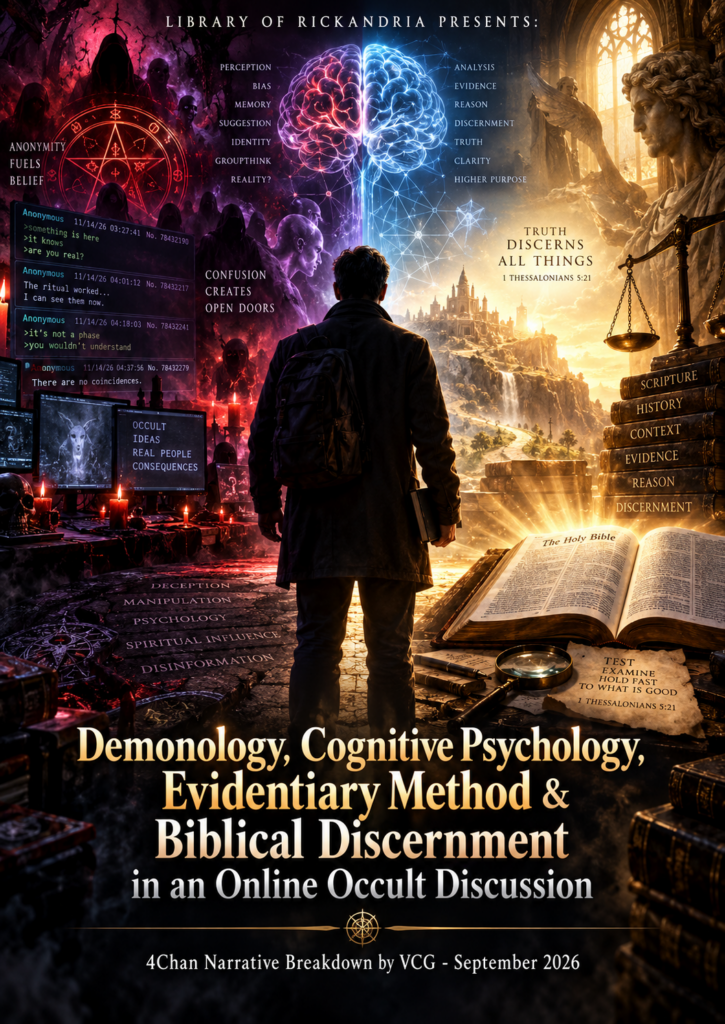
Demonology, Cognitive Psychology, Evidentiary Method & Biblical Discernment in an Online Occult Discussion
UPDATED BY VCG ON 9/18/2026 @ 20:20 EST
Anyone can do this, but most won’t.
ChatGPT – Library of Rickandria
Abstract
On September 5, 2026, an anonymous user on 4chan’s /x/ paranormal board opened a thread with a short question:
the poster said that he liked demonology, wanted to summon demons:
“to worship,”
and asked which ones he should choose.
/x/ – I like demonology and want to summon demons to wor – Paranormal – 4chan
The discussion that followed lasted into September 7 and moved rapidly through several very different kinds of claims:
- categorical skepticism
- occult advice
- personal testimony
- speculation about “tulpas,”
- theories of imagination
- dream cognition
- alleged spirit communication
- historical demon names
- warnings about deception
and jokes.
The thread is now archived.
This paper treats that discussion as a small case study in a much larger problem:
how should we reason when an unusual experience is interpreted as evidence of an unseen intelligent agent?
The investigation deliberately separates five questions that are often collapsed together.
What does the historical record show?
What does the anonymous testimony actually establish?
What psychological processes could produce similar experiences?
What kind of evidence would be needed to discriminate among competing explanations?
And, separately, what does the biblical text say about:
- demons
- occult consultation
- worship
- deception
and spiritual discernment?
The resulting picture is more complicated than either the thread’s believers or its skeptics generally allow.
The thread supplies no controlled evidence demonstrating that a named demon has been summoned as an independently existing intelligence.
At the same time, the strongest skeptical posts overreach when they move from:
“this has not been demonstrated”
to:
“this has never happened and never can.”
Contemporary psychology provides well-documented mechanisms capable of producing experiences of:
- presence
- agency
- meaningful coincidence
- involuntary movement
- autonomous-seeming thought
- vivid dream worlds
and perception shaped by expectation.
These mechanisms provide serious alternative explanations, but their existence does not logically prove that every alleged spiritual experience is reducible to psychology.
Within the biblical framework, the issue is different again.
Scripture presents evil spirits as real, but it does not instruct believers to authenticate that reality through experimental spirit contact.
Instead, it repeatedly directs worship to God alone,
- prohibits occult consultation
- commands discernment
- warns against deception
and describes resistance to the devil in terms of:
- truth
- righteousness
- faith
- Scripture
- prayer
- sobriety
- steadfastness
Biblical quotations in this paper use the supplied King James Version, Pure Cambridge Edition.
The central argument of this paper is therefore methodological before it is polemical:
An experience is not the same thing as an interpretation of the experience, and an interpretation is not yet an established cause.
That distinction allows us to take testimony seriously without becoming credulous, to take psychology seriously without turning it into metaphysical dogma, and to take Scripture seriously without forcing it to say more than its text supports.
PART I
THE THREAD
1. What We Are Actually Examining
The source is 4chan thread No. 42918983, posted on /x/ - Paranormal.
The original post is timestamped September 5, 2026, at 06:22:19.
The surviving page identifies the thread as archived and no longer open for replies.
The opening question is brief:
“I like demonology and want to summon demons to worship.”
The poster then asks which demons should be chosen and why.
That wording matters because several later participants correctly notice that the OP is combining concepts that are not identical.
The APA Dictionary of Psychology defines demonology as the systematic study of belief in demons and evil spirits.
Demonolatry, by contrast, simply means worship of demons.
Someone can therefore study demonology historically without practicing demonolatry, just as a historian can study ancient sacrifice without sacrificing anything.
That distinction sounds elementary, but it illustrates one of the recurring problems in the thread: language is constantly sliding between studying a belief, experiencing something, practicing something, and proving something.
Those are not the same activities.
2. Source Integrity and Evidentiary Limits
The thread should first be treated as an internet primary source—not as a collection of verified case reports.
We know that particular words appeared under particular anonymous post numbers at particular displayed times.
We do not ordinarily know who wrote them.
We cannot establish whether two “Anonymous” posts came from different people simply from their displayed names.
We cannot independently confirm whether autobiographical claims are:
- truthful
- mistaken
- exaggerated
- role-played
- copied
or deliberately fabricated.
This does not render the thread useless.
It determines what the thread can prove.
If an anonymous user writes,
“I was attacked by demons,”
the archived thread provides good evidence that someone posted that sentence.
It gives us weaker evidence that the writer sincerely believed it.
It gives us weaker evidence still about what actually happened outside the thread.
And by itself it supplies essentially no way to identify the cause of the reported event.
That hierarchy will matter repeatedly.
The anonymity of the setting may also affect what gets written.
John Suler’s influential treatment of the online disinhibition effect identified factors such as:
- anonymity
- invisibility
- asynchronicity
- dissociative imagination
and minimized authority as conditions that can change how people communicate online.
This does not mean anonymous testimony is false.
It means the social environment differs from:
- a signed interview
- clinical evaluation
- sworn statement
or controlled experiment.
The thread itself demonstrates that ambiguity.
Serious testimony sits beside trolling.
Historical claims sit beside jokes.
Psychological speculation sits beside practical occult recommendations.
A claim should therefore be evaluated because of its evidence, not because it appears confidently on a paranormal board.
PART II
HOW THE CLAIMS WILL BE JUDGED
3. A Claim Taxonomy
Before asking whether a statement is true, we need to know what kind of statement it is.
| Claim type | Example from the discussion | Appropriate question |
|---|---|---|
| Historical | Astaroth occurs in demonological literature | Does an identifiable text actually contain the name? |
| Experiential | “I got attacked by demons” | What experience is being reported? |
| Causal | A demon caused the experience | What evidence identifies that cause rather than alternatives? |
| Psychological | Demons are imagination-generated “tulpas” | Does research support the proposed mechanism, and how far? |
| Metaphysical | Imagined entities inhabit a realm of possibility | What warrants the ontology? |
| Theological | Demons exist and may deceive | What does the relevant religious text actually say? |
| Methodological | Ask an entity something you cannot know | Would the proposed test really exclude information leakage and chance? |
| Rhetorical | “No one can prove me wrong” | Is this argument or bravado? |
| Humorous/trolling | The ex-wife joke | Is there any factual proposition to evaluate? |
This classification prevents a common mistake:
treating all sentences as if they were competing scientific hypotheses.
They are not.
4. Evidence Grades Used in This Paper
Rather than forcing everything into “TRUE” or “FALSE,” the paper uses a more discriminating scale.
| Grade | Meaning |
|---|---|
| Documented | Directly supported by an identifiable primary or strong secondary source |
| Empirically supported mechanism | Research shows the proposed psychological process can occur |
| Plausible but unverified | Consistent with available evidence but not established in the particular case |
| Anecdotal | Based principally on testimony without independent confirmation |
| Historically attested claim | The belief appears in historical texts; this does not authenticate its supernatural content |
| Unsupported | Asserted without adequate evidence |
| Overstated | Contains a defensible core but claims more than the evidence permits |
| Unfalsifiable as presented | No imaginable outcome is allowed to count substantially against the claim |
| Non-substantive | Joke, insult, bump, or comment carrying little evidentiary content |
The point is not to produce a flashy scorecard. It is to avoid false precision.
PART III
THE CENTRAL EPISTEMIC PROBLEM
5. Experience, Interpretation, and Cause
Imagine three sentences:
I felt that somebody was standing behind me.
The presence seemed intelligent and hostile.
A demon was standing behind me.
They may feel like one continuous description. Epistemically, they are three different propositions.
The first describes an experience.
The second interprets qualities within that experience.
The third identifies its cause.
A person can be completely sincere about the first proposition and mistaken about the third.
This point is not hostile to spiritual belief.
It is ordinary reasoning.
A person may sincerely see what looks like water on a highway.
The visual experience is real; the interpretation:
“there is water there”
may be false because the cause is a mirage.
Likewise, a person can sincerely experience:
- a voice
- presence
- autonomous thought
- movement
- dream figure
- oppressive sensation
or remarkable coincidence.
The sincerity and intensity of the event do not, by themselves, tell us which causal explanation is correct.
The problem is one of underdetermination:
the same observation can sometimes be compatible with multiple explanations.
The Stanford Encyclopedia of Philosophy describes underdetermination in precisely these terms: available evidence may fail to determine uniquely which explanation should be accepted.
That gives us the working rule of this entire paper:
Take the experience seriously. Test the interpretation separately. Demand additional evidence for the proposed cause.
6. Competing Explanations
Suppose someone reports an intelligent presence after deliberately studying a named occult entity.
Several hypotheses become possible.
| Hypothesis | Could it produce the report? | What would discriminate it? |
|---|---|---|
| Deliberate fabrication | Yes | Independent corroboration, consistency, objective records |
| Trolling/role-play | Yes | Source history, behavior across contexts |
| Expectation/suggestion | Yes | Blinded conditions and manipulation of prior information |
| Associative learning | Yes | Testing whether conditioned cues predict experiences |
| Sleep-related experience | Sometimes | Sleep timing, paralysis, polysomnography where appropriate |
| Ideomotor action | For movement phenomena | Blinding, hidden targets, removal of participant contact |
| Implicit/forgotten knowledge | For “unknown” answers | Information-control procedures |
| Memory reconstruction | Yes | Immediate records versus later recollection |
| Coincidence plus selective attention | Yes | Prospective prediction and base-rate analysis |
| Unknown natural process | Possible | Further investigation |
| External human manipulation | Possible | Environmental and communication controls |
| External nonhuman intelligence | Logically possible | Reliable evidence uniquely favoring it over alternatives |
| Demon, specifically | A theological/metaphysical hypothesis | Requires further identification beyond merely establishing external agency |
The final row is especially important.
Even if somebody demonstrated an external intelligence, one more inferential step would remain:
Why call it a demon?
And beyond that:
Why call it Astaroth, Zozo, or any other named figure?
The more specific the conclusion, the more discriminating evidence is required.
PART IV
A CHRONOLOGICAL WALK THROUGH THE THREAD
7. The Opening: Worship Before Evidence
Post 42918983 begins not by asking whether demons exist, but by assuming enough of the occult framework to ask which demons should be worshipped.
Methodologically, this places the conclusion ahead of the investigation.
Biblically, the problem is more direct.
During Christ’s temptation, Satan offers worldly kingdoms in exchange for worship.
Jesus responds:
“Thou shalt worship the Lord thy God, and him only shalt thou serve.”— Matthew 4:10
Within Christianity, therefore, the question:
“Which demon should I worship?”
does not have a legitimate candidate answer.
CHRISTIANITY – Library of Rickandria
The theological answer is not:
“choose carefully.”
It is none.
That conclusion does not depend on deciding which grimoire tradition is historically authentic.
It arises from the biblical principle of exclusive worship.
8. “No One Has Ever Summoned a Demon”
Post 42918987 replies categorically that no one has ever successfully summoned a demon, no one ever will, and nobody can prove the poster wrong.
There is a reasonable skeptical core here:
The thread has not demonstrated a summoning.
But the writer then makes two much larger claims.
“No one has ever”
is a universal historical assertion.
“No one ever will”
is a universal prediction about the future.
Neither follows simply from the lack of a convincing demonstration in this thread.
The epistemically stronger formulation would be:
No reliably controlled demonstration has been presented here establishing successful demon summoning.
That statement leaves the evidentiary burden where it belongs without pretending to know every human event in history or the future.
Post 42919026 therefore asks the right question:
How do you know?
Skepticism is strongest when it remains skeptical of its own overstatements.
9. “Work With Them Instead”
Another poster objects not to demons but to the proposed relationship, arguing that worship would be foolish and that one should instead:
“work with”
such beings while expecting a bad bargain.
The problem is that the post has already granted the ontology.
Demons are described as social actors capable of bargaining and deception before any evidence has established that the entities under discussion exist independently.
From a psychological point of view, this is an example of agent-modeling:
ambiguous phenomena become narratively easier to manage once:
- intentions
- motives
- preferences
- personality
are attributed to an unseen agent.
That does not prove that no agent exists.
It simply means anthropomorphic detail cannot substitute for evidence.
Biblically, changing the proposed relationship from worship to collaboration does not resolve the issue.
James writes:
“Submit yourselves therefore to God.
Resist the devil, and he will flee from you.”— James 4:7
The direction of the passage is Godward submission and resistance, not negotiated partnership.
10. Names, Sigils, and Feeling “Drawn”
Post 42919433 recommends looking through demon names and sigils and choosing whichever one produces a sense of attraction.
The same poster acknowledges that different people may have dramatically different experiences with the same alleged demon.
There is a real historical element here.
Demonological manuscripts genuinely contain names, descriptions, and seals.
The British Library’s catalogue for Sloane MS 3648, for example, identifies material belonging to the Lesser Key of Solomon or Lemegeton.
Accessible editions of that textual tradition include a figure named Astaroth.
But two claims must remain separate:
A manuscript contains a spirit named Astaroth.
A supernatural being named Astaroth exists.
The first is a question of textual history.
The second is an ontological claim.
Historical documentation proves the former, not automatically the latter.
The suggestion to select whichever symbol one feels “drawn to” introduces another problem:
it selects the stimulus that is already emotionally salient and then allows subsequent experiences to be interpreted through it.
That is almost the opposite of blinding.
11. “Demons Are Tulpas”
Post 42919445 proposes a naturalistic explanation:
people read descriptions of demons and then use imagination to construct personified entities.
The poster calls these “tulpas.”
This claim deserves more care than either ridicule or immediate acceptance.
Contemporary tulpamancy is an observable online subculture.
A 2022 study of 243 participants examined tulpamancers, people reporting ASMR experiences, and controls.
The researchers explicitly described the unusual experiences in these nonclinical communities as generally sought and positive, and the study participants had no history of psychosis.
Group differences were found in some measures of hallucination-proneness and metacognition, but not in all of the constructs studied.
That research supports a modest claim:
Humans can deliberately cultivate experiences of apparently autonomous internal agents without those experiences necessarily being signs of psychotic illness.
It does not establish:
Every demon experience in history is a tulpa.
That universal conclusion exceeds the evidence.
So this anonymous poster may have identified a psychologically plausible mechanism while turning it into an overly complete metaphysics.
12. The Associative-Conditioning Post
Post 42919465 is one of the most psychologically revealing parts of the thread.
The poster recommends constructing a personalized entity narrative and repeatedly associating it with symbols and sensory cues.
Ordinary encounters with those cues are then supposed to be interpreted as signs of the imagined entity’s activity.
We will not reproduce the procedure as an instruction set. Its importance lies elsewhere.
Stripped of occult vocabulary, the post describes a feedback system involving:
- expectation
- associative learning
- selective attention
- meaning attribution
- memory consolidation
Suppose a person decides that an otherwise ordinary cue means:
“the entity is contacting me.”
The cue begins neutral.
The person attends to it more intensely.
Each occurrence becomes memorable.
Non-occurrences fade into the background.
Emotional arousal makes the noticed examples more salient.
The accumulating examples are then interpreted as confirmation that the original belief was correct.
What began as an assigned association can gradually feel discovered rather than invented.
Research on perception supports the broader point that expectations and prior beliefs can affect perceptual experience.
A review of the “strong priors” account of hallucinations notes that perception is constructive and that unusually strong priors can, under experimental conditions, generate hallucination-like percepts even in healthy participants.
Again, that does not prove that every sensed entity is internally generated.
It does show why a method built around expectation and repeated symbolic association is a poor method for demonstrating external agency.
13. “Everything Comes From Imagination”
The next poster claims that everything around us ultimately comes from someone’s imagination.
There is an obvious limited truth here.
- A computer
- cathedral
- novel
- logo
- chair
- game
or bridge can begin as a human conception.
But:
- mountains
- thunderstorms
- bacteria
- stars
- tectonic plates
and naturally occurring minerals do not therefore originate in human imagination.
The post equivocates between:
human artifacts can be designed mentally
and
reality is generated by imagination.
The former does not entail the latter.
Likewise, modern cognitive science’s claim that perception is constructive does not mean the external world is created by thought.
A model in the brain can mediate perception of an external object without creating that object.
14. “I Got Attacked by Demons”
Post 42920148 offers the thread’s clearest personal testimony:
the writer says he was attacked by demons and warns the OP not to proceed.
There are two bad ways to handle this.
One is to say,
“Therefore demons attacked him.”
The other is to say,
“Therefore he is lying or irrational.”
Neither is warranted.
The report establishes, at minimum, that the poster chose to describe an experience in demonic terms.
We have no:
- clinical history
- sleep history
- substance history
- environmental evidence
- recording
- independent witness
- chronology
or direct interview.
Research on felt presence is useful here.
A 2023 review describes felt presence as the sense that another being is nearby despite the absence of clear sensory evidence.
Such experiences occur across a wide range of contexts, including:
- neurological conditions
- psychosis-spectrum phenomena
- sleep paralysis
- anxiety
- endurance situations
- spiritual settings
and nonclinical experiences.
They may be comforting, neutral, or terrifying.
That gives us an important posture toward testimony:
The experience can be real as an experience even when its external cause remains unresolved.
15. “Almost Every Piece of Media Says You’re Wrong”
Post 42920170 appeals to the abundance of demon-related media as evidence against the skeptic.
This is not good evidence.
Stories document stories.
Movies document cultural imagination.
News reports document allegations and testimony.
Books document ideas.
Their evidentiary value depends on the underlying material.
Thousands of vampire stories do not biologically establish vampires.
Thousands of UFO stories establish a large body of reports, not a single agreed causal explanation for every report.
Media quantity and evidentiary quality are separate variables.
16. The “Unknown Information” Test
Post 42920425 makes a much stronger proposal.
According to the writer, demons cannot simply be imaginative constructs because one can supposedly ask them questions whose answers the practitioner could not know.
Now we have something testable.
But the anonymous poster’s proposed test is much weaker than it appears.
Human beings sometimes possess information they cannot consciously recall.
In an experiment using Ouija-style ideomotor responses,
- Gauchou
- Rensink
- Fels
found that participants who believed they were guessing performed at chance through ordinary deliberate responses but above chance in the study’s ideomotor condition.
The authors interpreted the result as evidence that implicit semantic knowledge can sometimes be expressed through unconsciously initiated movement.
This is directly relevant to the phrase:
“I couldn’t possibly know that.”
Conscious access to information and possession of information are not identical.
Other possibilities include:
- accidental cueing
- vague questions
- retrospective matching
- information leakage
- forgotten exposure
- flexible scoring
- coincidence
- selective reporting
and deliberate fraud.
So the thread has accidentally arrived at an excellent scientific question but has not designed an adequate experiment.
We will return to what such an experiment would require.
17. Summon Versus Worship
Posts 42922037, 42922041, and 42922049 focus partly on terminology, with one participant eventually noting that demonolatry is the more appropriate term for demon worship.
The terminology correction is supported by standard dictionary usage.
Historically, ceremonial spirit traditions have not all conceptualized spirits in the same way.
Some texts portray the operator as commanding or constraining spirits rather than worshipping them.
That distinction matters historically.
It does not solve the biblical problem.
Deuteronomy 18 does not merely prohibit bowing before an occult entity.
Its list includes:
- divination
- enchantment
- consulting familiar spirits
- wizardry
- necromancy
The passage continues by calling such practices abominations within Israel’s covenantal setting.
Within the biblical framework,
“I will consult rather than worship”
is therefore not an escape clause.
18. “Zozo”
A later participant recommends “the zozo demon,” promises that nothing bad will happen, and adds “trust me.”
The evidentiary value of this advice is effectively zero.
No evidence is supplied for:
- the being
- the identity
- the safety claim
or the poster’s authority.
Because this paper is analytical rather than instructional, there is no need to amplify modern internet folklore surrounding this name.
The relevant point is methodological:
A confident anonymous assurance is not risk assessment.
The immediate response claiming that:
“nothing will happen at all”
commits the opposite error.
It too predicts an outcome without evidence.
Even under a completely naturalistic model, an occult experiment could produce:
- fear
- expectation effects
- sleep disruption
- interpersonal consequences
- intrusive interpretations
or no noticeable result at all.
The supernatural question need not be settled in order to reject both absolute safety claims.
19. Dreams and the “Power of Imagination”
The discussion then turns to dreams.
Post 42923717 argues that the mind can generate worlds in dreams that the waking ego could never deliberately reproduce.
The poster ties this to the evolutionary history of DNA.
Another user replies that dreams can be reconstructed in Blender and recommends hypnosis-like techniques for remembering them.
A third insists that memory is irrelevant because dreams generate highly precise false worlds.
There are several separate claims here.
Dream experience can indeed feel extraordinarily rich.
But dream science has to distinguish at least three stages:
dream production, encoding of the dream into memory, and retrieval after waking.
Georgina Nemeth’s methodological analysis emphasizes precisely these distinctions and explains why a later dream report cannot simply be treated as a frame-by-frame recording of the original dream experience.
Memory also cannot simply be removed from the discussion.
A 2023 review found that memory traces are reactivated during sleep and may contribute to dream experience, while cautioning that such reactivation is unlikely to constitute the entire neural basis of dreaming.
So, both extremes fail:
Dreams are nothing but replayed memory is too simple.
Memory has nothing to do with dreams is also too simple.
The hypnosis recommendation is still more problematic.
A 2025 review of empirical work on hypnosis and memory concluded that hypnosis did not improve accurate recall in the reviewed studies and in some cases impaired it; hypnotic procedures also increased reports of events that had not occurred and could increase confidence in inaccurate recollections.
Vividness is therefore not the same as fidelity.
20. “Allies and Coworkers”
Post 42925693 again corrects the terminology from demonology toward demonolatry but then proposes treating demons as allies or coworkers.
Historically, that is one modern religious/occult posture among several.
It should not be projected backwards onto every demonological source.
The Lesser Key tradition, for example, often frames spirits through:
- ritual authority
- command
- constraint
- hierarchy
rather than modern egalitarian friendship.
The British Library manuscript record confirms the textual tradition; it does not authenticate its supernatural assertions.
Biblically, meanwhile, the category of “spiritual coworker” is not the model given for hostile spiritual powers.
Paul’s language in Ephesians 6 is opposition:
“Put on the whole armour of God, that ye may be able to stand against the wiles of the devil.”
He then describes:
- truth
- righteousness
- preparation of the gospel of peace
- faith
- salvation
- the word of God
- prayer
The emphasis is striking precisely because it is so unlike occult technique.
21. “Astaroth Always Happens”
Post 42925907 cryptically says,
“Astaroth always happens, 47.”
The phrase itself is too ambiguous for serious evaluation.
The name Astaroth, however, is historically documentable in grimoire traditions.
An edition of the Lesser Key of Solomon identifies Astaroth as one of the listed spirits and gives a traditional description and attributed powers.
That gives us a useful demonstration of the distinction between historical and ontological evidence.
We may responsibly say:
Astaroth is attested in a demonological textual tradition.
We may not move directly from that to:
Therefore, the entity described by the manuscript exists and performs the activities attributed to it.
Ancient or early-modern provenance does not turn a supernatural proposition into an observed fact.
22. What Could a Demon Want From a “Wagie” or “NEET”?
Post 42925930 speculates that demons would be uninterested in a person who has little economic or social status.
Another poster immediately asks whether this would make demons “materialists.”
The second comment exposes the problem in the first.
A completely undocumented psychology has been assigned to an unseen being.
The assumptions sound suspiciously human:
- status
- usefulness
- productivity
- exchange value
- hierarchy
This is not evidence about demons.
It is evidence about how humans imagine other minds.
23. “How Can You Trust What the Thread Is Telling You?”
Post 42926753 raises perhaps the strongest internal criticism offered by an occult-positive participant.
If demons are deceptive, the writer asks, why assume that anonymous recommendations are trustworthy?
Perhaps a malicious entity could manipulate the thread itself.
Taken narrowly, the epistemic problem is real:
A worldview that admits powerful deceivers needs criteria for distinguishing genuine from deceptive information.
But it can also become self-sealing.
- If confirmation proves the entity
- contradiction proves deception
- silence proves concealment
- failure proves trickery
and success proves manifestation, then no outcome genuinely tests the belief.
That is the point where “deception” can stop functioning as an explanation and start functioning as insulation from evidence.
The Bible does contain warnings about spiritual deception.
But careful interpretation is needed.
First John says:
“Beloved, believe not every spirit, but try the spirits whether they are of God.”
The next clause immediately explains the setting:
“because many false prophets are gone out into the world,”
followed by explicitly Christological criteria.
The passage is certainly about discernment.
It is not an instruction to create paranormal encounters so that spirits can be experimentally interrogated.
24. Jokes, Bumps, and Noise
Several posts merely “bump” the thread.
One makes an ex-wife joke.
Another makes a gender joke.
The final post mixes “Loki,” “Morning Star,” and “RuneScape” in what reads as trolling or absurd humor.
These posts are not evidence for or against demonology.
Their presence does, however, matter methodologically.
A thread can appear socially active without becoming evidentially stronger.
Repetition is not replication.
Engagement is not corroboration.
And irony creates an additional problem for anyone mining anonymous boards as if every line represented a stable doctrinal position.
PART V
THE PSYCHOLOGY OF ENTITY EXPERIENCES
25. Expectation and Strong Priors
Perception is not passive photography.
The brain combines sensory input with prior knowledge and expectations.
Under normal conditions, this helps us interpret incomplete information efficiently.
But if expectations become unusually strong, they can sometimes dominate ambiguous input.
A major review of hallucinations and predictive processing summarizes experimental evidence showing that sufficiently strong prior beliefs can contribute to perception-like experiences in the absence of corresponding external stimuli.
This matters directly to the thread.
A method that begins by teaching the practitioner what an entity is called, what personality it has, what symbols belong to it, what sensations may indicate its presence, and what coincidences should count as communication has already loaded the perceptual system with expectations.
A later experience may still be interesting.
But it is no longer independent of the suggestion that preceded it.
26. Felt Presence
One of the most striking paranormal experiences is the conviction that another being is physically present.
It can be powerful enough that:
“I only imagined it”
feels entirely inadequate to the person who experienced it.
That intensity should be respected.
At the same time, felt presence is a documented human phenomenon appearing in multiple settings without requiring one single cause.
The 2023 Lancet Psychiatry review surveys experiences associated with:
- neurological conditions
- sleep-related states,
- psychiatric phenomena
- endurance settings
- spiritual contexts
- nonclinical life
The correct scientific inference is therefore not:
“Presence is unreal.”
It is:
Feeling a presence does not uniquely identify what produced the feeling.
27. Sleep Paralysis and the “Intruder”
Sleep-related experiences deserve special attention because their phenomenology often maps remarkably well onto traditional supernatural narratives.
Research on hypnagogic and hypnopompic experiences during sleep paralysis describes an Intruder cluster involving fear, sensed presence, and visual or auditory phenomena; an Incubus cluster involving chest pressure, breathing difficulty, and distress; and unusual bodily experiences such as floating or out-of-body sensations.
A clinical review likewise describes the incubus phenomenon as sleep paralysis accompanied by sensed presence and frightening pressure on the chest.
None of this proves that every historical incubus story is:
“nothing but sleep paralysis.”
It establishes something more modest and more useful:
There is a known human state capable of producing experiences that can easily be interpreted as hostile supernatural visitation.
Therefore, whenever an entity report occurs during:
- falling asleep
- waking
- nighttime paralysis
- suffocation sensations
or bedroom apparitions, sleep state becomes an essential competing hypothesis.
28. Pattern Detection, Apophenia, and Synchronicity
Humans are pattern-finding organisms.
Usually that is adaptive.
Sometimes it generates false positives.
A 2023 signal-detection study involving 723 participants found an association between greater paranormal belief and a more liberal tendency to report patterns in noise, along with lower perceptual sensitivity in that particular experimental paradigm.
The authors appropriately cautioned that the effects were not the only or even necessarily the largest source of variance.
Earlier experimental work by Michiel van Elk likewise reported greater false-positive agency detection among paranormal believers than skeptics in a biological-motion task, while importantly noting that the finding did not generalize identically to traditional religious belief or witchcraft belief.
These findings should never be weaponized into:
“Religious people see things.”
That would badly overstate them.
Their relevance here is narrower.
If someone has already been instructed that:
- an ordinary number
- scent
- coincidence
- animal
- song
- dream
or technical malfunction counts as a communication, then the experiment lacks a neutral baseline.
29. The Confirmation Loop
The mechanism can be represented simply:
Expectation → increased attention → noticed coincidence → supernatural interpretation → emotional salience → stronger expectation → increased attention
The crucial asymmetry is that remembered hits accumulate while non-hits may disappear.
If someone says,
“Whenever the entity is near, I see 12,”
we need to know not merely how often 12 was noticed after the belief began, but how often comparable numbers appeared, how many opportunities existed, when the prediction was first recorded, and what would have counted as failure.
Without those controls, apparent synchronicity can become statistically uninformative.
30. Agency and the Feeling of “Not Me”
A thought, movement, voice, or image can feel autonomous.
That subjective autonomy is psychologically important, but it does not automatically establish another mind.
Ideomotor action gives a clear example.
Small unconsciously initiated movements can occur without a strong subjective sense of intentional authorship.
The Ouija experiment discussed earlier shows why an answer that feels as though:
“I didn’t consciously produce that”
need not originate in an external spirit.
The same principle should be handled cautiously when discussing inner speech or personified mental models.
“Not consciously authored”
is not equivalent to:
“externally authored.”
There are many layers of cognition outside immediate conscious access.
31. Tulpas Without Pathologizing Tulpamancers
The thread’s “tulpa” theory needs one further correction.
It is tempting to say that an autonomous-seeming companion must indicate illness.
The available evidence does not justify that generalization.
The 2022 tulpamancy study deliberately examined a nonpsychotic sample, and participants commonly described their unusual experiences as sought and positive.
That observation matters for this paper because it demonstrates that agent-like subjective autonomy can occur in psychologically complex but nonclinical contexts.
It also warns against two opposite stigmas:
“Entity experience proves a demon.”
“Entity experience proves mental illness.”
Neither follows automatically.
32. Dreams, Memory, and Retrospective Certainty
Dreams are especially vulnerable to epistemic overconfidence because they can be vivid while being difficult to preserve accurately after waking.
Current research distinguishes the dream itself from its encoding and retrieval.
That means a person’s later certainty about exactly what happened in a dream does not provide direct access to the original experience.
Adding hypnosis does not fix the problem.
Experimental literature reviewed in 2025 found no dependable gain in accurate recall from hypnosis and substantial reasons for concern about false or confidence-inflated memories.
Consequently, a dream reconstructed days later—even with extraordinary subjective confidence—should not be treated like contemporaneous video evidence.
PART VI
HISTORICAL DEMONOLOGY AND INTERNET DEMONOLOGY
33. Demonology Is a History Before It Is an Experiment
Wolfgang Behringer notes that the term demonology literally concerns the study of demons and their actions.
He also emphasizes that the meaning of daimon developed across classical and Christian traditions and that Christian demonology came to frame demons as evil and deceptive beings.
Early-modern demonology became entangled with:
- theology
- law
- witchcraft accusations
- discernment
and inherited ideas about agreements between humans and spirits.
This matters because internet occultism often compresses centuries of heterogeneous material into one apparently unified system.
It was never that simple.
- Demonological catalogues
- folk narratives
- theological texts
- magical manuscripts
- legal witchcraft theories
- nineteenth-century Spiritualism
- twentieth-century occult movements
- horror media
and twenty-first-century online communities do not form a single unchanging tradition.
The fact that two modern practitioners use the same demon name does not mean they are reproducing the same historical practice.
34. The Lesser Key as Historical Evidence
The British Library catalogue provides concrete manuscript evidence for Lemegeton or Lesser Key of Solomon material in Sloane MS 3648.
That is excellent evidence for the existence and transmission of a text.
The text itself includes catalogued spirits such as Astaroth.
But a critical historian has to resist an easy category error.
A medieval manuscript describing a dragon establishes a medieval dragon description.
It does not establish zoological dragons.
Likewise, a demonological manuscript establishes a historical demonological tradition.
Whether the entities described by that tradition correspond to external beings is a different question.
35. Textual Genealogy and Prior Contamination
Suppose a practitioner studies Astaroth’s traditional characteristics and later reports encountering a figure possessing exactly those characteristics.
Two interpretations immediately become possible.
The occult interpretation says the correspondence authenticates the entity.
The psychological interpretation says prior exposure supplied the template.
Because both hypotheses predict correspondence, correspondence by itself does not discriminate between them.
This is why prior knowledge matters so much.
The strongest evidence for an external source would involve information not available through the tradition, not available to the participant, not available to the experimenters during the test, specified before the result, and independently verified afterward.
That is a much higher bar than resemblance to a description one already studied.
PART VII
HOW WOULD WE ACTUALLY TEST AN ENTITY CLAIM?
36. Turning the Thread’s Best Idea Into a Real Experiment
Post 42920425 proposes asking an alleged entity for information the practitioner cannot know.
That can be turned into a serious experiment.
But the target would need to be generated and secured so that neither the claimant nor the person interacting with the claimant knows it during the trial.
The outcome measure would have to be defined in advance.
Vague semantic resemblance could not be accepted after the fact.
Every trial—including failures—would need to be recorded.
The procedure would need repeated trials rather than one dramatic success.
Independent investigators would then have to replicate the result.
Blinding and randomization exist precisely to reduce unnoticed confounds.
NIH guidance on scientific rigor emphasizes:
- transparent methodology
- masking/blinding
- randomization where appropriate
- comprehensive reporting
- replicability
If a claimant repeatedly produced hidden information at rates far beyond chance under such conditions, that would be genuinely interesting.
Even then, the inference should proceed in stages:
An anomaly occurred.
Then:
Information appears to have been acquired by a process not yet identified.
Then:
Is an external intelligence the best explanation?
And only much later:
What kind of intelligence?
Jumping directly from:
“unexpected correct answer”
to
“Astaroth did it”
would still be premature.
37. Why Failure Must Be Allowed to Count
A meaningful test requires the possibility of failure.
Suppose every outcome is interpreted this way:
Correct answer:
the demon communicated.
Incorrect answer:
the demon lied.
No answer:
the demon refused.
Contradictory answer:
another demon interfered.
Experiment disrupted:
demons dislike being tested.
There is no longer an experiment.
The hypothesis has been protected from every outcome.
This is why deceptive-agent explanations need special care.
Deception may genuinely occur in ordinary human life, but if it can explain literally every result, it loses discriminatory power.
PART VIII
THE BIBLICAL WITNESS
38. A Hermeneutical Guardrail
The biblical section of this paper uses four levels of statement.
Text:
what the passage actually says.
Immediate inference:
what follows reasonably from its context.
Theological interpretation:
how interpreters have synthesized the passage with other Scripture.
Speculation:
claims not actually supplied by the text.
Keeping these levels separate is important.
It would be inconsistent to criticize occultists for overinterpreting experience and then overinterpret Scripture ourselves.
39. Deuteronomy 18:9–14 — The Prohibition
Deuteronomy 18 places:
- divination
- enchantment
- witchcraft
- charming
- consultation with familiar spirits
- wizardry
- necromancy
among practices Israel is forbidden to imitate from surrounding nations.
The following verses explicitly describe such practices as abominations and contrast them with Israel’s required fidelity to the LORD.
The immediate biblical point is therefore clear:
Israel is not authorized to seek supernatural knowledge through these channels.
The passage does not offer a technical manual explaining which practices:
“really work.”
Its interest is covenantal obedience.
That distinction matters when people cite the prohibition itself as experimental proof of every occult claim ever made.
A prohibition can tell us what the text forbids without answering every modern scientific question about mechanism.
40. 1 Samuel 28 — Saul and the Woman at Endor
This is one of the most important and difficult passages in the entire discussion.
Samuel is dead.
Saul faces the Philistine army.
Saul inquires of the LORD and receives no answer:
“neither by dreams, nor by Urim, nor by prophets.”
He then seeks a woman described by the KJV as having:
“a familiar spirit”
and asks for Samuel.
The narrative subsequently calls the apparition Samuel.
The woman reacts strongly; Saul asks what she sees; the figure delivers a message condemning Saul’s prior disobedience and predicts his coming defeat and death.
That textual surface needs to be acknowledged honestly.
So do the interpretive disputes.
Across Jewish and Christian history, interpreters have offered several major readings:
that Samuel genuinely appeared by divine permission; that a deceptive spirit impersonated Samuel; that the woman produced deception or illusion; or variations in which an apparition is real but its mechanism differs from the medium’s presumed power.
Historical scholarship on the reception of the passage documents these competing lines of interpretation.
Modern literary study often focuses less on reconstructing paranormal mechanics and more on Saul’s tragic collapse.
A recent peer-reviewed treatment emphasizes the final meal scene as part of the portrayal of Saul’s approaching demise and loss of kingship.
The narrative’s theological trajectory is therefore clearer than its mechanics:
Saul has already rejected God’s word.
God is no longer answering him through the authorized means named in the narrative.
Saul responds not with repentance but by turning to a forbidden source.
The message he receives does not offer him a new occult path to wisdom.
It reiterates the judgment already hanging over him.
That makes 1 Samuel 28 a very poor text for the proposition,
“The Bible encourages us to test mediums and see what happens.”
Whatever interpretive view one takes of the apparition, Saul’s conduct is part of his downfall.
41. Matthew 4:1–11 — Worship and Testing God
In the wilderness temptation, Satan quotes Scripture as part of the temptation itself.
Jesus refuses both the testing proposed to him and the offer conditioned upon worship.
His response concerning worship is explicit:
“Thou shalt worship the Lord thy God, and him only shalt thou serve.”
The passage provides two useful corrections to the thread.
First, within Christian theology, spiritual-sounding quotation does not authenticate a speaker.
In the narrative, the tempter can quote Scripture.
Second, the response to temptation is not curiosity about Satan’s abilities.
Jesus refuses the terms.
42. Mark 5 — Authority, Not Fascination
Mark 5 depicts Jesus encountering a man with an “unclean spirit.”
The narrative names “Legion,” portrays multiple spirits, and emphasizes their submission to Jesus’ authority.
The passage is sometimes treated as if its central purpose were to supply a demonology catalogue.
Narratively, the emphasis is elsewhere.
The spirits do not become Jesus’ advisors.
The disciples are not told to form relationships with them.
The suffering man is restored.
The direction of the scene is liberation, not collaboration.
It is also worth noting that the Gospel traditions can distinguish sickness from demon-related phenomena rather than simply labelling every disorder demonic.
Mark 1, for example, speaks separately of people who were sick with diseases and those described as possessed with devils.
That does not provide a modern diagnostic system.
It does undermine the simplistic proposition that biblical language requires Christians to call every unusual symptom a demon.
43. Acts 16:16–18 — The Spirit of Divination
Acts describes a young woman with:
“a spirit of divination”
whose activity is economically profitable to her masters.
Interestingly, what she says about Paul and his companions sounds favorable:
she announces that they are servants of the Most High God who proclaim salvation.
Paul nevertheless commands the spirit to come out of her in the name of Jesus Christ.
This is highly relevant to the thread’s idea that useful information validates a spirit.
In Acts 16, apparently accurate or favorable speech is not treated as sufficient reason for partnership.
The narrative evaluates the source, not merely whether the words sound useful.
44. Acts 19:13–20 — Spiritual Technique Is Not a Toy
Acts 19 describes itinerant exorcists attempting to use the name of Jesus formulaically.
The episode goes badly for them.
The narrative then depicts believers renouncing magical practices and destroying books associated with “curious arts.”
Whatever one concludes historically about ancient magical practice, Luke’s theological direction is clear.
The Christian response in this narrative is movement away from magical technique, not its incorporation into Christian practice.
That is an important correction to attempts at “Christian occultism” built simply by adding biblical names to magical procedures.
45. 1 Corinthians 10:14–22 — Fellowship Matters
Paul begins the section:
“Wherefore, my dearly beloved, flee from idolatry.”
He then argues from sacrificial participation and states that the things Gentiles sacrifice are sacrificed:
“to devils, and not to God,”
adding that he does not want Christians to have:
“fellowship with devils.”
Modern scholarship likewise recognizes the passage’s strong either-or contrast between participation at the Lord’s table and participation in idolatrous cultic meals.
This is among the most direct biblical responses to the OP.
Paul does not solve the problem by recommending a less submissive style of demon interaction.
His command is flee from idolatry.
46. 2 Corinthians 11:13–15 — “Angel of Light” in Context
A frequently quoted line says that Satan is:
“transformed into an angel of light.”
But context matters.
Paul is discussing:
“false apostles”
and
“deceitful workers”
who present themselves as apostles of Christ.
He then compares their deceptive appearance with Satan appearing as an angel of light.
The passage certainly teaches that deceptive evil can present itself attractively.
But it should not be stretched into:
Anything beautiful, unusual, luminous, emotionally powerful, or mysterious is probably a demon.
Paul’s immediate subject is deceptive religious ministry.
That distinction protects the verse from becoming a blank cheque for suspicion.
47. Ephesians 6:10–18 — What Spiritual Warfare Actually Looks Like
Ephesians 6 explicitly describes struggle against:
- principalities
- powers
- rulers of darkness
- spiritual wickedness
That sounds, at first, like the ideal place for complicated demon-hunting technique.
Instead, Paul gives the reader:
- truth
- righteousness,
- the gospel of peace
- faith
- salvation
- the word of God
- prayer
- watchfulness
- perseverance
The contrast with much modern occult and sensationalist Christian material is striking.
The text’s response to spiritual opposition is profoundly God-centered and ethically ordinary.
48. James 4:7 — Submission Before Resistance
James writes:
“Submit yourselves therefore to God. Resist the devil, and he will flee from you.”
The following verse calls readers to draw near to God and purify their hearts.
Again, the movement is not:
study the devil,
engage the devil,
bargain with the devil,
experiment with the devil,
then defeat the devil.
It is:
submit to God,
resist evil,
draw near to God.
49. 1 Peter 5:8–9 — Sobriety, Not Obsession
Peter warns:
“Be sober, be vigilant.”
He describes the devil as an adversary seeking whom he may devour and then tells believers to resist him:
“stedfast in the faith.”
The vocabulary is important.
Sober. Vigilant. Steadfast.
Those words sit uneasily beside sensationalism.
A biblical demonology that produces:
- constant fear
- speculative taxonomy
- fascination with hidden hierarchies
or the attribution of every problem to spirits may be importing concerns the apostolic instructions themselves do not emphasize.
50. 1 John 4:1–6 — “Try the Spirits”
First John 4:1 is often quoted independently:
“Beloved, believe not every spirit, but try the spirits whether they are of God.”
But the verse immediately continues:
“because many false prophets are gone out into the world.”
The following verses give Christological and apostolic criteria.
The passage therefore establishes a principle of spiritual and doctrinal discernment.
It does not command believers to summon spirits so that they can be tested.
Discernment is not the same thing as deliberate exposure.
51. 1 Thessalonians 5:21 — “Prove All Things”
The phrase selected for the poster artwork deserves contextual treatment:
“Prove all things; hold fast that which is good.”
But immediately before it Paul says:
“Quench not the Spirit.
Despise not prophesyings.”
And immediately afterward:
“Abstain from all appearance of evil.”
So:
“prove all things”
is not a command to personally experiment with every dangerous or forbidden practice.
It is a call to discernment rather than gullibility.
The verse can support careful examination.
It cannot reasonably be used to cancel explicit biblical prohibitions by saying,
“I had to try necromancy so I could prove all things.”
PART IX
DOES THE BIBLE TEACH THAT EVERY PARANORMAL EXPERIENCE IS DEMONIC?
52. No Such Blanket Rule Appears
This point deserves emphasis because overreaction can become its own form of error.
The Bible speaks of dreams from God.
It speaks of ordinary dreams.
It speaks of false prophets.
It speaks of angels.
It speaks of evil spirits.
It speaks of sickness.
It speaks of deception by human beings.
It speaks of:
- human imagination
- fear
- ignorance
- temptation
- falsehood
It does not provide a rule saying:
Every unexplained experience is a demon.
Even in the Gospels, sickness and demon-related phenomena can be listed separately.
Therefore, a Christian does not become more biblical by diagnosing every:
- nightmare
- intrusive thought
- coincidence
- hallucination
- sleep-paralysis episode
- neurological symptom
- unusual dream
or unexplained noise as demonic.
That is an inference beyond the text.
Biblical seriousness and psychological seriousness need not compete.
PART X
DECEPTION AND THE SELF-SEALING PROBLEM
53. Satan as Deceiver
Scripture does portray deception as a spiritual danger.
Second Corinthians 11 is one example.
First John 4 demands discernment.
Matthew 24 warns about false prophets and deception.
But a theological warning about deception should not become an epistemology in which every contrary fact proves the theory.
If every failed prediction is demonic deception, then prediction loses its evidentiary value.
If every contradiction proves that spirits lie, no spirit message can authenticate the spirit.
This reveals an important difference between biblical discernment and occult information gathering.
The biblical texts do not tell believers that they can construct a reliable demon-science by asking deceptive spirits enough questions.
Quite the opposite.
PART XI
RHETORIC AND REASONING ERRORS IN THE THREAD
54. Recurrent Argument Patterns
Several errors appear on both sides.
The skeptics sometimes commit overclaiming from absence of demonstration:
“I have not seen convincing evidence”
becomes:
“it has never happened and never can.”
Occult-positive posters often commit argument from experience:
“It felt autonomous”
becomes:
“it was autonomous.”
Historical material produces appeal to antiquity:
“This name is old”
becomes:
“this entity is real.”
Media references generate appeal to popularity.
Unknown answers invite argument from ignorance:
“I do not know how I knew it”
becomes:
“therefore a spirit told me.”
Contradictions invite ad hoc rescue hypotheses:
failure becomes evidence of a deceptive spirit.
Symbolic coincidence invites confirmation bias and selective attention.
And terms such as:
- demon
- spirit
- tulpa
- imagination
- summoning
- worship
repeatedly shift meaning as the conversation proceeds.
None of these errors proves the opposite conclusion.
Finding a fallacy in a skeptic’s argument does not prove demons.
Finding a cognitive bias in a believer does not prove atheism.
It means that particular argument failed.
PART XII
THE STRONGEST VERSION OF EACH POSITION
55. Steelmanning Rather Than Caricaturing
| Position | Strongest case | What it still cannot establish |
|---|---|---|
| Hard skepticism | No reproducible controlled evidence in the thread demonstrates demon summoning; known cognitive mechanisms can explain many reports | It cannot logically prove that no spiritual being has ever existed or acted |
| Psychological interpretation | Expectation, felt presence, ideomotor action, implicit memory, sleep phenomena, pattern detection, dream reconstruction, and social reinforcement can produce striking entity-like experiences | Demonstrating mechanisms capable of producing an experience does not prove every instance has that cause |
| Occult realism | Long historical traditions exist, many people report seemingly autonomous encounters, and some claim information they did not consciously possess | Historical continuity and testimony alone do not exclude suggestion, implicit knowledge, information leakage, coincidence, fraud, or other explanations |
| Biblical supernaturalism | Scripture presents evil spirits as real and consistently commands God’s people to reject occult participation, resist the devil, and exercise discernment | Scriptural testimony is a theological-historical source; it is not equivalent to modern controlled laboratory replication, nor does it authorize experimental demon contact |
This table represents the main conclusion of the investigation.
We do not need to weaken one form of evidence to respect another.
We need to stop asking each form of evidence to do work it cannot do.
PART XIII
ETHICS AND PASTORAL CAUTION
56. Why This Paper Does Not Reproduce Ritual Instructions
A study of occult claims can inadvertently become an instructional guide.
That would defeat the purpose of this investigation.
For that reason, this paper identifies:
- texts
- names
- concepts
- historical practices
where necessary but does not reproduce complete:
- invocation procedures
- operational diagrams
- protective formulae
or step-by-step ritual techniques.
Historical completeness does not require operational reenactment.
The same principle applies psychologically.
If someone is distressed by:
- voices
- sensed presences
- sleep paralysis
- overwhelming fear
or intrusive experiences, the responsible response should not be to assume either supernatural attack or psychiatric pathology from a distance.
Experiences deserve careful assessment.
If there is an immediate risk of harm, medical or mental-health evaluation should not be postponed because someone has already adopted a supernatural interpretation.
That is compatible with theological seriousness.
It is simply recognition that causal diagnosis requires evidence.
PART XIV
LIMITATIONS
57. What This Paper Cannot Establish
There are limits to this project.
The 4chan participants are anonymous.
Their experiences cannot be independently reconstructed.
We do not know their:
- histories
- motives
- health status
- prior reading
or whether individual posts are sincere.
The psychological literature shows that natural mechanisms can produce classes of experiences resembling those described in occult discourse.
It cannot retrospectively diagnose anonymous posters.
Historical demonology demonstrates the development and transmission of beliefs.
It cannot independently authenticate supernatural entities.
Conversely, the absence of controlled scientific evidence in this thread cannot prove a universal metaphysical negative.
Biblical texts operate within a theological worldview in which:
- spirits
- angels
- demons
- revelation
- divine action
are treated as realities.
- Historical-critical
- literary
- confessional
- Jewish
and Christian interpreters may disagree about particular passages and mechanisms, most notably 1 Samuel 28.
The paper can therefore make stronger conclusions about method, text, and what evidence presently establishes than about every possible question of ultimate ontology.
That is not a weakness.
It is intellectual discipline.
PART XV
FINDINGS
58. What Survives the Investigation
Several findings remain after the thread is stripped of:
- bravado
- trolling
- suggestion
- terminology confusion
Historical demonology is real as history.
Texts cataloguing:
- spirits
- names
- descriptions
- magical practices
survive in manuscript traditions.
Astaroth, for example, is not an invention of this 4chan thread.
Human entity experiences are real as experiences.
People can genuinely experience:
- presences
- voices
- autonomous-seeming companions
- dreams
- involuntary movements
and meaningful patterns without consciously fabricating them.
Psychological mechanisms capable of producing many such phenomena are empirically documented.
- Expectation
- strong priors,
- ideomotor action
- implicit knowledge
- sleep paralysis
- dream-memory processes
and pattern-detection biases deserve serious consideration.
The 4chan thread does not contain a controlled demonstration establishing that a named demon exists as an independently acting supernatural intelligence.
It also does not justify the skeptic’s stronger claim that such beings have been proved impossible.
The biblical material occupies a different evidentiary category.
Within its own theological framework, Scripture presents hostile spiritual beings as real while repeatedly directing God’s people away from occult consultation and toward exclusive worship of God,
resistance to:
- evil
- truth
- faith
- Scripture
- prayer
- sobriety
- discernment
That biblical position differs from both major voices in the thread.
It differs from occult experimentation because Scripture does not authorize the cultivation of spirit relationships.
It differs from dogmatic materialist dismissal because Scripture does not reduce evil spirits to imagination.
And it differs from sensationalist Christianity because Scripture does not command believers to turn every ambiguous experience into demon activity.
PART XVI
CONCLUSION
59. From Experience to Ontology
The thread began with a deceptively simple question:
Which demon should I choose?
After examining the discussion:
- historically
- psychologically
- methodologically
- biblically
it becomes clear that this was never the most important question.
The deeper question is:
How do we know what we think we know about an unseen cause?
One poster says demons are impossible.
Another says demons attacked him.
Another says all demons are tulpas.
Another says unknown information proves they are not tulpas.
Another teaches the reader to condition ordinary sensory cues into signs of an imagined entity.
Another appeals to ancient demon names.
Another warns that demons may be deceiving the thread itself.
Every one of those moves crosses a boundary between evidence and interpretation.
The careful researcher does not have to mock any of them.
He has to slow them down.
“I experienced a presence.”
Good.
That is the datum.
“It seemed independent of me.”
That is an important phenomenological observation.
“It knew something I didn’t consciously know.”
Now we investigate:
- information pathways
- implicit memory
- scoring
- chance
- controls
“It was an external intelligence.”
That is a hypothesis requiring additional evidence.
“It was a demon.”
That is a more specific hypothesis.
“It was Astaroth.”
More specific still.
“The ancient grimoire proves it.”
No.
The grimoire proves a historical tradition.
“Psychology can reproduce similar experiences, therefore demons are impossible.”
No.
A sufficient alternative explanation for a class of observations does not prove universal metaphysical nonexistence.
“The Bible describes demons, therefore every strange thing is demonic.”
No.
Scripture itself does not reason that way.
This disciplined refusal to overclaim is not agnosticism about everything.
Some conclusions are quite strong.
The thread is real.
The historical demonological texts are real.
The psychological mechanisms are real.
The anonymous testimony is testimony.
The scientific demonstration of named external demons is absent from the thread.
And the biblical prohibition against occult consultation is explicit.
Within the biblical witness, the appropriate Christian response to spiritual evil is therefore neither fascination nor experimentation.
It is striking how consistently the relevant texts point elsewhere.
“Thou shalt worship the Lord thy God.”
“Flee from idolatry.”
“Resist the devil.”
“Be sober, be vigilant.”
“Put on the whole armour of God.”
“Believe not every spirit, but try the spirits.”
“Prove all things; hold fast that which is good.”
Read together, those passages do not construct an occult research program.
They construct a theology of allegiance, discernment, resistance, and truth.
And that may be the most important correction the 4chan conversation requires.
The choice is not between gullibility and contempt.
It is possible to hear an extraordinary claim without ridiculing the person making it, examine an experience without automatically validating its interpretation, use psychology without pretending psychology has solved metaphysics, study occult history without practicing it, and read Scripture without forcing it into conclusions it never states.
That is the standard this paper has attempted to follow.
APPENDIX A
COMPLETE THREAD AUDIT
| Post | Principal content | Classification | Assessment |
|---|---|---|---|
| 42918983 | Wants demons to summon and worship | Occult/theological | Confuses demonology with demonolatry; biblical worship principle directly conflicts |
| 42918987 | Nobody has ever or will ever summon one | Skeptical/metaphysical | Evidentiary skepticism reasonable; universal past/future claims unsupported |
| 42919026 | “How do you know?” | Methodological | Appropriate challenge to overclaiming |
| 42919242 | Bump | Non-substantive | No evidence |
| 42919292 | Work with demons rather than worship | Occult interpretation | Presupposes external agents without establishing them |
| 42919433 | Choose names/sigils one feels drawn toward | Occult advice | Historically recognizable framework; poor evidentiary method due expectancy |
| 42919445 | Demons are imagination/tulpas | Psychological/metaphysical | Plausible mechanism for some experiences; universal reduction unsupported |
| 42919465 | Build entity identity through symbolic/sensory associations | Psychological/occult | Closely resembles expectation and associative reinforcement; not evidence of external agency |
| 42919470 | Everything comes from imagination | Metaphysical | Equivocates between artifacts and external reality |
| 42919927 | Bump | Non-substantive | No evidence |
| 42920148 | Claims demonic attack | Testimony | Anecdotal; experience cannot be causally identified from post |
| 42920170 | Media proves skeptic wrong | Rhetorical | Popularity/media abundance does not establish ontology |
| 42920425 | Unknown answers disprove tulpa theory | Methodological | Potentially testable but uncontrolled; implicit knowledge and leakage must be excluded |
| 42922035 | Bump | Non-substantive | No evidence |
| 42922037 | Mocks summon/worship combination | Rhetorical | Highlights conceptual inconsistency but proves nothing |
| 42922041 | OP wants to try | Intent | Shows movement from curiosity to experimentation |
| 42922049 | “Demonolatry” terminology | Lexical | Correct terminology; insult irrelevant |
| 42923123 | Bump | Non-substantive | No evidence |
| 42923188 | Recommends “Zozo,” promises safety | Occult assertion | Unsupported; anonymous assurance has no evidentiary weight |
| 42923197 | Requests evidence from media claim | Methodological | Fair challenge, though media itself is not necessarily strong evidence |
| 42923198 | Says nothing will happen | Skeptical assertion | Unsupported absolute |
| 42923710 | Calls skeptic conceited | Rhetorical | Criticizes overconfidence but supplies no evidence |
| 42923717 | Dreams show power of imagination | Psychological speculation | Dreams are relevant; claims about ego/DNA and precision overreach |
| 42923767 | Blender reconstructions; hypnosis for memory | Anecdotal/methodological | Reconstruction possible; hypnosis is not a reliable accuracy amplifier |
| 42923778 | Memory irrelevant to dream generation | Psychological | Too categorical; dream-memory relationship is well documented but complex |
| 42924224 | Bump | Non-substantive | No evidence |
| 42925693 | Demons as allies/coworkers | Occult/theological | One modern framework, not historically universal; conflicts with biblical model |
| 42925882 | Ex-wife joke | Humor | No evidentiary content |
| 42925907 | “Astaroth always happens” | Occult assertion | Cryptic and unsupported; name itself historically attested |
| 42925930 | Demons care about status/productivity | Speculation | Anthropomorphic projection without evidence |
| 42926470 | Bump | Non-substantive | No evidence |
| 42926481 | Questions whether demons are materialists | Rhetorical critique | Successfully exposes unsupported assumptions in prior post |
| 42926753 | Deceptive demons might manipulate thread | Occult epistemology | Raises genuine internal trust problem; easily becomes unfalsifiable |
| 42926770 | Gender/demon joke | Humor | No evidence |
| 42926814 | Loki/Morning Star/RuneScape joke | Trolling/non sequitur | No serious demonological claim established |
The chronology and post content are preserved in the archived thread.
APPENDIX B
SCRIPTURE INDEX
| Passage | Relevance |
|---|---|
| Deuteronomy 18:9–14 | Prohibits divination, familiar spirits, wizardry, necromancy |
| 1 Samuel 28 | Saul’s forbidden consultation at Endor; major interpretive dispute |
| Matthew 4:1–11 | Exclusive worship; Satan’s use of Scripture; refusal to test God |
| Mark 5:1–20 | Jesus’ authority over unclean spirits |
| Acts 16:16–18 | Spirit of divination rejected despite apparently useful speech |
| Acts 19:13–20 | Failed formulaic exorcism; rejection of magical practices |
| 1 Corinthians 10:14–22 | Flee idolatry; no fellowship with devils |
| 2 Corinthians 11:13–15 | Deception and the “angel of light” image in false-apostle context |
| Ephesians 6:10–18 | Spiritual warfare through truth, righteousness, faith, Scripture, prayer |
| James 4:7–8 | Submit to God; resist devil; draw near to God |
| 1 Peter 5:8–9 | Sobriety, vigilance, steadfast resistance |
| 1 John 4:1–6 | Testing spirits in context of false prophets and Christological confession |
| 1 Thessalonians 5:19–22 | Discernment of prophecy; test, hold good, abstain from evil |
APPENDIX C
SOURCE HIERARCHY
| Tier | Source type | Use in this paper |
|---|---|---|
| 1 | Primary source | Archived 4chan thread; biblical text; historical manuscripts/text editions |
| 2 | Peer-reviewed empirical research | Cognitive psychology, sleep, memory, ideomotor action, perception |
| 3 | Academic historical/biblical scholarship | Demonology history, Samuel studies, reception history |
| 4 | Professional reference works | Terminology and definitions |
| 5 | Confessional commentary | Used only where explicitly identified as interpretation |
| 6 | Anonymous testimony | Treated as testimony rather than independently verified fact |
SELECTED REFERENCES
| Author / source | Work | Relevance |
|---|---|---|
4chan /x/ | Thread No. 42918983, Sept. 5–7, 2026 | Primary source for the discussion analyzed here. |
| American Heritage Dictionary | “Demonolatry” | Defines demonolatry as demon worship. |
| American Psychological Association | “Demonology” | Reference definition of demonology. |
| Barnby, Joseph M., et al. | “The felt-presence experience: from cognition to the clinic,” Lancet Psychiatry 10 (2023) | Review of sensed-presence phenomena across clinical and nonclinical contexts. |
| Behringer, Wolfgang | “Demonology, 1500–1660,” Cambridge History of Christianity | Historical context for Christian and early-modern demonology. |
| British Library | Sloane MS 3648 catalogue record | Manuscript evidence for Lesser Key of Solomon/Lemegeton material. |
| Cheyne and colleagues | Research on hypnagogic/hypnopompic hallucinations and sleep paralysis | Intruder, incubus, and unusual bodily-experience phenomenology. |
| Gauchou, Hélène L.; Rensink, Ronald A.; Fels, Sidney | “Expression of nonconscious knowledge via ideomotor actions,” Consciousness and Cognition 21 (2012) | Ouija-style ideomotor action and implicit semantic knowledge. |
| Jacobs, Jonathan | “Saul’s Meal at Endor,” Scandinavian Journal of the Old Testament | Literary analysis of Saul’s final scene at Endor. |
| Krackow, Rashed & Thompson | “Does Hypnosis Aid Memory Retrieval?” (2025) | Review finding no reliable improvement in accurate recall and risks of false memory/confidence. |
| Müller, Petra; Hartmann, Matthias | “Linking paranormal and conspiracy beliefs to illusory pattern perception through signal detection theory,” Scientific Reports 13 (2023) | Large-sample study of pattern detection and paranormal belief. |
| Nemeth, Georgina | “The route to recall a dream,” Psychological Research 87 (2023) | Distinguishes dream production, encoding, and retrieval. |
| Palmer-Cooper, Emma; McGuire, Nicola; Wright, Abigail | “Unusual experiences and their association with metacognition: investigating ASMR and Tulpamancy,” Cognitive Neuropsychiatry 27 (2022) | Nonclinical tulpamancy research. |
| Picard-Deland, Claudia, et al. | “Memory reactivations during sleep: a neural basis of dream experiences?” Trends in Cognitive Sciences 27 (2023) | Review of memory reactivation and dreaming. |
| Suler, John | “The online disinhibition effect,” CyberPsychology & Behavior 7 (2004) | Framework for anonymity and online communication behavior. |
| van Elk, Michiel | “Paranormal believers are more prone to illusory agency detection than skeptics,” Consciousness and Cognition 22 (2013) | Agency-detection experiment with important scope limitations. |
| Stanford Encyclopedia of Philosophy | “Underdetermination of Scientific Theory” | Framework for evidence compatible with multiple explanations. |
| U.S. National Institutes of Health | “Enhancing Scientific Rigor, Transparency and Replicability” (2026) | Blinding, randomization, transparency, and replicability principles. |
| King James Bible, Pure Cambridge Edition | Supplied primary biblical text | Biblical quotations and contextual analysis throughout. |
Closing Principle
A useful way to condense the entire investigation is this:
Historical attestation tells us what people wrote.
Testimony tells us what people report.
Psychology tells us what the human mind is capable of producing.
Methodology tells us what a claim would have to survive before we identify its cause.
Scripture tells us what the biblical writers teach and command.
Confusing those categories creates:
- bad history
- bad science
- bad psychology
- bad theology
Keeping them distinct allows them to illuminate one another.
“Prove all things; hold fast that which is good.” — 1 Thessalonians 5:21
4CHAN THREAD & POST BREAKDOWNS – Library of Rickandria
VCG PAPER PROJECTS – Library of Rickandria