UPDATED BY VCG ON 11/8/2026 @ 23:23 EST
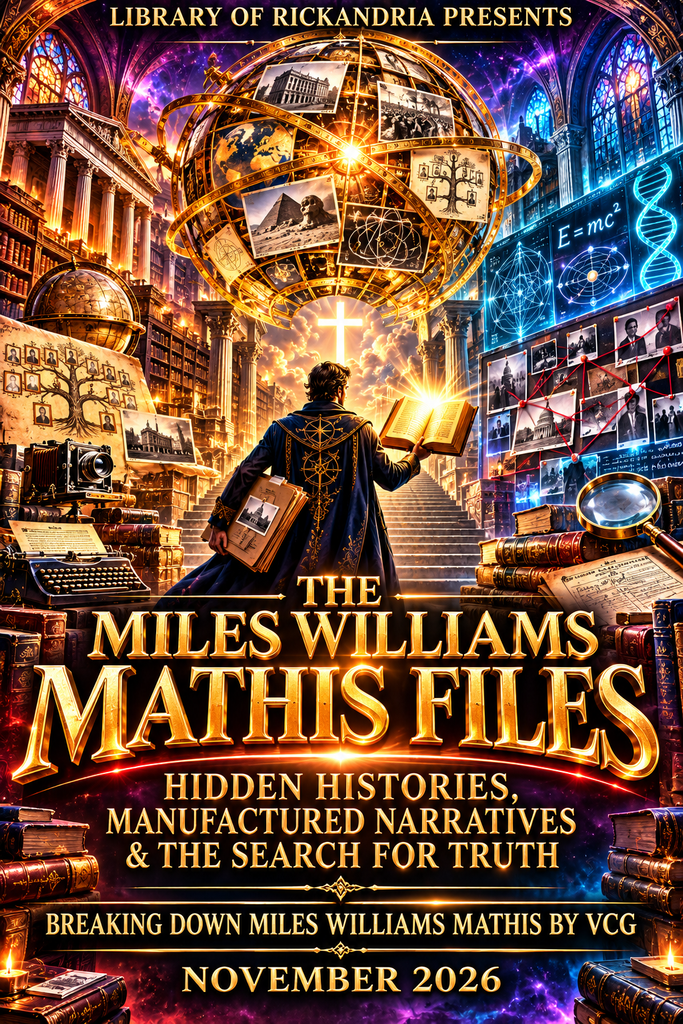
THE MILES WILLIAMS MATHIS FILES
HIDDEN HISTORIES, MANUFACTURED NARRATIVES & THE SEARCH FOR TRUTH
LIBRARY OF RICKANDRIA PRESENTS
An Investigation of:
- Conspiracy Claims
- Historical Revisionism
- Genealogy
- Scientific Controversies
- Controlled Opposition
- Biblical Discernment
9 Featured Research Works • Research & Investigations by VCG • 2026
“Prove all things; hold fast that which is good.” — 1 Thessalonians 5:21, KJV
INTRODUCTION — THE MAN, THE METHOD & THE MYSTERY
What happens when a researcher claims that familiar stories from:
- history
- science
- politics
- entertainment
- public life
are not simply incomplete, but deliberately constructed?
Miles Williams Mathis is an American artist and prolific independent writer whose publicly available material ranges from portraiture and art criticism to:
- unconventional physics
- historical revisionism
- genealogy
- allegations about staged events
His work asks readers to:
- look again at accepted explanations
- scrutinize photographs
- trace family relationships
- question institutions
His conclusions, however, often extend far beyond the evidence immediately presented.
The Library of Rickandria brings together nine featured investigations by VCG to examine not only what Mathis argues, but how his arguments are built.
The collection also tests the reasoning of his critics.
It examines allegations about:
- manufactured history
- suspicious patterns
- supposed covert networks
- disputed scientific assertions
- religious teachings
- the difference between independent thought and evidence-based inquiry
This hub does not ask readers to accept official accounts automatically.
Institutions can err, conceal information, or mislead.
Nor does it ask readers to accept an alternative account simply because it challenges authority.
The same questions apply to every side:
What exactly is being claimed?
A historical event, an interpretation, a possibility, or an allegation against a person?
What evidence supports it?
A primary document, authenticated record, reproducible measurement, contemporary testimony, or merely a resemblance?
What reasoning connects the evidence to the conclusion?
Are there missing steps or alternative explanations?
What would change our minds?
Can the claim be tested and, in principle, disproved?
What does Scripture actually teach?
Where does biblical instruction end and a modern historical interpretation begin?
This is a research hub, not a verdict on Mathis as a person.
Its aim is to make claims, sources, conclusions, and uncertainties visible to the reader.
WHO IS MILES WILLIAMS MATHIS?
Mathis presents himself as an artist and writer.
His own website includes:
- artwork
- biographical information
- art criticism
- scientific papers
- numerous essays disputing aspects of established historical and public narratives
These self-published materials are important primary sources for what he says and believes; they are not, by themselves, independent verification of his assertions.
His writing frequently uses:
- photographic anomalies
- dates and numbers
- surname similarities
- family trees
- media inconsistencies
- institutional connections as starting points
Some of these may identify legitimate questions.
But an anomaly is not itself proof of intentional fabrication, and a genealogical connection does not establish shared motives or coordination.
Claims that Mathis is secretly an intelligence operative or a controlled-opposition project likewise require evidence.
A critic’s suspicion, his unusual writing style, or the possibility of pseudonymous contributors cannot establish covert employment or organizational direction.
The burden of proof belongs to the party making the accusation.
For direct comparison, consult Mathis’s own website and the Library’s earlier assessment of his public record.
PART I — THE CENTRAL EVIDENCE AUDIT
01. THE MILES WILLIAMS MATHIS FILES: Truth, Error, Speculation & False Light — A Complete Evidence Audit
The principal, book-length investigation of the Mathis phenomenon.
It examines his:
- public persona
- research methods
- claims about history and science
- uses of genealogy and imagery
- treatment of religion
- assertions about hidden coordination
Importantly, it also revisits the Library’s own earlier assessments and asks whether critics have sometimes used the same speculative methods they condemn.
Central question:
Can we distinguish what a writer has demonstrated from what merely fits an attractive explanatory pattern?
READ THE COMPLETE EVIDENCE AUDIT
02. The Miles Mathis Framework: Mapping a System of Pattern-Based Narrative Construction
A companion research resource focused on recurring rhetorical patterns and the structure of narrative construction across Mathis-related writings.
Its current WordPress gateway primarily links to a companion Basecamp document; the gateway alone does not establish statistical conclusions about authorship, coordination, or intention.
Central question:
When multiple writers use similar language and reasoning, is that evidence of shared methods, common editorial influence, coordinated authorship—or something still unproved?
PART II — CASE STUDIES: WHEN EXTRAORDINARY CLAIMS MEET THE RECORD
03. “The Fake Fort Hood Shooter”? 53 Claims, Fatal Flaws & the Evidence Miles Mathis Overlooked
An extensive response to Mathis’s claim that the November 5, 2009, Fort Hood mass shooting was staged.
The paper evaluates 53 findings through:
- legal proceedings
- military and government records
- reported testimony
- forensic questions
- numerical inferences
- genealogical arguments
It distinguishes documented investigative failures from the far stronger and unsubstantiated claim that the victims and crime were part of a staged production.
Central question:
What additional evidence is required before an inconsistency becomes proof that an entire event was fabricated?
READ THE 53-CLAIM FORENSIC EXAMINATION
04. Prosecution Follies Examined: A Forensic, Historical, Medical, Legal, Psychological & Biblical Rebuttal to Miles Mathis
A page-by-page examination of Mathis’s Prosecution Follies.
The Library’s study separates observations from extrapolations and addresses claims involving:
- public legal proceedings
- medical evidence
- genealogy
- numerology
- historical atrocities
It explicitly rejects Holocaust-denial assertions and stresses that an allegation of fraud requires more than suspicious language or apparent coincidences.
Central question:
If contrary documents are always dismissed as fabricated, what evidence could ever disprove the theory?
READ PROSECUTION FOLLIES EXAMINED
PART III — TECHNOLOGY, SPIRITUAL TEACHINGS & SCRIPTURE
05. AI & the Spirit of Gnosticism: A Christian Examination of Miles Mathis
A Christian critique of Mathis’s arguments about artificial intelligence and his depiction of modern technology as deception.
The paper considers genuine concerns such as model errors and bias while distinguishing those concerns from broader claims that AI is wholly fraudulent or spiritually determined.
The comparison with Gnosticism is a theological analogy, not proof of Mathis’s membership in an ancient religious movement.
Central question:
How can criticism of technology remain accurate without turning suspicion into a comprehensive worldview?
READ AI & THE SPIRIT OF GNOSTICISM
06. Prove All Things: Examining Bruce Charlton’s “The Miles Mathis Phenomenon — Evaluated”
The first entry in a three-part examination of Bruce Charlton’s published responses to Mathis.
This study tests Charlton’s characterization of Mathis as a materialist against Mathis’s own statements, reviews weaknesses in historical and genealogical reasoning, and distinguishes doctrinal criticism from unsupported judgments about someone’s psychology or spiritual condition.
Central question:
Can a critic be right about research weaknesses while being wrong about the writer’s stated beliefs and motives?
READ THE MATHIS PHENOMENON EXAMINED
07. THINK FOR YOURSELF — BUT PROVE IT: Examining Charlton’s “More on Miles Mathis”
The second Charlton study considers whether unconventional thinking remains valuable when it repeatedly yields factual error.
It distinguishes legitimate independence from a habit of rejecting institutional testimony by default.
Central question:
Is independent thought a virtue apart from accuracy, accountability, and a willingness to correct mistakes?
READ THINK FOR YOURSELF — BUT PROVE IT
08. FEAR NOT — BUT FEAR GOD: Examining Charlton’s “Miles Mathis’s ‘Credo’: On Jesus & Fear”
The theological capstone of the Charlton sequence.
It examines competing views about:
- Jesus Christ
- the cross
- resurrection
- sin
- spiritual beings
- reincarnation
- fear
It distinguishes the Bible’s commands against fearing people from its positive teaching about reverence for God.
Central question:
What do the biblical texts actually say, and what has each modern interpreter added to them?
PART IV — INVESTIGATING THE INVESTIGATORS
09. THE LIMITED HANGOUT? Testing Allan Weisbecker’s Case Against Miles Mathis
A detailed examination of Allan C. Weisbecker’s two-part Open Letter to Miles Mathis.
It assesses criticisms involving:
- alleged errors
- genealogy
- vocabulary
- interviews
- document histories
It also tests whether those observations justify the further allegation that Mathis represents a government psychological operation or concealed group of authors.
Central question:
Can a critic correctly identify weaknesses in an argument and still make an unsupported leap when explaining those weaknesses?
A BIBLICAL FOUNDATION FOR TRUTHFUL INVESTIGATION
1. Test claims, not just the people making them
“Prove all things; hold fast that which is good.” — 1 Thessalonians 5:21, KJV
Paul’s instruction concerns careful discernment.
As an investigative principle, it discourages automatic belief and automatic dismissal alike.
Its application to archives, testimony, and scientific claims is a reasoned extension of the principle, not a claim that Paul wrote specifically about modern conspiracy research.
2. Hear both sides before reaching a verdict
“He that is first in his own cause seemeth just; but his neighbour cometh and searcheth him.” — Proverbs 18:17, KJV
A Mathis paper deserves to be read accurately, and so do the records and critics it disputes.
The fact that one party tells a compelling story does not make the story true.
3. Do not condemn before examining the evidence
“He that answereth a matter before he heareth it, it is folly and shame unto him.” — Proverbs 18:13, KJV
This applies equally to those who accuse public figures of covert wrongdoing and those who dismiss every unconventional researcher without reading the claim.
4. Recognize the moral weight of an accusation
“Thou shalt not bear false witness against thy neighbour.” — Exodus 20:16, KJV
When historical theories name:
- victims
- survivors
- families
- religious groups
or identifiable living people, rhetorical speculation can have human consequences.
- Errors
- relationships
- surnames
- religion
- ethnicity
or appearance cannot establish complicity in wrongdoing.
5. Make righteous judgment rather than superficial judgment
“Judge not according to the appearance, but judge righteous judgment.” — John 7:24, KJV
A photograph’s odd appearance, an unusual family resemblance, a recurring number, or a suspicious-sounding surname is not enough.
Investigators must ask what the evidence actually demonstrates.
Scripture supplies ethical and theological standards; it does not replace archives, medical evidence, legal records, or scientific testing.
THE RICKANDRIA EVIDENCE TEST: SEVEN QUESTIONS
| Question | The standard |
|---|---|
| 1. What is the precise claim? | Write it as a proposition that could be checked. |
| 2. What is the primary source? | Locate the original essay, document, image, data, or legal record. |
| 3. Is the evidence authentic and contextualized? | Establish provenance, dates, editing, and relevant context. |
| 4. What is observed versus inferred? | A resemblance, anomaly, or relationship is not a demonstrated conspiracy. |
| 5. What alternative explanations remain? | Consider coincidence, error, incomplete records, institutional mistakes, and ordinary social connections. |
| 6. What could disprove the theory? | A theory that treats every contradiction as proof of concealment cannot be fairly tested. |
| 7. How certain should the conclusion be? | Distinguish documented, strongly supported, plausible, unsubstantiated, and contradicted claims. |
A photograph may truly have been edited without proving that an entire event was staged.
Two people may genuinely share ancestors without being conspirators.
A writer may be wrong without knowingly deceiving readers.
Likewise, a criticism may be persuasive without establishing that its subject is an intelligence agent.
Suspicion should initiate inquiry—not substitute for its conclusion.
RECOMMENDED READING ORDER
Start with the complete framework.
Read The Miles Williams Mathis Files to understand the project and its commitment to examining its own earlier judgments.
Then open The Miles Mathis Framework as a companion to the analysis of recurring narrative patterns.
Test the method against particular events.
Read The Fake Fort Hood Shooter? and Prosecution Follies Examined.
These studies show why serious accusations demand primary records, specialist context, and an unusually strong evidentiary foundation.
Study worldview and Scripture separately from historical proof.
Continue with AI & the Spirit of Gnosticism and the three Charlton examinations, in sequence.
Distinguish Mathis’s actual theological statements, Charlton’s readings of them, and the KJV text itself.
Finish by auditing the critics.
Read The Limited Hangout? and ask whether every objection has been held to the same standard as the original Mathis claims.
FREQUENTLY ASKED QUESTIONS
Who is Miles Williams Mathis?
Mathis is a writer and visual artist who publishes work on:
- art
- physics
- genealogy
- controversial interpretations of history and public events
His own website is an important source for understanding what he claims, but independent evidence is needed to confirm contested assertions.
Is this hub defending or attacking Mathis?
Neither is its purpose.
It is an organized investigation into claims, evidence, and argument structure.
A correct point remains correct even when other assertions are wrong, and a weak critique should be corrected even when the underlying Mathis theory is unsubstantiated.
Does a historical error prove that a writer is part of a psychological operation?
No.
Demonstrating falsehood does not by itself demonstrate intent to deceive, and proving intent would not automatically establish involvement with an intelligence service.
Each conclusion requires different evidence.
Can genealogy prove covert coordination?
Genealogical records can establish properly documented family relationships.
They do not, without additional evidence, establish:
- political loyalty
- shared beliefs
- criminal involvement
or coordinated operations.
Claims that infer culpability from Jewish ancestry or other ethnic and religious identity are especially unsound.
What does the collection say about manufactured or staged events?
It evaluates specific claims rather than presuming all such claims are true or false in advance.
Staging a public event,
falsifying a document,
and fabricating an entire historical tragedy are different allegations with different burdens of proof.
How should readers approach Mathis’s scientific claims?
Identify the exact mathematical or physical proposition,
examine the derivation,
compare it with established observations and reproducible tests,
and separate any legitimate technical critique from unrelated claims about secret institutional motives.
Can the King James Bible establish whether a particular historical conspiracy occurred?
Scripture can provide ethical principles, doctrine, and warnings about deception.
It does not independently document a named modern conspiracy.
Historical claims still require historical evidence.
Why investigate Mathis’s critics?
Because criticism can contain its own:
- errors
- selective sourcing
- psychological guesses
or speculative claims.
The same standard must apply to Mathis, his detractors, official institutions, and the Library’s own research.
PRIMARY SOURCES & COMPANION RESEARCH
Miles Williams Mathis — Personal Art & Counter-Criticism Website — Direct source for the writer’s published material and self-description. His publication does not equal independent corroboration.
BREAKING DOWN MILES WILLIAMS MATHIS — Existing Library Index — The current nine-work research index.
BREAKING DOWN MILES WILLIAMS MATHIS — Basecamp Collection — Companion collection listing the nine current featured studies.
Assessment of Miles Williams Mathis: Independent Thinker or Controlled Opposition? — Earlier VCG review that found no demonstrated intelligence link; its subjective probability estimates were not measured frequencies.
Prove All Things: A Forensic Dissection of the Miles Mathis Jesuit Narrative — Additional study of genealogy, historical inference, and religious accusations.
An Open Letter to Miles Mathis: Part I — An earlier critical work considered by the later Limited Hangout? investigation.
Editorial note:
The nine works above are the featured links on the current Miles Mathis index.
The further resources here are supplementary and are not included in that count.
RELATED LIBRARY OF RICKANDRIA HUBS
UNDERSTANDING THE OCCULT — Hidden Knowledge, Ancient Symbols & the Search for Truth
UNDERSTANDING CHRISTIANITY — The Gospel, the Evidence & the Search for Truth
JESUS CHRIST — The Man, the Messiah & the Evidence
THE ALIEN DECEPTION? — UFOs, Nephilim, Hidden Histories & the Search for Truth
FINAL PERSPECTIVE — WHERE THE EVIDENCE ENDS, CERTAINTY MUST END
History deserves questions.
- Government statements
- scientific claims
- archival records
- popular narratives
should not be exempt from careful investigation.
But questioning is a method, not an answer.
A real inconsistency may deserve further research.
It does not automatically establish a cover-up.
A documented family connection is not evidence of collective guilt.
An institution’s proven misconduct in one matter does not invalidate every record it has ever produced.
Likewise, an independent writer’s willingness to challenge convention does not make every unconventional conclusion true.
The same caution extends to our own conclusions.
The Library of Rickandria must be willing to correct its earlier work when the sources demand it.
To hold others to a standard we will not apply to ourselves is not discernment.
“Prove all things; hold fast that which is good.” — 1 Thessalonians 5:21, KJV
The goal is neither to believe Miles Mathis nor to disbelieve him on principle.
It is to read the actual argument, examine the evidence, test the reasoning, preserve what survives, correct what fails, and acknowledge what remains unknown.
Truth does not become stronger when uncertainty is hidden.
SOLI DEO GLORIA — TO GOD ALONE BE THE GLORY.
LIBRARY OF RICKANDRIA · RESEARCH & INVESTIGATIONS BY VCG · 2026
THE MILES WILLIAMS MATHIS FILES: HIDDEN HISTORIES, MANUFACTURED NARRATIVES & THE SEARCH FOR TRUTH