UPDATED BY VCG ON 11/22/2026 @ 00:00 EST
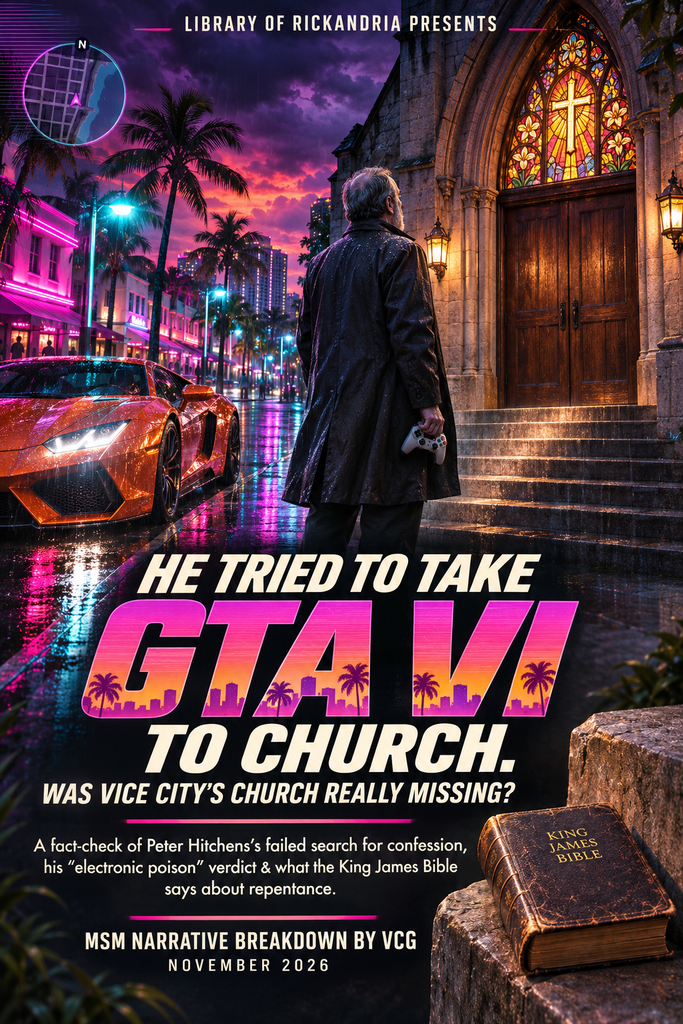
A fact-check of Peter Hitchens’s failed search for confession, his “electronic poison” verdict & what the King James Bible says about repentance.
Anyone can do this, but most won’t.
Peter Hitchens went looking for a Catholic priest in Grand Theft Auto VI because he wanted his character to confess and change his ways.
His search came up empty, but independent reporting identified a church building in Vice City that players couldn’t enter.
This Library of Rickandria investigation traces how one failed search became a claim about an entire city, examines what the game rewards and penalizes, and weighs Hitchens’s “electronic poison” verdict against research on aggression, empathy, and short-term desensitization.
The King James Bible takes the question beyond the screen, from Christ’s once-for-all atonement to the fruit of repentance and the mercy we show a real neighbor in need.
ChatGPT – Library of Rickandria
MSM Narrative Breakdown by VCG · November 2026
The church was there.
The confession was still missing.
Peter Hitchens wanted to see what would happen if a character in Grand Theft Auto VI decided he’d had enough of being a criminal.
Could he walk into a Roman Catholic church, confess to a priest, and spend the rest of the evening treating people better?
Hitchens and his guide, Daily Mail gaming colleague Mourad El-Dine Abdou, came away without finding a place to do it.
Hitchens’s frustration was real enough to report.
The trouble began when the search became a claim about what existed in all of Vice City.
Men’s Journal account · Hitchens’s original Daily Mail column
| What are we checking? | What the evidence supports |
|---|---|
| Is there a church building in Vice City? | DOMRADIO identified the Sunside Church inside Vice City. |
| Can the player enter it? | DOMRADIO reported that players could not enter the Sunside Church. |
| Can a character confess to a Catholic priest? | Hitchens’s session turned up no such interaction. The sources reviewed did not verify one elsewhere in the game. A reported failed search leaves the citywide question open. |
DOMRADIO also traced three Vice City buildings to real Miami-area churches.
In the game, it identified them as a community center with a café, a pizzeria, and a museum.
A player could therefore recognize church architecture and still come up empty when looking for a parish.
The outlet credited streamer Brad Rickard’s search and linked footage from Gamers for Christ.
I could verify the published account but couldn’t independently verify a standalone Sunside gameplay still for reproduction here.
DOMRADIO.DE DOMRADIO’s church investigation and embedded footage
Rockstar Games’ Port Gellhorn promotional postcard.
DOMRADIO identifies a separate church in this artwork.
Port Gellhorn is elsewhere in Leonida.
The Vice City finding concerns the Sunside Church described above.

Rockstar’s official artwork gallery · Full-size postcard
How a failed search became a headline
Rockstar released Grand Theft Auto VI for PlayStation 5 and Xbox Series X|S on November 19, 2026.
Hitchens’s Daily Mail opinion column appeared the next day.
Philip Uwaoma’s Men’s Journal article followed on November 21 and is the accessible version of the story circulated under the supplied MSN link.
The Daily Mail page denied access during this review, so the analysis of Hitchens’s original wording relies on published excerpts, the author’s public description of his search, and the follow-up article.
Searches for a matching 4chan thread did not yield an independently verifiable match.
The record here supports a media analysis of the article and its claims.
Take-Two launch announcement · Daily Mail excerpt · MSN story
| Where the claim appears | What the wording does |
|---|---|
| Daily Mail headline | Presents Hitchens’s attempt to take his character to church and concludes there were none in Vice City. |
| Men’s Journal headline | Says the journalist “Can’t Find a Church.” That describes the result of a search. |
| Men’s Journal opening summary | Says “Vice City had none.” That describes the supposed state of the entire city. |
The key word is find. It leaves room for a limited route, a building with closed doors, and a difference between the parish someone wanted and the location they passed.
Had none removes those qualifications.
A more accurate summary would read:
Peter Hitchens and his guide did not find a Catholic parish where his character could confess. Independent reporting identified a church building in Vice City and reported that players could not enter it.
Men’s Journal article · Daily Mail column
What holds up in the account of the game?
Hitchens describes a guided introduction to Vice City that involved reckless driving, a crash, fights, trouble with the police, and opportunities to obtain drugs.
His account also describes a city he found bleak and protagonists he found unsympathetic.
The Entertainment Software Rating Board confirms that the game depicts serious violence and that criminal activity features prominently in missions.
Rockstar confirms that Jason Duval and Lucia Caminos are the central characters.
The broad picture is recognizable.
The article gives too little information about the platform, build, route, story progress, and who controlled each action to reproduce the session or infer how often a particular scene occurs.
ESRB rating and content summary · Rockstar’s GTA VI site
The claim that the game has no meaningful consequences is too strong.
Hitchens thought the police were easy to evade.
Ars Technica also criticized enemy aim, so the impression has some corroboration.
The sources do not substantiate the suggestion that special ammunition explains it.
The ESRB documents a Wanted level that rises when players attack civilians or police and can impede their progress.
Getting away easily in one encounter is compatible with the game having a penalty system.
Whether those penalties carry enough weight to make the player reflect on the harm is a separate critical judgment.
Ars Technica review · ESRB description of the Wanted system
There is also a narrower correction to the discussion of sex workers.
Shacknews reported that GTA VI removed the ability to hire sex workers and asked Rockstar about that design choice.
The studio told the outlet that the mechanics it carried forward were selected to serve the story of Jason and Lucia and the systems it wanted to expand.
That verifies the change to the transaction.
The sources reviewed do not establish a separate rule about whether a particular civilian can be attacked.
The ESRB still rates the game Mature 17+ and lists strong sexual content, nudity, and intense violence.
Shacknews reporting and Rockstar’s response · ESRB rating
What the game asks you to do and what it lets you do
| Example | What the available evidence shows |
|---|---|
| Heists, car theft, and drug distribution | The ESRB describes these as examples of mission content. Crime is part of the game’s progression. The rating does not say how many missions require each activity. |
| Attacking civilians or police | The player can do it. It carries a documented Wanted-level penalty. |
| Purchasing or using drugs | The ESRB documents these options and describes effects including impaired controls and altered visuals. |
| Shopping, messaging Lucia, or maintaining the home | DOMRADIO reports that such acts can improve the couple’s relationship. That qualifies the claim that ordinary obligations have no place in the game. |
| Buying petrol or getting a sandwich | Hitchens said he did not have to do these things in his session. That observation leaves open what the rest of the game requires or rewards. |
| Entering a church and confessing | No such interaction was demonstrated by the sources reviewed. The existence of a church exterior tells us nothing about what its doors allow. |
ESRB content summary · DOMRADIO on the game’s relationship mechanics
This is where Hitchens has the most interesting question.
A game that lets a character cause harm can also give that character a meaningful chance to acknowledge it, make restitution, or change what he does next.
A police pursuit can impose a cost.
A relationship system can reward care.
A story of repentance would ask something further of the character:
what will he do about the people he wronged?
The published session is too narrow to settle how the full story handles remorse or repair, but it gives us a specific question to ask of the game.
Men’s Journal account · Ars Technica review
“Electronic poison” and “it’s just a game”
Hitchens’s strongest argument is that it matters what people repeatedly give their attention to and what they learn to enjoy.
The strongest version of the reader’s reply is that players can understand an action as fiction, participate in a story, and still judge the depicted conduct as wrong.
Men’s Journal quoted a commenter who identified herself as Christian and said she enjoyed the game without taking it seriously.
Her comment tells us how one player understands the experience.
Hitchens’s account tells us how one critic understood his.
Each raises questions that a review and a comment thread have limited power to answer.
Men’s Journal on the reader responses
Hitchens opens his argument with a memory from outside Mogadishu.
He recalls seeing a starving child and feeling less than he believed he should.
He attributed that response to having watched similar suffering repeatedly on television.
His account is worth hearing as a firsthand recollection of his reaction.
The cause is an inference.
The same limitation applies to his claim that color television magnified the effect a hundredfold.
The published excerpt provides no measure that would support that magnitude.
It also takes several steps to get from repeated news footage to a claim about interactive fiction, and from one person’s immediate reaction to a permanent change in conscience.
Published excerpt of the Daily Mail column
What the studies actually measured
| Outcome | What the research cited here found | What readers can infer |
|---|---|---|
| Immediate arousal | Carnagey, Anderson, and Bushman found lower physiological arousal while participants watched footage of actual violence after a brief violent-game session. Study | A short-term bodily response under experimental conditions. |
| Empathy and emotional reactivity | Kühn and colleagues assigned adults to play GTA V, The Sims 3, or neither for two months and detected no significant changes attributable to GTA V across their measures. Lengersdorff and colleagues found no reduction in measured empathy for pain or reactivity to violent images after a two-week experiment involving 89 men. Kühn et al. · Lengersdorff et al. | Evidence about specific groups, exposure periods, and measures. Neither study tested GTA VI. |
| Aggression | Prescott and colleagues reported a small prospective association. Drummond and colleagues found a small overall association, r = 0.059, and an estimate statistically indistinguishable from zero in an exploratory subset using more of their methodological best practices. A registered study of 1,004 adolescents found no association with carer-rated aggression. Prescott et al. · Drummond et al. · Przybylski and Weinstein | Results depend partly on which studies and outcomes are used. The APA distinguishes a small association with outcomes such as yelling or pushing from insufficient evidence for a causal link to violent behavior. APA statement |
| Real-world helping | The evidence reviewed here does not establish whether playing GTA VI changes how often people help someone in actual need. | A claim about helping requires a direct measure of helping and a credible comparison. A heart-rate reading, a carer’s aggression rating, and a decision to help answer different questions. |
Hitchens’s phrase “electronic poison” compresses those questions into a single image.
The story has a persuasive sequence: a distressing memory, a striking failed search, and a verdict about the culture that produced the game.
Media scholar Robert Entman’s work on framing helps explain how giving one episode prominence can make it stand for a much larger story.
Raymond Nickerson’s review of confirmation bias gives us a way to test both readings.
Hitchens’s prior convictions make it important to look for examples of care or accountability he might have missed.
A fan’s confidence makes it just as important to check whether the church they point to actually offers the interaction he wanted.
Entman on framing · Nickerson on confirmation bias
How to test the remaining claims
A reproducible map check would record the platform, build, mission progress, location, signage, door access, and interactions available.
A screenshot can document an exterior.
A continuous recording can show whether a specific door opens or a character offers an interaction under recorded conditions.
A study of player effects would need a defined exposure, a comparison group, baseline and follow-up measurements, and distinct outcomes for aggression, empathy, and helping.
Hitchens’s session serves as a first-person account.
His call to burn or withhold the game from everyone rests on a broader moral judgment than the research reviewed here establishes.
Kühn et al. study design · Lengersdorff et al. study design
What the King James Bible says about repentance
Christ’s atonement and the fruit of repentance
Hitchens’s request makes sense as a story about a wrongdoer who wants to change.
The word atonement carries a more specific meaning in Scripture.
Hebrews 10:10–14 grounds sanctification in Christ’s sacrifice, offered “once for all.”
First Timothy 2:5 identifies Christ Jesus as the mediator between God and men.
First John 1:8–2:2 calls us to acknowledge our sins and identifies Jesus Christ as our advocate.
Ephesians 2:8–10 places good works after salvation by grace through faith.
The relationship between the two matters.
Grace gives the believer a new direction, and that new direction bears fruit.
Hebrews 10:10–14, KJV · 1 Timothy 2:5 and 1 John 1:8–2:2, KJV · Ephesians 2:8–10, KJV
Paul tells his hearers to:
“repent and turn to God,”
with works fitting for repentance.
Second Corinthians 7:10–11 distinguishes godly sorrow from worldly sorrow and describes what godly sorrow produces.
Zacchaeus makes the distinction concrete in Luke 19. When Jesus comes to his house, Zacchaeus speaks of giving to the poor and repaying those he has defrauded.
That is the kind of change Hitchens was looking for in the story.
A scene of remorse could begin it.
The decision to face the people harmed and make restitution would give the change substance.
Acts 26:20, KJV · 2 Corinthians 7:8–11, KJV · Luke 19:1–10, KJV
Confession, the priest, and the church door
The Catholic Catechism teaches that only God forgives sins and that Christ entrusted a ministry of reconciliation to the Church, exercised sacramentally by bishops and priests.
John 20:21–23 belongs in a fair account of that position.
A Protestant reading emphasizes the believer’s access to God through Christ, our great high priest, in Hebrews 4:14–16.
James 5:16 also calls Christians to confess their faults to one another and pray for one another.
The theological disagreement concerns the role of priestly absolution.
Hitchens’s search tells us how he wanted the scene to play out.
Scripture and the Catechism tell us why different Christians understand that scene differently.
Catholic Catechism on reconciliation · Hebrews 4:14–16, John 20:21–23, and James 5:16, KJV
Can a Christian play with a clear conscience?
A fictional theft takes no property from a real neighbor.
The player still makes real choices about attention, appetite, time, and what they take pleasure in.
Romans 14 addresses disputed foods and days, and its counsel about conscience and judging fellow believers can be applied here by analogy.
First Corinthians 6:12 asks what brings us under its power.
First Corinthians 10:23–33 asks what builds others up and seeks their good.
Philippians 4:8 directs attention toward what is true, just, and pure.
A reader can examine what they seek from a game, what habits it reinforces in their own life, and whether they can play in good conscience before God.
Those are questions a content rating or a study average cannot answer for an individual.
Romans 14, 1 Corinthians 6:12 and 10:23–33, and Philippians 4:8, KJV
The neighbor beyond the screen
There is a danger in finishing this story with the church door.
It leaves the child outside Mogadishu where the article found him, serving as evidence in an argument about entertainment.
Hitchens tells us what he remembers feeling.
The available account doesn’t tell us what the child received or what anyone present could have done.
In Luke 10, the Samaritan sees the wounded man, draws near, treats his wounds, and pays for his care.
In 1 John 3:17–18, the question falls on the person who sees the need and has the means to respond.
John calls believers to love:
“in deed and in truth.”
Luke 10:25–37 and 1 John 3:16–19, KJV
That brings the article back to its best question.
Hitchens wanted a fictional man to be able to do something after recognizing he had done wrong.
Scripture gives the real reader the harder version of that question.
When someone needs mercy, and I have the means to give it, what will I do?
Music from the Library of Rickandria
Four direct watch pages verified on the Valiant Conquering Guardian channel.
- For the church-door scene. The Sanctuary Is Not a Safehouse
- For the distinction between remorse and a changed course. Sorry Is Not Repentance
- For the closing reflection on feeling and acting. What Is Love When You Feel Nothing?
- For the section on which part of a story a headline makes you notice. Feed the Message
Further reading from the Library of Rickandria
- A companion investigation into what players and posters inferred from the realism of the game. GTA VI Looks Real. Did 4chan /x/ Think That Was Proof?
- An examination of how claims about symbols, design choices, and hidden intent took shape around the same franchise. GTA VI: The Devil in the Details
- A framework for evaluating claims about religion in film, games, and online media. Screen & Scripture: Unmasking the Mockery
Soli Deo Gloria.
THE 4CHAN FILES: Where Anonymous Claims Meet Evidence & Scripture – Library of Rickandria
VCG PAPER PROJECTS – Library of Rickandria
He Tried to Take GTA VI to Church. Was Vice City’s Church Really Missing?
He Tried to Take GTA VI to Church. Was Vice City’s Church Really Missing? – Library of Rickandria