
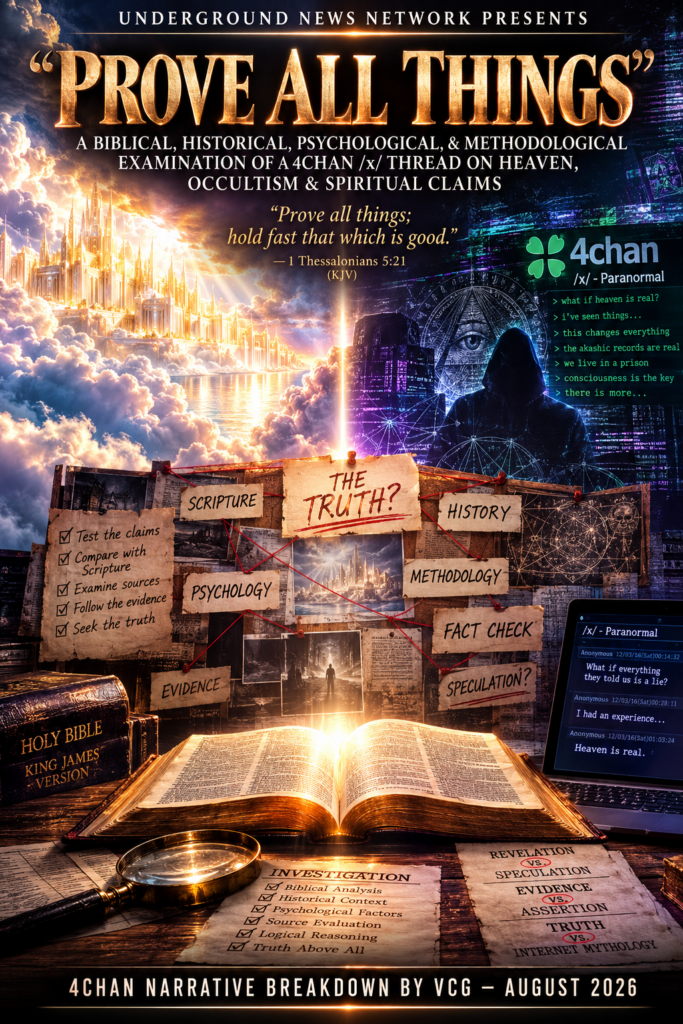
“Prove All Things”: A Biblical, Historical, Psychological, & Methodological Examination of a 4chan /x/ Thread on Heaven, Occultism & Spiritual Claims
UPDATED BY VCG ON 8/13/2026 @ 15:51 EST
I want to share a heartfelt cause with my audience. Conner Blaisdell-Greene, a brave Airforce Sr. Airman, recently lost his battle with cancer, leaving his family in financial distress. Every donation, no matter how small, can help cover his funeral costs and ease their burden during this difficult time. Please consider clicking the link below to contribute or share Conner’s story with others. Your support truly matters.
Anyone can do this, but they won’t.
ChatGPT – Library of Rickandria
I’ll treat the thread itself as the primary source, then separate each claim into: what it says, factual status, evidentiary quality, rhetorical/psychological technique, and Scripture correction (KJV). I’ll also distinguish what is demonstrably false from what is merely speculative, unfalsifiable, or based on a disputed interpretation.
/x/ – Do you think there are videogames in heaven? Like – Paranormal – 4chan
The first major finding is already clear: the thread repeatedly mixes incompatible categories of evidence—biblical claims, occult vocabulary, private experiences, satire, and assertions about hidden realms—without marking the transitions. That is the thread’s central methodological weakness; several replies sound specific while supplying no source or test at all.
Soli Deo Gloria. I pulled the live /x/ thread itself and captured it through No. 42819537, posted 13 August 2026 at 15:28:54. Because 4chan threads are live and ephemeral, later replies may appear or the thread may disappear; everything below refers to that captured state. (4chan)
For Scripture, I am treating the uploaded Pure Cambridge Edition of the King James Bible as our primary English text.
1. Executive finding
The thread begins with an innocent speculative question—whether someone could play Donkey Kong Country in heaven—but very quickly merges five fundamentally different kinds of statement:
- claims actually taught by the Bible;
- theological inferences that may be reasonable but are not explicitly stated;
- occult/New Age or private cosmological claims;
- personal experiences and grievances;
- jokes, satire, trolling, and rhetorical aggression.
The chief methodological error is epistemic flattening: the posters repeatedly speak as though all five categories carry the same authority. They do not. A biblical statement can be checked against Scripture. A historical claim can be checked against records. A psychological or scientific claim can be tested against research. A private vision may be sincerely reported while remaining independently unverifiable. A joke is not evidence at all.
The governing biblical principle is unusually well suited to /x/:
“Prove all things; hold fast that which is good.” — 1 Thessalonians 5:21.
And an equally important restraint is Paul’s warning:
“…that ye might learn in us not to think of men above that which is written…” — 1 Corinthians 4:6.
Those two verses cut in both directions: do not dismiss something merely because it sounds strange; but do not promote something to revealed truth merely because somebody on an anonymous board says it confidently.
2. What does the Bible actually say before we touch the replies?
This establishes the control against which every theological statement in the thread should be measured.
The Bible never says whether video games exist in heaven
There is no verse teaching either:
“There will be video games,” or “there cannot be video games.”
Consequently, anyone making either statement categorically is going beyond the text.
That does not mean every imaginative possibility is equally probable. It simply means revelation has not supplied an answer to that particular question.
The final Christian hope is more substantial than “ascending to a higher realm”
Popular imagination often treats eternity as permanently leaving physical existence for an ethereal heavenly dimension. The New Testament’s final picture is considerably richer.
Paul describes a resurrection in which what is corruptible is raised incorruptible and mortality puts on immortality. Revelation then describes:
“a new heaven and a new earth”
and the New Jerusalem “coming down from God out of heaven.” God then dwells with men, death and pain are gone, and God declares:
“Behold, I make all things new.”
Revelation 22 says God’s servants serve him, see his face, and “shall reign for ever and ever.”
So the biblical picture is not adequately summarized as dead people become disembodied spirits floating around an abstract higher plane forever.
Christian traditions differ over the intermediate state, millennium, chronology, and various eschatological details. But bodily resurrection and final renewal are plainly important New Testament themes.
John 14 does not promise a cosmic wish-fulfilment mansion
Jesus says:
“In my Father’s house are many mansions…”
“I go to prepare a place for you.”
“I will come again, and receive you unto myself; that where I am, there ye may be also.”
The actual emphasis is being with Christ, not cataloguing the appliances, automobiles, entertainment systems, or possessions inside each person’s imagined residence.
That distinction becomes important later.
3. Line-by-line examination
No. 42818581 — the OP: Donkey Kong Country in heaven
The OP asks whether heaven could contain video games and whether someone who genuinely wanted to play Donkey Kong Country would be denied the opportunity. (4chan)
Factual verdict: Unknown.
There is no empirical means presently available to inventory the recreational technology of the world to come, and Scripture does not answer this particular question.
Biblical correction
The safest Christian answer is therefore:
Scripture does not tell us.
It would be equally unwarranted to say “Of course DKC is in heaven” and “Obviously God forbids video games there.”
What Scripture does tell us is vastly more consequential: resurrection, incorruption, the presence of God, righteousness, the abolition of death and sorrow, service, worship, and reigning with God.
Psychology
The question itself is psychologically ordinary. Human beings naturally imagine unfamiliar futures through familiar goods: family, music, food, hobbies, homes, animals, books, games.
Nothing about wanting continuity between present joys and an imagined afterlife is inherently pathological.
The problem begins only when imagination quietly becomes revelation.
No. 42818587 — “it would be a recreation, always slightly off”
The reply asserts that heavenly DKC would merely be a recreation and necessarily imperfect. (4chan)
Verdict: Unsupported speculation.
No evidence or theological argument is supplied for either premise:
- that earthly creations must be reconstructed;
- that heavenly reconstructions must be defective.
Indeed, the second claim sits awkwardly beside the biblical language of consummation:
“Behold, I make all things new.” — Revelation 21:5.
That verse does not prove Nintendo games will be perfectly emulated in eternity. It merely shows that “everything there must be a slightly wrong copy” is not a doctrine furnished by Revelation.
Methodological problem
The sentence has the grammar of knowledge without the evidence of knowledge.
“Would be” and “always” are unusually strong words for a proposition for which the poster supplies no source, observation, argument, or test.
This pattern recurs throughout the thread.
No. 42818593 — the “Akashic record”
The poster claims the person would access an Akashic record and replay the game through somebody else’s eyes. (4chan)
Verdict: historically identifiable occult concept; specific claim unsupported.
“Akashic Records” is not a forgotten Christian doctrine. Scholarship on the concept traces the modern Akashic Records idea through the transformation of the Indian term ākāśa in modern esoteric thought, particularly through the Theosophical Society. Alex Nash’s historical study specifically describes the modern concept as developing through that Theosophical adoption and transformation.
The poster supplies no evidence whatsoever that:
- such a record objectively exists;
- deceased humans gain access to it;
- it reproduces first-person sensory histories;
- games can be replayed through another person’s past experience.
Historical documentation that people believe in a concept is not evidence that the claimed metaphysical mechanism exists.
Scripture correction
The Bible does describe heavenly books and the book of life, particularly in Revelation 20. But those books appear in a judgment scene:
“the books were opened…”
“the dead were judged out of those things which were written in the books…”
Nothing there identifies them with the Theosophical Akashic Records, much less with a cosmic first-person VR archive.
Connecting the two requires importing an external system into Revelation.
Psychology/method
This illustrates concept substitution. Scripture is silent concerning heavenly replay technology; an esoteric concept supplies a ready-made mechanism; the mechanism is then asserted as though the missing information has been filled by evidence.
It hasn’t. The unknown has merely been given a name.
Also note that “SPBP” later endorses this reply, but social endorsement does not increase its evidentiary weight.
No. 42818641 — video games, creativity, and not letting them overtake life
This post makes three separable claims. (4chan)
Claim 1: video games are good for creative people
Verdict: partly supported, but overgeneralized.
A 2012 study of 491 twelve-year-olds found greater video-game play was associated with higher scores on several creativity measures. Importantly, the authors called for further work to determine whether the relationship was actually causal. (ScienceDirect)
A later experiment involving 352 undergraduates found that participants randomly assigned to play Minecraft freely subsequently performed better on one creativity measure than several comparison groups. But even that study emphasized that how the game was played mattered. (ERIC)
So:
“Some forms of gaming can interact positively with creative cognition” is defensible.
“Video games are universally great for creative people” is too broad.
Claim 2: don’t let gaming overtake your surrounding life
That caution is reasonable. WHO’s ICD-11 definition of gaming disorder focuses on impaired control, gaming becoming increasingly dominant over other activities, and continuation despite harm; WHO also stresses that the disorder affects only a small proportion of gamers and requires significant functional impairment. (World Health Organization)
So ordinary enthusiasm for gaming should not be pathologized, but there is a genuine distinction between a hobby and a pattern that displaces family, work, health, school, or social functioning.
Claim 3: God uses creative people
There is at least a genuine biblical principle behind this. Bezalel is explicitly said to have been filled by God with wisdom, understanding, knowledge, and craftsmanship for artistic work connected with the tabernacle.
But that does not establish the stronger individualized claim, “If you’re creative, God definitely has a special artistic mission for you.”
The Bible gives examples of God employing artistic skill. It does not authorize strangers to manufacture personal divine callings for one another.
No. 42818648 — “imagine God told you that you were the Messiah”
The first portion is humor about working for exposure. Then comes the important theological hypothetical: what if God told you that you were the Messiah? (4chan)
That hypothetical needs correction because Christianity does not leave the office of Messiah vacant for a contemporary claimant.
In John 4 the Samaritan woman says:
“I know that Messias cometh, which is called Christ…”
Jesus answers:
“I that speak unto thee am he.”
And Jesus later warns:
“there shall arise false Christs, and false prophets…”
“believe it not.”
So from a New Testament standpoint, if someone presently experiences an impression, dream, voice, synchronicity, or intuition announcing “you are the Messiah,” the Christian test is not “Do I feel brave enough to accept the job?”
The prior scriptural testimony already gives grounds for rejecting the claim.
That is a particularly important lesson in paranormal environments: subjective intensity does not outrank established revelation.
No. 42818661 — heaven as a “higher realm,” where video games become boring
The claim is that DKC would seem trivial once someone had ascended into a superior spiritual existence. (4chan)
Two different things are happening.
“Heaven is simply a higher realm we ascend into” is an incomplete description of Christian eschatology for the reasons already discussed: resurrection and renewed creation are central.
“You wouldn’t want games anymore” is possible, but speculative.
It is plausible that present desires would be radically reordered in the unveiled presence of God. But Scripture never says:
Redeemed people will lose interest in every created form of play, art, craft, narrative, or recreation.
Revelation actually depicts activity: service, reigning, nations, a city, precious materials, and the bringing of the nations’ “glory and honour” into it.
How literally or symbolically individual elements should be taken is disputed. What cannot responsibly be done is turn “video games will seem boring” into revealed doctrine.
No. 42818666 — Jesus is already the Messiah; accept God’s role for you
This reply correctly challenges the previous Messiah hypothetical. (4chan)
“God already sent the Messiah, Jesus”
Within New Testament Christianity, yes. John 4 is explicit.
“If God has a clear role for you, take it”
That requires an important qualification:
How has the alleged role been established as God’s?
“Clear to me” does not necessarily equal “revealed by God.”
The New Testament’s answer is not blanket skepticism, but testing:
“Prove all things; hold fast that which is good.”
Even something religiously impressive is not automatically divine.
“Nothing is more powerful than him”
That is consistent with biblical monotheism and divine sovereignty. Isaiah says:
“Is there a God beside me? yea, there is no God; I know not any.”
The good element of this post should therefore be retained while tightening its discernment methodology.
No. 42818669 — God runs a PC fueled by worshippers
This is plainly satire, not a serious theology lesson. (4chan)
The joke caricatures worship as though God were a needy entity harvesting human energy.
Interestingly, biblical theology rejects exactly that premise.
Paul’s sermon in Acts 17 describes the Creator as Lord of heaven and earth and says he is not served by human hands “as though he needed any thing,” because he is himself the giver of life and breath.
So if the satire is intended as a reductio against Christianity, it attacks a conception Christianity itself denies.
That does not make the joke illegitimate. It makes the target poorly matched to classical biblical teaching.
No. 42818674 — capitalization, God’s supremacy, and “Lucifer”
This post contains one trivial claim, one sound theological claim, and one unsupported inference. (4chan)
“Why aren’t you capitalizing his name?”
English capitalization is not a theological test.
The KJV itself routinely refers to God with ordinary lower-case pronouns. For example, 1 John 5:14 speaks of confidence “in him”, asking “according to his will”, and that “he heareth us.”
So reverence cannot be measured by whether someone capitalizes every divine pronoun.
God has no genuine rival
Biblically, correct. Isaiah 44:6–8 explicitly stresses God’s uniqueness. Deuteronomy states:
“The LORD our God is one LORD.”
“God hasn’t erased Lucifer because God is merciful to him”
Unsupported by the cited biblical material.
There is a further textual problem with casually importing “Lucifer” as though Isaiah 14 straightforwardly says “Satan.”
Isaiah explicitly introduces the passage as:
“this proverb against the king of Babylon…”
and within that oracle appears:
“How art thou fallen from heaven, O Lucifer, son of the morning!”
Historically, Christians have often read the language typologically or secondarily as reflecting Satan’s fall. That interpretation has a long theological life, and other biblical passages unquestionably speak of Satan falling or being cast down: Jesus says, “I beheld Satan as lightning fall from heaven,” and Revelation 12 explicitly names the dragon as “the Devil, and Satan.”
But the distinctions matter:
Text: Isaiah 14 explicitly addresses the king of Babylon.
Interpretation: the passage may also be read as reflecting a deeper satanic archetype.
Error: pretending the immediate context literally says “This is Satan named Lucifer.”
Finally, Scripture does not teach that Satan’s continued existence proves divine mercy toward Satan. Revelation 20 instead depicts his ultimate judgment.
Second Peter’s famous statement about divine longsuffering says God is “longsuffering to us-ward”, not that he is delaying judgment to give the Devil another chance at redemption.
No. 42818687 — “which version of heaven?”
This is one of the stronger methodological interventions in the thread. The poster points out that many religions and individuals hold different concepts of heaven, so the word needs defining before the question can be answered. (4chan)
That is correct methodology.
Before asking “Are video games in heaven?” we need to know whether “heaven” means:
- biblical Christian heaven;
- final new creation;
- an Islamic afterlife;
- a New Age astral plane;
- a private spiritual cosmology;
- a fictional hypothetical.
Different worldviews produce different answers.
However, the reply makes a subtle shift near the end: if somebody’s alternate heaven permits video games, what is wrong with it?
That changes the question from truth to preference.
An afterlife model being attractive, permissive, comforting, or fun tells us nothing by itself about whether it corresponds to reality.
That distinction—“I like this model” versus “there is evidence for this model”—should govern the whole thread.
4. The most serious exchange: unanswered gaming prayers and the problem of evil
No. 42818693 — “I asked God to let me win, and he didn’t”
This is the emotional center of the thread. The poster moves from unsuccessful prayers about gaming to a much larger indictment of God for suffering, horror, religious condemnation, and perceived cruelty. (4chan)
It deserves a more serious answer than mockery.
First claim: “I asked God to let me win, and he didn’t”
The person’s report that they prayed can be accepted as autobiographical testimony unless there is reason otherwise.
But the interpretation—
“My requested gaming outcome did not occur, therefore God personally rejected or abused me”
—does not follow.
The Bible never promises unconditional fulfillment of every request.
1 John gives an explicit qualification:
“if we ask any thing according to his will, he heareth us.”
James adds:
“Ye ask, and receive not, because ye ask amiss, that ye may consume it upon your lusts.”
That does not mean every unanswered prayer proves selfish motives either. It means the biblical doctrine of prayer cannot legitimately be reduced to:
request → guaranteed desired event.
Therefore losing a game after praying to win does not falsify the biblical promise, because Scripture never made that promise in the first place.
Second claim: the existence of terrible suffering
Here the complaint becomes philosophically much stronger.
“Why does a good and powerful God permit horrific suffering?” is not answered simply by saying have more faith.
The Bible itself contains devastating lament.
Lamentations 3 speaks from the perspective of somebody who experiences God as having led him into darkness, enclosed him, and even shut out his prayer. The chapter does not censor that experience. Yet it later turns toward hope:
“It is of the LORD’S mercies that we are not consumed…”
and:
“though he cause grief, yet will he have compassion…”
followed by:
“For he doth not afflict willingly nor grieve the children of men.”
Romans likewise does not portray present creation as painless. It says creation is subjected to vanity and:
“the whole creation groaneth and travaileth in pain together until now.”
And Revelation’s ultimate hope explicitly presupposes present suffering:
“there shall be no more death, neither sorrow, nor crying, neither shall there be any more pain.”
So the biblical correction is not:
“Real believers never feel abandoned.”
Biblical authors plainly did experience profound anguish.
Does suffering prove that God is selfish, lazy, or cruel?
No—not deductively.
For that conclusion to follow, additional premises must be established, such as:
- a good God could have no morally sufficient reason to permit temporary suffering;
- a world involving meaningful creaturely freedom, stable natural order, judgment, redemption, soul-making, or other goods could never justify any permission of suffering;
- God has neither acted against evil nor promised its ultimate defeat;
- human knowledge is sufficiently comprehensive to rule out every possible reason.
Those are philosophical propositions requiring argument. The emotional force of suffering does not automatically prove them.
Conversely, Christians should not pretend that merely uttering “free will” or “God has a plan” settles every instance of horrendous suffering either.
The problem is real. The thread’s conclusion is stronger than its argument.
What about religious “gaslighting”?
The poster also complains about being labelled “lost” regardless of conduct.
That complaint cannot responsibly be dismissed merely because the language is angry. Human religious communities can behave manipulatively, dismissively, or cruelly.
But there is another distinction:
A cleric behaving badly is evidence about that cleric and community. It is not automatically evidence about God’s character.
The thread merges the two.
That is psychologically understandable, especially when people’s conception of God was formed through religious authority figures, but methodologically they must still be separated.
5. No. 42818705 — the Ashkenazi question and “you don’t understand God”
The reply immediately asks whether the angry poster is of Ashkenazi Jewish descent and then attributes the hostility to failure to understand God. (4chan)
This is one of the weakest replies in the thread.
The ancestry question
Nothing in the previous post establishes that ancestry is relevant to:
- unanswered prayer;
- the problem of evil;
- belief or unbelief;
- anger at clergy;
- one’s assessment of God’s character.
Introducing Jewish ancestry without evidentiary relevance is an ethnic insinuation, not an argument.
It shifts attention from the proposition to the imagined identity of the speaker.
Biblically, Paul tells the Athenians that God:
“hath made of one blood all nations of men…”
Whatever theological disagreements exist between Jews and Christians, genetics is not a rebuttal to someone’s argument about suffering.
“You dislike God because you don’t understand him”
Perhaps the speaker misunderstands some doctrines; everyone can.
But this specific claim is mind-reading unless evidence is supplied.
It immunizes itself:
- if the critic objects, that proves misunderstanding;
- if prayers fail, they “couldn’t see” the answer;
- if contrary evidence appears, insufficient faith explains why.
A claim structured so that every possible outcome confirms it becomes difficult to test.
“God answers prayers, but we cannot see without faith, trust, and patience”
There is a biblical core here: Scripture certainly commands faith, patience, and prayer.
But saying that every apparent non-answer is secretly an answer that only believers can perceive risks becoming self-sealing reasoning.
The biblical statement is more disciplined:
“if we ask any thing according to his will, he heareth us.”
It does not promise that every desired circumstance will manifest.
“God is … trusting of us”
“Faithful” and “patient” are biblical descriptions of God.
“Trusting of us” is more problematic if meant symmetrically.
John says of Jesus:
“Jesus did not commit himself unto them, because he knew all men.”
God may entrust responsibilities to people. That differs from saying omniscient God exercises uncertain faith in humans analogous to our trust in him.
6. No. 42818706 — “mind games,” “bad juju,” Yoda speech, and jumping between time perceptions
This post shifts heavily into idiosyncratic language. The speaker says no one must click the supplied link, characterizes mind games as something involving willing volunteers, invokes “bad juju,” and claims their Yoda-like speech accompanies movement between different perceptions of time. (4chan)
Several distinctions are necessary.
“Mind games only involve willing volunteers”
False as a general proposition.
Manipulation, coercive persuasion, deception, social pressure, and psychological exploitation can plainly involve people who did not consent to being manipulated.
Consent to click a hyperlink is not consent to every psychological effect that might arise from a communication.
“Bad juju”
The phrase can function humorously or colloquially.
As a literal supernatural causal law, however, the post provides no evidence.
“I talk like Yoda because I jump between perceptions of time”
Unsupported.
The unusual syntax is evidence that the person is using unusual syntax. It is not evidence of altered temporal access.
One of the most important rules in paranormal investigation is:
A description of a claimed mechanism is not evidence that the mechanism exists.
The linked video
The linked YouTube ID resolves in search results to a video titled “PARADE | A Knight of the Seven Kingdoms,” apparently an edit connected with the television series. Nothing surfaced that converts the video into evidence for supernatural manipulation or movement between temporal perspectives. (YouTube)
Psychology
I would strongly avoid diagnosing this poster from anonymous text. Unusual formatting, profanity, occult terminology, or playful identity presentation are not sufficient grounds for diagnosing psychosis, mania, schizophrenia, dissociation, or any other disorder.
The responsible psychological observation is narrower:
The post uses fragmentation, special vocabulary, hints of privileged perception, and performative obscurity. Those devices can create a sense that the speaker possesses a perspective inaccessible to ordinary readers.
But style does not establish truth or pathology.
7. No. 42818711 — hidden tyrants trying to separate people from God
The poster asserts that unspecified tyrants hate believers because those tyrants hate the idea of a being above themselves; these same actors allegedly work to separate people from God and subvert “natural orders.” (4chan)
Verdict: insufficiently specified and unsupported.
Who are “the tyrants”?
What actions constitute separation?
What is meant by “natural orders”?
What documentation ties the actors to the alleged motive?
None is supplied.
This is important because a claim about someone’s motive requires more evidence than merely observing an outcome you dislike.
Psychological research is relevant here, but it must be applied cautiously. Brotherton and French found associations between conspiracist ideation and a stronger tendency to infer intentional explanations for ambiguous events. Their results support studying intentionality attribution as one component of conspiracy cognition. They do not permit us to diagnose this anonymous poster as conspiratorial or mentally disordered. (PLOS)
The general reasoning trap is:
Something harmful happened → somebody must have intentionally designed it → I know who → I know why.
Each arrow requires evidence.
Christian theology certainly allows the possibility of persecution and spiritual deception. It does not authorize inventing unnamed human conspirators without proof.
Again:
“Prove all things.”
8. No. 42818993 — matrix heaven, “gods,” jewel craftsmanship, Prometheans, and the underworld
This is the thread’s most elaborate unsupported cosmology. The poster says heaven belongs to a matrix realm controlled by plural gods, that these beings prize natural craftsmanship and valuable materials, that video games are abominable there, and that one should instead seek an underworld associated with “Prometheans” for endless gaming—though the poster recommends neither route. (4chan)
Verdict: almost entirely unsupported private cosmology.
No source is supplied.
No named historical religious system is supplied.
No text is quoted.
No independent observation is documented.
No means of testing the cosmology is proposed.
The specificity therefore produces vividness, not evidence.
Interesting biblical mimicry
The reference to beautiful architecture and precious materials superficially resembles Revelation 21, which describes New Jerusalem with jasper, gold, precious stones, pearl gates, and other magnificent imagery.
But sharing decorative imagery does not validate the surrounding doctrine.
Revelation says the opposite of “heaven is ruled by gods.” Its city is illuminated by:
“the glory of God”
and:
“the Lamb is the light thereof.”
Isaiah likewise insists:
“beside me there is no God.”
So a system involving independent gods governing biblical-looking heaven cannot simply borrow Revelation’s gemstones and call itself biblical.
“Video games are an abomination”
Scripture never says this.
Calling something an “abomination” carries heavy biblical moral force. Applying that word to all electronic games without scriptural warrant is exactly the sort of doctrinal invention 1 Corinthians 4:6 warns against.
A game’s content could certainly be sinful or wholesome. The technological medium itself is not condemned by Scripture.
“Prometheans”
The post gives no explanation that allows its particular “Prometheans” to be reliably tied to a coherent historical tradition.
The correct verdict is therefore:
Undefined term + unsupported metaphysical assertion.
That is more rigorous than guessing what obscure lore the poster might mean.
No. 42819007 — sad-face reaction
No proposition is being asserted. (4chan)
Evidence value: none.
It is merely emotional/social feedback.
This sounds obvious, but reaction posts matter because threads often create the appearance of consensus through affirmation, ridicule, emojis, “based,” “seconded,” etc.
Consensus signals are not evidence for metaphysical claims.
9. No. 42819014 — “escape this death realm and return to base reality”
The poster replaces the previous cosmology with another: this world is a “death realm,” outside it lies “base reality,” and DKC should be playable there. (4chan)
Verdict: unsupported.
“Base reality” is not an explanation unless we know:
- what it is;
- where it is;
- why this world is not base reality;
- how the speaker learned that;
- what would distinguish this hypothesis from competing metaphysical models.
In fact, the next poster asks almost exactly the right question: where is this reality, and what is there?
Scripture correction
Christianity does speak of present creation being subjected to corruption and death. Romans 8 describes creation as groaning and awaiting deliverance.
But that does not make the biblical worldview equivalent to:
“the physical world is a fake matrix from which souls must escape into base reality.”
Biblical redemption includes the redemption of the body, not simply abandonment of embodiment. Romans 8 explicitly speaks of:
“the redemption of our body.”
That is a major difference from many escape-from-matter cosmologies.
10. No. 42819084 — only Wisdom Tree games in heaven
This is a joke, and unlike several other posts, its joke has an identifiable factual background. (4chan)
Wisdom Tree is associated with Christian-themed games such as Bible Adventures, Exodus, and Spiritual Warfare. Bible Adventures adapted Noah, Moses, and David-and-Goliath material into an unlicensed NES title. (Wikipedia)
So the humor is essentially:
If heaven has video games, naturally it only stocks the old Christian game publisher.
No theological rebuttal is needed because it is not presenting itself as revelation.
Recognizing jokes is part of proper methodology too. Over-literalizing every 4chan joke would produce false “claims” that nobody actually intended.
11. No. 42819096 — DKC might exist, but you probably won’t care
This is considerably more restrained than some earlier replies. The poster thinks the game could exist but speculates that heavenly priorities would make it uninteresting. (4chan)
Verdict: plausible theological inference, not biblical fact.
There are reasonable grounds to believe encounter with God transforms priorities.
But Scripture does not say redeemed humanity becomes incapable of enjoying finite goods.
The safest formulation is:
Eternity’s highest good is not Donkey Kong Country; Scripture places God himself at the centre. Whether redeemed persons also enjoy forms of art, play, craft, music, storytelling, or games is not specifically disclosed.
That preserves the theological hierarchy without inventing prohibitions.
12. No. 42819102 — a customized BMW inside “my mansion”
The poster reports having seen a customized BMW in one of the rooms of “my mansion” and infers that heaven therefore probably contains whatever games one’s heart desires. (4chan)
We need separate the testimony from its interpretation.
“I saw…”
We cannot know from this sentence whether the poster means:
- a dream;
- vision;
- near-death experience;
- imagination;
- psychedelic experience;
- joke;
- literal supernatural encounter.
The post does not say.
It would therefore be irresponsible either to declare “God showed this person their heavenly BMW” or “the person is lying.”
The correct classification is:
Private experience, cause undetermined, not independently verified.
Does John 14 teach personalized luxury mansions?
No.
Jesus says:
“In my Father’s house are many mansions…”
but the stated purpose is:
“that where I am, there ye may be also.”
The passage does not mention automobiles, individualized luxury estates, garages, or possessions tailored to consumer preference.
“Whatever your heart desires”
Psalm 37:4 is sometimes invoked here:
“Delight thyself also in the LORD; and he shall give thee the desires of thine heart.”
But read the immediate context:
Trust in the LORD. Do good. Delight in the LORD. Commit thy way unto the LORD. Trust in him. Rest in the LORD.
It is not an isolated cosmic vending-machine promise that every pre-existing consumer desire must be reproduced eternally.
At minimum the surrounding text makes God-centered delight central to understanding the verse.
13. No. 42819107 — “Where is base reality, and what waits there?”
This is one of the methodologically best posts. (4chan)
It asks the preceding claimant to define the central concept and furnish additional information.
A good follow-up investigation would continue:
What is the source?
How did you determine it?
Can the method distinguish true perceptions from dreams, imagination, suggestion, false memory, or invention?
Does another observer using the same method get the same result?
What evidence could count against the claim?
Those questions are not expressions of unbelief. They are basic epistemic hygiene.
And they harmonize rather well with:
“Prove all things.”
14. No. 42819121 — “SPBP”
In 4chan slang, “SPBP” is commonly explained as “second post, best post,” parallel to FPBP, “first post, best post.” The slang reference I found explicitly gives that usage. (Other Demons)
Here it functions as an endorsement of the Akashic Records reply. (4chan)
Evidentiary value: zero.
Another anonymous person liking a claim does not corroborate the claimed phenomenon.
This is a useful miniature example of the difference between:
social proof and empirical proof.
No. 42819170 — approval of the “which heaven?” post
Again, merely social evaluation. (4chan)
The underlying post did make a legitimate methodological point about defining terms, but calling it good does not add evidence.
No. 42819172 — “Seconded”
Same category. (4chan)
Agreement ≠ verification.
No. 42819528 — insulting the long poster’s formatting
This poster declines to read the material and insults its presentation. (4chan)
There is no substantive counterargument to evaluate.
It does illustrate an important communication lesson: difficult formatting raises cognitive cost and can cause audiences to disengage.
But the insult itself neither proves nor disproves the earlier paranormal claims.
A bad presentation can contain a true proposition.
A polished presentation can contain nonsense.
No. 42819537 — “this is a video game in heaven”
The final captured reply is another humorous/metaphorical line responding to the OP. (4chan)
There is insufficient context to treat it as a serious cosmological proposition.
No rebuttal is required beyond distinguishing humor from evidence.
15. Thread-wide psychology: what is actually happening here?
This needs especially careful handling.
We cannot clinically diagnose anonymous posters from a handful of messages. Claims about hidden realities, strange syntax, religious anger, mystical ideas, or conspiracy narratives do not by themselves establish psychiatric illness.
What we can study are the cognitive and social mechanisms encouraged by the medium.
Online disinhibition
John Suler’s foundational 2004 paper on the online disinhibition effect examined how features of online interaction can cause people to express themselves more openly or intensely than they might face-to-face. Importantly, Suler distinguished both benign and toxic forms; online disinhibition is not synonymous with pathology. (PubMed)
4chan intensifies several ingredients relevant to that model:
anonymous identity, weak interpersonal accountability, rapid turnover, and a culture where exaggeration, insults, role-play, sincerity, irony, and trolling can coexist.
That means a sentence on /x/ may be:
sincere belief, deliberate provocation, humor, exploratory speculation, performance, or some mixture.
Therefore confidence of tone is especially poor evidence of sincerity, let alone truth.
Pattern perception
One influential set of experiments by Whitson and Galinsky found that experimentally reduced feelings of control could increase some forms of illusory pattern perception. (PubMed)
That finding is relevant to paranormal cognition in general because humans are extraordinarily capable of perceiving meaningful connections among ambiguous events.
But two safeguards are necessary.
First, we cannot infer that any poster here lacks control merely because they perceive hidden patterns.
Second, later work has not uniformly reproduced all effects of experimental control manipulations, so this literature should not be wielded as a simplistic “conspiracy believers see patterns because they feel powerless” law. (University of California Press)
Agency detection and conspiratorial explanation
Brotherton and French found that people more disposed toward conspiracist ideation also tended, in their studies, to attribute intentionality more readily in ambiguous circumstances. (PLOS)
This provides a useful model for a post such as:
bad social conditions → hidden tyrants caused them → their motive is hatred of God → they intentionally subvert natural order.
The explanatory chain becomes progressively more specific while the evidence does not.
Again, this research explains a potential cognitive tendency. It does not diagnose the poster.
Specificity creates an illusion of knowledge
Compare:
“I don’t know what happens after death.”
with:
“Heaven is one layer of the matrix, ruled by gods devoted to jewel craftsmanship, while Prometheans inhabit the underworld.”
The second sounds vastly more knowledgeable because it contains more nouns and mechanisms.
But information density is not evidence density.
A fabricated map can contain far more detail than an honest admission of uncertainty.
That is a recurring psychological hazard in esoteric discourse: precision can simulate authority.
Private knowledge has a built-in status advantage
Several posters implicitly claim privileged access:
- Akashic records;
- a heavenly BMW;
- base reality;
- unusual perceptions of time;
- special knowledge of matrix heaven.
Such claims create an asymmetry:
The claimant knows because they experienced or were told something inaccessible to everyone else.
If challenged, the challenge itself may be explained by the challenger’s lack of perception, faith, initiation, vibration, insight, or spiritual readiness.
At that point the system becomes resistant to correction.
Biblically, that is precisely where testing becomes crucial.
“Prove all things…”
16. The occult-Christian mixture is especially important
The thread casually mixes:
Jesus Christ + Akashic Records + Lucifer + matrix cosmology + “gods” + Prometheans + base reality + personalized heavenly mansions.
Those ideas do not come from one coherent theological source.
That mixture matters because repeated proximity can create a false impression that concepts belong together.
For example:
Biblical: resurrection.
Biblical: New Jerusalem.
Modern esoteric: Akashic Records.
Private claim: BMW in one’s heavenly mansion.
Private cosmology: Prometheans in an underworld.
Simulation vocabulary: base reality / matrix.
Putting those items in the same conversation does not establish connections among them.
This is essentially syncretic bricolage: pieces from unrelated traditions and personal narratives are assembled into a new worldview without first establishing the truth of each piece.
17. A crucial Bible-study correction: 1 Corinthians 2:9
This thread is exactly the sort of context in which somebody may eventually quote:
“Eye hath not seen, nor ear heard…”
as though Paul were saying:
“Nobody can know anything about heaven, so literally any speculation may be true.”
But continue reading.
The very next verse says:
“But God hath revealed them unto us by his Spirit…”
The immediate context concerns God’s wisdom and what God has revealed—not a license to populate heaven with whatever objects or metaphysical mechanisms human imagination invents.
We should neither pretend Scripture tells us everything nor use mystery as permission to claim anything.
18. Claim audit
Here is the cleanest classification of the thread:
| Thread proposition | Verdict |
|---|---|
| Video games definitely exist in heaven | Not revealed / unknown |
| Video games definitely cannot exist there | Not revealed / unknown |
| Heavenly copies would always be imperfect | Unsupported |
| Souls access Akashic Records to replay games | Occult claim; unsupported |
| Gaming can relate positively to creativity | Partly empirically supported; nuanced |
| Gaming should not displace ordinary functioning | Reasonable; severe impairment is clinically recognized |
| God can employ artistic craftsmanship | Biblically supported |
| A modern person might be a new Messiah | Contrary to NT Christology |
| Jesus is the Messiah | Explicit New Testament teaching |
| Heaven is merely a disembodied “higher realm” | Biblically incomplete |
| God needs human spiritual energy | Contradicted by Acts 17 |
| God’s supremacy has no genuine rival | Biblically supported |
| Failure to capitalize every divine pronoun is irreverent | Not biblically supportable |
| Isaiah 14 simply and explicitly identifies Satan as Lucifer | Overstatement; immediate text addresses king of Babylon |
| Satan remains because God is showing Satan mercy | Unsupported |
| Different speakers must define what they mean by “heaven” | Methodologically correct |
| Failure to win a game after prayer proves divine cruelty | Does not follow |
| Horrendous suffering poses a serious theological problem | Yes; Scripture itself wrestles with suffering |
| Ashkenazi ancestry explains hostility toward God | Unsupported and irrelevant ethnic insinuation |
| Every prayer is visibly granted if one has enough faith | Not what Scripture promises |
| Unusual syntax proves altered time perception | Unsupported |
| Hidden tyrants are intentionally separating people from God | Unsupported as presented |
| Matrix heaven is ruled by multiple gods | Unsupported and contrary to biblical monotheism |
| Video games are inherently an abomination | No biblical basis |
| Prometheans occupy an underworld gaming realm | Unsupported / undefined |
| This world is a fake death realm outside “base reality” | Unsupported; not biblical resurrection doctrine |
| Wisdom Tree made Christian-themed video games | True; the post is a joke |
| People in heaven may no longer care about current games | Possible theological inference, not revealed fact |
| A private vision of a heavenly BMW proves personalized luxury possessions | No; testimony is unverifiable and inference exceeds it |
| Asking where “base reality” is and how we know | Excellent methodological challenge |
| SPBP/Seconded validates a claim | No; social endorsement only |
19. What a Scripture-first answer to the original question should actually say
The strongest answer is surprisingly simple.
Could there be video games—or something analogous to them—in the renewed creation?
Scripture does not tell us.
Does Scripture say God will prohibit them?
No.
Does Scripture promise that every present hobby, franchise, machine, intellectual property, food, automobile, and entertainment preference will be reproduced?
No.
Does Scripture depict eternity merely as disembodied spirits abandoning creation?
No. Resurrection and renewed creation are central.
Does Scripture suggest redeemed existence will be empty or boring?
Quite the opposite. It depicts life with God, righteousness, service, reigning, glory, and freedom from death and corruption.
So the responsible conclusion is:
We have no biblical authority to promise Donkey Kong Country in heaven, and no biblical authority to forbid it. The revealed hope is far greater and more concrete: resurrection, incorruption, a renewed creation, and dwelling with God. Anything beyond that must be honestly labelled speculation.
That preserves wonder without confusing imagination with revelation.
And that, more than anything else, is where this 4chan thread repeatedly goes wrong.
The standard worth carrying into every /x/ investigation is not “believe nothing strange,” nor “anything is possible.” It is:
“Prove all things; hold fast that which is good.” — 1 Thessalonians 5:21.
And where Scripture has not spoken:
“…not to think of men above that which is written…” — 1 Corinthians 4:6.
Those two principles allow genuine inquiry while shutting the door on confident invention.
4CHAN THREAD & POST BREAKDOWNS – Library of Rickandria
VCG PAPER PROJECTS – Library of Rickandria