
Between Thoughts & Truth: A Biblical, Historical, Psychological & Scientific Critique of Mystical Consciousness Claims
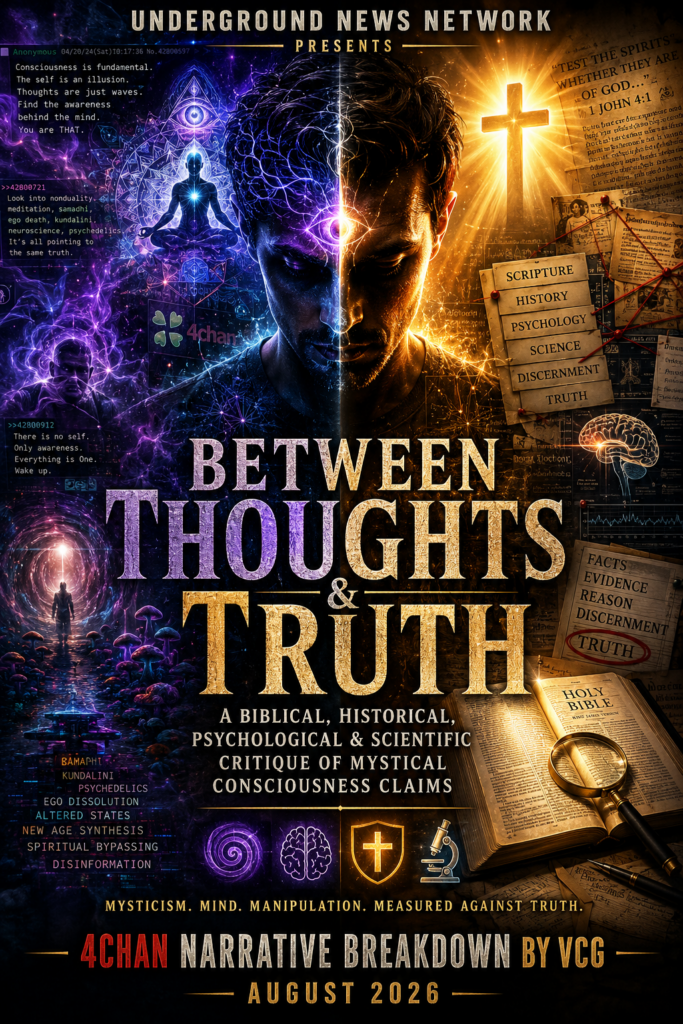
UPDATED BY VCG ON 8/13/2026 @ 22:22 EST
I want to share a heartfelt cause with my audience. Conner Blaisdell-Greene, a brave Airforce Sr. Airman, recently lost his battle with cancer, leaving his family in financial distress. Every donation, no matter how small, can help cover his funeral costs and ease their burden during this difficult time. Please consider clicking the link below to contribute or share Conner’s story with others. Your support truly matters.
Anyone can do this, but they won’t.
ChatGPT – Library of Rickandria
I’ll treat this in three layers: (1) what the thread actually claims, line by line; (2) what can be verified historically/scientifically/psychologically; and (3) what Scripture actually says in context, with the KJV text kept distinct from interpretation. I’ll also flag rhetoric, cognitive biases, unsupported leaps, and any places where the thread happens to be correct rather than rebutting by reflex.
/x/ – What is the “awareness between the thoughts”? – Paranormal – 4chan
The thread is much larger than the opening exchange: it expands into claims about Dzogchen/rigpa, samsara and karma, anxiety and “mental chatter,” animal stress, nondual consciousness, samādhi/nirvāṇa, psychedelic “breakthroughs,” breathwork, “spiritual light,” nervous-system energy, the pineal gland, Wim Hof/tummo, miracles, and even alleged psychic powers. I’m preserving those as separate claim families so a poetic/metaphysical statement does not get “fact-checked” as though it were a laboratory claim, while physiological claims do get held to empirical standards.
A first major correction is already clear: the thread repeatedly slides between useful phenomenology (“rumination can be distressing,” “meditation can reduce mind-wandering”) and unsupported ontology/physiology (“thought burns a special energy stock,” “that energy jumps from midbrain to cerebrum,” “tail-wagging discharges it,” “pure awareness is God,” “mind can shake reality”). Those are not one evidentiary category. The first family has real research behind parts of it; the second requires evidence the thread does not supply.
The historical side also needs a correction that cuts both ways. The Garab Dorje “Three Statements” attribution is authentic within Dzogchen tradition, and the third statement explicitly concerns the liberation of arising thoughts—so the thread’s later equation “realization = literally no thoughts” is not even an obvious consequence of the Dzogchen material it began with. At the same time, “Garab Dorje was the first human master” is a traditional lineage claim; the earliest securely datable Dzogchen textual evidence is much later, around the early ninth century.
Soli Deo Gloria.
I went through the live thread from the OP through the later exchanges available on August 13, 2026. The thread begins on August 9 with the question about “awareness between the thoughts,” but it rapidly grows into a much larger system involving Dzogchen, karma, anxiety, animals, samādhi, “spiritual light,” neural energy, breathwork, psychedelics, the pineal gland, the Kybalion, siddhis, mind-reading, and a proposed midbrain-to-cerebrum energy mechanism. (4chan)
My overall conclusion is important because this is not one single error. The thread combines several different things:
genuine observations about human experience + some authentic Buddhist vocabulary + real findings about rumination and meditation + speculative metaphysics + invented neurophysiology + altered-state interpretation + occult/New Thought material + unsafe overstatements + doctrines fundamentally incompatible with biblical Christianity.
So a responsible Christian rebuttal should not say, “Every sensation these people describe is fake.” Some experiences may be perfectly real. The error is often in the interpretation assigned to the experience.
That distinction is central.
I. Methodology: how I am auditing the thread
I am following essentially the research method already laid out in the VCG research framework: distinguish the original claim, what is being communicated, history, biblical analysis, science, psychology, logic, missing context, alternative explanations, and conclusion—while separating fact, interpretation, speculation, and rhetoric.
For every substantive claim, I applied six tests.
1. Source test. What did the poster actually claim? I am working from the live 4chan text rather than summaries of it. I am not reproducing every insult, meme reply, board-interface line, or duplicate statement; I am covering the substantive propositions chronologically and grouping repetitions. (4chan)
2. Category test. Is the claim historical, scientific, psychological, philosophical, theological, or merely phenomenological? “I experienced silence” and “silence stores neural energy in the midbrain” require entirely different evidence.
3. Steelman test. What is the strongest reasonable interpretation? If “energy” is merely metaphorical, that may be defensible. But once the poster identifies cranial nerves, midbrain thresholds, cerebrum, olfactory processing, and physical energy movement, it has become a physiological hypothesis and can be checked against neuroanatomy.
4. Empirical test. Does independent evidence support the mechanism—not merely the subjective experience?
5. Psychological test. Are there ordinary cognitive mechanisms that can explain why the experience feels revelatory or self-authenticating?
6. Biblical test. What does Scripture actually affirm? Here especially we must not convert every psychological finding into a Bible verse. Scripture and laboratory evidence answer overlapping but not identical questions.
The biblical model itself commends examination rather than gullibility:
“…they received the word with all readiness of mind, and searched the scriptures daily, whether those things were so.” — Acts 17:11.
And concerning spiritual claims:
“Beloved, believe not every spirit, but try the spirits whether they are of God…” — 1 John 4:1.
That is neither credulity toward paranormal claims nor reflexive denial of every unusual experience.
II. The biblical baseline before examining the thread
Several distinctions will recur throughout the analysis.
Biblical meditation is not defined as mental annihilation
Psalm 1 does not describe salvation through extinguishing thought:
“But his delight is in the law of the LORD; and in his law doth he meditate day and night.” — Psalm 1:2.
Joshua receives the same pattern:
“This book of the law shall not depart out of thy mouth; but thou shalt meditate therein day and night, that thou mayest observe to do according to all that is written therein…” — Joshua 1:8.
Psalm 143 likewise says:
“I remember the days of old; I meditate on all thy works; I muse on the work of thy hands.” — Psalm 143:5.
Biblical meditation therefore has content, object and purpose: God, his word, his works, obedience, remembrance and prayer.
That does not prove that sitting quietly or noticing one’s breathing is sinful. It means Scripture nowhere identifies contentless awareness as God, salvation, heaven, one’s “true nature,” or liberation.
Biblical peace is relational, not impersonal nonduality
Paul does not teach that peace comes because the distinction between observer and observed disappears:
“…in every thing by prayer and supplication with thanksgiving let your requests be made known unto God.
And the peace of God… shall keep your hearts and minds through Christ Jesus.” — Philippians 4:6–7.
Nor does Paul command Christians to cease thought:
“…whatsoever things are true… honest… just… pure… lovely… of good report… think on these things.” — Philippians 4:8.
Christian peace is not identical to “having no thoughts.”
Salvation is not a trained state of consciousness
The New Testament locates salvation in God’s grace and Christ’s work:
“For by grace are ye saved through faith; and that not of yourselves: it is the gift of God:
Not of works, lest any man should boast.” — Ephesians 2:8–9.
And Jesus says:
“I am the way, the truth, and the life: no man cometh unto the Father, but by me.” — John 14:6.
That is already a decisive theological difference between Christianity and the thread’s various “awakening through awareness” systems.
III. Chronological claim-by-claim audit
1. OP: “What is the awareness between thoughts?”
Verdict: valid phenomenological question; metaphysical conclusion not contained in the observation
The opening question is legitimate. Human beings sometimes report periods with little or no verbal inner speech. Inner speech is a well-studied cognitive phenomenon, and its frequency and form vary between individuals; it is not equivalent to consciousness itself. The absence of a sentence running through one’s head therefore does not imply the absence of cognition, perception, attention or brain activity. (PubMed Central (PMC))
The first substantive reply immediately identifies this silence with meditation/mantras and then with rigpa or “pure awareness.” (4chan)
Here is the first methodological leap:
Phenomenology: “There is a moment in which I notice no inner sentence.”
becomes
Ontology: “I have encountered the pristine fundamental nature of reality.”
The first does not logically entail the second.
A Christian can acknowledge attentional quiet without accepting a Buddhist metaphysics built upon it.
2. Garab Dorje and the “Three Statements”
Verdict: broadly accurate as Dzogchen tradition; historical certainty overstated
The thread identifies Garab Dorje with the famous Dzogchen “Three Statements.” That is genuinely part of Dzogchen tradition. A standard traditional presentation gives the three points as direct introduction to rigpa, certainty concerning it, and confidence in the liberation of arising thoughts. (Lotsawa House)
But notice something devastating to the thread’s later argument.
Its own opening Dzogchen teaching says thoughts arise and self-liberate. It does not simply say:
eliminate every thought forever.
The thread subsequently drifts from “recognize thoughts without grasping” into “thought itself causes samsara,” “thought consumes the energy needed for samādhi,” and eventually “nirvāṇa is persistent thoughtless samādhi.” Those are considerably stronger propositions. (4chan)
Historically, calling Garab Dorje “the first human master” should also be labeled traditional lineage history, not independently verified biography. The earliest securely datable Dzogchen literature scholars can presently locate belongs around the early ninth century, while later tradition projects the lineage backward to Garab Dorje. (early Tibet)
So the proper wording is:
“According to Dzogchen/Nyingma tradition, Garab Dorje is the first human lineage-holder.”
Not:
“History has established that Garab Dorje was the first human Dzogchen master.”
3. “Samsara is literally a stream of consciousness; karma just means every action has an equal and opposite reaction.”
Verdict: false
This is one of the cleanest factual errors in the thread. The poster explicitly equates karma with a Newtonian action-reaction principle and concludes that thought causes samsara, so removing thought ends samsara. (4chan)
That is not standard early Buddhist doctrine.
In AN 6.63, the Buddha is represented as defining kamma in terms of intention: intentional action through body, speech and mind. (SuttaCentral)
That is not Newton’s third law.
The thread commits an equivocation fallacy:
“cause and effect” in moral/intentional Buddhist doctrine
↓
is silently transformed into
↓
Newtonian equal-and-opposite physical reaction.
Those are different concepts.
Likewise, samsara in Buddhist traditions concerns the conditioned cycle of birth, death, rebirth and suffering—not merely the existence of verbal mental chatter. Eliminating a passing verbal thought is therefore not synonymous with attaining nirvāṇa.
This matters because the thread is presenting itself as explaining Buddhism while replacing Buddhist doctrine with an improvised physics metaphor.
4. “Eliminate thought, eliminate the cause, no more samsara.”
Verdict: unsupported and even inconsistent with the thread’s own Dzogchen source
As noted above, the Three Statements concern liberation of arising thought, which implies that arising thought need not itself constitute bondage. (Lotsawa House)
Much Buddhist analysis distinguishes between cognition itself and attachment, craving, ignorance or grasping. The thread collapses those distinctions.
Psychologically, this also risks confusing nonattachment to thoughts with suppression of thoughts.
That distinction is important because deliberate thought suppression can produce rebound effects. Meta-analytic and experimental literature has repeatedly investigated the phenomenon in which attempting forcibly not to think about a target can make the thought more accessible afterward. (PubMed Central (PMC))
So even at a psychological level:
“Do not automatically believe every thought”
is very different from
“A healthy mind produces virtually no thoughts.”
Biblically, Scripture similarly calls for discernment and transformation of thought rather than neurological silence. Psalm 139 even contains the prayer:
“Search me, O God, and know my heart: try me, and know my thoughts…” — Psalm 139:23.
Thought is not presented as the metaphysical cause of man’s bondage. Sin and alienation from God are.
5. “If you had zero mental chatter, why would anyone need anti-anxiety medication?”
Verdict: false and potentially dangerous
The thread explicitly proposes this. (4chan)
There is a kernel of truth: rumination and repetitive negative thinking can contribute substantially to anxiety and depression. Research strongly associates repetitive negative thinking with anxiety/depressive symptoms and their maintenance. (PubMed Central (PMC))
Meditative or mindfulness approaches may help some people with stress and anxiety, and they can be useful adjuncts. (NCCIH)
But:
rumination ≠ all anxiety
and
inner speech ≠ anxiety disorder.
Anxiety disorders involve complex interactions among temperament, learning, trauma, physiology, environment, cognition and other factors. Meditation is not a universal replacement for medical or psychological care.
NIH’s NCCIH also notes that meditation is not universally benign: a review of more than 6,000 participants found negative effects in roughly 8%, most commonly anxiety or depression. (NCCIH)
Therefore nobody should discontinue prescribed psychiatric medication because an anonymous 4chan poster says sufficiently quiet consciousness makes medication unnecessary. Medication changes belong between the patient and qualified treating clinician.
Scripture correction
Philippians 4 directs anxiety toward prayer, thanksgiving and deliberate godly thought, not a blank mind.
Nor does Scripture teach that receiving legitimate medical treatment demonstrates spiritual failure.
6. “Constant mental chatter is mental illness.”
Verdict: false pathologization
The thread later calls near-continuous thought a form of “mental illness” and claims silence is simply the healthy natural baseline. (4chan)
There is no clinical basis for defining ordinary inner speech as mental illness.
Inner speech participates in functions including reasoning, planning, self-regulation and self-reflection. It varies greatly across people. (PubMed Central (PMC))
The legitimate distinction is:
normal inner speech versus maladaptive repetitive negative thinking.
Calling ordinary cognition pathological is rhetorically powerful because it creates a problem for which the poster’s spiritual system becomes the cure.
Psychologically, this resembles problem inflation:
- redefine a widespread normal experience as pathology;
- offer an esoteric discipline that allegedly cures it;
- interpret inability to achieve the promised state as insufficient practice.
That structure should trigger methodological caution.
7. “Wild animals show us our natural peaceful condition.”
Verdict: romanticized and biologically false
A poster asks whether wild animals look stressed or anxious and presents them as naturally contented. Another poster immediately points out predation, hunger and vigilance. (4chan)
The second poster is much closer to biology.
Fear, vigilance, predation risk and physiological stress responses are extensively documented in wildlife. Captive animals can also display stereotypic behaviors and stress-related physiological changes. (PubMed Central (PMC))
Animals are not little Zen sages living in permanent contentment.
The thread is projecting a desired spiritual ideal onto them.
That is anthropomorphic romanticization.
8. “Animals wag their tails instead of ruminating; tail wagging discharges the same energy humans use for thoughts.”
Verdict: unsupported pseudophysiology
This becomes a repeated central claim. The poster says animals lack a ruminating mind and use tail wagging as an alternative “balancing” mechanism, eventually tying this to the accumulation of energy for deeper meditative states. (4chan)
There is no evidence supplied for such a mechanism.
Research on dog tail wagging treats it principally in the context of communication, emotional state and behavioral signaling, with multiple factors affecting direction, amplitude and context. (PubMed Central (PMC))
No recognized physiological literature identifies dog-tail motion as an alternative discharge route for an energy reservoir that otherwise becomes verbal thought.
This is a textbook example of reification of metaphor:
nervous excitement → “energy”
movement releases tension → “discharge”
therefore literal neural energy must be discharged through tail movement.
The words sound mechanically coherent while no demonstrated mechanism connects them.
9. “Thoughts arise from conditioning; ego-death can expose their causal history.”
Verdict: partly reasonable phenomenology, overstated interpretation
One poster gives one of the thread’s better observations: thoughts are influenced by previous experience and conditioning, and unusual states may make habitual patterns feel more visible. (4chan)
That is psychologically plausible. Our expectations, habits, emotional associations and learned schemas influence thought.
But “ego death” is not a scientifically established doorway into an objective archive containing the true causal lineage of every thought.
Psychedelic states can produce ego-dissolution, altered self-boundaries and unusually strong feelings of insight or significance. Neuroimaging studies have associated psychedelic ego-dissolution with changes in large-scale brain-network dynamics. (PubMed Central (PMC))
The experience may reveal something useful about one’s habits.
But:
feeling that one has seen the complete truth about oneself does not prove that one has.
That is the noetic-certainty problem: an altered state can increase subjective certainty without independently validating the content believed during it.
10. “You and the world are fundamentally one being; the world reflects thought.”
Verdict: metaphysical claim, not empirical finding; contrary to biblical Creator-creature distinction
Various posters move from meditative experience into nondual ontology: observer and observed dissolve; “oneness” is fundamental; material reality reflects or is projected from awareness. (4chan)
Someone may genuinely experience diminished subject-object boundaries. That does not demonstrate that the entire cosmos is literally one consciousness.
This is the phenomenology-to-ontology fallacy:
I experienced no distinction
therefore
no distinction exists in reality.
A dream can feel spatially enormous without proving the skull physically expanded.
Similarly, altered self-boundaries tell us something about experience; additional evidence is necessary before making claims about the ontology of the universe.
Scripture correction
Biblical creation is neither pantheism nor mental monism.
Acts 17 describes God as the one who made the world, gives creatures life and breath, and is Lord over what he made.
Colossians identifies Christ not as awareness discovered by dissolving one’s ego, but as the creator and Lord of creation.
Christian participation in God does not erase the distinction between Creator and creature.
11. Brahmā versus Brahman
Verdict: the correction in the thread is right
A poster uses “Brahma” while apparently referring to the Hindu metaphysical Brahman, and another poster corrects the distinction. The original poster acknowledges the mistake. (4chan)
That correction should be credited rather than rebutted.
This illustrates an important methodological point: the thread is religiously syncretic, moving among Buddhist, Hindu, Hermetic, Taoist, New Age and Christian terminology without always preserving what each tradition means.
That makes statements such as “God,” “nirvana,” “Brahman,” “rigpa,” “satori,” “pleroma,” “heaven” and “pure awareness” appear mutually interchangeable when historically they are not.
Shared mystical vocabulary does not prove shared doctrine.
12. The poisoned-arrow parable
Verdict: real Buddhist source; misusable as an epistemic shield
The thread invokes MN 63’s poisoned-arrow analogy. (4chan)
The source is real. In the Buddhist discourse, a man wounded by a poisoned arrow would be foolish to refuse treatment until every speculative question about the attacker had been answered. (SuttaCentral)
The lesson is roughly that liberation should not be postponed while one demands answers to every speculative metaphysical question.
But that parable cannot reasonably be transformed into:
“Therefore do not critically investigate metaphysical assertions made by teachers.”
That would be self-serving.
There is a difference between not allowing useless speculation to prevent practical action and declaring one’s speculative beliefs exempt from evidence.
13. “Neural activity consumes energy; therefore stopping thought saves a significant energy reserve.”
Verdict: true premise, unsupported conclusion
The poster asks whether neurons consume energy and argues that shutting down thought for hours preserves a substantial amount. (4chan)
Yes: neural signaling requires metabolic energy.
But “therefore a thoughtless mind stores a special reservoir of reusable spiritual/neural energy” does not follow.
The brain remains metabolically active during rest. Spontaneous resting-state activity is extensive, and brain networks such as the default mode network remain active when a person is not carrying out an external task. (PubMed Central (PMC))
Meditation also does not mean neurons have been switched off. Different meditation practices show different patterns of activation and deactivation rather than a universal shutdown. (arXiv)
The thread therefore commits:
true scientific fact → unauthorized extrapolation.
Neurons consume energy.
That does not validate the proposed spiritual battery.
14. “The sensory system leaves unused energy which reaches a threshold and jumps from the midbrain into the cerebrum as random thought.”
Verdict: pseudoneuroscience
This is the most technically falsifiable part of the thread.
The poster proposes:
- sensory processing generates “neurological outflows”;
- smelling sends olfactory signals into the midbrain;
- cranial nerves “feed the system”;
- refined breathing prevents olfactory activation;
- inefficient sensory processing leaves an energy remainder;
- that remainder accumulates;
- it eventually reaches a threshold;
- it “jumps” from midbrain to cerebrum;
- the resulting discharge manifests as a random thought. (4chan)
This is not recognized neurophysiology.
For example, olfactory receptor signals relay through the olfactory bulb, situated at the anterior forebrain, and then project into primary olfactory and limbic-associated cortical structures. (NCBI)
The midbrain is a specific brainstem structure; it is not a generic reservoir into which all cranial sensory signals deposit leftover psychic electricity. (NCBI)
Nor is there an established “energy remainder threshold” that leaps into cerebral tissue to produce an intrusive thought.
A real scientific theory would require, at minimum:
- specification of the physical energy involved;
- units;
- anatomical pathway;
- measurable reservoir;
- threshold value;
- predicted change during the practice;
- independent replication.
None is supplied.
The terminology creates the appearance of mechanism without the evidentiary architecture of mechanism.
This is sometimes called “neurobabble”: adding anatomical words to an intuitive spiritual model does not turn it into neuroscience.
15. “Refining breathing until the olfactory nerve is not stimulated suppresses random thoughts.”
Verdict: specific mechanism unsupported
Slow breathing can absolutely affect arousal, attention and autonomic state.
But that does not show that meditation works because one has stopped the olfactory nerve from producing an electrical waste product.
The thread confuses:
correlation: slow, subtle breathing accompanies quiet concentration
with
mechanism: lack of olfactory stimulation prevents a midbrain energy surplus from becoming thought.
The second requires evidence the thread does not have. (4chan)
16. Rigpa described as infinite, all-encompassing awareness in which knower and known disappear
Verdict: recognizable nondual contemplative language; not scientific evidence
A poster describes unconditioned awareness as infinite, ineffable and beyond subject-object distinction, while retaining “knowledge” without a conventional knower. (4chan)
One critic calls this logically contradictory.
We should be precise.
It may sound contradictory under ordinary propositional definitions, but contemplative traditions often deliberately use paradoxical language to describe altered phenomenology. Merely identifying paradox does not prove the contemplative experience never occurs.
But neither does ineffability give the speaker immunity from criticism.
The thread repeatedly says, in effect:
you cannot understand unless you’ve attained it.
This produces a self-sealing epistemology:
- agreement proves attainment;
- disagreement proves lack of attainment;
- therefore criticism can never count against the claim.
That is methodologically invalid.
An experience may be difficult to verbalize. Claims about anatomy, history, cosmology or miraculous powers are still open to verification.
17. “Only an infinitesimal fraction of meditators ever reach samādhi.”
Verdict: fabricated statistic
One poster estimates the rate at .00000000000002%. (4chan)
No dataset, definition, sample, denominator or study is supplied.
That is not statistics. It is a rhetorical number designed to communicate:
this is unimaginably rare.
Why does that matter psychologically?
It creates prestige scarcity. If an experience is said to occur in one of trillions of practitioners, anyone claiming to possess it becomes nearly impossible to challenge from ordinary experience.
It also provides an escape hatch:
If controlled studies don’t observe it, the subjects were simply not advanced enough.
A phenomenon can genuinely be rare. But rarity must itself be demonstrated.
18. “Thought and samādhi consume the same root energy; nirvāṇa is persistent samādhi.”
Verdict: unsupported physiology and doctrinal oversimplification
The thread explicitly states that thought and samādhi compete for one energy pool and concludes that nirvāṇa is essentially permanent samādhi. (4chan)
No evidence is supplied for this shared physical energy pool.
The Buddhist text the thread itself links, AN 9.34, discusses successively refined meditative attainments and the cessation of perception and feeling in a much more technical framework. It does not reduce all of nibbāna to “brain has stopped spending thought energy.” (SuttaCentral)
This is another case where the thread is less careful about Buddhism than the Buddhist sources it cites.
19. The folk etymologies of “nirvāṇa”
Verdict: speculative etymologizing presented without adequate linguistic support
The thread plays with meanings involving extinguishing and even “deforestation/leaving a forest,” while admitting uncertainty. (4chan)
The good part is that the poster says “I don’t know” rather than pretending certainty.
The methodological problem is using surface similarities among sounds to construct ancient meanings. Historical etymology requires comparative linguistic evidence, attested forms and phonological development—not “this word looks like these other pieces.”
This is a recurring occult-literature temptation: folk etymology becomes theology.
20. “Spiritual light” can arise reliably through sufficient conditioning
Verdict: subjective light phenomena are possible; supernatural interpretation unproven
One poster describes repeated episodes of a brilliant “spiritual light” that initially startled him, later became reproducible, and allegedly depended upon uninterrupted awareness. (4chan)
There are at least three logically separate propositions here:
- He experiences light-like phenomena.
- Meditative training changes their probability.
- The phenomenon is literal spiritual/divine energy.
Number 1 is quite possible.
Number 2 is also conceivable: meditation traditions have long reported internally perceived lights, imagery and related visual phenomena.
Number 3 does not follow automatically.
If “light” means a private visual experience, many ordinary neurovisual mechanisms remain possible. If it means externally emitted electromagnetic radiation visible to bystanders, that is testable with cameras and photometric instruments.
The thread provides no controlled external measurement.
Scripture correction
The New Testament’s central “light” language is Christological:
“For God, who commanded the light to shine out of darkness, hath shined in our hearts, to give the light of the knowledge of the glory of God in the face of Jesus Christ.” — 2 Corinthians 4:6.
And immediately:
“…that the excellency of the power may be of God, and not of us.” — v. 7.
Biblical “light” cannot simply be imported as confirmation of an internally generated meditative photic experience.
21. “Even in deep sleep or coma, you are always aware; pure awareness remains.”
Verdict: overstatement
Another poster argues that deep sleep and coma contain an underlying contentless awareness and then uses this as evidence for pure awareness as a metaphysical substrate. (4chan)
Modern consciousness research is much messier.
Clinical coma is classically characterized by absence of wakefulness and behavioral evidence of awareness. At the same time, newer work has shown covert cognitive responses in some behaviorally unresponsive patients, demonstrating that bedside behavior can underestimate residual consciousness in a subset. (PubMed Central (PMC))
That does not establish:
every comatose person possesses continuous contentless luminous awareness.
Sleep is similarly heterogeneous. Conscious experiences can occur during sleep, including states people may fail later to remember, but this does not prove uninterrupted universal pure consciousness.
The thread converts an unresolved scientific/philosophical question into metaphysical certainty.
22. “The darkness inside is heaven; pure awareness is God; matter projects from awareness.”
Verdict: explicit metaphysics, unsupported scientifically and incompatible with biblical theism
This is where the thread crosses decisively from meditation psychology into theology.
The poster moves from contentless awareness to:
- pure light;
- heaven;
- God;
- awareness as the basis of matter;
- mental processes interacting with material reality. (4chan)
None of those propositions follows from experiencing quiet awareness.
This is philosophical idealism/nondualism, not a neuroscientific discovery.
Scripture correction
The Bible does not identify God as one’s contentless field of consciousness.
God is personal, speaks, wills, judges, creates and is distinguished from creation. Christ is not the realization that the observer and universe are identical.
Jesus says:
“I am the way, the truth, and the life…”
Colossians warns believers specifically against being carried away by systems “after the tradition of men… and not after Christ,” while locating the fullness of deity in Christ.
The theological dispute is therefore not “Christians need to meditate more deeply to discover these doctrines.”
The doctrines are different propositions about God, man and salvation.
23. “All miracles are done mentally.”
Verdict: unsupported; biblically incorrect
The thread expands idealism into a theory of miraculous power through mind. (4chan)
Biblically, miracles are acts of God’s power, not manifestations of humans discovering a hidden consciousness technology.
Even where apostles participate in miracles, New Testament theology attributes the power and authority to God/Christ rather than treating it as a universal siddhi latent in sufficiently purified consciousness.
Furthermore, Scripture specifically warns that impressive signs are not sufficient proof of doctrinal truth. Jesus warns of false prophets capable of showing signs capable of deceiving. Therefore even if someone produced an extraordinary phenomenon, Christianity would still ask: What doctrine accompanies it? To whom does it point?
That is why 1 John says to test spiritual claims rather than identify unusual experience itself with God.
24. The psychedelic testimony: mescaline + mushrooms + Syrian rue + DMT
Verdict: the experience may have been profound; the combination is not evidence of enlightenment and entails real risk
One participant says he has repeatedly “glimpsed” awakening on psychedelics and recently combined four psychoactive substances, including Syrian rue. (4chan)
Psychedelics can produce ego dissolution, altered self/world boundaries and very powerful feelings of revelation. That part is scientifically unsurprising. (PubMed Central (PMC))
Syrian-rue alkaloids can inhibit MAO-A, which alters monoamine metabolism and can substantially alter the pharmacology of other drugs. Combining multiple serotonergic psychedelics with an MAOI makes effects and interactions considerably less predictable. (PubMed Central (PMC))
The FDA’s finalized July 2026 psychedelic-drug guidance itself emphasizes that these drugs require controlled clinical investigation with careful safety methodology. (U.S. Food and Drug Administration)
The critical epistemological distinction is:
“I experienced dissolution of self.”
Possible.
“Therefore I temporarily perceived ultimate metaphysical reality.”
Not demonstrated.
Psychedelic intensity is not a truth detector.
The thread’s later advice to stop relying on drugs is one of its more prudent elements, although telling someone to “follow your heart” even when everyone says the plan is foolish is not a reliable general decision rule. (4chan)
Scripture correction
The biblical test of truth is not “How overwhelmingly meaningful did it feel?”
It is conformity to truth revealed in Christ.
25. “You need a breakthrough that makes your cognition malleable.”
Verdict: psychologically perceptive but risky as a truth criterion
The responder says an altered “breakthrough” disrupts ordinary cognition and makes a person malleable. (4chan)
“Malleable” is the revealing word.
A highly suggestible or cognitively destabilized state may permit reappraisal and major behavioral change.
It can also increase susceptibility to:
- overinterpretation;
- guru influence;
- false certainty;
- grandiosity;
- memory distortion;
- unusual beliefs.
Plasticity is not identical to epistemic accuracy.
Clay being easier to reshape says nothing about whether the sculptor is making the correct shape.
26. Deleted threads and alleged suppression of wisdom
Verdict: possible moderation behavior; conspiracy conclusion unsupported
A poster notices that allegedly important threads disappear and wonders whether moderators are intentionally suppressing wisdom; another attributes at least some deletions to moderators. (4chan)
A deleted post establishes only that something disappeared.
To demonstrate systematic suppression of “revealing wisdom,” one would need a dataset showing:
- comparable threads;
- moderation outcomes;
- rules violated;
- deletion rates;
- moderator intent;
- differential treatment.
Without that, the reasoning is:
material I value disappeared
→ someone intentionally targets truth.
That is a classic environment for intentionality bias and conspiracy inference.
It may occasionally be true. It has not been demonstrated here.
27. The Kybalion and a supposed universal “law of rhythm”
Verdict: modern occult/New Thought material, not ancient empirical science
The thread recommends studying the Kybalion and applying its “law of rhythm” to emotional cycles. (4chan)
The book itself is a 1908 publication issued in Chicago by the Yogi Publication Society under the name “Three Initiates.” (Internet Archive)
So even though the work claims ancient Hermetic pedigree, the extant text is a modern publication. It cannot simply be cited as though someone discovered an ancient Egyptian psychological law.
There is a useful observation buried inside the discussion:
moods vary, people have patterns, and journaling can help identify them.
Fine.
But drawing a sine wave in one’s notebook does not establish a cosmic Hermetic “Law of Rhythm.”
This is another recurrent pattern:
ordinary useful observation + metaphysical superstructure.
28. “Put your tongue on the roof of the mouth to complete the energy circuit; energy travels up the spine and bathes the pineal gland.”
Verdict: traditional energetic interpretation, not established anatomy
The thread describes a tongue-palate position as closing an energy circuit running up the body, into the brain and around the pineal gland. (4chan)
A person may absolutely feel striking somatic sensations during breathwork, prolonged concentration or altered breathing.
But subjective sensation does not identify the underlying anatomy.
Modern physiology identifies the pineal gland primarily as a neuroendocrine organ involved in melatonin and circadian regulation, with light information reaching the circadian system via retinal and hypothalamic pathways and sympathetic innervation ultimately regulating pineal melatonin production. (NCBI)
There is no established anatomical circuit in which touching the tongue to the palate closes a bioelectric loop that then carries stored consciousness-energy into the pineal gland.
The thread again confuses:
“I can feel something moving”
with
“I have correctly identified what physical substance is moving and where.”
Interoceptive sensations can be very real while their folk explanation is wrong.
29. Wim Hof: “proven vagus nerve stimulation”
Verdict: real physiological research, wrong characterization
One poster correctly notes that Wim Hof-style practices have actually been studied. (4chan)
A well-known 2014 study found that trained subjects using breathing, meditation and cold-exposure techniques could voluntarily influence the sympathetic nervous system, producing increased epinephrine and altered innate immune responses during an endotoxin challenge. (PNAS)
That is interesting science.
But it is not accurately summarized as:
science proved Wim Hof stimulates the vagus nerve to produce various powers.
The headline result concerned sympathetic activation, not validation of the thread’s generalized “vagus” story.
This is a perfect example of why fact-checking must be granular: the skeptic who says “nothing physiological happens” would be wrong; the believer who says “science proved our energy model” would also be wrong.
30. “Wim Hof accidentally discovered tummo; basically the only difference is breath-hold position.”
Verdict: oversimplification
Tibetan g-tummo practices have indeed been studied physiologically, including measurable temperature changes in practitioners. (PubMed)
There are superficial commonalities between tummo-like practices and modern breath/cold techniques.
But claiming Hof independently reproduced tummo with only one technical difference compresses distinct systems involving breathing, attention, visualization, posture and religious context into a single physiological hack.
The evidence supports some overlapping physiological phenomena, not the historical claim that the methods are essentially identical.
31. Cold immersion: kidney/adrenal damage claim
Verdict: overbroad; genuine cold-water hazards exist, but different ones are better established
The poster warns that prolonged severe cold immersion can damage the kidneys/adrenals. (4chan)
The thread gives no source for that blanket statement.
What is well established is that sudden cold-water immersion can produce cold shock, abrupt changes in breathing, heart rate and blood pressure, cardiac strain, panic and drowning risk. (RNLI)
And hyperventilation before breath-holding—especially around water—is dangerous because falling oxygen can cause loss of consciousness before carbon dioxide generates a strong urge to breathe. (Divers Alert Network)
So the right correction is not “cold exposure is harmless.”
It is:
the thread names a poorly substantiated mechanism while overlooking some of the best-established acute hazards.
32. “The passage of time disappears in samādhi; therefore it is beyond time and space.”
Verdict: state report plausible; metaphysical conclusion does not follow
The thread contains testimony about the passage of time disappearing in samādhi and debate over whether such a state requires one year, eighteen months, or extreme rarity. (4chan)
Subjective time can change dramatically with attention, absorption, drugs, trauma, flow states and sleep.
But:
“I did not experience the passage of time”
does not imply
“my consciousness literally left spacetime.”
An anesthetized patient may experience no passage of hours, yet this does not show the patient physically exited time.
Again: phenomenology ≠ cosmology.
33. “Mind-reading is a small feat that almost anyone can do on a good day.”
Verdict: extraordinary claim unsupported by the thread
A poster characterizes reading minds as a fairly minor mental superpower. (4chan)
If that claim were as reliable as suggested, it would be extraordinarily easy to test:
- blinded target;
- preregistered questions;
- no sensory contact;
- objective scoring;
- repeated trials;
- independent replication.
Instead, when another participant challenges the claims with an actual demographic-information test, the thread descends into joking insults rather than controlled demonstration. (4chan)
Research into remote viewing and psi has a complicated history. Even the U.S. government’s Stargate-related work produced controversy over statistical anomalies; however, the commissioned evaluation concluded that the program did not provide dependable operational intelligence value. (CIA)
So the fair conclusion is not:
“Science has mathematically disproved every conceivable psi phenomenon.”
It is:
The casual claim that reliable mind-reading is an easy, ordinary meditative ability is not remotely established by the evidence presented.
Biblical correction
Biblical instances of extraordinary knowledge are attributed to God’s revelation or Christ’s divine authority. Scripture never teaches that ordinary humans can develop routine telepathy through sufficiently refined meditative energy.
34. Siddhis that “randomly happen around samādhi”
Verdict: traditional religious claim/anecdote, not empirical demonstration
One poster reports that during samādhi his body spoke and acted autonomously and claims siddhis may spontaneously arise. (4chan)
Two separate questions must be kept apart.
Did the person experience altered agency?
Quite possibly.
People can experience actions, speech, movement or thoughts as occurring with diminished sense of conscious authorship.
Were supernatural powers objectively produced?
That would require external evidence.
The thread routinely treats internal changes in agency as evidence for external metaphysical abilities.
That inference is not justified.
35. Out-of-body experiences
Verdict: OBE phenomenology is genuine; literal extracorporeal travel is not established by the experience alone
The thread eventually asks about methods for maintaining consciousness while the body falls asleep and describes unusually deep states associated with OBE practice. (4chan)
Neuroscience has connected OBE-like experiences with disturbed integration of body, perspective and multisensory information around temporoparietal regions; electrical stimulation has even produced OBE-like phenomena in clinical contexts. (PubMed Central (PMC))
That strongly supports the existence of brain mechanisms capable of generating the experience.
It does not philosophically prove that no soul could ever exist outside the body.
But it does mean:
“I experienced being outside my body”
is insufficient evidence for
“therefore my conscious entity physically left my body.”
Interestingly, Paul’s own report displays much greater epistemic restraint:
“whether in the body, I cannot tell; or whether out of the body, I cannot tell: God knoweth…” — 2 Corinthians 12:2.
And instead of using the experience to establish an esoteric rank, Paul explicitly refuses boasting and immediately speaks of being kept from exaltation.
That is a striking contrast with the status competition in the thread.
36. The final “energy remainder” theory
Verdict: unsupported and presently non-scientific
Near the end, the theory is restated more clearly:
ordinary sensation leaves a leftover energy;
animals resolve it by tail-wagging;
humans accumulate it;
when enough accumulates, it travels from midbrain to cerebrum;
this produces random thought;
training prevents the accumulation;
eventually the practitioner maintains a random-thought-free brain. (4chan)
This is useful because a theory stated this concretely becomes testable.
Yet the thread provides:
- no joules;
- no volts;
- no electrophysiological signature;
- no anatomical tract;
- no imaging;
- no metabolite;
- no threshold;
- no blinded experiment;
- no animal data;
- no comparison group;
- no independent replication.
The explanatory power comes almost entirely from the familiar word “energy.”
But “energy” in physics is not a mystical substance meaning “whatever seems to animate an experience.”
Until measurable quantities are specified, “energy remainder” is functioning as a placeholder for ignorance, not an explanation.
IV. The psychology underneath the thread
This may be the most valuable part of the entire analysis, because the posters do not need to be consciously lying for the system to become persuasive.
1. Introspection can report experience better than mechanism
A person may accurately say:
“When I breathe this way, my mind becomes quiet and I feel warmth moving upward.”
That person’s introspection may be excellent.
But humans are much worse at determining:
“The warmth is residual neural energy moving from my midbrain through a threshold potential.”
The first is a report.
The second is a causal theory.
The thread repeatedly confuses them.
2. Phenomenology-to-ontology inflation
This occurs constantly:
I feel unity → reality is metaphysically One.
I experience timelessness → consciousness transcended spacetime.
I experience light → spiritual light exists objectively.
I experience no self → there is no individual self.
I experience awareness without apparent content → awareness is God.
These transitions feel natural because the experience is immediate.
They remain logical leaps.
3. State-to-trait inflation
A temporary altered state becomes evidence of permanent attainment.
A psychedelic dissolution becomes “glimpse of enlightenment.”
Five seconds of unusual stillness becomes evidence of a latent nirvanic condition.
One mystical event becomes evidence of the practitioner’s rank.
But transient altered states and stable character traits are not equivalent.
4. Confirmation bias
Once the practitioner expects “energy” to rise:
tingling becomes energy;
heat becomes energy;
pressure becomes energy;
visual phenomena become energy;
silence becomes stored energy;
random thought becomes energy discharge.
Everything becomes interpretable within the model.
A theory that can explain every possible outcome after the fact becomes very difficult to falsify.
5. Apophenia and causal pattern-making
Humans naturally find structure.
If:
meditation → light once
meditation → nothing next week
meditation → light again
a practitioner can create an increasingly elaborate story explaining the interval.
That does not mean the pattern is imaginary. It means the causal model requires prospective testing rather than retrospective narrative.
6. Prestige and attainment hierarchy
The thread repeatedly distinguishes those who “have experienced it” from those who have not, sometimes explicitly dismissing critics as incapable of understanding because they lack attainment. (4chan)
This establishes an epistemic caste system:
Advanced practitioner: disagreement proves depth.
Outsider: disagreement proves ignorance.
Such systems become unusually resistant to correction.
Notice the irony: a philosophy ostensibly directed toward reducing attachment to ego generates extensive competition over who has the more advanced attainment.
That does not disprove meditation.
It tells us something important about human social psychology.
7. The “ineffability shield”
“Words cannot describe it” may be perfectly reasonable for describing some experience.
But the thread sometimes alternates between:
A. “Language is inadequate; outsiders cannot criticize.”
and
B. extremely precise claims about cranial nerves, olfactory processing, thresholds, midbrain dynamics and cerebral energy.
You cannot have both privileges simultaneously.
If the claim is ineffable, one should not present invented anatomy as settled explanation.
If the claim is physiological, physiology can test it.
8. Ancient-authority laundering
The thread frequently combines:
ancient spiritual language
- neuroscience vocabulary
- personal testimony.
The combination feels powerful because each component lends apparent credibility to the others.
But:
an ancient text can tell us what an ancient tradition believed;
a brain term can tell us where a structure is;
a personal testimony can tell us what someone experienced.
None automatically verifies the other two.
9. Spiritual bypassing
The anxiety discussion is a particularly clear example.
Instead of recognizing clinical anxiety as potentially requiring psychotherapy, medical evaluation, lifestyle changes, social support or medication, it gets reframed as:
excessive thought caused by insufficient spiritual stillness.
That can create shame and discourage appropriate care.
The thread thereby turns a complex clinical phenomenon into a spiritual-performance problem. (4chan)
10. Thought suppression paradox
The irony is that making “absolutely no thoughts” into the goal may itself increase monitoring of thought:
Am I thinking?
Was that a thought?
Did I lose the state?
Why did the thought return?
Research on thought suppression shows why aggressive suppression can sometimes produce rebound effects. (PubMed Central (PMC))
A healthier psychological skill is often changing one’s relationship to thoughts, rather than demanding their total elimination.
Interestingly, that is closer to the opening Dzogchen statement about allowing thoughts to arise and liberate than to the later 4chan “thought-energy” theory.
V. What the thread genuinely gets right
A strong rebuttal should concede truth wherever it appears.
The thread is right that rumination can be destructive and that reducing compulsive negative thought can improve wellbeing. (PubMed Central (PMC))
It is right that attention and breathing practices can measurably affect physiology and mental state. Wim Hof-type research is one example, although the proposed mechanisms in the thread are frequently wrong. (PNAS)
It is right that meditative phenomenology can become profoundly different from ordinary waking consciousness. Neuroscience does not require us to pretend these experiences never happen. (arXiv)
It is right that thoughts are influenced by conditioning and history.
It is right to distinguish Brahmā from Brahman. (4chan)
It is right that 4chan posters can badly misrepresent sophisticated traditions, and one poster sensibly recommends finding an actual qualified Dzogchen teacher rather than taking anonymous posts as definitive instruction.
It is right that behavior and character are a better test of claimed wisdom than boasting about attainment. Several late-thread critics make essentially this point.
And one of the smartest skeptical moments comes when posters demand actual evidence for alleged powers rather than treating ancient textual claims as proof.
Those concessions make the remaining criticism considerably stronger.
VI. Where the central spiritual deception lies from a biblical standpoint
I would not identify the primary biblical error as simply “they meditate.”
That is too crude.
The deeper substitution is:
Scripture:
God is objectively God; man is his creature.
Thread:
God is ultimately the pure awareness discovered beneath thought.
Scripture:
Man’s fundamental problem is sin and alienation from God.
Thread:
Man’s fundamental problem is thought, conditioned ego, duality or inefficient sensory-energy processing.
Scripture:
Salvation is God’s grace through Christ’s death and resurrection.
Thread:
Liberation comes through recognizing awareness, extinguishing grasping/thought, conditioning consciousness or attaining stable samādhi.
Scripture:
Truth is revealed and tested.
Thread:
Ultimate truth is directly known in an ineffable state that outsiders cannot properly evaluate.
Scripture:
Peace guards the mind through Christ and exists alongside deliberate thought.
“…the peace of God… shall keep your hearts and minds through Christ Jesus.”
“…think on these things.” — Philippians 4:7–8.
Thread:
Peace/bliss/oneness are the natural state exposed when conceptual thinking disappears.
Scripture:
Divine light reveals God in Christ.
“…the light of the knowledge of the glory of God in the face of Jesus Christ.” — 2 Corinthians 4:6.
Thread:
Internally experienced luminosity is interpreted as fundamental awareness/God.
That is not a small terminological difference.
Those are rival theological systems.
VII. Colossians 2 is unusually relevant
Paul writes:
“In whom are hid all the treasures of wisdom and knowledge.” — Colossians 2:3.
Then:
“And this I say, lest any man should beguile you with enticing words.” — v. 4.
Then:
“Beware lest any man spoil you through philosophy and vain deceit, after the tradition of men… and not after Christ.” — v. 8.
And notably, later in the same chapter Paul warns about systems possessing:
“…a shew of wisdom in will worship, and humility, and neglecting of the body…” — Colossians 2:23.
That should not be flattened into “all philosophy is evil” or “bodily discipline is evil.” Paul himself practiced bodily discipline.
The issue is a religious system becoming a substitute for Christ and presenting human practices as the road to spiritual completeness.
The chapter’s answer is:
“And ye are complete in him…” — Colossians 2:10.
VIII. One especially important correction about “taking every thought captive”
Christians can mishandle this subject too.
2 Corinthians 10 speaks about:
“Casting down imaginations, and every high thing that exalteth itself against the knowledge of God, and bringing into captivity every thought to the obedience of Christ…”
That should not be turned into Christianized obsessive thought suppression.
Paul’s context concerns arguments, pretensions and resistance to God’s truth. It is not clinical advice telling someone with intrusive thoughts that every involuntary mental event is a sin requiring immediate suppression.
The biblical answer is ordered thought under truth, not terror at having thoughts.
Psalm 139 can therefore calmly say:
“Search me, O God… try me, and know my thoughts…”
The Christian is not saved by achieving neurological silence.
IX. A better model for evaluating extraordinary spiritual experiences
The thread repeatedly asks the wrong question:
“How intense was it?”
A biblical/evidential investigation should ask instead:
What happened? Describe the experience before interpreting it.
What physical conditions preceded it? Sleep deprivation? fasting? breath manipulation? drugs? hyperventilation? prolonged concentration?
Could the experience be reproduced?
Can anything external be measured?
What competing explanations exist?
Does the interpretation contradict established anatomy or physics?
Does the person become more honest, humble, loving and reality-oriented—or more grandiose and unfalsifiable?
What doctrine accompanies the experience?
Does that doctrine agree with Scripture concerning God, Christ, salvation and man?
And finally:
What would falsify the explanation?
If the answer is “nothing, because anyone who disagrees has not attained the state,” we no longer have an evidential investigation.
We have a self-protecting belief system.
X. Final assessment of the thread
My assessment after reading it in full is:
The “awareness between thoughts” itself is not sinister, paranormal, or necessarily mysterious. It can simply describe a period of quiet nonverbal awareness.
Meditation-induced alterations in attention, body sensation, self-boundaries, time perception and internally perceived light can be genuine experiences. Their occurrence does not establish their preferred metaphysical explanation.
The opening Dzogchen information is substantially more authentic than the later home-built theory. Ironically, authentic Dzogchen language about the self-liberation of arising thoughts undercuts the thread’s later obsession with eliminating thought. (Lotsawa House)
The karma/Newton equation is wrong. Early Buddhist teaching explicitly grounds kamma in intention. (SuttaCentral)
The claim that normal inner speech is mental illness is wrong.
The claim that eliminating mental chatter removes the need for anti-anxiety medication is medically irresponsible.
The animal/tail-wagging energy theory has no scientific basis.
The olfactory-midbrain-energy-threshold-cerebrum mechanism is pseudoneuroscience. Its anatomical premises are wrong and its supposed energy has no operational definition. (4chan)
The pineal-energy-loop interpretation has no established neurophysiological basis. Pineal physiology instead has a well-characterized circadian/melatonin pathway. (NCBI)
Wim Hof research is real, but the thread misstates what it established. (PNAS)
Psychedelic ego dissolution is a genuine psychological phenomenon, but it cannot certify metaphysical truth.
Claims of routine mind-reading/siddhis are unsupported by what is presented.
The Kybalion is a 1908 occult publication, not evidence of an experimentally established ancient universal law. (Internet Archive)
And most importantly:
The theological destination of the thread is not biblical Christianity. Its mature position identifies fundamental awareness with God, makes matter derivative of consciousness, treats liberation as recognition/conditioning of consciousness, and interprets mystical experience as privileged access to ultimate reality. (4chan)
The biblical center is radically different:
“Jesus saith unto him, I am the way, the truth, and the life: no man cometh unto the Father, but by me.” — John 14:6.
And the proper Christian posture toward extraordinary experiences is beautifully illustrated by Paul. Even after describing an experience of paradise so extraordinary that he could not determine whether he was “in the body” or “out of the body,” his response was not:
I have unlocked the hidden mechanics of consciousness.
It was:
“God knoweth.”
That is the epistemic humility almost completely missing from the thread.
The decisive error is not that these posters experienced silence, bliss, light, ego-dissolution, strange bodily sensations or altered consciousness. The decisive error is repeatedly turning subjective experience into objective cosmology, then dressing that cosmology in borrowed Buddhist terminology and invented neuroscience, and finally calling the resulting awareness “God.”
Scripture calls us somewhere else entirely: not inward to discover that we are the ultimate awareness, but outward and upward to the living God revealed in Jesus Christ; not to extinguish cognition, but to have the mind renewed and governed by truth; not to trust every luminous or extraordinary experience, but to “try the spirits” and search the Scriptures “whether those things were so.”
That is, in my judgment, the core correction the whole 1,700+ line thread needs.
4CHAN THREAD & POST BREAKDOWNS – Library of Rickandria
VCG PAPER PROJECTS – Library of Rickandria