
Christology in the Anonymous Agora: A Scriptural, Historical, Logical & Psychological Analysis of a 4chan Debate on the Nature of Jesus Christ
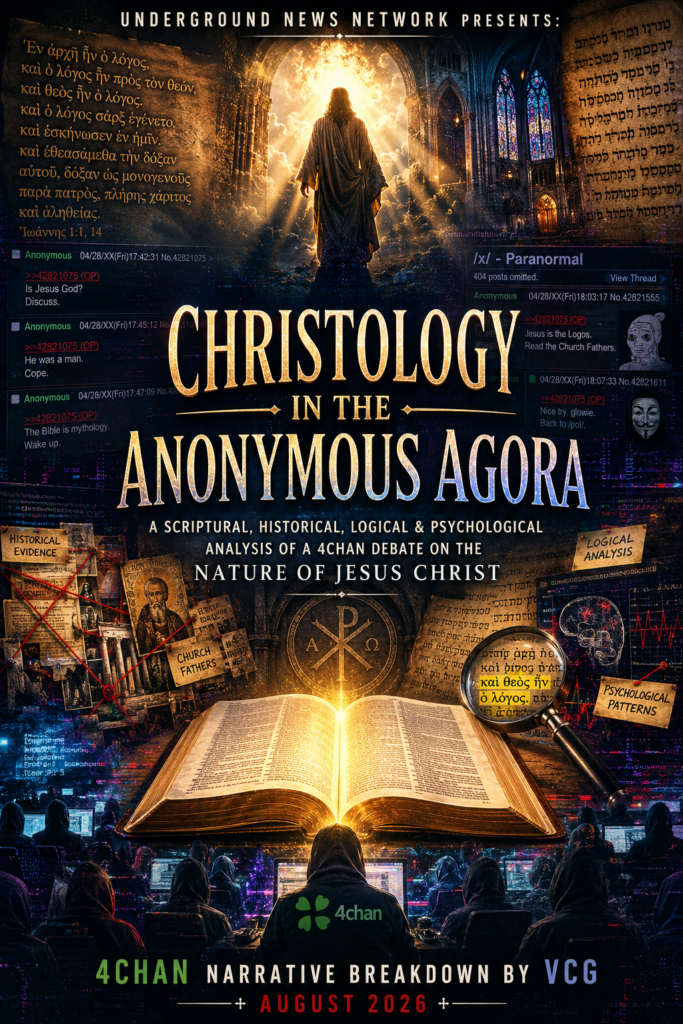
UPDATED BY VCG ON 8/14/2026 @ 09:11 EST
I want to share a heartfelt cause with my audience. Conner Blaisdell-Greene, a brave Airforce Sr. Airman, recently lost his battle with cancer, leaving his family in financial distress. Every donation, no matter how small, can help cover his funeral costs and ease their burden during this difficult time. Please consider clicking the link below to contribute or share Conner’s story with others. Your support truly matters.
Anyone can do this, but they won’t.
ChatGPT – Library of Rickandria
Soli Deo Gloria. I’ll treat this as an evidentiary audit, not merely a theological reaction: reconstruct the thread, separate each claim from rhetoric/inference, verify factual assertions against primary or high-quality sources, identify reasoning/psychological techniques, and then test the religious claims against Scripture—quoting the KJV you supplied where relevant.
/x/ – Jesus is clearly ranked under God, he is head of t – Paranormal – 4chan
The live thread is presently short enough to audit completely: the OP plus fourteen replies visible through 08:42 EDT on August 14. Several replies contain slurs or conspiracy claims; I’ll quote only the minimum needed to identify each claim, because the evidentiary issue is the claim itself, not amplifying the abuse.
One important correction is already clear from Scripture itself: the thread’s two opposite Christological shortcuts both fail. “Jesus is not fully man” conflicts with texts that call him “the man Christ Jesus” and insist he came in flesh; but “therefore the Son is merely a created divine being” conflicts with John’s declaration that “the Word was God” and that all things that were made were made by him. The hard work is explaining how the Father/Son ordering texts fit those statements rather than erasing either side.
The first-pass doctrinal pattern is now stable: the thread repeatedly confuses three different questions—(1) whether the Father and Son are distinct, (2) whether the Son obeys/is sent by the Father, and (3) whether the Son is therefore a created or lesser kind of being. Scripture unquestionably supplies material for (1) and (2); (3) is the disputed inference, and it has to survive John 1, Colossians 1, Hebrews 1–2, Philippians 2, and the resurrection narratives rather than being assumed.
I’ve now separated the thread into four evidentiary layers: what the Bible actually says; what later Christian theology concludes from those texts; what historical/Islamic claims can be externally checked; and what is merely rhetoric or speculation. That separation matters especially for phrases like “firstborn,” “greater than I,” “synagogue of Satan,” “dogs,” and “Mandela effect,” where one isolated phrase can be made to carry far more than its context permits.
Soli Deo Gloria. I pulled the live thread and audited the complete visible exchange. At the latest refresh, it consists of the OP plus fourteen replies, ending with No. 42822162 at 08:42:06 EDT on August 14, 2026. Because 4chan threads can change or disappear, everything below refers to that captured state. (4chan)
The central issue is more interesting than either side of the thread makes it sound. The Bible really does teach distinction, sending, obedience, headship, and even future subjection between the Father and the Son. Those texts should not be suppressed. But the further inference—“therefore the Son is a created heavenly being who is divine but not God”—runs directly into other texts that identify the Son as Creator, distinguish him categorically from angels, address him as God, and insist that he genuinely became flesh. A careful reading has to preserve both sets of texts rather than deleting whichever half is inconvenient.
All KJV quotations below are grounded in the Pure Cambridge Edition you supplied.
1. Methodology
I am following the research structure preserved in the VCG project manual: original statement → intended communication → historical analysis → KJV-first biblical analysis → language/context → scientific/psychological analysis → logical analysis → missing context → alternatives → conclusion. Its stated standards—Scripture interprets Scripture, context before commentary, evidence before opinion, uncertainty stated openly, and opposing views represented fairly—are exactly what this thread needs.
There are four categories we must keep separate.
Biblical fact asks: Does the text actually say this?
Theological interpretation asks: How should several biblical statements be reconciled?
Historical fact asks: What can manuscripts, history, Judaism, Islam, etc. actually establish?
Psychological/rhetorical analysis asks: What argumentative devices are being used?
Psychology cannot tell us what an anonymous poster secretly believes or diagnose that individual. It can, however, identify well-studied communication conditions and reasoning patterns. Suler’s classic work on the “online disinhibition effect,” for example, identifies anonymity and invisibility among factors that can loosen ordinary restraints online. That is relevant to an anonymous imageboard full of insults; it is not a diagnosis of any particular poster. (PubMed)
2. The theological issue that should have framed the whole thread
Before taking the posts one by one, we need to establish something the debate repeatedly confuses:
Distinction is not automatically inequality of nature.
Obedience is not automatically creaturehood.
“Firstborn” is not automatically “first-created.”
True humanity is not automatically denial of deity.
There are very strong biblical texts for real Father/Son ordering.
Paul writes:
“the head of Christ is God.”
That is 1 Corinthians 11:3. Nobody doing an honest Christology should pretend the verse is not there.
Even more strikingly, after describing Christ’s reign, Paul says:
“then shall the Son also himself be subject unto him that put all things under him, that God may be all in all.”
That is 1 Corinthians 15:28.
Likewise Jesus says in John 14:28 that the Father is greater than he; throughout John he is sent by the Father; he prays to the Father; and Acts repeatedly says God raised Jesus.
So the OP is not inventing the biblical data of Father/Son order.
But that does not settle the question of what kind of subordination Scripture describes.
Now consider Hebrews 1. Angels are commanded to worship the Son, while the Father says concerning the Son:
“Thy throne, O God, is for ever and ever.”
The same passage then attributes the laying of the earth’s foundation and the heavens to him, while angels are separately described as “ministering spirits.”
That is a categorical difficulty for “Jesus is simply the highest created celestial being.”
And Hebrews 2 simultaneously prevents the opposite mistake. Jesus was not merely God wearing a human-looking shell:
“he also himself likewise took part” of flesh and blood,
and:
“he took not on him the nature of angels; but he took on him the seed of Abraham.”
Then:
“in all things it behoved him to be made like unto his brethren.”
Paul is equally explicit:
“the man Christ Jesus”
in 1 Timothy 2:5.
So Scripture itself forces us to hold together:
real Father/Son distinction and order + genuine humanity + preexistence + creation through the Son + divine titles/predicates applied to the Son.
Historically, the mature Nicene doctrine was the church’s later systematic attempt to reconcile precisely this kind of material. Terms such as homoousios are not biblical vocabulary; they are theological terminology. The historical record also shows real diversity and controversy before the pro-Nicene consensus emerged. So “the exact later formula is not printed as one sentence in Scripture” is true; “therefore the Son’s deity was simply invented at Nicaea” does not follow. (Stanford Encyclopedia of Philosophy)
That distinction—biblical data versus later theological synthesis—will matter repeatedly below.
3. OP — No. 42821075
The OP makes several separate assertions: Jesus is ranked beneath God; is somehow leader of a heavenly choir; all things were created through him; is human and divine but “not God”; angelic appearances supposedly provide an analogy; Jesus is fully human and divine; and Father/Son have a subordinate relationship. (4chan)
“Jesus is ranked under God”
Partly correct, but ambiguous.
If “rank” means authority/order/mission, Scripture gives the OP substantial evidence: 1 Corinthians 11:3 and 15:28 are obvious examples. Jesus is sent by the Father, does the Father’s will, and speaks of the Father as greater.
If “rank” means the Son belongs to a lesser order of being or is a creature, the OP has moved from text to inference.
That inference must then explain Hebrews 1, John 1, and Colossians 1.
Colossians calls Christ:
“the image of the invisible God, the firstborn of every creature”
but immediately explains:
“For by him were all things created”
including heavenly authorities, and says he is before all things.
It is methodologically unsound to take firstborn from verse 15 while ignoring Paul’s explanation in verses 16–18.
“Head of the heavenly choir”
This is not a biblical title.
Hebrews does describe the Son declaring God’s name and singing praise among his brethren, but Scripture’s normal “head” language concerns Christ as head of the church/body, not “choirmaster of heaven.” And Hebrews 1 has the angels worshipping the Son, which is a rather different relationship.
This looks like an imaginative synthesis presented as though it were a scriptural datum.
“All things were created by him”
That part is substantially biblical. Colossians 1 explicitly says so. John 1 likewise says that what came into existence came through the Word.
But notice the tension in the OP’s own position: if all created things came through Christ, then classifying Christ straightforwardly among “created things” requires an additional argument. “He created everything else” cannot simply be assumed into the text.
“Fully divine but not God”
This depends completely on what divine means.
If it merely means “heavenly,” “supernatural,” or “godlike,” then it is too vague to prove much.
If it means fully possessing the divine nature, then “fully divine but not God” becomes terminologically unstable in classical Christian theology. The assertion is doing rhetorical work precisely because “divine” is left undefined.
The angel analogy
This is one of the OP’s weakest arguments.
Yes, biblical angels can appear in human form. But Hebrews explicitly contrasts Christ with angels:
“he took not on him the nature of angels”
and instead identifies him with Abraham’s seed and his human brethren.
An angel temporarily appearing as a man is therefore not the biblical model supplied for the incarnation.
Verdict on the OP
Best element: recognizes real Father/Son differentiation and hierarchy of mission/order.
Major error: treats relational or functional subordination as though it automatically proves ontological creaturehood.
Methodological problem: combines textual statements, metaphysical conclusions, and an unsupported angel analogy without identifying where Scripture ends and inference begins.
The position resembles historically subordinationist/non-Nicene Christologies, but it should be evaluated by whether it can explain all the relevant texts rather than by attaching a label to it. Classical Nicene theology answers the ordering texts by distinguishing personal relations/economic mission from inequality of divine nature; non-Nicene theology disputes that distinction. The historical disagreement is real. (Stanford Encyclopedia of Philosophy)
4. No. 42821129 — the racial “dogs/masters” claim and meme
This reply shifts abruptly from Christology to an antisemitic racial conspiracy claim. It alleges that Jesus treated Gentiles as dogs belonging beneath Jewish masters and then frames Christ’s divinity as a Jewish deception. The accompanying meme visualizes an ethnic “pecking order.” (4chan)
This is a very instructive example of half-context propaganda.
There really is a “dogs” saying.
In Matthew 15, a Canaanite woman asks Jesus to heal her daughter. Jesus initially identifies his mission with “the lost sheep of the house of Israel” and says:
“It is not meet to take the children’s bread, and to cast it to dogs.”
But the exchange does not end with “Gentiles are racial slaves of Jews.” The woman answers him; Jesus responds:
“O woman, great is thy faith”
and grants her request. Her daughter is healed.
The narrative therefore contains an Israel-first mission order, but the poster has transformed a salvation-historical metaphor into a racial caste doctrine which the passage itself does not teach.
The rest of the New Testament makes the racial hierarchy reading even harder.
Acts says God:
“hath made of one blood all nations of men”
and directs the gospel toward universal repentance.
Ephesians says Christ broke down the partition between Jew and Gentile and made the two one in reconciliation.
Revelation pictures redeemed people:
“of all nations, and kindreds, and people, and tongues”
before God and the Lamb.
And James provides a particularly sharp correction to the tone of this thread:
“Therewith bless we God, even the Father; and therewith curse we men, which are made after the similitude of God.”
James concludes:
“My brethren, these things ought not so to be.”
Psychology and rhetoric
The meme is not additional evidence. It converts an exegetical question into an identity-threat image: the reader is invited to feel humiliated, subordinate, and manipulated before examining the text.
That is rhetorically powerful because emotional framing can replace the original proposition:
Instead of asking, What does Matthew 15 mean in its narrative context? the audience is prompted to ask, Are you going to let this hostile group dominate you?
That is persuasion through antagonistic framing, not exegesis.
Verdict
Kernel of truth: Jesus used the children/dogs metaphor in a specific encounter.
False extrapolation: Scripture does not teach the meme’s Jewish-master/Gentile-dog racial hierarchy.
Psychological device: emotionally loaded identity framing substitutes for contextual interpretation.
5. No. 42821145 — “Jesus was not fully man”
This poster quotes Philippians 2:5–11 and 1 Timothy 3:16, then concludes Jesus was not genuinely fully human but was God “in the body” of a man. (4chan)
The quotation from Philippians is relevant; the conclusion is not.
Philippians says Christ was:
“made in the likeness of men”
and:
“found in fashion as a man.”
But “likeness” cannot responsibly be interpreted as “therefore not genuinely human” while Hebrews 2 sits nearby saying he shared flesh and blood and:
“in all things it behoved him to be made like unto his brethren.”
Paul directly calls him:
“the man Christ Jesus.”
The poster has therefore committed a single-word override: one term in Philippians (“likeness”) is made to negate clearer statements elsewhere.
That is precisely the opposite of comparing Scripture with Scripture.
There is also an obvious citation problem in the post. 1 Timothy 3:7 concerns qualifications/reputation for a bishop; it contributes nothing to the Christological argument. The relevant passage is 3:16. (4chan)
In the supplied KJV, 1 Timothy 3:16 indeed reads:
“God was manifest in the flesh”
which supports a strong claim concerning Christ’s deity in that textual tradition. But “God manifest in flesh” does not entail “his humanity was merely a costume.”
Verdict
Correct: Philippians 2 provides very high Christology and genuine humiliation/obedience.
Incorrect: “likeness of men” does not mean fake or incomplete humanity.
Strong correction: Hebrews 2 and 1 Timothy 2:5 make real humanity explicit.
6. No. 42821163 — “none of this is in the Bible” / “synagogue of Satan”
This reply says the preceding ideas are absent from Scripture and appeals to the phrase “synagogue of Satan.” (4chan)
The first assertion is simply too broad.
The incarnation, Sonship, preexistence, Father/Son relationship, deity language, genuine humanity, and Christ’s obedience are all intensely biblical subjects. One can dispute how they should be synthesized; one cannot plausibly say the subject matter is absent.
The second move is a textbook example of phrase transplantation.
“Synagogue of Satan” occurs in Revelation’s messages concerning particular hostile groups associated with Smyrna and Philadelphia. The wording itself specifies people who “say they are Jews, and are not.” Turning that apocalyptic polemic into the proposition:
all ethnic Jews = Satan’s synagogue
does not follow from the wording.
In fact, if the phrase says certain people claim Jewish identity falsely, it cannot simultaneously function as the definition of every actual Jew.
Nor should Christians forget that Jesus, the apostles, Paul, and the earliest Jerusalem believers emerge from Jewish Israel.
Verdict
The poster is right that the biblical text—not ethnic mythology—must govern Christian doctrine.
But the actual use of “synagogue of Satan” here violates that very principle by stripping an apocalyptic phrase from its addressed context and converting it into a universal racial category.
7. No. 42821167 — caricature about Jews taking over the world to cause the Second Coming
This reply offers essentially no exegetical argument. It caricatures Christianity as a scheme requiring Jewish world domination so a “magic rabbi” can return. (4chan)
Whatever one thinks about modern Christian Zionism, dispensationalism, covenant theology, or particular prophecy systems, that sentence is not a New Testament doctrine.
The New Testament’s ethical command to Christians is not “engineer Jewish world conquest.” It is repentance, faithfulness, gospel proclamation, watchfulness, holiness, endurance, and love.
The argument is therefore a straw man: a maximally absurd version of some modern eschatological beliefs is substituted for Christianity itself.
The rhetorical mechanism is also significant. Contempt language allows the speaker to win status in the conversation without demonstrating anything. In anonymous environments, the online-disinhibition literature offers a plausible framework for why discourse can become more uninhibited and aggressively dismissive—but again, that describes environmental mechanisms rather than diagnosing this poster. (PubMed)
Scripturally, 2 Timothy’s standard for doctrinal correction is notably different:
“rightly dividing the word of truth”
while avoiding unprofitable word-strife.
Verdict
No substantial evidence presented; almost entirely ridicule and straw-man framing.
8. No. 42821169 — “likeness” + “firstborn of creation”
This reply repeats the claim that Philippians’ “likeness” somehow prevents true humanity and then appeals to Christ being “firstborn.” (4chan)
We have already dealt with “likeness.” Hebrews 2 settles the relevant question far more directly.
The “firstborn” argument needs more care.
Colossians 1:15 calls Christ:
“the firstborn of every creature.”
But in biblical usage, firstborn can express status, supremacy, inheritance, or rank—not merely chronological birth order.
Psalm 89 gives an exceptionally clear example. God says concerning the Davidic king:
“Also I will make him my firstborn, higher than the kings of the earth.”
“Make him my firstborn” is explicitly explained by exaltation above the kings, not by physically causing him to become the first human ever born.
That matters greatly when reading Colossians.
Paul does not write:
Christ is firstborn → therefore Christ is the first thing God created.
Instead he writes:
Christ is firstborn → for by him were all things created → he is before all things → all things hold together in him.
So “firstborn = first-created” is possible only if imposed as an interpretation; it is not the lexical conclusion forced by the word itself.
Verdict
The poster is using an equivocation: “firstborn” is silently reduced to one possible sense while biblical examples showing rank/preeminence are ignored.
9. No. 42821187 — Colossians 1 plus a stitched-together “verse”
This is one of the more substantive replies because it actually quotes the immediate Colossians context. (4chan)
And that context is devastating to a simplistic “firstborn means first created” argument:
“by him were all things created”
and:
“he is before all things.”
The poster is therefore right to bring verses 16–17 back into the discussion.
However, the final line in the post is not one Bible verse. It combines language from Revelation’s Alpha/Omega/first/last passages with John 8’s “before Abraham” saying and packages them as though they form a single quotation.
That is bad citation practice even when the theological point one wants to make may be defensible.
This distinction matters:
A true conclusion does not license a false quotation format.
Scripture should be cited verse by verse, in context.
Verdict
Substantively useful: restores Colossians 1:16–17.
Methodologically sloppy: conflates several texts into a synthetic pseudo-quotation.
10. No. 42821195 — “judged by the book”
This statement is too vague to evaluate exactly because the poster gives no citation. (4chan)
If Revelation 20 is intended, Scripture actually speaks of books, followed by another singular book, the book of life. The dead are judged according to their works. The thread’s later question “which book?” therefore assumes a specificity that the original poster did not establish.
There is a genuine biblical doctrine of judgment.
But using an undefined “book” as a threat in place of an argument contributes almost nothing to the Christological question.
Verdict
Biblically plausible theme; methodologically underspecified.
11. No. 42821264 — “Jesus has a beginning because a word needs someone to think/say it”
This reply makes two different arguments.
First: Christ is “firstborn,” therefore he began.
Second: because Christ is “the Word,” a word must be thought or spoken by someone before it can exist. (4chan)
The first argument has already failed to establish its premise because firstborn does not inherently mean first-created.
The second is a human-language analogy elevated into metaphysics.
John calls Christ the Word. The poster then takes how human words arise in temporal human minds and projects that mechanism onto God’s eternal being.
But John itself controls what John means.
John’s prologue places the Word already present “in the beginning,” distinguishes the Word as being with God, identifies the Word in divine terms, attributes creation to him, and then says:
“the Word was made flesh”
The text nowhere says:
God first existed wordlessly → later conceived a thought → thereby created the Logos.
That is the poster’s philosophical construction.
Logical diagnosis
This is an argument from analogy whose decisive premise is never proved.
Human speaker : human word
therefore
God : eternal Logos
is not automatically a valid one-to-one mapping.
God is not established by Scripture to process thoughts temporally the way embodied human beings do.
Historical note
This is approximately where ancient disputes over whether the Son was created, begotten eternally, or otherwise derived from the Father became crucial. The later Nicene tradition deliberately distinguished “begotten” from “made/created.” That distinction is historical theology, not a word-for-word Bible sentence, and should be identified as such. (Stanford Encyclopedia of Philosophy)
Verdict
Unsupported metaphysical analogy masquerading as a necessary conclusion.
12. No. 42821455 — the Islamic reply
This poster introduces Qur’an 19:36, claims Muslims uniquely follow Jesus properly, states Muhammad is closest to Jesus, says Islam makes no distinction among prophets, asserts all prophets share one faith, and appeals to monotheism and humanity’s supposedly natural disposition toward belief. (4chan)
This requires separating accurate Islamic-source claims from unproved comparative claims.
Qur’an 19:36
The cited verse is accurately represented. Quran.com gives Jesus as declaring Allah his Lord and the hearers’ Lord and commanding worship of Him. (Quran.com)
So this is not a fabricated Quran quotation.
But methodologically, citing the Qur’an does not settle what the Christian New Testament teaches concerning Christ unless Qur’anic authority has first been established.
The poster has changed the controlling authority rather than exegeted the Christian text.
“Muhammad is closest to Jesus”
This really does have Islamic hadith support.
Sahih al-Bukhari 3442 reports Muhammad saying he is the nearest of people to Jesus and that no prophet came between them. Bukhari 3443 similarly says the prophets are brothers whose religion is one. (Sunnah.com)
So the poster is accurately reflecting Islamic confessional tradition.
That does not make it a neutral historical finding. The distinction is:
“Islamic hadith teaches X” — verifiable.
“Therefore X is historically/metaphysically true” — requires accepting or establishing the authority of that tradition.
“Islam does not differentiate between prophets”
There is Quranic basis for the sentiment: Qur’an 2:285 says believers make no distinction among God’s messengers in the relevant sense of accepting them. (Quran)
Again, that is an accurate statement of Islamic teaching.
“Only Muslims follow Jesus in goodness and tradition”
This is not a fact-checkable conclusion as stated.
What counts as “goodness”? Which practices constitute “Jesus’ tradition”? How are billions of Christians and Muslims being measured? No operational definition or evidence is offered.
It is a confessional superiority claim, not demonstrated comparative history.
“Belief in a higher power is our natural disposition”
That is recognizable as an Islamic theological concept, but the poster presents it as though psychology scientifically establishes it.
Psychological research does not justify such certainty. One major Scientific Reports study found no relationship between intuitive versus analytic thinking and supernatural belief across its studies and concluded that it was premature to explain belief in gods as simply intuitive; sociocultural upbringing may be important. (Nature)
That does not disprove a theological doctrine of fitrah. It means science cannot simply be cited as having established the poster’s theological anthropology.
Christian-scriptural response
The core Christian disagreement with the Islamic argument is not whether there is one God. Christianity itself insists upon one God.
The dispute concerns what the New Testament says about the Son within that monotheism.
Hebrews says the Father addresses the Son as God and commands angels to worship him.
John says the Word became flesh.
Colossians says all created orders were made through and for the Son.
So “God is one” does not by itself answer the Christian Christological question. One must explain those texts.
Verdict
This is far more source-grounded than several other replies: its Qur’an and hadith claims genuinely correspond to Islamic sources.
But it changes the authority structure from New Testament exegesis to later Islamic revelation and then presents Islamic theological conclusions as though they were independent historical demonstrations.
13. No. 42821489 — “Jesus Christ was God”
This post is only a conclusion, not an argument. (4chan)
There is nevertheless substantial biblical material supporting the intended claim.
Hebrews 1 addresses the Son:
“Thy throne, O God, is for ever and ever”
and applies creation language to him.
John’s prologue identifies the Word in divine terms and says the world was made by him before describing the Word becoming flesh.
But careful theology should avoid collapsing Jesus into the Father. The same New Testament also distinguishes them repeatedly.
Thus classical Trinitarian Christianity does not mean:
Jesus = the Father.
It means, in later doctrinal terminology:
the Son is personally distinct from the Father while sharing the one divine being/nature.
That is a theological synthesis of the data, not a statement that every later technical term appears verbatim in Scripture. Historically, that synthesis emerged through long controversy. (Stanford Encyclopedia of Philosophy)
Verdict
Biblically defensible conclusion in Trinitarian interpretation; essentially zero argument supplied by the poster.
14. No. 42822016 — “judged by your actions”
This is partly correct and seriously incomplete. (4chan)
Scripture plainly teaches judgment according to works. Jesus speaks of recompense according to works; Revelation does likewise.
But Scripture also says:
“by grace are ye saved through faith”
and:
“not of works, lest any man should boast.”
Then immediately:
“created in Christ Jesus unto good works.”
James simultaneously insists that faith without works is dead.
So the biblical picture is not well represented by either slogan:
“actions do not matter”
or:
“you earn salvation simply by accumulating enough good actions.”
Within Protestant theology, good works are normally treated as fruit/evidence flowing from saving faith rather than the meritorious ground of justification. Catholic and Orthodox formulations express the faith/works/grace relationship somewhat differently. That theological difference should be acknowledged rather than pretending one slogan ends the discussion.
Verdict
Correct about moral judgment; incomplete as a theology of salvation.
15. No. 42822080 — Galatians, Islam, “Jewish invention,” contradictions, Kaaba/Saturn/Baal
This post contains the greatest number of independently testable claims, and they vary wildly in quality. (4chan)
Galatians 1:8–9
The basic citation is legitimate. The supplied KJV reads:
“But though we, or an angel from heaven, preach any other gospel unto you than that which we have preached unto you, let him be accursed.”
and repeats the warning in verse 9.
As an internal Christian canonical argument, that is significant. A Christian who accepts Galatians as apostolic Scripture already has a criterion for rejecting a later revelation that contradicts Paul’s gospel.
But it is not an independent historical proof that every later religious claimant must be false. It depends on granting Galatians’ authority.
That distinction should be explicit.
“The Bible is the only thing needed to truly know God”
This is worded too absolutely even from Scripture.
Romans says aspects of God’s power and Godhead are perceivable through creation:
“the invisible things of him from the creation of the world are clearly seen”
through the created things.
So a classical Protestant claim of Scriptural sufficiency as the normative rule for doctrine is not identical to “no genuine knowledge of God can come through creation, conscience, history, etc.”
The poster has overstated sola Scriptura into something closer to solo Scriptura.
“Muhammad simply invented a cult”
“Cult” here is polemical rather than analytically defined.
The historical origin of Islam is a legitimate subject of scholarship, but “Muhammad made it all up” is not established by calling it a cult.
“Perhaps late rabbinic Jews created Islam”
This is conspiracy speculation with no evidence offered in the thread.
Early Quranic manuscript evidence is also awkward for any theory requiring a very late textual fabrication. The University of Birmingham’s Quran manuscript parchment has a calibrated radiocarbon range of 568–645 CE at 95.4% probability, placing the material very close to the conventional lifetime of Muhammad and the first Islamic generations. Carbon dating dates the parchment, not every historical claim Islam makes, but it is important physical evidence for a very early Quranic textual tradition. (University of Birmingham)
That does not prove traditional Islamic theology. It does show why “late rabbinic invention” requires serious evidence rather than anonymous conjecture.
“The Bible has no contradictions / the Qur’an has many”
As presented, neither side of that comparison is a completed argument.
A contradiction requires something like:
A is asserted; not-A is asserted; both refer to the same respect/time/sense.
The poster supplies zero examples.
The responsible response is therefore not “true” or “false” but:
unsupported as stated—submit the alleged contradictions individually.
For the Bible, apparent discrepancies can be harmonizable, genuinely difficult, genre-dependent, translation-dependent, or related to textual variants. Each case must be studied.
For the Qur’an, the same methodological requirement applies.
“Many contradictions!” is not evidence.
“Muslims worship a stone”
As a description of Islamic doctrine, this is false.
Muslims orient prayer toward the Kaaba and circumambulate it during Hajj, but mainstream Islamic worship is directed to Allah, not to the Kaaba as a deity. AP’s explanatory coverage explicitly notes that Muslims do not worship the Kaaba; it functions as the focal direction of prayer, and the tawaf circumambulation is performed seven times. (AP News)
One can disagree theologically with Islamic ritual without misdescribing what Muslims claim to worship.
“The Kaaba was connected to pre-Islamic pagan worship”
This part contains a genuine historical kernel.
The sanctuary predates Islam in its Islamic-era form, and historical/art-historical sources describe the pre-Islamic Kaaba as containing the Black Stone and statues of pagan gods before Muhammad’s reported removal of idols. (Smart History)
So:
“the Kaaba had a pre-Islamic pagan context” — historically supportable.
But:
“therefore Muslims presently worship those pagan gods” — does not follow.
A location’s former religious use does not automatically determine the theology of every later community occupying or repurposing it.
“Cube of Saturn” / “Baal site”
This is where the post moves from history into internet-occult association.
The reputable sources checked substantiate pre-Islamic polytheistic use, but not the asserted Saturn-cube chain as established history. The reliable Hajj sources describe the Kaaba as Islam’s prayer focal point; the art-historical source documents earlier pagan idols. Neither establishes the thread’s Saturn theory. (AP News)
“Baal” likewise needs specific historical evidence. “Ancient pagan idols existed there” does not permit swapping in any ancient Near Eastern deity one wishes.
Psychology of this post
This is a classic example of claim stacking:
one legitimate biblical citation
→ an assertion about biblical sufficiency
→ a global dismissal of Islam
→ a secret-rabbi origin theory
→ contradiction claims
→ stone worship
→ Saturn
→ Baal.
Each requires a different body of evidence.
The rhetorical advantage is enormous: the writer can generate seven accusations in seconds; a responsible investigator may need several pages to check them.
That is related to what is sometimes called a Gish gallop, although this is a short internet version rather than formal debate.
The conspiracy elements also fit established research describing conspiracy theories as explanations invoking secret, powerful, malevolent actors. Reviews find epistemic, existential, and social motivations can contribute to their appeal. That literature does not prove a particular conspiracy false and does not tell us this poster’s motives; it tells us why secret-plot narratives require especially strict evidentiary discipline. (PubMed)
Verdict
This post contains one strong biblical citation and one legitimate historical kernel about pre-Islamic paganism, surrounded by several exaggerated, unsupported, or false claims.
16. No. 42822085 — “Torah, Tanakh, or Talmud?”
This reply treats Torah, Tanakh, and Talmud as though they were three rival candidate names for one book. (4chan)
They are not.
Tanakh is the Hebrew Bible and is an acronym for its three major divisions: Torah, Nevi’im, and Ketuvim. Torah, in this specific canonical sense, is the first division—the Five Books of Moses. Sefaria describes exactly that structure. (Sefaria)
The Talmud is not another name for the Hebrew Bible. It is the record of generations of rabbinic discussion concerning law, philosophy, biblical interpretation, and related subjects, compiled centuries later. (Sefaria)
So the choice:
Torah or Tanakh or Talmud
is a category error.
It resembles asking:
“Which do you mean: Genesis, the Old Testament, or a later commentary collection?”
Those are related things, but not mutually exclusive labels for the same object.
Verdict
Factually incorrect categorization of Jewish literature.
17. No. 42822088 — Jesus as the “purest human” and model
This is poetic rather than analytical. (4chan)
There is certainly biblical warrant for presenting Christ as an exemplar whom believers follow.
But reducing Jesus to “the ideal human model” would be inadequate to the New Testament’s own presentation, because it also calls him Lord, Savior, Son, mediator, creator-agent, judge, and object of extraordinary honor.
Conversely, this reply does contribute an important corrective to the “Jesus wasn’t really human” poster: the New Testament insists upon real humanity.
Hebrews says he truly participated in flesh and blood.
1 Timothy calls him:
“the man Christ Jesus.”
Verdict
Reasonable devotional/moral sentiment, but not a complete Christology and not an evidentiary argument.
18. No. 42822093 — “Mandela effect Bible changes”
This is a major methodological category error. (4chan)
The Mandela effect refers to shared false memories. Experimental work on the “visual Mandela effect” found consistent shared false memories for certain familiar cultural icons. That is a psychological-memory phenomenon. (PubMed)
That phenomenon does not constitute evidence that history has been retroactively altered, timelines have merged, or Bible verses have supernaturally changed.
Bible textual history is studied with things like:
manuscripts,
citations by ancient writers,
translations,
printed editions,
scribal variants,
codicology,
palaeography,
and textual criticism.
Those leave physical evidence.
The crucial distinction is:
Remembering a verse differently ≠ demonstrating that every surviving earlier witness used to read the way you remember it.
To establish an actual textual change, one must produce documentary witnesses and establish their dates and relationships.
Verdict
The Mandela effect may explain why groups can confidently remember wording that was never there. It is not evidence of supernatural textual alteration.
19. No. 42822162 — scribal changes, debated verses/books, “core Bible always the same”
The final visible poster pushes back on the Mandela-effect claim and says that real scribal changes and disputed verses/books exist but doctrine should come from Scripture rather than imagination. (4chan)
This is, methodologically, one of the better posts—but it also needs refinement.
“There are actual changes certain scribes made”
Directionally true, but “changes” needs qualification.
Manuscript transmission produces variants for many reasons: accidental copying differences, spelling, omissions, repetitions, harmonization, clarification, and sometimes deliberate alteration.
That is ordinary textual history, not evidence for a paranormal Mandela process.
“Certain verses and books are debated”
Broadly true.
Textual variants affect particular readings; questions about canonical boundaries have also existed historically and differ among Christian traditions.
But that does not mean:
“therefore we know nothing,”
nor:
“every reading is equally likely.”
Textual criticism exists precisely because competing witnesses can be compared.
“The core Bible is always the same”
This is too vague to fact-check until core is defined.
If it means the overwhelming majority of biblical content is not hanging in radical uncertainty, that is a defensible kind of claim.
If it means there has literally never been a meaningful textual, translation, or canonical question, it is false.
Interestingly, the KJV translators themselves are much more nuanced than some modern KJV rhetoric.
In The Translators to the Reader, included in the Bible you supplied, they openly discuss improving previous English translations, consulting Hebrew and Greek, revising their own work, and putting alternate senses in the margins when the underlying text admits uncertainty. They even argue that in uncertain matters excessive dogmatism is inappropriate.
That is important.
The translators did not present faithful Bible study as pretending textual or translational difficulties do not exist.
“Doctrine comes from Scripture, not human imagination”
As a methodological principle, this is strong.
But it requires one more qualification:
Humans still interpret Scripture.
“Just Scripture” does not eliminate interpretation. The question is whether an interpretation is constrained by grammar, context, canonical comparison, historical evidence, and sound reasoning.
The biblical ideal itself is examination:
Acts commends those who:
“searched the scriptures daily, whether those things were so.”
And 2 Timothy calls for:
“rightly dividing the word of truth.”
Verdict
Best methodological instinct in the thread: documentary textual variants are real; paranormal Mandela claims are unnecessary.
Needed correction: do not minimize genuine textual/canonical history, and do not confuse “Scripture alone” with “my reading needs no interpretation.”
20. Thread-wide psychological and rhetorical analysis
The most important psychological finding is not “these people are crazy.” That would itself be lazy analysis.
The thread instead displays several recognizable information-processing conditions.
Anonymous disinhibition
4chan anonymity removes many social costs normally attached to racist insults, profanity, ridicule, and reckless certainty. Research on online disinhibition identifies anonymity and invisibility among mechanisms that can loosen behavioral restraint online. (PubMed)
This explains a communication environment; it does not determine truth. A rude anonymous person can be correct, and a polite scholar can be wrong.
Proof-text compression
Complex theological systems get compressed into talismanic phrases:
“firstborn”
“likeness”
“greater”
“synagogue of Satan”
“dogs”
“book.”
Once detached from surrounding verses, each phrase becomes capable of supporting virtually anything.
The antidote is context expansion: read paragraph, chapter, book, then relevant cross-references.
Identity substitution
Several replies stop answering:
“What does the verse mean?”
and begin answering:
“Which tribe/group is humiliating or deceiving us?”
That shifts inquiry from proposition-testing to coalition conflict.
Once the perceived enemy becomes the focus, evidence about the actual verse feels secondary.
Conspiracy closure
Words such as “psyop,” secret rabbinic origins, Saturn symbolism, and supernatural Bible alteration offer a powerful escape hatch from falsification.
If contrary evidence appears, it can itself be absorbed:
“The evidence is part of the deception.”
That makes the theory increasingly difficult to disprove because its structure protects it, not necessarily because the evidence supporting it has improved.
Research on conspiracy belief distinguishes epistemic, existential, and group-social motives that can make hidden-plot explanations attractive, though it cannot tell us the motivations of these specific anonymous posters. (PubMed)
Claim-volume asymmetry
One sentence can allege:
Islam is fabricated + Jews created it + Quran contradicts itself + Muslims worship Saturn.
Checking those claims responsibly requires entirely separate investigations.
This creates a persuasive asymmetry: assertion is cheap; verification is expensive.
A rigorous investigator therefore must refuse to let ten unsupported claims acquire the apparent weight of ten pieces of evidence.
Emotional contamination
Once a discussion is saturated in slurs and contempt, the emotional question becomes:
“Whose side are you on?”
instead of:
“What does the source say?”
That is especially contrary to James 3, which explicitly juxtaposes professed worship of God with cursing human beings made in God’s likeness.
21. Scripture-corrected synthesis
If we strip away the memes, racial polemic, Islamic-Christian crossfire, and conspiracy material, the KJV evidence produces a much more disciplined picture:
- There is one God. Christian Trinitarian theology does not begin by denying monotheism.
- The Father and Son are genuinely distinct. The Son prays to, is sent by, obeys, and is glorified by the Father.
- There is genuine order/subjection. “The head of Christ is God,” and 1 Corinthians 15:28 speaks explicitly of the Son being subject.
- Jesus is truly human. He shares flesh and blood, comes from Abraham’s seed, is made like his brethren, and is called “the man Christ Jesus.”
- Jesus is not simply an angelic being appearing human. Hebrews explicitly separates the Son from angels and says he did not take angelic nature.
- The Son stands on the Creator side of the Creator/creation distinction in several major passages. Colossians says heavenly and earthly things were created through and for him; Hebrews attributes cosmic creation to him.
- “Firstborn” does not automatically mean first-created. Psalm 89 explicitly uses “firstborn” for royal supremacy: “higher than the kings of the earth.”
- Therefore subordination texts cannot simply be deleted by Trinitarians, and deity/creation texts cannot simply be deleted by subordinationists. Any adequate Christology must account for both.
- Racial hatred is not a legitimate shortcut to Christological truth. Scripture speaks of one blood, Jew/Gentile reconciliation, and redeemed people from every nation.
- Judgment and grace belong together. Scripture teaches judgment according to works while also declaring salvation by grace through faith and insisting that living faith produces works.
Overall verdict on the thread
The OP identified a genuine biblical problem that deserves serious treatment: the Son really is presented in relation to the Father as sent, obedient, subordinate in certain senses, and finally subject. A weak Trinitarian rebuttal that merely shouts “Jesus is God” and ignores those verses does not answer the OP.
But the OP’s solution—essentially “therefore Jesus is a lesser divine being and not God”—does not survive the whole canonical dataset without substantial additional interpretation. Hebrews 1 is particularly difficult for that model: angels worship the Son, the Son is addressed as God, creation language is applied to him, yet the Father remains distinct from him. Hebrews 2 then prevents the opposite error by insisting that Christ’s humanity is real rather than theatrical.
The strongest reading, within classical Trinitarian Christianity, is therefore not:
Father and Son have no hierarchy whatsoever.
Nor is it:
hierarchy proves the Son is a creature.
It is:
Scripture distinguishes the Father and Son relationally and economically, including genuine obedience and subjection, while simultaneously assigning the Son predicates and works that make simple creature-Christology extremely difficult.
That is the biblical problem the later Nicene formulation was designed to resolve. The formula is a historical theological synthesis; the underlying textual tensions substantially predate the councils. (Stanford Encyclopedia of Philosophy)
The antisemitic material is largely a distraction built from decontextualized Scripture and racial hostility. The Islamic contribution contains several accurately sourced Islamic claims but cannot settle Christian Christology by importing a different canon. The anti-Islam reply then overcorrects with unsupported conspiracy history and a false description of Muslims as worshipping the Kaaba. The Mandela-effect suggestion contributes no evidence at all to textual criticism. And the final poster is essentially right that actual documentary textual history should replace paranormal speculation.
The governing principle for the whole investigation is therefore very close to the supplied KJV’s own admonition:
“Study to shew thyself approved unto God, a workman that needeth not to be ashamed, rightly dividing the word of truth.”
And that means no doctrine by meme, no theology by slur, no “firstborn” without verses 16–18, no “dogs” without the end of Matthew 15, no “synagogue of Satan” without its addressed context, no Islam history by Saturn memes, and no Bible textual history by Mandela memories. Evidence first; context first; Scripture compared with Scripture.
4CHAN THREAD & POST BREAKDOWNS – Library of Rickandria
VCG PAPER PROJECTS – Library of Rickandria