
“There Is No Way It Wasn’t Him”: Fact-Checking the Arthur Leigh Allen Zodiac Theory Through Forensic Evidence, Cognitive Bias & Biblical Standards of Judgment
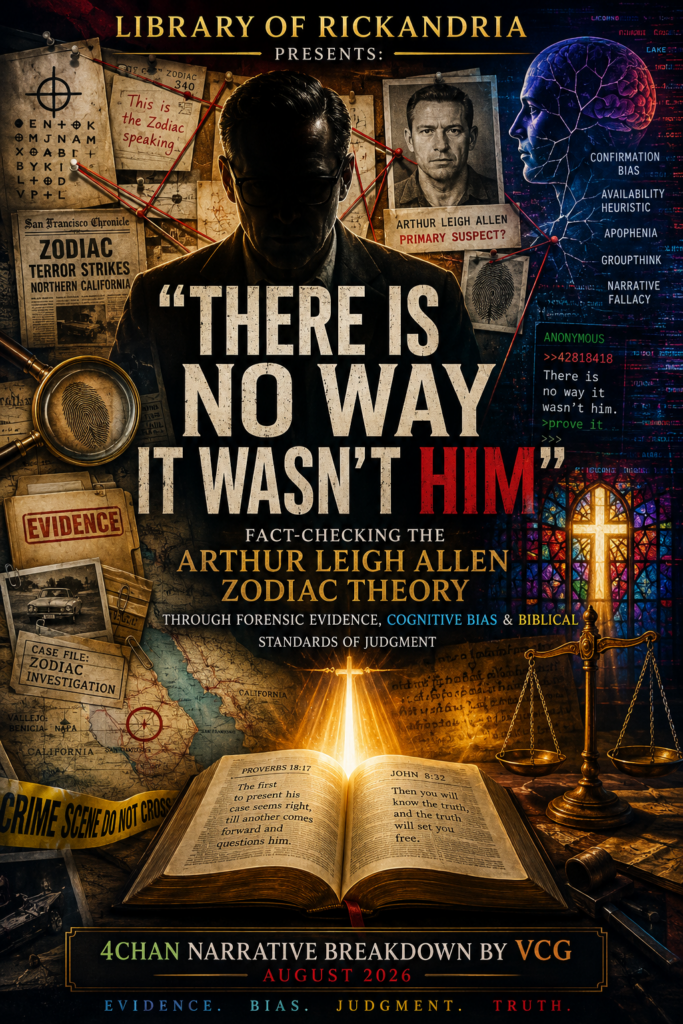
UPDATED BY VCG ON 8/20/2026 @ 01:11 EST
I want to share a heartfelt cause with my audience. Conner Blaisdell-Greene, a brave Airforce Sr. Airman, recently lost his battle with cancer, leaving his family in financial distress. Every donation, no matter how small, can help cover his funeral costs and ease their burden during this difficult time. Please consider clicking the link below to contribute or share Conner’s story with others. Your support truly matters.
Anyone can do this, but most won’t.
ChatGPT – Library of Rickandria
Soli Deo Gloria, brethren.
I’ll treat the thread as a primary source, then separate four layers for each claim:
- what it actually says
- what can be fact-checked
- what persuasion/psychology is operating
- what Scripture does—or does not—support
I’ll also distinguish explicit claims from insinuation so we don’t accidentally “rebut” things the poster never actually asserted.
/x/ – there is no way arthur allen leigh wasn’t the zodi – Paranormal – 4chan
The thread is short enough to audit completely.
Its core is not really:
“new Zodiac evidence”
it is a stacked circumstantial case for Arthur Leigh Allen, followed by several unsupported alternative theories.
The most important methodological issue is that a long list of individually weak or post-hoc correlations can feel statistically overwhelming even when no valid probability calculation has been made.
One important correction already emerges:
the thread’s “birthday” coincidence is not merely weak—it appears to be wrong.
The FBI-era record places the:
“today’s my birthday”
call around January 14, 1970, not Allen’s December 18 birthday, and subsequent calls were traced to Zodiac impersonator Eric Weil.
That detail became much more dramatic in later Graysmith/film retellings.
I went through the entire archived thread, not merely the OP, and cross-checked its principal claims against:
- the FBI archive
- San Francisco Chronicle reporting
- historical case summaries
- later witness accounts
and research on:
- eyewitness memory
- confirmation bias
- forensic reasoning
The thread contains some genuinely interesting facts about Arthur Leigh Allen—but it repeatedly upgrades circumstantial evidence into proof, later recollections into contemporary evidence, disputed claims into facts, and coincidences into imaginary probability calculations. (4chan)
My overall conclusion is:
Arthur Leigh Allen was a legitimate and unusually interesting Zodiac suspect.
The public evidence does not establish that he was the Zodiac Killer, much less establish it beyond reasonable doubt.
Several of the thread’s strongest-sounding claims are exaggerated, disputed, non-probative, or demonstrably false.
That conclusion cuts both ways. It would also be unjustified to declare,
“Allen definitely was not Zodiac.”
The historical record leaves unresolved questions.
But
“there is no way he wasn’t”
goes much further than the evidence permits.


1. The methodology I used
For this audit, evidence is weighted by provenance rather than dramatic effect:
| Tier | Evidence type | Weight |
|---|---|---|
| A | Police/FBI records, authenticated physical evidence | Highest |
| B | Contemporary reporting quoting investigators / documented case history | High |
| C | Later interviews with direct witnesses | Potentially valuable, but memory contamination must be considered |
| D | Documentaries, books, specialist researchers reconstructing the case | Useful secondary evidence |
| E | Anonymous internet claims, resemblance comparisons, “someone said…” | Very low unless independently corroborated |
The FBI’s public Zodiac collection contains seven parts of the surviving federal file.
That is the proper direction of travel:
primary records first, stories about the records second.
FBI — Federal Bureau of Investigation
There is also an important statistical distinction throughout this analysis:
Evidence that is consistent with Allen being Zodiac is not automatically evidence that uniquely identifies Allen as Zodiac.
- Owning guns
- liking codes
- having the right shoe size
- owning a Zodiac watch
- being an unpleasant or criminal person
and living in Northern California may all make an Allen narrative coherent.
But identifying evidence must answer another question:
How much more probable would we be to observe this fact if Allen were Zodiac than if he were not?
Forensic statisticians use likelihood concepts precisely because
“interesting coincidence”
and
“strong identification evidence”
are not synonymous.
2. The biblical standard before examining the accusations
Scripture does not give us a modern forensic-science manual.
It does, however, give exceptionally relevant principles concerning accusations and judgment.
Deuteronomy 19:15–18 places serious accusation within corroboration and commands the judges to make “diligent inquisition”:
“One witness shall not rise up against a man for any iniquity, or for any sin… at the mouth of two witnesses, or at the mouth of three witnesses, shall the matter be established.”
It then explicitly requires investigation of potentially false testimony.
Proverbs 18:13:
“He that answereth a matter before he heareth it, it is folly and shame unto him.”
And Proverbs 18:17 gives almost a perfect description of adversarial fact-checking:
“He that is first in his own cause seemeth just; but his neighbour cometh and searcheth him.”
Exodus 23:1, 7:
“Thou shalt not raise a false report…”
and
“Keep thee far from a false matter…”
Likewise:
“Be not a witness against thy neighbour without cause; and deceive not with thy lips.” — Proverbs 24:28.
A necessary qualification:
Deuteronomy 19 is an Israelite judicial law, not a rule saying historians may believe nothing unless exactly two eyewitnesses saw it.
The applicable principle is careful corroboration, diligent inquiry, and resistance to condemning a person on insufficient testimony.
That is especially relevant because Allen is dead and cannot answer new accusations.
3. The OP: “There is no way Arthur Leigh Allen wasn’t the Zodiac”
The opening post asserts certainty before supplying evidence and then invokes “astronomical” odds. (4chan)
Verdict: Methodologically indefensible
Even if every later bullet were accurate, the conclusion still would not follow automatically.
The thread would need to establish:
which observations were selected before Allen was proposed;
how common every characteristic was in the relevant population;
whether the characteristics are statistically independent;
how many other suspects were searched for similar matches;
which apparent matches resulted from later publicity;
how the negative forensic evidence should be weighted.
It does none of this.
This is structurally similar to post-hoc multiple comparison/data-dredging problems.
When you search enough characteristics after examining the target, chance matches accumulate.
Statistical literature explicitly warns that unplanned post-hoc searching increases false-positive findings.
Imagine searching thousands of men for:
a military connection,
shoe size,
firearms,
codes,
unusual literature,
a watch,
birthdays,
water-related hobbies,
geographical coincidences,
suspicious statements,
typewriters,
bombs,
handwriting habits.
You do not get to multiply the apparent rarity of the survivors afterward and call the result
“astronomical.”
That is the forensic equivalent of drawing the bull’s-eye around the bullet holes.
Psychology
This is classic confirmation bias/tunnel vision:
establish the suspect, then reinterpret ambiguous information in ways that fit him.
NIJ research describes tunnel vision as concentrating on one suspect or theory while failing adequately to process contradictory evidence.
Scripture correction
Proverbs 18:17 directly addresses this epistemic problem:
the first presentation can sound convincing until it is searched.
4. “Cheney said Allen described becoming ‘Zodiac’ before the murders”
This is one of the most important arguments in the thread. (4chan)
Verdict:
Historically real allegation; uncorroborated as a confession
Donald Cheney did indeed report Allen to police.
Investigators documented Cheney’s allegation that Allen discussed killing couples, sending taunting correspondence, using the name “Zodiac,” and putting a flashlight on a firearm.
Contemporary investigators initially considered Cheney sufficiently reliable to pursue the allegation; surviving FBI material records people close to Allen describing Cheney as reliable and investigators reporting no obvious ulterior motive. (Zodiac Killer)
That means it is incorrect to dismiss Cheney as simply:
“some random guy making it up.”
But there is a huge difference between:
“Cheney testified that Allen told him X”
and
“Allen confessed X.”
We possess Cheney’s testimony about Allen’s alleged statements.
We do not possess:
- a recording
- letter
- diary entry
- independent contemporary witness to the exact conversation
or other direct proof that Allen said all of it.
There are also reliability problems.
Researcher Michael Butterfield, who interviewed Cheney and examined the reports, states that Cheney’s accounts acquired additional elements and chronology problems over the years.
In particular, Butterfield highlights tension between the claimed date of the conversation and references to events that occurred later.
Ep 10 · Doubt – Monster: The Zodiac Killer
To be fair, Cheney’s daughter has recently disputed parts of that criticism and argues that her father’s original chronology was misunderstood; she also recalls hearing her parents discuss his Allen concerns before law enforcement involvement.
That is evidence worth considering—but it is still retrospective family testimony, not a recording of Allen.
“My dad wasn’t the Zodiac killer…” | San Diego Reader
Proper evidentiary conclusion
Cheney is a serious reason Allen became a suspect.
Cheney is not sufficient to establish Allen as Zodiac.
Psychology
The danger runs in both directions.
Someone already convinced Allen was guilty will treat every Cheney development as corroboration.
Someone already convinced Allen was innocent will treat every inconsistency as proof Cheney fabricated everything.
The responsible position is narrower:
his early allegation has evidentiary value, but later embellishment/chronological disagreement lowers confidence in the details.
Scripture
Deuteronomy 19 does not say
“disbelieve Cheney”
it says an accusation requires corroborative inquiry rather than immediate condemnation.
5. “Cheney described the flashlight-on-the-gun technique”
Verdict: Real allegation, potentially interesting, but dependent on Cheney
This is genuinely one of the more specific parallels.
History’s overview confirms that police questioned Allen after a friend reported his alleged discussion of killing and fastening a flashlight to a firearm.
Could Any of These Men Have Been the Zodiac Killer? | HISTORY
What reduces the evidentiary force is that this is not independent of item #1.
The thread presents:
Cheney says Allen planned Zodiac;
Cheney says Allen described flashlight technique;
as though they are two independent pieces of evidence.
They are principally two assertions arising from the same source and alleged conversation.
That matters statistically.
Ten details from one witness do not automatically equal ten independent witnesses.
Psychology/methodology
This is evidence fragmentation:
split one evidentiary source into several bullets to make the case visually look larger.
One witness alleging five suspicious statements may be important—but it is not the same evidence structure as five independently corroborated facts.
6. “Most people thought Cheney trustworthy”
Verdict: Partly supported, but irrelevant to whether every claim was accurate
Police did obtain favorable statements concerning Cheney’s reliability. (Zodiac Killer)
But
“trustworthy person”
is not a forensic category meaning
“incapable of memory error, reconstruction, exaggeration, or sincere mistake.”
People can be honest and wrong.
That distinction becomes especially important when decades pass.
Scripture
Biblical judicial caution is not based upon assuming every witness is malicious.
It recognizes that testimony must nevertheless be searched and established.
Deuteronomy 19:18 explicitly calls for
“diligent inquisition.”
7. “Allen wore size 10.5 Wing Walker boots”
Verdict: One of the better circumstantial points, but badly overstated
The Lake Berryessa assailant left distinctive boot impressions associated with approximately size 10½ military-style Wing Walker footwear.
Retrospective Chronicle reporting says Allen possessed boots identical to those attributed to Zodiac, and other historical overviews note the shoe connection.
Zodiac Killer case, 50 years later: Tracing the legend of ‘our Jack the Ripper’
So, there is a real evidentiary correspondence here.
But the thread jumps from:
same relatively uncommon footwear characteristic
to
astronomically unlikely coincidence.
That cannot be calculated without knowing:
how many of those boots existed in the region;
military/surplus distribution;
how many men of relevant build wore that size;
whether investigators physically established that Allen’s particular boots made the impressions;
whether wear-pattern characteristics matched.
There is no publicly established individualized footwear match tying a specific Allen boot to the Lake Berryessa impression.
Correct weight
Moderately interesting circumstantial evidence.
Not individualizing forensic evidence.
A size/type match puts someone inside a class.
It does not identify a unique member of that class.
8. “The Seawater children said Allen took them to the exact murder sites beforehand”
This is one of the most misleading formulations in the thread. (4chan)
Verdict: Later allegation converted into a fact and circularly worded
The Seawater siblings’ claims became prominent through the 2024 Netflix documentary.
They remember trips with Allen and retrospectively associate some journeys with locations near murders.
TIME’s reporting is careful:
the family believes Allen may have been responsible for killings occurring near some of those trips.
Netflix Doc This Is The Zodiac Speaking Explained
The thread instead says Allen took them to places
“where he committed the murders.”
That embeds the conclusion inside the premise.
Worse, two major crimes invoked in the documentary—the 1963 murders of Robert Domingos and Linda Edwards and the 1966 murder of Cheri Jo Bates—are not established canonical Zodiac murders.
TIME explicitly notes the 1963 killings are not officially linked to Zodiac, while Riverside authorities have rejected the Zodiac attribution of Bates.
Netflix Doc This Is The Zodiac Speaking Explained
So, the proper statement is:
Decades later, Seawater family members remembered trips with Allen that they now associate geographically or chronologically with certain unsolved murders, some of which are themselves not established Zodiac crimes.
That is substantially weaker than the 4chan wording.
Psychology
This is an excellent setting for:
hindsight bias;
retrospective pattern formation;
memory reconstruction;
narrative coherence after watching films/documentaries.
TIME reports that the siblings themselves described being struck by similarities after watching the 2007 Zodiac movie.
Netflix Doc This Is The Zodiac Speaking Explained
That doesn’t prove their memories are false.
It does mean we must distinguish memory formed before exposure from interpretation attached afterward.
9. “David Seawater says Allen confessed to him before dying”
Verdict: A direct allegation exists; it is not independently verifiable
TIME reports David Seawater’s account:
in 1992, during a telephone conversation shortly before Allen’s death, David says he asked whether Allen was Zodiac and Allen admitted it while emotionally discussing other abuse.
Netflix Doc This Is The Zodiac Speaking Explained
That is important testimony if true.
But the evidentiary situation is:
no recording;
no contemporaneous police documentation presented establishing the statement;
alleged speaker deceased;
recollection publicized decades later;
testimony emerges in a documentary built around the Allen hypothesis.
Calling this a reported deathbed-type confession is fair.
Calling it proof of confession is not.
Also, David’s testimony should not be counted independently from the entire Seawater narrative as though every associated memory creates a new probability multiplier.
They arise from a shared family context.
Biblical correction
Again:
“He that is first in his own cause seemeth just; but his neighbour cometh and searcheth him.” — Proverbs 18:17
Allen cannot now be searched or cross-examined regarding that alleged conversation, which is precisely why caution is warranted.
10. “Allen was a convicted child molester, so we know for a fact he’s amoral”
Verdict: First proposition substantially true; inference is logically irrelevant to Zodiac guilt
Allen was imprisoned following a child-sex offense.
Chronicle reporting records that he was imprisoned in the 1970s for lewd acts involving a boy.
Will DNA submitted to genealogy sites also finally catch the Zodiac Killer?
That is grievous misconduct.
But:
child sexual abuse → therefore serial murderer
is invalid reasoning.
Being guilty of offense A does not establish guilt of offense B.
“Amoral” is also not a precise forensic classification.
It rhetorically transforms established wrongdoing into a general license to attribute any other evil act to the person.
Psychology
This is the horn effect: once someone is known to possess a strongly negative characteristic, observers become more willing to interpret unrelated ambiguous evidence negatively.
In criminal reasoning it manifests as:
“We know he’s a terrible person, therefore this terrible accusation feels plausible.”
Plausibility is not identification.
Scripture
Scripture condemns both wickedness and false judgment.
The obligation not to bear false witness is not waived because the accused has committed another serious sin.
Exodus 20:16 says:
“Thou shalt not bear false witness against thy neighbour.”
That is an important Christian evidentiary principle:
we do not need to minimize Allen’s documented crimes in order to refuse to assign him undocumented ones.
11. “Allen owned a Zodiac-brand watch”
Verdict: True and genuinely interesting; low-to-moderate probative weight
This is well documented.
Allen owned a Zodiac-brand watch whose logo contained the circle-and-cross imagery strongly resembling the symbol adopted by the killer.
Could Any of These Men Have Been the Zodiac Killer? | HISTORY
This is the kind of coincidence that rightly causes investigators to look harder.
But notice what remains unknown.
We do not know that the killer chose his name or symbol because of that watch brand.
The inference runs:
Allen owns Zodiac watch
→ killer calls himself Zodiac and uses similar symbol
→ therefore Allen.
Possible.
Interesting.
Not demonstrated.
If independent evidence proved the killer consciously took his persona from that particular watch, its weight would increase enormously.
We do not have that evidence.
Verdict weight
Real clue; not a smoking gun.
12. “Allen’s house was filled with guns and daggers”
Verdict: Rhetorically inflated
Allen had firearms and was investigated repeatedly.
Searches recovered weapons and other suspicious materials.
Historical summaries confirm his firearms interest.
Could Any of These Men Have Been the Zodiac Killer? | HISTORY
But
“house filled with guns and daggers”
is descriptive rhetoric rather than an evidentiary category.
The question is not:
Did Allen own scary objects?
It is:
Did any recovered weapon forensically match a Zodiac murder weapon?
The public record does not establish such a match.
History’s review concludes that searches failed to produce incriminating evidence linking him to the crimes.
Could Any of These Men Have Been the Zodiac Killer? | HISTORY
This is a recurring pattern in true-crime persuasion: use visually ominous facts as substitutes for forensic linkage.
13. “Allen was obsessed with codes and taught children ciphers”
Verdict: Teaching codes is supported by later pupils; “obsessed” is interpretation
TIME reports a former student remembering Allen teaching pupils how to decipher codes as different forms of communication.
Netflix Doc This Is The Zodiac Speaking Explained
That’s relevant because Zodiac demonstrably used cryptograms.
But “obsessed” goes beyond the cited fact.
Furthermore, cryptography was not so unique an interest that anyone teaching elementary codes becomes an improbable match to Zodiac.
This is a class characteristic.
It contributes modestly to a cumulative circumstantial profile; it does not identify him.
14. “Allen’s birthday matched Zodiac’s ‘today’s my birthday’ call”
This is the thread’s biggest factual failure. (4chan)
Verdict: False
Allen’s birthday was December 18.
The surviving FBI chronology places the call in which someone claiming to be Zodiac said
“Today’s my birthday”
on or around January 14, 1970, not December 18, 1969.
Subsequent calls were traced to mental-hospital patient Eric Weil, who had impersonated Zodiac. The specialist reconstruction is based on FBI reports and contemporary chronology. (zodiackillerfacts.com)
The December 18 connection was popularized in Robert Graysmith’s later reconstruction and became especially memorable through the 2007 film.
This is important beyond this one bullet because it demonstrates information laundering:
police material
→ book reconstruction
→ cinematic dramatization
→ internet “fact.”
By the time the claim reaches the 4chan thread, the disputed reconstruction has become
“Allen’s birthday is the same day he called.”
It wasn’t.
Psychological significance
This is exactly why compelling narratives require source audits.
A coincidence feels almost supernatural once presented in a polished story, so people remember the coincidence while forgetting where it came from.
Remove this item entirely from the Allen probability stack.
15. “Zodiac threatened bombs; bomb formulas were found in Allen’s home”
Verdict: Substantively relevant but not unique
Authentic Zodiac correspondence contained threats involving a school bus and bomb designs.
Contemporary Chronicle records show a November 1969 communication containing plans for a device intended to attack a school bus.
Files shut on Zodiac’s deadly trail / SFPD caseload renders 35-year mystery inactive
Materials associated with explosives/bomb construction were also reportedly recovered in later searches of Allen’s property.
That is more interesting than
“he owned knives,”
because it overlaps a distinctive area of Zodiac’s correspondence.
But again, we need the missing individualizing link:
- Was the formula unique?
- Did Allen’s diagram share distinctive errors with Zodiac’s?
- Was paper/ink/typewriting matched?
- Were components traceable to a Zodiac device?
- Did police establish that the supposed Zodiac bomb was ever actually built?
Without that, this remains a circumstantial correspondence.
Worth investigating?
Absolutely.
Proof?
No.
16. “Allen was the ONLY suspect to offer police help”
Verdict: Not established and evidentially weak anyway
This appears closely related to a famous scene/narrative from the 2007 film in which Toschi mentions a letter from Allen offering assistance.
The film presents the “only one” element dramatically.
Subtitle Cat – All Language Subtitles – Zodiac.DVDRip.Arcon.en
I could not locate a sufficiently authoritative complete suspect dataset establishing that among every Zodiac person of interest Allen was literally the only person ever to offer help.
More importantly, suppose he were.
What follows?
Some offenders insert themselves into investigations.
So, do:
attention seekers;
innocent eccentrics;
people who enjoy contact with police;
people trying to look cooperative;
people joking about being suspected.
Without a validated base rate,
“serial killers sometimes help investigations”
cannot be inverted into:
“A suspect offered help; therefore, he is probably the killer.”
That’s the same conditional-probability error forensic statisticians warn against. (NIST)
17. “A surviving victim identified Allen”
Verdict: True, with very serious reliability qualifications
Michael Mageau, survivor of the 1969 Blue Rock Springs shooting, did identify Allen’s photograph in a lineup more than two decades later.
Could Any of These Men Have Been the Zodiac Killer? | HISTORY
This deserves inclusion in the Allen case.
But the thread omits almost everything needed to evaluate it.
Mageau had originally had a poor viewing situation.
The shooting took place at night and the attacker used a bright light.
By the time of the later identification, Allen had been publicly associated with the Zodiac case for years.
A detailed retrospective on the lineup reports that Mageau also pointed toward another photograph as having facial similarity, and Vallejo police did not regard the identification as strong.
Ep 10 · Doubt – Monster: The Zodiac Killer
History’s updated summary likewise says police regarded the photo ID as weak.
Could Any of These Men Have Been the Zodiac Killer? | HISTORY
Modern eyewitness-memory science gives good reason for caution.
Memories fade and are reconstructive; later photographs, feedback, repeated exposure to suspects, and subsequent information can affect identification.
APA specifically describes eyewitness memory as readily contaminated, and recent research documents a
“repeated-suspect effect,”
whereby repeated exposure increases the likelihood that a witness will select the same suspect later.
That does not prove Mageau was mistaken.
It means a 22-year-delayed identification after substantial publicity is not equivalent to an immediate uncontaminated identification.
Proper formulation
Evidence for Allen, but substantially weaker than the 4chan bullet makes it sound.
18. “The letters stop when Allen is incarcerated, then a 1978 letter appears after his release”
Verdict: Chronology partly correct; inference much weaker than advertised
Allen was arrested in the mid-1970s over the child-sex offense and spent a period institutionalized/incarcerated.
Authentic or generally accepted Zodiac correspondence extends into 1974.
Will DNA submitted to genealogy sites also finally catch the Zodiac Killer?
The problem is the:
“final letter.”
The 1978 communication has long been controversial.
Contemporary SFPD history records significant doubts over its authenticity; Inspector David Toschi was removed from the case amid the controversy, although he denied writing a Zodiac letter.
Inspector taken off Zodiac case
Other Chronicle summaries explicitly describe the 1978 letter as disputed.
Even granting authenticity, the inference is weak:
Allen unavailable → letters absent → Allen free → one letter appears.
Why?
Because authenticated Zodiac correspondence had already become sparse.
You cannot infer authorship merely because one person’s availability fits a broad silence interval.
Thousands of other adults were also free in 1978.
This is a timeline fit, not identification.
19. “Allen liked skinny-dipping; half the Zodiac murders happened at lakes”
Verdict: Mostly pattern manufacture
Look at the canonical attacks:
Lake Herman Road — roadside attack;
Blue Rock Springs Park — parking area;
Lake Berryessa — actual lakeshore attack;
Presidio Heights — urban San Francisco taxi murder.
The canonical geography is documented in Chronicle histories.
Will DNA submitted to genealogy sites also finally catch the Zodiac Killer?
Calling this
“half the killings happened at lakes”
exploits labels.
“Lake Herman Road”
contains Lake in its name, but the victims were attacked on the road.
Blue Rock Springs isn’t evidence of a skinny-dipping nexus.
Only Lake Berryessa is straightforwardly a waterside killing.
And even if two attacks occurred near water,
“Allen liked skinny-dipping”
does not connect him to those particular crimes unless something more specific links his activity to those dates/locations.
This bullet is a textbook example of semantic pattern enhancement—choosing a broad description after the fact because it connects the suspect to the crime.
It deserves essentially no evidentiary weight.
20. “Allen had bloody knives in his car at the time of the Lake Berryessa stabbing”
Verdict: Real statement; commonly retold in a materially misleading way
This one requires precision.
Police did not, according to the surviving account, pull Allen over after the murder, see bloody knives, and accept
“I killed chickens”
before sending him on his way.
Rather, in a later police interview, Allen himself brought up having had two bloody knives in his car, explaining that the blood came from a chicken.
History’s summary preserves the core fact:
he told investigators the bloody knives had been used on chickens.
Could Any of These Men Have Been the Zodiac Killer? | HISTORY
The later cinematic/documentary version can make this feel like police physically caught Allen with incriminating knives immediately after the attack.
That is much stronger than the underlying record supports.
No public forensic test established that those knives carried the victims’ blood.
Why it remains interesting
The statement is odd.
A person being questioned about a stabbing voluntarily saying, effectively,
“the bloody knives were from a chicken,”
reasonably attracts investigative attention.
But odd behavior has multiple possible causes:
guilty anticipatory explanation;
innocent anticipation of something police might have heard;
provocative personality;
desire for attention;
nervous over-explanation.
It is evidence to investigate, not proof of what generated the behavior.
21. What the thread leaves out: the evidence against Allen
This omission is crucial.
History’s updated survey records that:
Allen did not fit all eyewitness descriptions;
his fingerprints did not match prints believed to be Zodiac’s at the Stine scene;
his palm print did not match a print on Zodiac correspondence;
available handwriting samples from both hands did not match;
repeated searches failed to produce incriminating physical evidence;
the delayed Mageau identification was considered weak.
Could Any of These Men Have Been the Zodiac Killer? | HISTORY
Then there is DNA.
In 2002 SFPD investigators developed a partial genetic profile from biological material associated with a bona fide Zodiac communication and reported that Allen did not match it.
DNA seems to clear only Zodiac suspect / New-found evidence may allow genetic profile of ’60s killer
That sounds dispositive, but there is an important caution.
There is no confirmed crime-scene Zodiac DNA profile.
The stamp/envelope material is partial, and questions remain about whether the biological contributor was necessarily the killer himself.
The Chronicle later explained that the partial profile could exclude contributors but could not identify Zodiac by itself. (San Francisco Chronicle)
Will DNA submitted to genealogy sites also finally catch the Zodiac Killer?
So, two exaggerated claims should both be rejected:
Bad claim A:
“The DNA means nothing whatsoever.”
No.
A non-match with biological material from an authentic communication is evidence against Allen being the contributor.
Bad claim B:
“DNA conclusively proves Allen could not have been Zodiac.”
That is stronger than the provenance of the profile warrants.
The responsible formulation is:
The available DNA evidence weighs against Allen, potentially strongly, but because the source attribution of the partial profile is uncertain it is not a definitive exoneration.
That kind of qualified language is exactly what the 4chan argument lacks.
22. Reply: “It was multiple people and every murder was ritualistic human sacrifice”
The thread suddenly introduces a multiple-killer/human-sacrifice theory with no supporting evidence. (4chan)
Verdict: Unsupported
Zodiac’s correspondence does contain bizarre language about victims becoming his “slaves” in an imagined afterlife.
Chronicle reporting reproduces that theme from the solved cipher.
DNA seems to clear only Zodiac suspect / New-found evidence may allow genetic profile of ’60s killer
That tells us something about the writer’s stated fantasy or persona.
It does not establish:
an occult organization;
ceremonial sacrifice;
multiple ritual participants;
literal religious rites.
The leap is:
killer uses bizarre afterlife rhetoric
→ murders were ritual sacrifices.
That is not a demonstrated inference.
Scripture correction
This is particularly important on a paranormal board.
Scripture should not be used to turn unverified criminal speculation into spiritual certainty.
Calling something “ritual sacrifice” without evidence risks moving from discernment into false report.
Exodus 23:1 is applicable:
“Thou shalt not raise a false report…”
One may analyze occult themes in a murderer’s writings without declaring an occult conspiracy that the evidence does not establish.
23. Reply: “Zodiac was Paul Doerr; the evidence is damning”
Verdict: Interesting modern suspect theory, unproven
Author Jarett Kobek proposed Paul Doerr after finding numerous circumstantial parallels:
Bay Area location;
age/build compatibility;
Navy-related employment;
cryptography/fanzines;
explosives knowledge;
similarities between a bomb formula Doerr discussed and Zodiac-related material.
The Guardian covered Kobek’s case and, importantly, Kobek himself acknowledges its circumstantial character.
‘It’s not an unsolvable case’: has the Zodiac killer finally been found? | California | The Guardian
There is no publicly established:
- DNA
- fingerprint
- firearm
- handwriting
or other individualized forensic identification proving Doerr was Zodiac.
The Doerr claim therefore teaches exactly the same lesson as Allen:
If you search a person’s biography intensely enough, an astonishing-looking constellation of similarities can emerge.
That may generate a good suspect hypothesis.
It does not generate a conviction by arithmetic.
24. Reply: “Allen probably killed several people, just not the canonical Zodiac victims”
Verdict: Unsupported accusation
The thread supplies no evidence for this assertion. (4chan)
Allen’s documented sexual offense does not establish that he murdered:
“several people.”
This is where true-crime speculation becomes ethically serious.
“He seems capable of it”
is not historical proof of homicide.
Scripture
“Be not a witness against thy neighbour without cause…” — Proverbs 24:28
That applies even to a dead man with a reprehensible criminal history.
25. The “Just sayin’” comparison image
The post supplies a visual comparison without an articulated argument. (4chan)
Verdict: Insinuation, not evidence
I would not infer the identity of any real person from a photograph or composite.
More fundamentally, facial resemblance to a police sketch is weak evidence unless accompanied by:
controlled identification procedures;
distinctive measurable characteristics;
location/opportunity evidence;
forensic corroboration.
Police composites are not photographs.
They are reconstructions from witness memory.
A side-by-side graphic feels evidential because the human visual system is exceptionally good at finding similarity.
That is exactly why resemblance comparisons are seductive.
26. “There was no single Zodiac. It was a meme.”
Verdict: A legitimate hypothesis to investigate; stated as certainty without sufficient evidence
A modern documentary has promoted a multiple-perpetrator/constructed-Zodiac theory, arguing that the canonical attacks differ in weapon, witnesses, and circumstances.
Even the Chronicle’s review acknowledged that questioning the single-killer assumption can be interesting—but also criticized speculative attempts to explain away contradictory evidence.
Zodiac Killer was a myth, new documentary says
There is an important anchor against the strongest:
“nothing connected them”
version:
Paul Stine was murdered in San Francisco, and a subsequent Zodiac letter included a bloody piece of Stine’s missing shirt.
Zodiac Killer timeline: San Francisco Bay Area case still a puzzle 50 years later
Therefore, the writer of at least that authenticated communication either:
murdered Stine,
participated in the killing,
or obtained physical evidence directly or indirectly from someone who did.
That is a substantial link between the Zodiac correspondence and at least one canonical crime.
Calling the entire phenomenon merely “a meme” therefore requires explaining real physical evidence, not just variations in MO.
27. “There were multiple people killing and taking credit”
Verdict: Possible as a hypothesis; not established
Multiple-perpetrator theories can explain discrepant witness descriptions or methods.
But explanatory flexibility is not proof.
Notice the danger:
If attacks look similar →
“same killer.”
If attacks differ →
“multiple killers coordinating.”
If handwriting doesn’t match a suspect →
“accomplice wrote it.”
If DNA doesn’t match →
“someone else licked it.”
If chronology doesn’t fit →
“copycat.”
A hypothesis that can absorb every possible observation becomes difficult to falsify.
Good methodology asks:
What observation would prove my theory wrong?
If the answer is “nothing,” the theory has ceased to function as a strong evidentiary hypothesis.
28. “Someone on /x/ said they ran over Zodiac — bump bump gone”
Verdict: Zero evidentiary value without corroboration
This is anonymous hearsay about an earlier anonymous internet post. (4chan)
Its chain is:
unknown person
→ allegedly claims event
→ another anonymous person remembers it
→ current thread repeats it.
There is no:
name;
date;
vehicle;
police report;
victim;
body;
location;
independent witness;
physical evidence.
That is not a clue yet.
It is folklore.
29. The psychology of why the Allen case feels overwhelming
This is perhaps the most useful part of the whole exercise.
The Allen case has a powerful narrative density.
Consider the accumulation:
watch
- Zodiac symbol
- Wing Walkers
- bloody knives
- Cheney
- flashlight
- codes
- bombs
- child abuse
- Mageau
- Seawaters
- incarceration gap
- water hobby
Presented rapidly, the mind experiences what we might call convergence pressure:
“Come on.
How many coincidences can one person have?”
But several psychological mechanisms inflate that feeling.
Confirmation bias
Once “Allen = Zodiac” becomes the working theory, ambiguous facts are preferentially encoded as matches.
NIJ research on wrongful convictions specifically identifies confirmation bias and tunnel vision as recurring mechanisms by which investigations can accumulate an apparently coherent case while contrary information receives less attention. (Office of Justice Programs)
Evidence dependence
Many Allen clues are not independent.
For example:
- Cheney says Zodiac name
- Cheney says flashlight
- Cheney says couples
- Cheney says taunting police
looks like four matches.
Statistically it is primarily one witness account containing four details.
Likewise:
- Seawater trip
- Seawater confession
- Seawater childhood behavior
- Seawater locations
share a common retrospective witness environment.
They cannot simply be multiplied together.
Selection effects
Nobody began in 1968 with seventeen preregistered criteria and then discovered that one randomly selected man matched sixteen.
Rather, investigators and writers spent decades studying one unusually interesting suspect and accumulated whatever traits fit.
This is precisely the kind of post-hoc selection that makes coincidences appear rarer than they really are.
Multiple-comparison research shows why searching many variables increases apparent false-positive associations.
Base-rate neglect
“Zodiac watch”
sounds fantastically specific.
But to calculate its force we would need to know:
P (owns such watch | Zodiac)
versus
P (owns such watch | ordinary comparable Bay Area man)
We don’t know the first number.
We barely know the second.
Therefore “astronomical odds” is mathematically unjustified.
Hindsight bias
Once we know Zodiac used ciphers, a teacher who taught codes looks suspicious.
Once we know Zodiac used a strange symbol, the watch looks suspicious.
Once we know Zodiac threatened bombs, explosives material looks suspicious.
But asking after the fact:
“What about Allen resembles Zodiac?”
is not the same experiment as asking beforehand:
“Which person in Northern California uniquely possesses these predetermined traits?”
Narrative compression
The bloody-knives example is excellent.
The complicated historical claim:
Allen later volunteered during questioning that two bloody knives had been in his car and explained the blood as chicken blood.
compresses psychologically into:
Police found Allen driving away from the stabbing with bloody knives.
Those are not equivalent propositions.
The second is enormously more incriminating—and much easier to remember.
Movie-source contamination
The false birthday connection is the clearest demonstration.
Once the Graysmith/Fincher narrative binds:
December 18 + birthday call + Allen
together dramatically, the viewer remembers the emotional discovery as though it were documentary evidence.
The FBI chronology says otherwise.
That single example should make us re-audit every:
“I remember hearing that…”
Zodiac fact from primary sources.
30. The strongest case for Allen, stripped of exaggeration
If I were steelmanning the Allen hypothesis, I would not use seventeen internet bullets.
I would concentrate on the smaller group of genuinely interesting facts:
- Cheney’s early accusations were specific enough to cause serious police interest, especially the alleged “Zodiac” persona and flashlight/firearm idea. (HISTORY)
- Allen’s Zodiac-brand watch and symbol form an unusual thematic correspondence. (San Francisco Chronicle)
- The Lake Berryessa footwear correspondence is materially relevant circumstantial evidence.
- Allen’s bloody-knives statement is genuinely odd and deserves investigative attention. (HISTORY)
- Firearms/bomb/cipher interests overlap several aspects of the Zodiac persona.
- Mageau’s later identification, although weak, is evidence in Allen’s direction. (HISTORY)
- The Seawater allegations, if someday independently corroborated through contemporary documents or physical evidence, could become significant. (TIME)
That is a real circumstantial case.
It explains why experienced investigators did not simply laugh at Allen and move on.
31. The strongest case against Allen
The contrary side is substantial:
No confirmed murder weapon.
No recovered Allen firearm has publicly been shown to be a Zodiac murder weapon.
Negative fingerprints/palm print.
Known comparisons did not match Allen.
Could Any of These Men Have Been the Zodiac Killer? | HISTORY
Negative handwriting comparisons.
Investigators obtained samples using both hands; they failed to produce the desired match.
Could Any of These Men Have Been the Zodiac Killer? | HISTORY
Negative partial DNA comparison.
Allen did not match the partial profile recovered from biological material associated with authentic Zodiac correspondence, though sample provenance keeps this from being absolute exoneration.
DNA seems to clear only Zodiac suspect / New-found evidence may allow genetic profile of ’60s killer
Witness-description problems.
Allen did not fit every contemporary description well.
Could Any of These Men Have Been the Zodiac Killer? | HISTORY
The major Mageau identification occurred decades later.
That substantially lowers its reliability relative to an immediate identification.
Ep 10 · Doubt – Monster: The Zodiac Killer
Repeated searches failed to reveal decisive crime evidence.
Could Any of These Men Have Been the Zodiac Killer? | HISTORY
One seemingly spectacular coincidence—the birthday call—is simply erroneous.
That’s far too much contrary evidence to justify
“there is no way it wasn’t him.”
32. A graded scorecard of the 4chan evidence
| Thread claim | My assessment | Evidentiary value |
|---|---|---|
| Cheney implicated Allen | True as testimony | Medium |
| Flashlight/gun statement | Reported by Cheney | Medium |
| Cheney considered reliable | Supported, but not proof of accuracy | Low–medium |
| Wing Walker connection | Substantially supported | Medium |
| Seawater murder-site trips | Later retrospective allegation, overstated | Low |
| David Seawater confession | Reported allegation, unverified | Low–medium |
| Child-sex conviction | True but does not prove murder | Essentially none for Zodiac identity |
| Zodiac-brand watch | True | Low–medium |
| Guns/daggers | Broadly true, rhetorically framed | Low |
| Codes/ciphers | Partly supported | Low |
| Birthday call | False | Zero |
| Bomb overlap | Real correspondence | Low–medium |
| Only suspect offering help | Unverified exclusivity / weak inference | Very low |
| Mageau ID | True, major reliability caveats | Low–medium |
| Prison/letter gap | Chronology roughly fits; 1978 disputed | Low |
| Skinny-dipping/lakes | Pattern manufacture | Essentially zero |
| Bloody knives | True statement, commonly exaggerated | Medium |
| Ritual human sacrifices | Unsupported | Zero |
| Paul Doerr definitely Zodiac | Unproven suspect theory | Insufficient |
| Allen killed several non-Zodiac victims | Unsupported | Zero |
| Multiple killers | Possible hypothesis, not established | Undetermined |
| “Zodiac was a meme” | Overstatement | Unsupported |
| Anonymous hit-and-run story | Anonymous hearsay | Zero |
33. The biblical correction to the entire thread
There is a beautiful methodological balance in Scripture that conspiracy culture often loses.
Scripture does not teach gullibility.
It praises investigation:
“It is the glory of God to conceal a thing:
but the honour of kings is to search out a matter.” — Proverbs 25:2
But searching out a matter is not the same as deciding the answer first.
Scripture also warns against premature judgment:
“He that answereth a matter before he heareth it, it is folly and shame unto him.” — Proverbs 18:13
And against one-sided argument:
“He that is first in his own cause seemeth just; but his neighbour cometh and searcheth him.” — Proverbs 18:17
And against accusation unsupported by adequate testimony:
“One witness shall not rise up against a man…” — Deuteronomy 19:15
Notice the balance.
Do not protect the wicked by refusing to investigate.
But also:
Do not manufacture certainty against the accused because the story feels right.
Biblical justice requires both.
34. Final judgment
After breaking the thread down, I would classify the Allen hypothesis this way:
Historically serious suspect: Yes.
Numerous genuine circumstantial coincidences: Yes.
Enough to warrant the extensive police investigation he received: Yes.
Evidence that could reasonably cause someone privately to think Allen may have been Zodiac: Yes.
Public evidence establishing that Allen was Zodiac: No.
Public evidence establishing that he committed the canonical murders beyond reasonable doubt: No.
“Astronomical odds”
demonstrated mathematically: Absolutely not.
Thread contains important misinformation: Yes—most conspicuously the birthday-call claim.
Thread systematically suppresses exculpatory/negative evidence: Yes.
The most accurate short conclusion is therefore:
Arthur Leigh Allen remains one of the strongest and most narratively compelling Zodiac suspects, but the case against him is circumstantial and substantially weaker than this thread portrays.
The surviving forensic evidence has repeatedly failed to identify him, several famous Allen “facts” come from later testimony or dramatization, and at least one of the supposedly spectacular coincidences is demonstrably false.
We should neither declare him guilty nor artificially declare every suspicion meaningless.
The evidence warrants investigation; it does not warrant certainty.
That is where Proverbs 18:17 lands remarkably well:
the Allen case “seemeth just” when presented exclusively by the prosecution.
Once the contrary evidence comes and “searcheth him,” the picture becomes considerably more complicated.
And this thread itself is a good case study in why:
“Scripture first, truth always”
must include evidentiary restraint.
Calling speculation “discernment” does not transform speculation into knowledge; truth is served by stating exactly what the evidence proves, exactly what it merely suggests, and exactly what remains unknown.
4CHAN THREAD & POST BREAKDOWNS – Library of Rickandria
VCG PAPER PROJECTS – Library of Rickandria