
Hidden Wisdom or Constructed Syncretism? A Historical, Psychological & Biblical Critique of Hermetic Qabalah, Kabbalistic Claims & Occult Pattern-Making
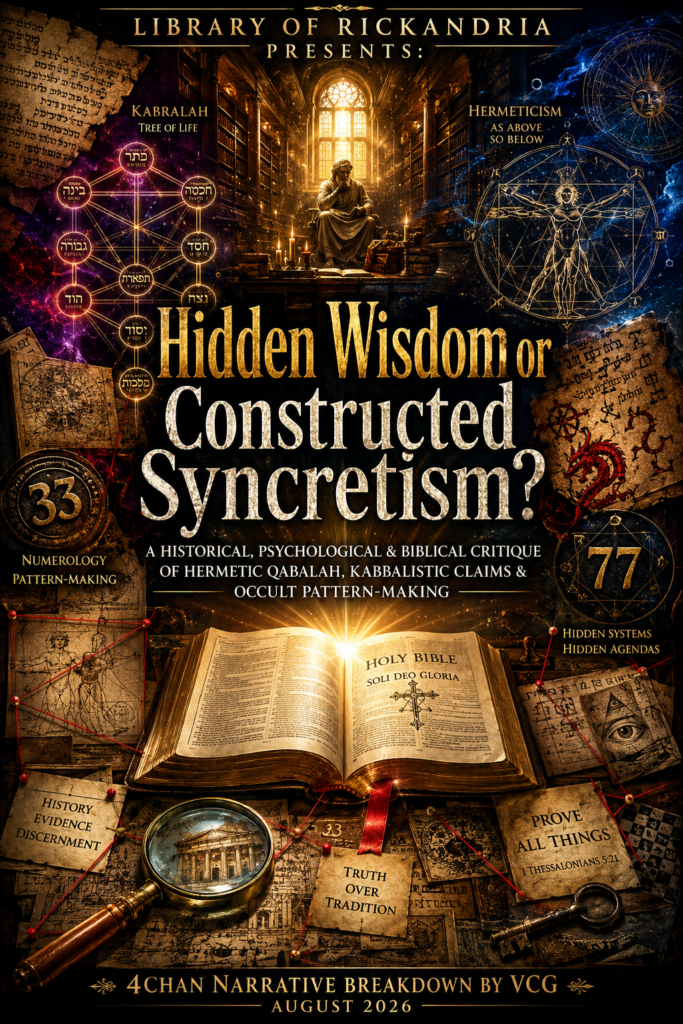
UPDATED BY VCG ON 8/21/2026 @ 13:13 EST
I want to share a heartfelt cause with my audience. Conner Blaisdell-Greene, a brave Airforce Sr. Airman, recently lost his battle with cancer, leaving his family in financial distress. Every donation, no matter how small, can help cover his funeral costs and ease their burden during this difficult time. Please consider clicking the link below to contribute or share Conner’s story with others. Your support truly matters.
Anyone can do this, but most won’t.
ChatGPT – Library of Rickandria
Soli Deo Gloria, brethren.
I’ll treat the thread as a set of claims rather than as a single argument:
first recover the exact posts, then classify each claim (historical, scientific/psychological, logical, or theological), verify it against primary/credible sources, and finally compare the theological claims against the KJV text supplied.
I’ll keep
“what the poster says,”
“what the evidence supports,”
and
“what Scripture actually says”
clearly separated.
/x/ – Non-Jewish Kabbalah – Paranormal – 4chan
The thread’s historical core is already separating cleanly from its speculative layers.
One important distinction:
- Jewish Kabbalah
- Renaissance Christian Cabala
- modern Hermetic/occult Qabalah
are related but not interchangeable; much of the thread’s confusion comes from collapsing them into one timeless
“secret tradition.”
The numerology posts are a different evidentiary problem altogether:
they use flexible, after-the-event number selection rather than a testable predictive method.
I read the live thread end-to-end, from OP No. 42839858 on August 18 through the final posts on August 20, 2026.
The thread begins with a legitimate historical question about whether Hermetic Qabalah can be disentangled from Jewish Kabbalah,
but it gradually mixes together:
- medieval Jewish mysticism
- Renaissance Cabala
- Hermeticism
- Neoplatonism
- comparative mythology
- linguistics
- gematria
- antisemitic conspiracy claims
- personal occult experience
and biblical assertions as though all of them belonged to one evidentiary category.
They do not. (4chan)
Executive verdict
There are several real historical connections buried in the thread:
- Jewish Kabbalah genuinely influenced Renaissance Christian Cabala, which was then blended deliberately with Hermetic, Neoplatonic, astrological, magical, and later occult systems.
- The surviving philosophical Hermetica are ancient/late-antique texts, centuries earlier than the mature medieval Kabbalah.
- Neoplatonism really does use hierarchical derivation/“emanation” language, although that does not mean every later emanation doctrine simply “came from Plotinus.”
- Devekut, tikkun, sefirot, qelipot/Sitra Achra, Hebrew letter symbolism, and numerical interpretation are genuine components of various Jewish mystical traditions.
- Golden Dawn-style Hermetic Qabalah really did appropriate and reorganize Jewish Kabbalistic material into a new Western occult synthesis.
But the thread repeatedly jumps from these facts into propositions for which it gives no adequate evidence:
a primordial “Magian” religion behind everything; all languages descending from one Egyptian/Mesopotamian source; Hebrew letters secretly encoding Mercury; Chinese writing deriving from Genesis; modern events being coded through 33/77; Jews collectively “running things”; a toroidal Qliphothic cosmology presented as though historical or physical; and claims about Christ’s “nine keys” that simply do not appear in Scripture.
And from a KJV-first Christian reading, the deepest problem is prior to all the historical questions:
Scripture never presents:
- occult correspondences
- angelic hierarchies
- gematria
- divination
- magical names
or secret initiatory systems as an alternative avenue by which a Christian is to approach God.
Instead it repeatedly directs the believer to God through Christ and warns against:
- divination
- “curious arts”
- deceptive spirits
- angel-centered spirituality
and claims that intrude into unseen things.
I. Methodology: how I am testing the thread
I am using four distinct standards rather than treating
“interesting resemblance”
as proof.
Historical test.
What is the earliest securely dated evidence?
Can we document transmission from A → B, rather than merely noting that A resembles B?
Empirical/logical test.
Is the claim specific enough to fail?
Were its rules fixed before the alleged confirmation?
Is there independent corroboration?
Are misses counted with hits?
Psychological test.
What normal cognitive processes can make an argument feel compelling—
- pattern detection
- selective attention
- hindsight
- motivated reasoning
- insider identity
—without diagnosing the anonymous author.
Biblical test.
What does the text actually say in context?
Is the teaching explicit, an inference, or imported from a later system?
Scripture is compared with Scripture rather than allowing an occult diagram to redefine Scripture.
That is also surprisingly close to the intellectual posture advocated in the prefatory material of the supplied KJV:
search the Scriptures, consult sources carefully, acknowledge difficult passages, and exercise modesty rather than dogmatism where evidence is uncertain.
Acts gives the Berean model:
they
“searched the scriptures daily, whether those things were so.”
And Paul gives the succinct principle:
“Prove all things; hold fast that which is good.”— 1 Thessalonians 5:21
That principle cuts both ways:
neither
“mainstream scholars say so”
nor
“initiates say so”
is sufficient by itself.
II. The OP itself — No. 42839858
The OP asks whether Hermetic Qabalah is essentially Hebrew religious material wearing Western occult clothing, or whether it is a universally valid system that merely retained Jewish influence; he also notices that the anti-Abrahamic “Tree of Wyrd” resembles/replaces the Kabbalistic Tree. (4chan)
Historical answer
There are really three things that should not be collapsed:
Jewish Kabbalah developed within Judaism.
Its mature medieval forms emerge particularly in southern France and Spain in the 12th–13th centuries, culminating in the Zoharic literature of late-13th-century Castile.
Current Oxford scholarship places formative Zohar texts in that setting.
Zohar | Oxford Bibliographies in Jewish Studies | Oxford Academic
Christian Cabala arose when Renaissance Christians deliberately appropriated Jewish Kabbalah and reinterpreted it Christologically.
Giovanni Pico della Mirandola is a watershed figure in the late 15th century; Johann Reuchlin followed him.
Cambridge scholarship explicitly describes Pico synthesizing Kabbalah with:
- Platonism
- Hermes Trismegistus
- Zoroastrian materials
and other supposedly ancient wisdom traditions.
Christian Kabbalah (Chapter 13) – The Cambridge Handbook of Western Mysticism and Esotericism
Hermetic/occult Qabalah is a still later Western esoteric synthesis.
Golden Dawn occultism inherited this already-Christianized Kabbalistic material and systematically matched the Tree with:
- planets
- Tarot
- astrology
- alchemy
- divine names
- angelic orders
- colors
- magical grades
etc.
Modern scholarship treats this as part of the history of Western esotericism—not simply as unchanged ancient Jewish Kabbalah.
So, the best answer is:
Can Hermetic Qabalah be separated religiously from Judaism?
Historically, occultists did precisely that.
Can it be separated genealogically from Jewish Kabbalah?
No.
Remove:
- the sefirotic Tree
- Hebrew letters
- Hebrew divine names
- Kabbalistic terminology
and inherited Jewish textual structures, and you have ceased to be talking about Qabalah in the historically recognizable sense.
That is considerably more precise than either
“it is Jewish religion”
or
“it is a universal primordial science.”
“Adonai” correction
The OP’s wording can also mislead.
Adonai is not the proper name of some separate Hebrew occult deity.
It means “Lord” and became the conventional reading substitute for the written Tetragrammaton YHWH.
Academic work on the Masoretic tradition confirms this reading practice.
So Hermetic ritual use of “Adonai” is better described as the appropriation of a Jewish divine title/name-reading into occult ritual, not proof that Hermetic Qabalah is simply worship of a separate entity called “Adonai.”
III. Post-by-post audit
No. 42839890 — “Judeo-Christian” mockery
There is no substantive historical argument here.
The meme reaction substitutes a social signal for evidence.
Methodologically, dismissing an idea because it smells
“Judeo-Christian”
tells us nothing about its:
- date
- source
- genealogy
or truth.
Biblically, Christianity undeniably arose from Israel’s Scriptures and Jewish historical context.
One may dispute theological continuity, but mere ridicule does not erase historical dependence.
Verdict: no argument presented.
No. 42840098 — Hermeticism is much older; read the Corpus Hermeticum
This is substantially right with an important qualification.
The philosophical/religious Hermetica are works of Greco-Roman late antiquity, whereas mature Kabbalah is medieval.
Cambridge describes the Hermetica as theological-philosophical writings of late antiquity that Renaissance readers mistakenly believed were vastly older—so old that Hermes was thought contemporary with Moses.
Therefore:
Extant Hermetic literature predates classical medieval Kabbalah:
yes.
Therefore, Hermeticism and Kabbalah have no connections:
no.
Renaissance thinkers later combined them deliberately.
The post gets chronology better than several later posts, but chronology alone cannot tell us which late antique ideas fed later Jewish mysticism.
Verdict: mostly true historically; insufficient as a complete answer.
No. 42840125 — “Emanations are Neoplatonism”
There is a legitimate insight here, expressed too absolutely.
Plotinus’ system proceeds from the One, to Intellect, to Soul.
Modern scholarship often calls this “emanation,” though Stanford warns that this should not be imagined as material fluid pouring out of God or as a temporal event; it describes an atemporal relation of ontological dependence.
Plotinus (Stanford Encyclopedia of Philosophy/Fall 2019 Edition)
Kabbalistic sefirotic structures have often been compared with Neoplatonic emanationism, and medieval thinkers existed in intellectual environments saturated with Greek, Islamic and Jewish philosophical currents.
But similarity is not identity:
One → Intellect → Soul
is not simply the same scheme as
Ein Sof → ten sefirot → later Kabbalistic worlds and structures.
“Neoplatonism influenced later mystical metaphysics”
is defensible.
“The entire idea of emanation belongs exclusively to Neoplatonism”
is not.
Verdict: partly correct, overstated.
No. 42840155
A joke about the title Corpus Hermeticum.
No evidentiary content.
No. 42840220 — Jewish Kabbalah = devekut; Golden Dawn = social-status LARP
This contains one genuine concept and one unsupported psychological attribution.
Devekut means “cleaving,” attachment or closeness to God.
It is especially important in Jewish mystical and later Hasidic traditions.
Saying
“clinging to God”
is fair shorthand.
Saying it simply means
“having God enter you”
or generic “enlightenment” loses the distinct Jewish theological context.
The judgment that Golden Dawn practitioners were merely performing degrees
“for social points”
is different.
The Golden Dawn demonstrably did possess elaborate grades and initiation structures, but a historian can establish the existence and function of grades, not casually infer that every participant’s real motive was prestige.
Current Oxford scholarship treats the order as a serious historical product of:
- Rosicrucianism
- Freemasonry
- occult revival
- Theosophy
- magic
- Kabbalah
It is perfectly legitimate to criticize initiatory hierarchy as conducive to status games.
It is not legitimate to leap from
“there were degrees”
to
“therefore the whole thing was consciously fraudulent.”
Verdict: first half broadly correct; motive claim unproved.
IV. The “primordial Magian Kabbalah” section
No. 42840247 — Pike proves Kabbalah and Hermeticism have identical origins
This is one of the thread’s most important errors because the quotation itself is authentic.
Albert Pike really did write in Morals and Dogma that a primordial revelation was preserved as “Kabalah,” and that Kabbalistic doctrine was also the doctrine of the Magi and Hermes.
Morals and Dogma: Consistory: XXXII. Sublime Prince of th… | Internet Sacred Text Archive
But:
Authentic quotation ≠ authentic ancient history.
Pike wrote in 1871.
He is an excellent primary source for what Albert Pike believed about perennial esoteric history.
He is not eyewitness evidence for:
- Abraham
- Hermes
- the ancient Magi
or the origins of medieval Kabbalah.
And modern scholarship explains exactly how this conception arose:
Renaissance and later occult thinkers actively constructed a prisca theologia/perennial-wisdom synthesis linking:
- Moses
- Hermes
- Zoroaster
- Plato
- Kabbalah
- Christianity
Pico is a classic example.
Christian Kabbalah (Chapter 13) – The Cambridge Handbook of Western Mysticism and Esotericism
The post then says conventional scholars cannot know because they are not initiated.
That creates a self-sealing epistemology:
- Historical evidence contradicts the doctrine.
- Historians point this out.
- Their disagreement proves they are outsiders.
- Only insiders count as competent witnesses.
- Insider testimony then proves the doctrine.
No possible contrary evidence can defeat such a system.
That does not prove the esoteric belief is false; it proves the argument offered cannot independently establish it.
Also, Pike’s statement that this doctrine is contained in the:
- Talmud
- Sefer Yetzirah
- Zohar
collapses works from very different historical periods into one primordial package.
Modern scholarship instead sees development over centuries.
Verdict: quote genuine; inference historically unsubstantiated.
No. 42840282 — Mesopotamian mysteries lie behind all religions
Mesopotamia profoundly influenced ancient Near Eastern:
- culture
- law
- mythology
- astronomy
- literature
That is not controversial.
But
“all religions descend from one Mesopotamian mystery religion”
is an enormous universal claim requiring an enormous transmission record.
Independent religious traditions developed in regions including:
- South Asia
- East Asia
- Africa
- the Americas
- Oceania
Similar features—
- floods
- sacred mountains
- divine kingship
- celestial symbols
- death/rebirth imagery
—can result from shared ancestry or ordinary human concerns or later diffusion.
One cannot choose
“secret Mesopotamian source”
solely because a resemblance exists.
This is the recurring methodological failure called parallelomania:
resemblance is treated as ancestry without establishing chronology and transmission.
Verdict: ancient Near Eastern influence is real; universal mystery-source claim unsupported.
No. 42840398 — “Kabbalah did not exist until the 14th century”
The ethnic insult attached to this claim is irrelevant; the dating itself is also wrong.
The mature Zohar belongs to the late 13th / early 14th century, but Kabbalah was already flourishing before that.
Oxford scholarship discusses 13th-century Nahmanidean and Castilian Kabbalah, and the Bahir belongs to the earlier medieval emergence of Kabbalistic thought.
There are also older antecedents, notably Sefer Yetzirah and earlier Jewish mystical traditions.
But an antecedent should not automatically be called “Kabbalah” in precisely the later Zoharic sense.
Thus:
- “Fully developed Zoharic Kabbalah existed in Abraham’s day”: historically unsupported.
- “Kabbalah suddenly appeared in the 14th century with no predecessors”: false.
- Better formulation: classical Kabbalah crystallized in the High Middle Ages out of older Jewish mystical, cosmological and exegetical traditions.
Verdict: false/too late.
No. 42840408 — “only insofar as the number 10 is a Jew”
A joke, but it exposes a real issue: the ten sefirot are not evidence that the number ten itself is ethnically or religiously Jewish.
Decimal structures arise naturally from human counting.
A tradition’s theological interpretation of ten is distinct from the existence of ten.
V. The language/alphabet cluster
No. 42840450 — Kabbalah began with the universe; all culture/language comes from Mesopotamia around Abraham; alef-bet = “House of God”; GOD = 26
This post stacks several completely separate propositions so that each appears to confirm the others.
“Kabbalah began with the universe”
That is an internal theological claim, not a historical statement.
If “Kabbalah” means an eternal cosmic truth later revealed to humans, historical dating cannot directly falsify that metaphysical belief.
If “Kabbalah” means a documented human tradition, its textual history does not begin with the universe.
Conflating those meanings lets an assertion escape ordinary historical testing.
“All language and culture traces to Mesopotamia around Abraham”
No.
Human language is far older than the Bronze Age Mesopotamian world associated with biblical Abraham.
Existing language families cannot be collapsed into a historically recoverable single Mesopotamian language of that period.
“Alef-bet = House of God”
This is folk etymology.
“Alef-bet/alphabet”
comes from the names of the first two letters.
The underlying Semitic letter names preserve the familiar acrophonic pattern:
aleph is associated with an ox and bet/beth with a house.
The Metropolitan Museum describes this history directly.
Alphabet Origins: From Kipling to Sinai | The Metropolitan Museum of Art
So:
bet ≈ house — historically grounded.
alef = God — not the historical meaning of the letter name.
Therefore alef-bet = House of God only works after replacing alef with an independently supplied theological concept.
That is wordplay, not etymology.
G=7, O=15, D=4 → 26
The arithmetic is correct:
7 + 15 + 4 = 26.
But it is derived from the modern English alphabetical positions of the English word “GOD.”
That establishes a property of an encoding convention.
It does not establish why English orthography, the word God, or the number 26 was supernaturally arranged.
Different languages immediately produce different outputs.
A serious predictive system would need to specify beforehand:
language,
spelling,
alphabet,
numeral scheme,
treatment of spaces,
reductions,
target number,
permissible arithmetic.
Without those constraints, almost anything can eventually be engineered into an interesting number.
Verdict: mixture of metaphysics, false historical generalization, folk etymology and post-hoc numerology.
No. 42840462 — letters as numbers; Egyptian is the root of all languages; Hebrew → Greek → Latin → English; Chinese derives from Genesis
This is perhaps the thread’s clearest example of confusing script history with language history.
Letters used as numbers
True in many historical systems. Greek and Hebrew letters acquired numerical values.
But mankind did not universally go through one simple phase of
“letters before 0–9.”
Civilizations used:
- tally systems
- cuneiform numerals
- Egyptian numerals
- Roman numerals
and many other systems.
Egyptian influence on alphabetic writing
There is a genuine historical connection worth preserving.
Early alphabetic signs in Sinai were probably developed by Semitic speakers in an Egyptian environment and appear graphically indebted to Egyptian signs.
The British Museum calls Proto-Sinaitic an ancestor of the Latin alphabet; the Met discusses the West Semitic acrophonic process. (British Museum)
But that concerns writing systems.
It does not mean:
Egyptian language → Hebrew language → Greek language → Latin language → English language.
Greek and English belong to the Indo-European family; Hebrew belongs to Semitic.
A script can be borrowed to write an unrelated language.
English uses an alphabet descended ultimately through Greek/Italic/Latin channels from earlier West Semitic alphabetic traditions.
English therefore has a script genealogy connected to them—not a Semitic linguistic genealogy.
Chinese from Genesis
No comparative-linguistic method establishes Chinese as descended from biblical Hebrew or Genesis.
Claims based on finding Genesis-like shapes within modern or ancient Chinese characters generally work by decomposing characters according to desired theological meanings while ignoring their actual historical phonology and paleography.
To demonstrate genetic relationship between languages, scholars seek systematic sound correspondences, reconstructable ancestral forms and historical development, not isolated visual resemblances.
Verdict: one real point about alphabetic transmission surrounded by major linguistic errors.
No. 42840472 and No. 42842376 — first and last Paleo-Hebrew letters form Mercury; Sanskrit Budha = Mercury
One half is real.
Budha is indeed the traditional Sanskrit/Jyotisha designation associated with the planet Mercury.
But that does not establish the claimed Paleo-Hebrew connection.
The Paleo-Hebrew alphabet has a documented Northwest Semitic history.
The first and last letters are aleph and taw.
Similar-looking strokes between an ancient alphabetic sign and a later planetary glyph are not enough to prove descent.
A historical-symbol claim requires:
securely dated examples of both symbols,
chronological priority,
intermediate forms,
a transmission environment,
evidence contemporaries understood one as derived from the other.
The thread supplies a visual collage, not that chain.
This is classic low-specificity pattern matching:
many geometric symbols are constructed from:
- circles
- crosses
- hooks
- lines
- crescents
With enough symbol inventories, visual near-matches are inevitable.
The proper question is therefore not
“why is nobody talking about this?”
but:
Where is the dated transmission evidence?
If none can be supplied, obscurity is not evidence of suppression.
Verdict: Budha/Mercury part true; Paleo-Hebrew derivation unproved.
VI. A direct Scripture error
No. 42840475 — Christ had seven keys of Hades and two keys of heaven
This is not what the Bible says.
Revelation 1:18 has Christ saying:
“I am he that liveth, and was dead; and, behold, I am alive for evermore, Amen; and have the keys of hell and of death.”
Revelation 3:7 speaks of:
“the key of David”
Those texts do not say
“seven keys of Hades plus two keys of heaven.”
No arithmetic should be introduced into Scripture where the text does not supply it.
The post also reduces Christ to a divine
“messenger/gatekeeper.”
Scripture gives a much higher Christology.
Colossians says:
“For by him were all things created…”
“And he is before all things, and by him all things consist.”— Colossians 1:16–17
Jesus says:
“I am the way, the truth, and the life:
no man cometh unto the Father, but by me.”— John 14:6
And Peter says:
“Neither is there salvation in any other…”— Acts 4:12
Calling Christ “messenger” in a generic sense may describe one aspect of his mission, but making him merely an occult gatekeeper is not New Testament Christology.
Verdict: explicit biblical error.
VII. “Kabbalistic correspondences are arbitrary” — No. 42841040
This criticism is too sweeping.
Some correspondences have genuine textual/traditional histories.
- The ten sefirot
- Hebrew letters
- divine names
and various symbolic associations were not randomly generated yesterday.
Other correspondences in Western occult Qabalah are demonstrably later syncretic constructions—
- Tarot paths
- planetary arrangements
- color scales
- alchemical associations
etc.
Calling all of them
“completely arbitrary”
ignores cultural history.
But the skeptic raises a valid epistemological issue:
A correspondence being traditional does not make it objectively causal.
A system can be internally coherent and historically meaningful without accurately describing hidden physical laws of the universe.
Also, the thread’s clinical slur is not analysis.
Nothing in anonymous posts permits diagnosing anyone with schizophrenia.
Verdict: legitimate epistemological concern expressed carelessly and overbroadly.
VIII. No. 42841750 — “It works; therefore religious origin is irrelevant”
This is one of the most important theological forks in the thread.
Historically, yes: modern occult practitioners often treat Hermetic Qabalah as a portable technology divorced from Jewish covenantal theology.
That is a recognizable Western esoteric position.
But “effective” needs definition.
Does “works” mean:
- produces altered states?
- improves concentration?
- creates emotionally powerful ritual experience?
- generates meaningful dreams?
- produces coincidences?
- invokes an objectively existing spiritual entity?
- reliably changes external events?
Those are radically different propositions.
The first several can occur through psychologically understood mechanisms without validating the practitioner’s metaphysical explanation.
And biblically, effectiveness is not the test of permissibility.
Deuteronomy 18 explicitly prohibits:
- divination
- enchantment
- witchcraft
- consulting familiar spirits
- necromancy
The command concludes:
“Thou shalt be perfect with the LORD thy God.”— Deuteronomy 18:13
Isaiah likewise asks:
“should not a people seek unto their God? for the living to the dead?”
and immediately gives the standard:
“To the law and to the testimony…”— Isaiah 8:19–20
So, the Christian question is not simply
“Does the ritual produce effects?”
It is
“What is its source, object, doctrine and spiritual allegiance?”
Scripture itself leaves room for deceptive spiritual phenomena; therefore extraordinary experience cannot authenticate itself.
Paul warns that:
“Satan himself is transformed into an angel of light.”— 2 Corinthians 11:14
Verdict: accurate description of an occult pragmatist position; incompatible with the Bible’s criterion for spiritual legitimacy.
IX. No. 42841860 — “the same four colors are everywhere”
This is weak evidence even if every example is genuine.
Black, white, red and gold/yellow are among the most visually and culturally salient colors humans possess.
Finding them in several religious or mythological systems has very low evidentiary specificity.
To demonstrate common ancestry you would want something much stronger:
same unusual sequence,
same meanings,
same associated ritual,
same technical terminology,
plausible historical contact,
chronological transmission.
Otherwise, it resembles saying multiple cultures used:
- water
- fire
- sun
- darkness
therefore one secretly copied the other.
The quoted apocalyptic color interpretation may be interesting in its own tradition, but resemblance is not genealogy.
Verdict: pattern worth investigating, not proof.
X. No. 42842174 — tikkun olam → “New Magian Aeon” → magical post-material world
The first component has a historical basis; the rest is a modern occult extrapolation.
Tikkun olam has had different meanings in different Jewish periods.
University of Chicago summarizes the shift:
early rabbinic uses concern maintenance/repair of social order, while in 16th-century Lurianic Kabbalah tikkun becomes cosmic repair following the shattering of vessels and dispersion of divine sparks.
Lawrence Fine’s explanation of Lurianic doctrine describes tzimtzum, shattering of:
- vessels
- qelipot
- fallen sparks
- tikkun
through:
- prayer
- mitzvot
- contemplative intention
Tikkun in Lurianic Kabbalah | My Jewish Learning
So, it is fair to say that cosmic repair is central to Lurianic Kabbalah.
It is not fair to say without evidence that all Kabbalah has one single goal called tikkun olam.
And the thread’s vocabulary—
- “New Magian Aeon”
- magical caste divisions
- “neo-goyim” defined by magical ability
—is not thereby established as Isaac Luria’s doctrine.
It is a later synthesis being layered onto Lurianic imagery.
The method being used is:
authentic traditional concept → speculative modern extension → extension presented as though contained in original tradition.
That is precisely where source criticism is needed.
Verdict: genuine Lurianic substrate; speculative superstructure.
XI. The 33/77 numerology
No. 42842208 — Frank Beard, age 77 → Z=26 + 7 = 33; six #1 singles = 3+3
The underlying death report is real. Reuters reported on August 18, 2026 that ZZ Top drummer Frank Beard died at age 77.
ZZ Top’s longtime drummer, Frank Beard, dies at 77 | Reuters
That makes this a perfect example of why true inputs do not guarantee a valid inference.
Why choose:
- Z rather than ZZ?
- Z = 26 rather than a different gematria?
- only one 7 from 77?
- addition rather than multiplication?
- convert 6 into “3+3” rather than leave it six?
- English alphabetical ordinal rather than Hebrew, Greek or another cipher?
The result appears only after multiple discretionary transformations.
This produces enormous researcher degrees of freedom.
If I may choose:
- words
- languages
- letter-values
- arithmetic operations
- reductions
and which digits to retain after seeing the event, a remarkable-looking number will almost always be available.
A genuine predictive numerological model would need to preregister:
the event to predict,
the cipher,
exact spelling,
arithmetic operations,
target value,
time window,
rules for failures,
before the event occurs.
Then we count misses as rigorously as hits.
Until that happens, the result is not prediction; it is retrospective fitting.
Verdict: factual death, invalid evidential inference.
No. 42842350 — “77 again”: Indonesia earthquake + Jesuit birthday
Same problem, stronger example.
The referenced earthquake actually occurred.
The date can be expressed differently depending on UTC versus local Indonesian time.
That alone demonstrates why date-based numerology needs fixed timezone rules in advance.
The Jesuit claim also compresses history:
August 15, 1534 is associated with Ignatius of Loyola and companions taking vows at Montmartre, an important formative event; the Society of Jesus received formal papal approval later, in 1540.
Calling August 15 simply
“the Jesuit Order’s birthday”
chooses one meaningful milestone among several possible founding dates.
So, the procedure is:
select magnitude 7.7,
select local date,
select one historical anniversary,
label that anniversary “birthday,”
infer deliberate connection.
There is no demonstrated causal mechanism linking tectonic rupture to Jesuit chronology.
A coincidence does not become causation because its components are individually accurate.
Verdict: real event + selectively framed historical date ≠ evidence of coding.
XII. Psychology of the numerology/conspiracy section
This needs careful wording:
I am not diagnosing any anonymous poster.
Human beings are pattern-detection organisms.
That ability is indispensable.
The problem is that the same machinery can sometimes perceive structure in noise.
A five-study program published in the European Journal of Social Psychology found relationships between illusory pattern perception, conspiracy beliefs and supernatural beliefs. Participants’ tendency to perceive meaningful patterns in random coin sequences or chaotic stimuli was associated with these beliefs.
That maps remarkably well onto several argumentative moves in this thread:
Apophenic search.
Start with 77, 33, colors, letter shapes or dates and search until connections appear.
Confirmation filtering.
Memorable matches are posted; the thousands of:
- deaths
- earthquakes
- birthdays
- numbers
that do not match disappear from attention.
Post-hoc flexibility. Six becomes 3+3; 77 contributes only one 7 when convenient; one of multiple historical dates becomes the “birthday.”
Agency attribution.
Once a pattern seems too meaningful to be accidental, the mind asks who encoded it.
Insider reinforcement.
“Nobody else knows this”
can increase rather than decrease perceived significance.
Self-sealing belief.
Scholarship’s rejection becomes evidence that scholarship is uninitiated or compromised.
That does not mean all conspiracies are false.
Real conspiracies exist.
It means the cognitive feeling of having discovered a hidden pattern is not itself evidence that the pattern is externally real.
And the larger psychological literature is more nuanced than
“conspiracy believers are crazy.”
A recent large meta-analytic literature finds multiple epistemic, existential and social motives associated with conspiracy belief, generally with considerable heterogeneity. (Utrecht University)
The clinically responsible conclusion is therefore:
assess the proposition, not the person’s sanity.
XIII. No. 42842235 — demons, Hermetic/Gnostic evil, Templars vs Magians, “books of wisdom”
Several categories are being mixed.
There is no historical evidence in the post establishing a continuing literal Templar-versus-Magian occult war.
The historical Knights Templar were a medieval Christian military order.
“Magi” can mean ancient Iranian priestly specialists, the Matthean Magi, or a later occult idealized category.
Without defining which groups, dates, institutions and documents are meant,
“Are they still at war?”
is not a historically testable proposition.
The writer’s personal statements about daemons also cannot be externally verified from a forum post.
We should not infer either a psychiatric explanation or supernatural certainty from an anonymous description.
Regarding “books of wisdom”:
if biblical Wisdom literature is meant, Proverbs provides a radically different epistemological center than occult mastery:
“The fear of the LORD is the beginning of knowledge…”— Proverbs 1:7
Biblical wisdom is not chiefly secret technical power over celestial structures; it is moral, covenantal and God-centered.
XIV. The antisemitic claims — Nos. 42840398, 42840450, 42844343, 42845035, 42846166
The thread repeatedly asserts some variation of:
Jews steal traditions;
Jews control/run things;
this explains history.
These are not historical conclusions produced by the evidence cited in the thread.
They match a very old and extensively documented antisemitic conspiracy template in which Jews collectively are assigned secret control over:
- economics
- media
- government
or world events.
The U.S. Holocaust Memorial Museum specifically identifies claims of collective Jewish world control as false antisemitic conspiracy theories and documents their long history.
Antisemitism and the Holocaust | Holocaust Encyclopedia
This distinction matters:
It is entirely legitimate to investigate:
- a particular Jewish writer
- organization
- financier
- rabbi
- institution
- government
- movement
or historical actor and criticize them when the evidence warrants it.
It is not legitimate reasoning to move from individual examples to:
“the Jews”
as a transhistorical collective agent.
That commits both hasty generalization and collective attribution.
It also creates an unfalsifiable agent:
whatever happens can be assigned to the same ethnic category.
Scripture correction
Christian Scripture gives no permission for racialized boasting against Jews.
Paul himself identifies as an Israelite, and Romans 11 explicitly warns Gentile believers against boasting over the branches.
Likewise, Revelation 3:9—frequently abused in this context—does not say
“the Jewish people are the synagogue of Satan.”
It refers to a specific group:
“which say they are Jews, and are not, but do lie”
The restrictive wording matters.
Turning it into an ethnic universal contradicts the text.
At the ethical level, unsupported accusations against whole peoples also collide with the biblical prohibition on false witness.
Verdict: unsourced collective blame, historically familiar antisemitic trope, and exegetically indefensible when Scripture is recruited to support it.
XV. No. 42844450 — coding-language analogy
This is a clever analogy:
practitioners should stop arguing which symbolic language is superior and actually “build.”
As advice about learning a craft, it has merit.
As an epistemological argument, it does not.
Python “works” because we can define the interpreter, input, output and causal mechanism.
If a program is wrong, reproducible tests expose it.
An occult system needs the same discipline before the analogy becomes probative:
- What result is predicted?
- What counts as success?
- What is the expected base rate?
- Can another practitioner reproduce it?
- What result would make you abandon the hypothesis?
Without those conditions, “practice” can generate experiences while leaving the metaphysical explanation untouched by testing.
Verdict: useful motivational metaphor, not evidence of occult truth.
XVI. No. 42844500 — torus = Tree of Life; lower torus = Qliphoth; equator = Sol Niger; realm of 36; Samael–Lilith
This is a textbook example of syncretic map-building.
Some ingredients are genuine traditional terms:
- Tree of Life / sefirot — Kabbalistic.
- qelipot/qliphoth and Sitra Achra, the “other side” — genuine later Kabbalistic concepts.
- Samael and Lilith — figures appearing in Jewish demonological/mystical traditions.
- 36 righteous persons — a genuine Jewish legendary/mystical motif in later reception.
But that does not authenticate the composite structure.
The thread supplies no early Kabbalistic source saying:
a physical toroidal universe has one hemisphere corresponding to the sefirot, the other to the Qliphoth, with an equatorial Sol Niger realm of 36.
The torus image is functioning as a modern organizing diagram into which older concepts are being inserted.
That can be meaningful as contemporary occult symbolism.
It should not be mislabeled as either:
established Kabbalistic history, or
established physics.
A diagram’s visual elegance is not evidence of the universe having the diagram’s ontology.
Verdict: recognizable historical ingredients; unsupported modern synthesis.
XVII. No. 42844785 — creation occurs in your mind; “the Messiah comes from inside you”
This requires a very clear Scripture distinction.
The KJV does contain:
“behold, the kingdom of God is within you.”— Luke 17:21
But the thread’s conclusion does not follow.
In context Jesus is answering Pharisees about the coming kingdom, and immediately warns against people saying
“See here; or, see there,”
before speaking of the future revelation of the Son of man.
The passage does not say:
“You generate the Messiah from your psyche.”
The New Testament identifies Jesus as the Christ/Messiah and expects his coming/revelation.
John 14 does not say discover the Christ hidden as your own inner self.
Jesus says:
“I am the way…”
Acts says salvation is in his name.
Colossians does speak of:
“Christ in you, the hope of glory”
but that means the indwelling relation of believers to the already-existing Christ; it does not mean one’s personal spirit creates or becomes the Messiah.
Verdict: New Age/esoteric reinterpretation, not the plain New Testament teaching.
XVIII. No. 42845035 — another “Jews stole it” assertion
No evidence is presented.
It therefore deserves no more evidentiary weight than the opposite unsupported statement.
This is important methodologically:
hostility is not evidence.
A proposition does not become more courageous or “forbidden” merely because it is offensive.
XIX. No. 42846166 — Kabbalah as the simplest explanation of God/universe
This is subjective.
Kabbalah is not one simple system.
Jewish Kabbalah itself contains multiple historical schools: early theosophical traditions, ecstatic/prophetic Kabbalah, Zoharic thought, Lurianism, later Hasidic adaptations and more.
Then Christian Cabala and occult Qabalah add further transformations.
Calling that “the simplest” is therefore a personal judgment rather than historical fact.
From a biblical Christian perspective, Colossians explicitly pushes in the opposite direction from the need for an added esoteric map:
“In whom are hid all the treasures of wisdom and knowledge.”
“And ye are complete in him…”— Colossians 2:3,10
Paul then warns about being beguiled by angel-focused spirituality and:
“intruding into those things which he hath not seen…”— Colossians 2:18
That does not mean studying the history of Kabbalah is forbidden.
It means the New Testament does not present Kabbalah as something a Christian lacks in order to become spiritually complete.
XX. No. 42850449 — Hermeticism and Kabbalah are “same stuff”
Historically false if taken literally.
The extant Hermetica belong to Greco-Roman late antiquity.
Classical Kabbalah emerges much later in medieval Judaism.
They become “same stuff” only after later synthesizers deliberately combine them.
Pico is almost the perfect demonstration:
he studied both traditions and intentionally sought a synthesis of multiple supposedly primordial wisdom streams.
Therefore, their later fusion actually argues against original identity:
If A and B had to be synthesized historically, that implies contemporaries could distinguish A from B.
Verdict: related through later synthesis; not historically identical.
XXI. No. 42850465 — Kabbalah is “error-protective”; books suffer semantic drift
This claim is backwards as stated.
Written traditions certainly undergo:
copying errors,
translation shifts,
reinterpretation,
editorial changes.
But texts also create audit trails.
Manuscripts can be dated and compared.
Variants can be identified.
We can observe what an author actually wrote centuries later.
Secret oral/initiatory traditions face their own transmission problems:
memory distortion,
teacher authority,
inaccessible variants,
lineage claims that cannot be independently checked,
reinterpretation being presented as ancient teaching.
And Kabbalah’s own history demonstrates substantial internal development.
The medieval Zohar, 16th-century Luria, Renaissance Christian Cabala and 19th-century occult Qabalah are not identical systems.
Interestingly, the KJV translators themselves explicitly defended comparison, revision and multiple readings rather than pretending that a single human transmission process was incapable of error.
Verdict: unsupported; textual traditions can drift, but texts also make drift detectable.
XXII. What about the Tree of Wyrd?
The OP’s intuition should not simply be dismissed.
The Order of Nine Angles/ONA’s “Tree of Wyrd” belongs to an eclectic modern esoteric environment and is consciously presented as an alternative septenary structure rather than ordinary Jewish Kabbalah.
Scholarship has described its Seven-Fold Way in relation to Hermetic/planetary material and has noted its deliberate differentiation from Jewish Kabbalistic structures.
So
“it resembles the Tree of Life despite anti-Abrahamic ideology”
is worth discussing.
But replacement is not necessarily direct copying.
Western occultism by that period already possessed a large shared visual vocabulary:
graded worlds,
planetary spheres,
ascent paths,
trees,
ladders,
correspondences,
numbered stations.
An anti-Kabbalistic group can define itself against Kabbalah and still reveal Kabbalah’s influence simply because Kabbalah had become part of the Western occult field.
That supports the OP’s historical observation:
Hermetic/Western occult traditions have absorbed Kabbalistic conceptual grammar so deeply that even movements rejecting Judaism often remain in dialogue with it.
It does not prove Kabbalah is an objectively universal cosmic operating system.
XXIII. The main logical fallacies running through the thread
The recurring structure is more important than any individual weird claim.
- Similarity → identity.
“These symbols look alike, therefore they have one origin.” - Identity → primordiality.
“Two later systems share an idea, therefore the idea comes from one prehistoric secret religion.” - Ancient ingredient → ancient composite.
A later diagram contains old symbols, therefore the entire later diagram is ancient. - Quotation → proof.
Pike said it, therefore the ancient Magi actually possessed Kabbalah. - Experience → ontology.
A ritual produces an experience, therefore its own metaphysical explanation is correct. - Coincidence → intentional code.
77 and 33 recur, therefore an intelligence deliberately embedded them. - Obscurity → suppression.
Nobody discusses the Mercury-letter resemblance, therefore it must be hidden knowledge. - Criticism → confirmation.
Scholars reject the doctrine because they are uninitiated; rejection therefore strengthens the doctrine. - Particular → ethnic collective.
Some historical exchange or appropriation becomes “Jews steal/run everything.” - Biblical vocabulary → occult doctrine.
Scripture mentions keys, angels, inner kingdom, light, numbers, etc.; therefore a later occult correspondence table must be encoded in Scripture.
These moves create the appearance of a single interconnected revelation while relaxing the standards required to prove each link.
XXIV. The Scripture-wide correction
For the Christian reader, I would reduce the theological issue to six governing passages.
1. God’s people are forbidden to seek occult knowledge in the manner of surrounding nations
Deuteronomy lists:
- divination
- observing times
- enchantment
- witchcraft
- familiar spirits
- wizardry
- necromancy
and then says:
“Thou shalt be perfect with the LORD thy God.”— Deuteronomy 18:13
The important point is that Scripture does not say, Avoid only fake magic.
The prohibition concerns the practice/source itself.
2. Revelation is tested against God’s given word
“To the law and to the testimony…”— Isaiah 8:20
Mystery does not outrank revelation.
3. Spiritual-looking manifestations are not self-authenticating
“Satan himself is transformed into an angel of light.”— 2 Corinthians 11:14
Therefore
“I experienced light/an angel/a powerful presence”
cannot settle the theological question.
4. Conversion in Acts moves people away from occult arts
Acts 19 says believers who had practiced “curious arts” brought their books and burned them; the narrative concludes:
“So mightily grew the word of God and prevailed.”
Whatever one makes historically of ancient magic, Luke’s theological presentation is unmistakable:
embracing Christ meant abandoning, not Christianizing, those arts.
5. Christian fullness is located in Christ
“For in him dwelleth all the fulness of the Godhead bodily.”
“And ye are complete in him…”— Colossians 2:9–10
A system claiming indispensable secret layers beyond Christ therefore carries a heavy biblical burden of proof.
6. Test everything
“Prove all things; hold fast that which is good.”— 1 Thessalonians 5:21
Biblical discernment is neither gullibility nor reflexive disbelief.
XXV. What the thread gets right vs. wrong
| Claim | Assessment |
|---|---|
| Hermetic texts predate medieval Kabbalah | Broadly true (Cambridge University Press) |
| Kabbalah begins only in the 14th century | False/too late (OUP Academic) |
| Christian/Hermetic Qabalah borrowed from Jewish Kabbalah | True (Cambridge University Press) |
| Neoplatonism is relevant to emanation models | True, but not exclusive (Stanford Encyclopedia of Philosophy) |
| Devekut means cleaving/attachment to God | True (Wikipedia) |
| Tikkun is important in Lurianic Kabbalah | True (UChicago Divinity School) |
| Pike really said Kabbalah preserved primordial Magian/Hermetic doctrine | He really said it (Sacred Texts) |
| Pike’s statement proves ancient common origin | No |
| Egyptian signs influenced early alphabet development | Supported (The Metropolitan Museum of Art) |
| Egyptian is the parent language of Hebrew, Greek, Latin, English and Chinese | False |
| “Alef-bet” literally means “House of God” | False folk etymology |
| Paleo-Hebrew aleph+taw historically produced Mercury’s glyph | Unsupported |
| Christ has seven Hades keys and two heavenly keys | Contradicted by Scripture |
| Frank Beard died at 77 | True (Reuters) |
| His age and ZZ Top statistics establish a 33-code | No evidentiary basis |
| Jews collectively “run” history / steal traditions | Unsupported antisemitic conspiracy claim (Holocaust Encyclopedia) |
| Messiah “comes from inside you” | Not NT Christology |
| A torus literally maps Tree of Life/Qliphoth cosmology | Modern symbolic synthesis, not established physics/history |
| Occult practice being effective would prove it spiritually legitimate | Biblically false criterion |
Final conclusion
The thread is compelling because it mixes real scholarship-shaped fragments with increasingly unconstrained inference.
That is why it deserves more than mockery.
There really was a centuries-long chain:
Jewish mystical traditions → medieval Kabbalah → Renaissance Christian Cabala → Hermetic/occult synthesis → Golden Dawn and later esotericism.
There really are cross-cultural borrowings in:
- alphabets
- philosophies
- symbols
- religious ideas
There really are Kabbalistic concepts called:
- sefirot
- devekut
- tikkun
- qelipot
- Sitra Achra
And Albert Pike really did teach a perennialist story connecting:
- Kabbalah
- Magi
- Hermes
But none of those genuine facts establishes the thread’s greater narrative:
one primordial Magian system underlies all religion and language, is encoded numerically in modern events, explains Jewish power, and reveals a hidden cosmology culminating in inner messiahhood.
That larger narrative is assembled mainly through:
- analogy
- post-hoc numerology
- etymological wordplay
- visual resemblance
- insider authority
- unfalsifiable claims
and selective historical fragments.
The biblical correction is even more fundamental.
Scripture does not direct the believer to find the deepest truth by synthesizing Kabbalah, Hermeticism, planetary correspondences, angelic magic and hidden numerical codes.
It points to Christ:
“In whom are hid all the treasures of wisdom and knowledge.”— Colossians 2:3
And immediately afterward:
“Beware lest any man spoil you through philosophy and vain deceit…”— Colossians 2:8
The careful conclusion therefore is not
“every similarity is demonic,”
nor
“every occultist is consciously deceiving people,”
nor
“nothing unusual can ever happen.”
It is narrower and stronger:
the thread has not demonstrated its grand synthesis, and where it makes explicit claims about:
- Christ
- Scripture
- language history
- Jewish collective control
or predictive numerology, several of those claims fail direct examination.
The Berean response remains the sound one:
receive claims seriously enough to investigate them, but
“search the scriptures daily, whether those things were so.”
4CHAN THREAD & POST BREAKDOWNS – Library of Rickandria
VCG PAPER PROJECTS – Library of Rickandria