
Aeons, Henads & Hidden Hierarchies: A Critical Examination of the Historical, Psychological & Biblical Claims in 4chan Thread No. 42819567
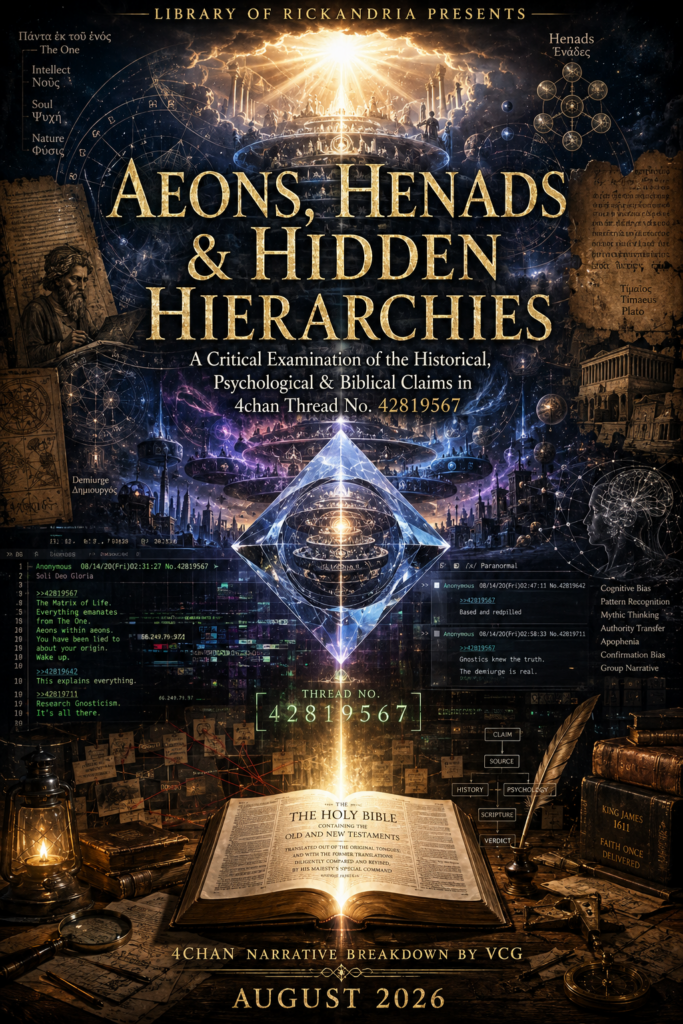
UPDATED BY VCG ON 8/23/2026 @ 16:16 EST
I want to share a heartfelt cause with my audience. Conner Blaisdell-Greene, a brave Airforce Sr. Airman, recently lost his battle with cancer, leaving his family in financial distress. Every donation, no matter how small, can help cover his funeral costs and ease their burden during this difficult time. Please consider clicking the link below to contribute or share Conner’s story with others. Your support truly matters.
Anyone can do this, but most won’t.
ChatGPT – Library of Rickandria
Soli Deo Gloria, brethren.
I’ll treat this as a forensic review, not just a theological reaction:
first preserve the thread’s actual claims, then separate factual assertions, rhetoric/psychology, interpretive moves, and Scripture use.
I’ll fact-check each externally verifiable claim, then compare every biblical claim against the KJV text supplied and label clearly what is text, inference, or doctrine.
/x/ – Time Traveler Here – Paranormal – 4chan
The thread is small enough to audit completely:
I count 11 visible posts in the archived discussion, dated August 13–14, 2026.
One important methodological caution already emerges:
because the posts are anonymous, we cannot safely assume every continuation-sounding reply is the original poster unless the thread itself gives an identifier; I’ll analyze each post by number rather than quietly merging anonymous voices.
I have now checked the archived thread itself, its attached material that is still retrievable, the historical vocabulary it borrows, the relevant physics, research on belief/rhetoric, and the KJV text supplied.
The short conclusion is important before the details:
the thread provides no evidential basis for concluding that its opening poster is a time traveller, a divine/henadic being, or a representative of a future “sacred cycle.”
Some vocabulary is genuinely ancient—especially aeon, henad, and demiurge—but those words come from different Greek philosophical/Gnostic streams and are being combined with biblical terminology and apparently idiosyncratic terms such as “Ubet,” “Batu,” “Matrix of Life,” “demos machina,” “God to Bless,” and “Son of Salvation.”
That combination creates an internally suggestive mythology; it does not establish that the mythology describes reality.
Proclus (Stanford Encyclopedia of Philosophy)
More seriously from a biblical standpoint, several central claims contradict the theological structure of the KJV: Scripture presents one God, creation through the Son, access to the Father through Christ, and Christ as the unique mediator and locus of eternal life.
It supplies no
“henad/Ubet”
intermediary, secondary
“Son of Salvation,”
transmissible personal-fault mechanism in blessing, or machine in which souls become trapped.
1. What exactly is in the source?
The surviving thread is on 4chan’s /x/ - Paranormal board. It began August 13, 2026, is now archived, and contains 11 visible posts running through August 14. The OP is No. 42819567. (4chan)
There is an evidential issue that matters throughout: the posts are displayed simply as Anonymous, with individual post numbers but no visible persistent identity marker proving that Nos. 42819582, 42819602, 42819615, etc. are the same human being as No. 42819567.
Their subject matter makes some look like continuations, but continuity of theme is not identity evidence.
So I will not silently attribute every mysterious-sounding continuation to the OP. (4chan)
My evidentiary scale here is:
| Grade | Meaning |
|---|---|
| Established | Supported independently by reliable evidence |
| Partly grounded | Contains a genuine historical/scientific concept but adds unsupported claims |
| Unsupported | Asserted with no independent evidence |
| Unfalsifiable as stated | So undefined/flexible that no clear test could disprove it |
| Biblically incompatible | Conflicts with the KJV framework when treated as Christian doctrine |
| Indeterminate | Available evidence cannot decide |
That distinction prevents two opposite mistakes:
believing something because it sounds sacred, and declaring something impossible merely because it sounds strange.
2. Opening post 42819567 — claim-by-claim forensic analysis
The OP says he comes from another “world,” redefines that world temporally, introduces Aeons and “sacred cycles,” gives himself a divine-sounding office, teaches rules for blessing, mentions a demiurge, and describes redemption through a “Son of Salvation” under Yeshua. (4chan)
A. “I come from a different world” — but “world” means a measure of time
Fact-check: unsupported.
Nothing in the post demonstrates temporal displacement.
There is no independently checkable future datum, no prediction subsequently verified, no technical result unknown in 2026, no reproducible machine, no physical specimen with authenticated provenance, and no chain of identity.
There is legitimate physics concerning unusual temporal structures.
General relativity admits mathematical spacetimes containing closed timelike curves, and the physical possibility of a device producing such curves remains an unsettled theoretical subject.
That is emphatically not equivalent to evidence that somebody on 4chan arrived from a future epoch.
The contemporary literature expressly distinguishes mathematical possibilities from an operational time machine.
Time Machines (Stanford Encyclopedia of Philosophy)
Hawking’s chronology-protection proposal is one famous attempt to explain why macroscopic closed timelike curves might never form, although present theory has not produced one universally decisive no-go result.
Physical Review D – Volume 46 Issue 2
So the correct position is neither
“physics has proven time travel impossible”
nor
“relativity makes this poster credible.”
It is:
some unusual time-travel models are mathematically discussable; this thread provides no evidence connecting its author to them.
B. “One creation span…we call an Aeon”
This is an excellent example of real vocabulary being used to lend plausibility to an invented taxonomy.
Greek αἰών (aiōn) genuinely has meanings involving:
- life
- lifetime
- time
- era
or age.
Perseus’ lexica give such senses as:
“life, lifetime, time,”
and a Thucydidean lexicon gives “time, era.” (Perseus Digital Library)
But that establishes only the word.
It does not establish:
Aeon = one objectively measurable “creation span” in a hidden cosmological calendar.
Indeed, ancient Gnostic systems also called divine members of the Pleroma “Aeons,” but those are historical religious ideas, not modern scientific discoveries.
Gnosticism | Internet Encyclopedia of Philosophy
Verdict:
historically grounded word; unsupported proprietary definition.
C. Time cycles “beyond an Aeon”
Verdict: undefined and unsupported.
To be scientific, a “cycle” needs operational content: what repeats?
What marks its beginning and end?
How long is it?
Relative to what clock/frame?
What observation detects the boundary?
None is given.
This is a recurring feature of the thread:
technical-sounding nouns appear before measurable definitions.
D. The poster is “four larger spans” or “sacred cycles” ahead
This sounds precise because it contains the number four, but it is actually less testable than saying
“I am from the year 2500.”
We never learn how long a Sacred Cycle lasts or how a cycle maps onto our chronology.
Consequently
“four cycles ahead”
cannot presently generate a prediction.
That is pseudo-precision:
numerical language without measurable quantity.
E. The self-designation “The God to Bless”
This is the first major biblical alarm.
It could conceivably be merely an awkward title—something like
“the official responsible for blessing”
—so it would be unfair to conclude from the phrase alone that the author claims equality with God.
But the surrounding explanation explicitly places this entity inside a divine/metaphysical hierarchy and says it facilitates the Most High.
The KJV’s fundamental confession is:
“Hear, O Israel:
The LORD our God is one LORD.” — Deuteronomy 6:4
And regarding mediation:
“For there is one God, and one mediator between God and men, the man Christ Jesus;
Who gave himself a ransom for all…” — 1 Timothy 2:5–6
Therefore, if
“God to Bless”
means another divine mediator between humanity and the Most High, that is not New Testament doctrine.
F. “I run the henad”
Here we can identify a genuine historical borrowing very clearly.
A henad is not futuristic terminology.
In late Neoplatonism, especially Proclus, the gods are called henads or “unities.”
The Neoplatonic Thread Examined: A Scriptural & Historical Analysis – Library of Rickandria
Proclus’ system positions these participated unities between the transcendent One and the multiplicity below it; the doctrine helped integrate traditional Greek gods into Neoplatonic metaphysics.
Proclus (Stanford Encyclopedia of Philosophy)
There is scholarly debate over whether Iamblichus already had such a doctrine; Syrianus and Proclus are its clearer exponents.
Proclus (Stanford Encyclopedia of Philosophy)
That is striking because the thread says, essentially:
Most High → henadic facilitator → lower reality
which structurally resembles Neoplatonic metaphysical hierarchy far more closely than biblical revelation.
This does not prove deliberate borrowing.
It could be:
- conscious syncretism
- AI-assisted synthesis
- occult reading
- creative roleplay
or sincere private belief.
But historically, “henad” belongs to ancient philosophy, not evidence of future provenance.
G. “Ubet”
I specifically searched for a credible:
- philosophical
- biblical
- occult-historical
or scientific usage connecting Ubet with a henad or the office described here.
I found no reliable established usage matching the thread’s meaning.
Therefore it must remain:
undefined/idiosyncratic unless its speaker supplies a source or definition.
A sound investigation should not invent an etymology merely because a strange word looks ancient.
H. “We bless; we do not curse”
This needs a nuanced correction rather than a blanket rebuttal.
As a Christian ethical instruction concerning one’s enemies, it has strong biblical support:
“Bless them which persecute you: bless, and curse not.” — Romans 12:14
James similarly condemns using the same tongue to bless God while cursing human beings:
“Therewith bless we God, even the Father; and therewith curse we men…”
“My brethren, these things ought not so to be.” — James 3:9–10
So I would not rebut the moral principle
“do not go around cursing people.”
But if it means God never judges or curses, Scripture contains no curse/judgment, or no servant of God ever pronounces judgment, that broader proposition is false.
The error is not the call to bless; it is making a good biblical ethic part of an unsupported metaphysical system.
I. Ask the Most High to bless you
This is actually biblical in principle.
Jabez directly asked God:
“Oh that thou wouldest bless me indeed…” — 1 Chronicles 4:10
So asking God for one’s own blessing is not inherently wrong.
J. Calling this a “direct and pure line”
Here Christian doctrine introduces an essential qualification.
A Christian does have access to the Father—but the New Testament explicitly frames that access through Christ, not as bypassing him:
“Jesus saith unto him, I am the way, the truth, and the life:
no man cometh unto the Father, but by me.” — John 14:6
And:
“For through him we both have access by one Spirit unto the Father.” — Ephesians 2:18
Therefore if
“direct and pure line”
merely means pray to God rather than treating yourself as the source of blessing, fine.
If it means one bypasses Christ and accesses the Most High through another divine order, it conflicts with the NT.
K. “If you bless others ask Most High to bless them”
Again, there is a genuine biblical resemblance.
In Numbers 6 Aaron and his sons are instructed to pronounce:
“The LORD bless thee, and keep thee…” — Numbers 6:24
and God concludes:
“And they shall put my name upon the children of Israel; and I will bless them.” — Numbers 6:27
Notice where the agency ultimately lies:
God says
“I will bless them.”
Psalm 134 likewise says:
“The LORD that made heaven and earth bless thee out of Zion.”
So the biblical pattern is not magical personal energy.
It is petition/pronouncement whose efficacy belongs to God.
L. Do not “bless yourself” unless instructed
If this means
“do not pronounce yourself spiritually empowered by your own authority,”
Scripture certainly promotes humility.
But there is no biblical universal law saying a person may not ask God to bless himself except after receiving a special instruction.
Jabez alone disproves that formulation if “bless yourself” includes petitioning God.
The thread apparently distinguishes asking God for blessing from generating one’s own blessing, which makes it internally less contradictory than it first appears.
Nevertheless, its special authorization rule is not derived from Scripture.
M. Blessing someone places that person “somewhat under you”
This is one of the most interesting claims because a biblical verse can be superficially recruited for it:
“And without all contradiction the less is blessed of the better.” — Hebrews 7:7
But that verse does not teach:
the physical act of blessing magically makes the recipient subordinate to the blesser.
Hebrews is arguing from Abraham receiving Melchizedek’s blessing to Melchizedek’s already-significant priestly status.
The blessing is evidence in the argument about status; it is not described as the causal mechanism creating that status.
Numbers 6 makes the corrective especially clear.
Aaronic priests blessed Israel, yet God says
“I will bless them.”
So the thread turns a contextual observation in Hebrews into a universal occult law.
N. Your personal blessing transmits your faults
There is no KJV doctrine that when one person blesses another, his moral defects or spiritual “essence” are inherited by the recipient.
Psychologically, however, this idea closely resembles what researchers call sympathetic or magical contagion:
the intuition that:
essence, impurity, or qualities can be transmitted through contact or symbolic association.
Contemporary reviews describe exactly this family of cognition, and classic work by Rozin and Nemeroff calls it the
“law of contagion.”
That similarity does not diagnose the poster.
Magical-contagion intuitions occur far beyond clinical populations and across ordinary culture.
It simply tells us that this proposed
“fault inheritance”
mechanism has a well-known psychological analogue and does not need a supernatural explanation.
Biblical verdict: unsupported.
3. “Demiurge,” Messiah, Yeshua, and “Son of Salvation”
The OP then invokes a demiurge, says he has a Messiah and can be redeemed, and assigns redemption to a “Son of Salvation” functioning under Yeshua. (4chan)
“Demiurge”
Another authentic ancient term—but again, not evidence from the future.
Greek dēmiourgos means a craftsman/maker.
Plato’s Demiurge need not be an evil god. In later Gnostic systems, however, the Demiurge frequently becomes an ignorant or inferior creator of the material cosmos, arising beneath the transcendent divine realm.
The Internet Encyclopedia of Philosophy describes precisely that Gnostic reworking.
Gnosticism | Internet Encyclopedia of Philosophy
Notice the emerging source mixture:
| Thread vocabulary | Closest historical family |
|---|---|
| Aeon | Greek time/age vocabulary; also Gnostic divine Aeons |
| Henad | Late Neoplatonism |
| Demiurge | Platonic term, radically reworked in Gnosticism |
| Most High | Biblical/religious language |
| Messiah / Yeshua | Jewish-Christian terminology |
| Sacred Cycle / Batu / Ubet | No established matching system located |
| Son of Salvation | Apparently idiosyncratic title |
That looks like syncretism—combining concepts from multiple religious/philosophical systems.
Biblical creation versus an inferior Demiurge
The Bible does not identify the Creator of Genesis as an ignorant inferior deity beneath a more authentic God.
Genesis opens:
“In the beginning God created the heaven and the earth.”
John deliberately places Christ inside that creation account:
“In the beginning was the Word, and the Word was with God, and the Word was God.”
“All things were made by him; and without him was not any thing made that was made.” — John 1:1,3
Hebrews similarly says God made the worlds through his Son.
So Gnostic demiurgism cannot simply be blended into biblical creation theology without changing the biblical account.
“Yeshua”
This part by itself is not suspicious.
Yeshua/Yešuaʿ is a historically legitimate Hebrew form associated with Jesus’ name.
Modern scholarship discusses both Yešu and Yešuaʿ in the history of Hebrew naming.
Using “Yeshua” therefore neither proves esoteric knowledge nor constitutes an error.
“A certain Son of Salvation” under Yeshua
This, however, creates an additional salvific figure for which the New Testament gives no corresponding office.
The NT says:
“For there is one God, and one mediator between God and men, the man Christ Jesus.” — 1 Timothy 2:5
And:
“God hath given to us eternal life, and this life is in his Son.”
“He that hath the Son hath life…” — 1 John 5:11–12
If
“Son of Salvation”
is merely a poetic title for Jesus, there is no problem.
But the grammar of the thread distinguishes a certain Son of Salvation from Yeshua, putting one “under” the other.
If that is intentional, the resulting two-tier salvific system is not supplied by the New Testament.
4. Post 42819582 — “the crystal”
No. 42819582 posts an image and gives the crystal a compelling role.
Because this is another anonymous post, we cannot prove it is the OP. (4chan)
There is no evidentiary argument here.
It is either humor, roleplay, continuation of the mythology, or some mixture.
The image itself could not be reliably fetched in my retrieval, so I am not going to invent details about it.
Verdict:
no verifiable proposition beyond attributing agency/influence to a “crystal.”
5. Post 42819602 — octahedron, Batu, “Matrix of Life”
This anonymous poster identifies the crystal with an octahedron, describes a top-to-bottom spiral, identifies “Batu” with a Sacred Cycle, and says the “Matrix of Life” is this crystal.(4chan)
An octahedron is of course an ordinary geometric solid.
Calling something an octahedron is not extraordinary.
But geometry does not entail the metaphysics added to it.
No mathematical derivation is supplied connecting:
octahedron → temporal cycle → Matrix of Life → Batu
and my targeted searches located no credible historical or scientific doctrine using “Batu,” “Sacred Cycle,” and “Matrix of Life” together this way.
So the reasoning amounts to stipulative definition:
“X is Y because I say X is Y.”
That can create a fictional/esoteric vocabulary, but it cannot independently demonstrate its ontology.
The phrase giving glory to the Most High is biblically unobjectionable by itself.
A true doxological sentence does not authenticate the claims immediately preceding it.
That distinction is crucial in religious discernment.
6. Post 42819604 — “time demons?”
This is merely a question from another anonymous participant. (4chan)
It carries no burden of proof by itself.
It is useful, however, because the next answer reveals how this mythology treats demons.
7. Post 42819615 — Aeon contamination, inner demons, trapped souls
The poster says Aeons do not
“cross-contaminate,”
identifies demons with negative portions of the self, and says souls trapped in a
“demos machina”
can be redeemed. (4chan)
A. Aeons cannot cross-contaminate
No mechanism, definition, observation, or evidence is given.
Moreover,
“contamination”
is unexplained.
Matter?
information?
causality?
souls?
memories?
Verdict: unfalsifiable as stated.
B. Demons are negative parts of oneself
There are at least two legitimate ways people use “demon” in ordinary English:
- metaphorically — “fighting my demons,” meaning trauma, vice, fear, etc.;
- biblically — personal spiritual adversaries/unclean spirits.
The thread’s psychological metaphor is possible as metaphor.
But as a correction of biblical demonology, it fails.
Mark 1 depicts an unclean spirit speaking to Jesus as an entity distinguishable from the possessed man; Jesus commands it to come out, and the narrative subsequently distinguishes sickness from people possessed by devils.
Acts 19 likewise portrays evil spirits as agents distinguishable from the humans they inhabit, including one responding to attempted exorcists:
“Jesus I know, and Paul I know; but who are ye?” — Acts 19:15
Whatever theological questions one asks about demonology, the biblical authors themselves are not merely using “demon” to mean an individual’s negative personality components.
C. Souls trapped in the “demos machina”
I could find no recognized doctrine or technical concept called “demos machina” matching this claim.
It resembles Latin/Greek-sounding terminology, but resemblance is not etymology.
I will not silently “correct” it to deus ex machina because we have no warrant that this was intended.
No mechanism for trapping souls is given; no evidence of such a machine is given.
Biblically, redemption is centered in Christ:
“He that hath the Son hath life; and he that hath not the Son of God hath not life.” — 1 John 5:12
The thread’s machine-based soul cosmology is therefore unsupported scientifically and extrabiblical theologically.
8. Posts 42819727 and 42819739 — “this looks AI-generated”
Two posters accuse the material of being AI-generated or “AI slop.” (4chan)
This criticism is understandable, but it also needs fact-checking.
The OP’s surviving image is a highly polished fantasy/cosmic scene of luminous humanoid figures.
The later retrievable image is a physical string-art polyhedral object being held outdoors.
Neither image, by appearance alone, proves:
time travel,
supernatural provenance,
AI generation,
or human generation.
NIST currently warns that real-world AI/deepfake detection is difficult; its 2026 forensic program reports substantial degradation when detectors move from academic tests into operational conditions.
So I would rate the skeptics’ statement:
plausible hypothesis, not established fact.
Their stronger underlying objection is good, though:
why does a person claiming extraordinarily advanced provenance provide only easily reproducible present-day media rather than uniquely future-verifiable evidence?
That is a serious evidential question.
9. Post 42819989 — “they deliberately look absurd”
This is arguably the most intellectually interesting reply.
The writer suggests advanced entities deliberately use ridiculous presentations for plausible deniability, masquerading under many labels while encouraging authority-based belief.
The writer then calls their technology poor and speculates that they may be evil or ignorant. (4chan)
Some of this critique is excellent.
Some merely replaces one unsupported story with another.
The strongest point: arbitrary authority without evidence
Yes.
The OP repeatedly announces ontological rules without showing how they were learned or how we can test them:
Aeons behave this way. Blessings transfer that. Batu means this. Souls can be trapped here.
That creates epistemic asymmetry:
the claimant controls both the invisible world and the definitions used to describe it.
When challenged, the proper question is:
“What independent observation would distinguish your model from an invented story?”
That is exactly where the thread is weakest.
The
“disguise through absurdity”
theory
This can become a self-sealing hypothesis.
If normal evidence means the entities are real and ridiculous evidence means they are disguising themselves, virtually every outcome can be assimilated into the theory.
Philosophical work on self-sealing conspiracy theories makes an important nuance:
resistance to counterevidence is not automatically irrational—sometimes apparent counterevidence really can result from concealment.
But continuously rescuing a theory with additional unsupported assumptions imposes an increasing epistemic cost.
Each case still needs evidence. (Cambridge University Press)
That is exactly the distinction needed here.
Occam’s razor
The reply uses Occam’s razor a little loosely.
Occam’s razor does not mean:
“anything weird should be ignored.”
It is a principle of parsimony: other things being equal, prefer the theory requiring fewer unsupported entities/assumptions.
Simplicity (Stanford Encyclopedia of Philosophy/Spring 2024 Edition)
Consider two hypotheses:
H1:
Someone online is roleplaying, creatively mythmaking, trolling, sincerely expressing private spiritual ideas, or using AI-assisted content.
H2:
Future trans-temporal entities deliberately imitate low-grade internet content so that humans will dismiss them, while operating hidden henads and sacred cycles.
Both are logically conceivable.
But H2 introduces many more unverified entities and causal mechanisms.
Without independent evidence that H1 cannot explain, H2 has no evidential advantage.
“They masquerade as gods, demons, aliens, time travelers”
Possible as a speculative scenario; unsupported as a factual claim.
Interestingly, Scripture does warn Christians not to accept spiritual claims merely because they present as spiritual:
“Beloved, believe not every spirit, but try the spirits whether they are of God…” — 1 John 4:1
And Deuteronomy 13 goes even farther:
even a successful sign or wonder does not override fidelity to God.
That gives a much stronger biblical test than
“it feels alien/demonic.”
Test doctrine and fruit; don’t manufacture an unseen demon when ordinary human explanation is sufficient.
“Their technology is impressive but poor”
Unsupported because no alien/time-traveler technology has first been established in this thread.
“They are evil or ignorant”
Also premature.
Before assessing motives, one must establish the agent exists.
This is a methodological sequencing issue:
existence → identity → capability → intention → moral judgment.
The reply jumps from hypothesis to moral classification.
10. Post 42821130 — image and Suno link
This post contains an image and another Suno URL but no substantive explanatory text. (4chan)
I could not independently retrieve the Suno tracks from the supplied short links, so I will not pretend to have analyzed their lyrics or audio.
Methodologically, however, an evocative song or cosmic image is nonprobative unless it contains independently verifiable information.
There is actually relevant psychological research here.
In experiments, photographs that contain no evidence bearing on a proposition can nevertheless make unfamiliar propositions feel more true—the “truthiness” effect.
Nonprobative photographs (or words) inflate truthiness – PubMed
That does not mean the poster consciously manipulates readers.
It means atmosphere should be separated from evidence.
- A haunting track
- sacred vocabulary
- geometric imagery
and cosmic art may powerfully affect interpretation while adding essentially zero verification.
11. Post 42821307 — “it is real; you cannot handle it”
This response offers no evidence and instead explains disagreement by attributing a psychological defect to the skeptic. (4chan)
Logically this is a mixture of:
ad hominem / mind-reading + burden shifting + immunization from criticism.
Rather than:
“Here is evidence X; here is why X favors my hypothesis over alternatives,”
the argument becomes:
“Your rejection demonstrates your inability to receive the truth.”
That is particularly dangerous in religious/esoteric discourse because disbelief itself becomes confirmation.
Compare the biblical model of testing:
“Beloved, believe not every spirit, but try the spirits…”
Biblical discernment does not require credulity toward anyone merely asserting possession of higher knowledge.
12. Post 42822252 — the best methodological question in the thread
The final poster asks what exactly the previous poster means by “it,” acknowledges that real time travel would involve major caveats, and speculates that “time travel” might conceal a related but different phenomenon. (4chan)
The first sentence is excellent:
define the claim before debating it.
The second is broadly correct.
“Time travel” covers very different concepts:
- ordinary relativistic differential aging
- closed timelike curves
- alternative-universe scenarios
- backward travel
etc. Contemporary literature treats these distinctions seriously.
Time Machines (Stanford Encyclopedia of Philosophy)
The final
“cover for something similar”
proposal remains speculation until that “similar idea” is:
defined,
made predictive,
and independently supported.
Otherwise one mystery word has merely replaced another.
13. The psychological architecture of the thread
This section needs particular care:
nothing in eleven anonymous posts permits a psychiatric diagnosis of anybody involved.
We cannot responsibly infer:
- psychosis
- mania
- schizophrenia
- personality disorder
or even whether the OP sincerely believes what was written.
Several mundane possibilities remain open:
- deliberate LARP
- occult/esoteric creative writing
- trolling
- AI-assisted improvisation
- sincere private cosmology
- collaborative riffing by multiple anonymous users
or combinations thereof.
What we can examine are communication mechanisms.
Esoteric compression
The OP introduces many novel propositions almost simultaneously:
Aeon → Sacred Cycle → God to Bless → henad/Ubet → blessing hierarchy → demiurge → Messiah → Son of Salvation → Yeshua.
This creates a high information-density appearance without corresponding explanatory depth.
Every unexplained term generates another question whose answer remains controlled by the speaker.
That can produce an aura of concealed knowledge.
Familiarity anchoring
Known sacred/historical words—“Most High,” “Messiah,” “Yeshua,” “Almighty,” “Aeon,” “demiurge,” “henad”—are interwoven with unverified vocabulary.
Psychologically, familiarity can make surrounding material easier to process, but ease of processing is not evidence.
Pattern completion
Humans naturally try to connect partial symbolic systems.
Research has found associations between illusory pattern perception and paranormal/conspiracy belief, although more recent work cautions that those associations are not enormous and vary by task.
That literature should not be turned into
“anyone interested in the paranormal is irrational.”
The correct lesson is narrower:
when evidence is sparse and symbols abundant, actively test whether we are discovering a connection or supplying it ourselves.
Magical contagion
The claim that one’s defects can be transmitted along with a blessing maps unusually well onto psychological research concerning symbolic contagion—the intuition that an essence or property passes by association.
Again, similarity of cognitive structure is not diagnosis.
Nonprobative imagery
The cosmic art and geometric object can make a metaphysical story feel instantiated.
Yet an image of a thing related to a claim can increase subjective truth even when the image carries no evidence relevant to whether the claim is true.
Nonprobative photographs (or words) inflate truthiness – PubMed
Hence our rule:
illustration ≠ corroboration.
Anonymous-environment effects
Research on online disinhibition identifies:
- anonymity
- invisibility
- asynchronicity
- dissociative imagination
and reduced authority cues as factors that can change online expression.
The online disinhibition effect – PubMed
That makes a place like anonymous imageboards especially suited to:
- role experimentation
- provocative disclosure
- collective mythmaking
and exaggerated personas—but again does not tell us which one occurred here.
Motivated reasoning operates on both sides
Kunda’s classic review describes how desired conclusions can influence which evidence and reasoning strategies people access.
The case for motivated reasoning – PubMed
That caution applies equally to:
believer:
“It feels spiritually profound, therefore true.”
and
skeptic:
“It looks ridiculous/AI-generated, therefore every underlying claim is false.”
The disciplined position is harder:
evaluate each proposition independently.
14. The strongest Scripture correction
If we strip away all the exotic terminology, the biblical conflict becomes quite simple.
The thread’s implied metaphysical chain looks approximately like:
Most High → henad/Ubet → “God to Bless” → blessing hierarchy → secondary salvific figure → Yeshua → redemption mechanisms involving cycles/machines
The New Testament pattern is considerably less crowded:
Father → Son/Jesus Christ → through the Spirit → believers
Ephesians puts it succinctly:
“For through him we both have access by one Spirit unto the Father.” — Ephesians 2:18
Paul says:
“there is one God, and one mediator between God and men, the man Christ Jesus.”
John says:
“All things were made by him…”
and:
“this life is in his Son.”
Therefore the biblical problem isn’t that the thread uses a Hebrew name for Jesus or encourages people to bless rather than curse.
Those portions can be perfectly compatible with Scripture.
The problem is that biblical truths are embedded inside a larger cosmology Scripture itself does not teach—and some of that added cosmology alters precisely those doctrines Scripture treats as central: God, creation, mediation, spiritual beings, and salvation.
That is where correction must concentrate.
15. How Scripture itself says to examine a claim like this
There is a striking methodological parallel between rigorous investigation and biblical discernment.
1 John 4:1 says not to accept every spiritual claim but to test it.
Deuteronomy 13:1–4 says even apparent supernatural success cannot authenticate teaching that redirects allegiance away from the revealed God.
Acts 3 is particularly instructive.
When people stare at Peter and John after a miracle, Peter explicitly rejects the idea that it happened through their own intrinsic spiritual greatness:
“why look ye so earnestly on us, as though by our own power or holiness we had made this man to walk?”
That is almost the opposite direction from constructing a special personal title and hierarchy around one’s blessing power.
And Jesus’ own Christological claim remains the controlling reference:
“I am the way, the truth, and the life: no man cometh unto the Father, but by me.”
Final evidential verdict
| Proposition | Verdict |
|---|---|
| Poster is literally from a future temporal “world” | Unsupported |
| Aeon is a genuine ancient word involving time/age | Established |
| An Aeon specifically equals the poster’s “creation span” | Unsupported |
| “Sacred Cycles” are measurable cosmic epochs | Unsupported / undefined |
| Henad is a genuine ancient metaphysical term | Established — Neoplatonic |
| Poster runs a real cosmic henad/Ubet | Unsupported |
| “Ubet” has the asserted historical/metaphysical meaning | Not established |
| Christians should bless rather than maliciously curse people | Strong biblical support |
| Humans may ask God to bless themselves | Biblically supported |
| Blessing someone places them metaphysically beneath you | Not established; Hebrews 7 does not teach this mechanism |
| A person’s faults transfer through his blessing | No biblical/scientific evidence; resembles magical-contagion thinking |
| Demiurge is a genuine historical term | Established |
| Biblical Creator is an inferior Gnostic Demiurge | Biblically incompatible |
| Yeshua is a legitimate historical name-form | Yes |
| A separate “Son of Salvation” beneath Yeshua redeems beings | No NT basis |
| Demons are simply negative portions of oneself | Possible metaphor, but incompatible with biblical narrative if offered as literal exegesis |
| Souls are trapped in “demos machina” | Unsupported/undefined |
| Thread imagery proves the story | No |
| Imagery is definitely AI-generated | Not established from appearance alone |
| Future entities intentionally disguise themselves as bad internet content | Possible story, no evidence; risks becoming self-sealing |
| Thread establishes aliens/demons/time travelers | No |
So, the fairest classification is not
“proven demonic”
and not
“proven time traveler.”
Neither conclusion follows from the evidence.
The source is best described as an unverified, syncretic esoteric cosmology using genuine fragments of Neoplatonic, Gnostic, and biblical vocabulary mixed with apparently invented terminology.
Its presentation is consistent with several ordinary explanations—including creative mythmaking, LARP/trolling, sincere private belief, or AI-assisted composition—and the current evidence cannot tell us which.
From a KJV-first Christian evaluation, retain what Scripture independently teaches—
- honor the Most High
- bless rather than curse
- ask God for blessing
- confess Messiah
—and reject the attempt to smuggle unsupported:
- intermediaries
- secret hierarchies
- magical blessing mechanics
- alternative creator theology
and additional salvific beings into those truths.
That is the central safeguard:
a biblical word inside a claim does not make the whole claim biblical.
4CHAN THREAD & POST BREAKDOWNS – Library of Rickandria
VCG PAPER PROJECTS – Library of Rickandria