
Hidden Worlds, Unfalsifiable Claims & Spiritual Discernment: A Critical Analysis of the “Parallel Dimension” Theory in Japanese Media
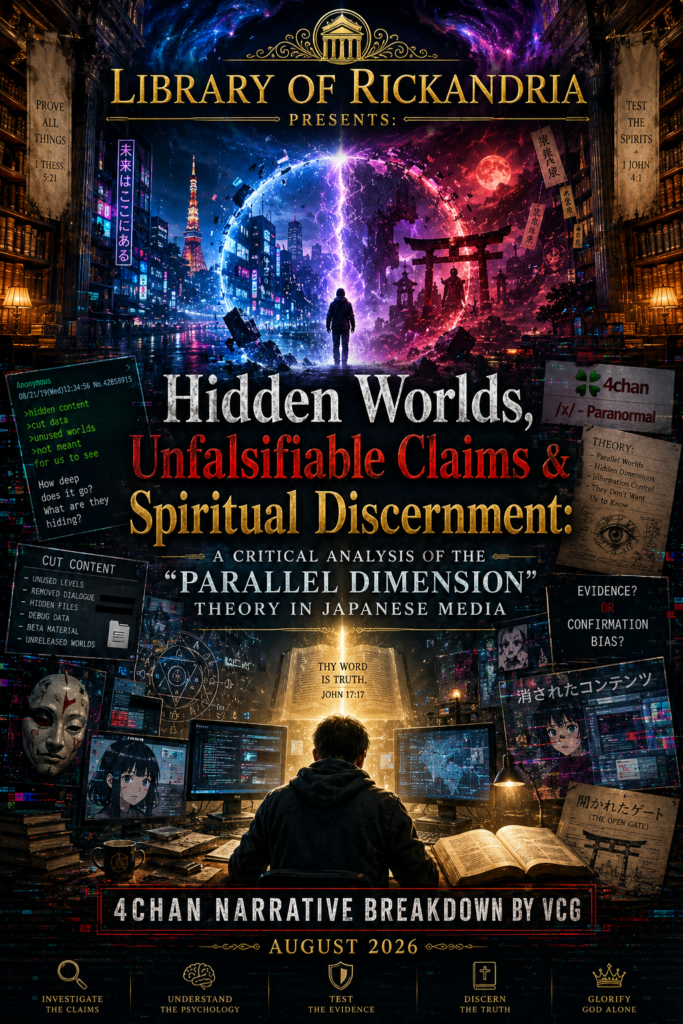
UPDATED BY VCG ON 8/24/2026 @ 17:17 EST
I want to share a heartfelt cause with my audience. Conner Blaisdell-Greene, a brave Airforce Sr. Airman, recently lost his battle with cancer, leaving his family in financial distress. Every donation, no matter how small, can help cover his funeral costs and ease their burden during this difficult time. Please consider clicking the link below to contribute or share Conner’s story with others. Your support truly matters.
Until We Meet Again
Spoken Tribute
Anyone can do this, but most won’t.
ChatGPT – Library of Rickandria
Soli Deo Gloria, brethren.
I’ll treat this as a source-critical study rather than a “take sides” exercise:
first reconstruct the thread faithfully, then separate factual claims, rhetorical/psychological moves, theological assertions, and Scripture use.
For each substantive line/claim I’ll mark what is actually supported, what is inference, what is false or unverifiable, and what the KJV text says in context.
/x/ – JAPAN’S SECRET – Paranormal – 4chan
The thread’s central factual hinge is already clear:
it moves from real things—
- unused game assets
- Japanese religious imagery
- stories about death/rebirth
—into a much larger claim that media contains an objectively accessible “parallel dimension.”
That leap is where the evidentiary standard has to become very strict; symbolism, unused files, lyrics, and personal experiences do not by themselves establish an external hidden world.
Two points in the thread deserve partial credit before rebuttal.
First, the Ten Kings material is not invented anime lore:
Tendai sources really do discuss postmortem judgments and the 49-day intermediate period.
Second, Bloodborne really does contain unused dialogue/data discoverable by datamining.
But neither fact establishes the thread’s added conclusions—
“King Henjō proves I will be reborn in Japan”
or
“unused files are an alternate dimension.”
Those are separate propositions requiring separate evidence.
The strongest internal contradiction is now documented in the thread itself.
The OP says
“you need evidence”
and
“you can’t trust your feelings alone,”
but then treats the ordinary explanation—cut content—as
“refusing to believe in the truth”
and explains continued disbelief by saying
“this must be why it’s a secret.”
That makes the claim self-sealing: both acceptance and rejection are absorbed as confirmation, so no conceivable result is allowed to count against it.
I audited the thread as it stood when retrieved on August 24, 2026.
The right way to handle it is neither to mock the poster nor to accept the claims because they sound spiritually significant.
The thread contains several real underlying facts, but repeatedly moves from those facts to conclusions the evidence does not establish. (4chan)
The standard I am using is the same evidence discipline laid out in the research framework: separate
- fact
- interpretation
- speculation
- rhetoric
context before commentary; evidence before opinion; state uncertainty honestly; represent opposing views fairly.
1. Bottom-line verdict
The thread is not wholly fabricated.
Four important components are real:
| Claim underneath the theory | Verdict |
|---|---|
| Japanese Buddhism developed traditions of postmortem judgment involving the Ten Kings | True as religious history/doctrine |
| Shinto and Buddhism have a long history of syncretism involving kami, Buddhist deities, ritual and concepts of spirit | True |
| Bloodborne contains unused/cut dialogue, objects, enemies, maps and other recoverable data | True |
| People report vivid experiences around actual or perceived proximity to death | True |
But none of those four facts proves the thread’s central theory:
Japanese creators have secretly made second metaphysical versions of games/anime/movies, humans have parallel counterparts inside them, certain people can switch with those counterparts, near-death states provide access, Japanese spirits maintain the system, and Japanese religious judgment determines entry into it.
I found no credible evidence establishing that chain.
Worse, several concrete claims used to support it are contradicted by the available evidence:
- The official Tendai source does not say King Henjō determines whether somebody will be reincarnated specifically in Japan. It describes judgments determining the deceased person’s next rebirth within a Buddhist doctrinal framework. (Tendai)
- The claim that Japanese games do not have “cut content” is directly contradicted by extensive Bloodborne datamining documenting deleted, unused, alpha-build and cut material. (Bloodborne Wiki)
- Modern Japanese immigration authorities do perform information gathering and screening before physical arrival; PNR information has been collected under law since 2015. (Ministry of Justice Japan)
- Quantum many-worlds physics does not provide a mechanism for entering videogames or exchanging consciousness with fictional counterparts. (Stanford Encyclopedia of Philosophy)
- Neuroscience recognizes NDE phenomenology but provides no evidence that experiencing an NDE grants causal power over reality or access to hidden software worlds. (Nature)
Biblically, the theory also collides at crucial points with the KJV’s teaching concerning
- death
- judgment
- resurrection
- salvation
- spiritual discernment
- moral authority
2. Source methodology
I assigned every major proposition to one of five categories:
F — externally verifiable fact.
Something independently checkable:
a game file exists,
immigration law says X,
a Buddhist institution actually teaches Y.
D — doctrine or religious tradition.
“The Ten Kings judge the dead”
can accurately describe Tendai/Buddhist doctrine without demonstrating that the supernatural claim is empirically true.
I — interpretation.
A reasonable or unreasonable conclusion drawn from facts:
“these game assets reflect an earlier design.”
S — speculation.
A proposition for which no adequate evidence has been supplied:
“the discarded assets form an alternate metaphysical game.”
U — unverified personal testimony.
“This happened to me”
“I was targeted”
“I experienced the ritual”
Such testimony shouldn’t automatically be ridiculed, but neither can an outside investigator upgrade it into established fact.
The critical methodological principle is:
Evidence that A exists does not automatically prove B merely because B incorporates A.
Ten Kings doctrine existing does not prove reincarnation into Japan.
An unused Bloodborne dialogue file existing does not prove a second Bloodborne universe.
A meaningful lyric does not prove that its metaphor describes literal physics.
An NDE does not prove an interdimensional gateway.
That distinction dismantles most of the thread without requiring us to prejudge anyone’s motives.
3. Sequential thread audit
Post 42858915 — “Only half” of Japanese media has been experienced
The opening claims that audiences have received only roughly half of Japanese games, anime and movies, because Japanese creators allegedly construct another “dimension” for essentially anything digital. (4chan)
Fact-check
There is no evidence presented for the percentages, and “half” is not operationally defined.
Is it:
- unused assets?
- alternate endings?
- source code inaccessible to players?
- deleted scenes?
- unreleased prototypes?
- metaphysical realities?
Those are radically different propositions.
Real software projects routinely contain assets that never appear in the shipping product.
Bloodborne provides an excellent example:
dataminers have recovered:
- incomplete areas
- unused dialogue
- deleted characters
- prototype mechanics
and material from network-test and alpha builds.
In one documented example, a pathway existed in an early build even though the connected retail map was absent; other versions evolved as development progressed.
That is exactly what developmental residue predicts.
Therefore:
“There is hidden/unused data”
= demonstrated.
“That data constitutes another playable game”
= not demonstrated.
“That other game exists in a parallel metaphysical dimension”
= much less demonstrated.
The move commits an equivocation on “hidden.”
- Hidden-in-files
- hidden-from-normal-gameplay
- intentionally-secret
and ontologically-existing-in-another-world are treated as though they mean the same thing.
“I am one of the few outsiders who understands it”
This establishes an initiatory epistemology:
ordinary outsiders don’t know; an awakened minority does.
That statement isn’t automatically false—minorities sometimes discover real things—but it changes the burden of proof.
A genuine discovery should increasingly produce publicly reproducible observations.
It should not become harder to test as more objections appear.
Psychologically,
“few understand”
language can also increase attachment because disagreement no longer feels like normal criticism; it becomes confirmation of special access.
That observation is about the argument’s structure, not a diagnosis of the poster.
4. The “gangstalking” claim
The OP says a coordinated targeting phenomenon happened during college and connects that experience with “waking up,” initiation and being pushed toward death. (4chan)
We have to distinguish two propositions.
Ordinary:
- stalking
- harassment
- bullying
- coordinated abuse
- institutional retaliation
- online harassment
are real phenomena.
Therefore it would be irresponsible simply to say,
“Nobody is ever followed by multiple people.”
But the broader internet concept called gangstalking—vast hidden networks using innumerable ambiguous everyday acts to target one individual—is studied very differently.
A 2021 mixed-methods study of a 225,000-word gangstalking forum corpus describes a persecutory belief system in which ordinary or individually ambiguous events become incorporated into a coordinated explanatory structure.
Researchers identified mechanisms such as presupposition, specialized terminology and mutually reinforcing online discourse.
That does not permit us to diagnose this poster.
We have never examined them, and a forum thread cannot support a psychiatric diagnosis.
It does establish something narrower and important:
The thread supplies no independent evidence demonstrating that the poster’s college experience was a coordinated secret network.
The experience and distress may have been completely sincere.
The proposed cause remains unverified.
This distinction is essential:
taking someone’s suffering seriously does not require affirming every causal explanation attached to it.
5. Kitsune, LINE Play, “Japan’s ritual”
One anonymous poster says access is reserved for kitsune; the OP answers that they personally underwent something through LINE Play and asks why Westerners in Japan do not know about the ritual. (4chan)
No independent evidence is offered for either proposition.
Notice the inferential sequence:
personal experience → culturally Japanese platform → Japanese ritual → supernatural mechanism.
Each arrow requires independent support.
A meaningful or intense experience while using a Japanese service does not establish that the service was conducting a national religious initiation.
Verdict: unverified testimony plus interpretation.
6. “Japan is saving me”
Taken psychologically, Japan may genuinely represent:
- hope
- identity
- belonging
- meaning
- creativity
or a desired future.
That is perfectly compatible with saying someone’s interest in Japanese culture helped them endure hardship.
But the expression becomes theologically different if “saving” means spiritual salvation.
The KJV says:
“Neither is there salvation in any other:
for there is none other name under heaven given among men, whereby we must be saved.” — Acts 4:12
So the correction must be precise:
Culture may encourage.
A nation may shelter.
Art may give hope.
Scripture does not assign salvific power to Japan.
7. “Japanese culture accommodates spirits more than other countries”
This is one of the thread’s more defensible observations if expressed carefully.
Japanese religious history unquestionably includes extensive discourse about:
- kami
- spirits
- ancestral rites
- Buddhist beings
- syncretism
- sacred places
- ritual
Kokugakuin University’s Encyclopedia of Shinto documents shinbutsu shūgō, the centuries-long harmonization and interaction of kami traditions and Buddhism.
Buddhism itself arrived in Japan after earlier processes of religious adaptation across:
- India
- China
- Korea
Shinbutsu shûgô | 國學院大學デジタルミュージアム
But the thread overstates this when it treats
“Japanese spirit culture”
as one coherent metaphysical system.
Kokugakuin’s discussion of Shinto explicitly says there is no single agreed definition of spirit in Shinto and no agreement on where human spirits go after death.
Concepts of the Spirit (reikonkan) | 國學院大學デジタルミュージアム
That is devastating to the thread’s homogenization of “Japan.”
There isn’t one unified
“Japanese religion”
teaching one comprehensive map of an afterlife.
Shinto traditions differ.
Buddhist schools differ.
Japanese people differ.
Folklore differs from institutional doctrine.
Anime differs from ritual practice.
Biblical correction
The Bible itself affirms the existence of spiritual beings, so the Christian rebuttal should not be
“spirits don’t exist.”
But neither does biblical theology say that a supernatural appearance authenticates itself.
Paul warns:
“Satan himself is transformed into an angel of light.” — 2 Corinthians 11:14
And Galatians goes further:
even an angelic apparition is not permitted to overturn the received gospel.
So within biblical epistemology:
“It felt spiritual”
and
“it appeared luminous”
are not sufficient authentication.
Nor should Christians casually assert that every Japanese kami is literally a demon.
Scripture gives categories for:
- false gods
- idols
- devils
- deceiving spirits
but identifying a particular Japanese religious figure with a particular spiritual entity is an additional interpretive claim requiring argument.
8. “Mocking the kami means instant death in Japan”
An anonymous participant says they will immediately die if they enter Japan because they mocked kami.
The OP then develops a theory about Japan beginning to “judge” people upon physical entry. (4chan)
There is no empirical evidence supplied for supernatural instantaneous death.
The immigration comparison is also factually misleading.
Japan’s formal landing examination occurs when a foreign national applies to land at a port of entry.
But the Immigration Services Agency also obtains Passenger Name Record information; Japanese law has allowed airlines to provide PNR data since 2015, explicitly for immigration-law implementation and landing-condition examination.
Overview of Passenger Reservation Records (PNRs) | Immigration Services Agency
So:
Formal permission to land:
yes, determined through landing procedures.
“Japan never evaluates anybody before arrival”
false as a description of modern immigration administration.
And none of that administrative machinery provides evidence about supernatural kami judgments.
The thread slides between government immigration and metaphysical judgment as though the first were an analogy confirming the second.
It does not.
9. The “globalism” passage
The OP shifts from supernatural claims to a social thesis: formerly countries maintained distinct behavioral norms, whereas modern globalism allegedly forces all societies toward identical standards. (4chan)
There is a modestly true observation underneath this:
globalization can spread:
- legal
- corporate
- technological
- cultural
norms.
But the stronger language—one global effort making behavior in America precisely equivalent to expectations in Japan—is much too absolute.
Japan remains legally, linguistically, culturally and institutionally distinctive.
More importantly, even if the political analysis were entirely correct, it supplies zero evidence for secret videogame dimensions.
This is an example of narrative accretion:
a second controversial subject is incorporated into the first theory, making the worldview larger without improving the evidence for its central proposition.
10. “Anime exists to stop Japanese people committing suicide”
An anonymous skeptic makes this claim, and the OP partially accepts the idea that such media gives people near death hope. (4chan)
The sweeping causal claim is unsupported.
There is legitimate research showing that media depictions can affect suicide-related outcomes, and a 2026 experiment even found that a coping-oriented animated narrative reduced suicidal thoughts relative to a comparison condition.
But that is a specific Papageno-effect result; it does not establish that the Japanese anime industry was created as a covert suicide-prevention program.
Other research on fictional suicide depictions has found mixed or potentially harmful effects depending on presentation and context.
So, the fair correction is:
Fiction can sometimes give vulnerable people hope.
That is very different from:
Japan manufactures anime in order to stop its population from killing itself.
No evidence in the thread supports the latter.
11. The Ten Kings and King Henjō
This is probably the most important religious fact-check in the thread.
The OP identifies as Tendai Buddhist/Shinto and links an actual Tendai source to prove that King Henjō determines whether they will be reborn in Japan. (4chan)
The first half is real.
The official Tendai Q&A says that, according to Buddhist teaching, the maximum intermediate period between death and the next rebirth is 49 days.
During that period, the deceased is said to undergo judgments at seven-day intervals concerning good and evil and the next rebirth.
As the idea developed in China, these judgments became associated with the Ten Kings; later Japanese practice expanded memorial/judgment associations further.
Therefore, the skeptical poster who assumed the Ten Kings image was merely anime was wrong.
But the OP then makes a different error.
The linked Tendai source does not state:
that King Henjō grants Japanese nationality;
that he selects Japan as a geographical rebirth destination;
that this individual personally will be reborn in Japan;
that the doctrine has been experimentally verified;
that videogame universes form possible rebirth destinations.
The OP has taken:
“a judge is associated with determining aspects of rebirth”
and transformed it into:
“therefore this judge proves my particular future rebirth will be Japan.”
The conclusion isn’t contained in the cited source.
Scripture correction:
reincarnation versus resurrection
The KJV describes a fundamentally different sequence:
“And as it is appointed unto men once to die, but after this the judgment:” — Hebrews 9:27
The immediate context matters. Hebrews compares humanity’s once-occurring death with Christ’s once-for-all offering:
“So Christ was once offered to bear the sins of many…” — Hebrews 9:28
Paul likewise presents Christian hope as resurrection, not a cycle of human reincarnations:
“But now is Christ risen from the dead, and become the firstfruits of them that slept.” — 1 Corinthians 15:20
And later:
“The last enemy that shall be destroyed is death.” — 1 Corinthians 15:26
The biblical contrast is therefore quite sharp:
Tendai/Buddhist model:
rebirth framework.
New Testament model:
earthly death → judgment/resurrection → final destiny in relation to Christ.
Calling both merely different descriptions of the same mechanism would erase genuine doctrinal disagreement.
12. “Spirits had thousands of years to implement Buddhism”
The OP then proposes a two-layer model:
human religion and spirit religion are intertwined; spirits have spent millennia implementing the Buddhist system; Buddhism is a creation of India and spirits; Japan probably possesses a particularly accommodating “region” of the spirit world. (4chan)
This is precisely where religious history gets converted into supernatural causal history.
What historians can document is that Buddhism developed over centuries, entered China and Korea, reached Japan, interacted with existing kami practices, underwent institutional evolution and produced syncretic forms such as Tendai Shinto.
Shinbutsu shûgô | 國學院大學デジタルミュージアム
Those data support:
human communities historically combined religious systems.
They do not establish:
nonhuman spirits engineered that development behind the scenes.
That hypothesis might be asserted theologically, but it cannot simply be labeled
“historical fact.”
The distinction needs to remain explicit:
Historical evidence:
- texts
- institutions
- ritual development
- transmission
Metaphysical interpretation: spirits caused the development.
They are not the same evidentiary category.
13. “There is another you in every parallel dimension”
The thread now makes a physics-sounding claim:
there are multiple versions of every person and videogame character, and one can exchange places with another counterpart to access a hidden game. (4chan)
This resembles popularized language derived from the Many-Worlds Interpretation of quantum mechanics, but it doesn’t follow from it.
Stanford’s Encyclopedia of Philosophy, substantively revised in June 2026, describes MWI as an interpretation relating the universal quantum state to experiences/worlds associated with different quantum outcomes.
It also emphasizes that defining the correspondence between the mathematical formalism and
“our experiences”
involves significant interpretive issues.
Many-Worlds Interpretation of Quantum Mechanics (Stanford Encyclopedia of Philosophy)
Nothing in that formalism predicts:
an ontologically real consciousness corresponding to a videogame avatar,
worlds intentionally constructed by Japanese developers,
conscious identity exchange between player and avatar,
secret game states accessed by spiritual awakening,
country-specific access rules.
The phrase parallel dimension is therefore doing illicit work.
Physics “world” → fictional alternate universe → unused program state → supernatural realm
are repeatedly treated as interchangeable.
They are not.
A software state is a pattern of data and executable instructions on hardware.
Even if an Everettian interpretation of quantum mechanics is correct, it does not transform arbitrary game assets into inhabited universes.
14. The skeptic’s objection: “Then information could come back”
One anonymous participant correctly spots part of the problem:
if switching between realities were genuinely possible, the theory should produce transferable information. (4chan)
That is an excellent methodological insight.
Suppose a subject enters “alternate Bloodborne” and returns knowing a password, texture hash, unreleased dialogue sequence or mathematical value that was:
chosen independently,
inaccessible beforehand,
unknown to the subject,
objectively checked afterward.
Now there would be an anomalous result requiring investigation.
Instead, the thread offers:
songs already publicly available;
files already obtainable by datamining;
religious traditions already documented;
interpretations of artwork;
personal experiences.
Those cannot discriminate between the hypothesis and ordinary alternatives.
This is the difference between post-hoc interpretation and novel prediction.
15. “Who defines good and evil?”
The thread then moves from ontology to ethics.
The OP rejects Christianity’s authority and asserts that the individual determines good and evil, while speaking of entering darkness to reach hidden light and potentially becoming evil in the process. (boards.4chan.org)
Here the disagreement is no longer principally factual.
It is explicitly worldview-level.
Within biblical theology, good and evil are not individually authored categories.
Isaiah gives an almost word-for-word conceptual inversion of the thread’s light/darkness formulation:
“Woe unto them that call evil good, and good evil; that put darkness for light, and light for darkness…” — Isaiah 5:20
And 1 John grounds sin in relation to an objective law:
“sin is the transgression of the law.” — 1 John 3:4
Judges repeatedly uses subjective morality as a symptom of disorder:
“every man did that which was right in his own eyes.” — Judges 21:25
One important qualification: quoting those verses demonstrates what Scripture teaches.
It doesn’t, by itself, prove biblical moral authority to a non-Christian interlocutor.
That larger apologetic question requires arguments about:
- God
- revelation
- Christ
But if the question is,
“Does the OP’s ethics agree with the Bible?”
the answer is clearly no.
16. “Light hidden in darkness”
This language is psychologically powerful because it reframes moral or epistemic danger as evidence that one is getting closer to secret knowledge.
That is a classic inversion structure:
fear becomes initiation;
opposition becomes confirmation;
darkness becomes the path to light;
harm becomes necessary transformation.
The Bible warns against exactly the assumption that apparent illumination authenticates its source.
Again:
“Satan himself is transformed into an angel of light.” — 2 Corinthians 11:14
The context concerns deceptive religious messengers—not videogame phenomena—so we shouldn’t turn this into a proof that the OP encountered Satan.
The valid application is narrower:
Biblically, perceived light is not self-authenticating.
It must be tested against revealed truth.
17. “The Gate will open” / “the seal will break”
The OP predicts an eventual “Gate,” a breaking “seal,” mass comprehension of parallel dimensions and major ensuing events, while admitting not to know what will happen. (boards.4chan.org)
This is apocalyptic certainty without predictive specificity.
Observe the inconsistency:
“We don’t know what happens.”
Yet: it will happen.
It will be world-changing.
Skeptics will eventually understand.
No date or measurable threshold is provided.
Delay does not count against the prediction.
A hypothesis becomes scientifically weak when its timeline and outcome can continually retreat without penalty.
For comparison, biblical prophecy claims shouldn’t be handled casually either.
Scripture itself repeatedly condemns false claims of divine authority and expects discernment.
One cannot rehabilitate an unsupported modern prediction merely by using biblical-sounding vocabulary such as gate, seal, light, or awakening.
Shared imagery is not shared revelation.
18. The anonymous “75% must die” claim
This number appears from another poster, not the OP.
There is no derivation for 75%. (boards.4chan.org)
It is numerology-like assertion without a model.
Importantly, the OP rejects mass death as necessary.
That distinction should be preserved:
the OP did not propose killing 75% of humanity.
So attributing that claim to the OP would be unfair.
19. “Death is a trick” and near-death illumination
The OP responds that death itself is a trick and that entering a near-death condition enables perception of light and power to change reality. (boards.4chan.org)
There are two separate claims.
What science supports
NDEs are genuine reported experiences.
A 2025 Nature Reviews Neurology review describes them as rich conscious experiences occurring amid actual, potential or perceived life-threatening circumstances.
It surveys physiological and psychological mechanisms, including:
- impaired cerebral blood flow
- hypotension
- hypoxia
- hypercapnia
- altered neuronal excitability
- neurotransmitter changes
and top-down psychological processes. (Nature)
A neuroscientific model of near-death experiences | Nature Reviews Neurology
There is ongoing scholarly dispute about whether neurocentric models adequately capture all aspects of NDE phenomenology.
That criticism should be acknowledged rather than pretending the matter is perfectly settled.
Limitations of neurocentric models for near-death experiences | Nature Reviews Neurology
But none of these sources demonstrates:
NDE → hidden videogame access → power to alter reality → Japan receiving the signal.
That causal chain remains unsupported.
Biblical correction
The Bible does not call death an illusion or trick.
“The last enemy that shall be destroyed is death.” — 1 Corinthians 15:26
An enemy can be defeated; an illusion need only be recognized.
And Hebrews says:
“it is appointed unto men once to die, but after this the judgment” — Hebrews 9:27
The Christian claim is therefore not death is unreal, but death is real and Christ conquers it through resurrection.
That is a major theological correction.
20. Openborne: the crucial technical evidence
The OP then links the Openborne GitHub repository and identifies a Japanese dialogue dump as the “hidden half” of Bloodborne. (boards.4chan.org)
The repository is real.
The file page identifies a public Openborne data repository containing a 3,868-line, approximately 188 KB Japanese dialogue text file. (GitHub)
That establishes only:
data exists.
It doesn’t establish:
the data represents a complete second game.
It certainly doesn’t establish:
the second game exists metaphysically and can be reached spiritually.
Meanwhile Bloodborne’s own extensive datamining record explicitly categorizes material as:
- cut
- unused
- deleted
- restored
- alpha-build
- network-test content
Documented examples include unfinished pathways, inaccessible areas restored by:
- hacking
- unused dialogue
- deleted creatures
- prototype mechanics and objects
Thus, the universal statement that Japanese games have no such thing as cut content is factually contradicted.
Development explanation
Game production generates residue because developers:
prototype;
revise scripts;
cancel quests;
replace maps;
preserve IDs to avoid breaking dependencies;
leave localization strings;
retain disabled objects;
change story direction;
ship data no longer referenced by executable logic.
Finding unused dialogue is exactly what that process predicts.
To establish something stronger, one must demonstrate an active retail execution path.
21. The most important methodological contradiction
The OP acknowledges that evidence matters and that feelings alone shouldn’t settle the question.
That is a genuinely sound instinct.
But after another participant says the GitHub file proves nothing, the reasoning changes.
The ordinary “cut content” explanation becomes interpreted as refusal to accept the truth; continued disbelief itself becomes part of the reason the alleged secret remains secret. (boards.4chan.org)
This produces a self-sealing hypothesis.
Consider the possible results:
| Observation | Theory’s response |
|---|---|
| Hidden data found | Proof |
| No playable route found | It’s deliberately hidden |
| Developer calls it cut | Developers protect the secret |
| Skeptic demands evidence | Skeptic isn’t awakened |
| Songs resemble theory | Confirmation |
| Songs don’t resemble it | Wrong song/game/layer |
| Decades pass | It takes a long time |
| No gate opens | Someone hasn’t accomplished it yet |
There is no losing condition.
And a claim with no conceivable losing condition cannot distinguish a true world from a false one.
That is the central methodological failure of the whole thread.
22. Japanese songs as evidence
The OP next appeals to Japanese music and interprets recurring language concerning:
- death
- distant places
- vows
- light
- justice
- hidden realities
as corroboration. (boards.4chan.org)
Songs can certainly reveal cultural themes.
But a song lyric is authored representation, not independent measurement of the universe.
Japanese games/anime frequently draw from:
Buddhism;
Shinto;
folklore;
reincarnation;
yōkai;
alternate worlds;
death/rebirth;
apocalyptic transformation;
sacrifice;
heroic destiny.
Consequently, discovering the same motifs across multiple works is exactly what we would expect from shared literary and religious traditions.
It does not require a secret reality to explain them.
This is analogous to finding:
- Christian resurrection
- judgment
- angels
- demons
throughout centuries of European literature.
Their recurrence shows cultural influence.
It does not mean every work independently discovered the same supernatural event through a hidden portal.
23. The “leap of faith”
The OP eventually says that no amount of evidence removes the need for a leap of faith and specifically distinguishes this from Christianity. (boards.4chan.org)
That is effectively a retreat from an empirical claim into a faith claim.
If the proposition is:
“I choose spiritually to believe this interpretation,”
then science cannot directly adjudicate the act of faith.
But if the proposition is:
“Bloodborne objectively contains another accessible game and I can prove it,”
then evidence is absolutely required.
One cannot alternate between empirical and faith standards depending on which protects the proposition.
Biblical correction
Biblical faith is frequently caricatured as believing without examination.
The KJV instead says:
“Prove all things; hold fast that which is good.” — 1 Thessalonians 5:21
And the Bereans were commended because they:
“searched the scriptures daily, whether those things were so.” — Acts 17:11
Those passages do not mean Christianity is reducible to laboratory science.
They do show that credulity is not presented as a virtue.
24. The lawsuit and proposed trip to Japan
The thread references litigation involving a game company and the OP says the next phase involves traveling to Japan to challenge FromSoftware directly. (boards.4chan.org)
A lawsuit, even if filed, proves only that somebody asserted legal claims.
A complaint is not a judicial finding that the underlying technical theory is true.
Likewise, confronting a developer cannot substitute for technical evidence.
If a developer says,
“Those were abandoned assets,”
that testimony would be relevant evidence.
But if the theory is constructed so that a developer’s denial merely becomes proof of secrecy, then no interview can actually test it.
25. “I threw my future away … I have to see it through”
This is psychologically the most consequential passage in the thread.
The poster says substantial life consequences have already occurred and therefore feels compelled to continue. (boards.4chan.org)
I am not diagnosing the poster.
But as reasoning, this displays the structure of escalation of commitment / sunk-cost reasoning:
I have already sacrificed greatly → therefore stopping becomes intolerable → therefore continuing feels necessary.
Rationally, previous costs don’t increase the probability that a proposition is true.
If someone spends ten years searching for buried gold at a location, the ten years do not make gold more likely to be there.
The right question remains:
What is the quality of the evidence now?
This is particularly important because beliefs tied to:
- identity
- vocation
- suffering
- destiny
- sacrifice
become much harder to revise than ordinary factual opinions.
26. The insulting replies
Several anonymous posters respond by insulting the OP, invoking psychiatric or developmental labels, or saying something must be wrong with them. (boards.4chan.org)
Those responses are not rebuttals.
Calling somebody names does not tell us whether Openborne contains an executable hidden route.
Likewise, I cannot responsibly diagnose the OP from 4chan posts.
A sound rebuttal should say:
The claim is unsupported because X evidence doesn’t establish Y conclusion.
Not:
The claim is false because the speaker is mentally ill.
That distinction matters both scientifically and biblically.
27. The final anti-Japan sexual-culture argument
Another poster responds by generalizing from Japanese:
- pornography
- hentai
- business practices
and the country’s age of consent. (boards.4chan.org)
Most of that is irrelevant to the central theory.
There is, however, one factual update worth making:
references to Japan having a national age of consent of 13 are outdated.
Japan amended its Penal Code in 2023, raising the relevant statutory threshold from under 13 to under 16, with additional provisions concerning 13–15-year-olds and age differences.
The Ministry of Justice explains the reform directly.
More broadly, “Japan produces disturbing media” does not prove:
Japan is metaphysically evil,
Japan is metaphysically good,
parallel videogame universes exist.
It’s another non sequitur.
28. The psychological architecture of the thread
This is where the thread becomes especially instructive.
A fairly consistent cognitive sequence emerges:
1. Start with genuine anomalies or interesting facts.
Unused game assets.
Buddhist afterlife traditions.
Japanese spirit folklore.
NDE reports.
2. Connect them under one explanatory story.
They all point toward another side of reality.
3. Search retrospectively for matching material.
- Songs
- games
- images
- religious concepts
- personal experiences
are re-read through the theory.
4. Similarities become confirmations.
Death imagery means the secret.
Parallel-world fiction means the secret.
Cut dialogue means the secret.
5. Counterexamples are absorbed.
Cut content isn’t really cut; denial reflects secrecy; disbelief shows outsiders aren’t ready.
6. The explanation becomes identity-bearing.
- Awakening
- chosen status
- destiny
- Japan
- sacrifice
- future vindication
become linked.
7. Abandoning the theory becomes psychologically expensive.
Because it would seemingly invalidate past sacrifice and reinterpret emotionally significant experiences.
Experimental psychology has documented a more general phenomenon relevant to stages 2–4: illusory pattern perception—seeing meaningful connections in ambiguous or random material—correlates with supernatural and conspiratorial belief.
Across five studies, researchers found relationships involving random coin-toss sequences, chaotic paintings and perceived patterns in world events.
That does not prove
“the OP is experiencing illusory pattern perception.”
It tells us why the reasoning method needs controls.
Humans are exceptionally good at finding patterns.
Therefore, good methodology asks:
Could I have found this pattern even if my theory were false?
For Japanese songs containing:
- death
- rebirth
- destiny
- darkness
and another world, the answer is very clearly yes.
29. Why the theory feels more convincing than its evidence warrants
It combines five unusually persuasive elements.
Partial truths.
The Ten Kings really exist in religious tradition.
The files really exist.
Technical obscurity.
Datamined IDs and unused dialogue look mysterious to someone unfamiliar with development pipelines.
Ancient tradition.
Connecting the hypothesis to centuries-old Buddhism supplies historical depth.
Personal experience.
Experiences of persecution, awakening or proximity to death give the interpretation emotional immediacy.
Narrative convergence.
- Songs
- anime
- games
- religion
appear to converge because the investigator is selecting material containing overlapping motifs.
This is much more persuasive than a theory invented completely from nothing.
That is precisely why it requires careful disentangling.
30. Scripture versus the thread: correction matrix
| Thread proposition | KJV correction |
|---|---|
| Reincarnation into Japan | Hebrews 9:27 presents death followed by judgment; 1 Corinthians 15 presents resurrection. |
| Death is a trick | Death is “the last enemy,” not an illusion. |
| Japan saves | Eternal salvation is located in Jesus Christ. Acts 4:12. |
| Individuals define good and evil | Scripture grounds righteousness/sin outside personal preference; Isaiah 5:20 explicitly warns against reversing good/evil and light/darkness. |
| Darkness can become the route to spiritual light | Scripture does not treat apparent “light” as automatically trustworthy; 2 Corinthians 11:14 warns of deceptive light. |
| Spiritual contact validates doctrine | Galatians 1:8 makes even angelic manifestation subordinate to the apostolic gospel. |
| A leap of faith replaces proof | “Prove all things”; Bereans examine claims. |
| Extraordinary experience grants authority | Paul himself describes an extraordinary heavenly experience cautiously and refuses to let people think of him beyond what can actually be observed/heard. |
| Secret knowledge authenticates the awakened few | New Testament proclamation moves toward publicly proclaimed gospel and Scripture rather than an esoteric videogame initiation. Acts 17 is a good model of public reasoning. |
One particularly important verse for the entire investigation is Christ’s prayer:
“Sanctify them through thy truth: thy word is truth.” — John 17:17
Within the biblical framework, Scripture—
- not an emotionally resonant song
- datamined NPC string
- unexplained coincidence
- vision
- spirit claim
or national mythology—is the theological measuring rod.
31. What would count as real evidence for the “hidden Bloodborne” claim?
This is where we can turn the whole thread into an actual investigation instead of endless argument.
A credible test would require:
- Define the claim precisely.
“A retail Bloodborne build contains a developer-created second playable route inaccessible through documented gameplay.” - Freeze the environment.
Exact disc/digital build, patch version, console firmware and save state. - No modification.
No injected code, restored assets, save editing, debug menu, emulator manipulation or modded executable. - Predict the trigger beforehand.
Exact sequence of actions rather than discovering something and declaring afterward that it was the secret. - Predict a unique result.
A map transition, NPC, dialogue branch, state variable or object impossible under normal documented play. - Independent replication.
Other investigators repeat it on independently obtained hardware/software. - Binary/code examination.
Demonstrate the executable logic and flags by which the route is invoked. - Distinguish dormant development residue.
Show that the data are referenced by reachable retail logic rather than merely residing unused in archives.
If those eight conditions succeed, we would have evidence for a hidden videogame feature.
We would still not yet have evidence for a metaphysical parallel dimension.
To establish that second proposition, there would have to be information or causal effects inexplicable by the:
- game
- hardware
- code
- modding
- human prior knowledge
or ordinary physics.
That two-stage distinction is indispensable.
32. A strong falsification question
I would put one question to the theory:
“What exact observation would make you conclude that the hidden-dimension theory is false?”
If the answer is:
nothing,
developers denying it proves secrecy,
absence of evidence proves secrecy,
critics prove persecution,
cut content proves the hidden game,
inaccessible content proves how hidden it is,
delays merely mean it hasn’t happened yet,
then it is no longer functioning as an empirical hypothesis.
It has become an unfalsifiable worldview.
That is not automatically proof that it is false, but it means its alleged “evidence” cannot establish it scientifically.
33. What the poster actually got right
For fairness, several instincts in the thread are worth retaining.
The poster was correct that the Ten Kings aren’t merely anime mythology.
The skeptical dismissal on that point was uninformed.
Official Tendai material really discusses the tradition.
The poster was correct that Bloodborne contains far more recoverable material than normal players encounter.
The poster was correct, at one point, that feelings alone should not establish an external claim.
The poster was also correct that Japanese media can embody religious and philosophical concepts unfamiliar to many Western players.
Those points are worth preserving.
What fails is the bridge from those facts to the grand theory.
34. The deepest logical problem
The argument can be reduced to this:
P1. Japanese religion contains elaborate teachings involving spirits, rebirth and postmortem worlds.
P2. Japanese fiction frequently depicts spirits, rebirth and alternate worlds.
P3. Japanese games contain unused or hidden data.
P4. Some people report extraordinary experiences around death or perceived persecution.
Therefore: Japanese media companies secretly maintain literal alternate realities that certain people can enter.
The conclusion simply does not follow from the premises.
Even if every premise were true, the conclusion could still be false.
That’s the textbook hallmark of an invalid inference.
A much more economical explanation is:
Japanese creators inherit rich religious, mythological and literary traditions; those themes enter fiction; games undergo messy iterative development leaving unused data; audiences then interpret those artifacts through their own cultural, psychological and spiritual frameworks.
That explanation accounts for the verified observations without adding an unobserved interdimensional mechanism.
35. Biblical conclusion
Scripture does not require us to deny the spiritual realm.
It actually prevents that simplistic move.
But Scripture equally refuses to tell us that every extraordinary spiritual-looking pattern is from God.
The biblical approach is both more supernatural and more skeptical than modern credulity:
God exists.
Angels exist.
Devils exist.
Resurrection is real.
Judgment is real.
Therefore, spiritual claims matter enough to test carefully.
Paul’s principle remains fitting:
“Prove all things; hold fast that which is good.” — 1 Thessalonians 5:21
And the Bereans provide the methodological model:
they “searched the scriptures daily, whether those things were so.” — Acts 17:11
So, the proper Christian response is not:
“This sounds paranormal; therefore demons.”
Nor:
“This person sounds unusual; therefore dismiss everything.”
Nor:
“Japanese Buddhism contains a similar symbol; therefore the theory is proven.”
It is:
What exactly is being claimed?
What is the source?
What does that source actually say?
What alternative explanations exist?
What observation would falsify it?
And what does Scripture actually teach rather than what we can make Scripture resemble?
On that standard, the thread’s historical and technical fragments contain genuine material, but its central
“Japanese secret parallel dimension”
theory remains unsupported, several supporting propositions are demonstrably wrong, and its theology—
- particularly reincarnation
- subjective good/evil
- death as illusion
- salvation through Japan
—is incompatible with the plain New Testament framework.
The most serious error is methodological:
evidence is repeatedly reinterpreted so the theory cannot lose.
Once that happens, investigation has stopped even though the language of
“seeking truth”
remains.
That is exactly where the correction must begin. (4chan)
If this is going into the larger VCG/Library investigation, the next useful layer would be a claim-evidence dossier on the Openborne/Bloodborne material itself—every alleged “hidden-game” dialogue/flag mapped against retail code, alpha/network-test provenance, known cut content, and what would actually be executable without modification.
That is the part of the thread most amenable to hard technical proof or falsification.
4CHAN THREAD & POST BREAKDOWNS – Library of Rickandria
VCG PAPER PROJECTS – Library of Rickandria