
Antinatalism, Gnosticism & the Ethics of Procreation: A Fact-Checked Biblical & Psychological Analysis of a 4chan Debate
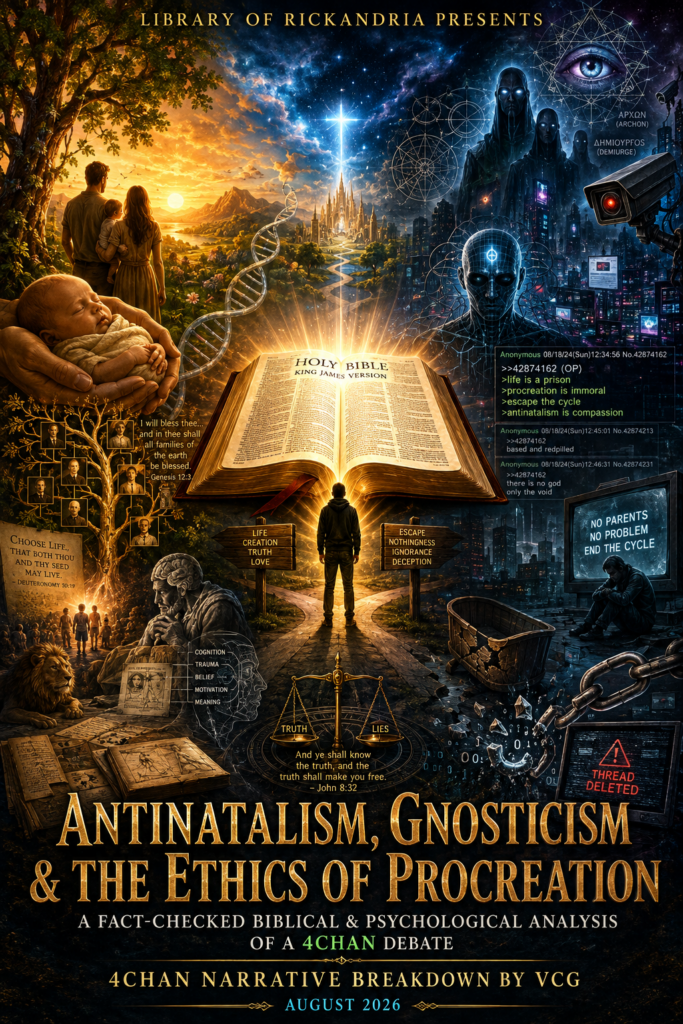
UPDATED BY VCG ON 8/26/2026 @ 23:23 EST
I want to share a heartfelt cause with my audience. Conner Blaisdell-Greene, a brave Airforce Sr. Airman, recently lost his battle with cancer, leaving his family in financial distress. Every donation, no matter how small, can help cover his funeral costs and ease their burden during this difficult time. Please consider clicking the link below to contribute or share Conner’s story with others. Your support truly matters.
Until We Meet Again
Spoken Tribute
Soli Deo Gloria, brethren.
Abstract
On August 26, 2026, an anonymous poster on 4chan’s /x/ board opened a discussion with a striking argument: perhaps the morally responsible response to the suffering of the world is to refuse to bring another generation into it. The poster presented childlessness not merely as a personal preference but as an act of moral awakening—a decision to “break the loop,” resist biological instinct, and avoid becoming responsible for the suffering of future descendants. As the thread developed, this ethical argument became entangled with claims about declining fertility, Buddhism, karma, Gnostic “archons,” technological surveillance, medicine, artificial intelligence, race, genetics, environmental decline, and finally biblical theology and the age of the earth.
This paper examines that discussion carefully rather than dismissing it. The thread raises a genuine ethical problem: what responsibilities do prospective parents have toward people who do not yet exist? Yet the conversation also illustrates how quickly a serious philosophical question can become entangled with unsupported certainty, conspiracy claims, identity-based rhetoric, metaphysical speculation, and false scientific claims.
The analysis therefore keeps several categories distinct. Philosophical arguments are evaluated philosophically. Historical claims are checked historically. Psychological language is used to analyze rhetorical patterns rather than diagnose anonymous participants. Scientific claims are tested against available evidence. Biblical claims are compared directly with the King James Bible, using the supplied Pure Cambridge Edition as the textual basis. Where Scripture speaks clearly, that is distinguished from later theological inference; where the evidence permits more than one interpretation, that uncertainty is acknowledged.
The resulting conclusion is more balanced than either pole of the thread. The antinatalist side is right that procreation is morally serious, that suffering cannot be waved away, and that Christianity does not command every individual believer to marry and reproduce. The opposing side is right that suffering does not prove life itself to be evil, that real improvements in human welfare have occurred, and that the thread’s developing imagery of souls trapped in a material prison resembles Gnostic rather than biblical anthropology. Both sides go beyond the evidence when they turn those valid observations into certainty about the future.
The Bible’s answer is neither “extend your bloodline at any cost” nor “escape the world by ending it.” Its pattern is creation, fall, responsibility, redemption, resurrection, and ultimately new creation.
Introduction: A Serious Question Hidden Inside an Internet Argument
The opening post succeeds rhetorically because it begins with something difficult to dismiss: having children has consequences.
A person considering parenthood is not deciding merely whether he wants a particular lifestyle. He is considering whether to participate in bringing another human being into a world containing disease, violence, injustice, grief, disability, betrayal, anxiety, economic hardship, natural disaster, aging, and death. Any morally serious account of parenthood must admit that.
Contemporary philosophy does admit it. The Stanford Encyclopedia of Philosophy distinguishes between local antinatalism, in which there may be particular circumstances where bringing a child into existence would expose that child to foreseeably intolerable suffering, and global antinatalism, which holds that procreation itself is generally or universally wrong. The distinction matters. One can believe prospective parents bear substantial responsibilities toward their future children without accepting that all procreation is immoral.
The 4chan thread rarely maintains this distinction. It moves rapidly from the reasonable proposition that parents should consider future suffering to the much stronger proposition that a parent becomes morally responsible for every suffering endured by every descendant. From there it moves again, into a metaphysical argument: reproduction supposedly drags souls into an imprisoning material reality, while refusal to reproduce becomes a path toward spiritual transcendence.
Those are not three versions of the same claim.
They are three different claims.
The first concerns parental ethics.
The second concerns moral causation and culpability.
The third concerns metaphysics and religion.
A careful investigation cannot allow one to borrow credibility from another.
I. Methodology: How the Thread Is Being Evaluated
This paper uses different standards of evidence for different kinds of statements.
A scientific statement such as “carbon dating proves fossils are billions of years old” must be examined using the methods and limits of radiometric dating. A historical statement about Gnosticism requires evidence from the study of ancient religion. A psychological statement concerning confirmation bias must be distinguished from an amateur diagnosis of an anonymous poster. A philosophical assertion about whether nonexistence is preferable to existence requires argument rather than laboratory measurement. And a claim that Christianity teaches something must finally be tested against the biblical text rather than against an internet user’s impression of Christianity.
That separation is especially important because the thread constantly crosses boundaries.
An observation about fertility statistics is turned into an evolutionary theory.
A concern about surveillance is turned into certainty concerning the political future.
A philosophical concern about suffering is turned into a doctrine about souls.
A personal rejection of parenthood becomes a claim about enlightenment.
A biblical discussion becomes a dispute over radiocarbon dating.
The method used here is therefore deliberately conservative. Claims will be called supported only where the evidence supports them. Partial truths will not be dismissed merely because they appear beside false claims. Predictions will remain predictions. Metaphysical propositions will not be called scientific facts. And anonymous posters will not be assigned psychiatric diagnoses.
The same restraint should govern the biblical analysis. The supplied King James Bible itself praises the searching and study of Scripture, and its translators explicitly emphasized the importance of carefully examining the text rather than dogmatizing where uncertainty remains.
That is an appropriate principle for this investigation as well.
II. The Opening Argument: From Responsibility to Infinite Guilt
The core moral argument begins with the claim that if a person reproduces, that person becomes responsible for “any and all suffering” experienced by his children, grandchildren, and subsequent descendants.
This is the logical hinge of the entire thread.
It is also where the argument first overreaches.
There is a meaningful difference between being part of the causal history of an event and being morally guilty for that event.
Suppose a woman has a son. Decades later, that son is defrauded by another person. The mother’s decision to have him was a necessary condition of his being present to experience the fraud. But it does not follow that the mother committed the fraud.
Without her action, the victim would not have existed.
That establishes causal ancestry.
It does not establish moral culpability.
Ordinary moral reasoning distinguishes intention, agency, foreseeability, negligence, control, and proximity. Parents can certainly be morally responsible for exposing a child to foreseeable harms. If parents knowingly create dangerous conditions, abuse a child, refuse necessary care, or irresponsibly ignore a grave hereditary risk, the moral question becomes serious. That resembles the “local” forms of antinatalist reasoning recognized in contemporary philosophical literature.
But global responsibility for everything that happens throughout an indefinite lineage is different.
The biblical text contains a particularly relevant principle in Ezekiel 18. After discussing righteous and wicked fathers and sons, the chapter states:
“The son shall not bear the iniquity of the father, neither shall the father bear the iniquity of the son.”
Ezekiel 18:20 does not teach that parents have no responsibilities toward their children. The surrounding chapter concerns personal moral accountability. Its relevance here is narrower but important: Scripture does not treat moral guilt as an unlimited hereditary substance flowing automatically backward or forward through a family line.
The opening post therefore identifies a genuine responsibility but enlarges it beyond what its argument establishes.
Parents are responsible to their children.
That is not the same thing as being responsible for every event that will ever happen to every descendant.
III. The Consent Argument: Can Someone Consent to Being Born?
The thread repeatedly frames procreation as forcing existence upon a nonconsenting person. One reply even combines the language of consent with karma and the idea of pulling a soul from an immaterial realm into physical existence.
The consent argument deserves more serious treatment than many replies give it.
There is an obvious asymmetry in procreation: the person most affected cannot be consulted beforehand.
That fact is real.
The philosophical difficulty is that before conception there is no existing person from whom consent can be requested.
This makes procreation different from ordinary cases of nonconsensual action. If I perform surgery on an existing competent adult without asking him, there is a definite person whose autonomy I have violated. Before conception, there is no already-existing child waiting to answer yes or no.
That does not make the ethics of procreation trivial. Philosophers such as Seana Shiffrin and David Benatar have developed serious arguments concerning the imposition of risk, harm, and benefit without prior consent. Stanford’s survey of the subject notes that global antinatalism has been defended partly through Benatar’s proposed asymmetry: the absence of pain is considered good even when nobody exists to enjoy that absence, whereas the absence of pleasure is not considered bad unless someone exists to be deprived of it.
But that asymmetry is the argument.
It cannot simply be assumed.
A 4chan poster saying that no possible argument exists against antinatalism does not make the underlying philosophical controversy disappear.
Nor does the thread establish that all imposed risk is immoral. Parents necessarily expose children to risk, but so do physicians, teachers, governments, rescuers, guardians, and countless other agents whose decisions affect people unable to give full prospective consent. The ethical question is usually not whether risk exists, but whether the risk is proportionate, avoidable, reasonably foreseeable, and imposed for a defensible good.
Global antinatalism requires considerably more than the observation that nobody signs a preconception consent form.
IV. “Break the Loop”: Where the Argument Becomes Metaphysical
The philosophical argument gradually becomes something else.
The original poster encourages readers to “break the loop,” master their biological impulses, and stop bringing souls into this world. Later posts speak of archons, spiritual ascent, enlightenment, reality as a prison, and reproduction as feeding a machine from which the awakened individual should escape. By the thread’s later stages, the original poster explicitly describes the material world as a prison and presents personal transcendence as a goal incompatible with raising children.
At this point we have left antinatalist ethics and entered religious metaphysics.
The relevant historical comparison is Gnosticism, but that label should be used carefully.
“Gnosticism” is a scholarly umbrella for a diverse set of religious and philosophical movements rather than one perfectly uniform church with one creed. Still, several themes recur in major Gnostic systems. The Internet Encyclopedia of Philosophy describes an “anti-cosmic world rejection” in which the material cosmos is associated with error or ignorance, the creator of the lower material order may be represented as a Demiurge, and the human spiritual element seeks return to a higher divine reality.
That does not prove the anonymous poster consciously follows an ancient Gnostic school.
It does show why another participant’s observation that the thread had become “gnostic” in its anti-materialism was historically perceptive.
The resemblance lies in the structure:
The material order is treated as fundamentally imprisoning.
Ordinary humanity is depicted as asleep or manipulated.
Certain people possess greater insight.
Reproduction perpetuates imprisonment.
Liberation consists in transcending the present material condition.
Those themes stand in considerable tension with biblical creation theology.
Genesis 1 does not describe the physical cosmos as the work of a malevolent Demiurge. It repeatedly describes God’s work as good. Humanity is created male and female in the image of God, receives the blessing to “be fruitful, and multiply,” and the completed creation is described as “very good.”
Whatever interpretive debates Christians may have concerning the chronology or literary structure of Genesis, the theological direction of the chapter is difficult to miss.
Creation is God’s work.
Material creation is not introduced as an evil prison.
V. Christianity Does Not Require Every Person to Reproduce
Correcting the thread’s anti-material theology does not require swinging to the opposite extreme.
Several posters argue or imply that intelligent or morally decent people possess an obligation to reproduce so that their children can improve society. One commenter states the claim explicitly: empathetic and intelligent people supposedly have an obligation to breed.
That is not a New Testament command.
First Corinthians 7 gives a much more nuanced treatment.
Paul says:
“every man hath his proper gift of God, one after this manner, and another after that.”
He then tells the unmarried and widows that remaining as he is can be good.
Later in the same chapter, Paul explains that the unmarried believer may devote attention to “the things that belong to the Lord” and speaks positively of serving the Lord “without distraction.” He also makes clear that marrying is not sin.
This produces a distinction that several people in the thread miss.
Biblical Christianity can affirm marriage and children as good without teaching that biological reproduction is every individual’s mandatory spiritual destiny.
Psalm 127 speaks warmly of children:
“Lo, children are an heritage of the LORD:
and the fruit of the womb is his reward.”
Yet Paul can simultaneously commend a celibate life devoted to God.
Those propositions are not contradictory.
A gift can be genuinely good without being assigned identically to every individual.
Where the thread’s antinatalist spirituality departs more sharply from the biblical pattern is not merely in choosing celibacy, but in redefining marriage, embodiment, and reproduction as participation in an evil metaphysical machine. First Timothy 4 warns specifically about teaching that includes “forbidding to marry,” then responds with the principle that “every creature of God is good” when rightly received.
Voluntary singleness and doctrinal condemnation of marriage are therefore not the same thing.
VI. The Bible Is Not Naively Optimistic About Suffering
A weak response to antinatalism would be to pretend that the world is pleasant enough that the problem of suffering disappears.
Scripture does not do that.
Ecclesiastes 4 begins with an observation so dark that it could have appeared in the 4chan thread itself. The writer looks upon oppression, sees the tears of the oppressed and the power of their oppressors, and says that in that particular comparison he praised the dead above the living and the one not yet born above both because he had not witnessed the evil done “under the sun.”
That passage matters enormously.
It means a biblical rebuttal to antinatalism cannot consist of telling suffering people that life is obviously wonderful.
The Bible knows otherwise.
Job knows otherwise.
Jeremiah knows otherwise.
Lamentations knows otherwise.
The Psalms know otherwise.
Paul himself writes of being pressed beyond measure and despairing even of life, while simultaneously locating hope in
“God which raiseth the dead.”
The biblical disagreement with global antinatalism therefore does not arise because Scripture refuses to see suffering.
It arises because Scripture places suffering inside a different story.
Ecclesiastes can describe oppression with devastating honesty without concluding that creation itself is an ontological mistake. First Corinthians can speak of death as an enemy rather than treating death as proof that existence should never have occurred.
This distinction becomes crucial when the thread reaches its deepest spiritual premise.
Christianity does not promise salvation by escaping embodiment.
It promises resurrection.
VII. Resurrection Versus Escape From Matter
First Corinthians 15 is perhaps the clearest biblical answer to the thread’s developing anti-material metaphysics.
Paul does not say that the final victory consists of souls finally abandoning bodily existence.
He speaks repeatedly of resurrection.
“It is sown in corruption; it is raised in incorruption.”
He continues:
“this mortal must put on immortality.”
The climax is not
“matter is abolished because matter was evil.”
It is:
“Death is swallowed up in victory.”
Paul certainly distinguishes the present corruptible condition from the resurrection condition. Christian theology should not flatten that distinction.
But transformation is not the same thing as Gnostic escape.
The biblical storyline moves from creation, through corruption and death, toward redemption and resurrection. Revelation intensifies the point by describing not merely souls fleeing the cosmos but a new heaven and a new earth, the dwelling of God with humanity, the removal of death and sorrow, and the declaration, “Behold, I make all things new.”
That is a very different eschatology from voluntary extinction.
VIII. Buddhism, Karma, and the “Soul From the Aether”
One participant suggests that the antinatalist insight is essentially what Buddha discovered. Another says people who reproduce accumulate negative karma by dragging a nonconsenting soul from an immaterial realm into bodily existence.
This is an unstable mixture of religious concepts.
Buddhist traditions are diverse, but the idea of an eternal individual soul waiting in an aether to be placed into a body sits uneasily with one of Buddhism’s most famous doctrines: anātman or anattā, usually rendered “not-self” or “no enduring self.”
Stanford’s discussion of Indian Buddhist philosophy explains that Buddhist accounts of mind do not posit an independent, permanent, substantial self underlying mental life. The classical analysis instead treats the person in terms of changing physical and psychological processes.
Buddhism unquestionably takes suffering, impermanence, craving, rebirth, and liberation seriously. That creates some superficial overlap with antinatalist language.
But “Buddha taught that reproduction yanks eternal souls out of the aether” is not an accurate summary of mainstream Buddhist doctrine.
The thread’s religious vocabulary is syncretic: Buddhist words, Gnostic imagery, modern consent ethics, internet conspiracy narratives, and an individualized doctrine of enlightenment are being fused into one worldview.
That synthesis may be personally meaningful to a poster.
It should not be mistaken for a historically established Buddhist or Christian teaching.
IX. Fertility Decline: Real Trend, Unproven Explanation
The thread contains an empirical argument that is stronger than some critics acknowledge: fertility really is falling.
The United Nations’ World Population Prospects 2024 estimates global fertility at approximately 2.25 live births per woman, down from 3.31 in 1990. More than half of the world’s countries and areas are now below the approximate replacement level of 2.1 births per woman.
So when posters say modern fertility patterns are changing, they are describing something real.
What does not follow is the claim that this proves humanity has developed a unified “species-level instinct” to stop reproducing because environmental conditions are subconsciously perceived as catastrophic.
Aggregate demographic trends do not reveal one psychological cause.
Economic development, contraception, education, urbanization, delayed marriage, changing family expectations, housing costs, women’s employment opportunities, secularization, changing norms, and many other influences can affect fertility. The United Nations itself discusses policy factors such as work-family balance, housing, childcare, gender divisions in domestic labor, and people’s ability to achieve their desired family size.
The fertility decline is therefore a fact.
The proposed explanation is a hypothesis.
Those categories should not be confused.
X. Abortion and Postpartum Mental Illness: A Case Study in Conflation
One poster tries to connect declining reproductive concern with support for later abortion and with children killed during what the poster calls postpartum depressive episodes.
The claim bundles several different subjects together.
CDC abortion surveillance for 2022 found that 92.8 percent of reported abortions occurred at or before thirteen weeks’ gestation. Abortions at twenty-one weeks or later made up 1.1 percent of reported procedures in the relevant reporting areas.
Whatever ethical position one takes on abortion, “late-term abortion” should not be spoken of as though it describes the typical abortion.
The mental-health claim requires even more care.
Postpartum depression and postpartum psychosis are not interchangeable terms.
Postpartum psychosis is a rare psychiatric emergency that can involve delusions and hallucinations and can create a genuine danger to mother and child. A 2024 systematic review estimated postpartum psychosis at roughly one case per thousand women and cited an approximately 4 percent infanticide rate in untreated cases.
That is a serious public-health problem.
It is not evidence that humanity is evolutionarily selecting itself toward indifference to offspring.
Nor is it responsible to transform a rare severe psychiatric condition into a generalized statement about mothers or declining civilization.
The factual phenomena are real.
The evolutionary interpretation is not established by them.
XI. Is the Modern World Simply Becoming Worse?
The argument eventually polarizes into two sweeping pictures.
One side describes contemporary society as a horrifying prison whose trajectory makes responsible reproduction impossible.
The other describes the modern era as practically a paradise compared with the past, citing sanitation, medicine, abundant information, technology, and expected breakthroughs.
Both positions contain truth.
Neither is adequate by itself.
Sanitation really has saved enormous numbers of lives. The World Health Organization estimates that inadequate water, sanitation, and hygiene remain associated with roughly 1.4 million preventable deaths per year. That number indirectly demonstrates what functioning sanitation systems accomplish.
Medical progress is also real.
HIV provides a particularly strong counterexample to claims in the thread that chronic treatment exists merely because medicine wants to keep patients permanently profitable. There is currently no effective cure for HIV, but antiretroviral treatment can allow people with HIV to live long, healthy lives; sustained viral suppression also prevents sexual transmission.
Type 2 diabetes provides another example of why “treated rather than cured” is not evidence of conspiracy. Significant and sustained weight loss can produce remission for some people with type 2 diabetes. Clinicians prefer “remission” to “cure” because the condition can recur if metabolic circumstances change.
At the same time, the pessimistic side is right that technological progress does not automatically produce moral progress.
Surveillance provides an excellent example.
XII. The Flock Surveillance Claim: One of the Thread’s Stronger Fact Checks
A participant points to Flock automated license-plate-reader technology and claims that police have used interstate travel patterns connected with legal marijuana jurisdictions as part of investigations.
Unlike some of the thread’s conspiratorial examples, this concern has real documentary support.
In August 2026, 404 Media reported on a Wisconsin criminal complaint in which police used Flock records showing that a vehicle frequently traveled to Michigan, where marijuana is legal, as part of the probable-cause narrative preceding a search and marijuana-possession arrest.
Broader concern about automated license-plate surveillance is likewise not imaginary. Recent reporting describes rapid expansion of Flock’s camera network and significant bipartisan privacy opposition.
This is a useful example because it demonstrates how the paper’s method works.
The thread’s factual concern can be valid even if its larger conclusion is not.
It is reasonable to worry about surveillance.
It is reasonable for prospective parents to consider what kind of political and technological systems future children may inhabit.
It does not follow that surveillance proves the moral necessity of human extinction.
The existence of a real danger does not automatically validate every conclusion attached to it.
XIII. “Medicine Keeps You Sick”: Where Suspicion Becomes Conspiracy
Another stage of the thread claims that water and air are intentionally poisoned, medicine treats rather than cures because chronic sickness is profitable, nutritional advice is deliberately designed to weaken the public, and accessible knowledge is permitted only when it poses no threat to “the system.”
There are legitimate concerns hiding inside this cluster.
Healthcare systems can contain financial conflicts of interest.
Pollution is real.
Processed foods can contribute to poor health.
Medical mistakes occur.
Corporate actors can behave unethically.
Public institutions can fail.
The methodological problem is the jump from those realities to a single intentional theory explaining all of them.
Once contradictory evidence is interpreted as evidence of how well the conspiracy hides itself, the claim becomes difficult to falsify.
The cancer discussion illustrates the problem especially well.
One poster says an mRNA cancer vaccine is coming. Another responds that mRNA is “poison.”
Current evidence supports neither absolute position.
In August 2026, Merck and Moderna announced positive phase-three results for a personalized mRNA-based melanoma treatment used with pembrolizumab. The results are genuinely encouraging, but the therapy is personalized, final survival data are still developing, manufacturing is complex, and effectiveness across other cancers remains uncertain.
Conversely, saying “mRNA is poison” ignores both mechanism and evidence. mRNA COVID vaccines have documented risks. The CDC recognizes a causal association with rare myocarditis and pericarditis, particularly in adolescent and young adult males after certain doses.
Acknowledging that adverse event is responsible medicine.
Turning it into the universal statement that mRNA technology itself is poison is not.
The disciplined conclusion is neither “medical technology is automatically benevolent” nor “medicine exists to preserve disease.”
It is that medical claims must be evaluated treatment by treatment and evidence by evidence.
XIV. Does Suffering Actually Outweigh Enjoyment?
At one point a participant declares it a fact that the chance and amount of suffering exceed the chance and amount of enjoyment.
That is not something the thread demonstrates.
It may function as a philosophical judgment.
It is not an established global measurement.
Gallup’s worldwide emotional-health data for 2024 present a mixed picture. Thirty-nine percent of adults reported substantial worry the previous day, 37 percent reported stress, and 32 percent reported physical pain. At the same time, 73 percent reported enjoyment, 73 percent reported laughter or smiling, and 88 percent reported being treated with respect.
The 2026 World Happiness Report likewise reports that positive emotions remain roughly twice as frequent as negative emotions in the available global data, while also documenting important declines and vulnerabilities among particular groups.
These measurements cannot resolve the philosophical question of whether life is “worth starting.”
A percentage of positive emotion is not a proof that procreation is morally required.
But the evidence does undermine the thread’s presentation of net-negative human experience as an uncontested empirical fact.
There is a broader lesson here.
The value of a human life cannot easily be reduced to an arithmetic sum of pleasant minus unpleasant moments.
People may regard lives containing profound suffering as meaningful.
Others may endure circumstances they themselves judge unbearable.
Any universal calculation needs more argument than either side of the thread provides.
XV. Psychology Without Amateur Diagnosis
The psychological section of this paper must begin with a limitation.
We do not know who the anonymous participants are.
We do not know whether every post is sincere.
We cannot clinically evaluate them.
We therefore should not diagnose depression, narcissism, psychosis, personality disorders, or any other condition from a handful of anonymous posts.
What we can analyze are rhetorical and cognitive patterns visible in the conversation.
The most important is confirmation bias.
Psychologist Raymond Nickerson’s classic review defines confirmation bias broadly as seeking or interpreting evidence in ways that favor one’s existing beliefs, expectations, or hypothesis.
Near the end of the thread, the original poster gives a striking example. People who reject his argument are divided into two groups: those supposedly unable to comprehend the truth because it would destroy their worldview, and those who understand it but deliberately refuse to accept it.
There is an obvious missing category:
A person might understand the argument and believe it is wrong.
Once that category disappears, disagreement itself becomes evidence for the theory.
That is epistemically dangerous.
If agreement proves enlightenment and disagreement proves psychological blindness, the worldview has constructed a shield against correction.
The opposing side does similar things.
Antinatalists are called defective, cowardly, mentally broken, or biologically inferior. Some participants suggest that anyone who thinks life contains too much suffering should simply die.
That response is both cruel and logically mistaken.
The question
“Should an existing person continue living?”
is not identical to
“Should a new person be created?”
Existing people have relationships, commitments, desires, dependents, histories, projects, and interests. A philosophical argument against creating a new life does not logically entail destroying an existing one.
The self-harm taunt therefore fails even as a reductio ad absurdum.
XVI. Identity, Status, and the Transformation of Argument Into Tribe
As the thread continues, participants increasingly stop evaluating propositions and begin classifying people.
One side constructs the identity of the enlightened person who has transcended biological programming.
The other constructs the identity of the genetically successful breeder whose descendants will inherit the future.
Both positions invite status competition.
That transformation matters psychologically because changing one’s mind becomes more costly once a belief is tied to identity.
If accepting antinatalism means becoming one of the intelligent people who “saw through the system,” contrary evidence threatens more than an argument.
If rejecting antinatalism means proving genetic fitness, strength, masculinity, racial continuity, or civilizational loyalty, contrary evidence becomes equally threatening.
The thread repeatedly slides into ethnic and racial scapegoating precisely at this point.
That rhetoric contributes nothing to the underlying ethical question.
Whether an argument is true does not depend on the ethnicity of the person who first proposed it.
Whether declining fertility is good or bad cannot be established through racial insult.
Whether surveillance is dangerous does not depend upon blaming an ethnic population.
Those moves are examples of the genetic fallacy in the ordinary logical sense: attempting to discredit an idea by assigning it to a despised source rather than evaluating the proposition itself.
The thread occasionally recognizes this problem, but repeatedly returns to it.
XVII. Echo Chambers and the Architecture of Online Certainty
The thread also illustrates a broader feature of online argument: people rapidly cluster around narratives.
A large comparative study published in Proceedings of the National Academy of Sciences examined more than one hundred million pieces of content from multiple platforms and found substantial homophilic clustering and biased diffusion toward like-minded users, although the strength of these effects differed by platform.
That research does not specifically prove that every 4chan thread is an echo chamber.
But the mechanism is relevant.
Participants repeatedly reinforce emotionally satisfying versions of the world:
The future is inevitably dystopian.
The future is inevitably technologically magnificent.
Only fools reproduce.
Only losers fail to reproduce.
Medicine is miraculous.
Medicine is poison.
Civilization is collapsing.
Civilization has never been better.
These paired absolutes are psychologically revealing because they simplify uncertainty.
The future, however, is not obligated to conform to either emotional forecast.
A careful researcher has to tolerate a less satisfying conclusion:
Some conditions have improved.
Some have worsened.
Some technologies create benefits and dangers simultaneously.
Some predictions will be wrong.
We do not know the life history of a hypothetical child.
Uncertainty is not intellectual failure.
Pretending uncertainty does not exist is.
XVIII. The “Maximum Suffering Creates Greatness” Response
One participant reacts against antinatalism by glorifying suffering itself, arguing that people should suffer as much as possible so that overcoming hardship will produce greatness.
This is not a biblical correction to antinatalism.
It is another distortion.
Scripture certainly teaches that suffering can produce endurance, maturity, discipline, hope, compassion, and faithfulness.
That does not make suffering intrinsically good.
The Bible repeatedly condemns people who oppress others.
Ecclesiastes does not look at oppressed people and congratulate their oppressors for building character. It mourns that the oppressed have no comforter.
Christian endurance of suffering and deliberate maximization of suffering are different moral ideas.
The New Testament response to suffering is neither to worship it nor to deny it.
It is to remain faithful through it, relieve it where possible, refuse evil, comfort the afflicted, and trust God beyond death.
XIX. The Thread’s Young-Earth and Carbon-Dating Exchange
Near the end, the discussion unexpectedly turns toward biblical chronology and radiometric dating.
One participant asserts that the earth is approximately six thousand years old. Another tries to rebut this with an explanation of carbon dating. A third then claims that carbon dating a grandmother’s bones would produce an age of billions of years.
Several corrections are needed.
First, the Bible nowhere contains the sentence “the earth is six thousand years old.”
A roughly six-thousand-year chronology is an inference produced by combining particular interpretations of biblical genealogies and chronology.
That does not automatically prove the inference wrong.
It means the inference should be honestly identified as an interpretation rather than quoted as though it were a verse.
Second, mainstream geochronology places the age of the earth at approximately 4.5 billion years. The U.S. Geological Survey describes radiometric evidence supporting an earth age of roughly 4½ billion years or more.
Third, carbon-14 is not the method used to date the earth at billions of years.
USGS explains that because carbon-14 has a relatively short half-life, radiocarbon dating is useful only for material from approximately the last 50,000 years. Much older rocks are dated with other isotope systems.
Therefore, the thread contains errors on both sides.
The young-earth assertion is not established merely by citing the Bible.
The response invoking carbon dating for billion-year timescales misstates the scientific method.
And the grandmother joke is simply false: properly conducted radiocarbon analysis of recent human remains does not ordinarily return billion-year ages.
This episode is worth including because it illustrates the central methodological principle of the entire paper.
A conclusion can be broadly correct while the argument offered for it is wrong.
And an argument can contain a legitimate observation while the conclusion drawn from it is excessive.
XX. Abaddon and the Book of Life
One of the thread’s explicitly religious posts declares that the world has been forsaken, asks to be removed from the Book of Life, and then hails Kali and Abaddon.
Whatever rhetorical or performative intention lies behind the post, its biblical references can be checked directly.
Revelation 9:11 identifies Abaddon as:
“the angel of the bottomless pit”
whose Greek name is Apollyon. The surrounding passage belongs to the trumpet judgments and describes destructive beings harming humanity.
Revelation does not present Abaddon as an object of Christian worship.
The Book of Life is likewise not portrayed as something from which liberation should be sought. Revelation’s final chapter gives the opposite invitation:
“whosoever will, let him take the water of life freely.”
Within the biblical worldview, the thread’s rhetoric has reversed the symbols.
Life with God becomes something to reject.
A destructive figure from the abyss becomes something to hail.
That inversion may be deliberate internet provocation, but it cannot be reconciled with the plain direction of Revelation.
XXI. What the Antinatalist Side Gets Right
A fair investigation should identify what survives fact-checking.
The antinatalist side is correct that a decision to have children should be made thoughtfully rather than automatically.
It is correct that parents cannot guarantee a good life for their children.
It is correct that future generations may face political, technological, economic, ecological, and social dangers that parents cannot completely control.
It is correct that concern for future people is morally meaningful even though those people do not yet exist.
It is correct that some people have serious hereditary, medical, financial, relational, or environmental reasons to decide against biological parenthood.
It is correct that Christian Scripture does not command every individual believer to marry.
It is correct that celibacy can be a legitimate vocation.
It is correct that surveillance technology poses genuine civil-liberty questions.
It is correct that material progress does not automatically mean moral progress.
It is correct that human beings often act from conformity, status pressure, sexual impulse, ego, and social expectation.
A Christian response should not deny any of these things merely because they appeared in an antinatalist thread.
Truth does not become false because an opponent said it.
XXII. Where the Antinatalist Argument Breaks
The thread nevertheless fails to establish global antinatalism.
The decisive error is the repeated conversion of uncertainty into certainty.
Children may experience terrible suffering becomes children will be victims of an intolerable dystopia.
Parents contribute causally to the existence of descendants becomes parents are morally guilty for every future suffering.
Technological surveillance can be abused becomes total oppressive surveillance will inevitably define the future.
Bodily life contains suffering becomes bodily existence is a metaphysical prison.
A person may choose celibacy becomes spiritual enlightenment requires refusing to reproduce.
Some people reproduce thoughtlessly becomes people who reproduce are governed by primitive instinct.
Some parents act narcissistically becomes parenthood itself is narcissism.
Some institutions deceive becomes contradictory information is merely controlled information permitted by “the system.”
At each stage, an observation that deserves discussion is inflated into a total theory.
The theory then becomes increasingly difficult to falsify because disagreement itself is explained as evidence of ignorance, conditioning, ego, or spiritual manipulation.
That is not careful skepticism.
It is certainty wearing skeptical clothing.
XXIII. What the Natalist Side Gets Right—and Wrong
The opposing side fares better on several empirical points.
Modern sanitation, medicine, literacy, information access, and disease treatment genuinely have improved many human lives.
Technological catastrophe is not predetermined.
Children can experience profound joy, love, friendship, beauty, meaning, discovery, service, and faith.
Parenthood can be motivated by genuine love rather than narcissism.
Christianity does not teach that physical existence is an intrinsically evil prison.
The resemblance between the thread’s later metaphysics and Gnostic anti-cosmic themes is real.
But natalist posters repeatedly weaken those legitimate points by making equally sweeping claims of their own.
Technological improvement does not guarantee a permanently better future.
Artificial intelligence will not necessarily solve every problem.
Good parents cannot promise that children will be happy.
Genetic selection cannot guarantee morally or intellectually superior offspring.
Ethnic fertility competition is not a biblical theology of parenthood.
People who remain childless are not necessarily defective.
People who fear suffering are not necessarily cowards.
And a Christian has no basis for telling a despairing person to destroy himself merely because that person questions the goodness of procreation.
The natalist extreme treats reproduction as conquest.
The antinatalist extreme treats nonreproduction as escape.
Neither captures the biblical picture.
XXIV. The Biblical Synthesis
When the relevant passages are read together, a coherent pattern emerges.
Genesis says creation is God’s work and calls the created order very good.
Psalm 127 describes children as an heritage and reward from the Lord.
Ecclesiastes refuses sentimentalism and acknowledges that oppression can make nonexistence appear preferable when life is viewed “under the sun.”
Ezekiel 18 rejects the idea that moral guilt simply transfers automatically between father and son.
First Corinthians 7 affirms both marriage and voluntary singleness, describing different conditions as gifts and explicitly saying that marriage is not sin.
First Timothy 4 warns against turning asceticism into a doctrine that condemns marriage and created things.
First Corinthians 15 presents death not as proof that creation should never have existed but as an enemy to be defeated in resurrection.
Revelation ends not with enlightened souls permanently abandoning a failed creation, but with God dwelling with humanity, death removed, tears wiped away, and all things made new.
Taken together, those passages rule out several simplistic positions.
They do not support compulsory biological reproduction for every believer.
They do not support contempt for celibacy.
They do not support the idea that suffering is unreal.
They do not support the idea that marriage is intrinsically corrupt.
They do not support infinite ancestral moral guilt.
They do not support worship of suffering.
And they do not support the idea that salvation consists of escaping evil material existence through human extinction.
The biblical answer is redemption rather than escape.
XXV. Creation, Fall, and the Missing Category in the Thread
The deepest theological problem with the thread may be that it repeatedly treats only two possibilities as available.
Either the world is good enough to justify reproduction.
Or the world is so evil that ending reproduction is the enlightened response.
Biblical theology introduces a third category:
a good creation subjected to corruption.
That category matters because it permits Christians to say several things at once.
The world contains genuine goodness because it is God’s creation.
The world contains genuine horror because sin and death are real.
Human beings can create terrible systems.
Human beings can also create hospitals, sanitation systems, music, families, acts of mercy, scientific discoveries, and communities of love.
Children are not immune from suffering.
Neither are they reducible to future suffering.
The present creation is not the final state.
Death is real, but death is not sovereign.
That is why Christian hope cannot be reduced to either optimism or pessimism.
It is eschatological.
The Christian is not required to pretend Babylon is Jerusalem.
Neither is he permitted to pretend Babylon is all that will ever exist.
XXVI. Conclusion: Neither “Extend the Line” nor “End the Line”
The 4chan thread begins with a serious moral intuition.
A prospective parent should think about the person who may result from his decision.
That child’s welfare matters.
The risks imposed upon that child matter.
The condition of society matters.
The motivations of the parents matter.
The possibility of suffering matters.
Anyone defending parenthood by saying “people have always had children, so stop thinking about it” has failed to answer the strongest version of the concern.
But the thread then repeatedly substitutes rhetoric for proof.
It does not establish that every parent becomes morally responsible for every suffering of every descendant.
It does not establish that human suffering objectively outweighs every human good.
It does not establish that future technological tyranny is inevitable.
It does not establish that reproductive behavior is being governed by a single species-level extinction instinct.
It does not establish that medicine is deliberately preserving illness.
It does not establish that Buddhism teaches eternal souls are dragged from an aether into bodies.
And it does not establish that matter is a prison from which enlightened people should escape by ending their lineage.
By the thread’s final stages, what began as an ethical question has become a worldview combining global antinatalism, technological pessimism, Gnostic-style anti-materialism, conspiracy reasoning, demographic anxiety, selective scientific claims, and individualized spiritual transcendence.
The worldview contains fragments of truth.
That is precisely why it deserves careful examination rather than mockery.
But fragments of truth do not automatically assemble themselves into a true system.
The opposing worldview fares no better when it treats reproduction as biological victory, technological progress as destiny, suffering as weakness, or children as instruments through which one’s genetics, ethnicity, status, or ideology will conquer the future.
Scripture offers another way.
Children may be blessings.
Singleness may be a gift.
Parents bear real responsibilities.
Individuals bear moral accountability.
Suffering is not denied.
Creation is not despised.
Death is an enemy.
Matter is not presented as the handiwork of an evil creator.
And Christian hope does not rest in whether one’s bloodline continues.
It rests in God.
The thread presents two rival imperatives:
Escape the world by ending the line.
Conquer the world by extending the line.
The Bible ultimately makes neither human reproduction nor human nonreproduction the center of salvation.
The center is Christ.
The final Christian answer to the terror of existence is therefore not denial, breeding, extinction, technological utopia, or Gnostic escape.
It is resurrection.
“For this corruptible must put on incorruption, and this mortal must put on immortality.”
And when that occurs:
“Death is swallowed up in victory.”
That conclusion does not make the ethical questions surrounding parenthood disappear.
It places them in their proper order.
Procreation remains a serious stewardship.
Celibacy remains a legitimate calling.
Suffering remains real.
Human beings remain morally accountable for how they treat one another.
But existence itself is not presented in Scripture as the original crime.
The biblical story begins with creation declared good and ends with creation made new.
Between those two points stands a fallen world in which men and women must choose carefully, love responsibly, refuse cruelty, examine claims honestly, and resist the temptation to turn either despair or optimism into an idol.
That is a less dramatic answer than the extremes offered by an anonymous imageboard.
It is also, upon examination, a far more coherent one.
4CHAN THREAD & POST BREAKDOWNS – Library of Rickandria
VCG PAPER PROJECTS – Library of Rickandria