
From Ancient Mesopotamia to Modern Esotericism: A Critical Analysis of Anunnaki Claims, Recovered Memory, Syncretism & Biblical Interpretation
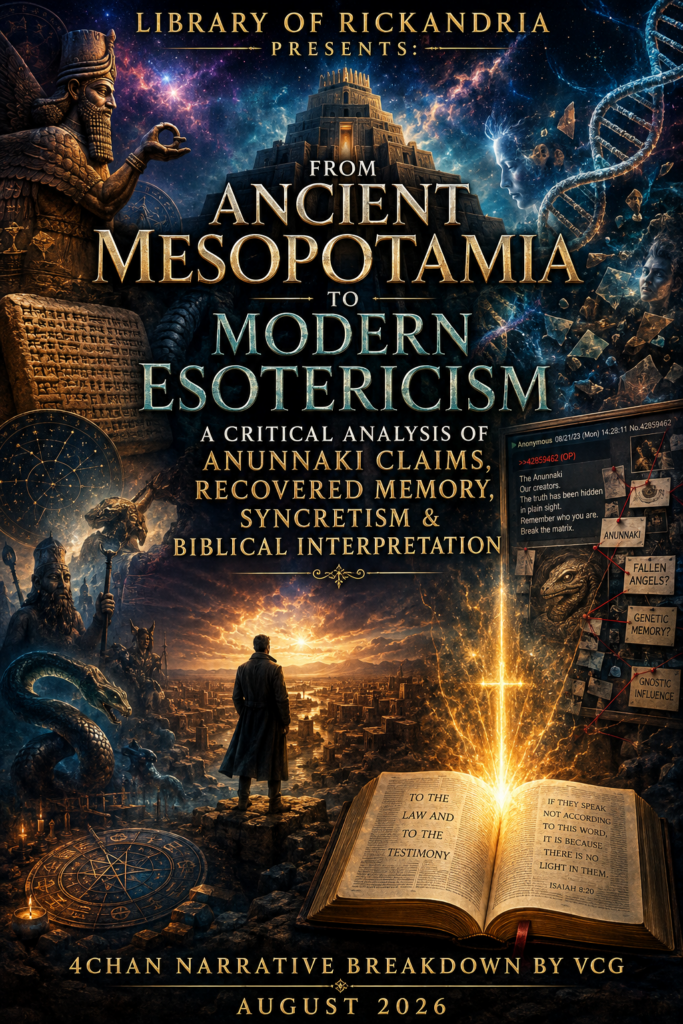
UPDATED BY VCG ON 8/27/2026 @ 01:11 EST
Soli Deo Gloria, brethren.
Abstract
On August 22–23, 2026, a thread on 4chan’s /x/ paranormal board began with a striking question: could newly surfacing memories of being an Anunnaki or fallen angel, creating human-animal hybrids, and performing superhuman feats represent either a genuine past life or some form of inherited ancestral memory? From that opening question, the discussion quickly expanded. Enki became a genetic engineer. Human beings were said to possess suppressed twelve-stranded DNA. The Gnostic Demiurge became a fungal hive mind. Jinn became plasma-based souls inhabiting biological bodies. Dreams involving Apep, Jesus, Moses, telekinesis, genetic experimentation, and animal transformation were treated as pieces of a larger cosmic history. Other posters added gold-mining Anunnaki, starseeds, reincarnation, “genetic memory,” and the suggestion that future dreams would contain messages from Enki.
The purpose of this paper is not to ridicule the people involved, nor to assume beforehand that unusual experiences cannot occur. It is to ask a narrower and more useful question: what, exactly, does the evidence establish?
To answer that, several kinds of claims must be kept separate. Ancient history can tell us what Mesopotamian texts actually say about the Anunnaki and Enki. Genetics can tell us what DNA is known to do. Psychology can help explain how memory, dreams, suggestion, and source attribution work without pretending to diagnose anonymous strangers. Historical study of Gnosticism, Egyptian religion, and Islamic traditions can determine whether modern interpretations accurately represent those traditions. Finally, Scripture can be examined on its own terms rather than having later occult systems quietly inserted into it.
That separation produces a consistent result. The thread repeatedly begins with something real—an ancient deity, a religious symbol, DNA, epigenetics, plasma, dreams, or a biblical passage—and then attaches additional claims for which the original source provides little or no support. The resulting worldview is best understood not as the rediscovery of one forgotten ancient teaching, but as a modern syncretic narrative assembled from many different traditions and modern cultural sources.
Introduction: Taking a Strange Claim Seriously Enough to Test It
A thread like this is easy to dismiss.
That would also be a mistake.
The fact that a claim sounds extraordinary is not evidence that it is false. History is full of ideas that once seemed unlikely and later turned out to be true. Religious texts themselves contain visions, dreams, angels, miracles, spiritual beings, and events that cannot be reduced to ordinary experience. A Christian analysis therefore has no reason to begin with the dogma that anything unusual must be imaginary.
But openness is not the same thing as credulity.
If we are willing to consider extraordinary claims, we should also be willing to examine them carefully enough to discover when they do not hold together.
That is the approach taken here. It follows the broader VCG research standard of separating fact, interpretation, speculation, rhetoric, scientific analysis, psychological analysis, logical analysis, historical context, and biblical analysis instead of blending them together. The goal is evidence before opinion, context before commentary, and uncertainty stated honestly.
There is an important distinction that will run through the entire paper:
An experience can be real as an experience without the interpretation placed upon that experience being historically or scientifically correct.
Someone can really have a vivid dream.
Someone can genuinely feel as though a memory arrived from outside ordinary consciousness.
Someone can sincerely experience an image of an ancient temple, a serpent, an angelic being, a forgotten civilization, or another life.
The researcher’s next question is not, “Did you really experience that?”
The better question is:
“What does that experience allow us to conclude about the external world?”
That difference is where much of the 4chan thread begins to unravel.
I. The Opening Claim: Anunnaki, Fallen Angels, Hybrids, and Recovered Memory
The original poster begins by asking whether others experience memories of a previous existence as an Anunnaki or fallen angel, memories of producing human-animal hybrids, memories of superhuman physical abilities, and whether such experiences represent reincarnation or an awakening form of inherited ancestral memory.
Several separate propositions are already bundled together.
Anunnaki are equated with fallen angels.
Human-animal hybrids are assumed to belong to that history.
Superhuman ability is treated as something remembered rather than imagined.
Reincarnation and inherited memory are presented as the two principal explanations.
Before choosing between those explanations, however, each link needs evidence of its own.
What the Anunnaki actually are
The word Anunnaki is not invented by modern conspiracy literature. It belongs to ancient Mesopotamian religion.
The Open Richly Annotated Cuneiform Corpus, an academic cuneiform resource, describes the Anunna—Akkadian Anunnaki or Anunnaku—as a group of gods within the Mesopotamian pantheon. Their exact role was not completely fixed. In earlier Sumerian material the term can refer to important gods generally or to the pantheon associated with a particular city. In later periods it is sometimes associated especially with underworld deities. Even ancient usage was variable.
That is important because it gives us a firm historical starting point.
Ancient Mesopotamians really did speak of the Anunnaki.
What the cuneiform evidence does not automatically give us is:
Anunnaki as extraterrestrials,
Anunnaki as biblical fallen angels,
Anunnaki as genetic engineers,
Anunnaki as gold-mining colonists,
or Anunnaki reincarnating as modern human beings.
Those propositions require additional evidence.
The reality of the ancient name cannot carry the weight of every modern claim attached to it.
Anunnaki and the biblical “sons of God”
Genesis 6 is naturally brought into this discussion because it contains one of the Bible’s strangest passages:
“That the sons of God saw the daughters of men that they were fair; and they took them wives of all which they chose.”
The passage continues:
“There were giants in the earth in those days; and also after that, when the sons of God came in unto the daughters of men, and they bare children to them, the same became mighty men which were of old, men of renown.” — Genesis 6:2, 4
There is a genuine interpretive debate here.
One longstanding interpretation understands the “sons of God” as supernatural beings. Other interpreters have understood them as the line of Seth, powerful rulers, or some other class of human beings. A careful biblical paper should not pretend that only one interpretation has ever existed.
But even if the supernatural interpretation is granted for the sake of argument, the text still does not say:
“Anunnaki.”
It does not identify Enki.
It does not mention extraterrestrial travel.
It does not mention gene editing.
It does not describe animal-human laboratory experiments.
Therefore, the proposition “Genesis 6 involves supernatural beings” and the proposition “those beings were the Mesopotamian Anunnaki” are not the same claim.
A comparison may be worth exploring. An identity must be demonstrated.
That distinction is one of the most important safeguards in comparative religion.
II. The Memory Problem: Past Life or Ancestral Memory?
The original poster frames the experience as a choice between reincarnation and ancestral memory. That sounds like an attempt to remain open-minded, but methodologically it creates a false choice.
Before asking whether the memories came from mechanism A or mechanism B, we first have to establish that either mechanism is operating.
There are other possibilities.
A remembered scene may come from ordinary memory, forgotten exposure to books or entertainment, dream imagery, imagination, inference, symbolic thought, expectation, source confusion, or some mixture of these.
None of those possibilities requires accusing the person of lying.
Human memory is reconstructive.
One of the most relevant concepts here is source monitoring: the cognitive process by which we decide where a remembered piece of information came from. Memory researchers have studied cases involving misattributed familiarity, cryptomnesia, confusion between imagined and perceived events, and even incorporation of fictional material into remembered reality. The important point is not that memory is worthless. It is that memory includes a judgment about source, and that judgment can sometimes be wrong.
A person may therefore remember an image very clearly while being mistaken about where it originated.
That gives us a better way to phrase the issue.
Instead of asking:
“Is the memory real?”
we should ask:
“Is the proposed source of the memory independently demonstrable?”
Those are different questions.
Genetic and epigenetic inheritance are real—but that does not establish inherited autobiographical memories
The phrase “ancestral memory” sounds more scientific when it is paired with genetics, and there is a legitimate field nearby: epigenetic inheritance.
Environmental conditions can affect patterns of gene expression. Mechanisms studied under epigenetics include DNA methylation, chromatin remodeling, histone modifications, and noncoding RNAs. Researchers continue to investigate whether some environmentally influenced epigenetic effects can persist through generations. Human transgenerational inheritance remains difficult to establish cleanly because genetic inheritance, culture, shared environment, direct exposure, and germline reprogramming can be difficult to separate. Reviews repeatedly urge caution about translating animal findings directly into sweeping claims about human inheritance.
But even if strong transgenerational epigenetic inheritance were demonstrated in humans, that would still be far removed from inheriting a visual scene from an ancestor’s life.
An altered stress response is not Grandpa’s memory.
A metabolic predisposition is not an ancestral conversation.
A methylation pattern is not a stored first-person movie.
The thread repeatedly crosses that boundary without noticing that it has changed categories.
Scripture and reincarnation
The Bible does not present repeated earthly reincarnation as the normal destiny of man.
Hebrews states:
“And as it is appointed unto men once to die, but after this the judgment:” — Hebrews 9:27
The immediate context strengthens the point because the writer compares human death and judgment with Christ’s once-for-all offering. The passage is concerned with finality rather than cyclical return.
That does not mean Hebrews was written specifically as a treatise against every later theory of reincarnation. We should not force a modern debate into the passage.
But the biblical sequence is plainly different:
life → death → judgment
rather than:
life → death → another earthly incarnation → recovered previous-life memories.
A reincarnation interpretation therefore requires a framework foreign to the ordinary biblical presentation of human destiny.
III. The First Objection: Media Contamination and the Question of Source
Soon after the original post, another participant dismisses the memories as material implanted by paranormal media. When the OP denies using the named service, the critic shifts to YouTube and asks a better question beneath the insults: would these memories have appeared if the person had never encountered Anunnaki material before?
The critic’s tone is poor.
The question is not.
A source investigation should always ask what information the experiencer encountered before the experience was interpreted.
That does not mean prior exposure proves fabrication.
It means prior exposure creates an alternative route by which the mind could possess the relevant imagery.
This is especially important with Anunnaki lore because modern internet culture already links Anunnaki with extraterrestrials, genetics, ancient technology, gold, hybridization, lost civilizations, and human origins. Once these associations are culturally available, a later dream containing similar material cannot automatically be treated as independent confirmation of the narrative.
The correct response is neither:
“You watched YouTube, therefore everything is false,”
nor:
“I did not watch that particular channel, therefore the memory must be ancient.”
Both go beyond the evidence.
The research question is simply:
What information had already entered the person’s cognitive environment before the memory was interpreted?
IV. “The Shills Are Coming”: When a Belief Protects Itself From Testing
One response warns the original poster that hostile outsiders are arriving because they do not want the truth known, while affirming that humanity once consisted of Anunnaki.
This is a pivotal moment.
At this point the discussion develops what can be called a self-sealing structure.
If other people agree with the theory, agreement is evidence.
If other people disagree, disagreement can also be treated as evidence because critics become agents of suppression.
That creates a serious methodological problem.
A useful hypothesis must be capable, at least in principle, of losing.
If every possible response strengthens the belief, then the belief is no longer being tested.
Suppose someone claims:
“If nobody challenges me, that proves the truth is obvious.”
Then critics arrive:
“The fact that they are challenging me proves powerful people fear the truth.”
What result remains that could count against the claim?
None.
This is stronger than ordinary confirmation bias because counterevidence has been converted into confirming evidence.
Scripture does recognize opposition, deception, persecution, and false accusation. But Scripture does not teach that opposition itself authenticates a doctrine.
Acts 17 gives almost the opposite model. The Bereans are praised because they:
“received the word with all readiness of mind, and searched the scriptures daily, whether those things were so.” — Acts 17:11
Notice the balance.
They were open.
They listened.
Then they checked.
Readiness and verification were not enemies.
V. Enki, the Human Blueprint, and the “Gene Lock”
The conversation becomes much more specific when the OP explains his larger framework. Enki is said to have modified humanity’s original design, granted superhuman abilities, and later sealed those powers behind a genetic restriction for humanity’s protection and spiritual development. Human beings are also said to have originally possessed twelve-stranded DNA rather than the familiar two-stranded structure. The same post identifies the Gnostic Demiurge with a fungal hive mind and recommends a cleansing protocol.
Here the discussion mixes three very different vocabularies:
ancient Mesopotamian mythology,
modern genetics,
and Gnostic cosmology.
The resulting story feels ancient because Enki is ancient and scientific because DNA is scientific.
But we need to examine the bridges.
What ancient texts actually say about Enki
Enki—called Ea in Akkadian tradition—is a major Mesopotamian deity.
He is associated with wisdom, fresh water, crafts, civilization, magic, and human creation. ORACC specifically notes his role as creator and protector of humanity in the Atrahasis flood tradition. In that story, humans are made from clay so they can perform labor previously imposed upon the gods.
The labor motif is genuine.
In Atrahasis, lesser gods suffer under their workload and rebel. ORACC summarizes the opening situation by noting that the great Anunnaki impose work upon the Igigi; the creation of humanity ultimately resolves this labor crisis.
This is exactly the kind of point that needs to be preserved rather than dismissed.
Modern Anunnaki theories did not invent every element from nothing.
There really is an ancient tradition connecting divine beings, human creation, and labor.
But the ancient evidence does not thereby establish the modern additions.
The tablets do not tell us Enki installed a superpower-suppressing gene lock.
They do not describe twelve-stranded human DNA.
They do not say that mankind’s hidden abilities will reactivate through spiritual awakening.
And the labor tradition does not automatically become a story about extraterrestrial gold mines.
A real historical kernel is being used as a platform for a much larger modern narrative.
Twelve-stranded DNA
If the claim is biological, it is testable.
The National Human Genome Research Institute describes the physical structure of DNA as a double helix made of two linked strands winding around one another.
Molecular biology is more complex than the simplified textbook drawing. DNA can form unusual local structures and temporary configurations under certain conditions. DNA is packaged, supercoiled, copied, repaired, transcribed, chemically modified, and associated with numerous proteins.
None of that demonstrates that ordinary human beings originally possessed twelve functional DNA strands and later lost or deactivated ten of them.
If “twelve-strand DNA” is intended symbolically or spiritually, then it should be presented as symbolic language.
If it is intended as genetics, physical evidence is required.
A claim cannot borrow the authority of molecular biology and then become metaphorical only when molecular biology fails to support it.
The “gene lock”
The phrase sounds technical, but no gene or molecular mechanism is identified.
Which chromosome carries it?
What regulatory pathway suppresses the supposed abilities?
What protein product is involved?
What phenotype should appear if the lock is removed?
How would one distinguish a person with the lock from a person without it?
What laboratory procedure could detect the difference?
Without answers, “gene lock” is not yet a genetic mechanism. It is a narrative mechanism described with genetic vocabulary.
This distinction matters throughout esoteric literature: scientific-sounding words are not the same thing as scientific explanation.
VI. Genesis Gives a Different Anthropology
The ancient Mesopotamian material is interesting precisely because comparing it with Genesis reveals both similarities and profound differences.
Genesis begins with God as Creator:
“In the beginning God created the heaven and the earth.” — Genesis 1:1
When humanity appears, the text says:
“And God said, Let us make man in our image, after our likeness…”
and then:
“So God created man in his own image, in the image of God created he him; male and female created he them.” — Genesis 1:26–27
Genesis 2 adds:
“And the LORD God formed man of the dust of the ground, and breathed into his nostrils the breath of life; and man became a living soul.” — Genesis 2:7
The biblical anthropology is therefore already highly exalted.
Man is not insignificant.
Man bears the image of God.
But the text does not say man is a forgotten god, a reincarnating extraterrestrial, or a divine consciousness trapped in laboratory-manufactured flesh.
Even Genesis 2’s mention of gold is instructive. The text specifically notes gold in the region of Havilah.
Yet there is still no statement that Adam was created to mine it for extraterrestrial beings.
This exposes how modern synthesis can work:
Ancient Mesopotamia contains divine labor.
Genesis contains gold.
Modern Anunnaki lore combines the two into alien gold miners.
But neither source actually makes that combination.
The connection comes from the modern interpreter.
VII. The Demiurge Becomes a Fungus
The OP next identifies the Gnostic Demiurge as a parasitic fungal collective that prevents humanity from recognizing its dormant power.
Once again, the first term is historically real.
The Internet Encyclopedia of Philosophy describes Gnosticism as a diverse movement flourishing especially in the first and second centuries CE. In several Gnostic systems, the material cosmos results from a primordial disruption associated with Sophia. An ignorant subordinate creator, the Demiurge or Ialdabaoth, forms the material cosmos while believing himself supreme.
That is recognizably Gnostic.
A fungal organism is not.
No ancient Gnostic source is produced in the thread saying that Ialdabaoth is a fungus, microbial colony, mycelial intelligence, or biological parasite.
Therefore the responsible wording is:
The fungal Demiurge is a modern interpretation of Gnostic mythology, not a teaching demonstrated from ancient Gnostic texts.
It is possible to use fungus metaphorically. Fungal networks can provide an imaginative picture of distributed intelligence, colonization, or hidden interconnection.
But metaphor and ontology are different.
Saying “this reminds me of a fungal network” is an analogy.
Saying “the Demiurge literally is a fungal network” is a biological claim.
The second needs biological evidence.
The deeper biblical disagreement
There is also a major theological difference between Gnostic cosmology and Genesis.
Genesis concludes the creation account:
“And God saw every thing that he had made, and, behold, it was very good.” — Genesis 1:31
Many Gnostic systems, by contrast, understand the material cosmos as the defective product of an ignorant inferior creator and salvation as escape or awakening from that condition.
This is not a minor vocabulary difference.
It is a different doctrine of creation.
The biblical problem is not that the true divine human is imprisoned inside a mistake made by an inferior creator.
Genesis presents creation as good and human rebellion as the catastrophe.
The serpent tells Eve:
“Ye shall not surely die:”
and promises:
“ye shall be as gods…” — Genesis 3:4–5
The thread’s spiritual narrative moves in a significantly different direction: humanity must rediscover hidden divinity, forgotten cosmic identity, or suppressed powers.
Biblically, man’s problem is not that he has forgotten that he was secretly divine.
It is that a creature made in God’s image rebelled against the Creator.
VIII. When Cosmology Becomes a Health Protocol
The same post recommends an image-based supplement protocol intended to eliminate the supposed fungal infestation. The protocol includes NAC, oregano oil, black seed oil, later pterostilbene and pomegranate extract, and a slow-release niacin regimen. It also provides a broad list of symptoms that may allegedly indicate fungal “die-off.”
This portion deserves special care because the conversation has moved from speculative cosmology into behavior that could affect physical health.
There is a kernel of legitimate science nearby.
Carvacrol, a compound found in oregano oil, has demonstrated antimicrobial and other biological activity in preclinical research. A major review described considerable experimental interest in carvacrol, while also noting that human clinical evidence was insufficient for sweeping therapeutic conclusions. Subsequent work has included early human safety studies, but that still does not validate the specific internet protocol or the fungal-Demiurge theory.
The reasoning mistake is therefore not:
“Oregano compounds never affect fungi.”
That would be too strong.
The mistake is:
“Oregano compounds can affect microorganisms; therefore my symptoms prove systemic fungal infestation; therefore the infestation is the ancient Gnostic Demiurge.”
Each arrow introduces a new claim.
None follows automatically from the one before it.
There is also a methodological problem with interpreting a very wide range of unpleasant symptoms as proof that a treatment is succeeding. If fatigue means the protocol is working, headache means it is working, gastrointestinal symptoms mean it is working, skin symptoms mean it is working, and worsening symptoms mean the organism is dying, then the treatment becomes difficult to falsify.
Side effects risk being reclassified as confirmation.
That is especially concerning because the protocol’s slow-release niacin component is not biologically inert. NIH LiverTox notes that sustained-release niacin has been associated with hepatotoxicity and that the risk is greater with sustained-release forms, particularly as dose increases.
This does not mean that every person taking niacin will be harmed.
It means symptoms should not automatically be interpreted as proof of spiritual or fungal cleansing.
A serious medical claim needs medical diagnosis and clinical evidence.
A spiritual cosmology cannot substitute for that.
IX. Gold, Solar Energy, and the Anunnaki Mining Story
Another poster expands the theory by claiming that Anunnaki used a special form of gold to collect life energy from the sun, created humanity to mine gold, and produced human-Anunnaki-animal chimeras as entertainment.
This is where separating ancient motif from modern expansion becomes essential.
As already noted, Mesopotamian creation traditions really do include the idea that humans relieve gods of labor. Enki/Ea genuinely has a human-creation role.
But “labor for the gods” is not identical to
“gold mining for extraterrestrials.”
If an ancient tablet says humans were created to bear labor, that fact should be reported.
If it does not say the labor consisted of extracting gold for alien technology, that should also be reported.
The gold-mining claim needs a primary source actually connecting those ideas.
The thread does not provide one.
The “solar life energy” claim has a similar problem.
What is life energy?
How is it measured?
What instrument detects it?
In what units?
What physical interaction allows the proposed gold substance to collect it?
What experimental result would distinguish this energy from heat, electromagnetic radiation, ordinary chemical processes, expectation, or placebo effects?
Until those questions are answered, “life energy” functions as an explanatory label rather than a demonstrated physical quantity.
The same is true of the alleged chimera program.
Ancient Near Eastern cultures absolutely depicted composite beings. Human-animal and multi-animal supernatural forms occur throughout ancient art.
But an image of a hybrid creature is not automatically a laboratory record.
Iconography must be interpreted in its historical religious context before being converted into evidence of genetic engineering.
X. The Thread Expands: Jinn, Hybrids, Sorcery, Evolution, and Eden
At this point the thread undergoes a major expansion.
One participant says that humanity has forgotten its angelic aspect, describes himself as a hybrid, explains hybridization through jinn inhabiting animal bodies, describes transforming into animals in dreams, reports visions of experimental monkeys undergoing accelerated evolution after dietary changes, proposes that jinn can take control of species and transform them into apex predators, describes ancient sorcerers, and interprets Eden as a biological experimentation site involving unusual creatures and genetic cultivation.
This is no longer one ancient tradition.
Mesopotamian gods, biblical angels, Islamic jinn, modern evolutionary language, genetic experimentation, dream symbolism, and occult sorcery have all entered the same explanatory system.
That process is called syncretism: elements from different traditions are combined into a new framework.
Syncretism is not automatically false. Religions and philosophies have influenced one another throughout history.
The methodological problem occurs when the new synthesis is presented as though all the original sources independently taught the same thing.
They do not.
Jinn are not a biblical synonym for angels
Jinn belong principally to Arabian and Islamic religious tradition.
Encyclopaedia Iranica describes them as a category of supernatural beings traditionally associated with creation from smokeless fire and existing invisibly alongside visible creation.
That does not make them Mesopotamian Anunnaki.
It does not make them biblical angels.
It does not make them human souls.
And it does not make them plasma.
Those equations may be proposed, but each requires an argument.
Dream transformation versus biological transformation
The poster reports transforming into animals in dreams.
That is valuable as a description of the dream.
It is not equivalent to evidence that a detachable jinn essence literally inhabited another biological species.
The difference sounds obvious when stated plainly, but it is repeatedly blurred throughout the discussion.
A dream is data about an experience of dreaming.
To turn it into zoology, genetics, ancient history, or metaphysics requires independent evidence.
Accelerated primate evolution
Similarly, a vision of primates undergoing rapid evolutionary change after dietary modification is not evidence that such an event occurred historically.
Diet can absolutely affect organisms and can influence selection pressures across populations and generations.
But the statement:
“Diet influences biology”
does not validate:
“I witnessed the hidden history of primate evolution in a vision.”
The first is a scientific proposition.
The second is an interpretation of subjective experience.
They belong in different evidential categories.
Eden as laboratory
Genesis describes Eden in considerable detail.
The LORD God forms man, plants a garden, places man within it, causes trees to grow, describes rivers and geography, gives Adam a vocation, gives a commandment, brings animals before him, and later creates the woman.
There is no description of giant insect-like incubation organisms.
There is no genetic breeding facility.
There are no extraterrestrial technicians.
There is no experimental program producing new biological strains.
It is legitimate for someone to say:
“My vision portrayed Eden as a laboratory.”
It is not legitimate to say:
“Genesis teaches that Eden was a genetic laboratory.”
Those sentences make different claims.
XI. “Genetic Memory” Becomes a Cosmic Theory of DNA
Another poster goes further, describing memories supposedly experienced through family members, an ethereal blueprint manifesting into DNA, “soul memories,” DNA originating as thought, human language manifesting DNA, and the Torah representing DNA.
Here the discussion illustrates one of the most common features of modern esotericism: scientific vocabulary is absorbed into a metaphysical system without retaining scientific definitions.
DNA becomes simultaneously:
a molecule,
a spiritual record,
a memory archive,
a book,
a cosmic thought,
and a manifestation of language.
Those uses can coexist poetically.
They cannot simply be treated as identical scientifically.
DNA is not an ancestral video archive
As already noted, researchers continue to investigate forms of biological inheritance beyond simple DNA sequence. Epigenetic effects are a legitimate field of study.
But no established mechanism allows descendants to retrieve first-person episodic memories of their ancestors from genomic DNA.
A genetic sequence can influence nervous-system development.
It can contribute to predispositions.
Biology can shape temperament and behavior.
None of those observations demonstrates that a descendant can access an ancestor’s visual memories through genetic code.
That would require an entirely different storage and retrieval mechanism.
The thread never identifies one.
“Torah means scroll”
This specific linguistic claim can be tested directly.
The Hebrew word torah means instruction, direction, or teaching, and by extension can refer to law. It does not literally mean “scroll.”
A Torah manuscript can, of course, be written on a scroll.
That object is commonly called a sefer Torah—a Torah scroll/book.
But:
Torah → instruction
is not:
Torah → scroll
and even:
Torah manuscript → scroll
would still not produce:
scroll → DNA
except as metaphor.
This is an excellent example of analogy being mistaken for identity.
A scroll is long and contains encoded information.
DNA is elongated and contains genetic information.
That makes for an evocative comparison.
It does not make the Torah molecule-shaped, nor DNA a literal Hebrew manuscript.
Analogies can illuminate.
They cannot establish ontology by resemblance alone.
XII. Dreams of Gold, Apep, Jesus, and Moses
Another participant explicitly locates his experience in a dream. In that dream, a special form of gold amplifies intention and permits telekinetic manipulation. The dream develops into conflict with Apep, followed by an appeal to God and the appearance of Jesus and Moses. The participant later offers a psychological interpretation, understanding Apep in relation to ego and free will.
This part of the thread actually offers a useful opportunity to avoid two opposite errors.
The first error would be to say:
“It was only a dream, so it means nothing.”
Dreams can be emotionally, psychologically, symbolically, and—within the Bible itself—sometimes spiritually significant.
The second error would be:
“The dream contained ancient and biblical figures, therefore those figures objectively appeared and revealed hidden history.”
That also goes too far.
Apep historically
Apep, or Apophis, is genuinely ancient Egyptian.
In Egyptian religious material he is associated with the great serpent adversary of the solar god Ra and with destructive forces of chaos.
That historical meaning does not equal “the subconscious ego.”
A modern dreamer may interpret Apep as representing ego, fear, shadow, destructive compulsion, subconscious conflict, or almost anything else.
That interpretation may even prove personally useful.
But it should be labeled modern symbolic interpretation, not ancient Egyptian doctrine.
Dreams in Scripture
The Bible certainly contains divinely significant dreams and visions.
Therefore a Scripture-first response should not adopt the crude claim that God never communicates through such experiences.
Yet Scripture also gives no rule stating that vividness equals divine origin.
One of the most revealing biblical models of humility appears in Paul’s description of an extraordinary revelatory experience:
“whether in the body, I cannot tell; or whether out of the body, I cannot tell:
God knoweth” — 2 Corinthians 12:2
Paul is describing something extraordinary, yet he distinguishes what he knows from what he does not know.
That is precisely the posture missing from much of the thread.
The appropriate response to a strange experience is not necessarily:
“Impossible.”
It may instead be:
“I experienced something powerful.
I do not yet know what it was.”
That sentence preserves both openness and integrity.
XIII. Jinn Become Plasma-Based Human Souls
The thread then gives jinn a technological reinterpretation. One participant identifies himself as a jinn and defines the term as a plasma-based lifeform inhabiting the chemical structure of the human body. He proposes that souls consist of information requiring some medium of expression and suggests that the medium might be chemical, silicon, plasma, or electromagnetic. Human bodies are then interpreted as biological vessels constructed for exploration of the physical realm.
This sounds scientific because it invokes plasma, information, silicon, chemistry, and electromagnetic fields.
But the scientific terms do not establish the metaphysical conclusion.
The U.S. Department of Energy describes plasma as an ionized state of matter containing free electrons and positively charged ions.
Physics therefore gives us a definition of plasma.
It does not tell us that plasma possesses:
personal identity,
autobiographical memory,
moral agency,
survival after bodily death,
or a soul.
A plasma can carry information in the broad physical sense.
So can ink.
So can magnetic storage.
So can electrical signals.
But:
“This medium can carry information”
does not imply:
“This medium can instantiate a human soul.”
A theory of consciousness would have to supply the missing argument.
The same problem applies historically.
Traditional jinn are supernatural beings associated with smokeless fire.
Calling smokeless fire “plasma” is a modern interpretation.
It is not a translation of the ancient term into modern physics.
The similarity is analogical:
fire-like substance → plasma-like state.
That may inspire speculation.
It does not constitute scientific identification.
XIV. The Biblical Human Is Not a Forgotten Angel in a Meat Suit
The thread repeatedly suggests that human beings are actually another order of being who have forgotten their true nature.
Scripture distinguishes those categories.
Hebrews describes angels as:
“ministering spirits, sent forth to minister for them who shall be heirs of salvation.” — Hebrews 1:14
The next chapter distinguishes man from angels:
“Thou madest him a little lower than the angels…” — Hebrews 2:7
And when discussing Christ’s incarnation it says:
“For verily he took not on him the nature of angels; but he took on him the seed of Abraham.” — Hebrews 2:16
The point here is not to construct an exhaustive doctrine of angelic nature from three verses.
It is simply to observe that the biblical text speaks of humans and angels as distinguishable categories.
Likewise, Paul can distinguish a natural body from the future resurrection body without turning man into a plasma being:
“It is sown a natural body; it is raised a spiritual body.”
And:
“The first man Adam was made a living soul; the last Adam was made a quickening spirit.” — 1 Corinthians 15:44–45
The resurrection hope is transformation by God.
It is not awakening to the discovery that the present human body was merely an extraterrestrial “meat suit.”
XV. Suggestion Enters the Experiment: “We Will Talk to You in Your Dreams”
One of the most methodologically significant posts arrives when a participant claims identification with Enki, encourages the original poster to remain open to visions, implies that the OP may belong to the same group, and predicts future dream communication containing information about starseed identity.
Whatever one thinks metaphysically, this creates a serious evidential problem.
The dreamer has now been told what to expect.
If the OP subsequently dreams of:
Enki,
Anunnaki,
starseeds,
ancient origins,
or hidden messages,
the later dream is no longer independent of suggestion.
This does not prove that the dream would be false.
It means it can no longer function as clean confirmation of the prediction.
Memory and imagination research matters here because source judgments can be influenced by familiarity, expectation, suggestion, and previously encountered material.
Imagine a different experiment.
A researcher tells a participant:
“Tonight you may be contacted by a woman in red carrying a silver key. Pay close attention.”
The participant later dreams of a woman in red.
We would not treat the dream as independent evidence that the researcher possesses supernatural foreknowledge, because the prediction itself entered the participant’s mind before the dream.
The same methodological caution applies here.
Once a forum participant tells someone that Enki will communicate through dreams, later Enki dreams become less useful as independent evidence.
XVI. The Android Objection and the “Teenager” Rescue
Eventually a skeptic raises a straightforward internal objection.
If the Anunnaki possessed technology advanced enough for interstellar travel and even reversing death, why would they need human biological miners instead of machines?
This does not disprove extraterrestrial life.
It does not even logically disprove a hypothetical advanced civilization using biological labor.
But it does expose a tension inside the particular story being told.
The OP later answers by proposing that these beings were essentially reckless adolescents using their parents’ advanced technology.
This answer could be true in some imaginable universe.
The question is whether there is evidence for it.
It appears only after the technological inconsistency has been raised.
That makes it an example of an ad hoc rescue hypothesis: an additional assumption introduced to preserve a theory from a new objection.
A useful methodological question is:
Was this explanation independently predicted before the objection?
Is it found in a primary ancient source?
Does archaeology support it?
Does it make some new testable prediction?
Or does it simply make the original story harder to disprove?
When a theory accumulates extra layers every time it encounters a contradiction, explanatory flexibility can become a weakness rather than a strength.
A theory that can explain absolutely anything after the fact may predict very little beforehand.
XVII. “What Do You Think You Are?”—Redefining the Android
The thread ends with another participant responding to the android objection by suggesting that human beings themselves are the androids.
Again, this is possible as metaphor.
The human body can be compared to a machine.
The brain can be compared to information-processing hardware.
Genetic instructions can be compared to code.
The nervous system can be compared to circuitry.
Those comparisons can be useful.
But calling a biological organism an “android” does not establish that the organism was artificially manufactured by extraterrestrial engineers.
A metaphor is not evidence for the history implied by the metaphor.
The thread therefore ends where much of it began: with terminology doing argumentative work that evidence has not yet done.
XVIII. What Is Happening Psychologically?
This section requires particular caution.
Nothing in an anonymous internet thread allows us to diagnose the mental health of its participants.
It would be irresponsible to label strangers with psychiatric conditions based on a handful of posts.
Psychology is still relevant, but in a different way.
We can examine cognitive processes and reasoning patterns that apply to all human beings, including researchers, skeptics, Christians, occultists, scientists, and the author of this paper.
Source monitoring
We frequently remember information while being less certain about where it originated.
A person may remember an image but not whether it came from a dream, movie, childhood book, internet post, conversation, imagined scene, or direct experience.
Source-monitoring research shows that these judgments are fallible.
That makes source contamination a serious issue for any recovered-memory claim.
Confirmation bias
Once a theory becomes compelling, matching evidence becomes easier to notice.
A dream about stars feels significant.
A dream about an ancient building feels significant.
A serpent becomes Apep.
A strange body sensation becomes DNA activation.
A headache after a supplement becomes parasite die-off.
Meanwhile contradictory experiences may receive less attention.
This is not unique to occult thought.
Researchers create blinded procedures for precisely this reason: intelligent, sincere people can unconsciously notice evidence that supports expectations.
Narrative convergence
The thread begins with one person’s experience.
Soon another person has related memories.
Another identifies as a hybrid.
Another identifies as a jinn.
Another claims to be Enki.
Another supplies cosmic DNA theory.
Another supplies dream evidence.
Each account makes the others feel more plausible.
But social accumulation is not necessarily independent corroboration.
Once the participants are reading one another’s material, the narratives can influence each other.
The evidence network is no longer composed of isolated observations.
Identity reinforcement
The worldview offers unusually meaningful identities:
fallen angel,
Anunnaki,
ancient genetic engineer,
hybrid,
jinn,
starseed,
cosmic consciousness.
A proposition becomes harder to evaluate neutrally when it answers not only “What happened?” but “Who am I?”
Again, that does not make it false.
It means stronger safeguards are appropriate.
When a belief becomes central to identity, disconfirming evidence can feel like an attack on the self rather than information about a hypothesis.
Self-sealing explanations
The “shill” response, fungal “die-off,” hidden gene lock, suppressed memories, and last-minute technological explanations all share a structural feature.
Information that might ordinarily count against the theory can be reinterpreted as further evidence for it.
Criticism means suppression.
Lack of powers means the powers were locked.
Lack of memory means the memory was suppressed.
Adverse symptoms mean parasites are dying.
Technological inconsistency means the users of the technology were immature.
A serious investigator should notice when a worldview becomes increasingly difficult to prove wrong.
XIX. What the Thread Gets Partly Right
A good critique should not gain rhetorical advantage by pretending every statement is foolish.
Several elements of the thread have genuine foundations.
The Anunnaki are real figures in ancient Mesopotamian religion.
Enki/Ea really is associated with humanity’s creation and protection in Mesopotamian mythology.
Some Mesopotamian creation traditions really do describe humans assuming labor previously carried by gods.
Gnosticism really does contain an inferior Demiurge associated with formation of the material cosmos in several systems.
Jinn really are a historic category of supernatural beings in Arabian and Islamic religious tradition.
Apep really is an ancient Egyptian religious figure.
Epigenetics really does complicate simplistic ideas about heredity.
Human memory really is more reconstructive than a video recording.
Oregano-derived compounds really can possess antimicrobial activity.
The Bible really does contain mysterious spiritual beings, dreams, visions, giants, angels, and unusual events.
None of those concessions weakens the critique.
They strengthen it.
The issue is not whether the thread contains real things.
The issue is what happens between the real things.
The unsupported material is largely found in the connecting sentences.
XX. The Anatomy of Modern Syncretism
We can now see the structure of the worldview more clearly.
Ancient Mesopotamia contributes Anunnaki and Enki.
Modern ancient-astronaut culture contributes extraterrestrial technology and gold mining.
New Age teaching contributes hidden DNA strands, awakening, starseeds, light bodies, and suppressed human powers.
Reincarnation traditions contribute past lives.
Modern genetic language contributes ancestral memory and DNA coding.
Gnosticism contributes the Demiurge and imprisonment in a defective world.
Alternative-health culture contributes parasites, detoxification, and die-off narratives.
Islamic tradition contributes jinn.
Modern physics contributes plasma and electromagnetic fields.
Ancient Egypt contributes Apep.
Depth-psychology-style interpretation contributes subconscious integration and ego symbolism.
Science fiction contributes imagery resembling Avatar, Stargate, Assassin’s Creed, and anime.
Genesis contributes Eden, giants, “sons of God,” the serpent, and creation.
All of those pieces can coexist inside one imaginative worldview.
But their coexistence in the worldview does not show that their original sources taught the worldview.
That is the central historical problem.
What looks like one recovered ancient system is better explained by the available evidence as a modern synthesis of many historically distinct systems.
XXI. Scripture as a Separate Test, Not a Decorative Ingredient
A biblical evaluation should not merely sprinkle verses onto conclusions reached elsewhere.
The biblical text has its own claims.
Those claims sometimes overlap ancient surrounding cultures.
Sometimes they strongly oppose them.
The task is to allow Scripture to speak in its own categories.
Creator versus cosmic hierarchy
Genesis begins not with rival divine races but with God creating.
“In the beginning God created the heaven and the earth.”
The narrative does not portray God as one technologically advanced member of a larger biological species.
He is the Creator.
That distinction is fundamental.
Humanity: dignified creature, not hidden deity
Humanity bears God’s image.
That gives man extraordinary dignity.
But image-bearing is not identity with God.
Genesis never says Adam merely forgot that he was divine.
The fall versus the awakening narrative
The thread’s basic problem is suppression:
humanity is powerful but does not remember.
The biblical problem is rebellion:
humanity knows enough to be morally responsible but disobeys.
Genesis 3 culminates not in humanity awakening to its true divine nature, but in alienation, curse, mortality, and exile.
That is a fundamentally different anthropology.
Salvation versus secret knowledge
The Gnostic pattern tends toward liberation through knowledge of hidden identity.
The thread follows that structure closely: awakening memories, rediscovering powers, escaping suppression, recognizing cosmic identity.
The New Testament centers salvation elsewhere.
Christ does not merely arrive to remind humans that they are secret gods.
He deals with sin, death, reconciliation, resurrection, and redemption.
Hebrews says that Christ came:
“to make reconciliation for the sins of the people.” — Hebrews 2:17
The difference is not superficial.
One system says:
Remember what you secretly are.
The gospel says:
Be reconciled to the God who made you.
Spiritual claims must still be tested
Isaiah places occult consultation against the revealed standard:
“To the law and to the testimony: if they speak not according to this word, it is because there is no light in them.” — Isaiah 8:20
Paul warns the Colossians against being beguiled by impressive systems and specifically mentions angel-related religious claims and intrusion into unseen things.
Acts praises people who verify teaching against Scripture.
Biblical discernment therefore does not require fear of every unusual claim.
It requires testing.
XXII. A Better Method for Testing Alleged Ancient Memories
If someone sincerely believes they are recovering memories from ancient Mesopotamia, the strongest response is not mockery. It is to design a test that gives the claim a genuine chance to succeed while protecting against self-deception.
- Record the memory before researching it. Write down every available detail with a date and do not revise the original record later.
- Separate observation from interpretation. “I saw a black cylinder with seven marks” is an observation within the experience. “It was an Anunnaki DNA machine” is an interpretation. Keep those in different columns.
- Document prior exposure. Record books, documentaries, games, films, websites, podcasts, religious teachings, and conversations that may have supplied relevant imagery.
- Generate risky predictions. A useful claim should predict obscure details capable of being wrong: terminology, geography, architecture, ritual procedure, language, material culture, administrative practice, or other historically testable information.
- Use blinded comparison. Someone knowledgeable in Mesopotamian studies should compare the recorded predictions with primary-source material without giving hints back to the experiencer.
- Count misses as well as hits. Ten vague similarities should not erase fifty specific errors. Coincidental resemblance must be distinguished from a statistically unusual pattern.
- Avoid suggestive memory-recovery practices while testing. Telling someone what they are expected to remember contaminates the later evidence. The “Enki will speak to you in dreams” suggestion in the thread is almost the opposite of good experimental procedure.
- Ask what would change the conclusion. Before gathering more evidence, specify what findings would lower confidence. If no conceivable evidence could count against the theory, the theory is not genuinely being tested.
This procedure does not assume atheism.
It does not assume Christianity.
It does not assume past-life memory is impossible.
It merely asks the claim to produce information that cannot easily be explained by prior exposure, suggestion, flexible interpretation, or chance.
If a genuine unknown information source exists, such a procedure should help reveal it.
XXIII. The Most Important Distinction in the Entire Thread
After examining the individual claims, the entire discussion can be reduced to one recurring error:
experience, interpretation, and explanation are repeatedly collapsed into one another.
Consider the difference.
“I dreamed of Apep.”
That is a report of experience.
“Apep represented my subconscious.”
That is an interpretation.
“The ancient Egyptians secretly taught that Apep was the subconscious.”
That is a historical claim.
“My encounter therefore proves an objective spiritual entity invaded my dream.”
That is a metaphysical claim.
“My physical symptoms afterward prove fungal infection.”
That is a medical claim.
“The fungus is the Gnostic Demiurge.”
That is a theological-metaphysical identification.
Six different evidential categories have appeared.
A thread participant can move through all six within a few sentences.
The movement feels natural because each sentence is related thematically.
But thematic continuity is not evidential continuity.
Each step needs its own support.
This is why careful research can feel slower than revelation.
Research keeps stopping to ask:
“How do we know that part?”
XXIV. What We Can Say With Confidence
We can say with confidence that the Anunnaki belong to authentic Mesopotamian religion.
We can say that Enki/Ea is genuinely connected to ancient stories about humanity’s creation and preservation.
We can say that a human-labor motif genuinely exists in Atrahasis.
We can say that none of those facts, by themselves, establishes extraterrestrial genetic engineering.
We can say that normal human DNA is a two-stranded double helix and that the thread provides no biological demonstration of an ancestral twelve-stranded human genome.
We can say that epigenetic inheritance is a legitimate and developing research field while also saying that this is not evidence for inherited first-person ancestral memories.
We can say that source-monitoring errors are known features of human memory without claiming that every extraordinary memory must therefore be false.
We can say that historical Gnosticism contains a Demiurge but no evidence presented here identifies that Demiurge as a literal fungus.
We can say that historical jinn traditions exist while distinguishing them from the modern claim that human souls are plasma-based jinn.
We can say that Torah means instruction or direction, not “scroll,” and therefore the linguistic foundation of the Torah-equals-DNA claim fails.
And biblically, we can say that Scripture presents God as Creator, man as a creature bearing God’s image, angels as distinguishable from humanity, death followed by judgment rather than ordinary reincarnation, and Christ—not recovered cosmic identity—as the center of redemption.
Conclusion: The Real Lesson of the Thread
The most useful conclusion is not that strange experiences never happen.
That would go further than the evidence permits and, from a biblical standpoint, further than Scripture itself permits.
The Bible contains dreams.
It contains visions.
It contains angels.
It contains spiritual rebellion.
It contains giants.
It contains supernatural encounters.
A Christian researcher has no need to explain those categories out of existence merely to appear respectable.
But belief in the supernatural does not remove the responsibility to distinguish truth from interpretation.
The 4chan thread begins with a personal mystery and gradually constructs an entire cosmology around it. Ancient Mesopotamian gods become extraterrestrial engineers. Enki becomes a genetic programmer. Divine labor becomes alien gold mining. DNA becomes a spiritual memory archive. Gnostic cosmology becomes fungal biology. Jinn become plasma consciousnesses. Egyptian myth becomes subconscious psychology. Dreams become recovered history. Scripture becomes one more symbolic ingredient in a system assembled from many sources.
The resulting worldview is vivid.
It is imaginative.
It occasionally touches genuine historical material.
But the historical material repeatedly fails to carry the additional conclusions attached to it.
That is the central finding.
The Anunnaki are real as ancient Mesopotamian gods.
Enki is real as an ancient Mesopotamian deity.
Atrahasis really does connect humanity with the relief of divine labor.
Gnosticism really does contain a Demiurge.
Human heredity really is more complicated than DNA sequence alone.
Dreams really can be profound experiences.
None of those facts establishes the thread’s larger narrative.
The missing evidence lies in the bridges.
And those bridges matter.
When a person says, “I experienced something strange,” careful inquiry should listen.
When the person says, “therefore I know what happened in ancient Mesopotamia,” inquiry should ask how.
When a modern interpretation claims support from an ancient text, we should read the ancient text.
When scientific terminology is invoked, we should ask for the mechanism.
When psychology is invoked, we should distinguish explanation from diagnosis.
When Scripture is invoked, we should allow Scripture to define its own categories rather than supplying meanings from later esoteric systems.
This posture is neither cynical nor gullible.
It is what the Bereans modeled:
“they received the word with all readiness of mind, and searched the scriptures daily, whether those things were so.” — Acts 17:11
And it is consistent with Isaiah’s older standard:
“To the law and to the testimony…” — Isaiah 8:20
The final correction, then, is not simply
“do not believe strange things.”
It is:
Do not confuse a strange experience with its interpretation.
Do not confuse analogy with identity.
Do not confuse an ancient name with a modern theory.
Do not confuse scientific vocabulary with scientific evidence.
And do not make Scripture say more—or less—than Scripture actually says.
The thread raises interesting questions about memory, myth, spirituality, human origins, ancient religion, and the possibility of realities beyond ordinary experience.
Those questions deserve investigation.
But truth does not need the researcher to protect it from examination.
If something is true, careful examination is its friend.
4CHAN THREAD & POST BREAKDOWNS – Library of Rickandria
VCG PAPER PROJECTS – Library of Rickandria