
Disenchantment, Conspiracy & the Occult Imagination: A Fact-Checked Psychological, Historical & Biblical Analysis of a 4chan /x/ Thread
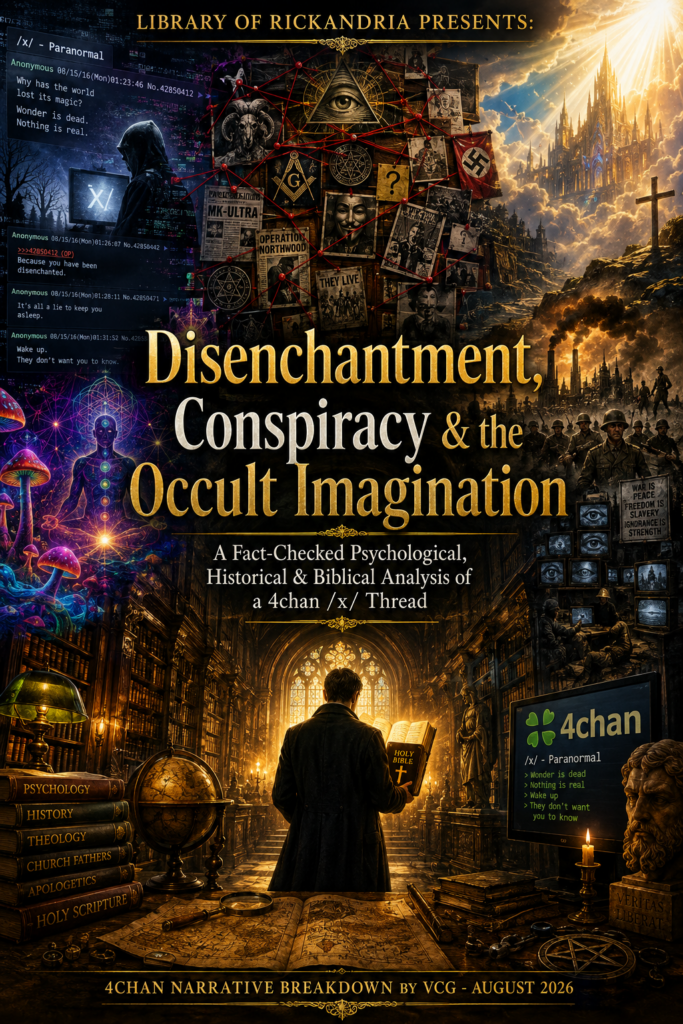
UPDATED BY VCG ON 8/27/2026 @ 19:19 EST
I want to share a heartfelt cause with my audience. Conner Blaisdell-Greene, a brave Airforce Sr. Airman, recently lost his battle with cancer, leaving his family in financial distress. Every donation, no matter how small, can help cover his funeral costs and ease their burden during this difficult time. Please consider clicking the link below to contribute or share Conner’s story with others. Your support truly matters.
Until We Meet Again
Spoken Tribute
Abstract
On August 20, 2026, an anonymous poster on 4chan’s paranormal board, /x/, asked a deceptively simple question:
“Why has the world lost its magic and wonder?
How do we get it back?”
What followed was not one answer but a miniature catalogue of contemporary disenchantment. Some participants blamed adulthood, routine, modern technology, social isolation, scientific reductionism, industrialization, or the loss of craftsmanship. Others attributed the same feeling to brainwashing, toxic metals, fluoride, psychedelic deprivation, reincarnation, Atlantis, Rudolf Steiner’s spiritual cosmology, Ahriman, archons, falsified history, collective consciousness, or hidden religious and political control. Still others tried to reinterpret Christianity primarily as myth and symbol rather than as a faith grounded in historical claims about Jesus Christ.
This paper examines that thread as a case study in reasoning under conditions of existential uncertainty. Its purpose is neither to ridicule unconventional beliefs nor to assume that a materialist explanation automatically settles every metaphysical question. Instead, it distinguishes five layers that are frequently collapsed online: observation, historical fact, psychological mechanism, metaphysical interpretation, and biblical teaching.
The analysis finds that the thread is often strongest when describing a real human experience—loss of awe, social fragmentation, excessive routine, technological saturation, or dissatisfaction with modern life—and weakest when moving from that experience to large, difficult-to-test causal systems. The recurring methodological problem is not simply “believing strange things.” It is the substitution of emotional coherence, symbolic resonance, anecdote, or apparent pattern for independent evidence.
Biblically, the thread raises an equally important issue. Scripture does not portray reality as spiritually empty; neither does it invite indiscriminate belief in every occult or visionary claim. The biblical pattern is wonder joined to discernment: creation remains God’s handiwork, supernatural reality is not denied, Christ’s death and resurrection are treated as historical claims rather than disposable symbols, occult practices are distinguished from biblical revelation, and extraordinary claims are to be tested rather than accepted because they feel profound.
Introduction: The Question Is Better Than Many of the Answers
The opening question deserves to be taken seriously.
A person does not have to believe that literal “magic” once saturated the world to understand what the poster is describing. Many adults remember childhood as brighter, stranger, larger, and less predictable. Places once seemed mysterious. Summers seemed longer. Books, forests, storms, abandoned buildings, stars, holidays, stories, friendships, and even ordinary neighborhoods could carry a significance that later appears difficult to recover.
Calling that experience disenchantment is useful as long as we do not smuggle a conclusion into the word. “The world has lost its magic” might mean several very different things. It could mean:
the supernatural has objectively withdrawn from human experience;
modern society discourages religious or mythological ways of seeing;
adult habituation reduces novelty;
industrial and digital environments reduce opportunities for awe;
social isolation has weakened communal meaning;
a person’s own mental or emotional state has changed;
or simply that childhood memory has become idealized.
Those possibilities cannot be treated as interchangeable.
The first reply in the thread says, in effect, that the world did not change—the observer did. That answer is probably too absolute, but it introduces the first distinction on which the rest of this paper depends: changes in perception are not necessarily changes in reality, yet changes in perception do not prove that the environment remained unchanged either.
Both can happen.
Modern environments really have changed. Communication habits have changed. Religious participation has changed. Urban landscapes have changed. Work patterns have changed. Entertainment has changed. Social networks have changed. But human beings also habituate, mature, acquire predictive models, accumulate responsibility, experience grief and trauma, and cease encountering familiar things as novel.
A careful investigation therefore cannot begin by choosing between “everything changed” and “nothing changed.” It has to ask what changed, at what level, and what evidence would allow us to tell.
That is the method used here.
I. Method: How to Read an Anonymous Occult Thread Without Either Mocking It or Believing It
The VCG research standard used for this analysis is straightforward: Scripture first in biblical questions, evidence before opinion, context before commentary, and a deliberate separation between fact, interpretation, speculation, and rhetoric.
For this particular thread, that requires several additional safeguards.
First, 4chan is the primary source for the claims, not for their truth. An anonymous post establishes that somebody posted an idea. It does not establish that the idea is historical, scientific, medical, or supernatural fact.
Second, not every sentence deserves the same type of rebuttal. “I feel that adulthood is spiritually deadening” is an introspective judgment. “The Protestant churches held a synod and discarded their moral teaching” is a historical assertion. “Fluoride caused humanity to lose wonder” is an empirical causal claim. “Ahriman is behind modern civilization” is a metaphysical proposition. “Christ was only a symbol” is a theological interpretation. Each requires a different method.
Third, psychological analysis must not become amateur diagnosis. An anonymous poster who perceives conspiracies or hidden patterns cannot responsibly be diagnosed from a handful of sentences. Psychology can identify known mechanisms—pattern perception, confirmation bias, agency attribution, motivated reasoning, self-sealing belief structures—but that is different from assigning an illness to the person.
Fourth, an extraordinary metaphysical proposition should not automatically be labelled “false” merely because present science cannot test it.
Sometimes the correct conclusion is narrower:
the evidence presented does not establish it.
That distinction matters. Intellectual humility works in both directions.
Finally, Scripture is not used here as though isolated verses were fortune cookies. Immediate context matters. Scripture is compared with Scripture. Where Christians differ over an interpretation, that disagreement should be acknowledged. But where a thread explicitly contradicts something the biblical author makes central to his argument, the contradiction should also be stated plainly.
This approach closely resembles the Berean habit described in Acts 17:11: they “searched the scriptures daily, whether those things were so.”
That sentence is not an instruction to become cynical. It is an instruction to examine.
II. The First Fork in the Road: Did the World Change, or Did We?
Several of the earliest replies divide into two camps. One says the world never changed; another says magic never existed; another argues that myth and symbolism still exist but modern people have forgotten how to perceive them. Then a much more practical reply advises the original poster to go outside, look carefully at beauty, reconnect with nature, and work through personal pain.
Of these responses, the nature-and-attention answer is one of the strongest in the thread because it proposes an intervention that does not require proving an enormous metaphysical system.
There is serious psychological research on awe. In five studies involving more than two thousand participants, Paul Piff and colleagues found that experiences of awe were associated with a diminished sense of the individual self’s centrality and with greater prosocial behavior. Their experiments included both laboratory inductions and a naturalistic encounter with towering trees.
A later randomized study assigned older adults to ordinary walks or “awe walks,” in which participants were encouraged to attend deliberately to vastness and novelty around them. Those receiving the awe-oriented instruction reported greater awe and shifts toward prosocial positive emotion.
That research does not prove that forests possess hidden occult energy. It proves something more modest and, for the original question, arguably more useful: attention changes experience.
A person can inhabit the same physical landscape in very different ways.
Someone walking while compulsively checking a phone, rehearsing worries, and moving through a familiar route on autopilot is not having the same psychological experience as someone deliberately attending to scale, texture, weather, animal life, architecture, light, or the night sky.
This suggests that part of “recovering wonder” may require no conspiracy theory at all. It may require learning to notice again.
But the skeptical answer—
“magic never existed”
—also exceeds what it can establish. What does “magic” mean? If it means aesthetic wonder, the statement is plainly wrong. If it means occult manipulation of nature, then evidence is required. If it means God’s supernatural action, the question becomes theological and historical rather than merely psychological.
The language has to be clarified before the argument can begin.
Biblical distinction: creation is not spiritually meaningless
The Bible does not begin with an inert universe accidentally waiting for human beings to project meaning onto it. Genesis begins:
“In the beginning God created the heaven and the earth.”
The sun, moon, and stars are subsequently presented as created works within that order.
That means biblical Christianity need not accept the premise that understanding natural processes “kills” wonder. The natural world has creaturely meaning precisely because it is not ultimate.
At the same time, biblical wonder is not equivalent to occult enchantment. Creation can signify the Creator without every tree, planet, mushroom, pattern, synchronicity, or altered state becoming a divine message.
That distinction will become increasingly important as the thread progresses.
III. Myth, Symbol, and the Historical Jesus
One of the most intellectually interesting posts comes very early. The writer argues that modern Christians and atheists have both become excessively literal-minded and that Christianity retains mythic value even if Jesus was not literally divine, virgin-born, crucified for sin, or physically raised from the dead. Christ can instead function as a Platonic or archetypal symbol.
There is a genuine insight buried here.
Christian Scripture is saturated with symbolism.
Jesus is presented as shepherd, lamb, vine, door, bread, light, temple, bridegroom, and more. Paul uses typology. Revelation uses symbolic imagery intensively. The Old Testament contains poetry, dreams, visions, types, ritual symbolism, parable, metaphor, and prophetic imagery.
Therefore, it would indeed be a mistake to read the Bible as though every image were flat prose.
But the thread then makes a different move: because Christianity contains symbolism, the historical claims can be discarded without substantially changing Christianity.
That does not follow.
A symbol and a historical claim can coexist. In fact, Christian theology frequently depends on their coexistence. The Exodus can have typological significance and still be narrated as an event. David can function typologically and still be presented as a king. The cross can symbolize self-giving, victory, judgment, sacrifice, and reconciliation while the apostolic writings simultaneously insist that Jesus was crucified.
The sharpest correction comes from Paul himself.
In 1 Corinthians 15 he summarizes what he says he had received and delivered:
“Christ died for our sins according to the scriptures;
And that he was buried, and that he rose again the third day according to the scriptures.”
Paul then lists claimed appearances and turns directly to the consequences if the resurrection did not happen.
His conclusion is uncompromising:
“And if Christ be not risen, then is our preaching vain, and your faith is also vain.”
And again:
“And if Christ be not raised, your faith is vain; ye are yet in your sins.”
Whatever a modern interpreter may personally think of Paul’s testimony, Paul’s own position cannot fairly be represented as “the resurrection is an optional symbol whose value remains unchanged if it never happened.”
He says virtually the opposite.
John likewise does not leave the Logos as a purely abstract philosophical principle:
“And the Word was made flesh, and dwelt among us…”
This is an important methodological lesson. A reader is free to reinterpret Christianity into an archetypal philosophy, but intellectual honesty requires admitting that this is a reinterpretation of apostolic Christianity, not simply the hidden meaning the apostles themselves supposedly intended.
The same applies to Christ’s future return. A later thread participant treats Christ as something humanity should embody rather than someone who will actually return. But Acts 1 places the disciples watching Jesus depart and then records:
“this same Jesus…shall so come in like manner as ye have seen him go into heaven.”
Christ certainly functions as moral example in Scripture.
He is not only moral example.
IV. When a Real Health Concern Becomes a Universal Explanation
The thread then takes a medical turn.
One poster attributes lost wonder to trauma, parasites, and brain injury and attaches a supplement protocol. Another expands the theory to lead, heavy metals, and fluoride, while recommending “cleansing” strategies. Science itself is simultaneously accused of destroying magic.
This cluster illustrates one of the most common problems in alternative-health reasoning: a real biological fact is used as a bridge to a much larger claim that has not been demonstrated.
Lead is a real neurotoxic hazard.
That statement is not controversial. The CDC recommends testing blood when lead exposure is suspected and uses measured blood lead levels to guide follow-up investigation and treatment.
But “lead can injure the nervous system” does not establish “lead poisoning explains cultural disenchantment,” nor does it establish that an internet supplement regimen is appropriate treatment.
The same distinction applies to fluoride, where the evidence is more nuanced than either side’s slogans usually suggest.
The U.S. National Toxicology Program concluded with moderate confidence that higher fluoride exposures, represented especially by populations around or above 1.5 mg/L in drinking water, are associated with lower IQ in children. Importantly, NTP distinguishes those higher-exposure findings from the U.S. recommended fluoridation concentration of 0.7 mg/L; evidence at lower exposures has been less clear.
Meanwhile, the U.S. Public Health Service recommendation remains 0.7 mg/L for caries prevention, a concentration selected to balance dental benefit against potential harms such as fluorosis.
Thus, neither of the following statements reflects the evidence well:
“Fluoride is harmless at every conceivable exposure.”
or
“Normal community fluoridation has been proven to destroy intelligence and spiritual perception.”
The first ignores dose. The second outruns the data.
The spiritual conclusion is even further removed. Nothing in the fluoride literature demonstrates that fluoride suppresses “magic,” blocks spiritual faculties, severs access to metaphysical reality, or causes modern disenchantment.
That is an interpretive addition.
The methodological pattern
This part of the thread repeatedly follows the same form:
Premise: Some toxin, chemical, or condition can affect the nervous system.
Conclusion: Therefore, that factor explains humanity’s spiritual condition.
The premise may be true while the conclusion remains unsupported.
The reasoning error is subtle because scientific vocabulary gives the second statement an aura borrowed from the first.
The appearance of mechanism is not the same as demonstration of mechanism.
V. Rudolf Steiner, Atlantis, and the Difference Between Accurate Attribution and Established Fact
A later poster invokes Rudolf Steiner. According to the post, human beings lost spiritual perception following Atlantis, planets are more than inert physical bodies, human consciousness formerly possessed clairvoyant faculties, and reincarnation belongs to the process.
Here we have to distinguish two questions that are often confused:
Did Rudolf Steiner actually teach ideas like these?
and
Are those ideas historically or scientifically established?
The first answer is substantially yes.
Steiner’s surviving lectures explicitly discuss ancient Atlantis, clairvoyant Atlantean leaders, reincarnation, magical capacities, and human interaction with spiritual beings. In one lecture he says that present human souls had previously incarnated in Atlantis and describes Atlantean leaders as clairvoyants and magicians.
So, a fair analysis should not ridicule the 4chan poster for simply inventing a fake Steiner quotation. The broad attribution belongs to Steiner’s documented anthroposophical worldview.
That is where the confirmation ends.
Evidence that Steiner said something is not evidence that Atlantis existed as he described it.
The primary ancient literary source for Atlantis is Plato’s Timaeus and Critias. Archaeological and classical discussion has repeatedly noted that Plato’s Atlantis functions exceptionally well as political and moral literature, and the Penn Museum’s archaeological treatment interprets the destruction narrative as part of Plato’s constructed moral fable rather than verified continental history.
This is a simple but vital evidentiary distinction:
“Steiner taught Atlantis”
— historically verifiable.
“Steiner’s Atlantis therefore existed”
— not established by that verification.
The same rule applies to any religious teacher, occultist, prophet, philosopher, or internet personality. Accurately quoting a source proves what the source believed. It does not automatically prove what the source believed about reality.
Reincarnation and Scripture
The reincarnation element also conflicts with the normal New Testament trajectory.
Hebrews 9 places human death and Christ’s sacrifice in deliberate parallel:
“And as it is appointed unto men once to die, but after this the judgment:
So Christ was once offered to bear the sins of many…”
The broader biblical hope is resurrection, not repeated terrestrial incarnation. One can certainly develop non-Christian or esoteric theories of reincarnation, but they should not be merged quietly with New Testament teaching as though the categories were interchangeable.
VI. Archons, Hidden Families, and the Architecture of a Total Explanation
The thread then moves from specific claims to something larger: a totalizing interpretation of modern society.
One poster presents money, institutional religion, hidden families, manipulated history, and archonic control as parts of a single concealed structure. Christ becomes primarily symbolic, politics becomes theatre, and ordinary history becomes fundamentally unreliable.
The attraction of this kind of explanation is understandable.
It brings scattered frustrations into one narrative.
Why does work feel dehumanizing?
Why is life monetized?
Why are institutions untrustworthy?
Why does politics feel performative?
Why are people lonely?
Why is history contested?
Why does spirituality feel marginal?
A total conspiracy theory can answer every question with the same agent.
That is psychologically efficient.
Research on conspiracy belief suggests that several motives can participate in such thinking. Karen Douglas, Robbie Sutton, and Aleksandra Cichocka group these broadly into epistemic motives—wanting to understand what is happening; existential motives—wanting security and control; and social motives—protecting individual or group identity. Their review also cautions that conspiracy beliefs do not necessarily succeed in satisfying those needs.
This research must not be abused.
It would be intellectually cheap to say, “You believe conspiracies because you feel powerless, therefore every conspiracy claim is false.” That is the genetic fallacy in psychological clothing.
Real conspiracies exist.
Governments conceal information. Corporations collude. Intelligence services deceive. Criminal networks coordinate. Institutions sometimes protect themselves dishonestly.
The psychological question is different: what happens when the conspiracy hypothesis becomes so flexible that every possible observation confirms it?
That is where the thread becomes epistemically fragile.
Suppose agreement proves the theory because awakened people recognize the truth.
Suppose disagreement also proves the theory because dissenters are brainwashed.
Suppose missing evidence proves the controllers successfully hid it.
Suppose contradictory evidence proves the official record was fabricated.
There is now no imaginable observation that could count against the theory.
At that point the theory has become self-sealing.
Research on illusory pattern perception is relevant here, but again with caution. Studies have found statistical associations between conspiracy or paranormal belief and perceiving meaningful patterns in noisy or random material. A 2018 series of experiments found relationships between illusory pattern perception and both conspiracy and supernatural beliefs; newer work suggests the relationships are real but not necessarily enormous or simple.
This does not mean “all pattern recognition is delusional.”
Human beings survive through pattern recognition.
The real question is whether the pattern is being checked against independent evidence.
VII. World War I and the Temptation of Compressed History
One of the thread’s longest historical arguments attempts to locate the death of enchantment around World War I. The writer associates the war with rejection of supernatural belief, ecclesiastical decline, Protestant moral change, scientific materialism, and then proposes a roughly century-long cycle culminating in renewed “awakenings” around 2014–2018.
This is an excellent example of a narrative that contains several pieces of real history but connects them too confidently.
The First World War did affect European religion.
It disrupted church structures, intensified theological crisis, exposed populations to mass death, transformed politics and social life, and participated in broader patterns of secularization.
But historians increasingly resist the older picture in which 1914–1918 simply shattered European faith overnight. In his study of British secularization, historian Clive Field describes the war as an accelerant rather than a novel agent. Religious allegiance remained comparatively stable in some respects; some churches continued earlier decline; Spiritualism grew; wartime attendance patterns fluctuated; and secularization proceeded through processes that had begun before the war.
That matters because
“World War I contributed to secularization”
is historically defensible.
“Everyone rejected the supernatural after World War I”
is not.
People continued joining churches, praying, believing in miracles, practicing Spiritualism, experimenting with occult traditions, reporting apparitions, participating in revivals, and producing supernatural literature long after 1918.
History is usually messier than the clean turning points we prefer.
VIII. What Actually Happened at Lambeth in 1930?
The thread’s claim that Protestant churches held a synod and discarded their moral teaching appears to echo, at least in part, a real event: the 1930 Lambeth Conference.
That conference matters historically because its Resolution 15 marked a significant change in Anglican teaching concerning contraception. Under circumstances in which there was a morally serious reason to limit parenthood and abstinence was judged unsuitable, the resolution allowed “other methods” while simultaneously condemning contraceptive use motivated by selfishness, luxury, or mere convenience. The vote was 193 to 67.
But describing that as “the Protestants held a synod and threw out all morality” substantially distorts what happened.
First, Lambeth is Anglican.
There is no universal administrative body called “the Protestant Church” capable of legislating for Baptists, Lutherans, Methodists, Presbyterians, Pentecostals, Reformed churches, Anglicans, and every independent Protestant body simultaneously.
Second, the same 1930 document continued to frame marriage and sexuality in explicitly moral and theological terms.
Third, the immediately following Resolution 16 recorded the conference’s abhorrence of abortion.
Fourth, Lambeth resolutions themselves are not binding universal legislation even across the entire Anglican Communion. Anglican provinces are autonomous, and the conference’s resolutions carry consultative, historical, and pastoral weight rather than creating globally binding canon law.
A critic may still argue that Lambeth 1930 was an important stage in Western Christian moral liberalization.
That is an interpretation worth discussing.
But it should be argued from what the conference actually resolved, not from the claim that all Protestant morality was abolished in one meeting.
That distinction—between a document and the story later told about the document—is precisely why historical sourcing matters.
IX. The Hundred-Year “Awakening” Cycle
The same historical post identifies 2014–2018 as a renewed period of magic or awakening because it occurred roughly a century after World War I.
This is not yet a meaningful historical hypothesis.
Why one hundred years?
What precisely counts as an “awakening”?
What variable increased?
Religious conversion?
Occult book sales?
Paranormal reports?
Google searches?
Meditation?
Psychedelic use?
Astrology?
Political radicalization?
Reported mystical experiences?
Unless the phenomenon is operationally defined, almost any cultural shift between 2014 and 2018 can be interpreted afterward as confirmation.
This is a form of retrospective pattern fitting.
A good hypothesis needs conditions under which it would fail.
The thread later gives an even clearer example: one poster simply provides the date October 23, 2026, without specifying what is expected to happen. As of this paper’s August 2026 date, October 23 is still in the future. But even after the date passes, a bare date is not a falsifiable prediction unless the event was specified in advance.
Otherwise, any earthquake, election story, celebrity death, market movement, unusual weather event, military action, viral video, astronomical occurrence, or private experience could be retroactively attached to it.
A date without a defined event is not prophecy-testing.
It is a blank space waiting for hindsight.
X. Craftsmanship: One of the Thread’s Better Intuitions
Another participant suggests that wonder is recovered through loving craftsmanship, correct materials, and particular timing.
This idea contains two very different propositions.
The first is psychologically and culturally plausible: craftsmanship can restore attention, meaning, patience, beauty, and embodied skill.
A handmade wooden table, illuminated manuscript, stained-glass window, mechanical watch, woven textile, stone building, musical instrument, or carefully prepared meal can evoke wonder partly because the observer senses concentrated human attention.
Modern mass production has given society extraordinary benefits—affordability, sanitation, consistency, accessibility—but it can also make objects feel disposable and interchangeable.
The thread is onto something when it senses a connection between care and enchantment.
The second proposition—that work must occur at occultly corresponding planetary hours—is different. That requires its own evidence. The value of craftsmanship does not demonstrate the efficacy of astrological timing.
Biblically, craftsmanship is entirely capable of carrying sacred significance. The tabernacle narratives devote enormous attention to materials, skill, beauty, and workmanship.
But Scripture also places boundaries around divination and occult methods. Deuteronomy 18 prohibits practices including divination, observing times, enchantment, consulting spirits, and necromancy.
Therefore, the biblical alternative is not:
mass-produced ugliness or occult craftsmanship.
There is a third option:
craftsmanship as faithful, disciplined, beautiful human work without divinatory technique.
XI. Adulthood, Childlikeness, and the Fear That Responsibility Kills Wonder
Another poster argues that modern people are conditioned to equate adulthood with employment, college, family formation, planning, emotional restraint, and practical responsibility. Curiosity and imagination become childish insults rather than virtues.
There is something humanly recognizable here.
Adulthood usually does narrow available time.
Bills have deadlines. Children require attention. Employers expect reliability. Illness, grief, caregiving, household maintenance, bureaucracy, and financial pressure all consume cognitive space.
It would be surprising if this had no effect on spontaneity.
But the argument becomes less convincing when it turns ordinary responsibility into evidence of intentional social control.
There is no contradiction between being imaginative and dependable.
One can pay a mortgage and study the stars.
One can raise children and explore forests.
One can work a job and compose music.
One can plan carefully and still possess curiosity.
The thread’s deeper mistake is confusing childlike with childish.
That distinction is also biblical.
When Jesus places a child before the disciples in Matthew 18, the passage itself explains the comparison:
“Except ye be converted, and become as little children, ye shall not enter into the kingdom of heaven.”
But the next sentence defines the relevant quality:
“Whosoever therefore shall humble himself as this little child, the same is greatest in the kingdom of heaven.”
The immediate emphasis is humility.
Nothing in the passage commands poor planning, credulity, intellectual immaturity, or refusal of adult obligations.
Childlike humility and mature judgment are compatible.
XII. Smartphones, Social Isolation, and the Part of the Thread Modern Research Takes Seriously
Several posters connect disenchantment with smartphones, the commercial internet, disappearance of analog media, and increasingly isolated social life.
Unlike the archon or Atlantis claims, this family of explanations has a substantial empirical research base.
But even here the evidence requires nuance.
A 2026 systematic review and meta-analysis covering 59 studies, 67 independent samples, and 81,344 adolescents and young adults found that problematic social-media use showed a moderate association with loneliness, around r = .29. In contrast, simple time spent using social media had a much smaller association, around r = .07. The studies were heterogeneous, and the authors explicitly cautioned that usage pattern matters.
This is an important correction to simplistic narratives.
“Phones destroy human connection” is too crude.
Someone using a phone to maintain close friendships, read, make art, coordinate a church group, call grandparents, study, or arrange an in-person gathering is not psychologically identical to someone compulsively refreshing antagonistic feeds for hours.
The device is not the entire variable.
The manner of use matters.
Research also suggests bidirectionality: lonely people may turn toward maladaptive digital habits, while maladaptive digital habits may deepen loneliness. That is a very different model from a single villain deliberately engineering spiritual death.
The strongest version of the thread’s argument is therefore not that smartphones “caused the loss of magic.”
It is that attention, embodiment, face-to-face community, novelty, and unstructured experience matter, and some digital habits compete with them.
That is a claim worth taking seriously.
XIII. Psychedelics: Intense Experience Is Not the Same Thing as Verified Metaphysics
Mushrooms and ayahuasca appear repeatedly in the discussion. One poster treats mushrooms as a route out of brainwashing; another says sufficiently strong ayahuasca taken in nature will show practically anyone that reality remains magical.
Here the distinction between phenomenology and ontology becomes essential.
Psychedelic experiences can unquestionably feel profound.
Users may report dissolution of ordinary self-boundaries, heightened beauty, perceived entities, unity, transcendence, fear, death-and-rebirth imagery, spiritual significance, or overwhelming certainty.
Those experiences are psychologically real in the straightforward sense that people genuinely undergo them.
The unanswered question is what they establish about external reality.
Suppose a person under psilocybin encounters a being who appears intelligent.
Several interpretations are immediately possible:
the entity is externally real;
the entity is an internally generated representation;
the experience is a mixture of memory, expectation, neurobiology, and symbolism;
the event has spiritual significance without every perceived detail being literal;
or something else is occurring.
The intensity of the experience cannot by itself choose among those possibilities.
That is why psychedelic testimony should neither be mocked nor automatically promoted to revelation.
The medical literature also complicates the claim that such experiences are universally beneficial. A 2024 meta-analysis of six randomized, double-blind trials involving 528 patients found increased acute risks of headache, nausea, anxiety, dizziness, and blood-pressure fluctuations with therapeutic psilocybin compared with controls. At the same time, the authors did not find increased paranoia or transient thought disorder in those controlled trial settings.
That is a balanced finding: neither “psychedelics are harmless revelation” nor “psychedelics inevitably cause madness.”
Ayahuasca research shows similar complexity. The Global Ayahuasca Survey included more than ten thousand respondents from over fifty countries. Many participants valued their experiences, but acute physical effects were common, and substantial numbers reported challenging psychological effects afterward; a smaller proportion sought medical or professional support.
That directly undermines the universal claim that a sufficiently strong dose will simply “show anyone the magic.”
People vary.
Set, setting, expectations, health, vulnerability, dose, social context, and interpretation matter.
Biblical question
Scripture itself does not teach that every altered state is false.
It contains dreams, visions, prophetic experiences, angelic encounters, and supernatural events.
Therefore, a Christian rebuttal should not become:
“Unusual experience = hallucination = meaningless.”
But biblical revelation repeatedly distinguishes between genuine and false spiritual claims. A powerful experience does not authenticate itself.
The methodological principle in 1 Thessalonians is:
“Prove all things; hold fast that which is good.”
The command to test is not anti-spiritual.
It presupposes that discernment matters precisely because claims of spiritual significance exist.
XIV. Mushroom Identification: A Tiny Exchange That Exposes the Larger Problem
At one point, a photograph of mushrooms prompts contradictory anonymous identifications. One participant warns that they are deadly; another confidently points toward Psilocybe and criticizes the first person’s identification skills.
The specific species need not be settled here to see the epistemological lesson.
Both posters sound certain.
Certainty is not identification.
A photograph can omit diagnostic features. Lighting changes apparent color. Species can resemble one another. Habitat, bruising reactions, spore characteristics, gill structure, stem details, season, geography, and sometimes microscopic features matter.
This exchange is almost a miniature model of the whole thread:
assertion → counterassertion → confidence → no agreed verification procedure.
When the subject is philosophy, the result may be confusion.
When the subject is mushroom ingestion, the consequences can be physical.
Anonymous confidence should never be mistaken for expertise.
XV. Science as the Enemy of Wonder
One of the thread’s recurring intuitions is that science destroys magic by explaining it.
There is a philosophical issue here worth taking seriously.
A certain form of scientism can indeed become reductive. Scientism is not identical to science; it is the philosophical claim that scientific description exhausts all meaningful questions or perhaps all genuine knowledge.
A person can reasonably reject scientism without rejecting empirical investigation.
The thread often fails to distinguish the two.
Science, in its ordinary methodological sense, asks questions such as:
What happened?
Under what conditions?
Can the result be reproduced?
What measurement distinguishes one explanation from another?
What evidence would count against the hypothesis?
Those questions do not logically entail atheism.
And explanation does not logically entail disenchantment.
Learning stellar nucleosynthesis does not require a person to find stars ugly.
Understanding photosynthesis does not force a forest to become meaningless.
Studying embryology does not determine whether birth evokes awe.
Knowing the acoustics of music does not abolish music.
The thread’s claim that humanity understands “most everything” is also empirically indefensible. Fundamental questions remain open across physics, consciousness studies, cosmology, biology, mathematics, cognition, and philosophy.
Mystery has not disappeared.
What has changed is the location of many mysteries.
The unknown at the edge of a medieval map has been replaced by the unknown inside consciousness, the early universe, quantum gravity, abiogenesis, dark matter, and countless other domains.
Wonder based entirely on ignorance is fragile.
Wonder capable of surviving knowledge is deeper.
XVI. War of the Worlds, Lenin the Mushroom, and Why Skepticism Must Apply to Our Own Side
One later poster warns against media manipulation by invoking famous examples, including the 1938 War of the Worlds broadcast and the Soviet “Lenin was a mushroom” hoax.
This section is particularly useful because it demonstrates how easily a person warning about misinformation can repeat misinformation.
The War of the Worlds broadcast did cause genuine confusion and fear among some listeners. But the later legend of a vast nationwide panic was magnified considerably, in part by newspaper coverage from an industry competing with radio. Contemporary historical treatment distinguishes real incidents of alarm from the exaggerated mass-hysteria mythology that developed afterward.
So the correct conclusion is neither:
“Nobody believed it.”
nor
“America collectively lost its mind.”
The truth is more limited.
The Lenin example has a similarly real core. In 1991, musician and provocateur Sergei Kurekhin appeared on Leningrad television and constructed an elaborate pseudo-scholarly argument that Lenin had effectively become a mushroom. The presentation deliberately mimicked serious documentary reasoning and left many viewers uncertain whether they were seeing scholarship, satire, madness, or a prank.
But
“many viewers were confused”
is not the same as
“Russians believed Lenin was a mushroom.”
Again, the thread compresses a nuanced event into a cleaner story.
The larger lesson is important:
skepticism has to be symmetrical.
If one demands primary sources from governments, churches, universities, or mainstream newspapers, one should not relax that requirement when a story supports an alternative worldview.
Distrust is not yet discernment.
Discernment applies the same standard to allies and adversaries.
XVII. The Search for a Villain
As the thread develops, various groups become explanations for lost wonder: elites, religious institutions, materialists, scientists, immigrants, younger generations, feminists, Marxists, corporations, occult powers, and eventually the Abrahamic religions themselves.
This shift is psychologically significant.
A diffuse social problem is difficult to hold in the mind.
If loneliness results from hundreds of factors—urban planning, family change, technology, economics, personality, mobility, work schedules, age, cultural norms, housing, health, and individual choice—there is no single enemy.
Narratives prefer agents.
“Someone did this to us”
is cognitively cleaner than
“a complex system emerged from many interacting causes.”
That does not mean intentional exploitation never occurs.
It means intentionality must be demonstrated rather than assumed.
The thread’s scapegoating posts contribute almost no causal evidence. Removing a disliked ethnic, generational, religious, or ideological group is not a scientific model of why a person no longer feels wonder.
Nor is contempt evidence.
The violent fantasy that appears later in the thread should therefore not be psychoanalyzed into a diagnosis. It can simply be classified correctly: it is violent rhetoric, not evidence for the metaphysical theory being discussed.
Biblically, it also sits badly beside commands concerning neighbour-love, mercy, sexual purity, control of the tongue, and the dignity of persons.
A worldview does not become true because it supplies someone to hate.
XVIII. The French Revolution, Industrialization, and a Better Historical Model of Disenchantment
One poster places the turning point not at World War I but around the French and Industrial Revolutions.
This is considerably more historically plausible, provided it is not turned into another single-cause explanation.
Industrialization transformed how enormous numbers of people lived.
Work shifted.
Cities grew.
Time became increasingly standardized.
Factories reorganized labor.
Transportation accelerated.
Traditional communities were disrupted and recomposed.
Mass production changed the relationship between worker and finished object.
Scientific and bureaucratic institutions expanded.
The French Revolution, meanwhile, radically transformed relationships among church, state, citizenship, monarchy, tradition, and public authority.
Those developments plainly belong to the history of Western disenchantment.
But there was no single day when “magic died.”
Secularization proceeded unevenly by country, denomination, class, region, and generation. Revivals occurred alongside decline. Spiritualism expanded during technologically modern periods. Occult movements thrived in industrial cities. Science and esotericism sometimes grew simultaneously.
Modernity did not simply replace enchantment with atheism.
It frequently rearranged enchantment.
That insight helps explain /x/ itself.
A technologically advanced global network carries discussions of Atlantis, spirits, astrology, reincarnation, psychedelics, prophecy, ancient religion, and occult philosophy.
The internet is simultaneously an icon of technological modernity and an enormous machine for the circulation of enchanted worldviews.
The story is therefore not
“technology erased magic.”
It is more complicated:
technology changed where, how, and through whom supernatural and conspiratorial ideas circulate.
XIX. Ahriman: Accurate Anthroposophy, Unverified Causation
The thread eventually names Ahriman as the spiritual force behind modern disenchantment.
Again, the first question is attribution.
Ahriman is genuinely important within Steiner’s thought. Steiner adopted and developed the Zoroastrian Ahrimanic concept within his own anthroposophical cosmology, associating Ahriman with particular adversarial, materializing, deceptive, or hardening influences. His lectures explicitly speak of Ahriman as a real spiritual being and as a source of illusion.
So, the term is not an invention of the poster.
But once more:
accurate representation of a worldview is not verification of that worldview.
If a culture becomes more mechanistic, Steiner’s system can describe that development as Ahrimanic.
But what independent evidence distinguishes:
“Ahriman caused this”
from
“Steiner developed Ahriman as a spiritual interpretation of tendencies he observed”?
Without an independent test, the theory risks circularity.
Modern materialism proves Ahriman because Ahriman is defined partly through modern materialism.
That may function meaningfully within a spiritual philosophy.
It is not the same thing as historical or scientific demonstration.
A biblical critic should also resist a different mistake: Scripture itself recognizes spiritual evil.
Therefore, one cannot rebut Steiner simply by saying
“spiritual beings are impossible.”
The better question is whether Scripture authorizes the specific identification.
It does not follow that because the Bible teaches Satan, demons, principalities, powers, and spiritual conflict, Steiner’s Ahrimanic system has therefore been biblically validated.
Shared category is not shared identity.
XX. Collective Consciousness and “Memetic Magic”
Another post argues that collective human minds can shape reality and that sufficiently powerful shared beliefs might alter the rules of existence.
There is a modest version of this statement that is plainly true.
Human belief reshapes social reality constantly.
Money works because people participate in shared monetary systems.
Laws function because institutions and populations recognize them.
Reputations affect behavior.
Borders are socially maintained.
Markets respond to expectation.
Language changes through collective use.
A rumor can cause a bank run.
A political myth can help create a movement.
A religion can alter architecture, diet, calendars, law, art, family structure, and warfare.
In this sense ideas genuinely alter the world.
But the thread moves from this social fact toward the stronger idea that collective belief can modify physical law itself.
That is a completely different proposition.
No evidence is offered showing that coordinated human expectation changes the gravitational constant, alters electron charge, modifies thermodynamics, or produces comparable changes to fundamental physical processes.
The argument equivocates between two senses of “reality”:
institutional/social reality
and
physical reality.
Showing that minds reshape the first does not establish that they rewrite the second.
XXI. Mental Breakdown as a Doorway to Hidden Reality
One poster speculates that a mental breakdown may provide access to a reality hidden behind ordinary experience.
This is a sensitive claim because there are two opposite errors available.
The first error is romanticization:
unusual perceptions are automatically secret revelation.
The second is reductionism:
anyone undergoing psychological crisis is incapable of saying anything true.
Neither is justified.
A person experiencing altered reality-testing may still make correct observations, ask profound questions, or have experiences that carry personal meaning.
But an experience should not be granted privileged metaphysical status precisely because ordinary methods of checking reality have become impaired.
The proper requirement is independent corroboration.
That is especially important because the human mind is capable of generating experiences that feel more certain than ordinary perception.
Biblically, this need for testing is not alien to spirituality.
Paul can instruct believers not to despise prophecy while immediately adding:
“Prove all things; hold fast that which is good.”
That pairing is worth noticing.
The biblical response to claimed spiritual phenomena is neither automatic dismissal nor automatic acceptance.
It is discernment.
XXII. “God Has No Dwelling”: A Biblical Statement That Needs Context
A short post declares that God has no dwelling.
Depending on what is meant, this can be surprisingly close to a biblical point—or very far from one.
Paul tells the Athenians:
“God that made the world and all things therein, seeing that he is Lord of heaven and earth, dwelleth not in temples made with hands.”
He goes on to insist that God is the giver of life and should not be reduced to a manufactured representation.
So if “God has no dwelling” means:
no human structure can contain God,
that is biblically defensible.
But if it means:
God is simply identical with the universe or an impersonal energy diffused through everything,
that is another claim entirely.
Acts 17 maintains a Creator-creature distinction even while emphasizing divine nearness.
Biblical transcendence is not absence.
Biblical immanence is not pantheism.
XXIII. Are Stars Conscious Beings?
A poster later suggests that stars themselves are enormously powerful conscious entities and that they may be afraid of what is happening to humanity.
There is no evidence in the thread capable of establishing this.
Ancient cultures frequently personified celestial bodies. Biblical poetry can also speak of creation in personified language. None of that automatically tells us that astronomical stars are individual conscious beings in the literal biological or spiritual sense proposed.
Genesis 1 presents the heavenly lights as created objects functioning within God’s ordered creation:
“And God made two great lights…he made the stars also.”
This does not answer every possible theological question about the relationship between celestial imagery and spiritual beings elsewhere in Scripture.
It does establish a basic boundary.
The Bible’s existence of angels or spiritual powers cannot simply be used to identify a visible star as a frightened conscious personality.
That additional identification requires argument.
XXIV. Prayer Alone and the Misuse of “Where Two or Three Are Gathered”
Near the end of the thread, Matthew 18:20 is invoked:
“For where two or three are gathered together in my name, there am I in the midst of them.”
A follow-up asks whether this implies that prayer does not work when a person prays alone.
The immediate context answers much of the question.
Matthew 18 has just discussed a brother’s trespass, approaching him privately, bringing one or two witnesses if necessary, taking unresolved matters before the church, and then binding, loosing, agreement, and gathered presence.
The verse is therefore not a mathematical statement that God’s presence switches on only when a second human arrives.
Other passages make solitary prayer unmistakable.
Mark describes Jesus himself:
“in the morning, rising up a great while before day, he went out, and departed into a solitary place, and there prayed.”
So Matthew 18:20 cannot coherently mean that individual prayer is spiritually ineffective.
This is a good example of why a true quotation can still be used incorrectly.
Fact-checking Scripture requires more than checking whether the words appear in the Bible.
It requires checking what those words are doing in their context.
XXV. Rich and Poor Countries: Is “Disenchantment” Really a First-World Problem?
The thread closes with the suggestion that loss of supernatural belief is primarily a wealthy-world phenomenon and that poorer societies remain more enchanted.
Unlike many sweeping claims in the discussion, this one has measurable support—but only in a qualified form.
Pew Research Center’s 2025 survey across 36 countries found a strong broad relationship between national wealth and several traditional measures of religiosity. Wealthier countries generally report lower levels of religion being personally important, less frequent prayer, and lower belief in God than many poorer countries.
However, the same study complicates the picture substantially.
Belief in “something spiritual beyond the natural world” does not map neatly onto national income. Beliefs concerning spirits in animals or nature also do not always track traditional institutional religiosity. Wealthy countries can remain highly spiritually diverse, and the United States is itself an important high-income outlier on several measures.
So, the thread notices a genuine demographic pattern:
economic development often correlates with lower conventional religiosity.
But it exaggerates that into:
poor people still know reality is magical while rich people have forgotten it.
Those are not equivalent propositions.
Survey data measure beliefs.
They do not determine which metaphysical beliefs are true.
XXVI. What the Thread Reveals Psychologically
Stepping back from individual claims, a pattern becomes visible.
The thread begins with an emotion:
Something is missing.
Then different posters compete to name the missing thing and its cause.
For one person, it is childhood.
For another, nature.
For another, God.
For another, myth.
For another, psychedelics.
For another, craftsmanship.
For another, community.
For another, health.
For another, Atlantis.
For another, Ahriman.
For another, archons.
For another, smartphones.
For another, World War I.
For another, capitalism or industrial modernity.
The diversity is itself revealing.
The experience of disenchantment appears capable of recruiting many pre-existing worldviews.
That does not mean the experience is imaginary.
It means the experience alone underdetermines its explanation.
Several psychological mechanisms help explain how people move from the feeling to the theory.
Pattern completion
Human beings dislike disconnected information. We search for structures that join events together. This ability is essential to intelligence, but it can produce false positives when noise is interpreted as a coherent signal. Research connecting illusory pattern perception with paranormal and conspiracy belief is relevant here, although the effects should not be exaggerated into a universal diagnosis.
Agency attribution
A bleak social condition is easier to narrate if someone caused it.
“The texture of modern life emerged from centuries of interacting technological, political, demographic, economic, and cultural changes”
is cognitively demanding.
“They did this to us”
is simple.
Proportionality
Large feelings invite large causes.
If the perceived loss feels civilizational, a person may instinctively prefer a civilizational enemy—an occult entity, hidden elite, global institution, or historical turning point—over thousands of small causes.
Confirmation bias
Once a theory has been adopted, confirming examples become easier to notice than disconfirming ones.
A spiritually meaningful coincidence becomes evidence.
An ordinary day is forgotten.
A historical event fitting the pattern is remembered.
A century that does not fit is reinterpreted.
Self-sealing reasoning
Perhaps the most dangerous move in the thread is the claim that negative replies prove brainwashing.
That transforms contradiction into confirmation.
If disagreement proves the theory, discussion can no longer correct it.
Narrative compression
Complex history becomes a chain:
war → secularization → church compromise → science → technology → isolation → lost wonder.
Every arrow may contain some truth.
But the chain as a whole still requires evidence.
Nostalgia
Human memory is not a neutral video archive. Childhood memories disproportionately preserve emotionally salient moments. Familiarity also changes perception.
The place may have changed.
The observer may have changed.
Memory may have changed.
Usually, all three deserve consideration.
XXVII. What Psychology Cannot Decide
At this point an important boundary is necessary.
Psychology can explain why a person might find a belief compelling.
It cannot automatically settle whether the belief is true.
A Christian can be psychologically motivated to believe in God.
An atheist can be psychologically motivated not to.
A conspiracy theorist can desire control.
An establishment loyalist can desire stability.
An occultist can desire mystery.
A skeptic can desire a predictable universe.
Explaining motive does not decide truth.
Otherwise, every worldview could be dissolved by tracing its emotional origin.
The correct sequence is:
understand the psychological mechanism, then return to the evidence.
Psychology is a tool of epistemic humility.
It should not become a weapon allowing one side to psychoanalyze the other while exempting itself.
XXVIII. What the Thread Gets Right
A fair analysis should resist the temptation to end with
“4chan is wrong.”
Several ideas in the discussion deserve serious consideration.
The thread is right that modern life can become excessively commodified.
It is right that craftsmanship and beauty matter.
It is right that people need nature.
It is right that attention can become fragmented.
It is right that social connection matters.
It is right that childhood curiosity can be unnecessarily shamed.
It is right that institutions can become bureaucratic.
It is right that historical narratives can be oversimplified.
It is right that media can manipulate.
It is right that scientific language can be abused.
It is right that religious institutions can compromise.
It is right that modern materialism is a philosophy rather than a laboratory finding.
It is right that mythology and symbolism carry real meaning.
It is right that subjective experience cannot be reduced to consumer entertainment.
And it is right that a person can become so accustomed to the world that extraordinary things begin to appear ordinary.
The mistake is usually not in noticing one of these realities.
The mistake arrives when the observation becomes a warrant for whatever larger cosmology the observer already prefers.
XXIX. The Biblical Alternative: Neither Sterile Materialism nor Credulous Occultism
The thread repeatedly presents a false choice.
Either modern materialism is correct and reality is dead,
or occult enchantment must be accepted.
Scripture presents neither option.
The biblical universe is emphatically not spiritually empty.
God creates.
God speaks.
Angels exist.
Demons exist.
Prayer matters.
Providence matters.
Miracles occur within the biblical narrative.
Prophecy exists.
Visions occur.
Christ is raised.
Judgment and resurrection are future realities within the New Testament framework.
But the same Bible draws boundaries around occult practice, false prophets, idolatry, deceptive spirits, and unauthorized attempts to obtain supernatural knowledge.
The presence of supernatural reality therefore does not make every supernatural claim true.
That may be the single most important correction to /x/-style spirituality.
A Christian need not say:
“There is nothing beyond matter.”
But neither can he say:
“Anything strange or mystical probably belongs to the hidden spiritual truth.”
The biblical pattern is testing.
Paul does not say
“despise every prophecy.”
He says:
“Despise not prophesyings.
Prove all things; hold fast that which is good.”
That combination is remarkably balanced.
Openness without gullibility.
Discernment without cynicism.
XXX. Christ as the Central Test Case
The thread’s handling of Jesus ultimately exposes the divide between biblical Christianity and generalized esotericism.
Esoteric interpretation often treats Christ as one manifestation of a universal archetype: divine man, Logos, solar figure, awakened consciousness, self-sacrificial pattern, or symbol of human potential.
Some of those comparisons may illuminate aspects of symbolism.
But the New Testament repeatedly refuses to leave Jesus inside the category of symbol.
John says the Word became flesh.
Paul says Christ died, was buried, rose, and appeared.
Paul then says Christianity collapses if Christ did not rise.
Acts presents witnesses to the resurrection and expects the same Jesus to return.
Hebrews presents Christ’s sacrifice as once-for-all rather than one episode in an endless reincarnational cycle.
This does not prove those Christian claims merely by quoting them.
It establishes what Christianity’s foundational documents claim.
That distinction is essential.
A historian may investigate those claims.
A theologian may interpret them.
A skeptic may reject them.
But nobody should replace them with “Christ was always only a symbol” and then present that position as though it were simply the original apostolic message properly decoded.
The texts themselves resist that reduction.
XXXI. A Post-by-Post Research Index
The following index records the analytical disposition of the substantive posts without treating every joke, image, or reaction as though it were a formal argument. Post numbers refer to the archived thread.
| Post | Primary issue | Research disposition |
|---|---|---|
| 42850412 | Lost wonder | Legitimate question; undefined terms |
| 42850422 | Observer changed | Partly plausible; too absolute |
| 42850432 | Belief dismissal | Assertion, not argument |
| 42850450 | Magic never existed | Underdefined and unproved |
| 42850453 | Myth/pre-birth knowledge | Symbolism plausible; pre-existence unsupported |
| 42850486 | Symbolic Christianity | Symbolism valid; historical reduction conflicts with NT |
| 42850770 | Nature/awe | Strongest evidence-aligned advice |
| 42850909 | Health protocol | Medical claims exceed presented evidence |
| 42850964 | Metals/fluoride/science | Real hazards mixed with unsupported causation |
| 42850992 | Steiner/Atlantis | Steiner attribution real; cosmology unverified |
| 42851074 | Archons/control | Totalizing, difficult-to-falsify framework |
| 42852226 | WWI secularization | Partial historical truth; major overreach |
| 42852260 | Jesus’ return | Consistent with NT expectation |
| 42852281 | Craft/timing | Craft plausible; occult timing unsupported |
| 42852699 | Brainwashing/mushrooms | Self-sealing reasoning |
| 42852704 | Mason joke | No substantive evidentiary claim |
| 42852843 | Outgroup blame | Scapegoating without causal evidence |
| 42852903 | Metal cleansing | Requires clinical evidence |
| 42852922 | Mushroom warning | Safety concern; anonymous ID inadequate |
| 42853089 | October 23 date | Not falsifiable without defined event |
| 42853097 | Image response | No independently testable proposition |
| 42853238 | Mushroom counter-ID | Confidence exceeds available evidence |
| 42853746 | Agreement | No new evidence |
| 42853757 | Agreement | No new evidence |
| 42853901 | Adulthood/control | Real tension; intentional-control claim unsupported |
| 42854183 | Knowledge kills wonder | Philosophical claim; empirical overstatement |
| 42854189 | Mockery | No argument |
| 42854601 | Joke | No argument |
| 42854669 | Image | No stated proposition |
| 42854682 | Universal cycle | Speculative cosmology |
| 42854855 | Miracle aphorism | Philosophical sentiment, not evidence |
| 42854922 | Approval | No new evidence |
| 42856017 | Intuitive symbolism | Psychologically meaningful; not objective proof |
| 42856159 | God’s dwelling | Biblically defensible only with qualification |
| 42856720 | Reaction | No new evidence |
| 42856732 | Conscious stars | Unsupported identification |
| 42856735 | Violent fantasy | Rhetoric, not evidence |
| 42857227 | Sarcasm | Critique by reductio, not proof |
| 42857427 | Joke/reaction | No new evidence |
| 42857797 | Media deception | Useful skepticism; examples need correction |
| 42858162 | Historical challenge | Proper demand for evidence |
| 42858250 | Revolution/industry | Plausible contributors, not sole cause |
| 42858262 | Technology/sociality | Partly evidence-aligned; overgeneralized |
| 42858554 | Ayahuasca | Experience real; universal metaphysical claim unsupported |
| 42858716 | Cycles | Some systems cycle; universal conclusion unwarranted |
| 42858720 | Reaction | No new evidence |
| 42859614 | Consumer-world framing | Useful conceptual challenge |
| 42859620 | Mushroom sourcing | Practical request, not explanatory evidence |
| 42860746 | Social collapse | Genuine concern expressed in absolutes |
| 42861729 | Art reaction | Aesthetic response |
| 42862256 | Contemplative practice | Possible psychological effects; cosmology separate |
| 42862260 | Science/God | False opposition when generalized |
| 42862774 | Memetic reality | Social effects real; physical-law claim unsupported |
| 42862862 | Breakdown/reality | Requires independent corroboration |
| 42864395 | Religion/media analogy | Social transmission does not decide truth |
| 42864451 | Group prayer | Scripture cited too broadly |
| 42864695 | Mushroom legality | Jurisdiction-dependent; blanket claim unreliable |
| 42864827 | Ahriman | Genuine Steiner concept; causation unverified |
| 42865099–65114 | Reactions | No significant new argument |
| 42865527 | Eliminate religions | Normative hostility, not causal evidence |
| 42865771 | Political causal chain | Historical fragments joined without proof |
| 42866409 | Reaction | No new evidence |
| 42866489 | Corporate internet | Contains plausible sociological observations |
| 42866551 | Prayer alone | Based on contextually mistaken inference |
| 42867118 | Scapegoating | Identifies a real tendency, overgeneralizes |
| 42867212 | Spiritual exhaustion | Useful metaphor; not measured diagnosis |
| 42867304 | First-world thesis | Partly supported, needs substantial nuance |
| 42867307 | Closing media | No stated testable proposition |
XXXII. Final Assessment
The thread never really answers one question.
It answers several different questions while pretending they are the same.
Why did childhood feel magical?
Why has Western religion declined?
Why are people lonely?
Why does modern architecture sometimes feel sterile?
Why do conspiracy theories flourish?
Are occult entities real?
Can psychedelics disclose truth?
Did churches compromise?
Is history manipulated?
Does technological life fragment attention?
Is Christianity fundamentally mythic or historical?
Those questions require different evidence.
The thread’s recurring failure is explanatory collapse: one theory is asked to explain all of them.
That is why a real concern about lead can become a spiritual theory.
A real history of secularization can become a hundred-year occult cycle.
A real experience of psychedelia can become proof of hidden entities.
A real problem of institutional deception can become “all history is fake.”
A real Christian use of symbolism can become “Christ need not have risen.”
A real correlation between wealth and religiosity can become “poor nations still perceive magic.”
A real problem of digital loneliness can become “smartphones destroyed redemption.”
At each stage, the careful researcher has to interrupt the momentum and ask:
What exactly did we establish?
That question may feel less exciting than the cosmic answer.
But it is the difference between investigation and mythology.
Conclusion: Wonder Joined to Discernment
The original poster asked how the world could recover its magic and wonder.
After examining the thread, perhaps the first correction is that wonder and credulity should never have been treated as synonyms.
A person does not become more awake by believing every extraordinary explanation.
Nor does a person become more rational by refusing to wonder.
The thread contains genuine observations about contemporary life: people can become isolated, overstimulated, distracted, exhausted, excessively commercialized, detached from nature, alienated from craftsmanship, and trapped inside routines. Modern technologies can deepen some of these problems when used maladaptively. Historical secularization is real. Institutions sometimes mislead. Churches sometimes compromise. Human beings do search for meaning, and awe remains psychologically important.
None of those facts proves Atlantis.
None proves archons.
None proves Ahriman.
None proves conscious stars.
None proves fluoride suppresses spiritual perception.
None proves psychedelics reveal an external ontology.
None proves collective consciousness rewrites physics.
None proves every historical record is fabricated.
And none requires reducing Christ to an archetype.
The thread is therefore most valuable not as a reliable map of hidden reality but as a record of what human beings do when they feel that ordinary explanations are no longer enough.
They search.
They connect.
They remember.
They suspect.
They mythologize.
They accuse.
They experiment.
They spiritualize.
Sometimes they uncover something real.
Sometimes they build a pattern from coincidence.
The task of discernment is learning the difference.
Scripture does not require an intellectually barren universe. Genesis presents creation as God’s work. Acts presents God as Lord of heaven and earth rather than an idol contained by human construction. The New Testament presents Christ’s resurrection not as ornamental mythology but as central testimony. And the apostolic response to contested claims is not to fear examination.
Paul writes:
“Prove all things; hold fast that which is good.”
And Luke praises the Bereans because they:
“searched the scriptures daily, whether those things were so.”
That may be the best answer the thread never quite reaches.
The alternative to disenchantment is not necessarily re-enchantment through occult speculation.
It may be something more demanding:
to look carefully at creation without worshipping creation;
to preserve mystery without manufacturing certainty;
to appreciate symbols without erasing history;
to acknowledge spiritual claims without surrendering discernment;
to investigate conspiracy without becoming incapable of falsifying one;
to respect experience without confusing experience with proof;
to use science without turning science into metaphysics;
and to read Scripture closely enough that our preferred interpretation remains accountable to the text.
The thread begins by asking how to recover wonder.
A biblical and evidential answer would add another question:
How can we recover wonder without losing truth?
Perhaps that is the more important problem.
Because wonder without discernment can become superstition.
Discernment without wonder can become sterile.
The wiser path attempts to keep both.
Wonder joined to discernment.
Mystery joined to examination.
Faith joined to truth.
Appendix A
Research Apparatus, Source Hierarchy, Verification Notes & Limitations
The purpose of this appendix is to make the reasoning behind this paper transparent. Because the material under examination moves rapidly between personal experience, historical claims, psychological theories, medical assertions, occult cosmologies, political narratives, and biblical interpretation, conclusions should not be accepted merely because they sound persuasive. The reader should be able to see what kind of evidence was required, what sources were considered authoritative for each question, where interpretation begins, and where uncertainty remains.
The central methodological principle of this study has been simple:
A claim should be judged according to the kind of claim it is.
An anonymous testimony may establish that someone experienced something unusual. It does not automatically establish the cause of that experience.
A historical document may establish what a church council, political institution, philosopher, or occult teacher actually said. It does not automatically establish that the worldview expressed in that document is true.
A psychological study may demonstrate statistical relationships between particular beliefs, experiences, emotions, or cognitive tendencies. It does not permit the diagnosis of an anonymous internet poster.
A scientific study may establish an association or mechanism under defined conditions. It does not automatically validate a metaphysical explanation attached to the same phenomenon.
And a biblical quotation may establish what Scripture says, but proper interpretation still requires attention to context, genre, speaker, audience, and comparison with other relevant passages.
For those reasons, this paper has deliberately resisted treating every source as though it possessed the same evidentiary value.
A.1 The Primary Source: The 4chan /x/ Thread
The thread examined in this study is:
4chan /x/ — Paranormal, Thread No. 42850412, August 2026
Its opening question asks:
“Why has the world lost its magic and wonder?
How do we get it back?”
The thread itself functions as the primary source for the beliefs, arguments, images, jokes, links, accusations, and interpretations expressed by its anonymous participants.
It does not function as independent evidence for the truth of those claims.
This distinction is especially important on an anonymous imageboard.
A statement such as:
“Rudolf Steiner taught that humanity once possessed clairvoyant abilities”
can be independently checked against Steiner’s writings.
A statement such as:
“Ahriman is currently manipulating civilization”
requires an entirely different level of demonstration.
Likewise:
“Fluoride exists in drinking water”
is independently measurable.
But:
“Fluoride was introduced to suppress spiritual perception”
is a separate historical and causal claim requiring separate evidence.
Throughout this paper, the original thread was therefore treated as a document to be analyzed, not as a source whose assertions were presumed factual.
A.2 Source Hierarchy
Sources were evaluated according to the following general hierarchy.
Tier One — Primary and Official Sources
These received the greatest weight when available.
Examples include:
the original 4chan thread;
the King James Bible text used for scriptural analysis;
Rudolf Steiner’s surviving lectures when determining what Steiner actually taught;
official Anglican Communion records for the 1930 Lambeth Conference;
government archives for declarations of war and other historical documents;
CDC, National Toxicology Program, or comparable institutional publications when examining public-health claims;
original historical writings where accessible.
Primary sources are particularly important when a thread claims:
“This person taught X.”
“This church decided Y.”
“This government did Z.”
Before interpreting an event, the first question should be whether the alleged event happened in the manner described.
A.3 Peer-Reviewed Scholarship
Peer-reviewed historical, psychological, medical, and social-scientific literature was used where the question involved empirical evidence.
This included research concerning:
awe and the psychology of wonder;
nature exposure;
loneliness and problematic social-media use;
conspiracy belief;
illusory pattern perception;
psychedelic experiences and adverse effects;
secularization;
religious belief across nations;
public-health questions involving lead and fluoride.
Preference was given to:
systematic reviews;
meta-analyses;
large datasets;
controlled experiments;
recognized historical scholarship;
studies directly addressing the claim under examination.
Individual studies were not treated as final scientific pronouncements merely because they appeared in academic journals.
Scientific evidence varies in strength.
A small observational study does not carry the same evidentiary weight as a large randomized trial or well-conducted meta-analysis.
A.4 Secondary Historical Sources
High-quality secondary historical sources were used to place isolated events into broader context.
This was particularly necessary for claims involving:
World War I and secularization;
the French Revolution;
industrialization;
Anglican moral teaching;
temperance and women’s political activism;
American entry into the Second World War;
the War of the Worlds broadcast;
the Soviet “Lenin was a mushroom” television hoax;
the Atlantis tradition.
Historical fact-checking must distinguish between at least three questions:
- Did the event occur?
- How did contemporaries understand it?
- What larger historical significance should be assigned to it?
A person may correctly answer the first question while badly exaggerating the third.
The thread frequently does exactly that.
A.5 Scripture as Primary Theological Source
For biblical analysis, the King James Bible used by the Library of Rickandria serves as the primary English Scripture text.
The method employed throughout the paper is Scripture compared with Scripture.
Particular care was taken to distinguish:
What the biblical text explicitly states
from
What a theological interpreter concludes from the text.
For example, 1 Corinthians 15 explicitly presents Christ’s death, burial, resurrection, and appearances as integral to Paul’s gospel proclamation.
Paul then explicitly argues:
“if Christ be not risen, then is our preaching vain, and your faith is also vain.”
That establishes something important even before wider theological debate begins:
Paul himself did not treat the resurrection as a disposable symbolic element.
Likewise, Matthew 18:20 genuinely says:
“For where two or three are gathered together in my name, there am I in the midst of them.”
But Matthew 6 and Christ’s own solitary prayer demonstrate that this verse cannot reasonably mean that God refuses to hear an individual praying alone.
The paper therefore distinguishes between:
quotation;
immediate context;
broader canonical context;
doctrinal interpretation.
This distinction is essential when correcting internet theology.
A.6 Evidence Labels Used in This Study
Although the body of the paper is written narratively, the underlying claims can generally be classified using five evidentiary judgments.
Supported
The available evidence substantially supports the proposition.
Example:
Problematic social-media use is associated with loneliness in adolescents and young adults.
This does not mean every causal interpretation attached to that association is established.
Partly Supported
A real fact exists at the center of the claim, but the claim substantially exaggerates or misinterprets it.
Example:
World War I contributed to religious and cultural change in Europe.
That is defensible.
World War I caused everyone to reject supernatural belief is not.
Unsupported or Speculative
No adequate independent evidence was identified that establishes the claim.
Examples include:
Ahriman as the empirically demonstrated cause of modern materialism;
archons harvesting human energy;
conscious stars fearing humanity’s condition;
collective belief altering fundamental physical laws;
Atlantis as Steiner described it;
fluoride suppressing spiritual perception.
“Unsupported” should not automatically be read as:
“logically impossible.”
It means:
the evidence presented does not justify belief in the proposition as established fact.
False or Seriously Misleading
Available evidence directly contradicts the statement or shows it to be materially distorted.
Examples include broad formulations such as:
“all Protestants held one synod and abolished morality”;
“everyone rejected supernatural religion after World War I”;
“nobody has friends, dreams, or meaningful activities anymore.”
Such statements are falsified by readily available counterexamples or by the historical record itself.
Not Presently Testable
Some claims are too vague to evaluate.
The clearest example is the post giving only:
October 23, 2026
without specifying what is supposed to happen.
Until a particular predicted event is stated in advance, the date alone cannot meaningfully succeed or fail as a prophecy.
A.7 Psychology: Mechanism Is Not Diagnosis
This paper discusses several psychological concepts:
confirmation bias;
apophenia;
agency detection;
motivated reasoning;
proportionality bias;
self-sealing belief systems;
nostalgia;
social identity;
existential uncertainty;
illusory pattern perception.
These concepts are used to examine forms of reasoning, not to diagnose individual anonymous posters.
That distinction is ethically and methodologically important.
Consider the statement:
“If you disagree with me, that proves you have been brainwashed.”
It is unnecessary to diagnose the author.
The argument can be evaluated directly.
It is self-sealing because both agreement and disagreement are interpreted as confirmation.
Likewise, observing that conspiracy beliefs sometimes correlate statistically with stronger illusory-pattern perception does not mean that every individual conspiracy believer possesses a cognitive disorder.
Nor does the existence of psychological motives invalidate a belief.
Every worldview can involve psychological motives.
A believer may desire cosmic meaning.
A materialist may desire ontological simplicity.
A conspiracy theorist may desire explanatory control.
An institutionalist may desire stability.
The truth or falsity of the proposition must still be examined independently.
Psychology helps explain why beliefs may become attractive or resistant to revision.
Psychology does not replace evidence.
A.8 Historical Method: Avoiding Narrative Compression
One of the thread’s recurring tendencies is to join multiple real historical developments into a single causal chain.
For example:
World War I → loss of faith → church compromise → sexual liberalization → scientific materialism → technological society → spiritual collapse.
Every arrow in such a chain requires evidence.
It is not enough that each event happened approximately before the next.
Temporal sequence does not automatically establish causation.
Similarly:
temperance activism → feminism → cultural Marxism → American entry into World War II
may sound coherent as a story while lacking evidentiary support as a causal explanation.
Historical analysis must distinguish:
chronology;
correlation;
influence;
institutional continuity;
ideological similarity;
direct causation.
The thread frequently collapses those categories.
This paper therefore treats monocausal historical explanations cautiously, particularly when they are used to explain changes spanning decades, nations, denominations, ideologies, and social classes.
A.9 Medical and Scientific Claims
Medical claims received a particularly high evidentiary threshold because inaccurate advice can cause direct harm.
The thread includes claims concerning:
parasites;
fungal infection;
NAC;
oregano products;
black-seed oil;
heavy metals;
lead;
fluoride;
chlorella;
psychedelic substances.
The presence of a biologically active substance does not demonstrate the validity of a treatment protocol.
Likewise, an in-vitro finding does not automatically translate into an effective human treatment.
The distinction between:
“compound X can affect organism Y under laboratory conditions”
and
“people should take compound X to cure a hidden systemic illness”
is enormous.
The paper therefore refuses a common form of evidence laundering in which technical vocabulary substitutes for clinical demonstration.
Where a claim concerns diagnosis or treatment, relevant human evidence matters.
A.10 Altered States and the Epistemology of Experience
Psychedelic and mystical experiences require special methodological care because they often carry extraordinary subjective certainty.
A person may sincerely report:
encountering an entity;
leaving the body;
becoming one with the universe;
receiving knowledge;
experiencing death and rebirth;
recognizing hidden connections;
sensing overwhelming divine presence.
The sincerity of the report should not be mocked.
But the experience itself does not settle its interpretation.
The correct question is not merely:
“Did the person experience something?”
but:
“What does that experience allow us to conclude about external reality?”
This paper therefore separates:
Phenomenological truth
The person genuinely experienced an entity-like presence.
from
Ontological conclusion
Therefore an independently existing entity was objectively present.
The second claim requires additional evidence.
This principle protects investigation in both directions.
It avoids the crude reduction:
“It happened during an altered state, therefore it means nothing.”
But it also avoids:
“It felt more real than ordinary reality, therefore it must be objectively true.”
A.11 Occult and Esoteric Sources
Occult sources were treated primarily as evidence of occult doctrines and historical intellectual traditions.
For example, Steiner’s writings are excellent evidence for understanding what Anthroposophy teaches.
They are not independent archaeological verification of Atlantis.
Likewise, an occult grimoire could establish how a magical system understands planetary correspondences.
It would not, merely by existing, establish that those correspondences exert measurable causal influence.
This distinction is necessary for fair treatment.
The paper does not dismiss a source because it is occult.
It assigns the source the evidentiary role it can actually bear.
A.12 Memes, Images, Screenshots, and Argument by Atmosphere
The /x/ thread contains numerous images, reaction posts, diagrams, memes, mushroom photographs, occult imagery, and linked material.
Visual media can communicate meaning powerfully.
But images require the same epistemic discipline as prose.
A photograph of a mushroom does not establish safe identification merely because someone confidently labels it.
A conspiracy board connected by red lines does not demonstrate causal relationships merely because the visual structure appears coherent.
An occult symbol may establish that a tradition uses the symbol.
It does not establish the symbol’s claimed supernatural efficacy.
An emotionally powerful image can influence interpretation before the reader has consciously evaluated the argument.
This might be called argument by atmosphere.
Atmosphere matters artistically.
It does not replace evidence.
A.13 Anonymous Authority
4chan’s anonymity creates a special epistemological problem.
Credentials generally cannot be verified.
One participant may be:
a professor;
a teenager;
a physician;
a historian;
an occult practitioner;
a troll;
a genuine experiencer;
a person copying another website;
someone deliberately fabricating a story.
The reader usually cannot know.
Therefore, the correct standard is:
Do not trust the poster.
Test the claim.
An anonymous source can still provide a useful lead.
It can point toward a document, concept, author, historical event, or research question.
But the lead must then be checked elsewhere.
This distinction transforms anonymous boards from authorities into research prompts.
That is a much safer use of them.
A.14 Biblical Discernment and the Supernatural
This paper deliberately rejects a simplistic equation:
unusual = occult = false
because Scripture itself contains extraordinary events.
But Scripture likewise rejects another equation:
unusual = spiritual = true.
The biblical worldview contains:
miracles;
angels;
demons;
prophecy;
dreams;
visions;
divine providence;
resurrection.
It also contains:
false prophets;
lying spirits;
forbidden divination;
idolatry;
false signs;
deceptive teachers;
human error.
Therefore, biblical supernaturalism contains an internal doctrine of discernment.
The existence of the spiritual realm, if accepted biblically, does not lower the evidentiary standard.
In an important sense, it raises it.
If deception is possible, testing becomes necessary.
Hence:
“Beloved, believe not every spirit, but try the spirits whether they are of God…”— 1 John 4:1
and:
“Prove all things; hold fast that which is good.”— 1 Thessalonians 5:21
Biblical faith is therefore poorly represented by indiscriminate credulity.
A.15 Study Limitations
Several limitations should be stated openly.
The posters are anonymous
Their identities, backgrounds, motives, sincerity, and expertise generally cannot be determined.
Deleted or external material may be incomplete
Imageboard discussions frequently depend on external videos, screenshots, images, dead links, or earlier conversations that later become inaccessible.
Where the surviving material does not establish a claim, this paper does not invent missing context.
Some metaphysical claims are not scientifically testable in their present form
A proposition should not be called scientifically disproven merely because no established scientific test currently addresses it.
In those cases the appropriate judgment is often:
not demonstrated.
Historical interpretation remains contested
Historians may agree that an event occurred while disagreeing about its significance.
This paper therefore distinguishes documentary fact from broader interpretation wherever possible.
Psychological findings are probabilistic
Research describing tendencies in populations cannot automatically be applied to a particular anonymous person.
Biblical interpretation contains genuine disagreements
Christians differ over:
eschatology;
spiritual gifts;
interpretations of prophecy;
some questions regarding spiritual beings;
details of Genesis;
church history;
sacramental theology;
numerous other doctrines.
Where disagreement is legitimate, it should be identified.
But legitimate interpretive diversity should not be used to pretend that Scripture says nothing clearly anywhere.
The goal is neither dogmatism nor artificial ambiguity.
A.16 Claims Worth Continuing to Monitor
Several questions raised by the thread remain suitable for further research.
October 23, 2026
The thread provides the date without a sufficiently specific prediction.
For methodological integrity, the original wording should be preserved before the date arrives.
If a later interpretation is offered, the researcher should ask:
Was that event specified beforehand, or was meaning attached retrospectively?
This is a useful real-time test of prophecy construction.
Digital life and disenchantment
The relationship between problematic technology use, loneliness, attention, embodied activity, and experiences of awe deserves continued study.
The existing literature supports concern but does not justify technological monocausality.
Psychedelic spirituality
Research continues to develop rapidly concerning therapeutic effects, adverse outcomes, mystical-type experiences, suggestibility, belief change, and long-term interpretation.
Particularly important will be research distinguishing:
psychological benefit
from
metaphysical truth claims.
Secularization and re-enchantment
The internet age may complicate older secularization theories.
Traditional institutional religion can decline while astrology, occultism, alternative spirituality, psychedelic mysticism, paranormal belief, conspiracy cosmology, and new religious movements expand.
The future question may therefore be less:
“Is society becoming secular?”
and more:
“What forms of transcendence replace older religious structures?”
A.17 A Practical Verification Checklist for Future /x/ Threads
When confronted with a new extraordinary claim, the following questions provide a useful starting framework.
1. What exactly is being claimed?
Rewrite the claim in plain language.
2. What kind of claim is it?
Historical?
Scientific?
Medical?
Psychological?
Legal?
Theological?
Metaphysical?
Personal testimony?
3. What evidence would distinguish truth from error?
If nothing could ever count against the theory, caution is warranted.
4. Is the source primary?
Did the quoted individual actually say it?
Did the institution actually publish it?
Did the event actually occur?
5. Does the source prove the conclusion or merely one premise?
“Chemical X affects cells”
does not automatically prove
“chemical X causes cultural collapse.”
6. Are correlation and causation being confused?
Two developments occurring together may have many possible relationships.
7. Is disagreement being treated as evidence of brainwashing?
If yes, the theory may be self-sealing.
8. Is a complex historical process being reduced to one villain?
Look for missing intermediary evidence.
9. Is technical language doing more work than the data?
Scientific vocabulary is not scientific proof.
10. Is emotional intensity being treated as verification?
A profound experience may deserve serious attention while still requiring interpretation.
11. If Scripture is cited, what is the context?
Read before and after the verse.
Compare related passages.
Distinguish the biblical text from the poster’s interpretation.
12. What conclusion does the evidence actually justify?
Not:
“What conclusion would make the most exciting story?”
A.18 Final Research Principle
The thread studied in this paper demonstrates why discernment requires more than skepticism.
A skeptic can be credulous toward skeptical stories.
A conspiracy researcher can become uncritical toward conspiracy claims.
A Christian can quote Scripture without context.
A scientist can overstate preliminary findings.
An occultist can confuse symbolism with history.
A historian can compress complicated causation into ideology.
A psychedelic experiencer can confuse certainty with verification.
A materialist can confuse methodological science with metaphysical naturalism.
No community possesses automatic immunity from error.
The appropriate response is therefore not:
Trust authority blindly.
Nor:
Trust alternative sources blindly.
Nor even:
Trust yourself blindly.
The more durable principle is:
Follow the evidence appropriate to the claim, preserve the distinction between fact and interpretation, and remain willing to correct the conclusion when better evidence appears.
For the biblical researcher, that methodological humility has a theological counterpart.
“The simple believeth every word:
but the prudent man looketh well to his going.”— Proverbs 14:15
And:
“Prove all things; hold fast that which is good.”— 1 Thessalonians 5:21
The purpose of fact-checking is not to drain mystery from the world.
It is to prevent falsehood from borrowing mystery’s beauty.
The purpose of biblical discernment is not to make the believer afraid of every extraordinary thing.
It is to teach the difference between wonder and credulity, revelation and speculation, testimony and proof, symbolism and history, mystery and invention.
That distinction is the methodological foundation upon which the entire present study rests.
4CHAN THREAD & POST BREAKDOWNS – Library of Rickandria