
Tesla, Myth & Method: A Forensic Examination of the “Free Energy” Conspiracy Narrative
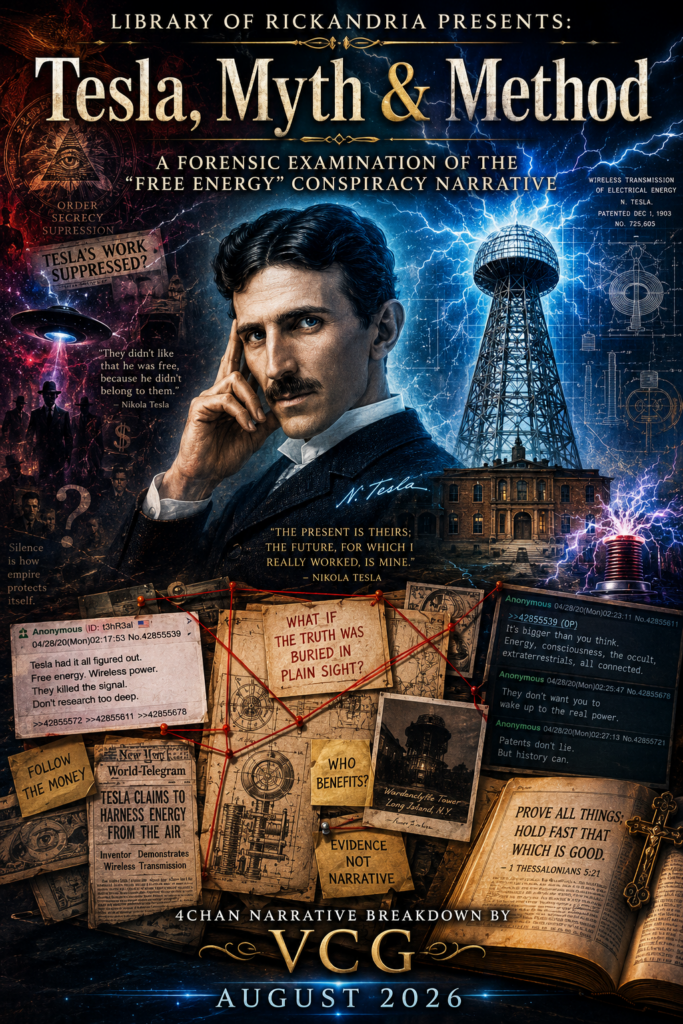
UPDATED BY VCG ON 8/26/2026 @ 19:19 EST
I want to share a heartfelt cause with my audience. Conner Blaisdell-Greene, a brave Airforce Sr. Airman, recently lost his battle with cancer, leaving his family in financial distress. Every donation, no matter how small, can help cover his funeral costs and ease their burden during this difficult time. Please consider clicking the link below to contribute or share Conner’s story with others. Your support truly matters.
Until We Meet Again
Spoken Tribute
Abstract
Nikola Tesla occupies an unusual place in modern culture. He was a genuine scientific and engineering pioneer whose work on polyphase alternating-current systems, induction motors, high-frequency electrical phenomena, radio control, and wireless transmission helped shape the technological world. At the same time, Tesla has become the center of a much larger mythology in which he is portrayed as the discoverer of limitless “free energy,” the victim of industrial suppression, the target of assassination, and, in some esoteric accounts, a nonhuman or extraterrestrial soul incarnated on Earth.
An archived August 2026 thread on 4chan’s paranormal board, /x/, provides a compact example of how these different layers can become fused into a single narrative. The thread begins with a question about why people regard Tesla as perhaps the smartest man who ever lived and believe he was killed because of his discoveries. Over the course of the discussion, participants move through claims about electricity harvested “from the air,” wireless power that cannot be metered, batteryless vehicles, industrial suppression, Tesla’s finances and death, Edison and General Electric, large Tesla infographics, and finally the claim that Tesla was “an arcturian incarnated in a human body.”
This paper examines those claims without assuming in advance that an unconventional claim must be false or that a conspiracy explanation must be true. Tesla’s patents, contemporary Wardenclyffe records, historical scholarship, government records, modern electrical-engineering research, and psychological literature are compared with the claims made in the thread. Biblical claims are treated separately and evaluated from the King James Bible supplied for this study.
The central conclusion is that Tesla’s genuine accomplishments provide much of the raw material from which the mythology is built. Yet the mythology commonly depends upon a series of category errors and evidentiary leaps: transmission becomes generation; environmental energy harvesting becomes unlimited energy; commercial difficulty becomes deliberate suppression; government interest becomes evidence of assassination; and later esoteric interpretations become retroactively attributed to Tesla himself. A careful examination does not diminish Tesla. It reveals that the historical Tesla is remarkable enough without requiring claims the surviving evidence cannot support.
1. Introduction: The Man and the Myth
There are historical figures whose reputations shrink under close examination. Nikola Tesla is not one of them.
Even after the legends are stripped away, Tesla remains an extraordinary inventor. His practical development of polyphase alternating-current machinery, including induction motors and the associated electrical system, was a major achievement. George Westinghouse acquired Tesla’s AC patents in 1888, and Tesla’s work became part of the infrastructure of modern electrical civilization.
That history makes the subject more difficult, not less.
A completely fictional character is relatively easy to debunk. Tesla mythology is persuasive precisely because it grows around a real inventor who did things that sounded astonishing even in his own lifetime. He produced spectacular high-voltage demonstrations. He experimented with wireless control. He investigated the transmission of electrical energy without ordinary wires. He obtained a patent explicitly titled Apparatus for the Utilization of Radiant Energy. He proposed ideas that anticipated later technologies. Government officials really did take an interest in his papers after his death.
These are not inventions of conspiracy culture.
The difficulty begins when genuine facts are connected by bridges that the facts themselves do not establish.
Tesla researched radiant energy.
Therefore, he discovered limitless electricity in the atmosphere.
Tesla intended wireless power transmission.
Therefore, his system required no generator.
Wireless power would create difficult commercial questions.
Therefore J. P. Morgan deliberately destroyed the project because electricity could no longer be metered.
Tesla’s papers interested government authorities.
Therefore, the government killed him.
Tesla reported remarkable intuitions and visualizations.
Therefore, he possessed extraterrestrial memories.
Each conclusion feels connected to the fact preceding it. Yet feeling connected is not the same thing as being demonstrated.
The August 22–23, 2026 /x/ thread examined here is useful because these transitions occur almost in miniature. The original poster asks why Tesla is regarded as perhaps history’s greatest intelligence and why people believe he was killed for his work. Within hours, the conversation moves from Tesla’s engineering to wireless electricity, industrial interests, pigeons, cars, government and business structures, massive “research” images, and finally extraterrestrial incarnation.
The purpose of this paper is not to mock that progression. It is to understand it.
A fair investigation has to perform two tasks at once. It must resist exaggerating Tesla into a mythological figure, while also resisting the lazy opposite error of dismissing every unusual Tesla claim simply because conspiracy communities repeat it.
The proper question is always narrower:
What does the evidence actually establish?
That approach closely follows a biblical principle of examination.
Proverbs warns:
“He that answereth a matter before he heareth it, it is folly and shame unto him.”
The same chapter immediately adds:
“He that is first in his own cause seemeth just; but his neighbour cometh and searcheth him.”— Proverbs 18:13, 17
Those verses describe something surprisingly close to good historical methodology. First hear the claim. Then search it.
2. Method: What Counts as Evidence?
Before examining the thread, several distinctions are necessary.
A patent is evidence that an inventor described and claimed a device or process. A patent can be extremely valuable historical evidence because it lets us read an inventor’s technical description directly. But the existence of a patent does not automatically prove that every performance claim in it was experimentally demonstrated at the scale imagined by the inventor.
Likewise, a surviving letter can establish what someone wrote. It cannot automatically establish that the writer’s interpretation of events was correct.
A newspaper report establishes that something was reported. Depending on corroboration, it may or may not establish that the event occurred exactly as described.
A later biography may summarize good archival material, but it stands below Tesla’s own patents or surviving contemporary documents when the two can be compared directly.
An internet infographic occupies a still lower evidentiary level unless its individual claims can be traced to reliable sources.
Finally, theological interpretation belongs in its own category. A scientific experiment cannot tell us whether reincarnation agrees with Scripture, and a Bible verse is not a substitute for laboratory measurement of electrical efficiency. Mixing those categories produces confusion.
For this paper, the working hierarchy is therefore:
Tesla’s own patents and contemporary documents receive the greatest weight for establishing what Tesla proposed. Contemporary reporting and archival records help reconstruct events. Modern historians and institutional histories provide context. Peer-reviewed engineering literature is used to determine whether technical claims have been reproduced or remain physically viable. Peer-reviewed psychology is used to discuss the persuasive structure of conspiracy narratives, not to diagnose anonymous posters. Scripture is used when the thread makes claims touching biblical anthropology, occult methods, or spiritual discernment.
The VCG research standard behind this study similarly emphasizes separating fact, interpretation, speculation, and rhetoric, while placing context before commentary and evidence before opinion.
One further distinction will matter throughout the investigation:
unsupported is not the same as disproved.
If no adequate evidence supports a claim, the proper verdict may simply be unsupported. If surviving evidence positively conflicts with it, contradicted is stronger. If the evidence establishes only part of what is being claimed, partly supported or misleading is more accurate.
This may seem cautious. That is intentional.
“Prove all things; hold fast that which is good,” Paul writes in 1 Thessalonians 5:21.
Testing everything includes preserving whatever survives the test.
3. The Opening Question: Was Tesla the Smartest Man Who Ever Lived—and Was He Killed for It?
The thread opens on August 22, 2026 with an anonymous poster asking why people believe Tesla was the smartest person who ever lived and why they believe he was killed because of it.
The first half of the question cannot really be fact-checked.
There is no objective historical instrument for ranking the intelligence of Tesla against Newton, Maxwell, Leonardo da Vinci, Gauss, Faraday, Einstein, von Neumann, or every other exceptional mind in recorded history. Intelligence is multidimensional, and historical evidence is not sufficiently standardized to produce a meaningful league table.
Tesla can reasonably be called a genius.
“Smartest person who ever lived”
is admiration, not a measurable historical conclusion.
The second claim is very different. Whether Tesla was killed is a factual historical question.
Tesla died in New York in January 1943 at the age of eighty-six. Contemporary material reproduced in the Tesla FBI-file collection states that Assistant Medical Examiner H. W. Wembly attributed the death to coronary thrombosis and recorded that he found no suspicious circumstances.
This does not mean governments showed no interest in Tesla. They did.
The FBI Vault presently contains multiple parts of its Nikola Tesla file.
That fact is sometimes treated as though it settles the murder question. It does not.
The two propositions—
government officials were interested in Tesla and his papers
and
Tesla died from natural causes
—are perfectly compatible.
To move from the first proposition to assassination would require additional evidence: evidence of poisoning, violence, a perpetrator, an order, contradictory medical findings, credible witness testimony, or some other demonstrable causal chain.
The thread supplies none.
The most responsible verdict is therefore:
Tesla’s assassination is unsupported by the surviving evidence examined here, while the available medical account positively favors natural death.
That conclusion should not be confused with the stronger philosophical statement that powerful institutions never kill inconvenient people. History provides abundant examples of real conspiracies and political crimes. The problem is not that assassination is impossible.
The problem is that a possibility is being treated as an established event.
4. “Do Your Own Thinking and Reading”: Independence Is Not a Method by Itself
The first response to the original poster essentially tells him to do his own thinking and reading.
There is something healthy in that instinct. People should not outsource all judgment to authorities, influencers, anonymous posters, or researchers.
But
“do your own research”
can mean two very different things.
At its best it means examining primary documents, checking opposing arguments, identifying source provenance, and changing one’s conclusion when the evidence changes.
At its worst it means searching until one finds material confirming what one already suspects.
The difference is methodology.
Acts 17:11 describes the Bereans as receiving what they heard “with all readiness of mind” while also searching the Scriptures “daily, whether those things were so.”
Notice the balance.
They neither rejected the claim automatically nor accepted it automatically.
They tested it.
That is the standard this thread needs.
5. The Pigeon: Biography Is Not Proof
The conversation briefly detours into Tesla’s attachment to pigeons. That part of the biography is real. In his later years Tesla regularly fed and cared for pigeons, and accounts describe his unusually intense attachment to them.
The fact is fascinating.
It proves almost nothing about free energy.
This seems obvious, but eccentric details often perform an important psychological role in hero mythology. They make the subject appear unlike ordinary people. In a hostile account, eccentricity can be used to dismiss the person as irrational. In an admiring account, the same eccentricity can become evidence of mystical sensitivity or extraordinary consciousness.
Neither inference is justified merely by the anecdote.
Tesla cared deeply for pigeons.
That is biography.
Whether Tesla discovered a revolutionary energy source is engineering.
The categories should remain separate.
6. “Harvested Electricity From the Air”: The First Major Technical Confusion
The first genuinely technical question in the thread asks whether Tesla “harvested electricity from the air” and wonders what generators he used.
This is where the popular story begins touching real Tesla material.
Tesla obtained U.S. Patent 685,957 in 1901, titled Apparatus for the Utilization of Radiant Energy. The patent describes exposing a conducting body to radiation and allowing electrical energy to accumulate in a condenser. Tesla discusses ultraviolet radiation, cathodic and Roentgen rays and related sources.
The patent is genuine.
It is therefore inaccurate to dismiss every reference to “Tesla and radiant energy” as invented internet mythology.
Tesla really investigated the subject.
But another distinction immediately becomes necessary.
Harvesting energy is not the same thing as creating energy.
A solar panel obtains energy from sunlight.
A radio-frequency harvester obtains energy from an electromagnetic field.
A wind turbine obtains energy from moving air.
All can be described as harvesting environmental energy. None produces energy from nothing.
Tesla’s radiant-energy patent likewise describes a system interacting with an external radiant source. The condenser receives energy under the action of those rays.
The phrase “from the air” therefore creates an impression that the patent itself does not justify.
The device is not presented as a box that simply extracts unlimited electrical power from empty atmosphere without an external energy source.
This distinction becomes even more important when Wardenclyffe enters the story.
7. Wardenclyffe: Generation Is Not Transmission
Popular Tesla mythology often treats Wardenclyffe Tower as though it were intended to generate free electricity for the planet.
The surviving record shows something different.
A contemporary February 1902 report reproduced by the Tesla Science Center described the Wardenclyffe powerhouse as containing a boiler room and an engine-and-dynamo room. Westinghouse supplied boilers, engines, dynamos, and other electrical equipment.
In plain language, the station first had to make electricity conventionally.
Tesla’s wireless system concerned what happened afterward.
The distinction can be expressed in three stages:
generation → transmission → reception
A generating station produces electrical energy.
A transmission system moves that energy.
A receiving apparatus obtains the transmitted energy.
Tesla’s wireless-energy patents concern the second and third problems, not the abolition of the first.
His U.S. Patent 645,576 is titled System of Transmission of Electrical Energy.
Wardenclyffe’s physical plant tells the same story. The surviving laboratory had ordinary power-generation equipment because something had to supply the transmitter before the transmitter could send anything.
A detailed 2026 documentary reconstruction of the Wardenclyffe record summarizes the plant as coal-fired and notes the boilers, steam engines, alternator, transformers, condensers and coils involved. Whatever judgment one reaches about Tesla’s proposed global transmission mechanism, Wardenclyffe itself was not an energy-from-nothing machine.
This does not make the project uninteresting.
Wireless transmission of useful electrical power over great distances would have been revolutionary.
But revolutionary transmission would still be transmission.
One of the most consequential errors in the thread is therefore not a disagreement about Tesla’s brilliance. It is a category error.
8. Did Tesla’s Global Wireless-Power System Actually Work?
Once generation and transmission are separated, a second question appears.
Could Tesla’s proposed Earth-coupled transmission system have delivered meaningful power over planetary distances?
Tesla believed it could.
That belief should be represented fairly.
His work at Colorado Springs convinced him that electrical disturbances could establish standing-wave behavior associated with the Earth, and he designed later systems around an Earth-coupled model of transmission. His claims were ambitious and sincere enough to shape years of work.
But engineering claims are ultimately tested by reproducibility.
A peer-reviewed 2016 study in Wireless Power Transfer experimentally demonstrated a real form of wireless energy distribution through soil over a local area. The researchers explicitly discussed Tesla’s earlier work. Their conclusion is important: they noted that little scientific documentation supports Tesla’s long-distance power-transfer claims, that replications of Tesla-related patents tend to operate at close range where capacitive coupling remains strong, and that his long-distance claims have not been reproduced.
That produces a nuanced verdict.
Tesla was not imagining that electrical energy can interact with the ground.
It can.
Researchers can distribute energy through conductive media.
Tesla’s dream continues to inspire legitimate research.
But the specific leap to efficient useful power delivered around the planet through the Earth has not acquired the experimental confirmation required to treat it as established technology.
This is exactly where mythological reasoning and engineering reasoning diverge.
Mythological reasoning says: Tesla was a genius, therefore his grandest claim was probably correct.
Engineering reasoning says: Tesla was a genius, therefore the claim deserves serious examination—and then it still has to survive measurement.
9. “There Is No Meter”: The J. P. Morgan Story
Another poster argues that wireless electricity cannot be charged for because there is “no meter,” then speculates that Tesla’s technology could have powered batteryless cars and perhaps even flying vehicles.
There is a genuine economic issue underneath this argument.
If a transmitter created a common accessible energy field from which anyone with suitable receiving equipment could draw power, billing and access control would become a serious commercial problem.
That is a legitimate observation.
The mistake comes when the observation is converted into a documented historical conversation.
One of the most famous Tesla stories claims that J. P. Morgan realized Tesla’s wireless electricity could not be metered and therefore withdrew support.
The documentary record is much weaker than the popularity of the story suggests.
A recent source audit of the Wardenclyffe correspondence found no contemporary document establishing that Morgan terminated financing because wireless power could not be metered. The metering objection itself is commercially sensible; the attribution of that motive to Morgan is not documented in the material located.
Tesla’s surviving correspondence with Morgan presents a more complicated story. Tesla initially obtained Morgan’s backing in connection with wireless communications. Later, after the project had expanded and Tesla was seeking additional funding, he disclosed more explicitly his intention to transmit power. Morgan declined further advances without giving the famous “meter” explanation.
There were also practical financial pressures.
Wardenclyffe was expensive. Tesla required more money. Material costs increased. Marconi was demonstrating a cheaper wireless-communications approach that appeared commercially successful. PBS’s historical treatment describes Morgan’s original $150,000 investment, Tesla’s growing financial difficulty, Marconi’s competitive success, and Morgan’s refusal to supply further funding.
The historical story therefore does not require a secret meeting of monopolists to explain why financing collapsed.
Could Morgan have disliked the economics of broadly accessible wireless power?
Certainly.
Did Morgan operate from commercial interests rather than humanitarian idealism?
That would hardly be surprising.
But neither proposition proves that the documented reason he stopped financing Tesla was an inability to install a meter.
This is a recurring lesson in historical investigation:
a plausible motive is not evidence that the actor performed the alleged act for that motive.
10. Batteryless Cars and Flying Vehicles
The thread then moves from wireless power to batteryless electric cars and “probably” flying cars.
There is nothing inherently absurd about powering a moving vehicle wirelessly.
Modern engineers actively study wireless power transfer for vehicles. The underlying concept is real.
But the fact that a technology is physically possible does not establish that Tesla had already solved every major implementation problem.
A vehicle receiving continuous external energy would still require a transmitter network, coupling system, receiver, control system, sufficient transferred power, acceptable efficiency, and safe operation. “No battery” does not mean “no energy source.”
Tesla also genuinely patented an aerial-transportation concept. His 1928 U.S. Patent 1,655,114 describes a proposed “helicopterplane” capable of vertical and horizontal flight using a prime mover and airscrew.
That is historically interesting.
But it does not demonstrate the specific thread implication that Tesla’s wireless system secretly supplied a functioning batteryless flying-car technology.
Here the reasoning has moved through several stages:
Tesla researched wireless power.
Wireless power might someday energize moving vehicles.
Tesla separately worked on an aircraft concept.
Therefore, Tesla likely knew how hidden batteryless flying cars worked.
The final conclusion contains more information than the premises provide.
That is not deduction. It is narrative completion.
11. “Dangerous for the Industry”: A Claim That Deserves More Care
Another participant rejects the “smartest man ever” framing and instead says Tesla’s inventions were “dangerous for the industry.”
This claim should not be dismissed outright.
Technological disruption is real.
New inventions can threaten existing business models, investments, labor structures, patents, infrastructure, and political relationships. Edison’s direct-current system and the emerging alternating-current industry were engaged in genuine technological and commercial competition.
Tesla’s AC work was disruptive.
But disruption does not automatically equal suppression.
This becomes particularly clear because Tesla’s most important disruptive electrical work was not buried.
It was bought.
George Westinghouse acquired Tesla’s AC patents in 1888.
That history complicates the simple image of “industry” as one unified actor attempting to keep Tesla’s inventions away from humanity.
Industry is not a single mind.
One company’s threat is another company’s opportunity.
One investor may refuse a project that another investor commercializes.
One technology can destroy an incumbent business while creating an entirely new industry.
A serious suppression claim therefore needs specificity.
Which company?
Which invention?
Which patent?
Which person made the decision?
What evidence shows suppression rather than technological failure, financing difficulty, market competition, engineering limitation, or loss of investor confidence?
Without those details, “dangerous for the industry” functions more as a narrative frame than a historical demonstration.
It may identify a motive worth investigating.
It cannot substitute for the investigation.
12. The Skeptic in the Thread: Right Facts, Bad Argument
One skeptical participant replies that conspiracy theorists have no interest in electrical engineering, then points out that Tesla lived to eighty-six and received a lifelong pension.
This response demonstrates an important principle: a person can have the stronger factual position while still making a weak argument.
The claim about “conspiracy theorists” is an ad hominem generalization.
A technical proposition is not false because a conspiracy-minded person believes it.
Someone with unusual political or paranormal beliefs can still correctly identify an engineering fact.
Conversely, an electrical engineer can make a bad historical argument.
The proposition must be tested independently of the identity of the person advancing it.
The age point is correct. Tesla died at eighty-six.
The pension point also has historical support. Accounts describe Tesla eventually receiving a lifelong pension or financial support from the Yugoslav government during his final years.
That fact should not be exaggerated in the opposite direction. Tesla’s later financial circumstances were difficult. Smithsonian’s account describes him as having lost his money and living his final years in diminished circumstances, with Westinghouse eventually covering his hotel rent.
The balanced conclusion is therefore:
Tesla lived to an advanced age.
He received late-life financial assistance.
He nevertheless experienced substantial financial decline.
None of those facts demonstrates assassination.
And none requires pretending that his later life was comfortable.
13. Tesla, Edison, and General Electric
A later post says, in effect, that Edison is associated with a car battery while “Tesla is GE,” adding that GE was owned by Edison.
This is a useful example of how several historical associations can be compressed until the resulting statement becomes false.
Edison did spend major effort developing storage batteries for electric automobiles. The Thomas Edison Papers at Rutgers notes that he pursued a lightweight, long-lasting battery for electric cars and eventually developed a commercially viable nickel-iron system, although internal-combustion vehicles had become dominant by then.
So the battery association contains a real historical kernel.
The GE claim is much less accurate.
General Electric was incorporated in 1892 through the merger of Edison General Electric Company and Thomson-Houston Electric Company.
It is therefore misleading to treat later GE as simply “owned by Edison.”
And Tesla’s defining AC patent relationship was not with GE.
It was with Westinghouse.
These distinctions matter because mythological histories often reorganize complex corporate relationships into a simple duel between two heroic personalities: Tesla versus Edison.
The real electrical industry was much larger than either man.
14. Who Was Tesla?
The thread also contains identity-related remarks that reflect a broader cultural confusion around Tesla.
The most precise description is that Nikola Tesla was born in 1856 in Smiljan, in territory then belonging to the Austrian Empire and located in present-day Croatia, into a Serbian Orthodox family. He later emigrated to the United States and became an American citizen.
The Nikola Tesla Museum preserves, among other identity documents, his baptismal material from the Serbian Orthodox parish and his certificate of American citizenship issued July 30, 1891.
This is worth noting because historical identity is another area where simplified internet narratives often turn layered realities into mutually exclusive slogans.
Tesla can simultaneously be described through birthplace, ethnicity, religious-cultural family background, imperial political geography, and later American citizenship.
Those categories answer different questions.
15. The Infographic Problem: When Visual Design Becomes Evidence
The thread eventually turns to screenshots and large Tesla images presented as research material. One image is a very large 1257-by-4361-pixel Tesla compilation, and the final post contains another large Tesla-themed graphic described as interesting material.
This marks a change in the argument.
Until this point, most claims have been conversational.
A large infographic feels different.
Historical photographs, patent diagrams, old newspaper clippings, technical vocabulary, quotations, circuitry, and explanatory paragraphs create the visual impression of accumulated evidence.
This can be valuable when every item is sourced.
It can also create what might be called borrowed authority.
A paragraph placed beside Tesla’s photograph can begin to feel like Tesla’s own explanation even when it was written many decades later.
That problem appears directly in Tesla “radiant energy” literature associated with the thread.
Material circulated under the title “Radiant Electricity” or similar language can be traced to later writer Gerry Vassilatos and his Secrets of Cold War Technology. Vassilatos presents a highly interpretive account of Tesla’s work in which Tesla supposedly moved completely away from alternating current into a fundamentally different impulse-energy domain.
That claim can be tested against Tesla himself.
Tesla’s 1896 Patent 568,179, Method of and Apparatus for Producing Currents of High Frequency, explicitly describes generating an alternating current, using it to charge a condenser during intervals of the wave, and discharging the condenser through a low-self-induction circuit.
So, a sweeping assertion that Tesla had “completely abandoned” alternating current is contradicted by Tesla’s own patent language.
A much more defensible statement would be that Tesla increasingly concentrated on high-frequency, high-voltage, impulse, resonance, and wireless phenomena rather than ordinary commercial AC distribution.
That is historically interesting.
It does not require inventing a complete rupture in his electrical work.
This case demonstrates why provenance matters.
Before asking,
“Is this paragraph true?”
the researcher should ask an even more basic question:
Who wrote it?
16. Tesla’s “Radiant Energy” Versus the Later Free-Energy Story
It is worth returning to radiant energy because the terminology is central to the mythology.
The phrase sounds almost tailor-made for modern free-energy lore.
Tesla’s patent is real.
But the patent and later literature are not identical.
Tesla’s patent describes an apparatus exposed to rays or radiation and collecting electrical effects in a condenser.
Later authors increasingly interpret Tesla through frameworks involving “cold electricity,” over-unity energy, hidden scalar effects, suppressed etheric technologies, or entirely new categories of energy.
Those later interpretations require their own evidence.
They cannot simply inherit the evidentiary status of Tesla’s 1901 patent because they use similar vocabulary.
This is a common form of source laundering:
A primary document contains term A.
A later author builds theory B around term A.
An infographic then places theory B beside photographs of the primary historical figure.
Readers unconsciously remember B as though it originated in the primary source.
Once this mechanism is noticed, many Tesla debates become much easier to evaluate.
The question changes from:
“Did Tesla believe in radiant energy?”
to:
“What exactly did Tesla mean in this particular patent, experiment, or article?”
That is a far better question.
17. If Wireless Power Was Real, Why Was It Not Developed?
This is the question that often keeps the suppression narrative alive even after the basic engineering distinctions are made.
It is understandable.
Tesla was brilliant.
He spent enormous effort on Wardenclyffe.
He spoke confidently about global transmission.
The tower was never completed in the form he envisioned.
Why?
There is no need to choose between only two possibilities:
Tesla was right and suppressed
or
Tesla was foolish and the project was worthless.
History allows more complicated outcomes.
Tesla could have been correct about some principles, mistaken about others, visionary in the overall goal, overconfident about scale, financially disorganized, commercially mismatched with his investor, overtaken by a cheaper competitor in communications, and unable to secure enough capital to test the complete system.
Those possibilities can coexist.
The PBS historical account emphasizes the financial and competitive environment surrounding Wardenclyffe.
Modern engineering research confirms that wireless energy transfer is real while also noting the absence of reproduction for Tesla’s proposed long-distance Earth-power mechanism.
The Wardenclyffe plant itself demonstrates that Tesla expected to feed the transmitter using conventional generated power.
Together these facts support a far less cinematic explanation:
Tesla pursued an extraordinarily ambitious transmission system whose full global power claims were never demonstrated, while the project became financially and commercially unsustainable.
That explanation may be less emotionally satisfying than suppression.
It has more evidence behind it.
18. Government Interest After Tesla’s Death
The FBI material deserves separate treatment because this is one area where skeptical summaries can also become misleading.
It is not true that government interest in Tesla is merely internet invention.
The FBI has released extensive Tesla-related records.
Tesla had publicly discussed weapons concepts, including what became popularly described as a “death ray,” and he died during the Second World War.
His papers could reasonably have attracted government attention regardless of whether his late-life claims were practical.
The existence of those records therefore establishes something important:
official interest was real.
But this fact should not be forced to carry more weight than it can bear.
Government interest in a deceased inventor’s potentially military papers is not evidence that the government murdered the inventor.
Indeed, the natural-death account and the government-interest account fit together without contradiction.
The conspiratorial narrative gains persuasive force by placing the two facts next to each other:
Tesla dies.
Officials examine papers.
The mind naturally asks whether the second explains the first.
But chronological proximity is not causation.
To prove causation, the missing bridge still needs evidence.
19. From Suppression to Assassination: How the Narrative Escalates
At this point a broader pattern becomes visible.
The thread does not begin with extraterrestrials.
It begins with a question about intelligence and death.
Then several true or partly true facts enter:
Tesla was exceptionally gifted.
Tesla investigated wireless power.
Tesla obtained a radiant-energy patent.
Wardenclyffe failed financially.
Morgan stopped financing him.
Tesla became poor.
Government authorities examined his material.
Each point adds another piece.
The story that emerges is emotionally coherent:
A benevolent genius discovers a technology capable of liberating mankind from energy scarcity.
Powerful economic interests realize the discovery threatens them.
They cut off his financing.
The inventor is marginalized.
The government takes his secrets.
He dies.
The technology disappears.
This story has a beginning, villain, martyr, hidden treasure, and unresolved promise.
It is excellent narrative architecture.
The problem is that historical causation cannot be established merely because the story has good architecture.
The most important missing links are exactly where the narrative becomes most dramatic.
There is evidence of Tesla’s ambition.
There is evidence of financing trouble.
There is evidence of government interest.
There is not comparable evidence establishing a successful limitless-energy machine, a coordinated suppression operation, or Tesla’s assassination.
A chain is only as strong as the links that actually exist.
20. The Final Leap: “Arcturian Incarnated in a Human Body”
Near the end of the thread, one anonymous poster states that Tesla was an
“arcturian incarnated in a human body.”
This requires an entirely different category of analysis.
Arcturus is real.
It is a star in the constellation Boötes and is classified as a red giant.
That astronomical fact does not establish that intelligent beings inhabit a civilization associated with Arcturus.
It certainly does not establish that Tesla’s soul originated there.
The latter idea belongs to modern “starseed” and channeling traditions. Some current esoteric sources explicitly describe Tesla as a starseed and say that there is disagreement even within that belief system over whether he was Arcturian.
Other contemporary starseed material instead labels Tesla Sirian.
That disagreement is revealing.
These claims are not emerging from independently reproducible historical evidence such as Tesla’s birth records, patents, correspondence, laboratory notebooks, or physical measurements.
They arise from metaphysical interpretive systems.
That does not mean one can mathematically prove that no intelligent life exists anywhere near Arcturus.
That would be a different claim entirely.
The narrow historical verdict is much simpler:
No evidence examined in Tesla’s historical record establishes that he was an extraterrestrial soul incarnated as a human being.
21. Biblical Analysis of the “Arcturian Incarnation” Claim
Here we have to be particularly careful not to make Scripture answer a question it does not explicitly address.
The Bible does not present a scientific survey of biological life throughout the universe.
Therefore this paper does not claim that Scripture directly settles the question of whether God could have created physical life elsewhere.
The 4chan claim is more specific.
It proposes that Tesla was an Arcturian being or soul who entered a human body.
That idea resembles reincarnational or pre-existent-soul anthropology much more closely than ordinary extraterrestrial biology.
Genesis gives a different description of human life:
“And the LORD God formed man of the dust of the ground, and breathed into his nostrils the breath of life; and man became a living soul.”
— Genesis 2:7
The text does not describe Adam’s body as an empty biological vehicle into which a previously existing human or extraterrestrial soul descended.
The formed man receives the breath of life and becomes a living soul.
Hebrews likewise presents the ordinary human sequence in these words:
“And as it is appointed unto men once to die, but after this the judgment:”
— Hebrews 9:27
The immediate argument of Hebrews 9 concerns the once-for-all sacrifice of Christ, so responsible interpretation should preserve that context. Verse 27 functions as an analogy within that argument.
Nevertheless, the analogy assumes a recognizable human pattern:
life, once-occurring death, and judgment.
It does not present repeated incarnations across planetary identities.
For that reason, the specific starseed-incarnation framework is difficult to reconcile with the biblical anthropology presented in these texts.
22. What If the Information Comes From Channeling?
Another distinction is necessary.
The anonymous poster does not explain how the Arcturian claim was obtained.
It would therefore be unfair to accuse that individual personally of practicing occultism.
But much starseed information is explicitly presented through channeling, psychic revelation, spirit communication, or similar methods.
If such a method is being used, Scripture does address it.
Deuteronomy 18 forbids divination, witchcraft, consultation with familiar spirits, wizardry, and necromancy among Israel.
Isaiah 8 places the issue in particularly relevant terms. The passage describes people being directed toward familiar spirits and wizards, then answers:
“To the law and to the testimony:
if they speak not according to this word, it is because there is no light in them.”
— Isaiah 8:20
Again, the biblical conclusion needs to be stated carefully.
We cannot prove that the 4chan poster personally used channeling.
We can say that if a spiritual claim about Tesla’s extraterrestrial soul is derived from methods Scripture identifies with divination or spirit consultation, the method conflicts directly with the biblical standard.
That is a Scripture correction.
It is not a psychological diagnosis.
23. Psychology: Why This Kind of Narrative Feels Persuasive
At this point it would be easy to make another mistake: to move from finding weaknesses in the argument to diagnosing the people who believe it.
That should be avoided.
Anonymous posts do not provide enough information to diagnose mental illness, personality disorders, intelligence, trauma, or individual motives.
Psychology can tell us about broad patterns found across groups.
It cannot tell us why a particular anonymous person typed a particular sentence.
With that limitation in place, research into conspiracy belief is useful.
A major 2025 systematic review and meta-analysis examined 971 effect sizes drawn from 279 independent studies involving more than 137,000 participants. It found statistically significant relationships between conspiracy beliefs and three broad classes of psychological motivation: epistemic motives related to understanding, existential motives related to security and control, and social motives related to the self and groups. The effects were modest, and the researchers stressed substantial heterogeneity.
That last point is important.
There is no single “conspiracy personality.”
People can reach conspiracy beliefs for different reasons.
The Tesla narrative nevertheless displays several structures known to be psychologically compelling.
Hero and villain compression
Complex technological history becomes easier to understand when reduced to moral characters.
Tesla becomes the visionary who wants to liberate humanity.
Morgan, Edison, government agencies, or “industry” become the suppressors.
Real history usually involves institutions with conflicting interests, technological uncertainties, mundane financing problems, personal rivalries, changing markets, and incomplete information.
The simplified story is easier to remember because it gives every event a moral position.
The true-kernel effect
The Tesla story does not begin with nonsense.
Tesla really was brilliant.
He really worked on wireless transmission.
He really patented radiant-energy apparatus.
Morgan really did stop supplying further money.
Tesla really did suffer financial decline.
The government really was interested in his papers.
When several true statements appear together, an unsupported conclusion placed beside them can acquire an undeserved feeling of truth.
The reader remembers the entire cluster as “documented.”
Category collapse
Several distinct concepts become interchangeable:
wireless energy becomes free energy;
free energy becomes unlimited energy;
energy harvesting becomes energy creation;
electrical resonance becomes hidden physics;
government investigation becomes government suppression.
Once the categories collapse, evidence for one concept begins to look like evidence for all the others.
Possibility becomes probability, then history
The thread provides a concise example.
Wireless power could theoretically be used for vehicles.
Tesla worked on aerial transportation.
Therefore batteryless flying cars become something Tesla probably understood.
The first statement is a technical possibility.
The final statement sounds like a historical fact.
The transition happens without new evidence.
The genius halo
Because Tesla was undeniably brilliant in areas where his work succeeded, later claims attributed to him receive an evidentiary advantage.
The underlying intuition is understandable:
“If Tesla saw things other engineers could not see before, perhaps the claims people now call impossible were simply another example.”
Sometimes a visionary really is ahead of everyone else.
But the existence of earlier successful predictions cannot make a later proposition true by itself.
Genius increases the reason to investigate.
It does not remove the requirement for verification.
24. Pattern Detection and the Human Mind
One of the most relevant areas of psychological research concerns pattern perception.
Humans are pattern-seeking creatures.
Usually this is beneficial.
Recognizing causal relationships, social intentions, danger signals, and recurring structures is essential for survival and reasoning.
The problem arises when meaningful connections are perceived where the evidence does not justify them.
A 2018 study found relationships between illusory pattern perception and conspiracy or supernatural beliefs across several experimental contexts. The researchers examined perceived patterns in random coin tosses, chaotic paintings, world events, and related material.
An earlier Science study reported that experimentally induced lack of control increased several forms of illusory pattern perception, including the perception of conspiracies and superstitious relationships.
These results should not be weaponized.
They do not establish that every perceived conspiracy is imaginary.
Real conspiracies create real patterns because people actually coordinate actions.
Nor do these studies allow us to say that a specific 4chan poster feels powerless or sees patterns that are not there.
What they do demonstrate is a general cognitive fact:
Human beings can experience a set of events as meaningfully connected before the causal connection has been established.
The Tesla narrative is especially suited to this tendency because the historical facts already look suggestive.
A brilliant inventor.
A failed tower.
A wealthy financier.
Financial collapse.
Secretive government files.
Missing or dispersed papers.
A wartime death.
Each fact naturally invites connection.
The methodological question is whether the connection comes from evidence or from the mind completing the pattern.
25. Visual Authority and “Research Collages”
The large Tesla imagery in the thread deserves psychological attention for another reason.
Visual presentation affects credibility.
An old patent diagram looks authoritative because it really is historical.
An archival photograph looks authoritative because it really depicts the past.
A typewritten quotation looks historical even when the wording is modern.
When all three are placed in one collage, their evidentiary status begins to blend.
This produces a problem that can be called visual source laundering.
The authentic image lends authority to the unauthenticated caption.
The real patent lends authority to an unrelated interpretation.
Tesla’s face lends authority to words he never wrote.
The Vassilatos example illustrates this clearly. A later interpretive story about “radiant electricity” can visually merge with Tesla’s own patents until readers no longer know where Tesla ends and the later author begins.
This is why serious research should attach provenance at the level of the individual claim.
A page containing twenty citations is not necessarily well sourced if none of the citations is clearly connected to the statement it supposedly supports.
26. The Asymmetry Between Making a Claim and Checking It
Internet research contains a structural problem.
A person can write:
Tesla mastered free energy, Morgan suppressed it, the government seized his work, Edison stole his inventions, Wardenclyffe would have powered the world, and Tesla was murdered—
in less than a minute.
Checking those claims may require hours.
One has to locate patents.
Read correspondence.
Distinguish direct current from alternating current.
Understand what a condenser is doing.
Trace company mergers.
Examine Wardenclyffe equipment.
Review government files.
Find the medical record.
Identify quotation provenance.
Compare later retellings.
This imbalance rewards accumulation.
A large number of claims can create the impression that something important must be true simply because no reader has time to check all of them.
The solution is not to answer every rapid claim with an equally rapid counterclaim.
It is to slow the argument down.
Take one proposition.
Identify what evidence would confirm it.
Find the best available source.
Then move to the next proposition.
That method is less dramatic.
It is far more difficult to manipulate.
27. Scripture and the Question of Conspiracies
A biblical analysis must avoid a common mistake from the opposite direction.
The Bible does not teach:
“If an authority denies a conspiracy, believe the authority.”
Scripture contains real plots, secret counsel, corrupt officials, false witnesses, political murder, bribery, deception, and organized opposition.
The fact that some conspiracies are real means that “conspiracy theory” can never function as a sufficient rebuttal.
But Scripture also repeatedly emphasizes truthful judgment, witnesses, careful hearing, and testing claims.
Proverbs 18:13 warns against answering before hearing. Verse 17 warns that the first presentation can appear convincing until it is examined.
Acts 17:11 commends the Bereans because they investigated whether the things preached to them were actually so.
First Thessalonians 5:21 says:
“Prove all things; hold fast that which is good.”
And Proverbs 23:23 says:
“Buy the truth, and sell it not; also wisdom, and instruction, and understanding.”
That standard cuts both ways.
If Tesla truly held a patent for radiant-energy utilization, we should not deny it because the fact is popular among conspiracy researchers.
If Wardenclyffe had boilers and dynamos, we should not hide that because it complicates a free-energy narrative.
If government officials examined Tesla’s material, we should acknowledge it.
If the assassination evidence is absent, we should acknowledge that too.
Biblical discernment is not deciding in advance which side deserves to win.
It is refusing to sacrifice truth for a preferred narrative.
28. The Most Important Technical Correction: “Free” Has Several Meanings
Much confusion in the Tesla debate comes from the word free.
It can mean several different things.
Energy may be financially free to the user because someone else pays for its production.
Energy may come from an environmental source such as sunlight or wind that does not require purchasing fuel.
Energy may be wirelessly transmitted, eliminating physical distribution wires.
A machine may claim over-unity performance, producing more usable energy than is supplied to it.
And a hypothetical perpetual source may be imagined as producing energy without any external input.
These are not the same claim.
A solar panel harvests environmental energy.
A wireless charger transmits energy.
Neither violates energy conservation.
Tesla’s radiant-energy patent concerns harvesting an external radiant effect.
His Wardenclyffe system concerned transmitting electrical energy.
The Wardenclyffe site had conventional generation equipment.
Therefore, a statement such as:
“Tesla worked on free energy”
is too ambiguous to fact-check until free is defined.
Once the word is unpacked, much of the apparent disagreement disappears.
29. What Tesla Actually Deserves Credit For
Correcting Tesla mythology should not end with a diminished Tesla.
That would be historically unjustified.
Tesla deserves substantial credit for his development and promotion of polyphase AC technology, induction motors, high-frequency electrical systems, wireless control, and ambitious work in radio and energy transmission.
He deserves credit for attempting projects that were technologically bold.
He deserves credit for thinking beyond the immediate commercial forms of the electrical industry in which he worked.
He also made claims and pursued mechanisms that did not all become successful technologies.
That should not surprise us.
A prolific inventor can be brilliant without being infallible.
Indeed, treating Tesla as infallible does him a strange disservice.
Scientific greatness is not the possession of perfect knowledge.
It is the willingness to reach beyond current knowledge, sometimes succeeding spectacularly and sometimes being wrong.
30. A Better Explanation for the Tesla Myth
The persistence of Tesla mythology probably cannot be explained by one cause.
Part of it comes from real injustice in historical memory. Edison became a household name while Tesla’s contributions were less widely understood for much of the twentieth century.
Part comes from Tesla’s personality and presentation. High-voltage photographs, lightning, remote control, enormous towers, futuristic predictions, and dramatic public demonstrations almost seem designed for later internet mythology.
Part comes from the tragedy of Wardenclyffe.
An unfinished tower naturally invites speculation about what might have happened if it had been completed.
Part comes from economic suspicion.
People know corporations defend profitable systems, so stories of suppressed disruptive technology feel intuitively plausible.
Part comes from the existence of genuine government files.
Part comes from Tesla’s own sweeping statements.
And part comes from later writers who built increasingly elaborate interpretive systems around fragments of Tesla’s work.
None of those ingredients alone creates the legend.
Together they create an unusually fertile environment for one.
31. What the Thread Gets Right
A fair investigation should identify the strongest points made or implied by the thread.
Tesla really was an extraordinary inventor.
Tesla really investigated wireless transmission of energy.
Tesla really patented an apparatus for utilizing radiant energy.
Tesla really believed much larger-scale wireless systems were possible.
Wardenclyffe really failed after major financing problems.
Morgan really did decline further advances.
Technology really can threaten existing industries.
Tesla really did suffer financial decline.
Tesla really did have unusual personal habits, including his relationship with pigeons.
Edison really did work on automobile batteries.
Tesla really did pursue an aerial transportation concept.
Government records concerning Tesla really do exist.
The strength of the mythology comes largely from the fact that this foundation is not imaginary.
The error lies in what is built on top of it.
32. What the Thread Does Not Establish
The thread does not establish that Tesla was objectively the most intelligent human who ever lived.
It does not establish that his radiant-energy patent produced limitless atmospheric electricity.
It does not establish that Wardenclyffe generated energy without a conventional source.
It does not establish that Tesla demonstrated useful global power transmission through the Earth.
It does not establish that wireless energy is inherently impossible to meter or control commercially.
It does not establish that Morgan withdrew funding because he asked where the meter would go.
It does not establish a functioning batteryless Tesla automobile or flying car.
It does not establish a coordinated industrial conspiracy suppressing a proven limitless-energy device.
It does not establish that Tesla was murdered.
It does not establish that Tesla was an Arcturian or other extraterrestrial soul.
Those claims vary in plausibility and type.
Some are contradicted by evidence.
Some are unsupported.
Some are metaphysical assertions outside ordinary historical verification.
What they share is that the thread presents no adequate evidentiary chain proving them.
33. A Note on the Large Tesla Infographic
One limitation should remain explicit.
The archived thread contains a 1257-by-4361-pixel Tesla image whose many small textual elements cannot all be responsibly reconstructed sentence by sentence from the archived thread display alone.
For that reason, this paper does not pretend to have authenticated every sentence embedded in that single image.
Where readable material could be traced—particularly the later “radiant electricity” interpretation—the provenance problem was examined.
A truly exhaustive sentence-level audit of the full infographic should be performed from the original full-resolution file, with each quotation and technical statement individually attributed.
Leaving that limitation visible is preferable to filling unreadable sections with assumptions.
Uncertainty is not a failure of research.
Hidden uncertainty is.
34. Final Assessment
The /x/ thread asks a good question even when some of its answers are weak.
Why has Nikola Tesla become the subject of such extraordinary claims?
The answer is not simply that gullible people invented stories about an ordinary engineer.
Tesla was not ordinary.
He genuinely operated near the edge of what electrical technology could do in his era. He made predictions that sound modern. He built dramatic apparatus. He pursued wireless transmission when most electrical infrastructure depended visibly on wires. He spoke in sweeping terms about what technology might someday accomplish.
That real history gives later myths somewhere to attach.
But admiration creates its own danger.
Once Tesla is transformed from a brilliant inventor into an infallible prophet of hidden physics, evidence begins to work differently. Every patent becomes proof of a suppressed technological revolution. Every failed project becomes evidence that someone stopped it. Every government document becomes evidence of assassination. Every missing detail becomes a place where the most dramatic explanation can be inserted.
At that point Tesla is no longer being studied.
He is being used as a character in a story.
The opposite reaction is equally unhelpful. Dismissing every Tesla-related conspiracy claim without checking it would cause us to miss genuine facts: the radiant-energy patent, Wardenclyffe’s power ambitions, government interest in his papers, corporate competition, and the real incompleteness of portions of the historical record.
The better position is more demanding.
Keep the true parts.
Reject what is contradicted.
Suspend judgment where evidence is insufficient.
Identify later interpretation as later interpretation.
Do not turn possibility into history.
Do not confuse a patent with a successful global demonstration.
Do not confuse transmission with generation.
Do not confuse motive with proof.
Do not confuse government interest with murder.
Do not confuse spiritual assertion with historical documentation.
And do not make Scripture say more than Scripture says.
This method leaves us with a Tesla who is less supernatural but more historically impressive.
He was a Serbian-American inventor working during one of the most transformative periods in the history of electricity. His polyphase AC work was genuinely consequential. His high-frequency and wireless experiments were genuinely visionary. Wardenclyffe was genuinely ambitious. Some of his most expansive transmission claims remain unverified or conflict with what later engineering has demonstrated. His finances genuinely deteriorated. Government officials genuinely cared about his papers. He died at eighty-six with the reported cause of coronary thrombosis and no documented suspicious circumstances.
None of that requires contempt for Tesla.
None of it requires worship of Tesla.
It requires proportion.
The final biblical principle is therefore also the simplest:
“Prove all things; hold fast that which is good.”
— 1 Thessalonians 5:21
Tesla’s genuine accomplishments survive that test.
The unsupported mythology does not become stronger by being placed beside them.
And truth loses nothing when the legend is asked to show its evidence.
Selected Sources
Nikola Tesla, U.S. Patent 645,576, System of Transmission of Electrical Energy, granted March 20, 1900.
Nikola Tesla, U.S. Patent 685,957, Apparatus for the Utilization of Radiant Energy, granted November 5, 1901.
Nikola Tesla, U.S. Patent 568,179, Method of and Apparatus for Producing Currents of High Frequency, 1896.
Nikola Tesla, U.S. Patent 1,655,114, Apparatus for Aerial Transportation, 1928.
Tesla Science Center at Wardenclyffe, reproduction of the February 8, 1902 Brooklyn Daily Eagle report describing Wardenclyffe’s powerhouse, boilers, engines, and dynamos.
PBS American Experience, Tesla, historical treatment of Tesla, Morgan, Marconi and Wardenclyffe.
IEEE Spectrum, discussion of Tesla’s 1888 induction-motor patents and Westinghouse’s acquisition of Tesla’s AC patents.
Thomas A. Edison Papers, Rutgers University, historical material on Edison’s storage battery and the formation of General Electric.
Nikola Tesla Museum, archival identity documents including baptismal documentation and Tesla’s 1891 American citizenship certificate.
Federal Bureau of Investigation, FBI Vault, Nikola Tesla files.
C. W. Van Neste et al., “Electrical excitation of the local earth for resonant, wireless energy transfer,” Wireless Power Transfer 3, no. 2 (2016): 117–125.
Mikey Biddlestone et al., “Reasons to believe: A systematic review and meta-analytic synthesis of the motives associated with conspiracy beliefs,” Psychological Bulletin 151, no. 1 (2025): 48–87.
Jan-Willem van Prooijen, Karen Douglas and Clara De Inocencio, “Connecting the dots: Illusory pattern perception predicts belief in conspiracies and the supernatural,” European Journal of Social Psychology 48, no. 3 (2018): 320–335.
Jennifer Whitson and Adam Galinsky, “Lacking control increases illusory pattern perception,” Science 322 (2008): 115–117.
The Holy Bible, Authorized King James Version, Pure Cambridge Edition, supplied Library of Rickandria text.
VCG NOTES: Tesla, Myth & Method: A Forensic Examination of the “Free Energy” Conspiracy Narrative
4CHAN THREAD & POST BREAKDOWNS – Library of Rickandria