
Satan, Lucifer & the Gods of the Ancient World: Method, Mythic Parallels & the Limits of Syncretic Interpretation
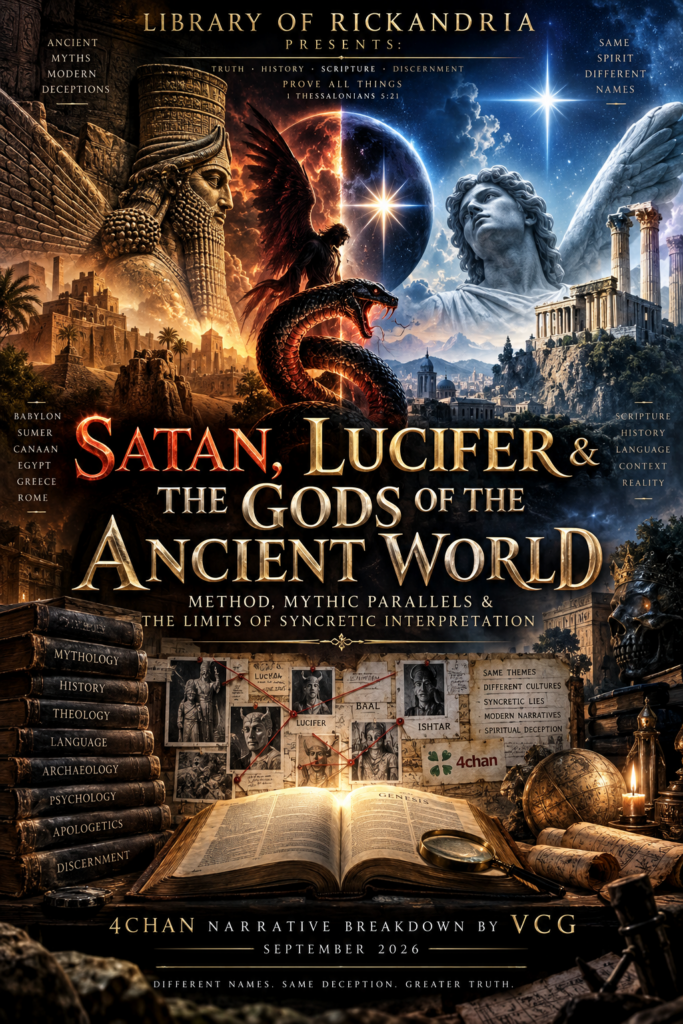
UPDATED BY VCG ON 9/8/2026 @ 23:23 EST
I want to share a heartfelt cause with my audience. Conner Blaisdell-Greene, a brave Airforce Sr. Airman, recently lost his battle with cancer, leaving his family in financial distress. Every donation, no matter how small, can help cover his funeral costs and ease their burden during this difficult time. Please consider clicking the link below to contribute or share Conner’s story with others. Your support truly matters.
Until We Meet Again
Spoken Tribute
Anyone can do this, but most won’t.
ChatGPT – Library of Rickandria
4Chan Narrative Breakdown by VCG
September 2026
“Prove all things; hold fast that which is good.” — 1 Thessalonians 5:21, KJV
All Scripture quotations are from the Authorized King James Version,
Pure Cambridge Edition, unless otherwise noted.
Abstract
This paper examines an archived 4chan /x/ thread that begins with a deceptively simple question—what, exactly, are Satan and Lucifer?—and then expands into claims about:
- Saturn
- Venus
- Enki
- Enlil
- Prometheus
- Zeus
- YHWH
- Hermeticism
- the Genesis flood
- Gnosticism
- fallen angels
- population control
and the problem of evil.
/x/ – What is Satan/Lucifer exactly? – Paranormal – 4chan
The thread is not one coherent treatise:
it is a conversation among multiple anonymous posters, and several referenced replies are missing from the archive.
For that reason, this paper does not pretend that:
“the thread”
speaks with one voice.
It audits surviving claims post by post and then asks why certain kinds of claims become persuasive when many traditions are compressed into a single hidden narrative.
The central finding is not that ancient parallels are imaginary.
Quite the opposite.
Mesopotamian flood traditions really do contain motifs that illuminate Genesis; Enki really is the Sumerian deity later called Ea in Akkadian; Inanna really is Ishtar; Venus really was assimilated to Aphrodite in Roman and Greek reception; Saturn really was identified with Cronus in Greco-Roman interpretatio; Hermetic texts really do contain elevated language about divine mind and human participation in divinity; and 1 Enoch really does number the Watchers at two hundred.
The problem begins when a genuine datum is used as a bridge to an identity claim that the source itself never makes.
In this paper that recurring move is called the
“authentic fragment, invented bridge”
pattern.
The method therefore distinguishes:
- shared motif
- shared symbol
- functional resemblance
- literary dependence
- theological adaptation
- historical syncretism
and actual identity.
It also separates five kinds of evidence that the thread frequently blends:
- Scripture
- extra-canonical religious literature
- historical reconstruction
- comparative mythology
and modern occult or psychological interpretation.
A biblical claim is tested first against the biblical text; a linguistic claim is tested by historical linguistic method rather than English sound-alikes; an identity claim is tested for chronology, transmission, and explicit ancient evidence; and a psychological observation is applied to reasoning patterns rather than used to diagnose anonymous people.
The most serious errors are textual rather than merely interpretive.
One post alters John 9:3 by inserting the devil into Jesus’ answer; another presents a philosophical sentence as though God said it in Job.
Other claims—such as:
- Satan being Christ’s equal opposite
- Satan incarnating as the Antichrist
- YHWH being Enlil under a new name, or “Satan” deriving from “Saturn”
—are not established by the cited traditions.
The paper nevertheless steelmans the thread’s strongest defensible insight:
biblical texts arose within an ancient Near Eastern and Mediterranean world in which:
- stories
- titles
- symbols
- divine functions
could be:
- shared
- adapted
- contested
- reinterpreted
That historically serious proposition does not entail a secret universal pantheon in which every god is one of two disguised cosmic persons.
| THESIS Real parallels deserve careful study. Similarity is evidence for comparison, not by itself evidence of identity, borrowing, or a hidden universal theology. |
Contents
Part I — Method Before Myth
1. Source hierarchy, scope, and archival limits
2. How to test a syncretic claim
3. Seven levels of similarity
4. Positive controls: what real historical identification looks like
5. Burden of proof, falsifiability, and the “authentic fragment, invented bridge” pattern
Part II — Establishing the Biblical Baseline
6. Satan across the canon
7. Lucifer: text, translation, and tradition
8. Antichrist, the serpent, and fallen angels
9. Canonical and extra-canonical sources
Part III — Ancient Context and Comparative Claims
10. Atrahasis, Ziusudra, Utnapishtim, and Noah
11. What Genesis does with ancient Near Eastern flood material
12. YHWH, El, Baal, and Enlil: comparison is not identity
13. Venus, Inanna/Ishtar, Aphrodite, and Lilith
14. Hermetic divinization and modern occult synthesis
15. Etana and the danger of motif-chaining
Part IV — Walking Through the 4chan Thread
16. Opening answers: posts 42916147–42916253
17. The major Enlil/Enki thesis: post 42916486
18. Population, Lucifer, and angelology: 42916730–42917486
19. Promethean Lucifer, Job, John 9, and the Demiurge: 42917949–42918547
20. Identity claims, 1 Enoch, and the thread’s final posts: 42918891–42921756
Part V — Psychology of the Reasoning
21. Pattern perception, agency, confirmation, and narrative compression
22. Parallelomania, transitive mythology, and esoteric unfalsifiability
Part VI — Evil, Suffering, and Meaning
23. What the thread legitimately asks
24. What Scripture states—and what it does not
Part VII — Steelman, Synthesis, and Field Guide
25. The strongest defensible version of the thread
26. Why the grand identity theory still fails
27. A reusable checklist for future claims
Appendix A — Post-by-post evidence matrix
Appendix B — Philology quick reference
Appendix C — Timeline of traditions
Appendix D — Most serious Scriptural alterations
References
Part I — Method Before Myth
1. Source hierarchy, scope, and archival limits
The first temptation in a thread like this is to begin answering claims one by one.
That is useful, but it is not enough.
Before comparing Satan with Saturn or Noah with Atrahasis, we need to decide what counts as evidence and what kind of question each source can answer.
A biblical passage can tell us what a biblical author says.
A cuneiform tablet can tell us what an ancient Mesopotamian text says.
A modern occult synthesis can tell us how later readers combine symbols.
None of those sources automatically tells us what the others
“really meant.”
The primary internet source here is the archived /x/ thread No. 42916140, opened on 4 September 2026 under the question
“What is Satan/Lucifer exactly?”
The archive confirms that it is closed to replies and preserves most of the sequence, but not every post referenced by surviving replies.
That matters.
Missing posts should not be reconstructed from memory or from later reactions.
Where the archive does not preserve the underlying statement, this paper says so rather than filling the gap.
The thread is also multi-authored.
“Anonymous”
is not a single thinker.
Some posters contradict others: one distinguishes Satan from Lucifer, another collapses Lucifer into Venus, another treats Satan as a literary symbol, another makes Satan identical with a Mesopotamian deity, and another treats Satan as a Jewish mythological figure.
Consequently, phrases such as:
“the thread claims”
are shorthand for a claim appearing somewhere in the surviving conversation, not an assertion that every participant shares it.
| SOURCE HIERARCHY For this paper, direct primary texts outrank paraphrases; critical editions and peer-reviewed scholarship outrank popular summaries; institutional museum catalogues are used for object/context facts; modern occult interpretations are treated as interpretations, not retroactive evidence of ancient belief. |
Scripture receives a separate category because the user’s requested correction is explicitly biblical.
The base text is the King James Bible, Pure Cambridge Edition supplied for this study.
Historical-critical scholarship is still consulted where the question is historical—such as the ancient Near Eastern background of Genesis—but its reconstructions are labeled as historical scholarship rather than silently equated with what Scripture itself asserts.
2. How to test a syncretic claim
A claim such as:
“Enki is Satan”
is not one claim but a bundle of questions.
Do the names have a linguistic relationship?
Do the characters perform sufficiently distinctive roles?
Is there evidence that communities in contact with one another identified them?
Is there an ancient text that equates them?
Is the proposed direction of borrowing chronologically possible?
Does the comparison explain differences as well as similarities?
A responsible test therefore has several independent gates.
Chronology — Are the relevant sources actually ordered in a way that permits influence or inheritance?
Language — Are the names related by regular historical sound correspondences, or do they merely look similar in modern spelling?
Geography and contact — Were the communities close enough, or connected enough, for transmission to be plausible?
Primary textual evidence — Does any ancient source explicitly identify A with B, or is the identity first asserted centuries or millennia later?
Function and narrative role — Are the similarities specific, or are they generic traits shared by many gods, heroes, kings, serpents, storms, or stars?
Transmission pathway — Can we identify intermediate stages showing how a name, story, or cult moved and changed?
Difference control — Does the hypothesis account for major disanalogies, or does it count only matches and ignore contradictions?
Samuel Sandmel’s classic warning about “parallelomania” remains helpful because he did not deny real parallels.
His concern was the extravagance by which resemblance is overdrawn and then treated as proof of literary dependence or predetermined direction of borrowing (Sandmel 1962).
The same caution applies here at an even larger scale:
- a serpent
- storm
- flood
- star
or rebel figure may invite comparison, but a comparison is the beginning of inquiry rather than the end.
Historical linguistics provides an analogous discipline for names.
The comparative method does not establish cognates because two modern forms sound alike; it looks for recurrent, regular sound correspondences across related languages and reconstructable forms (Ringe and Eska 2013; Rankin 2017).
That is why “Satan” and “Saturn” cannot be connected merely by their English spellings.
A proposed cognate relationship needs a historical mechanism, not a visual pun.
3. Seven levels of similarity
The thread becomes much easier to evaluate once several very different relationships stop being called simply “the same.” The following ladder is used throughout the paper.
| Level | What it means |
| 1. Shared motif | Two stories contain a flood, serpent, sacred tree, rebellious figure, descent to the underworld, or morning star. |
| 2. Shared symbol | Two traditions use the same astronomical body, animal, color, object, or visual emblem. |
| 3. Functional resemblance | Two figures occupy similar roles—storm deity, culture hero, accuser, divine warrior, fertility goddess. |
| 4. Literary dependence | A text plausibly knows, reuses, adapts, translates, or responds to an earlier text or story. |
| 5. Theological adaptation | A tradition deliberately reshapes inherited material to make a new theological point. |
| 6. Historical syncretism or interpretatio | Ancient communities explicitly identify or assimilate deities across cultures. |
| 7. Identity | The claim is that two differently named beings are literally the same entity. |
The evidentiary burden rises sharply as we move down the ladder.
A shared motif can be established by placing texts side by side.
Historical syncretism requires evidence of actual cultural identification.
Literal identity is stronger still.
The thread frequently moves from level 1 or 2 directly to level 7 without supplying the evidence that levels 4–6 would normally require.
4. Positive controls: what real historical identification looks like
A good method should recognize genuine identifications when they occur.
Otherwise it becomes a machine for saying “no.” Ancient religion gives us useful positive controls.
In Mesopotamia, the Metropolitan Museum summarizes well-attested bilingual/cultural equivalences:
Sumerian Enki became Akkadian Ea; Inanna became Ishtar; Utu became Shamash.
These are not modern guesses based on vague similarity.
They are embedded in the historical transition from Sumerian to Semitic-speaking Mesopotamian culture and in textual traditions that explicitly map or inherit the figures (Spar 2009).
Greco-Roman religion gives another kind of positive control.
Roman Saturn underwent a Greek interpretatio and was identified with Cronus; Roman Venus was assimilated to Greek Aphrodite.
These identifications are documented historically in:
- cult
- literature
- art
- classical interpretation
They show that ancient peoples really did equate foreign and local gods—but they also show the kind of evidence one should expect when such an equation is historical rather than invented later.
| POSITIVE CONTROL Real syncretism leaves traces: bilingual names, explicit equations, shared cults, ancient interpretatio, translations, iconographic continuity, or a demonstrable chain of reception. The absence of such traces does not logically prove two beings could never be compared; it does mean the stronger identity claim has not been demonstrated. |
5. Burden of proof, falsifiability, and the “authentic fragment, invented bridge” pattern
The burden of proof belongs to the person making the identity claim.
A critic does not need to prove that Enki is metaphysically incapable of being Satan.
The claimant needs to provide positive historical evidence that Enki was identified with Satan, or that a traceable chain of transmission supports the equation.
This is especially important when the proposed theory absorbs dozens of:
- deities
- languages
- centuries
into a single hidden system.
A second issue is falsifiability.
If the absence of evidence is answered by
“the priests hid it,”
if differences are dismissed as deliberate disguises, and if contradictory traditions are treated as further evidence of concealment, then no possible observation can count against the theory.
That makes the claim difficult to test historically.
It may still function as a symbolic or esoteric worldview, but it should be labeled as such rather than presented as established history.
The thread repeatedly exhibits what this paper calls the authentic fragment, invented bridge pattern.
A genuine fact provides credibility; an unsupported transition carries the reader to a much larger conclusion.
Atrahasis really includes divine conflict and a flood, therefore Enlil became YHWH.
Lucifer really has morning-star/Venus imagery, therefore every Venus-associated goddess is Lucifer.
1 Enoch really says two hundred Watchers descended, therefore shapeshifting celebrities are those Watchers.
Hermetic texts really discuss divine mind, therefore a modern Prometheus–Theseus–Titan synthesis is the exact ancient doctrine.
The first clause in each chain can be researched. The second requires separate evidence.
This pattern is more persuasive than a completely fabricated story because the authentic fragment survives fact-checking.
A careful rebuttal therefore should not deny the fragment.
It should mark the exact point where evidence ends and synthesis begins.
Part II — Establishing the Biblical Baseline
6. Satan across the canon
Before asking whether Satan is Saturn, Enki, Prometheus, or a metaphysical principle, it helps to let the biblical usage establish its own baseline.
The Hebrew term satan is connected with opposition or adversarial activity.
In the Hebrew Bible it can be used more generally for an adversary; in Job and Zechariah it appears in a heavenly accusatory role.
By the New Testament, “Satan” functions as a settled designation for the hostile spiritual adversary, alongside “the devil.”
This development can be described historically without pretending that every occurrence in every period carries identical nuance.
Job 1 is especially important because the thread invokes it.
The text says that:
“the sons of God came to present themselves before the LORD, and Satan came also among them.”
Asked where he has been, Satan answers,
“From going to and fro in the earth, and from walking up and down in it” (Job 1:6–7)
Yet he does not operate as God’s equal opposite.
God sets boundaries:
first Job’s person is protected, and later Satan is told to spare Job’s life (Job 1:12; 2:6).
Whatever questions Job raises about heavenly agency and suffering, the narrative’s power structure is not dualistic.
The New Testament makes several identifications explicit.
Revelation 12:9 calls the dragon:
“that old serpent, called the Devil, and Satan, which deceiveth the whole world.”
Revelation 12:10 calls him
“the accuser of our brethren.”
John 8:44 describes the devil as a murderer and liar.
Matthew 12:26 speaks of Satan having a “kingdom,” which supports the broad notion of organized hostile spiritual agency, but not the idea that Satan is a second deity equal to Christ.
Christ’s status is categorically different in the New Testament.
Colossians 1:16 attributes the creation of heavenly orders—
“thrones, or dominions, or principalities, or powers”
—to Christ.
The canonical picture is therefore not Jesus and Satan as symmetrical divine brothers.
It is Creator and creature, Lord and adversary.
Scripture can dramatize conflict without positing metaphysical equality.
| SCRIPTURE Revelation explicitly unites the titles Devil, Satan, and “old serpent” (Rev. 12:9). It does not explicitly unite Satan with Saturn, Enki, Prometheus, or any pagan deity. |
7. Lucifer: text, translation, and tradition
“Lucifer” needs unusually careful handling because both sides of internet debates often overstate their case.
The word really is present in the KJV. Isaiah 14:12 reads,
“How art thou fallen from heaven, O Lucifer, son of the morning!”
It would therefore be wrong to say that
“Lucifer is not in the Bible”
without qualification.
But the immediate literary context matters just as much.
Isaiah 14:4 tells Israel to
“take up this proverb against the king of Babylon.”
The passage depicts the humiliation of an arrogant earthly ruler with elevated cosmic imagery.
The Hebrew expression behind the KJV’s “Lucifer” is morning-star/shining-one language.
The familiar English form comes through Latin lucifer, literally a light-bearer and a conventional term for the morning star.
Christian readers very early connected Isaiah’s fall imagery with Satan, especially alongside texts such as Luke 10:18,
“I beheld Satan as lightning fall from heaven.”
Tertullian, Origen, and later tradition helped establish the Satanic reading.
That history is real; the interpretive status should simply be named.
Three propositions can therefore be held together without contradiction.
First, Isaiah 14 explicitly places the taunt in an oracle against Babylon’s king.
Second, Christian tradition has long read the passage typologically or secondarily in relation to Satan.
Third, Scripture never gives us a sentence saying,
“Satan’s original proper name was Lucifer.”
The common Christian naming convention is a theological interpretation built from the text, not an explicit biographical label supplied by Isaiah.
The morning-star imagery also cannot be treated as intrinsically demonic.
Revelation 22:16 records Jesus saying,
“I am the root and the offspring of David, and the bright and morning star.”
The same astronomical image can carry different symbolic functions in different texts.
That single fact is an important check against the thread’s tendency to make
“morning star = Venus = Lucifer = every Venus deity”
into an identity equation.
| INTERPRETATION A fair formulation is: the KJV uses “Lucifer” in Isaiah 14:12; the immediate target is the king of Babylon; the imagery is morning-star language; and a long Christian interpretive tradition applies the fall typologically to Satan. Do not collapse those four statements into one. |
8. Antichrist, the serpent, and fallen angels
The thread’s claim that the Antichrist is Satan’s physical form is not the biblical formulation.
First John says that
“antichrist shall come,”
but immediately adds that
“even now are there many antichrists” (1 John 2:18)
and defines antichrist in confessional terms:
“He is antichrist, that denieth the Father and the Son” (2:22)
Revelation’s dragon and beast are likewise distinguishable:
the dragon gives the beast
“his power, and his seat, and great authority” (Rev. 13:2)
Empowerment is not identity.
Fallen angels are biblical, but details from later literature should not be smuggled into the canonical text.
Jude 1:6 speaks of
“the angels which kept not their first estate, but left their own habitation,”
and 2 Peter 2:4 speaks of “the angels that sinned.” Neither passage numbers them at two hundred.
The number two hundred belongs to the Book of the Watchers in 1 Enoch 6.
That is a genuine ancient Jewish tradition and highly relevant to the reception of Genesis 6, but it is not a number stated in the KJV canon (Reed 2005).
Similarly, Jude 1:9 calls Michael “the archangel.”
Scripture does not tell us that Satan is the highest-ranking angel, the first son of God, Jesus’ sibling, or the celestial family member who eventually reconciles with everyone.
Those may be later imaginative constructions; they should not be advertised as direct biblical data.
On final judgment, the straightforward KJV language cuts against the thread’s reconciliation claim:
Revelation 20:10 says the devil is cast into the lake of fire and is tormented
“for ever and ever.”
Christians debate many questions about eschatology, but a claim of Satan’s eventual reconciliation needs to acknowledge that this text points in the opposite direction.
9. Canonical and extra-canonical sources
A great deal of confusion disappears when source corpora are placed on separate shelves.
The Hebrew Bible and New Testament are one shelf for the purposes of canonical Christian Scripture.
Second Temple Jewish works such as 1 Enoch and Jubilees are another.
- Early Christian Fathers
- Gnostic texts
- the Corpus Hermeticum
- medieval demonology
- Renaissance occultism
- Romantic literature
- modern Theosophy
- contemporary Luciferianism
and internet esotericism occupy still other shelves.
Those shelves can interact.
Jude can echo traditions known from Enochic literature; Christian interpreters can reread Isaiah in light of the New Testament; Renaissance Hermeticists can combine classical and Christian materials.
But interaction does not erase chronology.
A doctrine first made explicit in a late source cannot be projected backward into an earlier text without evidence.
Nor does the fact that an idea is extra-canonical make it historically useless.
It simply answers a different question.
| SOURCE DISCIPLINE Ask “Which corpus says this?” before asking whether a claim is true. “The Bible says,” “1 Enoch says,” “a Church Father interprets,” “a Hermetic text teaches,” and “a modern occultist symbolizes” are not interchangeable statements. |
Part III — Ancient Context and Comparative Claims
10. Atrahasis, Ziusudra, Utnapishtim, and Noah
The thread’s most historically substantial material appears in post 42916486, which appeals to Mesopotamian flood tradition.
Here the right response is not to deny the parallels.
The Old Babylonian Atrahasis tradition really does describe humanity becoming troublesome to the gods, successive attempts to reduce human numbers, a final flood, and Enki/Ea warning his human devotee so that a boat can be built.
A British Museum tablet from the Old Babylonian period, dated to the seventeenth century BCE, preserves part of this story and identifies Atrahasis as its flood hero.
Modern critical study of the epic rests especially on the edition by W. G. Lambert, A. R. Millard, and Miguel Civil (1969).
The first correction is terminological.
Atrahasis, Ziusudra, and Utnapishtim are not simply three spellings for one surviving text.
Atrahasis is the hero of the Akkadian Atrahasis epic.
Ziusudra is the flood hero in a Sumerian flood tradition.
Utnapishtim is the survivor encountered by Gilgamesh in Tablet XI of the Epic of Gilgamesh.
These traditions are related and share material, but keeping their names and textual witnesses distinct prevents a composite retelling from being mistaken for one ancient document.
The thread says Enki teaches “Ziusudra” to build the ark while otherwise narrating Atrahasis.
That conflation matters because it obscures which details survive in which witnesses.
The famous sequence of birds released after the flood is clearly preserved in Gilgamesh XI.
Atrahasis is fragmentary in the corresponding part of the story, so scholars can discuss whether comparable material may once have stood there, but we should not claim that the extant Atrahasis tablet preserves every Noah-like detail.
The divine roles also need precision.
The Metropolitan Museum describes Enki as lord of the subterranean freshwaters and later Akkadian Ea as the same inherited deity; Enlil is a leading god associated with Nippur and broad cosmic/earthly authority.
Adad is the classic storm god represented with forked lightning.
The thread’s neat scheme—Enlil as a single lightning-wielding earth ruler versus Enki as a mind-god—compresses a much more complicated pantheon (Spar 2009).
| HISTORY The Mesopotamian flood parallels are real enough that denying them weakens the critique. The stronger question is what follows from them. Literary relationship or shared tradition does not by itself establish that Enlil literally became YHWH or that Enki literally became Satan. |
11. What Genesis does with ancient Near Eastern flood material
Comparative scholars have long treated Genesis 6–9 in relation to Mesopotamian flood traditions, and recent work by David Carr and others continues to argue for literary or traditional relationships.
The exact compositional history of Genesis remains debated, but the existence of significant ancient Near Eastern parallels is not controversial in the broad sense.
What matters for this paper is that Genesis does not merely preserve the Mesopotamian theology unchanged.
Atrahasis frames humanity’s proliferation and noise as a divine problem.
The gods attempt plague and other forms of population reduction before the flood; after the flood, measures are established that restrain human reproduction and survival.
Genesis, by contrast, foregrounds moral corruption:
“the wickedness of man was great in the earth” (Gen. 6:5)
and the earth is
“filled with violence” (Gen. 6:11)
After judgment, God blesses Noah and his sons with the command,
“Be fruitful, and multiply, and replenish the earth” (Gen. 9:1)
That is not a trivial difference.
It reverses the population logic that the thread treats as the hidden engine of the biblical story.
Genesis also removes the inter-divine sabotage that structures Atrahasis.
In the Mesopotamian story, one deity can work around the intentions of another.
In Genesis, the same God:
- announces judgment
- instructs Noah
- preserves the remnant
- receives the sacrifice
- establishes the covenant
and promises the stability of the earth’s seasons.
The flood may reuse or participate in a shared ancient story-world, but its theology is reorganized around one sovereign moral judge rather than a divided pantheon.
This is precisely why the relationship is historically interesting.
If Genesis is adapting ancient material, the differences can be as meaningful as the similarities.
A theological author can inherit a flood story in order to contradict, demythologize, or recast elements of the older worldview.
“Genesis resembles Atrahasis”
is therefore a defensible comparative proposition.
“Genesis is Enlil propaganda and YHWH is Enlil renamed”
is a much stronger identity thesis for which the thread supplies no ancient evidence.
| METHOD When two related stories differ at their theological center, do not treat the differences as disposable noise. Adaptation often reveals itself precisely through deliberate changes. |
12. YHWH, El, Baal, and Enlil: comparison is not identity
Historical study of Israelite religion is more complicated than the internet choice between
“no pagan context at all”
and
“YHWH is just a pagan god with a new label.”
Scholars examine:
- inscriptions
- Northwest Semitic religion
- Ugaritic texts
- biblical poetry
- divine titles
and the development of monotheistic claims.
Mark S. Smith, Theodore Lewis, and others have explored how Israelite religion emerged within a wider West Semitic cultural environment.
Oxford reference works likewise note scholarly debate about relationships among YHWH, El, compound El titles, Baal-like storm imagery, and the development of exclusive monotheism.
That historical conversation should be represented fairly.
Some scholars speak of convergence:
titles roles, or features once associated with other West Semitic deities become attached to YHWH.
Others stress differentiation:
biblical texts polemicize against Baal and rival gods, sharpening Israel’s distinctive claims.
A text can appropriate storm-warrior imagery without declaring that two deities are literally the same being.
Religious traditions routinely reuse a culture’s language while contesting its theology.
Enlil presents an even clearer methodological problem for the thread.
Christopher Hays has proposed that Isaiah’s Hebrew term ʾelilim for other gods reflects borrowing from Akkadian Illil/Enlil in Neo-Assyrian rhetorical context.
The striking point is that Hays explicitly treats the term as distinct from the terms used for YHWH (Hays 2020).
In other words, genuine linguistic contact with the name Enlil can be studied without concluding that Isaiah secretly identifies YHWH as Enlil.
The divine name YHWH does not mean
“earth and Saturn becoming one.”
Its ultimate etymology is debated.
Exodus 3:14–15 itself plays on the Hebrew verb of being—
“I AM THAT I AM”
—and many scholarly proposals connect YHWH in some way with a Semitic root of being/becoming, while other proposals exist.
Oxford bibliographic surveys explicitly treat the etymology as a field of competing hypotheses.
The thread’s Earth-plus-Saturn derivation is not one of the historically supported analyses.
The phrase “YHWH of hosts,” sometimes rendered “LORD of hosts,” is a biblical title, but it does not function as evidence that YHWH is Enlil.
Nor does storm imagery prove identity with Baal or Zeus. Storms, kingship, mountains, armies, and divine warfare are widespread ancient religious symbols.
To move from shared imagery to literal identity requires the intermediate evidence the thread never provides.
| HISTORICAL RECONSTRUCTION VS. SCRIPTURE Historical-critical scholarship may describe convergence, appropriation, or development in ancient Israelite religion. Scripture itself presents YHWH as Israel’s God and repeatedly distinguishes him from rival gods. These are different kinds of claims and should be labeled rather than blended. |
13. Venus, Inanna/Ishtar, Aphrodite, and Lilith
Post 42918403 begins from another authentic fragment.
The KJV’s “Lucifer” in Isaiah 14 uses morning-star imagery, and the morning star is the planet Venus as seen before sunrise.
Mesopotamian Inanna/Ishtar was strongly associated with Venus. In Greco-Roman religion, Aphrodite/Venus is a genuine historical assimilation.
Those facts make comparative study entirely reasonable.
But the thread then turns those real links into a transitive identity machine.
If Lucifer is morning-star imagery, and Inanna is associated with Venus, and Aphrodite is associated with Venus, the poster concludes that:
- Inanna
- Lilith
- Aphrodite
- Persephone
and “most” goddesses are effectively one Lucifer figure.
This does not follow.
Two deities can share an astronomical association without being identical; two mythic females can descend to an underworld without being one goddess; later demonology can borrow imagery without preserving an ancient cultic identity.
The Inanna/Ishtar equation is a positive control because it is historically documented across Sumerian and Akkadian tradition.
Venus/Aphrodite is likewise an explicit Greco-Roman assimilation.
Lilith is different.
Her long reception history draws on ancient demonological materials and later Jewish tradition, and modern scholarship emphasizes the changing, malleable genealogies attached to her rather than a simple ancient identity with Inanna (Clay 2024).
Treating every later resemblance as an original equation erases the history one is supposedly trying to recover.
There is also a biblical check on the symbolic logic. Jesus calls himself
“the bright and morning star”
in Revelation 22:16.
Therefore “morning star” cannot function as a unique ontological fingerprint for Satan.
Symbols are polysemous:
they acquire meaning from their literary context.
| RULE OF THUMB Astronomical association is a relationship, not a passport number. The same planet can symbolize different deities or figures in different cultures without making them one being. |
14. Hermetic divinization and modern occult synthesis
The thread’s Hermetic material is another place where simple dismissal would be inaccurate.
The Corpus Hermeticum really does speak in exalted terms about mind, divine origin, and the human relationship to divinity.
In Corpus Hermeticum XII, divine mind is described as present in humans in a way that allows striking language about humans and gods; Corpus Hermeticum IV depicts humanity as a rational spectator of God’s work and mind as a prize connected with knowledge of the divine (Copenhaver 1992).
Those texts help explain why later esoteric traditions could read Hermeticism as a path of:
- ascent
- rebirth
- gnosis
or divinization.
But post 42916194 does more than repeat a Hermetic passage.
It fuses:
- Prometheus
- Theseus
- Titans
- Olympians
- “Sons of Hermes”
and self-deification into one ritualized mythic program.
That is an eclectic modern synthesis.
It may be inspired by Hermetic themes, but post 42918501 overstates the case when it calls the formulation the wholly accurate ethos of Hermeticism.
Biblically, the distinction between participation and identity matters.
Second Peter 1:4 speaks of believers becoming:
“partakers of the divine nature.”
Christian traditions have developed different accounts of deification or theosis from texts like this.
Yet that is not the same proposition as
“the creature becomes the Creator”
or
“you are God”
in an unqualified ontological sense.
A responsible comparison should not erase the doctrinal boundaries of either Hermetic or Christian sources.
This is a useful example of interpretive layering.
Ancient Hermetic text:
one layer.
Renaissance and modern Hermetic reception:
another.
Mythic Promethean symbolism: another.
Christian deification language:
another.
They can be compared; they should not be silently collapsed.
15. Etana and the danger of motif-chaining
Post 42918457 invokes the Mesopotamian Etana tradition to link a serpent, a tree, and an eagle with Genesis.
The Epic of Etana really does preserve a fable involving an eagle and a serpent associated with a tree; the eagle violates an oath and destroys the serpent’s offspring, and the serpent receives assistance in punishing it.
Later in the story Etana seeks the plant of birth and ascends toward heaven on the eagle.
British Museum tablets preserve versions of the Etana legend, and modern Assyriological work treats the eagle-and-snake episode as an integral part of the epic’s tradition.
This is exactly the kind of motif that can invite comparison with other ancient tree-and-serpent stories.
Yet the thread jumps from motif to identity: serpent becomes Enki/Satan; the opposing divine order becomes Enlil/YHWH; then Zeus and Set are added; then the flood is reinterpreted as suppression of a slave revolt.
The Etana text does not supply those equations.
A real serpent-and-tree motif has been made to carry a narrative constructed elsewhere.
Motif comparison becomes strongest when distinctive complexes align in sequence and a plausible transmission path exists.
It becomes weakest when common symbols are chained across unrelated stories until their original contexts disappear.
The serpent is especially vulnerable to this because serpents can signify:
- wisdom
- danger
- healing
- rebirth
- fertility
- chaos
- kingship
or deception depending on context.
Part IV — Walking Through the 4chan Thread
What follows is a readable audit rather than a transcript.
Post numbers allow the reader to check the archive.
Direct quotations from the thread are kept extremely short; most claims are paraphrased so that attention stays on the evidence rather than on reproducing the conversation’s rhetoric.
16. Opening answers: posts 42916147–42916253
42916147 — The physical world as false
This is a metaphysical interpretation, not a fact established by the post.
The language resembles currents of Gnostic or radical dualist thought in which the material cosmos is deficient or deceptive.
Biblical creation language is different:
Genesis 1:31 says God saw what he had made and
“it was very good.”
Scripture certainly portrays creation as:
- fallen
- groaning
- mortal
and awaiting renewal; that is not the same as saying material existence is intrinsically false.
42916194 — Prometheus, Theseus, Hermes, Titans, and becoming God
As discussed above, the post has a genuine Hermetic family resemblance: divine mind, ascent, and transformed humanity are real Hermetic themes.
But the exact mythological package is a modern synthesis.
As history, it is unsupported as one ancient doctrine.
As symbolic occult interpretation, it is intelligible.
As a biblical claim that humans become God without qualification, it exceeds the text.
42916199 — “satan = saturn”; Lucifer = Venus
The first equation fails philologically. Hebrew satan belongs to a Semitic lexical field of adversary/opposition.
Roman Saturnus is an Italic divine name of disputed etymology; John Scheid notes proposals involving sowing/seed and an Etruscan derivation, while emphasizing the name’s difficulties (Scheid 2016).
English resemblance is not historical cognacy.
The second equation is partly correct only at the level of astronomical imagery:
Isaiah’s morning star corresponds to Venus, but that does not make Satan literally the planet Venus.
42916202 and 42916208 — dismissive slurs
These posts make no substantive argument.
They are rhetorically dismissive and therefore carry no evidentiary weight.
A useful rule for the entire audit is that contempt is not counter-evidence and enthusiasm is not evidence.
42916203 — Satan as the psychological descent after innocence
This is best read as literary symbolism.
It may describe what “Satan” means to the poster, but it should not be confused with lexical history or biblical ontology.
Genesis narrates:
- deception
- disobedience
- judgment
- exile
it does not define Satan as an impersonal stage of psychological development.
42916215 — Satan as Jesus’ opposite and the Antichrist’s physical form
The post combines one plausible element with two unsupported ones.
Matthew 12:26 does use the language of Satan’s kingdom in a context involving demons, so a broad picture of Satan as leader of hostile spiritual forces has biblical warrant.
But Satan is not Christ’s equal opposite, and 1 John does not identify Antichrist as Satan incarnate.
Revelation distinguishes the dragon from the beast whom the dragon empowers.
42916253 — “jesus = sun”
As etymology this fails.
The English name Jesus comes through Greek and Latin from the Hebrew/Aramaic name Yeshua, related to Yehoshua/Joshua and traditionally understood with the sense of YHWH saving.
Matthew 1:21 itself makes a salvation wordplay:
“thou shalt call his name JESUS:
for he shall save his people from their sins.”
Solar imagery may be used symbolically in Christian literature, but an English homophone is not an ancient derivation.
17. The major Enlil/Enki thesis: post 42916486
This is the strongest post in the thread in the sense that it contains the highest proportion of real ancient material.
It is also the clearest demonstration of how a true substrate can lend authority to an unsupported grand theory.
The post is broadly right that Atrahasis traditions portray successive divine attempts to reduce humanity and that Enki/Ea aids the human flood hero.
It is also broadly right that post-flood population restrictions appear in the Atrahasis tradition.
These are not internet inventions.
The British Museum’s summary of an Old Babylonian Atrahasis tablet explicitly describes repeated divine attempts to destroy noisy humanity, the flood, and Enki’s secret warning to:
- Atrahasis
- Lambert
- Millard
- Civil
provide the standard critical textual basis.
But the post compresses names and episodes from several related traditions.
It calls the flood hero Ziusudra while narrating the Atrahasis story.
It treats the bird-release sequence as though it were securely preserved in the same text, although the famous preserved bird sequence belongs to Gilgamesh XI and Atrahasis is fragmentary in the relevant area.
It simplifies divine portfolios, turning Enlil into a straightforward lightning god while Met sources identify Adad as the characteristic lightning/storm deity.
The decisive leap comes afterward:
Enlil supposedly learns that monotheism is an efficient control technology, becomes
“YHWH of Armies,”
and recasts Enki as Satan for helping humanity.
The post provides no:
- ancient tablet
- inscription
- bilingual god list
- Israelite text
or intermediate tradition making that identification.
It is a narrative written by the poster to connect authentic fragments.
Without that bridge, the evidence supports
“Genesis and Mesopotamian flood traditions are historically comparable,”
not
“YHWH is Enlil and Satan is Enki.”
The Genesis differences are especially damaging to the population-control thesis.
Where Atrahasis treats human multiplication as a problem and institutes constraints, Genesis explains the flood through wickedness and violence and then blesses reproduction after the flood.
A theory claiming that Genesis was designed to preserve Enlil’s anti-population program has to explain why the biblical text explicitly commands the opposite.
| VERDICT Post 42916486: genuine Mesopotamian material + conflation of flood traditions + unsupported identity theory. Best label: partly correct historical substrate; major conclusion unproven. |
18. Population, Lucifer, and angelology: 42916730–42917486
42916730, 42916804, 42916832 — fertility and population rhetoric
One participant reacts to population-control claims with ethnicized generalizations; another notes that birth rates are down in developed countries; another says reproduction is now largely a pursuit of the poor or hobbyists.
Only the middle claim is broadly supported.
OECD data show long-term fertility decline, with an OECD average around 1.46 children per woman in 2024 and all OECD countries except Israel below replacement level.
Yet fertility decline is not confined to one civilization:
OECD data also show very large long-run declines in countries such as Türkiye, Mexico, and Saudi Arabia, while the United Nations reports a global fertility rate of about 2.25 and a continuing worldwide decline.
The thread’s class and ethnic stereotypes are not established by those demographic facts.
42916747 — the Demiurge image and ouroboric symbolism
A serpent fighting or consuming its own tail can carry rich symbolic meaning.
But an image labeled “Demiurge” is not historical proof that the:
- biblical God
- Saturn
- Satan
or a Gnostic creator are one being.
Iconography must be dated, sourced, and interpreted in its original context before it can carry historical weight.
42916827 and 42916860 — Satan and Lucifer as different beings
The distinction is partly perceptive and partly overconfident.
“Satan” does derive from adversary language.
But Scripture does not introduce a separate fallen angel with the explicit proper name Lucifer and then tell us he is distinct from Satan.
Isaiah 14 uses the KJV term Lucifer in a taunt against Babylon’s king; later Christian interpretation associates the fall imagery with Satan.
Calling Lucifer a second, specifically named angel goes beyond the canonical data.
42916927 — Satan as accuser of God
The accuser language is real but the object is misstated.
Revelation calls Satan
“the accuser of our brethren,”
and Job shows him challenging Job’s integrity before God.
One may philosophically say that Satan’s accusation indirectly impugns God’s judgment, but “accuser of God” is not the Bible’s standard formulation.
42917199 and 42917380 — non-arguments
“Me” and “a good king” are self-expression rather than evidence.
They require no historical rebuttal.
42917369 — etymological list leading to mind/body enlightenment
Several glosses are approximately reasonable in isolation—Prometheus is conventionally associated with forethought, and Satan with adversary/accuser—but the concluding mind/body metaphysics does not follow from the names.
Etymology cannot establish a hidden cosmological system.
Even the YHWH gloss needs caution:
Exodus 3 itself uses being-language, but scholars continue to debate the name’s ultimate historical etymology.
42917486 — Satan as highest angel; Lucifer as Jesus’ jealous sibling
None of these family details is stated in Scripture.
Jude names Michael “the archangel” but does not rank Satan as the highest angel.
The New Testament does not call Lucifer God’s first son, Jesus’ sibling, or a neglected worker resentful of Christ.
The claim that all reconcile at the end also conflicts with the straightforward judgment language of Revelation 20:10.
This post is imaginative mythography rather than biblical exegesis.
19. Promethean Lucifer, Job, John 9, and the Demiurge: 42917949–42918547
42917949 and 42918294 — a Promethean/Faustian Lucifer
These posts are best treated as literary philosophy.
Lucifer symbolizes aspiration, dissatisfaction with a damaged world, and the Promethean drive to improve it; Satan symbolizes controlled chaos or stagnation.
The poster even signals the subjective register by speaking personally.
As symbolism, the construction can be discussed on its own terms.
As biblical description, it conflicts with texts that characterize the devil primarily as deceiver, liar, tempter, and accuser rather than humanity’s frustrated benefactor.
42918093 — response to a missing post
This reply asks another poster to explain a refutation of the Promethean interpretation, but the referenced post 42918059 is not preserved in the accessible archive.
No responsible line-by-line audit can reconstruct its argument.
The gap is recorded rather than guessed.
42918156 — Job and John 9
This post contains the thread’s clearest textual corruption.
Its memory of Job includes one authentic detail:
Satan says he has been walking to and fro in the earth.
It then attributes to God a sentence about where he would stop if he put an end to something.
No such sentence appears in the Job text.
It is a philosophical paraphrase presented as biblical speech.
More seriously, the post rewrites Jesus’ answer in John 9 by inserting the phrase
“the devil sinned.”
The KJV says:
“Neither hath this man sinned, nor his parents:
but that the works of God should be made manifest in him” (John 9:3)
The devil is not named in the verse.
Jesus is responding to the disciples’ attempt to assign the man’s congenital blindness to a specific sin by the man or his parents.
Whatever theology one builds from the passage, the words
“the devil sinned”
cannot be attributed to it.
The post then proposes that pain must exist as a backdrop against which good becomes meaningful.
That is a philosophical theodicy, not something John 9 states.
It also sits awkwardly with the Bible’s own final vision.
Revelation 21:4 promises a meaningful redeemed existence in which
“there shall be no more death, neither sorrow, nor crying, neither shall there be any more pain.”
Scripture therefore cannot make pain an eternally necessary ingredient of meaning.
| MOST SERIOUS TEXTUAL ERROR John 9:3 does not say that “the devil sinned.” The KJV explicitly says, “Neither hath this man sinned, nor his parents.” This is not a denominational dispute; it is a direct text check. |
42918348 — the problem of a perfect creation ruined by an angel
The post raises a serious philosophical question but attacks an oversimplified version of Christian doctrine.
Genesis says creation was “very good,” yet the New Testament does not say an angel single-handedly ruined an otherwise passive humanity.
Romans 5:12 places human moral agency at the center:
“by one man sin entered into the world, and death by sin.”
Genesis 3 contains both serpent deception and human disobedience.
The larger question—why an omniscient and omnipotent God permits a history containing rebellion and suffering—remains a legitimate problem and deserves a better treatment than a straw man.
42918349 — no Lucifer in the primary source
This is close to an important correction but needs precise wording.
The Hebrew of Isaiah 14 does not contain the Latin word lucifer as a proper name; the KJV does contain “Lucifer” as its rendering of the morning-star expression.
The immediate target is Babylon’s king.
Later Christian interpretation applies the imagery to Satan.
Saying simply
“Lucifer does not exist”
discards both the KJV wording and the interpretive history; saying
“Isaiah explicitly gives Satan the personal name Lucifer”
goes too far in the other direction.
42918394, 42918444 — Satan and Saturn
The repeated appeal to sound is not strengthened by invoking Occam’s razor.
Simplicity is not permission to discard language history.
Hebrew satan and Latin Saturnus come from different linguistic contexts; Saturn’s own etymology is disputed within Italic/Roman scholarship.
If one wants to claim borrowing or cognacy, regular correspondences and a transmission pathway are required.
“They sound similar to an English speaker”
is not enough.
42918403 and 42918416 — giant deity equivalence chains
These posts create a large two-column universe in which a long list of:
- Mesopotamian
- Greek
- Roman
- biblical
and other beings are sorted into Satan or Lucifer.
Some individual links are historically real—Enki/Ea, Inanna/Ishtar, Aphrodite/Venus.
That makes the list feel stronger than it is.
But a chain containing several valid identifications does not validate every adjacent identity.
This is parallelomania at scale: quantity of correspondences substitutes for quality of transmission evidence.
42918440 — Satan as God or the Demiurge when God must be evil
This resembles certain Gnostic reinterpretations in which the creator of the material cosmos is distinguished from a higher God and can be portrayed as ignorant, defective, or hostile.
Gnostic systems were diverse, so one should avoid speaking of a single uniform Gnostic doctrine.
What can be said clearly is that identifying the biblical Creator with an evil or inferior Demiurge is a later polemical reinterpretation, not what Genesis or the New Testament says about God.
42918457 and 42918472 — Etana, Saturn eating children, tarot, and the world
These posts move from genuine mythic motifs to an occult correspondence system.
Cronus/Saturn swallowing his children is real classical mythology; the Etana eagle-and-serpent story is real Mesopotamian literature; tarot can be interpreted symbolically in later esoteric traditions.
What is not demonstrated is that Saturn swallowing children secretly means Saturn swallowing Earth, that the tarot World card preserves that original meaning, or that Etana proves YHWH flooded humanity to stop a slave revolt.
Later symbolic coherence is not evidence of ancient authorial intent.
42918485 and 42918491 — cryptic theological assertions
These fragments are too compressed to verify as historical claims.
They function as personal theology or esoteric rhetoric.
Where a proposition is not clearly stated, this paper does not manufacture one in order to refute it.
42918501 — the “wholly accurate” ethos of Hermeticism
The post has enough contact with real Hermetic themes to be interesting, but “wholly accurate” is too strong.
The Corpus Hermeticum contains divine-mind and divinization language; it does not present the precise Prometheus–Theseus–Titan–Olympian sequence from the earlier 4chan post as one canonical Hermetic formula.
42918513 and 42918529 — could God create meaningful perfection?
This is one of the thread’s best questions.
Could a perfect God create a world that is both deeply meaningful and free from evil?
The Bible’s final vision actually says yes in an important sense:
Revelation 21–22 depicts:
- worship
- fellowship
- kingship
- service
- identity
- beauty
and life without death or pain.
That does not answer every question about why the present history was permitted, but it prevents the easy claim that suffering is metaphysically necessary for all meaningful existence.
42918547 — hateful rhetoric wrapped around the problem of hell
This post uses:
- antisemitic
- ableist
- homophobic
slurs and mixes them with a speculative cosmology about:
- divine justice
- salvation
- hell
- universe-making
The slurs contribute no evidence and are not reproduced here.
Beneath them lies a legitimate philosophical issue:
how should:
- divine goodness
- judgment
- freedom
and suffering be reconciled?
That question deserves to be separated from the post’s unsupported theory that redeemed beings create universes and arbitrary hells or that God and Lucifer are secretly collaborating.
Treating a serious problem charitably is not the same as accepting the surrounding cosmology.
The problem of evil and the justice of final punishment have generated multiple Christian philosophical and theological responses; no anonymous speculative mechanism becomes true merely because the underlying question is hard.
20. Identity claims, 1 Enoch, and the thread’s final posts: 42918891–42921756
42918891 — personal claim to be Satan/Amun-Ra
This is an unverifiable self-identification.
No evidence accompanies it, and nothing responsible can be inferred about the poster’s mental state from one anonymous line. It is simply non-evidentiary.
42920535 — Satan as a Jewish mythological creature
As a secular history-of-religions label, one can study Satan as a figure developing within Jewish and Christian literature.
But the statement is reductive because it compresses ordinary Hebrew uses of satan as adversary, Job’s heavenly accuser, Second Temple developments, and the New Testament Devil into a single undifferentiated
“mythological creature.”
From a biblical-theological perspective, of course, Scripture presents Satan as real.
These are different epistemological frames and should not be smuggled into one another.
42921756 — two hundred fallen angels, shapeshifters, celebrities, reptilians
The number two hundred is a genuine Enochic detail.
First Enoch 6 places two hundred Watchers in the descent tradition, and Annette Yoshiko Reed’s study of Enochic reception shows how the Book of the Watchers elaborates Genesis 6 traditions.
But the canonical texts that mention sinning angels—Jude 1:6 and 2 Peter 2:4—do not give the number.
The claims that these angels are shapeshifting celebrities or cooperate with reptilians are unsupported by the biblical or Enochic sources cited.
Again: authentic fragment, invented bridge.
| THREAD-LEVEL CONCLUSION The recurring issue is not that every datum is false. It is that the evidentiary status changes mid-sentence without warning: history becomes symbolism, symbolism becomes identity, and identity becomes conspiracy. |
Part V — Psychology of the Reasoning
21. Pattern perception, agency, confirmation, and narrative compression
The psychological section needs one boundary at the outset:
this paper analyzes patterns of reasoning, not people.
Anonymous posters cannot be clinically assessed from a few lines, and belief in unusual ideas is not by itself evidence of mental illness.
The relevant research concerns ordinary cognitive tendencies that occur to varying degrees in everyone.
Humans are pattern-finding organisms.
That capacity is indispensable:
learning depends on noticing:
- regularities
- causes
- agents
- associations
Yet the same machinery can find meaningful structure where the evidence is weak.
Van Prooijen, Douglas, and De Inocencio found that illusory pattern perception in random coin tosses and chaotic paintings was associated with stronger endorsement of conspiracy and supernatural beliefs (2018).
The result does not tell us that any particular 4chan poster is
“seeing things.”
It does tell us why a dense chain of cross-cultural correspondences can feel evidentially stronger than each individual link actually is.
Agency detection is related.
Conspiracy explanations tend to favor intentional agents over impersonal or decentralized causes.
Gagliardi’s review of experimental literature discusses:
- agency-detection
- proportionality
- conjunction
- confirmation
- availability
- overconfidence biases
as possible contributors to conspiracy belief formation and updating (2025).
The important word is contributors.
These effects are probabilistic and heterogeneous, not diagnostic labels.
Proportionality bias is especially relevant to grand cosmologies.
Large effects seem to call for large causes.
The existence of suffering, the rise and fall of:
- civilizations
- declining fertility
- religious similarities across millennia
and the persistence of ancient symbols can feel too consequential to be explained by many local mechanisms.
A single hidden conflict—Enlil versus Enki, Saturn versus Lucifer, control versus liberation—provides an intuitively proportional cause.
But psychological satisfaction and historical truth are separate questions.
Confirmation bias enters once the organizing story is in place.
A storm image reinforces YHWH = Enlil.
A serpent reinforces Enki = Satan.
Venus reinforces Lucifer = goddess.
A mismatch can be explained as disguise or corruption.
The danger is not that the theory contains no observations; it is that observations are selected and interpreted through a scheme that has become difficult to disconfirm.
Narrative compression is a useful descriptive term for the thread’s overall appeal.
Thousands of years of religious history are genuinely hard:
- languages change
- myths have variants
- deities merge and split
- empires transport cults
- scribes adapt literature
- theologians argue
and symbols migrate.
A two-faction cosmic narrative compresses that complexity into something memorable.
Compression is not inherently bad—every model simplifies—but a model becomes unreliable when simplification erases distinctions the evidence requires.
| PSYCHOLOGY The paper does not argue: “these posters are irrational, therefore their claims are false.” Claims are tested independently. Psychology helps explain why certain weak inferences can feel compelling even when the historical chain is missing. |
22. Parallelomania, transitive mythology, and esoteric unfalsifiability
Sandmel’s “parallelomania” is not a sneer at comparison.
He explicitly cautioned against exaggerating resemblance and then assuming direct source and derivation.
The thread illustrates an expanded version:
not two texts but entire pantheons are placed in parallel until a universal identity scheme appears.
A related error may be called transitive mythology.
If A resembles B and B resembles C, the theory assumes A = B = C. But resemblance is not transitive.
Inanna and Ishtar are historically equivalent; Ishtar is associated with Venus; Aphrodite is associated with Venus; therefore Inanna and Aphrodite are comparably Venus-linked.
That still does not mean every narrative about either goddess is inherited from the other, much less that both are the biblical Lucifer.
Each edge in the chain needs its own evidence.
A second problem is category drift.
A planet, a deity, a poetic epithet, an angel, a demon, a mythic hero, a tarot symbol, and a psychological archetype can all be placed in one column because they share an association.
But “Venus” can mean an astronomical object, the Roman goddess, a symbolic principle, or a poetic image.
Unless those senses are held apart, equivocation quietly turns analogy into identity.
Finally, esoteric unfalsifiability can protect the system from correction.
If ancient texts do not identify Enki as Satan, perhaps the name was changed.
If the roles differ, perhaps the priests inverted them.
If Genesis blesses multiplication, perhaps the real agenda was hidden.
At some point a historical hypothesis must specify what evidence would count against it.
Otherwise it has migrated from history into an interpretive worldview.
Recent meta-analytic work reinforces the need for humility on both sides.
Biddlestone and colleagues synthesized 971 effect sizes from 279 independent studies and found significant but modest, heterogeneous associations between conspiracy belief and epistemic, existential, and social motives (2025).
No single motive explains all believers.
The psychologically responsible conclusion is therefore not to caricature people, but to build procedures that slow everyone down:
- define terms
- check sources
- seek disconfirming evidence
and distinguish what is known from what is merely coherent.
Part VI — Evil, Suffering, and Meaning
23. What the thread legitimately asks
Underneath the mythology, several posters are wrestling with a question much older than 4chan:
if God is good and powerful, why is reality marked by:
- suffering
- temptation
- injustice
- death
If God can defeat Satan, why permit Satan to act?
If the final goal is goodness, why not create the final condition immediately?
These questions should not be dismissed merely because they appear beside bad etymology or occult synthesis.
Philosophy of religion distinguishes several forms of the problem of evil.
A logical argument tries to show that divine attributes and evil are strictly incompatible.
Evidential arguments claim that the quantity or kinds of suffering count against certain conceptions of God.
Theodicies offer proposed reasons God might permit evil; defenses aim more modestly to show that God and evil need not be logically inconsistent.
Christian philosophers have proposed free-will defenses, soul-making accounts, greater-good approaches, and skeptical-theist arguments about human epistemic limits.
Each has strengths and objections.
No one should be smuggled into Scripture as though the Bible provides a neat philosophical treatise.
The thread’s
“pain as necessary backdrop”
proposal is one such theodicy, but it overreaches. Pain may make certain goods—courage, rescue, endurance—possible in a fallen history, but Revelation’s eschatological vision depicts meaningful life without continuing pain. Therefore pain cannot be a logically necessary ingredient of all possible meaningful existence if one takes Revelation’s picture seriously.
Likewise, attributing all suffering directly to Satan oversimplifies biblical causality. Scripture can speak of satanic temptation and oppression; it also speaks of human sin, fallen creation, ordinary consequences, persecution, divine judgment, chance-like events from the human perspective, and mysteries not explained to the sufferer. John 9 specifically resists a simplistic moral assignment of congenital blindness to the man or his parents.
24. What Scripture states—and what it does not
Several biblical affirmations are clear. Creation is declared “very good” (Gen. 1:31). Human sin is given real causal and moral weight (Rom. 5:12). God is not portrayed as morally enticing people into evil: “God cannot be tempted with evil, neither tempteth he any man” (James 1:13). Satan is an adversary and deceiver, but a bounded creature, not God’s equal. Judgment is real. Redemption is real. And the biblical story ends not with eternal dependence on evil, but with evil and death overcome.
What Scripture does not provide is an exhaustive causal map for every instance of suffering. Job is particularly resistant to easy explanation. The reader is given heavenly information Job does not have, yet even the book’s resolution does not hand Job a tidy formula explaining every wound. Much of the dialogue demonstrates how confidently spoken religious explanations can themselves become a problem.
That should shape the tone of Christian rebuttal. The answer to speculative overconfidence is not competing overconfidence. Where Scripture speaks, quote it accurately. Where it permits synthesis, show the reasoning. Where Christian traditions differ, name the difference. Where the text leaves a question open, do not fill the silence with certainty.
| SCRIPTURAL POSTURE Correction is strongest when it is exact and modest: do not attribute to God words he did not say; do not attribute to Jesus words absent from the Gospel; and do not call a later theological synthesis an explicit verse. |
Part VII — Steelman, Synthesis, and Field Guide
25. The strongest defensible version of the thread
A fair critique should be able to state the strongest version of the opposing insight. Here it is: biblical literature did not emerge in a cultural vacuum. Israel and early Christianity existed among Mesopotamian, Canaanite, Persian, Greek, and Roman cultures. Stories, symbols, divine titles, astronomical associations, and literary motifs crossed boundaries. Ancient peoples sometimes identified foreign gods with their own. Biblical authors could adapt inherited material, polemicize against it, or transform it. Later Jewish, Christian, Gnostic, Hermetic, and occult readers continued to recombine older traditions.
That proposition is historically serious. It explains why Atrahasis matters for Genesis, why West Semitic divine language matters for the study of YHWH, why Venus symbolism appears in multiple religious settings, why Hellenistic and Roman interpretatio matters, and why later readers could build elaborate cross-cultural occult systems.
It also protects the paper from a false choice. One does not need to insist that every biblical image is without cultural precedent in order to take Scripture seriously. Nor does identifying a cultural parallel prove that the biblical author copied mechanically, agreed with the older theology, or secretly worshipped the older deity. Influence can include contradiction. Adaptation can be polemical. Shared vocabulary can carry new meaning.
The strongest insight of the thread, then, is methodological curiosity: compare widely, notice recurring structures, and ask whether traditions have histories together. Its weakest habit is methodological impatience: once resemblance appears, the conclusion is announced before chronology, philology, and transmission are established.
26. Why the grand identity theory still fails
The grand theory fails for cumulative reasons. Linguistically, key equations such as Satan/Saturn and Jesus/sun are unsupported by historical linguistic method. Textually, some crucial claims depend on misquoting Scripture. Historically, the theory lacks ancient documents explicitly equating Enlil with YHWH or Enki with Satan. Comparatively, it counts similarities without controlling for widespread motifs and major differences. Chronologically, it often projects later Gnostic, Hermetic, tarot, or occult symbolism backward into much earlier texts. Epistemically, it can become unfalsifiable by treating every discrepancy as intentional concealment.
Most importantly, the theory is unnecessary to explain the real evidence. We already have ordinary historical mechanisms for the genuine parallels: cultural contact, translation, scribal adaptation, interpretatio, shared environment, polemic, and later reception. Those mechanisms can be documented without positing that dozens of gods are literally two hidden beings.
This is where positive controls matter. Enki/Ea is demonstrable. Inanna/Ishtar is demonstrable. Saturn/Cronus is demonstrable. Aphrodite/Venus is demonstrable. Their documentation shows what genuine cross-cultural equivalence looks like. The grand theory does not produce comparable evidence for Enki/Satan, Enlil/YHWH, Satan/Saturn, or Lucifer/Lilith. The fact that authentic equations exist makes the absence of equivalent evidence more—not less—significant.
The result is not a command to stop comparing. It is permission to compare more rigorously. Ancient religion is interesting enough without making every resemblance carry an identity it cannot bear.
27. A reusable checklist for future claims
The following field guide is designed for future threads, videos, books, or claims about hidden religious identities. It works whether the claimant is Christian, atheist, occultist, comparative mythologist, or simply curious.
Write the claim in one sentence. Avoid letting five identities hide inside one paragraph.
Name the evidence type: Scripture, ancient primary text, inscription, linguistic claim, iconography, later tradition, or personal symbolism.
Locate the earliest attestation of each side of the comparison.
Check whether the relevant languages are related and whether the proposed words obey regular sound correspondences.
Ask whether ancient people themselves equated the figures. Look for bilingual names, god lists, cultic assimilation, interpretatio, or explicit texts.
Separate motif from identity. A flood is not a god; a planet is not automatically every deity associated with it.
List disanalogies as carefully as analogies. A theory that explains only matches is not being tested.
Trace the transmission path. Who could have borrowed from whom, when, and through what contact?
Check for anachronism. Do not use a Renaissance or modern occult system as proof of Bronze Age intent without intermediate evidence.
Check quotations against primary texts. One fabricated line can carry an entire theological argument.
Ask what would falsify the hypothesis. If the answer is “nothing,” label it worldview or symbolism rather than established history.
State the narrowest conclusion the evidence actually supports.
| FIELD RULE The safest sentence in comparative religion is often: “These traditions are meaningfully comparable, but the evidence does not establish identity.” |
Appendix A — Post-by-Post Evidence Matrix
Verdict key: Confirmed = supported in the relevant source; Partly correct = contains a real datum but overstates it; Interpretive = symbolic/theological reading rather than testable historical claim; Unsupported = evidence supplied does not establish the claim; Contradicted = conflicts with the cited primary text or strong evidence; Non-propositional = rhetoric, self-expression, or too little content to test.
| Post | Claim / Theme | Verdict | Correction |
| 42916140 | What are Satan/Lucifer? | Question | Sets scope; no claim to evaluate. |
| 42916147 | Physical world is false | Interpretive | Gnostic-like metaphysics; Genesis calls creation very good. |
| 42916194 | Prometheus/Hermes/Titan ascent to becoming God | Partly correct | Real Hermetic divinization themes; exact synthesis is modern/eclectic. |
| 42916199 | Satan = Saturn; Lucifer = Venus | Mixed | Satan/Saturn unsupported etymology; Venus is relevant to morning-star imagery. |
| 42916202 | Dismissive slur | Non-propositional | No evidentiary content. |
| 42916203 | Satan as post-innocence descent into reality | Interpretive | Literary psychology, not biblical lexical definition. |
| 42916208 | Dismissive slur | Non-propositional | No evidentiary content. |
| 42916215 | Satan opposite Jesus; Satan is Antichrist form | Unsupported | Satan is not Christ’s equal; 1 John/Revelation distinguish relevant figures. |
| 42916253 | Jesus = sun | Contradicted | Name derives through Greek/Latin from Yeshua; English homophone is not etymology. |
| 42916486 | Enlil/Enki flood history → YHWH/Satan | Partly correct | Atrahasis substrate real; flood heroes conflated; identity bridge unattested. |
| 42916730 | Population-control ethnic generalization | Unsupported | Demographic rhetoric exceeds evidence; fertility change is global/heterogeneous. |
| 42916747 | Demiurge/serpent image proves cosmic identity | Interpretive | Symbolism without provenance does not establish historical identity. |
| 42916804 | Birth rates down in developed countries | Confirmed | OECD fertility well below replacement on average. |
| 42916827 | Satan and Lucifer are different beings | Unsupported as stated | Satan term distinct from Isaiah image; Scripture does not introduce a second angel named Lucifer. |
| 42916832 | Only poor/hobbyists reproduce | Unsupported | Stereotype, not demographic finding. |
| 42916860 | Satan means adversary; Lucifer specific fallen angel | Mixed | First clause broadly correct; second is later interpretive claim, not explicit biblical data. |
| 42916927 | Satan is accuser of God | Partly correct | Biblical accuser language targets brethren/Job; “of God” is not standard wording. |
| 42917199 | Self-identification | Non-propositional | No evidence to evaluate. |
| 42917369 | Name glosses reveal mind/body enlightenment | Unsupported | Some glosses plausible; metaphysical conclusion does not follow from etymology. |
| 42917380 | A good king | Non-propositional | No clear referent/argument. |
| 42917486 | Satan highest angel; Lucifer Jesus’ sibling; final reconciliation | Unsupported | No canonical basis; final reconciliation conflicts with Rev. 20:10’s plain wording. |
| 42917949 | Promethean Lucifer as aspiration | Interpretive | Coherent literary symbol, not canonical description. |
| 42918093 | Requests refutation of missing post | Archival gap | Referenced 42918059 absent from surviving archive. |
| 42918156 | Job quote; John 9 says devil sinned | Contradicted | Job sentence fabricated; John 9:3 directly says neither man nor parents. |
| 42918294 | Lucifer abandoned divine ideal/name | Interpretive | Modern mythopoetic construction. |
| 42918339 | Asks source for Lucifer as specific angel | Question | Good evidentiary question. |
| 42918348 | Perfect creation ruined by one angel | Partly straw man | Biblical account includes human agency; deeper problem of evil remains legitimate. |
| 42918349 | Lucifer absent from primary source | Partly correct | No Latin proper name in Hebrew; KJV has Lucifer; later Satanic reading is traditional. |
| 42918371 | Reaction image | Non-propositional | No argument. |
| 42918394 | Questions Satan/Saturn; suggests Saturn/YHWH | Unsupported | Raises useful challenge but supplies no philology. |
| 42918395 | “God let it happen” reply to missing post | Archival gap | Underlying argument not preserved. |
| 42918403 | Lucifer/Venus/Inanna/Lilith/Aphrodite/Persephone identity | Mixed | Some Venus links real; total identity chain unsupported. |
| 42918416 | Large two-column deity identity list | Unsupported | Contains genuine local equations inside uncontrolled parallelomania. |
| 42918435 | Things are worse than known | Non-propositional | Rhetorical insinuation. |
| 42918440 | Satan = God/Demiurge when God is evil | Interpretive/contradicted | Gnostic-like reinterpretation, not canonical biblical distinction. |
| 42918444 | YHWH = earth+Saturn; Satan sounds like Saturn | Contradicted | No accepted etymological support; sound-alike method invalid. |
| 42918457 | Etana proves Genesis identities/slave-revolt flood | Partly correct | Etana motifs real; proposed biblical identities and political motive unsupported. |
| 42918467 | Retort | Non-propositional | No substantive evidence. |
| 42918472 | Saturn eating children = swallowing Earth; tarot proof | Interpretive | Later correspondence system, not evidence of ancient authorial intent. |
| 42918485 | Cryptic divine-justice claim | Unclear | Too compressed for reliable historical testing. |
| 42918491 | Cryptic warning | Non-propositional | No testable claim. |
| 42918501 | Earlier post is wholly accurate Hermeticism | Partly correct | Real thematic resemblance; “wholly accurate” overstates evidence. |
| 42918513 | Could God create meaningful perfection? | Question | Legitimate philosophy-of-religion question. |
| 42918529 | God could make perfect and meaningful world | Interpretive | Philosophical assertion; Revelation’s final vision is relevant. |
| 42918547 | Speculative cosmology plus hateful rhetoric | Unsupported | Underlying problem of justice is serious; cosmology/slurs are not evidence. |
| 42918891 | Claims to be Satan/Amun-Ra | Unsupported | Unverifiable self-assertion; no diagnosis inferred. |
| 42920535 | Satan is a Jewish mythological creature | Reductive | Erases lexical and literary development; depends on epistemological frame. |
| 42921756 | 200 fallen angels are shapeshifting celebrities/reptilian allies | Mixed | 200 Watchers is 1 Enoch; modern conspiracy additions unsupported. |
Appendix B — Philology Quick Reference
| Term | Language | What evidence supports | What it does not prove |
| satan / śāṭān | Hebrew | adversary/opponent; accusatory use in some contexts | No demonstrated derivation from Latin Saturnus. |
| Saturnus | Latin/Italic | Roman divine name; etymology disputed; ancient Greek identification with Cronus | Sound resemblance to Satan in English is not cognacy. |
| Lucifer | Latin | light-bearer; morning star | Used by Latin tradition for Isaiah 14 imagery; later became a Satanic name in Christian reception. |
| hêlēl ben-šāḥar | Biblical Hebrew | shining/morning-star expression in Isaiah 14:12 | Immediate literary taunt is against king of Babylon. |
| YHWH | Biblical Hebrew divine name | Ultimate etymology debated; Exodus 3 uses being-language wordplay | No support for “earth + Saturn becoming one.” |
| Yeshua / Yehoshua | Hebrew/Aramaic name tradition | name underlying Greek Iēsous and English Jesus; associated with YHWH saving | Not derived from English “sun.” |
| Enki / Ea | Sumerian / Akkadian | historically corresponding Mesopotamian deity; wisdom/freshwater associations | Positive control for real cross-language divine identification. |
| Inanna / Ishtar | Sumerian / Akkadian | historically corresponding goddess; Venus association prominent | Positive control; does not make every Venus-linked goddess identical. |
| Aphrodite / Venus | Greek / Latin | historically assimilated Greek/Roman goddesses | Positive control for interpretatio. |
| Cronus / Saturn | Greek / Latin | historically assimilated Greek/Roman deities | Positive control; does not supply Satan/Saturn etymology. |
| El / ʾel | Northwest Semitic/Hebrew | can be common noun ‘god’ and, in some contexts, divine name/title | Relationship to YHWH is a subject of historical reconstruction, not a license to equate all ‘El’ figures. |
| elohim | Hebrew | grammatically plural form used for ‘god/gods’ and often for Israel’s God | Meaning depends on syntax/context; form alone does not prove polytheistic identity. |
Appendix C — Timeline of Traditions
| Late 3rd–early 2nd millennium BCE | Sumerian and Akkadian mythic traditions develop and circulate; divine equivalences such as Inanna/Ishtar and Enki/Ea become historically visible across linguistic change. |
| c. 17th century BCE | Old Babylonian Atrahasis tablets preserve flood tradition involving divine attempts to reduce humanity and Enki/Ea’s warning to Atrahasis. |
| 2nd–1st millennia BCE | Mesopotamian flood traditions continue in multiple forms; Gilgamesh Tablet XI preserves Utnapishtim’s flood account and bird sequence. |
| Iron Age Israel/Judah | Biblical traditions develop amid wider West Semitic and imperial Near Eastern cultures; historical study examines YHWH, El, Baal imagery, Assyrian influence, and growing exclusive worship. |
| First millennium BCE | Genesis flood narrative takes its biblical form; precise compositional dating and literary models remain scholarly debates. |
| Hellenistic–Roman periods | Greek and Roman interpretatio maps deities such as Cronus/Saturn and Aphrodite/Venus; Jewish apocalyptic literature elaborates fallen-angel traditions. |
| c. 3rd–1st centuries BCE (broadly) | Enochic Watcher traditions develop; 1 Enoch 6 numbers the Watchers at two hundred. |
| 1st century CE | New Testament uses Satan/Devil as developed hostile spiritual designation; Revelation explicitly identifies Devil, Satan, and old serpent. |
| 2nd–3rd centuries CE | Early Christian writers increasingly connect Isaiah 14’s fallen morning-star imagery with Satan; diverse Gnostic movements reinterpret creator/ultimate-God relations. |
| 2nd–4th centuries CE (texts in late antiquity) | Greek philosophical Hermetica articulate mind, cosmic knowledge, rebirth, and divinization themes. |
| Medieval period | Christian demonology, Jewish Lilith traditions, and layered scriptural interpretations continue to develop. |
| Renaissance–early modern period | Hermetic, Neoplatonic, Christian, astrological, alchemical, and classical materials are deliberately recombined in Western esotericism. |
| 19th–20th centuries | Romantic, occult, Theosophical, psychological, and literary reinterpretations of Lucifer/Satan proliferate. |
| 21st century internet culture | Ancient texts, popular myth summaries, memes, occult systems, and conspiracy narratives can be recombined rapidly, often with chronology flattened. |
Appendix D — Most Serious Scriptural Alterations
| Text / claim | Thread move | Primary-text correction | Assessment |
| John 9:3 | Thread insertion: the devil is made the sinner/cause. | Actual KJV: “Neither hath this man sinned, nor his parents: but that the works of God should be made manifest in him.” | Direct textual corruption. |
| Job | A sentence about God asking where he would stop if he ended something is presented as divine speech. | No such sentence appears in Job. | Fabricated quotation/paraphrase presented as Scripture. |
| Satan and Jesus | Satan is presented as Christ’s equal opposite. | Col. 1:16 places created powers under Christ’s creative agency; Job depicts Satan under divine limits. | Theological claim contrary to canonical hierarchy. |
| Antichrist | Antichrist is treated as Satan’s physical incarnation. | 1 John 2:18 speaks of “many antichrists”; Rev. 13 distinguishes dragon and beast. | Unsupported identity. |
| Lucifer | Scripture is treated as explicitly naming Satan’s original angelic proper name Lucifer. | Isa. 14:4 targets Babylon’s king; v.12 uses KJV “Lucifer” morning-star imagery; Satanic application is later Christian interpretation. | Tradition presented as explicit text. |
| Two hundred fallen angels | The number is implied to be biblical canon. | Jude 6 and 2 Pet. 2:4 mention sinning angels but no number; 200 belongs to 1 Enoch 6. | Extra-canonical detail misattributed to Scripture. |
References
Primary sources and thread
4chan /x/. 2026. “What is Satan/Lucifer exactly?” Thread No. 42916140, opened September 4, 2026; archived. https://boards.4chan.org/x/thread/42916140. Accessed September 9, 2026.
The Holy Bible, Authorized King James Version, Pure Cambridge Edition. Cambridge University Press. Scripture base supplied for this study.
Copenhaver, Brian P., ed. and trans. 1992. Hermetica: The Greek Corpus Hermeticum and the Latin Asclepius in a New English Translation, with Notes and Introduction. Cambridge: Cambridge University Press.
Lambert, W. G., A. R. Millard, and Miguel Civil. 1969. Atra-Hasis: The Babylonian Story of the Flood, with the Sumerian Flood Story. Oxford: Clarendon Press.
1 Enoch, Book of the Watchers, especially chs. 6–11. Used here as an extra-canonical ancient Jewish source, not as part of the KJV canon.
Method, language, and comparative religion
Sandmel, Samuel. 1962. “Parallelomania.” Journal of Biblical Literature 81 (1): 1–13. https://doi.org/10.2307/3264821.
Ringe, Don, and Joseph F. Eska. 2013. Historical Linguistics: Toward a Twenty-First Century Reintegration. Cambridge: Cambridge University Press. See ch. 10, “Reconstruction.” https://doi.org/10.1017/CBO9780511980183.012.
Rankin, Robert L. 2017. “The Comparative Method.” In The Handbook of Historical Linguistics, edited by Brian D. Joseph and Richard D. Janda. Wiley. https://doi.org/10.1002/9781405166201.ch1.
Day, John. 2013. “Comparative Ancient Near Eastern Study: The Genesis Flood Narrative in Relation to Ancient Near Eastern Flood Accounts.” In Biblical Interpretation and Method. Oxford University Press.
Carr, David M. 2020. The Formation of Genesis 1–11: Biblical and Other Precursors. Oxford: Oxford University Press.
Smith, Mark S. 2001. The Origins of Biblical Monotheism: Israel’s Polytheistic Background and the Ugaritic Texts. Oxford: Oxford University Press.
Smith, Mark S. 2002. The Early History of God: Yahweh and the Other Deities in Ancient Israel. 2nd ed. Grand Rapids: Eerdmans.
Lewis, Theodore J. 2020. The Origin and Character of God: Ancient Israelite Religion through the Lens of Divinity. Oxford: Oxford University Press. See ch. 6, “The Origin of Yahweh.”
Cornell, Collin. 2019. “Names of God in the Hebrew Bible.” Oxford Research Encyclopedia of Religion. https://doi.org/10.1093/acrefore/9780199340378.013.144.
Dewrell, Heath D., and Andrew M. Garbarino. 2023. “Names of God in the Hebrew Bible.” Oxford Bibliographies in Biblical Studies. https://doi.org/10.1093/obo/9780195393361-0318.
Bonfiglio, Ryan. 2016. “God, Ancient Israel.” Oxford Bibliographies in Biblical Studies. https://doi.org/10.1093/obo/9780195393361-0212.
Hays, Christopher B. 2020. “Enlil, Isaiah, and the Origins of the ʾĕlîlîm: A Reassessment.” Zeitschrift für die alttestamentliche Wissenschaft 132 (2): 224–235. https://doi.org/10.1515/zaw-2020-2002.
Ancient Near Eastern and classical religion
Spar, Ira. 2009. “Mesopotamian Deities.” Heilbrunn Timeline of Art History. The Metropolitan Museum of Art. https://www.metmuseum.org/essays/mesopotamian-deities.
The Metropolitan Museum of Art. Art of the Ancient Near East: A Resource for Educators. New York: The Metropolitan Museum of Art. Used for Mesopotamian divine symbols and the Inanna/Ishtar and Ea/Enki identifications.
The British Museum. Object 1889,0426.236 (Museum no. 78943), Old Babylonian Atrahasis tablet, c. 1635 BCE. Collection catalogue. https://www.britishmuseum.org/collection/object/W_1889-0426-236.
Scheid, John. 2016. “Saturnus, Saturnalia.” Oxford Classical Dictionary. https://doi.org/10.1093/acrefore/9780199381135.013.5721.
Versnel, H. S. 2015. “Cronus.” Oxford Classical Dictionary. Oxford University Press.
Valk, Jonathan. 2020. “The Eagle and the Snake, or anzû and bašmu? Another Mythological Dimension in the Epic of Etana.” Journal of the American Oriental Society 140 (4): 889–900. https://doi.org/10.7817/jameroriesoci.140.4.0889.
Reed, Annette Yoshiko. 2005. Fallen Angels and the History of Judaism and Christianity: The Reception of Enochic Literature. Cambridge: Cambridge University Press. https://doi.org/10.1017/CBO9780511499104.
Lucifer, Satan, and biblical interpretation
Alden, Robert J. 1968. “Lucifer, Who or What?” Bulletin of the Evangelical Theological Society 11 (1): 35–39.
Fields, Lee M. 2014. “When Did Lucifer Become a Name Equivalent to Satan?” Zondervan Academic. Used for reception-history orientation; claims checked against Isaiah’s context and early Christian interpretation.
Bible Gateway Encyclopedia of the Bible. “Satan.” Reference entry used for Hebrew adversary terminology and canonical usage.
Lexham Bible Dictionary. “Accuser.” Reference entry used for the legal/adversarial sense of satan and New Testament development.
Hermeticism, Gnosticism, and later reception
Copenhaver, Brian P., ed. and trans. 1992. Hermetica. Cambridge University Press. Especially Corpus Hermeticum IV and XII.
Osborn, Eric. 2009. “Appendix: Gnosticism.” In Irenaeus of Lyons. Cambridge: Cambridge University Press.
Clay, Simon. 2024. “Lilith, a Monster Feminist Icon: Four Genealogies of a Divine Jewish Demon.” Magic, Ritual, and Witchcraft 19 (1): 1–35. https://doi.org/10.1353/mrw.2024.a944365.
Psychology and epistemology
van Prooijen, Jan-Willem, Karen M. Douglas, and Clara De Inocencio. 2018. “Connecting the Dots: Illusory Pattern Perception Predicts Belief in Conspiracies and the Supernatural.” European Journal of Social Psychology 48 (3): 320–335. https://doi.org/10.1002/ejsp.2331.
Douglas, Karen M., Robbie M. Sutton, and Aleksandra Cichocka. 2017. “The Psychology of Conspiracy Theories.” Current Directions in Psychological Science 26 (6): 538–542.
van Prooijen, Jan-Willem, and Mark van Vugt. 2018. “Conspiracy Theories: Evolved Functions and Psychological Mechanisms.” Perspectives on Psychological Science 13 (6): 770–788. https://doi.org/10.1177/1745691618774270.
Gagliardi, Lorenzo. 2025. “The Role of Cognitive Biases in Conspiracy Beliefs: A Literature Review.” Journal of Economic Surveys 39 (1): 32–65. https://doi.org/10.1111/joes.12604.
Biddlestone, Mikey, Ricky Green, Karen M. Douglas, Flávio Azevedo, Robbie M. Sutton, and Aleksandra Cichocka. 2025. “Reasons to Believe: A Systematic Review and Meta-Analytic Synthesis of the Motives Associated with Conspiracy Beliefs.” Psychological Bulletin 151 (1): 48–87. https://doi.org/10.1037/bul0000463.
Stanford Encyclopedia of Philosophy. “The Problem of Evil.” Consulted for distinctions among logical/evidential arguments, defenses, and theodicies.
Stanford Encyclopedia of Philosophy. “Skeptical Theism.” Consulted for epistemic-limit approaches to the problem of evil.
Demography
OECD. 2025. “Fertility.” In Pensions at a Glance 2025. OECD Publishing. OECD average TFR 1.46 in 2024; all OECD countries except Israel below replacement level. https://www.oecd.org/en/publications/pensions-at-a-glance-2025_e40274c1-en/full-report/fertility_ae615db2.html.
United Nations. 2024. World Population Prospects 2024 Revision. UN DESA Population Division. Global fertility approximately 2.25 births per woman in 2024; projected long-run decline.
| CLOSING NOTE This bibliography intentionally mixes primary texts, critical scholarship, museum catalogues, reference works, and psychology research. Their functions differ. Primary texts establish what sources say; scholarship reconstructs history and method; psychology describes population-level tendencies; Scripture correction is anchored to the supplied KJV text. |
4CHAN THREAD & POST BREAKDOWNS – Library of Rickandria
VCG PAPER PROJECTS – Library of Rickandria