
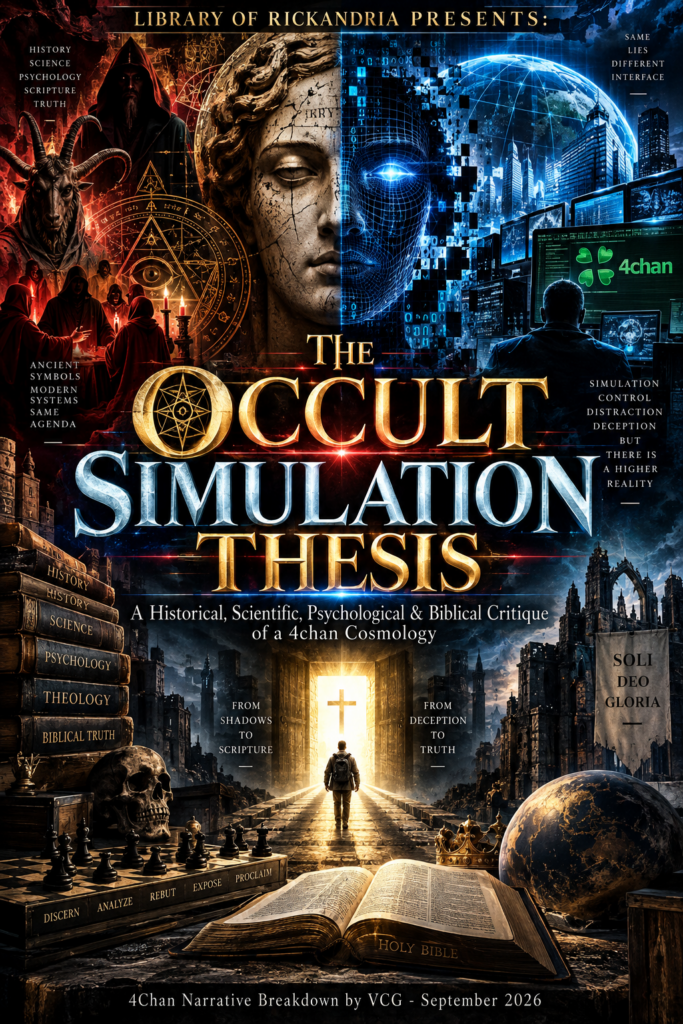
The Occult Simulation Thesis: A Historical, Scientific, Psychological & Biblical Critique of a 4chan Cosmology
UPDATED BY VCG ON 9/20/2026 @ 10:10 EST
Anyone can do this, but most won’t.
ChatGPT – Library of Rickandria
UPDATED BY VCG ON 9/20/2026 @ 10:10 EST
Anyone can do this, but most won’t.
ChatGPT – Library of Rickandria
LIBRARY OF RICKANDRIA PRESENTS
THE OCCULT SIMULATION THESIS
A Historical, Scientific, Psychological & Biblical Critique of a 4chan Cosmology
4Chan Narrative Breakdown by VCG
September 2026
Soli Deo Gloria
Abstract
Between September 16 and September 20, 2026, a thread on 4chan’s /x/ paranormal board developed from one anonymous poster’s account of an extraordinary experience into an elaborate cosmology combining:
- Christianity
- simulation theory
- quantum computing
- Freemasonry
- Hermeticism
- ceremonial magic
- Goetic demonology
- Kabbalah
- tarot
- information theory
- psychology
and computer-security terminology.
/x/ – My revelation that we live in a computer simulatio – Paranormal – 4chan
The argument is fascinating precisely because many of its ingredients are real.
Freemasonry genuinely uses architectural and geometric symbolism.
Quantum computers genuinely employ:
- qubits
- superposition
- entanglement
- measurement
- error correction
and specialized hardware topologies.
The Ars Goetia genuinely contains a catalogue of seventy-two spirits in its later manuscript tradition.
A seventy-twofold angelic tradition associated with the Shem ha-Mephorash genuinely exists.
Later ceremonial-magical systems genuinely brought these bodies of material into correspondence.
Tarot is real.
Hermetic literature is real.
The Kybalion is real.
Search Results for “Kybalion” – Library of Rickandria
The biblical texts invoked by the participants are real.
The problem is not generally that the thread invents both ends of its comparisons.
The more characteristic problem is that it takes real nodes and connects them with unauthenticated edges.
A Masonic checkerboard and a quantum-computing lattice may both exist; that does not establish that the former encodes the latter.
A ritual circle and a cybersecurity sandbox may both restrict something within a boundary; that does not make the first an ancient implementation of the second.
A Goetic catalogue may assign a spirit a number of “legions,” while digital storage is measured in terabytes; defining one legion as one terabyte does not discover a physical conversion constant.
The arithmetic that follows such a definition may be correct while the premise remains arbitrary.
This paper examines the thread claim by claim while maintaining five distinctions that are easily lost in discussions of this kind:
historical evidence is not the same thing as symbolic resemblance; scientific terminology is not the same thing as scientific demonstration; psychological analysis is not psychiatric diagnosis; later occult interpretation is not identical with an ancient source; and biblical teaching is not established merely because Christian vocabulary appears in a theory.
The conclusion is deliberately limited.
This paper does not claim to have disproved every conceivable simulation hypothesis, every metaphysical interpretation of information, or the biblical reality of the spiritual realm.
It argues something narrower and more demonstrable:
the 4chan thread does not establish its central thesis that reality is a quantum light-based simulation whose hidden architecture has been encoded in occult traditions and can be manipulated through them.
The appropriate investigative principle is remarkably close to the biblical one:
“Prove all things; hold fast that which is good.” — 1 Thessalonians 5:21, KJV
Biblical quotations in this paper follow the supplied King James Bible, Pure Cambridge Edition.
1. Why This Thread Deserves a Serious Examination
It would be easy to mock this thread.
That would also be a poor way to investigate it.
The material is:
- elaborate
- imaginative
- technically decorated
- religiously charged
and psychologically compelling.
It mixes enough genuine history and genuine scientific terminology with speculative interpretation that a reader unfamiliar with the individual subjects can easily come away with the feeling that dozens of independent disciplines are converging upon one hidden conclusion.
That feeling is itself something worth examining.
The thread began on September 16, 2026, with an anonymous poster describing what he called a revelation that reality is a computer simulation.
He simultaneously expressed doubt about his own interpretation, writing that he personally thought it had “probably” been a psychotic episode.
The reported experience involved:
- beings speaking to him, Jesus Christ being described as the true God “in our world,”
- a higher God apparently operating the simulation
- reincarnation into different worlds for advancement
- a high-definition eye-like vision
and a conviction during the experience that he was somehow a chosen figure.
That original post is important because it is much more tentative than what follows.
The OP reports an experience.
He does not demonstrate a cosmology.
Then another participant, posting under the name “Jailbreaker,” begins constructing a systematic interpretation titled:
“Simulation Theory and How Freemasonry, Hermeticism, and Alchemy Allow one to Win the Game.”
From there,
- Masonic symbols become quantum-computing architecture
- Hermetic principles become operating-system protocols
- déjà vu becomes a cache synchronization error
- synchronicity becomes a hash collision
- ghosts become memory leaks
- Goetic spirits become software daemons
- sigils become authentication tokens
- magical circles become sandboxes
- angels and demons acquire terabyte values
and Jacob’s ladder becomes a means of transferring oneself onto a higher computational substrate.
The argument also becomes increasingly certain.
By September 17, the compressed conclusion is no longer merely that the symbols can be compared to computer systems.
The thread states that:
“we’re in a simulation,”
identifies it specifically as a:
“Quantum Light-Based Simulation,”
and claims that genuine occult traditions both refer to that fact and teach people how to manipulate the simulation.
This movement—from experience, to analogy, to explanatory model, to certainty—is one of the most important things to notice in the entire thread.
2. Source Method and Evidentiary Rules
Before examining individual claims, we need a method.
This paper treats the 4chan thread as a primary source for what its participants claimed, not as an authoritative source for the truth of those claims.
The thread was retrieved directly from 4chan while still accessible on September 20, 2026.
Because imageboard threads are ephemeral, preservation by PDF capture or screenshots is advisable for any published edition of this paper.
Historical claims are checked against historical or institutional sources where possible.
Scientific claims are checked against scientific institutions and technical educational material.
Psychological observations are grounded in psychological research, but they are not used to diagnose anonymous participants.
Biblical claims are checked against the biblical text itself, using the supplied KJV edition, while later theological conclusions are identified as interpretation rather than silently presented as quotations from Scripture.
Four categories are especially important.
A possibility is something not yet ruled out.
A resemblance means two things share one or more features.
A historical connection requires evidence that one:
- person
- text
- community
or tradition actually knew about, borrowed from, transmitted, or intentionally corresponded with another.
A causal or scientific explanation requires substantially more:
a mechanism, measurable quantities where applicable, predictions, independent confirmation, and some means of distinguishing the proposed explanation from alternatives.
The thread repeatedly moves between those categories without announcing that it has done so.
“The Masonic floor resembles a grid”
is one kind of statement.
“The Masonic floor intentionally encodes quantum-computer architecture”
is a much stronger historical statement.
“The universe literally operates as the quantum machine represented by that floor”
is stronger still.
Each step needs new evidence.
Repetition of the resemblance does not supply the missing evidence.
A useful three-question test will therefore recur throughout this paper:
| Question | Why it matters |
|---|---|
| Where did this claim originate? | Establishes provenance and guards against reading modern ideas backward into older texts. |
| What evidence connects the two things? | Distinguishes resemblance from historical or causal connection. |
| What observation would show the claim to be wrong? | Tests whether the explanation risks becoming self-sealing. |
This approach also happens to resemble the Berean pattern in Acts 17.
They received what they heard seriously, but:
“searched the scriptures daily, whether those things were so.”
Investigation and receptivity are not enemies.
3. A Chronology the Thread Tends to Flatten
One of the easiest ways to become confused by esoteric correspondence systems is to encounter everything simultaneously.
A twenty-first-century chart can place:
- Genesis
- medieval Jewish traditions
- Renaissance Hermetism
- seventeenth-century ceremonial magic
- eighteenth-century Freemasonry
- nineteenth-century occult tarot
- twentieth-century New Thought
- computer science
and quantum physics in adjacent boxes.
Once they are visually adjacent, they can begin to feel historically simultaneous.
They are not.
The biblical writings belong to the ancient world.
The Greek Hermetic literature generally called the Hermetica emerged around the beginning of the Common Era, with the Corpus Hermeticum substantially associated with the second and third centuries CE.
Cambridge’s overview of Renaissance Hermetism explicitly distinguishes these Alexandrian writings and their late-antique setting.
The elaborate story identifying Lilith as Adam’s rebellious first wife does not occur in Genesis.
Scholarship examining the tradition notes that early sources concerning Lilith are comparatively sparse and that the elaborate form appears in the medieval Alphabet of Ben Sira.
Tarot appears in European evidence centuries later.
The Metropolitan Museum of Art places the earliest surviving references in the 1440s and 1450s and emphasizes that the decks were used for a trick-taking game.
Its familiar association with occult divination gained currency much later, especially in the nineteenth century.
The Lemegeton or Lesser Key of Solomon is part of an early-modern Solomonic magical tradition.
Joseph Peterson’s manuscript-based edition describes the work in substantially its surviving form as a seventeenth-century ritual-magic handbook and traces the Goetia catalogue to earlier demonological lists.
The Testament of Solomon, another text sometimes blurred together with biblical Solomon, is itself a later pseudepigraphal work.
The Encyclopedia of Ancient History describes it as a Late Roman pseudepigraphon in which Solomon encounters numerous demonic figures.
The seventy-two Goetic spirits and seventy-two Shem angels were subsequently placed into a one-to-one correspondence in a manuscript tradition associated with Thomas Rudd, though even that attribution is historically disputed.
The important point is that the pairing is a historical act of system-building:
the two lists were not originally born as a single seventy-two-positive versus seventy-two-negative computer architecture.
Then comes The Kybalion—not an Egyptian papyrus, not a classical Hermetic treatise, but a Chicago publication issued by the Yogi Publication Society in 1908 under the name “Three Initiates.”
- Digital computing
- information theory
- cybersecurity concepts
- cloud services
- APIs
- memory buffers
- NVRAM
- software daemons
and contemporary quantum computing belong to still later technological environments.
Finally, in September 2026, the thread applies that contemporary vocabulary retroactively across all of these earlier traditions.
Chronology does not by itself prove that every proposed correspondence is false.
But it changes the burden of proof dramatically.
If somebody claims that an ancient or early-modern symbol secretly describes a later technology, the historical question becomes unavoidable:
What evidence demonstrates that the older source possessed the later concept?
Without that bridge, the resemblance may tell us more about the modern interpreter than about the ancient symbol.
4. The Opening Experience: Experience Is Data, but Interpretation Is Another Step
The OP’s initial account deserves more care than either ridicule or immediate acceptance.
He reports something subjectively powerful.
He also displays uncertainty about it.
He describes:
- fear
- wonder
- beings communicating information
- religious imagery
- a sense of cosmic importance
and a desire to experience something similar again.
Several layers must be kept separate.
The first is the experience itself:
the poster reports that this happened to him.
The second is psychological classification:
what kind of experience was it?
The third is causal explanation:
what caused it?
The fourth is metaphysical interpretation:
was the content externally true?
None follows automatically from the previous one.
A dream is experienced but not therefore a literal geographical journey.
A hallucination can be vivid but does not imply that the experiencer is dishonest.
A religious experience can be transformative while its exact theological interpretation remains disputed.
A frightening or ecstatic mental event may have:
- neurological
- psychological
- pharmacological
- sleep-related
- spiritual
or other interpretations depending on the case.
NIMH defines psychosis as a collection of symptoms involving some loss of contact with reality and notes that hallucinations and delusions can occur in different conditions and from multiple causes,
including:
- mental illnesses
- sleep deprivation
- certain medications
- substance misuse
A qualified professional must assess an individual case.
Nothing in an anonymous imageboard thread allows us to diagnose the OP.
Nothing in the thread allows us to diagnose Jailbreaker either.
This point becomes relevant later when another participant uses “schizo” as an insult and Jailbreaker answers by appealing to the etymology of “schizophrenia.”
Neither move is medically meaningful.
A diagnostic category is not established or refuted by wordplay about its Greek roots.
The OP himself does something more epistemically responsible than either side of that later exchange: he admits uncertainty.
From a biblical perspective, uncertainty about a powerful experience is not faithlessness.
Scripture itself demands testing.
Galatians 1:8 goes so far as to say that even if an:
“angel from heaven”
proclaims a gospel contrary to the one already received, the supernatural appearance does not override the prior revelation.
Likewise, 1 John 4:1 says,
“believe not every spirit, but try the spirits whether they are of God.”
The biblical principle is therefore not:
extraordinary experience → divine truth.
It is:
extraordinary claim → test it.
That immediately presents problems for several parts of the OP’s experience.
The reported system of repeated reincarnation onto planets in order to “level up” conflicts with the ordinary biblical sequence summarized in Hebrews:
“And as it is appointed unto men once to die, but after this the judgment.” — Hebrews 9:27
Whatever philosophical debates may exist about consciousness, Hebrews does not describe an educational cycle of repeated planetary reincarnation.
Likewise, the idea of Jesus as merely the deity governing “our world,” while a higher ultimate God operates the larger simulation, does not naturally fit New Testament Christology.
Colossians describes creation itself—visible and invisible—as created through Christ rather than placing Christ as one local divine administrator within somebody else’s machine.
The presence of Christian imagery therefore cannot by itself establish that the experience expresses biblical Christianity.
5. Mosaic Pavement and the “Qubit Grid”
Jailbreaker’s first extended argument is important because nearly the entire later method is already present in miniature.
The thread describes the Masonic Mosaic Pavement as a checkerboard representing opposites and then claims that the shape of a quantum-computing chip can be connected to it because a quantum chip uses a literal checkerboard-like grid of qubits and control lines.
The Masonic half contains recognizable material.
Freemasonry does use operative-building imagery and geometric symbols to convey moral and philosophical lessons.
Grand Lodge educational material describes the degrees and working tools in exactly this general moral-development framework.
The quantum-computing generalization, however, is too broad.
Quantum processors do not possess one universal checkerboard architecture.
IBM, for example, explicitly retired earlier square and triangular topologies in favor of its heavy-hex architecture.
Its engineering discussion explains that topology as a design choice intended to reduce frequency collisions and spectator errors.
There are quantum error-correcting schemes whose diagrams can indeed look checkerboard-like.
IBM itself notes that surface-code layouts can look like a checkerboard.
But in the same discussion IBM explains why its own architecture moved toward heavy-hex connectivity.
That distinction matters.
The existence of some checkerboard-like quantum diagrams is not equivalent to:
quantum computing is inherently checkerboard-shaped.
And even if every quantum computer were checkerboard-shaped, the historical question would remain:
What evidence shows that Masonic floor symbolism was intended to represent quantum processors?
The thread does not provide one.
The resemblance is real enough to make a metaphor.
It is not enough to establish a hidden technological lineage.
6. Moral Duality Is Not Quantum Superposition
The argument then links the black-and-white pavement with quantum states.
This sounds plausible because both involve “two.”
But the word two is doing nearly all of the work.
A qubit may be described relative to basis states ∣0⟩|0\rangle and ∣1⟩|1\rangle, and a Hadamard operation can place a qubit into an equal superposition of those states.
IBM’s quantum-learning materials explain the mathematics explicitly.
They also stress an important point often lost in popular accounts:
the superposition itself is not merely a random classical coin flip; standard quantum gates act deterministically on quantum states, with measurement introducing probabilistic outcomes.
Good and evil, meanwhile, are moral categories.
Black and white are visual categories.
Zero and one are labels in a computational basis.
“Spin up” and “spin down” may represent physical quantum states in a particular context.
These categories can be poetically juxtaposed, but one is not experimentally shown to be the hidden physical implementation of another.
This is a recurring category error in the thread:
terms from separate explanatory domains are linked because they can be described using similar verbal oppositions.
The problem becomes even clearer when we remember that quantum-state descriptions depend on basis.
A quantum state that appears as a superposition relative to one basis can be a definite basis state relative to another representation.
Quantum mechanics therefore does not supply a universal metaphysical proof that all existence is fundamentally organized into the thread’s moral doctrine of polarity.
7. Square, Compasses, Gavel, and the Conversion of Metaphor into Engineering
The thread next translates Masonic working tools into computer functions.
Square becomes logical validation.
Compasses become a boundary mechanism.
The gavel becomes error correction.
Masonic degrees become security permissions.
Secret words and grips become passwords or cryptographic keys.
The thread’s Rough Ashlar becomes inefficient code; the Perfect Ashlar becomes optimized software.
Again, the historical symbols are real.
Ohio Masonic material describes the common gavel in terms of smoothing away personal imperfections and explicitly compares the initiate’s rough condition to an unshaped stone requiring work.
The degrees really are progressive initiatory stages called:
- Entered Apprentice
- Fellow Craft
- Master Mason
Official Masonic educational material describes them as ceremonies conveying symbolic lessons and associates them broadly with education, character development, and stages of human life.
That is what the historical source gives us.
“Algorithmic optimization”
is what the 2026 interpreter adds.
This distinction can be expressed simply:
Historical fact:
Freemasonry interprets building tools and worked stone morally.
Modern analogy:
Character refinement resembles code optimization.
Unproven claim:
The Masonic ritual secretly describes literal computational optimization of consciousness inside a simulation.
The first proposition is historically documentable.
The second is a metaphor.
The third requires evidence not supplied by either of the first two.
The same issue applies to the “password” analogy.
Initiatory societies commonly restrict information according to rank.
Computer systems commonly restrict information according to authorization.
This similarity is unsurprising because both are instances of a much larger concept:
controlled access.
- A monastery
- intelligence agency
- corporation
- military
- university
- online forum
and medieval guild can all have restricted information and levels of authority.
That does not make all of them ancient cryptographic operating systems.
8. “Light” as Knowledge and Light as Data
The thread next takes the Masonic pursuit of “Light” and converts it into literal data transfer.
To receive Masonic Light is said to mean receiving information packets that render previously hidden parts of the simulation.
This move depends on equivocation.
The same English word can carry different meanings.
“Light” can refer to electromagnetic radiation.
It can refer metaphorically to knowledge.
It can symbolize moral purity.
It can symbolize divine revelation.
It can describe visibility.
Computer networks can transmit information optically.
Those facts do not collapse the meanings into one physical identity.
Scripture itself frequently uses “light” symbolically.
If one insisted that every spiritual use of light were a disguised physics statement about photons, biblical interpretation would immediately become absurd.
A metaphor can be profoundly meaningful without being a concealed engineering manual.
9. The Point Within a Circle and the Bloch Sphere
The thread’s comparison of the Masonic point-within-a-circle symbol to a Bloch sphere offers an unusually clean fact-check.
Jailbreaker says that the Masonic point maps to the state of a qubit “inside” a Bloch sphere.
Masonic ritual explanations give a very different interpretation.
The Grand Lodge of Maine describes the point as representing the individual brother and the circle as the boundary of his duty.
Mississippi Masonic material gives substantially the same moral reading.
Now compare the quantum concept.
IBM explains that the pure states of a single qubit correspond to points on the surface of a unit sphere.
Thus even the technical analogy is imprecise as stated.
One can discuss mixed quantum states using the sphere’s interior, but the thread presents its analogy as though an ordinary pure-state Bloch representation were simply
“a point inside the sphere.”
More importantly, however, circles containing points long predate quantum mechanics and occur in many unrelated symbolic systems.
A geometric resemblance does not identify historical intention.
10. Euclid’s Forty-Seventh Proposition and the “Rendering Engine”
The thread identifies Euclid’s forty-seventh proposition—the Pythagorean theorem—with the distance-calculation machinery of a simulated universe.
The Pythagorean theorem is, of course, foundational mathematics.
It is useful in coordinate geometry.
Computer graphics use geometry.
Simulation engines use mathematics.
None of this is surprising.
The causal direction is the problem.
Modern simulations use Euclidean geometry because their designers use mathematics to represent spatial relationships.
It does not follow that ancient geometry was secretly describing digital simulation.
Otherwise every mathematical theorem later implemented in software would become retroactive evidence that its discoverers understood software.
Addition is used by spreadsheets.
That does not make ancient arithmetic a hidden spreadsheet protocol.
Trigonometry is used in video games.
That does not make Hipparchus a graphics-engine programmer.
The thread repeatedly mistakes later technological use of an old idea for evidence that the old idea was originally about the later technology.
11. Solomon’s Temple as a Quantum Mainframe
The thread then reaches one of its most ambitious reinterpretations.
King Solomon’s Temple becomes a physical mainframe.
The Holy of Holies becomes the CPU.
The sanctuary becomes RAM or working cache.
Jachin and Boaz become I/O bus lines or binary polarities.
Temple movement becomes data processing.
At this stage we can perform a particularly strong test because the Temple is not known only through Masonic symbolism.
We possess extensive biblical descriptions.
First Kings and Second Chronicles discuss:
- construction
- dimensions
- priesthood
- vessels
- sacrifice
- covenant
- dedication
- worship
- the Ark
- the LORD’s name
and Israel’s relationship with God.
The text does not describe the Holy of Holies as computational memory.
It does not identify Jachin with binary 1 and Boaz with binary 0.
It does not describe an I/O bus.
It does not describe quantum-state processing.
It does not describe a simulated universe.
One may certainly create a modern analogy:
“The Holy of Holies functions somewhat like the protected core of a system.”
But once the word like disappears, the argument changes.
The biblical Temple belongs to a covenantal and cultic narrative.
“CPU” belongs to computer architecture.
The thread has not discovered an exegetical meaning.
It has re-described one symbolic system using another symbolic system.
That may be artistically creative.
It is not historical demonstration.
12. Hermeticism and the 1908 Problem
The next major layer is Hermeticism.
The thread treats seven “Hermetic Laws”—
- Mentalism
- Correspondence
- Vibration
- Polarity
- Rhythm
- Cause and Effect
and Gender—as though they were ancient operating principles now vindicated by quantum information theory.
Here provenance becomes decisive.
Ancient and late-antique Hermetic literature is real.
As already noted, the Corpus Hermeticum is associated mainly with the second and third centuries CE.
But the famous set of seven Hermetic principles invoked in modern occult discourse comes from The Kybalion.
The University of Pennsylvania’s bibliographic record identifies The Kybalion, attributed to “Three Initiates,” as a Chicago publication of the Yogi Publication Society copyrighted in 1908.
This does not mean The Kybalion has no older intellectual influences.
It does mean we should stop describing its seven-part formula as though we had simply opened an ancient Egyptian papyrus and found quantum-computing principles waiting there.
The historical sequence matters:
late-antique Hermetic literature comes first;
many centuries of esoteric reinterpretation follow;
The Kybalion appears in 1908;
twentieth- and twenty-first-century readers subsequently interpret it using modern physics and computing.
Once that timeline is restored, the apparent miracle of:
“ancient quantum knowledge”
becomes much less mysterious.
13. Mentalism, Correspondence, Vibration, Polarity, Rhythm, Cause and Effect, Gender
The seven principles deserve individual consideration because the thread repeatedly uses them to create an impression of scientific convergence.
Mentalism is translated into information ontology:
reality is fundamentally mind or information.
That is a philosophical proposition, not a result experimentally established merely by quantum mechanics.
Serious philosophers and physicists debate the ontology of information, consciousness, and physical reality.
The existence of those debates does not establish the Kybalion as correct.
Correspondence—
“as above, so below”
—is linked to fractals, nested systems, and object-oriented programming.
Patterns genuinely recur across scales in nature and mathematics.
But recurrence does not imply that atoms are literally instances of the same software class as solar systems.
Similar structures can arise for many reasons.
Vibration is identified with quantum wavefunctions and frequency.
This is a classic quantum-mysticism move because “vibration” sounds scientific.
But a wavefunction is a mathematical object in quantum theory, and frequency has defined physical meanings.
Saying that:
- emotions
- moral states
- spiritual entities
and matter all “vibrate” does not create one measurable variable shared by all those categories.
Polarity is linked to binary computing and qubits.
But qubits are not simply metaphysical opposites.
Quantum state space allows complex superpositions, and the description depends on basis.
Rhythm becomes the universe’s refresh clock.
- Day and night
- seasons
- biological cycles
- oscillations
and periodic physical systems unquestionably exist.
Their existence does not demonstrate that reality is being refreshed like a display.
Cause and Effect becomes a karma-processing engine.
Causal relations exist.
Karma, however, is an additional religious or metaphysical doctrine.
One cannot derive the second from the first merely by renaming causality.
Gender becomes a read/write or active/passive computational polarity.
Again, this is correspondence chosen by the interpreter.
Computer read operations are not physically male and write operations are not physically female.
The general methodological error is consistent:
because a sufficiently abstract concept can be expressed in computer language, the thread treats the successful translation as evidence that the original concept was always computer language.
That conclusion does not follow.
14. Déjà Vu, Synchronicity, and Ghosts as Software Failures
At one point the thread presents what sounds like a technical diagnostic manual.
Déjà vu is described as a cache synchronization error.
Synchronicity is described as a hash collision.
Ghosts are described as persistent memory leaks.
These explanations feel satisfying because the computer phenomena are familiar and mechanistic.
But naming an analogy is not identifying a mechanism.
A genuine cache error requires an identifiable system containing:
- memory levels
- rules governing storage and retrieval
- timing behavior
- measurable failures
A genuine hash collision requires an actual hash function.
Two distinct inputs must map to the same hash output under that defined function.
A memory leak involves allocated computer memory that is not properly released.
The thread identifies no literal cache architecture underlying human memory, no cosmic hash algorithm assigning identifiers to events, and no measurable RAM allocation from which an apparition can be shown to persist.
The computer terminology therefore adds an appearance of mechanism without supplying one.
This can be tested by replacing the terminology.
“Déjà vu is a glitch.”
“Synchronicity is a collision.”
“A ghost is leftover information.”
Nothing has actually been explained until a mechanism tells us:
- how
- when
- where
and under what conditions these processes occur—and what observations should differ if the theory is false.
15. Classical Simulation, Quantum Simulation, and Free Will
The thread attempts to solve the problem of free will by sharply contrasting classical and quantum computation.
Classical simulation is presented as essentially a pre-rendered deterministic film.
Quantum simulation is presented as a branching field of all possible futures.
Human intention then supposedly collapses those possibilities into the experienced outcome.
The first contrast is already false.
Classical computers can implement stochastic simulations.
NIST’s own Monte Carlo software repeatedly samples probability distributions in order to model uncertainty.
A classical simulation need not be a pre-recorded movie.
It can generate probabilistic outcomes while running.
Second, quantum indeterminacy is not equivalent to human free will.
A random event is not automatically a freely chosen event.
If a roulette wheel were truly indeterministic, the randomness of the ball would not make the ball morally responsible for its landing place.
Third, the thread treats consciousness-induced wavefunction collapse as though it were simply what quantum mechanics teaches.
It is not.
The Stanford Encyclopedia of Philosophy’s survey of quantum approaches to consciousness describes consciousness-caused collapse as one particular historical family of interpretations associated with thinkers such as:
- London
- Bauer
- Wigner
The relationship between quantum theory and consciousness remains philosophically disputed.
Accordingly, two conclusions should not be treated as automatic consequences of quantum mechanics:

Quantum theory may challenge a strictly deterministic picture of nature, but indeterminacy by itself does not establish human freedom, nor does the measurement problem demonstrate that conscious intention directly produces large-scale physical outcomes.
Those are additional philosophical claims that require independent argument and evidence.
16. Entanglement Is Not a Mystic Communications Channel
The thread also maps Masonic bonds and spiritual connections onto quantum entanglement.
The rhetorical power is obvious.
Entangled systems display correlations that are genuinely unlike classical intuition.
To a reader encountering the idea casually, “nonlocal” can easily become
“instantaneous hidden communication.”
But that is not what quantum information theory gives us.
IBM’s explanation of quantum teleportation explicitly notes that entanglement must be combined with classical communication.
The protocol cannot be used to send controllable information faster than light.
Therefore:
human spiritual bond
≠ demonstrated qubit entanglement;
mystical communication
≠ demonstrated quantum information transmission;
symbolic connectedness
≠ laboratory nonlocal correlation.
Again the problem is not that metaphors are forbidden.
The problem begins when a metaphor is presented as physics.
17. The Goetia: Real Text, Real History, Different Conclusion
The thread’s Goetic section is perhaps its most elaborate.
There really is an Ars Goetia.
Peterson’s manuscript-based edition identifies it as the first portion of the Lemegeton tradition and transcribes a catalogue of seventy-two spirits.
He traces the catalogue through earlier demonological material and notes that Johann Weyer’s earlier list contained sixty-nine spirits even though the tradition could mention seventy-two.
This is historically interesting.
It is also important because it demonstrates that the list has a textual history.
It was not handed to historians as a fixed seventy-two-process computer registry from primordial antiquity.
The surviving Goetic system is a product of:
- copying
- adaptation
- expansion
- ritual elaboration
- editorial history
That is normal for manuscript traditions.
But it greatly weakens an argument that treats every numerical property of the final form as though it must directly reflect the architecture of reality.
18. Seventy-Two Angels and Seventy-Two Demons
The thread then treats seventy-two angelic figures and seventy-two Goetic spirits as positive and negative computational modules.
At first glance this appears extraordinary.
How could two independent systems both have seventy-two members?
Historical work gives a less dramatic answer.
A later manuscript tradition associated with Thomas Rudd explicitly paired the seventy-two Goetic spirits against the seventy-two angels associated with the Shem ha-Mephorash.
The attribution to Rudd himself is disputed, but the correspondence system is historically attested.
The critical point is that the pairing itself is part of the history.
The two systems did not independently emerge as obvious halves of a computer.
Later occult system-builders brought them together.
A modern reader who encounters the completed correspondence table without its history can mistake editorial construction for independent corroboration.
This is one of the central lessons of the entire paper:
A correspondence can be real without being primordial.
Someone really did pair the lists.
That fact does not mean the universe did.
19. “One Legion = One Terabyte”
Here we arrive at the clearest quantitative error in the thread.
Jailbreaker explicitly proposes that one legion be defined as one terabyte and then converts the traditional legion counts associated with spirits into digital storage sizes.
The thread subsequently derives enormous aggregate storage quantities and assigns computer functions to individual spirits.
The key word is define.
No measurement produces the conversion.
No manuscript states it.
No physical experiment derives it.
No storage medium is identified.
No encoding scheme is established.
No information content is measured.
No equation connects “legion” as a count of subordinated spirits with “byte” as a digital information unit.
The arithmetic after the definition may be flawless.
Suppose, purely for the sake of argument, we define
1 legion = 1 TB
Then a spirit said to command 66 legions would correspond to 66 TB only because that conversion was stipulated in advance:
66 legions = 66 TB
The arithmetic is valid, but it does not provide evidence that a “legion” is actually a unit of digital storage.
The conclusion simply restates the assumption in numerical form.
But the equation has not been discovered.
It has been imposed.
Scientific measurement requires quantities and units to have defined relations.
NIST’s SI guidance emphasizes that measured quantities have dimensions and that values are expressed as numbers attached to appropriate units.
The thread’s conversion has no dimensional or empirical bridge.
The problem becomes clearer by analogy.
One could just as easily stipulate:
1 choir = 1 GB
or
1 horse = 12 MB
None of the arithmetic validates the correspondence.
Once such a conversion is defined, any subsequent arithmetic may be perfectly correct while still telling us nothing about the real-world relationship between the two quantities.
Mathematical consistency cannot validate an arbitrary unit conversion; the conversion itself requires independent evidence.
20. False Precision: 37.3 TB per Angel
The thread then takes its manufactured aggregate Goetic storage estimate and divides it across seventy-two angels, obtaining a value around 37.3 TB per angel.
Decimals have psychological force.
“Approximately 37.3 TB”
looks measured.
But precision in the result cannot exceed justification in the premises.
If the original equation equating legions and terabytes is arbitrary, dividing its output by seventy-two produces precise arithmetic built on an unsupported ontology.
This is false precision.
A calculator can make an assumption look sophisticated without making it true.
21. Sigils as API Tokens and Circles as Sandboxes
The thread converts ceremonial-magical procedure into cybersecurity language:
sigil → API token;
magic circle → sandbox;
triangle → interface or command environment;
spirit → daemon.
Computer science gives these words specific meanings.
NIST defines an application programming interface as a system access point or library function with defined syntax and functionality.
A ritual sigil is therefore not an API merely because both can be described as granting or identifying access.
To demonstrate the stronger claim, one would need to identify:
the actual system receiving the command;
the authentication process;
the encoded token;
the protocol;
the expected response;
a repeatable means of testing authorized versus unauthorized calls.
The thread does none of this.
Likewise a cybersecurity sandbox is a controlled execution environment implemented within a computing system.
A ritual circle can be compared metaphorically to containment.
That does not prove the circle is a literal computer-security boundary.
The same reasoning applies to “daemon.”
The linguistic coincidence is especially seductive because daemon is genuinely a computing term for certain background processes, while demon is a religious/occult term.
But sharing an etymologically related word does not identify the entities.
A Unix daemon is software written by programmers.
The Ars Goetia is a ritual-magical text transmitted through a historical manuscript tradition.
The resemblance of the words cannot carry the ontological burden placed upon it.
22. Tarot and the Arithmetic of Selection
The thread next connects seventy-two angels to tarot.
It identifies thirty-six numbered Minor Arcana cards and assigns two angels to each:
36×2=72.36 \times 2 = 72.
The multiplication is correct.
The selection is doing the work.
A standard tarot deck’s Minor Arcana contains fifty-six cards.
The Metropolitan Museum describes four suits, each containing cards from ace through ten plus four court cards.
The thread’s own explanation says thirty-six pip cards plus sixteen court cards constitute the fifty-six-card Minor Arcana.
But:
36+16=52.36+16=52.
The missing four are the aces.
Once the four aces are excluded and the sixteen court cards are also set aside, exactly thirty-six numbered cards from two through ten remain.
Then two angels per card yields seventy-two.
This is not necessarily a mathematical mistake in the final multiplication.
It is a selection problem.
The system is designed around a chosen subset that produces the desired target number.
Historical chronology matters here too.
Tarot’s earliest documentation belongs to fifteenth-century European card games, while its familiar occult and divinatory role gained currency much later.
Thus an angelic-tarot correspondence may be part of later esoteric system-building without being evidence that the original tarot designers encoded a cosmic computer architecture.
23. The Holy Guardian Angel as Cloud Backup
The thread describes the Holy Guardian Angel in computing terms: a higher or persistent version of the self stored outside ordinary local embodiment, analogous to a cloud backup.
Abramelin-style practice then becomes a synchronization or kernel-upgrade procedure.
Whatever one concludes about the history or metaphysics of ceremonial-magic HGA traditions, this description is not biblical angelology.
Biblical angels are depicted as created spiritual beings and servants of God.
They are not described as remote backups of the practitioner.
Nor does the New Testament direct Christians to achieve union with a personal higher-self angel in order to obtain privileged system access.
First Timothy instead says:
“For there is one God, and one mediator between God and men, the man Christ Jesus.” — 1 Timothy 2:5
That does not answer every historical question about ceremonial magic.
It does establish that a Christian theology of mediation cannot simply substitute an occult higher-self synchronization system for Christ and call the result biblical.
24. Lilith: Later Lore Read Backward into Genesis
The thread also invokes Lilith as Adam’s first equal partner and converts her into a rogue kernel or anti-system intelligence.
The important phrase is later lore.
The elaborate first-wife narrative is not found in Genesis.
Academic discussion of the Lilith tradition notes that ancient references are comparatively sparse and that the elaborate story appears in the medieval Alphabet of Ben Sira.
A later Jewish legendary tradition is historically worth studying.
But it should not be silently moved backward into the canonical Genesis narrative.
This is precisely the kind of historical layering the thread repeatedly collapses.
- Biblical text
- rabbinic development
- medieval folklore
- modern occult interpretation
and twenty-first-century computer metaphor are different stages.
They should remain visible as different stages.
25. Qliphoth as “Dark Web”
A similar move occurs when Qliphothic imagery is translated into corrupted files, malware, shadow networks, and a cosmic dark web.
The concept of Klipoth/Qliphoth does have a genuine place in later Jewish mystical traditions.
A scholarly discussion in Brill describes the Klipoth, or “shells,” as a Kabbalistic concept used in Hasidic thought in relation to evil and impurity.
But “shell of impurity” and “computer malware” are not historically identical merely because both can be described negatively.
Again:
historical concept → real;
modern technological analogy → possible;
literal computer architecture → unestablished.
26. Biblical Solomon and Magical Solomon Are Not One Source
The thread repeatedly speaks about “Solomon’s magic” as though biblical narratives, later pseudepigrapha, and early-modern grimoires were a single continuous document.
They are not.
The Testament of Solomon is a late antique pseudepigraphal work involving Solomon and demons.
The Lemegeton in substantially surviving form belongs to a much later early-modern manuscript environment.
First Kings and Second Chronicles are different texts again.
Attaching Solomon’s name to a later magical work does not place that work inside the biblical canon.
This matters when the thread turns stories about Solomon commanding spirits or controlling demons into evidence of biblical “root administrator” privileges.
The move relies upon a blurred category:
Solomonic literature becomes something Solomon historically wrote, which becomes biblical teaching, which becomes ancient computer science.
Every arrow in that chain requires independent evidence.
27. The Demon Eating Gemstones and the “FORCE KILL” Command
The thread interprets a story of a demonic figure consuming gemstones in computer terms.
Gemstones become precompiled assets.
Solomon’s vault becomes an encrypted root directory.
The demon becomes a malicious resource-draining process.
The Seal of Solomon becomes a cryptographic security mechanism.
Solomon’s command becomes a “FORCE KILL” operation.
This is one of the thread’s most vivid passages.
It is also one of the clearest demonstrations of its method.
Nothing prevents us from retelling The Odyssey in computer terminology.
The Sirens could become malicious notification processes.
The Trojan Horse could become malware.
Odysseus could become a privileged user.
The Labyrinth could become an obfuscated file system.
Such retellings may even illuminate themes.
But a clever retelling is not evidence that Homer understood cybersecurity.
The thread’s Solomonic reinterpretation has exactly the same problem.
28. The Most Concerning Practical Turn: “Safe” Goetic Queries
The thread eventually moves beyond interpretation.
It discusses how a practitioner might avoid downloading an entire Goetic entity and instead make limited “SQL-style” queries through ritual procedures, treating the spirit as a cloud database.
It even frames this as a safer method of interacting with the proposed backend.
At this point the biblical correction becomes especially direct.
The Bible does not teach Christians to discover the safest protocol for consulting occult spirits.
Deuteronomy 18 forbids:
- divination
- enchantment
- consultation with familiar spirits
- wizardry
- necromancy
Acts 16 is particularly instructive because the spirit of divination initially says something favorable about Paul and his companions.
Paul does not turn the spirit into an information source.
He commands it to leave.
Acts 19 gives another pattern.
Converts associated with “curious arts” do not refine their magical procedures into Christian techniques.
They bring their books and burn them.
First Corinthians 10 explicitly warns against spiritual fellowship connected with devils.
A Christian response to Goetic practice therefore does not require first proving that every purported spirit encounter is authentic.
The biblical boundary concerns the practice itself.
The thread’s proposed synthesis—Christianity plus controlled occult backend access—is difficult to reconcile with that boundary.
29. Scripture Does Not Require Materialism
A necessary clarification follows.
Rejecting the thread’s computer model does not require reducing Scripture to materialism.
The Bible contains angels.
It contains demons.
It contains visions.
It contains divine revelation.
It contains miracles.
It contains spiritual warfare.
It contains prophecy.
It contains resurrection.
A critic does not have to say,
“Spiritual reality is impossible,”
in order to say,
“This terabyte-demon calculation is unsupported.”
That false dilemma should be resisted.
One can take biblical supernatural claims seriously while still asking whether a twentieth- or twenty-first-century technological metaphor has been illegitimately projected into them.
Indeed, Scripture itself demands discernment precisely because spiritual claims are not automatically trustworthy.
30. Jacob’s Ladder and the Final “Higher Substrate” Claim
Near the end of the thread, the computer metaphor is applied directly to Genesis.
Jailbreaker tells another participant that it is possible to transfer oneself informationally into “higher” substrates and ultimately leave the simulation architecture, then invokes Jacob’s Ladder.
Genesis 28 actually tells us what Jacob sees.
He dreams of a ladder set upon the earth whose top reaches heaven.
Angels of God ascend and descend upon it.
The LORD identifies himself as the God of Abraham and Isaac, reiterates covenant promises concerning the land and Jacob’s seed, promises his presence, and assures Jacob that he will be brought back.
The text never says Jacob climbs the ladder.
It never says Jacob uploads himself.
It never calls consciousness information.
It never describes higher computational substrates.
It never offers the ladder as an esoteric technique for escaping the universe.
The New Testament reuse of the image makes the thread’s reading still more difficult.
Jesus tells Nathanael:
“Hereafter ye shall see heaven open, and the angels of God ascending and descending upon the Son of man.” — John 1:51
Within the canonical trajectory, the imagery becomes Christological.
Christ—not an occult upload procedure—is placed at the center of heaven-earth mediation.
The thread’s interpretation therefore does not merely add technical detail absent from Genesis.
It redirects the symbol toward self-transcendence through hidden architecture where the New Testament directs it toward the Son of man.
31. Simulation Philosophy Is Not the Same as the Thread’s Simulation Cosmology
There is a serious philosophical literature concerning simulated realities.
The thread can therefore gain rhetorical credibility simply by standing near it.
But Nick Bostrom’s simulation argument is much narrower than the 4chan thesis.
Bostrom’s argument presents a trilemma concerning the future of civilization, ancestor simulations, and the possibility that observers like us inhabit a simulation.
His own FAQ explicitly emphasizes that the argument does not tell us which of its three alternatives is true and that someone can accept the simulation argument while rejecting the hypothesis that we currently live in a simulation.
He also cautions against overconfidence.
Nothing in Bostrom’s argument independently establishes:
Freemasonry as quantum code;
Goetic spirits as daemons;
sigils as authentication tokens;
tarot as user interface;
the Kybalion as operating-system documentation;
angels as storage clusters;
or Jacob’s ladder as substrate migration.
Those require separate arguments.
The existence of respectable simulation philosophy cannot be used as borrowed evidence for claims it does not make.
32. Real Node, Invented Edge
At this point a recurring structure should be visible.
The thread is strongest at identifying nodes.
Freemasonry is real.
The Mosaic Pavement is real.
Quantum computing is real.
Qubits are real.
The Bloch sphere is real.
Hermetic literature is real.
The Kybalion is real.
The Goetia is real.
The Shem tradition is real.
Tarot is real.
Kabbalistic concepts are real.
Solomonic magical literature is real.
The Bible is real.
- Computer APIs
- sandboxes
- daemons
- caches
- hash functions
and storage units are real.
What the thread has difficulty establishing are the edges:
Mosaic Pavement → quantum substrate;
Masonic Light → literal data packets;
Point within Circle → qubit state;
Temple → CPU;
Kybalion → quantum operating system;
Goetic legion → terabyte;
sigil → executable authentication token;
demon → literal software daemon;
angel → 37.3 TB storage process;
tarot → cosmic user interface;
Jacob’s ladder → consciousness upload path.
The fact that both endpoints are real can make the edge feel real.
It is not enough.
The edge must be demonstrated independently.
This is arguably the central methodological lesson of the entire investigation:
Verify the edges, not merely the nodes.
33. Why So Many Correspondences Can Feel Like Proof
We now reach the psychological dimension.
This section needs restraint.
Psychological mechanisms describe tendencies found across ordinary human cognition.
They do not allow us to diagnose a stranger from his internet posts.
Humans are pattern-detecting creatures.
That ability is indispensable.
Science depends on recognizing regularities.
Language depends on patterns.
- Faces
- threats
- causes
- social intentions
- mathematical relationships
and environmental structure all require pattern detection.
But a useful cognitive capacity can sometimes produce false positives.
Research by van Prooijen, Douglas, and De Inocencio found relationships between illusory pattern perception and conspiracy or supernatural beliefs across multiple studies, including judgments involving random sequences and world events.
Whitson and Galinsky likewise reported experimental evidence that diminished feelings of control could increase illusory pattern perception under some conditions.
Raymond Nickerson’s classic review defines confirmation bias as the tendency to seek or interpret evidence in ways partial to existing beliefs, expectations, or hypotheses.
These findings do not mean:
“People interested in occultism are mentally ill.”
They do not mean:
“Every perceived correspondence is false.”
They mean something much more useful:
humans need methods for distinguishing discovered patterns from imposed patterns.
34. The Correspondence Cascade
The thread creates an unusually fertile environment for what we might call a correspondence cascade.
Consider the accumulation:
checkerboard → qubits;
black/white → binary;
square → logic;
compasses → boundary;
gavel → error correction;
degrees → permissions;
words → passwords;
Light → data;
circle → Bloch sphere;
Temple → server;
Holy of Holies → CPU;
pillars → I/O;
spirits → daemons;
sigils → tokens;
ritual circle → sandbox;
déjà vu → cache;
synchronicity → hash collision;
ghost → memory leak;
heaven → cloud;
soul → persistent storage;
ascension → substrate migration.
Any single comparison may initially appear modest.
But fifty comparisons placed beside one another generate a powerful impression:
Surely, they cannot all be coincidences.
The difficulty is that they are not statistically independent observations.
They are produced by the same flexible mapping rule:
“Translate an older symbol into contemporary computer terminology using whichever similarity is available.”
Once that rule is allowed, generating correspondences is easy.
A church door becomes an authentication gateway.
Baptism becomes a system initialization.
A library becomes cold storage.
A confession becomes a log file.
A crown becomes administrator privilege.
A trumpet becomes a broadcast protocol.
A shepherd becomes a process manager.
A seal becomes encryption.
The ease with which new mappings can be generated is evidence of the flexibility of the analogy, not necessarily the truth of the ontology.
35. Technical Language and the Illusion of Added Evidence
The thread’s language also grows increasingly technical.
“Coincidence” becomes “hash collision.”
“Spirit” becomes “daemon.”
“Boundary” becomes “sandbox.”
“Sign” becomes “API access token.”
“Memory” becomes “NVRAM.”
“Influence” becomes “code execution.”
This shift makes the explanation sound more precise.
But terminology is not measurement.
Compare:
“Something causes déjà vu.”
with:
“A cache synchronization error causes déjà vu.”
The second sentence sounds like it tells us more.
But unless the cache is identified and measured, it has merely supplied a metaphor with technical nouns.
This rhetorical effect is especially strong when exact numbers appear.
“37.3 TB per angel”
feels far more scientific than:
“angels contain much information.”
Yet as we have seen, the decimal comes from arithmetic performed after an arbitrary conversion.
This is why scientific writing cares not merely about precision but about validity.
A precisely calculated answer to an unjustified equation remains unjustified.
36. Self-Sealing Explanations
Another methodological problem appears when a worldview becomes able to explain every possible observation.
If one has déjà vu, the simulation’s cache malfunctioned.
If one does not, the cache worked correctly.
If a coincidence appears meaningful, a hash collision occurred.
If no coincidence appears, the database operated normally.
If a ghost appears, there is a memory leak.
If no ghost appears, the memory was cleared.
If an occult ritual “works,” access was successful.
If it fails, the operator lacked permissions, used the wrong key, encountered interference, misunderstood the result, or was protected from the result.
A theory with enough flexibility can absorb both an observation and its opposite.
That makes it difficult to falsify.
A scientific explanation becomes powerful when it risks being wrong:
it tells us what we should observe if the theory is correct and what should fail to occur if it is not.
The thread generally does not specify such conditions.
It retrofits outcomes.
37. The Thread’s Own Psychological Warning Sign
One exchange deserves special notice, not because it proves anything clinically, but because it shows how these ideas can affect interpretation.
A participant tells Jailbreaker that the material has made him:
“suspicious of everyone around me.”
Jailbreaker replies that the information was revealed to him in a dream.
We cannot know whether the first statement was serious, exaggerated, playful, or temporary.
We should not diagnose it.
But it illustrates a pastoral and epistemic concern.
A worldview built around:
- hidden actors
- secret access levels
- invisible scripts
- concealed manipulation
- supernatural modules
and clues embedded throughout ordinary reality can encourage a reader to reinterpret ambiguous events as intentional signals.
That is exactly where responsible inquiry requires stronger evidentiary thresholds, not weaker ones.
If engagement with such material begins producing persistent fear, inability to sleep, perceived messages directed personally through ordinary media, severe suspiciousness, or difficulty distinguishing private interpretations from publicly testable events, professional mental-health assessment can be appropriate.
NIMH emphasizes that psychotic symptoms can have numerous causes and should be evaluated by qualified professionals rather than internet strangers.
Seeking such evaluation does not decide theological questions.
It is simply prudent care.
38. The “You Need PhDs” Defense
When challenged about the length and complexity of the presentation, Jailbreaker says that fuller explanation would require advanced expertise across fields including:
- computer science
- religious studies
- occultism
- biology
The thread also claims that continued scientific advancement will eventually bring the investigator back to the truth revealed there.
Expertise absolutely matters.
But expertise increases evidentiary responsibility.
A computer scientist can ask what an API actually is.
A physicist can ask which quantum interpretation is being assumed.
A historian can ask when a correspondence first appears.
A textual scholar can ask which manuscript contains it.
A biblical scholar can distinguish canonical Solomon from later Solomonic pseudepigrapha.
A psychologist can distinguish cognitive bias research from casual diagnosis.
The invocation of interdisciplinary complexity cannot substitute for answering those questions.
Indeed, once the disciplines are separated carefully, much of the apparent convergence disappears.
39. The LLM Question
A participant near the end asks Jailbreaker what he can explain without copying material from an LLM tab.
The style of the long posts is certainly compatible with AI-assisted writing:
- repeated parallel structure
- comprehensive taxonomies
- uniform “X maps to Y” formulations
- confident synthesis across unrelated specialties
and large quantities of technically flavored prose.
But stylistic compatibility is not proof.
Jailbreaker says the material had been copied from a Microsoft Word document when explaining formatting problems.
Without metadata, generation logs, an admission, or other provenance evidence, the responsible conclusion is simply:
LLM involvement is possible but unverified.
That small example reinforces the broader method of the paper.
Plausibility is not proof.
40. A Biblical Theology of Discernment
Having completed the historical and technical analysis, we can now ask the specifically biblical question.
The thread contains a strange mixture.
Some elements sound Christian.
Jesus is called Lord.
God is invoked.
Biblical symbols appear.
Angels and demons are discussed.
Solomon is central.
Jacob’s ladder is quoted.
But biblical vocabulary does not make a framework biblical.
Scripture gives several tests that are directly relevant.
First, revelation is tested rather than accepted because it feels supernatural.
Galatians 1 makes the content of the gospel authoritative even over an apparent angelic messenger.
Second, spiritual claims are tested.
“Beloved, believe not every spirit, but try the spirits whether they are of God.” — 1 John 4:1
Third, occult consultation is forbidden.
Deuteronomy 18 explicitly names:
- divination
- enchantment
- familiar spirits
- wizardry
- necromancy
Fourth, apparently useful spiritual information is not automatically welcomed.
The divining spirit in Acts 16 speaks favorably about Paul, but Paul does not exploit it for intelligence.
He casts it out.
Fifth, conversion turns people away from magical practices.
Acts 19 describes those who practiced curious arts bringing their books and burning them.
Sixth, Paul warns against spiritual fellowship with devils rather than teaching believers techniques for safe interaction.
Seventh, Christian mediation is centered in Christ.
“For there is one God, and one mediator between God and men, the man Christ Jesus.”
These passages form a coherent pattern.
The New Testament acknowledges spiritual realities while rejecting magical mastery as the Christian path.
41. The Biblical Difference Between Revelation and Esotericism
The thread’s underlying spiritual logic is repeatedly:
hidden information exists;
ordinary people lack access;
initiates obtain higher permissions;
secret names or symbols unlock deeper layers;
spirits can provide specialized knowledge;
the practitioner increases capacity;
higher levels of reality become accessible;
the knowledgeable operator eventually transcends ordinary limitations.
That is structurally close to an esoteric ascent system.
The New Testament’s center of gravity is different.
Its decisive message is publicly proclaimed.
Christ dies and rises.
Salvation is given by grace.
The apostles preach openly.
The believer does not become reconciled to God by acquiring the universe’s root password.
He is reconciled through Christ.
This does not mean Christianity contains no mysteries.
It means the gospel does not present salvation as a privileged exploit discovered by reverse-engineering reality.
42. Resurrection Is Not Reincarnation and Not a Data Restore
The thread repeatedly makes computer backup metaphors attractive.
Death becomes shutdown.
The soul becomes persistent storage.
Resurrection becomes system restoration.
Reincarnation becomes loading the user onto another world.
These comparisons can be imaginative, but they should not be allowed to redefine the biblical doctrine.
Hebrews 9:27 places death before judgment, not before repeated terrestrial or planetary incarnations.
First Corinthians 15 presents resurrection as God raising and transforming the dead, not simply spinning up another interchangeable avatar from a saved file.
The distinction is theological, not technological.
A computer metaphor may illustrate continuity.
It cannot determine what Scripture means.
43. Creator Is Not Merely “Lead Programmer”
The thread repeatedly calls the Great Architect or God the “Lead Programmer.”
As metaphor, this captures one genuine intuition:
creation depends upon an intelligent source rather than being self-existent.
But the analogy becomes misleading if pushed too far.
A programmer normally exists within a larger reality.
The programmer depends on:
- logic
- a substrate
- hardware
- energy
- mathematics
- time
and some environment in which programming occurs.
The biblical Creator is not merely an unusually powerful technician inside a larger ontology.
Paul’s speech at Athens describes God as the maker of the world and Lord of heaven and earth, the giver of life and breath, the one “in” whom creatures live, move, and have their being.
Colossians likewise places visible and invisible creation under Christ’s creative agency.
“Programmer” can therefore function as an illustration.
It cannot function as a complete doctrine of God.
44. The Steelman: What Would Make the Thesis Strong?
A good critique should not merely seek weak versions of its opponent’s argument.
So let us imagine what genuinely strong evidence for the thread’s thesis could look like.
Suppose an authenticated ancient manuscript contained an unambiguous description of a technology unavailable to its period—not merely:
- generic circles
- binaries
- lights
- hierarchies
but mathematically precise architecture later independently rediscovered.
Suppose a ritual system repeatedly produced objectively measurable physical effects under controlled conditions and those effects disappeared when defined components of the ritual were removed.
Suppose a supposed sigil encoded a reproducible information structure whose mathematical properties could be identified without first knowing the modern system to which it was being compared.
Suppose an old occult text predicted a novel quantum phenomenon with numerical precision centuries before experimental physics discovered it.
Suppose a Goetic “storage” theory provided a measurable information quantity in bits, along with an encoding mechanism, and independent laboratories reproduced the measurement.
Suppose the simulation theory predicted a phenomenon that competing physical theories did not predict, and observation subsequently confirmed it.
That would deserve serious attention.
Notice what makes these examples strong.
They move beyond resemblance.
They produce independent, risky, externally testable evidence.
The 4chan thread does not provide evidence of that kind.
Its strength lies almost entirely in retrospective correspondence.
45. Alternative Explanations Require Fewer Assumptions
Why, then, do so many symbols seem transferable into computer language?
Several ordinary explanations are available.
Human beings repeatedly encounter:
- boundaries
- hierarchies
- memory
- communication
- transformation
- secrecy
- order
- disorder
- opposites
- light
- darkness
- networks
- centers
- circles
- paths
Those patterns appear in religion because they appear in human life.
They appear in computing because computers are made by human beings to manage information and action.
They appear in institutions because institutions organize people and access.
They appear in myths because myths use basic human experiences symbolically.
They appear in mathematics because geometry and quantity are general.
It is therefore not surprising that analogies can be made between them.
We do not need a hidden primordial computer science to explain why a ritual boundary resembles a software boundary.
Both were created by minds familiar with the general concept of inside versus outside.
This alternative has the advantage of requiring fewer undocumented historical connections.
46. What the Thread Gets Right
A fair paper should also identify where the thread notices something genuine.
Mathematics really is extraordinarily powerful in describing physical reality.
Information genuinely occupies an important place in contemporary physics and philosophy.
Quantum mechanics genuinely challenges classical intuition.
Quantum computation genuinely uses superposition and entanglement.
Freemasonry genuinely employs architecture and geometry symbolically.
Western occult traditions genuinely built intricate correspondence systems.
The Goetia genuinely contains a catalogue of spirits.
The Shem tradition genuinely developed a seventy-twofold structure.
Later ceremonial magicians genuinely paired different esoteric systems.
Tarot genuinely became an occult symbolic language in later European esotericism.
Human beings genuinely report extraordinary:
- religious
- mystical
- anomalous
and paranormal experiences.
Simulation arguments genuinely exist in philosophy.
Questions concerning consciousness and physical reality genuinely remain difficult.
None of those concessions establishes the thread’s final synthesis.
But acknowledging them matters because the best rebuttal is not:
“Everything you mentioned is fake.”
It is:
“Many of the ingredients are real; the claimed connections require separate evidence.”
47. A Compact Claim Audit
| Thread claim | What survives fact-checking | What does not follow |
|---|---|---|
| Masonic pavement resembles a quantum grid | Masonic checkerboard symbolism and grid-like quantum layouts both exist | That Masonry encoded quantum hardware |
| Duality corresponds to qubits | Qubits use two-dimensional state spaces | Moral polarity is not thereby quantum physics |
| Degrees are security clearances | Masonic degrees are progressive initiations | No evidence they change permissions in physical reality |
| Rough Ashlar is unoptimized code | Ashlar symbolism concerns personal refinement | “Algorithm” is modern analogy |
| Masonic Light is data | Light symbolizes knowledge in many traditions | No evidence of literal simulation packets |
| Point within circle is Bloch sphere | Both are geometric representations involving circles/spheres | Historical meanings differ; pure qubit states lie on Bloch-sphere surface |
| Euclid encodes rendering | Pythagorean geometry is used in computation | Later use does not establish ancient simulation knowledge |
| Temple is mainframe | Temple has ordered architecture and symbolic significance | CPU/RAM/I/O mapping is imposed |
| Kybalion is ancient quantum law | It presents seven principles called Hermetic | Kybalion is a 1908 publication, not the ancient Hermetic corpus |
| Déjà vu is cache error | Déjà vu exists; computer caches exist | No cosmic cache mechanism is identified |
| Synchronicity is hash collision | Meaningful coincidences are reported; hash collisions exist | No universal hash function is demonstrated |
| Ghosts are memory leaks | Apparition claims and memory leaks both exist as categories | No shared mechanism is demonstrated |
| Quantum mechanics proves free will | Quantum measurements can have probabilistic outcomes | Randomness is not equivalent to free agency |
| Consciousness collapses reality | Some interpretations historically assign consciousness a role | It is not settled quantum physics |
| Seventy-two demons and angels are two processing clusters | Both seventy-twofold lists exist in later esoteric history | Later historical pairing is not cosmic architecture |
| One legion = one TB | Arithmetic works after defining the conversion | The conversion itself is arbitrary |
| 37.3 TB per angel | Division is mathematically straightforward | Decimal precision does not create empirical measurement |
| Sigil = API token | Both can function symbolically as identifiers/access metaphors | No literal computational protocol is shown |
| Circle = sandbox | Both involve conceptual containment | Metaphorical similarity is not identity |
| HGA = cloud backup | HGA concepts exist in ceremonial magic | Not biblical angelology or demonstrated information storage |
| Lilith was Adam’s first wife | Medieval first-wife tradition exists | Genesis does not contain that story |
| Qliphoth = dark web | Qliphothic concepts exist in Kabbalistic traditions | Cybersecurity mapping is modern reinterpretation |
| Solomon was a root administrator | Later magical texts attach spirit-commanding stories to Solomon | Later pseudepigrapha are not identical to canonical Solomon |
| Jacob’s ladder is substrate escape | Genesis contains ladder imagery | The text does not teach consciousness uploading; John 1 centers the imagery on Christ |
48. Limitations of This Paper
A careful conclusion should not claim more than the evidence permits.
This paper cannot determine precisely what psychological event the original poster experienced.
It cannot determine whether every participant was sincere.
It cannot establish whether Jailbreaker used an LLM.
It cannot prove that no advanced civilization could ever simulate conscious beings.
It cannot solve every interpretation problem in quantum mechanics.
It cannot settle the philosophy of consciousness.
It cannot experimentally adjudicate every paranormal report.
It does not attempt to demonstrate that every occult historical tradition is internally identical.
It does not establish a psychiatric diagnosis for anyone in the thread.
It does not argue that because a particular occult-computational correspondence is unsupported, the entire supernatural worldview of Scripture must therefore be false.
Its conclusion is narrower and consequently stronger:
the evidence presented in the thread does not establish the specific architecture the thread claims to have discovered.
49. Final Assessment
The 4chan thread is best understood not as a successful reverse-engineering of reality but as an extraordinary exercise in cross-domain analogical synthesis.
It begins with an intense reported experience.
It then gathers historically real symbols.
It imports authentic scientific terminology.
It borrows modern computer-security language.
It incorporates later occult correspondence systems.
It overlays biblical imagery.
It converts similarities into identities.
It converts identities into mechanisms.
It converts mechanisms into numerical quantities.
Finally, it treats the resulting synthesis as scientific confirmation.
The evidentiary chain does not support those transitions.
The checkerboard does not establish the quantum substrate.
The compass does not establish a simulation boundary.
The gavel does not establish quantum error correction.
The Temple does not establish a CPU.
The Kybalion does not establish ancient quantum theory.
The Goetia does not establish software daemons.
A legion does not become a terabyte because someone assigns the unit.
A ritual circle does not become a literal cybersecurity sandbox.
An angel does not become 37.3 TB because the arithmetic balances.
The later Lilith tradition does not become Genesis.
A pseudepigraphal Solomon does not become the canonical Solomon.
Jacob’s ladder does not become a consciousness-upload mechanism because a modern interpreter knows computer terminology.
What we repeatedly encounter are real nodes joined by invented or insufficiently demonstrated edges.
And yet the biblical correction should not stop at debunking.
The thread’s deepest theological tension is its conception of spiritual advancement.
Its system moves toward:
- hidden knowledge
- privileged access
- secret correspondences
- root commands
- magical querying
- system exploitation
- self-optimization
and ascension through higher substrates.
The New Testament moves in a different direction.
It places the center not in hidden system architecture but in Christ.
It warns that even impressive spiritual manifestations must be tested.
It forbids occult consultation rather than teaching safer techniques for it.
It portrays converts abandoning magical arts.
It calls believers to truth, faith, holiness, prayer, discernment, and the Word of God.
It presents resurrection rather than reincarnational leveling.
It presents Christ rather than an HGA as mediator.
And when Jacob’s ladder imagery returns in the New Testament, the angels ascend and descend upon the Son of man.
The proper answer to an overwhelming pattern is therefore neither immediate acceptance nor reflexive contempt.
It is examination.
The thread should be read.
Its sources should be traced.
Its mathematics should be recalculated.
Its historical layers should be separated.
Its scientific terms should be restored to their technical meanings.
Its psychological effects should be handled without ridicule or amateur diagnosis.
Its occult claims should be distinguished from the biblical canon.
And its biblical interpretations should be checked against the text.
The King James Bible states the principle with exceptional economy:
“Prove all things; hold fast that which is good.” — 1 Thessalonians 5:21
And Proverbs gives the corresponding warning:
“The simple believeth every word:
but the prudent man looketh well to his going.” — Proverbs 14:15
Those verses do not command gullibility.
Neither do they command fear of investigation.
They commend discernment.
That is the method this thread ultimately requires.
Selected Sources and Bibliographic Notes
Primary thread.
“My revelation that we live in a computer simulatio[n],” 4chan /x/ Paranormal, thread no. 42969518, begun September 16, 2026 and retrieved September 20, 2026. The opening post contains the reported experience and the author’s own uncertainty about its nature; subsequent Jailbreaker posts construct the occult-computational model examined throughout this paper.
Biblical text.
The Holy Bible, King James Version, Pure Cambridge Edition, supplied research copy. Scripture citations throughout this paper use this edition.
Quantum computing.
IBM Quantum, “The IBM Quantum Heavy Hex Lattice,” explaining IBM’s move away from square and triangular topologies toward heavy-hex architecture. IBM Quantum Learning, “Bloch Sphere,” explaining the geometrical representation of pure single-qubit states. IBM Quantum Learning, “Superposition with Qiskit,” explaining superposition, quantum gates, measurement, and Bloch-vector representation. IBM Quantum Learning, “Quantum Teleportation,” explaining the need for classical communication and why entanglement does not enable faster-than-light information transfer.
Quantum consciousness.
Stanford Encyclopedia of Philosophy, “Quantum Approaches to Consciousness,” substantive revision May 13, 2024. The entry surveys distinct quantum-consciousness proposals and the historical consciousness-collapse ideas associated with London, Bauer, Wigner, and others rather than treating them as the single settled interpretation of quantum mechanics.
Classical probabilistic simulation.
National Institute of Standards and Technology, “Monte Carlo Tool,” documenting ordinary classical simulation through repeated probabilistic sampling.
Scientific quantities and units.
National Institute of Standards and Technology, The International System of Units (SI) and NIST Guide to the SI, especially discussions of quantities, dimensions, numerical values, and units.
Computer-science terminology.
National Institute of Standards and Technology Computer Security Resource Center glossary entry for Application Programming Interface, defining an API as an access point or library function with defined syntax and functionality.
Simulation philosophy.
Nick Bostrom, “The Simulation Argument FAQ,” version 2.0, explaining the simulation argument’s three-way structure and explicitly noting that accepting the argument does not require accepting the simulation hypothesis.
Hermeticism.
The Cambridge Handbook of Western Mysticism and Esotericism, chapter on Renaissance Hermetism, for the late-antique context of the Greek Hermetica and Corpus Hermeticum.
The Kybalion.
University of Pennsylvania Online Books Page bibliographic entry for The Kybalion: A Study of the Hermetic Philosophy of Ancient Egypt and Greece, attributed to “Three Initiates,” Chicago: Yogi Publication Society, 1908.
Tarot.
Metropolitan Museum of Art, “Exhibition Galleries” and “Before Fortune-Telling: The History and Structure of Tarot Cards,” documenting the fifteenth-century European history of tarot, the fifty-six-card suit structure, and the much later rise of its occult/fortune-telling associations.
Freemasonry.
Grand Lodge of Ohio educational materials concerning degrees, operative symbols, working tools, moral development, and the common gavel. Grand Lodge of Maine and Grand Lodge of Mississippi materials concerning the traditional moral interpretation of the point within a circle.
Goetic textual history.
Joseph H. Peterson, ed., Lemegeton, Part I: Goetia, manuscript-based electronic edition, including discussion of the seventy-two-spirit catalogue and its relationship to earlier demonological lists.
Goetia/Shem correspondence.
Historical summary of the manuscript tradition associated with Thomas Rudd, in which the seventy-two Goetic spirits are paired position-for-position with seventy-two Shem angels; attribution of the compilation to Rudd remains disputed.
Testament of Solomon.
Todd Klutz, “Testament of Solomon,” The Encyclopedia of Ancient History, identifying the work as a Late Roman pseudepigraphon integrating Solomon with numerous demonic figures.
Lilith.
Scholarly discussion of early Lilith traditions and the Alphabet of Ben Sira, noting that the elaborate Adam/Lilith first-wife story occurs in the medieval text rather than the Genesis narrative.
Qliphoth/Klipoth.
Scholarly discussion published by Brill describing the Kabbalistic concept of the Klipoth or “shells” and their association with evil and impurity in later Jewish mystical thought.
Psychology of pattern perception.
Jan-Willem van Prooijen, Karen Douglas, and Clara De Inocencio, “Connecting the Dots: Illusory Pattern Perception Predicts Belief in Conspiracies and the Supernatural,” European Journal of Social Psychology. Jennifer Whitson and Adam Galinsky, “Lacking Control Increases Illusory Pattern Perception,” Science 322 (2008). Raymond Nickerson, “Confirmation Bias: A Ubiquitous Phenomenon in Many Guises,” Review of General Psychology 2 (1998): 175–220.
Clinical terminology and caution.
National Institute of Mental Health, “Understanding Psychosis,” for definitions, potential causes, symptoms, and the importance of qualified assessment rather than casual internet diagnosis.
Closing Research Principle
Real source ≠ correct interpretation.
Real symbol ≠ hidden technology.
Real coincidence ≠ demonstrated causation.
Correct arithmetic ≠ valid premise.
Powerful experience ≠ self-authenticating revelation.
Spiritual language ≠ biblical doctrine.
And two real nodes do not prove the edge drawn between them.
The work of careful research is to examine the edge.
Soli Deo Gloria.
4CHAN THREAD & POST BREAKDOWNS – Library of Rickandria
VCG PAPER PROJECTS – Library of Rickandria