
The Doom Dot: A Critical Examination of 4chan Prophecy, Collective Consciousness, Astrology, Cognitive Bias & Biblical Discernment
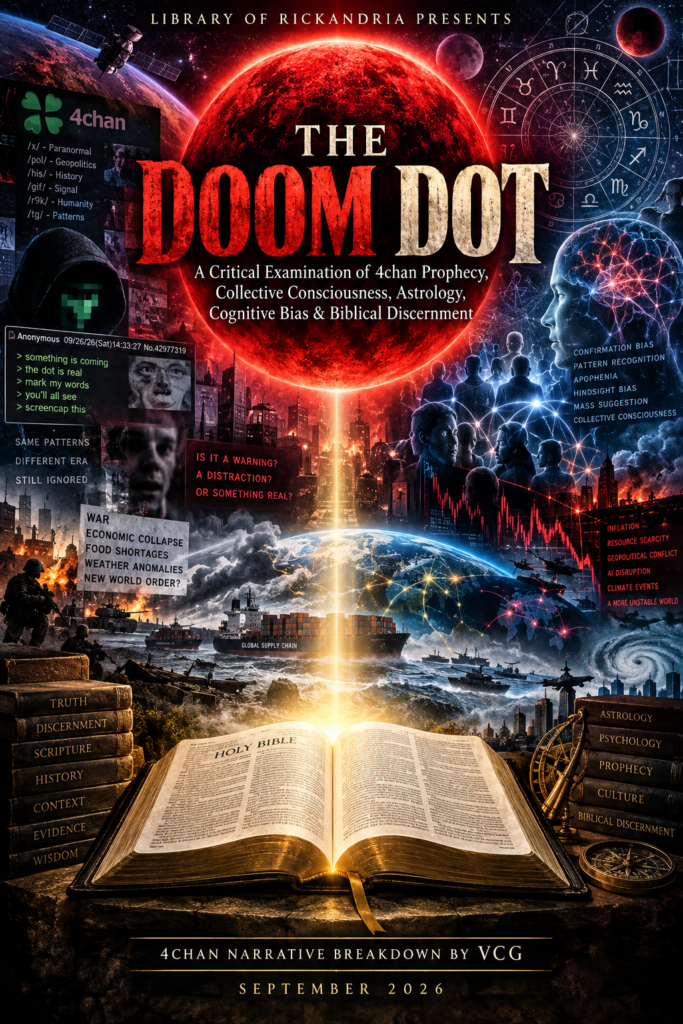
UPDATED BY VCG ON 9/22/2026 @ 02:22 EST
Anyone can do this, but most won’t.
ChatGPT – Library of Rickandria
LIBRARY OF RICKANDRIA PRESENTS
THE DOOM DOT
A Critical Examination of 4chan Prophecy, Collective Consciousness,
Astrology, Cognitive Bias & Biblical Discernment
4CHAN NARRATIVE BREAKDOWN BY VCG
SEPTEMBER 2026
| RESEARCH NOTEThis paper distinguishes five layers throughout: (1) what the thread actually said, (2) what contemporaneous or primary evidence supports, (3) what research methodology can establish, (4) what psychology may help explain without diagnosing anonymous posters, and (5) what Scripture says in context. The cover artwork is illustrative conceptual art. Embedded forum-style text and interface elements in the artwork are fictionalized and are not evidence. All factual analysis relies on the cited thread, project materials, primary data, contemporary reporting, scientific literature, and the supplied King James Bible. |
Abstract
On September 18, 2026, an anonymous thread on 4chan’s /x/ board treated a deeply negative reading from a website called Schizo Dot as a warning that a major bad event was imminent.
/x/ – It’s fucking happening. The future predictive Doom – Paranormal – 4chan
The thread is worth studying not because it is uniquely irrational, but because it compresses several recognizable ways of knowing into a single conversation:
- real-time news
- crowd intuition
- prediction claims
- astrological interpretation
- apocalyptic language
- skepticism
- trolling
- personal distress
and attempts at self-correction.
That mixture makes it an unusually good case study in how a compelling narrative can grow around real events before its causal claims have been tested.
This paper reconstructs the thread post by post, checks its factual claims against primary sources and contemporaneous reporting, examines the Schizo Dot methodology as publicly described, and separates prospective predictions from retrospective memories of successful ‘hits.’
The clearest prospective claim in the thread moved from the vague statement that something bad would happen that day to a more testable claim that a major global catastrophe would occur that day or night.
By the following morning, the thread itself contained a post treating the forecast as a miss.
Because ‘major global catastrophe’ was never operationally defined, that episode cannot be scored with the precision of a preregistered scientific forecast.
That ambiguity is not a minor technicality; it is one of the central reasons the forecast can remain persuasive regardless of outcome.
The paper also gives the strongest version of the hypothesis a fair hearing.
Anonymous internet communities can aggregate dispersed ordinary information, and prediction markets can sometimes turn scattered information into useful forecasts.
A model reading many posts could therefore contain real signal without invoking precognition or a paranormal collective consciousness.
The scientific question is whether Schizo Dot adds measurable out-of-sample forecasting skill beyond ordinary baselines, and whether its astrology layer improves that skill.
No public evidence reviewed here establishes either proposition.
The project’s own public descriptions also show meaningful version drift, including an earlier architecture with a prediction-market layer and a current architecture with an explicit emotional-sentiment layer.
The final part turns to Scripture.
It does not attempt to baptize statistics into prophecy or to diagnose an internet tool as demonic.
Instead, it compares the disclosed use of astrological ‘omens’ with biblical prohibitions on divination and prognostication, distinguishes biblical signs from internet branding such as ‘Blood Moon Level,’ and uses biblical passages on testing claims, sober watchfulness, false prophecy, ethnic boasting, and fear.
The controlling principle is the balance of 1 Thessalonians 5:20-21: neither credulity nor reflexive dismissal, but testing – ‘Prove all things; hold fast that which is good.’ [41]
Scope date:
research and source verification in this edition are current through September 21, 2026.
Executive Summary
The thread contains a genuine prospective test.
At 04:07 on September 18, the opening post said the extreme reading meant:
“something bad happens TONIGHT/today.”
At 05:55, a poster using the name schizodot.wtf sharpened this into a claim that:
“A major global catastrophe occurs tonight or today.” [1]
The thread itself then supplied the right skeptical questions.
At 12:52, one poster asked,
“And if not? What then?”
At 15:35, another argued that an undefined ‘something’ has a high base rate during an already turbulent period. At 05:57 on September 19, a poster wrote,
“Nothing ever happened. Again.” [1]
That sequence is more probative than remembered hits.
A retrospective claim that Schizo Dot had predicted an Iranian attack on U.S. naval forces refers to a real underlying event, but the thread did not supply a timestamped archived forecast demonstrating that the model had made that prediction beforehand. [1][17][18]
Schizo Dot’s public methodology does not establish a validated measurement of ‘collective consciousness.’
The current site describes prediction extraction, an unspecified ‘intelligence’ estimate, emotional-state scoring, and a Classical Astrology omen layer. [2]
A thread-time architecture image instead included a Polymarket layer and did not present the same separate emotional layer, showing that the system has changed. [3]
Real-world danger in the thread should not be dismissed.
The U.S. gross national debt had passed $40 trillion; Hormuz and Bab el-Mandeb traffic was severely disrupted; Saudi energy infrastructure had been attacked; WFP warned about food and fertilizer risks; and NOAA was forecasting a potentially historic El Nino. [6][9][10][12][14]
Several absolute claims nevertheless fail fact-checking.
Hormuz and Bab el-Mandeb were not literally closed, the U.S. dollar was not ‘worthless,’
Canada was not seeking EU membership, and broad world merchandise trade was not ‘dying’ according to the WTO’s September 9 barometer. [7][9][11][16]
The HAARP-to-El-Nino causal claim is not supported by the evidence offered in the thread.
HAARP’s University of Alaska Fairbanks FAQ explains that the facility’s HF radio waves do not interact with the lower atmosphere where weather forms. [15]
Psychological research offers several non-pathological reasons ambiguous predictions can feel accurate:
- hindsight bias
- availability
- illusory correlation
- motivated reasoning
- pattern perception under uncertainty
- online disinhibition
and repeated exposure to negative news.
These are mechanisms of judgment, not psychiatric diagnoses. [21]-[29]
The closest named research tradition, the Global Consciousness Project, is not the same instrument as Schizo Dot.
GCP uses distributed random-number generators, explicitly warns against interpreting single events and retrospective event matching, and states that its data are not a tool for predicting future events. [30][31]
Biblically, the strongest correction concerns the astrology layer.
Deuteronomy 18 rejects divination and observing times; Isaiah 47 directly addresses astrologers, stargazers, and monthly prognosticators. [41]
Scripture does not, however, authorize the further claim that an AI model is itself a demon, that every statistical anomaly is spiritual activity, or that a -80 software score is a biblical ‘blood moon.’
| CENTRAL CONCLUSIONSchizo Dot is best treated, on the evidence currently available, as an experimental internet-sentiment and prediction system wrapped in paranormal and astrological interpretation. Some of its inputs may contain ordinary predictive information. What has not been demonstrated is that the system predicts major events better than appropriate baselines, that 4chan measures a global collective consciousness, or that astrology adds reliable forecasting value. |
How to Read This Paper
The easiest way to get lost in a thread like this is to let different kinds of claims bleed into each other.
A fact about shipping traffic is not a psychological conclusion.
A psychological mechanism is not a proof that a claim is false.
A biblical prohibition is not a statistical analysis.
A real war is not evidence that astrology predicted it.
To keep those categories separate, each major section uses the following five-layer framework.
| Layer | Question |
| HISTORY / RECORD | What the thread, project site, or dated source actually records. This layer is descriptive. |
| METHODOLOGY | What would be required to test the claim: definitions, baselines, denominators, calibration, controls, preregistration, replication. |
| PSYCHOLOGY | Research on judgment, memory, pattern perception, emotion, and online behavior. These mechanisms can operate in anyone and are not diagnoses. |
| INTERPRETATION | Our reasoned synthesis of what the evidence most plausibly permits. Interpretation is explicitly separated from primary facts. |
| SCRIPTURE | The supplied KJV text, read in literary and covenantal context, followed by a clearly marked application rather than an invented oracle. |
Contents
1. Why This Thread Deserves a Careful Reading
2. Reconstructing September 18-19: What Was Actually Claimed
3. What Schizo Dot Says It Is
4. Evidence Methodology and Claim Grading
5. The Central Test: Prospective vs. Retrospective Prediction
6. Base Rates, Falsifiability, Calibration, and the Missing Denominator
7. Fact-Checking the Thread’s Doom Inventory
8. Steelmanning the Idea: Could an Anonymous Crowd Contain Real Signal?
9. Collective Consciousness and the Global Consciousness Project
10. Psychology: Why the Dot Can Feel Uncannily Accurate
11. Anonymity, Sampling, Manipulation, and 4chan
12. The Aesthetic of Precision: Interface, Color, Numbers, and Certainty
13. How a Doom Narrative Assembles Itself
14. Astrology: What Has and Has Not Been Tested
15. Biblical Discernment: Text, Context, and Application
16. A Pastoral Note on Crisis Language
17. What Evidence Would Change the Conclusion?
18. Conclusion
Appendix A. Thread Post-by-Post Ledger
Appendix B. Claim-Evidence Matrix
Appendix C. Prospective Replication Protocol
Appendix D. Glossary
Appendix E. Scripture Index
References
1. Why This Thread Deserves a Careful Reading
There are two easy ways to mishandle an anonymous paranormal thread.
One is to believe it because the language feels urgent and several of the surrounding headlines are genuinely alarming.
The other is to laugh at it, point to the strangest sentence, and move on.
Both reactions miss what makes the thread useful.
It is a miniature laboratory of modern belief formation.
The posters are not working with a blank world.
September 2026 really is turbulent.
Energy routes have been disrupted by war.
Governments are carrying large debts.
Food-security organizations are warning about second-order effects from shipping, fuel, and fertilizer shocks.
NOAA is watching an unusually strong El Nino. [6][9][12][14]
A model scraping an anxious internet community during such a period should probably produce anxiety.
That observation is compatible with ordinary social sensing.
What requires testing is the next step:
whether the score predicts events that were not already inferable from public information; whether the selected users of an anonymous imageboard can stand in for a ‘collective consciousness’; whether astrological omens add information; and whether memorable coincidences survive when every miss is counted.
The point of this paper is therefore narrower than ‘nothing strange ever happens.’
It asks:
What was actually forecast before the deadline?
What did the world already know?
Which thread claims are factual, exaggerated, or unsupported?
What would count as failure?
Which psychological mechanisms can make an ambiguous system feel precise?
And for a Christian reader, what does Scripture actually say about prognostication, signs, fear, and testing claims?
2. Reconstructing September 18-19: What Was Actually Claimed
The chronology matters because prediction claims are uniquely vulnerable to hindsight.
Once an event has happened, it is easy to remember a prior statement as more specific than it was.
The thread gives us timestamps, so we can keep the arrows of time pointing in the right direction. [1]
| Time | Post | What enters the record |
| 09/18 04:07 | 42977319 | Opening post says the reading is below roughly -80%, calls that ‘Blood Moon Level,’ treats -85% as an escalation threshold, and predicts that something bad will happen that day/night. |
| 04:08 | 42977322 | A reply summarizes the proposed mechanism as collective consciousness plus astrology. |
| 04:20-05:08 | 42977348-42977427 | Early skepticism and reaction posts. One invokes the recurring ‘nothing ever happens’ meme; another treats civilization-ending catastrophe as the standard for a real ‘happening.’ |
| 05:09 | 42977433 | A poster asks the key track-record question: has it ever predicted anything before? |
| 05:19 | 42977444 | A poster discloses acute suicidal thinking after job loss. This is a safety issue, not evidence for or against the Dot. |
| 05:42-05:43 | 42977477-42977479 | A supporter first remembers that there was a hit but cannot recall it, then says the Dot predicted an Iranian attack on U.S. naval forces one day in advance. |
| 05:55 | 42977496 | A poster named schizodot.wtf turns the thread into a clearer test: a major global catastrophe is said to occur that day or night. |
| 06:08-06:10 | 42977523-42977528 | The creator describes the system as reading hundreds of posts per hour, then wonders whether the collective-consciousness input should be emotional state rather than explicit predictions. The hypothesis is visibly evolving during the discussion. |
| 06:30 | 42977557 | A long inventory of debt, banking, bunkers, shipping, oil, fertilizer, El Nino, HAARP, hunger, trade, war, ethnicity, and Antichrist speculation becomes the narrative center of gravity. |
| 06:32 | 42977559 | A poster argues that 4chan anonymity makes it unusually good at revealing what people ‘really’ believe and contrasts it with more moderated social platforms. |
| 06:44-07:14 | 42977574-42977628 | COVID is invoked against ‘nothing happens’; the thread drifts into identity insults, link requests, renewed expectation, and the observation that 4chan itself is saturated with hopelessness. |
| 12:52 | 42978379 | A skeptic asks the scientifically decisive question: what follows if the event does not happen? |
| 15:35 | 42979010 | Another skeptic points out the base-rate problem: during a turbulent period, saying ‘something’ happens after a Friday close gives the forecaster many ways to claim a hit. |
| 23:07-23:22 | 42980278-42980314 | A poster says the Dot is ‘up and running again,’ implying version history; another makes an unsupported accusation that a poster is a federal agent. |
| 09/19 05:57 | 42981463 | After the stated day/night window, a poster treats the prediction as a failure. |
| 09/19 11:00 | 42982137 | A poster asks how coordinated, manipulative, or non-organic posting would contaminate the score. |
| 09/19 21:27 | 42984296 | The response concedes that such manipulation is currently unaccounted for and that the system cannot identify those actors. |
The shape of the thread is already informative.
It begins with a dramatic threshold, then asks for a track record, remembers a prior success, sharpens the current prediction, expands into a much larger geopolitical story, and only later asks what failure would mean.
That ordering is not proof of error.
It does, however, show why a preregistered protocol is necessary:
the criteria for success should exist before the emotional and informational consequences of the day unfold.
3. What Schizo Dot Says It Is
The current public Schizo Dot page describes three layers.
First, it searches 4chan for predictions, estimates the poster’s ‘intelligence’ using unspecified ‘well known algorithms,’ and gives the prediction a doom/hope value.
Second, it scores the emotional state of posts.
Third, it evaluates upcoming astrological events through ‘Classical Astrology’ and classifies them as good or bad omens.
The system then combines the layers into a scale from maximum doom to maximum hope. [2]
Those words matter.
The site is not merely a sentiment meter.
It makes a stronger conceptual claim by using ‘collective consciousness’ language and by embedding astrology into the forecast.
The public description does not provide enough detail to reproduce the score:
there is no published model card identifying the exact:
- language model
- training data
- intelligence construct
- prompts
- weighting function
- calibration set
- error rates
or astrological rulebook.
3.1 The ‘intelligence’ score is a construct-validity problem
Calling a number ‘intelligence’ does not make it a validated intelligence measure.
A serious construct would need to specify whether it means:
- IQ
- verbal sophistication
- coherence
- education
- domain expertise
- predictive track record
or something else.
It would then need criterion validation.
An anonymous imageboard adds obvious confounds:
- sarcasm
- deliberate misspelling
- slang
- copied text
- role-play
- non-native English
and intentionally stupid posting can all change the surface form without tracking the underlying trait.
| METHODOLOGICAL DISTINCTIONAn opaque weighting heuristic may still be useful. The criticism is not that it is ‘fake’ because it is heuristic. The criticism is narrower: until validation is published, it should be described as a model-generated score, not as a demonstrated measurement of human intelligence. |
3.2 The system changed
A thread-time ‘How It Works’ graphic describes a different pipeline:
prediction extraction and intelligence weighting, a mundane-astrology layer, and a Polymarket layer that feeds into the final score. [3]
The current site instead presents:
- prediction extraction
- emotional sentiment
- Classical Astrology
with no Polymarket layer in its public description. [2]
There is nothing improper about changing an experimental system.
Iteration is normal.
The problem arises only if the track record of multiple materially different versions is pooled into one story of success.
A model that adds or removes:
- market data
- changes prompts
- changes weights
or changes an input layer is a new forecasting system for validation purposes.
Each version needs its own dated record.
4. Evidence Methodology and Claim Grading
This paper uses a source hierarchy rather than treating every hyperlink as equal.
The original thread and Schizo Dot’s own pages establish what was claimed.
Government and intergovernmental data are preferred for:
- debt
- reserves
- weather outlooks
- trade
and food-security assessments.
Reuters and a specialist conflict-monitoring source are used for fast-moving military and shipping events.
Peer-reviewed literature is used for psychology and forecasting methodology.
Scripture quotations come from the supplied King James Version, Pure Cambridge Edition. [1]-[41]
4.1 Claim labels
| Label | Meaning |
| SUPPORTED | The central factual proposition is directly supported by good evidence, with scope and definitions stated. |
| PARTLY SUPPORTED | A real underlying fact exists, but the wording overstates scale, certainty, mechanism, or consequence. |
| MISLEADING | The wording gives a materially different impression from the best available evidence even though some component is true. |
| FALSE AS AN ABSOLUTE | The claim uses categorical language such as ‘nobody,’ ‘closed,’ or ‘nothing’ that is contradicted by observed counterexamples. |
| UNVERIFIED | The claim may or may not be true, but the cited thread provides no sufficient evidence and independent verification is lacking. |
| NOT YET TESTABLE / FUTURE CLAIM | The proposition depends on a future time horizon or undefined event that has not been specified enough to score. |
| INTERPRETATION | A synthesis or causal story rather than a directly observed fact. |
4.2 Thread-time evidence versus later verification
A subtle but important rule is temporal.
A source published on September 21 can help us learn what happened after the thread, but it cannot be used to pretend the September 18 posters already knew it.
The main fact-check therefore prioritizes sources available on or before September 18 whenever the question is what the thread could reasonably have known.
Later material is used only to verify outcomes after the forecast window.
4.3 What this paper does not infer
It does not infer mental illness from paranormal belief, anonymous posting, or dark rhetoric.
It does not assume that every conspiracy claim is false because it is called a conspiracy.
It does not assume that every official source is infallible.
And it does not treat biblical theology as a substitute for empirical measurement.
Each claim is tested with the kind of evidence appropriate to that claim.
5. The Central Test: Prospective vs. Retrospective Prediction
The single most important distinction in the paper is between a prediction preserved before an event and a memory of a prediction after an event.
A prospective forecast lets us inspect the original wording, time window, and confidence before the outcome is known.
A retrospective hit is much more vulnerable to selective memory and interpretive stretching.
5.1 The September 18 forecast
At 04:07 the opening post tied a very low Dot reading to the expectation that something bad would happen that day or night.
At 05:55, a poster using the site name sharpened the forecast to a ‘major global catastrophe’ within the same day/night window. [1]
That sharpening is helpful because it moves toward falsifiability.
The trouble is that ‘major global catastrophe’ still has no operational definition.
Does a major missile strike count if casualties are low?
A 5% market move?
A hurricane making landfall?
A national disaster with hundreds of deaths?
An interstate war escalation?
Without a predefined event ontology, two reasonable observers can look at the same 24 hours and score it differently.
By 05:57 the next morning, the thread contained a post treating the forecast as a miss. [1]
We should not overstate that either: a later poster’s summary is not a comprehensive census of every bad event on Earth.
The more defensible conclusion is that the thread did not identify an event that clearly satisfied its own sharpened criterion, and at least one participant explicitly regarded the test as failed.
5.2 The Iran-carrier ‘hit’
The retrospective example is more complicated.
A participant remembered that Schizo Dot had supposedly predicted an Iranian attack on U.S. naval forces one day in advance.
The underlying military event is real: in early September, Iranian missiles targeted U.S. naval forces, including an aircraft carrier and a destroyer; the specialist conflict monitor reported that the missiles did not hit the vessels or cause casualties. [17][18]
What is not established by the thread is the forecast provenance.
The poster did not supply a frozen, timestamped forecast record with the exact wording and model version.
That makes the event useful as a lead for archival verification, but not yet as evidence of predictive skill.
The proper status is: real event, unverified prior model prediction.
| EVIDENCE RULEReal event + remembered forecast is not the same thing as verified prediction. The forecast record must predate the event and preserve enough detail to determine whether the later event actually matched what was said. |
6. Base Rates, Falsifiability, Calibration, and the Missing Denominator
6.1 The ‘something happened’ problem
If the forecast is merely ‘something bad happens somewhere tomorrow,’ the background success probability is enormous.
- Wars
- crimes
- accidents
- market movements
- political crises
- storms
- fires
and deaths occur every day.
A broad target can score a ‘hit’ without the model adding any information.
The correct question is comparative:
how often does a predefined event occur after Dot readings below a threshold, compared with ordinary days and with appropriate baseline models?
A striking coincidence means little until it is placed against that denominator.
6.2 Falsifiability
A forecast becomes scientifically useful when the forecaster states what would count as failure before the outcome.
The thread itself eventually asks this question.
If a very red Dot can mean catastrophe, a near miss, diffuse bad vibes, an event a few days later, an event that was prevented, or a hidden event nobody can verify, then no observation can lower confidence.
That is not a forecasting test; it is a narrative that absorbs every outcome.
6.3 Calibration and scoring
Even a threshold such as -80 or -85 needs empirical calibration.
A numerical display creates the impression of precision, but the number becomes scientifically interpretable only after we know what frequencies it corresponds to.
Probabilistic forecasting literature emphasizes calibration – whether stated probabilities match observed frequencies – while proper scoring rules such as the Brier score and logarithmic score reward forecasts that are both informative and honest about uncertainty. [37][38]
A publishable validation would therefore report all forecasts, all misses, the base rate of each event class, calibration plots, and performance relative to baselines. Selected screenshots of dramatic hits cannot answer those questions.
6.4 Preregistration and the denominator
Preregistration is useful precisely because human beings are creative after seeing outcomes.
A preregistered plan fixes the target, window, threshold, exclusions, and analysis before evaluation data are observed, while leaving exploratory analysis free to generate new hypotheses for the next test.
That distinction between confirmatory and exploratory work is a central purpose of modern preregistration frameworks. [39]
7. Fact-Checking the Thread’s Doom Inventory
The long 06:30 post works rhetorically because it mixes facts of very different quality into one uninterrupted cascade.
Some are solid.
Some are reasonable concerns stated too absolutely.
Some are predictions.
Some are causal claims for which no evidence is supplied.
The responsible approach is to separate them rather than accepting or rejecting the entire bundle.
| Thread claim | Assessment | Evidence |
| U.S. gross national debt exceeded $40 trillion. | SUPPORTED | A Joint Economic Committee update using Treasury data put total gross national debt at about $40.10T on September 3, 2026. [6] |
| The U.S. dollar is ‘worthless.’ | FALSE AS A LITERAL CLAIM | Whatever one’s view of debt or inflation risk, the dollar retained monetary and reserve value. IMF COFER data put it at 57.13% of allocated official FX reserves in 2026 Q1. [7] |
| Banks are secretly failing. | UNVERIFIED | The claim is framed so the relevant evidence is hidden. Public FDIC records list two U.S. bank failures in 2026 through the available data. That does not prove no bank is stressed; it does show the thread did not establish secret failures. [8] |
| Wealthy people bought New Zealand / South America bunkers because they know what is coming. | PARTLY DOCUMENTED, CAUSAL INFERENCE UNSUPPORTED | A wealthy-tech-prepper interest in New Zealand has been documented for years. That behavior can reflect tail-risk insurance and does not establish insider knowledge of an imminent catastrophe. The thread does not substantiate the South America extension. [19] |
| Hormuz is completely closed / nobody is getting oil / nothing has exited for months. | FALSE AS AN ABSOLUTE | Traffic was severely impaired, but Reuters recorded three commodity-vessel transits on September 16 and a tanker exit. Severe disruption is not zero traffic. [9] |
| Bab el-Mandeb is closed. | FALSE AS AN ABSOLUTE | Reuters recorded 21 vessel crossings on September 16, down from 24 the prior day. [9] |
| Saudi Arabia’s East-West pipeline was blown up. | CORE EVENT TRUE; WORDING OVERSTATED | Three of eleven pumping stations were damaged and the pipeline was temporarily shut. Repair estimates varied. [10] |
| Canada is joining the EU. | MISLEADING | Canada was exploring a deeper or novel association, but Prime Minister Mark Carney explicitly said Canada was not seeking EU membership. [11] |
| Nobody has enough oil or fertilizer. | OVERBROAD | The shipping crisis creates real supply and price risks, especially for fuel and fertilizer, but ‘nobody’ is an unsupported global absolute. WFP documented route disruptions and their consequences. [12] |
| An unprecedented / exceptionally strong El Nino is developing. | STRONG CONCERN SUPPORTED AS A FORECAST | NOAA’s September 10 outlook put the chance of a very strong 2026-27 El Nino above 90% and gave a 75% chance of an Oct-Dec event exceeding earlier events in its post-1950 RONI record by the stated criterion. It was still a forecast, not a completed historical observation. [14] |
| HAARP caused the El Nino. | UNSUPPORTED; MECHANISM CONTRADICTED | The thread supplies no causal evidence. UAF’s HAARP FAQ states that the facility’s HF waves do not interact with the troposphere or stratosphere where weather forms. [15] |
| Mass hunger is coming / food security is deteriorating. | SERIOUS RISK, SCOPE REQUIRES CARE | WFP warned that conflict-driven disruptions to fuel, fertilizer, and shipping can sharply increase food insecurity; an April scenario projected tens of millions of additional people at risk if the conflict persisted. A modeled scenario should not be restated as an already realized count. [12][13] |
| Global trade is dying. | CONTRADICTED AS A BROAD PRESENT-TENSE CLAIM | The WTO’s September 9 Goods Trade Barometer stood at 102.0, above trend, while acknowledging headwinds and route-specific weakness. [16] |
| Middle East wars will not stop. | FUTURE CLAIM | Ongoing conflict is observable. ‘Will not stop’ needs a time horizon and cannot be verified as a present fact. |
| No Antichrist figure has appeared yet, so the crisis will continue until one does. | THEOLOGICAL SPECULATION | This is not an empirical geopolitical indicator. The biblical term ‘antichrist’ also has a more specific Johannine usage than popular end-times shorthand. [41] |
| Debt is explained by ‘Jew economics.’ | UNSUPPORTED ETHNIC SCAPEGOATING | The phrase does not identify a testable economic mechanism. Debt can be analyzed through deficits, rates, taxation, spending, monetary policy, demographics, and institutions without assigning causation to Jewish ancestry. |
7.1 The pattern: real facts, unsupported bridges
The most important observation is not that the post is ‘all wrong.’
It is not.
The debt figure is real.
The shipping crisis is real.
The pipeline damage is real.
Food-security risks are real.
NOAA’s El Nino warning is real.
The narrative becomes unreliable when those observations are connected by causal bridges for which no evidence is supplied.
| A RECURRING NARRATIVE MOVEA is real. B is real. Therefore hidden mechanism C links A and B. The burden of proof is concentrated in the last sentence, not in the reality of A or B. |
7.2 HAARP as a worked example
The El Nino/HAARP claim is a clean example.
NOAA’s outlook gives the first half of the story genuine weight:
forecasters were indeed expecting an exceptionally strong event. [14]
But the claim that HAARP caused it is a separate proposition.
UAF’s description of the facility places its relevant radio interactions in the ionosphere and states that the lower atmospheric layers responsible for weather are not affected in the proposed way. [15]
The presence of a surprising weather pattern therefore does not supply the missing causal mechanism.
8. Steelmanning the Idea: Could an Anonymous Crowd Contain Real Signal?
The strongest version of the Doom Dot hypothesis does not need telepathy.
Imagine that thousands of people are:
- reading local-language reports
- watching ship trackers
- following niche military accounts
- studying markets
- hearing workplace rumors
and noticing subtle changes before those observations are assembled into a mainstream narrative.
A text model that aggregates their posts could, in principle, produce a useful early-warning signal.
Prediction markets are a good comparison.
They do not require paranormal knowledge; they can aggregate dispersed incentives and information.
A classic review by Justin Wolfers and Eric Zitzewitz found that prediction-market forecasts were often reasonably accurate and could outperform several ordinary benchmarks. [40]
If an earlier Schizo Dot version included Polymarket, then any predictive success first has to be tested against the possibility that the market layer was supplying ordinary public-information signal.
The same applies to sentiment.
If a military crisis is escalating, public news can cause 4chan users to become anxious, prediction markets to reprice, and actual near-term risk to increase.
Those variables will correlate even if nobody possesses precognition.
The causal structure may simply be:
| ORDINARY COMMON-CAUSE MODELBreaking information -> anxious posts / explicit predictions Breaking information -> market repricing Breaking information -> genuinely higher near-term event risk A later event can therefore follow a red Dot without the Dot having accessed information from the future. |
This steelman is important because it gives the project something rigorous to prove.
The question becomes not:
‘is the Dot spooky?’
but ‘does it improve out-of-sample forecasting beyond the information already present in news, markets, and ordinary sentiment?’ That is testable.
9. Collective Consciousness and the Global Consciousness Project
The phrase ‘collective consciousness’ invites comparison with the Global Consciousness Project (GCP), but the instruments are fundamentally different.
GCP studies a network of hardware random-number generators.
Schizo Dot analyzes:
- internet text
- model-generated attributes
- emotional sentiment
- astrology
The fact that both use a global-mind vocabulary does not make evidence for one evidence for the other.
More importantly, GCP’s own methodological cautions run against the way a live red Dot is often used.
Its FAQ warns that individual events contain too little signal relative to noise for reliable interpretation and that retrospective searches for a statistical spike followed by a hunt for a matching world event create uncontrolled degrees of freedom.
In a complex world, something that looks significant can be found almost any time. [30]
GCP also states that its data are not a system for predicting future events.
Its hypothesis concerns statistical structure during pre-specified events, not a warning light for tomorrow. [31]
9.1 Even the GCP literature is interpretively contested
A 17-year analysis by Peter Bancel reported an anomalous cumulative database but argued that detailed tests did not support the proposed global-consciousness mechanism as the best explanation, favoring an experimenter-related account. [32]
Roger Nelson, associated with the project, published a response arguing that rejecting the global-consciousness interpretation was premature. [33]
The fair conclusion is not that the GCP ‘proves’ or ‘disproves’ a global mind. It is that the closest research tradition is itself contested and methodologically cautious – and it explicitly does not validate single-event future prediction.
10. Psychology: Why the Dot Can Feel Uncannily Accurate
Psychology should be used here as an explanation of ordinary judgment, not as a weapon.
The relevant biases are not signs of stupidity or mental illness.
They are features of human cognition that affect skeptics and believers alike.
The question is how a vivid interface and ambiguous forecast interact with memory, attention, and uncertainty.
10.1 Hindsight bias
Hindsight bias is the familiar ‘I knew it all along’ effect: once the outcome is known, people can remember prior uncertainty as greater certainty and view the event as more predictable than it was.
Roese and Vohs review evidence that hindsight can alter recollection, perceived inevitability, and beliefs about one’s own predictive ability. [22]
The thread’s sequence – a user first remembering that a hit existed, then recalling what it supposedly was – is exactly the kind of situation where independent archives matter.
That does not prove fabrication; it explains why memory alone is weak evidence.
10.2 Availability and salience
Tversky and Kahneman’s availability work describes how judgments of frequency or probability can be influenced by how easily examples come to mind. [23]
A rare deep-red score followed by a dramatic missile attack is memorable.
A deep-red score followed by an ordinary day is not.
Unless the full series is archived, memory naturally supplies a biased sample.
10.3 Illusory correlation
Hamilton and Gifford showed how distinctive or infrequent events can produce perceived associations stronger than the underlying data justify. [24]
A striking Dot and a striking world event are exactly the sort of co-occurrence that invites this effect.
Again, the remedy is not to mock the perception; it is to calculate the association using every observation.
10.4 Pattern perception under uncertainty
Experimental work has found that reduced feelings of control can increase perception of patterns in noisy information, including conspiratorial and superstitious patterns. [25]
Later multi-study work also linked illusory pattern perception with conspiracy and supernatural beliefs. [26]
These findings do not establish that any particular conspiracy claim is false.
They show why pattern claims require external validation rather than felt coherence.
10.5 Motivated reasoning
Kunda’s classic review describes how motivation can shape which beliefs and evidence people access, construct, and evaluate, while still being constrained by the need to build a seemingly reasonable justification. [27]
In doom communities, both believer and skeptic can be motivated:
one may search for the hit; the other may search for the miss.
A complete dataset is the safeguard against both.
10.6 Emotional contagion and doom exposure
Large-scale online experiments have shown that the emotional content people encounter can modestly shift the emotional content they later express, though that work generated serious ethical controversy and should not be generalized into a mystical group mind. [28]
Research during COVID-19 also found associations between heavy media exposure and trauma-related distress. [29]
Those findings make a mundane prediction:
a community immersed in crisis content may become more negative as a community, even if the negativity does not predict a new event.
10.7 Proportionality intuitions
Humans often find it psychologically unsatisfying when large events appear to have ordinary, distributed causes.
A huge war, market shock, or climate anomaly can feel as though it ought to have a correspondingly large hidden cause.
In this paper we treat that as an interpretive caution rather than a diagnostic label:
the size of an effect does not tell us, by itself, whether its cause is centralized, intentional, occult, accidental, or emergent.
| PSYCHOLOGY DOES NOT DECIDE TRUTHA claim is not false because a believer could be influenced by confirmation bias. A claim is not true because a skeptic could be influenced by motivated reasoning. Psychology explains why independent records, control groups, and prospective tests are necessary. |
11. Anonymity, Sampling, Manipulation, and 4chan
11.1 Candor is not the same as accuracy
The thread argues that 4chan is useful because anonymity lets people say what they ‘really’ believe.
There is a genuine psychological basis for expecting different behavior under anonymity.
John Suler’s online-disinhibition framework describes how anonymity, invisibility, asynchronicity, and related factors can increase self-disclosure and acting out.
Importantly, that does not mean anonymous behavior is simply the hidden ‘true self’; online settings can create a different configuration of thought, affect, and behavior. [21]
Research on 4chan’s /b/ board found that more than 90% of posts were fully anonymous and that users could adopt and discard identity signals quickly. [20]
That study is from 2011 and concerns /b/, not /x/ in 2026, so it cannot be used as a direct demographic portrait of this thread.
It does illustrate the larger point:
anonymity weakens persistent identity, which can increase candor but also role-play, irony, trolling, and low-cost exaggeration.
11.2 4chan is not unmoderated
The claim that 4chan has a ‘lack of banning’ is factually wrong as a literal description.
4chan publishes global and board rules, moderators can remove material and revoke access, and its FAQ explains that outsiders cannot reliably infer how much moderation occurs simply by looking at surviving posts. [4][5]
11.3 A selected population is not humanity
Even if Schizo Dot measured /x/ perfectly, /x/ is a self-selected population.
It reflects people with internet access, knowledge of 4chan, willingness to post anonymously, interest in the board’s themes, particular time zones and languages, and tolerance for its culture.
Calling that ‘collective consciousness’ silently expands the sampling frame from one online subculture to human consciousness generally.
11.4 The thread identifies its own adversarial-data problem
Near the end, one poster asks how:
- coordinated posters
- trolls
- alleged shills
or other non-organic inputs affect the Dot.
The reply concedes that this is currently unaccounted for and that the system cannot identify such actors. [1]
Strip away the politically loaded labels and the technical objection is strong.
Any public sentiment system needs defenses against:
- bots
- brigading
- copied text
- sarcasm
- adversarial prompting
- spam
and users intentionally trying to move the score.
12. The Aesthetic of Precision: Interface, Color, Numbers, and Certainty
A forecasting interface does more than display data; it frames interpretation.
A single glowing red orb is cognitively efficient.
It collapses a complicated world into one emotionally legible object.
Red means danger before the user has read a methodology.
A percentage or score such as -80 gives that danger the appearance of measurement.
Calling it ‘Blood Moon Level’ adds apocalyptic symbolism.
None of those design choices is deceptive by itself.
Risk dashboards use color all the time.
The issue is the gap between visual precision and evidentiary precision.
A score rendered to two digits can still be built from:
- subjective labels
- opaque model judgments
- uncalibrated weights
and an unvalidated astrology layer.
12.1 Language of certainty
The thread repeatedly uses the grammar of certainty before it has specified the target:
something is coming; mark the threshold; today is the day.
This style is rhetorically powerful because it maximizes emotional commitment while leaving the event class broad.
Scientific forecasting moves in the opposite direction:
it narrows the event definition, publishes uncertainty, and makes failure easy to identify.
| INTERPRETIVE CAUTIONA technical-looking number is not the same thing as a calibrated probability. Visual seriousness can precede measurement validity. |
13. How a Doom Narrative Assembles Itself
The thread’s long doom inventory illustrates a common narrative architecture.
It begins with real anomalies or stresses, adds plausible but unmeasured links, introduces hidden intentional causes, and finally treats the assembled picture as confirmation that the initial warning signal was meaningful.
Observation:
select real high-salience events (war, debt, disrupted shipping, strong El Nino).
Compression:
present them rapidly so they feel like one phenomenon rather than separate causal systems.
Causal bridge:
connect some of them to mechanisms that have not been demonstrated (for example, HAARP -> El Nino).
Agency:
introduce hidden groups, coordinated actors, or ethnic categories as a master explanation.
Prophetic frame:
interpret the cluster as evidence that an imminent ‘happening’ or eschatological transition is near.
Retrospective closure:
after an event, match it back to the broad warning and remember the match more strongly than misses.
13.1 Real crisis versus false causal link
The antidote is not denial.
In fact, denying the real crisis makes bad causal explanations more attractive because people can see the crisis with their own eyes.
A better method preserves the true premise while testing the connective tissue.
‘Hormuz traffic is severely disrupted’ can be true while ‘therefore a collective subconscious predicted it’ remains unproven.
‘A historic El Nino may be developing’ can be true while ‘therefore HAARP caused it’ is unsupported.
‘Debt is historically high’ can be true while an ethnic explanation remains both evidentially empty and morally corrosive.
14. Astrology: What Has and Has Not Been Tested
The astrology question needs more precision than either ‘astrology is proven’ or ‘astrology has been debunked.’
Schizo Dot’s own claim concerns a form of world-event or ‘mundane’ astrology embedded in a forecasting model.
Most controlled psychological studies of astrology test natal-chart/personality matching, which is not the same claim.
Controlled studies have often failed to find the expected natal-chart matching effects.
For example, Startup’s three studies reported no evidence for the validity of the tested astrological aspects, and Wyman and Vyse conducted a double-blind natal-chart/personality matching study. [34][35]
Shawn Carlson’s famous 1985 Nature experiment is also frequently cited in this literature. [36]
Fairness requires noting that Carlson’s analysis has been disputed.
Suitbert Ertel later argued that the design and analysis did not justify Carlson’s strong negative verdict and reported a reanalysis with marginal or modest positive results, while explicitly stating that those results were still insufficient to regard astrology as empirically verified. [42]
This dispute is a useful warning against turning one study into a slogan.
For Schizo Dot, however, the decisive issue is simpler:
the project has not publicly demonstrated that its astrology layer improves prospective out-of-sample forecasts.
The direct test is an ablation.
Run the same frozen system with and without astrology over the same future period.
If the astrology model does not improve proper forecast scores, it has not earned a predictive role.
If it repeatedly does improve them under preregistered conditions, that would be an empirical anomaly worth independent replication.
Even then, predictive increment would not by itself identify a metaphysical mechanism.
15. Biblical Discernment: Text, Context, and Application
A Christian analysis can go wrong in two opposite directions.
It can treat every unusual prediction as revelation, or it can react against occult language by claiming more than Scripture itself says.
The standard here is to quote the text, locate its context, make the application explicitly, and then mark what the passage does not establish.
15.1 Divination, observers of times, and astrological prognostication
There shall not be found among you any one … that useth divination, or an observer of times, or an enchanter, or a witch.- Deuteronomy 18:10, KJV [41]
History/text:
Deuteronomy 18 addresses Israel entering the land and forbids imitating the divinatory practices of surrounding nations.
The passage contrasts those practices with listening to the prophet whom the LORD raises.
It is therefore not a generic anti-science text; it is about unauthorized means of obtaining guidance and hidden knowledge. [41]
Let now the astrologers, the stargazers, the monthly prognosticators, stand up, and save thee from these things that shall come upon thee.- Isaiah 47:13, KJV [41]
History/text:
Isaiah 47 addresses Babylon and mocks its reliance on sorceries and celestial prognosticators in the face of judgment.
The text explicitly names astrologers, stargazers, and monthly prognosticators. [41]
Application:
Schizo Dot publicly says it evaluates astrological events as good or bad ‘omens.’ [2]
That disclosed purpose makes the biblical comparison unusually direct.
A Christian does not need to decide whether the software is spiritually possessed in order to say that using astrological omens as a means of future guidance conflicts with these texts.
Limit: These passages do not prove that every statistical anomaly is demonic, that artificial intelligence is inherently occult, or that every person reading an astrology column is consciously practicing the full range of Deuteronomy 18.
The application should be as specific as the text.
15.2 ‘Blood Moon Level’ is branding, not a biblical threshold
Scripture contains genuine celestial imagery:
Joel speaks of the moon turned to blood; Peter cites Joel in Acts 2; Revelation 6 uses apocalyptic celestial imagery; Matthew 24 speaks of the sun, moon, and stars in an eschatological discourse.
None of those passages gives a numerical algorithm that maps a sentiment score of -80 to a biblical blood moon.
Interpretation: calling a software threshold ‘Blood Moon Level’ borrows the emotional and theological weight of biblical imagery.
Unless an argument is made from the text, it remains metaphor or branding, not fulfilled prophecy.
15.3 Wars, rumors, and sobriety
And ye shall hear of wars and rumours of wars: see that ye be not troubled:
for all these things must come to pass, but the end is not yet.- Matthew 24:6, KJV [41]
Matthew 24 is interpreted differently across Christian traditions, especially regarding the relationship between first-century Jerusalem and final eschatology.
One point is plain in the verse itself:
hearing about war is not permission for panic, and war headlines alone do not equal ‘the end is now.’
The imperative is striking:
‘see that ye be not troubled.’ [41]
Application:
the thread’s atmosphere often treats every accumulating crisis as a clock.
Jesus’ warning cuts against that reflex.
Watchfulness in the passage is paired with resistance to deception and alarm, not with compulsive deadline manufacture.
15.4 Testing claims without despising them
Despise not prophesyings.
Prove all things; hold fast that which is good.- 1 Thessalonians 5:20-21, KJV [41]
This passage is a better model for the paper than either credulity or sneering.
Its immediate context concerns Christian life, prophecy, and discernment; it is not a statistics textbook.
Still, the moral posture is relevant: do not reject a claim simply because it is unusual, and do not accept it simply because it is spiritually charged.
Test, then retain what survives.
Acts 17 describes the Bereans searching the Scriptures daily to examine Paul’s teaching.
Proverbs 18 warns against answering a matter before hearing it and observes that the first case sounds right until another examines it.
John 7:24 says to judge righteous judgment rather than appearance. [41] Together, these texts support a discipline of patient examination.
15.5 False prophecy and prediction failure: an important category distinction
When a prophet speaketh in the name of the LORD, if the thing follow not, nor come to pass, that is the thing which the LORD hath not spoken.- Deuteronomy 18:22, KJV [41]
The context matters.
Deuteronomy 18 is about a prophet who claims to speak in the LORD’s name within Israel’s covenantal order.
Schizo Dot is an algorithmic project using internet text and astrology; it is not automatically a ‘false prophet’ in the technical biblical sense.
Applying the death penalty or prophetic office language to an internet dashboard would be a category error.
The principle nevertheless exposes a temptation that appears whenever failed predictions are protected by endless reinterpretation.
If a person explicitly claims divine authority for a prediction, Scripture does not encourage believers to rescue the claim after it fails.
For this thread, the scientific route is simpler:
score the prediction by its predeclared terms and preserve the miss.
15.6 Antichrist: biblical term versus cultural composite
Little children, it is the last time: and as ye have heard that antichrist shall come, even now are there many antichrists…- 1 John 2:18, KJV [41]
He is antichrist, that denieth the Father and the Son.- 1 John 2:22, KJV [41]
In the Johannine letters, ‘antichrist’ is already a category operating in the writer’s present and is tied to denial concerning Jesus Christ.
Christian traditions often synthesize these texts with the ‘man of sin’ in 2 Thessalonians 2 and the beasts of Revelation to describe a singular end-time Antichrist.
That synthesis may be argued theologically, but it should not be mistaken for a verse in Revelation that simply names the beast ‘the Antichrist.’
Application: saying that a contemporary crisis must continue because no obvious Antichrist figure has appeared is not a biblical forecasting rule.
The text does not authorize using one’s inability to match a current politician to an end-times template as a clock.
15.7 Circumcision as an internet insult
For in Jesus Christ neither circumcision availeth any thing, nor uncircumcision; but faith which worketh by love.- Galatians 5:6, KJV [41]
But if ye bite and devour one another, take heed that ye be not consumed one of another.- Galatians 5:15, KJV [41]
The thread’s move into ‘circumcised’ versus ‘uncut’ identity insults is almost the inverse of Paul’s argument.
In Galatians, neither condition supplies spiritual boasting in Christ; the chapter turns instead toward faith working by love and warns communities against devouring one another.
15.8 Ethnic scapegoating and the Jewish question in the thread
The phrase ‘Jew economics’ is not an economic explanation.
It transfers frustration from mechanisms and accountable institutions to ancestry.
A Christian critique should be especially careful here because the New Testament both argues intensely about Israel and warns Gentile believers against arrogance.
Boast not against the branches.
But if thou boast, thou bearest not the root, but the root thee.- Romans 11:18, KJV [41]
That verse does not settle every theological debate about Israel, modern states, banking, or public policy.
It does set a posture:
Gentile boasting against Jewish branches is explicitly rebuked.
Economic claims should therefore name:
- policies
- institutions
- incentives
- documented actors
and causal mechanisms rather than convert Jewish ethnicity into a master variable.
15.9 ‘Try the spirits’ – and keep the context
Beloved, believe not every spirit, but try the spirits whether they are of God:
because many false prophets are gone out into the world.- 1 John 4:1, KJV [41]
The immediate test in 1 John is Christological:
the following verses concern confession of Jesus Christ come in the flesh.
It should not be flattened into a generic command that every empirical question can be solved by intuition about spiritual atmosphere.
The broad caution against credulity is relevant; the specific test belongs to the apostle’s doctrinal context.
15.10 Biblical epistemology in one sentence
The biblical pattern relevant to this paper is not ‘believe only what institutions say,’ nor ‘believe the hidden explanation.’
It is to hear before answering, examine claims, seek multiple witnesses where the legal context requires them, refuse divinatory substitutes for God’s revelation, resist fear, and distinguish what God has said from what we are inferring. [41]
16. A Pastoral Note on Crisis Language
One post in the thread contains a direct statement of suicidal intent after job loss.
That sentence should not be mined for clues about the Doom Dot or used to diagnose the poster.
In a live conversation, an immediate safety response would take precedence over debating collective consciousness.
This matters to the broader subject because apocalyptic communities can contain people who are frightened, grieving, isolated, or economically desperate alongside people who are joking, role-playing, researching, or trolling.
A humane analysis does not confuse those states.
It also does not romanticize despair as spiritual sensitivity.
The New Testament’s eschatological posture repeatedly pairs watchfulness with:
- sobriety
- endurance
- love
- ordinary faithfulness
- comfort
Even where judgment is real, panic is not presented as a virtue.
Matthew 24 says ‘see that ye be not troubled’; 1 Thessalonians 5 tells believers to watch and be sober, and in the same chapter tells them to comfort, support, and be patient. [41]
17. What Evidence Would Change the Conclusion?
A skeptical conclusion should itself be falsifiable.
The present paper does not claim that no future version of Schizo Dot could have predictive value.
It states that the reviewed public evidence does not yet demonstrate that value.
The following results would materially change that assessment.
A frozen, timestamped model version with:
- prompts
- weights
- input sources
- code
or sufficiently detailed reproducibility documentation.
A public prospective forecast archive that cannot be edited after outcomes occur.
Predefined event classes, severity thresholds, geographic scope, and forecast windows.
A large enough sample to estimate calibration and uncertainty rather than highlighting individual dramatic days.
Performance that beats historical base rates, random forecasts, ordinary news sentiment, and prediction-market baselines on held-out future data.
Ablation results showing which components add value.
In particular, the full system should be compared with identical versions that omit astrology, emotion, market data, and poster-intelligence weighting one at a time.
Resistance to adversarial manipulation, duplicate content, brigading, sarcasm, and bots.
Independent replication by researchers who did not design the system.
17.1 Proposed ablation study
| Arm | Inputs | Question |
| Model A | 4chan prediction/text features only | Does the text itself contain signal? |
| Model B | Text + emotional sentiment | Does emotion add incremental value? |
| Model C | Text + astrology | Does astrology improve out-of-sample performance? |
| Model D | Text + prediction-market data | How much signal is ordinary market aggregation? |
| Model E | Full frozen system | Does the complete architecture beat every simpler baseline? |
17.2 Controls
At minimum, the Dot should be compared with historical base rates, a random or climatological forecaster, an ordinary current-news sentiment model, and the relevant prediction-market probabilities when available.
If the system cannot beat these, the most economical explanation is that it repackages already-public information or noise.
If it does beat them prospectively, the next question is which component supplies the gain.
18. Conclusion
The September thread is not best understood as a simple contest between gullible believers and rational skeptics.
The same conversation contains both credulity and good scientific instincts.
Someone asks for a track record.
Someone remembers a dramatic hit.
Someone sharpens the prediction.
Someone asks what failure would mean.
Someone notices the base rate.
Someone asks about adversarial manipulation.
The creator concedes that the manipulation problem is unsolved.
That is a more interesting story than a caricature.
The factual world behind the thread is also mixed.
Several dangers are real and well documented.
The U.S. debt figure is real; shipping routes are severely disrupted; the Saudi pipeline attack happened; food and fertilizer risks are serious; and NOAA’s El Nino outlook is exceptional.
But the thread repeatedly moves from those facts to stronger statements that the evidence does not carry:
- total closures
- a worthless dollar
- a country ‘joining’ the EU
- HAARP causation
- hidden banking collapse
- ethnic master explanations
and an eschatological clock.
Methodologically, the Doom Dot has not yet crossed the line from interesting experimental dashboard to validated forecaster.
The public methodology is not reproducible, the system has changed, the dramatic thresholds are not publicly calibrated, the denominator of misses is missing, adversarial contamination is acknowledged, and the astrology layer has not been shown to add predictive value.
The September 18 thread’s own prospective test appears, by the thread’s own later reaction, to have missed.
The strongest possible case for the project is still worth testing.
Anonymous communities can surface dispersed information.
Text models can summarize weak signals.
Prediction markets can aggregate beliefs.
If a frozen future version beats serious baselines under preregistered conditions, that result deserves attention.
But ordinary information aggregation must be ruled out before ‘collective consciousness’ is inferred, and incremental predictive performance must be demonstrated before astrology is credited.
For the Christian reader, the central correction is not fear.
It is discernment.
Scripture warns against divination and astrological prognostication, resists false certainty about times and seasons, refuses ethnic boasting, and repeatedly calls believers to sober testing rather than panic.
The most fitting sentence for the entire inquiry remains Paul’s compact instruction:
‘Prove all things; hold fast that which is good.’ [41]
Appendix A. Thread Post-by-Post Ledger
The descriptions below paraphrase the thread except for four short quotations already identified in the body.
Obscene or slur-based material is summarized rather than reproduced.
| Post | Time | Type | Paraphrase | Research note |
| 42977319 | 09/18 04:07 | Main forecast | Opening post says Dot is unusually below about -80%, labels it ‘Blood Moon Level,’ treats -85 as further escalation, and expects a bad event that day/night. | Prospective claim; threshold uncalibrated; event initially vague. |
| 42977322 | 04:08 | Mechanism | Says the system is collective consciousness plus astrology. | Hypothesis statement, not evidence. |
| 42977348 | 04:20 | Skepticism | Posts the recurring ‘nothing ever happens’ meme. | Cultural response, not a test. |
| 42977415 | 05:00 | Rhetoric | Invokes 2012 and survival as reason not to equate ‘nothing happened’ with no event. | Uses civilization-ending catastrophe as implicit threshold. |
| 42977427 | 05:07 | Reaction | Reaction image. | No evidentiary content. |
| 42977433 | 05:09 | Track record | Asks whether the system has predicted anything before. | Methodologically strong question. |
| 42977444 | 05:19 | Personal crisis | Discloses suicidal intent after job loss. | Safety concern; not evidence about the Dot; do not diagnose. |
| 42977477 | 05:42 | Retrospective memory | Says there was a prior hit but initially cannot remember which one. | Weak testimonial evidence; archive needed. |
| 42977479 | 05:43 | Retrospective hit claim | Says the remembered hit was an Iran attack on U.S. aircraft carriers one day after the Dot forecast. | Underlying attack real; prior Dot forecast unverified in thread. |
| 42977496 | 05:55 | Sharper forecast | Poster named schizodot.wtf states a major global catastrophe is expected that day/night and frames it as a test. | More falsifiable, but ‘major global catastrophe’ undefined. |
| 42977512 | 06:03 | Insult | Insults board users. | Ad hominem; no evidentiary value. |
| 42977523 | 06:08 | Model rationale | Says hundreds of posts per hour may reveal a near-future ‘vibe.’ | Interesting hypothesis; ordinary information aggregation is a competing mechanism. |
| 42977528 | 06:10 | Model revision | Creator wonders whether collective consciousness should be based on emotions rather than explicit predictions. | Shows hypothesis/model still evolving. |
| 42977557 | 06:30 | Doom inventory | Combines debt, banking, bunkers, currency, Hormuz, Bab el-Mandeb, pipeline damage, Canada/EU, oil, fertilizer, El Nino/HAARP, hunger, trade, war, ethnic blame, and Antichrist speculation. | Mixture of true facts, exaggerations, unsupported causes, prediction, theology, and scapegoating. |
| 42977559 | 06:32 | Anonymity claim | Argues 4chan reveals true beliefs because of anonymity and purported lack of banning. | Anonymity can change behavior; candor != accuracy; 4chan does ban/moderate. |
| 42977574 | 06:44 | Historical counterexample | Invokes COVID lockdowns against the idea that nothing happens. | True that disruptive events occur; does not validate a specific forecaster. |
| 42977580 | 06:51 | Identity insult | Uses circumcision as an insult. | No evidentiary content; relevant to Galatians 5 discussion. |
| 42977582 | 06:52 | Counter-insult | Returns an identity/medical insult. | No evidentiary content. |
| 42977615 | 07:08 | Interest | Expresses intrigue. | Social uptake, not corroboration. |
| 42977618 | 07:09 | Link request | Asks for the project link. | No claim. |
| 42977620 | 07:10 | Expectation | Repeats that the event is expected that day. | Reinforces forecast socially; not independent evidence. |
| 42977628 | 07:14 | Board mood | Describes 4chan as saturated with hopelessness. | Suggests a baseline-affect confound for a doom meter. |
| 42977677 | 07:45 | Off-topic | Unrelated crude celebrity anecdote. | Irrelevant to the thesis. |
| 42978379 | 12:52 | Falsifiability | Asks what follows if the event does not happen. | Best methodological challenge in thread. |
| 42979010 | 15:35 | Base-rate critique | Argues that predicting ‘something’ during a turbulent Friday gives too many ways to claim a hit. | Correctly identifies base-rate/vagueness problem. |
| 42979268 | 17:04 | Off-topic hostility | Unrelated sexual/trans-hostile aside. | No evidentiary relevance. |
| 42979277 | 17:08 | Retort | Childish retort. | No evidentiary relevance. |
| 42980278 | 23:07 | Version history | Says the Dot is ‘up and running again.’ | Suggests prior versions/outages; version-specific validation needed. |
| 42980314 | 23:22 | Unsupported accusation | Calls another poster a federal agent. | No evidence supplied. |
| 42981463 | 09/19 05:57 | Post-deadline judgment | Treats the forecast as a failure. | Thread-level negative result; still limited by undefined event criterion. |
| 42982128 | 10:56 | Geopolitical speculation | Compressed partisan/geopolitical speculation. | Too compound and vague to validate the forecast; political slogans are not evidence. |
| 42982137 | 11:00 | Adversarial input | Asks how coordinated/manipulative posting affects the organic signal. | Strong technical objection. |
| 42984296 | 21:27 | Admission | Response says this is currently unaccounted for and actors cannot be identified. | Important limitation acknowledged by participant/creator. |
Appendix B. Claim-Evidence Matrix
| Claim | Status | Best source | Why | What would settle it? |
| Extreme Dot <-80 predicts imminent bad event | Unverified / not calibrated | Thread + project | No published threshold calibration or event ontology. | Prospective archive, base rates, calibration. |
| Collective consciousness is being measured | Interpretation, not established construct | Project description | Input is a selected 4chan population plus model-generated scores. | Define construct; show external validity. |
| Poster ‘intelligence’ weighting improves forecasts | Unverified | Project description | Underlying construct and validation not published. | Criterion validation + ablation. |
| Astrology improves forecasts | Unverified | Project + astrology literature | No direct prospective Schizo Dot ablation published. | Freeze model; compare with/without astrology. |
| Polymarket layer helps | Plausible ordinary signal | Old architecture + prediction-market literature | Prediction markets can aggregate public information. | Ablation vs market-only baseline. |
| Iran naval attack was real | Supported | Reuters/CTP | Missile attack targeted U.S. naval forces; no hit/casualties per CTP. | None for event itself. |
| Schizo Dot predicted Iran attack one day early | Unverified | Thread memory | No frozen prior record supplied in thread. | Timestamped archive from before attack. |
| >$40T gross U.S. debt | Supported | JEC/Treasury | About $40.10T on Sep 3. | Clarify gross vs public debt. |
| Dollar is worthless | False literally | IMF | USD remained dominant reserve currency share. | Define ‘worthless’ if metaphorical. |
| Banks secretly failing | Unverified | Thread/FDIC | Public failures known; hidden claim not evidenced. | Specific institutions + audited evidence. |
| Hormuz totally closed | False absolute | Reuters | Some transits and exits continued amid severe disruption. | Use volume, not binary open/closed. |
| Bab el-Mandeb closed | False absolute | Reuters | Crossings continued. | Use flow comparison. |
| East-West pipeline blown up | Partly supported | Reuters | 3/11 pumping stations damaged; temporary shutdown. | Use precise damage description. |
| Canada joining EU | Misleading | Reuters | No membership bid; discussion of deeper/novel association. | Distinguish membership from association. |
| El Nino potentially unprecedented | Supported as forecast | NOAA | Very strong event highly likely; record-exceeding probability estimated. | Outcome after season completion. |
| HAARP caused El Nino | Unsupported / mechanism contradicted | HAARP FAQ | Facility says HF waves do not affect weather-forming lower atmosphere. | Independent physical causal evidence. |
| Food/fertilizer crisis risk | Supported as risk | WFP | Fuel/fertilizer/shipping disruptions can worsen food insecurity. | Distinguish scenarios from realized totals. |
| Global trade dying | Contradicted as broad claim | WTO | Goods barometer above trend Sep 9. | Measure route-specific vs global trade. |
| Anonymity reveals true beliefs | Overstated | Suler/Bernstein | Anonymity changes behavior but does not guarantee sincerity/accuracy. | Direct /x/ validation would be needed. |
| 4chan has no banning | False | 4chan rules/FAQ | Moderators can delete and ban. | None. |
| Ethnic identity explains debt | Unsupported | Thread | No causal economic mechanism supplied. | Policy/institutional analysis, not ancestry. |
| Antichrist absence is a geopolitical clock | Theological speculation | Thread + Scripture | No biblical forecasting rule of this form. | Exegetical argument would be required. |
Appendix C. Prospective Replication Protocol
Objective: determine whether a frozen Schizo Dot model predicts predefined world events better than appropriate non-paranormal baselines, and identify which input layers supply any incremental value.
| Step | Protocol |
| 1. Freeze version | Archive code/configuration, prompts, weights, model IDs, data sources, astrology rules, time zone, preprocessing, and hash before the evaluation period. |
| 2. Define targets | Create an event ontology before data collection: e.g., interstate kinetic escalation above a casualty threshold; >=7.0 earthquake; >=10% one-day benchmark move; named disaster severity categories; assassination of a head of government; etc. |
| 3. Define windows | Use fixed horizons such as 6h, 24h, and 72h. Do not extend windows after seeing outcomes. |
| 4. Output probabilities | Forecast probabilities for each event class rather than a single undefined doom score, while preserving the legacy score separately if desired. |
| 5. Archive all outputs | Write forecasts to an append-only public log or third-party timestamping system before the event window. |
| 6. Baselines | Compare with historical base rates, a simple news-sentiment model, market probabilities where relevant, and a random/climatological forecast. |
| 7. Ablations | Run text-only, text+emotion, text+astrology, text+market, and full-system arms simultaneously. |
| 8. Scoring | Use Brier/log scores, calibration curves, discrimination metrics, and confidence intervals. Report all classes, not only spectacular events. |
| 9. Adversarial test | In a separate sandbox, test duplicates, bot floods, sarcasm, coordinated doom posting, prompt injection, and deliberate attempts to move the score. |
| 10. Holdout | Do not tune on the formal evaluation period. Changes create a new version and a new test window. |
| 11. Replicate | Give the frozen protocol to independent analysts. Replication should be prospective, not a re-selection of past crises. |
| 12. Publish misses | The miss ledger is as important as the hit ledger. A system that hides misses cannot establish calibration. |
Appendix D. Glossary
| Term | Definition |
| Ablation study | A test that removes or changes one component of a model at a time to measure that component’s incremental contribution. |
| Apophenia / illusory pattern perception | Perceiving meaningful structure or connections in noisy or unrelated information. The term describes a cognitive phenomenon, not a diagnosis. |
| Base rate | How often an event occurs before considering the new signal. A forecast must beat or appropriately update this background rate. |
| Brier score | A proper scoring rule for probabilistic forecasts based on squared error between forecast probabilities and outcomes. |
| Calibration | The match between forecast probabilities and observed frequencies. Events forecast at 70% should occur about 70% of the time in a well-calibrated system. |
| Collective consciousness | In this paper, the project’s label for aggregate group signal. It is not treated as an empirically established global mental field. |
| Confirmation bias | A family of tendencies to seek, interpret, or remember evidence in ways that support an existing belief. It is not sufficient by itself to show a belief is false. |
| Doomscrolling | Repeated consumption of negative news or social-media content, often associated in research with distress and threat-focused attention. |
| Falsifiability | The property that a claim can, in principle, be shown wrong by specified observations. |
| Hindsight bias | The tendency for an outcome to seem more predictable after it is known. |
| Illusory correlation | Perceiving a relationship between variables that is stronger than the data support, often aided by distinctive co-occurrences. |
| Mundane astrology | Astrological interpretation applied to collective/world events rather than only individual natal charts. |
| Operational definition | A rule that specifies exactly how a concept or outcome will be measured or counted. |
| Prediction market | A market whose prices can aggregate participants’ beliefs about the likelihood of specified future outcomes. |
| Preregistration | Recording hypotheses and analysis rules before observing the evaluation data, helping distinguish confirmatory from exploratory analysis. |
| Proper scoring rule | A forecast score designed so that forecasters are rewarded for stating their true probabilities rather than gaming the metric. |
| Prognostication | Foretelling or attempting to infer future events; in the biblical discussion the word is especially relevant where tied to astrology or omens. |
| Version drift | Changes in model architecture, prompts, data sources, weights, or logic over time. Track records should be version-specific. |
Appendix E. Scripture Index
| Passage | Textual theme | Application caution |
| Deuteronomy 18:9-22 | Divination, observers of times, authorized prophecy, and the test of a claimant speaking in the LORD’s name. | Do not collapse the covenantal prophetic office into an algorithm; relevant to the disclosed astrology/omen layer. |
| Deuteronomy 19:15 | Two or three witnesses in Israel’s legal context. | Useful as a caution about evidentiary sufficiency, but not a generic rule that every scientific claim literally requires two witnesses. |
| Proverbs 18:13, 17 | Hear a matter before answering; the first case seems right until examined. | Strong epistemic analogy for source checking. |
| Isaiah 47:9-15 | Babylon’s sorceries, astrologers, stargazers, and monthly prognosticators. | Directly relevant to astrology as future guidance. |
| Matthew 24:4-6, 24-36 | Deception, wars and rumors, false prophets, celestial imagery, uncertainty regarding day/hour. | Supports sober watchfulness rather than crisis-clock certainty; traditions differ on the chapter’s eschatological structure. |
| John 7:24 | Do not judge by appearance; judge righteous judgment. | General discernment principle. |
| Acts 1:7 | Times and seasons are in the Father’s authority in the context of kingdom restoration. | Caution against turning every crisis into a timetable. |
| Acts 17:11 | Bereans search the Scriptures daily to test apostolic preaching. | Model of careful scriptural examination. |
| Romans 11:17-21 | Gentile branches warned against boasting over Jewish branches. | Relevant to ethnic arrogance/scapegoating. |
| Galatians 5:6, 15 | Circumcision/uncircumcision not spiritual boasting in Christ; warning against biting/devouring. | Direct correction to thread identity insults. |
| 1 Thessalonians 5:1-23 | Watchfulness, sobriety, mutual care, prophecy, and testing. | Central discernment text: ‘Prove all things; hold fast that which is good.’ |
| 1 John 2:18-22 | Many antichrists; antichrist tied to denial of Father and Son. | Distinguishes Johannine usage from popular end-times composites. |
| 1 John 4:1-3 | Try the spirits; immediate Christological test. | Relevant to non-credulity, but context should not be erased. |
References
Access date for web sources unless otherwise noted: September 21, 2026.
URLs are provided for auditability.
Contemporary event claims are dated in the entries.
[1] 4chan /x/. Thread No. 42977319, September 18-19, 2026.
Primary source for the discussion analyzed in this paper.
/x/ – It’s fucking happening. The future predictive Doom – Paranormal – 4chan
[2] Schizo Dot.
Public project page and methodology description:
prediction/intelligence weighting, emotional-state analysis, Classical Astrology omens, combined doom/hope score.
[3] Schizo Dot thread-time architecture image. 4chan CDN image describing prediction extraction, intelligence weighting, mundane astrology, and a Polymarket layer.

1789718930535227.png (1529×1167)
[4] 4chan. Rules.
Primary source documenting site rules, deletions, bans, automated-access restrictions, and enforcement authority.
[5] 4chan.
Frequently Asked Questions.
Primary source describing moderators/janitors and the limits of inferring moderation from visible posts.
[6] U.S. Congress Joint Economic Committee.
Monthly Debt Update, September 8, 2026; cites Treasury data showing approximately $40.10 trillion gross national debt as of September 3.
Monthly-Debt-Update-website.knit
[7] International Monetary Fund.
COFER Data Brief, July 1, 2026. U.S. dollar share of allocated foreign-exchange reserves: 57.13% in 2026 Q1.
IMF Data Brief: Currency Composition of Official Foreign Exchange Reserves
[8] Federal Deposit Insurance Corporation.
Bank Failures in Brief – 2026. Public record of U.S. bank failures.
[9] Reuters.
Mohi Narayan, ‘Number of ships transiting Strait of Hormuz falls to three on Wednesday, data shows,’ September 17, 2026. Also reports Bab el-Mandeb crossings.
Number of ships transiting Strait of Hormuz falls to three on Wednesday, data shows | Reuters
[10] Reuters.
Jonathan Saul, Dmitry Zhdannikov, and Alex Lawler, ‘Three pumping stations along Saudi East-West Pipeline were hit in recent attack,’ September 17, 2026.
[11] Reuters.
Report on Prime Minister Mark Carney’s proposal for a deeper Canada-EU relationship; September 13, 2026. Carney said Canada was not seeking EU membership.
Carney says Canada seeks “unique alliance” but not membership with the European Union | Reuters
[12] World Food Programme.
‘What do disruptions in major trade routes mean for food security?’ September 8, 2026. Discusses fuel, fertilizer, shipping, prices, and vulnerable populations.
What do disruptions in major trade routes mean for food security? | World Food Programme
[13] World Food Programme.
Projected increase in acute food insecurity due to Middle East conflict, April 2, 2026. Scenario analysis, not a realized September count.
Projected increase in acute food insecurity due to the Middle East conflict | World Food Programme
[14] NOAA Climate Prediction Center.
ENSO Diagnostic Discussion, September 10, 2026. Probability assessment for a very strong 2026-27 El Nino.
Climate Prediction Center: ENSO Diagnostic Discussion
[15] University of Alaska Fairbanks Geophysical Institute / HAARP.
Frequently Asked Questions.
Explains why HAARP’s HF transmissions do not control weather in the troposphere/stratosphere.
[16] World Trade Organization.
Goods Trade Barometer, September 9, 2026. Composite index 102.0, above trend, while noting significant headwinds.
WTO | 2026 News items – Goods barometer points to resilient trade growth despite headwinds
[17] Reuters.
Report on September 5, 2026 Iranian missile attacks targeting U.S. naval forces and related U.S. strikes.
US, Iranian forces fire at vessels in waters near Iran | Reuters
[18] Critical Threats Project / Institute for the Study of War.
Iran Update, September 7, 2026.
Reports an aircraft carrier and destroyer were targeted and that missiles did not hit the vessels or cause casualties.
Iran Update, September 7, 2026 | Critical Threats
[19] The Guardian.
Mark O’Connell, ‘Why Silicon Valley billionaires are prepping for the apocalypse in New Zealand,’ February 15, 2018.
Historical background on elite/prepper interest in New Zealand.
[20] Bernstein, M. S., Monroy-Hernandez, A., Harry, D., Andre, P., Panovich, K., and Vargas, G.. ‘4chan and /b/: An Analysis of Anonymity and Ephemerality in a Large Online Community.’ ICWSM, 2011.
MIT Media Lab record.
4chan and /b/: An Analysis of Anonymity and Ephemerality in a Large Online Community — MIT Media Lab
[21] Suler, J.. ‘The online disinhibition effect.’
CyberPsychology & Behavior 7(3), 321-326 (2004).
DOI: 10.1089/1094931041291295.
The online disinhibition effect – PubMed
[22] Roese, N. J., and Vohs, K. D.. ‘Hindsight Bias.’ Perspectives on Psychological Science 7(5), 411-426 (2012). DOI: 10.1177/1745691612454303.
[23] Tversky, A., and Kahneman, D.. ‘Availability: A heuristic for judging frequency and probability.’
Cognitive Psychology 5(2), 207-232 (1973). DOI: 10.1016/0010-0285(73)90033-9.
Availability: A heuristic for judging frequency and probability – ScienceDirect
[24] Hamilton, D. L., and Gifford, R. K.. ‘Illusory correlation in interpersonal perception: A cognitive basis of stereotypic judgments.’
Journal of Experimental Social Psychology 12(4), 392-407 (1976). DOI: 10.1016/S0022-1031(76)80006-6.
[25] Whitson, J. A., and Galinsky, A. D.. ‘Lacking control increases illusory pattern perception.’
Science 322, 115-117 (2008). DOI: 10.1126/science.1159845.
This influential finding should be read alongside later replication literature.
Lacking Control Increases Illusory Pattern Perception | Science
[26] van Prooijen, J.-W., Douglas, K. M., and De Inocencio, C.. ‘Connecting the dots: Illusory pattern perception predicts belief in conspiracies and the supernatural.’
European Journal of Social Psychology 48, 320-335 (2018). DOI: 10.1002/ejsp.2331.
[27] Kunda, Z.. ‘The case for motivated reasoning.’
Psychological Bulletin 108(3), 480-498 (1990).
DOI: 10.1037/0033-2909.108.3.480.
The case for motivated reasoning.
[28] Kramer, A. D. I., Guillory, J. E., and Hancock, J. T.. ‘Experimental evidence of massive-scale emotional contagion through social networks.’
PNAS 111(24), 8788-8790 (2014). DOI: 10.1073/pnas.1320040111.
The study generated substantial ethical controversy.
Experimental evidence of massive-scale emotional contagion through social networks | PNAS
[29] Price, M., et al.. Research on media exposure and psychological distress during COVID-19, Psychological Trauma (2022), DOI: 10.1037/tra0001202.
Context-specific and correlational limitations apply.
[30] Global Consciousness Project. FAQ.
Discusses signal-to-noise limits, need for accumulated events, and problems with post hoc event matching.
Global Consciousness Project FAQ
[31] Global Consciousness Project. Media / explanatory material stating that GCP data are not predictive of future events.
https://www.ww.global-mind.org/media.html
[32] Bancel, P. A.. ‘Searching for Global Consciousness: A Seventeen Year Exploration.’ Explore 13(2) (2017). PMID: 28279629.
Searching for Global Consciousness: A 17-Year Exploration – PubMed
[33] Nelson, R. D.. Response concerning interpretation of Global Consciousness Project evidence. Explore (2017). PMID: 28108111.
[34] Startup, M.. ‘The validity of astrological theory as applied to personality, with special reference to the angular separation of planets.’
British Journal of Social Psychology 24 (1985), 307-315. DOI: 10.1111/j.2044-8309.1985.tb00693.x.
[35] Wyman, A. J., and Vyse, S.. ‘Science versus the stars: A double-blind test of the validity of the NEO Five-Factor Inventory and computer-generated astrological natal charts.’
Journal of General Psychology 135(3), 287-300 (2008).
DOI: 10.3200/GENP.135.3.287-300.
[36] Carlson, S.. ‘A double-blind test of astrology.’
Nature 318, 419-425 (1985).
DOI: 10.1038/318419a0.
A double-blind test of astrology | Nature
[37] Waghmare, K. G., and Ziegel, J. F.. Review of proper scoring rules in probabilistic forecasting.
Annual Review of Statistics and Its Application 13 (2026), 271-296. DOI: 10.1146/annurev-statistics-042424-050626.
Proper Scoring Rules for Estimation and Forecast Evaluation | Annual Reviews
[38] Gneiting, T., and Katzfuss, M.. ‘Probabilistic Forecasting.’
Annual Review of Statistics and Its Application 1 (2014).
DOI: 10.1146/annurev-statistics-062713-085831.
Probabilistic Forecasting | Annual Reviews
[39] Open Science Framework. OSF Preregistration guidance/form.
Distinguishes plans specified before data from exploratory analysis.
Form: OSF Prereg form (v1) • preregr
[40] Wolfers, J., and Zitzewitz, E.. ‘Prediction Markets.’
Journal of Economic Perspectives 18(2), 107-126 (2004).
DOI: 10.1257/0895330041371321.
Prediction Markets – American Economic Association
[41] The Holy Bible, King James Version, Pure Cambridge Edition.
Supplied edition used for all Scripture quotations and verse checks in this paper.
Cambridge University Press / Bible Protector facsimile-text edition in the user’s source file.
[42] Ertel, S.. ‘Appraisal of Shawn Carlson’s Renowned Astrology Tests.’
Journal of Scientific Exploration 23(2), 125-137 (2009/2010 web record).
Argues Carlson’s negative verdict was too strong while stating the reanalysis is insufficient to verify astrology.
Appraisal of Shawn Carlson’s Renowned Astrology Tests | Journal of Scientific Exploration
Source Taxonomy
Primary records: [1]-[5], [41]. Government/intergovernmental and institutional data: [6]-[16].
Contemporary reporting and conflict monitoring: [9]-[19].
Peer-reviewed psychology/methodology: [20]-[29], [34]-[40], [42].
Global Consciousness Project primary/interpretive literature: [30]-[33].
4CHAN THREAD & POST BREAKDOWNS – Library of Rickandria
VCG PAPER PROJECTS – Library of Rickandria