
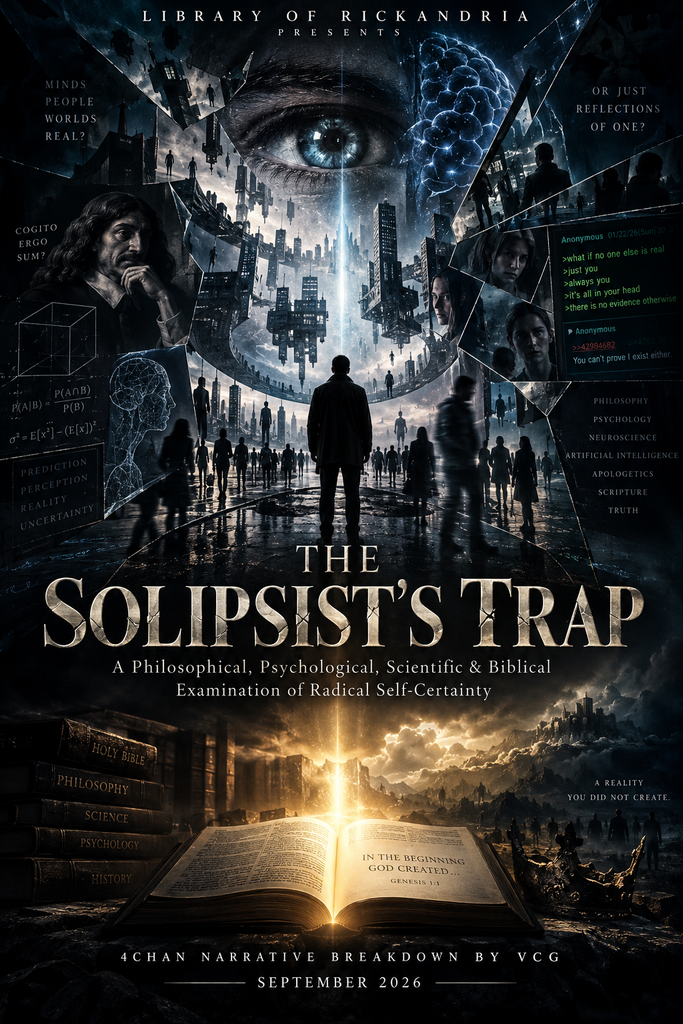
The Solipsist’s Trap: A Philosophical, Psychological, Scientific & Biblical Examination of Radical Self-Certainty
UPDATED BY VCG ON 9/23/2026 @ 00:00 EST
Anyone can do this, but most won’t.
ChatGPT – Library of Rickandria
LIBRARY OF RICKANDRIA PRESENTS
THE SOLIPSIST’S TRAP
A Philosophical, Psychological, Scientific & Biblical Examination of Radical Self-Certainty
4CHAN NARRATIVE BREAKDOWN BY VCG
SEPTEMBER 2026
Abstract
On September 19, 2026, an anonymous poster on 4chan’s /x/ board asked a deceptively simple question:
why do people believe in solipsism?
/x/ – Why do you believe in solipsism? – Paranormal – 4chan
The thread that followed moved rapidly through:
- philosophy
- psychology
- neuroscience
- Buddhism
- historical skepticism
- trauma
- the free-energy principle
- Holocaust denial
- Socrates
- agnosticism
and finally theology.
Along the way, several participants noticed genuine philosophical problems.
Others confused different kinds of solipsism, treated uncertainty as evidence for nonexistence, invoked scientific theories beyond what those theories establish, or attempted to explain philosophical disagreement by speculating about opponents’ psychology.
The surviving thread contains posts dated September 19–22, 2026.
This paper approaches that discussion as a case study in reasoning under radical uncertainty.
Its central contention is deliberately narrower than:
“science disproves solipsism.”
Radical skeptical hypotheses are difficult to eliminate through ordinary empirical observation precisely because they can be constructed to accommodate whatever observation occurs.
The more defensible criticism is that the thread repeatedly moves from a sound observation—
I have unusually direct access to my present conscious experience—
to a much stronger metaphysical proposition—
only my consciousness exists—
without supplying an adequate premise connecting the two.
That transition is the paper’s central concern.
The discussion therefore distinguishes metaphysical solipsism from:
- epistemological solipsism
- methodological solipsism
- idealism
- skepticism about other minds
- nondual traditions
- simulation hypotheses
and psychological experiences of derealization or depersonalization.
It reconstructs the strongest argument available to the solipsist before criticizing weaker versions.
It then examines:
- certainty
- probability
- falsifiability
- explanatory power
- prediction
- ad hoc rescue hypotheses
- the free-energy principle
- trauma research
- dissociation
- motivated reasoning
and the misuse of psychological labels.
Finally, the paper asks a separate theological question:
Is solipsism compatible with the biblical worldview?
Here the answer is much clearer.
- Scripture presents God—not human consciousness—as ontologically prior to creation
- distinguishes Creator, creation, self, and neighbour
- grounds moral obligation in genuinely relational categories
and depicts human beings as finite knowers inhabiting a reality they did not create.
- Genesis 1
- Job 38
- Acts 17
- John 1
the biblical doctrine of witness, and the command to love one’s neighbour all work within this Creator–creature structure.
The aim is not to ridicule the solipsist.
It is to determine exactly what has been established, what remains possible, what remains merely imaginable, and where certainty has been claimed without warrant.
I. THE THREAD AND THE QUESTION BENEATH IT
The original poster did something worthwhile.
Rather than announcing that solipsism was stupid or true, he asked believers to explain three things: why they became solipsists, what experiences influenced them, and what reasoning made the position seem correct.
Those are three different questions.
An experience can explain why a belief became psychologically attractive without establishing whether the belief is true.
An argument can be valid or invalid regardless of the emotional circumstances that produced it.
And a worldview may have:
- philosophical
- scientific
- psychological
and theological dimensions that require different methods of evaluation.
The thread frequently collapses those categories.
One poster suggests social alienation.
Another proposes trauma.
Another says surprise falsifies solipsism.
Another invokes Karl Friston.
Another invokes Buddhism.
Another compares the issue to Holocaust denial.
Another retreats from metaphysical solipsism into epistemological solipsism.
Another imagines having secretly constructed the universe and erased his own omniscience.
Eventually the discussion reaches the possibility that:
“everything is me.”
The resulting conversation is chaotic, but the chaos is useful.
It exposes a family of hidden assumptions that occur far beyond 4chan.
The most important is this:
If I cannot know something with the same certainty with which I know my own awareness, I am not justified in believing it exists.
That premise does enormous work.
Yet the thread rarely states it.
II. METHODOLOGY: HOW THIS PAPER EVALUATES THE THREAD
A responsible analysis cannot use one method for every claim.
When a poster says that Holocaust denial has a large evidential basis, that is an historical claim.
Historical records and institutional archives are appropriate evidence.
When someone invokes Friston’s free-energy principle, that is a scientific claim.
Friston’s published work is the appropriate control.
When someone says trauma causes solipsism, that is a psychological causal claim.
Clinical and psychological research is needed.
When someone says only one mind exists, that is principally a metaphysical proposition.
Neuroscience cannot simply place “metaphysical solipsism” in a scanner and disprove it.
When someone claims that Buddha taught solipsism, that is a historical-philosophical interpretation and should be compared with Buddhist scholarship.
When this paper asks whether solipsism is compatible with Scripture, that is a biblical-theological question.
The biblical text must be distinguished from the interpretation offered about it.
This paper therefore uses the following evidence hierarchy:
- Primary materials — the 4chan thread itself and the supplied King James Bible/Pure Cambridge Edition.
- Primary scientific literature — peer-reviewed papers and reviews.
- Academic reference works — especially the Stanford Encyclopedia of Philosophy.
- Institutional historical archives — such as the United States Holocaust Memorial Museum.
- Secondary interpretive scholarship.
- Anonymous assertions — treated as claims to investigate, not authorities.
This hierarchy does not make every higher-ranked source infallible.
It tells us what kind of evidential weight is reasonable to assign.
Methodological rule
A criticism of an argument should first address the argument.
Psychological explanations come afterward.
If somebody says,
“Only my mind exists,”
the first question is:
What premises supposedly entail that conclusion?
It is not:
What childhood trauma made you say that?
That distinction will matter throughout this paper.
III. WHAT DO WE MEAN BY “SOLIPSISM”?
The thread repeatedly uses one word for several different positions.
That makes meaningful disagreement almost impossible.
1. Metaphysical solipsism
The strongest version:
Only my mind ultimately exists.
External objects and apparent persons are somehow contained within, generated by, or reducible to the sole consciousness.
This is the position most readers ordinarily imagine when hearing “solipsism.”
Academic treatments likewise distinguish the ontological claim that only one’s own mind exists from weaker epistemological claims.
2. Epistemological solipsism
A weaker position:
Only my own conscious states are directly or certainly knowable to me.
This does not logically entail that other minds do not exist.
A person might believe that other minds probably exist while simultaneously claiming that their existence cannot be known with the same immediacy as one’s own consciousness.
This distinction becomes crucial when post 42991931 eventually concedes that “epistemological solipsism” would have been the more precise terminology.
3. Methodological solipsism
This is a technical term in philosophy of mind and should not be confused with either of the above.
In discussions associated with Jerry Fodor, “methodological solipsism” concerns how psychological states should be individuated for explanatory purposes—roughly, whether their characterization should depend on external semantic relations.
It is a research methodology, not the metaphysical doctrine that nobody else exists.
4. The problem of other minds
This asks:
How am I justified in believing that apparently conscious beings besides myself actually possess minds?
That is a genuine philosophical problem without requiring solipsism.
Contemporary treatments discuss analogy, inference to the best explanation, testimony, externalism, and other approaches.
There is no single unanimously accepted solution.
5. Idealism
Idealism is not synonymous with solipsism.
Different idealists understand reality as fundamentally mental, idea-like, experience-dependent, or structured by mind in importantly different senses.
George Berkeley, for example, emphatically did not conclude that only Berkeley existed.
His ontology contains finite spirits and God.
Indeed, Berkeley used the involuntary and systematic character of sensory experience as part of his argument for a divine cause.
So:
Idealism ≠ solipsism.
6. Nondualism
“Nondualism” covers diverse philosophical and religious traditions.
In broad terms, it can refer to the rejection of an ultimate division between subject and object or between seemingly separate realities.
That does not automatically mean:
My individual ego is the sole existent being.
Collapsing “nondual” into
“everything is my personal ego”
is precisely the mistake several comments in the thread flirt with.
7. Buddhist mind-only doctrines
Even Yogācāra—often described in strongly idealist language—cannot simply be identified with ego-solipsism.
Early Yogācāra philosophers explicitly confronted the other-minds problem, and Dharmakīrti wrote a work defending other mental continua.
Scholarship notes that solipsism was an unwelcome challenge rather than a simple summary of the school.
8. Simulation hypotheses
A simulation scenario proposes that the experienced environment is generated by some computational substrate.
That is not solipsism.
Nick Bostrom’s simulation argument concerns possible simulated civilizations and simulated observers.
It does not propose that only one observer exists.
A simulated world could contain billions of independently conscious simulated persons.
9. Depersonalization and derealization
These are experiences of detachment.
Depersonalization concerns estrangement from oneself.
Derealization concerns the experience that the surroundings feel unreal, distant, dreamlike, or strange.
Clinical literature explicitly describes them as experiences of detachment from self and environment.
Feeling:
“The world seems unreal”
is not equivalent to establishing:
“The world does not exist.”
That difference between phenomenology and ontology will become important later.
IV. STEELMANNING SOLIPSISM
Before criticizing solipsism, we should make its strongest case.
A serious version might proceed like this:
- Everything I experience appears within consciousness.
- I never encounter another person’s consciousness from the first-person perspective.
- Even evidence for an external world—vision, touch, testimony, scientific instruments—appears to me as conscious experience.
- Dreams demonstrate that apparently external environments can be experienced without corresponding to the world as they appear.
- Radical skeptical scenarios can reproduce the experiential evidence I presently possess.
- Therefore, I cannot obtain absolute Cartesian certainty that external objects or other minds exist independently of consciousness.
Up to this point, there is a real philosophical challenge.
Descartes deliberately pushed skepticism in this direction.
His malicious-deceiver thought experiment strips away confidence in the external world until the meditator arrives at something that appears resistant to doubt:
the occurrence of thought and, with it, his existence while thinking.
Descartes describes:
“I am, I exist”
as necessarily true whenever entertained.
The skeptical challenge remains alive in modern forms such as the brain-in-a-vat scenario.
A sufficiently radical deception hypothesis is constructed precisely so that ordinary experience cannot discriminate between the skeptical world and the ordinary one.
The solipsist therefore deserves this much:
There is an important epistemic asymmetry between my awareness of my present experience and my awareness of another person’s experience.
But now something happens.
The argument quietly changes.
From:
I cannot know another consciousness in exactly the same way I know present experience
we get:
Therefore only my consciousness exists.
The first does not entail the second.
That is the trap.
V. THE MISSING PREMISE: HOW “I KNOW THAT I AM” BECOMES “ONLY I AM”
This is the philosophical center of the paper.
Let:
A = I am presently conscious.
The thread’s strongest pro-solipsist poster is correct that A enjoys a peculiar first-person status.
But consider:
B = Other conscious beings exist.
Suppose I cannot know B with precisely the same immediacy with which I know A.
What follows?
Not:
¬B.
Not even necessarily:
I have no rational justification for B.
The argument requires an additional premise:
P:
If a proposition cannot be known with the same certainty as my present awareness, I should not believe that proposition describes reality.
Now the reasoning becomes visible:
- I know my awareness directly.
- I do not know other minds with identical certainty.
- Only things known with that degree of certainty should be treated as existent.
- Therefore only my own awareness should be treated as real.
The third premise is doing the decisive work.
And it is enormously controversial.
Contemporary epistemology commonly distinguishes knowledge from certainty.
Skeptical arguments might show that much ordinary knowledge falls short of infallible Cartesian certainty without showing that it lacks epistemic value or cannot count as knowledge.
That gives us three distinctions the thread repeatedly needs:
Not certain ≠ not known.
Not proven with deductive certainty ≠ unsupported.
Conceivably false ≠ irrational to believe.
VI. FORMAL ARGUMENT MAPS FROM THE THREAD
Argument Map 1: The Cartesian-to-solipsist slide
Thread reasoning
P1. I am aware.
P2. My awareness is uniquely certain.
P3. Other minds are not equally certain.
C. Only my awareness is truly real.
Problem
C does not follow from P1–P3.
Required hidden premise
P4. Anything whose existence is not as certain as my consciousness should be denied or treated as unreal.
That premise needs an argument.
Argument Map 2: Surprise disproves solipsism
P1. If my mind created everything, I would predict everything.
P2. I am sometimes surprised.
C. My mind did not create everything.
This works only if P1 is true.
But P1 secretly assumes:
If one mind ultimately generates experience, its ordinary conscious ego must have complete access to and voluntary control over the generating process.
A solipsist can reject that assumption by positing unconscious production, self-limitation, forgotten intentions, or hidden levels of mind.
Those rescues create other problems, but they show why surprise does not deductively refute every imaginable solipsism.
Argument Map 3: Nonfalsifiability implies possibility
P1. Solipsism cannot be experimentally falsified.
P2. Nonfalsifiable propositions have not been disproved.
C. Solipsism therefore has meaningful positive probability.
P2 is reasonable.
C still does not follow.
A theory’s resistance to falsification does not itself assign a probability to the theory.
A hypothesis can be unfalsified because evidence favors it.
Or because nobody tested it.
Or because it was formulated so that no observation could ever count against it.
Those are profoundly different situations.
Argument Map 4: I secretly created the universe and forgot
P1. Surprise seems inconsistent with conscious omnipotence.
P2. Perhaps a deeper version of myself intentionally hid omniscience from my ordinary self.
C. Surprise therefore poses no problem for solipsism.
C can be maintained.
But P2 is an auxiliary hypothesis introduced specifically to protect the central claim.
The question becomes:
What independent reason exists for P2?
If none is supplied, the move preserves logical possibility at the expense of explanatory discipline.
Argument Map 5: Posting implies other minds
P1. I post messages.
P2. I expect meaningful responses that I do not consciously formulate.
P3. Independent minds are a good explanation for such responses.
C. Therefore other minds exist.
This is not deductively valid in the sense of rendering every skeptical scenario impossible.
But it may be a perfectly respectable abductive inference—an inference to the best explanation.
Philosophers have long explored analogy and explanatory inference as ways of justifying belief in other minds.
That distinction matters:
Good evidence does not have to constitute Cartesian proof.
VII. A SHORT GENEALOGY OF THE PROBLEM
The thread talks as though solipsism were an eccentric internet invention.
The underlying problem is much older.
Descartes: the solitary starting point
Descartes’ methodical doubt asks what remains certain if sensory experience, memory, the body, and even mathematical reasoning can be systematically deceived.
The cogito survives because attempting to doubt thought still involves thinking.
But Descartes himself does not stop at solipsism.
His project attempts to recover knowledge of God and the external world.
The historical importance for our purposes is methodological: modern philosophy now has an epistemic starting point inside the first-person perspective.
Hume: skepticism and nature
Hume pushes doubts concerning causal inference and the external world very far.
SEP notes that he questions whether reason can establish external objects when our direct access is to perceptions, while also developing a more naturalistic account of human belief.
Hume ultimately rejects sustained extreme skepticism as psychologically unlivable and endorses a mitigated skepticism.
This is instructive.
The inability to produce Cartesian proof need not compel metaphysical solipsism.
Reid and Mill: other minds
Thomas Reid resisted the Cartesian framework and treated belief in intelligent fellow humans as part of ordinary human cognition.
John Stuart Mill developed an inferential approach.
We observe stable connections between our own internal states and behavior, then infer comparable internal states behind comparable behavior in others.
This became one classic answer to the problem of other minds.
Kant: challenging the inside-outside setup
Kant’s
“Refutation of Idealism”
attempts something more radical:
to show that consciousness of one’s own temporal experience itself depends upon awareness of persistent objects outside oneself.
Scholars debate the success and interpretation of the argument, but its significance is obvious:
Kant does not merely infer an external world from an isolated inner theater; he challenges the assumption that inner experience is epistemically self-sufficient in the way the skeptic supposes.
Berkeley: idealism without solipsism
Berkeley denies material substance in his distinctive sense, but retains minds, other finite spirits, and God.
His example is useful because it proves a terminological point:
Making reality mind-dependent does not automatically make reality dependent upon my individual human ego.
Wittgenstein: can a purely private standpoint sustain language?
The private-language discussions associated with Wittgenstein attack the idea of a language whose meanings could in principle be known only to a solitary user.
The underlying concern is that meaningful rule-following requires standards of correct and incorrect use that cannot simply reduce to
“whatever seems right to me is right.”
Interpretations of Wittgenstein are contested, so this should not be presented as a one-paragraph knockdown proof of solipsism.
But it creates a serious problem for philosophies that imagine a fully private consciousness first and public meaning second.
The history therefore does not yield:
philosophers proved solipsism impossible.
It yields something more interesting:
philosophers repeatedly discovered that the supposedly simple route from private experience to solitary reality becomes conceptually expensive.
VIII. FROM “YOU CANNOT DISPROVE IT” TO “THEREFORE BELIEVE IT”
The burden-of-proof switch
One of the thread’s most important moves appears around post 42992831.
The poster correctly says that nonfalsifiability does not mean falsehood.
But then the reasoning begins treating inability to disprove solipsism as a reason for granting it positive epistemic weight.
Those are separate issues.
Imagine three propositions:
H1: There is an invisible dragon in my room that leaves no physical effects.
H2: There is an ordinary chair in my room.
H3: Other human beings possess conscious mental lives broadly analogous to mine.
Suppose H1 has been protected from all possible observation.
That does not make H1 equally supported with H2 or H3.
Being impossible to falsify can arise because the proposition has been insulated from evidence.
The person making an existence claim therefore bears a burden to provide reasons for it.
The burden does not automatically reverse because opponents cannot construct a deductive impossibility proof.
This is especially important when the solipsist oscillates between two claims:
Motte:
I cannot possess absolute certainty about other minds.
Bailey:
Only my mind exists.
The first is much easier to defend.
The second is much stronger.
Retreating from the second to the first when challenged, then returning to the second afterward, creates a classic argumentative instability even if it is not always consciously strategic.
IX. POSSIBILITY, PROBABILITY, AND PLAUSIBILITY
The thread repeatedly moves among three concepts as though they were identical.
They are not.
Logical possibility
A proposition contains no obvious contradiction.
Example:
Perhaps I created the universe and erased my memory.
That may be logically describable.
Epistemic possibility
Given what I know, I cannot confidently rule it out.
Probability
The hypothesis has some quantified or comparative likelihood under a probability model.
Plausibility
The hypothesis fits background knowledge, explanatory virtues, prior evidence, and relevant constraints comparatively well.
These levels cannot be freely substituted.
From:
“I can imagine H”
we cannot infer:
“H has a meaningful probability comparable to its alternatives.”
A probability requires some account of priors, likelihoods, or comparative warrant.
This is why post 42992831’s move from nonfalsifiability to “nonzero chance” is philosophically more complicated than it appears.
Logical openness is not a probability distribution.
X. PREDICTION, EXPLANATORY POWER, AND THE SELF-SEALING HYPOTHESIS
Consider two models.
Model R: Other-agent realism
Other people possess minds partly independent of mine.
This model predicts that:
- people will possess information I lack;
- they will sometimes misunderstand me;
- they will surprise me;
- they will resist my preferences;
- they will pursue projects I never imagined;
- independent observers will sometimes converge on discoveries;
- others will remember events I forgot;
- they may correctly tell me I am mistaken.
Model S*: unrestricted hidden-mind solipsism
Everything is generated by my deeper consciousness, but that deeper consciousness can hide any fact, create any apparent person, produce any disagreement, erase any memory, simulate any discovery, and surprise my ordinary ego whenever it wishes.
What observation could discriminate S* from anything else?
Apparently none.
If others agree with me:
my deeper mind generated agreement.
If they disagree:
my deeper mind generated disagreement.
If I control an outcome:
my hidden power worked.
If I fail:
my hidden power wanted failure.
If I remember creating the world:
confirmation.
If I do not remember:
deliberate amnesia.
S* becomes capable of postdicting everything.
But a theory explaining every outcome equally well often predicts very little.
This does not prove S* false.
It shows why explanatory flexibility can become explanatory weakness.
Popper’s falsifiability criterion was meant to distinguish empirical science from non-science:
a scientific theory must risk conflict with possible observation.
Importantly, Popper did not equate “metaphysical” or “unfalsifiable” with “meaningless” or automatically false.
He acknowledged that non-scientific ideas could be intellectually valuable.
So the correct conclusion is:
Radical self-sealing solipsism is not empirically refuted merely because it is unfalsifiable.
But equally:
Its unfalsifiability is not scientific evidence in its favor.
XI. THE SURPRISE ARGUMENT AND FRISTON’S FREE-ENERGY PRINCIPLE
One poster argues that surprise proves solipsism false.
Another invokes Karl Friston’s free-energy principle to reinforce this.
The thread is reaching for something real but overshooting it.
Friston’s framework describes adaptive agents in terms of:
- prediction
- generative models
- sensory exchange
- variational free energy
“Surprise” here has a technical information-theoretic meaning related to the improbability of outcomes under a model—not merely the everyday feeling of being startled.
The free-energy principle can help us understand:
prediction,
prediction error,
sensory inference,
model updating,
adaptive interaction.
It does not contain a theorem saying:
If an organism encounters prediction error, metaphysical solipsism is false.
That conclusion requires additional philosophical premises.
What surprise really shows
Surprise strongly challenges one particular thesis:
My ordinary conscious ego deliberately controls and predicts every detail of experience.
If I routinely encounter events I neither intend nor anticipate, that model performs poorly.
But the sophisticated solipsist can respond:
My unconscious or deeper mind generated those events.
At that point the debate has shifted.
We are no longer testing conscious control.
We are testing an invisible unrestricted generator whose operations are defined so as to explain every result.
That is why the better criticism is methodological rather than pretending neuroscience has directly disproved metaphysics.
XII. DREAMS, HALLUCINATIONS, VR, AND SIMULATION
The strongest intuitive argument for skepticism may be very simple:
Dreams feel real while we are dreaming.
Therefore, apparent perceptual immediacy is not infallible.
Correct.
But this establishes:
experience can misrepresent reality.
It does not establish:
experience never supplies evidence about reality.
Hallucinations establish the same point.
Virtual reality establishes that sensory systems can be fed artificially structured information.
Brain-in-a-vat scenarios push the principle to its logical extreme.
Yet the inference:
some perceptions are misleading
therefore perception provides no knowledge
is itself invalid.
Medicine, navigation, engineering, and ordinary life all depend on fallible but corrigible perception.
Error is discoverable precisely because observations can be compared across time, instruments, modalities, and observers.
Simulation is not solipsism
Even if we lived inside a simulation, several possibilities remain:
other simulated beings are conscious;
biological beings outside the simulation are conscious;
the simulator is conscious;
multiple levels of consciousness exist.
Bostrom’s famous simulation argument is therefore not an argument for:
“only I exist.”
It is a conditional argument concerning the prevalence of ancestor simulations and simulated observers.
The distinction is simple:
A world can be artificial without being solitary.
XIII. PSYCHOLOGY: EXPERIENCE IS NOT METAPHYSICS
Several thread participants attempt to explain solipsism psychologically.
This is where great caution is needed.
Depersonalization
A person may feel detached from self, body, thoughts, or emotions.
Derealization
A person may experience surroundings as:
- unreal
- distant
- artificial
- dreamlike
or strangely flattened.
Clinical literature describes both experiences clearly.
But:
“The world feels unreal”
is a report about experience.
“The world is ontologically unreal”
is a metaphysical claim.
The second does not follow from the first.
That distinction protects both philosophy and psychology.
It prevents us from dismissing a genuine psychological experience merely because the metaphysical inference is unjustified.
And it prevents us from mistaking an intense subjective experience for proof of a theory about reality.
XIV. TRAUMA: WHAT THE EVIDENCE DOES AND DOES NOT SUPPORT
Post 42987872 presents solipsism as a trauma-based escape mechanism.
Another poster speculates that social alienation explains most solipsists.
The research supports something narrower.
Trauma can be associated with dissociation, and dissociative presentations of PTSD prominently involve depersonalization and derealization.
Reviews report associations between dissociative PTSD, derealization/depersonalization, and histories of trauma, while also emphasizing heterogeneity and limits in the evidence.
That allows us to say:
Some trauma-related states can involve profound experiences of detachment or unreality.
It does not allow us to say:
Therefore people who defend philosophical solipsism are doing so because of trauma.
No psychological assessment of the anonymous posters exists.
No representative sample is presented.
No causal study in the thread demonstrates that philosophical solipsism is generally a trauma defense.
The claim may be a hypothesis worth researching.
It is not presently an established diagnosis.
XV. PSYCHOLOGY WITHOUT PSYCHOLOGIZING
There is a broader methodological error here: the genetic fallacy.
Suppose we discovered that somebody believes realism because it makes him feel safe.
That would not prove realism false.
Suppose somebody believes solipsism because it protects him from interpersonal pain.
That would not prove solipsism false either.
The origin of a belief and the justification of a belief are distinct questions.
Psychology becomes relevant when asking:
- Why are certain explanations attractive?
- How do people preserve beliefs?
- How do identity and emotion affect evidence evaluation?
- Why do self-sealing explanations resist revision?
Research on motivated reasoning shows that goals and motivations can influence how people search for, evaluate, and construct justifications for conclusions.
But even classic accounts emphasize that motivated reasoning generally operates through attempts to construct apparently reasonable justifications rather than through unlimited fantasy.
This applies to everybody.
The realist can rationalize.
The solipsist can rationalize.
The Christian can rationalize.
The atheist can rationalize.
A good methodology therefore asks:
What evidence would make me revise my position?
That question should be asked symmetrically.
XVI. THE DUNNING–KRUGER LABEL
Post 42991674 throws “Dunning–Kruger” into the discussion as an insult.
That is not an adequate use of psychological research.
The original Dunning–Kruger literature concerns relationships among performance, self-evaluation, and metacognitive calibration.
Later research has shown that the familiar pattern is more complicated than the popular slogan
“stupid people are too stupid to know they are stupid.”
McIntosh and colleagues found that metacognitive differences can contribute but are neither necessary nor sufficient to produce the familiar effect.
Nothing about an anonymous philosophical disagreement allows us to diagnose a
“Dunning–Kruger victim.”
The correct response to a bad argument remains:
Show where the argument fails.
XVII. FACT-CHECKING THE THREAD’S HISTORICAL AND RELIGIOUS REFERENCES
1. Did Buddha teach solipsism?
No—not in the simple sense implied by the thread.
Early Buddhist teaching is famously associated with non-self rather than the apotheosis of the individual ego.
Academic treatments describe arguments denying a permanent substantive self underlying the psychophysical aggregates.
That is profoundly different from:
My personal self is the only thing that exists.
Yogācāra creates more complicated questions because of its idealist tendencies, but major Yogācāra philosophers explicitly wrestled with the existence of other minds; Dharmakīrti defended other mental continua.
So:
Buddhist illusion doctrines ≠
“my ego invented everyone.”
2. Did Socrates mean that nothing can be known?
The slogan commonly rendered as:
“I know that I know nothing”
should not be treated as universal nihilistic skepticism.
In the Apology context, Socrates discovers that others claim knowledge about important matters without adequate justification, while he recognizes his own ignorance concerning those matters.
SEP emphasizes inquiry and recognition of epistemic limits rather than the universal proposition
“nothing whatsoever can be known.”
That actually fits this paper rather well:
Knowing where knowledge stops is different from declaring reality stops there too.
3. Does agnosticism necessarily mean permanent unknowability?
Not exclusively.
T. H. Huxley coined “agnostic” and connected it to disciplined withholding of claims unsupported by adequate evidence.
Contemporary philosophical usage also includes suspension of belief concerning a proposition rather than only the strongest thesis that nobody could ever know it.
Thus post 42994262 identifies one strong agnostic position and then treats it as the only legitimate meaning.
Usage is broader.
XVIII. THE HOLOCAUST-DENIAL COMPARISON
One of the thread’s worst factual moments occurs when a poster compares objections to solipsism with
“so-called Holocaust denial”
and claims that the Holocaust lacks proof while contrary evidence is abundant.
That historical claim is false.
The United States Holocaust Memorial Museum describes the Holocaust as the best-documented case of genocide.
Evidence includes thousands of German records entered at postwar trials, photographs and films created by perpetrators, eyewitness testimony from survivors and perpetrators, demographic records, material evidence, and extensive subsequent documentation.
This mistake also teaches a useful epistemological lesson.
If historical knowledge required elimination of every imaginable Cartesian deception scenario, then we would know no historical event.
That does not place all historical hypotheses on equal footing.
History works through converging:
- independent evidence
- source criticism
- provenance
- physical evidence
- testimony
- contemporaneous documentation
- demographic reconstruction
- explanatory coherence
Absolute logical certainty is not the ordinary standard for historical knowledge.
The comparison therefore fails in two ways:
- the empirical claim about Holocaust evidence is false;
- it confuses absence of Cartesian certainty with absence of overwhelming historical warrant.
XIX. INTERNET RHETORIC AS PART OF THE PHENOMENON
The thread is not simply a collection of propositions.
It is a social environment.
The rhetorical behavior deserves analysis because it affects how arguments are perceived.
Several recurring patterns appear.
Ridicule replacing argument
Posters repeatedly label opponents stupid rather than identifying faulty premises.
The insult may earn status within the thread.
It earns no logical validity.
Scientific name-dropping
Friston’s name appears as though mentioning an advanced theory settles the metaphysical question.
This is authority inflation:
real technical theory → vaguely related concept → conclusion not actually established by the theory.
Psychological labeling
“Trauma,” “Dunning–Kruger,” social alienation, and bitterness become explanations for opponents.
Some may be relevant hypotheses.
None can be inferred confidently from a few anonymous comments.
Definition shifting
“Solipsism” moves among:
metaphysical exclusivity,
epistemic humility,
uncertainty about other minds,
nondualism,
the universe as self-generated,
ordinary selfishness.
Arguments that appear contradictory often target different definitions.
Retreat and return
A poster may begin with:
“only my own awareness is certain,”
defend that modest claim when challenged, then later speak as though everything literally is the same self.
This is why explicit definitions matter.
Mystical escape hatches
The claim that an unknown deeper self intentionally generated every counterexample cannot be disproved easily because the deeper self can be assigned whatever properties are needed after the fact.
Identity and certainty
Once a person says:
“I am a solipsist,”
criticism can become criticism of identity rather than of a proposition.
That raises the psychological cost of revision.
A better conversation would say:
Here is the proposition I currently think is true.
That keeps the belief revisable.
XX. CLAIM–EVIDENCE MATRIX
| Thread claim | Type of claim | Evidence offered | Evaluation | Corrected conclusion |
|---|---|---|---|---|
| My present awareness is unusually certain | Epistemology | Introspection | Strong but limited | Supports privileged first-person access, not sole existence |
| Only my consciousness exists | Metaphysics | First-person certainty | Insufficient | Requires additional premises |
| Surprise disproves solipsism | Philosophy/science | Prediction error | Too broad | Challenges conscious total-control versions |
| Friston disproves solipsism | Neuroscience/metaphysics | Free-energy principle | Misapplied | FEP concerns adaptive inference, not a metaphysical proof |
| Solipsism cannot be falsified | Philosophy of science | Radical skeptical construction | Often true for unrestricted versions | Nonfalsifiability does not imply truth |
| Nonfalsifiability gives solipsism positive probability | Probability/epistemology | None specified | Unsupported transition | Probability requires additional assumptions |
| Trauma causes solipsism | Psychology | Anecdotal speculation | Unsupported as a general claim | Trauma can relate to dissociation/DPDR, not thereby philosophical solipsism |
| Solipsists are social outcasts | Psychology/sociology | Anecdote | Unsupported generalization | Requires empirical population data |
| Dunning–Kruger explains defenders | Psychology | Insult | Unsupported | DKE cannot be diagnosed from disagreement |
| Touch proves external reality | Epistemology | Tactile experience | Insufficient against radical skepticism | Touch is evidence, not Cartesian proof |
| Buddha taught solipsism | History of philosophy | Loose association with illusion | Misleading | Buddhist non-self and Yogācāra are not reducible to ego-solipsism |
| Socrates taught universal ignorance | History of philosophy | Popular slogan | Oversimplified | Socratic ignorance concerns disciplined recognition of limits |
| Agnosticism necessarily means permanent unknowability | Terminology | Assertion | Too narrow | Usage includes suspension of judgment |
| Holocaust evidence is weak | History | Assertion | False | Holocaust is extraordinarily well documented |
| Posting implies belief in other minds | Practical epistemology | Communicative behavior | Strong practical evidence, not deduction | Shows ordinary reasoning treats others as independent information sources |
| “Everything is me” follows from epistemic limitation | Metaphysics | None | Non sequitur | Epistemic limitation does not establish ontological identity |
XXI. “WHERE WAST THOU?” — JOB 38 AND THE DECENTERING OF HUMAN CONSCIOUSNESS
We now shift methods.
Everything above has asked:
What does philosophy, psychology, history, or science establish?
We now ask:
What worldview does the biblical text itself present?
The distinction matters.
A biblical passage is not a neuroscience experiment.
Nor does citing Genesis magically solve every problem in secular epistemology.
The theological question is narrower:
If Scripture is taken on its own terms, is metaphysical ego-solipsism compatible with its worldview?
The biblical answer appears overwhelmingly negative.
The opening words already establish the basic ontology:
“In the beginning God created the heaven and the earth.”— Genesis 1:1
Notice what does not appear.
The human observer.
Human consciousness is not introduced as the precondition for creation.
The world is already spoken, ordered, distinguished, and declared before Adam appears.
Within the narrative, therefore:
God precedes man.
Creation precedes human observation.
Human consciousness is located inside creation rather than creation inside the human ego.
Then Job 38 makes the point almost confrontationally:
“Where wast thou when I laid the foundations of the earth? declare, if thou hast understanding.”— Job 38:4
This is not a philosophical treatise on Cartesian skepticism.
Its context concerns Job’s creaturely limitation before divine wisdom.
Yet the theological implication is highly relevant.
Reality is not centered upon Job’s awareness.
God does not ask Job to remember secretly generating the cosmos.
He distinguishes the divine Creator who laid the foundations from the human creature who was absent.
The following questions intensify that distinction:
Did Job measure the earth? command the morning? enter the springs of the sea? perceive the breadth of the earth?
The rhetorical answer is consistently no.
Biblical epistemic humility is therefore not:
I cannot know everything, so perhaps everything is me.
It is closer to:
I cannot know everything because I am a finite creature inhabiting a reality whose Author is not me.
That is nearly the theological inversion of ego-solipsism.
XXII. ACTS 17: DEPENDENCE IS NOT IDENTITY
Acts 17 deserves special attention because mystical language is often misunderstood in precisely the direction seen in the thread.
Paul says:
“God that made the world and all things therein, seeing that he is Lord of heaven and earth…”— Acts 17:24
A few verses later:
“For in him we live, and move, and have our being…”— Acts 17:28
Someone could isolate verse 28 and reinterpret it as:
Everything is literally one consciousness.
But its immediate context resists that reading.
Paul has already distinguished:
God,
the world God made,
nations of human beings,
their times,
their habitations,
their search for God.
“In him” therefore communicates radical dependence.
It does not erase Creator and creature into numerical identity.
We may formulate the distinction:
Dependence ≠ identity.
Image ≠ identity.
Indwelling ≠ identity.
Creaturely participation ≠ becoming the Creator.
The thread’s occasional move from:
“the divine expresses itself through consciousness”
to
“therefore all apparent persons are secretly me”
cannot simply be imported into Acts 17.
The text maintains distinctions the solipsistic interpretation dissolves.
XXIII. JOHN 1: CREATION AND INCARNATION
John opens:
“In the beginning was the Word, and the Word was with God, and the Word was God.”
— John 1:1
Then:
“All things were made by him; and without him was not any thing made that was made.”— John 1:3
And finally:
“And the Word was made flesh, and dwelt among us…”— John 1:14
These statements create a profoundly non-solipsistic theological structure.
Reality does not originate in the human reader.
The human reader belongs to the class of things whose existence depends upon the divine Creator.
And Christianity’s central claim does not involve escaping embodiment into an isolated consciousness.
It involves incarnation:
the Word made flesh.
Whatever else one makes of Christian metaphysics, its textual narrative is embodied, historical, relational, public, and populated by distinct subjects.
The Gospel does not announce:
You will discover everyone was secretly your mind.
It announces the coming of One into a world already made through Him.
XXIV. THE BIBLICAL DOCTRINE OF WITNESS
Biblical revelation repeatedly operates through multiple witnesses.
This matters for the structure of the worldview.
Paul writes:
“In the mouth of two or three witnesses shall every word be established.”— 2 Corinthians 13:1
Acts begins by speaking of Christ showing himself alive and commissioning apostles as witnesses.
The New Testament repeatedly distinguishes:
the event,
the witness who observed it,
another witness,
the hearer receiving testimony.
Those categories are not philosophical proofs against a malicious-demon scenario.
But within the biblical worldview they presuppose genuinely distinct personal agents.
Christian proclamation is structurally intersubjective.
One person sees.
Another testifies.
Another hears.
Another checks.
Another may reject.
This is particularly visible in Acts 17:11, where the Bereans receive teaching and then independently search the Scriptures to examine whether what they have heard is so.
The pattern is not:
One consciousness talking to its projections.
It is:
claims examined among accountable persons before God.
XXV. THE BIBLICAL EPISTEMOLOGY OF EXAMINATION
One verse provides an excellent motto for this entire paper:
“Prove all things; hold fast that which is good.”— 1 Thessalonians 5:21
The context is theological rather than a modern philosophy-of-science manual.
Still, the principle is instructive:
test rather than merely assert.
The Bible also contains a notable respect for careful inquiry.
The Bereans:
“searched the scriptures daily, whether those things were so.”— Acts 17:11
The biblical alternative to solipsistic certainty is therefore not intellectual passivity.
Nor is it
“believe whatever an authority says.”
Scripture repeatedly distinguishes truth from falsehood, witness from false witness, wisdom from folly, and knowledge from presumption.
Within its theological framework, humility means admitting creaturely limitation while still seeking truth.
XXVI. “LOVE THY NEIGHBOUR AS THYSELF”: THE ETHICAL PROBLEM
Jesus states:
“Thou shalt love thy neighbour as thyself.”— Matthew 22:39
Notice the grammar.
Neighbor.
Self.
The command relates them morally without identifying them numerically.
First John sharpens the point:
“for he that loveth not his brother whom he hath seen, how can he love God whom he hath not seen?”— 1 John 4:20
The brother is treated as a genuine moral other whose welfare matters.
This creates a serious theological problem for religious forms of ego-solipsism.
If another person becomes merely an internally generated character whose suffering is ultimately “my experience,” the biblical category of neighbor has been transformed.
An important caution
This does not mean every philosophical solipsist behaves immorally.
A solipsist could adopt compassionate ethics.
Nor does it mean every realist treats others well.
The point is conceptual.
A worldview in which other people possess genuine reality supplies a straightforward basis for treating their interests as genuinely other than mine.
A worldview in which every apparent person is merely a projection of my own solitary consciousness must reconstruct that moral otherness by some additional theory.
Biblical ethics requires no such reconstruction.
The neighbor is already there.
XXVII. HUMAN LIMITATION IS NOT HIDDEN DIVINITY
One recurring solipsistic escape is:
Perhaps I really am omnipotent and omniscient, but I deliberately hid those attributes from myself.
Notice what has happened.
The original argument began with epistemic humility:
I only know my own awareness with certainty.
It ends with cosmic self-deification:
Perhaps I secretly generated everything.
The distance between those claims is enormous.
Biblically, the attributes are assigned in the opposite direction.
God is Creator.
Man is creature.
Revelation 4 presents worship directed toward God:
“for thou hast created all things, and for thy pleasure they are and were created.”— Revelation 4:11
Colossians similarly says of Christ:
“For by him were all things created…”— Colossians 1:16
and:
“he is before all things, and by him all things consist.”— Colossians 1:17
Biblical ignorance therefore points toward creatureliness, not concealed universal authorship.
XXVIII. ETHICAL CONSEQUENCES WITHOUT CARICATURE
It is worth asking what practical consequences can follow from a strongly ego-solipsistic worldview.
But this must be done carefully.
We cannot say:
Solipsists are immoral.
We can ask instead what becomes conceptually difficult if other people are treated as projections.
Several problems arise.
Consent
Why respect another’s refusal if the other is ultimately a character generated by oneself?
The solipsist may still respect consent—but must provide an ethical reason that survives the reduction of the other person’s independent reality.
Suffering
If another person’s agony is interpreted primarily as:
“an experience my consciousness generated for itself,”
there is a risk that actual interpersonal suffering becomes aestheticized or spiritualized.
Accountability
If every harm done by another ultimately becomes something a hidden self created, ordinary distinctions among victim, perpetrator, responsibility, and injustice can become unstable.
Correction
If every critic is my own projection, disagreement can become self-confirming rather than genuinely corrective.
Again, none of these outcomes is logically mandatory.
They are structural risks.
The biblical framework counters them by placing each neighbour under God rather than inside my ego.
XXIX. THE PERFORMATIVE TENSION OF POSTING SOLIPSISM ONLINE
There is something fascinating about arguing for solipsism on an anonymous message board.
The poster:
composes sentences;
selects words;
anticipates interpretation;
answers objections;
distinguishes misunderstandings;
becomes frustrated when readers fail to understand;
supplies clarification;
waits for novel replies.
All of that behavior operates naturally under the model:
There are other interpreters whose mental states differ from mine.
Does that deductively disprove solipsism?
No.
The solipsist can say:
All of this communication is internally generated.
But notice the price.
The communicative behavior continues to rely pragmatically on categories that the metaphysical theory attempts to dissolve.
That produces a performative tension, not necessarily a formal contradiction.
Post 42992831 notices this unusually well when it observes that posting implies an expectation of intelligible replies the poster did not consciously produce.
That may be one of the most insightful observations in the entire thread.
XXX. WHAT EVIDENCE WOULD CHANGE YOUR MIND?
This question should be asked of every side.
To the metaphysical solipsist
What conceivable experience would decrease your confidence?
If the answer is:
Nothing whatsoever, because my hidden mind could generate anything,
then your theory is empirically non-discriminating.
That does not make it logically false.
It tells us what kind of theory it is.
To the realist
What evidence would reduce confidence that apparent persons possess independent minds?
The answer might include systematic evidence that apparently independent agents are generated predictably by one’s own intentions, disappearance of behavioral independence, reliable access to supposed private states before the apparent agents possess them, or some powerful alternative explanatory framework.
That does not settle radical skepticism, but it shows that ordinary realism can participate in comparative evidence evaluation.
To the Christian interpreter
What would challenge the theological interpretation offered here?
Biblically, we would need texts establishing something like:
the human ego existed before creation;
the individual human consciousness created all other persons;
neighbours are merely manifestations of one human subject;
Creator and human creature are numerically identical.
The texts examined instead move consistently in the opposite direction.
That does not make the biblical worldview an experimental proof against solipsism.
It makes metaphysical ego-solipsism textually incompatible with the worldview Scripture actually presents.
XXXI. COMPLETE POST-BY-POST ANNOTATED WALKTHROUGH
For copyright and readability, this appendix paraphrases every substantive visible post rather than reproducing the thread wholesale.
The post numbers allow the reader to compare the analysis against the live source.
42984682 — Original Post
The OP asks believers in solipsism to explain:
- experience
- reasoning
- motivation
Assessment:
Methodologically sound opening question.
Correction:
Keep psychological explanation and philosophical justification separate.
42984692
The poster makes a joke based on the premise that replying to another person would really amount to bothering oneself.
Assessment: Rhetorical play, not argument.
42984947
The poster dismisses solipsism as unintelligent and easily refuted.
Assessment: Unsupported assertion.
Solipsism may face serious objections, but radical skeptical positions are not made false merely by calling them simple to refute.
42985602
The poster argues that present awareness is the only absolutely certain proposition and claims solipsism therefore requires no beliefs.
Assessment:
The first claim resembles a Cartesian intuition; the second overreaches.
The proposition:
“I am aware”
does not entail:
“Only I am aware.”
Descartes’ cogito establishes the thinking subject’s existence while thinking, not the nonexistence of everyone else.
42985911
The poster attributes solipsism primarily to social isolation and, in other cases, misunderstanding spiritual or occult teachings.
Assessment: Two hypotheses are mixed.
The distinction between universal divine manifestation and personal ego-solipsism is philosophically useful.
The social-outcast explanation is unsupported population psychology.
42987862
The poster says solipsism is a category mistake and that surprise defeats it.
Assessment: The surprise argument is too strong.
Surprise undermines conscious-total-control theories more directly than unrestricted metaphysical solipsism.
42987872
The poster characterizes solipsism as an escape from interpersonal trauma.
Assessment: Unsupported diagnosis.
Trauma can correlate with dissociation and derealization, but this does not establish that anonymous philosophical solipsists adopted their beliefs because of trauma.
42988403
The poster clarifies that no ontological conclusion was intended; the point was merely that one can be sure only of one’s own awareness.
Assessment: Important retreat to an epistemological thesis.
This is much more defensible than metaphysical solipsism.
Calling it a “tautology,” however, is imprecise.
42988419
The poster compares the evidential situation to Holocaust denial and says the Holocaust has not been proved.
Assessment: Historically false.
The Holocaust is extraordinarily well documented through perpetrator records, photographs, films, testimony, demographic evidence, trial evidence, and physical documentation.
42988438
Brief humorous reaction.
Assessment: No substantive argument.
42988444
The poster jokes that other people are too foolish to have been imagined by him.
Assessment: Rhetorical version of the surprise argument.
Not deductive evidence.
42988451
The poster says unexpected events that violate prior expectations render solipsism void.
Assessment: Overstatement.
Prediction error challenges one model of solipsistic control but not every conceivable sole-mind hypothesis.
42988471
The poster rejects solipsism but then makes sweeping claims that humanity is universally delusional, authorities are universally dishonest, and existence is a hell-realm.
Assessment: Unsupported universal generalizations.
The concluding commitments to truth and reducing suffering are normative propositions and do not establish the preceding metaphysical claims.
42988477
The poster says he ceased experiencing surprise in 2005 after concluding that everything was fake.
Assessment: Personal phenomenological report.
Even if accurate, absence of felt surprise does not establish ontology.
42988493
The poster invokes Friston’s free-energy principle as showing solipsism to be logically invalid.
Assessment: Scientific overreach.
Friston develops a theory of adaptive inference, generative models, sensory prediction, and free energy—not a proof against metaphysical solipsism.
42988560
The poster responds by mocking the use of sophisticated scientific vocabulary.
Assessment: There is a legitimate criticism hidden under the insult: technical language does not establish an unrelated conclusion.
The argument would be stronger without the abuse.
42990863
Pure insult.
Assessment: No evidential content.
42991435
The poster simply announces that solipsism is the final truth.
Assessment: Assertion without argument.
Confidence is not evidence.
42991661
The poster distinguishes certainty about one’s awareness from claims denying other awarenesses.
Assessment: One of the strongest contributions to the thread.
This identifies the central epistemology/ontology distinction.
42991665
The poster says a claimed loss of surprise presupposes earlier capacity for surprise.
Assessment: Fair reply to the personal claim, but it still does not convert surprise into a universal disproof of solipsism.
42991674
The poster invokes Dunning–Kruger.
Assessment: Psychological label used as insult.
The effect cannot be diagnosed from a philosophical disagreement.
42991692
The poster vaguely accuses another of substituting popular science for reality.
Assessment: Potentially legitimate concern, insufficiently specified.
One should identify exactly which scientific claim was misused.
42991782
A joke treats spiritual reunification of souls as though it implied all persons literally are one individual self.
Assessment: Useful accidental illustration of the difference between nondualism and ego-solipsism.
The two doctrines do not automatically coincide.
42991812
The poster says an opponent’s personal attack constitutes an admission of defeat.
Assessment: Overreach.
An ad hominem is not a valid rebuttal, but committing one does not logically prove that the speaker has secretly conceded the argument.
42991931
The poster accepts “epistemological solipsism” as the more precise term and proposes that perhaps the world was deliberately configured to hide omniscience from the self.
Assessment: Terminological improvement followed by an ad hoc rescue hypothesis.
The central question becomes what independent evidence supports the hidden-self explanation.
42992535
The poster argues that tactile experience shows illusions cannot account for reality.
Assessment: Touch supplies evidence but not an answer to radical skepticism.
A dream, hallucination, or simulated environment can include tactile experience.
42992677
The poster says information limits are not a philosophy and uses division by zero/vertical lines as an analogy.
Assessment: The underlying point is useful: representational limitation does not imply nonexistence.
The mathematical analogy is imprecise, and epistemological positions concerning limits of knowledge unquestionably are philosophical positions.
42992704
The poster endorses solipsism “for me” but not for another person.
Assessment: Conceptually unstable if intended literally.
If only one subject exists, two independently valid subject-relative ontologies cannot straightforwardly coexist.
42992831
The poster makes several important distinctions:
nonfalsifiable does not mean false; sensory data can be mistaken; posting behavior pragmatically anticipates other minds.
It then moves from nonfalsifiability toward assigning some positive chance to sole consciousness.
Assessment: Mixed.
The nonfalsifiability point is correct.
The probability transition requires further premises.
The observation about communicative behavior is unusually insightful.
42992832
The poster reduces the prior position to lack of knowledge.
Assessment: Reasonable if referring specifically to acknowledged epistemic limitation.
Ignorance alone does not entail metaphysical solipsism.
42992836
The poster dismisses the spiritual discussion as religious nonsense.
Assessment: Mere dismissal.
A religious claim may be false, true, confused, or irrelevant; the category “religious” does not decide which.
42992853
The poster observes that unconscious things such as rocks or lightning can surprise someone.
Assessment: Correct.
Surprise does not logically entail another conscious agent.
42992856
The poster asks whether an illusory world generated by oneself is essentially Buddhism.
Assessment: Historically misleading.
Buddhist non-self and Yogācāra cannot be reduced to personal ego-solipsism.
42992860
The poster generalizes that implicit solipsism appears as passive-aggressive bitterness.
Assessment: Interesting social hypothesis but unsupported empirical generalization.
It may describe some behaviors without establishing prevalence or causality.
42992886
The poster suggests that being surprised by another person’s character provides stronger evidence than surprise by inanimate events.
Assessment: Better argument.
Unexpected sophisticated interpersonal behavior can contribute to an abductive case for other minds.
It still does not deductively eliminate radical deception scenarios.
42993040
The poster correctly recognizes that physically striking a solipsist does not philosophically prove realism, but expresses the point mainly through contempt.
Assessment: Sound narrow criticism, poor presentation.
Tactile evidence does not answer radical skepticism by itself.
42993492
The poster argues that epistemic limitation can itself constitute a philosophical stance and invokes Socrates.
Assessment: First part is correct.
The Socratic slogan requires historical qualification.
Socrates’ learned ignorance is not the same as metaphysical solipsism or universal unknowability.
42993589
The poster declares that everything is the self and that this realization is liberating.
Assessment: Full metaphysical assertion without supporting inference.
The move is much stronger than epistemological caution.
42993619
The poster argues that if one mind generates everything, it should control violence, lotteries, romantic outcomes, and other events.
Assessment: Strong objection to conscious-volitional omnipotence.
Not decisive against a theory positing unconscious generation.
42994262
The poster argues that true agnosticism means permanent in-principle unknowability and dismisses the Socrates comparison.
Assessment: The rejection of the Socrates analogy is partly fair.
The definition of agnosticism is too restrictive relative to philosophical usage.
42994286
Brief dismissive meme response.
Assessment: No argument.
42995079
The poster repeats the claim that everything is the same self.
Assessment: Assertion without new evidence.
42995087
Test post.
Assessment: No philosophical content.
XXXII. FIVE-CLAIM EXERCISE: SPOT THE HIDDEN PREMISE
The following exercise is drawn directly from reasoning patterns in the thread.
Before reading the answers, identify what unstated proposition must be added to make each argument work.
Claim 1
I am completely certain that I am aware.
I am not completely certain that other minds exist.
Therefore only my consciousness is truly real.
What is the hidden premise?
Pause here.
Answer
Only things whose existence I know with the same certainty as my own awareness should be believed to exist.
That is the crucial unproved premise.
The argument otherwise moves from an epistemological difference to an ontological conclusion.
Claim 2
Solipsism cannot be scientifically falsified.
Therefore it remains a genuine positive possibility that deserves nonzero credence.
What is the hidden premise?
Answer
Any unfalsifiable proposition automatically deserves positive epistemic probability merely because it cannot be disproved.
That is false without additional assumptions.
Nonfalsifiability concerns empirical testability, not automatic probability.
Claim 3
People and events surprise me.
Therefore solipsism is false.
What is the hidden premise?
Answer
If my mind were the sole source of experience, my ordinary conscious ego would know and predict everything that mind produces.
That premise is much stronger than solipsism itself.
A solipsist can deny it by introducing unconscious generation.
Doing so may create an ad hoc or self-sealing theory, but it defeats this simple deductive argument.
Claim 4
Maybe I created the universe and intentionally hid my omniscience so that existence would remain interesting.
Therefore surprise and lack of control do not count against solipsism.
What is the hidden premise?
Answer
An unobserved deeper self with whatever capacities are needed may legitimately be introduced whenever evidence conflicts with conscious-control solipsism.
Once that premise is allowed without independent evidence, almost any observation can be absorbed.
The theory becomes extraordinarily difficult to discriminate empirically.
Claim 5
I post messages expecting meaningful replies that I did not consciously compose. Therefore other minds exist.
What is the hidden premise?
Answer
Independent conscious agents are the best available explanation for complex, context-sensitive responses that appear independently of my intentions.
Unlike the previous hidden premises, this one is not obviously unreasonable.
But it produces an abductive conclusion rather than a deductive proof.
The important lesson is that hidden premises are not always bad.
They must be exposed and evaluated.
That is the skill the thread most needs.
XXXIII. FALLACY AND REASONING INDEX
This index should be used cautiously.
A fallacy label never replaces explanation.
Non sequitur
Pattern: conclusion does not follow from stated premises.
Examples:
certainty of own awareness → only own awareness exists;
nonfalsifiability → positive probability;
insult by opponent → opponent has conceded.
Argument from ignorance
Pattern: because something has not been disproved, it is positively supported.
Relevant to some uses of solipsism’s resistance to falsification.
Equivocation
Pattern: meaning of “solipsism” shifts between epistemological uncertainty and metaphysical sole existence.
This is one of the most common problems in the thread.
Genetic fallacy
Pattern: belief is dismissed because of supposed psychological origin.
Examples:
trauma,
loneliness,
bitterness,
social failure.
Ad hominem
Numerous posts substitute insults for replies to premises.
False dichotomy
Pattern: either absolute certainty or complete ignorance.
Contemporary epistemology contains many positions between those extremes.
Ad hoc rescue hypothesis
Example:
hidden omnipotent self intentionally erased its knowledge.
Possible, but introduced specifically to neutralize contradictory evidence without independent support.
Appeal to authority / authority inflation
Example:
Friston’s theory exists; therefore solipsism is logically invalid.
The cited scientific theory does not establish the metaphysical conclusion.
Motte-and-Bailey pattern
Motte: I only claim special certainty concerning my own experience.
Bailey: Everything literally is me.
The modest position is defended under pressure; the stronger position reappears afterward.
Not every shift is intentionally deceptive, but the distinction is analytically useful.
Category confusion
Repeatedly confusing:
experience with ontology;
epistemology with metaphysics;
falsifiability with probability;
scientific explanation with philosophical proof;
nondualism with ego-solipsism.
XXXIV. SCRIPTURE INDEX BY DOCTRINAL THEME
Creator and creation
Genesis 1:1 — God creates heaven and earth before human observers appear.
John 1:3 — all created things are made through the Word.
Colossians 1:16–17 — creation is by and for Christ; He precedes it.
Revelation 4:11 — creation exists by God’s will.
Creaturely limitation
Job 38:4–18 — Job is confronted with his absence from and ignorance concerning the foundations of creation.
Dependence without identity
Acts 17:24–29 — God makes the world and humanity; creatures live and move in Him while remaining distinguished from Him.
Incarnation and embodied reality
John 1:14 — the Word becomes flesh and dwells among human witnesses.
Examination and discernment
Acts 17:11 — the Bereans examine teaching against Scripture.
1 Thessalonians 5:21 —
“Prove all things; hold fast that which is good.”
Witness
2 Corinthians 13:1 — multiple witnesses establish testimony in the cited context.
Acts 1:3, 8 — apostolic witness is explicitly communal and public.
Neighbour and moral otherness
Leviticus 19:18 — love of neighbour.
Matthew 22:37–40 — love of God and neighbour.
1 John 4:20–21 — visible brother and unseen God remain distinct objects of moral relation.
XXXV. METHODOLOGICAL LIMITATIONS
A serious paper should say what it cannot establish.
1. We cannot clinically diagnose anonymous posters
We possess text, not clinical interviews, psychiatric histories, validated measures, or informed consent.
Psychological language must therefore describe mechanisms and possibilities rather than individual diagnoses.
2. Science does not straightforwardly “disprove metaphysical solipsism”
An unrestricted solipsistic hypothesis can be formulated to reproduce any observation.
That is precisely why the scientific criticism concerns empirical discrimination rather than a simplistic experiment that supposedly destroys metaphysical skepticism.
3. Philosophy has no unanimous solution to the problem of other minds
Analogy, best explanation, testimony, externalism, Wittgensteinian approaches, and transcendental arguments remain debated.
The paper therefore does not pretend a centuries-old problem disappeared because one 4chan poster noticed people can be surprising.
4. Biblical incompatibility is not the same kind of conclusion as scientific falsification
This paper argues:
Metaphysical ego-solipsism conflicts with the Creator–creation–neighbour structure of Scripture.
That is a textual/theological conclusion.
It is not a laboratory result.
5. Logical possibility does not guarantee practical rationality
A hypothesis can remain logically imaginable while possessing very weak explanatory advantages.
6. Ordinary realism is not infallibility
To defend rational belief in other minds, one need not claim complete access to their consciousness.
XXXVI. THE CENTRAL FINDINGS
After separating the thread’s claims, several conclusions emerge.
Finding 1
The statement that one has uniquely direct access to one’s own consciousness is philosophically serious.
Finding 2
It does not entail that other consciousnesses do not exist.
Finding 3
The move from epistemological privilege to metaphysical exclusivity requires a hidden premise.
Finding 4
Absolute certainty is not the only form of rational epistemic warrant.
Finding 5
Other minds can be supported through inference, behavior, language, testimony, and explanatory considerations even though none gives access identical to first-person consciousness.
Finding 6
Surprise undermines conscious-total-control solipsism more effectively than unrestricted metaphysical solipsism.
Finding 7
Friston’s free-energy principle does not scientifically disprove solipsism.
Finding 8
Nonfalsifiability does not mean falsity.
It also does not confer evidential support.
Finding 9
Trauma can be associated with depersonalization, derealization, and dissociation, but the thread provides no basis for diagnosing solipsists as trauma-driven.
Finding 10
Buddhism cannot responsibly be summarized as the doctrine that one individual ego creates everyone else.
Finding 11
The Holocaust-denial comparison rests on a demonstrably false historical claim.
Finding 12
The biblical worldview is incompatible with metaphysical ego-solipsism because Scripture places God before creation, creation before human observation, and genuine neighbours alongside the self.
CONCLUSION: THE SOLIPSIST’S TRAP
Solipsism begins from something difficult to deny.
I encounter reality through consciousness.
I do not crawl directly into another person’s first-person experience.
My senses can mislead me.
My interpretations can fail.
My memories can fail.
My models can fail.
There is wisdom in recognizing those limitations.
But humility about knowledge can quietly become extravagance about ontology.
The reasoning begins:
I cannot be absolutely certain about everything.
Then:
I cannot be absolutely certain about other minds.
Then:
Perhaps other minds do not exist.
Then:
Perhaps only I exist.
Then:
Perhaps I created everything.
Then:
Perhaps I deliberately erased my memory of creating everything.
At each transition, another premise has entered.
The final worldview is no longer the cautious conclusion with which the argument began.
That is the solipsist’s trap.
Radical doubt begins by accusing ordinary people of believing too much.
It can end by believing something vastly more ambitious than ordinary realism: that the finite observer secretly constitutes the entire field of reality.
A careful researcher should resist both extremes.
We should not pretend that touching a table solves Cartesian skepticism.
We should not pretend that neuroscience has experimentally refuted every metaphysical skeptical scenario.
We should not diagnose anonymous philosophers because their arguments irritate us.
But neither should we confuse inability to obtain absolute certainty with evidence that only one mind exists.
There is an enormous conceptual distance between:
“I know that I am.”
and
“Only I am.”
The thread never successfully bridges it.
And when the question turns from philosophy to Scripture, the distance becomes even greater.
The Bible begins not with the human observer but with God:
“In the beginning God created the heaven and the earth.”— Genesis 1:1
Job is not told that reality emanated from his hidden consciousness.
He is asked:
“Where wast thou when I laid the foundations of the earth?”— Job 38:4
Paul does not identify man with the Creator.
He says God:
“made the world and all things therein”— Acts 17:24
John does not describe salvation as awakening to the discovery that everyone else is imaginary.
He says:
“the Word was made flesh, and dwelt among us”— John 1:14
And Christ’s command is not to discover that the neighbour is merely oneself.
It is:
“Thou shalt love thy neighbour as thyself.”— Matthew 22:39
Self and neighbour remain distinguishable.
Creature and Creator remain distinguishable.
Human ignorance and divine knowledge remain distinguishable.
And Scripture’s attitude toward difficult claims is not intellectual surrender:
“Prove all things; hold fast that which is good.”— 1 Thessalonians 5:21
That is perhaps the most fitting final method for the whole investigation.
Not ridicule.
Not credulity.
Not certainty manufactured out of ignorance.
Examine the claim.
Expose the premise.
Test the evidence.
Distinguish what is known from what is inferred.
Distinguish experience from interpretation.
Distinguish psychological explanation from philosophical rebuttal.
Distinguish scientific models from metaphysical conclusions.
And when Scripture is invoked, distinguish what the text actually says from what someone wishes to place inside it.
The observer may doubt creation.
But within the biblical story, he stands inside a reality he did not create.
SELECTED RESEARCH SOURCES
Primary thread: 4chan /x/, Thread No. 42984682, “Why do you believe in solipsism?”, posts dated September 19–22, 2026.
Scripture: The Holy Bible, Authorized King James Version, Pure Cambridge Edition, supplied source copy.
Descartes and the cogito: Stanford Encyclopedia of Philosophy, “Descartes’ Epistemology.”
Problem of other minds: Stanford Encyclopedia of Philosophy, “Other Minds.”
Solipsism: Internet Encyclopedia of Philosophy, “Solipsism and the Problem of Other Minds.”
Knowledge and certainty: Stanford Encyclopedia of Philosophy, “Certainty.”
Philosophical skepticism: Stanford Encyclopedia of Philosophy, “Skepticism.”
Hume: Stanford Encyclopedia of Philosophy, “David Hume.”
Kant and the external world: Stanford Encyclopedia of Philosophy, “Kant’s Transcendental Arguments.”
Idealism and Berkeley: Stanford Encyclopedia of Philosophy, “Idealism” and “George Berkeley.”
Mill and inference to other minds: Stanford Encyclopedia of Philosophy treatments of other minds and J. S. Mill.
Wittgenstein/private language: Stanford Encyclopedia of Philosophy, “Private Language” and “Ludwig Wittgenstein.”
Methodological solipsism: Stanford Encyclopedia of Philosophy, “Methodological Individualism,” section on Fodor.
Brain-in-a-vat skepticism: Stanford Encyclopedia of Philosophy, “Brains in a Vat.”
Popper and falsifiability: Stanford Encyclopedia of Philosophy, “Science and Pseudo-Science” and “Karl Popper.”
Free-energy principle: Karl Friston, “The free-energy principle: a unified brain theory?”, Nature Reviews Neuroscience 11 (2010).
Depersonalization/derealization: Murphy, “Depersonalization/Derealization Disorder and Neural Correlates of Trauma-related Pathology: A Critical Review.”
Trauma and dissociation: reviews of dissociative PTSD and trauma-related dissociation.
Motivated reasoning: Kunda, “The Case for Motivated Reasoning.”
Dunning–Kruger: McIntosh et al., “Wise up: Clarifying the role of metacognition in the Dunning-Kruger effect.”
Buddhism/non-self: Stanford Encyclopedia of Philosophy, “Buddha.”
Yogācāra and other minds: Stanford Encyclopedia of Philosophy, “Yogācāra.”
Socrates and learned ignorance: Stanford Encyclopedia of Philosophy, “Ancient Skepticism.”
Agnosticism: Stanford Encyclopedia of Philosophy, “Atheism and Agnosticism.”
Simulation argument: Nick Bostrom, “Are You Living in a Computer Simulation?” and associated simulation-argument materials.
Holocaust documentation: United States Holocaust Memorial Museum, documentation and Nuremberg evidence resources.
Final methodological maxim
An inability to rule out a proposition is not the same thing as evidence for it.
A feeling is not automatically a metaphysics.
A scientific model is not automatically an ontology.
A psychological explanation is not automatically a rebuttal.
A Scripture quotation is not automatically a sound interpretation.
And:
The certainty that I exist does not contain, hidden inside itself, the proposition that nobody else does.
4CHAN THREAD & POST BREAKDOWNS – Library of Rickandria
VCG PAPER PROJECTS – Library of Rickandria