
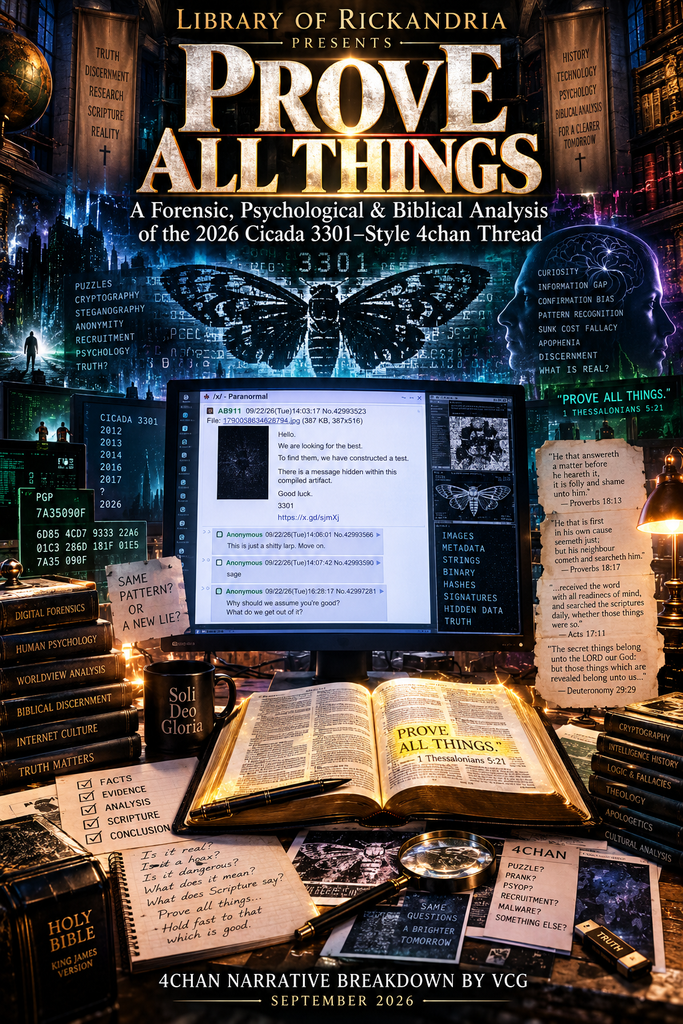
Prove All Things: A Forensic, Psychological & Biblical Analysis of the 2026 Cicada 3301–Style 4chan Thread
UPDATED BY VCG ON 9/23/2026 @ 06:19 EST
Anyone can do this, but most won’t.
ChatGPT – Library of Rickandria
LIBRARY OF RICKANDRIA PRESENTS
PROVE ALL THINGS
A Forensic, Psychological & Biblical Analysis of the 2026 Cicada 3301–Style 4chan Thread
4CHAN NARRATIVE BREAKDOWN BY VCG
SEPTEMBER 2026
“Prove all things; hold fast that which is good.”— 1 Thessalonians 5:21, KJV
Research edition.
This paper distinguishes verified facts, historical reconstruction, methodological inference, psychological interpretation, and biblical theological evaluation. It does not claim divine inspiration or certainty beyond the evidence.
Abstract
On 22 September 2026, a short post appeared on 4chan’s /x/ board under the displayed name “AB911.”
/x/ – Hello. We are looking for the best. To find them, – Paranormal – 4chan
It claimed to seek “the best,” announced a test, referred to a hidden message inside a “compiled artifact,” signed off with “3301,” and supplied a shortened X.gd link.
The wording unmistakably evokes the famous Cicada 3301 puzzle tradition, but resemblance is not authentication.
This paper treats the thread as a compact case study in:
- digital provenance
- cryptographic identity
- online puzzle culture
- cognitive bias
- cyber-risk
and Christian discernment.
The central methodological conclusion is deliberately modest:
the public 2026 post is demonstrably Cicada-styled, while the authorship of the historical Cicada organization, the nature and safety of the linked artifact, and any spiritual significance are separate propositions requiring separate evidence.
The historical Cicada community archives document the use of an OpenPGP key identified by key ID 7A35090F and full fingerprint 6D854CD7933322A601C3286D181F01E57A35090F, as well as repeated warnings to verify signatures.
Modern OpenPGP guidance further cautions that short key IDs should not be assumed unique.
Accordingly, a copied name, number, logo, or prose style cannot substitute for cryptographic verification.
Psychologically, the thread’s brevity is part of its power.
It creates an information gap, offers status through an undefined category of “the best,” and borrows prestige from a pre-existing mystery.
Those features can activate:
- curiosity
- confirmation bias
- pattern over-detection
- sunk-cost persistence
- scarcity effects
- identity investment
None of these mechanisms establishes malicious intent; they describe how a format can influence attention and interpretation regardless of the author’s motives.
Biblically, the paper avoids two opposite errors:
credulity toward mystery and superstition toward mystery.
- Encryption
- steganography
- numbers
- symbols
- anonymity
are not automatically occult.
Scripture does, however, commend careful:
- hearing
- examination
- testing
- humility
- fidelity
to revealed truth.
Where the thread makes no theological claim, Scripture should not be forced into an artificial rebuttal.
If later stages were to make spiritual claims, those claims would need to be evaluated on their content rather than on the technical impressiveness of their delivery.
Principal finding
At the evidence level available from the public thread, the most defensible description is:
an unauthenticated Cicada-3301-style 4chan challenge that closely echoes the 2012 recruitment formula, points to an opaque shortened URL, and does not publicly establish historical Cicada authorship, artifact safety, organizational benevolence, or spiritual authority.
Scope and date
This paper analyzes the thread as visible on 23 September 2026.
Web content can change or disappear.
Where a source is community-maintained rather than official, that status is stated.
The external artifact was not executed for this paper.
The absence of execution is a deliberate forensic and safety boundary, not evidence that the artifact is harmful.
Contents
1. The Case File: What the Thread Actually Contains
2. Methodology and Evidentiary Standards
3. Historical Context: Cicada 3301 and the Authentication Problem
4. Textual Comparison: 2012 and 2026
5. Authentication Before Interpretation
6. What OpenPGP Can Prove—and What It Cannot
7. Line-by-Line Analysis of the 2026 Thread
8. Threat Model: Competing Explanations
9. Digital Forensics Protocol for the Linked Artifact
10. Psychology of the Challenge
11. Puzzle-Solving False Positives and the Fallacy Index
12. Biblical Discernment: Scripture in Context
13. Hidden Knowledge, Occultism, and Category Errors
14. Strongest Counterarguments
15. Alternative Explanations for the Major Clues
16. Findings and Conclusions
17. Limitations
18. A Seven-Question Discernment Framework
Appendix A. Thread Inventory
Appendix B. Cicada Authentication Timeline
Appendix C. Scripture Index
Appendix D. Claim/Evidence Matrix
Appendix E. Reproducibility Checklist
Sources and Works Cited
1. The Case File: What the Thread Actually Contains
The starting point is intentionally unglamorous:
before discussing Cicada mythology, psychology, or theology, we establish the small set of facts that the thread itself supplies.
The live 4chan page identifies the board as /x/ – Paranormal, shows the original post as No. 42993523, displays the name “AB911,” and timestamps the post 22 September 2026 at 02:30:34.
It also lists an attached JPEG measuring 387 × 516 pixels.
The text greets the reader, says the authors are looking for “the best,” says they have made a test, claims a message is hidden in a compiled artifact, ends with “Good luck” and “3301,” and supplies the shortened URL x.gd/sjmXj. [1]
Three visible replies follow.
One dismisses the image and the task.
Another posts an image without a substantive textual argument.
A later reply asks two unusually important questions:
how the reader knows the poster is “good,” and what the participant gets from the exercise.
[1] Those questions are more analytically useful than they may first appear, because they separate identity, benevolence, and incentive—three issues that mystery culture often collapses.
4chan’s own FAQ matters here.
It states that the site has no ordinary user-registration system; a poster can type a name into the Name field, while tripcodes are an available mechanism for pseudo-registration or identity continuity.
The FAQ also states that starting a thread requires an image. [2]
Therefore neither the displayed name “AB911” nor the mere presence of an attached JPEG should be treated as strong provenance evidence.
The paper therefore begins with a narrow record:
a public imageboard post, a claimed hidden artifact, a short link, and an allusion to “3301.” Everything beyond that must be earned by evidence.
1.1 What the thread does not establish
It does not prove that more than one person is behind the post merely because the author writes “we.”
It does not define what “the best” means or what trait the test is supposed to measure.
It does not identify:
- an organization
- employer
- research group
- religious body
- intelligence service
or puzzle studio.
It does not state:
- a reward
- contract
- membership offer
- privacy policy
or end condition.
It does not visibly provide:
- a PGP signature
- full fingerprint
- tripcode
- capcode
or other identity proof.
It does not establish that the shortened destination is safe or unsafe.
It does not make an explicit theological claim.
2. Methodology and Evidentiary Standards
The method used here is simple to state but demanding to apply:
separate the layers.
A historical fact is not the same thing as an inference.
A cryptographic fact is not a moral judgment.
A psychological mechanism is not a diagnosis.
A biblical principle is not a license to invent spiritual significance.
Each layer is allowed to answer only the questions it can actually answer.
2.1 Evidence classes
| Classification | Meaning | Example in this case |
| Verified fact | Directly supported by a primary or technically authoritative source. | The 2026 thread displays post No. 42993523 and the X.gd short link. |
| Strongly supported | Supported by converging records but not by a single official authority. | Community archives preserve the historical Cicada key fingerprint and signed-message practice. |
| Plausible inference | Reasonable from the evidence but not demonstrated. | The 2026 writer intentionally modeled the post on the famous 2012 opener. |
| Speculation | Possible but not presently evidenced. | AB911 encodes a meaningful identity or secret message. |
| Contradicted / unsupported | Evidence conflicts with the claim, or the claim has no evidentiary basis. | The visible name field alone authenticates Cicada 3301. |
| Unverifiable at present | Necessary evidence is unavailable, inaccessible, or not safely examined. | The linked artifact contains exactly the hidden message the poster claims. |
The confidence language is not a substitute for proof.
Its purpose is to stop a narrative from silently upgrading.
A plausible inference should not become a “fact” simply because it has been repeated several times.
2.2 Source hierarchy
1. Primary material:
- the live thread
- original files
- verified signatures
- technical outputs
and the supplied KJV text.
2. Technical standards and official guidance:
- RFC 9580
- NIST digital-evidence guidance
- 4chan documentation
- FTC security guidance
3. Historical archives:
community-maintained Cicada repositories preserving images, signatures, and timelines.
These are useful but are not themselves the historical organization.
4. Peer-reviewed scholarship:
- psychology of curiosity
- confirmation bias
- sunk cost
- apophenia
- persistence
- construct validity
and related topics.
5. Secondary discussion:
journalism, forums, videos, and community theories. These can suggest questions but should not anchor high-confidence claims when stronger sources exist.
2.3 Authentication is not benevolence
The paper repeatedly distinguishes two questions that are often fused:
“Did the holder of a particular key sign this message?”
and
“Is the signer good, truthful, safe, or spiritually authoritative?”
Cryptography can contribute to the first question.
It does not answer the second.
Likewise, a person can tell the truth without proving identity, and a verified identity can still make false claims.
2.4 Construct validity: what does the test actually test?
The phrase “the best” creates a measurement problem.
In psychometrics, validity concerns whether evidence and theory support the interpretation placed on a test result, and construct validity concerns whether a measure actually assesses the intended latent attribute. [16]
Even a brilliantly difficult puzzle cannot be assumed to measure:
- general intelligence
- moral character
- wisdom
- honesty
- loyalty
- spiritual discernment
or employability unless there is evidence connecting performance to that construct.
A test may measure exactly what it asks the solver to do—and much less than its rhetoric implies.
3. Historical Context: Cicada 3301 and the Authentication Problem
The historical comparison is unavoidable because “3301” and the recruitment-style wording are not generic.
Community archives of Cicada 3301 place the first major puzzle on 4chan on 4 January 2012.
The well-known opening described a search for:
“highly intelligent individuals,”
said a test had been “devised,” and told readers that a message was hidden in an image. [3]
This became the entry point to a multi-stage puzzle tradition involving:
- steganography
- ciphers
- websites
- physical coordinates
and later Liber Primus.
The archive evidence also documents a cryptographic identity convention.
Preserved materials identify key ID 7A35090F and the full OpenPGP fingerprint 6D854CD7933322A601C3286D181F01E57A35090F. [5]
A 2016 preserved signed message includes the warning to verify OpenPGP 7A35090F, while solver archives report a final known authenticated warning in 2017 emphasizing false paths and signature verification. [4][6]
The important point is methodological rather than mythological: historical participants themselves treated impersonation as a real problem and developed a cryptographic means of distinguishing messages.
The archives used here are community repositories, not a currently operating:
“official Cicada website.”
That limitation matters.
The repositories can preserve artifacts and verification outputs; they cannot, by themselves, prove every story later told about the organization.
Where the archives summarize winner activity or internal projects, this paper treats those details as community historical reconstruction rather than as independently established institutional fact.
3.1 Authentication timeline
| Date | Event | Relevance |
| 4 Jan 2012 | First widely recognized 4chan puzzle appears. | Establishes the recruitment-text template later echoed in 2026. |
| Jan 2012 | Hidden material includes PGP-signed content; 7A35090F becomes the verification identity in preserved records. | Introduces cryptographic continuity. |
| 2013–2014 | Further puzzle rounds and signed materials are preserved by solvers. | Demonstrates repeated use of the identity mechanism. |
| 2016 | A signed clue warns: verify OpenPGP 7A35090F. | Makes signature verification part of the message itself. |
| Apr 2017 | Solver archives report the last known authenticated warning, again emphasizing false paths and signature verification. | Creates a strong historical expectation that later claims require authentication. |
| 22 Sep 2026 | New 4chan post invokes “3301” but shows no visible signature in the public text. | Resemblance is established; continuity is not. |
4. Textual Comparison: 2012 and 2026
The 2026 post does not merely mention Cicada.
It recreates the rhetorical architecture of the 2012 opening.
That observation is strong because the parallels are numerous and ordered:
- greeting
- elite-selection claim
- test
- hidden message
- path toward an unknown group
and the 3301 sign-off.
The wording has been modernized and compressed, but the scaffold remains recognizable.
| Function | 2012 historical form | 2026 form | Interpretive weight |
| Greeting | Brief salutation. | Brief salutation. | Weak alone. |
| Selection claim | Search for “highly intelligent individuals.” | Search for “the best.” | Strong thematic parallel. |
| Mechanism | A test has been devised. | A test has been constructed. | Strong syntactic/conceptual parallel. |
| Hidden content | Message hidden in an image. | Message hidden in a compiled artifact. | Strong modernization of the same role. |
| Closing | Good-luck formula and 3301. | Good-luck formula and 3301. | Strong branding parallel. |
What does that prove?
It strongly supports literary dependence:
the 2026 writer knew the Cicada template or encountered material derived from it.
It does not prove common authorship.
Publicly copying prose is easy; possession of a historical private signing key is qualitatively different evidence.
4.1 Borrowed provenance
The phrase “borrowed provenance” is useful for the phenomenon at work.
A new message can inherit emotional weight from an old mystery without inheriting its identity.
The number 3301 can make the reader supply years of associations—
- cryptography
- Tor
- posters
- runes
- Liber Primus
- elite recruitment
—even though the new post has not earned those associations through evidence.
This is not necessarily deception; homage and fan continuation operate the same way.
The point is that atmosphere and provenance are different things.
5. Authentication Before Interpretation
A recurring failure mode in mystery research is interpret-first, authenticate-later.
The researcher sees a black image, a strange number, a date, a username, and a short link, and begins constructing an interpretive universe.
Only afterward does the question arise:
who posted this, and can the identity claim be verified?
That order invites confirmation bias because every new detail is interpreted inside a story that has already been chosen.
For this case, the preferred order is:
1. Preserve the source as it appeared.
2. Establish provenance: where did it come from, and what identifiers are actually present?
3. Establish integrity: are the bytes or screenshots unchanged from the preserved copy?
4. Authenticate any identity claim using the strongest available mechanism.
5. Only then analyze content, symbolism, motives, worldview, and theology.
This ordering does not forbid exploratory interpretation.
It simply prevents interpretation from being smuggled back into authentication.
A beautiful solution to a cipher does not prove who authored the cipher.
A matching aesthetic does not prove organizational continuity.
A signature, in turn, does not prove theological truth.
Each claim has its own evidentiary burden.
6. What OpenPGP Can Prove—and What It Cannot
OpenPGP is often discussed in online mystery communities as if a successful:
“good signature”
output settles everything.
It does not.
RFC 9580 states that implementations should not assume Key IDs are unique and notes that a fingerprint is more likely to be unique than a Key ID. [7]
For the historical Cicada material, that means the short label 7A35090F should be treated as an identifier of convenience, not as the strongest available identity reference.
The archived full fingerprint is the more meaningful target for comparison. [5]
6.1 What a valid signature would establish
If a new artifact contains a detached or clearsigned OpenPGP signature that verifies over the exact new bytes using the archived public key whose full fingerprint matches the historical fingerprint, the evidence would strongly support a narrow statement:
the message was signed by a party in possession of the corresponding private-key capability.
That would be a substantial authentication event compared with mere imitation.
6.2 What a valid signature would not establish
It would not prove that the signer is morally good.
It would not prove that every claim inside the signed message is true.
It would not prove divine inspiration, revelation, or spiritual authority.
It would not prove that the same biological person or exact team from 2012 remains in control.
It would not by itself exclude key transfer, compromise, or deliberate handoff.
It would not make unsafe instructions safe.
This distinction answers the final 4chan respondent’s question with unusual precision.
Authentication can answer:
“is this message connected to the historical key?”
It cannot answer:
“how do I know you are good?”
Moral and theological evaluation remain separate tasks.
6.3 Why the absence of a visible signature is not absolute disproof
There is a fair counterargument: the first 2012 public-facing image was itself the beginning of a chain in which signed material was uncovered later.
Therefore, the absence of a signature in the visible 2026 4chan text cannot logically prove that the challenge is fake.
A genuine continuation could, in principle, place authentication inside the linked artifact.
That possibility is exactly why the paper uses the word unauthenticated rather than counterfeit. The correct next step is safe inspection, not premature certainty.
7. Line-by-Line Analysis of the 2026 Thread
7.1 “Hello.”
The greeting carries no evidentiary weight by itself.
Its relevance is comparative:
it participates in the deliberate echo of the 2012 opener.
A greeting cannot authenticate authorship, but in combination with the ordered parallels around it, it helps establish imitation or homage.
7.2 “We are looking for the best.”
Three separate claims are packed into this short sentence.
“We” implies plurality without proving it.
“Looking for” implies a selection process without identifying its sponsor or purpose.
“The best” supplies an evaluative hierarchy without defining the trait.
The sentence is therefore rhetorically strong and informationally weak.
Psychometrically, the phrase invites an invalid inference unless the test’s target construct is specified.
A difficult reverse-engineering puzzle might select for technical persistence and specialized knowledge among the people willing to attempt it.
That is not the same as selecting the best people, the most intelligent people, the wisest people, or the most morally trustworthy people. [16]
7.3 “To find them, we have constructed a test.”
At the minimal level, this is plausible:
the post presents some kind of challenge.
But a test can only justify conclusions that have been validated against what it purports to measure.
A puzzle can be ingenious yet have poor construct validity for the grand category “the best.”
The line should therefore be read as a recruitment claim, not as a demonstrated measurement fact.
7.4 “There is a message hidden within this compiled artifact.”
This is the first sharply falsifiable technical claim.
Either a specific artifact exists and reproducibly contains recoverable hidden information, or the claim fails.
The word “compiled” may suggest an executable or binary product, but the public thread does not establish file type.
Without the bytes, investigators should not infer:
- extension
- platform
- language
- payload
or safety.
The right forensic response is preservation before execution.
NIST guidance emphasizes chain of:
- custody
- integrity
- secure storage
and hashing of digital evidence. [8]
The question is not merely:
“can we open it?”
but
“can another researcher later demonstrate that we examined the same object without altering the original?”
7.5 “Good luck.”
Ordinary language should be read ordinarily unless context supplies a reason not to.
The phrase is a conventional expression of hoped-for success.
Treating it as evidence of:
pagan fatalism, occult doctrine, or a theology of impersonal Fortune would be an over-reading.
Biblical discernment is not improved by inventing doctrinal claims that the text does not make.
7.6 “3301”
The number is powerful branding and weak authentication.
Anyone can type it.
Its historical association justifies comparison with Cicada 3301, but it cannot establish continuity.
Nor does Scripture provide warrant for turning 3301 into a divinely revealed prophetic number.
A number can matter mathematically inside a puzzle if the puzzle constrains that use; it should not be promoted into spiritual revelation merely because it is mysterious.
7.7 The X.gd artifact link
X.gd is a legitimate URL-shortening service that advertises:
- direct redirects
- custom short strings
- analytics
and free use without registration. [10]
That fact cuts both ways.
The use of X.gd does not establish maliciousness, but it also does not authenticate the destination.
A shortener intentionally obscures the destination from the text of the post.
The evidentiary status of the destination therefore remains separate from the reputation of the shortening service.
Security guidance from the U.S. Federal Trade Commission warns that unexpected links or attachments can deliver malware or lead to credential theft and recommends caution rather than blind clicking. [9]
This is generic risk guidance, not evidence that the 2026 artifact is malicious.
7.8 The name “AB911”
The displayed name should not be decoded before it is authenticated.
4chan states that it does not offer ordinary username registration and recommends tripcodes when users want some continuity or protection against impersonation. [2]
A plain Name-field string is therefore not a verified account identity.
Numerological or alphabetic speculation about “AB911” may be entertaining, but without a clue that constrains the transformation it is methodologically weak.
7.9 The black/dark attachment
A dark image can carry:
- hidden data
- metadata
- appended bytes
or low-contrast content—but it can also be visually empty or simply function as the image required to start a thread.
Because 4chan requires an image for a new thread, the attachment’s existence is not itself evidence of a puzzle layer. [2]
The file should be inspected as a file before its darkness is interpreted symbolically.
7.10 The replies
The first reply is dismissive, but dismissal is not refutation.
The image-only reply may be community humor or commentary, but without a textual claim it contributes little to authentication.
The final respondent asks the strongest questions in the thread:
why regard the unknown party as good, and what benefit does participation offer?
Those questions expose the difference between technical identity, moral character, and incentive.
The OP answers none of them. [1]
8. Threat Model: Competing Explanations
Binary framing—“real Cicada” versus “scam”—is too crude.
A better threat model keeps multiple hypotheses alive until evidence discriminates among them.
The following scenarios are not ranked probabilities; they are competing explanations to test.
| Scenario | Description | Evidence that would strengthen it | Evidence that would weaken it |
| A. Historical continuity | A party controlling historical Cicada signing capability launches a new challenge. | Valid signature over new material with archived full fingerprint; continuity of methods not based on public copying alone. | Invalid/new key; no authentication; contradictions with signed historical guidance. |
| B. Sophisticated fan continuation | A skilled admirer builds a tribute or successor ARG. | High technical quality; explicit later disclosure; no false claim of key continuity. | Strong historical-key authentication. |
| C. Independent ARG / art project | Cicada aesthetics are used as narrative shorthand. | Credits, production trail, entertainment framing, staged puzzle design. | Authenticated historical continuity. |
| D. Recruitment mechanism | A real group uses the mystique to identify technically capable participants. | Clear later selection criteria, contact, tasks, organizational purpose. | No follow-through or purely theatrical endpoint. |
| E. Social experiment | The goal is observation of solver behavior rather than puzzle recruitment. | Data-collection structure, consent/debriefing, research framing. | No evidence of observation or study. |
| F. Malware / credential lure | Mystery serves as social engineering for unsafe execution or disclosure. | Executable behavior, credential prompts, persistence, network indicators, malicious code. | Benign static artifact, reproducible puzzle-only behavior. |
| G. Prank / trolling | The post exists mainly to provoke attention or waste time. | Dead end, recycled assets, no coherent challenge. | Deep reproducible structure or authenticated continuity. |
| H. Deliberate impersonation | The writer intends readers to believe historical Cicada returned. | False signature claims, copied identity markers, deceptive assertions of continuity. | Explicit disclaimer that it is fan-made. |
| I. Hybrid | A genuine puzzle uses Cicada branding without claiming continuity. | Clear puzzle quality plus no cryptographic identity claim. | Direct false claim of historical authorship. |
The value of this table is not that every possibility is equally likely.
It forces the investigation to ask what observation would actually move us from one explanation toward another.
A hypothesis that explains every possible outcome explains very little.
9. Digital Forensics Protocol for the Linked Artifact
If the artifact becomes available for analysis, the first objective is not to “solve” it.
The first objective is to preserve an evidentiary object that can still be examined after the excitement of the moment has passed.
NIST’s digital-evidence preservation guidance emphasizes:
- source documentation
- integrity
- hashing
- secure storage
and chain of custody. [8]
A research-oriented adaptation follows.
1. Record the acquisition context: date, time, source URL, redirect chain if safely obtainable, browser/tool version, and who performed the acquisition.
2. Save the original bytes without opening them in an application that may rewrite metadata.
3. Compute at least SHA-256; optionally compute an additional modern hash. Record the output outside the working copy.
4. Create a read-only archival copy and perform analysis on duplicates.
5. Identify actual file type from magic bytes and structure rather than trusting the filename extension.
6. Record file size, timestamps as metadata (without assuming they are trustworthy), container structure, and compression method.
7. Extract printable strings and embedded resources without executing the file.
8. Inspect digital signatures, certificates, OpenPGP blocks, and public-key material.
9. Check for appended data, alternate streams where relevant, archive nesting, steganographic indicators, and unusual entropy—but do not infer hidden content merely from entropy.
10. If dynamic execution becomes necessary, use an isolated, disposable analysis environment appropriate to the file type, with network controls and logging.
11. Document every decoding operation and tool parameter so that another researcher can reproduce the result.
12. After each transformation, hash the output and preserve both the transformation recipe and the resulting object.
9.1 Chain of custody for independent research
“Chain of custody”
is often associated with courts, but the underlying principle is broadly useful:
document what object you had,
where it came from, who handled it,
and what was done to it.
In an online puzzle, that discipline prevents accidental substitution—such as analyzing a re-uploaded file and later speaking as though it were the original.
9.2 Do not execute to prove courage
The elite framing of the challenge can create a dangerous social pressure:
running an unknown binary may feel like part of proving oneself.
That is a category error.
Security discipline is not timidity.
A legitimate technical puzzle should survive competent containment and analysis.
If a challenge only “works” when the solver abandons basic safeguards, that fact is itself relevant evidence about the design.
10. Psychology of the Challenge
This section describes mechanisms that can shape attention and reasoning.
It does not diagnose the anonymous poster or the participants.
The same mechanisms can operate in:
- a harmless puzzle
- an advertisement
- a scientific problem
- a religious rumor
- a scam
or a genuine recruitment exercise.
10.1 The information gap
George Loewenstein’s review of curiosity developed an information-gap account:
curiosity intensifies when attention is drawn to a gap between what one knows and what one wants to know. [11]
The 2026 post is almost a textbook invitation to such a gap.
It tells the reader that a message exists, that it is hidden, and that finding it is linked to an undefined elite category.
The withheld answer becomes motivational.
Importantly, the gap does not tell us whether the hidden content is valuable.
Curiosity answers:
“I want to know,”
not
“this is worth knowing.”
10.2 Status and identity
“We are looking for the best”
shifts the task from a neutral puzzle into an identity test.
The participant is no longer merely deciding whether a puzzle is interesting; the participant may feel invited to discover whether he or she belongs to a superior class.
This can make disengagement feel like self-disqualification.
The mechanism can operate even if the author never consciously intended manipulation.
10.3 Confirmation bias
Nickerson describes confirmation bias as seeking or interpreting evidence in ways partial to an existing belief or hypothesis. [12]
Once a solver decides that:
“Cicada is back,”
ambiguous observations can become self-sealing confirmations:
a dark image feels like Cicada style; an unsigned post feels like a deliberate return to the first-stage format; a broken path feels like a test; criticism feels like a decoy.
The safeguard is to specify in advance what evidence would count against the hypothesis.
10.4 Apophenia and false-positive pattern detection
Apophenia is commonly defined in research as a tendency to perceive meaningful patterns where none are present.
Blain and colleagues describe it as a disposition toward false-positive pattern perception. [14]
Puzzle solving necessarily rewards pattern detection, so the skill that solves a real clue can also produce false positives when the search space is enormous.
The right response is not to stop looking for patterns; it is to demand constraints, replication, and predictive success.
10.5 Sunk cost
Arkes and Blumer’s classic work describes the sunk-cost effect as a greater tendency to continue an endeavor after investing money, effort, or time. [13]
Puzzle trails are fertile ground for this.
After hours of decoding, a solver may reason that the endpoint must be important because abandoning the trail would make the prior investment feel wasted.
But effort already spent is not evidence that the next step is safe, authentic, or meaningful.
10.6 Scarcity and exclusivity
The APA Dictionary summarizes the scarcity principle as the tendency to assign greater value to opportunities or information perceived as limited or rare. [15]
Cicada-style rhetoric naturally invokes this: only a few will make it through; the best are being sought; the path is hidden.
Scarcity can intensify motivation without increasing evidentiary quality.
10.7 Partial reinforcement and persistence
Research on persistence has long examined how reinforcement schedules affect continued behavior.
Pittenger’s review notes that partial rather than continuous reinforcement often produces greater persistence, while also documenting exceptions and competing explanations. [18]
Puzzle paths can mimic this structure:
long stretches of ambiguity interrupted by occasional successful decodes.
The analogy should not be overclaimed—an ARG is not a laboratory reinforcement schedule—but it helps explain why intermittent breakthroughs can sustain effort far beyond what a cold cost-benefit analysis might predict.
10.8 Authority by obscurity
“Authority by obscurity”
is used here as a descriptive phrase, not a formal psychological diagnosis.
Difficult or opaque communication can feel profound because understanding it requires effort.
Yet difficulty and truth are logically independent.
A hard cipher can encode nonsense; a simple sentence can be true.
The paper therefore treats obscurity as a feature to analyze, not as evidence of depth.
11. Puzzle-Solving False Positives and the Fallacy Index
The central methodological danger in open-ended puzzle solving is researcher degrees of freedom.
If a solver may choose any:
- base
- cipher
- alphabet
- key
- extraction interval
- anagram rule
- coordinate system
- timestamp conversion
or numerological mapping after seeing the data, meaningful-looking outputs become increasingly likely by chance.
The strongest puzzle solutions are constrained before the answer appears.
11.1 A constraint rule
A decoding method gains evidentiary strength when the artifact itself gives a reason to choose the method before the successful plaintext is known.
For example, a visible hint to OutGuess plus a reproducible extraction that produces a signed message is substantially stronger than trying hundreds of transformations until one output resembles English.
A solution is even stronger when it generates a new prediction that can be independently tested.
11.2 Common false-positive routes
| Technique | Weak use | Stronger use |
| Base conversion | Try many bases until a recognizable number appears. | Artifact explicitly signals the base or output validates independently. |
| Caesar/Vigenère | Cycle keys until fragments look meaningful. | Key is constrained by a clue and yields coherent, checkable output. |
| Numerology | Assign values to arbitrary strings after the fact. | A mapping is explicitly supplied by the puzzle and used consistently. |
| Timestamps | Convert among zones/epochs until a date looks significant. | The source identifies a timezone/epoch or the date predicts a later event. |
| Image enhancement | Adjust levels until shapes appear. | Hidden layer is reproducible across tools and tied to file data. |
| Hashing | Hash arbitrary strings seeking a target. | The algorithm/input are specified or cryptographically linked to the next stage. |
| Post numbers | Treat any repeated digit as intentional. | The puzzle explicitly points to post-number arithmetic or yields constrained verification. |
11.3 Fallacy index
| Error | How it appears here | Correction |
| Argument from ignorance | “No one can explain it, therefore it is Cicada/supernatural.” | Unknown means unknown. |
| Genetic fallacy | Rejecting or accepting a claim solely because of who supposedly posted it. | Evaluate evidence and content separately from identity. |
| Appeal to mystery | Treating secrecy as evidence of importance. | Secrecy changes access, not truth value. |
| False dichotomy | “Either historical Cicada or malware.” | Maintain multiple live hypotheses. |
| Confirmation bias | Interpreting every anomaly as support for the preferred theory. | Define disconfirming evidence in advance. |
| Unfalsifiability | “Any contradiction is part of the test.” | Require conditions under which the hypothesis would be rejected. |
| Equivocation | Sliding from “Cicada-style” to “Cicada-authenticated.” | Use distinct labels consistently. |
| Numerological cherry-picking | Trying many mappings until one produces significance. | Pre-register or constrain the mapping. |
| Halo from difficulty | Assuming a hard puzzle must contain profound truth. | Judge claims independently of decoding difficulty. |
12. Biblical Discernment: Scripture in Context
The thread contains almost no explicit theology.
That fact should discipline the biblical section.
Scripture can shape the investigator’s posture—
- careful hearing
- testing
- humility
- truthfulness
- avoidance of forbidden spiritual practices
—without pretending that a verse directly predicts an anonymous 2026 computer puzzle.
The text of Scripture and our application of it should remain distinct.
12.1 1 Thessalonians 5:21: testing without gullibility
The title of this paper comes from 1 Thessalonians 5:21:
“Prove all things; hold fast that which is good.”
In context, verses 19–22 address quenching the Spirit, despising prophesyings, testing, retaining what is good, and abstaining from evil.
The verse is not a modern laboratory-method slogan.
Its direct context is Christian discernment.
Still, its pattern is relevant:
testing must precede holding fast.
The investigator should neither despise a claim merely because it is strange nor accept it because it is impressive. [17]
12.2 Proverbs 18:13 and 18:17: hear, then search
Proverbs 18:13 warns against answering before hearing a matter; Proverbs 18:17 observes that the first presentation can seem right until another comes and searches it.
These sayings are not technical rules of digital forensics, but they map well onto evidentiary humility.
The first story supplied by the OP is:
“3301 has a test.”
The researcher’s task is to search that story rather than merely inhabit it. [17]
12.3 Acts 17:11: readiness and examination
Acts 17 describes the Bereans receiving Paul and Silas with readiness while searching the Scriptures daily to determine whether the preached claims were so.
The immediate issue is apostolic preaching and scriptural examination, not internet rumors.
Yet the posture is valuable:
openness is not credulity, and examination is not cynicism. [17]
12.4 Deuteronomy 29:29: secret things and revealed things
Deuteronomy 29:29 distinguishes the “secret things” belonging to the LORD from the things revealed to Israel for covenant obedience.
The verse should not be reduced to:
“do not solve mysteries.”
Scripture itself contains:
- investigation
- reasoning
- craftsmanship
- hidden human information
The relevant theological boundary is that human mystery does not automatically become divine revelation.
An encrypted message can be hidden without being sacred. [17]
12.5 1 John 4:1: spiritual claims require testing
First John 4:1 instructs believers not to believe every spirit but to test the spirits because false prophets have gone out into the world.
This passage becomes directly relevant if a puzzle begins making spiritual or prophetic claims.
It does not justify labeling every anonymous puzzle “demonic.”
Rather, it forbids uncritical spiritual acceptance and directs attention to doctrinal content, especially the confession concerning Jesus Christ in the verses that follow. [17]
12.6 Deuteronomy 18: occult practice has content
Deuteronomy 18:9–14 prohibits specific practices associated with:
- divination
- enchantment
- witchcraft
- consulting familiar spirits
- wizardry
- necromancy
Those categories have content.
- Encryption
- steganography
- runes as an alphabet
- difficult mathematics
- anonymous speech
or symbolic art are not automatically instances of the prohibited practices.
If a later puzzle stage actually instructed a solver to seek knowledge through divination or spirits, the passage would become directly relevant.
Until then, calling the thread occult simply because it is mysterious outruns the text. [17]
12.7 1 Corinthians 1: intellectual status is not spiritual status
The rhetoric of “the best” deserves a theological counterweight.
In 1 Corinthians 1:26–31, Paul warns against boasting in human status and wisdom and locates the believer’s ground of glory in the Lord.
The passage does not condemn intelligence or technical excellence; Paul himself reasons carefully throughout his letters.
It does deny that worldly distinction is the basis of standing before God.
A person may solve every cipher in the chain and gain no spiritual superiority from doing so. [17]
12.8 Mystery in the New Testament
Christian Scripture can speak positively of “mystery,” but the Pauline pattern often concerns something once hidden and now made known in God’s redemptive work, especially in Christ.
That is importantly different from an esoteric system whose authority rests on indefinite concealment from outsiders.
If a future artifact claims saving truth is accessible only through elite technical initiation, the claim should be compared with the apostolic gospel rather than accepted because the puzzle is difficult.
13. Hidden Knowledge, Occultism, and Category Errors
One of the most useful safeguards in Christian internet research is refusing to collapse every kind of secrecy into one category.
“Hidden” can describe:
- an encrypted password
- a confidential medical record
- an undiscovered scientific fact
- a private confession
- a military secret
- a steganographic puzzle
- an occult divination practice
or a claimed divine revelation.
Those are not morally or theologically interchangeable.
| Kind of hidden knowledge | Example | Evaluation |
| Ordinary encoded information | Ciphertext, steganographic payload, password. | Morally neutral in itself; context determines use. |
| Confidential information | Private correspondence or protected records. | Raises privacy, consent, and lawful-access questions. |
| Scientific unknown | An unsolved natural question. | Legitimate object of inquiry. |
| Puzzle secret | A clue intentionally concealed by a designer. | Ordinary game/communication practice unless other content changes the category. |
| Forbidden divination | Seeking supernatural knowledge through prohibited spiritual practices. | Directly relevant to Deuteronomy 18. |
| Claimed new revelation | “God/spirits revealed this secret doctrine to us.” | Requires theological testing; cannot borrow authority from technical difficulty. |
| Revealed gospel mystery | New Testament usage concerning truths God has made known in Christ. | Revelation to be proclaimed, not an elite cryptographic credential. |
13.1 What would make an occult assessment evidence-based?
Rather than relying on mood or aesthetics, the paper proposes content criteria.
Direct biblical concern would be triggered by instructions to:
- invoke spirits
- consult the dead
- perform divination
- solicit supernatural guidance through forbidden practices
- worship another deity or spiritual being
or accept an alternative revelation that contradicts the apostolic gospel.
- A black image
- insects
- runes
- ciphers
- primes
or Latin phrases do not meet those criteria by themselves.
14. Strongest Counterarguments
A serious case study should state the strongest objections to its own conclusions.
The goal is not to manufacture symmetry where evidence is unequal, but to make sure the thesis survives its best alternatives.
14.1 “The original opener was not visibly signed either”
Correct.
This is the strongest objection to treating the 2026 absence of a visible signature as dispositive.
The first 2012 public image led to signed material later in the chain.
Therefore the public OP’s unsigned status does not prove forgery.
The paper’s conclusion is deliberately limited to unauthenticated-at-this-stage.
If the artifact produces a valid new signature under the historical key, the assessment should be revised.
14.2 “A real Cicada would not repeat old methods”
Possible, but unfalsifiable if used too freely.
A genuine group could change its authentication method, and an imitator could copy the old one.
The practical question is what evidence a changed method supplies that is at least as discriminating as the old signature.
“They changed methods”
cannot function as a blanket excuse for the absence of evidence.
14.3 “A valid historical signature would prove it is Cicada”
It would be very strong evidence of continuity with the historical signing capability.
It would still not establish a complete organizational ontology:
whether the same people remain, whether the key changed hands, whether the key was compromised, or whether every historical claim about the group was true.
The paper would nevertheless treat a valid new signature as a major update, not a trivial detail.
14.4 “The psychological analysis assumes manipulation”
It does not.
- Curiosity
- scarcity, status
- confirmation bias
- pattern detection
and sunk-cost effects can arise without conscious manipulation.
- A crossword
- treasure hunt
- scientific problem
and scam can all engage some of the same mechanisms.
The psychological section describes affordances of the format, not hidden motives of the author.
14.5 “Biblical analysis is irrelevant because this is only a puzzle”
If the artifact remains a purely technical puzzle, theological analysis should remain limited.
This paper includes Scripture because the project explicitly asks for biblical discernment and because Cicada discussions often acquire spiritual interpretations.
The responsible approach is precisely to mark where Scripture speaks directly, where a general principle is being applied, and where no theological conclusion is warranted.
15. Alternative Explanations for the Major Clues
| Clue | Possible ordinary explanations | What would discriminate |
| Dark attached image | Thread-start requirement; minimalist aesthetic; carrier file; decoy; actual steganographic object. | File-level analysis, hashes, metadata, reproducible extraction. |
| “AB911” | Arbitrary alias; private reference; coded clue; disposable name. | Later clue explicitly constraining the interpretation or authenticated reuse. |
| “3301” | Historical continuity; homage; impersonation; genre branding. | Cryptographic provenance. |
| Shortened X.gd URL | Convenience; concealment for puzzle effect; tracking; destination obfuscation; malicious lure. | Resolve safely, preserve redirects, inspect destination without execution. |
| “compiled artifact” | Executable; packaged binary; archive; inaccurate wording; deliberate technical clue. | Actual bytes and file structure. |
| 2012-like wording | Authentic continuity; homage; fan fiction; deliberate impersonation. | Signature plus non-public continuity evidence. |
| No visible PGP signature | Early-stage design; ignorance of Cicada history; intentional ambiguity; counterfeit. | Artifact inspection and later authenticated material. |
| Few replies | Low interest; early thread state; community skepticism; timing. | Longitudinal archive, not speculation. |
16. Findings and Conclusions
The paper’s strongest factual finding is also its simplest:
the 2026 post is real as a 4chan post and deliberately resembles Cicada 3301, but the public-facing evidence does not establish that the historical Cicada organization authored it.
The resemblance is too structured to dismiss as accidental, yet imitation is precisely the kind of evidence that public familiarity makes cheap.
The historical record makes authentication especially important because preserved Cicada material itself warned about fakes and used OpenPGP signatures as a continuity mechanism.
Modern OpenPGP guidance strengthens the methodological point:
short key IDs should not be treated as unique identifiers; full fingerprints and exact signature verification matter. [5][7]
The second major finding concerns reasoning.
Mystery magnifies the cost of sloppy categories.
“Unknown” easily becomes “malicious,” “spiritual,” “authentic,” or “profound” depending on the investigator’s prior expectations.
The disciplined alternative is to let unknown remain unknown until a discriminating observation appears.
The third finding is psychological.
The challenge’s economy is not weakness.
A handful of words create an information gap, an elite identity frame, and a borrowed historical prestige.
That is enough to produce strong motivation in some readers.
Curiosity and persistence are not evidence of deception, but they can make solvers more vulnerable to confirmation bias, false-positive pattern detection, and sunk-cost escalation if methodology is weak.
The fourth finding is theological.
Scripture does not authorize panic at mystery.
It calls for:
- truthfulness
- testing
- humility
- doctrinal fidelity
Encryption is not divination.
A cicada is not a demon.
A number is not a prophecy because it is repeated.
Conversely, technical sophistication cannot confer spiritual authority.
If future stages preach doctrine, the doctrine must be examined as doctrine.
Accordingly, the present conclusion is not:
“Cicada returned,”
“Cicada did not return,”
“this is malware,”
or
“this is occult.”
It is narrower and more useful: the thread is an unauthenticated Cicada-style challenge whose identity, artifact, intent, and worldview must be investigated as separate questions.
17. Limitations
The thread is ephemeral web content and may change or disappear after the date of analysis.
The historical Cicada sources used here are largely solver-maintained archives.
They preserve valuable material but are not an official institutional archive with independently audited custody.
The linked artifact was not executed in this research edition; therefore claims about its:
- runtime behavior
- payload
- network activity
or maliciousness are not made.
The X.gd short link obscures destination context in the visible post.
A future preserved redirect chain could materially improve the analysis.
Cryptographic continuity, even if later established, would not resolve questions of:
- key transfer
- compromise
- team membership
or moral character.
Psychological mechanisms discussed here are population-level concepts and theoretical tools.
They are not diagnoses of the anonymous poster or individual solvers.
The biblical section evaluates claims and practices in light of the supplied KJV text.
It does not claim that Scripture directly addresses Cicada 3301 by name or predicts this thread.
Absence of evidence in a four-post snapshot should not be mistaken for evidence of permanent absence; later posts or artifacts can update conclusions.
18. A Seven-Question Discernment Framework
The case can be reduced to a reusable framework for:
- future anonymous puzzles
- ARGs
- “leaks,”
- conspiracy claims
- alleged occult material
- purported revelations
1. What exactly is being claimed?
Rewrite the claim in a form that could be true or false.
2. What is the original source?
Distinguish the source from screenshots, reposts, commentary, and lore.
3. Can the source’s identity be authenticated?
Use the strongest available mechanism, not visual style or reputation alone.
4. What evidence would falsify the claim?
If no possible observation counts against it, the claim is not functioning as a meaningful test.
5. Am I distinguishing evidence from interpretation?
Label:
- facts
- inferences
- speculation
- unknowns
6. What psychological pressures might be influencing judgment?
Consider:
- curiosity
- status
- scarcity
- confirmation bias
- apophenia
- sunk cost
7. If a spiritual claim is made, what does Scripture actually say in context?
Test the doctrine rather than being impressed by the messenger’s mystery or technical skill.
The discipline is compact:
- preserve
- authenticate
- test
- interpret
and only then hold fast.
Appendix A. Thread Inventory
This appendix inventories the visible posts without reproducing the entire copyrighted webpage.
Short quotations are limited to the phrases most important for analysis.
Source: live 4chan thread No. 42993523, accessed 23 September 2026. [1]
| Post | Timestamp shown | Displayed identity | Content summary |
| 42993523 | 22 Sep 2026, 02:30:34 | AB911 | Cicada-style recruitment text; says it seeks “the best”; claims a hidden message in a compiled artifact; signs “3301”; supplies x.gd/sjmXj; attached 387×516 JPEG. |
| 42993566 | 22 Sep 2026, 02:42:54 | Anonymous | Dismisses the image and task; offers no authentication evidence. |
| 42993590 | 22 Sep 2026, 02:55:46 | Anonymous | Posts an image reply referencing the OP; no substantive textual claim. |
| 42997281 | 22 Sep 2026, 23:16:16 | Anonymous | Asks how the reader can know the poster is “good” and what benefit participation provides. |
Appendix B. Cicada Authentication Timeline
The timeline below is intentionally limited to events relevant to provenance rather than attempting a complete history of every puzzle stage.
Dates and descriptions are drawn from the cited solver archives. [3][4][5][6]
| Period | Authentication-relevant event |
| Jan 2012 | Opening 4chan puzzle begins; hidden material preserved by solvers includes signed content. |
| 2012 onward | Key ID 7A35090F is used in preserved materials; archive records full fingerprint 6D854CD7933322A601C3286D181F01E57A35090F. |
| 2013–2014 | Signed communications continue across puzzle rounds. |
| 2016 | Preserved signed clue explicitly tells solvers to verify OpenPGP 7A35090F. |
| Apr 2017 | Community archive reports final known authenticated warning emphasizing false paths and signature verification. |
| Sep 2026 | New /x/ post uses “3301” and a 2012-like structure; no visible signature appears in the public post. |
Appendix C. Scripture Index
| Passage | Role in this paper | Contextual caution |
| 1 Thessalonians 5:19–22 | Testing and holding fast to what is good. | Immediate context concerns prophecy/Christian discernment, not digital forensics. |
| Proverbs 18:13 | Hear before answering. | Wisdom maxim; applied analogically to investigation. |
| Proverbs 18:17 | First account should be searched/examined. | Wisdom maxim; not a technical evidentiary statute. |
| Acts 17:10–12 | Readiness joined to searching Scripture. | Historical narrative about Berean response to apostolic preaching. |
| Deuteronomy 29:29 | Boundary between secret and revealed things. | Covenant context; not a ban on solving human puzzles. |
| 1 John 4:1–3 | Testing spiritual/prophetic claims. | Directly relevant when an artifact makes spiritual claims. |
| Deuteronomy 18:9–14 | Specific prohibited divinatory/occult practices. | Should not be stretched to ordinary encoding or symbolism. |
| 1 Corinthians 1:26–31 | Human status/intellectual boasting is not spiritual standing. | Does not condemn intelligence or careful reasoning. |
| James 3:13–17 | Wisdom is evaluated morally, not merely intellectually. | Useful if a claimant presents technical ability as wisdom. |
| Romans 12:3 | Humility in self-assessment. | Relevant to elite-identity rhetoric, not a rejection of excellence. |
Biblical quotations and wording are from the supplied Authorized King James Version, Pure Cambridge Edition. [17]
Appendix D. Claim/Evidence Matrix
| Claim | Evidence | Status | Confidence |
| The thread exists and contains a Cicada-style challenge. | Live 4chan page. [1] | Verified | High |
| The displayed poster name is AB911. | Live 4chan page. [1] | Verified display fact | High |
| AB911 authenticates a unique person. | 4chan has no ordinary username registration. [2] | Unsupported | High |
| The wording intentionally evokes Cicada 3301. | Ordered parallels to archived 2012 text. [3] | Strongly supported | High |
| Historical Cicada authored the 2026 post. | No public signature or independent provenance shown. | Unverified | Low at present |
| Historical Cicada used PGP identity 7A35090F / archived full fingerprint. | Solver archives and preserved signed material. [5][6] | Strongly supported | High |
| A short key ID alone is unique proof of identity. | RFC 9580 warns not to assume Key IDs are unique. [7] | Contradicted | High |
| X.gd is itself malicious. | X.gd is a general-purpose shortener. [10] | Unsupported | High |
| The destination is safe. | Destination not established in the public text. | Unknown | Unknown |
| The destination is malicious. | No artifact-level evidence presented here. | Unknown | Unknown |
| The artifact contains a hidden message. | Anonymous OP assertion only. | Unverified | Unknown |
| The puzzle is occult. | No occult practice or doctrine is stated in the visible thread. | Not established | High |
| The puzzle is Christian. | No Christian claim is stated in the visible thread. | Not established | High |
| The OP promises a reward. | No reward is stated. | False as to visible post | High |
| A valid future historical-key signature would materially change provenance assessment. | OpenPGP verification logic and archived key continuity. | Supported methodological judgment | High |
Appendix E. Reproducibility Checklist
Archive the thread page with date/time and note the post number.
Save the attached image in original form and calculate SHA-256.
Record image dimensions and file metadata without treating metadata as self-authenticating.
Preserve the X.gd URL as text; do not assume the destination from screenshots.
If resolving the short link, record every redirect hop and timestamp.
Preserve the final artifact bytes before opening or executing.
Calculate hashes and keep the original read-only.
Identify file format from content signatures.
Extract strings/resources statically.
Search for PGP-signed blocks and verify against the archived full fingerprint, not merely the short key ID.
Document software versions, commands, and parameters used for extraction.
Hash every derived output and map it to the exact transformation that produced it.
Separate technical findings from interpretation in research notes.
Record failed hypotheses as well as successful ones to reduce hindsight bias.
Sources and Works Cited
[1] 4chan. “/x/ – Hello. We are looking for the best…” Thread No. 42993523. Posted 22 September 2026; accessed 23 September 2026.
/x/ – Hello. We are looking for the best. To find them, – Paranormal – 4chan
[2] 4chan. FAQ: anonymity, user registration, tripcodes, image requirement, and sage.
[3] Yotam, Kris (community archive). Cicada 3301 — 2012 Puzzle, First Round. Preserves the opening text and solver reconstruction.
Page not found · GitHub · GitHub
[4] Cicada Solvers (community archive).
The Complete Cicada 3301 Archive. Historical puzzle materials and summary of the verified 2017 message.
GitHub – cicada-solvers/The-Complete-Cicada3301-Archive · GitHub
[5] Yotam, Kris (community archive). Cicada 3301 research archive: PGP key ID 7A35090F and full fingerprint 6D854CD7933322A601C3286D181F01E57A35090F.
Page not found · GitHub · GitHub
[6] Oosterhof, Michel / solver archive. Preserved 2016 OutGuess output containing an OpenPGP-signed Cicada message and verification warning.
cicada-2016/stage01/4gq25.jpg.outguess at master · micheloosterhof/cicada-2016 · GitHub
[7] Internet Engineering Task Force. RFC 9580: OpenPGP. Section 3.3 and 5.5.4 discuss Key IDs and fingerprints and warn that Key IDs should not be assumed unique.
[8] Guttman, B., White, D. R., Williams, S., & Walraven, T. (2022). Digital Evidence Preservation: Considerations for Evidence Handlers. NISTIR 8387.
Digital Evidence Preservation: Considerations for Evidence Handlers
[9] U.S. Federal Trade Commission. How To Recognize and Avoid Phishing Scams. Consumer Advice.
How To Recognize and Avoid Phishing Scams | Consumer Advice
[10] X.gd. Free URL Shortener with No Sign-Up or Ads; service features and analytics documentation.
Free URL Shortener with No Sign-Up or Ads – X.gd
[11] Loewenstein, G. (1994). The psychology of curiosity: A review and reinterpretation. Psychological Bulletin, 116(1), 75–98. doi:10.1037/0033-2909.116.1.75.
[12] Nickerson, R. S. (1998). Confirmation bias: A ubiquitous phenomenon in many guises. Review of General Psychology, 2(2), 175–220. doi:10.1037/1089-2680.2.2.175. https://doi.org/10.1037/1089-2680.2.2.175
[13] Arkes, H. R., & Blumer, C. (1985). The psychology of sunk cost. Organizational Behavior and Human Decision Processes, 35(1), 124–140. doi:10.1016/0749-5978(85)90049-4. =
The psychology of sunk cost – ScienceDirect
[14] Blain, S. D., et al. (2020). Apophenia as the disposition to false positives. Research article available through PubMed Central.
[15] American Psychological Association. APA Dictionary of Psychology: scarcity.
[16] Cronbach, L. J., & Meehl, P. E. (1955). Construct validity in psychological tests. Psychological Bulletin, 52(4), 281–302. doi:10.1037/h0040957.
[17] Authorized King James Version, Pure Cambridge Edition. Supplied research Bible used for Scripture quotations and contextual references. Cambridge University Press edition supplied by the user.
[18] Pittenger, D. J. (2002). The two paradigms of persistence. Genetic, Social, and General Psychology Monographs, 128(3), 237–268. PMID 12401034.
Research note on historical sourcing
Cicada 3301 has no presently identified official archive used by this paper.
Historical claims therefore rely heavily on preserved solver repositories.
Those archives are valuable because they retain files, signed messages, and verification notes, but their interpretive summaries should not be confused with primary institutional statements.
The paper has tried to cite preserved artifacts where possible and to label community reconstruction where necessary.
Research note on Scripture
The supplied KJV/Pure Cambridge Edition is treated as the requested biblical text.
Scripture quotations in this paper are kept distinct from application.
Where a passage’s immediate context differs from digital investigation, that difference is explicitly stated rather than hidden.
4CHAN THREAD & POST BREAKDOWNS – Library of Rickandria