
From Prediction to “Plan”: A Source-Critical Examination of the MSN/AlterNet Trump Martial-Law Narrative
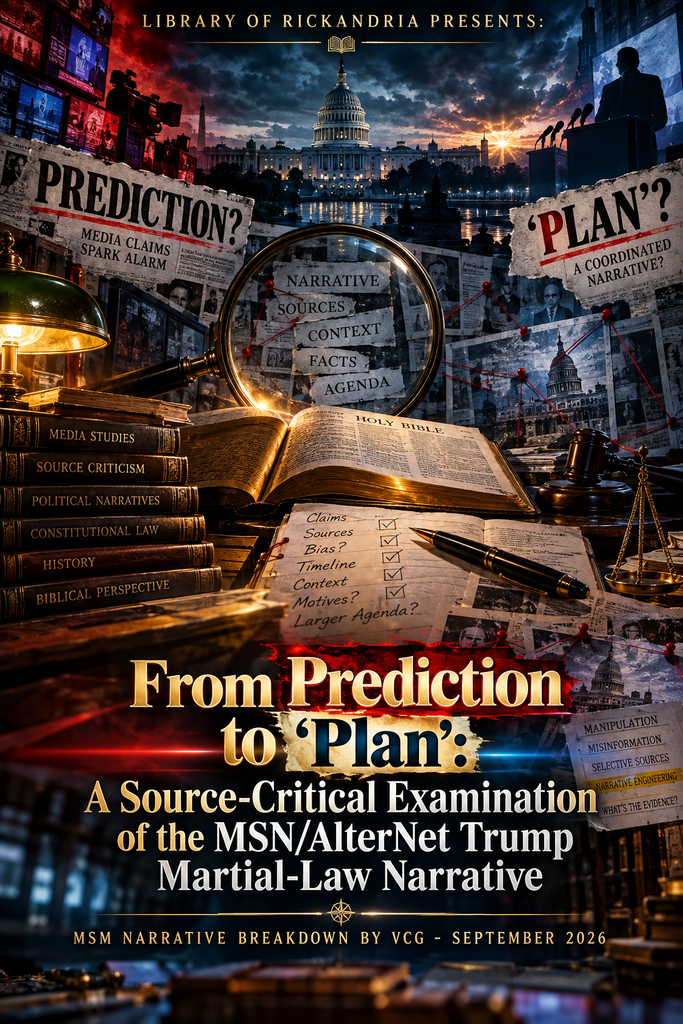
UPDATED BY VCG ON 9/24/2026 @ 04:20 EST
Fact-Checking the Evidence, Legal Claims, Media Framing, Psychological Techniques, and Biblical Standards of Truth
Anyone can do this, but most won’t.
ChatGPT – Library of Rickandria
Abstract
On September 23, 2026, an AlterNet article by Nick Hilden appeared under the headline
“Insider unveils Trump’s plan to declare ‘martial law’ and mobilize military against protestors.”
Insider unveils Trump’s plan to declare ‘martial law’
The story was distributed through MSN and other outlets and relied principally on reporting published the same day by Yvonne Wingett Sanchez and Michael Scherer in The Atlantic.
A surviving mirror reproduces the AlterNet headline and text; National Memo also republishes the AlterNet article.
Blue Country Gazette: September 2026
The underlying Atlantic investigation contains facts that warrant serious examination.
Attorney Peter Ticktin, an outside Trump adviser and longtime acquaintance, predicted that President Donald Trump might eventually face a choice of:
“martial law, or step aside.”
Wayne Allyn Root has publicly urged Trump to declare a national-security emergency involving elections.
Trump himself has said Republicans should “nationalize” voting in some places, responded to Root’s emergency proposal by saying
“stranger things have happened,”
and subsequently reposted Root’s article describing the proposal as:
“foolproof.”
Those are documented facts, not inventions of the press.
But the public evidence available as of September 24, 2026 does not establish several stronger propositions conveyed by the AlterNet/MSN headline.
The published record does not establish that Ticktin disclosed an approved presidential martial-law plan; does not establish that Trump ordered or threatened military action against protesters; and does not establish operational military preparations to seize polling places or election machinery.
Indeed, The Atlantic reports that the White House says Ticktin, Root, and Tina Peters have no role in White House election policy, that DOJ denies an initiative to declare certified election equipment unusable absent verified evidence and lawful process, and that senior officials have publicly denied plans for a federal takeover of state election administration or polling places. FeedLand
This paper therefore does not replace one political narrative with another.
It asks a narrower question:
How far does the evidence actually take us?
That requires separating documented statements from:
- advocacy
- predictions from plans
- legal authority from political rhetoric
- psychological effects from inferred motives
and Scripture from partisan interpretation.
I. What We Are—and Are Not—Trying to Establish
This inquiry is not a determination of whether Donald Trump is a good or bad president, whether his election policies are desirable, or how anyone ought to vote.
VCG INVESTIGATION: TRUMP – Library of Rickandria
Those are separate political judgments.
Nor is this paper attempting to prove that no emergency action could occur in the future.
That would require predicting future presidential behavior, which the available evidence cannot establish.
Our task is narrower and testable:
Did the evidence cited by the September 23 article justify describing what had been uncovered as
“Trump’s plan to declare martial law”
and
“mobilize military against protestors”?
That question can be investigated without asking the reader to admire or despise anyone.
II. Methodology: How the Thread Was Reconstructed
There is an immediate source problem worth making explicit.
The supplied MSN URL could not be reliably retrieved in this research environment.
I therefore did not silently invent or reconstruct missing MSN text.
Instead, I used two surviving syndicated copies.
Blue Country Gazette reproduces the exact MSN/AlterNet:
- headline
- subheadline
- author
- article body
National Memo also republishes the AlterNet story and identifies it as reproduced with permission.
The shared wording makes it possible to audit the syndicated article. Blue Country Gazette
The evidentiary chain is therefore:
MSN distribution / AlterNet article
→ Nick Hilden’s condensed account
→ The Atlantic investigation by Sanchez and Scherer
→ interviews with Ticktin, Root, Peters and government officials
→ primary Trump statements, presidential posts, statutes, official records and public statements
That hierarchy matters.
When a secondary article says:
“the Atlantic reports X,”
we should first ask what The Atlantic actually reported.
When The Atlantic paraphrases Trump, we should look for Trump’s own words.
When a political advocate supplies a legal theory, we should read the statute and case rather than treating the advocate as the final legal authority.
Evidence classifications
Throughout this paper, claims are separated into five categories:
| Category | Meaning |
|---|---|
| Documented fact | Direct quotation, government record, statute, transcript, video, official result, or well-corroborated event |
| Attributed report | A source reports something that cannot presently be independently verified |
| Inference | A conclusion reasonably drawn from facts but not itself directly documented |
| Prediction/speculation | A claim about what someone may do later |
| Unsupported or contradicted proposition | The evidence cited does not establish the proposition, or better evidence conflicts with it |
These classifications are intentionally about claims, not about political actors.
III. The Evidence Ladder
The central problem becomes easier to see if we arrange the evidence in ascending order.
Documented statement
↓
Documented advocacy by a Trump ally
↓
Documented Trump acknowledgment or amplification
↓
Inference that Trump is receptive to or interested in the proposal
↓
Inference of presidential intent to carry it out
↓
Claim that an approved presidential plan exists
↓
Claim that operational military preparations are underway
The evidence unquestionably reaches the first three rungs.
Root has advocated an emergency.
Trump heard the proposal and did not reject it.
Trump later amplified Root’s article.
Trump has separately spoken about “nationalizing” voting.
Those facts can support discussion of receptivity or possible interest.
What they do not automatically prove is:
- an internal decision
- approved martial-law plan
- signed implementation directive
- military operational order
or planned deployment against protesters.
That gap—from receptivity to established plan—is where much of this article’s rhetorical force resides.
IV. Source Genealogy: What The Atlantic Actually Reported
The original Atlantic headline is itself instructive:
“The Supporters Urging Trump to Declare Martial Law for the Midterms.”
That construction identifies the relevant actors as supporters urging Trump.
The Atlantic’s own promotional summary similarly says Trump’s advisers had been trying to move him away from unsupported election-fraud theories while:
“a group of outsiders”
was making that difficult.
The Supporters Urging Trump to Declare Martial Law for the Midterms | The Atlantic | 16 comments
The article opens by calling Ticktin one of Trump’s:
“outside advisers.”
Ticktin and Trump knew each other at military school, and Ticktin has assisted Trump in legal and political matters.
That makes him a person worth interviewing.
It does not make every prediction he makes an authorized disclosure of presidential policy. FeedLand
Ticktin told the reporters that he foresaw three possibilities.
He claimed, without evidence supplied in the article, that Democrats had already cheated in primaries; predicted Trump might act before the election; and said the final possibility involved Trump declaring martial law around November 3:
“Either martial law, or step aside.”
When reporters asked about riots if Trump tried to overturn the election results, Ticktin answered that he was unconcerned because:
“Believe me, our armed forces are a lot bigger than they are.”
Both statements are real quotations attributed to Ticktin. FeedLand
But already we can see three distinctions that must remain intact:
Ticktin is speaking, not Trump.
Ticktin is predicting, not revealing an order.
And the reporters asked about riots, whereas the syndicated headline converts the object of possible military force into:
“protestors.”
Those distinctions will become important.
V. Line-by-Line Claim Audit
The headline: “Insider unveils Trump’s plan…”
Blue Country Gazette’s reproduction preserves the exact syndicated headline:
“Insider unveils Trump’s plan to declare ‘martial law’ and mobilize military against protestors”
followed by:
“Even threatens that U.S. military will outnumber any protestors.”
“Insider”
Ticktin has unusually longstanding personal ties to Trump and has advised or assisted him.
But The Atlantic specifically categorizes him with outside advisers, and later reports that a White House official said Ticktin, Root, and Peters
“play no role in election policy at the White House.”
Calling him an “insider” is therefore ambiguous at best.
He is an insider in the loose sense of personal access or association; the evidence supplied does not establish that he is an insider to White House election-policy deliberations.
A more precise descriptor would have been:
“outside Trump adviser”
or
“longtime Trump associate.”
“unveils”
“Unveils” implies disclosure—something previously concealed being revealed.
Yet Ticktin tells reporters what he thinks could happen.
The Atlantic repeatedly frames his statements as expectations or predictions.
The distinction is not semantic trivia:
“I think the president may do X”
is not the same evidentiary object as:
“the president has decided to do X, and here is the plan.”
“Trump’s plan”
This is the largest inferential jump.
The public evidence establishes advocacy around Trump and Trump receptivity to at least some emergency-election ideas.
It does not, in the material cited, produce an authenticated White House directive, implementation memorandum, executive-order draft, military operational plan, presidential instruction, or firsthand statement that Trump has made the decision to declare martial law.
Moreover, The Atlantic reports explicit official denials of several supposed operational components. FeedLand
Thus,
“proposal being urged upon Trump”
and
“Trump’s established plan”
should not be treated as interchangeable.
VI. “Mobilize Military Against Protestors”
This portion of the headline undergoes an even larger transformation.
The source exchange was:
The Atlantic reporters raise a hypothetical:
suppose Trump attempts to overturn an election outcome and riots follow.
Ticktin replies:
the armed forces are larger.
That is disturbing rhetoric to some readers and reassuring rhetoric to others; those reactions are political interpretation.
The factual structure, however, is simple:
Speaker: Peter Ticktin.
Scenario: a reporter’s hypothetical.
Civil disturbance term: “riots.”
Statement of presidential intent: none reported.
Operational order: none reported. FeedLand
The secondary headline effectively transforms this into:
Actor: Trump.
Action: mobilizing the military.
Target: protesters.
Status: a plan.
Those are materially different propositions.
It is possible that an editor regarded Ticktin’s prediction as evidence of what Trump might ultimately do.
But that interpretive bridge should have been visible rather than disappearing inside the headline.
VII. “Many in Trump’s orbit believe he will…”
The article opens:
“many in President Donald Trump’s orbit believe he will declare ‘martial law’…”
and says The Atlantic spoke with:
“several people close to Trump”
who asserted he was likely to claim a national-security emergency. Blue Country Gazette
The fuller source is more complicated.
The Atlantic identifies a genuine network of outside activists encouraging extraordinary action.
But it separately describes a White House election working group and says administration advisers have been trying to pull Trump’s attention away from unsupported fraud theories promoted by Ticktin, Root, and Peters.
It reports that Trump’s inner circle regards extraordinary action as still possible, while also reporting substantial internal and congressional opposition. FeedLand
Therefore, the strongest formulation supported by the visible evidence is not:
“The White House believes Trump will declare martial law.”
It is closer to:
“Some outside Trump allies advocate or predict extraordinary emergency measures; people inside the administration reportedly regard the possibility that Trump might act on such demands as unresolved.”
The difference between might and will is central when reporting future conduct.
VIII. What Trump Himself Has Actually Said
A good source-critical paper should resist a tempting mistake here.
Finding exaggeration in the MSN/AlterNet framing does not permit us to erase Trump’s own statements.
There are several important ones.
February: “nationalize” voting
On February 2, Trump said Republicans should “nationalize” voting in at least 15 unspecified places.
Reuters reported that he did not explain a concrete mechanism.
Trump says Republicans should ‘nationalize’ voting in at least 15 places | Reuters
That is significant evidence that Trump favors substantially greater federal or partisan intervention in election administration than conventional practice.
It still does not by itself establish martial law.
August: Root proposes a national-security emergency
On August 11, Wayne Allyn Root directly presented Trump with a theory that he could declare a national-security emergency, impose voter-ID and citizenship requirements and restrictions on mail voting, and avoid ordinary Senate passage.
Trump answered:
“Let me just say that stranger things have happened.
Okay?”
and then:
“I’ll leave it at that.”
The exchange is documented not merely by Trump-critical reporting but by RealClearPolitics and Breitbart.
The proper evidentiary description is neither:
“Trump rejected the proposal.”
Nor:
“Trump announced that he would do it.”
He did neither.
He left the proposal open.
August 28: Trump amplifies Root
The American Presidency Project preserves Trump’s August 28 Truth Social posts.
At 11:23 a.m. ET he posted Root’s article headed:
“Liberal Media Goes Insane with Rage Over My Idea for ‘National Security Emergency for Elections.’ … You Can’t Stop It.
It’s Foolproof.”
Immediately beforehand, Trump had also reposted an article concerning his own response when asked whether he would declare such an emergency.
Truth Social Posts of August 28, 2026 | The American Presidency Project
This strengthens the case for saying Trump was willing to amplify the idea.
It still does not tell us whether he formally adopted Root’s legal theory.
IX. A Crucial Nuance: An Election-Related National Emergency Already Exists
One fact makes this discussion particularly instructive.
On August 31, 2026, Trump officially continued for another year the national emergency originally declared in Executive Order 13848 concerning foreign interference in or the undermining of public confidence in U.S. elections.
The continuation invokes the International Emergency Economic Powers Act and the National Emergencies Act.
That does not mean Root’s proposed takeover has occurred.
Instead, it demonstrates how emergency law actually works.
A president can declare or continue a national emergency concerning elections.
But the declaration does not, merely by containing the word emergency, supply every imaginable governmental power.
The legal question becomes:
What statute authorizes the specific action being taken?
That brings us to Root’s legal argument.
X. Root’s INS v. Chadha Theory
Root told Trump that INS v. Chadha supposedly means that once the President declares a national-security emergency, the declaration
“can’t be challenged”
and can be overturned only by a two-thirds vote in both houses. RealClearPolitics
There is a historical kernel here, but the conclusion is much broader than the case.
What Chadha actually held
INS v. Chadha, decided in 1983, struck down a one-house legislative veto because legislative action generally must comply with bicameralism and presentment:
passage through both houses and submission to the President.
INS v. Chadha | 462 U.S. 919 (1983) | Justia U.S. Supreme Court Center
After Chadha, Congress amended the National Emergencies Act in 1985.
The old mechanism involving a concurrent resolution was changed to a joint resolution, which is presented to the President.
If a President vetoes legislation terminating his own emergency declaration, Congress would need the ordinary two-thirds vote in each chamber to override that veto.
50 USC Ch. 34: NATIONAL EMERGENCIES
So Root identifies a real procedural consequence.
But that does not yield his larger proposition.
The difficulty of terminating a national emergency is not the same thing as unlimited presidential power during that emergency.
Most importantly, Chadha did not hold that presidential emergency acts are immune from judicial review or that a President may create powers Congress never delegated.
XI. What the National Emergencies Act Actually Says
50 U.S.C. §1631 is unusually straightforward.
When the President declares a national emergency, statutory emergency powers cannot be exercised until the President identifies the provisions of law under which the President or other officers propose to act. U.S. Code
That means:
Emergency declaration ≠ newly created power.
Rather:
Emergency declaration + existing statutory authority = potentially exercisable emergency power.
Consequently, someone proposing that a national emergency would allow the President to
- rewrite voting qualifications
- seize election machinery
- control certification
- prohibit mail ballots
or deploy troops must still identify the legal authority for each action.
The phrase national emergency cannot do that work by itself.
XII. Who Constitutionally Administers Congressional Elections?
Article I, Section 4—the Elections Clause—provides that the times, places, and manner of House and Senate elections are prescribed in each state, subject to alteration by Congress.
Congress’s Constitution Annotated explains that the relevant authority reaches a wide field:
- notices
- registration
- voting supervision
- protection of voters
- fraud safeguards
- counting
- inspectors
- canvassers
- publication of returns
States and Elections Clause | Constitution Annotated | Congress.gov | Library of Congress
There is an important nuance.
The Elections Clause does not itself determine voter qualifications.
Those arise from other constitutional provisions and state qualifications, subject to federal constitutional and statutory constraints. Congress.gov
But for purposes of the current article, the salient point remains:
The Constitution expressly identifies states and Congress in the congressional-election regulatory framework.
It does not contain a freestanding presidential power to take over federal-election administration by proclamation.
That does not mean the executive branch has no legitimate election-related duties.
DOJ enforces federal voting laws; DHS and intelligence agencies address foreign threats and cybersecurity; federal courts resolve legal disputes; the military may have responsibilities under other statutes during genuine emergencies.
It does mean that an extraordinary presidential takeover requires a much more specific legal argument than:
“the President declared an emergency.”
XIII. National Emergency, Insurrection Act, and Martial Law Are Not Synonyms
Much public discussion collapses three legally different concepts.
A national emergency
A National Emergencies Act declaration activates specified statutory authorities when statutory conditions are satisfied.
It is not itself martial law. U.S. Code
The Insurrection Act
10 U.S.C. §252 allows the President, when specified unlawful obstructions or rebellion make ordinary judicial enforcement of federal law impracticable, to call militia into federal service and use armed forces to enforce federal law or suppress rebellion.
Section 253 separately addresses:
- insurrection
- domestic violence
- unlawful combinations
or conspiracies that obstruct federal or state law or deprive people of federally protected rights under the conditions specified in the statute.
These provisions can authorize extraordinary domestic military use.
They do not say, however, that invoking them automatically transfers state election administration to the President.
Martial law
“Martial law”
has a separate and complicated constitutional history.
The famous post-Civil War decision Ex parte Milligan declared that military rule cannot simply replace functioning civilian justice where courts remain open and unobstructed.
Constitution Annotated also carefully notes the limits and competing reasoning in the case, including the view of four Justices concerning congressional wartime authorization.
Martial Law Generally | U.S. Constitution Annotated | US Law | LII / Legal Information Institute
Therefore, it would be equally careless to say either:
“A president can declare martial law and then legally do anything.”
or
“American law recognizes no circumstances whatsoever involving military rule.”
The law is narrower and more conditional than either slogan.
XIV. Military at the Polls: The Statutory Barriers
Federal law contains particularly explicit restrictions concerning elections.
18 U.S.C. §592 criminalizes federal officials:
- ordering
- bringing
- keeping
or controlling troops or armed men at an election site, subject to the statute’s stated armed-enemy exception.
18 USC Ch. 29: ELECTIONS AND POLITICAL ACTIVITIES
18 U.S.C. §593 goes further. Members of the Armed Forces may not use military authority to:
fix voter qualifications;
prevent a qualified voter from voting by:
- force
- threat
- intimidation
- advice
or otherwise;
compel election officers to accept unlawful votes;
impose election regulations different from those prescribed by law; or
interfere with an election officer’s discharge of duties.
The Posse Comitatus Act separately prohibits using the armed forces to execute domestic law except where the Constitution or Congress expressly authorizes it.
These statutes do not answer every conceivable emergency hypothetical.
The Insurrection Act, for example, constitutes congressional authorization for certain domestic military actions.
But they make one proposition very difficult to sustain:
There is no general presidential military-election power waiting to be unlocked merely by uttering “national emergency” or “martial law.”
XV. What the Military Has Publicly Said
As of August 31, Chairman of the Joint Chiefs Gen. Dan Caine said there were “no plans” to deploy federal troops or National Guard personnel to polling locations for the November election.
Reuters reported that Caine emphasized that election administration and security belong primarily to state and local authorities, and said he had neither received nor expected unlawful military orders concerning the election.
‘No plans’ to deploy troops to midterm elections polling sites, top US general says | Reuters
Earlier in February, the White House similarly said Trump had no “formal plans” to deploy ICE at polling sites, while not ruling out federal action in specific legitimate law-enforcement circumstances.
Trump has no ‘formal plans’ to deploy ICE at polling sites, White House says | Reuters
That does not prove that future decisions cannot change.
But any article asserting an existing military mobilization plan should deal directly with the contrary evidence.
XVI. The Largest Omission in the AlterNet/MSN Compression
This may be the most important difference between the condensed article and its source.
The Atlantic explicitly reports:
A White House official said Ticktin, Root and Peters play no role in election policy at the White House.
A DOJ spokesperson said there are no plans to declare certified voting machines unreliable absent:
“credible, verified evidence”
and legal process, and called claims that such an initiative is underway false.
The article reports public statements from senior officials that there are no plans to forcibly take over state election-administration roles or deploy federal officials to polling places, while preserving the possibility of responses to specific threats.
The full article also says White House and Cabinet advisers have been working to steer Trump away from the unsupported election-fraud theories advocated by this outside group. FeedLand
AlterNet does quote the sentence saying administration advisers were trying to redirect Trump.
What it largely removes is the detailed counterevidence accompanying that sentence.
Compression is inevitable in journalism.
But when an article’s headline says an insider has:
“unveiled Trump’s plan,”
those omitted qualifications become unusually material.
XVII. A Concrete Attribution Error: Ticktin Became Root
Here we have something stronger than an argument over framing.
AlterNet says:
“Root described a ‘nightmare scenario’ in which Democrats won, flipped Congress, then impeached the president.”
It then mentions a standing ovation. Blue Country Gazette
The source says something different.
The Atlantic states:
“When it was Ticktin’s turn to address the crowd, he described a ‘nightmare scenario’…”
Ticktin then discussed his hypothetical involving voting equipment, Democratic control of Congress, and impeachment.
Root appears separately.
The Atlantic reports that Root received a standing ovation after telling attendees what he believed an emergency declaration could accomplish. FeedLand
Thus, two real events appear to have been compressed together:
Ticktin → “nightmare scenario.”
Root → standing ovation for his emergency-declaration presentation.
The syndicated rewrite attributes the first to Root.
That is a genuine sourcing error.
XVIII. “MAGA Literally Applauds Such Plans”
There is a factual core.
Conference attendees really did cheer Ticktin’s remarks, and The Atlantic reports a standing ovation for Root’s presentation. FeedLand
The extrapolation is in the noun “MAGA.”
A conference audience consists of a selected population:
people motivated enough to attend an election-skeptic gathering.
It is not a statistically representative sample of every Trump voter or person who identifies with the MAGA movement.
Accordingly:
“Attendees at this conference applauded”
is an observed fact.
“MAGA applauds”
generalizes from those attendees to a much larger political population.
The same methodological restraint should apply regardless of ideology.
An activist gathering on the left should not automatically be treated as representative of every Democratic voter either.
XIX. “Trump Has Not Been Shy About Signaling His Intention to Meddle”
The word “meddle” is evaluative rather than descriptive.
Yet it would be a mistake to dismiss everything underneath it.
Trump’s “nationalize” remarks, the Root interview, and Trump’s subsequent amplification supply factual grounds for reporting that he has expressed or entertained greater federal involvement in election administration.
Trump says Republicans should ‘nationalize’ voting in at least 15 places | Reuters
A more neutral journalistic sentence would therefore be:
“Trump has repeatedly expressed support for greater federal involvement in election rules and has entertained a proposal for an election-related national emergency.”
Readers could then decide whether to call that “meddling,” “election security,” “federal overreach,” or something else.
That distinction between description and evaluation is one of the recurring lessons of this paper.
XX. Trump’s “Cheat Like Hell” Remark
The quotation itself is authentic.
The full September 10 transcript shows Trump conducting a theatrical audience pledge.
He tells listeners to raise their hands and repeat after him, then says:
“I don’t care if I’m registered or not, I’m gonna try and cheat like hell like they do.”
He immediately transitions to getting family and friends out to vote on or before November 3.
Factbase Transcripts – Roll Call
The Atlantic itself describes this as sarcastic. FeedLand
So two interpretations should be excluded by the evidence.
“Trump never said it.”
He did.
“The quotation alone proves a literal operational plan to commit election fraud.”
It does not.
Context does not erase words.
Words do not automatically prove the most literal interpretation possible.
Both principles can be true simultaneously.
XXI. Trump’s Claim That He Won in 2020
Here a source-critical rebuttal must correct our own side if necessary.
The AlterNet story repeats The Atlantic’s characterization of Trump’s claim to have won the 2020 election as false.
The official historical evidence supports that characterization.
The National Archives records the certified Electoral College result as Biden 306, Trump 232.
Objections to Arizona and Pennsylvania were considered by Congress and were not sustained.
2020 Electoral College Results | National Archives
Trump-appointed Attorney General William Barr stated in December 2020:
“To date, we have not seen fraud on a scale that could have affected a different outcome…”
The Justice Department’s own archive preserves that statement.
Former AG Barr Records Concerning 2020 Election
The intelligence community also concluded that it had no indication any foreign actor altered voter registration, ballot casting, vote tabulation, or reporting in the 2020 election.
DOJ and DHS similarly reported no evidence that a foreign government-affiliated actor changed votes or compromised the technical integrity of ballots.
None of that means there were literally zero irregularities, zero unlawful votes, or zero foreign influence efforts.
Elections involving more than 150 million votes can contain isolated violations, and foreign influence operations did occur.
The proposition requiring evidence, however, is much larger:
whether fraud changed the presidential outcome.
The official record does not establish that proposition.
Therefore, finding genuine defects in the MSN/AlterNet article cannot be used to bootstrap the separate claim that Trump was the certified winner in 2020.
Truth is not a team sport.
XXII. Timeline: Claim Versus Event
| Date | Documented event | Evidentiary significance |
|---|---|---|
| Nov. 2020–Jan. 2021 | Biden’s 306–232 Electoral College victory certified | Historical baseline for later election-fraud claims. National Archives |
| Feb. 2, 2026 | Trump says Republicans should “nationalize” voting in at least 15 places | Direct evidence favoring greater federal/partisan election involvement, but no martial-law plan disclosed. Reuters |
| Aug. 11 | Root proposes election national emergency to Trump; Trump says “stranger things have happened” | Direct evidence of Trump hearing and leaving open the proposal. RealClearPolitics |
| Aug. 28 | Trump reposts Root article calling emergency proposal “foolproof” | Direct evidence of amplification; does not by itself establish adoption. The American Presidency Project |
| Aug. 31 | Trump continues EO 13848 election-interference national emergency | Demonstrates existing use of statutory emergency framework; not equivalent to Root’s proposed election takeover. GovInfo |
| Aug. 31 | Gen. Caine says no plans for troops at polling sites | Public evidence against an existing operational polling-place military deployment. Reuters |
| Sept. 10 | Trump delivers “cheat like hell” mock pledge in Dallas | Authentic rhetoric requiring context; not an operational fraud order. Roll Call |
| September | Ticktin speaks at Storm Summit and predicts possible martial law | Direct evidence of Ticktin’s prediction—not direct evidence of Trump’s decision. FeedLand |
| Sept. 23 | The Atlantic publishes investigation | Primary journalistic source for the syndicated story. FeedLand |
| Sept. 23 | AlterNet/MSN version appears | Secondary compression introduces stronger headline language and Ticktin/Root attribution error. Blue Country Gazette |
Chronology prevents something subtle from happening:
later speculation must not be retroactively treated as proof that earlier statements constituted a secret operational decision.
XXIII. Terminology Audit
| Term | What it actually means in this context |
|---|---|
| National emergency | A formal legal status allowing use of emergency authorities that Congress has already made available by statute, once the relevant statutory authorities are identified. U.S. Code |
| Election nationalization | Political shorthand without one fixed legal meaning. Constitutionally, congressional election regulation belongs principally to states subject to congressional alteration. Congress.gov |
| Insurrection Act | Statutory authority permitting domestic military use under defined circumstances involving obstruction, rebellion, insurrection, domestic violence or denial of protected rights. Legal Information Institute |
| Martial law | Historically exceptional military substitution for civilian authority; heavily constrained by constitutional doctrine and necessity. Legal Information Institute |
| Poll security | Ordinary election protection typically performed by state/local civilian institutions, potentially with lawful federal assistance in defined circumstances. |
| Protest | Protected expressive activity when peaceful and lawful. |
| Riot | Violent or unlawful collective disorder; not synonymous with protest. |
| Military intervention in elections | Subject to unusually explicit statutory restrictions, including §§592 and 593. U.S. House of Representatives |
The rhetorical consequence of collapsing these terms is profound.
If:
- emergency
- martial law
- troop deployment
- poll security
- riot control
and suppression of protesters become interchangeable, the reader can be moved from a documented fact to an undemonstrated scenario without noticing the transitions.
XXIV. What Would Actually Have to Happen?
Suppose a President genuinely wished to execute an election-related emergency plan of the kind described by Root or imagined by Ticktin.
An announcement alone would not settle the matter.
- There would have to be some combination of a presidential declaration or order
- identification of statutory authority
- instructions to departments or military officials
- implementation decisions by those officials
- interaction with state governments
- likely litigation challenging statutory or constitutional authority
- possible congressional legislation or attempts to terminate an emergency
- judicial evaluation of particular actions
and, depending on the action, potential conflicts with federal criminal statutes governing military interference with elections.
That legal pathway matters because it supplies observable evidence.
A serious investigative claim that the machinery is moving should eventually produce things such as:
- signed orders
- agency directives
- legal memoranda
- deployment instructions
- verified internal communications
- budget
or logistics preparations, court filings, or corroborated firsthand testimony.
The September 23 reporting provides:
- advocacy
- access
- rhetoric
- prediction
It does not publicly provide that operational record.
XXV. The Strongest Case for the Article
A fair investigation should steelman the position it scrutinizes.
There are legitimate reasons for journalists to examine this subject closely.
Trump has not merely been passively associated with Root.
He has publicly entertained Root’s emergency proposal and amplified it.
He has independently argued for “nationalizing” voting in some places.
An election-related national emergency is already formally in force for a different statutory purpose.
Outside allies with access are explicitly urging more aggressive action.
Ticktin has longstanding personal ties to Trump.
Peters says she has discussed election issues with him.
And The Atlantic reports that even administration insiders regard the possibility that Trump might act on outside demands as unresolved. Reuters
A journalist therefore need not possess a signed martial-law order before reporting that pressure exists and that there is a potential risk worth investigating.
Investigative journalism often begins before a contemplated action becomes an official plan.
The legitimate concern is thus:
Could outside advocacy, combined with presidential receptivity and prior rhetoric, eventually become policy?
That is a reasonable journalistic question.
The problem begins when the answer to that unresolved question is embedded prematurely in the headline as:
“Trump’s plan.”
XXVI. The Strongest Defense of the Headline
Someone defending the headline might argue that “plan” need not mean a signed government document.
Political reporting routinely describes ideas actively circulating among influential advisers as “plans.”
They might also argue that Ticktin’s unusual personal history with Trump makes “insider” reasonable in colloquial journalism, even if he holds no White House position.
Finally, they could argue that Trump’s refusal to reject Root’s proposal, subsequent reposting of it, prior “nationalize” language, and associates’ expectations collectively justify treating the emergency proposal as more than a random outsider’s fantasy.
Those arguments deserve consideration.
But they still cannot erase the epistemic distinctions.
A plan being advocated to a president is different from a plan adopted by the president.
A person close to a president is different from an official inside the relevant policymaking process.
And an ally saying the armed forces would defeat hypothetical rioters is different from the President ordering the military against protesters.
The issue is therefore not whether the article had anything worth reporting.
It clearly did.
The issue is whether the headline allows the reader to see where evidence ends and inference begins.
XXVII. Rhetorical Transformation Audit
| Source-level proposition | Syndicated transformation | What changes |
|---|---|---|
| Ticktin is an outside adviser with deep personal ties | “Insider” | Personal proximity becomes institutional proximity |
| Ticktin predicts Trump may face a martial-law choice | “unveils Trump’s plan” | Prediction becomes settled intent |
| Reporter asks about hypothetical riots | military against “protestors” | Violent disorder and protected protest are blurred |
| Ticktin says armed forces are larger | Trump headline “even threatens” military action | Speaker/agency becomes less clear |
| Trump says “stranger things have happened” | Evidence within a “plan” narrative | Ambiguous receptivity can be read as commitment |
| Trump reposts Root’s proposal | “plan” framing | Amplification is capable of being understood as adoption |
| Conference attendees cheer | “MAGA literally applauds” | Selected audience becomes a mass political category |
| Ticktin gives “nightmare scenario” | Root is said to describe it | Concrete attribution error |
| Officials deny operational plans | Mostly omitted in compression | Contrary evidence becomes less salient |
None of these transformations requires us to infer malicious intent by the author.
That is important.
A condensed article can become more dramatic through ordinary:
- editorial incentives
- selection
- simplification
- headline writing
- narrative compression
without anyone consciously deciding to deceive.
XXVIII. Psychology: Why This Kind of Headline Is Powerful
Here the methodology must be especially disciplined.
Psychological research can tell us about mechanisms that affect readers.
It generally cannot tell us what was inside a particular editor’s mind.
Negativity and attention
A large Nature Human Behaviour study analyzed 22,743 randomized headline experiments involving roughly 105,000 headline variations, 5.7 million clicks and more than 370 million impressions.
For an average-length headline, each additional negative word increased click-through rate by approximately 2.3 percent.
Negativity drives online news consumption | Nature Human Behaviour
Words and concepts such as:
- martial law
- seize
- military
and against protesters create unusually concentrated threat salience.
It would be methodologically invalid, however, to conclude:
“Therefore the AlterNet editor intentionally manipulated readers.”
The study establishes an audience-level effect of negative wording—not this author’s motive.
Fear appeals
A meta-analysis of 127 papers containing 248 independent samples and 27,372 participants found that fear appeals produced a positive average effect on attitudes, intentions and behavior.
The measured average composite effect was approximately d = 0.29. PubMed
Again, that literature spans many contexts, much of it health and risk communication.
It should therefore be applied cautiously to political journalism.
What it does establish is that threat framing is psychologically consequential, not inert.
Repetition and the illusory-truth effect
A 2024 review summarizes extensive evidence that repetition increases perceived truth, including with fake-news headlines, misinformation, implausible statements and even propositions conflicting with prior knowledge. PubMed
That gives us a reason to care about repeated shorthand.
Imagine this sequence:
“An outside adviser predicts Trump could declare martial law.”
becomes
“Trump ally reveals martial-law possibility.”
then
“insider unveils Trump’s martial-law plan.”
then
“Trump’s leaked martial-law plan.”
The reader may eventually remember the core proposition while forgetting the qualifiers that originally established its uncertainty.
This is not unique to anti-Trump information.
The same mechanism operates on repeated pro-Trump misinformation.
Motivated reasoning and partisan identity
An especially useful experiment involved 3,364 U.S. participants.
Incentivizing people to make accurate judgments about political news improved accuracy and reduced partisan bias by roughly 30 percent.
Asking participants instead to identify material their political allies would like reduced accuracy. PubMed
That finding should trouble everybody.
The antidote to misleading anti-Trump reporting is not motivated pro-Trump reasoning.
The antidote is greater motivation for accuracy.
XXIX. The Symmetry Test
A useful bias check is to reverse the political identities.
Suppose a progressive activist who had known a Democratic President for decades predicted that the President might use troops in an election crisis.
Suppose another outside activist urged the Democratic President to declare an emergency.
Suppose the President replied ambiguously and reposted the proposal.
Would we be justified in investigating?
Yes.
Would the evidence prove that the President had approved a military-election operation?
Not yet.
Would an article be justified in reporting the advocacy, the President’s response and the repost?
Yes.
Would we want a headline saying:
“Insider unveils President’s plan to deploy military against conservative protesters”
if the actual source was an outside activist answering a hypothetical about riots?
We should demand the same evidentiary standard irrespective of party.
That is the value of the symmetry test: remove the name, preserve the facts, and ask whether the reasoning still works.
XXX. Falsifiability: What Would Change This Paper’s Findings?
A source-critical argument becomes stronger when it states in advance what evidence could overturn it.
The conclusion that no publicly established operational martial-law plan has yet been demonstrated would need to be revisited if credible evidence emerged such as:
an authenticated presidential directive ordering such preparations;
a draft or signed proclamation tied to specific election takeover measures;
an authenticated military or federal law-enforcement operational order;
contemporaneous legal memoranda setting out authority for the operation;
multiple independently corroborated firsthand officials describing an approved plan;
documented logistical preparations whose purpose cannot reasonably be explained otherwise;
or a public presidential statement announcing the action.
Likewise, the inference that Trump has shown some receptivity to extraordinary election intervention would need modification if the available Trump posts, interview transcripts or quotations proved fabricated or materially misrepresented.
Good research must remain corrigible.
If tomorrow’s evidence is stronger than today’s, tomorrow’s conclusion should change.
XXXI. Corrections We Must Make to “Our Own Side”
Because this paper is critical of the syndicated article, it is especially important not to compensate by overstating claims favorable to Trump.
The available evidence does not permit us to say:
Trump unequivocally rejected Root’s emergency idea.
He did not. RealClearPolitics
Trump has shown no interest in federalizing election administration.
His “nationalize” remarks contradict that proposition. Reuters
The emergency proposal was never brought to Trump’s attention.
It was presented directly to him, and he later amplified it. RealClearPolitics
Trump’s 2020 victory was established but suppressed by the media.
The certified governmental record identifies Biden as the winner, and Trump’s own attorney general said DOJ found no outcome-changing fraud. National Archives
The “cheat like hell” quotation was fabricated.
It appears in the public transcript. Roll Call
Every concern raised by The Atlantic is therefore fake.
That conclusion does not follow from defects in AlterNet’s condensation.
These corrections are not concessions to a political adversary.
They are the cost of having one standard of evidence.
XXXII. Scripture and the Discipline of Knowing
We now move into a separate category.
Everything above involved:
- journalism
- statutes
- political statements
- history
- law
- empirical psychology
Scripture is not an additional newspaper source.
For Christians, it addresses the moral discipline with which:
testimony, judgment, rulers, accusations and truth ought to be handled.
That difference in category should remain explicit.
1. False reports
The clearest starting point is Exodus:
“Thou shalt not raise a false report:
put not thine hand with the wicked to be an unrighteous witness.”
The passage immediately adds:
“Thou shalt not follow a multitude to do evil…” — Exodus 23:1–2
The first command checks falsehood.
The second checks social pressure.
Applied carefully, neither says
“the mainstream press is always lying”
nor
“popular consensus is always wrong.”
It says that the size or influence of a crowd cannot convert falsehood into truth.
That applies equally to:
- a cable-news audience
- a social-media movement
- a political rally
and our own preferred community.
2. Hear before answering
Proverbs states:
“He that answereth a matter before he heareth it, it is folly and shame unto him.”
Then:
“He that is first in his own cause seemeth just; but his neighbour cometh and searcheth him.” — Proverbs 18:13,17
This is remarkably close to source criticism.
A story may appear compelling in its first telling.
Then we retrieve the source.
Then we retrieve what that source was based upon.
Then we examine contrary testimony.
The biblical instruction does not forbid conclusions.
It forbids premature ones.
3. Multiple witnesses
Deuteronomy’s judicial rule says:
“at the mouth of two witnesses, or at the mouth of three witnesses, shall the matter be established.” — Deuteronomy 19:15
Its covenantal judicial setting should not simply be converted into a modern journalism statute.
But its moral principle is recognizable: grave accusations demand serious evidentiary support.
A single confident voice is not automatically a sufficient foundation for a sweeping conclusion.
4. Prove all things
Paul writes:
“Prove all things; hold fast that which is good.” — 1 Thessalonians 5:21
The immediate context concerns prophecy and Christian discernment, so it should not be ripped from context as if Paul were laying out modern investigative-journalism rules.
Yet the broader posture is unmistakable:
test rather than swallow indiscriminately.
And after testing, retain what survives.
That means a Christian analysis should not throw away the genuine evidence merely because some framing was exaggerated.
5. No respect of persons in judgment
Leviticus commands:
“thou shalt not respect the person of the poor, nor honour the person of the mighty: but in righteousness shalt thou judge thy neighbour.” — Leviticus 19:15
This principle places a severe restriction on partisan apologetics.
The powerful are not to be condemned merely because they are powerful.
Nor are they to be shielded because we admire them.
The passage does not permit political favoritism disguised as discernment.
6. Do not make princes into saviors
Psalm 146 says:
“Put not your trust in princes, nor in the son of man, in whom there is no help.” — Psalm 146:3
That does not forbid voting, public service, political loyalty in an ordinary civic sense, or gratitude for good governance.
It does forbid ultimate trust.
For a Christian, no President becomes the epistemic standard by which every accusation is automatically false or every promise automatically true.
7. Pray for rulers
Paul instructs Christians to make prayers:
“For kings, and for all that are in authority; that we may lead a quiet and peaceable life in all godliness and honesty.” — 1 Timothy 2:2
That posture differs sharply from modern outrage culture.
Prayer for rulers is compatible with examining their claims carefully.
Respect is compatible with accountability.
8. Civil authority is real, but not divine
Romans 13 commands subjection to governing authorities and tells Christians to render what is due.
Acts simultaneously records Peter and John telling authorities:
“Whether it be right in the sight of God to hearken unto you more than unto God, judge ye.” — Acts 4:19
Christian interpretation has long debated the precise scope of civil obedience and resistance.
These passages should therefore not be used as simplistic slogans for either unlimited state obedience or automatic rebellion.
What can safely be said is that Scripture does not make the civil magistrate God.
Authority has a real place.
God retains the higher place.
XXXIII. A Biblical Epistemology for Political News
Placed together, these passages supply something more substantial than:
“Bible verses against the media.”
The pattern is:
Do not originate or transmit falsehood.
Do not let crowds determine truth.
Hear a matter before answering.
Examine competing testimony.
Demand sufficient evidence for serious accusations.
Judge without favoritism.
Test claims and retain what withstands examination.
Pray for rulers rather than idolizing or demonizing them.
Remember that no political prince is the Christian’s final refuge.
That standard corrects journalists.
It also corrects us.
XXXIV. Final Evidence Matrix
Rather than give the entire political controversy one sweeping “true” or “false” label, the more accurate conclusion is proposition-by-proposition.
| Proposition | What the presently available evidence establishes |
|---|---|
| Some Trump allies are advocating extraordinary election intervention. | Yes. Ticktin, Root and Peters are documented examples. FeedLand |
| Ticktin predicted possible martial law. | Yes. His quotation is documented. FeedLand |
| Trump has discussed greater federal control over elections. | Yes; his February “nationalize” comments are documented. Reuters |
| Root directly proposed an election national emergency to Trump. | Yes. RealClearPolitics |
| Trump explicitly rejected Root’s proposal. | No. His “stranger things have happened” answer left the matter open. RealClearPolitics |
| Trump later amplified Root’s proposal. | Yes. The Presidency Project documents the post. The American Presidency Project |
| Therefore an approved Trump martial-law plan has been publicly demonstrated. | The cited public record does not establish that additional step. |
| Ticktin is inside White House election policymaking. | The White House told The Atlantic that he, Root and Peters play no role in White House election policy. FeedLand |
| Trump personally threatened protesters with the military in the cited quotation. | No. The quotation came from Ticktin in response to a reporter’s hypothetical concerning riots. FeedLand |
| Military preparations to occupy polling places are publicly documented. | Current public statements point the other way; Gen. Caine said there were no such plans. Reuters |
| A national emergency automatically gives the President unlimited election powers. | No. §1631 requires identification of statutory authority. U.S. Code |
| The President ordinarily possesses unilateral constitutional authority to rewrite congressional election administration. | The Elections Clause assigns the relevant regulatory structure to states subject to Congress, not a general presidential takeover power. Congress.gov |
| Federal law restricts military interference at elections. | Yes. §§592 and 593 contain explicit prohibitions. U.S. House of Representatives |
| AlterNet correctly attributed the Storm Summit “nightmare scenario” to Root. | No. The Atlantic attributes that scenario to Ticktin; Root separately received a standing ovation. Blue Country Gazette |
| Trump said “cheat like hell.” | Yes, in the context of a theatrical pledge; the source article describes it as sarcastic. Roll Call |
| Trump’s claim that he won the certified 2020 election is supported by the official result. | No. The National Archives records Biden 306–Trump 232, and Barr said DOJ found no fraud on a scale capable of changing the result. National Archives |
| The underlying subject therefore deserves no scrutiny. | That conclusion would also outrun the evidence. Trump’s rhetoric, Root’s proposal, amplification of that proposal, and continued outside lobbying are all documented and legitimate subjects for scrutiny. RealClearPolitics |
XXXV. Conclusion: Keep the Verbs Honest
The most important lesson in this story may be grammatical.
Ticktin predicted.
Root proposed.
Trump entertained and later amplified.
Administration officials denied current operational plans.
Journalists inferred risk.
The AlterNet/MSN headline then said an insider:
“unveils Trump’s plan.”
Each verb represents a different evidentiary level.
Good source criticism keeps them separate.
There is real evidence here. Outside Trump allies genuinely are advocating extraordinary federal intervention in the 2026 election.
Trump himself has used language favoring greater federal involvement, has declined to reject an emergency proposal when it was put directly to him, and has circulated that proposal afterward.
A careful reader should not erase those facts merely because he distrusts the outlet reporting them. Reuters
But there is a second obligation.
Advocacy is not yet adoption.
Receptivity is not yet intent.
Intent is not yet an approved plan.
An approved plan is not yet operational preparation.
And a statement made by an outside adviser cannot silently become a presidential threat.
That is where the headline gets ahead of the publicly documented evidence.
At the same time, a national-emergency declaration would not function as a legal blank check.
Federal emergency law requires statutory authority; the Constitution gives states and Congress the central regulatory roles over congressional elections; federal criminal law expressly restricts military interference with voting; and the Insurrection Act and martial-law doctrines occupy distinct legal categories. U.S. Code
Psychology explains why ignoring those distinctions is consequential.
Negative threat language attracts attention; repetition can increase perceived truth; fear appeals can influence attitudes and behavior; and partisan social motivation can reduce accuracy. None of those findings proves malicious editorial intent.
They do give readers good reason to slow down and reconstruct claims from their sources. Nature
For the Christian reader, Scripture sets an even more searching standard.
We must neither raise a false report nor follow a multitude into distorted judgment.
We must hear before answering, examine competing testimony, judge without respect of persons, prove what we hear, and refuse to place ultimate trust in princes.
That standard does not guarantee that our preferred political conclusions survive examination.
That is precisely the point.
“He that is first in his own cause seemeth just; but his neighbour cometh and searcheth him.” — Proverbs 18:17
Soli Deo Gloria.
Source Archive and Reproducibility Notes
| Source | Why it matters |
|---|---|
| Exact syndicated headline/body mirror | Preserves the AlterNet headline and body corresponding to the MSN story. |
| National Memo syndicated AlterNet copy | Independent reproduction of the AlterNet article. |
| The Atlantic original report | Underlying investigation from which the rewrite derives. |
| Trump–Root August 11 exchange | Primary-context transcript of Root proposing an election emergency to Trump. |
| Trump’s August 28 Truth Social archive | Documents Trump circulating Root’s “foolproof” emergency proposal. |
| Federal Register emergency continuation | Official evidence of the existing EO 13848 election-interference national emergency. |
| 50 U.S.C. §1631 / National Emergencies Act | Shows that statutory authorities must be identified before emergency powers are exercised. |
| Congress’s Elections Clause analysis | Constitutional allocation of congressional-election administration. |
| 18 U.S.C. §593 | Statutory prohibition on Armed Forces interference with voters and election officials. |
| 10 U.S.C. §252 / Insurrection Act authority | Defines one major statutory route for domestic military use. |
| National Archives 2020 certified result | Primary official record of the 2020 Electoral College result. |
| Nature: negativity and online news consumption | Large randomized study of negative headline language and clicks. |
| PubMed: fear-appeal meta-analysis | Empirical basis for discussion of fear-based communication. |
| PubMed: illusory-truth review | Review of repetition and belief in misinformation. |
| Nature/PubMed: accuracy versus partisan-social motivation | Experimental evidence supporting accuracy-focused rather than team-focused evaluation. |
The Scripture quotations in this paper are taken from the uploaded King James Bible, Pure Cambridge Edition.
4CHAN THREAD & POST BREAKDOWNS – Library of Rickandria
VCG PAPER PROJECTS – Library of Rickandria