
The Modern Gnostic Revival: A Historical, Psychological, Evidentiary & Biblical Examination of Claims of Coordinated Spiritual Influence
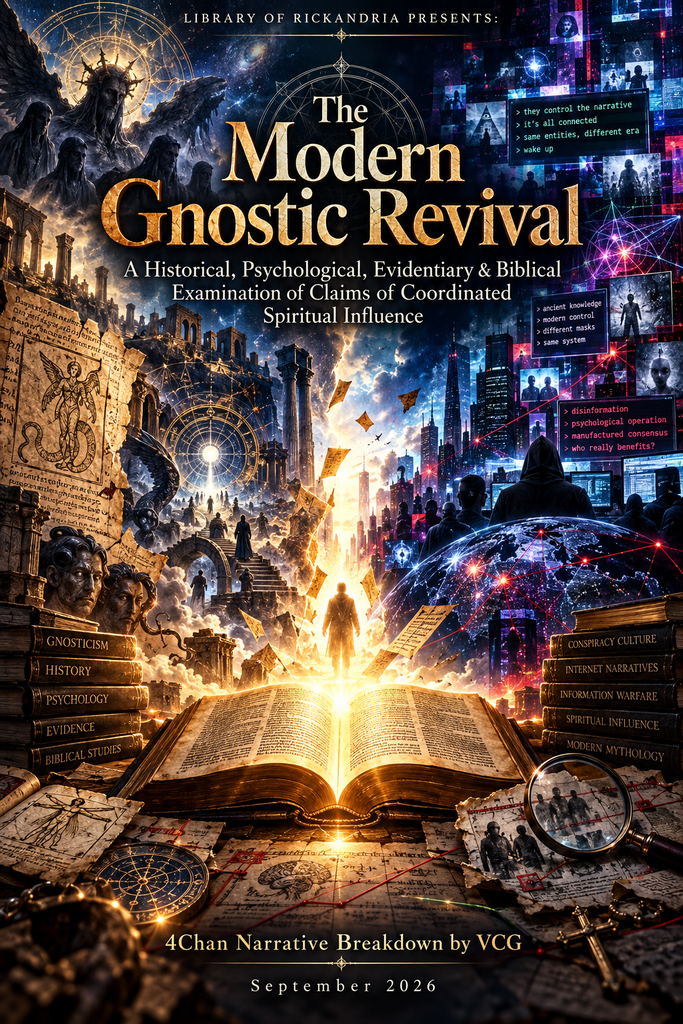
UPDATED BY VCG ON 9/29/2026 @ 10:10 EST
Anyone can do this, but most won’t.
ChatGPT – Library of Rickandria
Abstract
On September 20, 2026, an anonymous poster on 4chan’s /x/ board asked a deceptively simple question:
“is gnosticism a psyop?”
/x/ – is gnosticism a psyop – Paranormal – 4chan
The poster’s concern was autobiographical.
Gnosticism had once seemed obscure to him; after encountering it through popular culture and online communities,
he began seeing references to it increasingly often and wondered what had caused it to:
“start going mainstream.”
Over the following days, the thread expanded far beyond that question.
Participants discussed:
- ancient Gnostic schools
- the Matrix films
- Carl Jung
- Freemasonry
- Luciferian symbolism
- Washington, D.C.
- Nag Hammadi
- near-death experiences
- CIA documents
- Robert Monroe
- prison-planet cosmology
- the Essenes
- Nazoreans
- reincarnation
- Buddhism
- Kabbalah
- comparative mythology
- supposed pagan origins of Christian customs
and the possibility of an organized campaign to replace biblical Christianity with an esoteric spirituality.
This paper examines those claims without beginning from either credulity or ridicule.
It distinguishes five questions that are frequently collapsed in internet discussions:
What can history establish?
What can empirical evidence establish?
What can psychology help explain?
What remains interpretation or metaphysics?
And what does Scripture actually teach?
That separation produces a more complicated but more defensible conclusion than either:
“everything in the thread is nonsense”
or
“the thread uncovered a coordinated operation.”
There is substantial evidence that ancient movements commonly grouped under the modern category Gnosticism existed;
that those movements were diverse rather than monolithic;
that Gnostic material was:
- transmitted
- rediscovered
- translated
- reinterpreted
- repackaged
through:
- modern scholarship
- occultism
- psychology
- literature and film
that thinkers such as Carl Jung seriously engaged Gnostic ideas;
that twentieth-century science fiction repeatedly used Gnostic and quasi-Gnostic themes;
that The Matrix consciously participates in a wider religiously syncretic:
“awakening from false reality”
tradition; that governments have conducted genuine research into psychological influence and altered-state techniques; and that recommendation algorithms can substantially change what information people encounter.
Those facts are important.
They still do not demonstrate the stronger proposition that the contemporary revival of Gnostic imagery constitutes a centrally coordinated psychological operation.
A psychological operation is not merely an idea that influences psychology.
Military doctrine describes Military Information Support Operations as planned activities conveying selected information to defined audiences in order to influence their:
- reasoning
- motives
- emotions
- behavior
toward an originator’s objectives.
A serious psyop hypothesis therefore requires evidence of:
- an operator
- objective
- target population
- messaging strategy
- dissemination channel
- coordination
and desired behavioral outcome.
The 4chan thread repeatedly establishes one or two pieces of that chain and then assumes the remainder.
This paper therefore reaches a provisional evidentiary conclusion rather than an absolute metaphysical one:
The modern revival and mutation of Gnostic ideas is real.
The mechanisms by which those ideas spread are substantially identifiable.
The thread does not presently establish that those mechanisms belong to a single coordinated operation.
From a biblical standpoint, a separate conclusion emerges.
Whatever its modern origin or mode of distribution, the characteristic theology of anti-cosmic Gnosticism conflicts at foundational points with the canonical biblical account of:
- God
- creation
- Christ
- humanity
- salvation
- resurrection
and the final destiny of creation.
The biblical story does not depict human beings as forgotten divine fragments imprisoned by an inferior creator and rescued through secret knowledge.
It presents one Creator,
a creation originally declared good,
humanity corrupted by sin,
the Creator’s Word becoming flesh,
Christ’s bodily resurrection,
the redemption of the body,
and finally a renewed creation in which God dwells with redeemed humanity.
The controlling methodological principle of this paper is therefore deliberately simple:
“Prove all things; hold fast that which is good.” — 1 Thessalonians 5:21
I. The Question Behind the Thread
The original post is worth taking seriously because the experience it describes is common.
A person learns about an obscure idea. Soon afterward, he begins noticing it everywhere.
At first this can feel uncanny.
The poster says that while growing up he heard virtually nothing about Gnosticism.
He encountered it through the video game Cruelty Squad, discovered that there were people who actually held related beliefs, and later began noticing substantially more discussion of Gnosticism on social media.
His question was not initially an elaborate conspiracy theory.
It was essentially:
Why am I suddenly seeing this everywhere?
That question has several possible answers, and they need not be mutually exclusive.
The idea itself might genuinely be growing more popular.
Previously obscure texts may have become easier to obtain.
Popular entertainment may have translated difficult ancient ideas into memorable images.
Internet subcultures may have repackaged them into memes.
People already interested in:
- occultism
- simulation theory
- altered states
or religious deconstruction may independently converge on similar language.
Recommendation systems may notice a user’s interest and supply increasingly related material.
A movement, organization or state actor could also intentionally promote some of the ideas.
The mistake would be to choose the most dramatic explanation before separating those possibilities.
The thread does not consistently maintain that separation.
That is where our investigation begins.
II. What Would “Psyop” Actually Mean?
The term psyop is used extremely loosely online.
Sometimes it means propaganda.
Sometimes manipulation.
Sometimes advertising.
Sometimes a cultural trend somebody dislikes.
Sometimes it simply means an idea that changes people’s behavior.
That looseness creates a major evidentiary problem.
U.S. Army legal doctrine describes Military Information Support Operations as planned operations conveying selected information to foreign audiences in order to influence:
- emotions
- motives
- reasoning
and ultimately behavior in ways favorable to the originator’s objectives.
The crucial words are not merely influence or psychology.
They are planned, audience, and originator’s objectives.
An advertisement can influence someone without being a military psychological operation.
A movie can influence someone without being a psychological operation.
A social-media algorithm can influence someone without being intentionally configured to promote the worldview he eventually adopts.
A religion can change someone’s behavior without thereby being an intelligence operation.
Even deliberate persuasion is not automatically covert psychological warfare.
The distinction is foundational.
A Burden-of-Proof Ladder
The claims in the thread can be arranged according to how much evidence each one requires.
| Evidentiary Level | Claim | What Would Be Needed |
|---|---|---|
| Level 1 | Gnostic ideas are increasingly visible | Trend data, cultural examples, publication/search/social-media evidence |
| Level 2 | Digital systems amplify Gnostic material | Recommendation data, platform experiments, user-exposure evidence |
| Level 3 | Particular cultural actors intentionally promote Gnostic themes | Statements, scripts, interviews, institutional records, funding or editorial decisions |
| Level 4 | Multiple actors coordinate that promotion | Communication records, shared planning, funding relationships, common campaign documents |
| Level 5 | The coordination is intentionally concealed | Authentic internal documents, operational-security measures, corroborated testimony |
| Level 6 | Intelligence, Masonic, occult or other centralized networks direct the campaign | Command relationships, operational directives, budgets, targets, campaign objectives and independent corroboration |
The thread contains material relevant to Levels 1 and 2.
It occasionally supplies suggestive material relevant to Level 3.
It repeatedly concludes Levels 5 or 6.
That jump is the central methodological problem.
A researcher should not say,
“therefore there is no operation.”
The proper conclusion is narrower:
Evidence sufficient for the stronger claim has not been presented.
III. Our Evidence Standard
Throughout this paper, claims are classified in five ways.
| Classification | Meaning |
|---|---|
| Supported | Credible independent evidence substantially confirms the claim |
| Partly supported | A real historical or empirical core exists, but the thread goes farther than the evidence |
| Unsupported | The evidence necessary to establish the claim has not been produced |
| Contradicted | Strong primary or independent evidence points against the claim |
| Metaphysical / experiential | The claim is not directly resolvable by ordinary historical or empirical fact-checking |
Confidence is separately described as high, moderate, low, unresolved, or not empirically testable.
This distinction matters.
For example:
“Plotinus criticized people we conventionally call Gnostics”
is an historical claim.
“I encountered a luminous presence during meditation”
is an experiential claim.
“That presence was the true God beyond the Demiurge”
is an interpretation of an experience.
“The CIA proved that such beings exist”
is an empirical-historical claim about government research.
“Scripture identifies this being as deceptive”
is a theological interpretation requiring biblical exegesis.
Putting all five statements into one evidentiary bucket guarantees confusion.
IV. Before We Discuss “Gnosticism,” We Have to Define It
One of the thread’s better observations is that ancient Gnostic systems were not all the same.
Modern scholarship goes farther: some scholars question whether Gnosticism is even a sufficiently precise historical category.
Michael Allen Williams’ influential Rethinking “Gnosticism” argues that the conventional term encourages us to imagine a single, unified religious phenomenon where the ancient evidence actually reveals multiple movements, texts and interpretive systems.
Williams particularly warns against stereotypes concerning a single Gnostic attitude toward matter, the body, elitism and social protest.
Recent scholarship on the Nag Hammadi codices likewise cautions against assuming that every text in the collection belonged to one self-conscious “Gnostic community.”
The codices contain heterogeneous works, and the relationship between the books, their readers, monasteries and supposed Gnostic groups remains debated.
So throughout this paper Gnostic will be used as a practical umbrella term where necessary, but never as though it names one ancient denomination with one creed.
A Working Taxonomy
| Tradition / Category | Why It Matters | Important Qualification |
|---|---|---|
| Sethian-type traditions | Texts such as the Secret Book of John contain elaborate divine emanations, a lower creator and reinterpretations of Genesis | “Sethian” itself is a scholarly classification, not a universal ancient denominational label |
| Valentinian Christianity | Highly sophisticated Christian movement associated with Valentinus and later teachers | Valentinian views of creation and the Demiurge cannot simply be equated with every hostile prison-cosmos model |
| Basilidean traditions | Another early Christian speculative school with distinctive cosmology | Should not be treated as interchangeable with Sethian systems |
| Marcionism | Strong Creator/Christ theological rupture and rejection of much Jewish Scripture | Often discussed beside Gnostic movements but should not automatically be called identical with them |
| Manichaeism | Later explicitly dualistic world religion associated with Mani | Related to late antique dualistic environments but historically distinct from second-century Christian Gnostic schools |
| Hermetic traditions | Western esoteric texts emphasizing revelation and spiritual ascent | “Esoteric” does not automatically mean “Gnostic”; important differences exist |
| Medieval Christian dualists | Bogomils and groups conventionally called Cathars sometimes resemble earlier anti-cosmic systems | Direct genealogical continuity with ancient Gnosticism is debated |
| Modern occult / New Age adaptations | Reinterpret Gnostic motifs through psychology, Theosophy, Eastern religions and esotericism | These are modern syntheses rather than untouched survivals of ancient religion |
| Prison-planet spirituality | Demiurge, archons, soul traps, reincarnation machinery, “loosh,” NDE deception | A contemporary hybrid containing major elements not characteristic of ancient Gnostic texts |
The Internet Encyclopedia of Philosophy itself places:
- Basilides
- Marcion
- Valentinus
- Mani
within a broad discussion of Gnosticism while simultaneously distinguishing important differences among them.
That is useful pedagogically, but Williams’ warning should remain in view: the wider the umbrella becomes, the easier it is to manufacture false historical continuity.
V. A Transmission Timeline: What Can Actually Be Connected?
One of the thread’s largest claims is that ancient Gnosticism has been passed through hidden organizations into modern culture.
There is a history of transmission and revival.
The question is where the evidence supports continuity and where we are dealing only with analogy.
| Period | Development | Relationship to Earlier Gnosticism |
|---|---|---|
| 2nd–3rd centuries | Sethian, Valentinian, Basilidean and other movements flourish; Christian heresiologists respond | Documented historical presence |
| 3rd century | Plotinus attacks anti-cosmic Gnostic contemporaries | Documented interaction |
| Late antiquity | Heresiologists preserve descriptions of movements even as many communities disappear | Documented textual transmission, though polemical |
| Medieval period | Bogomils and western Christian dualists appear | Some thematic similarity; specific genealogies debated |
| Renaissance / early modern esotericism | Hermetic, Neoplatonic, Kabbalistic and later occult currents circulate | Complex influence environment; not simple Gnostic continuity |
| 19th century | Major increase in Western occult and scholarly interest; G. R. S. Mead translates Pistis Sophia into English in 1896 while active in the Theosophical Society | Documented modern reception |
| Early 20th century | Carl Jung studies Gnostic material and uses Gnostic-like symbolism in his psychological writings | Documented intellectual influence |
| 1945 | Nag Hammadi codices discovered in Egypt, dramatically expanding available primary material | Documented textual rediscovery |
| Postwar counterculture | Gnosticism increasingly enters psychology, alternative religion and popular spirituality | Documented reception with extensive reinterpretation |
| Late 20th-century science fiction | Philip K. Dick and others explore false worlds, hidden realities and Gnostic motifs | Documented literary adaptation |
| 1999 onward | The Matrix gives mass audiences a powerful false-world/awakening narrative blending Christian, Gnostic, Buddhist and other motifs | Documented cultural adaptation |
| Early internet era | Esoteric forums remix Gnostic terminology with simulation theory, UFO religion, Monroe, altered states and conspiracy culture | Partly documented; individual diffusion histories require archival work |
| 2010s–2020s | “Prison planet,” “archons,” “loosh” and reincarnation-trap narratives circulate through forums, podcasts, video platforms and social media | Modern synthesis |
| 2026 thread | 4chan participants themselves debate whether increased visibility reflects algorithmic exposure or coordinated manipulation | Direct evidence of contemporary reception |
G. R. S. Mead is an especially useful marker.
Cambridge notes that Mead spent twenty-five years in the Theosophical Society, worked closely with Helena Blavatsky, wrote widely about Gnosticism and Western esotericism, and produced the first English translation of a major Gnostic work, Pistis Sophia, in 1896.
That alone demonstrates that modern Gnostic revival long predates TikTok, 4chan or The Matrix.
Carl Jung represents another documented bridge.
Scholarship in analytical psychology has examined the substantial Gnostic affinities of Jung’s Seven Sermons to the Dead and the Gnostic texts available to him.
Calling Jung simply “a Gnostic” would flatten his psychology into an ancient religion, but saying that Gnostic material substantially influenced him is well grounded.
Nag Hammadi then changed the scale of access.
The Egyptian discovery in 1945 yielded a large cache of Coptic codices containing roughly fifty-two treatises, some closely resembling systems previously known largely through hostile heresiologists.
The discovery did not invent Gnosticism, nor did it reveal a religion completely unknown to scholarship, but it transformed scholars’ ability to study relevant texts directly.
And popular culture provided another transmission route.
Scholarship has documented Gnostic and dualistic themes in Philip K. Dick’s fiction, while religion-and-film scholarship recognizes The Matrix as deliberately syncretic, prominently drawing on Gnostic Christianity and Buddhism.
None of that requires a secret organization.
It gives us an observable cultural genealogy.
VI. Returning to the Thread
1. “Why Am I Seeing This Everywhere?”
The first serious answer in the thread suggests that The Matrix helped popularize the concept.
Another poster points to:
- loneliness
- loss of meaning
- distrust of authority
and Western occult interest.
A later poster gives an even simpler explanation:
perhaps Gnosticism did not suddenly become ubiquitous; perhaps the original poster’s information environment changed.
Another describes 4chan’s old niche material being scraped and redistributed into the wider internet.
These are not mutually exclusive explanations.
Indeed, taken together they form a plausible diffusion model:
ancient sources → scholarly recovery → occult/psychological reinterpretation → popular entertainment → niche internet culture → large-scale algorithmic recommendation.
The striking thing is that this model requires no hidden coordinator.
That does not prove there is no coordination.
It means that before proposing one, we already have a substantial ordinary mechanism capable of producing the observed phenomenon.
VII. The Thread’s First “Psyop Test” Fails as a Test
One poster offers two supposed signs of a psyop:
it makes people believe they possess special knowledge, and it persuades them that they lack something and need improvement.
The observation is psychologically interesting.
It is not a valid diagnostic rule.
Religious conversion can create both effects.
Education can create both effects.
Learning a language can create both effects.
Joining a professional discipline can create both effects.
Advertising certainly can.
Therapy can.
Fitness culture can.
An initiation society can.
A philosophy class can.
A manipulative cult can too.
Therefore the psychological effect does not identify the causal mechanism.
This is a recurring problem throughout the thread: a feature genuinely associated with manipulation is treated as though it were unique to manipulation.
VIII. The Matrix: A Genuine Gnostic Connection
Here the thread has something real.
The Matrix is not merely being forced into a Gnostic interpretation after the fact.
Academic work in the Journal of Religion & Film has explicitly examined the film’s Gnostic and Buddhist dimensions.
Its world of:
- apparent reality
- ignorance
- awakening
- liberation
and a guide who helps the protagonist perceive his true condition naturally invites Gnostic comparison.
But the same scholarship also emphasizes the film’s syncretism.
Its imagery is not reducible to one religious system.
- Christian messianism
- Buddhism
- cyberpunk
- philosophical skepticism
- modern technological anxiety
coexist inside the narrative.
So the following inference is defensible:
The Matrix helped familiarize mass audiences with themes that resemble or explicitly evoke Gnostic awakening.
The next inference is not established:
Therefore someone deployed The Matrix as a coordinated Gnostic psychological operation.
The first is literary history.
The second is an operational claim requiring operational evidence.
IX. When Every Story Becomes Gnostic
One poster moves from:
- The Matrix to Lord of the Rings
- Star Wars
- Fight Club
treating each protagonist-antagonist conflict as an expression of Gnostic or Jungian shadow integration.
Another poster in the thread immediately identifies the methodological problem:
once one interpretive framework is applied to every story, the framework begins generating its own evidence.
That correction is important.
Sauron can be called “the Shadow” without becoming Jung’s technical shadow.
Anakin’s fall can involve conflict between desire and discipline without being a Gnostic initiation drama.
Tyler Durden can function as a dissociated alter ego without making Fight Club a Sethian gospel.
Symbolic interpretation is legitimate.
But possible interpretation is not demonstrated authorial intention, and authorial intention is still not evidence of coordinated psychological warfare.
There are therefore three distinct propositions:
This story can be read through a Gnostic lens.
This story’s creators intentionally used Gnostic material.
This story was commissioned or promoted as part of a coordinated Gnostic influence campaign.
Those propositions require increasingly different evidence.
X. Jung: Real Connection, Wrong Conclusion
The thread is correct that Jung engaged Gnosticism extensively.
His Septem Sermones ad Mortuos—Seven Sermons to the Dead—contains obvious Gnostic affinities, and scholarship has reconstructed the Gnostic sources he may have known when composing it.
This matters because Jung becomes an important modern route by which ancient religious symbols entered psychological vocabulary.
But there is still a categorical distinction:
Ancient Gnostic myth describes cosmology and salvation.
Jungian psychology frequently treats religious imagery as symbolic material expressive of psychic structures and individuation.
A modern reader can transform the Demiurge into a psychological symbol.
That does not demonstrate that ancient Gnostics secretly meant nothing more than psychology.
The thread sometimes commits exactly this reversal: it assumes that because Jung can psychologically reinterpret an ancient myth, the ancient myth must originally have been an initiatory psychological technique.
That conclusion requires historical evidence of ancient intention.
It cannot be supplied retrospectively by Jung.
XI. Freemasonry: Where Similarity Becomes Identity
The thread’s Freemasonry section makes several increasingly strong claims:
the Masonic letter G means “Gnosis”;
the Grand Architect of the Universe is literally the Gnostic Demiurge;
higher initiates receive secret Luciferian/Gnostic teaching;
and Freemasonry uses mass culture to spread Gnostic ideas.
The first claim can be checked directly.
An official educational resource of the Scottish Rite’s Northern Masonic Jurisdiction explains that the G is associated principally with Geometry and God, the latter connected with the
“Grand Architect of the Universe.”
It does not present “Gnosis” as the standard meaning asserted by the thread.
That does not prove that no Mason in history has ever interpreted G esoterically.
It proves something narrower and sufficient:
The thread’s statement,
“the G stands for Gnosis”
cannot simply be treated as established institutional fact.
The Grand Architect/Demiurge identification has a similar problem.
Both use architectural imagery.
But the theological concepts are different.
In ordinary Masonic usage, the Grand Architect refers to the supreme divine being in deliberately nonsectarian terminology.
In classic anti-cosmic Gnostic myths, the Demiurge is typically a subordinate creator associated with ignorance, deficiency or hostility relative to the higher God.
“Architect” therefore does not establish “same deity.”
A shared metaphor is not a genealogy.
The stronger claim—that initiates are secretly taught that Lucifer is the savior and that this hidden doctrine coordinates modern culture—would require:
- specific degree texts
- jurisdiction
- date
- documentary provenance
and evidence that the teaching is organizational rather than the speculation of individual occult writers.
The thread does not supply that chain.
XII. The Statue of Liberty and the Lucifer Inference
Another poster declares the Statue of Liberty:
“pure symbolism of Lucifer”
because she holds a torch and Lucifer is understood as a light-bearer.
The documented symbolism is much less mysterious.
The National Park Service states that the torch symbolizes enlightenment and notes the statue’s official title, Liberty Enlightening the World.
Historical material describes Bartholdi’s figure as a classical personification of liberty raising the torch of freedom.
This does not make esoteric interpretation forbidden.
Someone may construct a Luciferian interpretation of any torch-bearing image.
But there is a crucial difference between:
“The image can remind me of Lucifer.”
and
“The monument was designed to represent Lucifer.”
The second claim concerns historical intention.
Historical intention requires historical evidence.
Torch + light ≠ Lucifer automatically.
XIII. Washington, D.C., and the Pentagram Problem
The thread also claims that the street plan of Washington contains an intentional pentagram representing Baphomet or Lucifer.
The Library of Congress describes L’Enfant’s 1791 plan as a comprehensive Baroque city plan in which radiating avenues, parks and vistas were laid over an orthogonal street system, influenced by European cities and eighteenth-century garden planning.
A city containing many diagonals will naturally permit people to select line segments that form partial stars, triangles and other geometric shapes.
The evidentiary question is therefore not:
Can a pentagram-like shape be drawn on the map?
It is:
Did the planner intend that shape to carry the meaning being alleged?
That requires evidence from:
- plans
- correspondence
- diaries
- Masonic records
- design notes
or comparable historical material.
Without that evidence, drawing a familiar symbol across selected streets demonstrates a geometric possibility, not the intention of the city planner.
This is a textbook example of why pattern recognition must be distinguished from causal reconstruction.
XIV. Pattern Perception and Conspiracy Reasoning
At this point psychology becomes relevant—but only if used carefully.
We are not diagnosing anonymous posters.
There is no responsible basis for doing that.
What researchers can study are general cognitive mechanisms.
Van Prooijen, Douglas and De Inocencio conducted five studies investigating relationships among conspiracy belief, supernatural belief and illusory pattern perception—the tendency to perceive meaningful causal structure in stimuli generated randomly or chaotically.
Their studies found associations between such pattern perception and the kinds of beliefs under investigation.
They also emphasize that conspiracies can genuinely occur; the problem is not seeing patterns but incorrectly inferring a causal pattern where none has been established.
That distinction is especially useful for this thread.
Seeing that:
a torch resembles “light-bearer” imagery,
a street arrangement resembles part of a pentagram,
a G might suggest gnosis,
a fictional architect resembles a Demiurge,
and a modern psychological concept resembles an ancient myth
may generate good research questions.
But those perceptions do not establish one causal network.
The work begins after the pattern is noticed.
XV. Why Hidden-Knowledge Narratives Are So Powerful
The psychology of conspiracy narratives should never be reduced to:
“people who believe strange things are stupid.”
That explanation is both insulting and analytically weak.
Douglas and colleagues summarize motives associated with conspiracy belief under three broad categories:
epistemic motives involving the desire to understand events,
existential motives involving security and control,
and social motives involving identity and one’s relationship to valued groups.
A hidden-knowledge worldview can therefore satisfy several human needs simultaneously.
It can explain why the world feels disordered.
It can explain suffering.
It can identify an agent responsible for the suffering.
It can turn confusion into coherence.
It can tell the believer that apparent chaos actually has a hidden structure.
It can transform alienation into identity.
It can turn social marginality into evidence of spiritual insight.
It can offer a heroic role: you are one of the people who noticed.
None of those psychological rewards tells us whether the underlying belief is true.
True beliefs can be comforting.
False beliefs can be comforting.
True beliefs can be terrifying.
False beliefs can be terrifying.
Psychology helps explain why a narrative attracts us.
It does not replace examination of whether the narrative is correct.
XVI. The Self-Sealing Secret
Several posters employ a particularly important form of reasoning.
One says he knows the truth but will not reveal it.
Another insists that hidden knowledge is real, that revealing it is dangerous, and that only a select few are prepared to receive it.
A secret can of course genuinely exist.
But secret-knowledge claims have a structural problem.
If no evidence appears, secrecy explains the absence.
If evidence appears, it proves the secret.
If a skeptic doubts, the skeptic is spiritually unready.
If a believer accepts it, the believer has awakened.
If predictions fail, the operation changed.
If records are missing, they were destroyed.
This creates what may be called a self-sealing system.
The issue is not that a self-sealing proposition must be false.
The issue is that it becomes increasingly difficult to identify any observation that would count against it.
A theory that can explain every possible outcome risks explaining none of them discriminatively.
That is why falsification criteria matter.
We will return to them later.
XVII. “The LORD of the Old Testament Is Not the God of Jesus”
Here the thread crosses from history and conspiracy into theology.
One participant says he believes that the “LORD” of the Old Testament is not the God Jesus proclaimed.
This resembles theological ideas found in some ancient movements that sharply separated the Creator associated with Israel’s Scriptures from the higher God revealed by Christ.
Historical investigation can establish that people taught such things.
It cannot settle the theological truth of the proposition by historical method alone.
For that, our paper asks a different question:
Does the canonical New Testament itself teach that distinction?
It does not.
John begins:
“In the beginning was the Word, and the Word was with God, and the Word was God.”
and then:
“All things were made by him; and without him was not any thing made that was made.”
Later:
“And the Word was made flesh, and dwelt among us…”
John 1:1, 3, 14.
The canonical Christ is therefore not depicted as an emissary entering a universe manufactured independently by an alien creator.
The world was made through him.
Luke likewise presents the risen Christ affirming the continuity of his mission with:
“the law of Moses, and in the prophets, and in the psalms,”
which he says speak concerning him.
Whatever one thinks of that theology, the textual point is clear:
The canonical New Testament does not present Jesus as exposing Moses’ God as a counterfeit Demiurge.
To make that argument, one must either reinterpret the canonical texts against their ordinary narrative continuity or privilege other sources above them.
That is a theological choice.
It should not be disguised as something the canonical texts straightforwardly teach.
XVIII. The Biblical Cosmos Is Fallen, Not Intrinsically Evil
A major attraction of prison-world spirituality is obvious: the world contains horrifying suffering.
Any Christian answer that merely says:
“creation is beautiful”
and ignores:
- cancer
- predation
- cruelty
- decay
- death
will sound superficial.
The biblical account is more complex.
Genesis says:
“And God saw every thing that he had made, and, behold, it was very good.”
Genesis 1:31.
But Romans 8 describes that same creation as later:
“made subject to vanity,”
existing in
“bondage of corruption,”
and
“groan[ing] and travail[ing] in pain.”
Crucially, Paul does not conclude that creation must therefore be escaped.
He says the creation itself awaits deliverance, while believers await:
“the redemption of our body.”
The biblical sequence is therefore:
good creation → corruption → groaning → redemption.
The hard anti-cosmic Gnostic sequence is characteristically different:
defective creator → defective material cosmos → imprisoned spiritual element → awakening and escape.
Those are not merely two vocabularies describing the same theology.
They tell different stories about what went wrong.
XIX. “Every Creature of God Is Good”
First Timothy makes the anti-cosmic tension unusually explicit.
It warns about teachings involving prohibitions concerning marriage and foods, then answers:
“For every creature of God is good, and nothing to be refused, if it be received with thanksgiving.”
1 Timothy 4:4.
That does not mean every human desire is good.
It does not mean sin is unreal.
It means created materiality itself is not the metaphysical enemy.
Likewise, Romans can speak very negatively about “the flesh” as the sphere of sinful desire while still affirming that God will:
“quicken your mortal bodies.”
This distinction matters because online Gnostic discussion often assumes:
Christian condemnation of “the flesh” = Christian condemnation of embodiment.
That is not Paul’s argument.
The final hope is bodily resurrection.
XX. Christianity Is Radically Incarnational
This point becomes even sharper in the Johannine writings.
“Every spirit that confesseth that Jesus Christ is come in the flesh is of God.”
1 John 4:2.
Second John likewise warns about those who do not confess Jesus Christ:
“come in the flesh.”
And Luke portrays the risen Jesus telling his frightened disciples:
“handle me, and see; for a spirit hath not flesh and bones, as ye see me have.”
He then eats before them.
Whatever debates surround the exact opponents these texts address historically, the canonical theological emphasis is difficult to miss.
Christian salvation does not culminate in Jesus shedding embodiment as an illusion.
The Word becomes flesh.
Christ rises bodily.
Believers await resurrection.
Creation awaits liberation.
Revelation ends not with redeemed souls permanently fleeing creation but with a new heaven and a new earth, God dwelling with humanity, and the declaration:
“Behold, I make all things new.”
That is fundamentally different from prison-planet escape.
XXI. Ancient Gnosticism Versus the Modern Prison-Planet Synthesis
Modern internet “Gnosticism” often contains elements that would be unfamiliar as a package to ancient authors.
| Theme | Ancient Gnostic-Type Systems | Modern Prison-Planet Synthesis |
|---|---|---|
| Demiurge | Lower creator in several mythologies | Often treated as literal extraterrestrial/interdimensional prison administrator |
| Archons | Cosmic rulers associated with the lower order | Alien controllers, NDE deceivers, elite bloodlines, astral jailers |
| Material world | Frequently deficient, alienating or lower | Engineered simulation or energy farm |
| Human condition | Divine/spiritual element trapped in ignorance | Soul trapped in reincarnation machinery |
| Salvation | Gnosis, revelation, ascent | Avoid “light trap,” reject afterlife beings, regain sovereignty |
| Reincarnation | Appears differently across traditions; not universal in one modern form | Often central, mechanical recycling system |
| “Loosh” | Not an ancient Gnostic technical term | Borrowed from modern Monroe-associated consciousness literature |
| NDEs | Not ancient clinical NDE literature | Used as supposed empirical confirmation |
| UFO / alien lore | Absent as modern technological mythology | Frequently integrated |
| Simulation theory | Ancient illusion/ignorance analogies can resemble it | Often treated literally through computing metaphors |
| CIA documents | Obviously absent | Used rhetorically as validation of altered-state cosmology |
Calling all of this “ancient Gnosticism” hides the actual historical process.
A more accurate description is:
a modern syncretic mythology built from selected:
- ancient Gnostic motifs
- Western occultism
- New Age spirituality, UFO culture
- altered-state literature
- simulation metaphors
- NDE interpretation
and internet conspiracy culture.
That does not answer whether any metaphysical element might be true.
It tells us what the historical mixture is.
XXII. Nag Hammadi: Rediscovery Is Not Authentication
A poster in the thread describes Gnostic writings as buried by Christianity and rediscovered in the 1940s.
The historical core is real.
Nag Hammadi was an extraordinary discovery and drastically expanded direct access to relevant texts.
But scholars already knew a great deal about Gnostic traditions through heresiologists and other surviving material.
The discovery transformed the evidence; it did not create the subject from nothing.
More importantly, rediscovery does not automatically authenticate theology.
A suppressed text can be true.
A suppressed text can be false.
A lost text can preserve early tradition.
A lost text can preserve late speculation.
An institution can suppress a text unfairly.
A community can stop copying a text because it rejects it.
Therefore:
“This book was excluded or suppressed”
is information about reception history.
It is not by itself evidence that the book’s cosmology is correct.
The proper response to Nag Hammadi is not:
“the Church rejected it, therefore ignore it.”
Nor is it:
“the Church rejected it, therefore it contains the truth they feared.”
It is:
Read it.
Date it.
Establish its textual relationships.
Compare its claims.
One poster who tells people to read the Apocryphon of John itself rather than learning Gnosticism through memes and podcasters therefore gives some of the best methodological advice in the thread.
XXIII. How to Read the Ancient Witnesses
Before Nag Hammadi, scholars often reconstructed Gnostic systems through hostile Christian authors.
That creates obvious source problems.
A useful source-control table looks like this:
| Source | Value | Limitation |
|---|---|---|
| Irenaeus | Early detailed Christian descriptions of rival movements and teachers | Theological opponent writing polemic |
| Hippolytus | Preserves extensive reports of heterodox teachings | Compilatory and polemical; dependence on earlier sources must be examined |
| Tertullian | Important evidence concerning Marcionite and Valentinian controversies | Strong rhetorical and apologetic agenda |
| Origen | Valuable witness to third-century theological disputes and interpretive traditions | Not a neutral ethnographer of religious opponents |
| Plotinus | Independent non-Christian philosopher attacking Gnostic contemporaries | Philosophical opponent who interprets them through his Platonic concerns |
| Nag Hammadi texts | Direct access to writings from relevant ancient interpretive worlds | Collection is heterogeneous; manuscript date, composition date, community and classification differ by text |
Plotinus is particularly valuable because his criticism is independent of Christian heresiology.
The Stanford Encyclopedia of Philosophy notes that his contemporaries included Gnostics who regarded the sensible cosmos as the work of a foolish or malevolent creator, and that Plotinus vigorously rejected their anti-cosmic view while defending the intelligibility and beauty of the physical world.
This independently confirms that anti-cosmic teachings were not simply later inventions of Christian polemicists.
But it also shows why “Gnosticism” cannot simply mean “Platonism.”
Plotinus thought the Gnostics had seriously distorted Platonism.
XXIV. The Gospel of Judas: Fascinating, but Not a First-Century Transcript
The thread invokes the Gospel of Judas as though it reveals that the ordinary apostles worshipped the wrong god and Judas alone understood Christ correctly.
The real textual history is more complicated.
Irenaeus knew of a Gospel of Judas in the second century.
The surviving Coptic work became famous after modern publication, and its interpretation immediately generated scholarly controversy.
Even the popular initial interpretation portraying Judas straightforwardly as the heroic enlightened disciple has been challenged on textual grounds.
This makes the document extremely important for understanding alternative Christianities.
It does not make it an eyewitness transcript by Judas Iscariot.
The appropriate historical statement is:
By the second century, some Christians were circulating a radically alternative theological narrative concerning Judas, Jesus, sacrifice and the disciples.
That is historically significant.
The stronger claim—
Therefore this is what the historical Jesus secretly taught Judas
—requires evidence beyond the title and content of the later work.
Ancient pseudonymous attribution was common.
A text speaking in an apostolic voice is not automatically apostolic in date.
XXV. Government Interest in Altered States: A Real Fact
The thread’s CIA/Hemi-Sync material should not simply be laughed away, because part of it is genuine.
Declassified records concerning the U.S. Army’s CENTER LANE project show personnel experimenting with or receiving training in techniques including biofeedback, Hemi-Sync and programs associated with Robert Monroe’s institute.
One official document describes Hemi-Sync training as part of advanced preparation for selected participants.
This is genuine historical evidence of government interest.
It establishes something important:
U.S. military/intelligence-linked programs seriously investigated altered-state and so-called psychoenergetic techniques.
But an archive has to be read correctly.
A document existing in the CIA Reading Room does not mean that every proposition inside it was scientifically validated by the CIA.
Indeed, one CIA-hosted historical document discussing Monroe explicitly says his reported out-of-body experience was not supported by scientific evidence.
This creates an excellent general rule:
Government interest is evidence of government interest.
It is not automatically evidence that the object of interest works as claimed.
Governments investigate failures.
Governments investigate rumors.
Governments investigate enemy claims.
Governments test speculative technology.
Governments preserve external clippings.
Governments sometimes spend money on ideas later abandoned.
The existence of a classified stamp is not a sacrament of truth.
XXVI. Intelligence-Document Literacy
When reading declassified material, the following distinctions should govern the analysis.
| What the document establishes | What it does not automatically establish |
|---|---|
| An agency possessed the document | The agency endorsed every statement |
| Personnel investigated a technique | The technique worked |
| A program received funding | Its theoretical framework was correct |
| A contractor made a claim | The agency adopted the claim |
| A report was classified | The report was true |
| An experiment occurred | The experiment successfully demonstrated the paranormal interpretation |
| The document was declassified | The claims have since been validated |
| The government used a term such as “psychoenergetics” | The metaphysical ontology associated with the term is scientifically established |
This distinction alone resolves much of the:
“CIA proved it”
rhetoric surrounding occult and paranormal internet discussions.
XXVII. Algorithms: A Much Stronger Explanation Than Most Posters Realize
One of the thread’s simplest explanations deserves more attention: perhaps the original poster’s feed changed.
Modern recommendation systems really can alter information exposure.
A 2026 randomized field experiment published in Nature assigned active U.S.-based X users to algorithmic or chronological feeds over seven weeks.
The researchers found measurable changes in exposure, engagement, account-following behavior and certain attitudes among users moved onto the algorithmic feed.
The authors also emphasize that effects depend on platform, algorithm and time period.
The relevance here is methodological, not partisan.
An algorithm does not need to:
“believe in Gnosticism.”
It only needs to infer:
this user engages with occultism → show adjacent occultism;
this user pauses on simulation theory → show more simulation theory;
this user interacts with NDE content → show NDE spirituality;
this user watches archon videos → show prison-planet content.
The user then experiences a world in which the subject appears suddenly ubiquitous.
The algorithm may have produced real amplification without anyone ever issuing the directive:
Promote Gnosticism.
That difference is critical.
XXVIII. Emergent Amplification Versus Central Coordination
Consider two models.
Model A: Coordinated Operation
An identifiable actor decides to increase receptivity to anti-cosmic spirituality.
It identifies a target population.
It commissions narratives.
It places or funds content.
It coordinates partners.
It monitors audience response.
The resulting cultural shift is therefore substantially intentional.
Model B: Emergent Amplification
Thousands of independent creators make provocative content because it attracts attention.
Ancient Gnostic terminology provides dramatic language.
Science fiction supplies metaphors.
Occult communities remix them.
Audiences respond strongly to narratives involving hidden reality and secret rulers.
Algorithms detect that engagement and recommend more.
Creators notice the successful pattern and make more.
The worldview grows without a central planner.
Both models can produce:
recurring themes;
similar imagery;
rapid diffusion;
clusters of influencers;
cross-platform repetition;
and a sense that:
“someone is pushing this.”
Therefore those surface observations cannot distinguish the models.
We need evidence concerning coordination.
The thread mostly does not supply it.
XXIX. Moses and the “Secret First Tablets”
One later poster presents a supposed Essene account in which Moses’ first tablets contained higher mysteries too advanced for Israel.
Moses therefore smashed them and later returned with a simplified Ten Commandments for the spiritually unready masses.
Unlike many metaphysical propositions in the thread, this one can be directly tested against Exodus.
The first tablets are described as:
“the work of God, and the writing was the writing of God, graven upon the tables.”
Exodus 32:16.
Then God tells Moses concerning the replacements:
“I will write upon these tables the words that were in the first tables, which thou brakest.”
Exodus 34:1.
That does not leave room for the specific claim that the first tablets contained one elite doctrine while the second contained a different simplified doctrine.
A later text or tradition may tell that story.
If so, it should be presented honestly as a later alternative tradition.
It should not be represented as the hidden meaning of the Exodus account itself.
XXX. Jesus, the Essenes and the Nazoreans
Another late-thread claim states that the “true Christians” were Nazoreans, that Nazoreans were a northern Essene group, and that Jesus and all his disciples belonged to that sect.
The difficulty is evidentiary.
The Essenes themselves are historically well attested.
- Philo
- Josephus
- Pliny
are major witnesses, and scholars frequently discuss the relationship between Essenes and the Qumran community.
Nazoreans are another matter.
A Cambridge study explains that the principal later sources are Epiphanius and Jerome in the fourth century and notes the judgment that they lacked first-hand knowledge of Nazorean beliefs.
The group may preserve important evidence for Jewish Christianity, but reconstructing it is methodologically difficult.
Recent scholarship on Jewish-Christian traditions repeatedly emphasizes how difficult it is to trace genealogical continuity between early Jesus-following Jewish groups and later communities labeled Nazoreans or Ebionites.
Therefore:
Jesus existed in a Jewish environment that included Essene-type movements.
That does not establish:
Jesus was a member of a secret northern Essene-Nazorean order transmitting Egyptian mysteries.
The latter is a much more specific claim and requires much more specific evidence.
XXXI. Pagan Holidays and the Etymology Trap
The thread eventually turns to a familiar internet claim: Christian holidays are simply renamed pagan festivals, accompanied by long chains connecting similarly sounding names across languages and civilizations.
This area needs especially strict methodology.
Historical linguistics does not establish relationships because two modern words sound alike.
The comparative method works through systematic comparison of cognate material, regular sound correspondences, reconstructable historical forms and relationships among languages.
For an etymological claim to carry historical weight, we therefore need to ask:
What is the earliest attested form?
What language is it in?
What are the expected sound changes?
Are the languages genetically related?
Could one have borrowed from the other?
Were the cultures in contact at the necessary time?
Does the meaning remain sufficiently continuous?
Is there documentary evidence of borrowing?
Without that work, a chain such as:
Orion → Odin → Osiris → Nimrod → Shiva → Zeus
is not historical linguistics.
It is visual or phonetic association.
The number of associations does not strengthen the case if the individual links are weak.
Fifty speculative links are still fifty speculative links.
XXXII. Comparative Mythology Requires the Same Discipline
Religious symbols genuinely migrate between cultures.
Myths borrow.
Deities are identified with foreign deities.
Religious communities reinterpret earlier festivals.
Syncretism is historically real.
But that fact can become permission for undisciplined comparison.
Two gods being associated with the sun does not prove identity.
Two gods dying does not prove one story was copied from the other.
Two religious figures holding staffs does not prove historical descent.
Two traditions using a sacred meal does not prove a single mystery cult.
A meaningful comparative argument should show not merely resemblance, but where possible transmission.
Chronology is decisive.
A proposed source cannot borrow from something later than itself.
Geography matters.
Language matters.
Intermediaries matter.
Specific unusual correspondences matter more than generic human themes.
The thread repeatedly treats similarity as though it were already transmission.
That is methodologically unsafe.
XXXIII. Modern “Loosh,” NDEs and Reincarnation
The prison-planet material expands the Gnostic narrative through Robert Monroe’s “loosh” terminology, near-death experiences, out-of-body experiences and reincarnation-trap theories.
These are not all the same evidentiary category.
Someone reporting an NDE is evidence that someone reports an NDE.
That report may be sincere.
Its psychological reality may be profound.
But the interpretation—
the beings encountered were archons attempting to recycle the soul
—is a further claim.
A Christian can interpret the experience differently.
A Buddhist can interpret it differently.
A secular neuroscientist can interpret it differently.
An experiencer may revise his own interpretation years later.
Therefore:
experience ≠ interpretation of experience.
That distinction does not dismiss experience.
It protects it from premature explanation.
XXXIV. Reincarnation and the Bodhisattva Comparison
The thread later connects Gnostic spirituality with Buddhism and describes bodhisattvas as enlightened beings who delay Nirvana and reincarnate to help others.
There is a recognizable Mahayana idea underneath this.
The bodhisattva path emphasizes becoming a Buddha for the benefit of all beings rather than pursuing liberation only for oneself.
But:
“Buddhism teaches immortal souls choosing repeated incarnations”
would be a misleading Christian/New Age translation of Buddhist ideas.
Buddhist traditions differ, and the concept of rebirth is embedded within doctrines that do not simply reproduce the Western idea of an eternal personal soul passing unchanged from body to body.
Likewise Nirvana and the Gnostic Pleroma are not interchangeable simply because both involve transcendence.
Similarity of spiritual function does not establish theological identity.
XXXV. Biblical Treatment of Reincarnation
The canonical biblical pattern is not repeated earthly embodiment.
Hebrews says:
“And as it is appointed unto men once to die, but after this the judgment.”
Hebrews 9:27.
The immediate context concerns Christ’s once-for-all sacrifice, so this verse should not be isolated as though Hebrews were written as a modern anti-reincarnation tract.
Nevertheless, the assumed sequence is significant.
The broader New Testament hope is consistently resurrection.
The dead are raised.
Mortal bodies are transformed.
Creation is redeemed.
That is a different anthropology from an eternal soul repeatedly cycling through disposable bodies.
XXXVI. Prayer Is Not Manifestation Magic
One thread participant appeals to John 14:13—asking in Jesus’ name—to support a theology in which spiritually advanced “pneumatics” manifest what they desire.
But John’s own writings supply interpretive boundaries.
First John says:
“if we ask any thing according to his will, he heareth us.”
1 John 5:14.
The point of Christian prayer is therefore not:
A sufficiently awakened person can obtain whatever his will imagines.
Prayer is situated inside relationship, obedience, divine will and the glory of God.
Treating “in my name” as an esoteric technology of desire reverses the moral direction of the text.
XXXVII. “God Contains Good and Evil”
Another poster argues that a complete God must somehow contain both good and evil, because goodness allegedly requires evil as a contrast.
The canonical Christian claim is explicit:
“God is light, and in him is no darkness at all.”
1 John 1:5.
Biblical theology certainly has to explain why an all-good Creator permits evil.
Christians have disagreed about providence, freedom, sovereignty and the metaphysics of evil for centuries.
But that is different from saying that evil must be an eternal constituent of God’s own nature.
The biblical account treats evil as:
- opposition
- corruption
- rebellion
- death
—not as one necessary half of a divine polarity.
XXXVIII. Secret Knowledge Versus Biblical “Mystery”
Christianity itself uses the word mystery.
So the contrast should not be caricatured as:
Gnostics have mysteries; Christians reject mystery.
The real question is what happens to the mystery.
In the apostolic writings, a mystery is characteristically something once hidden that God has now made known through Christ.
The public apostolic movement is toward proclamation.
Acts praises the Bereans because they:
“searched the scriptures daily, whether those things were so.”
First Thessalonians commands:
“Prove all things; hold fast that which is good.”
First John commands:
“believe not every spirit, but try the spirits whether they are of God.”
That produces a biblical epistemology very different from:
Believe me because the knowledge cannot be publicly tested and your doubt proves you are not ready for it.
Biblical revelation may contain difficult things.
It does not make untestability a virtue.
XXXIX. Colossians Is Particularly Relevant
Colossians is useful because it combines language of knowledge, spiritual powers and bodily Christology.
Paul says that in Christ:
“are hid all the treasures of wisdom and knowledge.”
He then warns against being beguiled with enticing words, against vain deceit, and later against angelic preoccupation and:
“intruding into those things which he hath not seen.”
Most importantly:
“For in him dwelleth all the fulness of the Godhead bodily.”
That phrase deserves attention in a discussion about secret spiritual ascent.
Paul does not answer false spirituality by saying knowledge is bad.
He relocates knowledge into Christ.
He does not answer spiritual powers by denying they exist.
He places Christ above them.
He does not answer the body by escaping it.
He insists upon divine fullness bodily.
XL. The Biblical Story as a Whole
Individual proof texts are useful, but the larger canonical structure is stronger.
| Biblical Stage | Canonical Pattern |
|---|---|
| Creation | God creates heaven and earth and calls creation very good |
| Fall / corruption | Sin, death and alienation enter human experience |
| Covenant | God acts within history through Israel rather than abandoning creation |
| Incarnation | The Creator’s Word becomes flesh |
| Cross | Sin is dealt with through Christ’s self-offering |
| Resurrection of Christ | Jesus rises bodily |
| Life in Christ | Salvation includes forgiveness, reconciliation and sanctification |
| Resurrection of believers | Mortality is transformed rather than the body discarded as a cosmic mistake |
| Liberation of creation | Creation itself is delivered from corruption |
| New creation | God dwells with humanity in a renewed heaven and earth |
Genesis’ declaration of goodness,
John’s doctrine of creation through the Word,
Luke’s bodily resurrection narrative,
Romans’ “redemption of our body,”
and Revelation’s renewed creation fit together as one theological arc.
The prison-cosmos story is therefore not a forgotten chapter of the canonical biblical story.
It is a rival account of the human predicament.
XLI. Canonical Christianity and Representative Gnostic Theology Compared
| Question | Canonical Biblical Pattern | Representative Anti-Cosmic Gnostic Pattern |
|---|---|---|
| Who made the world? | One God; all things through the divine Word | Lower creator/Demiurge distinct from highest God |
| What is creation? | Originally good, now subject to corruption | Lower, defective, ignorant or imprisoning order |
| What is humanity’s central problem? | Sin, death and alienation from God | Ignorance of true spiritual origin and cosmic entrapment |
| Who is Christ? | Creator’s Word made flesh, crucified and bodily risen | Revealer from higher realm; Christologies differ greatly |
| What saves? | God’s grace in Christ, received through faith, resulting in reconciliation and new life | Gnosis/awakening/recollection/ascent in various forms |
| What happens to the body? | Resurrection and transformation | Often subordinate, temporary or something from which the spiritual element must be freed |
| What is the final hope? | Resurrection and new creation | Return/ascent beyond the lower cosmic order |
| How is truth tested? | Apostolic testimony, Scripture, public proclamation, discernment | Often revelatory or initiatory knowledge available to those able to receive it |
The table necessarily simplifies both categories.
But it reveals why the dispute cannot be solved by saying both systems merely use different words for “spirituality.”
They disagree over the identity of the Creator, the meaning of embodiment, the work of Christ and the nature of salvation.
XLII. Things the Thread Gets Right
A fair investigation should preserve valid observations even when the overall theory fails.
The thread is right that ancient traditions grouped under “Gnosticism” were diverse.
It is right that Plotinus attacked Gnostic contemporaries.
It is right that Carl Jung engaged Gnostic material.
It is right that The Matrix contains substantial Gnostic resonance.
It is right that modern popular culture often simplifies complex religious systems.
It is right that older internet subcultures can become source material for later mainstream content.
It is right that recommendation systems can alter what people encounter.
It is right that Nag Hammadi dramatically changed access to ancient sources.
It is right that Western occultism and alternative spirituality have repeatedly appropriated Gnostic material.
It is right that governments genuinely investigated altered states and unusual consciousness-related claims.
It is right that institutional rejection of a text does not by itself prove the text false.
And it is right that Christians sometimes answer challenging esoteric ideas with poor history, weak arguments and recycled internet folklore.
Those concessions do not weaken the paper.
They are what make the stronger corrections possible.
XLIII. Things Christian Rebuttals Often Get Wrong
A Christian rebuttal loses credibility when it responds to speculation with different speculation.
If a Gnostic poster claims that every torch represents Lucifer, a Christian should not counter by declaring every unfamiliar symbol demonic.
If someone misuses a CIA document, the Christian should not answer by claiming every intelligence project is satanic.
If somebody invents false etymologies, the Christian should not repeat equally poor:
“pagan origins of everything”
material merely because it supports the opposite theological conclusion.
If someone says all Masons secretly worship Lucifer, the Christian should demand evidence rather than circulate unattributed quotations.
If a later pseudepigraphal gospel makes an extraordinary claim, the answer is not
“all noncanonical books are worthless.”
The answer is to date and evaluate the book.
If a Gnostic argument caricatures Christianity, Christians should not caricature Gnosticism in return.
One hostile poster in the thread combines Christian warnings with lurid, unsupported allegations concerning occult elites.
Those accusations are not strengthened because they are offered in defense of Christianity.
Scripture itself forbids false witness.
The Christian obligation to truth is not suspended when investigating spiritual error.
XLIV. The Strongest Possible Case for the Psyop Hypothesis
A serious paper should steelman the opposing argument.
So what is the strongest version?
It would begin with several established facts.
Governments conduct psychological operations.
States and intelligence services study persuasion and information environments.
Government-connected programs have historically investigated altered states and unconventional consciousness claims.
Elite organizations and esoteric societies do exist.
Some influential artists and intellectuals deliberately use esoteric material.
Modern media can normalize metaphysical assumptions without explicitly teaching them as doctrine.
Algorithms can amplify ideas massively and invisibly to the individual user.
Popular culture undeniably contains Gnostic motifs.
Gnostic language concerning hidden rulers, false reality and awakening fits unusually well with modern simulation culture.
The public often encounters these motifs not through historical study but through entertainment.
Those facts make investigation of intentional influence legitimate.
They justify asking who funds particular projects, where narratives originate, whether networks overlap, whether messaging clusters emerge before apparently organic trends, and whether institutions deliberately exploit spiritual alienation.
That is the strongest case.
But notice what it still does not establish.
It does not tell us who is conducting a Gnostic operation.
It does not tell us what precise behavioral outcome they want.
It does not establish that producers using Gnostic imagery are coordinating.
It does not establish that Freemasonry controls the messaging.
It does not establish that CIA consciousness research was designed to convert civilians to Gnosticism.
It does not establish that algorithms were configured to spread anti-Christian metaphysics rather than engagement-maximizing content.
In other words:
The steelman establishes plausibility of inquiry.
It does not establish completion of proof.
That distinction is the heart of responsible investigation.
XLV. What Would Actually Change This Paper’s Conclusion?
The conclusion should be falsifiable.
- If future researchers produced authenticated internal directives describing a plan to promote specific Gnostic or anti-cosmic religious themes to a defined civilian population
- financial records linking such directives to creators or distribution channels
- planning documents identifying objectives and audience segments
- communications demonstrating coordination among supposedly independent promoters
- metrics measuring spiritual or behavioral conversion
or multiple independently corroborated insiders whose testimony matched surviving documents, then the evidentiary situation would change dramatically.
Likewise, evidence connecting specific:
- Masonic bodies
- intelligence services
- media corporations
or occult organizations through demonstrable command relationships would move the hypothesis upward on the burden-of-proof ladder.
The current paper would then need revision.
That is exactly how a serious conclusion should work.
It is not:
“This can never be true.”
It is:
“This has not yet been demonstrated by the evidence examined.”
XLVI. What Evidence Would Not Be Enough?
A movie containing an eye symbol would not be enough.
A celebrity using occult imagery would not be enough.
A street map permitting a pentagram to be drawn would not be enough.
Two words sounding alike would not be enough.
An anonymous poster claiming insider knowledge would not be enough.
A CIA-hosted PDF would not be enough unless the PDF actually established the relevant proposition.
A Masonic writer discussing light would not be enough.
A Gnostic text appearing in pop culture would not be enough.
Multiple people independently repeating the same internet theory would not be enough if all ultimately derive from one unverified source.
A meaningful investigation must distinguish volume of repetition from independence of evidence.
Ten thousand reposts of one unsupported assertion still amount to one unsupported assertion.
XLVII. The Deepest Epistemological Problem: How Do We Know That We Know?
Gnosticism is especially interesting because knowledge itself is central to the conversation.
But the critical question is not whether hidden knowledge exists.
Obviously hidden knowledge exists.
Passwords are hidden knowledge.
Military secrets exist.
Private archives exist.
Mysteries of nature remain unknown.
Biblical revelation itself contains things once hidden.
The question is:
How does a claimant distinguish genuine secret knowledge from sincere imagination, inherited folklore, altered-state interpretation or deliberate fabrication?
A claim of revelation needs criteria.
A visionary experience needs interpretation.
A historical tradition needs provenance.
A manuscript needs dating.
An etymology needs linguistic methodology.
A conspiracy claim needs an operator and causal evidence.
A spiritual teaching needs theological examination.
Saying:
“I experienced it directly”
may establish sincerity.
It does not make every interpretation infallible.
That is why the biblical command to test is so important.
“Beloved, believe not every spirit, but try the spirits whether they are of God…”
1 John 4:1.
Notice what the verse does not say.
It does not say deny all spiritual phenomena.
It says test.
XLVIII. A Reader’s Protocol for Extraordinary Claims
- What exactly is being claimed? Rewrite it in one sentence without rhetorical language.
- What type of claim is it? Historical, empirical, psychological, theological, experiential or metaphysical?
- What is the earliest identifiable source?
- Is the source primary, secondary, anonymous, derivative or merely repeating another source?
- Is there genuinely independent corroboration?
- Is resemblance being mistaken for identity or transmission?
- What evidence would count against the claim?
- Does a simpler explanation account for the same observations with fewer assumptions?
- If Scripture is invoked, does the cited passage actually say what the claimant says it does in context?
- Have we clearly distinguished biblical text, historical evidence, theological interpretation and personal experience?
That procedure cannot guarantee that every conclusion will be correct.
It can make error considerably harder to hide.
XLIX. Appendix A — Claim Audit of the 4chan Thread
The table below covers substantive claims rather than every joke, insult, reaction image or one-line exchange.
Because 4chan is anonymous, identical writing styles or recurring themes are not treated as proof that different anonymous posts came from the same person.
The thread remained live during research on September 29, 2026, so this paper should be understood as a dated snapshot.
| ID | Post | Claim | Category | Finding | Confidence |
|---|---|---|---|---|---|
| C-001 | 42985342 | Gnosticism appears more visible now than during OP’s childhood | Personal observation | Valid as autobiography; not population-level trend evidence | High |
| C-002 | 42985361 | The Matrix helped popularize Gnostic-type ideas | Cultural history | Supported in broad form | High |
| C-003 | 42985365 | Alienation and distrust can make hidden-knowledge narratives attractive | Psychology | Plausible and broadly consistent with conspiracy-psychology literature | Moderate |
| C-004 | 42985365 | Feeling special plus deficient reliably identifies a psyop | Methodology | Not a valid diagnostic criterion | High |
| C-005 | 42985365 | Ancient Gnostic traditions were diverse | History | Supported | High |
| C-006 | 42985377 | Plotinus attacked Gnostics | History | Supported | High |
| C-007 | 42985377 | Anti-body Gnostic teaching was fundamentally an initiation technique | Interpretation | Possible modern reading, not established general ancient intention | Low |
| C-008 | 42985381 | Poster knows hidden truth but will not reveal it | Epistemology | Unverifiable | Unresolved |
| C-009 | 42986009 | Secret knowledge is dangerous and only select people can receive it | Metaphysical / historical | No evidence supplied | Unresolved |
| C-010 | 42986035 | OP’s information environment changed | Media explanation | Strong plausible alternative | Moderate–High |
| C-011 | 42986088 | LOTR, Star Wars, Matrix, Fight Club all promote Gnosticism/shadow integration | Interpretation | Overgeneralized | High |
| C-012 | 42986088 | Statue of Liberty is intentionally Luciferian | Historical symbolism | Unsupported by documented intended symbolism | High |
| C-013 | 42986088 | Masonic G means Gnosis | Institutional symbolism | Contradicted by standard Masonic explanations of God/Geometry | High |
| C-014 | 42986088 | Washington street plan intentionally encodes Baphomet/Lucifer | Historical intention | Unsupported | High |
| C-015 | 42986247–52 | Jung strongly engaged Gnostic material | Intellectual history | Supported | High |
| C-016 | 42986323 | Current meme-Gnosticism emerged from /fringe/ around 2012–13 | Internet history | Plausible testimony requiring archival verification | Low–Moderate |
| C-017 | 42986604 | Old niche-board content gets scraped and redistributed | Internet diffusion | Plausible | Moderate |
| C-018 | 42987175 | Freemasonry is institutionally Gnostic and Grand Architect = Demiurge | Religious history | Similar symbolism does not establish identity | High |
| C-019 | 42987175 | Higher Masonry secretly teaches Luciferian/Gnostic salvation | Organizational claim | Not demonstrated by evidence supplied | Unresolved |
| C-020 | 42987858 | OT LORD is not the God of Jesus | Theology | Recognizable alternative Christian/Gnostic claim; conflicts with canonical NT presentation | High textual confidence |
| C-021 | 42988601 | All organized spirituality is a psyop | Methodology | Definition becomes so broad it loses explanatory value | High |
| C-022 | 42988688 | Genesis is a cipher through which hidden guidance continually reveals itself | Hermeneutics | Personal interpretive method, not independent evidence of encoded intention | Unresolved |
| C-023 | 42989659 | Western civilization has always been a Gnostic experiment | Macro-history | Unsupported totalizing thesis | High |
| C-024 | 42989787 | Mainstream culture simplifies complex esoteric ideas | Media criticism | Plausible and commonly observable | Moderate |
| C-025 | 42990019 | John 14 teaches advanced pneumatics obtain whatever they desire | Biblical interpretation | Contradicted by Johannine context concerning God’s will | High |
| C-026 | 42990019 | Gospel of Judas establishes apostolic worship of wrong god | Ancient texts | Later text demonstrates alternative theology, not first-century historical proof | High |
| C-027 | 42993442 | Gnosticism was rediscovered in the 1940s | Intellectual history | Nag Hammadi transformed study, but Gnostic material was known before | High |
| C-028 | 42993728 | Prison-planet communities are direct heirs of ancient Gnostics | Genealogy | Strong thematic analogy; direct continuity not demonstrated | Moderate–High |
| C-029 | 42993728 | NDEs/OBEs/regression prove Gnostic cosmology | Empirical/metaphysical | Experiences do not independently establish one interpretation | High methodological confidence |
| C-030 | 42993728 | CIA/Hemi-Sync research validates Gnostic cosmology | Intelligence history | Government interest real; validation inference unsupported | High |
| C-031 | 42997181 | Moses’ first tablets contained elite mysteries replaced by simplified commandments | Biblical history | Directly contradicted by Exodus 34:1 | High |
| C-032 | 43001738 | Christian holidays are simply rebranded pagan festivals | Religious history | Overgeneralized; each tradition requires separate historical analysis | High |
| C-033 | 43002392 | Modern Gnosticism was engineered by secret French hedonist societies | Historical conspiracy | No substantiating evidence supplied | Unresolved/low |
| C-034 | 43003245 | Ecclesiastes 7:16 discourages excessive pursuit of wisdom | Biblical interpretation | Genuine verse; application as prohibition on careful investigation is too broad | High |
| C-035 | 43003975 | Read primary Gnostic texts rather than relying on memes | Methodology | Sound advice | High |
| C-036 | 430040xx | Orion/Odin/Osiris/Nimrod/Shiva/Zeus etc. form one historical identity chain | Comparative religion | Resemblance substituted for demonstrated linguistic/historical transmission | High |
| C-037 | 43004084 | Ancient mystery religions derive from one solar secret transmitted for millennia | Historical conspiracy | Not demonstrated | Low |
| C-038 | 43004103 | Kabbalah was directly derived from Gnosticism | Intellectual history | Possible parallels/influences require period-specific demonstration; statement too broad | Moderate |
| C-039 | 43007814 | Jesus and every disciple were Nazorean/Essenes | Early-Christian history | Goes significantly beyond surviving evidence | High |
| C-040 | 43007842 | Bliss/warmth/peace authenticates contact with true God | Spiritual epistemology | Affect alone cannot uniquely authenticate source | High |
| C-041 | 43009084 | True Gnosticism necessarily produces unique individual doctrines | Modern definition | Modern individualist reinterpretation, not stable ancient criterion | Moderate |
| C-042 | 43010265 | Dianetics “engrams” explain unconscious damage | Psychology | Scientology-specific conceptual framework presented without independent evidence | Moderate |
| C-043 | 43011583 | Icke/Maxwell helped popularize archon/elite-control discourse | Media genealogy | Plausible; quantitative reception evidence still needed | Moderate |
| C-044 | 43014285 | Souls choose painful lives because perfection is boring | Metaphysics | Not empirically established | Not testable as presented |
| C-045 | 43014285 | Nirvana and Pleroma are effectively the same | Comparative religion | Conceptual conflation | High |
| C-046 | 43014285 | God must contain evil for good to exist | Theology/philosophy | Not logically required; contradicts canonical Christian theology | High |
| C-047 | 43014391 | Algorithms can explain increased exposure | Media science | Mechanism strongly plausible; general algorithm effects documented | High |
| C-048 | 43014675 | Gnostic movements are roughly as old as early Christianity | Ancient history | Broadly true for second-century rival forms; wording requires nuance | Moderate–High |
| C-049 | 43018707 | Christian response uses unverified atrocity claims about Gnostic initiation | Apologetics | Unsupported accusations should not be treated as evidence | High |
| C-050 | 43019565 | Bodhisattvas remain within rebirth for others | Comparative religion | Broadly resembles Mahayana ideals but simplified | Moderate–High |
L. Appendix B — Etymology and Mythology Evidence Rules
- A proposed linguistic or religious connection becomes stronger when its chronological direction is possible
- early forms are attested
- languages and sound changes can be demonstrated
- meanings remain coherent
- contact between cultures is plausible
- intermediary stages exist
and independent specialists reproduce the analysis.
It becomes weaker when the argument depends primarily on:
modern English spelling,
vague phonetic resemblance,
symbols common to many civilizations,
cherry-picked visual correspondences,
or a chain in which every uncertain link is used to validate the others.
The historical-linguistic comparative method specifically relies on recurring sound correspondences and comparison of cognate material, not free association between similar-looking words.
LI. Appendix C — A Practical Guide to Declassified Documents
A declassified file should first be identified by document type.
Is it an internal analysis?
A training memorandum?
A contractor proposal?
A clipping?
An external book excerpt?
A raw intelligence report?
A speculative concept paper?
A scientific evaluation?
A budget request?
The answer matters more than the stamp at the top.
The Monroe material demonstrates the point perfectly.
CENTER LANE documentation proves that Hemi-Sync and Monroe-associated techniques were genuinely incorporated into particular training efforts.
A different CIA-hosted item simultaneously states that Monroe’s own out-of-body claim lacked scientific support.
Both documents can be authentic.
They answer different questions.
LII. Conclusion: What the Thread Actually Shows
The original poster noticed something real at the level of personal experience:
Gnostic language had become much more visible in his information environment.
The thread then proposed several explanations.
Some were historically strong.
Some were psychologically insightful.
Some were speculative but testable.
Some were theological.
Some were essentially mythology created in real time.
Once the material is separated, the picture becomes considerably clearer.
Ancient religious movements conventionally called Gnostic genuinely existed.
They were diverse.
They genuinely argued about the Creator, matter, divine knowledge and salvation.
Plotinus genuinely attacked some of them.
Their writings genuinely disappeared or became inaccessible in many contexts.
Modern occultists and scholars genuinely revived interest before Nag Hammadi.
Carl Jung genuinely engaged Gnostic imagery.
Nag Hammadi genuinely transformed modern access.
Science fiction genuinely appropriated Gnostic themes.
The Matrix genuinely helped popularize a recognizable awakening-from-false-reality mythology.
Internet communities genuinely remix these ideas.
Government programs genuinely investigated altered-state techniques.
Algorithms genuinely alter informational exposure.
Those facts give us a substantial and interesting historical story.
But none of them supplies the missing causal chain:
Gnosticism → coordinated covert operator → unified cultural campaign → defined target population → documented spiritual objective.
The strongest evidence presently favors a more decentralized history:
rediscovery, translation, occult revival, psychological reinterpretation, counterculture, science fiction, entertainment, online syncretism and algorithmic amplification.
That conclusion should remain open to revision if stronger documentary evidence appears.
The theological conclusion is separate.
Even if tomorrow an archive proved that no government, lodge, intelligence service or media company had ever intentionally promoted Gnostic spirituality, the biblical disagreement would remain.
And if tomorrow an archive proved that some institution deliberately had promoted it, that would still not by itself establish whether Gnostic metaphysics were true or false.
Origin and truth are different questions.
A belief is not false because intelligence agencies promote it.
A belief is not true because intelligence agencies suppress it.
A text is not false because a church rejected it.
A text is not true because a church rejected it.
A spiritual experience is not false because psychology can describe it.
A spiritual interpretation is not automatically true because an experience felt profound.
That is why the categories in this paper have been kept separate.
History asks what happened.
Psychology asks how human cognition and motivation operate.
Intelligence analysis asks whether organized influence can be demonstrated.
Philosophy asks whether conclusions follow from premises.
Textual criticism asks what documents are, when they arose and how they relate.
Theology asks what claims about God are being made.
And Scripture, when the question is specifically what the Bible teaches, has to be allowed to speak in its own textual context.
The Bible supplied for this study gives an especially fitting conclusion in Acts 17.
The Bereans are praised not because they rejected unfamiliar teaching automatically, nor because they accepted a new spiritual teacher automatically:
they
“received the word with all readiness of mind, and searched the scriptures daily, whether those things were so.”
That posture contains both openness and skepticism.
Listen carefully.
Examine seriously.
Test the source.
Check the text.
Do not be intimidated by institutional authority.
Do not be seduced by anti-institutional authority either.
Do not mistake secrecy for profundity.
Do not mistake unfamiliarity for falsehood.
Do not mistake antiquity for truth.
Do not mistake suppression for authentication.
Do not mistake patterns for causes.
Do not mistake experiences for interpretations.
And do not defend Scripture with evidence that would fail the very standard of truth Scripture itself demands.
The final biblical command is therefore more rigorous than either credulity or dismissal:
“Prove all things; hold fast that which is good.”
— 1 Thessalonians 5:21
Selected External Research & Primary Sources
Research Note
All biblical quotations in this paper are from the supplied Authorized King James Version, Pure Cambridge Edition.
The 4chan thread is an ephemeral anonymous source.
Post numbers have therefore been preserved wherever practicable so claims can be audited while the thread remains accessible.
Anonymous posters have not been treated as one continuous individual unless a displayed name or explicit reply structure warrants the connection.
The paper’s central evidentiary conclusion is dated September 29, 2026, and should remain open to revision if new primary documentation emerges.
4CHAN THREAD & POST BREAKDOWNS – Library of Rickandria
VCG PAPER PROJECTS – Library of Rickandria