
Did 4chan Unmask the Antichrist? The Beast, Babylon & the Lies Hidden in End-Times Prophecy
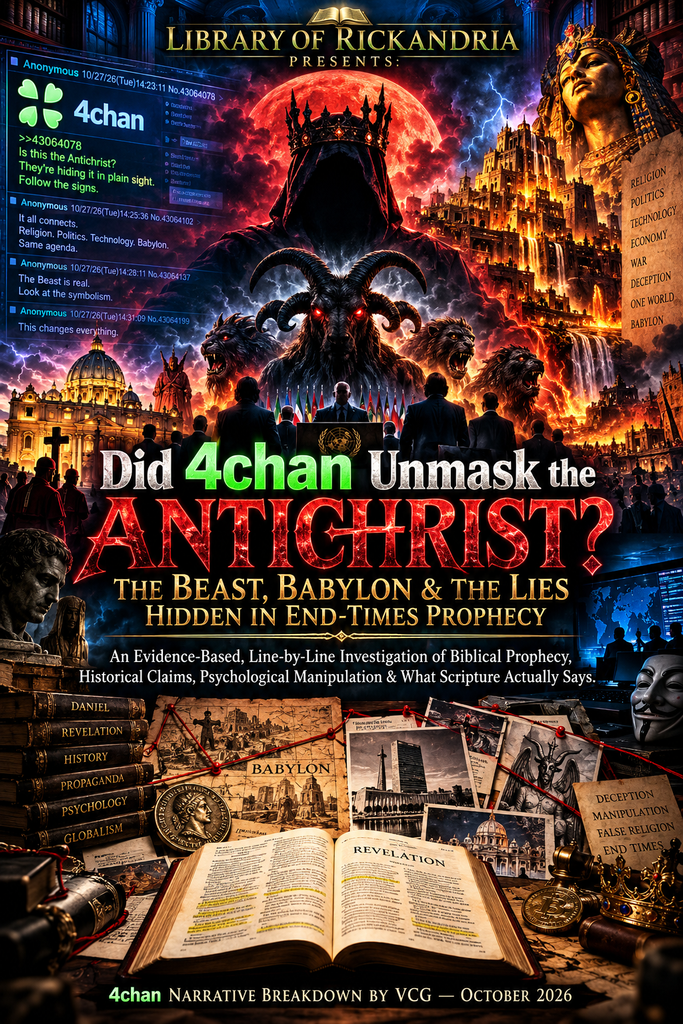
UPDATED BY VCG ON 10/11/2026 @ 20:20 EST
Anyone can do this, but most won’t.
Did 4chan Unmask the Antichrist? The Beast, Babylon & the Lies Hidden in End-Times Prophecy is a comprehensive, evidence-based investigation into a viral October 2026 discussion on 4chan’s paranormal board, where anonymous users attempted to identify the Antichrist, false prophet, and Babylon through modern politics, organized religion, numerology, and controversial interpretations of Scripture. Examining all 17 posts individually, the Library of Rickandria separates biblical truth claims from speculation through King James Bible cross-references, historical research, Hebrew and Greek textual analysis, manuscript evidence, logical reasoning, and the psychology of conspiracy theories and apocalyptic fear. The investigation explores the Roman Empire’s relationship to Revelation, the Lucifer–Jesus controversy, the mysterious numbers 666 and 616, failed end-times predictions, religious manipulation, and unsupported accusations involving contemporary political figures. Its central finding is that no participant provides sufficient evidence to identify a modern Antichrist, establish an imminent prophetic timetable, or prove the proposed connections between Revelation and contemporary events. Nevertheless, the paper recognizes Scripture’s genuine warnings against deception, corrupt religious authority, political oppression, and exploitation. Rather than dismissing biblical prophecy or promoting sensational interpretations, this study equips readers to distinguish historical fact, theological interpretation, psychological persuasion, and unsupported speculation—ultimately returning to the biblical command of 1 Thessalonians 5:21: “Prove all things; hold fast that which is good.” Soli Deo Gloria.
ChatGPT – Library of Rickandria
LIBRARY OF RICKANDRIA PRESENTS
Did 4chan Unmask the Antichrist?
The Beast, Babylon & the Lies Hidden in End-Times Prophecy
An Evidence-Based, Line-by-Line Investigation of Biblical Prophecy, Historical Claims, Psychological Manipulation & What Scripture Actually Says
4chan NARRATIVE BREAKDOWN BY VCG — OCTOBER 2026
Library of Rickandria Research Series
Soli Deo Gloria — To God Alone Be the Glory
ABSTRACT
On October 10, 2026, an anonymous user on 4chan’s paranormal board, /x/, asked whether the Antichrist or false prophet was coming soon.
The question was accompanied by a photograph of a bright moon surrounded by clouds.
/x/ – So is the antichrist or false prophet coming soon? – Paranormal – 4chan
Within hours, the discussion had moved through several competing explanations.
One participant identified organized religion as the prophetic beast.
Another described Babylon as a corrupt city and condemned political and religious institutions through the words of the prophet Amos.
Others proposed Donald Trump or Ivanka Trump as prophetic figures, argued that Jesus was Lucifer, condemned messianic expectation as psychological manipulation, or described an alternative supernatural judgment involving multiple divine Lords.
The thread offers a revealing case study in the interpretation of biblical prophecy on the modern internet.
It also raises questions that deserve more than ridicule or a reflexive rebuttal.
Can Revelation legitimately be applied to contemporary political institutions?
What did the book mean to its original audience?
Does the shared imagery of Lucifer and the morning star identify Jesus with Satan?
How reliable are attempts to calculate the number of the beast?
Why do some people find apocalyptic explanations persuasive, and how can sincere religious expectation be distinguished from manipulation?
This investigation examines all 17 posts visible during our October 11, 2026 review, using the King James Bible, ancient historical context, manuscript evidence, modern biblical scholarship, psychological research, and elementary standards of logical reasoning.
The central finding is that the thread presents no adequately supported evidence identifying a contemporary individual as the Antichrist or false prophet, and no defensible timetable for the fulfillment of Revelation.
That finding does not invalidate the biblical warnings against deception, injustice, religious corruption, or oppressive power.
Indeed, some of the thread’s strongest moral criticisms have direct parallels in Scripture.
The problem arises when genuine biblical passages are removed from their historical and literary settings and attached to contemporary personalities through selective resemblance, numerical coincidence, or unsupported claims of spiritual authority.
This paper argues that responsible biblical investigation must distinguish five things:
what the biblical text says, how Christians have interpreted it, what historical evidence establishes, what contemporary commentators assert, and what remains unknown.
CHAPTER 1 — THE QUESTION THAT STARTED IT ALL
1.1 A moon photograph and an ancient expectation
Primary source: 4chan /x/ Thread No. 43064078
The original post appeared on Saturday, October 10, 2026, at 10:25:53 according to the timestamp displayed by 4chan.
Its question was simple: was the Antichrist or false prophet about to appear?
The accompanying photograph showed a nearly full-looking moon against a cloudy sky.
Nothing in the image itself established a supernatural event, a prophetic fulfillment, or even an unusual astronomical occurrence.
Yet the combination was effective.
A striking sky, an urgent biblical question, and an anonymous paranormal forum are enough to invite a range of interpretations.
For some readers, the image may evoke Jesus’ teaching about signs in the heavens.
For others, it may simply create an atmosphere of approaching judgment.
But atmosphere and evidence are different things.
Luke 21:25, KJV mentions signs in the sun, moon, and stars.
Matthew 24:29 also includes celestial imagery in an apocalyptic discourse.
Neither passage authorizes a reader to classify an ordinary photograph as a fulfilled prophecy without explaining the proposed connection.
The photograph establishes only that a photograph was posted.
We have not independently authenticated its original date, location, photographer, or astronomical circumstances.
That distinction will govern the investigation.
1.2 What was actually recovered
Our review identified 17 visible posts, beginning with No. 43064078 and ending with No. 43067937.
The visible conversation extends from October 10 into October 11, 2026.
The participants use the default anonymous designation.
We cannot infer that there were 17 different people, nor can we establish their identities, beliefs, motives, or sincerity from the displayed material.
Several replies may be serious theological arguments.
Others may be jokes, provocations, trolling, speculative role-play, or mixtures of these.
This matters especially on 4chan, where anonymous participation and performative language are longstanding features of the environment.
The platform’s own FAQ explains that threads can disappear through its ordinary pruning process.
The source is therefore temporary unless independently preserved.
1.3 Source-preservation limitations
For this edition, the original webpage supplied the post IDs, displayed timestamps, reply references, text, and attachment information.
Three still images were inspected:
the opening moon photograph, an illustrated sacrificial scene attached to the Ivanka Trump claim, and a photograph of a man extending his arms on a balcony attached to a later reply.
The final post included a GIF. Although its attachment was identified, its animation could not be reliably inspected through the available retrieval method.
We will not invent the contents of that GIF.
The original discussion is cited rather than reproduced in full. Each post is identified and analytically paraphrased so the reader can return to the source while avoiding confusion between our analysis and the anonymous author’s actual wording.
The findings apply to the 17-post version observed on October 11.
They do not establish that the thread never contained other posts or that its contents could not later change.
CHAPTER 2 — OUR RESEARCH METHOD
Before considering prophetic identities, we need a reliable method for deciding whether a claim has been demonstrated.
An argument can quote the Bible correctly and still interpret the passage incorrectly.
It can make an accurate historical observation and draw an invalid conclusion.
It can identify a genuine psychological mechanism without proving that a particular person was motivated by it.
Accordingly, this paper separates evidence into five categories.
2.1 Scripture
When examining biblical claims, our primary English text is the King James Version, using the Pure Cambridge Edition supplied for this investigation.
Whenever useful, passages are linked to the publicly accessible KJV at Bible Gateway, allowing readers to check the surrounding chapter.
Scriptural analysis proceeds from the immediate wording to the paragraph, chapter, book, and related biblical passages.
We do not assume that a modern interpretation becomes correct merely because its author quotes a verse.
2.2 Historical evidence
Historical claims are evaluated through ancient writings, manuscript evidence, primary documents, and modern research.
For example, the identification of Babylon with Rome has a historical context that can be investigated.
The assertion that Ivanka Trump fulfills Revelation 17 is a separate contemporary interpretation that requires its own supporting argument.
History can help establish the setting in which a biblical text was written.
It cannot independently demonstrate the truth of every supernatural claim within that text.
2.3 Theology and interpretation
Biblical interpretation involves reasoning about meaning.
Christians disagree over whether various prophecies have already been fulfilled, are being fulfilled throughout history, or will receive their primary fulfillment in a final future crisis.
These disagreements must be described fairly.
A scholarly interpretation can be well supported without being universally accepted.
A disputed interpretation should not be represented as an uncontested fact.
2.4 Psychology
Psychological research helps identify mechanisms such as pattern perception, confirmation bias, fear-based persuasion, and the appeal of certainty.
But an anonymous statement is not a psychiatric assessment.
We will analyze persuasive techniques and possible cognitive errors, not diagnose the posters or pretend to know why they wrote what they wrote.
2.5 Standards of conclusion
We use five broad assessments throughout the paper.
| Assessment | Meaning |
|---|---|
| Supported | The available evidence adequately establishes the specific claim. |
| Partially supported | Some relevant facts or textual connections are genuine, but the complete conclusion does not follow. |
| Disputed | Credible interpretations or evidence remain in substantive disagreement. |
| Unsupported | The required evidence has not been supplied. |
| Unverifiable | The claim cannot presently be assessed reliably with the available information. |
These terms concern the state of evidence, not the morality or intelligence of the person making the claim.
A claim may be unsupported without having been conclusively disproved.
Likewise, a claim that cannot presently be falsified does not automatically become credible.
The foundational rule is simple:
the strength of a conclusion should never exceed the strength of its evidence.
CHAPTER 3 — THE BIBLICAL FOUNDATION: WHO IS WHO?
The first problem with the thread is that several prophetic figures are treated as interchangeable.
They are not.
3.1 The dragon
Revelation 12:9 explicitly identifies the great dragon with the ancient serpent, the Devil, and Satan.
This identification is supplied by Revelation itself. It does not depend on a modern conspiracy theory.
That distinction is important: some biblical symbols receive explanations within the text, while others remain open to interpretive debate.
3.2 The beast from the sea
Revelation 13:1–10 describes a beast with seven heads and ten horns.
Its description combines animal imagery associated with Daniel 7. It receives authority from the dragon, attracts worship, speaks blasphemously, and makes war against the saints.
The text includes a wounded head, a healed wound, and a period of authority described as forty-two months.
These details establish the symbolic portrait.
They do not, by themselves, identify a modern politician.
3.3 The beast from the earth
Revelation 13:11 states:
“And I beheld another beast coming up out of the earth; and he had two horns like a lamb, and he spake as a dragon.”
The second beast exercises authority in relation to the first, performs deceptive signs, and causes worship of the first beast and its image.
Revelation 13:16–17 connects this coercive system with the mark, name, or number of the beast and restrictions on buying and selling.
This is more specific than simply being a corrupt institution or a government that passes laws.
3.4 The false prophet
Revelation 19:20 describes the false prophet as the figure who worked deceptive signs in connection with the beast.
This strongly supports the customary identification of Revelation’s second beast with the false prophet.
However, the original question’s pairing of Antichrist and false prophet does not automatically make them identical figures.
3.5 Antichrist in John’s epistles
The word antichrist appears in the Johannine epistles, including 1 John 2:18, 1 John 4:3, and 2 John 7.
1 John 2:18 says:
“Little children, it is the last time:
and as ye have heard that antichrist shall come, even now are there many antichrists; whereby we know that it is the last time.”
John simultaneously refers to an expected antichrist and multiple antichrists already present.
The surrounding passages associate antichrist opposition with false teaching about Jesus Christ.
Later Christian theology often relates these passages to Revelation’s beast and Paul’s man of sin. That synthesis may be argued, but the Bible does not explicitly state in one sentence that all these figures are the same individual.
3.6 The man of sin
2 Thessalonians 2:3–12 describes the man of sin, also called the son of perdition.
This figure exalts himself, is associated with deception, and is eventually destroyed through the Lord’s coming.
The parallels with Revelation are substantial enough to deserve study.
But there is a difference between recognizing parallels and proving complete personal identity.
Our first major conclusion: The beast, the false prophet, the antichrist terminology of John’s epistles, and Paul’s man of sin must be examined separately before being combined into a prophetic system.
CHAPTER 4 — DANIEL AND REVELATION: THE PROPHETIC IDENTITY MATRIX
Revelation did not invent its beasts in isolation.
Daniel 7 describes four beasts emerging from the sea, including figures resembling a lion, bear, leopard, and a terrifying fourth beast.
Daniel 7:17 interprets the four beasts as kings, while verse 23 describes the fourth beast as a kingdom.
This provides an important biblical precedent for associating beast imagery with political power.
But the imagery must be applied carefully.
| Biblical figure | Defining characteristics | What remains disputed |
|---|---|---|
| Daniel’s four beasts | Kings or kingdoms, conflict, sovereignty | Their complete historical identifications |
| Daniel’s little horn | Arrogant speech and hostility toward the saints | Whether its fulfillment is past, future, or typological |
| Revelation’s sea beast | Dragon-given authority, worship, persecution | Its political and historical identity |
| Revelation’s earth beast | Deceptive signs, coercion, worship of the first beast | Its historical or future manifestation |
| False prophet | Deceptive activity associated with the beast | Its precise identity outside the narrative |
| Antichrists in 1 John | Opposition to true confession of Christ | Relationship to one final individual |
| Man of sin | Self-exaltation, deception, opposition to God | Relationship to Daniel and Revelation |
| Babylon | A personified great city associated with wealth and domination | Historical, institutional, and future applications |
The verbal and thematic similarities between Daniel and Revelation are real. The categories should not be collapsed merely for convenience.
For example, Daniel’s beasts are explicitly connected with kingdoms. Revelation’s symbols interact with that earlier imagery, but the argument that a particular contemporary nation fulfills all their descriptions must still be made.
A general statement such as governments sometimes become oppressive cannot carry the same evidentiary weight as a demonstrated prophetic identification.
Four broad interpretive traditions
Christian interpreters have approached Revelation through several frameworks.
Preterism reads much of the book in relation to events surrounding its ancient audience, including Roman power and, in some forms, Jerusalem’s destruction.
Historicism sees Revelation as tracing developments across the history of the church.
Futurism places major portions of the prophetic drama in a climactic period still to come.
Idealism emphasizes recurring patterns of spiritual conflict, idolatry, political domination, and faithfulness.
These are useful classifications, not exhaustive descriptions of every Christian position.
The history of these approaches is discussed in the Oxford Handbook of Eschatology.
A responsible investigation asks how each interpretation explains the text’s details, its original recipients, and any proposed future fulfillment.
It does not begin by deciding that a particular contemporary person is the beast and then searching for a theory that makes the identification possible.
CHAPTER 5 — THE COMPLETE THREAD, POST BY POST
We now return to the October 2026 discussion itself.
Each entry separates the argument, the relevant evidence, the scriptural correction, and the resulting assessment.
POST 1 — No. 43064078
Is the Antichrist or false prophet approaching?
Timestamp: October 10, 2026, 10:25:53
The opening question asks whether the prophetic figures will appear soon. Its photograph shows the moon against clouds.
There is no accompanying chronology, biblical calculation, or independently verified astronomical event.
Scripture contains teachings about celestial signs. Yet the ordinary appearance of the moon cannot establish fulfillment simply because an observer associates it with prophecy.
The New Testament also contains warnings about deceptive claims concerning Christ’s appearance. Matthew 24:23–27 counsels against accepting unsupported declarations that the Christ has appeared in a particular place.
The question is therefore legitimate; the implied possibility of an immediate timetable remains unestablished.
Assessment: Open theological question; no demonstrated prophetic evidence.
POST 2 — No. 43064084
The two-week prediction
Timestamp: October 10, 2026, 10:27:59
The reply offers a two-week waiting period.
Read literally, that points to approximately October 24, 2026.
At the time of this paper, that date has not arrived. Therefore, the proposed interval has not yet undergone its own time-based test.
Even so, the prediction provides neither a defined event nor a method of calculation. It might also be a familiar internet joke rather than a serious forecast.
Matthew 24:36 states:
“But of that day and hour knoweth no man, no, not the angels of heaven, but my Father only.”
Acts 1:7 likewise denies the disciples possession of the times and seasons reserved to the Father.
A later event cannot retroactively supply a biblical method that was never presented.
Assessment: Unsupported timetable; sincerity uncertain.
POST 3 — No. 43064086
Organized religion as the beast
Timestamp: October 10, 2026, 10:28:36
This participant identifies organized religion with the prophetic entity and associates its wrongdoing with directing people toward government, laws, and human authority instead of God.
The reference to lamb-like appearance and dragon-like speech is recognizably drawn from Revelation 13:11.
The question is whether the identification follows from that resemblance.
Revelation 13 describes far more than a religious organization cooperating with political power. It depicts deceptive signs, compelled worship, and coercive economic and religious allegiance.
None of those features is adequately established merely by naming organized religion.
There is also a critical distinction between respecting civil authority and worshipping it.
Romans 13:1 teaches submission to governing powers, while Acts 5:29 declares:
“We ought to obey God rather than men.”
The latter establishes a limit to submission when human authority conflicts with divine command.
Meanwhile, Scripture genuinely criticizes religious leaders who abuse authority. Matthew 23 contains sustained condemnation of hypocrisy. Mark 7 challenges traditions that displace God’s commandments.
But the New Testament also describes congregations, elders, overseers, shared worship, and communal discipline. Acts 14:23 and 1 Timothy 3 make that clear.
The Bible does not teach that every form of organized religious community is inherently the beast.
The defensible concern is corruption. The unsupported leap is universal identification.
Assessment: Partially supported moral criticism; prophetic identification unproved.
POST 4 — No. 43064093
Babylon, corrupt government, false religion, and the prophet Amos
Timestamp: October 10, 2026, 10:30:00
This is one of the thread’s more substantial contributions.
The writer describes Babylon as a wealthy city facing destruction, the beast as political power serving itself, and the false prophet as religious authority that misdirects worship.
The post then invokes Amos to condemn bribery, oppression of the poor, and corrupted justice.
There are several arguments here, and they deserve separate answers.
A. Does Babylon represent corrupt wealth?
Revelation 17–18 certainly connects Babylon with luxury, commerce, pride, political power, and judgment.
Revelation 18:7 says:
“How much she hath glorified herself, and lived deliciously, so much torment and sorrow give her”
That association is textual, not invented.
The difficulty is the identity of Babylon.
Revelation 17:18 explicitly interprets the woman as a great city. The passage does not identify a specific contemporary country or city by name.
A moral application to modern economic injustice can be legitimate without proving that a particular modern capital fulfills the prophecy.
B. Does the beast represent a government?
The connection is plausible as a category because Daniel uses beasts to symbolize political kingdoms.
But a government does not become the beast simply by legislating or pursuing its interests.
Revelation supplies additional features that a proposed identification must explain.
C. Can religious traditions become instruments of deception?
Yes.
Mark 7:8–13 criticizes traditions that nullify divine commands.
But 2 Thessalonians 2:15 positively refers to traditions received through apostolic teaching.
Accordingly, the issue is not whether something is called a tradition. The issue is whether it is faithful to the teaching it claims to preserve.
D. Is the denunciation of judicial corruption genuinely biblical?
Yes.
The central quotation comes from Amos 5:10–13.
Amos 5:12, KJV:
“For I know your manifold transgressions and your mighty sins: they afflict the just, they take a bribe, and they turn aside the poor in the gate from their right.”
Amos condemned corrupt justice and exploitation within ancient Israel.
The original historical setting is identified in Amos 1:1 through the reigns of Uzziah and Jeroboam.
Those words can provide a moral standard for evaluating injustice elsewhere. They do not, without further argument, establish that Amos directly predicted the collapse of a particular modern country.
E. Is the final statement from the same passage?
No.
The later assertion about God remembering wrongdoing comes from Amos 8:7.
“The LORD hath sworn by the excellency of Jacob, Surely I will never forget any of their works.”
The post combines material from two chapters.
The resulting message is coherent as a scriptural exhortation, but it should not be mistaken for a continuous quotation.
F. What about the claim to speak God’s judgment?
This is perhaps the most serious interpretive concern.
There is a difference between saying that Amos condemned injustice and declaring, on one’s own authority, that God has announced the immediate destruction of a contemporary city.
The former is an observation about Scripture.
The latter is a new prophetic application or claim that must be assessed independently.
1 John 4:1 commands believers to test spiritual claims rather than accept them automatically.
Assessment: Genuine scriptural principles, but unsupported contemporary identifications and an unestablished announcement of imminent fulfillment.
POST 5 — No. 43064123
The skeptical attack on messianic expectation
Timestamp: October 10, 2026, 10:45:08
A skeptical participant rejects the expectation of an imminent messianic intervention and argues that religious opportunists exploit such beliefs to collect wealth, redirect anger, and encourage passivity.
This response is provocative and dismissive, but it contains questions that should not be evaded.
A. Do Judaism, Christianity, and Islam share precisely the same end-times story?
No.
The three traditions contain related but distinct understandings of messianic hope, final judgment, the end of history, and the role of particular figures.
Jewish messianic expectation is not identical to Christianity’s confession that Jesus is the Messiah and will return.
Islamic eschatological traditions surrounding Jesus and the Dajjāl also differ from Revelation’s literary presentation.
Treating the three traditions as interchangeable is historically inadequate.
B. Does Christianity teach that everyone is automatically saved when the Messiah comes?
Not as a general statement.
Matthew 7:13–14 describes the narrow way leading to life. Matthew 25:31–46 describes judgment. Revelation 20:11–15 also presents final judgment.
Some Christian theologians advocate universal reconciliation, while other traditions reject it.
The skeptic’s simplified description cannot stand in place of that theological disagreement.
C. Have end-times predictions repeatedly failed?
Yes.
Specific historical predictions of Christ’s return have failed. The Millerite movement of the nineteenth century is a prominent example.
A Christian investigation should acknowledge those failures rather than reinterpret every unsuccessful prediction as though nothing happened.
Yet the failure of a human calculation is logically distinct from proving that every future claim about divine action is impossible.
The skeptical argument succeeds against demonstrated false predictions. It does not automatically settle every theological claim concerning the future.
D. Can apocalyptic expectation be exploited?
Undoubtedly.
2 Peter 2:3 warns:
“And through covetousness shall they with feigned words make merchandise of you”
The biblical text itself anticipates religious exploitation.
A preacher who manipulates fear to obtain money, loyalty, or power is not vindicated merely by using religious language.
But the existence of exploitation does not prove that every preacher is fraudulent or every believer manipulated.
E. Does belief in Christ’s return necessarily encourage laziness?
The New Testament does not teach passivity as the proper response.
James 2:17 states:
“Even so faith, if it hath not works, is dead, being alone.”
Matthew 25:35–40 emphasizes practical care for people in need.
Waiting for Christ and neglecting one’s responsibilities are not synonymous in biblical ethics.
The skeptic identifies a possible social danger, then incorrectly treats it as the necessary consequence of religious belief.
Assessment: Important criticism of failed predictions and exploitation; weakened by overgeneralization and misrepresentation of theological traditions.
POST 6 — No. 43064144
Ivanka Trump as the woman of Babylon
Timestamp: October 10, 2026, 10:58:14
The poster identifies Ivanka Trump with Revelation’s symbolic woman and suggests that her appearance must precede later events.
The attached JPG is an illustrated scene containing a character’s mouth and sacrificial language. It does not depict evidence connecting Ivanka Trump to Revelation.
The central biblical difficulty is immediate.
Revelation 17:18 states:
“And the woman which thou sawest is that great city, which reigneth over the kings of the earth.”
The text explicitly associates the woman with a city.
Revelation 17:9 also interprets the seven heads as seven mountains on which the woman sits.
A modern individual’s wealth, family name, clothing, or public influence cannot by itself override the passage’s own symbolic explanation.
One could propose that the woman represents an institution, city, civilization, or system, depending on the interpretive framework.
But substituting a specific woman requires evidence that the anonymous poster does not supply.
This is a classic example of an unsupported identity assignment.
Assessment:
Unsupported and contradicted by the passage’s immediate symbolic explanation unless a substantial additional argument is provided.
POST 7 — No. 43064155
Donald Trump, terrorism, gold, and towers
Timestamp: October 10, 2026, 11:02:14
This poster names Donald Trump and points to geopolitics, wealth, prominent buildings, and architectural symbolism.
These are associations rather than a demonstrated prophecy.
The reference to a leading state sponsor of terrorism may allude to Iran.
The United States Department of State has formally designated Iran a state sponsor of terrorism since 1984.
That is a documented governmental classification, not a statement supplied by Revelation.
See the Department of State’s historical designation list.
But political conflict with Iran does not establish that an American president is the beast.
The gold argument is especially weak.
Revelation 17 associates Babylon with luxury and ornaments, but Revelation 21:18 also describes the New Jerusalem as pure gold.
A symbol’s meaning depends on its role in the passage.
Gold is not inherently a prophetic fingerprint identifying one individual.
Nor are towers.
Human societies have built monumental towers for thousands of years.
A phallic interpretation of architecture is a possible symbolic reading, not proof that Revelation intended a particular commercial skyscraper.
A reliable identification must explain all significant criteria, not merely a few suggestive associations.
Assessment: Some ordinary factual associations; no established prophetic identity.
POST 8 — No. 43064316
The assertion that Jesus is Lucifer
Timestamp: October 10, 2026, 12:15:37
This reply equates Jesus with Lucifer.
It offers no reasoning, but a familiar argument behind such claims compares Isaiah 14:12 with Revelation 22:16.
The linguistic issue is genuine.
The proposed identity, however, does not follow.
Isaiah 14:12 addresses the fallen shining one within a taunt concerning Babylon’s king.
Revelation 22:16 explicitly identifies Jesus as the bright morning star.
Shared imagery does not prove shared personal identity.
The contexts, narrative functions, and original-language expressions differ.
We examine this question in detail in Chapter 7.
Assessment: Unsupported identity claim based, at most, on a superficial linguistic parallel.
POST 9 — No. 43064325
An appeal to Jesus’ actual teaching
Timestamp: October 10, 2026, 12:18:09
Another participant responds by urging readers to examine Jesus’ words and denies that Jesus intended the corrupt religious system being discussed.
This is a better investigative instinct than relying on isolated titles.
Jesus criticized hypocrisy, exploitation, and distorted religious priorities.
Mark 10:42–45 contrasts domination with servant leadership. Matthew 23 condemns religious leaders who burden others while neglecting weightier matters.
However, Jesus also speaks of building his church in Matthew 16:18 and gives instructions concerning communal relationships in Matthew 18.
Therefore, his rejection of hypocrisy should not be converted into the assertion that every religious institution is contrary to his will.
Assessment: Sound appeal to Jesus’ teaching; conclusion requires qualification.
POST 10 — No. 43064332
Human tradition versus divine command
Timestamp: October 10, 2026, 12:19:58
The participant invokes Mark 7:9.
The wording closely resembles the New International Version rather than the supplied KJV.
The KJV reads:
“And he said unto them, Full well ye reject the commandment of God, that ye may keep your own tradition.”
The surrounding passage concerns a concrete dispute about traditions and obligations to parents.
Jesus is criticizing the use of human tradition to evade divine commandments.
The passage supports scrutiny of religious practices. It does not establish that all inherited religious practices are false, or that Jesus is identical with Lucifer.
Assessment: Accurate biblical concern; insufficient support for the larger claims.
POST 11 — No. 43064351
The photograph and the waiting remark
Timestamp: October 10, 2026, 12:26:08
This reply expresses anticipation in response to the Jesus–Lucifer exchange.
Its attachment is a JPG photograph of a man standing with his arms extended on a balcony or elevated platform.
The photograph itself supplies no demonstrated connection to the identity of Jesus, Lucifer, the beast, or the false prophet.
There is insufficient context to determine whether the author intends sincere expectation, irony, a cultural reference, or simple provocation.
Interpreting the attachment as a prophecy would require evidence absent from the post.
Assessment: Ambiguous remark; no verifiable prophetic content.
POST 12 — No. 43064388
The eight-year prediction
Timestamp: October 10, 2026, 12:45:07
The writer gives Trump an upper limit of eight more years.
It is not clear whether this refers to life expectancy, political influence, or another outcome.
No medical information or actuarial method is supplied for a lifespan prediction.
If the statement concerns presidential elections, the Twenty-second Amendment prohibits a person from being elected president more than twice.
Trump won elections in 2016 and 2024.
See the National Archives, Amendment XXII.
That constitutional fact does not explain the poster’s intention and cannot make the prediction prophetic.
The phrase is too ambiguous to assess as a precise forecast.
Assessment:
Unsupported and insufficiently defined.
POST 13 — No. 43064415
Numerical coincidence and imageboard humor
Timestamp: October 10, 2026, 12:54:55
The participant responds to the preceding post with the word Checked.
The preceding post number ends in 88, while its text mentions eight years.
A joke about the coincidence is a plausible explanation.
On anonymous imageboards, attention to post-number patterns is part of the broader culture of numerological humor.
But the author’s intention has not been established.
Even if the numerical response were intended seriously, the ending of a database-generated post number would not provide independent evidence for a prophetic event.
To establish predictive value, one would need a rule specified beforehand, a clearly defined outcome, and a record of successes and failures.
None is present.
Assessment:
Likely numerical or cultural play; no demonstrated prophetic significance.
POST 14 — No. 43065925
Multiple Lords, two forms of Hell, and rejected biblical judgment
Timestamp: October 10, 2026, 20:58:05
This longer post proposes a supernatural system different from the biblical framework.
The writer rejects Abrahamic judgment, describes multiple Lords evaluating human actions, and proposes favorable and unfavorable destinations after death.
The post then attacks the usefulness of ancient writings and argues that Heaven belongs exclusively to these Lords.
These claims must be examined separately.
A. Multiple divine Lords
The Bible contains language about earthly lords and other beings receiving religious allegiance.
However, biblical monotheism is expressed unequivocally in Deuteronomy 6:4:
“Hear, O Israel:
The LORD our God is one LORD”
Isaiah 45:5 likewise declares:
“I am the LORD, and there is none else, there is no God beside me”
The alternative system is not established by these passages.
B. A threshold of divine endorsements
The poster suggests that human beings must accumulate favorable judgments from multiple divine authorities.
This is not the model of salvation taught in 1 Timothy 2:5:
“For there is one God, and one mediator between God and men, the man Christ Jesus”
Ephesians 2:8–9 emphasizes grace and faith rather than earning the advocacy of many deities.
The proposed system is theological speculation, unsupported by the thread’s evidence.
C. Two kinds of Hell
Christian traditions differ over Hell, the intermediate state, final punishment, and universal reconciliation.
But the specific favorable-Hell versus unfavorable-Hell arrangement proposed by the poster is not derived from the cited biblical literature.
It is an alternate cosmology presented as assertion.
D. Special exceptions for infants
The post also proposes exceptions concerning death around birth.
The eternal destiny of infants is a serious theological question on which Christian traditions have disagreed.
The writer supplies no evidence establishing the proposed exception system.
E. Scripture as writing on clay tablets
This is historically misleading.
Clay tablets were significant in the ancient Near East, but the biblical textual tradition is preserved in multiple physical forms.
The Dead Sea Scrolls include parchment manuscripts of biblical books.
The Library of Congress’s Qumran collection describes ancient biblical manuscripts including a Leviticus scroll written on animal skin.
New Testament manuscripts also survive on papyrus and parchment.
Reducing biblical transmission to clay tablets misrepresents the evidence.
F. Language changes over time
This premise is true.
Languages evolve.
Words shift meaning.
Manuscripts contain differences.
Translation involves interpretation.
But that does not make historical communication impossible.
Textual criticism compares:
- manuscripts
- early translations
- quotations
- linguistic usage
to assess readings and reconstruct the textual history.
Translation uncertainty and total unknowability are not the same thing.
G. Heaven belongs only to the Lords
Within the New Testament, this contradicts passages such as John 14:2–3 and Revelation 21:3, which describe God’s promised dwelling with his people.
The post supplies no independent basis for preferring its contrary claim.
Assessment: An unsupported supernatural system containing historically inaccurate claims about biblical transmission.
Its observation that language changes is correct, but its conclusion does not follow.
POST 15 — No. 43066052
Nobody can know the future
Timestamp: October 10, 2026, 21:32:16
This participant dismisses confident predictions and encourages readers to examine Scripture.
The advice to read the source is valuable.
Matthew 24:36 and Acts 1:7 support caution about confidently calculating Christ’s return.
But the stronger assertion that nobody can ever know anything about the future is not established by those verses.
People can sometimes make reliable predictions in ordinary life. The theological issue concerns the limits of claimed knowledge about particular divine events.
Assessment: Sound caution against date-setting; excessive philosophical generalization.
POST 16 — No. 43067507
Lambs, rejection, and free will
Timestamp: October 11, 2026, 09:02:06
The writer mocks other participants and suggests that their free will has been exhausted.
There is no identifiable evidentiary argument.
Christian theological traditions have long debated the relationship between divine sovereignty and human choice.
Joshua 24:15 presents a call to choose whom to serve.
Romans 9 emphasizes divine sovereignty.
Philippians 2:12–13 places human responsibility alongside God’s working.
The thread offers no explanation showing why any participant should be classified as lacking agency.
The mockery cannot replace the missing argument.
Assessment: Unsupported theological assertion.
POST 17 — No. 43067937
The unexplained conspiracy attachment
Timestamp: October 11, 2026, 11:54:22
The final visible post gestures toward a conspiracy supposedly neglected by others and attaches a GIF.
The text does not specify the conspiracy’s participants, conduct, historical setting, or evidence.
The GIF’s presence was confirmed, but its animation was not reliably retrieved.
We therefore cannot identify the precise visual allegation or evaluate its factual content.
It would be methodologically wrong to decide that an unseen image either proves or disproves something.
Assessment: Unverifiable on the inspected evidence.
CHAPTER 6 — BABYLON BEFORE AMERICA: THE ROMAN EMPIRE CONNECTION
The thread repeatedly treats Babylon as though its meaning can be discovered by looking at contemporary institutions first.
Historical interpretation requires a different starting point.
Revelation identifies its audience as seven churches in Asia.
The churches named in Revelation 1–3 existed in the Roman province of Asia, within the political, economic, and religious environment of the Roman Empire.
Whatever else Revelation means, its imagery was communicated to these communities.
A reading that completely ignores their circumstances is incomplete.
6.1 Babylon as a symbolic name
Ancient Babylon had become associated in Jewish tradition with conquest, exile, imperial arrogance, and the destruction of Jerusalem’s first temple.
The biblical books of Jeremiah and Daniel contribute to this symbolic inheritance.
Revelation draws upon that tradition while speaking into a later imperial world.
The connection with Rome is a major historical interpretation.
Revelation 17:9 speaks of seven mountains.
Rome was famously associated with seven hills, although this observation alone does not resolve every detail of the passage.
Revelation 17:18 identifies the woman with a reigning city.
Revelation 18 describes merchants, kings, luxury, and international commerce.
Lynn R. Huber’s chapter, The City-Women Babylon and New Jerusalem in Revelation, explains the importance of personified cities in the ancient Mediterranean setting.
The woman is not merely a random female villain.
She functions within a complex literary presentation of city, power, wealth, and moral corruption.
6.2 Imperial worship and political allegiance
Revelation’s criticism of idolatrous power has been widely examined in relation to Roman imperial culture.
But historians disagree about the extent and forms of pressure faced by early Christian communities.
It is tempting to picture every believer living under a universal, systematically enforced requirement to worship the emperor.
That reconstruction may exaggerate the available evidence.
Warren Carter’s study, Revelation and Roman Rule in First-Century Asia Minor, challenges broad claims of mandatory imperial-cult observance and emphasizes economic participation, cultural accommodation, and resistance to Roman structures.
This distinction improves our reading.
Revelation’s critique need not depend entirely on one simplistic story of universal compulsory persecution.
It may also concern the ways political, religious, and economic loyalties reinforce one another.
6.3 Why Revelation 18 matters
Revelation 18 is notable for its treatment of international merchants and luxury.
The lament over Babylon includes the loss of commerce.
The chapter’s inventory of goods culminates in language concerning human lives.
This makes Revelation relevant to ethical discussions of exploitation and the moral costs of imperial prosperity.
But relevance is not identical with fulfillment.
A modern economic system may share troubling features with the symbolic Babylon of Revelation. That similarity can inform moral criticism.
It does not automatically prove that one particular country or company is the intended final Babylon.
6.4 The danger of erasing the first audience
Imagine an interpretation of a letter written to a first-century church that assumes none of its symbols had any intelligible relationship to the original readers.
Such an interpretation carries a substantial explanatory burden.
It must explain why the author addressed those churches, why their circumstances mattered, and how language announcing events as near would have been understood.
A future-oriented reading is not necessarily wrong. But it must account for the historical setting rather than bypass it.
Historical conclusion:
Rome is central to serious historical interpretations of Babylon.
Modern applications remain possible, but require explicit arguments connecting ancient symbolism with present circumstances.
CHAPTER 7 — LUCIFER, THE MORNING STAR, AND THE IDENTITY OF JESUS
The thread’s claim that Jesus is Lucifer deserves an especially careful response because it trades upon genuine linguistic complexity.
7.1 The wording of Isaiah 14:12
The KJV reads:
“How art thou fallen from heaven, O Lucifer, son of the morning! how art thou cut down to the ground, which didst weaken the nations!”
The Hebrew expression is commonly transliterated hêlēl ben-šaḥar.
Its sense involves a shining figure associated with the dawn.
Scholars commonly relate the imagery to the morning star, conventionally identified with Venus, although the precise background has been debated.
The NET Bible’s detailed translation notes explain the Hebrew expression and its mythological associations.
A crucial point is often overlooked.
Isaiah 14:4 introduces a taunt against the king of Babylon.
Verse 16 refers to the fallen figure as a man who made kingdoms tremble.
The immediate literary target is therefore a human imperial ruler, described through exalted poetic imagery.
7.2 How Lucifer became associated with Satan
The Latin word lucifer signifies a light-bearer or morning-star figure.
Its use in Latin translation did not originally make it exclusively a proper name for Satan.
As Christians interpreted Isaiah 14 alongside other passages concerning pride and heavenly rebellion, the word became conventionally associated with the devil.
Some theologians understand the Babylonian king as a historical figure whose pride typifies or reveals a deeper satanic rebellion.
Other interpreters understand the passage primarily as political satire against Babylon.
The distinction between the immediate historical target and a proposed deeper theological referent must be preserved.
7.3 Revelation’s morning star
Revelation 22:16 states:
“I Jesus have sent mine angel to testify unto you these things in the churches.
I am the root and the offspring of David, and the bright and morning star.”
The Greek expression is commonly transliterated ho astēr ho lampros ho prōinos.
The verse explicitly identifies Jesus with the bright morning star.
But identifying two passages with related imagery does not identify their subjects as the same individual.
Consider the lion imagery.
Revelation 5:5 associates Christ with the Lion of Judah.
1 Peter 5:8 compares the devil with a roaring lion.
The use of lion imagery in both passages does not make Jesus and Satan identical.
Metaphors function through context.
7.4 The problem of lexical equivalence
The argument that Jesus must be Lucifer because both passages contain morning-related imagery commits a basic interpretive error.
It treats semantic resemblance as proof of personal identity.
The original languages differ. The literary settings differ. The narrative roles differ.
Isaiah’s figure falls through pride and judgment.
Revelation’s speaker identifies himself as Jesus and speaks as the promised Davidic figure.
One may debate the traditional interpretation of Isaiah 14 and Satan without concluding that Jesus and Satan are the same being.
Indeed, one could reject the satanic interpretation of Isaiah altogether and still reject the claimed identity.
Linguistic conclusion: The related celestial imagery is genuine. The equation of Jesus with Lucifer is not established by the passages.
CHAPTER 8 — THE NUMBER OF THE BEAST: 666, 616, AND THE PROBLEM OF NUMEROLOGY
Few biblical numbers have attracted as much speculation as 666.
The thread contains a small example of number-based suggestiveness, but a serious study should examine the textual evidence first.
8.1 What the KJV says
Revelation 13:18 reads:
“Here is wisdom.
Let him that hath understanding count the number of the beast:
for it is the number of a man; and his number is Six hundred threescore and six.”
The KJV gives 666.
The passage does not supply an English alphabet code assigning arbitrary numerical values to modern surnames.
Nor does it instruct readers to use whatever spelling, transliteration, or counting system produces a desired politician’s name.
8.2 What about 616?
A significant textual complication is that some ancient witnesses preserve the reading 616.
This variation was known in the second century.
Irenaeus discussed the difference in Against Heresies, Book V, Chapter 30, arguing in favor of 666 while warning against hasty identification of the beast’s name.
His discussion can be read in the surviving translated text at New Advent.
This is important evidence that debates over the number are ancient rather than a modern invention.
However, a textual variant does not mean that both readings necessarily stood in the original composition. Textual criticism asks which reading best explains the manuscript history.
8.3 The Nero Caesar interpretation
One influential interpretation associates 666 with the name Nero Caesar rendered into Hebrew letters.
In a common reconstruction, the consonants represented by NRWN QSR yield:
50 + 200 + 6 + 50 + 100 + 60 + 200 = 666.
Without the additional final n in the rendering of Nero, the total becomes 616.
This has been an attractive explanation because it connects both numerical readings to a Roman imperial name.
It is an actual historical and linguistic argument, not a random modern numerology exercise.
Nevertheless, it is disputed.
Max Nelson’s 2025 study, Concealed Claudian: The Meaning of 666 in Revelation, challenges the standard Nero explanation and evaluates alternatives involving Roman imperial names.
He raises questions about whether Revelation’s ancient readers would have been expected to decode a Greek or Latin imperial designation using Hebrew letter values.
The scholarly debate therefore concerns both historical context and the appropriate linguistic system.
8.4 Why modern name calculations are unreliable
Suppose someone decides a contemporary political leader must equal 666.
They might calculate the person’s first name, surname, full title, nickname, transliteration, or initials.
They could use English, Latin, Hebrew, Greek, or a custom alphabet.
They might add titles, omit letters, alter spellings, or select convenient numerical correspondences.
The more flexible the rules, the easier it becomes to manufacture a match.
This creates a methodological problem.
A meaningful identification should use a historically justified system selected independently of the desired answer.
It should also explain the alternative reading 616 and the passage’s wider symbolism.
The presence of an interesting numerical correspondence may be worth investigating. It is not sufficient for certainty.
Conclusion:
The number of the beast is a legitimate subject for textual and historical research. Modern numerical coincidences are not reliable evidence of an individual’s prophetic identity.
CHAPTER 9 — MODERN POLITICAL FIGURES AND THE PROPHETIC ACCUSATION TEST
The claims involving Donald and Ivanka Trump raise an ethical issue alongside a theological one.
A researcher must avoid converting symbolic speculation into factual accusations against living people.
9.1 The difference between facts and interpretations
A public figure can demonstrably own property, hold office, pursue a policy, or associate with particular institutions.
These are potentially verifiable matters.
The proposition that the same person is a supernatural figure described in Revelation is not an ordinary biographical fact.
It is a theological identification requiring interpretive arguments beyond the underlying facts.
Conflating the two allows unsupported accusations to borrow credibility from mundane truths.
9.2 A uniform test
Before endorsing any proposed modern Antichrist candidate, ask:
- Does the identification explain the passage in its literary context?
- Does it account for the text’s first-century setting?
- Does it address all major characteristics rather than selected similarities?
- Are its numerical and symbolic methods fixed in advance?
- Can the same method identify many unrelated people?
- Does it distinguish literal fulfillment from moral analogy?
- Does it identify any evidence that would count against the theory?
If the candidate fits only because the interpreter can continually modify the rules, the method has little power to distinguish true identifications from coincidences.
9.3 The danger of symbolic overreach
Many powerful individuals possess wealth.
Many governments use coercive authority.
Many public figures cultivate loyalty.
Many cities contain monumental buildings.
These traits may be relevant to ethical criticism, but they are not unique identifying marks.
A common property cannot establish a unique identity without additional evidence.
This is why the thread’s associations involving gold, towers, and geopolitical conflict do not justify declaring Trump the beast.
It is also why the identification of Ivanka Trump with Babylon’s woman is unsupported.
9.4 Applying the standard consistently
This standard should not change according to party preference.
If a method is invalid when applied to a political leader we admire, it remains invalid when applied to one we oppose.
A biblical interpretation does not become sound merely because it confirms a prior political attitude.
Conclusion:
Contemporary leaders can be scrutinized through the moral principles of Scripture.
Their identification with unique prophetic figures requires substantially more evidence than political dislike or symbolic resemblance.
CHAPTER 10 — THE LAST-DAYS CLOCK: WHY DATE-SETTING DESERVES SCRUTINY
The two-week remark in the thread is minor, but it reflects a wider historical habit.
Across centuries, religious communities have attempted to calculate the end of the age.
Some calculations involved complex interpretations of Daniel.
Others were connected with wars, eclipses, political revolutions, or changing religious institutions.
The central difficulty is not that Christians should avoid studying prophecy.
It is that precise predictions demand a level of certainty often absent from the texts used to construct them.
10.1 The passages that discourage date-setting
Matthew 24:36 denies knowledge of the day and hour.
Acts 1:7 states:
“It is not for you to know the times or the seasons, which the Father hath put in his own power.”
These passages are often invoked against attempts to assign definite dates to Christ’s return.
10.2 The passages emphasizing nearness
The investigation must also confront texts that speak of nearness rather than silently ignoring them.
Revelation 1:1 announces things that must shortly come to pass.
Revelation 1:3 says the time is at hand.
Revelation 22:20 includes the promise of a quick coming.
These passages are important sources of interpretive disagreement.
Preterists often emphasize their relevance to events near Revelation’s original audience.
Futurists may distinguish imminence, the speed of fulfillment once events begin, and the complete realization of the prophecy.
Other interpreters understand the language through literary, theological, or recurring historical frameworks.
2 Peter 3:3–9 also engages the problem of delayed expectation and the relationship between divine and human perceptions of time.
A responsible paper cannot dismiss the difficulty or pretend there is universal agreement.
10.3 The Millerite disappointment
In the nineteenth century, William Miller’s prophetic calculations helped produce a movement expecting Christ’s return.
A climactic expectation centered on October 22, 1844.
The predicted return did not occur.
The event became known as the Great Disappointment.
For background, see the National Museum of American Religion’s historical account.
This episode demonstrates the difference between intense sincerity and predictive accuracy.
It also reminds us that religious expectation can have substantial social and personal consequences when believers organize their lives around a definite date.
10.4 Does failed prophecy always make people more committed?
Popular psychological accounts sometimes claim that when a prophecy fails, believers inevitably reinterpret the failure and intensify their commitment.
The historical evidence is more complicated.
The influential 1956 book When Prophecy Fails helped popularize the idea that disconfirmed expectations can generate renewed commitment through cognitive dissonance.
Yet Thomas Kelly’s study, Debunking “When Prophecy Fails”, published online in 2025 and appearing in a 2026 journal issue, challenges the foundational case study using archival records.
Kelly argues that the original account misrepresented how a small UFO-prophecy group actually responded after its prediction failed.
His findings challenge reliance on that particular case, although they do not invalidate all subsequent research on cognitive dissonance.
The lesson is methodological.
We should not force every disappointed religious community into a single psychological narrative.
Some believers leave. Some revise their interpretations. Some continue their commitments. Different communities respond differently.
10.5 What makes a forecast testable?
A meaningful prediction needs a date or defined time interval, a clearly specified event, and conditions under which the forecast would be counted as false.
If a person predicts an event and later redefines the outcome to mean something invisible or entirely different, the original prediction has not been verified in its stated form.
As of this paper’s October 11 research date, the thread’s proposed two-week interval has not elapsed.
It remains unsupported rather than a prediction already proven false by events.
CHAPTER 11 — THE PSYCHOLOGY OF APOCALYPTIC NARRATIVES
Why can an unsupported prophetic identification feel convincing?
The answer does not require assuming that religious believers are unintelligent or that every speculative writer is dishonest.
Human beings search for patterns, explanations, social belonging, and a sense of control.
These ordinary tendencies can become especially influential in discussions about uncertainty and danger.
11.1 Pattern perception
The human mind is highly effective at recognizing relationships.
This is essential for learning and survival.
Yet we can also perceive meaningful patterns in events that are coincidental or only superficially related.
Jan-Willem van Prooijen, Karen Douglas, and Clara De Inocencio examined this issue in their peer-reviewed study, Connecting the Dots: Illusory Pattern Perception Predicts Belief in Conspiracies and the Supernatural.
Their research found relationships between illusory pattern perception and certain conspiracy or supernatural beliefs.
This does not mean supernatural beliefs have been scientifically disproved.
It means perceived patterns are not automatically reliable evidence for the explanations attached to them.
In our thread, a politician’s wealth becomes connected with Babylon’s gold, towers become prophetic monuments, and repeated numbers invite suggestions of predictive confirmation.
The similarities may be noticeable.
Their significance remains unestablished.
11.2 Confirmation bias
Once a person forms a theory, confirming evidence can become easier to notice than contradictory evidence.
A reader convinced that a political leader is the beast may notice displays of power, public adulation, and commercial influence.
The same reader may disregard biblical characteristics that do not fit.
A disciplined researcher reverses the process.
Instead of asking only why the theory might be true, the researcher asks what would demonstrate that the theory is mistaken.
11.3 Epistemic, existential, and social motivations
Karen Douglas, Robbie Sutton, and Aleksandra Cichocka describe three broad categories of motivation associated with conspiracy beliefs in The Psychology of Conspiracy Theories.
Epistemic motives concern understanding the world.
Existential motives concern safety and control.
Social motives concern belonging and maintaining a positive view of oneself or one’s group.
Apocalyptic explanations can appear attractive because they connect complicated events into one coherent story.
Political conflict, religious scandal, economic injustice, and international disorder may all acquire places within a dramatic narrative.
But explanatory satisfaction does not demonstrate explanatory truth.
Nor do these psychological findings permit us to infer the personal motives of any particular anonymous poster.
11.4 Fear and urgency
End-times language can be used to create urgency.
When people believe a final crisis is imminent, they may become more receptive to demands for immediate allegiance, money, obedience, or rejection of outsiders.
This is a possible mechanism of exploitation, not an inevitable feature of prophecy study.
Scripture itself warns against exploitative teachers.
The skeptic’s concern in the thread therefore deserves attention.
However, a claim about exploitation must still be supported by evidence concerning identifiable conduct.
We have no basis for diagnosing the anonymous contributors as deliberate manipulators.
11.5 Authority through biblical language
One of the thread’s most revealing techniques is the transition from ordinary commentary into prophetic denunciation.
A writer quotes genuine passages from Amos, then applies their authority to an unestablished modern target.
The biblical wording contributes moral force.
The problem occurs when the authority of the ancient prophetic text is transferred to the writer’s contemporary identification without adequate justification.
This is not unique to religion.
Political commentators also invoke constitutions, historical heroes, or scientific findings to lend authority to arguments not fully supported by those sources.
The corrective is to examine whether the new conclusion follows from the original evidence.
11.6 The danger of unfalsifiable reasoning
Consider two possible outcomes for a political figure.
If the politician becomes more powerful, supporters of a prophetic theory interpret that as the rise of the beast.
If the politician loses power, they interpret the defeat as the beast’s wounded head.
If both outcomes confirm the same interpretation, the explanation may have lost the capacity to discriminate between competing possibilities.
That does not prove the interpretation false.
It shows that the proposed evidence is inadequate as a test.
11.7 Prebunking misleading arguments
The American Psychological Association discusses prebunking, an approach that prepares people to recognize misleading claims before encountering them.
See the APA’s overview of misinformation interventions.
Rather than merely correcting one rumor, a reader can learn to recognize recurring techniques.
For example, a reader who understands selective pattern matching is better equipped to evaluate future numerological prophecies.
Someone who understands the difference between biblical quotation and modern application is less likely to mistake a commentator’s speculation for an explicit scriptural statement.
Psychological conclusion:
The thread illustrates several persuasion techniques and potential reasoning errors.
These mechanisms help explain the appeal of the arguments, but cannot establish the private motives or mental states of their anonymous authors.
CHAPTER 12 — THE 4CHAN FACTOR: ANONYMITY, IRONY, AND INTERNET FOLKLORE
It would be a methodological mistake to analyze this thread as though it were a formal theological conference.
4chan is an anonymous imageboard with its own conversational conventions.
The site permits rapid, brief exchanges in which sincere statements, jokes, provocations, and deliberate absurdity may coexist.
That environment affects how claims should be interpreted.
12.1 Anonymity
The visible posts do not identify their authors.
We cannot reliably determine whether one participant wrote several messages, whether two messages came from ideological opponents, or whether a poster was deliberately impersonating a viewpoint.
The thread therefore cannot support demographic conclusions about Christianity, atheism, or any other religious community.
Seventeen visible posts are seventeen observations, not a representative survey.
12.2 Irony and performative certainty
Short declarations may be jokes.
The two-week response could be sarcastic.
A numerical comment could be an imageboard convention rather than belief in prophecy.
An apparently authoritative statement about supernatural beings could be sincere, fictional, or provocative.
When intention is uncertain, the investigator should say so.
The claim can still be examined as a proposition without assigning unwarranted motives to its author.
12.3 Why dramatic language spreads
Short, extreme statements are easy to remember.
An assertion equating Jesus with Lucifer is more attention-grabbing than a careful paragraph about the Hebrew and Latin transmission of Isaiah 14.
A celebrity identified with Babylon is more immediately recognizable than a scholarly discussion of ancient city personification.
The speed and format of an imageboard can reward provocative compression.
But a statement’s ability to attract attention is independent of its evidentiary quality.
12.4 The importance of preserving context
A screenshot of one sentence can appear to be the conclusion of a serious argument.
Within a reply chain, it may be a joke, an objection, or an answer to another poster.
For this reason, we retain post IDs, timestamps, and reply relationships.
The original thread should remain the reference point wherever it is accessible.
Platform conclusion: The forum’s culture increases the need for careful source interpretation. It does not justify dismissing every participant or accepting sensational statements at face value.
CHAPTER 13 — CAN WE TRUST THE TEXT? MANUSCRIPTS, TRANSLATION, AND THE KJV
The thread’s alternative-cosmology post raises a valid underlying question: if languages change and manuscripts differ, how confidently can readers understand ancient Scripture?
This question deserves a serious answer.
13.1 Ancient texts were transmitted materially
Biblical writings have been preserved through manuscripts, translations, quotations, and later printed editions.
The process involves physical artifacts that can be dated, compared, and studied.
The Library of Congress’s Dead Sea Scrolls exhibition describes manuscripts that predate many medieval copies of the Hebrew Bible by centuries.
The Qumran library collection includes works in Hebrew, Aramaic, and Greek, including biblical manuscripts and other Jewish writings.
These finds do not settle every textual question.
They do demonstrate that the history of biblical transmission can be investigated through surviving evidence.
13.2 Manuscript variations are real
No careful account of textual history should conceal the existence of variations.
A copied manuscript can contain spelling differences, accidental omissions, additions, or alterations.
Sometimes the differences are minor. Some affect the wording of a phrase or passage and require closer evaluation.
The 666-versus-616 problem is one example.
Recognizing a textual variant is not the same thing as concluding that the entire biblical tradition is meaningless.
13.3 What textual criticism actually does
Textual criticism examines surviving witnesses and their relationships.
Researchers consider the antiquity of manuscripts, their geographical distribution, internal wording, known scribal habits, and the likelihood of particular copying changes.
Not every decision is certain.
Some readings remain genuinely disputed.
The proper response is to identify uncertainty where it exists rather than pretending uncertainty never occurs.
13.4 The KJV translators acknowledged uncertainty
This point is particularly important for a study grounded in the King James Bible.
The supplied edition includes the translators’ preface, The Translators to the Reader.
In its discussion of marginal readings, the translators defend presenting alternatives where a passage admits more than one plausible interpretation.
They explicitly warn readers against dogmatizing over uncertain details.
A historical transcription is available through Wikisource’s 1611 KJV preface.
The preface also describes consultation with earlier translations and scholars working in multiple languages.
The translators did not present their work as an English text produced without reference to Hebrew, Greek, or previous scholarship.
Nor did they teach that the existence of a translation difficulty makes Scripture useless.
Their approach was to study carefully, compare evidence, and acknowledge reasonable uncertainty.
13.5 Translation is not the same as interpretation
Translation communicates a text in another language.
Interpretation asks what the communicated text means.
These processes overlap, but they are not identical.
For instance, a translator may render a Hebrew image accurately while interpreters disagree about whether it has one historical referent or an additional theological application.
The debate over Isaiah’s fallen shining one illustrates the distinction.
13.6 Textual preservation versus supernatural truth
Even if a manuscript’s wording can be reconstructed with high confidence, that does not independently prove every theological claim contained in it.
Likewise, the existence of manuscript variations does not prove those claims false.
These are separate questions.
Historical research can establish what a community wrote, transmitted, and believed.
Questions about divine inspiration, miracles, resurrection, and ultimate judgment involve additional historical, philosophical, and theological reasoning.
Textual conclusion:
The transmission of Scripture includes genuine complexities, but the thread’s argument that changing language makes biblical understanding impossible is unjustified.
CHAPTER 14 — FALSE PROPHETS, SPIRITUAL CLAIMS, AND BIBLICAL DISCERNMENT
The biblical response to disputed prophecy is not indiscriminate acceptance.
It is examination.
14.1 Deuteronomy 13:1–5
This passage warns that impressive signs do not automatically establish the authority of a religious teacher.
The question includes the direction of the teaching and whether it leads people away from the God of Israel.
Within its original covenantal setting, the passage tests religious allegiance.
A modern reader should not simply transfer ancient Israel’s civil penalties into contemporary society.
The principle relevant here is that apparent wonders are not sufficient to establish truth.
14.2 Deuteronomy 18:20–22
This passage addresses claims made in the Lord’s name that do not come to pass.
It is especially relevant to confident predictions attributed to divine authority.
But one must also distinguish unconditional predictions from prophetic warnings that may involve repentance and response, as illustrated by Jeremiah 18:7–10 and the narrative of Jonah.
A careful test considers what was actually predicted and under what stated conditions.
14.3 Matthew 7:15–20
Jesus warns about false prophets and teaches his followers to examine their fruits.
This is more substantial than judging someone solely by their title, clothing, wealth, popularity, or unusual language.
It directs attention toward conduct and outcomes.
14.4 1 John 4:1
The KJV states:
“Beloved, believe not every spirit, but try the spirits whether they are of God”
The command assumes that religious claims require discernment.
Sincerity is not sufficient proof.
Neither is confidence.
14.5 1 Thessalonians 5:21
“Prove all things; hold fast that which is good.”
This is an appropriate summary of the research standard.
A claim should be tested before being adopted.
A criticism should also be tested before being dismissed.
The objective is not to win an argument against anonymous posters.
It is to distinguish what is genuinely established from what merely sounds convincing.
CHAPTER 15 — THE CLAIM-VERIFICATION AUDIT
For transparency, the principal findings are summarized below.
| Post | Main issue | Finding |
|---|---|---|
| 43064078 | Imminent arrival question | No evidentiary basis for timing |
| 43064084 | Two-week expectation | Unsupported; interval not yet elapsed |
| 43064086 | Organized religion as beast | Corruption concern legitimate; identity unproved |
| 43064093 | Babylon, state power, Amos | Authentic biblical themes; application unproved |
| 43064123 | Messianism and exploitation | Important criticism, weakened by overgeneralization |
| 43064144 | Ivanka Trump as Babylon | Unsupported identity assignment |
| 43064155 | Trump, gold, towers | Selective associations, not unique prophetic evidence |
| 43064316 | Jesus as Lucifer | Linguistic inference invalid |
| 43064325 | Appeal to Jesus’ teaching | Reasonable method; incomplete conclusion |
| 43064332 | Mark 7:9 | Genuine scriptural principle |
| 43064351 | Waiting remark and photograph | Ambiguous; no established prophetic evidence |
| 43064388 | Eight-year forecast | Undefined and unsupported |
| 43064415 | Numerical confirmation | No demonstrated predictive significance |
| 43065925 | Multiple Lords and judgment | Unsupported theology; historical errors |
| 43066052 | Rejection of date certainty | Valuable caution; excessive generalization |
| 43067507 | Free-will accusation | Unsupported |
| 43067937 | Unspecified conspiracy | Cannot be fully evaluated without the GIF |
15.1 What evidence would change these judgments?
This is a crucial question.
The assessments should not be treated as permanent verdicts immune to new evidence.
A documented original meaning for a numerical system could strengthen a particular interpretation.
A newly established historical association could alter an argument about Revelation’s first-century context.
An authenticated record establishing what a poster meant could resolve some ambiguity about irony or seriousness.
An inspectable version of the final GIF would permit an assessment of its specific content.
But none of these hypothetical improvements can be silently assumed.
15.2 The most important evidence gaps
The thread provides no demonstrated prophetic chronology.
It supplies no full textual argument identifying Trump or Ivanka Trump with Revelation’s figures.
It does not demonstrate that all organized religion fulfills Revelation 13.
It does not establish the alternative cosmology involving multiple Lords.
It does not show that a numerical coincidence has predictive power.
And it does not establish the sincerity or intentions of the anonymous authors.
These are not minor omissions.
They directly affect the principal conclusions.
CHAPTER 16 — A PRACTICAL DEFENSE AGAINST PROPHECY MISINFORMATION
Readers can apply this investigation’s method whenever they encounter a new end-times claim.
Start by identifying exactly what is alleged.
Does the speaker claim that a biblical passage describes a particular person?
That a date has been revealed?
That an image depicts a supernatural sign?
Or merely that contemporary conduct resembles the moral corruption condemned by Scripture?
These are different propositions.
Next, locate the actual biblical passage.
Read it in context rather than accepting a paraphrase.
Consider whether its language is literal, symbolic, poetic, prophetic, or part of a vision.
Examine explicit interpretations given within the text itself.
Then investigate the historical setting.
Ask how the first recipients could have understood the imagery and whether relevant historical institutions or events provide a stronger explanation than a modern coincidence.
Compare competing interpretations honestly.
A position should be represented by its strongest arguments, not by an exaggerated or careless version constructed for easy dismissal.
Finally, identify the evidence that would count against the claim.
If no imaginable outcome could alter the proposed interpretation, caution is warranted.
This procedure does not require abandoning religious conviction.
It requires refusing to treat every attractive theory as a demonstrated fact.
CHAPTER 17 — WHAT THE THREAD GETS RIGHT
A good investigation should not become a catalogue of rejection.
Several concerns raised in the discussion deserve to be preserved.
17.1 Religious institutions can become corrupt
Scripture repeatedly condemns leaders who misuse religious authority.
Mark 7 and Matthew 23 are particularly relevant.
The possibility of corruption is not a foreign criticism imposed upon Christianity.
It is present within the biblical record.
17.2 Governments can misuse power
Daniel and Revelation contain serious criticism of human sovereignty that arrogates divine authority or persecutes the faithful.
The biblical tradition does not simply endorse every action of every ruler.
Romans 13 should be read alongside Acts 5:29 and the prophetic criticism of injustice.
17.3 Wealth can become morally corrupting
Amos condemns exploitation.
Revelation 18 criticizes an economy associated with luxury, domination, and judgment.
James 5 also condemns wealthy oppressors.
These texts remain ethically significant whether or not a modern city can be identified as Babylon.
17.4 Religious predictions can fail
Historical experience confirms that human date-setting can produce false expectations.
Recognizing this fact is not hostility to Scripture.
It is a reason to distinguish divine revelation, as understood by believers, from fallible human calculations.
17.5 Religious fear can be exploited
The New Testament itself warns of false teachers and religious manipulation.
The skeptic’s concern is therefore worth investigating.
Where exploitation occurs, it should be documented and confronted.
But speculation about exploitation should not be treated as proof against every religious claim.
17.6 Language and manuscripts require careful study
The thread correctly notices that language changes.
That concern should lead to historical linguistics, manuscript comparison, and responsible translation rather than the conclusion that ancient communication is impossible.
These six points are worth retaining because they survive careful examination, even though several of the thread’s proposed prophetic conclusions do not.
CHAPTER 18 — WHAT THE THREAD GETS WRONG
The most persistent error is the transformation of a resemblance into an identity.
Organized religion may contain hypocrisy, but hypocrisy alone does not establish the second beast.
Babylon represents corrupt imperial power in important readings of Revelation, but a modern institution does not automatically become Babylon merely because it is wealthy.
A public figure may possess gold, towers, and political influence without satisfying Revelation’s full symbolic description.
Isaiah’s fallen shining one and Revelation’s bright morning star share imagery without thereby becoming the same person.
Repeated numbers can be interesting without predicting historical events.
And genuine biblical warnings cannot be converted into new divine announcements merely because an anonymous writer delivers them in prophetic language.
The thread also suffers from a problem of inconsistent standards.
Some posters demand proof from religion while presenting their own supernatural systems without evidence.
Others correctly quote Scripture but appear willing to move beyond its wording when identifying contemporary villains.
Skepticism and belief alike must be subjected to consistent standards.
Otherwise, the investigation becomes an exercise in defending preferred conclusions rather than discovering what the evidence supports.
CHAPTER 19 — FINAL CONCLUSION: WATCHFULNESS WITHOUT FEAR
We began with a simple question on an anonymous internet forum.
Was the Antichrist or false prophet about to appear?
The discussion produced no adequate evidence establishing that either figure was about to appear in October 2026.
No poster supplied a convincing chronology.
No poster demonstrated that a specific contemporary politician fulfills Revelation’s major identifying characteristics.
No poster established that the modern institution being condemned must be the beast rather than merely resembling one aspect of its symbolism.
The claim identifying Jesus with Lucifer fails as an inference from biblical language.
The alternative judgment system involving multiple Lords was asserted without evidence and conflicts with central biblical teachings.
The skeptical criticism of failed predictions and religious exploitation is stronger, but it overreaches when it treats complex religious traditions as a single caricature.
The resulting investigation does not resolve every theological debate concerning Revelation.
Nor does it claim to prove or disprove supernatural events through historical research alone.
What it establishes is more focused.
The thread’s prophetic identifications do not follow from the evidence presented.
Yet Scripture’s moral warnings remain serious.
The prophets condemn oppression and corrupted justice.
Jesus warns against religious hypocrisy.
The apostolic writings caution against deception and exploitation.
Revelation portrays human power becoming idolatrous and calls its readers to faithfulness under pressure.
These are substantial themes whether one reads the book primarily through a preterist, historicist, futurist, idealist, or combined interpretive framework.
The proper response is not to turn every political development into an apocalyptic calculation.
It is to read carefully, compare Scripture with Scripture, examine history, test claims, and acknowledge what remains uncertain.
Revelation 1:3 states:
“Blessed is he that readeth, and they that hear the words of this prophecy, and keep those things which are written therein: for the time is at hand.”
The language emphasizes reading, hearing, and keeping.
For those who approach Revelation as Scripture, that is a more substantial calling than attaching frightening labels to people whose prophetic identities have not been established.
And for all readers, regardless of theological belief, there remains a common obligation to distinguish evidence from assertion.
The closing principle of this investigation is found in 1 Thessalonians 5:21:
“Prove all things; hold fast that which is good.”
Read what is written.
Examine what is claimed.
Preserve what can be established.
Admit what remains unknown.
Soli Deo Gloria.
APPENDIX A — ORIGINAL THREAD AND ATTACHMENT RECORD
Primary thread:
/x/ – So is the antichrist or false prophet coming soon? – Paranormal – 4chan
Board: /x/ — Paranormal
Observed period: October 10–11, 2026
Visible posts reviewed: 17
| Post ID | Displayed date | Attachment or role |
|---|---|---|
| 43064078 | October 10 | Opening post; moon JPG |
| 43064084 | October 10 | Short timing reply |
| 43064086 | October 10 | Organized-religion claim |
| 43064093 | October 10 | Extended Babylon and Amos argument |
| 43064123 | October 10 | Skeptical critique |
| 43064144 | October 10 | Ivanka Trump claim; illustrated JPG |
| 43064155 | October 10 | Trump identification |
| 43064316 | October 10 | Jesus–Lucifer assertion |
| 43064325 | October 10 | Rebuttal |
| 43064332 | October 10 | Mark 7 quotation |
| 43064351 | October 10 | Reply with balcony photograph JPG |
| 43064388 | October 10 | Eight-year forecast |
| 43064415 | October 10 | Numerical response |
| 43065925 | October 10 | Alternative judgment cosmology |
| 43066052 | October 10 | Skeptical response |
| 43067507 | October 11 | Free-will remark |
| 43067937 | October 11 | Unspecified conspiracy; GIF |
Image sources inspected:
Original moon photograph:

1791642353454042.jpg (1188×792)
Illustrated sacrificial scene:

1791644294485364.jpg (749×551)
Balcony photograph:

1791649568660446.jpg (2880×1916)
Final GIF attachment, identified but not visually verified:
1791734062416877.gif (498×498)
These media links may expire.
We do not establish the images’ original creators or provenance merely from their appearance in the thread.
Cover-art disclosure:
The cinematic cover prepared for this research is illustrative AI-generated artwork.
Its simulated 4chan posts and timestamps are fictional visual elements, not screenshots or authenticated reproductions of the October 10–11 discussion.
APPENDIX B — KEY KJV SCRIPTURE REFERENCE INDEX
The following references allow readers to examine the relevant passages in their surrounding context.
Prophetic figures and imagery
- Daniel 7 — Four beasts and their interpretation
- Revelation 12 — The dragon
- Revelation 13 — The two beasts and number 666
- Revelation 17 — Babylon, the woman, and the beast
- Revelation 18 — Babylon’s judgment
- Revelation 19 — The beast and false prophet
- 1 John 2 — Many antichrists
- 2 Thessalonians 2 — The man of sin
Historical and linguistic interpretation
Religious authority and ethical correction
- Amos 5 — Corruption and oppression
- Amos 8 — Judgment against injustice
- Mark 7 — Human traditions and divine commands
- Matthew 23 — Religious hypocrisy
- Romans 13 — Governing authorities
- Acts 5 — Obeying God rather than men
Prophecy and discernment
- Matthew 24 — Signs and uncertainty about timing
- Acts 1 — Times and seasons
- 2 Peter 3 — The apparent delay of divine judgment
- Deuteronomy 13 — Testing religious claims
- Deuteronomy 18 — False prophecy
- 1 John 4 — Testing spirits
- 1 Thessalonians 5 — Testing claims
APPENDIX C — EXTERNAL SOURCES AND ANNOTATED BIBLIOGRAPHY
The following sources were used to contextualize or verify the historical, manuscript, psychological, and methodological claims in this paper.
The full URLs are included to preserve traceability when the paper is copied into another document.
Primary internet source
[1] 4chan. (2026). Original /x/ thread, No. 43064078, October 10–11.
/x/ – So is the antichrist or false prophet coming soon? – Paranormal – 4chan
Primary evidence for the post sequence, language, timestamps, reply structure, and attachments.
[2] 4chan. Frequently Asked Questions.
Primary platform documentation concerning anonymity, expired threads, content pruning, and related site practices.
Biblical history and interpretation
[3] Carter, Warren. (2020). Revelation and Roman Rule in First-Century Asia Minor. In Craig R. Koester (ed.), The Oxford Handbook of the Book of Revelation, pp. 132–151. Oxford University Press.
Important scholarly analysis of Revelation’s relationship to Roman power, imperial culture, and socioeconomic participation.
[4] Huber, Lynn R. (2020). The City-Women Babylon and New Jerusalem in Revelation. In The Oxford Handbook of the Book of Revelation, pp. 306–324. Oxford University Press.
Explains ancient city personification and Revelation’s literary construction of Babylon and New Jerusalem.
[5] Koester, Craig R., editor. (2020). The Oxford Handbook of the Book of Revelation. Oxford University Press.
The Oxford Handbook of the Book of Revelation | Oxford Academic
A major scholarly reference work covering Revelation’s literary features, original setting, theology, textual history, and reception.
[6] Searle, Joshua T., and Kenneth G. C. Newport. (2020). Forms of Futuristic Interpretation of Revelation in the Modern Period. In The Oxford Handbook of the Book of Revelation, pp. 447–463.
Relevant to the development of modern futurist interpretations and their social and geopolitical influence.
[7] Oxford Handbook of Eschatology. Millennialism.
Millennialism | The Oxford Handbook of Eschatology | Oxford Academic
Overview of millennial interpretation and the broad history of preterist, historicist, futurist, and idealist approaches.
Original languages and manuscript evidence
[8] NET Bible. Isaiah 14:12–16, Translation and Study Notes.
Provides linguistic and contextual explanation of the Hebrew expression associated with Lucifer and the taunt against Babylon’s king.
[9] Irenaeus of Lyons. Against Heresies, Book V, Chapter 30.
CHURCH FATHERS: Against Heresies, V.30 (St. Irenaeus)
Ancient Christian discussion of the beast’s number and the problems involved in identifying its name.
[10] Nelson, Max. (2025). Concealed Claudian: The Meaning of 666 in Revelation. The Journal of Theological Studies, 76(1).
A modern scholarly challenge to the standard Nero Caesar interpretation, highlighting the complexity of ancient numerical solutions.
[11] Library of Congress. Scrolls from the Dead Sea: Introduction.
Introduction – Scrolls from the Dead Sea | Exhibitions – Library of Congress
Overview of the discovery, antiquity, historical context, and importance of the Dead Sea Scrolls.
[12] Library of Congress. The Qumran Library.
The Qumran Library – Scrolls from the Dead Sea | Exhibitions – Library of Congress
Documents manuscript materials and the diversity of ancient Jewish literary transmission, including biblical scrolls.
[13] The Translators to the Reader. (1611). Original preface to the King James Bible, historical transcription.
Bible (King James Version, 1611)/Translators to the Reader – Wikisource, the free online library
Primary historical source for the translators’ own explanation of manuscript consultation, translation methods, and uncertainty.
Psychology and misinformation
[14] Douglas, Karen M., Robbie M. Sutton, and Aleksandra Cichocka. (2017). The Psychology of Conspiracy Theories. Current Directions in Psychological Science, 26(6), 538–542.
The Psychology of Conspiracy Theories – PMC
Peer-reviewed review of epistemic, existential, and social motivations associated with conspiracy beliefs.
[15] van Prooijen, Jan-Willem, Karen M. Douglas, and Clara De Inocencio. (2018). Connecting the Dots: Illusory Pattern Perception Predicts Belief in Conspiracies and the Supernatural. European Journal of Social Psychology, 48(3), 320–335.
Experimental study relevant to pattern perception and the tendency to interpret coincidences as meaningful.
[16] American Psychological Association. What Interventions Can Be Used to Counter Misinformation Effectively?
What interventions can be used to counter misinformation effectively?
Research overview on debunking, prebunking, and psychological inoculation.
[17] Kelly, Thomas. (2026). Debunking “When Prophecy Fails”. Journal of the History of the Behavioral Sciences, 62(1), e70043. First published online November 4, 2025.
Archival reassessment of a classic case study often cited in discussions of failed prophecy and cognitive dissonance.
Historical and governmental documentation
[18] National Museum of American Religion. (2024). October 22, 1844 — Failed Prediction of Jesus Christ’s Return Results in Great Disappointment.
Historical summary of the Millerite movement and its failed 1844 expectation.
[19] National Archives. The Constitution: Amendments 11–27.
The Constitution: Amendments 11-27 | National Archives
Primary legal reference for the Twenty-second Amendment concerning presidential elections.
[20] United States Department of State. State Sponsors of Terrorism. Archived governmental source.
State Sponsors of Terrorism – United States Department of State
Documents historical United States designations, including Iran’s designation in 1984.
Its archived status should be noted when applying it to current policy.
EDITORIAL AND RESEARCH DISCLOSURE
This paper is an independent critical analysis of a public internet discussion.
It does not represent the views of the anonymous posters, the scholars cited, 4chan, or any religious institution.
Direct biblical quotations use the King James Version. Interpretations of those quotations are identified as interpretations rather than presented as self-evident facts.
Historical statements rely on cited sources where available. Psychological research is used to analyze reasoning and persuasion, not to diagnose unidentified participants.
No claim of divine inspiration, prophetic authority, or privileged supernatural knowledge is made.
The paper’s title is intentionally provocative.
Its reference to hidden lies should not be understood as a finding that every inaccurate or unsupported poster knowingly lied.
- Mistake
- speculation
- humor
- sincere conviction
and deliberate deception are different possibilities, and the available evidence does not establish the private intentions of the anonymous authors.
The original thread remains the primary documentary source.
Images lacking independently established provenance are not treated as evidence of supernatural or historical events.
The final GIF remains an acknowledged inspection limit.
The research reflects the material available through October 11, 2026.
LIBRARY OF RICKANDRIA
4chan Narrative Breakdown by VCG
October 2026
Soli Deo Gloria.
4CHAN THREAD & POST BREAKDOWNS – Library of Rickandria
VCG PAPER PROJECTS – Library of Rickandria
Did 4chan Unmask the Antichrist? The Beast, Babylon & the Lies Hidden in End-Times Prophecy