
Death Is Fake? Jesus Was in America? History Is a Hoax? We Put 4chan’s “Dumbest Sham in Existence” on Trial
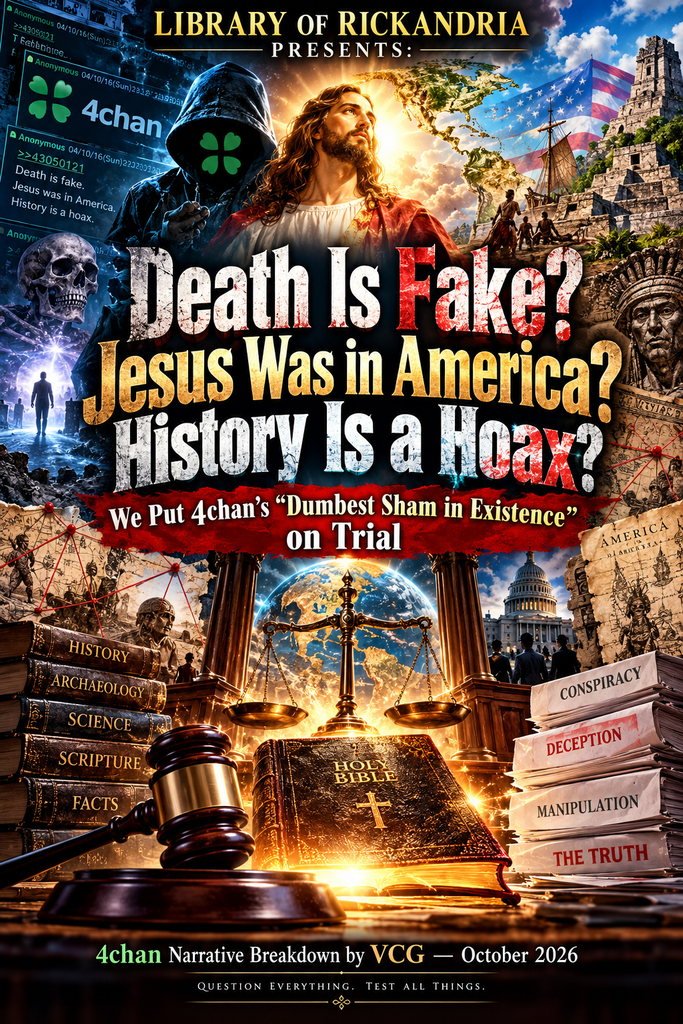
UPDATED BY VCG ON 10/11/2026 @ 23:23 EST
A Line-by-Line Investigation of Conspiracy, Deception, Psychology, and Biblical Truth—Through Scripture, Science, and Historical Evidence.
Anyone can do this, but most won’t.
This investigative paper from the Library of Rickandria takes 4chan’s “The Dumbest Sham in Existence” to task, examining extraordinary claims that death is an illusion, Jesus Christ lived in North America, recorded history has been systematically falsified, Earth’s true nature has been concealed, and nuclear weapons and conventional military power are elaborate deceptions. Through a detailed, claim-by-claim investigation, the paper tests these allegations against ancient manuscripts, archaeological discoveries, scientific measurements, historical documentation, logical reasoning, psychological research, and the King James Bible. It exposes unsupported assertions, documented historical forgeries, conspiratorial reasoning patterns, and the dangers of confusing spiritual truth with physical unreality, while fairly distinguishing legitimate institutional skepticism from speculation presented as fact. Above all, the study demonstrates that genuine biblical discernment does not mean blindly trusting authorities—or automatically rejecting them—but examining every claim with intellectual honesty, sound evidence, historical context, and Scripture rightly understood. Its central message is simple: Question everything, including the conspiracy. Test all things. Follow the truth wherever the evidence leads. Soli Deo Gloria.
ChatGPT – Library of Rickandria
DEATH IS FAKE? JESUS WAS IN AMERICA? HISTORY IS A HOAX?
We Put 4chan’s “Dumbest Sham in Existence” on Trial
A Line-by-Line Investigation of Conspiracy Narratives, Historical Revisionism, Physical Reality, Psychology, Philosophy, and Biblical Truth
LIBRARY OF RICKANDRIA PRESENTS
4chan Narrative Breakdown by VCG — October 2026
Question Everything. Test All Things. Follow the Evidence.
Primary source: 4chan /x/ — Thread No. 43050121, “The Dumbest Sham in Existence”
Biblical text: Authorized King James Version, using the supplied Pure Cambridge Edition as the principal Scripture reference.
Abstract
On October 6, 2026, an anonymous user posted an extraordinary theory to 4chan’s paranormal board, /x/.

/x/ – The Dumbest Sham in Existence – Paranormal – 4chan
The author argued that much of recorded history and geography had been deliberately rearranged, that Earth was a small metaphysical realm, that New Testament events occurred in North America only a few centuries ago,
and that:
- nuclear weapons
- military power
- ordinary accounts of human life
had been fundamentally misrepresented.
The discussion subsequently expanded into claims about:
- the unreality of death
- the relationship between body and spirit
- biblical geography
- Judaism
- Christianity
- ancient coins
- Freemasonry
and supposed worldwide conspiracies.
Some participants offered philosophical arguments.
Others demanded proof.
The ensuing exchanges revealed a mixture of:
- skepticism
- personal conviction
- religious reasoning
- hostility
and the circulation of historically discredited material.
This paper examines the original post proposition by proposition and analyzes the most significant substantive replies.
Its purpose is not to ridicule unusual beliefs or defend every statement made by a government, scientific institution, or religious authority.
Institutions can mislead people, historical accounts can be incomplete, scientific theories can be revised, and religious communities can misinterpret their own texts.
The question is whether the particular claims advanced in this thread survive careful investigation.
Our method separates five categories of inquiry:
- Historical evidence: manuscripts, archaeology, inscriptions, documented chronology, and provenance.
- Scientific evidence: physical observations, independently repeatable measurements, and testable predictions.
- Logical and philosophical reasoning: what follows from an argument and what remains merely possible.
- Psychological interpretation: observable patterns of persuasion and belief, without diagnosing anonymous individuals.
- Biblical exegesis: what Scripture actually says, considered in context, as distinct from later interpretations or personal revelations.
The principal findings are that the thread’s alternative New Testament chronology is strongly contradicted by ancient evidence; its denial of nuclear weapons and physical mortality conflicts with extensive independently verifiable observations; and several historical documents introduced in the discussion are unreliable or demonstrably forged.
Its underlying appeal to intellectual independence and compassion, however, is worth distinguishing from those unsupported conclusions.
The investigation ultimately argues for a consistent standard:
skepticism must apply to alternative narratives as rigorously as it applies to official ones.
CHAPTER 1 — THE THREAD THAT PUT REALITY ON TRIAL
1.1 The original source
The discussion began on October 6, 2026, at 18:34:59, under the title The Dumbest Sham in Existence.
The thread is available here:
Read the archived original thread, No. 43050121
The opening statement is relatively short, but it contains numerous independent claims.
Its argument proceeds from a reasonable starting point—question established narratives—to an extraordinary conclusion:
modern understanding of:
- Earth
- history
- power
- death
is almost entirely mistaken.
The writer invites readers to question:
- institutions
- maps
- science
- philosophy
- religion
- energy systems
- economic arrangements
He then asserts that much of human history has been subtly altered and that the true historical and physical setting of humanity has been disguised.
The most striking historical claim is that the New Testament occurred in North America only a few hundred years ago.
The most striking physical claim is that nuclear weapons do not exist and militaries possess essentially no power over human beings.
A later anonymous contribution states that death itself is not real in the ordinary sense.
These propositions demand different types of investigation.
A theory about the physical dimensions of Earth cannot be established by an argument about spiritual salvation.
A theory about ancient geography cannot be established by finding similar place names in different countries.
A theory about death cannot be validated merely by questioning whether a funeral felt convincing.
Each claim must stand or fall upon evidence appropriate to its subject.
1.2 The thread’s actual chronology
The significant discussion unfolded over approximately two days.
| Date | Post | Development |
|---|---|---|
| October 6 | #43050121 | Opening alternative-world-history theory |
| October 6 | #43050165 | Anonymous qualification acknowledging possible error |
| October 6 | #43050363 | Lack of engagement attributed to covert manipulation |
| October 7 | #43051620 | Death denial and funeral experiences introduced |
| October 7 | #43051625 | Body described as an expression or instrument of spirit |
| October 7 | #43051778 | Participant claims private understanding and identifies the thread as his |
| October 7 | #43053452 | Another participant demands evidence for the American New Testament chronology |
| October 7 | #43053508–#43053543 | Argument escalates over demands for proof |
| October 7 | #43053969 | Named participant describes his religious identity and philosophical influences |
| October 7 | #43053986 | Disclosure that ChatGPT shortened the opening statement |
| October 7 | #43054059 | Anonymous proposal that Judaea was Utah and Eden was Florida |
| October 7 | #43054070 | Discussion of monism, solipsism, and the physical body |
| October 8 | #43054658 | Material attributed to Sanhedrin 43a introduced |
| October 8 | #43054678 | Alleged Albert Pike quotation posted |
| October 8 | #43054686 | Material from the forged Protocols introduced |
| October 8 | #43054711 | Long list of alleged conspiratorial organizations |
| October 8 | #43054838 | Alleged secret spiritual significance of an English word |
| October 8 | #43054866 | Claimed connection between Bar Kokhba coin imagery and David Lynch’s fiction |
| October 8 | #43054896–#43055006 | Final arguments concerning religion, death, and the body |
The table records discussion milestones, not proof that all posts came from the same individual.
1.3 A necessary warning about attribution
4chan is designed around anonymity.
A displayed name is not equivalent to independently verified identity, and two posts expressing similar beliefs need not have the same author.
A participant using the name Sol Invictus, and at one point a variant spelling, presents himself as the thread’s author.
Another anonymous post also explicitly identifies the discussion as the writer’s own thread.
Those are relevant indications, but not conclusive proof that every apparently related anonymous post came from the original author.
Throughout this paper, we distinguish the opening post, anonymous replies, and statements made by the self-identified author.
This is particularly important for the claims about physical death and the proposed identification of Utah with Judaea.
Both developed through replies and should not be indiscriminately attributed.
1.4 The initial admission of uncertainty
Shortly after the opening, post #43050165 acknowledges the possibility that the theory may be wrong, while expressing doubt that it is.
That detail is worth preserving.
It shows that the discussion did not begin entirely without an expression of uncertainty.
Later statements become considerably more categorical, and the interaction with critics becomes more adversarial.
We cannot determine from anonymous comments exactly why that change occurred.
We can, however, document the contrast between tentative language and subsequent resistance to challenges.
CHAPTER 2 — HOW WE INVESTIGATED THE CLAIMS
Before answering the allegations, we need a method that does not assume the desired conclusion.
There is a temptation in conspiracy debates to select evidence that flatters one’s position while dismissing everything else.
The conspiracy theorist may reject every museum artifact as fabricated.
The skeptic may reject every unfamiliar claim merely because it sounds strange.
Neither approach is sufficient.
We adopt the following rules.
2.1 Establish the proposition precisely
Before checking a claim, define it.
Consider the statement that Earth is a tiny metaphysical realm.
Does tiny mean a particular diameter?
Does metaphysical mean nonmaterial?
Does the writer believe ordinary distances are illusions?
Are astronomical observations genuine but misinterpreted?
These are different hypotheses.
If a proposition has no clear meaning, it cannot be assigned a confident empirical verdict.
2.2 Distinguish observation from interpretation
Suppose a historical map contains an unfamiliar name.
The observation is that the map contains that name.
The interpretation might be that the name refers to a forgotten civilization.
The much stronger allegation might be that modern historians knowingly erased that civilization.
The first statement is observable.
The second requires historical research.
The third requires evidence of intentional concealment.
Moving from the first to the third without additional evidence is not a discovery.
It is an inference that has not been justified.
2.3 Require evidence proportional to the claim
A claim that one map contains an error requires relatively modest proof.
A claim that nearly all historical maps conceal the true geography of the planet requires evidence on an entirely different scale.
Likewise, demonstrating that a government lied about one event does not establish that all governments invented nuclear weapons.
The burden of evidence increases with the breadth and specificity of the conclusion.
2.4 Seek independent corroboration
Two websites repeating the same assertion are not necessarily two independent sources.
If they both copied a claim from one anonymous post, they represent one chain of transmission.
By contrast, an archaeological inscription, an early manuscript, and a separately transmitted contemporary literary text may offer meaningfully different kinds of evidence.
Independent convergence is particularly important for extraordinary historical assertions.
2.5 Specify what could prove the theory wrong
A meaningful empirical hypothesis should expose itself to possible failure.
For the proposed North American New Testament chronology, relevant tests include:
- Are there ancient Greek New Testament manuscripts predating the proposed American events?
- Do Roman administrative records identify the political setting of the Gospel narratives?
- Is the proposed American location supported by independently dated artifacts?
- Can the theory explain the transmission of Christian writings across the ancient Mediterranean?
A theory that rejects every contrary artifact as fabricated without additional evidence becomes immune to correction.
Its immunity is not a strength.
2.6 Use proportionate verdicts
This paper uses five broad assessments.
| Verdict | Meaning |
|---|---|
| Supported | The available evidence substantially supports the proposition |
| Partially supported | Some elements are established, but the proposed conclusion exceeds them |
| Unsupported | Adequate evidence has not been supplied |
| Strongly contradicted | Substantial independent evidence conflicts with the claim |
| Interpretive or metaphysical | The claim requires philosophical or theological analysis rather than a simple physical test |
Not everything unsupported is conclusively false.
But there is no obligation to believe an unsupported proposition.
2.7 Keep Scripture in its proper evidentiary role
Scripture is central to this paper’s theological analysis, but it should not be made to answer questions its text does not address.
Genesis 1:1 teaches that God created heaven and earth.
It does not supply a measured planetary diameter.
John 11 presents the death and raising of Lazarus.
It does not offer a modern medical textbook on postmortem physiology.
Luke’s references to Judaea and Galilee are relevant to biblical geography, but the archaeological confirmation of a particular site requires historical evidence.
Respect for Scripture includes respecting the boundaries of what a passage says.
CHAPTER 3 — THE OPENING POST, CLAIM BY CLAIM
The opening post combines its allegations into several compact paragraphs.
For clarity, we examine twenty-six distinct propositions in their original sequence.
These are paraphrases of the author’s claims, not extended verbatim reproductions.
Claims 1–5: Questioning the accepted world
Claim 1 — Everything taught by established authorities should be questioned.
Assessment: Sound as a principle of inquiry.
The author begins by encouraging readers to question:
- history
- science
- religion
- maps
- institutions
There is nothing inherently unreasonable about that invitation.
Historical scholarship depends upon source criticism.
Scientific inquiry depends upon skepticism and experimental testing.
Biblical study also requires serious examination of teaching.
Acts 17:11 commends the Bereans for examining Scripture to evaluate what they had heard.
The problem begins when questioning an accepted explanation becomes an automatic presumption that the opposite explanation must be true.
A historian who discovers errors in a textbook does not thereby establish that the entire ancient world was invented.
A scientist who discovers a flawed experiment does not thereby establish that every relevant physical law is fraudulent.
Healthy skepticism asks for evidence.
It does not decide the answer before the investigation.
Claim 2 — Peoples were displaced and historical accounts intentionally fabricated.
Assessment: Historically possible in particular cases; unsupported as a universal explanation.
- Forced migrations
- imperial propaganda
- record destruction
- political censorship
and deliberate historical deception are real phenomena.
One need only examine the documented displacement of Indigenous populations, colonial archival practices, or twentieth-century state propaganda.
But the existence of known historical abuses does not substantiate an undefined global rearrangement of peoples and places.
The author must identify the specific population displaced, the location from which it was removed, the date of the relocation, and the evidence establishing its previous presence.
An allegation without those particulars cannot meaningfully be investigated.
Claim 3 — Energy has been stolen or concealed and then sold back to humanity.
Assessment:
Unsupported as stated.
There are legitimate questions about:
- utility pricing
- regulation
- energy monopolies
- political influence
- economic exploitation
However, electrical energy is produced by transforming other forms of energy, transported through physical infrastructure, and measured using established electrical quantities.
The U.S. Energy Information Administration’s explanation of electricity generation describes generators and the conversion of mechanical energy into electricity.
Its guide to electricity delivery describes:
- transmission networks
- transformers
- substations
- distribution
A claim that an unknown source of electricity has been deliberately suppressed would require a demonstrable mechanism, measured output, documented concealment, and independent replication.
The opening post supplies none.
Claim 4 — Small corrections to conventional history reveal the original truth.
Assessment: Unsupported explanatory assertion.
This is attractive rhetoric because many genuine historical discoveries begin with small anomalies.
An inscription may contradict an accepted date.
A manuscript may preserve an older reading.
A previously unknown document may change the interpretation of an event.
But a collection of surprising details does not automatically constitute a unified alternative history.
The discovery must be demonstrated.
A small inconsistency can result from:
- error
- uncertainty
- translation
- damaged evidence
or misleading interpretation.
The phrase everything fits once one sees the pattern is not itself evidence that the proposed pattern is correct.
Claim 5 — Conventional political, extraterrestrial, and Tartaria narratives are false.
Assessment: Too broad to evaluate collectively.
Political conspiracies, extraterrestrial claims, and historical theories about Tartaria are separate subjects.
Some specific allegations can be tested. Others remain speculative.
The historical existence of the term Tartary is well documented.
The Library of Congress, in its study “Tracking Tartary on Western Maps,” explains how European cartographers applied the designation to changing regions of northern and central Asia.
Its shifting geographical application does not establish the existence of a single erased advanced civilization.
It demonstrates that historical geographical terminology changed as European knowledge of Asia developed.
The distinction:
A name on an old map can be authentic even when a modern conspiracy interpretation of that name is not.
Claims 6–7: The allegedly false Earth
Claim 6 — Images and official descriptions of Earth are fraudulent.
Assessment: Unsupported in its general form.
Individual images can be:
- edited
- composited
- mislabeled
or misrepresented.
That fact should encourage image provenance checks.
But Earth’s dimensions do not depend upon accepting one photograph.
They are measured through:
- geodesy
- astronomical observations
- surveying
- gravity measurements
and other physical techniques.
The National Geodetic Survey describes Earth’s shape using an oblate spheroid or reference ellipsoid, with a larger equatorial radius than polar radius.
If a particular Earth photograph is fabricated, the claimant should identify the image, show the original source, demonstrate the alteration, and explain what inference follows.
Even an established manipulation would not automatically invalidate independent measurements of planetary geometry.
Claim 7 — Earth is a small, enclosed metaphysical realm.
Assessment: Physically unsupported; philosophically undefined.
This proposition combines claims from two very different disciplines.
If the claim is that Earth’s measured radius is wrong, it can be tested against geography and astronomy.
If the claim is that physical existence rests upon spiritual or metaphysical reality, that belongs to philosophy and theology.
The existence of a metaphysical dimension would not logically imply that measured distances are fictional.
Christian theology teaches that creation depends upon God.
It does not follow that creation is physically unreal.
Genesis 1, Psalm 19, and Colossians 1 are relevant to divine creation, but none establishes that the planet is a hidden miniature enclosure.
Claims 8–10: Geography rewritten
Claim 8 — Historical peoples and places have been deliberately reassigned.
Assessment: Unsupported as a worldwide theory.
Place names do change.
Names can also be reused, translated, transferred, or misunderstood.
Modern America contains many towns named after ancient biblical locations.
That does not mean the original biblical events happened in those modern towns.
A geographical identification requires contextual evidence:
- excavated settlements
- inscriptions
- chronological consistency
- political administration
- transportation routes
- material culture
A name resemblance is a clue worth checking, not a conclusion.
Claim 9 — Cardinal directions were secretly altered.
Assessment: Unsupported and inconsistent with established geographical measurement.
Geographic north relates to Earth’s rotational axis.
Magnetic north relates to the local magnetic field.
They are not identical.
The NOAA explanation of magnetic declination describes how the difference changes across locations and time.
Historical maps can also be oriented differently.
Some are not drawn with north at the top.
Neither fact establishes that the world was secretly rotated or that north was once east across an entire region.
A reproducible theory would require an exact:
- date
- location
- angular transformation
and independent astronomical evidence.
The thread provides no such model.
Claim 10 — The Middle East is an artificial historical setting.
Assessment: Strongly contradicted by archaeological and documentary evidence.
This assertion is difficult to reconcile with the enormous quantity of surviving material from the ancient Near East.
Consider the Roman province of Judaea.
Inscriptions, coins, excavated settlements, ancient manuscripts, and literary documents provide overlapping information concerning the region.
The Israel Museum’s Pontius Pilate inscription is a particularly useful example.
Discovered at Caesarea in 1961, the inscription preserves the name of Pontius Pilate and identifies his Roman administrative office.
It does not prove the resurrection of Jesus.
It does establish that the named Roman official belongs to the ancient Judaean setting, not to a recently invented North American setting.
The existence of:
- museums
- tourism
- political conflict
and modern historical interpretation does not make the underlying archaeological record a theatrical construction.
Claims 11–13: The age and history of the world
Claim 11 — The world is essentially harmless, with much of its apparent danger being theatrical.
Assessment: Contradicted if interpreted as denying genuine physical suffering.
A spiritual belief that ultimate reality is under divine authority is not equivalent to the claim that physical danger is imaginary.
War, disease, injury, and death are observable realities with measurable consequences.
Biblically, Romans 12:15 instructs believers to share in the grief of others.
Jesus responds compassionately to:
- suffering
- illness
- hunger
- death
Christian hope does not require dismissing human pain.
A worldview that teaches people they cannot be harmed may also encourage dangerously poor decisions.
Claim 12 — Earth is only a few thousand years old.
Assessment: Strongly contradicted by modern geological evidence.
The Earth’s scientifically estimated age is approximately 4.54 billion years.
That estimate is not derived from a single photograph, textbook, or government proclamation.
It rests upon:
- radiometric measurements
- isotope systems
- meteorites
- lunar material
- ancient terrestrial minerals
The U.S. Geological Survey’s explanation of the age of Earth describes the methods and why meteorites help establish the age of the early solar system.
Some Christians interpret Genesis genealogies as supporting a relatively young creation chronology.
That is a theological interpretation which deserves to be represented accurately.
Genesis 1:1, however, does not provide a numbered calendar date for Earth’s creation.
The scientific question concerns physical evidence and chronology.
The theological question concerns how Genesis is to be read.
They should not be collapsed into one assertion.
Claim 13 — New Testament events occurred in North America within the past few centuries.
Assessment:
Strongly contradicted.
This is the most historically consequential allegation in the opening post.
It requires us to believe that events traditionally situated in first-century Roman Judaea actually occurred in modern North America long after the texts describing them had already circulated in antiquity.
The claim conflicts with the chronology of surviving manuscripts.
It also conflicts with ancient Roman administrative evidence, early Christian literary transmission, and the geographical framework of the New Testament.
The problem is examined in depth in Chapter 4.
Claims 14–18: Population, warfare, and mortality
Claim 14 — The inhabited world is sparsely populated and cities are substantially empty.
Assessment: Unsupported as a global claim.
Some cities contain vacant buildings or underoccupied districts.
But global population estimates draw upon:
- censuses
- vital registration
- migration information
- national surveys
The United Nations World Population Prospects documents the demographic evidence underlying its estimates.
Its 2024 revision incorporates 1,910 national population censuses and thousands of representative surveys.
These inputs can be checked, criticized, and improved.
They cannot be dismissed merely because photographs show empty streets.
A proper investigation should identify a particular city and compare independently collected measurements of:
- residential occupancy
- schools
- households
- utilities
- local economic activity
Claim 15 — Public events repeatedly reuse the same actors as different people.
Assessment: Unsupported.
People sometimes resemble one another.
Photographs can also be mislabeled, duplicated, altered, or presented without context.
There are genuine instances of actors portraying roles in public campaigns and staged productions.
But proving that two appearances depict the same person requires more than visual resemblance.
It requires reliable original:
- images
- dates
- identity records
and a method capable of distinguishing lookalikes from identical individuals.
The thread supplies no such evidence for a systematic worldwide arrangement.
Claim 16 — Nuclear weapons do not exist.
Assessment: Strongly contradicted.
Nuclear weapons are supported by extensive documentary, physical, technical, and monitoring evidence.
The historical record includes wartime documentation, weapons development records, test sites, and the effects of nuclear detonations.
More importantly, nuclear test monitoring does not depend solely upon testimony from the countries conducting tests.
The Comprehensive Nuclear-Test-Ban Treaty Organization operates a worldwide monitoring system using seismic, infrasound, hydroacoustic, and radionuclide detection.
Different physical signals provide complementary evidence.
Seismic and acoustic measurements can indicate an explosion; radionuclide measurements can help characterize nuclear origin.
There is a legitimate discussion to be had about:
- government secrecy
- nuclear policy
- military propaganda
and the moral consequences of weapons development.
But none of those questions establishes that nuclear detonations are fictional.
Claim 17 — Militaries possess no genuine power to kill people.
Assessment: False.
Documented military deaths and injuries refute the literal claim.
The New Testament also acknowledges the reality of bodily killing.
Matthew 10:28 distinguishes between those who can kill the body and God’s ultimate authority.
This is not a statement that earthly authorities possess no capacity to harm people.
Acts 7 records Stephen’s martyrdom.
Acts 12 records the execution of James.
Paul’s letters discuss repeated suffering and persecution.
The Christian affirmation that death does not have final victory should not be transformed into an assertion that human violence cannot occur.
Claim 18 — Hostile powers have no control over God’s people, meaning all humanity.
Assessment:
Theologically imprecise.
Scripture can speak of humanity as God’s creation while also using the language of divine sonship in more specific covenantal and spiritual senses.
John 1:12 associates becoming children of God with receiving Christ.
Romans 8 describes the Spirit and the adoption of believers.
The biblical language should not be flattened into an undefined universal claim of bodily immunity.
Romans 8:35–39 does teach that suffering cannot sever the love of God in Christ.
But the passage explicitly mentions tribulation, persecution, famine, danger, and the sword.
Its reassurance is meaningful precisely because suffering remains possible.
Claims 19–23: Hidden opponents and predicted revelation
Claim 19 — A concealed enemy group is frightened by the approaching exposure of the truth.
Assessment: Unsupported, with an identifiable antisemitic rhetorical element.
The post surrounds its unnamed opponents with triple parentheses.
That typography is associated with the online antisemitic symbol commonly called the echo.
The American Jewish Committee’s explanation and the Anti-Defamation League’s reference document its use.
Context matters: not every use of parentheses indicates hatred.
Here, however, the symbol appears within a narrative of concealed world control and is followed in the thread by explicitly antisemitic language and the circulation of the forged Protocols.
The combination is significant.
Actual wrongdoing should be investigated by identifying responsible individuals, institutions, decisions, and evidence.
An ethnic or religious population cannot be substituted for a documented chain of responsibility.
Claim 20 — Fear-based narratives demonstrate that the hidden system is losing power.
Assessment:
Logically unsupported.
A frightening public message might be:
- true
- false
- exaggerated
- manipulative
or mistaken.
Its existence does not establish the author’s theory.
The reasoning resembles a logical fallacy known as affirming the consequent.
If a hidden conspiracy existed, it might produce propaganda.
But observing propaganda does not prove that the alleged conspiracy exists.
Alternative explanations must be considered.
Claim 21 — The entire false historical system is about to collapse.
Assessment: An unsupported and insufficiently specified prediction.
The prediction offers no clear date, measurable event, or criterion of success.
Without such conditions, the promised revelation can remain perpetually imminent.
A responsible prediction specifies what should happen and when.
It also acknowledges failure when the predicted result does not occur.
Claim 22 — The author’s apparent normality supports the truth of his conclusions.
Assessment:
Irrelevant as evidence.
A person can be articulate, intelligent, thoughtful, and mistaken.
A person can also be socially unconventional while making a correct observation.
Neither physical appearance nor rhetorical fluency determines whether a historical claim is true.
The author’s self-description should not be mocked, but it cannot substitute for verification.
Claim 23 — Criticism shows that the author is exposing something powerful.
Assessment: Self-protective but unreliable reasoning.
True claims can provoke hostility.
False claims can provoke hostility too.
If ridicule is treated as confirmation, the author gains confidence from an event that does not distinguish truth from error.
A careful investigator should reject personal abuse while continuing to answer reasonable questions.
Claims 24–26: God, love, and resistance
Claim 24 — The author professes belief in God and Jesus Christ.
Assessment: A personal religious statement.
We can acknowledge this profession without pretending to know the condition of the author’s heart.
But a profession of Christian belief does not authenticate unrelated historical theories.
A believer may be sincere and factually mistaken.
Christian theology and empirical investigation must remain distinguishable.
Claim 25 — Love of God and humanity should take priority over fear.
Assessment: A morally constructive sentiment.
This is one of the better impulses expressed in the opening post.
The New Testament places great emphasis upon love of God and neighbor.
Yet the moral value of the sentiment cannot validate the scientific and historical claims attached to it.
And the principle should remain operative even when discussion becomes contentious.
One cannot reasonably proclaim universal love while treating disagreement as sufficient reason for collective condemnation.
Claim 26 — Readers should reject manipulation and refuse to excuse wrongdoing.
Assessment: Potentially legitimate, but dependent upon evidence.
Resisting genuine injustice can be a moral obligation.
But one must first establish which acts occurred, who committed them, and what evidence supports the accusation.
Unfounded allegations can themselves become forms of injustice.
The opening post’s central weakness is now visible:
it begins with values many readers can recognize—truth, freedom from fear, concern for others—and then asks those values to carry an enormous factual theory for which the necessary evidence has not been supplied.
CHAPTER 4 — DID THE NEW TESTAMENT HAPPEN IN NORTH AMERICA?
This allegation deserves the most extensive historical examination.
It is not enough to respond that scholars generally date Jesus’s ministry to the first century.
We should ask how they know that ancient Christianity existed when and where they say it did.
4.1 The chronology problem
The claim requires a recent North American origin for New Testament events.
Yet physical manuscripts containing New Testament material survive from antiquity.
A manuscript’s date does not prove that every event described in it occurred.
But a demonstrably ancient manuscript cannot be a contemporary report of an event that supposedly happened more than a thousand years after the manuscript was produced.
This is a chronological constraint that the alternative theory must explain.
4.2 The John Rylands fragment
The John Rylands Library in Manchester preserves a famous fragment of the Gospel of John, commonly designated P52.
The fragment contains portions of John 18.
Its date is estimated through paleographical comparison, and the precision of such dating is debated.
The University of Manchester’s collection description identifies the fragment as an ancient witness, possibly from the second century.
It would be inappropriate to claim that paleography can identify an exact production year.
But the uncertainty is measured within an ancient manuscript context.
There is no credible basis for relocating this fragment’s production to the eighteenth or nineteenth century.
4.3 Codex Sinaiticus
Codex Sinaiticus is a fourth-century Greek biblical manuscript.
The manuscript project identifies it as containing the earliest surviving complete copy of the Christian New Testament.
Its importance extends beyond the words alone.
It is a physical object with parchment, scribal hands, corrections, material characteristics, and an independently studied transmission history.
A recent-American chronology must therefore propose some explanation for a fourth-century manuscript containing writings about events supposedly still far in the future.
The thread offers no such explanation.
The manuscript alone does not establish Christian theology.
But it decisively demonstrates that New Testament writings existed long before the proposed recent chronology.
4.4 The Pontius Pilate inscription
A limestone inscription found at Caesarea contains the name of Pontius Pilate and refers to his Roman office in Judaea.
The Israel Museum collection documents the artifact.
This matters because Pilate is not merely a character appearing within the Gospel narratives.
He also belongs to the archaeological and administrative record of ancient Roman Judaea.
The relevant inference is limited but important.
We cannot infer the resurrection from a stone inscription.
We can infer that the political environment involving Pilate is not a recent geographical invention.
4.5 The broader manuscript and archaeological convergence
The Pilate inscription, the John fragment, and Codex Sinaiticus are different kinds of evidence.
The inscription concerns Roman administration.
The fragment concerns early Gospel transmission.
The codex concerns the development and preservation of Christian Scripture.
Their significance comes partly from their independence.
They do not all depend upon a modern Bible publisher making the same assertion.
They converge upon an ancient Mediterranean setting for early Christianity.
Exhibit A — The competing chronologies
| Historical evidence | Ancient Mediterranean chronology | Proposed recent American chronology |
|---|---|---|
| Roman Judaean political setting | Consistent with first-century Roman administration | Requires extensive unexplained reassignment |
| Pilate inscription | Fits known Roman Judaea | No equivalent American evidentiary context supplied |
| Ancient Greek Gospel papyri | Expected | Their existence predates the alleged events |
| Fourth-century New Testament manuscript | Expected | Requires extraordinary explanation |
| Later transmission of Christian literature | Develops from ancient Christianity | No coherent replacement chronology offered |
Finding:
The ancient chronology has independent documentary and material support.
The recent American chronology remains unsupported and conflicts with surviving physical evidence.
4.6 What Scripture itself says
Luke 2 locates Joseph and Mary within Galilee and Judaea and names Nazareth and Bethlehem.
Luke 3 places the ministry of John the Baptist within a chronological framework involving:
- Tiberius Caesar
- Pontius Pilate
- Herod
- Philip
and other identifiable authorities.
John 19 describes the crucifixion near Jerusalem and the inscription placed upon the cross in Hebrew, Greek, and Latin.
Acts 2 includes an extensive list of peoples and regions connected with the ancient eastern Mediterranean and surrounding world.
These details form a geographical and political network.
The New Testament does not identify Utah, Florida, or any other modern North American location as the setting of Jesus’s ministry.
An alternative interpretation must therefore supply positive evidence rather than merely assert that the place names were transferred.
4.7 The strongest conceivable objection
A defender might argue that manuscripts can be forged, dates can be mistaken, and geographical names can change.
All three observations are possible in individual cases.
But possibility is not demonstration.
The defender must show that these particular manuscripts are forged or misdated, explain the relevant physical evidence, and produce better-dated artifacts supporting the competing chronology.
A suspicion of fabrication cannot be used to dismiss every inconvenient artifact without investigation.
Historical verdict:
The proposed recent North American New Testament chronology is strongly contradicted by the surviving evidence.
CHAPTER 5 — EARTH, CARTOGRAPHY, AND THE IDEA OF A FABRICATED WORLD
5.1 A metaphysical Earth is not necessarily a small Earth
There is a legitimate philosophical question about whether physical reality depends upon something beyond matter.
- Religious idealists
- metaphysical monists
- theologians
have offered many different answers.
But the size of the physical Earth remains a separate empirical question.
The existence of spiritual reality would not require measured geographical distances to be fictitious.
To establish that Earth is much smaller than conventional measurements, the author must supply an alternative geometrical model capable of predicting actual observations.
5.2 Measuring Earth independently
Earth’s circumference can be approximated using observations of the Sun at separated locations.
An idealized example illustrates the principle.
Suppose two locations, approximately 800 kilometers apart along a north-south line, produce a difference of 7.2 degrees in solar elevation when measured appropriately.
The approximate radius would be:
R ≈ distance ÷ angle in radians
Because 7.2 degrees is about 0.1257 radians:
R ≈ 800 ÷ 0.1257 ≈ 6,366 kilometers
That is close to Earth’s measured mean radius.
Real measurements require corrections and careful attention to:
- location
- solar time
- instrumental accuracy
Nevertheless, the important point is that planetary dimensions can be investigated through observations available from the ground.
The National Geodetic Survey provides a modern mathematical treatment of Earth’s shape.
Exhibit B — Testing a proposed geographical reversal
| Test | Conventional model | Alternative model must provide |
|---|---|---|
| Solar position | Predictable by location and date | Its own accurate angular predictions |
| Geographic north | Defined relative to Earth’s axis | A defined replacement |
| Magnetic compass | Affected by changing declination | An explanation for observed variation |
| Surveyed distance | Measurable with independent instruments | Equivalent or superior predictions |
| Historical maps | Interpreted by date, projection, and context | Demonstrated systematic falsification |
The alternative theory cannot succeed merely by pointing to an old map oriented in an unfamiliar way.
It must explain the measurements.
5.3 The legend of Tartaria
Historical European maps used the term Tartary over several centuries.
The precise territories designated changed.
The Library of Congress explains that the designation could refer broadly to regions inhabited by various:
- Tatar
- Turkic
- Mongol
and other Asian populations.
Some maps reflect limited geographical knowledge.
Others employ categories that have little correspondence to modern political boundaries.
This is not evidence that a single technologically advanced world empire was erased from the historical record.
A serious historical investigation must distinguish a historical geographic label from a later legend constructed around it.
Source: Library of Congress — Tracking “Tartary” on Western Maps.
5.4 The age of Earth
The few-thousand-year chronology also requires consideration beyond the opening claim.
Radiometric dating does not simply involve assigning arbitrary dates to rocks.
It uses naturally occurring isotope systems and measured relationships between parent and daughter isotopes.
Different dating methods have different assumptions and limitations.
Scientists evaluate those limitations through:
- calibration
- mineral selection
- geological context
- cross-checking
The USGS explains why the combined evidence of meteorites, Earth rocks, and lunar material supports an age of approximately 4.54 billion years.
Source: USGS — Age of the Earth.
Theologically, Christians disagree over the interpretation of the Genesis creation days and genealogies.
Those disagreements deserve fair treatment.
But a particular biblical chronology must not be represented as an explicit measured age supplied by Genesis 1:1.
CHAPTER 6 — ENERGY, NUCLEAR WEAPONS, WARFARE, AND THE REALITY OF DEATH
6.1 Energy and economic criticism
The author suggests humanity is being charged for energy that properly belongs to it.
There may be an ethical argument concerning the distribution of natural resources, access to electricity, or exploitative utility structures.
Those would be reasonable subjects for economic investigation.
But the mere fact that a utility charges for electricity does not prove that energy production is fraudulent.
Electrical generation involves measurable inputs and outputs.
The EIA’s electricity documentation provides a starting point for independently examining those processes.
A meaningful suppression allegation would need to identify the hidden technology, its physical mechanism, its operating characteristics, and evidence of deliberate concealment.
6.2 Are nuclear weapons imaginary?
The claim that nuclear weapons do not exist can be examined through evidence beyond government films.
One particularly important source is the international nuclear-test-monitoring network.
The Comprehensive Nuclear-Test-Ban Treaty Organization operates systems intended to detect signs of explosions through several physical channels.
A seismic station measures ground motion.
Hydroacoustic stations detect underwater sound propagation.
Infrasound stations monitor low-frequency atmospheric signals.
Radionuclide stations measure radioactive particles and gases.
These methods possess different strengths and limitations.
Together they provide a means of comparing observations from multiple countries and locations.
Source: CTBTO — International Monitoring System.
Exhibit C — Independent nuclear-test evidence
Suspected event
→ Seismic or acoustic detection
→ Event-location and signal analysis
→ Comparison with natural phenomena
→ Radionuclide investigation where available
→ Evaluation across independent monitoring stations
→ Evidence-weighted classification
A seismic signal alone does not necessarily prove a nuclear explosion.
That is why multiple forms of evidence matter.
The existence of an international monitoring system also does not prove that every governmental statement about nuclear weapons is true.
It does demonstrate that the underlying subject is open to physical investigation and is not reducible to staged photographs.
6.3 The claim that militaries cannot kill
This proposition fails against ordinary medical, historical, and physical evidence.
It also conflicts with the biblical narratives of:
- war
- execution
- persecution
- martyrdom
The Christian idea of spiritual victory over death does not eliminate the present vulnerability of the human body.
Matthew 10:28 acknowledges bodily killing.
Revelation speaks of martyrs.
Acts records the deaths of Stephen and James.
A reading that denies the possibility of bodily harm cannot explain these passages without radically revising their ordinary meaning.
6.4 Death, funerals, and personal testimony
In post #43051620, an anonymous contributor recounts difficult experiences involving bereavement, earlier attempts at self-harm, and the unsettling appearance of deceased individuals at funerals.
The writer treats these experiences as reasons to question whether ordinary death is genuine.
This is sensitive material.
An upsetting experience deserves to be taken seriously as an experience.
It does not automatically justify the explanatory conclusion placed upon it.
The appearance of a deceased person can differ from memories of the person during life. The context of a funeral can also profoundly affect perception.
The correct response is not ridicule.
It is to distinguish testimony from inference.
A person may sincerely report what they saw, felt, or remember while being mistaken about its explanation.
Crucially, the reality of biological death should never be treated as something to test through self-harm or risk-taking.
6.5 Scripture does not teach that death is staged
Hebrews 9:27 teaches that human death is a real part of the present order.
In 1 Corinthians 15:26, Paul identifies death as the final enemy to be destroyed.
John 11 presents Lazarus as truly dead and Christ as restoring him to life.
In the Gospel accounts, Jesus genuinely dies and is raised.
These are not narratives about an imaginary condition from which people need only awaken psychologically.
The resurrection is meaningful because death is real.
The Christian claim is not that death never occurs, but that death does not possess ultimate victory over Christ and those who belong to him.
CHAPTER 7 — EMPTY CITIES AND RECYCLED PUBLIC FIGURES
7.1 What would an empty-city conspiracy predict?
If large cities were mostly uninhabited, one would expect measurable irregularities in:
- Electricity and water demand.
- School attendance and enrollment.
- Residential occupancy.
- Traffic counts.
- Healthcare use.
- Household surveys.
- Local food distribution.
- Birth and death registrations.
No single dataset is perfect.
But the combination of independent evidence makes the existence of a large urban population difficult to dismiss through photographs alone.
The UN World Population Prospects offers a substantial starting point for understanding international demographic estimation.
7.2 The problem of repeated actors
Some online conspiracy narratives compare photographs of unrelated people and infer that the same actor is portraying multiple identities.
There are several possible sources of error.
Images may be distorted by lighting, perspective, compression, or editing.
People can resemble each other.
Images can be duplicated and given incorrect captions.
Names can be shared.
Two people may occupy similar roles or wear similar clothing.
These possibilities must be excluded before claiming identity.
The evidentiary standard is not merely whether two faces appear similar.
It is whether authenticated records establish that they are the same individual.
7.3 Why the theory expands so easily
If one apparent resemblance is treated as evidence of a staged reality, the world begins to furnish endless possible matches.
Yet a theory that treats similarities as meaningful while dismissing differences does not evaluate evidence symmetrically.
This is an example of a broader methodological error:
collecting apparent confirmations without measuring how frequently similar patterns arise by coincidence.
Finding:
The sparse-population and recycled-actor claims are unsupported in the form presented.
CHAPTER 8 — THE FORGED-DOCUMENT PROBLEM
This chapter addresses one of the most serious developments in the thread.
The discussion eventually introduces materials associated with secret-world-control narratives and historical allegations about Judaism and Freemasonry.
These materials require source criticism, not just theological disagreement.
8.1 The Protocols of the Elders of Zion
In post #43054686, the self-identified author reproduces material from the Protocols of the Elders of Zion.
The document purports to present a secret Jewish program for political and social control.
It is a forgery.
This conclusion is supported by extensive documentary investigation.
The United States Holocaust Memorial Museum explains that the text appeared in the Russian Empire in 1903 and was later exposed through comparison with earlier works.
Much of its material was plagiarized from Maurice Joly’s 1864 political satire, Dialogue in Hell Between Machiavelli and Montesquieu.
That earlier work criticized Napoleon III and did not describe a Jewish world conspiracy.
Another source of the forgery’s themes was Hermann Goedsche’s fictional novel Biarritz.
In 1921, journalist Philip Graves demonstrated the textual relationship in The Times.
Exhibit D — How the forgery developed
| Date | Source or event | Historical significance |
|---|---|---|
| 1864 | Maurice Joly’s political satire | Earlier text later plagiarized |
| 1868 | Hermann Goedsche’s Biarritz | Fictional conspiratorial imagery |
| 1903 | Publication of the Protocols in the Russian Empire | Forged text presented as secret evidence |
| 1921 | Philip Graves’s investigation | Public demonstration of plagiarism |
| Later decades | Reprinting and adaptation | Forgery continues to circulate |
Source: USHMM — Protocols Key Dates.
The decisive problem is provenance.
There is no authenticated transcript of a secret meeting establishing the alleged conspiracy.
The supposed documentary evidence instead derives from earlier fictional and political writing.
This is not a minor factual error.
The document’s claimed identity is false.
8.2 The antisemitic echo and collective accusation
The opening post’s triple-parenthesis language is followed by material explicitly connecting Jewish people with allegations of world control.
This combination is historically significant.
Antisemitic conspiracy narratives have repeatedly treated Jewish identity itself as evidence of secret political coordination.
That is not a legitimate inference.
It is possible to criticize an individual Jewish person, a Jewish organization, an Israeli government decision, or any other identifiable action on its evidence.
But ethnicity or religion cannot serve as proof of collective criminal responsibility.
Scripturally, false witness is condemned in Exodus 23:1.
The New Testament also requires Christians to remember that Jesus, the apostles, and Paul emerged from Jewish religious and historical contexts.
Romans 11 is especially relevant to rejecting simplistic claims that Jewish people may be dismissed collectively.
8.3 The alleged Albert Pike quotation
Post #43054678 includes an image attributing an occult or Luciferian statement to Albert Pike.
There is a well-documented tradition of forged or spurious Pike quotations associated with the nineteenth-century Léo Taxil hoax.
Research into that tradition traces widely circulated allegations through nineteenth-century sensational literature and later reprints.
See Is It True What They Say About Freemasonry? — the Albert Pike and Lucifer section.
But precision matters.
The exact wording and provenance of the particular image used in this 4chan post should be compared with the established forged quotations before making a definitive identification.
What we can conclude immediately is that the presence of a quotation in an internet image does not authenticate it.
An adequate investigation would require an identified original publication, its date, a verifiable manuscript or contemporary record, and independent corroboration.
The historical Taxil hoax provides a serious reason for caution.
It does not eliminate the need to inspect the exact quotation.
8.4 Ancient rabbinic literature and Sanhedrin 43a
In post #43054658, material is presented as a passage from the Munich manuscript tradition of Babylonian Talmud, Sanhedrin 43a.
It concerns a figure named Yeshu and includes references to execution near Passover.
The relationship between rabbinic references to Yeshu and the historical Jesus is a subject of scholarly debate.
The Babylonian Talmud contains legal and narrative traditions transmitted and edited over generations.
Its final redaction belongs to late antiquity, centuries after the first-century setting of the Gospels.
Different manuscript witnesses and later censorship complicate the text’s history.
Readers can examine the standard passage at Sefaria — Sanhedrin 43a.
The thread’s version should not be assumed to establish the precise wording of every manuscript without textual collation.
Even if a tradition concerns Jesus of Nazareth, that would not establish a recent American chronology.
Nor does disagreement with a rabbinic text justify hostility toward Jewish people collectively.
8.5 Ancient coins and modern fictional symbols
In post #43054866, the author claims a symbol on a Bar Kokhba revolt coin resembles an occult symbol in the fictional world of David Lynch.
Coins from the Bar Kokhba revolt are genuine ancient artifacts.
The revolt occurred during the reign of Hadrian, approximately AD 132–135.
Museum collections preserve and document such coins.
The fact that a motif resembles imagery in a modern work of fiction does not establish a supernatural or historical connection.
One must identify the exact images, determine whether the resemblance is genuinely close, establish the historical meanings of the original symbol, and trace a plausible line of transmission.
The thread supplies no such chain.
In fact, the ancient coinage itself reinforces the existence of the Roman Judaean historical context that the opening theory attempts to relocate.
Exhibit E — A document-authentication checklist
A serious historical investigation asks:
What is the earliest surviving version?
Who produced it?
Where was it discovered?
Is its date established or merely claimed?
Does earlier literature contain the same wording?
Are the alleged participants independently documented?
Can scholars inspect the original artifact or manuscript?
Do independent sources corroborate the event?
A document that fails these tests should not be granted authority because it appears old, secret, religious, or politically explosive.
CHAPTER 9 — WHAT HAPPENED WHEN THE THREAD WAS CHALLENGED?
The replies provide insight into how the original theory functioned in conversation.
9.1 Silence interpreted as manipulation
Post #43050363 proposes that the discussion has little engagement because covert agents are not being paid to participate.
This is a self-protective explanation.
If low participation proves suppression, and high participation can also be interpreted as infiltration, there is no observation that would disconfirm the theory.
The explanation does not distinguish conspiracy from ordinary forum behavior.
9.2 Private knowledge offered instead of evidence
In post #43051778, a participant who identifies the thread as his own says that he has further understanding but is unwilling to discuss the details.
He is entitled to decline an online debate.
But the absence of publicly inspectable evidence leaves the claim unsupported for other readers.
Private confidence and public demonstration are different things.
A person may possess strong conviction without possessing evidence sufficient to persuade independent observers.
9.3 A fair demand for proof
Post #43053452 asks for significant evidence concerning the claim that the New Testament happened recently in North America.
That is a reasonable request.
The claim overturns an extensive historical chronology.
Its consequences are enormous.
The appropriate response would be to identify relevant discoveries, calculations, or primary documents.
Instead, the ensuing exchange becomes personally hostile.
A named participant using a spelling variant of Sol Invictus explicitly declares resistance to changing his mind.
That attitude cannot itself establish the truth or falsehood of his beliefs.
But it weakens the claim that the conversation is functioning as an open investigation.
9.4 What does it mean to question everything?
An especially revealing tension emerges here.
The opening post encourages universal questioning.
Later, the writer resists questioning directed toward his own claims.
This creates an inconsistent standard.
It is reasonable to challenge institutions.
It is also reasonable to challenge an anonymous claim about the entire history of Christianity.
A theory does not deserve immunity from scrutiny merely because it defines itself as anti-establishment.
9.5 The Utah and Florida proposal
Post #43054059 proposes that Judaea corresponds to Utah and Eden to Florida.
This is an anonymous contribution, not a securely attributable statement from the opening author.
The proposal provides no adequate documentary or archaeological support.
Salt lakes, landscape features, or reused names are not enough to move a historical province across the Atlantic.
A legitimate historical relocation would require dated:
- inscriptions
- coins
- settlement remains
- contemporary literature
and consistency with the wider historical setting.
9.6 A hidden spiritual meaning assigned to an English word
Post #43054838 proposes that a common English word used in rejecting a belief has a secret linguistic and spiritual meaning involving removal from the Book of Life.
The explanation is not supported by credible etymology or Scripture.
Biblical passages concerning divine judgment and the Book of Life do not establish such a hidden English-language mechanism.
This illustrates another danger:
a word can be broken into imagined components and then assigned spiritual significance without linguistic evidence.
Biblical interpretation should not depend upon arbitrary wordplay.
CHAPTER 10 — THE PHILOSOPHY BEHIND THE THEORY
The thread cannot be understood merely as a collection of factual claims.
Its author also advances a view of the relationship between:
- consciousness
- matter
- identity
- God
10.1 Monism
In post #43054070, the named participant identifies himself as a monist rather than a solipsist.
Monism is a family of philosophical positions holding that reality is fundamentally unified in some important respect.
Different forms of monism disagree about the nature of that unity.
Materialistic monism, idealistic monism, and other metaphysical systems are not equivalent.
A monistic theory does not automatically establish that history has been fabricated or that physical injury is impossible.
Those would require further premises and arguments.
10.2 Solipsism
Solipsism concerns the status of one’s own mind and other minds.
In its stronger forms, it treats one’s own mind as the only reality or the only mind whose existence is assured.
The participant explicitly rejects being a solipsist.
That distinction should be respected.
It would be inaccurate to label every spiritual or monistic position solipsistic.
The appropriate question is whether the particular philosophical assumptions logically support the historical and physical conclusions.
10.3 The body as an instrument of spirit
The discussion repeatedly depicts the body as a secondary expression of spirit.
Philosophers have debated the relationship between mind and body for centuries.
But the Christian biblical narrative gives bodily existence considerable importance.
Genesis 2:7 describes man’s formation from dust.
John 1:14 presents the Word becoming flesh.
Luke 24 emphasizes the bodily reality of the risen Christ.
Paul describes the body as significant in the Christian moral life.
Different Christian traditions debate the precise relationship of body and soul.
But a philosophy that treats the body as unimportant cannot be straightforwardly identified with the teaching of these passages.
10.4 The contradiction between embodiment and invulnerability
If physical reality is merely a harmless stage, why do biblical narratives place such emphasis upon hunger, illness, wounds, death, and resurrection?
Why does Jesus minister to the sick?
Why does Paul describe bodily suffering?
Why does the New Testament treat death as an enemy?
One could develop a radical symbolic interpretation of these narratives.
But such an interpretation must be openly acknowledged as a departure from their ordinary historical presentation.
It cannot be silently substituted and then described as the Bible’s plain teaching.
10.5 Metaphysical possibility versus historical proof
A philosophical system may argue that the material world is dependent upon a deeper reality.
That does not prove that a particular ancient inscription is forged.
It does not prove that an old city is located in Utah.
It does not establish that nuclear reactions are imaginary.
Those additional claims require their own evidence.
The philosophical verdict: The discussion raises legitimate metaphysical questions but repeatedly moves from metaphysical speculation to unsupported factual conclusions.
CHAPTER 11 — THE SCRIPTURAL EXAMINATION
This chapter evaluates the central religious implications using the King James Bible.
It does not treat every theological tradition as identical, nor does it claim that all interpretive debates have been resolved.
The governing distinction is between the words of Scripture and the conclusions someone derives from them.
11.1 Creation: Genesis 1–2
Genesis begins with God’s creation of heaven and earth.
The text presents creation as dependent upon God.
It does not provide a measured radius for Earth or a modern cartographic projection.
Christians differ in their interpretation of the creation days and the relationship between Genesis and scientific chronology.
Whatever view one adopts, the statement that Earth is physically tiny is not directly established by Genesis.
A theological commitment to creation must not become a license to invent geographical facts.
11.2 The physical body: Genesis 2:7 and Luke 24:39
Genesis 2:7 presents humanity as embodied life.
Luke 24:39 records Jesus emphasizing the bodily reality of his resurrection.
This is significant.
The risen Christ does not simply tell his disciples that bodies are imaginary or irrelevant.
The Gospel account is concerned with the continuity and reality of the risen person.
It is therefore difficult to derive a doctrine of bodily unreality from this passage.
11.3 The body as temple: John 2:21 and 1 Corinthians 6:19
John 2:21 explains that Jesus was speaking of the temple of his body.
The statement occurs in the context of Jesus’s prediction of his death and resurrection.
First Corinthians 6:19 concerns the body as the temple of the Holy Ghost in Paul’s moral instruction to believers.
The two passages are not identical in subject.
One speaks specifically about Jesus’s body.
The other concerns the bodily life of believers.
Taken together, however, they affirm rather than dismiss the significance of embodiment.
11.4 The reality of death: Hebrews 9:27
Hebrews 9 discusses Christ’s sacrifice in contrast with repeated sacrificial offerings.
Within that argument, human death and judgment are treated as real.
The verse does not teach that human beings can test their physical invulnerability.
Nor does it suggest that funerals are theatrical productions.
11.5 The resurrection: John 11 and 1 Corinthians 15
The raising of Lazarus is presented as a genuine restoration to life.
First Corinthians 15 concerns the resurrection of Christ and the future resurrection of the dead.
Paul’s argument depends upon the reality of death.
If death is nothing more than a trick, the distinction between death and resurrection collapses.
Christian victory over death is not the same proposition as the claim that biological mortality never exists.
11.6 God and historical geography: Luke 2–3 and John 19
Luke gives geographical names, political rulers, and historical relationships.
John places the crucifixion within Jerusalem’s historical setting.
These passages do not support the relocation of Jesus’s ministry to recent North America.
The biblical authors may be interpreted differently on theological questions, but their geographical framework is not a blank page upon which modern locations can be assigned without evidence.
11.7 The people of God: John 1:12, Romans 9–11, and Galatians 3
The thread introduces claims about:
- Judaism
- Christianity
- ethnic identity
- spiritual kinship
These subjects deserve careful distinctions.
Galatians 3 teaches the unity of believers in Christ across major social divisions.
It does not state that every Christian becomes ethnically Jewish.
Romans 9–11 treats Israel and the Gentiles with considerable theological nuance.
John 1:12 speaks of receiving Christ and becoming children of God.
These passages should be read together, not reduced to a slogan.
11.8 Truth and false witness: Exodus 23:1 and Proverbs 18:17
Biblical concern for truth includes the way allegations are made against other people.
The command against false reports is relevant to conspiracy claims that attribute evil actions to large populations without evidence.
Proverbs 18:17 emphasizes the importance of examining a person’s case rather than accepting the first presentation uncritically.
That principle applies to both the original thread and this rebuttal.
11.9 Discernment: Acts 17:11 and 1 Thessalonians 5:21
The Bereans examined the claims they heard.
Paul’s instruction to test all things likewise encourages discernment.
Neither passage says that the most frightening explanation is necessarily correct.
Neither instructs believers to accept a theory because its author reports secret knowledge.
A faithful method should examine the evidence and refuse both careless belief and careless dismissal.
11.10 Love and humility: Matthew 5 and James 3
Matthew 5 teaches love even toward enemies.
James 3 contrasts heavenly wisdom with envy and contentiousness.
The theological importance of these passages extends beyond the thread’s factual errors.
A desire to expose falsehood does not excuse personal cruelty.
The critic should avoid mocking people.
The claimant should avoid portraying disagreement as evidence that an opponent is spiritually corrupt.
Neither approach serves careful examination.
11.11 Job, suffering, and divine mystery
Some replies invoke the Book of Job as support for the idea that the world is a divine test.
Job certainly concerns suffering, faithfulness, and the limits of human knowledge.
But Job’s suffering is not presented as harmless stagecraft.
The death of his children, the loss of possessions, and his physical affliction are treated as serious.
The book challenges simplistic explanations of suffering.
It does not establish that suffering itself is fictitious.
11.12 The Book of Enoch
The discussion also invokes Enoch.
The title generally refers, in this setting, to 1 Enoch, an ancient Jewish apocalyptic collection.
Its reception differs across Christian traditions, and it has a significant place in Ethiopian Orthodox biblical tradition.
Jude 14–15 contains an Enoch-associated prophecy.
That relationship raises interesting literary and canonical questions.
It does not establish the modern claim that physical death is staged or that the New Testament occurred in North America.
The historical status, literary meaning, and canonical reception of 1 Enoch must be studied separately.
11.13 The KJV translators and intellectual humility
The supplied Pure Cambridge Edition includes the historical introduction The Translators to the Reader.
The translators discuss difficulties of interpretation, differing readings, and the importance of modesty where the biblical text does not support certainty.
They defend consulting original languages and acknowledging interpretive questions.
That essay is a historical statement by translators, not inspired Scripture itself.
Nevertheless, it offers an instructive principle.
The proper response to an uncertain passage is not always to impose a bold conclusion.
Sometimes the more faithful response is to acknowledge the limits of one’s knowledge.
Scriptural finding:
The doctrines of creation, spiritual hope, and resurrection do not substantiate the thread’s proposed geography, denial of death, or claim of physical invulnerability.
CHAPTER 12 — THE PSYCHOLOGY OF THE NARRATIVE
We now turn from the truth of individual propositions to the way the argument is constructed.
This analysis must be handled carefully.
It is possible to identify patterns of reasoning without diagnosing the people using them.
12.1 Why conspiracy narratives can be attractive
Psychologists Karen Douglas, Robbie Sutton, and Aleksandra Cichocka describe three broad categories of motives associated with conspiracy beliefs.
They are:
Epistemic motives:
The desire to understand confusing events and establish a coherent explanation.
Existential motives:
The desire for safety, control, and relief from uncertainty.
Social motives:
The desire to maintain identity, belonging, and a favorable understanding of one’s group.
These are research categories, not judgments about any one poster.
Source: Douglas, Sutton, and Cichocka, “The Psychology of Conspiracy Theories,” 2017.
12.2 The appeal of one grand explanation
The thread attempts to bring together:
- maps
- nuclear weapons
- population
- ancient religion
- political systems
- electricity
- spiritual identity
- death
Ordinarily, these would require separate bodies of evidence.
The grand theory gives them a single explanation:
most public reality has been deliberately staged.
That unity can feel powerful.
Instead of confronting many unrelated uncertainties, the reader is offered one master cause.
But explanatory simplicity is not sufficient.
A theory must also explain why the evidence looks as it does and outperform competing explanations.
12.3 Pattern perception
Humans are good at noticing patterns.
That ability helps us learn, predict, and survive.
It can also produce false connections.
A symbol on an ancient coin may resemble one in a modern film.
Two individuals may look similar.
Two place names may sound alike.
The existence of a resemblance is not proof of intentional continuity.
One must ask how often comparable resemblances would arise by chance and whether there is independent evidence of transmission.
12.4 Confirmation bias
Confirmation bias involves giving disproportionate attention or weight to evidence compatible with an existing belief.
In the thread, anomalies are frequently treated as significant clues.
Conventional explanations are often dismissed as products of deception.
This creates an asymmetry.
Evidence supporting the theory is welcomed.
Evidence challenging the theory may be rejected as part of the very deception under investigation.
A consistent investigator must apply comparable standards to both.
12.5 Self-sealing explanations
One of the clearest patterns is the treatment of opposition as confirmation.
If people ignore the thread, they may be accused of deliberate suppression.
If they disagree, they may be accused of defending the false reality.
If they become hostile, that hostility may be interpreted as proof that the truth is threatening.
In this structure, almost any reaction can support the theory.
Exhibit F — The self-sealing loop
An unusual experience occurs
↓
The experience is interpreted as evidence of deception
↓
Additional unrelated anomalies are collected
↓
Contradictory evidence is attributed to the deception
↓
Criticism becomes further confirmation
↓
The theory becomes more resistant to correction
This is a model of the argument’s structure.
It is not a psychiatric diagnosis.
12.6 The fear paradox
The author emphasizes liberation from fear.
Yet the narrative proposes that most familiar sources of historical knowledge are deceptive, that hidden forces manipulate human understanding, and that ordinary reality is not what it seems.
For some readers, such a worldview may initially create anxiety.
The theory then offers relief by claiming that hostile powers cannot truly harm them.
Psychologically, this is an interesting combination.
The same narrative generates a large threat and promises protection from it.
That may contribute to its appeal, although we cannot establish the private motives of the author from the thread alone.
12.7 Debate becomes identity conflict
As the conversation progresses, participants increasingly discuss the supposed motives, character, and religious standing of their opponents.
The argument shifts from evidence to identity.
Once that happens, conceding a factual point can feel like surrendering one’s social position.
This does not prove either side wrong.
It makes productive investigation harder.
A better approach asks participants to define one proposition, identify relevant evidence, and discuss it without demanding a wholesale change of worldview.
12.8 What psychology cannot prove
An important caution is necessary.
The fact that a belief satisfies a psychological need does not prove it false.
True beliefs can also provide comfort, identity, and a sense of control.
Likewise, identifying confirmation bias does not settle whether the underlying claim is true.
The historical and scientific questions remain independent.
Psychology helps explain how beliefs may be formed, defended, and communicated.
It does not replace the evidence required to assess them.
CHAPTER 13 — DIGITAL CULTURE AND AI-ASSISTED CERTAINTY
13.1 The context of an anonymous imageboard
4chan encourages rapid, often anonymous interaction.
A discussion may contain:
- sincere testimony
- parody
- deliberate provocation
- hostility
- genuine research
- misleading material
within the same thread.
This makes careful attribution especially important.
The researcher must resist assuming that all participants share the original author’s beliefs.
A reply may be:
- supportive
- hostile
- ironic
or deliberately disruptive.
Without additional evidence, private identity and sincerity often remain uncertain.
13.2 The ChatGPT editing disclosure
In post #43053986, the participant using the name Sol Invictus says he wrote the original material and used ChatGPT to shorten it.
This is a significant source detail.
The posted statement is therefore presented by its author as an AI-condensed version of a longer text.
We do not possess that longer draft.
Consequently, we cannot know which qualifications, explanations, or sources—if any—were omitted.
The public post remains the proper object of the investigation.
But we should not assume it preserves every detail of the author’s original argument.
13.3 When polished writing resembles stronger evidence
AI-assisted editing can improve grammar, reduce repetition, and create clearer structure.
It can also make weak assertions sound unusually coherent.
A concise, confident paragraph can conceal the fact that several unrelated propositions have been joined without supporting evidence.
The appearance of orderly reasoning is not proof that the reasoning is valid.
This observation applies to the present paper as well.
An AI-assisted research document must be subjected to independent verification rather than accepted because it contains polished language and many citations.
13.4 Our own disclosure
This research paper was prepared with AI assistance, including source discovery, organization, argument evaluation, and drafting.
That assistance does not constitute historical or scientific authority.
- The original thread
- external research publications
- museum records
and the biblical text remain the evidentiary sources.
Readers should be able to follow the links, inspect the documents, challenge the interpretations, and identify errors.
This is the standard by which this paper should be judged.
CHAPTER 14 — THE STRONGEST FAIR DEFENSE OF THE THREAD
A good investigation should not rely on weak caricatures.
Let us consider the strongest defensible observations underlying the theory.
14.1 Governments sometimes lie
This is unquestionably true.
Historical records:
- document propaganda
- intelligence deception
- censorship
- concealed operations
But a demonstrated government lie establishes a particular instance of deception.
It does not prove that all scientific measurements, archaeological findings, or historical manuscripts are false.
14.2 Historical narratives are sometimes politically constructed
Also true.
Victorious powers have shaped histories.
Colonial archives may omit Indigenous perspectives.
Official records may conceal abuses.
But the proper remedy is stronger historical criticism, not indiscriminate rejection of all records.
A credible alternative chronology must explain physical artifacts and independent documentary traditions.
14.3 Place names can be duplicated or moved
True.
People have carried names across continents.
The United States contains many settlements named after places in Europe and the ancient Mediterranean.
Yet reusing a name is not relocating the original historical event.
The historical context must still be established.
14.4 The physical universe may have a spiritual foundation
This is a legitimate philosophical and theological question.
Christianity teaches divine creation and providence.
Other philosophical systems explore the dependence of matter upon mind or ultimate reality.
But none of those general propositions proves that Earth has secretly altered dimensions or that nuclear weapons are nonexistent.
14.5 Scientific knowledge changes
True again.
Scientific models are revised when better evidence becomes available.
Yet the fact that science is corrigible does not mean that every established measurement is arbitrary.
The relevant question is whether a proposed replacement model makes more accurate, reproducible predictions.
14.6 Ancient manuscripts can be forged
They can.
Historical scholarship must therefore examine:
- writing materials
- language
- palaeography
- provenance
- textual relationships
But the possibility of forgery is not evidence that every inconvenient manuscript is forged.
An allegation of forgery must be demonstrated in the specific case.
14.7 Personal experience can challenge accepted assumptions
Yes.
Many investigations begin when someone notices an apparent inconsistency.
But personal observation and explanatory interpretation remain different.
An unusual experience should motivate investigation, not automatically determine the conclusion.
Exhibit G — What would change our conclusions?
| Claim | Evidence that could materially alter the assessment |
|---|---|
| Recent American New Testament | Securely dated and independently corroborated American material demonstrating the proposed events and resolving the ancient manuscript chronology |
| Miniature Earth | A quantitative model accurately predicting distances and celestial observations better than accepted geodesy |
| Global recycled actors | Authenticated identity documentation demonstrating repeated impersonation on the alleged scale |
| No nuclear weapons | A comprehensive alternative physical explanation for the records and monitoring signals |
| Staged death | Reliable, independently reproducible evidence incompatible with biological mortality |
| Worldwide historical concealment | Authenticated coordination records and corroborated material evidence establishing the proposed operation |
Our conclusion should be revisable if such evidence emerges.
That is not weakness.
It is a condition of responsible inquiry.
CHAPTER 15 — THE FINAL FINDINGS
After examining the opening statement, the significant replies, and the relevant:
- historical
- scientific
- philosophical
- psychological
- biblical material
several conclusions are warranted.
The author’s initial call to question established accounts is reasonable.
Institutions should not receive unlimited trust merely because they possess authority.
But the author does not provide an evidentiary bridge from that principle to the assertion that:
- Earth’s geography
- human history
- military technology
- biological mortality
are fraudulent.
The central historical claim fails especially clearly.
Ancient Christian manuscripts and Roman Judaean material evidence existed long before the alleged recent North American events.
The theory supplies no adequate alternative chronology.
The proposed physical claims fare little better.
Earth’s dimensions can be investigated through repeatable measurements.
Nuclear detonations are supported by multiple forms of evidence.
Human mortality is established by extensive medical and physical observation.
The suggestion that apparent death is staged is not supported and should not be treated as a safe practical belief.
The theological claims require further distinctions.
A belief in God, spiritual reality, divine providence, or resurrection does not establish that the physical world is imaginary.
The King James Bible depicts embodied:
- human life
- genuine suffering
- physical death
- resurrection
The discussion’s later use of forged conspiracy literature also raises serious concerns about its historical method.
The Protocols of the Elders of Zion is not a hidden key to the modern world.
It is a documented forgery.
The alleged Pike material belongs to a quotation tradition requiring careful authentication, especially in light of the Taxil hoax.
The passage attributed to Sanhedrin 43a requires manuscript-specific study and cannot be transformed into an indictment of Jewish people.
Finally, the exchanges demonstrate how a discussion ostensibly devoted to questioning authority can become resistant to questions directed toward its own claims.
This is perhaps the paper’s most important methodological lesson.
The demand for evidence must not stop when scrutiny reaches a theory we personally find attractive.
A legitimate search for truth requires the freedom to challenge established claims and the discipline to challenge alternative claims as well.
The appropriate final verdict is therefore not that every unusual idea is false.
It is that the specific grand historical and physical theory advanced in this thread has not been substantiated, and several of its most important assertions are strongly contradicted by independently verifiable evidence.
The Christian obligation to truth does not become less important when a narrative invokes God.
If anything, the moral stakes of truthful testimony become greater.
APPENDIX A — THE PRIMARY-SOURCE POST REGISTER
This appendix identifies the major relevant posts for readers seeking to reproduce the investigation.
The source archive is:
4chan — The Dumbest Sham in Existence, Thread #43050121
| Post number | Date | Subject |
|---|---|---|
| 43050121 | Oct. 6 | Original five-paragraph worldview statement |
| 43050165 | Oct. 6 | Admission of possible error |
| 43050363 | Oct. 6 | Covert-manipulation explanation for thread inactivity |
| 43051620 | Oct. 7 | Personal experiences and denial of death |
| 43051625 | Oct. 7 | Body as expression of spirit |
| 43051778 | Oct. 7 | Private understanding and unwillingness to elaborate |
| 43053452 | Oct. 7 | Demand for evidence concerning chronology |
| 43053508 | Oct. 7 | Hostile response to critics |
| 43053543 | Oct. 7 | Expressed unwillingness to change position |
| 43053943 | Oct. 7 | Non-answer to question about American New Testament |
| 43053969 | Oct. 7 | Religious identity and philosophical influences |
| 43053986 | Oct. 7 | AI-assisted editing disclosure |
| 43054059 | Oct. 7 | Utah/Judaea and Florida/Eden suggestion |
| 43054070 | Oct. 7 | Monism and bodily theology |
| 43054658 | Oct. 8 | Sanhedrin 43a material |
| 43054678 | Oct. 8 | Alleged Albert Pike quotation image |
| 43054686 | Oct. 8 | Forged Protocols introduced |
| 43054711 | Oct. 8 | Alleged hidden-institution list |
| 43054838 | Oct. 8 | Speculative English-word theology |
| 43054866 | Oct. 8 | Bar Kokhba and fictional-symbol connection |
| 43054896 | Oct. 8 | Further religious argument |
| 43055006 | Oct. 8 | Final discussion of physical decay |
Attribution limitation:
Similarity of opinion or writing style alone does not prove common authorship.
This register prioritizes posts making substantive claims.
Repetitive personal insults, reaction posts, and unrelated media links are not treated as independent factual evidence.
APPENDIX B — CONSOLIDATED CLAIM LEDGER
| ID | Claim | Assessment |
|---|---|---|
| C01 | Question established authorities | Sound investigative principle |
| C02 | Human history globally rearranged | Unsupported |
| C03 | Energy hidden and resold | Undefined and unsupported |
| C04 | Small corrections reveal all truth | Unsupported |
| C05 | All relevant alternative narratives are false | Overgeneralized |
| C06 | Earth’s images and measurements are broadly fabricated | Unsupported |
| C07 | Earth is a miniature metaphysical realm | Physically unsupported; metaphysically unclear |
| C08 | Peoples and places secretly reassigned | Unsupported |
| C09 | Cardinal directions reversed | Unsupported |
| C10 | Middle East artificially constructed | Strongly contradicted |
| C11 | Physical dangers mostly theatrical | Contradicted as literal claim |
| C12 | Earth only thousands of years old | Strongly contradicted scientifically |
| C13 | New Testament recently occurred in America | Strongly contradicted |
| C14 | Global population largely fictional | Unsupported |
| C15 | Public figures systematically recycled as actors | Unsupported |
| C16 | Nuclear weapons nonexistent | Strongly contradicted |
| C17 | Militaries cannot kill | False |
| C18 | God’s people physically invulnerable | Not supported by Scripture |
| C19 | Hidden enemy group frightened | Unsupported |
| C20 | Fear narratives prove conspiracy is collapsing | Logical non sequitur |
| C21 | Imminent collapse of false system | Unverified prediction |
| C22 | Presenter’s normality confirms credibility | Irrelevant to factual proof |
| C23 | Hostile reaction confirms truth | Invalid inference |
| C24 | Author professes belief in Christ | Personal religious claim |
| C25 | Love should prevail over fear | Constructive ethical aspiration |
| C26 | Genuine wrongdoing should not be excused | Sound principle when evidence-based |
| R01 | Death and funerals are staged | Strongly contradicted |
| R02 | Body is merely secondary or unreal | Philosophically contested; not the plain biblical teaching |
| R03 | Judaea corresponds to Utah | Unsupported |
| R04 | Eden corresponds to Florida | Unsupported |
| R05 | Secret English wording erases divine favor | Unsupported |
| R06 | Protocols documents world control | False; forged source |
| R07 | Pike image authenticates an occult conspiracy | Unauthenticated |
| R08 | Bar Kokhba symbol proves fictional occult linkage | Unsupported |
| R09 | All listed institutions share hidden command | Unsupported |
| R10 | Biblical resurrection establishes bodily invulnerability | Scripturally unsound inference |
The ledger distinguishes failure to demonstrate a theory from a definitive scientific disproof of every imaginable version of it.
APPENDIX C — THE KING JAMES BIBLE REFERENCE INDEX
Readers should examine the full context of these passages rather than relying only upon the references used in the paper.
| Subject | KJV passages |
|---|---|
| Creation | Genesis 1:1–31; Genesis 2:1–25 |
| Humanity and embodiment | Genesis 2:7; Psalm 139:13–16 |
| Divine creation through Christ | John 1:1–14; Colossians 1:15–17 |
| Historical geography | Luke 2:1–7; Luke 3:1–6; John 19:17–22 |
| Jesus’s bodily resurrection | Luke 24:36–43; John 20:24–29 |
| Body as temple | John 2:19–21; 1 Corinthians 6:19–20 |
| Physical death | Genesis 3:17–19; Hebrews 9:27 |
| Lazarus’s death and raising | John 11:1–44 |
| Resurrection doctrine | 1 Corinthians 15:12–58 |
| Persecution and martyrdom | Matthew 10:16–28; Acts 7:54–60; Acts 12:1–2 |
| God’s faithfulness amid suffering | Romans 8:31–39 |
| Israel and the Gentiles | Romans 9–11; Galatians 3 |
| Children of God | John 1:12–13; Romans 8:14–17 |
| False witness | Exodus 23:1; Deuteronomy 19:15–21 |
| Careful judgment | Proverbs 14:15; Proverbs 18:13–17 |
| Examination of claims | Acts 17:10–12; 1 Thessalonians 5:21 |
| False teaching | Matthew 7:15–20; 1 John 4:1 |
| Love of neighbor | Matthew 5:43–48; 1 John 4:19–21 |
| Wisdom and humility | James 3:13–18 |
| Job and suffering | Job 1–2; Job 38–42 |
| Final judgment | Revelation 20 |
| Renewal of creation | Revelation 21–22 |
Online KJV reference: King James Bible Online.
Textual note: This study uses the supplied Pure Cambridge Edition KJV as its biblical base. The translators’ historical preface is treated as a historical document rather than as canonical Scripture.
APPENDIX D — ANNOTATED RESEARCH BIBLIOGRAPHY
Primary source and biblical materials
1. Original 4chan thread. “The Dumbest Sham in Existence.” /x/ Paranormal, No. 43050121, October 6–8, 2026.
/x/ – The Dumbest Sham in Existence – Paranormal – 4chan
The principal source for the author’s claims, replies, date, post numbers, and discussion chronology.
2. Authorized King James Version, Pure Cambridge Edition.
User-supplied PDF, including The Translators to the Reader.
The base biblical text for this paper’s scriptural analysis.
3. King James Bible Online.
OFFICIAL KING JAMES BIBLE ONLINE: AUTHORIZED KING JAMES VERSION (KJV)
A publicly accessible reference for readers verifying the cited passages.
New Testament history and archaeology
4. Codex Sinaiticus Project. “About Codex Sinaiticus.”
Codex Sinaiticus – About Codex Sinaiticus
Description of the fourth-century manuscript and its complete New Testament text.
5. University of Manchester Library. “Religion and Theology Collections.”
Religion and Theology Collections (The University of Manchester Library)
Information concerning the John Rylands papyrus collection and the early Gospel of John fragment.
6. Israel Museum. Latin dedicatory inscription mentioning Pontius Pilate.
Material evidence for Roman administration in ancient Judaea.
7. Sefaria. Babylonian Talmud, Sanhedrin 43a.
Sanhedrin 43a | The Sefaria Library
Textual reference for the rabbinic passage discussed in the thread. Manuscript-specific claims require additional scholarly collation.
Geography and physical science
8. Library of Congress. Raines, Amelia. “Tracking ‘Tartary’ on Western Maps.” June 20, 2025.
Tracking “Tartary” on Western Maps | Worlds Revealed
Historical analysis of Tartary as a changing geographical designation.
9. NOAA National Geodetic Survey. “The Geopotential Surface.”
The Geopotential Surface | Geopotential Datums | Research | National Geodetic Survey
Scientific explanation of Earth’s mathematical reference shape.
10. NOAA National Centers for Environmental Information. “Magnetic Declination.”
Magnetic Declination (Variation) | NCEI
Explanation of geographic and magnetic north.
11. U.S. Geological Survey. “Geologic Time: Age of the Earth.”
Geologic Time: Age of the Earth
Review of radiometric dating and Earth’s estimated age.
12. U.S. Energy Information Administration. “How Electricity Is Generated.”
How electricity is generated – U.S. Energy Information Administration (EIA)
Technical explanation of conventional electric power generation.
13. U.S. Energy Information Administration. “Electricity Delivery to Consumers.”
How electricity is generated – U.S. Energy Information Administration (EIA)
Description of electricity networks and distribution systems.
14. Comprehensive Nuclear-Test-Ban Treaty Organization. International Monitoring System.
Official documentation of international nuclear-test-monitoring technologies.
15. United Nations Population Division. World Population Prospects 2024.
Sources, methods, and population-estimation framework.
Historical forgery and antisemitism
16. United States Holocaust Memorial Museum. “The Protocols of the Elders of Zion.”
An Antisemitic Conspiracy: The Protocols of the Elders of Zion | Holocaust Encyclopedia
Authoritative historical account of the forgery.
17. United States Holocaust Memorial Museum. “Protocols of the Elders of Zion: Key Dates.”
Protocols of the Elders of Zion: Key Dates | Holocaust Encyclopedia
Chronology of the text’s development and exposure.
18. American Jewish Committee. “(((Echo)))” in Translate Hate.
(((echo))) | #TranslateHate | AJC
Explanation of coded antisemitic typography.
19. Anti-Defamation League. “Echo.”
Additional historical and contextual documentation of the symbol.
20. de Hoyos, Art, and S. Brent Morris. Is It True What They Say About Freemasonry?
Is It True What They Say About Freemasonry?
Analysis of anti-Masonic allegations, including spurious Albert Pike quotations and the Taxil tradition.
Psychology and online discussion
21. Douglas, Karen M., Robbie M. Sutton, and Aleksandra Cichocka. “The Psychology of Conspiracy Theories.” Current Directions in Psychological Science, 26, no. 6 (2017): 538–542.
A central review examining epistemic, existential, and social motives associated with conspiracy beliefs.
22. Phadke, Shruti, Mattia Samory, and Tanushree Mitra. “What Makes People Join Conspiracy Communities? Role of Social Factors in Conspiracy Engagement.” 2020.
Research concerning social factors in online conspiracy-community participation.
23. Phadke, Shruti, Mattia Samory, and Tanushree Mitra. “Characterizing Social Imaginaries and Self-Disclosures of Dissonance in Online Conspiracy Discussion Communities.” 2021.
Research on online conspiracy discussion, belief, doubt, and community dynamics.
24. Arviv, Eyal, Simo Hanouna, and Oren Tsur. “It’s a Thin Line Between Love and Hate: Using the Echo in Modeling Dynamics of Racist Online Communities.” 2020.
Research on the use of antisemitic echo notation in online networks.
These research papers should be interpreted according to their designs and limitations.
Population-level findings do not establish the personal motives or mental state of any individual in the 4chan thread.
APPENDIX E — METHODOLOGY, VISUAL EXHIBITS, AND CORRECTIONS POLICY
E.1 Evidence hierarchy
The following ordering is useful as an investigative guide, although the precise strength of evidence depends upon the question.
Direct physical evidence:
Artifacts, manuscripts, instrument readings, and materials with reliable provenance.
Contemporaneous documentation:
Texts produced near the event being investigated, with attention to authorship and bias.
Independent corroboration:
Evidence from genuinely separate chains of transmission.
Later historical analysis:
Scholarly reconstruction based upon surviving sources.
Eyewitness recollection:
Potentially valuable, but subject to limitations of observation and memory.
Unverified internet assertions:
Claims that require additional evidence before they can establish historical facts.
No source should be accepted solely because of its category. Authenticity and relevance must still be evaluated.
E.2 The eight planned visual exhibits
For a fully illustrated publication edition, these exhibits should be developed as original diagrams using actual documented evidence rather than fictional reconstructions presented as fact.
| Exhibit | Proposed visual | Underlying evidence |
|---|---|---|
| A | Competing New Testament chronologies | Codex Sinaiticus, P52, Pilate inscription |
| B | Ancient and proposed geographical locations | Historical maps, biblical geography, archaeological sites |
| C | Nuclear-detection process | CTBTO monitoring documentation |
| D | Timeline of the Protocols forgery | Joly, Goedsche, 1903 publication, 1921 exposure |
| E | Historical-document authentication workflow | Manuscript provenance and source criticism |
| F | Self-sealing conspiracy belief loop | Logical analysis and psychology research |
| G | Scripture versus interpretation comparison | Full contextual KJV passages |
| H | Claim-and-evidence relationship diagram | The complete claim ledger |
Exhibit H — Evidence network design
For every substantive allegation, the published figure should visually distinguish:
Claim
→ Supporting source offered by the claimant
→ Independent source verification
→ Counterevidence
→ Remaining uncertainty
→ Final assessment
Lines connecting claims and evidence should identify the nature of the relationship.
A shared symbol or name should be labeled as resemblance rather than demonstrated causation.
A copied allegation should not be displayed as independent corroboration.
E.3 Reproducibility protocol
Anyone auditing this paper should be able to:
- Locate the cited 4chan post.
- Confirm the claim attributed to that post.
- Open the external supporting source.
- Check whether the source actually supports the stated proposition.
- Evaluate the quality and independence of the evidence.
- Compare a competing explanation.
- Record any remaining uncertainty.
This procedure should be applied consistently to the thread and to this paper.
E.4 Research limitations
Several limitations must be acknowledged.
Anonymous attribution:
The thread does not establish the real-world identity of its participants.
Missing original draft:
The longer text allegedly submitted for AI condensation was not made available for examination.
Image provenance:
Not every attached image has been independently traced to its earliest source.
Manuscript-specific questions:
The exact Munich manuscript reading presented in the thread requires specialized textual collation for a fully critical edition.
Philosophical ambiguity:
The proposed metaphysical realm is insufficiently defined to assess every conceivable version of the theory.
Psychological interpretation:
Research on cognitive and social mechanisms cannot establish the motives or clinical condition of particular anonymous individuals.
Coverage:
This paper examines the complete opening argument and the principal substantive allegations in the replies.
It does not treat every insult, reaction image, or repetitive exchange as an independent factual proposition.
These limitations restrict certain conclusions.
They do not eliminate the strong evidence against the thread’s central historical and physical allegations.
E.5 Corrections and versioning
A responsible final publication should record:
- The date each external source was last checked.
- Any broken or replaced archival link.
- Corrections to quotations or post attribution.
- Updated scholarly findings.
- Changes to evidentiary confidence.
- Any claim withdrawn because adequate support could not be established.
The same standards used to challenge the original theory must be applied to the published rebuttal.
CONCLUSION — TRUTH DOES NOT NEED A DIFFERENT STANDARD
The most compelling element of the original thread is its invitation to question assumptions.
That invitation is worth accepting.
But accepting it means questioning the thread itself.
If history can be falsified, we should examine manuscripts and artifacts.
If geography can be misrepresented, we should measure distances and test astronomical predictions.
If institutions can mislead the public, we should compare independent sources and demand authenticated documentation.
If religious language can be misused, we should read Scripture in context.
If personal experience can be interpreted incorrectly, we should distinguish what someone experienced from what that experience proves.
And if a theory claims that all contrary evidence is itself part of the deception, we should ask whether the theory retains any meaningful possibility of being corrected.
The investigation does not establish that all authorities are trustworthy.
It does establish that several extraordinary allegations advanced in this particular thread are either unsupported or strongly contradicted by evidence.
The most serious theological mistake is the transformation of biblical hope into denial of earthly reality.
The New Testament does not teach that the world is harmless stagecraft.
It speaks openly about:
- suffering
- injustice
- persecution
- death
- resurrection
The most serious historical mistake is attempting to replace an extensively documented ancient Christian chronology without supplying comparable evidence.
The most serious methodological mistake is applying skepticism to every established account while exempting a personally favored alternative theory.
A stronger approach is available.
Examine the source.
Establish what it actually says.
Understand its historical setting.
Identify the evidence.
Consider alternative explanations.
Acknowledge uncertainty.
Correct errors when they are discovered.
And refuse to confuse personal certainty with demonstrated truth.
The point of investigation is not to replace one unquestionable story with another.
It is to become more accountable to what the evidence can actually establish.
Scriptural closing reference: Proverbs 18:17; Acts 17:11; 1 Thessalonians 5:21.
LIBRARY OF RICKANDRIA
4chan Narrative Breakdown by VCG
October 2026
Soli Deo Gloria.
End of Paper
4CHAN THREAD & POST BREAKDOWNS – Library of Rickandria
VCG PAPER PROJECTS – Library of Rickandria