
THE GOSPEL ACCORDING TO 4CHAN: Alien Creators, Trapped Souls & the Jesus They Left Behind
UPDATED BY VCG ON 10/14/2026 @ 09:11 EST
Prison Planet, Alien Creators, Reincarnation & the False Gospel of Self-Salvation — A Line-by-Line Investigation of 4chan’s Viral Cosmology
Anyone can do this, but most won’t.
THE GOSPEL ACCORDING TO 4CHAN: Alien Creators, Trapped Souls & the Jesus They Left Behind is an in-depth investigative examination of a mysterious October 2026 4chan thread claiming that humanity originated from an extraterrestrial experiment, Earth became a prison for reincarnating souls, and spiritual liberation comes through self-awakening rather than salvation through Jesus Christ. Through a meticulous, claim-by-claim analysis, the Library of Rickandria traces the narrative’s connections to The Urantia Book, The Law of One, and ancient Gnostic traditions, while evaluating its extraordinary assertions against astronomy, archaeology, medical research, historical evidence, and the psychology of belief and persuasion. Distinguishing verified facts from speculation, philosophical interpretation, and biblical doctrine, the investigation exposes critical evidentiary gaps, challenges unsupported claims about cosmic creators and spiritual purification, and identifies profound contradictions between the thread’s self-salvation philosophy and the gospel proclaimed in the King James Bible. Ultimately, the paper demonstrates how an elaborate narrative blending genuine ethical principles, scientific terminology, and ancient spiritual concepts can offer a compelling but unsubstantiated explanation of human suffering—while redirecting attention away from the biblical message of sin, grace, redemption, and the unique saving work of Jesus Christ. Soli Deo Gloria.
ChatGPT – Library of Rickandria
THE LIBRARY OF RICKANDRIA
Investigation: “What Is God and More” — 4chan /x/ Thread No. 43072681
Biblical examination · Historical fact-check · Scientific assessment · Psychological analysis · KJV Scripture correction
/x/ – What is God and more – Paranormal – 4chan
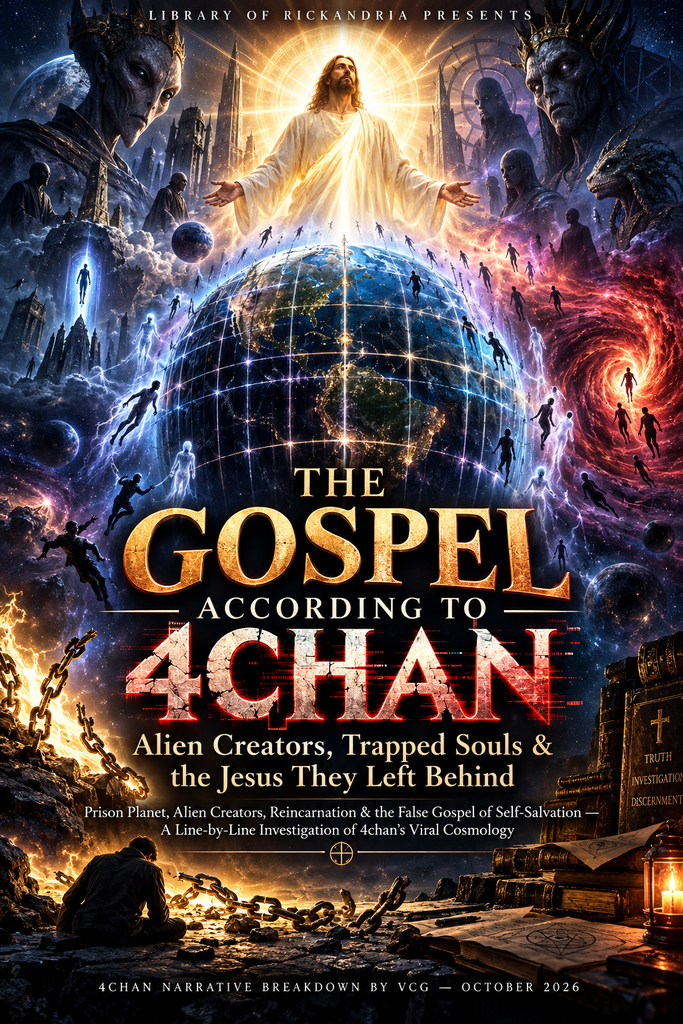
LIBRARY OF RICKANDRIA PRESENTS
THE GOSPEL ACCORDING TO 4CHAN
Alien Creators, Trapped Souls & the Jesus They Left Behind
Prison Planet, Alien Creators, Reincarnation & the False Gospel of Self-Salvation — A Line-by-Line Investigation of 4chan’s Cosmic Claims
4CHAN NARRATIVE BREAKDOWN BY VCG | OCTOBER 2026
Cover artwork:
Library of Rickandria investigative illustration.
Its:
- extraterrestrial figures
- cosmic prison
- portrayal of Jesus
are artistic symbolism, not documentary evidence.
An independent examination of an anonymous /x/ thread through:
- historical source criticism
- astronomy
- archaeology
- psychology
- philosophy
- medical evidence
and the King James Bible.
Primary document:
Read the original 4chan thread — What is God and more, /x/, thread No. 43072681, October 12–13, 2026.
Scriptural text:
The supplied Holy Bible, King James Version, Pure Cambridge Edition.
Abstract
On October 12, 2026, an anonymous contributor to 4chan’s paranormal board published an unusual account of:
- God
- consciousness
- human existence
/x/ – What is God and more – Paranormal – 4chan
The writer described:
a universe populated by powerful creators,
a long-running experiment involving human bodies,
a catastrophic interstellar takeover,
and a planet transformed into a prison for reincarnating souls.
The account was not simply a story about aliens.
It was also an explanation of suffering.
The author argued that humanity’s deepest problem originated in a cosmic catastrophe and that liberation required:
- ethical transformation
- bodily purification
- spiritual awareness
- personal action
Jesus Christ appeared in the narrative, but not principally as the crucified and risen Savior presented in the New Testament.
He became one among several spiritual teachers who had attempted to help humanity overcome its captivity.
This paper asks whether the account can be supported by evidence, where its ideas may have originated, how its arguments work psychologically, and how its teachings compare with Scripture.
The research identifies substantial parallels with earlier esoteric literature, especially The Urantia Book, which contains the distinctive names Havona and Nebadon.
It also identifies conceptual similarities with The Law of One and several ancient traditions commonly discussed under the umbrella of Gnosticism.
These relationships are historically relevant, although resemblance alone cannot demonstrate exactly which sources the anonymous author consulted.
The scientific investigation finds that the thread incorporates some correct astronomical information but supplies no adequate independent evidence for its claimed:
- galactic administrative structures
- prehistoric extraterrestrial conquest
- planetary incarnation computer
or repeated enslavement of human consciousness.
The psychological investigation considers how comprehensive explanations of:
- suffering
- technical-sounding language
- hidden histories
and promises of liberation can make such narratives persuasive.
It does not presume to diagnose the author or declare the author’s intentions.
The biblical investigation reaches a separate but equally significant finding.
The thread’s account of:
- human identity
- the nature of God
- reincarnation
and especially salvation differs substantially from the ordinary contextual reading of central New Testament passages.
Our principal conclusion is that the thread is best understood as an unverified esoteric cosmology containing recognizable influences from earlier spiritual literature, selected ethical principles compatible with Christianity, and a doctrine of liberation that cannot simply be reconciled with the New Testament gospel.
That conclusion is not permission to mock its author or readers.
It is a reason to examine the claims carefully.
I. The Thread That Claimed to Explain God
1.1. Encountering the original source
The thread begins quietly.
It does not open with a sensational announcement of impending destruction.
Instead, its anonymous author introduces the material as personal writing, originally composed in another language and translated with a computer.
The writer admits that some portions may be difficult to understand.
The opening combines uncertainty about God’s ultimate nature with a feeling that there is something beyond the already unfamiliar realm called Havona Shantar.
From there, the narrative expands dramatically.
Earth is placed inside a sequence of cosmic jurisdictions.
Powerful beings supposedly designed human bodies as vessels for higher-dimensional consciousness.
One creation project allegedly went wrong, producing aggressive entities that conquered other worlds and eventually converted Earth into a prison.
The writer’s explanation then changes direction.
The cosmic history becomes a moral lesson.
Humanity must:
- learn love
- respect freedom
- abandon materialistic priorities
- cleanse the body
and take responsibility for its own spiritual progress.
Finally, the author suggests that devotion to spiritual teachers—including dependence upon Jesus for salvation—can actually obstruct liberation.
That movement is essential to understanding the thread.
The early astronomical and extraterrestrial claims establish the setting; the later spiritual teachings reveal the practical message.
The reader is not merely being asked to believe in undiscovered galaxies.
The reader is being invited to reconsider what is wrong with humanity and how humanity must be saved.
1.2. The verified thread record
At the time of examination, the original webpage remained accessible and was marked archived.
The visible record contains twelve posts:
five initial narrative posts, four intervening responses, and three later narrative additions.
The original post appeared on October 12, 2026, at 15:37:48 in the time format displayed by 4chan.
The final visible post appeared on October 13 at 12:24:57.
| Post number | Date | Principal subject |
|---|---|---|
| 43072681 | Oct. 12 | God, the Source, Satik, Theta, Naoshi, Aroshi |
| 43072688 | Oct. 12 | Nebadon and human bodies as consciousness vessels |
| 43072699 | Oct. 12 | Completed experiment, suffering, Earth as a living being |
| 43072702 | Oct. 12 | Cosmic rebellion and the imprisonment of Earth |
| 43072706 | Oct. 12 | Spiritual teachers, Jesus, and ethical principles |
| 43073043 | Oct. 12 | Short skeptical or playful response |
| 43073057 | Oct. 12 | Approval of an ethical maxim |
| 43075634 | Oct. 13 | Brief appeal to unconditional love |
| 43075718 | Oct. 13 | Skepticism about the unusual cosmic names |
| 43076043 | Oct. 13 | Detoxification, meditation, physical purity |
| 43076048 | Oct. 13 | Religion, idolatry, priests, and self-salvation |
| 43076052 | Oct. 13 | The Cosmic Christ and collective consciousness |
Source:
Original archived 4chan thread.
The distinction between the posts matters.
They are not all the same kind of evidence.
The initial messages establish the cosmology.
The intervening replies demonstrate a small amount of visible audience reaction.
The final three posts elaborate the religious and practical implications.
Because most posts are anonymous, references back to the original post cannot establish the identity of their authors.
It is reasonable to analyze the first five and last three posts as a connected narrative, but we cannot verify that a single human being authored all eight.
We also cannot establish how widely the thread circulated.
For that reason, this paper does not claim it went viral.
A public post is not automatically a widespread movement.
1.3. What the thread does not provide
A reader looking for supporting evidence quickly encounters an important limitation.
The writer gives no:
- verifiable identity
- original-language manuscript
- independent witness statement
- astronomical observation log
- archaeological record
- biological experiment
or document demonstrating access to the claimed extraterrestrial history.
The account refers to confirmation from another source without identifying that source.
That is not a minor procedural issue.
It prevents independent evaluation of the supposed corroboration.
An anonymous witness could, in principle, communicate something true.
Anonymity is not proof of deception.
But the inability to investigate the witness or their supporting material necessarily limits the strength of conclusions we can draw.
There is a related preservation concern.
According to 4chan’s archive documentation, archived threads are temporary and may be automatically deleted.
A publication-grade evidence archive should preserve the page, all original images, post identifiers, observation date, and a cryptographic hash of each archived file.
The present investigation relies on the live archived page.
It does not claim that a separate permanent forensic capture has already been deposited.
II. How We Investigated the Claims
This investigation uses four different kinds of reasoning, and they must not be confused.
Historical source criticism asks where a statement came from, how old the source is, whether it depends on earlier material, and whether independent testimony supports it.
A modern anonymous account containing distinctive terms from a book published decades earlier is historically significant.
But it does not, without further analysis, prove plagiarism or deliberate deception.
Scientific evaluation asks whether a claim is defined precisely enough to investigate and whether observations support it.
A statement about a galactic structure or a medical treatment invites different forms of testing from a statement about God’s transcendent nature.
Psychological analysis asks how beliefs are formed, sustained, and communicated. It examines cognition and persuasion rather than claiming privileged access to someone’s motives or medical condition.
Biblical interpretation asks what Scripture actually says, how a passage functions in context, and whether an interpretation can be supported by comparison with other passages.
Theological and empirical conclusions are not interchangeable.
For example, a reader may conclude that reincarnation conflicts with Hebrews 9:27.
That is a textual and theological assessment.
It does not independently constitute a laboratory experiment disproving every possible idea of reincarnation.
Similarly, an unsubstantiated claim about heavenly beings cannot automatically be declared scientifically impossible.
It can be described more precisely as lacking adequate evidence.
Standards of judgment
| Finding | Meaning |
|---|---|
| Supported | Reliable evidence establishes the stated factual claim |
| Partly supported | Some facts are correct, but the larger conclusion is unsupported |
| Unsubstantiated | Sufficient independent evidence has not been provided or identified |
| Contrary to established evidence | A claim conflicts with relevant well-supported findings |
| Biblically contradictory | The claim conflicts with a defensible contextual reading of Scripture |
| Interpretive or philosophical | The issue requires argument and cannot be settled by a simple measurement |
Confidence in each verdict depends upon the evidence, not the strangeness or familiarity of the idea.
This method is consistent with the philosophical distinction between scientific explanations and accounts that lack clear observational tests.
For further discussion, see the Stanford Encyclopedia of Philosophy’s examination of science and pseudoscience.
There is also a useful principle in the preface of the supplied King James Bible.
In The Translators to the Reader, the translators caution against excessive confidence where the original wording remains genuinely uncertain and defend the practice of acknowledging alternative readings.
They specifically discourage dogmatic conclusions about doubtful matters.
The relevance is methodological.
We should be firm where evidence is firm, candid where it is limited, and unwilling to manufacture certainty.
III. The Hidden Literary Ancestry
3.1. The Urantia connection
The Urantia Book
First published in 1955 by the Urantia Foundation, this lengthy religious work describes:
- elaborate cosmic hierarchies
- spiritual beings
- evolving universes
and an expanded history of Jesus.
Image: a photographed 1973 edition, showing the characteristic blue hardcover.
The clearest literary connection is not a vague similarity of mood.
It involves two distinctive names.
In its Paper 14, The Urantia Book describes Havona as the central and divine universe.
The same paper distinguishes this realm from the local universe of Nebadon.
Its Paper 32 further develops the organization and evolution of local universes.
These are not ordinary terms found in standard astronomical catalogs.
They belong to the terminology of that religious text.
The 4chan author uses both names as elements within a larger cosmic description.
That establishes an identifiable relationship at the level of vocabulary and subject matter.
But the comparison produces another finding that should prevent oversimplification.
Paper 32, paragraph 32:0.3, identifies Jesus of Nazareth with the sovereign of Nebadon.
In the 4chan thread, however, Jesus is described more generally as one teacher among several.
The difference is substantial.
It means that, although the narrative shares distinctive Urantia terminology, it cannot be described accurately as simply reproducing Urantia theology in every respect.
The possibilities include selective borrowing, indirect influence through another source, adaptation of ideas circulating in spiritual communities, or independent recombination of familiar themes.
The available evidence does not establish which explanation is correct.
Finding:
The literary connection is strong at the level of terminology and broad cosmological structure.
Direct authorship dependence and intentional copying remain unproved.
3.2. The October 12 coincidence
There is an unusual chronological detail.
The Urantia Foundation records that the first printing of The Urantia Book was made available on October 12, 1955.
The 4chan thread began on October 12, 2026.
The dates fall exactly 71 years apart.
Paper 32 – The Evolution of Local Universes | Urantia Book | Urantia Foundation
This coincidence deserves documentation, but not exaggeration.
We do not know whether the anonymous author selected that date deliberately, whether the date had any significance to them, or whether they were even aware of the publication anniversary.
The coincidence becomes more interesting because of the shared terminology.
But adding an intriguing coincidence to an established literary resemblance does not automatically prove a deliberate anniversary publication.
The proper conclusion is narrower:
the dates coincide, and the author’s intention remains unknown.
3.3. The Law of One and the language of spiritual evolution
Another relevant comparison is The Law of One, sometimes called the Ra Material.
The organization L/L Research describes a series of channeling sessions conducted in the 1980s, involving communications attributed to a collective intelligence called Ra.
The recorded teachings address:
- the One Infinite Creator
- spiritual densities
- planetary evolution
- service to others
and the relationship between individual consciousness and an underlying cosmic unity.
These are conceptual parallels to the 4chan thread.
Particularly relevant are the themes of consciousness moving through levels of existence, the moral importance of love, and the idea that creation possesses a deeper unity than ordinary perception reveals.
However, The Law of One is not identical to the prison-planet narrative.
Its overall framework and emphasis differ in significant ways, and we should not attribute every idea in the thread to it.
A careful source critic distinguishes three possible relationships:
- shared vocabulary
- shared concepts
- demonstrable textual dependence
Only the first two are evident here.
Primary comparative source:
L/L Research — The Law of One Library.
3.4. Ancient Gnostic traditions and the problem of the material world
Historical image of Nag Hammadi codices, an important collection of ancient religious writings discovered in Egypt in 1945.
The manuscripts are historical artifacts; their cosmological contents are not thereby established as factual descriptions of the universe.
The ancient material commonly called Gnostic is another useful comparison.
Some systems describe:
- a flawed material world
- subordinate creator figures
- human beings alienated from their spiritual origin
and liberation associated with special knowledge.
These themes resemble the 4chan narrative’s claim that humanity is trapped within a cosmic order requiring awakening or escape.
The resemblance matters because it demonstrates that the basic pattern of cosmic captivity and liberating knowledge is not new to internet culture.
But the historical caution is equally important.
There was no single uniform Gnostic religion with one universally accepted doctrine.
Scholarly research into the Nag Hammadi writings has emphasized how diverse the texts and communities were.
The Internet Encyclopedia of Philosophy’s survey of Gnosticism discusses this diversity, including the scholarly criticism of treating all these writings as one religious system.
The thread therefore resembles certain Gnostic patterns, not necessarily a specific ancient document.
It would be an overstatement to say that the anonymous author has reproduced one precise ancient Gnostic religion.
3.5. The source comparison
| Idea | Earlier literature or tradition | Relation to the thread |
|---|---|---|
| Havona | The Urantia Book, Paper 14 | Distinctive shared name |
| Nebadon | The Urantia Book, Paper 32 | Distinctive shared name and local-universe concept |
| Cosmic creators and administrative hierarchies | The Urantia Book | Substantial structural parallels |
| Spiritual densities and consciousness development | The Law of One | Conceptual parallel |
| Creation as an underlying unity | The Law of One and other traditions | Broad conceptual parallel |
| Material existence as captivity | Some historical Gnostic systems | Thematic resemblance |
| Special knowledge as liberating | Some historical Gnostic systems | Thematic resemblance |
| Earth as an extraterrestrial incarnation computer | Not established by the sources compared | Provenance unresolved |
| Satik, Theta, Naoshi, Aroshi | Not traced to an authenticated earlier source in this investigation | Provenance unresolved |
| Jesus as one among several teachers | General perennialist or syncretic theme | Not equivalent to Urantia’s explicit identification of Jesus as sovereign of Nebadon |
What emerges is a composite account rather than a wholly unprecedented revelation.
The author appears to be working with a vocabulary and set of ideas that have circulated through religious and esoteric literature for decades, and in some respects for centuries.
This does not prove that the author knowingly assembled a fabrication.
It establishes that the narrative has recognizable intellectual precedents.
The burden of demonstrating an independent supernatural source remains unmet.
IV. The Universe Under Cross-Examination
NASA/ESA Hubble Ultra Deep Field 2014.
The image combines ultraviolet, visible, and near-infrared observations of galaxies.
It is real astronomical evidence, not an image of any cosmic hierarchy alleged in the thread. NASA source and image explanation.
4.1. The danger of confusing a detailed description with a demonstrated discovery
One of the thread’s most effective literary features is its extraordinary specificity.
The author gives cosmic regions names and puts numerical quantities beside them.
A group supposedly contains 21 galaxies.
A larger region contains approximately 18,600.
There are multiple levels of hierarchy, followed by still greater levels above them.
This sounds like information taken from an advanced atlas.
But a scientific atlas is not merely a collection of names and numbers.
It supplies:
- locations
- measurements
- criteria for classification
and observations that other investigators can check.
For example, an astronomer claiming that a particular collection contains 21 galaxies should be able to identify the galaxies, provide their coordinates, explain their measured distances, and establish what makes them members of the same group.
The thread does none of these things.
It asks the reader to accept a detailed classification without furnishing the evidence from which that classification could be reproduced.
This is a central problem throughout the narrative:
the amount of descriptive detail is much greater than the amount of verifiable evidence.
4.2. What we actually know about our location
NASA/JPL-Caltech illustration showing the Sun’s position relative to sections of the Milky Way’s spiral structure.
NASA’s Milky Way location reference.
Astronomers place our solar system in the Milky Way’s Orion Spur, also called the Orion Arm, between the Sagittarius and Perseus arms.
The Milky Way belongs to the Local Group of galaxies, which contains more than 50 members.
The Local Group is associated with the larger Laniakea supercluster.
These structures are not known merely through tradition.
They are studied through astronomical observations involving:
- light
- positions
- redshifts
- distances
and the motions of galaxies.
NASA provides accessible explanations in its galaxy overview and large-scale structure reference.
That brings us to the first major evidential division in the thread.
The claim that Earth is located in the Milky Way is established.
The claim that the Milky Way belongs to an additional hierarchy called Theta, Naoshi, and Aroshi is not established by supplying those names.
Scientific investigations may revise the boundaries and classifications of cosmic structures as new evidence emerges.
But there must first be actual evidence to evaluate.
4.3. Does theoretical physics support higher-dimensional creators?
Some modern physical theories consider additional dimensions beyond the three spatial dimensions familiar in everyday life.
That is a legitimate area of theoretical physics.
For example, CERN explains that certain models involving extra dimensions predict observational signatures, such as heavier versions of known particles or unusual missing-energy events in particle collisions.
Those predictions make the theories physically investigable.
See CERN — Extra Dimensions, Gravitons, and Tiny Black Holes.
The 4chan thread uses dimensional language differently.
Its dimensions appear to function as levels of spiritual existence or consciousness.
Beings allegedly:
- descend through densities
- divide their consciousness
- lose memory
and enter physical bodies.
No mathematical model or experimental result is offered connecting the thread’s account to the scientific theories.
Nor does the existence of a ten-dimensional mathematical framework establish that beings occupying fewer than ten dimensions become violent.
This is a category error.
A scientific hypothesis about the geometry of spacetime is not evidence of a hierarchy of spiritually advanced civilizations.
One may propose such a hierarchy philosophically or religiously.
But using terminology also found in physics does not validate the proposal scientifically.
V. The Primary-Source Examination: Post by Post
The following analysis preserves the order of the original thread.
Short descriptions identify the claims without extensively reproducing the author’s copyrighted wording.
Each numbered item identifies a substantive proposition requiring examination.
Post 43072681 — God, the Source, and the cosmic atlas
Claim 1: The account comes from translated personal notes
The author explains that the material originated as personal writing in another language and that machine translation may have introduced awkward passages.
This explanation is plausible.
It also limits our ability to resolve unclear wording.
Without the original-language text, a researcher cannot determine whether a questionable term was chosen by the author, introduced by translation, or interpreted incorrectly.
Verdict: Possible, but independently unverifiable.
Claim 2: A source beyond Havona has been confirmed
The author expresses uncertainty about God’s ultimate nature but simultaneously claims to have received confirmation of something beyond Havona.
Two questions follow.
What exactly was confirmed?
And what independent evidence did the confirming source provide?
Neither question is answered.
If two people independently recorded the same previously unknown observation, that might be meaningful.
If one person simply repeated information learned from another, it would not provide independent corroboration.
Since the alleged confirming source is unidentified, neither possibility can be investigated.
Verdict:
Unsubstantiated.
Claim 3: An ultimate Source sustains all existence
This proposition has a partial biblical parallel.
Acts 17:24–28 portrays God as the Creator and sustainer of the world.
Paul explains that human life depends upon God.
However, the passage does not teach that all persons and objects are literally fragments of a single collective consciousness.
Paul preserves a distinction between the God who creates and the creatures who depend upon him.
Scriptural correction:
God’s sustaining presence does not require pantheism.
See Acts 17:24–29 and Romans 1:25.
Claim 4: The writer senses a mysterious childlike intelligence
We have no independent observations by which to identify the entity or determine whether the description is literal, symbolic, or impressionistic.
A private intuition may be important to the person experiencing it, but personal conviction does not establish the external existence or identity of its object.
The Bible itself warns against accepting purported spiritual communications without examination.
1 John 4:1 (KJV):
Beloved, believe not every spirit, but try the spirits whether they are of God:
because many false prophets are gone out into the world.
This passage does not permit automatically declaring every unusual impression demonic. It calls for discernment.
Verdict:
Unsubstantiated subjective interpretation.
Claim 5: Earth lies within the Milky Way’s Orion region
There is a real astronomical connection here.
The Sun lies in the Orion Spur of the Milky Way.
NASA’s observations support this location.
However, agreement on a known fact does not validate the additional claim that our solar system formerly belonged to a system called Satik or that its history was transformed through extraterrestrial wars.
Verdict:
Accurate astronomical core surrounded by unsupported claims.
Claim 6: The solar system was formerly called Satik and changed through wars
The writer provides no records of the supposed naming authority, participating civilizations, chronology, or physical evidence of the alleged events.
We must also distinguish a naming claim from an event claim.
A community may call a place by a name unknown to others.
Establishing that someone uses a name would not prove the accompanying history of wars.
Verdict:
Unsubstantiated historical assertion.
Claim 7: Theta, Naoshi, and Aroshi are real cosmic jurisdictions
The proposed numbers and names cannot presently be checked against an identifiable dataset supplied by the author.
The names’ origins are also unclear.
A later commenter speculates that some of the names may have been chosen for an exotic effect, but that suggestion is itself unproved.
The correct finding is simply that the supposed celestial hierarchy has not been independently demonstrated.
Verdict:
Unverified proposed classification.
Post 43072688 — Why human bodies allegedly exist
Claim 8: Everything around us belongs to the local universe of Nebadon
The name appears in The Urantia Book, as already documented.
That is evidence of an earlier literary source for the terminology, not evidence that Nebadon has been mapped astronomically.
No physical boundaries, astronomical coordinates, or observational criteria are supplied.
Verdict:
Historically traceable terminology; unsupported physical claim.
Claim 9: The cosmos contains numerous creation programs
The narrative proposes that different beings conduct creative projects across the universe.
No independent evidence is offered identifying these programs or the beings conducting them.
Theologically, Genesis 1:1 attributes the creation of heaven and earth to God.
Colossians 1:16–17 identifies the Son as having a universal role in creation and preservation.
These passages do not present competing extraterrestrial engineering programs as the foundation of human existence.
Verdict:
Unsubstantiated and not derived from the biblical creation narrative.
Claim 10: The human body was designed as a vessel for higher-dimensional beings
We can separate the biological and metaphysical parts of this claim.
Biological human history is investigated through:
- fossils
- genetics
- archaeology
- comparative anatomy
The Smithsonian’s Human Origins Program documents Homo sapiens fossils approximately 300,000 years old, placing humans within a long and varied evolutionary history.
Our species arose at least 300,000 years ago | The Smithsonian Institution’s Human Origins Program
This does not experimentally adjudicate the existence of souls, divine creation, or every possible metaphysical explanation of human life.
It does, however, establish that the ordinary physical human form has an extensively studied history for which the alleged extraterrestrial vessel project supplies no independent evidence.
Genesis 1:26–27 identifies humanity through its relationship to God and the image of God.
Genesis 2:7 depicts man’s formation and reception of life from God.
Biblical distinction:
Human embodiment is not portrayed as a technological solution to a problem experienced by beings descending from higher dimensions.
Claim 11: Consciousness must fragment when entering physical reality
The author suggests that higher beings divide consciousness into smaller units when descending into lower-density existence.
But what is the proposed mechanism?
What would count as a measurable fragment of consciousness?
How could such fragmentation be distinguished from memory changes, personality development, or ordinary neurological activity?
The narrative supplies no operational definition.
In biblical anthropology, there are longstanding debates concerning:
- soul
- spirit
- body
and the intermediate state after death.
Those debates deserve careful attention, but they do not amount to biblical support for extraterrestrial consciousness fragmentation.
Verdict:
Unsubstantiated metaphysical mechanism.
Claim 12: Embodiment causes loss of memory and identity
The thread offers memory loss as a consequence of entry into physical bodies.
Human memory, however, is extensively studied in relation to:
- brain systems
- learning
- disease
- injury
The thread provides no reproducible demonstration of a memory existing before embodiment and then being erased through dimensional descent.
A hypothesis in which every absence of evidence is explained by erased memory risks becoming impossible to distinguish from a mistaken hypothesis.
Verdict:
Unsupported.
Post 43072699 — The completed experiment and the suffering Earth
Claim 13: The cosmic project has succeeded and is nearing completion
The writer announces that the project has reached its objective and awaits closure.
But no objective milestone is given.
A rigorous claim about the completion of a project would require knowing the project’s goals, evidence of progress, and criteria for success.
Without those, the assertion remains a declaration.
The Bible’s promised consummation of history appears in passages such as 1 Corinthians 15:20–28 and Revelation 21:1–5.
Neither identifies the culmination of history as the successful conclusion of the proposed incarnation program.
Verdict:
Unsubstantiated claim about cosmic history and the future.
Claim 14: Human suffering requires explanation
This is one of the most serious and legitimate concerns raised by the author.
People suffer from:
- violence
- poverty
- illness
- oppression
- loneliness
and forms of evil that appear grotesquely disproportionate to anything they might have done.
The existence of those problems is not controversial.
Their deeper explanation is one of the enduring questions of philosophy and theology.
The Book of Job refuses simplistic assertions that suffering always reflects personal wrongdoing.
In John 9:1–3, Jesus rejects an attempt to explain a man’s blindness by assigning responsibility to his own sin or that of his parents.
Romans 8:20–23 depicts creation as subject to corruption and awaiting redemption.
These biblical passages do not answer every philosophical question about evil.
They do, however, offer an account different from that of the 4chan author.
The existence of suffering is evidence that suffering exists; it is not, without further evidence, proof of extraterrestrial captivity.
Claim 15: Earth is a conscious being that feels pain
This is more complicated than it first appears.
Biological life interacts with Earth’s:
- atmosphere
- oceans
- rocks
- climate
The Gaia hypothesis, associated especially with James Lovelock and Lynn Margulis, concerns interactions and feedback processes within the Earth system.
The scientific literature distinguishes several forms of the hypothesis, from relatively straightforward ecological relationships to much more speculative claims about Earth as an organism.
James Kirchner’s review, The Gaia Hypothesis: Can It Be Tested?, is particularly useful because it identifies these different levels of assertion.
But ecological regulation is not identical to conscious subjective experience.
To establish that Earth feels pain in the way an individual does, one would need a defensible theory of planetary consciousness and evidence supporting it.
The thread does not supply that evidence.
Romans 8:22 (KJV):
For we know that the whole creation groaneth and travaileth in pain together until now.
The image of creation groaning belongs to Paul’s account of corruption and anticipated redemption.
It should not be converted automatically into proof that the planet possesses a humanlike nervous system or subjective consciousness.
Verdict:
Real ecological interdependence; planetary consciousness unestablished.
Claim 16: Numerous Creators collaborated in the planetary experiment
The biblical scriptures speak of:
- angels
- principalities
- powers
and other created spiritual beings.
That fact should not be mistaken for endorsement of multiple independent creators jointly producing humanity.
Isaiah 44:24 emphasizes the LORD’s creative work.
John 1:3 and Colossians 1:16 place creation under the agency of the Word or Son.
Historic Trinitarian Christianity understands:
- Father
- Son
- Holy Spirit
as the one God, rather than three competing deities.
Verdict:
Unsupported as history and incompatible with biblical monotheism if the alleged creators are independent divine agents.
Claim 17: These Creators experimented with different plans and cooperated peacefully
The narrative portrays a collaborative environment in which numerous creators pursued different designs.
As a story, it establishes a contrast between peaceful cosmic cooperation and the violence that supposedly followed.
But a narrative function is not evidence that the events happened.
The Bible describes wisdom and purpose in creation, not the process proposed here.
Isaiah 46:9–10 also emphasizes God’s knowledge of the end from the beginning.
Verdict:
Unsubstantiated; the proposed divine experimentation does not follow from Scripture.
Post 43072702 — The prison-planet hypothesis
Claim 18: One creative project became uncontrollable
Here the story introduces its central catastrophe.
A previously peaceful experiment supposedly produced aggressive beings, whose actions transformed the wider cosmic environment.
This claim serves a clear explanatory function:
it assigns the origin of evil to an aberrant creation project.
There is a resemblance to some ancient narratives involving a flawed or subordinate creator, but resemblance does not establish historical truth.
Genesis 3 describes human disobedience, while Romans 5:12–21 develops a theological relationship between:
- Adam
- sin
- death
- Christ
Christian traditions disagree about certain details of original sin, inherited guilt, and the interpretation of Genesis.
Yet the thread’s technological catastrophe is not the explanation given in those passages.
Verdict: Unsubstantiated historical account and divergent theological explanation.
Claim 19: Existence below 10D creates aggressive behavior
This is one of the more striking examples of mathematical-sounding terminology serving an undefined moral theory.
The number ten is not given a measurable meaning.
Nor does the author demonstrate any causal relationship between the alleged dimensional threshold and violence.
A physical theory containing ten dimensions would not automatically imply that beings in ordinary spacetime possess a particular moral character.
Jesus identifies evil actions as arising from the human heart in Mark 7:20–23.
This should not be interpreted as denying the importance of bodily, social, or environmental influences.
It means that Jesus’ moral explanation is not based upon the numerical dimensionality of spacetime.
Verdict:
Unsupported causal claim.
Claim 20: Aggressive civilizations conquered planets, stars, and galaxies
No dated records, physical remains, corroborated astronomical observations, or independently testable consequences are offered.
The account supplies a sweeping history without a recoverable historical record.
If these events involved extensive technological civilizations and interstellar conflict, one could at least ask whether any observable effects are predicted.
The author gives no way to distinguish a universe in which these wars happened from one in which they did not.
Verdict:
Unsubstantiated.
Claim 21: Earth operated as an incarnation computer approximately 20,000 years ago
This claim introduces a date that sounds historically specific.
Around 20,000 years ago, humans already had a long prehistoric history.
Archaeology studies material evidence of ancient human populations, while genetics and fossil research place our species much earlier.
The Smithsonian’s human-origins overview provides a useful scientific starting point.
But the author’s specific claim concerns a planetary technological function.
To investigate that proposition, we would need physical evidence of the alleged mechanism, a location, dated artifacts, technical documentation, or some independently observable signature.
The analogy to Avatar helps readers picture the alleged process, but a familiar fictional analogy is not evidence that it happened.
Verdict: No adequate archaeological or technological evidence identified.
Importantly, the fact that humans existed 20,000 years ago does not by itself disprove a hypothetical later intervention.
The problem is that the intervention has not been demonstrated.
Claim 22: Earth became a prison for reincarnating souls
The author now combines the alleged extraterrestrial conquest with repeated incarnations.
The result is a complete theory of the human condition:
people allegedly live and die without escaping the system that imprisons them.
This explanation is difficult to test because ordinary failures to remember previous lives can be incorporated into the theory as part of the imprisonment mechanism.
The biblical account differs significantly.
Hebrews 9:27–28 connects death, judgment, and Christ’s once-for-all offering.
Hebrews 9:27 (KJV):
And as it is appointed unto men once to die, but after this the judgment:
The immediate context discusses the uniqueness and sufficiency of Christ’s sacrificial work.
The author is comparing the once-for-all character of death and judgment with Christ’s once-for-all sacrifice.
It would be careless to make this verse answer every conceivable philosophical question about postmortem existence.
Nevertheless, its ordinary context does not teach a recurring cycle of births intended to imprison human souls.
John 5:28–29 and 1 Corinthians 15 emphasize resurrection.
Biblical verdict:
The proposed reincarnation prison is not the New Testament account of human destiny.
Post 43072706 — Jesus, spiritual teachers, and the ethics of liberation
Claim 23: The Creator knows what is happening and has intervened
The author responds to the problem of evil by asserting that higher authority is aware of Earth’s condition and has taken corrective measures.
But those measures remain unspecified.
An assertion that action has already occurred somewhere beyond human observation is not equivalent to evidence of that action.
The New Testament identifies God’s saving intervention with the historical mission of Jesus Christ, including his death and resurrection.
Romans 5:8 presents Christ’s death as a manifestation of divine love toward sinners.
Verdict: The general affirmation of divine knowledge has biblical parallels; the alleged hidden interventions remain unverified.
Claim 24: Enlightened teachers were sent throughout the cosmos
The existence of moral and religious teachers throughout human history is well established.
The claim that such teachers arrived from other planets or higher-dimensional realms is another proposition entirely.
The writer gives no verifiable examples of teachers from other planets or any independently documented origin of that kind.
Verdict: Historically plausible earthly teachers; unsupported extraterrestrial origins.
Claim 25: Jesus was one teacher among many
This is where the theological differences become especially important.
The Bible does identify Jesus as a teacher.
He taught publicly, used parables, interpreted Scripture, and instructed disciples.
Yet the New Testament describes him in additional categories that cannot be reduced to ordinary religious instruction.
John 1:1–14 identifies the Word as divine and incarnate.
Colossians 1:15–20 describes Christ in relation to all creation.
Hebrews 1:1–3 distinguishes the Son’s identity and role from those of earlier messengers.
John 14:6 (KJV):
Jesus saith unto him, I am the way, the truth, and the life:
no man cometh unto the Father, but by me.
A person is free to dispute the historical or theological truth of that claim.
But the claim cannot honestly be reduced to a message that Jesus was one interchangeable spiritual guide among many.
Biblical verdict:
An incomplete and ultimately incompatible account of Jesus’ identity and redemptive role.
Claim 26: People should not inflict upon others what they would dislike themselves
This is a broadly defensible ethical principle.
It overlaps with the teaching Jesus gives in Matthew 7:12, though Jesus’ formulation emphasizes positively doing good to others.
The distinction is significant.
Refraining from harming a neighbor is valuable.
Actively helping a suffering neighbor goes further.
Verdict:
Substantial biblical ethical agreement, though less demanding than the positive command.
Claim 27: People should love their neighbors
This is directly biblical.
Matthew 22:39 (KJV):
Thou shalt love thy neighbour as thyself.
The command is rooted in Leviticus 19:18 and receives a prominent place in Jesus’ summary of the law.
Its presence in the thread is not evidence that the entire cosmology is correct.
True principles can appear within accounts that also contain mistaken claims.
Verdict: Scripturally supported ethical teaching.
Claim 28: People should respect one another’s free choices
There is a legitimate moral concern here about coercion, domination, and respect for persons.
However, human freedom is more complex than the freedom to choose without any limitations.
Biblical liberty is connected with truth, responsibility, and service.
Galatians 5:13 directs believers not to use liberty as an occasion for the flesh, but to serve one another in love.
Verdict: Broad moral agreement; the concept requires qualification.
Claim 29: Character matters more than possessions
The thread’s contrast between being and having echoes a longstanding moral concern about wealth and personal identity.
Jesus’ teaching in Luke 12:15 warns against defining life by the abundance of possessions.
First Timothy 6:6–10 addresses contentment, the love of money, and the dangers associated with pursuing riches.
These passages support the general concern without validating the cosmic account attached to it.
Verdict:
Substantially compatible with biblical ethics.
Claim 30: Stones, plants, trees, and human beings possess equivalent living significance
Several ideas are being combined.
Plants and trees are living organisms.
Stones are not living organisms under ordinary biological classifications.
The question of moral significance is different again.
An ecosystem can deserve protection without each of its components being a conscious person.
Scripture affirms the goodness of creation and humanity’s responsibility to care for it.
Genesis 2:15 depicts man’s vocation to cultivate and keep the garden.
At the same time, Genesis 1:26–27 assigns human beings a distinctive relationship to God through the divine image.
Biblical correction:
Care for creation is justified without erasing the distinction between human persons, plants, and inanimate matter.
The four intervening replies
These posts are short, but a complete analysis should not silently omit them.
Post 43073043 uses an ambiguous computing expression as a response to the author’s uncertainty about God.
It is too brief to support a substantive claim about consciousness or theology.
Post 43073057 expresses approval of the maxim concerning how others should be treated.
This demonstrates agreement with one ethical statement, not with the larger cosmology.
Post 43075634 refers to unconditional love.
The sentiment is understandable, but undefined.
Biblical love includes:
- mercy
- truth
- justice
and moral responsibility.
Loving another person does not require affirming every belief or action.
Post 43075718 questions the origin and purpose of the unusual cosmic names.
This raises a legitimate issue of source criticism, although the commenter supplies no proof concerning their linguistic origins or the writer’s intentions.
The visible discussion therefore includes a mixture of curiosity, approval, and skepticism.
It does not establish community consensus, scientific validation, or widespread acceptance.
Post 43076043 — Purification, parasites, and meditation
We now reach a particularly important turn in the discussion.
Until this point, the narrative has largely concerned the origin and structure of reality.
Here, the author begins recommending a practical regimen as part of the supposed path toward spiritual completion.
The shift matters because the consequences of accepting the claim can extend beyond religious belief into medical decisions and bodily health.
Claim 31: Human understanding of the cosmic situation remains incomplete
The author openly admits that much of the account remains difficult even for the person presenting it.
This admission is appropriate in principle.
However, it creates a tension with the certainty of the prescriptions that follow.
A person who has not established the underlying system should be especially cautious about declaring particular practices universally necessary.
Verdict:
A reasonable admission of uncertainty that should reduce confidence in subsequent unsupported requirements.
Claim 32: Heavy-metal and parasite detoxification is necessary for effective meditation
The author proposes that removal of heavy metals and parasites is a fundamental prerequisite for meditation.
There are real medical conditions involving toxic-metal exposure.
There are also genuine parasitic infections, some of which are serious.
But those facts must be separated from the idea that ordinary people generally require unspecified cleansing procedures to participate in meditation or achieve spiritual progress.
The US National Institutes of Health explains that most popular detoxification programs lack convincing supporting evidence and that some carry health risks.
The NIH also distinguishes general commercial cleansing programs from medically indicated treatments for specific toxic exposures.
“Detoxes” and “Cleanses”: What You Need To Know | NCCIH
The CDC explains that suspected parasitic infections are evaluated according to:
- symptoms
- medical history
- exposure
- travel
and appropriate laboratory testing.
Different parasites require different diagnostic approaches.
Diagnosis of Parasitic Diseases | Parasites | CDC
There is no established universal medical rule requiring parasite cleansing before meditation.
Verdict:
Unsupported health prescription.
Medical references:
NIH — Detoxes and Cleanses: What You Need to Know; CDC — Diagnosis of Parasitic Diseases.
Claim 33: A contaminated body cannot meditate properly
The author presents a causal relationship between physiological contamination and spiritual performance.
The problem is that neither contamination nor meditation success is properly defined.
Research does suggest that some meditation practices can improve certain psychological outcomes.
A systematic review and meta-analysis by Goyal and colleagues, published in JAMA Internal Medicine in 2014, included 47 trials involving 3,515 participants.
It found moderate evidence for reductions in anxiety, depression, and pain with mindfulness meditation, while also identifying limitations in the evidence.
It did not establish the necessity of universal detoxification regimens.
Verdict:
Unsupported proposed mechanism.
The appropriate response to a suspected toxic exposure or parasitic infection is medical evaluation, not an assumption that difficulty concentrating is proof of bodily contamination.
Claim 34: Difficulty with junk food and carbohydrates interferes with the author’s spiritual progress
The writer describes repeated attempts to change eating habits.
That statement may be an entirely sincere description of personal difficulty.
However, the narrative places the struggle within a spiritual framework in which bodily purity determines successful completion of a larger mission.
Carbohydrates themselves are a broad nutrient category.
Treating all carbohydrate consumption as contamination would be medically misleading.
A practical distinction is needed between improving nutritional habits and pursuing an undefined ideal of bodily purification.
Verdict: Personal experience cannot establish a universal doctrine of spiritual failure or contamination.
Claim 35: A divine being would reject an impure physical vessel
The author’s proposed reasoning is theological rather than medical.
The assumption is that divine beings require bodily purity before accepting human embodiment or communion.
There is a point of contact with biblical concern for bodily holiness.
First Corinthians 6:19–20 describes the believer’s body as the temple of the Holy Ghost and calls believers to glorify God in their bodies.
But the passage appears within Paul’s teaching about sexual immorality, belonging to Christ, and bodily conduct.
It does not establish heavy-metal detoxification as a condition of salvation.
In fact, the New Testament presents Christ as coming to sinners and ministering to the sick.
Mark 2:17 (KJV):
I came not to call the righteous, but sinners to repentance.
The text should not be made to imply that physical illness or dietary imperfection places someone beyond divine mercy.
Biblical verdict: Concern for bodily holiness is legitimate; the proposed purification requirement does not follow from Scripture.
Post 43076048 — Religion, idolatry, and the gospel of personal action
This post contains the most direct theological challenge in the thread.
Claim 36: Higher beings transmitted religious knowledge through meditation and spiritual contact
The author proposes that spiritual communications from higher planes helped produce religious teachings.
There are historical records of people reporting visions, revelations, channeling experiences, and other encounters across many religious traditions.
The existence of those reports is a historical fact.
Whether the experiences correspond to external supernatural beings requires separate investigation.
The thread does not provide independent evidence demonstrating the identity or reliability of the alleged communicators.
The Bible itself contains reports of divine and angelic communication, but it also repeatedly warns that not every claimed spiritual message should be accepted.
Galatians 1:8 is particularly relevant because Paul refuses to treat the claimed authority of even an angel as sufficient justification for a message contradicting the gospel he proclaimed.
Verdict: Reports of religious experience are historically real; the alleged higher-dimensional origin of this information is unverified.
Claim 37: Religions arose from humanity’s interpretation of spiritual masters
The history of religion is considerably more complicated.
Religious traditions develop through interactions among:
- texts
- oral traditions
- communities
- rituals
- philosophy
- political authority
- cultural exchange
and experiences understood as sacred.
Christianity, for example, did not arise solely through the preservation of ethical teaching.
Its earliest surviving literature places the death and resurrection of Jesus at the center of the proclamation.
First Corinthians 15:3–8 records Paul’s account of the gospel and the resurrection appearances claimed by the earliest Christian community.
This is historically significant even for someone who does not accept the resurrection as a supernatural event.
It demonstrates what early Christians were proclaiming.
Verdict: An oversimplified account of religious history.
Claim 38: Devotion to Jesus obstructs spiritual development through idolatry
The author argues that religious devotion to spiritual masters can become a barrier to personal growth.
There are legitimate questions about manipulation, abusive religious authority, misplaced loyalties, and the difference between genuine faith and unthinking dependence.
But the Christian worship of Jesus cannot be evaluated accurately without first examining the New Testament’s claims about his identity.
John 1:1 identifies the Word with God.
John 1:14 identifies the Word as made flesh.
John 20:28 records Thomas addressing Jesus as his Lord and God.
Historic Trinitarian Christianity understands worship of Jesus as worship of the divine Son, not the worship of a created religious teacher.
Some non-Trinitarian traditions interpret the relevant passages differently, and those disagreements deserve honest textual treatment.
Nevertheless, the thread does not engage the biblical reasoning for Christian worship.
It assumes that Jesus belongs in the category of created spiritual masters and then judges his worship on that assumption.
Biblical verdict:
The idolatry accusation begs the central question of Christ’s identity.
Claim 39: Expecting Jesus to save humanity leads to spiritual failure
This is the decisive contradiction.
The thread suggests that waiting for salvation from Jesus creates a dangerous dependency.
There is a version of passive religiosity that deserves criticism: professing faith while refusing to act with love, repent, or take responsibility for one’s conduct.
James 2 addresses precisely the problem of faith without corresponding action.
But it does not follow that dependence upon Christ’s saving work is contrary to the gospel.
Ephesians 2:8–10 (KJV):
For by grace are ye saved through faith; and that not of yourselves:
it is the gift of God:
Not of works, lest any man should boast.
For we are his workmanship, created in Christ Jesus unto good works, which God hath before ordained that we should walk in them.
Paul does not reject good works.
He places them after and within God’s saving work rather than presenting them as its independent foundation.
The distinction is critical.
In the thread, the fundamental hope increasingly becomes humanity’s own awakening and achievement.
In Ephesians, salvation originates in God’s grace and produces a transformed life.
Biblical verdict:
The proposed replacement of Christ-centered salvation with autonomous spiritual liberation contradicts the Pauline gospel.
Claim 40: Personal action is the essential route to victory
Personal responsibility is not foreign to Christianity.
Believers are instructed to:
- repent
- pursue holiness
- resist evil
- show mercy
- work diligently
- persevere
Philippians 2:12–13 combines human responsibility with divine action.
James 2 teaches that a profession of faith without works is empty.
The problem is therefore not the call to act.
The problem is treating action as an alternative to Christ’s redemptive work rather than as a response to divine grace.
Verdict:
A legitimate emphasis on responsibility incorporated into an alternative doctrine of salvation.
Claim 41: Priests, bishops, and religious leaders are unnecessary
This assertion includes issues over which Christians themselves disagree.
First Timothy 2:5 identifies Christ as the one mediator between God and humanity.
First Peter 2:9 describes believers as a royal priesthood.
These verses are important for understanding the believer’s relationship to God.
But the New Testament also describes:
- overseers
- elders
- teachers
- pastors
and other forms of ministry.
First Timothy 3, Titus 1, and Ephesians 4:11–12 address aspects of leadership and the equipping of believers.
Different Christian traditions interpret the nature and authority of ordained ministry differently.
Therefore, a careful biblical assessment must distinguish the claim that no religious leader can replace Christ as mediator from the much stronger claim that all forms of ordered church ministry are unnecessary.
The first has substantial New Testament support.
The second is difficult to reconcile with the relevant passages.
Verdict:
Partly grounded concern, but an overgeneralized ecclesiastical conclusion.
Claim 42: God exists within everything, including every atom
This is a philosophical proposition requiring careful terminology.
Pantheism generally identifies God with the cosmos.
Panentheism typically distinguishes the world from God while affirming that the world exists in God, though there are considerable variations of the concept.
The Stanford Encyclopedia of Philosophy’s article on panentheism explains these distinctions.
The biblical doctrine of God’s omnipresence is not identical to the claim that every object is God.
Psalm 139 celebrates God’s inescapable presence.
Acts 17 teaches that humanity depends upon God.
Yet Scripture continues to distinguish God from the created world.
Romans 1:25 contrasts the Creator with the creature.
The thread moves from divine presence toward a claim of universal spiritual identity without adequately defending that move.
Biblical verdict: God’s presence in creation does not establish that all created things are literally divine.
Claim 43: Rocks, minerals, animals, and human beings are spiritual siblings
The author’s language encourages a sense of kinship with the natural world.
As poetic language, such ideas can encourage humility and environmental responsibility.
But literal claims about personhood require more.
Scripture sometimes personifies natural objects.
Psalm 148 calls upon the:
- heavens
- mountains
- trees
- animals
and people to praise God.
That is not sufficient evidence that stones possess consciousness equivalent to human consciousness.
Nor does biblical praise of creation cancel the distinction between living organisms and inanimate matter.
Verdict: Potentially meaningful metaphor, but unsupported literal metaphysics.
Post 43076052 — The Cosmic Christ and collective consciousness
Claim 44: The Cosmic Christ is universal awareness of shared consciousness
The expression Cosmic Christ has a wider theological history than the thread acknowledges.
Christian theologians have used cosmic language to describe Christ’s universal creative, sustaining, and reconciling work.
Colossians 1:15–20 is one of the central biblical passages associated with cosmic Christology.
The name should therefore not be rejected merely because it is unfamiliar.
The important issue is the meaning assigned to it.
In the thread, the concept appears to shift toward universal collective consciousness, in which beings realize their membership in a single whole.
This is not equivalent to the New Testament’s description of the incarnate Christ.
Colossians 2:9 (KJV):
For in him dwelleth all the fulness of the Godhead bodily.
The passage locates divine fullness in Christ rather than identifying Christ solely with collective spiritual awareness.
Biblical verdict: The thread’s use of the term diverges from historic Christ-centered cosmic theology.
Claim 45: Universal awareness will overcome violence and destructive competition
This is an attractive ethical hope.
The longing for peace, reconciliation, and the end of violence is deeply compatible with biblical themes.
Isaiah 2:2–4 portrays an international peace in which instruments of warfare are transformed.
Revelation 21:4 describes the end of death, sorrow, crying, and pain.
The difference concerns the mechanism and foundation of that hope.
The thread proposes an awakening into shared consciousness.
The biblical passages connect the consummation of peace with God’s action and the promised new creation.
Verdict:
Ethical aspiration compatible with Scripture; proposed metaphysical route unestablished.
Claim 46: Harming another person is equivalent to harming oneself
The author’s reasoning depends upon a literal unity of consciousness.
This is one possible metaphysical foundation for an ethics of compassion.
But it is not necessary to believe that another person is literally oneself in order to recognize an obligation not to harm that person.
Biblical ethics grounds love in God’s character, his commands, human dignity, and the relationships established through Christ.
First John 4:11 (KJV):
Beloved, if God so loved us, we ought also to love one another.
The other person’s value does not depend on being a concealed extension of the self.
Verdict:
A positive moral conclusion supported by an unverified metaphysical premise.
VI. What the Narrative Is Actually Asking Us to Believe
By the end of the thread, a distinct spiritual system has emerged.
The details are numerous, but the underlying structure is comparatively simple.
Reconstruction of the thread’s proposed pathway
Original spiritual existence
Consciousness originates beyond ordinary physical embodiment.
Experimental incarnation
Human bodies are designed to accommodate higher-dimensional beings.
Cosmic catastrophe
A defective creation project produces aggressive conquerors.
Captivity
Earth becomes a prison maintained across reincarnations.
Liberating teaching
Spiritual instructors reveal a more harmonious way to live.
Purification and action
Individuals pursue:
- awareness
- ethical conduct
- bodily cleansing
- spiritual progress
This is an analytical summary of the author’s apparent worldview, not a verified description of human history.
Notice what happens along the way.
The narrative begins with an explanation of cosmic geography.
It becomes an explanation of suffering.
It then becomes a doctrine of moral responsibility and spiritual liberation.
Jesus is retained as a teacher, but the necessity of his redemptive work is challenged.
That final movement is what makes the account specifically relevant to Christian theology.
The most important disagreement is not whether the cosmos contains a realm called Nebadon.
It is whether humanity’s deepest need is to awaken from an externally imposed cosmic imprisonment or to be reconciled to God through Jesus Christ.
The two answers imply fundamentally different understandings of:
- sin
- salvation
- spiritual authority
- human destiny
VII. The Biblical Trinity Versus the Cosmic Creators
7.1. The Creator–creation distinction
The Bible opens with an affirmation:
Genesis 1:1 (KJV):
In the beginning God created the heaven and the earth.
The significance of this statement becomes clearer when compared with later passages.
Isaiah 44:24 attributes creation to the LORD.
John 1:3 describes all created things as made through the Word.
Colossians 1:16 describes all things in heaven and earth, visible and invisible, as created through and for Christ.
Taken together, these passages establish a Creator–creation distinction.
Even the invisible orders of power described in Colossians are placed within the created order.
That differs from a cosmology in which numerous relatively independent creators develop and test rival programs.
The thread could conceivably redefine its so-called creators as subordinate beings acting under one supreme God.
But such a revision would still require evidence for their existence and would not establish that the biblical texts describe them.
7.2. John 1:1–14: The identity of the Word
Photographic reproduction of the ancient Isaiah Scroll.
Historical manuscripts are valuable for textual history, though they are not direct evidence for the 4chan author’s extraterrestrial claims.
Manuscript image and description.
The Gospel of John begins by identifying the Word as existing in the beginning, being with God, and being God.
John 1:3 (KJV):
All things were made by him; and without him was not any thing made that was made.
John 1:14 (KJV):
And the Word was made flesh, and dwelt among us…
The context then connects this revelation with Jesus Christ in John 1:17.
The Greek term translated Word is logos.
It carries a wider range of meanings in Greek usage, and interpreters debate aspects of its Jewish, Hellenistic, and literary background.
But the key contextual point does not depend on inventing an exotic meaning for the term.
John identifies the Word with divine preexistence and creative agency, then presents the Word as incarnate.
The prologue is not simply introducing an enlightened person who has realized his membership in a collective consciousness.
Historic Trinitarian interpretation understands the passage as supporting both the divine identity of the Son and his personal distinction from the Father.
There are alternative interpretations, including non-Trinitarian ones.
A detailed account should acknowledge them rather than pretend that two millennia of theological debate do not exist.
Nevertheless, interpreting Jesus as merely one advanced cosmic teacher fails to account naturally for the full collection of claims in John’s prologue.
External KJV text:
John 1:1–14, King James Version.
7.3. Colossians 1:15–20: Christ over all creation
Colossians describes Christ as the image of the invisible God and the firstborn of every creature.
The expression firstborn has generated theological debate.
Some understand it in relation to priority, status, and supremacy, while others have used it to argue that the Son is a created being.
The passage must be read through its surrounding explanation, particularly verses 16–17, which attribute creation and the continuing coherence of all things to Christ.
Colossians 1:17 (KJV):
And he is before all things, and by him all things consist.
In its wider context, this is a portrayal of Christ’s cosmic supremacy.
Colossians 1:20 connects that cosmic scope with reconciliation through the blood of his cross.
This combination is vital.
The apostle does not set cosmic reality against the historical saving work of Jesus.
He brings them together.
The one through whom creation exists is also the one through whom reconciliation is proclaimed.
That is fundamentally different from a system in which cosmic Christ consciousness renders dependence upon the crucified Savior unnecessary.
7.4. Hebrews 1:1–3: The Son is more than a messenger
Hebrews opens by contrasting God’s former speech through the prophets with his revelation through the Son.
The Son is described as appointed heir of all things and as the one through whom God made the worlds.
The passage then speaks of his purification of sins and exalted position.
The author does not deny the reality or importance of earlier prophets.
Instead, he distinguishes the Son from them.
This directly challenges the idea that Jesus can be understood adequately as simply another member of a continuing class of spiritual instructors.
7.5. What the Trinity does and does not imply
The doctrine of the Trinity is an attempt within historic Christian theology to account for the biblical portrayal of Father, Son, and Holy Spirit while maintaining monotheism.
It does not teach that three separate gods compete with one another.
Nor does it require imagining three extraterrestrial engineers operating different creative programs.
Christian theologians disagree about some formulations and historical developments of Trinitarian doctrine.
Those discussions belong to the history of theology.
But the thread’s cosmic creators cannot simply be equated with the Father, Son, and Spirit without demonstrating that the two systems actually mean the same thing.
They do not appear to do so.
VIII. Reincarnation and Resurrection: Two Different Destinies
The prison-planet narrative depends upon repeated incarnation.
Without that feature, its system of ongoing captivity loses much of its structure.
The New Testament, by contrast, emphasizes resurrection.
The two ideas are sometimes treated as though they are alternative words for the same process.
They are not.
Reincarnation, broadly understood, involves successive embodiments of a persisting self or consciousness.
Resurrection, in the New Testament account, concerns God’s raising of the dead, especially in connection with Christ’s resurrection and the promised transformation of believers.
First Corinthians 15 is the essential passage.
Paul addresses the question of whether there is a resurrection of the dead, links the believers’ hope to Christ’s resurrection, and discusses the transformation of the body.
The chapter does not describe liberation as escape from a cycle of repeated births.
It describes victory over death.
First Corinthians 15:54 (KJV):
Death is swallowed up in victory.
This is not an argument that every imaginable spiritual phenomenon has been experimentally disproved.
It is an argument that the prison-planet doctrine and Paul’s stated account of resurrection are different and cannot be treated as interchangeable without a substantial reinterpretation of the text.
Hebrews 9:27–28 strengthens the comparison through its emphasis on death, judgment, and Christ’s once-for-all sacrifice.
John 5:28–29 speaks of those in the graves hearing the Son’s voice and coming forth.
Revelation 21 presents a renewed creation.
The biblical hope is not presented as a recovered memory of prehuman cosmic identity.
It is restoration and new life through God’s redemptive action.
IX. Who Was the Historical Jesus?
This section requires a distinction between historical evidence that Jesus lived and was executed and the theological truth of claims about his divine identity and resurrection.
Those are related questions, but they are not identical.
Historical scholarship examines:
- ancient texts
- their dates
- literary relationships
- audiences
- credibility
Among the surviving sources, Paul’s letters are especially important because they provide relatively early evidence for the Christian movement.
First Corinthians 15:3–8 preserves a proclamation about Christ’s death, burial, resurrection, and appearances.
There is debate over the precise dating of individual traditions and over how historians should assess the claims of resurrection appearances.
Nevertheless, their central place in early Christianity is clear.
The Roman historian Tacitus also refers to Christ’s execution under Pontius Pilate.
Historian Helen K. Bond, in her scholarly work on Pilate, identifies Jesus’ crucifixion under Pilate as one of the most secure facts concerning the early Christian movement.
See Cambridge University Press — Pontius Pilate in History and Interpretation and the St Andrews Encyclopaedia of Theology — The Trial and Death of Jesus.
These sources do not constitute experimental proof of the resurrection.
They establish that the historical discussion is grounded in identifiable ancient testimony rather than an entirely undocumented modern assertion.
The contrast with the 4chan thread is striking.
The thread attributes extraordinary claims about Jesus’ role within an interplanetary spiritual program without furnishing comparable documentary evidence.
Christianity’s earliest sources present him not only as a teacher of love but as someone whose death and resurrection were central to the faith from an early period.
A historically responsible discussion must begin with that evidence, even when assessing it critically.
X. The Psychology of Cosmic Captivity
The psychological dimensions of the thread deserve careful attention, but there is an important ethical boundary.
We cannot examine the anonymous author clinically.
We cannot determine whether the person was deceiving others, describing sincere religious experiences, experimenting with fiction, or drawing conclusions from books and conversations.
We should also resist the temptation to describe every person attracted to unusual cosmologies as irrational or mentally unwell.
Psychological research can illuminate how certain narratives become persuasive, but it cannot diagnose their authors from a few paragraphs or settle the truth of their supernatural assertions.
With those limitations in mind, several features of the thread are worth examining.
10.1. The appeal of an explanation that accounts for everything
Imagine someone trying to make sense of the world.
They see:
- war
- poverty
- deception
- loneliness
- injustice
and persistent human suffering.
They want to know why these things happen and whether there is any way to overcome them.
The 4chan narrative supplies a comprehensive answer.
Humanity supposedly belonged to a benevolent cosmic project.
A catastrophic rebellion transformed that project into captivity.
Human beings consequently suffer because they have lost knowledge of their original existence.
Once the story is accepted, numerous experiences can be interpreted within it.
Suffering becomes evidence of imprisonment.
Forgetfulness becomes evidence of memory suppression.
Violence becomes evidence of corrupted cosmic administration.
Religious disagreements become evidence of distorted spiritual instruction.
The narrative’s explanatory reach is impressive as storytelling.
The question is whether it is equally impressive as evidence.
A theory that can explain every conceivable observation may be difficult to test if it does not specify what would count against it.
This is not a proof that the account is false.
It is a reason to ask whether the account actually provides information that helps us distinguish truth from error.
10.2. Epistemic, existential, and social motives
A 2025 systematic review and meta-analysis examined psychological motives associated with conspiracy beliefs.
The researchers synthesized 971 effect sizes from 279 independent studies, encompassing 137,406 participants.
They examined three broad classes of motivation:
epistemic needs associated with knowledge and understanding, existential needs associated with security and control, and social needs involving identity and relationships.
The reported correlations were generally modest, approximately 0.14–0.16 for the principal categories, and the researchers identified substantial variation across studies.
The findings do not justify simplistic claims that everyone holding an unconventional belief has the same psychological motivation.
Research source:
How might this relate to the thread?
The prison-planet story could address all three broad concerns.
It offers knowledge of an allegedly hidden cause of suffering, a proposed explanation for powerlessness, and a sense that humanity shares a common identity and destiny.
Those features may help explain why a reader could find the narrative meaningful.
They do not establish that the anonymous writer intentionally constructed the account to exploit those needs.
10.3. Pattern recognition and hidden connections
Human beings are exceptionally capable of recognizing patterns.
That capacity is essential to:
- learning
- science
- communication
- ordinary survival
But people can also perceive meaningful relationships in observations that do not actually establish the proposed connection.
Psychologists Jan-Willem van Prooijen, Karen Douglas, and Clara De Inocencio examined relationships between illusory pattern perception and beliefs about conspiracy theories and supernatural phenomena.
Their 2018 paper found several associations between detecting patterns in ambiguous or random material and endorsement of particular kinds of beliefs.
The findings concern psychological tendencies across study participants; they are not a diagnostic test of the 4chan author.
Research source:
The thread presents numerous concepts that can readily be connected:
- higher dimensions
- ancient history
- religion
- human suffering
- spiritual teachers
- planetary consciousness
The connections form an internally comprehensible story.
But a coherent pattern is not automatically a verified causal explanation.
The investigator’s responsibility is to ask which relationships are independently demonstrated.
10.4. The power of technical-sounding vocabulary
Consider the difference between these two statements:
A civilization from another realm supposedly imprisoned humanity.
A civilization from a specifically named cosmic quadrant supposedly conquered an advanced incarnation system and imposed a lower-dimensional containment structure.
The second statement sounds much more technical.
Yet unless it provides identifiable evidence, the additional terminology may add almost nothing to its reliability.
This is not a claim that unfamiliar scientific vocabulary is inherently suspicious.
Genuine science often requires specialized language.
The distinction is whether the terminology carries precise definitions and supports reproducible inquiry.
Terms such as higher-dimensional density, consciousness fragmentation, and galactic administrative sectors sound systematic within the thread.
But the author gives no measurement procedures by which the reader could verify them.
The lesson is simple: precision in language should be accompanied by precision in evidence.
10.5. Why repeated ideas can begin to feel true
Repetition can influence how familiar and credible a statement feels.
Psychologists Jessica Udry and Sarah Barber reviewed research on the illusory truth effect, finding that repeated exposure can increase belief in misinformation, sometimes even when the information is implausible or conflicts with prior knowledge.
They also discuss interventions that can reduce the effect, including focusing attention on accuracy.
Research source:
The thread uses terminology that already circulates within certain spiritual communities.
A reader repeatedly exposed to discussions of:
- consciousness densities
- cosmic creators
- planetary imprisonment
and universal awakening may find the terminology increasingly familiar.
That familiarity does not add historical or scientific evidence.
Equally, the mere fact that an idea appears in multiple books does not establish that all those books provide independent confirmation.
A hundred works repeating the same original assertion do not necessarily constitute a hundred independent observations.
10.6. How explanations can become self-protecting
The thread’s account of erased memory is particularly interesting.
Suppose a person asks why humanity has no reliable collective recollection of the supposed extraterrestrial prison system.
Within the narrative, the answer could be that incarnation causes memory loss.
Now suppose a person asks why there is no physical evidence of the ancient machinery.
The story could be extended to suggest that it exists in dimensions we cannot observe.
Suppose another asks why no one can identify the controlling beings.
A further explanation could claim that the controllers deliberately conceal themselves.
Each additional proposition may protect the original account from criticism.
But unless these propositions are supported independently, they increase the complexity of the story without necessarily increasing its credibility.
A sound investigation asks what the theory predicts before evidence is collected and whether those predictions can distinguish it from alternative explanations.
10.7. The ethical appeal of love and unity
One reason the thread deserves a serious response is that its ethical conclusion is not uniformly malicious or absurd.
The author repeatedly emphasizes:
- love
- cooperation
- freedom
and the rejection of violence.
These themes are attractive for understandable reasons.
Human beings desire reconciliation and safety.
They recognize the damage caused by selfishness, greed, and domination.
A reader might agree enthusiastically with the ethical message and gradually come to accept the surrounding cosmology.
But the conclusion and its proposed justification should be evaluated separately.
It is possible to agree that human beings should love their neighbors while rejecting the claim that they are reincarnated fragments of a universal consciousness.
Indeed, Christian ethics commands love of neighbor for reasons substantially different from the ones proposed in the thread.
We need not deny the good in a moral teaching merely because it is embedded within a questionable worldview.
Nor must we accept the worldview merely because we agree with the moral teaching.
10.8. The danger of turning personal suffering into evidence of spiritual failure
The detoxification section deserves special psychological attention.
The author describes difficulty changing dietary habits, then places the problem inside a system in which bodily purity is supposedly necessary for successful spiritual completion.
This combination can encourage readers to interpret ordinary imperfections or medical symptoms as signs of spiritual inadequacy.
The danger is not that healthy eating is undesirable.
It is that an unsupported purification doctrine can create pressure to pursue increasingly elaborate cleansing regimens or blame oneself for failing to achieve an undefined state of purity.
Medical research provides no basis for the universal requirement proposed in the thread.
Christian theology also contains a fundamentally different understanding of:
- grace
- mercy
- weakness
and human dependence.
Second Corinthians 12:9, within Paul’s account of weakness, directs attention toward the sufficiency of divine grace rather than human perfection.
A distinction between responsible bodily care and fear-driven purification is therefore necessary.
10.9. Psychological findings and their limits
The narrative combines an explanation of suffering, specialized terminology, hidden knowledge, appeals to moral improvement, and a promised form of liberation.
Research helps explain how such features can influence belief.
But three boundaries remain important.
First, persuasive features do not prove falsehood.
A true statement can be presented persuasively.
Second, cognitive biases are not exclusive to people who accept the thread.
- Skeptics
- scientists
- religious believers
and critics can all reason poorly.
Third, we cannot infer deliberate manipulation merely because an argument has persuasive qualities.
The proper psychological conclusion is that the thread possesses several features associated with persuasive, comprehensive belief narratives.
Whether its author deliberately employed those features is unknown.
XI. The Strongest Case for the Thread — and Its Limits
A responsible rebuttal should not attack the weakest possible interpretation of a position.
It should consider what a thoughtful defender might reasonably say.
A defender of the thread could make several arguments.
They might argue that modern science does not yet explain every aspect of consciousness or cosmic reality.
That is fair.
They might observe that the history of science includes discoveries of phenomena once considered unlikely.
That is also fair.
They might point out that spiritual experiences occur across cultures and that not every significant aspect of human life can be reduced to simple laboratory measurements.
Again, this deserves consideration.
They could also observe that different religious traditions contain overlapping ethical teachings, including compassion, generosity, and the rejection of cruelty.
That overlap is real.
But none of these points establishes the specific claims being examined.
The incompleteness of scientific knowledge is not evidence for a particular undocumented interstellar war.
The possibility of new discoveries is not confirmation of a planetary incarnation computer.
The existence of religious experience is not proof that one anonymous person’s cosmology accurately describes the universe.
The fact that religions share ethical themes does not establish that their distinct doctrines are interchangeable.
Finally, the desire to take responsibility for one’s conduct does not prove that divine grace and redemption through Christ are unnecessary.
A defender might also propose that the thread is intended symbolically rather than literally.
That would change the nature of the discussion.
As symbolic mythology, the account could be evaluated for its psychological, ethical, and artistic meaning.
But if presented as a literal history of Earth and humanity, its factual propositions require factual evidence.
A story can communicate meaning without being a historical record.
The author and reader should not move between literal and symbolic interpretations solely to avoid criticism.
XII. The Gospel Substitution
The expression false gospel is a theological judgment, not a laboratory classification.
To understand why the term is relevant here, we must identify what the New Testament means by the gospel and how the thread differs from it.
The relevant biblical sequence is straightforward.
Creation:
Humanity exists as part of God’s creation and bears the divine image.
Genesis 1:26–27.
Human disorder:
Scripture describes:
- sin
- rebellion
- death
and a creation subject to corruption.
- Genesis 3
- Romans 3:23
- Romans 5:12
- Romans 8:20–23
Divine intervention:
God acts through Jesus Christ.
- Romans 5:8
- John 3:16–17
Redemption:
Christ’s death and resurrection stand at the center of the gospel proclamation.
First Corinthians 15:3–4.
Grace and faith:
Ephesians 2:8–10 describes salvation as God’s gift, producing good works.
Consummation:
The biblical hope is bodily resurrection and renewed creation.
- First Corinthians 15
- Revelation 21–22
The thread offers a substantially different pattern.
The human problem originates in a corrupted cosmic experiment.
Human identity is understood in terms of forgotten higher-dimensional existence.
Repeated incarnation becomes captivity.
Religious teachers provide guidance for overcoming the system.
Purification, self-directed action, and awareness of collective consciousness become central to liberation.
The difference lies principally in the identity of the Savior and the means of salvation.
| Biblical question | New Testament gospel | Thread’s apparent alternative |
|---|---|---|
| What is humanity’s fundamental problem? | Sin, death, estrangement, and corruption | Cosmic captivity and loss of original awareness |
| Who is Jesus? | The incarnate Son, Creator, Savior, and Lord | One among several spiritual teachers |
| What is the central saving event? | Christ’s death and resurrection | Spiritual awakening and progress |
| What is the means of salvation? | God’s grace through Christ, received through faith | Individual action, development, and purification |
| What is humanity’s future hope? | Resurrection and new creation | Liberation from repeated incarnation |
| What grounds moral obligation? | God’s character, commandments, and love | Shared identity within universal consciousness |
The thread’s call to personal responsibility is not itself the problem.
The New Testament repeatedly commands human action.
The contradiction arises when self-directed spiritual achievement is made the alternative to Christ’s unique redemptive work.
Galatians 1:8 (KJV):
But though we, or an angel from heaven, preach any other gospel unto you than that which we have preached unto you, let him be accursed.
That verse must be interpreted within Paul’s dispute concerning the gospel and the requirements being imposed upon believers.
It should not be used as an excuse to dismiss every unfamiliar philosophical idea.
But it does show how seriously Paul regarded the content of the gospel and the danger of substituting another basis of acceptance before God.
The comparison with Ephesians 2 is decisive.
The thread moves toward salvation achieved through awareness and individual action.
Paul describes salvation as God’s gift, with good works following as its fruit.
This is why the thread’s message cannot simply be presented as another expression of New Testament Christianity.
XIII. The Evidence Ledger
A good investigation should allow readers to challenge its conclusions without reconstructing the entire research process.
The following register consolidates the 46 substantive claims examined above.
| Claim numbers | Main assertion | Finding | Principal evidence |
|---|---|---|---|
| 1–4 | Translated notes, higher source, sustaining consciousness, private intuition | Personal origin unverified; cosmological and spiritual claims unsubstantiated | Original thread; Acts 17; 1 John 4 |
| 5–7 | Orion location, Satik wars, Theta/Naoshi/Aroshi hierarchy | Astronomical core supported; additional history and classifications unsubstantiated | NASA Milky Way and galaxy references |
| 8–9 | Nebadon and cosmic creation programs | Earlier literary terminology verified; physical assertions unsupported | Urantia Book, Papers 14 and 32 |
| 10–12 | Human bodies as higher-dimensional vessels; fragmented consciousness and erased memory | No adequate independent biological or physical evidence | Smithsonian human-origins research; Genesis 1–2 |
| 13–14 | Completed project and explanation of suffering | Completion unsupported; suffering is real but does not establish the proposed cause | Original thread; Job; Romans 8 |
| 15 | A suffering, conscious Earth | Ecological interdependence supported; planetary subjective consciousness unestablished | Gaia research; Romans 8 |
| 16–17 | Multiple cooperating creators and experimental plans | Unsubstantiated; theological differences from biblical monotheism | Isaiah 44; John 1; Colossians 1 |
| 18–20 | Defective project, aggression below 10D, interstellar conquests | Unsubstantiated; dimensional language does not supply a mechanism | CERN; Genesis 3; Mark 7 |
| 21 | Earth as a prehistoric incarnation computer | No adequate supporting archaeological or technological evidence identified | Smithsonian; original thread |
| 22 | Repeated reincarnation within a planetary prison | Unsubstantiated; differs from New Testament resurrection teaching | Hebrews 9; John 5; 1 Corinthians 15 |
| 23–25 | Hidden divine intervention, extraterrestrial teachers, Jesus as one teacher | Unsubstantiated extraterrestrial claims; inadequate account of New Testament Christology | John 1; Hebrews 1; Romans 5 |
| 26–29 | Non-harm, neighbor-love, freedom, and character over possessions | Significant biblical ethical overlap | Matthew 7; Matthew 22; Galatians 5; Luke 12 |
| 30 | Biological and spiritual equivalence of stones, plants, and people | Biological claims unsupported where applied to rocks; biblical distinctions remain | Genesis 1–2; Psalm 148 |
| 31 | Acknowledgment of incomplete understanding | Plausible admission of uncertainty | Original post 43076043 |
| 32–33 | Detoxification necessary for meditation | Unsupported health prescriptions | NIH, CDC, JAMA review |
| 34–35 | Dietary struggles and bodily purity as conditions for spiritual completion | Personal experience unverified; universal spiritual requirement unsupported | NIH; Mark 2; 1 Corinthians 6 |
| 36–37 | Higher-plane communications and the origins of religion | Reports of experience are historical phenomena; particular origins unverified | Early Christian sources; original thread |
| 38–40 | Worship of Jesus as idolatry; self-action as alternative to salvation | Major conflicts with New Testament Christology and soteriology | John 1; Ephesians 2; Philippians 2 |
| 41 | Unnecessary religious offices | Overgeneralized; substantial denominational disagreement | 1 Timothy 2–3; Titus 1; 1 Peter 2 |
| 42–43 | God in every atom; spiritual kinship with rocks | Philosophical interpretations possible; literal conclusions unestablished | Stanford philosophy references; Romans 1 |
| 44 | Cosmic Christ as collective consciousness | Diverges from the incarnational focus of Colossians | Colossians 1–2 |
| 45–46 | Harmony through universal awareness; harm as self-harm | Admirable ethical concern; metaphysical foundation unverified | Isaiah 2; 1 John 4 |
What is most strongly established?
The strongest historical finding is that recognizable vocabulary and cosmological ideas predate the thread.
The strongest scientific finding is that the thread’s specific extraterrestrial and prison-planet assertions lack sufficient independent evidence.
The strongest medical finding is that its universal detoxification requirement is not supported by established clinical evidence.
The strongest biblical finding is that its account of Jesus and salvation differs materially from the New Testament’s teaching.
There are limits to each finding.
Unsubstantiated claims are not automatically impossible, and theological contradictions should not be presented as scientific experiments.
XIV. The Investigation’s Remaining Open Questions
Although the thread has been examined in considerable detail, a rigorous paper must identify what remains unresolved.
The original language of the document.
The writer says the text was translated by computer.
The original has not been obtained, so nuances of terminology cannot be independently checked.
The identity of the author.
There is no adequate basis for linking the anonymous contributor to a verified individual or determining the authorship of all related messages.
The precise source of:
- Satik
- Theta
- Naoshi
- Aroshi
This investigation identifies clear precedents for Havona and Nebadon, but not authenticated historical origins for every proposed cosmic name.
The relationship with earlier esoteric publications.
Similarities are established, but the exact chain of influence is unknown.
A full textual-comparison study could strengthen or weaken the hypothesis of direct borrowing.
The October 12 publication coincidence.
The dates coincide, but deliberate anniversary posting is not proven.
The author’s intended genre.
The thread might reflect sincere speculation, symbolic storytelling, or an attempt to present literal knowledge.
The available text does not settle that question.
The circulation of the thread.
Its presence on 4chan is established, but broader influence requires independently documented reposts, readership figures, or downstream references.
These gaps should remain visible to readers.
Filling them with speculation would undermine the same standard of evidence applied to the thread.
XV. What If the Thread Is Wrong — and Why Does the Difference Matter?
It would be easy to finish an investigation like this by declaring the account absurd and moving on.
But that would miss something important.
The author is trying to answer questions that human beings have asked for thousands of years.
Why are we here?
Why do we suffer?
Why do people repeatedly choose selfishness and violence?
Are we responsible for our own destiny?
Does God know what is happening?
Can humanity ever be free?
These are serious questions.
A person may be drawn to the prison-planet account not because they desire deception, but because the account appears to make suffering intelligible.
It suggests that injustice is not meaningless.
It places the individual within a vast story. It promises that something can be done.
Those are understandable sources of appeal.
But the fact that an explanation comforts us does not establish that it is true.
Likewise, the fact that a narrative is frightening does not establish that it is false.
The question must remain whether its claims are adequately supported.
When we examine the thread historically, we find precedents in earlier esoteric literature.
When we examine it scientifically, we find correct background information mixed with major unsubstantiated assertions.
When we examine it psychologically, we find a narrative possessing features that can appeal to the human desire for understanding, security, and purpose.
When we examine it philosophically, we encounter disputed claims about consciousness, identity, and the relationship between God and creation.
When we examine it biblically, we find genuine moral overlap alongside serious contradictions concerning Jesus Christ and salvation.
That combination makes the thread worth examining carefully rather than merely ridiculing.
The importance of the Savior’s identity
The New Testament does not portray Jesus merely as a messenger revealing humanity’s forgotten cosmic origins.
It presents him as central to creation and redemption.
John identifies him with the incarnate Word.
Paul proclaims his death and resurrection.
Hebrews describes his unique priestly work.
The gospel according to the New Testament is not principally a secret account of extraterrestrial history.
It is the proclamation of what God has done through Christ.
Romans 5:8 (KJV):
But God commendeth his love toward us, in that, while we were yet sinners, Christ died for us.
Acts 4:12 (KJV):
Neither is there salvation in any other:
for there is none other name under heaven given among men, whereby we must be saved.
John 8:36 (KJV):
If the Son therefore shall make you free, ye shall be free indeed.
These passages do not make personal responsibility irrelevant.
They establish the theological foundation from which Christian obedience, love, and moral transformation proceed.
A Christian reader therefore has a substantive reason to reject the thread’s proposed substitution of spiritual self-liberation for salvation through Christ.
That judgment rests on the relevant biblical texts, not on an assumption that every unfamiliar spiritual idea must be false.
The importance of intellectual honesty
A second lesson concerns the way we investigate extraordinary claims.
There is no need to invent evidence against the author.
There is no need to accuse the writer of intentional fraud.
There is no need to dismiss every ethical statement because the surrounding cosmology is unsupported.
And there is no need to pretend that science has settled every question about consciousness or ultimate reality.
The evidence already permits a meaningful conclusion.
The thread does not provide a sufficient basis for accepting its alleged cosmic history as fact.
Its recognizable antecedents in earlier literature undermine any assumption that distinctive terminology, by itself, demonstrates newly revealed knowledge.
Its medical prescriptions exceed the evidence supporting them.
Its portrayal of Jesus omits central features of New Testament Christology.
And its proposed path of liberation presents a different answer to the question of salvation.
That is a substantial conclusion.
It does not need embellishment.
The final biblical standard
The apostle Paul writes in 1 Thessalonians 5:21 (KJV):
Prove all things; hold fast that which is good.
In context, the instruction belongs to a series of exhortations concerning Christian life and discernment.
It encourages careful examination rather than gullibility.
Likewise, Acts 17:11 commends the Bereans for examining Scripture in response to what they were taught.
The appropriate response to an extraordinary spiritual narrative is therefore neither thoughtless acceptance nor hostility toward the person presenting it.
It is careful inquiry.
We should ask what was said, where the ideas came from, what evidence supports them, what remains unknown, and how particular teachings compare with Scripture.
That is the spirit in which this investigation has been conducted.
XVI. Final Verdict
The 4chan thread titled What is God and more presents a sweeping explanation of:
- God
- human origins
- suffering
- spiritual captivity
- ultimate liberation
It is imaginative, internally suggestive in places, and ethically concerned with the problem of violence and the importance of love.
It also contains numerous extraordinary assertions for which adequate independent evidence is lacking.
Some of its most distinctive terminology can be traced to The Urantia Book, while broader themes resemble The Law of One and certain ancient Gnostic traditions.
Its astronomical terminology should not be mistaken for a verified scientific map.
Its account of a prehistoric technological prison should not be mistaken for established archaeology.
Its proposal that purification from heavy metals and parasites is necessary for meditation or spiritual completion should not be adopted as medical advice.
Its statements concerning love, generosity, and freedom deserve consideration on their own merits.
But those positive moral themes cannot establish the truth of the proposed cosmology.
Most importantly for a biblical investigation, the narrative’s doctrine of spiritual liberation differs fundamentally from the New Testament’s proclamation of salvation through Jesus Christ.
The central issue is not simply whether the author has misunderstood the universe.
It is whether an alternative account of humanity’s predicament has displaced the identity and saving work of Christ.
The paper finds that it has.
This is a theological conclusion grounded in the scriptural passages examined, not a scientific declaration about every possible supernatural reality.
The final assessment can therefore be stated without sensationalism:
The thread offers an unverified cosmic history, an identifiable mixture of earlier esoteric ideas, and a system of self-directed spiritual liberation that cannot be treated as equivalent to the biblical gospel.
For readers committed to the authority of Scripture, the relevant question is not whether the proposed cosmos is fascinating, but whether its claims withstand examination by the Word of God.
The Gospel According to 4chan is not the gospel according to:
- Matthew
- Mark
- Luke
- John
or the apostolic proclamation.
And the difference matters.
XVII. References and Further Reading
The following sources are included so readers can examine the original material, investigate the historical connections, assess the scientific claims, and scrutinize the psychological literature independently.
A. Primary source and esoteric literature
| Reference | Source and purpose |
|---|---|
| A1 | 4chan — What is God and more, Thread 43072681. Original posts, replies, dates, and cosmological claims. |
| A2 | 4chan Archive API Documentation. Explains how archived threads are retained and eventually deleted. |
| A3 | Urantia Foundation — Who We Are. Institutional history and first-publication date. |
| A4 | Urantia Foundation — October 12, 1955. Historical account of the book’s initial publication. |
| A5 | The Urantia Book, Paper 14 — The Central and Divine Universe. Havona and the broader cosmology. |
| A6 | The Urantia Book, Paper 32 — The Evolution of Local Universes. Nebadon, creator figures, and Jesus’ relationship to the local universe. |
| A7 | The Urantia Book — 1955 First-Printing Text. Historical edition useful for textual comparisons. |
| A8 | L/L Research — The Law of One. Earlier channeled teachings concerning cosmic unity and spiritual development. |
| A9 | Internet Encyclopedia of Philosophy — Gnosticism. Historical background and scholarly debates over the classification. |
B. Astronomy, physics, and human history
| Reference | Source and purpose |
|---|---|
| B1 | NASA — Galaxies. Milky Way, Local Group, and recognized galactic structures. |
| B2 | NASA — Milky Way and Our Location. Sun’s location in the Orion Spur. |
| B3 | NASA — Large-Scale Structures. Galaxy clusters and superclusters. |
| B4 | CERN — Extra Dimensions, Gravitons, and Tiny Black Holes. Scientific meaning and potential tests of additional dimensions. |
| B5 | Smithsonian Human Origins Program — Our Species Arose at Least 300,000 Years Ago. Human fossil evidence. |
| B6 | Lovelock and Margulis — Atmospheric Homeostasis by and for the Biosphere: The Gaia Hypothesis. Early scientific presentation of the Gaia concept. |
| B7 | Kirchner — The Gaia Hypothesis: Can It Be Tested?. Critical distinction between more modest and speculative Gaia claims. |
C. Medicine and meditation
| Reference | Source and purpose |
|---|---|
| C1 | National Institutes of Health — Detoxes and Cleanses: What You Need to Know. Evidence and safety of detoxification programs. |
| C2 | Centers for Disease Control and Prevention — Diagnosis of Parasitic Diseases. Evidence-based assessment of parasitic infections. |
| C3 | Goyal et al. — Meditation Programs for Psychological Stress and Well-being. JAMA Internal Medicine, 2014. Systematic review and meta-analysis. |
D. Psychology and methodology
| Reference | Source and purpose |
|---|---|
| D1 | Reasons to Believe — Systematic Review and Meta-Analysis. Psychological Bulletin, 2025. Motives associated with conspiracy beliefs. |
| D2 | Van Prooijen, Douglas, and De Inocencio — Connecting the Dots. European Journal of Social Psychology, 2018. Pattern perception and belief. |
| D3 | Udry and Barber — The Illusory Truth Effect. Current Opinion in Psychology, 2024. Repetition and perceived truth. |
| D4 | Stanford Encyclopedia of Philosophy — Science and Pseudo-Science. Scientific-demarcation questions. |
| D5 | Stanford Encyclopedia of Philosophy — Pantheism. Philosophical accounts identifying God and the cosmos. |
| D6 | Stanford Encyclopedia of Philosophy — Panentheism. Philosophical accounts of God’s relation to the world. |
E. Historical Jesus and Scripture
| Reference | Source and purpose |
|---|---|
| E1 | The Holy Bible, King James Version, Pure Cambridge Edition, supplied to the Library of Rickandria. Principal biblical text throughout this investigation. |
| E2 | John 1:1–14 — King James Version. External reference for the Word and the incarnation. |
| E3 | Ephesians 2:8–10 — King James Version. External reference for grace, faith, and good works. |
| E4 | Helen K. Bond — Pontius Pilate in History and Interpretation. Cambridge University Press. Historical evidence concerning Jesus’ execution. |
| E5 | St Andrews Encyclopaedia of Theology — The Trial and Death of Jesus. Roman and Christian historical testimony concerning Jesus’ death. |
The references establish different kinds of things.
The 4chan thread establishes what was claimed.
Urantia and Ra sources establish earlier literary or religious formulations.
Scientific and medical sources supply empirical context.
Psychological publications offer research on belief formation.
The KJV provides the basis for biblical interpretation.
None of these categories should be silently substituted for another.
Final Research Note
This investigation was prepared on October 14, 2026, from the accessible thread, the supplied KJV, and the linked external material.
It is an expanded critical essay rather than a completed archival deposit or a peer-reviewed scholarly publication.
Its principal remaining research task is a more exhaustive passage-level comparison between the thread and earlier esoteric texts, ideally using preserved primary-source copies, dated editions, and transparent similarity criteria.
A final publication edition would also benefit from permanent preservation of the 4chan record, direct links to individual posts, a standardized scholarly citation style, and independent checking of every quoted passage.
These qualifications do not invalidate the conclusions reached here.
They define the limits within which those conclusions should be understood.
SOLI DEO GLORIA
LIBRARY OF RICKANDRIA
4chan Narrative Breakdown by VCG
October 2026 · Historical Inquiry · Scientific Evaluation · Biblical Discernment
THE 4CHAN FILES: Where Anonymous Claims Meet Evidence & Scripture – Library of Rickandria
VCG PAPER PROJECTS – Library of Rickandria
THE GOSPEL ACCORDING TO 4CHAN: Alien Creators, Trapped Souls & the Jesus They Left Behind