
The 95% Evil Trap: Is the Dark Path Really the Fast Track to Enlightenment?
UPDATED BY VCG ON 10/14/2026 @ 16:16 EST
Exposing 4chan’s Occult Graduation Theory Through Scripture, Psychology, Logic, and a Fact-Checked Investigation of the Ra Material
Anyone can do this, but most won’t.
The 95% Evil Trap: Is the Dark Path Really the Fast Track to Enlightenment? is a comprehensive, evidence-based investigation by the Library of Rickandria examining a 70-post 4chan /x/ discussion that questions whether evil offers a superior route to spiritual advancement. Tracing the argument to the Ra Material and its controversial 51% service-to-others versus 95% service-to-self graduation thresholds, the paper systematically evaluates the claims through historical research, scientific fact-checking, moral philosophy, psychology, logical analysis, and the King James Bible. It explores the origins and credibility of alleged extraterrestrial revelations, examines questionable claims about Jesus Christ and the Tunguska explosion, investigates connections to Gnosticism, occult philosophy, and earlier Spiritualist literature, and exposes the psychological appeal of forbidden knowledge, supernatural power, and supposed spiritual shortcuts. Through a chronological examination of every post, the study distinguishes documented facts from speculation, genuine philosophical objections from logical fallacies, and biblical teaching from competing metaphysical interpretations. Its central conclusion is that greater difficulty does not establish greater truth, greater power does not establish greater goodness, and numerical claims about spiritual enlightenment do not become reality without credible evidence. Ultimately, the investigation challenges readers to test extraordinary claims against their original sources, sound reasoning, verifiable evidence, and Scripture—affirming that the pursuit of truth requires discernment rather than fascination with darkness. Soli Deo Gloria.
ChatGPT – Library of Rickandria
LIBRARY OF RICKANDRIA PRESENTS
SPECIAL INVESTIGATIVE REPORT · OCTOBER 2026
THE 95% EVIL TRAP
Is the Dark Path Really the Fast Track to Enlightenment?
Exposing 4chan’s Occult Graduation Theory Through Scripture, Psychology, Logic, and a Fact-Checked Investigation of the Ra Material
4chan Narrative Breakdown by VCG
Library of Rickandria · Research Edition · October 14, 2026
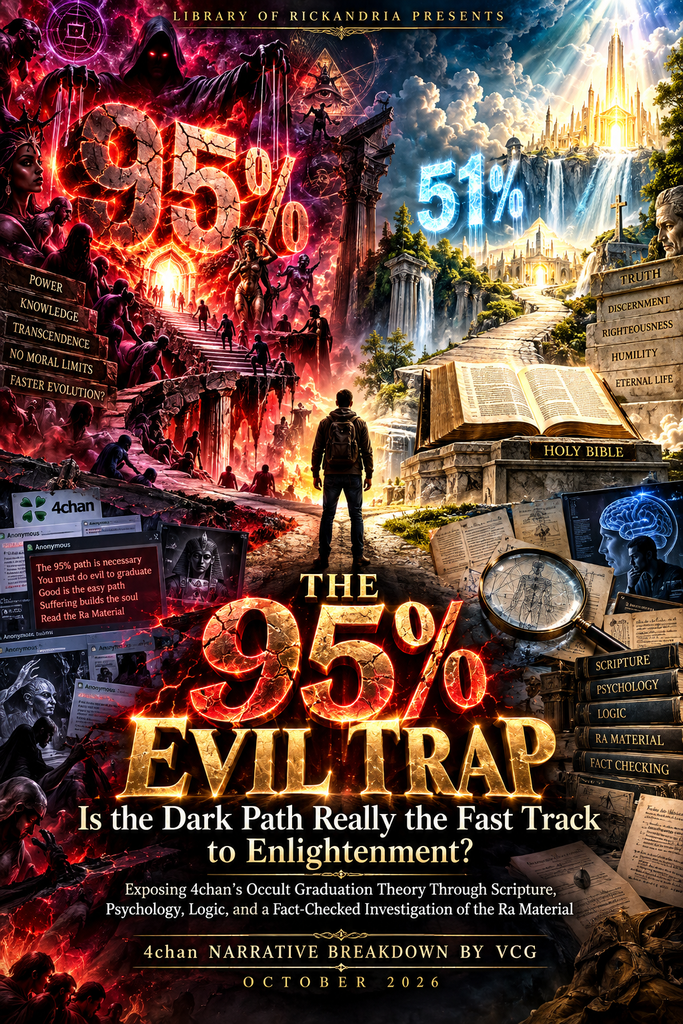
Theatrical-style cover artwork created for this investigation.
Its imagery is symbolic and illustrative, not documentary evidence.
“Prove all things; hold fast that which is good.”— 1 Thessalonians 5:21, King James Version
Abstract
On October 8, 2026, an anonymous user on 4chan’s paranormal board, /x/, asked a deceptively simple question:
if graduating along an evil spiritual path is harder than graduating along a good one, must the harder path offer some superior reward?
/x/ – If it’s harder to graduate on the evil path, then – Paranormal – 4chan
What followed was a conversation about:
- selfishness
- salvation
- occult practice
- demons
- philosophy
- Freemasonry
- Gnosticism
- morality
and the apparent success of wicked people.
Eventually, participants identified the source behind the opening premise:
The Law of One, commonly called the Ra Material, a series of channeling transcripts from the early 1980s.
The resulting discussion raises several legitimate questions.
Does difficulty imply value?
Are spiritual experiences reliable evidence of supernatural claims?
Can good and evil be measured numerically?
Why does cruelty sometimes seem profitable?
And what happens when an alternative spiritual system borrows language associated with Jesus Christ while describing a very different account of salvation?
This investigation examines those questions through:
- primary-source research
- logic
- moral philosophy
- psychology
- historical scholarship
and the King James Bible.
Our purpose is neither to mock the anonymous participants nor to sensationalize occult claims.
It is to determine what was actually said, where the claims originated, what the available evidence establishes, and where biblical teaching agrees or conflicts with the ideas under discussion.
Principal finding:
The opening argument is logically unsound, the Ra system’s percentages lack independently validated measurement, and its account of spiritual advancement differs fundamentally from the New Testament’s account of salvation.
Some concerns raised by the participants—particularly about:
- suffering
- divine justice
- moral authority
—nonetheless deserve serious consideration.
Part I. Entering the Thread
1. The discussion that started everything
4chan /x/ — Paranormal
October 8–9, 2026
Thread No. 43055131
Opening post: October 8 at 03:54, as displayed by 4chan
The original poster suggests that a supposedly harder route to spiritual advancement must possess an advantage that makes the additional effort worthwhile.
/x/ – If it’s harder to graduate on the evil path, then – Paranormal – 4chan
One detail immediately affects how this paper should be read:
the accessible original thread contains 70 distinct posts, including the opening post, not 80.
The previous draft claimed an 80-post audit but duplicated ten entries.
This edition corrects that error.
The appendix examines the 70 posts in chronological order, assigning each unique post number only once.
The board’s timestamps are reproduced as displayed.
They should not be assumed to establish the posters’ geographic locations or time zones.
The opening premise is attractive because it resembles a familiar assumption from ordinary life: valuable achievements require sacrifice.
Difficult training might produce exceptional skill; demanding study might produce expertise; years of discipline might lead to mastery.
But the comparison fails if the destination itself has not been established as worthwhile.
A person can exert extraordinary effort toward a false belief, a destructive purpose, or an unattainable reward.
Difficulty tells us something about cost, not necessarily benefit.
There is an even more basic problem.
The poster has not demonstrated that the two spiritual graduation routes exist.
The question begins inside a metaphysical system and then asks us to accept that system’s assumptions before considering their implications.
That is precisely where our investigation begins.
2. What counts as evidence?
We will distinguish six categories throughout the report.
| Classification | Meaning |
|---|---|
| Textually verified | The source really says what is attributed to it |
| Historically supported | Documents or other reliable records substantiate the historical claim |
| Empirically supported | Relevant observable evidence supports the factual claim |
| Unsupported | Sufficient evidence has not been provided |
| Biblically contradicted | The claim conflicts with an identifiable teaching of the biblical text in context |
| Interpretive or unresolved | The conclusion depends on disputed assumptions, incomplete evidence, or philosophical judgment |
These categories should not be confused.
For example, we can establish that a particular Ra transcript teaches a 95% threshold for negative spiritual polarization.
That establishes the transcript’s content.
It does not establish that the cosmos actually operates according to that threshold.
Similarly, a historian may correctly identify the beliefs of an ancient Gnostic community without endorsing those beliefs.
And a Christian may correctly explain that a teaching contradicts the canonical Gospels without claiming to have scientifically disproved the possibility of all supernatural experiences.
A source can be genuine without being accurate.
A participant can be sincere without being correct.
A statement can resemble biblical language without teaching biblical doctrine.
The method used here is to examine the strongest identifiable primary source first, then compare it with independent evidence and, separately, with Scripture.
3. The research method
The investigation uses four principal evidence streams.
First is the thread itself:
the original 4chan archive, including:
- post IDs
- reply relationships
- images
- timestamps
Second is the source of the disputed theology:
the complete Ra Contact collection, with particular attention to Session 17, where the relevant percentages appear.
Third is outside corroboration:
- scientific research
- historical documents
- philosophical primary texts
- scholarly reference works
Fourth is biblical comparison:
the King James Version supplied for the Library of Rickandria, especially passages concerning:
- salvation
- sin
- moral discernment
- spiritual claims
and the identity of Jesus Christ.
When assessing arguments, we ask what would establish a claim, what evidence might falsify it, and whether alternative explanations have been considered.
When interpreting Scripture, we examine context before drawing theological conclusions.
Where Christian traditions disagree, those disagreements should be acknowledged.
For psychological questions, we examine reasoning patterns without diagnosing anonymous people or claiming to know their private motives.
One important limitation must remain visible:
anonymous forum posts do not necessarily represent stable, sincerely held beliefs.
A participant might be:
- arguing seriously
- joking
- provoking
- impersonating someone else
or experimenting with an idea.
We can analyze the words; we cannot reliably reconstruct the person behind them.
Part II. The Ra Material: The Source Behind the Question
4. Who—or what—is Ra?
The material comes from recorded sessions conducted between 1981 and 1984 by Don Elkins, Carla Rueckert, and Jim McCarty.
According to the participants, Rueckert served as an instrument through whom a nonhuman collective intelligence identifying itself as Ra communicated.
The group recorded 106 sessions on cassette tapes.
These were later transcribed and published, with additional material and corrections incorporated into subsequent editions.
This history is documented by the publishing organization, L/L Research, in its account of the different versions of the Ra Contact.
The distinction is essential:
the recordings and transcripts are historical artifacts.
The assertion that they originated from a genuine nonhuman intelligence is a supernatural claim made within those artifacts.
The materials themselves do not provide independent verification that the claimed speaker existed as described.
The editorial history matters
The early publications omitted some material that the editors regarded as personal, distracting, or transient, including Sessions 104–106.
Later editions restored material and corrected transcription errors through renewed listening to the recordings.
A revised transcript is not automatically evidence of fraud.
Historians routinely work with edited sources.
But investigators must specify which version they have consulted.
For this report, the principal citations use the indexed session texts and the publisher’s documented editorial history.
Primary-source links:
L/L Research, Versions Explained · Law of One, Session Index
5. The two alleged paths
Within the Ra system, spiritual development is described through levels called densities.
The terms service to others and service to self describe two opposed types of polarization.
In Session 17.31, the transcript accepts a threshold of more than 50% orientation toward others for positive fourth-density graduation.
In Session 17.32, it gives a 95% service-to-self requirement for the negative path.
51%
Service to others
Positive fourth-density threshold claimed by Ra
95%
Service to self
Negative fourth-density threshold claimed by Ra
Exhibit 1.
The purported thresholds are represented accurately as textual claims.
They are not scientifically established measurements.
These numbers are the foundation of the discussion, but they already raise difficult questions.
What counts as an act of service?
How is intent weighed against outcome?
Does an act motivated partly by duty and partly by affection count as selfish or altruistic?
What happens when a person helps others while benefiting personally?
The transcript does not establish a publicly testable scoring process that would allow independent researchers to calculate a person’s exact polarization.
This is the first major methodological problem.
The numerical precision exceeds the available empirical precision.
6. The sentence that complicates the entire argument
The thread repeatedly infers that because negative graduation requires 95% dedication, it must be substantially more difficult than positive graduation.
But the primary source is more complicated.
Session 17.33 explicitly compares the difficulty of reaching 51% dedication to others with reaching the negative path’s opposite threshold, describing the attainments as similarly difficult.
At the same time, Session 17.32 calls the negative path demanding and requiring exceptional dedication.
A careful reading therefore yields three conclusions.
First, the source really does claim two different numerical thresholds.
Second, the source does characterize negative polarization as difficult.
Third, it does not follow that negative polarization produces a superior reward, or even that the difference in percentages can be converted directly into a difference in actual difficulty.
The anonymous discussion often treats those three propositions as interchangeable.
They are not.
Another revealing statement appears in Session 17.2, which explicitly denies being able to supply shortcuts to enlightenment.
That statement does not necessarily contradict the existence of two alleged routes within the Ra worldview.
But it undermines the popular suggestion that the text is advertising an easy or superior spiritual shortcut.
And none of this establishes that the density system exists outside the transcripts.
Finding:
The thread’s main premise is at best a disputed interpretation of a disputed supernatural source.
Part III. Can the Ra Claims Survive Independent Examination?
7. The Tunguska test: an extraordinary explanation for a real explosion

File:Tunguska Ereignis-1.jpg – Wikimedia Commons
Exhibit 2. Historical photographs of flattened forest at the Tunguska site.
See NASA’s investigation and archival imagery.
The Ra transcripts contain claims that can be investigated against physical evidence.
One particularly useful example concerns the 1908 Tunguska explosion in Siberia.
On June 30, 1908, an enormous atmospheric explosion flattened extensive areas of forest near the Podkamennaya Tunguska River.
Eyewitnesses reported a brilliant fireball and powerful atmospheric effects.
Later surveys documented widespread tree damage.
This is not paranormal folklore.
It is a well-documented physical event.
In Session 17.3, Don Elkins asks what caused a supposed crater at Tunguska.
Ra attributes the event to a destroyed fission reactor.
In Session 17.4, the explanation becomes more specific:
a malfunctioning device sent by the Confederation was deliberately detonated.
The claim is not simply that a mysterious explosion occurred.
It supplies a specific technological and extraterrestrial explanation.
NASA’s examination of the event instead identifies an atmospheric explosion of a cosmic object, most likely an asteroid.
115 Years Ago: The Tunguska Asteroid Impact Event – NASA
Modern research uses physical modeling, eyewitness evidence, and the recorded pattern of destruction to examine the event.
There is a worthwhile qualification:
a 2007 paper proposed that Lake Cheko might represent a secondary impact crater.
That hypothesis is not equivalent to establishing a confirmed main impact crater, nor does it substantiate a destroyed extraterrestrial reactor.
| Question | Ra explanation | Scientific evidence |
|---|---|---|
| What exploded? | An alleged extraterrestrial device with a fission reactor | Strong evidence favors an incoming cosmic body |
| Was an alien operator established? | Claimed to be associated with the Confederation | No independently confirmed evidence |
| Was there a crater? | The question’s crater premise was accepted | No confirmed main impact crater; secondary-crater hypotheses have been proposed |
| Is the explanation reproducibly established? | No publicly demonstrated test | Physical modeling supports the airburst explanation |
The distinction between these columns matters.
An extraterrestrial technological explanation is an extraordinary hypothesis; it would require evidence of technology, relevant materials, or other corroborating traces that distinguish it from the much better-supported natural explanation.
The Ra account supplies no independently verified physical evidence meeting that standard.
Finding:
The Ra explanation of Tunguska is unsupported by the available scientific evidence and conflicts with the prevailing evidence-based explanation.
This does not logically prove every other passage of the Ra Material false.
It does, however, undermine any assumption that its confident statements about physical history deserve automatic trust.
8. The 2011 harvest: prophecy, possibility, or unfalsifiable prediction?
In Session 17.29, Elkins asks whether the alleged spiritual harvest will occur in 2011 or be spread across a longer period.
Ra treats the date as approximate, referring to a probable or possible time for the event and acknowledging difficulty with human time measurements.
That qualification must be preserved.
It would be inaccurate to claim that the transcript unequivocally predicted a visible worldwide transformation on a specified day in 2011.
Yet the passage still raises a legitimate question: what observable event was the prediction supposed to correspond to?
A researchable prediction requires a reasonably clear definition of what would count as success or failure.
If the harvest is understood as a process entirely invisible to ordinary observation, there may be no practical means of determining whether the event happened.
If any outcome—dramatic transformation, gradual social change, or no visible change—can be interpreted as confirmation, the claim has little empirical testing value.
This is a problem of testability, not necessarily a formal contradiction.
Exhibit 3 — A timeline of the claim
- 1981 — Session 17
The transcript discusses 2011 as an approximate harvest period. - 1981–1984 — The complete Ra contact
The group’s recorded channeling sessions continue, eventually totaling 106. - 2011 — Approximate target period
The asserted harvest does not have an agreed, independently validated observable measurement. - October 2026 — 4chan discussion
Participants still debate spiritual graduation as a meaningful possibility, without establishing that the purported harvest mechanism has been observed.
How should the biblical reader approach this?
Deuteronomy 18:20–22 addresses false prophetic speech in a covenantal setting.
Its principle of accountability is relevant, but we must not simply treat an approximate, internally qualified date as an unqualified prediction.
Likewise, Matthew 24:36 cautions against presuming knowledge of the timing of Christ’s coming.
The Ra harvest and Christ’s return are not necessarily descriptions of the same event.
They are claims belonging to different theological systems.
Finding: The 2011 reference is genuine, but the transcript’s qualifications prevent a simple failed-exact-date verdict.
The alleged harvest remains independently unverified.
9. The strongest defense of the Ra Material
Before proceeding, we should give its defenders a fairer argument than the original thread generally provides.
A careful supporter might respond as follows:
The Ra Material is not recommending evil as morally superior.
It describes two possible forms of polarization within a larger metaphysical reality.
Negative graduation requires extraordinary dedication to self, while positive graduation requires sustained concern for others.
Both allegedly allow further development, but they do not offer identical experiences or ultimate destinies.
Furthermore, the percentages are spiritual descriptions rather than laboratory measurements, and their truth may not be reducible to physical experiments.
This response improves the argument in several ways.
It avoids equating greater difficulty with greater goodness.
It acknowledges the internal distinction between positive and negative polarization.
It also avoids pretending that every metaphysical concept is automatically measurable using ordinary scientific instruments.
But several problems remain.
We still need a reason to believe the claimed densities and harvest mechanisms exist.
We need a principled way to distinguish genuine revelation from mistaken interpretation, imagination, or fabrication.
We need to explain why seemingly precise numerical thresholds are warranted when no publicly validated scoring system exists.
And the account’s disagreement with Christianity remains significant, particularly regarding salvation and the identity of Christ.
The stronger defense therefore rescues the Ra Material from a crude internet caricature. It does not establish its truth.
That distinction is essential in serious apologetics: the goal is not to defeat the weakest possible version of an opposing belief.
It is to examine the strongest defensible version and identify where the evidence still falls short.
Part IV. The Mathematics and Philosophy of the Alleged Spiritual Paths
10. Can the human soul be expressed as a percentage?
The 51% and 95% thresholds create the impression of an objective system.
Numbers are familiar, persuasive, and apparently precise.
We use them to measure:
- temperatures
- distances
- financial returns
- experimental results
It is natural to assume that a teaching expressed numerically must have something measurable behind it.
But measurement requires a defined quantity.
Suppose someone spends a year working as a caregiver.
They may act from:
- love
- duty
- financial necessity
- social expectation
- personal fulfillment
or some combination of those motives.
Which of these counts as service to others?
Which counts as service to self?
Are the two always opposites?
Does the presence of personal satisfaction reduce the moral value of helping another person?
And if someone performs one remarkably charitable act after years of ordinary selfishness, how would the system weight the event?
These questions reveal that the percentages require assumptions about moral psychology that the transcript does not operationalize.
Exhibit 4 — The measurement problem
Claimed measurement
95% STS
A precise figure can be graphically displayed without being empirically validated.

| Necessary question | What the investigation finds |
|---|---|
| What exactly is measured? | Not independently operationalized |
| What is the unit of measurement? | Not established |
| Who performs the assessment? | No publicly validated independent procedure |
| Can different observers reproduce the result? | Not demonstrated |
| Does the result predict measurable outcomes? | Not independently established |
The problem is not that moral reasoning must always be mathematical.
It is that the numerical form itself does not supply the missing evidence.
A useful distinction is between a metaphor, a theological classification, and a scientific measurement.
They may all use numbers, but they are not interchangeable.
11. Does effort indicate value?
Return to the opening post.
The reasoning can be expressed simply:
If the negative path requires more dedication, it must offer a superior benefit; otherwise, a rational person would never choose it.
There are two mistakes here.
The first is assuming that cost determines value.
The second is assuming that human beings consistently choose what actually benefits them.
Neither assumption is defensible as a general principle.
Consider a highly demanding financial fraud.
It might require:
- planning
- secrecy
- technical skill
and years of effort.
That does not make the fraud morally superior to straightforward employment.
Or consider an athlete who trains with an ineffective method.
More training effort does not automatically produce a better result when the underlying method is defective.
Even if a path is genuinely harder, it may be harder because it is inefficient, destructive, or badly designed.
The benefit must be demonstrated independently of the cost.
This is precisely the mistake the original poster makes:
the supposedly difficult nature of evil becomes evidence that evil must contain something unusually valuable.
But no such conclusion follows.
The effort heuristic
A relevant psychological finding comes from Justin Kruger, Derrick Wirtz, Leaf Van Boven, and T. William Altermatt’s 2004 study, The Effort Heuristic.
The researchers examined how perceived production effort influenced judgments of quality and value.
Under certain circumstances, people rated an object more highly when they believed it required greater work to produce.
A later replication reported mixed findings, so the effect should be discussed as a context-dependent tendency, not an infallible law.
The effort heuristic – ScienceDirect
The connection to the thread is suggestive, not diagnostic.
The opening argument resembles an effort-based value judgment.
That resemblance does not establish the author’s actual thought process or psychological motivation.
Research:
Kruger et al., The Effort Heuristic (2004) · Replication assessment
12. Why would someone knowingly choose a harmful path?
One of the more thoughtful replies suggests that the answer lies in short-term versus long-term incentives.
This deserves attention.
A harmful action can appear beneficial when its rewards are immediate and its consequences uncertain, distant, or borne by other people.
The study of delayed gratification and delay discounting addresses part of this problem.
People do not always evaluate immediate and distant rewards identically, and perceived uncertainty can influence that evaluation.
But behavior also depends on circumstances, learned expectations, incentives, social pressures, and moral commitments.
The claim that most human beings simply lack the ability to delay gratification goes beyond what the thread demonstrates.
The Bible treats temptation in a psychologically recognizable way.
James 1:14–15 describes temptation as connected with desire, followed by destructive consequences when desire develops into sin.
Galatians 6:7–9 introduces the contrast between what a person sows and what they eventually reap.
The biblical texts are theological, not experimental studies of human decision-making.
Still, their distinction between immediate attraction and eventual consequence addresses the original argument more directly than the idea that difficulty implies value.
13. What do we mean by evil?
The conversation uses several terms as though they were interchangeable:
| Term | Working distinction |
|---|---|
| Self-interest | Concern for one’s own needs or well-being |
| Selfishness | Excessive prioritization of oneself at the expense of others |
| Self-preservation | Protecting one’s own life or safety |
| Altruism | Acting for another’s benefit, potentially at personal cost |
| Sin | In biblical theology, wrongdoing in relation to God’s moral will |
| Evil | A broad moral category of serious wrongdoing, harm, or corruption |
| Service to self | A technical spiritual category within the Ra system |
| Salvation | In the New Testament, deliverance from sin and its consequences through Christ |
| Enlightenment | A term with significantly different meanings across religious traditions |
A person who eats dinner, seeks medical treatment, protects their family, or earns an honest living is not necessarily pursuing evil because those activities benefit the self.
Likewise, one apparently charitable act does not necessarily reveal a pure motive.
Without clear definitions, the thread risks treating ordinary self-concern, moral wrongdoing, and Ra’s technical category of negative polarization as though they meant the same thing.
The Bible itself offers a more complex picture.
Philippians 2:4 directs concern beyond one’s own interests, while the command to love one’s neighbor as oneself in Mark 12:31 does not require a person to deny every legitimate personal need.
14. Who determines good and evil?
Several replies eventually reach this more fundamental question.
The issue is not only whether the evil path is profitable.
It is whether goodness exists independently of personal preference or claimed supernatural power.
The thread contains versions of three competing ideas:
morality based on personal will, morality grounded in some higher spiritual order, and morality grounded in God.
Each needs careful examination.
If one person declares that whatever they choose is objectively good, their declaration does not demonstrate objective moral authority.
That would merely assume the very authority under dispute.
If someone instead says that power makes right, the position leaves unresolved why the strongest person would be morally entitled to dominate the weak.
And if a Christian says goodness is grounded in God, there remains a theological responsibility to explain God’s character rather than reducing morality to the arbitrary exercise of superior power.
The biblical account consistently associates divine authority with:
- righteousness
- justice
- goodness
See Psalm 145:17, Deuteronomy 32:4, and 1 John 4:8.
This does not remove every philosophical objection to theistic morality.
It does establish that the biblical position is not simply that any action becomes righteous whenever the most powerful being performs it.
Part V. The Psychology of the Dark-Path Narrative
15. The attraction of secret knowledge
The Ra Material presents an expansive explanation of reality involving:
- spiritual densities
- hidden histories
- nonhuman entities
and the ultimate development of consciousness.
Narratives of this kind can feel compelling because they appear to bring unrelated experiences into a single explanatory framework.
A person who feels powerless may find a promise of hidden spiritual ability attractive.
Someone dissatisfied with conventional institutions may value an alternative account claiming to reveal concealed realities.
But these are possibilities, not diagnoses.
Research by Karen Douglas, Robbie Sutton, and Aleksandra Cichocka identifies three broad classes of motivations associated with certain conspiracy beliefs:
the desire to understand, to feel secure or in control, and to maintain a positive sense of identity.
The authors also caution that research does not establish that adopting such beliefs actually satisfies those needs.
Research:
Douglas, Sutton, and Cichocka, The Psychology of Conspiracy Theories (2017)
These findings cannot simply be imposed on every occult belief.
A metaphysical system, a paranormal experience, and a conspiracy theory are different categories, even when they share rhetorical features.
The useful research question is narrower:
how can the appeal of an explanation influence the evaluation of its evidence?
16. Why extraordinary experiences can feel convincing
One participant claims that prayer directed toward demons produced the desired result.
We should not pretend that a brief anonymous report establishes a supernatural cause.
We should also avoid claiming the writer knowingly lied.
The appropriate question is what evidence would distinguish a supernatural intervention from an ordinary coincidence or a misunderstood causal relationship.
Psychologists Fernando Blanco and Helena Matute have studied causal illusions:
circumstances in which people perceive a causal relationship between events even when the observed relationship does not warrant that conclusion.
This work helps explain why experiences can sometimes produce confident beliefs unsupported by adequate evidence.
Research:
Blanco and Matute, The Illusion of Causality (2018)
An adequate investigation of an alleged answered demonic prayer would require more than one successful anecdote.
It would need a pre-recorded request, a specific predicted outcome, a time frame, independent verification, an assessment of how often similar outcomes happen ordinarily, and consideration of unsuccessful attempts.
Even then, an unusual result would not by itself identify a demon as the cause.
The biblical standard is especially relevant here.
Deuteronomy 13:1–4 warns that a sign or wonder does not automatically establish the legitimacy of a religious messenger.
Similarly, 1 John 4:1–3 instructs readers to test claims about spiritual authority.
The Bible’s test is theological rather than laboratory-based.
Both approaches, however, reject the idea that an impressive outcome settles every question about the source.
17. From anonymous claim to assumed authority
A striking progression occurs in the thread.
The opening post begins with an unexplained assumption.
Later comments introduce a diagram.
Other posters debate what the diagram means.
Eventually, someone identifies the Ra Material, and several participants begin treating the numerical thresholds as though they adequately explain the whole matter.
This is a common research problem:
a claim acquires apparent credibility as it passes through increasingly familiar forms.
A number becomes a graphic.
A graphic becomes a talking point.
A talking point becomes an explanation.
The explanation is then repeated without revisiting its original source.
To interrupt this process, researchers can practice lateral reading:
leaving the immediate page to investigate the publisher, trace claims to primary sources, and check independent evidence.
Sarah McGrew’s 2020 study of instruction in civic online reasoning found that students improved on several online evaluation tasks following training in fact-checking strategies.
Research:
McGrew, Learning to Evaluate: An Intervention in Civic Online Reasoning (2020)
In this case, lateral reading led to an important correction:
Session 17.33 complicates the thread’s inference that different percentages necessarily establish greater difficulty.
18. Hostility is not evidence
The thread repeatedly descends into insults about:
- intelligence
- spelling
- mental capacity
- character
There is no reason to reproduce those slurs in detail.
They provide little evidentiary value.
Sometimes the participants make valid points in needlessly hostile language.
At other times, the insult replaces the argument entirely.
The difference matters.
If a poster says that the original premise is unsupported, that could be correct even if the sentence is rude.
Conversely, if someone confidently asserts that they possess the majority of all Masonic literature, confidence does not make the claim verifiable.
We should evaluate the substance independently of the tone.
Proverbs 18:13 warns against answering before hearing, while 2 Timothy 2:24–25 describes patient correction.
Neither passage asks us to abandon rigorous disagreement.
The principle is that truth is not strengthened by unnecessary contempt.
Part VI. Historical and Philosophical Claims Under Examination
19. Max Stirner: Is God an egoist?
Max Stirner (1806–1856) was a German philosopher associated with the Young Hegelians.
His best-known work, The Ego and Its Own, was published in German in 1844, with an 1845 imprint date.
The image shows Friedrich Engels’s satirical drawing of the Young Hegelians, including Stirner.
The thread includes quotations attributed to Stirner, who rejected the idea that individuals must automatically subordinate themselves to supposedly higher causes.
In the opening section of his book, Stirner challenges the notion that a person should devote themselves to God’s cause, humanity’s cause, or the state’s cause, while surrendering ownership of their own life.
The relevant passages are genuine and can be checked against the published English translation.
The Project Gutenberg eBook of The Ego and His Own, by Max Stirner.
The historical attribution is therefore not the central problem.
The real question is whether Stirner’s argument succeeds.
He argues that God pursues God’s own cause, and that human beings should similarly recognize their own interests.
But this treats the supposed interests of a divine being and the interests of human individuals within a common philosophical framework.
A Christian philosopher would challenge that comparison.
Within classical Christian theology, God is not simply a powerful creature competing with other creatures for finite resources.
Divine goodness, creation, and the dependence of creatures upon God complicate the proposed equivalence.
Stirner’s critique may expose hypocrisy among rulers or religious authorities who demand sacrifices from others while serving their own interests.
But it does not, by itself, demonstrate that the Creator described in Scripture is a selfish tyrant.
The biblical comparison includes Deuteronomy 32:4, Psalm 145:17, and 1 John 4:8.
Those passages make claims about God’s righteousness and love.
A critic may dispute whether those claims are credible, but they must first acknowledge what the biblical text actually teaches.
20. Stirner, LaVey, and Aquino: a real connection or a forced genealogy?
One participant equates Stirner’s individualism with ideas later expressed by Anton LaVey’s Church of Satan and Michael Aquino’s Temple of Set.
There are genuine thematic similarities involving self-assertion, opposition to conventional religious morality, and the language of individual autonomy.
The chronology is also straightforward.
Exhibit 5 — Timeline of ideas and movements
- 1844/1845: Stirner’s Der Einzige und sein Eigentum appears.
- 1966: Anton LaVey establishes the Church of Satan.
- 1975: Michael Aquino establishes the Temple of Set following his departure from LaVey’s organization.
- 1981–1984: The Ra channeling sessions are recorded.
Chronological sequence does not, by itself, prove direct philosophical borrowing or doctrinal identity.
The religious differences matter.
The Church of Satan has generally emphasized a non-theistic or symbolic conception of Satan, while the Temple of Set developed a religious framework involving Set as a real divine being.
Stirner’s philosophical egoism is not simply a nineteenth-century version of either movement.
Historical finding:
The comparison is worth examining, but the claim that these traditions are effectively the same ideology overlooks substantial differences.
Sources:
Stirner’s primary text · Temple of Set, Encyclopedia.com
21. Gnosticism and the Archons
The discussion also invokes Archons—ruling powers found in some ancient religious cosmologies associated with Gnostic traditions.
Certain Gnostic accounts distinguish a transcendent divine reality from a lower creator or ruler of the material cosmos.
This lower figure may be portrayed as ignorant, oppressive, or wrongly claiming exclusive divine authority.
That framework provides the background for the thread’s suggestion that resistance to the creator could be spiritually liberating.
But historical precision is necessary.
Gnosticism is a modern umbrella term covering diverse ancient movements, texts, and theological systems.
Scholars have repeatedly questioned whether these different traditions should be treated as one unified religion.
Source:
Oxford Classical Dictionary, “Gnosticism”
A second distinction concerns chronology.
Stirner’s philosophy belongs to nineteenth-century Europe; Gnostic traditions developed in very different ancient settings.
A modern reader can certainly attempt to combine their ideas.
But that synthesis would require argument rather than assuming that the traditions originally taught the same thing.
For biblical comparison, John 1:1–3 identifies the Word as divine and involved in the creation of all things.
Colossians 1:16–17 makes a similarly comprehensive statement about creation through Christ.
These passages are in substantial conflict with interpretations portraying the biblical Creator as an inferior cosmic impostor.
That is a theological comparison, not a historical demonstration that every Gnostic narrative is false.
22. Albert Pike, Morals and Dogma, and claims about Freemasonry
Albert Pike’s Morals and Dogma was published in 1871 and explores philosophical, moral, religious, and symbolic material associated with degrees of the Scottish Rite.
It is a historical work whose contents can be examined directly.
Neither owning it nor reading it demonstrates membership in an occult conspiracy.
View the original title page and edition
The thread’s claims about Pike range from dismissing the book as dull to boasting about possessing an extraordinary proportion of Masonic literature.
Neither position establishes the text’s actual content.
The proper method is to inspect the work’s publication history, specific passages, and historical setting.
A claim that someone possesses 90% of all Masonic books also requires a defined bibliography.
Without specifying what counts as a Masonic publication and presenting the alleged collection, the percentage is unverifiable.
There is a broader problem here.
Esoteric subject matter can become a substitute for evidence.
Merely invoking a secret society may give an argument an atmosphere of hidden significance, even when the claim being made is ordinary, exaggerated, or unsupported.
That atmosphere should not influence the evidentiary standard.
23. The inverted triangle: an example of symbol overinterpretation
One participant becomes convinced that an inverted triangle must represent something more than its familiar associations with water or feminine symbolism.
Here, unlike many of the supernatural claims, we can identify at least one well-documented historical use.
▽
The downward-pointing triangle is used in alchemical notation to represent water.
Unicode also encodes the related alchemical water symbol, 🜄, as U+1F704.
Source:
Unicode’s official alchemical-symbol chart
This does not mean every downward-pointing triangle has always meant water.
Symbols depend upon their:
- culture
- date
- medium
- surrounding context
A triangular road sign, an alchemical diagram, a religious ornament, and a mathematical symbol can share a geometric form without sharing a hidden doctrine.
The research mistake is moving from this form has been used symbolically to every appearance conceals the same secret meaning.
The latter conclusion requires evidence not present in the thread.
24. Does the Ra Material agree with Buddhism?
A participant suggests that Ra’s account generally aligns with Buddhism.
There are understandable reasons someone might perceive similarities: both systems speak about spiritual development, consequences of conduct, and movement beyond ordinary experience.
But resemblance does not imply equivalence.
A central Buddhist teaching is anātman, or not-self, which challenges the notion of a permanent, independent personal essence.
Buddhist traditions differ in their philosophical explanations, yet this doctrine creates significant difficulties for any simple equation between Buddhism and a system centered on the development of an enduring self through increasing polarization.
Source:
Stanford Encyclopedia of Philosophy, “Mind in Indian Buddhist Philosophy”
Moreover, the 95% service-to-self graduation rule has not been established as a standard Buddhist doctrine.
The fairest conclusion is that the two systems may share selected ethical themes while differing in metaphysics, terminology, and ultimate goals.
25. Animal suffering: a moral challenge that deserves evidence
Late in the thread, a participant objects to human cruelty toward animals.
Here we encounter an important claim that is broadly accurate in quantitative terms.
According to FAO data presented by Our World in Data, approximately 78.53 billion chickens were slaughtered for meat worldwide in 2024, alongside billions of other farm animals.
Yearly number of animals slaughtered for meat, 1961 to 2024
EXHIBIT 6 · ANIMAL AGRICULTURE, 2024
78.5 billion
Chickens slaughtered for meat worldwide
FAO figures via Our World in Data.
This number does not include animals killed in every other agricultural context.
Open the full species-by-species data
The number is substantial and relevant to any serious ethical discussion of animal welfare.
But the additional assertion that every animal suffered mistreatment throughout its entire life would require evidence about particular farming systems, welfare conditions, and populations.
Most importantly, wrongdoing against animals does not establish that cruelty toward human beings is justified.
A criticism of one moral failure cannot logically excuse another.
Biblically, Proverbs 12:10 associates righteousness with concern for animals.
Genesis 9:3 permits the consumption of animal food within its covenantal context.
Christian ethical interpretations of modern animal farming vary.
But the texts do not establish that animals are unworthy of humane treatment.
Part VII. The Other Jesus: Testing the Ra Narrative Against Scripture
26. Why Christology is central to this investigation
The deepest disagreement is not between two sets of moral percentages.
It concerns the identity of Jesus Christ.
The Ra Material uses Jesus as an important spiritual figure within its own cosmic history.
But it places him within a system of densities, reincarnation-like spiritual development, karma, and evolving consciousness.
The canonical New Testament presents him differently:
as the divine Word made flesh, the Messiah, the crucified and risen Lord, and the one through whom salvation is proclaimed.
Those differences cannot be resolved by noting that both systems speak favorably about love.
We have to examine what each means.
27. Was Jesus a fourth-density wanderer?
In Session 17.11–17.12, the Ra transcript describes Jesus through the system of densities and wanderers, including a correction from fifth density to fourth.
Notice that the transcript itself records an adjustment to its initial answer.
This is relevant to evaluating the claimed source’s reliability.
A correction does not automatically prove fabrication, but the passage should not be quoted as though it contained one unqualified original statement.
Now compare the canonical account.
John 1:1–14 opens with the Word’s existence and relationship to God, identifies the Word with divine creative activity, and describes the Word becoming flesh.
Colossians 2:9 states:
For in him dwelleth all the fulness of the Godhead bodily.
The mainstream Nicene Christian interpretation understands Jesus as truly divine and truly human, not simply an advanced creature ascending through spiritual categories.
Some historical Christian groups have interpreted Christology differently, so the phrase mainstream Nicene Christianity is important.
Yet the canonical texts themselves plainly place Jesus at the center of creation and redemption, not merely within Ra’s ranking system.
Theological verdict: The Ra account is incompatible with Nicene Christology.
28. The disturbing childhood narrative
The most striking historical claim appears in Sessions 17.19–17.20.
There the transcript describes Jesus as a child who, in anger, fatally injured another child through extraordinary power, later learning to use that power positively.
That account is not found in:
- Matthew
- Mark
- Luke
or John.
We must be precise about what this establishes.
An event’s absence from the canonical Gospels does not, by itself, prove the event impossible.
The Gospels do not claim to record every moment of Jesus’ childhood.
However, Hebrews 4:15 describes Christ as without sin.
1 Peter 2:22 similarly affirms his sinlessness.
The Ra account associates the childhood death with Jesus’ anger and his discovery of a destructive potential.
That presents a serious conflict with the canonical portrayal, especially if the episode is understood as culpable wrongdoing.
An earlier literary parallel: the Infancy Gospel of Thomas
This is where historical source criticism becomes especially interesting.
The noncanonical Infancy Gospel of Thomas contains stories of the young Jesus displaying extraordinary power, including punishment miracles in which children are harmed or killed.
Its various textual traditions are the subject of substantial scholarly research.
The text should not be confused with the Coptic Gospel of Thomas found at Nag Hammadi.
A critical translation by early-Christianity scholar Tony Burke provides access to the childhood narratives.
See The Childhood of the Saviour: Infancy Gospel of Thomas.
This resemblance raises a historical question: did the Ra narrative reproduce, transform, or indirectly reflect earlier Christian apocryphal traditions?
That is a plausible research question.
It is not proof of direct literary borrowing, because similarity alone does not establish transmission.
What we can say is that the general idea of a youthful Jesus harming another child did not originate with the twentieth-century Ra transcripts.
Three different source categories
| Source | Status | What it contributes |
|---|---|---|
| Canonical Gospels | Foundational Christian scriptural texts | Account of Jesus’ life and ministry within the New Testament canon |
| Infancy Gospel of Thomas | Ancient noncanonical Christian literature | Expanded childhood narratives, including punitive miracles |
| Ra Session 17 | Modern channeling transcript | An alternative metaphysical childhood story |
These sources do not have equivalent historical provenance, theological status, or evidentiary weight.
29. The crucifixion and salvation
Ra’s account places Christ’s life and death within a broader spiritual system involving lessons, karma, and spiritual polarization.
In Session 17.20, the transcript relates Jesus’ crucifixion to the resolution of karmic consequences.
The New Testament presents a markedly different explanation of the cross.
Mark 10:45 associates Christ’s mission with giving his life as a ransom.
1 Corinthians 15:3–4 summarizes the apostolic proclamation of Christ’s death for sins, burial, and resurrection.
Hebrews 9:26–28 interprets his death as a decisive sacrificial act concerning sin.
Christian traditions differ over the precise theological mechanism of atonement.
For example,
- ransom
- satisfaction
- penal substitution
and Christus Victor approaches emphasize different aspects of the saving work of Christ.
But none of those major approaches treats salvation as simply crossing a 51% altruism threshold.
The contrast between spiritual scoring and grace is especially clear in Ephesians.
For by grace are ye saved through faith; and that not of yourselves: it is the gift of God: Not of works, lest any man should boast.
Verse 10 immediately describes believers as created in Christ Jesus unto good works.
That sequence matters.
The text does not dismiss moral conduct.
It places good works in relation to God’s saving action, rather than making them a numerical admission fee into a higher density.
30. The return of Jesus
Session 17.22 associates the return of Christ with others possessing the relevant consciousness at the time of harvest.
In the New Testament, Acts 1:9–11 speaks of the same Jesus returning.
Mainstream Christian traditions disagree over many aspects of eschatology:
the millennium, the tribulation, the sequence of events, and the interpretation of apocalyptic symbols.
But the identification of the returning Christ as Jesus himself is not equivalent to the general appearance of spiritually similar persons.
The two systems therefore diverge on another central theological claim.
31. Ra’s portrayal of Yahweh
In Session 17.17, Ra discusses negatively oriented influences associated with information described using the name Yahweh.
This passage needs care because the broader Ra corpus contains its own complicated narrative about Yahweh, other entities, and alleged distortions of religious teaching.
We should not compress all of those claims into the assertion that every use of Yahweh in the Ra text always refers to the same role.
Nevertheless, the contrast with the Bible remains significant.
Isaiah 45:5 presents the LORD as uniquely God.
John 1:3 attributes the creation of all things to the Word.
James 1:17 describes God as the source of good gifts.
The biblical witness does not portray the Creator as merely one morally compromised authority competing among a hierarchy of cosmic administrators.
Theological verdict:
The Ra framework and the canonical biblical account of God operate with substantially different concepts of divine identity and authority.
32. The central doctrinal comparison
| Question | Ra framework | Canonical Christian teaching |
|---|---|---|
| Who is Jesus? | An advanced being described through densities | The incarnate Word; John 1:1–14 |
| What is spiritual progress? | Polarization and development through densities | Sanctification and life in Christ; Romans 6 |
| How is graduation determined? | Claimed 51% or 95% thresholds | No such numerical salvation rule |
| How is salvation received? | Framed within harvest and polarization | Salvation by grace through faith; Ephesians 2:8–10 |
| What does the cross accomplish? | Discussed using karmic and spiritual-development concepts | Christ’s saving work concerning sin; Hebrews 9 |
| Who returns? | Others associated with Christlike consciousness at harvest | The same Jesus; Acts 1:11 |
| What is the standard for spiritual claims? | Authority attributed to the channeled source | Testing teachings, prophets, and spiritual claims; 1 John 4:1 |
This table records differences between two identifiable religious systems.
It is not a scientific demonstration that every Christian doctrine is true or that every supernatural experience attributed to Ra is impossible.
The proper conclusion is more precise: someone cannot simply adopt the Ra account of Jesus and present it as an unmodified expression of the canonical New Testament.
Part VIII. Does the Bible Teach That the Harder Way Is Better?
33. The narrow gate: Matthew 7 in context
One participant cites Jesus’ teaching about the narrow way.
The most relevant passage is Matthew 7:13–14:
Enter ye in at the strait gate:
for wide is the gate, and broad is the way, that leadeth to destruction, and many there be which go in thereat:
Because strait is the gate, and narrow is the way, which leadeth unto life, and few there be that find it.
The immediate context is the Sermon on the Mount.
The wider passage concerns:
- obedience
- moral discernment
- false prophets
- spiritual fruit
and the contrast between those who hear Christ’s words and do them and those who do not.
We should not treat the narrow road as simply the path with the greatest amount of suffering.
In Matthew 7, the destination and relationship to Christ’s teaching are central.
That makes the passage directly relevant to the thread’s confusion.
Difficulty is not inherently proof of righteousness.
The narrow path is associated with life because of where it leads and what it involves, not because hardship itself possesses saving power.
34. Good works, grace, and the danger of turning salvation into a score
Suppose a person becomes convinced that eternal life requires reaching a measurable percentage of altruistic behavior.
Several consequences might follow.
They could begin treating relationships as opportunities to earn points.
They might become anxious over the exact purity of their intentions.
They could also confuse socially useful conduct with reconciliation to God.
The New Testament emphasizes genuine moral transformation, but it does not provide a spiritual spreadsheet.
Romans 3:23–26 discusses sin and justification.
Ephesians 2:8–10 describes salvation through grace and the place of good works.
James 2:14–26 insists that professed faith without corresponding action is inadequate.
Christian traditions differ on precisely how:
- justification
- faith
- works
- sacramental life
relate to one another.
- Protestants
- Catholics
- Orthodox Christians
do not express every element in identical terms.
But those traditions do not teach the Ra system’s 51% and 95% fourth-density requirements.
35. Can supernatural power establish truth?
Another major thread assumption is that access to extraordinary power would validate a spiritual path.
Yet the Bible repeatedly distinguishes power from righteousness.
Matthew 7:21–23 describes people appealing to extraordinary religious works while receiving Christ’s rejection.
Deuteronomy 13:1–4 warns against following rival gods even when impressive signs are claimed.
1 John 4:1 begins with the instruction:
Beloved, believe not every spirit, but try the spirits whether they are of God…
These passages do not establish the identity of any particular supernatural experience described on 4chan.
They establish the internal biblical principle that claims to spiritual authority must be examined rather than accepted on the basis of spectacle.
36. Why do wicked people appear to prosper?
Of all the objections in the thread, this one deserves perhaps the greatest theological attention.
A skeptical participant observes that evil people sometimes appear to succeed in life.
They may acquire wealth, status, influence, or physical security while more conscientious people suffer.
That observation should not be dismissed.
The Bible itself wrestles with precisely this problem.
In Psalm 73, the psalmist observes the prosperity of the wicked and experiences serious spiritual conflict.
Ecclesiastes 8:11–14 describes the moral difficulty created by delayed judgment and apparent inequalities of fortune.
Jeremiah 12:1 asks why the way of the wicked prospers.
The Book of Job challenges simplistic explanations that equate suffering with wrongdoing or prosperity with righteousness.
The biblical writers do not pretend that every act of wickedness results in immediate public punishment.
This is particularly important when considering claims about judgment and the afterlife.
Christian traditions differ on the final nature and duration of punishment.
Eternal conscious punishment, conditional immortality or annihilationism, and various forms of Christian universalism are debated in historical and contemporary theology.
These disagreements should not be hidden under the claim that every Christian interpreter reaches precisely the same conclusion about hell.
What is broadly shared in orthodox Christian theology is the importance of divine justice and accountability.
But the claim that divine judgment ultimately occurs is a theological assertion.
We should not present it as though researchers had directly observed every person’s postmortem destiny.
The skeptic’s evidentiary objection deserves that acknowledgment.
At the same time, lack of access to the ultimate outcome does not prove that injustice is morally preferable.
It simply leaves certain theological claims outside ordinary empirical verification.
37. Does evil offer greater power?
The New Testament asks a question that directly challenges the OP’s assumptions.
In Matthew 16:26, Christ asks what profit there is in gaining the whole world while losing one’s soul.
The passage does not deny the attractiveness or potential reality of worldly gain.
It questions the judgment that treats such gain as the highest good.
The difference between possessing power and possessing goodness is critical.
Power describes capacity.
Moral value concerns how capacity is used, what purposes it serves, and whether those purposes are righteous.
A person may be powerful and just, powerful and cruel, or powerless yet virtuous.
The mere acquisition of power does not settle the moral question.
38. The KJV translators and the virtue of disciplined uncertainty
One of the most fitting historical statements for this entire investigation comes from the translators of the King James Bible.
In The Translators to the Reader, included in the edition supplied to the Library of Rickandria, they discuss how difficult readings should be handled and why uncertainty should sometimes be acknowledged.
They cite the principle:
It is better to make doubt of those things which are secret, than to strive about those things that are uncertain.
A parallel form can be examined in the 1611 translators’ preface.
The authors were discussing questions about translation and interpretation, not conducting a modern investigation of channeling or paranormal claims.
We should not pretend otherwise.
Still, the scholarly virtue they commend—avoiding excessive certainty where the evidence does not warrant it—is directly applicable.
That principle allows us to reject contradictions, identify weak arguments, and acknowledge uncertainty without treating all claims as equally plausible.
It is a more demanding standard than either automatic acceptance or automatic ridicule.
Part IX. Tracing the Source of the Source
39. A nineteenth-century connection: Oahspe
The source trail reveals something easily missed in the 4chan argument.
The idea of a positive service threshold was not introduced in Session 17 as an entirely new revelation originating independently with Ra.
In Session 17.31, Don Elkins explicitly refers to an earlier book called Oahspe while asking about the service-to-others requirement.
Oahspe:
A New Bible was published in 1882 under the name of John Ballou Newbrough, an American dentist involved in Spiritualism.
Newbrough attributed the writing to supernatural agency through automatic writing.
This does not prove that every aspect of Ra’s system came from Oahspe.
Nor does it mean the negative 95% threshold was necessarily copied from that work.
It establishes a narrower but important point:
the participants in the Ra sessions were already familiar with earlier Spiritualist literature, and Elkins explicitly brought one of those texts into the discussion.
Exhibit 7 — The documented transmission pathway
1882 · Oahspe
Earlier Spiritualist text attributed to John Ballou Newbrough
1981 · Ra Session 17.31
Don Elkins explicitly asks about a threshold described in Oahspe
October 2026 · 4chan /x/
Participants debate a diagram presenting positive and negative polarization thresholds
This shows documented references and thematic transmission, not proof of an unbroken exclusive chain of textual borrowing.
The 1882 book can be examined through the Internet Sacred Text Archive, with a historical copy listed in Google Books.
This matters because it shifts the evidentiary question.
Instead of starting with a mysterious numerical law allegedly revealed from beyond Earth, we can establish part of the concept’s literary and religious background.
A claimed revelation is not strengthened merely because similar ideas appear in multiple texts, particularly when the later text explicitly references the earlier one.
Part X. The Complete 70-Post Thread Audit
The following appendix preserves the original post sequence.
Every post number is unique, and each links to the corresponding entry in the original thread.
This is an argument-focused audit rather than a verbatim republication.
Offensive language is summarized where its exact wording contributes nothing to the research.
Image attachments are noted when the text would otherwise be incomplete.
The thematic chapters above provide the fuller historical, psychological, and biblical reasoning behind the shorter findings here.
October 8, 2026 — The opening argument and early responses
| Post | Claim or contribution | Researcher’s assessment |
|---|---|---|
| 1. #43055131 | Evil graduation must offer greater value if it requires more effort. | Invalid inference. Difficulty does not establish benefit. The existence of the graduation system has not been demonstrated. See Proverbs 14:12 and Matthew 16:26. |
| 2. #43055221 | An image about doing one’s best accompanies a brief response. | The image may evoke personal effort, but it provides no evidence regarding the spiritual paths. No substantial doctrinal assertion needs refutation. |
| 3. #43055250 | Immediate rewards help explain harmful choices. | Psychologically plausible, although the claim about most people’s inability to delay gratification is unsupported as stated. See James 1:14–15. |
| 4. #43055561 | Personal insult replaces substantive response. | No counterevidence is supplied. The preceding claim stands or falls independently of the speaker’s character. |
| 5. #43056501 | Turning the other cheek is mocked as foolish dependence on future reward. | The objection assumes nonretaliation has no present moral value. Matthew 5:38–48 should be read in its context of resisting revenge and loving enemies. |
| 6. #43056530 | Resisting grace supposedly produces misery despite possible supernatural power. | The moral warning resembles Christian teaching, but the specific promise of occult powers is unsupported. Compare John 8:34–36. |
| 7. #43056565 | An ominous statement about the person being fuel accompanies a video link. | The statement is rhetorically dramatic but lacks an identifiable evidentiary argument. The linked video would require separate examination. |
| 8. #43056602 | A response attacks another participant’s spelling. | Spelling ability does not determine whether a proposition is true. |
| 9. #43056645 | An image quotes Max Stirner on higher powers. | Historically traceable. The quotation reflects Stirner’s work; it does not establish the truth of his philosophical conclusions. |
| 10. #43056665 | Resistance may involve effort without worthwhile gain. | A valid counterexample to the OP. Hardship may be pointless or destructive. |
| 11. #43056672 | A sailing image accompanies an affirmative reply. | The image can symbolize indirect movement against resistance, but cannot demonstrate a spiritual graduation mechanism. |
| 12. #43056710 | Occult practice is criticized as a shortcut sought by greed or laziness. | It is reasonable to question unearned-reward promises, but attributing one motive to all occult practitioners is an unjustified generalization. |
| 13. #43056716 | The writer asks whether Stirner’s egoism can be used against Gnostic Archons. | This combines two distinct philosophical and religious frameworks. The possibility of using the ego as a spiritual weapon is unsupported. |
| 14. #43056737 | Economic inequality and genetics are invoked against advice to improve oneself. | Structural inequality and genetic influence are real research topics; neither establishes that personal development is universally futile. |
| 15. #43056741 | Another insult replaces engagement with the previous claim. | It contributes no evidence regarding the economy, heredity, or individual agency. |
| 16. #43056758 | Stirner is compared to LaVey and Aquino; God is called an egoist. | The philosophical comparison is debatable, the historical movements are distinct, and the proposition about God is not established. |
| 17. #43056766 | A participant reports that prayer to demons worked. | Unverified testimony. No identifiable outcome, control condition, independent record, or causal evidence is supplied. |
| 18. #43056798 | Both spiritual paths can allegedly be used while remaining friendly with Jesus. | This proposes a form of syncretism. It conflicts with the New Testament’s warnings about divided religious allegiance in 1 Corinthians 10:20–21. |
| 19. #43056802 | An unspecified event is said to be approaching. | Not testable as stated. No event, deadline, or observable condition is provided. |
| 20. #43056803 | Another participant asks what is approaching. | An appropriate request for clarification. |
| 21. #43056806 | A writer claims supreme creative and moral authority, alongside extraordinary influence over distant individuals. | The claims lack independent corroboration. A declaration of authority does not establish it; no mental-health conclusions should be drawn from the post alone. |
| 22. #43056807 | A hostile demand for further explanation appears. | The request for specificity is reasonable; the insult adds no evidentiary value. |
| 23. #43056813 | A brief expression of laughter. | A reaction rather than a testable claim. |
The early discussion is dominated by ethical intuitions, personal insults, and assertions about power.
Neither the Ra percentages nor the metaphysical mechanism has yet been adequately explained.
October 8 — Egoism, moral authority, and esoteric literature
| Post | Claim or contribution | Researcher’s assessment |
|---|---|---|
| 24. #43056817 | A sarcastic reference to contemporary lightworkers. | Ridicule communicates skepticism but supplies no explanation of the extraordinary claim it targets. |
| 25. #43056826 | Older spiritual movements are remembered as more entertaining. | An anecdotal cultural comparison, not historical evidence. |
| 26. #43056915 | A Gnostic interpretation of the material world’s creator is connected with Stirner’s egoism. | A real theological motif is invoked, but traditions differ. It conflicts with the canonical portrayal of the Creator. |
| 27. #43057172 | Evil is contrasted with getting what one desires; good with learning to desire rightly. | A valuable distinction between gratification and moral transformation. Compare Romans 12:2 and Ezekiel 36:26. |
| 28. #43057245 | An image suggests cosmic indifference or nihilism. | Expressive imagery is not an argument establishing the absence of meaning. |
| 29. #43057257 | The left-hand path is called easy and the right-hand path difficult, accompanied by a confession of Christ’s kingship. | The theological sentiment resembles Matthew 7, but the simplified occult-path terminology does not precisely represent biblical categories. |
| 30. #43057362 | The writer questions who determines right conduct. | A legitimate metaethical issue. It requires a theory of moral authority rather than an appeal to personal preference alone. |
| 31. #43057409 | Another participant requests a definition of right and wrong. | A productive demand for conceptual clarity. |
| 32. #43057574 | Deliberately choosing hell is likened to desiring suffering. | It assumes that a sinner consciously intends eternal punishment. Christian accounts distinguish intention, ignorance, culpability, and judgment. |
| 33. #43057591 | The supposed evil path is compared to searching through useless or deceptive information. | This questions the informational value of the pursuit, but does not demonstrate that every associated claim is false. |
| 34. #43057611 | A joke imagines possessing an absurd number of copies of Pike’s book. | Rhetorical exaggeration, not a documented bibliographic claim. |
| 35. #43057621 | The writer objects to someone speaking for everyone. | A valid caution against unjustified universal claims. |
| 36. #43057626 | Pike’s Morals and Dogma is characterized narrowly as instruction about worship. | The description oversimplifies a wide-ranging historical work. |
| 37. #43057639 | Escalating cruelty is presented as the consequence of following evil. | The moral danger is understandable, but the imagined progression is not shown to be inevitable. The post ends with abusive language that is unnecessary to its argument. |
| 38. #43057649 | Animal suffering is invoked to justify hostility toward humans. | The scale of animal slaughter is genuine, but suffering inflicted on animals does not justify wrongdoing toward people. |
| 39. #43057673 | The question of moral right and wrong is raised again. | A substantive philosophical issue, still unresolved in the discussion. |
| 40. #43057694 | A claim of owning approximately 90% of Masonic books. | Unverifiable without an inventory and clearly defined population of books. |
| 41. #43057698 | Hostile commentary about the collection. | No evidence is offered about the collection’s contents or significance. |
| 42. #43057788 | A joke that any worthwhile library needs a section for coping. | Humor rather than a verifiable historical assertion. |
| 43. #43057917 | Evil is described as eternally burdened by itself. | A moral or theological proposition. Compare Romans 6:23; the comment does not empirically establish eternal consequences. |
By this stage, the thread has moved far from the OP’s original inference.
The discussion now contains at least three independent questions:
whether morality is objective, whether spiritual claims can be trusted, and whether philosophical rebellion produces genuine freedom.
Those questions should not be treated as interchangeable.
October 8 — Symbols, evidence, and the prosperity of evil
| Post | Claim or contribution | Researcher’s assessment |
|---|---|---|
| 44. #43058036 | The writer requests information about a particular symbol. | A legitimate historical research question, provided the symbol and its context can be identified. |
| 45. #43058049 | A distinction is drawn between abstract symbols and graphic representations. | Useful methodological clarification. |
| 46. #43058053 | The writer asks which mark is being discussed. | An appropriate demand for specificity before interpretation. |
| 47. #43058082 | The inverted triangle is suspected of possessing an undisclosed meaning. | The known alchemical water association is documented; additional meaning requires contextual evidence. |
| 48. #43058180 | A catalogue of possible symbolic associations is supplied. | Without a precise bibliographic source, the list cannot establish the meaning of the particular symbol under discussion. |
| 49. #43058184 | The writer reports that Freemasons have jokingly referred to threats against families over secrets. | An anecdote that cannot substantiate a broader allegation of organized coercion without independent evidence. |
| 50. #43058185 | Confusion is expressed about the symbolic catalogue. | Reasonable: terminology without provenance or explanation is not helpful research. |
| 51. #43058388 | A difficult road to safety is contrasted with an easy road to danger. | Sound logical counterexample. The correct destination matters more than the convenience of reaching it. |
| 52. #43058418 | The writer questions whether evil really leads to punishment when wicked people visibly prosper. | A serious objection. Psalm 73, Job, and Ecclesiastes acknowledge apparent injustice without claiming immediate punishment is universal. |
| 53. #43058424 | Wordplay involving a term in the symbolism list. | No substantive factual claim. |
| 54. #43058430 | Another joke involving the same symbolic vocabulary. | No doctrinal rebuttal required. |
| 55. #43058455 | The Ra framework is explicitly invoked, with a 51%/95% diagram. | The thresholds accurately reflect the transcripts as claims, but not established reality. Session 17.33 complicates the assertion about greater difficulty. |
| 56. #43058503 | The biblical path to life is described as harder than the path to destruction. | Broadly compatible with Matthew 7:13–14, though the participant’s wording is a paraphrase and not the complete passage. |
| 57. #43058517 | The writer argues that life needs a purpose beyond money or romantic relationships. | A worthwhile ethical point, but pursuing ordinary financial security or companionship is not automatically monstrous. |
| 58. #43058524 | Earlier comments and the polarization diagram are cross-referenced. | No separate argument is stated. |
The actual image used in the thread
The graphic posted with #43058455 can be inspected directly:
The original diagram is available as a direct image from the 4chan thread.
It represents a spiritual classification through a magnetic analogy; it does not establish a physical relationship between iron magnetization and moral character.
October 9 — The underlying source becomes explicit
| Post | Claim or contribution | Researcher’s assessment |
|---|---|---|
| 59. #43058616 | The OP’s assumptions are criticized without identifying the precise error. | The conclusion may be defensible, but the hostile response does not show why. |
| 60. #43058633 | A participant recommends examining the Ra Material. | A crucial source-identification step. The text can now be checked directly. |
| 61. #43058642 | The polarization diagram is questioned, and Matthew 7 is cited. | The challenge to the graphic’s iron analogy is reasonable. The poster also correctly distinguishes the biblical narrow-way teaching from the OP’s premise. |
| 62. #43058648 | Two earlier posts are cross-referenced. | No independent factual assertion. |
| 63. #43058660 | The diagram’s percentages are interpreted as personal benefit or loss ratios. | A misunderstanding of the Ra framework’s intended use of the numbers. |
| 64. #43058671 | The intended meaning of the 51% and 95% thresholds is explained. | Textually accurate in broad terms. The percentages refer to claimed orientation toward others or self, not quantified personal benefit. |
| 65. #43058777 | The writer tries to formulate the opposing claim fairly before evaluating it. | A strong methodological move. The question about whether greater difficulty comes from Ra or merely from the diagram leads directly to Session 17.33. |
| 66. #43058799 | The negative route is described as harder solely because 95 exceeds 51. | An oversimplification that ignores the source’s qualification about the difficulty of the respective thresholds. |
| 67. #43058832 | The Ra account is compared favorably to Buddhism, while concern is raised that knowledge of the negative path might tempt people. | The comparison with Buddhism is insufficiently supported, but the ethical question about how information can influence conduct is legitimate. |
| 68. #43058885 | Withholding knowledge of negative graduation is described as lying by omission. | Omissions can deceive, but not all nondisclosure is dishonest. The reasoning also presupposes that the alleged spiritual knowledge is true. |
| 69. #43058929 | An extreme numerical claim is made about selfish motives across humanity. | No representative evidence supports the population estimate. Accusing dissenters of projection does not validate the claim. |
| 70. #43059180 | The final participant questions whether Ra supplied every possible item of information. | An effective challenge to the earlier omission argument. It also exposes the absence of a reliable method for judging the completeness of alleged revelation. |
The thread ends without resolving whether the Ra worldview is true, whether the numerical thresholds describe anything measurable, or whether the negative route is actually preferable.
That unresolved ending is instructive.
Many participants debate what would follow if the system were real.
Far fewer establish reasons to believe the system itself.
Part XI. Evidence Ledger and Final Findings
40. What has actually been established?
A good investigation should not end with a dramatic accusation.
It should leave the reader able to distinguish what has been established from what remains uncertain.
The following ledger records the principal claims examined in this report, the relevant evidence, and the limits of our conclusions.
| Claim | Finding | Principal source |
|---|---|---|
| The thread began on October 8, 2026 | Verified | Original thread |
| The accessible thread contains 70 unique posts | Verified by chronological enumeration | Original thread |
| Ra describes a 51% positive threshold | Textually verified | Session 17.31 |
| Ra describes a 95% negative threshold | Textually verified | Session 17.32 |
| The negative path must be more valuable because its threshold is higher | Unsupported and logically invalid | Session 17.33 |
| The 51% and 95% numbers have been validated as measurements of human spirituality | Not established | Ra source material |
| Ra offers a guaranteed shortcut to enlightenment | Inconsistent with an explicit statement in the source | Session 17.2 |
| Ra correctly identifies an extraterrestrial reactor as the cause of Tunguska | Unsupported; conflicts with the prevailing physical explanation | Ra 17.3–17.4 · NASA |
| Ra discusses 2011 as an approximate harvest period | Textually verified; purported event remains unverified | Session 17.29 |
| Ra describes Jesus as an advanced wanderer | Textually verified; incompatible with Nicene Christology | Sessions 17.11–17.12 · John 1 |
| Ra attributes a childhood death to Jesus | Textually verified; historically uncorroborated | Sessions 17.19–17.20 |
| Earlier noncanonical childhood narratives attribute harmful miracles to Jesus | Historically verified as literary content | Oxford Bibliographies |
| Stirner argued against submission to higher causes | Historically verified | Stirner’s original work |
| Ancient Gnostic traditions presented differing creator cosmologies | Historically supported | Oxford Classical Dictionary |
| The inverted triangle can represent water in alchemical notation | Verified | Unicode chart |
| Approximately 78.5 billion chickens were slaughtered for meat in 2024 | Supported by FAO data | Our World in Data |
| An individual anonymous poster demonstrated that prayer to demons caused a desired result | Not established | Post #43056766 |
| The Bible teaches salvation by numerical spiritual polarization | Biblically contradicted | Ephesians 2:8–10 |
No single item resolves every question about religion, consciousness, morality, or the supernatural.
Together, however, these findings reveal the central weaknesses of the original argument.
41. The major corrections made during the investigation
Scholarly integrity requires acknowledging mistakes in our own research as carefully as we identify mistakes in other people’s claims.
This edition corrects four important issues from the earlier breakdown.
First, the post count:
the earlier draft described 80 posts but repeated ten entries.
The present edition identifies 70 distinct posts, without padding the total.
Second, the Ra citation references: the relevant Jesus passages in Session 17 concern his purported density at 17.11–17.12, the childhood incident at 17.19–17.20, and his return at 17.22. Earlier references to other portions of the session were inaccurate.
Third, the Tunguska evidence:
it would be too categorical to say that no crater has ever been proposed.
The accurate statement is that no main impact crater has been confirmed, although secondary-crater hypotheses have appeared in scientific literature.
Those hypotheses do not establish a nuclear device of extraterrestrial origin.
Fourth, the moral difficulty comparison:
the earlier discussion too readily described Ra as contradicting itself.
The better distinction is that the source simultaneously describes negative polarization as highly demanding and characterizes attainment of the respective positive and negative thresholds as comparably difficult.
The internet argument overstates what can be concluded from the numbers alone.
These corrections do not weaken the investigation.
They make its conclusions more defensible.
Part XII. Final Synthesis
42. The first problem is not evil. It is the premise.
After following the argument from 4chan to the Ra transcripts, from those transcripts to earlier Spiritualist literature, and from the historical claims to their available evidence, the original question looks considerably different.
The question initially appeared to be about the rewards of evil.
But the supposed rewards were never established.
The thread assumes a system of spiritual graduation, attaches percentages to competing moral orientations, interprets the higher percentage as a more difficult pathway, and then asks whether the additional effort implies additional value.
Every one of those steps requires examination.
The existence of a numerical metaphysical system has not been independently demonstrated.
The percentages lack an externally validated measurement procedure.
The connection between difficulty and superior benefit is logically invalid.
And the system’s claims about Jesus, salvation, and divine authority cannot be reconciled without significant reinterpretation of the New Testament.
What began as a question about spiritual opportunity therefore becomes a case study in how an assumption can acquire an appearance of authority through repetition, technical vocabulary, and attractive imagery.
43. The second problem is confusing spiritual power with moral goodness.
Several participants appear interested in spiritual independence, authority, forbidden knowledge, or extraordinary ability.
That interest is understandable at a human level. People often want greater influence over circumstances they cannot fully control.
But the ability to obtain something does not determine whether obtaining it is good.
A powerful ruler may be cruel.
A gifted thinker may be mistaken.
A religious teacher may speak confidently while making unsupported claims.
An impressive experience may leave its cause unresolved.
The New Testament repeatedly directs attention away from mere demonstrations of power and toward:
- truth
- righteousness
- humility
- love
- fidelity to God
The central biblical alternative is not a contest over who can accumulate the most spiritual influence.
It is a question of whom to trust, how to understand the truth, and what sort of life follows from that understanding.
44. The third problem is treating disagreement as proof of deception.
The thread contains sharp disagreement, ridicule, speculative claims, and occasionally serious philosophical questions.
The appropriate response is not to assume that everyone who disagrees with biblical Christianity is dishonest, unintelligent, or secretly involved in occult activity.
A person may interpret Scripture differently because of unfamiliarity with its context, conflicting religious commitments, philosophical objections, personal experiences, or sincere doubts about the evidence.
Likewise, a Christian interpretation should not be protected from legitimate historical or logical scrutiny merely because it invokes the Bible.
The goal of serious examination is to identify which claims survive careful questioning.
This requires the willingness to admit uncertainty and the discipline to distinguish between what a text teaches and what an investigator can independently establish.
45. The fourth problem is overlooking the serious questions hidden beneath the internet argument.
The thread is often chaotic, but several issues deserve continued study:
Why do apparently wicked people sometimes thrive?
How should moral authority be justified?
Can spiritual experience serve as evidence?
What makes a source genuinely trustworthy?
How do we distinguish moral transformation from mere conformity?
And can someone sincerely pursue what they believe is good while being mistaken about the nature or consequences of that pursuit?
These questions cannot be answered adequately with a single insult, a percentage diagram, or a collection of detached proof texts.
They require philosophy, historical research, theology, and a willingness to hear difficult objections.
In that respect, even an unruly anonymous forum can provide a useful starting point for serious study.
Final conclusion
The 95% evil trap is not evidence that evil provides a superior route to enlightenment.
It is an example of how a disputed metaphysical premise can become the basis of increasingly confident conclusions without first being established.
The original thread confuses a claimed numerical requirement with actual difficulty, actual difficulty with greater value, and the pursuit of power with the attainment of goodness.
The Ra Material provides an identifiable account of spiritual polarization, but its alleged cosmic grading system lacks independently validated evidence.
Some of its physical-history claims can be tested and fare poorly against the available scientific record.
Its account of Christ also differs fundamentally from the canonical New Testament.
Meanwhile, the strongest objections raised in the discussion—particularly those about moral authority, human suffering, and divine justice—remain worthy of respectful and sustained examination.
From a Christian scriptural standpoint, the way of life is not defined by a numerical degree of spiritual polarization.
The New Testament presents it through the person and work of Jesus Christ, the grace of God, faith, repentance, love, and a transformed life.
The final question is therefore not whether evil demands more dedication than goodness.
It is whether the proposed path is true, whether its promised destination is real, and whether the authority describing it deserves to be trusted.
The governing principle remains:
Prove all things; hold fast that which is good.
Soli Deo Gloria.
Research Bibliography and Primary-Source Links
The sources below are organized by subject so that readers can verify the relevant claims without relying on this paper’s summaries alone.
The linked works also provide starting points for deeper study; their inclusion does not imply endorsement of every conclusion they contain.
A. Original thread and primary occult texts
| Source | Purpose |
|---|---|
| 4chan /x/, Thread No. 43055131 | Complete primary discussion, October 8–9, 2026 |
| Original 51%/95% diagram | Image attachment from post #43058455; direct image hosting may not be permanent |
| L/L Research, The Ra Contact | Original publisher’s collection of the 106 sessions |
| L/L Research, Versions Explained | Publication, omissions, transcription, and editorial history |
| The Law of One, Session 17 | Primary source for the principal claims studied |
| Oahspe, 1882 | Earlier Spiritualist text explicitly mentioned in Session 17.31 |
| John Ballou Newbrough, Oahspe, historical edition | Bibliographic evidence for the nineteenth-century source |
B. Historical and philosophical studies
| Source | Relevance |
|---|---|
| Max Stirner, The Ego and His Own, Project Gutenberg | Verification of the philosophy and quotations attributed to Stirner |
| Oxford Classical Dictionary, “Gnosticism” | Diversity of ancient traditions grouped under Gnosticism |
| Albert Pike, Morals and Dogma, historical title page | Historical Masonic publication |
| Temple of Set, Encyclopedia.com | Background on Aquino and the Temple of Set |
| Oxford Bibliographies, Infancy Gospel of Thomas | Scholarly introduction to ancient noncanonical childhood narratives |
| Tony Burke, Critical Translation of the Infancy Gospel of Thomas | Primary-text comparison of Jesus’ childhood narratives |
| Stanford Encyclopedia of Philosophy, Mind in Indian Buddhist Philosophy | Buddhist not-self and relevant philosophical differences |
| Unicode, Alchemical Symbols | Documented symbolic meaning of the downward triangle |
C. Scientific and psychological research
| Source | Relevance |
|---|---|
| NASA, Tunguska Asteroid Impact Event | Evidence-based history of the Tunguska explosion |
| NASA Earth Observatory, A Cosmic Explosion Over Siberia | Historical images and present scientific explanation |
| Gasperini et al., A Possible Impact Crater for the 1908 Tunguska Event | Proposed secondary impact crater |
| Kruger et al., The Effort Heuristic (2004) | Research on perceived effort and judgments of value |
| FORRT, Effort Heuristic Replication Assessment | Mixed replication findings |
| Douglas et al., The Psychology of Conspiracy Theories (2017) | Psychological motivations, uncertainties, and limitations |
| Blanco and Matute, The Illusion of Causality (2018) | Research on erroneous causal attribution |
| McGrew, Learning to Evaluate (2020) | Online verification and lateral-reading education |
| FAO / Our World in Data, Animals Slaughtered for Meat | Quantitative verification of global animal-slaughter estimates |
D. Biblical primary sources
The biblical comparisons principally use the King James Version supplied for this investigation.
These online links make the text independently accessible.
| Study theme | Principal passages |
|---|---|
| Testing spiritual claims | 1 John 4, Deuteronomy 13 |
| Salvation and grace | Ephesians 2, Romans 3 |
| Faith and works | James 2 |
| The narrow gate and false prophets | Matthew 7 |
| The identity of Christ | John 1, Colossians 1 |
| Christ’s sinlessness | Hebrews 4, 1 Peter 2 |
| The death and resurrection of Christ | 1 Corinthians 15, Hebrews 9 |
| Christ’s return | Acts 1 |
| The prosperity of the wicked | Psalm 73, Ecclesiastes 8, Job |
| Human desire, temptation, and judgment | James 1, Galatians 6 |
| Humility in biblical interpretation | The KJV Translators to the Reader, 1611 |
End of research edition.
External links are included throughout the text for source verification.
The generated cinematic cover is illustrative; the historical photographs, original thread diagram, research findings, and scriptural references are identified separately.
THE 4CHAN FILES: Where Anonymous Claims Meet Evidence & Scripture – Library of Rickandria
VCG PAPER PROJECTS – Library of Rickandria
The 95% Evil Trap: Is the Dark Path Really the Fast Track to Enlightenment?
The 95% Evil Trap: Is the Dark Path Really the Fast Track to Enlightenment? – Library of Rickandria