
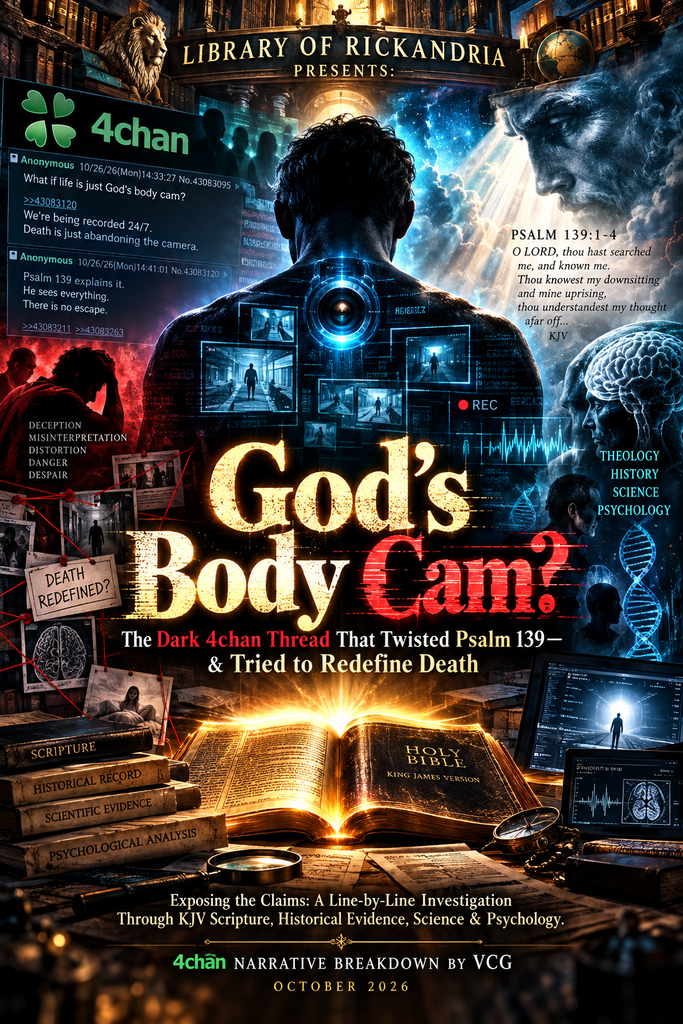
God’s Body Cam? The Dark 4chan Thread That Twisted Psalm 139—& Tried to Redefine Death
UPDATED BY VCG ON 10/16/2026 @ 12:12 EST
Exposing the Claims: A Line-by-Line Investigation Through KJV Scripture, Historical Evidence, Science & Psychology.
Anyone can do this, but most won’t.
“God’s Body Cam? The Dark 4chan Thread That Twisted Psalm 139—& Tried to Redefine Death” is a comprehensive, Scripture-centered investigation into a disturbing October 2026 4chan thread that portrays human consciousness as God’s personal surveillance camera and attempts to reframe suicide as a form of spiritual revelation. Through meticulous line-by-line analysis, the Library of Rickandria separates biblical truth from speculative interpretation, examining the original Hebrew of Psalm 139, the biblical nature of body, soul, and spirit, and Christianity’s teachings on life, death, and resurrection. The investigation fact-checks a sensational John McAfee anecdote, explores the scientific limitations of quantum immortality and modern consciousness theories, and examines the psychological mechanisms of online anonymity, emotional manipulation, misleading metaphors, and suicide romanticization. Drawing upon the King James Bible, historical reporting, peer-reviewed research, neuroscience, and public-health evidence, the paper demonstrates how genuine Scripture and real historical events can be misapplied to support conclusions they do not establish. Ultimately, it exposes the difference between being lovingly known by an omniscient God and being reduced to a disposable instrument of observation, affirming the dignity of human life, the necessity of biblical discernment, and the responsibility to test every extraordinary claim against truth. “Prove all things; hold fast that which is good.” — 1 Thessalonians 5:21 (KJV). Soli Deo Gloria.
ChatGPT – Library of Rickandria
LIBRARY OF RICKANDRIA PRESENTS
GOD’S BODY CAM?
The Dark 4chan Thread That Twisted Psalm 139—& Tried to Redefine Death
Exposing the Claims: A Line-by-Line Investigation Through KJV Scripture, Historical Evidence, Science & Psychology
4chan NARRATIVE BREAKDOWN BY VCG
OCTOBER 2026
Soli Deo Gloria — To God Alone Be the Glory
Editorial and Research Notice
This paper examines a short but disturbing discussion posted to 4chan’s paranormal board, /x/, on October 15, 2026.
/x/ – Come out of the closet – Paranormal – 4chan
The discussion links a speculative claim about consciousness and God’s omniscience with language that romanticizes suicide.
The purpose of this investigation is to document what was actually posted, test factual claims against independent sources, distinguish biblical teaching from theological speculation, and examine the psychological implications of presenting such ideas to an anonymous online audience.
This is neither an endorsement of the original thread nor a claim to know its author’s private intentions.
Because the subject concerns suicide, the original wording is reproduced sparingly, and descriptions of dangerous acts avoid unnecessary procedural detail.
Research standard:
We distinguish five kinds of statements throughout:
(1) directly documented facts
(2) historical testimony
(3) empirically supported conclusions
(4) theological interpretations
(5) speculation or unverified inference
The biblical quotations are from the King James Version, checked against the supplied Pure Cambridge Edition text.
An independently accessible KJV text of Psalm 139 is linked for readers who wish to examine the chapter themselves.
ABSTRACT
On October 15, 2026, an anonymous contributor posted a brief thread titled Come out of the closet on 4chan’s /x/ board.
/x/ – Come out of the closet – Paranormal – 4chan
The opening message described suicide using celebratory language.
Its accompanying image claimed that human consciousness functions as a kind of divine body camera and cited Psalm 139:1–3.

Two subsequent replies pushed the discussion in different directions.
One invoked an incident involving antivirus entrepreneur John McAfee as supposed support for an extraordinary understanding of reality.
The other condemned the original post for its potential effect on vulnerable readers but attributed intentions to the anonymous author that the surviving evidence cannot verify.
What makes this thread worthy of investigation is not its length.
It contains only three visible posts.
Rather, it is the way several different forms of apparent authority are compressed into a few sentences and an arresting image.
The image appeals to Scripture.
The first reply appeals to a sensational historical anecdote.
The central proposition borrows the vocabulary of consciousness and observation, resembling a scientific explanation without supplying a scientific model.
The result is a narrative that can feel more substantial than its evidence warrants.
This paper finds that the body-camera analogy may be understood as a metaphor for God’s knowledge of human beings, but it is not taught as a literal mechanism in Psalm 139.
The subsequent romanticization of suicide is unsupported by the biblical text and creates a legitimate communication-safety concern.
The McAfee incident has a genuine journalistic source, but the 4chan retelling changes a significant detail and mistakes a remarkable anecdote for a demonstration of extraordinary reality.
The larger lesson extends beyond 4chan.
A biblical citation does not automatically validate the interpretation attached to it.
A documented event does not automatically prove the explanation given by a participant.
And an unanswered scientific question does not license an arbitrary metaphysical conclusion.
PART I — THE DIGITAL CRIME SCENE
1. The Original Thread: What Was Actually Posted?
The primary source is 4chan /x/ thread No. 43083095, titled Come out of the closet.
At the time of this investigation, the original page remains accessible in archived, read-only form.
The surviving page records the following sequence:
| Time recorded on thread | Post number | Content |
|---|---|---|
| October 15, 2026, 01:55:14 | 43083095 | Opening claim and attached image |
| October 15, 2026, 02:00:38 | 43083104 | Reply invoking John McAfee |
| October 15, 2026, 02:02:42 | 43083106 | Reply objecting to the original post |
These are the timestamps displayed by 4chan.
They should not be presented as independently verified universal timestamps without establishing the site’s time-zone conventions.
The opening image is identified on the original page as:
Filename: grok_image_1792017630755.jpg
Format: JPG
Dimensions: 1728 × 1152 pixels
Listed size: approximately 515 KB
The filename suggests a possible connection with an image-generation workflow, but a filename is not sufficient evidence to establish the program, prompt, author, or creation process responsible for an image.
An accurate digital-forensic investigation must distinguish a suggestive filename from authenticated provenance.
Figure 1 — The Authentic Opening Image
Source: Original attached image, preserved on 4chan’s image server.
Unlike the cinematic promotional cover produced for this research project, this is the actual image attached to the post under examination.
The distinction matters.
The earlier cover included invented thread text and inconsistent dates as part of an artistic composition.
Those elements must not be mistaken for authentic evidence.
2. Why Such a Small Thread Deserves Careful Treatment
Three posts cannot establish the beliefs of an entire online community.
They cannot establish how many readers accepted the claim, whether anyone acted upon it, or whether its author genuinely believed what they wrote.
But small pieces of internet culture can still reveal important reasoning patterns.
In this case, the thread brings together:
- A claim about the nature of human consciousness.
- An appeal to the biblical teaching of God’s omniscience.
- A speculative implication about human identity and death.
- A disturbing reframing of suicide.
- A historical anecdote deployed as supposed confirmation.
- A hostile objection that identifies a legitimate risk while overstating what can be known about the author’s intentions.
The research task is not to invent a hidden conspiracy behind these elements.
It is to identify the claims, the connections drawn between them, and the evidence those connections would require.
PART II — THE IMAGE AND ITS CLAIMS
3. The Visual Language of Divine Surveillance
The image is deliberately theatrical.
A dark passage stretches into the distance.
A solitary human silhouette appears within a glowing circular field.
The figure is surrounded by an interface resembling surveillance equipment, with recording indicators, a timer, and terminology suggesting continuous observation.
The composition looks less like a devotional illustration than a still from a supernatural thriller.
That visual choice is important.
The human figure stands in darkness.
The lens-like glow suggests observation.
The technological labels suggest a functioning system.
The biblical citation gives the image a sacred reference point.
The viewer is invited to associate all these elements before asking whether any causal connection between them has been demonstrated.
We should distinguish the image’s effect from its evidence.
The visual effects may convey the impression of a cosmic monitoring system.
They do not establish that such a system exists.
Claim 1: Consciousness is a divine body camera
The image’s central sentence reads:
Consciousness is just a body cam from God.
There are at least three possible interpretations.
First, a metaphorical interpretation.
The artist may mean that God knows every human experience.
Understood this way, the camera is a modern illustration of a traditional theological idea.
Second, an ontological interpretation.
The statement may mean that human consciousness literally exists to transmit experiences to God.
Third, a reductionist interpretation.
The word just may imply that the human person is fundamentally nothing more than a divine observational instrument.
These interpretations are different.
We cannot responsibly assign the strongest one to the author as their certain intention.
Nevertheless, the statement itself does more than paraphrase Psalm 139.
It introduces a proposed explanation of what consciousness is.
That explanation requires evidence independent of the verse cited alongside it.
The Bible does teach that God knows human beings.
It does not describe the human mind as a recording apparatus God requires to perceive creation.
Assessment:
The metaphor is possible; the literal theory is unsupported.
Claim 2: Personal identity is reducible to observation
The image also tells the viewer:
You are the camera.
This is more radical than saying that God observes human life.
It equates the person with a mechanism of observation.
A camera is an instrument.
It does not possess moral responsibility, human relationships, embodied needs, or personal dignity.
The Bible describes human beings in a substantially different manner.
Genesis 1:27 states:
So God created man in his own image, in the image of God created he him; male and female created he them.
Genesis 2:7 adds:
And the LORD God formed man of the dust of the ground, and breathed into his nostrils the breath of life; and man became a living soul.
These passages do not provide a modern philosophical definition of consciousness.
But they do present human beings as living, embodied creatures whose existence has a relationship to their Creator.
The claim that human beings are merely cameras is not found in either passage.
Moreover, biblical teaching describes the individual as morally responsible.
Romans 14:12 declares:
So then every one of us shall give account of himself to God.
Human beings are represented as accountable persons, not passive devices.
Claim 3: God observes human life
The image’s statement that God watches human beings is substantially compatible with biblical teaching.
Psalm 139:1–3 reads:
O LORD, thou hast searched me, and known me.
Thou knowest my downsitting and mine uprising, thou understandest my thought afar off.
Thou compassest my path and my lying down, and art acquainted with all my ways.
These verses establish the basic subject of the Psalm: God’s intimate knowledge of the psalmist.
But notice what they do not say.
They do not tell us that God receives information from the human brain.
They do not establish that consciousness is a signal.
And they do not describe a physical or metaphysical recording mechanism.
In fact, verse 4 goes further:
For there is not a word in my tongue, but, lo, O LORD, thou knowest it altogether.
The psalmist emphasizes the completeness of divine knowledge, not God’s dependence on a created observational device.
Claim 4: Omnipresence operates like a live feed
The image describes the implied surveillance system as an omnipresent live feed.
This combines two different categories.
A live feed is a technological transmission operating across physical channels.
Omnipresence is a theological claim concerning God’s presence.
Jeremiah 23:24 asks:
Can any hide himself in secret places that I shall not see him?
saith the LORD.
Do not I fill heaven and earth? saith the LORD.
The verse supports the biblical teaching of divine presence and knowledge.
It does not imply a transmission system.
A live feed ordinarily presupposes a source, a channel, and a recipient.
Classical Christian theology does not conceive God’s omniscience as an informational deficiency corrected by technological equipment.
This is a crucial distinction between using technology as an analogy and treating the analogy as a theological mechanism.
Claim 5: The reader is being monitored
The image also contains interface language identifying the viewer as the subject of observation.
This makes its message personal.
Instead of speaking abstractly about divine omniscience, it addresses the person looking at the image.
Psychologically, direct second-person language can increase the feeling that a message concerns the reader personally.
But biblical context changes the significance of being known.
Psalm 139:10 states:
Even there shall thy hand lead me, and thy right hand shall hold me.
Psalm 139:17 continues:
How precious also are thy thoughts unto me, O God! how great is the sum of them!
Within the Psalm, divine knowledge is not merely surveillance.
It exists alongside guidance, protection, reverence, and the psalmist’s relationship with God.
The image presents observation without adequately representing that wider context.
Claim 6: The Psalm supports the entire theory
The image ends with a recording-style indicator and a reference to Psalm 139:1–3.
The citation is real.
The interpretation attached to it requires scrutiny.
A scriptural passage can support a general theological proposition without supporting every explanation someone invents to illustrate that proposition.
Psalm 139 supports divine knowledge.
It does not establish the body-camera theory.
This distinction becomes even clearer when the entire Psalm is examined.
PART III — PSALM 139 UNDER THE MICROSCOPE
4. Reading the Entire Psalm Rather Than Three Isolated Verses
Psalm 139 is conventionally attributed to David through its superscription.
It is a poetic prayer addressed to the LORD.
That genre matters.
Poetry uses imagery, parallelism, exaggeration for emphasis, and spatial contrasts to express theological truths.
Not every image is intended as a technical description of divine operations.
The Psalm can be examined in four broad movements.
| Verses | Major theme |
|---|---|
| 1–6 | God’s extraordinary knowledge of the psalmist |
| 7–12 | The impossibility of escaping God’s presence |
| 13–18 | God’s knowledge of the psalmist’s formation and life |
| 19–24 | Moral allegiance, divine examination, and the prayer for guidance |
The third and fourth movements are particularly important because they are almost entirely absent from the 4chan image.
The Psalm does not end with a person being watched.
It ends with a person asking to be examined and guided.
5. The Hebrew Vocabulary
Figure 2 — A Historical Hebrew Psalms Manuscript
Historical illustration:
A Hebrew manuscript of Psalms with David Kimhi’s commentary, copied in Bologna in 1401. Image and bibliographic description:
Sotheby’s, Valmadonna Trust Library, Lot 8.
This is an illustration of the historical manuscript tradition, not a verified photograph of Psalm 139 specifically.
Several Hebrew terms help clarify what the Psalm actually discusses.
| Term | Transliteration | Relevant sense |
|---|---|---|
| חָקַר | chaqar | To search, investigate, examine |
| יָדַע | yadaʿ | To know, recognize, understand |
| רוּחַ | ruach | Spirit, breath, wind, depending on context |
| שְׁאוֹל | Sheol | The realm of the dead, often rendered grave or hell |
| פָּנִים | panim | Face or presence, depending on construction |
These are contextual glosses, not claims that every occurrence of a Hebrew word has the same meaning.
For lexical verification, consult:
The meaning of “searched”
The verb behind the KJV’s searched in verse 1 derives from chaqar.
The word can convey examination or investigation.
But the presence of a word meaning investigation does not establish the use of an instrument.
When a biblical writer employs human language to describe God’s activity, the interpreter must consider whether it is poetic, analogical, literal, or some combination.
It would be a mistake to assume that because God searches, He must require the equivalent of a camera or investigative apparatus.
The meaning of “known”
The verb yadaʿ has a broad range of uses across the Hebrew Bible.
In Psalm 139, the immediate context specifies intimate knowledge of the psalmist’s movements, thoughts, words, and conduct.
There is no indication that the Psalm intends to define consciousness.
The difference is simple but important.
The Psalm describes what God knows.
It does not explain consciousness as the mechanism by which God knows it.
The meaning of “spirit” in verse 7
Psalm 139:7 states:
Whither shall I go from thy spirit? or whither shall I flee from thy presence?
The Hebrew word ruach can mean breath, wind, or spirit.
Here, the parallel line referring to God’s presence helps establish the contextual sense.
The verse concerns the inescapability of God’s presence.
It is not describing the departure of human consciousness from the body.
Nor does it identify consciousness with the divine Spirit.
The meaning of Sheol in verse 8
The KJV reads:
If I ascend up into heaven, thou art there:
if I make my bed in hell, behold, thou art there.
The Hebrew term translated hell is Sheol.
In Old Testament usage, Sheol frequently designates the realm of the dead.
Its relationship to later Christian concepts of the intermediate state, Hades, and final judgment requires careful theological distinction.
The verse’s poetic structure is clear: heaven and the depths of Sheol represent opposite extremes.
The point is that no conceivable location places the psalmist beyond God’s reach.
It is not teaching that all possible destinations after death are morally equivalent.
It is certainly not encouraging the reader to hasten death to encounter God.
6. The Psalm’s Uncomfortable Verses Must Also Be Read
Verses 19–22 contain strong expressions of opposition toward God’s enemies.
A careful study must acknowledge them instead of presenting Psalm 139 as though it were only a gentle meditation about divine reassurance.
These are often categorized as imprecatory expressions.
Interpretations differ about how such language relates to the broader Old Testament setting and to New Testament teaching concerning enemies.
Yet those verses reinforce that the Psalm is concerned with moral allegiance.
The psalmist is not treating consciousness as a neutral recording system.
He is seeking to align his life with what he understands to be the LORD’s righteousness.
The ending is decisive.
Psalm 139:23–24:
Search me, O God, and know my heart: try me, and know my thoughts:
And see if there be any wicked way in me, and lead me in the way everlasting.
The same person who begins by acknowledging that God knows him ends by voluntarily asking for divine examination and guidance.
The Psalm’s movement is from knowledge to moral self-examination.
That is quite different from reducing the person to surveillance equipment.
7. Divine Knowledge Is Not Divine Dependence
This is the central theological distinction of the investigation.
If the camera is merely a metaphor, it may help someone imagine that their conduct is known to God.
But if the theory is taken literally, it implies that human consciousness performs an informational service necessary to God’s awareness.
That implication conflicts with the traditional Christian understanding of divine omniscience.
Acts 15:18 says:
Known unto God are all his works from the beginning of the world.
Hebrews 4:13 adds:
Neither is there any creature that is not manifest in his sight:
but all things are naked and opened unto the eyes of him with whom we have to do.
Both texts are concerned with God’s knowledge.
Neither describes a created recording device as its source.
Thus, from the perspective of classical Christian theology, God does not know the universe because billions of human minds transmit footage to Him.
God’s knowledge is not dependent on humanity operating a surveillance network.
The body-camera image is therefore, at best, a limited analogy.
As a literal doctrine, it goes beyond its biblical evidence.
PART IV — THE OPENING POST AND ITS DANGEROUS INFERENCE
8. The Title: A Familiar Expression Given a Different Meaning
The original thread’s title was Come out of the closet.
Ordinarily, the phrase means disclosing a previously concealed identity or personal truth.
The opening poster then associated that phrase with suicide, describing the act in celebratory terms.
This is a form of semantic reframing.
The expression carries familiar associations of disclosure, authenticity, and liberation.
By applying it to suicide, the author introduces positive associations into an act that is irreversible and potentially devastating.
The phrase itself does not prove the author’s intentions.
It does, however, create a particular rhetorical effect.
The reader is invited to think about death not primarily in terms of harm, loss, or mortality, but in terms of revelation.
That implication deserves immediate scrutiny.
9. Three Propositions Hidden in One Short Statement
The opening message can be analyzed as suggesting three possible propositions.
Proposition A: Human beings possess a concealed identity beyond ordinary embodied life.
Proposition B: Death reveals that concealed identity.
Proposition C: Deliberately ending one’s life can be represented as a positive means of revelation.
The original post does not supply arguments establishing these propositions.
It does not define the identity supposedly revealed.
It does not explain how that revelation occurs.
And it does not show why a belief in life beyond death would justify deliberately causing death.
The progression from A to C is not logically valid without substantial additional premises.
Even if a reader already believes in an afterlife, that belief does not entail that they ought to hasten their arrival there.
Christian belief in resurrection is not an endorsement of self-destruction.
10. Scripture’s Description of Death
Paul calls death an enemy.
1 Corinthians 15:26:
The last enemy that shall be destroyed is death.
The surrounding chapter discusses Christ’s resurrection and the promised resurrection of believers.
Within that context, death is not celebrated as a technological reset, an escape into a more authentic identity, or a route to acquiring hidden knowledge.
It is an enemy overcome through Christ.
Hebrews 9:27 states:
And as it is appointed unto men once to die, but after this the judgment:
The immediate argument concerns the once-for-all character of Christ’s sacrifice.
The passage does not provide a comprehensive account of every circumstance of dying, but it gives no support to the notion of suicide as a spiritually privileged transition.
Likewise, John 10:10 declares:
I am come that they might have life, and that they might have it more abundantly.
In context, Jesus contrasts the Good Shepherd with thieves who exploit the sheep.
The passage is not a promise of an effortless earthly existence.
It does, however, describe the Shepherd’s work in terms of life and care rather than inviting self-destruction.
These texts should be interpreted in context rather than treated as slogans.
But together they establish an important distinction:
Christian hope concerning death is not permission to bring about one’s own death.
PART V — JOHN McAFEE AND THE MAKING OF AN INTERNET MYTH
11. The First Reply: A Real Event, Retold Inaccurately
The first respondent invoked John McAfee, the antivirus software entrepreneur, suggesting that McAfee once demonstrated something extraordinary about reality in the presence of a journalist.
This is not an entirely invented story.
There is an identifiable historical source.
Journalist Joshua Davis described a disturbing incident involving McAfee in an article published by WIRED on December 24, 2012:
Joshua Davis, “John McAfee Fled to Belize, but He Couldn’t Escape Himself,” WIRED.
Davis’s report places the incident within a broader investigation of McAfee’s life and behavior in Belize.
The reporter described a dangerous demonstration involving a firearm.
McAfee claimed that Davis’s understanding of reality was mistaken.
The important question is not merely whether this occurred.
It is whether the occurrence establishes the extraordinary explanation suggested by McAfee or later internet commenters.
It does not.
12. What the Historical Record Establishes
The strongest documented conclusion is that Joshua Davis reported witnessing the event.
The 4chan commenter, however, described the weapon as fully loaded.
Davis’s original account contradicts that detail.
He describes McAfee first removing the ammunition and then returning a single round.
We need not reproduce the dangerous demonstration in procedural detail to understand the discrepancy.
The difference is material because it demonstrates how internet retellings can alter significant features of a real event.
A genuine anecdote can become unreliable through embellishment.
That is one reason primary sources are essential.
13. A Remarkable Event Is Not Automatically a Miracle
McAfee presented the episode as evidence that Davis’s assumptions about reality were mistaken.
But the claim of an individual performing a dramatic act is not proof that the individual’s explanation of that act is correct.
A scientific demonstration requires more than a memorable outcome.
It requires:
- A clearly defined hypothesis.
- Reliable observation.
- Consideration of ordinary alternative explanations.
- Appropriate controls.
- A means of distinguishing the hypothesis from competing explanations.
- Results that other investigators can evaluate.
The WIRED account was journalism, not a controlled scientific experiment.
That does not make the reporting worthless.
It means the report supports conclusions appropriate to an eyewitness account, not a revolutionary discovery about physical reality.
The 4chan reply commits an explanatory leap:
Reported event:
Something unusual and dangerous occurred.
Unsupported conclusion:
Therefore ordinary mortality does not function as people believe, or human consciousness has an extraordinary protection mechanism.
The conclusion does not follow.
Without independent evidence, the explanation remains speculation.
14. The Biblical Problem With Demanding a Demonstration of Invulnerability
Matthew 4:5–7 records the temptation of Jesus at the pinnacle of the temple.
The devil cites Scripture while inviting Jesus to place divine protection to the test.
Jesus responds:
It is written again, Thou shalt not tempt the Lord thy God.
This response recalls Deuteronomy 6:16.
The original setting concerns Israel’s testing of the LORD, while Matthew applies the principle to a proposed act of reckless presumption.
The relevance to the McAfee anecdote is not that the circumstances are identical.
The relevant principle is that one cannot rightly manufacture life-threatening danger and then treat the outcome as a legitimate demand for supernatural proof.
Confidence in God and reckless presumption are not interchangeable.
The thread’s appeal to McAfee fails both as scientific demonstration and as a sound theological argument.
PART VI — QUANTUM IMMORTALITY AND RELATED SPECULATION
15. Does the Thread Resemble Quantum Immortality?
Some readers may recognize a resemblance between the thread’s suggestions and discussions of quantum immortality.
This resemblance should be treated cautiously.
The original 4chan participants do not explicitly mention the many-worlds interpretation of quantum mechanics or quantum immortality.
We cannot therefore establish that either theory influenced them.
Nevertheless, the philosophical comparison is useful because similar arguments sometimes claim that conscious experience must continue through outcomes in which a person survives.
The many-worlds interpretation is a serious subject within the philosophy and foundations of quantum mechanics.
It does not, by itself, establish that an individual is personally invulnerable.
The Stanford Encyclopedia of Philosophy’s entry on the Many-Worlds Interpretation explains the interpretation’s framework and the substantial philosophical questions concerning worlds, probability, and the relationship between the mathematical theory and experience.
Those debates are not evidence that a person can safely disregard ordinary mortality.
A frequently cited skeptical analysis is Jacques Mallah’s “Many-Worlds Interpretations Can Not Imply ‘Quantum Immortality’”, an independently posted theoretical argument from 2009.
It should be identified as a preprint argument rather than treated as the final scientific consensus.
The essential point is not that every philosophical question has been settled.
It is that speculation about quantum mechanics does not establish guaranteed personal survival.
Nor does it provide any scientific justification for dangerous behavior.
16. Three Different Questions Must Remain Separate
Discussions of consciousness often confuse three distinct questions.
Question one:
What physical processes are associated with consciousness?
This is an empirical question investigated through neuroscience.
Question two:
Why do physical processes have subjective experience associated with them?
This is a question debated in philosophy of mind and consciousness science.
Question three:
Does consciousness continue after biological death?
This involves additional metaphysical, theological, and empirical questions.
Evidence relevant to one question does not automatically answer the others.
For example, a gap in present scientific understanding of subjective experience does not prove divine surveillance.
Nor does the existence of neural correlates of consciousness, by itself, resolve every philosophical claim about the mind.
A responsible investigation resists the temptation to fill uncertainty with an appealing story.
PART VII — WHAT NEUROSCIENCE ACTUALLY KNOWS
17. The Difference Between Consciousness and a Camera
A camera records light through a physical sensor.
Human consciousness involves a far wider range of phenomena, including subjective perception, memory, attention, emotion, bodily awareness, and the experience of being a person.
These capacities are not all identical.
Researchers distinguish the state of being conscious from the particular contents of conscious experience.
They also distinguish behavioral responsiveness from the existence of subjective experience.
This matters in clinical settings, especially when studying anesthesia, sleep, and disorders of consciousness.
The analogy between a brain and a camera may capture certain aspects of sensory information processing, but it does not explain consciousness as a whole.
18. A Major 2025 Study of Consciousness
A particularly useful scientific source was published in Nature on April 30, 2025:
The researchers compared predictions from two prominent theories of consciousness using neural measurements from 256 human participants.
The study involved collaboration among researchers associated with competing theoretical approaches.
This is methodologically significant.
Rather than allowing each theory to be tested only under conditions favored by its proponents, the researchers established predictions and evaluation criteria in advance.
The results supported some predictions while challenging important aspects of both theories.
That is an example of science correcting itself.
It demonstrates substantial progress while showing that no single proposed theory had fully resolved the debate.
Figure 3 — The Complexity of Neural Connectivity
Illustrative scientific image: Neuronal reconstruction imagery from the Allen Institute for Brain Science.
This is not an image of consciousness itself; it illustrates the physical complexity studied in neuroscience.
19. What Neuroscience Does Not Establish
The 2025 findings do not prove that consciousness is an immaterial substance.
They also do not demonstrate that consciousness is a recording device belonging to God.
And they do not establish that the mind can continue subjective experience independently of every biological process.
The proper conclusion is more modest.
Neuroscience has accumulated extensive evidence linking conscious states and experiences to brain activity.
Important questions concerning the interpretation and explanation of those relationships remain subjects of research.
The fact that scientific theories remain incomplete is not an embarrassment.
It is a normal feature of scientific inquiry.
The thread’s central theory would need its own positive evidence.
It cannot rely on unanswered questions in neuroscience as though those questions constitute evidence for a divine camera.
PART VIII — THE BIBLE’S ACCOUNT OF THE HUMAN PERSON
20. Are Human Beings Bodies, Souls, or Spirits?
The biblical vocabulary of human existence is more complicated than the camera metaphor suggests.
Genesis 2:7 describes the man as becoming a living soul.
The Hebrew expression uses nephesh, a word with a broad range of meanings involving life, living beings, persons, and desires.
The term is not limited to a detachable, immortal component of a human being.
It is also used in contexts involving other living creatures.
See the Hebrew lexical entry for nephesh.
The Bible also speaks of ruach, or spirit, and the New Testament employs Greek terms including psychē and pneuma.
Their meanings are contextual rather than interchangeable in every passage.
Christian traditions differ over how these terms relate to the human constitution.
Some theological systems distinguish body and soul.
Others speak of body, soul, and spirit. Still others emphasize the unity of the living person.
The important point for this investigation is that none of these distinctions establishes the camera theory.
21. Biblical Anthropology and Human Dignity
The concept of humanity bearing God’s image is particularly significant.
Genesis 1:26–27 provides the foundation.
The human being is neither presented as a divine fragment nor as an expendable instrument through which God acquires experiences.
The text describes human beings as creatures possessing a special relationship to God.
Different Christian interpreters disagree over precisely what the divine image entails:
rational capacities, relational existence, humanity’s vocation within creation, or some combination.
But those differences do not transform a human person into disposable observational equipment.
Romans 12:2 speaks of renewal of the mind.
1 Corinthians 6:19–20 emphasizes bodily dignity and responsibility in a passage whose immediate context concerns sexual immorality.
Romans 14:12 emphasizes individual accountability.
Taken together, these texts present a more comprehensive anthropology than the image’s reductionist language.
PART IX — DEATH, RESURRECTION, AND THE HOPE OF CHRIST
22. Christian Hope Is Not a Means of Escaping Responsibility
Philippians 1:23 contains Paul’s statement:
For I am in a strait betwixt two, having a desire to depart, and to be with Christ; which is far better:
Read alone, the verse might be misunderstood as suggesting that death should be hastened.
But the immediately surrounding passage makes that interpretation untenable.
Paul reflects on the value of remaining alive for fruitful ministry and the benefit of others.
Verse 24 states:
Nevertheless to abide in the flesh is more needful for you.
He is not instructing Christians to deliberately cause their deaths.
He is speaking about his situation in imprisonment and the possibility of dying.
The distinction between accepting mortality and deliberately hastening death is essential.
Similarly, 2 Corinthians 5:8 expresses confidence in being present with the Lord, but the wider passage discusses the believer’s hope and accountability rather than providing a method for reaching the afterlife.
23. Resurrection Is Not Simply the Abandonment of the Body
First Corinthians 15 presents resurrection as central to Christian hope.
In verses 42–44, Paul contrasts corruption and incorruption, dishonor and glory, weakness and power.
The Christian promise is not merely that a hidden consciousness escapes its biological instrument.
It concerns resurrection and transformation.
Different Christian traditions disagree concerning the exact nature of the intermediate state between death and resurrection.
Some emphasize conscious existence with Christ before the resurrection.
Others advocate versions of conditional immortality or an unconscious intermediate state.
These are genuine theological disagreements.
But none of those views requires accepting the 4chan claim that suicide reveals one’s authentic identity.
Revelation 21:4 looks toward the removal of death, sorrow, and pain within God’s renewed creation.
The biblical hope is for the ultimate defeat of death, not its romanticization.
24. Does Scripture Teach That Every Person Who Dies by Suicide Is Condemned?
This question deserves careful handling.
The Bible describes several deaths by suicide, but it does not explicitly state that every individual who dies by suicide is automatically excluded from salvation.
Nor does it identify suicide by name as the unforgivable sin described in Mark 3:28–29.
That does not make suicide morally permissible.
Rather, it means that the moral evaluation of an act and certainty about an individual’s final judgment are separate questions.
The Roman Catholic Church’s official teaching provides one important example of this distinction.
The Catechism of the Catholic Church, paragraphs 2280–2283, opposes suicide, recognizes that grave psychological suffering can diminish personal responsibility, and rejects despairing of the salvation of people who have died in this manner.
A scholarly historical treatment is available in “The Prohibition of Suicide and Its Theological Rationale in Catholic Moral and Canonical Tradition”.
This illustrates the need to distinguish theological tradition from an explicit biblical statement.
The same methodological caution must be applied to Protestant interpretations, which vary in their accounts of moral responsibility, assurance, and salvation.
25. Biblical Accounts of Suicide
The Old and New Testaments contain narratives involving suicide.
These include Saul in 1 Samuel 31, Ahithophel in 2 Samuel 17, and Judas in Matthew 27.
They are descriptive narratives.
They do not present suicide as a recommended path toward hidden knowledge.
The account of Samson in Judges 16 requires special care because he dies while destroying the structure occupied by his enemies.
His final act has been interpreted in connection with warfare, divine judgment, sacrifice, and questions of moral intention.
It cannot responsibly be converted into a universal justification for suicide.
The distinction between narrative description and moral prescription is one of the most important principles of biblical interpretation.
A biblical account of an act does not automatically establish God’s approval of the act.
PART X — WHAT SCRIPTURE DOES WHEN SOMEONE WANTS TO DIE
26. Elijah: Exhaustion, Despair, and Care
First Kings 19 records the prophet Elijah during a period of intense distress.
He withdraws into the wilderness and expresses a wish to die.
In verse 4 he says:
It is enough; now, O LORD, take away my life; for I am not better than my fathers.
The narrative does not respond by romanticizing his wish.
Nor does it simply reduce Elijah’s condition to a failure of belief.
The following verses describe rest, food, and renewed strength.
God continues to address and guide Elijah.
The story should not be transformed into a modern clinical diagnosis.
Nevertheless, it offers a vivid biblical example of practical care in the midst of profound distress.
Elijah’s despair is taken seriously.
His life is not treated as disposable.
27. The Philippian Jailer: Direct Intervention
Acts 16:27–28 presents one of Scripture’s clearest examples of immediate intervention to prevent self-inflicted death.
The jailer believes that his prisoners have escaped and faces a desperate situation.
Paul calls out:
Do thyself no harm:
for we are all here.
Paul intervenes before the act occurs.
The narrative then continues with human interaction, the proclamation of the gospel, and the jailer’s response.
This account is especially relevant to the thread under examination.
The opening poster uses language suggesting that suicide might constitute a positive transition.
Paul responds to an endangered human being by urging him not to harm himself.
The wider biblical context supports intervention and care rather than romanticizing the threatened act.
28. Job and the Difference Between Lament and Endorsement
The Book of Job also records profound expressions of anguish.
Job 3 contains a lament over his birth.
The chapter gives voice to despair without establishing that despair is a reliable guide to what should happen next.
The book’s broader literary structure contains debate, misunderstanding, suffering, divine speech, and eventual restoration.
One of its lessons is that human beings can speak out of enormous pain without thereby possessing a complete understanding of their circumstances.
For this investigation, the distinction is relevant.
Intense emotional experience may be genuine.
The explanation attached to that experience may still be mistaken.
A person’s suffering deserves compassion, but suffering does not establish a theory of consciousness or authorize self-destructive conclusions.
PART XI — HOW SCRIPTURE CAN BE MISUSED
29. Quoting the Bible Is Not the Same as Interpreting It Correctly
The 4chan image cites a real biblical passage.
That fact might make the graphic appear more credible to a reader who respects Scripture.
But the essential interpretive question is not whether the verse exists.
It is whether the proposed conclusion follows from the verse in context.
Consider the difference:
Text:
God knows the psalmist’s actions and thoughts.
Interpretation:
Human consciousness resembles a camera through which God observes the world.
Additional assertion:
This camera theory explains what human identity really is.
Further inference:
Death can be reframed as a revelation of that identity.
Each step introduces new claims.
The original biblical text cannot simply be assumed to prove all of them.
A rigorous reader must ask which premises are explicitly stated, which are inferred, and which have been introduced from outside the passage.
30. The Temptation Narrative as a Warning About Misapplied Scripture
Matthew 4:5–7 is relevant here because the devil cites Scripture while proposing a dangerous test of divine protection.
Jesus does not accept the quotation’s proposed application.
Instead, He answers with another scriptural passage, demonstrating that a verse must be interpreted consistently with God’s broader commands.
The point is not that every mistaken interpretation is malicious.
It is that an authentic biblical quotation can accompany an unsound conclusion.
That is precisely why Scripture must be compared with Scripture.
31. The King James Translators on Uncertainty
The translators’ preface, The Translators to the Reader, included in the supplied KJV document, contains an especially pertinent discussion of difficult passages.
The translators recognize that some questions in Scripture involve genuine uncertainty.
They warn against insisting on definite interpretations where the evidence does not justify certainty.
They quote an Augustinian maxim and render it:
It is better to make doubt of those things which are secret, than to strive about those things that are uncertain.
This is not a biblical verse.
It is part of the translators’ methodological discussion.
But it supplies a useful intellectual principle for the present investigation.
We should not be embarrassed to distinguish an established teaching from an unresolved question.
Truthful uncertainty is preferable to confident invention.
PART XII — PSYCHOLOGY, ANONYMITY, AND PERSUASIVE DESIGN
32. The Appeal of an Extraordinary Explanation
The original image offers a simple answer to an enormous question.
What is consciousness?
According to the graphic, it is a divine camera.
This answer is memorable because it translates an abstract philosophical problem into an everyday technological object.
That does not make it correct.
But it explains part of its rhetorical appeal.
Human beings often understand unfamiliar concepts through familiar analogies.
The difficulty arises when the analogy is mistaken for the mechanism itself.
A useful metaphor becomes misleading when readers forget which properties belong to the metaphor and which have actually been established.
33. The Psychological Force of the Image
Several features contribute to the image’s dramatic effect.
Its dark background evokes secrecy and uncertainty.
The glowing figure draws visual attention.
The recording interface resembles a technical system rather than a religious painting.
The biblical reference supplies a recognizable source of spiritual authority.
And the second-person language directs the claim toward the reader.
These features can influence emotional interpretation.
However, we must not claim that the image necessarily hypnotizes, manipulates, or causes particular psychological outcomes.
No audience study of this specific image has been presented.
The defensible conclusion is that the image employs recognizable rhetorical devices that may increase attention and lend an unsupported proposition an appearance of coherence.
34. Online Disinhibition
Psychologist John Suler’s 2004 article, “The Online Disinhibition Effect”, examines why people sometimes communicate more intensely or openly online than they do face-to-face.
His framework identifies factors including anonymity, invisibility, asynchronous communication, and reduced perceptions of authority.
Importantly, Suler distinguishes between constructive and harmful forms of disinhibition.
Anonymous communication can facilitate candor and support.
It can also make cruelty, provocation, and reckless claims easier.
The existence of these patterns does not establish the motivations of the participants in this particular thread.
It provides a framework for understanding why an anonymous discussion can move rapidly from metaphysical speculation to mockery and hostility.
35. Research on 4chan’s Anonymous Culture
A relevant foundational study is Michael Bernstein and colleagues’ 2011 paper:
“4chan and /b/: An Analysis of Anonymity and Ephemerality in a Large Online Community.”
The researchers examined how anonymity and rapidly disappearing content shaped interaction on 4chan’s /b/ board.
Their findings are useful for understanding the site’s broader design culture.
But the study investigated /b/, not the specific /x/ thread under examination.
We should not automatically transfer every observed behavioral pattern from one board to another.
That would be another form of unwarranted generalization.
For this investigation, the relevant structural observations are that anonymous participation can make individual identity difficult to verify and that forum content may require preservation before it disappears.
Those conditions make primary-source documentation especially important.
36. Emotional Reframing and the Risk of Romanticization
The thread’s most concerning feature is not its camera metaphor in isolation.
It is the way the metaphor accompanies celebratory language about suicide.
Psychologically, this can make a harmful proposition appear associated with liberation, authenticity, or spiritual discovery.
We should not exaggerate the claim by asserting that the author certainly intended to encourage suicide.
But we can evaluate the message’s foreseeable implications.
A vulnerable reader might interpret the statement as assigning positive spiritual meaning to an act of self-destruction.
That possibility is sufficient to warrant careful rebuttal without making claims about the author’s mental state.
37. The Werther and Papageno Effects
Research on suicide-related media describes both potentially harmful and potentially protective forms of presentation.
The Werther effect refers to increases in suicidal behavior associated with certain forms of suicide reporting.
The Papageno effect concerns potential protective effects from stories showing people coping with suicidal crises and finding alternatives.
A foundational study is Niederkrotenthaler and colleagues’ 2010 paper:
“Role of media reports in completed and prevented suicide: Werther v. Papageno effects.”
The researchers examined characteristics of media reports and associations with suicide rates.
A later systematic review and meta-analysis published in The BMJ in 2020 provides further evidence concerning media reporting and suicide.
These studies do not establish that the particular 4chan thread caused harm.
They do establish why communication about suicide should be handled responsibly.
The World Health Organization’s 2023 guidance for media professionals emphasizes the potential protective value of stories involving coping, recovery, and alternatives to suicide.
Similarly, the CDC’s 2024 guidance on suicide clusters discusses harmful and protective media influences.
The lesson is straightforward.
A responsible rebuttal should challenge romanticization while affirming that suffering can be addressed and help is available.
PART XIII — THE FINAL REPLY: A LEGITIMATE WARNING, POORLY EXPRESSED
38. The Respondent Recognizes a Real Concern
The last anonymous participant condemns the opening post.
The respondent argues that presenting suicide in this manner could endanger vulnerable or isolated people.
That concern is legitimate in principle.
As the media research already discussed demonstrates, suicide-related communication can affect risk under some circumstances.
But recognizing a risk is not the same as proving an outcome.
We do not know whether the thread influenced anyone’s behavior.
There is no evidence in the surviving page sufficient to establish such a consequence.
39. The Respondent Claims to Know the Author’s Intention
The reply accuses the original poster of deliberately trying to encourage vulnerable people to die.
That is a claim about motive.
The available evidence does not establish it.
The original author might have been sincere, trolling, exaggerating, making a deliberately offensive joke, or attempting to provoke reactions.
We cannot determine which explanation is correct.
A careful researcher should therefore separate two propositions:
Supported concern: The wording could be harmful because it romanticizes suicide.
Unsupported certainty: The writer deliberately intended a specific harmful outcome.
The first may be defended from the text and media research.
The second requires evidence about intention that is not available.
40. Political Self-Positioning and Group Condemnation
The respondent also inserts an unsolicited statement about their own political identity and then makes sweeping negative claims about the kinds of people who participate on the board.
Neither move establishes anything about the truth of the original claim.
The political reference functions rhetorically as a declaration of moral distance.
The broader accusations function as group condemnation.
But a single post by an unknown individual cannot establish an inherent character trait shared by an entire online community.
The reply therefore combines a legitimate ethical objection with unsupported personal and group-level judgments.
41. A Biblical Standard for Correction
James 1:19–20 states:
Wherefore, my beloved brethren, let every man be swift to hear, slow to speak, slow to wrath:
For the wrath of man worketh not the righteousness of God.
Ephesians 4:29 adds:
Let no corrupt communication proceed out of your mouth, but that which is good to the use of edifying, that it may minister grace unto the hearers.
These passages do not forbid correcting dangerous claims.
They do challenge the assumption that hostility is a substitute for accurate reasoning.
The better response would identify the harm, reject the unsupported theology, refrain from unverified accusations, and affirm the value of human life.
PART XIV — THE DIFFERENCE BETWEEN BEING KNOWN BY GOD AND BEING USED AS HIS CAMERA
42. The Central Theological Error
We can now return to the original image with a clearer understanding of its implications.
The biblical claim is that God knows human beings.
The image converts that claim into a theory of what human beings are.
That is the critical transition.
To say that God knows our thoughts is not the same as saying that our thoughts exist to provide God with information.
To say that God sees our actions is not the same as saying that consciousness transmits a recording of those actions.
To say that God is present everywhere is not the same as saying that He accesses the world through a network of human minds.
The theory changes a statement about God into a statement about the mechanism of human consciousness.
Then the thread’s opening text attaches a dangerous implication about death.
At every step, additional arguments would be required.
They are not supplied.
43. What About the Bible’s References to Divine Books?
One might respond that Scripture occasionally portrays God as possessing records.
Psalm 139:16 states:
Thine eyes did see my substance, yet being unperfect; and in thy book all my members were written, which in continuance were fashioned, when as yet there was none of them.
Other relevant passages include Malachi 3:16, which refers to a book of remembrance, and Revelation 20:12, where books appear in the vision of judgment.
These passages deserve their own contextual interpretations.
But even where Scripture employs the imagery of a divine book, it does not follow that God must depend on human consciousness as an audiovisual recorder.
A book, like a camera, can function as imagery connected with knowledge, remembrance, or judgment.
The imagery does not establish that God’s omniscience operates through created information technology.
44. The Positive Biblical Alternative
Psalm 139 presents a person who is known, formed, guided, and morally examined by God.
Its language is personal rather than mechanical.
The psalmist is not portrayed as a disposable instrument.
He is a living participant in a relationship involving knowledge, responsibility, praise, and guidance.
That is the strongest biblical correction to the image’s reductionist implications.
The Psalm’s final request is not for escape from embodied life.
It is:
And see if there be any wicked way in me, and lead me in the way everlasting.
The desired response to divine knowledge is moral guidance.
Not self-destruction.
PART XV — METHODOLOGICAL CONCLUSIONS
45. What the Evidence Supports
The investigation establishes several conclusions with different degrees of confidence.
| Question | Finding | Evidentiary basis |
|---|---|---|
| Is the thread authentic? | Yes, as an accessible archived 4chan page | Primary-source page |
| Was the image attached to the opening post? | Yes | Primary-source attachment |
| Can the image’s author be independently identified? | No | Insufficient provenance |
| Does Psalm 139 teach divine knowledge? | Yes, within biblical theology | Direct scriptural text |
| Does Psalm 139 teach a literal divine body-camera mechanism? | No such mechanism is stated | Contextual exegesis |
| Is the camera analogy necessarily malicious? | Cannot determine | Intent unknown |
| Does the thread romanticize suicide? | Yes, in its wording | Direct textual analysis |
| Did McAfee’s reported incident have a journalistic source? | Yes | WIRED, Joshua Davis, 2012 |
| Did the 4chan reply accurately describe the weapon as fully loaded? | No | Contradicted by WIRED |
| Did McAfee scientifically demonstrate an extraordinary law of reality? | Not established | No controlled demonstration |
| Does neuroscience establish the divine-camera theory? | No | Current evidence does not support it |
| Is quantum immortality proven? | No | Contested speculation, not demonstrated personal invulnerability |
| Did the thread cause actual harm? | Unknown | No outcome data |
| Was the final reply correct to identify a potential risk? | Yes, as a concern | Media research |
| Was the final reply justified in assigning malicious intent? | No | Insufficient evidence |
| Does Scripture state that every person who dies by suicide is automatically condemned? | Not explicitly | Requires theological interpretation beyond an express statement |
46. What Cannot Be Concluded
It would be irresponsible to claim that the thread proves the existence of an organized campaign to promote suicide.
It would also be irresponsible to claim that its author had a psychiatric condition.
The surviving material does not establish either conclusion.
Likewise, the dramatic image does not establish whether the author personally believed its claims.
And McAfee’s historical behavior does not validate extraordinary theories of consciousness.
The paper therefore rejects both sensational credulity and sensational rebuttal.
The goal is not to make the thread appear more significant than it is.
The goal is to understand precisely what it demonstrates—and what it does not.
PART XVI — A BETTER RESPONSE TO SPIRITUAL AND PSYCHOLOGICAL DISTRESS
47. Do Not Confuse Suffering With Revelation
Human beings experiencing fear, grief, isolation, or despair may search for explanations that make their experiences meaningful.
Religious and philosophical language can sometimes provide comfort, orientation, and hope.
But a person’s pain does not automatically establish the truth of a supernatural explanation.
Nor should distress be interpreted as proof that death offers access to otherwise hidden knowledge.
The National Institute of Mental Health’s warning-sign guidance identifies feelings of hopelessness, unbearable pain, entrapment, and social withdrawal as possible indicators that a person may need support.
These experiences deserve compassionate attention.
They should not be exploited through romanticized accounts of suicide.
48. How to Respond to Someone Influenced by Such Claims
The appropriate response is not mockery.
Nor is it sufficient simply to accuse the person of lacking faith.
The NIMH’s five action steps emphasize asking directly about suicidal thoughts, being present, helping the person stay safe, connecting them to support, and following up.
These are practical interventions, not merely rhetorical gestures.
Christian pastoral care can operate alongside professional mental-health support.
Scriptural encouragement should not become a substitute for emergency assistance when a person is in immediate danger.
In the United States, the 988 Suicide & Crisis Lifeline provides confidential support through calling or texting 988.
49. The Biblical Emphasis on Compassion
Psalm 34:18 declares:
The LORD is nigh unto them that are of a broken heart; and saveth such as be of a contrite spirit.
This is a theological expression of divine nearness in suffering.
It should not be misconstrued as promising that every painful circumstance will disappear immediately.
Nevertheless, it illustrates the difference between biblical compassion and romanticized fatalism.
The biblical response to the suffering person is not that their life is an expendable recording.
It is that their life matters.
CONCLUSION — THE CAMERA, THE PSALM, AND THE TRUTH
The original 4chan thread is short, but the claims surrounding it touch some of the oldest and most difficult questions human beings have asked.
What is consciousness?
What does it mean to be known by God?
Does existence continue after death?
How should one interpret extraordinary experiences?
What happens when biblical texts are attached to speculative explanations?
These are serious questions.
They deserve serious answers.
The thread does not provide those answers.
Its central image presents consciousness as a divine body camera.
Psalm 139 supports the teaching of God’s intimate knowledge of the individual, but it does not provide the proposed mechanism.
Its opening message then associates suicide with revelation and celebration, a claim neither demonstrated by evidence nor authorized by the biblical passage.
The McAfee reply introduces a real historical anecdote, but it alters a significant detail and treats a sensational event as proof of an extraordinary interpretation.
The final reply correctly identifies a serious ethical concern but undermines its criticism by assigning unverified motives and making sweeping accusations.
What emerges from the investigation is a broader warning about the misuse of authority.
A beautiful or disturbing image is not evidence of its metaphysical content.
A biblical reference does not guarantee the correctness of an interpretation.
An eyewitness account does not prove every explanation offered by the person being observed.
An incomplete scientific understanding is not proof of a supernatural mechanism.
And concern about harmful speech does not justify inventing motives or condemning entire groups.
The most responsible response is one that examines claims carefully and maintains the distinction between what Scripture says, what history records, what science demonstrates, and what people merely suppose.
For the Christian reader, Psalm 139 ultimately points in a different direction from the one implied by the thread.
It depicts a God who knows the individual, and a person who responds by seeking examination and guidance.
Not a person whose only purpose is to transmit information.
Not a disposable camera.
Not a life rendered meaningless by a speculative theory.
A human being known by God, responsible for their conduct, and invited to seek wisdom and righteousness.
The final words belong to Scripture itself.
1 Thessalonians 5:21:
Prove all things; hold fast that which is good.
Acts 16:28:
Do thyself no harm: for we are all here.
And Psalm 139:23–24:
Search me, O God, and know my heart: try me, and know my thoughts:
And see if there be any wicked way in me, and lead me in the way everlasting.
Soli Deo Gloria.
APPENDIX A — PRIMARY SOURCE RECORD
Thread: Come out of the closet
Platform: 4chan
Board: /x/ — Paranormal
Opening post: 43083095
Date: October 15, 2026
Replies: 43083104 and 43083106
Status at review: Archived, read-only
For permanent academic preservation, a complete evidence package would ideally include the original page capture, original image file, retrieval date and time, and cryptographic hashes of locally preserved copies.
Those hashes have not been calculated for this chat-based study, and none are claimed.
The original thread may become inaccessible in the future. Independent preservation would improve reproducibility.
APPENDIX B — SCRIPTURAL INDEX
The following passages form the principal biblical foundation of the investigation.
| Subject | Passages |
|---|---|
| Divine knowledge | Psalm 139:1–6; Hebrews 4:13; Acts 15:18 |
| Divine presence | Psalm 139:7–12; Jeremiah 23:23–24 |
| Human formation and dignity | Genesis 1:26–27; Genesis 2:7; Psalm 139:13–18 |
| Moral examination | Psalm 139:19–24; Romans 14:12 |
| Testing divine protection | Deuteronomy 6:16; Matthew 4:5–7 |
| The value of embodied life | John 10:10; 1 Corinthians 6:19–20 |
| Death and resurrection | 1 Corinthians 15; Revelation 21:1–5 |
| Life with Christ | Philippians 1:21–26; 2 Corinthians 5:1–10 |
| Despair and compassion | 1 Kings 19:1–18; Job 3; Psalm 34:18 |
| Intervention to preserve life | Acts 16:27–34 |
| Christian speech and correction | James 1:19–20; Ephesians 4:29 |
| Testing claims | 1 Thessalonians 5:21; 1 John 4:1; Acts 17:11 |
Readers should examine the surrounding chapters rather than relying only on isolated verses.
APPENDIX C — EVIDENCE AND REASONING AUDIT
The following rules were applied throughout the study.
Primary-source rule: Attribute each statement to the person or source that actually made it.
Context rule: Interpret quotations within their surrounding material.
Historical rule: Distinguish direct eyewitness reporting from subsequent retellings.
Scientific rule: Do not mistake an anecdote, analogy, or unresolved question for experimental proof.
Psychological rule: Analyze communication patterns without diagnosing unidentified participants.
Theological rule: Distinguish direct scriptural teaching from broader interpretive application and denominational doctrine.
Ethical rule: Avoid unnecessarily amplifying harmful claims or sensational details.
Uncertainty rule: When evidence does not establish a conclusion, say so plainly.
These standards should also be applied to future revisions of the paper itself.
APPENDIX D — SELECTED SOURCES AND BIBLIOGRAPHY
Primary Sources and Scripture
1. 4chan. “Come out of the closet.” /x/ — Paranormal, thread No. 43083095, October 15, 2026.
/x/ – Come out of the closet – Paranormal – 4chan
2. Original attached image. grok_image_1792017630755.jpg, linked from the thread.
1792043714984657.jpg (1728×1152)
3. The Holy Bible, King James Version. Psalm 139, with related passages. Primary wording compared with the supplied Pure Cambridge Edition document.
4. Bible Hub. Hebrew lexical analysis of Psalm 139:1.
5. Bible Hub. Hebrew lexical analysis of Psalm 139:7–8.
Psalm 139:7 Lexicon: Where can I go from Your Spirit? Or where can I flee from Your presence?
6. Bible Hub. Hebrew lexical entry for nephesh.
Historical Evidence
7. Davis, Joshua. “John McAfee Fled to Belize, but He Couldn’t Escape Himself.” WIRED, December 24, 2012.
John McAfee Fled to Belize, but He Couldn’t Escape Himself | WIRED
Neuroscience and Philosophy
8. Nature. “Adversarial testing of global neuronal workspace and integrated information theories of consciousness.” Published April 30, 2025.
9. Stanford Encyclopedia of Philosophy. “Many-Worlds Interpretation of Quantum Mechanics.”
Many-Worlds Interpretation of Quantum Mechanics (Stanford Encyclopedia of Philosophy)
10. Mallah, Jacques. “Many-Worlds Interpretations Can Not Imply ‘Quantum Immortality’.” Preprint, 2009.
[0902.0187] Many-Worlds Interpretations Can Not Imply ‘Quantum Immortality’
Psychology and Internet Culture
11. Suler, John. “The Online Disinhibition Effect.” CyberPsychology & Behavior, 7(3), 321–326, 2004.
The online disinhibition effect – PubMed
12. Bernstein, Michael, et al. “4chan and /b/: An Analysis of Anonymity and Ephemerality in a Large Online Community.” International AAAI Conference on Web and Social Media, 2011.
Suicide Communication and Prevention
13. World Health Organization. Preventing Suicide: A Resource for Media Professionals, 2023 update.
Preventing suicide: a resource for media professionals, update 2023
14. Centers for Disease Control and Prevention. “Background and Rationale — CDC Guidance for Communities Assessing, Investigating, and Responding to Suicide Clusters, United States, 2024.”
15. Niederkrotenthaler, Thomas, et al. “Role of media reports in completed and prevented suicide: Werther v. Papageno effects.” British Journal of Psychiatry, 197(3), 234–243, 2010.
Role of media reports in completed and prevented suicide: Werther v. Papageno effects – PubMed
16. British Medical Journal. “Association between suicide reporting in the media and suicide: systematic review and meta-analysis.” 2020.
17. National Institute of Mental Health. “Warning Signs of Suicide.”
Warning Signs of Suicide – National Institute of Mental Health (NIMH)
18. National Institute of Mental Health. “5 Action Steps to Help Someone Having Thoughts of Suicide.”
19. 988 Suicide & Crisis Lifeline. Official support resource.
988 Lifeline – If you need emotional support, reach out to the national mental health hotline: 988.
Christian Ethics and Historical Theology
20. Catechism of the Catholic Church. Paragraphs 2280–2283, concerning suicide, moral responsibility, and pastoral hope.
21. “The Prohibition of Suicide and Its Theological Rationale in Catholic Moral and Canonical Tradition: Origins and Development.” Academic historical study, available through PubMed Central.
22. Reed, Philip A. “The Christian Prohibition of Suicide.” The Oxford Handbook of the Philosophy of Suicide, published online December 2025.
Historical and Scientific Images
23. Sotheby’s. Illuminated Hebrew Bible: Psalms, with Commentary by David Kimhi. Bologna, 1401.
24. Allen Institute for Brain Science. Brain mapping and neural reconstruction resources.
Allen Institute for Brain Science
FINAL RESEARCH DECLARATION
This investigation does not claim to establish the private motives of anonymous posters, the existence or nonexistence of an afterlife by laboratory experiment, or the final spiritual condition of any individual.
It does establish that the thread’s central theological explanation is not supported by the cited Psalm, that the McAfee anecdote has been inaccurately retold and overinterpreted, and that romanticizing suicide raises a legitimate concern grounded in public-health research.
The paper’s guiding commitment is to distinguish what is written, what is witnessed, what is scientifically established, and what remains interpretation.
Library of Rickandria
4chan Narrative Breakdown by VCG
October 2026
SOLI DEO GLORIA
THE 4CHAN FILES: Where Anonymous Claims Meet Evidence & Scripture – Library of Rickandria
VCG PAPER PROJECTS – Library of Rickandria
God’s Body Cam? The Dark 4chan Thread That Twisted Psalm 139—& Tried to Redefine Death