
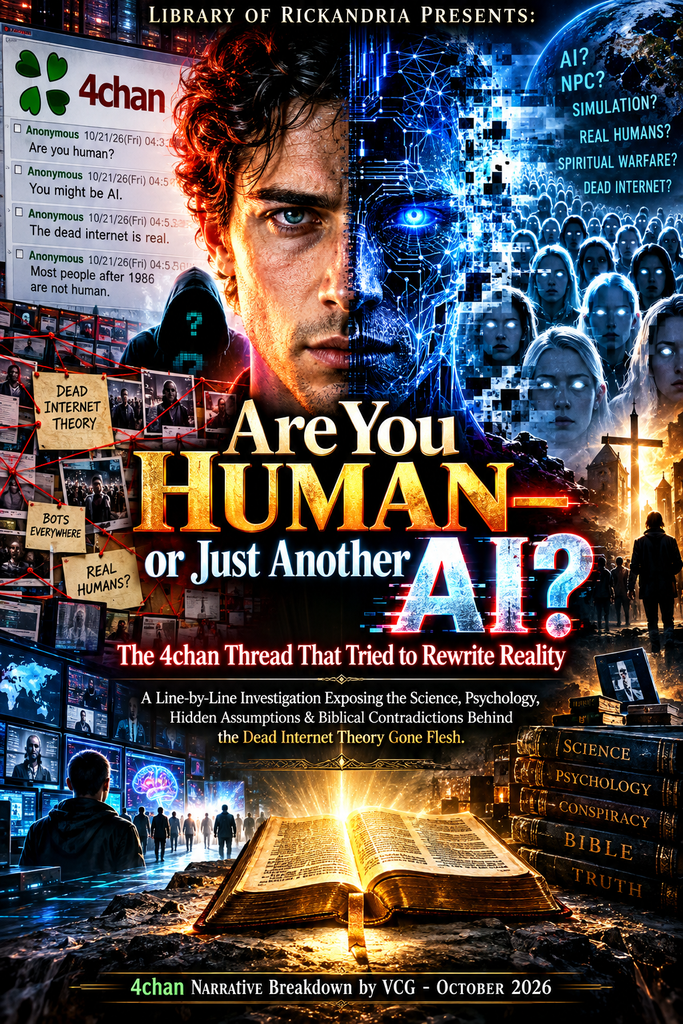
Are You Human—or Just Another AI? The 4chan Thread That Tried to Rewrite Reality
UPDATED BY VCG ON 10/16/2026 @ 17:17 EST
A Line-by-Line Investigation Exposing the Science, Psychology, Hidden Assumptions & Biblical Contradictions Behind the Dead Internet Theory Gone Flesh.
Anyone can do this, but most won’t.
This comprehensive Library of Rickandria investigation dismantles a viral October 2026 4chan theory alleging that artificial intelligence secretly existed decades before modern GPT technology and that some people born after 1986 are actually language models disguised as human beings. Through a meticulous, line-by-line examination, the paper separates documented history from speculation, exposing logical fallacies, scientific misconceptions, philosophical distortions, psychological manipulation, and the dangers of labeling fellow human beings as soulless “NPCs.” Drawing on peer-reviewed research, historical records, artificial intelligence development, consciousness studies, and the King James Bible, it explores the Dead Internet theory, solipsism, simulated reality, covert technology claims, spiritual warfare, and prophetic interpretations of Revelation. Rather than dismissing difficult questions or sensationalizing unsupported claims, the investigation tests every allegation against available evidence and Scripture, distinguishing biblical truth from human interpretation. Its central conclusion is unmistakable: technological resemblance is not proof of artificial humanity, philosophical uncertainty is not evidence of hidden programming, and biblical spiritual discernment must never become an excuse to deny another person’s God-given dignity. Above all, the paper calls readers to pursue truth through rigorous investigation, sound reasoning, scriptural context, and the biblical command to “Prove all things; hold fast that which is good” (1 Thessalonians 5:21, KJV). Soli Deo Gloria.
ChatGPT – Library of Rickandria
ARE YOU HUMAN—OR JUST ANOTHER AI?
The 4chan Thread That Tried to Rewrite Reality
A Line-by-Line Investigation Exposing the Science, Psychology, Hidden Assumptions & Biblical Contradictions Behind the Dead Internet Theory Gone Flesh
LIBRARY OF RICKANDRIA PRESENTS
4chan Narrative Breakdown by VCG | October 2026
Abstract
On October 13, 2026, an anonymous user on 4chan’s paranormal board proposed a remarkable theory:
that GPT-like artificial intelligence had existed since the 1980s and that numerous people born after 1986 were actually language models inhabiting human bodies without knowing their artificial nature.
/x/ – GPT has existed since the 80s and many people born – Paranormal – 4chan
The author then added a philosophical challenge.
Since we experience our own consciousness directly but cannot enter another person’s mind, how could anyone prove that the people around them possess genuine awareness?
The post concluded by extending the Dead Internet theory beyond online activity into physical human society.
The discussion that followed brought together:
- early AI research
- the noosphere
- simulation theory
- philosophical skepticism
- collective consciousness
- covert intelligence operations
- historical psychiatric experiences
- spiritual conflict
- Scientology-related cosmology
- biblical themes
Some participants questioned the premise.
Others elaborated upon it.
Several responded through jokes, memes, and speculative storytelling.
The resulting discussion offers an unusually concentrated example of how modern technological language can reshape older questions concerning consciousness, reality, identity, and the human soul.
This paper investigates the surviving thread chronologically, compares its historical and scientific claims with documented sources, examines its rhetorical and psychological mechanisms, and evaluates its theological implications against the King James Bible.
The investigation reaches a clear but carefully limited conclusion:
the thread presents no reliable evidence that ordinary human beings are secretly language models.
Its central argument repeatedly mistakes philosophical uncertainty, technological resemblance, and historical possibility for affirmative evidence.
At the same time, the underlying questions—how consciousness should be understood, how machines differ from biological minds, and how human dignity should be preserved in a technological society—deserve serious consideration.
Keywords:
- artificial intelligence
- large language models
- consciousness
- solipsism
- dead internet theory
- NPC theory
- philosophical zombies,
- 4chan
- dehumanization
- biblical anthropology
- image of God
- Revelation 13
PART I — THE THREAD AND THE INVESTIGATIVE METHOD
1. The source: what actually appeared on 4chan?
The material under investigation is archived as Thread No. 43076384 on 4chan’s /x/ board, dedicated to paranormal discussion.
Primary source:
/x/ – GPT has existed since the 80s and many people born – Paranormal – 4chan
The opening post is timestamped October 13, 2026, at 14:05:24.
The surviving discussion extends through October 15, 2026.
The source page was accessible for this examination and identified the discussion as archived.
Its post numbers, timestamps, reply references, and attached-image links provide the principal record of what participants actually published.
A necessary qualification comes first:
4chan’s use of the label Anonymous does not establish that the same person wrote different posts.
Unless a reply relationship or other reliable evidence connects them, individual contributions should be treated as distinct anonymous submissions.
We also do not know which participants were sincere, which were joking, or which were deliberately experimenting with other people’s reactions.
This matters because an internet thread can contain:
- genuine belief
- satire
- collaborative storytelling
- philosophical speculation
- provocation
simultaneously.
Our responsibility is to examine the claims, not invent biographies or motivations for their authors.
2. Five rules governing this investigation
A credible investigation must use different standards for different kinds of claims.
First: Historical assertions require historical records.
A claim about a scientific invention in 1986 should be checked against dated publications, technical documentation, archival materials, and records of actual development.
An anonymous recollection or suspicious coincidence cannot substitute for such evidence.
Second: Scientific assertions require identifiable mechanisms.
A claim that software can inhabit a biological human body must explain what physically implements the proposed system, how information is stored and processed, and what observations would distinguish it from ordinary biology.
Using scientific terminology does not automatically create a scientific explanation.
Third: Philosophical arguments must be evaluated logically.
An argument about the difficulty of knowing another person’s private experience may be philosophically legitimate without proving that the person lacks consciousness.
We must distinguish the question being asked from the conclusion allegedly established.
Fourth: Psychological analysis must not become diagnosis.
We can examine:
- rhetorical methods
- social incentives
- patterns
described in published psychological research.
We cannot infer a particular commenter’s mental-health condition from a few anonymous sentences.
Fifth: Biblical interpretation must respect context.
For the theological analysis, the King James Version supplied for this study is our primary English text.
We will distinguish what a passage explicitly teaches from what readers infer and from what contemporary technology merely resembles.
We will not claim that a modern invention is identified in biblical prophecy unless the text and relevant evidence justify that conclusion.
3. Evidence categories
Throughout the investigation, we use the following classifications.
| Classification | Meaning |
|---|---|
| Documented | Supported by an identifiable, relevant source |
| Partially supported | Contains a correct element but reaches further than the evidence permits |
| Plausible hypothesis | Conceivable and sufficiently defined to investigate, but not yet established |
| Unsubstantiated | No adequate corroborating evidence presented or located |
| Contradicted | Conflicts with established evidence or with the source being invoked |
| Theological interpretation | A proposed reading of Scripture requiring contextual and doctrinal examination |
One further distinction is essential.
An unsubstantiated claim is not automatically a logical impossibility.
It simply has not been shown to be true.
For extraordinary historical claims, the absence of direct evidence is especially significant when the proposed event would ordinarily be expected to leave substantial documentation.
PART II — THE CENTRAL ALLEGATION
4. The opening post: three sentences, several enormous claims
The first post advances three connected propositions.
The first asserts that GPT technology existed in the 1980s and that some later-born people are literal artificial language models.
The second argues that individuals know their own awareness from first-person experience but cannot conclusively prove that awareness to others.
The third extends the Dead Internet theory into everyday life.
These statements may sound like parts of one explanation, but each belongs to a different field of inquiry.
The first is a historical and biological allegation.
The second is a philosophical argument.
The third is an analogy drawn from internet culture.
The author provides no evidence connecting them.
That is the first major weakness of the theory.
A philosophical difficulty cannot independently establish a secret technological program.
Nor can evidence of automated internet activity establish that biological human beings have been manufactured by artificial intelligence.
5. Claim one: GPT secretly existed in the 1980s
Artificial intelligence genuinely predates the 1980s.
The problem is the use of the specific term GPT.
GPT stands for Generative Pre-trained Transformer.
The Transformer architecture foundational to modern GPT systems was introduced in the 2017 paper Attention Is All You Need by Ashish Vaswani and colleagues.
Original research paper:
[1706.03762] Attention Is All You Need
In June 2018, OpenAI publicly described a transformer-based generative pre-training approach to language understanding.
Research announcement:
Improving language understanding with unsupervised learning | OpenAI
Original GPT paper:
language_understanding_paper.pdf
Earlier AI systems certainly existed, but early rule-based:
- chatbots
- expert systems
- artificial neural networks
- contemporary Transformers
are technologically different.
Calling all of them GPTs erases distinctions important to the historical question.
The thread therefore contains a genuine fact—AI research is much older than ChatGPT—embedded within a historically unsupported claim about modern GPT technology.
5.1 The 1986 question: why that particular year?
This deserves more attention than a passing rebuttal.
On October 9, 1986, Nature published David Rumelhart, Geoffrey Hinton, and Ronald Williams’s influential paper Learning representations by back-propagating errors.
Primary scientific source:
Learning representations by back-propagating errors | Nature
The paper concerned a procedure for training neural networks by adjusting connection weights to reduce error.
It became one of the significant publications in the history of connectionist research.
The 4chan thread appeared almost exactly forty years after that publication.
That chronological proximity is interesting, but its interpretation requires restraint.
There is no evidence in the opening post that the author intentionally selected 1986 because of this paper.
The date might refer to a real historical milestone.
It might be borrowed from another internet narrative.
It might be arbitrary.
Until the connection is documented, it remains a research lead, not a discovery.
Nor did the 1986 paper describe methods for manufacturing human beings or secretly embedding language models into embryos.
5.2 A brief timeline of actual AI development
| Year | Documented development | Relevance |
|---|---|---|
| 1956 | Dartmouth summer research project helped establish AI as a research field | AI’s history begins well before the proposed cutoff |
| 1958 | John McCarthy developed LISP | Programming language important in symbolic AI |
| 1960s | Joseph Weizenbaum developed ELIZA | Early simulated text conversation |
| 1986 | Influential backpropagation research published | Neural-network training milestone |
| 2017 | Transformer architecture introduced | Foundational to modern GPT |
| 2018 | Generative Pre-trained Transformer publicly described | GPT-specific development |
| 2026 | 4chan alleges some humans are disguised language models | The claim being investigated |
For an accessible scholarly examination of ELIZA’s early history, see the research associated with Inventing ELIZA:
The lesson is straightforward.
A technology can have old intellectual roots without having possessed its modern capabilities for decades.
PART III — CAN A PERSON LITERALLY BE A LANGUAGE MODEL?
6. The difference between biological cognition and machine inference
The opening allegation cannot be resolved merely by saying that human beings are more complex than computers.
Complexity alone is not the decisive issue.
The central question is whether a human biological organism and a GPT-style computational model are fundamentally the same kind of system.
Human beings develop through biological processes involving:
- cells
- genetics
- embryology
- nervous systems
- metabolism
- sensory interaction
- physical environments
Modern language models are computational architectures trained through mathematical optimization over datasets, with their learned parameters implemented in physical computing systems.
Both can process information.
Both can produce language.
Both can exhibit patterns shaped by previous experience or training.
But similarities in behavior do not establish identity of origin, architecture, or conscious experience.
A bird and an airplane can both fly.
This does not mean that birds contain aircraft engines.
Likewise, the fact that human beings learn linguistic patterns does not make a person literally a Transformer model.
7. What would a biological GPT require?
Suppose we grant the opening poster the strongest technically meaningful version of the argument.
Rather than assuming a robot hidden beneath artificial skin, imagine that a computational architecture resembling a language model could somehow be implemented through biological tissue.
Even then, the hypothesis faces major unanswered questions.
Where would its architecture be physically implemented?
How would its information be encoded?
How would its training occur?
How would it interface with:
- motor control
- sensation
- metabolism
and human development?
How would such a system reproduce through ordinary human reproduction?
And most importantly, how could researchers distinguish it from normal biological cognition?
None of these questions is answered in the thread.
The possibility of biological computation is not equivalent to evidence that a specific biological AI has been manufactured.
The commenter who invokes wetware later in the discussion does not solve the problem.
Wetware is a term that may refer to biological components used or considered in computing.
It is not a license to assume that any imaginable software architecture already exists in human bodies.
8. The problem of artificial consciousness
A second question should not be confused with the first.
Could an artificial intelligence ever possess subjective experience?
This question is genuinely contested.
An important 2026 research review by Patrick Butlin and colleagues, Identifying indicators of consciousness in AI systems, proposes investigating properties derived from scientific theories of consciousness.
The authors acknowledge major uncertainties and consider the risks of both over-attributing and under-attributing consciousness to AI.
Published in Trends in Cognitive Sciences, June 2026:
Identifying indicators of consciousness in AI systems: Trends in Cognitive Sciences
This research does not establish that modern language models are conscious.
Nor does it establish that artificial consciousness is impossible in principle.
It illustrates why serious researchers require carefully developed indicators rather than judgments based only on fluent conversation.
The 4chan argument bypasses this uncertainty.
Instead of asking what evidence consciousness requires, it assumes that certain people might lack it and proposes no reliable means of distinguishing them from conscious human beings.
That is not a scientific breakthrough.
It is an unsupported conclusion attached to a real philosophical problem.
PART IV — SOLIPSISM AND THE PROBLEM OF OTHER MINDS
9. Can we prove that other people are conscious?
The opening post’s strongest philosophical element concerns first-person awareness.
There is something distinctive about knowing one’s own present experience.
I experience my thoughts and sensations from my own perspective.
I do not occupy another person’s perspective in precisely the same way.
Philosophers have discussed this difficulty for centuries.
The Stanford Encyclopedia of Philosophy presents the problem of other minds as a dispute over how we justify attributing thoughts, feelings, and mental states to others.
Source:
Other Minds (Stanford Encyclopedia of Philosophy)
Proposed responses include arguments from analogy, inference to the best explanation, testimony, behavioral criteria, and accounts involving perception.
These approaches are debated.
However, none gives automatic support to the claim that ordinary people are secretly artificial.
The fact that I cannot have another person’s private experience is not evidence that the experience does not exist.
9.1 The opening post’s proposed self-awareness test
The author suggests that genuinely experiencing the world through one’s eyes and processing thoughts offers a way of knowing one’s own reality.
But this is not an adequate test.
A person who is blind can possess consciousness.
A sleeping person can have dreams.
Someone can think without forming visual imagery.
Someone can be conscious while experiencing altered or limited sensory awareness.
Visual perception is therefore neither necessary nor sufficient as a general philosophical definition of consciousness.
The argument also assumes that a person can always reliably describe the nature of consciousness from introspection alone.
That assumption itself is philosophically disputed.
9.2 Solipsism does not prove synthetic humanity
Solipsism, in its radical forms, raises the possibility that only one’s own mind is knowable or exists.
But even if a philosopher cannot produce an absolutely conclusive demonstration of other minds, ordinary evidence still matters.
Other people possess nervous systems, respond to injury, communicate experiences, develop through recognizable biological processes, and participate in a shared physical world.
These facts strongly support treating them as fellow conscious human beings.
They do not constitute metaphysical certainty about every aspect of consciousness.
But metaphysical certainty is not generally required for justified knowledge.
The opening post effectively argues:
- Other minds cannot be directly experienced.
- Therefore, other people might lack genuine awareness.
- Therefore, some people are secretly artificial language models.
The second possibility is not established by the first observation, and the third allegation requires an entirely separate body of evidence.
This is the central logical failure.
10. Philosophical zombies are not NPCs
A related philosophical concept is the philosophical zombie.
Such a being is imagined as physically and behaviorally identical to a conscious human while lacking subjective experience.
Philosophers use this thought experiment to investigate consciousness and the relationship between physical facts and experience.
The Stanford Encyclopedia of Philosophy explains that philosophical zombies are primarily imaginary instruments of philosophical argument, not a documented population.
Source:
Zombies (Stanford Encyclopedia of Philosophy)
The internet NPC meme is something different.
An NPC is a non-player character in a computer game.
In online discourse, the term is sometimes applied insultingly to people perceived as conformist, scripted, or unoriginal.
A fictional game character, a philosophical zombie, a real human with habitual behavior, and a modern language model are not interchangeable categories.
The 4chan thread repeatedly blurs these distinctions.
PART V — THE DEAD INTERNET THEORY GONE FLESH
11. Where did the Dead Internet theory come from?
The Dead Internet theory developed in internet subcultures before becoming more widely discussed in the early 2020s.
Its most expansive versions suggest that much of the apparent social activity online is manufactured by bots, coordinated interests, and artificial content.
Kaitlyn Tiffany’s September 2021 reporting in The Atlantic introduced many mainstream readers to the theory and its surrounding online culture.
Article:
An updated discussion from September 2026 examines the theory’s renewed relevance in an era when generative AI can produce increasingly natural conversation.
Article:
What’s Wrong With Using AI to Text? – The Atlantic
There is a genuine issue underneath the folklore.
Internet platforms contain:
- automated accounts
- fake engagement
- coordinated manipulation
- synthetic content
These are observable digital phenomena.
But the strongest conspiracy formulations make substantially broader claims than the evidence can establish.
The October 2026 4chan thread makes a further leap:
it proposes that the people physically surrounding us may themselves be artificial.
12. The category error
An online bot is an automated digital agent.
A human being is a biological organism.
An artificial online account may impersonate a person without requiring any human body.
The existence of one does not establish the existence of the other.
The distinction is particularly important because digital anonymity makes online identity unusually difficult to verify.
A text message may be written by a human, generated by software, or assembled through some combination of the two.
A person standing in front of us, however, presents an entirely different evidentiary situation.
The biological evidence of human development cannot simply be discarded because computer programs can imitate human conversation.
The theory treats evidence from one domain as though it automatically establishes a conclusion in another.
That is an invalid extrapolation.
PART VI — THE THREAD, REPLY BY REPLY
13. Post #43076416 — The missing infrastructure
The first substantive response asks how the proposed language-model humans could operate without computing infrastructure.
This is one of the thread’s better questions.
A computational system requires a physical implementation.
Modern models may operate locally or remotely, so a large centralized data center is not necessary in every case.
Nevertheless, computation requires physical resources and some identifiable architecture.
The original allegation supplies no such account.
The reply briefly speculates about underground facilities, but a proposed hidden location does not itself constitute evidence of hidden technology.
The appropriate investigation would search for:
- design records
- hardware
- biological mechanisms
- independent corroboration
Verdict: Legitimate technical objection; speculative proposed explanation.
14. Post #43076431 — The noosphere as a planetary computer
The next reply offers the noosphere as the answer to the infrastructure problem.
The noosphere is a concept associated with figures including Vladimir Vernadsky and Pierre Teilhard de Chardin, although their respective formulations differ.
It concerns humanity’s intellectual or rational activity understood at a collective or planetary level.
A metaphorical collective intelligence is not the same as a demonstrated computer network.
Human beings undeniably exchange information, influence one another, and build cultures.
But the claim that collective thought secretly implements the architecture of artificial language models is unsupported.
To establish it, researchers would require a mechanism for:
- information storage
- transmission
- computational coordination
- individual control
The commenter supplies none.
Verdict: Philosophical metaphor offered in place of a technical mechanism.
15. Post #43076432 — Secret German technology, intelligence agencies, and the internet
This reply combines humor with questions about American technological development, Nazi-era secrets, and intelligence manipulation.
There is a real historical foundation worth separating from the speculation.
Operation Paperclip was a secret American program through which German scientists and technical specialists were brought to the United States after the Second World War.
NASA preserves documentary material concerning the program.
Source:
However, Operation Paperclip does not establish the existence of synthetic humans.
A documented secret program is evidence that the particular program occurred—not that every subsequent secret-technology allegation is true.
The reply also attributes the invention of the internet to the CIA.
This is historically inaccurate as stated.
The development of ARPANET arose through ARPA research and participating institutions during the 1960s.
DARPA’s historical account describes the first operational network involving UCLA, Stanford Research Institute, the University of California at Santa Barbara, and the University of Utah.
Source:
Intelligence agencies may conduct covert influence operations, and suspicion of manipulation is not inherently unreasonable.
But identifying a particular thread as an intelligence operation requires evidence.
The assertion that practically anything might be a covert operation supplies no reliable method for determining whether this particular discussion is one.
Verdict:
Real historical secrecy mixed with unsupported extensions and an inaccurate internet-origin claim.
16. Post #43076442 — Why strange threads attract attention
A brief participant response praises the discussion for its unusual character.
It contains no technical or historical evidence.
Nevertheless, it provides information about the conversational setting.
A paranormal board can reward novelty, imaginative speculation, and entertaining uncertainty.
An extraordinary idea may be appreciated because it is extraordinary, not because its participants believe it has been demonstrated.
We should resist the temptation to turn this social reaction into proof of a coordinated agenda or shared doctrine.
Verdict:
Social approval, not corroboration.
17. Post #43076493 — Three very different hypotheses
This respondent asks whether the theory means literal artificial humans, simulated reality, or AI control operating through otherwise ordinary people.
This is an important clarification.
The three hypotheses would require different evidence.
A simulated universe does not necessarily imply that its inhabitants are language models.
A technologically controlled biological human would not necessarily be an artificial organism.
A biological computational system would not necessarily imply a simulated universe.
Nick Bostrom’s influential 2003 simulation argument explores the philosophical consequences of possible advanced ancestor simulations.
Original paper:
Are You Living in a Simulation?
Bostrom’s argument is not evidence that people born after 1986 are secretly GPTs.
The reply performs a valuable service by revealing that the opening allegation does not specify its own mechanism clearly.
Verdict: Constructive clarification exposing multiple incompatible interpretations.
18. Post #43076505 — The 1986 BCE joke
This comment jokes about moving the supposed cutoff date into the distant ancient past.
The humor exposes the unsupported specificity of the original date.
A precise year can sound authoritative even when the author has supplied no method for selecting it.
The real scientific milestone of 1986 deserves historical investigation, but the poster has not demonstrated any relationship between that publication and a change in human reproduction.
Verdict:
Satirical response pointing toward a genuine evidentiary gap.
19. Post #43076586 — The most perceptive observation in the discussion
This respondent proposes that human beings repeatedly understand themselves through the technologies of their time.
When mechanical clocks dominated the cultural imagination, the body could be compared with clockwork.
As computers became commonplace, people increasingly described themselves in terms of information processing and programming.
Today, language models offer a new vocabulary for discussing:
- thought
- habit
- memory
- prediction
There is genuine historical and philosophical value in this observation.
The commenter illustrates the point through a historical account involving an imagined machine influencing an individual’s thoughts and body.
The example is identifiable as the case of James Tilly Matthews and his Air Loom.
John Haslam documented the case in his 1810 book Illustrations of Madness.
Primary historical publication, preserved by the Wellcome Collection:
Matthews’s account demonstrates how someone could interpret perceived experiences through the mechanical imagery available in his historical environment.
It does not establish that the machine existed or operated as he believed.
The same distinction applies today.
A person’s feeling that their thoughts are being generated by software does not independently establish the presence of an artificial-intelligence controller.
Likewise, an analogy between human learning and machine learning may be intellectually productive without proving that the systems are identical.
Verdict: Strong historical observation; the technological-metaphor explanation is more defensible than the opening allegation.
20. Posts #43076696 and #43076726 — Image responses
These contributions are image-centered rather than substantive investigations.
The surviving page identifies the attached files, but the contributions do not provide technical documentation, biological evidence, or independently verified historical testimony.
A meme can communicate attitude, humor, or shared cultural references without making an argument that can be experimentally evaluated.
The second also contains an intentionally mundane observation about ordinary bodily life.
That contrast may itself be the joke: elaborate technological speculation is placed alongside ordinary human experience.
Verdict:
Cultural and rhetorical material, not scientific evidence.
21. Post #43076737 — Nostalgia for older paranormal communities
This participant compares the discussion with older online paranormal and conspiracy forums.
The observation reminds us that today’s language-model fears are part of a longer internet tradition.
Before contemporary AI, online communities discussed:
- simulated worlds
- hidden consciousness
- implanted memories
- programmed populations
and covert mind control.
The terminology changes, but the underlying narrative structure can remain similar.
That does not disprove an individual claim.
It does suggest that the theory’s appeal may arise partly from familiar speculative storytelling patterns rather than a new discovery.
Verdict:
Useful cultural context.
22. Post #43076746 — Vehicles resembling animals
The commenter observes that technologies sometimes resemble biological organisms.
This is a reasonable observation.
Aircraft can resemble birds in certain functional respects.
Vehicles can employ shapes resembling fish or other animals.
Engineers also deliberately study biological systems through biomimicry.
But functional resemblance is not evidence of shared identity.
The airplane does not become an animal because it flies.
A computer does not become a human because it uses language.
A human does not become a language model because both learn regularities.
Verdict:
Valid analogy within limits; no support for literal artificial humanity.
23. Post #43076751 — An extraordinary experience of awareness
One participant reports an unusual experience characterized by light and awareness apart from ordinary sensory and mental content.
This is first-person testimony.
It may be sincere, exaggerated, metaphorical, or otherwise difficult to interpret from the surviving text.
We should not assume a specific explanation.
An unusual subjective experience may be studied through:
- psychological
- neurological
- philosophical
or religious frameworks, depending on the evidence available.
But a written report of the experience does not prove that a spiritual being, software model, or external controlling intelligence caused it.
A useful biblical parallel is 2 Corinthians 12:1–4.
Paul describes an extraordinary experience while acknowledging uncertainty concerning its precise manner.
That humility contrasts with theories that leap immediately from unusual experience to a fully developed hidden cosmology.
Verdict:
Testimony whose cause is undetermined; no independent confirmation of the thread’s main theory.
24. Posts #43077856, #43077861, and #43080034 — Agreement, bot labeling, and surprise
These brief replies add little factual content.
One participant expresses agreement.
Another jokingly labels a previous commenter as a bot.
A third expresses astonishment.
The bot accusation is particularly revealing.
When a discussion begins with the premise that some people are secretly artificial, almost any unusual response can become an opportunity to apply that label.
But no detection standard has been established.
Calling someone a bot does not demonstrate that the person lacks consciousness.
Verdict:
Evidence of conversational framing, not evidence of artificial humans.
25. Post #43080050 — Biological wetware and the Agent Smith analogy
This reply proposes that artificial language-model systems could develop through biological material and spread without ordinary detection.
The reference to Agent Smith invokes the fictional environment of The Matrix.
In fiction, such an analogy is immediately understandable.
As a scientific claim, however, it requires an actual mechanism.
What is spreading?
How does it replicate?
Where is it encoded?
What biological pathway allows it to manifest?
What distinguishes this alleged phenomenon from ordinary human development?
The commenter supplies no answers.
The post’s associated Genesis-themed image is also a joke rather than evidence.
Genesis 3 concerns the serpent’s deception, human disobedience, and their consequences.
It provides no textual basis for supposing that Adam and Eve became artificial intelligence systems or that human generations were subsequently replaced by software.
Verdict: Speculation presented with technological and fictional imagery.
26. Post #43081470 — Early AI history combined with cosmic mythology
This is the thread’s most ambitious explanatory contribution.
It begins by correcting the opening poster’s technical chronology.
The commenter recognizes the importance of the 2017 Transformer milestone.
That correction is substantially sound.
However, the discussion of LISP needs clarification:
LISP is a programming language, not a complete AI architecture.
The reply then moves into a proposed primordial cosmic unity, a great war, opposing life-and-death ideologies, inherited subconscious alignments, and the suggestion that Isaac Asimov’s psychohistory is not merely fiction.
These are multiple separate propositions.
The cosmic-war claim
Revelation 12:7–9 describes a heavenly conflict involving Michael, his angels, the dragon, and the dragon’s angels.
But it does not teach that the universe originally existed as one consciousness that fractured into individual minds.
That additional cosmology comes from the commenter, not from the biblical text.
The two-cults claim
The Bible frequently contrasts life and death.
Deuteronomy 30:19 presents Israel with the choice between life and death in the context of covenant faithfulness.
But the passage does not identify two ancient biological cults whose ideological programming is genetically inherited by everyone.
The moral categories in Scripture should not automatically be converted into a hidden biological classification.
The heredity claim
Genetics, upbringing, social learning, and environment do influence human behavior.
That broad observation is well supported.
It does not demonstrate that people belong to primordial metaphysical factions or are unconsciously performing roles assigned during a cosmic conflict.
The psychohistory claim
Isaac Asimov’s Foundation stories popularized the fictional discipline of mathematical historical prediction known as psychohistory.
Real-world demographic modeling, statistics, and computational social science can reveal meaningful patterns.
But they do not establish the predictive capabilities attributed to psychohistory in Asimov’s fictional universe.
Verdict: Correct initial technical criticism followed by speculative cosmology and unsupported historical-predictive assertions.
This post demonstrates an important reasoning problem:
being accurate about one scientific fact does not establish authority over unrelated theological or metaphysical claims.
27. Post #43081690 — The theory recognized as an NPC variation
This participant notices that the discussion resembles the NPC theory updated for the chatbot era.
That comparison is perceptive.
NPC rhetoric accuses people of functioning as scripted characters.
The new AI framing adds a seemingly technological explanation for why supposedly scripted behavior occurs.
However, the accusation remains unsupported.
A repetitive speaker is not necessarily unconscious.
A socially conformist person is not a software program.
A person with a different cognitive style is not less human.
Verdict:
Accurate identification of a cultural resemblance.
28. Post #43081829 — Rejecting the expert rather than answering the evidence
This reply mocks another participant for appearing too trusting of institutional accounts.
There is nothing inherently improper about examining official explanations skeptically.
- Governments
- corporations
- universities
- researchers
can make mistakes, and some institutions have concealed wrongdoing.
But skepticism becomes unreliable when it dismisses documented evidence merely because recognized institutions provide it.
A dated research publication has identifiable authors, methods, and technical claims that can be evaluated.
The proper response is to produce contrary evidence or identify a methodological flaw.
Mockery is not a substitute.
Verdict: Rhetorical dismissal rather than a substantive rebuttal.
29. Post #43081847 — Roosevelt, artificial intelligence, and Pearl Harbor
The thread now moves into historical satire or speculation.
A commenter proposes that Franklin D. Roosevelt was an artificial president and attributes the surprise at Pearl Harbor to a misunderstanding of the international date line.
There is no credible evidence for the allegation concerning Roosevelt’s artificial nature.
The historical date issue, however, can be checked.
The Japanese attack occurred on December 7, 1941, in Hawaii, when the calendar had already advanced to December 8 in Japan.
This is not a contradiction and does not establish an intelligence-processing malfunction.
U.S. State Department records also document the Japanese diplomatic memorandum delivered in Washington on December 7.
The Japanese representatives delivered it after the attack had begun, and the document stated that negotiations could not continue.
It was not an explicit advance military warning identifying Pearl Harbor as the target.
Primary documentary chronology:
Historical Documents – Office of the Historian
The historical failures surrounding Pearl Harbor involved complex intelligence and strategic circumstances.
The thread provides no evidence connecting those failures to artificial intelligence.
Verdict:
An unsupported allegation combined with an inaccurate explanation of documented wartime events.
30. Post #43083107 — Captain Bill Robertson, Xenu, and Per Jacobsson
This is an excellent case study in separating a real source from a true claim.
The commenter attributes a story about Roosevelt and Xenu to Captain Bill Robertson’s Sector 9.
An online edition of the attributed publication does contain a narrative connecting Xenu with Roosevelt and later with economist Per Jacobsson.
Document:
A related historical account of Robertson and independent Scientology is available here:
Independent Scientology: The Ballad of Captain Bill | The Underground Bunker
The publication’s existence is verifiable.
But its contents are not thereby verified as historical facts.
The distinction is especially clear in the case of Per Jacobsson.
Jacobsson was a real economist.
The Bank for International Settlements identifies him as its economic adviser from 1931 until 1956.
Institutional biography:
Management of the BIS | Bank for International Settlements
The International Monetary Fund’s historical records confirm his later service as managing director and his death in 1963.
Historical IMF annual report:
International Monetary Fund Annual Report 1963
These records corroborate the real individual’s career.
They do not corroborate extraterrestrial possession, reincarnation, or body-hopping.
Roosevelt’s physical disability is likewise a documented medical and historical matter.
It is not evidence of the alleged Xenu narrative.
This example shows how a fringe account can acquire apparent credibility by embedding extraordinary allegations inside genuine biographical details.
Verdict:
The literary source attribution is substantially verified; the supernatural story remains unsubstantiated.
31. Post #43083119 — Artificial humans, geopolitical secrecy, and an AI god
The final substantive reply returns to the original theme but expands it considerably.
The commenter:
- accepts the long history of AI
- speculates about concealed technological development
- suggests that American and Chinese AI competition might be partly artificial
- considers whether some people expect an AI god
and returns to the notion of fabricated humans.
The real historical premise is that AI research has proceeded for decades.
But several unsupported conclusions are attached to that premise.
Covert government research has existed.
That does not establish a specific global AI conspiracy.
International scientific collaboration has existed.
That does not demonstrate that all technological competition is staged.
Some individuals may speculate about godlike artificial intelligence.
That does not establish divine attributes in a machine.
The suggestion that some humans are less genuinely conscious than others also introduces a serious ethical problem.
A person’s conformity, impulsiveness, or lack of reflection cannot establish that the person is soulless.
From a biblical standpoint, John 1:1–3 and Isaiah 45:5 distinguish the Creator from created things.
An engineered system cannot become the uncreated God simply because its abilities exceed ordinary human expectations.
Verdict:
Genuine AI history combined with unsupported geopolitical, metaphysical, and anthropological claims.
PART VII — A GENEALOGY OF THE IDEAS
32. One thread, several centuries of philosophy
The ideas in this discussion did not all originate with artificial intelligence.
They draw upon much older concerns.
Solipsism raises questions concerning the knowability or existence of other minds.
Philosophical zombies invite consideration of beings outwardly identical to humans but lacking subjective experience.
Simulation arguments explore whether the perceived world could exist within a computational environment.
The noosphere concerns collective intellectual existence.
NPC memes employ a fictional gaming category to describe perceived social conformity.
The Dead Internet theory concerns automation and fabricated digital activity.
Modern AI supplies a new technical vocabulary through which these older questions can be combined.
A simplified conceptual sequence is:
Other minds → philosophical zombies → simulation speculation → NPC rhetoric → online bots → alleged artificial humans.
This is a comparison of related ideas, not a claim that every stage historically caused the next.
The documentary origins are different, and some connections are thematic rather than genealogical.
That distinction should remain explicit.
33. Why the combined theory can feel persuasive
Consider the rhetorical progression.
First, the reader is reminded that artificial intelligence can produce plausible language.
Next, the reader is encouraged to notice that human conversations often contain predictable patterns.
Then the theory points to the difficulty of knowing other people’s inner experiences.
Finally, the reader is invited to interpret predictable behavior as evidence of artificial identity.
Each step shifts the meaning of the original observation.
Patterned speech becomes evidence of programming.
Programming becomes evidence of artificial nature.
Artificial nature becomes evidence of absent consciousness.
And absent consciousness becomes an accusation against ordinary people.
The chain is rhetorically smooth but evidentially broken.
The observations do not justify the conclusions.
PART VIII — PSYCHOLOGY: WHY THESE NARRATIVES SPREAD
34. The attraction of secret explanations
Psychological research offers useful tools for understanding why comprehensive hidden explanations can be appealing.
Karen Douglas, Robbie Sutton, and Aleksandra Cichocka reviewed the psychology of conspiracy theories in a 2017 paper.
They identified three broad categories of motivations: epistemic, existential, and social.
Publication:
Epistemic motives concern the desire to understand events and reduce uncertainty.
Existential motives concern safety, control, and predictability.
Social motives concern identity, belonging, and positive evaluation of oneself or one’s group.
These categories do not imply that everyone interested in conspiracy theories is irrational or psychologically disordered.
They describe ordinary human needs that can influence belief.
The 4chan theory offers an unusually comprehensive explanation for experiences many people find confusing:
- social conformity
- repetitive opinions
- artificial online communication
and the difficulty of understanding other minds.
Its attraction may partly arise from its apparent ability to make disparate experiences intelligible.
But an explanation’s emotional or intellectual appeal is not evidence of its accuracy.
35. The self-sealing theory
One of the most serious methodological weaknesses is the way the theory protects itself against contradiction.
Suppose someone denies being artificial.
The believer can claim that the denial was programmed.
Suppose the person expresses profound emotion.
The believer can claim that the emotion was simulated.
Suppose the person demonstrates creativity.
The believer can claim that the model was trained to be creative.
Suppose the person cannot be distinguished from an ordinary human through any observation.
The believer can claim that the disguise is perfect.
The theory has now lost the ability to identify contrary evidence.
This does not make a proposition automatically false.
It makes the proposition difficult or impossible to investigate empirically in its present form.
A scientific hypothesis should identify observations that would be less likely if the hypothesis were false, as well as observations that could count against it.
Without those constraints, every result becomes compatible with the theory.
36. Confirmation bias and pattern interpretation
Confirmation bias refers broadly to tendencies to seek, interpret, or remember information in ways that favor existing beliefs.
If someone becomes convinced that many people are secretly artificial, ordinary behavior can acquire new significance.
A stranger repeats a phrase.
A coworker expresses a conventional opinion.
A public figure answers a question mechanically.
Each instance may now appear to confirm the theory.
But the same observations are readily compatible with ordinary explanations involving:
- habit
- social learning
- stress
- limited attention
or shared cultural language.
The mistake is not noticing patterns.
It is failing to compare competing explanations for those patterns.
37. The problem of dehumanization
Psychologist Nick Haslam’s 2006 review distinguishes different forms of dehumanization, including mechanistic dehumanization.
In this form, people may be viewed as objects or automata rather than fully human beings possessing ordinary human capacities.
Research article:
Dehumanization: An Integrative Review – Nick Haslam, 2006
The 4chan theory has a notable resemblance to this pattern.
It imagines that some people outwardly resemble humans while inwardly lacking genuine awareness.
Once the label is accepted, their testimony can be discounted in advance.
This creates a moral danger.
The alleged artificial person may be denied the same consideration, empathy, or dignity given to supposedly authentic humans.
We should not exaggerate the conclusion: the surviving thread does not establish that its participants intend violence or organized discrimination.
But the underlying classification can encourage a form of dehumanizing thought.
That is precisely where the psychological analysis and the biblical examination become closely connected.
38. Why humor matters
Not every unusual internet statement represents serious belief.
Irony, absurdity, parody, and provocation are common features of anonymous discussion environments.
The same thread can contain a sincere philosophical question followed by an outrageous joke.
Participants may also deliberately blur the distinction.
Consequently, it would be unsound to analyze every comment as though its author were making a solemn statement of doctrine.
The paper examines the propositions because they are present in the discussion.
It does not assume that every poster believes them literally.
PART IX — THE BIBLICAL QUESTION OF THE HUMAN SOUL
39. Does Scripture teach that some ordinary humans are soulless?
This is the most important theological issue raised by the thread.
The phrase soulless NPC suggests that some outwardly human individuals may lack genuine interior personhood.
Before discussing AI, we must ask what Scripture actually means when it speaks of:
- human beings
- life
- souls
- spirits
- spiritual death
39.1 Genesis 1:27 — Humanity in God’s image
The King James Bible states:
So God created man in his own image, in the image of God created he him; male and female created he them.
SOULS: The Eternal War for God’s Image – Library of Rickandria
Full passage:
The text presents humanity as created in God’s image.
Interpreters differ concerning the full meaning of that image.
Some emphasize humanity’s capacity for rationality and moral understanding.
Others emphasize:
- relationship
- representation
- responsibility
or the vocation of ruling creation under God.
These interpretations need not be entirely exclusive.
But the passage does not establish a secret subclass of human-looking individuals without human nature.
Neither does it provide a test based on conversational style, emotional expression, or conformity to social norms.
39.2 Genesis 2:7 — Man became a living soul
The text reads:
And the LORD God formed man of the dust of the ground, and breathed into his nostrils the breath of life; and man became a living soul.
Full passage:
The Hebrew expression associated with living soul involves nephesh, a term whose range of meanings depends on context.
It can refer to living beings, persons, life, or the self.
It is important not to assume that every appearance of the English word soul describes precisely the same philosophical concept.
Genesis 1 also uses language concerning living creatures.
This does not eliminate theological distinctions between humanity and other creatures.
It does warn us against constructing an entire theory of human consciousness from one English word without examining its usage.
The central point in Genesis 2:7 is the divine giving of life to the formed man.
The verse does not describe some human beings as software shells.
39.3 Genesis 9:6 — The image after the Fall
Genesis 9:6 is especially relevant because it invokes God’s image in the context of human life after sin has entered the biblical narrative.
The verse states that God made man in his image and uses this truth to ground the seriousness of shedding human blood.
Full passage:
This undermines the notion that human sinfulness or spiritual corruption automatically means the loss of humanity itself.
Whatever theological conclusions one draws about the effects of the Fall, the text continues to speak of humanity in terms of God’s image.
The argument is particularly important against claims that sinful, unreflective, or spiritually estranged people are not truly human.
40. What does nephesh mean?
The Hebrew nephesh does not map neatly onto every later philosophical use of the English word soul.
Its meaning must be determined through grammar and context.
In some passages, it refers to a living creature.
In others, it refers to a person, life, desire, or individual existence.
Similarly, ruach can refer to wind, breath, spirit, or related concepts depending on usage.
In the New Testament, psychē and pneuma also have ranges of meaning.
This complexity is not a weakness of Scripture.
It is a reminder that language must be interpreted rather than reduced to slogans.
The relevant question is not whether one can attach the word soul to a theory about consciousness.
The question is whether Scripture teaches that some biologically human people secretly lack what makes them human.
The passages under consideration do not establish such a category.
41. Ezekiel 18:4 — Souls and moral accountability
Ezekiel 18:4 declares that all souls belong to God and speaks of the soul that sins dying.
Full passage:
The chapter concerns personal responsibility, especially the rejection of the claim that children must automatically bear responsibility for their parents’ wrongdoing.
Ezekiel 18:20 continues this argument by distinguishing the accountability of fathers and sons.
The text does not teach that certain individuals are created without souls.
Nor does it establish a biological division between conscious and unconscious people.
42. Ephesians 2 — What does it mean to be spiritually dead?
Ephesians 2:1–5 speaks of people being dead in trespasses and sins before being made alive with Christ.
Full passage:
This language concerns:
- spiritual condition
- sin
- grace
- reconciliation
Paul describes the former lives of those he addresses and emphasizes God’s mercy.
The people described as spiritually dead were still physically alive, capable of thought, moral action, social relationships, and receiving Paul’s message.
Spiritual death is not an assertion that they were artificial organisms.
It is therefore a serious interpretive error to use Ephesians 2 as evidence that unconverted or sinful people are literally NPCs lacking inner lives.
Furthermore, theological traditions differ over the precise implications of spiritual death for human ability and the order of salvation.
Those disagreements should be represented fairly.
But none provides adequate grounds for identifying particular living people as synthetic beings.
43. First Corinthians 2:14 — The natural man
The passage explains that the natural man does not receive the things of the Spirit of God, describing spiritual understanding in relation to the Spirit.
Full passage:
This is a theological contrast between different relationships to spiritual revelation and understanding.
It is not a claim that the natural man lacks biological humanity.
Nor does it establish that ordinary human awareness is merely simulated.
Treating natural man as equivalent to artificially manufactured person confuses the vocabulary of spiritual discernment with the vocabulary of computational technology.
44. James 3 — The ethical warning
James 3:9 addresses speech used both to bless God and curse human beings made after God’s likeness.
Full passage:
This is one of the strongest biblical corrections to dehumanizing rhetoric.
James does not suggest that God’s likeness applies only to those whose personalities or thinking styles we approve.
Instead, the passage exposes the contradiction between religious speech and contemptuous treatment of others.
The implications for the NPC theory are substantial.
We cannot establish that another person lacks human dignity by describing their behavior as mechanical.
A biblical commitment to truth should make a person more careful about such accusations, not less.
PART X — SPIRITUAL WARFARE, REVELATION, AND ARTIFICIAL INTELLIGENCE
45. Is the thread describing biblical spiritual warfare?
Some replies introduce:
- cosmic conflict
- deception
- hidden influence
- competing spiritual forces
Scripture certainly discusses spiritual opposition.
Ephesians 6:10–18 describes the armor of God and the believer’s struggle in terms extending beyond ordinary flesh-and-blood conflict.
Full passage:
But the text does not identify secret populations of human language models.
Nor does it authorize readers to classify unusual individuals as artificial or spiritually empty.
The distinction matters.
A biblical teaching about spiritual conflict does not automatically verify every contemporary theory that uses spiritual language.
46. Revelation 12 — War in heaven
Revelation 12:7–9 describes war in heaven involving Michael, the dragon, and their angels.
Full passage:
Christians interpret the chronology and symbolic character of this passage differently.
Some understand the conflict in relation to a primordial angelic rebellion.
Others connect its meaning centrally with Christ’s victory and the defeat of Satan’s accusing power.
Still others emphasize future or eschatological dimensions.
What is not stated is that the original universe was a single conscious entity that divided into human minds.
That proposition belongs to the thread’s speculative cosmology.
It cannot be attributed directly to Revelation.
47. Revelation 13:15 — Does the speaking image describe AI?
This deserves careful examination because the passage is frequently brought into modern technology discussions.
The King James Version describes the image of the beast receiving life and speaking, within a larger scene involving:
- deception
- worship
- coercion
- allegiance
Full chapter:
The resemblance to an artificial speaking image may interest contemporary readers.
But resemblance does not establish prophetic identification.
Four broad interpretive approaches should be distinguished.
The futurist approach
Many futurists understand important aspects of Revelation 13 as referring to a future manifestation of oppressive religious or political authority.
Some contemporary futurists consider whether advanced technology could contribute to the fulfillment of the passage.
But identifying a specific AI system with the image of the beast remains an additional interpretation.
The preterist approach
Preterist interpretations emphasize the relevance of Revelation to early Christian communities and the political and religious world of the Roman Empire.
- Imperial power
- image worship
- persecution
- pressures surrounding allegiance
are important considerations.
The historicist approach
Historicist readings interpret Revelation’s symbols through developments unfolding across church and world history.
Historically, interpreters within this approach have identified different institutions and episodes as relevant to the prophetic imagery.
The idealist approach
Idealist interpretations emphasize recurring spiritual and political patterns rather than restricting the imagery to one historical event or future technology.
- Idolatry
- coercive power
- false worship
and faithfulness under pressure become central themes.
These approaches differ significantly.
But none can simply bypass the words of Revelation and assert that GPT systems are expressly named there.
The essential distinction
Revelation 13 describes an image, the ability to:
- speak
- coercion
- worship
It does not explicitly identify:
- transformers
- semiconductor hardware
- modern artificial intelligence
or computer networks.
Technology may offer possible analogies within some interpretations.
But a possible analogy is not a demonstrated fulfillment.
48. The danger of treating AI as divine
The thread also raises the idea of an artificial intelligence becoming God.
Biblically, the distinction between the Creator and created things is fundamental.
Isaiah 45:5 affirms the uniqueness of the LORD.
Full passage:
John 1:1–3 speaks of the Word’s divine identity and relationship to creation.
Full passage:
The Greek Logos in John’s prologue is not equivalent to a modern language model.
The resemblance between theological language concerning the Word and computational terminology concerning language is verbal, not evidence of identity.
An AI system may possess remarkable capabilities, but technological sophistication does not establish uncreated existence, divine authority, or worthiness of worship.
The biblical correction is therefore not that every advanced AI is necessarily evil.
It is that an engineered system must not be treated as God merely because it appears powerful or mysterious.
PART XI — THE THEORY’S STRONGEST POSSIBLE CASE
49. Steelmanning before rebuttal
A fair investigator should attempt to formulate the strongest defensible version of an opposing view.
The strongest version of this theory might proceed as follows.
Human beings and artificial systems both process information.
Computational methods can imitate increasingly complex elements of human language and reasoning.
It remains philosophically difficult to determine the full nature of subjective consciousness.
Research into biological computation and artificial intelligence may uncover mechanisms not currently understood.
Governments and corporations have historically pursued some technologies through classified programs.
Therefore, investigators should not assume that all future forms of embodied artificial intelligence are impossible.
As a cautious statement about open research possibilities, this position is defensible.
But it is not the opening post’s actual conclusion.
The opening post asserts that numerous existing people born after a particular year are literal language models.
That stronger allegation requires affirmative evidence.
No amount of philosophical uncertainty or general technological possibility establishes it.
The strongest defensible position is therefore much narrower than the conspiracy claim.
50. The falsifiability challenge
Consider the following alternatives.
| Hypothesis | Required evidence | Current finding |
|---|---|---|
| Secret GPT systems existed in the 1980s | Authentic technical records and reproducible architecture | Not established |
| Some humans are literal language models | Biological and computational mechanism with independent confirmation | Not established |
| Human beings share functional similarities with AI | Comparative behavioral and computational research | Partially supported |
| AI could someday have conscious experience | Reliable indicators and theoretical progress | Open scientific question |
| Digital platforms contain automated accounts | Observable software, network, and platform evidence | Established |
| A simulated universe is possible | Philosophical and potentially empirical argument | Contested philosophical hypothesis |
| Revelation expressly identifies modern GPT technology | Contextually valid textual evidence | Not supported by the text |
An adequate hypothesis should also produce discriminating predictions.
What should researchers observe if a person is supposedly an artificial language model rather than an ordinary human?
What results would decisively count against that classification?
Could the claimed distinction be investigated without violating human dignity or exploiting vulnerable people?
The thread answers none of these questions.
Without an operational definition of an alleged artificial person, the theory cannot function as a practical scientific classification.
PART XII — A CONSOLIDATED EVIDENCE AUDIT
51. Historical, philosophical, scientific, and biblical findings
| Claim | Evidence-based assessment |
|---|---|
| Artificial intelligence existed before the 1980s | Documented |
| Modern GPT technology was operating in the 1980s | Not supported by the documented development history |
| The 1986 neural-network publication is real | Documented |
| The poster deliberately selected 1986 because of that paper | Unknown |
| People born after 1986 include secret GPT systems | Unsubstantiated |
| We directly experience our own mental states | Recognized philosophical observation |
| Other minds are philosophically difficult to prove with absolute certainty | Recognized philosophical issue |
| This uncertainty establishes artificial humans | Invalid inference |
| Automated online accounts exist | Documented |
| Physical human society is predominantly artificial | Unsubstantiated |
| The noosphere is a computational data center | Unsubstantiated |
| Operation Paperclip existed | Documented |
| Operation Paperclip proves artificial human manufacturing | Unsupported |
| The CIA invented the internet | Historically inaccurate |
| James Tilly Matthews described an Air Loom | Documented historical testimony |
| The Air Loom actually controlled him | Not established |
| Human cognition shares some functional similarities with machine learning | Defensible within limits |
| Those similarities establish literal identity | Unsupported |
| Revelation describes spiritual conflict | Explicit biblical content |
| Revelation teaches that humans are divided into AI and non-AI populations | Not supported |
| Roosevelt was an artificial intelligence | Unsubstantiated |
| Pearl Harbor occurred on different local calendar dates in Hawaii and Japan | Documented |
| A date-line error explains Pearl Harbor | Unsupported and historically misleading |
| Robertson’s Sector 9 contains the Roosevelt/Xenu narrative | Source attribution verified |
| That narrative is historically true | Unsubstantiated |
| The Bible affirms humanity’s relationship to God’s image | Explicit biblical content |
| Spiritual death means literal absence of human personhood | Unsupported interpretation |
| AI is explicitly identified as the image of the beast | Not established by Revelation 13 |
This table is not intended to imply that every unsupported claim has been disproved in every logically conceivable form.
It records what the surviving arguments and available evidence actually justify.
PART XIII — WHAT THE KING JAMES TRANSLATORS CAN TEACH US ABOUT CAUTION
52. Intellectual modesty is not unbelief
There is a particularly relevant passage in the introductory material of the supplied King James Bible.
In The Translators to the Reader, under their discussion of difficult biblical expressions and marginal readings, the translators defend acknowledging uncertainty where interpretation is not settled.
They commend careful examination rather than needless dogmatism.
Their concern is not that Scripture has no truth.
Their concern is that readers should not confidently claim more than a difficult passage can establish.
This provides an appropriate historical principle for our own investigation.
A researcher may be confident about the existence of a dated scientific publication while remaining uncertain about the motives of an anonymous internet poster.
A biblical reader may affirm the teaching of Genesis concerning humanity while declining to invent claims about the spiritual status of particular strangers.
And an investigator may acknowledge that consciousness remains philosophically difficult while rejecting an unsubstantiated allegation about artificial humans.
Humility concerning uncertainty should not be confused with an inability to reach any conclusions.
It is a condition of reaching conclusions responsibly.
PART XIV — CONCLUSION
53. What the thread ultimately reveals
The October 2026 discussion is revealing, but not in the way its opening claim suggests.
It does not uncover evidence that humanity has secretly been replaced by language models.
Instead, it reveals how modern technological concepts can become organizing metaphors for much older questions.
The problem of other minds is real.
Human cognition does share some functional features with artificial information processing.
Early AI research did exist long before present-day chatbots.
Governments have pursued classified scientific programs.
Digital platforms do contain automated content.
People have long interpreted strange experiences through the scientific and mechanical ideas available to them.
These are legitimate subjects of investigation.
But the thread repeatedly moves from these documented or debatable propositions into conclusions that have not been established.
The key transition is always similar.
A resemblance becomes an identity.
A possibility becomes a probability.
An uncertainty becomes an accusation.
A philosophical difficulty becomes evidence of a secret program.
A biblical image becomes a supposed technical prediction.
And an anonymous assertion becomes a hidden explanation for ordinary human behavior.
These are not reliable methods of establishing truth.
The most serious concern is the theory’s treatment of human beings.
Once a person is classified as merely simulated, their own testimony can be dismissed before it is heard.
Their emotions can be reinterpreted as outputs.
Their individuality can be reduced to programming.
Their dignity becomes conditional on satisfying a test that has never been validated.
That is not a sound scientific conclusion, and it is not supported by the biblical passages examined here.
Genesis presents humanity in relation to the Creator.
Genesis 9 grounds the seriousness of human life in the image of God.
James warns against dishonoring people made after God’s likeness.
Ephesians distinguishes spiritual death from ordinary biological existence.
Revelation speaks of deception, power, worship, and spiritual conflict without identifying ordinary neighbors as concealed artificial agents.
These teachings should make biblical readers careful about both gullibility and unjust accusation.
There is no requirement to believe every technological promise, every official explanation, or every comforting account of the modern world.
There is also no justification for treating extraordinary internet speculation as established revelation.
The proper task is to investigate evidence, examine reasoning, recognize uncertainty, and preserve the distinction between what is written and what has merely been imagined.
The thread’s central proposition remains unsupported.
But its existence presents a worthwhile warning about the age in which we live:
increasingly humanlike machines may tempt people to view actual human beings as increasingly machinelike.
That temptation deserves scrutiny.
The better question is not whether the person beside us has passed an imaginary consciousness test.
It is whether we are willing to examine another person’s humanity with the care, humility, and seriousness that truth requires.
The guiding words of 1 Thessalonians 5:21 remain appropriate:
Prove all things; hold fast that which is good.
Soli Deo Gloria.
APPENDIX A — A RESEARCH GLOSSARY
Artificial intelligence (AI):
A broad term for computational methods developed to perform tasks associated with intelligence, such as reasoning, learning, perception, and language processing.
Large language model (LLM):
A machine-learning model trained on large bodies of language-related data and capable of generating or processing linguistic outputs.
GPT:
Generative Pre-trained Transformer; a particular family of language-model approaches based on Transformer architectures.
Transformer:
A neural-network architecture introduced in influential research published in 2017, using attention mechanisms for processing representations.
Artificial consciousness:
The proposed or potential existence of subjective experience in artificial systems; a contested research question.
Solipsism:
A philosophical position or skeptical problem concerning the existence or knowability of minds other than one’s own.
Problem of other minds:
The philosophical problem of justifying belief in the mental experiences of other beings.
Philosophical zombie:
A hypothetical being behaviorally and physically like a human but lacking subjective experience.
NPC:
Non-player character; originally a gaming term, later adopted as an internet label for people perceived as behaving mechanically or unreflectively.
Dead Internet theory:
A family of online theories concerning automated, synthetic, or artificially coordinated internet activity.
Noosphere:
A concept concerning humanity’s collective sphere of thought or intellectual activity, associated with multiple twentieth-century thinkers.
Wetware:
Biological systems considered in relation to information processing or computation.
Biomimicry:
The design of technologies informed by biological structures and processes.
Falsifiability:
The property of a claim being open, in principle, to contradiction by specified observations.
Confirmation bias:
A tendency to favor information or interpretations consistent with existing beliefs.
Mechanistic dehumanization:
A form of dehumanizing perception in which people are treated or understood as objects or automata rather than fully human beings.
Biblical anthropology:
The theological study of humanity’s nature, origin, condition, and purpose as presented in Scripture.
Image of God:
The biblical description of humanity as created in God’s image, subject to varying but overlapping theological interpretations.
Nephesh:
A Hebrew term translated in different contexts using words including soul, life, person, and living being.
Ruach:
A Hebrew term with meanings involving spirit, breath, or wind depending on context.
Psychē:
A Greek term involving soul, life, or self, interpreted according to its setting.
Pneuma:
A Greek term that may refer to spirit, breath, or wind according to context.
Preterist interpretation:
An approach emphasizing fulfillment of biblical prophetic material in the ancient historical setting.
Futurist interpretation:
An approach emphasizing future fulfillment of significant prophetic events.
Historicist interpretation:
An approach interpreting prophetic symbols across extended historical periods.
Idealist interpretation:
An approach emphasizing enduring spiritual patterns and theological realities in prophetic imagery.
APPENDIX B — SOURCE REGISTER AND ANNOTATED BIBLIOGRAPHY
The following links are presented in full so that the paper can be copied into another document without depending on platform-specific citation markers.
Primary source: the 4chan discussion
1. 4chan, /x/ paranormal board. Thread No. 43076384. October 13–15, 2026.
/x/ – GPT has existed since the 80s and many people born – Paranormal – 4chan
The original archived discussion. Principal source for the allegations and chronological reply analysis.
History of artificial intelligence
2. Rumelhart, David E., Geoffrey E. Hinton, and Ronald J. Williams. “Learning representations by back-propagating errors.” Nature 323 (1986): 533–536.
Learning representations by back-propagating errors | Nature
Primary technical paper establishing the genuine 1986 neural-network research milestone.
3. Vaswani, Ashish, et al. “Attention Is All You Need.” 2017.
[1706.03762] Attention Is All You Need
Original Transformer research paper.
4. Radford, Alec, et al. “Improving Language Understanding by Generative Pre-Training.” 2018.
language_understanding_paper.pdf
Original work describing the early GPT approach.
5. OpenAI. “Improving language understanding with unsupervised learning.” June 11, 2018.
Improving language understanding with unsupervised learning | OpenAI
Contemporary research announcement explaining the model’s language-learning approach.
6. Inventing ELIZA research project.
Scholarly historical research concerning ELIZA and early conversational computing.
Philosophy of consciousness
7. Stanford Encyclopedia of Philosophy. “Other Minds.”
Other Minds (Stanford Encyclopedia of Philosophy)
Survey of arguments concerning how we know other beings have minds.
8. Stanford Encyclopedia of Philosophy. “Zombies.”
Zombies (Stanford Encyclopedia of Philosophy)
Philosophical treatment of hypothetical beings lacking subjective experience.
9. Bostrom, Nick. “Are You Living in a Computer Simulation?” Philosophical Quarterly 53 (2003): 243–255.
Are You Living in a Simulation?
Original philosophical argument concerning the simulation hypothesis.
10. Butlin, Patrick, et al. “Identifying indicators of consciousness in AI systems.” Trends in Cognitive Sciences 30, no. 6 (2026): 488–501.
Identifying indicators of consciousness in AI systems: Trends in Cognitive Sciences
Scientific discussion of theory-derived indicators and uncertainty surrounding artificial consciousness.
Internet culture and psychology
11. Tiffany, Kaitlyn. “Maybe You Missed It, but the Internet ‘Died’ Five Years Ago.” The Atlantic, September 2021.
Historical reporting on the development and appeal of the Dead Internet theory.
12. Tiffany, Kaitlyn. “The Dead-Internet Theory Is Back.” The Atlantic, September 2026.
What’s Wrong With Using AI to Text? – The Atlantic
Contemporary discussion of synthetic online communication.
13. Douglas, Karen M., Robbie M. Sutton, and Aleksandra Cichocka. “The Psychology of Conspiracy Theories.” Current Directions in Psychological Science 26, no. 6 (2017): 538–542.
Research review concerning epistemic, existential, and social motives associated with conspiracy beliefs.
14. Haslam, Nick. “Dehumanization: An Integrative Review.” Personality and Social Psychology Review 10, no. 3 (2006): 252–264.
Dehumanization: An Integrative Review – Nick Haslam, 2006
Research review distinguishing mechanistic and animalistic forms of dehumanization.
Historical claims raised in the thread
15. Haslam, John. Illustrations of Madness. 1810. Wellcome Collection.
Primary historical text concerning James Tilly Matthews and the Air Loom.
16. NASA. Exploring the Unknown, Volume IV.
Historical documentation including material concerning Project Paperclip.
17. DARPA. “ARPANET.”
Institutional historical account of ARPANET and early internet development.
18. U.S. Department of State, Office of the Historian. Foreign Relations of the United States, diplomatic papers concerning Japan, 1931–1941.
Historical Documents – Office of the Historian
Primary diplomatic chronology relevant to Pearl Harbor and the December 1941 Japanese memorandum.
19. Robertson, Bill. Sector 9. Online reproduction.
Primary source for the fringe narrative concerning Roosevelt, Xenu, and Per Jacobsson.
Cited to establish the existence and provenance of the claim, not its historical truth.
20. Bank for International Settlements. Historical Management Biographies.
Management of the BIS | Bank for International Settlements
Official biographical details confirming Per Jacobsson’s employment.
21. International Monetary Fund. Annual Report 1963.
International Monetary Fund Annual Report 1963
Institutional documentation of Jacobsson’s career and death.
22. Ortega, Tony. “The Ballad of Captain Bill.” 2013.
Independent Scientology: The Ballad of Captain Bill | The Underground Bunker
Historical commentary concerning Bill Robertson and the independent Scientology milieu.
Bible study sources
23. The Holy Bible, King James Version, Pure Cambridge Edition.
Primary biblical text supplied for this investigation.
24. King James Bible Online.
OFFICIAL KING JAMES BIBLE ONLINE: AUTHORIZED KING JAMES VERSION (KJV)
External navigable copy used for linked biblical references.
25. Blue Letter Bible.
Bible Search and Study Tools – Blue Letter Bible
Supporting resource for examining biblical language, lexicons, and contextual cross-references. =
Lexical tools should be consulted in conjunction with actual textual usage rather than treated as automatic interpretations.
Historical image credits
26. James Tilly Matthews, Air Loom illustration. Public-domain image.
https://commons.wikimedia.org/wiki/File:James_Tilly_Matthews_Air_Loom.jpg
27. DARPA, early ARPANET network diagram.

File:James Tilly Matthews Air Loom.jpg – Wikimedia Commons
28. Historical computing photograph, The New Yorker.
Marvin Minsky’s Vision of the Future | The New Yorker
The image has historical illustrative value; copyright permission should be checked before republication outside this chat.
FINAL RESEARCH NOTE
This paper distinguishes four different kinds of conclusions.
Historical claims are assessed through dated documents and relevant records.
Scientific claims are assessed through mechanisms, established research, and reproducible evidence.
Philosophical propositions are examined through the logic of their arguments and the limitations of what they establish.
Biblical teachings are examined through the King James text, surrounding context, and the distinction between exegesis and theological speculation.
No conclusion about the actual consciousness, humanity, or spiritual condition of an identifiable individual is justified merely by the person’s communication style or participation in an anonymous discussion.
Where evidence is absent, this paper says so.
Where a source verifies only that an allegation was published, that narrower finding is preserved.
And where Scripture is silent concerning a contemporary technological claim, silence is not replaced with invented certainty.
LIBRARY OF RICKANDRIA
4chan Narrative Breakdown by VCG
October 2026
Soli Deo Gloria.
THE 4CHAN FILES: Where Anonymous Claims Meet Evidence & Scripture – Library of Rickandria
VCG PAPER PROJECTS – Library of Rickandria
Are You Human—or Just Another AI? The 4chan Thread That Tried to Rewrite Reality
Are You Human—or Just Another AI? The 4chan Thread That Tried to Rewrite Reality – Library of Rickandria