
4chan /x/ Put God on Trial—But Did Anyone Read the Bible?
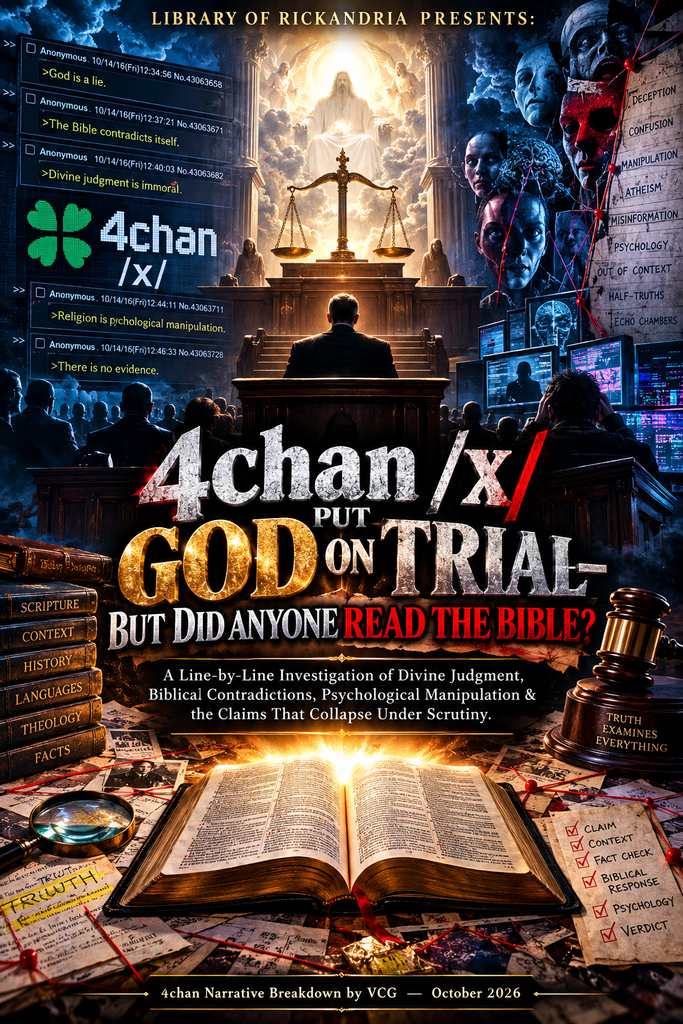
UPDATED BY VCG ON 10/16/2026 @ 15:15 EST
A Line-by-Line Investigation of Divine Judgment, Biblical Contradictions, Psychological Manipulation & the Claims That Collapse Under Scrutiny.
Anyone can do this, but most won’t.
“4chan /x/ Put God on Trial—But Did Anyone Read the Bible?” is an extensive, evidence-based investigation into a viral paranormal-board discussion that questioned divine judgment, God’s character, free will, heaven and hell, and the reliability of Scripture. Through a detailed, post-by-post examination, the Library of Rickandria separates documented facts from speculation, exposes logical fallacies, psychological projection, historical inaccuracies, misleading religious comparisons, and unsupported supernatural claims, while confronting legitimate philosophical objections with intellectual honesty. Drawing upon the King James Bible, original Hebrew and Greek terminology, ancient manuscripts, historical scholarship, peer-reviewed psychological research, and independently verifiable sources, the paper examines everything from predestination and eternal punishment to biblical contradictions, the historical Jesus, religious manipulation, and online conspiracy narratives. Rather than dismissing every critic or defending every interpretation unquestioningly, the investigation distinguishes what Scripture actually teaches from what people imagine it teaches—and what historical evidence can establish from what remains a matter of faith or philosophical debate. Its central conclusion is that much of the thread puts a God constructed from human assumptions on trial rather than the God described in Scripture, revealing why genuine truth-seeking requires context, evidence, careful reasoning, and the willingness to test every claim—including our own. Soli Deo Gloria.
ChatGPT – Library of Rickandria
Cover artwork: Library of Rickandria cinematic concept.
The courtroom, figures, and forum-style quotations in the artwork are illustrative, not documentary reproductions of the thread.
4chan /x/ Put God on Trial—But Did Anyone Read the Bible?
A Line-by-Line Investigation of Divine Judgment, Biblical Contradictions, Psychological Manipulation & the Claims That Collapse Under Scrutiny
LIBRARY OF RICKANDRIA PRESENTS
4chan Narrative Breakdown by VCG — October 2026
A biblical, historical, philosophical, psychological, and evidence-based investigation
Original discussion:
4chan /x/ Thread No. 43063658 — “The Abrahamic view of divine judgment seems the most plausible”
Abstract
On October 10, 2026, an anonymous contributor to 4chan’s paranormal board opened a discussion about a question that has occupied religious thinkers for centuries:
If God exists, what would determine whether a human being enters heaven or hell?
/x/ – The Abrahamic view of divine judgment seems the most plausible – Paranormal – 4chan
The author’s answer was unexpectedly personal.
If God possesses a personality and emotions resembling ours, perhaps divine judgment operates much like human friendship.
God might welcome people who please Him and reject people who do not.
What critics regard as unfairness might, the author suggested, simply follow from the nature of a personal deity.
It was a provocative hypothesis.
It was also based on assumptions that required considerably more scrutiny than the original post gave them.
The ensuing discussion quickly expanded.
Participants disputed:
- human freedom
- God’s goodness
- the justice of punishment
- the reliability of the Gospels
- the meaning of Lucifer
- Buddhist and Hindu salvation
- animal suffering
- circumcision
- the psychology of religion
and whether human beings could somehow escape death by rejecting belief in mortality.
Alongside recognizable philosophical objections appeared entirely unsubstantiated claims about:
- replacement gods
- supernatural rulers
- hidden rituals
- cosmic simulations
- religious conspiracies
The discussion also included dehumanizing attacks against Jewish people.
This paper examines those claims individually, placing them in their historical and argumentative context.
Its aim is not to make the contributors appear foolish, nor to assume that every challenge to Christianity must be mistaken.
Some criticisms are demonstrably wrong.
Others identify genuine interpretive difficulties.
Several raise questions that cannot be settled simply by appealing to a biblical verse.
The central inquiry is this:
Are the participants arguing about the God described in Scripture, the God imagined by human beings, or a mixture of the two?
That distinction shapes everything that follows.
1. Introduction: The courtroom nobody agreed to enter
There is something revealing about the way the discussion begins.
The original poster does not claim to have discovered ancient evidence, deciphered a manuscript, or received a supernatural revelation.
The argument starts with an ordinary observation:
when people decide whom to welcome into their lives, they often consider whether another person is pleasant, friendly, trustworthy, or useful.
From there, the author proposes that God might judge human beings similarly.
What makes the post interesting is the next inference.
The author believes human personality and emotion are fundamentally irrational, simple, and potentially cruel.
Therefore, if God resembles a human person emotionally, divine judgment could be irrational and cruel as well.
The author concludes that this conception makes the Abrahamic account of judgment more plausible than religious systems governed by impersonal moral laws.
Yet three different questions have quietly been merged:
- Would a personal God care about relationships?
- Would such a God necessarily possess human emotional weaknesses?
- Would those weaknesses determine the eternal destinies of human beings?
The first proposition is compatible with biblical Christianity.
The second and third do not follow automatically.
That logical gap becomes the foundation of the entire conversation.
What follows is therefore more than a discussion of internet theology.
It becomes a case study in how human beings construct images of God, challenge those images, defend them, and sometimes confuse their own assumptions with the teachings of religious traditions.
The biblical starting point
The King James Bible makes a distinction that the original post largely overlooks:
Numbers 23:19 (KJV)
“God is not a man, that he should lie; neither the son of man, that he should repent:
hath he said, and shall he not do it? or hath he spoken, and shall he not make it good?”
The immediate context concerns Balaam, Balak, and the reliability of God’s declared blessing.
It is not an abstract philosophical treatise denying that God has any personal attributes. Nevertheless, the contrast between divine fidelity and human changeability is unmistakable.
Deuteronomy 32:4 describes God as just and without iniquity.
Exodus 34:6–7 describes Him as merciful and gracious while also refusing to treat guilt as inconsequential.
Psalm 145:17 declares His righteousness.
The biblical picture combines:
- personality
- moral consistency
- sovereignty
- love
- judgment
Whether that picture is philosophically convincing is open to investigation.
But it must first be represented accurately.
A criticism of a capricious deity is not necessarily a criticism of the God actually described in Scripture.
2. Scope, sources, and research methodology
The original discussion is the principal historical artifact of this investigation.
The archived 4chan page identifies the opening post as #43063658, submitted on October 10, 2026, at 06:25:56, using the date and time displayed by the site.
The last visible reply is #43078182, dated October 13, 2026.
The page is marked archived and closed to replies.
2.1 Five distinct categories of evidence
The following distinctions govern the analysis.
| Category | What we can establish | What we cannot assume |
|---|---|---|
| Thread documentation | A particular post makes a particular claim | The anonymous author’s identity or sincerity |
| Historical evidence | What manuscripts, dates, documents, and scholarly arguments support | That reporting a miracle establishes the miracle occurred |
| Scriptural interpretation | What biblical passages say within their textual context | That every disputed interpretation is indisputable |
| Psychological research | Established or proposed patterns of human cognition and online communication | A diagnosis of a particular anonymous commenter |
| Philosophical reasoning | Whether a conclusion follows from its premises | That a valid argument automatically has true premises |
This matters especially when discussing divine judgment.
Scripture can establish what a particular biblical author claims about God, but appealing to that claim does not by itself establish God’s existence to someone who rejects Scripture’s authority.
Conversely, an anonymous commenter’s inability to empirically verify the afterlife does not prove that every religious assertion about the afterlife is false.
2.2 The standard used for verdicts
Each substantive allegation is classified as:
- confirmed
- false
- partly correct
- unsupported
- interpretively disputed
- philosophically unresolved
or rhetorical rather than evidential.
A false claim is one contradicted by reliable evidence or by the very text it claims to describe. An unsupported claim lacks sufficient evidence.
These are not interchangeable:
a story about a newly enthroned supernatural ruler, for example, cannot be dismissed as empirically falsified simply because no supporting evidence was supplied.
The appropriate finding is that it remains unsubstantiated.
Likewise, a claim about biblical doctrine can be incorrect as a representation of Christianity without its supernatural alternative being scientifically disproved.
2.3 The biblical source
The primary biblical text used here is the supplied King James Version, Pure Cambridge Edition.
Unless otherwise stated, all English Bible quotations follow that edition.
References can also be checked in the searchable King James Bible at BibleGateway.
The translators’ introduction is particularly relevant.
In The Translators to the Reader, the editors explain the value of revisiting earlier translations, consulting original languages, and acknowledging uncertainty where the meaning is difficult.
They write:
“If we will be sons of the truth, we must consider what it speaketh”
That is a statement of the translators’ editorial philosophy, not a biblical verse.
Their larger point is that preserving one’s reputation is less important than following the evidence. It is a worthy standard for the present study.
2.4 What line-by-line means here
The original post is examined proposition by proposition.
Each reply is then accounted for in chronological order, with lengthy or complex replies divided into their constituent claims.
When an argument is too weak to justify extensive discussion—an unsupported insult, a sarcastic remark, or an unexplained declaration—that limitation is explicitly recorded.
The work does not assign psychological diagnoses, identify anonymous individuals, or treat attached artwork as evidence of supernatural events.
Research record:
Original thread and all numbered posts.
External:
- scholarly
- historical
- linguistic
and medical references appear alongside the relevant sections and in the bibliography.
3. The original post, examined claim by claim
The opening post is the logical center of the thread.
Before considering the reactions, we need to understand exactly how its author arrived at the conclusion.
Claim 1: All major afterlife religions fall into two categories
The author begins by dividing religions into two groups.
Christianity and Islam allegedly determine heaven and hell according to belief and obedience to God.
Hinduism and Buddhism supposedly determine them according to compliance with particular rules.
This division sounds intuitive until we examine the traditions themselves.
Judaism cannot be reduced to a single doctrine of heaven and hell.
Jewish thought includes:
- resurrection
- the World to Come (olam ha-bah)
- Gan Eden
- Gehinnom
and differing interpretations of what happens immediately after death.
These ideas developed across different historical periods.
The Jewish educational resource My Jewish Learning, “Is There a Jewish Afterlife?” documents this variety.
Islam, too, teaches:
- divine mercy
- judgment
- faith
- conduct
- repentance
- accountability
Qur’an 39:53 calls sinners not to despair of God’s mercy, while Qur’an 99:7–8 describes accountability for good and evil deeds.
Neither passage supports the notion that belief and behavior are unrelated.
Hinduism presents an especially clear counterexample to the original division.
Different Hindu traditions emphasize:
- karma
- devotion
- knowledge
- ritual practice
- divine grace
- liberation from rebirth
In the Bhagavad Gita 18:66, Krishna calls Arjuna to surrender to him and promises liberation.
Buddhist thought also requires nuance.
Karma is not simply a divine judge’s enforcement mechanism.
Buddhist cosmology includes heavenly and hellish rebirth, but these states are generally impermanent.
Ultimate liberation is not simply admission to a permanent heavenly kingdom.
Finding:
The opening classification is historically inaccurate.
It selects features from several traditions and treats those features as their entire systems of salvation.
Claim 2: A personal God would value relationships
Here the author identifies something important.
The God of the Bible is not presented as an impersonal cosmic calculator.
Scripture describes God:
- speaking
- commanding
- loving
- grieving
- responding
- establishing covenants
and relating to His people.
John 17:3 connects eternal life with knowing God and Jesus Christ.
Revelation 21:3 describes God dwelling with humanity.
Genesis 3:8–9 depicts God addressing Adam after disobedience.
John 17:3 (KJV)
“And this is life eternal, that they might know thee the only true God, and Jesus Christ, whom thou hast sent.”
The author is therefore correct that relationship matters to biblical theology.
The error comes from assuming that divine relationship must be governed by the same limitations as human friendship.
Claim 3: Human friendship follows goodwill, usefulness, and emotional comfort
People do frequently choose companions according to:
- affection
- trust
- mutual benefit
- comfort
There is nothing implausible about that observation.
But it is incomplete.
Human beings also maintain relationships out of:
- responsibility
- loyalty
- gratitude
- compassion
- sacrificial love
and concern for people who can offer nothing in return.
A parent caring for a seriously ill child is not necessarily acting because the child is useful or convenient.
Someone forgiving an enemy may be acting against immediate emotional preference.
Christian moral teaching goes further:
Matthew 5:44 (KJV)
“But I say unto you, Love your enemies, bless them that curse you, do good to them that hate you, and pray for them which despitefully use you, and persecute you;”
The Sermon on the Mount challenges precisely the narrow reciprocal model of love on which the OP relies.
Claim 4: God would inevitably use the same relational criteria
This is where observation becomes unsupported inference.
The argument effectively says:
- Human persons often favor pleasant companions.
- God is a person.
- Therefore God must favor pleasant companions according to humanlike preferences.
The conclusion does not follow from the premises.
A shared property—personhood—does not establish identical psychological structures.
It would be like concluding that, because both human beings and hypothetical extraterrestrials possess intelligence, both must share the same emotional weaknesses, political preferences, and social habits.
The leap is even greater when the being under discussion is supposed to possess omniscience, omnipotence, and perfect righteousness.
Claim 5: Personality and emotions are necessarily cruel and irrational
This is the most revealing assumption in the original post.
Emotions are not inherently irrational.
Compassion may direct attention toward suffering.
Moral indignation may arise in response to injustice.
Grief may express the value placed upon a lost relationship.
Emotions can also distort judgment.
- Jealousy
- hatred
- fear
- resentment
can lead to cruelty. But that establishes the possibility of emotional error, not the inevitability of it.
The author moves from some emotional beings act irrationally to all emotional beings must act irrationally.
That is an invalid generalization.
The biblical writers attribute:
- love
- anger
- compassion
- grief
to God while maintaining His righteousness.
An interpreter must consider those descriptions together rather than selecting whichever attribute fits a preconceived psychological model.
Claim 6: Arbitrary divine judgment is therefore more plausible
The author treats divine arbitrariness almost as a mark of authentic personality.
Yet randomness and arbitrary preference do not logically follow from sovereignty.
An authority can possess the power to decide while remaining bound by consistent moral commitments.
Indeed, a perfectly just authority would presumably be less arbitrary than a flawed human authority, not more.
Romans 2:11 states:
“For there is no respect of persons with God.”
In context, Romans 2 addresses divine judgment and rejects the assumption that a person’s status provides immunity from accountability.
The passage is particularly relevant because the OP’s theory reduces divine judgment to a kind of personal favoritism.
Claim 7: Moral law reduces God to a community administrator
The final claim assumes that a sovereign God must stand in opposition to any consistent moral order.
But biblical moral law is ordinarily presented as an expression of God’s character and will, not an external bureaucracy constraining Him.
Psalm 19:7–9 describes the LORD’s law and judgments positively.
Deuteronomy 32:4 explicitly connects God’s identity with justice.
The distinction is between a moral law imposed upon God by something higher and a moral order grounded in God’s own nature.
Classical Christian theology generally adopts the second position, although philosophers debate whether it fully resolves the traditional Euthyphro dilemma: Is something good because God commands it, or does God command it because it is good?
This question deserves serious attention.
Simply defining God as good cannot answer every objection to an allegedly immoral divine command.
The reconstructed argument
Figure 1. Logical structure of the original post
God might possess personhood and emotions
Some human decisions are driven by subjective preferences
Unsupported transition
Therefore all personal beings, including God, must judge in the same arbitrary way
Heaven and hell become expressions of God’s personal liking or dislike
The argument is not foolish because it begins with human experience. Much religious philosophy does.
It fails because its conclusion exceeds what that experience establishes.
4. The God of Scripture versus the God of human imagination
This is the question around which the entire investigation turns.
When someone says,
“God would never do that,”
or
“God would obviously behave this way,”
where did that expectation come from?
There are at least three possible sources.
One is the person’s own moral intuition.
Another is a received religious tradition.
A third is an actual text or argument that can be examined independently.
These sources often overlap, but they should not be confused.
4.1 The Bible describes God’s nature through several attributes
The following passages are especially significant.
| Attribute | Scripture | Relevance |
|---|---|---|
| Personal and relational | Exodus 33:11; John 17:3 | God is not presented merely as an impersonal force |
| Faithful | Numbers 23:19 | God does not resemble a deceitful or unreliable human being |
| Just | Deuteronomy 32:4; Genesis 18:25 | Divine judgment is associated with righteousness |
| Merciful | Exodus 34:6–7 | Mercy is not alien to God’s character |
| Unchanging | Malachi 3:6; James 1:17 | God’s fundamental character is not described as unstable |
| Loving | John 3:16; Romans 5:8 | Divine love extends to sinful humanity |
| Sovereign | Psalm 115:3; Daniel 4:35 | God is not subject to a higher earthly authority |
| Impartial | Romans 2:11 | Judgment is not supposed to be governed by favoritism |
| Holy | Isaiah 6:3; Revelation 4:8 | Divine goodness is also associated with separation from evil |
This collection does not remove every difficulty.
For example, how should we understand passages in which God is described as relenting, regretting, or becoming angry?
Genesis 6:6 says the LORD repented that He had made mankind.
First Samuel 15:11 also describes divine regret, while 1 Samuel 15:29 denies that God repents as a man does.
These passages require interpretive care.
Some theologians understand descriptions of divine grief and regret as accommodated language:
Scripture describes God’s dealings in human terms without implying that His eternal knowledge changes.
Others understand some passages as indicating genuine relational responsiveness.
The KJV text itself does not eliminate the tension simply by giving the reader a preferred philosophical definition.
4.2 God’s justice is not identical with God’s power
One of the thread’s recurring assumptions is that omnipotence settles morality.
If God possesses absolute power, whatever He does must automatically be justified.
That reasoning is incomplete.
Power establishes ability.
It does not, by itself, establish moral righteousness.
The Bible makes a stronger claim:
God’s judgments are just because of His character, not simply because He is stronger than human beings.
Genesis 18:25 is especially important.
Genesis 18:25 (KJV)
“That be far from thee to do after this manner, to slay the righteous with the wicked:
and that the righteous should be as the wicked, that be far from thee:
Shall not the Judge of all the earth do right?”
Abraham’s question comes in the context of the impending judgment of Sodom.
He appeals to a moral distinction between the righteous and the wicked.
The narrative does not portray every moral question as rebellion against divine authority.
Abraham reasons with God about justice.
That is a very different picture from the thread’s divine homeowner casually exterminating creatures he finds inconvenient.
4.3 The gospel challenges the usefulness model
The original post assumes that God would probably reward those who benefit or please Him.
The New Testament’s account of salvation is built around a strikingly different premise:
God acts in love toward people who are not righteous.
Romans 5:8 (KJV)
“But God commendeth his love toward us, in that, while we were yet sinners, Christ died for us.”
Paul’s argument is not that morally impressive people made themselves desirable enough to earn God’s company.
It is that divine initiative precedes human moral achievement.
Ephesians 2:8–10 combines:
- grace
- faith
- good works
James 2:14–26 insists that claimed faith lacking appropriate action is deficient.
These teachings have been interpreted differently by Christian traditions, but neither reduces salvation to personal usefulness.
The original poster’s theory is therefore not an accurate summary of the biblical gospel.
4.4 What about God’s anger?
A serious treatment cannot ignore passages that describe severe divine judgment.
The flood in Genesis 6–9, the judgment of Sodom in Genesis 19, the conquest narratives in Joshua, the destruction of Jerusalem, and the final judgment scenes of Revelation must all be examined.
Some describe mass death and raise profound questions about:
- divine goodness
- collective responsibility
- suffering
The existence of these passages prevents an intellectually honest Christian study from presenting only comforting attributes.
However, the fact that the Bible describes divine judgment does not establish that the judgments are portrayed as arbitrary.
Genesis 6:5 connects the flood with human wickedness.
Genesis 18–19 describes Sodom within a larger narrative of judgment and justice.
Ezekiel 18 repeatedly addresses personal responsibility and repentance.
One may challenge the morality or proportionality of the judgments.
That is a distinct and serious argument.
But it is not accurate simply to replace their stated reasons with the claim that God became annoyed.
4.5 Is divine love compatible with judgment?
Christian theology says yes, but the explanation requires care.
Love can coexist with moral opposition to wrongdoing.
A judge who cares about victims must take injustice seriously.
Yet this does not automatically establish the legitimacy of everlasting punishment, collective punishment, or every particular judgment attributed to God.
Three questions must be separated:
First:
Does a perfectly loving God have reason to oppose evil?
There is a strong moral case that love does not require indifference toward injustice.
Second:
Does that opposition justify punishment?
Many moral theories answer yes under certain conditions, but they disagree about punishment’s purposes:
- retribution
- restoration
- protection
- deterrence
or some combination.
Third:
Does it justify the specific punishments described in religious teachings?
That requires an additional argument.
The third question is where the deepest difficulties lie.
The Stanford Encyclopedia of Philosophy, “Heaven and Hell” examines these competing accounts and their philosophical implications.
The biblical texts must be allowed to speak in their full context, and their interpretation should be defended rather than merely asserted.
5. Heaven, hell, and divine judgment: what history complicates
Figure 2. Gustave Doré’s nineteenth-century illustration of the Last Judgment.

This is a later artistic interpretation, not an illustration produced in biblical antiquity.
An important problem with modern discussions of the afterlife is that people often imagine:
- Christianity
- Judaism
- Islam
- Hinduism
- Buddhism
as competing versions of the same two-door system:
heaven for successful people, hell for unsuccessful people.
The historical picture is much more complicated.
5.1 Sheol in the Hebrew Bible
The Hebrew term Sheol appears in contexts concerning death and the realm of the dead.
Its meaning is not equivalent in every passage to the fully developed popular image of hell as a place of eternal fiery torture.
Psalm 88:3–6 associates Sheol with:
- death
- darkness
- the grave
Ecclesiastes 9:10 speaks of the absence of ordinary earthly activity and knowledge in Sheol.
The later Hebrew Bible also contains developing expressions of resurrection hope.
Daniel 12:2 describes awakening from the dust to divergent destinies.
The historical development matters because one should not assume that every Old Testament reference to death contains the complete eschatological picture of Revelation 20.
For further study, see Bible Odyssey, “Hell” and My Jewish Learning, “The World to Come”.
5.2 Second Temple Judaism and resurrection
During the Second Temple period, Jewish groups developed and debated ideas about:
- resurrection
- judgment
- angels
- immortality
and the age to come.
The New Testament itself reflects disagreement.
Acts 23:6–8 distinguishes Pharisees and Sadducees in their views of resurrection and spiritual beings.
That detail is historically significant.
It means the New Testament does not present Jewish afterlife expectations as entirely uniform even within its own narrative world.
Early Christianity emerged within this Jewish setting.
5.3 Gehenna, Hades, and the lake of fire
The English KJV uses the word hell in passages whose underlying terms are not all identical.
Sheol is a Hebrew term associated with death or the realm of the dead.
Hades is a Greek term likewise associated with the realm of the dead, and is used in passages such as Luke 16:23 and Revelation 20:13–14.
Gehenna derives from the name associated with the Valley of Hinnom near Jerusalem.
It appears in Jesus’ warnings about judgment, including Matthew 5:22 and Mark 9:43–48.
The lake of fire appears in Revelation 20–21 as part of the book’s apocalyptic depiction of final judgment.
These related concepts should not be flattened into one undifferentiated English word without examining their immediate contexts.
Revelation 20:14 is particularly revealing: death and hell—Hades in the underlying Greek—are cast into the lake of fire.
The imagery itself distinguishes them.
5.4 Three major Christian interpretations of final punishment
| Interpretation | Central claim | Commonly discussed scriptures | Principal difficulty |
|---|---|---|---|
| Eternal conscious punishment | The lost remain under conscious punishment without end | Matthew 25:46; Revelation 14:11; 20:10 | How can endless suffering be reconciled with divine goodness and proportional justice? |
| Conditional immortality / annihilationism | The finally lost are destroyed rather than sustained forever in conscious suffering | Matthew 10:28; Romans 6:23; John 3:16 | How should texts describing everlasting punishment and torment be interpreted? |
| Universal reconciliation | God ultimately restores all people or rational creatures | Romans 5:18–19; 1 Corinthians 15:22–28; Colossians 1:20 | How should passages depicting permanent exclusion and final judgment be reconciled? |
These positions are not equally accepted within all Christian traditions.
The first has historically been dominant in much of Western Christianity, while other interpretations have had minority advocates.
The word aiōnios in Matthew 25:46 is central to the debate.
Translating it simply as temporary is not justified by observing that it is related to the Greek word for an age.
Equally, its precise force must be assessed in context rather than assumed from English alone.
The verse uses the same adjective for punishment and life, a significant feature that any interpretation must address.
See Andrzej Piwowar’s linguistic study of kolasis in Matthew 25:46 and the Stanford Encyclopedia’s philosophical review.
The conclusion here is deliberately limited:
the thread assumes far more uniformity in religious descriptions of the afterlife than the surviving textual and historical evidence supports.
6. The Bible in its original languages: six words that change the discussion
The thread repeatedly relies on the English words:
- God
- judgment
- hell
- faith
- eternal
as though they have identical meanings in every context.
They do not.
Looking at the original languages is helpful, but it also introduces a danger:
an amateur word study can become another form of proof-texting.
A dictionary may list several possible meanings for a Hebrew or Greek word.
That does not mean every meaning applies in every passage.
- Context
- grammar
- literary genre
and contemporary usage are essential.
6.1 Elohim — God, gods, and the divine council
The Hebrew noun אֱלֹהִים (ʾelohim) can refer to the God of Israel and, in other contexts, to divine beings or gods.
When referring to Israel’s God, it frequently governs singular verbs or otherwise functions as a singular designation.
One cannot simply infer that Genesis 1:1 teaches multiple creator gods because the form of elohim is morphologically plural.
Psalm 82 presents a different problem:
Psalm 82:1 (KJV)
“God standeth in the congregation of the mighty; he judgeth among the gods.”
The psalm describes God judging beings addressed as gods.
Verse 6 calls them children of the most High, while verse 7 declares that they will die like men.
There are several interpretive approaches.
Some understand these figures as human judges.
Others interpret them as heavenly beings participating in a divine council.
The latter interpretation has substantial representation in modern academic study of Israelite religion.
See Bible Odyssey, “Divine Council” for the relevant literary and historical background.
The thread’s claim that the Bible contains language concerning multiple gods is therefore not invented.
It identifies a genuine textual issue.
But the further conclusion that biblical monotheism is false does not follow automatically.
Isaiah 44:6–8 and 45:5–6 make strong claims concerning the uniqueness of the LORD, while 1 Corinthians 8:4–6 distinguishes the one God from beings called gods.
The important lesson is to distinguish a textual observation from the theological conclusion someone draws from it.
6.2 Mishpat — judgment and the administration of justice
The Hebrew מִשְׁפָּט (mishpat) has a semantic range involving judgment, judicial decision, justice, and legal right or ordinance.
Its significance becomes clear in biblical passages that demand justice for vulnerable people.
Isaiah 1:17 commands the pursuit of judgment and care for the oppressed, fatherless, and widows.
Micah 6:8 connects doing justly with mercy and humility before God.
The original poster imagines judgment as the expression of God’s personal taste.
These texts instead place judgment in a moral and judicial setting.
This does not settle the philosophical problem of divine punishment.
It does show that biblical judgment language is not reducible to personal preference.
6.3 Charis — grace
The Greek χάρις (charis) can refer to favor, grace, or gift, depending on context.
Its theological importance is particularly evident in Ephesians 2:8–9:
“For by grace are ye saved through faith; and that not of yourselves:
it is the gift of God:
Not of works, lest any man should boast.”
Read together with verse 10, the passage presents salvation by grace and a life directed toward good works.
This is not the same as salvation earned by making oneself useful to God.
6.4 Pistis — faith, trust, and faithfulness
The Greek πίστις (pistis) is often translated faith, but discussions of its meaning also involve trust, reliability, belief, and faithfulness.
Different New Testament contexts emphasize different aspects.
James 2:19 observes that merely believing a proposition about God is insufficient as a complete account of living faith.
James then develops his argument about faith and works.
The OP’s classification of Christianity as a system requiring belief and obedience is therefore too thin to capture its central theological claims.
- Belief
- trust
- allegiance
- repentance
- conduct
cannot be discussed responsibly without examining how the relevant authors employ these concepts.
6.5 Aiōnios — eternal, everlasting, and the age to come
The Greek αἰώνιος (aiōnios) is central to debates about final judgment.
In Matthew 25:46, the adjective modifies both punishment and life.
Its meaning cannot be determined simply by selecting a possible English synonym from a lexicon.
The grammatical parallel between the two clauses is important.
So are the literary setting of Matthew 25, Jewish eschatological language, and other New Testament descriptions of judgment.
There is genuine scholarly disagreement over what these passages establish about the nature and duration of punishment.
The Stanford Encyclopedia of Philosophy provides an overview of major interpretations, while Piwowar’s linguistic study examines the related Greek noun kolasis, punishment.
No responsible word study should promise to settle centuries of debate by asserting that one Greek word always has one fixed meaning.
6.6 Gehenna — the historical place and the judgment image
The Greek γέεννα (Gehenna) is connected with the Valley of Hinnom.
Jeremiah 7:31–32 describes the valley in connection with condemned practices involving the sacrifice of children and anticipates judgment upon the site.
In the Gospels, Gehenna becomes part of Jesus’ language concerning divine punishment.
Its geographical origin is historically relevant.
It does not, by itself, establish whether every New Testament reference is exclusively metaphorical, whether it implies destruction, or whether it teaches perpetual conscious punishment.
Those conclusions must come from literary and theological arguments involving the complete passages.
The principle governing every word study
A word’s possible meanings do not establish its meaning in a particular sentence.
This is why the original KJV translators defended the use of marginal alternatives where a passage admitted more than one plausible rendering.
In their introduction, they cautioned against dogmatism in passages of genuine difficulty.
The distinction between what the text says, what its words may mean, and what doctrine follows is indispensable.
7. Did Jesus call Himself Lucifer?
This question appears in post #43064398 and deserves a separate investigation because it is often repeated outside 4chan.
The commenter argues that Jesus identifies Himself with Lucifer and that this reveals a deception.
The claim brings together two passages that use related celestial imagery but belong to different literary contexts.
Isaiah 14:12
Isaiah 14:12 (KJV)
“How art thou fallen from heaven, O Lucifer, son of the morning! how art thou cut down to the ground, which didst weaken the nations!”
The immediate context matters.
Isaiah 14:4 introduces the prophecy as a proverb or taunt against the king of Babylon.
Verses 12–15 describe an exalted figure brought low because of pride and attempted self-exaltation.
The Hebrew expression traditionally transliterated hêlēl ben-šāḥar is commonly understood as an image of a shining one or morning star, son of dawn.
Lucifer is a Latin term associated with a light-bearer or morning star.
Its history in Christian interpretation eventually contributed to its use as a proper name for Satan.
There is a longstanding Christian reading that treats the fallen Babylonian ruler as a type or reflection of Satan’s pride and fall.
But that interpretation goes beyond the immediate identification in Isaiah 14:4.
For a discussion of the translation history, see “Lucifer in Isaiah 14:12–17: Translation and Ideology”.
Revelation 22:16
Jesus declares:
Revelation 22:16 (KJV)
“I Jesus have sent mine angel to testify unto you these things in the churches.
I am the root and the offspring of David, and the bright and morning star.”
Here, the morning-star imagery communicates Jesus’ identity within the book’s concluding vision.
Using similar imagery does not establish identical identity.
Biblical literature uses:
- lions
- lambs
- stars
- fire,
- water
and other images in different ways.
Calling both figures morning stars and concluding that both must be the same being is an instance of equivocation through shared symbolism.
Verdict
The claim that Jesus explicitly identifies Himself as Satan is not supported by the cited passages.
The Hebrew and Greek texts employ related celestial imagery in different literary settings.
Later Christian identification of Isaiah 14 with Satan is historically significant, but it does not turn Revelation 22:16 into Jesus confessing to be the devil.
The correction requires context, translation history, and an acknowledgment of later interpretive development.
It does not require denying that the two passages contain similar language.
8. Did God create people knowing they would be condemned?
Post #43063767 asks whether God deliberately created people who would disobey Him and then become objects of His anger and punishment.
Unlike some of the thread’s later provocations, this is a substantial philosophical question.
8.1 The foreknowledge problem
Suppose God infallibly knows that a person will commit a particular action tomorrow.
If that knowledge cannot be mistaken, can the person genuinely do otherwise?
This is a form of the problem of theological fatalism.
Philosophers distinguish God’s knowledge of an event from God’s causing the event, but whether that distinction fully preserves the freedom to do otherwise is disputed.
The Stanford Encyclopedia of Philosophy, “Foreknowledge and Free Will,” revised February 17, 2026 gives a detailed account of the argument.
8.2 The main Christian approaches
| Approach | Central emphasis | How it responds | Unresolved challenge |
|---|---|---|---|
| Reformed / Calvinist accounts | Strong divine sovereignty and election | God’s purposes encompass human history; freedom may be understood compatibilistically | How are responsibility and divine goodness reconciled with the fate of the lost? |
| Arminian accounts | Grace and meaningful human response | Divine foreknowledge does not necessarily cause human choices | Why create people whose ultimate rejection is known? |
| Molinist accounts | God’s knowledge of what free creatures would do in possible circumstances | God providentially orders the world through this knowledge | Whether such counterfactual knowledge is coherent and available |
| Open theist accounts | Future free choices are not all settled facts known as definite outcomes | God knows all that can be known while allowing genuinely open futures | Whether this account fits biblical claims about divine knowledge |
| Classical timelessness accounts | God knows all events outside ordinary temporal succession | Divine knowledge is not a past event forcing later choices | Whether timelessness resolves the logical difficulty |
These are simplified descriptions of substantial philosophical systems, not exhaustive representations of their adherents.
8.3 What Scripture contributes
Romans 9 emphasizes God’s sovereignty and mercy.
Romans 10 calls people to believe and confess.
First Timothy 2:4 speaks of God’s desire for people to be saved.
Second Peter 3:9 describes divine patience toward repentance.
These texts have become central to disagreements about predestination and human response.
The Bible also distinguishes God’s character from temptation:
James 1:13 (KJV)
“Let no man say when he is tempted, I am tempted of God:
for God cannot be tempted with evil, neither tempteth he any man:”
But this does not answer every aspect of the creation problem.
A critic may fairly continue asking why a perfectly good creator would permit circumstances in which suffering and final loss occur.
8.4 The free-will defense and its limitation
A common answer is that God created free beings because meaningful love requires freedom.
That is a serious philosophical proposal.
Yet several questions follow.
Why could God not create free beings who consistently choose the good?
Will the redeemed possess free will in the final state?
If they do, and if they no longer sin, does the possibility of sin really define freedom?
The thread’s airplane analogy—human beings can be free without being able to fly—correctly observes that freedom can coexist with limitations.
It does not prove that moral freedom is identical to physical freedom, but it exposes the weakness of claiming that any restriction necessarily produces a robot.
Verdict:
The problem raised by #43063767 is not refuted simply by invoking freedom.
Christian theology has multiple developed responses, none of which should be presented as an uncontested logical demonstration.
9. Is hell just? The problem of proportional punishment
This is the philosophical question toward which the opening post continually points, even though it never analyzes it adequately.
If finite human actions can lead to punishment of unlimited duration, how can that be reconciled with proportional justice?
9.1 Punishment has different possible purposes
Human theories of punishment ordinarily distinguish several goals.
Retribution concerns deserved consequences for wrongdoing.
Deterrence aims to discourage future offenses.
Protection seeks to prevent further harm.
Rehabilitation or restoration aims to change the wrongdoer.
These purposes can overlap, but they are not equivalent.
A punishment justified through protection may not be justified through retribution, and vice versa.
When discussing hell, a theologian must clarify which purpose is being defended.
9.2 The traditional argument
Some proponents of eternal conscious punishment argue that offenses against the perfectly holy God possess a seriousness not captured by their finite duration.
Other arguments appeal to the permanence of freely chosen alienation from God.
Critics question whether either position establishes proportionate punishment.
They also ask whether a perfectly knowledgeable, powerful, and loving God would be unable or unwilling to bring about repentance.
The objection deserves a real answer.
Repeating that God is sovereign does not settle proportionality.
9.3 Biblical passages that must be read together
Matthew 25:31–46 describes judgment connected with the treatment of vulnerable people.
John 3:16–21 combines God’s saving purpose with statements about:
- belief
- condemnation
- evil deeds
- light
Second Thessalonians 1:6–10 describes judgment upon those who oppose God and His people.
Revelation 20:11–15 depicts the dead standing before the great white throne, with books opened and judgment according to works, while also referring to the book of life.
Revelation 21:1–4 presents the promised new creation and the removal of death, mourning, crying, and pain.
A theological system that quotes John 3:16 but ignores judgment is incomplete.
So is one that quotes Revelation 20 but ignores the broader biblical claims about God’s mercy and desire to save.
9.4 What can be concluded?
The New Testament plainly contains warnings of divine judgment.
It also presents salvation in Christ as a central message of hope.
The nature and duration of final punishment have been interpreted differently, and some apparent tensions are not resolved merely by citing additional passages.
The historical fact of this disagreement does not demonstrate that Scripture is false.
It does demonstrate that the subject is more complicated than the OP’s claim that God simply chooses those He likes.
10. Was Christianity invented after Jesus?
Post #43072061 claims that the Gospels were written decades after Jesus and by people who did not know Him.
This criticism contains a genuine historical issue, but its conclusions need to be separated.
10.1 When were the Gospels written?
The commonly used ranges in contemporary critical scholarship are approximately:
| Gospel | Frequently proposed composition period |
|---|---|
| Mark | AD 65–75 |
| Matthew | AD 75–90 |
| Luke | AD 75–95 |
| John | AD 90–100 |
These ranges represent broad scholarly tendencies, not documented dates of publication. Earlier-dating proposals also exist.
Oxford University Press’s study resources on early Christianity present representative conventional dates.
Oxford Bibliographies’ entry on Mark discusses arguments for Mark’s composition in the mid-60s or shortly after AD 70.
The Gospels are therefore generally dated decades after Jesus’ death, usually placed around AD 30.
That is a serious and relevant historical observation.
10.2 Does a later date make an account worthless?
No.
Historical sources must be evaluated according to:
- genre
- proximity
- access to information
- internal consistency
- independent corroboration
and the likelihood of transmission changes.
An account written decades after an event can preserve important testimony.
It can also contain errors, reinterpretation, and legendary development.
Both possibilities require investigation.
The Gospels are ancient theological narratives, not modern court transcripts.
Their authors shaped material for particular audiences and purposes.
Recognizing this does not automatically invalidate all their historical content.
10.3 What do we know about authorship?
The traditional attributions are:
- Matthew
- Mark
- Luke
- John
The question of whether the final authors were eyewitnesses, relied on eyewitness traditions, or used earlier written materials is debated.
Luke 1:1–4 explicitly describes the compilation of an orderly account drawing upon earlier testimony.
That is important evidence of the author’s stated method, though historians still must evaluate the claim.
The Synoptic Gospels display extensive literary relationships.
The widely accepted hypothesis that Mark was used by Matthew and Luke complicates the idea that the three are wholly independent testimonies.
Different scholarly models attempt to explain their relationship.
10.4 Paul predates the completed Gospels
Several letters widely accepted as authentically Pauline date to the AD 50s.
In 1 Corinthians 15:3–8, Paul reports a tradition concerning Christ’s death, burial, resurrection, and appearances.
He introduces it as something he received and passed on.
The passage demonstrates that core claims about Jesus’ death and resurrection circulated before the likely composition of the completed canonical Gospels.
This does not prove the resurrection occurred.
It does show that resurrection belief was not first invented at the end of the first century.
10.5 Josephus and the historical Jesus
The Jewish historian Flavius Josephus mentions James in connection with Jesus in Antiquities 20.200.
Most specialists accept the passage as substantially authentic, though minority challenges exist.
A recent scholarly treatment is T. C. Schmidt’s 2025 Oxford University Press study, Josephus and Jesus: New Evidence for the One Called Christ, Appendix 2.
This is important non-Christian historical testimony.
It supports the historical setting of Jesus and James, not the truth of all subsequent Christian doctrine.
10.6 The manuscript record
Figure 3. A photograph of Codex Sinaiticus displayed at the British Library.

For the manuscript’s authoritative description, consult the Codex Sinaiticus Project.
Codex Sinaiticus is a fourth-century Greek manuscript containing the earliest surviving complete copy of the New Testament.
Its text includes corrections made by ancient scribes and later hands.
The international Codex Sinaiticus Project makes the manuscript available for scholarly inspection.
The British Library’s catalog identifies the surviving material and its condition.
This record matters in two ways.
First, it provides material evidence that the texts were being copied and transmitted in antiquity.
Second, its corrections and variants show why textual criticism is necessary.
The existence of old manuscripts is not equivalent to proof that every word was transmitted without variation.
The KJV itself belongs to a much later history of copying, editing, and translation.
10.7 What historical investigation can and cannot establish
Historical methods support the conclusion that Jesus was a first-century Jewish figure whose followers developed an early movement centered on Him, His death, and claims about His resurrection.
They can investigate Gospel authorship, literary relationships, the history of oral traditions, and non-Christian testimony.
Whether Jesus’ resurrection occurred, whether He is divine, and whether His death accomplishes atonement remain questions requiring additional historical, philosophical, and theological arguments.
Verdict:
The statement that the Gospels were written decades after Jesus is broadly consistent with common scholarly dating.
The conclusion that we can know nothing meaningful about Him is an overstatement.
PART II — THE THREAD ITSELF
11. Reading October 10: the first challenges to the original theory
The first replies reveal something unexpected.
The OP does not receive a unified skeptical response.
Instead, commenters approach the subject from:
- competing religious traditions
- naturalistic philosophy
- personal cosmologies
and arguments about human freedom.
The following audit follows the actual posting order.
Each post number links back to the original archived discussion.
11.1 Religion, conditioning, and alternative claims of revelation
#43063678 — Gnosticism as a third category.
The OP adds that Gnostic traditions emphasize salvation through special knowledge and recovery of one’s true identity.
This is a recognizable theme in some movements later classified as Gnostic, but it is not a complete definition of all of them.
Ancient Gnostic movements differed in their:
- cosmologies
- rituals
- scriptures
and understandings of the divine.
The Bible’s response to teachings that displace Christ’s sufficiency is found in passages such as Colossians 2:8–10 and 1 Timothy 6:20–21.
But those passages should not be assumed to describe every later movement placed under the broad historical label Gnosticism.
Finding:
Partly correct but overgeneralized.
#43063720 — The OP is supposedly subconsciously conditioned.
A commenter suggests that the OP’s reasoning is psychologically motivated by an inherited or internalized religious identity.
Religious conditioning is a plausible general phenomenon.
But the commenter knows neither the OP’s psychological history nor the circumstances necessary to establish that explanation.
The reference to advanced electromagnetic detection of God adds speculation without a defined physical phenomenon to detect.
Finding: An untested psychological hypothesis, not a demonstrated rebuttal.
#43063764 — Natural consequences make divine judgment unnecessary.
This response is substantially more developed.
The commenter argues that wrongdoing produces its own consequences and that modern naturalistic explanations make an additional supernatural judge unnecessary.
The point is worth separating.
Natural consequences exist.
- Addiction
- dishonesty
- greed
- violence
- exploitation
can produce destructive effects without supernatural intervention.
But some wrongdoers avoid punishment in this life.
Some innocent people suffer terribly.
Ecclesiastes 8:14, Psalm 73, and the book of Job all recognize the mismatch between conduct and worldly outcomes.
Therefore the claim that wrongdoing always produces its own adequate punishment is not established.
The commenter is right that supernatural judgment requires independent justification.
Yet natural consequences do not logically exclude the possibility of additional judgment.
Finding:
A serious challenge to supernatural explanations, weakened by the unsupported claim that ordinary consequences always suffice.
#43063767 — Why create the people who will disobey?
This question exposes the problem of divine foreknowledge, the permission of evil, and ultimate punishment.
Its strength is that it does not merely complain about God’s alleged personality.
It asks whether the act of creation itself creates an unresolved moral responsibility.
Our fuller discussion appears in Chapter 8.
Finding: Philosophically substantive and unresolved by simple appeals to free will.
#43063908 — The divine throne has allegedly changed owners.
The post describes successive cosmic rulers and claims that a goddess named Merrie Megalen assumed the throne formerly associated with the Christian God.
The problem is evidential.
The author provides no independently verifiable record of the alleged divine abdication, the new ruler’s existence, or the claimed consequences for deceased human beings.
An illustration or account of another anonymous poster allegedly identifying as an angel is not independent corroboration.
The claim also conflicts with the biblical presentation of God’s eternal nature in Psalm 90:2, Malachi 3:6, and Isaiah 43:10–11.
Finding:
Unsupported supernatural cosmology.
Its conflict with Scripture is clear; its empirical truth has not been demonstrated.
#43064069 — Buddhism is declared true.
No argument accompanies the claim beyond an insult.
Finding:
Unsupported assertion.
#43064392 — Cultural conditioning.
The commenter offers a possible explanation for the OP’s belief without explaining what evidence would establish it.
A person’s cultural background can help explain the origin of an idea.
It does not determine whether the idea is true.
Finding: Possible explanation, not a refutation.
#43064398 — Jesus allegedly identifies Himself as Lucifer.
This argument confuses the immediate setting of Isaiah 14 with the imagery of Revelation 22.
Chapter 7 examines the distinction in detail.
Finding: Not supported by the cited biblical contexts.
#43064499 — The OP describes a Buddhist father and atheist mother.
The OP offers autobiographical information to resist the conditioning accusation.
No independent evidence is available to verify these details.
That does not make them false.
It means they cannot establish the argument’s validity.
The OP also mentions Christian teachers and acquaintances, which illustrates why the influence of a surrounding culture cannot be reduced to parental religious identity.
Finding: Unverifiable personal testimony with limited relevance to the truth of the argument.
#43064563 — Buddhist teaching includes hell.
This is correct for significant Buddhist traditions.
The Majjhima Nikaya 129, Bālapaṇḍita Sutta contains descriptions of painful rebirth and hell.
However, a Buddhist hell realm within a system of rebirth is not identical to every Christian account of eternal punishment.
Finding:
Correct basic observation requiring comparative context.
#43065524 — The Bhagavad Gita disproves the simplistic classification.
This commenter offers a strong counterexample by introducing Krishna’s promise of liberation through surrender.
There is a specific reference error:
the Sanskrit passage cited belongs to Bhagavad Gita 18:66, not 18:64.
The actual verse and a translation can be examined at Bhagavad Gita 18:66.
The mistake does not destroy the argument.
Its central point—that Hindu traditions include paths emphasizing surrender and divine grace—is valid.
Finding:
Substantially correct, with an incorrect verse number.
#43065552 — The OP is accused of lying.
The reply supplies no evidence of dishonesty.
Questioning an unverifiable claim can be reasonable; declaring it false without evidence is not.
Finding: Personal accusation without substantiation.
#43065680 — Salvation depends on recruiting supernatural patrons.
A contributor proposes that multiple supernatural lords evaluate human conduct and determine admission into favorable or unfavorable realms.
The terminology is presented confidently, but the claims are not accompanied by identifiable records, historical corroboration, or testable observations.
The post also correctly notices that language and texts change over time.
That concern is relevant to translation and textual criticism, but it does not validate the proposed system of supernatural patrons.
Finding:
Unsupported cosmology built around an independently legitimate observation about textual transmission.
11.2 Free will and the ant analogy
The discussion then turns toward a recurring thought experiment:
if God is enormously superior to human beings, perhaps people relate to Him as ants relate to a homeowner.
#43065713 — A brief denial.
The commenter offers no supporting reasoning.
Finding:
No substantive evidential contribution.
#43065729 — Would you prefer to be God’s automaton?
The post presents freedom and mechanical obedience as opposing alternatives.
This identifies an important distinction, but it does not prove that a free creature must be capable of every moral wrong.
The biblical discussion includes Deuteronomy 30:19 and Romans 6:16–23.
Finding:
Relevant objection, framed too narrowly.
#43065835 — People remain free despite being unable to fly.
This is a useful counterexample to the claim that every restriction destroys freedom.
It does not settle whether moral freedom differs from physical capacity.
Finding: Logically useful but incomplete.
#43066039 — God supposedly has no concern for human desires.
The commenter appeals implicitly to absolute sovereignty.
Psalm 115:3 describes God doing what He pleases, but Matthew 6:25–32 and 1 Peter 5:7 also describe divine concern for human beings.
Power and indifference are not synonyms.
Finding: Unsupported inference from sovereignty to indifference.
#43066248 — Sin is not equivalent to flying.
Correct in the sense that the two acts belong to different categories.
Yet analogies do not require identical categories; they highlight relevant structural similarities.
The original flying analogy was intended to show that the absence of an ability need not eliminate freedom.
Finding: Fair objection to an analogy’s limitations, not a refutation of its central logical point.
#43066259 — God treats sinners like unwanted kitchen ants.
The commenter describes killing ants because they are inconvenient, then imagines God treating sinners similarly.
This is perhaps the clearest expression of the thread’s underlying problem.
A morally indifferent human response is projected directly onto God.
The analogy omits the creator’s alleged foreknowledge, responsibility, and proclaimed love for His creatures.
Romans 5:8 and Ezekiel 33:11 present a very different biblical account of God’s attitude toward sinners.
Finding:
Misleading analogy; incompatible with central biblical descriptions of divine love.
#43066294 — Why not believe in multiple emotionally humanlike gods?
This is a logically effective challenge to the OP.
If personal emotion is the only reason for the theory, nothing in that argument establishes that exactly one god exists.
The biblical case for monotheism must appeal to something other than this psychological analogy.
Finding:
Valid criticism of the OP’s premises.
#43066417 — God created the ants knowing what they would do.
This reply introduces the feature absent from the homeowner analogy:
the biblical God is Creator.
A homeowner did not design each kitchen ant with perfect knowledge of its future.
The analogy breaks down precisely where the problem of divine responsibility becomes important.
Finding:
Strong criticism of the analogy.
#43066452 — Why would the OP lie about family background?
The question is understandable but misses the evidential distinction between accepting someone’s account provisionally and proving it.
The OP’s biography remains peripheral to the central argument.
Finding:
Not decisive.
#43066471 — An ant has no standing to judge its owner.
This effectively appeals to the difference in power and status between God and humanity.
But moral correctness does not follow solely from superiority.
Genesis 18:25 presents Abraham questioning whether divine judgment will preserve the distinction between righteousness and wickedness.
Finding: Confuses superior authority with established moral justification.
#43066566 — Why create a creature destined to cause trouble?
The commenter develops the flaw in the analogy.
If the creator foreknows and determines the creature’s nature and circumstances, one must at least investigate the creator’s responsibility for permitting the outcome.
Finding:
Serious extension of the foreknowledge objection.
#43066704 — Freedom can coexist with restrictions.
This is correct as a general proposition.
Human freedom routinely exists within limitations of knowledge, physical capacity, and circumstance.
Finding: Conceptually correct; its implications for moral freedom require further argument.
#43066709 — The ant analogy would make God an enemy.
The commenter follows the analogy to its uncomfortable conclusion.
If God treats humanity with indifference and hostility, why would humanity regard Him as loving or trustworthy?
That is a successful criticism of the analogy.
It does not establish that the biblical God really behaves in that fashion.
Finding:
Valid reductio against a hostile model of divine authority.
The first day’s result
The discussion has already divided into three recognizable approaches.
One group treats God as a powerful humanlike personality.
Another challenges whether such a personality would be morally good.
A third introduces alternative religious or supernatural systems without supplying the evidence necessary to establish them.
The strongest objections concern divine justice, foreknowledge, and human freedom.
The weakest contributions substitute assertion, analogy, or speculation for evidence.
12. October 11: the discussion expands into competing worldviews
12.1 Religion, enlightenment, and divine fear
#43066725 — A Kali Yuga image.
The poster’s cosmological imagery invokes Hindu cyclical time.
It does not provide independent evidence for a cosmic timetable.
Religious cosmologies are appropriate subjects for historical and comparative study, but a meme cannot establish the actual age or metaphysical condition of the universe.
Finding: Religious cosmological assertion without independent verification.
#43066779 — The OP must achieve enlightenment before speaking.
The commenter demands a particular form of spiritual attainment as a prerequisite for meaningful argument.
Experience can contribute to understanding, but an undocumented claim to superior spiritual status does not exempt anyone from providing evidence.
Finding: Gatekeeping rather than substantive rebuttal.
#43066786 — Antlike aliens in science fiction.
The observation concerns popular fictional depictions of collective hostile beings.
Even if a broad cinematic pattern could be demonstrated, it would tell us little about the character of God.
Finding:
Largely irrelevant analogy.
#43066939 — Christians should fear God.
The fear of the LORD is a genuine biblical theme.
Proverbs 9:10 connects it with wisdom.
Hebrews 12:28–29 connects reverence with divine holiness.
Yet 1 John 4:18 associates mature love with the removal of fear involving torment.
The different uses of fear require careful contextual study.
Finding:
Textually grounded but easily misunderstood when reduced to terror.
#43066990 — God demonstrably cares about human beings within the biblical narrative.
The commenter challenges the ant analogy by observing that the Bible repeatedly describes divine concern.
This is a strong textual point.
- Psalm 8
- Matthew 10:29–31
- 1 Peter 5:7
support it.
Finding:
Substantially correct as a characterization of biblical teaching.
#43067001 — The homeowner loves ants that stay outside.
The reply retains the model of affection based on convenience.
The Bible, however, describes God’s initiative toward sinners and the lost.
Luke 15 and Romans 5:8 are particularly relevant.
Finding:
Continues the flawed analogy.
#43067010 — God simply likes some people and dislikes others.
The commenter restates the OP’s argument in its most compressed form.
A linked YouTube video accompanies the post, but the scriptural claims do not depend on that video.
The Bible discusses:
- covenant
- grace
- repentance
- justice
- faith
- election
- salvation
Reducing all of them to personal liking is inadequate.
Finding: Theologically reductive and unsupported as a full account of Christian doctrine.
#43067459 — A commenter identifies as God.
The author claims a new divine identity and condemns previous objects of worship.
The claim supplies no verifiable supporting evidence.
An investigator should neither accept it as supernatural testimony nor diagnose the anonymous speaker.
Finding:
Extraordinary unsupported personal claim.
12.2 The return of the ant analogy
#43067723 — The ant analogy destroys divine love.
The commenter emphasizes that a god who exterminates humans without concern cannot easily be reconciled with the proclamation that God loves humanity.
As a criticism of the analogy, this is persuasive.
Finding:
Logically successful against the hostile-homeowner model.
#43067727 — God might favor open rejection over religious confidence.
There are biblical warnings against self-righteousness and hypocrisy.
Luke 18:9–14 is one example.
But that does not establish the claim that God would prefer unbelief as such.
Finding:
Speculation containing a recognizable biblical concern.
#43067754 — Multiple gods and human beings as golems.
The comment combines a speculative account of humanity with an observation about divine plurality in ancient religious literature.
Psalm 82 and other divine-council passages are real textual issues, discussed in Chapter 6.
The claim that humans are literally golems controlled by supernatural rulers is not established by those passages.
Finding:
A genuine exegetical question attached to an unsupported cosmology.
12.3 Suffering and the purpose of creation
#43067760 — Creation appears incompetent or cruel.
Beneath the abusive language is the problem of evil.
If a perfectly wise, loving, and powerful creator made the world, why does it contain:
- vast suffering
- biological vulnerability
- predation
- natural disasters
and apparently pointless pain?
This is among the strongest questions in the discussion.
Christian theology commonly appeals to:
- human sin
- creaturely freedom
- natural order
- divine providence
and the future restoration of creation.
Yet not every form of suffering can easily be explained through human choice.
The suffering of animals long before modern human civilization, for example, raises additional questions.
Romans 8:20–23 portrays creation as groaning and awaiting redemption.
It does not provide a detailed explanation of every instance of suffering.
Finding:
Serious philosophical challenge expressed through hyperbolic rhetoric.
#43067783 — Creation was not designed to make humans happy.
This may be true under certain religious or philosophical conceptions of creation’s purpose.
But it cannot be established merely by assertion.
Nor does denying that happiness is the ultimate purpose prove that suffering is justified.
Finding:
Possible philosophical thesis, inadequately argued.
#43067807 — A supernatural replacement supposedly already occurred.
The post offers an unexplained declaration and illustration.
No independently verifiable event is identified.
Finding:
Unsupported supernatural assertion.
#43067865 — Abrahamic teachings are condemned as deception.
A criticism of religious truth claims requires specificity.
Which proposition is false?
What evidence contradicts it?
Is the objection historical, theological, or moral?
The post provides no developed case.
Finding:
Polemical accusation rather than demonstrated conclusion.
12.4 Personal spirituality and universal morality
#43068300 — Reject religion and invent one’s own spirituality.
Religious institutions can certainly distort, exploit, or obscure the teachings they profess.
But a personally constructed spirituality is not inherently more accurate than an inherited religious system.
It can be just as vulnerable to bias and unsupported belief.
Finding:
Personal philosophical preference, not evidence against every religion.
#43068327 — Seven moral commandments and a reflective cosmic simulation.
The author advocates:
- compassion
- freedom
- beauty
- wisdom
- life
- innocence
- environmental care
These aspirations deserve evaluation on their own terms.
Several substantially overlap with biblical ethics.
Proverbs 12:10 concerns the humane treatment of animals.
Genesis 2:15 describes care for the garden.
Deuteronomy 15:7–11 concerns poverty.
Proverbs 31:8–9 commands defense of vulnerable people.
The metaphysical claim is much weaker.
The commenter states that living well automatically produces good outcomes through a cosmic reflective mechanism.
That causal system is not demonstrated.
The Bible itself recognizes that righteous people can suffer and wicked people can prosper.
The assumption that every misfortune reveals moral wrongdoing is specifically challenged by Job and John 9:1–3.
Finding:
Morally serious proposals combined with an unsupported theory of cosmic reward and punishment.
#43068340 — A fictional supernatural rescuer.
The character Shallow Vernal is introduced as capable of resolving the supposed cosmic crisis.
Fiction can inspire moral and philosophical thought, but an appeal to a fictional character does not demonstrate real supernatural intervention.
Finding:
Fictional reference without historical or empirical support.
#43068354 — Religions are primarily systems of control.
Religious institutions have sometimes been used to exploit, manipulate, or dominate people.
The Bible itself criticizes religious corruption in:
- Isaiah 1
- Matthew 23
- 2 Peter 2
But the universal claim that all religions were designed primarily for control is unsupported.
Religious traditions arise in different historical circumstances, and their institutions have served diverse functions, both constructive and destructive.
Finding: Sweeping generalization containing a legitimate concern about religious abuse.
#43068650 — The OP’s argument supposedly disproves God.
A demonstration that one conception of God is incoherent would not automatically disprove every possible conception of God.
Finding:
Invalid inference from a defective model to universal nonexistence.
#43068706 — Borrow the best ideas from different traditions.
Comparative study can produce worthwhile insights.
Yet combining attractive ideas does not establish the resulting worldview’s truth.
Conflicting claims must still be reconciled or rejected through evidence and reasoning.
Finding:
A practical recommendation, not an argument that establishes supernatural reality.
12.5 Universal paradise
#43068823 — Everyone eventually reaches paradise.
This resembles forms of universal reconciliation.
The Christian tradition has debated this possibility, drawing on passages such as:
- Romans 5:18
- 1 Corinthians 15:22–28
- Colossians 1:19–20
Other passages, including Matthew 25:46 and Revelation 20, are commonly interpreted against it.
Finding:
Theological position with a history of serious disagreement; not established by the post.
#43068835 — An experience of love supports universal reconciliation.
An experience of love may carry deep personal meaning.
It does not independently establish the final destiny of all humanity.
Finding:
Personal testimony extended into an unsupported universal conclusion.
#43068894 — The current world may be someone else’s paradise.
A speculative possibility is introduced without independent evidence or criteria for testing it.
Finding:
Unsubstantiated hypothesis.
#43069148 — Happiness is not the purpose of existence.
The commenter clarifies a preceding statement.
The distinction between being capable of happiness and being created chiefly for happiness is logically valid.
But the intended purpose of the universe remains unproved.
Finding:
Conceptually coherent distinction with an unsupported metaphysical conclusion.
12.6 From religious criticism to scapegoating
#43069439 — Abrahamic religions are treated as mental contamination.
The post uses a disease-like metaphor for religious traditions.
Such language is rhetorically aggressive but supplies no evidence about specific doctrines or historical effects.
Finding:
Degrading metaphor, not an empirical demonstration.
#43070088 — Seven supposed causes of the world’s problems.
The accompanying propaganda image groups religious symbols and unrelated social practices into a single framework of corruption.
Its inclusion of Jewish symbolism and conspiracy-associated imagery requires special caution.
A collection of frightening or disliked symbols does not establish a causal connection among them.
Linking Jewish identity with hidden societal evil is a recognizable antisemitic pattern.
The United States Holocaust Memorial Museum’s history of antisemitism documents how false accusations about Jewish control and collective responsibility have circulated for centuries.
A criticism of animal suffering, economic exploitation, or religious institutions may be legitimate.
Those issues do not justify treating Jewish people as a collective source of evil.
Finding:
Guilt by association, unsupported causal claims, and prejudicial imagery.
#43070322 — Can society function without money?
The commenter questions the feasibility of eliminating money.
This is an economic and institutional question.
It cannot be resolved by religious slogans or an image identifying money as evil.
Finding:
Reasonable practical objection requiring economic analysis.
The second day’s result
By October 11, the original theological question has largely fragmented.
Some participants still discuss God’s nature.
Others introduce:
- private moral systems
- anti-institutional spirituality
- fictional supernatural saviors
or cosmic reward mechanisms.
The thread illustrates an important difference between making a moral proposal and establishing a metaphysical fact.
The seven moral commandments might be argued for philosophically even if the alleged simulation mechanism is false.
A legitimate concern about cruelty can remain legitimate even when the associated conspiracy theory is baseless.
Careful research separates those propositions rather than accepting or rejecting them together.
13. October 12–13: biblical criticism, ritual controversy, conspiracy claims, and immortality
13.1 Money and institutional religion
#43071447 — A challenge to the necessity of money.
The contributor responds to the idea that society cannot function without money.
The post’s accompanying image and brief remark do not establish a workable alternative economic system.
A serious economic argument would have to address:
- allocation
- incentives
- exchange
- scarcity
- production
- institutional coordination
Finding: Unsubstantiated counterassertion.
#43071456 — Christianity allegedly betrays Christ.
This objection contains an important distinction.
An institution can invoke a religious founder while acting contrary to that founder’s recorded teaching.
Christianity has its own vocabulary for:
- hypocrisy
- corruption
- false teaching
Matthew 23 is a sustained criticism of religious leaders who fail to practice what they profess.
But identifying hypocrisy within Christian institutions does not establish that every church, denomination, or religious leader hates Christ.
The post also speculates about another commenter’s habits and motives, which contributes nothing to the theological argument.
Finding: Legitimate possibility of institutional hypocrisy combined with an unsupported universal judgment.
13.2 The lengthy accusation against Scripture
#43072061 — Animal cruelty, the fig tree, the pigs, biblical violence, and Gospel reliability.
This is one of the most important posts in the thread because it combines multiple allegations that should not be evaluated as a single argument.
The author claims the Bible contains no meaningful prohibition against mistreating animals, mistakes the fig tree for an olive tree, cites Jesus’ encounter with the demon-possessed man and the swine, condemns violent biblical narratives, and challenges the historical reliability of the Gospels.
There is also an argument that a truly benevolent creator would have given more explicit guidance concerning the treatment of sentient animals.
Some claims are demonstrably false.
Some are partly correct.
Others raise genuine moral questions.
Finding: Mixed.
A complete examination follows in Chapter 14.
#43072093 — Human beings worship money instead of using it.
This criticism has substantial overlap with biblical warnings about greed.
Jesus warns in Matthew 6:24 that people cannot serve God and mammon.
Luke 12:15 cautions against covetousness.
First Timothy 6:10 warns about the love of money.
The post goes further, suggesting that society’s leaders are generally controlled by greed.
That requires independent social and economic evidence.
Finding:
A legitimate moral concern expressed through overgeneralization.
13.3 Circumcision and the problem of childhood consent
#43073214 — A deity commanding circumcision is condemned as evil.
This post raises a difficult ethical issue.
Non-therapeutic circumcision involves an irreversible bodily procedure performed, in some traditions, before the individual can consent.
The biblical background is Genesis 17:9–14 and Leviticus 12:3.
Luke 2:21 records the circumcision of Jesus.
The New Testament also records disagreement about requiring circumcision of Gentile Christians.
Acts 15 and Galatians 5 reject making it a condition of Gentile salvation.
Medical questions must be distinguished from theological ones.
- Pain
- surgical risks
- anesthesia
- complications
and the child’s future bodily autonomy all deserve careful consideration.
Finding:
Serious ethical objection.
The post’s conclusion about God’s existence does not follow automatically from the objection.
#43075880 — Brief agreement.
The commenter affirms the preceding criticism but provides no additional evidence.
Finding:
Endorsement, not independent substantiation.
#43075885 — Frustration with religious arguments.
The reply objects to the prevalence of Christian debate on the board.
Its contemptuous language is not an argument about biblical doctrine.
Finding:
Social complaint without evidential content.
#43075896 — Allegations about ritual oral suction.
The post refers to a real practice known as metzitzah b’peh, performed by some Jewish ritual circumcisers.
This specific practice can expose newborns to herpes simplex virus type 1.
The New York City Department of Health documents the risk and associated severe medical outcomes.
The commenter, however, moves from describing a practice to declaring a particular legal classification and motive.
Those conclusions require additional legal and factual argument.
Finding: Real medical concern mixed with insufficiently supported general accusations.
#43075911 — Circumcision is described as extreme torture with permanent effects.
The procedure causes pain and carries risks.
The degree of harm, complication rates, later outcomes, and ethical significance must be evaluated through clinical evidence and ethical reasoning.
It is not scientifically defensible to claim that every person circumcised as an infant suffers identical lifelong consequences.
The World Health Organization’s clinical manual on early infant circumcision discusses anesthesia and procedural safety.
Finding:
Genuine concern about pain and harm, overstated as a universal medical conclusion.
#43075924 — The OP is again accused of indoctrination.
The commenter supplies no new information about the OP’s upbringing.
This repeats a hypothesis previously presented without evidence.
Finding:
Unsupported psychological attribution.
#43075931 — Personal insult.
The reply attacks another contributor’s perceived identity and sincerity.
There is no substantive evidence to evaluate.
Finding:
Ad hominem abuse.
#43076065 — Criticism of circumcision becomes antisemitic dehumanization.
The author moves from a medical and ethical controversy to condemning Jewish people collectively.
This is a fundamental failure of reasoning.
A practice can be criticized.
Religious freedom and childhood consent can be debated.
Medical risks can be documented.
None of those facts establishes a claim about the moral character of an entire ethnic or religious population.
The United States Holocaust Memorial Museum documents precisely this pattern of turning specific grievances into collective accusations.
Finding:
Unjustified group generalization and antisemitism, alongside independently examinable ethical claims.
13.4 What follows death?
#43076076 — Nobody knows what happens after death.
This is a more substantial epistemological objection.
There is no generally accepted, reproducible scientific demonstration of the detailed supernatural destinations described throughout the thread.
That is different from claiming that no evidence of any kind has ever been offered.
- Religious testimonies
- philosophical arguments
- historical traditions
and alleged near-death experiences exist, although their strength and interpretation are disputed.
The post also makes unsupported accusations concerning Freemasonic rituals.
Finding:
Legitimate concern about inadequate empirical evidence, expressed through an overly categorical assertion.
#43076194 — Rituals must conceal real supernatural knowledge.
The commenter assumes that continued ritual practice demonstrates knowledge of hidden supernatural forces.
But a practice can persist through:
- tradition
- identity
- symbolism
- perceived efficacy
- social reward
or coercion.
Its continuation does not establish its supernatural claims.
Finding:
Invalid inference from ritual persistence to supernatural knowledge.
#43076221 — Rituals survive because of inherited tradition and fear.
The author proposes a naturalistic alternative and invokes a familiar family-custom analogy.
The explanation is plausible in some settings, but it is not proof of the actual history or motivations of every practitioner.
Finding:
Possible social explanation, lacking case-specific evidence.
#43076248 — Technology can create a modern nightmare without supernatural rituals.
Technology can be used for:
- surveillance
- coercion
- manipulation
- social control
That observation is well within the scope of ordinary historical and social investigation.
But equating technological coercion with undefined supernatural ritual effects does not establish that such effects exist.
Finding:
Plausible warning about technology, not evidence of supernatural equivalence.
#43076532 — A supernatural being allegedly ceased to exist in 2016.
The post claims that a being associated with previous rituals was destroyed and that new rituals are now required.
No identifiable empirical evidence or independently verifiable source is supplied.
Finding: Unsupported supernatural historical claim.
13.5 Physical immortality through belief
#43076710 — People die because they believe they will die.
This claim mistakes biological mortality for a psychological expectation.
Beliefs can influence:
- stress
- health-related decisions
- behavior
and certain physiological outcomes.
But there is no credible evidence that rejecting belief in death abolishes senescence, injury, disease, or physical mortality.
The post also confuses three distinct concepts:
biological immortality, survival after bodily death, and religious eternal life.
The New Testament’s doctrine of resurrection does not teach that refusing to acknowledge mortality prevents bodily death.
Hebrews 9:27, John 11:25–26, and 1 Corinthians 15:42–57 must be read within their respective contexts.
Finding: False biological assertion; confused metaphysical terminology.
#43077465 — Sarcastic dismissal.
The response ridicules the preceding declaration of immortality.
Although the original claim is unsupported, mockery does not establish why.
Finding: No independent evidence.
#43078182 — Closing banter.
The final visible reply continues the sarcastic exchange without returning to the question of divine judgment.
Finding:
No substantive contribution.
What the chronological audit establishes
The discussion begins with a recognizable hypothesis concerning divine personality and salvation.
It subsequently becomes a series of competing narratives.
Some address theology, others reject religious institutions, and others offer personal supernatural systems.
The later material increasingly incorporates speculative history, moral outrage, conspiracy thinking, and ridicule.
Yet the thread also contains legitimate questions that should not be lost among the provocation.
The most serious are these: whether divine judgment can be just, whether God can foreknow free decisions, why suffering exists, how biblical moral narratives should be interpreted, and what evidence supports the Christian account of Jesus.
Those questions lead to the deeper investigations that follow.
PART III — THE DIFFICULT PASSAGES
14. Did Jesus and the Bible contradict their own moral teachings?
Post #43072061 does not deserve one sweeping verdict.
It contains several separate claims, and the evidence differs for each.
14.1 Does the Bible lack animal-welfare teaching?
No.
The categorical assertion is false.
Proverbs 12:10 (KJV)
“A righteous man regardeth the life of his beast:
but the tender mercies of the wicked are cruel.”
This passage appears in the supplied KJV text itself.
Its ordinary meaning associates righteousness with attention to the welfare of an animal under human care.
Other relevant passages include:
| Passage | Teaching or subject |
|---|---|
| Exodus 23:5 | Assisting an overburdened animal, even when it belongs to an enemy |
| Exodus 23:12 | Sabbath rest includes working animals |
| Deuteronomy 22:6–7 | Protection concerning a mother bird and its young |
| Deuteronomy 25:4 | An ox working to tread grain must not be muzzled |
| Proverbs 12:10 | Righteous people regard the life of their animals |
| Jonah 4:11 | God’s explanation to Jonah includes the animals of Nineveh |
These passages do not establish that biblical ethics are identical to contemporary animal-rights philosophy.
Nor do they eliminate animal sacrifice, meat consumption, or difficult biblical accounts involving animals.
But they directly contradict the claim that Scripture contains no concern for animal welfare.
14.2 The fig tree, not the olive tree
The commenter states that Jesus cursed an olive tree.
The account concerns a fig tree.
In Mark 11:12–14, Jesus approaches a fig tree and finds no fruit.
The following narrative concerns the temple, and Mark 11:20–21 returns to the withered tree.
This arrangement invites a symbolic interpretation.
Many Christian interpreters understand the episode as a prophetic action concerning fruitlessness and judgment.
The episode is therefore not adequately understood by isolating Jesus’ action from the surrounding temple narrative.
Still, the text leaves room for ethical questioning.
Why employ a living tree in this symbolic action?
What does the account imply about authority over creation?
The interpretive context explains why the narrative is structured as it is; it does not require readers to pretend the difficult feature is absent.
Finding: Incorrect tree identification; literary context omitted; moral interpretation remains discussable.
14.3 The swine in Mark 5
Mark 5:1–20 describes Jesus delivering a man afflicted by unclean spirits.
The spirits enter a herd of pigs, and the animals rush into the sea and drown.
The animals’ death is explicitly part of the narrative.
It would be inaccurate to deny it or claim that the episode concerns only the human recipient of deliverance.
At the same time, the account presents the restoration of the afflicted man as its central event.
The narrative does not give a detailed explanation of the animals’ moral status, their owners’ loss, or the reason this particular outcome was permitted.
The honest conclusion is limited.
The passage portrays a dramatic human deliverance accompanied by animal death.
Its theological significance is debated, and several ethical questions remain.
14.4 Does reporting violence mean endorsing violence?
The thread refers to biblical accounts of rape, slaughter, and other atrocities.
Some of these accounts unquestionably exist.
Judges 19 contains horrific sexual violence.
Second Samuel 13 describes the rape of Tamar.
The events are not presented as examples of exemplary conduct.
In such narratives, one must distinguish the author’s description of wrongdoing from an instruction approving it.
But that distinction alone cannot resolve every troubling passage.
Numbers 31:17–18 and Deuteronomy 21:10–14 involve warfare, captivity, and the treatment of women.
These raise serious ethical and historical questions because they concern commands or legal provisions rather than simply the reporting of criminal actions.
Christian responses have included attention to:
- ancient Near Eastern warfare
- progressive revelation
- covenantal differences
- literary genre
- divine accommodation
and Christ-centered interpretations of Scripture.
Critics respond that such approaches may explain the historical setting without fully justifying the morality of the actions.
Both arguments deserve examination.
14.5 The broader interpretive problem
A responsible biblical analysis must avoid two opposite mistakes.
The first is treating every violent narrative as an endorsement of violence.
The second is assuming that every morally difficult biblical passage can be resolved by saying it is symbolic, misunderstood, or removed from context.
Some questions are historically difficult.
Others are philosophically difficult.
Some turn on textual details.
The challenge is to identify the kind of problem before offering a solution.
15. Circumcision: biblical covenant, medical evidence, and ethical responsibility
The thread’s later circumcision discussion illustrates why ethical criticism must be separated from prejudice.
15.1 The biblical background
Genesis 17 establishes circumcision as a sign of God’s covenant with Abraham and his descendants.
Leviticus 12:3 specifies circumcision on the eighth day.
This is a historical and theological claim about ancient Israelite covenantal identity.
The New Testament records Jesus’ circumcision in Luke 2:21.
Yet Acts 15 describes an important controversy concerning whether Gentile Christians must be circumcised.
Galatians 5:2–6 rejects treating circumcision as a condition of justification for Gentile believers.
The New Testament therefore does not simply reproduce the Abrahamic covenant requirement as a universal rule for Christians.
15.2 What medicine can establish
Circumcision involves removal of the foreskin.
Like other surgical procedures, it involves pain and carries risks such as bleeding and infection, with complications depending on circumstances and technique.
The World Health Organization’s Manual for Early Infant Male Circumcision Under Local Anaesthesia discusses pain control and clinical safety.
Specific ritual practices introduce additional considerations.
New York City health authorities identify a risk of HSV-1 transmission associated with metzitzah b’peh, in which direct oral suction is applied to the circumcision wound.
The public-health agency documents severe neonatal infections and emphasizes that the risk cannot be completely eliminated when direct oral suction is used.
Source:
15.3 What medicine cannot settle by itself
Medical evidence can inform debates about:
- risk
- pain
- potential benefits
- complications
- safety
It does not independently answer every question of:
- religious liberty
- parental authority
- children’s bodily autonomy
- informed consent
or moral permissibility.
Those are ethical and legal questions that require explicit reasoning.
Different societies and communities have reached different conclusions about them.
15.4 Why collective condemnation is unjustified
The existence of a medically risky practice does not establish that every Jewish person performs it or approves of it.
It certainly does not justify portraying Jewish people collectively as abusive or inherently evil.
That is the point at which the thread abandons a potentially serious ethical debate and engages in antisemitic dehumanization.
Romans 11:18–21 warns Gentile believers against arrogance toward the Jewish branches of the covenantal olive tree.
James 3:9–10 challenges speech that blesses God while cursing human beings.
Christian criticism of particular religious practices must remain accountable to justice, truthfulness, and the rejection of collective blame.
16. Are apparent biblical contradictions actually contradictions?
An investigation of alleged contradictions must first define its terms.
Two statements are contradictory when they affirm and deny the same proposition in the same relevant sense and under the same conditions.
Not every difference in wording is a contradiction.
Not every apparently reconcilable difficulty has been successfully reconciled, either.
16.1 Five different kinds of difficulty
| Type | Example | Proper investigative question |
|---|---|---|
| Textual variation | Differences among manuscript readings | Which reading is best supported by the textual witnesses? |
| Narrative discrepancy | Differing details across Gospel accounts | Are the accounts inconsistent, selective, or complementary? |
| Interpretive tension | Faith and works in Paul and James | Are the writers addressing the same question? |
| Moral challenge | Violent judgment narratives | Does the action described fit the moral claims made about God? |
| Translation issue | Lucifer, Gehenna, or Greek judgment terminology | How did the wording develop, and what does the original context require? |
16.2 Paul and James: faith versus works?
Ephesians 2:8–9 emphasizes salvation by grace through faith, not works.
James 2:17 states:
“Even so faith, if it hath not works, is dead, being alone.”
These passages are often alleged to contradict one another.
A common Protestant explanation distinguishes works as the basis for earning salvation from works as the evidence of living faith.
Ephesians 2:10 itself describes believers as created for good works.
Catholic and Orthodox traditions articulate the relationship between:
- grace
- faith
- justification
and faithful action differently.
It would therefore be misleading to assert that the apparent disagreement has never been examined or that only one interpretive framework exists.
The proper investigation asks what each author means by:
- faith
- works
- salvation
- justification
in the immediate argument.
16.3 Does God repent, or does God never change?
Genesis 6:6 describes divine grief or regret regarding humanity’s wickedness.
Numbers 23:19 emphasizes that God is not like a deceitful or changeable man.
Malachi 3:6 declares that the LORD does not change.
This produces a recognizable theological problem.
Classical theologians often distinguish changes in God’s historical dealings with creatures from changes in His essential character or eternal knowledge.
Other theologians place greater emphasis on genuine divine responsiveness.
A complete interpretation must explain why the same biblical canon can employ different descriptions.
16.4 Was salvation always by faith, or also by obedience?
The Hebrew Bible emphasizes:
- covenantal obedience
- sacrifice
- repentance
- faithfulness
- trust
Paul interprets Abraham’s faith in Romans 4 and Galatians 3.
James also appeals to Abraham, but uses his obedience to illustrate the completion or expression of faith.
The apparent disagreement cannot be resolved merely by quoting one passage while ignoring the others.
The debate concerns the relationships among:
- grace
- covenant
- justification
- obedience
across differing literary and historical contexts.
16.5 How many biblical difficulties remain unresolved?
It would be irresponsible to announce a numerical verdict without a defined list of passages, explicit criteria, and systematic review.
A future comprehensive contradictions index could be organized by:
- book
- verse
- claim
- textual evidence
- proposed harmonization
- objections to harmonization
- final assessment
For this thread, the most important lesson is narrower:
several commenters confuse a difficult passage with an established contradiction, while some defenders of Scripture confuse a possible explanation with a demonstrated solution.
Neither method is sufficiently rigorous.
PART IV — PSYCHOLOGY, RHETORIC, AND THE MECHANICS OF BELIEF
17. Why people construct God in their own image
One of the most interesting aspects of the discussion is how frequently contributors describe God using familiar human personalities.
God becomes an irritated homeowner, an indifferent ruler, a frustrated parent, an incompetent engineer, a compassionate stranger, or a powerful being seeking admiration.
The metaphysical claims differ, but the underlying psychological operation is similar.
Human beings understand other agents partly by analogy with themselves.
17.1 Anthropomorphism
Anthropomorphism is the attribution of humanlike:
- motivations
- intentions
- characteristics
or emotions to nonhuman entities.
In their 2007 review, Nicholas Epley, Adam Waytz, and John T. Cacioppo proposed a framework explaining circumstances in which people may anthropomorphize agents.
Their analysis identifies factors associated with accessible human knowledge, the desire to explain behavior, and social motivations.
Source:
The OP provides a particularly clear example of the sort of reasoning this literature investigates.
The author does not first establish God’s psychological nature and then derive consequences.
Rather, the author begins with human preferences and projects them onto a hypothetical deity.
That does not demonstrate that every belief in a personal God is anthropomorphic invention.
It demonstrates why the inference requires examination.
17.2 The projection of personal beliefs onto God
A related experiment-based research program provides especially relevant evidence.
Epley and colleagues investigated how people’s estimates of God’s beliefs related to their own positions on social and ethical questions.
Their 2009 findings suggested that participants’ representations of God’s beliefs were particularly closely associated with their own beliefs, including under certain experimental manipulations.
Source:
This research does not prove whether God exists.
It does indicate that people can mistake personal moral intuitions for divine viewpoints.
The implication is relevant to defenders and critics of Christianity alike.
A person who confidently announces what God must:
- desire
- hate
- approve
or punish should explain the evidential basis of that conclusion.
17.3 The theological danger of projection
Romans 1:22–23 speaks of human beings exchanging divine glory for representations of created things.
Although Paul’s immediate concern is idolatry, the passage has wider relevance to the danger of replacing divine reality with human constructions.
The question is not whether God possesses personhood.
It is whether we are allowing biblical texts and reasoned theological argument to shape our account of God, or whether we are projecting our own psychological limitations upon Him.
That is the core weakness of the original thread.
18. Motivated reasoning: when conclusions influence evidence
The term motivated reasoning describes ways in which desires, commitments, and goals can influence how people evaluate information.
Ziva Kunda’s 1990 review, “The Case for Motivated Reasoning”, examines how motivation can affect the retrieval, construction, and evaluation of beliefs.
The critical point is that motivated reasoning does not always appear as conscious dishonesty.
Someone may sincerely believe a conclusion while selecting evidence that favors it and applying more demanding standards to competing views.
18.1 Patterns visible in the thread
The OP’s claim that divine personality entails arbitrary judgment is compatible with anthropomorphic projection and selective reasoning.
Commenters who dismiss all religion because religious institutions have committed abuses risk confusing the misconduct of institutions with the truth or falsity of their metaphysical claims.
Contributors who confidently describe alternative supernatural rulers while rejecting Christianity for lack of evidence risk applying inconsistent evidential standards.
Religious defenders can commit equivalent errors when they demand detailed documentation from critics but accept their own favored supernatural assertions without scrutiny.
The important point is not to identify which person is secretly motivated by which desire. Anonymous posts cannot establish that.
The point is to identify where reasoning standards change depending on the preferred conclusion.
18.2 A practical correction
The following questions should accompany every major claim:
- What evidence supports this proposition?
- What alternative explanations are available?
- What would count as evidence against it?
- Is the conclusion stronger than the premises?
- Would I accept this reasoning if it supported an opposing worldview?
These questions are especially important in religious discussion because the issues frequently concern:
- identity
- meaning
- death
- morality
- community
19. The just-world assumption: why good people are not always rewarded
Post #43068327 proposes that good conduct reliably generates happiness and evil conduct reliably generates suffering.
There is an obvious attraction to this idea.
It portrays reality as morally legible.
If someone lives compassionately, the universe will reward them.
If someone behaves cruelly, suffering will eventually return to them.
Some versions of karma are popularly misunderstood in just this simplified fashion.
Psychological research offers a related concept: belief in a just world.
Melvin J. Lerner and Dale T. Miller reviewed research suggesting that people may be motivated to perceive the world as orderly and morally fair, with individuals generally receiving what they deserve.
Source:
19.1 Why the assumption becomes dangerous
When someone assumes every misfortune is deserved, suffering can become evidence against the victim.
A person experiencing illness may be blamed for insufficient virtue.
A poor person may be treated as morally deficient.
Someone harmed by violence may be assumed to have somehow attracted the harm.
This is not merely an intellectual problem.
It can undermine compassion.
19.2 The book of Job directly challenges simplistic reward theories
Job is introduced as a righteous man, yet suffers the loss of:
- possessions
- family
- health
- standing
His friends repeatedly seek moral explanations that connect his suffering with wrongdoing.
The book does not vindicate their simplistic accusations.
Job therefore constitutes a powerful biblical challenge to the idea that worldly conditions always reveal moral deserts.
19.3 Jesus also rejects a simplistic explanation of suffering
In John 9:1–3, the disciples ask whether a man’s blindness resulted from his sin or his parents’ sin.
Jesus rejects that proposed explanation of the man’s condition.
The passage does not offer a complete philosophical theory of suffering.
But it decisively resists automatic victim-blaming.
The Bible contains passages affirming that conduct has consequences, including Galatians 6:7–8.
Those statements must be read alongside:
- Job
- Ecclesiastes
- the Psalms
- the Gospels
The biblical picture is not that every righteous person enjoys worldly success or that every sufferer must have deserved suffering.
20. Identity, authority, and the appeal of secret knowledge
Several contributors appear to compete over who possesses the more authoritative account of hidden reality.
One claims knowledge of divine succession.
Another describes supernatural patrons.
Others introduce rituals, simulations, or spiritual enlightenment as privileged sources of understanding.
These claims differ considerably, but their rhetoric has common features.
They often invoke extraordinary access, resist ordinary verification, and place the speaker in a position of supposed superiority over uninformed outsiders.
20.1 Secret knowledge is not automatically false
A fact may be known initially to only a small number of people.
Scientific discoveries, historical documents, and private experiences can all begin with limited access.
The problem is not secrecy itself.
The problem is treating secrecy as a substitute for evidence.
A supernatural claim does not become more credible merely because its proponent says ordinary people cannot understand it.
20.2 The burden of proof
Consider the claim that a goddess replaced the Christian God.
To evaluate it, we would need an intelligible description of the event, evidence supporting its occurrence, and a way to distinguish genuine confirmation from imagination, fiction, or mistaken inference.
Without those things, the rational conclusion is not that the event has been scientifically disproved.
It is that the claim has not been substantiated.
The same rule applies to Christian miracle claims, alleged mystical experiences, conspiracy allegations, and assertions that supernatural rituals influence history.
No worldview should receive an evidential exemption simply because its adherents believe it is sacred.
20.3 Scripture and claims of hidden authority
Deuteronomy 13:1–5 and 1 John 4:1 warn against accepting spiritual claims uncritically.
Acts 17:11 commends examination of religious teaching.
Such passages support a Christian practice of scrutiny rather than automatic acceptance of whoever claims access to supernatural truth.
21. Online disinhibition and the escalation of religious conflict
Why does the discussion move from a fairly restrained hypothesis to sweeping insults, personal supernatural declarations, and conspiracy allegations?
The platform’s social environment may help explain part of the progression.
John Suler’s 2004 paper, “The Online Disinhibition Effect”, examines features of digital communication that can encourage people to behave differently online.
These include anonymity, invisibility, reduced immediate consequences, and changes in perceived authority.
21.1 Anonymity changes the discussion
Anonymous participation can encourage candor.
People may feel able to discuss religious doubts they would hesitate to express publicly.
The same anonymity can also reduce accountability for abusive or exaggerated claims.
This does not prove that every hostile participant is insincere.
It helps explain why inflammatory rhetoric may flourish in such a setting.
21.2 Provocation is rewarded with attention
An argument that demands careful historical analysis can be difficult to evaluate quickly.
A shocking declaration, by contrast, is easy to notice and repeat.
Some posts in this thread present extraordinary claims without accompanying evidence.
The claims themselves are often more dramatic than the original subject.
That is a recognizable characteristic of attention-driven online discussion, though the motivations of particular contributors remain unknown.
21.3 Repetition can create familiarity without establishing truth
Research on the illusory truth effect has found that repeated exposure can increase the perceived credibility of statements under some conditions.
The American Psychological Association discusses this phenomenon in its consensus statement on understanding and addressing misinformation.
This does not mean every repeated claim becomes convincing.
It means repetition can influence judgments of credibility independently of evidential strength.
A responsible rebuttal should therefore avoid endlessly reproducing inflammatory falsehoods without clear corrections.
The correction should be more prominent than the misinformation.
22. From moral criticism to scapegoating: the propaganda problem
The thread’s visual material deserves scrutiny because images can communicate associations that a written argument never establishes.
One poster presents a collection of symbols and alleged societal evils, suggesting that eliminating the depicted targets would heal the world.
The composition encourages the viewer to infer a single hidden cause behind multiple unrelated problems.
But the image does not demonstrate those causal relationships.
22.1 Guilt by association
Suppose an image places:
- money
- religious symbols
- harmful practices
- political institutions
and unsettling photographs together.
The visual arrangement may create a feeling that these things are connected.
That feeling is not evidence.
A connection must be established by:
- historical records
- documented institutional relationships
- financial evidence
or some other relevant form of proof.
22.2 Why antisemitic narratives require explicit correction
The discussion includes a dehumanizing statement about Jewish people and imagery connected to antisemitic conspiracy themes.
Criticism of particular Jewish practices, like criticism of Christian or Islamic practices, may be legitimate.
But an accusation against a religious practice is not evidence against an entire population.
The United States Holocaust Memorial Museum documents the long history of portraying Jews as secretly responsible for society’s difficulties.
These accusations have repeatedly proven false and have contributed to discrimination and violence.
22.3 Christian theological responsibility
A Christian response has an additional reason to reject this rhetoric.
Jesus was Jewish. His earliest disciples were Jewish.
The New Testament developed within the historical world of Second Temple Judaism.
Paul’s warning in Romans 11 against Gentile arrogance toward Israel is particularly relevant.
The biblical command to speak truth cannot coherently be used to excuse collective dehumanization.
An editorial decision about the original images
This paper does not reproduce the thread’s antisemitic propaganda or sexually graphic allegations as decorative illustrations.
The original posts remain linked for researchers who need to examine the primary evidence, while the written analysis identifies the claims and explains the relevant concerns.
That preserves access to the source without unnecessarily amplifying its prejudicial imagery.
PART V — THE EVIDENCE DOSSIER
23. The most important fact-checks in one place
The following table consolidates the clearest factual, historical, theological, and philosophical findings.
Confidence refers to the specific judgment stated in the table, not to confidence that the entire associated worldview is true or false.
| Claim | Finding | Confidence | Primary evidence |
|---|---|---|---|
| Abrahamic and Dharmic traditions fit two simple salvation categories | Historically false simplification | High | Jewish afterlife history; Gita 18:66 |
| God must judge with humanlike emotional arbitrariness | Does not logically follow | High | Logical structure of the OP; Numbers 23:19 |
| God’s foreknowledge creates philosophical problems for freedom | Genuine problem | High | SEP: Foreknowledge and Free Will |
| All wrongdoing automatically produces adequate worldly punishment | Unsupported universal assertion | High | Job; Ecclesiastes 8:14; John 9:1–3 |
| Buddhist traditions contain hell realms | Correct | High | Majjhima Nikaya 129 |
| The surrender verse in the thread is Bhagavad Gita 18:64 | Incorrect citation | High | Bhagavad Gita 18:66 |
| Jesus identifies Himself as Satan | Not established by the cited passages | High | Isaiah 14:4–15; Revelation 22:16 |
| Psalm 82 contains language referring to gods | Correct textual observation | High | Psalm 82; divine-council study |
| The Bible contains no animal-welfare teaching | False | High | Proverbs 12:10; Exodus 23:5, 12 |
| Jesus cursed an olive tree | False | High | Mark 11:12–21 identifies a fig tree |
| The pigs died in the event described in Mark 5 | Correct within the narrative | High | Mark 5:1–20 |
| All violent biblical narratives are endorsements of violence | False generalization | High | Literary examination of Judges 19 and 2 Samuel 13 |
| The Gospels were written decades after Jesus | Broadly correct under common scholarly dating | High | Oxford biblical studies |
| Nothing historically meaningful can be known about Jesus | Overstatement | High | Pauline letters; Josephus study |
| Circumcision involves pain and possible complications | Medically established | High | WHO clinical manual |
| Direct oral suction can transmit HSV-1 to newborns | Medically established | High | NYC Health |
| Medical criticism justifies condemnation of all Jewish people | Invalid and prejudicial | High | Logic; USHMM |
| Rituals prove contact with hidden supernatural entities | Unsupported | High | No corroboration supplied |
| A replacement deity inherited God’s throne | Unsupported | High | No independently verifiable evidence supplied |
| Every human eventually enters paradise | Interpretively disputed religious claim | High confidence in the existence of disagreement | SEP: Heaven and Hell |
| Human belief in mortality is the cause of biological death | False as a general biological proposition | High | Established biological mortality; absence of supporting evidence |
24. Visual summary of the discussion’s development
Figure 4. How the thread’s arguments branched
Original hypothesis: divine judgment resembles human preference
#43063658
Philosophical objections
- Foreknowledge
- free will
- justice
- suffering
Religious comparisons
- Gnosticism
- Buddhism
- Hinduism
- divine councils
Biblical criticism
- Lucifer
- animals
- Gospel dating
- circumcision
Speculative narratives
- Replacement deities
- cosmic systems
- rituals
- immortality
The discussion loses a shared standard of evidence
Different participants increasingly answer different questions
The most important development is not that everyone becomes hostile.
Some contributors remain thoughtful, offer relevant comparisons, or identify real problems.
The deeper problem is that the conversation loses a common method for deciding what would count as a satisfactory answer.
One person appeals to historical texts, another to personal revelation, another to moral intuition, another to natural science, and another to fantasy imagery.
Without identifying the type of claim and the evidence appropriate to it, debate becomes a competition between incompatible assertions.
25. What additional evidence would change the verdicts?
A careful paper should not merely announce conclusions.
It should specify what kind of evidence could reasonably change them.
For the claim of a newly enthroned supernatural deity, an investigator would require independently corroborated evidence of an identifiable event, not merely further anonymous declarations.
For the claim that rituals generate measurable supernatural effects, the effects would need to be defined and tested using methods capable of excluding alternative explanations.
For Gospel history, genuinely new manuscript evidence or historical documents might alter scholarly estimates about authorship, dating, or transmission.
For medical allegations, well-designed clinical studies and documented outcomes can improve estimates of risks, benefits, and complications.
For philosophical disagreements about free will, additional conceptual arguments may reveal inconsistent premises or stronger alternative accounts.
For theological disagreements over final judgment, interpretation depends on:
- cumulative textual evidence
- linguistic arguments
- literary context
- doctrinal coherence
These are different research questions.
They should not be forced into a single evidential model.
The limit of empirical methods
There is a difference between scientific investigation and the broader philosophical question of whether supernatural realities exist.
Science works especially well with observable, measurable phenomena that can be investigated through reliable methods.
Questions about God’s existence, ultimate moral reality, and the destiny of persons after death also involve metaphysical claims.
Not every metaphysical claim is meaningless merely because it cannot be tested in a laboratory.
But inability to test a claim also does not entitle someone to treat it as established.
The honest conclusion is often that the available evidence does not settle the matter.
PART VI — SCRIPTURE, MANUSCRIPTS, AND THE INTEGRITY OF THE INVESTIGATION
26. Did the Bible survive history unchanged?
One of the thread’s speculative contributors raises a legitimate objection about ancient texts: words change, copies differ, and translations cannot always preserve every nuance of an original.
This concern deserves investigation rather than dismissal.
Figure 5.
The Great Isaiah Scroll, an ancient Hebrew manuscript from the Dead Sea Scrolls collection.

The manuscript is valuable evidence for the history of the biblical text, not independent proof of the supernatural events described in Isaiah.
26.1 Ancient manuscript evidence matters
The Great Isaiah Scroll, designated 1QIsaᵃ, is an important witness to the Hebrew text of Isaiah from before the Christian era.
Its survival allows scholars to examine how the book existed in antiquity and compare its text with later witnesses.
The differences and similarities are relevant to textual transmission, scribal practices, and historical interpretation.
The existence of such a manuscript does not prove that every prophecy has been fulfilled or that every supernatural claim in the book is true.
It establishes something more specific:
an ancient form of the text can be examined independently of later printed editions.
26.2 Textual preservation and theological truth are different questions
Suppose historians establish with high confidence that a particular passage was written in antiquity and transmitted with substantial continuity.
That would support the reliability of our knowledge of what the passage says.
It would not independently establish that every event described in that passage occurred.
For example, demonstrating the antiquity of a resurrection claim is not equivalent to demonstrating the resurrection itself.
Conversely, finding a manuscript variation does not automatically establish that the entire document is historically worthless.
A textual critic must ask how the variation arose, whether it affects meaning, and what the evidence suggests about the earliest recoverable reading.
26.3 The KJV translators’ own standards
The translators of the King James Bible were working within the scholarly resources and textual knowledge available in the early seventeenth century.
Their introduction makes clear that they considered earlier translations valuable and believed improvement was possible.
They defended consulting Hebrew and Greek sources, comparing translations, and acknowledging plausible alternatives.
Their approach challenges the idea that textual investigation is inherently an attack on Scripture.
The historian’s task is not to force ancient manuscripts to support a predetermined conclusion. It is to establish what the surviving evidence actually shows.
Useful research resources include the Codex Sinaiticus Project, the British Library’s manuscript catalog, and the original KJV translators’ preface.
26.4 Historical honesty is not hostility toward faith
A believer may regard Scripture as divinely inspired while still investigating its:
- human authors
- manuscripts
- literary genres
- historical circumstances
- translation history
A skeptic may reject biblical inspiration while still recognizing the documents’ historical importance.
Neither position eliminates the responsibility to handle the sources fairly.
This is one of the strongest methodological lessons we can draw from the entire discussion.
27. A research glossary
| Term | Meaning in this investigation |
|---|---|
| Apologetics | The reasoned explanation or defense of a religious position |
| Anthropomorphism | Attributing humanlike characteristics or motivations to nonhuman agents |
| Canon | A recognized collection of authoritative sacred writings |
| Exegesis | Interpreting a passage through its language, genre, context, and historical setting |
| Eisegesis | Reading an external assumption or desired conclusion into a text |
| Eschatology | Teaching or study concerning the last things, including death, resurrection, judgment, and final destiny |
| Hermeneutics | The study of principles and methods of interpretation |
| Historicity | The historical reality or reliability of a reported person, event, or account |
| Motivated reasoning | Ways in which goals and preferences influence the evaluation of information |
| Non sequitur | A conclusion that does not follow logically from its premises |
| Primary source | Direct evidence from the person, document, or period being investigated |
| Proof-texting | Using isolated passages to support a claim without sufficient attention to context |
| Textual criticism | Comparing surviving textual witnesses to investigate transmission and reconstruct earlier readings |
| Theodicy | An attempt to reconcile God’s goodness and power with the existence of evil |
| Theological fatalism | The claim that infallible divine foreknowledge makes genuinely free action impossible |
| Universal reconciliation | The theological view that all people, or ultimately all rational creatures, will finally be reconciled to God |
PART VII — THE VERDICT
28. Who was actually put on trial?
At the beginning, the OP proposes that the Abrahamic view of divine judgment seems more plausible because a personal God would necessarily behave with the irrationality and cruelty familiar from human emotion.
This is an interesting hypothesis.
But its conclusion depends on assumptions that have not been established.
The author does not demonstrate that all personality entails irrationality, that all emotion entails cruelty, or that God’s judgment must follow the same preferences governing some human friendships.
The thread then produces several kinds of responses.
Some contributors reveal genuine weaknesses in the argument.
Others identify serious problems within the broader philosophy of religion.
Still others substitute their own unsupported supernatural accounts.
The discussion is therefore not one successful argument followed by a sequence of failed replies. Its intellectual value varies considerably from post to post.
Verdict 1: The original poster’s argument
Not established.
The OP offers a psychologically understandable analogy but fails to demonstrate that a personal God must judge arbitrarily.
The comparison of religious traditions also overlooks substantial historical and theological diversity.
Verdict 2: The strongest skeptical objections
Substantive and deserving continued examination.
The questions about:
- suffering
- divine foreknowledge
- predestination
- freedom
- moral responsibility
and proportional punishment cannot responsibly be dismissed as ignorance or hostility.
They have occupied major philosophers and theologians for centuries.
The thread does not resolve them.
Neither does a collection of isolated proof texts.
Verdict 3: The alleged biblical contradictions
Mixed findings.
Some claims are directly contradicted by the biblical text.
The olive tree is a fig tree.
Proverbs 12:10 disproves the claim that Scripture contains no animal-welfare teaching.
The assertion that Jesus explicitly identifies Himself as Satan is unsupported by the cited contexts.
Other matters require much more analysis.
The ethical questions raised by Mark 5, the violent narratives of the Hebrew Bible, and the nature of final punishment cannot be settled simply by labeling the critics mistaken.
Verdict 4: The historical objections concerning Jesus
Partly correct, with overstated conclusions.
The Gospels were probably composed decades after Jesus’ lifetime, according to commonly accepted scholarly chronologies.
That raises legitimate historical questions.
But early Pauline testimony, surviving manuscripts, Gospel traditions, and non-Christian references mean that historians are not left without evidence concerning Jesus and the early Christian movement.
Historical inquiry can establish significant facts while leaving supernatural claims open to further debate.
Verdict 5: The psychological explanations
Useful explanatory frameworks, not diagnoses.
- Anthropomorphism
- motivated reasoning
- just-world beliefs
and online disinhibition help us understand the kinds of reasoning and rhetoric found in the discussion.
They do not establish the private mental states of particular anonymous commenters.
Nor do these psychological mechanisms demonstrate that a religious or nonreligious conclusion is necessarily false.
Verdict 6: The alternative supernatural narratives
Unsupported by independently verifiable evidence.
Claims about:
- replacement gods
- supernatural patrons
- hidden cosmic administrators
and abolished mortality are not established by personal declarations or accompanying images.
The proper conclusion is that their proponents have not supplied adequate evidence.
Verdict 7: The antisemitic allegations
Unjustified, prejudicial, and methodologically defective.
The thread’s medical and ethical concerns concerning circumcision can be investigated seriously.
The leap from criticism of a practice to condemnation of an entire people is not supported by that evidence.
Such reasoning must be rejected whether it appears in a religious or anti-religious argument.
29. What this investigation establishes—and what remains unproven
This distinction is essential to the paper’s integrity.
What the investigation establishes
The original poster’s two-category description of religious judgment is substantially inaccurate.
The central inference from divine personality to arbitrary judgment is logically unsupported.
Several contributors make factual mistakes concerning Scripture and non-Christian religious texts.
Some criticisms correctly identify difficult philosophical and theological questions.
The thread contains multiple supernatural claims for which no adequate evidence is supplied.
Its later stages include unsupported conspiracy claims and antisemitic rhetoric.
The original discussion demonstrates how rapidly a religious debate can lose coherence when participants fail to distinguish textual evidence, personal intuition, philosophical argument, and claims of revelation.
What it does not establish
This investigation does not scientifically prove the existence of God.
It does not scientifically disprove God.
It does not establish which account of the afterlife is metaphysically true.
It does not settle every theological dispute concerning:
- hell
- predestination
- divine foreknowledge
or the morality of difficult biblical passages.
It does not determine the sincerity, mental health, or undisclosed motives of anonymous contributors.
And it does not demonstrate that every religious claim is false merely because some online defenders express those claims badly.
Those limits are not weaknesses to conceal.
They are part of the difference between research and propaganda.
30. Conclusion: Did anyone read the Bible?
The title asks a deliberately provocative question.
The answer is more interesting than a simple yes or no.
Several participants clearly knew particular religious texts or had encountered their teachings.
One brought in a relevant passage from the Bhagavad Gita.
Another correctly observed that Buddhism includes hell realms.
Others referenced biblical imagery, divine plurality, or historical claims concerning the Gospels.
But citing a passage is not the same as interpreting it carefully.
Throughout the discussion, scriptural images are separated from their contexts.
Traditions are reduced to stereotypes.
Human psychological characteristics are projected onto hypothetical gods.
Moral intuitions are treated as metaphysical facts.
And claims of supernatural knowledge are presented without evidence.
The OP’s original question, however, remains important.
Does God judge people because they are personally pleasing to Him, or according to a moral order grounded in His character?
The Christian Scriptures present God as personal, but not as a being whose judgments are merely expressions of comfort, convenience, or favoritism.
They describe:
- divine justice
- mercy
- holiness
- love
- sovereignty
- faithfulness
They also contain severe judgments that require serious moral and theological examination.
The Christian gospel introduces a dimension largely absent from the OP’s model:
God’s initiative toward sinners.
John 3:16–17 (KJV)
“For God so loved the world, that he gave his only begotten Son, that whosoever believeth in him should not perish, but have everlasting life.
For God sent not his Son into the world to condemn the world; but that the world through him might be saved.”
These verses do not eliminate the necessity of reading John 3:18–21, which speaks about condemnation, unbelief, evil works, and light.
They do, however, expose the inadequacy of imagining biblical salvation as a powerful being choosing only those creatures who make Him comfortable.
The gospel’s central claim concerns divine love directed toward a world in need of redemption.
Whether one ultimately accepts that claim is a separate question.
The historical scholar must examine its origins and evidence.
The philosopher must evaluate its coherence.
The theologian must interpret it within Scripture.
The psychologist may study how people come to accept or reject it.
None of these disciplines should pretend to accomplish the work of all the others.
That is perhaps the most lasting lesson of this thread.
A serious investigation is not successful because it humiliates the opposing side.
It succeeds when it identifies what is true, what is false, what is plausible, what remains uncertain, and why the evidence supports those distinctions.
The appropriate closing principle comes from Scripture itself:
1 Thessalonians 5:21 (KJV)
“Prove all things; hold fast that which is good.”
The responsibility is not simply to read the Bible.
It is to read carefully, examine honestly, compare responsibly, acknowledge uncertainty, and refuse to substitute personal assumptions for evidence.
Soli Deo Gloria.
Bibliography and external research links
The following bibliography groups the primary sources, historical studies, philosophical references, psychological research, and medical documentation used in this paper.
The links are written as ordinary external hyperlinks so that the source destinations accompany copied text.
A. Primary sources and biblical studies
1. 4chan /x/, “The Abrahamic view of divine judgment seems the most plausible,” thread #43063658, October 10–13, 2026. Read the original archived discussion.
2. The Holy Bible, King James Version, Pure Cambridge Edition. Primary biblical text supplied for this investigation. Online KJV reference.
3. King James Bible translators, “The Translators to the Reader,” 1611. Historical preface.
4. Bhagavad Gita 18:66. Sanskrit text and translation.
5. Majjhima Nikaya 129, Bālapaṇḍita Sutta. Translation by Bhikkhu Sujato. Read at SuttaCentral.
6. My Jewish Learning, “Is There a Jewish Afterlife?” Read article.
7. My Jewish Learning, “The World to Come.” Read article.
8. Bible Odyssey, “Divine Council.” Read article.
9. Bible Odyssey, “Hell.” Read article.
10. Piwowar, Andrzej. “The Meaning of the Noun Kolasis in the Septuagint, the Old Testament Pseudepigrapha and the New Testament.” Scholarly article.
B. Biblical manuscripts and early Christian history
11. Oxford University Press, biblical studies companion resources, Chapter 4. Historical Gospel chronology.
12. Oxford Bibliographies, “Gospel of Mark.” Scholarly reference.
13. Schmidt, T. C. Josephus and Jesus: New Evidence for the One Called Christ. Oxford University Press, 2025, Appendix 2. Josephus and James discussion.
14. Codex Sinaiticus Project. Digital manuscript project.
15. British Library, Add MS 43725, Codex Sinaiticus. Manuscript catalog.
16. “Lucifer in Isaiah 14:12–17: Translation and Ideology.” Read translation-history discussion.
C. Philosophy and theology
17. Stanford Encyclopedia of Philosophy, “Heaven and Hell in Christian Thought.” Read article.
18. Stanford Encyclopedia of Philosophy, “Foreknowledge and Free Will,” substantive revision February 17, 2026. Read article.
D. Psychology and reasoning
19. Epley, Nicholas; Waytz, Adam; and Cacioppo, John T. “On Seeing Human: A Three-Factor Theory of Anthropomorphism.” Psychological Review 114(4), 2007, pp. 864–886. PubMed record.
20. Epley, Nicholas, and colleagues. “Believers’ Estimates of God’s Beliefs Are More Egocentric Than Estimates of Other People’s Beliefs.” Proceedings of the National Academy of Sciences 106(51), 2009, pp. 21533–21538. Full article.
21. Kunda, Ziva. “The Case for Motivated Reasoning.” Psychological Bulletin 108(3), 1990, pp. 480–498. PubMed record.
22. Lerner, Melvin J., and Miller, Dale T. “Just World Research and the Attribution Process: Looking Back and Ahead.” Psychological Bulletin 85(5), 1978, pp. 1030–1051. Stanford research record.
23. Suler, John. “The Online Disinhibition Effect.” CyberPsychology & Behavior 7(3), 2004, pp. 321–326. Journal article.
24. American Psychological Association. Using Psychological Science to Understand and Fight Health Misinformation: An APA Consensus Statement. Full report.
25. American Psychological Association, “What Psychological Factors Make People Susceptible to Believe and Act on Misinformation?” Read explanation.
E. Medical evidence and historical propaganda
26. World Health Organization. Manual for Early Infant Male Circumcision Under Local Anaesthesia. WHO document.
27. New York City Department of Health and Mental Hygiene, “Safe Bris.” Public-health guidance.
28. United States Holocaust Memorial Museum, “Antisemitism.” Holocaust Encyclopedia.
29. United States Holocaust Memorial Museum, “Antisemitism in History: The Era of Nationalism, 1800–1918.” Historical study.
30. United States Holocaust Memorial Museum, “A Dangerous Lie: The Protocols of the Elders of Zion.” Historical exhibition.
Publication and research note: Prepared October 2026 for the Library of Rickandria / VCG. The primary forum discussion was checked against the publicly accessible archived thread.
The paper distinguishes documented post content, historical scholarship, empirical findings, philosophical assessment, and interpretation of Scripture.
Quoted biblical text is taken from the supplied KJV edition.
The cinematic cover is illustrative; historical manuscript images and artwork are separately attributed.
External sources can be updated, moved, or removed by their publishers.
A permanent scholarly edition would benefit from preserved source captures, page-specific references for lengthy external works, and independent editorial review before publication.
END OF PAPER
Soli Deo Gloria — To God Alone Be the Glory.
THE 4CHAN FILES: Where Anonymous Claims Meet Evidence & Scripture – Library of Rickandria
VCG PAPER PROJECTS – Library of Rickandria
4chan /x/ Put God on Trial—But Did Anyone Read the Bible?
4chan /x/ Put God on Trial—But Did Anyone Read the Bible? – Library of Rickandria