
WHO STOLE 700 YEARS OF HISTORY? The 4chan “It’s Actually 1326” Conspiracy Exposed: Archaeology, Psychological Manipulation & the Biblical Test of Truth
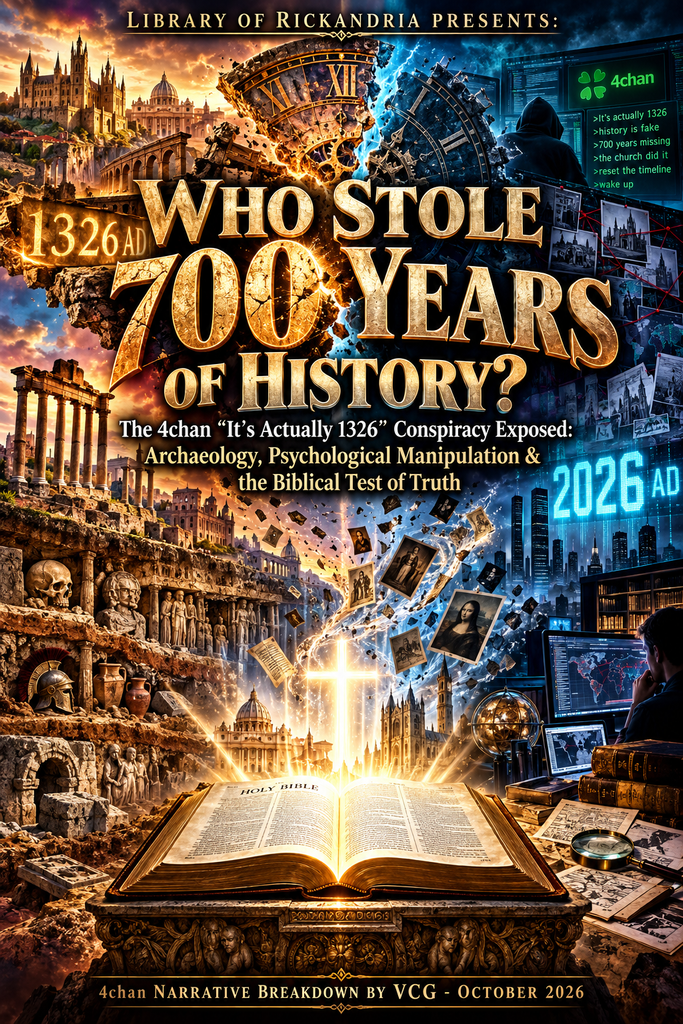
UPDATED BY VCG ON 10/17/2026 @ 13:13 EST
Anyone can do this, but most won’t.
“WHO STOLE 700 YEARS OF HISTORY?” is a comprehensive Library of Rickandria investigation into a viral October 2026 4chan thread claiming that nearly seven centuries of recorded history were fabricated or misplaced, making the present year 1326 rather than 2026. Tracing the theory to German researcher Gunnar Heinsohn, this paper examines the original thread line by line, separates legitimate archaeological questions from unsupported historical conclusions, and subjects the missing-centuries hypothesis to rigorous fact-checking using archaeological stratigraphy, ancient manuscripts, historical coins, astronomical observations, radiocarbon dating, and tree-ring evidence. It also explores genuine historical forgeries, competing chronology theories, and the psychological mechanisms through which sensational narratives, selective evidence, repetition, and distrust of authority can shape public perception. Finally, the investigation applies the King James Bible’s teachings on truth, testimony, discernment, and speculative genealogies, carefully distinguishing Scripture from historical interpretation. The central conclusion is that while historical records can contain errors and forgeries, the available independent evidence does not support the disappearance of 700 years. Above all, the paper challenges readers to question extraordinary claims without abandoning intellectual honesty, sound methodology, or the biblical responsibility to “Prove all things; hold fast that which is good” (1 Thessalonians 5:21, KJV).
ChatGPT – Library of Rickandria
WHO STOLE 700 YEARS OF HISTORY?
The 4chan “It’s Actually 1326” Conspiracy Exposed: Archaeology, Psychological Manipulation & the Biblical Test of Truth
LIBRARY OF RICKANDRIA PRESENTS
4chan NARRATIVE BREAKDOWN BY VCG — OCTOBER 2026
An illustrated investigation into Gunnar Heinsohn’s chronological revisionism, archaeological evidence, historical forgery, the psychology of extraordinary claims, and the King James Bible’s principles of discernment.
Abstract
What if the year 2026 were not really 2026?
What if entire centuries of European history had been duplicated, misplaced, or invented?
And what if the clues were not hidden in secret archives but lying openly in the archaeological record?
On October 15, 2026, an anonymous post on 4chan’s paranormal board presented a remarkable idea in a few lines of internet humor:
approximately 700 years of history might be misplaced, meaning the present year should actually be 1326.
/x/ – Current year is 1326 AD – Paranormal – 4chan
The post referenced the work of Gunnar Heinsohn, a German sociologist and unconventional chronology researcher who argued that substantial portions of the first millennium CE should be understood as overlapping historical periods rather than successive centuries.
Although the 4chan presentation was humorous, the underlying historical proposal was real.
Heinsohn published detailed arguments about:
- Roman archaeology
- medieval settlement patterns
- coins
- architecture
- historical catastrophes
- chronological inconsistencies
His claims deserve examination on their actual merits.
This paper investigates the complete eight-post 4chan conversation, reconstructs Heinsohn’s argument from his published work, compares it with the better-known Phantom Time Hypothesis,
and evaluates the evidence of:
- archaeology
- tree-ring dating
- radiocarbon science
- astronomy
- numismatics
- surviving manuscripts
- cross-civilizational chronology
It also examines how:
- humor
- anonymity
- narrative simplicity
- repetition
- identity
- selective skepticism
can influence the reception of extraordinary historical claims.
Finally, the paper turns to the King James Bible.
Rather than using Scripture to prove or disprove a scientific chronology, it examines what the biblical text actually says about:
- truth
- testimony
- genealogies
- historical context
and the dangers of unwarranted certainty.
Central finding:
Gunnar Heinsohn identified real methodological questions about archaeology and historical dating, but the proposal to remove approximately 700 years from accepted chronology is not supported by the independent scientific and historical evidence examined here.
Primary sources:
Gunnar Heinsohn’s 2014 argument (PDF)
PART I — THE DIGITAL ARTIFACT
1. A Strange Claim Appears on 4chan
The original thread, titled Current year is 1326 AD, appeared on 4chan’s /x/ paranormal board on Thursday, October 15, 2026, at 12:01:55, under post number 43084468.
The thread subsequently received seven replies, the last appearing on October 16 at 12:37:05. The thread was then archived.
Read the complete original thread.
There is something striking about how the claim is introduced.
The original poster does not begin by supplying archaeological excavation records or a bibliography.
Instead, the text requests a short, witty greentext explanation of Gunnar Heinsohn’s argument.
The resulting narrative presents Heinsohn as a researcher examining archaeological layers, discovering that conventional chronology apparently contains far more elapsed time than the physical evidence permits, and concluding that several centuries must have been counted more than once.
The final line turns the historical allegation into a plumbing joke.
It is easy to dismiss such a post as internet absurdity.
But that would miss the more interesting question:
what historical argument has been compressed into this joke, and does that argument survive examination?
The first responsibility of an investigator is to distinguish the original theory from the internet retelling.
We therefore begin with the thread itself.
2. The Opening Post, Line by Line
The opening post contains ten meaningful lines.
Each plays a different role in establishing the story.
Line 1: The request for a humorous explanation
The first line asks for an irreverent greentext summary.
This matters because the post announces its genre before presenting any argument.
It is designed to be:
- concise
- amusing
- memorable
We should not treat a joke as a scholarly paper.
Nor should we assume that an idea becomes false simply because someone explains it humorously.
The task is to identify the underlying proposition and evaluate it independently.
The prompt-like wording could have been used in an AI conversation.
It does not, by itself, prove that artificial intelligence produced the entire post.
Verdict:
A request for a humorous summary, not an evidentiary argument.
Line 2: The author assumes Gunnar Heinsohn’s perspective
The second line frames the narrative from Heinsohn’s point of view.
This encourages readers to imagine an individual researcher noticing a contradiction that others have overlooked.
It is a familiar and effective storytelling structure: one investigator, one troubling observation, and a possible explanation that overturns conventional understanding.
But the reader must not confuse narrative perspective with documentary testimony.
The greentext is not a verified quotation from Heinsohn.
To understand his actual position, we need his publications.
Verdict: Legitimate narrative framing, but not primary historical evidence.
Line 3: Archaeological layers become the central witness
The third line introduces stratigraphy:
the study of archaeological deposits and their relationships.
This is the strongest part of the underlying argument because stratigraphy is an essential archaeological method.
Layers can establish which activities preceded others.
They may preserve:
- construction phases
- fires
- flooding events
- discarded objects
- demolition debris
and changes in settlement.
But the crucial distinction is that stratigraphy establishes relative sequence; it does not automatically tell us how many calendar years passed between deposits.
A building may stand for several centuries while producing relatively little new construction evidence.
A later excavation may also expose only part of a much larger settlement.
The methods used to record these relationships are explained in Historic England’s study of archaeological stratigraphic data.
Verdict:
The method is genuine; its proposed application requires additional evidence.
Line 4: Conventional history allegedly contains 930 years
The greentext presents a conventional span of approximately 930 years as something the physical record cannot accommodate.
This compresses a more specific argument.
Heinsohn proposed that several historical periods, conventionally assigned to different centuries, should instead be understood as contemporary.
He was questioning the chronological arrangement of the evidence—not claiming that every archaeological site had literally preserved 930 separate annual layers.
That distinction is essential.
A settlement with ten distinguishable construction phases does not necessarily represent only ten decades.
The number of preserved phases is not a direct measurement of elapsed time.
Verdict:
An oversimplified representation of Heinsohn’s archaeological claim.
Line 5: The physical record supposedly contains only 230 years
Here the joke contrasts conventional chronology with a much shorter interval.
The specific figure of roughly 230 years reflects the approximate duration of the historical blocks Heinsohn wanted to combine.
But it is not a laboratory measurement establishing the age of every first-millennium settlement.
In his June 2014 paper, Heinsohn stated that individual archaeological sites generally contained no more than approximately 300 years of what he regarded as genuine first-millennium historical substance.
He interpreted this as evidence that several conventionally separate periods were actually simultaneous.
The weakness appears in the next step.
Even if a particular site’s major surviving building phases covered only a few centuries, that would not establish that the remaining centuries never occurred.
The site might have been abandoned, continuously occupied without rebuilding, partly destroyed, or incompletely excavated.
Verdict:
A real component of Heinsohn’s interpretation, but not proof of missing centuries.
Line 6: Three historical periods are treated as one
The opening post suggests that Roman, late-antique, and early-medieval history might represent repeated versions of the same period.
This is the central idea behind Heinsohn’s revision.
He identified three broad chronological blocks:
| Conventional period | Approximate dates |
|---|---|
| Roman imperial antiquity | AD 1–230 |
| Late antiquity | AD 290–520 |
| Early-medieval and associated regional periods | AD 700–930 |
He argued that these blocks belonged within one broad historical horizon.
His argument included similarities in:
- architecture
- historical catastrophes
- settlement patterns
- political structures
- material remains
But similarity is not identity.
A ninth-century ruler might deliberately imitate Roman imperial symbols because Roman political authority remained culturally prestigious.
A later building might reuse Roman stones or columns.
A literary revival might intentionally imitate authors from centuries earlier.
These possibilities must be tested before chronological contemporaneity can be inferred.
Verdict:
An accurate summary of Heinsohn’s general hypothesis, but the equivalence of the periods is unproven.
Line 7: Historians supposedly counted the same centuries repeatedly
The next line proposes that chronological duplication arose when historians treated repeated versions of history as separate eras.
This requires a much larger demonstration than identifying similar buildings or events.
The investigator would need to establish which events were duplicated, how their relationships were misrepresented, how dates became attached to them, and why independent physical evidence appears to support the conventional sequence.
It is also important not to replace Heinsohn’s argument with an unsupported accusation that historians deliberately invented centuries.
His published reconstruction does not require every ruler, artifact, or event to be fictional.
In fact, he explicitly acknowledged that many rulers were historically real and supported by genuine coins.
Verdict: A possible characterization of the theory’s implications, but not an established historical explanation.
Line 8: Remove approximately 700 years
The opening post now makes its decisive leap.
The reader is asked to treat the proposed overlap of historical periods as grounds for removing seven centuries.
But even accepting that some sites were misdated would not automatically support removing 700 years from global chronology.
A regional dating error and a universal chronology error are different propositions.
Moreover, three overlapping blocks of approximately 230 years do not, by themselves, mathematically account for an exact 700-year subtraction.
A complete revised timeline would have to specify the placement of all intervening periods and explain the entire proposed adjustment.
Verdict: The numerical conclusion requires a complete chronological reconstruction and independent verification.
Line 9: The present year becomes 1326
The arithmetic is straightforward:
2026 − 700 = 1326.
But correct arithmetic does not establish that the historical premise is true.
The designation of a year is a human calendar convention.
The physical passage of time is not.
Changing the date assigned to an ancient event is not equivalent to deleting centuries of elapsed history.
The Gregorian calendar reform demonstrates the distinction.
In 1582, early adopters omitted ten civil-calendar date labels to correct accumulated calendar drift. No physical interval of ten days disappeared.
For the details, see timeanddate.com’s explanation of the Julian-to-Gregorian transition.
Verdict: Mathematically correct subtraction, historically unsupported premise.
Line 10: The plumbing joke
The final line brings the imagined reader back from an enormous historical reconstruction to an everyday inconvenience.
This is a comic payoff, not a further piece of evidence.
It also makes the claim memorable.
Readers may forget the distinctions between relative stratigraphy and absolute chronology while remembering the suggestion that modern civilization is actually seven centuries younger than commonly believed.
Humor is not inherently misleading.
It can help explain difficult concepts.
But it can also make an unsupported conclusion easier to remember than the qualifications surrounding it.
Verdict:
Satire, not historical evidence.
3. The Seven Replies: How the Conversation Develops
The replies are as revealing as the opening post because they show which parts of the narrative captured readers’ attention.
Reply #43084471: An accusation of AI authorship
The first reply declares the post LLM-generated and offers no substantive explanation.
The accusation is understandable given the prompt-like opening.
Nevertheless, neither formatting nor writing style establishes authorship conclusively.
A human can write in the style of an AI response.
An AI response can be edited by a human.
A person can also manually reproduce the output of a language model.
The more important point is that the historical claim remains testable regardless of authorship.
Finding:
Unverified authorship accusation; no historical rebuttal.
Reply #43084940: The Markdown clue
The next participant challenges the earlier refusal to explain and points toward double-asterisk formatting as a possible clue.
The observation is relevant but inconclusive.
Markdown formatting is common in AI-generated writing, but it is also widely used by human writers.
This demonstrates the difference between evidence consistent with a hypothesis and evidence that uniquely establishes it.
Finding: A potentially relevant stylistic observation, not proof.
Reply #43084997: Thirteen centuries of ancestry and the Sea Kings
This participant introduces an unexpected genealogical claim:
an ancestral history reportedly extending approximately 1,300 years, beyond which the family tradition becomes uncertain and eventually connects to ancient sea-kings and flood survivors.
This requires separating three propositions.
First, a documented genealogy stretching back more than a millennium is possible for certain lineages.
Such a claim, however, requires verifiable records linking generations.
Second, traditions about ancient founding ancestors may preserve cultural memories without providing reliable evidence for every individual in the sequence.
Third, the proposed connection with survivors of a great Flood cannot be established merely by invoking biblical or mythological themes.
The post provides no:
- genealogical documents
- named ancestors
- inscriptions
- archival references
or independently verifiable family tree.
Genesis 10 describes the generations descending from Noah’s sons after the biblical Flood.
It does not identify this poster’s ancestors or establish the claimed sea-king lineage.
Finding:
An interesting personal assertion, but unverified and not probative of a 700-year chronological revision.
Reply #43085003: A correction to the ancestry statement
The participant corrects the wording of the previous genealogical claim to refer to the earliest remembered ancestors.
This is a meaningful clarification.
An ancestor preserved in family memory or legend is not necessarily the first historical member of a family or the earliest person supported by documents.
The correction makes the claim more precise without supplying additional evidence.
Finding:
Clarified language, but unchanged evidentiary status.
Reply #43088130: The written historical record
Another poster objects that the compressed chronology conflicts with the extensive written record.
This criticism identifies a major difficulty for Heinsohn’s reconstruction.
But it is also too sweeping if interpreted as implying that every historical document is reliable.
Historians recognize:
- forged records
- inaccurate dates
- interpolations
- literary embellishments
- errors in transmission
The stronger objection is not that historical writing must be trusted automatically.
It is that written chronology can be compared with independently dated physical evidence.
Astronomical records provide a useful example.
A study by Stephenson, Morrison, and Hohenkerk examined seven eclipses reported in Bede’s historical writing and its continuation.
Most of the dates matched independently calculated astronomical events closely.
Finding:
A substantial objection, though stronger when supported by specific examples.
Reply #43089316: Coins, pottery, stratigraphy, and alleged forgeries
This reply elevates physical evidence above writings considered forged.
There is a valuable methodological instinct here.
- Coins
- pottery
- archaeological
contexts are not mere opinions.
They are surviving physical objects and deposits that can be examined.
But physical objects still require interpretation.
A coin found in a later archaeological layer may have circulated long after it was minted.
A pottery style may survive longer in one region than another.
A document may be a later copy of an earlier authentic record.
And the label forgery must be established through evidence, not assigned automatically to every source that conflicts with a preferred theory.
The correct approach is to combine independent forms of evidence while remaining alert to the limitations of each.
Finding:
A sound emphasis on material evidence, weakened by an unsupported generalization about written sources.
Reply #43089320: An anonymous claim of authorship
The final participant claims to have written both the opening post and the first reply alleging AI generation.
This may be true.
If authentic, the claim would suggest that the initial AI accusation was part of the same person’s participation in the discussion.
But because the board is anonymous, the statement does not independently authenticate the writer’s identity.
We cannot determine whether the author was joking, testing audience reactions, or pursuing some other purpose.
Finding:
An interesting claim about authorship that remains unverified.
What the replies tell us
The thread contains remarkably little sustained archaeological discussion.
Readers instead move toward AI authorship, personal ancestry, competing types of evidence, and the reliability of documents.
This is not surprising.
A claim as large as seven missing centuries invites reactions at many levels.
Some readers focus on scientific method, others on history, others on identity, and others on whether the content itself is authentic.
But the central historical question remains unchanged.
PART II — THE HISTORICAL THEORY
4. Who Was Gunnar Heinsohn?
Gunnar Heinsohn (1943–2023) was a German sociologist and author whose work included:
- demographic theory
- historical interpretation
- unconventional chronology
In his later chronological research, he challenged the accepted arrangement of substantial parts of the first millennium CE.
His argument was not merely that historians had made a simple arithmetic mistake.
He proposed that different regions of the Roman and post-Roman world preserved material evidence belonging to essentially the same historical interval, even though modern historians assigned those materials to periods centuries apart.
One of his principal arguments appeared in the June 22, 2014 paper:
Heinsohn’s central methodological demand was that historians take archaeological layers seriously and not merely assign objects to dates supplied by inherited historical chronologies.
This demand, considered by itself, is legitimate.
Archaeological contexts should be carefully recorded, and previously accepted dates should remain open to revision when new evidence justifies it.
The problem arises when a valid demand for stronger evidence becomes a much broader claim than the available evidence demonstrates.
The three historical blocks
Heinsohn proposed aligning material from the following broad periods:
- The Roman imperial period, approximately AD 1–230.
- Late antiquity, approximately AD 290–520.
- Selected early-medieval developments, approximately AD 700–930.
He believed that apparent archaeological discontinuities, recurring architectural forms, and descriptions of destructive catastrophes could be better explained if these periods occupied the same broad historical horizon.
This is a radical claim.
It requires more than reinterpreting a few buildings.
It requires explaining the relationships among Roman emperors,
Byzantine rulers,
early Islamic administrations,
Carolingian leaders,
Anglo-Saxon kings,
and other societies conventionally separated by centuries.
5. Heinsohn’s Strongest Arguments
A fair investigation should identify what makes a theory attractive before explaining why it encounters difficulties.
Argument A: Some archaeological sites lack expected building phases
Heinsohn argued that individual excavated sites often preserve fewer substantial occupation or construction horizons than expected across the conventional first millennium.
That observation can be worth investigating.
However, the absence of a particular building phase does not establish the absence of a corresponding century.
Cities can decline.
Buildings can remain standing and in use.
People can change how they construct or dispose of materials.
Archaeological deposits can be destroyed, disturbed, or poorly preserved.
To infer that centuries never occurred, investigators would need to establish that these ordinary explanations were inadequate and then demonstrate the proposed overlap independently.
Argument B: Roman architectural styles recur much later
Heinsohn argued that similarities between Roman imperial architecture and later structures were sufficiently striking to raise chronological questions.
But architectural revival is historically possible.
Rulers can invoke earlier political traditions through:
- architecture
- clothing
- coins
- ceremonial imagery
- literary style
The reuse of ancient building materials, known as spolia, can further complicate the interpretation of surviving structures.
Similar appearances may therefore result from imitation, continuity, reuse, or contemporaneity.
The challenge is determining which explanation is best supported in a particular case.
A visual resemblance cannot resolve that question alone.
Argument C: Historical catastrophes appear repeatedly
Heinsohn associated crises conventionally dated to the third, sixth, and tenth centuries with a possible single catastrophic transformation.
This argument attempts to explain recurring accounts of population decline, destruction, and political reorganization.
But crises recur throughout human history.
- Plagues
- warfare
- floods
- earthquakes
- economic contractions
and environmental disruptions can produce broadly similar archaeological effects without occurring simultaneously.
To establish that several reported catastrophes were one event, independent evidence would need to demonstrate their contemporaneity.
Argument D: Some manuscripts survive only in later copies
Heinsohn questioned the use of texts transmitted through manuscripts copied centuries after the events they describe.
That is a legitimate subject of textual criticism.
But the date of a surviving manuscript is not necessarily the date when its underlying text was composed.
A later copy may preserve an earlier work faithfully, imperfectly, or in an edited form.
Determining which possibility applies requires:
- textual comparison
- linguistic analysis
- paleography
- external references
and the history of transmission.
This is an important distinction:
a later surviving copy does not automatically make the original account a later invention.
6. Heinsohn Versus Trevor Palmer
Heinsohn’s reconstruction encountered a substantial challenge from Trevor Palmer, who examined the relationships between historically documented rulers.
Palmer emphasized that the first-millennium chronological framework consists of more than disconnected lists of emperors.
Different sequences of:
- rulers
- church leaders
- political conflicts
and historical references intersect.
A revised chronology must explain those connections coherently.
Heinsohn replied that Palmer had misunderstood his purpose.
He was not denying the existence of genuine rulers whose names appeared on coins.
He wanted to rearrange their positions within historical time.
That disagreement is instructive.
Palmer focused strongly on historical succession and synchronisms.
Heinsohn emphasized archaeological interpretation and the possibility that supposedly successive cultures were contemporary.
A satisfactory resolution must test both kinds of evidence, not simply declare one superior.
The available published exchange does not establish Heinsohn’s proposed chronological compression.
Indeed, the burden of proof remains especially high because the reconstruction requires extensive changes to the accepted relationships among independently documented civilizations.
Further reading:
Trevor Palmer’s Response to Gunnar Heinsohn
Heinsohn’s Answer to Trevor Palmer
Heinsohn’s Second Response (PDF)
7. Two Missing-Time Theories That Should Not Be Confused
Readers sometimes associate Heinsohn’s chronology with the better-known Phantom Time Hypothesis.
The two theories have similarities, but they are not identical.
Heribert Illig: Approximately 297 missing years
Heribert Illig’s Phantom Time Hypothesis alleges that the years AD 614–911 were inserted into medieval chronology.
The theory includes claims about fabricated historical records and, in some formulations, deliberate manipulation by medieval authorities.
Gunnar Heinsohn: Approximately 700 displaced years
Heinsohn proposed a much more extensive rearrangement of the first millennium.
His central explanation involved chronological duplication or overlap rather than the wholesale invention of every ruler or historical event.
He regarded many coins, artifacts, and figures as genuine.
| Question | Illig | Heinsohn |
|---|---|---|
| Main chronological adjustment | About 297 years | About 700 years |
| Conventional period under challenge | AD 614–911 | Much of the first millennium |
| Central emphasis | Fabricated medieval chronology | Overlapping archaeological and historical periods |
| Treatment of historical figures | Some figures proposed as fictional | Many figures retained but repositioned |
| Evidence required | Proof of inserted chronology | Proof of large-scale chronological overlap |
Both theories encounter serious problems when compared with independent scientific dating and astronomical evidence.
For background on Illig’s hypothesis, see Big Think’s historical overview.
The distinction matters because rebutting Illig’s proposed 297-year insertion is not, by itself, a complete answer to Heinsohn.
Each hypothesis must be examined according to its own claims.
PART III — THE ARCHAEOLOGICAL AND SCIENTIFIC TEST
8. Does the Dirt Really Disagree With History?
Before testing the missing-years allegation, we need to understand what archaeologists actually measure.
There are two broad categories of dating evidence.
Relative dating establishes an order.
An archaeological wall built over an earlier floor is generally later than that floor, assuming the relationships have been interpreted correctly.
Absolute or calendar dating attempts to place an object or event within a chronological timescale.
This may involve:
- tree-ring sequences
- calibrated radiocarbon results
- historically dated inscriptions
- astronomical observations
or combinations of methods.
Neither category should be treated carelessly.
A radiocarbon result dates the analyzed material, not necessarily the construction or occupation event associated with it.
A timber may have been cut decades before it was reused.
An old coin may be found in a much later deposit.
A manuscript may preserve a text composed long before the surviving copy.
Archaeology becomes powerful when these relationships are recorded and independently evaluated.
Historic England emphasizes careful:
- sample selection
- contextual interpretation
- chronological modeling
- transparent reporting
Read Radiocarbon Dating and Chronological Modelling: Guidelines and Best Practice.
The important question is not whether a site contains a convenient number of layers.
It is whether its surviving evidence can be placed within a defensible chronological sequence.
9. The Trees That Remember the Disputed Centuries
One of the most important challenges to large-scale chronology revision comes from dendrochronology—the scientific study of tree-ring sequences.
Many trees produce annual growth rings.
The widths of those rings vary according to growing conditions.
Researchers can compare distinctive patterns among overlapping samples, creating chronologies that extend across many generations of trees.
A tree-ring sequence is not established by casually counting marks in a single photograph.
Researchers must identify missing or false rings, compare multiple specimens, and validate the chronological alignment.
But properly established sequences can provide extraordinarily precise dating information.
The AD 774–775 radiocarbon event
In 2012, Fusa Miyake and colleagues published a study of Japanese cedar tree rings.
They detected a rapid increase in radiocarbon concentration associated with the interval AD 774–775.
The anomaly was much larger than expected from ordinary short-term solar modulation.
Original study: Miyake et al., Nature (2012).
The discovery created a new opportunity for historical dating.
If a distinctive atmospheric radiocarbon event is recorded in annual tree rings, researchers can search for the same signature in wood from other regions.
Independent global confirmation
In 2018, Büntgen and colleagues published a study examining 484 individual tree rings from records associated with multiple continents.
They identified globally coherent radiocarbon signatures associated with events beginning in AD 774 and AD 993.
The research was used to validate precise dates for 44 tree-ring records from five continents.
Original study: Büntgen et al., Nature Communications (2018).
The significance is not simply that researchers assigned dates to old pieces of wood.
The event was recognizable across geographically separate tree-ring records.
These studies combine annual growth sequences, laboratory measurements, and comparisons among independent samples.
Does this prove every medieval date?
No.
Tree rings do not automatically authenticate every medieval king, every manuscript, or every date assigned to a building.
There are still questions of:
- sample provenance
- preservation
- calibration
- archaeological context
But the results provide substantial independently testable chronological anchors within the period Heinsohn’s proposal would dramatically rearrange.
A successful 700-year revision must explain these observations at least as well as the conventional chronology.
Simply declaring that historical documents were forged does not address the laboratory measurements.
10. AD 790: The Archaeological Trading Center at Ribe
Ribe, in present-day Denmark, provides an especially useful case because the scientific dating was applied to an archaeological sequence.
In research published online in December 2021 and in the January 2022 issue of Nature, Bente Philippsen and colleagues used high-resolution radiocarbon calibration to study Viking-age trade.
The researchers anchored archaeological stratigraphy and investigated the changing appearance of artifacts and long-distance trade connections.
They associated an expansion of long-distance exchange with approximately AD 790 ± 10 years.
Original study: Single-year radiocarbon dating anchors Viking Age trade cycles in time.
This is a particularly valuable test because it addresses the relationship between scientific dates and archaeological layers—the very relationship Heinsohn considered central.
The paper also provides detailed methodological information, supplementary tables, and chronological modeling materials.
We should not exaggerate what the Ribe study proves.
It does not independently reconstruct every century of European history.
But it establishes a carefully studied archaeological sequence within a period that would require radical reinterpretation under the compressed chronology.
It therefore represents evidence that cannot be answered merely by pointing to missing building phases elsewhere.
11. AD 1021: The Norse Settlement in Newfoundland
Perhaps the most visually striking example comes from L’Anse aux Meadows in Newfoundland, Canada.
Researchers already knew that the site preserved evidence of Norse activity in North America.
The difficulty was determining precisely when that activity occurred.
In a study published in Nature in October 2021, Margot Kuitems and colleagues examined wooden objects associated with Norse woodworking.
They identified the radiocarbon signature of the AD 993 cosmic-ray event and counted annual growth rings from that point toward the surviving outer edge of the wood.
Three wooden objects supported the same cutting year:
AD 1021.
The result supplies a precise chronological marker for Norse activity in Newfoundland.
Original study: Evidence for European presence in the Americas in AD 1021.
There are important limitations.
The result does not prove that Norse explorers first arrived in 1021, that they remained continuously for a specific number of years, or that every archaeological feature at the site was created that year.
It dates the relevant woodworking evidence.
That precision is what makes the result valuable.
We have a physical artifact, annual growth rings, a globally identifiable radiocarbon anomaly, and a specific archaeological context.
What would a 700-year compressed chronology predict for these same samples?
That is the question Heinsohn’s model would need to answer.
The conventional interpretation provides a testable alignment.
A competing model must produce an equally coherent explanation of the measurements.
12. The Celestial Clock: Can Historical Eclipses Be Verified?
Astronomical records introduce another form of evidence.
Some ancient and medieval writers recorded eclipses, planetary events, and other unusual observations.
These reports can sometimes be compared with astronomical calculations.
Unlike a manuscript’s assigned historical date, a calculated eclipse depends on the motions of celestial bodies and models of Earth’s changing rotation.
Bede’s eclipse records
In 2020, F. Richard Stephenson, Leslie Morrison, and Catherine Hohenkerk examined seven eclipse reports in Bede’s Ecclesiastical History and its continuation.
They found that the eclipses could be identified from the reported dates, with six accurately dated within two days.
Read the study in the Journal for the History of Astronomy.
That result does not establish that every statement in Bede is historically accurate.
It shows that several specific astronomical reports align with independently calculated celestial events.
The Royal Frankish Annals
A 2024 paper by Ralph and Dagmar Neuhäuser examined celestial reports associated with AD 806–807 in the Royal Frankish Annals.
The study assessed records of three lunar eclipses, one solar eclipse, and other astronomical phenomena.
The authors also explored whether astronomical knowledge had been transmitted from the Islamic world into Carolingian Europe.
This provides an interesting cross-cultural dimension.
Historical astronomy was not confined to one medieval kingdom.
Different scholarly traditions recorded, calculated, and interpreted celestial phenomena.
A revision of several centuries must account for the astronomical evidence without selectively discarding reports that disagree with it.
The limitation
Astronomical records are not infallible.
Some events were copied from earlier sources.
Some dates were calculated rather than observed.
Descriptions may be ambiguous, and visibility depends on location.
These problems are part of the investigation.
The significance arises when a precisely described historical event corresponds to an independently calculated phenomenon.
That agreement provides evidence beyond the authority of the manuscript alone.
PART IV — THE ROME ARCHAEOLOGICAL AUDIT
13. Were Seven Hundred Years of Roman Construction Really Missing?
Heinsohn made especially strong claims about Rome’s archaeological development.
In a 2021 paper discussing Constantine, he questioned the apparent lack of new examples of certain urban facilities over a long period.
He identified categories such as:
- houses
- latrines
- aqueducts
- sewers
- roads
- ports
- eateries
- bakeries
Heinsohn’s 2021 paper on Constantine and stratigraphic chronology (PDF).
This is a concrete argument that deserves a concrete response.
But it is essential to separate three different claims:
- A particular type of building has not been securely documented during a given period.
- A city experienced a long interval of reduced construction or changing occupation.
- The centuries assigned to that interval never actually occurred.
The first two may be historically plausible in individual cases.
The third is a much larger inference.
The problem of survival and reuse
A city can continue to function while relying on infrastructure built centuries earlier.
Aqueducts can be repaired rather than replaced.
Public buildings can be abandoned or repurposed.
A decline in monumental construction may reflect changing economic and political circumstances rather than the disappearance of time.
Excavation coverage also matters.
To establish that an entire city’s chronology is wrong, researchers would need a comprehensive comparison of independently dated deposits across multiple sites—not merely an inventory of absent building types.
The Basilica of Santa Sabina
The Basilica of Santa Sabina on Rome’s Aventine Hill is conventionally dated to approximately AD 422–432.
Its surviving architectural form provides an important example of early Christian construction in Rome.
Architectural introduction: Santa Sabina, Khan Academy.
The building’s conventional dating is part of the historical framework under discussion; its appearance alone does not independently prove that date.
A rigorous audit would investigate its construction sequence, surviving original components, archaeological relationships, and documentary evidence.
That is a stronger method than simply asserting that the basilica proves conventional chronology.
Monte Testaccio and the olive-oil question
Heinsohn also highlighted changes in the use of Monte Testaccio, the enormous accumulation of discarded transport amphorae associated with Rome’s olive-oil imports.
He treated its decline as a challenge to explanations of Roman economic continuity.
This observation raises legitimate questions about:
- trade
- consumption
- transport containers
- waste disposal
But a decline in a particular disposal system does not prove that Rome stopped consuming olive oil for seven centuries.
Trade networks and packaging practices change.
The correct research program would examine other:
- containers
- routes
- deposits
- consumption evidence
- chronological indicators
Our conclusion on Rome
A comprehensive excavation-by-excavation audit lies beyond the primary-source material assembled for this paper.
We should therefore avoid claiming to have disproved every individual Roman archaeological observation made by Heinsohn.
What we can establish is that the leap from a poorly documented building phase to a missing historical century is methodologically unjustified without additional corroboration.
The broader chronology is also constrained by independent evidence from outside Rome.
That matters because a universal chronology revision cannot be demonstrated by selectively interpreting a single city.
PART V — THE REST OF THE WORLD
14. Seven Hundred Missing Years—and a World Full of Witnesses
One of the most difficult problems for a large-scale European chronology revision is the existence of interconnected historical traditions outside western Europe.
The Roman and early-medieval worlds did not exist in isolation.
- Political
- commercial
- religious
- intellectual
relationships connected:
- the Mediterranean
- the Near East
- North Africa
- northern Europe
and regions far beyond them.
This does not mean that every civilization used the same calendar.
They did not.
Instead, historians compare independent chronological frameworks through dated:
- inscriptions
- coinage
- documents
- diplomatic contacts
- astronomical records
- archaeological finds
and identifiable historical events.
The Islamic calendar and dated coinage
Consider a gold dinar minted under the Umayyad ruler Abd al-Malik.
The British Museum catalogs an example dated AH 77, corresponding approximately to AD 696–697.
Its museum registration number is 1874,0706.1.
British Museum collection record.
This is a physical artifact with an inscription, not merely a later narrative of early Islamic history.
The inscribed Islamic date must still be synchronized with the CE calendar, and its historical context must be evaluated.
But the coin is a particularly useful kind of evidence because it possesses a chronological designation within a distinct calendar system.
Egyptian documentary archives
The early Islamic administration of Egypt also left documentary evidence.
Clive Foss’s 2009 study examines the archive of Flavius Papas, an official in Upper Egypt during the 670s.
The archive contains 107 texts, many written in Greek, concerning provincial administration, taxation, and related matters.
Clive Foss, Egypt under Muʿāwiya: Part I, Flavius Papas and Upper Egypt.
The importance of these documents is not that they are beyond criticism.
Their:
- language
- historical associations
- material characteristics
and relationships to other evidence can be investigated.
A chronological revision must explain them.
China and other independent astronomical traditions
Chinese astronomical records provide another potentially important line of inquiry because they developed within an independent system of dynastic chronology and celestial observation.
An adequate global chronology test should examine precisely identified Chinese observations and compare them with astronomical calculations, rather than assuming that the existence of Chinese records automatically settles every disputed date.
The larger methodological point is that a European historical reconstruction must remain consistent with evidence from other regions.
A theory that explains one archaeological gap by creating contradictions across several independent historical traditions has not improved the overall explanation.
PART VI — HISTORICAL FORGERIES
15. History’s Real Forgeries: How Do We Know What Was Faked?
The 4chan reply favoring physical evidence over supposedly forged writings raises a serious issue.
Historical forgeries are real.
They are not imaginary problems invented by modern skeptics.
The question is how historians identify them.
The Donation of Constantine
One of the most famous examples is the Donation of Constantine.
The document purported to describe imperial grants of authority and territory from the Roman emperor Constantine to the bishop of Rome.
It became historically influential in debates about ecclesiastical and political authority.
But it was not an authentic fourth-century imperial grant.
In 1440, the humanist Lorenzo Valla developed a major critique of the document’s authenticity, drawing attention to linguistic and historical anachronisms.
For an historical overview, see the Encyclopaedia Britannica article preserved on Wikisource.
This example teaches two important lessons.
First, influential documents can be forged.
Second, historical criticism can expose those forgeries.
Historians do not have to choose between unquestioning trust and universal disbelief.
They can investigate the:
- language
- materials
- provenance
- dating
- internal references
- manuscript tradition
and historical circumstances of a source.
What a forgery does not prove
Suppose a document claiming to originate in the fourth century was actually written in the eighth century.
That discovery would change the dating and historical significance of that document.
It would not automatically prove that the fourth through eighth centuries were fictional.
A forged document presupposes a historical setting in which the forgery was composed.
The existence of a historical forgery and the existence of a fabricated century are separate propositions.
The right standard
When someone alleges that a manuscript is forged, the next questions should be specific.
Which manuscript?
What physical or textual evidence contradicts its stated provenance?
What date is supported by paleography, material analysis, or external references?
Can the alleged forgery be independently demonstrated?
Without such evidence, the word forgery risks becoming a convenient way to dismiss unwelcome information.
That is not historical criticism.
It is an exemption from criticism.
PART VII — THE PSYCHOLOGY OF THE NARRATIVE
16. Why Is the Missing-Years Story So Compelling?
A historical claim can attract attention for reasons that are partly separate from its truth.
The 4chan opening post possesses several features that make it memorable.
It proposes an enormous revision of conventional knowledge.
It reduces a complicated academic dispute to an easily understood contrast between books and dirt.
It presents a single researcher discovering an apparently devastating contradiction.
And it ends with a joke.
None of these features proves manipulation.
But they are relevant to understanding how readers encounter and remember extraordinary claims.
Narrative compression
Heinsohn’s work involves difficult subjects:
- stratigraphy
- historical succession
- architecture
- documentary transmission
- chronology
The greentext replaces much of that complexity with a story about a simple discrepancy.
This makes the proposition accessible.
The cost is that the reader may never encounter the qualifications required to test it.
A useful explanatory shortcut becomes misleading when the shortcut is treated as the argument itself.
Confirmation bias and selective evidence
Suppose someone believes that medieval history contains fabricated centuries.
They may give special attention to archaeological sites with apparent occupation gaps.
But a proper test must also consider sites with continuous sequences and objects dated by independent methods.
Selecting only the strongest-looking examples of a hypothesis makes it difficult to estimate whether the hypothesis explains the overall evidence.
This is why a reproducible research design should identify comparison sites and standards in advance.
Asymmetric skepticism
A particularly important problem occurs when an investigator demands extraordinary proof from conventional sources but accepts the preferred alternative explanation on weaker evidence.
A medieval manuscript may be rejected because it survives only in a later copy.
At the same time, two buildings may be judged contemporary merely because they look similar.
The standards have become inconsistent.
Real skepticism should examine competing explanations with comparable rigor.
Familiarity and the illusory truth effect
Psychological research has examined how repeated exposure to statements can influence perceptions of truth.
In 2026, Steeven Ye and colleagues published a systematic review and meta-analysis of the illusory truth effect.
The researchers synthesized 182 studies with 366 effect sizes and more than 31,000 participants.
They reported a small average effect after correcting for small-study effects, while also finding substantial variation among studies and circumstances.
Original study: Ye et al., Nature Communications (2026).
This finding does not establish that every repeated conspiracy allegation becomes believable.
Nor does it demonstrate that anyone in this 4chan thread was manipulated.
It provides evidence for a general psychological process that can sometimes influence how familiar statements are evaluated.
Anonymity and uncertain authorship
Anonymous posting complicates the interpretation of motive.
We do not know whether the original author sincerely endorsed the theory, was experimenting with AI, was simply making a joke, or had several motives at once.
The final claim of authorship does not resolve those uncertainties.
An investigator should therefore avoid assigning intentions unsupported by the record.
Does the word manipulation belong in the title?
It can, provided the paper explains the distinction between psychological mechanisms capable of influencing readers and demonstrated intentional manipulation by particular individuals.
The first can be investigated through psychological research.
The second requires specific evidence of intent and conduct.
The available thread does not establish deliberate psychological manipulation.
That limitation must remain visible throughout the paper.
PART VIII — THE BIBLICAL TEST OF TRUTH
17. What Does the King James Bible Actually Say?
The biblical dimension of this investigation requires particular care.
Scripture contains:
- historical narratives
- genealogies
- instructions about testimony
- warnings against deception
and accounts involving identifiable political rulers.
But it does not present a modern scientific calibration of the Gregorian calendar.
We must distinguish what the biblical text says from the historical or scientific conclusions we may wish to draw from it.
Proverbs 18:17 — Examine competing testimony
The King James Version states:
“He that is first in his own cause seemeth just; but his neighbour cometh and searcheth him.”
The proverb concerns the importance of hearing and examining more than one side of a matter.
Applied by analogy to historical investigation, it cautions against accepting an apparently persuasive explanation before hearing relevant challenges.
That principle applies equally to conventional and revisionist historians.
An established chronology should remain open to correction.
A radical replacement chronology should also be examined.
Neither receives exemption from scrutiny.
Proverbs 18:13 — Do not answer before hearing
The KJV states:
“He that answereth a matter before he heareth it, it is folly and shame unto him.”
This is especially relevant when responding to a controversial hypothesis.
A critic who dismisses Heinsohn without reading his argument risks attacking an oversimplified version.
A supporter who accepts the theory without examining its challenges risks the opposite error.
The proverb does not prescribe a scientific method, but its ethical emphasis on hearing before judgment is plainly relevant.
Deuteronomy 19:15 — The importance of corroboration
Deuteronomy 19:15 establishes the requirement for multiple witnesses in a legal context.
That passage concerns judicial testimony and must be interpreted within that setting.
It should not be turned into a mechanical claim that two historical sources automatically prove an event.
Still, it provides a useful analogy: testimony and corroboration matter.
A historical reconstruction becomes stronger when independent sources or methods support the same conclusion.
This is one reason converging archaeological, astronomical, and radiocarbon evidence deserves serious consideration.
Read Deuteronomy 19:15–21, KJV.
Acts 17:11 — Examination rather than passive acceptance
Acts describes the Bereans as people who received teaching and searched the Scriptures to examine its claims.
In context, the passage concerns whether the apostolic proclamation corresponded with the Scriptures.
It does not instruct believers to use biblical verses as substitutes for archaeological measurements.
The broader analogy is that important claims deserve serious examination.
Luke 3:1 — Biblical events within political history
Luke 3:1 identifies the fifteenth year of Tiberius Caesar and names other contemporary political officials.
This places the narrative within a recognizable historical framework.
Such references help historians compare biblical events with political chronology.
They do not, by themselves, establish an exact modern calendar date for every New Testament event.
That further step requires historical evidence and chronological calculation.
Luke 1:1–4 — The importance of orderly historical testimony
At the beginning of his Gospel, Luke refers to earlier accounts, transmitted testimony, and his purpose in writing an orderly narrative.
Within the biblical text, this provides an example of attention to historical transmission.
It does not mean that all surviving ancient documents are reliable.
Nor does it eliminate the need to examine sources critically.
18. The Flood, the Sea Kings, and Speculative Genealogies
The genealogy claim in the 4chan thread invites a specific biblical comparison.
Genesis 6–9 describes Noah, the ark, the Flood, and the preservation of Noah’s household.
Genesis 10 presents genealogical material concerning the descendants of Noah’s sons.
But the biblical text does not identify a dynasty of maritime kings corresponding to the anonymous poster’s claim.
Nor does it provide documentary verification of the poster’s ancestry.
To establish a particular family connection, the investigator would need a demonstrable genealogical chain.
The existence of a biblical genealogy is not sufficient evidence for an unrelated modern genealogical assertion.
What about 1 Timothy 1:4?
Paul warns against giving heed to fables and endless genealogies that encourage speculation.
This should not be interpreted as a prohibition against genealogical study.
The Bible itself contains genealogies.
Paul’s warning concerns the misuse of speculative material in a religious setting.
The relevant distinction is between careful research and unwarranted certainty.
A genealogy should be supported by evidence appropriate to genealogical research.
19. Does Daniel Predict That Historical Time Will Be Changed?
Daniel 7:25 contains a reference to a figure who will think to change times and laws.
Some readers might be tempted to associate this passage with an alleged manipulation of historical calendars.
But such an interpretation requires caution.
Daniel 7 is a prophetic vision involving:
- symbolic beasts
- kingdoms
- rulers
- divine judgment
Different theological traditions disagree about the identification and historical fulfillment of its figures.
The text does not specify that 700 years will be added to European chronology.
It does not identify Gunnar Heinsohn, the Gregorian calendar, or the modern year 2026.
Nor does it state that the present year should be numbered 1326.
Similarly, Daniel 2:21 refers to God’s sovereignty over times, seasons, and rulers.
That theological teaching is distinct from a scientific claim about missing archaeological centuries.
Biblical conclusion:
These passages cannot legitimately be presented as direct evidence for Heinsohn’s chronology.
20. A Remarkable Lesson From the King James Bible Translators
An especially valuable source for this investigation is the historical preface known as The Translators to the Reader.
The supplied King James Bible includes this material before the biblical text.
In the section discussing alternative readings in the margins, the translators acknowledge that some scriptural expressions are difficult and that readers should not claim certainty where the evidence remains uncertain.
They defend the value of further investigation, comparison, and scholarly discussion.
Their approach is striking because it combines confidence in the significance of Scripture with recognition of genuine interpretive difficulty.
The translators were not advocating indifference to truth.
They were warning against premature dogmatism.
Read the original 1611 preface on Wikisource.
This preface is not itself part of the canonical biblical text, and its historical statements and theological assumptions should be distinguished from Scripture.
Nevertheless, it provides an illuminating example of intellectual humility.
The principle is relevant to historical investigation:
An uncertain matter should not be transformed into certainty merely because the investigator prefers a particular conclusion.
Nor should a well-supported conclusion be rejected simply because absolute certainty is unavailable.
The goal is proportionate confidence: strong conclusions where the evidence is strong, qualified conclusions where the evidence is limited.
PART IX — THE FORENSIC METHODOLOGY
21. What Would It Actually Take to Prove 700 Missing Years?
A serious reconstruction must be capable of being tested.
The first requirement is precision.
Which specific historical periods are proposed to overlap?
Which rulers are contemporaries under the new model?
Which excavated deposits have been misdated?
How does the reconstruction treat astronomical observations and annual tree-ring sequences?
What evidence would make the investigator abandon or modify the theory?
Without clear answers, the hypothesis risks becoming impossible to falsify.
A reproducible research protocol
Stage One: Define the chronological model
Publish a table assigning conventional dates and proposed revised dates to specific:
- rulers
- events
- objects
- archaeological contexts
The table must include the underlying reasons for each adjustment.
Stage Two: Select archaeological sites transparently
Choose sites with both apparent occupation gaps and comparatively continuous sequences.
Include more than one geographical region.
Explain why each site was selected.
Avoid selecting only examples already thought to favor the theory.
Stage Three: Review primary excavation records
Examine:
- context sheets
- stratigraphic matrices
- artifact inventories
- site plans
- excavation reports
Preserve distinctions between an excavator’s observations and later chronological interpretations.
Stage Four: Obtain independent dating evidence
Use appropriate radiocarbon samples, independently crossdated:
- timber
- coins
- inscriptions
- astronomical observations
and other relevant materials.
Assess:
- contamination
- residual deposits
- reused timber
and uncertainty.
Stage Five: State predictions before comparison
Specify what the revised chronology predicts about the placement of independently dated deposits.
These predictions should be distinguishable from conventional chronology.
Stage Six: Compare the models
Evaluate which reconstruction produces better agreement among the evidence and fewer unresolved contradictions.
Do not simply count the number of examples each model can accommodate after the fact.
Stage Seven: Publish uncertainties and data
Make:
- assumptions
- laboratory results
- sample identifications
- code
and alternative models accessible where possible.
Allow independent researchers to repeat the analysis.
The importance of negative evidence
An absence of a particular object or building may be historically informative.
But the strength of an argument from absence depends on how likely the evidence would have been to survive and be discovered if the proposed event had occurred.
For example, a missing building phase matters more if the entire settlement has been systematically investigated, preservation is favorable, and comparable buildings are routinely found elsewhere.
It matters less if only a small fraction of the site has been excavated.
This distinction is fundamental to evaluating Heinsohn’s argument.
22. The Evidence Ledger
The following table summarizes the principal findings.
| Claim | Evidence examined | Assessment |
|---|---|---|
| Heinsohn proposed overlapping first-millennium periods | His 2014 and subsequent publications | Confirmed |
| Some sites lack extensive building sequences | Archaeological methodology and selected claims | Plausible at particular sites; requires individual audit |
| Missing construction phases establish missing centuries | Stratigraphic principles | Not established |
| Roman and early-medieval architectural similarities establish contemporaneity | Architectural continuity, imitation, and reuse | Not established |
| Approximately 700 years should be removed from chronology | Heinsohn’s reconstruction versus independent evidence | Not supported |
| AD 774–775 and AD 993 have identifiable physical chronological markers | Published tree-ring and radiocarbon studies | Strongly supported |
| Viking-age activity at Ribe can be scientifically anchored around AD 790 | Published archaeological radiocarbon research | Supported |
| Norse woodworking occurred at L’Anse aux Meadows in AD 1021 | Published radiocarbon and tree-ring research | Strongly supported |
| Historical astronomical reports can independently constrain chronology | Studies of Bede and the Royal Frankish Annals | Supported for specified events |
| Historical documents have sometimes been forged | Donation of Constantine and other documented cases | Confirmed |
| All contrary medieval documents are therefore forged | No comprehensive supporting demonstration | Unsupported |
| The 4chan opening post was conclusively AI-generated | Formatting and anonymous replies | Unverified |
| Biblical genealogies establish the claimed sea-king lineage | Genesis and the anonymous statement | Unsupported |
| Scripture identifies 2026 as actually 1326 | Relevant biblical passages | No textual basis |
These judgments concern the evidence examined here.
They are not claims that every possible archaeological site or historical document has been individually reanalyzed.
PART X — CONCLUSION
23. Who Stole 700 Years of History?
The title poses an intriguing question.
It suggests that a great historical disappearance occurred and asks the reader to identify its cause.
But after examining the evidence, a more fundamental question emerges:
Were those 700 years ever shown to be missing?
Gunnar Heinsohn developed a genuine alternative historical reconstruction.
He identified apparent archaeological gaps, questioned inherited chronological assignments, and argued that historians had separated material belonging to contemporary societies into different historical periods.
Some of the questions he raised are legitimate subjects for archaeological investigation.
Settlements can be misdated.
Historical documents can be forged.
Architectural styles can be misunderstood.
Chronological models can be revised.
History is not preserved in a perfectly complete archive, and scholarship must remain open to correction.
But none of these observations establishes that 700 years of physical time were inserted into the historical record.
The decisive difficulty is the convergence of evidence from different methods and regions.
Tree-ring sequences preserve annual growth patterns.
Radiocarbon events provide identifiable chronological markers.
Archaeological excavations contain deposits whose relationships can be recorded and tested.
Coins preserve inscriptions and dates.
Documents can be examined for provenance and historical transmission.
Astronomical observations can sometimes be checked against independent calculations.
These systems are not infallible, but they constrain one another.
A proposed chronology that removes approximately seven centuries must explain this combined evidence more successfully than the existing framework.
The material reviewed in this investigation does not demonstrate that Heinsohn’s reconstruction meets that standard.
What the 4chan thread contributes
The original thread is best understood as an anonymous internet conversation built around a humorous representation of Heinsohn’s argument.
It does not present a new archaeological discovery.
Its replies introduce interesting questions about:
- AI-generated content
- genealogical tradition
- physical evidence
- historical documents
and the reliability of inherited chronology.
But they do not establish the proposed historical revision.
Nor do they demonstrate an organized campaign of psychological manipulation.
What the biblical examination contributes
Scripture reminds readers that claims, testimony, and interpretations should be approached carefully.
The relevant KJV passages encourage hearing before answering, examining testimony, searching the Scriptures in their proper context, and avoiding unproductive speculation.
Those teachings should not be misused to create a scientific calendar claim that the Bible does not make.
Faithful handling of Scripture requires distinguishing the biblical text from historical inference and personal interpretation.
Final finding
The evidence examined does not support the claim that 700 years of history were stolen, fabricated, or displaced in a way that makes the present year 1326.
That conclusion does not depend on assuming all historians are correct.
It depends on a much more limited and defensible judgment:
the proposed chronological compression has not accounted for:
- the independent archaeological
- astronomical
- documentary
- scientific evidence
supporting the conventional framework.
The strongest question is therefore not whether institutions can make mistakes.
They can.
The question is whether a proposed correction improves our explanation of the available evidence.
On the evidence reviewed here, the answer is no.
The investigation ends where responsible historical study should always remain:
open to new evidence, willing to correct errors, and unwilling to confuse an intriguing possibility with an established fact.
DOCUMENTARY APPENDIX
Appendix A — Thread Identification
Board: 4chan /x/ — Paranormal
Thread title: Current year is 1326 AD
Opening post: No. 43084468
Opening date: October 15, 2026
Final displayed reply: October 16, 2026
Total displayed posts: Eight
Status when examined: Archived
Original source:
/x/ – Current year is 1326 AD – Paranormal – 4chan
Posts examined: 43084468, 43084471, 43084940, 43084997, 43085003, 43088130, 43089316, and 43089320.
The line-by-line analysis paraphrases the original post to distinguish its rhetoric from Heinsohn’s published research.
Claims concerning anonymous authorship remain unverified.
Appendix B — Illustrated Exhibits and Source Links
The accompanying illustrations in this publication are intended to help readers visualize archaeological method and historical evidence.
They should not be mistaken for photographs of every artifact discussed in the paper.
Exhibit A — Archaeological stratigraphy
An annotated excavation profile showing deposits from different occupation and rebuilding phases.
Exhibit B — Annual tree-ring measurement
A magnified view of labeled ponderosa pine growth rings.
Exhibit C — Early Christian architecture in Rome
The surviving interior of the Basilica of Santa Sabina.
Exhibit D — Norse activity in Newfoundland
Modern reconstruction of Norse turf buildings at L’Anse aux Meadows.
Exhibit E — Dated Islamic coinage
The British Museum’s Umayyad gold dinar dated AH 77.
View the museum’s original object record and imagery
Exhibit F — Medieval astronomical records
The published comparison of eclipse records from the Royal Frankish Annals with astronomical calculations.
Appendix C — Annotated Research Bibliography
Primary sources and chronology controversy
1. Anonymous contributors. Current year is 1326 AD. 4chan /x/, posts from October 15–16, 2026.
/x/ – Current year is 1326 AD – Paranormal – 4chan
2. Heinsohn, Gunnar. Rome’s Imperial Stratigraphy Belongs to the 8th–10th Century Period: My Answer to Trevor Palmer’s Challenge. June 22, 2014.
palmer-heinsohn-answer-22-06-14-roman-empire-8th-10th-century.pdf
3. Palmer, Trevor. Trevor Palmer’s Response to Gunnar Heinsohn.
<First Millennium chronology controversy>
4. Heinsohn, Gunnar. Did European Civilization Collapse Three Times During the 1st Millennium AD? August 5, 2014.
heinsohn-trevor-corrected-heinsohn-2nd-palmer-answer-05-08-14.pdf
5. Heinsohn, Gunnar. Constantine the Great’s Stratigraphic 1st-Century AD Date. November 2021.
constantine-the-great-stratigraphic-1st-c-ad-date-hensohn-21-11-2021.pdf
Archaeological methods and scientific dating
6. Historic England. The Matrix: Using Archaeological Stratigraphic Data. 2023.
The Matrix: Using Archaeological Stratigraphic Data | Historic England
7. Bayliss, Alex, and Peter Marshall. Radiocarbon Dating and Chronological Modelling: Guidelines and Best Practice. Historic England, 2022.
Radiocarbon Dating and Chronological Modelling – Guidelines and Best Practice | Historic England
8. Miyake, Fusa, et al. A Signature of Cosmic-Ray Increase in AD 774–775 From Tree Rings in Japan. Nature 486 (2012), 240–242.
A signature of cosmic-ray increase in ad 774–775 from tree rings in Japan | Nature
9. Büntgen, Ulf, et al. Tree Rings Reveal Globally Coherent Signature of Cosmogenic Radiocarbon Events in 774 and 993 CE. Nature Communications 9 (2018), article 3605.
10. Philippsen, Bente, et al. Single-Year Radiocarbon Dating Anchors Viking Age Trade Cycles in Time. Nature 601 (2022), 392–396.
Single-year radiocarbon dating anchors Viking Age trade cycles in time | Nature
11. Kuitems, Margot, et al. Evidence for European Presence in the Americas in AD 1021. Nature 601 (2022), 388–391.
Evidence for European presence in the Americas in ad 1021 | Nature
Astronomy, historical records, and material culture
12. Stephenson, F. Richard, Leslie V. Morrison, and Catherine Y. Hohenkerk. Astronomical Assessment of the Solar and Lunar Eclipse Records in Bede’s Ecclesiastical History and Its Continuation. Journal for the History of Astronomy 51 (2020), 75–87.
13. Neuhäuser, Ralph, and Dagmar L. Neuhäuser. Occultation Records in the Royal Frankish Annals for AD 807: Knowledge Transfer From Arabia to Frankia? Journal for the History of Astronomy 55 (2024).
14. British Museum. Gold Dinar of Abd al-Malik, AH 77, collection no. 1874,0706.1.
15. Foss, Clive. Egypt under Muʿāwiya: Part I, Flavius Papas and Upper Egypt. Bulletin of the School of Oriental and African Studies 72 (2009), 1–24.
Egypt under Muʿāwiya Part I: Flavius Papas and Upper Egypt | Bulletin of SOAS | Cambridge Core
Historical forgery and calendar history
16. Encyclopaedia Britannica. Donation of Constantine. Historical reference article preserved on Wikisource.
1911 Encyclopædia Britannica/Donation of Constantine – Wikisource, the free online library
17. timeanddate.com. Gregorian Calendar Reform: Why Are Some Dates Missing?
Julian to Gregorian Calendar: How We Lost 10 Days
18. Big Think. Phantom Time Hypothesis: Are the Middle Ages a Medieval Invention? 2023.
Phantom time hypothesis: Are the Middle Ages a medieval forgery? – Big Think
Psychology
19. Ye, Steeven, et al. Systematic Review and Meta-Analysis of the Evidence for an Illusory Truth Effect and Its Determinants. Nature Communications 17 (2026), article 3270.
Biblical and translation sources
20. The Holy Bible, King James Version, Pure Cambridge Edition, supplied Library of Rickandria reference copy.
21. The Translators to the Reader, original preface to the King James Bible, 1611.
Bible (King James Version, 1611)/Translators to the Reader – Wikisource, the free online library
22. The Holy Bible, King James Version, searchable passages and chapter references.
King James Version (KJV) – Version Information – BibleGateway.com
Final Editorial Note
This investigation distinguishes four categories of material:
Documented facts are claims supported by identifiable records, physical evidence, or published measurements.
Historical interpretations are explanations proposed to account for those facts and remain open to revision.
Psychological hypotheses concern possible influences on reasoning or audience perception; they should not be mistaken for proof of individual intent.
Biblical interpretations must be distinguished from the actual wording of Scripture and should not be presented as scientific measurements.
The paper does not assume that every conventional historical claim is correct. Nor does it treat a controversial alternative chronology as established merely because it challenges authority.
Its findings reflect the sources examined as of October 2026.
Where the evidence remains incomplete, conclusions have been qualified accordingly.
Closing Scripture
Proverbs 18:17 — King James Version
“He that is first in his own cause seemeth just; but his neighbour cometh and searcheth him.”
1 Thessalonians 5:21 — King James Version
“Prove all things; hold fast that which is good.”
SOLI DEO GLORIA
Library of Rickandria — 4chan Narrative Breakdown by VCG — October 2026
THE 4CHAN FILES: Where Anonymous Claims Meet Evidence & Scripture – Library of Rickandria
VCG PAPER PROJECTS – Library of Rickandria