
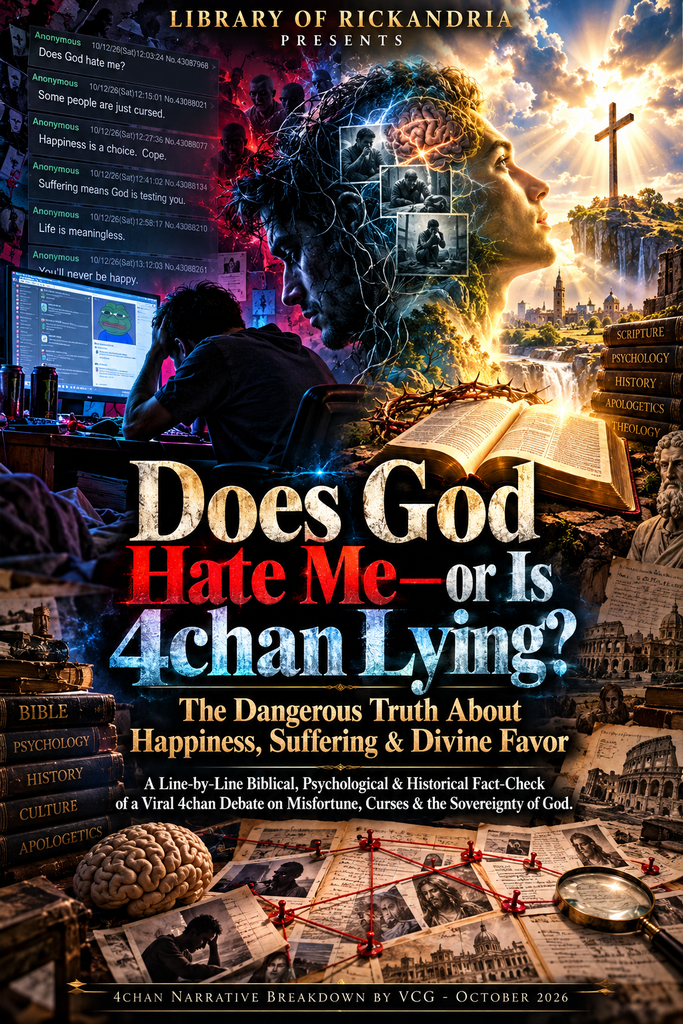
Does God Hate Me—or Is 4chan Lying? The Dangerous Truth About Happiness, Suffering & Divine Favor
UPDATED BY VCG ON 10/17/2026 @ 15:15 EST
A Line-by-Line Biblical, Psychological & Historical Fact-Check of a Viral 4chan Debate on Misfortune, Curses & the Sovereignty of God.
Anyone can do this, but most won’t.
This comprehensive Library of Rickandria investigation examines an October 2026 4chan discussion centered on a deeply troubling question: “Does God hate me, or am I cursed because others seem happier and more successful?” Through a detailed, post-by-post analysis, the paper exposes the weaknesses in popular claims that happiness is entirely a choice, that repeated failure signals divine rejection, and that worldly prosperity proves God’s favor. Combining the King James Bible with psychological research, historical scholarship, original-language studies, and logical analysis, the investigation explores social comparison, hopelessness, emotional invalidation, intrusive thoughts, religious fear, and the dangers of assigning supernatural explanations to ordinary human suffering. It traces the intellectual roots of positive thinking, examines prosperity theology and competing Christian understandings of divine providence, and distinguishes genuine biblical joy from temporary pleasure, material success, and forced optimism. Drawing upon Job, Psalms, Ecclesiastes, the teachings of Jesus Christ, Paul’s epistles, and Revelation, the paper demonstrates that suffering is not inherently evidence of sin, a curse, or God’s hatred, just as prosperity is not proof of righteousness. It also challenges harmful religious counsel that condemns struggling individuals without understanding their circumstances, emphasizing compassion, discernment, personal responsibility, and appropriate psychological support. Ultimately, the investigation reveals that neither internet certainty nor worldly circumstances can reliably determine a person’s standing before God. Instead, it directs readers toward careful examination of Scripture, intellectual honesty, and the Christian hope grounded in the suffering, resurrection, and redemptive work of Jesus Christ—affirming that genuine faith does not require pretending suffering is unreal, and that God’s love cannot be measured by how easily life appears to unfold. Soli Deo Gloria.
ChatGPT – Library of Rickandria
LIBRARY OF RICKANDRIA PRESENTS
Does God Hate Me—or Is 4chan Lying?
The Dangerous Truth About Happiness, Suffering & Divine Favor
A Line-by-Line Biblical, Psychological & Historical Fact-Check of a 4chan Debate on Misfortune, Curses & the Sovereignty of God
4chan Narrative Breakdown by VCG — October 2026
Research edition
October 17, 2026
Primary text: King James Bible, supplied Pure Cambridge Edition
View the cinematic cover artwork
Cover artwork is a dramatic illustration, not a documentary screenshot. Any forum messages depicted in that artwork should not be mistaken for verified quotations from the original thread.
Abstract
On October 16, 2026, an anonymous visitor to 4chan’s Paranormal board asked why other people seemed able to enjoy happiness and success while the writer endured disappointment.
/x/ – why do other people get to be happy and i dont? wh – Paranormal – 4chan
The questions then turned toward God:
Was this apparent inequality evidence of divine hatred, or perhaps a curse?
The thread received ten replies.
Some commenters encouraged personal discipline and less comparison.
Others asserted that happiness is a matter of choice, speculated about the allocation of success, challenged the usefulness of happiness as a goal, or described the experience of persistent mental distress.
At first glance, the exchange appears to be an ordinary internet argument about attitude.
But underneath it are several important questions.
How much emotional control do human beings actually possess?
Does persistent suffering indicate personal failure?
What does Scripture teach about the prosperity of the wicked and the suffering of the righteous?
How should believers distinguish divine providence from speculation?
And what happens when simplistic advice is given to someone who may already be psychologically overwhelmed?
This paper investigates those questions through a close reading of:
- the original discussion
- contemporary psychological research
- intellectual history
and the King James Bible.
Its central finding is that neither outward prosperity nor inward distress provides a reliable, stand-alone measurement of someone’s spiritual standing before God.
While individuals can influence their responses to adversity, the claim that happiness is wholly voluntary is not supported by psychological evidence.
Scripture, meanwhile, contains repeated examples of faithful people experiencing profound suffering, and it warns against making unjustified accusations about those who suffer.
The aim of this investigation is not to manufacture a theological verdict against anonymous commenters.
It is to evaluate their arguments fairly, preserve what they get right, identify what they cannot substantiate, and develop a more defensible Christian response.
Introduction: Four questions in the middle of the night
At 1:52 a.m. on Friday, October 16, 2026, an anonymous message appeared on 4chan’s /x/ board.
It was short, unpolished, and emotionally direct.
The writer wondered why others seemed happier, why others appeared to win while the writer lost, whether God hated them, and whether they were cursed.
There is something revealing about the progression.
It begins with comparison.
It moves into perceived injustice.
Then it seeks an ultimate explanation.
The question is no longer merely Why am I unhappy?
It becomes What does my unhappiness mean about me, and what does it mean about God?
That movement is the heart of the investigation.
An unsuccessful job application,
a failed relationship,
poor health,
loneliness,
financial hardship,
or years of disappointed expectations may invite the same reasoning.
A person looks at the apparent prosperity of others and begins to wonder whether life is somehow arranged against them.
But the appearance of a pattern is not sufficient evidence of the cause of that pattern.
And where questions about suffering intersect with religious belief, the temptation to invent a hidden explanation becomes especially powerful.
The book of Job dramatizes this temptation.
Job’s friends do not merely observe that he is suffering.
They construct an explanation for why he must deserve it.
The thread we are examining offers a modern variation on that ancient problem.
Its participants are not uniformly cruel or uniformly helpful.
Some provide useful advice.
Some confuse useful principles with universal laws.
Some are flippant.
At least one describes distress that deserves more serious consideration.
We should therefore investigate the arguments rather than assign moral or psychological identities to strangers we cannot know.
The governing principle is expressed in 1 Thessalonians 5:21:
“Prove all things; hold fast that which is good.”
That is an invitation to examine rather than merely react.
Part I — The Evidence
Chapter 1. What the original thread actually contains

Figure 1. Original-post visual theme
The original attachment shows three monkey figurines covering their eyes, mouth, and ears.
It is an example of the familiar three-wise-monkeys motif.
The image shown here is illustrative.
View the exact original attachment.
The evidence begins with the preserved thread itself:
Primary source:
4chan /x/ — Thread No. 43087968, archived October 16, 2026.
Its recorded characteristics are:
| Feature | Verified information |
|---|---|
| Board | /x/ — Paranormal |
| Thread number | 43087968 |
| Original post | October 16, 2026, 1:52:54 a.m., as displayed by 4chan |
| Last visible reply | October 16, 2026, 5:20:19 p.m. |
| Total visible posts | 11 |
| Replies after the opening post | 10 |
| Attached images | 2 |
| Posting identities | Anonymous |
| Current thread state | Archived; replies closed |
| Independently established viral reach | Not established |
The original thread is directly accessible at the link above.
Its entire visible conversation can be checked against the numbered sequence below.
The phrase viral 4chan debate appeared in our earlier working subtitle.
That description goes further than the available evidence.
A small archived discussion can be interesting and worth studying without being demonstrably viral.
Accordingly, this research edition does not treat virality as an established fact.
The chronological record
The following is a structured paraphrase of all 11 posts.
The post numbers and displayed timestamps are retained so a reader can compare every summary with the source.
| Post number | Time, Oct. 16 | Substance |
|---|---|---|
| 43087968 | 1:52 a.m. | Opening questions concerning happiness, unequal success, God’s possible rejection, and a curse |
| 43087979 | 1:58 a.m. | Encourages self-focus and reduced comparison; condemns envy insultingly |
| 43088133 | 3:34 a.m. | Declares that the distressed person has suddenly realized they are happy |
| 43088147 | 3:40 a.m. | Suggests reframing the questions positively and remembering previous successes |
| 43088160 | 3:44 a.m. | Assigns complete personal responsibility for happiness and treats resentment as chosen misery |
| 43089149 | 11:47 a.m. | Objects that repeated failure and disappointment can undermine the possibility of simply choosing happiness |
| 43089324 | 12:37 p.m. | Speculates about winners, hidden unfairness, internal happiness, and the scarcity of joy |
| 43089488 | 1:43 p.m. | Emphasizes discipline and mindset; rejects a divine allocation of winners and losers |
| 43089513 | 1:52 p.m. | Describes unwanted memories, persistent mental noise, insecurity, and lack of control |
| 43089520 | 1:54 p.m. | Questions the pursuit of happiness and favors accepting whatever experiences life brings |
| 43090226 | 5:20 p.m. | Ends with a brief, ambiguous challenge |
The timestamps are those displayed by the thread.
Their timezone is not established by the retrieved text.
Some comments explicitly reference earlier post numbers, while others do not.
This matters:
a reader must not assume that every response is directed to the person immediately preceding it.
Nor can we assume that the writer describing mental distress later in the conversation is the original poster.
Every message is labeled Anonymous.
The thread’s two images
Opening attachment
The three-wise-monkeys imagery is present, but the poster does not explain why it was chosen.
Attachment to post 43089520
A green-tinted, glowing cat accompanies the comment about accepting experience.
Its intended symbolism is unknown.

These pictures can be discussed as part of the source material.
But they do not independently establish anyone’s theology, state of mind, or motive.
The images should not be subjected to elaborate symbolism unless the poster supplies a reason for it.
A picture can communicate mood or internet culture without encoding a coherent philosophical argument.
Chapter 2. The rules of an honest investigation
Before evaluating a single claim, we need to establish what kind of evidence would justify a conclusion.
We will use six distinctions throughout the paper.
First, quotation is different from paraphrase.
The post numbers and timestamps above permit readers to verify the wording of the discussion.
We will reproduce only brief illustrative excerpts and otherwise explain each claim in our own words.
Second, experience is different from explanation.
A person who reports feeling miserable is providing evidence about their reported experience.
They are not necessarily providing evidence that God is causing that misery.
Third, a psychological pattern is different from a diagnosis.
Language resembling catastrophizing, social comparison, or perceived helplessness may be discussed without identifying a stranger as:
- clinically depressed
- traumatized
- delusional
or otherwise ill.
Fourth, an empirical finding is different from a theological doctrine.
Psychological research may establish that a coping intervention helps some participants.
It cannot establish whether God loves a particular person or whether divine judgment has occurred.
Fifth, a biblical passage is different from an interpretation of that passage.
When the text speaks directly, we will say so.
When Christians disagree over its implications, we will identify the disagreement.
Sixth, lack of evidence is different from disproof.
The absence of evidence for a curse does not constitute a scientific proof about every possible supernatural claim.
It does mean that we are not warranted in telling this writer that a curse explains their misfortune.
Why the KJV translators’ preface matters
The supplied Bible contains The Translators to the Reader, originally associated with the 1611 King James translation.
There the translators discuss difficulties of interpretation and the value of acknowledging uncertainty.
They write:
“It is better to make doubt of those things which are secret, than to strive about those things that are uncertain.”
They also defend consulting the original languages, earlier translators, and alternative readings where the text is difficult.
This provides a fitting methodological standard:
careful study is not diminished by acknowledging uncertainty.
The accompanying Pure Cambridge Edition’s later editorial material should, however, be distinguished from the original translators’ preface.
A modern editor’s claims about a particular edition are not automatically statements made by the translators in 1611.
For this paper, the supplied KJV is our English textual standard, not a reason to dispense with contextual examination, original-language study, or historical research.
How findings will be classified
A statement may be assessed as:
- supported
- partially supported
- unsupported
- contradicted
or unresolved.
For example, the claim that deliberate habits can influence well-being is supported by research.
The stronger claim that every person can immediately decide to feel happy is not.
Similarly, the Bible recognizes divine judgment and curses.
But that does not support identifying an unknown individual’s unfortunate life circumstances as evidence of a particular curse.
The distinction between a concept exists and this concept explains this case will be essential.
Part II — A Line-by-Line Examination of the Thread
Chapter 3. The opening post: From disappointment to fear of divine rejection
Post 43087968 — October 16, 2026, 1:52:54 a.m.
The opening message contains four questions, and their order matters.
They move from personal unhappiness to comparative failure, then to two proposed spiritual explanations.
Question one: Why do other people appear happy when I am not?
The first thing to recognize is that the writer’s unhappiness is a reported experience.
We should neither dismiss it nor treat it as proof that we know its cause.
The comparison, however, introduces a difficulty.
Other people’s happiness is being judged from the outside.
Human beings do not have direct access to one another’s internal emotional lives.
An outwardly successful or cheerful individual may also experience:
- anxiety
- grief
- insecurity
or disappointment.
This is particularly significant in social environments where people selectively reveal their favorable experiences.
Research on upward social comparison is relevant.
Aubry, Quiamzade, and Meier, writing in Personality and Individual Differences in 2024, examined the relationship between comparing oneself with apparently better-off people on Instagram and depressive symptoms.
Their findings were consistent with a reciprocal relationship: greater depressive symptoms accompanied more upward comparison, while upward comparison could also contribute to distress.
That research concerns social-media comparison rather than this anonymous writer specifically.
It helps explain a possible process, not the actual cause of this individual’s suffering.
The biblical parallel is Psalm 73.
Asaph begins by admitting:
Psalm 73:3 (KJV)
“For I was envious at the foolish, when I saw the prosperity of the wicked.”
This is not the voice of someone calmly detached from other people’s advantages.
It is the voice of someone troubled by the apparent injustice of life.
Asaph’s perspective changes as the psalm develops.
By verse 26, his emphasis is no longer upon matching the prosperity of others but upon God as his enduring portion.
Notice what the narrative does not promise.
It does not describe Asaph suddenly receiving every material advantage that troubled him in the beginning.
Finding:
The writer’s distress deserves recognition.
The perception that other people are happier, however, cannot be taken as an accurate account of their complete lives.
Nor does unequal happiness establish divine favoritism.
Question two: Why do other people win while I lose?
This question introduces the language of permission.
Success appears to be something other people are allowed to possess.
But who is doing the allowing?
God?
Society?
Fate?
A hidden power?
The post does not specify.
That ambiguity matters.
It permits the question to drift toward a worldview in which the outcomes of life are assigned by an unseen authority.
Without further evidence, this explanation is speculative.
The biblical book of Ecclesiastes offers a remarkable counterweight.
Ecclesiastes 9:11 (KJV)
“I returned, and saw under the sun, that the race is not to the swift, nor the battle to the strong, neither yet bread to the wise, nor yet riches to men of understanding, nor yet favour to men of skill; but time and chance happeneth to them all.”
This text recognizes the imperfect relationship between merit and outcome.
A skilled person can lose.
A wise person can remain poor.
Someone who works diligently can suffer misfortune.
The statement does not deny the importance of preparation, discipline, or wisdom.
It denies that earthly outcomes always follow a predictable moral or practical formula.
The contemporary research picture is compatible with that limited observation.
The World Health Organization identifies a combination of:
- individual
- social
- environmental
- structural
factors affecting well-being, including:
- economic deprivation
- violence
- inequality
- education
- social connection
We should also avoid drawing the opposite conclusion.
It is not established that the writer is unusually disadvantaged or that every failure has been beyond their control.
Those are factual questions we cannot answer from the available message.
Finding:
Repeated losses can be real, but they do not prove that the universe assigns success to morally favored people or that failure reveals personal worth.
Question three: Does suffering mean God hates me?
Here the discussion enters theology.
The apparent reasoning is simple:
I am suffering.
Other people appear to prosper.
Therefore, perhaps God has rejected me.
The conclusion does not logically follow.
Indeed, several substantial portions of Scripture are difficult to reconcile with that conclusion.
Job is introduced as upright (Job 1:1).
Yet he experiences catastrophic losses.
His friends attempt to explain his suffering through moral accusation.
God’s later rebuke of those friends, in Job 42:7, makes their certainty a warning to readers.
John 9:1–3 provides an even more direct example.
When the disciples encounter a man born blind, they ask whether his condition resulted from his sin or that of his parents.
Jesus rejects that explanation in the particular case.
JESUS CHRIST REVEALED: THE TRUTH THEY HID – Library of Rickandria
Luke 13:1–5 likewise warns against assuming that people who experience calamity are necessarily worse sinners than those who escape it.
And Matthew 5:45 describes God’s sun and rain reaching both the good and the evil.
These passages do not prove that God never judges anyone through earthly events.
Scripture contains accounts of divine judgment.
They establish that one cannot ordinarily infer a person’s moral or spiritual standing from the mere occurrence of suffering.
Romans 8:35–39 gives Christians a more profound assurance, teaching that affliction does not separate those who belong to Christ from the love of God in him.
The qualification is important.
Romans 8 is addressed within the context of life in Christ.
It should not be mechanically applied as proof of an anonymous writer’s relationship with God, which remains unknown.
Finding:
The thread supplies no evidence demonstrating divine hatred.
Scripture substantially contradicts the premise that adversity alone reveals God’s rejection.
Question four: Am I cursed?
The final question looks for a supernatural classification of the entire experience.
There is a danger in answering too casually.
The Bible does speak about:
- curses
- covenant sanctions
- judgment
- redemption
We should not pretend otherwise.
Deuteronomy 28, for example, contains covenant blessings and curses addressed to Israel.
Galatians 3:10–14 discusses the curse associated with the law and Christ’s redemptive work.
But the existence of such categories does not establish that every person experiencing bad fortune is under a supernatural curse.
Galatians 3:13 states:
“Christ hath redeemed us from the curse of the law, being made a curse for us:”
The immediate context concerns the law and redemption through Christ.
It is not a promise that Christians will never experience:
- setbacks
- illness
- poverty
or grief.
Similarly, Proverbs 26:2 cautions against treating a baseless curse as effective.
It is a proverb, not a diagnostic instrument for determining the supernatural source of every unfortunate event.
The opening writer supplies no specific evidence of a curse.
Finding:
The curse hypothesis is unsubstantiated.
It should not be affirmed by a stranger seeking to offer a dramatic explanation for someone’s pain.
Chapter 4. Post 43087979: Helpful advice delivered badly
October 16, 2026, 1:58:56 a.m.
The first reply encourages self-focus, discourages excessive comparison, and condemns envy with a derogatory expression.
There is a useful insight here.
A person who continually evaluates their worth through other people’s successes may develop a distorted assessment of themselves.
Concentrating on one’s responsibilities and goals can be constructive.
Galatians 6:4 tells the reader to examine their own work.
But verse 2 of the same chapter commands believers to bear one another’s burdens.
These ideas belong together.
A biblical commitment to personal responsibility is not a command to become emotionally isolated or indifferent to the needs of others.
The commenter also moves too quickly from comparison to envy.
The original poster might envy others.
But the evidence does not establish that they resent or wish harm upon anyone.
They may simply be discouraged.
James 3:14–16 does warn against bitter envy.
Yet condemning something that has not been established is not sound discernment.
Finally, insulting someone who has disclosed unhappiness does not become wise merely because the insult accompanies useful advice.
Ephesians 4:29 emphasizes speech that edifies.
Romans 12:15 calls believers to mourn with those who mourn.
Verdict: Partially supported.
Reducing unhealthy comparison is reasonable; assuming moral guilt and delivering counsel through ridicule is not justified.
Chapter 5. Post 43088133: Declaring someone happy does not make them happy
October 16, 2026, 3:34:57 a.m.
The second reply abruptly declares that the original writer has discovered happiness simply through reading the comment.
It may be a joke.
It may be provocative humor.
It might be an attempt at a kind of verbal reframing.
The source does not let us determine the intention.
But as a literal psychological claim, it has no evidentiary foundation.
Another person cannot establish your internal emotional state by announcement.
This is not to deny that words can help change feelings.
- Encouragement
- reassurance
- humor
- reframing
- supportive conversation
can influence mood.
But influence is different from authoritative control.
The National Institute of Mental Health explains that depression may involve persistent sadness, loss of interest, changes in sleep or appetite, diminished concentration, and other symptoms.
Treatment may involve psychotherapy, medication, or both, depending on a person’s needs.
Depression – National Institute of Mental Health (NIMH)
Simply telling a distressed individual that their problem has vanished does not substitute for understanding it.
Job’s companions supply a valuable warning:
a confident answer can still be a bad answer.
Proverbs 18:13 describes the folly of answering before hearing a matter.
Verdict:
Unsupported if taken literally.
There is insufficient evidence to judge whether the commenter intended humor, but the assertion cannot establish the writer’s actual condition.
Chapter 6. Post 43088147: Positive reframing or denial of reality?
October 16, 2026, 3:40:46 a.m.
This response is more complex.
The commenter tries to rewrite the original complaints as expressions of serenity and contentment.
The writer also suggests that previous successes have been forgotten, introduces an unexplained reference to possible cognitive deterioration, and argues that life’s abundance is already present.
There are at least three ideas to separate.
First: Reinterpreting events can help
Cognitive reappraisal involves changing how a situation is understood.
A person who interprets every setback as proof of total failure may benefit from examining that conclusion.
For example, losing one opportunity does not necessarily mean every opportunity is closed.
But sound reframing must remain anchored to evidence.
It cannot simply replace an unpleasant fact with a pleasant invention.
If someone is grieving a death, telling them that they are actually serene does not correct a false belief. It denies an experience.
Second: Remembering genuine blessings may be valuable
Psalm 103:2 encourages remembrance of God’s benefits.
Philippians 4:8 directs attention toward what is:
- true
- just
- pure
- lovely
and worthy of praise.
This can support gratitude.
But gratitude becomes dishonest when it requires someone to claim blessings they have not received or pretend that actual hardships do not matter.
The commenter does not know whether this person has enjoyed substantial previous victories.
The suggestion should be offered as a question, not imposed as fact.
Third: Speculating about cognitive impairment is unwarranted
The reply introduces a possibility resembling dementia, but the thread provides no evidence of neurocognitive disease.
A negative outlook is not sufficient evidence of dementia.
Neither is forgetting one’s achievements.
No medical diagnosis follows from that statement.
The appropriate theological correction is found in James 2:15–16, where the inadequacy of verbal reassurance without practical help is exposed.
A person lacking necessities does not need to be told that material abundance surrounds them.
They may need:
- food
- clothing
- shelter
- care
or assistance.
Verdict:
Mixed.
Reappraisal and gratitude are potentially beneficial; invented positivity and ungrounded medical speculation are not.
Chapter 7. Post 43088160: Is happiness really a choice?
October 16, 2026, 3:44:55 a.m.
The central claim is captured in four words:
“Happiness is a choice”
The commenter also assigns personal responsibility for happiness entirely to the individual and argues that resenting happy people amounts to choosing misery.
This is the thread’s most consequential psychological assertion.
To assess it fairly, we must distinguish a modest claim from an absolute one.
The modest claim is that people can sometimes improve well-being through:
- actions
- habits
- interpretations
- relationships
- treatment
That claim has empirical support.
The absolute claim is that every person’s happiness is solely a matter of individual choice, regardless of:
- illness
- traumatic experience
- material deprivation
or other circumstances.
That claim is not supported by contemporary mental-health research.
In 2023, a large synthesis of meta-analyses in The Journal of Positive Psychology evaluated research across 198 meta-analyses, encompassing 4,065 primary studies and more than 500,000 participants.
It reported generally small-to-medium improvements across several well-being and mental-health measures associated with broadly defined positive-psychology interventions.
That is significant evidence that interventions can be helpful.
But it is not evidence of universal, effortless, immediate control over happiness.
A more narrowly focused systematic review by Lim and Tierney, published in the Journal of Happiness Studies in 2023, analyzed ten studies involving 1,341 adults experiencing depression.
When positive-psychology interventions were compared with other active psychological treatments, the differences in happiness and depression outcomes were small and not statistically significant.
The authors also reported substantial heterogeneity and methodological limitations.
Together, these findings encourage a balanced conclusion.
Human beings are not powerless spectators of every emotional change.
But neither are they fully sovereign over their psychological condition.
Scripture: Joy is not the same as cheerful self-command
Galatians 5:22–23 identifies joy among the fruit of the Spirit.
Philippians 4:11 describes Paul learning contentment amid differing circumstances.
Both passages give a more substantial account than an instruction to generate happiness on demand.
Moreover, the commenter has not established that the original poster resents happy people.
Asking why others seem better off is not itself proof of malicious envy.
First Thessalonians 5:14 distinguishes between people requiring:
- warning
- encouragement
- support
- patience
Sound pastoral care must exercise comparable discernment.
Verdict: Partially supported in a limited sense; unsupported in its absolute formulation.
Happiness can be influenced by choice.
It cannot always be produced simply by deciding to possess it.
Chapter 8. Post 43089149: The exhaustion of repeatedly disappointed hope
October 16, 2026, 11:47:30 a.m.
This commenter objects to the choice-based view of happiness.
Their objection arises from repeated failure and the experience of having hope disappointed again and again.
Here the writer identifies a weakness in the preceding argument.
Personal agency is not the same thing as control over results.
An individual may choose to:
- study
- work
- seek treatment
- pursue reconciliation
or apply for opportunities.
The eventual outcome may still depend upon many other factors.
Repeated disappointment can undermine a person’s expectation that their efforts will matter.
Psychologists have studied perceived controllability and helplessness extensively.
But the original reply does not provide enough information to determine whether this specific commenter is experiencing a clinically significant pattern of helplessness.
There is also a caution in their own language.
Describing every attempt as ending badly may be emotionally understandable, but we cannot verify that it is literally true.
Scripture recognizes the injury of deferred hope:
Proverbs 13:12 (KJV)
“Hope deferred maketh the heart sick:
but when the desire cometh, it is a tree of life.”
This proverb makes no attempt to ridicule the person whose expectations have been disappointed.
Psalm 13 and Lamentations 3 likewise recognize the painful passage of time between suffering and renewed hope.
Verdict: Substantially valid as a challenge to instant-choice theories of happiness.
The precise extent of the writer’s losses remains unverifiable.
Chapter 9. Post 43089324: Is life a rigged game?
October 16, 2026, 12:37:44 p.m.
This reply presents several different claims.
Some people succeed because they understand how life works.
Alternatively, the commenter speculates, certain people may be permitted to succeed as a form of humiliation directed toward supposedly better people.
The writer then returns to the claim that happiness must originate within the individual, insists that it must be deliberately chosen, and treats genuine joy as scarce.
The first proposition contains a modest truth:
- knowledge
- experience
- strategy
can improve the likelihood of success.
The second is a much larger assertion.
It proposes an intentional arrangement of success and humiliation without supplying evidence of the arrangement, the agent responsible, or the moral superiority of the supposed victims.
It is possible to perceive a pattern of unfairness without knowing its ultimate explanation.
The danger is that the explanation may become immune to contradiction.
If someone else prospers, the system is allegedly rewarding them to torment you.
If you suffer, the system is allegedly proving its hostility.
Such an explanation can absorb almost any outcome without demonstrating its truth.
There is also an uncomfortable irony:
the reply implies that outwardly successful people might be morally inferior while simultaneously advising the original poster to stop depending upon outward comparisons.
First Samuel 16:7 provides a strong theological warning against reading character from appearances.
The context concerns the selection of David, and the broader principle challenges human confidence in outward judgments.
The scarcity claim
The commenter also treats joy as a limited resource that individuals must manufacture for themselves.
No evidence is given for this supposed scarcity.
Emotional experience is not a fixed quantity of material goods distributed among human beings.
Nor does Scripture present Christian joy as wholly self-generated.
Romans 15:13 locates joy and peace within God’s work in the lives of believers.
John 15:11 places joy within Christ’s relationship with his disciples.
The reply therefore combines plausible self-improvement advice with unsupported claims about hidden cosmic arrangements.
Verdict: Mixed, with important speculative elements.
Strategic action can influence outcomes; the claim that others prosper as instruments of deliberate humiliation is unsubstantiated.
Chapter 10. Post 43089488: Discipline, fortune, and divine sovereignty
October 16, 2026, 1:43:01 p.m.
The next response rejects the notion that happiness is reserved for a privileged class.
It emphasizes clarity and self-discipline, denies that God assigns worldly winners and losers, and draws a strong distinction between luck and happiness.
The comment contains several worthwhile ideas but also a theological overstatement.
Discipline can contribute to well-being.
Habits of thought and behavior matter.
Yet there is no evidence that clarity and self-discipline are sufficient to secure happiness in every situation.
The World Health Organization’s account of mental-health determinants explicitly recognizes the interaction of personal and social factors.
The claim concerning God requires even more care.
Psalm 75:6–7 presents God as the one who:
- judges
- humbles
- exalts
Daniel 4:35 emphasizes divine sovereignty.
James 4:13–15 cautions people against treating their plans as independent of God’s will.
At the same time, Ecclesiastes 9:11 recognizes the significance of contingency and chance within earthly experience.
Christians have developed different explanations of how:
- divine providence
- human agency
- secondary causes
- contingency
relate to one another.
These disagreements cannot be resolved through one short internet reply.
However, a narrower conclusion is well supported:
A person’s worldly success does not establish that God approves of them, and a person’s failures do not establish that God has rejected them.
The reply’s final assertion also goes too far by implying that good or bad fortune has no bearing upon happiness.
Losing a loved one,
becoming seriously ill,
gaining stability,
receiving support,
or escaping an abusive situation can profoundly affect emotional well-being.
Christian contentment is not the denial that circumstances matter.
Verdict: Partially supported psychologically; disputed and oversimplified theologically.
Chapter 11. Post 43089513: When the mind will not become quiet
October 16, 2026, 1:52:24 p.m.
This is the most important contribution for understanding the possible consequences of the thread’s advice.
The commenter reports continual mental noise and insecurity, involuntary recollections of unpleasant past experiences, and a sense that life operates according to rules they cannot understand.
The writer challenges the assumption that happiness is immediately available through conscious decision.
We should approach this statement carefully.
What the comment supports
It supports the conclusion that the writer is reporting significant subjective distress.
It suggests that unwanted cognitive experiences may be interfering with their ability to feel at peace.
It also demonstrates why simplistic instructions about emotion can feel inadequate to someone whose internal experiences appear difficult to control.
What the comment does not support
It does not establish a diagnosis of:
- post-traumatic stress disorder
- depression
- generalized anxiety disorder
or any other clinical condition.
It does not prove a history of particular traumatic events.
It does not establish demonic interference or a supernatural curse.
Nor does it prove that recovery is impossible.
The National Institute of Mental Health identifies:
- intrusive memories
- flashbacks
- persistent negative emotions
- heightened alertness
and difficulty feeling positive emotions among symptoms that can occur with PTSD.
Diagnosis, however, requires additional:
- criteria
- context
- duration
- assessment
Post-Traumatic Stress Disorder – National Institute of Mental Health (NIMH)
The same agency distinction becomes essential here.
A person may not control the immediate appearance of a troubling memory.
Nevertheless, they may be able to develop responses that reduce its effects, with appropriate assistance.
- Clinical treatments
- supportive relationships
- coping strategies
- changes in circumstances
can all be relevant.
The biblical answer to anguished thoughts
Psalm 42 gives language to a person whose soul is cast down.
Psalm 88 demonstrates that biblical lament need not always resolve into an immediate experience of relief.
Romans 8:26 acknowledges infirmity and the believer’s need for divine assistance.
Second Corinthians 12:7–10 portrays Paul asking repeatedly for an affliction to be removed, while learning to understand strength and grace amid weakness.
In 1 Kings 19, Elijah’s despair is accompanied by exhaustion.
The narrative includes rest, nourishment, and divine care.
These passages do not amount to a modern clinical treatment protocol.
They demonstrate that Scripture does not require suffering people to conceal their distress in order to appear faithful.
Verdict: Credible as a report of distress, without sufficient information for diagnosis or causal explanation.
The ethically appropriate response would be compassionate listening, careful questions, and encouragement toward practical and professional support when symptoms persist or interfere with daily living.
Chapter 12. Post 43089520: Acceptance, pleasure, and the limits of detachment
October 16, 2026, 1:54:41 p.m.
Figure 2. Green-cat attachment
This commenter accompanies a philosophical reply with a bright green cat image.
Illustrative preview.
The writer questions whether happiness is even the correct goal, then advocates accepting life’s experiences, whether pleasant or terrifying.
A psychedelic trip is used as a metaphor for the unpredictable range of human experience.
This is philosophically more interesting than a simple command to become happy.
The first insight is that people may use the word happiness to describe different things:
- pleasure
- peace
- success
- contentment
- fulfillment
or acceptance.
A person may be searching for an impossible condition if they define happiness as the continuous absence of unpleasant feeling.
The second insight concerns emotional acceptance.
Ford, Lam, John, and Mauss examined the psychological consequences of accepting negative emotions and thoughts through laboratory, diary, and longitudinal research.
Their findings associated habitual acceptance with healthier psychological outcomes and suggested that reduced secondary reactions to unpleasant internal experiences could help explain the relationship.
This gives the comment a meaningful connection to contemporary psychology.
However, acceptance must be distinguished from resignation.
Accepting that fear is presently occurring does not mean that danger should be celebrated.
Accepting grief does not mean that bereavement is good.
Accepting that a person has been mistreated does not mean they should remain in an abusive situation.
The biblical distinction is similar.
Ecclesiastes 3:4 recognizes distinct occasions for:
- weeping
- laughter
- mourning
- dancing
Romans 12:9 calls believers to reject evil and hold to good.
The Bible does not require a person to enjoy every circumstance in order to trust God.
The psychedelic comparison remains a metaphor, not evidence about the writer’s actual drug use.
Verdict: Partially supported.
Acceptance can be beneficial, but enjoying or approving every unpleasant experience is neither a psychological necessity nor a biblical command.
Chapter 13. Post 43090226: The final unanswered question
October 16, 2026, 5:20:19 p.m.
The final message consists of a short question.
It may challenge the assumption that happiness is impossible.
It might be playful.
It might be directed toward a previous commenter rather than the original poster.
We do not have enough context to know.
That uncertainty should be preserved.
Theologically, one could answer that Christian hope is possible amid suffering.
Psychologically, one could answer that many individuals can improve their well-being with support and appropriate interventions.
But neither answer should be projected backward as though it proves what the anonymous writer intended.
Verdict: Insufficient information for a substantive claim assessment.
The comment illustrates an important principle:
responsible interpretation sometimes requires declining to assign meaning where the evidence does not support it.
Part III — The Biblical Investigation
Chapter 14. The ancient problem: Why do the righteous suffer?
Figure 3. Job Rebuked by His Friends — William Blake
William Blake’s depiction of Job and his accusers provides an almost perfect historical illustration for this discussion.
The figures surrounding Job appear certain of their judgments.
Yet certainty is not the same thing as truth.
Public-domain artwork.

Wikimedia Commons image and attribution.

A related engraving is held by the National Gallery of Art.
The problem raised in the opening post is ancient.
If God is righteous, why do people who appear wicked sometimes prosper?
And why do people trying to do what is right sometimes suffer?
The Bible does not ignore these questions.
Several biblical books confront them so directly that any theology unable to accommodate suffering is likely to be a theology unable to accommodate Scripture itself.
Job: When the explanation becomes the accusation
The book of Job begins with a description of its central character as upright and God-fearing.
The reader then encounters events that Job and his human companions do not understand.
This difference between what the reader knows and what Job’s friends know is crucial.
The friends observe Job’s calamity.
They assume there must be a corresponding moral explanation.
Their conclusion is that his suffering must reveal hidden guilt.
But the opening narrative has already undermined their explanation.
By chapter 42, God rebukes Eliphaz and the two other companions for failing to speak rightly concerning him.
Job 42:7 (KJV)
“Ye have not spoken of me the thing that is right, as my servant Job hath.”
The lesson is not that every accusation is false or that Job never speaks rashly.
Job himself is confronted by God and brought to humility.
The central lesson for this investigation is that an explanation of suffering can sound religiously plausible and still misrepresent God.
The same warning applies to strangers who diagnose someone’s life as cursed, abandoned, or deservedly miserable without adequate evidence.
Joseph: Evil intentions and providence
Genesis 37–50 describes Joseph’s:
- betrayal
- enslavement
- imprisonment
and eventual elevation in Egypt.
In Genesis 50:20, Joseph distinguishes the harmful purposes of his brothers from God’s good purpose in the eventual preservation of life.
This supplies an important biblical model of providence.
Human wrongdoing does not automatically frustrate God’s ultimate purposes.
Yet Joseph does not pretend that his brothers’ betrayal was morally good.
The passage should not be used to assert that we know the beneficial purpose of every tragedy.
Joseph speaks retrospectively within a specific biblical narrative.
That is different from an internet commenter declaring divine intent over an unknown person’s suffering.
David: Faith and anguish together
David’s psalms repeatedly express:
- fear
- grief
- guilt
- uncertainty
- hope
Psalm 13 begins with distress over God’s apparent absence.
Its movement toward trust is meaningful precisely because the earlier anguish is real.
The psalm does not present sorrow as something that instantly disappears when faith is exercised.
Psalm 34:18 expresses hope in God’s nearness to the brokenhearted, while Psalm 42 portrays the inner struggle of a cast-down soul.
These passages allow faith and emotional pain to exist in the same life.
Jeremiah: The prophet who questioned prosperity
Jeremiah 12:1 directly asks why the wicked prosper.
The prophet does not begin with an assumption that the successful are necessarily favored by God.
Jeremiah’s own calling involves rejection, opposition, and suffering, despite his prophetic vocation.
That is a serious challenge to any simplistic doctrine that divine approval will be expressed through uninterrupted earthly success.
Paul: Contentment learned through adversity
Paul’s letters repeatedly describe:
- deprivation
- imprisonment
- opposition
- physical weakness
- affliction
Philippians 4:11–13 describes contentment as a learned reality, cultivated across different circumstances.
Second Corinthians 1:8–10 records severe distress.
Second Corinthians 12:7–10 describes the experience of seeking relief from affliction and receiving a theological answer emphasizing grace.
Neither account supports the idea that genuine Christian faith abolishes all psychological pain.
Christ: Suffering without personal sin
The clearest example appears in Jesus Christ.
First Peter 2:22 identifies his sinlessness, while the Gospel narratives recount:
- betrayal
- abandonment by disciples
- humiliation
- physical suffering
- crucifixion
Within Christian theology, Christ’s suffering has a unique redemptive significance.
It is not interchangeable with ordinary human suffering.
But it conclusively challenges the assumption that suffering necessarily reveals the sufferer’s personal wickedness.
A comparison of the biblical evidence
| Figure | Documented suffering | What the text establishes |
|---|---|---|
| Job | Severe loss and physical affliction | Adversity does not necessarily establish personal guilt |
| Joseph | Betrayal, enslavement, imprisonment | God can bring good through events involving genuine human evil |
| David | Fear, persecution, grief | Lament and trust may coexist |
| Jeremiah | Opposition and rejection | A faithful calling does not guarantee outward success |
| Paul | Persecution, deprivation, affliction | Christian contentment can be learned amid hardship |
| Jesus Christ | Rejection, humiliation, crucifixion | Suffering cannot simply be equated with personal sin |
The accumulated evidence strongly rejects the claim that the original poster’s losses, by themselves, demonstrate God’s hatred.
Chapter 15. The curse question: Scripture, covenant, and superstition
The word curse carries very different meanings in popular conversation.
A person may use it metaphorically to mean an extended run of bad luck.
Another may mean divine punishment.
Another may imagine an inherited spiritual condition, a spoken malediction, or occult interference.
These claims should not be treated as identical.
Covenant curses in Deuteronomy
Deuteronomy 28 contains blessings and curses within the Mosaic covenant, in which Israel is addressed as a covenant people.
This context is indispensable.
The chapter cannot responsibly be converted into a universal checklist by which every modern person’s financial difficulties, illness, or disappointment is automatically diagnosed as divine punishment.
Doing so removes the text from its specific covenantal setting.
The curse of the law in Galatians
In Galatians 3, Paul addresses justification, the law, faith, and Christ’s redemptive work.
His declaration in verse 13 that Christ redeemed people from the curse of the law belongs within that argument.
It should not be reduced to the claim that a believer must never suffer hardship or that poverty automatically demonstrates an unbroken curse.
The New Testament’s description of persecuted believers makes such an interpretation difficult to sustain.
Generational guilt and inherited consequences
Exodus 20:5 and related passages are sometimes invoked to explain supposed generational curses.
The biblical discussion is more complex.
Deuteronomy 24:16 distinguishes personal judicial responsibility.
Ezekiel 18 challenges the idea that a child is automatically held morally guilty for a parent’s wrongdoing.
Consequences can pass between generations through:
- poverty
- violence
- harmful example
or damaged relationships without demonstrating the transmission of personal moral guilt.
Claims about inherited supernatural curses therefore require careful theological argument.
They cannot be inferred simply because a family has endured repeated difficulties.
Proverbs 26:2 and unsupported accusations
Proverbs 26:2 cautions against a baseless curse.
Its relevance is straightforward:
Scripture gives no permission to treat an unexplained difficulty as proof that someone has been supernaturally targeted.
The proverb is wisdom literature, however, and should not be inflated into an empirical law proving that no harmful act can ever occur.
What Scripture does and does not permit us to say
We may say that Scripture discusses divine judgment, covenant curses, and redemption.
We may say that the New Testament presents Christ as the redeemer from the curse of the law.
We may say that Christians differ over some contemporary teachings about generational curses and spiritual warfare.
We cannot legitimately identify this anonymous writer as cursed merely because life has been painful.
That conclusion does not arise from the evidence.
Chapter 16. Providence, human freedom, and the problem of evil
One of the replies denies that God chooses worldly winners and losers.
Another entertains a hidden system that allows success for the purpose of humiliating others.
Both statements touch the larger theological problem of divine providence.
Christian theology has never been represented by a single, universally agreed explanation of exactly how God governs every event.
A useful distinction begins with the problem of evil itself.
The logical problem of evil asks whether the existence of evil is compatible with God’s traditional attributes.
The evidential problem of evil asks whether the actual character and extent of suffering make God’s existence or certain understandings of providence less plausible.
Philosophers distinguish between a defense, which seeks to show that God and suffering could be compatible, and a theodicy, which offers a proposed explanation for God’s permission of evil.
The Stanford Encyclopedia of Philosophy’s analysis of the problem of evil discusses these distinctions and the principal approaches to them.
The sovereignty-centered approach
Some Reformed and other providence-centered theologians emphasize God’s comprehensive governance of history.
Relevant biblical passages include:
- Ephesians 1:11
- Psalm 115:3
- Daniel 4:35
Such approaches differ in how they explain God’s relation to evil actions and secondary causes.
They do not automatically license the claim that we know why a particular individual lost a job or experienced illness.
Free-will-centered approaches
Other Christians emphasize the meaningful freedom of created agents and the role of creaturely decisions in producing suffering.
Human choices plainly can harm others.
- Betrayal
- violence
- fraud
- neglect
and exploitation are genuine features of the world.
But an appeal to human freedom alone does not explain every form of suffering, particularly natural disasters, congenital illness, or other cases where no obvious culpable human decision is involved.
Soul-making approaches
SOULS: The Eternal War for God’s Image – Library of Rickandria
A tradition associated with the thought of Irenaeus and developed in modern philosophy by John Hick emphasizes the possibility of moral and spiritual development through adversity.
There may be circumstances in which hardship contributes to:
- perseverance
- compassion
- maturity
or dependence upon God.
James 1:2–4 and Romans 5:3–5 are frequently discussed in this connection.
Yet there is a serious moral danger in applying this explanation indiscriminately.
It would be presumptuous to tell a victim of severe abuse or tragedy that we know their suffering was specifically arranged for their improvement.
The possibility that good can emerge from suffering does not make the suffering itself good.
Appeals to human ignorance
Some approaches emphasize the limits of human knowledge concerning God’s reasons.
The book of Job strongly contributes to this discussion.
Job receives a profound encounter with God, but the narrative does not give him a simple, exhaustive explanation of all the events he endured.
Epistemic humility has value.
But appealing to mystery should not become a device for dismissing suffering or asserting detailed explanations that nobody has established.
The Christian hope of final restoration
Romans 8:18–25 presents present suffering alongside the future redemption of creation.
Revelation 21:4 looks toward the removal of:
- death
- sorrow
- crying
- pain
This final horizon is important because the New Testament does not make temporary comfort, social success, or financial prosperity the ultimate measure of divine goodness.
Theological synthesis: Christians disagree about the precise relationship between providence and creaturely freedom.
But Scripture gives ample reason to reject confident claims that another person’s successes or failures disclose God’s private intentions toward them.
For further discussion of freedom and divine foreknowledge, see the Stanford Encyclopedia of Philosophy: Foreknowledge and Free Will.
Chapter 17. Happiness, joy, blessedness, and contentment: A language study
The forum participants use the word happy as if its meaning were obvious.
It is not.
In ordinary English, happiness may describe:
- pleasure
- a favorable mood
- life satisfaction
- good fortune
- fulfillment
or some combination of these.
Biblical vocabulary is similarly varied.
No single Hebrew or Greek term perfectly corresponds to every modern use of the English word.
| Term | General meaning | Representative passage |
|---|---|---|
| Hebrew ʾashrê (אַשְׁרֵי), related to ʾesher | Blessed or fortunate condition | Psalm 1:1 |
| Hebrew simḥāh (שִׂמְחָה) | Joy, gladness, celebration | Psalm 16:11 |
| Greek makarios (μακάριος) | Blessed, happy, fortunate | Matthew 5:3–12 |
| Greek chara (χαρά) | Joy, gladness, delight | Galatians 5:22 |
| Greek autarkēs (αὐτάρκης) | Content, sufficient | Philippians 4:11 |
These broad lexical meanings can be checked against the lexical entries for:
The important work, however, is not simply looking up dictionary definitions.
It is examining how words function within sentences, genres, and arguments.
Blessedness is not continuous pleasant emotion
In Matthew 5:3–12, Jesus pronounces blessing upon groups that include those mourning, suffering persecution, and hungering for righteousness.
The presence of mourning and persecution is especially revealing.
Jesus does not declare that the mourners are secretly enjoying uninterrupted pleasure.
His beatitudes relate their situation to God’s kingdom and promises.
Thus, biblical blessedness cannot simply be identified with an absence of distress.
Joy is not restricted to outward success
Galatians 5:22 identifies joy among the fruit of the Spirit.
James 1:2 calls believers to consider trials from a perspective of faith.
That does not require denying the genuine pain of the trials.
In John 15, joy is connected to Christ’s teaching, love, and abiding relationship with his disciples.
The New Testament presents joy as a deeply relational and spiritual good.
However, it would be another overstatement to declare that the biblical word joy always means a quiet spiritual condition and never ordinary delight.
Its semantic range includes real gladness.
Contentment is learned
In Philippians 4:11, Paul uses autarkēs, a term associated with sufficiency or contentment.
The surrounding passage is crucial.
Paul speaks of learning contentment in both abundance and deprivation, and identifies Christ as the source of his strength.
This is different from the claim that an isolated individual can instantly manufacture every desirable emotion.
Paul’s language should also be read within its original setting rather than reduced to a timeless self-help slogan.
The conclusion of the language study
We should not build a theology upon the assumption that the words:
- happy
- joyful
- blessed
- content
are completely interchangeable.
Nor should we pretend that the original languages establish rigid distinctions where their meanings actually overlap.
The more reliable conclusion is contextual:
Christian blessedness concerns more than favorable circumstances, and Christian joy need not be identical to uninterrupted pleasant feeling.
This finding substantially changes how we should evaluate the forum’s central question.
Part IV — Psychology and the History of Happiness
Chapter 18. How much control do we really have over happiness?

This is artwork, not a neuroimaging result or scientific measurement.
One of the most useful distinctions in this entire discussion is between influencing a process and controlling its every outcome.
A person can take actions that improve physical health without guaranteeing that they will never become ill.
Likewise, an individual can develop habits that support psychological well-being without guaranteeing that unwanted emotions will never arise.
This is not fatalism.
It is a more accurate description of agency.
The different components of emotional experience
An individual’s emotional condition may involve:
- spontaneous thoughts
- physiological reactions
- memories
- conscious interpretation
- learned behavior
- relationships
and the broader environment.
Some of these can be influenced deliberately.
Others may occur without conscious invitation.
The WHO explicitly describes mental health as the product of interacting individual, social, community, and structural conditions.
For someone experiencing severe economic pressure, trauma-related symptoms, or profound isolation, an instruction merely to think differently may fail to address central causes of distress.
But the evidence also argues against complete helplessness.
Psychotherapies and structured psychological interventions can help people develop new responses to distressing experiences.
The NIMH identifies cognitive behavioral therapy and interpersonal therapy among established treatments for depression.
Depression – National Institute of Mental Health (NIMH)
The important lesson is that treatment involves:
- processes
- skills
- context
- time
It is not simply the declaration of a desired outcome.
Chapter 19. The psychological patterns operating in the discussion
Upward comparison
The original poster judges their life against others who appear happier or more successful.
Such comparisons can sometimes motivate constructive action.
But they can also intensify dissatisfaction when a person interprets others’ achievements as evidence of their own inferiority.
The 2024 study by Aubry and colleagues supports concern about reciprocal relationships between online upward comparison and depressive symptoms.
Its Instagram-specific findings should not be assumed to describe all internet users.
Perceived helplessness
When individuals repeatedly experience setbacks, they may come to expect that effort will not change outcomes.
That expectation can undermine motivation.
But we must distinguish a pattern of language indicating helplessness from a clinically established condition.
The forum provides no structured assessment, and its participants’ circumstances remain unknown.
Catastrophic interpretation
The movement from I am suffering to God may hate me illustrates how an adverse experience can be interpreted as evidence of a much larger threat.
The original emotion may be legitimate even when the broader conclusion is unsupported.
A responsible response should investigate the interpretation rather than ridicule the emotion.
Emotional invalidation
Some replies attempt to replace the person’s distressed experience with an assertion of happiness or contentment.
This risks treating emotional pain as a mistake that must be corrected before it has been understood.
A healthier approach would acknowledge the reported experience while examining any interpretations that may intensify it.
Excessive personal responsibility
The claim that individuals are exclusively responsible for their happiness discounts factors outside immediate voluntary control.
The opposite error is also possible: a person may interpret every unpleasant experience as proof that they have no meaningful ability to act.
Neither extreme is supported by the psychological evidence.
Negative religious coping
Religion can function as a source of:
- meaning
- social connection
- hope
- support
It can also be associated with distress when adversity is interpreted through persistent fears of divine punishment or abandonment.
A 2024 longitudinal study by Steven Pirutinsky and colleagues followed data collected from 397 participants across three years.
It found associations involving:
- negative religious coping
- spiritual struggles
- adverse events
- depressive symptoms
The authors distinguished between ongoing spiritual struggles and coping responses activated by specific stressful events.
Negative religious coping versus spiritual struggles: Moderator or main effect? – PubMed
The study’s participants and measures do not permit conclusions about the unknown author of the 4chan post.
It provides evidence that religious interpretations of suffering can be psychologically important.
It does not establish whether a person’s beliefs about God are theologically true.
Chapter 20. Acceptance is not surrender
Of all the psychological ideas in the thread, acceptance may be among the most easily misunderstood.
A person who experiences fear may respond with an additional judgment that they are weak for being afraid.
Someone who experiences sadness may become ashamed of being sad.
This can create a second layer of distress.
Research by Ford and colleagues provides evidence that accepting negative emotions and thoughts without immediately condemning their presence can be associated with healthier outcomes.
But acceptance is not the same as refusing to act.
It is possible to acknowledge anxiety and still seek treatment.
It is possible to grieve while maintaining hope.
It is possible to accept that an injustice occurred while seeking protection, accountability, or restoration.
The biblical comparison is useful, though psychological acceptance and Christian submission to God’s will are not identical concepts.
Jesus’ prayer in Gethsemane recognizes profound distress and expresses submission to the Father’s will.
Paul’s discussion of affliction in 2 Corinthians 12 likewise reflects a response to suffering that does not require pretending the suffering is pleasant.
The strongest form of the acceptance argument is therefore not that all experiences are good.
It is that fighting against the mere existence of unwanted emotion may sometimes add unnecessary suffering.
Chapter 21. The intellectual history of happiness as personal responsibility
The idea that a person’s internal judgments profoundly shape their experience did not begin with 4chan, modern therapy, or twentieth-century motivational literature.
It has a long philosophical history.
Stoicism: The distinction between events and judgments

Epictetus taught that human responses are strongly influenced by judgments about events.
Illustrative classical portrait; not a verified likeness of Epictetus.
In chapter 5 of the Enchiridion, Epictetus places special emphasis upon the judgments through which people interpret events.
The text is available through the MIT Internet Classics Archive’s edition of the Enchiridion.
The resemblance to modern advice about mindset is evident.
But the difference between Stoic discipline and the idea that every person can immediately decide to be happy should not be erased.
Ancient Stoic ethics involved a broad account of:
- virtue
- reason
- judgment
- disciplined practice
It cannot be responsibly reduced to a four-word motivational slogan.
Nor do we have evidence that any commenter in this thread consciously borrowed from Epictetus.
The relationship is philosophical similarity, not demonstrated influence.
Christian thought and contentment
Christian Scripture also teaches:
- disciplined thought
- perseverance
- gratitude
- contentment
Philippians 4:8–13 is an important example.
But the Christian framework differs from a purely self-sufficient philosophy because Paul describes reliance upon Christ.
This should not lead us to caricature Stoicism or deny the philosophical similarities.
It means that the two traditions place important concepts within different accounts of the good life.
Norman Vincent Peale and modern positive thinking

The American minister Norman Vincent Peale popularized a religiously framed approach to positive thought through his 1952 book The Power of Positive Thinking.
Illustrative cover image; editions and cover designs vary.
Peale’s work became one prominent expression of twentieth-century motivational religion.
The popular notion that positive beliefs can produce favorable results belongs partly to this broader history.
However, different self-help movements have made different claims.
Some encourage realistic optimism.
Others make stronger and less defensible promises concerning material success, physical health, or the power of thought to control events.
It is important to distinguish them.
Prosperity-oriented theology
Historian Kate Bowler examines the development of American prosperity theology in Blessed: A History of the American Prosperity Gospel (Oxford University Press, 2013).
Her history traces connections among metaphysical religion, Pentecostal movements, self-help concepts, healing revivals, and promises of worldly flourishing.
The book is documented by Oxford University Press.
This historical tradition provides a useful comparison with ideas linking:
- attitude
- faith
- happiness
- success
But we must keep a critical distinction: the presence of similar language in the forum does not establish that its authors subscribe to prosperity theology.
The forum does not supply their religious affiliations or sources.
Modern psychotherapy is not the same as magical positive thinking
Contemporary evidence-based psychological therapies can examine thought patterns and encourage behavioral change.
But this should not be conflated with the claim that thoughts magically determine every external event.
Cognitive behavioral therapy, for example, works with the relationship between thoughts, emotions, and behavior.
It does not require believing that unpleasant events never occurred.
The historical conclusion is therefore nuanced.
The idea that interpretation influences experience is ancient.
Modern motivational culture popularized simplified forms of it.
Psychological research supports some interventions that change how people think and act.
None of that establishes unlimited mental control over external reality or immediate happiness.
Chapter 22. Anonymous internet culture and the appearance of authority
The thread’s setting matters.
4chan’s anonymous posting structure can make it difficult to distinguish repeated contributors, assess credentials, or reconstruct interpersonal relationships.
At the same time, anonymity may allow people to disclose experiences they would hesitate to discuss publicly.
Neither anonymity nor bluntness automatically means dishonesty.
Psychologist John Suler described the online disinhibition effect in a 2004 article in CyberPsychology & Behavior.
He discussed how:
- anonymity
- invisibility
- delayed communication
and other features of online interaction may change what people are willing to disclose or express.
The Online Disinhibition Effect – John Suler, 2004
The article provides a theoretical framework, not a diagnosis of the authors in this particular thread.
Why confidence can masquerade as evidence
An anonymous commenter can state a sweeping philosophy with great certainty and no documentation.
Readers may find that certainty attractive, especially when the subject is emotionally difficult.
But persuasive tone is not verification.
A forceful statement about God’s intentions requires theological justification.
A forceful statement about psychological treatment requires empirical support.
A forceful statement about someone else’s motives requires evidence about that person.
In the thread, these types of claims are often mixed together without the distinctions being acknowledged.
Why sarcasm creates interpretive uncertainty
One response declares the original poster happy.
Another uses deliberately provocative language.
The final response offers only a short question.
Some remarks may be humorous or intentionally absurd.
It would be unsound to attribute detailed theological commitments to a commenter who may be joking.
But potential humor does not make a claim clinically or spiritually reliable if a distressed reader chooses to take it literally.
This distinction allows the paper to examine the practical effect of a claim without presuming its author intended harm.
What we cannot infer about the writers
We cannot determine their:
- ages
- nationalities
- medical histories
- religious commitments
- sincerity
- education
or identities.
We cannot establish that the original poster returned to respond.
We cannot establish that someone was manipulating other users deliberately.
And we cannot establish any coordinated campaign or larger organized narrative behind eleven anonymous messages.
A narrative analysis is not proof of an organized narrative operation.
The paper is stronger when it resists the temptation to invent one.
Part V — The Ethical and Christian Response
Chapter 23. When religious advice becomes harmful
The most troubling feature of this discussion is not simply that some psychological claims are exaggerated.
It is that several assertions are directed toward someone who has disclosed unhappiness, and at least one participant later describes persistent distress.
That changes the ethical demands of the conversation.
A claim about human responsibility may be worth discussing in philosophy class.
The same claim, delivered without qualification to a person experiencing severe psychological difficulty, may become an accusation.
The difference lies partly in the listener’s circumstances and partly in the speaker’s willingness to understand those circumstances.
The error of Job’s companions
The friends in Job begin with an admirable response.
In Job 2:11–13, they gather to sympathize with him, weep, and sit silently beside him.
Their later arguments become much more problematic.
They attempt to explain Job’s suffering by appealing to supposed hidden wrongdoing.
They may believe that they are defending God’s righteousness.
Yet their explanations misrepresent the situation.
The same danger exists in modern religious conversation.
A distressed person may be told that they lack faith, have chosen misery, suffer from a curse, have been abandoned by God, or must possess concealed guilt.
Some biblical categories concerning sin and discipline are real.
But applying them to a particular individual requires grounds that an anonymous internet post does not provide.
Ezekiel 34 and the responsibility to care for the weak
Ezekiel 34 condemns shepherds who neglect the flock and prioritize themselves rather than care for vulnerable sheep.
The chapter addresses Israel’s leadership in its historical and prophetic context.
Its broader moral significance for pastoral reflection is clear:
those responsible for spiritual care must not exploit or disregard the vulnerable.
The New Testament reinforces this through Galatians 6:2 and Romans 12:15.
This does not mean Christian counsel must always agree with the person seeking help.
It means correction must be truthful, proportionate, and informed by actual circumstances.
Why psychological distress is not a spiritual diagnosis
A person suffering from intrusive memories may also hold Christian beliefs.
A person experiencing depression may pray.
Someone struggling with anxiety may be sincerely committed to God.
We cannot infer spiritual failure merely from the existence of symptoms.
Likewise, a clinician should not claim that a diagnostic category establishes God’s intentions.
These are different questions.
Theologically, suffering must be interpreted in light of Scripture.
Clinically, symptoms require appropriate assessment.
Pastorally, individuals deserve compassion, truthful counsel, and practical assistance.
Responsible care may involve all three without confusing their purposes.
Chapter 24. What a careful Christian response would actually sound like
Suppose someone came to a Christian friend or pastor and expressed the concerns found in the opening post.
The first responsibility would not be to announce a supernatural explanation.
It would be to understand what the person means.
Are they grieving a particular loss?
Have they experienced repeated disappointments?
Are they isolated?
Are there immediate material needs?
Have symptoms affected their ability to function?
These are not merely administrative questions.
They help distinguish different kinds of suffering that may require different forms of response.
A compassionate Christian might respond along these lines:
I can hear that life has felt deeply unfair, particularly when you compare your circumstances with people who seem to be doing well.
I would not conclude from that that God hates you or that you are cursed.
Scripture gives us many examples of righteous people suffering, including Job, the prophets, and the apostles.
I would like to understand what has been happening rather than give you a quick explanation.
If you are overwhelmed by painful memories, anxiety, or persistent hopelessness, that also deserves serious attention and support.
You do not need to pretend those experiences are unreal in order to ask God for help.
We can examine what Scripture teaches, what practical help may be available, and what steps might make your circumstances more manageable.
Your suffering does not give me permission to pronounce God’s private judgment over your life.
This is not a substitute for clinical assessment.
It is an example of how truthful Christian encouragement can avoid both indifference and unwarranted spiritual accusations.
What about persistent mental distress?
The contributor describing intrusive memories and mental noise raises a separate practical concern.
Such symptoms may benefit from evaluation by a qualified mental-health professional, especially if they persist or interfere with:
- sleep
- work
- relationships
or daily functioning.
The NIMH identifies psychotherapy, medication, and individualized support as treatment options for different mental-health conditions.
It also emphasizes the role of social support in recovery from trauma-related distress.
Post-Traumatic Stress Disorder – National Institute of Mental Health (NIMH)
Seeking appropriate care need not be presented as a rejection of prayer or Christian fellowship.
Nor should prayer be used as a reason to refuse necessary assistance.
The New Testament repeatedly associates Christian love with concrete acts of service.
James 2:15–16 confronts the inadequacy of benevolent words when material needs go unmet.
For a person facing real hardship, an offer of practical help may communicate more than a lengthy argument about happiness.
When warning against envy is appropriate
Christian compassion does not require treating every emotional reaction as morally good.
Envy can become spiritually destructive, and Scripture addresses it directly.
But correction should follow understanding.
Someone who grieves because a friend has succeeded where they failed may need help recognizing bitterness.
Someone who feels overwhelmed by repeated losses may need comfort rather than rebuke.
Someone else may need both.
The ability to distinguish these situations is part of mature discernment.
Chapter 25. The master claim-verification matrix
This table consolidates the investigation’s central findings.
The verdicts assess the claims as presented in the thread, not the private character or sincerity of their authors.
| Issue | Final assessment | Primary evidence or correction |
|---|---|---|
| Other people are happier than the opening writer | Unverified comparison | Limits of external observation; social-comparison research |
| Others are permitted to succeed while the writer fails | Unsupported causal inference | Ecclesiastes 9:11; multiple determinants of outcomes |
| The writer’s suffering may prove divine hatred | Unsupported by the evidence | Job 1–2; John 9; Romans 8 |
| Ordinary misfortune proves a curse | Unsupported | Deuteronomy 28 in context; Galatians 3 |
| Focusing less on others can improve well-being | Partially supported | Social-comparison research; Galatians 6:4 |
| Distress proves sinful envy | Not established | James 3; requirement for evidence |
| Telling someone they are happy makes it so | Unsupported | NIMH depression guidance |
| Positive reframing can help | Supported in qualified contexts | Psychological intervention research |
| Invented positivity is a reliable response to loss | Unsupported | Clinical assessment and contextual care |
| Happiness is entirely voluntary | Contradicted in its absolute form | WHO; NIMH; intervention evidence |
| Repeated disappointment can damage hope | Supported as a general principle | Proverbs 13:12; psychological research |
| Successful people are allowed to prosper to humiliate better people | Unsupported speculation | No evidence of intent; 1 Samuel 16:7 |
| Joy is a scarce resource individuals must manufacture alone | Unsupported | Romans 15:13; Galatians 5:22 |
| Discipline may influence well-being | Supported in a limited sense | Psychological research; Philippians 4 |
| God never governs worldly outcomes | Theologically overbroad | Psalm 75; Daniel 4; James 4 |
| Fortune has no influence upon happiness | Contradicted as an absolute statement | WHO’s multifactorial account |
| Persistent intrusive memories can interfere with well-being | Supported as a general clinical possibility | NIMH trauma guidance |
| The distressed commenter definitely has PTSD | Not established | No clinical assessment |
| Emotional acceptance can help | Supported in qualified contexts | Ford et al., 2018 |
| Every unpleasant experience should be enjoyed | Not established; not a biblical requirement | Ecclesiastes 3:4; Romans 12:9 |
The matrix reveals a recurring theme.
Most of the defensible claims concern limited influences: comparison can matter, discipline can help, and acceptance can reduce distress.
Most of the weaker claims transform those influences into absolute explanations.
That transformation is where much of the thread’s reasoning fails.
Part VI — The Final Theological Verdict
Chapter 26. The God who was not spared suffering: The cross and the question of divine love

The image is a historical artistic interpretation, not a documentary depiction.
The entire investigation began with a question about divine hatred.
If life has become painful, does that pain reveal God’s rejection?
At this point, the Christian answer must move beyond psychology.
Psychology can examine how such beliefs arise and how they affect well-being.
It cannot establish the truth of Christian redemption.
History can explain how certain ideas about suffering and success developed.
It cannot independently prove God’s personal intentions toward someone.
Scripture, within Christian theology, provides a different kind of evidence.
And the central Christian response to suffering reaches its most significant expression in the suffering of Jesus Christ.
Isaiah 53: The suffering servant
Isaiah 53 describes the suffering servant as despised, rejected, and associated with grief.
Verse 3 includes the description:
“a man of sorrows, and acquainted with grief:”
Christian interpreters traditionally understand this passage in relation to Jesus Christ.
Jewish interpretation and modern biblical scholarship include other readings of the servant’s identity and the literary setting of Isaiah 40–55.
The passage should therefore be presented with awareness of its interpretive history.
Within the New Testament, however, the connection between Isaiah’s suffering-servant imagery and Jesus’ passion is explicit in passages such as Acts 8:32–35 and 1 Peter 2:21–25.
This establishes a fundamental point for Christian theology:
suffering is not necessarily a sign that the sufferer is morally corrupt.
Gethsemane: Distress without sin
In the Gospels, Jesus experiences anguish before his arrest and crucifixion.
Matthew 26:38 records his description of exceeding sorrow.
He prays, submits to the Father’s will, and continues toward the events that follow.
The significance for this paper is not that a distressed person must imitate every feature of Christ’s unique suffering.
Rather, it is that the biblical narrative does not treat sorrow, fear, and anguish as incompatible with obedience to God.
The crucifixion: Apparent defeat and the purposes of God
In Mark 15:34, Jesus cries out using the opening words of Psalm 22.
The cry must be read in its crucifixion context and in relation to the psalm it invokes.
Different Christian theological traditions have developed distinct accounts of the meaning of Christ’s suffering, divine judgment, and the relationship between Father and Son at the cross.
We should not flatten those substantial questions into a simplistic emotional slogan.
Yet the contrast with the original 4chan question remains powerful.
From the perspective of ordinary worldly success, crucifixion appears to be catastrophic defeat.
Christian faith, however, understands Christ’s death and resurrection as central to God’s redemptive work.
The Gospel therefore does not permit worldly triumph to serve as the ultimate measure of divine approval.
Romans 8: The strongest direct answer
Romans 8 develops Paul’s account of life in Christ, suffering, hope, and the future redemption of creation.
Verse 18 compares present sufferings with coming glory.
Verses 22–25 describe groaning and waiting.
Verse 26 acknowledges human weakness.
Verses 35–39 deny that:
- tribulation
- distress
- persecution
or other adversities can separate those in Christ from God’s love.
The logic is profound.
Paul does not argue that believers will avoid all distress.
He argues that distress cannot ultimately overthrow the love and purpose of God in Christ.
The promise is addressed to those who belong to Christ.
It should not be detached from that context.
But it decisively challenges the assumption that hardship itself establishes divine hatred.
Revelation 21: The final horizon of Christian hope
The Bible’s concluding vision does not present a world in which suffering has always been imaginary.
It promises a future in which sorrow and death are overcome.
Revelation 21:4 (KJV)
“And God shall wipe away all tears from their eyes; and there shall be no more death, neither sorrow, nor crying, neither shall there be any more pain:
for the former things are passed away.”
The tears must first be real for their removal to matter.
The Christian promise is not that faithful people will never weep.
It is that, within the theological vision of Revelation, suffering and death will not have the final word.
Chapter 27. The strongest objections to our conclusions
A credible paper should not merely assemble favorable evidence.
It should confront serious objections.
Objection one: Does Philippians 4:4 not command Christians to rejoice?
It does.
The command should be taken seriously.
But the same letter acknowledges:
- hardship
- imprisonment
- concern
- need
and the process of learning contentment.
It therefore does not follow that every unwanted emotional reaction is immediately voluntary or that a person who experiences distress has necessarily disobeyed the command.
Christian traditions may differ over the relation between commanded rejoicing, cultivated spiritual disposition, and involuntary emotion.
What cannot be inferred from the verse alone is a universal psychological theory of instantaneous mood control.
Objection two: Does James 1:2 not tell believers to count trials as joy?
Yes. James calls believers to understand testing within a larger framework of faith and perseverance.
The text does not say that trials feel pleasant or that grief must never occur.
The distinction is between an evaluation made from the standpoint of faith and the immediate emotional experience of suffering.
Objection three: Does Hebrews 12 not teach that suffering can involve divine discipline?
Hebrews 12 certainly teaches divine fatherly discipline.
The theological significance of that passage should not be erased.
But the existence of divine discipline does not give strangers authority to declare that a particular unexplained hardship is punishment for a particular sin.
Job provides a compelling warning against precisely that kind of inference.
A responsible Christian may examine their own life before God, but they should not turn every adverse event into an accusation against themselves or others.
Objection four: If God governs history, can we really call something chance?
Ecclesiastes uses the language of time and chance while other biblical texts affirm divine sovereignty.
Different theological traditions explain that relationship differently.
Some regard chance as describing events from the limited human perspective.
Others emphasize the reality of contingency within a providentially governed creation.
The disagreement is substantial.
But it does not establish the private reasons God may have for allowing one particular person’s success or suffering.
Objection five: Does emphasizing circumstances undermine personal responsibility?
It need not.
Recognizing that:
- poverty
- illness
- violence
- loss
or trauma can affect mental health does not mean that human beings possess no agency.
It means agency operates within conditions.
In fact, realistic recognition of circumstances can make responsibility more meaningful, because it allows individuals to identify which factors they can influence and which require assistance, time, or external change.
Objection six: Is psychology replacing Scripture?
Not in this investigation.
Psychological science is used to evaluate empirical claims about:
- mood
- cognition
- behavior
- treatment
Scripture is used to examine specifically biblical claims about:
- God
- sin
- joy
- judgment
- hope
The two forms of inquiry do not answer precisely the same questions.
Scientific evidence cannot determine whether God has forgiven someone.
Biblical quotations alone do not establish whether an individual meets diagnostic criteria for PTSD.
Treating each field according to its proper scope is not compromise.
It is methodological clarity.
Chapter 28. What the thread ultimately reveals
The discussion begins with an understandable human question and becomes a contest among incompatible explanations.
Some contributors place happiness almost entirely under personal control.
Others emphasize the crushing force of repeated disappointment.
Some speak as though the distribution of worldly success reflects a hidden moral arrangement.
Others reject divine involvement too absolutely.
One person offers acceptance.
Another describes mental distress that cannot simply be switched off.
The comments are not all equally mistaken.
They contain fragments of insight.
The problem is that several replies confuse a partial truth with a complete account of human existence.
Comparison can distort perception, but not every complaint is envy.
Personal discipline can improve life, but not every misfortune is chosen.
Acceptance can reduce suffering, but accepting an emotion is not the same as approving evil.
Divine providence is a serious Christian doctrine, but it does not give ordinary people unrestricted knowledge of God’s concealed intentions.
Christian joy is real within the New Testament’s theological framework, but Scripture does not identify it with constant outward success or effortless emotional pleasure.
The recurring danger is false certainty.
A forum comment can deliver a sweeping answer in seconds.
A careful explanation may require a much longer examination of the evidence.
That difference is not weakness.
It is the difference between pronouncing judgment and earning a conclusion.
Conclusion — Does God hate the sufferer?
The original thread does not establish that its writer is cursed, divinely hated, or deliberately excluded from happiness.
The available evidence cannot identify the writer’s circumstances or the full causes of their suffering.
Psychological research supports the idea that emotional well-being is influenced by:
- thoughts
- habits
- relationships
- treatment
- circumstances
It does not support the absolute claim that happiness can always be produced by immediate voluntary decision.
Biblical evidence likewise challenges the assumption that suffering proves wrongdoing or divine rejection.
The experiences of:
- Job
- Joseph
- David
- Jeremiah
- Paul
and especially Jesus Christ show that pain and faithfulness are not mutually exclusive.
Scripture does not authorize us to promise an easy life.
Nor does it authorize us to assign hidden divine judgments to people whose lives we barely know.
The strongest Christian response is grounded in the suffering and resurrection of Christ, the promise of God’s faithfulness to those in him, and the obligation to offer truthful and practical care to those experiencing hardship.
A person can be suffering without knowing why.
A person can be disappointed without being morally inferior.
A person can experience intrusive thoughts without choosing them.
A person can need assistance without abandoning personal responsibility.
And a person can honestly ask difficult questions about God without those questions giving strangers authority to condemn them.
The final word belongs not to internet certainty but to carefully understood truth.
Second Corinthians 1:3–4 describes God as the Father of mercies and the God of all comfort, and connects the experience of receiving comfort with the responsibility to comfort others.
That is an appropriate conclusion to a discussion in which so many people attempted to explain another person’s suffering.
Before claiming to know why someone suffers, we should first be willing to hear them.
Before announcing that God has rejected someone, we should examine the biblical evidence.
And before claiming that joy is effortless, we should recognize that the Christian Scriptures themselves were written, in no small part, by people acquainted with grief.
Soli Deo Gloria.
Research Appendices and Source Documentation
Appendix A. Primary-source authentication
The original discussion is preserved at:
/x/ – why do other people get to be happy and i dont? wh – Paranormal – 4chan
The thread is marked archived and consists of 11 visible posts dated October 16, 2026.
These posts form the primary evidence for the forum analysis.
The complete original wording should be consulted at that link.
This paper reproduces only short excerpts and provides detailed paraphrases and evaluations of the remainder.
The two original attachments can be inspected independently:
| Attachment | Direct image URL |
|---|---|
| Three-wise-monkeys image | Original JPG |
| Green-cat image | Original PNG |
Neither image is evidence of a participant’s:
- identity
- intentions
- medical condition
or spiritual standing.
The cinematic cover and conceptual illustrations are editorial artwork.
Their role is visual communication, not factual verification.
Appendix B. Biblical source and textual standard
The principal biblical source for this paper is the King James Version in the supplied Pure Cambridge Edition PDF, including the prefatory material attributed to the original translators.
The examination uses scriptural references with attention to literary context, genre, and theological purpose.
Where a passage is interpreted through a particular Christian framework, that interpretation has been distinguished from the actual wording of the text.
Where the relationship between:
- divine sovereignty
- human freedom
- discipline
- suffering
remains contested, the discussion has not asserted universal Christian agreement.
The original translators’ preface is particularly relevant because of its recognition of interpretive difficulty and its encouragement of careful study.
For an independently accessible comparison of the KJV text, consult Job 42, King James Version, at Bible Gateway.
Appendix C. Research bibliography
The following bibliography provides identifiable, clickable external sources.
The URL itself is displayed wherever available so it remains visible in a plain-text copy.
Primary source, clinical guidance, and psychological studies
[1] Original anonymous discussion. 4chan, /x/, thread 43087968. October 16, 2026.
/x/ – why do other people get to be happy and i dont? wh – Paranormal – 4chan
[2] World Health Organization. Mental health. Updated September 11, 2026.
Authoritative overview of individual, social, environmental, and structural determinants of mental health.
[3] National Institute of Mental Health. Depression.
Clinical overview of:
- symptoms
- multifactorial influences
- psychotherapy
- medication
- treatment considerations
Depression – National Institute of Mental Health (NIMH)
[4] National Institute of Mental Health. Post-Traumatic Stress Disorder.
Clinical guidance on:
- intrusive memories
- flashbacks
- diagnostic criteria
- risk factors
- established treatments
Post-Traumatic Stress Disorder – National Institute of Mental Health (NIMH)
[5] Aubry, R., Quiamzade, A., and Meier, L. L. (2024). Depressive symptoms and upward social comparisons during Instagram use: A vicious circle. Personality and Individual Differences, 217, 112458.
DOI: 10.1016/j.paid.2023.112458.
[6] Lim, W. L., and Tierney, S. (2023). The Effectiveness of Positive Psychology Interventions for Promoting Well-being of Adults Experiencing Depression Compared to Other Active Psychological Treatments: A Systematic Review and Meta-analysis. Journal of Happiness Studies, 24, 249–273.
DOI: 10.1007/s10902-022-00598-z.
[7] Ford, B. Q., Lam, P., John, O. P., and Mauss, I. B. (2018). The Psychological Health Benefits of Accepting Negative Emotions and Thoughts: Laboratory, Diary, and Longitudinal Evidence. Journal of Personality and Social Psychology, 115(6), 1075–1092.
DOI: 10.1037/pspp0000157.
[8] The evidence-base for positive psychology interventions: A mega-analysis of meta-analyses. The Journal of Positive Psychology. Published online 2023.
DOI: 10.1080/17439760.2023.2168564.
This synthesis aggregates findings from prior meta-analyses; the reported participant counts must not be interpreted as wholly independent new experimental participants.
[9] Pirutinsky, S., and colleagues (2024). Negative religious coping versus spiritual struggles: Moderator or main effect? Journal of Clinical Psychology, 80(8), 1780–1796.
DOI: 10.1002/jclp.23694.
[10] Suler, J. (2004). The Online Disinhibition Effect. CyberPsychology & Behavior, 7(3), 321–326.
DOI: 10.1089/1094931041291295.
The Online Disinhibition Effect – John Suler, 2004
Historical and philosophical sources
[11] Epictetus. The Enchiridion, chapter 5. English translation hosted by the MIT Internet Classics Archive.
The Internet Classics Archive | The Enchiridion by Epictetus
[12] Bowler, K. (2013). Blessed: A History of the American Prosperity Gospel. Oxford University Press.
DOI: 10.1093/acprof:oso/9780199827695.001.0001.
Blessed: A History of the American Prosperity Gospel | Oxford Academic
[13] Stanford Encyclopedia of Philosophy. The Problem of Evil.
Scholarly discussion of logical and evidential formulations, defenses, theodicies, and soul-making approaches.
The Problem of Evil (Stanford Encyclopedia of Philosophy/Spring 2017 Edition)
[14] Stanford Encyclopedia of Philosophy. Foreknowledge and Free Will. Revised February 17, 2026.
Scholarly examination of theological fatalism, divine foreknowledge, human freedom, and competing philosophical solutions.
Foreknowledge and Free Will (Stanford Encyclopedia of Philosophy)
Biblical-language reference tools
These entries are lexical aids, not substitutes for contextual exegesis.
| Term | External reference |
|---|---|
| Hebrew ʾesher / ʾashrê | Strong’s Hebrew: 835. אַשְׁרֵי (esher) — Blessedness, happiness |
| Hebrew simḥāh | Strong’s Hebrew: 8057. שִׂמְחָה (simchah) — Joy, gladness, mirth, rejoicing |
| Greek makarios | Strong’s Greek: 3107. μακάριος (makarios) — Blessed, happy, fortunate |
| Greek chara | Strong’s Greek: 5479. χαρά (chara) — Joy, gladness, delight |
| Greek autarkēs | Strong’s Greek: 842. αὐτάρκης (autarkés) — Self-sufficient, content |
Historical artwork
William Blake, Job Rebuked by His Friends, 1825, National Gallery of Art collection.
Job Rebuked by His Friends by William Blake
The artwork is used to illustrate the biblical theme of suffering and misplaced accusation, not as evidence of the historical appearance of Job.
Appendix D. Limits and reproducibility
A final methodological note is necessary.
The central documentary evidence is one archived forum conversation.
It is sufficient to establish what its participants wrote, but not to establish their:
- identities
- motives
- personal circumstances
or mental-health conditions.
The clinical sources support general conclusions about symptoms and treatment.
They cannot diagnose strangers.
The philosophical sources establish the existence and reasoning of different traditions.
They do not demonstrate that a specific commenter consciously adopted one.
The biblical passages support theological reasoning, but their interpretation must attend to:
- genre
- covenantal setting
- literary context
and the differences among Christian traditions.
Finally, the article’s conclusions should not be extended into claims about 4chan users generally.
Eleven messages from one thread are not a representative sample of an internet community.
The research can be replicated by reading the original thread, consulting the linked sources, and testing each interpretive step against the evidence.
The principal unresolved questions concern the original author’s actual experiences, the sincerity and identity of individual responders, and the ultimate causes of the distress described.
Those questions remain unresolved because the sources do not answer them.
LIBRARY OF RICKANDRIA
SOLI DEO GLORIA
4chan Narrative Breakdown by VCG • October 2026
THE 4CHAN FILES: Where Anonymous Claims Meet Evidence & Scripture – Library of Rickandria
VCG PAPER PROJECTS – Library of Rickandria
Does God Hate Me—or Is 4chan Lying? The Dangerous Truth About Happiness, Suffering & Divine Favor