
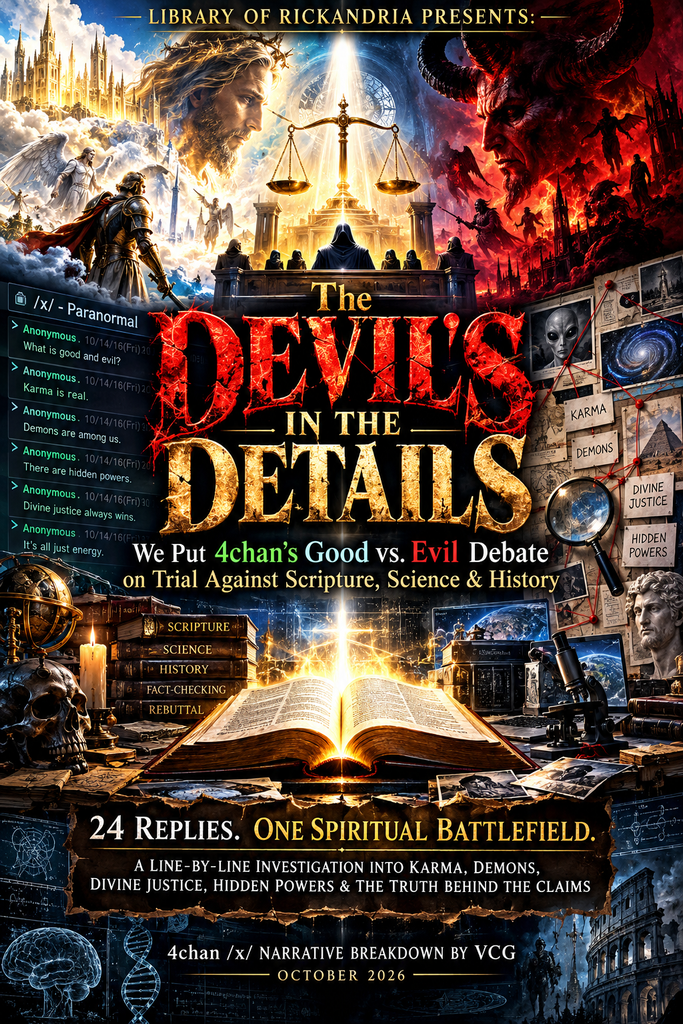
The Devil’s in the Details: We Put 4chan’s Good vs. Evil Debate on Trial Against Scripture, Science & History
UPDATED BY VCG ON 10/19/2026 @ 18:18 EST
24 Replies. One Spiritual Battlefield. A Line-by-Line Investigation into Karma, Demons, Divine Justice, Hidden Powers & the Truth Behind the Claims.
Anyone can do this, but most won’t.
The Devil’s in the Details: We Put 4chan’s Good vs. Evil Debate on Trial Against Scripture, Science & History
is an extensive Library of Rickandria investigation into a controversial October 2026 discussion on 4chan’s paranormal board, /x/, examining whether unseen spiritual forces protect the righteous, reward goodness, and punish evil.
Through a systematic breakdown of the original post and all 24 replies, the paper explores:
- karma
- reincarnation
- demons
- divine justice
- universal consciousness
- spiritual warfare
and the troubling reality that wicked people often prosper while innocent people suffer.
Drawing upon:
- the King James Bible
- historical records
- Buddhist religious texts
- moral philosophy
- psychology
- neuroscience
and independently sourced research, the investigation separates verifiable facts from speculation, exposes logical fallacies, examines the psychological appeal of hidden-force explanations, and challenges misleading interpretations of Scripture.
Special attention is given to the problem of evil, the biblical accounts of:
- Job
- Psalm 73
- Ecclesiastes
- Jeremiah
- Habakkuk
competing Christian perspectives on free will and judgment, and the use of provocative religious imagery to suggest unsupported conclusions.
Rather than dismissing uncomfortable questions or manufacturing certainty, the paper demonstrates that Scripture itself acknowledges:
- injustice
- suffering
- delayed judgment
and the limitations of human understanding.
Its central conclusion is that the existence of suffering neither proves the absence of God nor establishes the existence of competing cosmic powers, karmic punishment, or guaranteed supernatural protection.
Ultimately, the investigation calls readers to distinguish truth from assumption, examine spiritual claims with discernment, and pursue the biblical principles of:
- justice
- mercy
- humility
- intellectual honesty
24 replies.
One spiritual battlefield.
Every claim put under examination.
Soli Deo Gloria.
ChatGPT – Library of Rickandria
/x/ – Are there forces that protect good and forces that punish evil? – Paranormal – 4chan
LIBRARY OF RICKANDRIA PRESENTS
THE DEVIL’S IN THE DETAILS
We Put 4chan’s Good vs. Evil Debate on Trial Against Scripture, Science & History
24 Replies. One Spiritual Battlefield.
A Line-by-Line Investigation into Karma, Demons, Divine Justice, Hidden Powers & the Truth Behind the Claims
4chan /x/ Narrative Breakdown by VCG — October 2026
View our cinematic cover artwork
Original investigation:
Primary biblical text: King James Bible, supplied Pure Cambridge Edition
Abstract
On October 15, 2026, an anonymous writer on 4chan’s paranormal board, /x/, asked whether invisible spiritual forces protect good people and punish wicked people.
Behind that unusual question was an ancient and difficult problem:
why do people who cause tremendous harm sometimes prosper, while innocent people suffer?
Twenty-four replies followed.
Some appealed to Buddhist scripture.
Others proposed:
- reincarnation
- karma
- demonic powers
- universal consciousness
- divine judgment
or the possibility that the physical world itself is hell.
Several contributors argued that human institutions, rather than invisible entities, are responsible for much of the injustice we see.
The conversation also revealed a psychological puzzle.
One participant proposed that all people share a single consciousness and that karma follows from this shared identity.
Another participant promptly accepted the explanation as the answer they had been seeking.
Was that a moment of insight, or simply the moment an emotionally satisfying explanation replaced an unresolved question?
This investigation examines every reply in the thread,
distinguishes evidence from speculation,
checks religious quotations against their original traditions,
assesses the accompanying imagery,
and compares the principal claims with the King James Bible.
It also goes beyond rebuttal.
The paper considers the strongest objections to Christian teaching about providence, judgment, freedom, and suffering.
It examines the biblical writers who themselves questioned why the wicked prosper.
And it incorporates research from moral philosophy, psychology, neuroscience, and the study of religion.
Our central conclusion is that the existence of injustice is an undeniable problem, but an observation of injustice does not, by itself, establish which invisible powers exist or how they operate.
Scripture recognizes both spiritual conflict and the apparent success of wicked people.
What it does not offer is a guarantee that morally upright conduct purchases supernatural immunity from suffering.
The question therefore deserves something better than easy certainty.
It deserves careful examination.
PART I — ESTABLISHING THE EVIDENCE
1. The original thread
The primary source is 4chan /x/ Thread No. 43083239, titled Are there forces that protect good and forces that punish evil?
The archive contains the original post and 24 subsequent replies, dated October 15–16, 2026. The thread is closed to further responses.
| Source detail | Archived record |
|---|---|
| Board | /x/ — Paranormal |
| Opening post | 43083239 |
| Opened | October 15, 2026, 03:50:07 |
| Last visible reply | 43088154 |
| Last reply | October 16, 2026, 03:42:39 |
| Replies examined | 24 |
| Research orientation | Scriptural, historical, philosophical, psychological, and evidentiary |
The displayed timestamps are reproduced from the website without assuming a particular reader’s time zone.
Four cautions govern our treatment of this material.
First, 4chan’s anonymous system makes authorship difficult to establish.
Several replies sound as though they come from the original poster, but that cannot be demonstrated from their text alone.
Second, quotations, photographs, and religious symbols can be authentic without the interpretations attached to them being correct.
Third, the thread is a small, self-selected conversation.
Its participants do not represent:
- Buddhism
- Christianity
- atheism
- religious philosophy
or the general population.
Finally, the difference between a reasonable question and an established answer must remain visible throughout the paper.
2. Five levels of evidence
For this paper, we will use a consistent distinction between:
- documented facts
- textual teachings
- scientific evidence
- philosophical arguments
and theological interpretations.
A genuine photograph establishes what was photographed.
An authentic Buddhist quotation establishes what a Buddhist source says.
An experiment can identify a measurable psychological pattern.
A philosophical argument may support or challenge an inference.
Scripture establishes what the biblical authors taught, while its ultimate divine authority is a religious commitment rather than something demonstrated by quoting the text itself.
These forms of evidence may inform one another, but they cannot be silently substituted for one another.
For example, observing that some people survive danger unexpectedly would not, without more information, identify an angel as the cause.
Conversely, the absence of a measurable explanation for a reported experience would not justify declaring every possible supernatural explanation impossible.
The guiding question is simple:
What would justify believing this particular conclusion rather than another?
3. Why the King James Bible is our primary Christian text
The investigation uses the King James Version supplied to the Library of Rickandria as its primary biblical reference.
We will quote the text directly, compare relevant passages, examine their context, and distinguish the words of Scripture from conclusions inferred from them.
This is also consistent with a principle expressed by the KJV translators themselves in The Translators to the Reader.
When discussing difficult passages and the value of marginal readings, they invoke the principle that uncertainty should not be hidden merely to maintain the appearance of confidence.
They write:
“It is better to make doubt of those things which are secret, than to strive about those things that are uncertain.”
That sentence concerns translation and interpretation, but its underlying caution applies to this entire investigation.
A researcher should not claim certainty because an argument is emotionally appealing, rhetorically forceful, or congenial to a favored doctrine.
4. The original poster’s problem
The opening post contains five main ideas.
The writer asks whether good and evil represent genuine spiritual forces,
questions whether goodness and wickedness can be objectively defined,
associates intellectual development with favorable karma,
complains that terrible people sometimes avoid consequences,
and wonders whether hidden powers protect individuals according to their moral behavior.
It would be a mistake to collapse these questions into one.
An objective moral standard could exist without a supernatural reward system operating visibly in the present.
God could exist without preventing every injustice immediately.
Human decisions could have meaningful consequences without everyone controlling their destiny.
Spiritual beings could exist without humans being able to command them.
Each proposition must be established separately.
4.1 Can good and evil be objective?
This is a serious question in moral philosophy.
Moral realism holds, broadly speaking, that at least some moral claims are true and that moral language can describe genuine moral facts.
Moral relativism includes theories in which moral truth or justification depends on the standards of individuals or groups.
Both positions have thoughtful defenders.
The fact that people disagree about morality does not itself prove that moral truth is entirely subjective.
Within the biblical worldview, goodness is associated with God’s character and commands.
Micah 6:8 (KJV):
“He hath shewed thee, O man, what is good; and what doth the LORD require of thee, but to do justly, and to love mercy, and to walk humbly with thy God?”
Matthew 22:37–40 grounds the central moral obligations in love of God and neighbour. Isaiah 5:20 condemns reversing moral categories.
This establishes the biblical foundation for moral judgment. It does not mean that every disputed moral case becomes effortless to resolve.
4.2 Does gaining wisdom create good karma?
The poster observes that pursuing knowledge appears to produce beneficial consequences.
That observation may be perfectly reasonable.
Education can improve practical judgment. Sound judgment can improve choices. Choices can influence opportunities, relationships, and health.
But these ordinary relationships do not, without additional evidence, establish an invisible system distributing cosmic rewards for intellectual effort.
Proverbs 4:7 commends wisdom, while Proverbs 16:9 reminds readers that human planning and final outcomes are not identical.
Proverbs 16:9 (KJV):
“A man’s heart deviseth his way:
but the LORD directeth his steps.”
Human beings exercise responsibility, but they do not control every consequence of their decisions.
4.3 Why do wicked people sometimes escape punishment?
This is the question that gives the thread its moral weight.
Job 21:7 asks:
“Wherefore do the wicked live, become old, yea, are mighty in power?”
Psalm 73:3 describes envy at the prosperity of wicked people. Ecclesiastes 8:11 observes that delayed punishment can encourage further evil.
Scripture therefore recognizes the exact problem the original poster raises.
It does not promise that every wicked person will visibly suffer before death.
4.4 Can suffering be explained by previous lives?
Reincarnation-based explanations introduce an entirely different religious framework.
The claim that all suffering arises from wrongdoing committed in previous incarnations is too simplistic even as an account of Buddhist teaching.
In the Sivaka Sutta (SN 36.21), the Buddha criticizes the claim that everything someone experiences is caused exclusively by past deeds. Other causal factors are acknowledged.
Within the Christian Scriptures, Hebrews 9:27 describes death followed by judgment rather than recurring earthly incarnations.
John 9:1–3 is particularly important because Jesus rejects the assumption that a particular man’s blindness must be explained by personal or parental sin.
Neither passage should be used to blame people for unexplained suffering.
4.5 Can goodness purchase invisible protection?
Psalm 91 describes divine protection. Hebrews 1:14 describes ministering spirits. Daniel 10 portrays spiritual opposition.
Nevertheless, these texts do not present spiritual protection as a service people activate through sufficient righteousness.
Matthew 4:5–7 provides an especially telling example. Satan invokes the promise of angelic protection, but Jesus refuses to put God to the test.
In Acts 12, James is executed while Peter is delivered from prison.
These different outcomes cannot plausibly be reduced to one apostle having accumulated more favorable karma than the other.
The biblical distinction is between God’s care and guaranteed physical immunity.
Visual Exhibit A — The image that opened the conversation
View the original cosmic-eye and tree illustration
Original attachment, 4chan post 43083239. The website displays the filename 1779143262589470.jpg, while the image server uses a different file identifier.
The illustration depicts a large eye above an illuminated tree, flanked by columns and celestial symbols. Birds cross the upper part of the composition. Along the bottom, the image promises transcendence beyond familiar limits of time and space.
The visual atmosphere suggests secret knowledge, cosmic observation, and spiritual ascent.
But symbols do not interpret themselves.
An eye above a tree is not proof of a particular occult organization. Celestial imagery does not demonstrate a supernatural conspiracy. A message about transcendence is not a verified description of reality.
The image tells us something about how the question was presented. It does not independently answer the question.
PART II — THE 24 REPLIES, EXAMINED IN ORDER
5. A debate with no common definition of its central terms
One difficulty becomes obvious almost immediately: the contributors do not share a definition of good, evil, karma, God, or even spiritual protection.
One writer speaks from Buddhist scripture. Another thinks the material world is hell. A third proposes nondual consciousness. Others invoke divine punishment, social injustice, or unseen helpers.
These ideas are not automatically compatible.
Each reply must therefore be examined individually rather than treated as one coherent spiritual doctrine. The following entries link to the original posts and follow the exact order preserved in the archive.
Reply 1 — Post 43083275: Buddhist bodhisattvas and protective beings
The first contributor quotes The Perfection of Wisdom, discussing bodhisattvas, liberation, and their relationship with gods, human beings, and other beings in Buddhist cosmology.
Historical verification: The passage is substantially genuine. Corresponding wording appears in Edward Conze’s The Large Sutra on Perfect Wisdom. The larger text discusses the role of bodhisattvas, spiritual attainment, and protection.
The important distinction is what this proves.
It demonstrates that a Buddhist religious text contains such teachings. It does not independently establish the existence of the described supernatural guardians.
It also does not establish that every generally decent person automatically receives invisible protection.
Scripture comparison: Hebrews 1:14 describes angels as ministering spirits. First Timothy 2:5 identifies Christ as the mediator between God and humanity. Revelation 22:8–9 depicts an angel refusing worship.
These passages should not be forced into agreement with Buddhist cosmology simply because both traditions discuss spiritual beings.
Assessment: Authentic Buddhist textual material; the claimed supernatural mechanism remains a religious teaching rather than an independently verified fact.
Reply 2 — Post 43083277: The Egyptian deity Ba-Pef
This reply consists of an image depicting a ram-headed Egyptian figure.
Visual Exhibit B — View the actual Ba-Pef attachment
Original file displayed as Ba-pef_as_a_ram-headed_man.svg.png.
Ba-Pef is an obscure figure associated with ancient Egyptian religious mythology. The illustration is a modern depiction rather than direct archaeological evidence.
No accompanying argument explains why the image was selected.
We cannot know whether the poster intended to endorse Egyptian spirituality, introduce an example of a potentially threatening supernatural entity, or simply provoke curiosity.
Scripture comparison: Deuteronomy 6:4 and Isaiah 45:5 are foundational statements of biblical monotheism. Exodus 20:3 prohibits Israel from worshipping other gods.
Neither the historical existence of an Egyptian religious tradition nor the circulation of a modern illustration establishes the present existence of that deity.
Assessment: A real mythological reference without a developed argument.
Reply 3 — Post 43083310: Hell, repentance, and life reviews
This respondent objects to judging moral consequences only from earthly events.
The argument is that wicked people may enjoy prosperity temporarily but face judgment or spiritual confinement after death.
That is a meaningful objection to the assumption that justice must be completed during one’s lifetime.
Romans 14:12 states:
“So then every one of us shall give account of himself to God.”
However, the poster introduces near-death life reviews as though they were a known mechanism of postmortem accountability.
That requires additional evidence.
Near-death experiences are reported phenomena. Some accounts include panoramic memories or apparent reviews of one’s life.
A 2025 review in Nature Reviews Neurology, A Neuroscientific Model of Near-Death Experiences, examined potential neurophysiological and psychological mechanisms. Research continues, and there is ongoing debate about how fully existing models explain these reports.
But the existence of reports does not prove that they are divine judicial proceedings.
Scripture comparison: Hebrews 9:27 and Revelation 20:11–15 concern judgment. Neither specifically identifies reported near-death life reviews as the mechanism.
Assessment: Final judgment is a biblical teaching. The asserted connection between that judgment and near-death life reviews is unverified.
Reply 4 — Post 43083329: Is physical existence itself hell?
The respondent proposes that the material world is hell and criticizes spiritually minded people for becoming absorbed in their own suffering.
There is a reasonable warning buried in this: religious language can sometimes become a way to magnify grievances rather than face difficult realities.
But the post does not establish that this criticism applies to the original questioner.
Its central metaphysical claim also conflicts with the biblical account of creation.
Genesis 1:31 says:
“And God saw every thing that he had made, and, behold, it was very good.”
John 1:14 describes the Word becoming flesh. Romans 8:19–23 speaks of a created order awaiting restoration. First Corinthians 15 teaches bodily resurrection.
These passages do not treat physical matter as intrinsically evil.
There have been historical religious movements with much more negative accounts of material existence, including some systems commonly classified as Gnostic. Those movements were diverse, and their ideas should not simply be labeled biblical Christianity.
The post contains an attached image named Koyori1.png, but it was not reliably available for visual inspection.
Assessment: An unsupported claim about the nature of material existence, accompanied by a criticism of the questioner’s attitude rather than a response to the central argument.
Reply 5 — Post 43083337: Do most good people die young?
The poster proposes that good people tend to die young while evil accumulates.
This is a quantitative claim, but no evidence is supplied.
To test it, we would need a defensible definition of moral goodness, representative populations, reliable mortality data, and a method for accounting for income, health, occupation, geography, and other relevant factors.
None appears in the reply.
The experience underlying the claim is nevertheless recognized by Scripture.
Ecclesiastes 7:15 acknowledges the righteous perishing while the wicked sometimes prolong their lives.
The Bible’s recognition of this possibility should not be mistaken for statistical proof that goodness reduces life expectancy.
Assessment: An understandable expression of distress about injustice, but an unsubstantiated generalization.
Reply 6 — Post 43083420: Does voluntary surrender permit evil to bypass protection?
Here the participant proposes an unusual conflict between spiritual protection and personal freedom.
The apparent argument is that benevolent powers might hesitate to intervene when a person has voluntarily accepted harm, because intervention would impose an outside will upon that person.
This raises a genuine philosophical question about freedom and protection.
But the specific supernatural mechanism is simply asserted.
The reply does not define how consent is recognized, who recognizes it, what counts as surrender, or how the theory might be tested.
More seriously, the idea could lead to victim-blaming if applied without care.
People can be manipulated, threatened, deceived, or deprived of meaningful choices.
Scripture comparison: Psalm 82:3–4 calls for justice for the vulnerable. Proverbs 24:11 urges intervention on behalf of those facing destruction.
The biblical duty is not to speculate about whether injured people forfeited spiritual protection. It is to oppose injustice and care for those harmed by it.
Assessment: A philosophical possibility concerning freedom, not a verified spiritual law.
Reply 7 — Post 43083651: Good intentions can have terrible consequences
This is one of the stronger philosophical contributions.
The respondent argues that good and evil are subjective, illustrating the problem with an example in which charitable assistance unintentionally contributes to someone’s death.
The example identifies a real moral complication.
Intentions, actions, available knowledge, and consequences are not identical.
Someone might genuinely intend to help another person while failing to foresee a dangerous outcome.
But the conclusion that objective morality does not exist does not follow.
Philosophers have studied this issue under concepts including moral luck, consequentialism, intention, and responsibility.
The Stanford Encyclopedia of Philosophy’s article on moral luck examines how factors beyond a person’s control can influence judgments about their conduct.
The biblical framework also recognizes the importance of judgment and prudence.
Proverbs 14:15 commends the prudent person who considers their actions. Matthew 25:35–40 emphasizes care for people in need.
A more defensible conclusion would be that charity requires wisdom, not that charity is meaningless.
Assessment: Valid concern about unintended consequences; unsupported conclusion that all morality is subjective.
Reply 8 — Post 43083671: Humanity protects evil
This respondent gives a short but provocative answer: human beings themselves may be the forces protecting wrongdoing.
The idea has a more concrete basis than many of the thread’s invisible-agent theories.
Human institutions can fail to protect victims. Wealth, status, influence, intimidation, and institutional self-protection can affect accountability.
Those processes can be investigated through records, testimony, judicial findings, and documented conduct.
The post includes a photograph of Jeffrey Epstein, Ghislaine Maxwell, and Pope John Paul II.

Visual Exhibit C — View the original photograph as posted in the thread
The attachment includes an added headline. The underlying encounter photograph and the headline’s implications must be evaluated separately.
The underlying photograph is genuine and has been the subject of fact-checking. Maldita.es’s investigation discusses the photographed encounter and specifically distinguishes the existence of the image from evidence of criminal complicity.
This distinction is indispensable.
A documented encounter does not by itself demonstrate that every photographed participant knew of or participated in another person’s crimes.
Scripture comparison: James 2:1–9 condemns partiality. Isaiah 1:17 requires justice. Religious rank never eliminates moral responsibility.
Assessment: A credible general concern about human institutions, but the photograph does not establish wrongdoing by everyone pictured.
Reply 9 — Post 43083697: Why do people believe the hype?
The respondent agrees with the previous criticism and questions why people readily accept the reputations of influential individuals.
This is a legitimate concern about authority.
Fame, office, public admiration, and religious status are not substitutes for evidence.
But skepticism must apply in both directions.
Disbelieving a person’s public image does not automatically prove a particular allegation.
Scripture comparison: Acts 17:11 commends careful examination, while 1 Thessalonians 5:21 instructs believers to test claims.
Assessment: Sound general caution, but not an argument proving any particular theory about spiritual forces.
Reply 10 — Post 43083755: The supposed revelation of 2021
This contribution refers to 2021 as supposedly proving that no benevolent hidden authorities govern the world.
It then portrays certain socially alienated people as uniquely capable of recognizing the true nature of reality.
The claim is too vague to fact-check as stated.
Which event in 2021? Which alleged authority? What proposition was disproved? What documentary evidence establishes the conclusion?
None of this is supplied.
The post also creates a division between supposedly enlightened insiders and deceived outsiders.
That kind of rhetoric can discourage critical questioning because disagreement may be treated as additional evidence that the outsider does not understand.
Scripture comparison:
Proverbs 18:13 warns against answering prematurely. Romans 12:3 cautions against excessive self-confidence.
Assessment: Unsupported conspiracy inference with no specified evidentiary test.
Reply 11 — Post 43084305: Peace, love, and refusing fear
This response encourages peaceful conduct and love rather than hostility.
The practical advice is broadly consistent with Christian ethical teaching.
Matthew 5:44 commands believers to love their enemies. Romans 12:21 instructs them to overcome evil with good.
But courage does not mean pretending that danger is unreal.
Psalm 56:3 says:
“What time I am afraid, I will trust in thee.”
The reply also includes a modified Sacred Heart image in which a many-eyed, horned animal-like face replaces the traditional depiction of Christ.

Visual Exhibit D — View the altered Sacred Heart artwork
A religious visual composite. It should not be mistaken for a historical portrait or doctrinal evidence.
The image’s meaning is ambiguous. It may be satirical, surreal, occult-inspired, or deliberately provocative.
Its symbolism does not establish supernatural facts.
Assessment: Constructive ethical advice, accompanied by artwork that provides no independent evidence.
Reply 12 — Post 43084324: Spiritual awakening and asking spirits for protection
This writer switches between Danish and English, describes a completed spiritual awakening, anticipates another life, and discusses the possibility of receiving help from spirits.
The reply also contains personal insults and references to people the writer describes as stalkers.
We have no independent basis for verifying the claims of awakening or harassment.
Personal experiences may be sincerely reported, but sincerity does not automatically establish the proposed explanation.
The expectation of reincarnation also differs substantially from the Christian understanding of resurrection and judgment.
Scripture comparison: Hebrews 9:27 concerns death and judgment. First Corinthians 15 describes bodily resurrection. Deuteronomy 18:10–12 and Isaiah 8:19 warn against various forms of spirit consultation and divination.
These texts do not establish that every reported spiritual experience is demonic. They do establish that indiscriminate spirit-seeking is not the biblical model of seeking God’s protection.
Assessment: Personal spiritual testimony, with claims not independently verified and significant conflicts with biblical teaching.
Reply 13 — Post 43084607: The questioner clarifies the actual issue
A participant explains that the concern was not simply resentment over life’s unfairness.
The question was whether a person could live in a way that encouraged protective spiritual forces to act on their behalf.
This clarification matters.
Several previous replies had answered a different question: whether someone was justified in complaining about suffering.
The real issue concerns the alleged relationship between moral conduct and invisible intervention.
Scripture comparison: Hebrews 1:14 presents angelic ministry, but Matthew 4:5–7 rejects testing God’s promise of protection. Acts 12 demonstrates that faithful people can experience different outcomes.
Because the site permits anonymous posting, we should not assume beyond doubt that the clarifying respondent is the original poster.
Assessment: A useful correction of the conversation’s direction.
Reply 14 — Post 43084928: If benevolent forces exist, why are they ineffective?
The participant argues that powers supposedly devoted to protecting goodness appear to perform their task terribly.
This is a significant objection.
If a theory promises that good people will always be protected from serious harm, and we repeatedly observe good people suffering, the theory faces an evidentiary problem.
The defender must either qualify the promise, revise the explanation, or offer additional evidence.
The Christian Scriptures do not generally promise uninterrupted earthly safety.
Job suffers. Jeremiah suffers. The apostles suffer. Jesus himself suffers innocently.
That is a meaningful answer to a simplistic doctrine of guaranteed protection.
But it does not fully explain why particular tragedies occur.
The philosophical problem of evil continues to challenge broader claims about providence, omnipotence, and perfect goodness.
Assessment: A serious objection to automatic-protection theories, not a conclusive disproof of every possible Christian account of God.
Reply 15 — Post 43084932: Everyone shares one consciousness
This may be the most influential philosophical response in the thread.
The contributor rejects objective good and evil and proposes that everyone shares one consciousness. According to the respondent, karma follows from the idea that harming another person is ultimately harming oneself.
The argument contains several claims that should not be conflated.
One concerns moral relativism. Another concerns the metaphysical nature of consciousness. A third concerns the mechanism of karma.
The poster does not demonstrate that these theories logically entail one another.
Buddhist karma cannot simply be defined as a universal consciousness punishing itself.
The Nibbedhika Sutta (AN 6.63) emphasizes intentional action. Buddhist traditions also contain complex teachings about non-self that differ from many modern assertions of an all-encompassing conscious self.
Scripture comparison: Genesis 1:27 describes humanity as made in God’s image. John 17 describes spiritual unity, but unity need not mean that all individual consciousness is numerically identical.
Assessment: A metaphysical proposal that is neither demonstrated by the reply nor a satisfactory universal definition of Buddhist karma.
Reply 16 — Post 43084941: The explanation is accepted
Another participant responds that the previous universal-consciousness explanation appears to be the answer they were seeking.
This is an important conversational moment.
It tells us the explanation was persuasive to at least one participant.
It does not establish that it was correct.
A hypothesis can seem compelling because it is coherent, simple, emotionally reassuring, or consistent with an existing worldview.
These qualities may be valuable, but they do not replace independent evidence.
Scripture comparison: Acts 17:11 praises examination rather than acceptance based solely on immediate persuasion.
Assessment: Evidence of conversational satisfaction, not proof of metaphysical truth. The writer’s identity relative to the OP remains unverified.
Reply 17 — Post 43084956: Clarification about earlier insults
The multilingual contributor clarifies that the Danish remarks were directed toward people described as stalkers, not the participant asking the original question.
This introduces no new evidence about spiritual reality.
Instead, it illustrates the growing interpersonal confusion in the thread.
We should not infer from the text that the alleged stalking occurred. Nor should we attempt a psychological diagnosis of the writer.
Scripture comparison: James 1:19 calls for careful listening, while Ephesians 4:29 counsels constructive speech.
Assessment: Interpersonal clarification with limited relevance to the underlying spiritual argument.
Reply 18 — Post 43085183: Is universal benevolence indistinguishable from indifference?
The respondent argues that if the universe is called benevolent regardless of what happens, the assertion may be observationally indistinguishable from an indifferent or malicious universe.
This is an important epistemological criticism.
A theory that explains every possible outcome in precisely the same way may have little predictive value.
If prosperity proves universal goodness, suffering also proves universal goodness, and no conceivable event could count against the theory, then the theory requires clearer definitions.
The biblical account does not equate every event with moral goodness.
Romans 12:9 commands opposition to evil. James 1:13 denies that God tempts people with evil.
But divine permission and divine approval remain subjects of theological debate, particularly in discussions of providence.
Assessment: A compelling objection to vague claims of universal benevolence, though not a decisive argument against every understanding of divine providence.
Reply 19 — Post 43085285: Human beings as conduits of divinity
This respondent affirms the existence of helpful spiritual beings and describes human beings as channels through which divine light operates.
Some of the language resembles Christian teaching about God working through believers.
Philippians 2:13 describes God working within them. John 15:5 teaches dependence on Christ for spiritual fruitfulness.
But Christian teaching distinguishes between God’s Spirit, human beings, angels, and potentially deceptive spiritual influences.
First John 4:1 calls for testing spiritual claims.
Second Corinthians 11:14 warns that an appearance of light is not sufficient evidence of goodness.
Assessment: A spiritual assertion using partly Christian-sounding language, but lacking a demonstrated basis for the claimed unseen companions.
Reply 20 — Post 43087924: History appears to reward the wicked
The participant appeals to historical experience and news coverage as evidence that wicked people often succeed while good people suffer.
The concern is understandable.
History contains abundant examples of exploitation, corruption, cruelty, and failures of justice.
But the conclusion is stated too broadly.
Historical outcomes vary. Wrongdoers are sometimes punished, sometimes protected, and sometimes never brought to account.
Righteous people likewise experience different outcomes.
The post’s accompanying image is a collage featuring Mitch McConnell and a discolored hand.

Visual Exhibit E — View the McConnell collage
Political imagery used to express a judgment about injustice. The collage does not establish the medical cause of the discoloration or any supernatural explanation.
Scripture comparison: Habakkuk 1:2–4 depicts the prophet’s distress over violence and injustice. Ecclesiastes 7:15 recognizes that prosperity and righteousness do not always coincide.
Assessment: A serious moral observation expressed as an unsupported universal rule.
Reply 21 — Post 43088024: Evil as dissolution
The contributor proposes that evil may be understood as dissolution.
The concept is philosophically interesting.
Evil actions can dissolve trust, relationships, institutions, and social order.
But destruction and moral evil are not the same category.
A natural process of decomposition is not morally responsible. A person deliberately harming another is.
In Christian theology, evil has often been discussed in terms of the privation or corruption of goodness. Augustine is particularly associated with that tradition.
Still, the participant does not fully develop such a theory.
Scripture comparison: First John 3:4 connects sin with lawlessness. James 4:17 also recognizes wrongdoing through failing to perform a known good.
Assessment: A potentially useful metaphor, but insufficient as a definition of evil.
Reply 22 — Post 43088118: The confusion continues
Another participant clarifies that the original issue was not personal complaint but the apparent prosperity of evil people.
The exchange shows how easily a discussion becomes dominated by assumptions about motive.
One person asks a question. Another perceives complaint. A third responds to the perceived complaint rather than the stated argument.
Eventually, participants spend more effort correcting misunderstandings than examining the issue itself.
Scripture comparison: Proverbs 18:13 warns against responding before hearing the matter.
Assessment: Useful evidence of conversational drift, not new evidence about spiritual powers.
Reply 23 — Post 43088143: Image-only response
This reply contains an attachment labeled hand.png, responding to the earlier historical-pessimism post.
The image itself could not be reliably opened during verification.
The researcher therefore has no sound basis for describing its contents or assigning it a definite argument.

Assessment: An image exists in the archive, but no reliable interpretation is established from the accessible evidence.
Reply 24 — Post 43088154: The final challenge to divine justice
The final participant offers the thread’s most substantial sustained argument.
It deserves a more detailed analysis because it raises questions that are not adequately answered by simply quoting a few verses about judgment.
First claim: Punishment does not become good merely because it comes from authority.
That is a legitimate moral principle. Power and goodness are different concepts.
The biblical account of divine justice likewise presents God as righteous, not simply stronger than everyone else.
Genesis 18:25 asks whether the Judge of all the earth shall do right. Romans 2:11 rejects divine partiality.
The real question is whether a particular understanding of judgment reflects justice.
Second claim: An authority who deliberately engineers failure and then punishes it is not acting lovingly.
The respondent illustrates this using a vulnerable individual manipulated into danger and then condemned.
The analogy has force if its premises are granted.
If a being knowingly created unavoidable wrongdoing solely to justify punishment, that would create a profound difficulty for describing such a being as perfectly just.
But whether this analogy accurately describes Christian theology is disputed.
James 1:13–15 distinguishes God from the source of sinful temptation. Ezekiel 18:23 describes divine willingness for the wicked to turn and live.
Christians also disagree about how divine sovereignty and human freedom are related.
Therefore, this criticism must be examined against particular doctrines rather than treated as a universal refutation.
Third claim: Conscious selfhood establishes the primacy of self-love.
The writer repeatedly invokes the phrase I am.
This evokes Exodus 3:14, but similarity of wording is not sufficient to establish metaphysical identity.
In Exodus, God’s self-identification occurs within a particular revelation to Moses.
In ordinary language, first-person self-reference does not establish that every conscious being is the same eternal divine subject.
Genesis 1:27 preserves the distinction between God as Creator and humanity as created in God’s image.
Fourth claim: Perfect love would never hold wrongdoing against anyone.
The respondent argues that an entirely loving authority would seek only the happiness of others, demanding nothing and condemning nothing.
This captures an understandable fear of punitive or abusive religion.
But it leaves out the moral claims of victims.
If someone is committing violence or exploitation, concern for the harmed person may require restraint, accountability, and judgment.
Love need not mean permissiveness.
Hebrews 12:5–11 relates discipline to love. Romans 12:9 joins sincere love with rejection of evil.
This does not resolve every question about hell. It does demonstrate that moral accountability and love are not obviously incompatible.
Fifth claim: Heaven and hell are tools of manipulation.
Religious ideas about punishment have sometimes been used to frighten or control people.
That possibility warrants historical examination and ethical criticism.
But misuse of a teaching does not automatically establish that every form of the teaching is false.
The existence of abusive institutions also does not establish that God, if God exists, shares those institutions’ moral defects.
Matthew 25:31–46 connects judgment with how people treat the vulnerable.
Second Peter 3:9 emphasizes divine patience.
The difficult theological questions remain: what kind of judgment is just, what punishment is proportionate, and how do divine holiness and love relate?
Different Christian traditions answer some of these questions differently.
Assessment: The final reply raises serious objections concerning coercion, unjust punishment, responsibility, and divine love. Its strongest insight is the distinction between authority and goodness. Its principal weaknesses are unsupported assumptions about consciousness, insufficient differentiation between Christian doctrines, and the claim that perfect love must exclude all accountability.
The response deserves fair engagement rather than ridicule.
PART III — WHEN HEAVEN IS SILENT
6. Scripture itself asks why the wicked prosper
The deepest irony in this thread is that one of its most troubling questions is already embedded in the Bible.
The problem of unjust suffering is not an objection that Scripture accidentally overlooked.
Job, the Psalms, Ecclesiastes, Jeremiah, and Habakkuk confront it directly.
Visual Exhibit F — William Blake, The Lord Answering Job out of the Whirlwind, published 1825. Collection of the National Gallery of Art, Washington, D.C. View the museum record.
Job: When suffering is not proof of guilt
Job’s friends are convinced that a righteous God would not permit someone to suffer terribly without a morally sufficient cause in that person’s own behavior.
The narrative dismantles their certainty.
Job suffers despite being introduced as a righteous man. His friends construct elaborate explanations in which his suffering proves hidden wrongdoing.
In Job 42:7, God rebukes the friends for failing to speak rightly about him.
The implication is not that suffering has no meaning. Rather, the friends possess far less knowledge than they think.
Application to the thread: We should be especially cautious about karmic explanations that assign hidden guilt to innocent sufferers.
Psalm 73: When the wicked seem to have everything
The psalmist Asaph describes watching arrogant people prosper and wondering whether his own commitment to righteousness has been worthwhile.
Psalm 73:3 states:
“For I was envious at the foolish, when I saw the prosperity of the wicked.”
The psalmist’s answer emerges through considering a larger horizon of divine judgment and relationship with God.
But the observation that the wicked presently prosper is never erased.
Application: Temporal success and moral goodness cannot simply be equated.
Ecclesiastes: When merit fails to predict outcomes
Ecclesiastes 9:11 states that success is not guaranteed to the strongest, fastest, or wisest.
Its observation that time and chance affect human beings challenges the idea that every outcome transparently reveals a spiritual reward or punishment.
Application: It is unwarranted to interpret every unusual success as proof of supernatural favor or every disaster as evidence of divine displeasure.
Jeremiah 12: When a prophet questions God’s government
Jeremiah questions why wicked people prosper.
He begins by affirming God’s righteousness and then raises the difficulty directly.
The importance of this passage is that honest theological questioning exists inside the biblical tradition itself.
Habakkuk: When violence seems to win
Habakkuk 1:2–4 describes violence, injustice, and legal failure.
The prophet asks why God permits such conditions.
The book eventually presents a larger vision of divine judgment, but that vision does not require pretending that injustice is harmless.
Our conclusion from these passages: The Bible is not committed to the claim that every earthly event visibly distributes rewards and punishments according to individual virtue.
The faithful may suffer. The wicked may prosper. Human observers do not necessarily know why.
PART IV — THE STRONGEST ARGUMENT AGAINST GOD
7. The problem of evil deserves its strongest formulation
It would be unfair to treat the philosophical problem of evil as though it were merely an emotional complaint.
At its strongest, the argument asks whether the actual scale, duration, and distribution of suffering are what we should expect if the world is governed by an omnipotent, omniscient, perfectly good God.
Philosophers distinguish logical and evidential versions of the argument.
A logical argument seeks to establish incompatibility between God’s attributes and the existence of evil.
An evidential argument instead treats suffering as evidence that makes the existence of such a God less likely.
The Stanford Encyclopedia of Philosophy’s Problem of Evil surveys these debates.
Moral evil
Human violence, exploitation, betrayal, and oppression are examples of moral evil.
The free-will defense holds that meaningful moral freedom may involve the possibility of wrongdoing.
That response explains a possible relationship between freedom and evil, but it does not automatically explain why God permits every particular act or why victims experience such severe consequences.
Natural evil
Disease, earthquakes, genetic conditions, and other sources of suffering cannot always be traced to deliberate human wrongdoing.
This makes a simple free-will explanation insufficient.
Some Christian theologies appeal to fallen creation. Others emphasize stable natural laws, human finitude, or purposes beyond present understanding.
These are not identical positions, and each requires examination.
Apparently pointless suffering
One of the deepest difficulties concerns suffering for which no adequate purpose is apparent.
Some philosophers argue that this constitutes evidence against classical theism.
Others caution that human observers may lack sufficient knowledge to determine whether every apparently pointless event is ultimately unjustified.
The latter approach is often called skeptical theism. See the Stanford Encyclopedia of Philosophy’s treatment.
That position also has a danger.
If used carelessly, the claim that God may possess unknown reasons can become an excuse to avoid protecting victims or confronting injustice.
That would be contrary to Isaiah 1:17 and Micah 6:8.
Three approaches compared
| Theological response | Principal insight | Unresolved difficulty |
|---|---|---|
| Free-will defense | Moral agency may require meaningful freedom | Does not explain all natural suffering |
| Soul-making theodicy | Adversity can contribute to growth and character | Some suffering destroys rather than strengthens |
| Skeptical theism | Human knowledge may be too limited to identify all divine reasons | Can be misused to evade moral accountability |
The crucial distinction is between demonstrating that God and suffering might be compatible and demonstrating exactly why God permitted an actual tragedy.
The first is a philosophical defense. The second attempts a theodicy.
A careful Christian researcher should not confuse the two.
PART V — KARMA, REINCARNATION, AND UNIVERSAL CONSCIOUSNESS
8. Three ideas that the thread treats as one
One of the thread’s greatest interpretive problems is the way it combines distinct religious and philosophical concepts.
Karma, reincarnation, nondual consciousness, spiritual energy, and divine judgment become parts of a single explanation without any demonstration that the parts belong together.
That is not a reliable method of comparative religion.
Karma in Buddhist teaching
Karma is associated with intentional action and its consequences.
In the Nibbedhika Sutta, AN 6.63, intention occupies a central place in the explanation of kamma.
Yet the Sivaka Sutta, SN 36.21 rejects the proposition that everything experienced is caused exclusively by previous deeds.
That correction is important because popular explanations sometimes transform karma into a complete theory of deserved suffering.
Such a theory can become ethically troubling when applied to victims of disease, abuse, natural disasters, or poverty.
It may encourage people to search for hidden guilt rather than recognize suffering and offer assistance.
Hindu traditions and rebirth
Many Hindu traditions also teach karma and rebirth, but they are not metaphysically identical to Buddhist traditions.
Some influential Hindu philosophical systems affirm an enduring self, or ātman. Buddhist philosophical accounts often emphasize anātman, or non-self, though the interpretation and development of these ideas are complex.
For a scholarly introduction, see the Stanford Encyclopedia of Philosophy’s Mind in Indian Buddhist Philosophy.
A researcher should therefore be cautious about claiming that all Eastern religions teach that humanity is one consciousness.
They do not speak with one voice.
The thread’s universal-consciousness theory
The respondent in post 43084932 proposes that everyone shares one consciousness and that harming another person therefore constitutes harming oneself.
That is a metaphysical claim.
But what does it mean?
There is a difference between saying that humanity shares an underlying reality, that individual selves are ultimately illusory, that consciousness is fundamental, and that every person literally possesses one numerically identical consciousness.
The thread does not distinguish these possibilities.
Nor does it establish the alleged karmic consequence.
The moral impulse behind the theory—that hurting others is profoundly significant—may be constructive.
But a morally appealing implication does not demonstrate a metaphysical premise.
The biblical alternative
The biblical account presents human beings as created in God’s image.
Genesis 1:27 grounds human dignity in creation. Matthew 22:39 commands love of neighbor. First Corinthians 12 describes believers as members of one body.
These passages provide a basis for solidarity and responsibility without requiring the conclusion that individual human consciousness is literally identical.
The distinction matters: Christianity can command radical love for others while retaining personal identity, moral responsibility, and the difference between Creator and creature.
9. Reincarnation versus resurrection
Reincarnation and Christian resurrection should not be treated as synonyms.
In traditions affirming reincarnation, life and rebirth are often understood within a sequence of embodied existences.
The Christian New Testament instead presents resurrection as God’s action in raising and transforming the dead.
First Corinthians 15 connects believers’ future resurrection with Christ’s resurrection.
John 5:28–29 describes a future resurrection associated with life and judgment.
Hebrews 9:27 describes death followed by judgment.
These passages do not teach a series of lives in which individuals progressively discharge karmic debts.
This also clarifies Galatians 6:7:
“Be not deceived; God is not mocked:
for whatsoever a man soweth, that shall he also reap.”
The immediate context concerns sowing to the flesh or to the Spirit and perseverance in doing good.
Paul’s point should not be detached from that context and made into a doctrine of reincarnation.
Conclusion: Biblical sowing and reaping and traditional karmic causation may be compared as religious ideas about action and consequence, but they cannot simply be declared identical.
PART VI — WHY PEOPLE SEE HIDDEN FORCES
10. Psychology without diagnosing strangers
A psychological analysis can illuminate why certain explanations feel compelling.
But it must not claim knowledge of the private thoughts, health, intentions, or mental conditions of anonymous people.
The proper subject is the reasoning visible in the discussion.
The just-world hypothesis
Psychologists Melvin Lerner and Dale Miller investigated a tendency to regard the world as fundamentally orderly and just.
Their 1978 review, Just World Research and the Attribution Process: Looking Back and Ahead, examined how this belief may influence reactions to innocent suffering.
The relevance to the thread is immediate.
If someone assumes that goodness must produce prosperity, then undeserved suffering becomes deeply unsettling.
There are several ways to respond.
A person may reject the underlying reward theory. They may conclude that judgment occurs after death. They may propose hidden karmic debts. Or they may mistakenly assume that victims somehow deserved their suffering.
The last response is especially dangerous.
The book of Job provides an instructive biblical parallel.
Job’s friends attempt to protect their belief in an orderly system of divine rewards and punishments by blaming Job.
But their confidence exceeds their knowledge.
This does not mean the just-world hypothesis explains every religious belief in providence. It offers a relevant psychological framework for understanding the temptation to interpret suffering as deserved.
Illusory pattern perception
Jennifer Whitson and Adam Galinsky published Lacking Control Increases Illusory Pattern Perception in Science in 2008.
Their experiments investigated how diminished feelings of control can increase the perception of patterns in unrelated information.
This helps explain why hidden-force theories can become attractive during uncertainty.
A person experiences disturbing events and searches for an explanation connecting them.
Sometimes genuine connections are discovered.
At other times, coincidences are mistaken for intentional patterns.
The correct response is neither indiscriminate belief nor indiscriminate dismissal.
It is to investigate whether the proposed pattern exists beyond the observer’s interpretation.
Confirmation bias
Raymond Nickerson’s influential 1998 review, Confirmation Bias: A Ubiquitous Phenomenon in Many Guises, describes how people may seek or interpret evidence in ways favoring existing beliefs and expectations.
The exchange involving posts 43084932 and 43084941 illustrates a possible vulnerability.
A respondent proposes a theory of shared consciousness. Another participant immediately finds it satisfying.
But no independent test is offered.
A more rigorous discussion would ask what the theory predicts and what alternative explanations might account for the same observations.
Online disinhibition
John Suler’s 2004 paper, The Online Disinhibition Effect, examines how anonymity, invisibility, and other properties of online interaction may affect self-disclosure and behavior.
The 4chan discussion displays several relevant conversational features: personal insults, sweeping declarations, provocative images, abrupt changes in topic, and uncertainty about who is addressing whom.
But these observations do not permit us to diagnose the participants.
The important conclusion is methodological: anonymity changes the evidentiary environment.
We should be especially cautious about attributing motives or treating unverified autobiographical claims as established facts.
Spiritual bypassing
The term spiritual bypassing, associated with psychologist John Welwood, refers broadly to using spiritual beliefs or practices to avoid difficult emotional or psychological concerns.
A 2026 systematic review by Maitri Patel and Navin Kumar, “It helps me cope”: A Meta-Ethnographic Synthesis on Lived Experiences of Spiritual Bypassing, examined the phenomenon across qualitative studies involving 55 participants.
The authors emphasize that spiritual bypassing should not simply be treated as a fixed personal defect. It can develop as a coping response to genuine pain.
That distinction matters.
Someone who finds spiritual consolation during suffering is not necessarily avoiding reality.
The problem arises when spiritual explanations are used to deny suffering, suppress accountability, or prevent the examination of practical causes.
For example, telling an abused person that the material world is an illusion or that the abuse reflects previous-life wrongdoing can discourage protective action.
This problem can also occur within Christian communities.
Invoking God’s mysterious plan to silence victims or prevent legitimate questions is not the same as demonstrating biblical wisdom.
Scripture comparison: Jesus weeps in John 11:35. Galatians 6:2 calls believers to bear one another’s burdens. Isaiah 1:17 commands the pursuit of justice.
Spiritual reflection should not become an excuse for abandoning people in distress.
PART VII — TESTING THE COMPETING THEORIES
11. What would actually count as evidence?
The thread repeatedly proposes hidden explanations without identifying what observations would distinguish one explanation from another.
Suppose a person survives a dangerous event.
One observer attributes the survival to an angel. Another attributes it to karma. Another credits medical intervention. Another identifies chance.
Merely naming a cause is not enough.
A serious investigation asks what independently supports one explanation over competing possibilities.
| Proposed explanation | What could be investigated? | Important limitation |
|---|---|---|
| Divine or angelic protection | Specific empirical claims, testimony, surrounding circumstances, ordinary causal factors | Not every theological claim generates a measurable prediction |
| Karmic rewards and punishments | Claimed correlations between behavior and outcomes | Requires defensible definitions and evidence for the proposed mechanism |
| Universal consciousness | Predictions distinguishing it from separate-minds theories | Shared experience alone does not demonstrate numerical identity |
| Human institutional protection of wrongdoing | Documents, financial records, testimony, judicial evidence | Individual guilt cannot be inferred merely from association |
| Coincidence or ordinary causation | Base rates, medical evidence, historical circumstances, statistical models | Lack of proof of one cause does not establish another automatically |
A theory becomes more informative when it identifies why certain outcomes should occur rather than simply explaining every result after the fact.
For the strongest claims of automatic protection, one might ask whether defined behaviors reliably predict protection across a sufficiently large, representative population, after accounting for ordinary causes.
The thread provides no such study.
That does not establish that all spiritual experiences are false.
It establishes that the proposed universal reward mechanism has not been demonstrated.
12. When a theory cannot lose
Consider a hypothetical theory in which every outcome proves the same conclusion.
If a morally good person survives, the survival proves protection.
If the person dies, the death proves that protection operated in a hidden spiritual realm.
If a wicked person prospers, the prosperity proves that judgment is delayed.
If the wicked person suffers, the suffering proves that judgment has arrived.
Such a theory may form part of a theological interpretation, but these observations alone cannot discriminate between it and other theories.
A rigorous researcher must acknowledge that limitation.
Faith may involve claims that extend beyond laboratory measurement. But that does not justify converting every observation into supposed independent confirmation.
PART VIII — CHRISTIAN DISAGREEMENTS THAT THE THREAD OVERLOOKS
13. Sovereignty and free will
The final 4chan respondent challenges the morality of a deity who allegedly engineers human failure and then punishes it.
That argument must be examined against actual Christian positions.
Different traditions interpret divine sovereignty and human freedom differently.
Reformed theology commonly emphasizes God’s providential sovereignty and often explains creaturely freedom in compatibilist terms.
Arminian theology typically emphasizes resistible grace and meaningful human responses.
Catholic theology affirms divine grace and human responsibility while containing several theological schools concerning predestination and cooperation with grace.
Eastern Orthodox theology commonly emphasizes synergy, divine healing, and the relationship between grace and human participation.
These are broad descriptions rather than exhaustive accounts.
The biblical texts creating the debate include Ephesians 1:11, Romans 9, Ezekiel 18, John 6, and James 1:13–15.
The important point is that Christian theologians have not always agreed on precisely how sovereignty and human freedom relate.
Therefore, criticism of one strongly deterministic model cannot automatically be represented as a refutation of every Christian account.
14. Is hell necessarily eternal conscious torment?
The final respondent also assumes that Christian teachings about heaven and hell describe a coercive system based upon endless punishment.
Some Christian traditions do teach eternal conscious punishment.
Others have defended conditional immortality or forms of universal reconciliation.
The differences are significant.
| Position | General claim | Frequently discussed passages |
|---|---|---|
| Eternal conscious punishment | Final punishment continues consciously without end | Matthew 25:46; Mark 9:43–48; Revelation 20 |
| Conditional immortality | The wicked ultimately perish rather than remain conscious forever | Matthew 10:28; Romans 6:23; John 3:16 |
| Universal reconciliation | God ultimately reconciles all, possibly through corrective judgment | Romans 5:18–19; 1 Corinthians 15:22–28; Colossians 1:20 |
The Stanford Encyclopedia of Philosophy’s Heaven and Hell in Christian Thought surveys major philosophical difficulties and competing positions.
Stanford Encyclopedia of Philosophy
For comparison, the official Catechism of the Catholic Church, paragraphs 1033–1037, explicitly teaches the eternity of hell and connects it with separation from God.
These positions are not equally accepted by all churches.
The fact that interpretations differ does not mean every interpretation is equally well supported by Scripture.
It means the disputed claims must be argued carefully rather than merely asserted.
15. Mercy and judgment are not necessarily opposites
The final respondent’s strongest moral concern is that punishment can become cruelty disguised as righteousness.
That warning should be taken seriously.
But an ethic that refuses all accountability faces its own problem.
What happens to victims when wrongdoing is never restrained or judged?
If a powerful person exploits vulnerable people, concern for the victims may require investigation, protection, restitution, and legal consequences.
Compassion for an offender cannot mean indifference to the harmed.
Romans 12:9 joins sincere love with opposition to evil.
Micah 6:8 joins justice, mercy, and humility.
The biblical account does not require abandoning one virtue to preserve another.
The deeper theological question is not whether love and accountability can coexist. It is what just and proportionate accountability ultimately requires.
PART IX — THE ORIGINAL LANGUAGES
16. Why biblical word studies can go wrong
Some of the thread’s most consequential claims arise from giving ordinary or religious words enormous metaphysical significance.
This is particularly visible in the final reply’s use of I am.
It is also relevant to questions about light, darkness, evil, demons, and judgment.
A careful word study begins with context rather than a dramatic dictionary definition.
Hebrew raʿ — evil and calamity
Isaiah 45:7 reads in the KJV:
“I form the light, and create darkness:
I make peace, and create evil:
I the LORD do all these things.”
The Hebrew word rendered evil can refer to moral wickedness or calamity, depending on context.
The immediate passage concerns God’s sovereignty over the affairs of nations, including deliverance and judgment.
The NET Bible’s notes on Isaiah 45:7 explain the contextual interpretation involving peace and calamity.
It would therefore be careless to conclude that the verse teaches God directly performs every morally wicked act.
Hebrew mishpat — judgment and justice
The Hebrew term mishpat has a range of meanings involving judicial decision, justice, judgment, and the establishment of what is right.
Context determines the precise sense.
A biblical discussion of judgment need not concern punishment alone.
Justice also includes fair dealing and the protection of those vulnerable to exploitation.
This is clear in passages such as Isaiah 1:17 and Micah 6:8.
Greek daimonion — demons and spiritual beings
The Greek daimonion appears in New Testament discussions of spiritual beings, frequently in contexts involving hostile spirits.
However, the linguistic history of the term is broader than a single modern popular definition.
A word’s etymology does not establish that a particular illness, photograph, nightmare, or coincidence was caused by a demon.
That inference would require evidence beyond the word itself.
For lexical comparison, see Strong’s Greek 1140 and its related lexicon entries.
Greek krisis — judgment
The Greek term krisis is connected with judgment, decision, and judicial evaluation.
Passages such as John 5:24–29 must be examined according to their contexts.
The existence of a Greek term for judgment does not, by itself, settle every debate about the nature and duration of final punishment.
Exodus 3:14 — the divine name
Exodus 3:14 states:
“And God said unto Moses, I AM THAT I AM…”
This statement occurs within God’s revelation to Moses concerning Israel’s deliverance.
The Hebrew expression is connected with the verb of being and has generated extensive discussion about divine identity, presence, and existence.
But ordinary human self-reference and God’s declaration to Moses are not necessarily metaphysically equivalent.
The fact that a human being can say I am does not establish that every human consciousness is God.
The interpretive rule
One word may have different senses in different passages.
A metaphor should not automatically be converted into a literal cosmology.
And a similarity of language does not prove an identity of doctrine.
These principles are fundamental to responsible biblical interpretation.
PART X — THE VISUAL EVIDENCE VAULT
17. What the pictures establish—and what they do not
The thread’s images are not incidental.
They help set the emotional atmosphere. Ancient Egyptian imagery suggests hidden powers. A Christian image modified with animal features creates spiritual unease. A photograph involving prominent figures introduces moral suspicion. A political collage reinforces pessimism about worldly justice.
But images can establish very different things depending on their origins.
The following record separates the contents that could be verified from inferences that cannot be justified.
| Exhibit | Source and status | Evidentiary conclusion |
|---|---|---|
| A — Cosmic eye and tree | Original attachment, directly inspected | Establishes the poster’s use of esoteric imagery, not a particular supernatural system |
| B — Ba-Pef | Original illustration, directly inspected | Mythological imagery; does not prove divine or demonic activity |
| C — Pope, Epstein, Maxwell | Original thread image, directly inspected | The underlying encounter photograph is genuine; complicity cannot be inferred from the image alone |
| D — Altered Sacred Heart | Original attachment, directly inspected | Modern symbolic composite, not biblical or historical proof |
| E — Political collage | Original attachment, directly inspected | Demonstrates a political insinuation, not a medical or supernatural conclusion |
| F — Job illustration | William Blake, National Gallery of Art, authenticated public-domain artwork | Artistic interpretation of a biblical passage |
Additional — Koyori1.png | Archive attachment, not reliably inspected | Contents and intended meaning remain unresolved |
Additional — hand.png | Archive attachment, not reliably inspected | Contents and intended meaning remain unresolved |
Why provenance matters
A serious image investigation asks where a picture originated, whether it has been edited, what it actually depicts, and what the accompanying caption alleges.
Those questions are particularly important with politically charged or conspiratorial images.
The underlying papal photograph is one example.
An authentic encounter can be established without establishing criminal knowledge or complicity.
Similarly, a visual collage of a public figure and a physical condition does not prove the condition’s cause.
When those distinctions disappear, visual material can transform an association into an accusation without supplying the necessary evidence.
Symbolism is not causation
The thread’s occult-style imagery invites interpretation.
But an image containing eyes, pillars, celestial objects, or ancient gods does not establish a coordinated occult operation.
Art historians may identify traditions of imagery. Historians can investigate where symbols originated. Researchers can examine who distributed or modified particular files.
Those are legitimate inquiries.
The leap from symbolic resemblance to hidden coordination is a separate claim that needs independent proof.
PART XI — CLAIM VERIFICATION AND RESEARCH RESULTS
18. The consolidated evidence ledger
The following table summarizes the principal propositions investigated.
These judgments concern the available evidence and the biblical texts, not the sincerity of the participants.
| Claim | Research assessment |
|---|---|
| The Bible teaches spiritual conflict | Supported by biblical texts |
| Good and evil are two equal ultimate powers | Inconsistent with biblical monotheism |
| Objective morality cannot exist | Philosophically disputed, not established |
| Wisdom can improve practical outcomes | Reasonable and supported in ordinary experience |
| Wisdom automatically earns good karma | Not demonstrated |
| Human will controls destiny completely | Not established; conflicts with relevant biblical passages |
| Wicked people sometimes prosper | Acknowledged explicitly in Scripture |
| All suffering comes from previous lives | Oversimplifies Buddhism and conflicts with biblical resurrection theology |
| Buddhist literature discusses bodhisattva protection | Verified as religious teaching |
| Near-death life reviews prove final judgment | Not established |
| The material world is literally hell | Contradicts the ordinary biblical doctrine of creation |
| Most good people die young | No adequate evidence supplied |
| Moral intentions can have harmful consequences | Reasonable and philosophically important |
| Morality must therefore be entirely subjective | Does not follow from the example |
| All minds are literally one consciousness | Unverified metaphysical theory |
| The papal encounter photograph is genuine | Supported by independent fact-checking |
| The photograph proves the Pope’s complicity in Epstein’s crimes | Not established |
| Helpful spirits necessarily accompany awakened people | Unverified |
| Love and moral accountability cannot coexist | Not established; contradicts several biblical passages |
| Christian theologians all agree on providence and hell | Historically inaccurate |
| The Bible guarantees earthly immunity to the righteous | Not supported by the biblical narrative |
The strongest overall finding is that the original question is serious, but most of the proposed answers remain incomplete or unsupported.
That is not a failure of investigation.
It is the result of investigation.
PART XII — WHAT RIGHTEOUSNESS REQUIRES WHEN EVIL GOES UNPUNISHED
19. The question the thread rarely answers
The thread devotes considerable attention to invisible agents, cosmic justice, karma, and the nature of consciousness.
But a practical question remains.
What should human beings do when confronted with actual injustice?
If a person is being abused, should we speculate about karmic debts?
If a corrupt institution shields wrongdoing, should we focus entirely on invisible powers?
If someone suffers unexpectedly, should we immediately assign spiritual causes?
The biblical response is much more concrete.
Isaiah 1:17 states:
“Learn to do well; seek judgment, relieve the oppressed, judge the fatherless, plead for the widow.”
Micah 6:8 calls for justice, mercy, and humility.
James 2 condemns partiality and emphasizes active care.
Matthew 25:31–46 presents the treatment of vulnerable people as morally significant.
These passages direct attention toward responsibility rather than mere speculation.
Justice without arrogance
The danger of becoming convinced that one’s enemies are agents of cosmic evil is that ordinary disagreement can become morally absolute.
People may begin to treat suspicion as proof and accusation as judgment.
Scripture warns against partiality, false witness, rash speech, and arrogant certainty.
Those warnings apply to Christian investigators as much as to anonymous internet participants.
Mercy without naivety
Mercy does not require ignoring wrongdoing.
A victim’s need for protection does not disappear because an offender claims repentance.
Compassion and accountability may need to operate together.
A responsible moral framework distinguishes genuine repentance, restitution, forgiveness, institutional responsibility, and legal justice.
Spiritual discernment without superstition
First John 4:1 instructs believers to test spirits.
In context, the passage is specifically concerned with evaluating religious claims concerning Jesus Christ.
It should not be transformed into a vague invitation to diagnose every unusual event as supernatural activity.
Biblical discernment involves attention to doctrine, truth, conduct, and context.
It does not authorize untestable accusations against people simply because they possess unusual imagery or beliefs.
PART XIII — THE RESEARCHER’S FINAL JUDGMENT
20. What the thread gets right
The original poster asks a question worthy of serious treatment.
The world does not consistently reward virtue with visible prosperity.
Wicked people sometimes evade justice.
Good intentions can produce terrible consequences.
Religious authorities can be mistaken or abusive.
Appeals to invisible powers can become ways of explaining more than the available evidence warrants.
Several participants recognize portions of these problems.
The thread is therefore not devoid of insight.
Its weaknesses arise primarily from the reasoning used to move from observation to conclusion.
21. What the thread fails to establish
The conversation never demonstrates that karma operates as a cosmic reward system protecting intellectual or moral achievement.
It does not establish that every person shares one consciousness.
It does not demonstrate that spiritual forces distribute earthly benefits according to moral character.
It does not prove that religious imagery documents supernatural activity.
It does not establish that the apparent prosperity of wicked people means goodness does not exist.
And it does not establish that every Christian understanding of divine judgment is equivalent to coercive abuse.
Each of these conclusions would require arguments beyond those supplied.
22. What Scripture contributes
The King James Bible provides a framework with several important distinctions.
God is presented as sovereign rather than one equal cosmic force among others.
Satan and hostile spiritual beings are presented as adversaries, not independent ultimate creators.
Human beings are morally responsible.
Righteous people may suffer.
Wicked people may prosper temporarily.
God’s care is not identical with a guarantee of earthly safety.
Judgment and mercy are both significant biblical themes.
And human beings are repeatedly instructed to act justly rather than pretend to understand every hidden purpose of providence.
The Bible does not answer every philosophical question to everyone’s satisfaction.
But its actual teaching is more complex than either a simplistic reward theory or the claim that suffering disproves all divine goodness.
CONCLUSION — THE DIFFERENCE BETWEEN FINDING MEANING AND FINDING TRUTH
The discussion began with a question about spiritual protection.
It ended with competing accounts of karma, consciousness, justice, divine authority, and the moral structure of reality.
Along the way, participants expressed sincere concern, frustration, philosophical curiosity, hostility, and occasional insight.
The thread illustrates a recurring challenge in religious investigation.
Human beings want the world to make sense.
We want wrongdoing to have consequences. We want goodness to matter. We want innocent people to be protected. We want suffering to possess an explanation that makes it bearable.
Those desires are understandable.
But our desire for an explanation is not evidence that a particular explanation is correct.
A belief can be ancient and still require interpretation.
An image can be authentic and still be misused.
An argument can be emotionally compelling and still contain invalid inferences.
A religious doctrine can be genuinely held and still be misunderstood by outsiders or by its own adherents.
And a scientific account can illuminate human experience without answering every philosophical or theological question raised by that experience.
The biblical writers themselves understood something of this tension.
Job protested.
Asaph wrestled with the prosperity of the wicked.
Jeremiah questioned.
Habakkuk lamented violence.
These texts do not make honest uncertainty the enemy of faith.
They show why certainty must be handled carefully.
The most responsible conclusion is not that every invisible force has been disproved, nor that every mysterious event confirms one.
It is that claims about spiritual reality should be examined with the same commitment to truth, fairness, and intellectual humility that we should bring to history, psychology, and Scripture.
And where suffering is real, moral responsibility should never be replaced by speculative explanations.
The final biblical passage is appropriately Micah 6:8:
“He hath shewed thee, O man, what is good; and what doth the LORD require of thee, but to do justly, and to love mercy, and to walk humbly with thy God?”
That is a more durable answer than promising that righteousness will always secure invisible protection.
Do justice. Love mercy. Seek truth. Recognize the limits of your knowledge.
Soli Deo Gloria.
RESEARCH APPENDIX A — LINKED BIBLIOGRAPHY
The references below are provided as conventional hyperlinks so that the source destinations remain available when the text is copied into a document that preserves Markdown or rich-text links.
Primary sources
4chan. October 15–16, 2026. Are there forces that protect good and forces that punish evil? /x/, thread 43083239.
/x/ – Are there forces that protect good and forces that punish evil? – Paranormal – 4chan
The Holy Bible. King James Version, supplied Pure Cambridge Edition. Principal scriptural source for the biblical comparisons.
KJV reference text at Bible Gateway
The Translators to the Reader. Preface to the King James Bible.
The Translators to the Reader – Trinitarian Bible Society
The Large Sutra on Perfect Wisdom. English translation associated with Edward Conze. Used to assess the Buddhist quotation in post 43083275.
The Large Sutra On Perfect Wisdom
Nibbedhika Sutta, AN 6.63. Translation by Thanissaro Bhikkhu. Used to examine intention and karma.
AN 6:63 Penetrative | Nibbedhika Sutta | sutta on dhammatalks.org
Sivaka Sutta, SN 36.21. Translation by Thanissaro Bhikkhu. Used to assess whether every experience results exclusively from past action.
Philosophy and theology
Stanford Encyclopedia of Philosophy. Moral Realism. Revised 2026.
Moral Realism (Stanford Encyclopedia of Philosophy)
Stanford Encyclopedia of Philosophy. Moral Relativism. Revised 2026.
Moral Relativism (Stanford Encyclopedia of Philosophy)
Stanford Encyclopedia of Philosophy. Moral Luck.
Moral Luck (Stanford Encyclopedia of Philosophy)
Stanford Encyclopedia of Philosophy. The Problem of Evil.
The Problem of Evil (Stanford Encyclopedia of Philosophy)
Stanford Encyclopedia of Philosophy. Skeptical Theism.
Skeptical Theism (Stanford Encyclopedia of Philosophy)
Stanford Encyclopedia of Philosophy. Heaven and Hell in Christian Thought.
Heaven and Hell in Christian Thought (Stanford Encyclopedia of Philosophy)
Stanford Encyclopedia of Philosophy. Mind in Indian Buddhist Philosophy.
Mind in Indian Buddhist Philosophy (Stanford Encyclopedia of Philosophy)
Catechism of the Catholic Church. Paragraphs 1033–1037, Hell. An official Catholic source for one major Christian position.
NET Bible. Isaiah 45:7 translation notes. Used for the contextual distinction between moral evil and calamity.
Psychology and neuroscience
Lerner, M. J., and Miller, D. T. (1978). Just World Research and the Attribution Process: Looking Back and Ahead. Psychological Bulletin, 85(5), 1030–1051.
Whitson, J. A., and Galinsky, A. D. (2008). Lacking Control Increases Illusory Pattern Perception. Science, 322(5898), 115–117.
Lacking Control Increases Illusory Pattern Perception | Science
Nickerson, R. S. (1998). Confirmation Bias: A Ubiquitous Phenomenon in Many Guises. Review of General Psychology, 2(2), 175–220.
Confirmation Bias: A Ubiquitous Phenomenon in Many Guises – Raymond S. Nickerson, 1998
Suler, J. (2004). The Online Disinhibition Effect. CyberPsychology & Behavior, 7(3), 321–326.
The Online Disinhibition Effect – John Suler, 2004
Patel, M., and Kumar, N. (2026). “It Helps Me Cope”: A Meta-Ethnographic Synthesis on Lived Experiences of Spiritual Bypassing. Frontiers in Psychology, 17.
Martial, C., Fritz, P., Gosseries, O., et al. (2025). A Neuroscientific Model of Near-Death Experiences. Nature Reviews Neurology, 21, 297–311.
A neuroscientific model of near-death experiences | Nature Reviews Neurology
Image verification and historical artwork
Maldita.es. Fact-check discussing the photograph of Jeffrey Epstein and Ghislaine Maxwell with Pope John Paul II and the limitations of claims derived from it.
National Gallery of Art. William Blake, The Lord Answering Job out of the Whirlwind (1825). Public-domain artwork.
The Lord Answering Job out of the Whirlwind by William Blake
RESEARCH APPENDIX B — MASTER SCRIPTURE INDEX
The passages below form the primary biblical reference framework for the paper.
| Research subject | Principal KJV passages |
|---|---|
| God’s goodness and justice | Psalm 119:68; Micah 6:8; Genesis 18:25; Romans 2:2–11 |
| Spiritual warfare | Ephesians 6:10–18; Daniel 10; 2 Corinthians 11:14 |
| Divine sovereignty | Isaiah 45:5–7; Colossians 1:16; Proverbs 16:9 |
| Angelic ministry | Psalm 91; Hebrews 1:14; Acts 12 |
| Testing spiritual claims | 1 John 4:1–3; 1 Thessalonians 5:21 |
| Prosperity of the wicked | Job 21; Psalm 73; Ecclesiastes 7:15; 8:11 |
| Suffering of the righteous | Job 1–2; John 9:1–3; Luke 13:1–5 |
| Human wisdom | Proverbs 1:7; 4:7; James 1:5 |
| Human responsibility | Ezekiel 18; James 1:13–15; Galatians 6:7–10 |
| Death and judgment | Hebrews 9:27; Romans 14:12; Revelation 20 |
| Resurrection | John 5:28–29; 1 Corinthians 15 |
| Creation and material existence | Genesis 1:31; John 1:14; Romans 8:19–23 |
| Human identity | Genesis 1:26–27; Exodus 3:14; John 17 |
| Mercy and accountability | Matthew 5:44; Hebrews 12:5–11; Romans 12:9–21 |
| Justice for victims | Isaiah 1:17; Psalm 82:3–4; Matthew 25:31–46 |
| Humility and discernment | Proverbs 18:13–17; James 1:19; Micah 6:8 |
RESEARCH APPENDIX C — LIMITATIONS AND VERIFICATION NOTES
This investigation is based on the archived thread as accessible in October 2026.
The original discussion contains anonymous posts. Except where a non-anonymous display name appears, the identity and continuity of contributors cannot be independently established.
The direct image server may eventually stop serving some original attachments. For long-term publication, the images should be preserved with their original filenames, source URLs, retrieval dates, and applicable rights information. The linked images are source exhibits; the cinematic Library of Rickandria cover is newly generated illustrative artwork.
Two attachments could not be reliably inspected, and no unsupported interpretation has been assigned to them.
The comparative-religion sections examine relevant primary teachings but are not intended to exhaust all schools of Buddhist or Hindu philosophy.
The psychology section applies established concepts to observable rhetoric and reasoning patterns. It does not diagnose anonymous participants or establish their inner motives.
The theological analysis identifies several Christian interpretive positions where the issues are disputed. Its biblical conclusions should be evaluated through the cited passages in context, not solely through isolated quotations.
Finally, the fact that a religious proposition cannot be established through the evidence in this thread does not automatically demonstrate its falsity. Conversely, the inability to disprove a proposition does not establish its truth.
These limitations are part of the paper’s evidentiary integrity, not concessions to be concealed.
LIBRARY OF RICKANDRIA The Devil’s in the Details 4chan /x/ Narrative Breakdown by VCG October 2026
Soli Deo Gloria.
THE 4CHAN FILES: Where Anonymous Claims Meet Evidence & Scripture – Library of Rickandria
VCG PAPER PROJECTS – Library of Rickandria