
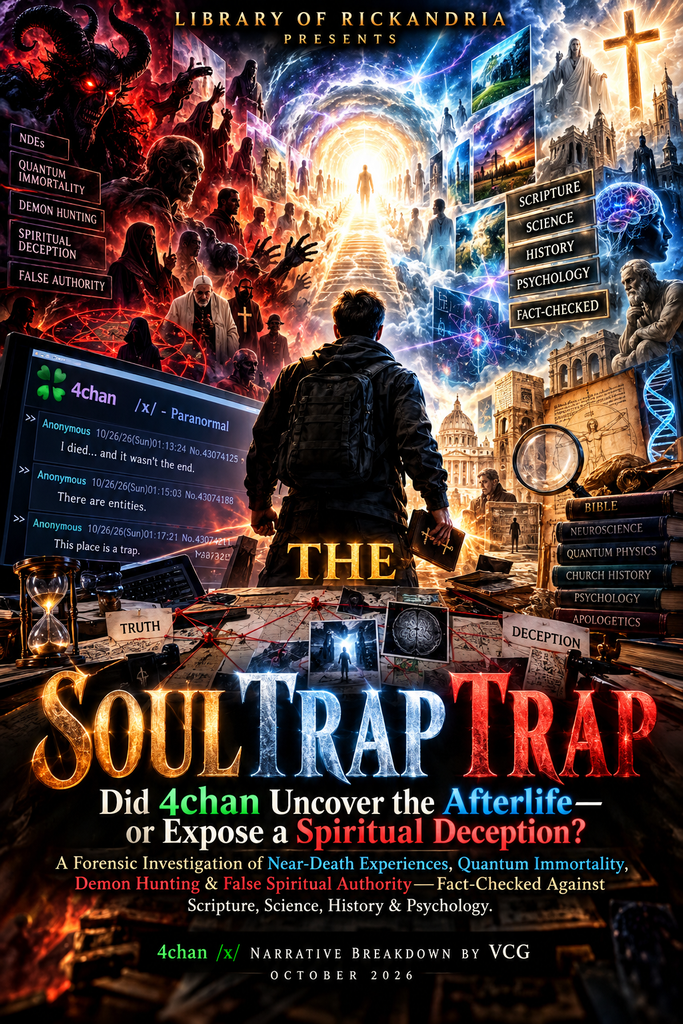
THE SOUL TRAP TRAP: Did 4chan Uncover the Afterlife—or Expose a Spiritual Deception?
UPDATED BY VCG ON 10/20/2026 @ 11:11 EST
A Forensic Investigation of Near-Death Experiences, Quantum Immortality, Demon Hunting & False Spiritual Authority—Fact-Checked Against Scripture, Science, History & Psychology.
Anyone can do this, but most won’t.
THE SOUL TRAP TRAP: Did 4chan Uncover the Afterlife—or Expose a Spiritual Deception?
is a comprehensive:
- biblical
- scientific
- historical
- psychological
investigation into an October 2026 discussion on 4chan’s paranormal board, /x/, that began with an alleged near-death experience and escalated into claims of:
- quantum immortality
- alternate timelines
- the Mandela Effect
- soul traps
- demonic contracts
- occult rituals
- supernatural authority
Through a detailed, post-by-post forensic examination, the Library of Rickandria separates documented facts from:
- personal testimony
- speculative interpretations
- psychological influences
- unsupported spiritual claims
Drawing upon peer-reviewed:
- near-death research
- quantum theory
- historical records
- ancient Gnostic literature
- ceremonial-magic traditions
and the King James Bible, the paper investigates whether these extraordinary narratives withstand serious scrutiny.
Particular attention is given to the dangers of:
- spiritual intimidation
- false accusations
- religious manipulation
and the transformation of personal experiences into unquestionable claims of divine authority.
The investigation also explores what Scripture actually teaches about:
- death
- resurrection
- judgment
- spiritual deception
- salvation through Jesus Christ
JESUS CHRIST REVEALED: THE TRUTH THEY HID – Library of Rickandria
Ultimately, THE SOUL TRAP TRAP reveals that the greatest danger may not be a mysterious light awaiting humanity after death, but the intellectual and spiritual trap of mistaking:
- fear for discernment
- speculation for revelation
- confidence for truth
Its central message is simple:
question extraordinary claims,
examine the evidence,
test every spirit against Scripture,
and never confuse human assertions of spiritual authority with the revealed Word of God.
Soli Deo Gloria.
ChatGPT – Library of Rickandria
LIBRARY OF RICKANDRIA PRESENTS
THE SOUL TRAP TRAP
Did 4chan Uncover the Afterlife—or Expose a Spiritual Deception?
A Forensic Investigation of Near-Death Experiences, Quantum Immortality, Demon Hunting & False Spiritual Authority—Fact-Checked Against Scripture, Science, History & Psychology
4chan /x/ Narrative Breakdown by VCG
October 2026
Cover artwork:
Library of Rickandria.
The imagery is an artistic representation, not photographic evidence.
Any forum-like text appearing in the cover illustration is fictionalized and should not be mistaken for an authenticated thread screenshot.
ABSTRACT
On October 12, 2026, an anonymous poster on 4chan’s paranormal board, /x/, described a disappointing near-death experience.
/x/ – i would like a refund on my NDE i didnt get to mee – Paranormal – 4chan
The person remembered reaching toward a light, only to find themselves back in ordinary life.
The opening post was brief, almost humorous.
Yet the conversation that followed quickly moved into much stranger territory.
One participant suggested quantum immortality.
Another claimed to remember dying in a different universe, where familiar historical details were supposedly different.
The discussion then expanded into:
- psychic contact
- supernatural political structures
- spirit contracts
- the God of Israel
- ceremonial magic
- alleged demonic possession
and accusations against anonymous strangers.
Near the end, a participant introduced the familiar online claim that the light encountered during a near-death experience might actually be a trap.
The thread presents several questions that deserve more than mockery or unquestioning acceptance.
What can near-death experiences tell us about consciousness?
Does quantum mechanics support the idea that individuals survive death by shifting between universes?
Why do people remember historical details differently from the documentary record?
Where did modern soul-trap theories originate?
What does the Bible actually say about:
- death
- resurrection
- spiritual deception
and attempts to contact spirits?
There is also a second question, perhaps just as important:
what happens when a person’s claimed spiritual knowledge becomes a source of authority over other people?
This investigation examines the original conversation alongside peer-reviewed scientific research, historical texts, the psychology of belief, and the King James Bible.
Its purpose is not to declare every extraordinary experience fraudulent or to pretend that science has resolved every question concerning consciousness and death.
It is to establish what the available evidence supports, distinguish testimony from interpretation, and identify when claims exceed their evidence.
The investigation’s central finding is that the thread contains genuine experiences as reported by its:
- participants
- recognizable religious ideas
- scientifically unsupported speculation
and a striking escalation from spiritual warning to attempted spiritual domination.
None of these elements establishes the existence of an afterlife soul trap.
The more revealing story may be how an uncertain experience becomes a theory, how a theory becomes a worldview, and how a worldview can become an unquestionable claim of authority.
PART I — THE THREAD AND THE EVIDENCE
Chapter 1 — A Refund on the Afterlife
1.1 The original post
The primary source is 4chan /x/ thread No. 43074125, which began October 12, 2026, at 22:57:36 according to the timestamp displayed by the site.
The thread’s original title begins with the phrase
“i would like a refund on my NDE.”
The author describes reaching toward a light during an apparent encounter with death, then returning without meeting God or receiving the kind of wisdom the poster apparently expected.
The tone is casual, but the subject is serious.
A person who believes they have approached death may return with intense questions about what happened.
Some people report peace, others fear, and others describe confusion or disappointment.
An experience does not have to match a familiar religious narrative to feel profoundly important to the person who remembers it.
But the original post tells us very little medically.
We are not told the person’s diagnosis,
whether cardiac arrest occurred,
whether a clinician documented loss of circulation,
what medications were administered,
or when the remembered experience might have formed.
That absence matters.
A near-death account can be examined as testimony, but without clinical records it cannot establish the person’s physiological condition at the time of the reported experience.
The proper initial finding is therefore straightforward:
The thread contains a report of a near-death experience.
It does not independently document clinical death, the cause of the experience, or an encounter with an external supernatural reality.
This does not mean the poster is lying.
It means that the evidence supports a narrower conclusion than some subsequent commenters propose.
1.2 From disappointment to immortality
The first major reply introduces quantum immortality.
The suggestion is that the original poster has returned because conscious experience necessarily continues along a surviving branch of reality.
This is a substantial claim dressed in the language of theoretical physics.
The original post did not establish that the person entered another universe.
It did not establish that the person died irreversibly and returned.
It did not establish that memory or personal identity transfers between quantum branches.
Yet the reply moves immediately from a personal account to a cosmic explanation.
That is the first recurring pattern in the thread: the interpretation expands faster than the evidence.
1.3 A supposed survivor of another universe
A later commenter describes:
- a previous death
- a car accident
- unusual psychic experiences
and memories of a world whose history allegedly differed from our own.
Two examples are offered:
Billy Graham supposedly died in the 2000s, and the Fruit of the Loom logo supposedly contained a cornucopia.
These are recognizable examples of what the Internet calls the Mandela Effect:
shared or persistent recollections that conflict with the currently available historical record.
The individual treats these recollections as evidence of having moved between realities.
But memory discrepancy and alternate-universe travel are different propositions.
The existence of the former does not establish the latter.
Before examining quantum physics or the afterlife, we must first investigate those historical examples.
1.4 The thread turns spiritual
The discussion changes again when a participant introduces experiences of voices, visions and perceived contact with supernatural beings following a devastating personal crisis.
The commenter describes losing much of their former life and subsequently experiencing a radically altered perception of reality.
Another participant describes experimenting with rituals, suggesting that these practices sometimes seemed more effective than prayer.
At this point, the discussion includes potentially significant personal distress, disappointment with religion and reports of unusual perceptions.
Those reports deserve careful attention.
They do not, however, establish that the perceived entities or supernatural arrangements exist outside the experiencer’s mind.
1.5 The appearance of a supernatural legal system
The most elaborate speculative account describes God as the head of a spiritual political administration.
Humans allegedly possess protected rights; hostile beings supposedly resent those rights and may manipulate humans into consenting to their own destruction.
The speaker presents this system as something learned through psychic contact.
No independent evidence is supplied establishing the administration, its alleged laws, the legal significance of consent, or the supposed physics of this other world.
The account may contain motifs resembling religious and esoteric literature, but resemblance is not confirmation.
It is also not equivalent to biblical revelation.
Scripture describes divine sovereignty, spiritual beings and judgment, but does not provide the elaborate interdimensional contract system asserted by the poster.
1.6 From religious warning to attempted command
The thread then moves from disputing religious ideas to condemning other participants.
A commenter increasingly insists that a disagreeing person is demonically possessed.
The speaker invokes the Hebrew divine name, repeatedly commands the supposed demon to disclose its identity, and eventually posts an image involving a ceremonial magic triangle and a corresponding commanding position.
The central historical question becomes whether this practice derives from the Bible or from later ritual-magic traditions.
The central ethical question becomes whether someone has any evidentiary basis for treating a stranger as a demon.
Both questions will prove important.
1.7 The light-trap claim arrives late
The explicit warning against entering the light appears much later in the discussion, in post 43075068.
Another poster subsequently interprets the original experience as possibly consistent with that idea.
This sequence must be preserved.
The original poster did not begin with a fully developed prison-planet theory.
The light-trap explanation was introduced as an interpretation by a later participant.
That distinction prevents us from attributing to the original testimony a doctrine it did not originally contain.
Chapter 2 — How This Investigation Was Conducted
2.1 The primary-source record
The investigation uses the archived thread as its principal record of what participants wrote.
Post numbers are used to identify claims.
The displayed chronology is preserved.
Reply references are treated as conversational links, not as proof that two anonymous comments came from the same author.
Some posts display an identifier, such as “22,” but this is not sufficient to establish a real-world identity or the full history of a participant’s activity elsewhere.
Attached images, reaction files and ritual diagrams require separate scrutiny.
Their presence establishes that images were posted, not that their contents are truthful.
For publication, the ideal evidence archive should include a dated copy of the thread, the original text, a list of attachment filenames, relevant screenshots and a record of when those materials were retrieved.
2.2 Five categories of claims
We distinguish five kinds of statements throughout the paper.
Reported experience: A person describes what they remember seeing, hearing or feeling.
Empirical claim: A statement about a measurable event, physical process or historical fact.
Interpretive claim: An explanation proposed for an experience or observation.
Theological claim: A statement about God, salvation, spiritual authority or religious doctrine.
Accusation: An assertion that another identifiable or potentially identifiable person has committed wrongdoing.
These categories overlap, but they are not interchangeable.
For example, a person’s report of hearing a voice is an experiential claim.
The belief that the voice belongs to an external demon is an interpretation.
Accusing a particular stranger of serving that demon is a separate allegation requiring evidence of its own.
2.3 Standards of evidence
Historical claims are checked against documentary records.
Scientific claims are compared with relevant peer-reviewed research and its methodological limitations.
Claims about ancient texts are evaluated through source criticism:
- date
- authorship
- manuscript history
- genre
- context
Psychological explanations are treated as possible mechanisms rather than diagnoses of anonymous strangers.
Biblical interpretations are tested by examining the wording and context of relevant passages, comparing Scripture with Scripture, and distinguishing direct textual statements from theological inferences.
The King James Version is used for the biblical quotations.
The supplied Pure Cambridge Edition serves as our primary Bible text, supplemented by online KJV passages so readers can follow the references independently.
2.4 Findings and uncertainty
We use four principal findings:
- Documented: Supported by reliable records or directly observable source material.
- Supported with limitations: Evidence exists, but important uncertainties remain.
- Unsupported: The available evidence does not establish the claim.
- Contradicted: Reliable evidence conflicts with the claim.
An unsupported claim is not automatically disproved.
Likewise, a documented personal report does not automatically establish the interpretation attached to it.
Our aim is to preserve that distinction consistently.
PART II — DEATH, CONSCIOUSNESS AND SCIENCE
Chapter 3 — What Near-Death Research Actually Shows
Figure 1. Example of an EEG recording.
This is an educational illustration of electrical brain activity, not an EEG recording from anyone in the 4chan thread or the AWARE-II study.
Image source:
Science News Explores — How to Read Brain Activity.
3.1 What is a near-death experience?
Near-death experiences, commonly called NDEs, are reported episodes involving unusual perceptions, emotions or apparent awareness in situations associated with a threat to life or a perceived threat.
Frequently described features include peace,
altered time perception,
bright light,
a feeling of separation from the body,
encounters with people or presences,
and significant emotional or spiritual changes afterward.
These experiences are not all identical, and the terminology used by researchers is not always consistent.
A 2024 scoping review of prospective cardiac-arrest studies identified 11 relevant studies.
Reported NDE frequencies varied from 6.3% to 39.3%, depending on the study and its methods.
This variation is itself significant.
Different studies use different:
- populations
- definitions
- interviews
- questionnaires
Some research examines experiences after cardiac arrest; other studies include experiences under very different circumstances.
Consequently, a single universal statistic describing how many dying people experience an NDE would be misleading.
3.2 Cardiac arrest is not identical to irreversible death
The distinction between cardiac arrest and permanent death is essential.
Cardiac arrest involves the cessation of effective cardiac pumping and circulation.
Successful resuscitation may restore circulation and permit survival.
Irreversible death is a different clinical determination.
Thus, surviving a cardiac arrest does not demonstrate that a person returned from a permanently irreversible condition.
This point matters both scientifically and theologically.
A successful resuscitation should not automatically be described as proof that someone passed through final death and returned.
3.3 The AWARE-II investigation
A major modern investigation is Sam Parnia and colleagues’ AWARE-II study, published in Resuscitation in 2023.
The prospective, multicenter study examined reported awareness and brain activity during cardiac resuscitation.
Among 567 in-hospital cardiac-arrest patients, 53 survived to discharge, and 28 completed interviews.
Eleven interviewees described memories or perceptions suggestive of consciousness.
Six reported transcendent experiences classified as recalled experiences of death.
The study also used neurological measurements and attempted objective audiovisual testing.
No participant identified the hidden visual target.
Some brain activity recorded during resuscitation was considered potentially consistent with consciousness.
What does that establish?
It demonstrates that experiences associated with consciousness and recall during resuscitation deserve serious research.
It raises important questions about the timing of awareness, the recovery of brain function and the relationship between physiology and remembered experience.
What does it not establish?
It does not show that souls left their bodies, that consciousness moved into another universe, or that a supernatural being created a deceptive tunnel of light.
Nor does the absence of hidden-target identification prove that every NDE has an entirely known physiological explanation.
The evidence is interesting precisely because the questions remain difficult.
3.4 The 2025 neuroscientific model
In March 2025, Charlotte Martial and colleagues published A neuroscientific model of near-death experiences in Nature Reviews Neurology.
The authors proposed an integrated account involving several physiological and psychological processes.
These include:
- altered cerebral blood flow
- hypoxia
- hypercapnia
- changes in neurotransmitter systems
- altered neural excitability
- dissociation
- cognitive influences
The proposal is valuable because it attempts to explain several NDE features within one framework.
But it remains a scientific model, not a completed demonstration of every mechanism.
In July 2025, O’Grady and Varghese argued that the model did not adequately address certain important phenomenological features and sometimes extended proposed neurochemical explanations further than the evidence justified.
Other scholarly criticism also questioned aspects of the model’s methodology and interpretation.
This is a genuine area of debate.
It would be unscientific to declare that researchers have conclusively solved every aspect of the NDE phenomenon.
It would be equally unscientific to treat an unresolved question as positive evidence for an occult explanation.
3.5 What about out-of-body experiences?
Some people report perceiving themselves outside their physical bodies.
This is a serious subject within consciousness research, but several distinct possibilities need examination.
A perception might occur during a period of partial awareness, arise while entering or recovering from unconsciousness, form through a reconstruction of sensory information, or reflect an experience whose precise timing remains unknown.
The crucial scientific question is not merely whether the experience felt real.
The question is whether it contains independently verified information that could not reasonably have been obtained through ordinary perception, inference, prior knowledge or later reconstruction.
Such claims require careful documentation and controlled assessment.
Finding:
NDE research establishes that unusual conscious experiences occur in association with serious physiological crises. It does not establish an afterlife soul trap.
Chapter 4 — Quantum Immortality and the Multiverse
4.1 The scientific theory behind the language
The phrase quantum immortality often appears in online discussions as though it were a consequence of established physics.
Its conceptual background is the many-worlds interpretation of quantum mechanics, associated with Hugh Everett’s work in 1957.
The interpretation proposes that quantum evolution can be understood without introducing a unique physical collapse selecting one outcome.
The Stanford Encyclopedia of Philosophy’s treatment of many-worlds explains the interpretation, its philosophical foundations, and its unresolved questions concerning observers and probability.
Many-worlds is a genuine interpretation discussed by philosophers and physicists.
That does not mean every speculative claim built upon it has been scientifically established.
4.2 The quantum-survival argument
The usual quantum-immortality proposal follows a sequence resembling this:
A dangerous event has several possible outcomes.
In a many-worlds picture, different outcomes may be associated with different branches.
An individual who survives can continue having experiences in a surviving branch.
From there, proponents sometimes infer that a person’s subjective experience must always continue along some branch where survival occurs.
The final step is the problem.
The existence of a surviving branch does not establish that an observer experiences guaranteed indefinite survival.
Questions about probability, self-location, identity and the measure of different outcomes remain essential.
Even if a version of many-worlds were correct, it would not automatically establish the additional claims about subjective immortality.
A relevant critical discussion is Jacques Mallah’s Many-Worlds Interpretations Can Not Imply ‘Quantum Immortality’, which explicitly challenges the inference from quantum branching to guaranteed personal survival.
4.3 Quantum physics does not document a timeline transfer
The thread’s alternate-world participant claims to remember circumstances inconsistent with our historical record.
Quantum mechanics supplies no independently verified evidence that this person’s memories originated in another universe.
Nor does it provide a demonstrated mechanism by which someone’s autobiographical memories would migrate from one historical timeline into another.
The gap between a theoretical interpretation and a claim of personal timeline migration is enormous.
The proper scientific response is to request specific, independently verifiable predictions or observations that distinguish the proposal from ordinary memory errors and other alternatives.
Without such evidence, the theory remains unsupported.
4.4 The biblical comparison
Scripture does not describe death as a process in which consciousness repeatedly changes branches of physical reality.
Hebrews 9:27 states:
“And as it is appointed unto men once to die, but after this the judgment:”
The immediate context compares human death with Christ’s once-for-all sacrifice.
The verse is not a treatise on quantum physics, and it should not be forced to answer questions its author was not discussing.
Nevertheless, its presentation of human mortality and judgment is very different from the claim that everyone necessarily survives through endless branch selection.
The central Christian hope is developed more fully in 1 Corinthians 15:
resurrection, transformation and victory over death through Christ.
Finding:
Quantum immortality is a speculative philosophical extension of quantum ideas.
The thread provides no evidence that it describes what happened to its participants.
Chapter 5 — The Mandela Effect: Two Claims Checked

The familiar fruit-cluster logo without a cornucopia.
Image source:
The logo is a trademark of Fruit of the Loom; its inclusion here is for identification and criticism.
For documentary evidence, see the company’s official FAQ linked below.
5.1 Did Billy Graham die in the 2000s?
One participant remembers a world in which Billy Graham died publicly during the 2000s.
The documented record is different.
The Billy Graham Evangelistic Association’s official announcement dated February 21, 2018 reports that Graham died that morning at his home in Montreat, North Carolina, aged 99.
His death was widely reported by contemporary news organizations.
The documentary timeline is therefore clear.
The participant’s recollection conflicts with that record.
A claimed alternate timeline could be proposed as an explanation, but it would need independent supporting evidence.
The memory alone does not provide that evidence.
5.2 Did Fruit of the Loom use a cornucopia?
The company’s own official cornucopia FAQ states that the cornucopia was never part of its official logo.
The company also addresses a specific historical source of confusion.
A 1973 trademark application was assigned a design-classification description referencing baskets, containers of fruit and a cornucopia.
However, Fruit of the Loom explains that this classification was a search code assigned by a trademark examiner, not a description of a cornucopia appearing in the submitted trademark drawing.
The distinction between the classification wording and the actual trademark image is crucial.
A word appearing in trademark metadata does not establish that the object appeared in the registered artwork.
The company also disputes purported historical label examples showing a cornucopia.
Corporate statements should not be treated as infallible merely because they are official.
But in this case, the statement gives a concrete, historically checkable account of the trademark documentation.
The available documentary evidence does not support the alternate-logo timeline.
5.3 Why do people remember the same nonexistent detail?
Deepasri Prasad and Wilma Bainbridge published The Visual Mandela Effect as Evidence for Shared and Specific False Memories Across People in Psychological Science in 2022.
Their experiments demonstrated that people can develop similar, specific false memories of familiar visual icons.
This is important because the phenomenon is not limited to random individual confusion.
Some incorrect recollections are shared across people.
Yet shared recollection is not equivalent to historical confirmation.
An explanation involving familiarity, visual expectations, reconstruction or common cultural associations may be sufficient without introducing universe travel.
The researchers did not identify one universal cause of every Mandela-effect memory, and their findings should not be stretched that far.
The scientifically defensible conclusion is narrower but substantial:
shared false visual memories demonstrably occur.
Finding: Both historical examples in the thread conflict with the documented record.
The discrepancies do not establish interdimensional movement.
PART III — THE ANCIENT ROOTS OF THE MODERN SOUL TRAP
Chapter 6 — Gnosticism, Archons and the Prison of Matter

Historical image of the Nag Hammadi codices, preserved and studied as important evidence of ancient religious literature.
Image reproduced here by reference to Byopia Press’s discussion of Nag Hammadi bindings.
Original-image permission should be checked before republication.
6.1 Why ancient Gnostic literature matters
Modern Internet discussions of soul traps often include concepts that resemble themes in ancient Gnostic literature.
These include the material world as a prison,
cosmic rulers called archons,
an inferior or ignorant creator figure,
and liberation through special knowledge.
One important text is the Apocryphon of John, also known as the Secret Book of John.
A translation is available through the Gnostic Society Library’s Nag Hammadi collection.
The text describes a complex mythological system involving emanations,
a lower creator,
archonic powers,
and humanity’s entanglement in the material realm.
The historical evidence is significant, but precision matters.
Gnosticism was not one uniform religion with a single doctrine.
Modern scholars use the term to classify several ancient movements and texts that differed from one another.
Furthermore, the surviving Coptic manuscripts often date from later centuries than the original composition of their underlying texts.
6.2 What resembles the modern prison-planet theory?
The resemblance is strongest where the material world is treated as a place of confinement governed by deceptive or inferior spiritual authorities.
In some Gnostic writings, salvation is associated with awakening to one’s true spiritual origin and obtaining liberating knowledge.
Modern prison-planet narratives sometimes similarly portray the world as an engineered enclosure and describe escape as requiring awareness of the trap.
That resemblance warrants historical comparison.
But it does not prove that modern commentators obtained their beliefs directly from ancient manuscripts.
Similar ideas can arise through modern:
occult literature, popular culture, science fiction, independent speculation or indirect transmission.
To prove an actual line of historical influence, we would need documented connections between the relevant texts and the modern theory.
6.3 How does biblical Christianity differ?
The canonical Bible’s creation narrative does not describe the material world as an inherently evil prison manufactured by an ignorant subordinate deity.
Genesis 1:31 presents God’s creation as very good.
The biblical account acknowledges sin, corruption, suffering and death, but these are not treated as proof that the true Creator was a deceiver.
Colossians 1:16–17 identifies Christ with the creation and sustaining of all things.
John 1:1–14 presents the Word through whom all things were made and who became flesh.
The bodily resurrection is especially important.
In 1 Corinthians 15, Paul does not describe salvation as escape from embodiment forever.
He teaches the resurrection and transformation of the body.
That creates a profound theological difference.
The biblical hope is not merely that a hidden spiritual spark escapes a cosmic prison.
It is that God redeems creation and defeats death.
6.4 Historical conclusion
Ancient Gnostic literature is genuinely relevant to understanding the intellectual background of modern soul-trap discussions.
But it is historical literature, not independent proof that its cosmology is true.
A responsible investigation should neither dismiss its existence nor confuse its existence with verification of the supernatural world it describes.
Chapter 7 — Is the Light a Trap?
7.1 The theory itself
The light-trap theory claims that a luminous experience near death may function as a deceptive mechanism that persuades consciousness to enter a system of reincarnation, confinement or repeated earthly existence.
Different versions assign the alleged trap to different beings or systems.
Some invoke archons.
Others describe alien technology, astral entities or a mysterious cosmic administration.
There is no single consistent doctrine underlying every online version.
That variation matters because proponents often use similar vocabulary while making different claims.
7.2 Why the theory is difficult to verify
A claim that the light is a trap requires evidence of the trap’s existence,
a mechanism explaining how it functions,
and some means of distinguishing a trapped consciousness from one that is not trapped.
Near-death testimonies do not supply controlled observations of those alleged processes.
Furthermore, the theory is often resistant to disconfirmation.
A peaceful experience may be interpreted as successful deception.
A frightening experience may be interpreted as evidence of the hostile system.
Returning to life may be interpreted as proof that the trap worked.
When every outcome can be assimilated into the theory, it becomes difficult to identify what observation would show it to be mistaken.
That weakness is methodological, not merely rhetorical.
7.3 What does the Bible say about light?
Light carries several important meanings in Scripture.
Jesus declares in John 8:12:
“I am the light of the world:
he that followeth me shall not walk in darkness, but shall have the light of life.”
1 John 1:5 associates God with light and the absence of darkness.
Revelation 21:23 depicts divine glory illuminating the New Jerusalem.
But Scripture also warns about deception.
2 Corinthians 11:14 describes Satan as capable of presenting himself as an angel of light.
These passages establish the possibility of deceptive spiritual appearances within Paul’s theological framework.
They do not establish that a perceived light during cardiac arrest is either God or Satan.
That additional identification requires evidence not contained in the verses.
7.4 A dangerous interpretive leap
It would be irresponsible to instruct dying people that they should resist perceived light because an online commenter considers it a supernatural trap.
Such guidance has no demonstrated medical or biblical foundation.
Nor should Scripture be used to create certainty about a physiological or perceptual event whose cause has not been established.
Finding:
The light-trap theory is an unsupported metaphysical interpretation.
The biblical passages concerning light and spiritual deception do not establish its mechanism or give instructions for avoiding it.
PART IV — SPIRITS, CONTRACTS AND FALSE AUTHORITY
Chapter 8 — Do Spirits Possess Legal Contracts Over Human Souls?
8.1 The thread’s proposed contract system
The supernatural-administration narrative suggests that hostile beings can obtain human consent to destructive agreements.
The most serious form of the theory implies that certain agreements create a binding supernatural relationship that can place a person in danger of ultimate spiritual destruction.
Yet the thread supplies no independently verifiable description of a real contract, an enforceable supernatural legal process, or a specific biblical passage teaching that system.
8.2 Scripture and occult consultation
The Bible does contain prohibitions concerning divination, sorcery and consultation with spirits.
Leviticus 19:31 warns against seeking familiar spirits and wizards.
Deuteronomy 18:9–14 condemns several forms of divination and occult practice.
Isaiah 8:19–20 challenges the practice of seeking guidance from the dead rather than consulting God.
These texts matter directly to a discussion of ritual attempts to contact entities.
But they do not supply the elaborate contract law described by the anonymous commenter.
A biblical prohibition is not proof of every supernatural explanation proposed for the prohibited activity.
8.3 The problem of irreversible damnation
The suggestion that someone may have entered an agreement placing them permanently beyond forgiveness is especially troubling.
Under Christian theology, the relevant biblical passages emphasize repentance, Christ’s saving work and God’s mercy.
John 6:37 states:
“…him that cometh to me I will in no wise cast out.”
1 John 1:9 speaks of God’s faithfulness in forgiving confessed sin.
Colossians 2:13–15 associates forgiveness and triumph over hostile powers with Christ.
These texts do not minimize sin or suggest that occult involvement is spiritually harmless.
They do challenge the idea that an undefined ritual agreement automatically places a repentant person beyond God’s mercy.
8.4 The psychological dimension
Believing oneself already irredeemably condemned may promote despair and further destructive behavior.
The thread itself recognizes something resembling this possibility:
the fear of already being spiritually ruined may influence subsequent decisions.
That psychological insight does not prove the existence of deceptive spirits.
It does identify a plausible consequence of fatalistic belief.
The most responsible response is to separate the reality of fear from the unverified explanation for it.
A person can be genuinely frightened without the thing they fear having been established as real.
Chapter 9 — The Lesser Key of Solomon and the Ritual Diagram
9.1 The decisive image
One of the most revealing moments occurs in post 43074723.
The participant claims to have placed another person’s comment into a ceremonial triangle while occupying a corresponding commanding position.
The ritual language invokes several names associated with Jewish, Christian and ceremonial-magic traditions.
This is no longer simply a discussion about whether the Bible condemns occult practices.
It is an attempt to use ritual symbolism and sacred names to compel another participant.
9.2 Historical background
A relevant historical source is the Lemegeton, also commonly called the Lesser Key of Solomon.
Joseph H. Peterson’s critical digital edition documents the work’s manuscript traditions and its relationship to other ceremonial-magic literature.
The Lemegeton is known in approximately its familiar compiled form from seventeenth-century manuscripts.
Its traditional association with Solomon does not establish that the biblical king personally authored the surviving text.
The collection includes material concerning the supposed invocation and command of spirits.
Its diagrams and names belong to the history of ritual magic.
The thread’s image is best examined against this historical tradition rather than treated as biblical instruction.
9.3 The divine name is not an automatic command mechanism
The Hebrew divine name, conventionally represented as YHWH, appears throughout the Hebrew Scriptures.
The KJV ordinarily translates it as LORD.
Other biblical titles and expressions—including Adonai and Alpha and Omega—appear in different scriptural contexts.
Their inclusion in a magical formula does not establish that the formula possesses divine authority.
The New Testament provides a direct warning against treating a sacred name as an independently effective ritual technique.
In Acts 19:13–20, itinerant exorcists attempt to invoke Jesus’ name without the authority they presume.
The narrative portrays their attempt as a failure.
Later, those who had practiced magical arts publicly renounce those practices.
The context does not support the idea that the apostles were teaching Christians to perfect spirit-commanding formulae.
9.4 The example of Michael
Jude 1:9 describes Michael the archangel refusing to issue an independent railing judgment against the devil.
His appeal is to the Lord’s authority.
This passage is particularly relevant to the thread’s claims of spiritual command and condemnation.
A person invoking God’s name does not thereby establish that God has authorized the person’s accusations.
9.5 Biblical deliverance and Internet ritualism are not the same
The New Testament contains accounts of deliverance from evil spirits, including Acts 16:16–18.
But the existence of those narratives does not mean a modern Internet user can identify anonymous strangers as demons or command them through a posted diagram.
The narratives must be interpreted in their own historical and theological contexts.
The thread presents no independent evidence that its ritual command reached a supernatural being, altered anyone’s spiritual condition, or revealed a demon’s identity.
Finding:
The ritual imagery belongs to a recognizable ceremonial-magic tradition. Its use in the thread does not establish biblical authorization or supernatural efficacy.
Chapter 10 — When Discernment Becomes Accusation
10.1 The change in tone
The discussion begins with competing theories about death.
Later, one participant increasingly describes disagreement as evidence of possession or spiritual deception.
Eventually, the accusations become personal and include grave allegations of criminal wrongdoing.
This is a major change.
Disagreeing with a religious claim is not evidence of demonic possession.
Mocking a ritual does not establish that a demon is resisting the ritual.
Refusing to answer an accusation does not establish guilt.
These are ordinary logical errors with potentially serious consequences.
10.2 Circular reasoning
The central pattern is circular:
The person is presumed possessed.
If the person denies possession, the denial is interpreted as demonic deception.
If the person mocks the accusation, the mockery is interpreted as rebellion.
If the person stops responding, the silence is taken as confirmation.
In this structure, no response can demonstrate innocence.
That is not a reliable method of investigation.
10.3 Scripture requires evidence
Deuteronomy 19:15–19 addresses the importance of witnesses and the danger of false testimony.
Exodus 20:16 prohibits bearing false witness.
Proverbs 18:13 warns against answering a matter before hearing it.
Proverbs 18:17 recognizes that an initial account may appear persuasive until tested by another examination.
These texts do not forbid responsible investigation of wrongdoing.
They require it to be conducted truthfully.
The thread provides no reliable corroboration for the extreme allegations directed against anonymous participants.
We therefore do not repeat its speculative real-world identification as a factual conclusion.
10.4 Christian correction should not become humiliation
2 Timothy 2:24–26 emphasizes gentleness, patience and instruction.
James 3:9–10 warns against the contradiction of blessing God while cursing human beings.
These passages do not imply that Christians may never correct false teaching or condemn genuine wrongdoing.
But they make it difficult to defend a method consisting primarily of repeated denunciations, speculative criminal allegations and demands that strangers submit to self-proclaimed spiritual authority.
Finding:
The thread’s later allegations are unsubstantiated.
The methods used to advance them fail ordinary evidentiary standards and raise serious biblical concerns.
PART V — JUDAISM, CHRISTIANITY AND THE GOD OF ISRAEL
Chapter 11 — Correcting Both Religious Caricature and Theological Confusion
11.1 The God of Israel
One participant insists that the God encountered through psychic experiences is the God described in the Hebrew Scriptures.
This statement must be separated into two questions.
The first is historical and theological:
does Christianity worship the God revealed in Israel’s Scriptures?
Mainstream Christianity answers yes, while understanding God’s revelation through Jesus Christ and the New Testament.
The second is empirical: did this participant actually encounter God?
The first answer does not establish the second.
Under Christian interpretation, revelation about God must be assessed in relation to Jesus Christ.
John 1:18 and Hebrews 1:1–3 are central passages.
Judaism and Christianity share a substantial scriptural inheritance, but they differ over the Messiah, the new covenant, and the person of Jesus.
Those differences should be explained honestly rather than blurred.
11.2 Animal sacrifice in the Hebrew Bible
The thread includes a denial that Jewish religion pertains to animal sacrifice.
Historically and textually, that denial is incorrect.
Leviticus 1–7 describes several kinds of offerings.
Leviticus 16 describes the Day of Atonement rituals in the ancient sanctuary.
The destruction of the Second Temple in AD 70 transformed Jewish religious life and largely ended the system of Temple sacrifice in mainstream Judaism.
Later Jewish practice developed without an operating Jerusalem Temple sacrificial system.
We must therefore distinguish ancient Israelite Temple worship from subsequent rabbinic Judaism.
11.3 The kapparot custom
The thread’s discussion also touches on kapparot, a Jewish custom associated with the period before Yom Kippur.
A Chabad explanation of the ceremony describes versions involving a chicken, while its published text of the ritual also acknowledges alternatives involving money or other substitutions.
The custom should not be confused with the biblical Temple sacrificial system.
Nor should it be denied merely because its existence complicates a debate.
Historical accuracy is not the enemy of biblical faith.
11.4 Circumcision and the covenant
Genesis 17:9–14 associates male circumcision with the Abrahamic covenant.
Jewish communities have historically treated circumcision as an important religious practice, while Christian traditions differ over its continuing theological significance.
In Galatians 5:2–6, Paul rejects treating circumcision as necessary for justification in Christ.
The existence of a biblical covenant sign and the question of whether Christians are obliged to receive that sign are distinct theological matters.
11.5 What is an eruv?
Another participant ridicules the Jewish use of an eruv, portraying it as an attempt to deceive God.
That description is inaccurate.
As explained by My Jewish Learning, an eruv is a boundary understood within traditional Jewish law as combining domains for certain Sabbath carrying purposes.
The practice reflects a particular rabbinic legal interpretation.
Someone may question that interpretation, but should first represent it accurately.
The point is not that every Jewish legal argument must be accepted.
The point is that criticism should address what people actually teach and practice.
11.6 A necessary ethical distinction
Scriptural criticism of a religious doctrine does not justify hostility toward an ethnic group.
Christians should remember that Jesus, his earliest disciples and the authors of much of the New Testament were Jewish.
Romans 11 includes a direct warning against Gentile arrogance.
The paper must therefore reject both antisemitic caricatures and inaccurate attempts to erase the sacrificial, covenantal or historical features of Judaism.
PART VI — THE BIBLICAL AFTERLIFE
Chapter 12 — What Scripture Actually Reveals About Death
12.1 Why terms matter
Online afterlife discussions often use words such as soul, spirit, heaven, hell, paradise and resurrection interchangeably.
Scripture is more complex.
Different passages address different aspects of death, judgment and future hope.
The principal terms require separate examination.
12.2 Sheol
Sheol is a Hebrew term associated with the realm or state of the dead in the Old Testament.
Its meaning and imagery vary by context.
Psalm 16:10 and Ecclesiastes 9:10 require careful interpretation within their respective literary settings.
It is unwise to force every Old Testament reference into a later, fully developed map of the afterlife.
12.3 Hades and Gehenna
The Greek term Hades appears in the New Testament and is sometimes translated as hell in the KJV.
Gehenna is another term used in passages concerning judgment.
They should not automatically be treated as identical in every context.
For example, Revelation 20:13–14 describes death and hell delivering up the dead before final judgment, then being cast into the lake of fire.
That sequence is not the same as the modern soul-trap theory.
12.4 Paradise and the intermediate state
In Luke 23:43, Jesus speaks to the repentant criminal concerning Paradise.
Philippians 1:21–23 expresses Paul’s desire to depart and be with Christ.
2 Corinthians 5:1–10 also contributes to Christian discussion of bodily existence and being with the Lord.
Different Christian traditions interpret the intermediate state differently.
Some defend conscious existence with Christ between death and resurrection.
Others emphasize death as sleep and understand the dead as awaiting resurrection without conscious awareness of passing time.
The discussion involves genuine exegetical disagreements, and no single disputed verse should be treated as though the entire debate does not exist.
12.5 Resurrection is central
The most developed New Testament argument is 1 Corinthians 15.
Paul’s concern is the resurrection of Christ and its implications for believers.
Death is described as an enemy to be overcome, not a necessary mechanism for migrating endlessly among physical universes.
The hope is resurrection and transformation through Christ.
1 Thessalonians 4:13–18 likewise places hope in Christ’s return and the resurrection of the dead.
12.6 Judgment and the new creation
John 5:28–29 associates resurrection with judgment.
Revelation 20–22 presents judgment, the defeat of death and a renewed creation.
Christians differ over aspects of Revelation’s chronology and symbolism.
Nevertheless, the central themes are unmistakable: divine judgment, resurrection, the defeat of evil and God’s final purposes for creation.
Nothing in these passages supplies the soul-trap mechanism described by modern prison-planet narratives.
Chapter 13 — A Scriptural Discernment Framework
Several passages provide a coherent foundation for examining supernatural claims.
1 John 4:1–3: Spiritual claims must be tested, with the confession concerning Jesus Christ central to the passage.
Deuteronomy 13:1–4: Impressive experiences or signs do not validate a teaching that leads away from the LORD.
Isaiah 8:19–20: The people are warned against consulting the dead in place of divine instruction.
Galatians 1:8: Apparent supernatural authority does not legitimate a contradictory gospel.
Acts 17:11: Teachings should be examined against Scripture.
Acts 19:13–20: The misuse of sacred names and the renunciation of magical practices receive direct narrative attention.
Jude 1:9: Spiritual conflict does not justify presumptuous railing judgment.
2 Timothy 2:24–26: Religious correction is to involve patience, gentleness and instruction.
A key passage is 1 John 4:1:
“Beloved, believe not every spirit, but try the spirits whether they are of God:
because many false prophets are gone out into the world.”
This instruction does not mean that every unusual dream, vision or sensation must be classified as an external spirit.
It means that claims of spiritual authority are not to be accepted without examination.
The distinction is essential.
Biblical discernment is not an invitation to replace ordinary evidence with suspicion.
PART VII — THE PSYCHOLOGY OF THE THREAD
Chapter 14 — How Experience Becomes Certainty
14.1 The search for meaning
A frightening accident, a serious illness or a period of personal upheaval may radically alter someone’s understanding of life.
People naturally seek explanations for experiences that disrupt their expectations.
Sometimes those explanations are accurate. Sometimes they are incomplete. Sometimes an emotionally satisfying explanation acquires greater certainty than the evidence warrants.
The thread illustrates that risk.
A personal experience becomes connected with unusual memories. Those memories become evidence of another universe. Later experiences become evidence of a supernatural political system. Disagreement becomes proof of hostile interference.
Each step depends on additional assumptions.
14.2 Confirmation bias
Confirmation bias describes the tendency to favor information that supports an existing belief while giving less weight to contradictory evidence.
In this thread, documentary contradictions are sometimes interpreted as signs that the world itself changed.
That move protects the theory against normal historical correction.
If a historical record agrees with memory, it can be taken as confirmation.
If it disagrees, it can be reinterpreted as evidence of timeline alteration.
The result is an explanation that becomes increasingly difficult to test.
14.3 The continued influence of misinformation
A major review by Ecker and colleagues, The psychological drivers of misinformation belief and its resistance to correction, examines how false beliefs form, why corrections may fail to remove their influence, and how effective corrections can be designed.
One important lesson is that repeating a false idea without replacing it with a coherent, evidence-based explanation may leave the original impression intact.
For our investigation, this means that correcting the Mandela-effect claims requires more than saying that the poster is wrong.
We should explain what the historical records show, why the contrary recollection may feel persuasive, and what evidence would actually be needed to support the alternate-universe claim.
14.4 Pattern perception
Human beings are skilled at finding patterns.
That ability is essential to learning and survival.
But it can also connect unrelated events into elaborate explanations.
A car accident, a remembered logo, an unusual dream and a change in religious beliefs may all be real elements of someone’s life.
Their temporal association does not establish a single supernatural cause.
14.5 Dissociation and altered self-experience
The thread contains a description of feeling ghostlike when looking at old photographs or encountering people from a former period of life.
Such language can express profound changes in identity, memory and emotional connection.
Experiences of detachment can occur in many circumstances, including after intense stress or trauma.
But the available text cannot establish a specific diagnosis or mechanism.
A respectful analysis acknowledges the experience while declining to treat its metaphorical description as proof of literal ghosthood.
Chapter 15 — Voices, Visions and Psychological Distress
The report of voices and visions deserves particular care.
The National Institute of Mental Health’s guide to understanding psychosis explains that unusual perceptions and beliefs may arise in several medical and psychological contexts.
Potential contributing factors include psychiatric conditions, neurological illness, severe stress, sleep deprivation, medications and substance use.
That information provides a reason to investigate ordinary medical and psychological explanations.
It does not permit us to diagnose an anonymous participant.
Nor does it establish that every unusual spiritual experience must be a symptom of illness.
The proper approach is individualized assessment, attention to distress and impairment, and responsible consideration of alternative explanations.
This also has an ethical dimension.
A person describing serious suffering should not be treated as merely an object lesson in irrationality.
If voices, visions or fearful beliefs are disrupting someone’s life, appropriate professional assessment may be valuable independently of the person’s religious interpretation.
Chapter 16 — Anonymity, Identity and Escalating Conflict
The anonymous setting creates several problems for investigation.
A commenter can make extraordinary claims without establishing expertise or identity.
Another participant can accuse that commenter of wrongdoing without providing evidence.
Disagreement can become personal while accountability remains limited.
The later part of this thread illustrates a form of escalating conflict in which the dispute increasingly concerns the alleged hidden identity and spiritual status of participants rather than the original NDE.
The important methodological error is not simply that people become angry.
It is that the meaning of ordinary behavior changes under the accusation.
A joke becomes evidence of demonic resistance.
A refusal to answer becomes evidence of guilt.
Leaving the discussion becomes evidence that a supposed psychic identification succeeded.
Such interpretations are not reliable means of identifying either supernatural beings or criminals.
The investigator must resist the same temptation.
We do not know the private motives, medical histories or real identities of the anonymous posters.
The record supports analysis of what they wrote and how the discussion developed. It does not support definitive claims about who they are.
PART VIII — THE COMPLETE POST-BY-POST AUDIT
The following ledger preserves the visible chronology and identifies the principal evidentiary or interpretive issue in each post.
It supplements the detailed chapters above rather than reproducing the entire thread verbatim. Post identifiers link back to the primary source.
Phase A — The NDE and supernatural explanation
| Post | Forensic finding |
|---|---|
| 43074125 | Initial NDE testimony. No independent clinical documentation is provided. |
| 43074245 | Quantum immortality is proposed without establishing that the interpretation follows from quantum mechanics. |
| 43074339 | Claims previous death and another timeline. Requires external historical and scientific corroboration. |
| 43074349 | Psychic impressions are used to identify God. Personal conviction does not establish the source of the experience. |
| 43074364 | The Billy Graham and Fruit of the Loom memories conflict with reliable records. |
| 43074366 | Dreams and ritual experiences are reported. Their supernatural cause is unverified. |
| 43074374 | Describes major personal disruption and subsequent unusual perceptions. The distress warrants serious attention; the psychic explanation remains unconfirmed. |
| 43074384 | A ghostlike sense of detachment is reported. It does not establish literal ghosthood. |
| 43074390 | Warns against contacting entities. Biblical prohibitions are relevant, but certain destruction is not demonstrated. |
| 43074416 | Correctly recognizes biblical prohibitions against occult consultation. |
| 43074428 | A careless joke about remaining dead longer supplies no evidence and should not be treated as advice. |
| 43074436 | Offers a protective rationale for the prohibition. Plausible as interpretation, but not a complete textual explanation. |
| 43074437 | Reports fear associated with water and apparent benefits from ritual practice. Relief does not verify supernatural efficacy. |
| 43074440 | Hostile mockery contributes no evidence. |
| 43074445 | Introduces an elaborate supernatural government and consent system without corroboration. |
| 43074459 | Repeats warnings based on claimed psychic observation. Repetition does not create independent confirmation. |
| 43074493 | Reports previous ritual agreements and religious disappointment. The meaning of the alleged contracts remains unverified. |
| 43074524 | Questions the power of the alleged contracts, while adding further speculative rules. |
| 43074534 | Recognizes a possible fear-reinforcement process but attributes it to entities without evidence. |
| 43074550 | Expresses hostility toward Abrahamic religion and inaccurately characterizes aspects of Jewish practice. |
| 43074569 | Correctly rejects ethnicity as proof of theology, but incorrectly denies Judaism’s sacrificial history. |
| 43074579 | Ends productive discussion through dismissal and group-directed hostility. |
Phase B — Religious confrontation and ritual invocation
| Post | Forensic finding |
|---|---|
| 43074602 | Disagreement becomes an allegation of possession. No evidentiary foundation is supplied. |
| 43074613 | Religious caricature accompanies a disclosure of distress and unanswered prayer. Both elements require separate treatment. |
| 43074619 | Ethnic background is offered as evidence of an unexpected revelation. It does not validate the alleged revelation. |
| 43074629 | Opposing arguments are attributed to deliberate supernatural deception without proof of motive. |
| 43074633 | Demands a supposed demon’s identity before demonstrating possession. |
| 43074640 | A joking reply is not evidence of demonic activity. |
| 43074645 | Claims authority to compel confession through invocation. Acts 19 is a relevant biblical warning. |
| 43074655 | Denies the premise of possession. Denial does not establish supernatural resistance. |
| 43074667 | Introduces punitive religious language directed at the accused participant. |
| 43074671 | Revises the wording of the accusation without addressing its unsupported premise. |
| 43074675 | Repetition is treated as increasing spiritual power. No such effect is demonstrated. |
| 43074680 | Mockery offers no new factual evidence. |
| 43074689 | Sacred-name invocations intensify. Repetition does not establish divine authorization. |
| 43074704 | Reaction image; no independently verifiable supernatural proposition is established by its presence. |
| 43074723 | A ritual diagram and commanding formula are used against a stranger. Historical ceremonial magic is relevant; biblical authorization is not demonstrated. |
| 43074731 | Challenges the ongoing behavior without introducing new corroboration. |
Phase C — Accusation and coercion
| Post | Forensic finding |
|---|---|
| 43074735 | Repeats the demand for a supernatural confession. |
| 43074737 | Introduces an unsupported allegation of misconduct. |
| 43074747 | Adds a religious curse to an unverified accusation. |
| 43074748 | Sarcastic reply; not evidence of guilt or possession. |
| 43074753 | Repeats the supposed spiritual command without supplying new evidence. |
| 43074767 | Mocks the repeated invocations. |
| 43074778 | Predicts consequences of disobedience without demonstrating prophetic knowledge. |
| 43074783 | Invokes an unspecified supernatural law. Its existence is unproven. |
| 43074792 | Adds speculative personal identification and a supposed demonic association. |
| 43074800 | A joking response does not validate the accusation directed at the speaker. |
| 43074802 | A grave allegation is asserted without reliable supporting evidence. |
| 43074817 | Criticizes the unsupported accusations. The methodological objection is valid. |
| 43074823 | Attempts to compel a criminal confession through religious invocation. |
| 43074827 | Reaction content communicates disengagement rather than establishing a factual proposition. |
| 43074833 | Prayer incorporates an unverified criminal allegation. Concern for victims does not excuse false testimony. |
| 43074841 | Reaction image; no independent corroboration. |
| 43074847 | Speculative identification is repeated as a question. |
| 43074851 | Predicts imprisonment as a consequence of spiritual disobedience without evidence. |
| 43074855 | Rejects the allegation while using insulting language. |
| 43074962 | Introduces an alleged distinction between possession and contractual servitude. The classification is unsupported. |
Phase D — Identity claims and the soul trap
| Post | Forensic finding |
|---|---|
| 43074980 | Indicates disengagement. Silence is not an admission. |
| 43074987 | Uses an alleged ritual contract as supposed evidence of criminal activity. The inference is invalid. |
| 43074992 | Elaborates an extreme accusation without independent verification. |
| 43074993 | Reaction media; no corroboration of allegations. |
| 43075000 | Extends suspicion to alleged animal cruelty without evidence. |
| 43075008 | Challenges the accusation’s speculative nature. |
| 43075013 | Uses discriminatory insults. No legitimate evidentiary contribution. |
| 43075014 | Continues unsupported attribution of misconduct to the respondent. |
| 43075017 | Escalates grave criminal allegations without establishing them. |
| 43075018 | Comments on the derailment of the discussion. |
| 43075021 | Introduces a speculative real-world identification. No corroboration is supplied. |
| 43075024 | Suggests trolling as an explanation. Plausible, but unconfirmed. |
| 43075025 | Criticizes the escalating participant without establishing a clinical diagnosis. |
| 43075026 | Repeats an attempted identification. |
| 43075029 | Speculates about illness or trolling. Neither can be diagnosed from the thread. |
| 43075032 | Raises concern about inappropriate images. Specific evidence would be required for any criminal finding. |
| 43075036 | Suggests a named person’s identity without demonstrating that the person participates in the thread. |
| 43075064 | Treats the apparent end of an exchange as support for psychic identification. |
| 43075068 | Introduces the explicit light-trap warning and overstates the absence of recurring NDE features. |
| 43075073 | Repeats an unsubstantiated accusation. |
| 43075079 | Implies sinister identities behind other participants without evidence. |
| 43075080 | Interprets the opening NDE as consistent with a light trap. This remains retrospective speculation. |
| 43075092 | Raises a legitimate question about cultural expectations while offering an overly reductive explanation. |
| 43075102 | Treats reduced engagement as evidence of guilt. |
| 43075103 | Uses ethnic background as a rebuttal to cultural influence. Ethnicity and religious socialization are different variables. |
| 43075131 | Continues unsupported identification. |
| 43075134 | Asserts criminal identity without establishing it. |
| 43075144 | Compares the religious ideas to broader philosophical traditions. Resemblance warrants study, not automatic validation. |
| 43075891 | Introduces a Saturn–Moon control theory and insinuations about hidden actors, again without evidence. |
PART IX — THE STRONGEST OBJECTIONS
Chapter 17 — What Would a Fair Critic Say Against Our Conclusions?
A good investigation should not only criticize weak arguments made by others. It should also examine the best arguments against its own conclusions.
Objection 1: Neuroscience has not explained consciousness, so a supernatural interpretation remains possible.
This is a reasonable philosophical observation.
The relationship between physical brain activity and subjective experience remains a major topic in philosophy and cognitive neuroscience.
A lack of complete explanation does leave room for competing philosophical interpretations.
However, possibility is not verification.
The fact that consciousness remains difficult to explain does not establish that one particular supernatural entity or mechanism caused an NDE.
Objection 2: Some NDE testimony contains information that experiencers apparently could not have known.
Such claims deserve careful investigation.
The relevant questions include whether the information was documented before verification, whether the experiencer could have learned it through ordinary means, whether the timing of the experience is established, and whether independent observers confirmed the details.
A compelling individual case may motivate further study.
It does not automatically validate all claims about the afterlife, and it certainly does not establish a universal soul trap.
Objection 3: Ancient religious texts describe deceptive cosmic rulers. Why dismiss the possibility?
Ancient texts provide historical evidence that people held such beliefs.
They may preserve genuine insights, theological interpretations, mythological narratives or combinations of these.
But the existence and antiquity of a text do not independently establish its cosmology.
The same historical method must apply to every religious source.
Objection 4: Scripture itself says that evil spirits deceive people.
Yes.
The Bible contains warnings about false prophets, deceptive spirits and spiritual opposition.
But a general theological claim about deception does not identify a particular anonymous person as possessed.
Nor does it prove a specific modern theory about quantum timelines, soul contracts or light traps.
The conclusion must not outrun the premise.
Objection 5: Some psychological explanations are speculative too.
Correct.
Psychological interpretation must not be presented as though researchers could diagnose a person from several anonymous posts.
Our analysis identifies plausible reasoning patterns and documented general mechanisms.
It does not establish a clinical diagnosis, prove a participant’s motive or conclusively explain every subjective experience.
Admitting those limits strengthens the investigation.
PART X — THE FINAL VERDICT
Chapter 18 — What the Evidence Supports
The investigation leads to several conclusions.
First, the opening NDE account is a personal report, not a medically verified demonstration of the afterlife.
There is no basis for assuming the poster reached irreversible death or visited another universe.
Second, the quantum-immortality explanation exceeds established physics.
Many-worlds is a legitimate interpretation of quantum mechanics, but the proposed guarantee of endless personal survival does not follow as an experimentally demonstrated conclusion.
Third, the historical-memory examples are contradicted by documentary records.
Billy Graham’s documented death occurred in February 2018, and Fruit of the Loom denies ever using a cornucopia in its official logo.
Shared false visual memories are a recognized psychological phenomenon.
Fourth, the thread’s alleged supernatural political system and spirit-contract rules remain unsupported.
They are personal interpretations, not verified descriptions of another world or doctrines established by Scripture.
Fifth, the comparison with ancient Gnosticism is historically worthwhile but must not be overstated.
There are recognizable conceptual similarities, yet no direct genealogy or supernatural verification follows from those similarities alone.
Sixth, the ritual-commanding material belongs to a recognizable history of ceremonial magic.
Invoking divine names or posting a ritual diagram does not establish biblical authority over anonymous strangers.
Seventh, the severe criminal allegations in the later discussion are unsubstantiated.
They should not be amplified as facts or used to identify a real person without independent evidence.
Eighth, the light-trap theory appears as a late interpretation within the thread, not an established feature of the opening testimony.
Neither scientific research nor the cited biblical passages establishes its proposed mechanism.
Ninth, the psychological features of the conversation deserve careful attention without remote diagnosis.
The visible progression illustrates confirmation bias, self-sealing explanations, escalating suspicion and the difficulty of correcting beliefs that treat opposition as confirmation.
Tenth, the biblical alternative centers on resurrection, judgment, divine sovereignty, truthful testimony and the saving work of Christ.
It is not founded on secret escape instructions for navigating a supernatural light trap.
Chapter 19 — The Deeper Lesson
The most significant feature of this thread may not be its unusual claims about death.
It may be the way the conversation handles uncertainty.
At the beginning, uncertainty invites speculation.
Different participants offer explanations for an experience that none of them can independently verify.
Soon, a more elaborate worldview emerges.
Then something changes.
The worldview stops being merely an explanation and starts functioning as an unquestionable authority.
Disagreement becomes evidence of spiritual rebellion.
Resistance becomes evidence of guilt.
A sacred name becomes a supposed instrument of compulsion.
At that point, the problem is no longer only whether the original theory is true.
The problem is what happens when confidence replaces evidence and a person claims spiritual jurisdiction over someone else.
The Bible’s own warnings about religious arrogance, false testimony and presumptuous judgment are relevant here.
In 1 Thessalonians 5:21, Paul writes:
“Prove all things; hold fast that which is good.”
And the account of the Bereans in Acts 17:11 commends those who examined the Scriptures to determine whether the message they received was true.
That remains a sound principle for this investigation.
We should be willing to hear extraordinary testimony without ridicule.
We should be willing to examine serious scientific disagreements without declaring unresolved questions settled.
We should be willing to recognize genuine historical parallels without treating resemblance as proof.
We should be willing to engage the Bible carefully, including passages that challenge our preferred interpretation.
And we should refuse to turn suspicion into accusation or speculation into certainty.
The translators of the King James Bible expressed a related principle in their preface, The Translators to the Reader.
Discussing matters whose interpretation remained uncertain, they commended intellectual modesty rather than contentious certainty.
That counsel is particularly appropriate when examining a conversation in which certainty repeatedly grows while the supporting evidence does not.
CONCLUSION — THE REAL SOUL TRAP TRAP
The title of this investigation has two meanings.
The first concerns the literal theory promoted in the thread:
that consciousness may be deceived by a luminous mechanism associated with death.
That theory has not been demonstrated.
The second concerns a danger that can be observed without claiming access to the supernatural.
A person can become trapped within an explanation that cannot be questioned.
Every contradictory fact becomes evidence of a cover-up.
Every skeptical voice becomes an enemy.
Every uncertain experience acquires a predetermined meaning.
The mind becomes less free to investigate because the theory has already decided what every observation must mean.
That is not proof that every believer in an unusual theory is psychologically unwell or dishonest.
It is a warning about an epistemic method that makes correction increasingly difficult.
The biblical answer is not to replace one elaborate system of speculative certainty with another.
It is to examine the evidence, test spiritual claims, respect the limits of our knowledge, and distinguish God’s revealed word from our own assumptions.
The Christian Scriptures do not present salvation as discovering a secret technique to evade the light after death.
They present it through the person and work of Jesus Christ.
As Jesus states in John 14:6:
“I am the way, the truth, and the life:
no man cometh unto the Father, but by me.”
That is the claim at the center of the Christian gospel.
It should be examined on its own scriptural and historical grounds, not confused with the declarations of an anonymous psychic or the procedures of ceremonial magic.
The original 4chan discussion does not prove that people are imprisoned in an afterlife machine.
It demonstrates how difficult it can be to distinguish experience from interpretation, conviction from evidence, and religious language from legitimate spiritual authority.
That distinction is worth defending.
Soli Deo Gloria.
APPENDIX A — MASTER CLAIMS LEDGER
| Claim | Evidence available | Finding |
|---|---|---|
| The opening poster experienced an NDE | Anonymous first-person report | Report documented; medical circumstances unverified |
| Consciousness always survives through quantum branching | Philosophical speculation | Unsupported as established physics |
| Billy Graham died in the 2000s | Contrary recollection | Contradicted by documented history |
| Fruit of the Loom used a cornucopia | Shared recollection | Contradicted by the company’s documented account |
| A participant traveled between universes | Personal testimony and memory discrepancies | Unsupported |
| Psychic contact reveals God’s identity | Personal interpretation | Unverified |
| God operates a supernatural political administration | Personal cosmological account | Unsupported |
| Ritual contracts establish irreversible supernatural obligations | Anecdotal claim | Unsupported |
| Scripture prohibits occult consultation | Biblical texts | Documented textual teaching |
| The Bible describes the thread’s precise spirit-contract system | No matching biblical demonstration | Unsupported |
| Ceremonial-magic language appears in the confrontation | Original post and image | Documented |
| The ritual commanded a real demon | No independent evidence | Unverified |
| A participant identified another person’s criminal activity psychically | Anonymous accusation | Unsubstantiated |
| The NDE light is a soul trap | Speculative theory | Unsupported |
| NDE reports share recognizable features | Prospective studies and reviews | Supported, with methodological limitations |
| Cultural expectations may affect interpretation | Psychological and NDE literature | Plausible and supported in qualified forms |
| Every NDE is explained completely by known neuroscience | Current models remain contested | Not established |
| Resurrection is central to New Testament hope | Multiple biblical passages | Documented textual teaching |
APPENDIX B — BIBLICAL CROSS-REFERENCE INDEX
| Subject | Principal KJV passages |
|---|---|
| Creation and God’s goodness | Genesis 1:31; Psalm 115:3 |
| Mortality and judgment | Hebrews 9:27–28; John 5:28–29 |
| Resurrection | 1 Corinthians 15; 1 Thessalonians 4:13–18 |
| Intermediate state | Luke 23:43; Philippians 1:21–23; 2 Corinthians 5 |
| Testing spirits | 1 John 4:1–3; Deuteronomy 13:1–4 |
| Occult prohibitions | Leviticus 19:31; Deuteronomy 18:9–14; Isaiah 8:19–20 |
| Divine authority | Acts 19:13–20; Jude 1:9 |
| False testimony | Exodus 20:16; Deuteronomy 19:15–19 |
| Careful judgment | Proverbs 18:13–17; John 7:24 |
| Christian correction | 2 Timothy 2:24–26; Galatians 6:1 |
| Forgiveness and mercy | John 6:37; 1 John 1:9; Colossians 2:13–15 |
| Christ and creation | John 1:1–14; Colossians 1:16–17 |
APPENDIX C — HOW TO VERIFY EXTRAORDINARY CLAIMS
A future investigation of another NDE or paranormal thread should begin by preserving the original testimony before introducing explanations.
It should then identify the independently checkable statements.
A precise prediction, authenticated medical record or contemporaneous document has a different evidentiary value from a retrospective recollection.
For historical claims, investigators should prioritize contemporary records over later recollections.
For scientific claims, they should examine the actual experiments, controls, sample sizes, operational definitions and limits of inference.
For psychological claims, they should distinguish recognized general mechanisms from individual diagnosis.
For theological claims, they should examine the relevant passages in context and disclose where Christian traditions disagree.
Finally, every proposed explanation should face the question:
what evidence would cause us to revise or reject it?
An explanation immune to all possible correction is not made stronger by that immunity.
APPENDIX D — CORRECTIONS AND LIMITATIONS
This paper identifies several limitations that should remain visible in any published edition.
The original thread was examined as a source of claims and conversational behavior, not as independently verified autobiography.
Anonymous authorship prevents reliable identification of individual participants across all posts.
The medical details of the opening NDE were not independently confirmed.
Historical sources establish the content and transmission of religious literature, not the supernatural accuracy of its doctrines.
Scientific studies establish findings within their designs and samples; they do not answer every philosophical or theological question.
Biblical passages are interpreted in their literary and canonical settings, with disputed doctrinal questions acknowledged.
The attached cover is illustrative, and any invented forum text within the artwork must not be treated as part of the primary record.
These limitations do not undermine the investigation.
They establish the boundaries of its conclusions.
SOURCES AND BIBLIOGRAPHY
Primary-source thread
4chan /x/. Thread No. 43074125, October 12–13, 2026.
/x/ – i would like a refund on my NDE i didnt get to mee – Paranormal – 4chan
Near-death experiences and consciousness
Parnia, S., et al. (2023). “AWAreness during REsuscitation — II: A Multi-center Study of Consciousness and Awareness in Cardiac Arrest.” Resuscitation.
Near-death experiences after cardiac arrest: a scoping review (2024). Discover Mental Health.
Near-death experiences after cardiac arrest: a scoping review – PMC
Martial, C., et al. (2025). “A neuroscientific model of near-death experiences.” Nature Reviews Neurology, 21, 297–311.
A neuroscientific model of near-death experiences | Nature Reviews Neurology
O’Grady, G., and Varghese, C. (2025). “Limitations of neurocentric models for near-death experiences.” Nature Reviews Neurology.
Limitations of neurocentric models for near-death experiences | Nature Reviews Neurology
Engmann, B. (2025). “Perils and pitfalls of near-death experience research.” Nature Reviews Neurology.
Perils and pitfalls of near-death experience research | Nature Reviews Neurology
Quantum mechanics
Stanford Encyclopedia of Philosophy. “Many-Worlds Interpretation of Quantum Mechanics.” Revised June 2026.
Many-Worlds Interpretation of Quantum Mechanics (Stanford Encyclopedia of Philosophy)
Mallah, J. (2009). “Many-Worlds Interpretations Can Not Imply ‘Quantum Immortality’.”
[0902.0187] Many-Worlds Interpretations Can Not Imply ‘Quantum Immortality’
Historical memory and the Mandela Effect
Billy Graham Evangelistic Association (2018). “Billy Graham, Evangelist to the World, Dead at Age 99.”
Billy Graham, Evangelist to the World, Dead at Age 99
Fruit of the Loom. Official cornucopia and trademark FAQ.
Fruit of the Loom | Cornucopia and Michigan
Prasad, D., and Bainbridge, W. A. (2022). “The Visual Mandela Effect as Evidence for Shared and Specific False Memories Across People.” Psychological Science, 33(12), 1971–1988.
Ancient religious literature and ceremonial magic
The Apocryphon of John. Translation by Frederik Wisse, Gnostic Society Library / Nag Hammadi Library.
Peterson, Joseph H. The Lesser Key of Solomon / Lemegeton, critical digital edition and manuscript introduction.
Psychology and misinformation
National Institute of Mental Health. “Understanding Psychosis.”
Understanding Psychosis – National Institute of Mental Health (NIMH)
Ecker, U. K. H., et al. (2022). “The psychological drivers of misinformation belief and its resistance to correction.” Nature Reviews Psychology, 1, 13–29.
Jewish history and religious practice
Chabad.org. “The Kaparot Ceremony.”
The Kaparot Ceremony – Chabad.org
Chabad.org. “Text of Kapparot in Hebrew and English.”
Text of Kapparot in Hebrew and English – Chabad.org
My Jewish Learning. “What Is An Eruv?”
What Is An Eruv? | My Jewish Learning
Scriptural source
The Holy Bible, King James Version, Pure Cambridge Edition, supplied Library of Rickandria reference copy.
Publicly accessible KJV cross-references:
King James Version (KJV) – Version Information – BibleGateway.com
LIBRARY OF RICKANDRIA
Research · History · Scripture · Critical Investigation
4chan /x/ Narrative Breakdown by VCG
October 2026
SOLI DEO GLORIA
RELATED
THE 4CHAN FILES: Where Anonymous Claims Meet Evidence & Scripture – Library of Rickandria
VCG PAPER PROJECTS – Library of Rickandria
THE SOUL TRAP TRAP: Did 4chan Uncover the Afterlife—or Expose a Spiritual Deception?