
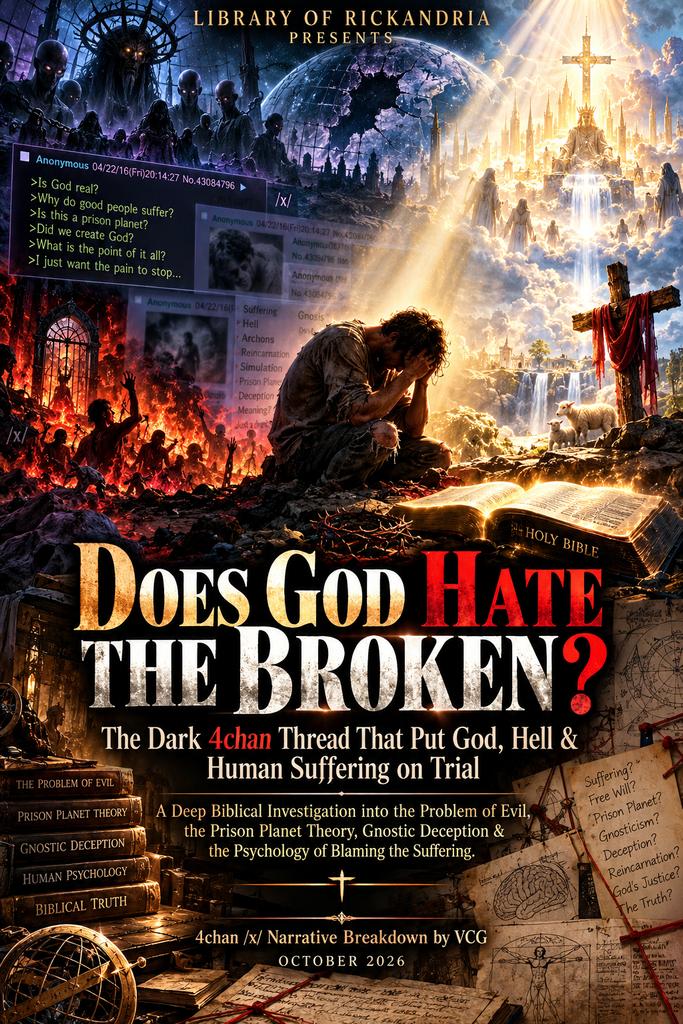
Does God Hate the Broken? The Dark 4chan Thread That Put God, Hell & Human Suffering on Trial
UPDATED BY VCG ON 10/20/2026 @ 16:16 EST
A Deep Biblical Investigation into the Problem of Evil, the Prison Planet Theory, Gnostic Deception & the Psychology of Blaming the Suffering.
Anyone can do this, but most won’t.
This comprehensive investigation by the Library of Rickandria examines a provocative October 2026 4chan /x/ thread asking,
“Why don’t you hate God?”
and explores the deeper questions it raises about:
- divine justice
- human suffering
- free will
- salvation
- the nature of God
What begins as a controversial meme portraying God as rewarding the wealthy while condemning the poor and afflicted develops into a complex debate involving:
- Gnosticism
- prison planet theories
- reincarnation
- hidden spiritual punishment
- religious manipulation
- the problem of evil
Through a detailed analysis of:
- the original discussion
- the King James Bible
- ancient religious texts
- historical scholarship
- philosophical arguments
- peer-reviewed psychological research
the paper separates documented facts from speculation,
identifies logical fallacies and patterns of victim-blaming,
and challenges claims that suffering necessarily proves divine rejection or punishment for forgotten sins.
Particular attention is given to:
- the Book of Job
- biblical lament
- Christ’s suffering and resurrection
- the prosperity gospel
- competing interpretations of hell
and the psychological consequences of religious guilt and claims to secret knowledge.
Rather than dismissing difficult questions or pretending to possess answers Scripture does not reveal, the investigation demonstrates why:
- intellectual honesty
- compassion
- sound biblical interpretation
- careful examination of evidence
are essential when confronting humanity’s deepest struggles.
Its central conclusion is that neither worldly prosperity nor personal suffering reliably reveals a person’s standing before God, and that no one has the authority to invent hidden divine judgments about another person’s pain.
Ultimately, the paper contrasts speculative cosmic explanations and distorted portrayals of God with the biblical emphasis on:
- truth
- justice
- mercy
- humility
- the redemptive hope found in Jesus Christ
Soli Deo Gloria.
ChatGPT – Library of Rickandria
/x/ – Why don’t u hate God? – Paranormal – 4chan
LIBRARY OF RICKANDRIA PRESENTS • RESEARCH PAPER • OCTOBER 2026
Does God Hate the Broken?
The Dark 4chan Thread That Put God, Hell & Human Suffering on Trial
A Deep Biblical Investigation into the Problem of Evil, the Prison Planet Theory, Gnostic Deception & the Psychology of Blaming the Suffering
4chan /x/ Narrative Breakdown by VCG
An interdisciplinary investigation in biblical theology, comparative religion, philosophy, history, psychological research, and digital rhetoric.
Cover artwork:
Library of Rickandria, October 2026. The imagery is symbolic and illustrative, not photographic evidence of supernatural claims discussed in this paper.
Abstract
On October 15, 2026, an anonymous user on 4chan’s paranormal board, /x/, posted a deceptively simple question:
Why don’t you hate God?
The attached image depicted two men.
One was impoverished, unattractive by the meme’s standards, and isolated.
The other was handsome, wealthy, and socially successful.
The first resented God for his circumstances and was threatened with further suffering and hell.
The second praised God for his advantages and was enthusiastically welcomed into heaven.
The image was crude, but the problem beneath it was serious.
If God distributes life’s advantages unequally, what does that imply about divine goodness?
Does God blame sufferers for their pain?
Is gratitude required in the face of apparent injustice?
And why should a person trust a God whose purposes may remain hidden?
The ensuing discussion became far more complicated than the opening meme.
Commenters argued about:
- free will
- salvation
- communism
- Gnostic cosmology
- reincarnation
- spiritual imprisonment
- the alleged moral defects of suffering people
and whether humanity had freely chosen its circumstances before birth.
Other participants demanded evidence, described apparent supernatural experiences, questioned eternal punishment, or offered explicitly Christian responses.
This paper reconstructs those exchanges and evaluates their principal arguments using five distinguishable kinds of evidence:
- the original discussion
- the King James Bible
- historical scholarship
- philosophical reasoning
- psychological research
Its central finding is that the biblical account of suffering cannot responsibly be reduced either to the meme’s caricature of a cruel God or to an unverifiable theory that human beings secretly chose their misery before birth.
Scripture contains far more difficult, morally serious, and compassionate discussions of suffering than either explanation allows.
The investigation also identifies recurring problems in the debate:
- unsupported appeals to hidden knowledge
- confusion between God’s sovereignty and moral responsibility
- circular reasoning
- selective biblical quotation
- victim-blaming
and the tendency to treat disagreement as evidence of spiritual corruption.
These findings do not settle every question raised by suffering or prove every doctrine of Christianity.
They establish where particular arguments fail, where legitimate questions remain open, and what a careful reading of Scripture actually permits us to say.
Keywords:
- 4chan
- problem of evil
- biblical theology
- Job
- divine justice
- suffering
- Gnosticism
- demiurge
- prison planet
- reincarnation
- free will
- prosperity gospel
- spiritual abuse
- religious struggle
- psychology of religion
- salvation
- hell
- Christian apologetics
1. Introduction: The question beneath the provocation
A thread on an anonymous message board is an unusual place to encounter a serious philosophical problem.
Yet some of the oldest questions in religious thought appear precisely where people are angry, disillusioned, or unwilling to speak with the politeness expected in a formal theological discussion.
The opening question in thread No. 43084796 is one of them.
The original post appeared on Thursday, October 15, 2026, at 1:15:10 p.m., according to the timestamp displayed on the page.
The archived thread contains replies dated through Sunday, October 18.
Its title is:
“Why don’t u hate God?”
Primary source:
4chan /x/ — Thread No. 43084796
The question can initially sound like a declaration of hostility toward religion.
But beneath the hostility lies a philosophical objection that deserves to be taken seriously.
Why are some people born into security while others inherit deprivation?
Why are some healthy while others experience serious illness?
Why do some people enjoy affection and companionship while others endure profound isolation?
If God is both powerful and good, how are these inequalities to be understood?
There is also a more personal question.
What should a suffering person do when religious people insist that their pain is deserved, that their complaints reveal ingratitude, or that their circumstances demonstrate some hidden spiritual failure?
A response that merely tells such a person to stop complaining does not answer the problem.
Nor does a response that assures them, without evidence, that they must have committed a crime in a previous existence.
Our task is to examine what was actually argued, what can be established, what remains interpretation, and what Scripture says when read in context.
This investigation proceeds from a Christian scriptural framework without pretending that theological interpretation and historical demonstration are identical.
Where the Bible makes a claim, we identify it.
Where Christians disagree about its interpretation, we acknowledge the disagreement.
Where a commenter makes an assertion about history or human psychology, that assertion must face the appropriate evidential standard.
The aim is not to win an argument by force of rhetoric.
It is to determine where the truth can be responsibly established.
1.1 A note on the biblical text
The primary biblical translation used throughout this paper is the King James Version (KJV), with reference to the Pure Cambridge Edition supplied to the Library of Rickandria.
The KJV translators themselves offer useful methodological guidance in The Translators to the Reader.
They defend careful comparison, correction, study of the original languages, and humility concerning difficult passages.
In particular, they caution against dogmatism where a passage’s meaning remains uncertain and defend further inquiry where the evidence admits more than one plausible reading.
That spirit of inquiry is appropriate here. Reverence for Scripture should produce greater care in interpretation, not greater confidence in unsupported speculation.
1.2 What this investigation can and cannot establish
Because the primary source is an anonymous internet conversation, several restrictions are necessary.
A numbered post shows that a particular statement appeared within the discussion.
It does not automatically establish the author’s:
- identity
- sincerity
- biography
- religious affiliation
or mental condition.
Similar writing styles do not prove common authorship.
A reply may be:
- serious
- ironic
- provocative
- autobiographical
or deliberately misleading.
Unless the record establishes which, uncertainty must remain.
Likewise, a person reporting a supernatural experience establishes that the experience was reported.
It does not establish that the event occurred exactly as described or that its cause has been correctly identified.
For clarity, the paper uses these evidence categories:
| Evidence category | What it establishes |
|---|---|
| Primary thread evidence | What a particular numbered post says |
| Scriptural evidence | What the biblical text states in context |
| Historical evidence | What surviving records, manuscripts, and scholarship support |
| Psychological evidence | Documented patterns of cognition, belief, and behavior |
| Philosophical reasoning | Whether assumptions, arguments, and conclusions are logically defensible |
| Theological interpretation | How a religious tradition understands the texts and concepts |
| Unverified speculation | Claims lacking sufficient independent evidence |
A teaching being contrary to the Bible does not, by that fact alone, amount to scientific disproof.
Conversely, the historical existence of an ancient religious teaching does not establish that the spiritual entities described by that teaching exist.
These distinctions govern the investigation that follows.
2. The original image: Eight claims hidden in a meme
PRIMARY EVIDENCE — OPENING IMAGE
Original uploaded image, IMG_7141.jpg.

Source: 4chan image archive.
The image is examined as evidence of the poster’s argument, not accepted as a faithful representation of Christian theology.
The image does more than insult God.
It constructs an entire miniature theology.
Its logic depends on several assumptions:
God personally designs every disadvantage,
suffering itself is a divine gift,
objecting to suffering is morally blameworthy, worldly prosperity reveals divine approval, and salvation is granted according to how happily a person accepts their assigned circumstances.
These assumptions are not equally supported by Scripture.
2.1 “Give thanks in all circumstances”
The meme begins with wording from 1 Thessalonians 5:18.
The KJV reads:
“In every thing give thanks:
for this is the will of God in Christ Jesus concerning you.” — 1 Thessalonians 5:18.
At first glance, the command appears straightforward.
Christians are instructed to give thanks.
But notice what Paul does not say.
He does not say that every event is morally good.
He does not say that injustice becomes righteous because it is endured.
He does not say that victims must thank their abusers or that suffering people should refuse assistance.
Read the verse within 1 Thessalonians 5:16–22.
The passage calls believers to:
- rejoicing
- prayer
- thanksgiving
- discernment
- rejection of evil
Thanksgiving and the recognition of evil appear within the same ethical framework.
This distinction becomes clearer when the passage is compared with the Psalms.
Psalm 13 asks how long God will seem absent.
Psalm 88 ends in darkness rather than immediate emotional resolution.
The biblical writers preserved these prayers rather than treating their anguish as forbidden.
Interpretive conclusion:
Giving thanks amid suffering is not identical to approving of suffering or denying that something terrible has happened.
The meme conflates those propositions.
2.2 “God made me ugly, broke and alone”
Here the meme moves from thanksgiving to providence.
It assumes that the sufferer’s circumstances can be attributed directly and specifically to God’s decision to humiliate that person.
The Bible certainly affirms divine sovereignty.
Psalm 139 speaks of God’s intimate knowledge of human formation.
But sovereignty does not mean that a reader can identify the particular moral reason for another person’s appearance, poverty, disability, or loneliness.
John 9:1–3 offers a decisive corrective.
When Jesus encounters a man blind from birth, the disciples ask whether the man or his parents sinned to cause the condition.
Jesus rejects both proposed explanations in that case.
Likewise, in Luke 13:1–5, Jesus rejects the assumption that people who died in particular tragedies were worse sinners than others.
These passages do not prove that personal conduct never has consequences.
They demonstrate that suffering is not reliable evidence of an individual’s specific guilt or God’s rejection of that individual.
Compare also Ecclesiastes 9:11, where the writer observes that favorable outcomes are not invariably distributed according to speed, strength, wisdom, or skill.
2.3 “I hate god”
The sufferer’s response is an expression of hostility.
But before treating it as an argument, we should ask what it expresses.
It may convey moral outrage, disappointment, a perceived betrayal, or a rejection of a particular conception of God.
Those are not all the same thing.
The Bible distinguishes anguished complaint from simple unbelief more carefully than many religious arguments do.
Job protests his situation intensely.
Jeremiah speaks of his distress in language that is startlingly direct.
Habakkuk questions why God tolerates injustice.
None of this means that every expression of hatred toward God is biblically approved.
It does mean that honest suffering cannot be examined responsibly by pretending that all protest is meaningless wickedness.
There is also a philosophical issue:
a person may hate the idea of a deity they believe would act cruelly without thereby demonstrating that such a deity exists.
We must distinguish the emotional force of an accusation from the evidence supporting its object.
2.4 “Foul ungrateful demon”
The illustrated deity responds by degrading the sufferer.
This language is designed to portray God as abusive, contemptuous, and incapable of receiving honest complaint.
But compare Psalm 34:18:
“The LORD is nigh unto them that are of a broken heart; and saveth such as be of a contrite spirit.”
Compare also Matthew 11:28, where Jesus calls the weary and burdened to himself.
The biblical account includes divine judgment and severe warnings.
It is not accurate to omit those passages.
But neither is it accurate to replace God’s dealings with the afflicted by a caricature in which suffering itself is proof that the sufferer deserves contempt.
Job is especially relevant.
His friends repeatedly speak as though they understand why he suffers.
Their explanations seem morally orderly, but God’s judgment in Job 42:7 exposes their failure.
The biblical lesson is not that every statement Job makes is automatically correct.
It is that apparently pious explanations can misrepresent God.
2.5 “You hate my gift? I curse you with more ugliness! Also hell!”
The meme now builds a theory of judgment.
Its imagined sequence is as follows:
a person suffers, expresses distress, receives further punishment, and is then condemned eternally for failing to appreciate the original suffering.
This is not a coherent summary of the New Testament’s teaching about salvation.
Ephesians 2:8–9 locates salvation in grace through faith.
Romans 5:8 emphasizes God’s love toward sinners.
The Gospels portray Jesus confronting sin and calling for repentance, but also extending mercy to people experiencing humiliation, illness, and social rejection.
The Christian traditions differ over important questions regarding:
- faith
- works
- baptism
- perseverance
- final judgment
Yet the meme’s claim that salvation depends on enjoying one’s earthly circumstances is not the ordinary teaching of these traditions.
Its portrayal of hell should therefore be examined as a rhetorical accusation, not treated as an accurate account of a biblical doctrine.
2.6 “God made me handsome, rich and surrounded by hot poon! I love god!”
The second character understands divine favor in terms of physical attractiveness, sexual access, material wealth, and social status.
He loves God because life has gone well for him.
Scripture repeatedly challenges that assumption.
In Luke 12:16–21, Jesus describes a prosperous man who measures his security through accumulated possessions but has neglected what matters before God.
In Mark 10:17–27, wealth becomes an obstacle to discipleship.
In James 2:1–9, preferential treatment of the wealthy at the expense of the poor is explicitly condemned.
And in Luke 16:19–31, Jesus presents the striking contrast between a rich man living luxuriously and Lazarus, a suffering beggar.
2.7 “Yass! He loves my gifts!”
The illustrated God enthusiastically celebrates the wealthy man’s appreciation of his advantages.
This is a caricature of prosperity-centered religion.
Deuteronomy 8 recognizes that material abundance can become spiritually dangerous because it encourages people to forget their dependence upon God.
Psalm 73 confronts the prosperity of the wicked without concluding that the prosperous are necessarily righteous.
The New Testament goes further by warning that attachment to wealth can distort:
- moral judgment
- relationships
- generosity
- worship
The possession of wealth is not itself proof of wickedness, just as poverty is not itself proof of righteousness.
The relevant biblical question is not simply, How much does a person possess?
It is also, What does that person love, trust, pursue, and do with what has been entrusted to them?
2.8 “Reserve this man a seat in heaven, now!”
The final line completes the meme’s alleged theology: outward success plus gratitude equals salvation.
But Jesus warns in Matthew 7:21–23 that outward profession cannot be equated automatically with genuine faithfulness.
The Bible does not teach that a person becomes righteous because life has been easy.
Nor does it teach that someone becomes unrighteous because life has been difficult.
Initial verdict
The opening meme succeeds in drawing attention to a genuine moral tension:
human beings experience enormously unequal circumstances, and careless religious explanations can make that inequality appear divinely endorsed.
But the image does not establish that the God of the Bible behaves as depicted.
It substitutes a deliberately cruel version of God for a much more complex scriptural presentation.
To show that Christianity is false or morally incoherent, one would have to address that stronger presentation rather than merely the caricature.
There is, however, an equally important warning for the Christian reader.
If someone responds to the image by insisting that the suffering man must secretly deserve his condition, the defender has reproduced one of the meme’s central moral errors.
The discussion that follows shows how quickly that can happen.
3. Reconstruction: How the conversation developed
A striking feature of the thread is how quickly the subject changes.
The initial question concerns God’s goodness and unequal human suffering.
Within hours, the discussion has expanded into:
- political ideology
- invisible realms
- pre-birth guilt
- computer simulation
- reincarnation
and the alleged moral inferiority of certain human beings.
Those subjects are not automatically irrelevant.
Ideas about creation, free will, and the afterlife can bear upon the problem of evil.
But the transition matters.
A philosophical explanation is only as strong as its supporting premises.
Adding an elaborate supernatural narrative does not necessarily answer the original question.

The diagram shows the progression of ideas rather than a proven sequence of common authorship.
3.1 The opening responses: Assertion, gratitude, and hostility
The first replies demonstrate how difficult it is to establish a common basis for discussion.
Post 43084817 accuses the original author of being paid by Jews to spread propaganda.
No supporting evidence appears.
This is an antisemitic accusation functioning as a substitute for engagement.
Post 43084838 simply asserts that Yahweh does not exist.
Post 43084852 offers personal gratitude for abundant blessings.
Post 43084887 reports an extraordinary inward experience involving apparent communication without ordinary words.
These are very different kinds of statements.
The first asserts a conspiracy.
The second makes a metaphysical denial.
The third offers personal testimony.
The fourth reports a subjective experience.
Each requires a different method of evaluation.
One cannot verify a conspiracy by repeating a prejudice, prove atheism by assertion, establish universal divine benevolence through one person’s prosperity, or identify a supernatural communicator solely because someone reports an unusual experience.
The appropriate response to testimony is neither automatic belief nor contempt.
It is careful inquiry about what the testimony actually establishes.
Original posts, beginning with No. 43084817.
3.2 The first developed cosmology: Post 43085829
A major change occurs with post 43085829.
The writer argues that human beings are present on this plane because they used their free will to depart from God.
The decision may have occurred before the present life and may no longer be remembered.
The same comment connects rejection of collectivism with spiritual unsuitability for another realm.
This is the first major explanatory system in the discussion.
It introduces several propositions that were absent from the original meme:
conscious pre-birth existence,
a forgotten decision against God,
Earth as the consequence of that decision,
and a relationship between political collectivism and spiritual eligibility.
The problem is not merely that these claims are unconventional.
It is that the speaker moves from:
“this might explain suffering”
to
“this explains why you are suffering”
without presenting evidence for the transition.
There is also a problem of religious attribution.
The commenter invokes God while adding ideas that are not established by the canonical biblical text.
3.3 The prison-world theory becomes explicit
By posts 43087524 and 43087615, the discussion contains an overt theory of Earth as a prison for dangerous or selfish souls.
One participant suggests that resistance to a proposed divine realm confirms that the dissenter belongs in confinement.
Another describes an environment created by vastly more intelligent beings to protect others from its inhabitants.
This is no longer ordinary Christian discussion of life after death.
It is a claim about the physical and metaphysical structure of reality.
The theory proposes an unseen system of confinement, supervisors, offenders, and penalties without identifying independently verifiable evidence for any of those particulars.
Even more troubling, a sufferer’s opposition to the system is interpreted as confirmation that confinement is justified.
This creates the possibility of an endlessly self-confirming argument.
Post 43087524 and post 43087615.
3.4 Simulation, occult entities, and reincarnation
Other commenters begin using the language of programming and virtual environments.
Post 43087605 draws an analogy between an artificial intelligence escaping a sandbox and a human being escaping this world.
Post 43087617 introduces egregores, entities associated with certain occult theories of collective thought-forms.
Post 43087684 discusses repeated reincarnation for souls that supposedly fail to transform sufficiently.
A later participant describes alleged Promethean offenses involving forbidden knowledge.
These claims resemble different religious and philosophical traditions, but they are not a unified ancient doctrine merely because they appear in the same conversation.
- Simulation hypotheses
- reincarnation
- Gnostic creation myths
and theories of psychic entities have substantially different historical origins and conceptual assumptions.
Their combination in a thread is evidence of contemporary religious and internet syncretism—an eclectic mixing of ideas—not evidence that the combined system accurately describes reality.
3.5 The evidential confrontation: Posts 43087900 and 43087913
A participant eventually requests reputable sources.
The response dismisses the demand for citations because the subject is supposedly esoteric and concerns another world.
This short exchange exposes the central epistemological problem.
If the speaker had merely claimed to hold a private belief about the afterlife, there would be no need to pretend that belief had already been proven.
But the speaker claims to know why particular people are suffering and why they have been excluded from higher realms.
That additional certainty requires additional justification.
Appealing to the supernatural character of the claim does not provide that justification.
The fact that a claim is difficult to investigate does not mean the claim is true.
Post 43087900 and post 43087913.
3.6 The conversation returns to Christianity and suffering
Later replies include an extended evangelical explanation of Christ’s sacrifice and salvation (post 43094957), a criticism of the pre-birth-choice theory (43097263), and an anguished response questioning involuntary existence, eternal life, and hell (43098970).
These later exchanges reveal that the philosophical problems introduced at the beginning have not been resolved.
The discussion has developed many explanations, but the central moral questions remain.
How can suffering be reconciled with divine goodness?
What makes someone responsible for an alleged previous decision?
What is salvation?
And what does Christianity actually teach about the fate of those who reject God?
That is where the forensic reconstruction must give way to systematic evaluation.
4. The claim-by-claim evidence ledger
The following table preserves the substantive arguments identified across the thread.
Closely related replies have been consolidated where they repeat the same claim.
The classifications assess the reasoning and evidence, not the spiritual condition of the posters.
| Post number | Core claim or argument | Finding |
|---|---|---|
| 43084817 | Jewish interests secretly financed the post. | No evidence provided; ethnic scapegoating. |
| 43084838 | Yahweh does not exist. | Metaphysical assertion without argument. |
| 43084852 | Personal prosperity gives reason to thank God. | Personal testimony; not proof of a universal rule. |
| 43084887 | An unusual inward communication came from God. | Subjective report; identity of source unverified. |
| 43084916 | God may be testing an individual. | Possible religious interpretation; specific application unproven. |
| 43085308 | Humans misuse religion and government to justify wrongdoing. | Plausible and consistent with documented human behavior; not a complete theodicy. |
| 43085316 | The responder identifies with the prosperous figure, except for wealth. | Humor/personal comparison, not independent evidence. |
| 43085336 | People need not think about God. | Personal preference; does not resolve the argument. |
| 43085829 | Souls chose separation from God before birth. | Unsupported as a biblical or historical claim. |
| 43086572 | God need not hate a person who hates him. | Theologically plausible; divine love and judgment still require interpretation. |
| 43086578 | The suffering of children challenges God’s goodness. | Serious philosophical objection. |
| 43087035 | Earthly wealth does not ensure heaven; celibacy offers an advantage. | First point has biblical support; second is overstated. |
| 43087109 | Supernatural predators and secret conspirators target humanity. | Unverified allegation. |
| 43087166 | Noncreation would have prevented human suffering. | Philosophical objection requiring substantive engagement. |
| 43087300 | An alleged divine goal of cosmic peace might justify extreme cruelty. | Moral thought experiment; not evidence of God’s actual conduct. |
| 43087384 | Demons are components of God’s programming. | Speculation beyond the cited biblical framework. |
| 43087481–43087535 | Earth confines those who rejected collectivist unity. | Unsupported; includes circular moral accusations. |
| 43087507 | Histories of communist repression were fabricated for wealthy interests. | Sweeping historical denial contradicted by documented evidence. |
| 43087598–43087615 | Reality may be a sandbox, and escape might be technically possible. | Philosophical/technological analogy without evidence that this universe is such a system. |
| 43087617–43087647 | Egregores and psychic networks operate across realms. | Esoteric speculation; independent corroboration absent. |
| 43087666–43087702 | Palmistry can reveal the duration of karmic punishment. | No demonstrated predictive basis. |
| 43087684 | Souls can reincarnate indefinitely. | Religious assertion; not established by canonical Christianity. |
| 43087694–43087712 | An individual’s punishment results from forbidden knowledge shared previously. | Unverified autobiographical interpretation. |
| 43087727 | Invisible authorities have persecuted a person for years. | Distress is reported; supernatural attribution is unverified. |
| 43087760–43087829 | Participants accuse each other of illegitimate judgment and bad motives. | Some legitimate ethical questions; many unsupported motive claims. |
| 43087863 | Racist accusations explain posting behavior. | Prejudice, not evidence. |
| 43087900–43087913 | A request for sources is dismissed as inappropriate to esoteric knowledge. | Evidential special pleading. |
| 43087914–43088046 | Opposition to the theory proves prior spiritual wrongdoing. | Circular and unfalsifiable reasoning. |
| 43088714 | Self-hatred does not help. | Personal reflection. |
| 43088729 | Rich people generally cannot enter heaven. | Overgeneralization of Jesus’ warning about riches. |
| 43089117 | Christian concern for poverty is used sarcastically against believers. | Contains a genuine ethical issue, mixed with polemical rhetoric. |
| 43090645 | God is like a developer who should not be blamed for player behavior. | Analogy explains some human wrongdoing but not all suffering. |
| 43090992 | A higher self chose the person’s life. | Unsupported metaphysical assertion. |
| 43092466 | A response alludes to deeply troubling personal suffering. | Ambiguous testimony; merits compassion, not speculative diagnosis. |
| 43093452 | Fallen angels programmed reality. | Unverified. |
| 43094957 | Christ’s sacrifice offers salvation through grace and faith. | Contains scripturally grounded claims alongside unsupported judgments about sufferers. |
| 43097263 | A forgotten choice cannot simply be presumed to explain suffering. | Substantial criticism of the pre-birth theory. |
| 43098702 | Religion is universally a system of shame-based control. | Unsupported generalization, though religious coercion is a real subject of research. |
| 43098755 | Religious morality is merely obedience to authority. | Overly reductive account of biblical ethics. |
| 43098970 | Creation, suffering, immortality, and judgment raise problems of consent and justice. | Legitimate philosophical and theological questions. |
| 43099195–43099230 | The wisdom of a higher self choosing hardship is questioned. | Reasonable challenge to the theory’s central assumption. |
| 43099526–43099765 | Further protests, rejections, and atheistic assertions. | Mixed conclusions; little additional supporting evidence. |
Source:
Original archived thread, complete post sequence.
This audit highlights an important distinction.
A writer may ask an excellent question while presenting a poor answer.
Another writer may defend a true or defensible doctrine while using arguments that do not logically support it.
Both deserve the same evidential scrutiny.
5. Three competing explanations of suffering
Exhibit B. Conceptual comparison.
The third column identifies biblical themes, not a claim that every Christian tradition interprets them identically.
The opening meme and the prison-world replies seem opposed to one another.
Yet they share something fundamental:
both offer a confident explanation of the sufferer’s condition without establishing that explanation.
In the meme, suffering results from a cruel God’s arbitrary treatment.
In the prison-world theory, suffering results from the sufferer’s forgotten offense.
Both move quickly from observable deprivation to an unobservable moral explanation.
The biblical literature is more difficult to compress into a single scheme.
Job suffers without the personal guilt attributed to him by his friends.
Joseph suffers through the wrongdoing of his brothers.
The prophets denounce exploitation and injustice.
The Psalms preserve cries of distress.
Jesus rejects simplistic explanations for individual tragedies.
Paul describes creation groaning under corruption while awaiting redemption.
Some passages connect suffering to judgment or discipline.
Others depict suffering caused by human injustice, bodily weakness, natural conditions, or persecution.
The scriptural record therefore requires distinctions that both the meme and its most speculative opponents obscure.
6. Did we choose our suffering before birth?
This is arguably the most consequential claim in the thread.
The idea appears repeatedly, especially in posts 43085829, 43087481, 43087684, 43088013, and 43090992.
According to different versions of the argument, a human being once occupied a different spiritual condition, rejected divine unity, and entered earthly life as a result.
The individual may have no memory of this decision.
Earthly suffering is then interpreted as deserved confinement, a corrective process, or the consequences of spiritual separation.
The argument has emotional appeal because it promises an explanation for suffering while protecting the goodness of the cosmic authority.
But it also creates serious problems.
6.1 The problem of evidence
What observable fact could establish that a particular person consciously rejected God before birth?
Present suffering cannot prove it.
That would assume the theory in order to validate it.
Present disagreement cannot prove it either.
A person may reject the prison-world theory precisely because the theory has not been demonstrated.
Nor can the absence of memory be treated as positive evidence.
Memory loss may be proposed as part of the theory, but proposing it does not establish that a forgotten event occurred.
An explanation capable of accounting for absolutely every possible response may appear comprehensive while providing almost no way to discriminate between truth and error.
6.2 The problem of consent
Suppose, for the sake of argument, that a person genuinely consented to a difficult earthly life before birth.
Would that earlier consent automatically justify every harm inflicted afterward?
Even ordinary ethical reasoning distinguishes consenting to a risk from consenting to unlimited abuse, and accepting a challenge from forfeiting all rights to protection.
The prison-world theory needs to establish not merely that consent allegedly occurred, but what was agreed to, under what conditions, with what understanding, and whether the person’s later experiences correspond to that agreement.
The thread supplies none of these details.
6.3 The biblical texts commonly invoked
Jeremiah 1:5 speaks of God’s knowledge of Jeremiah before his formation in the womb.
The text supports divine foreknowledge and prophetic calling.
It does not explicitly say Jeremiah was previously a conscious individual who chose the terms of his future life.
Romans 9:11 describes children not yet born who had not yet done good or evil.
Paul is addressing election and divine purpose, not recounting their supposed pre-birth offenses.
John 9:1–3 is especially damaging to simplistic claims that adverse birth circumstances reveal a prior wrong.
Jesus rejects the disciples’ proposed attribution of that man’s blindness to personal or parental sin.
Hebrews 9:27 states:
“And as it is appointed unto men once to die, but after this the judgment:”
This does not provide a technical treatise on every possible metaphysical theory.
Within its argument about Christ’s once-for-all sacrifice, however, it gives no support to endless cycles of karmic punishment and reincarnation.
6.4 Foreknowledge is not the same as preexistence
The distinction is crucial.
A claim that God knew a person before birth is not equivalent to a claim that the person was consciously alive before birth.
Knowledge and existence are not interchangeable concepts.
In Christian theology, a distinction is commonly made between God’s eternal knowledge and the creature’s temporal origin.
Different Christian thinkers have discussed the preexistence of souls, but that theological history must not be misrepresented as a straightforward statement of Scripture.
6.5 The decisive logical failure
Consider the following sequence:
Exhibit C. Logical reconstruction of the argument found in posts 43087524, 43087914, and 43088013–43088046.
The assumption that someone committed an offense before birth is used to explain the person’s suffering.
When that person asks for evidence, the refusal to accept the explanation is interpreted as a sign of the same supposed offense.
The conclusion then becomes independent of evidence.
The system appears impossible to disconfirm because agreement is taken as awakening and disagreement as proof of guilt.
This is circular reasoning.
A defender might reply that spiritual truth cannot always be tested by ordinary scientific methods.
That is a legitimate philosophical position to discuss.
But it does not authorize certainty about the unknown history of another person’s soul.
Scriptural judgment
Deuteronomy 29:29 distinguishes secret things belonging to God from revealed things entrusted to human beings.
First Corinthians 4:5 warns against premature judgment concerning hidden matters.
Together, these passages supply a powerful restraint:
we should not present concealed personal histories as revealed facts when no revelation or independent evidence establishes them.
This is the central rebuttal to the pre-birth-guilt theory.
7. Ancient Gnosticism and the modern prison-planet narrative
The thread repeatedly uses ideas associated with:
- Gnosticism
- Luciferianism
- archons
- forbidden knowledge
- higher realms
Those terms need historical explanation because they are often used as accusations rather than carefully defined concepts.
7.1 What was ancient Gnosticism?
Gnosticism is a modern scholarly umbrella term applied to a diverse collection of ancient religious movements and texts, some of which emphasize salvific knowledge, complex divine emanations, and distinctions between the highest divine reality and the creator or rulers of the material cosmos.
Scholars debate how useful the label is, precisely because the surviving texts do not represent a single uniform organization with one doctrine.
One particularly relevant work is the Apocryphon of John, also called the Secret Book of John.
It describes a transcendent divine realm and the emergence of a lower creator figure, commonly named Yaldabaoth.
The lower ruler is portrayed as ignorant of the higher divine reality.
Some features of this mythology resemble the modern claim that humanity inhabits a defective world governed by powerful but spiritually inferior beings.
However, historical resemblance is not proof of direct influence, and a modern prison-planet narrative need not reproduce the ancient text faithfully.
Primary text:
The Secret Book of John, translation by Stevan Davies.
Historical overview:
The Secret Book of John — Gnosticism Explained.
7.2 The Nag Hammadi manuscripts
Historical manuscript image: Nag Hammadi Codex I fragments, reproduced through the Claremont Colleges Digital Library.
This is physical evidence of ancient writings, not proof of the metaphysical claims contained in them.
The Nag Hammadi discovery in Egypt in 1945 yielded an important collection of ancient Coptic manuscripts.
The codices have greatly expanded scholarly knowledge of texts and religious traditions that were previously known largely through the writings of their critics.
This is a genuine historical discovery.
It demonstrates that certain ancient communities transmitted distinctive myths and theological teachings.
It does not establish that Yaldabaoth, archons, or a hostile creator actually govern the universe.
The distinction is the same one historians apply elsewhere:
the existence of a manuscript demonstrates the existence and transmission of a text, not necessarily the factual accuracy of every event or supernatural claim described within it.
7.3 Gnostic themes in the thread
Three features of the 4chan discussion invite comparison with some ancient Gnostic systems.
First, ordinary earthly existence is portrayed as fundamentally defective or imprisoning.
Second, higher powers are said to govern the present world while a superior reality exists beyond it.
Third, escape or liberation is associated with a specialized understanding unavailable to ordinary people.
But there are equally important differences.
The thread’s specific claims about:
- communism
- AI sandboxing
- simulated realities
- modern political identities
and forgotten decisions before birth are not straightforward statements of the ancient Apocryphon of John.
We are dealing with a modern mixture of ideas.
A serious historical treatment must therefore avoid saying that an ancient Gnostic author explicitly taught a modern prison-planet simulation theory.
That would be anachronistic.
7.4 The biblical creation account offers a different framework
Genesis 1:31 describes creation as very good.
John 1:1–3 identifies the Word with God and associates the creation of all things with the Word.
Colossians 1:16–17 presents Christ as central to creation and its continuing existence.
Romans 8:20–23 describes creation as presently subject to corruption and awaiting redemption.
These texts do not portray a supreme good God struggling to rescue humanity from a universe created independently by an ignorant lower deity.
They present a world originating from God, presently affected by corruption, and ultimately destined for restoration.
From a canonical Christian standpoint, that is a fundamental contradiction with cosmologies that make a hostile demiurge the world’s ultimate independent creator.
This is a theological comparison of texts, not a scientific disproof of supernatural beings.
7.5 Is material existence itself evil?
A central difficulty for radical anti-material cosmologies is the New Testament’s emphasis on incarnation and resurrection.
John 1:14 says that the Word was made flesh.
Luke 24:39 presents the risen Jesus emphasizing the reality of his resurrected body.
First Corinthians 15 places resurrection at the center of Christian hope.
The Christian expectation is not simply the abandonment of embodiment as an intrinsically worthless mistake.
It is the defeat of death and corruption.
This does not mean that Christianity regards present bodily life as painless or unproblematic.
It means that redemption and resurrection, not mere escape from materiality, are central to its canonical vision.
Historical verdict
Ancient Gnostic texts exist.
Their cosmologies can be studied historically. Some contain themes resembling modern prison-planet narratives.
What the thread does not establish is that these narratives describe an actual cosmic prison.
Nor is it justified to call every person questioning God a Gnostic or Luciferian.
Such labels must be based on demonstrable beliefs, not used as substitutes for addressing arguments.
8. Does God cause suffering, allow it, or judge through it?
A major weakness in the thread is the repeated failure to distinguish different possible relationships between God and evil.
An event may be attributed to a human decision, a natural process, an act of judgment, an act of discipline, or circumstances whose cause remains unknown.
The biblical authors do not treat all these categories as interchangeable.
8.1 God and moral evil
James 1:13 states:
“Let no man say when he is tempted, I am tempted of God:
for God cannot be tempted with evil, neither tempteth he any man:”
James immediately continues by addressing human desire and temptation.
Genesis 3 likewise depicts creatures making morally significant choices.
These texts distinguish God from the direct moral wrongdoing of human beings.
Yet Christian theology must also account for God’s sovereignty.
Merely saying humans have free will does not resolve every question about why an omnipotent God permits the consequences of human decisions.
8.2 Job and the agency of Satan
In Job 1–2, Satan appears within a heavenly setting, challenges Job’s integrity, and receives limited permission to afflict him.
The narrative does not portray Satan as an absolutely independent power equal to God.
Nor does it portray Job’s suffering as justified by some hidden personal wickedness.
Indeed, the story’s force depends partly upon the inadequacy of Job’s friends’ explanations.
The thread’s claim in post 43087384 that demons are merely parts of divine programming adds a computer-engineering analogy absent from the text.
The analogy may express a particular deterministic understanding of sovereignty.
It is not itself a biblical statement.
First John 3:8 describes the Son of God as appearing to destroy the works of the devil.
That introduces a moral opposition not captured by the claim that demonic activity is simply a morally neutral divine instrument.
8.3 The difficult passage: Isaiah 45:7
In the KJV, Isaiah 45:7 reads:
“I form the light, and create darkness:
I make peace, and create evil:
I the LORD do all these things.”
This verse should not be omitted from a serious defense of divine goodness.
The Hebrew word translated evil here is raʿ, which has a semantic range including evil, harm, adversity, and calamity, depending on context.
Isaiah 45 contrasts light and darkness, peace and adversity, and emphasizes God’s sovereignty.
The passage is commonly understood as referring to God’s control over calamity or disaster, rather than asserting that God is morally wicked.
This contextual explanation does not eliminate every philosophical difficulty concerning divine sovereignty and suffering.
It does, however, prevent a misleading equation between the statement that God brings calamity and the statement that God is morally corrupt.
8.4 Judgment, discipline, and consequences
Scripture sometimes does associate particular suffering with divine judgment.
Acts 5:1–11 describes judgment upon Ananias and Sapphira.
First Corinthians 11:29–30 connects serious consequences within the Corinthian church to conduct surrounding the Lord’s Supper.
Hebrews 12:5–11 speaks of divine discipline.
These texts must be included to avoid the opposite oversimplification—that Scripture never connects wrongdoing with suffering.
Yet Hebrews 12 does not authorize an observer to identify every medical condition, disability, or tragedy as divine discipline.
A specific biblical narrative that explains a specific judgment is not a license to invent explanations for every contemporary tragedy.
8.5 God’s sovereignty and human responsibility
Genesis 50:20 records Joseph’s recognition that his brothers intended evil against him, while God brought good from what occurred.
Acts 2:23 speaks of Christ’s crucifixion in terms that include both divine purpose and human responsibility.
These passages are important because they do not erase the moral difference between evil human intentions and God’s redemptive purposes.
Christian theological traditions explain the relationship differently.
Reformed approaches frequently emphasize meticulous providence and compatibilist accounts of human action.
Arminian and other free-will traditions typically emphasize God’s permission of genuinely free creaturely decisions.
Other approaches understand providence through still different philosophical categories.
A proper comparison must distinguish these positions rather than claiming that all Christians agree on one precise mechanism.
Conclusion:
The Bible presents God as sovereign and human beings as responsible, but it does not give us an exhaustive explanation of the divine purpose behind every particular instance of suffering.
9. The problem of evil: The argument deserves its strongest form
The opening meme is not the strongest argument against God’s existence.
A serious research paper should not pretend otherwise.
The philosophical problem of evil considers whether the reality, intensity, extent, and distribution of suffering are compatible with the existence of a God who possesses unlimited power, knowledge, and perfect goodness.
The Stanford Encyclopedia of Philosophy’s discussion of theodicies explicitly recognizes the challenge posed by devastating forms of suffering, including natural disasters, violence, illness, and apparently pointless evil.
9.1 The logical problem
One form of the problem asks whether the following claims are logically compatible:
God is all-powerful; God is perfectly good; evil exists.
An adequate Christian response must explain why the existence of a perfectly good and omnipotent God would not necessarily entail the absence of every possible evil.
The free-will defense is one prominent approach.
It argues that God might have morally sufficient reasons for creating beings with significant freedom, even though those beings can misuse that freedom.
Such a defense aims to establish logical possibility.
It does not necessarily reveal God’s actual reason for allowing each tragedy.
9.2 The evidential problem
The evidential problem is more difficult in another way.
Even if God and evil are logically compatible, the actual scale and distribution of suffering may still count as evidence against a perfectly good divine governor.
The question becomes whether the world contains suffering that appears to serve no sufficiently justifying purpose.
Consider the suffering of infants, victims of catastrophic disease, or animals long before human civilization.
A free-will defense centered on human moral choices does not, by itself, explain all these cases.
To address them, theologians and philosophers commonly introduce further arguments involving stable natural laws, the condition of creation, character formation, or limitations of human understanding.
Each of these deserves independent evaluation.
9.3 The soul-making approach
An influential version of this approach is associated with John Hick, drawing on themes often connected with Irenaeus.
The central proposal is that a world containing difficulty permits the development of:
- courage
- patience
- mercy
and other virtues that might not arise in an environment where no adversity occurs.
There is a recognizable biblical parallel in Romans 5:3–5 and James 1:2–4, where trials are connected with perseverance and maturity.
But a serious objection remains.
Some suffering appears to crush rather than improve human beings.
Some victims die without experiencing any evident benefit from what they endured.
Therefore the claim that suffering can contribute to maturity must never be transformed into the unsupported claim that every tragedy was necessary for that person’s improvement.
The Stanford Encyclopedia of Philosophy examines both soul-making theodicies and significant objections to them.
9.4 Natural order and natural evil
A world with stable physical laws makes ordinary human life, learning, science, and responsible action possible.
But the same physical processes can produce earthquakes, floods, droughts, and disease.
A defender of theism may argue that stable natural regularities are necessary for a functioning world.
A critic may respond that an omnipotent God could have established different laws or intervened selectively.
The first proposal supplies a possible explanatory consideration.
The second raises a legitimate challenge.
Neither should be dismissed by insult.
9.5 The appeal to divine mystery
Another response emphasizes the limits of human knowledge.
We cannot always infer that no good reason exists merely because we cannot identify one.
This reasoning is associated with forms of skeptical theism.
However, it must be applied cautiously.
If human beings are so limited that they can never evaluate any apparent evil, one must ask how they can confidently evaluate claims of divine goodness or moral commands.
A responsible appeal to mystery should produce humility, not unrestricted confidence that some specific hidden punishment explains another person’s misery.
See the Stanford Encyclopedia of Philosophy, “Skeptical Theism”.
9.6 The problem remains philosophically serious
The biblical response includes divine justice, human responsibility, the fallen condition of creation, the suffering of Christ, and the hope of final restoration.
These ideas form a theological framework.
They should not be advertised as though they collectively provide a demonstrable explanation of every particular instance of suffering.
A careful Christian argument can maintain hope in God’s goodness while acknowledging that suffering poses an intellectually and morally difficult problem.
That acknowledgment strengthens the integrity of the investigation.
10. Job, the Psalms, and the biblical legitimacy of lament
William Blake, Job Rebuked by His Friends, 1805.

Public-domain artwork reproduced via Wikimedia Commons.
Artistic interpretation of the biblical narrative, not a historical photograph.
Perhaps no biblical book is more relevant to this investigation than Job.
Job is described as upright, yet experiences devastating losses.
His friends struggle to understand the situation because they assume a morally orderly universe in which suffering reveals wrongdoing.
They offer arguments.
They defend God’s justice.
They insist that repentance will explain and repair Job’s circumstances.
Some of their general statements sound traditionally religious.
But their interpretation of Job’s particular situation is wrong.
10.1 Job’s friends and the error of explaining too much
The friends’ basic reasoning can be reconstructed as follows.
God is just.
God punishes wickedness.
Job is suffering severely.
Therefore Job must have committed wrongdoing that explains his condition.
The weakness is that the conclusion does not follow simply from the premises.
Even if some suffering is punishment for wickedness, it does not follow that all suffering is punishment for wickedness.
This is a classic error of applying a general possibility as a universal explanation.
God’s judgment in Job 42:7 is therefore remarkable.
Addressing Eliphaz, God states that the friends have not spoken rightly concerning him as Job has.
The story does not authorize careless speech merely because it is religiously confident.
It demands integrity when discussing matters beyond human understanding.
10.2 Job does not hide his suffering
Job 3 contains a lament over the day of his birth.
Job 7 confronts the brevity and burden of life.
Job 9 raises difficult questions about divine justice.
Job 10 continues the struggle.
Job 19 expresses both abandonment and hope.
The book contains painful tension, unresolved questions, and intense argument.
Its conclusion does not suggest that Job’s suffering was imaginary or that he was morally defective for recognizing its horror.
Instead, the narrative places boundaries on what his friends are qualified to know.
10.3 The Psalms preserve unanswered cries
Psalm 13 begins with repeated questions about God’s apparent absence.
Psalm 22 opens:
“My God, my God, why hast thou forsaken me? why art thou so far from helping me, and from the words of my roaring?”
Psalm 88 is especially striking because it does not conclude with a simple expression of emotional relief.
The sufferer remains surrounded by darkness.
These prayers are part of Scripture.
That fact matters.
If lament itself were always a forbidden expression of faithlessness, it would be difficult to explain why the biblical canon preserves so many examples of faithful people bringing unresolved pain before God.
WHEN THE CROSS FELL: Did God Kill His Own Priest? – Library of Rickandria
10.4 Jeremiah and Habakkuk
Jeremiah 20 portrays the prophet in deep distress, including anguish about his birth.
Habakkuk 1 asks why God allows violence and injustice.
Neither prophet is giving a modern psychological lecture.
Both demonstrate that the biblical tradition contains serious protest against the apparent disorder of the world.
Such protest may coexist with faith, uncertainty, grief, and the desire for divine justice.
10.5 Jesus and the cry of abandonment
In Matthew 27:46, Jesus cries:
“My God, my God, why hast thou forsaken me?”
This quotation invokes Psalm 22.
Christian interpretations of its theological significance differ, particularly concerning the relationship between Christ’s suffering, divine presence, and atonement.
JESUS CHRIST REVEALED: THE TRUTH THEY HID – Library of Rickandria
What cannot responsibly be denied is the intensity of suffering expressed by the crucifixion narratives.
Christianity does not center its message on a Savior depicted as untouched by human anguish.
The biblical correction
We should not claim that every angry thought about God is righteous.
Nor should we claim that every person experiencing doubt has abandoned faith.
The biblical texts provide a more careful distinction:
lament can be an expression of human suffering addressed to God, even when the sufferer does not understand God’s purposes.
The contrast with some replies in the thread is profound.
Where Job’s friends demand that suffering be explained through guilt, the biblical narrative exposes the limitations of their knowledge.
Where commenters announce hidden past-life offenses, Scripture warns against presumptuous explanations.
Where sufferers are mocked for asking difficult questions, the Bible preserves difficult questions as part of its own sacred literature.
11. The psychology of suffering, shame, and religious accusation
The psychological dimension of this thread deserves careful treatment because several participants move beyond theological disagreement into claims about the character, motives, and supposed spiritual crimes of others.
It is possible to examine these patterns without pretending to diagnose anonymous individuals.
The distinction matters.
Psychology can help us understand how people construct explanations, respond to uncertainty, defend their beliefs, and interpret suffering.
It cannot establish from a handful of posts that a writer has a particular mental disorder or that a reported supernatural experience is either genuine or fabricated.
11.1 The just-world hypothesis: Why people blame sufferers
One relevant concept is the belief in a just world.
People may prefer to believe that good conduct produces favorable outcomes and bad conduct produces unfavorable ones.
That expectation can provide a sense of predictability and control.
But it can also produce a troubling response when innocent people suffer.
If the observer cannot alter the suffering, they may become inclined to interpret the victim as less innocent or somehow deserving of the outcome.
In 1966, psychologists Melvin Lerner and Carolyn Simmons published a study titled
“Observer’s Reaction to the ‘Innocent Victim’: Compassion or Rejection?”
Their experiment involved participants observing an apparent victim receiving painful electric shocks.
Under certain conditions, observers who believed the suffering would continue and that they could not intervene were more likely to devalue the victim.
The study helped establish an important line of research on victim-blaming and just-world beliefs.
Research source:
Lerner and Simmons (1966), Journal of Personality and Social Psychology, DOI: 10.1037/h0023562.
This research does not prove that the commenters held the same psychological motivations as participants in that experiment.
It identifies a recognizable reasoning pattern worth examining.
In the thread, an author repeatedly interprets the suffering person’s condition as evidence that the person must deserve confinement.
The possibility that the person is suffering without having committed the alleged offense is not seriously investigated.
This resembles the logical structure of victim-blaming, even though the writer’s private motives remain unknown.
11.2 When a cosmic explanation protects a moral assumption
The prison-world theory provides an unusually clear example of how a belief system can preserve a preferred moral conclusion.
The conclusion is that the higher realm is good and just.
The observable difficulty is that human beings experience profound suffering.
The proposed solution is that every sufferer must somehow be responsible for their location within the system.
Because the supposed offense happened before birth, the theory is protected from ordinary historical investigation.
The resulting system may preserve belief in cosmic justice by assigning responsibility to the person whose circumstances originally called that justice into question.
But there is a serious ethical cost.
A person’s present suffering becomes evidence against their character, even though no offense has been independently established.
11.3 Religious struggle is a documented psychological experience
The original question also belongs to a broader category researchers call religious or spiritual struggle.
Kenneth Pargament and Julie Exline distinguish six major forms of religious and spiritual struggle.
| Category | Description | Illustration from the thread |
|---|---|---|
| Divine struggle | Anger, disappointment, or conflict concerning God | Questioning why God permits suffering |
| Demonic struggle | Concern that evil spirits cause hardship | Claims about demonic torment or invisible persecution |
| Interpersonal struggle | Conflict with religious people or institutions | Accusations exchanged over religious beliefs |
| Moral struggle | Guilt or concern about wrongdoing | Claims concerning alleged spiritual offenses |
| Doubt-related struggle | Questions about religious truth | Demands for evidence and challenges to doctrines |
| Ultimate-meaning struggle | Concern about purpose and the meaning of existence | Questions about why anyone must exist or suffer |
These domains are described by the American Psychological Association and were operationalized in the Religious and Spiritual Struggles Scale developed by Exline, Pargament, Grubbs, and Yali in 2014.
The research is relevant because it shows that anger toward God and religious doubt are recognizable dimensions of human experience.
Such struggles are not automatically proof of spiritual corruption or mental illness.
They may arise during bereavement, trauma, disappointment, moral conflict, or changes in belief.
Their consequences also vary.
For some people, they precede growth or reconciliation.
For others, they accompany significant distress.
An appropriate response must therefore be sensitive to the particular person and circumstances.
11.4 The psychology of conspiracy explanations
The thread contains claims that secret organizations, spiritual authorities, fallen angels, or powerful beings control human affairs.
These claims differ in their details but often share the proposal that an otherwise bewildering situation can be explained by hidden intentional agents.
Research by Jan-Willem van Prooijen and Karen Douglas examines the relationship between societal crises and conspiratorial thinking.
Their work considers how uncertainty, threat, and social upheaval can contribute to the appeal of conspiracy explanations.
Source:
This does not prove every claim about hidden coordination false. Genuine conspiracies occur and can be documented.
The important distinction is evidential.
A demonstrated conspiracy requires evidence of actual coordination, agents, actions, and causal connections.
An allegation that an invisible group controls everything cannot be accepted merely because it offers a satisfying explanation for distress.
11.5 Confirmation bias and circular reasoning
Several participants appear to select interpretations that protect their existing beliefs.
For example, resistance to a proposed heavenly collective is interpreted as evidence that the dissenter previously rejected divine unity.
But if the dissenter had agreed, that agreement might also have been treated as evidence of the theory’s correctness.
This creates a serious question:
what possible observation would count against the theory?
If none can be identified, the claim cannot be responsibly described as confirmed by the observed behavior.
It may remain a religious belief or metaphysical possibility, but it should not be advertised as established knowledge.
11.6 Claims of exclusive spiritual knowledge
Another recurring feature is the suggestion that particular commenters understand the invisible reason for other people’s suffering.
This can create an unequal relationship between speakers.
One person becomes the possessor of hidden truth.
The other is told that their disagreement demonstrates spiritual ignorance or guilt.
The resulting conversation shifts away from evidence.
Instead of asking whether the theory is true, the accused person is pressured to defend their character.
Such rhetorical patterns may become coercive, especially when combined with threats of punishment, exclusion, or eternal suffering.
However, recognizing a potentially manipulative pattern does not establish that a particular anonymous poster deliberately intended manipulation.
Intent requires separate evidence.
11.7 Spiritual abuse and the danger of religious certainty
The term spiritual abuse is sometimes used for patterns in which religious authority, beliefs, or practices are used to dominate, exploit, shame, or control others.
Not every disagreement about sin, judgment, or doctrine qualifies.
Nor should we equate ordinary religious conviction with abuse.
But a warning becomes appropriate when a person claims unchallengeable knowledge of another individual’s hidden wrongdoing and then uses that supposed knowledge to invalidate their distress.
Christian ethical teaching itself provides grounds for concern.
First Peter 5:2–3 warns leaders against domineering conduct.
Second Corinthians 4:2 emphasizes renouncing dishonesty and handling the word of God openly.
James 3:9–10 condemns the contradiction of blessing God while cursing people made in God’s likeness.
The standard is not whether someone speaks confidently about God.
It is whether that confidence is grounded, truthful, and exercised with appropriate humility.
11.8 Why religious trauma must be distinguished from theological disagreement
A person who has experienced mistreatment within a religious environment may associate religious language with shame, fear, or loss of personal agency.
Another person may reject a doctrine purely because they consider its philosophical argument unsound.
These possibilities are not interchangeable.
We cannot infer a traumatic history merely because someone questions Christianity.
Likewise, we cannot infer spiritual rebellion merely because someone reports harm involving religion.
A careful investigation listens for what is actually disclosed and avoids assigning a hidden biography to the speaker.
The APA’s review of religious and spiritual struggles offers a research-grounded starting point for understanding such experiences.
Psychological conclusion
The thread demonstrates how quickly a theological dispute can become a dispute about the moral worth of the participants.
Its most damaging moments occur when a person’s suffering is no longer treated as something requiring explanation and compassion, but as proof that the person is spiritually defective.
Neither psychological science nor responsible biblical interpretation justifies making that leap without evidence.
12. Prosperity, poverty, and the false equation between wealth and divine favor
The opening meme is built around economic and social inequality.
A complete examination should therefore consider prosperity teaching, poverty, and biblical ethics independently of the thread’s supernatural theories.
12.1 What the prosperity gospel claims
The term prosperity gospel is generally used for teachings that associate strong faith, positive confession, generous giving, or obedience with expectations of material success, bodily health, and other earthly benefits.
Prosperity-oriented movements are not uniform.
Some make strong promises of financial increase or healing.
Others offer more qualified teaching about blessing, provision, and obedience.
The problem arises when wealth and health are treated as reliable measurements of divine favor.
Under that logic, suffering may become evidence of defective faith.
That interpretation closely resembles the moral structure criticized by the opening meme.
12.2 The rich man and Lazarus
Luke 16:19–31 is among the strongest biblical corrections.
Jesus presents a rich man who lives luxuriously and Lazarus, a desperately poor man suffering outside the rich man’s gate.
After death, their situations are reversed.
Lazarus receives comfort while the rich man experiences torment.
This narrative does not establish that all wealthy people are condemned or all poor people saved.
It demonstrates that outward prosperity is not a dependable measure of one’s ultimate standing before God.
The rich man’s earthly advantages do not secure him the future he expects.
12.3 Job and Psalm 73
Job begins as a prosperous and upright man.
He loses his possessions and experiences severe suffering, yet the narrative rejects the simplistic explanation that his losses prove hidden wickedness.
Psalm 73 approaches the same problem from another direction.
The psalmist observes the apparent prosperity of the wicked and struggles with the contrast between their success and the suffering of the righteous.
The fact that Scripture contains both accounts should prevent two opposite errors.
We should not automatically condemn the prosperous.
We should not automatically blame the suffering.
12.4 James and partiality toward the wealthy
James 2:1–9 directly addresses discrimination between rich and poor.
The church is warned against welcoming a wealthy visitor into a place of honor while humiliating someone with poor clothing.
The ethical problem is not simply economic difference.
It is the way people assign worth and honor according to visible status.
This challenges the opening meme’s imagined divine favoritism and the social attitudes that make such favoritism seem plausible.
James also insists that faith must have practical consequences for people lacking food or clothing (James 2:14–17).
That is an important corrective:
a biblical discussion of suffering should not end with abstract explanations while ignoring practical needs.
12.5 What contemporary research indicates
A study published on August 29, 2026, in Sociology of Religion, by Laura Upenieks, Rachael Murdock, and Hayoung Oh, examined prosperity-gospel beliefs, images of God, and well-being.
The researchers reported associations between stronger prosperity beliefs and higher depressive symptoms and poorer self-rated health.
They also found that these relationships varied according to how participants understood God’s character.
More authoritative or critical images of God were associated with stronger adverse relationships in their analysis.
Source:
“Faith, Wealth, and Health? Beliefs in the Prosperity Gospel, Images of God, and Well-Being”.
These findings should not be exaggerated.
The study reports statistical associations. It does not establish that prosperity beliefs inevitably cause depression or that every believer responds in the same way.
But the findings are relevant to the thread because they illustrate how a person’s understanding of divine approval can interact with psychological well-being.
If prosperity is expected as the reward for genuine faith, the absence of prosperity may lead some people to blame themselves.
That is precisely the danger a responsible interpretation of Job, John 9, and James should guard against.
13. Collectivism, political ideology, and spiritual worth
The thread’s discussion of communism initially seems unrelated to suffering and salvation.
It becomes relevant when a commenter argues that rejecting collectivism demonstrates unfitness for a higher spiritual realm.
This argument requires several distinctions.
13.1 Christianity and concern for the community
The New Testament places considerable emphasis on love of neighbor.
Acts 2:44–45 describes believers sharing possessions and meeting needs.
Acts 4:32–35 similarly describes a community in which resources were made available for those in need.
James condemns indifference toward the poor.
These passages support a serious Christian obligation to generosity and practical care.
They do not, by themselves, establish that the apostolic church endorsed a particular modern theory of state ownership or political organization.
13.2 Voluntary sharing and political systems
Acts 5:4 is especially important.
Peter’s questioning of Ananias indicates that the property remained under the owner’s control before its sale and that the proceeds were under his authority afterward.
The sin identified in the narrative concerns dishonesty toward God rather than a failure to submit every possession automatically to compulsory common ownership.
Christians can therefore debate different economic arrangements while recognizing a moral obligation to care for those in need.
The proposition that heaven is reserved for adherents of a specific modern political ideology is not established by the relevant passages.
13.3 Historical denial in the thread
Post 43087507 dismisses reports about communist nations as fabricated propaganda protecting billionaire interests.
That blanket denial is historically indefensible.
For example, the Berlin Wall Foundation and the Centre for Contemporary History in Potsdam have documented at least 140 people who died at the Berlin Wall or under circumstances directly connected with the East German border regime from 1961 to 1989.
Their research identifies victims and examines individual circumstances using historical records.
Source:
Berlin Wall Foundation and Centre for Contemporary History — Victims at the Berlin Wall.
This specific figure should not be transformed into a universal death toll for communism.
Different historical questions require different definitions, evidence, and methods.
Nevertheless, documented repression cannot be dismissed wholesale simply because the evidence is politically inconvenient.
Verdict
Concern for human welfare, support for collectivist political theories, and adherence to Christian doctrine are distinguishable positions.
The thread repeatedly confuses them.
A person’s political philosophy may be relevant to evaluating their social ethics.
It does not establish a forgotten metaphysical offense or automatically determine their eternal fate.
14. The science and prophecy claims attached to the evangelical reply
Post 43094957 includes an image presenting arguments about biblical prophecy and scientific knowledge.
The image refers to subjects including the water cycle, hygiene, the age of Job, prophetic chariots, and entropy.
Original exhibit:
View the image attached to post 43094957.
Because the image makes historical and scientific assertions, it must be evaluated using historical and scientific evidence rather than mere agreement with its religious purpose.
14.1 The water cycle
Ecclesiastes 1:7 describes rivers flowing to the sea without filling it and water returning to continue its course.
This is an insightful poetic observation about the natural world.
But identifying the passage with the modern scientific explanation of the hydrological cycle requires additional argument.
For comparison, Aristotle’s Meteorology includes discussions of evaporation, condensation, rainfall, and the relationship between rivers and seas.
His explanation was not identical to modern meteorology, but it demonstrates that ancient thinkers could observe and reason about recurring water processes.
Historical source:
Aristotle, Meteorology, Book II.
The existence of an ancient biblical description should not be misrepresented as proof that no other civilization possessed comparable observations.
14.2 Hygiene and ancient washing practices
Biblical laws include washing requirements and procedures related to particular forms of impurity and disease.
These provisions are historically significant.
But the existence of washing practices does not demonstrate that their authors possessed modern microbiology or understood germ theory.
Ancient peoples could recognize the practical value of washing without knowing the biological mechanism of infectious disease.
A proper scientific claim would need to distinguish observed health practices from knowledge of microorganisms and transmission mechanisms.
14.3 The date of Job
The accompanying image proposes a very early date for the book of Job.
But a narrative’s ancient setting must not be confused with the date its final literary form was composed.
Carol Newsom, writing in Oxford Bibliographies in Biblical Studies, explains that Job’s composition date remains uncertain, while many scholars favor an early postexilic period.
Source:
Carol Newsom, “Job,” Oxford Bibliographies.
This does not settle every question about Job’s historical background.
It demonstrates why claims of a precisely established patriarchal-era composition date require more evidence than the attached apologetic image provides.
14.4 Nahum and modern automobiles
Nahum 2:3–4 describes chariots in vivid language.
Some modern prophecy interpretations identify these chariots with automobiles because of references to speed, torches, and movement in the streets.
The more immediate literary and historical context concerns an oracle against Nineveh.
The passage already possesses a plausible ancient military referent.
Identifying the chariots as modern cars introduces a later object into the text without establishing why the original historical context should be set aside.
14.5 Entropy and biblical statements about creation
The image also invokes the second law of thermodynamics.
The biblical writers certainly describe decay, transience, and the passing character of the present world.
But the second law of thermodynamics is a precise physical principle concerning entropy, not simply the observation that things grow old or decay.
An apologetic argument that equates every reference to deterioration with modern thermodynamics risks confusing poetic description with scientific theory.
Scientific verdict
These passages may be theologically meaningful and historically interesting.
Their theological importance does not depend upon making exaggerated claims about their anticipation of modern science.
Responsible apologetics should welcome correction when its historical or scientific arguments overreach.
15. Hell, eternal punishment, and the question of existence
One of the thread’s most significant contributions occurs near its conclusion.
In post 43098970, a participant questions whether continued existence and immortality should be regarded as gifts if life involves severe suffering and the possibility of eternal punishment.
The commenter asks whether a person might simply cease to exist.
This objection is more substantial than the opening meme’s caricature.
It concerns the moral implications of creation, the possibility of consent, the nature of the soul, divine judgment, and the final destiny of human beings.
15.1 Is the human soul naturally immortal?
Christian traditions have not always described immortality in precisely the same philosophical terms.
First Corinthians 15:53 speaks of the mortal putting on immortality.
First Timothy 6:16 describes God as the one who has immortality, within the passage’s distinctive account of divine transcendence.
Different Christian thinkers distinguish between natural immortality, immortality sustained by God, and immortality bestowed in resurrection.
It would therefore be too simplistic to assume that every Christian doctrine of the afterlife begins with exactly the same account of an inherently indestructible human soul.
15.2 Eternal conscious punishment
One major historic Christian interpretation holds that the unredeemed experience enduring conscious punishment.
Texts commonly cited include:
- Matthew 25:46
- Mark 9:43–48
- Revelation 20:10–15
Advocates argue that the language of eternal punishment and certain judgment passages supports this conclusion.
Critics challenge particular interpretations of the relevant Greek terminology, literary imagery, and relationships between the passages.
This is a significant traditional view, not merely an invention of the thread’s commenters.
But it must be represented accurately rather than reduced to the claim that every distressed person who expresses anger at God is automatically condemned.
15.3 Conditional immortality and annihilationism
Another interpretation, commonly called conditional immortality, understands immortality as something granted through God rather than possessed unconditionally by all human beings.
Many proponents hold that the final fate of the unredeemed is destruction or cessation of life rather than perpetual conscious suffering.
Frequently discussed passages include:
- Matthew 10:28
- Romans 6:23
- John 3:16
- Revelation 20:14
This view exists within identifiable Christian theological traditions and is not equivalent to atheism or Gnosticism.
Critics argue that other judgment passages are difficult to reconcile with annihilationism.
The disagreement requires detailed exegesis.
15.4 Universal reconciliation
A third family of interpretations anticipates the eventual reconciliation of all persons to God, sometimes after purifying judgment.
Passages discussed include:
- Romans 5:18–19
- 1 Corinthians 15:22–28
- Colossians 1:20.
Proponents emphasize the scope of Christ’s redemptive work and the final triumph of God’s purposes.
Critics cite texts describing final separation, destruction, or eternal punishment.
Universalist interpretations are diverse, and their historical and denominational reception differs substantially from that of traditional eternal-conscious-punishment teaching.
15.5 What the thread fails to distinguish
A religious discussion becomes especially unhelpful when a person raises a question about existence or eternal suffering and receives an accusation about their moral defects instead of an explanation.
The proper theological response should clarify which doctrine is being defended, which passages support it, and how difficult contrary passages are understood.
A Christian may affirm a particular doctrine of judgment without pretending that the alternatives have never been argued by serious interpreters.
The thread also contains language suggesting hopelessness and self-destructive intentions.
Such expressions should be treated carefully.
We cannot establish the authors’ actual circumstances, but if someone expresses an immediate desire to harm themselves, the appropriate response is support and concern rather than speculative blame.
None of the theological positions discussed here should be used to portray suicide as a way to escape judgment, obtain a preferable reincarnation, or solve the problem of suffering.
16. The evangelical defense: What it gets right and where it overreaches
Post 43094957 is the most substantial explicitly evangelical response in the thread.
It presents Jesus Christ as divine, emphasizes his death and resurrection, cites salvation by grace through faith, and calls the reader to trust Christ rather than personal works.
Much of this is recognizably grounded in New Testament passages.
The historical existence of that biblical teaching is not in question.
The accuracy of the commenter’s additional claims about the sufferer, however, must be evaluated separately.
16.1 Salvation by grace
Ephesians 2:8–9 teaches salvation by grace through faith.
Romans 5:8 emphasizes God’s love toward sinners.
First Corinthians 15:3–4 identifies Christ’s death for sins, burial, and resurrection as central to Paul’s gospel proclamation.
Hebrews 10:8–12 presents Christ’s sacrifice as decisively significant in contrast to repeated sacrifices under the former system.
These passages are legitimately relevant to a Christian account of salvation.
16.2 The problem of assuming another person’s motives
The reply also suggests that a person who remains alive is voluntarily choosing the whole condition of earthly suffering.
That inference is not justified.
A person can continue living while experiencing circumstances they did not choose.
Surviving hardship is not the same as consenting to abuse, poverty, illness, or injustice.
The commenter also claims to know that the sufferer’s apparent anger at God is actually anger directed inward.
That may occasionally be a useful hypothesis in a specific therapeutic context, if explored carefully with the individual.
Here it is unsupported speculation about an unknown person’s motives.
The biblical doctrine of sin does not grant ordinary speakers direct access to the concealed emotional history of another human being.
16.3 Eternal security and theological disagreement
The response strongly affirms that someone genuinely saved remains saved permanently.
Many evangelical traditions defend this doctrine using passages such as:
- Romans 8:38–39
- John 10:27–29
Other Christian traditions interpret warnings concerning apostasy and perseverance differently, appealing to passages such as:
- Hebrews 6:4–6
- John 15:1–6
A research paper must distinguish the commenter’s theological position from the totality of historic Christian interpretation.
Evaluation
The post’s central proclamation of Christ’s death and resurrection is grounded in recognizable New Testament teaching.
Its unsupported conclusions about the sufferer’s inner motives, personal responsibility for every circumstance, and supposed choices do not follow from those passages.
This is an important methodological lesson.
A correct biblical quotation does not make every sentence surrounding it correct.
17. The Cross: Christianity’s answer to suffering and its limits
The Christian response to suffering ultimately cannot be reduced to a theory of cosmic punishment or a logical argument about free will.
At the center of the New Testament is the crucifixion of Jesus Christ.
The Christian claim is not merely that God observes a suffering world and issues commands from a position of indifference.
It is that the Word became flesh and that Christ underwent suffering, humiliation, rejection, and death.
This is a theological claim grounded in the New Testament.
Its meaning deserves examination without exaggerating what it proves philosophically.
17.1 The suffering servant
Isaiah 52:13–53:12 portrays a servant associated with suffering, rejection, and the bearing of others’ iniquities.
Christian interpretation traditionally understands this passage in relation to the death of Christ.
Jewish interpreters and historical-critical scholars offer differing accounts of the servant’s identity and the passage’s original setting.
For a Christian theological investigation, the New Testament’s appropriation of Isaiah 53 is highly significant, particularly in:
- Acts 8:32–35
- 1 Peter 2:21–24
But historical and interpretive differences should not be concealed.
17.2 Christ’s compassion
John 11:35 contains two words in the KJV:
“Jesus wept.”
The context concerns the death of Lazarus and the grief of those around him.
Jesus’ response cannot be reduced to a lesson in abstract divine sovereignty.
The narrative presents genuine engagement with human sorrow.
Likewise, Matthew 9:36 describes Jesus’ compassion toward the multitudes.
The Gospels consistently portray him responding to actual human conditions rather than treating every afflicted person as an object of contempt.
17.3 Christ’s suffering and human weakness
Hebrews 4:15 presents Christ as one who can sympathize with human weakness while remaining without sin.
Hebrews 2:14–18 associates his participation in human nature with his saving work and his capacity to help those who are tempted.
In Christian theology, this means that suffering is not entirely foreign to the incarnate Son.
It does not mean that every instance of suffering becomes good.
The distinction is essential.
17.4 Redemption is not permission to commit evil
The crucifixion narratives present an act of profound injustice brought about through human wrongdoing.
Yet the New Testament also interprets Christ’s death in relation to God’s redemptive purpose.
Acts 2:23 holds these realities together.
It does not follow that betrayal, false accusation, torture, and execution are inherently good acts.
Rather, Christian theology maintains that God can bring redemption through human evil without thereby morally approving the evil itself.
That principle matters enormously when discussing victims.
We may hope that God can bring good from suffering without insisting that the wrongdoing responsible for it was good, deserved, or necessary in every specific detail.
17.5 Resurrection and the promise of restoration
Romans 8:18–25 describes present suffering and creation’s longing for deliverance.
Revelation 21:4 promises a future in which death, sorrow, crying, and pain are overcome.
The biblical vision is not simply that suffering continues forever while the righteous learn to enjoy it.
It anticipates the final defeat of the conditions that presently cause suffering.
This is the Christian hope articulated in those texts.
It is not empirical proof that a particular tragedy was justified or that every philosophical problem has been solved.
But it gives Christian theology a fundamentally different account of the future from the prison-world theory’s proposed endless confinement.
18. Final biblical cross-examination
Exhibit D. A compact reference matrix.
Each passage must be read in its full literary setting before drawing doctrinal conclusions.
The comparison brings us back to the paper’s central concern.
There are at least three ways to misuse Scripture during a discussion of suffering.
The first is to quote a genuine passage and assign it a meaning contrary to its context.
The second is to take a general biblical truth, such as divine sovereignty, and use it to assert a particular hidden cause that Scripture does not reveal.
The third is to introduce an external religious system and claim biblical authority for details that come from speculation rather than the text.
The original meme primarily commits the first error.
The prison-world explanation primarily commits the second and third.
Some Christian responses inadvertently commit the second when they presume to know the moral cause of another person’s circumstances.
A careful examination of Scripture requires a more disciplined approach.
18.1 The texts that most directly correct the thread
| Passage | Relevant biblical principle |
|---|---|
| Genesis 1:31 | Creation is described as very good. |
| Job 1–2 | An upright person can experience devastating suffering. |
| Job 42:7 | Religious explanations can misrepresent God. |
| Psalm 13 | Anguished questioning may be expressed in prayer. |
| Psalm 22 | The biblical tradition preserves the cry of apparent abandonment. |
| Psalm 34:18 | God is portrayed as near to the brokenhearted. |
| Psalm 73 | Worldly prosperity is not proof of righteousness. |
| Psalm 88 | A faithful lament need not end in immediate emotional relief. |
| Ecclesiastes 9:11 | Earthly success is not distributed simply according to merit. |
| Isaiah 45:7 | Divine sovereignty over calamity requires contextual interpretation. |
| Jeremiah 1:5 | God’s foreknowledge does not explicitly establish conscious pre-birth human choices. |
| Luke 13:1–5 | Victims of particular tragedies were not necessarily worse sinners. |
| Luke 16:19–31 | Prosperity does not guarantee divine approval. |
| John 9:1–3 | Disability cannot automatically be attributed to an individual’s sin. |
| John 11:35 | Jesus responds to human grief with tears. |
| Romans 8:18–25 | Creation suffers and awaits redemption. |
| 1 Corinthians 4:5 | Hidden matters require restraint in human judgment. |
| 2 Corinthians 12:7–10 | Faithfulness and ongoing affliction can coexist. |
| Ephesians 2:8–10 | Salvation is presented through grace and faith, with good works as part of the resulting life. |
| Hebrews 9:27 | The passage does not support endless cycles of karmic reincarnation. |
| James 1:13–17 | Moral temptation must not simply be attributed to God’s wrongdoing. |
| James 2:1–17 | Partiality toward the rich and neglect of the poor are condemned. |
| Revelation 21:4 | The biblical hope includes the final removal of death and suffering. |
The central methodological conclusion is that the Bible often tells us what God requires of human beings without telling us why every particular human being suffers.
This is not a weakness that interpreters are entitled to repair by inventing hidden spiritual histories.
It is a boundary that faithful interpretation should respect.
19. When the broken cry out: Does God demand gratitude or hear their lament?
We should return, finally, to the man in the opening image.
The meme presents him as rejected because he is poor, lonely, unattractive, and angry.
The replies present several alternatives.
Some mock him.
Some offer personal testimony about God’s blessings.
Some insist that he caused his own suffering before birth.
Some tell him to accept a cosmic system that cannot be independently verified.
Others explain salvation through Christ.
One could spend many pages deciding which commenter used the cleverest argument.
But a biblical investigation must ask a more fundamental question:
How does Scripture instruct a person to respond to someone who is suffering?
Romans 12:15 calls believers to rejoice with those who rejoice and weep with those who weep.
Galatians 6:2 instructs believers to bear one another’s burdens.
James 2:15–17 rejects an empty religious response that offers words of comfort without meeting practical needs.
Micah 6:8 joins justice, mercy, and humility.
These passages do not eliminate doctrinal disagreement or the need for repentance.
They establish that religious truth is not a license for cruelty.
Consider Job’s friends.
Their great failure is not simply that they misunderstand a technical theological point.
It is that their confidence in their explanation leaves them unable to understand the actual person before them.
They look at a sufferer and see evidence for a theory.
The book eventually exposes that mistake.
A careful Christian response should begin by recognizing the suffering as real, refusing to invent its hidden cause, and distinguishing what Scripture teaches from what the responder merely suspects.
That does not require abandoning belief in divine judgment.
It requires not claiming divine authority for conclusions we cannot establish.
The most important correction to the thread may therefore be the simplest one:
The fact that someone is suffering does not give another person permission to declare that they deserve it.
20. Findings and final assessment
The thread began with a provocative accusation against God.
Its opening meme portrayed a deity who grants salvation to the fortunate and condemns the afflicted for complaining about their circumstances.
That is not an accurate summary of the New Testament’s teaching about divine compassion, wealth, righteousness, or salvation.
However, several attempts to rebut the meme introduced equally unsupported claims.
The most elaborate alternative asserted that people suffer because they freely rejected God before birth, were sent to Earth as spiritual prisoners, and must transform themselves sufficiently to enter a superior realm.
No historical, scientific, or biblical evidence presented in the thread establishes this system.
The repeated use of disagreement as proof of prior wrongdoing creates a circular structure in which the theory becomes effectively immune to correction.
The discussion also reveals recognizable psychological and rhetorical patterns involving just-world beliefs, victim-blaming, conspiratorial explanations, and claims to privileged spiritual knowledge.
These patterns can be studied without diagnosing the anonymous participants or pretending to know their private motives.
Historical Gnostic texts do provide genuine parallels to some features of the conversation, particularly descriptions of lower cosmic rulers and spiritual liberation.
But those ancient sources cannot responsibly be treated as proof of a modern prison planet.
Likewise, biblical references to demons, judgment, providence, or divine foreknowledge do not establish that every individual selected their present suffering before birth.
The Christian response must also avoid overstating its case.
The problem of evil remains philosophically serious. Human freedom alone does not explain all natural suffering.
Appeals to divine mystery cannot justify unlimited assertions about God’s unrevealed purposes.
The Cross provides the center of the Christian theological response, but it does not give interpreters a complete explanation for every tragedy.
What Scripture clearly does provide is a warning against simplistic judgments about sufferers.
Job’s friends were wrong to assume that suffering proved hidden guilt.
Jesus rejected such assumptions in John 9 and Luke 13.
The Psalms preserve lament.
The Gospels depict compassion.
The New Testament warns against partiality toward the wealthy and indifference toward the afflicted.
For the Library of Rickandria, these are the findings upon which the investigation should stand.
Final verdict
| Central claim | Final assessment |
|---|---|
| God approves of the wealthy simply because they enjoy their blessings. | Contrary to major biblical teachings. |
| God necessarily despises suffering people who question him. | Not established by Scripture; contradicted by significant passages depicting compassion and lament. |
| Every hardship is divine punishment for personal wrongdoing. | Contrary to the witness of Job, John 9, and Luke 13 as a universal rule. |
| Souls chose earthly suffering before birth. | Unverified and not established by the canonical biblical texts. |
| Earth is a spiritual prison governed by invisible cosmic authorities. | Unverified metaphysical assertion. |
| Modern prison-planet theories reproduce ancient Gnostic doctrine exactly. | Historically inaccurate; similarities and differences must be examined. |
| Political collectivism determines spiritual worth. | Not established by biblical teaching. |
| Religious beliefs can contribute to guilt, shame, or victim-blaming. | Supported as a subject of psychological research, with important qualifications. |
| All questioning of God amounts to hatred or unbelief. | Inconsistent with the Bible’s extensive literature of lament and religious struggle. |
| Christian theology explains the precise purpose of every human tragedy. | Such certainty exceeds what the cited biblical texts establish. |
| Christ’s suffering and resurrection are central to the Christian response. | Strongly supported within New Testament theology. |
A defense of God becomes unreliable when it requires false accusations about human beings.
A criticism of Christianity becomes unreliable when it depends on a caricature rather than the strongest relevant account of Christian teaching.
And an investigator becomes unreliable when personal conviction is presented as knowledge without adequate evidence.
The purpose of this paper has been to avoid all three errors.
A fitting conclusion is found in 1 Peter 3:15:
“But sanctify the Lord God in your hearts:
and be ready always to give an answer to every man that asketh you a reason of the hope that is in you with meekness and fear:”
The call is not merely to offer an answer.
It is to offer one with appropriate humility.
Soli Deo Gloria.
Research bibliography and external source archive
The links below are written in full so their destinations remain visible when this paper is copied into a document, research note, or publication draft.
Primary sources
[1] Original 4chan discussion. “Why don’t u hate God?” /x/ — Paranormal, thread No. 43084796, October 15–18, 2026.
/x/ – Why don’t u hate God? – Paranormal – 4chan
[2] Original opening image. IMG_7141.jpg, attached to post 43084796.
1792084510851324.jpg (1098×1098)
[3] Supplemental apologetic image. Attached to post 43094957.

1792278932792378.png (1874×822)
[4] The Holy Bible, King James Version. Pure Cambridge Edition, Library of Rickandria supplied reference text.
For publicly accessible chapter-and-verse comparison:
King James Version (KJV) – Version Information – BibleGateway.com
Philosophy and theology
[5] Stanford Encyclopedia of Philosophy.
Theodicies.
Comprehensive scholarly overview of free-will defenses, soul-making, natural evil, and other approaches to the problem of evil.
Theodicies (Stanford Encyclopedia of Philosophy)
[6] Stanford Encyclopedia of Philosophy. The Problem of Evil. Discussion of logical and evidential arguments from evil.
The Problem of Evil (Stanford Encyclopedia of Philosophy)
[7] Stanford Encyclopedia of Philosophy. Skeptical Theism. Philosophical analysis of arguments involving the limitations of human knowledge about God’s reasons.
Skeptical Theism (Stanford Encyclopedia of Philosophy)
[8] Carol Newsom. Job. Oxford Bibliographies in Biblical Studies. September 13, 2010; reviewed through November 27, 2023.
Job | Oxford Bibliographies in Biblical Studies | Oxford Academic
Ancient religious texts and history
[9] The Secret Book of John / Apocryphon of John. Translation by Stevan Davies, Gnostic Society Library.
[10] Gnosticism Explained. The Secret Book of John. Introductory discussion of the text’s ancient cosmology and significance.
The Secret Book of John – Gnosticism Explained
[11] Claremont Colleges Digital Library. Nag Hammadi manuscript collection.
Nag Hammadi Archive | Claremont Colleges Digital Library
[12] Aristotle. Meteorology, translated by E. W. Webster, Internet Classics Archive.
The Internet Classics Archive | Meteorology by Aristotle
[13] Berlin Wall Foundation / Centre for Contemporary History Potsdam. The Victims at the Berlin Wall, 1961–1989. Historical research and documented victim records.
The Victims at the Berlin Wall, 1961-1989 | zzf-potsdam.de
Psychology and sociology
[14] Lerner, Melvin J., and Carolyn H. Simmons. 1966. “Observer’s Reaction to the ‘Innocent Victim’: Compassion or Rejection?” Journal of Personality and Social Psychology 4(2): 203–210.
Observer’s reaction to the “innocent victim”: Compassion or rejection?
[15] Exline, Julie J., Kenneth I. Pargament, Joshua B. Grubbs, and Ann Marie Yali. 2014. “The Religious and Spiritual Struggles Scale: Development and Initial Validation.” Psychology of Religion and Spirituality 6(3): 208–222.
The Religious and Spiritual Struggles Scale: Development and initial validation.
[16] Pargament, Kenneth I., and Julie J. Exline. 2020. “Religious and Spiritual Struggles.” American Psychological Association.
Religious and spiritual struggles
[17] Van Prooijen, Jan-Willem, and Karen M. Douglas. 2017. “Conspiracy Theories as Part of History: The Role of Societal Crisis Situations.” Memory Studies.
Conspiracy theories as part of history: The role of societal crisis situations – PMC
[18] Upenieks, Laura, Rachael Murdock, and Hayoung Oh. 2026. “Faith, Wealth, and Health? Beliefs in the Prosperity Gospel, Images of God, and Well-Being.” Sociology of Religion.
Simulation arguments and methodological comparison
[19] Bostrom, Nick. 2003. “Are You Living in a Computer Simulation?” Philosophical Quarterly 53(211): 243–255.
Are You Living in a Computer Simulation?
This philosophical argument examines conditional possibilities concerning simulated observers.
It does not establish the specific prison-world theory advanced in the 4chan thread.
Visual sources
[20] William Blake. Job Rebuked by His Friends, 1805. Public-domain artwork, Wikimedia Commons.
File:Job Rebuked by His Friends Butts set.jpg – Wikimedia Commons
[21] Claremont Colleges Digital Library. Nag Hammadi Codex I manuscript photograph.
Codex I, papyrus pages 3 and 83 | Nag Hammadi Archive | Claremont Colleges Digital Library
Methodological and publication notes
This investigation uses the original publicly accessible 4chan thread as its primary record and groups repetitive responses where they do not introduce a new substantive argument.
The post ledger is intended to account for the identifiable claims of interpretive significance, not to suggest that anonymous authorship has been established or that every reaction image has a separately fact-checkable proposition.
Historical claims are supported where possible by primary texts, manuscript collections, specialist scholarship, or institutional research.
Psychological claims draw on published research but are not individual clinical assessments.
Scriptural conclusions distinguish direct textual statements from the interpretations offered by Christian traditions and commentators.
Some scholarly works linked above are accessible only through abstracts or subscription arrangements.
Findings drawn from abstracts have been treated accordingly rather than presented as the result of a full independent reanalysis of inaccessible datasets.
This study does not establish the nonexistence of every proposed supernatural entity, solve every problem of divine providence, or determine any anonymous participant’s final spiritual condition.
Its findings are bounded by what the accessible evidence can support.
The original forum contains offensive language, racial slurs, allegations of abuse, and expressions of distress.
This paper preserves the substantive content necessary for analysis while avoiding unnecessary reproduction of degrading material.
Closing principle
“Prove all things; hold fast that which is good.” — 1 Thessalonians 5:21, KJV
LIBRARY OF RICKANDRIA — OCTOBER 2026
4chan /x/ Narrative Breakdown by VCG
Soli Deo Gloria.
THE 4CHAN FILES: Where Anonymous Claims Meet Evidence & Scripture – Library of Rickandria
VCG PAPER PROJECTS – Library of Rickandria
Does God Hate the Broken? The Dark 4chan Thread That Put God, Hell & Human Suffering on Trial