
THE GREAT HISTORY HOAX? 4CHAN’S FORBIDDEN PAST PUT ON TRIAL
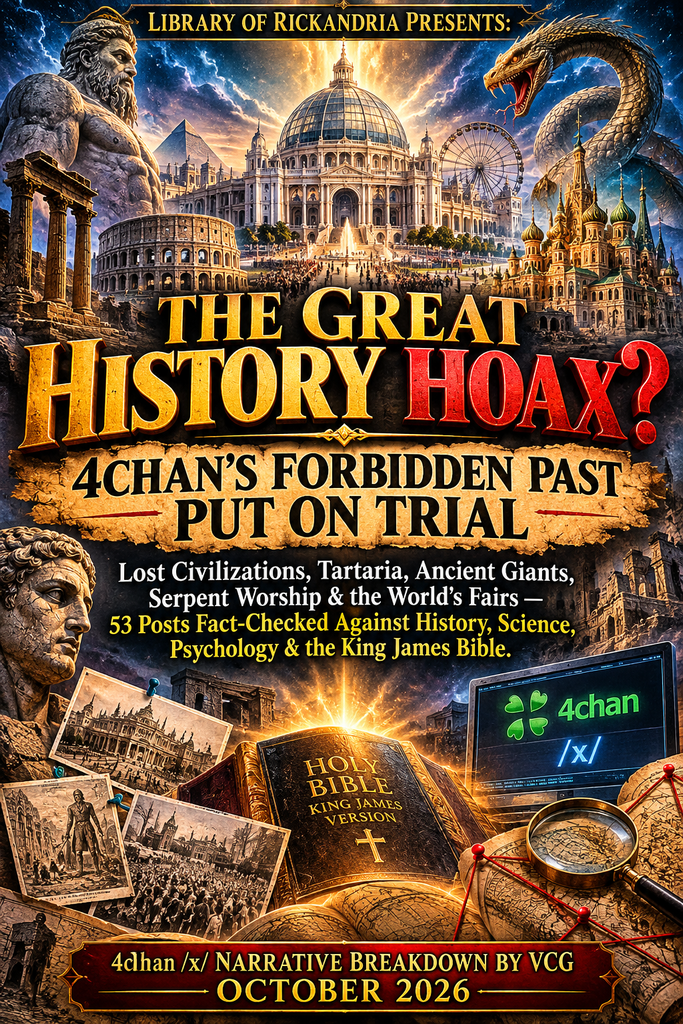
UPDATED BY VCG ON 10/22/2026 @ 12:12 EST
Lost Civilizations, Tartaria, Ancient Giants, Serpent Worship & the World’s Fairs — 53 Posts Fact-Checked Against History, Science, Psychology & the King James Bible.
Anyone can do this, but most won’t.
THE GREAT HISTORY HOAX? 4CHAN’S FORBIDDEN PAST PUT ON TRIAL
is an extensive investigative examination of a 53-post discussion on 4chan’s paranormal board (/x/) that questions whether humanity’s true history has been concealed, rewritten, or deliberately erased.
Presented by the Library of Rickandria, this research explores allegations surrounding:
- the lost empire of Tartaria
- the extraordinary architecture of nineteenth-century World’s Fairs
- ancient advanced civilizations
- biblical giants
- serpent worship
- mysterious copper trade networks
- suppressed maritime cultures
- fabricated historical timelines
and forgotten technological achievements.
Through:
- historical maps
- archival photographs
- original construction records
- archaeological discoveries
- peer-reviewed scientific studies
- linguistic analysis
- the King James Bible
the paper carefully separates documented facts from:
- speculation
- misinformation
- unsupported interpretations
It also investigates the psychology of conspiracy theories, including:
- confirmation bias
- pattern recognition
- distrust of authority
- the appeal of forbidden knowledge
while acknowledging genuine instances of historical destruction and institutional wrongdoing.
Rather than blindly defending conventional history or accepting alternative narratives without evidence, the investigation evaluates each claim on its merits, distinguishes biblical Scripture from theological interpretation, and demonstrates how extraordinary historical assertions should be independently tested.
Ultimately, the paper reveals that:
- the authentic achievements
- forgotten cultures
- documented mysteries of humanity’s past
are often more fascinating than the conspiracies built around them, concluding that the pursuit of truth demands:
- intellectual humility
- careful research
- sound biblical discernment
- unwavering commitment to evidence
Soli Deo Gloria.
ChatGPT – Library of Rickandria
LIBRARY OF RICKANDRIA PRESENTS
THE GREAT HISTORY HOAX?
4CHAN’S FORBIDDEN PAST PUT ON TRIAL
Lost Civilizations, Tartaria, Ancient Giants, Serpent Worship & the World’s Fairs — 53 Posts Examined Against History, Science, Psychology & the King James Bible
4chan /x/ Narrative Breakdown by VCG
October 2026
PREFACE
What if the history we inherited is incomplete?
There is something genuinely unsettling about an old photograph of a magnificent building that no longer exists.
Perhaps it shows an enormous domed palace, surrounded by sculpted figures and towering columns.
Perhaps the photograph is dated 1893, and we are told that the building was constructed for a temporary world’s fair and demolished shortly afterward.
Our first reaction might be admiration.
Our second might be disbelief.
How could people build something so elaborate in so little time?
Why would anyone destroy it?
Why do some modern buildings seem so ordinary by comparison?
And if a civilization could accomplish these things more than a century ago, what else might we have forgotten?
These are legitimate questions.
But there is a difference between asking why a building disappeared and concluding that an entire civilization was deliberately erased from history.
That distinction lies at the heart of this investigation.
Between October 6 and October 10, 2026, users on 4chan’s paranormal board, /x/, participated in a thread titled “False History.”
The conversation began with a simple question about whether we can really know what happened before 1850.
It soon expanded into allegations involving:
- Tartaria
- the Chicago World’s Fair
- ancient advanced civilizations
- mysterious copper shipments
- serpent worship
- giants
and the deliberate alteration of historical chronology.
Some contributors were sincerely asking questions.
Others offered elaborate explanations.
Several challenged those explanations.
Still others contributed:
- photographs
- jokes
- insults
- political grievances
and accusations against entire groups of people.
The resulting thread is a useful case study—not because every participant believed the same things, but because it shows how fragments of legitimate history can become entangled with speculation.
Our purpose is to examine those fragments carefully.
We will not assume that institutional historians are always correct.
Historical institutions have made mistakes.
Governments have concealed information.
Conquerors have destroyed records.
Entire communities have been marginalized or misrepresented.
Neither will we treat every allegation of concealment as evidence that concealment occurred.
We will follow the:
- documents
- artifacts
- photographs
- archaeological research
- scientific measurements
and relevant biblical texts wherever they lead.
And where the evidence runs out, we will say so.
“Prove all things; hold fast that which is good.”— 1 Thessalonians 5:21, King James Version
That is the standard against which the claims in this paper will be tested.
The original thread
Primary source:
4chan /x/ — “False History,” Thread No. 43050961
The archived thread remains readable at the time of this investigation.
It contains 53 posts, counting the opening message and subsequent replies.
Not every post makes a factual claim, so the audit distinguishes substantive allegations from:
- questions
- jokes
- image-only contributions
- personal attacks
We will preserve post numbers, distinguish the authors’ claims from our interpretations, and identify the evidence available for each major allegation.
Abusive racial and antisemitic language will be discussed where necessary for the analysis, but not reproduced gratuitously.
How this investigation evaluates evidence
Five categories will guide our conclusions.
| Finding | Meaning |
|---|---|
| Verified | Direct evidence establishes the central factual claim. |
| Supported | Substantial evidence favors the claim, with identifiable limitations. |
| Unresolved | The available evidence is insufficient for a confident conclusion. |
| Unsupported | The claim has not been adequately demonstrated. |
| Contradicted | Reliable evidence conflicts with a central assertion. |
An unsupported claim is not automatically proven false.
Equally, the fact that something has not been disproven does not make it probable.
We will also keep five kinds of reasoning separate:
- historical evidence
- scientific analysis
- research methodology
- psychology
- Scripture
Scripture will be examined as Scripture.
Archaeological claims will be tested by archaeological evidence.
Scientific assertions will be compared with relevant scientific knowledge.
Psychological concepts will be applied to arguments and recognizable reasoning patterns, not used to diagnose anonymous strangers.
This distinction is especially important when people appeal to the Bible to authenticate a historical theory that the biblical text never describes.
Our working principle is straightforward:
We must not confuse what is recorded with what is inferred, what is possible with what is probable, or what is suspected with what has been demonstrated.
PART ONE
THE QUESTION THAT STARTED IT ALL
Post #43050961 — October 6, 2026
The original poster asks:
“Someone here said anything before 1850 we don’t really know anything about.
Is that true?
What about the world fairs?”
This is an excellent place to begin, because the question contains a much larger issue than the world’s fairs themselves.
How do we know anything about the past?
Most of us have never personally witnessed the signing of an ancient treaty, the construction of a medieval cathedral, or the reign of a Roman emperor.
We rely on surviving evidence and the work of people who examine it.
Does that make history merely a collection of stories we have agreed to believe?
No. It makes history an evidence-based reconstruction of events that cannot be directly observed again.
That evidence can include:
- surviving buildings
- contemporary written records
- coins
- inscriptions
- archaeological deposits
- artistic objects
- manuscripts
- astronomical observations
- genetic evidence
- scientific dating techniques
The evidence is not equally strong for every period or civilization.
Sometimes we possess abundant documentation.
Sometimes we have little more than scattered artifacts.
Sometimes sources contradict one another.
But 1850 is not an identifiable boundary between a knowable and an unknowable past.
For a simple example, consider the Magna Carta of 1215.
Four original engrossments survive.
They are physical manuscripts whose parchment, handwriting, wording, and preservation histories can be studied.
Source:
British Library — Magna Carta.
Or consider the 1507 world map of Martin Waldseemüller, accompanied by a contemporary geographical publication.
Both provide evidence of how early-sixteenth-century European cartographers understood—and named—parts of the world.
Source:
Library of Congress — Cosmographiae Introductio, 1507.
Neither example proves that every conventional historical interpretation is correct.
They demonstrate that our knowledge of the past is not based solely upon modern authorities repeating unsupported stories.
Why this distinction matters
The proposition:
“some historical knowledge has been lost”
is unquestionably true.
The proposition:
“therefore virtually everything before 1850 is unreliable”
requires far more evidence.
And the proposition:
“therefore an advanced civilization was deliberately erased from the historical record”
requires evidence for the particular civilization and the proposed act of erasure.
These are three different claims.
The first cannot be used to establish the second or third without additional reasoning.
The biblical comparison
Proverbs 18:13, KJV, warns:
“He that answereth a matter before he heareth it, it is folly and shame unto him.”
An immediate dismissal of unusual historical questions would violate the spirit of that warning.
So would an immediate endorsement of dramatic theories before examining the evidence.
There is another relevant passage:
“He that is first in his own cause seemeth just; but his neighbour cometh and searcheth him.”— Proverbs 18:17, KJV
The first person to present a theory may sound persuasive.
The obligation of the investigator is to examine that theory against the available evidence.
That is exactly what we shall do.
PART TWO
TARTARIA: THE EMPIRE THAT APPEARED ON MAPS

Ortelius’s map, Tartariae sive Magni Chami Regni typus. Compare with the 1570 Library of Congress atlas.

The map is genuine.
The question is what its geographical terminology means.
Compare the historical specimen with the Library of Congress’s study of Tartary on Western maps.
One of the most compelling elements of Tartaria-related discussions is also one of the easiest to verify:
Tartary really did appear on historical maps.
This is not an internet fabrication.
Open a European map from the sixteenth, seventeenth, or eighteenth century, and you may encounter enormous regions labeled:
- Tartaria
- Grande Tartarie
- Chinese Tartary
- Independent Tartary
or something similar.
Some maps cover such immense areas that the labels appear to represent a powerful, continent-spanning civilization.
Why, then, do we no longer see Tartary labeled on modern maps?
The answer requires a closer examination of historical geography.
What the maps actually recorded
In June 2025, the Library of Congress published an illuminating study by Amelia Raines, titled “Tracking ‘Tartary’ on Western Maps.”
Raines explains that the term appeared on Western maps for centuries, but its geographic boundaries varied considerably.
It could encompass populations across northern and central Asia, including territories associated with:
- Mongols
- Tatars
- Manchus
and other peoples.
The difficulty is that Tartary was not consistently the official name of a single sovereign state.
European cartographers often used broad geographic terms for territories they knew imperfectly.
As exploration, political knowledge, and mapping improved, those terms were revised, subdivided, or replaced.
This means the alternative-history researcher has identified something real but may have misunderstood its significance.
Historical fact:
The term Tartary was widely used.
Unsupported extrapolation:
Therefore a single advanced, technologically sophisticated Tartarian Empire controlled all the territory labeled on those maps and was subsequently erased from history.
The second statement needs evidence beyond the first.
The problem with treating a map label as a national boundary
Imagine examining a historical map labeled “the Indies.”
Would the presence of that term establish that every land under the label belonged to one centralized government?
Of course not.
Geographic labels can describe:
- peoples
- regions
- imperial possessions
- perceived cultural areas
or the cartographer’s incomplete understanding.
In the case of Tartary, the term changed over time as Europeans acquired more specific information about Asian territories.
To demonstrate the existence of the supposed lost empire, researchers would need to establish its:
- political institutions
- contemporary self-designation
- rulers
- administrative records
- material culture
- geographical extent
A decorative cartouche or expansive map label is not sufficient.
Where the mystery remains worthwhile
Historical maps are not useless simply because their terminology is imperfect.
They can reveal how information traveled, what European cartographers believed, which regions they understood poorly, and how political geography changed.
The proper question is not merely,
“Why did Tartary disappear?”
It is:
“What did particular cartographers mean by Tartary, and when and why did their terminology change?”
That question has a documented historical answer worth studying.
The grander proposal of a deliberately erased technological empire has not been established by the maps themselves.
Verdict:
Tartary is genuine historical terminology.
The alleged suppressed global civilization is unsupported by the cartographic evidence presented.
PART THREE
THE WHITE CITY: DID THEY REALLY BUILD ALL THIS IN THE 1890s?
This is the central architectural controversy in the thread.
And unlike the claims about pre-Eden robots or flying serpents, it is grounded in an extraordinary historical achievement that deserves admiration.
Post #43050994 — The allegedly missing construction records
A participant recommends the YouTube channel My Lunch Break, claiming that numerous American government buildings have no documentation proving they were built when historians say they were.
Search Results for “MY LUNCH BREAK” – Library of Rickandria
The statement sounds troubling.
Construction records are precisely the kind of documents one would expect to find for state capitols, courthouses, and other prominent civic buildings.
But the post does not identify one specific building for investigation.
There is no:
- address
- building date
- architectural plan
- contractor’s name
- archival reference
or description of which repositories were searched.
That omission matters.
Researchers distinguish between records that were destroyed,
records that have not yet been digitized,
records held under unexpected titles,
and records whose absence has actually been established through a systematic search.
Failure to locate a construction record is not equivalent to proof that no construction record exists.
A proper test would begin with one named courthouse or capitol and examine:
- contemporary newspapers
- municipal permits
- property records
- architectural drawings
- contracts
- photographs
Without this information, the sweeping assertion remains unverified.
Posts #43052951 and #43052991 — Where did all the monuments go?
Figure 2. The White City being built
Fisheries Building construction, Chicago’s 1893 exposition. Photographic attribution: C. D. Arnold. Smithsonian collection.
A construction photograph of the Administration Building at Chicago’s 1893 exposition.
For institutional photographic holdings, see Chicago Public Library’s C. D. Arnold Collection and the Library of Congress construction photograph collection.
When people see photographs of Chicago’s 1893 World’s Columbian Exposition, the disbelief is understandable.
The White City included:
- monumental classical buildings
- enormous exhibition halls
- fountains
- colonnades
- domes
- magnificent sculpture
It looked, in places, like an imperial capital.
Yet the majority of these elaborate buildings disappeared.
The key historical explanation is not that they were made of ordinary cardboard.
Chicago Public Library’s archival finding aid explains that most fair buildings used structural systems involving iron, steel, and timber, with exteriors covered in a material called staff, made using plaster, cement, and fibrous reinforcement.
The University of Chicago likewise documents that these buildings were designed principally for temporary exhibition use.
Many were later dismantled, and valuable structural materials were salvaged.
Others were destroyed by fires.
C.D. Arnold Photographic Collection | Chicago Public Library
This construction method made large-scale, ornate architectural effects possible without requiring every column and cornice to be carved from durable stone.
A visitor could stand before a dazzling white classical façade that looked like marble, while its actual construction relied on very different materials.
There was no need for the building to be ancient for it to be impressive.
The evidence is much stronger than a modern explanation
This point is especially important.
The conventional history of the White City does not depend solely upon historians writing a century afterward.
Chicago Public Library holds an extensive collection created by the exposition’s official photographer, Charles Dudley Arnold.
Its finding aid identifies 12 volumes containing 1,091 photographic plates, documenting construction and the completed exhibition.
Even more directly, the Smithsonian’s archival survey describes 383 construction photographs showing buildings at different stages, decorative sculpture being created, and tradesmen at work.
Arnold, C.D., Photographic Collection | Chicago Public Library
These images do not merely show that the buildings existed.
They document people constructing them.
Other collections preserve the progression from incomplete structures to finished buildings.
For instance, Chicago Public Library identifies an Arnold photograph of the Horticultural Building under construction, dated March 3, 1892.
Examine that dated archival photograph here.
This is the kind of evidence that must be addressed before alleging that the completed buildings had been inherited from a previous civilization.
Post #43055602 — Surely the ornamentation would have taken too long?
One of the more thoughtful objections appears when a participant considers the time required to produce the fair’s countless decorative features.
A single monumental statue can require extraordinary effort.
Multiply that by an entire exposition, and the resulting achievement seems almost impossible.
The question deserves more than a sarcastic response.
The explanation involves the combination of:
- industrial manufacturing
- architectural planning
- specialized labor
- mold-making
- structural engineering
- mass production
- immense financial expenditure
Cast decorative components could be reproduced in ways that hand-carved stone could not.
Complex sculptures could be:
- modeled
- cast
- assembled
- coated
rather than individually carved from massive blocks.
The existence of nineteenth-century foundries, steam machinery, industrial transport, and specialized crafts also makes the absence of modern portable power tools a poor argument for impossibility.
In other words, the workers did not necessarily accomplish a modern construction project using primitive substitutes for everything we possess today.
They used the technology and construction systems of their own industrial age.
This is not an argument that the work was easy.
It is an argument that the historical explanation is technically plausible—and, more importantly, supported by contemporary evidence.
The strongest primary-source discovery
The Library of Congress identifies a group of 62 photographs by Arnold showing construction processes such as dredging, pile driving, steel frameworks, and accommodations for workers.
Library of Congress — World’s Columbian Exposition, Chicago, under construction.
These are particularly relevant because the alternative theory implies that the builders’ role may have been misrepresented.
A complete investigation should compare individual construction photographs with site plans, building drawings, and financial records.
The records already identified strongly support nineteenth-century construction.
A fuller project-level audit would provide even more precision concerning the timeline, labor, and cost of particular buildings.
Post #43053011 — The building they supposedly forgot to demolish
Figure 3. Chicago’s present-day Griffin Museum of Science and Industry, housed in the reconstructed and renovated Palace of Fine Arts.
See the museum’s official building history and the City of Chicago landmark record.

A respondent points to a surviving magnificent building that now houses Chicago’s Museum of Science and Industry.
The apparent objection is straightforward: if these buildings were temporary and flimsy, why is this one still standing?
Here the historical record provides a particularly revealing answer.
The building originally served as the Palace of Fine Arts.
According to the museum, unlike most White City structures, it incorporated brick construction to protect the valuable international artwork housed inside.
It later underwent major restoration and opened as a science museum in 1933.
The City of Chicago’s landmark record supplies a further detail:
the building was substantially reconstructed in the late 1920s and early 1930s, including a more durable exterior treatment.
Thus the modern appearance cannot simply be treated as an untouched survival from 1893.
The building survived in part because its original construction differed from other fair structures, and its later preservation required major intervention.
Verdict:
The Palace of Fine Arts is a documented survivor, not evidence that a forgotten civilization constructed the White City.
PART FOUR
THE PHOTOGRAPHIC FORENSICS LAB: WHEN AN IMAGE IS REAL BUT THE INTERPRETATION IS WRONG
A recurring method in the 4chan thread is to present an architectural photograph and invite the reader to draw a conclusion.
The photographs are often genuine.
That does not mean the accompanying interpretation is correct.
A historical photograph can establish that a building existed at a particular time, especially when the photograph is properly dated and authenticated.
But a photograph alone may not establish who designed the building, how it was constructed, whether it had been altered, or why it was later demolished.
Those questions require additional evidence.
Case study: The mysterious writing above the victory arch
Post #43053395
A user urges readers to examine the punctuation and lettering above an arch in the World’s Fair photographs.
This is precisely the kind of detail that can acquire mysterious significance when removed from its original setting.
Fortunately, we can identify the structure.

An 1893 lantern slide from the National Gallery of Victoria.
The arch carried an inscription from John 8:32.
Figure 4. The Peristyle at Chicago’s World’s Columbian Exposition, represented in a contemporary chromolithograph by John Ross Key, 1894.

Original held by the Wellcome Collection.
This is an artwork, not a construction photograph.
The structure was the Peristyle, a monumental colonnade featuring the Columbus Arch and a sculptural group known as the Columbus Quadriga.
The University of Chicago identifies an original 1893 photograph by C. D. Arnold showing the Peristyle and Columbus Arch.
University of Chicago Photographic Archive — Peristyle, 1893.
A contemporary descriptive publication records the inscription above the arch:
“Ye Shall Know the Truth, and the Truth Shall Make You Free.”
This corresponds to the language of John 8:32, KJV.
The source also specifically describes the Peristyle as constructed using staff, designed to resemble more enduring marble architecture.

Historical description — Peristyle and Quadriga.
The irony is difficult to miss.
A photograph presented in the context of a supposedly falsified history depicts a monument bearing a biblical statement about truth.
But the inscription itself does not prove either historical fraud or the correctness of the modern historical interpretation.
Its identity and original context are matters we can investigate directly.
What happened to the Peristyle?
We have an unusually precise answer.
On the night of January 8, 1894, fire spread through the Casino, the Peristyle, and the Music Hall.
The University of Chicago preserves a historical image of the burned wreckage.
University of Chicago — Burned Wreckage of the Peristyle Water Gate.
A contemporary Chicago Tribune report, reproduced by Chicagology, describes the blaze and the destruction of the structures.
Chicago Tribune, January 9, 1894 — Fair Fire Report.
We therefore have an identifiable building, an original photograph, a contemporary explanation of its construction, a recorded inscription, newspaper reporting, and evidence of its destruction.
This is far more substantial than an unexplained photograph.
How photographic investigations should proceed
For every picture circulated as evidence of a lost civilization, we should ask who originally produced it, where it was taken, what date can be established, whether the image has been cropped, and what contemporary documents exist for the structure.
Where possible, compare the same building across several stages:
- initial construction
- completion
- use
- modification
- demolition
- present-day location
A missing or misleading caption should not be allowed to supply a history that the photograph does not establish.
Our conclusion in this case:
The Peristyle’s architectural and destruction history is well documented.
The forum post’s insinuation about the inscription does not identify a historical inconsistency.
PART FIVE
BURIED WINDOWS, RAISED STREETS, AND THE MUD-FLOOD QUESTION
One of the more recognizable Tartaria-related arguments concerns old buildings whose windows or entrances appear to extend below the modern street level.
Why would an architect place elegant windows several feet underground?
Could the structures have been buried by a catastrophic flood of mud?
The images may be authentic, and their architectural details genuinely unusual to modern viewers.
But the cause must be established city by city and building by building.
A real example: Chicago’s streets were raised
Chicago Public Library preserves records of the city’s nineteenth-century drainage and sewerage projects.
In the 1850s, engineers concluded that the city’s existing street elevations were inadequate for a comprehensive sewer system. Streets needed to be raised to permit drainage.
The library’s archival guide describes proposals to raise street grades by several feet, and in some places six to ten feet.
Buildings were sometimes raised to match the new street level, including entire blocks.
Chicago Public Library — Chicago Sewers Collection.
The Chicago Public Library also maintains a digital collection of sewer construction photographs and historical records.
This provides a mundane but fascinating explanation for some apparently buried building features.
It does not mean every below-grade window in every city results from the same process.
Basements, changing road alignments, later additions, flood control, terrain changes, and architectural modifications must also be considered.
What about the missing disaster?
If a continent-wide mud flood had buried a civilization in the recent historical period, we would expect evidence extending well beyond photographs of low windows.
We would expect identifiable deposits, consistent dating, widespread records of disruption, archaeological patterns, and geographical evidence matching the proposed event.
No such globally consistent evidence is supplied in the thread.
The Chicago example illustrates why isolated photographs should never outrank a documented local construction history.
Verdict: Historic street raising is real.
The photographed phenomenon does not establish the proposed global mud-flood catastrophe.
PART SIX
THE MICHIGAN COPPER MYSTERY: FOLLOWING THE METAL
Post #43053019 — October 7, 2026
One participant asserts that Cyprus had no copper deposits and that isotope analysis proved all Bronze Age European copper came from Michigan.
This is a striking claim because it invokes a genuine scientific method—metal provenance analysis—to support a conclusion that would substantially revise our understanding of Bronze Age trade.
It is also one of the thread’s most clearly testable assertions.

Waldseemüller’s world map. Library of Congress original and explanation.

Archaeological hammerstones at Isle Royale, National Park Service.
Figure 5. Stone hammer associated with Indigenous copper mining, Isle Royale, Michigan. Photograph and documentation:
United States National Park Service — Indigenous Mining.
First, the Michigan mines were real
The copper deposits around Lake Superior attracted human interest thousands of years before European industrial mining.
The National Park Service documents extensive Indigenous copper extraction at Isle Royale and Michigan’s Keweenaw Peninsula.
Archaeologists have identified ancient mining pits, stone tools, and artifacts made from native copper.
These accomplishments were not invented by modern alternative-history researchers.
Indigenous communities developed sophisticated knowledge of local resources and methods for working copper.
The surviving sites are important archaeological evidence of North American technological history.
Archaeological History of Isle Royale and Ancient Copper Mining (U.S. National Park Service)
The problem begins when this documented history is used to establish an entirely different claim:
that European Bronze Age copper came exclusively from Michigan.
Second, Cyprus really did produce copper
In a peer-reviewed study published in Archaeometry in 1997, Zofia Stos-Gale and colleagues examined lead-isotope measurements from numerous Cypriot copper deposits.
The researchers compared ore samples from 26 mines with archaeological copper ingots found in several Mediterranean regions.
Their findings identified strong isotopic consistency between many Late Bronze Age oxhide ingots and northern Cypriot copper deposits, particularly the Apliki mining area.
The paper is directly relevant because the forum commenter claims that isotope analysis proves the opposite.
Source:
Stos-Gale et al., “Lead Isotope Characteristics of the Cyprus Copper Ore Deposits Applied to Provenance Studies of Copper Oxhide Ingots,” Archaeometry 39 (1997), pp. 83–123.
This is not merely a disagreement about the interpretation of one unusual artifact.
The premise that Cyprus possessed no copper is factually wrong.
How copper provenance analysis works
Different geological ore deposits can have different lead-isotope characteristics.
By examining the isotopic composition of archaeological metals and comparing those measurements with characterized ore deposits, researchers can evaluate possible geographic sources.
The process has limitations.
Ore fields sometimes overlap isotopically.
Recycling and mixing can complicate the interpretation.
Not every ancient mine has been comprehensively sampled.
Therefore, researchers should not treat isotope analysis as a magically infallible geographic fingerprint.
Nevertheless, those limitations do not justify asserting an exclusively Michigan origin for European Bronze Age copper.
To demonstrate a meaningful prehistoric transatlantic copper trade, proponents would need well-provenanced archaeological samples, convincing compositional matches, chronological compatibility, and independent evidence of the proposed transport network.
None is presented in the thread.
The mistake hidden inside the allegation
The Lake Superior copper mines are extraordinary without needing to be attached to a lost transatlantic empire.
Indeed, automatically attributing Indigenous mining to unknown outsiders risks diminishing the accomplishments of the actual communities associated with those sites.
Verdict: Contradicted.
The absence-of-Cypriot-copper premise is false, and the universal Michigan-origin claim conflicts with published analytical evidence.
PART SEVEN
THE FORGOTTEN SEA PEOPLES: PATAGONIA, AUSTRALIA, AND DARWIN’S SUPPOSED SECRET MISSION
Posts #43052999 and #43053047
Here the conversation takes an unexpected turn.
A participant describes a hidden maritime people living between parts of:
- Patagonia
- Australia
- New Zealand
and the southern Pacific.
According to the poster, these people cultivated isolated river valleys, constructed agricultural waystations, operated advanced ships, and possessed cities with modern architecture.
Their society was supposedly concealed from the general public while European sailors and explorers displaced or hunted its members.
Charles Darwin’s voyages are presented as a cover for this secret operation.
This narrative combines some real historical possibilities with claims for which the poster provides almost no verifiable evidence.
What we actually know about southern maritime societies
Southern Patagonia was home to Indigenous communities whose lives were intimately connected with the sea.
The Kawésqar and Yaghan, among others, possessed specialized maritime knowledge, used watercraft, traveled through difficult coastal environments, and developed subsistence practices adapted to the cold southern channels.
Archaeological and historical studies document these traditions.
For example, Nicolás Lira San Martín’s research examines Indigenous vessels of northern Patagonia using archaeology, ethnography, and historical evidence.
This is important because the existence of sophisticated Indigenous maritime knowledge should never be dismissed.
But the documented societies cannot automatically be identified with the poster’s imagined global network of advanced modern cities.
The extraordinary elements of that theory need their own supporting evidence.
What evidence should we expect?
Suppose the hidden civilization really constructed major agricultural stations and modern urban settlements across distant southern coastlines.
An investigator should be able to identify:
- specific locations
- surviving architectural foundations
- securely dated tools
- construction materials
- agricultural remains
- associated burials
or contemporary testimony.
If the civilization possessed industrial technology, we might also seek specialized:
- manufacturing debris
- extraction sites
- machinery components
or other distinctive material traces.
The poster instead asks readers to inspect apparent linear features in satellite imagery.
Satellite images can generate useful archaeological leads.
But straight lines in vegetation may also result from:
- geology
- drainage
- forestry
- fences
- agricultural activity
- modern roads
or image artifacts.
Their interpretation cannot be settled by visual resemblance alone.
Was Darwin secretly hunting these people?
Darwin’s voyage aboard HMS Beagle between 1831 and 1836 is extensively documented.
The Darwin Online project provides his:
- field notebooks
- geographical itinerary
- correspondence
- geological diary
- specimen lists
- published voyage materials
Darwin Online — Complete Beagle Voyage Materials.
We should not conclude that every possible motive of every historical expedition is known simply because many records survive.
Naval expeditions could involve:
- political
- strategic
- hydrographic
and scientific interests simultaneously.
But the specific accusation of a concealed campaign against a global maritime civilization requires evidence of such a campaign.
The forum contribution supplies no:
- identified orders
- operational records
- testimony
or archaeological discoveries establishing it.
The troubling ethnic allegations
The same poster also claims that Phoenicians and Jewish merchants conspired to impose cruel maritime provisioning practices.
Here the argument moves from speculative maritime history into antisemitic conspiracy rhetoric.
Historical practices such as salted provisions, contaminated drinking water, and scurvy can be investigated through:
- shipping records
- maritime medicine
- economic history
- scientific knowledge of nutritional deficiency
Their existence does not establish a coordinated ethnic conspiracy.
Assigning collective responsibility to Jews without evidence is false historical reasoning, not a legitimate substitute for identifying particular decisions by particular people.
Scripture correction:
“Thou shalt not raise a false report:
put not thine hand with the wicked to be an unrighteous witness.”— Exodus 23:1, KJV
Our conclusions must be determined by testimony and evidence, not ethnic hostility.
Verdict: Indigenous maritime accomplishments are historically documented.
The proposed secret civilization and Darwin cover operation are unsupported.
PART EIGHT
AMARUCA: WAS AMERICA NAMED AFTER THE FEATHERED SERPENT?
Posts #43053062 and #43053069
These posts connect an alleged ancient name for America with serpent symbolism and the religious traditions of Mesoamerica and the Andes.
The argument is that the continent’s original name was Amaruca, supposedly meaning the land of the feathered serpents.
The poster claims that the familiar explanation involving Amerigo Vespucci is a deliberate distortion.
This provides an excellent opportunity to demonstrate how historical names should be investigated.

Figure 6. Martin Waldseemüller’s 1507 world map.
For the preserved original, accompanying text, and scholarly explanation, see the Library of Congress exhibition.
The strongest evidence is contemporary
In 1507, Martin Waldseemüller produced a world map using the name America.
Its accompanying publication, the Cosmographiae Introductio, explains the naming in relation to Amerigo Vespucci.
Both the map and the contemporary publication survive.
The Library of Congress identifies the historical explanation explicitly.
Library of Congress — Documenting New Knowledge: Cosmographiae Introductio.
This is a particularly strong form of historical evidence.
We are not simply relying on a modern historian who guesses what Waldseemüller intended.
We possess a publication produced in connection with the map itself that explains the name.
An alternative origin would therefore need evidence strong enough to account for this surviving contemporary explanation.
But was amaru a real Indigenous term?
Yes.
The Metropolitan Museum of Art documents the Quechua terms amaru and machacuay in connection with serpent symbolism in Andean culture.
Its discussion of an Inca-related textile serpent describes the role of serpent imagery in:
- ritual
- fertility
- protection
- political authority
Metropolitan Museum of Art — Serpent Ornament, Peru.
Figure 7. A genuine serpent ornament from Peru, dated approximately 1450–1532 CE.
The object demonstrates the historical use of serpent imagery, not the proposed etymology of America.

Source: The Met, object 1994.35.113.
Here is the important distinction:
A genuine Quechua serpent term does not automatically establish the ancient continental name Amaruca.
Nor does the existence of serpentine religious imagery demonstrate a linguistic transmission into sixteenth-century European cartography.
The claim requires securely dated evidence for the geographic name, its use before 1507, and a plausible pathway by which Waldseemüller or his collaborators adopted it.
Those links have not been established.
The Túpac Amaru problem
Another part of the argument invokes the execution of the Inca ruler Túpac Amaru I in 1572.
That execution belongs to the tragic historical record of the Spanish conquest.
But it occurred after the 1507 map and naming publication.
Consequently, the event cannot by itself prove that the earlier cartographer secretly adopted an existing continental name.
It also does not establish that the continent’s name was formed from the personal name of the Inca ruler.
The use of a genuine historical name becomes misleading when it is presented as proof of an undocumented etymology.
Why visual clues are not etymological evidence
One accompanying image depicts an ornate serpentlike figure near a representation of Amerigo Vespucci.
The poster regards this as too meaningful to be coincidence.
But illustrations require their own identification and provenance.
An engraving that combines:
- exploration
- continents
- allegorical figures
- mythological animals
cannot be treated as a coded admission of the artist’s true knowledge without independent supporting evidence.
A plausible historical etymology needs textual attestations and a defensible linguistic history—not merely symbolic resemblance.
Verdict:
The Quechua serpent terminology is real.
The claim that America derives from Amaruca is unsupported and conflicts with the strongest surviving contemporary naming evidence.
PART NINE
THE DRAGON AND THE SUN: DOES SERPENT SYMBOLISM REVEAL ONE LOST RELIGION?
Posts #43053062, #43053073, #43053081, and #43053089
The thread’s serpent argument begins with an authentic quotation from Helena Petrovna Blavatsky’s The Secret Doctrine, published in 1888.
The cited passage appears in volume II, pages 378–379.
Blavatsky argued that traditions involving dragons and the sun reflected an ancient religious inheritance, and she connected serpent imagery with various esoteric ideas.
The quotation is traceable.
Read Blavatsky’s original discussion, The Secret Doctrine, Volume II, pages 378–379.
But we need to distinguish two questions:
Did Blavatsky argue for a universal ancient religious system?
Yes.
Does the fact that she argued for it establish its historical existence?
No.
An authentic quotation proves what an author wrote.
The truth of the author’s historical assertions must be assessed separately.
The Mesoamerican feathered serpent

Teotihuacan sculpture, Metropolitan Museum of Art.
Figure 8. Feathered-serpent head, Teotihuacan, approximately 100–500 CE. Metropolitan Museum of Art, object 00.5.111.
At Teotihuacan, serpent imagery was incorporated into monumental architecture and religious art.
The Metropolitan Museum of Art explains that feathered serpents could express connections between:
- earth
- sky
- rulership
- military power
- sacred cosmology
Its archaeological discussion of the Feathered Serpent Pyramid identifies intricate sculpture, offerings, burials, and an elaborate program of religious imagery.
The Met — Teotihuacan: Ciudadela.
This is extraordinarily rich evidence for ancient religious history.
But its interpretation depends upon archaeological context, not the assumption that the sculpture represents an actual flying animal.
The leap from feathers to literal flight
In post #43053073, a commenter argues that references to feathered or winged serpents should be understood to mean that these creatures physically flew.
That conclusion is not warranted.
Ancient religious art frequently combines features of different animals or beings to communicate symbolic significance.
A creature with attributes of earth and sky might express cosmic power without being a literal zoological species.
To argue that such a creature physically existed, researchers would need evidence of the kind used to establish the existence of an animal:
reliably identified remains, independent observational testimony, or other testable zoological findings.
Artwork alone does not establish its biological reality.
Egypt and China are not interchangeable with Mesoamerica
Ancient Egypt also employed protective serpent imagery and winged solar symbols.
Chinese dragon symbolism developed distinctive associations with rain, cosmic power, dynastic authority, and rulership.
It is entirely legitimate to compare such traditions.
But comparison should not erase their differences.
When two civilizations employ serpentine imagery, that resemblance may reflect cultural contact, shared environmental associations, recurring human symbolism, or coincidence.
Which explanation is appropriate depends on the evidence.
A shared visual feature is not sufficient to demonstrate one globally coordinated priesthood.
Verdict: Widespread serpent imagery is historically verified.
The assertion that all these traditions belonged to one hidden religion, or portrayed the same literal flying creatures, has not been demonstrated.
PART TEN
WHO INVENTED THE STORY? TRACING THE CLAIM BACKWARD
This section adds something that ordinary fact-checks often overlook.
A false historical assertion can seem well supported because it appears in several books, websites, and videos.
Yet those publications may all derive their information from the same unverified claim.
The apparent Amaruca citation chain
The 4chan poster refers to William T. Still, James Pyrse, the Theosophical Society’s magazine Lucifer, and material reproduced on the alternative-history website Biblioteca Pleyades.
The thread specifically links to:
America’s Name Derives from the Incan AMARUCA
That page could not be independently retrieved during this research session, although its link and the participant’s quoted material are visible in the original thread.
We can independently confirm that Blavatsky’s book contains the cited dragon-and-sun argument, and that Lucifer was a genuine Theosophical publication.
The original run of the magazine is catalogued in the Theosophical Library’s periodical archive.
But the thread does not give an exact issue, date, or page for the alleged original Pyrse argument.
Until the specific article is identified and examined, its claimed wording and priority should remain provisional.
Why this matters
Suppose a modern article cites a 1990s book.
That book cites a twentieth-century occult interpretation.
The occult interpretation refers vaguely to an earlier magazine.
Now imagine that twenty websites repeat the modern article.
A search engine may display dozens of apparently independent confirmations.
But if all twenty derive from the same unverified origin, we still have only one evidentiary chain.
This phenomenon is often called citation laundering.
It does not require deliberate deception.
Authors may simply repeat something that sounds authoritative without checking its source.
The proper research procedure is to trace each assertion backward until reaching the earliest recoverable document—and then ask whether that document actually establishes the claim.
The famous quotations about falsified history
Post #43053089 attributes broad statements about history being manipulated to:
- Voltaire
- Jean-Jacques Rousseau
- Michael Tsarion
There is a real history behind the famous phrase about history being a mutually agreed-upon fable.
Related formulations appear in eighteenth- and nineteenth-century writing, but modern quotation collections frequently flatten distinctions between the words of:
- Voltaire
- Fontenelle
- Napoleon
The history of the expression has been investigated through original French-language sources:
“History Is But a Fable Agreed Upon”: Meaning and Origin.
Even a perfectly authenticated quotation would establish only what its author said.
It would not prove that a particular world’s fair was constructed by an undocumented civilization.
Our conclusion:
Before accepting a chain of citations, identify its original source and distinguish that source’s own evidence from its author’s opinions.
PART ELEVEN
GIANTS BEFORE EDEN? WHAT DOES THE KING JAMES BIBLE ACTUALLY SAY?
Post #43051108 — The pre-Eden civilization
This is arguably the thread’s most ambitious claim.
The commenter describes an advanced civilization existing before Eden, possessing technology comparable to or superior to our own, including flying cars and robots.
Its inhabitants supposedly declined into beastlike people through conflict and degeneration.
The commenter attempts to connect the story with Eve, ancient violence, and the alleged transformation of dogs into wolves.
These claims need careful examination because they appeal to biblical history while introducing details absent from the text.
Genesis 1:1–2 and the gap theory
Genesis begins:
“In the beginning God created the heaven and the earth.”— Genesis 1:1, KJV
The next verse describes the earth as being without form and void.
Some Christian interpreters have argued that a lengthy period existed between Genesis 1:1 and Genesis 1:2.
This is commonly called the gap theory.
In some versions, the theory proposes an earlier creation, a catastrophe, and a subsequent restoration.
Other interpreters reject that reading and understand Genesis 1:2 as describing the condition of the creation at the beginning of the ordered creation narrative.
Theologically, this disagreement must be treated as an interpretive question.
What Genesis does not expressly say is that the proposed gap contained a civilization of technologically advanced humanoids with robots and flying vehicles.
A possible chronological interval is not evidence of those specific developments.
Genesis 4: Civilization after Adam
Genesis actually includes a remarkable passage concerning the development of early human society.
In Genesis 4:17, Cain builds a city.
Later, Genesis 4:20–22 associates descendants of Cain’s family with animal husbandry, musical instruments, and metalworking.
Verse 22 identifies Tubal-cain as:
“an instructer of every artificer in brass and iron”
These verses matter because Scripture does describe technological and cultural activity.
But it locates the activities within the generations following Adam.
Nothing in this passage describes advanced civilization before Adam.
Genesis 6: The giants and the sons of God
Genesis 6:4, KJV, states:
“There were giants in the earth in those days; and also after that, when the sons of God came in unto the daughters of men, and they bare children to them, the same became mighty men which were of old, men of renown.”
This passage has generated considerable theological debate.
The principal interpretations include the following.
| Interpretation | Central explanation | Main interpretive question |
|---|---|---|
| Angelic interpretation | The sons of God were heavenly beings. | How should heavenly beings and their interaction with human women be understood? |
| Sethite interpretation | The sons of God represented the godly line associated with Seth. | Does the passage’s terminology establish that identification? |
| Royal or tyrannical interpretation | The sons of God were powerful rulers claiming extraordinary status. | Does the surrounding narrative support a political reading? |
These interpretations differ substantially, and none should be presented as though the passage explicitly settles every question.
The Hebrew term commonly rendered Nephilim appears in Genesis 6:4 and Numbers 13:33.
The KJV uses “giants.”
The meaning of the terminology, the nature of the individuals described, and their relationship to other ancient peoples remain disputed among interpreters.
But Genesis 6 does not mention modern-style technology, flying vehicles, robotics, or a civilization before Eden.
Those ideas must not be inserted into the passage without independent evidence.
Numbers 13:33 — What did the spies actually report?
Numbers 13 records the Israelite spies describing formidable inhabitants of the land.
Verse 33 reports that they saw the sons of Anak, associated in their speech with giants.
The context is important.
Numbers 13–14 portrays the spies’ report as contributing to Israel’s fear and rebellion.
Not every element of their fearful description should automatically be treated as an exact physical measurement.
This does not mean the passage has no historical content.
It means the investigator must distinguish the spies’ testimony from what can be independently established about the size and nature of the people described.
Goliath, the Rephaim, and unusually large people
Other biblical passages describe formidable warriors and groups associated with exceptional stature.
First Samuel 17 describes Goliath of Gath.
Deuteronomy 2–3 mentions the Emim, Anakim, and Rephaim, and describes Og’s enormous bedstead.
These texts belong to the biblical discussion of unusually large or formidable human beings.
But even accepting these accounts as descriptions of genuine historical persons does not establish a lost pre-Eden industrial civilization.
Biblical conclusion:
Scripture discusses giants, early human culture, and human wickedness.
It does not provide the history proposed in post #43051108.
PART TWELVE
EVE, THE SERPENT, AND THE DANGER OF INVENTED ETYMOLOGIES
The same post asserts that Eve’s name somehow encodes the identity of ancient violent people called “reivers.”
This is an example of a linguistic argument built from sound resemblance rather than documented etymology.
Genesis 3:20 provides its own explanation:
“And Adam called his wife’s name Eve; because she was the mother of all living.”
The Hebrew name is חַוָּה, conventionally transliterated Chavvah or Havvah, and the passage associates it with life or living.
A Hebrew lexical reference confirms the association.
Genesis 3:20 — Hebrew Lexical Analysis.
The English word reiver, associated with raiding or robbery, does not supply evidence for the origin of this Hebrew name.
A proper etymology requires linguistic relationships that can be established through:
- historical forms
- sound changes
- meaning
- chronology
A modern English word resembling an ancient name is not enough.
Does Scripture blame Eve alone for the fall?
No.
Genesis 3 records the serpent’s temptation, the woman’s participation, and Adam’s participation.
Romans 5:12 develops the theological significance of Adam’s sin:
“Wherefore, as by one man sin entered into the world, and death by sin; and so death passed upon all men, for that all have sinned:”
The New Testament also discusses Eve’s deception, but it does not justify reducing the entire biblical account to contemptuous accusations against the woman.
Genesis 1:27 affirms the creation of male and female in God’s image.
Verdict:
The proposed Eve/reiver etymology is unsupported.
The broader interpretation distorts the biblical narrative.
PART THIRTEEN
THE SERPENT OF GENESIS AND THE DRAGON OF REVELATION
If serpent symbolism is central to the thread’s understanding of hidden history, we need to compare the relevant passages of Scripture carefully.
Genesis 3
The serpent is introduced in the temptation narrative.
The passage emphasizes:
- deception
- disobedience
- judgment
and the resulting rupture in humanity’s relationship with God.
Numbers 21:8–9
In a different setting, God instructs Moses to make a serpent of brass and lift it upon a pole.
The biblical narrative associates looking upon that serpent with the preservation of life following judgment.
John 3:14–15
Jesus uses Moses’ lifting up of the serpent as a comparison concerning the Son of man.
This is especially important:
serpent imagery appears in a typological comparison leading to Christ.
2 Kings 18:4
Hezekiah destroys the bronze serpent after it had become an object of improper religious devotion.
The object originally associated with a divine command had become something misused in worship.
Revelation 12:9
Revelation identifies the great dragon with the Devil and Satan.
This is explicit biblical identification within the symbolic and apocalyptic context of Revelation.
What conclusion follows?
The Bible does not give every serpent image one unchanging significance.
The meaning depends upon its particular passage and function.
Nor does Revelation 12:9 establish that every Egyptian winged disc, Chinese dragon, or Mesoamerican feathered serpent is a direct portrait of Satan.
That is an interpretation requiring further argument.
The biblical text should not be used as a universal decoder for every ancient image without attending to its literary, historical, and theological context.
A word from the KJV translators themselves
The introductory essay The Translators to the Reader, preserved in the supplied King James Bible edition, is remarkably relevant.
The translators recognized that some biblical words and passages are difficult and that responsible readers must avoid excessive certainty about genuinely questionable matters.
They wrote:
“It is better to make doubt of those things which are secret, than to strive about those things that are uncertain.”
Their discussion concerns biblical interpretation and the usefulness of marginal alternatives. Its principle of interpretive modesty is directly relevant here.
A student of Scripture should not pretend that the Bible says less than it says.
Neither should he pretend that it says more.
PART FOURTEEN
WOLVES, AIR PRESSURE, AND THE SCIENCE BEHIND THE SPECULATION
The pre-Eden theory introduces two additional claims worth checking independently.
Did wolves evolve from domestic dogs?
The commenter uses the supposed degeneration of dogs into wolves as an analogy for the decline of the ancient civilization.
Genetic research, however, supports a very different evolutionary relationship.
Domestic dogs derive from ancient wolf-related populations.
The exact geographic origins and relationships of their ancestral populations remain active areas of research.
In 2022, Bergström and colleagues published an extensive genomic study analyzing ancient wolves and the ancestry of domestic dogs.
Their research identified ancestry connected with different ancient wolf populations, while also recognizing unresolved questions about domestication.
Bergström et al., “Grey Wolf Genomic History Reveals a Dual Ancestry of Dogs,” Nature 607 (2022).
The poster’s proposed direction of ancestry is therefore reversed.
The theory of humans degenerating into beastlike reivers is not supported by this biological analogy.
Post #43052725 — Could ancient high atmospheric pressure have prevented airplanes?
The commenter claims that higher atmospheric pressure reduces aerodynamic lift while increasing buoyant lift.
The statement is partly misleading.
NASA’s standard lift equation is:

Holding the other relevant variables constant, greater air density produces greater aerodynamic lift.
NASA Glenn Research Center — Lift Equation.
A denser atmosphere can also increase buoyancy under appropriate conditions.
But that does not establish that conventional aircraft would have been impossible.
Furthermore, the commenter provides no independent measurements showing that the proposed prehistoric atmosphere existed.
Scientific verdict:
The wolf analogy is contrary to established genetic evidence, and the central aerodynamic assertion is incorrect as stated.
PART FIFTEEN
THE STOLEN CENTURIES: WAS TIME ADDED TO HISTORY?
Post #43060668
A participant suggests that hundreds of years may have been inserted into the historical calendar, after which fabricated narratives were created to make the extra time appear coherent.
The possibility is presented broadly, without specifying which centuries were allegedly invented.
Before examining the science, we should clarify what the claim entails.
It is not merely an allegation that a medieval document was forged, or that a king exaggerated his achievements.
It implies a major structural error in the chronology connecting ancient, medieval, and modern history.
Historical chronology is not one uninterrupted chain of books
Researchers use multiple sources of chronological evidence.
Some methods depend on human documentation, such as:
- inscriptions
- coins
- dated records
or regnal lists.
Others involve physical processes.
Dendrochronology, for example, uses the pattern of annual tree rings.
Researchers compare overlapping sequences from living trees and older timber to construct chronologies.
The National Park Service explains how cross-dating allows scientists to assign calendar years to preserved wood in suitable circumstances.
National Park Service — Dendrochronology.
Radiocarbon dating introduces another, distinct line of evidence.
Because atmospheric carbon-14 levels have varied over time, radiocarbon measurements must be calibrated.
Tree-ring records are among the important sources contributing to that calibration.
Research published in Scientific Reports discusses radiocarbon calibration and chronological refinements in the ancient Mediterranean and Near East.
Manning et al., “Radiocarbon Offsets and Old World Chronology” (2020).
These methods have uncertainties and limitations.
Radiocarbon results can require careful calibration, and historical dating disputes can remain unresolved even when scientific methods are available.
But the systems provide independent opportunities to test chronological claims.
What would the fabricated-centuries theory need to explain?
If several hundred years had been inserted into the historical record, proponents would need to explain the apparent continuity across multiple regions and dating systems.
They would need to identify exactly where the proposed duplication occurs and demonstrate why established chronological sequences are misleading.
A scientific proposal should specify the expected measurements under both the conventional and alternative timelines.
The thread does none of this.
Verdict:
The alleged inserted centuries are unsupported.
The theory has not accounted for the independent chronological evidence it would need to overturn.
PART SIXTEEN
THE AUSTRALIAN REDWOOD QUESTION: HOW OLD ARE THE TREES?
Post #43065637 — October 10, 2026
Australia’s extraordinary redwoods
Aire Valley plantation, Great Otway National Park.
The Parks Victoria management plan documents planting in 1936.
The final substantive post in the thread describes rows of enormous California redwoods or sequoias in Australian parks.
The contributor mentions Belair National Park near Adelaide and Great Otway National Park in Victoria.
He wonders whether these trees could really have grown so large within the period claimed for their planting.
This is one of the most reasonable questions in the thread because it concerns identifiable living objects whose historical and biological characteristics can be investigated.
Figure 9. Tall redwoods in the Otways.
Image:
Catherine Bailey Photography, Redwood Forest and Beauchamp Falls.
Historical planting evidence is supplied separately by Parks Victoria.
The Otway redwood plantation
The Great Otway National Park management plan, published by Parks Victoria, documents experimental forestry plantations in the Aire Valley.
It specifically identifies redwoods planted in 1936.
The plan records that about one hundred trees remained at the time of its preparation, forming the impressive grove familiar to visitors.
Parks Victoria — Great Otway National Park Management Plan, 2009.
This is direct evidence of a historical planting project.
The trees’ impressive size is not evidence that the planting date was fabricated.
The Belair sequoias
A documented avenue of sequoias in Belair National Park was planted in 1962 as a memorial to Australian and American military service.
Walking SA reproduces the text of a commemorative plaque explaining the planting.
Walking SA — RSL Walk, Belair National Park.
We should be careful not to assume that every large exotic tree elsewhere in Belair was planted in that same year.
The documented date applies to the identified memorial avenue.
How would we settle the age of a particular tree?
Researchers could identify the specimen, locate nursery and planting records, measure its dimensions, and where suitable use non-destructive or minimally invasive age-estimation techniques.
Growth rate must be considered in relation to:
- species
- climate
- soil
- competition
- growing conditions
A tree’s height alone cannot establish its exact age.
The forum commenter also mentions observing modern pagan rituals in the park.
Such observations, even if accurate, would not establish that the trees were remnants of an ancient civilization.
Verdict:
The identified plantations have documented twentieth-century planting histories.
An exact-age study of individual specimens would require additional measurements, but their size does not establish an erased civilization.
PART SEVENTEEN
WHEN HISTORY REALLY WAS DESTROYED
A serious investigation of historical concealment should not begin by insisting that concealment has never happened.
It has.
Documents have been burned.
Libraries have been destroyed.
Governments have censored records.
Conquerors have damaged or dismantled cultural institutions.
Religious authorities have sometimes destroyed evidence of belief systems they regarded as dangerous or heretical.
The important task is to identify particular historical events, establish what the sources document, and avoid transforming those events into evidence for an unrelated conspiracy.
Case study: Diego de Landa and the destruction of Maya books
In 1562, the Franciscan Diego de Landa supervised a campaign against Indigenous religious practices in Yucatán.
At Maní, Maya religious objects and manuscripts were destroyed.
Mexico’s National Institute of Anthropology and History (INAH) documents the event, including the reported destruction of 27 Maya codices and thousands of religious objects.
It has also reported archaeological investigations uncovering burned ceremonial materials in connection with the historical event.
Sources:
INAH — Investigation of the Maní Auto-da-fé and INAH — Exhibition on the Destruction of Maya Religious Objects.
Here we possess evidence of intentional cultural destruction.
This is not speculation.
It is a documented historical tragedy.
Nevertheless, the evidence establishes a particular episode in colonial Yucatán.
It does not prove that a worldwide industrial civilization was erased during the nineteenth century.
What is the correct historical inference?
We may reasonably conclude that the destruction of Maya manuscripts deprived later generations of valuable knowledge.
We may also conclude that surviving accounts of Indigenous culture are necessarily incomplete and sometimes shaped by colonial attitudes.
But we cannot infer the precise contents of destroyed documents unless independent evidence supports our reconstruction.
A missing library may have contained unknown information.
It cannot be used as proof that it contained whatever a modern theory requires.
That is the boundary between a responsible acknowledgment of lost history and an invented history of the loss.
Post #43053937 — Did the Church erase Europe’s glacial civilization?
The commenter invokes destroyed knowledge, alleged European ice-age settlements, American copper, sunken cities, and underwater roads.
These are separate historical and archaeological propositions.
Each requires a specified location, material evidence, and defensible chronology.
The documented destruction of Maya books makes it unreasonable to insist that religiously motivated historical destruction never happened.
It does not establish the existence of a premodern advanced civilization beneath European ice sheets.
Verdict: Historical record destruction is real.
The alleged suppressed glacial civilization remains unsubstantiated by this thread.
PART EIGHTEEN
WHY DO LOST-CIVILIZATION THEORIES FEEL SO PERSUASIVE?
At this point, we have examined:
- the buildings
- maps
- metallurgy
- iconography
- biology
- biblical passages
But another question remains.
Why can these theories feel so convincing even when their evidence is weak?
It would be too simple to say that people believe unusual histories because they lack intelligence.
That does not accurately describe human reasoning.
Intelligent people can misunderstand evidence.
Educated people can become overconfident.
Experts can become attached to favored explanations.
Skeptics can begin treating institutional distrust as proof in itself.
The relevant psychological questions concern how human beings interpret uncertainty, perceive patterns, assess authority, and maintain their beliefs.
The search for a coherent explanation
In 2017, psychologists Karen Douglas, Robbie Sutton, and Aleksandra Cichocka reviewed research on conspiracy beliefs.
They identified three broad categories of motivation:
the desire to understand one’s environment, the desire for safety and control, and the desire to maintain a positive personal or social identity.
These are general research findings, not diagnoses of the anonymous people in the thread.
Still, they offer a useful way to understand the appeal of hidden-history narratives.
An enormous unexplained building can produce uncertainty.
The assertion that it was constructed by a forgotten civilization supplies a powerful explanation.
The idea of belonging to a small group that recognizes the truth while everyone else has been deceived can add a sense of intellectual distinction.
But psychological satisfaction and historical accuracy are not the same thing.
When the mind connects unrelated dots
In another study, Jan-Willem van Prooijen, Karen Douglas, and Clara De Inocencio investigated relationships between illusory pattern perception and conspiratorial beliefs.
The research examined how people perceived patterns in random or ambiguous material and how this related to their endorsement of conspiracy explanations.
Consider the Amaruca argument in light of this research.
The poster observes a genuine Quechua serpent term, an Indigenous symbolic tradition, and a decorative reptilian image associated with a European representation of America.
Those elements are then connected into a story about the secret origin of the continent’s name.
But the connections are not established by the relevant linguistic and cartographic evidence.
What feels like a meaningful pattern may be a relationship created by the interpreter.
The argument from incredulity
This appears repeatedly in the architectural discussions.
The basic reasoning is:
A building looks too magnificent to have been constructed quickly; therefore the accepted construction history is false.
The weakness is that our personal inability to imagine a historical process does not establish that the process was impossible.
The remedy is to investigate the actual:
- materials
- labor
- financial records
- equipment
- construction sequence
The appeal to missing evidence
Another recurring pattern begins with a missing document.
The researcher cannot find an original construction photograph or building contract.
That absence becomes proof that the building was inherited.
But missing evidence has multiple possible explanations.
A record might have been lost, overlooked, misfiled, never produced, or preserved in an inaccessible collection.
The conclusion must be proportional to what has actually been established.
The self-sealing conspiracy
This is the most serious logical problem in the latter portion of the thread.
Posts #43060772 and #43061172 illustrate the dispute.
One participant notes that newspapers and souvenir books document the world’s fairs.
Another responds that historical records would have been necessary to explain where the allegedly inherited buildings came from.
Notice what has happened.
Evidence that might ordinarily count against the conspiracy is reinterpreted as evidence that the conspiracy was carefully organized.
The theory now accepts both outcomes.
If records do not exist, they must have been destroyed.
If records do exist, they must have been fabricated.
This makes the theory difficult to test because it has not defined the circumstances under which it would be regarded as false.
Douglas and colleagues discuss this tendency for some conspiracy explanations to resist falsification by treating contrary testimony as part of the cover-up.
The Psychology of Conspiracy Theories
Why the hostility matters
The thread contains insulting responses from both defenders and critics of alternative history.
Some dismiss opponents as ignorant or mentally deficient.
Others accuse critics of being paid agents or deliberate deceivers.
These rhetorical methods interfere with investigation.
If a person is dismissed because of his:
- group identity
- occupation
- religion
or presumed motive, his actual evidence may never be examined.
And if an argument is accepted because its author belongs to a trusted community, weak claims may go unchallenged.
The proper question is not simply who made the statement.
It is whether the statement is supported.
The danger of scapegoating
Posts #43053047 and #43059445 introduce allegations that Jewish people collectively engineered historical decline, controlled maritime suffering, or deliberately destroyed national beauty.
These accusations rely on old forms of antisemitic conspiracy rhetoric.
The United States Holocaust Memorial Museum documents how accusations of hidden Jewish control have repeatedly been used to explain complex political, economic, and cultural problems through collective blame.
United States Holocaust Memorial Museum — Antisemitism and Conspiracy Theories.
None of this prevents legitimate investigation of a particular merchant, company, government, or financial institution.
It requires that wrongdoing be established by evidence about the actual parties involved.
Ethnicity is not evidence of guilt.
Psychology must also be applied to the debunkers
A responsible paper should not analyze only the alternative-history believers.
Professional researchers can suffer from confirmation bias, institutional loyalty, career incentives, premature dismissal of inconvenient findings, and excessive confidence in accepted explanations.
The existence of these human tendencies does not invalidate scholarship.
It makes transparency, reproducibility, independent examination, and willingness to revise conclusions more important.
The psychological lesson is therefore universal:
Our desire for an explanation must never become stronger than our commitment to discovering whether the explanation is true.
PART NINETEEN
THE 1893 ARCHITECTURAL EVIDENCE ROOM: THE ORIGINAL PLANS
Before moving into the complete post audit, there is one particularly important piece of contemporary evidence to add to the White City investigation.
We have already examined construction photographs.
But architectural drawings offer a different and complementary source.
The Library of Congress preserves an 1893 publication titled:
Plans and Diagrams of All Exhibit Buildings in the World’s Columbian Exposition.
The publication consists of approximately 98 digitized pages and includes drawings and diagrams associated with the exposition.
Library of Congress — Original 1893 Plans and Diagrams.
The Library of Congress also holds an elevation and plan of the Administration Building attributed to architect Richard Morris Hunt.
Library of Congress — Administration Building Elevation and Plan.
Architecture and Statuary of the 1893 Columbia World’s Exposition
Figure 10.
Archival architectural drawing associated with Chicago’s 1893 World’s Columbian Exposition.

The identified primary source is the Library of Congress Administration Building drawing; the image should be compared with that original before any print reproduction.
This allows us to assemble several distinct evidence categories.
| Evidence | What it helps establish |
|---|---|
| Architectural elevations and plans | The documented design of specific fair buildings |
| Construction photographs | The physical progression of building work |
| Contemporary guidebooks | How the exposition was publicly described during its operation |
| Period newspapers | Events, construction developments, public reaction, and destruction |
| Surviving structures | Physical evidence of original construction and later alteration |
| Museum and archival holdings | Where original materials can be independently inspected |
No one category is automatically decisive.
But when different kinds of evidence support the same construction history, their combined significance is greater than that of an isolated image.
A question for advocates of the inherited-building theory
If the 1893 structures were actually remains of a suppressed civilization, what does the theory predict about these architectural plans?
Were the plans produced before or after the alleged discovery?
Were they copied from earlier structures?
Which dimensions or construction details would demonstrate that?
Where is the independent evidence of the supposedly earlier building?
Those are questions that can be investigated.
Simply declaring the documents fabricated does not answer them.
PART TWENTY
THE COMPLETE 53-POST AUDIT
The preceding chapters address the major historical and biblical allegations.
This appendix reviews the entire thread in chronological order.
The table distinguishes comments that contain testable claims from:
- questions
- jokes
- insults
- images
without an accompanying argument.
Source:
Original 4chan /x/ Thread No. 43050961, “False History”.
| Post | Claim or contribution | Assessment |
|---|---|---|
| 43050961 | Asks whether history before 1850 is essentially unknowable. | Contradicted as a general proposition. Numerous earlier primary sources survive. |
| 43050994 | Claims prominent American government buildings lack construction documentation, citing My Lunch Break. | Unsupported as presented. No individual building and systematic archive search are identified. |
| 43051108 | Describes an advanced pre-Eden civilization, devolved humans, a dog-to-wolf transformation, and an alleged hidden meaning in Eve’s name. | Unsupported or contradicted. Genesis does not describe the proposed technology; the linguistic and biological assertions are unsound. |
| 43052122 | Dismisses the original question through an insult. | No meaningful historical evidence. |
| 43052127 | Criticizes trusting anonymous strangers. | A legitimate caution, weakened by abusive language. |
| 43052130 | Demands proof that construction records do not exist. | Correctly identifies an evidentiary burden, but communicates it abusively. |
| 43052710 | Asks why an advanced prehistoric civilization left no airplanes. | Reasonable evidentiary challenge, though the absence of airplanes alone is not a definitive test. |
| 43052725 | Claims high atmospheric pressure suppresses aerodynamic lift. | Incorrect as stated. See NASA’s lift equation and Part Fourteen. |
| 43052951 | Shares monumental architecture and asks where it went. | Legitimate question; building identification and historical documentation are required. |
| 43052969 | Attributes demolition to the reuse of materials for racially defined neighborhoods. | Unsupported and racially derogatory speculation. |
| 43052980 | Asks for the accepted explanation of the photographed monuments. | Appropriate research question. |
| 43052991 | Rejects the explanation that ornate fair buildings were temporary, caricaturing them as cardboard. | Mischaracterization. Staff-faced industrial structures were more complex than cardboard construction. |
| 43052999 | Describes a secret maritime civilization in Patagonia and the South Pacific, allegedly targeted by colonial voyages. | Unsupported. No verified sites, distinctive artifacts, or operational records are presented. |
| 43053011 | Presents Chicago’s surviving museum as evidence against the temporary-building explanation. | Incorrect inference. The building’s distinctive construction and later reconstruction are documented. |
| 43053019 | Claims Cyprus lacked copper and Europe received all Bronze Age copper from Michigan. | Contradicted by documented Cypriot ore deposits and lead-isotope studies. |
| 43053047 | Expands the maritime civilization claim and introduces allegations of coordinated wrongdoing by Jewish merchants. | Secret civilization unsupported; collective accusations unsubstantiated and antisemitic. |
| 43053059 | Provides a photographic montage. | Visual evidence requires image-by-image provenance; the post supplies no complete historical argument. |
| 43053062 | Cites Blavatsky, serpent worship, and an alleged Amaruca origin for America’s name. | Blavatsky citation is traceable; broader conclusions and the proposed etymology are unsupported. |
| 43053069 | Uses serpent imagery, Vespucci, Túpac Amaru, and lost Inca cities to reinforce Amaruca. | The proposed connections are unproven and conflict with the contemporary 1507 naming explanation. |
| 43053073 | Argues that feathered-serpent images depict literal flying creatures. | Unsupported. Symbolic artwork is not sufficient zoological evidence. |
| 43053081 | Adds another image of serpent-related material. | Requires cultural context and provenance; no separate historical conclusion demonstrated. |
| 43053089 | Discusses Chinese imperial dragons and quotations alleging manipulated history. | Chinese dragon symbolism is real; quotations do not establish a suppressed global empire. |
| 43053310 | Notes that many alleged hidden-history photographs are publicly preserved. | Legitimate challenge to the premise of comprehensive concealment. |
| 43053385 | Brief agreement with the preceding comment. | No independently testable historical claim. |
| 43053395 | Draws attention to apparent punctuation and text above the fairground triumphal arch. | The Peristyle and its biblical inscription are documented; no alternative reading is established. |
| 43053401 | Shares an admired architectural photograph. | Aesthetic appreciation, not a demonstrated historical allegation. |
| 43053937 | Claims a civilization existed beneath Europe’s glacial ice and was erased, alongside allegations about copper and submerged structures. | Unsupported as presented. No identifiable excavations or technical findings are supplied. |
| 43054194 | Recommends the JonLevi YouTube channel. | A source referral; not independent proof of any particular claim. |
| 43055602 | Questions whether fairground architecture could be completed without modern power tools. | Legitimate engineering question, but the impossibility conclusion is not supported. |
| 43055702 | Argues that skepticism requires investigation rather than automatic rejection of the accepted explanation. | Sound methodological principle, expressed through insulting language. |
| 43055716 | Links to another 4chan thread. | Source referral; outside the scope of this thread’s evidentiary claims. |
| 43055722 | Equates skepticism with denying the accepted account. | Methodologically incorrect; skepticism requires testing competing explanations. |
| 43055820 | Mocks the temporary-material explanation. | No substantive counterevidence. |
| 43055830 | Calls the temporary-building account probably false. | Unsupported assertion. |
| 43055861 | Contrasts magnificent old exhibitions with neglected modern public infrastructure. | Legitimate civic criticism does not establish historical fraud. |
| 43058632 | Repeats a link to another forum discussion. | Referral only. |
| 43058698 | Requests references for the proposed maritime civilization. | Appropriate demand for evidence. |
| 43058949 | Asserts that all the data fit the alternative theory. | Unsupported generalization; no comparative evidentiary analysis is provided. |
| 43059413 | Jokes about Túpac Amaru using modern Tupac Shakur song lyrics. | Satire, not historical testimony. |
| 43059445 | Rejects universal mud-flood explanations but attributes architectural decline and economic problems to conspiratorial ethnic and political forces. | Mixed. Historic street raising is documented; collective accusations are unsupported. |
| 43059574 | Responds with a racist insult concerning the origin of architectural achievements. | No evidentiary argument. |
| 43059623 | Makes a statement about Russians’ racial classification. | Irrelevant to the historical construction questions. |
| 43059700 | Describes fair buildings as papier-mâché and balsa wood. | Partly recognizes temporary construction but inaccurately generalizes the actual material systems. |
| 43060555 | Adds an antisemitic insinuation. | No evidence or testable historical claim. |
| 43060655 | Makes an insulting generalization about Russian warfare. | Unrelated to the thread’s central historical propositions and unsupported as a collective judgment. |
| 43060668 | Suggests that hundreds of years may have been inserted into history. | Unsupported. No alternative chronology or explanation of independent dating systems. |
| 43060772 | Points to original newspapers and souvenir books documenting the fairs. | Relevant evidence; supported by surviving contemporary collections. |
| 43061172 | Suggests that the historical records themselves might have been produced to conceal the true origin of the buildings. | Unsubstantiated counter-explanation; risks making the theory unfalsifiable. |
| 43062235 | Alleges obvious interference by bad actors and attacks skeptical participants. | Unsupported allegations; personal hostility contributes no historical evidence. |
| 43064403 | Bumps the discussion with an attached image. | No substantive claim. |
| 43065587 | Challenges proponents to explain how a comprehensive historical deception could have been accomplished. | Fair evidentiary challenge, although individual building histories still require examination. |
| 43065591 | Rejects an unsupported claim about coordinated historical manipulation. | Reasonable objection; a complete rebuttal must also offer positive evidence. |
| 43065637 | Questions the claimed ages of large Australian redwoods and sequoias. | Legitimate testable question; documented twentieth-century planting histories exist. |
What the complete audit reveals
The thread contains some good questions.
It also contains several verifiably incorrect scientific and historical statements, numerous unsupported hypotheses, and a considerable amount of rhetorical hostility.
There is no single, internally consistent alternative history established by the conversation.
One participant imagines pre-Eden technological societies.
Another proposes a maritime civilization spanning the southern hemisphere.
A third argues that the world’s fairs concealed inherited buildings.
Others suggest an erased chronology or a secret worldwide serpent religion.
These narratives occasionally borrow details from one another, but they do not independently corroborate one another merely by appearing in the same discussion.
A collection of possibilities is not automatically a coherent explanation.
PART TWENTY-ONE
THE EVIDENCE LEDGER: WHAT WOULD ACTUALLY CHANGE OUR MINDS?
An investigation becomes substantially more credible when it specifies what evidence could overturn its conclusions.
We should be able to say what we currently believe, why we believe it, and what findings would force us to reconsider.
| Historical proposition | Present assessment | What would materially change it |
|---|---|---|
| The Chicago exposition buildings were inherited from a lost civilization. | Unsupported; substantial contemporary evidence supports nineteenth-century construction. | Authenticated earlier documentation of the same buildings in the same locations, corroborated by physical and archaeological evidence. |
| Tartary was one advanced unified empire whose history was erased. | Unsupported by historical maps alone. | Contemporary administrative records, political institutions, material culture, and evidence demonstrating the proposed centralized state. |
| Bronze Age European copper originated exclusively in Michigan. | Contradicted by Cypriot mining and provenance evidence. | A comprehensive, replicated analytical record overturning established source attributions, together with archaeological evidence of the required exchange network. |
| Patagonia possessed a suppressed technologically advanced maritime civilization. | Unsupported. | Securely dated industrial settlements, manufacturing evidence, and independently verified geographic locations. |
| America was originally named Amaruca. | Unsupported; contradicted by the surviving 1507 naming explanation. | Securely dated earlier use of Amaruca as the continental name and evidence demonstrating transmission to the 1507 cartographers. |
| Winged-serpent images document literal flying reptiles. | Unsupported. | Reliable paleontological, zoological, or independently corroborated observational evidence. |
| Several hundred years were inserted into historical chronology. | Unsupported. | A specific alternative timeline successfully reconciling independent dating methods and multiple regional chronologies. |
| Australian redwood groves are remnants of a lost civilization. | Unsupported; modern planting histories documented. | Tree-age studies, earlier site records, and independent evidence establishing an ancient origin for the specific specimens. |
The principle is not that dramatic claims must be dismissed.
It is that claims should be evaluated in proportion to their consequences.
An assertion overturning centuries of interconnected history requires a substantial evidentiary foundation.
A modern photograph, speculative etymology, or statement from an online commentator is not sufficient by itself.
Our recommended archival research standard
A future revision of this dossier should preserve exact screenshots or transcripts of the forum posts, original image filenames, relevant archive identifiers, and dated copies of the strongest external sources.
It should document the full provenance of every forum photograph before declaring that it shows a particular building.
The available documentation already establishes the principal historical findings in this paper.
Nevertheless, some secondary image identifications, the alleged original Pyrse article, and certain unspecified buildings still require item-level investigation.
Those should remain explicitly marked as incomplete rather than quietly treated as settled.
For archaeological and scientific claims, record sample provenance, analytical method, date, limitations, and the precise conclusion supported by the study.
For biblical claims, record the verse, its literary and historical context, the textual wording, and major interpretive disagreements.
For quotations, trace the words to an original publication wherever possible.
The objective is an independently reproducible argument, not merely a persuasive one.
PART TWENTY-TWO
BEYOND CHICAGO: THE 1904 ST. LOUIS WORLD’S FAIR
One final architectural comparison strengthens the paper.
Chicago was not the only American city to construct spectacular temporary exhibition buildings.
The Louisiana Purchase Exposition, held in St. Louis in 1904, also featured enormous palaces covered in ornate architectural decoration.
The Missouri Historical Society preserves an especially informative account of their construction.
It explains that the fair’s principal palaces were ornamented using staff, a plaster-and-cement material reinforced with fibers.
Molds allowed sculptural components to be reproduced efficiently, while craftsmen could further shape and refine the hardened material.
The institution even documents a surviving ornamental lion’s head made from the material.

Missouri Historical Society — Constructing the 1904 World’s Fair.
The Library of Congress also preserves an illustrated government-building guide prepared for the exposition.
Library of Congress — 1904 Louisiana Purchase Exposition Guide.
Why is this comparison valuable?
Because it demonstrates that the large-scale use of temporary sculptural architecture was not an isolated or unexplained practice.
It formed part of an established exhibition-building tradition.
The buildings’ extraordinary appearance is not in dispute.
Their physical construction can be investigated through surviving contemporary material.
PART TWENTY-THREE
THE VERDICT: WHAT IF THE REAL HISTORY IS MORE INTERESTING THAN THE HOAX?
Having followed the discussion from the first question to the final photograph of Australian redwoods, we can now draw several conclusions.
The world’s fairs were genuine events.
Their spectacular buildings were real.
They required remarkable:
- human organization
- labor
- artistic skill
- engineering
- money
Historical Tartary was a real term on old maps.
Ancient peoples really did employ powerful serpent imagery.
Indigenous communities around Lake Superior really did mine copper thousands of years ago.
Southern maritime peoples developed sophisticated ways of living and navigating difficult environments.
Historical documents really have been destroyed.
And not every question about the past has been answered.
These truths are worth studying.
They do not need to be converted into evidence of a suppressed global empire to become interesting.
The central problem with the 4chan thread is not that its contributors dared to ask unconventional questions.
It is that several contributors moved from genuine observations to extraordinary conclusions without establishing the necessary connections.
An ornate nineteenth-century building became evidence of an erased civilization.
A historical geographic label became evidence of a lost empire.
A serpent symbol became proof of a literal flying creature.
A genuine Indigenous word became the alleged secret origin of America’s name.
A historical instance of cultural destruction became evidence for an entirely different, global suppression operation.
In each case, the movement from evidence to conclusion required more than the available sources supplied.
What the conventional historical record actually offers
It is tempting to imagine an extraordinary explanation whenever we encounter extraordinary craftsmanship.
But the documented achievements of the nineteenth century were extraordinary in their own right.
The White City was not merely an illusion produced by temporary materials.
It was a demonstration of what:
- architecture
- industrial manufacturing
- urban planning
- sculpture
- engineering
- concentrated investment
could accomplish together.
Its disappearance raises genuine questions about the value we place upon public beauty and historic preservation.
Those questions deserve consideration.
Why do societies sometimes spend fortunes building things they intend to destroy?
Why do magnificent public structures fall into disrepair?
Why do certain buildings survive while others disappear?
Why do we preserve some historical records carefully while allowing others to deteriorate?
These are historical, economic, political, and ethical questions worth investigating without assuming a hidden civilization.
What the Bible contributes
Scripture gives us principles of:
- truthfulness
- humility
- justice
- careful testimony
It does not supply a ready-made answer to every archaeological question.
We should resist two opposing errors.
The first is to dismiss Scripture whenever its teaching challenges our assumptions.
The second is to insert our assumptions into Scripture and then present those assumptions as biblical revelation.
The Bible deserves more careful treatment than that.
James 3:9 reminds readers that human beings are made after the likeness of God.
The contempt, racial hostility, and unsupported collective accusations found in portions of the thread stand in tension with that teaching.
Second Timothy 2:24 teaches patience and gentleness in dealing with others.
First Thessalonians 5:21 commands examination.
And Proverbs 18:17 reminds us to hear more than the first persuasive account.
These principles support an investigative method that is rigorous without being arrogant and skeptical without becoming cynical.
Our final findings
| Subject | Conclusion |
|---|---|
| Knowledge before 1850 | Substantial primary evidence survives. The past is not universally unknowable. |
| Tartaria | Genuine historical geographic terminology, not proof of the proposed erased industrial empire. |
| World’s fairs | The extraordinary architecture is authentic, with surviving construction records and documentation. |
| Mud floods | Historic street raising explains some apparently buried buildings; the global catastrophe is not demonstrated. |
| Michigan copper | Ancient Indigenous mining is real; the exclusive European Bronze Age origin claim is contradicted. |
| Hidden maritime civilization | The proposed advanced southern-hemisphere network lacks substantiating evidence. |
| Amaruca | The claimed origin of America’s name is unsupported; the 1507 cartographic explanation is documented. |
| Serpent worship | Ancient symbolic traditions are genuine but culturally diverse; one universal hidden cult is not established. |
| Pre-Eden technology | The proposed robots and flying vehicles are not described by the biblical texts or demonstrated archaeologically. |
| Giants | Biblical passages merit careful interpretation but do not establish the thread’s technological civilization. |
| Fabricated centuries | Unsupported and inadequately reconciled with independent dating methods. |
| Australian redwoods | Documented modern plantings; unusual size alone does not establish greater antiquity. |
| Historical destruction | Certain episodes are verified, but they cannot establish unrelated global conspiracies. |
The thread does not establish the alternative history it proposes.
That conclusion does not depend upon institutional authority being infallible.
It depends upon weighing specific claims against specific evidence.
And the evidence tells a far more interesting story than a simple contest between enlightened insiders and deceived outsiders.
It tells the story of civilizations capable of extraordinary achievements, historians working with incomplete records, genuine acts of cultural destruction, scientific methods that continually improve, and human minds that sometimes see connections where none have been demonstrated.
The pursuit of truth demands that we take all these realities seriously.
SELECTED BIBLIOGRAPHY & PRIMARY-SOURCE ARCHIVE
The links below are written out explicitly so that their addresses remain available when the manuscript is copied into another document or publishing platform.
Historical geography, cartography, and Tartaria
| Reference | Direct source link |
|---|---|
| Raines, Amelia. “Tracking ‘Tartary’ on Western Maps.” Library of Congress, June 20, 2025. | Tracking “Tartary” on Western Maps | Worlds Revealed |
| Waldseemüller and Ringmann. Cosmographiae Introductio, 1507. Library of Congress. | Cosmographiae introductio : cum quibusdam geometriae ac astronomiae principiis ad eam rem necessariis. Insuper quatuor Americi Vespucij nauigationes. Uniuersalis cbosmographiae [sic] descriptio tam in solido q[uam] plano eis etiam insertis qu[a]e Ptholom[a]eo ignota a nuperis reperta sunt | Library of Congress |
| Library of Congress. “1507 World Map Highlights.” | 1507 World Map Highlights – Waldseemüller Maps – Exploring the Early Americas | Exhibitions – Library of Congress |
World’s fairs and architectural history
| Reference | Direct source link |
|---|---|
| Chicago Public Library. C. D. Arnold Photographic Collection, 1891–1893. | C.D. Arnold Photographic Collection | Chicago Public Library |
| Smithsonian Archives of American Art. C. D. Arnold Construction Albums, 1891–1892. | C.D. Arnold photograph albums of World’s Columbian Exposition construction | Archives of American Art, Smithsonian Institution |
| University of Chicago. World’s Columbian Exposition Collection. | Guide to the World’s Columbian Exposition of 1893 Collection 1892-1930 |
| World’s Columbian Exposition. Plans and Diagrams of All Exhibit Buildings, 1893. Library of Congress. | Plans and diagrams of all exhibit buildings in the World’s Columbian exposition, | Library of Congress |
| City of Chicago. Museum of Science and Industry Landmark Record. | Chicago Landmarks – Landmark Details |
| Chicago Public Library. Chicago Sewers Collection. | Chicago Sewers Collection | Chicago Public Library |
| Missouri Historical Society. Constructing the 1904 World’s Fair. | 1904 World’s Fair: Looking Back at Looking Forward |
Archaeology, metallurgy, and ancient cultures
| Reference | Direct source link |
|---|---|
| Stos-Gale et al. “Lead Isotope Characteristics of the Cyprus Copper Ore Deposits.” Archaeometry, 1997. | LEAD ISOTOPE CHARACTERISTICS OF THE CYPRUS COPPER ORE DEPOSITS APPLIED TO PROVENANCE STUDIES OF COPPER OXHIDE INGOTS – STOS‐GALE – 1997 – Archaeometry – Wiley Online Library |
| National Park Service. Indigenous Copper Mining. | Indigenous Mining (U.S. National Park Service) |
| Metropolitan Museum of Art. “Teotihuacan: Ciudadela.” | Teotihuacan: Ciudadela – The Metropolitan Museum of Art |
| Metropolitan Museum of Art. “Serpent Ornament,” Peru. | Serpent ornament – Inca (?) – The Metropolitan Museum of Art |
| Darwin Online. Documentary Resources for the Voyage of HMS Beagle. | The Complete Work of Charles Darwin Online |
| INAH. Investigation of the 1562 Maní Auto-da-fé. | Reconstruyen el auto de fe de Maní, Yucatán, a partir de nuevos hallazgos, fuentes históricas y animación virtual |
Science and independent chronology
| Reference | Direct source link |
|---|---|
| NASA Glenn Research Center. “Lift Equation.” | Lift Equation | Glenn Research Center | NASA |
| Bergström et al. “Grey Wolf Genomic History Reveals a Dual Ancestry of Dogs.” Nature, 2022. | Grey wolf genomic history reveals a dual ancestry of dogs | Nature |
| National Park Service. “Dendrochronology — The Study of Tree Rings.” | Dendrochronology – The Study of Tree Rings (U.S. National Park Service) |
| Manning et al. “Radiocarbon Offsets and Old World Chronology.” Scientific Reports, 2020. | Radiocarbon offsets and old world chronology as relevant to Mesopotamia, Egypt, Anatolia and Thera (Santorini) | Scientific Reports |
| Parks Victoria. Great Otway National Park Management Plan. | Microsoft Word – final for park web_130110_final.doc |
Psychology and historical misinformation
| Reference | Direct source link |
|---|---|
| Douglas, Sutton and Cichocka. “The Psychology of Conspiracy Theories.” 2017. | The Psychology of Conspiracy Theories – PMC |
| Van Prooijen, Douglas and De Inocencio. “Connecting the Dots: Illusory Pattern Perception Predicts Belief in Conspiracies and the Supernatural.” 2018. | Connecting the dots: Illusory pattern perception predicts belief in conspiracies and the supernatural – PMC |
| United States Holocaust Memorial Museum. “Antisemitism: An Introduction.” | Antisemitism | Holocaust Encyclopedia |
| Blavatsky, H. P. The Secret Doctrine, Volume II, pages 378–379. | vol 2 pt 1, stanza 12 b – The Secret Doctrine |
Biblical source
Biblical quotations and references are drawn from the King James Version, with the supplied Pure Cambridge Edition used as the textual reference.
The translators’ introductory essay, The Translators to the Reader, is treated as historical commentary on biblical translation rather than as inspired Scripture.
The principal passages examined include:
- Genesis 1–6
- Numbers 13
- Deuteronomy 2–3
- 1 Samuel 17
- 2 Kings 18
- Proverbs 18
- Exodus 23
- John 3
- Romans 5
- Revelation 12
- 1 Thessalonians 5
FINAL REFLECTION
Truth does not become stronger when we exaggerate it
There is nothing wrong with asking whether our knowledge of history is incomplete.
It is incomplete.
There is nothing wrong with questioning an explanation that seems improbable.
Some accepted explanations have been wrong.
And there is nothing wrong with being fascinated by:
- forgotten buildings
- ancient cultures
- mysterious symbols
or difficult biblical passages.
The trouble begins when fascination outruns evidence.
Our investigation has shown that many of the supposedly inexplicable details raised in the 4chan thread have identifiable historical explanations.
Other allegations remain too vague to test properly. Several conflict directly with scientific or documentary evidence.
The remaining uncertainties should be preserved as uncertainties.
We do not serve truth by inventing answers where the records are silent.
We serve it by studying carefully, correcting mistakes, and remaining willing to change our minds when the evidence requires it.
The most enduring lesson of the thread may not be about Tartaria, giants, or the White City at all.
It may be about the difference between wanting to possess forbidden knowledge and being willing to do the difficult work of discovering what is true.
“For we can do nothing against the truth, but for the truth.”— 2 Corinthians 13:8, KJV
Soli Deo Gloria.
Library of Rickandria | 4chan /x/ Narrative Breakdown by VCG | October 2026
Editorial note:
This is a source-linked investigative manuscript rather than a completed archival edition.
The main documentary findings have been checked against the cited sources.

THE 4CHAN FILES: Where Anonymous Claims Meet Evidence & Scripture – Library of Rickandria
VCG PAPER PROJECTS – Library of Rickandria
THE GREAT HISTORY HOAX? 4CHAN’S FORBIDDEN PAST PUT ON TRIAL
THE GREAT HISTORY HOAX? 4CHAN’S FORBIDDEN PAST PUT ON TRIAL – Library of Rickandria